

Putting in the time to make it 1,000 hours. At 26 years old, that’s the volume U.S. Ski Team member Noah Hoffman has in store for his training year.
If you read Hoffman’s blog — which often details the nitty gritty of a World Cup athlete’s life — you’ve no doubt noticed he’s decided to do things differently this year. According to Hoffman’s 2015/2016 training log, he totaled 678 total hours.
This training year his goal is 1,000 high-quality training hours.
Zach Caldwell, Hoffman’s coach responsible for monitoring his recovery post-training, explained that his athlete is not making an extreme jump.
“We have to be clear, what he is biting off is not a whole new training load,” Caldwell said over the phone. “It’s reducing distractions, focusing on better continuity and holding the training pace at a level he is already shown an ability to tolerate and benefit from. So it’s not as though we took everything and bumped it up 20 percent or 30 percent, or whatever it ends up being. It’s not like we are asking a guy who can run eight-minute miles to go out and run six-minute miles.”
According to both Hoffman and Caldwell, the junk hours added up last year. Below is a snapshot of what Hoffman wrote on his blog when explaining why some of his training was compromised as “limited” or “off”:
“Missed, Compromised or Scheduled as Low Training Days
– Off days in April: 25
– Scheduled Off days for training (Summer and Winter): 15
– Off Days or shortened Days due to “vacations” (Maggie’s wedding, fall desert trip, Quebec City and Davos “Break”): 11
– Off Days or Compromised Training Days due to Travel: 36
– Off days due to illness, injury or medical procedure: 1
– Shortened training days due to technique work: 19
– Days Limited to about an hour a day of training for posture project: 30
Total Days limited or off for all above reasons: 137 (37% of all days in the year)“
So how exactly will Hoffman bump up the hours?
Over the summer, he will log big days both running and rollerskiing. Hoffman said in a podcast interview (to be posted on FasterSkier at a later date) that the big days are in fact not getting any bigger. The majority of the hours increase is gained through eliminating the junk days, the compromised training.
“What he is biting off is not a whole new training load … It’s not like we are asking a guy who can run eight-minute miles to go out and run six-minute miles.” — Zach Caldwell on the planned jump in Noah Hoffman’s training hours
This past Monday, Hoffman began a two-week training block during which he’ll total approximately 53 hours.
Basically, Hoffman organized those two weeks into 3 x 4-day mini blocks. The mini blocks consist of 3 x 5-hour days in succession, followed by a two-hour “recovery” day. The final mini block of five-hour days — days 9, 10, and 11 — ends with a rest day sandwiched between two recovery days — those are days 12, 13, and 14. Hoffman plans to repeat the two-week training cycles for the remainder of the summer months.
The following “Wednesday Workout” features Day 1 of Hoffman’s most recent two-week block:
– Yoga (15 minutes) followed by an approximately 30-minute strength workout done at home.
– Strength (30-40 minutes):
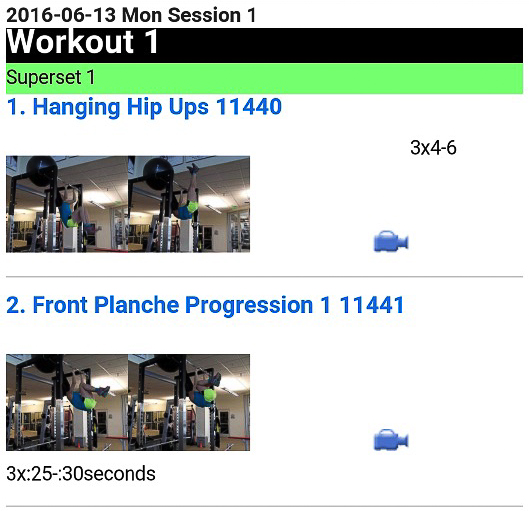
- Hanging Hip Ups 3 x 4-6
- Front Planche Progression 3 x 25-30 seconds
(Courtesy photo)
3. Hanging Hip Flexion 3 x 10-12
4. Varying Push Ups 2 x 3 push ups (varying push Up and hold) + 15-18 regular push ups, hold for time
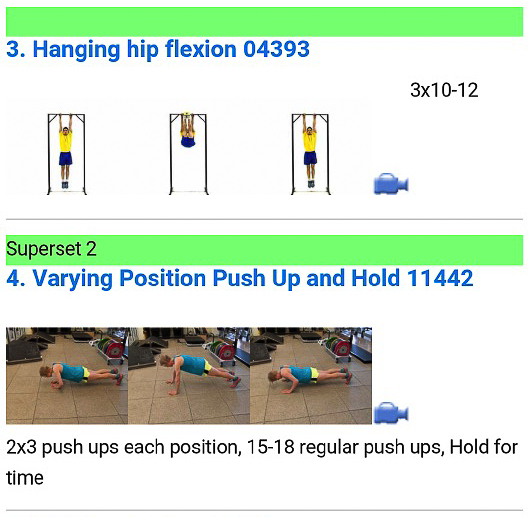
5. TRX Row Series 2 x 3 rows each grip, rows/flys / 1 x 4-6 decline or horizontal rows – last one is a hold for time
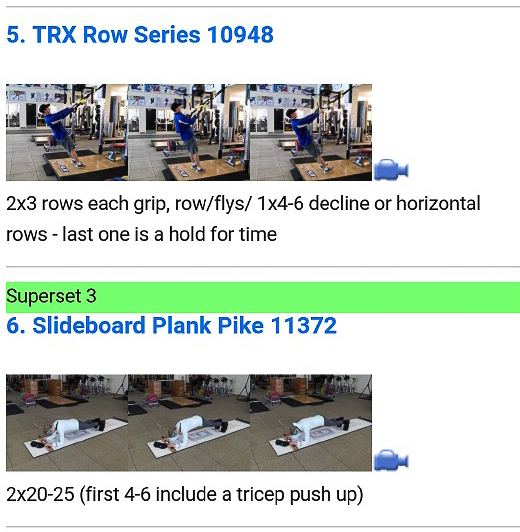
6. Slideboard Plank Pike 2 x 20-25 (first 4-6- include tricep push up)
7. Foam Roll Walkout

– Then it’s onto a morning-distance trail run: 3 hours at Level 1
– Followed by an afternoon/early evening-distance rollerski: Double pole for 2 hours at Level 1
Hoffman explained that his pace for the big five-hour days is controlled and at the slow end of the effort spectrum.
“Level 1. All the distance will be at Level 1, both the run and the double pole,” he said. “Which for me is 110 to 130 beats per minute running on mountain terrain. And average double poling, it’s 11 mph for me on my average speed. That’s all very arbitrary, I do enough Level 1 training that I know the paces by heart rate and by speed.”
If you are curious how the effort compares on his recovery days, here’s the details.
“I would say that the pace for those sessions should be lower,” he said. “It should be a recovery focused pace to play into the theme of the day. If anything it would be the low end of Level 1, although my Level 1 range is 110 to 130, and that’s a pretty big range … And the theme I have for the summer versus the winter is I train more in the summer than most of my teammates and less in the winter than most of my teammates. I really believe that for me it works well that the high stuff to be high and the low stuff to be low and that goes on a day to day basis, and on a seasonal basis.”
As with any athlete making jumps in their training hours, Hoffman is no different in terms of keeping things tempered and being mindful of the race season many months away.
To accrue his increased high-quality load, Hoffman will have fewer of what Caldwell calls “circuit breakers.” Ensuring that Hoffman is benefitting from his increased hours and not breaking down is one of Caldwell’s primary jobs.
“The big concern, without those circuit breakers if you will — I have always thought of those breaks as being a little bit like circuit breakers, an opportunity for some physical recovery and a shift of load,” Caldwell said. “The big challenge without those circuit breakers is to manage the accumulation of load, and to make sure he is benefiting from the training. And we are principally using Firstbeat Systems to do heart rate variability analysis of his overnight sleep recovery.”
Over the summer, Caldwell said he’ll focus on Hoffman’s longer-term recovery trends, which he’ll keep a close eye on after each of his two-week training blocks.
“Coming out of that we want to see evidence that over those two weeks he is putting up improved recovery scores from before,” he said. “It doesn’t happen to be any one test, we just want to see the the overall trajectory be positive at this time of year. As he gets closer to competition season, we want to see more of a daily response. We want to tighten the timeline on that recovery. But what we are not willing to do is do bank 12 weeks of training against the promise of some future response without seeing a response during that time frame. We are not doing it based on faith.”