From the FasterSkier archive — posts syndicated from athletes’ and coaches’ own blogs between 2004 and 2012, kept online as published. Current coverage is at fasterskier.com.
We’ve got extra-special Alaska-based guest Kikkan Randall joining us for this episode to recap the 2021/22 Tour de Ski. We break down a rough finish for a head cold-afflicted Jessie Diggins, some sensational skiing by Johannes Høsflot Klæbo, and some lingering questions about Olympic preparation.
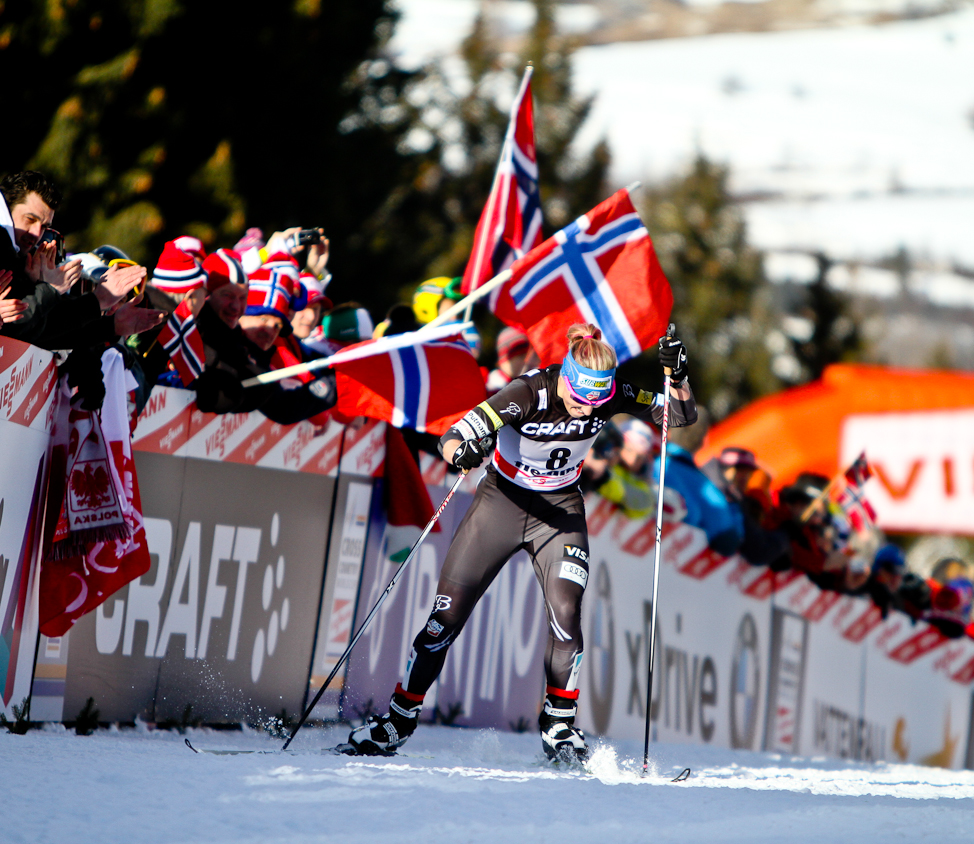
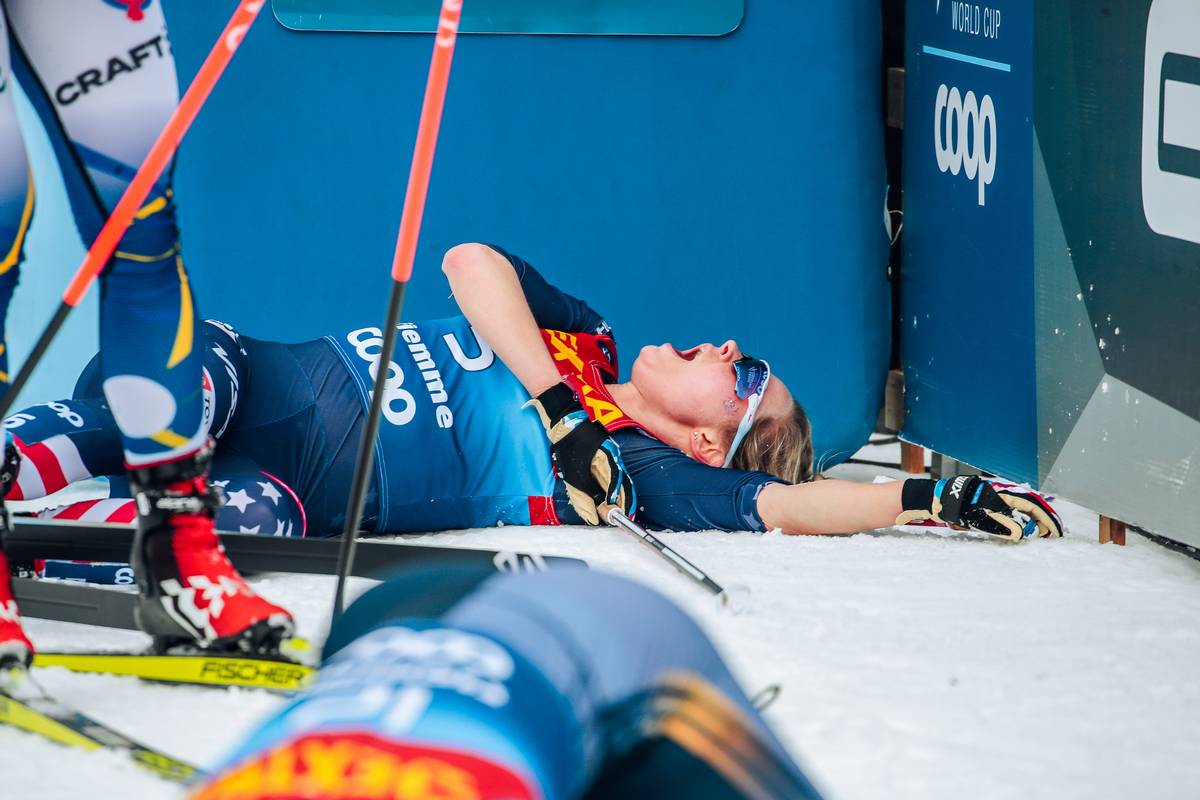
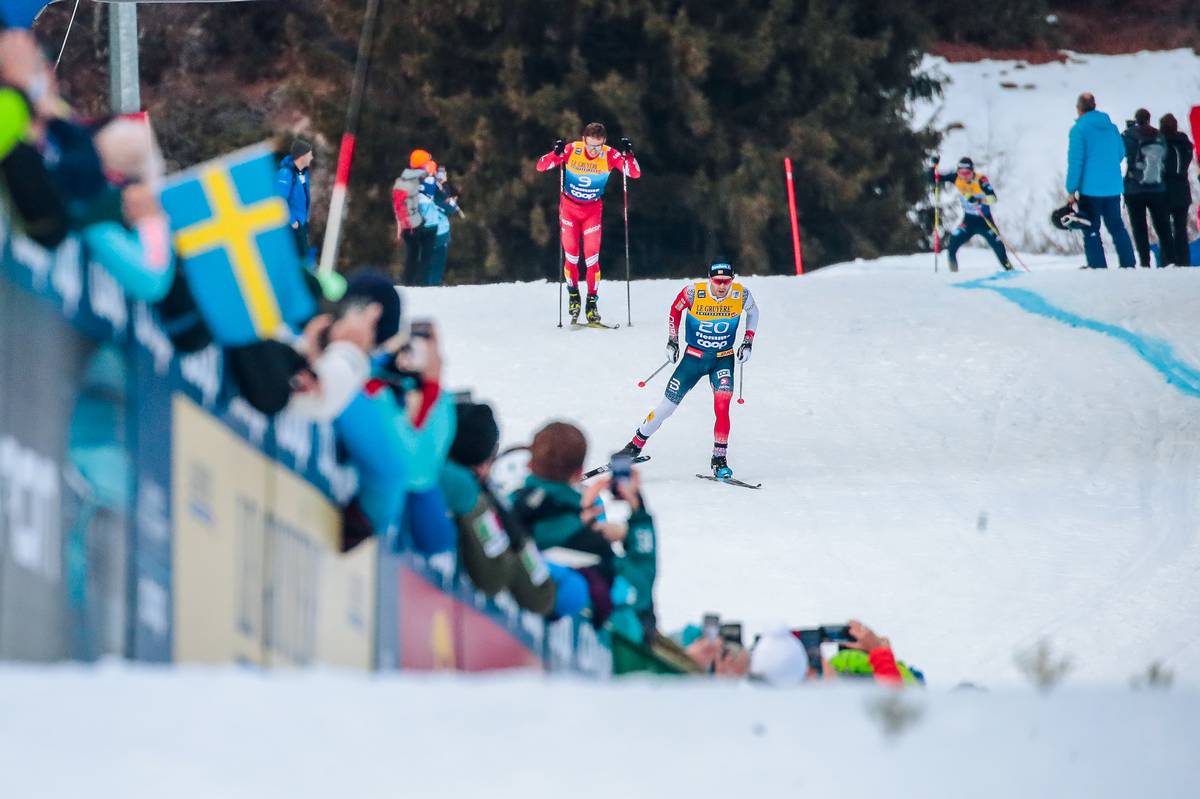
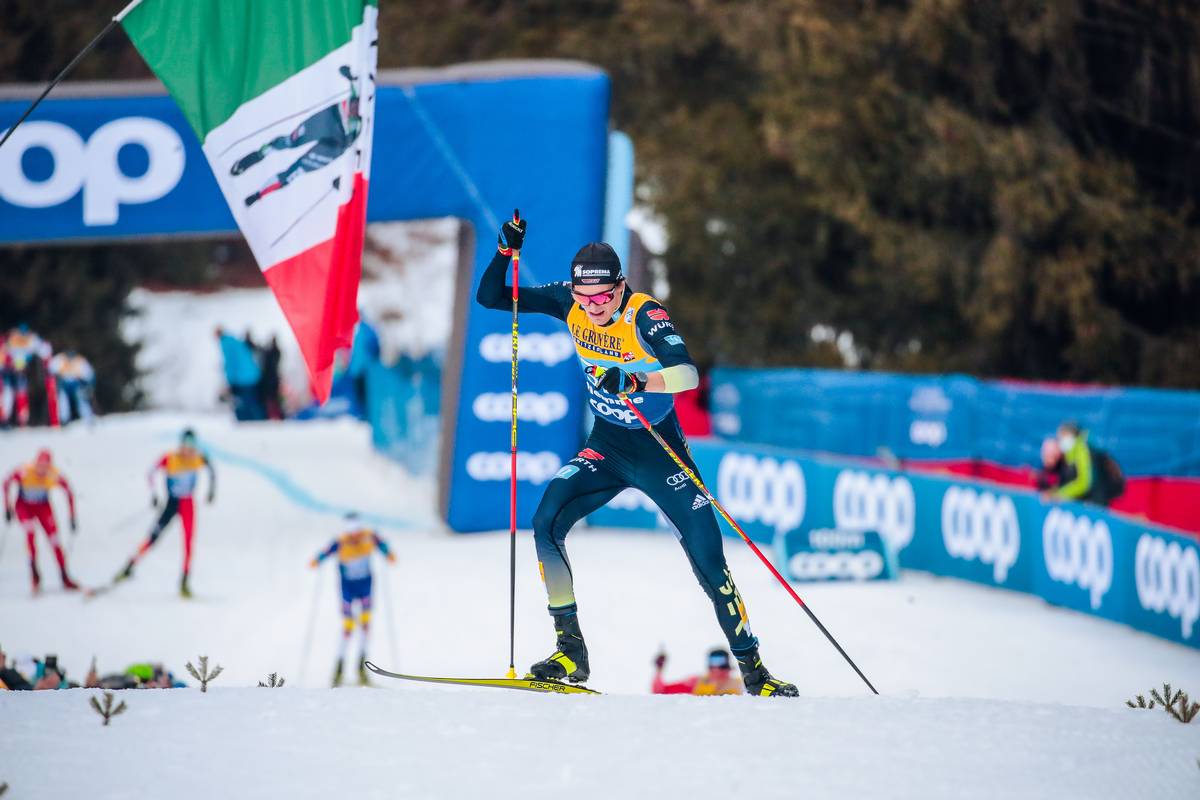
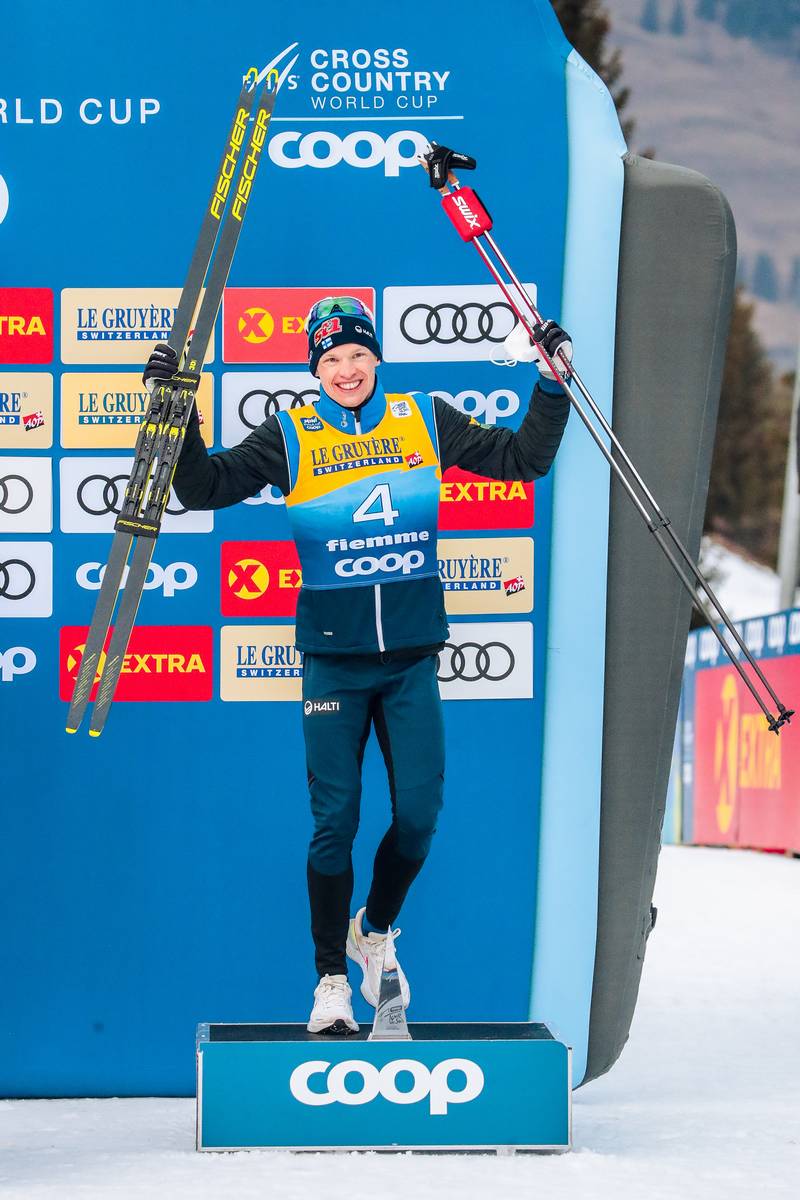
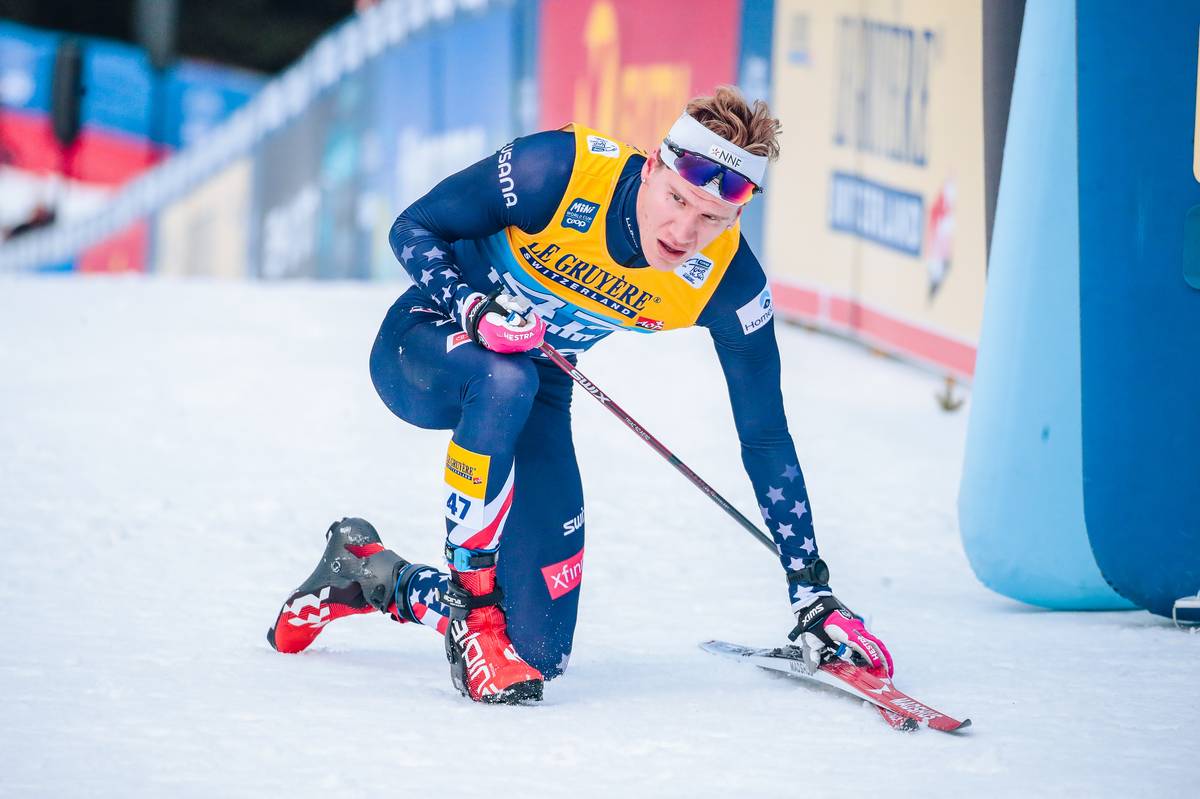
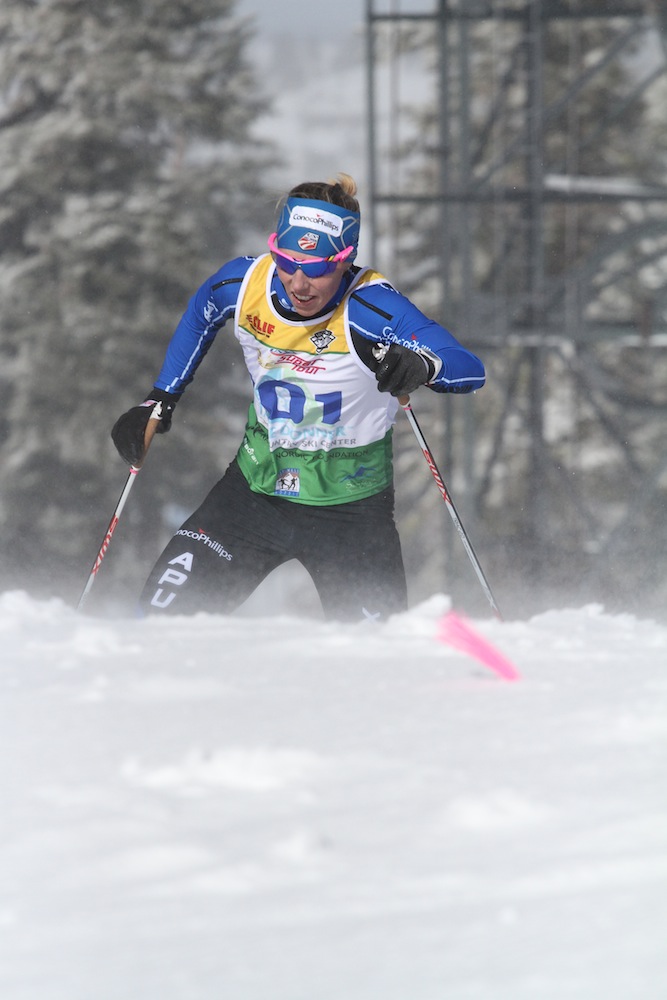
Kikkan Randall finishing the Tour de Ski’s final climb on Sunday. (Photo: FasterSkier archives)Jessie Diggins embodies the soul crushing, full body burning cumulative fatigue of the Tour de Ski following the final hill climb up the Alpe Cermis. (Photo: NordicFocus)
Hall and the A Hall Mark of Excellence Award. To learn more about A Hall Mark of Excellence Award or to learn how you can support FasterSkier’s coverage please contact info@fasterskier.com.
We began this year’s coverage of the Men’s Tour de Ski with a prelude from 5 time Tour de France champion Bernard Hinault. So let us begin this coda with him as well.
On the cycling classic Paris-Roubaix, “the hell of the north” – famous for its cobblestones, and the mud, blood, sweat, and tears they bring – Hinault said in 1981, “[It’s] bulls**t.” He had just won the race.
Johannes Høsflot Klæbo (NOR) may feel the same about a certain climb in Val di Fiemme, Italy he continues to find himself on year-after-year at the end of the Tour de Ski.
The profile of the point-to-point hill climb up the Alpe Cermis, the capstone of the Tour de Ski. (Photo: Screenshot 2022 FIS Broadcast)
Even among cross-country skiers and ski fans (admittedly, a Venn diagram that is nearly a singular circle), the final 10-kilometer stage of the Tour de Ski, and its roughly 3-kilometer, 28% gradient pitch-including climb up the Alpe Cermis, seems like a stupid proposition. We love skiing because it juxtaposes the brilliance and pure white benevolence of winter with the brutality, the pure push, the goddamn slog that fighting through it on a pair of skis can be. The Alpe – well – it piles onto the latter without balancing it with the former. We watch and look and say to ourselves why? But in piling on the pain, and the pure difficulty, the Alpe enters an uncanny valley as deep and awe-inspiring as its climb is high and mighty.
In short, why the Alpe? It’s masochistic, and it’s the most beautiful race in the world.
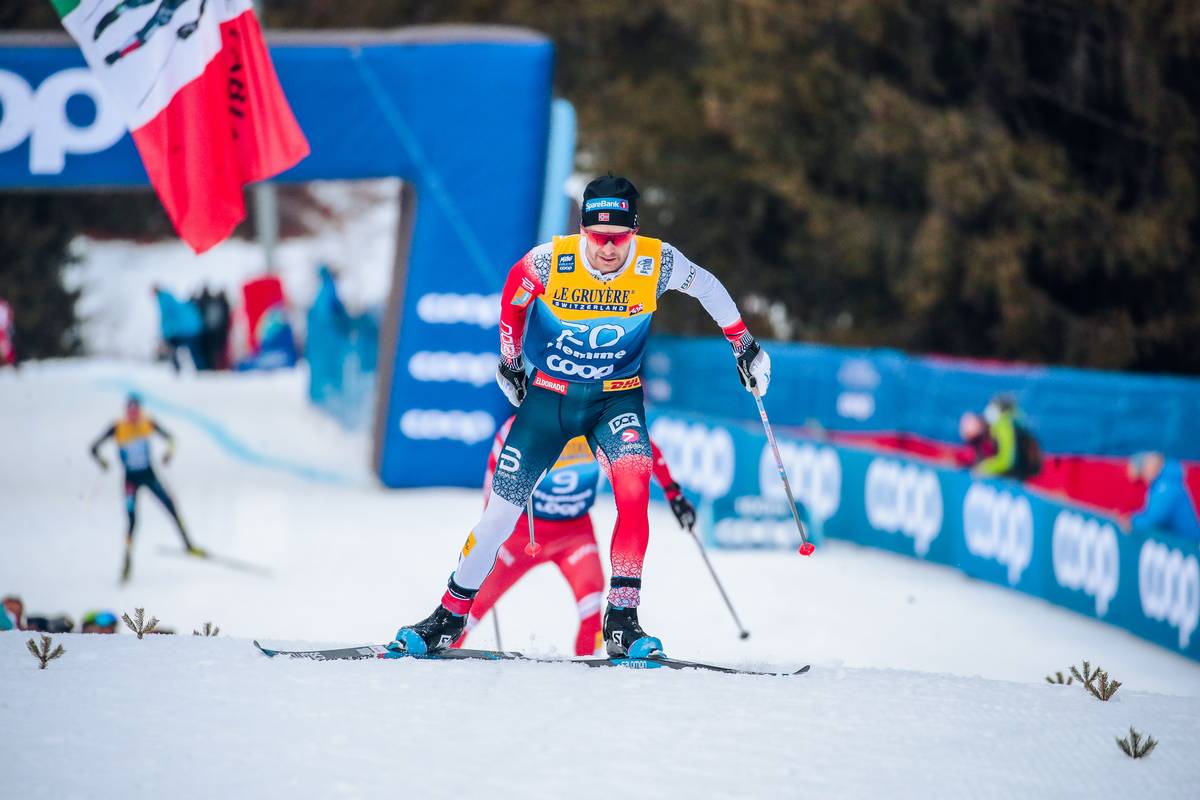
Johannes Høsflot Klæbo finished 5th in the Alpe Cermis hill climb to solidify his overall win in the 2021/22 Tour de Ski. (Photo: NordicFocus)
You don’t have to look any further than Klæbo’s history on the climb to tell you so. The Norwegian, with an opportunity to surpass none other than Bjørn Dæhlie himself for career Individual World Cup wins with a win in today’s stage (as it stood before the start, the two were tied at 46 apiece), has had both triumph and tribulation on the Alpe in previous editions of the Tour. In his first climb up the Alpe 2018/19, he came across the line in first after a pursuit start, becoming the youngest ever winner of the Tour de Ski. In his last climb up the Alpe in 2019/2020, he lost a one second advantage he carried into the day, consequently losing the Tour to Alexander Bolshunov (RUS).
This time around, his task was simpler. Instead of the 1 second advantage he had on Bolshunov in 19/20, he carried exactly two minutes over the Russian going into a mass start today. No need to be first to the top; all he would have to do was stick to the red suits of Alexander Bolshunov and his Russian teammates.
When the field, which remained compact throughout the approach, hit the bottom of the Alpe Cermis, Klæbo was doing exactly that. Alexey Chervotkin (RUS) had led the pack through most of the first six k, which followed the flow of the river valley, with his fellow countrymen Bolshunov, Ivan Yakimushkin (RUS), and Denis Spitsov (RUS) close behind. Also slotted within the field was the only American left to start today’s race, Zak Ketterson.
The animating move as the terrain kicked up, however, came from Iivo Niskanen (FIN), who went into the day in third place (+2:49) in the Tour standings, and was looking to maintain his place on the podium.
At the 7.5k checkpoint, Niskanen led a pack that resembled a cell in mitosis – stretched, but not yet split into packs with lives of their own. Less than a second behind him was a familiar sight, Sjur Røthe (NOR), who had previously won on the Alpe during his last ascent in 2019. Klæbo crossed the checkpoint in fifth place, with Bolshunov in sixth. Ketterson, meanwhile, was in the pack that followed – coming across in 26th place (+15.9).
Sjur Røthe takes the win in Stage 6 of the 2021/22 Tour de Ski. (Photo: NordicFocus)
The decisive pitch came shortly after the checkpoint. At a 26% section, Sjur Røthe’s attack was less a thrilling burst of energy than a confident crawl away from the pack. He created a gap, and looked to be set to face the last 1.6k of the climb alone.
That was, of course, until another face familiar to the Alpe slowly crawled out of the pack too. Last year’s hill climb winner, Denis Spitsov (RUS), skied up to Røthe , setting up a two-way battle that had, as Røthe didn’t race the Tour last year, been two years in the making.
The chase group that included Klæbo, Bolshunov, and Niskanen stayed together passed the 24% gradient. Niskanen, though, soon started to show signs that he was about to crack. When his V1 finally gave way to a coach’s skate, it was in one of the hairpins set-up to ease the gradient on the skiers. He brought, for a split second, the chase group to a complete pause. Bolshunov, who was the second skier behind Niskanen, was caught up for a moment, which allowed Klæbo to shoot to the outside and overtake both of them.
Niskanen faded, but Bolshunov now had to expend energy to stay up with Klæbo, who some 1.2k out from the finishing line was showing a resolve on the Alpe that he hadn’t in his previous ascents.
So it had broken into a race of sub-races. The lead group with Røthe and Spitsov, gunning for the stage win. The chase group, 20 seconds off, looking to decide the overall of this year’s Tour de Ski.
Sjur Røthe (NOR) leads in the final kilometer of the Stage 6 hill climb ahead of Denis Spitsov (RUS). (Photo: NordicFocus)
When the Alpe finally, impossibly, gave way to gradients that were in the single-digits, Røthe proved the Puncheur over Spitsov. His V1 gave way to a V2 that still somehow maintained some grace to it, and he came across the blue line painted in the snow at the top of the Alpe a champion again. Spitsov, not losing sight of the Røthe, crossed the line in second (+2.4).
The chase group meanwhile, was now being led by two skiers wearing suits not seen near the front of a Men’s World Cup so far this season. Indeed, it was two young Germans, Friedrich Moch and Lucas Bögl, who were pulling Klæbo and Bolshunov through the final moments of this year’s Tour. When the terrain gave way, Moch took it one step farther, gapping the field to claim his first individual World Cup podium in 3rd place (+18.9), and becoming the first German man to podium at a World Cup since Tim Tscharnke in 2015 (also in Val Di Fiemme).
Friedrich Moch (GER) climbs to third up the Alpe Cermis. (Photo: NordicFocus)
Then, 15 seconds later, the Tour was decided. Klæbo came in 5th place on the day (+34.9), gaining 3 seconds on Bolshunov who came in 8th (+38.1). Niskanen’s aggressive racing too, turned out to re-work the podium. He finished 12th on the stage (+1:00.4), maintaining his position for a third place overall finish in the Tour.
Iivo Niskanen (FIN) skiied his way to 3rd place overall in the Tour on the Hill Climb in Val Di Fiemme. (Photo: NordicFocus).
The final standings for this year’s Tour de Ski then: Johannes Høsflot Klæbo with the win (2:24:56.0), Alexander Bolshunov in second (+2:03.2), and Iivo Niskanen third (+3:14.5).
For Klæbo , it is his second overall Tour de Ski championship. He becomes only the 2nd Norwegian, after Martin Johnsrud Sundby, to win multiple Tours. He leaves tied with Bjørn Dæhlie on Individual World Cup stage wins. He also closes his most apparent weakness in the World Cup circuit, finishing 5th on the Alpe Cermis after previously never having breached the Top 10.
And yet, as he said in an interview with FIS media: Klæbo is “glad it’s over. It will be nice to get some days off now and rest for the Olympics.”
Johannes Hoesflot Klaebo (NOR) wins his 2nd Tour de Ski title (Photo: NordicFocus).
What lessons do we take from this year’s Tour de Ski then? While it has waxed and waned in importance and depth in championship seasons, it is a barometer by which we can see the history and the achievement of the sport’s greatest skiers. There are World Championships and World Cups, but the Tour is the Tour. As we head towards the sport’s biggest stage in Beijing next month, this edition reminds us that we are witnessing something one-of-a-kind in a Norwegian, still young at 25, that is poised to re-write any notion of what is possible in this sport: Johannes Høsflot Klæbo. Against the toughest and most glorious test in skiing on the Alpe Cermis, he has finally passed.
On his first climb up the Alpe, Zak Ketterson finished 48th (+3:01.3). He becomes the only American man to finish this year’s Tour de Ski, coming off the SuperTour in the U.S. to complete the sport’s most grueling test, and do so as his first World Cup starts no less. He finished 54th overall (+16:06.4).
Zak Ketterson finishes his first climb up the Alpe Cermis, rounding out his first World Cup starts at the 2021/22 Tour de Ski. (Photo: NordicFocus)
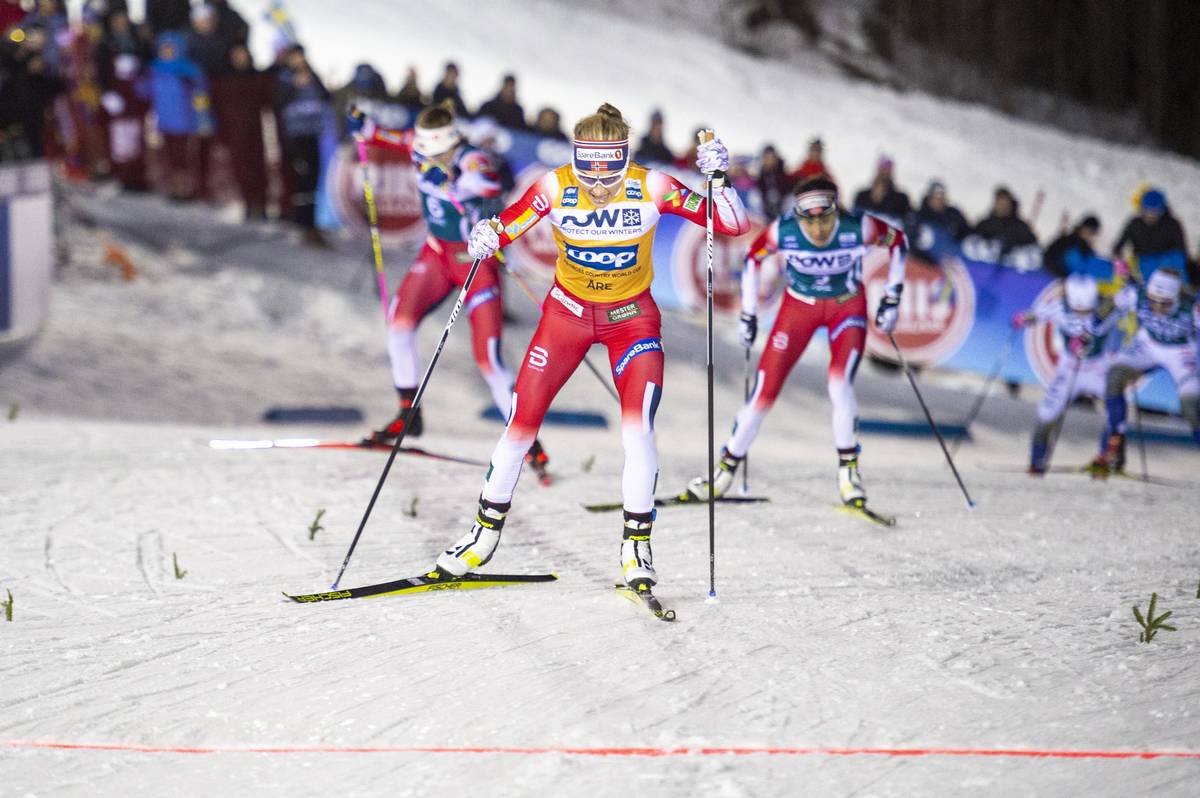
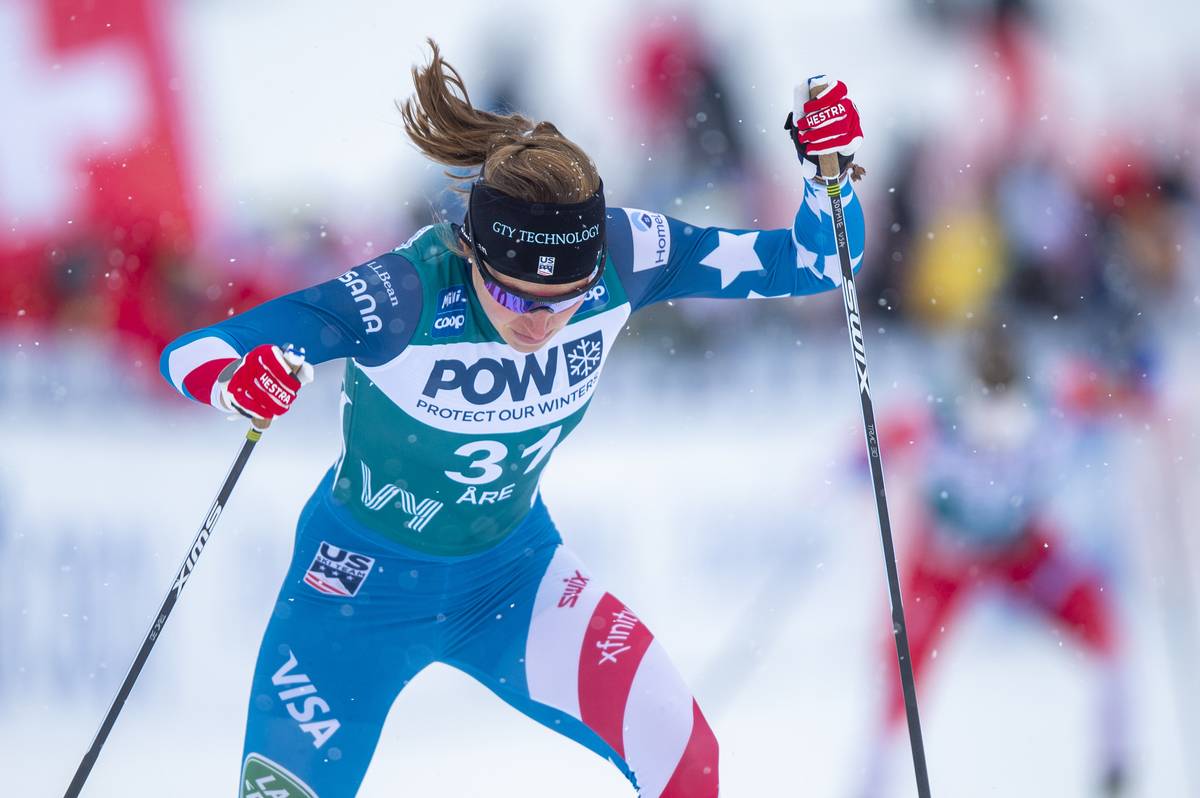
When Therese Johaug wins a sprint qualifier by 4.5 seconds and Sophie Caldwell qualifies in 23rd, you know it is not your average course. Held at the Swedish national alpine ski area in Åre, today’s event seemed to blend the infamous climb up the Alpe Cermis in the final stage of the Tour de Ski with skier cross on perhaps the shortest but toughest sprint on the World Cup.
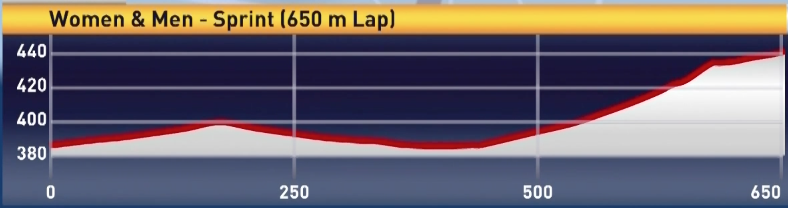
A gradual uphill start led skiers to a fast downhill into a swooping banked turn to the left. The course then ascends a pitch as steep as 28% up the base of the alpine hill, climbing nearly 60 meters within the final 200 meters of the course. Athletes would then need to walk back down to the start area.
The Åre sprint hill climb in profile. (Photo: Screenshot FIS Broadcast)
Though less than 700 meters in total length, nearly half the usual distance, the course took the women roughly two and a half minutes, on par with a usual sprint time.
The event drew a roaring crowd, with fans lining the course, their yells and gaps echoing as athlete’s skied by. After the race, Matt Whitcomb recognized the event organizers for putting together a unique stage and drawing so many energetic spectators.
Post-race comments from Matt Whitcomb.
With Johaug at the top of the qualification list were Heidi Weng (NOR), Greta Laurent (ITA), Linn Svahn (SWE), and Laura Mononen (FIN), the most diversity in nations among the top five in the tour so far. This result also added mystery and excitement as it could be anyone’s game. Weng is a top distance skier, Laurent and Svahn are most recognized for their sprint performances, and Mononen normally hovers on the border of the top-30 FIS point scorers list, a relative unknown.
Rosie Brennan climbs to the top American result in qualification during the Stage 3 “sprint”. (Photo: NordicFocus)
Rosie Brennan was the top American qualifier in 14th, followed by Jessie Diggins in 17th, Julia Kern in 18th, Sadie Maubet Bjornsen in 21st, and Caldwell in 23rd.
Racing in the second wave of the quarterfinal, Diggins and Brennan took the pace out hot, trying to create a gap over the two top qualifiers, Johaug and Weng. Diggins led the way over the gradual climb and into the downhill, fearlessly flying into the banked turn with high speed. Riding up the berm to the outer lip of the curve, Diggins stayed in control, though only just.
Brennan and Diggins were still in the lead beginning the hill climb, but the two high-tempo Norwegians were gaining quickly. Weng and Johaug overtook the Americans midway up the climb, but Diggins did not let them get away. Maintaining contact, she crossed the line within 1.5 seconds of the Norwegians and advanced as lucky loser, her early effort to push the pace making it the fastest of the five heats.
Diggins attacks the hill climb during the Stage 4 sprint in Åre, Sweden. (Photo: NordicFocus)
Brennan fell back to fifth in the heat and did not advance. She ended her day in 22nd.
Maubet Bjornsen and Kern raced in the fourth heat, finishing fourth and sixth, respectively. Maubet Bjornsen’s final rank was 20th.
At the start of the last quarterfinal round, Caldwell skied off the front, navigating the banked turn with ease and picking up momentum as she approached the base of the hill in V2. Caldwell stayed near the front through the climb, her technique smooth and controlled. As the course curved and leveled to the finish, it was Mononen and Caldwell at the front. They crossed the line together, immediately folding with hands on their knees in anguish.
If this is what the finish of the quarters looks like, what will happen as the deep burn of cumulative fatigue starts to sink in?
In the semis, Diggins faced off again with Johaug and Weng. Rather than flying off the front, Diggins sat in the middle of the pack over the first climb, hooking 180 degrees left and dropping into a tuck heading into the banked downhill.
Johaug was last into this turn and last to the base of the climb, but she was far from out of the race. Jump skating up the left side of the course, Johaug rocketed from the back of the pack to the lead, edging out Weng to win the round.
Diggins fell off the pack at the base of the climb and finished last in the heat, and 11th for the day.
Relaxed, smooth, collected, per usual, Caldwell rounded the banked turn in second and was in the mix at the base of the climb. Then it was over.
At the front, Svahn, Astrid Urenholdt Jacobsen (NOR), Laurent, and Mononen stepped powerfully up the climb. In the final meters, Svahn was at the front with Laurent close on her tails looking like a lock for second, until a last second surge by Jacobsen snuck her just ahead of the Italian at the line. As the heat was slower than the first, only Svahn and Jacobsen advanced.
After falling off the pack, Caldwell took last in the heat and ended the day in 12th.
Breaking down the lineup in the final, you’ve got two pure distance skiers with a history of outstanding results in the TdS hill climb, Johaug and Weng, alongside their teammate, Jacobsen, an all-arounder skewed toward distance. These three women paired with three sprinters, Svahn, Jonna Sundling (SWE), and Nadine Faehndrich (CHE). A World Cup cocktail.
The Swedes took the lead at the start of the final, shooting around the banked curve and into the climb. Johaug, again, the last to the base of the hill.
As the grade increased, Weng and Jacobsen accelerated up the right side of the course, while Johaug repeated her uphill attack as she weaved through the other women to the front. The Norwegians skied three abreast as they passed under the Audi e-tron arch toward the steepest pitch, shortly before the finish.
Therese Johaug leads Heidi Weng and Astrid Urenholdt Jacobsen through the final meters of the sprint hill climb. (Photo: NordicFocus)
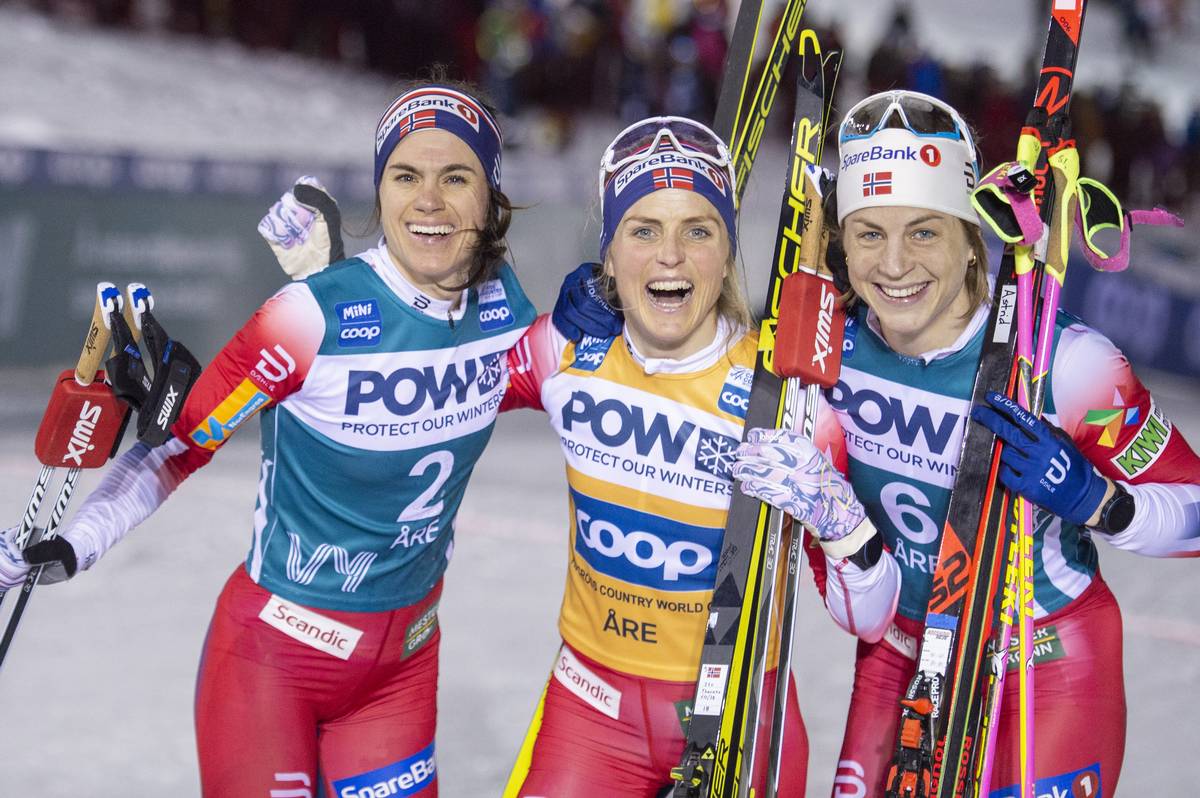
Increasing her tempo and beginning to jump skate, Johaug rounded the final bend in the lead with the win locked up. Her teammates, Weng then Jacobsen, crossing behind her in second and third, respectively.
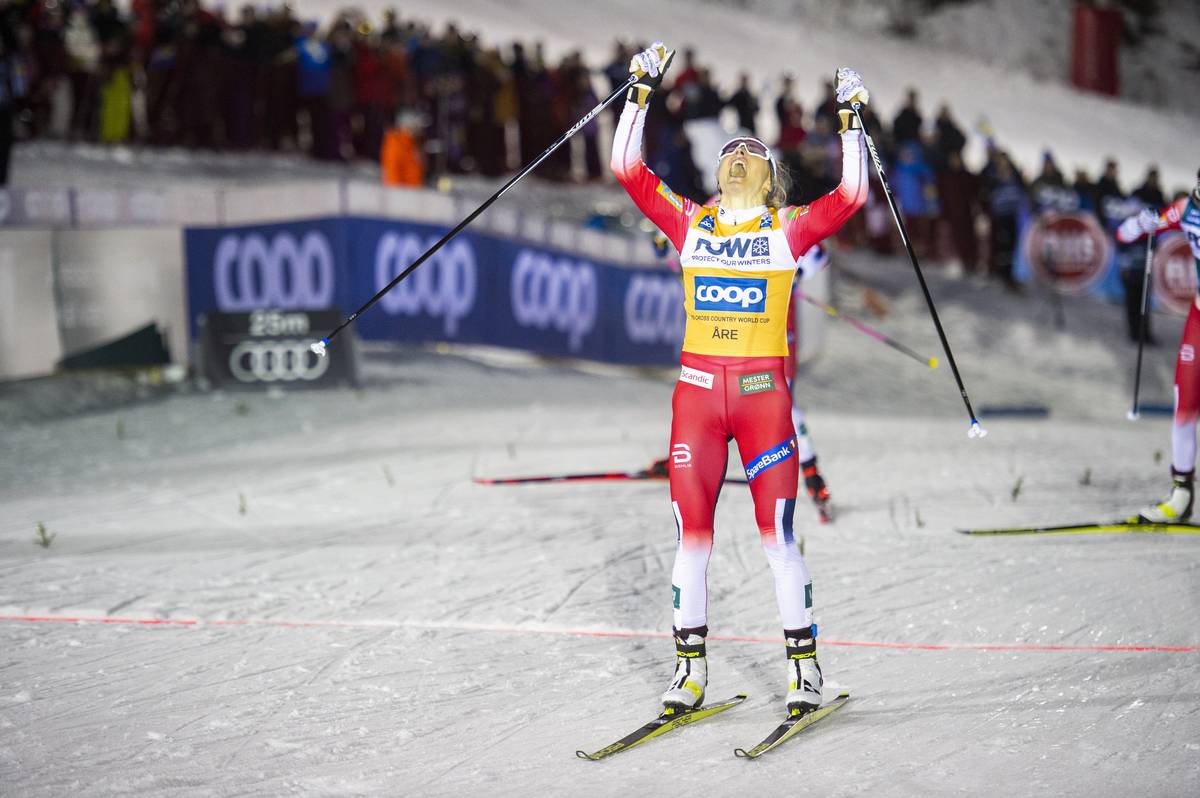
As the other wobbly-legged women collapsed, writhing in agony with faces turned toward the snow, Johaug raised her arms in celebration, her lungs still functional enough to let out a loud yell. She looked as though she had just completed a particularly successful interval session, a much different appearance than the others.
Therese Johaug takes Stage 3 of the FIS Ski Tour 2020. (Photo: NordicFocus)
“It was a crazy race,” smiled Johaug as she spoke with FIS at the finish. “But, as you know, I love uphills, and today as well was my day. Of course, you cannot call it a sprint race, but for me, it means a lot to stand atop the podium and I worked really hard for that, so I’m really happy.”
The third straight all-Norwegian women’s podium of the FIS Ski Tour 2020. (Photo: NordicFocus)
Commenting on the event in a post-race email, Caldwell wrote:
“Today was a very different kind of sprint. I wasn’t sure what to expect, but when we checked out the course yesterday, I was pretty shocked that we were literally going up an alpine hill! I had never done anything like this because and I know I have the potential to flood, so I wanted to make sure I did some pacing for my qualifier. It didn’t end up being a ripping fast qualifier, but it was good enough and I was honestly psyched to qualify on a course like this that doesn’t exactly play to my strengths.
“In my quarter I tried to get out fast and ski the technical corner how I wanted to and then I just focused on finding the faster snow and leaving a little left for the end. I was really happy with how my quarter went and on a course like this, making the semi final is a really good day for me. I also left everything I had in my legs on the course, so unfortunately in my semi final, even though I didn’t feel like I was breathing very hard, my legs weren’t exactly moving. So that was pretty different from a normal sprint where I usually feel like I can keep pretty good legs and energy through the final. Now it’s time for some recovery before the next stage!”
Head down and grinding, Sophie Caldwell skis to 12th place in Åre. (Photo: NordicFocus)
Outside the heats, Alayna Sonnesyn skied to 42nd (+17.24) in the qualifier, followed closely by Hailey Swirbul in 43rd (+17.31). Caitlin Patterson finished 46th (+19.76), Rosie Frankowski 56th (+23.55), and Katherine Ogden 59th (+27.58).
Racing for Canada, Katherine-Stewart Jones was the top qualifier in 34th (+15.56), followed by Cendrine Brown in 45th (+18.88), and Emily Nishikawa in 49th (+20.04).
In a post-race call, Whitcomb provided further insight into the women’s day, expressing that the his athletes were “quite positive” about the result, but impressed by the difference in feelings between qualification and the quarterfinal.
Whitcomb also explains that because of impending weather, the planned 38-kilometer point to point race across the Sweden-Norway from Storlein to Meråker may not be possible. The backup plan is a 15 k race for both men and women on an approximately 3 k loop in Meråker.
Jake Brown (Craftsbury Green Racing Project/US Biathlon) racing to a sizable win at the 2018 Climb to the Castle on Saturday, Sept. 15 in Wilmington, N.Y. (Photo: Heloise Rolland)
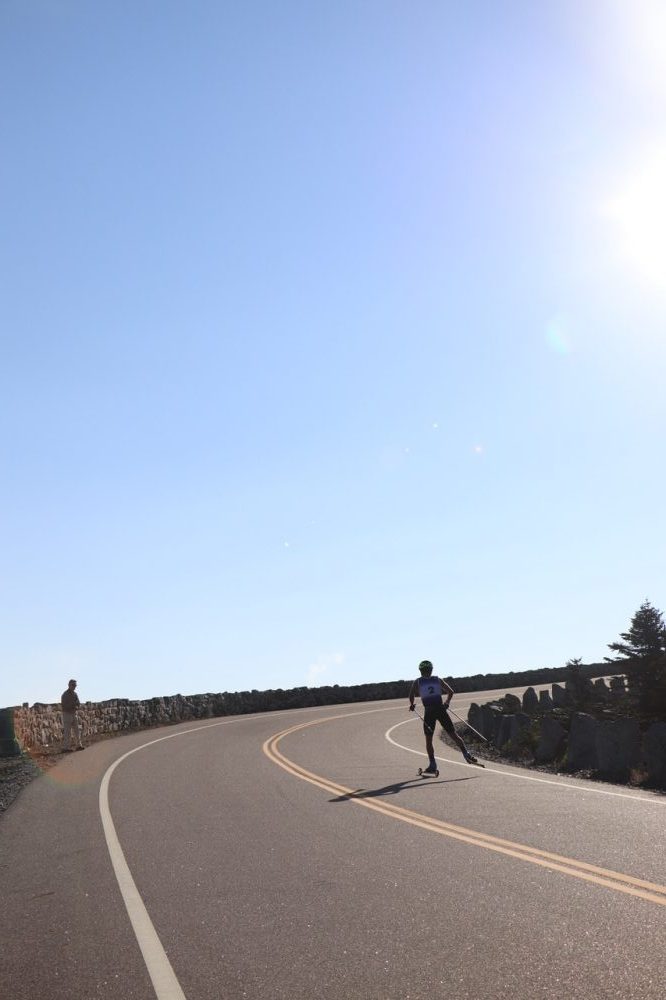
On a humid fall Sunday in northern New York where temperatures reached an uncharacteristic 80 degrees, Jake Brown of the Craftsbury Green Racing Project and US Biathlon Development Team and Tara Geraghty-Moats of USA Nordic won the 2018 Climb to the Castle.
Brown’s time was 35:40.7, while Geraghty-Moats finished in 45:03.
Big Gaps and Clear Wins
On the men’s side, Brown’s Craftsbury teammate Raleigh Goessling finished second in 38:16.6, and Erikson Moore of the Fondeurs-Laurentides team in Quebec was third in 39:00.3.
Among women, Jackie Garso of Saint Lawrence University was second, in 49:24.1, and Nakkertok’s Zoe Williams third in 49:40.6.
This year was a high water mark for attendance, with 102 athletes finishing.
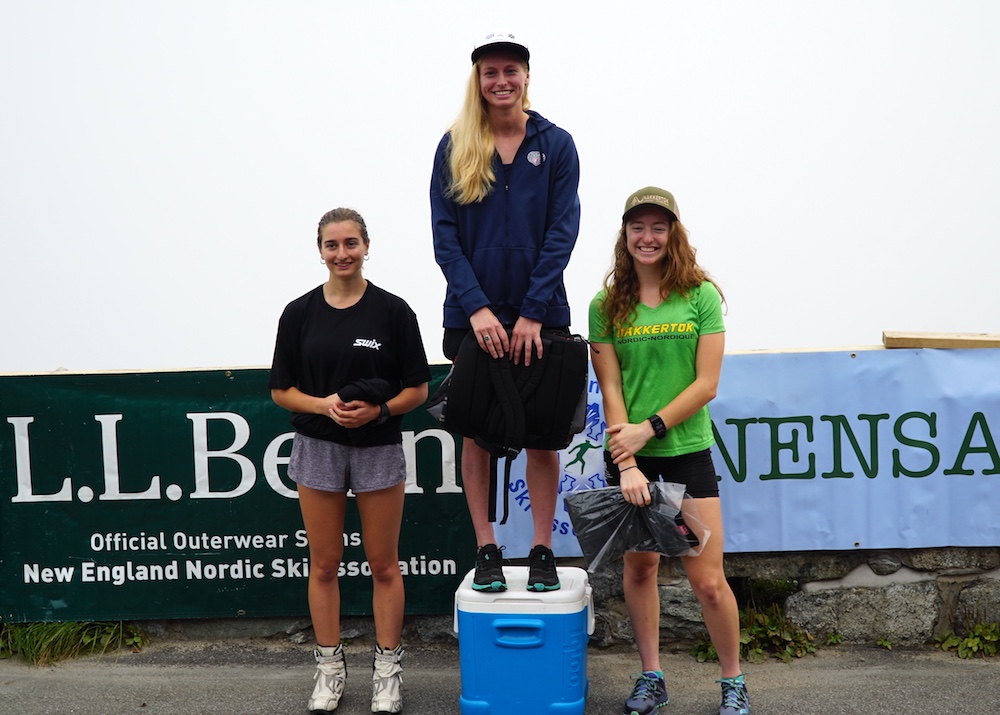
The overall women’s podium at the 2018 Climb to the Castle at the top of Whiteface on Sept. 15 in Wilmington, N.Y., with winner Tara Geraghty-Moats (c) of USA Nordic, Jackie Garso (l) of St. Lawrence University in second, and Zoe Williams (r) of Nakkertok in third. (Photo: Colin Delaney)
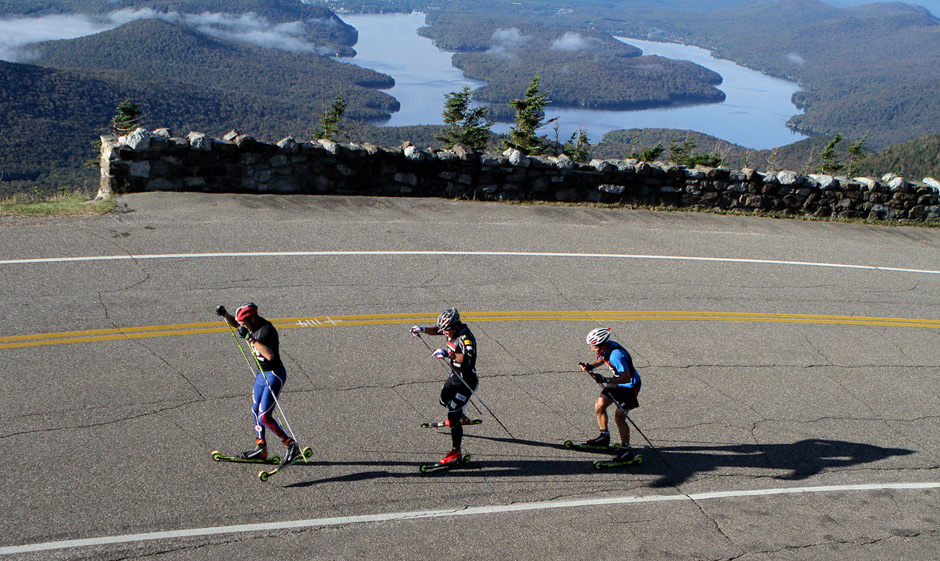
While a few degrees cooler than last year, dank humidity settled like a blanket over the five-mile climb, with athletes moving through a couple of patches of dense fog on the higher reaches of the mountain.
“It was a hard one today,” Brown said following the race. “Last year, I felt like I went a little too hard off the line, and kind of buried myself early. So I wanted to be a little more conservative and finish strong today. I tried doing that and it felt a lot better, and I skied a little faster. I was on different rollerskis, so it’s hard to be able to compare it to last year. I was happy with my effort and it was a good push today.”
This year was Brown’s second consecutive win, and he beat his 2017 time of 39:01.9.
“It’s always a tough race, but I’m happy with how my summer training has paid off,” Geraghty-Moats said. “I felt strong and I had a good race.”
Asked if the race was part of her training plan, she replied, “I just finished competing in the Ski Jumping Grand Prix in Russia, so I’m still pretty jet-lagged. I love this race, NYSEF puts a lot of energy into putting it on every year, so I figured I’d make the trip over. It’s really fun and I enjoy racing with a good crew.”
A ski jumper winning a cross-country ski competition? For those not in the know, Geraghty-Moats is one of the pioneers of the developing women’s nordic combined.
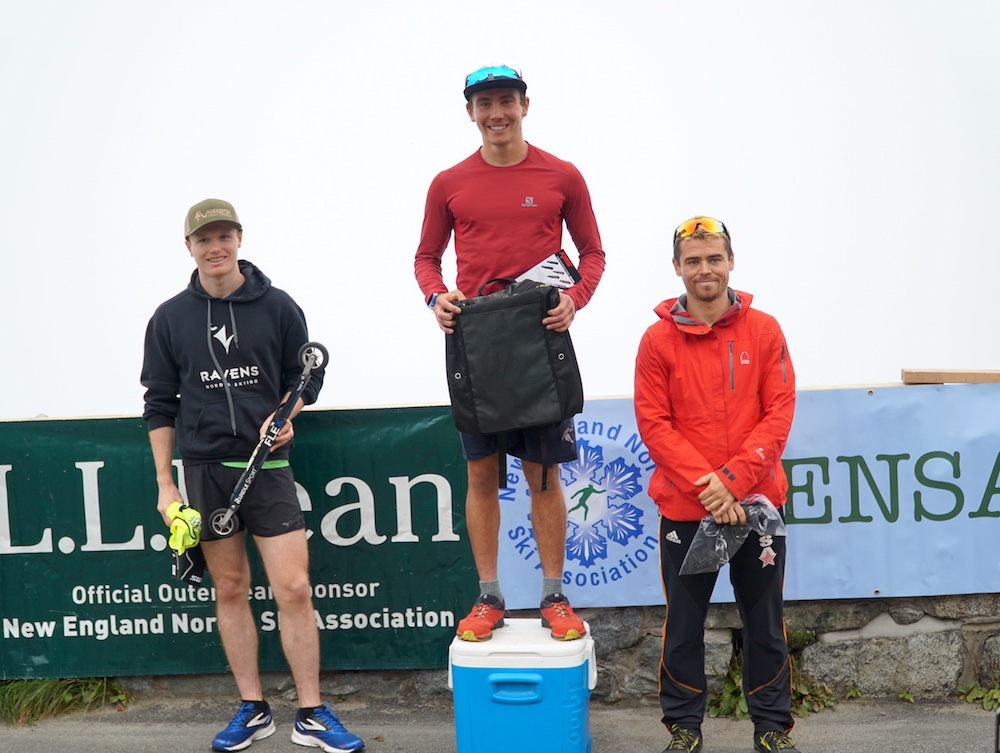
The overall men’s podium at the 2018 Climb to the Castle at the top of Whiteface on Sept. 15 in Wilmington, N.Y., with winner Jake Brown (c) of the Craftsbury Green Racing Project (CGRP)/USBA Development Team in first, Raleigh Goessling (r) of the CGRP in second, and Erikson Moore (l) of Fondeurs-Laurentides in third. (Photo: Colin Delaney)
“I’m on the women’s ski jumping team and I’ve been to a World Championship in 2015 and on the World Cup team for the past 4 years,” she explained. “Before that, I was a biathlete, so nordic combined was sort of a natural step for me. FIS has put in a lot of resources to developing women’s nordic combined. This year, they’ll have a Continental Cup circuit; next year, there’ll be a World Cup circuit; and the following year after that, there’ll be a World Championship. I’m starting to learn how to compete in nordic combined and I’m really enjoying it.”
Zoe Williams, along about 60 other athletes, had participated in the previous day’s Doubleday events at the Intervale Ski Jump. (for more on the Doubleday, keep reading!)
“I felt a bit tired in my warmup,” Williams said. “By the time I got to the start line and the race started, I didn’t feel as bad as I could have. My legs for sure felt tired in the first kilometer, but after the first k, I started settling into that rhythm and I ended up feeling pretty good for the rest of the race. Climb to the Castle, you just have to find that gear and grind away.”
In 2017 she was fourth overall, five seconds behind biathlete Deedra Irwin.
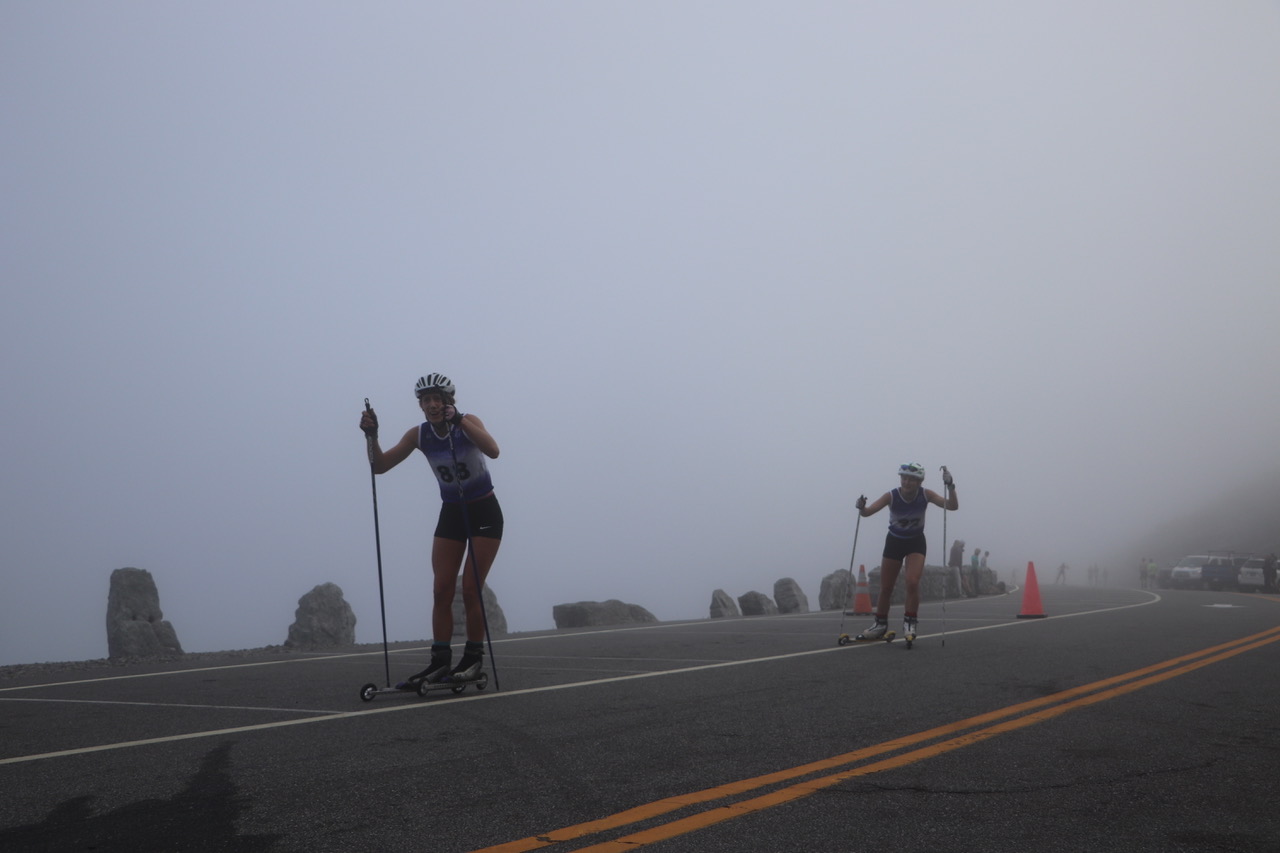
Meredith Stetter (88) leads her Mansfield Nordic Club teammate Jennifer Wilbraham during a foggy Climb to the Castle rollerski race on Sept. 15 in Wilmington, N.Y. They finished 19th and 20th, respectively. (Photo: Heloise Rolland)
“This year, I ended up leading the group that I was with, which was kind of a fun change,” Williams said. “But the whole time I was thinking ‘what did Deedra do here? We one-skated [V2’ed] here. I can one-skate here!’”
Asked if Climb to the Castle was a good fitness benchmark, Williams said, “Because the next couple of months are where you start getting the really high intensity zone four, this is a really good indicator of the base level fitness that you have, because of the endurance focus of the race. But I’m for sure looking to find my top end gear in the next couple of months.”
Doubleday Takes Off: New Events Added to the Climb to the Castle weekend
On Saturday, the New England Nordic Ski Association (NENSA) and the New York Ski Education Foundation (NYSEF) collaborated on a new event held on the rollerski loop at the Intervale Ski jumps.
Quincy Massey-Bierman won the junior women’s 3 k prologue. (Photo: Heloise Rolland)
The Lake Placid Doubleday started with a three-kilometer prologue; after a break, there was a 1.5 kilometer sprint time trial. The results of the two races were aggregated to determine winners.
Nicholas Clifford of Carleton University in Ottawa, Ontario, was the open men’s winner, while Nakkertok’s Williams was the open women’s winner before going on to be the runner-up in the Climb to the Castle.
“We’ve had the Climb to the Castle for 11 years, and this year we wanted to expand it to a full weekend,” NYSEF head coach Shane McDowell said. “We started talking with Justin [Beckwith, NENSA Competitive Program Director] ] in the spring and he proposed the idea of trying [NENSA’s] new format of the doubleday, which will be used at the Eastern Cup scheduled for 23 February at the Dublin School.”
“The format came out of discussions this spring,” Beckwith said. “Three kilometers is a national junior relay distance and we were valuing shorter, sprinting efforts in the results because we were usually a little heavy on the distance qualifications for our Junior National team in New England. When partnering with Shane and ORDA [the Olympic Regional Development Authority] to make it a reality, for us to test out the event which has a physiological effect of doing the 3k prologue in the morning and do a prelim in the sprint, the 1.5, would be the timing of a typical quarter final.”
The roller ski loop at Intervale is serpentine and narrow, with fast downhills. In the pre-race meeting, Beckwith admonished the athletes to be conservative as they warmed up. As they warmed up, the rollerskiers gradually became more aggressive in their approach to the course.
Taking a corner on the Intervale Ski Jump loop during Doubleday. (Photo: Heloise Rolland)
The race started and finished at the biathlon range located midway through the long climb from the lowest to the highest sections of the course.
Clifford is the coach of the Carleton University ski team, located in Ottawa, Ontario.
“It was really exciting,” he said. “It was the first time I’ve skied at [Intervale]. I’ve heard a lot about some of the sketchier downhills but it was actually really well done. It was just like ski racing.”
Asked how he planned his races, Clifford said, “Not so much. I’m not a shorter distance guy, so the Climb to the Castle tomorrow is the real show and this was just a bit of a tuneup to get some speed in the legs.”
Of the Doubleday format, the consensus was that it was tough.
“The course here… It’s pretty much straight up and then you go down and come back up,” CSU’s Alex Burt said. “For the 3 k, you do it twice. It’s a lot more brutal. I had to actually pace it. For the1.5 k, my strategy was to go out as hard as I can and just keep it up.”
But it was also fun, many participants agreed.
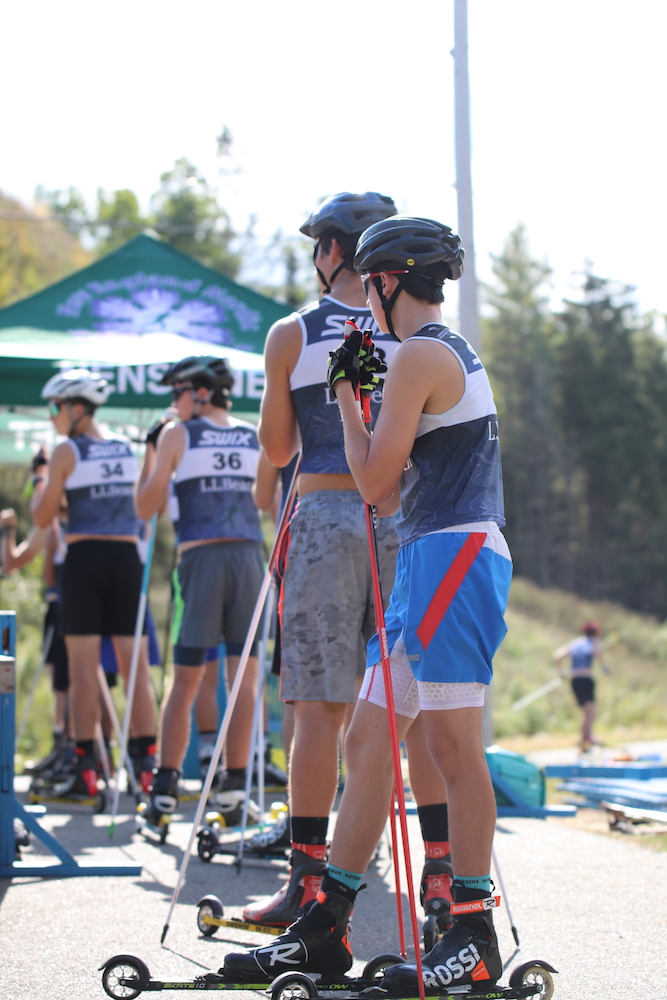
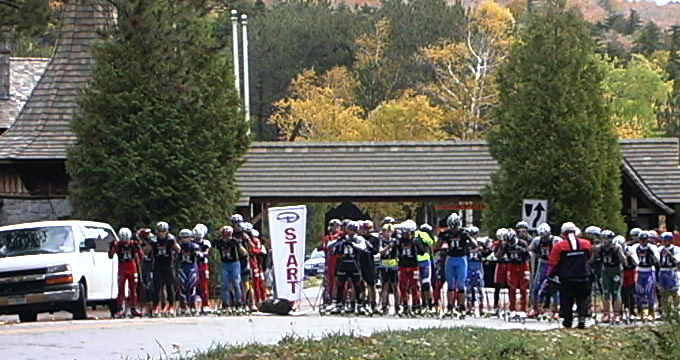
Racers lined up at the start for a Doubleday competition. (Photo: Heloise Rolland)
“It was fun,” said Williams of the Doubleday. “The course here was super awesome, because it was like actually skiing, whereas a lot of roller ski races are on roads. It’s so twisty and turns up and down, it’s a lot like actually ski racing.”
On getting used to the downhills, Williams said, “It took me through mid warm up, to get used to the corners. In the race itself, I didn’t even think about it. It was super nice. I worried about it in the warmup, because there are some really gnarly corners, but when you’re racing, all your focus is on going fast.”
Amy Duclos of Saint Michael’s College in Burlington VT, was the third overall female finisher at the Doubleday.
“I wasn’t really sure about the course going into it, because of the turns, the hills, but it was a lot of fun,” she said. “I thought today was a good warmup to get the legs moving for tomorrow. It’s definitely a different type of race.”
Laura Appleby, of Cambridge Sports Union (CSU), won the junior women’s division at Doubleday and was the fifth junior woman finisher at Climb to the Castle.
“They went really well,” she said of the Doubleday races. “It was super fun. I liked the downhills… The first race was a little bit longer, so I was definitely pacing it a little bit slower. But generally just go out and ski the course, ski the transitions.”
Shilo Rousseau, Chandra Rousseau, and Zoe Pekos, all of Barrie [Ontario] Cross-Country, sat for an interview in a downtown Lake Placid coffee shop following the Doubleday.
“It was a little scary at first with the safety meeting,” said Shilo, who finished third junior woman both at the Doubleday and C2C. “After skiing the lap a few times, you realize it’s not that bad. As you go on, your laps get faster. You really have commit on roller skis.”
Did she save energy for the C2C?
“Full send every day,” Shilo replied. “I’m not leaving anything in the tank.”
Chandra Rousseau said, “The last downhill was bad. The prologue wasn’t as good as I wanted it to be. I probably could have pushed a little harder on the downhills. On the sprint, I was more used to the course.”
Recovering in a bench outside the Castle, a reporter asked the Rousseaus and Pekos, so, did you go full send?
Bryan Fletcher, seen here at 2016 U.S. Ski Jumping and Nordic Combined Large Hill Championships in Park City, Utah, isn’t all about the downhills. One of his favorite workouts is a “good-old-fashioned hill climb.” (Photo: USSA/Tyler Tate/T Squared Action Sports)
When Bryan Fletcher retired from the Nordic Combined World Cup this spring, FasterSkier asked the national-team veteran and two-time Olympian for a workout that is sure to stand the test of time. Here’s what he had to say.
***
After 11 years on U.S. Nordic Combined’s national team, it’s no wonder many of Bryan Fletcher’s most recent teammates viewed him as the ‘Team Dad’. Along with being an actual father — he has a daughter named Ellery who will be 2 in August — he’s dedicated close to 25 years of his life to NoCo. Food for thought: the average age of his teammates at this year’s Winter Olympics was 23.
So when Fletcher announced that, at age 31, he would be retiring from NoCo this spring, FasterSkier reached out to the veteran for a tried-and-true workout. Fletcher’s response was simple. For him, nothing beats a “good-old-fashioned hill climb.” The experienced skier’s most savvy advice? Take the gondola back down.
“Downhills can be pretty abusive on the knees and your back,” Fletcher explained on the phone. “[This workout] is super-easy way to get long hours in or a good intensity session in, without putting a huge load on the lower body.”
Fletcher’s other favorite part about the workout is its versatility and adaptability (two words all parents should know).
It can be a long, easy distance workout or an interval one depending on the effort you choose to climb back up. For an easy workout, hike up at a Level 1 effort and take the gondola back down. For an intensity session, hike/bound up at a Level 3 effort and take the gondola back down.
“I chose this workout because I think it’s well-suited to all nordic athletes,” Fletcher said. “It really has a little bit of everything that a nordic athlete should be focusing on in terms of their endurance and also their hiking and bounding abilities.”
The Workout: Easy Endurance or Level 3/Steady State Intensity
Terrain: Alpine hill (preferably with a Gondola to ride down)
Warmup: 15-20 minutes easy
If doing intensity, Fletcher recommends at least one “pickup” at a steady state pace during the warmup time. “Nothing too long,” he said. “Just enough to get the muscles warm and the legs moving and to get that speed in the legs a little bit.”
Set:If doing easy distance, hike up with poles at a Level 1 effort. If doing intensity, Fletcher recommends doing 4 x 15 minutes at threshold and taking 5 minutes in between.
Cool down:15-20 minutes
Total time: 120-130 minutes
Fletcher’s Top-Two Tips
Wear the water belt. “They’re not going to have rest stations along the way so you’ve got to stay hydrated and it will be super-refreshing on your ride down.”
Take stake in the scenery. “The best way to keep this fun is to enjoy the hike and the nature that you’re in.”
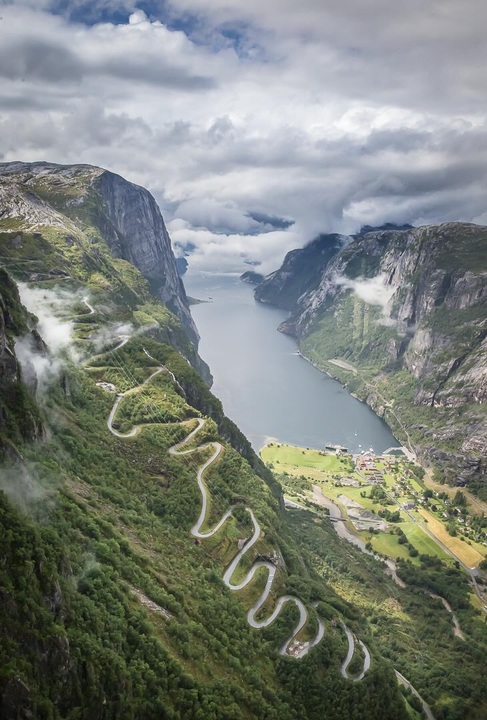
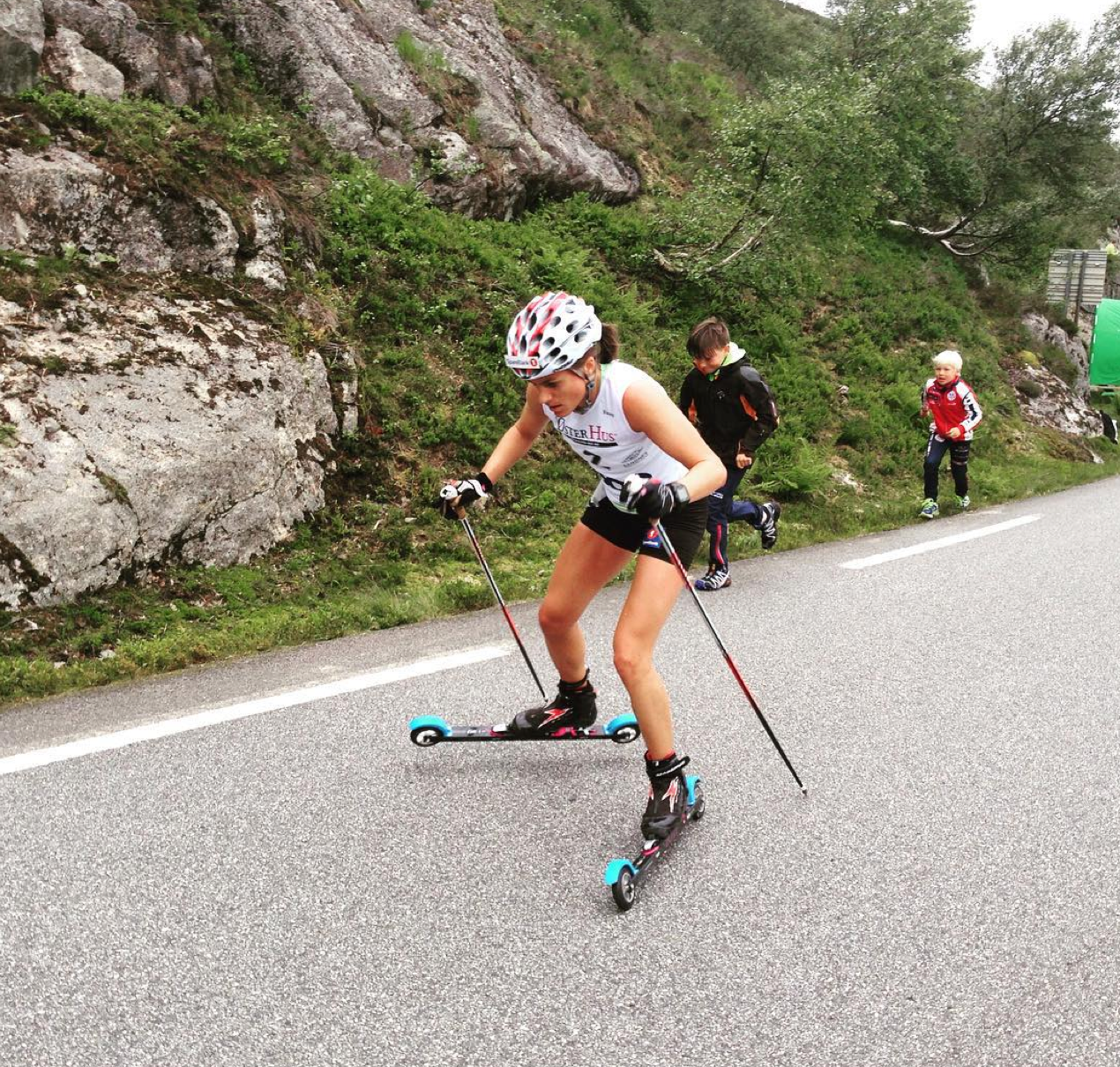
The 7.5-kilometer race course for the Lysebotn Opp, an annual hill climb at the Blink Ski Festival in Lysebotn, Norway. (Photo: Blink Ski Festival/ Facebook)
There’s a little more than six months to go until the opening ceremony of the 2018 PyeongChang Winter Olympics. For the recently turned 30-year-old Charlotte Kalla, a two-time Olympic gold medalist and three-time silver medalist from Sweden, nothing would be sweeter than to capture another gold this winter in South Korea.
Her last individual Olympic win came in 2010 in Vancouver, B.C., when she took first in the women’s 10-kilometer freestyle. A repeat podium in the PyeongChang 10 k skate is not far from her thoughts.
“It is a race that is certainly on my mind,” Kalla told NRK on Thursday, according to a translation.
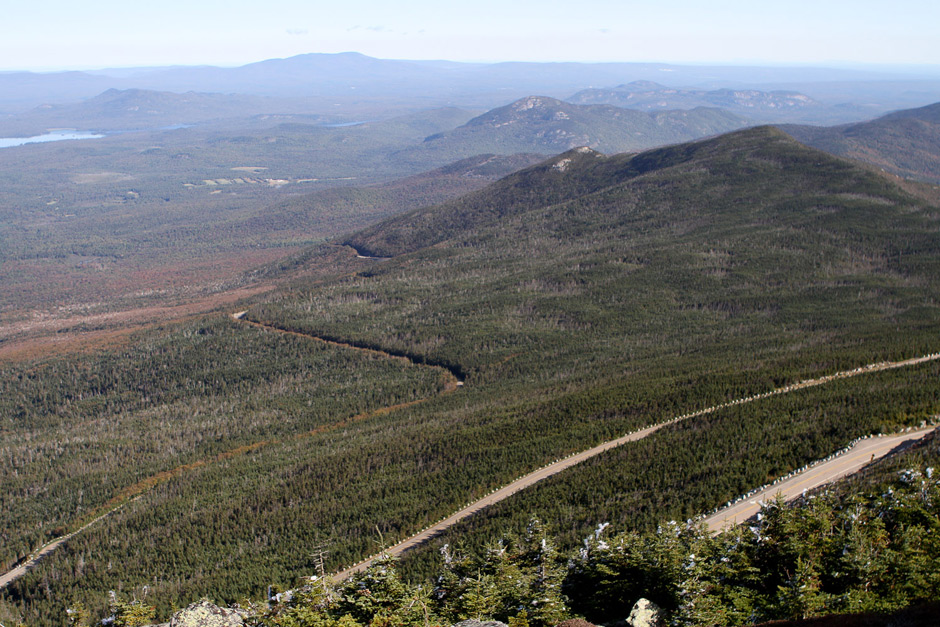
What better way for Sweden’s 10 k favorite to practice than at the Blink Ski Festival’s Lysebotn Opp, an annual 7.5 k freestyle rollerski hill climb in Lysebotn, Norway? With names sure to contest her at the Olympics –including Norway’s Marit Bjørgen and Heidi Weng, as well as Finland’s Krista Pärmäkoski, Germany’s Stefanie Böhler and American Liz Stephen — on the start list for Thursday’s race, Kalla couldn’t resist entering herself.
Sweden’s Charlotte Kalla (r) racing to the win in the Lysebotn Opp, a 7.5-kilometer uphill climb, at the 2017 Blink Ski Festival on Thrusday in Lysbotn, Norway. (Photo: Axelar/Arild Aarnes)
If her performance in the rollerski race is any indication of where Kalla is headed this winter, it’s the direction she wants. After breaking away with Bjørgen, Pärmäkoski and Weng early on in the race to form a lead pack of four women, Kalla quickly decided to make the race her own.
Within the next few kilometers, Kalla dropped the two Norwegians and Pärmäkoski and went on to finish first in a time of 33 minutes, 18.3 seconds. Weng followed 40.3 seconds later and Bjørgen crossed in third, 1 minute and 50.5 seconds back.
Notably, Kalla’s time was faster than 57 out of 100 elite men that raced the same 7.5 k course later on Thursday.
“One shouldn’t focus too much on what happens in July, there is a lot left to be done before the season, but it’s been long since I’ve been in this good a shape in July. The last time was probably 2013,” Kalla told NRK.
The Lysebotn Opp’s 2014 champion,Stephen finished sixth overall (+3:35.7) on Thursday, after Norway’s Ragnhild Haga in fourth (+2:43.4) and Pärmäkoski in fifth (+2:47.0). Prior to winning three years ago, Stephen also placed third in the famous rollerski hill climb in 2012 (the Lysebotn Opp was added to the festival in 2010).
In the men’s 7.5 k uphill race that followed, Hans Christer Holund broke away for the win in 27:37.6, besting fellow Norwegian Simen Hegstad Krüger in second (+1:13.9) and Finland’s Matti Heikkinen in third (1:25.6).
Holund took it out strong from the start, holding his lead through the climb’s entirety.
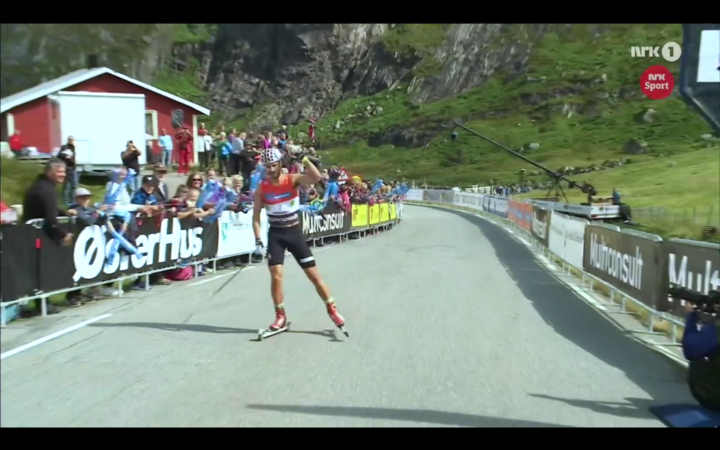
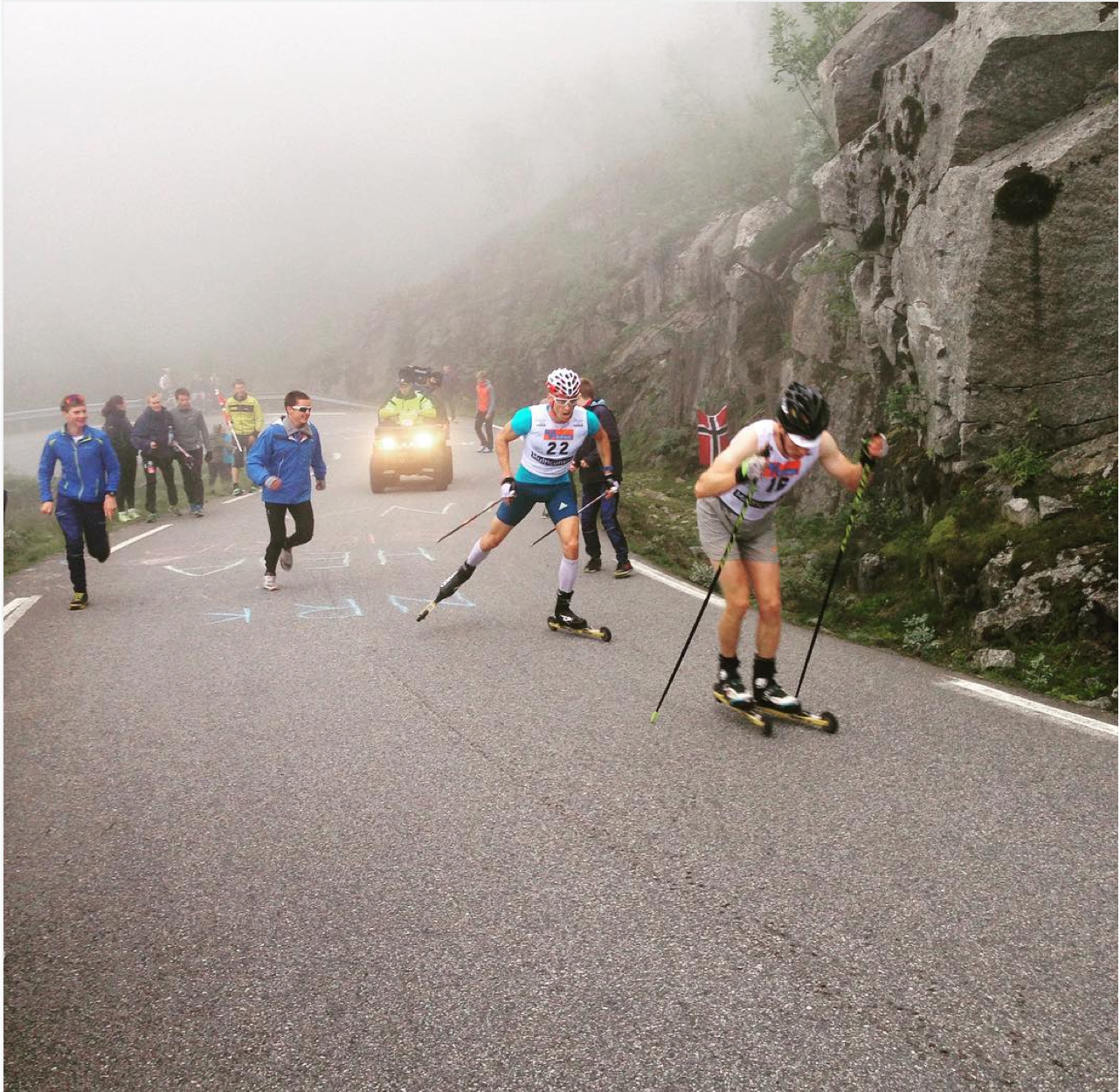
Norway’s Hans Christer Holund after winning the men’s 7.5-kilometer Lysebotn Opp rollerski hill climb on Thursday at the 2017 Blink Ski Festival in Lysebotn, Norway. (Photo: NRK screenshot)
“I am healthy and have done some solid training this summer,” the 28-year-old Holund told NRK after. “It looks promising. There’s still a lot of time Olympics, but it does look promising. It is so competitive in Norway and it’s tough to just be selected. If I am selected for the Olympics when the time comes then I will be good enough and then an Olympic gold-medal is the next task.”
Norway occupied seven of the top eight on Thursday, with Henrik L’Abée-Lund in fourth (+1:59.6), Sjur Røthe in fifth (+2:05.7), Martin Johnsrud Sundby (Wednesday’s 60 k winner) in sixth (+2:11), Simen Andreas Sveen in seventh (+2:12.4), and Gaute Kvåle in eighth (+2:14.7).
Andy Newell of the U.S. Ski Team did not race the hill climb, but he was back for the 15 k mass start on Friday (as was Stephen for the women’s 10 k). Stay tuned for results in a separate report.
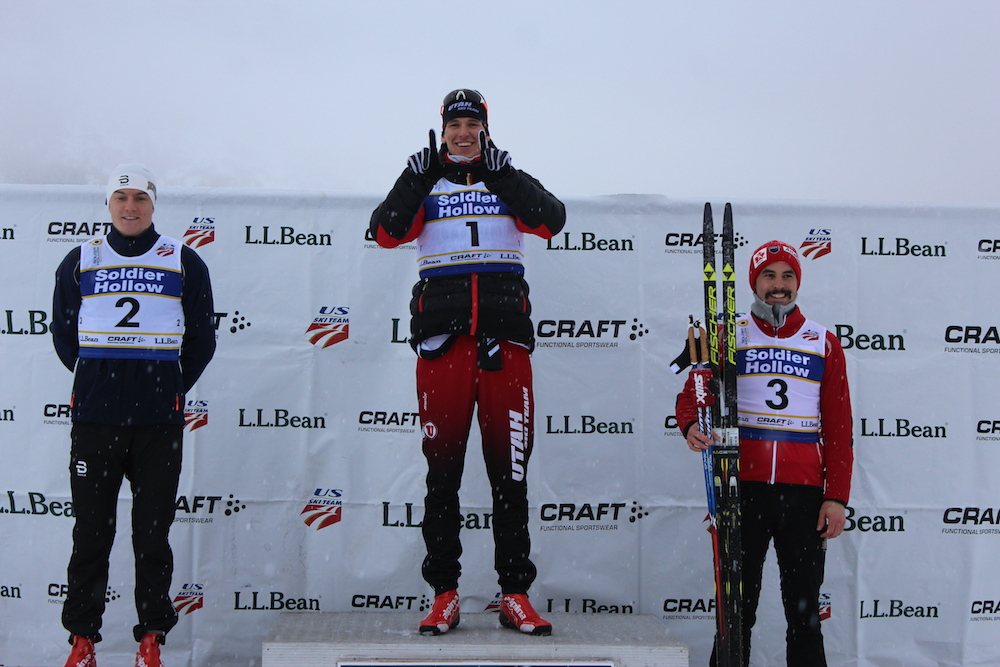
The men’s classic sprint podium at 2017 U.S. nationals at Soldier Hollow on Sunday: with winner Kevin Bolger (c) of the University of Utah, runner-up Moritz Madlener (l) of the University of Denver, and Jess Cockney (r) of the Canadian World Cup B-team in third.
U.S. Cross Country Championships (Soldier Hollow): Classic sprints
Jennie Bender of Bridger Ski Foundation and Kevin Bolger of the University of Utah won national titles in the classic sprints at 2017 U.S. Cross Country Championships at Soldier Hollow earlier Sunday afternoon. They each took narrow – but, for sprinting, relatively uncontested – victories, as each was in the lead coming into the stadium and led through the final 180-degree turn into the finishing straight.
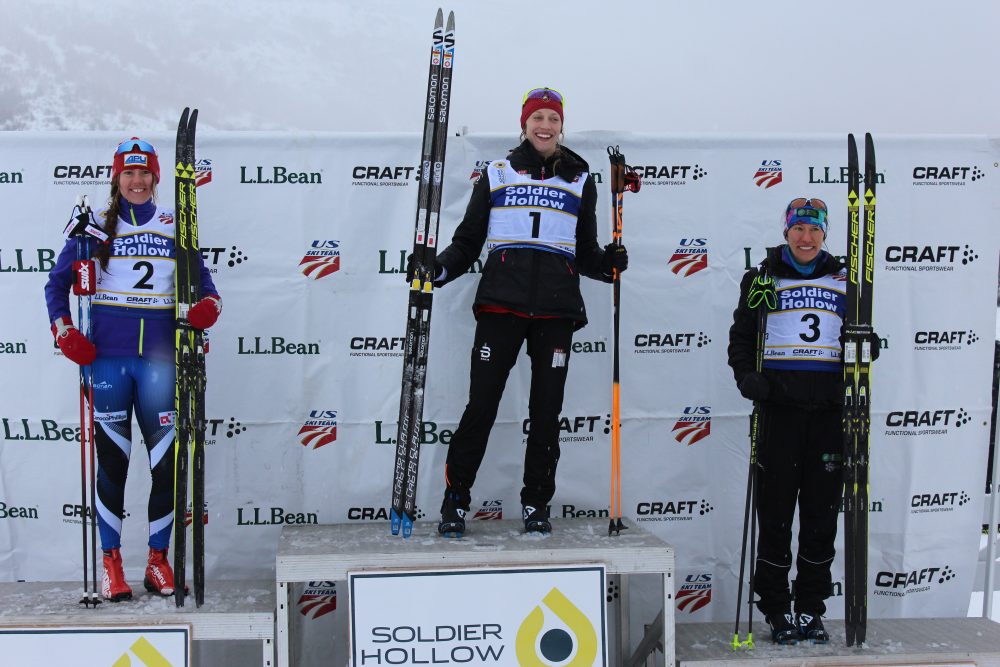
The women’s classic sprint podium at 2017 U.S. nationals on Sunday at Soldier Hollow: with winner Jennie Bender (c) of the Bridger Ski Foundation, runner-up Becca Rorabaugh (l) of Alaska Pacific University, and Kaitlynn Miller (r) of the Craftsbury Green Racing Project in third.
In the women’s race, Bender took the victory over Becca Rorabaugh of Alaska Pacific University, who just edged out Kaitlynn Miller of the Craftsbury Green Racing Project for second. Miller had won the qualifier earlier in the day.
Dahria Beatty of Canada’s Alberta World Cup Academy in fourth, Anne Hart of Stratton Mountain School Elite Team in fifth, and Krista Niiranen, originally from Finland and now a sophomore at the University of New Mexico, in sixth made up the rest of the A-final. There was no B-final contested for either gender.
In the men’s race, Bolger’s victory marked his best performance in a national championship by a substantial margin: His previous best before today was 23rd, in the 15 k classic at SoHo in 2014. (His 37th in the sprint that same year marked his previous best finish in a national championship sprint.)
Bolger was followed to the line by Moritz Madlener, of the University of Denver, and Jesse Cockney, of the Canadian World Cup B-team. Cockney had qualified fourth that morning.
The rest of the A–Final was Canadian Bob Thompson, of National Team Development Centre (NTDC) Thunder Bay, in fourth, Petter Reistad of the University of Colorado in fifth, and Fredrik Schwencke of Northern Michigan University in sixth.
Madlener is German. Cockney and Thompson are Canadian. Reistad and Schwencke are Norwegian. The USSA selection criteria for World Championships in Lahti provide that, “For the purposes of the 2017 Championship Selection List, athletes that are not US citizens will not be included in the scoring, and US athletes will move up the results/scoring list as foreign athletes are eliminated.” American racers eliminated in the semifinals included, in no particular order, Ben Lustgarten of Craftsbury Green Racing Project, Cully Brown of the University of Vermont, John Hegman and Cole Morgan of Sun Valley Ski Education Foundation (SVSEF) Gold Team, and Ben Saxton of Stratton Mountain School.
Earlier Sunday, Kaitlynn Miller won the women’s classic sprint qualifier. Starting sixth out of the 200+ woman field, Miller laid down an unbeatable time of 3:24.5 in difficult waxing conditions. She is the defending classic sprint champion from last year’s national championships.
Krista Niiranen, originally from Finland and now a sophomore at the University of New Mexico, was next fastest and tallied a time just 0.2 seconds behind Miller’s. Emily Nishikawa of the Canadian National Ski Team was third, Dahria Beatty of Canada’s Alberta World Cup Academy fourth, and Cendrine Browne from the Centre National d’Entrainement Pierre Harvey in Quebec clocked the fifth-fastest time.
The 30th skier making the cut for quarterfinals — Frederique Vezina, also of the Centre National d’Entrainement Pierre Harvey — was 16.53 seconds behind Miller.
Ben Saxton of the Stratton Mountain School Elite Team won the men’s sprint qualifier, notching the fastest time by 1.27 seconds over Etienne Hebert of Monteriski.
Canadians took the three of the top four spots in the qualifier, with Reed Godfrey of Canmore Nordic clocking the third-fastest time and Canada’s Jesse Cockney finishing fourth.
9.17 seconds separated the top 30 men who moved on to the quarterfinals. That included racers from at least six countries: the U.S. and Canada, but also collegiate skiers from Finland, Germany, France, and Norway. It also included one Under-18 competitor: Ben Ogden from the Stratton Mountain School.
It was a World Championships preview weekend on the Nordic Combined World Cup circuit, with two large hill/10 k individual competitions held in Lahti, Finland.
On Saturday, Germany’s Eric Frenzel took the win in 29:13.7, holding off Finland’s Eero Hirvonen by 4.1 seconds across the line. After posting the second-best jump, Frenzel started the 10 k in second, ahead of Hirvonen in third, but still full 1:06-minutes behind Norway’s Jarl Magnus Riiber, who dominated the jump with 135.2 points. Hirvonen started 1:29 back in third.
Riiber went on to place sixth at the finish with the 38th-ranked course time (out of 43 finishers). Germany had two on the podium with Johannes Rydzek in third (+26.4).
American Bryan Fletcher finished 15th (+1:29.8) after jumping to 22nd and starting the ski race 3:06 minutes back. He skied the sixth-fastest 10 k to end up 1:29.8 behind Frenzel at the finish.
Ben Loomis was the second American competing on Saturday. He finished the day in 40th (+5:18.5) after jumping to 35th.
On Sunday, Germany swept the podium with Fabian Rießle leading the charge, Frenzel in second and Rydzek in third. Rießle jumped to fifth and captured the win in 25:44.2, ahead of Frenzel (+4.2) and Rydzek (+11.6). Frenzel led after the jump and started the 10 k just 6 seconds ahead of Italy’s Samuel Costa, who ended up sixth at the finish (+40.6).
Rießle started 16 seconds after Frenzel and posted the third-fastest course time en route to the win.
Bryan Fletcher raced to 16th (+1:30.7) on Sunday, after jumping to 28th. Loomis did not start.
The NoCo World Cup moves to Val di Fiemme, Italy, for competitions next Friday through Sunday. Lahti World Championships will hold nordic-combined competitions Feb. 24-March 3.
Two North Americans started the International Biathlon Union (IBU) World Cup women’s 12.5 k mass start on Sunday, with one of them finding out at the last minute that they were in for the 30-woman race.
American Susan Dunklee knew she had qualified well ahead of time after ranking 17th in the overall World Cup. She raced to ninth on Sunday, finishing 1:43.5 behind from the winner, Gabriela Koukalová of the Czech Republic, who cleaned the four-stage race to finish first in 37:20.5.
Germany’s Laura Dahlmeier made her first appearance of the week in the final race of the World Cup stop in Oberhof, Germany, placing second in the mass start, 31.5 seconds behind Koukalová, with one standing miss (0+0+1+0). The Czech Republic had two on the podium with Eva Puskarčíková in third (+45.4), with clean shooting.
Dunklee was in contention with the leaders until the last two standing stages, where she missed one target then two more (0+0+1+2) for a total of three penalty laps. Ninth place helped elevate Dunklee to 15th in the overall World Cup standings.
Canada’s Rosanna Crawford jumped into the race being listed as a reserve athlete on standby. Wearing bib 30, she finished 25th (+3:08.6) with two clean stages and two penalties (0+1+1+0).
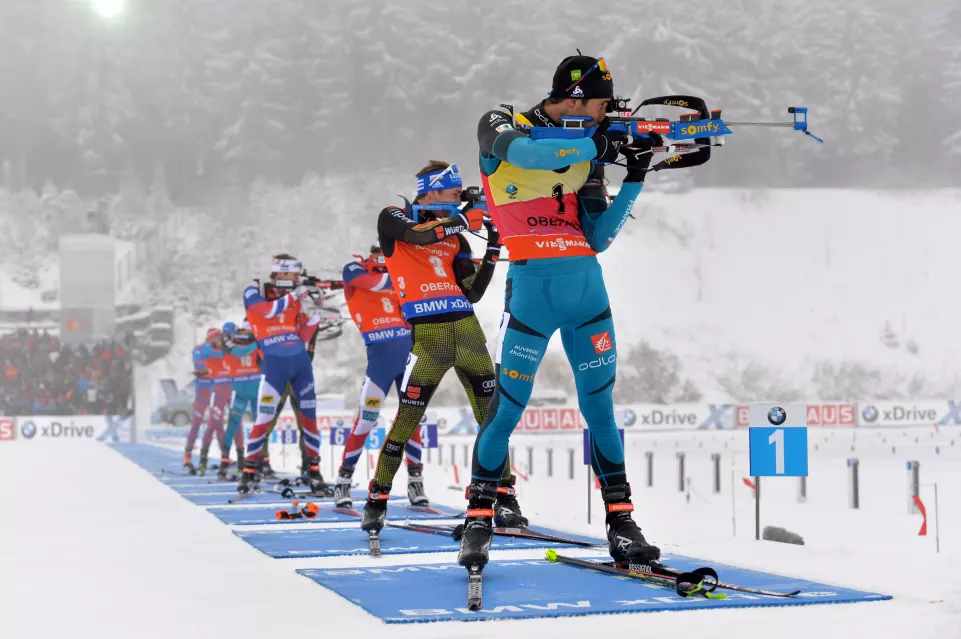
France’s Martin Fourcade (bib 1) and Germany’s Simon Schempp (bib 3) shooting in the third stage of the men’s 15-kilometer mass start at the 2017 IBU World Cup in Oberhof, Germany. (Photo: IBU)
On Sunday in the men’s 15 k mass start, Germany’s Simon Schempp celebrated his first victory of the season, and it was a special one in front of thousands of cheering fans at home in Oberhof. On the final lap, he desperately tried to hang onto the ski tails of France’s biathlon star Martin Fourcade, who pushed hard on the first climb out of the shooting range unsuccessfully trying to create a gap.
“He started attacking immediately up the Birxsteig [climb],” Schempp told German TV broadcaster ZDF. “And I thought either you blow up or you can stick with him, and I could. Because I was in the draft, I saved a few percent, that probably was the decisive point in the end.“
Schempp kept right behind Fourcade, then started an attack on the last climb himself and outsprinted his rival on the finishing stretch, celebrating across the line with a time of 38:30.9 minutes, with just one penalty (0+0+1+0).
To the joy of the German fans, Schempp’s teammate Erik Lesser managed to overtake France’s Jean Guillaume Beatrix on the final loop closing up to the two athletes in front on the last meters, and outlunged Fourcade in a photo finish sprint (both +0.4 seconds).
“They pushed up the Birxsteig so incredibly hard,” Lesser told ZDF. “I thought I could only fight for position five. Then I saw that Beatrix wasn’t skiing very clean anymore either. So I just tried a full attack… I never would have believed that a second place would come out of that.“
“My father-in-law is probably watching the Tour de Ski today and saying, ‘Finally the guy makes a lunge,’ ” Lesser joked about the finish sprint. “I never would have believed that Fourcade still lets himself get beaten by the little Lesser. Finally all the strength training paid off.“
Fourcade had incurred two penalties in the third shooting stage, having to make up a 44 second gap to the top. In the final shooting he stayed clean, but already had to invest a lot of energy on the prior loop so he could not create a significant lead on the last one.
“I skied as fast as I could, but Simon was just faster and Erik as well,” Fourcade said during the press conference. “I tried my best in the beginning of the lap because we were too [many] people… I gave all I had. I must say I didn’t see Erik until he passed me in the sprint… It was a great competition, a great fight.”
Coming into the last shooting stage Lesser had been leading the race with Norway’s Ole Einar Bjørndalen, but both missed a target and had to a penalty lap while Schempp and Fourcade stayed clean.
Fourcade’s teammate Beatrix finished fourth with one penalty (+13.2), Bjørndalen was fifth (+19.5) also with one penalty.
No North American men competed in the mass start, with US Biathlon’s Lowell Bailey ,who would have been qualified via the overall World Cup standings skipping the race week in Oberhof for a training block. Bailey is currently ranked 19th overall.
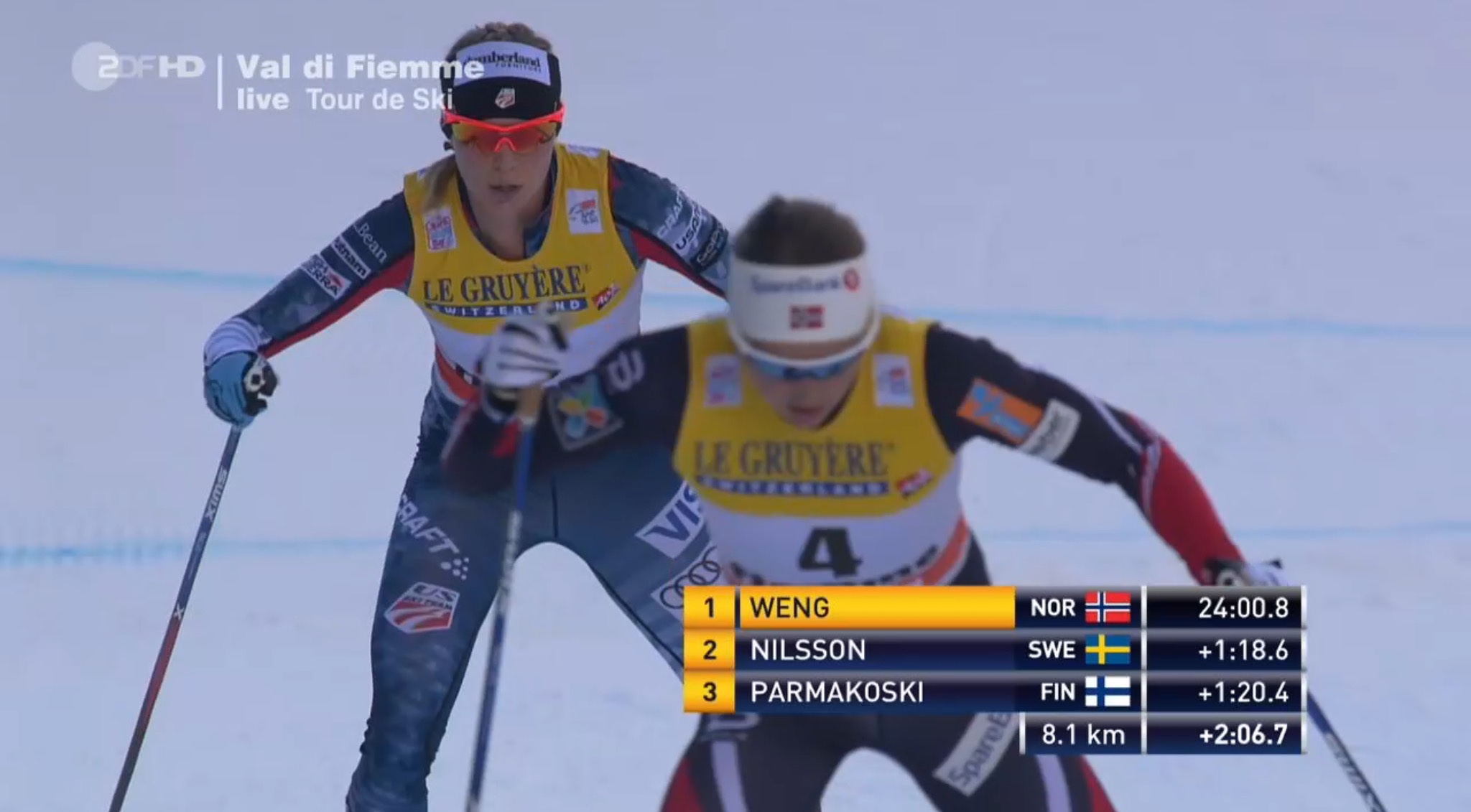
American Jessie Diggins chasing Norway’s Ingvild Flugstad Østberg on the final climb of the 2017 Tour de Ski up the Alpe Cermis in Val di Fiemme, Italy. Østberg finished the Tour in fourth and Diggins fifth, tying a best-ever mark for the U.S., set in 2015 by Liz Stephen. (Photo: ZDF screenshot)
FIS Cross-Country Tour de Ski Stage 7 (Val di Fiemme/Alpe Cermis, Italy): 9 k freestyle
Heidi Weng of Norway proved that she was the threat everyone was fearing – despite a few races in the Tour de Ski with bad skis or low energy, Weng had a dominating performance up the Alpe Cermis and took her first ever Tour de Ski title.
At 6.2 k of the 9 k course, Weng passed Stina Nilsson of Sweden, who had started the day in the leader’s bib with a 19.2-second advantage. Weng just stepped on the gas from there, turning in the fastest climb time of the field and winning by 1:37.0.
Further up the hill, Nilsson was also passed by Krista Parmakoski of Finland, who gapped the Swede and earned second place.
And Nilsson had to hold off one more attack, from Norway’s Ingvild Flugstad Østberg near the top of the climb. Østberg had started in fourth place and got close to Nilsson, before the Swede found her second (or third, or fourth) wind and sprinted it in to the finish to secure third place and her first Tour de Ski overall podium.
Weng has three previous Tour de Ski podiums, but never a win. Parmakoski’s previous best overall finish was fourth, in 2014.
Jessie Diggins of the U.S. Ski Team started behind Østberg and almost made contact at one point, before the Norwegian slipped from her grasp. Diggins finished the Tour de Ski fifth (+3:09.0) — where she had started the day — to tie for the best-ever Tour finish with Liz Stephen, who was fifth in 2015.
Today, Stephen clocked the second-fastest time up the climb, behind Weng, and finished 14th (+6:45.6).
Rosie Brennan, the third and final U.S. woman to finish the Tour de Ski this year, landed 28th, +12:59.9. Her time was the 23rd-fastest up the Alpe Cermis.
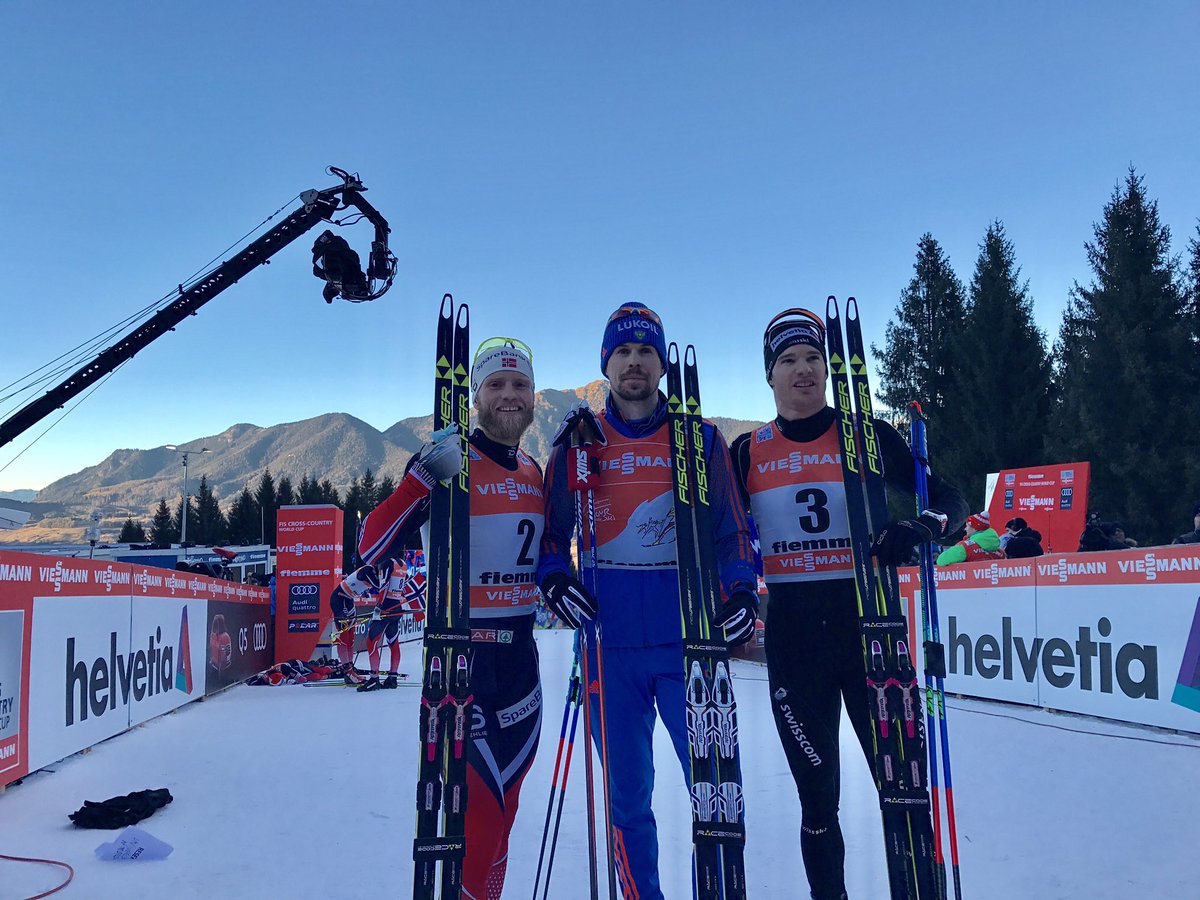
The overall podium at the end of the 2017 Tour de Ski, with winner Sergey Ustiugov (c) of Russia, Norway’s Martin Johnsrud Sundby (l) in second, and Switzerland’s Dario Cologna (r) in third after finishing in that order in the 9 k freestyle hill-climb pursuit, Stage 7 of the Tour de Ski in Val di Fiemme, Italy. (Photo: FIS Cross Country/Twitter)
In the men’s 9 k freestyle hill climb that followed, 24-year-old Sergey Ustiugov of Russia raced to his first Tour de Ski victory, heading out of the gate with a 1:12-minute head start over Norway’s Martin Johnsrud Sundby and finishing 1:02.9 ahead for the win in 30:27.7.
Sundby put time into Ustiugov over parts of the course, particularly in the first kilometer along a flatter section leading up to the climb and then again between 6 and 8 k on Alpe Cermis itself.
Sundby skied alone throughout the pursuit race, with Switzerland’s Dario Cologna starting 52 seconds behind him. Cologna had a 29-second head start on Finland’s Matti Heikkinen, who entered the race in fourth, and 30 seconds ahead of France’s Maurice Manificat in fifth, but Manificat caught and even passed Cologna with about 0.5 k remaining. Cologna proceeded to pass Manificat back while Heikkinen skied about nine seconds back in fifth.
Canada’s Alex Harvey had started sixth and helped lead Manificat and Heikkinen in chasing down Cologna early in pursuit, but he faded to seventh, behind Sweden’s Marcus Hellner (who started seventh, 12 seconds after Harvey) by 8.5 k. There, Hellner trailed Heikkinen by 14.6 seconds, and Harvey was another 27.9 seconds back in seventh (and nearly a 54 seconds ahead of the man skiing in eighth at the time, Norway’s Simen Hegstad Krüger).
Half a kilometer later, it was all over with Cologna securing third overall in the Tour, 1:19.1 behind Ustiugov and 16.2 seconds behind Sundby.
With the fastest 9 k time of the day, Manificat moved up one place for fourth overall, finishing 1:26.9 after Ustiugov with a time of 29:20 minutes. Heikkinen was the second fastest on course, 6.1 seconds slower than Manificat, for fifth overall in the Tour (+1:31.3). Hellner took sixth at the finish (+2:05.8), ahead of Harvey in seventh (+2:39.7). For Harvey, it was his best overall finish in four competed Tour de Skis (last year, he finished 14th. His best result was 12th in 2012).
Norway swept the next five places with with Krüger in eighth (+3:27.2), Hans Christer Holund in ninth (+3:50.4), Niklas Dyrhaug in 10th (+4:24.9), Sjur Røthe in 11th (+4:56.4), and Didrik Tønseth in 12th (+5:07.7).
Canada had two in the final climb with Devon Kershaw finishing 25th (+9:32.2) after starting 23rd. Graeme Killick did not start after being positioned in 37th overall in the Tour.
Kershaw finished 8.1 seconds ahead of Noah Hoffman, the lone American racing to the top of Alpe Cermis. Hoffman moved up from 30th at the start to finish 26th (+9:40.3) overall, and in doing so, he posted the 15th-fastest time of the day, 1:05.3 back from Manificat.
Harvey’s time ranked 14th (+1:04.9). Norway’s Holund had the third-fastest time after starting 11th and ending up ninth, Hellner was fourth fastest, and Cologna fifth fastest.
Tour de Ski final results (with isolated climb times): Women | Men
Former Middlebury College skiers Emily Attwood (l) and Heather Mooney lunge at the finish of their final hill climb sprint in the spring of 2014. (Photo: Lander Karath)
It’s that time of year … to kick back and live a little! If you have a hill and residual snow nearby, this one’s for you. The following workout was published two years ago. Read the original here.
***
[circa April 2014]
MIDDLEBURY, Vt. — Unless you’re the audacious Liz Stephen or Overall World Cup Champion Therese Johaug, you’re probably not a huge fan of hill climbs. However, when the mid-April temps turn our favorite trails into puddles, nordic ski enthusiasts have to get creative to get their on-snow skiing fix before spring training begins.
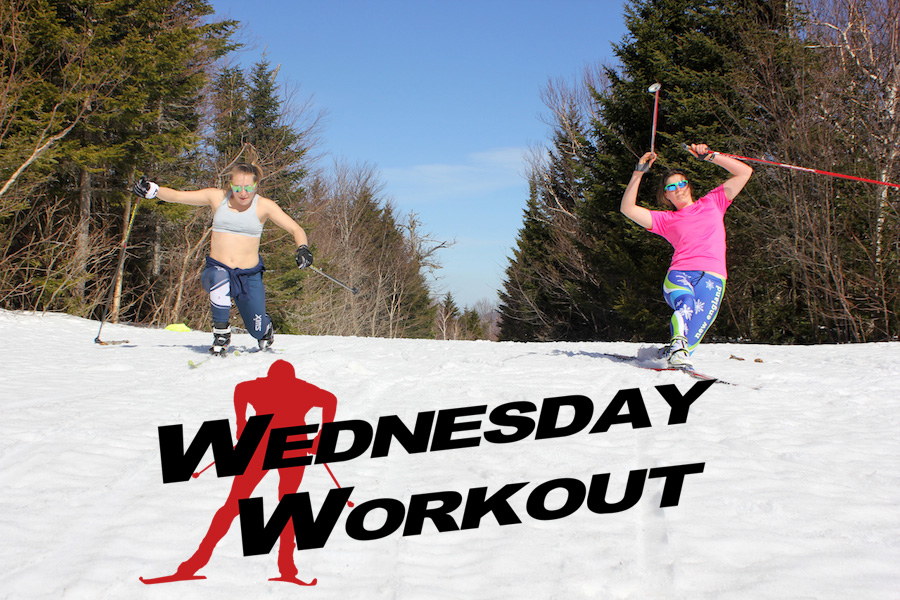
Former Middlebury skiers Emily Attwood (l) and Heather Mooney get ready to climb up then ski down the Middlebury Snow Bowl in the spring of 2014. (Photo: Lander Karath)
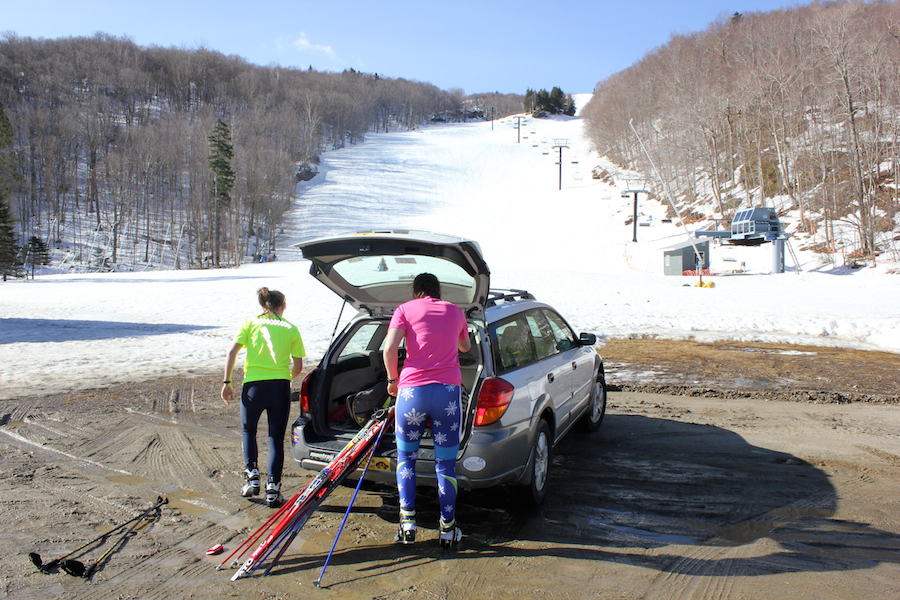
In Middlebury, skiers at the local college are doing just that by taking advantage of the remaining of snow at the Middlebury College Snow Bowl, an college-owned downhill ski area only 20 minutes from campus.
I joined Heather Mooney (Peru, Vt.) and Emily Attwood (Cape Elizabeth, Maine) this past week to take advantage of the long awaited spring weather and to get in a late season ski at the same time. For this retired ski racer, the workout was certainly exhausting but left me full of energy for the rest of the day.
Preparation:
Finding a location for the hill climb and norpine is easy in a place like Middlebury where the alpine ski area is closed and the snow remains in relative abundance. In many western ski areas these circumstances can also be found with the exception of the few mountains that are still open. If this is the case, they most likely won’t allow you to ski, due to the lack of leashes, but it doesn’t hurt to check.
Once the ideal spot is found, there’s not much needed for a spring hill climb and norpine other than a pair of skate rock skis, classic poles (skate poles are too big for the climb as well as the descent), and of course, a sense of adventure. However, there are a few accessories that make this workout even more enjoyable. For example, bring a Jammypack so your favorite jams can aid you in your struggle your up the hill, and provide a sick soundtrack for the cruise down.
In addition, make sure to start your climb in the morning, as warm spring temperatures make the snow pretty soft, wet, and slow later in the day.
The Workout:
Once you’ve adorned your Jammypack, jumped on your skis, and hit the snow you have a long trek ahead of you. Most alpine ski areas are fairly steep so be prepared for a haul to the top. At times it can feel like progress in the softening snow is nonexistent, but little by little the hills get conquered.
Once you reach the final ascent of our climb, those who are more ambitious can decide to have a final hill sprint. My two companions decided to have such a race, once again proving that cross county ski racers have some of the most competitive personalities in the sports world.
While you can choose to sit out of the final sprint (as I did), it aids in keeping those post-season legs fit and fresh with a little bit of intensity. It also certainly adds to the sense of accomplishment and exhilaration of climbing to the top of a massive alpine ski area.
Once at the top, the real fun begins. After taking a rest from the 45 minutes of climbing, make your way down the slopes for some awesome twists and turns.
This part of the workout is called norpining. As the name suggests, its a combination of nordic and alpine skiing. While nordic skis don’t have great edges, they certainly make for a fun (and somewhat unstable) 20+ minute cruise to the bottom. It may take a few turns to get used to skinny skis on a steep slope, but by the time you reach the base you’ll be rearing for more.
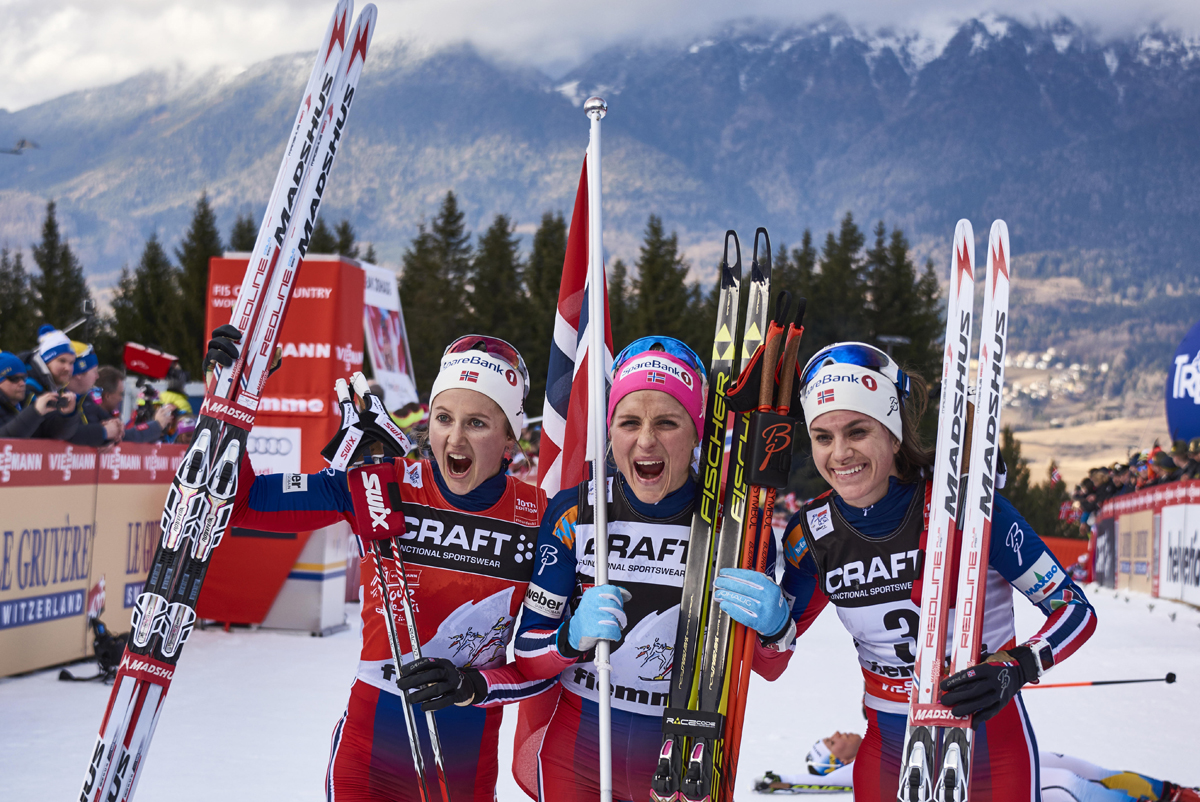
2016 Tour de Ski overall runner-up Ingvild Flugstad Østberg (l), champion Therese Johaug (c) and third-place finisher Heidi Weng (r) celebrate Norway’s sweep of the podium at Sunday’s Stage 8 final climb in Val di Fiemme, Italy. (Photo: Fischer/NordicFocus)
The image of several Norwegians sprawled in the snow at the top of Alpe Cermis, while Therese Johaug, also of Norway, kneels to congratulate them on their efforts, says a lot.
“It was a good fight, Ingvild,” Johaug said to second-place finisher, teammate Ingvild Flustad Østberg, as she sat next to her on the ground.
Østberg was second to — who else? — but Johaug, who had just bested her to the top of the mountain by nearly two and half minutes after starting 39 seconds behind in the final stage of the Tour de Ski, the notorious 9-kilometer freestyle pursuit up Alpe Cermis in Val di Fiemme, Italy.
“I hoped I could take some seconds on Ingvild before the climb. It worked better than I had hoped,” Johaug told FIS afterward.
Norwegian women swept the podium, with Johaug landing at the top with a finishing time of 33:53.5, Østberg reached the summit in second (+2:20.9), and Heidi Weng started third, 2:27 behind Østberg, and held onto third across the line (+3:13.9).
The event was a pursuit, with start times based on cumulative times over seven World Cup stages in nine days. Sunday marked the eighth and final stage on the 10th day of the Tour. Fatigue was the shared theme among 43 women who started and completed the final climb, thus completing the Tour.
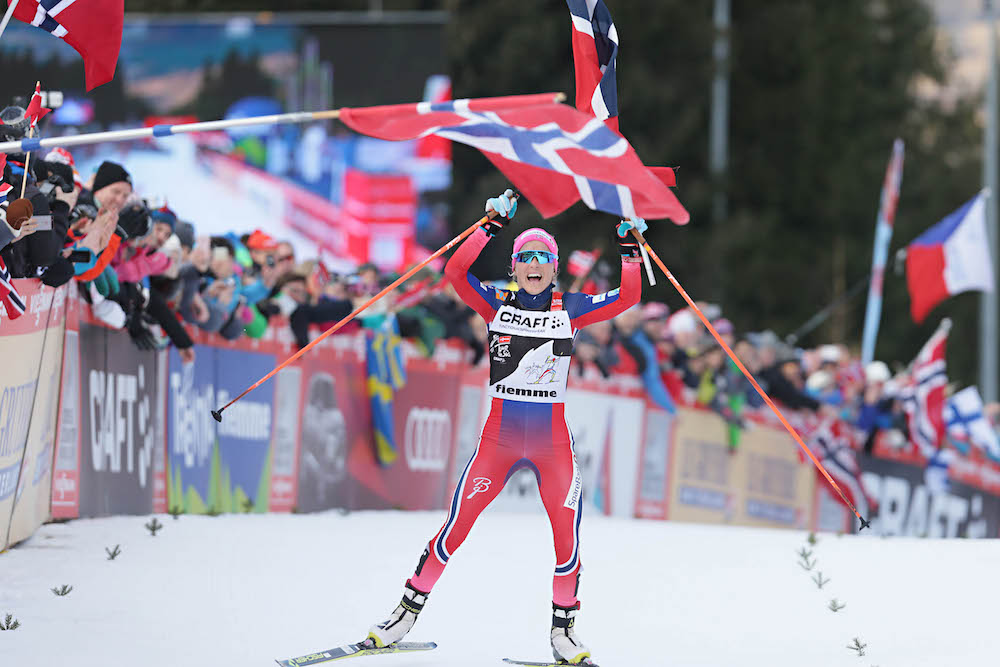
Norway’s Therese Johaug approaches the finish of the 9 k final climb at the last stage of the 2016 Tour de Ski with enough time to grab a Norwegian flag and celebrate her win. It was Johaug’s second overall Tour de Ski victory since last winning in 2014. (Photo: Fiemme World Cup)
While Johaug started the eight-stage series by earning the leader’s bib on Day 1 in Lenzerheide, Østberg took control after winning the 5 k pursuit in Lenzerheide at Stage 3. From that point on, the 25-year-old Østberg continued to lead the Tour, up until about 17 minutes into the final climb, when Johaug caught and passed her.
Still 14 seconds ahead of Johaug at 6.2 k, shortly after the course began to ascend up the mountain at a brutal grade, Østberg hung onto first for another minute before Johaug reached her. Wasting no time, Johaug pushed on, putting 17 seconds between her and Østberg by 7.1 k. One kilometer later, she was 1:26 ahead and in the clear for the win.
Following the zig-zagging course to the top, the 27-year-old Johaug V1-ed past excited spectators before a multitude of waving Norwegian flags greeted her at the finish. She grabbed one a few meters before the line and held it up in elation.
“It was my dream and big goal to win the Tour de Ski,” Johaug said after claiming her second overall title since winning the 2014 Tour. “Ingvild has pushed me at every stage of the Tour this year. I think this was my [best] Tour de Ski ever.”
According to reporters at the summit, Johaug asked Østberg afterward, “Are you tired now?”
“Yes,” Østberg replied.
(Article continues below)
(Photo: Fiemme World Cup)
Norway’s Ingvild Flugstad Østberg pushes toward the top of the 9 k freestyle hill climb, the final stage of the 2016 Tour de Ski. She went on to place second, 2:20 behind teammate Therese Johaug (not shown). (Photo: Fiemme World Cup)
Winner Therese Johaug jumps for joy after taking the overall win at the 2016 Tour de Ski in Val di Fiemme, Italy. (Photo: Fischer/NordicFocus)
Therese Johaug (Norway) after winning her second Tour de Ski title with a victory in the final climb in Val di Fiemme, Italy. (Photo: Fischer/NordicFocus)
Diggins 10th, Bjornsen 14th Overall
After starting 9:01 back in 10th and finishing 10th (+11:20.4), Jessie Diggins led the U.S. women in the final Tour standings. It was the end to an eventful Tour for Diggins, after her first individual World Cup win on Friday.
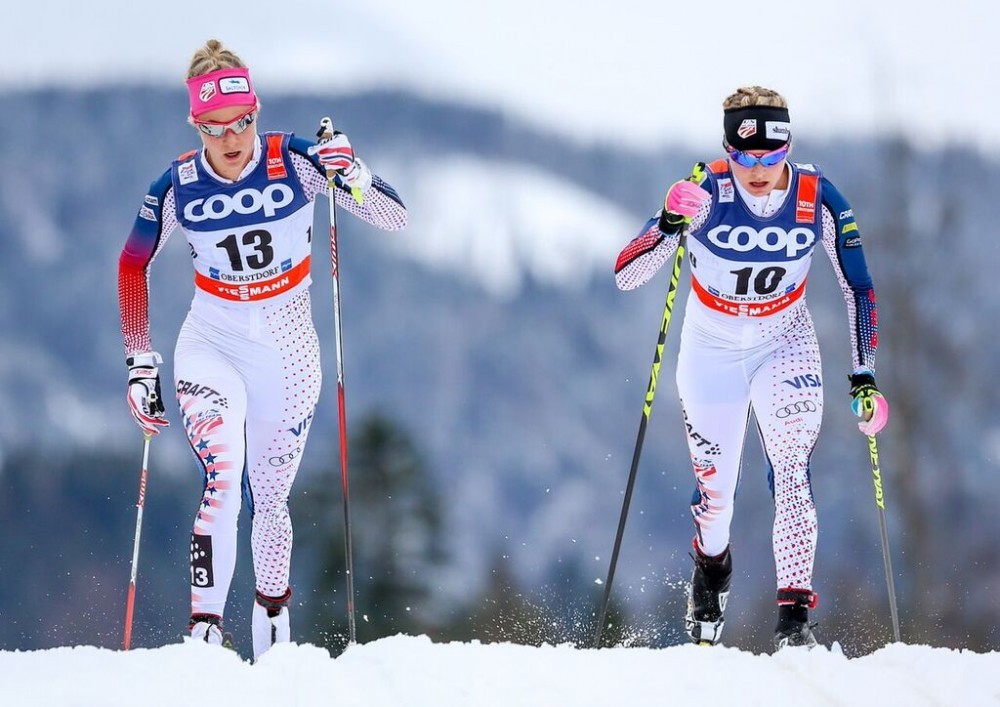
U.S. Ski Team members Sadie Bjornsen (l) and Jessie Diggins (r) started near each other in the fifth stage of the Tour de Ski, a 10 k classic mass start in Oberstdorf, Germany. (Photo: Marcel Hilger)
“One of my big goals for the season was to finish the Tour in the top 10, so I made that goal today!” she wrote in an email to media.
While Diggins didn’t finish the Tour last year because of illness, she did in 2014 and placed 13th overall.
“That climb is brutally hard hard and I was in a world of pain, but I had to tell myself to just keep my feet moving!” she reflected on Sunday. “It was a real mental battle out there so I was happy to be able to hang tough.”
Following her to the top of the downhill ski area was Sadie Bjornsen, who started 12th, 9:32 after Østberg, and slipped two spots to finish in 14th (+12:24.1). This year was her first time completing the Tour, after withdrawing after Stage 5 last year despite being in the top 10.
“I just had no idea what to expect,” Bjornsen said in a phone interview. “I’d done some hill climbs in the U.S., but never against a World Cup field. So I was definitely very nervous because I had a number of people quite close behind me. I decided that I just had to look up the hill, instead.”
“Sadie will tell you that she’s not a climber,” U.S. Ski Team Women’s Coach Matt Whitcomb said. “But she did great today – she only lost two places on Alpe Cermis. She’s skating at a high level now as well classic skiing … Fourteenth place is just a super result for Sadie and for our team.”
Stephen Third Fastest on Course, 2nd on Actual Climb
The U.S. team’s best individual performance in Stage 8 came from Liz Stephen, who climbed six places from 25th to 19th (+13:27.8) and posted the third-fastest time of the day. Stephen’s time was 1:29.5 behind Johaug, who earned “fastest of the day” accolades on Alpe Cermis for the sixth-consecutive year, according to a FIS press release.
American Liz Stephen led Norway’s Ragnhild Haga during last year’s final climb, the seventh stage of the 2015 Tour de Ski in Val di Femme, Italy. She placed fifth overall. (Photo: Fiemme World Cup)
Weng clocked the second-fastest course time, less than four seconds ahead of Stephen’s time.
In her fifth Tour de Ski, Stephen also had the second-fastest split on the climbing portion of the course, the final 3 k to the finish. Only Johaug was 31.7 seconds faster, besting Stephen’s climbing time of 19:18.3.
“I kind of just did my thing on the uphill and went to go catch as many people as I could,” Stephen said in a phone interview. “I felt really strong today, and I had great skis. It’s my favorite race of the year – not a single downhill. I like just getting into that zone and just grinding.
“Today was just my ideal conditions,” she added. “I love it when it’s just soft and wet and sloppy and just wonderful.”
According to Whitcomb, Stephen was coming off a tour that was “stacked against her strengths.” While the U.S. Ski Team veteran, who turns 29 on Tuesday, excels in longer skate races, the tour had a lot of shorter, classical races. Stephen was fifth overall in last year’s Tour – the best result ever for an American at the Tour de Ski.
“She didn’t put together the Tour she wanted,” Whitcomb said. “But we knew that today would test something that is her strength, and would be a good indicator as to where she is physically. She skied better than she did last year during this race – you can’t compare times – but she was able to maintain form and she paced it better, so I think she’s in a confident place.
“Third on time of day and only four seconds off of second — that’s something to be proud of,” he added. “She can leave Italy with some confidence.”
Also for the U.S., Rosie Brennan started 31st and slipped one place to 32nd overall (+20:06.1), and Caitlin Gregg started 38th and finished 42nd (+23:57.6). Both completed their first Tours.
Unsurprisingly, Whitcomb was pleased with the performance of his team.
“I’m really excited with having seven athletes finish the Tour [Diggins, Bjornsen, Stephen, Brennan, Gregg, Noah Hoffman and Erik Bjornsen]. I think it’s a little bit of an unlikely circumstance – battling illness and fatigue, even injury in some cases, anything can happen during the Tour,” he said. “So to have seven athletes finish and have seven athletes stay healthy, that’s a big sign of success for a group of athletes. It means that they’re absorbing the [racing] rather than just getting buried by it.”
Without a World Championships or Olympics this year, the U.S. coaches decided it was safe to have their athletes dig deeper than they otherwise might during the Tour.
“We were able to afford having a few extra athletes that were well beyond their comfort zones finish the Tour, despite it perhaps burying them for the next week or two,” Whitcomb explained.
Sprint specialists Sophie Caldwell, Ida Sargent, Simi Hamilton, and Andy Newell all withdrew from the Tour early, with the intention of saving themselves for two days of skate sprinting at next weekend’s World Cup in Planica, Slovenia. The seven skiers that finished the Tour will sit out the Planica sprints to rest for the Nove Mesto (Czech Republic) World Cup the following week.
But the fatigue runs deep.
“I’m looking forward to the next tour we have,” Stephen said of the Ski Tour Canada from March 1-12. “Which is crazy that we have another one. Thinking about that today was actually a little bit sickening – we’re just so tired that the thought of doing another [eight-stage] tour later on this year is a little bit tiring just to even think about. But I’m sure by then I’ll be really ready and really excited, and of course skiing in Canada is awesome.”
Norway’s Heidi Weng en route to the win in the Lysebotn Opp rollerski hill climb on Thursday. (Photo: Blinkfestivalen.no/Instagram)
Last year Heidi Weng felt that she didn’t quite pace it right on the Lysebotn Opp, a grueling seven kilometer rollerski race that rises 2,000 feet in southwestern Norway.
With a nine percent grade lasting the entire race, going out too hard can result in a lot of pain – even more than nailing the pacing, which is a world of hurt in its own right.
So this year, Weng started a bit more conservatively in the first competition of the Blink Festival, an annual nordic sports extravaganza. That allowed the Norwegian cross-country ski star to pick up the pace partway through and float away from her nearest competition, Finnish biathlete Kaisa Mäkäräinen, who finished 30 seconds back.
“I opened a little better this year,” Weng told Norwegian news service Dagbladet. “I didn’t have the ‘Duracell bunny’ [Therese] Johaug here. She tends to go fast from start to finish. The rest of us have to start a little more sensibly to get ourselves into the race.”
Stephen poses for a photo with Heidi Weng after the 2013 Blink festival. (Courtesy photo.)
Indeed, her teammate Johaug, routinely the best climber in the final ascent of the Tour de Ski, was sitting out with a broken hand. Also absent was last year’s winner, Liz Stephen of the U.S. Ski Team, who recently returned from a training camp in New Zealand and chose not to venture a few more time zones in the opposite direction after arriving home.
Weng’s time was a minute and 20 seconds slower than Stephen’s winning pace from last year, but it was almost a minute faster than Weng’s own fifth-place performance from 2014.
That made her happy.
“The body functioned clearly better this year than last year, so the question is whether it is a good sign for me,” she told Aftenbladet. “I hope that all the training I’ve put so far should give good results when the ski season begins.”
Weng finished third in the overall World Cup last season behind teammates Marit Bjørgen and Johaug. With Bjørgen taking the upcoming season off to have a baby, Weng is looking to improve on her 13 podiums from 2015, and maybe to take her first World Cup win.
Mäkäräinen, who won the Lysebotn Opp in 2013 and finished third last year, was on the podium yet again. The biathlete, who finished second in the overal World Cup rankings last season, led a group of Finnish skiers across the line: Laura Mononen finished third, Kerttu Niskanen fourth, and Aino Kaisa Saarinen fifth.
Sprint specialist Ingvild Flugstad Østberg was the next Norwegian, finishing sixth.
Kaisa Makarainen leading Heidi Weng partway through the race. (Photo: Matthias Ahrens)
A trio of North Americans also competed: Canadian biathletes Rosanna Crawford and Megan Heinicke, and American Susan Dunklee. All three have been in Norway for the last week for a shooting camp of international athletes, including Makarainen, organized by Canadian coach Matthias Ahrens and Norwegian shooting specialist Joar Himle.
Dunklee finished 21st in the hill climb last year.
“This year I was familiar with the course layout, including landmarks like the kilometer-long tunnel and the switchbacks in the last 500 meters,” she wrote in an email Thursday evening. “It still felt like a pain cave, but a controlled pain cave. I tried to think about keeping my weight on my toes, switching a lot between V1 and V2 and only looking ahead to one switchback at a time.”
This year Dunklee finished 15th in 38:49, outsprinting Finnish skier Anne Kylloenen at the line.
The Canadians had not previously made the trip to the Blink festival.
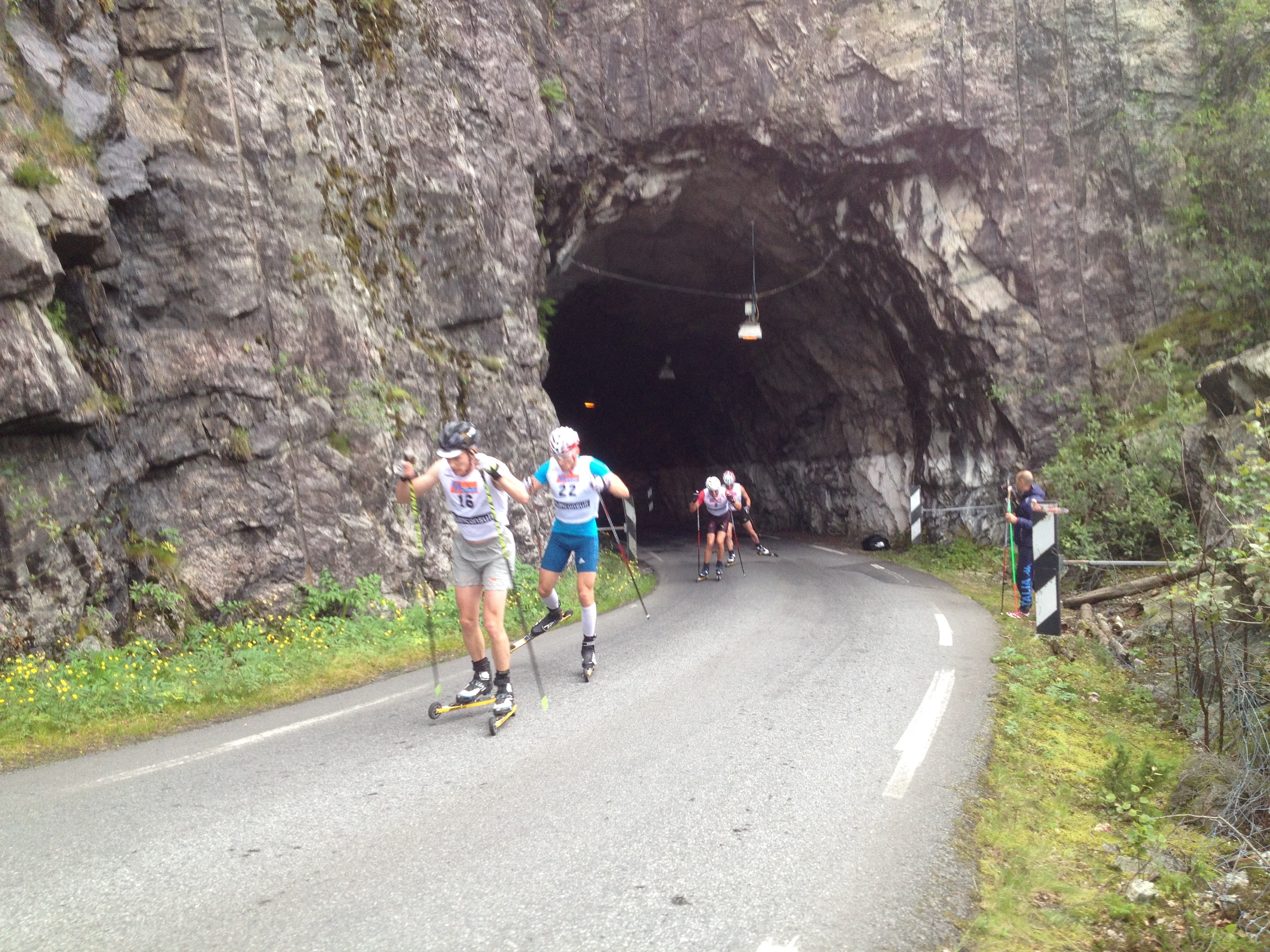
“The biggest shock was the 1km long tunnel, that took about 9 minutes I think, dark and slippery and hard to pass people,” Crawford explained in an email.
This type of event wouldn’t usually be her forté – “hill climbing has never been my strong front” – but Crawford enjoyed testing her fitness against the rest of the world’s best.
Crawford and Heinicke finished 30th and 33rd in 41:44 and 42:16, respectively.
“Makes me happy we don’t have 40 minute straight uphill biathlon races!” she wrote. It’s a lot harder than our Norquay races, which is about 5k and average 7-8% I think. Much longer than any hill climb we could find around Canmore. I’m always working on my climbing so I looked at it as a great opportunity to keep getting fitter!”
Racing continues Friday and Saturday, and the North Americans plan to race through the festival.
Not so for Weng.
“I’m going to a wedding on Saturday and then I simply can’t do several races this weekend,” she told Aftenposten. “It’s a little silly, because I like it so much here at these competitions in Lysebotn and Sandnes. But sometimes different worlds collide.”
But even at Blink, ostensibly a race festival, social time collides with sport.
“I especially enjoyed the boat ride [back across the fjord] today, it was a great opportunity to socialize,” Dunklee wrote. “In general all the athletes are very relaxed compared to the winter and happy to chat.”
Matti Heikkinen of Finland drops Russia’s Alexander Legkov at the top of the Lysebotn Op hill climb, a seven kilometer rollerski race which kicked off the Blink festival in Norway on Thursday. (Photo: Blinkfestivalen/Instagram)
(Note: This article has been updated to include comments from Canada’s Brendan Green.)
Finland’s Matti Heikkinen outsprinted Russia’s Alexander Legkov for the win on the brutal seven-kilometer uphill rollerski race in Lysebotn, Norway.
“It has been four years since I’ve been interviewed by Norwegian television,” Heikkinen, a former World Champion, told the media. “That’s too long.”
Legkov was 18 seconds back after the pair skied together for much of the race. Last year’s winner, Maurice Manificat of France, finished third, +44.6.
Heikkinen, who at 31 still looks boyish, had been considering ending his career, he told Finnish newspaper YLE in March.
“I have enjoyed skiing, even though last autumn, it was felt that this job would be running out,” he said. “My goal is to ski at the level of the World Cup podium and cold fact is that my level is often not enough to get there.”
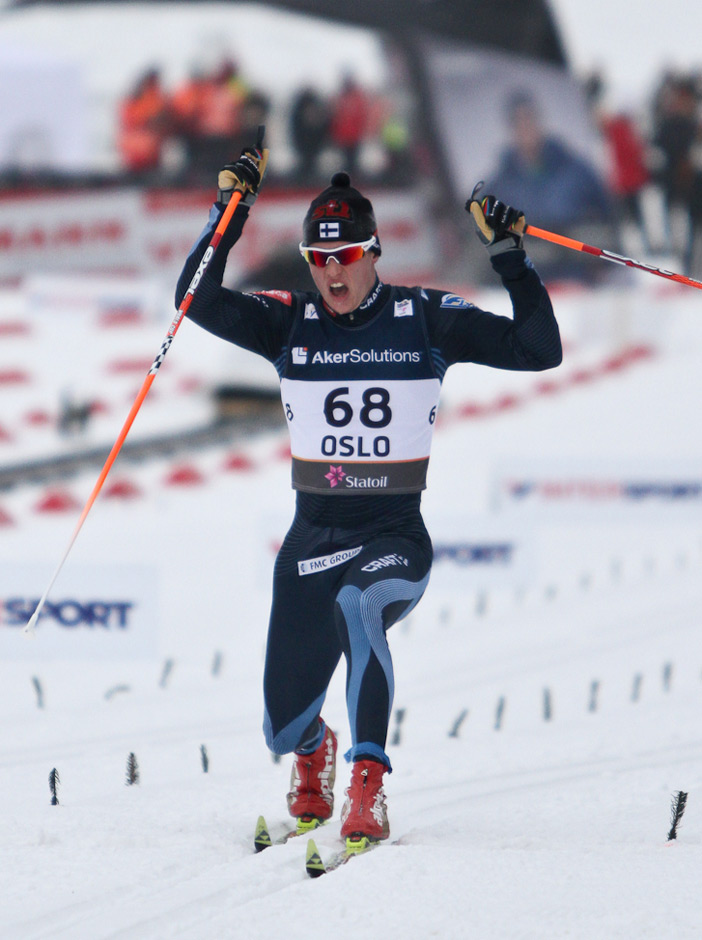
Matti Heikkinen crosses the line to win World Championships gold in the 15 k classic in Oslo, Norway, in 2011.
But with World Championships headed to Lahti, Finland, in 2017, Heikkinen decided to refocus, train smart, build a base, and try to peak three years down the road.
Perhaps the win in a summer rollerski race against the world’s best – not only top skiers, but also biathletes – shows that the work is paying off. Heikkinen not only won, but also set a new course record in 27:45.2.
Legkov is also coming off a spring season with a lot of changes. The star Russian, a gold medalist from the 2014 Olympic 50 k, left the Switzerland-based training group he had founded and is now training with Russia’s sprint squad, but on his own program.
Biathlete Bø Tops Skiers
The races did not go particularly well for the home country, aside from Heidi Weng’s big win in the women’s race (a separate article is coming soon). Last year Norway took places two through six in the men’s competition; this year their top finisher was Tarjei Bø, in fourth place.
“It’s obviously very fun to beat all Norwegian cross country specialists, but I was supposed to have been on the podium,” the biathlete joked to NRK.
He beat a field of Norway’s best skiers, including 2015 World Cup Champion Martin Johnsrud Sundby.
“It’s the first time I beat the cross-country guys, and it’s kind of neat,” Bø, a former World Cup overall winner and medalist at three different World Championships, told Norwegian broadcaster NRK. “There is little prestige there. I look up to the cross-country skiers and their capacity, and it’s hard to beat them.”
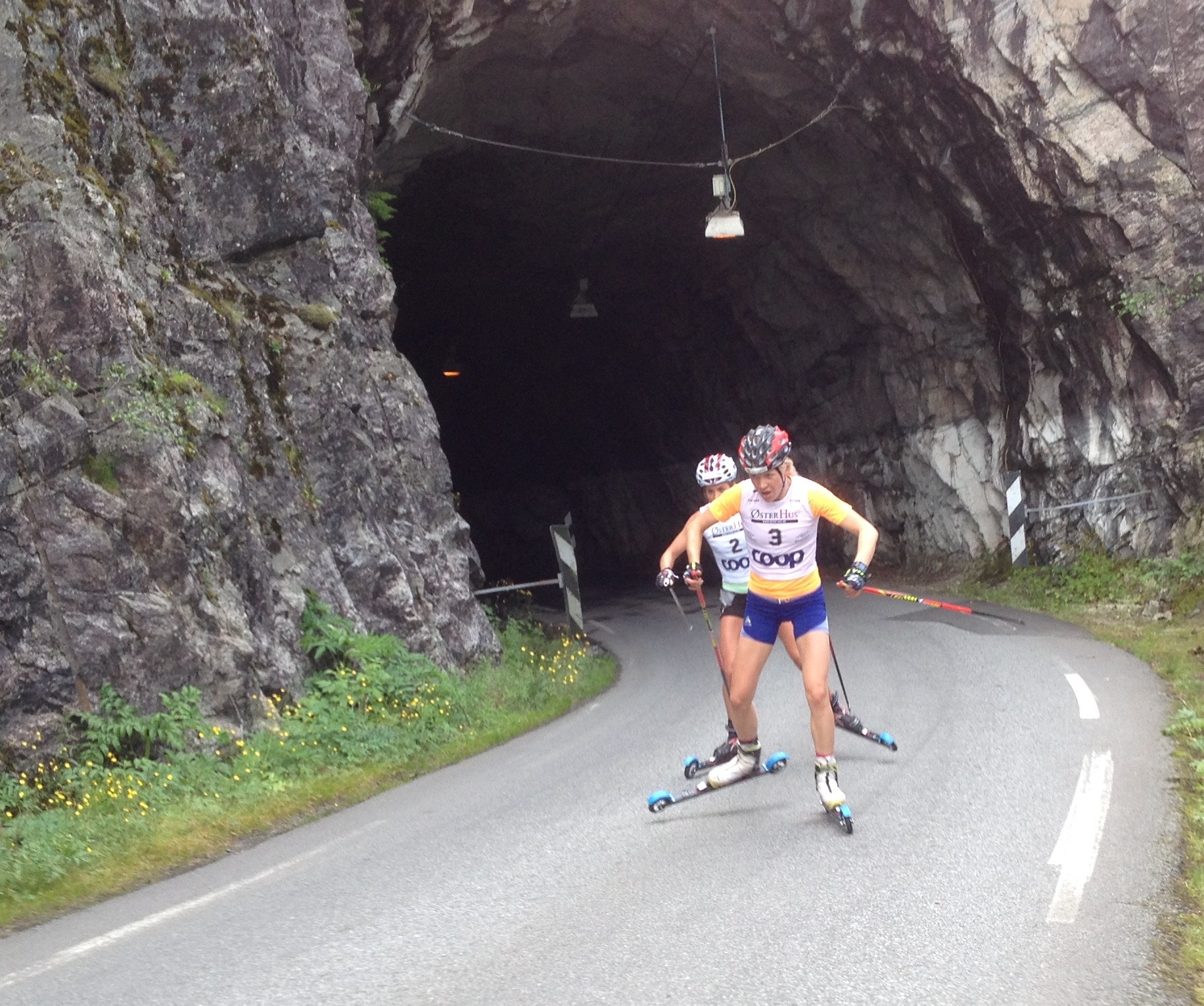
Heikkinen leading Legkov, Manificat, and Tarjei Bø out of a kilometer-long tunnel early in the race. (Photo: Matthias Ahrens)
Despite what was ultimately a very successful 2015 campaign, with three individual bronze medals at World Championships and medals in both the men’s and mixed relays as well, Bø has sometimes had a tough go since his breakout season in 2011.
He has often been sick or injured, and has rarely been able to completely follow his training plan.
Things have been better this year, which is important since Oslo is hosting IBU World Championships.
“I finally had a smooth ride, and have in fact neither been injured or sick so far,” he told NRK. “Therefore I could train exactly how it has been planned… If you ask me now, I’m on a good path for the World Championships on home soil. But it might happen much in the months remaining until the event. Now it is important to listen properly to the body.”
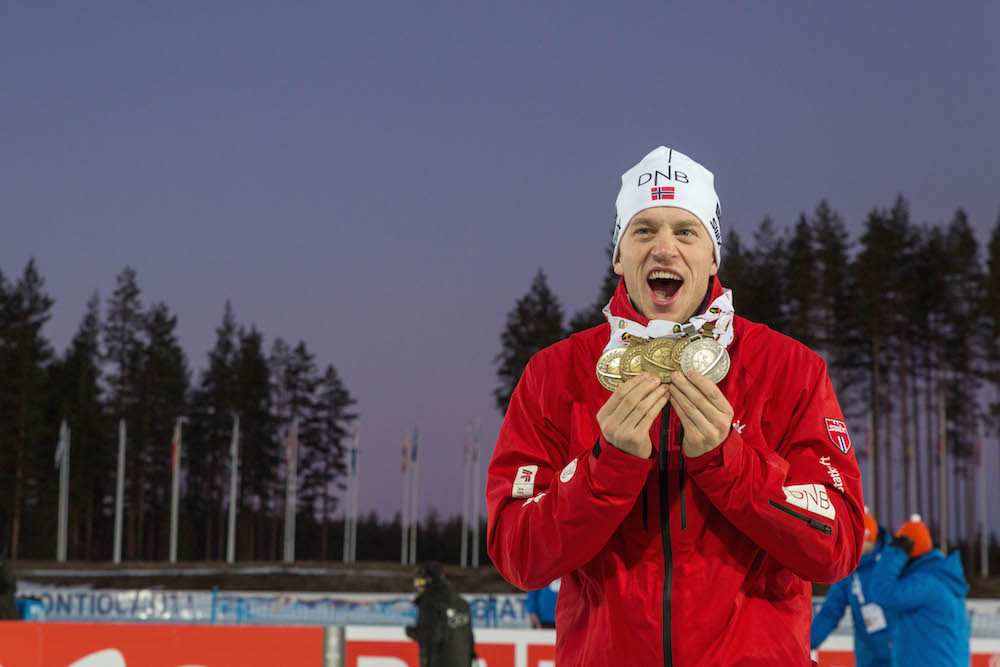
Norway’s Tarjei Bø with his five medals from 2015 IBU World Championships in Kontiolahti, Finland. (Photo: Kontiolahden Urheilijat/Kari Kuninkaanniemi)
Locked off the podium, the Norwegian men nevertheless packed the top ten. After Bø crossed the line nearly a minute behind Heikkinen, he was followed 20 seconds later by Sjur Røthe, Martin Johnsrud Sundby, Henrik L’Abee Lund, and Hans Christer Holund.
“It was difficult to move towards the end,” Bø told the newspaper VG. “There was no one to pushing me, so then it was only to slip back and save some strength for biathlon in the morning.”
Jean Marc Gaillard and Adrien Backschneider of France rounded out the top ten.
Petter Northug, a star who admitted to NRK the previous day that his form was “not too good,” finished 72nd. Northug declined interviews from any Norwegian media after the race.
Green Leads North Americans
Brendan Green led the North American contingent, placing 16th in 30:27 to finish less than a minute out of the top six in his first Blink Festival. The Canadian biathlete just edged Robin Duvillard of France at the finish.
“It’s a tough race with a stacked field, no doubt about that,” Green wrote in an email. “I really wasn’t sure what expect with this being my first time at the Blink Festival and racing the Lysebotn climb. Our team was training in Sirdal last week and during one of our volume workouts we were able to preview the climb, but even then it doesn’t fully compare to racing the climb.
“I’m happy with my race and my overall effort throughout the course,” he added. “I think with a bit more practice on the climb and now knowing a bit more how the race actually unfolds, I feel I could improve upon today. The section through the tunnel seemed to bottle neck and break up the race which was frustrating, as I was still middle of the pack at that point and the break was already gone by the time I came out. We don’t race Mass Start races very often either so that was a bit different for us with pacing and that sort of thing.
“It was an awesome experience to race in such an elite field and I’m definitely looking forward to the rest of the week,” he concluded. “We don’t see the XC guys often, so when we’re able to actually race head to head with them those are really valuable opportunities.”
Teammate Nathan Smith finished 39th in 32:11, besting American biathlete and recent newlywed Lowell Bailey by just three places and six seconds. Bailey’s compatriot Leif Nordgren placed 81st in 35:36.
“Absolutely I am happy with the results for this time of the year and a rather unusual hill climb, overall I see it more as a great training workout,” Canadian head coach Matthias Ahrens wrote in an email.
You’re working out hard, following a training plan built in accordance with your specific goals for the upcoming race season. All is well, but something is missing. You’re lacking that extra motivation, a simple spark so many endurance athletes tend to lose along the rocky road to personal gratification. How about measuring yourself against the best athletes in the world? While some will find no interest entering such an unmatched contest, others may welcome this unique opportunity.
The best part of it all: you get to set the date, time and place to face the virtual elite pack. Virtual, yes, as you’ll be doing it all alone. No eyes to witness the rivalry. No roars from fans to elevate you in the middle of your improbable feat. Only a magic number to reach, or in a few cases, to beat.
In recent years, specific challenges using simple technology started emerging in endurance sports, with professionals participating and setting the bar high. Since 2005, Trail Runner magazine has hosted the Uphill Challenge head-to-head competition at the Summer Outdoor Retailer show in Salt Lake City.
Sixteen elite-level runners, male and female, compete on side-by-side treadmills for 15-minute stints at 15-percent incline. The runner to cover the greatest distance is crowned champion. American ultra-trail runner Sage Canaday, a two-time Olympic marathon qualifier who holds the American record in the Mount Washington Road Race, managed to run an impressive 1.92 miles. In the women’s treadmill challenge, Cynthia Fowler won with a distance of 1.46 miles.
What: Trail Runner magazine’s Uphill Challenge
Where: Anywhere you can get on a treadmill for 15 minutes
Who: Anyone who feels comfortable running on a treadmill at a massive incline
How: Warmup appropriately, then set your treadmill at 15-percent incline, and go! Goal is to run as far as possible in 15 minutes, so either pick a pace and stay there or gradually ramp up to the highest speed you can sustain (techniques can vary, but don’t hurt yourself!)
In an email, Canaday explained how the uphill challenge benefited his race prep.
“I think it is one of the most specific workouts you can do to indicate how well you’ll fare at the Mt. WA road race,” he wrote. “The Challenge is something that I’d probably only do twice in a season to prepare for a race. It is a good, nearly 100% Vo2max type of stimulus/test that shows me how well I can climb on a steep slope.”
He recommended separating the challenges by five to eight weeks to show improvement.
“It is such a short and intense workout and the incline is rather steep so it’s best to do other, longer workouts on a more moderate incline (i.e. 10%) for longer periods of time in between these super hard efforts,” Canaday wrote. “Also, in preparation for the challenge is recommended to do some easy paced uphill running at 10-15% incline to help prevent injury!”
So not only does this short intense workout enables one to compare his results with the best, it can serve as a simple and accurate fitness gauge before upcoming races.
A ThoraxTrainer challenge in motion (Photo: ThoraxTrainer/Facebook)
Similar challenges can also be found in nordic skiing and mostly involve double poling.
The ThoraxTrainer challenge in Norway has attracted some strong skiers. In 2012, Sweden’s Jerry Ahrlin, from Team Xtra personell, set the record in the 5000-metre double-pole contest in 13 minutes, 41 seconds. Ola Vigen Hattestad, Norway’s most successful cross-country sprinter, set a world-record time of 1:09 in the 500-metre challenge.
So, what are you waiting for? Hit the treadmill or a ski-specific trainer and get motivated!
The Whiteface Mountain Veterans Memorial Highway, where NYSEF’s Climb to the Castle has been held for the past seven years in Wilmington, N.Y., as seen in 2011. The toll road is undergoing construction this summer and fall.
There’s a race each year scheduled in line with the end of the U.S. Ski Team’s fall camp in Lake Placid, N.Y. You might have heard of it: the Climb to the Castle. Hosted by the New York Ski Education Foundation (NYSEF), the freestyle rollerski race starts at the entrance to a paved toll road, the Whiteface Mountain Veterans Memorial Highway, and stretches five miles up with an average 8-percent grade. The finish is marked by the castle at the top of New York’s fifth-highest peak at 4,867 feet above sea level.
Try to rollerski up there now, however, and you’ll likely run into some heavy machinery.
Construction has already begun on the eight-mile highway as part of a larger project to completely resurface the road over the next several months. The Adirondack Daily News reported Thursday that the upper, toll portion of the road — where the Climb to the Castle (C2C) takes place — will be closed weekdays during May, June and September, but open on weekends. It will be open on weekends and two holiday Mondays during these months: Memorial Day, May 26, and Labor Day, Sept. 1. Throughout July and August, the road is scheduled to be open during daytime hours, with work taking place at night.
US Biathlon’s Tim Burke (l), and U.S. Ski Team members Kris Freeman (c) and Noah Hoffman (r) lead the 2011 Climb to the Castle race in Wilmington, N.Y.
According to Chris Grover, the U.S. Ski Team will hold its Lake Placid training camp from Aug. 25-Sept. 8. So while there’s a chance construction could impact it, there’s a better chance the toll road will be open on Saturday, Sept. 6, when NYSEF scheduled the race.
Margaret Maher, NYSEF’s head nordic coach and C2C organizer, wrote in an email to FasterSkier last week that they were “trying to figure out how the road work will influence the race. Hoping we can still have C2C!”
In all, the highway is expected to be closed 54 days from this week until the end of the season, and open 88 days over the same period, according to the Enterprise.
While the toll road has been patched periodically since it was opened in the 1930s, it has never been completely resurfaced. Whether rollerskiing, cycling, or running to the summit, it’s riven with frost heaves and cracked pavement. Regardless of what state the road is in this year, its sure to be a superior surface for rollerskiing next summer.
Rifenburg Construction, based out of Albany, N.Y., will resurface the entire eight-mile length of the road, from the four-way intersection in the center of Wilmington to the summit. They’ll also rehabilitate rock walls and make repairs to the castle.
The men’s start of the 2009 Climb to the Castle.
Rifenburg earned the project with a $11.2-million bid, and the company expects to complete the work by the end of 2015.
Project manager Russell Huta said that the goal is to have a base layer of new pavement from the tollgate to the castle by the end of this fall. In 2015, the toll section will be finished, and all work on the section from Wilmington town center to the tollgate will be completed.
“Each project has its own set of unique challenges,” Huta told FasterSkier, when asked about the difficulty of working in the narrow confines of the toll road. When road work is in motion, the toll road will be closed to traffic.
In September, Huta said, his company will have “full access” to the toll road Monday through Friday – except for Labor Day. “By the end of the day Friday, there will be a paved surface for [use by] cars, buses, pedestrian traffic” until Monday morning. “On Monday morning, it’s ours again.”
If for some reason, the C2C isn’t possible this year, Grover wrote in an email that it won’t be the end-all of camp.
“We typically run a sprint or team sprint time trial along with the Climb to the Castle,” he explained. “If the Climb is not ready this season, we will employ other alternatives.”
Before the C2C, a time trial was previously held up Gillespie Drive, now a warmup for athletes. The event is entering its eighth year. USST veteran Liz Stephen won the women’s race the last three years, setting a new course record last year in 42 minutes and 4 seconds. US Biathlon’s Tim Burke won the 2013 men’s race in 37:13.
Emily Attwood (l) and Heather Mooney lunge at the finish of their final hill climb sprint.
Middlebury, Vt. — Unless you’re the audacious Liz Stephen or Overall World Cup Champion Therese Johaug, you’re probably not a huge fan of hill climbs. However, when the mid-April temps turn our favorite trails into puddles, nordic ski enthusiasts have to get creative to get their on-snow skiing fix before spring training begins.
In Middlebury, skiers at the local college are doing just that by taking advantage of the remaining of snow at the Middlebury College Snowbowl, an college-owned downhill ski area only 20 minutes from campus.
I joined Heather Mooney (Peru, Vt.) and Emily Attwood (Cape Elizabeth, Maine) this past week to take advantage of the long awaited spring weather and to get in a late season ski at the same time. For this retired ski racer, the workout was certainly exhausting but left me full of energy for the rest of the day.
Former Middlebury skiers Emily Attwood (l) and Heather Mooney get ready to climb up then ski down the Middlebury Snowbowl in the spring of 2014. (Photo: Lander Karath)
Emily Attwood (l) and Heather Mooney start their 45 minute ascent to the top.
Middlebury Snowbowl Hill Climb and Norpine
Middlebury Snowbowl Hill Climb and Norpine
Emily Attwood (l) and Heather Mooney lunge at the finish of their final hill climb sprint.
Middlebury Snowbowl Hill Climb and Norpine
Middlebury Snowbowl Hill Climb and Norpine
Tired, happy, and on top of the world.
Middlebury Snowbowl Hill Climb and Norpine
Heather Mooney (l) and Emily Attwood navigate the Middlebury Snowbowl on their nordic skis.
Middlebury Snowbowl Hill Climb and Norpine
Middlebury Snowbowl Hill Climb and Norpine
Preparation:
Finding a location for the hill climb and norpine is easy in a place like Middlebury where the alpine ski area is closed and the snow remains in relative abundance. In many western ski areas these circumstances can also be found with the exception of the few mountains that are still open. If this is the case, they most likely won’t allow you to ski, due to the lack of leashes, but it doesn’t hurt to check.
Once the ideal spot is found, there’s not much needed for a spring hill climb and norpine other than a pair of skate rock skis, classic poles (skate poles are too big for the climb as well as the descent), and of course, a sense of adventure. However, there are a few accessories that make this workout even more enjoyable. For example, bring a Jammypack so your favorite jams can aid you in your struggle your up the hill, and provide a sick soundtrack for the cruise down.
In addition, make sure to start your climb in the morning, as warm spring temperatures make the snow pretty soft, wet, and slow later in the day.
The Workout:
Once you’ve adorned your jammypack, jumped on your skis, and hit the snow you have a long trek ahead of you. Most alpine ski areas are fairly steep so be prepared for a haul to the top. At times it can feel like progress in the softening snow is nonexistent, but little by little the hills get conquered.
Once you reach the final ascent of our climb, those who are more ambitious can decide to have a final hill sprint. My two companions decided to have such a race, once again proving that cross county ski racers have some of the most competitive personalities in the sports world.
While you can choose to sit out of the final sprint (as I did), it aids in keeping those post-season legs fit and fresh with a little bit of intensity. It also certainly adds to the sense of accomplishment and exhilaration of climbing to the top of a massive alpine ski area.
Once at the top, the real fun begins. After taking a rest from the 45 minutes of climbing, make your way down the slopes for some awesome twists and turns.
This part of the workout is called norpining. As the name suggests, its a combination of nordic and alpine skiing. While nordic skis don’t have great edges, they certainly make for a fun (and somewhat unstable) 20+ minute cruise to the bottom. It may take a few turns to get used to skinny skis on a steep slope, but by the time you reach the base you’ll be rearing for more.
FasterSkier’s coverage of SuperTour Finals and U.S. Distance Nationals is brought to you by the generous support of Concept2, the leading manufacturer of indoor rowers, racing oars, and the SkiErg.
TRUCKEE, Calif. — Erik Bjornsen (Alaska Pacific University/U.S. Ski Team) held off Kris Freeman (Maine Winter Sports Center/USST) on the final climb up Sugar Bowl Resort to win SuperTour Finals on a blustery day on the mountain. Mikey Sinnott (Sun Valley Ski Education Foundation) crossed the line in third.
*Apologies to viewers for missing Bjornsen at the finish — our camera at the top of the mountain froze after the women’s race and Bjornsen was gone before we could get the backup camera running.
FasterSkier’s coverage of SuperTour Finals and U.S. Distance Nationals is brought to you by the generous support of Concept2, the leading manufacturer of indoor rowers, racing oars, and the SkiErg.
TRUCKEE, Calif. — The hill climb that concluded SuperTour Finals on Monday looks even more brutal on video than it did in the photos. Liz Stephen (Burke Mountain Academy/U.S. Ski Team) clawed her way from third to first, with a 2-minute, 26-second deficit at the start, to pass Sadie Bjornsen (Alaska Pacific University/USST) and then Kikkan Randall (APU/USST) to make it to the top of Sugar Bowl Resort first, winning both the four-race tour and posting the fastest time of the day. Randall held on for second and Bjornsen came in third.
Liz Stephen (Burke Mountain Academy/U.S. Ski Team) gasping for air as she finishes the 6.0 k hill climb with the fastest time of day and overall SuperTour Finals win. Photo: Mark Nadell/MacBeth Graphics.
FasterSkier’s coverage of SuperTour Finals and U.S. Distance Nationals is brought to you by the generous support of Concept2, the leading manufacturer of indoor rowers, racing oars, and the SkiErg.
TRUCKEE, Calif. — It’s no secret that Liz Stephen (Burke Mountain Academy/U.S. Ski Team) has an affinity for skiing really hard climbs. Where other people struggle to wrap their minds around a race to the top of an alpine slope, the 26-year-old thrives in environments where she’s up against the mountain, the elements, and the pain and suffering they induce.
Stephen was second in the world in the final climb of the Tour de Ski this January; and has proven time and again that she is unrivaled when it comes to going up the precipitous pitches that most people prefer do go down.
For the ultimate stage of SuperTour Finals, a 6-kilometer freestyle hill climb at Sugar Bowl Resort, Stephen continued her impressive record and demolished the field by 1 minute, 44.9 seconds on time-of-day, with a finishing time of 27:57.7. The time gap, though considerable, is not really a surprise. After all, she won the Climb to the Castle rollerski race up Whiteface Mountain in September by five whole minutes.
What’s surprising, however, was that she was able to surpass Kikkan Randall (Alaska Pacific University/USST) from 2:26 down in doing so, snatching the overall SuperTour Finals title by 38.3 seconds. After three stages, the tour victory had looked to be in the bag for Randall. But Stephen was on her game Monday and, in what turned into a critical factor, Randall handicapped herself when she skied off the designated trail up one of the course’s steepest pitches, losing valuable time.
“I honestly wasn’t expecting to catch Kikkan today,” Stephen said. “I was expecting to get close, but I thought that gap was going to be too big. But that just goes to show you go out and you try your hardest each day.”
With hill climbs, the terrain on which a race unfolds is as much an active player in the outcome as are the people competing. For this particular race, athletes were treated to the additional challenge of extreme weather — as if to say that climbing a mountain on skate skis wasn’t hard enough, Mother Nature provided a special mixture of treacherously strong winds on Monday morning. The higher the course went up Sugar Bowl’s blue runs, the more extreme the wind became.
“It was brutal,” Stephen said.
“Brutal. Miserable,” echoed Chelsea Holmes of the Sun Valley Ski Education Foundation, who had the third-fastest time.
Racers later spoke of having to adjust the angle of their pole plants so they could control where their baskets would land as the wind blew them sideways. The course was stripped down to the ice in some parts and piled up with dense drifts in others. Blowing snow pelted skiers’ exposed faces. A thousand feet above the starting line, the finish banner whipped threateningly in the wind. Nordic skiers are drawn to the sport for its singular difficulty, and the ingredients were all there for this hill climb to go down as one of the most memorable races of them all.
Knowing what waited for them, the women lined up ready for anything at the base of the mountain. The race began with a flat, rolling 3 k before the real incline began.
Randall left the start a full minute and nineteen seconds ahead of the next women, Sadie Bjornsen (APU/USST). Stephen didn’t set foot on the course until over a minute after that. But as soon as she did, the two women in front of her knew the clock would be running with Stephen hot on their tails.
“I knew Liz would be coming by, of course,” Bjornsen said. “I was kind of making bets with her for how far it would be until she caught me.”
The very first starter in the pursuit, Randall wasn’t fazed by being hunted down.
“I mean, it’s fun,” she said. “I always view these hill climbs as it’s me versus the mountain, really. So it was fun to be out front, fun to know I had a chance. I knew it’d be close and it was.”
The course brought skiers to the peak at 7,953 feet by way of two traverses across the face in between direct climbs up the slope. The flat first half of the race was merely a place to conserve energy and anticipate the impending suffer-fest.
Once the climb began, athletes had to dance a fine line between making forward progress and avoiding the redline. Stephen can accomplish this task at a higher threshold than anyone else on impossible grades, and she tracked down Bjornsen, the first target in front of her, on traverse number one. Focused on her own internal battle, Bjornsen processed Stephen moving past her and quickly returned her attention to moving her own two feet.
“It’s hard to look straight up the hill because that just makes it harder, so I watched her for a second when she went by me and then just put my head down,” Bjornsen said. “Just trying to keep a rhythm in my legs.”
Up ahead, Randall was still a ways in front of Stephen. As the minutes ticked by and the hill kept going up through a tunnel of howling wind, Stephen frequently reminded herself that things could be worse.
“I kept thinking [of when] I did this hill climb in Poland two years ago and it was like this day except no sun and we had no idea where we were going and it was like a whiteout and then you had to go down, also,” Stephen said. “The wind was coming at you the whole time, pushing you back downwards, and this was a least coming at the side of us or the back of us. So I kept thinking when it was getting really hard, ‘This could be worse this could be worse.’”
She also kept her eyes on Randall, who was drawing ever closer. She watched as her friend and teammate made a critical error at a turn in the course and start going up the wrong way. Instead of staying inside the quickly-eroding blue borders that marked the course, Randall followed her line of sight up the more direct but incorrect route. By the time she realized her mistake and turned around to go the right way, she likely lost around half a minute.
The way Randall described it later, the mistake was the product of being too exhausted in the moment to realize what was happening.
“I saw a gate ahead of me and thought that’s where I needed to go,” she said. “I remember crossing the blue line but it didn’t occur to me that I shouldn’t be crossing the blue line… All a sudden I heard my name yelled out behind me and I was like, ‘Wow, everyone’s getting really excited cheering all of a sudden.’”
When spectators kept yelling at Randall after she’d passed them, she knew something was wrong. She looked back and saw former APU skier James Southam running up to her, indicating she had to go back.
“I saw the gate and I went, ‘Ahhhh…’” Randall said.
So back down she went. On the correct course once more, Randall still had a few more turns to make before the top, and behind her, Stephen was getting ever closer. The race leader didn’t let herself think about the time she cost herself with the wrong turn, as it would have been counterproductive to the race yet to be skied.
“At that point I was still focused on making it up that pitch,” Randall said. “My legs were really starting to tie up and I just focused on making steps forward.”
There’s no telling how much of a difference that time made. Stephen closed in on Randall as they crested the top of the last big hill before they meandered along the ridge to the finish line. By the time they came within sight of the timing building, Stephen was well ahead of Randall and crossed the finish line 30:23.7 after the gun had gone off down below for a time-of-day mark of 27:57.7. But even after she’d passed her, Stephen didn’t quite count Randall out.
“I looked back like three times because I was sure she was going to just outsprint me,” Stephen said.
Instead, Randall looked tired as she double-poled across the finish. In the base lodge much later, she admitted the wrong turn and resulting loss was a bummer.
“In the end with it being a little bit close, I could have used that extra 20 or 30 seconds,” she said.
For Stephen, to end SuperTour Finals by winning it was simply an added bonus to a week that wasn’t geared towards results.
“I didn’t have expectations this week at all,” she said. “I just wanted to come out and enjoy myself and I’ve totally done that, and I’m psyched to have won today. It’s so fun to end the season on a podium, for sure, but honestly the goal was to go out, have fun, go as hard as I can up that hill. And I happened to bring home a win today.”
Bjornsen held on to her position and was third across the line, 1:35 behind Stephen. As a skier not traditionally suited towards climbing or skating, she was thrilled to hang on to a podium finish.
“I’m definitely happy,” she said. “Deep down my goal was to finish still standing on the podium, but I didn’t know if that was realistic.”
Sweden’s Maria Graefnings (Falun Borlange SK), who started fourth, held off a charging Jessie Diggins (SMST2/USST) to finish in the same position, crossing the line 3:12.6 behind Stephen. Climbing is not usually her strong suit, so she was happy to both hang on and to wrap up the tour in good standing against a strong U.S. field.
“It’s super competitive; it’s such a good field here,” Graefnings said. “It’s good motivation for next season to see I can kind of keep up with those girls, ’cause they all had a really good season, so I’m happy.”
Jessie Diggins comes across the line with the second-fastest time of the day. Photo: Mark Nadell/MacBeth Graphics.
Embedded within the pursuit-style climb was an individual race, too. Stephen had the fastest time-of-day by far, but it was Diggins who followed her with the next best time, much to her own surprise. Diggins started 10th, four minutes behind Randall, and clambered past five other people to finish fifth in the tour, seven seconds behind Graefnings.
Diggins caught and passed Annelies Cook (Maine Winter Sports Center/USBA) and Susan Dunklee (Craftsbury Green Racing Project/USBA) on the early flats and later skied with Rosie Brennan (APU) on the climb.
After the sprint on Saturday, Diggins had considered herself “physically and mentally done.” But with the help of some pink-and-purple race-day makeup, she amped herself up for another competition and was happy to learn that she was still ready to go for the final stage.
“I was really quite burned out, so I had to go to some drastic measures to get myself excited today, including some lipstick and glitter and colors on my face,” she said. “It’s nice to be like, ‘OK, just get in the mindset one more time, you can do this.”
It was a mantra she likely repeated to herself as she worked toward the top of the mountain with her poles blowing sideways.
“It was definitely a real test kind of a day, a mental-stubbornness test,” Diggins said.
Twenty-four seconds behind Diggins on time-of-day, Holmes was third fastest and 12th overall. She was pleased with the result, though she admitted to not being totally prepared for the difficulty of the course.
“I was so not prepared, mentally,” Holmes said. “I was like, ‘Oh, it’s not as hard as Jay Peak’ (site of the hill climb in 2012). And then I was going up it and was like, ‘I am so dumb. I am so wrong’… It was tough.”
Though the women still have a 30 k classic mass start to complete, Monday’s hill climb was the last SuperTour race of the season. There were double SuperTour points available at the Finals, and overall points leaders on the men’s and women’s lists will be going back to the World Cup in the fall. Brennan was the points leader going into the Finals and she still is now that the season is over. She finished sixth overall in the mini-tour, 10 seconds behind Diggins, with the seventh-fastest time of day.
“More than anything I was hoping to keep the SuperTour lead, and I think I’ve done that now so that’s really nice,” Brennan said.
If FasterSkier’s calculations are correct, Brennan ends the season with 582 SuperTour points to Bjornsen’s 399 points.
U.S. Ski Team member Holly Brooks after winning her first Mount Marathon title on Wednesday. She also set a top-10 time in the hill climb’s 85-year history in 51:53. (Photo by Rob Whitney)
In Anchorage, getting on the front page of the Alaska Daily News is a big deal. It doesn’t matter if you’re an Olympian and U.S. Ski Team member; Holly Brooks was still pumped to be featured in Thursday’s paper.
The 30-year-old Alaska Pacific University skier did so by winning Mount Marathon, one of Alaska’s biggest athletic events and Fourth of July traditions.
Brooks near the bottom of Wednesday’s grueling Mount Marathon trail run in Seward, Alaska. (Photo by Rob Whitney)
Brooks ascended the 3,022-foot mountain, which averages a 38-percent incline, and completed the out-and-back course in Seward, Alaska, in a record time of 51:53. She not only won the race, she set one of the top-10 women’s times in the race’s 85-year history. And she wasn’t even wearing a watch.
A three-time runner up, Brooks had finally sealed her first Mount Marathon win. Engaged the day before the 2008 race, in which she came in second, she had a special history with the event.
She led it back in 2009 — a week before her wedding — until dehydration and heat exhaustion pulled her out and into the emergency room. She returned in 2010, where she was beaten by seconds by seven-time Mount Marathon champion Cedar Bourgeois. Last year, U.S. Ski Team veteran and APU teammate Kikkan Randall edged Brooks by 19 seconds for the win.
“The Birkie and Mount Marathon have driven me crazy,’’ Brooks told the Daily News, referring to her photo-finish loss in the American Birkebeiner ski marathon in 2009. She redeemed the former by winning the 50 k skate race in February.
“No one lets you forget it. ‘You gonna win this year?’ I no longer have to answer that question, because I did it,” Brooks said. “I can put the demons to rest.’’
While Brooks did plenty of interviews on Wednesday, she shared some afterthoughts with FasterSkier via email on Friday.
Brooks on her way up Mount Marathon on Wednesday. (Photo by Rob Whitney)
FasterSkier: What was the race like this year? How did it compare to years past?
Holly Brooks: The race had a different kind of pressure this year… while I knew that Kikkan wasn’t running, I didn’t know who else would be out there to race against. I came into the race just days after my biggest week of training ever – 30 plus hours of glacier skiing [with the North American Women’s Training Alliance on Eagle Glacier] and I had no idea how my body would react to a race effort. I’ve been really close to winning this race so many times that I really wanted to come away with a victory this year!
I went out hard from the line and tried to establish a gap on the uphill such that I didn’t have to take any big risks on the decent. I had some friends that gave my splits 1/4 and 1/2 up the mtn. I knew I had a decent margin going into the downhill… it’s certainly different just racing by yourself out there – as compared to last year when Kikkan and I were two inches away from each other the entire race!
I purposely didn’t wear a watch because it was wet and trail was slippery. I knew I was tired and didn’t think I would be capable of putting in a good time. I was shocked when I finally saw the race clock near the finish line – I ran faster this year than we ran last year! Had I known my splits I certainly could have run faster – but, it was really fun to enjoy the race instead of going for every second. Usually main street is extremely stressful – the race has come down to a couple of sprints for me – but this time I had a HUGE grin the entire way …. I stopped to pick up an American flag from one of the spectators, too! It was awesome and I was really able to savor the moment. Main street was so loud and everyone was cheering – it was fabulous!
Mt Marathon is the Birkie of Alaska, that’s for sure! I’m totally psyched that I was able to cross both of those off my list this year. I got two gorillas off my back!
FS: How did you approach it mentally?
HB: The race was really hard to prepare for – in fact, I did virtually no preparation seeing that the NAWTA camp ended right before it. I drove down to Seward the day before and hiked up past the halfway point. It’s really important to inspect “the gut” (the down trail) for safety reasons… you basically run down a waterfall with snow bridges. It’s important to see it before race day. I didn’t want to expend the energy to run to the top of the mtn and it was tough not knowing what to expect when I encountered it in the race. There was a big snow patch and a huge glissade chute.
Brooks bearing the American flag she ran with across the finish line to win the Mount Marathon trail run. She also earned a champagne shower. (Photo by Rob Whitney)
It’s difficult when everyone tells you that it’s “your race to loose”… everyone expected me to win and I didn’t want to disappoint. I also didn’t want to be over confident. You can’t take anything for granted in this race. In 2009 I lead almost the entire race before passing out right in front of the emergency room four blocks from the finish line.
I did my best to relax going into the race, and remember that it was “all for fun.” But, it was hard to avoid the pressure! Mt. Marathon is certainly the “Olympics of Alaska” and I can’t go anywhere in town without people asking me about the race.
FS:How does it stack up against other races you’ve done?
HB: The visibility of the race in AK is much more so than any other races I compete in – the story made front page news July 5th and leading up to the race there were articles in the paper everyday. There is also a certain element of danger and risk in the race which makes for an additional level of stress. There is one man still MISSING from the race – two days after the event. My fingers are crossed for him but time is running out as race day was 50 degrees and raining. I really hope he turns up, alive. Ironically, the finisher race t-shirts read, “Survivor” on the sleeve this year. I’m not sure the race organizers anticipated a potential death (in the race) when designing the t-shirts.
FS:What does it mean for you to finally win it?
HB: Well, I can sleep at night now! Actually, it feels great to finally be able to “check the box” for Mt. Marathon. This race has been really monumental is my life the past couple of years – my rookie year I came in second and got engaged the day before the race, then 2009 I passed out (ER Trip) , decided I wanted to make the Olympics, and then was married a week later… 2010 was right after the Olympics, 2011 Kikkan and I battled it out. So far, 2012 has been great in that I was finally able to take a Birkie win and a Mt. Marathon win – two really fun, big races!
Now that the race is over I can re-focus on my ski training and get ready for a second glacier trip, then our camp in Sweden!
Brooks’ husband, Rob Whitney, with Gumby at the Mount Marathon trail run on Wednesday. “Gumby” did the entire 3.5-mile race in costume, which Brooks explained was no small feat considering how technical the course is.
Fredrik Mandt of Skien, Norway, was crushed by the speedy national team racer from Dalsbygda, who also has the nickname Duracell Bunny, in the hill climb race up the alpine run in Rauland, Norway, on Saturday. Mandt had to eat the soles of his ski boots (with chili) at the top of the climb.
Not tasty
“I had shoe soles and ate my shoes. I had lactic acid coming out my ears after five meters,” Mandt said to Norwegian newspaper Dagbladet after his race. He admits that the field moved faster than he expected. “I don’t even want to talk about how far back I was. It was the technique that failed me,” he said.
How did your boots taste?
“Of course, it was really hard to have to eat my boots, and they had a bitter taste. We dressed them with Mexican chili to mask the taste, but if I have to compare the consistency to any kind of meat, I would say it classifies as tough,” Mandt said. He has already accepted his new nick name: “The Big Mouth from Skien.”
Therese Johaug waited for her challenger at the top, and could pretty much have showered before Mandt arrived.
“I’ve changed and eaten already. Looks like you need to eat some of the food from my neck of the woods,” Johaug said to Mandt, according to the newspaper TA.
Revenge – without skis
Fredrik Mandt is hoping to get even in a different race, one where he feels the playing ground is more level.
“I’ll challenge her to a rematch with running shoes. I hope Johaug is sporty enough to take me up on the offer and we can carry out what the bet was really about,” Mandt said with a laugh.
“That’s what I thought this was about when I agreed to eat my shoes. Once I realized this was about skiing, I dearly regretted the bet,” he explained. But on the other hand, Mandt is happy to contribute to create a little more commotion about the event in Rauland this weekend.
Normally, Mandt is a triathlete, and has competed seven times in one of the world’s toughest one-day races, the Norseman Extreme Triathlon (consisting of a 3.8-kilometers open water swim in the frigid Hardangerfjorden in Norway, a 180-kilometer bike leg and concluding with a 42.2-kilometer marathon where the last 17 kilometers climbs 1,800 meters – or more than 5,200 feet).
From Dagbladet.no, April 2, 2011. By Mads Gudim Burheim, translation by Inge Scheve
Andy Newell (USST) leads up the hill climb, with teammate Torin Koos and Ivan Babikov (Canada) in pursuit
Today’s 7 k men’s hill climb in Fort Kent was scripted to end with an exciting finish. It didn’t disappoint.
At the bottom, Andy Newell (USST) started the day with a 1:20 advantage over Ivan Babikov (Canada), one of the best pure climbers in the world. By the time they arrived at the top, Babikov had made up all the time.
But he couldn’t shake Newell, who had saved just enough for the one kilometer of rolling terrain to the finish. And everyone knows what happens when you stack Newell up against a distance skier in a sprint—he took the win by a full second.
“That’s a hell of a way to finish the year,” he said.
Newell said he went out hard, but at his own pace. He’d lost about a third of his lead by the end of the two-kilometer promenade loop before the climb, then set about attacking the big hill.
For just over one kilometer, the course went straight up one of the alpine trails at the Lonesome Pines Ski Area. Organizers stuck in a couple of bends and switchbacks, but there was still nowhere for Newell to hide.
Ivan Babikov two-thirds of the way up.
Especially not from Babikov. He ate up the climb, using a quick-tempo V1 to pass Torin Koos (USST) and take more than 55 seconds from Newell by the top.
When Babikov caught him, just a few seconds from the hill’s crest, Newell had been working, using a mix of V1 and even coach’s skate—but he was still skiing his own race. He said he didn’t look over his shoulder once.
Eventually, though, Newell said he heard someone behind him, and sure enough, it was Babikov.
The Canadian put in a big push, hoping to get clear, but Newell hung on tenaciously.
“I was just dying at the top, but [I] was able to tuck in behind him,” he said.
There was one more small climb before they reached the stadium, and they hammered it, V2-ing side by side. Newell got a bit of an advantage, and he held it to the line.
“I couldn’t have played it out any better,” Newell said. “It was fun to try to ski with some tactics and actually get a sprint finish.”
Koos brought it home for third, just holding off APU’s Lars Flora.
While the tour format makes some big demands on athletes and coaches, Newell said he thinks that the events suit him well.
“Tours are the future,” he said. “It’s hard on the athletes to race so many days in a row, it’s hard on the technicians, it’s hard on the coaches, but the fans seem to like it.”
Babikov had the fastest time on the day, taking into account Newell’s head start. Noah Hoffman (USST) showed that he can also climb with the best, finishing second, and Flora was third.