From the FasterSkier archive — posts syndicated from athletes’ and coaches’ own blogs between 2004 and 2012, kept online as published. Current coverage is at fasterskier.com.

Tag: Hinterzarten

  • Hendrickson Earns Bronze Medal at Junior World Championships

    Jan. 31, 2010 — Sarah Hendrickson of the Visa U.S. Women’s Ski Jumping Team captured the bronze medal Saturday at the FIS Nordic Junior World Championships in Hinterzarten, Germany.

    The 15-year-old Hendrickson, who attends junior high in Park City, Utah, is the first American jumper to ever earn a medal at the Nordic Junior Worlds.

    “I don’t think it’s really settled in yet. I’m really happy. I had two really good jumps,” Hendrickson said.

    Italy’s Elena Runggaldier took the world championships gold medal with jumps of 106.5 and 102 meters and an overall score of 267.5 with style points included. France’s Coline Mattel earned silver (103.5, 102, 258.0). Germany placed four jumpers in the top 11 to lead the way, but the top seven finishers were all from different nations, reinforcing the continued universality of women’s ski jumping.

    “I didn’t realize how big of an event this was. It’s huge,” said Hendrickson, who competed in the first FIS World Championships for women’s jumping last February, where her teammate Lindsey Van captured the title. “It reminded me of World Championships, but without the older girls. It was exactly the same.”

    Visa U.S. Women’s Ski Jumping Team members Nina Lussi and Nita Englund also jumped Saturday. Lussi finished in 27th place with jumps of 84.5 meters and 85.5 meters and a score of 173.0, while Englund finished outside the top 30, posting a jump of 80 meters to just miss qualifying for a second jump.

    Hendrickson, currently the top American in the Continental Cup standings in sixth place, overcame the postponement of the event from Friday’s scheduled time, inconsistent wind and intermittent snow showers to post jumps of 102.5 meters and 97.5 meters on the K-95 hill. She finished with a score of 249.5

    Hendrickson said she didn’t jump well in the pre-event warm-up, but her first competition jump was “one of the better jumps I’ve ever had.”

    In the second round I was just trying to do the same thing,” she added. “It’s a great hill; It’s a K-95, and the hill crew who put it together was amazing. There were men constantly packing it out and putting it together.”

    Hendrickson said some of the jumpers may have benefited a little more than others with the inconsistent winds Saturday, and a 15-minute snow squall in the middle of the competition probably threw some of the jumpers out of rhythm.

    Runggaldier’s win, Hendrickson said, was somewhat surprising because she hadn’t jumped well in practice and had recently been struggling on the Continental Cup. Mattel, however, had been jumping very well recently, finishing second in the Continental Cup event on Jan. 23 in Schonach, Germany.

    As for Hendrickson, she hopes to take some momentum into the remainder of the Continental Cup season, which resumes Feb. 6 in Slovenia.

    “Now, I can tell myself I can have two good jumps in a row and I can do it at a pretty high level. I can do it in a Continental Cup,” she said.

  • Norway Doubles up With Men’s WJ Relay Gold

    Norway Doubles up With Men’s WJ Relay Gold

    Petr Sedov (RUS) leads Finn Krogh (NOR) on the final climb of the today's World Junior men's relay.  Krogh passed Sedov and took the victory for Norway.
    Petr Sedov (RUS) leads Finn Krogh (NOR) on the final climb of the today's World Junior men's relay. Krogh passed Sedov and took the victory for Norway.

    Like the women’s relay here, the men’s relay at the World Junior Championships today came down to to the wire. And just like in the women’s race, it was Norway that prevailed.

    As he attacked the last rise, Finn Krogh was able to do something nobody has done yet here: drop Russia’s Petr Sedov in a mass start race. With a Northug-like kick, Krogh propelled the Norwegian men to their first junior relay championship since 2006—when Petter himself was on the team.

    Glued to Sedov all the way up and over the main climb here, Krogh said that his plan all along was to stick with the Russian, then attack at the finish. The move was impressive—Krogh was a whirl of arms and legs—and Sedov was not close, ending up four seconds back.

    Thomas Bing anchored the third place German team, coming across the line 28 seconds behind Krogh.

    The relay, Krogh said, is the crown jewel event for Norway.

    “So it was very good to win,” he said.

    The American team of David Norris, Sam Tarling, Scott Patterson, and Erik Bjornsen came home in twelfth place. Bjornsen skied the anchor leg, and he bridged a sizeable gap to the Swedish skier in front of him in the last 300 meters of the race, though could not quite hold his lead in a tight finishing sprint. The effort left him still out of breath for an interview five minutes later.

    Matt Whitcomb, the head U.S. junior coach here, said that the team got two solid legs from Bjornsen and Patterson, but that with such a strong field, “you have to put four excellent performances together to get into the top six.”

    “Our guys are competitive enough that when we put together four perfect performances, we’re going to be able to stand on the podium,” he said. “But that’s a hard thing to accomplish…Today we put together two pretty good legs, and two great legs.”

    The final climb on the classic loop.
    The final climb on the classic loop.

    The fans were out in droves again today. Tarling said that it was the loudest he’d ever heard a crowd.

    “The top of the hill was something to remember, for sure,” he said.

    Tarling and Whitcomb also noted the performance of the race organizers, who despite challenging weather pulled off a remarkably smooth series of events.

    Georg Zipfel, the chief of competition here, headed a production that was staffed by more than 1,000 volunteers. It was the first large-scale event at the Notschrei Nordic Center—the name of which, perhaps fittingly, translates roughly to “cry for help”.

    He organized the building of new race trails at the venue here, and he said that the these, combined with a rollerski loop, will make the Black Forest a world-class training center for German athletes centered at the Olympic Training Center in Freiburg nearby.

    “This is the last thing that we need, and now we can start,” he said.

    With seven races in seven days, the only people who may have worked harder than Zipfel here were the team’s service crews.

    Those staffs had to contend with inaccurate weather forecasts, heavy snow almost every day, as well as two pursuits, which required the preparation of twice as many skis for each athlete.

    “I knew that seven consecutive days of racing was going to be challenging, and it was more than I even had dared to dream for,” said Abi Holt, one of the members of the American wax crew here. “I’m kind of excited now, though—I feel like I just survived glide waxing boot camp.”

    Men’s World Junior Relay – Complete Results

  • Norway Tops Women’s Relay in Thrilling Finale; U.S. Team Eighth, 15 Seconds From Fourth

    Norway Tops Women’s Relay in Thrilling Finale; U.S. Team Eighth, 15 Seconds From Fourth

    Hanna Brodin (SWE) leads Ingvild Flugstad Oestberg (NOR) in the women's relay
    Hanna Brodin (SWE) leads Ingvild Flugstad Oestberg (NOR) in the women's relay

    With pursuit champion Ingvild Flugstad Oestberg and sprint champion Hanna Brodin anchoring their respective teams, today’s women’s relay race was primed for a showdown.

    Oestberg, a Norwegian, had proven to be one of the strongest distance skiers here at the World Junior Championships after winning the pursuit, while Brodin, a Swede had dominated the sprint. The 3.3k distance was right in between the two disciplines.

    They received the tag ten seconds apart, with Oestberg in the lead. By the time they reached the bottom of the main climb here, Brodin had made up the ground, and the two were together. In the middle of the hill, Brodin came around Oestberg to make her move, and for about a minute, she gave it full gas.

    Oestberg told FasterSkier afterwards that she didn’t think she would be able to hold on— but she did. And after hammering up the entire hill, Brodin was exhausted. Over the top, Oestberg put in a surge, and left the Swede behind. Coming into the stadium, she had a lead that looked insurmountable.

    But as the Norwegian neared the finish, one more challenger turned up: Finland’s Krista Lahteenmaki. Chasing ferociously, Lahteenmaki had nearly closed a thirty-second gap to Oestberg, and she passed Brodin like she was standing still, relegating the Swedish team to a bronze medal. And by the time Oestberg made the turn onto the finishing straight, Lahteenmaki was only a few meters behind, and closing hard.

    For fifteen seconds, the crowd held its collective breath, waiting to see if Lahteenmaki could do it. It came down to the final meters. In the end, Lahteenmaki needed just a few more, as Oestberg held her off by 0.5 seconds.

    Ingvild Flugstad Oestberg getting mobbed by her teammates at the finish of the women's relay
    Ingvild Flugstad Oestberg getting mobbed by her teammates at the finish of the women's relay

    “I would have been thinking about that for a long time, if I hadn’t managed to win,” Oestberg said.

    As the Scandinavian battle unfolded at the front of the race, the U.S. women were less than a minute back, just behind heavyweights Russia and Germany. At the finish, Jessie Diggins gave a huge effort to nearly top France in the sprint for seventh, collapsing in pain and exhaustion as soon as she crossed the line. The American team of Diggins, Sophie Caldwell, Caitlin Patterson, and Joanne Reid ended up eighth, just fifteen seconds from Kazakhstan in fourth.

    The team was one spot back of their finish last year, but Matt Whitcomb, the head junior coach here, said that the result wasn’t indicative of the way the women skied.

    “The actual performance was better this year,” he said.

    The Canadians struggled today, ending in 14th, three and a half minutes back. Dahria Beatty’s first leg left the team in eighth, but the rest of her teammates—Heidi Widmer, Marlis Kromm, and Rebecca Reid—couldn’t hold on.

  • Video: Interview With U23 Pursuit Champion Astrid Oeyre Slind

    Astrid Oeyre Slind (NOR) won the women’s 15km pursuit at the U23 Championships in Hinterzarten, Germany today. Slind improved on her 2nd place in this same event last year, and joined her sister Kari, who was 2nd in the World Junior sprint, as medal winners for Norway.

  • Romanian Runs Away With U-23 Men’s Pursuit; Elliot Leads but Fades to 21st

    Romanian Runs Away With U-23 Men’s Pursuit; Elliot Leads but Fades to 21st

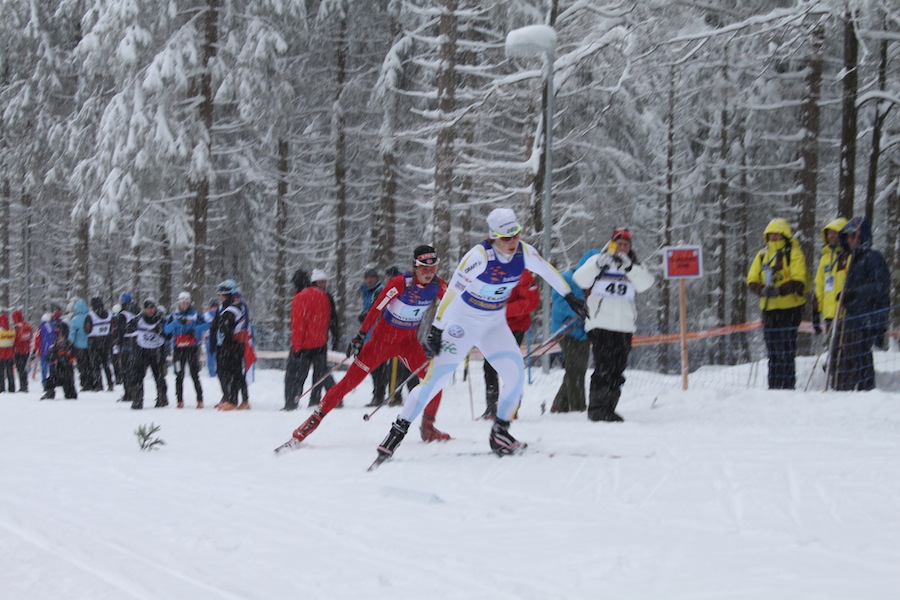
    Paul Constantine Pepene of Romania making his race-winning move on the second of four skate laps. Tad Elliot is in the red suit directly behind Pepene, with Andreas Katz (GER) on the far left.
    Paul Constantine Pepene of Romania making his race-winning move on the second of four skate laps. Tad Elliot is in the red suit directly behind Pepene, with Andreas Katz (GER) on the far left.

    After Petr Sedov’s domination of the junior 20k pursuit here yesterday, it seemed unlikely that anyone would be able to outdo that performance in the 30k U-23 version today.

    Enter Paul Constantin Pepene of Romania.

    As a dense, 30-skier group made its way up the course’s big climb on its sixth of eight laps, Pepene put in a huge acceleration—the biggest that second-place Ole Marius Bach said he had ever seen.

    Using a quirky skate technique–-which he said was ingrained by learning to ski on Romania’s poorly-groomed trails—Pepene was able to fend off a furiously-chasing pack led by Andreas Katz (GER) and Tad Elliot.

    He built up a big lead over the next two laps, crossing the finish line 25 seconds in front of Ole Marius Bach (NOR) and Katz despite a lengthy victory celebration—and he looked like he could have skated another eight laps.

    Elliot found himself in the mix after a relatively slow and tactical start to the race. A professional mountain biker during the off season, Elliot prefers skating, so he was happy to see a brief snow squall slowing down the leaders during the classic leg–he actually came into the stadium for the transition leading the race.

    For the first two 3.75k skate loops, Elliot sat at the front, and was in good position to respond when Pepene made his move. He went with Katz and a few others to try to close the gap, but the Romanian was too strong, and the effort proved to be too much for Elliot to absorb, as he faded to 21st.

    Noah Hoffman also looked to be on course for a strong day, skiing at the front during the third of four classic laps. He said the didn’t wasn’t trying to push the pace, but that with such a touchy pack behind him—Hoffman said the classic leg was like “bumper cars” with everyone jockeying for position—he didn’t want to give up his place at the front. He said he wasn’t sure what happened during the skate leg, or where he lost contact with the lead group, but he was well behind by the middle of the first skate lap.

    Two Canadians, Frederic Touchette and Graeme Killick, rounded out a strong day for their country by finishing sixth and seventh, following Brittany Webster’s eighth place in the women’s race. Killick said that he made the lead chase group that formed behind Pepene, but that he was slowed by cramps over the last two laps. Touchette edged him in a sprint at the line.

    Both of the other Canadian starters made the top-20—Kevin Sandau and Len Valjas were 13th and 16th, respectively.

    Peter Kling and Reese Hanneman of the U.S. battled hard to stay ahead of Pepene on their seventh of eight laps. It appeared that they had succeeded, as they still had a 30-second gap on him coming through the stadium to head out on their final loop, but officials pulled the racers anyway.

    Pepene’s win was the second Romanian podium in as many days. He said that his country had been helped by a recent infusion of money into their ski federation ahead of the European Youth Olympics that will be held their in 2013, and that there that there’s a strong group of juniors in the

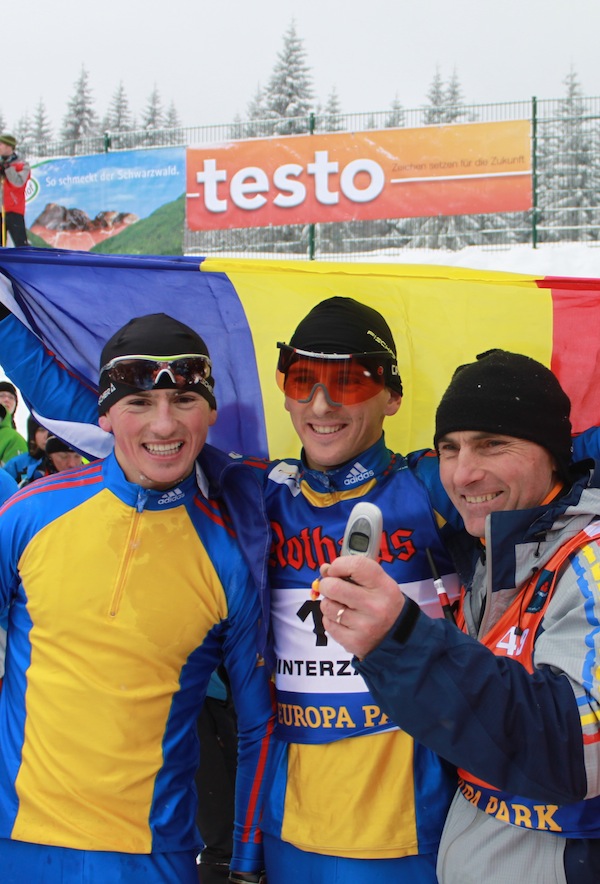
    Pepene with his coach and one of his teammates after the finish
    Pepene with his coach and one of his teammates after the finish

    pipeline.

    “I believe the world will hear of us,” Pepene said in the press conference, still wrapped in the Romanian flag he’d donned at the finish.

    Like Sedov, Pepene is headed to Whistler to compete in the 2010 Winter Olympics, where he said his goal is a top-30.

  • Sedov Dominates World Junior Pursuit; Patterson 20th

    Sedov Dominates World Junior Pursuit; Patterson 20th

    Petr Sedov on his way to winning the 20k pursuit at World Junior Championships
    Petr Sedov on his way to winning the 20k pursuit at World Junior Championships

    The snow fell furiously during the men’s 20k pursuit at World Junior Championships—as hard as Scott Patterson said he had ever seen it snow during a race.

    But there was another force of nature here today that was stronger than the weather: a tall, stocky 19-year-old Russian named Petr Sedov.

    At the end of the classic leg of the 20k pursuit here, Sedov had already dropped the entire field except for one: his teammate, Evgeni Belov. And after 10k of Sedov’s smooth, deliberate skating, nobody else was even close. By the finish, the Russian had 40 seconds on his nearest challenger, Petrica Hogiu of Romania. Finn Haagen Krogh  (NOR) was another three seconds behind, in third.

    Scott Patterson again led the way for the American juniors with a 20th place finish, followed by David Norris and Erik Bjornsen in 43rd and 49th, respectively. Eric Packer was 56th, hindered by cramps.

    After winning all the races in last year’s championships, it was a little surprising when Sedov only managed second place to Norway’s Paal Golberg in Wednesday’s individual 10k classic. But Russian Assistant Coach Natalia Timofeeva told FasterSkier that Sedov had suffered from vertigo that day on the course’s final climb, leaving him unable to race to his full potential.

    Sedov trains with his father, Nikolai, who also coached former World Junior Champion Irina Khazova, Timofeeva said. After the last race in Hinterzarten on Sunday, Petr heads home to Russia before traveling to Whistler to compete in the Winter Olympics.

    For a junior, Sedov is certainly big, and perhaps a bit more physically mature than some of his competitors. But he has already proven that he can compete at the elite level, with a 10th place in a World Cup in Finland last March.

    “Many of those guys are big,” said Norwegian U-23 Head Coach Micke Palsson, referring to the juniors here. “[Sedov] is really good.”

    Behind Sedov, a messy race was unfolding. With heavy snow falling all morning and only tapering off by the conclusion of the race, athletes had to contend with very soft course conditions. Some the men ended up skating on the classic trail, which was substantially firmer.

    By the end of the classic leg, Patterson had moved up to fifteenth, after beginning with bib 54 in the mass start. He almost maintained that in the skate leg, losing just five positions to fall to twentieth after losing a photo finish at the line to Britain’s Andrew Musgrave.

    Scott Patterson dueling with two Italians, Stefano Gardener (l) and Enrico Nizzi (r)
    Scott Patterson dueling with two Italians, Stefano Gardener (l) and Enrico Nizzi (r)

    Between the weather and the same brutal course as yesterday (which the men had to ski six times)—Patterson said it was one of the hardest races he’d ever skied.

    “It wasn’t really counting how many laps you do,” he said. “It was counting how many times you had to go up that hill.”

    David Norris, who raised eyebrows with a 4th place finish in the U.S. Nationals 30k classic, struggled to 43rd today. He clearly didn’t have the same pop that he displayed in Anchorage, and though he was sick recently, Norris said today that he had no excuses.

    “I raced hard the last two races…and racing hard should be faster than what it has been,” he said.

    Canadian starters included Zach Holland in 33rd, Patrick Stewart-Jones in 52nd, Joey Burton in 68th, and Steffan Lloyd in 70th.

  • U23 10/15km Classic Photos

    U23 10/15km Classic Photos

    Photos from today’s 10/15km individual start classic at the U23 World Championships in Hinterzarten, Germany. Brittany Webster (CAN) posted the top North American finish placing 5th.

    Women’s 10km Race Report
    Men’s 15km Race Report

    Don’t forget to check out the FasterSkier Junior Racing blog for additional reports and video interviews from the venue.

  • Skobelev Takes U-23 15k on Tough Course; Sandau 13th; Hoffman 20th

    Skobelev Takes U-23 15k on Tough Course; Sandau 13th; Hoffman 20th

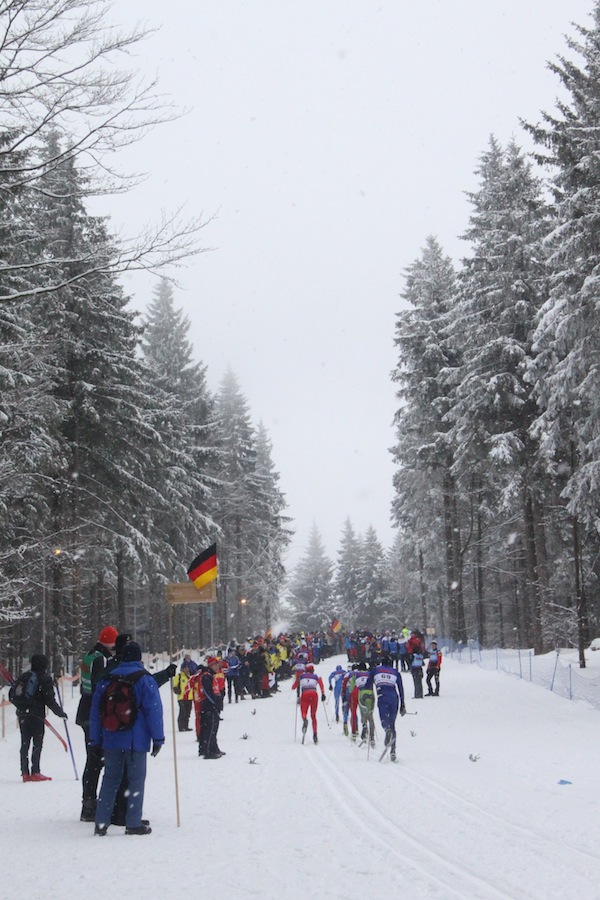
    Athletes nearing the "tunnel of noise" during the 15k classic at the U-23 World Championships in Hinterzarten, Germany
    Athletes nearing the "tunnel of noise" during the 15k classic at the U-23 World Championships in Hinterzarten, Germany

    With some big climbs and minimal recovery, the 3.75k course in Hinterzarten demands some restraint and smart pacing. That’s no accident, according to Karl-Heinz Lickert, the FIS official who laid out the loop that was used in the U-23 men’s 15k.

    “We don’t want athletes who are only physically strong,” he said.

    The winner here, Vladislav Skobelev (RUS), clearly had both the brawn and brains Lickert was looking for—though he also wasn’t hurt by the snow squall that blew in just as he was finishing, slowing many of his rivals still out on course.

    Back in seventh place after the first lap, Skobelev–who rose through the field over the next three circuits to take the win by 20 seconds over his teammate, Stanislav Perliak. Gennadly Matviyenko of Kazakhstan was third, another second behind.

    Noah Hoffman led the way for the Americans in 20th, while Kevin Sandau was the top Canadian, in 13th.

    After some long-overdue warmth and sun, it was back to the same snow and fog that blanketed the first two days of competitions. The crowds, however, were not deterred. Local schools sent their teachers and students to the trails here, and like yesterday, they helped line the toughest hill on the course, along with coaches and many of the athletes who weren’t competing.

    “I was super-impressed with how many people were out there,” Hoffman said. “I’ve never skied quite through anything like that. It was just a tunnel of noise.”

    Hoffman said that he had been working on his pacing, and that today’s effort was definitely an improvement—though still not his best.

    Tad Elliot, who finished 32nd, with U.S. Coach Matt Whitcomb
    Tad Elliot, who finished 32nd, with U.S. Coach Matt Whitcomb

    It was what Lickert’s course demanded, though. While the late snow may have slowed a number of the top-ranked skiers towards the end of the race, it was still clear that the best finishers today all started very conservatively. Out of the top six finishers, only Matviyenko was ranked in top five after the first lap. In the post-race press conference, Skobelev said that he always starts conservatively, and that today he did so with the final climb in mind.

    Unlike the Russians, though, Canada’s Graeme Killick received the sharp end of Lickert’s loop. He was sitting third after 3.5k, but he faded hard, losing between seven and ten places each subsequent lap to finish 24th. He said his legs seized up on his last circuit, even though he said that he began at a pace that “I thought I could keep.”

    Lickert said that FIS courses are designed to challenge athletes in three areas: physical fitness, technical skill (like with challenging downhills), and mental resilience. Today’s placed a premium on the latter—while there’s only an average amount of climbing in each loop, “there’s nowhere you can really relax.”

    “You have to plan your race—you have to be clever and smart. This is why Petter Northug is the champion,” Lickert said, citing the Norwegian’s skill at pacing and his killer finishing kick.

    Simi Hamilton, who finished 33rd, perhaps summed it up best.

    “It wasn’t a ton of recovery, but it was just enough to let you go really hard up the hills,” he said. “So it hurt.”

    Other Americans in the race were Tad Elliot and Patrick Johnson, who finished 32nd and 52nd, respectively. Frederic Touchette and Julien Nury were the two other Canadians starters, in 19th and 47th. For complete results, click here.

  • 3 of 4 U.S. Women Notch Top Thirties in WJ Classic; Lahteenmaki Wins

    3 of 4 U.S. Women Notch Top Thirties in WJ Classic; Lahteenmaki Wins

    Sophie Caldwell in the 5k classic at the World Junior Championships, Hinterzarten, Germany
    Sophie Caldwell in the 5k classic at the World Junior Championships, Hinterzarten, Germany

    After a strong day by the U.S. U-23 team yesterday, the American junior women said they were feeling the pressure for a strong performance today in the 5k classic.

    “We’ve got to step it up and show that we mean business here,” said Annie Hart.

    While they didn’t exactly match yesterday’s fourth place by Ida Sargent, the juniors did manage a decent show of depth today, putting three of their four women in the top 27. Caitlin Patterson led the way in 17th, with Sophie Caldwell and Hart following in 24th and 27th. All three were within a minute and fifteen seconds of the winner, Krista Lahteenmaki of Finland, while Adele Espy was the fourth American, in 51st.

    Krista Lahteenmaki (FIN) on her way to the win
    Krista Lahteenmaki (FIN) on her way to the win

    Lahteenmaki was followed closely by Ingvild Flugstad Oestberg, a Norwegian who frequently races on the World Cup circuit. Oestberg led halfway through the race by six seconds, but she gave it all up on her second loop to finish three seconds down.

    “I didn’t feel that I went slowly at the end—Krista was tough,” Oestberg said afterwards.

    Monday’s sprint winner, Hanna Brodin (SWE), was another second back, in third.

    Matt Whitcomb, head coach of the American juniors, said that three top-30 results for his women are nothing to scoff at—they used to be “unheard of for the U.S.—we’d get a couple a year. Now we’re shooting for dozens.”

    “The standard has been higher for the last several years,” he said. “The athletes feel it.”

    One of the strengths of the group here, Whitcomb said, is its depth.

    “We don’t have just single athletes that are our only hope in any of these races—we have a full team of athletes that can contend,” he said.

    A slow starter, Patterson said that she favors longer races, and is more jazzed for the upcoming pursuit 10k pursuit on Friday.

    “Do this race and then tack a five k skate on the end of it, plus mass start, I’m really excited,” Patterson said.

    Racing for the U-23 athletes resumes here tomorrow with another individual start classic race. With snow in the forecast, conditions could be more challenging than today’s, but the temperature is expected to stay cold enough to avert any chaotic waxing.

    Link to full results.

    Caitlin Patterson climbing one of the hills in the 5k classic
    Caitlin Patterson climbing one of the hills in the 5k classic
  • Patterson Leads American Juniors with 17th in Hinterzarten; Norway’s Golberg Wins

    Patterson Leads American Juniors with 17th in Hinterzarten; Norway’s Golberg Wins

    Sam Tarling nearing the finish of the men's 10k at the World Junior Championships, HInterzarten, Germany
    Sam Tarling nearing the finish of the men's 10k at the World Junior Championships, HInterzarten, Germany

    They’re not the Northug family yet, but give them some time.

    After Caitlin Patterson skied to a 17th place showing in this morning’s women’s 5k classic at the World Junior Championships, Scott Patterson wouldn’t be shown up, matching his older sister’s position in the men’s 10k in the afternoon.

    According to Matt Whitcomb, the head coach of the American juniors here, Scott had told his sister that he would beat her placing in his own race, and he came a single second from doing just that. He ended up just 1:15 behind the winner, Norway’s Paal Golberg.

    Scott Patterson on the initial climb in the 10k classic
    Scott Patterson on the initial climb in the 10k classic

    “I think it was the first time I’ve heard him trash-talk,” Whitcomb said.

    Sam Tarling had a breakout race, just five spots behind Patterson in 22nd. David Norris and Tyler Kornfield, both recovering from illness, were 29th and 77th, respectively

    Golberg improved on his silver medal from Monday’s sprint in today’s 10k, which he said is his favorite event. He battled with second-place Evgeniy Belov (RUS) for the entire race, trailing by less than two seconds at both intermediate time checks. But the Russian fell off the pace in the last three kilometers, conceding ten seconds to the Golberg by the finish.

    Petr Sedov (RUS), who won both distance races at these championships last year, rounded out the podium another 25 seconds back.

    After two days of fog and mist at the Notschrei Nordic Center, athletes were greeted today by bluebird skies and warm sun. Recent snowfall here combined with crisp temperatures made for a simple waxing day—Sverre Caldwell said that the men skied on straight fluorinated kick wax.

    They needed every bit of it, as the 3.3k men’s loop here was almost entirely up and down, with very little double poling. None of the hills were too steep for striding, but that didn’t make the skiing any less tough.

    “The course is so short that you hit those hills three times, and that’s a lot of climbing,” Tarling said. “The pain is all over.”

    The fans were out in force, too. The final climb was lined with coaches and onlookers packed shoulder-to-shoulder, waving flags and screaming in a half-dozen different languages.

    “I kind of knew they weren’t cheering for me,” Patterson said, since he wasn’t getting very much encouragement in English. “But it was still pretty sweet to hear them all.”

    Crowds lining the trail on the course's final big climb
    Crowds lining the trail on the course's final big climb

    After two of four races down here, Whitcomb said that the best from his athletes is still to come.

    “We have juniors that can be in the top five,” he said.

    With some illness working its way around the team, Whitcomb added that “both Patterson and Norris felt like they were 80 percent today.” Kornfield is also still recovering from a fever.

    Norris, though, should be on his way up, and Friday’s 20k pursuit should suit him very well after his recent fourth place in the U.S. Nationals 30k classic.

    “Hopefully [today’s race] will warm me up for that,” he said.

    Link to full results.

  • Hard Luck Hamilton Loses Grip in Quarters; Norwegian Wins U-23 Skate Sprint

    Hard Luck Hamilton Loses Grip in Quarters; Norwegian Wins U-23 Skate Sprint

    Simi Hamilton gestures to fans for a pole after losing his grip in the U-23 skate sprint
    Simi Hamilton gestures to fans for a pole after losing his grip in the U-23 skate sprint

    After a mishap in a race in Canada, Simi Hamilton said that he secured the grips on his Swix Stars with “about a pound” of glue. It still wasn’t enough.

    Leading his heat through the initial downhill in the U-23 skate sprint today, a Norwegian skied over one of Hamilton’s baskets as he came out of a tuck. The grip came off, and the whole pack went by.

    Hamilton was left screaming at the fans on the right side of the trail for a new pole, and he finally grabbed one from an unsuspecting Russian woman who was looking the other way. But by then it was far too late.

    Hamilton frantically putting on a borrowed pole while the rest of the heat skis away.
    Hamilton frantically putting on a borrowed pole while the rest of the heat skis away.

    “I thought that I had learned my lesson and put on a ton of glue last fall when I was building my poles up,” said Hamilton afterwards. “I had a good qualifier, which I’m really psyched about…It just sucks that [the mishap] had to happen here.”

    Martin Jaeger (SUI) looked dominant after Hamilton’s exit, and he appeared to have the A-final under wraps until Ole-Marius Bach, a lanky Norwegian, managed to get around him coming into the finishing stretch. Andrei Parfenov (RUS) took bronze.

    Peter Kling was the only other American in the heats, and he failed to advance. He said that the racing was aggressive on the slick course here, and that the Europeans “don’t mess around.”

    “But we can ski with them,” he said. Kling said that he was dropped midway through his heat, but that a crash ahead of him gave him a chance to get back in the race.

    “I just needed another hundred meters,” he said.

    A nervous starter added to the stress—Hamilton’s quarterfinal had a false start, which he said took the wind out of his sails, and one of the semifinals had three. The jury reigned it in after that, though, reinstating all of the disqualified athletes and running the heat with all six.

    For Hamilton, the pole problems were made all the more painful by the fact that course was so short and fast, which seemed like it should suit him.

    He won the qualifier by a full second, which U.S. U-23 Head Coach Pat Casey said was significant.

    “To win the prelim by a second on a course where bib number makes such a difference [with lane choices for the heats]—everyone was gunning for bib number one,” he said. “For him to dominate it like that…it’s like an exclamation point.”

    Losing out in the quarters was a “bummer” for Hamilton, but “every time he does a sprint, though, he learns something,” Casey said.

    Hamilton will be racing in the 15k classic on Tuesday, and then it will be back to North American for the sprint in Canmore. He said that he hopes to travel back to Europe later this winter for some continental cup racing.

    Reese Hanneman was the next-best American finisher after Kling, finishing 34th, just half a second out of the heats. Patrick Johnson was another 1.5 seconds back, in 39th.

    Canada’s Len Valjas made the B-final, placing third.

    The U-23 championships continue on Thursday with the 10/15k classic, while the juniors are back in action tomorrow with a 5/10k in the same discipline.

  • Sargent Sprints to Fourth at U-23’s; Finnish Biathlete Skis Away With Title

    Sargent Sprints to Fourth at U-23’s; Finnish Biathlete Skis Away With Title

    Mari Laukkanen (l) leads Ida Sargent (second from left) in their semifinal heat at the U-23 Championships
    Mari Laukkanen (l) leads Ida Sargent (second from left) in their semifinal heat at the U-23 Championships

    When Simi Hamilton lost a pole and was bounced from his quarterfinal heat, it was up to Ida Sargent to salvage the American hopes in the U-23 skate sprint. She didn’t disappoint.

    After qualifying in fourth, Sargent advanced easily through the quarters and semis, faltering only midway through the A-final. After some bad luck and tactical errors by the Americans over the last two days, you could almost hear the sigh of relief from her coaches and teammates.

    “Before that A-final, I thought Ida could win that thing,” said Pat Casey, head coach of the American U-23 squad. “I talked to her about it, and she thought she could win that thing, too.”

    Sargent was “unbeatable” off the line all day, Casey said, and the final was no different—she was in front headed into the first corner before Mari Laukkanen (FIN) got by. But on the way up the last big climb, she started running out of gas, and Denise Herrmann (GER) and Kathrine Rolsted Harsem (NOR) snuck past.

    Laukkanen was well clear of the group by the finish, but Sargent was still close with the others as the group entered the stadium. She just couldn’t quite match the pace at the finish.

    “I got a little tired on the second hill, so I lost some time there,” she said, “but I was able to pull it together…I feel like I’m right in there, so it was a really fun day.”

    Ida Sargent (l) chases Mari Laukkanen
    Ida Sargent (l) chases Mari Laukkanen

    Laukkanen won the qualifier by over a second, then proceeded to sweep every heat en route to her victory, improving on her third place finish in last year’s U-23 classic sprint in France.

    Laukkanen actually focuses on biathlon, and she said that her goal for the winter had been to qualify for the Finnish Olympic Team. She didn’t seem too overwhelmed by the win, already whipping out her cell phone just five minutes after the finals.

    Laukkanen did have good things to say about Sargent though, noting that the American was right on her heels in their semifinal.

    “It’s not surprising,” she said of Sargent. “In sprint, there’s always been a couple of very good [American women].”

    None of the three other American women made it out of the quarters. Both Rosie Brennan and Sadie Bjornsen were third in their heats, but neither advanced as lucky losers. Becca Rorabaugh found herself in the snow after getting tangled up on the first climb.

    It was clear that Sargent’s finish today gave the rest of her team a big lift, as Hamilton, Rorabaugh, and Peter Kling were all sprinting back and forth across the course during the finals to cheer her on.

    “We were hopeful yesterday that we could get that boost,” Casey said. “Coming in last night talking to the U-23 guys, I basically just told them…to break down those limitations and to know that any one of them could be world champions. And I think a couple of them demonstrated today that we weren’t far off of that.”

  • Hamilton Wins U-23 Sprint Qualifier; Sargent 4th as All Four Women Make Heats

    Hamilton Wins U-23 Sprint Qualifier; Sargent 4th as All Four Women Make Heats

    Simi Hamilton on his way to winning qualifying at the U-23 Championships
    Simi Hamilton on his way to winning qualifying at the U-23 Championships

    He’s the real deal.

    That’s what U.S. Ski Team Development Coach Matt Whitcomb said this morning about Simi Hamilton, after the skate sprint national champ took first place in the qualifying round of the same event here in Hinterzarten.

    After some drizzle overnight, the race trails at the Notschrei Nordic Center were covered with a thin icy crust this morning, which made for some slick skiing and a fast qualifying round—Hamilton’s time was around 2:20.

    Peter Kling also snuck into the rounds, finishing somewhere in the high twenties, while Reese Hanneman was the second Alaskan in two days to finish just out of the heats, just a few places out.

    Peter Kling racing at the U-23 Championships in Hinterzarten, Germany
    Peter Kling racing at the U-23 Championships in Hinterzarten, Germany

    On the women’s side, all four U.S. entrants skied into the heats, led by Ida Sargent in fourth, two and a half seconds behind Mari Laukkanen of Finland. Sadie Bjornsen followed in 13th, with Rosie Brennan 16th and Becca Rorabaugh in 19th.

    For both genders here, there are fewer entrants contesting today’s race than at the junior level yesterday. Yesterday’s men’s field was around 100 racers, while only some 60 men started today, and were just 41 women started.

    According to Whitcomb, many of the world’s best U-23 athletes are competing on the World Cup. But he said that the top of the field is still competitive, and to break into the top ten should still be considered a strong result.

    Ida Sargent on her way to fourth place in the U-23 skate sprint qualifier
    Ida Sargent on her way to fourth place in the U-23 skate sprint qualifier

    Click here for a quick video with Hamilton, and click here for a summary of the Canadian chances today, with one of the team’s coaches, Eric Bailey.

    Check back later today for complete coverage of the heats.

  • World Juniors Sprint: Photos

    World Juniors Sprint: Photos

    Photos from the World Junior Freestyle Sprint in Germany. It was a foggy day in Hinterzarten.

  • In Germany, It’s Another Northug–Tomas Takes WJ Sprint

    In Germany, It’s Another Northug–Tomas Takes WJ Sprint

    Paal Golberg (NOR) leads teammate Tomas Northug at the World Junior Championships in Hinterzarten, Germany
    Paal Golberg (NOR) leads teammate Tomas Northug at the World Junior Championships in Hinterzarten, Germany

    Different race, different Northug, same result. With a finishing kick eerily similar to the one his brother has made famous, Norway’s Tomas Northug won the championship in the World Junior Sprint today in dominating fashion.

    The resemblance between the two brothers is striking, and beyond their facial features, Tomas also has the same blazing speed and Casco headwear made famous by Petter.

    Their attitudes are similar, too. When asked if he had stepped out of his brother’s shadow today, Tomas said no.

    “The shadow was back behind me,” Northug told FasterSkier after the race, clarifying that he would have dropped Petter had he been here.

    Northug’s teammate Paal Golberg and Federico Pellegrino (ITA) finished second and third, but they were not within striking distance.

    The U.S.’s Erik Bjornsen was the only North American male to qualify for the heats. He was sitting in third in his quarterfinal coming off the final hill, but was passed by two others in the last corner and ended in fifth.

    “400 meters before the finish, there’s a sharp corner…and I kind of got blocked out,” Bjornsen said. “Those guys ski pretty nasty.”

    The heat ended up being the fastest of any of the quarterfinals: the two skiers ahead of Bjornsen advanced as lucky losers.

    Tyler Kornfield, who just over two weeks ago raised hopes by winning American championship in the classic sprint, came down with a fever since traveling to Germany and almost scratched today’s race. He still started and nearly qualified, finishing just two seconds out of the top 30.

    Even closer, though, was Eric Packer, who finished in the dreaded 31st position, a tantalizing three hundredths of a second from the heats.

    Over a 1.3 k sprint course, that tiny margin could be closed by a slightly more aerodynamic haircut. But Packer said that he wasn’t too bummed after the race—and he did remembered to stretch for the finish.

    “It didn’t come down to the lunge. I was flat on my back at the finish line, trying to get my toe across,” he said. “That’s kind of what ends up happening when you’re skiing on the bubble. I feel like on a good day I could have been right in there.”

    A thick fog blanketed the race trails all day, adding to the mystique of an already dark and shadowy venue. The conditions gave Northug’s win an eerie aura, as he went into the woods in second place, then materialized out of the fog 30 seconds later with such a big gap over Golberg that some spectators were laughing in disbelief.

    The Norwegian said that he trains with his brother, and that Petter had already sent him a text message by the time of the press conference. Though Tomas wouldn’t divulge exactly what the contents were, he said that it began with a “ha ha ha.”

  • U.S. Women Out in WJ Sprint Quarters; Swede Takes the Win

    U.S. Women Out in WJ Sprint Quarters; Swede Takes the Win

    Sophie Caldwell in her semifinal heat at the World Junior Championships in Hinterzarten, Germany
    Sophie Caldwell in her semifinal heat at the World Junior Championships in Hinterzarten, Germany

    One misstep and one mistake, and it was all over for the American women in Hinterzarten.

    50 meters into her quarterfinal here, Jessie Diggins found herself on the ground, seeing stars. Sophie Caldwell lasted longer, and was in contention to advance, but she lost crucial ground coming into the final turn that she could not make up in the finishing sprint.

    Sitting in third on the final downhill, Caldwell swung to the outside of the ensuing righthand corner to try move up. But two more skiers snuck inside Caldwell as she tried to advance into second place, then held her off on the finishing straight, relegating the American to fifth place in the heat.

    “I kind of made a tactical error,” she said, adding that her fitness was not what held her back in the heats. “It was felt good to be in there, but it was a pretty big bummer not to be up there.”

    Diggins’ heat was more spectacular, even if it was still no more successful. Soon after the start of the sprint, the course makes a hard left into a downhill, and Diggins, with a middle lane choice, found herself getting squeezed by the Russian on her right. Before she knew it, she was on the ground.

    “Diggins took a digger,” said Matt Whitcomb said.

    Chasing fiercely, it looked like Diggins might have made up some ground on the pack in front of her. But they were too far ahead to be caught.

    Sprinting never leaves a lot of margin for error, but the races here today seemed especially tight. Many stayed together for their durations, separating only in the last few hundred meters.

    “There were a lot of tactics involved today,” Caldwell said.

    The racing is cutthroat in Europe—certainly more so than at Nationals.

    “It’s as aggressive as you’ll find on the World Cup here,” Whitcomb said. “Our guys know that, and they’re just as aggressive as the next…we have no excuses for today.”

    Sweden’s Hanna Brodin took the final, avenging last year’s loss to today’s second place finisher, Invild Flugstad Oesberg of Norway. Kari Oeyre Slind (NOR) was third.

    She's all legs--Sweden's Hanna Brodin leads one of her heats
    She's all legs–Sweden's Hanna Brodin (r) leads one of her heats

    Brodin is a short, stocky chunk of muscle, her legs almost as large as some of the other girls’ waists. She had a blistering start from the gun, almost gapping the field into the first corner, and led wire-to-wire, although it wasn’t certain until the finishing stretch

    Three quarters of the way through the heat, it looked like Brodin might be petering out after her fast start, and Oestberg seemed to be making up ground. But coming around the final corner, the 19-year-old Swede put in one last acceleration, and was able to hold her gap to the finish, giving a half-hearted lunge that it didn’t look like she really needed.

    Both races were delayed for nearly an hour between the quarterfinals and the semis, as officials had to turn to the manual timing to determine the lucky losers after a snafu with the starting gun.

    The athletes were all subjected to the same wait, though, and Brodin said she wasn’t fazed.

    Racing continues here tomorrow with an identical sprint for the U-23 men and women. The next junior race is a 5/10k classic on Wednesday.