PASSO DELLO STELVIO, Italy— For most small ski countries, the Olympic Games are a one-time chance to shine. Get on television, do some interviews, perhaps gain a few more fans. People care more about the Olympics, and the Games are about participation.
But for the Japanese cross country team, things aren’t quite so easy. Regardless of how many quota spots the International Ski Federation doles out to the country, the skiers face an uphill battle to get to the starting line.
First, there’s the budget. It’s always small – the team can’t attend every World Cup weekend and must pick and choose the most important ones – and doesn’t improve in an Olympic year, even though many teams see an uptick in funds when the Games roll around.
“Our problem in Japan is that in winter sport, there is already not so much of a budget,” says Fabio Ghisafi, a wax technician and women’s team coach for Japan. “Especially for the Olympic Games they have quite big hopes for ski jumping, where the level is quite high, and also for nordic combined. So they decided to give the budget according to the chances of medals. As we don’t have so many chances, our budget is still very very tiny.”
Secondly, Japan sets draconian qualification standards for its athletes. If they can’t earn the honor of representing their country, then the team’s quota spots will go unfilled when the Games kick off.
To earn start rights in an individual race, an athlete must have one top-8 finish on the World Cup, two top-10’s, or three top-12’s.
“From twelve to twenty is not considered at all,” Ghisafi laments.
That’s even more challenging when the team doesn’t attend a full season of World Cups, so the athletes have fewer chances to rack up results. So far, just two Japanese have met the qualification standards: Masako Ishida, the women’s distance specialist, and Yuichi Onda, the male sprinter.
The standards have been particularly tough for Keishin Yoshida, the world’s 37th-ranked distance skier, who finished 11th in both the World Championships 50 k and the Davos, Switzerland, distance race. If both of those finishes had been 10th, not 11th, he’d be in. Or if he had finished 11th one more time. But as it is, his results are not yet enough to earn an individual start.
“We will use all our small budget in the early season to try to have a good shot of making it,” Ghisafi says.
Luckily for the men, Japan has been strong in relays. They were eighth at World Championships, and so have qualified as a team. So, with four trips to Sochi guaranteed for the team event if nothing else, the squad is hard at work this summer to try to earn start rights in the individual races.
“Yes, there’s a little more motivation this year, because of the Olympics,” says Akira Lenting, a top developing skier just finishing his under-23 eligibility. “And if we have a good result, then we have a chance to get more popular I think.”
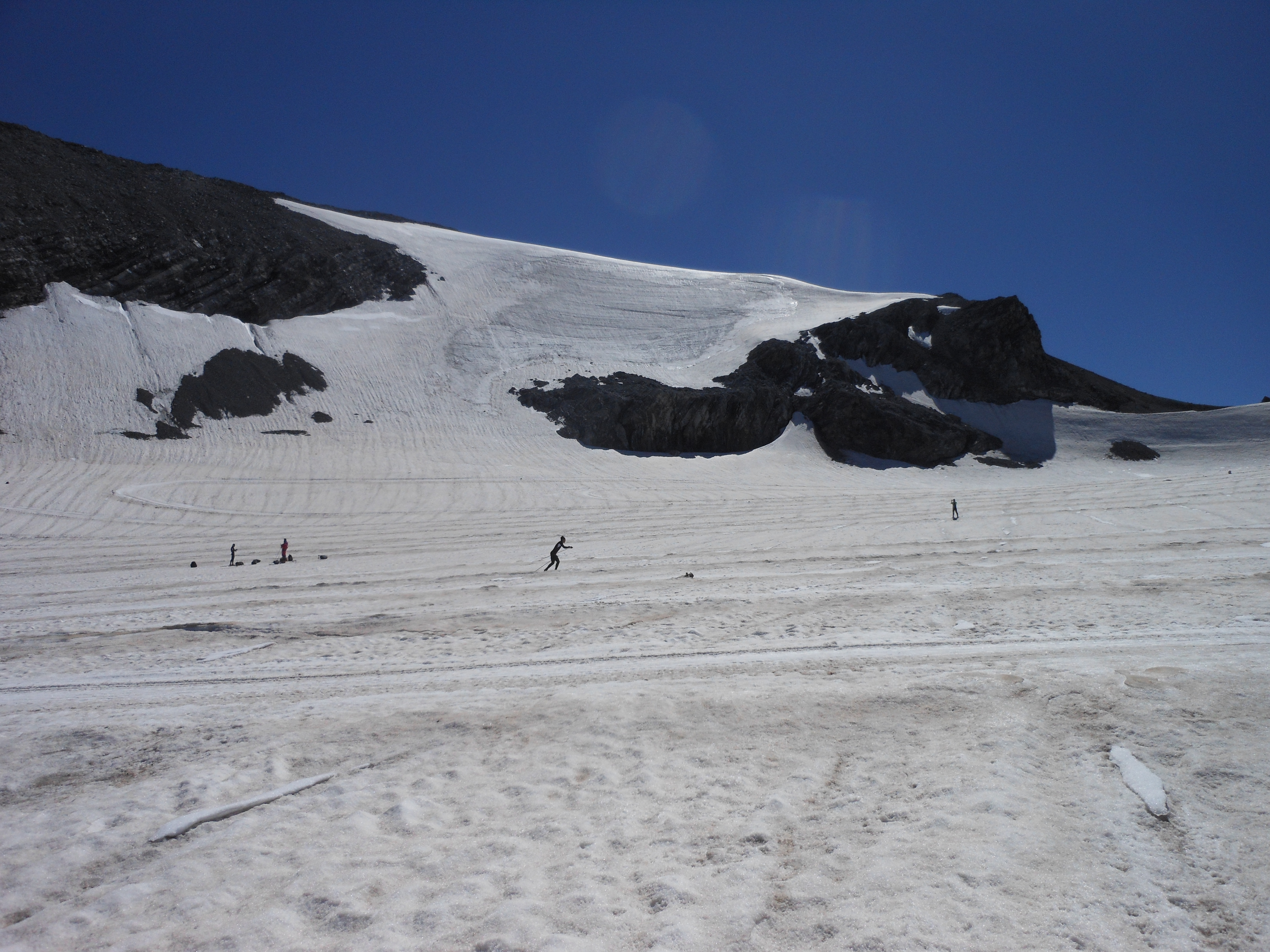
That hard work has brought them here, to Italy – the country Ghisafi originally hails from. In years past, he has brought the team to a summer training camp in Aosta, where they ski on the glacier in nearby Tignes, France. It’s so hot in Japan in the summer that getting to Europe is a necessity, even with their tight budget. This year, the team picked Passo dello Stelvio because it’s 10,000 feet of elevation add a bonus for training.
“It’s not so difficult because the weather is good every day,” says Akira. “The altitude is okay for me.”
“No!” interjects Nobu Naruse, laughing.
The five men at the camp have been spending every morning skiing a few hours on the glacier. It’s mostly slow distance and technique work, due to the elevation and the wet, slow snow. But Ghisafi says they have been throwing in a little bit of speed work, too. Many afternoons they head down to the valley to rollerski, and sometimes they do ski-bounding in the nearby national park.
Overall, the men are happy with the location and the atmosphere. Despite spending much of the winter on the road and away from their families, it’s still exciting to see Europe in summer. The one who misses home the most is Keishin, whose wife had twins three months ago. The training here is an improvement for him, but it’s hard to be away from his children.
“I can concentrate better for training if I go away,” he says. “So it’s very good to be here. But of course sometimes I want to go back to Japan. It will be even harder in the winter.”
They are also happy to have the chance to train together. With such a small national team budget, they don’t have many training camps. Keishin has a good training partner where he is posted in the army, and Akira is spending the year in Falun, Sweden, where he has a strong team to work with. But for others, like Nobu, most training is done alone.
“My hometown is where the Nagano Olympics were,” Nobu says. “I don’t have a teammate, so it’s only alone training. This camp is for me, so good – to finally have a national camp.”
Hisashi Yamaguchi, the head coach, talks about how limited the team’s schedule is. After this, they will have a rollerski camp in Japan, and then that’s basically it for training camps. Twice a year, they meet for physiology testing. The women, who are at home now, had a separate camp earlier in Aosta; with only three staff members, it’s easier to do camps one at a time. They didn’t have enough money to bring a physiotherapist with them.
But they are still looking forward to Sochi as a golden opportunity. Keishin and Nobu both participated in the World Cup test event this past season, and liked what they saw – at least for courses.
“It’s a very tough uphill, but it’s good,” Nobu says.
“It’s hard, but I like it very much,” Keishin agrees.
In general, the difficulty of the Sochi courses play to Japan’s favor.
“The harder it is, the better it is for them,” Ghisafi says. “They don’t like so much the flat and double-poling, but in the uphill, they are strong. So they like very much this course. Or at least, we will see.”
Other things, like the food, don’t agree with them so much. With no food from their homeland and no grocery stores in the Olympic village, Keishin says that it wasn’t very good in Sochi, “at least not for Japanese.” In that respect, Sochi feels very far from home.
But the team, with its small budget, has one more thing going for it at the new Russian venue, and that’s the unpredictable conditions. Just as the men like tough uphills, Ghisafi says they do well in less-than-perfect snow, too.
And the wax maestro was happy when he saw the weather and snow at the Olympic venue.
“I remembered when I was young and we would sometimes have the Italian championships in the middle of winter in the south of Italy,” he says. “There was this strange snow, near to the sea – it’s a little familiar.”
The unpredictability of the conditions levels the playing field, too. The Japanese wax crew is good – it’s just small. So when nobody knows what is coming, they finally have a chance to shine.
“If you have stable conditions, and they can test every single thing, and we have no chance against the big countries with such huge budgets,” Ghisafi says. “But if you come in the morning and there is a new situation, then we can find the right combination. It’s the only way we can do it. So this is better for us. We hope the weather will be bad!”
That’s one thing coming from a coach standing on the sidelines. What about the skiers – are they looking forward to slogging through some nasty weather?
In a word, yes.
“We trust him,” Keishin laughs.
Watch out, Sochi.