From the FasterSkier archive — posts syndicated from athletes’ and coaches’ own blogs between 2004 and 2012, kept online as published. Current coverage is at fasterskier.com.
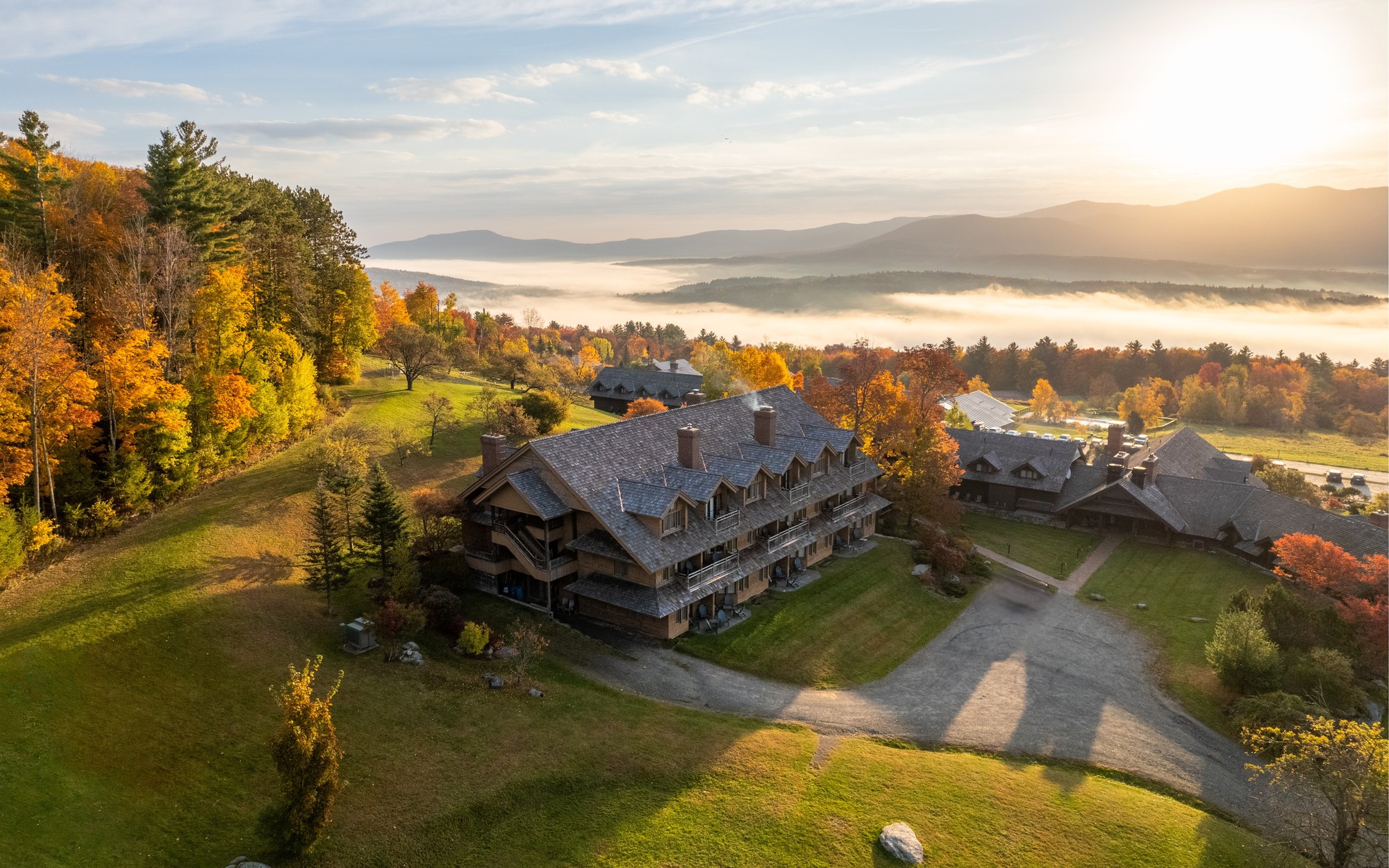
Morning fog fills the valley below the von Trapp Family Lodge & Resort in Stowe, Vt. (Photo: Chadwick Estey)
The von Trapp Family Lodge & Resort has received the Historic Hotels of America® Legendary Family Historic Hoteliers of the Year Award, announced October 15 at the 2026 Historic Hotels Annual Awards of Excellence Ceremony and Gala. The honor was conferred on the von Trapp family by Historic Hotels of America, an official program of the National Trust for Historic Preservation.
The lodge is one of more than 300 hotels and resorts in the United States recognized by Historic Hotels of America for preserving and maintaining its historic integrity, architecture, and ambiance.
“This recognition is especially meaningful to our family because it honors not only our history, but the generations of dedication that have kept our family’s legacy alive,” said Kristina von Trapp Frame, granddaughter of Maria and Georg von Trapp.
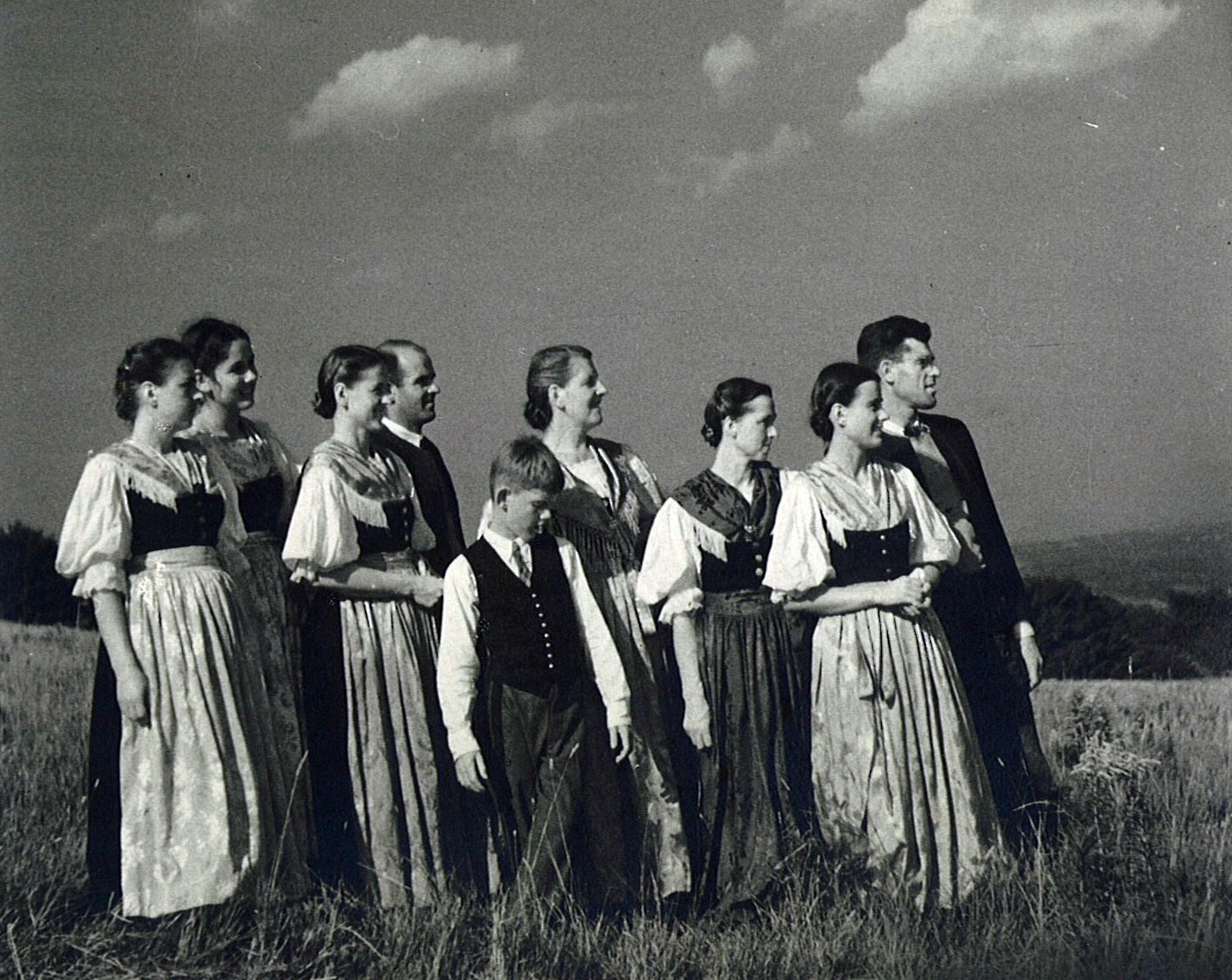
The Trapp Family Singers, who performed in more than 30 countries before and after making their home in Vermont. (Photo: von Trapp Family Lodge & Resort archive)
From Austria to Stowe
The family left Austria in 1938, months after its annexation by Nazi Germany, and spent the years that followed on the road as the Trapp Family Singers. The choir would eventually perform in more than 30 countries, and the family’s story became The Sound of Music.
In 1942 they settled in Stowe. They named their home Cor Unum, Latin for “one heart,” on a hillside looking across to the Worcester Range, and from 1945 to 1955 they ran the Trapp Family Music Camp nearby.
“What began with my grandparents’ dream of creating a home in the Vermont mountains has grown into a place where we have welcomed guests from around the world for more than 75 years,” Frame said.
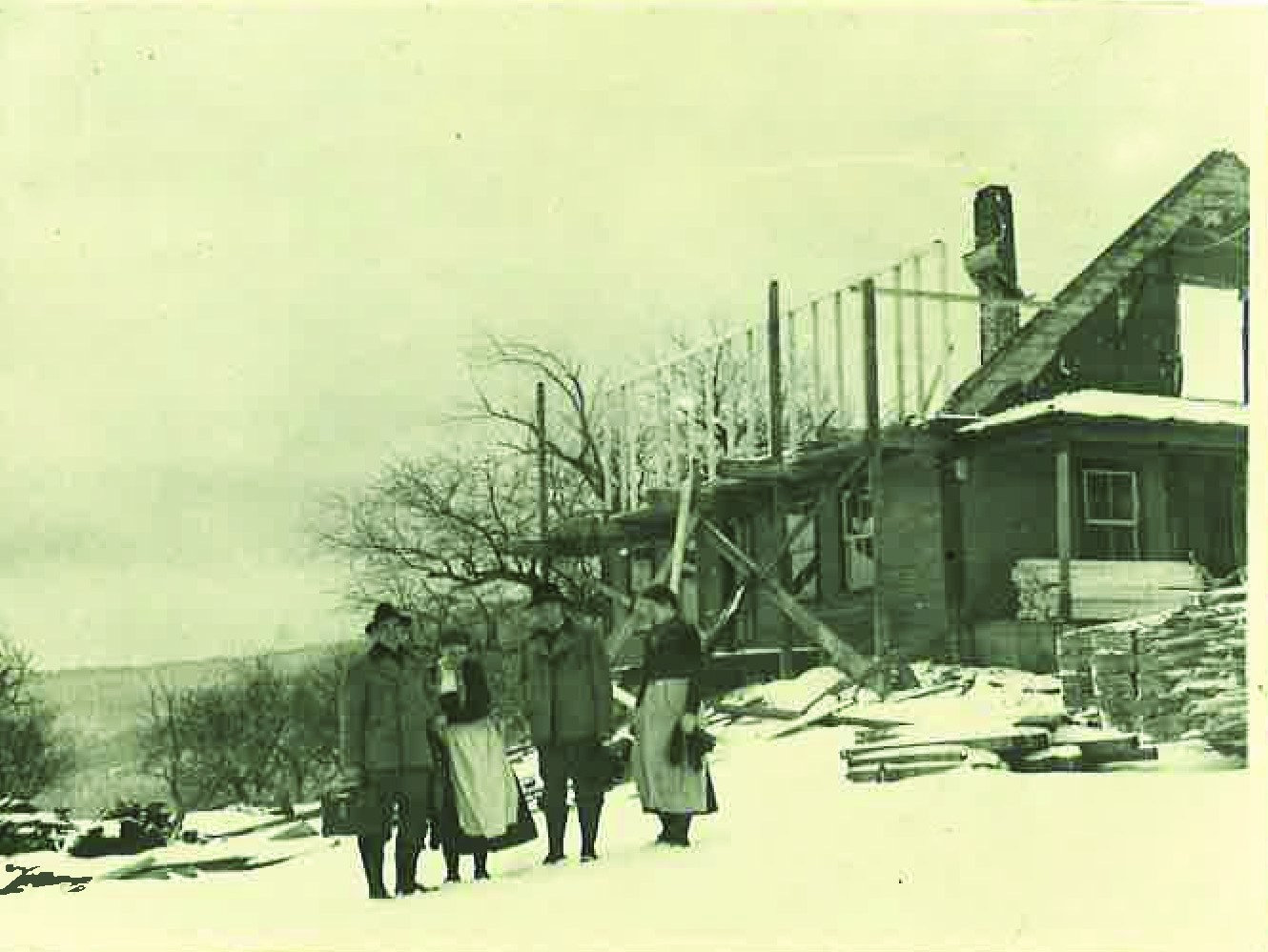
Building the family’s new lodge in Stowe, 1943. (Photo: von Trapp Family Lodge & Resort archive)
Opening the Doors in 1950
In 1950 the family opened their expanded home to guests as the Trapp Family Lodge. Maria ran it first. Her youngest son, Johannes, took over from her and turned a ski lodge into a year-round destination.
Three generations on, it is still family operated. The property covers 2,600 acres and pairs Austrian-inspired hospitality with outdoor recreation, a craft brewery that began making lager in 2010, farm-to-table dining, and wide-open mountain views.
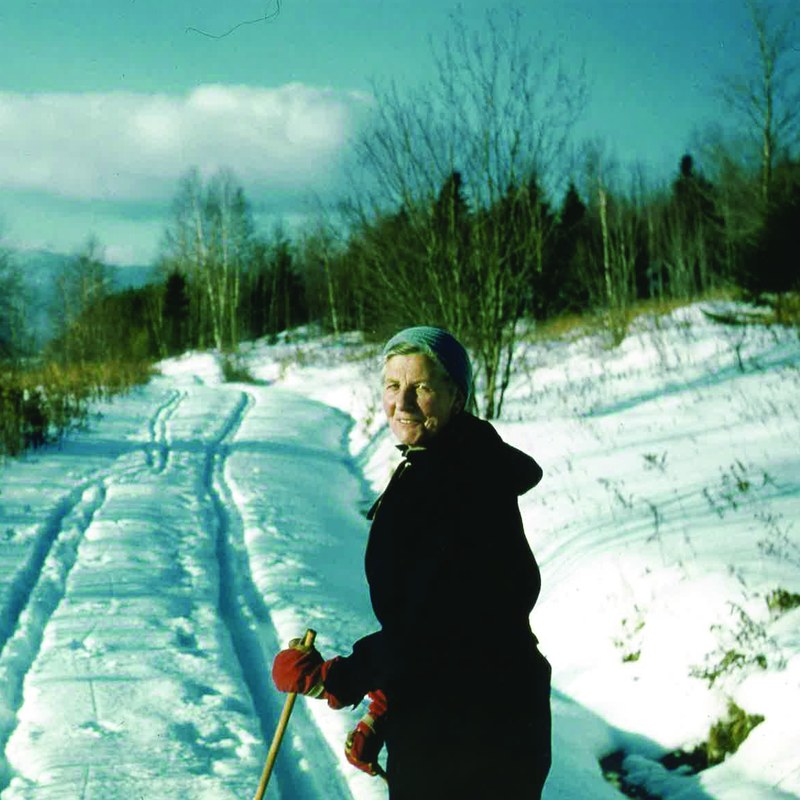
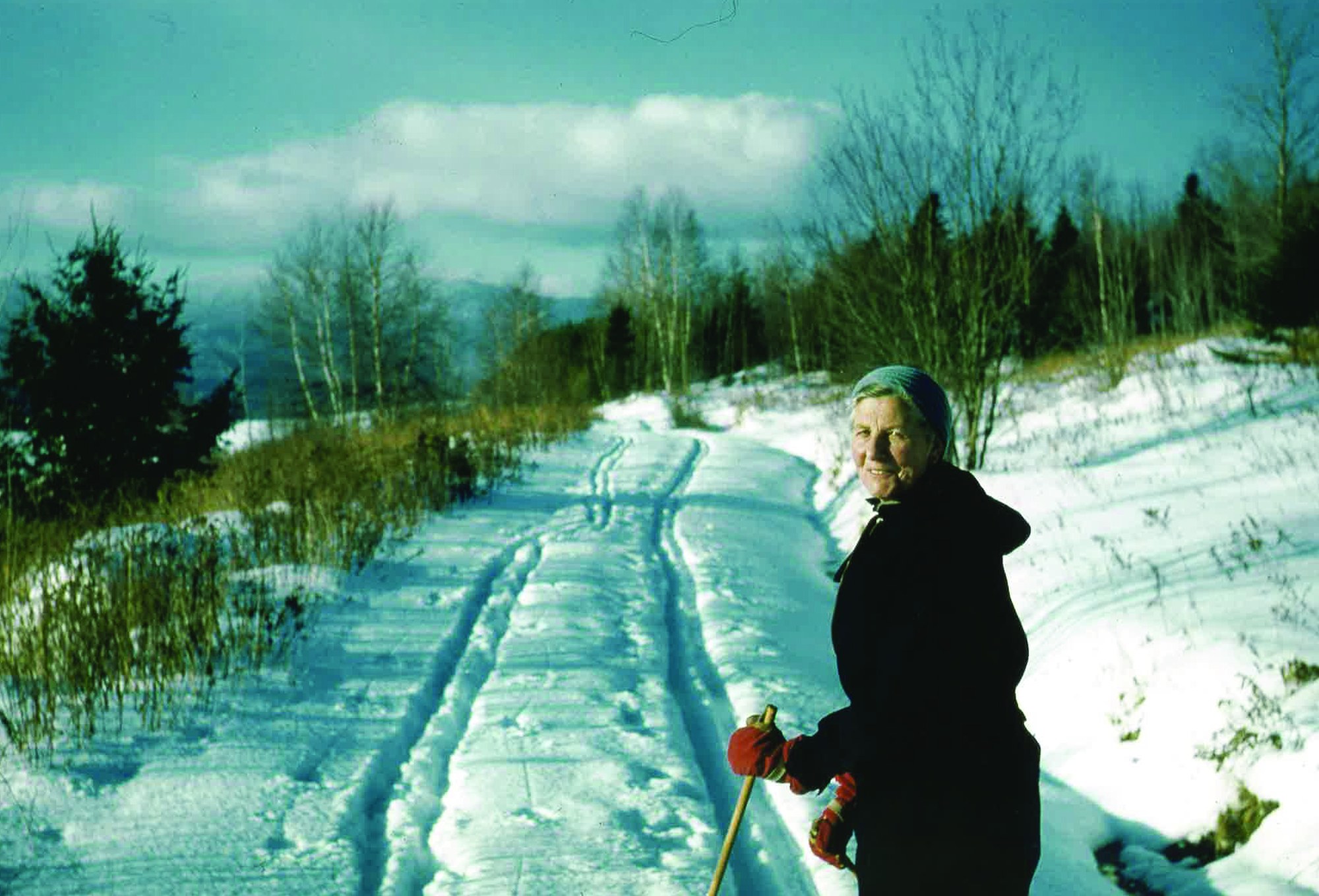
Maria von Trapp out on skis. (Photo: von Trapp Family Lodge & Resort archive)
Where American Cross-Country Skiing Got Its Start
Skiers know the place for something else. In 1968 Johannes opened a cross-country ski center at the lodge, the first in America.
The trails have stayed close to the sport ever since. Johannes helped revive the Stowe Derby in 1972, and in 2014 the lodge hosted U.S. Junior Nationals, with Johannes himself handing out the medals.
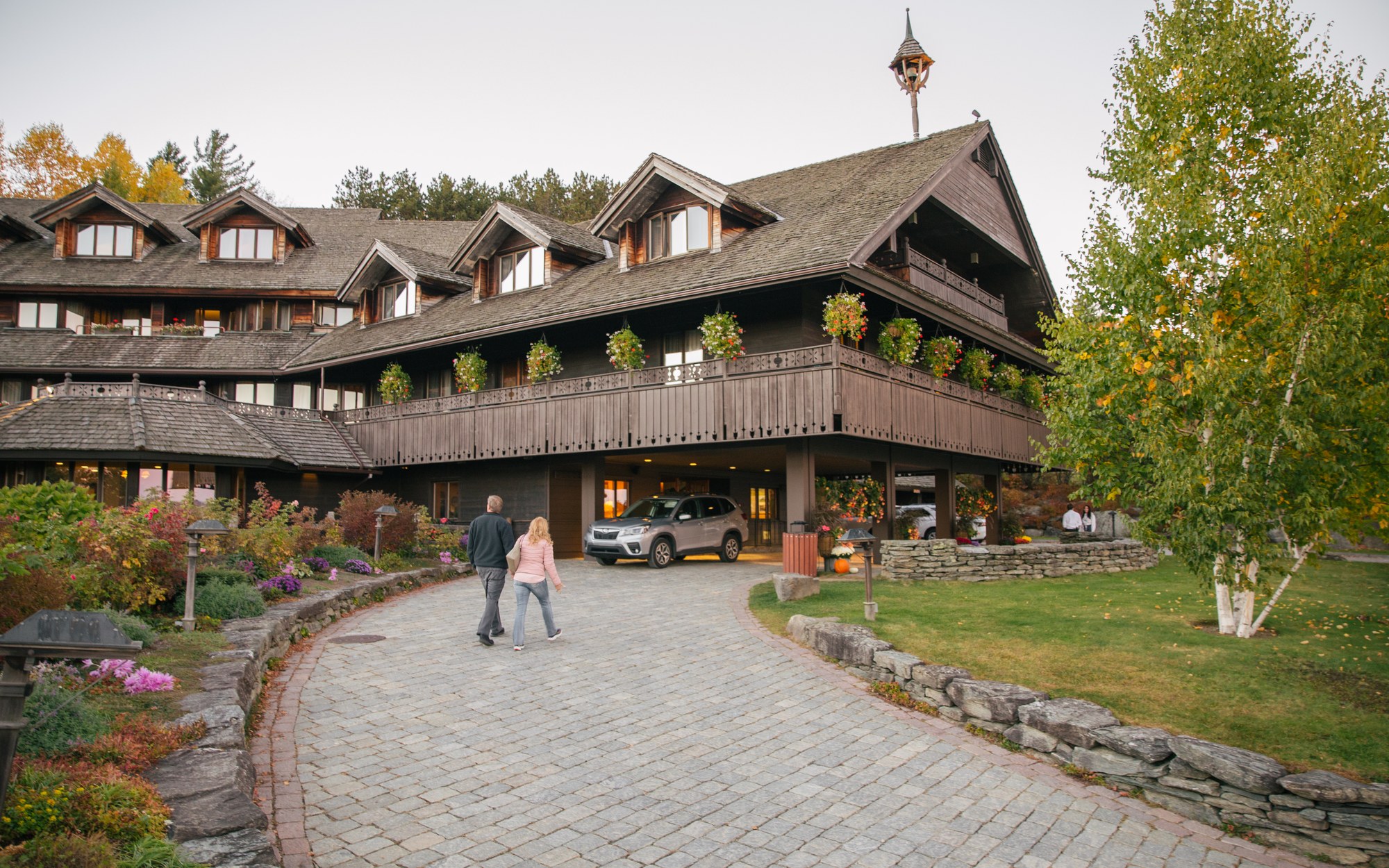
The main lodge, rebuilt in the Austrian style the family brought with them to Stowe. (Photo: Chadwick Estey)
Honored in Williamsburg
Through its Annual Awards of Excellence, Historic Hotels of America recognizes the historic hotels, hoteliers, and leadership practices that do the most to further the recognition, preservation, and celebration of these hotels and their histories. Eleven historic hotels and seven individuals were honored in 2026.
The winners were announced before an audience of owners, general managers, senior decision makers, and guests from many of the finest historic hotels in the world, at the Williamsburg Lodge, Autograph Collection (1939) in Williamsburg, Virginia. The ceremony closed the 2026 Historic Hotels Annual Conference.
“We are delighted to honor the von Trapp Family with this prestigious award. It was chosen from an exclusive group of nominees and considered for several categories. It stands among the finest hotels and hoteliers in the world,” said Lawrence Horwitz, Executive Vice President of Historic Hotels of America and Historic Hotels Worldwide. “We applaud the dedication and passion of the individuals working at these iconic and legendary historic hotels, the people who keep the stories alive from the past and make staying or celebrating special occasions at these historic hotels memorable experiences.”
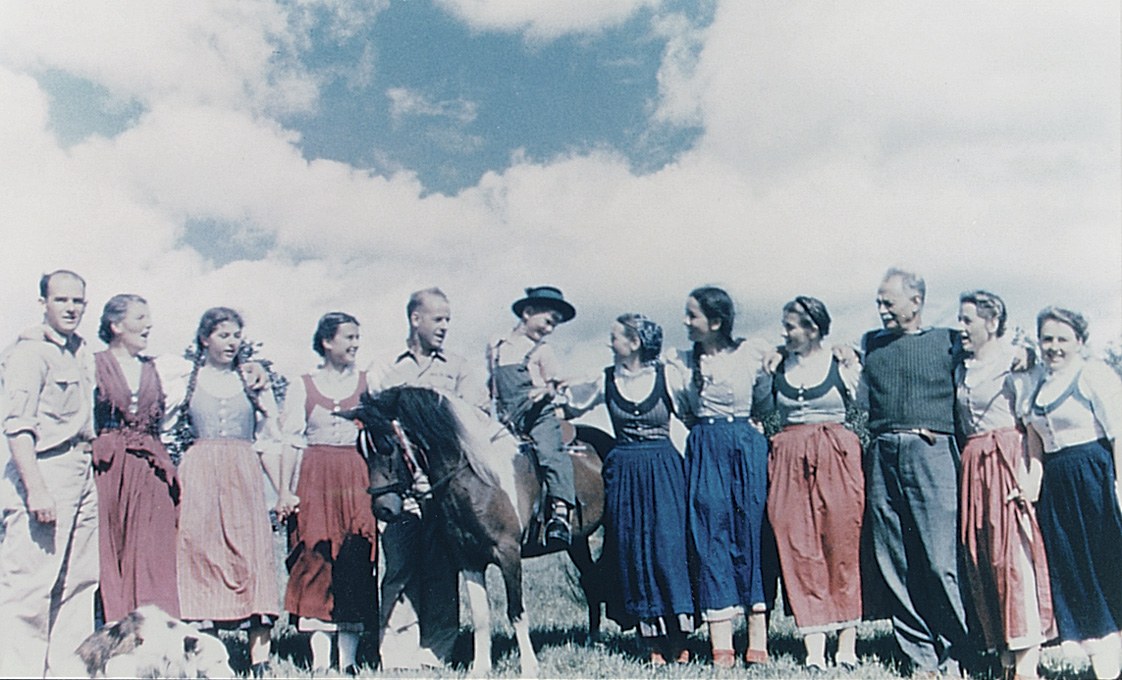
The von Trapp family lined up in a Stowe field, with Johannes on horseback. (Photo: von Trapp Family Lodge & Resort archive)
Carrying It Forward
“We are incredibly proud to carry on their traditions of warm hospitality, family, music, and a love of the outdoors,” Frame said. “Receiving the Legendary Family Historic Hoteliers of the Year Award is a wonderful tribute to our family, our dedicated employees, and the countless guests who have become part of our story.”
About von Trapp Family Lodge & Resort
Founded in 1950 by the von Trapp family, whose story inspired The Sound of Music, the von Trapp Family Lodge & Resort is a third-generation, family-operated, four-season destination in Stowe, Vermont. Situated on 2,600 acres, the property offers Austrian-inspired hospitality, outdoor recreation, a craft brewery, farm-to-table experiences, and breathtaking mountain views while preserving the family’s rich history and traditions. Learn more at vontrappresort.com.
About Historic Hotels of America®
Historic Hotels of America is the official program of the National Trust for Historic Preservation for recognizing and celebrating the finest historic hotels across the United States. The National Trust for Historic Preservation was chartered by the U.S. Congress in 1949 and is a private 501(c)(3) nonprofit organization. To be nominated and selected for membership, a hotel must be at least 50 years old; designated by the U.S. Secretary of the Interior as a National Historic Landmark or listed in or eligible for listing in the National Register of Historic Places; and recognized as having historical significance. More than 300 historic hotels from 41 states, the District of Columbia, the U.S. Virgin Islands, and Puerto Rico have been inducted. Learn more at HistoricHotels.org.
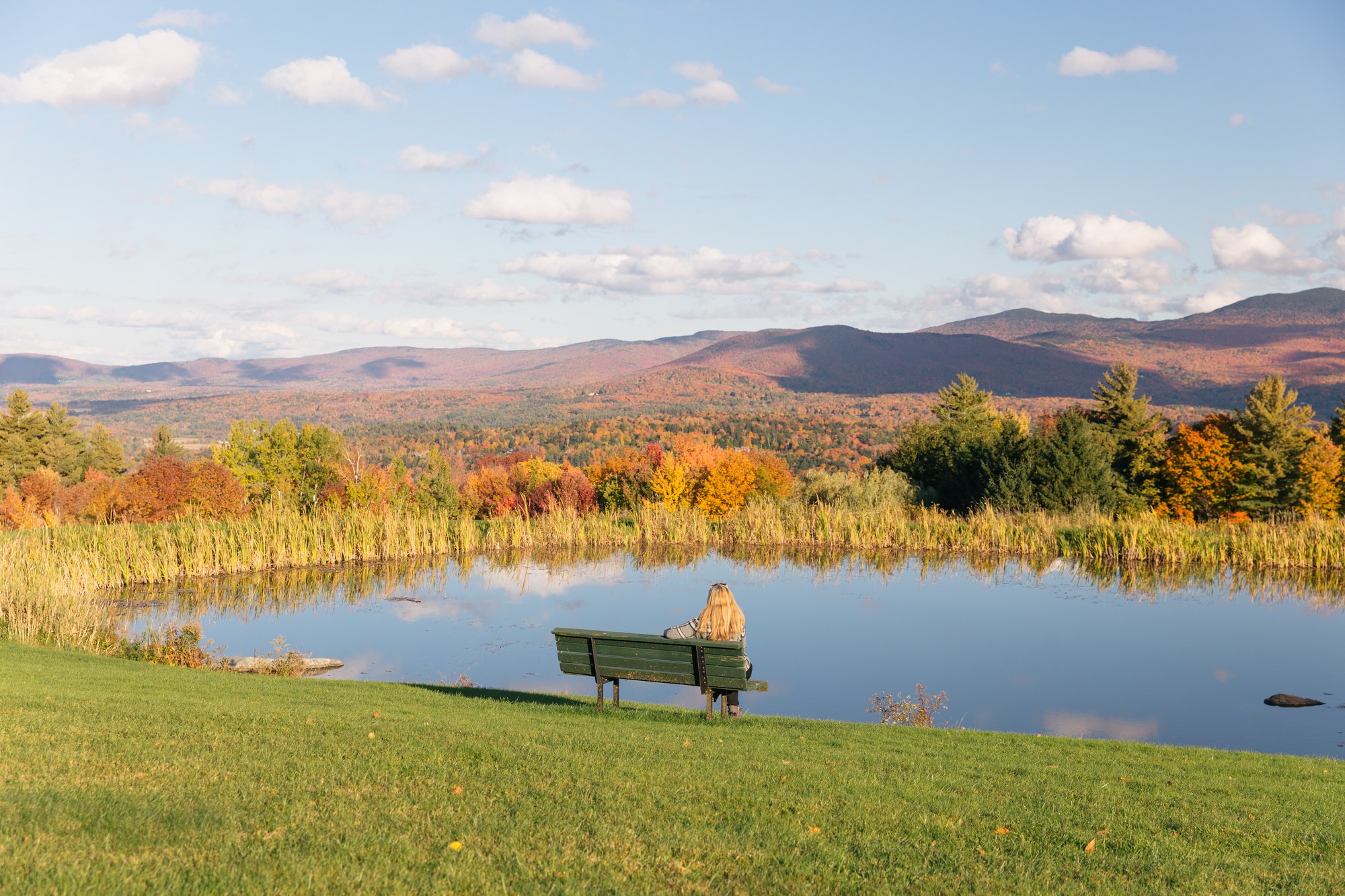
A guest takes in the view from the pond at the von Trapp Family Lodge & Resort. (Photo: Chadwick Estey)
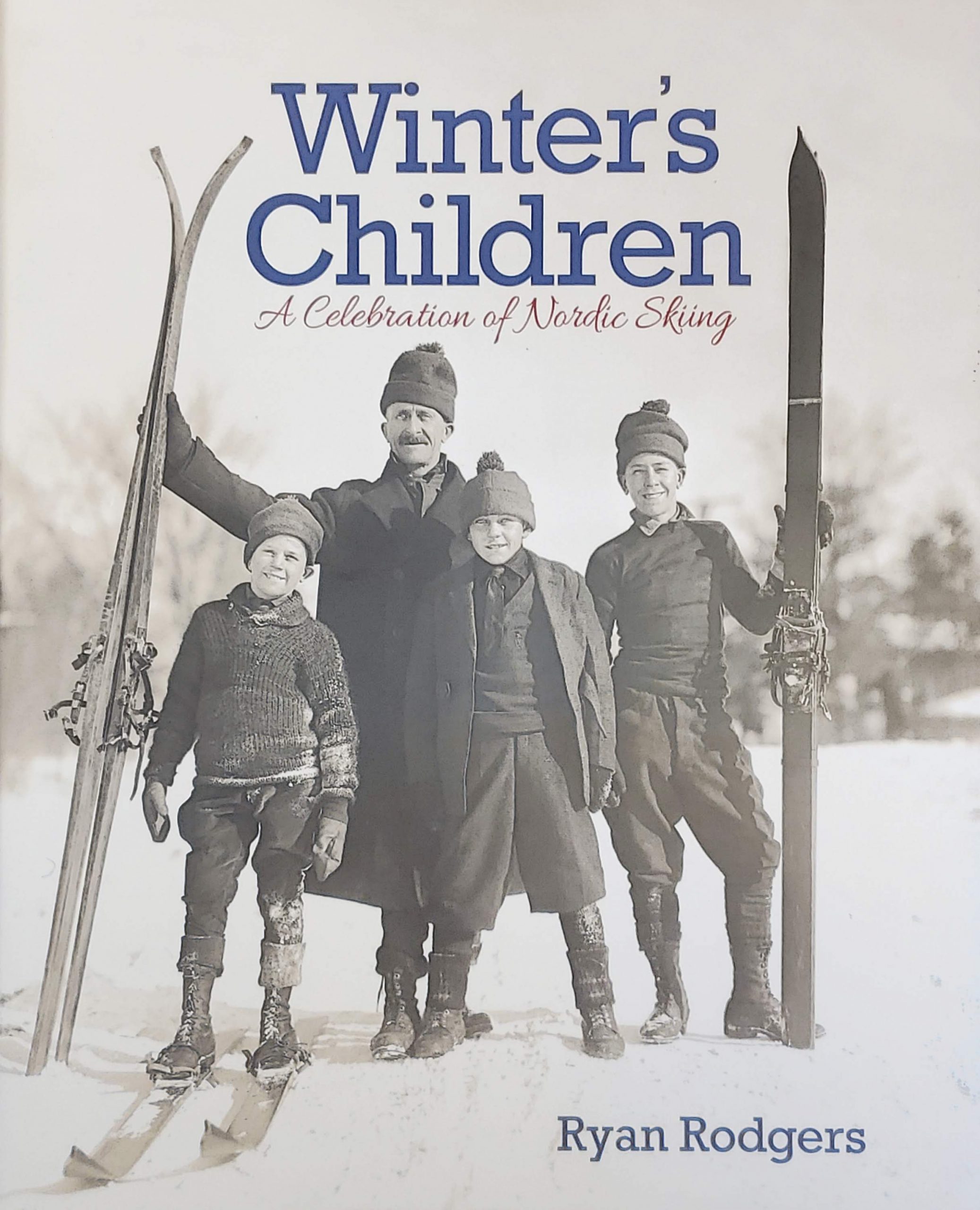
In a history of American skiing centered around the Upper Midwest, author Ryan Rodgers weaves together the stories of individuals who have found joy, love, and purpose in skiing with their heel detached, inspiring his readers to do so, too.
Cover photo courtesy of University of Minnesota Press
At the intersection of outdoors and pursuits, the street signs read “myth” and “heroes.” And we, those who spend our time outside, are here to patiently listen.
That intersection has given rise to classics across the myriad of ways humans interact with various natural playgrounds. Surfing has the permanent nostalgia laced in Endless Summer, rock climbing has the steady, emotive death-defying of Free Solo, and alpine skiing has the entire catalog of Warren Miller. These submissions to the genre are appropriate for their outdoor pursuits: flash-in-the-pan instances of action, bringing together visual and audio media to make something that’s brilliant.
But also, brilliance that’s just, well, oh-so accessible.
For cross country skiing? The individualistic and energy intensive mode of moving through winter’s harsh environment on skis requires a medium suggestive of walking its lonesome valley, and the ancient timelessness of doing so. It’s perhaps less glamorous than climbing nearly 3000 vertical feet up a cliff face with no rope, but also easier to connect with; less documentary, and more rhapsody.
With “Winter’s Children: A Celebration of Nordic Skiing,” Ryan Rodgers has accomplished just that. His work is a well-researched, extensively reported history that gets at the Norwegian ideal, sought throughout, of idraet – ski-sport, the mixing of ancient technique with spiritual renewal. Rodgers takes the epic tales of American skiing, and allows its practitioners to work together with his prose to form a journey with all the ebbs, flows, wanderings and epiphanies of a long ski in the woods. In doing so, he lifts the stories of this sport, done at the edges of frozen existence, out of the ether and into something material.
Rogers himself quickly sets the limits of what his project is from the outset; this is ostensibly the story of skiing centered around the Midwest. Not, as he says “a comprehensive look at the almost unfathomably long history of Nordic skiing,” but instead, “a celebration of an often-intertwined array of people and places.” In other words, he is out to tell a folk-history.
In doing so, Rodgers’ focus lies primarily on the folks in that history, interweaving the individual stories of people – some well known to the world, some well known to the Nordic community, and some simply not well known at all – who found the crevices and creases of human life using a pair of free-heeled skis as a medium. This is a work about skiing, yes, but also one in which the storytelling lets tales of freedom, fraternity, courage, and humor shine through.
I highlight this strength first because it gets to the heart of who should read this book. That is, although this is a Midwestern-centric skiing history, the bounds of that history include people and places that will be of interest to skiers from all over. Yes, the narrative, especially when skiing first hits America in the late 19th century, returns again and again to figures that touched the Midwest, but that is only a consequence of accurate historiography.
That is clear from the outset here. The first figure that Rodgers illuminates is Sondre Norheim, so-regarded as the father of modern skiing in his native Norway that both times the country has hosted the Winter Olympics (Olso in 1952, Lillehammer in 1994) the torch relay has begun with a flame from his hearth in Morgedal, Telemark. He is a national hero. And yet, he lived most of his life in Minnesota and died in North Dakota. The intercontinental connection is a common theme for most of the early history of skiing in the United States. Nordic Skiing was the great cultural product exchanged between those Scandinavians who came to America, with its port of entry the Twin Cities, farm fields of Wisconsin, and mining camps of the Iron Range.
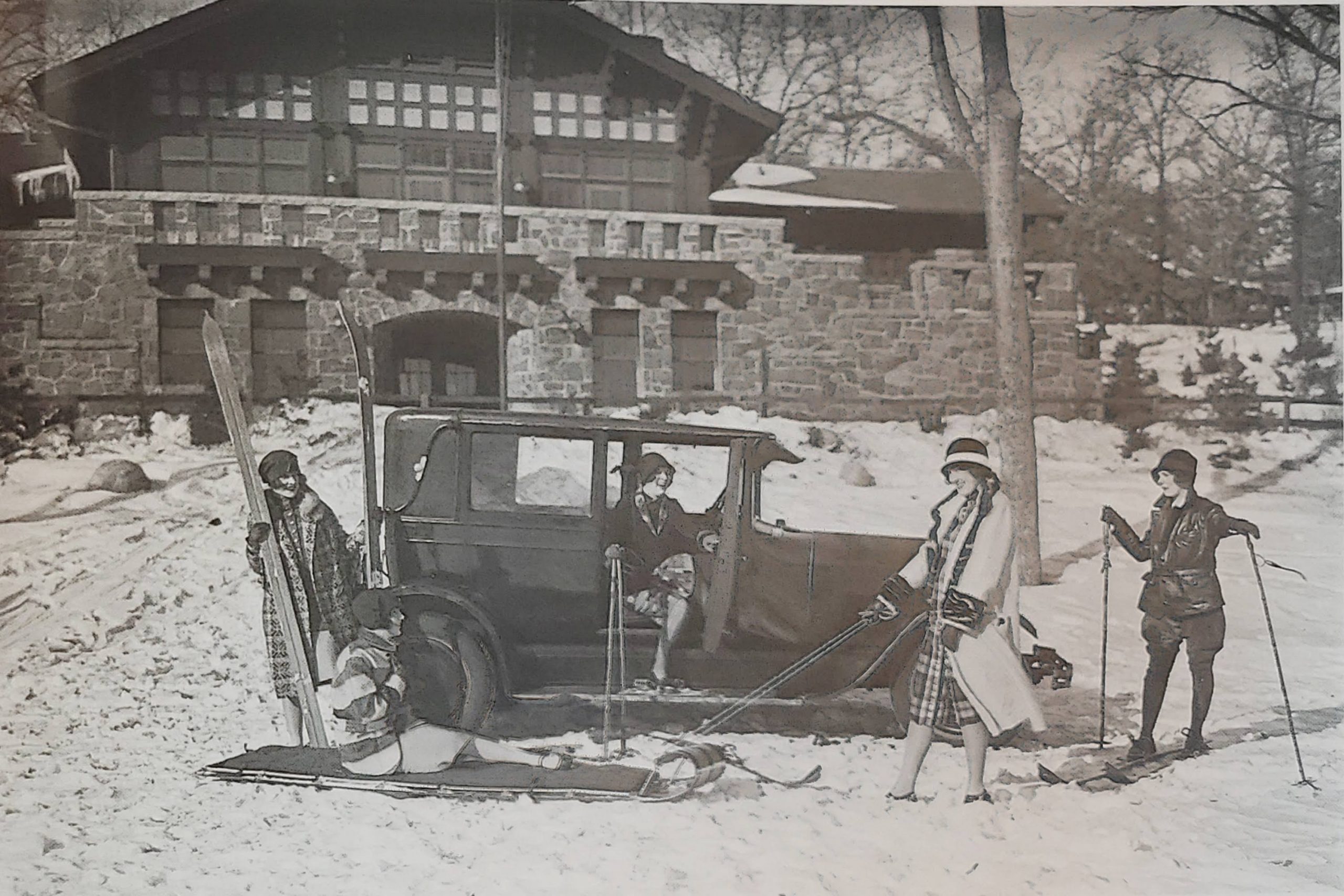
Women skiers in front of the old chalet at Theodore Wirth Park, Minneapolis, MN, in 1925. The base of the alpine-inspired building will be familiar to anyone who has skied Wirth, as it was the main chalet as recently as 2019, when the Loppet Foundation’s new adventure center opened a few hundred yards away. (Photo: U of M Press, reprinted from Minnesota Historical Society)
From Norheim, Winter’s Children begins to layer in the stories of the types of names that most of us skiers have come across in the name of a memorial race, or on a trophy or trail system. Rodger’s strength, especially in the early days of American skiing, is being precise in which characters he fully fleshes out, and then jutting and jiving between their narratives to interweave the particular pressures of a period on racers, organizers, and promoters alike. Then, like seeing a technical downhill off-shooting from a flat ski trail, he is willing to make us stop, turn at full speed, and take off to complexity and joy in his storytelling.
That’s how tales that for many skiers may have been whispers and vague allusions brought up at their local ski chalet become full-on stories – rising action, climax, denouement and all – in Rodger’s voice. Anders Haugen and his brother Lars become the main characters to illuminate the heyday of American ski jumping, the dominant discipline in skiing before WWII, with Rodgers recounting the brothers’ countless national titles after the formation of the National Ski Association (the former name of U.S. Ski & Snowboard).
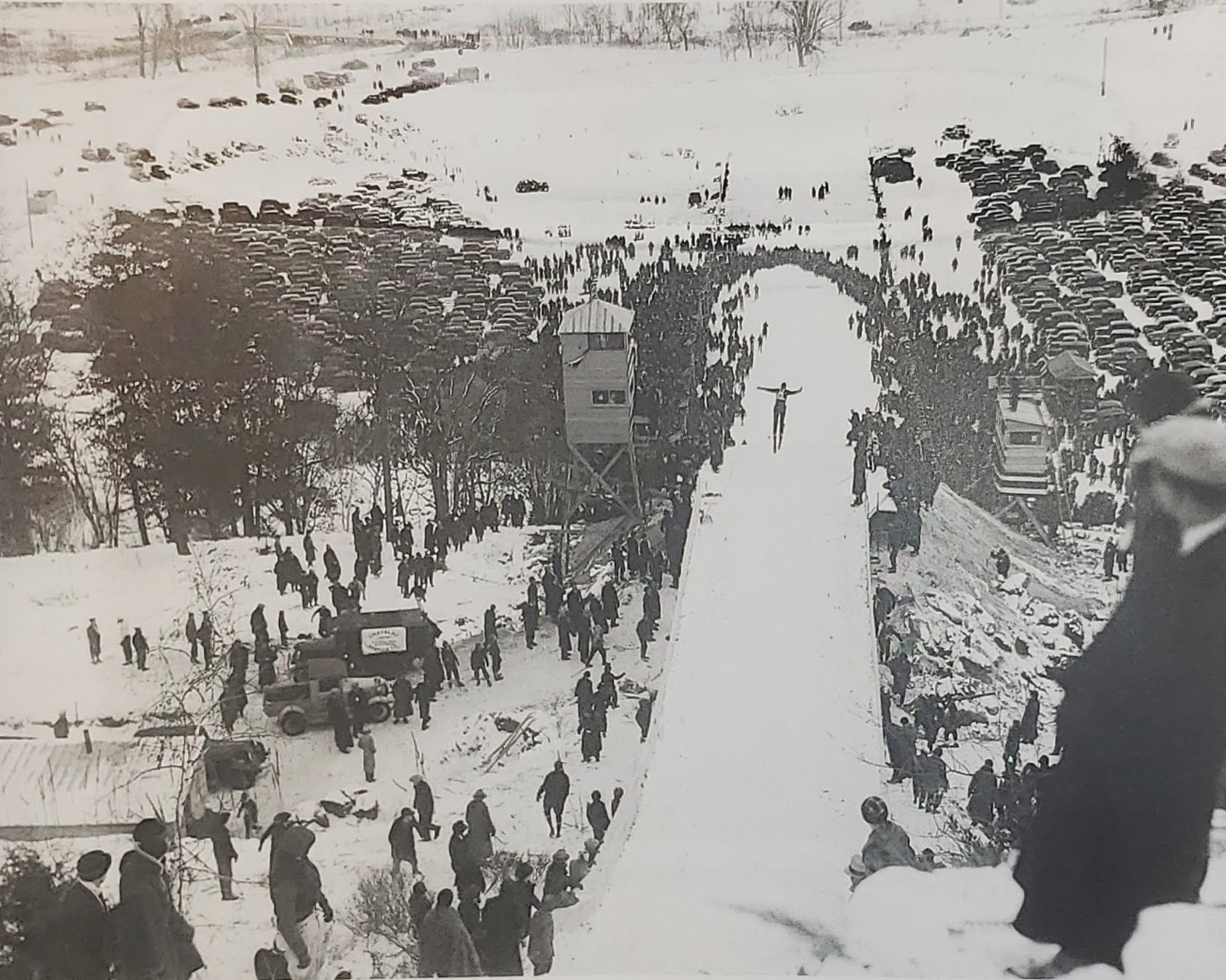
Scenes from the National Ski Championships in 1936, held in Red Wing, MN. Red Wing’s Aurora Ski Club dominated skiing in the first half of the 20th century, when Norwegian immigrants brought their jumping skills to the Mississippi river town. (Photo: U of M Press, reprinted from UM-Duluth Archives)
After detailing Anders Haugen’s foray into winning US Skiing’s first Olympic Medal at the 1924 Chamonix Games, Rodgers shifts to Lars trouncing over the Colorado Rockies between Estes Park and Steamboat Springs with skiing pioneer Erling Strom. From there we follow Strom ascending Denali on skis for the first time with Al Lindley, a Minneapolis-debonair who represented the US at the 1932 and 1936 games. The whole time we’re treated to a storytelling style which forgoes lyricism in favor of carefully plucked anecdotes that set them in a Midwestern simplicity and witticism which reaffirm the place these stories emanate from.
The best, most fully expressive character in the book hops off from Lindley, with his wife Grace Carter. Carter and Lindley met at the tryouts for the 1936 Olympics, with Grace becoming one of the first two American women to represent the US in skiing on the Olympic stage. Her story begins the earnest exploration of the exclusion and challenges that women have faced surrounding skiing since the sport’s inception in the United States. We follow her courage, effervescence, and brilliance through to the end of her life in 2002 in Duluth.
Carter shines through best when Rodgers puts her attitude towards the skiing world that tried to exclude her in her own words, citing a column she wrote in the 1960s where “several times each year parents asked her if they should allow their daughters to race. ‘I usually tell the parent no…because that’s what he wants to hear…if a girl is really keen she’ll race anyway. When the girl asks me, I say yes.’” Carter’s attitude also seems to sum up the broad arc of women’s sporting history, which is one of the key themes of Winter’s Children.
Skiing, at points, has been a site for progressive attitudes towards women’s participation in sport, but at others, it’s also been caught up in the same history of misogyny found elsewhere.
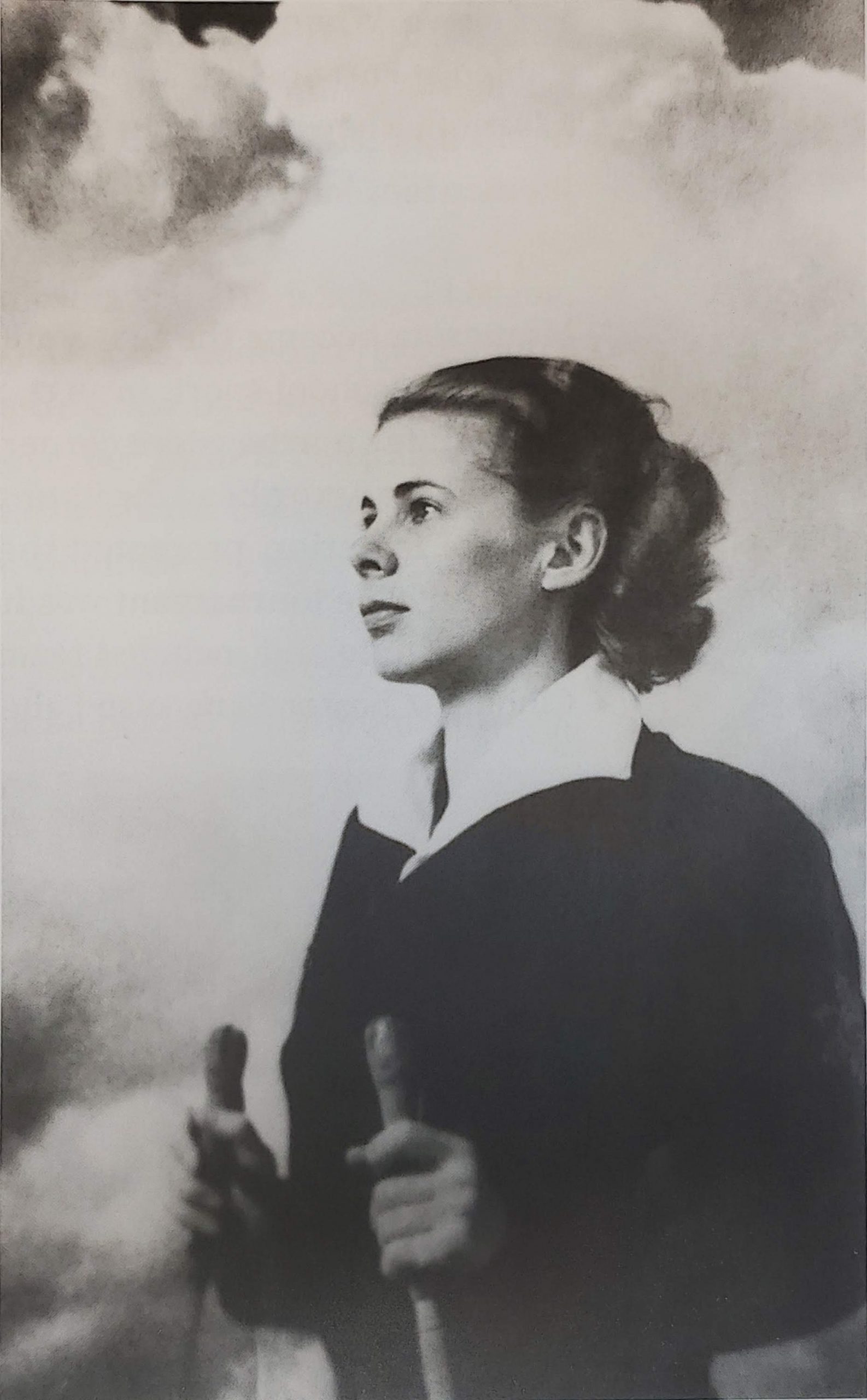
Skiing pioneer Grace Carter Lindley. Carter was one of the first women to represent the US at an Olympic games when she did so at Garmisch in 1936. She later married teammate Al Lindley, was an advocate for women’s racing, and touched nearly every development in Alpine skiing from Sun Valley, to Aspen, to Vail, before her passing in Duluth in 2002. (Photo: U of M Press, reprinted from Aspen, CO Historical Society)
Earlier than one might expect in his history, Rodger’s starts to introduce characters that some of us may have shook hands or looked up to out on the trail during our own lifetimes. At that inflection point lies one of the most poignant reasons to read Rodger’s work; the inclusion of snippets from an interview with George Hovland, capturing the former Olympian and Midwest’s foremost ambassador of the sport earnestly reflecting on his life’s work shortly before he passed away, at age 94, last May.
In the context of Winter’s Children, the reader can fully pair the vignettes Hovland might offer you if you were lucky enough to run into him out at Chester Bowl in Duluth with the full life and joy that he first found there as a youth in the 1940s. Back then, the Bowl was home to a ski jumping scene that was something akin to what one might find at a skate park today.
George Hovland at the American Birkiebeiner in 1982. Hovland was an Olympian at the 1952 Oslo games, and touched all corners of skiing in the Midwest over the course of his life in his native Duluth, MN. (Photo: U of M Press, reprinted from George Hovland personal collection)
The strength of Winter’s Children is not only remaining in, but building on, the mythos of those types of characters and those types of places strewn across the Midwest. Rodgers makes it foundational, with the most widely-known myths in the sport – that of the Vasaloppet and Birkiebeiner – being recounted in the first pages. When Winter’s Children does get to the Midwestern revival of those myths with the founding of both the Mora Vasaloppet and American Birkiebeiner in 1973, there is an ironic coming back down-to-Earth. It’s when the history starts to feel more vivid. When, for many readers, the recollections on the page will mix with those in their own minds. Of their own experience, perhaps.
That leads to the temptation to say that things aren’t how you remember them in Rogers’ words. You might think ceded some of its accuracyand cohesiveness as it gets closer to the present. If the reader catches that thought, they should hold two idea’s in mind. 1) First and foremost, is that Rogers’ is most likely correct, this is a painstakingly well-researched project, and 2) that their own mind’s wanderings add to the folk history that Rogers’ set out with here. Rodgers’ biographical sketches of Bill Koch (who isn’t a Midwesterner, but did design the trails at Telemark, and that seems like tangential connection enough to explore his influence here) and Jessie Diggins aren’t nearly as fleshed-out and richly-woven into the story of skiing as the athletes who came a half-century before them. He stops the story of the Birkie right after its originator Tony Wise loses control of the race in 1985, without detailing how the race continues to be the “Rome” in Midwestern skiing’s empire – all the youth skiing, citizen racing, and training developments seemingly leading to it. That’s ok, those histories and those stories continue to go on. Reading their introductions here is a great primer to join in.
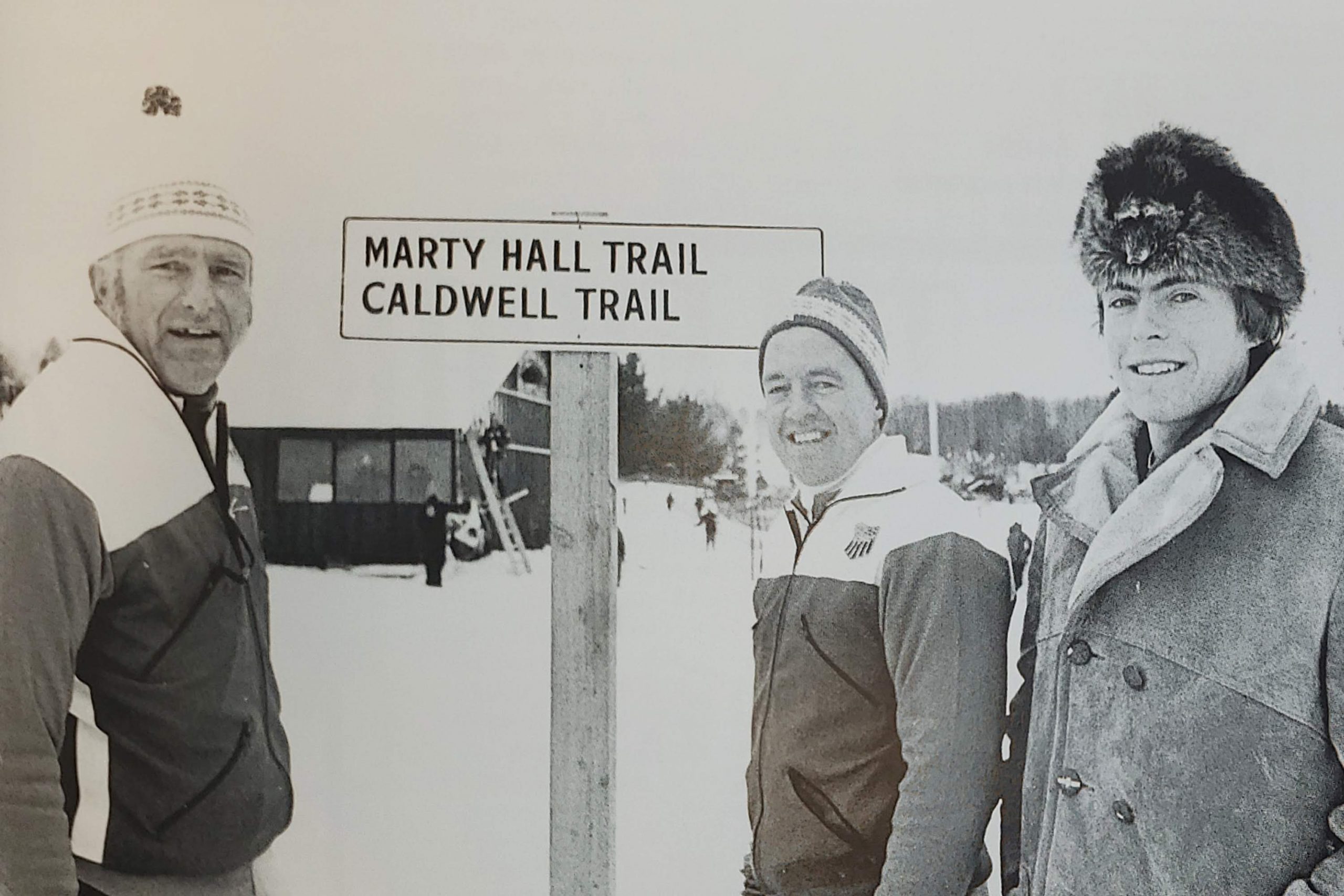
Marty Hall, John Caldwell, and Tim Caldwell pose at the trailhead of the new Telemark World Cup Trails, designed by Bill Koch, ahead of US Olympic trials in Cable, Wisconsin, 1979. (Photo: Telemark Education Foundation)
There are the accurate appraisals, too, on modern issues in the community – climate change, the influx of money into youth training programs, and the lack of racial and socioeconomic diversity in the sport. They all remind the reader that the individual and communal elements of nordic skiing’s history are both active agents. Rodger’s can’t fully portray the sport as it is today, sending us as readers back to the ether and implying that you yourself need to feel them as part of the living, breathing, gliding AND kicking community of nordic skiing as it continues its odyssey here and now.
That theme: the vitality of skiing’s history, is how Winter’s Children comes to an end. Our rhapsode, Ryan Rodgers, ends by tying up the loose ends of the narrative thread of Charlie Banks and Mark Helmer.
It is a long one. We are first introduced to Charlie Banks when he wins one the first Minnesota High School State Meets in 1941, before he fights in WWII, returns, and splits for the forests that extend past the Duluth hillside. Living an ascetic, but sturdy life in those Northwoods, Banks cut a trail system called Korkki on his property where he started the oldest continuous race in the Midwest, the Judeen Memorial 10 k, in 1962. Twenty years later, Mark Helmer was living down the road and decided to ask Banks if he could use the trails.
The meeting soon evolved into a deep friendship built around skiing, saunas, and more than a few PBRs. Banks sold Helmer 20 acres of his property in 1993 to build himself a house and a warming chalet at the trailhead of the newly public Korkki trails. Banks passed away in 1998, with Helmer saying in an interview for Winter’s Children that “he was my best friend and still is my best friend; there isn’t a day that goes by that I don’t think about the man.” It is one final parable that points towards the magical juxtaposition at the heart of nordic skiing – a cold, individual pursuit that brings out the warmest of human connections.
A simple sport that was, and still is, the core around which a person can organize a life.
Charlie Banks on his handcut Korkki trails outside of Duluth, MN. This photo of Banks greets visitors of the Korkki trails, hung above the hearth in its warming chalet. (Photo: Korkki Nordic)
Winter’s Children: A Celebration of Nordic Skiing by Ryan Rodgers is available at local bookstores and ski shops throughout the Midwest, major book retailers, and online from the University of Minnesota Press.
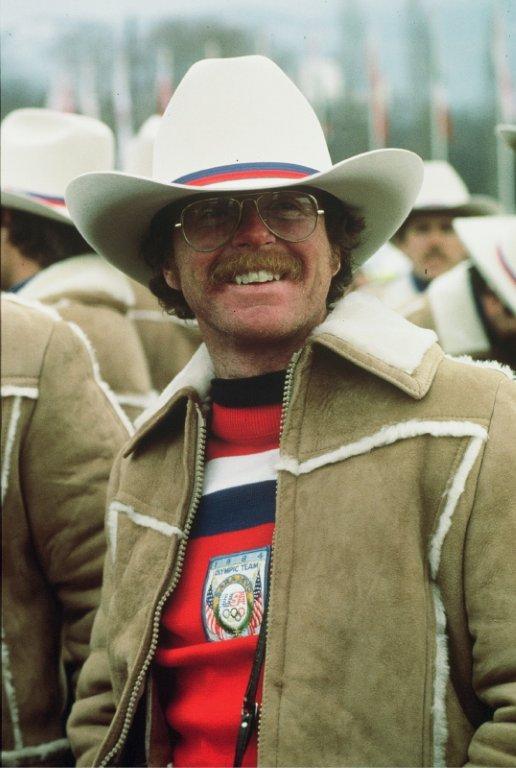
Peter Ashley at the 1984 Sarajevo Olympics opening ceremony. Now the nordic vice president at Fischer Skis USA, he was the U.S. Ski Team women’s coach from 1984-85. (Courtesy photo)
Peter Ashley is “Mr. Fischer” in the United States. For over 18 years, he has been vice president of the nordic division at Fischer Skis. He is responsible for everything that has to do with Fischer Nordic USA: ski selection, pricing, marketing, reps, budget, and more.
Peter Ashley during a recent cruise near Portsmouth, N.H. (Photo: John Estle)
Although Fischer is his life these days, Ashley has been involved with cross-country skiing in many other capacities for decades before working for Fischer. He has truly been around the nordic block. Ashley has had just about every job that skiing offers and has experienced the evolution of the sport firsthand. FasterSkier’s Nancy Fiddler caught up with him recently on the phone in a conversation about the development of cross-country skiing and some of his best stories from a pivotal period in the 1980s.
Ashley, 62, lives in Contoocook, N.H., with his wife, Rhonda, and three Maine Coon cats. New England is his home now, but Ashley is a self-declared westerner with strong roots in Jackson Hole, Wyo. For Ashley, the West was where the whole skiing thing started.
Growing up, his family was hugely involved with skiing and the Jackson Hole Ski Club (JHSC). Ashley trained and raced alpine, then nordic with the JHSC, making his first Junior National nordic team in the mid 1960s when he was in eighth grade. He continued to race alpine and nordic until his junior year in high school, when he admits that his size and athletic talent were more suitable to cross-country skiing.
It has been all nordic ever since for Ashley, who went on to race at the University of Colorado under the direction of Bill Marolt. After graduating in 1974 with a degree in finance, the same year that fiberglass skis were introduced, Ashley returned to Jackson Hole to try his hand at coaching. He got his feet wet coaching juniors for four years as head coach of JHSC, the beginning of a 12-year run of coaching that took him all the way to the U.S. Ski Team. Along the way, Ashley worked with a lot of interesting characters, traveled the world, and witnessed firsthand some big changes in skiing.
“Skiing was a very, very different sport 25 years ago.”— Peter Ashley
World Cup cross-country ski racing has been divided into two disciplines since the 1986/1987 season: classic and freestyle (skating). The evolution of skiing from an all-classic technique sport to a two-discipline sport took place over the course of several rocky seasons and saw some major battles.
A multiple Olympic gold medalist, Sweden’s Thomas Wassberg, after whom the “Wassberg” skating technique is named, freestyle racing at the 1985 World Championships in Seefeld, Austria. (Photo: Peter Ashley)
The year was 1985; the place: Seefeld, Austria, and the event: the 35th Nordic World Ski Championships. There was a lot of drama in the days leading up to the races, and the hot topic was skating. The question surrounding the final preparation was whether skating would be allowed in the championship races, or just the traditional classic skiing.
Left to the Norwegians, who had already banned skating in junior competition in Norway, there would not have been any skating at the 1985 Worlds. The prevailing attitude is best summed up by Norwegian Ivar Formo, Controller of Equipment, who said, “no one can be the World Champion on skis without grip wax.”
The women’s coach for the U.S. Ski Team (USST) from 1984-85, Ashley was in the thick of this historical debate. Cross-country skiers had been experimenting with skating for a couple of years. As he remembers it, skiing had taken on a hybrid form by the time of the Seefeld World Championships. Skiers were still using kick wax, but moving with the marathon skate and a gliding herringbone, which eventually morphed into a rudimentary V1 technique.
With narrow trails with set tracks and athletes using short poles, long skis and kick wax, the stage was hardly set for the break out of skating. Still, athletes were looking for faster and faster methods of skiing. At Seefeld, just days before the first race, Swedish skier Gunde Svan was seen experimenting with one very long pole and no kick wax. This silliness by the eventual-double gold medalist was quickly put down by the organizers, who were desperately looking for a way to prohibit skating at the Championships.
According to Ashley, the way it finally went down was with a nations’ meeting where a vote would temporary prohibit skating in Seefeld. A unanimous vote was required. All it took was a single “no” vote from the Australians, and the rest is history.
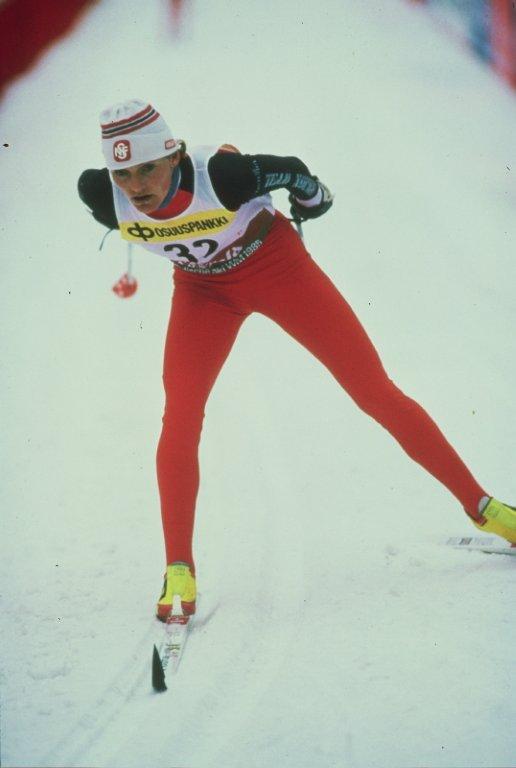
Annette Bøe of Norway skating at the 1985 World Championships in Seefeld, Austria (Photo: Peter Ashley)
Ashley recalls snow conditions on the Seefeld courses contributing to the decision by some teams to abandon kick wax entirely. As if 32 degrees Fahrenheit wasn’t bad enough, the snow was extremely dirty. “Nothing was kicking and everything was slow,” Ashley said.
For some athletes, this was the first time they would race without kick wax. The Americans had been fooling around with the skating techniques and little to no kick wax for some time on classic equipment, according to Ashley, who recently learned that was a different story for the Norwegians, whose ski leaders did not embrace skating.
In a conversation two years ago with former biathlete and nordic skier Grete Nykkelmo, Ashley said he learned that the Norwegian women were not allowed to skate in training. Nykkelmo, who won four medals at 1985 World Championships: a gold in the 20 k, bronze in the 5 and 10 k, and a silver medal in the relay, said that the Norwegian women had to quickly get with the program. In the end, skiers who went with kick wax were losers. The Norwegians managed to top the medal charts at Seefeld, but the battle wasn’t over yet.
The 1984-85 World Cup season was fraught with conflict over skating. Ashley remembers that in the races prior to the World Championships, organizers went to great lengths to keep skating out. He describes barriers built on the race trails to prevent any kind of skating, ugly coaches’ meetings and threats of disqualifications.
After Seefeld, things were still not resolved and for the rest of the season, race organizers tried everything possible to keep classic skiing as part of every race. Some races (Falun ’85 World Cup) had sections of course that were classic only and other sections on the same course that were “freestyle.”
“We were just trying to make sense of all the technical changes that were happening.” — Ashley
A season later, the 1985-86 World Cup was all skating. Classic skiing had all but disappeared for the time being (except for in Norway). Poles got longer, skis got shorter, and a good solution for boots was yet to be arrived at. In short, it was an equipment revolution and nordic skiing experienced a huge bump in sales.
U.S. cross-country skiing great Bill Koch, who pioneered the skating/freestyle technique in the 80s. (Photo: Peter Ashley)
Only a decade earlier, cross-country skis went from wood fabrication to fiberglass, a phenomenon that changed the sport completely, according to Ashley. Fischer fiberglass skis first appeared at the 1974 Falun worlds. Adidas was the first company to do away with the bulky three-pin bindings and duck-billed boots, replacing them with running-shoe-like boots and 38-millimeter bindings. The skis were faster and the boot-binding system sleeker, but it was still classic skiing.
In 1986 and 1987, Ashley once again found himself in the middle of everything. He was now responsible for Cross-Country Coaches Education for the U.S. Ski and Snowboard Association (USSA). He recalls this period an “extremely challenging” time to be trying to teach the country how to ski. Skating was here to stay, but by 1987, thanks largely to the Norwegians, classic skiing was back in international competition. It was now no longer possible to use any form of skating in a classic race.
What started as a hybrid classic-skate technique was now two distinctive methods of skiing. While classic skiing remained much the same, advances in skating equipment like higher cut, plastic-cuffed boots caused skating techniques to change almost overnight. Pole timing to match terrain evolved and Ashley was running to keep pace with all of it. V1, V2, V2 Alternate – these were names Ashley and others came up with to describe the new techniques. He remembers this period in U.S. skiing history as a bit chaotic, with too many experts and no definitive organization. He also recognizes this time as when the sport was thrown “wide open.”
The Path to Fischer
After the 1986-87 season, Ashley found himself without a job. It was a time of change, and USSA and the USST, in preparation for a merge, let the coaching staff go. For Ashley, it was time to move on, but he wasn’t ready to let go of the sport entirely.
For a year, he cut trails at Jeremy Ranch in Park City before beginning a stint working at Pacific Mountaineer in Palo Alto, Calif. The move to the Bay Area was a big one for Ashley, who had always lived in the mountains, but he stayed involved with skiing by coaching masters near Lake Tahoe.
In 1994, Ashley got a phone call from former skier Dan Simoneau, who presented an opportunity that ultimately led to Ashley’s current position at Fischer. A two-time Olympian and current nordic director at Mt. Bachelor Sports Education Foundation, Simoneau was getting ready to leave Fischer, then owned by Raichle Molitor, for a new job at Timex. He offered Ashley a position as Fischer product manager and Ashley took him up on it. By November, Ashley was living in Connecticut and quickly learning everything there was to know about Fischer skis. He admits that on his first purchasing trip to Europe, he felt more than a little bit unprepared.
Going on 19 years with the company, Ashley has landed and is thriving. He is grateful for the success of Fischer and acknowledges that the company is grateful that people believe in them at the top of the sport.
“This is not an un-cool sport to be in nowadays.” — Ashley
Ashley has seen tremendous growth and change in the sport of cross-country skiing in the U.S. He believes the sport is benefiting already from the recent success of the U.S. women’s team. This success in a sport dominated by Europeans was a long time coming. Ashley has seen generations of female cross-country skiers in our country pave the way for today’s champions. There have been many hurdles to cross, like doping, politics and funding problems over the years, but the image of cross-country skiing has never looked better, he said.
Looking back over the decades, Ashley sees nordic skiing as much more main stream now than 20 years ago. Nordic skiers used to be branded as eccentric, loner types in the ’70s and ’80s, dedicated athletes in a fringe winter sport with very little media exposure. Kooky behavior was not uncommon and almost expected of the athletes of this period.
There are higher expectations for today’s nordic athletes. The sport is maturing in the U.S. and is highly professional for athletes and coaches alike. Social media has increased the visibility of today’s skiers, who are able to manage their own brand. Media training is necessary for athletes to help them deal with this increased visibility. The bar has been raised, according to Ashley, and there is no better example than Kikkan Randall of a nordic skier who “acts the right way.”
Finally, Ashley is excited to see the success of U.S. skiers directly affecting the numbers of kids entering the sport today. It’s a new, very cool sport to be a part of.
Peter Ashley is putting together a slideshow of the history of skating, the cast of characters of the time, and the international scene from the early to mid-80s to present this fall at FinnSisu in St. Paul, Minn.