Tag: Hochfilzen IBU World Cup

  • U.S. Men, Canadian Women 9th in Extra Windy, Hochfilzen Relays

    U.S. Men, Canadian Women 9th in Extra Windy, Hochfilzen Relays

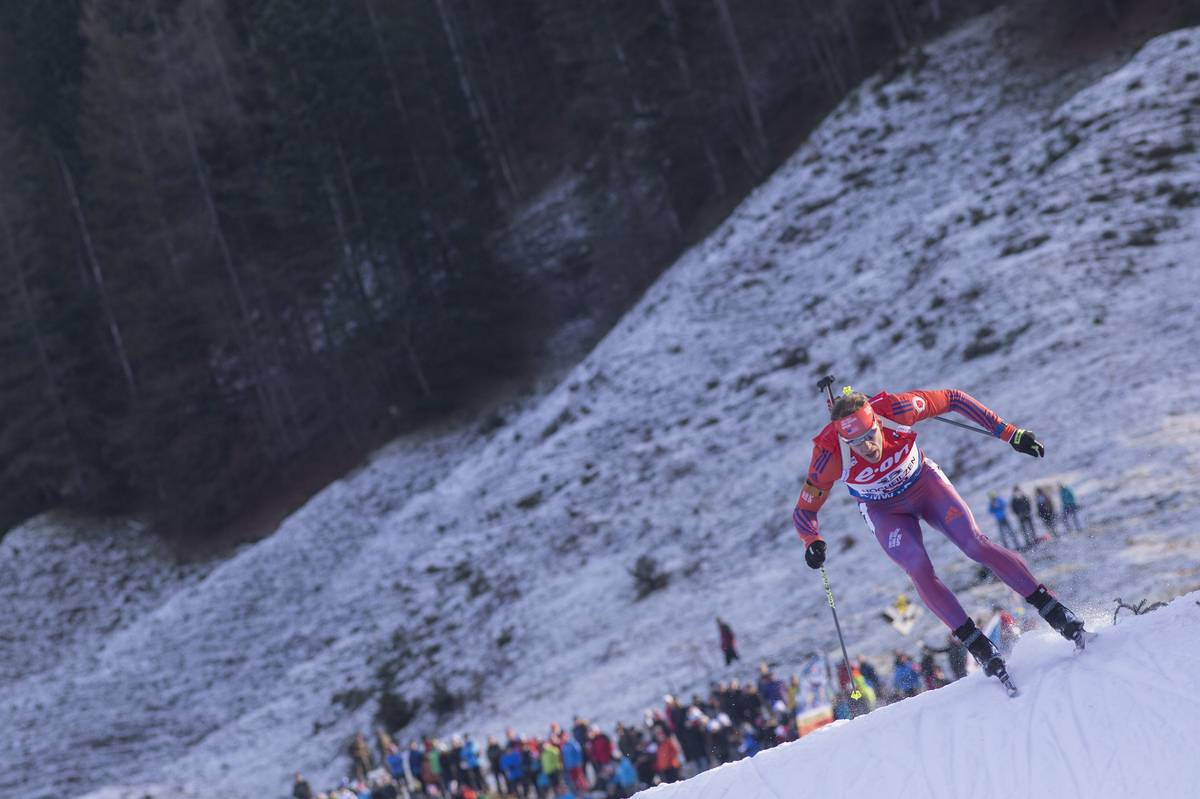
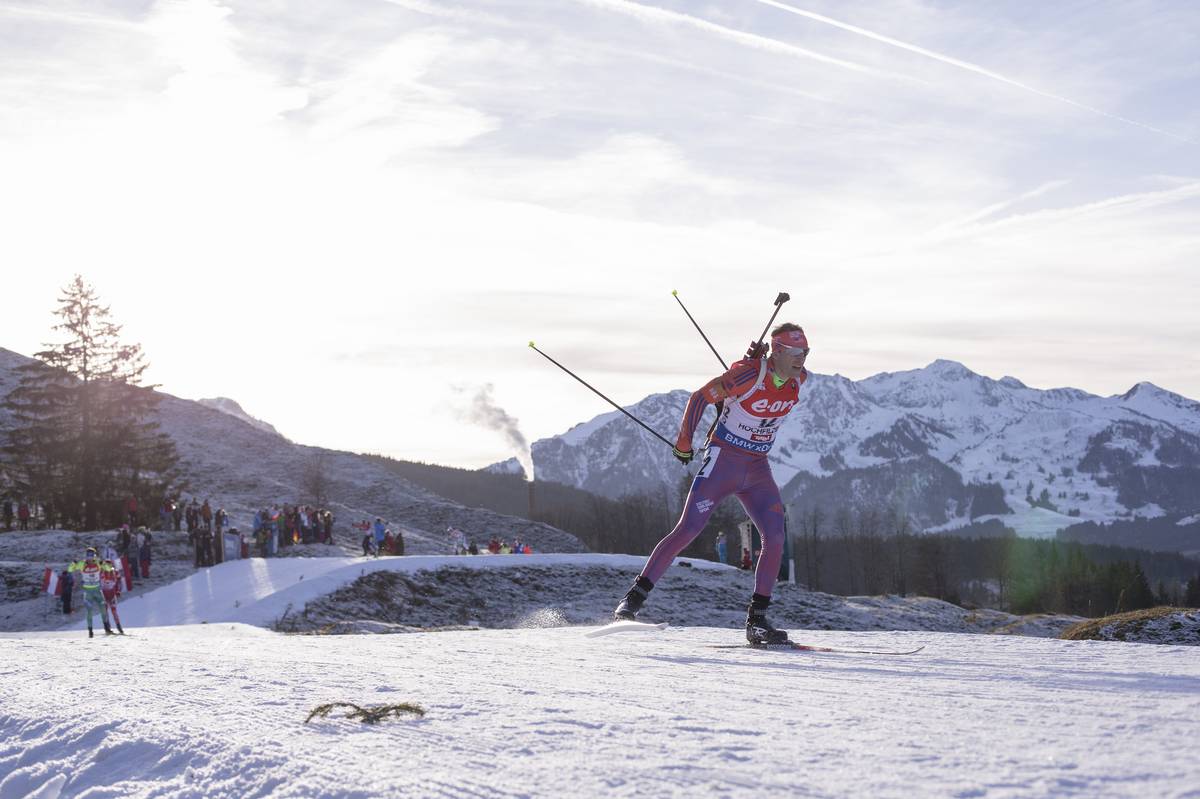
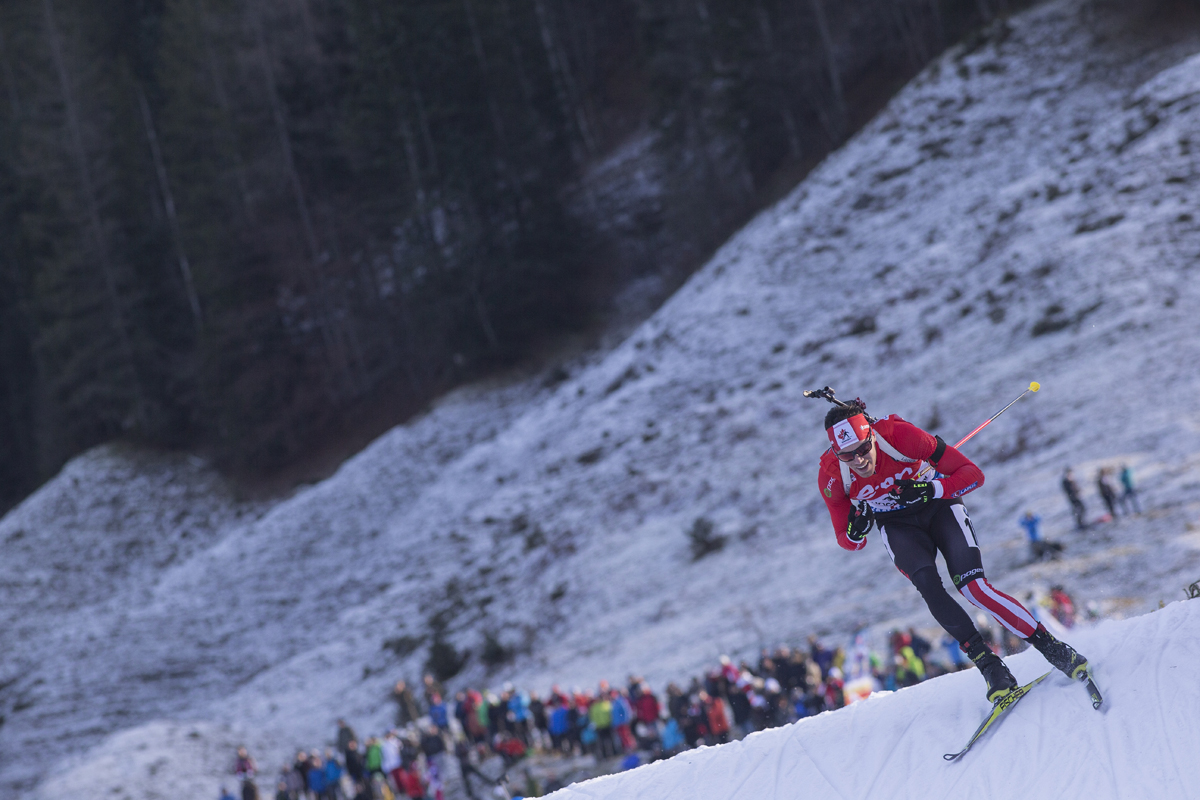
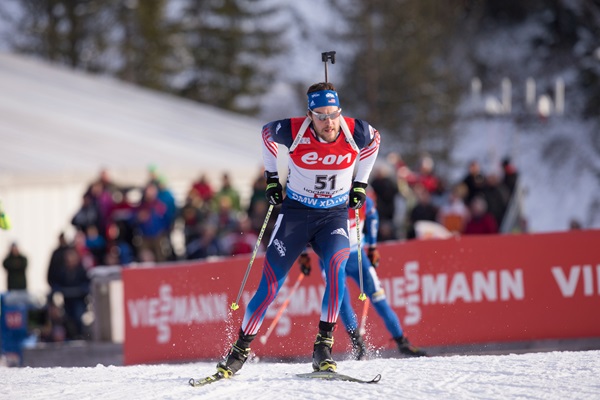
    Leif Nordgren (US Biathlon) skiing the second leg of the IBU World Cup men’s 4 x 7.5 k relay on Sunday in Hochfilzen, Austria. The U.S. men ended up ninth overall out of 26 teams. (Photo: IBU/NordicFocus)

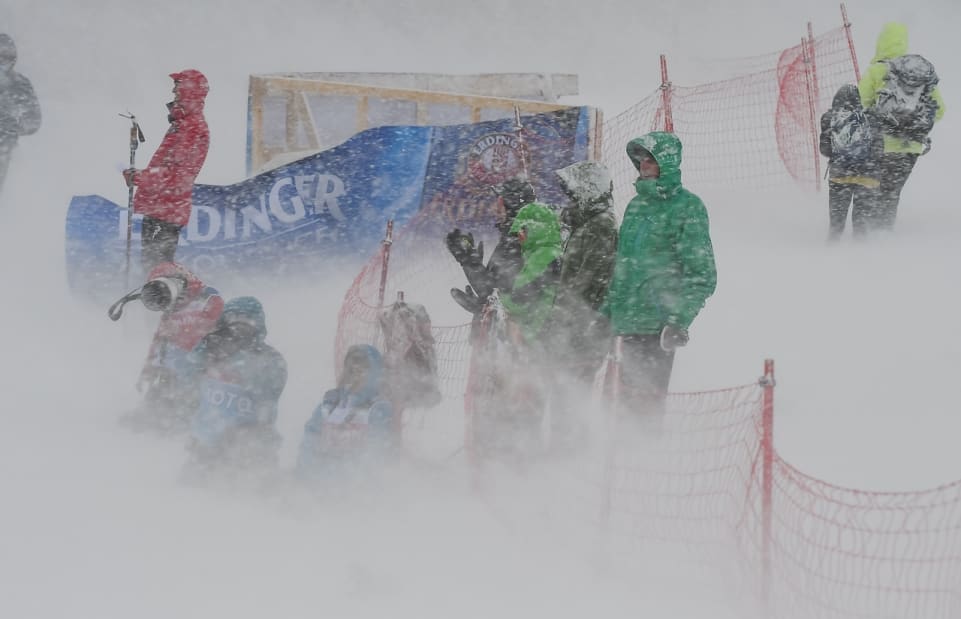
    Strong gusts of wind on the range required strong nerves and a lot of luck in the women’s and men’s relay races that concluded the International Biathlon Union (IBU) World Cup in Hochfilzen, Austria, on Sunday afternoon.

    While the relays concluded with teams on the podium one might expect there, tempestuous weather conditions that at times made it almost impossible to hit the targets also gave outsiders a good chance, and both the U.S. men and Canadian women remained in contention for a long time. The men’s 4 x 7-5-kilometer relay was particularly wild with more than 100 penalty laps, and it began with a big surprise.

    Belgium’s starter Michael Rösch tagged off in first place for the first time in the history of that team, representing a country that until now, rarely had enough athletes for a relay and had thus far had a 24th place at the 2016 World Championships to its credit. And on his tails was Norway’s Ole Einar Bjørndalen, and shortly behind them US Biathlon’s Lowell Bailey in third.

    The three aforementioned athletes all raced in the Olympic relay more than a decade ago at the 2006 Winter Games in Torino, Italy, but back then Rösch raced for Germany and won gold with his team.

    “I wanted to tag off in first at all costs, to see the Belgian flag at the top,” Rösch told TV broadcaster ARD on Sunday while the race was still going on. “But Ole made it really hard for me. … I was on my last fumes, I tumbled into the finish, I was just seeing black, but it definitely was worth it.”

    Just a turn behind, Bailey had gotten off to a strong start for the U.S. team, temporarily taking the lead out of the arena on the first lap before shooting clean in his prone stage to put himself in the lead group of seven. Facing strong wind in his standing stage, Bailey missed two targets but avoided the penalty lap with his last spare in that stage (0+0, 0+3), and tagged off to teammate Leif Nordgren in third position, 23.8 seconds out of first.

    Nordgren ended up with a penalty in his first prone after missing two targets, and returned to the course in fifth. While his penalty had increased the gap to first by 50 seconds, Nordgren made up a few seconds with a clean standing bout, hitting all targets without requiring a spare (1+3, 0+0).

    Italy and France passed him on the final loop, and Nordgren handed off in seventh, 1:34.2 minutes behind Norway setting the pace up front.

    “The team came pretty close to a good result today in a relay with nasty weather,” Nordgren wrote on his Instagram account. “Personally I’m quite disappointed with my skiing, it’s been a struggle to find the top gears so far this season and I’m far from where I know I should be. It’s a long season though and there is still plenty of time to turn it around.”
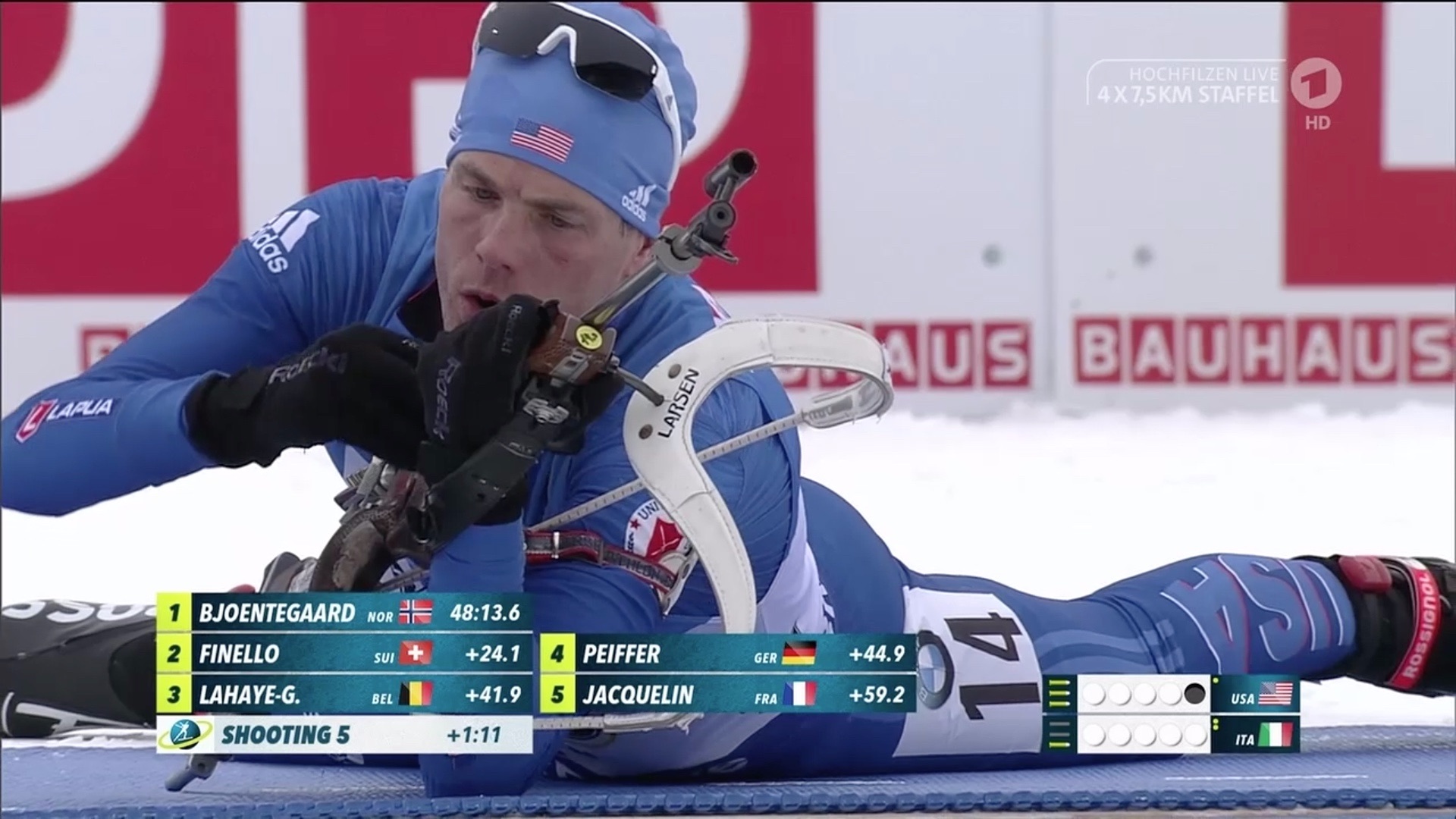
    US Biathlon’s Tim Burke loading a spare in his prone stage of the men’s relay at the 2017/2018 IBU World Cup in Hochfilzen, Austria. The team went on to finish 9th. (Screenshot: ARD broadcast)

    Taking over next for the U.S. was Tim Burke, who pointed out this was one of the most challenging races in terms of wind that he’d experienced.

    “This was definitely one [of the] windiest races that I have taken part in,” Burke wrote in an email to FasterSkier. “We knew it would be very challenging right from the start but our team tried to look at it as an opportunity for a top result. I feel like our team did a great job at avoiding any big disasters on the range and this allowed us to stay near the front for most of the race.”

    After only needing one spare in his prone shooting to hit his last target, Burke incurred a penalty in his standing stage (0+1, 1+3), but kept his position on the final loop in a hard race against Switzerland’s Jeremy Finello to exchange still in seventh, now another minute back (+2:49.4).

    “I was not surprised to see a mix of different teams near the front today,” Burke wrote. “It was one of those days that any team could find themselves with multiple penalty loops after a windy shooting stage.“

    Taking over from Burke as the U.S. anchor leg was Sean Doherty, coming off two strong shooting performances in the sprint and pursuit earlier this week.
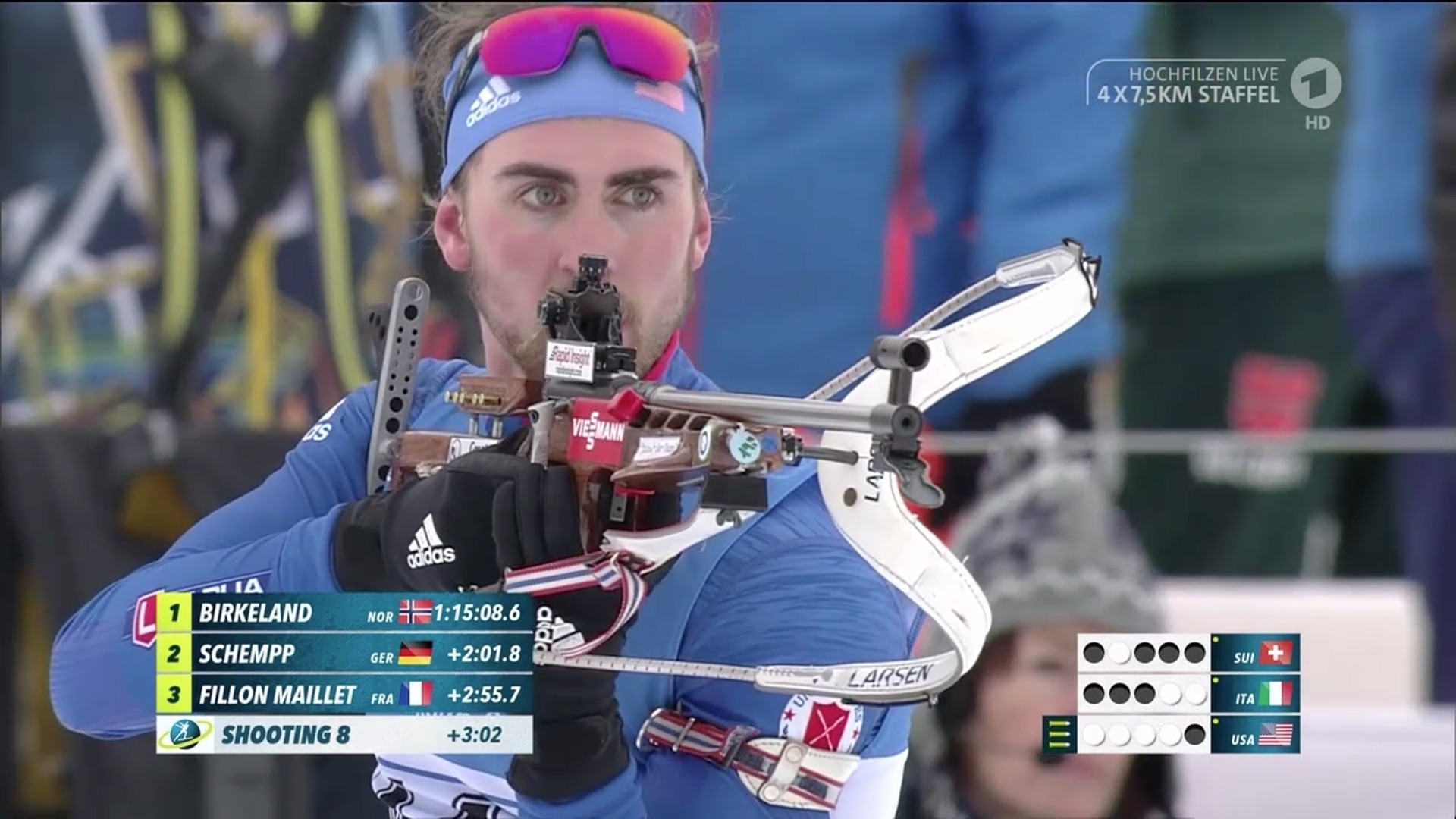
    U.S. relay anchor Sean Doherty taking aim in difficult wind conditions during his standing stage of the men’s relay at the 2017/2018 IBU World Cup in Hochfilzen, Austria. His team finished ninth. (Screenshot: ARD broadcast)

    In his prone stage, Doherty again shot clean and fast (with the second-fastest prone shooting time on his leg) and overtook Switzerland to move into sixth. He kept that position on the course, vying for a position in the top five with the teams from France, Italy, Ukraine, and Russia also in his vicinity.

    “Today was a crazy one for sure,” Doherty wrote in an email. “The conditions on the course were decent, firm tracks and we had good skis. The wind was whipping, so that really just made some sections a lot harder than normal when you added in the head wind. I have done races in bad weather before but today was amongst the most windy.

    In the standing stage, Doherty hit his first four shots in another fast sequence before missing the last one. It looked as if he had thought that final shot was also a hit as he dropped his rifle slightly, but then realized he had to load spares. Unable to clear the last target, Doherty ended up with the team’s third penalty.

    “With the shooting you try to get a general idea of how far the wind is pushing the shots and do the best you can,” Doherty explained. “It’s a total toss up and the finish order is just a ranking of who battled the wind the best and had most to least luck along the way.”

    He set out on his last loop in eighth place with Ukraine’s Dmytro Pidruchnyi and Switzerland’s Mario Dolder right ahead of him, and Russia’s Anton Shipulin ten seconds behind.

    “The fight on the last lap is always tough,” Doherty wrote. “Although I felt better today I was not able to hang with the two guys I left the range with. I was able to ski a good lap but not enough to hold off Anton.”

    After Shipulin passed him up the big last climb, Doherty came to the finish in ninth position, 3:38.3 minutes behind the winners with a team total of three penalties and 13 spares.

    “We were not too excited with the end result because we saw the potential was there for a top 5,” Burke concluded for the team. “We are also all far from our best on the tracks right now, but are hopeful that will come with more racing.”

    Norway Successful with Its ‘Second Unit’
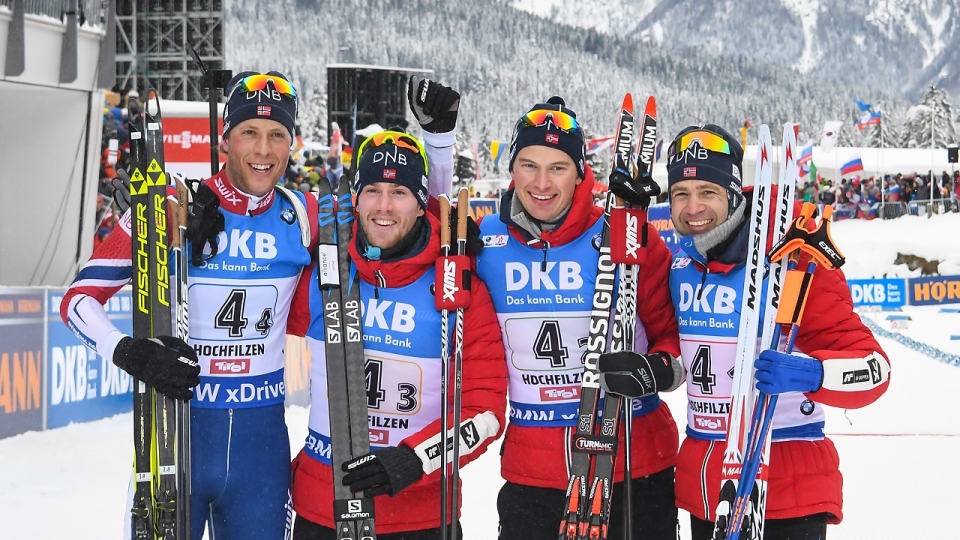
    Norway’s Lars Helge Birkeland, Erlend Bjøntegaard, Henrik L’Abée-Lund and Ole Einar Bjørndalen (left to right) following their victory in the men’s relay at the 2017/2018 IBU World Cup in Hochfilzen, Austria. (Photo: IBU/Biathlonworld)

    Norway started the men’s relay race without Emil Hegle Svendsen, who was sidelined with a cold, and also rested brothers Johannes Thingnes Bø and Tarjei Bø, both of whom had already won races this season.

    But shooting was more important than skiing in a relay decided by strong crosswinds on the range, and that’s where the Norwegians coped by far the best. While Norway also required nine spares, which usually is a rather average performance in a relay, on Sunday this was the top shooting performance of the men’s relay.

    After veteran Bjørndalen, Henrik L’Abée-Lund and Erlend Bjøntegaard had created a fairly comfortable lead of almost a minute on the first three legs, Lars Helge Birkeland anchored them to the victory by shooting clean in prone and only needing one spare to hit every target in his final stage despite some widely spread shots.

    “It is really nice; a good start for Norway and good self confidence for the the rest of the season,” L’Abée-Lund said at the post-race press conference.

    “It’s always fun to compete on the highest level with the best guys,” Bjøntegaard said. “I think I did pretty good on my leg today. It was tough conditions as it was for everyone else. I am just happy to show what I am capable of.”

    “It feels great, it was an amazing feeling on the last loop, and really satisfied with my own leg,” Birkeland said. “I just decided to be offensive and attack and don’t think about the others and just do my own race. … We have a really strong team with a lot of good guys, so we don’t need to have all the best at the start to have a chance to win.”

    All hopes for Germany’s Simon Schempp to contend with Birkeland for first were dashed when Schempp required three spares to clear both his prone and standing stages, narrowly avoiding the penalty lap twice.

    Due to the huge distances between the top-three teams, the final loop was more of a cool down for their anchors, with Norway taking the win in 1:21:21.8 hours, just under two minutes ahead of Germany, with Erik Lesser, Benedikt Doll, Arnd Peiffer and Schempp, in second (+1:54.9, with zero penalties and 17 spares).

    “At least we avoided the penalty loop, for me it was definitely close in standing,” Peiffer told German broadcaster ARD. “There was so much wind that it was impossible to shoot calmly and controlled. … It was clear that today there would be some upsets, like Belgium being in the mix in front. You just had to somehow avoid the penalty lap.”

    “The last years in Hochfilzen we have never been on the podium, so it’s the first time in like six years we are back again,” Peiffer said at the press conference. “So that’s a good start for us because normally we are struggling here and we don’t know why.”

    France, which had rested its star Martin Fourcade and started Jean-Guillaume Beatrix, Simon Desthieux, Emilien Jacquelin, and anchor Quentin Fillon Maillet, finished another 40 seconds later in third (+2:34.0, with three penalties and 13 spares).

    Another 20 seconds back, Sweden with Peppe Femling, Jesper Nelin, Sebastian Samuelsson, and Fredrik Lindström crossed the line in fourth (+2:54.8, with three penalties and 12 spares).

    “Today was very hard, very strange result, because when we look at all the penalties on the result list it was just crazy,” Beatrix said at the press conference. “I am satisfied for the team, and I am also really satisfied for the newcomer Emilien because it’s his first two weeks on the World Cup and first relay, and he did a every good job and brought us to the podium.”

    “Today I was a little bit stressed, because the French guys are so strong and I had to be at their level, so I am happy to do a good relay today,” the 22-year-old Jacquelin said.

    And what happened to the brave team from Belgium? With three athletes who had just made an overnight trip from an IBU Cup race in Lenzerheide, Switzerland, they came through the second exchange in second place after Florent Claude only needed one spare in standing. On the last two legs, however, three penalties for both Tom Lahaye-Goffart and Thierry Langer put them in 16th at the finish (+6:24.9) , which was still a team-best relay result for Belgium.

    Just ahead of them in a finishing sprint anchored by Brendan Green was Biathlon Canada, with a lineup that earned bronze at the 2016 World Championships in Oslo, Norway. On Sunday, however, the Canadians’ race began with difficulties for brothers Christian Gow (1+3, 2+3) and Scott Gow (1+3, 2+ 3), each having to ski three penalty laps and exchanging in 21st position already 4:45.7 minutes back. Then Nathan Smith (0+0, 0+2) and Green (0+3, 0+3) were able to move them up a bit again, with Smith putting them as high as 13th by the final exchange and Green anchoring them to 15th (+6:22.5, with six penalties and 20 spares).

    Of 26 teams in the men’s relay, Norway and Germany were the only ones that succesfully avoided the penalty lap.

    Hochfilzen World Champs Women’s Podium Repeats

    Later on Sunday afternoon in the women’s 4 x 6 k relay in slightly better conditions than the men’s race, last season’s reoccurring winner Germany struck gold again.
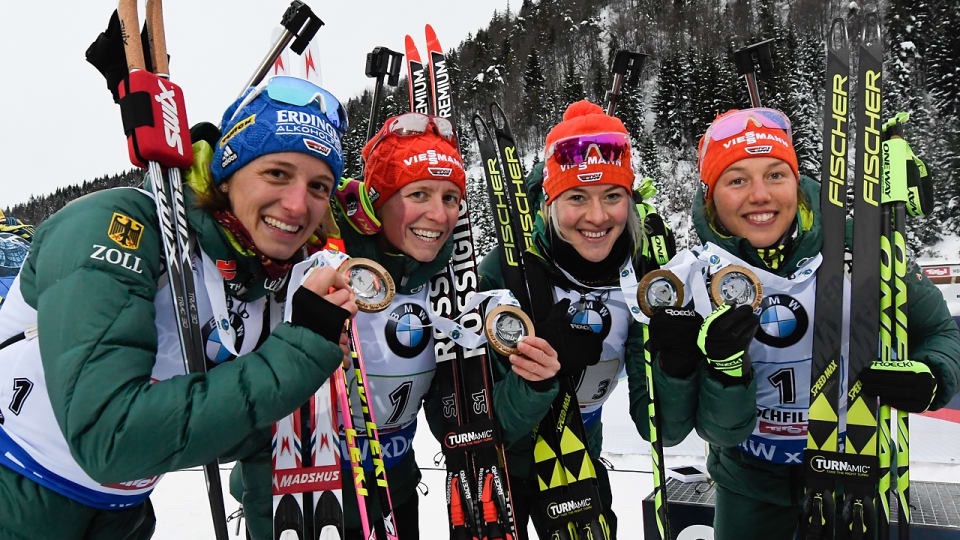
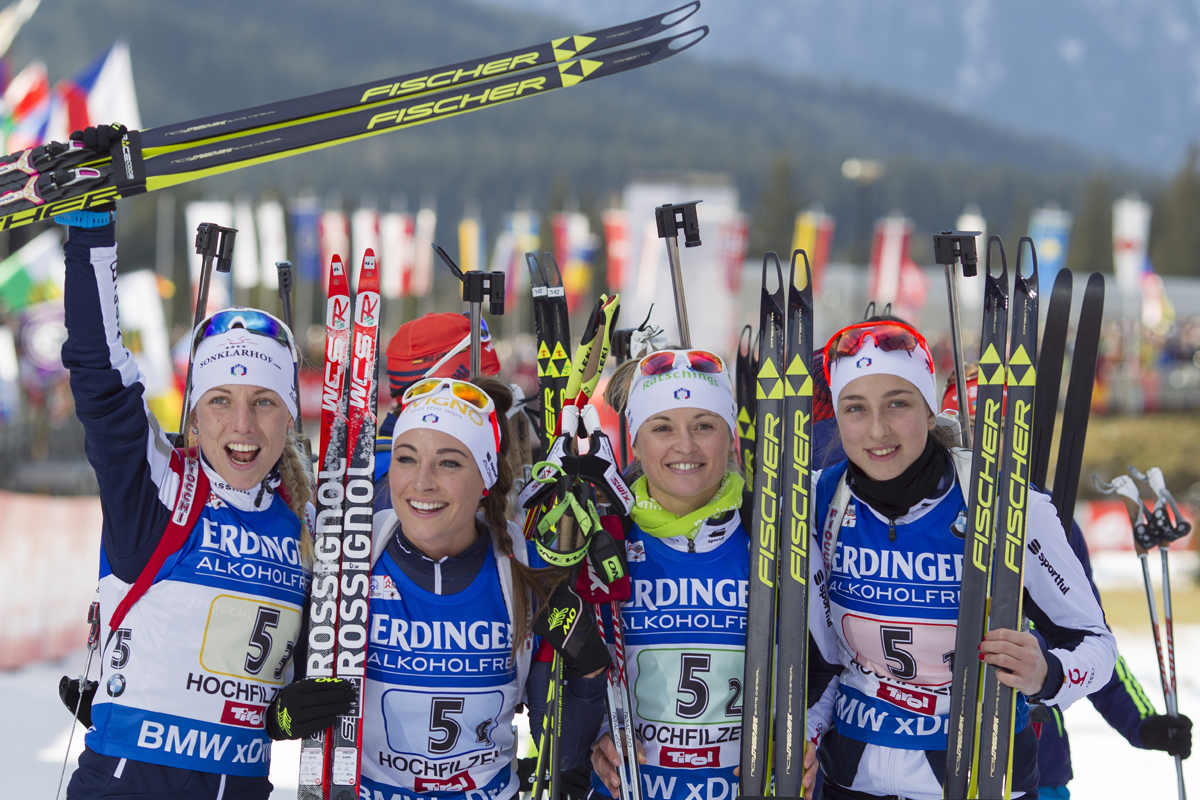
    Germany with (left to right) Vanessa Hinz, Franziska Hildebrand, Maren Hammerschmidt and anchor Laura Dahlmeier shows off their medals following their victory in the women’s relay at the 2017/2018 IBU World Cup in Hochfilzen, Austria. (Photo: IBU/Biathlonworld)

    The victorious world-champion quartet of Vanessa Hinz, Franziska Hildebrand, Maren Hammerschmidt,and Laura Dahlmeier won with a large lead ahead of Ukraine (+44.9) and France (+1:04.5). The first-, second- and third-place teams were a repeat of last season’s World Championships relay in Hochfilzen this past February.

    Fighting for position with Ukraine and Switzerland on the third leg, Hammerschmidt got her team on the road to victory when she cleaned every target within 24 seconds despite difficult conditions to reclaim the lead, erasing the gap she had been handed of almost 30 seconds to first.

    “For me it was very important to have a good standing shooting today, because the last two days were not so good,” Hammerschmidt said at the press conference. “I thought it was one of my best standing shootings, and I was so happy to go on the last loop and fight for every second to give to Laura.”

    Dahlmeier returned to the World Cup after missing last week’s opening races with a cold, then had no major problems defending the lead. Dahlmeier used just one spare in each of her shooting stages, while Switzerland’s Irene Cadurisch as the closest pursuer had to ski a penalty lap. Germany finished in a time of 1:14:36.4, with zero penalties and nine spares.

    “It’s a really cool feeling to be here again,” Dahlmeier said at the press conference. “Especially with the team. We know we can make a good race, but it’s important for every person to be good on the range and on the tracks. Relays are special races.”

    “From the last year we have good memories about Hochfilzen … and today it was a good place, too,” Hildebrand said “I was really impressed with [Ukraine’s] Yulia Dzhima’s standing shooting, because she took all targets out while I used two extra bullets and was happy I could go out on the track again.”

    Ukraine’s Olena Pidhrushna anchored her team, with Vita Semerenko, Yulia Dzhima and Valj Semerenko, to second (+44.9), thanks to the best team shooting performance of zero penalties and five spares, and despite a fall on the first leg by Vita Semerenko.

    “I think our team spirit is very strong, without that we wouldn’t be on the podium, so I am very thankful to all the girls and our staff for making this happen,” Valj Semerenko said at the press conference, via a translator.

    “My start this season was not so good … Actually today I was so nervous ahead of the relay,” Pidrushna explained. “But I saw that we had a little bit of extra time at the last exchange, and I calmed down a little bit and it worked well in the end. … And I think my team believes in me [to anchor it successfully].”

    Twenty seconds behind her, France with Marie Dorin Habert, Celia Aymonier, Justine Braisaz and the current women’s World Cup leader Anaïs Bescond, passed Russia’s Ekaterina Yurlova-Percht on the final loop to claim third place  (+1:04.5, with two penalties and 13 spares).

    “Honestly at the beginning when I started I didn’t think a podium was still possible, but loop after loop I thought maybe I can still catch a podium [position],“ said Bescond, who skied the fastest course time on the final leg amidst strong competition.

    A few seconds behind, Russia with Victoria Slivko, Tatiana Akimova, Irina Starykh, and Ekaterina Yurlova-Percht finished fourth (+1:09.0, with no penalty and nine spares).

    Another 16 seconds back, Switzerland, with Elisa Gasparin, her older sister Selina Gasparin, Lena Häcki and Cadurisch finished fifth (+1:25.7, with two penalties and 12 spares) for Switzerland’s best women’s relay result, which fulfilled its national qualification criteria for the Olympics.

    Canada in Contention

    For Biathlon Canada, Emma Lunder started off the race in the middle of the field, and managed hit all her targets with one spare in her prone stage to leave the range in 16th position.
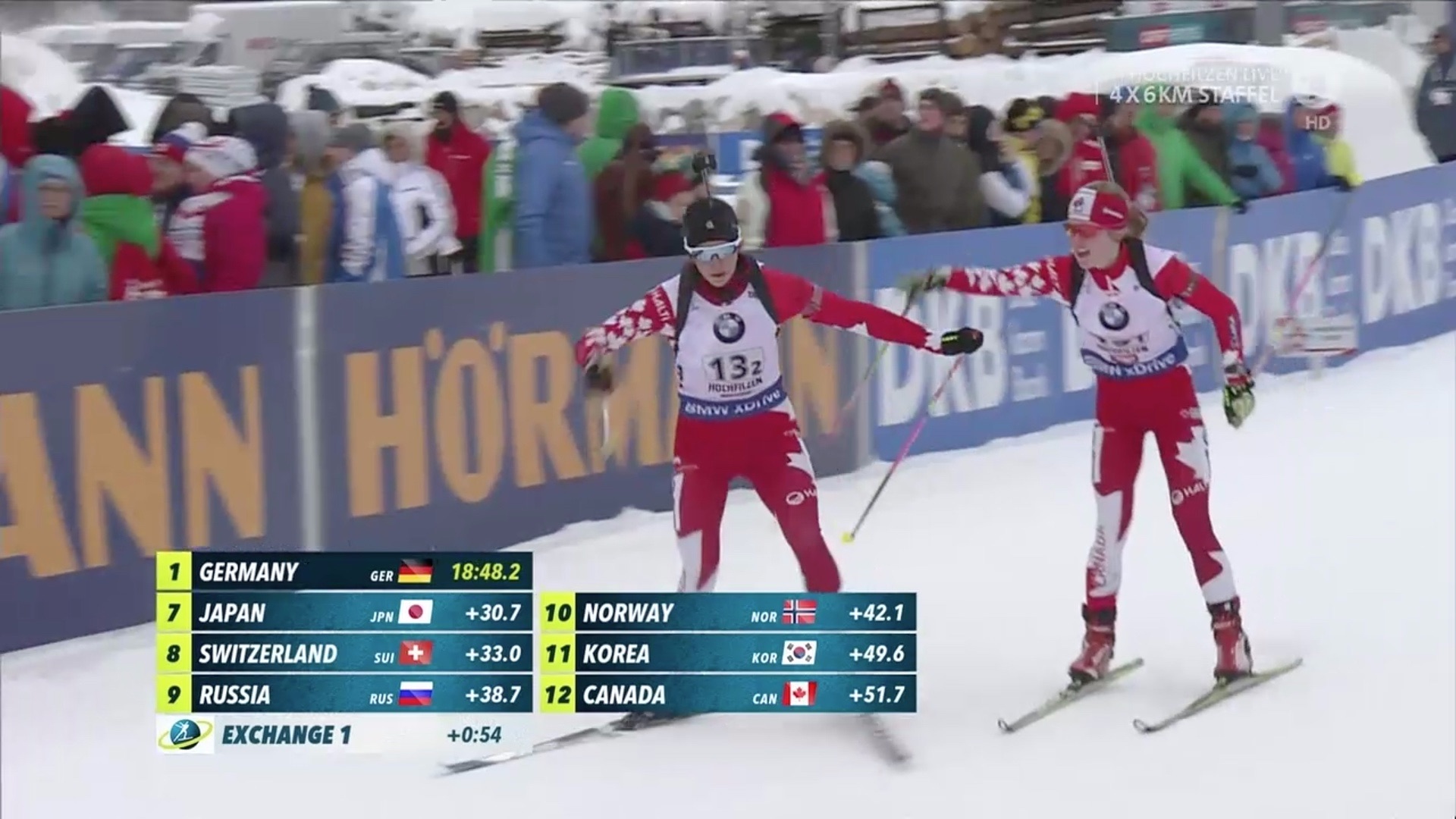
    Biathlon Canada’s starter Emma Lunder (r) exchanging to Rosanna Crawford in the women’s relay at the 2017/2018 IBU World Cup in Hochfilzen, Austria. Crawford temporarily moved up to fifth before the team finished in ninth position. (Screenshot: ARD broadcast)

    While a number of competitors, including France’s Dorin Habert, incurred penalties, Lunder again needed just one spare to clean (0+1, 0+1) and moved Canada up to 1oth. After losing a few more seconds on her last loop to the leaders, with Germany’s Hinz up front, she tagged Rosanna Crawford in 12th position, 51.7 seconds back.

    Crawford started out fast and also needed just one spare to hit all five prone targets, improving by three places to ninth.

    “It was a tricky shooting day today, you really had to be aware of the wind, and be prepared to do a correction even part way through a bout of shooting,” Crawford wrote in an email. “In prone I made a correction of 5 left and 2 up and it was enough to keep me pretty centred.”

    Then in her standing stage, she picked off four more positions with clean shooting and no spares to leave the range in fifth place, while most teams around her needed spares or even incurred a penalty in seemingly difficult wind conditions.

    “I was really happy with my standing today,” Crawford explained. “I saw Brendan [Green] right before zero and he said that it’s worthwhile to take your time and make each shot a good one. So I really thought about that as I came into the shooting, there was a big gust right off the start, so I waited and could hear the women around me missing. Each shot was really precise. My shooting time was 33 seconds which is really slow for standing but still the 2nd fastest of my leg, which says a lot about the wind today!”
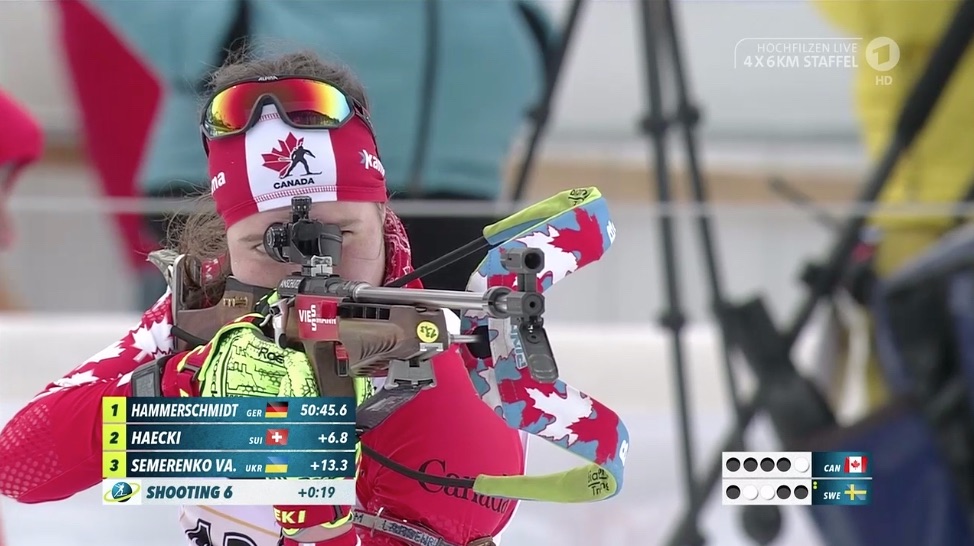
    Biathlon Canada’s Megan Bankes shooting in her standing stage in the women’s relay at the 2017/2018 IBU World Cup in Hochfilzen, Austria. The team finished ninth overall. (Screenshot: ARD broadcast)

    Crawford tagged Megan Bankes in fifth (+36.3), after having regained 15 seconds on the leaders and skiing the second-fastest course time on the final loop.

    “It’s always fun to tag off in a high position but today was a bit of a lucky draw for what you got in the range,” Crawford concluded.

    The 20-year-old Bankes as Biathlon Canada’s youngest team member started out just as fast, nearly maintaining that time gap on the first loop.

    “I was super stoked to be tagged in such a good place, but I definitely still felt that I was able to ski my own race,” Bankes wrote in an email. “I wanted to ski my best, and not lose to much time on the tracks, but also be controlled on the range, because I knew it was going to be a tricky shooting day.”

    She was able to get through the prone stage with two spares in a stage when all leading teams needed them, keeping her in fifth. Bankes followed that up with just one spare in her standing shooting, temporarily moving up to fourth after overtaking Sweden’s Mona Brorsson.

    “Coming into the range I was focussed on my own shooting more than anything else,” Bankes wrote. “I knew that the wind was pretty variable, and that I needed to make sure I took good, smart shots, and correct appropriately for the wind. I was super happy with how I ended up doing on the range, and also with my speed on my first couple of laps.”

    On the last loop, Brorsson and Russia’s Starykh passed her, and Bankes came through the final exchange in sixth place (+1:28.8).

    “I died a bit at the end, but I still managed to tag Julia in a good position, so for me it was a pretty great race!” Bankes concluded.

    Shown on television in the exchange zone, looking back at the final curve to see when Bankes would arrive, Ransom took over as the anchor and skied a very fast first loop, just 1 second off the fastest pace on that loop.

    She then managed to still clean all five targets in a controlled fashion, leaving the range again in fifth position, with Switzerland in sight and Russia nearby as well.

    After a slower second loop, Ransom struggled to clean all her targets in the final stage, but avoided the penalty lap with her last shot and left the range in ninth position. Sweden’s anchor Anna Magnusson was still in sight, 10 seconds ahead, but extended her lead on the final loop, while Japan’s anchor Rina Mitsuhashi was already more than a minute behind Ransom in 10th.

    Ransom crossed the line in ninth place (+2:31.6) with zero penalties and nine spares for the team.

    “A top 10 is a decent result for our team, it’s nice that we were fighting for a top 6 for most of the race,” Crawford wrote. “Our team has come a long way and I’m really proud to be a part of this team! Emma and Megan had a great leg and Julia an awesome prone and then it was quite windy for her standing, but most teams have their strongest women on the last leg, so it’s always a hard fight!”

    In other good news for Biathlon Canada this weekend, the team finished eighth in an IBU Cup mixed relay and national team member Megan Tandy raced to 11th place in the sprint followed by ninth place in the pursuit this weekend in Lenzerheide, Switzerland.

    “Another #perfect #shooting day! I was hoping for more, but you gotta work with what you got – in my case very heavy legs skiing. Nonetheless, a solid race,” Tandy wrote on Instagram after shooting clean in both the sprint and mixed relay.  

    The U.S. Women and Nation Cup Standings

    US Biathlon could not start a women’s relay on Sunday because it only has three women currently on the World Cup circuit: Susan Dunklee, Clare Egan and Emily Dreissigacker. US Biathlon had hoped that its fourth woman Kelsey Dickinson, would qualify for the first trimester of World Cup racing by scoring necessary points at the IBU Cup opener in Sjusjøen, Norway. But unfortunately that did not work out.

    In addition to Dickinson missing out on the World Cup starts because of that technicality, and her teammates now missing out on one of only three opportunities on the World Cup competition calendar to prepare for the relay in the upcoming Olympics, this also means they lost out on valuable points for the Nation Cup Score. That ranking is its own award category in the World Cup season (last year Germany won it for both the women and men), but more importantly for the North American teams, also determines the starting quota for the following season.

    With a third of the races counting towards that already completed (unlike at World Championships the races at the Olympics don’t apply, neither do pursuits and mass starts), the U.S. is currently in 21st position for the women with 676 points and in danger of losing its fourth starting position for next year again, which would make team selections and travel planning even harder.

    While certainly not impossible — last year the U.S. women also did not start a relay in Pokljuka, Slovenia — it will be a bit of an uphill battle to make that up the rest of the season, requiring a number of strong results. For instance, South Korea is currently 357 points ahead in 17th, the benchmark for a fourth quota spot.

    The Canadian women are currently in 14th position with 1220 points. Last season they were 15th and the U.S. 14th. For the men’s teams, Canada is currently in 12th position with 1260 points, the U.S. is 13th with 1198.

    The teams will now travel to Annecy-Le Grand Bornand, France, for the next World Cup from Thursday, Dec. 14, to Sunday, Dec. 17.
    Results: Men | Women

  • Lunder Rises to 27th for Career-Best Pursuit; Kuzmina Nabs First Win in 3 1/2 Years

    Emma Lunder (Biathlon Canada) racing last January at the 2017 IBU World Cup in Ruhpolding, Germany. (Photo: Fischer/NordicFocus)

    Emma Lunder may be a relatively recent addition to Biathlon Canada’s World Cup team, but the 26-year-old Vancouver native has raced her share of International Biathlon Union (IBU) World Cups.

    On Saturday, Lunder demonstrated both experience and composure, just as she had done the day before with close to zero visibility in the sprint, in the women’s 10-kilometer pursuit in Hochfilzen, Austria. Despite having started more than two dozen World Cups since the 2013/2014 season, this was only her third pursuit.

    “I went into this race knowing that both snow and wind were expected, so I anticipated conditions similar to yesterday’s sprint,” Lunder, who had previously raced to 42nd in the sprint with 9-for-10 shooting, wrote in an email. She had started second of 102 racers in the sprint and had to clear her own path through new snow while trying to stay on course.

    On Saturday, she started 42nd, 2:04 minutes behind the sprint winner, Darya Domracheva of Belarus, and within 12 seconds of 32nd.

    “With all of the racers starting fairly close together, a nice little track formed right in the middle of the ski trail so I just tried to ski in that path as much as I could during the race,” Lunder explained.

    It was snowing as expected on Saturday afternoon, but not as heavily as the day before, and the wind was variable.

    On the first prone shooting stage, Lunder missed her first shot but hit the next four. She had to ski a penalty lap and left the range in 45th, 2:35 minutes behind Domracheva, who had cleaned to remain in first place.

    “On the range today I had some windy bouts and some calm bouts, so I took the information I had from yesterday about correcting and clicked accordingly,” Lunder recalled.

    After missing her first shot, which she attributed to being slightly hesitant with her setup, Lunder went on to hit the next 19 — cleaning the next three bouts. In doing so, she rose to 37th after a clean second prone, then 32nd after the first standing, then 25th after the last stage.

    “In standing I ended up on lanes near the start of the range (lanes 7 and 3) so it gave me a few extra seconds to recover from the climb into the range,” she wrote. “I focused on the same cues I’d been using yesterday and tried not to think too much, and that seemed to do the trick for me.”

    Lunder crossed the finish line in 27th, 2:31.6 behind Slovakia’s Anastasia Kuzmina who also shot 19-for-20 after an early prone miss (1+0+0+0) to take the win in 34:41.2.

    It was Lunder’s best World Cup pursuit result and second-best result of her career after placing 21st in a 15 k individual race last season in Antholz, Italy.

    “I was getting splits throughout the race telling me what position I was in, but I just tried my best not to think about it too much, and keep skiing as fast as I could and shooting as well as I could!” she wrote. “Coming into the last standing I felt a little bit shaky, but once I was on the shooting mat I just went for it as if it was any other shooting bout, and I ended up with a good result. I’m really happy with my performance today. … to crack the top-30 in the second weekend of World Cup racing is definitely motivating for me!”

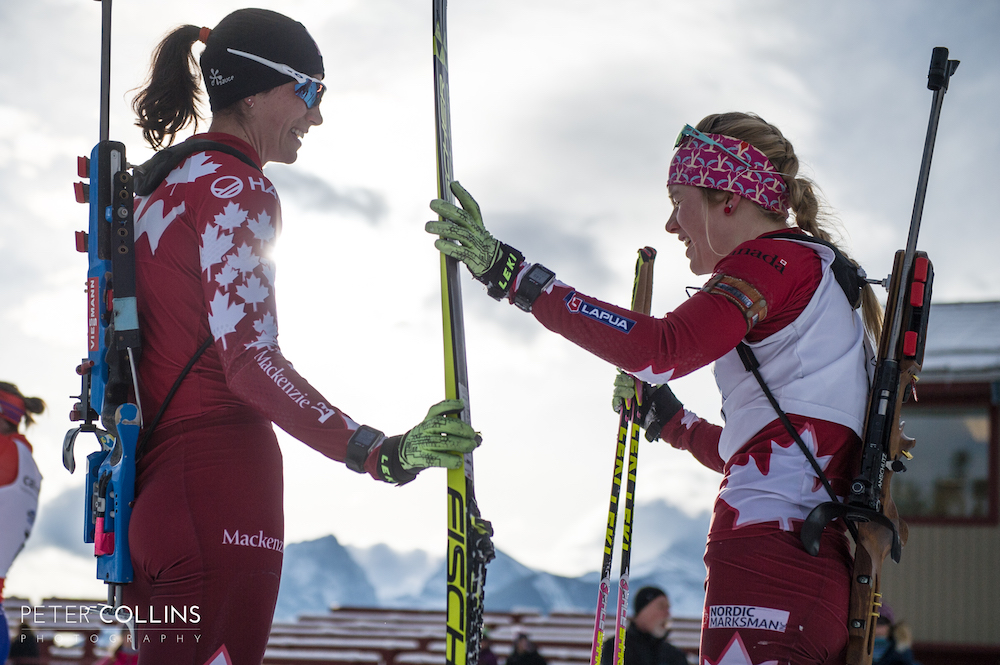
    Emma Lunder (r) with fellow Biathlon Canada national-team member Rosanna Crawford after the women’s modified sprint at Biathlon Canada’s team trials in November in Canmore, Alberta. Lunder placed second in that race to secure one of the last two spots on Canada’s IBU World Cup Team, while Crawford, who had been pre-selected for the team, placed sixth in that race. (Photo: Peter Collins/petercollinsphoto.com)

    The other Canadian in the race, Rosanna Crawford, finished 39th (+3:44.3) after starting 49th and shooting 16-for-20 with one miss in each stage (1+1+1+1). Crawford had the fourth-fastest overall shooting time out of 56 women in the pursuit.

    “I feel like today was a bit more like my normal shooting speed for standing and a little slower than my normal for prone,” she wrote. “I was really taking my time in zero for prone because the snow was making it so hard to see the target. Visibility was slightly better in the race, but I still tried to take my time in the hopes of hitting all 5.”

    In placing 39th, she tied her previous season best from the 15 k individual last week in Ostersund, Sweden, and scored World Cup points for the second time this season.

    “It’s disappointing to miss one shot every time, and to get into the top 30 I would have had to hit 18 or better,” Crawford wrote. “I’m glad I got a few points today, but feeling frustrated that I can’t put a good skiing and shooting together in the same race. Skiing was pretty good for the first 3 laps, and I slowed down a bit for the last 2, but today was my best skiing so far this year.

    “Looking forward to France where I am sure some good cheese will help fuel some good races!!” she added of this week’s upcoming races in Annecy, France. “Also just so happy for Emma Lunder! She really did a great job today, in the range to hit 19 and move up to 27th is awesome!”

    The lone American in the women’s pursuit, Clare Egan finished 53rd (+5:21.6) after starting 36th and having to ski seven penalty laps (2+2+2+1).

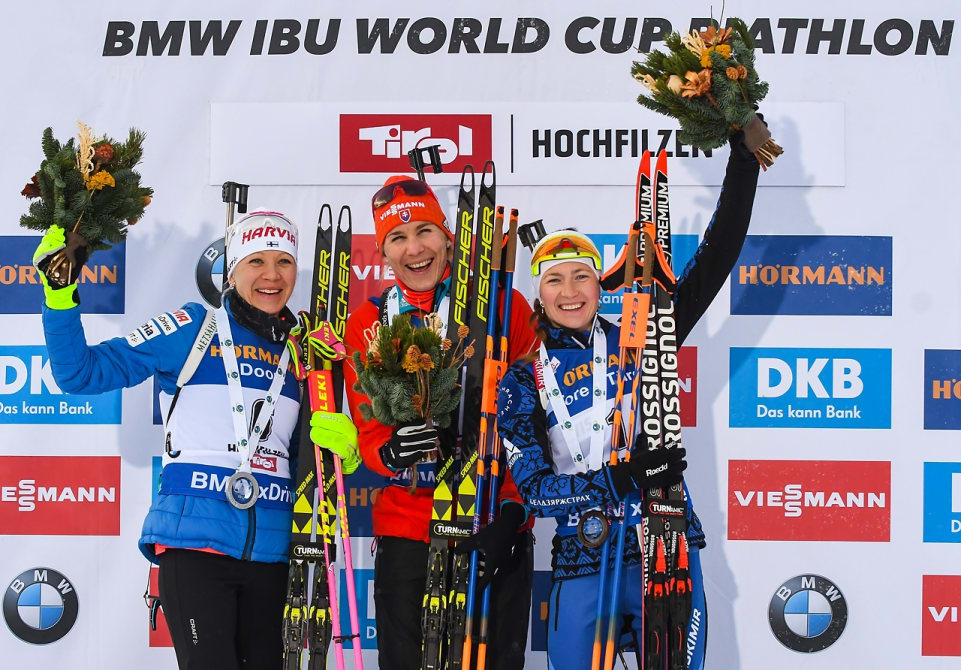
    The women’s 10 k pursuit podium at the IBU World Cup in Hochfilzen, Austria, with Slovakia’s Anastasia Kuzmina (c) in first, Finland’s Kaisa Mäkäräinen (l) in second, and Darya Domracheva of Belarus in third. (Photo: IBU/biathlonworld)

    In the race for first, Kuzmina, who had started second, 22 seconds behind Domracheva, maintained her position for the first half of the race despite a penalty on the first stage. After leaving the range 27 seconds behind Domracheva after the first shooting, Kuzmina was within 9 seconds of her after the second prone stage, which both women cleaned.

    The first standing stage that followed proved to be the turning point, with Domracheva missing one and Kuzmina cleaning to take the lead by nearly 13 seconds. Both cleaned the final standing, but Kuzmina skied faster to keep Domracheva at bay, racing to the win while Domracheva was passed by Finland’s Kaisa Mäkäräinen on the final loop to end up third (+11.8). Mäkäräinen claimed second place (+10.2), up from starting 50 seconds back in sixth place, with 18-for-20 shooting (1+0+0+1) and the fastest course time of the field. (In comparison, Kuzmina skied the seventh-fastest overall course time and Domracheva’s time ranked 31st.)

    While it was Mäkäräinen’s first podium of the season, it was Kuzmina’s first win since a mass start in March 2014.

    “It is always great to be on the podium and especially in first position,” the 33-year-old Kuzmina said, according to an IBU press release. “After yesterday, I thought I had a chance, but it was not easy for me, especially on the shooting range; I could not catch my breath  … I just tried to stay positive. I took a long time on the last shooting, but finally it was good.”

    “Overall, it was not an easy race with such weather conditions,” Domracheva said. “Like Anastasia, I think I took some extra time for that last shot, but I had 19-of-20 and that is very good.”

    Sunday is a relay day with the men’s 4 x 7.5 k and women’s 4 x 6 k wrapping up racing in Hochfilzen. Canada is listed as starting Lunder, Crawford, Megan Bankes, and Julia Ransom, while the U.S., with three women on the circuit, will not be entering a women’s relay.

    Results

    Women’s relay start list

  • Johannes Bø Wins Race No. 2 in Hochfilzen; Doherty 17th for Best Pursuit

    Johannes Bø Wins Race No. 2 in Hochfilzen; Doherty 17th for Best Pursuit

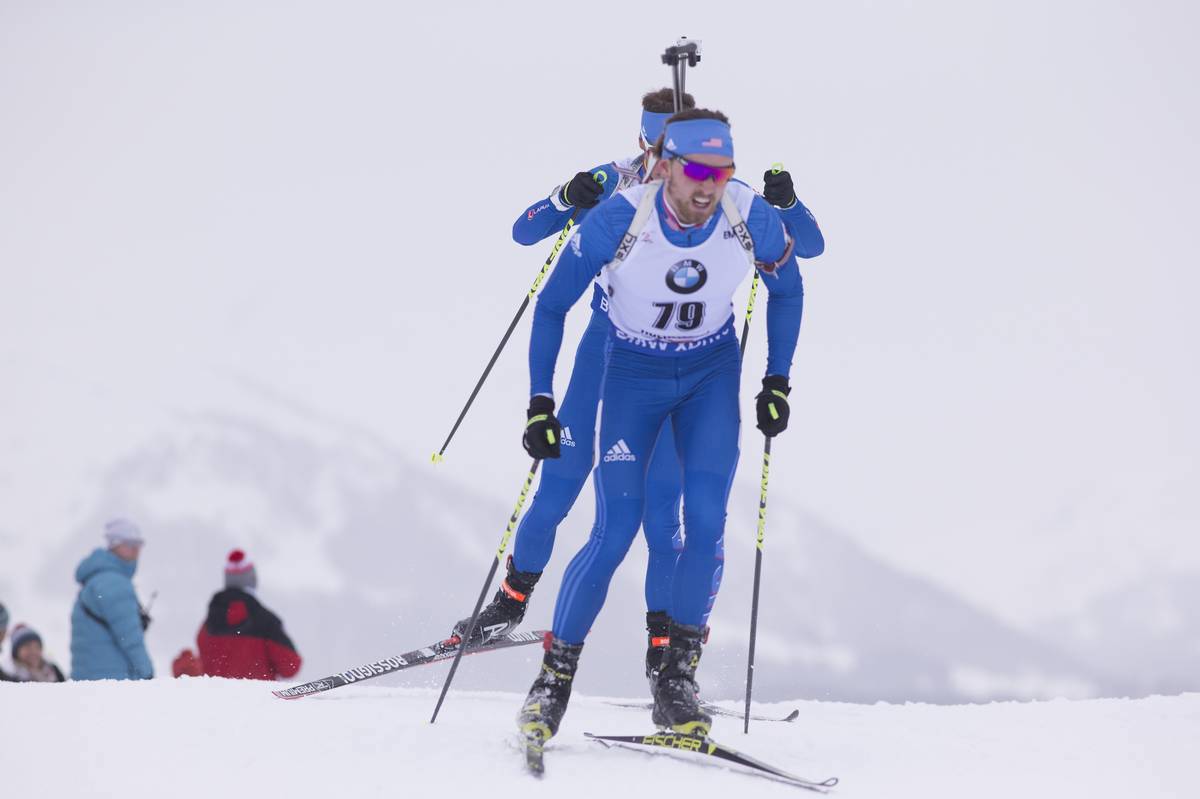
    US Biathlon’s Sean Doherty (79) racing to 22nd in the IBU World Cup men’s 10 k sprint on Friday in Hochfilzen, Austria. On Saturday, he raced up to 17th for his best pursuit result on the circuit. (Photo: US Biathlon/NordicFocus)

    One day after winning the International Biathlon Union (IBU) World Cup men’s sprint, Johannes Thingnes Bø held onto first place in the men’s 12.5-kilometer pursuit on Saturday in Hochfilzen, Austria. In difficult conditions with heavy snowfall and strong gusts of wind, the Norwegian decided the race when he shot clean in the final standing stage. He reached the finish line uncontested on the last loop in a time of 36:41.1 minutes, almost a minute ahead of Slovenia’s Jakov Fak (+58.8 with one penalty) and last season’s Overall World Cup winner Martin Fourcade (+1:10.0 minutes with five penalties).

    “Best start of the season so far in my career,” the 24-year-old Bø said after his third victory of the season in a post-race press conference. “I have to enjoy it, you never know what the next races will bring.”

    2:12.8 minutes behind him, US Biathlon’s Sean Doherty finished 17th for his best career result in a World Cup pursuit, improving by on an 18th place from a pursuit last season in Kontiolahti, Finland.

    A day after scoring his first points of the new World Cup season in 22nd and shooting a perfect 10-for-10 in Friday’s 10-kilometer sprint, Doherty shot 18-for-20 in the pursuit (1+0+1+0).

    “I am very happy with the race today,” Doherty wrote in an email to FasterSkier. “The execution on the range was good in the tough conditions we had today. It’s nice to have a solid back-to-back set of races here. … The ski shape is still a ways off but it’s heading in the right direction.”

    In very difficult conditions in the first standing stage, several of the top racers like Norway’s Henrik L’Abee-Lund and Germany’s Arnd Peiffer incurred multiple penalties and to slip out of contention. Meanwhile, Doherty hit all but one of his targets in that stage and moved up to 16th. On the next loop he maintained that position about 1:50 back.

    “The course was slow today, although not too soft,” Doherty commented on the conditions. “Fortunately it was not as snowy and windy as yesterday afternoon. There was a steady wind but it was manageable. I am pleased with my work on the range. If you want to compete at this level you have to shoot well.”

    After the race up front had been decided in a final duel between Bø and Fourcade in the last stage, Doherty once again shot clean in the last standing stage and moved up to 11th. On the final loop, he could not quite hold that position and a small group passed him, yet coming onto the finishing stretch he was able to keep Ukraine’s Dmytro Pidruchnyi 0.4 seconds behind him in a push for 17th (+2:12.8).

    “Unfortunately I didn’t quite have the legs to back up the solid shooting, as was clear on the last lap,” Doherty wrote. “Looking over my shoulder I saw that big pack of guys and I just tried to give it all I had. I wasn’t able to hang on but I was glad to be in that situation nonetheless.”

    Starting out in 19th place based on his sprint result, Biathlon Canada’s Nathan Smith finished the day in 31st, 3:02.2 after Bø with three penalties (1+1+0+1).

    After the first shooting stage, Smith had moved into 14th despite incurring a penalty.

    “The wind was a bit changeable, especially in the first prone where it was blowing quite strongly,” he explained in an email after the race.

    Smith skied the next lap in a group that included Germany’s Simon Schempp, who eventually would finish the race in podium contention, and got into a slight tangle with Schempp in a right-hand turn at the far point of the course, but both remained on their feet.

    “I started pretty aggressive on the first lap but wasn’t able to maintain the speed of those around me after that,” Smith wrote. “I didn’t see who was tangling with me on that turn, but it was definitely an odd place to attempt an inside pass. I can’t say yet that things are turning around in the skiing department. I think I will just have to be very very patient.”

    In the second prone stage, Smith incurred another penalty and dropped to 29th place, almost two minutes behind the leaders. He cleaned the first standing stage that followed, then had one more miss in the fourth and final stage.

    “My shooting was pretty good once again today, given the challenging conditions,” Smith wrote. “It was definitely tougher conditions today, although the temperature was low enough that the falling snow wasn’t sticking to my glasses. The tracks were a little soft, and quite slow, especially out of the track where athletes were skiing.”

    He started the final loop in 27th position and “like the previous ones, I was mostly focused on trying to minimize the number of skiers passing me,” Smith wrote. “It’s fun to pass but when you’re not feeling it its important to try and conserve energy.”

    On the final meters of the race, he went head to head with Italy’s Thomas Bormolini and finished 0.4 seconds behind him for 31st.

    “I thought I could take Bormolini but he got the middle track,” Smith recalled. “I tried my best in the outside and made a little ground, but the snow was just too deep over there. Tactically it would’ve been best to be in front heading through the tunnels [that are leading into the stadium].”

    Smith’s teammate Brendan Green finished 33rd (+3:15.7), also with three penalties ( 1+0+1+1), after climbing nearly 20 places from his starting position by using his extensive experience to deal with snowy conditions that he described as “a classic Hochfilzen day”.

    “Today was a much better race for me,” Green wrote in an email. “Yesterday felt completely off for some reason, so to be able to put together a solid performance today is reassuring. … I’m quite happy with the shooting considering the conditions. I was really hoping to shoot clean in the last bout, which would have made for a really great day, but all in all I’m happy with how I performed.”

    After incurring that third penalty in the last standing stage, Green, who started 52nd, came back on the course in 37th place. He recalled seeing a group ahead of him, which he was able to catch by skiing the 17th-fastest course time on the final loop.

    “I attacked early on and skied my way past a train of 5 athletes, and was able to hold them off for the rest of the loop with the exception of [Belgium’s] Michael Roesch. This was my strongest ski of the season which is hopefully a sign that my shape is coming around. It seems that no matter what I do, I struggle to find my form early on in the season.”

    Doherty’s teammate, Lowell Bailey, the only other American who qualified for the pursuit, moved up from 53rd to finish 36th (+3:20.6) with three penalties (0+2+1+0).

    The two remaining Canadian starters, Scott Gow and Christian Gow, finished 48th (+5:08.4) and 49th (+ 5:13.7), respectively, with Scott ending up with seven penalties (1+1+3+2), while his younger brother Christian had five penalties (2+0+1+2) and improved five places from the sprint.

    Bø and Fourcade in Sync… Until Final Shooting

    The two dominant athletes of the IBU World Cup season so far swapped the lead out on course and dueled on the range in Saturday’s pursuit. In the end the podium was nearly a repeat of Friday’s sprint, with Bø in first, and Fak and Fourcade flipping positions in second and third, respectively.

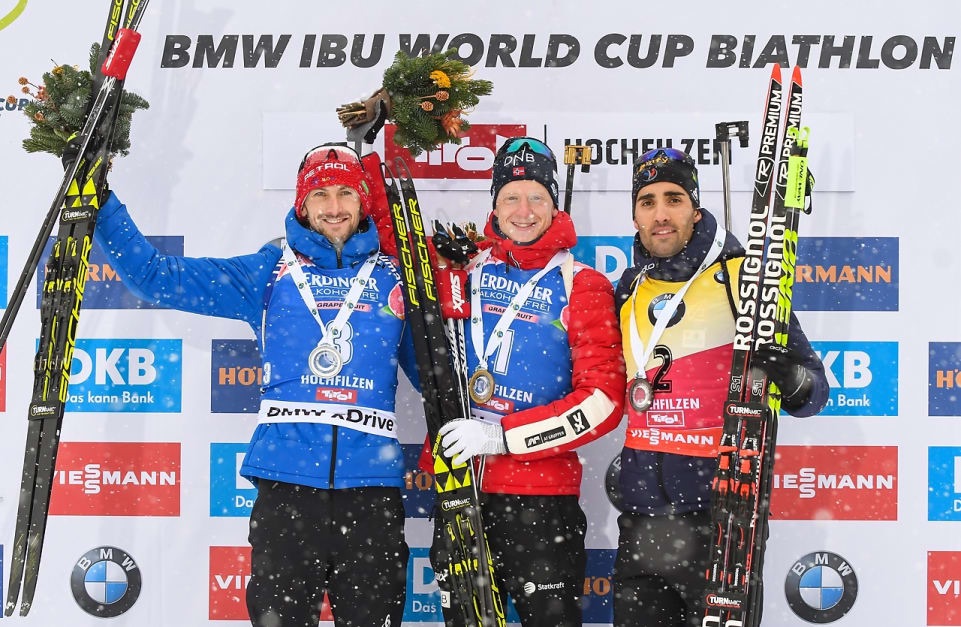
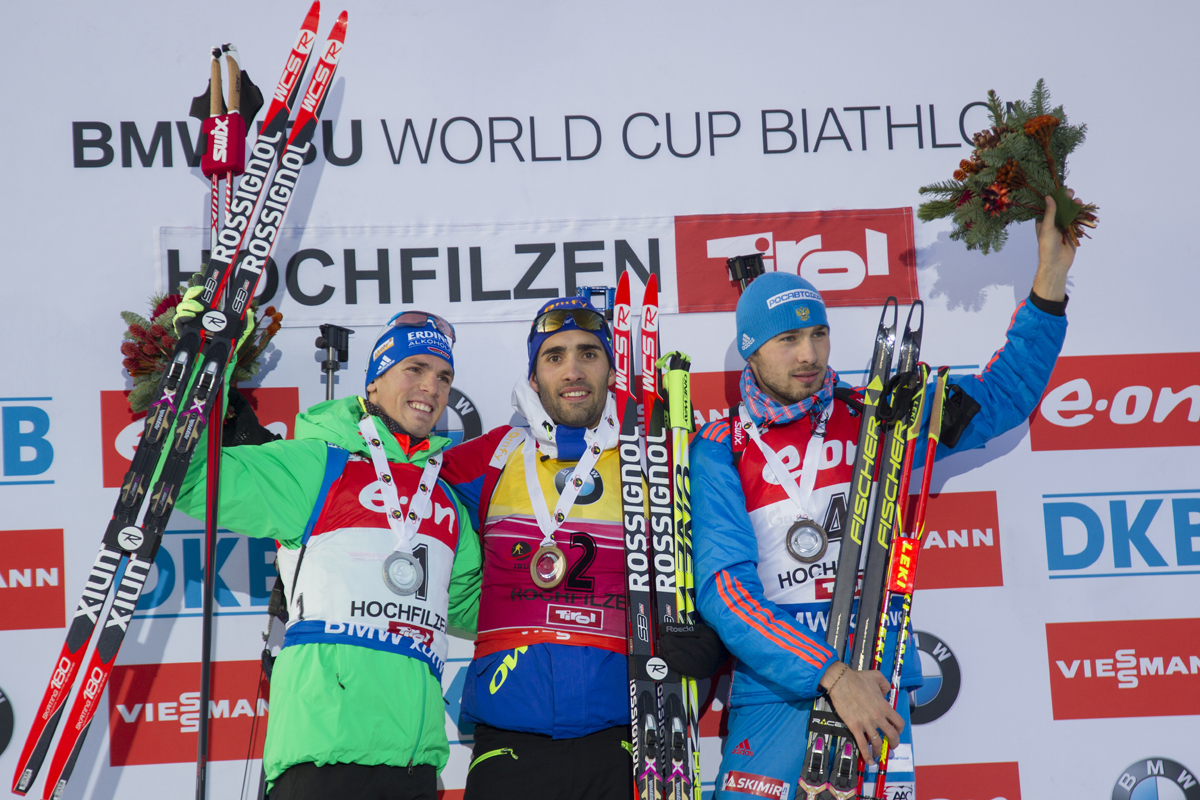
    Medal ceremony for the men’s 12.5-kilometer pursuit at the 2017/2018 IBU World Cup in Hochfilzen, Austria, with Norway’s Johannes Thingnes Bø (c) in first place, Slovenia’s Jakov Fak (l) in second place, and France’s Martin Fourcade (r) in third place. (Photo: IBU/biathlonworld)

    In the first shooting bout, Bø incurred two penalties to lose his 12-second head start on Fourcade, but he set out on his second loop just a second behind Fourcade. In the second prone stage, the two both shot clean, after shooting alongside each other and almost hitting their targets in a synchronous rhythm, before starting the third loop together.

    While not quite able to hold up with Fourcade and Bø on the course with the 35th-ranked overall course time, Fak, who had started the day in third, was able to keep in touch with the leaders due to another solid shooting performance.

    The 30-year-old, Croatian-born Fak, who has been racing for Slovenia since the beginning of the 2010/2011 season, is coming back from a slight slump last season, but is looking back on a storied career that includes a third place in the 2014/2015 World Cup Total Score and two gold medals at the 2012 and 2015 IBU World Championships.

    By his own account, in preparation for the new season Fak mostly trained with the Ukrainian women’s team, which is coached by one of his old mentors. “They shoot good and I wanted to beat them and I guess that also works in the men’s field,” he said with laugh at the press conference.

    In the first standing stage, Bø and Fourcade each incurred a penalty, and while Fourcade shot his sequence slightly faster, Bø was able to easily make up a six-second gap on the next loop, taking the lead again up the first big climb.

    “[I] had a perfect race together with Johannes,” Fourcade said at the press conference. “We each did half the [work] in the front and it was a smart move because we wanted to keep the advantage and we knew the answer would be on the final shooting.”

    Fak also had his only miss of the day in the third stage, but managed to improve his position as conditions worsened and a number of athletes had several penalties in this stage. Russia’s Maxim Tsvetkov and Germany’s Schempp were the first ones to clean this stage to leap into  podium contention. Bø’s older brother Tarjei also cleaned.

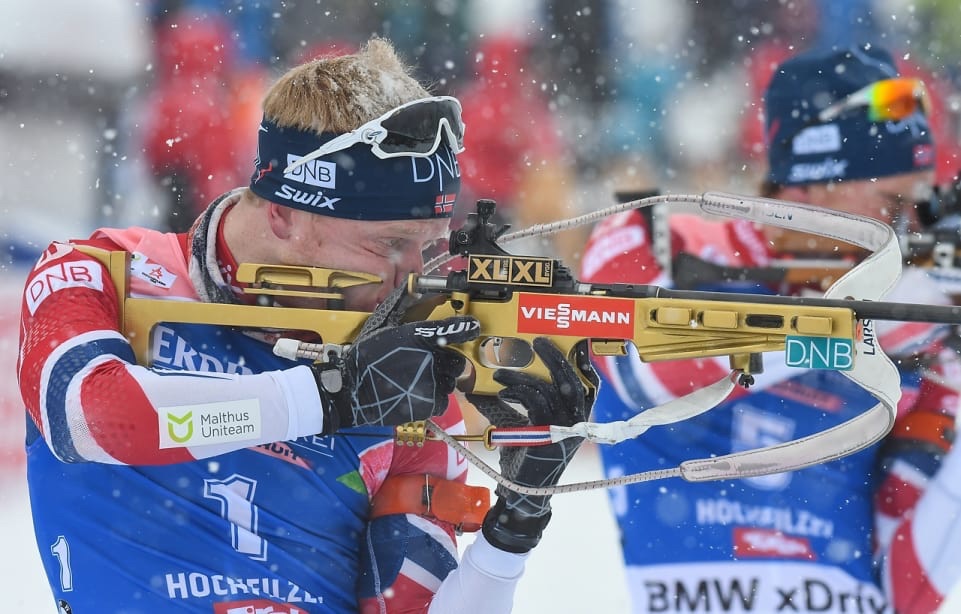
    Norway’s Johannes Thingnes Bø shooting in the standing position in difficult weather conditions on his way to the victory in the men’s 12.5-kilometer pursuit at the 2017/2018 IBU World Cup in Hochfilzen, Austria. (Photo: IBU/biathlonworld)

    In the final stage Johannes Bø and Fourcade again stood side by side on the range, but this time Fourcade missed three while Bø hit every target to embark on the last loop with nearly a minute lead.

    “He got the answer, and I didn’t…,” Fourcade sighed when he tried to explain what had happened in his final shooting. “With the snow conditions I went on my shooting mat a little late, I first had to open my rifle [sights snow cover] and I was simply a bit late compared to Johannes by just one or two seconds. … Then I heard that Johannes had a good shooting and I tried to shoot faster to catch him, and that was totally wrong today.”

    “The people are always speaking about a fight of Martin against the Norwegian team,” Bø stated in the press conference. “Of course both me and him think about this, but still we fought together out there, we exchanged in the first position [helping each other], and that was a smart move for us.”

    Fak managed to shoot clean again to leave the range for the last time in second, and while he could be relatively sure of second place, a fierce fight for third ensued behind him.

    “It was very hard on the track, but I managed to stay calm on the shooting range and tried to shoot as [few] mistakes as I could,” Fak said. “It was only one mistake and so I am pretty happy about that, because if we look at the weather it was not so easy on the shooting range. On the track I used my shooting as an advantage, and it got me in the second position on the last lap, so I just needed to go a little faster in the beginning and then cruise to the finish.”

    A group of Schempp, Tsvetkov and Tarjei Bø also came through the final stage with a clean shooting performance, and Fourcade joined them after he had completed his three penalty laps.

    Fourcade led that group going into the longest climb of the course, then tried to break away, pushing hard over the crest of the hill with only Schempp able to stay on his tails into a corkscrew downhill section.

    Schempp and Fourcade had a minor tangle as they positioned themselves on the slightly uphill finishing stretch, and Fourcade ended up outlasting Schempp in the final meters by half a second

    “It was a big fight with Simon but also with Tarjei and Maxim Tsvetkov from Russia,” Fourcade said. “It was a big battle, and then at the finish line we crossed our skis. The advantage of being in the first position is that you can choose your own line, it’s what I did, and when I crossed my skis with Simon because I saw he chose the same line I went to the other line. … I said to Simon that I was sad, because I didn’t want to do it this way, but I fought really hard on the track to get the first position and choose my own track because it’s a big advantage.”

    “In the finish sprint I really wanted to take the innermost lane, so wide right, and thought he’d take the middle lane,” Schempp told German broadcaster ARD in a post-race interview, according to a translation. “But then he still pulled onto my side and we tangled up and got a little bit into each other’s way, but everything is all right.”

    Tarjei Bø came to the finish a second later in fifth (+1:11.9) with two penalties  (1+0+1+0), while Tsvetkov finished sixth (+1:12.3), up from a 20th starting position, with just one penalty (1+0+0+0).

    “I am happy I am in the top six, but I am a bit sad that I can’t fight today for a top three,” Tsvetkov told the IBU in an interview, via a translator.

    “[Actually] I can’t understand why I missed today,” he added with a laugh when questioned about his lone penalty, which only he, Fak, and two more athletes achieved in this race.

    The IBU World Cup in Hochfilzen concludes on Sunday with the first men’s 4 x 7.5 k and women’s 4 x 6 k relays of the season.

    Fourcade announced during the press conference that he plans to skip the relay to focus on next week’s races in front of a home crowd in Le Grand Bornand, France.

    Results

  • Domracheva Conquers Hochfilzen Blizzard; JT Bø on a Roll; Smith 19th; Doherty 22nd

    Domracheva Conquers Hochfilzen Blizzard; JT Bø on a Roll; Smith 19th; Doherty 22nd

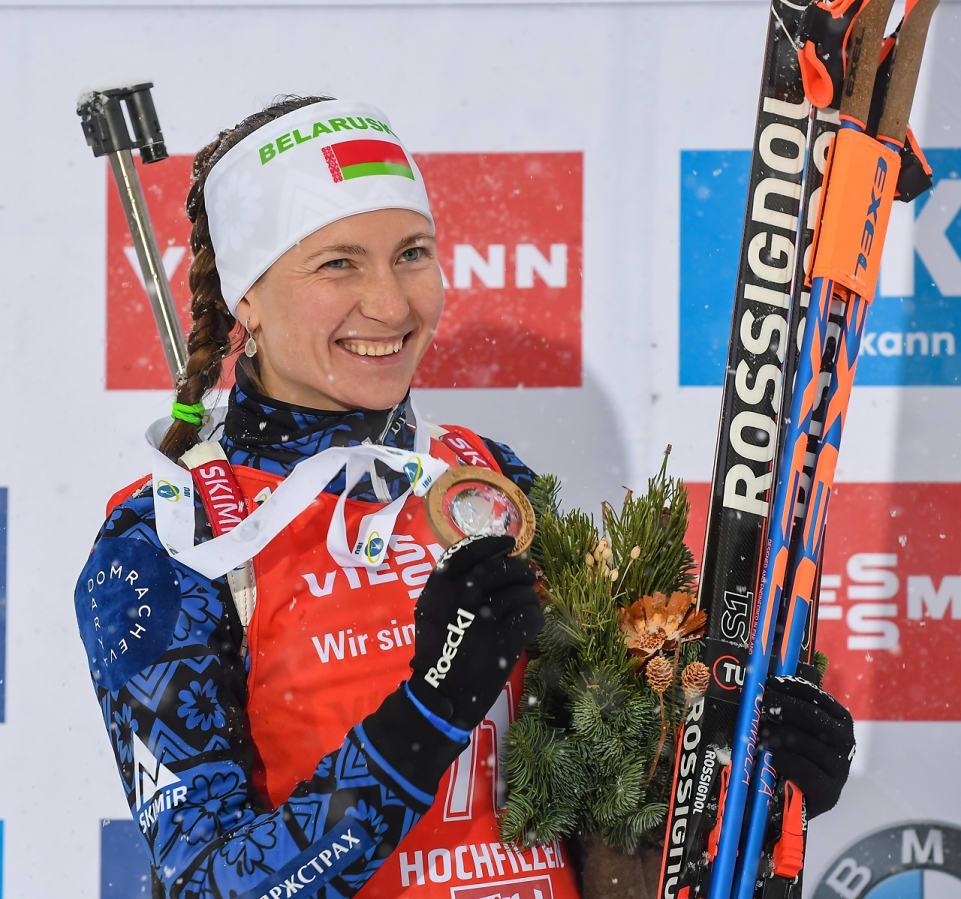
    Darya Domracheva of Belarus after winning her first race in more than a year and a half, the women’s 7.5 k sprint at the IBU World Cup in Hochfilzen, Austria, on Friday. (Photo: IBU/biathlonworld)

    Note: This article has been updated to include comments from Biathlon Canada’s Nathan Smith and Emma Lunder.

    Calm wind and a light drizzle for the men’s International Biathlon Union (IBU) World Cup sprint on Friday afternoon in Hochfilzen, Austria, turned into a full-blown blizzard for the women’s sprint that followed. One multiple-time Olympic and world champion weathered the elements best, as Darya Domracheva of Belarus won the latter with clean shooting. She was one of four women in the top 20 that cleared all 10 targets amid the white-out conditions with a strong wind ripping sideways across the range.

    “I am grateful that I was able to handle these challenging weather conditions today,” said the 31-year-old Domracheva, who had her first child just over a year ago, according to an IBU press release. “It has been a long time since I was on top of the podium, since March 2015, so it is nice to be here.”

    Domracheva is the defending Olympic champion in three disciplines: the individual, pursuit and mass start. On Friday, she won the women’s 7.5-kilometer sprint for her first win over a year and a half, after taking the 2015/2016 season off to have a child and returning to the World Cup this past January. At 2017 IBU World Championships, she raced to silver in the pursuit.

    During the women’s 7.5 k sprint on Friday at the IBU World Cup in Hochfilzen, Austria. (Photo: IBU/biathlonworld)

    But on Friday, in the second sprint of the World Cup season, she was back to her winning ways in the most challenging of conditions. After the men’s race, wet snow began to fall more steadily. Temperatures dropped, making for drier snow that intensified in the minutes leading up to the race.

    “The conditions were completely different in the race from the zeroing, so you had to adapt today,” said Domracheva, who started 71st of 102 women and bested Anastasia Kuzmina’s time by 22.1 seconds for the win in 22:40.2 minutes. Kuzmina, of Slovakia, who started just ahead of her in bib 69, placed second with a single penalty (1+0), bumping Italy’s Dorothea Wierer (bib 48), who also missed one prone target (1+0), to third (+30.6).

    “It was really strange; I could see nothing on the tracks and I had to take off my glasses,” Wierer said, according to the IBU. “In these conditions, the race was decided on the shooting range; with one mistake, that was pretty good. … I think the conditions were the same for everyone; it was snowing for the whole race.”

    “We were all hoping that the forecasted storm wouldn’t materialize, but just as predicted, the flakes started getting heavy about 20 minutes before the start,” US Biathlon’s Clare Egan explained in a post-race email to FasterSkier. “That’s when one of our wax techs says he thought about locking the wax cabin and fleeing the scene. Lucky for us he did not, and I think our skis were the best in the field today. I don’t know how they can make such fast skis for such slow conditions but somehow they manage!”

    Egan led three American women in 35th, 1:56.1 minutes behind Domracheva, with a total of two penalties: one in prone and another in standing (1+1).

    “While I was warming up the wind was extremely strong and then it seemed less intense during my race so I think the earlier starters had worse wind,” Egan recalled. “I took a couple clicks in prone [i.e., adjusted my sight for the wind] but that’s very standard. I actually did a completely normal shooting routine today in both prone and standing, which is a good thing. The trick in biathlon is to replicate your normal shooting routine even when you are in a high-stress race scenario.”

    Egan started 68th, just ahead of Kuzmina. Her overall shooting time ranked 29th in the field, while her course time was 42nd. In comparison, Domracheva had the 43rd-ranked shooting time but was fifth-fastest out on course. Kuzmina was sixth fastest on course and had the second-fastest range time (including setup and actual shooting time).

    “I did not do anything special today, but because I had special skis I managed a decent course time,” Egan wrote. “This year I am making a point to accept however my body feels on a given day and just focus on technique. When I do that, I know that even if I don’t feel great I can still have a great race.”

    In the second World Cup stop of the season, 35th is a season best for Egan and her best result since placing 34th in a sprint last March. Last week in Östersund, Sweden, she placed 75th in the sprint and 79th in the 15 k individual.

    “To borrow an expression I just learned from a British biathlete, I’m super duper chuffed with my race,” she wrote. “Last week’s racing was a real blow to my confidence so I’m very proud of the work I did to turn things around. It took a lot of mental gymnastics and help from our sports psychologist. Today’s race wasn’t exceptional but it was a solid biathlon performance and I’m very content with that. I will be completely happy when all of my teammates have races they can feel good about too. We are very much in this together.”

    Egan will be the lone American woman racing in Saturday’s pursuit in Hochfilzen; both Emily Dreissigacker and Susan Dunklee finished outside the qualifying top 60. Dreissigacker placed 89th (+3:49.1) with three penalties (1+2) and Dunklee was 97th (+4:52.9) with eight penalties (3+5).

    Two Canadian women landed in the top 60 to make the 10 k pursuit, with Emma Lunder in 42nd (+2:03.5) with a single miss (1+0)  and Rosanna Crawford in 49th (+2:19.6) with two penalties (1+1). Megan Bankes just missed the cutoff in 65th (+2:55.3) with three standing penalties (0+3), and Julia Ransom finished 100th (+5:20.6) with seven misses (3+4).

    “I was really happy with my shooting in the race,” Lunder wrote in an email. “I made sure to focus on my cues after making a 5-click correction for the wind, and took a bit of extra time setting up. It was snowing quite heavily, so I did my best to make every shot a good one, but unfortunately I did have one get away from me. When I came into standing it was a lot calmer, but still snowing a lot, so I was pleased with shooting clean! I’ve been working a lot this year on getting my confidence back in the shooting range, and I’ve seen improvements in both my prone and standing.”

    She started second, with only one racer clearing the tracks ahead of her.

    “I followed the tracks of Bib 1 for the first loop, just trying not to ski off the trail!” Lunder reflected. “It was really deep snow for that first loop but all things considered our wax team gave me some pretty quick skis for the race. I felt okay skiing today but I still need to find that next gear when I’m racing, so I’m excited to have a lot of girls around me to chase in the pursuit.”

    Smith 19th, Doherty 22nd

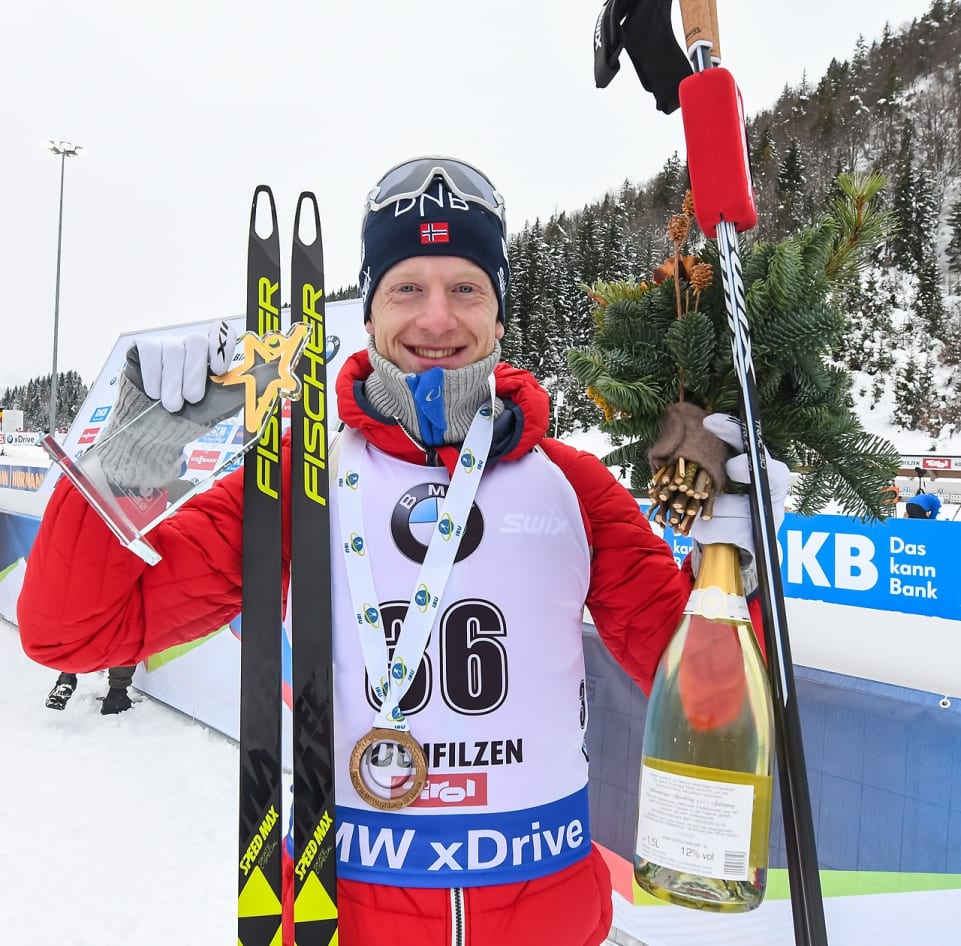
    Norway’s Johannes Thingnes Bø after winning his third race of the season (including a mixed relay and 20 k individual race last week Ostersund, Sweden) in Friday’s 10 k sprint at the IBU World Cup in Hochfilzen, Austria. (Photo: IBU/biathlonworld)

    In the men’s 10 k sprint that opened the Hochfilzen weekend, Canada’s Nathan Smith raced to 19th — his best non-relay World Cup result since March 2016 — and American Sean Doherty placed 22nd for his best result since finishing 18th in a World Cup pursuit last March. Both Smith and Doherty shot clean, along with 12 others out of 108 competitors.

    “Conditions for our race were quite good,” Doherty explained in an email. “Calm winds and overcast. Unfortunately a storm blew in for the women’s race so they had a much tougher course and range today.”

    The top-four men all shot a perfect 10-for-10, with Norway’s Johannes Thingnes Bø in bib 36 setting a faster time around the course than France’s Martin Fourcade (bib 38), who also shot clean. Bø took the win in 24:18.4 and was 12.1 seconds clear of Fourcade, who ended up second. Slovenia’s Jakov Fak notched his second-straight podium (coming off a second place in Östersund’s pursuit) in third (+35.4).

    “It is always better to be first rather than second,” said Bø, who also won the 20 k individual last week in Ostersund, according to an IBU press release. “I was lucky to shoot clean today. That is what I needed to get the win … My plan was like: go until you die, attack all the way. If you want to win, you cannot save the power…I was quite tired in the last loop, but I managed to hold on.”

    Bø’s overall course time was the fastest of the field, 15.3 seconds faster than Fourcade.

    “I cannot comment on any fight because Johannes had too big of an advantage after the standing shooting,” Fourcade told the IBU, referring to his 20-second deficit to Bø after the second shooting stage. “I am just happy that I was able to catch some seconds in the end. We had about the same ski speed as last week, but today he shot clean and I had not chance to win.”

    “I shot clean and ran as fast as I could; that is all you can do,” said Fak, who started 33rd. “I never worried much after that  … You can never be sure about the results until everyone has finished.”

    Smith started 12th and finished 1:31.9 off Bø’s winning time, posting the fifth-fastest overall shooting time while hitting every target. Smith’s course time ranked 54th overall.

    “I was carefull to take it easier for the last 15 sec before the range,” Smith, 31, wrote in an email when asked about his clean shooting. “It’s an awkward entry with a short steep bump.”

    “I’m looking to continue the solid shooting while upping my ski speed a bit, back to around what my shape had been like in November,” he stated. “I’m happy with today’s race. Top 20 is a good accomplishment and a solid step in my comeback. For the pursuit I’m aiming to improve a little and grab a top 16.”

    Doherty started in bib 79 and ended up tying Slovenia’s Klemen Bauer for 22nd, 1:39.2 back. (Bauer had a single penalty in prone.)

    “As long as I stay disciplined the targets will fall,” the 22-year-old Doherty wrote of his clean shooting. “Overall I am happy with my race today. I am excited to take the momentum into the pursuit tomorrow.”

    Saturday will be his first pursuit of the season after placing 82nd in the Östersund sprint. He also placed 38th in the 20 k individual there.

    “The start to the season in Ostersund was tough,” Doherty noted. “That course there is one of the hardest on the whole circuit and we had exceptionally poor snow conditions for the individual, so that was a brutal race. Here in Austria I was looking to make a step froward towards the level of racing I know I am capable of and take care of the final Olympic criteria.

    “To be honest my skiing is pretty poor right now, and that’s fine,” he added.

    Doherty’s overall shooting time was 29th fastest while his course time ranked 57th.

    “The important part of the season is still a ways away and that is when I will be on form,” he wrote. “In general I think I am off to a good start this season but there are still many races to go. So I just want to keep working and using each race as an opportunity to keep improving.”

    All four Canadian men qualified for Saturday’s 12.5 k pursuit, with Scott Gow finishing 43rd (+2:25.1) with three penalties (2+1), Brendan Green 51st (+2:30.3) with one standing miss (0+1), and Christian Gow 54th with clean shooting.

    For the U.S., Lowell Bailey is also in after placing 53rd (+2:32.4) with two penalties (2+0). Tim Burke finished outside the necessary top 60 in 73rd (+3:00.7) with three misses (1+2), Leif Nordgren was 98th (+3:40.2) with three standing penalties (0+3), and Paul Schommer 103rd (+3:54.6) with three misses as well (1+2).

    The men race at 6:15 a.m. Eastern Standard Time Saturday, followed by the women at 8:45 a.m. EST.

    Results: Women | Men

    Pursuit start lists: Women | Men

  • First Relay Victory for Italy; Canadian Women 10th and U.S. 15th

    First Relay Victory for Italy; Canadian Women 10th and U.S. 15th

    The victorious Italian women at the Hochfilzen World Cup, in Austria. Left to right: Federica Sanfilippo, Dorothea Wierer, Karin Oberhofer, and Lisa Vittozzi. Photo: Fischer/NordicFocus
    The victorious Italian women’s 4 x 6 k relay, with (from l to r) Federica Sanfilippo, Dorothea Wierer, Karin Oberhofer, and Lisa Vittozzi at the Hochfilzen World Cup on Sunday in Austria. (Photo: Fischer/NordicFocus)

    The women’s biathlon 4 x 6-kilometer relay, marked by good shooting performances, perfect weather, and several unusual lineup choices came down to the wire, with the race decided on the last lap in a sprint between Italy’s anchor Dorothea Wierer and Germany’s Franziska Preuss. Wierer lunged over the line first by less than a ski length, in a time of 1:05:32.6. This secured the first World Cup win for an Italian women’s relay in history, celebrated extensively by her teammates and coaches in the finish.

    After a number of changes between several countries vying for the final spot on the podium, Ukraine prevailed in the end, taking third 13.1 seconds behind the Italians. None of the three teams on the podium suffered a penalty lap, with Italy having to use eight spare rounds, Germany seven, and Ukraine 10.

    After sweeping the podium in the sprint and securing first and second place in the pursuit race this weekend, Germany’s women had to be considered the overwhelming favorites for the relay. But on Sunday, Germany opted for a lineup of Franziska Hildebrand, Maren Hammerschmidt, Vanessa Hinz and Franziska Preuss, a group of athletes who had never been in a relay team together.

    They were not alone in trying something new, with teams such as the Czech Republic, Italy, France, Russia, Ukraine, the United States, and Canada also experimenting with new athletes or at least order changes.

    Germany’s Laura Dahlmeier, the winner of the pursuit race on Saturday and anchor of the gold-medal-winning relay at the 2015 IBU World Championships, rested on Sunday.

    “This was my own decision,” she explained in an interview with German broadcaster ARD before the race. “The season is long enough, and the World Championships are what matters. And I believe as strong as we are as a team right now, the other four girls can do well without me.”

    The German coaches are happy that they still have an ace up their sleeve for the next relays. “We know that there still is a long and tough season ahead of us,” Women’s Head Coach Gerald Hönig said. “We are planning with an eye towards the [2016] World Championships in Oslo in March. So a deep team is a nice problem to have, in contrast to always having to use the same two or three top performers.”

    Miriam Gössner, who achieved a third place in the sprint on Friday, also took a break from racing on Sunday.

    American Susan Dunklee skates her way through the second leg at the IBU World Cup women's relay in Hochfilzen, Austria. Photo: Fischer/NordicFocus
    American Susan Dunklee racing the second leg of the IBU World Cup women’s relay on Sunday in Hochfilzen, Austria. (Photo: Fischer/NordicFocus)

    With the Germans explicitly stating their goal to reach the podium, the day got off to a problematic start for Germany, with other teams charging ahead.

    Hildebrand, the winner of the sprint race on Friday and fourth place in the pursuit on Saturday, skied a controlled race at first, and cleaned the prone stage with perfectly centered shooting. But then she required two spare rounds in the standing position and had trouble inserting them, setting her back to 14th position. After a good final round, she tagged off at the first exchange 11 seconds behind in eighth.

    “Still in sight of the leaders,” Hildebrand recalled in the ARD interview. “And the other girls then turned it around.”

    Italy’s first skier, Lisa Vittozzi, who also scrambled for Italy’s bronze-medal relay at World Championships last March, fared better, shooting perfectly (0+0, 0+0) and tagging off just 4.2 seconds behind the Czech Republic who was in first at that time. On the second leg, Karin Oberhofer kept Italy near the front, requiring only one spare round (0+0, 0+1), and tagged Italy just 1 second behind.

    Throughout the race, Germany struggled a bit with technical details. Maren Hammerschmidt, the surprise second-place finisher in both of the previous races, had two misses (0+1, 0+1) and doubled the deficit she had been handed by Hildebrand. In slow-motion replays from the shooting range, she could be seen desperately trying to insert a spare round into her rifle, before it fumbled back out.

    “That was a technical malfunction today, nothing I could do about it,” Hammerschmidt said an interview with ARD. “A shot hung up in the ammunition magazine. I did not expect this, and will have to check that clip again at home.”

    She tagged 22.2 seconds behind the leaders in ninth place, one behind Canada’s Megan Tandy.

    “I hope we can still secure a podium finish,” Hammerschmidt said in a mid-race interview.

    It then fell to Vanessa Hinz, who placed 15th in the Hochfilzen sprint and 29th in the pursuit, to bring Germany back into contention. With two fast shooting performances (28 seconds prone) and requiring only one spare round, she steadily moved up through the ranks, and handed over to Franziska Preuss in first.

    “I was really happy about the nomination [for the relay], and glad that it worked so well today,” Hinz later said.

    On the third leg of the relay, Italy struggled a bit. Federica Sanfilippo, a surprising podium finisher during the first World Cup weekend in Östersund, Sweden, and not a member of Italy’s bronze-medal relay at World Championships, required five spares to clean her targets. She had the toughest time in standing (0+2, 0+3), but avoided the penalty and skied the fastest lap of the field, handing off to Wierer 21.6 seconds behind.

    For Preuss, the 2014 Olympics ended in a minor drama during the relay, when she started for Germany at the age of 19 and crashed twice, getting snow into the sights of her rifle and costing her team their chance at a medal. Since then, Preuss has usually raced the second or third leg in relays.

    But on Sunday, with her close friend Dahlmeier taking a break, she was called up to anchor the relay. Preuss headed out strong and required only one spare round to clean prone. But by the time she came back to the range for the final shooting, a group of athletes that included Wierer had caught up to her.

    Preuss hit the first four targets, and was convinced that her fifth shot had also hit, closing the protective flap on the sights of her rifle, before realizing it was a miss. This forced her to load the spare and take aim again, hitting the target, and left the range with Wierer, who had also required one spare, right behind her.

    On the last lap the lead changed back and forth. Preuss later told ARD she deliberately let Wierer overtake her. Then she accidentally stepped on the tails of Wierer’s skis near the top of the first climb, causing both to stop briefly, but neither Preuss nor Wierer fell or broke their poles. At the halfway checkpoint, they were just 0.3 seconds apart.

    Preuss then decided to try and force a decision before the stadium by “slogging away on the last climb from the bottom to the top, 100 percent,” and managed to create a small gap. But Wierer refused to be dropped, and caught the end of Preuss’ skis again as they entered the arena. After a right turn into the closing stretch, Wierer double poled past her taking the middle lane, with Preuss on her right trying to hold on. But Wierer had more power left, and lunged over the line 0.2 seconds ahead, into the arms of her excited teammates.

    “I know I’m not the best female sprinter. I have to work on that again,” Preuss confided to ARD during a group post-race interview. “The second place is a great result, I think we are all satisfied with that”.

    Canada's Megan Tandy blasts through the second leg of the women's relay at the IBU World Cup in Hochfilzen, Austria. Tandy's clean shooting helped advance Canada to eighth place at the end of her leg. Photo: Fischer/NordicFocus
    Canada’s Megan Tandy blasts through the second leg of the women’s relay at the IBU World Cup in Hochfilzen, Austria. Tandy’s clean shooting helped Canada move into eighth place at the end of her leg. (Photo: Fischer/NordicFocus)

    Her teammates also agreed with her that the Hochfilzen arena poses a difficult challenge for a finishing sprint, with a noticeable incline the last 100 meters.

    Wierer had already beaten Preuss and Hildebrand in a sprint to the line in Östersund this season, so she had every reason to be confident that she could do it again.

    “I was only thinking that I should run as fast as you can. She was close in front of me. I was hoping I could win in the final sprint,” Wierer told the IBU.

    Afterward, both teams seemed happy with their results, with the women all smiling and posing for pictures.

    “You can hardly ask for a better selling point for biathlon [than this race],” German coach Hönig said with a laugh. “That’s why millions of people watch us on TV and the arenas are full.”

    Asked later why the Italians didn’t seem even more jubliant about their first-ever victory in a women’s relay, Wierer tried to explain: “I think we are just all so tired.”

    The Czech Republic, who frequently had the best relay performances last season, also had been in the lead early in this race, thanks to Eva Puskarcikova and Olympic silver medalist Gabriela Soukalova. But then team rookie, Lucie Charvatova – who was sixth in Friday’s sprint and replaced Jitka Landova on Sunday – could not clean her standing shooting with the three spare rounds and thus incurred a penalty lap. After another difficult shooting by anchor Veronika Vitkova, they finished the race in sixth place (1+12), 29.8 seconds back from Italy.

    Chervatova only recently took up biathlon training when she failed to qualify for the Czech cross-country senior national team again, and her new teammates are expecting great things from her.

    “Just watch, she is incredible, her body is all muscle. In a few years she will be frequently at the top,” veteran Soukalova told the media in Hochfilzen.

    The podium was in hot contention with 22 countries at the start line, and with the Czech Republic, Sweden, Austria, France, Ukraine, and Belarus (this year having to race without defending World Cup champion Darya Domracheva) in the top three at various points of the relay.

    In the end, Ukraine’s team claimed the third, with anchor Olga Pidrushna requiring three spares but skiing the second best time on the final round. Overall the team, usually known for their excellent shooting, required ten spare rounds to clean all the targets.

    “I think there are some things we could improve, so we will work on them this season,” starter Yuliia Dzhyma said in the press conference.

    Poland placed fourth, 27.5 seconds back, while France was fifth, (+28.8).

    Canada 10th, U.S. 15th

    For the relay in Hochfilzen, Biathlon Canada put up a different lineup and order than in the last World Championships in Kontiolahti, Finland. Canada advanced as high as eighth in split times during the race.

    Starting in the fourth row in bib 10, Julia Ransom kept the leaders within viewing distance.

    “I always like relays so was excited for today!” Ransom wrote in an email. “My legs weren’t as snappy as usual the past two races but things came together for today and I felt much better. I am new to starting relays but I have a background racing cross country and feel comfortable in a mass. This helps with navigating the more technical areas of the course with a group.”

    The 22 year old needed two spares to clean the first shooting, then one more in the standing stage. Ransom tagged Tandy in 11th, 20.6 seconds back.

    Tandy was able to keep her gap to the best athletes at the top of the field and even improved position, largely helped by two clean stages (0+0, 0+0) and the shortest range time on her leg. At the exchange, she handed off 21.5 seconds back in ninth place. At that time Canada was ahead of top teams like Germany, Norway and Russia.

    Emma Lunder took over, and while the 24 year old lost about a minute to the leaders and required four spare rounds (0+1, 0+3), Lunder avoided a penalty lap in the standing shooting. She tagged Canadian anchor Rosanna Crawford 1:23 back in 12th place.

    “The 2 k course here is quite easy and has a lot of rolling flat sections, which really plays to my strengths in two skate and one skate,” Crawford wrote in an email. “It’s also a really fast 6 k — the race was only taking 16-17min, which is super fast for a relay. Skiing felt a lot better than it has this year and we had some super fast skis, thanks to our techs.”

    Crawford cleaned her prone shooting stage, and only required one spare round in the standing position (0+0, 0+1), making up ground to the top by skiing the fourth-fastest course time on her leg.

    “Prone has been feeling really good all year, but I’ve been struggling with one miss standing far too often!”

    She finished the relay for Canada in 10th, 1:08.7 behind Italy and just 4.3 seconds behind the Russian team.

    “I think this will be a great learning experience for our younger girls on the team,” Crawford continued. “Feel that excitement of doing well in a relay and allow them to be better prepared for the next relay. Overall we are happy as a team, but know with a few less spares that top 8 is within reach!”

    “Canada did great today!” Ransom wrote. “All of us had solid races and were in the mix for the most part. I think this was a great place to start from for the season.”

    The US Biathlon women’s team also experimented with a new order. Susan Dunklee, who has been the starter for several years, moved to the second leg while Annelies Cook started.

    Canadian Emma Lunder powers through the third leg of the women's relay at the IBU World Cup in Hochfilzen, Austria. Photo: Fischer/NordicFocus
    Canadian Emma Lunder racing the third leg of the women’s relay at the IBU World Cup in Hochfilzen, Austria. (Photo: Fischer/NordicFocus)

    “We are experimenting [with our relay order] to see what combinations work best for the team as a whole,“ Dunklee wrote in an email. “Traditionally I have started off the first leg, which involves a lot of tactics and is exhilarating, but today Annelies tried it instead and did a fantastic job.”

    In her first season starting on the World Cup circuit, Clare Egan, who anchored the team at World Championships and in the last relay of last season, was moved to the third position, with Hannah Dreissigacker closing out the race instead.

    “My job today was to try the second leg and chase down the lead pack not far ahead,” Dunklee continued. ” Skiing feels strong and I had nearly regained contact with the leaders, then my extra rounds in standing set us back again.  We didn’t have a perfect day and we look forward to improving on our 15th place in the future.”

    Based on the U.S. relay performances last season, Cook started back in the seventh row in bib 20. She opened her race with two misses in prone, then one more in standing (0+2, 0+1), and tagged off to Dunklee 32.0 seconds behind the leader in 14th place.

    Dunklee made up some positions, entering the prone stage in 13th place, then cleaned it. On the next lap she caught up with a few more athletes to move into seventh. But then she used all of her spare rounds in standing, narrowly avoiding a penalty lap but losing a lot of valuable time with the reloads. At the second exchange, she tagged Egan 41.8 seconds behind in 11th place.

    On her standing stage, Egan struggled, missing four shots in a row and thus running out of spare rounds. In the end, she had to circle the 150-meter penalty lap twice (0+1, 2+3), and tagged off to Dreissigacker 3:08.6 minutes behind.

    Dreissigacker fared better, cleaning her prone stage and using two spares in standing (0+0, 0+2). While the clean prone helped her catch a few teams ahead of her, Dreissigacker lost time on the final loop before the finish and ended up 15th (+4:10.9).

    In the women’s Nation Cup rankings — important not only for prestige as an own end-of-season award, but also determining the number of starters a country can use in World Cup event — Germany is in the lead after this weekend’s races. Canada ranks 10th and the U.S. stands in 16th.

    Results

  • Fourcade Strikes Back in Hochfilzen Pursuit; Bailey Just Misses Top 10

    Fourcade Strikes Back in Hochfilzen Pursuit; Bailey Just Misses Top 10

    Lowell Bailey on his way to 13th in the men's 12.5 k pursuit at the IBU World Cup in Hochfilzen, Austria. (Photo: USBA/NordicFocus)
    Lowell Bailey (US Biathlon) on his way to 13th in the men’s 12.5 k pursuit at the IBU World Cup in Hochfilzen, Austria. (Photo: USBA/NordicFocus)

    Despite the best efforts of his competitors, it appeared French biathlon star Martin Fourcade was almost his own worst enemy in Saturday’s 12.5-kilometer World Cup pursuit in Hochfilzen, Austria.

    In a scene reminiscent of Norwegian cross-country skier Heidi Weng’s mistake in Kuusamo earlier this season, Fourcade, who was being followed closely by Germany’s Simon Schempp and Russia’s Anton Shipulin, nearly skipped his final shooting stage. He was saved, though, because as he turned towards the finishing stretch, he saw his two competitors ski toward the range again. He very quickly realized his mistake, and followed them, keeping his focus to clean the final stage.

    After that he never looked back until he finished first in 31:19.9, pounding his chest and pointing to the crowd as he did so. Schempp finished 8.9 seconds later in second place and Shipulin was 19.1 seconds back in third to round out the podium.

    After what runner-up Simon Schempp (l) of Germany called a "psycho race" Schempp, winner Martin Fourcade (c) of France, and Russia's Anton Shipulin (r) shared the pursuit podium at the IBU World Cup in Hochfilzen, Austria. (Photo: Fischer/NordicFocus)
    After what runner-up Simon Schempp (l) of Germany called a “psycho race” Schempp, winner Martin Fourcade (c) of France, and Russia’s Anton Shipulin (r) shared the pursuit podium at the IBU World Cup in Hochfilzen, Austria. (Photo: Fischer/NordicFocus)

    During a post-race press conference, Fourcade had no comment on his nearly-disastrous wrong turn. But Schempp, who suspected a mistake mused it might just have been a move by Fourcade to avoid having to go on the first position on the shooting range.

    “It was a wonderful victory at the site of the next [2017] World Championships,” Fourcade told the IBU. “My fan club, my family, is here, and it was a really good fight. I love to win, but I love to win more when the opponents are really strong. Today it was a great fight, which is why I’m so happy to succeed.”

    For most of the race, Friday’s sprint runner-up Fourcade had struck with or been within a few seconds of sprint winner Schempp and Shipulin, who started fourth. After taking the control of the pursuit, each with two clean shooting stages, Schempp and Shipulin at times slowed down considerably on the track, skating next to each other with Shipulin gesturing wildly for Schempp to take his turn in front, but the German was seemingly unwilling to set the pace.

    This posturing enabled a few athletes, including Fourcade, to close the gap to them again, after Fourcade had missed two targets in the second shooting. But he, too, didn’t want to take the lead.

    All three athletes managed to leave the crucial last shooting stage without a miss. Fourcade shot the fastest, and Schempp entered the final lap about five seconds later, with Shipulin 12 seconds behind. They tried everything in their power to catch Fourcade, but to no avail.

    “I am happy about the second place,” Schempp told the German broadcaster ARD, “but it was a complete psycho race. Like Martin not wanting to go in front, then attacking just ahead of the shooting, then he wanted to skate into the finish…”

    “It was not so easy for my brain. Topsy-turvy, but that’s part of the game,” he added. “It was a fine competition [for me] with one miss on the shooting range. And of course I’m happy with the second place.”

    Nathan Smith (Biathlon Canada) racing to 18th in the IBU World Cup pursuit in Hochfilzen, Austria. (Photo: Fischer/NordicFocus)
    Nathan Smith (Biathlon Canada) racing to 18th in the IBU World Cup pursuit in Hochfilzen, Austria. (Photo: Fischer/NordicFocus)

    Both athletes complimented their fierce competition afterward.

    “I gave all I had in the beginning of the loop,” Schempp said in the press conference. “The gap was the same a long time, but at the last hill, Martin was very strong, so I had to defend my second place to Anton.”

    Fourcade echoed those remarks after swapping positions with Schempp in two races between Friday and Saturday.

    “Simon showed me on the last lap it was necessary to do my best,” Fourcade said. “This week I had to give 100 percent. It was a great fight between us.”

    Shipulin also expressed his satisfaction with his first podium of the season.

    “I realized those are my conditions and I’m getting better and better compared to the first leg in Östersund,” he said through a translator. “I still have to work hard on my form, but I’m really glad this is the first podium for me, and I’m doing better and better race by race.

    “I have always loved pursuits,” Shipulin added. “Of course, I was a bit disappointed [Friday] with the fourth place, but I only tried to pay attention to today and in the end the podium is a good result.”

    Last week at the World Cup in Östersund, Sweden, Schempp struggled mightily with the windy range, missing the pursuit after placing out of the top 60 in the sprint.

    Asked before Saturday’s race how he coped and turned a difficult situation into a sprint victory on Friday, Schempp revealed his latest training secret to ARD: last week, he had worked with his home-team coach and assistant national-team coach Andreas Stitzl, using a leaf blower to simulate strong sudden gusts of wind.

    While he acknowledged Fourcade’s strong performance in the two Hochfilzen individual races, Schempp was not too pleased with a scene that happened during the final shooting stage. He claimed Fourcade, who was next to him, nicked Schempp’s ski poles on the mat between his legs while Fourcade left the range.

    “You have to be able to focus on yourself, but of course you notice what happens left and right,” Schempp told ARD. “I noticed Martin had hit everything in the last shooting, he was a little bit faster than me. And then when he was leaving, he hit my ski poles good, while I still had one shot. That brought me out of my rhythm a little bit, but thank God I hit it. Then on the last round I tried everything, but there was nothing left.”

    Schempp reiterated this irritation in his post-race interview with the IBU: “I was not calm every time. It was a psycho race. You have to be calm.”

    Norway’s Tarjei Bø, who had started the pursuit in third, always kept the leaders in viewing distance but couldn’t quite catch them in the end, finishing with two penalties (0+1+0+1) and missing the podium by 12 seconds (+31.2).

    With about 8,000 spectators in the stadium and lining the course in the Austrian Alps, local fan favorite Dominik Landertinger managed to move up eight positions with a single miss, finishing fifth place (+39.8), ahead of Norwegian stars Ole Einar Bjørndalen (+57.5) and Emil Hegle Svendsen (+59.5).

    Landertinger told the Austrian television broadcaster ORF that he’s been struggling with the recent death of his mother and wished she could have been there to see him.

    “Everything I had to go through in recent weeks, I can tune that out pretty well during the race,” he said. “I have a great family with everyone supporting each other, but this has been a hard time for me.

    “That was a very good race. I came through the shooting great. I achieved exactly what I had set out to do. Focus just on myself,” Landertinger added. “But for the podium I should not have had that miss. You’ve got to be satisfied, there are so many good guys here.”

    Bailey Just Outside Top 10

    Lowell Bailey on his way to 13th in the men's 12.5 k pursuit at the IBU World Cup in Hochfilzen, Austria. (Photo: USBA/NordicFocus)
    Lowell Bailey on his way to 13th in the men’s 12.5 k pursuit at the IBU World Cup in Hochfilzen, Austria. (Photo: USBA/NordicFocus)

    Of the eight North American men in Saturday’s pursuit, US Biathlon’s Lowell Bailey came closest to a top 10 after starting 12th and briefly moving into eighth with two clean prone stages. He skied the third lap in a fairly large chase group with six other athletes, but after missing a target in the first standing, Bailey fell back to 13th.

    From there, the 34-year-old Bailey pushed to hang on up two climbs on the course. After cleaning his final standing stage, he left the range for a last time in 10th place, just between Germany’s Andreas Birnbacher and Slovenia’s Jakov Fak. Bailey faded a bit on the last loop, and in the finish he had given up the positions he previously gained on the shooting range, ending the day in 13th place (+1:20).

    “Today was a great indicator of how strong the current men’s World Cup field is,” Bailey said in a US Biathlon press release. “I feel really good about my race today, but unfortunately I wasn’t able to hold or improve my starting place. Some days the field is just that strong and you just have to live with the result. Still, I’m happy with another top-15 and excited for the relay tomorrow.”

    Nathan Smith of Canada skates his way to 18th at the IBU World Cup pursuit in Hochfilzen, Austria. (Photo: Fischer/NordicFocus)
    Nathan Smith (Biathlon Canada) racing to 18th in the IBU World Cup pursuit in Hochfilzen, Austria. (Photo: Fischer/NordicFocus)

    Biathlon Canada’s Nathan Smith ended the day in 18th (+1:48.4) — the same position he had started in — with too many penalty laps preventing a better result. Smith missed two targets in the first shooting, then cleaned the next two stages before adding another two penalties in the last standing to his tally. His skiing remained strong, posting the fifth-fastest time on the final lap for the 13th-best course time overall.

    On Friday, Smith had predicted “some spectacular crashes” in the pursuit, due to the difficult snow conditions on the course. Crashes didn’t decide the outcome of Saturday’s race, but indeed, there were some victims. Germany’s Daniel Böhm careened off the course on the third lap in a downhill hairpin turn, then struggled back to his feet and onto the elevated track. Worse yet, in addition to the lost time, Böhm damaged his rifle in the crash and had to switch to the official reserve each team has in store during a race. However, as he explained after the race, that replacement rifle has a generic fit, rather than being fitted to any one athlete. Böhm went on to miss three shots between the last two standing stages, ultimately falling nine spots to 55th (+6:14.2).

    Tim Burke achieved another top 30 for the U.S., moving up three spots to finish the day in 27th (+2:38.5). He cleaned the first two prone stages, before missing three on the next two (0+0+2+1) and crashing, which set him back farther.

    “I had a great start to the race today with two clean prone stages and solid skiing,” Burke wrote in an email. “Unfortunately, I had a huge crash on the third loop and lost a lot of time.  This definitely took a little wind out of my sails.”

    He was cheered on by his wife, retired German biathlete Andrea Burke (formerly Henkel), who attended the race with a few friends from her national-team days.

    “Considering [the crash], I was very happy to still move up a few places,” Burke continued. “I was really happy with my skiing so far this week.  It was a big improvement from Ostersund and I feel like I am back to my normal ski form.

    “I am pretty banged up from the crash today,” he added. “But am hoping to feel better for the relay tomorrow.  Everyone seems to be in good shape, so anything is possible!”

    A third American, Sean Doherty started 45th and ended the pursuit in 35th (+3:24.8). He missed six (2+1+1+2) while skiing the 23rd-fastest course time. Leif Nordgren placed 52nd (+5:27.1) for the U.S., with three misses in the first shooting and five in all (3+0+1+1).

    Canada’s Christian Gow moved up 20 spots to finish 39th (+3:43.1) after having missed two targets and cleaning both standing stages (1+1+0+0), while his older brother Scott Gow missed six targets (2+3+1+0), and dropped 12 places to end the day in 45th (+4:23.8).

    Racing continues in Hochfilzen with the four-person relays on Sunday.

    Results

  • Fourcade Cleans When It Counts to Win Hochfilzen Pursuit; Burke Disappointed with 25th

    France's Martin Fourcade celebrates the finish of Sunday's IBU World Cup 12.5 k pursuit in Hochfilzen, Austria, which he won by 4.1 seconds over Germany's Simon Schempp. (Photo: Martin Fourcade/Instagram)
    France’s Martin Fourcade celebrates the finish of Sunday’s IBU World Cup 12.5 k pursuit in Hochfilzen, Austria, which he won by 4.1 seconds over Germany’s Simon Schempp. (Photo: Martin Fourcade/Instagram)

    Martin Fourcade was pretty pumped about his 12.5-kilometer pursuit win on Sunday on the last day of the Hochfilzen IBU World Cup in Austria. Like, eight exclamation points excited.

    “Yes!!!!!!!!” the two-time Olympic gold medalist and five-time world champion from France wrote on Instagram, posting a photo of himself holding his arms high above his head at the finish line.

    Fourcade started seventh, 28 seconds behind Friday’s sprint winner Johannes Thingnes Bø of Norway, and raced his way up to sixth, 21.4 second back, after cleaning the first prone.

    Bø cleaned as well to leave the first stage with a 19-second lead on Germany’s Andreas Birnbacher, who started 18 seconds back in third.

    After the second stage, Fourcade was up to fifth behind Bø, Slovenia’s Jakov Fak, Germany’s Simon Schempp, and Norway’s Emil Hegle Svendsen, respectively — all of which cleaned back-to-back prone stages.

    On a calm, bluebird afternoon with warming conditions, the men’s race was clearly going to come down to mistakes — or who could escape without any.

    Fourcade and Schempp turned out to be those guys. Both cleaned the two standing stages to shoot 20-for-20 and finish first and second, respectively. Schempp had started second, 14 seconds after Bø.

    The 21-year-old Norwegian leader dropped to fourth on the third shooting stage with two standing misses, putting him 27.8 seconds out of first. Svendsen, Fak, Fourcade, and Schempp entered the ranged together after him, and Fak, Fourcade and Schempp emerged without any misses. Fak took the lead, 1.5 seconds ahead of Fourcade and 3.6 seconds over Schempp, and Svendsen dropped to ninth with two penalties.

    On the fourth lap, Fourcade passed Fak, leading the Slovenian by one second at 8.7 k. Schempp was right there in third, trailing by another half a second. Meanwhile, Bø led the chase 31 seconds back in third, just ahead of Austria’s Dominik Landertinger and Russia’s Anton Shipulin.

    Entering the range first a few seconds ahead of Fak and Schempp, Fourcade cleaned once more. Fak missed one and Schempp hit every target to move into second, 8.1 seconds behind Fourcade.

    The penalty put Fak into fourth, 26 seconds back and 0.6 seconds behind Bø, who cleaned to leave the range in third.

    “I knew Johannes was the best skier, but I tried to give it my all in the last uphill and that tactic paid off,” Fak told the IBU, after attacking on the last climb to pass and drop Bø, along with Shipulin in tow.

    Fourcade held off Schempp on the last lap by 4.1 seconds for the victory in 32:53.7. Fak powered to third, 10.9 seconds after Fourcade, and Bø finished fourth, 5.3 seconds later. Shipulin fell off the pace on the last climb, but held onto fifth (+28.5), and Bø’s older brother Tarjei Bø placed sixth (+45.1), ahead of Birnbacher (+48.8) in seventh.

    Landertinger, the fourth starter, ended up eighth with three penalties (+56.2), Ondrej Moravec of the Czech Republic was ninth (+56.5), and Russia’s Dmitry Malyshko took 10th (+1:02.6).

    “This was a great weekend for me,” Fourcade told the IBU, after placing seventh in the sprint with clean shooting. “I am happy that I gave 100 percent of myself today and shoot 20. I am very happy with that … My instinct on the shooting range was not to go too fast but to hit the targets and win the race.”

    Second twice this weekend, Schempp was satisfied.

    “I am really happy with my start to the season,” he said. “The first two weeks have been really great for me. This is the result of good preparation for the season with no injuries and illness.”

    Burke Top North American in 25th

    Tim Burke on his way to 25th in the IBU World Cup 12.5 k pursuit on Sunday in Hochfilzen, Austria. (Photo: USBA/NordicFocus)
    Tim Burke on his way to 25th in the IBU World Cup 12.5 k pursuit on Sunday in Hochfilzen, Austria. (Photo: USBA/NordicFocus)

    After starting 13th, 40 seconds behind Bø, American Tim Burke ended the pursuit with five penalties and 25th overall (+2:35.6).

    “I am definitely disappointed with my pursuit race today,” he wrote in an email. “I felt like I had really good ski form but I struggled with the shooting until the last stage.”

    Burke missed one on each of his prone stages, then three in the first standing. He went from 16th after the first shooting to 34th by the end of his third bout.

    “I was a little frustrated with my mistakes in prone because I felt like I had taken good shots and I was surprised with the penalties,” he wrote. “On the first standing stage I just never felt comfortable and was not able to get into any flow.”

    As for his finish, he was pleased to land in the points, especially before the first mass start of the season next Sunday in Pokljuka, Slovenia.

    “I feel like I am in great shape right now and Pokljuka is one of my favorite courses,” Burke wrote.

    Lowell Bailey leads Bulgaria's Krasimir Anev during Sunday's 12.5 k pursuit in Hochfilzen, Austria. After starting 18th, Bailey went on to place 32nd. (Photo: USBA/NordicFocus)
    Lowell Bailey leads Bulgaria’s Krasimir Anev during Sunday’s 12.5 k pursuit in Hochfilzen, Austria. After starting 18th, Bailey went on to place 32nd. (Photo: USBA/NordicFocus)

    His US Biathlon teammate Lowell Bailey started 18th and 58 seconds behind first. With four penalties, one on each prone and two on the final standing, he finished 32nd (+2:53.2).

    “It was just one of those days where nothing went totally wrong but nothing went right either,” Bailey explained in an email.

    His prone penalties put him in 25th, nearly two minutes out of first, halfway through.

    “I recovered a bit with a clean stage in the first standing but I set myself pretty far back with two misses in the end,” he wrote after leaving the range for the last time in 31st. “I’m not sure why I missed in the last standing. I felt good with the position and I felt stable. Sometimes you just miss!

    “My legs were a little heavy, this being the third of a three-day mini-series… But that too is biathlon, three races a week, three weeks in a row,” he added. “It’s a brutal schedule but normally I’m able to handle it ok. The trick now is to get some recovery in before the next races in Pokljuka.”

    The third U.S. man, Leif Nordgren skied up to 37th after starting 51st and 2:19 back. On Saturday, Nordgren and the rest of the U.S. men’s 4 x 7.5 k relay were lapped on the final leg after a tough day on the range. After getting tagged in 11th, Nordgren used all his spares and skied four penalty loops.

    Leif Nordgren racing up from 51st to 38th on Sunday in the IBU World Cup 12.5 k pursuit in Hochfilzen, Austria. (Photo: USBA/NordicFocus)
    Leif Nordgren racing up from 51st to 38th on Sunday in the IBU World Cup 12.5 k pursuit in Hochfilzen, Austria. (Photo: USBA/NordicFocus)

    He tried to forget it soon after.

    “It was such a spectacular mess that it wasn’t worth even giving a second thought to,” Nordgren wrote in an email. “I know that I’m better than that, sometimes those things happen and it doesn’t help to worry about it!  Not really sure what happened, or why, but like I said I’m not really trying to think it out.”

    For Sunday’s race, he figured anything could happen and aimed to land in the top 30.

    “The first lap is my least favorite, everyone in the back just guns it as fast as they can, I think this is the second week in a row where I’ve been the last one into the range for the first shooting!” he explained. “But I like starting out a little more conservative and hopefully having some more gas for the last loop.”

    Nordgren cleaned his first two stages, missed one standing, and cleaned his last standing.

    “I was a little too relaxed in the first standing, I took it shot by shot instead of getting into a nice rhythm,” he wrote. “So it was just a bad shot, I was more aggressive in the second standing and it worked out perfectly.”

    Without much left to give on the last loop, he went from 36th to 37th at the finish (+3:30.1).

    “Overall I’m pretty happy with the weekend,” he wrote. “It was a step up from Ostersund for sure, hopefully I can keep climbing into next week as well.”

    The two Canadian men in Sunday’s race — Brendan Green and Nathan Smith — struggled on the range, with Green missing five and Smith being penalized two minutes for another racer’s crossfire. While it appeared he cleaned his first and last stages, Smith didn’t actually clean his last standing — the person next to him did.

    “This has never happened to me in all my years of biathlon,” Smith explained. “I wasn’t exactly sure what to do so I waited for a good 40 seconds, the target did not reset, so I took my partially full magazine out, cleared the chamber and left.”

    It didn’t take him long to realize that he’d be penalized for not firing all five shots.

    “Right after I left I was like f***, I’m disqualified now!” Smith wrote. “Turns out it’s actually a 2 min penalty for failing to use each bullet. So that mishap cost me close to 3 minutes total.”

    With two misses (0+1+1+0) and the added time penalty, Smith finished 49th (+5:19.6) after starting 44th and 1:57 behind the leader.

    “I was really happy with my ski form in yesterday’s relay, so I was optimistic about how today could go,” he wrote, referring to his team’s sixth-place relay on Saturday. “I felt absolutely wrecked yesterday evening though and just hoped that I would feel a lot more energetic after a good night’s sleep.”

    Yet on Sunday, he realized his skiing wasn’t there.

    “It was a tough race for me and I couldn’t really find the extra motivation to give 100% because it was just hurting too much,” Smith wrote. “I made good time in the range, but suffered on course.  I was mostly able to maintain position thanks to shooting quickly.”

    Green started 49th and ended up 44th (1+0+1+3), 4:21.9 back. In an email, he explained that his race was “fairly decent” up until the last standing. For one, he was feeling good skiing and posted the 32nd-fastest course time overall.

    “I had my best ski of the year today which is a step in the right direction,” Green wrote.

    Hovering around 42nd before his last bout, he knew he could potentially move up with a clean last stage.

    “Unfortunately I ended up with three misses,” he wrote. “I just kind of went for it with a nothing-to-lose attitude in the last shooting and the first miss felt very close to a hit so I continued with my rhythm and kept missing by what felt like just a small margin. It was frustrating and in hindsight I should have taken a second or two to reset after the first miss, but the shots were feeling good and not out of control. Lesson learned on that front today I guess.”

    Overall, he felt the weekend was an improvement, although, “I’m still not content with my form and know I’m capable of a lot more,” he added.

    On the bright side, after he and his teammates tied a team-best relay result, Green watched his girlfriend Rosanna Crawford achieve a career-best fifth in Sunday morning’s women’s pursuit.

    “When it hit me that if she shot clean she would be leaving the range in 3rd or 4th I held my breath until she was done shooting,” Green wrote. “That’s when I started yelling at the TV and things really got intense!  It was a little more action then I’m used to in the morning while I’m getting ready to race, but it was awesome.

    “She’s had a taste of what it’s like to fight it out for a podium today and there’s no doubt it will happen any day now,” he added. “I think she’s finished in the top 10 just once prior to today, so as soon as she accepts that she belongs in the top 10 and then the top 5, a podium will be the next step.”