Tag: Hochfilzen relay

  • First Relay Victory for Italy; Canadian Women 10th and U.S. 15th

    First Relay Victory for Italy; Canadian Women 10th and U.S. 15th

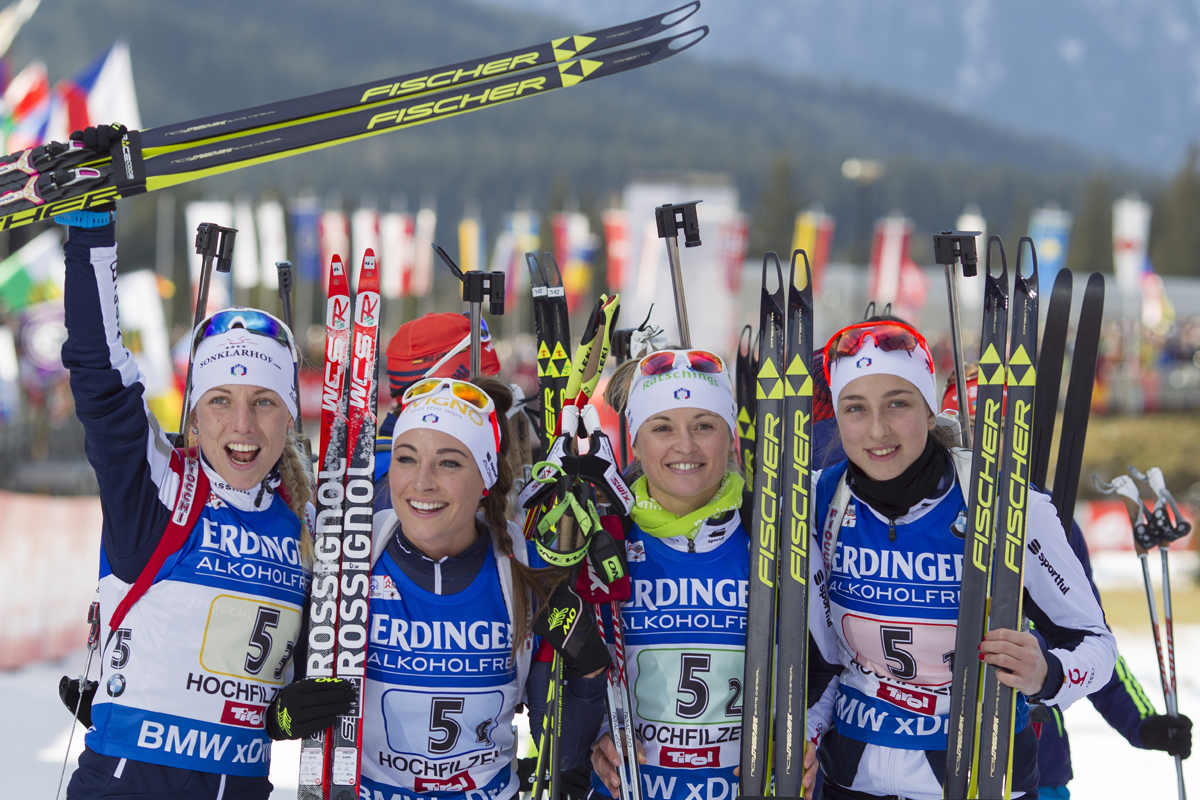
    The victorious Italian women at the Hochfilzen World Cup, in Austria. Left to right: Federica Sanfilippo, Dorothea Wierer, Karin Oberhofer, and Lisa Vittozzi. Photo: Fischer/NordicFocus
    The victorious Italian women’s 4 x 6 k relay, with (from l to r) Federica Sanfilippo, Dorothea Wierer, Karin Oberhofer, and Lisa Vittozzi at the Hochfilzen World Cup on Sunday in Austria. (Photo: Fischer/NordicFocus)

    The women’s biathlon 4 x 6-kilometer relay, marked by good shooting performances, perfect weather, and several unusual lineup choices came down to the wire, with the race decided on the last lap in a sprint between Italy’s anchor Dorothea Wierer and Germany’s Franziska Preuss. Wierer lunged over the line first by less than a ski length, in a time of 1:05:32.6. This secured the first World Cup win for an Italian women’s relay in history, celebrated extensively by her teammates and coaches in the finish.

    After a number of changes between several countries vying for the final spot on the podium, Ukraine prevailed in the end, taking third 13.1 seconds behind the Italians. None of the three teams on the podium suffered a penalty lap, with Italy having to use eight spare rounds, Germany seven, and Ukraine 10.

    After sweeping the podium in the sprint and securing first and second place in the pursuit race this weekend, Germany’s women had to be considered the overwhelming favorites for the relay. But on Sunday, Germany opted for a lineup of Franziska Hildebrand, Maren Hammerschmidt, Vanessa Hinz and Franziska Preuss, a group of athletes who had never been in a relay team together.

    They were not alone in trying something new, with teams such as the Czech Republic, Italy, France, Russia, Ukraine, the United States, and Canada also experimenting with new athletes or at least order changes.

    Germany’s Laura Dahlmeier, the winner of the pursuit race on Saturday and anchor of the gold-medal-winning relay at the 2015 IBU World Championships, rested on Sunday.

    “This was my own decision,” she explained in an interview with German broadcaster ARD before the race. “The season is long enough, and the World Championships are what matters. And I believe as strong as we are as a team right now, the other four girls can do well without me.”

    The German coaches are happy that they still have an ace up their sleeve for the next relays. “We know that there still is a long and tough season ahead of us,” Women’s Head Coach Gerald Hönig said. “We are planning with an eye towards the [2016] World Championships in Oslo in March. So a deep team is a nice problem to have, in contrast to always having to use the same two or three top performers.”

    Miriam Gössner, who achieved a third place in the sprint on Friday, also took a break from racing on Sunday.
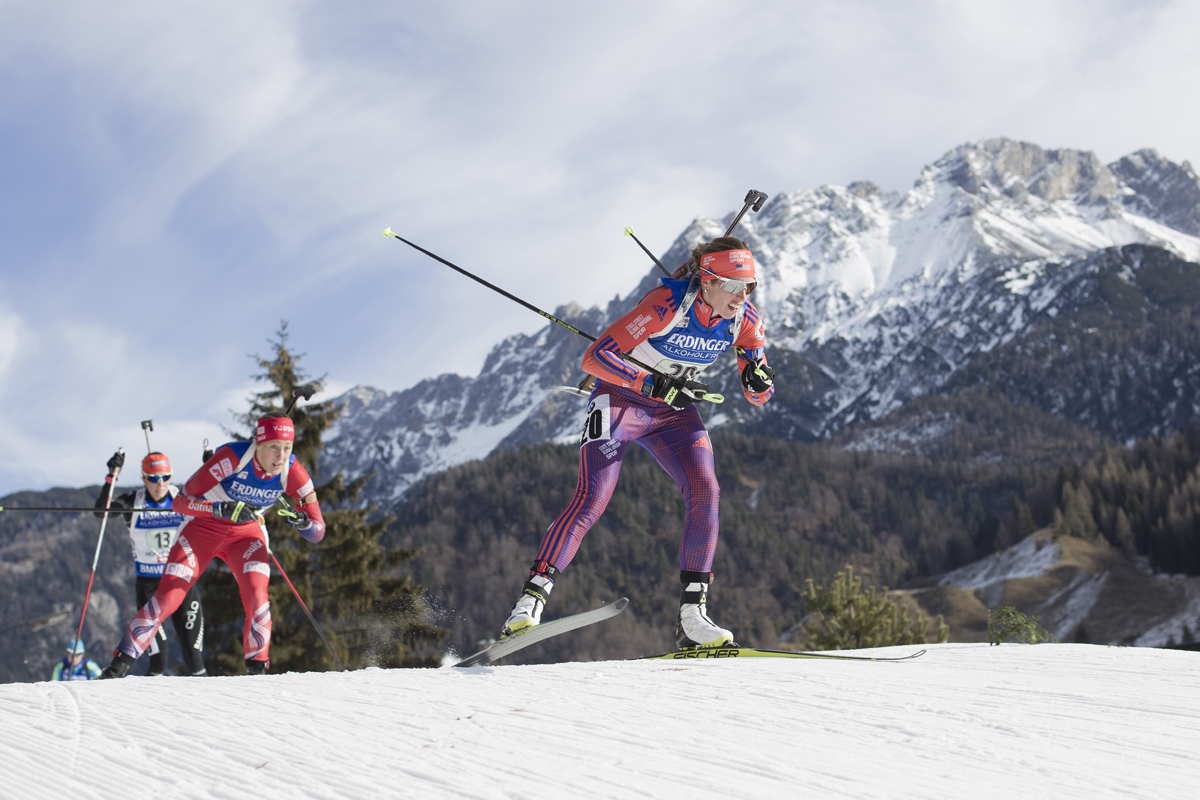
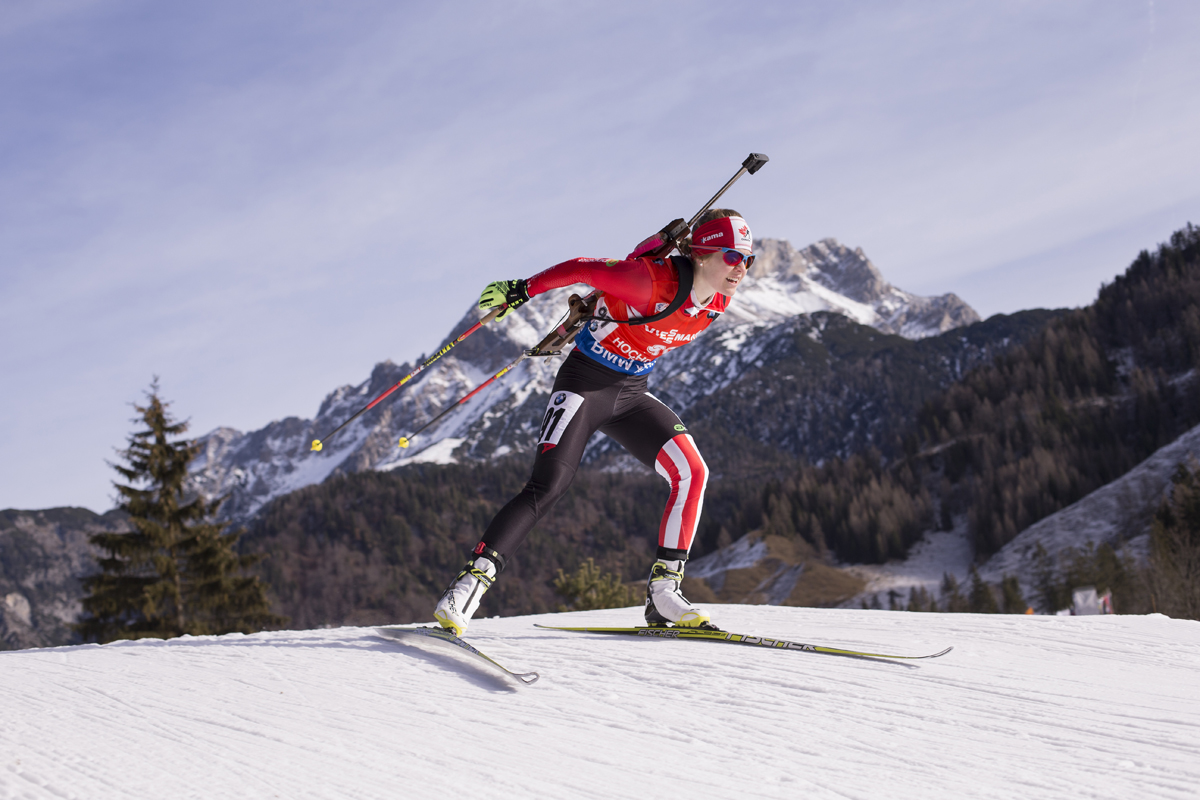
    American Susan Dunklee skates her way through the second leg at the IBU World Cup women's relay in Hochfilzen, Austria. Photo: Fischer/NordicFocus
    American Susan Dunklee racing the second leg of the IBU World Cup women’s relay on Sunday in Hochfilzen, Austria. (Photo: Fischer/NordicFocus)

    With the Germans explicitly stating their goal to reach the podium, the day got off to a problematic start for Germany, with other teams charging ahead.

    Hildebrand, the winner of the sprint race on Friday and fourth place in the pursuit on Saturday, skied a controlled race at first, and cleaned the prone stage with perfectly centered shooting. But then she required two spare rounds in the standing position and had trouble inserting them, setting her back to 14th position. After a good final round, she tagged off at the first exchange 11 seconds behind in eighth.

    “Still in sight of the leaders,” Hildebrand recalled in the ARD interview. “And the other girls then turned it around.”

    Italy’s first skier, Lisa Vittozzi, who also scrambled for Italy’s bronze-medal relay at World Championships last March, fared better, shooting perfectly (0+0, 0+0) and tagging off just 4.2 seconds behind the Czech Republic who was in first at that time. On the second leg, Karin Oberhofer kept Italy near the front, requiring only one spare round (0+0, 0+1), and tagged Italy just 1 second behind.

    Throughout the race, Germany struggled a bit with technical details. Maren Hammerschmidt, the surprise second-place finisher in both of the previous races, had two misses (0+1, 0+1) and doubled the deficit she had been handed by Hildebrand. In slow-motion replays from the shooting range, she could be seen desperately trying to insert a spare round into her rifle, before it fumbled back out.

    “That was a technical malfunction today, nothing I could do about it,” Hammerschmidt said an interview with ARD. “A shot hung up in the ammunition magazine. I did not expect this, and will have to check that clip again at home.”

    She tagged 22.2 seconds behind the leaders in ninth place, one behind Canada’s Megan Tandy.

    “I hope we can still secure a podium finish,” Hammerschmidt said in a mid-race interview.

    It then fell to Vanessa Hinz, who placed 15th in the Hochfilzen sprint and 29th in the pursuit, to bring Germany back into contention. With two fast shooting performances (28 seconds prone) and requiring only one spare round, she steadily moved up through the ranks, and handed over to Franziska Preuss in first.

    “I was really happy about the nomination [for the relay], and glad that it worked so well today,” Hinz later said.

    On the third leg of the relay, Italy struggled a bit. Federica Sanfilippo, a surprising podium finisher during the first World Cup weekend in Östersund, Sweden, and not a member of Italy’s bronze-medal relay at World Championships, required five spares to clean her targets. She had the toughest time in standing (0+2, 0+3), but avoided the penalty and skied the fastest lap of the field, handing off to Wierer 21.6 seconds behind.

    For Preuss, the 2014 Olympics ended in a minor drama during the relay, when she started for Germany at the age of 19 and crashed twice, getting snow into the sights of her rifle and costing her team their chance at a medal. Since then, Preuss has usually raced the second or third leg in relays.

    But on Sunday, with her close friend Dahlmeier taking a break, she was called up to anchor the relay. Preuss headed out strong and required only one spare round to clean prone. But by the time she came back to the range for the final shooting, a group of athletes that included Wierer had caught up to her.

    Preuss hit the first four targets, and was convinced that her fifth shot had also hit, closing the protective flap on the sights of her rifle, before realizing it was a miss. This forced her to load the spare and take aim again, hitting the target, and left the range with Wierer, who had also required one spare, right behind her.

    On the last lap the lead changed back and forth. Preuss later told ARD she deliberately let Wierer overtake her. Then she accidentally stepped on the tails of Wierer’s skis near the top of the first climb, causing both to stop briefly, but neither Preuss nor Wierer fell or broke their poles. At the halfway checkpoint, they were just 0.3 seconds apart.

    Preuss then decided to try and force a decision before the stadium by “slogging away on the last climb from the bottom to the top, 100 percent,” and managed to create a small gap. But Wierer refused to be dropped, and caught the end of Preuss’ skis again as they entered the arena. After a right turn into the closing stretch, Wierer double poled past her taking the middle lane, with Preuss on her right trying to hold on. But Wierer had more power left, and lunged over the line 0.2 seconds ahead, into the arms of her excited teammates.

    “I know I’m not the best female sprinter. I have to work on that again,” Preuss confided to ARD during a group post-race interview. “The second place is a great result, I think we are all satisfied with that”.
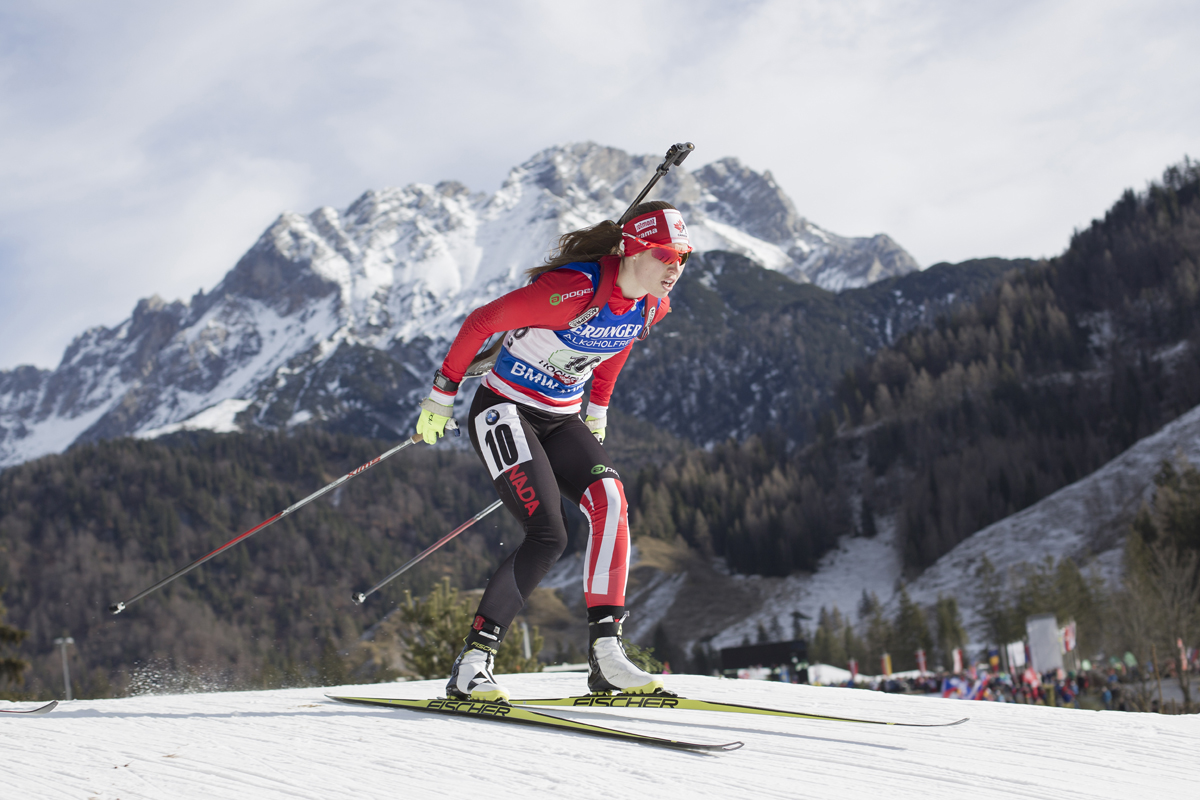
    Canada's Megan Tandy blasts through the second leg of the women's relay at the IBU World Cup in Hochfilzen, Austria. Tandy's clean shooting helped advance Canada to eighth place at the end of her leg. Photo: Fischer/NordicFocus
    Canada’s Megan Tandy blasts through the second leg of the women’s relay at the IBU World Cup in Hochfilzen, Austria. Tandy’s clean shooting helped Canada move into eighth place at the end of her leg. (Photo: Fischer/NordicFocus)

    Her teammates also agreed with her that the Hochfilzen arena poses a difficult challenge for a finishing sprint, with a noticeable incline the last 100 meters.

    Wierer had already beaten Preuss and Hildebrand in a sprint to the line in Östersund this season, so she had every reason to be confident that she could do it again.

    “I was only thinking that I should run as fast as you can. She was close in front of me. I was hoping I could win in the final sprint,” Wierer told the IBU.

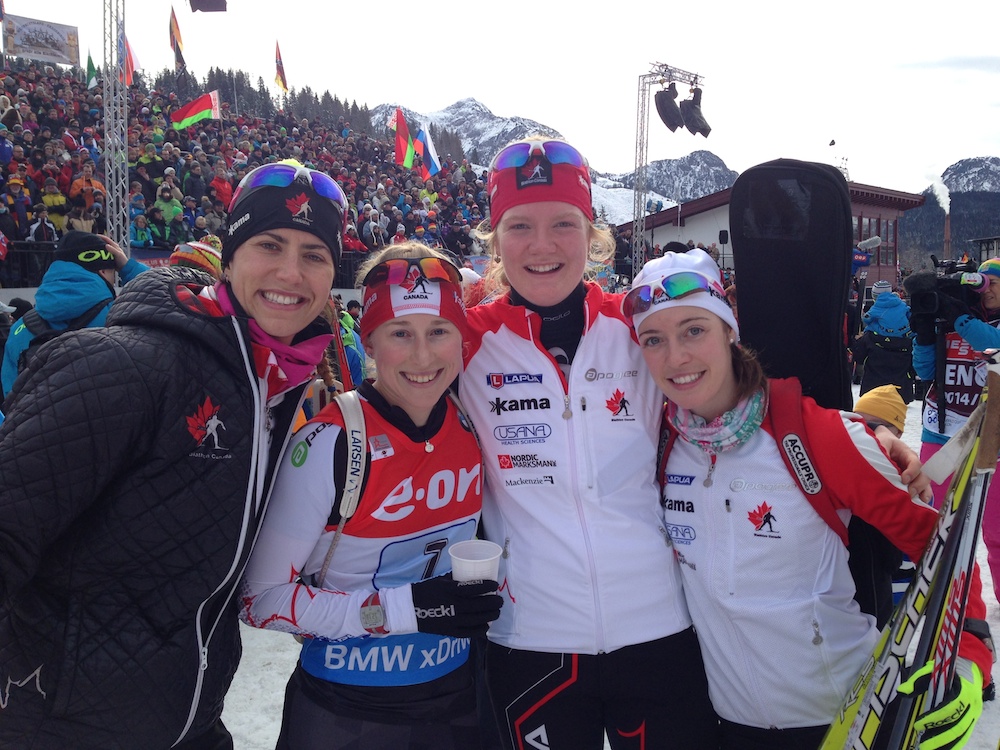
    Afterward, both teams seemed happy with their results, with the women all smiling and posing for pictures.

    “You can hardly ask for a better selling point for biathlon [than this race],” German coach Hönig said with a laugh. “That’s why millions of people watch us on TV and the arenas are full.”

    Asked later why the Italians didn’t seem even more jubliant about their first-ever victory in a women’s relay, Wierer tried to explain: “I think we are just all so tired.”

    The Czech Republic, who frequently had the best relay performances last season, also had been in the lead early in this race, thanks to Eva Puskarcikova and Olympic silver medalist Gabriela Soukalova. But then team rookie, Lucie Charvatova – who was sixth in Friday’s sprint and replaced Jitka Landova on Sunday – could not clean her standing shooting with the three spare rounds and thus incurred a penalty lap. After another difficult shooting by anchor Veronika Vitkova, they finished the race in sixth place (1+12), 29.8 seconds back from Italy.

    Chervatova only recently took up biathlon training when she failed to qualify for the Czech cross-country senior national team again, and her new teammates are expecting great things from her.

    “Just watch, she is incredible, her body is all muscle. In a few years she will be frequently at the top,” veteran Soukalova told the media in Hochfilzen.

    The podium was in hot contention with 22 countries at the start line, and with the Czech Republic, Sweden, Austria, France, Ukraine, and Belarus (this year having to race without defending World Cup champion Darya Domracheva) in the top three at various points of the relay.

    In the end, Ukraine’s team claimed the third, with anchor Olga Pidrushna requiring three spares but skiing the second best time on the final round. Overall the team, usually known for their excellent shooting, required ten spare rounds to clean all the targets.

    “I think there are some things we could improve, so we will work on them this season,” starter Yuliia Dzhyma said in the press conference.

    Poland placed fourth, 27.5 seconds back, while France was fifth, (+28.8).

    Canada 10th, U.S. 15th

    For the relay in Hochfilzen, Biathlon Canada put up a different lineup and order than in the last World Championships in Kontiolahti, Finland. Canada advanced as high as eighth in split times during the race.

    Starting in the fourth row in bib 10, Julia Ransom kept the leaders within viewing distance.

    “I always like relays so was excited for today!” Ransom wrote in an email. “My legs weren’t as snappy as usual the past two races but things came together for today and I felt much better. I am new to starting relays but I have a background racing cross country and feel comfortable in a mass. This helps with navigating the more technical areas of the course with a group.”

    The 22 year old needed two spares to clean the first shooting, then one more in the standing stage. Ransom tagged Tandy in 11th, 20.6 seconds back.

    Tandy was able to keep her gap to the best athletes at the top of the field and even improved position, largely helped by two clean stages (0+0, 0+0) and the shortest range time on her leg. At the exchange, she handed off 21.5 seconds back in ninth place. At that time Canada was ahead of top teams like Germany, Norway and Russia.

    Emma Lunder took over, and while the 24 year old lost about a minute to the leaders and required four spare rounds (0+1, 0+3), Lunder avoided a penalty lap in the standing shooting. She tagged Canadian anchor Rosanna Crawford 1:23 back in 12th place.

    “The 2 k course here is quite easy and has a lot of rolling flat sections, which really plays to my strengths in two skate and one skate,” Crawford wrote in an email. “It’s also a really fast 6 k — the race was only taking 16-17min, which is super fast for a relay. Skiing felt a lot better than it has this year and we had some super fast skis, thanks to our techs.”

    Crawford cleaned her prone shooting stage, and only required one spare round in the standing position (0+0, 0+1), making up ground to the top by skiing the fourth-fastest course time on her leg.

    “Prone has been feeling really good all year, but I’ve been struggling with one miss standing far too often!”

    She finished the relay for Canada in 10th, 1:08.7 behind Italy and just 4.3 seconds behind the Russian team.

    “I think this will be a great learning experience for our younger girls on the team,” Crawford continued. “Feel that excitement of doing well in a relay and allow them to be better prepared for the next relay. Overall we are happy as a team, but know with a few less spares that top 8 is within reach!”

    “Canada did great today!” Ransom wrote. “All of us had solid races and were in the mix for the most part. I think this was a great place to start from for the season.”

    The US Biathlon women’s team also experimented with a new order. Susan Dunklee, who has been the starter for several years, moved to the second leg while Annelies Cook started.
    Canadian Emma Lunder powers through the third leg of the women's relay at the IBU World Cup in Hochfilzen, Austria. Photo: Fischer/NordicFocus
    Canadian Emma Lunder racing the third leg of the women’s relay at the IBU World Cup in Hochfilzen, Austria. (Photo: Fischer/NordicFocus)

    “We are experimenting [with our relay order] to see what combinations work best for the team as a whole,“ Dunklee wrote in an email. “Traditionally I have started off the first leg, which involves a lot of tactics and is exhilarating, but today Annelies tried it instead and did a fantastic job.”

    In her first season starting on the World Cup circuit, Clare Egan, who anchored the team at World Championships and in the last relay of last season, was moved to the third position, with Hannah Dreissigacker closing out the race instead.

    “My job today was to try the second leg and chase down the lead pack not far ahead,” Dunklee continued. ” Skiing feels strong and I had nearly regained contact with the leaders, then my extra rounds in standing set us back again.  We didn’t have a perfect day and we look forward to improving on our 15th place in the future.”

    Based on the U.S. relay performances last season, Cook started back in the seventh row in bib 20. She opened her race with two misses in prone, then one more in standing (0+2, 0+1), and tagged off to Dunklee 32.0 seconds behind the leader in 14th place.

    Dunklee made up some positions, entering the prone stage in 13th place, then cleaned it. On the next lap she caught up with a few more athletes to move into seventh. But then she used all of her spare rounds in standing, narrowly avoiding a penalty lap but losing a lot of valuable time with the reloads. At the second exchange, she tagged Egan 41.8 seconds behind in 11th place.

    On her standing stage, Egan struggled, missing four shots in a row and thus running out of spare rounds. In the end, she had to circle the 150-meter penalty lap twice (0+1, 2+3), and tagged off to Dreissigacker 3:08.6 minutes behind.

    Dreissigacker fared better, cleaning her prone stage and using two spares in standing (0+0, 0+2). While the clean prone helped her catch a few teams ahead of her, Dreissigacker lost time on the final loop before the finish and ended up 15th (+4:10.9).

    In the women’s Nation Cup rankings — important not only for prestige as an own end-of-season award, but also determining the number of starters a country can use in World Cup event — Germany is in the lead after this weekend’s races. Canada ranks 10th and the U.S. stands in 16th.

    Results

  • Canadian Men Tie Team-Best Sixth in Hochfilzen; Russia Drops Field by Last Lap

    Canadian Men Tie Team-Best Sixth in Hochfilzen; Russia Drops Field by Last Lap

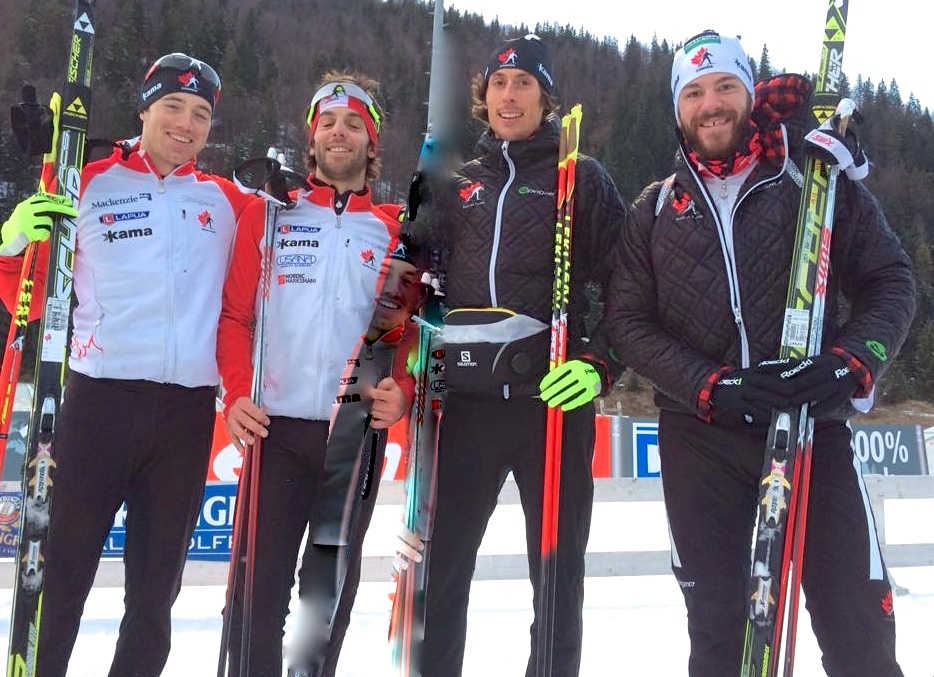
    The Canadian men's 4 x 7.5 k relay, which tied a team-best sixth on Saturday at the IBU World Cup in Hochfilzen, Austria. (Courtesy photo)
    The Canadian men’s 4 x 7.5 k relay, which tied a team-best sixth on Saturday at the IBU World Cup in Hochfilzen, Austria. From left to right, Nathan Smith, Scott Perras, Brendan Green, and Marc-Andre Bedard. (Courtesy photo)

    Note: This article has been updated to include quotes from Canadian national-team head coach Matthias Ahrens.

    Just a couple steps from the podium on Saturday, the Canadian men’s 4 x 7.5-kilometer relay team was pretty psyched to get flowers — and chocolate, and a “sweet medal,” and cash, according to third-leg Marc-André Bédard.

    They had been in the hunt for sixth, which tied each of their career bests in the team event and was worthy of the flower ceremony, since the first leg of Saturday’s IBU World Cup relay in Hochfilzen, Austria.

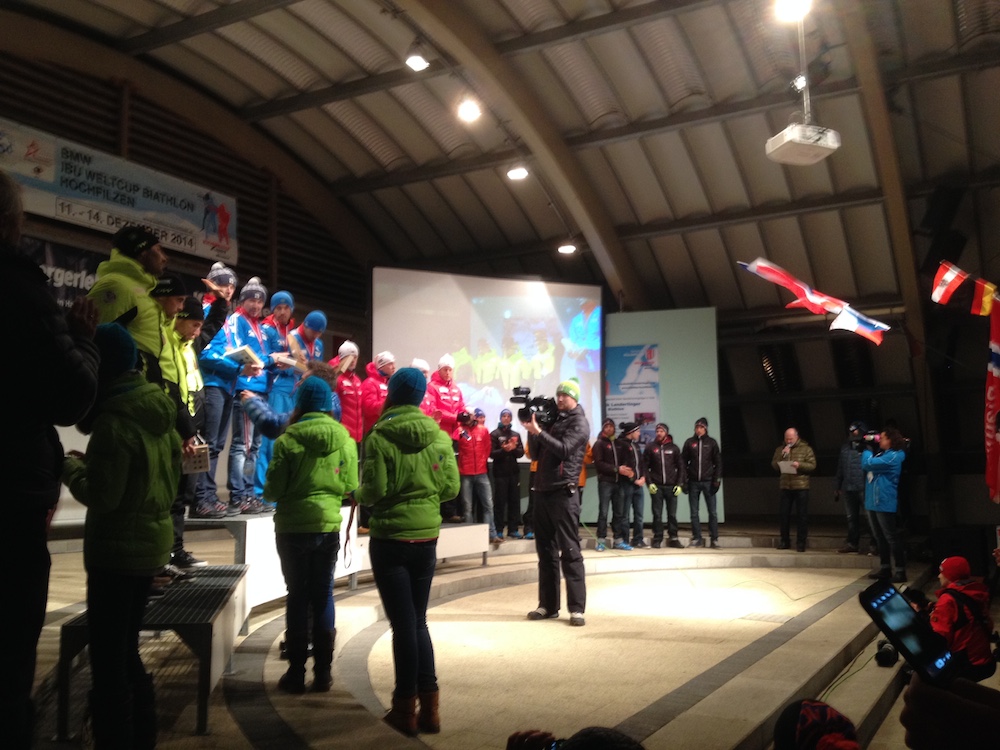
    The Hochfilzen World Cup men's relay awards ceremony on Saturday night, with Canada (far right) in sixth. (Photo: Matthias Ahrens)
    The Hochfilzen World Cup men’s relay awards ceremony on Saturday night, with Canada (far right) in sixth. (Photo: Matthias Ahrens)

    Temperatures were colder than Friday’s sprint, their skis seemed to be running great, and by the first exchange, the Canadians were well on their way to the top-eight Nathan Smith thought they were capable of on a given day.

    Saturday turned out to be especially impressive, Smith explained.

    “After yesterday’s disappointing showing for our team in the sprint I was unsure of what to expect today,” Smith wrote in an email, referring to his 44th-place finish, which led the Canadian men in Friday’s 10 k sprint. Teammate Brendan Green was 49th, Bédard placed 82nd and Scott Perras was 100th.

    On Saturday, they tagged off in that order.

    Smith started first in the 24-team field and found himself drifting toward the back of the pack — farther than he would have liked. After his first shooting, where he had to use three spare rounds, he was 21st, nearly 37 seconds behind Sweden and Italy in the lead. France and Russia hovered a few seconds behind in third and fourth, and the Americans — with Lowell Bailey leading off — ranked ninth, 14.5 seconds back, after Bailey missed one prone.

    In an email, Bailey in bib 20 explained he started six rows back, based on the IBU’s new start rules, which he considered “a significant disadvantage for teams with higher bib numbers.”

    “I was able to make it up into the top five during the first loop but it was definitely tough starting with bib 20,” he wrote in an email. “I disagree with the change and I think it gives the lower bib numbers an advantage that they didn’t have with the previous format. That being said, I was able to work my way through the field, but it took a lot of effort and I expended a lot of needless energy trying to pass.”

    While Bailey was satisfied with his shooting, using one spare on each stage, Smith was stressing over prone.

    “I was pretty worried in prone,” Smith wrote. “I’m not sure exactly what went wrong there, but it felt exactly the same as the prone in [Friday’s] sprint. I knew I was feeling good skiing though so I just tried to ski hard and hopefully catch some teams off guard that were skiing in groups.”

    By the second stage, the Canadian was up to 12th with a clean bout. He went on to post the fastest course time of his leg on his third-and-final lap.

    “I felt strong and tried to make up time on the second half of the course where all the climbing is,” Smith explained. “My last lap felt amazing. I passed a lot of people and it was actually ranked 1st for that leg. I had hoped to put Brendan in a slightly better position, but given 3 extra, I’m pretty happy that the deficit was only 25 seconds.”

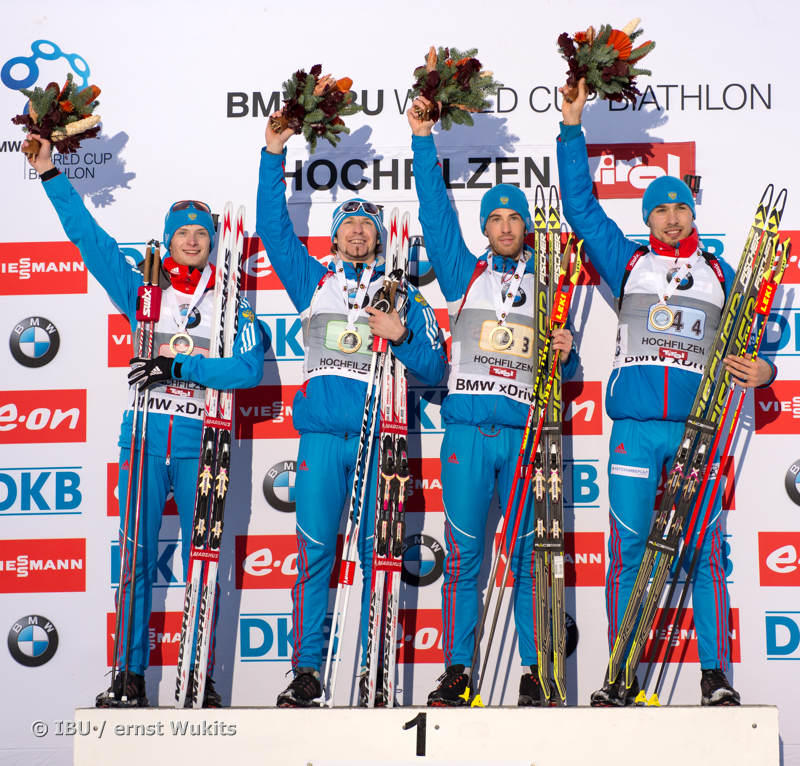
    Russia won the men's relay on Saturday at the IBU World Cup in Hochfilzen, Austria. (Photo: IBU/Ernst Wukits)
    Russia won the men’s relay on Saturday at the IBU World Cup in Hochfilzen, Austria. From left to right: Maxim Tsvetkov, Timofey Lapshin, Dmitry Malyshko, and Anton Shipulin. (Photo: IBU/Ernst Wukits)

    Smith tagged Green in seventh, 25.7 behind Friday’s sprint winner, Johannes Thingnes Bø of Norway in first — who missed one in prone. France’s Simon Fourcade cleaned to put his team 12 seconds back in second, and Ukraine tagged in third (+14.4) after 10-for-10 shooting from Dmytro Pidruchnyi.

    The U.S. slipped to 15th during Bailey’s leg as a result of less-than-ideal skis, second-leg Tim Burke explained.

    “I knew right away when I saw Lowell’s race that he was having a problem with skis,” Burke wrote after his team placed 14th overall. “Unfortunately, I did not have time to change my skis and we were using the same grind. The temperature dropped more than we thought at race time and the snow really dried out. We simply ended up on too big of a grind.”

    Heading out 56 seconds behind the leaders, Burke remained hopeful that he could pick a few teams off. He ended up using two spares in prone and another in standing.

    “I definitely made a mistake in prone when I tried to push the pace a little too much and ended up pulling the last two shots,” he wrote. “After standing I ways able to pick up a few spots on the last loop but we were still far from where we should have been after two legs.”

    Meanwhile, Green cleaned both stages for Canada to improve to sixth. He led Italy’s Dominik Windisch, who started a second behind him, on his first lap. The two entered the range together, and despite Windisch using one spare, they left together as well.

    “I was able to work off him for my second lap and relax a little bit more in certain areas before standing,” Green explained. “I knew my skiing should be decent if worked with him so I didn’t try and do anything too heroic on course and more just tried to settle into a solid pace.”

    After his standing stage, Green was up to sixth, 39 seconds behind Russia’s Timofey Lapshin up front. Lapshin and Norway’s Emil Hegle Svendsen both cleaned standing to leave the range together, and France’s Jean Guillaume Beatrix used one spare to fall slightly off the pace, eight seconds back in third. Windisch missed three and dropped to ninth.

    On the long climb back up to the stadium, Svendsen led Beatrix and Lapshin, while Austria’s Simon Eder tried to close the 12-second gap in fourth. Germany’s Andreas Birnbacher trailed by another 12 seconds in fifth — 14.7 seconds ahead of Green.

    “I always feel a ton of pressure during relay races,” Green reflected. “But last year we had multiple strong relay performances where we were contending at the front of the race, so I’m sure those experiences helped me out today…

    “When setting up the next teammate for the tag, it’s ideal if you can tag them with other nations close by so they have people to work with skiing,” he added. “If that scenario works out, perfect, but if not that’s fine, and we’re always doing our best to tag as close to the lead as possible.”

    Green handed off to Bédard in sixth, 50 seconds behind Norway and France, neck-and-neck for first, and 24 seconds behind Germany in fifth. Russia tagged off 7.8 seconds back in third, and the U.S. came through in 11th, 1:55 behind the leaders.

    Upon receiving the tag, Bédard — the team’s newest member and the only one not to experience sixth place in the relay in Antholz, Italy, last January (former national-team member J.P. LeGullec scrambled in that race) — he focused on keeping his cool and trying not to lose too much ground.

    “It was a bit lonely during the first 2 laps but I tried to go as hard as I could knowing that it would be super short,” Bédard wrote.

    He used one spare in prone and three in standing to slip one place to seventh behind Italy’s Thomas Bormolini after his second stage.

    “On the final lap I took extra time on the range to clear my targets and the Italian came back strong cleaning his, so I had to fight back 8-10 seconds,” Bédard explained. “I got to him pretty fast. I felt good so I attacked right away but he kept up to me and we ended up together.”

    Bédard and Bormolini entered the final exchange at the same time, 1:56.4 behind Russia. After Dmitry Malyshko cleaned, Russia remained the definitive race leader heading into the final leg, more than 17 seconds ahead of Norway’s Lars Helge Birkeland in second. Birkeland used five spares — two in prone and three standing to account for half of Norway’s 10 total spares at the end of the day.

    France’s Simon Desthieux, who missed two standing, trailed Birkeland by 0.7 seconds through the tag zone in third.

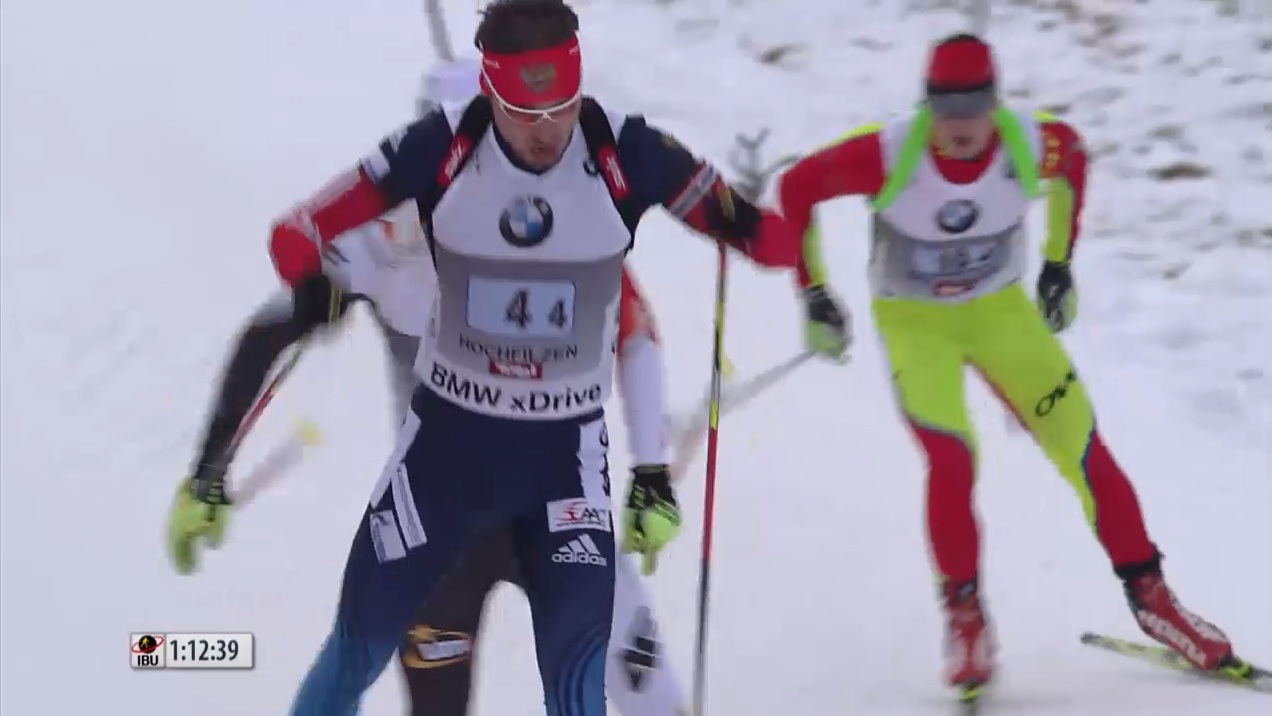
    Russia's Anton Shipulin laps several teams en route to a 20-second victory for the Russian men's team in Saturday's 4 x 7.5 k relay in Hochfilzen, Austria.
    Russia’s Anton Shipulin laps several teams en route to a 20-second victory for the Russian men’s team in Saturday’s 4 x 7.5 k relay in Hochfilzen, Austria.

    At the front of the race, it was all about chasing Russia with anchor leg Anton Shipulin ultimately cleaning both stages to bring it home. France’s Martin Fourcade and Norway’s Tarjei Bø duked it out for second, with Fourcade missing one prone and Bø missing three standing to drop to third.

    Then there was Austria and Germany, some 35 seconds behind Russia after prone and 48 seconds back after standing, racing for fourth.

    “The gaps were quite big when I started,” Canada’s anchor, Perras wrote. “My race was all about getting into the prize ceremony.  I couldn’t even see 4th or 5th.”

    He missed two prone and three standing for five total spares — half of what Canada ended up with.

    “In prone I shot a bit slow. I threw my first spare round down range to try and leave the range with Italy,” Perras explained.

    Italy’s Christian Martinelli used one spare in prone to exit the range 15 second ahead of him. Perras made up that time on the second lap and entered the range with him, then reclaimed sixth. While Perras missed three that bout and Martinelli missed two, Perras left the range 22 seconds ahead.

    Canada's anchor Scott Perras pushing for sixth in the finishing straight of Saturday's IBU World Cup 4 x 7.5 k men's relay in Hochfilzen, Austria.
    Canada’s anchor Scott Perras pushing for sixth in the finishing straight of Saturday’s IBU World Cup 4 x 7.5 k men’s relay in Hochfilzen, Austria.

    “I had no idea how close Italy was to me or any team for that matter,” Perras explained of his last lap. “I fought the whole way. I was fighting for my teammates out there.”

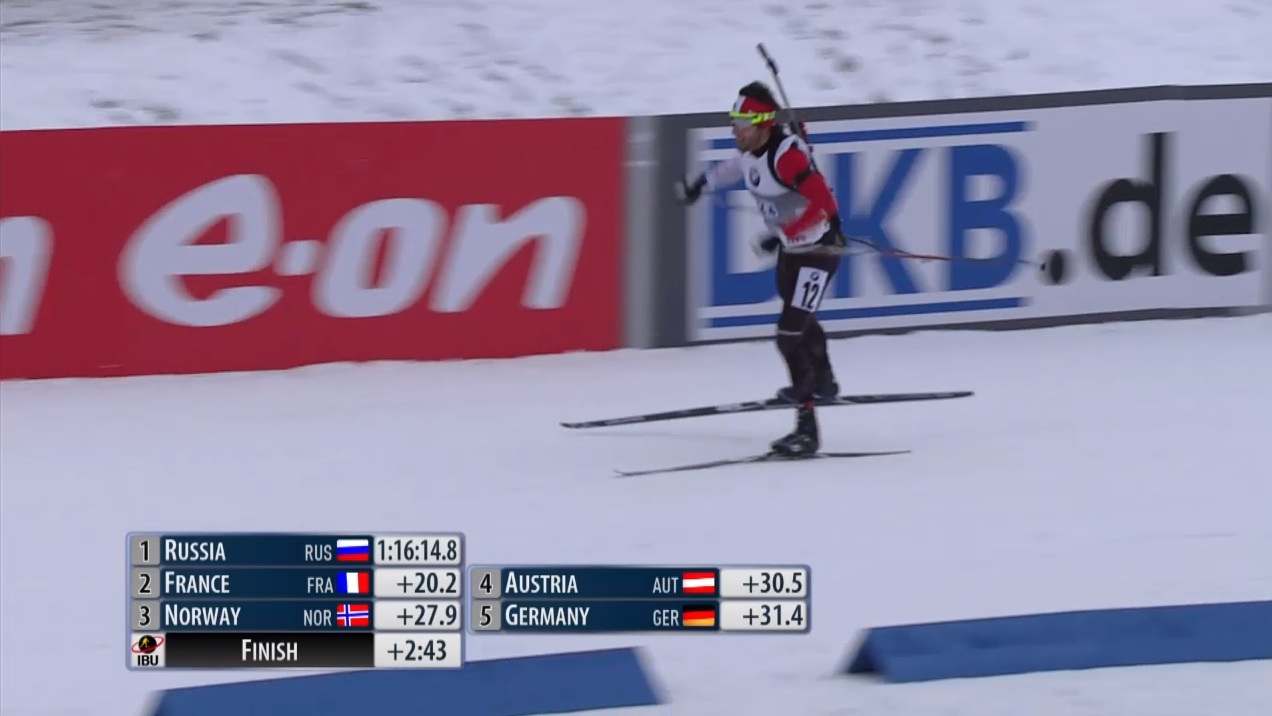
    He secured sixth to match the team’s best from Antholz, finishing 2:55.4 behind Russia, which won in 1:16:14.8 after using just one spare round. Fourcade cleaned standing and outsprinted Bø by 7.7 seconds to lock up silver for France (0+4), 20.2 seconds behind Russia, and Norway took third (0+10).

    Dominik Landertinger cleaned prone and used one spare in standing to finish fourth for Austria (0+7), 30.5 behind Russia, and Germany’s Simon Schempp also cleaned the first stage then missed one standing to finish 0.9 seconds later in fifth for his team (0+9).

    “Matching a top finish is always a must, we obviously want to get better and better,” Bédard wrote. “But it was great to be [in] the flower ceremony.”

    “I think we are happy to get back there so early in the year,” Perras explained. “It sets the bar for the whole team. It makes everyone want to work harder, coaches, wax techs and athletes to repeat or better days like today.”

    In an email, Canada’s national-team head coach Matthias Ahrens called their performance “solid … especially in the shooting range taking the opportunity of other team’s weaknesses,” he wrote in an email. “This was an important result for our team in building confidence towards their individual races. This also applies for our women’s team who had a decent result [11th] with 2 young athletes, one being a junior in her first [World Cup] race.”

    While the Canadian men ended the day with zero penalties and 10 spares, the Americans, which were lapped during Russell Currier’s anchor leg, ended up with four penalties and 14 spares.

    After Burke tagged Leif Nordgren in 11th, Nordgren used three spares and had to ski a penalty loop on his first stage, then slipped to 12th. In standing, he used all three spares again and had three more penalty loops to leave the range in 17th.

    He tagged Currier in 17th, nearly five minutes behind the leaders. Currier went on to use two spares in prone and one in standing before being pulled on his last lap.

    “We are not reading too much into this result as a team,” Burke wrote. “We know we are far better than what we showed today. In one way, at least everything went wrong for us on the same day.”

    “I think we are capable of a podium,” Bailey noted. “The field is incredibly strong on the men’s side this year and a few small mistakes make a big difference on the results list. If we are perfect, we have a chance at the podium.

    “Tomorrow is a new day,” he added. On Sunday, Burke and Bailey will start 13th and 17th, respectively in the pursuit. Nordgren, who also qualified, will head out 51st of 60 men.

    Smith and Green will also be hunting for a top 30 after starting in 44th and 49th, respectively.

  • With Clutch Prone, Preuss Clinches German Relay Victory in Hochfilzen; Canadian Women 11th

    With Clutch Prone, Preuss Clinches German Relay Victory in Hochfilzen; Canadian Women 11th

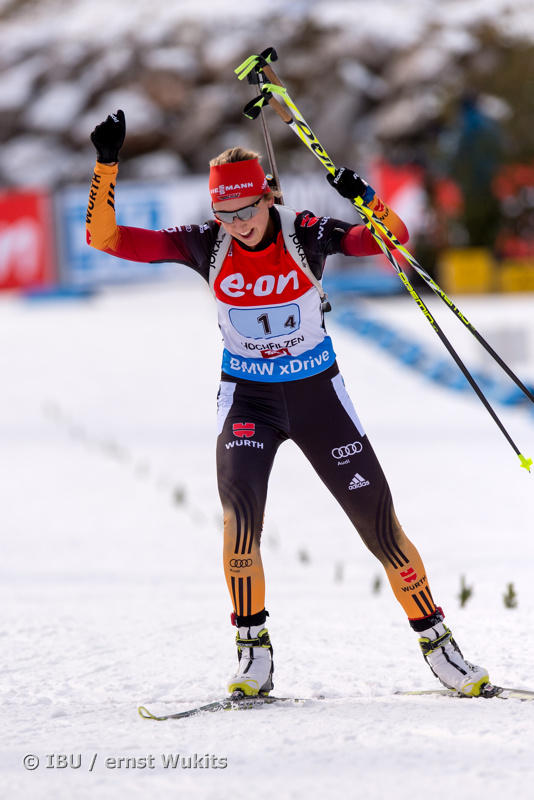
    Germany's anchor, Franziska Preuss celebrates a 21-second victory in the women's 4 x 6 k relay at the IBU World Cup on Saturday in Hochfilzen, Austria. (Photo: IBU/Ernst Wukits)
    Germany’s anchor, Franziska Preuss celebrates a 21-second victory in the women’s 4 x 6 k relay at the IBU World Cup on Saturday in Hochfilzen, Austria. (Photo: IBU/Ernst Wukits)

    For three out of the four legs in the IBU World Cup women’s 4 x 6-kilometer relay on Saturday in Hochfilzen, Austria, it could’ve been anyone’s game, especially Russia’s, Germany’s, Poland’s and the Czech Republic’s.

    All four were within 40 seconds of one another behind Russia in first at the final exchange — and while it might have seemed like Russia with a 19-second lead was untouchable — any biathlete will tell you nothing in biathlon is ever a sure-thing.

    Ekaterina Shumilova tagged off in first, upholding the position teammate Olga Podchufarova put her in during the second leg. However, by the final prone, Russia’s lead started to unravel. Ekaterina Glazyrina used all three spare rounds, then had to ski the team’s first penalty loop of the day.

    She dropped from first to fifth, 44 seconds out of the lead.

    Meanwhile, Germany’s anchor Franziska Preuss cleaned her first stage to take control — not knowing what happened to Glazyrina.

    “I had no idea that she was on the loop,” Preuss told the IBU after the race. “I did not know it until the finish line.”

    Veronika Vitkova of the Czech Republic used one spare to move to second after prone and trailed Preuss by 24.1 seconds leaving the range. Belarus was suddenly back in contention when Darya Domracheva cleaned prone to jump from sixth at the exchange to third, 37 seconds after Preuss.

    For the final standing, the pressure was on for Preuss. She had to use one spare, but so did Vitkova and Domracheva in second and third.

    The German left the range with a 29-second lead over Vitkova and remained 37.4 seconds ahead of Domracheva in third. With a huge smile, Preuss entered the stadium uncontested and waved to the Austrian crowd as she finished. Domracheva outsprinted Vitkova for second, giving Belarus the silver, 21.1 seconds behind Germany, and the Czech Republic took third another 1.1 seconds back.

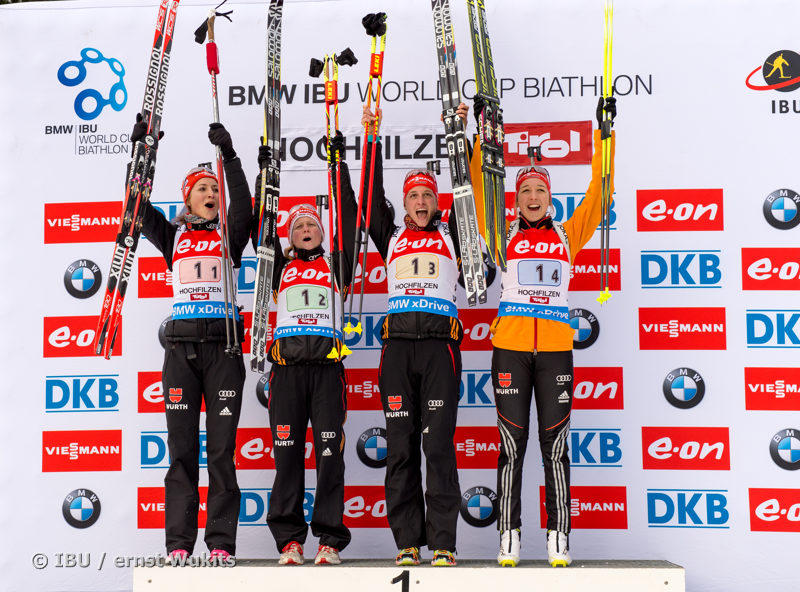
    The German women's relay atop the podium on Saturday at the Hochfilzen World Cup: (from left to right)  Luise Kummer, Franziska Hildebrand, Vanessa Hinz, and Franziska Preuss. (Photo: IBU/Ernst Wukits)
    The German women’s relay atop the podium on Saturday at the Hochfilzen World Cup: (from left to right) Luise Kummer, Franziska Hildebrand, Vanessa Hinz, and Franziska Preuss. (Photo: IBU/Ernst Wukits)

    For Germany, the relay victory marked the first podium for two of its members: first-leg Luise Kummer and third-leg Vanessa Hinz, the latter of which lifted the team from fourth to second with two spares.

    “It is very exciting being up there; it is such a great feeling!” Kummer said.

    Second-leg Franziska Hildebrand, who brought Germany from 11th to fourth by the second exchange, said the team’s goal was to be on the podium.

    “People should be happy, because we are a very young team and this shows how good we can be,” Hildebrand said.

    The Czech Republic’s second skier who brought her team to third from seventh, Gabriela Soukalova was also pleased with the top-three finish.

    “We realized at the beginning of the season that we can have a strong relay team I think this result will be a great motivation for our whole team,” she said. “For me, I have had some problems and I needed to have a great race.”

    Germany finished the day with zero penalties and eight spares, Belarus had 10 spares and the Czech Republic had nine spares.

    Italy (1+4) fell from an early lead set by first-leg Dorothea Wierer, to 13th when second-leg Nicole Gontier had a penalty loop on her second stage. Karin Oberhofer lifted the team from 11th at the final exchange to fourth overall (+39.9) with clean shooting.

    Norway placed fifth with a penalty and 12 spares, five of which came from second-leg Synnøve Solemdal. Anchor Tiril Eckhoff skied the team up from 14th to fifth (+46.3).

    Poland ended up sixth (0+8), Ukraine was seventh (1+11), Russia eighth (1+7), France ninth (1+10), and Slovenia 10th (0+7).

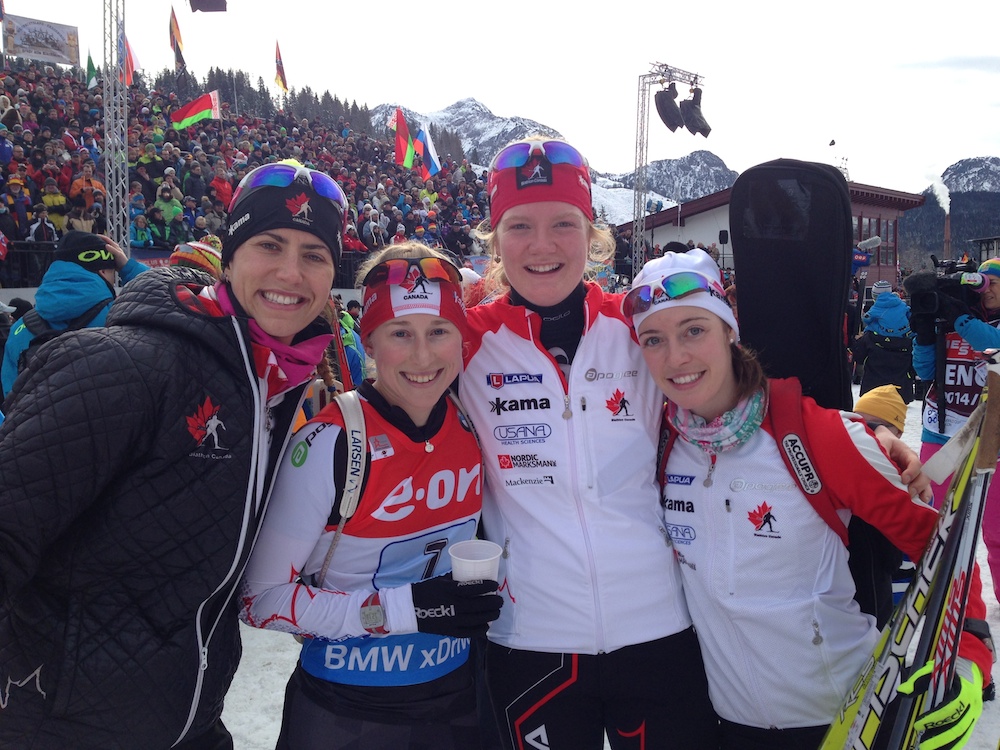
    The Canadian women's relay team after placing 11th on Saturday: (from left to right) Rosanna Crawford, Audrey Vaillancourt, Sarah Beaudry, and Megan Heinicke. (Photo: Rosanna Crawford)
    The Canadian women’s relay team after placing 11th on Saturday: (from left to right) Rosanna Crawford, Audrey Vaillancourt, Sarah Beaudry, and Megan Heinicke. (Photo: Rosanna Crawford)

    The Canadians finished 11th overall (0+7), 2:11.1 behind Germany. They were 16th at the end of Megan Heinicke’s first leg, after she cleaned prone and missed three standing.

    “I wasn’t feeling particularly snappy but I have been recovering from a cold since last Saturday so I am hoping for a bit more explosiveness next week,” Heinicke explained in an email.

    While she was “happy and motivated” by her prone stage, which put her in seventh, Heinicke added that she was surprised by her standing.

    “I didn’t feel like I had pushed very hard during the 2nd loop so I was pretty surprised when my left leg was shaky during standing,” she explained. “I have often struggled with standing in the last 2 seasons but rarely because of shaky legs! There was definitely that element of slight panic at needing to use all 3 spares and a fierce determination to hit then. I admit, I was relieved to bypass the penalty loop. My goal on the last loop was simply to giver and try to catch 1 or 2 of the girls ahead of me.”

    She moved up one spot from 17th to 16th, tagging teammate Rosanna Crawford 52 seconds back from Italy in first.

    “I knew that with some good quick shooting on the range that you can move up a lot in a relay,” Crawford explained, adding that she didn’t think about shooting right away. “You don’t want to start thinking about shooting as soon as you start a race or that’ll put too much pressure on yourself. So I focused on my skiing and switched to shooting when I was getting closer to the range. My skis were really good today, which always makes for a fun race, because you just feel like you’re flying!”

    With clean shooting on both stages, she left the range in 12th after prone and sixth after standing. She recorded the fastest shooting for her leg.

    “I just took it one shot at a time never getting ahead of myself,” Crawford wrote. “Things can go wrong quickly in a biathlon races if you start thinking about the 5th shot when you’re only on the 1st!”

    She handed off to 20-year-old Sarah Beaudry, who was in her first World Cup relay and second-ever World Cup race, in sixth. In an email, Beaudry explained that she simply wanted to hit her targets and ski fast.

    After cleaning prone, she was up to fourth.

    “Moving up to fourth wasn’t really part of any plan, it was more just a result of my good prone shooting,” Beaudry wrote. “For my prone I just came in really relaxed and my focus was to watch wind. Sometimes I am a little forgetful about wind so I think having that focus helped me stay calm.”

    Fortunately for the women’s and men’s races on Saturday, there wasn’t much wind to speak of.

    Beaudry tried to stay calm as she approached her standing stage, but after hitting her first two targets, she got “a little too excited” and ended up missing the last three, she explained.

    “Then I was just trying hard to avoid the penalty loop with my spares,” she added. She avoided it, tagging Audrey Vaillancourt in 12th, 1:09.4 back.

    “Today I was going to give everything I had no matter what place I was tagged in, and this is exactly what I did,” Vaillancourt wrote.

    With a single prone miss, Vaillancourt maintained her position in 12th. One lap later, she cleaned standing to improve to 11th.

    “I kept focused on trying to get closer to the other team, but I also knew there were some very strong women out there in the last leg,” she wrote.

    Slovenia’s Urska Poje was 15 seconds ahead of her in 10th heading into the final lap. Vaillancourt ended up finishing 18 seconds behind in 11th.

    “Overall I am very happy with my race, both on the skiing and shooting side. I have had a cold all week which affected my training and preparation a lot, but today I felt a lot better so I think I’m back on track,” Vaillancourt wrote.

    Crawford referred to her team’s 11th place, with zero penalties and seven spares, as a “decent result.”

    “We had two legs with some scary standing, but no penalty loops is great!” she wrote. “A few less spares and we could have been top 10. We were trying a different order today and it seemed like it worked out pretty well. Megan did a great job at the start of the race.”

    Later Saturday afternoon, the Canadian men tied a team-best sixth in the 4 x 7.5 k relay.

    “So excited for men’s team,” Crawford wrote. “They’ve had a bit of a bumpy start and not performing like they were hoping for. A top 6 is a great way to build some confidence into the rest of the season.”

    With three women on the World Cup circuit, the U.S. did not field a women’s relay.