From the FasterSkier archive — posts syndicated from athletes’ and coaches’ own blogs between 2004 and 2012, kept online as published. Current coverage is at fasterskier.com.
After ten races in Östersund, Sweden, where the U.S. Biathlon Team saw personal best finishes, strong ski times and solid shooting performances, the team will now make the trip to Hochfilzen, Austria, where the three-day weekend will feature a sprint, pursuit and a pair of relays.
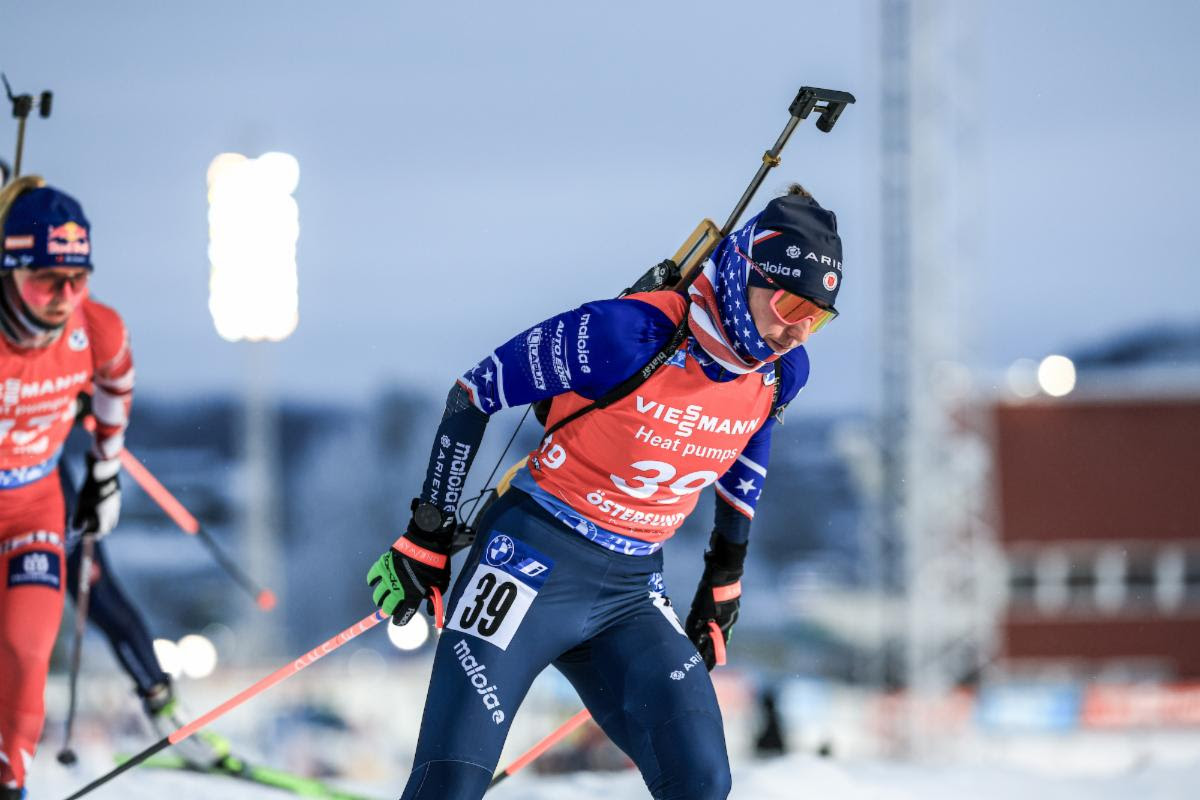
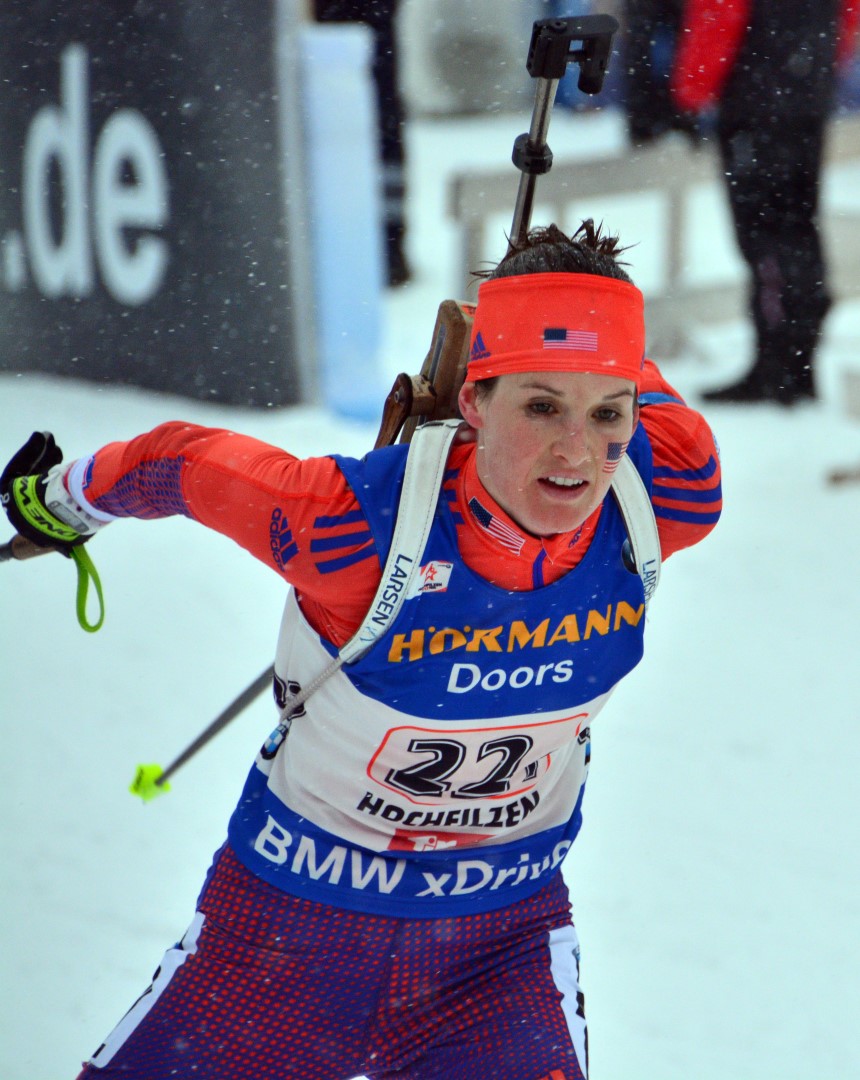
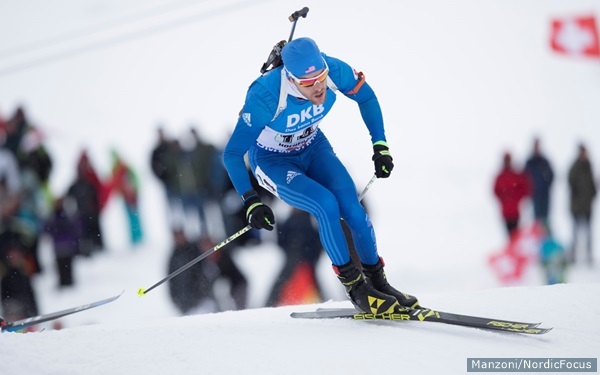
Deedra Irwin (USA) – IBU World Cup Biathlon, pursuit women, Oestersund, Sweden. (Photo: Manzoni/NordicFocus)
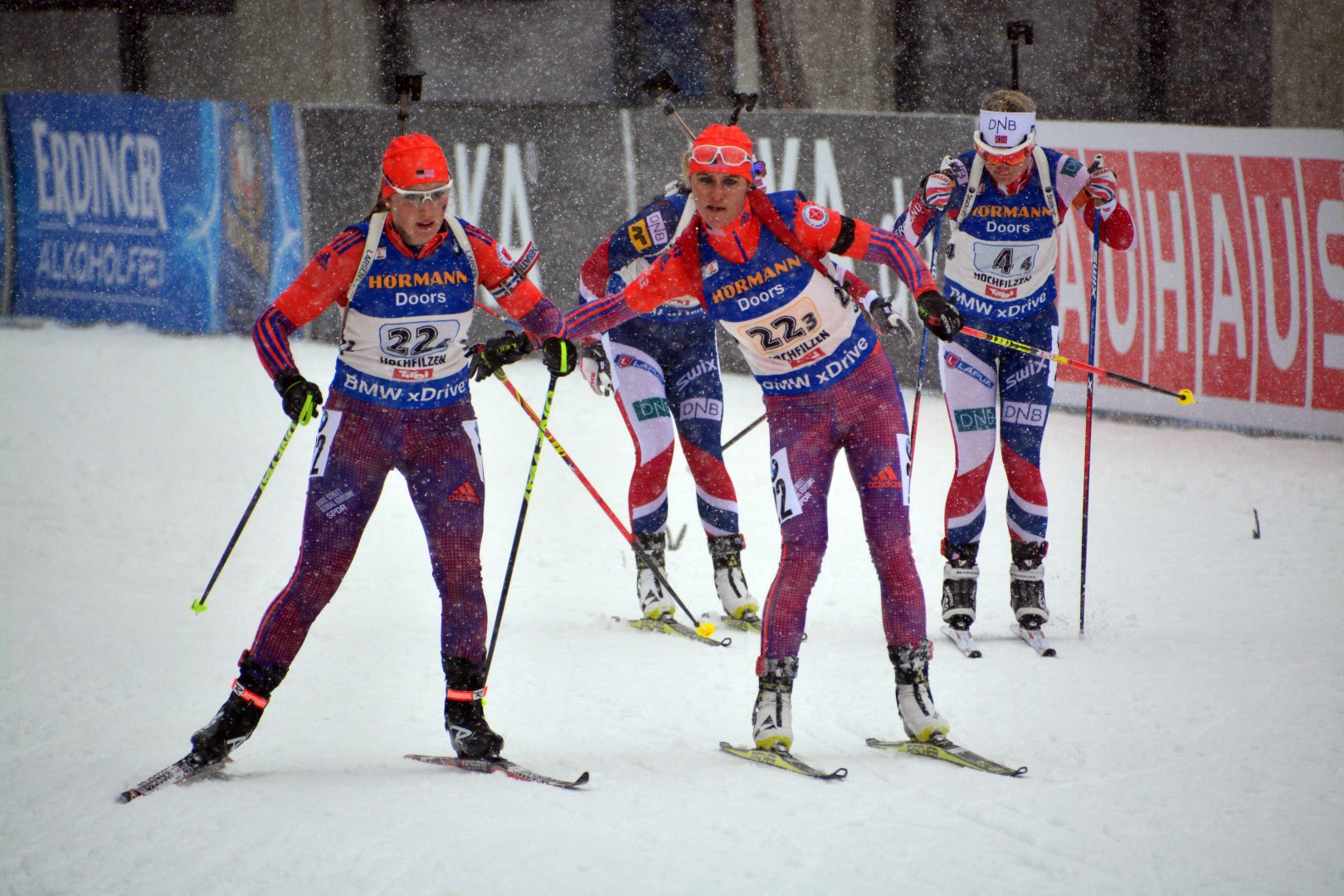
Racing in Östersund kicked off with a strong performance from Deedra Irwin (Pulaski, WI/Army World Class Athlete Program) and Sean Doherty (Center Conway, NH/National Guard Biathlon) to finish eighth in the single mixed relay only +1.10.9 behind the lead. Kelsey Dickinson (Winthrop, WA/Craftsbury Green Racing Project), Margie Freed (Apple Valley, MN/Craftsbury Green Racing Project), Jake Brown (Saint Paul, MN/Craftsbury Green Racing Project) and Maxime Germain (Chamonix-Mont Blanc, FRA/National Guard Biathlon) followed suit with a 14th-place finish in the mixed relay, Freed’s first World Cup start.
Dickinson carried the momentum into day two, crossing the line with a career-best 36th in the women’s 15km individual, missing only one target on her last round of shooting.
“It was really cool to have a huge personal best and score my first World Cup points in the first weekend of racing,” said Kelsey Dickinson. “I’m really grateful to all the coaches, staff, and wax technicians that made it possible. It feels good to have a result that shows improvement over last year.”
Jackie Garso (Lake Clear, NY/Craftsbury Green Racing Project), Irwin, Dickinson and Freed began the day of relays with another 14th-place finish for Team USA. Doherty, Germain, Brown and Wright, who raced in his first-ever relay, landed in 15th. Germain had a stellar performance, only +10.0 behind the lead in third place after his leg of the race.
Joining the World Cup for week two is Grace Castonguay (Jackson, NH/Ethan Allen Biathlon Club), who was brought up to fill the vacant spot on the women’s team as Margie Freed (Apple Valley, MN/Craftsbury Green Racing Project) is traveling back to the US to compete in cross-country skiing. In Kontiolahti, Castonguay had the top ski time for the US women in the individual as well as a ninth-place finish in the single mixed relay. This will be her first World Cup appearance.
Vincent Bonacci (Salt Lake City, UT/Team Crosscut) will also race on the World Cup for week two as Campbell Wright (Wanaka, NZL/U.S. Biathlon) will not be competing in Hochfilzen. Bonacci showed his strength in Kontiolahti with a personal-best sixth place in the individual and ninth in the single mixed relay with Castonguay.
“After a personal best, and the second fastest ski time in the relay, it is exciting to head down to Hochfilzen carrying momentum,” said Bonacci, “Racing in the mountains and the sun will be a welcome change from the darkness of Scandinavia.”
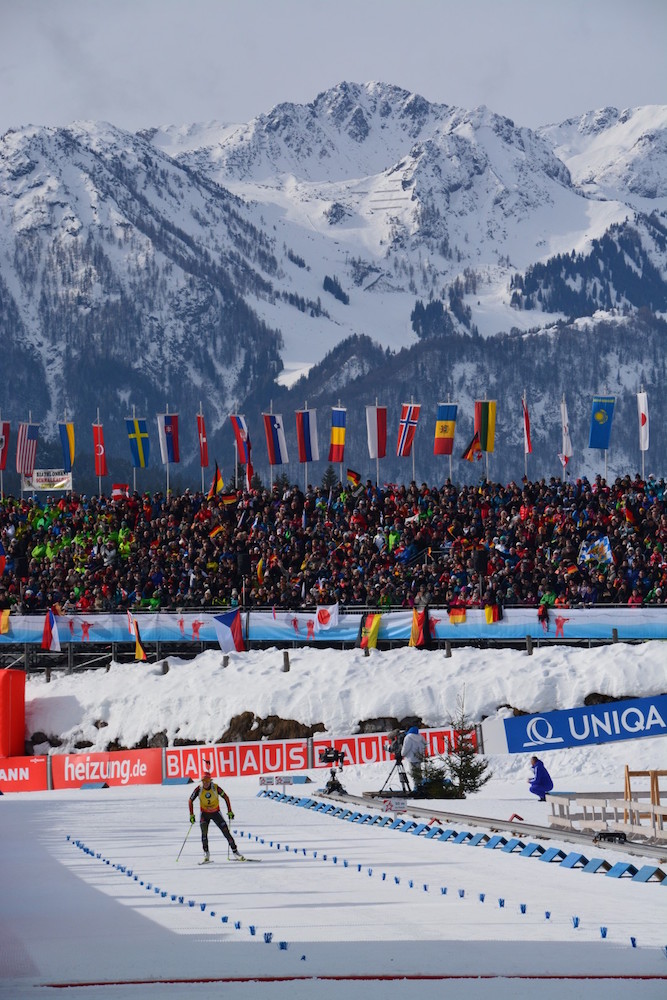
The venue at Hochfilzen will be a change from Östersund, with the Austrian Alps providing a stunning backdrop for the races. With a long, hard climb near the end of the lap, athletes will need to pay close attention to pacing to ensure accuracy in the range after pushing at their limit, making for an exciting weekend of racing. Live streams can be found at eurovisionsports.tv/ibu/. Spectator resources for the season can be found at usbiathlon.org/spectator-resources.
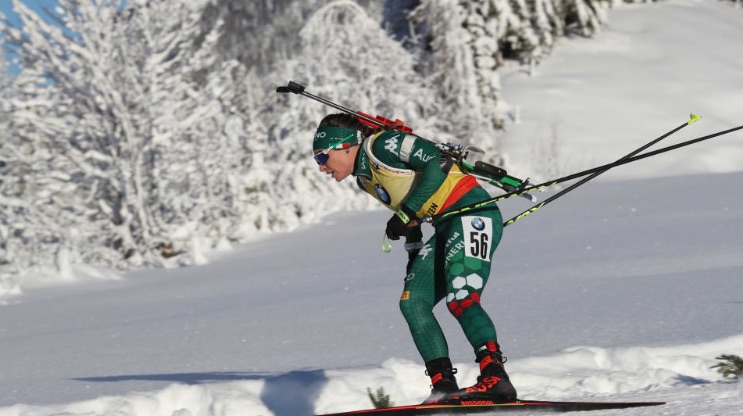
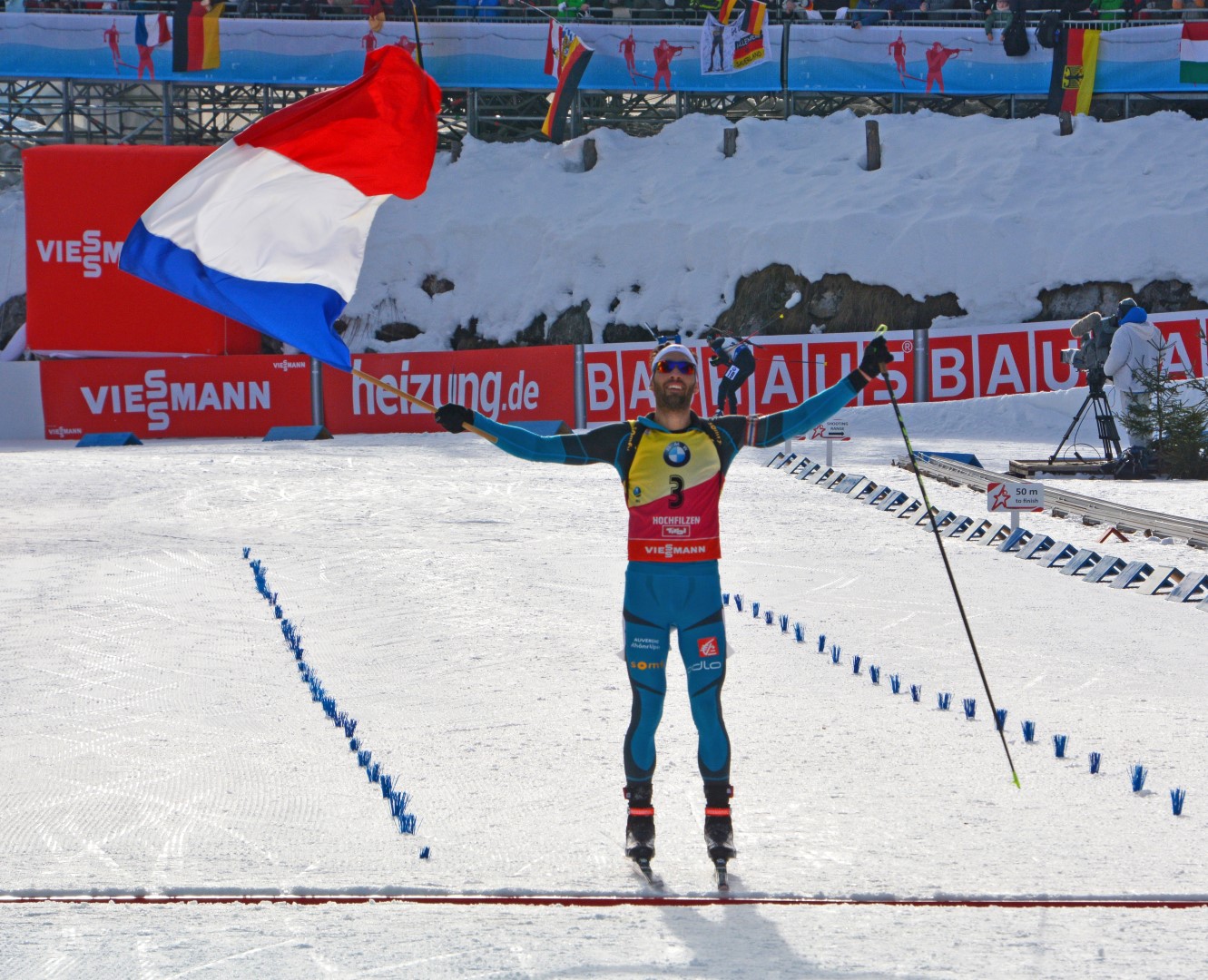
Dorothea Wierer of Italy won Thursday’s sprint in Hochfilzen, Austria in a time of 21:04.9 minutes. (photo: biathlonworld.com)
Today in Hochfilzen, Austria, Dorothea Wierer of Italy won the sprint in a time of 21:04.9 minutes. Wierer missed one shot standing for a single penalty during the race. Kaisa Mäkäräinen of Finland was close behind in second, 0.6 seconds back. Mäkäräinen also had one missed target standing. Third place went to Russia’s Ekaterina Yurlova-Percht, finishing 24.4 seconds behind. Yurlova-Percht short clean in the race.
Susan Dunklee was the best placed American in 34th (+1:33.0, 0+2). Joanne Reid was 44th (+1:48.3, 0+1), and Clare Egan 65th (+2:22.1, 2+2).
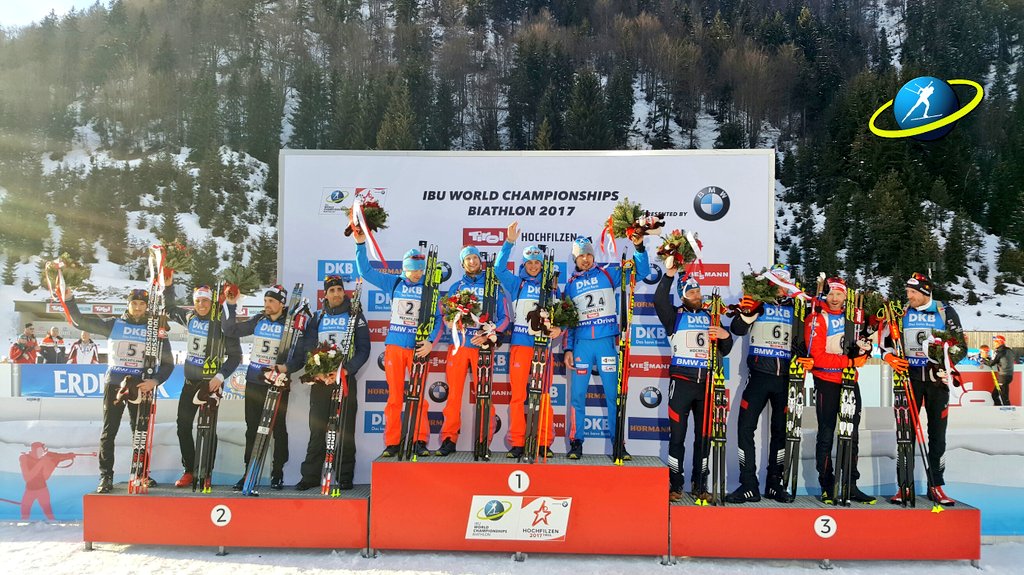
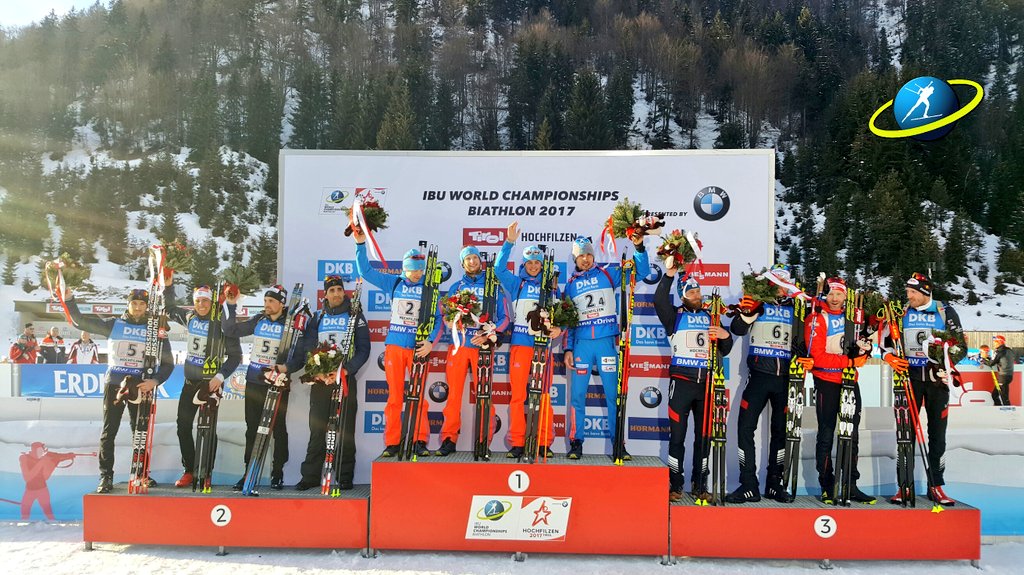
On the non-racing front, the IBU released a statement about “Austrian state authorities” investigating five Russian biathlon officials and five biathletes due to their connections to doping. The IBU stated that the possible infractions occurred during the 2017 Hochfilzen IBU World Championships.
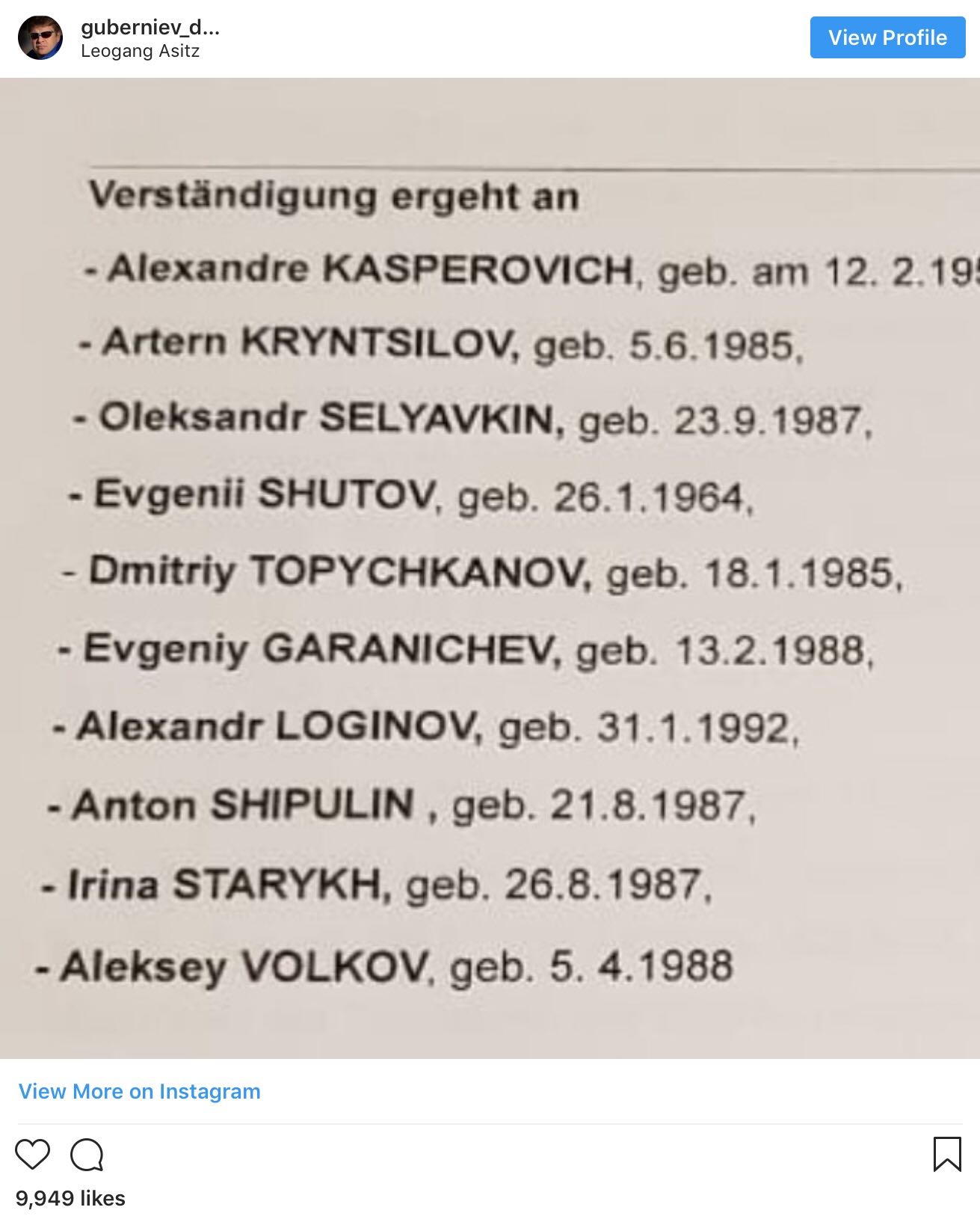
Russian sports journalist Dmitry Guberniev has posted the names of the individuals under investigation. According to tass.com, a Russian news site, Guberniev the following people: “Among athletes accused of violating anti-doping rules are 2014 Olympic champion Anton Shipulin, Evgeny Garanichev and Alexander Loginov. The list also includes biathletes Alexey Volkov, Irina Starykh, former coach of the Russian national team Alexander Kasperovich, doctors and massage therapists Artyom Kryntsilov, Alexander Selyavkin, Evgeny Shutov and Dmitry Topychkanov,” tass.com reported.
List of people under investigation according to Russian journalist Dimitri Guberniev (Screenshot from @guberniev_dmitry)
FasterSkier will post updates about this developing story as more information is discovered
– Harald Zimmer contributed
***
NorAm and U23/JW World Championships Qualification, Canmore, Alberta
The Canadian NorAm series continued Thursday in Canmore, Alberta, with a combined NorAm and trials for U23 and Junior World Championships.
The three race weekend kicked off with classic sprints, run from the biathlon stadium which offers an uphill finish in place of the traditional long descent into the finish straight.
The selection criteria are involved, but it appears that each day four athletes will earn a spot in U23/JW World Championships in Lahti, Finland. The top athlete of each gender in U23 and junior each day should be automatically selected.
There are also World Cup period 2 (Tour de Ski) and period 3 starts on the line, with the possibility of Canadian women in the Tour de Ski for the first time since Sara Renner finished 16th in 2010.
Dahria Beatty (CNST) won the open women’s category in style, winning the qualifier in 3:51.06 by 4.96 seconds before winning all three heats by large margins.
Katherine Stewart-Jones (CNST) finished second in the A final in 3:49.60, 2.20 seconds behind Beatty after finishing second in the qualifier and winning her earlier heats. Maya MacIsaac-Jones (CNST) completed the podium, finishing 5.37 back.
Marie Corriveau was the top U23, finishing 6th in the A final after qualifying in 6th. Corriveau has struggled with results for two seasons, but her first race of the season is a very positive sign.
Anne-Marie Petitclerc (Mont Sainte Anne) won the qualifier and quarterfinal on her way to the junior win in 4:01.71. Molly Miller (Black Jack) was second at 0.68 seconds back and Anna Pryce (Foothills) took third at 7.25 seconds.
Bob Thompson (TBay) won the men’s A final in 3:19.43 by 2.31 seconds. Angus Foster (TBay) outstretched top qualifier Julien Locke (CNST) by 0.01 seconds for second. Graham Ritchie (Big Thunder) was the top U23 in 4th, 2.36 back after qualifying 6th.
Remi Drolet (Black Jack) won the junior A final in 3:31.94, after winning the qualifier and all his heats. Foothills teammates Tom Stephen and Xavier McKeever were second and third, 2.08 and 2.51 seconds back respectively. Stephen has two future seasons as a junior while McKeever has three.
All results, including live timing for the rest of the weekend.
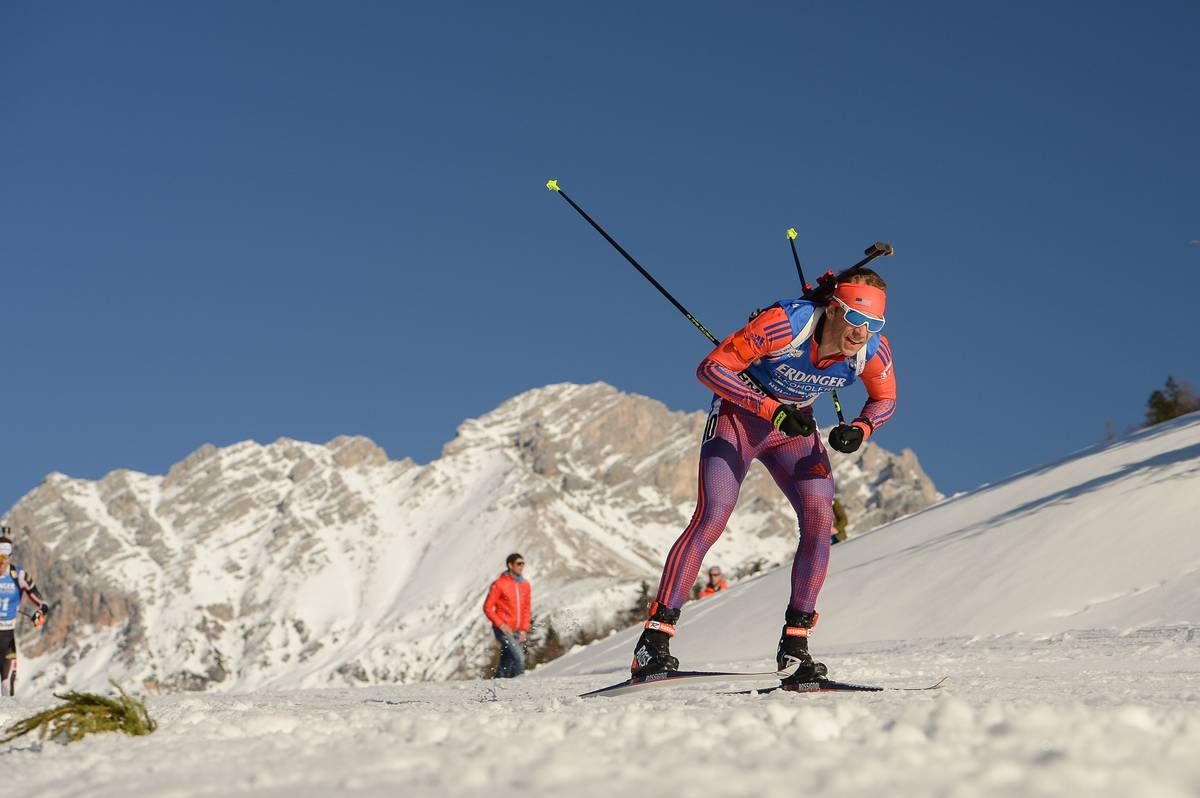
Leif Nordgren (US Biathlon) skiing the second leg of the IBU World Cup men’s 4 x 7.5 k relay on Sunday in Hochfilzen, Austria. The U.S. men ended up ninth overall out of 26 teams. (Photo: IBU/NordicFocus)
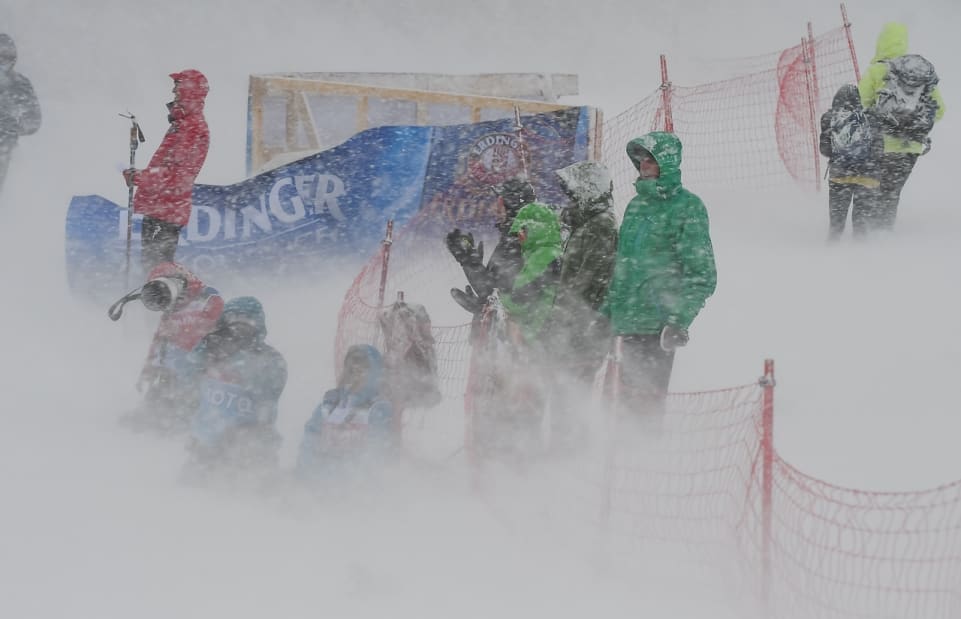
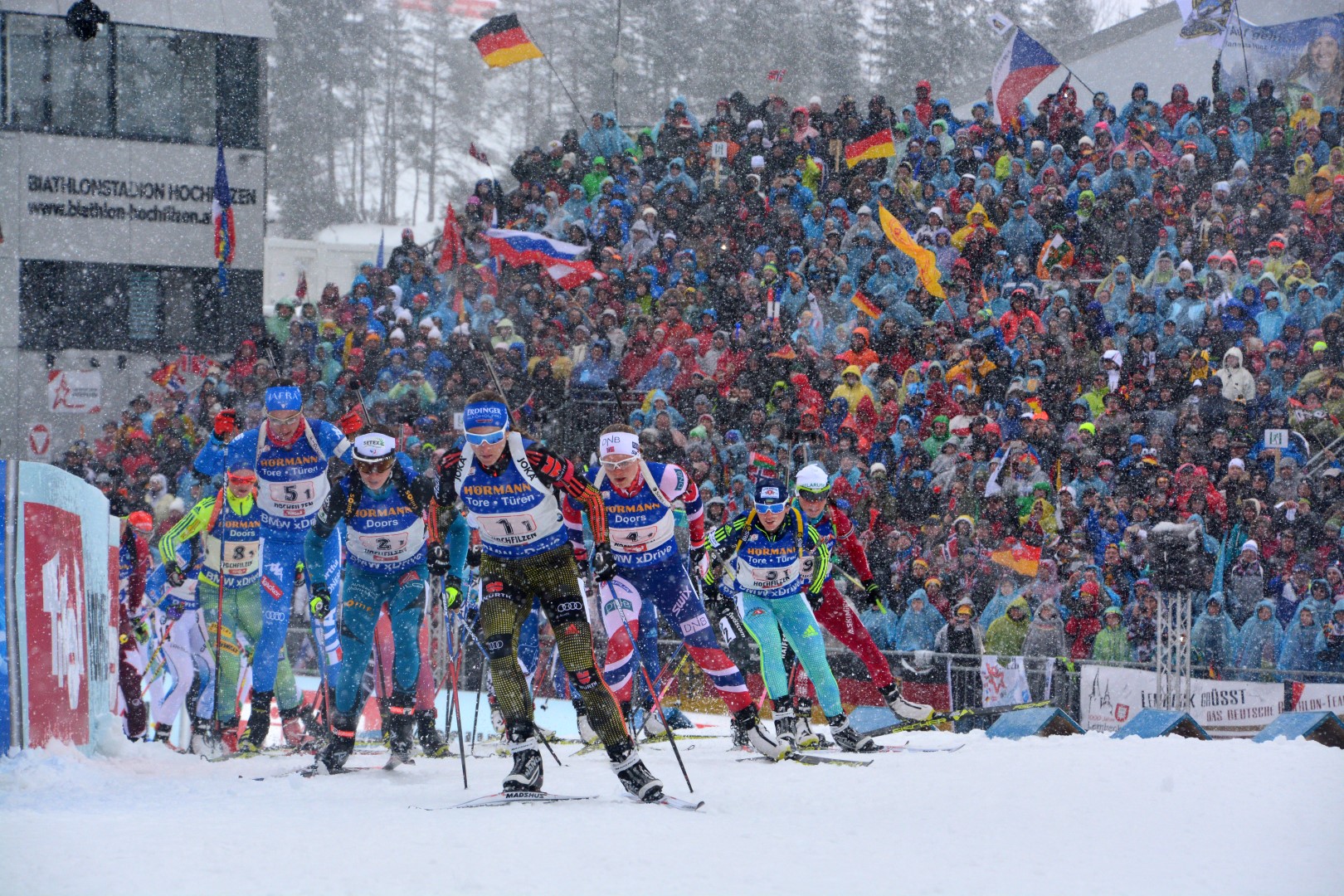
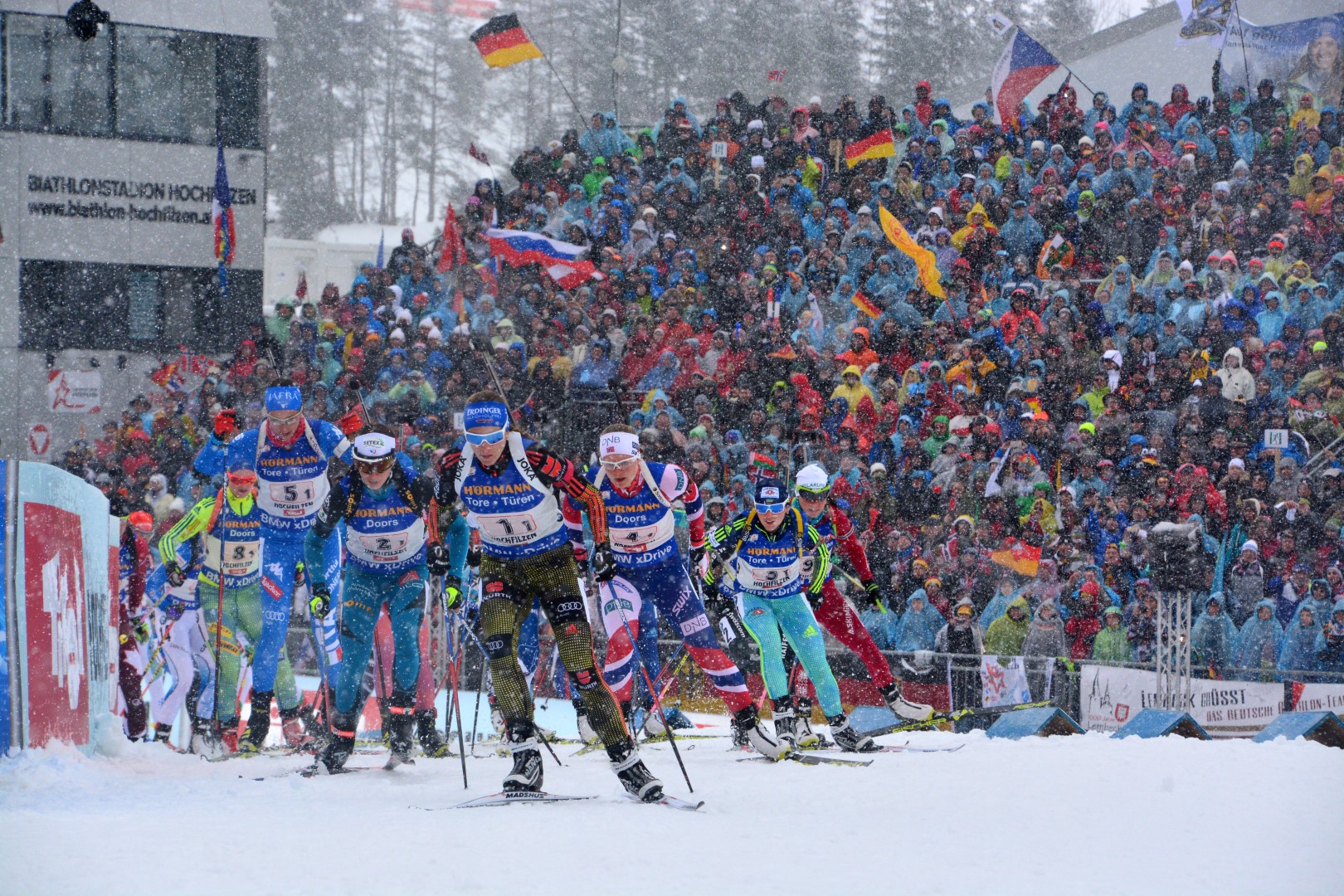
Strong gusts of wind on the range required strong nerves and a lot of luck in the women’s and men’s relay races that concluded the International Biathlon Union (IBU) World Cup in Hochfilzen, Austria, on Sunday afternoon.
While the relays concluded with teams on the podium one might expect there, tempestuous weather conditions that at times made it almost impossible to hit the targets also gave outsiders a good chance, and both the U.S. men and Canadian women remained in contention for a long time. The men’s 4 x 7-5-kilometer relay was particularly wild with more than 100 penalty laps, and it began with a big surprise.
Belgium’s starter Michael Rösch tagged off in first place for the first time in the history of that team, representing a country that until now, rarely had enough athletes for a relay and had thus far had a 24th place at the 2016 World Championships to its credit. And on his tails was Norway’s Ole Einar Bjørndalen, and shortly behind them US Biathlon’s Lowell Bailey in third.
The three aforementioned athletes all raced in the Olympic relay more than a decade ago at the 2006 Winter Games in Torino, Italy, but back then Rösch raced for Germany and won gold with his team.
“I wanted to tag off in first at all costs, to see the Belgian flag at the top,” Rösch told TV broadcaster ARD on Sunday while the race was still going on. “But Ole made it really hard for me. … I was on my last fumes, I tumbled into the finish, I was just seeing black, but it definitely was worth it.”
Just a turn behind, Bailey had gotten off to a strong start for the U.S. team, temporarily taking the lead out of the arena on the first lap before shooting clean in his prone stage to put himself in the lead group of seven. Facing strong wind in his standing stage, Bailey missed two targets but avoided the penalty lap with his last spare in that stage (0+0, 0+3), and tagged off to teammate Leif Nordgren in third position, 23.8 seconds out of first.
Nordgren ended up with a penalty in his first prone after missing two targets, and returned to the course in fifth. While his penalty had increased the gap to first by 50 seconds, Nordgren made up a few seconds with a clean standing bout, hitting all targets without requiring a spare (1+3, 0+0).
Italy and France passed him on the final loop, and Nordgren handed off in seventh, 1:34.2 minutes behind Norway setting the pace up front.
“The team came pretty close to a good result today in a relay with nasty weather,” Nordgren wrote on his Instagram account. “Personally I’m quite disappointed with my skiing, it’s been a struggle to find the top gears so far this season and I’m far from where I know I should be. It’s a long season though and there is still plenty of time to turn it around.”
US Biathlon’s Tim Burke loading a spare in his prone stage of the men’s relay at the 2017/2018 IBU World Cup in Hochfilzen, Austria. The team went on to finish 9th. (Screenshot: ARD broadcast)
Taking over next for the U.S. was Tim Burke, who pointed out this was one of the most challenging races in terms of wind that he’d experienced.
“This was definitely one [of the] windiest races that I have taken part in,” Burke wrote in an email to FasterSkier. “We knew it would be very challenging right from the start but our team tried to look at it as an opportunity for a top result. I feel like our team did a great job at avoiding any big disasters on the range and this allowed us to stay near the front for most of the race.”
After only needing one spare in his prone shooting to hit his last target, Burke incurred a penalty in his standing stage (0+1, 1+3), but kept his position on the final loop in a hard race against Switzerland’s Jeremy Finello to exchange still in seventh, now another minute back (+2:49.4).
“I was not surprised to see a mix of different teams near the front today,” Burke wrote. “It was one of those days that any team could find themselves with multiple penalty loops after a windy shooting stage.“
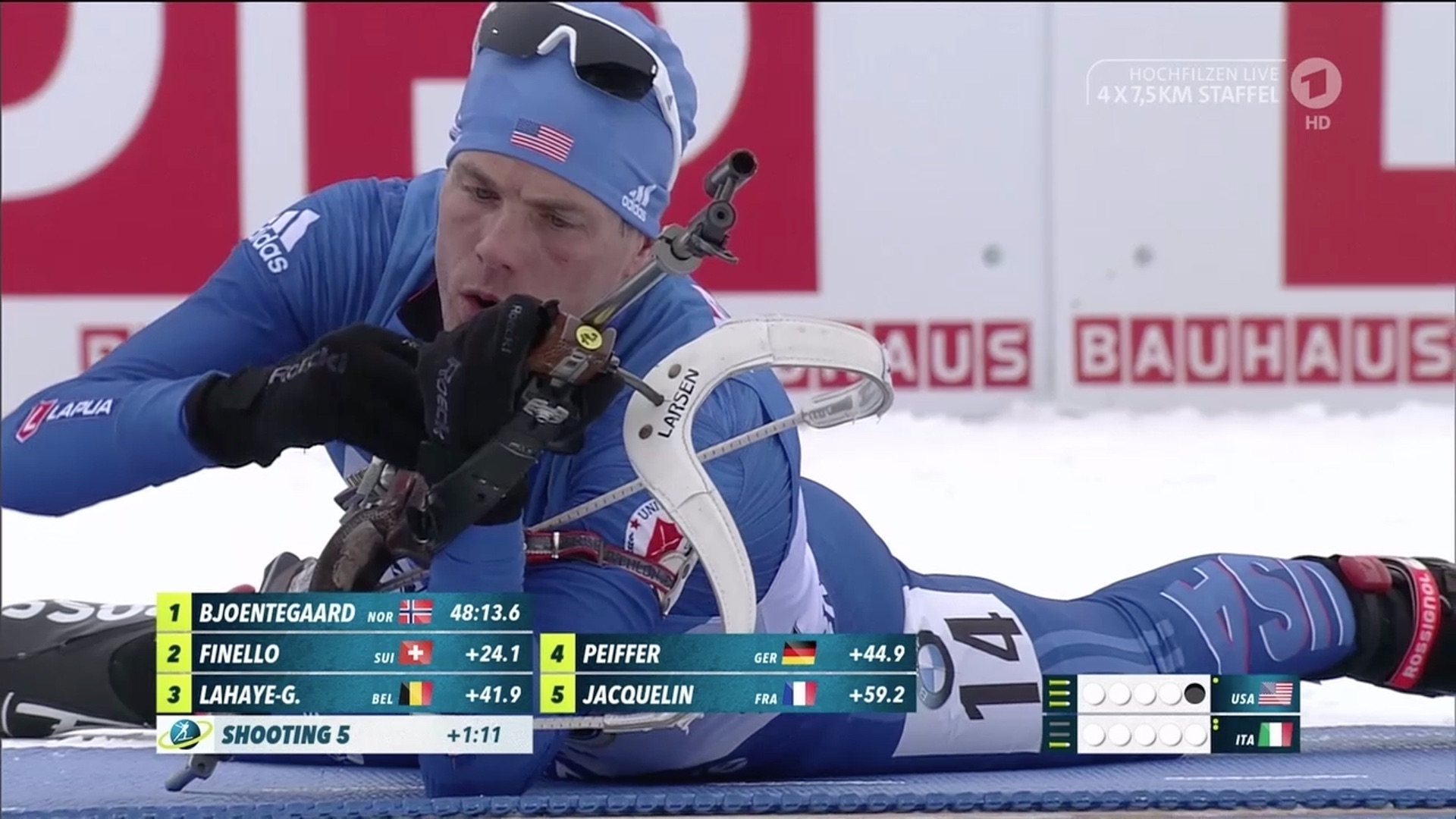
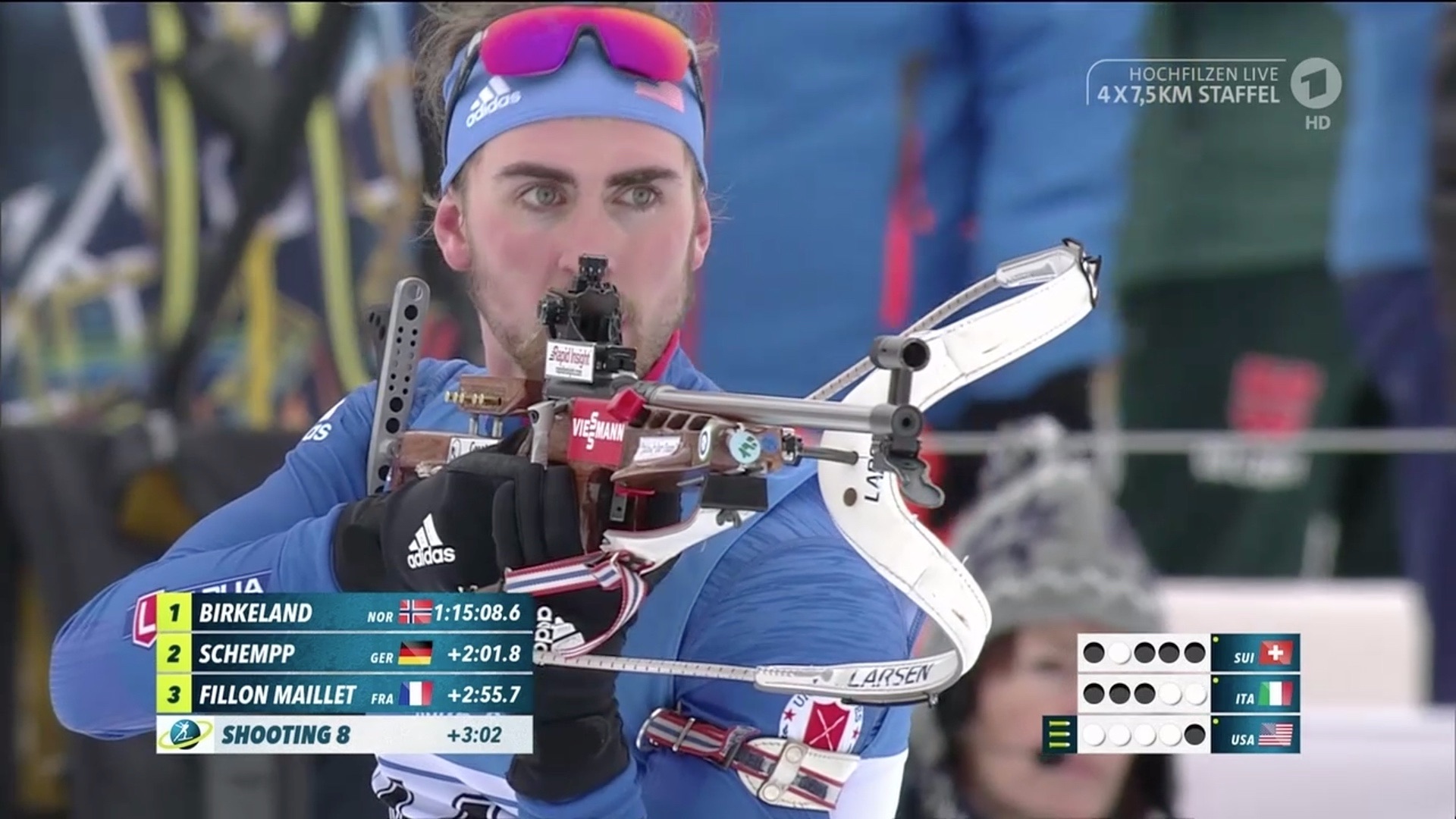
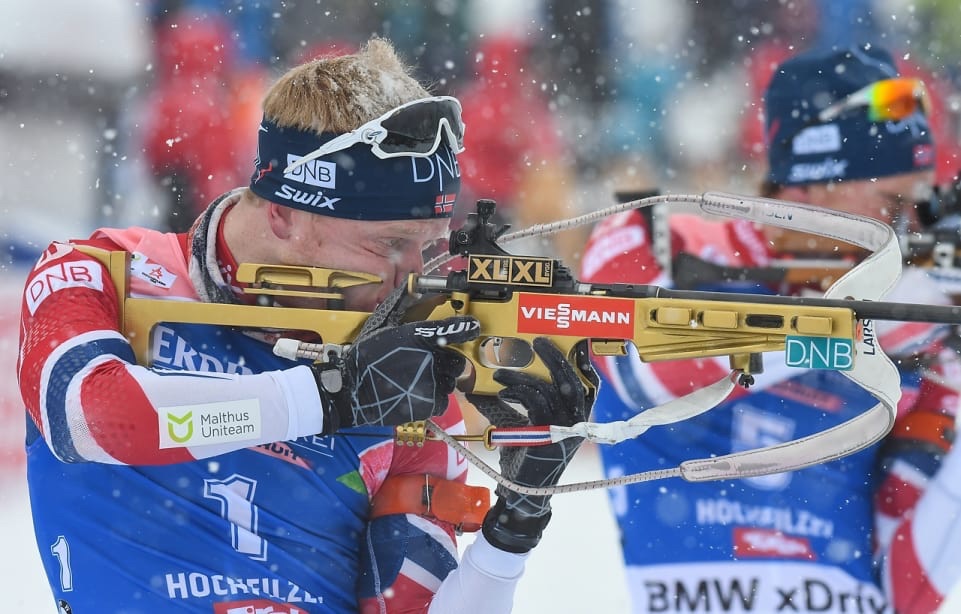
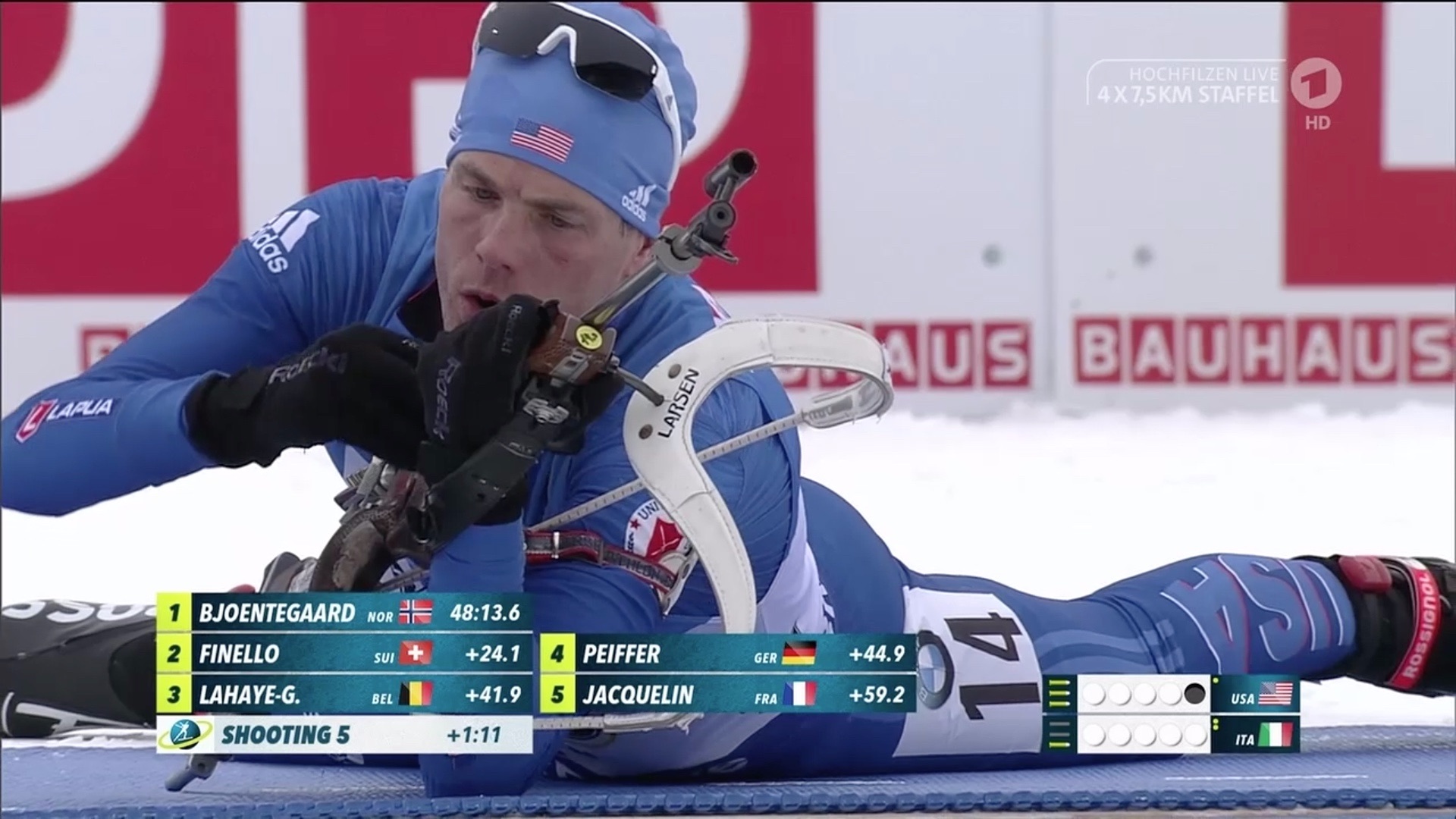
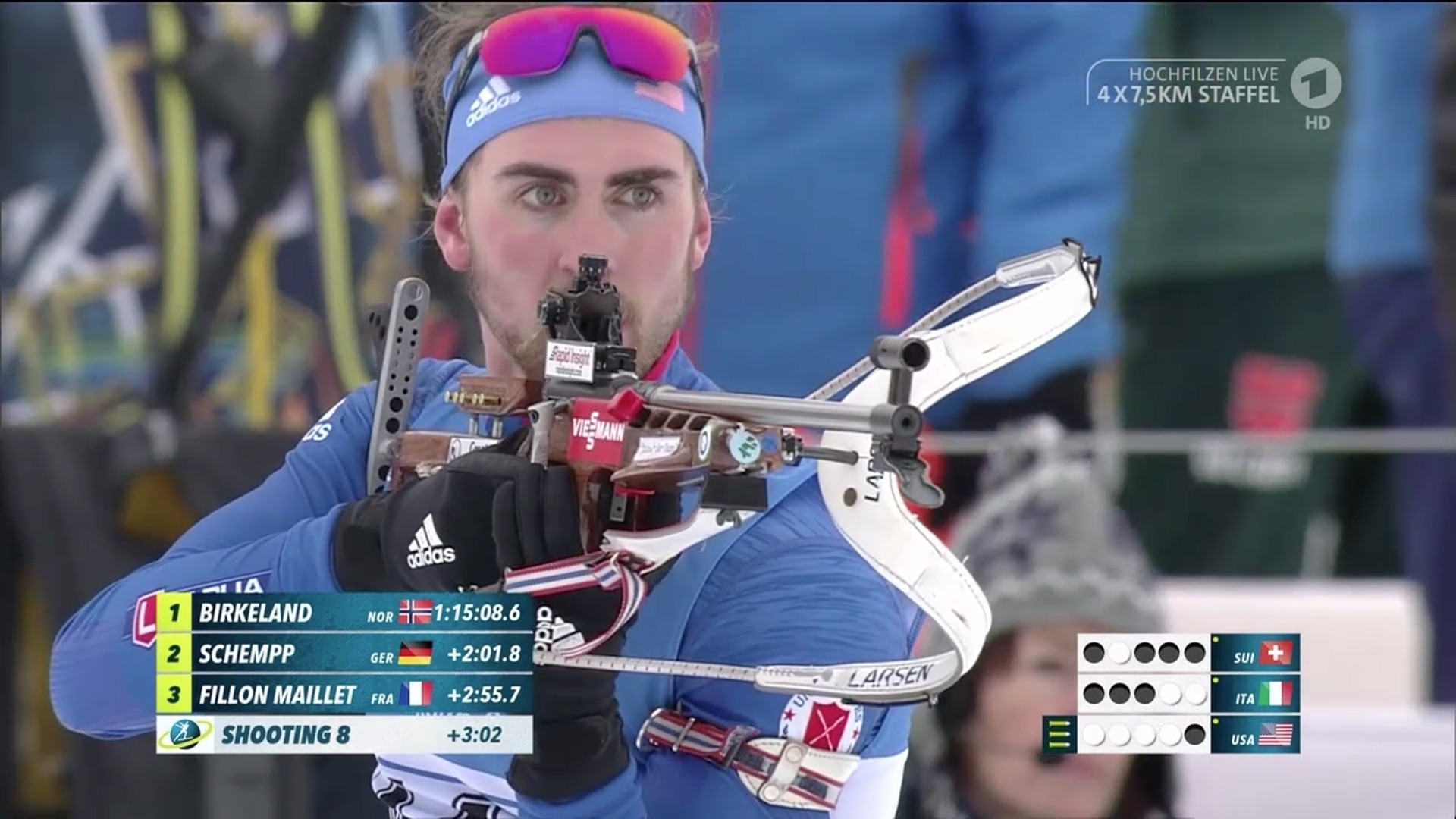
Taking over from Burke as the U.S. anchor leg was Sean Doherty, coming off two strong shooting performances in the sprint and pursuit earlier this week.
U.S. relay anchor Sean Doherty taking aim in difficult wind conditions during his standing stage of the men’s relay at the 2017/2018 IBU World Cup in Hochfilzen, Austria. His team finished ninth. (Screenshot: ARD broadcast)
In his prone stage, Doherty again shot clean and fast (with the second-fastest prone shooting time on his leg) and overtook Switzerland to move into sixth. He kept that position on the course, vying for a position in the top five with the teams from France, Italy, Ukraine, and Russia also in his vicinity.
“Today was a crazy one for sure,” Doherty wrote in an email. “The conditions on the course were decent, firm tracks and we had good skis. The wind was whipping, so that really just made some sections a lot harder than normal when you added in the head wind. I have done races in bad weather before but today was amongst the most windy.
In the standing stage, Doherty hit his first four shots in another fast sequence before missing the last one. It looked as if he had thought that final shot was also a hit as he dropped his rifle slightly, but then realized he had to load spares. Unable to clear the last target, Doherty ended up with the team’s third penalty.
“With the shooting you try to get a general idea of how far the wind is pushing the shots and do the best you can,” Doherty explained. “It’s a total toss up and the finish order is just a ranking of who battled the wind the best and had most to least luck along the way.”
He set out on his last loop in eighth place with Ukraine’s Dmytro Pidruchnyi and Switzerland’s Mario Dolder right ahead of him, and Russia’s Anton Shipulin ten seconds behind.
“The fight on the last lap is always tough,” Doherty wrote. “Although I felt better today I was not able to hang with the two guys I left the range with. I was able to ski a good lap but not enough to hold off Anton.”
After Shipulin passed him up the big last climb, Doherty came to the finish in ninth position, 3:38.3 minutes behind the winners with a team total of three penalties and 13 spares.
“We were not too excited with the end result because we saw the potential was there for a top 5,” Burke concluded for the team. “We are also all far from our best on the tracks right now, but are hopeful that will come with more racing.”
Norway Successful with Its ‘Second Unit’
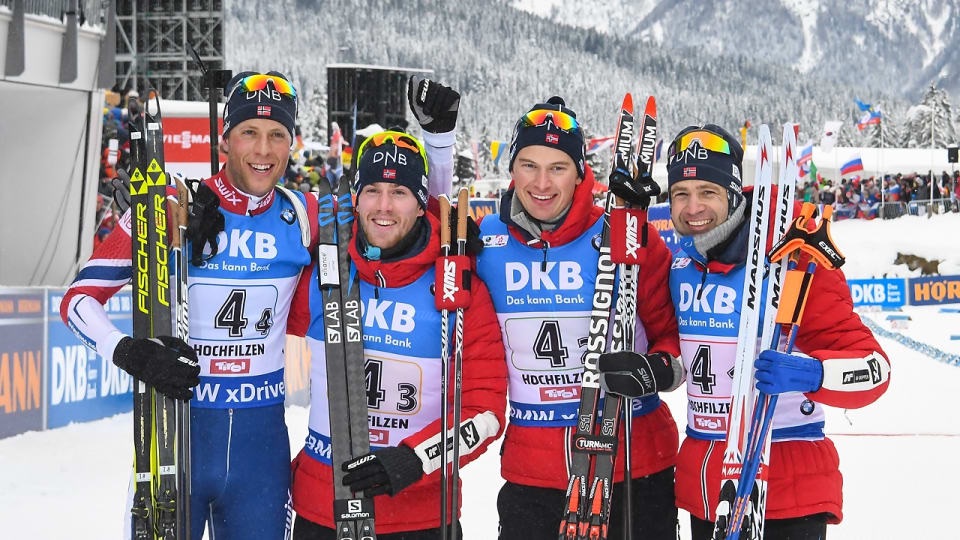
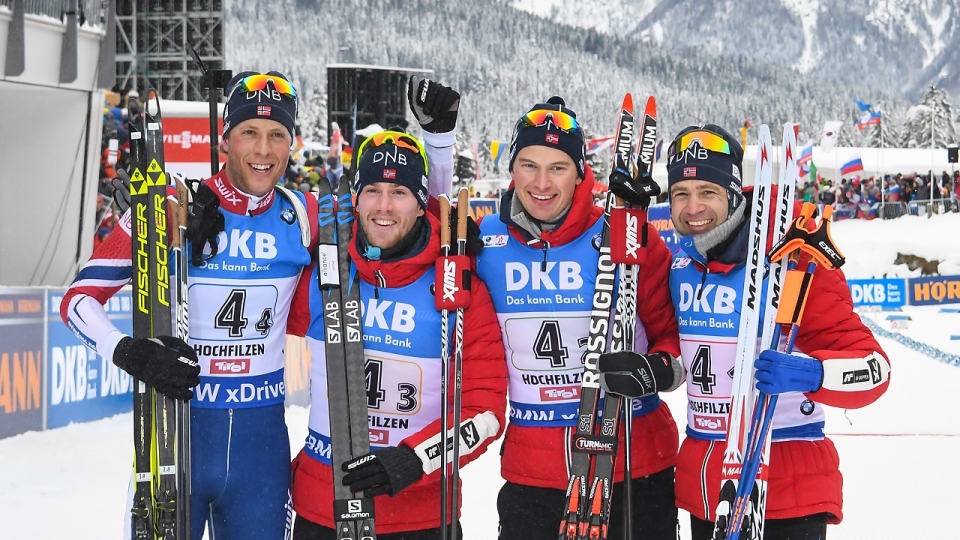
Norway’s Lars Helge Birkeland, Erlend Bjøntegaard, Henrik L’Abée-Lund and Ole Einar Bjørndalen (left to right) following their victory in the men’s relay at the 2017/2018 IBU World Cup in Hochfilzen, Austria. (Photo: IBU/Biathlonworld)
Norway started the men’s relay race without Emil Hegle Svendsen, who was sidelined with a cold, and also rested brothers Johannes Thingnes Bø and Tarjei Bø, both of whom had already won races this season.
But shooting was more important than skiing in a relay decided by strong crosswinds on the range, and that’s where the Norwegians coped by far the best. While Norway also required nine spares, which usually is a rather average performance in a relay, on Sunday this was the top shooting performance of the men’s relay.
After veteran Bjørndalen, Henrik L’Abée-Lund and Erlend Bjøntegaard had created a fairly comfortable lead of almost a minute on the first three legs, Lars Helge Birkeland anchored them to the victory by shooting clean in prone and only needing one spare to hit every target in his final stage despite some widely spread shots.
“It is really nice; a good start for Norway and good self confidence for the the rest of the season,” L’Abée-Lund said at the post-race press conference.
“It’s always fun to compete on the highest level with the best guys,” Bjøntegaard said. “I think I did pretty good on my leg today. It was tough conditions as it was for everyone else. I am just happy to show what I am capable of.”
“It feels great, it was an amazing feeling on the last loop, and really satisfied with my own leg,” Birkeland said. “I just decided to be offensive and attack and don’t think about the others and just do my own race. … We have a really strong team with a lot of good guys, so we don’t need to have all the best at the start to have a chance to win.”
All hopes for Germany’s Simon Schempp to contend with Birkeland for first were dashed when Schempp required three spares to clear both his prone and standing stages, narrowly avoiding the penalty lap twice.
Due to the huge distances between the top-three teams, the final loop was more of a cool down for their anchors, with Norway taking the win in 1:21:21.8 hours, just under two minutes ahead of Germany, with Erik Lesser, Benedikt Doll, Arnd Peiffer and Schempp, in second (+1:54.9, with zero penalties and 17 spares).
“At least we avoided the penalty loop, for me it was definitely close in standing,” Peiffer told German broadcaster ARD. “There was so much wind that it was impossible to shoot calmly and controlled. … It was clear that today there would be some upsets, like Belgium being in the mix in front. You just had to somehow avoid the penalty lap.”
“The last years in Hochfilzen we have never been on the podium, so it’s the first time in like six years we are back again,” Peiffer said at the press conference. “So that’s a good start for us because normally we are struggling here and we don’t know why.”
France, which had rested its star Martin Fourcade and started Jean-Guillaume Beatrix, Simon Desthieux, Emilien Jacquelin, and anchor Quentin Fillon Maillet, finished another 40 seconds later in third (+2:34.0, with three penalties and 13 spares).
Another 20 seconds back, Sweden with Peppe Femling, Jesper Nelin, Sebastian Samuelsson, and Fredrik Lindström crossed the line in fourth (+2:54.8, with three penalties and 12 spares).
“Today was very hard, very strange result, because when we look at all the penalties on the result list it was just crazy,” Beatrix said at the press conference. “I am satisfied for the team, and I am also really satisfied for the newcomer Emilien because it’s his first two weeks on the World Cup and first relay, and he did a every good job and brought us to the podium.”
“Today I was a little bit stressed, because the French guys are so strong and I had to be at their level, so I am happy to do a good relay today,” the 22-year-old Jacquelin said.
And what happened to the brave team from Belgium? With three athletes who had just made an overnight trip from an IBU Cup race in Lenzerheide, Switzerland, they came through the second exchange in second place after Florent Claude only needed one spare in standing. On the last two legs, however, three penalties for both Tom Lahaye-Goffart and Thierry Langer put them in 16th at the finish (+6:24.9) , which was still a team-best relay result for Belgium.
Just ahead of them in a finishing sprint anchored by Brendan Green was Biathlon Canada, with a lineup that earned bronze at the 2016 World Championships in Oslo, Norway. On Sunday, however, the Canadians’ race began with difficulties for brothers Christian Gow (1+3, 2+3) and Scott Gow (1+3, 2+ 3), each having to ski three penalty laps and exchanging in 21st position already 4:45.7 minutes back. Then Nathan Smith (0+0, 0+2) and Green (0+3, 0+3) were able to move them up a bit again, with Smith putting them as high as 13th by the final exchange and Green anchoring them to 15th (+6:22.5, with six penalties and 20 spares).
Of 26 teams in the men’s relay, Norway and Germany were the only ones that succesfully avoided the penalty lap.
Hochfilzen World Champs Women’s Podium Repeats
Later on Sunday afternoon in the women’s 4 x 6 k relay in slightly better conditions than the men’s race, last season’s reoccurring winner Germany struck gold again.
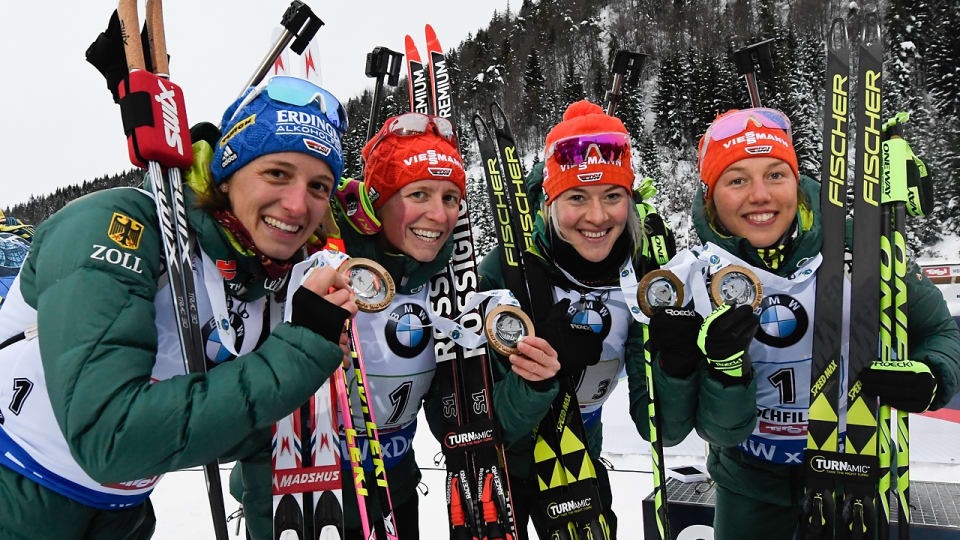
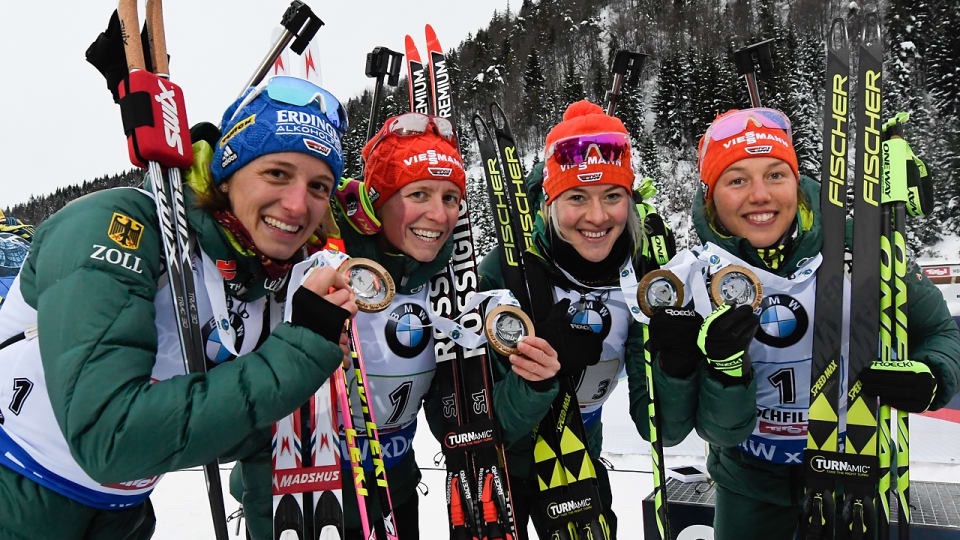
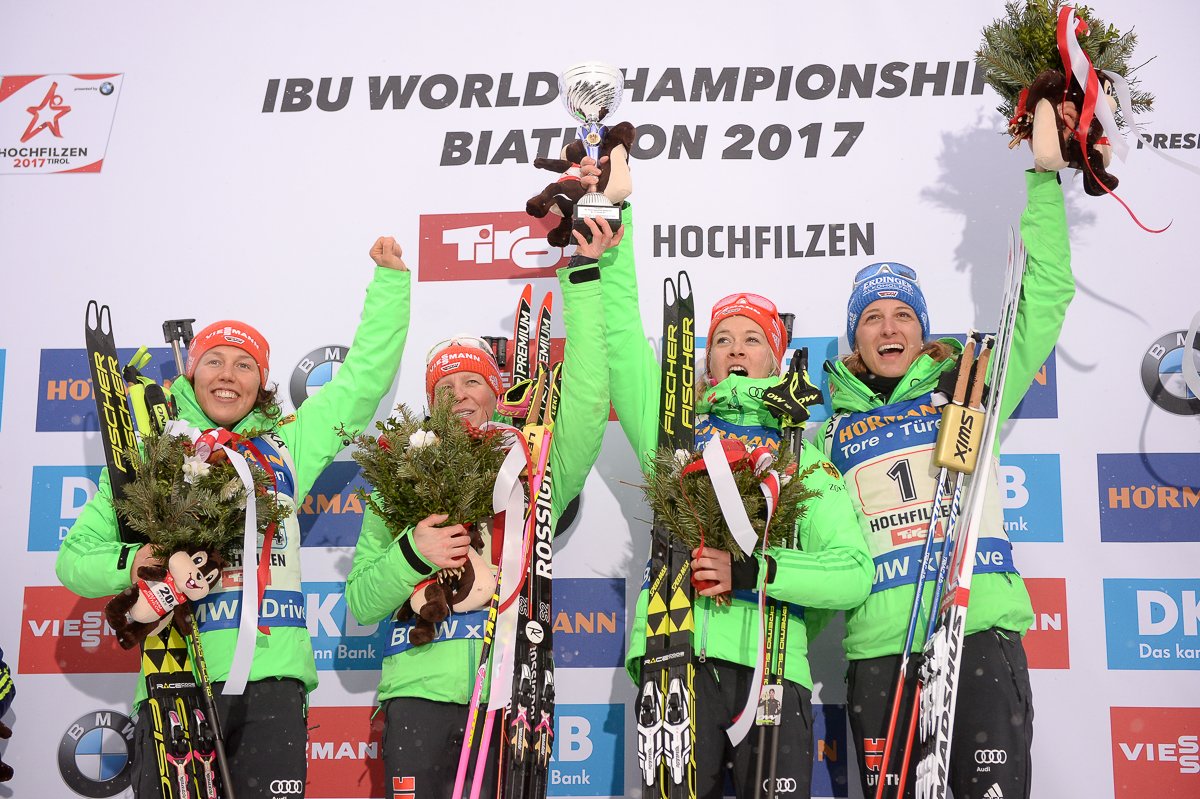
Germany with (left to right) Vanessa Hinz, Franziska Hildebrand, Maren Hammerschmidt and anchor Laura Dahlmeier shows off their medals following their victory in the women’s relay at the 2017/2018 IBU World Cup in Hochfilzen, Austria. (Photo: IBU/Biathlonworld)
The victorious world-champion quartet of Vanessa Hinz, Franziska Hildebrand, Maren Hammerschmidt,and Laura Dahlmeier won with a large lead ahead of Ukraine (+44.9) and France (+1:04.5). The first-, second- and third-place teams were a repeat of last season’s World Championships relay in Hochfilzen this past February.
Fighting for position with Ukraine and Switzerland on the third leg, Hammerschmidt got her team on the road to victory when she cleaned every target within 24 seconds despite difficult conditions to reclaim the lead, erasing the gap she had been handed of almost 30 seconds to first.
“For me it was very important to have a good standing shooting today, because the last two days were not so good,” Hammerschmidt said at the press conference. “I thought it was one of my best standing shootings, and I was so happy to go on the last loop and fight for every second to give to Laura.”
Dahlmeier returned to the World Cup after missing last week’s opening races with a cold, then had no major problems defending the lead. Dahlmeier used just one spare in each of her shooting stages, while Switzerland’s Irene Cadurisch as the closest pursuer had to ski a penalty lap. Germany finished in a time of 1:14:36.4, with zero penalties and nine spares.
“It’s a really cool feeling to be here again,” Dahlmeier said at the press conference. “Especially with the team. We know we can make a good race, but it’s important for every person to be good on the range and on the tracks. Relays are special races.”
“From the last year we have good memories about Hochfilzen … and today it was a good place, too,” Hildebrand said “I was really impressed with [Ukraine’s] Yulia Dzhima’s standing shooting, because she took all targets out while I used two extra bullets and was happy I could go out on the track again.”
Ukraine’s Olena Pidhrushna anchored her team, with Vita Semerenko, Yulia Dzhima and Valj Semerenko, to second (+44.9), thanks to the best team shooting performance of zero penalties and five spares, and despite a fall on the first leg by Vita Semerenko.
“I think our team spirit is very strong, without that we wouldn’t be on the podium, so I am very thankful to all the girls and our staff for making this happen,” Valj Semerenko said at the press conference, via a translator.
“My start this season was not so good … Actually today I was so nervous ahead of the relay,” Pidrushna explained. “But I saw that we had a little bit of extra time at the last exchange, and I calmed down a little bit and it worked well in the end. … And I think my team believes in me [to anchor it successfully].”
Twenty seconds behind her, France with Marie Dorin Habert, Celia Aymonier, Justine Braisaz and the current women’s World Cup leader Anaïs Bescond, passed Russia’s Ekaterina Yurlova-Percht on the final loop to claim third place (+1:04.5, with two penalties and 13 spares).
“Honestly at the beginning when I started I didn’t think a podium was still possible, but loop after loop I thought maybe I can still catch a podium [position],“ said Bescond, who skied the fastest course time on the final leg amidst strong competition.
A few seconds behind, Russia with Victoria Slivko, Tatiana Akimova, Irina Starykh, and Ekaterina Yurlova-Percht finished fourth (+1:09.0, with no penalty and nine spares).
Another 16 seconds back, Switzerland, with Elisa Gasparin, her older sister Selina Gasparin, Lena Häcki and Cadurisch finished fifth (+1:25.7, with two penalties and 12 spares) for Switzerland’s best women’s relay result, which fulfilled its national qualification criteria for the Olympics.
Canada in Contention
For Biathlon Canada, Emma Lunder started off the race in the middle of the field, and managed hit all her targets with one spare in her prone stage to leave the range in 16th position.
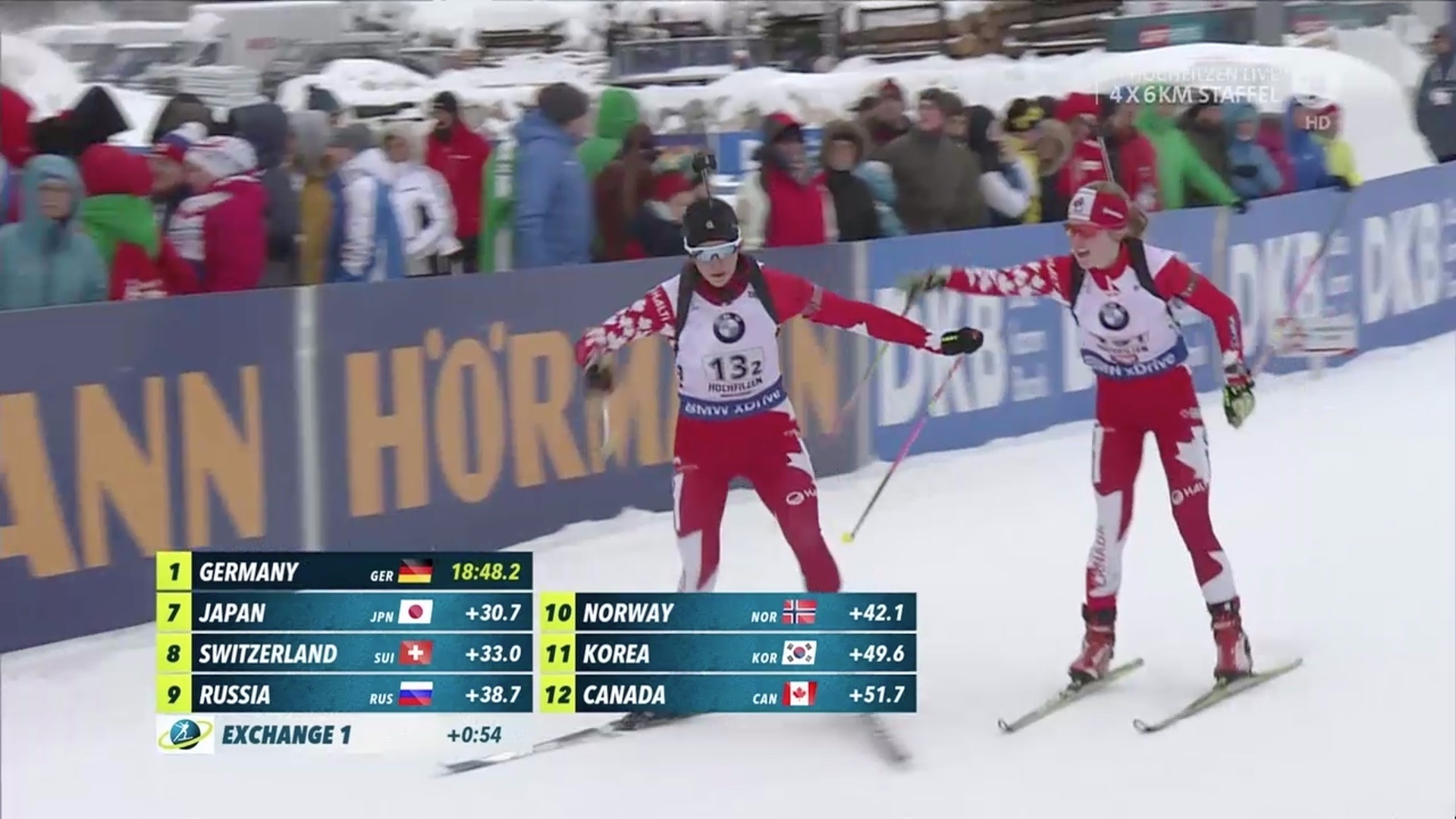
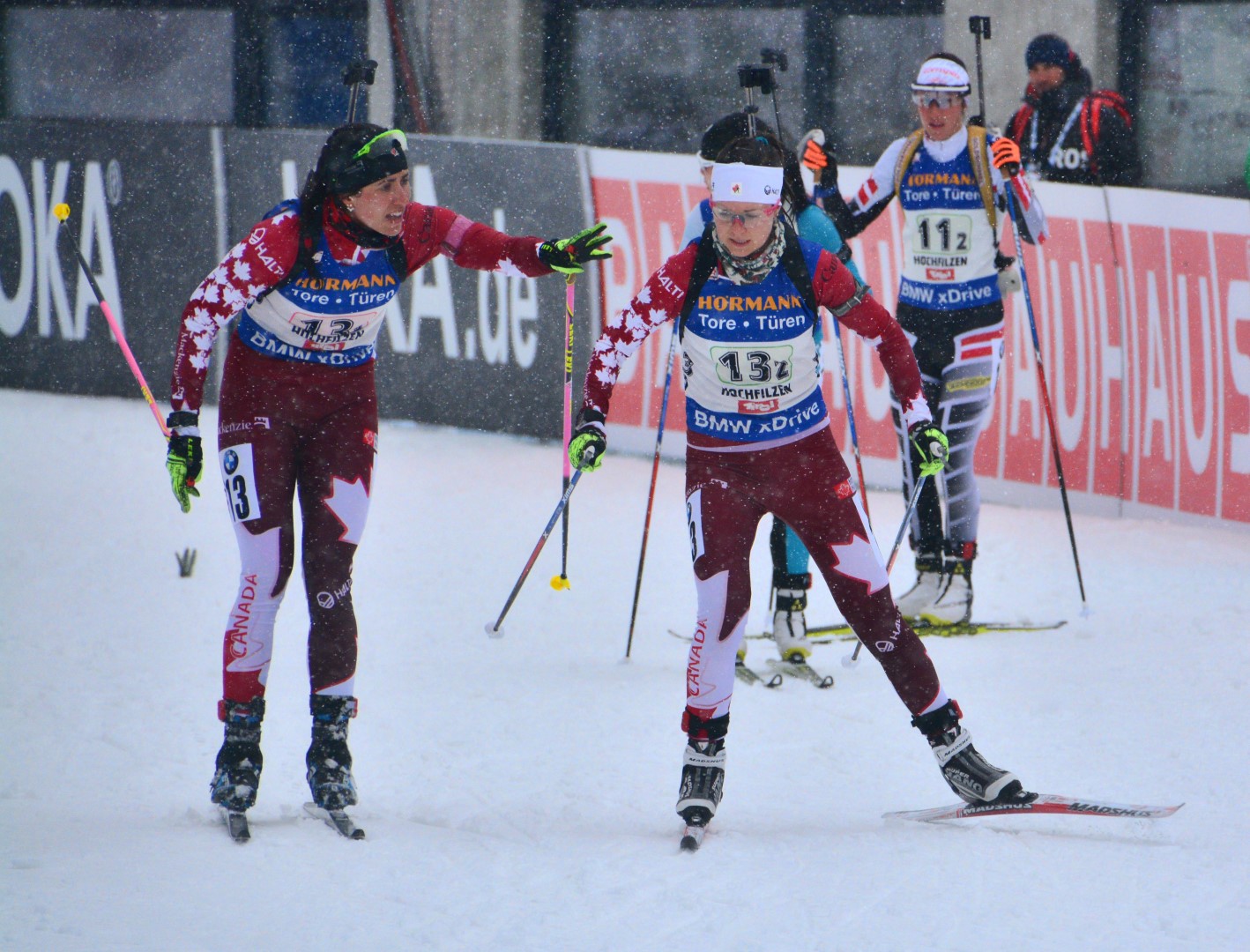
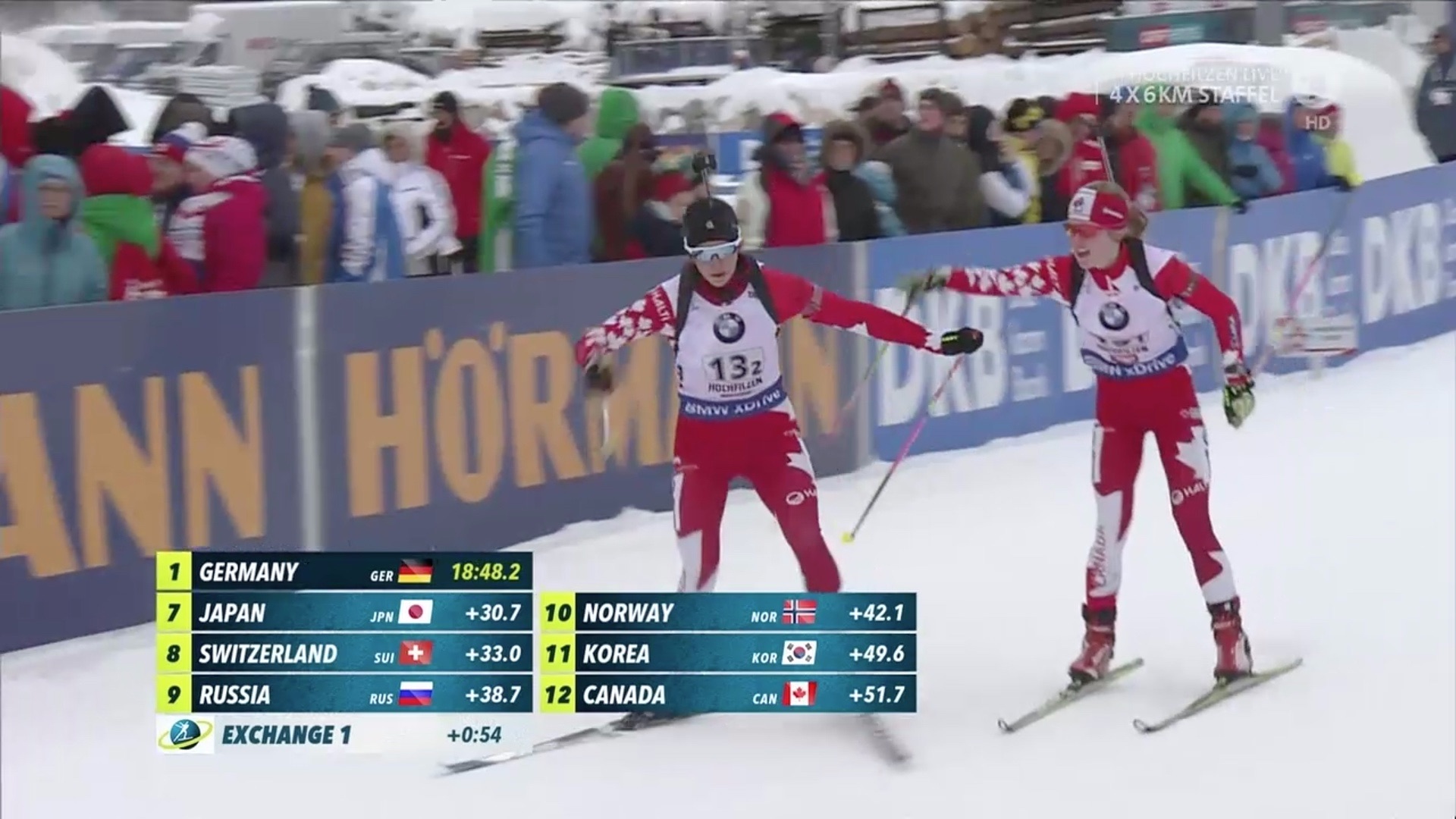
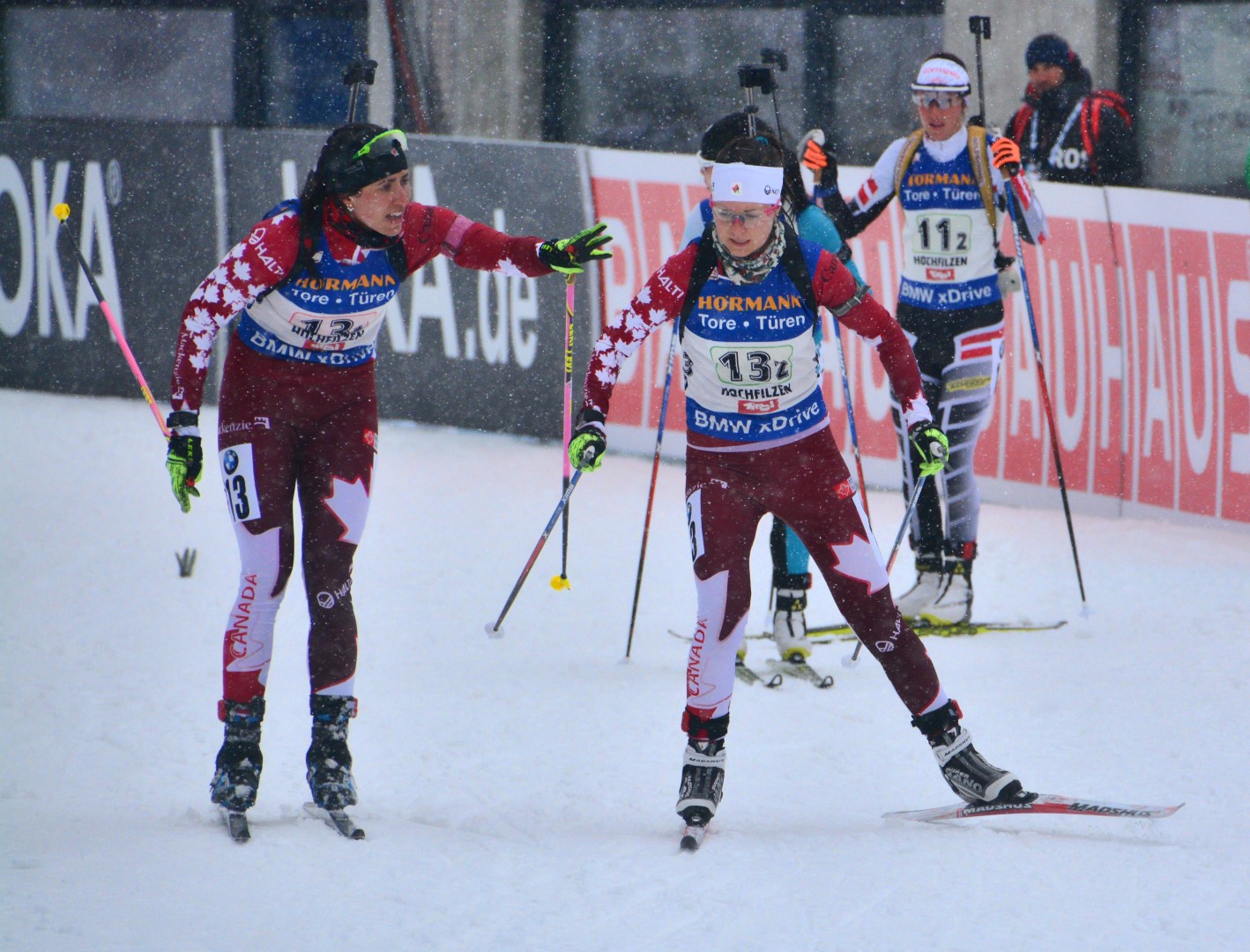
Biathlon Canada’s starter Emma Lunder (r) exchanging to Rosanna Crawford in the women’s relay at the 2017/2018 IBU World Cup in Hochfilzen, Austria. Crawford temporarily moved up to fifth before the team finished in ninth position. (Screenshot: ARD broadcast)
While a number of competitors, including France’s Dorin Habert, incurred penalties, Lunder again needed just one spare to clean (0+1, 0+1) and moved Canada up to 1oth. After losing a few more seconds on her last loop to the leaders, with Germany’s Hinz up front, she tagged Rosanna Crawford in 12th position, 51.7 seconds back.
Crawford started out fast and also needed just one spare to hit all five prone targets, improving by three places to ninth.
“It was a tricky shooting day today, you really had to be aware of the wind, and be prepared to do a correction even part way through a bout of shooting,” Crawford wrote in an email. “In prone I made a correction of 5 left and 2 up and it was enough to keep me pretty centred.”
Then in her standing stage, she picked off four more positions with clean shooting and no spares to leave the range in fifth place, while most teams around her needed spares or even incurred a penalty in seemingly difficult wind conditions.
“I was really happy with my standing today,” Crawford explained. “I saw Brendan [Green] right before zero and he said that it’s worthwhile to take your time and make each shot a good one. So I really thought about that as I came into the shooting, there was a big gust right off the start, so I waited and could hear the women around me missing. Each shot was really precise. My shooting time was 33 seconds which is really slow for standing but still the 2nd fastest of my leg, which says a lot about the wind today!”
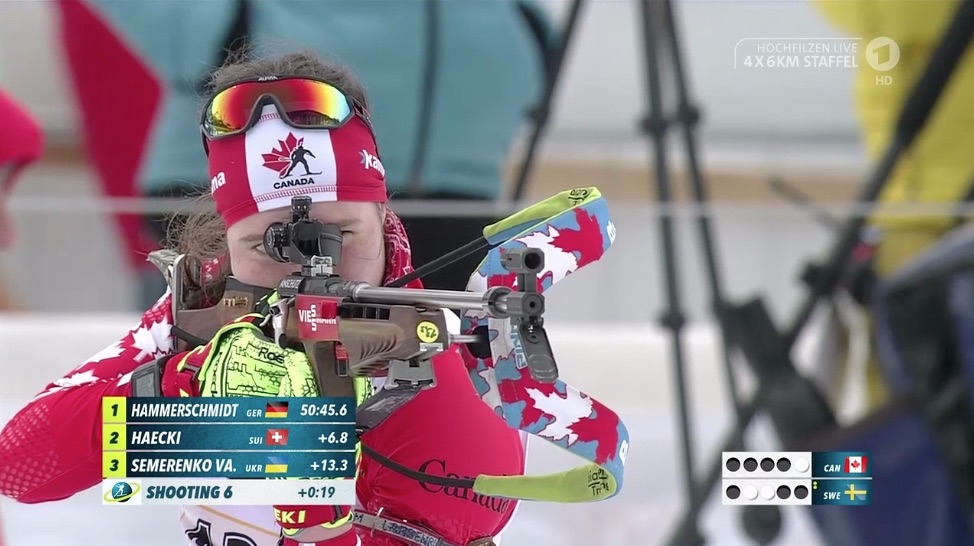
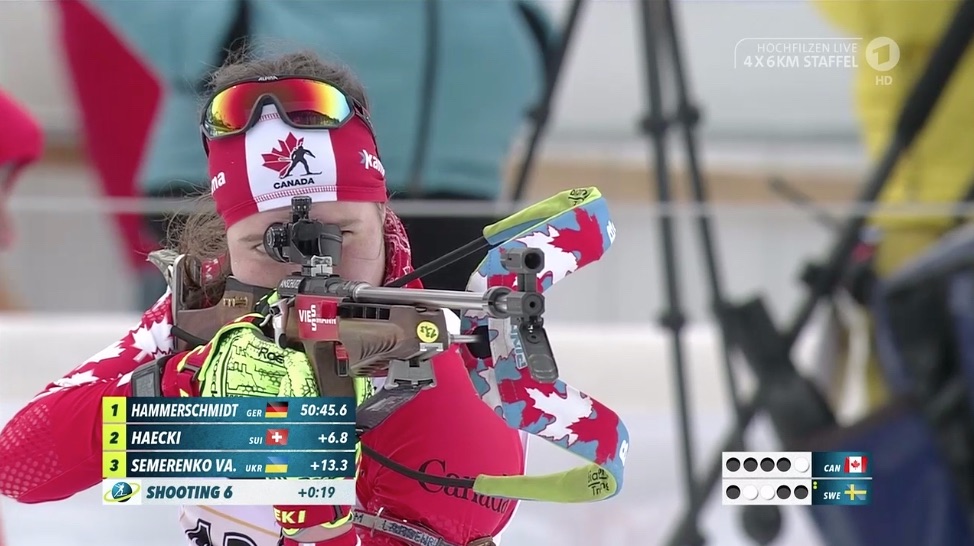
Biathlon Canada’s Megan Bankes shooting in her standing stage in the women’s relay at the 2017/2018 IBU World Cup in Hochfilzen, Austria. The team finished ninth overall. (Screenshot: ARD broadcast)
Crawford tagged Megan Bankes in fifth (+36.3), after having regained 15 seconds on the leaders and skiing the second-fastest course time on the final loop.
“It’s always fun to tag off in a high position but today was a bit of a lucky draw for what you got in the range,” Crawford concluded.
The 20-year-old Bankes as Biathlon Canada’s youngest team member started out just as fast, nearly maintaining that time gap on the first loop.
“I was super stoked to be tagged in such a good place, but I definitely still felt that I was able to ski my own race,” Bankes wrote in an email. “I wanted to ski my best, and not lose to much time on the tracks, but also be controlled on the range, because I knew it was going to be a tricky shooting day.”
She was able to get through the prone stage with two spares in a stage when all leading teams needed them, keeping her in fifth. Bankes followed that up with just one spare in her standing shooting, temporarily moving up to fourth after overtaking Sweden’s Mona Brorsson.
“Coming into the range I was focussed on my own shooting more than anything else,” Bankes wrote. “I knew that the wind was pretty variable, and that I needed to make sure I took good, smart shots, and correct appropriately for the wind. I was super happy with how I ended up doing on the range, and also with my speed on my first couple of laps.”
On the last loop, Brorsson and Russia’s Starykh passed her, and Bankes came through the final exchange in sixth place (+1:28.8).
“I died a bit at the end, but I still managed to tag Julia in a good position, so for me it was a pretty great race!” Bankes concluded.
Shown on television in the exchange zone, looking back at the final curve to see when Bankes would arrive, Ransom took over as the anchor and skied a very fast first loop, just 1 second off the fastest pace on that loop.
She then managed to still clean all five targets in a controlled fashion, leaving the range again in fifth position, with Switzerland in sight and Russia nearby as well.
After a slower second loop, Ransom struggled to clean all her targets in the final stage, but avoided the penalty lap with her last shot and left the range in ninth position. Sweden’s anchor Anna Magnusson was still in sight, 10 seconds ahead, but extended her lead on the final loop, while Japan’s anchor Rina Mitsuhashi was already more than a minute behind Ransom in 10th.
Ransom crossed the line in ninth place (+2:31.6) with zero penalties and nine spares for the team.
“A top 10 is a decent result for our team, it’s nice that we were fighting for a top 6 for most of the race,” Crawford wrote. “Our team has come a long way and I’m really proud to be a part of this team! Emma and Megan had a great leg and Julia an awesome prone and then it was quite windy for her standing, but most teams have their strongest women on the last leg, so it’s always a hard fight!”
In other good news for Biathlon Canada this weekend, the team finished eighth in an IBU Cup mixed relay and national team member Megan Tandy raced to 11th place in the sprint followed by ninth place in the pursuit this weekend in Lenzerheide, Switzerland.
“Another #perfect#shooting day! I was hoping for more, but you gotta work with what you got – in my case very heavy legs skiing. Nonetheless, a solid race,” Tandy wrote on Instagram after shooting clean in both the sprint and mixed relay.
The U.S. Women and Nation Cup Standings
US Biathlon could not start a women’s relay on Sunday because it only has three women currently on the World Cup circuit: Susan Dunklee, Clare Egan and Emily Dreissigacker. US Biathlon had hoped that its fourth woman Kelsey Dickinson, would qualify for the first trimester of World Cup racing by scoring necessary points at the IBU Cup opener in Sjusjøen, Norway. But unfortunately that did not work out.
In addition to Dickinson missing out on the World Cup starts because of that technicality, and her teammates now missing out on one of only three opportunities on the World Cup competition calendar to prepare for the relay in the upcoming Olympics, this also means they lost out on valuable points for the Nation Cup Score. That ranking is its own award category in the World Cup season (last year Germany won it for both the women and men), but more importantly for the North American teams, also determines the starting quota for the following season.
With a third of the races counting towards that already completed (unlike at World Championships the races at the Olympics don’t apply, neither do pursuits and mass starts), the U.S. is currently in 21st position for the women with 676 points and in danger of losing its fourth starting position for next year again, which would make team selections and travel planning even harder.
While certainly not impossible — last year the U.S. women also did not start a relay in Pokljuka, Slovenia — it will be a bit of an uphill battle to make that up the rest of the season, requiring a number of strong results. For instance, South Korea is currently 357 points ahead in 17th, the benchmark for a fourth quota spot.
The Canadian women are currently in 14th position with 1220 points. Last season they were 15th and the U.S. 14th. For the men’s teams, Canada is currently in 12th position with 1260 points, the U.S. is 13th with 1198.
The teams will now travel to Annecy-Le Grand Bornand, France, for the next World Cup from Thursday, Dec. 14, to Sunday, Dec. 17.
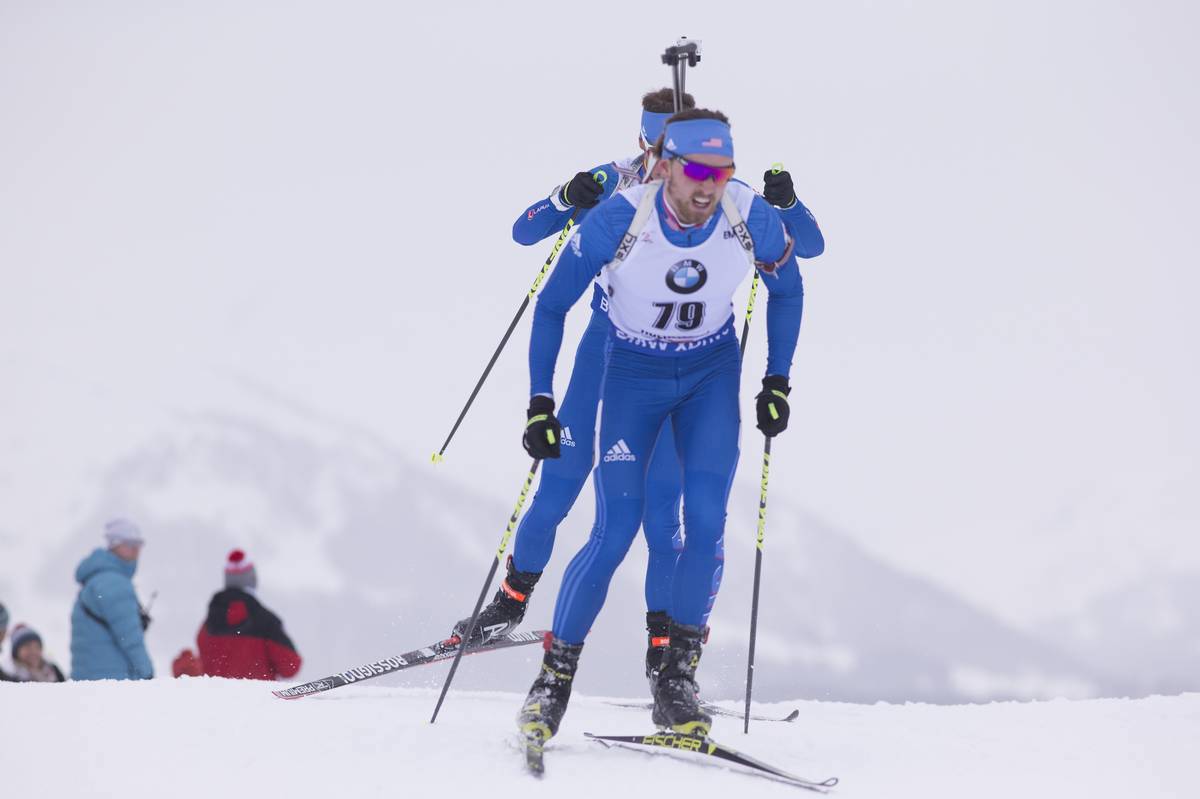
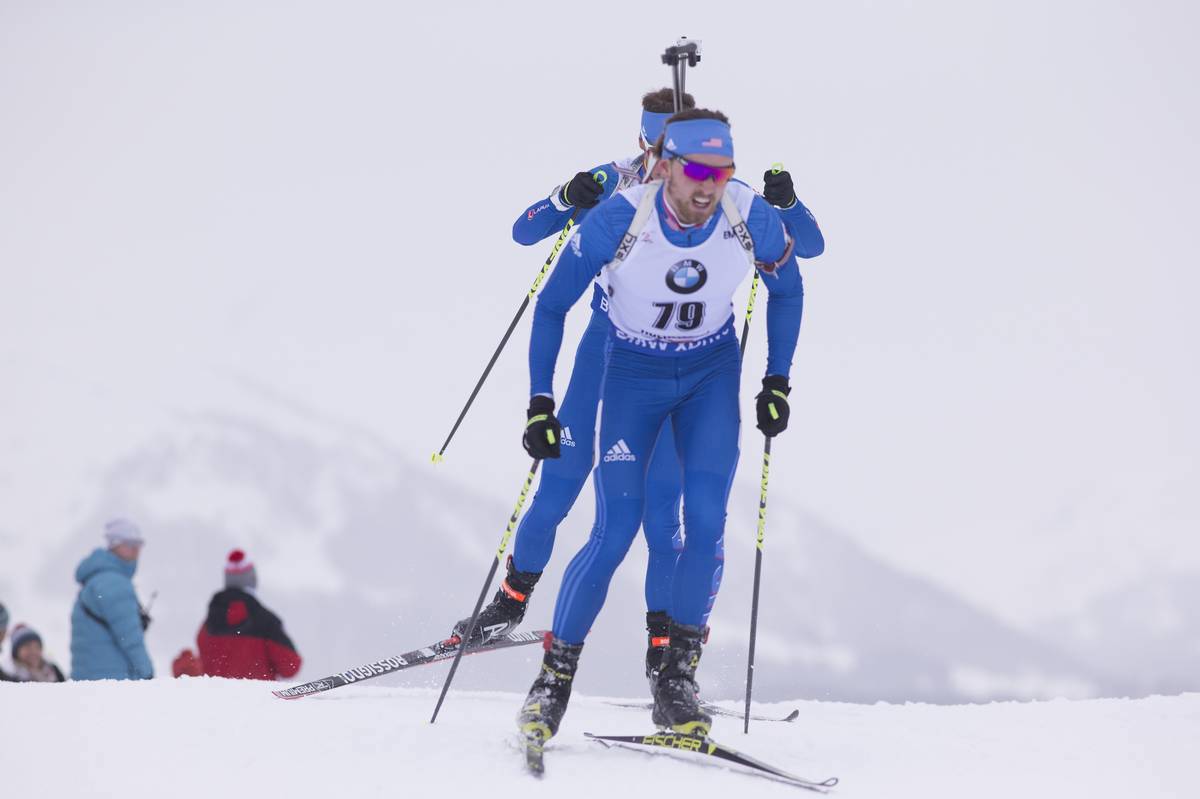
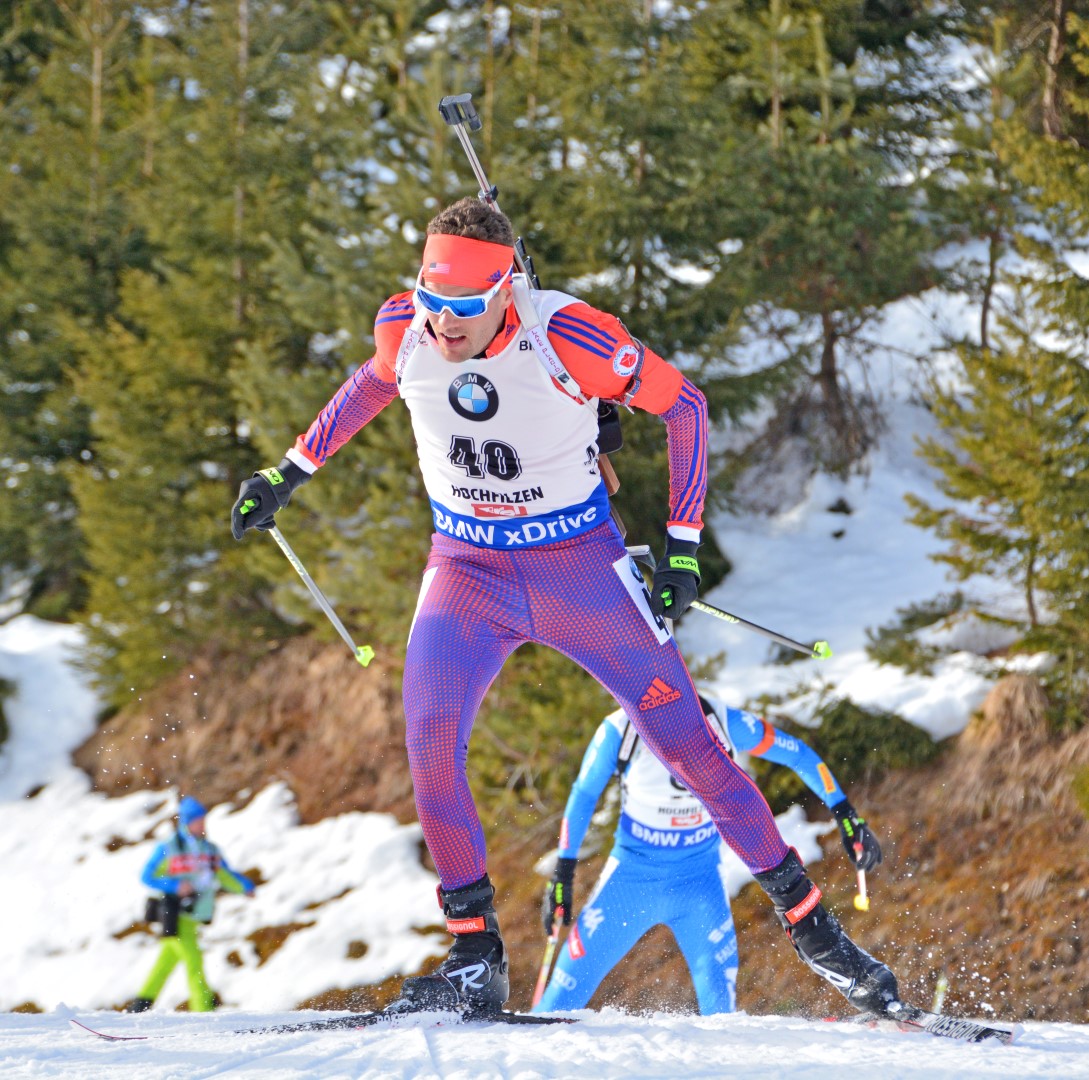
US Biathlon’s Sean Doherty (79) racing to 22nd in the IBU World Cup men’s 10 k sprint on Friday in Hochfilzen, Austria. On Saturday, he raced up to 17th for his best pursuit result on the circuit. (Photo: US Biathlon/NordicFocus)
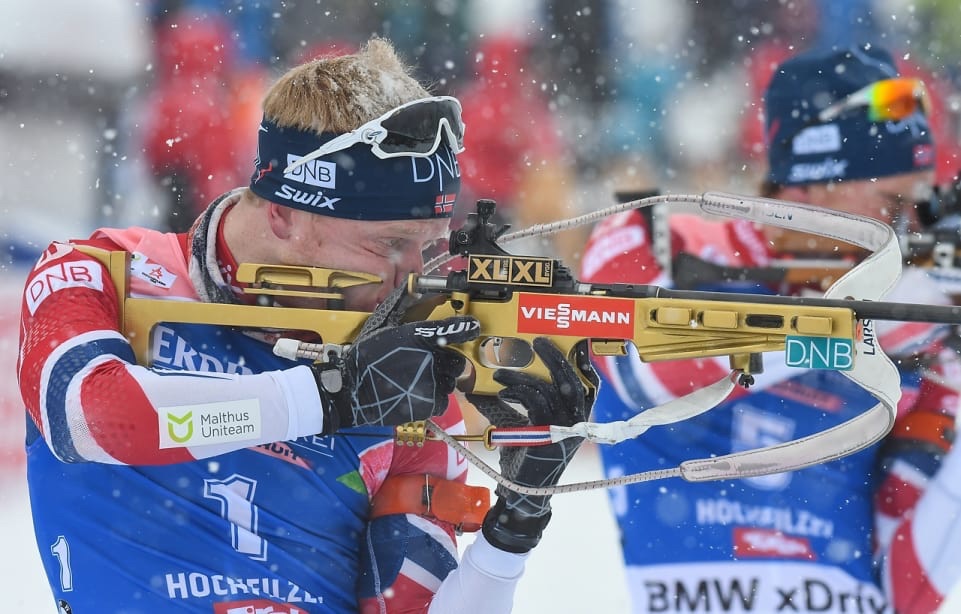
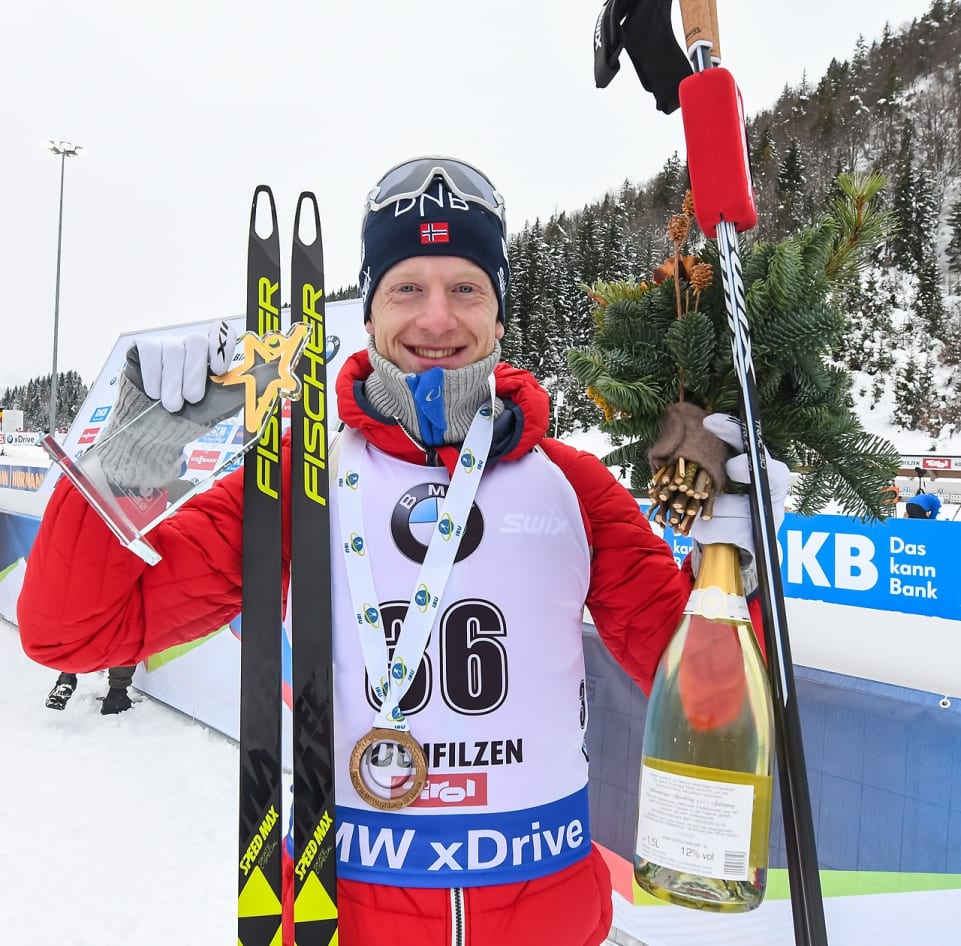
One day after winning the International Biathlon Union (IBU) World Cup men’s sprint, Johannes Thingnes Bø held onto first place in the men’s 12.5-kilometer pursuit on Saturday in Hochfilzen, Austria. In difficult conditions with heavy snowfall and strong gusts of wind, the Norwegian decided the race when he shot clean in the final standing stage. He reached the finish line uncontested on the last loop in a time of 36:41.1 minutes, almost a minute ahead of Slovenia’s Jakov Fak (+58.8 with one penalty) and last season’s Overall World Cup winner Martin Fourcade (+1:10.0 minutes with five penalties).
“Best start of the season so far in my career,” the 24-year-old Bø said after his third victory of the season in a post-race press conference. “I have to enjoy it, you never know what the next races will bring.”
2:12.8 minutes behind him, US Biathlon’s Sean Doherty finished 17th for his best career result in a World Cup pursuit, improving by on an 18th place from a pursuit last season in Kontiolahti, Finland.
A day after scoring his first points of the new World Cup season in 22nd and shooting a perfect 10-for-10 in Friday’s 10-kilometer sprint, Doherty shot 18-for-20 in the pursuit (1+0+1+0).
“I am very happy with the race today,” Doherty wrote in an email to FasterSkier. “The execution on the range was good in the tough conditions we had today. It’s nice to have a solid back-to-back set of races here. … The ski shape is still a ways off but it’s heading in the right direction.”
In very difficult conditions in the first standing stage, several of the top racers like Norway’s Henrik L’Abee-Lund and Germany’s Arnd Peiffer incurred multiple penalties and to slip out of contention. Meanwhile, Doherty hit all but one of his targets in that stage and moved up to 16th. On the next loop he maintained that position about 1:50 back.
“The course was slow today, although not too soft,” Doherty commented on the conditions. “Fortunately it was not as snowy and windy as yesterday afternoon. There was a steady wind but it was manageable. I am pleased with my work on the range. If you want to compete at this level you have to shoot well.”
After the race up front had been decided in a final duel between Bø and Fourcade in the last stage, Doherty once again shot clean in the last standing stage and moved up to 11th. On the final loop, he could not quite hold that position and a small group passed him, yet coming onto the finishing stretch he was able to keep Ukraine’s Dmytro Pidruchnyi 0.4 seconds behind him in a push for 17th (+2:12.8).
“Unfortunately I didn’t quite have the legs to back up the solid shooting, as was clear on the last lap,” Doherty wrote. “Looking over my shoulder I saw that big pack of guys and I just tried to give it all I had. I wasn’t able to hang on but I was glad to be in that situation nonetheless.”
Starting out in 19th place based on his sprint result, Biathlon Canada’s Nathan Smith finished the day in 31st, 3:02.2 after Bø with three penalties (1+1+0+1).
After the first shooting stage, Smith had moved into 14th despite incurring a penalty.
“The wind was a bit changeable, especially in the first prone where it was blowing quite strongly,” he explained in an email after the race.
Smith skied the next lap in a group that included Germany’s Simon Schempp, who eventually would finish the race in podium contention, and got into a slight tangle with Schempp in a right-hand turn at the far point of the course, but both remained on their feet.
“I started pretty aggressive on the first lap but wasn’t able to maintain the speed of those around me after that,” Smith wrote. “I didn’t see who was tangling with me on that turn, but it was definitely an odd place to attempt an inside pass. I can’t say yet that things are turning around in the skiing department. I think I will just have to be very very patient.”
In the second prone stage, Smith incurred another penalty and dropped to 29th place, almost two minutes behind the leaders. He cleaned the first standing stage that followed, then had one more miss in the fourth and final stage.
“My shooting was pretty good once again today, given the challenging conditions,” Smith wrote. “It was definitely tougher conditions today, although the temperature was low enough that the falling snow wasn’t sticking to my glasses. The tracks were a little soft, and quite slow, especially out of the track where athletes were skiing.”
He started the final loop in 27th position and “like the previous ones, I was mostly focused on trying to minimize the number of skiers passing me,” Smith wrote. “It’s fun to pass but when you’re not feeling it its important to try and conserve energy.”
On the final meters of the race, he went head to head with Italy’s Thomas Bormolini and finished 0.4 seconds behind him for 31st.
“I thought I could take Bormolini but he got the middle track,” Smith recalled. “I tried my best in the outside and made a little ground, but the snow was just too deep over there. Tactically it would’ve been best to be in front heading through the tunnels [that are leading into the stadium].”
Smith’s teammate Brendan Green finished 33rd (+3:15.7), also with three penalties ( 1+0+1+1), after climbing nearly 20 places from his starting position by using his extensive experience to deal with snowy conditions that he described as “a classic Hochfilzen day”.
“Today was a much better race for me,” Green wrote in an email. “Yesterday felt completely off for some reason, so to be able to put together a solid performance today is reassuring. … I’m quite happy with the shooting considering the conditions. I was really hoping to shoot clean in the last bout, which would have made for a really great day, but all in all I’m happy with how I performed.”
After incurring that third penalty in the last standing stage, Green, who started 52nd, came back on the course in 37th place. He recalled seeing a group ahead of him, which he was able to catch by skiing the 17th-fastest course time on the final loop.
“I attacked early on and skied my way past a train of 5 athletes, and was able to hold them off for the rest of the loop with the exception of [Belgium’s] Michael Roesch. This was my strongest ski of the season which is hopefully a sign that my shape is coming around. It seems that no matter what I do, I struggle to find my form early on in the season.”
Doherty’s teammate, Lowell Bailey, the only other American who qualified for the pursuit, moved up from 53rd to finish 36th (+3:20.6) with three penalties (0+2+1+0).
The two remaining Canadian starters, Scott Gow and Christian Gow, finished 48th (+5:08.4) and 49th (+ 5:13.7), respectively, with Scott ending up with seven penalties (1+1+3+2), while his younger brother Christian had five penalties (2+0+1+2) and improved five places from the sprint.
Bø and Fourcade in Sync… Until Final Shooting
The two dominant athletes of the IBU World Cup season so far swapped the lead out on course and dueled on the range in Saturday’s pursuit. In the end the podium was nearly a repeat of Friday’s sprint, with Bø in first, and Fak and Fourcade flipping positions in second and third, respectively.
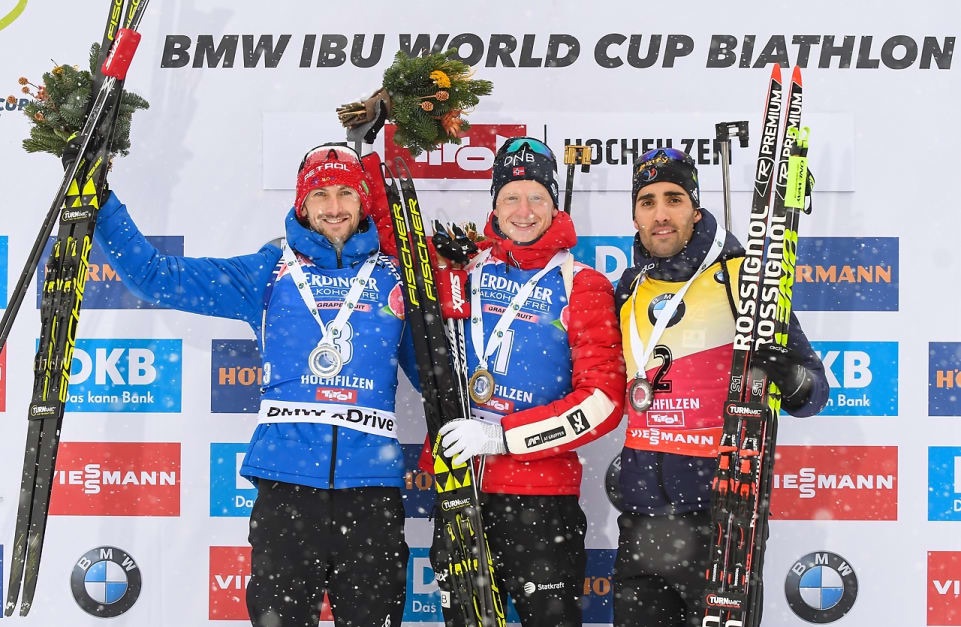
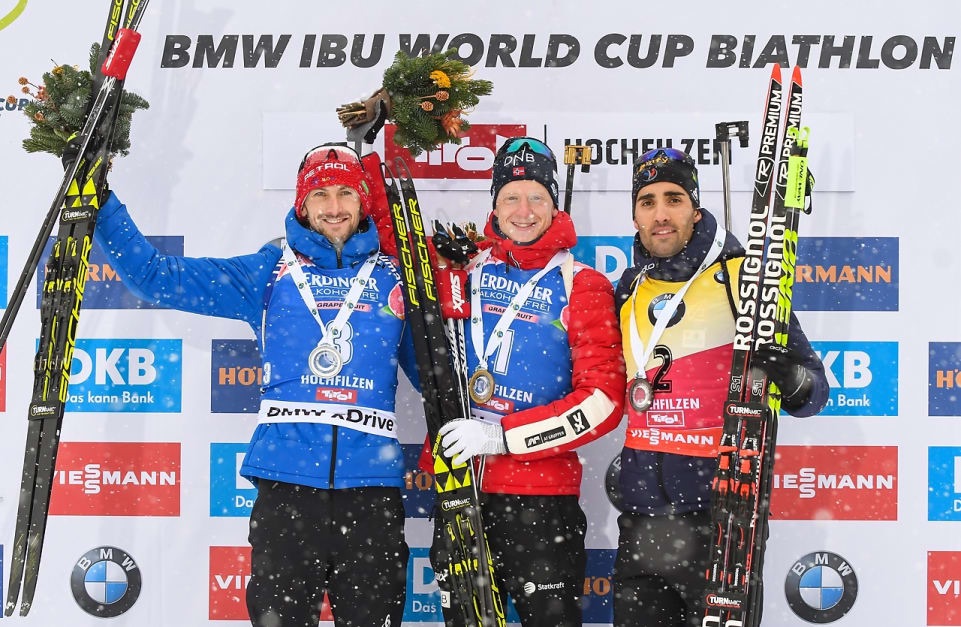
Medal ceremony for the men’s 12.5-kilometer pursuit at the 2017/2018 IBU World Cup in Hochfilzen, Austria, with Norway’s Johannes Thingnes Bø (c) in first place, Slovenia’s Jakov Fak (l) in second place, and France’s Martin Fourcade (r) in third place. (Photo: IBU/biathlonworld)
In the first shooting bout, Bø incurred two penalties to lose his 12-second head start on Fourcade, but he set out on his second loop just a second behind Fourcade. In the second prone stage, the two both shot clean, after shooting alongside each other and almost hitting their targets in a synchronous rhythm, before starting the third loop together.
While not quite able to hold up with Fourcade and Bø on the course with the 35th-ranked overall course time, Fak, who had started the day in third, was able to keep in touch with the leaders due to another solid shooting performance.
The 30-year-old, Croatian-born Fak, who has been racing for Slovenia since the beginning of the 2010/2011 season, is coming back from a slight slump last season, but is looking back on a storied career that includes a third place in the 2014/2015 World Cup Total Score and two gold medals at the 2012 and 2015 IBU World Championships.
By his own account, in preparation for the new season Fak mostly trained with the Ukrainian women’s team, which is coached by one of his old mentors. “They shoot good and I wanted to beat them and I guess that also works in the men’s field,” he said with laugh at the press conference.
In the first standing stage, Bø and Fourcade each incurred a penalty, and while Fourcade shot his sequence slightly faster, Bø was able to easily make up a six-second gap on the next loop, taking the lead again up the first big climb.
“[I] had a perfect race together with Johannes,” Fourcade said at the press conference. “We each did half the [work] in the front and it was a smart move because we wanted to keep the advantage and we knew the answer would be on the final shooting.”
Fak also had his only miss of the day in the third stage, but managed to improve his position as conditions worsened and a number of athletes had several penalties in this stage. Russia’s Maxim Tsvetkov and Germany’s Schempp were the first ones to clean this stage to leap into podium contention. Bø’s older brother Tarjei also cleaned.
Norway’s Johannes Thingnes Bø shooting in the standing position in difficult weather conditions on his way to the victory in the men’s 12.5-kilometer pursuit at the 2017/2018 IBU World Cup in Hochfilzen, Austria. (Photo: IBU/biathlonworld)
In the final stage Johannes Bø and Fourcade again stood side by side on the range, but this time Fourcade missed three while Bø hit every target to embark on the last loop with nearly a minute lead.
“He got the answer, and I didn’t…,” Fourcade sighed when he tried to explain what had happened in his final shooting. “With the snow conditions I went on my shooting mat a little late, I first had to open my rifle [sights snow cover] and I was simply a bit late compared to Johannes by just one or two seconds. … Then I heard that Johannes had a good shooting and I tried to shoot faster to catch him, and that was totally wrong today.”
“The people are always speaking about a fight of Martin against the Norwegian team,” Bø stated in the press conference. “Of course both me and him think about this, but still we fought together out there, we exchanged in the first position [helping each other], and that was a smart move for us.”
Fak managed to shoot clean again to leave the range for the last time in second, and while he could be relatively sure of second place, a fierce fight for third ensued behind him.
“It was very hard on the track, but I managed to stay calm on the shooting range and tried to shoot as [few] mistakes as I could,” Fak said. “It was only one mistake and so I am pretty happy about that, because if we look at the weather it was not so easy on the shooting range. On the track I used my shooting as an advantage, and it got me in the second position on the last lap, so I just needed to go a little faster in the beginning and then cruise to the finish.”
A group of Schempp, Tsvetkov and Tarjei Bø also came through the final stage with a clean shooting performance, and Fourcade joined them after he had completed his three penalty laps.
Fourcade led that group going into the longest climb of the course, then tried to break away, pushing hard over the crest of the hill with only Schempp able to stay on his tails into a corkscrew downhill section.
Schempp and Fourcade had a minor tangle as they positioned themselves on the slightly uphill finishing stretch, and Fourcade ended up outlasting Schempp in the final meters by half a second
“It was a big fight with Simon but also with Tarjei and Maxim Tsvetkov from Russia,” Fourcade said. “It was a big battle, and then at the finish line we crossed our skis. The advantage of being in the first position is that you can choose your own line, it’s what I did, and when I crossed my skis with Simon because I saw he chose the same line I went to the other line. … I said to Simon that I was sad, because I didn’t want to do it this way, but I fought really hard on the track to get the first position and choose my own track because it’s a big advantage.”
“In the finish sprint I really wanted to take the innermost lane, so wide right, and thought he’d take the middle lane,” Schempp told German broadcaster ARD in a post-race interview, according to a translation. “But then he still pulled onto my side and we tangled up and got a little bit into each other’s way, but everything is all right.”
Tarjei Bø came to the finish a second later in fifth (+1:11.9) with two penalties (1+0+1+0), while Tsvetkov finished sixth (+1:12.3), up from a 20th starting position, with just one penalty (1+0+0+0).
“I am happy I am in the top six, but I am a bit sad that I can’t fight today for a top three,” Tsvetkov told the IBU in an interview, via a translator.
“[Actually] I can’t understand why I missed today,” he added with a laugh when questioned about his lone penalty, which only he, Fak, and two more athletes achieved in this race.
The IBU World Cup in Hochfilzen concludes on Sunday with the first men’s 4 x 7.5 k and women’s 4 x 6 k relays of the season.
Fourcade announced during the press conference that he plans to skip the relay to focus on next week’s races in front of a home crowd in Le Grand Bornand, France.
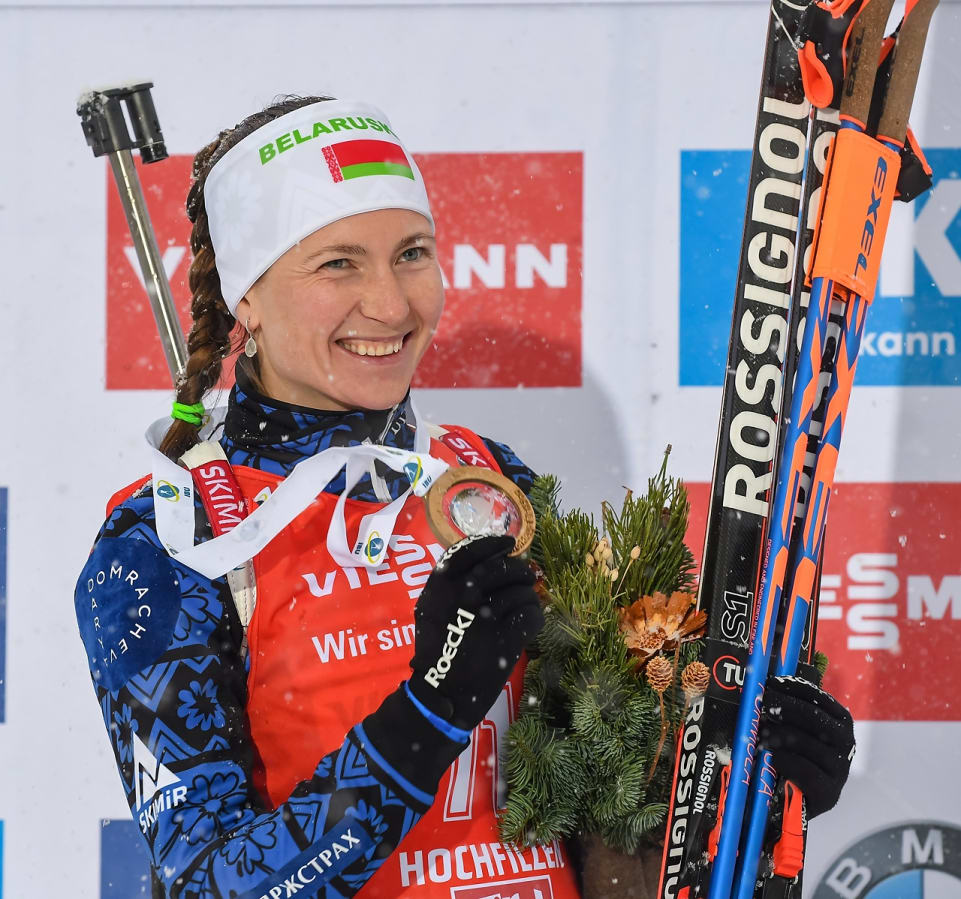
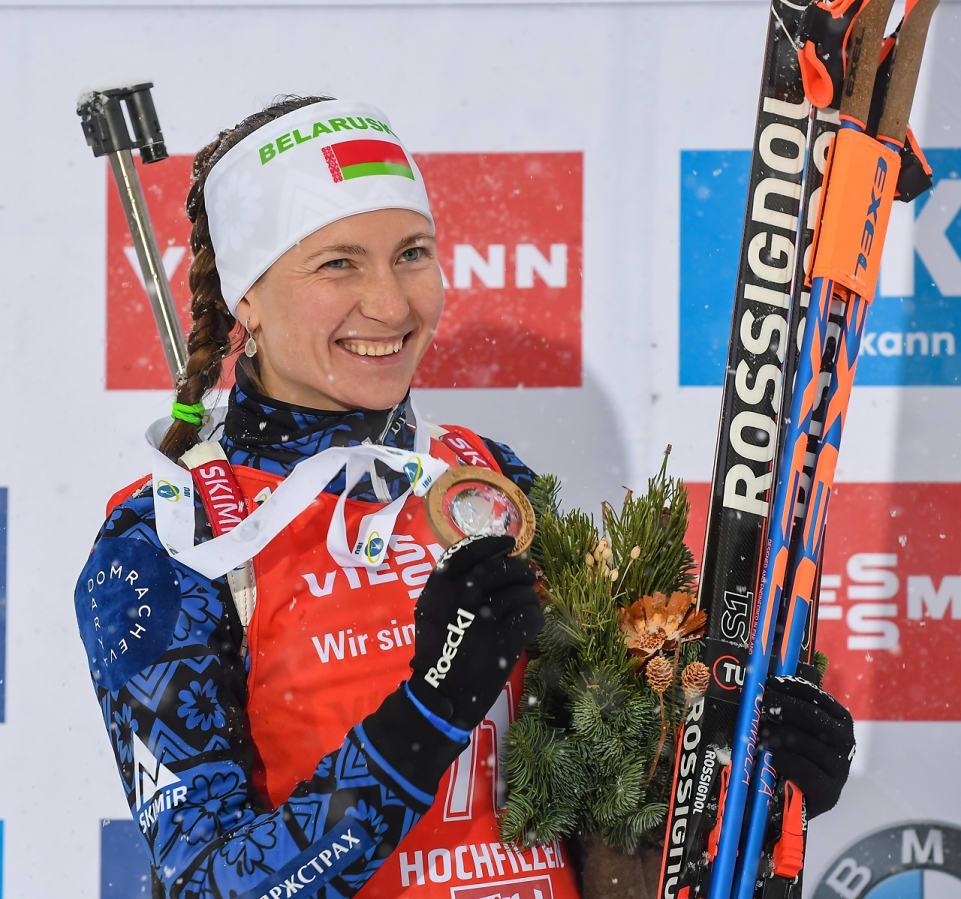
Darya Domracheva of Belarus after winning her first race in more than a year and a half, the women’s 7.5 k sprint at the IBU World Cup in Hochfilzen, Austria, on Friday. (Photo: IBU/biathlonworld)
Note: This article has been updated to include comments from Biathlon Canada’s Nathan Smith and Emma Lunder.
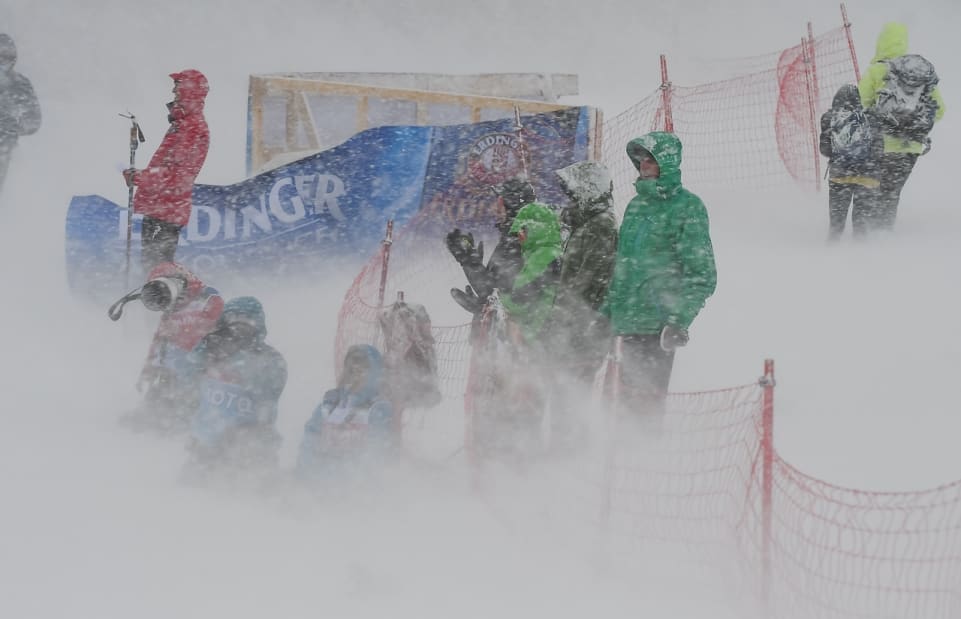
Calm wind and a light drizzle for the men’s International Biathlon Union (IBU) World Cup sprint on Friday afternoon in Hochfilzen, Austria, turned into a full-blown blizzard for the women’s sprint that followed. One multiple-time Olympic and world champion weathered the elements best, as Darya Domracheva of Belarus won the latter with clean shooting. She was one of four women in the top 20 that cleared all 10 targets amid the white-out conditions with a strong wind ripping sideways across the range.
“I am grateful that I was able to handle these challenging weather conditions today,” said the 31-year-old Domracheva, who had her first child just over a year ago, according to an IBU press release. “It has been a long time since I was on top of the podium, since March 2015, so it is nice to be here.”
Domracheva is the defending Olympic champion in three disciplines: the individual, pursuit and mass start. On Friday, she won the women’s 7.5-kilometer sprint for her first win over a year and a half, after taking the 2015/2016 season off to have a child and returning to the World Cup this past January. At 2017 IBU World Championships, she raced to silver in the pursuit.
During the women’s 7.5 k sprint on Friday at the IBU World Cup in Hochfilzen, Austria. (Photo: IBU/biathlonworld)
But on Friday, in the second sprint of the World Cup season, she was back to her winning ways in the most challenging of conditions. After the men’s race, wet snow began to fall more steadily. Temperatures dropped, making for drier snow that intensified in the minutes leading up to the race.
“The conditions were completely different in the race from the zeroing, so you had to adapt today,” said Domracheva, who started 71st of 102 women and bested Anastasia Kuzmina’s time by 22.1 seconds for the win in 22:40.2 minutes. Kuzmina, of Slovakia, who started just ahead of her in bib 69, placed second with a single penalty (1+0), bumping Italy’s Dorothea Wierer (bib 48), who also missed one prone target (1+0), to third (+30.6).
“It was really strange; I could see nothing on the tracks and I had to take off my glasses,” Wierer said, according to the IBU. “In these conditions, the race was decided on the shooting range; with one mistake, that was pretty good. … I think the conditions were the same for everyone; it was snowing for the whole race.”
“We were all hoping that the forecasted storm wouldn’t materialize, but just as predicted, the flakes started getting heavy about 20 minutes before the start,” US Biathlon’s Clare Egan explained in a post-race email to FasterSkier. “That’s when one of our wax techs says he thought about locking the wax cabin and fleeing the scene. Lucky for us he did not, and I think our skis were the best in the field today. I don’t know how they can make such fast skis for such slow conditions but somehow they manage!”
Egan led three American women in 35th, 1:56.1 minutes behind Domracheva, with a total of two penalties: one in prone and another in standing (1+1).
“While I was warming up the wind was extremely strong and then it seemed less intense during my race so I think the earlier starters had worse wind,” Egan recalled. “I took a couple clicks in prone [i.e., adjusted my sight for the wind] but that’s very standard. I actually did a completely normal shooting routine today in both prone and standing, which is a good thing. The trick in biathlon is to replicate your normal shooting routine even when you are in a high-stress race scenario.”
Egan started 68th, just ahead of Kuzmina. Her overall shooting time ranked 29th in the field, while her course time was 42nd. In comparison, Domracheva had the 43rd-ranked shooting time but was fifth-fastest out on course. Kuzmina was sixth fastest on course and had the second-fastest range time (including setup and actual shooting time).
“I did not do anything special today, but because I had special skis I managed a decent course time,” Egan wrote. “This year I am making a point to accept however my body feels on a given day and just focus on technique. When I do that, I know that even if I don’t feel great I can still have a great race.”
In the second World Cup stop of the season, 35th is a season best for Egan and her best result since placing 34th in a sprint last March. Last week in Östersund, Sweden, she placed 75th in the sprint and 79th in the 15 k individual.
“To borrow an expression I just learned from a British biathlete, I’m super duper chuffed with my race,” she wrote. “Last week’s racing was a real blow to my confidence so I’m very proud of the work I did to turn things around. It took a lot of mental gymnastics and help from our sports psychologist. Today’s race wasn’t exceptional but it was a solid biathlon performance and I’m very content with that. I will be completely happy when all of my teammates have races they can feel good about too. We are very much in this together.”
Egan will be the lone American woman racing in Saturday’s pursuit in Hochfilzen; both Emily Dreissigacker and Susan Dunklee finished outside the qualifying top 60. Dreissigacker placed 89th (+3:49.1) with three penalties (1+2) and Dunklee was 97th (+4:52.9) with eight penalties (3+5).
Two Canadian women landed in the top 60 to make the 10 k pursuit, with Emma Lunder in 42nd (+2:03.5) with a single miss (1+0) and Rosanna Crawford in 49th (+2:19.6) with two penalties (1+1). Megan Bankes just missed the cutoff in 65th (+2:55.3) with three standing penalties (0+3), and Julia Ransom finished 100th (+5:20.6) with seven misses (3+4).
“I was really happy with my shooting in the race,” Lunder wrote in an email. “I made sure to focus on my cues after making a 5-click correction for the wind, and took a bit of extra time setting up. It was snowing quite heavily, so I did my best to make every shot a good one, but unfortunately I did have one get away from me. When I came into standing it was a lot calmer, but still snowing a lot, so I was pleased with shooting clean! I’ve been working a lot this year on getting my confidence back in the shooting range, and I’ve seen improvements in both my prone and standing.”
She started second, with only one racer clearing the tracks ahead of her.
“I followed the tracks of Bib 1 for the first loop, just trying not to ski off the trail!” Lunder reflected. “It was really deep snow for that first loop but all things considered our wax team gave me some pretty quick skis for the race. I felt okay skiing today but I still need to find that next gear when I’m racing, so I’m excited to have a lot of girls around me to chase in the pursuit.”
Smith 19th, Doherty 22nd
Norway’s Johannes Thingnes Bø after winning his third race of the season (including a mixed relay and 20 k individual race last week Ostersund, Sweden) in Friday’s 10 k sprint at the IBU World Cup in Hochfilzen, Austria. (Photo: IBU/biathlonworld)
In the men’s 10 k sprint that opened the Hochfilzen weekend, Canada’s Nathan Smith raced to 19th — his best non-relay World Cup result since March 2016 — and American Sean Doherty placed 22nd for his best result since finishing 18th in a World Cup pursuit last March. Both Smith and Doherty shot clean, along with 12 others out of 108 competitors.
“Conditions for our race were quite good,” Doherty explained in an email. “Calm winds and overcast. Unfortunately a storm blew in for the women’s race so they had a much tougher course and range today.”
The top-four men all shot a perfect 10-for-10, with Norway’s Johannes Thingnes Bø in bib 36 setting a faster time around the course than France’s Martin Fourcade (bib 38), who also shot clean. Bø took the win in 24:18.4 and was 12.1 seconds clear of Fourcade, who ended up second. Slovenia’s Jakov Fak notched his second-straight podium (coming off a second place in Östersund’s pursuit) in third (+35.4).
“It is always better to be first rather than second,” said Bø, who also won the 20 k individual last week in Ostersund, according to an IBU press release. “I was lucky to shoot clean today. That is what I needed to get the win … My plan was like: go until you die, attack all the way. If you want to win, you cannot save the power…I was quite tired in the last loop, but I managed to hold on.”
Bø’s overall course time was the fastest of the field, 15.3 seconds faster than Fourcade.
“I cannot comment on any fight because Johannes had too big of an advantage after the standing shooting,” Fourcade told the IBU, referring to his 20-second deficit to Bø after the second shooting stage. “I am just happy that I was able to catch some seconds in the end. We had about the same ski speed as last week, but today he shot clean and I had not chance to win.”
“I shot clean and ran as fast as I could; that is all you can do,” said Fak, who started 33rd. “I never worried much after that … You can never be sure about the results until everyone has finished.”
Smith started 12th and finished 1:31.9 off Bø’s winning time, posting the fifth-fastest overall shooting time while hitting every target. Smith’s course time ranked 54th overall.
“I was carefull to take it easier for the last 15 sec before the range,” Smith, 31, wrote in an email when asked about his clean shooting. “It’s an awkward entry with a short steep bump.”
“I’m looking to continue the solid shooting while upping my ski speed a bit, back to around what my shape had been like in November,” he stated. “I’m happy with today’s race. Top 20 is a good accomplishment and a solid step in my comeback. For the pursuit I’m aiming to improve a little and grab a top 16.”
Doherty started in bib 79 and ended up tying Slovenia’s Klemen Bauer for 22nd, 1:39.2 back. (Bauer had a single penalty in prone.)
“As long as I stay disciplined the targets will fall,” the 22-year-old Doherty wrote of his clean shooting. “Overall I am happy with my race today. I am excited to take the momentum into the pursuit tomorrow.”
Saturday will be his first pursuit of the season after placing 82nd in the Östersund sprint. He also placed 38th in the 20 k individual there.
“The start to the season in Ostersund was tough,” Doherty noted. “That course there is one of the hardest on the whole circuit and we had exceptionally poor snow conditions for the individual, so that was a brutal race. Here in Austria I was looking to make a step froward towards the level of racing I know I am capable of and take care of the final Olympic criteria.
“To be honest my skiing is pretty poor right now, and that’s fine,” he added.
Doherty’s overall shooting time was 29th fastest while his course time ranked 57th.
“The important part of the season is still a ways away and that is when I will be on form,” he wrote. “In general I think I am off to a good start this season but there are still many races to go. So I just want to keep working and using each race as an opportunity to keep improving.”
All four Canadian men qualified for Saturday’s 12.5 k pursuit, with Scott Gow finishing 43rd (+2:25.1) with three penalties (2+1), Brendan Green 51st (+2:30.3) with one standing miss (0+1), and Christian Gow 54th with clean shooting.
For the U.S., Lowell Bailey is also in after placing 53rd (+2:32.4) with two penalties (2+0). Tim Burke finished outside the necessary top 60 in 73rd (+3:00.7) with three misses (1+2), Leif Nordgren was 98th (+3:40.2) with three standing penalties (0+3), and Paul Schommer 103rd (+3:54.6) with three misses as well (1+2).
The men race at 6:15 a.m. Eastern Standard Time Saturday, followed by the women at 8:45 a.m. EST.
Bernd Eisenbichler embraces Lowell Bailey after Bailey became the first-ever world champion in the history of US Biathlon. (Photo: Glen Crawford)
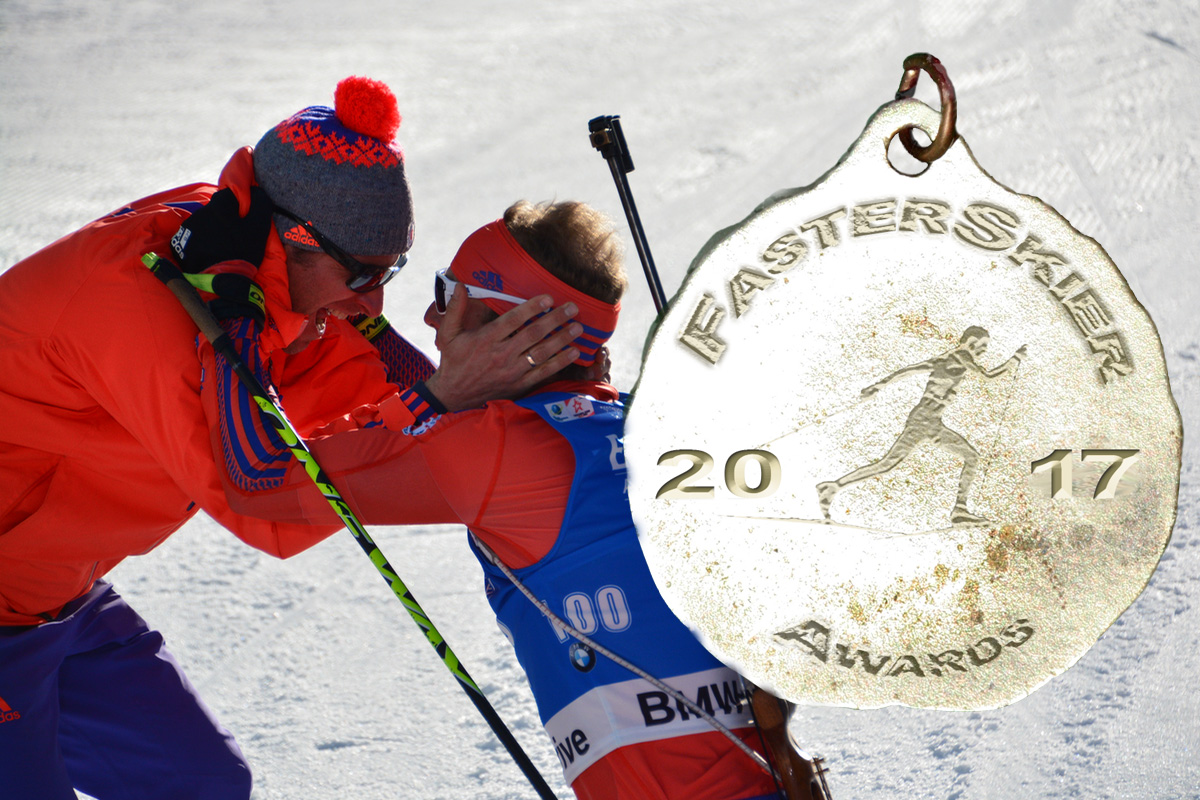
With the 2016/2017 season officially in the rearview, FasterSkier is excited to unveil its annual award winners for this past winter. Votes stem from the FS staff, scattered across the U.S., Canada, and Europe, and while not scientific, they are intended to reflect a broader sense of the season in review. This set of honors goes to a coach or team director who has particularly contributed to their team’s success.
Despite the title of this award, Bernd Eisenbichler has never really been a coach.
He has been an athlete (in Germany), a ski technician (for Ricco Gross, Kati Wilhelm, and then the American biathlon team), the high-performance director for the US Biathlon Association (USBA), and now its chief of sport.
Such a title might suggest that as Eisenbichler has risen through the ranks to direct both the national team and now also the development pipeline for the U.S. biathlon community, he has become more distant from the nitty-gritty, the details or the athletes.
Not so much. This season, you could still see the 41 year old zooming around on skis, or running back and forth between different parts of a stadium. Eisenbichler isn’t one who is content to stand around, or to distance himself and watch other people do work.
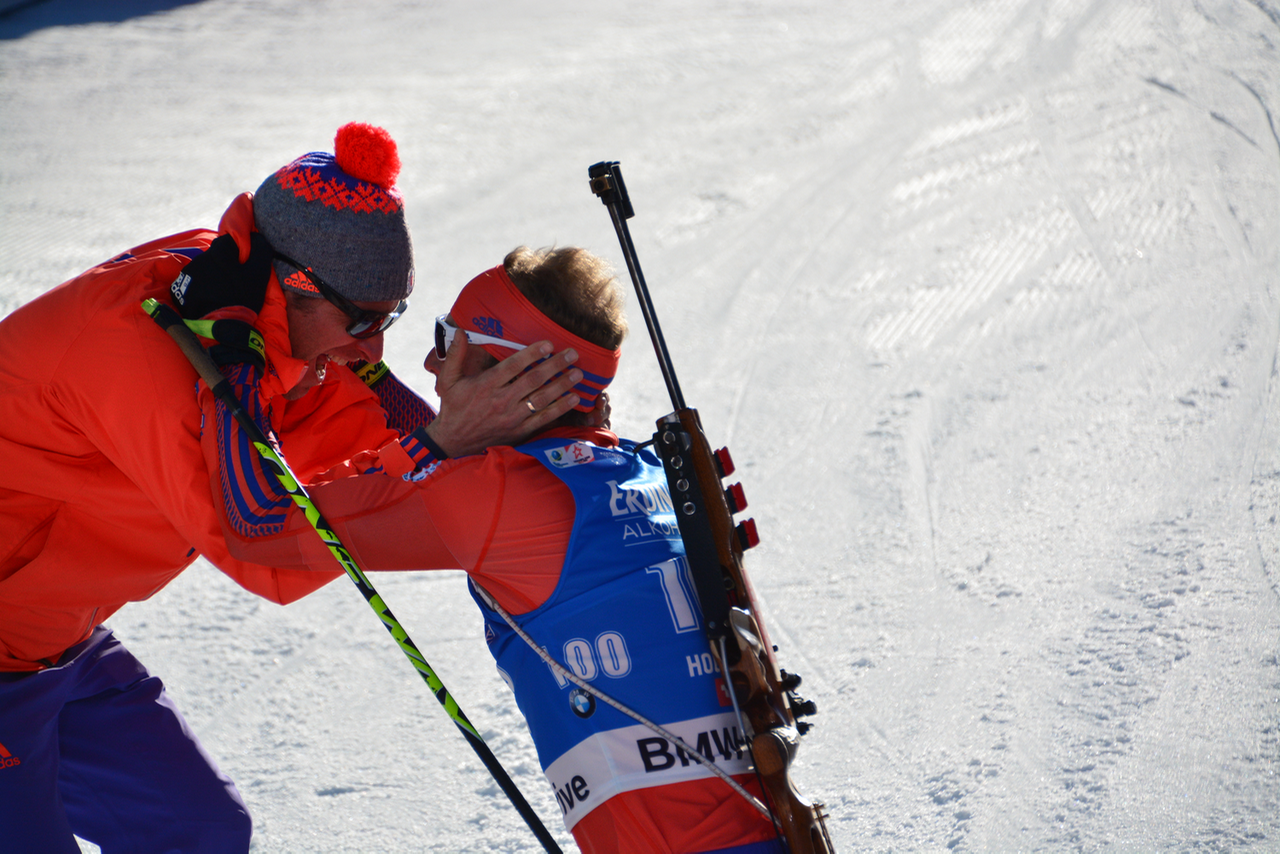
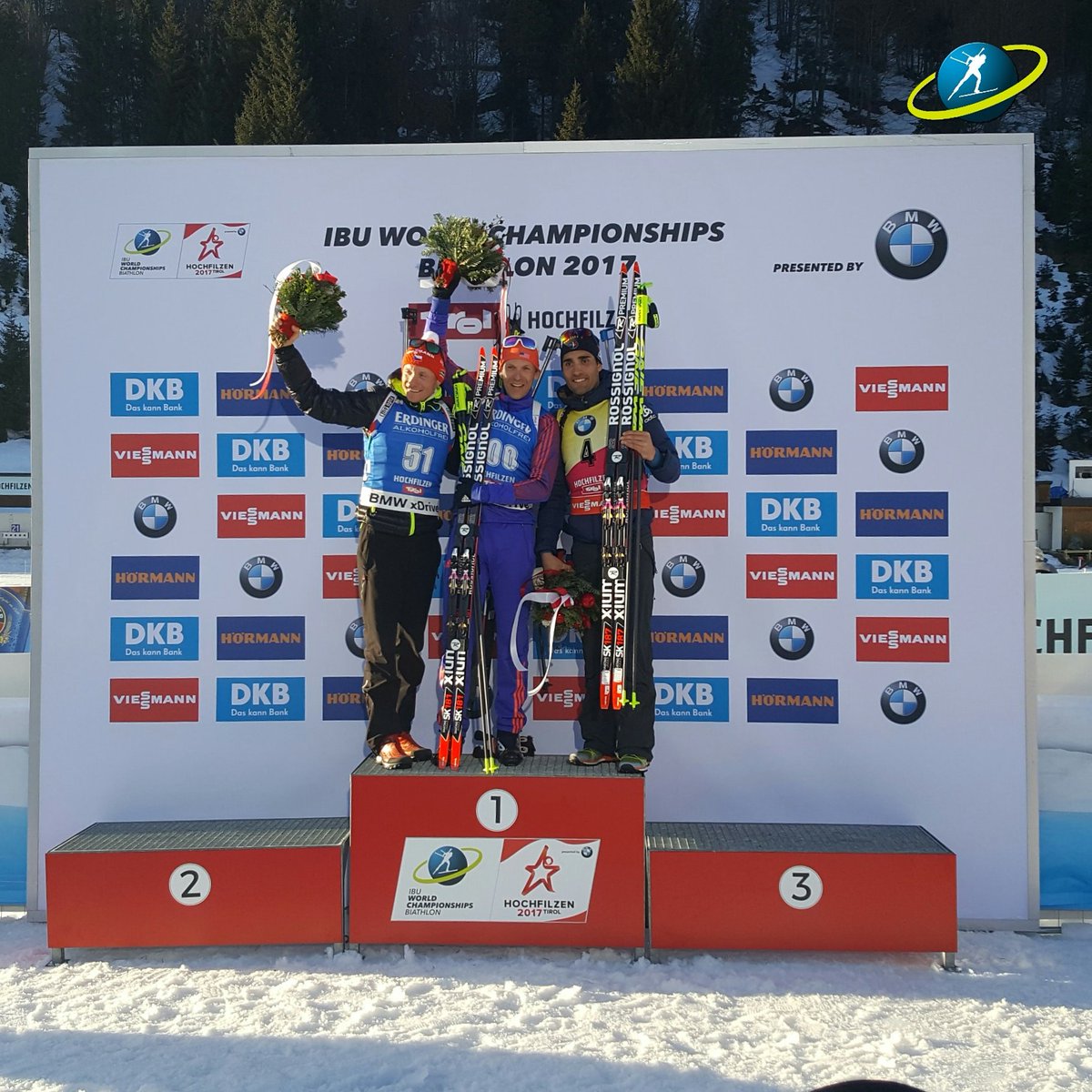
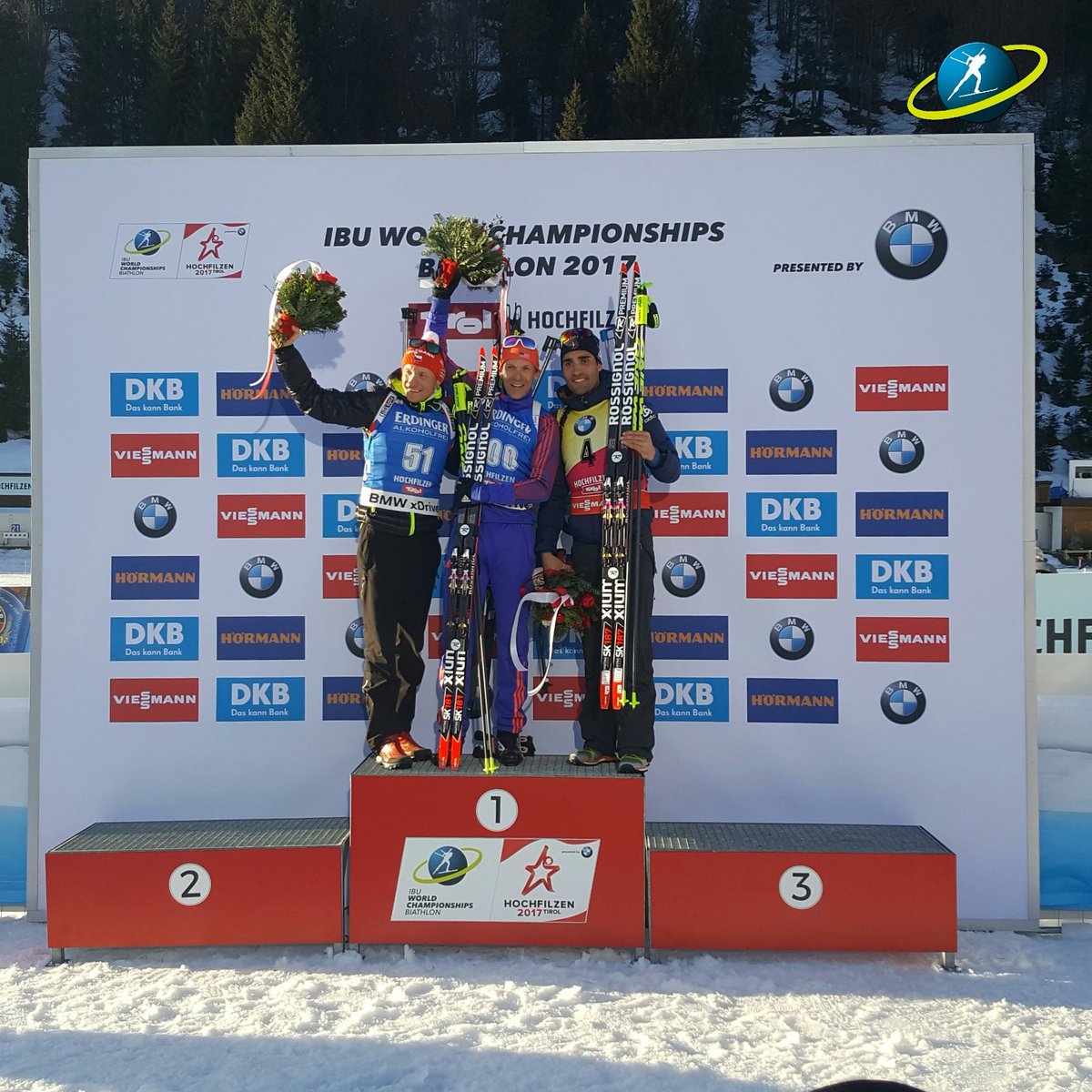
And when Lowell Bailey crossed the finish line in Hochfilzen, Austria, in February to become a world champion in the 20 k individual, one man ran out to grab him by the shoulders, scream and celebrate. You guessed it, it was Eisenbichler.
“Bernd was the first person who greeted me at the finish line, tears in his eyes,” Bailey wrote in an email this week. “[He is] one of the most passionate, hard-working individuals I’ve ever known!”
Eisenbichler testing skis in 2015. (Photo: Jake Ellingson)
Technically, nobody is allowed in the finish zone except the athletes who just finished the race. But Eisenbichler pushed through the scrum of officials and celebrated with an athlete he had met in the same place, Hochfilzen, back at Junior World Championships in 2000. Back then, he was what Bailey called a “hired hand” to make their skis fast.
At that point, did the German envision himself staying with the U.S. team for nearly 20 years (so far)?
“Along the way, I had different offers from different teams,” Eisenbichler admitted in an interview from his office in the Bavarian town of Frasdorf on Monday. “But I enjoy the freedom I get [from USBA] to create a high-performance program. You learn on the way. You make mistakes on the way. Hopefully you do it better next time. What I always see, though, is the potential to get better… I enjoyed working with Lowell and Tim [Burke] for every day of the 18 years. But every new person who came, they added something to the program. It meant, we are not done here. There are things we can do better, to reach higher.”
Bailey’s gold medal, the first ever by an American, and Susan Dunklee’s silver to make her the first U.S. woman to win an individual World Championships medal – together, they make an argument that this was US Biathlon’s best season ever and that the program is entering a new era.
“We have never, before now, had strong men and strong women at the same time,” USBA CEO Max Cobb said after Dunklee’s silver in Hochfilzen. “This is really exciting for us and a good validation that these opportunities, and the pipeline we have, works.”
The World Championships haul didn’t come out of left field.
Tim Burke gets encouragement from US Biathlon’s High Performance Director Bernd Eisenbichler at the beginning of the 12.5 k pursuit in Hochfilzen, Austria, in 2014.
In 2013, Tim Burke earned World Championships silver. Then at the 2014 Olympics, Bailey and Dunklee set best-ever marks for U.S. men and women, respectively: eighth by Bailey, 11th by Dunklee.
Just weeks after that, Bailey and Dunklee began accumulating World Cup podiums, and they haven’t stopped.
Since 2014, three different athletes – Sean Doherty, Maddie Phaneuf and Chloe Levins – have turned in top-five performances at Youth and Junior World Championships.
And this season, two athletes with college degrees in just their second seasons of biathlon – Paul Schommer and Joanne Reid – turned in individual top-35 performances on the World Cup and then teamed up with Sean Doherty and Clare Egan to finish eighth in a mixed relay. Five different athletes on the team, including Burke, Egan and Leif Nordgren, picked up top-20 World Cup results this season.
We asked Cobb, the USBA President and CEO, whether US biathlon would be where it is today without Eisenbichler.
His answer was simple: “No. Bernd is masterful in his leadership of our program.”
“Bernd is one of most passionate people I know, and for decades he has directed all his energies into building up USBA’s program,” Dunklee agreed.
“What was always interesting with Bernd, even at [the beginning], was that even though he was a German, he was extremely passionate about Team USA’s results,” Bailey wrote. “He got to know all of the athletes and was genuinely interested in seeing our team succeed, even if that meant beating the German team… At first, he was just waxing skis; then, he was in charge of stone-grinding and waxing; then he was put in charge of some team logistics. Eventually he became High Performance Director. Since that time, I’ve seen our team go from a mediocre ‘also-ran’ to one of the strongest teams in the world. That success is largely due to Bernd’s role and his tireless drive to win by out-maneuvering instead of out-spending. He embraced this David-and-Goliath struggle from the start.”
Eisenbichler prefers to call it a puzzle, referring to the complexity of the sport and the intricacy of the management required to win.
“We always knew that our program and our approach works, and we also had results to justify that,” Eisenbichler said. “But this year it really culminated in a perfect way… You always add to the puzzle and you try to have the perfect pieces to complete it. This year we just completed the puzzle. I think we proved that all the additions that we made to the program over the last three or four years, we really benefitted from it this year.”
For North American nordic sports teams, having a European at the helm seems to have worked out about as often as it hasn’t. But for US Biathlon, it sure has, and the consensus seems to be that it’s because of Eisenbichler himself. Having a German guiding your biathlon program doesn’t automatically buy you success. It’s not nationality so much as what the guy does.
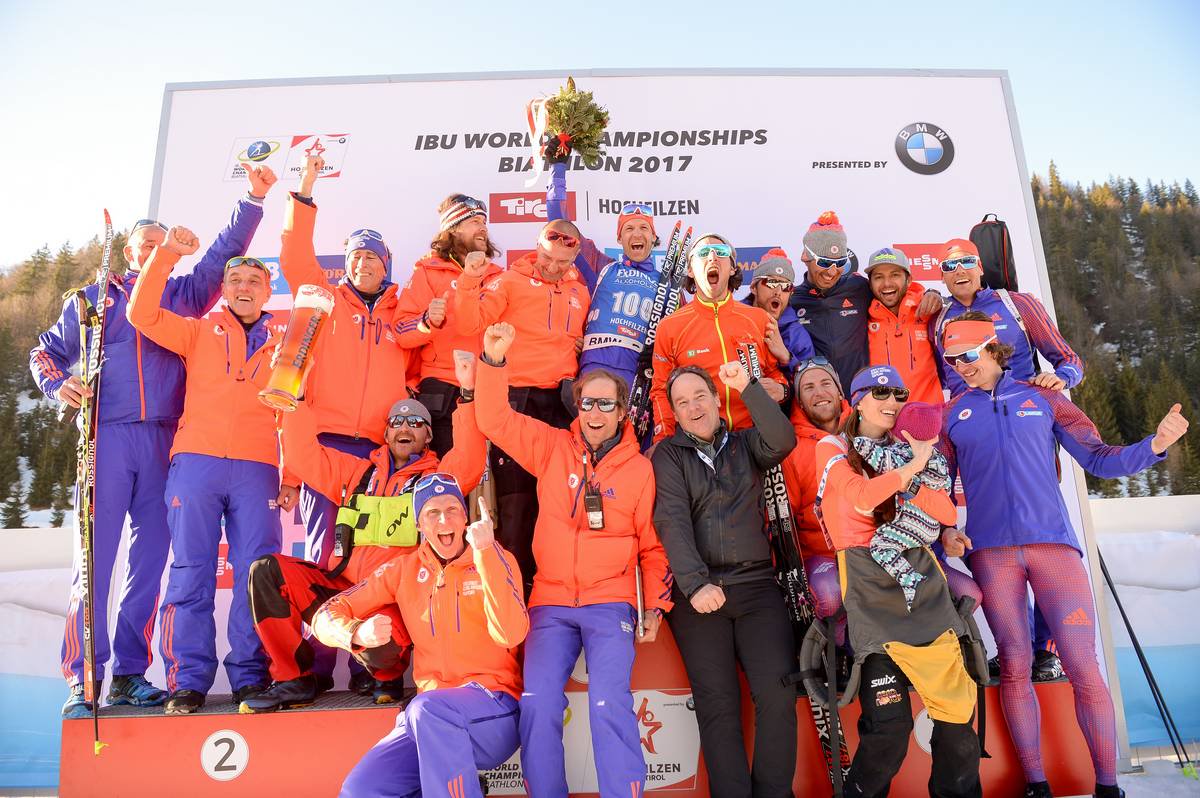
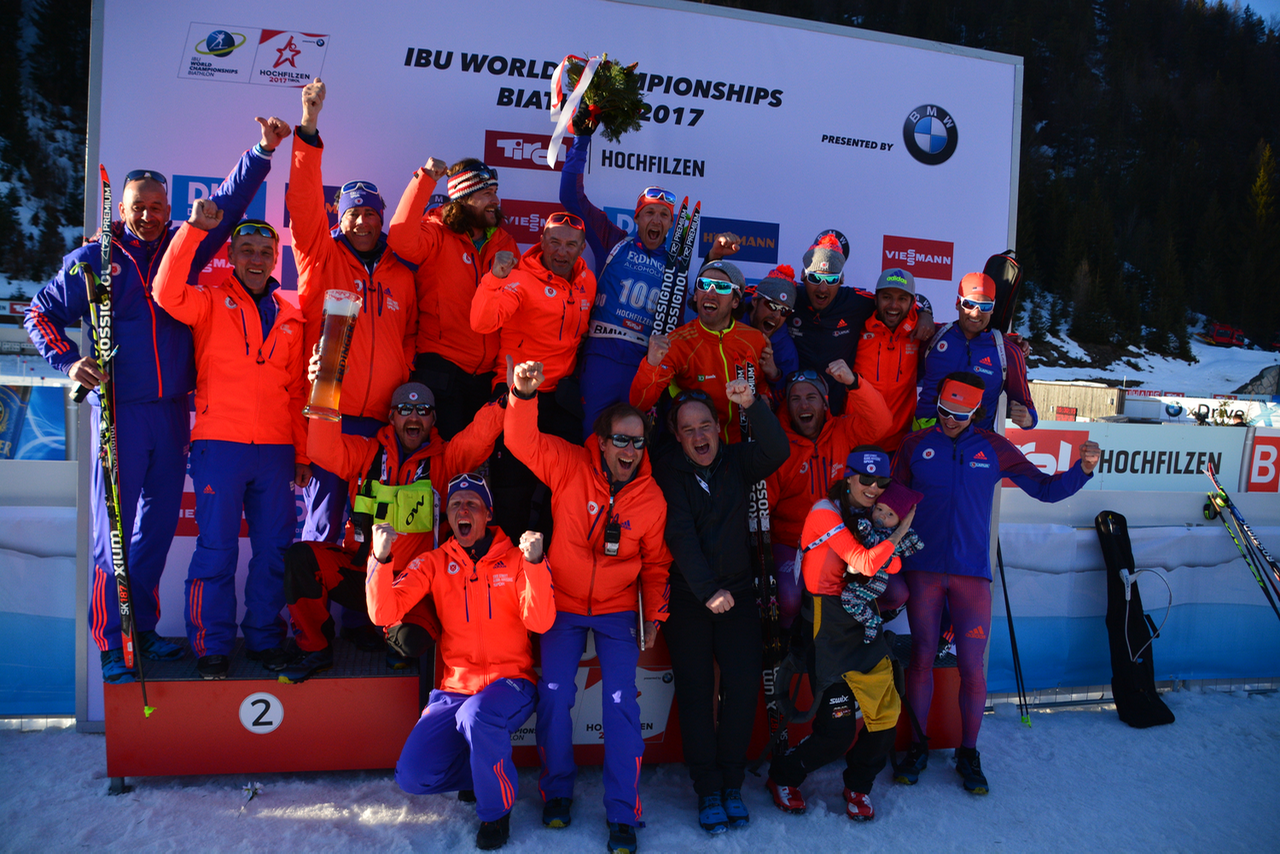
The U.S. team and staff — including Cobb (brown jacket) and Eisenbichler (to his left) — celebrate Lowell Bailey’s gold medal at 2017 World Championships in Hochfilzen, Austria. (Photo: USBA/NordicFocus.com/Twitter)
In Eisenbichler’s case, he assembles a coaching team from Sweden, Finland, and Canada, a service team that includes Germans, Czechs, and an Italian, and brings in a shooting advisor from Austria. Plus, of course, Americans.
“We have eight nations represented on our staff, and they all worked so hard towards one goal, over nearly a decade for some of the staff members,” Eisenbichler said. “To see them so happy after Lowell and Susan’s success was just very, very rewarding for me.”
How does it work, gaining buy-in and loyalty from a staff which can be far-flung in the summer months?
“If I was being arrogant, I would say good management,” Eisenbichler laughed. “No, that’s a joke.”
He admits that there have been a few hires which didn’t work out and didn’t fit in with the team. But they have been “actually few.” Part of the staff’s success, Eisenbichler said, was how it fits together.
“We manage pretty well to give everybody a project where they can really identify themselves as being a very important part of the program,” he explained. “As a result they are really giving more than a normal staff member would do, really giving their heart and their energy into these projects. But at the same time they know they are part of the puzzle. There is nobody who is the only one contributing to the success or failure. I really believe it is like a puzzle, and every staff member has — even if at times their role is more important than other times — but they have the feeling that without them, it would not have been possible to be so successful.”
That’s not to say that there have never been cultural differences between Eisenbichler and his team.
“In my early years on the team, we used to have a slight disagreement about the word ‘fun’,” Dunklee wrote, explaining: “I’ve always made it my goal to keep ‘fun’ at the forefront of all my racing and training because the day that I forget to have fun is the day that I burn out. I think Bernd (and many other European coaches I have met) associate the word ‘fun’ with a carefree and unfocused attitude. However, I’ve never thought of fun and hard work or professionalism as mutually exclusive, in fact they can build on each other. I have been most successful and satisfied with the sport when I am directing every effort possible towards a big goal and remembering to savor and enjoy the goofy, spontaneous and joyful moments along the way. On that point, Bernd could agree. We were talking about the same thing, he just preferred to use the term ‘enjoyment’ rather than fun. But he humors me now and sometimes tells me ‘have fun!’ before my race and I always act so surprised to hear that word coming from him. It’s become a running joke.”
In some ways, Eisenbichler is still a ski technician at heart. He works closely with Muck Bauer, the team’s stonegrinder, who is also based in Germany. The pair test skis all year round, and were developing new grinds right up through World Championships. That meant that skis were getting driven from Hochfilzen to Ruhpolding, stoneground, being driven back, and then skied in for 20 k the next morning before being raced on.
“Bernd was excited about some of the new breakthroughs they’d had,” Bailey wrote. “The night before the individual, it was decided that a couple of pairs of my skis should be sent to Germany and re-ground with some of these new grinds. It was one of those pairs that carried me to victory later that day. It’s hard to say what the difference was for me that day, but it’s hard to overlook that fact that, in a race lasting almost one hour, a 3.3-second margin of victory is about as slim as it gets!”
At the end of this year’s U.S. National Championships, Dunklee and Bailey presented Eisenbichler with USBA’s Medal of Honor. The love and appreciation that Eisenbichler has for his athletes, and vice versa, stands out.
“I was meeting with Bernd in the lead-up up to [the 2014 Olympics] in Sochi and one thing he said stuck out to me,” Dunklee wrote. “We were talking about goals and how of course he wants to see someone on the team bring home a medal. He explained how every bit of the high performance budget and staff were being directed towards that main priority. But then he told me, ‘You know, I’ll really gauge my work with the team as successful if 20 years from now, you athletes and staff decide to travel to Munich for an Oktoberfest Reunion together. Then I’ll know I did a good job.’ ”
“I look forward to that reunion some day,” Dunklee concluded.
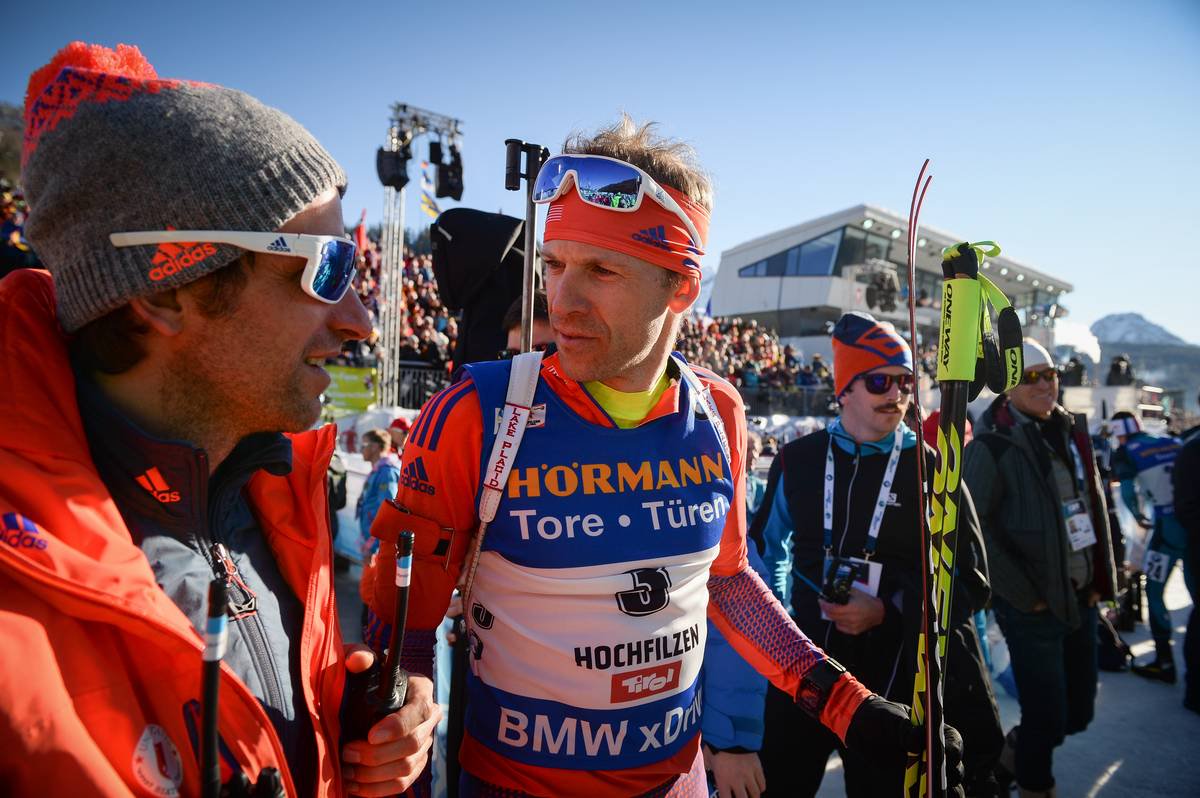
Lowell Bailey and Bernd Eisenbichler leave the mixed zone after Bailey finished sixth in the mass start at 2017 IBU World Championships in Hochfilzen, Austria. (Photo: USBA/NordicFocus.com)
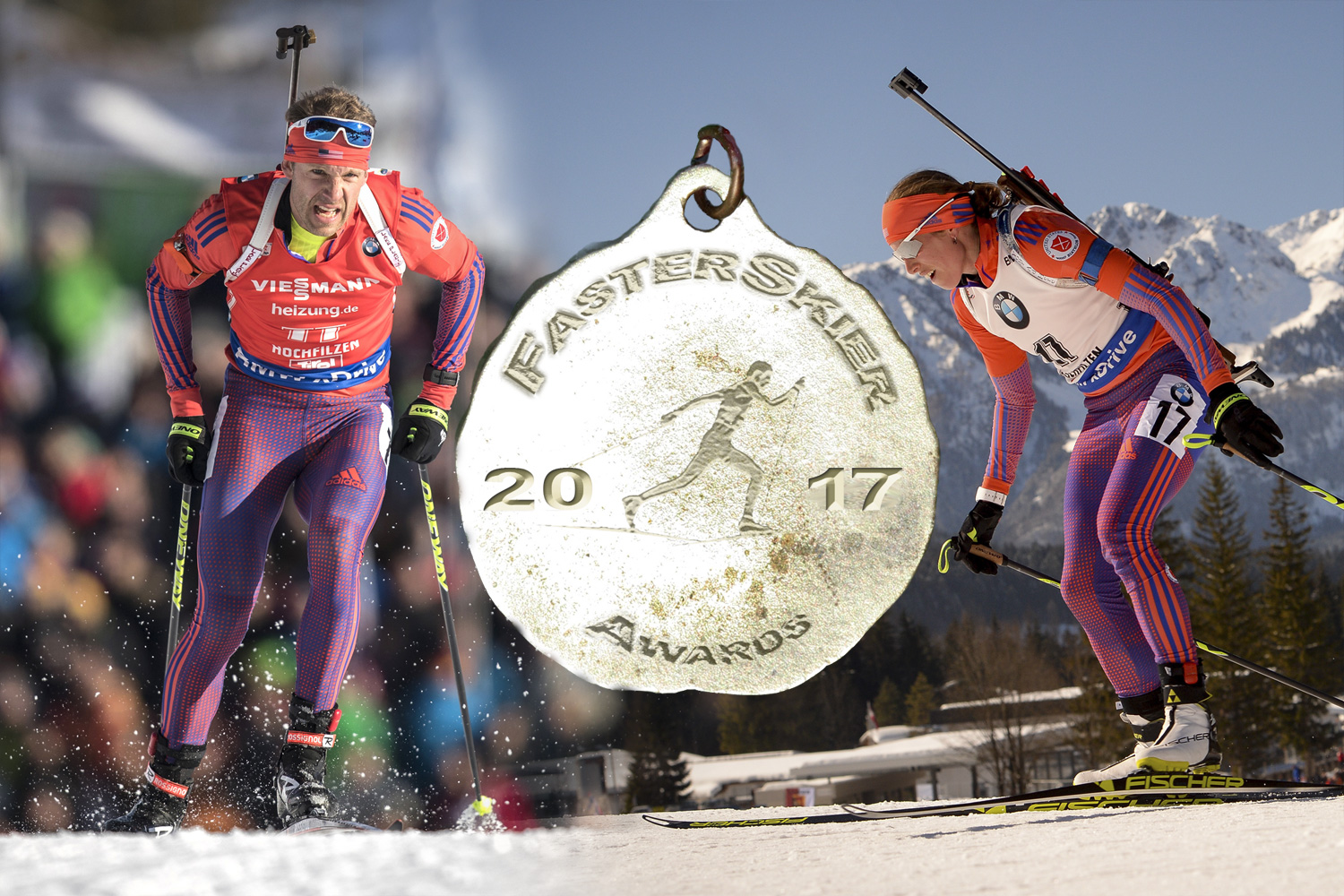
U.S. Biathlon’s Lowell Bailey (Photo: US Biathlon/NordicFocus) and Susan Dunklee (Photo: Fischer/NordicFocus) are FasterSkier’s 2017 Biathletes of the Year.
With the 2016/2017 season officially in the rearview, FasterSkier is excited to unveil its annual award winners for this past winter. Votes stem from the FS staff, scattered across the U.S., Canada, and Europe, and while not scientific, they are intended to reflect a broader sense of the season in review. This set of honors goes to outstanding female and male North American biathletes on the IBU World Cup circuit.
Susan Dunklee and Lowell Bailey, to U.S. national team biathletes, each had historic seasons in their own right, marked by both consistently strong performances and historic peaks. Bailey won the first World Championships gold medal for an American biathlete – male or female – and Dunklee won a silver medal as the first U.S. woman in an individual-start race in those same championships.
Then, like a tag team of comic book superheroes banding together, it seemed only fitting that they combined their strengths to also achieve the first World Cup podium in a team event for U.S. Biathlon in ages, putting an exclamation mark on their oustanding year.
Susan Dunklee, U.S. Biathlon
Dunklee, who already won FasterSkier’s female biathlete of the year award in 2015/2016, further improved on her strong performances from the prior winter with an even more remarkable season, thanks to increased accuracy and noticeably faster shooting times on the range after cleaning her targets rather deliberately earlier in her career.
Susan Dunklee (front) going head to head with Germany’s Laura Dahlmeier (1), Austria’s Lisa Theresa Hauser (12), and France’s Marie Dorin Habert (left) in the women’s 10 k pursuit at the IBU World Cup in Pokljuka, Slovenia. (Photo: USBA/NordicFocus)
In the first half of the season she already achieved a third place in the sprint in Nove Mesto, Czech Republic, as well as two more top-five finishes.
Then her powerful skiing and a clean 20-for-20 shooting performance – the first of her career in a four-stage race at the World Cup level – propelled her to a historic podium finish in the women’s 12.5-kilomter mass start at the World Championships in Hochfilzen, Austria.
“I thought, I have to get the hell out of here!” Dunklee described her feelings after hitting the last target in that race in an interview with FasterSkier back then. And she did, leaving the range first and claiming the silver medal and her first podium at World Championships, after only being passed on the final loop by Germany’s Laura Dahlmeier.
“Repetition and discipline and training will get you to be able to shoot fast in the race,” Dunklee reflected. “And you have to get to the point where you trust that speed is better than shooting slow. That takes a long time … [to] feel comfortable with that speedy rhythm. It has worked some days in races this year, and then other days it has totally fallen apart. But today it worked.”
Dunklee followed up the highlight of her season with several more strong and consistent performances, three times just missing another World Cup podium in fifth place. And then she crowned her year with another success, placing second together with teammate Lowell Bailey in the single mixed relay at the World Cup in Kontiolahti, Finland, only behind a team from Austria.
“I have dreamed for a long time being able to run into the finishing pen with a bib on and a rifle, and greet my teammates as they come in,” Dunklee described her new experience of winning as part of a team, in a phone interview after that race. “It’s so cool to finally do that. It’s definitely a dream come true.”
Fittingly, Dunklee was also the only North American athlete qualified for the elite top-30 field in the final World Cup mass start of the season in Oslo, Norway. Despite struggling a bit with her shooting accuracy in that last World Cup weekend, she managed to overall claim the tenth position in the women’s Total Score standings, another highlight to end her best season to date.
“This is the sort of history-making team that every athlete dreams of being part of during their lifetime,” Dunklee reflected on her season after the final race in an email. “We have staff who have worked for decades believing this level is possible. Now the door has been opened. I don’t think they will have to wait decades for the next relay medals or World Championships podiums.”
Lowell Bailey, US Biathlon
“Well, glad I didn’t stop,” Lowell Bailey told broadcaster ARD following his historic gold medal in the men’s individual race at World Championships, later reiterating that feeling in the press conference.
“I’m so thankful for the people who came to me and allowed me to continue my career. The first one to think of is my wife Erika who supported me in my decision. We had our daughter Ophelia this summer, and of course this makes things much more interesting as a family. We had to be creative in our training this year, but it all worked out. So thankful for them, and grateful for everyone who has helped me.“
Lowell Bailey (US Biathlon) celebrating a podium in the men’s 10 k sprint at the IBU World Cup in PyeongChang, South Korea. (Photo: USBA/NordicFocus)
In retrospect, Bailey had definitely made the right decision to continue racing. Leading into the 2017 season, talk about his imminent retirement from biathlon after a long and successful career and his potential future as a “bison farmer” on the ranch of his father-in-law had become a bit of a running gag among some TV announcers and his fellow competitors.
Bailey started out the winter with consistently good yet not outstanding results, with a ninth place in the pursuit in Nove Mesto his best result before the New Year’s holiday break, usually finishing between positions ten and twenty due to his slightly slower ski speed than the strongest athletes in the field.
Following the break Bailey’s form improved leading up to the planned peak at World Championships in Hochfilzen, and he shot remarkably well during the second half of the season when he focused on some foundational principles of biathlon.
“As you get to the competition season, you boil your shooting cues down to a few key principles,” Bailey explained in an interview with FasterSkier after his winning performance. “For me those are having a good trigger squeeze and follow-through. So it’s like two things. Trigger squeeze. Follow-through. And by the way, when you got to your first biathlon camp, those are two of the three things they teach you. But when you are in that situation, you are fighting for a World Championship medal, you have to keep things simple because that is all your brain is capable of.”
With a clean 20-for-20 shooting performance in the men’s 20-kilometer individual race at the World Championships, Bailey held a small lead going out on the final lap over Czech Republic’s Ondrej Moravec, and what followed was truly one of the most exciting finishes of the season.
“Fortunately I had great skis, and I had a U.S. staff member seemingly every hundred meters along that track,” Bailey told FasterSkier after the race. “But every hundred meters it was a sprint. Every hundred meters was ‘go as hard as you can for this hundred meters, and then when you get to the end of that hundred meters, go as hard as you can and just keep doing that.’ I thought the finish line was never going to come. I was just like, I don’t know how much longer I can do this, because the finish line is just not showing up.”
When the line finally did show up, Bailey was 3.3 seconds ahead and fell elated into the arms of U.S. Biathlon Association (USBA) Chief of Sport Bernd Eisenbichler awaiting him, emotionally celebrating the first gold medal not just of Bailey’s career but for the whole U.S. Biathlon program.
Susan Dunklee and Lowell Bailey celebrate after finishing second in the World Cup single mixed relay in Kontiolahti, Finland. Austria won the competition. (Photo: IBU/Twitter)
“When I think about when I first met Lowell, he was probably 13 years old, in Lake Placid, and just this good young skier who put his heart into this and worked for this every day, for almost 20 years now,” USBA President Max Cobb told FasterSkier following Bailey’s gold medal. “I think it is a total validation of Lowell’s career.”
As a sign of the respect Bailey commands among his peers, not just his own team but even his competitors seemed happy about the success, drawing high praise from silver medalist Moravec who so narrowly had lost out on gold, bronze medalist and World Cup dominator Martin Fourcade of France, and Germany’s Erik Lesser who had just missed the podium in fourth place.
Bailey followed up on his medal with a second place in the sprint at the following World Cup in PyeongChang, South Korea, at the site of the upcoming 2018 Olympic Winter Games.
“Sometimes you have these waves as an athlete, sometimes you can have also the opposite,” Bailey said in the press conference at PyeongChang. “I have been on this path since World Championships. I feel good physically and mentally, and confident on the shooting range and on the tracks.”
Then he recorded another historic second place in Kontiolahti in the single mixed relay together with his teammate Dunklee.
“It was my first single mixed relay and Susan’s as well, and we were totally psyched,” Bailey told FasterSkier after their shared podium. “This was the first time that you could hug your teammate in the finish zone… It’s a great moment to see both programs, both the men’s and the women’s teams, have a joint success like this.”
Bailey finished the season in eighth place overall in the men’s World Cup Total Score standings, both a career-best for him and a historic best for a US biathlete, all the more impressive because he skipped the entire week of races in Oberhof, Germany, for a longer holiday and training break.
“This is, by far, the best season of my life,” Bailey wrote in an email reflecting on his season after the last mass start of the year, where like Dunklee he had been the only qualified North American starter. “At 35 years old, I can say that I’ve waited a long time for this season.”
Susan Dunklee celebrates silver in the women’s mass start at the 2017 IBU World Championships in Hochfilzen, Austria. She became the first U.S. woman to earn an individual medal at Biathlon World Championships. (Photo: USBA/NordicFocus)
HOCHFILZEN, Austria—Lowell Bailey’s gold medal in the 20 k individual on Thursday was groundbreaking for the U.S. biathlon team.
But Susan Dunklee had come with goals of her own. And if anything, they just got bigger.
“I think back to a few years ago when he got his first podium in Kontiolahti [Finland], and I watched him do that,” Dunklee said. “I thought, he has been doing this for a long time and that’s possible. Then a week later I got my first podium in Oslo. So that thought crossed my head the other day when he won. I was like, huh, maybe I can feed off of this. You just need to get some positive momentum going and it makes it easier for the whole team to do well.”
In Dunklee’s last race of World Championships, the 12.5 k mass start, she performed in a way that was entirely her own. From the very first shooting, the Vermonter asserted that she was the woman to beat.
And while she didn’t match Bailey’s gold, she did end up with silver, the very first individual World Championships medal ever won by a U.S. woman in biathlon.
Susan Dunklee (US Biathlon) racing to silver in the women’s 12.5 k mass start on the last day of 2017 IBU World Championships in Hochfilzen, Austria. The second place was a best-ever result by a U.S. woman at Biathlon World Championships. (Photo: Fischer/NordicFocus)
Starting from bib 17, Dunklee moved into the top ten on the first loop of racing. Then, her moment came: the first prone stage.
Dunklee took just 26 seconds to hit the mat, clean all five targets, and jump back up again. It was the fastest time of the whole field and she left with a 5.1-second lead on the rest of the women.
It was a pattern that would repeat again and again: the others caught Dunklee on the top of the large climb on the back of the course, but then they would ski into the range together, Dunklee would clean with lightning speed, and go out with a gap again.
“I was focusing on skiing patiently today, and efficiently, especially because I was off the front,” she explained. “I didn’t have someone to tuck behind, so I didn’t want to overdo it. I wanted to have something left in the tank on loop four and five. So I thought, I am going to ski relaxed and if they catch me I will just jump in behind them, and if they don’t catch me, well, then I will have an extra gap.”
Dunklee knew that she had a trump card in her pocket: shooting speed. It was something she had been working on all year, and she was determined to shoot both quickly and accurately, making up time on the range.
At her first World Championships, where Dunklee finished fifth in the 15 k individual, she was one of the slowest shooters in the field. Today, she was the absolute fastest over all four stages.
“Repetition and discipline and training will get you to be able to shoot fast in the race,” she said. “And you have to get to the point where you trust that speed is better than shooting slow. That takes a long time, and one of the things that I have done this year is shooting on paper with speed, just to get used to that rhythm, and feel comfortable with that speedy rhythm. It has worked some days in races this year, and then other days it has totally fallen apart. But today it worked.”
And so she came into the final standing stage with three other women, giants in the sport: Laura Dahlmeier of Germany, who had already won four gold medals at this World Championships; Gabriela Koukalova of the Czech Republic, who had won a medal in every individual race so far; and Marie Dorin Habert of France, the winningest athlete of last year’s World Championships.
Dunklee had never cleaned a four-stage race, but she had the confidence of 15 perfect shots behind her.
As soon as the first target turned white, she was on a roll, keeping up the speed and finally getting that 20-for-20. Again, she left in first place.
American Susan Dunklee leaving the range first after the final shooting stage of the women’s 12.5 k mass start at IBU World Championships in Hochfilzen, Austria. She went on to place second for her first World Championships medal and the best result of a U.S. female biathlete at World Championships. (Photo: USBA/NordicFocus)
“I thought, I have to get the hell out of here,” she said of the feeling of hitting the 20th target.
Koukalova and Dorin Habert both missed a shot, leaving Dahlmeier as the lone chaser. (A third woman, Lisa Vittozzi of Italy, cleaned all 20 targets, but was slower on her skis and finished 11th).
“As I was skiing out I kind of looked up [at the scoreboard] saw that I was out and Laura was five seconds back,” Dunklee recalled. “I didn’t see any other names yet, so that’s all I knew, that Laura was dive seconds back. It could be someone else that was close to her but I wasn’t sure.”
Dunklee tried to ski big, but not to wear herself out on the first part of the loop. By the time the loop was halfway through, Dahlmeier had caught her. On the same hill where Dunklee had been caught on earlier loops, Dahlmeier put the hammer down.
“We had this in every loop, where she goes a little bit faster in the shooting range, then we come closer closer and I got her at the highest point,” Dahlmeier said in the post-race press conference. “Then on the last loop, it was going to be the same thing. [I thought], it is possible.”
She skied away; Dunklee couldn’t follow.
“I didn’t quite have it to stick with her,” Dunklee said. “But I didn’t know how far back those other people were, so I as just pushing to hopefully keep a big enough gap so they don’t get any ideas in their head, you know, and chase me down.”
It was a smart move: while Koukalova and Dorin Habert were in the penalty loop, a few other women cleaned the last stage. That set up a battle between Kaisa Makarainen of Finland, Teja Gregorin of Slovenia, Yuliya Dzhima of Ukraine, and the Czech and French stars.
Makarainen skied the fastest last-loop time of the entire field, and claimed bronze (+20.1).
“The first shooting I did a big mistake,” Makarainen said of her one miss in the race. “My finger was breaking early. But I knew that [if] it was my only penalty, I could still fight for the top spots. When I came to the last shooting I knew that the girls were in front of me were strong, but I worked hard in the last loop.”
Dunklee stayed well ahead of her and crossed the line second (+4.6), earning a historic silver medal.
“I had a feeling that [Dahlmeier] would catch me, because it is a lot easier when you are hunting than being hunted,” Dunklee said of not being able to follow the German – who with the medal became the most successful woman at a single World Championships ever – and thus missing out on gold. “Unfortunately I didn’t quite have that today, but I am pretty happy with the race and it gives me something to aim for in the future. Laura is at the top of her game right now, she’s done fantastic under pressure and I don’t think there re many people in the world ever who could have done that.”
Dunklee’s performance was distracting, even mid-race, for teammate Clare Egan. Egan had turned in the best results of her career so far to earn the 30th and last bib in the mass start, her first time ever qualifying for the race.
“I was paying attention to the bigscreen even on my way into my standing,” Egan admitted. “I was listening and I heard that Susan was leading after shooting four. It took the pressure off in a way, I was like, what I am doing right now doesn’t matter at all because Susan is going to medal in this race! Maybe I should have been paying a little more attention to myself,” she laughed.
But perfect focus or no, Egan raced to 24th place (+3:04.4), one of the five best races of her career.
“Luckily I started our last two relays, so I had some experience with mass starts,” she said. “But I still need to work on my standing shooting. I missed my last standing shot both times and I just I don’t have a lot of confidence in my shooting. And as soon as you get defensive you miss. I have a lot to work on, but I am happy — I shot 80%, I was 24th and I am content.”
Maybe it wasn’t a medal, but seeing Egan in the mass start was another accomplishment for a team which has had their best week ever.
Like Dunklee, Egan came from a cross-country skiing background. While Dunklee turned to biathlon immediately after graduating from college, it took Egan a few more years before she decided to make the switch. But the results are starting to come.
“Going into this week I have met none of my goals for the season and I was pretty disappointed,” said Egan. “But I had a lot of support from our coaches, and sports psychologist and my teammates, and turned things around. I can only hope one day I will be as good as Susan, but nobody works harder than she does, she really deserves this and every other victory that she gets.”
Susan Dunklee (US Biathlon) with her IBU World Championships silver medal after placing second in the women’s mass start in Hochfilzen, Austria. (Photo: USBA/NordicFocus)
For Dunklee, the shooting speed and the results it has brought her have come from not only hard work on the range, but a calm attitude and a diversified lifestyle. Much like Bailey has successfully divided his time between world-class training and personal pursuits, Dunklee became a homeowner this summer and is dedicated to her home community in Craftsbury, Vermont.
“We say I am adulating, I guess,” she laughed. “I definitely like having a little more space. I feel like it has also allowed me feel like I have done my little bit and I have other interesting things going on besides just biathlon. Like the other day I found out that my mailbox got hit by the plow truck. Now I have other things to think about, you know, it’s just its fun.”
In the press conference, Dahlemeier talked about how mountain climbing and having other hobbies that require spending time away from biathlon (and her mobile phone) was essential for her performance. Balance, she said, was good.
Dunklee agreed.
“I do have a tendency to focus 100 percent on whatever I am working on at a given time,” she said. “That can be good at certain aspects, but that can also can take over my life, and when things are frustrating or a little disappointing it can be hard for me to distance myself from that. So I need to have other things that I get meaning from.”
Lowell Bailey (US Biathlon) racing to gold in the men’s 20 k individual at 2017 IBU World Championships on Feb. 16 in Hochfilzen, Germany. He finished the championships with his fourth individual top six on Sunday in the men’s 15 k mass start. (Photo: USBA/NordicFocus)
Before this year’s International Biathlon Union (IBU) World Championships, American Lowell Bailey had never cleaned a 20-kilometer individual or 15-kilometer mass start race. In layman’s terms, he had never hit all 20 targets in those types of races — the longest formats on the circuit. Not in a World Championships, not in a World Cup. That’s not to say shooting isn’t his strength; that’s just extremely difficult to do.
Fast forward to Sunday, the last day of 2017 Biathlon World Championships in Hochfilzen, Austria, Bailey finished his third individual race of the championships with perfect shooting, shooting clean in the 15 k mass start for sixth place. In four individual races over the last week, he hit 69 out of 70 targets.
“It’s, no words, it’s unbelievable,” Bailey said after Sunday’s mass start, where he finished with what would have been a career best (sixth) in any other of his previous World Championships appearances.
In his eighth World Championships, this year was different. Bailey started the week off by racing to fourth in the sprint, the second-best result of a U.S. biathlete at World Championships. He cleaned that race. Then he finished sixth in the pursuit for his second-best result at World Championships. That’s the race he missed one.
Not counting Olympics (Bailey finished eighth in the 20 k at the 2014 Sochi Games), he had cracked the top 10 of an individual race at World Championships once before (in last year’s mass start in Oslo, Norway, where he placed 10th). Bailey carried his momentum this year all the way to the Hochfilzen 20 k, which he won to become the first American gold medalist at Biathlon World Championships. That happened Thursday. Three days later, he ended the championships with his fourth top-six result in as many individual races.
“I’m so happy for the team, for Susan,” Bailey said. “Our whole team deserves this world champs. We haven’t shown what we’re capable of, there’s always been one setback or another … and the stars aligned for this one. We were waiting for this moment and everything clicked for the team and it’s so great to see, and god, am I glad I stuck around to be here.”
Lowell Bailey sharing his moment on the top step of the World Championships podium with his wife Erika (r) and daughter Ophelia on Feb. 16 in Hochfilzen, Austria. (Photo: USBA/NordicFocus)
Bailey, 35, is a new dad. Some people refer to him as a buffalo farmer. He got married nearly two years ago and he and his wife Erika welcomed a baby girl into their lives last June. You could say Bailey has a lot going on, and he considered retiring at the end of last season, yet he came into this season with a very specific focus.
“I told my staff, I said, ‘Hey, I just want to be on the podium again. It really doesn’t matter to me where that is because I know every race is just as competitive, so if it’s at world champs, great, if it’s at the first World Cup, if it’s at the last World Cup…,” Bailey explained.
With “25-some-odd” races in a season, he liked his odds. And considering the momentum he has coming out of world champs, Bailey is feeling good about the last nine races of the season.
“It’s just a matter of believing,” he said. “I’ve got the confidence now, I know I can go head to head with the best in the world … I’m just gonna enjoy the rest of the season and every race is a new day and a new chance.”
Podium Contention
While sixth sounds pretty good, Sunday’s mass start was even more exciting for fans of Bailey and US Biathlon as he skied in first, second or third for much of the race.
Bailey put himself near the front of the 30-man field early in the mass start, entering the range in fifth for the first time. One of 18 skiers to shoot clean on that first prone stage, he headed out on his second loop in second place, just 1.1 seconds behind Russia’s Anton Shipulin in first.
On that second loop, Austria’s Simon Eder took the lead then traded off with his teammate Dominik Landertinger before Germany’s Benedikt Doll led the pack into the range for the second time, followed closely by Shipulin and Bailey, respectively.
There, Bailey shot clean and posted the fastest range time to leave the range in first, 0.9 seconds ahead of Landertinger. Overall on the day, Bailey’s range and shooting times ranked third fastest.
On the third loop, Doll, Eder and Landertinger passed Bailey early, and he ultimately entered the range for the first standing stage in eighth, just 2.5 seconds behind Doll in first. Despite tired legs, Bailey shot clean again and left the range in second.
“I just kept to what’s been working for me all week,” he recalled. “I kept to the simple fundamentals of shooting. Today I was really feeling it, I didn’t have it in the legs and sometimes that can be a distraction, but I just said, you know, just do what you can do. You know how to shoot and you know how to ski, so just go and do the best you can.”
Austria’s Simon Eder (17) leads France’s Martin Fourcade (2) and Austrian teammate Dominik Landertinger (22) in the men’s 15 k mass start, the last race of IBU World Championships in Hochfilzen, Italy. Eder went on to place third for his first World Championships podium, Fourcade placed fifth and Landertinger seventh. (Photo: IBU)
He followed Eder, also clean through three stages, out of the range with about 3 seconds between the two. France’s Martin Fourcade had worked his way up to third after a penalty in the first stage and trailed Bailey by 0.6 seconds. Aside from Fourcade, seven of the top eight were still without a miss heading into the last shooting.
There, Bailey entered the range in eighth again, 12.1 seconds behind Fourcade, who had worked his way up to first on that fourth loop. Landertinger remained in second, just 0.5 seconds behind Fourcade, Germany’s Simon Schempp third (+0.7), Norway’s Johannes Thingnes Bø fourth (+1.3), and Eder fifth (+1.8).
Eder, Schempp and Bailey all cleaned — the only three men to do so and finish the day with 20-for-20 shooting — to embark on that last loop in that order. Eder led Schempp by just 2.3 seconds while Bailey trailed in third, 16.8 seconds out of first. Another 8.4 seconds behind Bailey, Bø flew out of the penalty loop (after his first miss of the day) in fourth.
And while third place was undoubtedly on Bø’s mind, he didn’t stop there when he passed Bailey early on the final 3 k loop. Up front, Schempp had caught and passed Eder within the first kilometer. Eder appeared to give up the chase for gold half a kilometer later, and at 13.6 k, he was 7.5 seconds ahead of Bø in third.
Germany’s Simon Schempp celebrating his first individual World Championships gold on Sunday in the men’s 15 k mass start in Hochfilzen, Austria. (Photo: IBU)
Bø caught him and with less than a kilometer remaining, he passed Eder to lead on a downhill into the finishing straight. Schempp skied away, uncontested, for first place in 35:38.3 minutes, while Bø finished 9 seconds later for silver. Just 1.1 seconds behind Bø, Eder notched his first World Championships podium in third (+10.1).
Meanwhile, Bailey’s gap to Bø on the last lap grew to 18 seconds by 13.6 k. Shipulin passed Bailey shortly after, and Fourcade passed him as well to put Bailey in sixth at the finish (+33.5), behind Shipulin in fourth (+25.3) and Fourcade in fifth (+31.3).
“I was able to hang for four laps and I just told myself to hang as long as I could,” Bailey recalled. “Unfortunately I only had four laps and the fifth was bru-tal as they say in Germany. But I’m so psyched with this whole world champs…
“It’s surreal to be sixth,” he continued. “I mean, a fourth, a sixth, a first, and a sixth… I’ve popped good results here and there, but to be consistent for the whole two weeks, I’m so satisfied with how the training’s gone and the preparation. I had great skis today, maybe the best skis I’ve had actually, thank god because I didn’t feel so good. I was pretty tired. It’s amazing, it’s really just amazing. It’s hard putting it into words.”
For the 28-year-old Schempp, who wore the red bib of the World Cup mass-start discipline leader, it was his first individual world title in his sixth World Championships.
“He is wearing the red bib, and you could see he deserves that,” Germany’s head coach Mark Kirchner told German broadcaster ARD. “He has waited a long time for his individual medal, and now he also [silenced] the last critics who talked all week about how he hasn’t won one yet, and even with gold. Sensational.”
“I am just happy that it was finally sufficient,” Schempp told ARD. “Incredible, an amazing race. I am just happy that it finally was enough for the top. Thanks to everyone, I can’t really say anything right now.”
He explained that he made a point to save some energy for the last climb, because he was “determined to attack there,” Schempp said. “And that was enough. A great day.”
“Of course it’s a big relief,” he added. “After all the races here I had to walk through the mixed zone and justify myself, that was not a nice feeling. And everyone asked me about the medal. It’s not easy, but today I finally was able to put it all together for a season highlight, and that’s why I am also enormously proud of myself.”
The men’s 4 x 7.5 k relay podium at 2017 IBU World Championships on Saturday in Hochfilzen, Austria, with Russia (c) in first, France (l) in second, and Austria (r) in third. (Photo: IBU World Champs/Twitter)
HOCHFILZEN, Austria—Redemption, validation, national pride: just a few of the things that were on the line in today’s 4 x 7.5 k relay at IBU World Championships.
For Austria, it was clear: a good performance on home soil was critical. The team hadn’t won a medal yet despite eight chances to do so.
For Germany, the question was whether their accomplished men’s team could live up to the expectations set by its younger women’s team, which has won every relay this year, including at World Championships.
For Norway, there had been no gold so far, but the men wanted to defend their title from last year’s Championships in Oslo.
Russia? Relays were seeming like the best way to take medals. They had earned bronze in the mixed relay, but been locked out ever since. Plus, the team has been embroiled in politics. Things were getting complicated.
France’s Martin Fourcade has dominated the whole season, but only won one gold at World Championships. Would the relay be the place he could finally get a second?
Plus, Canada won bronze in the team event last year, and the U.S. men’s team, often a top-six threat, was looking to capitalize on the energy from Lowell Bailey’s gold in the 20 k individual.
Any number of teams wanted a slice of the podium. But there were only three steps, and only one set of gold medals.
Out of the start, a team that nobody had expected shot to the front: Latvia. Andrejs Rastorgujevs, always one of the fastest skiers in the field, decided to make a breakaway already on the first loop. He then quickly cleaned prone and continued to lead on his own through the second loop.
Using spares in standing, though, the strategy didn’t seem to pay off. Germany staked a claim as soon as he faltered, with veteran Erik Lesser cleaning both shooting stages with no spare rounds and then attacking the final loop. He tagged off to Benedikt Doll with 5.8 seconds on the competition.
“Erik is such a great finisher,” U.S. lead skier Lowell Bailey – who tagged off 12.4 seconds back in fourth place, after using one spare round – said of Lesser. “In that situation he is nearly unstoppable. Hats off to him. He knows how to ski relays.”
While Lesser had thrown down, many teams weren’t so far behind him. By the end of the third leg, Benedikt Doll had thrown away Germany’s lead with poor shooting and six teams were still within 32 seconds of first place. Gone were the U.S., Canada, and Norway. Anton Babikov had turned in a hero’s performance to take Russia to the front, and his team was now chased by Austria, France, Germany, Ukraine, and Italy.
Anton Shipulin had taken over for Russia with a slight lead over Austria and France. Martin Fourcade, the French anchor, chased hard, and passed Austria’s Dominik Landertinger. With a clean prone from both Fourcade and Shipulin, the race narrowed. But Shipulin still had some seconds of cushion when he came in for standing.
He needed them: Shipulin used one spare. Fourcade shot quickly, cleaned, and tried to catch the Russian. He left the range 4.2 seconds back, setting up a battle between two of the top men on the World Cup.
“Today the last round for me was the most difficult, because I knew that Martin Fourcade is a very strong athlete,” Shipulin said through a translator at the press conference. “I was just trying to run faster than him.”
It turned into the battle that wasn’t, however, with Shipulin pulling away and coasting to a 5.8-second win for Russia.
“I think it was too complicated for me today,” Fourcade said. “I am not in my best shape. Anton was really strong on the track. I tried in the beginning of the race to catch him, and I almost did it. But then he had a bit more power than I had.”
While the Russian fans weren’t the most numerous in the stands, they were among the most passionate. And the team had delivered for them.
“I feel relieved for our team and our country,” Shipulin said. “I think it has been almost ten years we have not won any [World Championships] in the relay. So we are just really lucky and really happy, and we are going to celebrate.”
(Russia did win gold at the 2014 Olympics.)
Behind Fourcade and Shipulin, Landertinger of Austria and Simon Schempp of Germany were both trying desperately to secure a podium spot, but there was only room for one.
Schempp initially appeared to have better skis on the downhills on the front end of the loop. But on the major climb on the back end, Landertinger accelerated and Schempp was utterly unable to follow. To the monstrous roar of the crowd, Landertinger skied into the stadium to take bronze with his three teammates.
“It was very, very hard,” Landertinger told Austrian broadcaster ORF. “Simon is one of the best anchor skiers I know. When I skied out of the range after the shooting and saw him just four or five meters behind me, I knew it would be very difficult. I probably looked at that climb a hundred times in training, and it was pretty clear I would do my attack there. And thank God that worked out great.”
Schempp was deflated, but said that Germany needed to have an overall better team performance to secure a podium. Eight spares wouldn’t to it.
“It wasn’t enough for the podium today,” he told German broadcaster ARD. “I gave everything I had, everything that was left. Unfortunately we were not convincing on the shooting range today.”
Doll apologized too: four of the eight spare rounds came from him, including three in the standing stage, which had dropped the team to seventh at the time.
“Everyone did their best, I also tried to do my best,” he said. “But I just didn’t have it in my head today. I am really sorry about that, it really hurts because half the used spares were on me. I might have to give out a bar round tonight. I have to take a large part of the blame on me.”
For the Austrian team, the medal was long-awaited and cause for celebration.
Leadoff skier Daniel Mesotitsch was also the leadoff guy when Austria took bronze on this same course back at 2005 World Championships.
“It feels just as great as back then,” the 40-year-old told ORF. “There is no better feeling than winning a medal at home with the team. We are all overwhelmed by our emotions. I was briefly feeling sick to my stomach even watching [the last loop]. I was a lot more nervous than during my own loop.”
But now, a medal is theirs.
“It’s beautiful,” Landertinger said. “Really, really beautiful. And I have to say, what I experienced today with those fans, I already got goosebumps coming into the arena today. And I am proud that I can race here. And now with this medal I achieved the goal I had, and I am brutally happy now.”
U.S. Team Seventh, Just Out of Top-Six Goal
Bailey delivered as the U.S. team’s leadoff racer, using just one spare round and staying near the front for the whole race. After the team could not contest the first few relays of the season, they lost valuable Nations Cup and relay points and started with a high bib number. Bailey had to make up the time on the range, rather than the trails.
“There was no where to go –it’s actually fairly narrow for a World Championships Course,” Bailey said. “There wasn’t a lot of room to work. With the high bib number you actually hit the [shooting] point [on the range] before a lot of other people, so I really was just focusing on getting my first shot off quick. I did, but I missed it unfortunately. The key is just in that first prone is keeping enough contact, so I really pushed the pace in shooting and pushed that extra round so I could maintain contact.”
While he was confident coming off his gold medal on Thursday, Bailey was also tired. He wasn’t sure how he was going to feel, or if he would be able to make up time on the trails once the pack thinned out enough for him to move.
“I was a little nervous about today, because the last 48 hours have been a little bit wild and I slept two hours the night after the individual,” he admitted. “I didn’t go to bed late. I just lay there and Erika and I were both wide awake, occasionally like, ‘Are you sleep?’ ‘No, are you sleep?’ ‘No, shit.’ You have to put your feet back on the ground, back in the ski boots.”
By the time he tagged off to Leif Nordgren, the U.S. was in fourth place, more or less where they wanted to be.
Then, Nordgren cleaned prone and moved into second place, 0.4 seconds behind Germany’s Doll. Really right where they wanted to be.
“I kind of took my time a little bit in prone,” Nordgren said. “I wanted to make sure I hit all five targets not using any extras, so that went really well.”
The pair were soon consumed by a chase back, but that didn’t bother Nordgren.
“I left the range right with Doll there for the lead, and then he didn’t push super hard the second loop so it was no problem staying with him. But of course it allowed some guys from behind to catch up, which, no big deal.”
In standing, Nordgren used one spare, dropping to fifth, and then stayed in sixth place on the trails. Despite losing places, he was still just 17.7 seconds out of the lead.
“I think I paced the race really well,” said Nordgren. “I was right there. I couldn’t quite close the gap, but you know, I think I kept us right in there, so yeah, I am happy.”
Tim Burke used one spare in prone and three in standing, and blamed his spare rounds partly on exhaustion.
“I feel so bad on the skis, it’s such a fight from the first kilometer,” he said. “By the time I got to standing my legs were cramping, and I — yeah. It’s so much easier when you’re feeling good, you can push and recover and get in the flow. When you’re just fighting the whole loop to try keep your head above water, and then you hit the mat to shoot, it’s just brutally hard.”
Despite a performance that left him frustrated, the U.S. was still in seventh place when Sean Doherty took over to race the anchor leg. He used two spares in prone and then cleaned standing, heading out on course in seventh place and on the hunt: Ukraine was just 3.2 seconds ahead.
The top six was not meant to be, though.
“I just didn’t have it in the legs today and that’s pretty frustrating,” Doherty said after crossing the line seventh, +1:50.5. “You know, to be so close to sixth there and not have the gear on the last lap to push it through. I gave it all I had and just didn’t have enough.”
With a total to eight spare rounds – not bad, but more than Russia’s three or France’s four – the team was missing the last little bit that would have gotten them to where they wanted to be.
“I would say we were hunting for the top six, and you know, Leif and Lowell got us off to such a great start,” Doherty said. “Unfortunately, I wasn’t able to really follow up on that. I think we all had it in us, just couldn’t quite get that critical mass.”
Canada 13th in Hunt for Medal Defense
Last year, the men’s relay was the best moment in several Canadian team members’ sporting careers. They won an unexpected bronze medal and were the sensation of World Championships.
This season, Nathan Smith has been out with a virus. That gave Macx Davies a chance to start. But overall, the team couldn’t match their form from the year before. With ten spares overall, they crossed the line 13th, +3:35.5.
“I was just hoping to have a good race for myself,” said Davies, for whom it was the first World Championships relay start. “It is hard to put any [results goals] on relays because it is a team event, and I am not the other three guys… It hasn’t been bad, it just has been a little too slow, especially a few too many spares for us. We need to miss less than the other nations if we ski, or if I ski, like I did today.”
“I could have definitely done better than I did today,” said leadoff racer Christian Gow, who had three spares. “Too many mistakes on the range, but I am at least happy with my skiing… I think it was a pretty good ski day. I think it is the closest I have been with that many spares. The skiing was pretty decent, but I dropped the ball in the range.”
-Gerry Furseth, Harald Zimmer, and Ian Tovell contributed
The men’s 4 x 7.5 k relay podium at 2017 IBU World Championships on Saturday in Hochfilzen, Austria, with Russia (c) in first, France (l) in second, and Austria (r) in third. (Photo: IBU World Champs/Twitter)
IBU World Championships (Hochfilzen, Austria): Men’s relay
[UPDATED] Russia’s four-man relay team hit nearly every target on Saturday, using a total of just three spares to clean 40 targets, and stayed out of the penalty loop to capture gold in the men’s 4 x 7.5-kilometer relay at the International Biathlon Union (IBU) World Championships in Hochfilzen, Austria.
It was the last team event and the second-to-last day of the championships, with the men’s and women’s elite mass starts remaining on Sunday. Anton Shipulin anchored the Russians to first, 5.8 seconds ahead of France’s Martin Fourcade, after Shipulin cleaned his prone stage and used one spare in standing to hold onto the lead his team built. Fourcade cleaned both stages to secure silver for his team, and Austria took bronze (+20.1) with anchor Dominik Landertinger.
After Russia’s Alexey Volkov used one spare in each of his shooting stages and came through the exchange in seventh, Maxim Tsvetkov and Anton Babikov both cleaned without any spares to bring the team into fourth, then first, respectively.
France’s first leg Jean-Guillaume Béatrix shot clean as well and tagged Quentin Fillon Maillet in second. Fillon Maillet then needed one spare in prone, but cleaned standing to take the lead, tagging Simon Desthieux in first. Desthieux used three spares in prone, but avoided the penalty lap before tagging Fourcade in third, 12 seconds behind Austria in second. Fourcade closed the gap and clinched second, and France combined for a total of just four spare rounds.
Austria achieved bronze in front of a home crowd with Daniel Mesotitsch, Julian Eberhard, Simon Eder, and Landertinger combining for 10 spares and no penalties.
Finishing 8.5 seconds after Austria, Germany placed fourth. Italy was a minute and a half out of first in fifth, Ukraine took sixth (+1:41.3), and the U.S. placed seventh (+1:50.5) with Lowell Bailey, Leif Nordgren, Tim Burke, and Sean Doherty. Bailey initially put the team in fourth at the first exchange, 12.4 seconds out of first, then Nordgren tagged Burke in sixth, 17 seconds behind. Burke used four spares to clean and tagged Doherty in seventh, about a minute back. The Americans used a total of eight spares but had no penalties.
Canada finished 13th (+3:35.5) with Christian Gow, Scott Gow, Macx Davies, and Brendan Green. They were 39 seconds out of first and in 12th place after Christian Gow’s first leg, then slipped to 14th before Davies moved them back into 12th by the last exchange. Canada had a total of 10 spares and zero penalties.
FIS Cross-Country World Cup (Otepää, Estonia): Freestyle sprint
In the last World Cup before the upcoming 2017 International Ski Federation (FIS) Nordic Ski World Championships next week in Lahti, Finland, five U.S. women qualified in the top 12 of the women’s 1.3-kilometer freestyle sprint, and Jessie Diggins reached the final on Saturday in Otepää, Estonia.
Diggins started the day by placing 12th in the qualifier, 3.93 seconds behind Sweden’s Stina Nilsson in first (and her U.S. teammates Kikkan Randall in third, Sophie Caldwell in fourth, and Ida Sargent in 10th) before winning her quarterfinal and semifinal. In the final, Diggins wad gapped by the leaders on the final climb and finished fifth (+6.82).
The women’s freestyle sprint podium at the Otepaa World Cup on Saturday in Estonia, with Swedish winner Stina Nilsson (c), Norway’s Maiken Caspersen Falla (l) in second and Heidi Weng (r) in third. (Photo: FIS Cross Country/Twitter)
Nilsson won the final in a time of 2:49.96 minutes, just ahead of Norway’s Maiken Caspersen Falla (+0.27) who lost her balance and her speed with it on the last corner. The two had broken away from third place and Nilsson led into the final straightaway and held Falla off for the win. Norway took second through fourth with Heidi Weng in third place (+3.75) and Astrid Uhrenholdt Jacobsen in fourth (+4.91).
Randall initially finished her quarterfinal in third position and would have been out, but advanced when Russia’s Natalia Matveeva was relegated to last for obstruction. In the same semifinal as Diggins, Randall fell cresting a small hill over a tunnel and finished fifth (+13.30) for ninth overall on the day.
Caldwellplaced second in her quarterfinal heat behind the day’s winner Nilsson, then stumbled halfway up a climb early in her semifinal, but stuck with the pack to finish fifth (+1.83) for 10th overall.
Sargent raced in the same quarterfinal as Falla and narrowly missed advancing to the semifinal in third place, fewer than 0.2 seconds behind Switzerland’s Laurien van der Graaff in second and 0.35 seconds behind Falla, who won that heat. Sargent placed 13th on the day.
Sadie Bjornsen qualified 25th and finished fourth (+2.82) in the same quarterfinal as Randall for the 25th overall.
Canada’s Dahria Beatty also qualified for the sprint heats in 30th place, and finished sixth in her quarterfinal for 29th overall.
Also for Canada, Cendrine Browne finished the qualification in 48th place and Katherine Stewart-Jones was one position behind in 49th.
Also for the U.S., distance specialists Chelsea Holmes and Rosie Brennan placed 58th and 60th, respectively.
The men’s freestyle sprint podium on Saturday at the World Cup in Otepaa, Estonia, with Norway’s Johannes Høsflot Klæbo (c) taking his first World Cup win, Norway’s Finn Hågen Krogh (l) in second, and Russia’s Sergey Ustiugov (r) in third. (Photo: FIS Cross Country/Twitter)
In the men’s 1.6-kilometer sprint, Norway’s Johannes Høsflot Klæbo achieved the first World Cup victory of his career in a time of 3:06.53 minutes, holding onto a lead he had created with an attack right out of the start gate in the final. His teammate Finn Hågen Krogh placed second (+0.60), taking the inside lane in the last turn to push reigning Tour de Ski winner Sergey Ustiugov of Russia to third (+1.0).
For the North Americans, it was a day of narrow misses.
For the U.S., Simi Hamilton started his race day by qualifying in seventh position, and placed second in his quarterfinal. He then closely missed out on the final after placing fourth in his semifinal in a four-way sprint photo finish (+0.33), just 0.04 seconds behind the third place and lucky loser time of Norway’s Håvard Solås Taugbøl, who advanced. Hamilton ended the day in eighth overall.
Canadian World Cup Team member Alex Harvey snuck into the sprint heats in 29th place in the qualifier, then just missed out on advancing from his quarterfinal in a photo finish for second with Great Britain’s Andrew Young, who took it by 0.04 seconds. Harvey finished third in that heat, 0.6 behind Italy’s Federico Pellegrino, for 15th for the day. Young went on to finish sixth in his semifinal for 12th overall, and Pellegrino advanced as a lucky loser from the same semifinal and was fourth in the final (+4.77).
American Andy Newell qualified 16th and finished sixth (+1.89) in his quarterfinal for 27th overall.
Canada’s Len Valjas missed qualifying for the heats in 40th place, as did his teammate Devon Kershaw in 50th.
American Erik Bjornsen was 53rd, and for Canada, Jesse Cockney 54th and Knute Johnsgaard 56th. In his World Cup debut, Benjamin Lustgarten placed 64th in the qualifier.
Germany’s Vanessa Hinz leading the first leg of the women’s relay, followed closely by France’s Anais Chevalier and Norway’s Kaia Woeien Nicolaisen on Friday at IBU World Championships in Hochfilzen, Austria. (Photo: Glen Crawford)
HOCHFILZEN, Austria — Coming into the women’s 4 x 6-kilometer relay at World Championships, there was certainly one overwhelming favorite: Germany.
Not only had the German women won every relay in the World Cup season so far, but the German mixed relay team won gold to kick off the Championships. Plus, anchor leg Laura Dahlmeier had two individual gold medals to her name and one silver so far.
“As a team we tried to put no additional pressure on us, at least not more than we already had,” Maren Hammerschmidt told German broadcaster ARD. “For me, I can say that it was not easy to resist the pressure today. I think that was similar for my colleagues.”
While the weather in Hochfilzen changed today from the hot, bright sun athletes had adapted to all week – instead, a snowstorm dumped wet flakes onto the course and slowed down the skis — the German team weathered the storm and again came out on top.
It hadn’t seemed like a given. On the first leg of the relay, it looked like it was going to be a fight.
Vanessa Hinz led the race out of the start and cleaned prone, just like you would expect from the best team in the world. Then she used two spare rounds in standing, which provided an opening for other teams.
“In standing the second miss annoyed me greatly,” Hinz told ARD. “I just wanted to do it too fast because I noticed Anais [Chevalier] next to me had already begun shooting, so I got too distracted by that. At least I managed to hit the spares so it was alright.”
France’s Chevalier used only one spare round, leaving the range in first place. Lisa Vitozzi of Italy also used just one spare, and left 6.3 seconds back. Chevalier, the bronze medalist from the sprint, extended her lead by another 1.2 seconds by the time she tagged off.
“For sure everybody wants to hand over first, but not everybody could,” Hinz said in a press conference. “With ten seconds back, it was quite okay.”
Hammerschmidt received the tag in third place, and despite four spare rounds, pulled the Germans into second.
That was partly because the previous leader, Celia Aymonier of France, struggled, using all three spares to hit her standing targets, and slowly.
Germany’s Franziska Hildebrand (c) tagging her team’s anchor Laura Dahlmeier (l) in first during the women’s 4 x 6 k relay on Friday at IBU World Championships in Hochfilzen, Austria. (Photo: Glen Crawford)
“I’m in good shape, but on the last shooting my leg was shaking and the mat was wet, so I [slipped] a little bit,” she said of the snowfall. “So it was really hard for me to shoot. But I am happy to put all my extra [bullets] in, so it’s okay, it’s enough for my teammates. They are strong.”
On the third leg, Alexia Runggaldier – the bronze medalist in the pursuit – faltered on the range, losing Italy’s lead with two spare rounds in prone. That gave Germany’s Franziska Hildebrand all the room she needed. With two clean sheets, she moved her team into the lead and they never looked back.
“I was very happy to shoot two times clean and I could give a little bit of time forward to Laura,” Hildebrand said.
Laura: the one everyone was waiting for. Dahlmeier didn’t disappoint, skiing the fastest anchor leg despite already being in the lead. She used three spare rounds, but even then held the lead and delivered another gold medal for Germany – and her fourth of the Championships, a feat no other German biathlete has ever accomplished.
The German team of (l-r) Laura Dahlmeier, Franziska Hildebrand, Maren Hammerschmidt, and Vanessa Hinz celebrate World Championships relay gold. (Photo: Evgeny Tumashov/IBU/Twitter)
“Of course that is gigantic,” Dahlmeier told ARD. “But I mostly want to point out that we were a really really good relay today, like already during the whole season. It’s just a lot of fun that we are now on the podium together, a great day for us.”
The other Germans agreed, and emphasized that despite the high expecatations, they were simply happy to work together.
“I think we are a strong team, and we had very good results in the past during World Championships,” Hildebrand said. “We can do it all together and have fun.”
While Italy had faded to just out of the picture, the fight for silver was intense. Gabriela Koukalova of the Czech Republic, Olena Pidhrushna of Ukraine, and Marie Dorin Habert of France all left the final stage within 10 seconds of Dahlmeier, and more than that, within four seconds of each other.
“During the last loop I was remembering the last year all the time,” Pidhrushna said. “In every relay last year, it was the fight on the last loop for me.”
The three women skied together for about half a loop, until Pidhrushna’s skis proved superior on a downhill and she glided past the other two. She took the opening and put in a surge up the next hill. Koukalova dropped first, undone by seemingly slower skis, and Dorin Habert couldn’t hang on either. Silver belonged to Ukraine.
“When I overtook the girls under the bridge I realized, this was my chance and now I have to jump for a medal,” Pidhrushna said. “And so I did, and it worked and I’m really happy.”
She finished 6.4 seconds back. France earned bronze (+8.1) and the Czech Republic was left in fourth place (+14.0).
“I’m very happy about this medal with all the team,” Dorin Habert said in a press conference. “It was very stressful for me. I know that Olena is a very good finisher. And of course Gabi is just crazy, she is the top this season, so in my head it wasn’t very easy to make it. So I’m happy to get this.”
Perhaps the happiest woman on the podium was Anastasiya Merkushina of Ukraine. Just 22 years old, she was appearing at her first senior World Championships.
“I have no words because it’s too much emotions for me,” she said in the press conference. “I cannot believe that this is my first World Championships and silver medal, it’s too big. I did not expect this result. Of course I believe in my team, but it’s really great.”
U.S. 14th, Canada 16th
Neither the U.S. nor Canada had perfect shooting days, with 13 spare rounds apiece; Canada also had two penalty loops.
Clare Egan racing the first leg of the U.S. women’s 4 x 6 k relay at IBU World Championships on Friday in Hochfilzen, Austria. (Photo: Glen Crawford)
Both teams had good, yet frustrating starts.
The U.S. started in bib 22, after they did not field relay teams for the first part of the season and thus lost out on team ranking points.
“The first leg, it’s so slow [with the new snow] to pass and it takes so much energy that my coaches basically said, ‘Unless there’s room in a good track to go around, don’t bother’,” Clare Egan said. “So I looked at it almost as a 4 k race after the first stage.”
She used one spare round in prone, and then took all three in standing. Despite that, she managed to move up on the trails on every single loop, and tagged off in 16th.
“I was really hoping to clean the prone so that I would be in a good position for that second lap, but I missed my first shot,” Egan said. “Then standing, maybe that 4 k approach meant I was a little over the redline in my shooting. I went really slowly [with the shooting], that was the problem, but I hit my targets. I missed two and then I missed the first spare. Then I had two targets, two bullets, and I’m just really happy that I managed that situation well.”
Susan Dunklee took over and skied the fastest second-leg time among all teams, cleaning prone and then using two spares in standing. Like Aymonier, she struggled with the copious wet snow falling on the range.
“The standing, the mats are really slippery, and I almost fell over just trying to stand up on the mat,” Dunklee said. “Then I just didn’t really take the time to set up in my position, I just felt like my legs were going out from under me the whole time.”
By the time her work was done the U.S. was in seventh place, and had moved from 1:20.7 back to just 36.7 seconds back from the lead.
“I really like having big packs of people in front of me,” Dunklee said. “It’s just really thrilling to chase them down. The course… it’s one of those glazed days where your shin muscles get all tight and it is hard to sprint. So you have to stay right in the middle where people have skied. I had to be a little patient, and when I went I had to go hard, 100%, for a few cycles just to get around people.”
Joanne Reid (r) tagging U.S. teammate Maddie Phaneuf (l) in 12th during the final exchange of the women’s 4 x 6 k relay on Friday at IBU World Championships in Hochfilzen, Austria. (Photo: Glen Crawford)
Joanne Reid took over, using four spares, then Maddie Phaneuf used three spares on the anchor leg. The team finished +3:37.0.
“The last loop was so hard,” Phaneuf said. “The snow was just so slow compared to every other day this week. The Swiss girl [Elisa Gasparin] I was with when I left the range did one long impulse up a hill when she passed me and I didn’t have any energy to stay with her. I tried, but nope. I knew there was nobody behind me anywhere, so I just tried my hardest to get to the finish line.”
For Canada, Rosanna Crawford kicked things off by using just two spare rounds, and shot fast, but was tripped up on the trail.
“I was pretty angry on my first loop,” she said. “I had moved up quite a few spots and then the Austrian [Dunja Zdouc] kind of shoved into me, and I spun around facing the wrong way so I lost a lot of time on that first loop, which I’m super pissed about. But the rest was good and the last loop was good, I was catching some girls.”
Austria was later disqualified when Julia Schwaiger used four spare rounds in her prone shooting stage; only three are allowed.
Canada’s Rosanna Crawford (l) tagging her teammate Julia Ransom in 13th in the women’s 4 x 6 k relay on Friday at IBU World Championships in Hochfilzen, Austria. (Photo: Glen Crawford)
Crawford tagged off in 13th. But with Julia Ransom skiing two penalty loops in standing, the team dropped to 20th. Megan Tandy pulled Canada back to 16th, and Emma Lunder regained 16th after slipping to 17th after a few more spare rounds on the range. The team finished +5:59.4.
“Even though we weren’t in an amazing position, it was still my first World Championships relay, so I wanted to make sure I enjoyed it,” Lunder said. “Last year here at the World Cup in the relay we were 10th. And we also had a 10th in Ruhpolding this year where we shot super well. But I think maybe it just wasn’t there for everyone today. Korea is our last chance this year, so we’ll see what we can make happen.”
Lowell Bailey, his wife Erika, and daughter Ophelia stand atop the World Championships podium in Hochfilzen, Austria. Second-place Ondrej Moravec of the Czech Republic and third-place Martin Fourcade of France didn’t begrudge Bailey the win: “It means a lot a guy like Lowell won today for the sport,” Fourcade said. (Photo: Glen Crawford)
HOCHFILZEN, Austria–As Lowell Bailey sprinted around the final four kilometers of the 20 k individual on Thursday, the stadium announcer told the crowd that they were witnessing something special.
Fans who had been watching the sprint and pursuit earlier in the World Championships had seen Bailey come oh-so-close to the podium, only to miss out, finishing fourth in the sprint and sixth in the pursuit.
This time, he was on track to stay on that podium – and the announcer explained that it would be the first top-level win ever for an American biathlete.
The crowd went wild.
As Bailey pushed towards the finish and back towards the stadium, the crowd was asked to urge him on. They responded, as loudly as the predominantly German and Austrian fans would have cheered for their own favorites. The roar was deafening.
And from deep in his pain cave, Bailey heard.
“I did notice all the cheering,” Bailey said once he was sitting down and could process having just won World Championships gold. “It made me want to cry. This is an amazing sport, all the support we have.”
Martin Fourcade missed two shots in the 20 k individual, one more than he could afford if he wanted to win another gold medal. Instead, he settled for bronze. (Photo: Glen Crawford)
The fans weren’t the only ones pleased to see Bailey finally break through. Other competitors, too, seemed happy to see him atop the podium. That even included Ondrej Moravec, the Czech who came so close to winning his first individual World Championships gold himself.
“I am really happy for his gold medal, because he waited for this for a long time,” Moravec, who finished 3.3 seconds back to take silver, told NBC’s Chris Dupre. “As he said, from 2000 he competed first here in Hochfilzen, and I started in 2001 in Khanty-Mansiysk. So I know him long time, and he is a really good guy.”
So you’re completely happy with silver? That was the question from Peer Lange, the International Biathlon Union’s Communication Director.
“Well,” Moravec laughed. “It is like — I already won other medals, bronze, silver — but never gold. And today I was really closer ever than I was. It was a big chance for me today, but I was not good enough.”
Martin Fourcade, the pre-race favorite who finished third, was also gracious. And while the reaction from some was a surprise that an American could possibly win, Fourcade was among those who saw it as a day that had long been coming.
“I think when someone is finishing fourth in the sprint and sixth in pursuit you can say it’s not a big surprise,” he said in the press conference. “I know Lowell a bit more from this year. I know the guy.”
It was suns out, guns out for Germany’s Erik Lesser, whose one penalty kept him off the podium. He ended up fourth. (Photo: Glen Crawford)
Fourcade was referring in part to Bailey’s work as an Athlete Representative to the International Biathlon Union. Throughout the doping scandal which has built since the release of the first McLaren report, Bailey has been working to give athletes a voice in how their federation handles doping violations.
Fourcade has sometimes been right there beside him. He was among the nearly 200 signatories on a letter sent by World Cup athletes to the federation requesting action, has spoken out in the press, and led an athlete walk-out from a meeting with the federation where athletes felt that the sport’s leaders were not adequately answering their questions.
“I am really really happy for Lowell, a guy with amazing values on the track and outside,” Fourcade said in an interview with NBC’s Chris Dupre. “Lowell is our Athlete Representative for the federation. We fought together for more anti-doping rules, and it means a lot a guy like Lowell won today for the sport.”
“I really appreciated his working in the athletes committee, fighting for better conditions for the athletes, against doping,” Moravec agreed. “So that’s a great performance.”
Ole Einar Bjørndalen, the Norwegian legend who is also an Athlete Representative, said that Bailey’s commitment to representing athletes and fighting for clean sport made it even better to see him atop the podium.
A fan holds an American flag at the end of the day on Thursday in Hochfilzen. (Photo: Glen Crawford)
“It was fantastic,” Bjørndalen said. “He is a fantastic guy, and it’s fantastic that he win in World Championship. I’m so happy for him. And he is a fantastic athlete. He is really a fair athlete, also, and I really like to compete with him.”
Germany’s Erik Lesser, who finished fourth, would have earned a medal if Bailey had missed even one shot.
“I don’t begrudge him this victory at all,” he told German broadcaster ARD. “Last year he had kind of retired already, he was at home on his bison farm or whatever, and now he comes here and becomes World Champion. He deserves that. He is a great guy with incredible experience. He has always been a good go-to guy for me when there have been any problems. That’s just the way it is.”
While Bailey could sometimes frustrate the German on the trails, that wasn’t the case on Thursday.
“In mass starts he can be a bit annoying squeezing himself into gaps, but today he pretty much squeezed himself into a gap left open by others,” Lesser said. “Four times zero, that has to be rewarded, just like Moravec. That just deserves to be honored with a medal.”
Fourcade also highlighted what all those people in the crowd who had cheered so loudly for Bailey had known: to see an American at the top of the sport, that’s not such a bad thing.
“I know how important it really is for biathlon,” Fourcade said of Bailey’s gold medal. “To see some people outside of Europe winning. I think that is the most we can do to make our sport bigger. I cannot be more satisfied about the guy winning today.”
Tim Burke was the last U.S. man to stand on a World Championships podium. He won silver in the 20 k individual in 2013, just as Josh Thompson did in 1987. Their medals had been the best-ever finishes for the U.S. – no more.
“I don’t look at like that, that’s not what it’s about,” Burke said of losing his record to his long-time training partner and friend. “It’s great for the entire team, especially for our program. You see we don’t even have a title sponsor this year. I’m sure we’re the only team that has a world champion that does not have a title sponsor, so it helps with things like that. It helps with the morale. It’s great for everyone.”
Lowell Bailey celebrates after crossing the line to win gold in the 20 k individual at IBU World Championships in Hochfilzen, Austria. (Photo: Glen Crawford)
HOCHFILZEN, Austria—Four days ago, Lowell Bailey left the shooting range after cleaning his fourth stage in the pursuit, and was in second place.
Things didn’t go his way and he saw first World Championships silver, then bronze, slip from his grasp as other men were stronger on the Hochfilzen race course’s big hills. He ultimately finished sixth, after placing fourth in the sprint.
Today, the American biathlete again left the range after cleaning his fourth stage. Two key differences: this time he had hit 20 out of 20 targets, rather than missing once. And this time, he was in first place, although he didn’t know it right away.
“I was really happy about it, obviously,’ Bailey said. “There was a surge of adrenaline immediately when I left the mat. Obviously most of the race is finished by that point, but in my mind, that was where the race began, the second I left the mat.”
Bailey was the second-to-last starter out of the 102-man field, and there was no chance of anyone behind him besting his time. When he hit the course, he had a 6.4-second lead on Ondrej Moravec of the Czech Republic.
If he could protect that lead, Bailey would become the first American ever to win a gold medal at biathlon World Championships. The U.S. has also famously never won an Olympic medal in biathlon, the last such winter sport, and Bailey had never won a World Cup before, either.
After watching a medal slip away in the pursuit, he wasn’t going to let it happen again.
“I know that my weakness on the course is the long extended climbs,” Bailey said. “If I look back to the pursuit that’s where things fell apart for me. I was okay on the fast gradual stuff, but at the long extended climbs I lost tons of time there. So today I tried to maximize my strengths… And then just mentally knowing that the last two kilometers are a lot of V1 extended climbing, I was telling myself ‘Don’t lose it on these climbs, you just gotta dig deep and find something there, because I’m not gonna lose it on these climbs’.”
He almost did. With 1,100 meters left to go, Bailey’s lead was down to 0.1 seconds. The crowd held its breath. Moravec, watching on the big screen from the finish area, shook his head, like, can you believe this?
U.S. Biathlon Association Chief of Sport Bernd Eisenbichler with Lowell Bailey after Bailey won World Championships gold in the 20 k individual in Hochfilzen, Austria. (Photo: Glen Crawford)
It was a race for the ages. But some on the U.S. team were sure that with the long swooping downhill to the finishing stretch, Bailey could eke out a win.
“It was closer and closer, and it was a tenth of a second at the last split at the very top,” U.S. teammate Tim Burke said. “But we had phenomenal skis and I knew if he was close there, he would make it. There was no way anyone had better skis than us… He owes a serious tip to the service guys.”
Bailey wasn’t as sure, but he also didn’t have any time or energy to think about it. He just stayed confident and kept fighting.
“I was in such a pain state that you are thinking like a five-year-old at that point,” he said. “But I would say that I was extremely confident in my skis today, and I think having those long downhill stretches before the finish definitely helped.”
Bailey ended up getting passed by Alexey Volkov of Russia, who had started a bib earlier but who Bailey had passed before. At first it seemed like Volkov might be an obstruction, but the Russian kept a high speed. As a result Bailey got a bit of a draft, and had someone to fight with to the finish.
“He was feeling pretty good on the last loop, and I tried to stay with him,” Bailey said of Volkov. “I mean, it’s always an advantage to see someone in front and try to stay with them. I think the battle was mostly going on in my own head. But we were skiing together, and I think that has to help in some way.”
By the time he hit the finish, he had gained a few seconds back from Moravec and crossed the line with 3.3. seconds to spare. Bailey fell to his knees and U.S. Biathlon Chief of Sport Bernd Eisenbichler rushed over to embrace him.
After nearly two decades of working together – back in the day, Bailey was a junior and Eisenbichler a wax tech – the pair had done it: a World Championships medal for Bailey.
And it was gold.
“When I think about when I first met Lowell, he was probably 13 years old, in Lake Placid, and just this good young skier who put his heart into this and worked for this every day, for almost 20 years now,” U.S. Biathlon Association President and CEO Max Cobb said. “I think it is a total validation of Lowell’s career… and how we were able to engineer things. We stripped out everything that we didn’t need to do and made it really focused on developing the athletes and bring them to this level. And now we are one year out from the Olympics.”
Perfection on the Range
Four-stage races have not always been Bailey’s best friend.
“That fourth stage in a pressure situation is definitely, in my opinion, the hardest part of biathlon,” Bailey said. “And it hasn’t always been my strong point. I have lost a lot of medal opportunities in the last stage.”
The U.S. men’s team, staff, and Bailey’s family celebrate on the podium after the flower ceremony. “Biathlon really is a team sport, and nobody achieves success like this without having a perfect environment around them,” U.S. Biathlon Association CEO Max Cobb said. “So I can’t say enough for Bernd [Eisenbichler]’s leadership, and all the great work of the coaches and ski techs and the whole support staff. Because that’s what makes it possible.” (Photo: Glen Crawford)But in the Olympics three years ago, Bailey came back from a disappointing start to the Games by focusing and turning in an eighth-place finish in the 20 k individual, his best Olympic or championship performance ever up to that point. He was one miss away from a medal, and set a new best mark for a U.S. biathlete at the Olympics.
Thinking about this World Championships, Bailey decided months ago that the 20 k would be his best shot.
“I focused on this race starting in May,” Bailey said in the press conference. “What do I need to do in my training to really prepare for this race? And so starting in May with the shooting workouts, I started going through this race in my head, and sort of doing a dress rehearsal during the training. Who is to say that helped or didn’t help, but I felt really composed today on the shooting range. I wouldn’t say I felt anymore nervous than any other day, any other race. That was good.”
Bailey knew that he would have to shoot a perfect 20 for 20. While the wind is tricky in Hochfilzen, it’s not always strong. There are always a few clean sheets and Bailey doubted he could win without one.
So he had to overcome the threat of a last-stage collapse, that pattern that had haunted him so many times in the past.
In Sunday’s pursuit, he had done it. His one missed shot came in the third stage, and then cleaning the final standing put him in that second-place position. So while the last loop of the pursuit didn’t go well, Bailey knew that he could do it on the range.
“One thing that I have learned over the years working with sports psychologists is that you are going to get distracted,” he said, gesturing as his daughter Ophelia cried in the background. “Especially at a World Championships, there are going to be distractions both externally and internally. For me actually the internal distractions are the most detrimental. You are talking to yourself in your head ‘if I do this, if I do that, if I clean then this, if I just hold it together…’ And all that is doing is taking you away from what you have trained for decades to do. The muscle memory is there, hundreds of thousands of rounds fired. So you just have to trust in your training, and also know that those are just distractions.”
In the final stage of the individual, Bailey was focusing on just two things. The crowd and the potential medal didn’t factor in.
“As you get to the competition season, you boil your shooting cues down to a few key principles,” he explained. “For me those are having a good trigger squeeze and follow-through. So it’s like two things. Trigger squeeze. Follow-through. And by the way, when you got to your first biathlon camp, those are two of the three things they teach you. But when you are in that situation, you are fighting for a World Championship medal, you have to keep things simple because that is all your brain is capable of.”
Sprint, pursuit, and individual: 50 targets, and Bailey has hit 49 of them. Fast, too. His shooting time today tied for the fourth-quickest among all the men in the field.
His focus is working, and that accomplishment was something the U.S. staff was particularly proud of. As Bailey started taking his first shots of that last stage, U.S. men’s coach Jonas Johansson breathed a sigh of relief. While watching it was “horrible”, he said, he was also sure Bailey could come through.
“I knew when he started to execute the shooting like planned, that this can go,” Johansson said. “Normally before, he has been a little too cautious in those situations, and stepped back a little bit. But now he went for it. I’m so happy for him that he really pulled it off and he came through clean.”
Four k or 40 k?
While cleaning all 20 targets was a big part of the work, Bailey still had to ski four more kilometers to seal the deal after he finished shooting.
“I didn’t know that I would come out in first place, but I knew that if there was ever a point where every second mattered, it’s directly after you have gone 20 for 20 in an individual,” Bailey said. “So I knew that those four kilometers were going be the deciding factor, and I knew it was going to be a matter of seconds. It was just that rush of adrenaline: ‘I worked so hard to get to this point, I need to do this’.”
Bailey, one of the last men to leave the start house in Hochfilzen. (Photo: Glen Crawford)
He described the four kilometers as agonizing, especially those big climbs that he knew were his weakness. In the press conference, Bailey joked that it felt more like 40 kilometers than just four.
“Fortunately I had great skis, and I had a U.S. staff member seemingly every hundred meters along that track,” he said later. “But every hundred meters it was a sprint. Every hundred meters was ‘go as hard as you can for this hundred meters, and then when you get to the end of that hundred meters, go as hard as you can and just keep doing that.’ I thought the finish line was never going to come. I was just like, I don’t know how much longer I can do this, because the finish line is just not showing up.”
That final loop ended up being one of Bailey’s fastest of the day. And that earned him gold.
As he climbed up onto the top step of the podium after his race, he was joined by his wife, Erika, and their daughter. Martin Fourcade of France, the superstar who took bronze, handed the girl a plush toy he had received as a prize. Everyone seemed happy.
“I think Lowell has a really good mix of biathlon and life with his daughter and his wife,” Johansson said. “I think that’s something really good for him, to have them around to be able to relax. And to also be able to have pure biathlon focus when he’s racing and he’s training. That’s a skill he had today, he did it one-hundred percent.”
Johansson, a Swede, has been working with the U.S. men’s team for three years. Watching the whole men’s team succeed, including this medal for Bailey, has been rewarding, he said.
“It’s a fantastic team in every way and it’s hard workers,” Johansson said. “Most of these athletes are maybe not the most talented on day one, but they are hard workers, and Lowell is one of them. He’s worked hard for many years and now he’s on the top… Lowell and also the other athletes on the team, they have this potential. I mean, they’ve shown before that they can be up on the podium and fighting for the podium, so it’s an unbelievable day.”
Teammate Burke, the last U.S. man to stand on the World Championships podium when he won silver in the 20 k individual in 2013, was thrilled for Bailey.
“He deserves it, especially this week,” Burke said. “He’s been so on, with the fourth place, sixth place, and today he needed the perfect race and he absolutely had, that’s the perfect race. It doesn’t get any better than that.”
Other North American Results
23. Leif Nordgren, USA, 1-0-0-1 (+2:53.6)
36. Tim Burke, USA, 1-1-0-2 (+4:14.4)
42. Macx Davies, Canada, 0-0-0-1 (+4:25.2)
43. Scott Gow, Canada, 0-1-0-1 (+4:29.1)
58. Sean Doherty, USA, 1-1-2-0 (+6:04.4)
86. Brendan Green, Canada, 2-1-0-2 (+9:33.9)
Christian Gow of Canada did not finish.
-Alex Kochon, Jason Albert, and Harald Zimmer contributed
Lowell Bailey (c) became the first American to win gold at IBU World Championships on Thursday after topping the men’s 20 k individual in Hochfilzen, Austria. He is joined on the podium by Ondřej Moravec (l) of the Czech Republic and France’s Martin Fourcade (r). (Photo: IBU World Champs/Twitter)
IBU World Championships (Hochfilzen, Austria): Men’s 20 k individual
Lowell Bailey became the first American biathlete to become a world champion on Thursday in the men’s 20-kilometer individual race at 2017 International Biathlon Union (IBU) World Championships in Hochfilzen, Austria.
Wearing lucky bib 100, Bailey started near the back of the field and cleaned four consecutive stages in the longest-format race on the circuit, then finished with the new best time of 48:07.4 minutes, 3.3 seconds faster than the Czech Republic’s Ondřej Moravec (who started 51st and also hit all 20 targets).
Bailey even beat out France’s Martin Fourcade, the pursuit champion who had previously won 10 World Cup races this season, by 21.2 seconds.
While he had come close to the podium in fourth in the sprint last Saturday, Feb. 11, Bailey’s best World Cup result was second in a 2014 World Cup sprint in Kontiolahti, Finland. His World Championships gold medal on Thursday topped that of his teammate, Tim Burke, who had taken a historic silver for the U.S. in the 20 k individual at 2013 World Championships in Nove Mesto, Czech Republic.
France’s Martin Fourcade hands his stuffed-animal prize to Lowell Bailey’s daughter Ophelia as they join him on the podium of the men’s 20 k individual at 2017 IBU World Championships in Hochfilzen, Austria. (Photo: IBU World Champs/Twitter)
“This is a perfect day, absolutely,” Bailey told German broadcaster ARD after. “This is the most perfect day of my biathlon career. To shoot clean at World Championships … every single part of my race fit together today. I have so many people to thank for that. Years, decades of support, and people cheering me on for so long. I’ll remember this for the rest of my life.”
He was joined on the podium by his wife, Erika, and infant daughter, Ophelia. In the same interview with ARD, he credited Erika for supporting his decision to continue racing.
“I’m so thankful for the people who came to me and allowed me to continue my career,” he said. “The first one to think of is my wife Erika who supported me in my decision. We had our daughter Ophelia this summer, and of course this makes things much more interesting as a family. We had to be creative in our training this year, but it all worked out. So thankful for them, and grateful for everyone who has helped me so far.”
Also for the U.S., Leif Nordgren placed 23rd (+2:53.6) with two penalties for his best result of these championships, Burke was 36th (+4:14.4) with four misses, and Sean Doherty 58th (+6:04.4) with four penalties as well.
Macx Davies led Canada in 42nd (+4:25.2) with one miss, Scott Gow was four seconds behind in 43rd (+4:29.1) with two penalties, and Brendan Green finished 86th (+9:33.9) with five penalties. Christian Gow did not finish.
Germany’s Laura Dahlmeier jumps for joy after winning her third gold of the 2017 IBU World Championships, in the 15 k individual. (Photo: Glen Crawford)
HOCHFILZEN, Austria—Every women’s race of the World Championships so far, the question has been: where’s Laura Dahlmeier?
And in every race, the German has has turned in fantastic performances. Close to perfect on the range, fast on her skis, winning a medal each time.
The 15 k individual was no exception. A late starter, Dahlmeier had just one miss, in her first prone stage, and then all was clear as she raced to another gold medal. This time, it was by 24.7 seconds over Gabriela Koukalova of the Czech Republic, the winner of the sprint.
“I think Laura is in amazing shape, and it’s very difficult to beat her,” Koukalova said in a press conference. “Because, what can I say, she is unbelievable. Stronger, faster, better concentration, there is no chance.”
Dahlmeier herself was calm as she concluded something not so different
“It’s a special moment for me — the third gold medal, the fourth [overall] and I think the ninth medal since Oslo [World Championships 2016],” she said. “It’s amazing. One race after the other I can show my best performance, and it’s really great to be on the podium and on the first position.”
Most of the top women started in the last seed group, hoping for the shade to speed up the tracks in the late afternoon. Mari Laukkanen of Finland – who will represent her country at FIS Cross Country World Championships in a few weeks – set the early time to beat, with one missed shot and a blistering ski time.
Her time held up for 25 minutes, until Koukalova crossed the line with one penalty and a faster ski speed. Clean-shooting Alexia Runggaldier of Italy slotted in between them, and finally Dahlmeier’s time knocked everyone down a notch.
“I thought that it could be possible if I shoot clean,” first-time World Championships medalist Runggaldier said. “But then I thought, okay, there are the best people of the whole world that will be competing at this competition. So if I am lucky then I will be good, and if it’s not like this then nothing happens. But I am really happen that I shot four times clean… I think both [Dahlmeier and Koukalova] can shoot four times clean.”
Laukkenen ultimately ended up with the wooden medal, +1:56.8. Fifth place went to Ekaterina Avvakumova (+2:03.6), a Russian who transferred her citizenship to Korea, and sixth (+2:06.7) to Susan Dunklee of the United States.
Other North American results:
Julia Ransom, Canada, 18th Place
Julia Ransom. (Photo: Glen Crawford)
Ransom went into the individual with a brand-new attitude.
“I’ve been sort of frustrated the last couple weekends ,with sickness in Antholz and just having a hard time getting my groove, so I decided today to just leave nothing behind,” she said. “Shoot fast, ski fast, not worry about the consequences. It was just fun racing, so it was awesome.”
The strategy worked: Ransom missed just one shot, and raced to an 18th-place finish (+3:48.2), her best international result to date.
“I think I came in with too many expectations from last year and I forgot to just race because I love it and race for myself and not for carding or not for criteria not for anything, just because it’s super fun,” she said.
Clare Egan, USA, 22nd Place
Egan notched her second top-25 of the Championships, and is turning in some of her best racing ever at this event.
In the individual, she collected another personal best: with just two missed shots, she achieved 90% shooting in a four-stage race for the first time.
Furthermore, she did it by cleaning each of the first three stages. She was pleased that she didn’t completely falla part on the final shooting stage, given that she was in line for perhaps a top-six finish – which would have been a huge personal best – if she had cleaned.
Clare Egan waves to the crowd after crossing the finish line in the top ten. She was later bumped down. (Photo: Glen Crawford)
“After I cleaned my first standing stage, I knew I would have three clean stages because I was so confident about the prone ,” she said. “I’m happy with my last standing, too, I’ve never cleaned three stages of a four-stage race before so I’ve never been in that position before. Of course I could have handled it better, but I’m pretty happy with two misses… I’m totally fine with that. I hit more than I missed. I was a little shaky for sure.”
Egan also had the 26th-fastest ski time. That netted her 22nd place, +3:55.0.
“She is really able to be up there, and I want to see her up there more often,” U.S. Biathlon Association Chief of Sport Bernd Eisenbichler said. “We will work for the next season to have her more constantly up there in the top 20, because I think she can be up there any given day. She is in a higher level for the skiing performance now. There is still too much up and down, but she took a step forward this year.”
Megan Tandy, Canada, 43rd Place
With two missed shots, Tandy ended up +5:14.0. While she was happy with 90% shooting, she wished the effort had netted a better result.
“Actually it was a good race,” she said. “But I have been feeling actually awful this season. I haven’t had a good ski feeling since November… I am starting every race maybe feeling good for 800 meters, and then I am not racing, I am just surviving. Today I had some fight, and I hit 18 so I should be happy. But I am just watching the results list, because for me to qualify for funding [Spot Canada funding] next season I need one more top 30.”
That didn’t happen. But Tandy thought that the tools she had developed to get her through this race, and this season, would continue to serve her well in the future.
“I kind of came into the race prepared to not think about anything but the process,” she said of the pressure for results. “I had really specific keywords for the shooting, both prone and standing, as well as really key tactical goals for the course. When I am standing on the shooting mat I am thinking about trigger pressure and black targets, and those are the only two things in my head.”
Joanne Reid, USA, 56th Place
Reid split a bullet on the last shot of her first stage, but rather than be frustrated, she took responsibility.
“It was way off from the rest of my group, so that was all me,” she laughed.
After starting the season with a sensational performance in the 15 k individual in Österund, Sweden, Reid’s four misses today seemed imperfect. But she refused to let any one shooting stage get to her.
“I come into the range each time ready to focus on that bout,” she said.
That helped her clean the last stage, something she was particularly proud of. She finished +6:36.7, and also had a faster last standing stage than usual, clocking in at 27 seconds.
“I actually do have the speed capability, but I can’t always put all the pieces together yet,” she wrote in an email. “I’ve been working really, really hard at improving the speed over the course of the season, but it never seems like the time to implement it in a race. There’s always teammates counting on me, or an individual in which you have a minute penalty per miss, or the sprint in which you must make the pursuit, or the pursuit in which you aren’t supposed to miss the prone targets, or…. or…. or. This stage today was quite fast, and was all in the prone ring, and so was my fast standing stage in the pursuit (all in the prone ring). I think I have to trust myself.”
Rosanna Crawford, Canada, 62nd Place
Crawford had a rough start to her race: three missed shots in prone, right off the bat.
Rosanna Crawford. (Photo: Glen Crawford)
“That was so strange!” she said. “Usually my prone goes well, and this was just all over the place. I don’t know what happened. But actually, I find that when I miss early, it’s easy to get it turned around because the pressure is totally off.”
She did turn her shooting around, cleaning each of the next three stages. But her skiing time was not enough to make up for the missed shots and Crawford finished +7:01.5.
“15 k is really hard for me, and when it’s hot – I just can’t handle the heat,” she said. “So it was tough.”
Emma Lunder, Canada, 64th Place
Lunder had one more missed shot than her teammate, and finished +7:17.9.
“It had good and bad parts,” she said. “I missed two in my first shooting, so that was a little bit tough, trying not to think about that while I was skiing. And then the rest of my shooting I was a lot happier with, but then to miss one in the last bout – I was just so tired… it was such a hot race, and everyone was out there just dying. It was a good effort for sure.”
Maddie Phaneuf, USA, 87th Place
It was the second competition of World Championships for Phaneuf, a first-year-senior who had made the Championships a major goal.
“I felt like coming into it I was going to feel so overwhelmed, but it just kind of feels normal, like another World Cup,” Phaneuf said. “In the beginning of the season, I haven’t had that many World Cup starts, it was just so overwhelming and I wasn’t quite ready to experience it. But now that I’ve done a handful of them this season, it feels much more comfortable and I feel like I deserve to be here, which is exciting.”
Normally a strong shooter, Phaneuf missed two shots in each of her standing stages. That left her with 87th place overall, 9:38.3 behind the pace set by Dahlmeier.
“Recently I’ve just been struggling with my standing,” she said. “I’ve been hitting the targets in training but in the races I keep missing two every time. It’s really annoying. I think I shoot clean in prone and then I come into the range [for standing] and I try not to think about the result, but I need to figure out how to push that out of my head because it keeps messing me up.”
Eisenbichler saw this as a learning experience for the youngest member of the U.S. women’s team.
“Maddie is here to learn, more or less,” he said. “For sure we want to have great results for her as well, but it’s her first World Championships in the senior category. We must work on the [skiing] shape. She’s a strong shooter, she can shoot clean on any given day in an individual race, but the shape needs some work, this was obvious today again. We will make sure that we approach this with the right tactics for the next season.”
U.S. biathlete Susan Dunklee after finishing sixth in the 15 k individual at World Championships. (Photo: Glen Grawford)
Stay tuned for further reporting from the women’s 15 k individual race, to be posted later today.
HOCHFILZEN, Austria—Sixth place? Not a bad way to turn things around halfway through a week-and-a-half long World Championships.
After all, Susan Dunklee didn’t have the start she wanted at World Championships, finishing in the mid-20’s in the sprint and the pursuit. Not bad results exactly, but for the most successful U.S. woman in the history of the sport, they left something to be desired.
Yet even through those races, Dunklee knew that there wasn’t anything wrong with her racing or her biathlon process. In some ways, the pair of racing experiences reinforced her resolve.
“Honestly, I think after having the first couple races done I just started feeling a little bit more relaxed,” Dunklee said. “Okay, so I don’t have to have a good result when I show up. I just have to do my job, and I don’t have control over what the results are going to be, I can only control what I am doing in the moment. And I did that those early races. It didn’t go as well as I wanted, but it was good work and I have to accept that.”
Come Wednesday, and the 15 k individual, she was ready to do more good work and reap the rewards.
The unique race format, where missed shots accrue a one-minute time penalty rather than a trip to the penalty loop, has provided Dunklee some of her best Championships results, including fifth place in Ruhpolding in 2012. But paradoxically, it has been her worst discipline this season: no better finish than 71st this season.
“I think it took the pressure off,” Dunklee mused. “I knew I didn’t have to do a lot to beat that.”
The monkey is now off her back. With just two penalties, Dunklee finished sixth today, 2:06.8 behind German winner Laura Dahlmeier, who had one penalty.
“It was a great comeback,” U.S. Biathlon Association Chief of Sport Bernd Eisenbichler said. “I think that with the two misses today she can be satisfied. There’s really high pressure on her, she really wants to be up there, and she belongs up there, and I think today she proved that.”
“I do a lot of race visualization in training, and today I just tried to pretend I was doing a race visualization,” Dunklee said.
Like many of the other top women, Dunklee picked the last seed group. With constant sun in Sudtirol and the weather in the stadium reaching the mid-40’s (Fahrenheit), much of the course was getting slow. But late in the day when sections of the trail were shaded, things began to speed up.
Dunklee said it had been the right call.
“There was a little bit more shade, and the shade was fastest, so that was helpful,” she said. “It was a little bit deeper [in some places], but I think it was beneficial to have the shade and that outweighed it.”
Starting nearly last – 98 out of 99 starters – she had a strange race-day experience.
“A lot of sitting around beforehand,” she said. “I am not used to that… I felt like the steam of energy in the stadium had kind of died down a little bit by the time I started.”
It also meant that when she missed one shot in the very first stage, she was knocked way back in the standings – to 38th. But cleaning the next two stages brought her back up and by the time she left the range the third time, she was in podium position.
It was not to be, though, as Dunklee missed a shot in the last standing stage.
“Sometimes you can feel it, sometimes you can’t,” Dunklee said. “I didn’t feel any of the misses today, they felt like good shots. I feel good about what I did.”
Dunklee got the details, though, clocking in the fourth-fastest shooting time and seventh-fastest ski time.
“The [skiing] shape is on a higher level now than we saw in January, so that is good to see,” Eisenbichler said.
The result should qualify her for the 2018 Olympic Games, and she will join teammate Lowell Bailey to make the very first pair of athletes named to the U.S. Olympic Team. U.S. Biathlon has a criteria that any athlete with a top-six World Championships result in the prior season is automatically selected. That’s never applied to more than one athlete before, and many years there are no such performances.
Dunklee says that such a system, which allows top athletes to qualify a whole year ahead of time, makes sense.
“It takes a lot of pressure off, and allows you to just focus on your training,” Dunklee said. “If you have to try out and qualify extra you have to taper a little bit for those qualification races, and I have the luxury of being able to just train through and make my peak ready for the Olympics… I think it’s good for us.”
And that gives the U.S. three top-six finishes in five days at World Championships, easily a best-ever team tally.
“Now we are hungry for even more, that’s for sure,” Eisenbichler said. “We still have the mass start and I think with that skiing shape and that shooting we can go for even more. That’s the goal for now.”
Canada’s Christian Gow finished 32nd in the sprint and a career-best 23rd in the pursuit at World Championships in Hochfilzen, Austria, this weekend. (Photo: Glen Crawford)
Has a coach ever told you that you should be hot at the start line of your races? That the engine needs to be revved up and ready to go?
Then you might be surprised at the scene before a World Cup biathlon race. While some competitors are jogging around and jumping up and down, others seem to be just standing around for a surprisingly long stretch of time — the opposite of arriving to the start line just beginning to sweat.
Walking, jogging, and standing: the various modes of prepping for the start of the World Championship men’s sprint on Saturday.
That doesn’t mean that the adage to arrive to the line hot is wrong. For you, it might be right. But then again it might not.
“There are guys who you swear don’t warm up at all,” said Canada’s Christian Gow, standing in bib 24 in the photo above. “Especially some of the top guys. It seems like they come, zero, and then basically start the race. It’s pretty mind-blowing. But then other people it seems like they really need a long, hard, warmup, the longer the better even. And everywhere in between. It’s super individualized. I’m sort of a mid-ground. I try to ski a little bit during zero, get some hard effort in, and then go to the race.”
Zeroing — taking some prone and standing shots and getting the rifle’s sights adjusted for accuracy in the day’s conditions — is an added warmup feature in biathlon that skiers don’t have to consider. Athletes ski a few small, or large, loops during the zeroing process. And zeroing also has to take place before the race starts. That means that if you’re an early starter, almost your whole warm-up might be done during zeroing — but if you’re a late starter, you have a long wait between zeroing and actually heading to the start line.
“When you start early like I did today, you can usually just keep warming up on the trail during zero,” Gow explained. “When I’m a later starter I do use the warm-up track.”
So if Gow is a medium warm-up guy, how did he figure that out? Trial and error through the beginning of his career, with added tweaks even after he more or less had a reliable routine.
The message is that while copying a teammate’s warm-up might be a good place to start, you shouldn’t assume that what works for someone else will work for you. Here’s how Gow found his sweet spot, and how you can too.
1. Start now, because it might take a while.
“I started [racing biathlon] when I was 11,” said Gow, who is now 23 years old. “My warmup routine hasn’t changed much in the last five years. So I guess it took seven years or so to get it to where it is today.”
2. Track what you did for a warm-up, and how it made you feel.
“I’ve done races where I just finished warming up and go to the start line in five minutes or less,” Gow said. “Then it’s often that my legs don’t feel great starting.”
But in order to rule out the straight-to-the-start-line mode of warming up, Gow had to be able to make the connection between what he did, and how he felt. If you’re not paying attention or systematically tracking what you did for a warmup — perhaps writing it down in your training log along with your race notes — it will take you longer to figure out your best warm-up.
3. You can stay warm without coming in hot.
“For me, it seems like a little bit of a break between the hard warm-up and the race start is not so bad,” he explained. “Then it’s just a little bit of jogging around, jumping up and down, getting the blood flowing a bit. Nothing too crazy.”
4. Don’t be afraid to adjust.
Although routine is comforting, Gow said that it’s important for him to pay attention to how his body is feeling and adjust his warm-up for each race accordingly. If you’re particularly tired, you might need a shorter warmup than usual. Or a longer warmup. Try to figure that out.
“When things aren’t feeling right or aren’t going the way they normally do, there’s that air of doubt,” he said. “Today, for example, in my zero, I have the same zero routine I do every time. It’s normally more than enough. But today the prone just wasn’t there and [the grouping of shots] wasn’t tight. So I had to shoot more and more and more. Normally race morning isn’t the day to be trying to figure that out. But actually, I ended up shooting clean in the race.”
5. But don’t second-guess yourself.
“Sometimes things don’t go according to plan, but it’s all about how you go into it mentally,” Gow explained. “It’s the same way that some days you get to the race course and your legs just feel awful and you feel awful, and you’re setting yourself up thinking that it’s going to be one of your worst days. But sometimes those end up being your best races. So it’s just being open to different circumstances, and don’t count yourself out or second-guess yourself.”
France’s Martin Fourcade jumping for joy on the podium after winning the men’s 12.5 k pursuit on Sunday at 2017 IBU World Championships in Hochfilzen, Germany. (Photo: Glen Crawford)
HOCHFILZEN, Austria — In a World Championships that started as a contentious battle of snubs between France and Russia, the first week ended with three guys who couldn’t be happier to compliment each other on the podium.
Starting third in Sunday’s 12.5-kilometer pursuit, after earning bronze in the sprint, Martin Fourcade of France was nearly perfect. He only missed the last of his 20 shots and cruised to a 22.8-second victory for his first gold medal of the Championships.
France’s Martin Fourcade celebrates his first win of the 2017 IBU World Championships on Sunday with a nearly 23-second win in the 12.5 k pursuit in Hochfilzen, Austria. (Photo: Glen Crawford)
In the press conference, he was liberal with his praise for second-place Johannes Thingnes Bø and third-place Ole Einar Bjørndalen, both of Norway.
“I am pretty satisfied to be on the podium with Johannes, one of the greatest biathlon talents, and with Ole who is as well one of the greatest biathlon talents,” Fourcade said, understating Bjørndalen’s role in the history of the sport. “It was amazing for me to share this podium with them, because Johannes is always good on the big events… And everyone is asking me when I will break Ole’s record, and how I will do that. But I am simply sure that if I want to break one his records he will have to stop.”
If Fourcade seemed to have things locked up with one stage to go, the battle for second place was fierce.
Bjørndalen, Krasimir Anev of Bulgaria, and Ondrej Moravec of the Czech Republic were all in the pack close behind Fourcade, but all missed a shot. Lowell Bailey of the United States, however, cleaned – as did Bø and Anton Shipulin of Russia.
Bailey headed out of the range in second place, with Bjørndalen exiting the penalty loop just behind him.
The American led for a while, but Bjørndalen was stronger. And although the pair had a substantial lead on the others when they left the range – Bailey had 7.1 seconds on Anev, 12.8 seconds on Bø, and another 2-3 seconds on Moravec and Shipulin – the chasers were charging hard.
American Lowell Bailey (4) chasing Norway’s Ole Einar Bjørndalen during the men’s 12.5 k pursuit at 2017 IBU World Championships in Hochfilzen, Austria. (Photo: Glen Crawford)
About the time that Bjørndalen passed Bailey, Bø realized he had a chance.
“I was not sure I would catch Ole,” he said in the press conference. “When I closed up he was going past Bailey… he looked quite strong. But Lowell had not his best day I think on the last loop, and on the last uphill I managed to catch Ole.”
Bø fought with Bjørndalen in the final kilometer. He ended up with a clear edge, earning silver (+22.8) while Bjørndalen took bronze (+25.6).
The 43-year-old Bjørndalen seemed to harbor no hard feelings after being knocked down a spot by his younger teammate.
“It was a really good race for me,” Bjørndalen said. “Shooting was really good, and I felt much better on the skis also today, so it was a really good race.”
The last time World Championships were in Hochfilzen, in 2005, Bjørndalen won three individual gold medals, as well as one in the relay. On Sunday, bronze was good enough.
“2005 I was definitely stronger on the skis than I am in the moment today,” he said.
The men’s 12.5 k pursuit podium at 2017 IBU World Championships, with France’s Martin Fourcade (c) in first, Norway’s Johannes Thingnes Bø (l) in second, and Norway’s Ole Einar Bjørndalen (r) in third. (Photo: Glen Crawford)
His younger teammate started in second place, just where he finished. But it was not a straight line in between. Bø racked up three penalties and had a bobble that tripped him up and sent him sprawling to the ground as he left the shooting mat at one point.
While he had been disappointed to be second the day before – by just 0.7 seconds to Benedikt Doll of Germany – he seemed ebullient with his pursuit silver.
“Today it is quite a better feeling,” he said. “Not quite so tired after the race as I was yesterday. It’s quite fun to [finish by] gaining places up to the podium today. It’s a little bit more fun than losing the gold medal [at the end] yesterday.“
As for Bailey, he was finally caught by a group of Shipulin, Moravec, and Anev. He couldn’t stay ahead of anyone but Anev, and finished sixth (+34.7).
“In the end I just didn’t quite have enough,” he said at the finish. “It’s just so close and there are so many good guys. One more shot! One more shot, ten more seconds… You know, I could keep going and going, but that’s the way it is.”
A New High for USA
Although Bailey was so close to the podium he could almost taste it, sixth place was still a solid result to follow up his fourth-place finish in Saturday’s sprint.
Lowell Bailey (US Biathlon) racing to sixth in the men’s 12.5 k pursuit on Sunday at 2017 IBU World Championships in Hochfilzen, Austria. (Photo: Glen Crawford)
“Two times in the top six, we cannot complain about that,” U.S. Biathlon Associaiton Chief of Sport Bernd Eisenbichler said. “It’s a fantastic result for Lowell.”
While fourth place in the sprint was the second-best result ever by an American at World Championships – Tim Burke won a silver medal in 2013 and Josh Thompson a silver in 1987 – two top-six finishes in a single Championships is pretty unprecedented.
Starting a pursuit in fourth position is certainly an advantage, but it’s also far from any sort of guarantee. Just ask Doll, who won the sprint but ended up 11th in the pursuit. Or Germany’s Vanessa Hinz, who started the women’s pursuit sixth but ended up 20th.
“I think it was really impressive how he approached those two races,” Eisenbichler said. “Yesterday he was really aggressive on the range, really went for it, had the second-fastest shooting time. And you know, it was just unlucky that there were three better guys… And I have to say that I am even more proud today, because this was a really tough race for him. And he kept it together in the last shooting, and I am really proud of that.”
Bailey had a similar assessment.
“Obviously I would have loved to be on the podium,” he said. “That’s what we all hope for. But I approached each race this year just telling myself to go out there and do what you can do for the day. Some days you got more in your legs than others. I am actually really happy with the shooting today, because I held it together shooting up there near the lead the whole time. Quite honestly, that’s where I have struggled in the past. So I am really happy to have stuck with my game plan in shooting and kept my focus.”
Bailey took his time to clean the last five targets, but even so was the second-fastest shooter in the field when all the stages were added up. That helped him, since the skiing did not go exactly as he would have wished.
“I would say the pace was a little bit faster than I would have liked to go in the beginning,” Bailey admitted. “But I knew that if I didn’t maintain contact, I wouldn’t have a chance. So I went as hard as I could in the beginning, and then I paid for it in the end. But you have to be there at the end to have a chance. So…”
He shrugged his shoulders. What are you going to do?
The weekend netted Bailey another major accolade: he became the first athlete of any sport to qualify for the U.S. Olympic team to PyeongChang, South Korea, for 2018. U.S. Biathlon qualification rules stated that any athlete with a top-six finish at 2017 World Championships would get a spot, and Bailey nailed it – twice.
“It’s a goal that I’ve had for a long time and I think now it means so much more for me to be competing with the support of my wife Erika and our new daughter Ophelia,” Bailey said of the 2018 Olympics in a Team USA press release. “To know that I can represent the U.S. team for her is really special for me to be able to have that privilege.”
Tim Burke (US Biathlon) racing to 32nd in the men’s 12.5 k pursuit at 2017 IBU World Championships in Hochfilzen, Austria. (Photo: Glen Crawford)
Behind him, his three American teammates didn’t have as strong days on the range. Tim Burke had three penalties to move from 40th up to 32nd (+2:45.4); Leif Nordgren had five missed shots to drop from 26th to 49th (+4:11.1); and Sean Doherty collected nine penalties to fall from 39th to 55th (+5:15.2).
But Eisenbichler focused on their performances in the sprint as a sign of what was to come.
“I am really happy how the recovery goes for [Nordgren and Doherty],” he said, referring to a toe injury and mononucleosis, respectively. “I still call it a recovery, they are still on the path to get back to their full shape. Sean had a really super shape in the summertime — he was there with Tim and Lowell –and Leif had also a really high level. And so I was really pleased to see Leif’s 26th place, and Sean also taking points with two misses in prone which is absolutely not perfect. But with a clean shooting he’d have been up there. And don’t forget about [Burke], too. We had a really good men’s team performance overall yesterday, so we are really looking forward to the individual and to the relay.”
Personal Best for Gow to Lead Canada
Christian Gow (Biathlon Canada) racing to a career-best 23rd in the men’s 12.5 k pursuit on Sunday at 2017 IBU World Championships in Hochfilzen, Austria. (Photo: Glen Crawford)
Meanwhile, Christian Gow matched Bailey’s shooting to move from 32nd up to 23rd and collect a new personal best.
“I was super happy with it, finally breaking into the top 30,” Gow said. “I have been in so many races right around that cusp. So it feels good to get into it.”
Before the competition, it hadn’t seemed like things were off to an auspicious start. Yet Gow kept an open mind and began to feel better and better.
“Starting today, I didn’t feel very good warming up,” he admitted. “I felt exhausted still from yesterday, and my legs just felt kind of dead. The first loop of the pursuit was crushing. I was kind of like‚ ‘Okay, there is 2.5 out of 12.5 done…’ I don’t know, it was looking a little bleak, but then something changed on the range, and all of a sudden I just felt fine on skis. And I felt like I was fine on the last lap. I was pretty hurt, but I am really happy with the race.”
32nd had been the best sprint result of Gow’s career, so he was starting the pursuit in fast territory. That added some pressure.
“Looking at my skiing yesterday, it wasn’t great,” Gow said. “And a lot of the guys around me were guys that are some of the strongest skiers, who just missed too many yesterday. So they had two or three misses and were at my [level] with three more hits. So I knew today was going to be a lot of work, but I kept together on the range really well, I am happy about that. It was great to feed off the fast guys out on my loops. And sometimes your realize, ‘Oh wait, that pace isn’t so bad, I can manage that’.”
His older brother Scott Gow had seven missed shots to drop from 25th to 47th (+3:56.0), and Brendan Green missed five to slip from 38th to 52nd (+4:19.5).
Laura Dahlmeier of Germany (far right) was in control of the women’s pursuit for almost the whole race. With just one penalty, she used her position to calmly secure a gold medal. (Photo: Glen Crawford)
HOCHFILZEN, Austria—For Germany’s Laura Dahlmeier in the 10 k pursuit today, it was another gold medal. One to match the mixed relay from this World Championships, a follow-up to her silver in the sprint, and a repeat of the pursuit gold from last year’s edition.
“I’m very happy about the three medals — it’s really like a dream, two gold medals and one silver,” Dahlmeier said in a press conference. “The next races I will try to give my best, especially with the team. We are really strong, and we have the possibility to be on the [relay] podium or to win the gold medal. I will fight.”
For Gabriela Koukalova, it was simply another medal. After winning the sprint, the Czech overcame some ammunition problems and three penalties to fight back for bronze in the pursuit.
“I was a little bit nervous, and I had some problems with ammunition,” she said. “It didn’t shoot, three times. So in this moment I said, goodbye, my medal.”
Not so fast: she earned the medal after all.
Darya Domracheva of Belarus setting up to clean another five targets en route to a silver medal. (Photo: Glen Crawford)
But perhaps the most joy on the pursuit podium came from the silver medalist, Darya Domracheva of Belarus.
Domracheva has won a fat handful of World Championships medals before, as well as three Olympic golds.
But success at this Championships was not guaranteed. Domracheva took the 2015-2016 season completely off, then some more time off to have her first child. She didn’t return to the World Cup until January of this year, and her best individual result since then was 13th place in the sprint in Ruhpolding.
Furthermore, Domracheva had finished 27th in the sprint here in Hochfilzen. That put her 1:25.6 behind Koukalova starting the pursuit.
Yet Domracheva wasn’t content to shoot for the teens or twenties. She cleaned target after target, quickly moving up in the standings. By the time she left the final standing shooting stage, she had hit all 20 targets and moved all the way into second place.
“I can say that some time ago, my name from journalists was ‘the comeback girl’,” she said in a press conference. “Today I think I earned this name again. It’s a really good day for me.”
Leaving the final shooting, Dahlmeier had an 8.6-second lead on Domracheva, who had another 4.9 seconds on Koukalova.
Laura Dahlmeier all alone coming to the finish of the 10 k pursuit. (Photo: Glen Crawford)
Dahlmeier tried to just hold her lead, despite not feeling “so strong on the tracks”. Domracheva and Koukalova set out to catch her. But it wasn’t easy.
“I tried to go maximum what I can — of course I tried also to catch Laura, but she was strong on the last loop,” Domracheva said. She ended up losing three more seconds to the German on the final 2.5 k.
But her second goal was to stay ahead of Koukalova, and that one she accomplished.
“I didn’t know what happened behind me,” said Koukalova, who was only sure she had secured a medal 500 meters from the finish line. “I saw only Darya. It was only three seconds [up to her], but in the moment, very far away. I didn’t have energy to catch her.”
And so Domracheva completed a comeback in impressive style, moving from 27th up to second place (+11.6) over the course of just ten kilometers. Koukalova was left with bronze (+16.6).
“I think the most difficult element was to combine all the elements of biathlon together,” she said of returning to top-level competition. “On some races for me it was good [skiing], on some races it was good shooting, and today I could say that I combined them together. The silver was the result from that.”
There was a tough fight for fourth place, with Irina Starykh of Russia – who returned this season from a three-year ban for blood doping – crossing the line first, +35.9.
After her it was Justine Braisaz of France in fifth (+36.1), teammate Marie Dorin Habert sixth (+36.3), and Finland’s Kaisa Makarainen seventh (+37.2).
Good But Not Perfect for American Trio
Susan Dunklee of the United States started two bibs and a few seconds behind Domracheva, and had begun her own ascent early in the race. Despite a penalty in the first prone, she moved from 29th up to 26th. Then with a clean second prone and a single miss in the first first standing, she was into the top 15.
The U.S. women’s team of Clare Egan, Susan Dunklee, and Joanne Reid at the finish. The fourth team member, Maddie Phaneuf, will get back to racing in the individual after missing the top-60 cutoff for the pursuit: “I am also really excited for Maddie, because she is a really strong shooter and she has been struggling this week — she is a little frustrated, so really excited to see what she does,” Reid said. (Photo: Glen Crawford)
“My start position today was not as high up as I wanted it to be, but it’s a great opportunity and the time [gap to better places] was not that big,” Dunklee said. “So if I shot well, I would just move up a few positions with each shooting, and just have a good race and keep moving… The first loop was a blast, tucking in behind Justine [Braisaz] and Darya [Domracheva], just trying to relax.”
In the last standing stage, though, things came apart, with two more misses. That knocked Dunklee back out of the top twenty. She tried to battle back on her skis, but by the finish was tiring. Dunklee landed 22nd, +1:44.7 after being so close to the top ten.
“Of course the race wasn’t like that,” she said of her initial plan.
She’s still looking for her best performance at the Championships, and has another chance in the 15 k individual and then, depending on how that goes, likely in the mass start.
“I came into these championships really nervous, and not dealing with that pressure as well as I wanted to,” Dunklee admitted. “And I think that affects me in a way. It’s hard to perform well when you are overly nervous, I think it’s good to have some nerves. But now I am finally feeling a bit more relaxed and more normal, more like my normal self, which is a good thing.“
On course, she passed teammate Clare Egan, who had started with bib 20. Egan shot better than Dunklee – just three misses – but wasn’t feeling the best on her skis.
Clare Egan (USA) and Rosanna Crawford (Canada) on course. (Photo: Glen Crawford)
“I think I’m just a little bit tired from doing the mixed relay and the sprint,” Egan said. “It’s just one of those days… I was starting 20th place. This was a much higher starting position than I’m used to, so the people around me are going faster and it’s just tough competition. I have a feeling with the altitude here, that the [15 k] individual could be a better pacing distance for me. I felt like the first lap for me [today] was like a 5 k pace, not a 10 k pace for me. I think I’ll be better in the 15 k.”
Egan landed 41st (+3:01.3), and still had things to be pleased about. Her three penalties matched her best shooting ever in a four-stage race.
“I shot 1-0-2-0 and I’m really especially happy about cleaning my last stage,” she said. “So my shooting, I’m happy with that. I hoped that I would not have moved back 21 places with solid shooting, but I think there must’ve been a lot of good shooting today. Mostly the issue was my skiing today. I didn’t have what it takes to move up. I would have needed to shoot perfectly to maintain my [top-20] spot.”
Egan was right: 16 women shot either clean or a single penalty. And that meant a lot of people moved up: Starykh from 24th to fourth, Braisaz from 28th to fifth, Italy’s Alexia Runggaldier from 43rd to 15th, Norway’s Marte Olsbu from 54th to 16th. The list went on. With three or four penalties, it was hard for the likes of Egan or Dunklee to do so well.
Joanne Reid (center) on the range in Hochfilzen. (Photo: Glen Crawford)
While Dunklee shot quickly – she tied for the third-fastest shooting time of the day – Egan and the third American starter, Joanne Reid, took the opposite approach.
“I was trying to clean prone, because when you are behind in prone you have a really hard time skiing and catching up with the group,” Reid explained. “So I was trying to take my time in prone. Maybe today I took a little bit too much time in prone, but I hit them, so nobody can complain too much about it.”
Egan, too, was steady and purposeful.
“I have a really active mind that’s easily distracted, so I have to be really deliberate about focusing on only my position and my trigger work,” she said. “And I did that on my last stage, so I’m happy with that.”
For Reid, the slow shooting paid off. She had only one penalty in the competition – a miss in the last stage.
“It’s been a little tricky for me, just because I am still learning wind,” said Reid, who finished 38th in just the second World Championships race of her career.
“And this range is really susceptible to wind. A little woosh and the wind flags… it’s just a lot of clicks. And I don’t even remember to always look at the wind flags. That’s something I’m working on. But I love it here, I love this course. It’s fun.”
For Canada, Rosanna Crawford finished 43rd with three penalties (+3:04.3).
A year ago, she didn’t have a single result worse than 29th in the whole World Championships. She has had a difficult 2017 season, like much of the Canadian team.
“I’m just so frustrated,” Crawford said at the finish. “The sprint felt like almost getting closer back to normal. Then today again, I just couldn’t move. I couldn’t stay with anyone around me. It’s hard. You want to know what you did wrong so you don’t do it again.”