Tag: Holly Books

  • Wild Card on the FIS Marathon Cup, Brooks 2nd in La Sgambeda

    Wild Card on the FIS Marathon Cup, Brooks 2nd in La Sgambeda

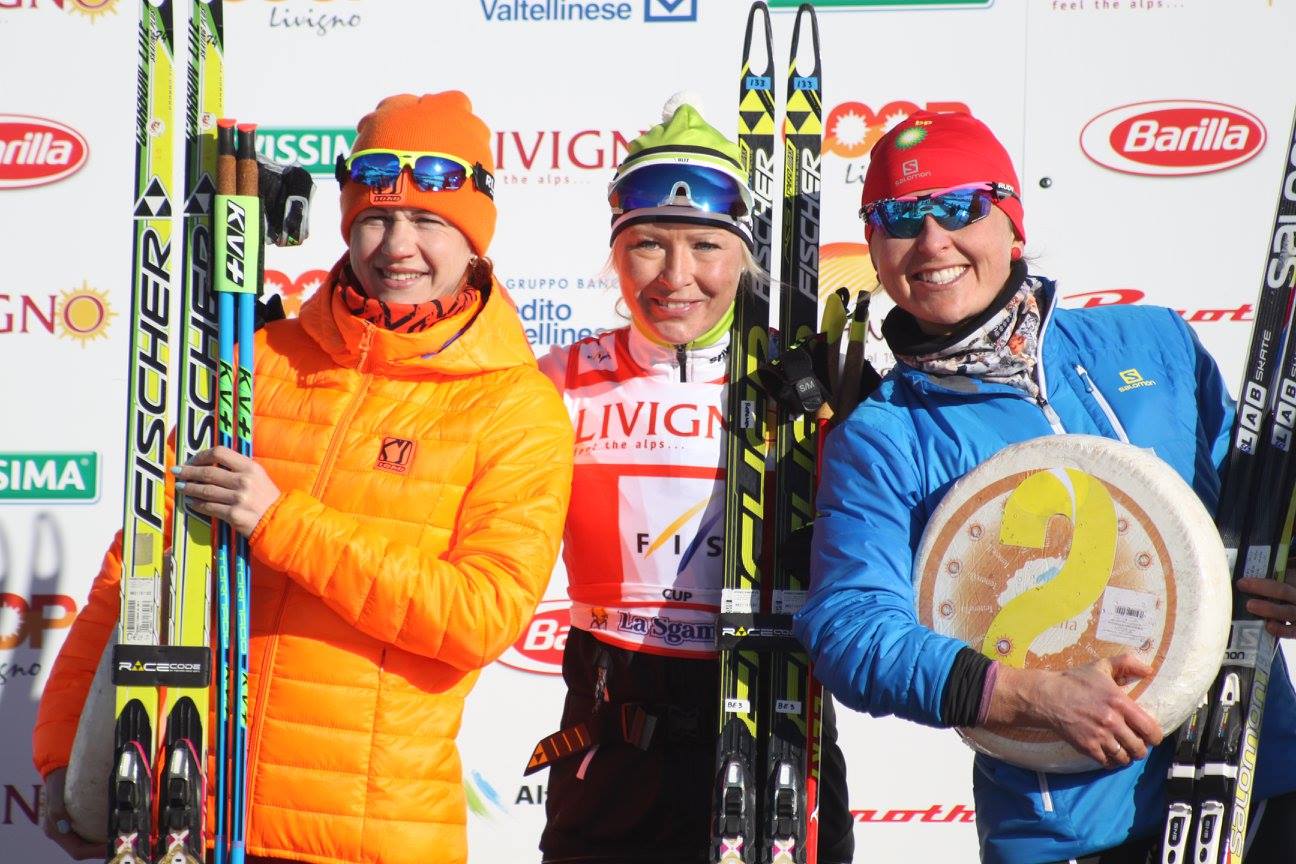
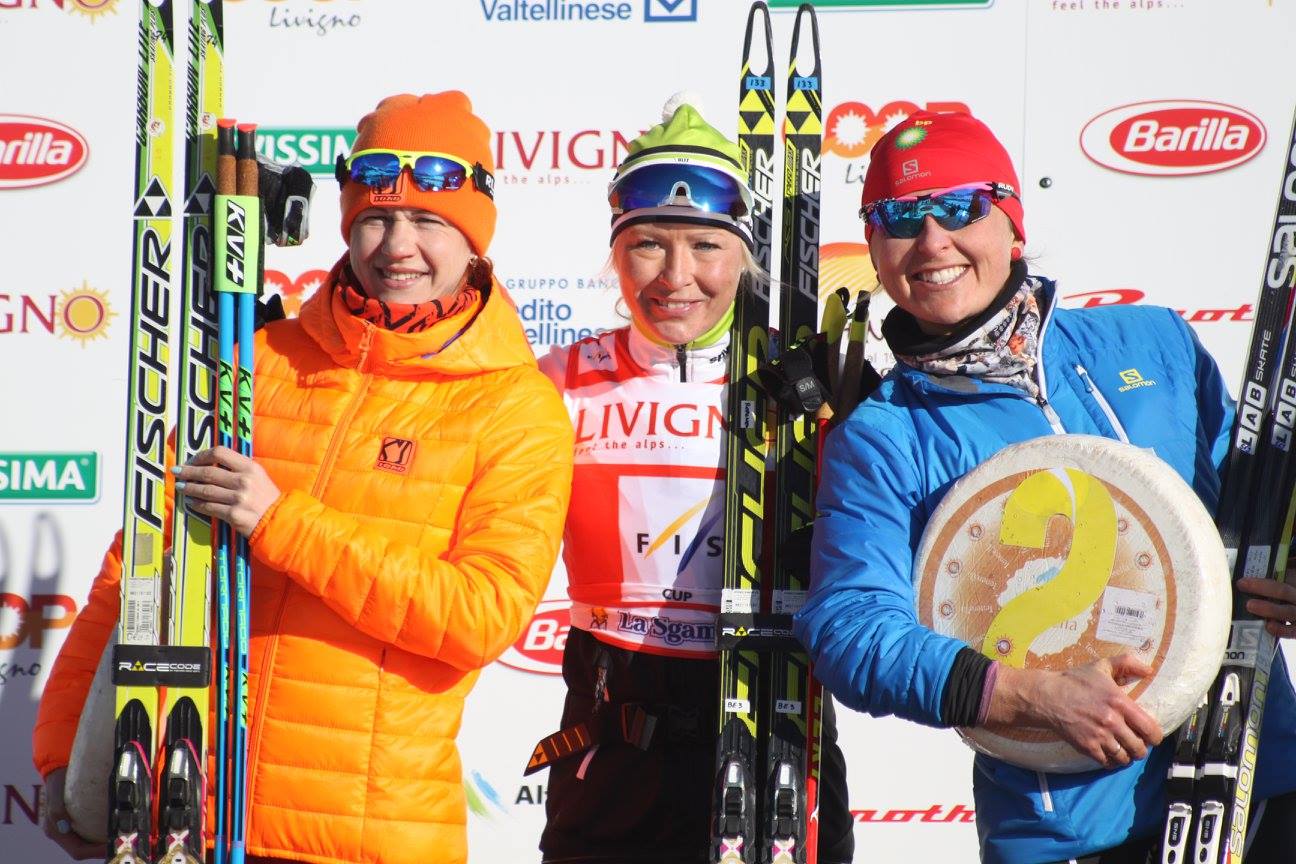
    The La Sgambeda women's podium on Friday in Livigno, Italy: with Finnish winner Riitta-Liisa Roponen (c), who notched her third-consecutive victory at La Sgambeda, American Holly Brooks (r) in second, and Ekaterina Rudakova of Belarus in third. (Photo: Worldloppet/FIS Marathon Cup)
    The La Sgambeda women’s podium on Friday in Livigno, Italy: with Finnish winner Riitta-Liisa Roponen (c), who notched her third-consecutive victory at La Sgambeda, American Holly Brooks (r) in second, and Ekaterina Rudakova of Belarus in third. (Photo: Worldloppet/FIS Marathon Cup Facebook)

    They called her a wild card — the International Ski Federation (FIS), that is. And according to Holly Brooks, she wasn’t sure what she was capable of, either.

    “The marathon world is a new can of worms for me, and I’m essentially going to a race which I know nothing about,” Brooks, a two-time Olympic cross-country skier and former U.S. Ski Team member, explained in an email earlier this week.

    “I don’t have a team, or a regular wax tech for that matter,” she added. “But, I’ve met some great people through the process already, and I have a certain amount of faith that it will all work out.”

    Without an early season race to test the waters, Brooks, 32, dove right into La Sgambeda on Friday: a 42-kilometer freestyle mass start in Livigno, Italy.

    “I was nervous!” she reflected after the race. “It was the first race of the season for me and I usually don’t wait this long to start racing.”

    She flew into Zurich last Saturday and spent her first few days training in Davos, acclimating to the time difference from Anchorage, Alaska.

    “It almost felt like ‘coming home’ because of all places in Europe, I’ve spent a lot of time in Davos,” she wrote in an email. “It was also really nice to see all my World Cup friends and of course the U.S. team. It provided a nice transition before heading out into the ‘unknown.’ ”
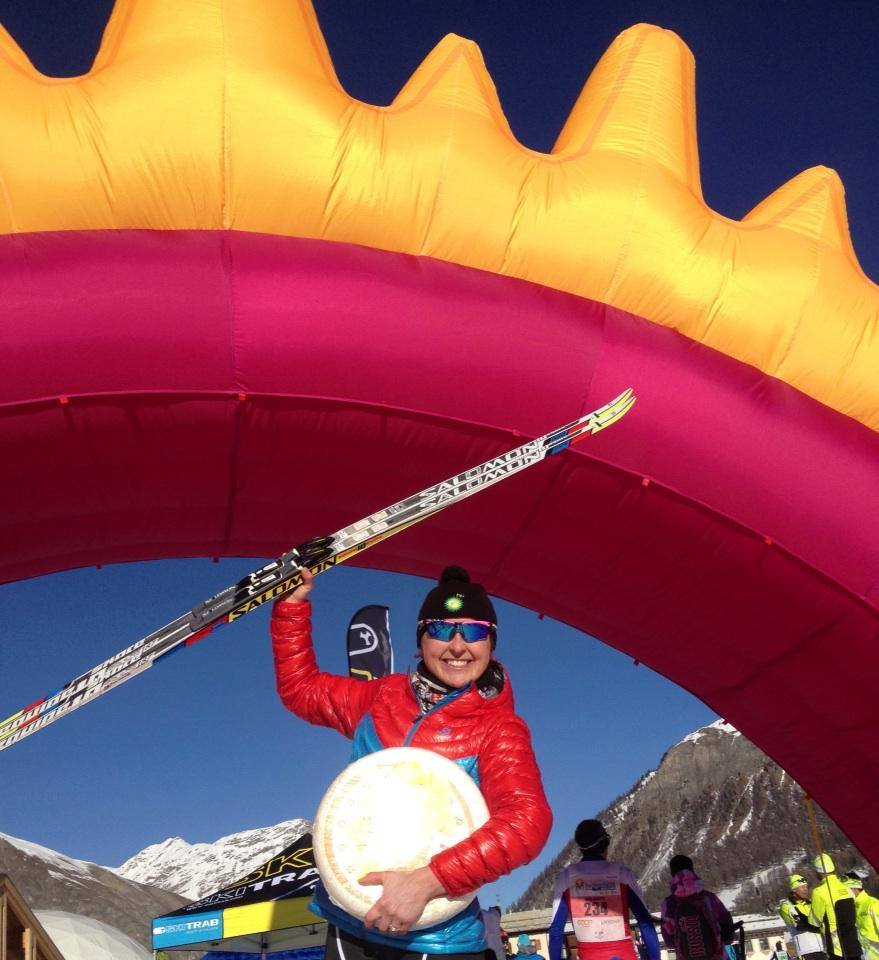
    La Sgambeda runner-up Holly Brooks with her skis and the 15-pound wheel of cheese, which she received as a prize on Friday in Livigno, Italy. (Photo: Holly Brooks/Facebook)
    La Sgambeda runner-up Holly Brooks with her skis and the 15-pound wheel of cheese, which she received as a prize on Friday in Livigno, Italy. (Photo: Holly Brooks/Facebook)

    For Brooks, that mysterious-and-nerve-racking first race was all about chasing Finland’s Riitta-Liisa Roponen, the defending FIS Marathon Cup champion who had one the two previous La Sgambedas.

    “Unfortunately I was never in contact with Riita Lisa,” Brooks explained. “She had a faster start than me and she got lost in the crowd of men. There were tons of people between the two of us and I couldn’t weave through to catch her.

    “Many of these marathons don’t have women’s waves so a big part of the race is eluding the other women,” she added. “I would prefer our own wave but in the meantime I will have to work on my mixed-gender racing tactics.  Once gaps open up in the big groups, it’s impossible to ‘ski up’ without a good draft.”

    Brooks managed to ski up to second-best for second place overall. While she was 3 minutes, 12.1 seconds behind Roponen (who won in 1:40.42.8), Brooks outlasted Ekaterina Rudakova of Belarus by 8 seconds for silver and a 15-pound cheese wheel.

    Three-and-a-half seconds later, Olga Mikhailova of the Russian marathon team finished fourth (+3:23.6) and France’s Aurelie Dabyduk took fifth (+3:39.4).

    “Whenever you land on the podium it’s a good day,” Brooks wrote. “After a couple years of racing World Cup you forget what it feels like and honestly, it’s really fun.”

     “After a couple years of racing World Cup you forget what it feels like and honestly, it’s really fun.” — Holly Brooks, after placing 2nd in first marathon of season at La Sgambeda on Friday

    Benoit Chauvet claimed the La Sgambeda men’s crown in 1:32.11.4, just four-hundredths of a second ahead of fellow Frenchman Robin Duvillard and the Czech Republic’s Petr Novak, who tied for second.
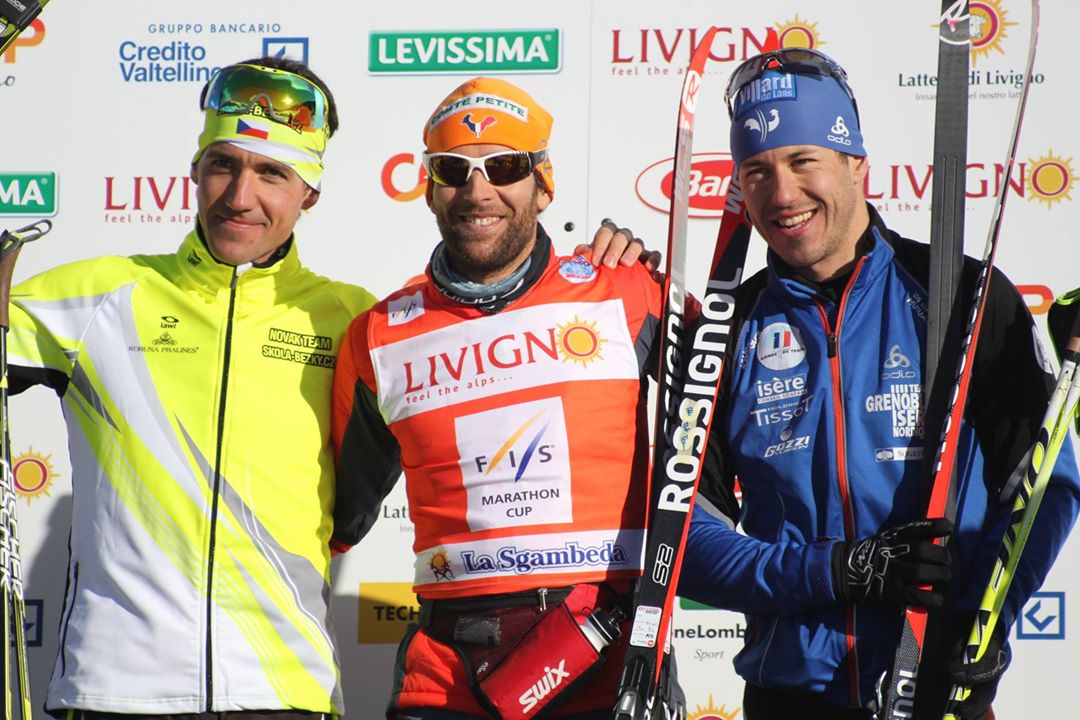
    The La Sgambeda men's podium on Friday in Livigno, Italy: with French winner Benoit Chauvet (c), Petr Novak (l) of the Czech Republic and France's Robin Duvillard, who tied for second. (Photo: Worldloppet/FIS Marathon Cup Facebook)
    The La Sgambeda men’s podium on Friday in Livigno, Italy: with French winner Benoit Chauvet (c), Petr Novak (l) of the Czech Republic and France’s Robin Duvillard, who tied for second. (Photo: Worldloppet/FIS Marathon Cup Facebook)

    Switzerland’s Toni Livers was another 0.6 seconds back in fourth, Sergei Dolidovich of Belarus was fifth (+1.9), and the top-11 men all finished within 8.8 seconds of one another.

    “The conditions were AMAZING,” Brooks explained. “Livigno is picturesque – perfect!  Pure sun, gorgeous mountains, really perfect.  My skis were awesome too… but it was a stressful situation leading up to having great skis.”

    The night before the race at the captain’s meeting, she still wasn’t sure who would wax her skis. Fortunately, she found some “local Italians” who were up for the job — a man named Enzo, who spent 16 years on Italy’s national-ski team, was one of them, she explained. She repaid him with an iPhone.

    Brooks, who switched from the World Cup circuit to the Worldloppet and FIS Marathon Cup this season, is one of the racers receiving a lot of international attention on the eve of the Marathon Cup opening.

    “It will be interesting to see how Holly Brooks, who is fully concentrating on the long-distance scene this season, will do,” a FIS and Worldloppet press release stated before the first race of the season.

    Marathon weekend

    There are three races this weekend, including the 15 k ProTeam Tempo classic “prologue” on Saturday and 35 k classic on Sunday, both of which are part of the Swix Ski Classics.

    Brooks is competing in all three, after recently signing with a Pro Swix Ski Classics team. “But more on that later,” she wrote. Before she knew she’d race the prologue, she was aware two marathons in one weekend was ambitious.

    “Sunday’s race course is somewhat of a double-pole derby, and honestly, I’m looking at it as more of a training race for me,” she explained. “Many of those girls train specifically for double-pole, which I do not do.”

    While Brooks is viewed as a serious contender for the long-distance events, she’ll have plenty of experienced competition in her quest for an overall podium at the end of the season.

    Italy’s Antonella Confortola, who has competed on the FIS Marathon Cup for years, is no doubt hungry for the overall title and reported to be in killer shape again.

    Veteran favorite Seraina Boner of Switzerland will definitely be a very strong contestant for the overall title, but how she does could depend on how many races she enters. The same goes for Roponen, last year’s overall FIS Marathon Cup winner, according to FIS.

    Men’s outlook

    On the men’s side, last year’s overall winner Tom Reichelt of Germany is not racing after his team dissolved in September. Chauvet, who won Friday’s La Sgambeda and was second overall last year, is eager to make it to the top of the overall podium this season. So is Novak, who was second at last year’s La Sgembeda and second again on Friday.

    Aliaksei Ivanou of Belarus, who was third last year, Italy’s Sergio Bonaldi and Simone Paredi, as well as France’s Christophe Perrillat Colomb and Adrien Mougel also raced Friday and all of them finished in the top 15 (with the exception of Paredi in 25th).

    Including the World Cup racers

    Scheduling La Sgambeda for the day before the World Cup in Davos, Switzerland, on Saturday and Sunday allows World Cup racers to race La Sgambeda, as Davos is fewer than 70 kilometers from Livigno.

    Accordingly, several World Cup skiers entered the race this year. France’s Jean Marc Gaillard followed teammate Duvillard (who was second) in sixth. The two teamed up for bronze from last year’s sprint relay at the Sochi Olympics. Livers is another World Cup regular, along with Dolidovitch, Spain’s Imanol Rojo, Denmark’s Martin Moeller, and Estonia’s Madis Vaikmaa.

    Norway’s Peter Northug won the race last year but did not compete on Friday — no Norwegians did.

    Tough but scenic course

    The 42 k marathon consisted of two laps on a 21 k course that runs along the Spöl river and winds through all the villages along it: Florin, Pont Lonc, Limina, Tresenda, and runs as far as Campaciol. From the Hotel Forcola at 12.5 k, the course turns back toward the cross-country stadium, which marks the start, finish and halfway point.

    Livigno, normally known as having snow from early November on, had to work hard last year to put the 21 k course together as snow was hard to come by. However, this year, conditions were notably better.

    “Livingo is amazing. More North Americans should come here!” Brooks summed up.

    Next FIS Marathon Cup: The Dolomitenlauf 42 k freestyle on Jan. 18 in Austria

    In total more than 220,000 Euros ($274,000 dollars) will be distributed as prize money this season. Each race offers a minimum of 21,000 Euros ($26,150 dollars) worth of prize money per race. Additional prize money of over 31,000 Euros ($38,600 dollars) will be handed out to the top six men and women in the overall FIS Marathon Cup at the end of the season.

    Like every year, the FIS Marathon Cup kicked off with La Sgambeda in the Italian valley of Livigno.

    This season, the FIS Marathon Cup consists of nine races total, with a new final in Russia: the Ugra Ski Marathon 50 k skate in Khanty-Mansiysk, Siberia, caps the season in mid-April. Khanty-Mansiysk is best known for its biathlon World Cups and World Championships.

    Friday’s La Sgambeda results: women | men

    FIS Marathon Cup 2014/2015 calendar

    1. La Sgambeda (Italy)
    Friday, Dec. 12
    42 k freestyle

    2. Dolomitenlauf (Austria)
    Jan. 18, 2015
    60 k freestyle

    3. Marcialonga (Cavalese/Val di Fiemme, Italy)
    Jan. 25
    70 k classic

    4. La Transjurassienne (France)
    Feb. 7
    56 k classic

    5. Tartu Marathon (Estonia)
    Feb. 15
    63 k classic

    6. American Birkebeiner (Cable/Hayward, USA) 
    Feb. 21
    50 k freestyle

    7. Bieg Piastow (Poland) 
    Feb. 28
    50 k classic

    8. Engadin Ski-marathon (Switzerland)
    March 8
    42 k freestyle

    9. Ugra Ski Marathon (Russia)
    April 11
    50 k freestyle

  • U.S. Women Come Out Swinging In Sochi: Diggins 8th in Skiathlon, Matches Best Ever for U.S.

    U.S. Women Come Out Swinging In Sochi: Diggins 8th in Skiathlon, Matches Best Ever for U.S.

    Jessie Diggins racing in the women's Olympic 15 k pursuit on Saturday.
    Jessie Diggins racing in the women’s Olympic 15 k pursuit on Saturday.

    FasterSkier’s coverage is made possible through the generous support of Rudy Project

    SOCHI, Russia – Jessie Diggins didn’t expect to have her best race ever in the ladies’ 15 kilometer skiathlon today. In fact, like most of her teammates, she expected to warm into the Games – this was just the first stop along the way, a chance to get the race legs going.

    “For sure. I was hoping to maybe get a top 20, not a top 10!” Diggins exclaimed after the race, where she finished eighth.

    Not bad for the first Olympic appearance of her career.

    “Out of the four races I hope to do, this was the one that I had the least expectations for,” Diggins continued. “I didn’t think this was going to be my best race. And hopefully the rest of the races go just as well because it was awesome. It definitely came as a surprise to have such a good race.”

    Liz Stephen during the skate leg of the women's Olympic 15 k pursuit.
    Liz Stephen during the skate leg of the women’s Olympic 15 k pursuit.

    Along with teammate Liz Stephen, Diggins started conservatively, but steadily, in the 7.5 k classic portion of the race. She was sitting in 27th place at the ski exchange, about 50 seconds behind Marit Bjørgen of Norway and the lead pack of six other skiers.

    But on the 7.5 k skate section, Diggins turned on the afterburners. When the dust cleared, she was in eighth place – matching the best performance ever by a U.S. woman in a cross country ski race at the Olympics. Kikkan Randall finished eighth in the classic sprint four years ago in Vancouver.

    “I had a great peaking plan from the coaches and awesome skis,” Diggins said. “In the classic part I was just trying to stay calm, conserve energy, and stay out of tangles. And just remain in contact. In the skate part I started ramping it up to pick people off.”

    To add a cherry on top of this Olympic sundae, teammate Liz Stephen skied a monster skate leg to move from 31st up to 12th. Two women in the top 15? That’s for sure a best day, and it highlights how far the U.S. women’s team has come in four years.

    “Having such a deep field of girls who can all be in the top ten or top five or top 20 every day, it’s great,” Stephen said. “I couldn’t be part of a better team. I’m really happy to be with the girls I’m with.”

    There were numerous hints throughout the season so far that the U.S. women were capable of such results, particularly in this discipline.

    “As you’ve seen from Jessie and Liz, they’ve both had top-ten World Cup results in classic this year,” U.S. Ski Team coach Matt Whitcomb said. “So we know now that if they finish in the top ten they can ski their way into the top five or better on the skate leg – they’re just superior skaters. Today was close to that. For Jessie it was one of her best classic races of her life.”

    As a result of the team’s rising abilities, expectations were a lot higher at this Olympics than they ever have been before for the team.

    “I knew that today could be outstanding,” Whitcomb said. “We’re not chucking Hail Marys like we once did heading into the games. We arrived with a bunch of people ready to just go big.”

    In Vancouver, the ski community placed high hopes on Stephen and teammate Morgan Arritola, who were considered to be the up-and-coming distance skiers in the U.S. One Games later, Stephen is delivering on that promise – and has been joined by Diggins, who is young enough that she wasn’t even in consideration for an Olympic spot last time around, but has made a powerful argument for herself ever since.

    “My last Olympics, I think my best result was like a 50th, or 48th or something,” Stephen said. “To start off the games with 12th, I’m really happy with it. I’m hoping for more as the Games go on, for sure, but I’m really happy with today… It takes the pressure off to

    Holly Brooks early in the women's Olympic 15 k pursuit.
    Holly Brooks leads teammate Liz Stephen early in the women’s Olympic 15 k pursuit.

    start the Olympics up. You wait around and you train and you prepare, and there’s so much that goes into the Olympics. It’s fun to just hear the gun go off and know that it’s just another ski race, with a cooler bib.”

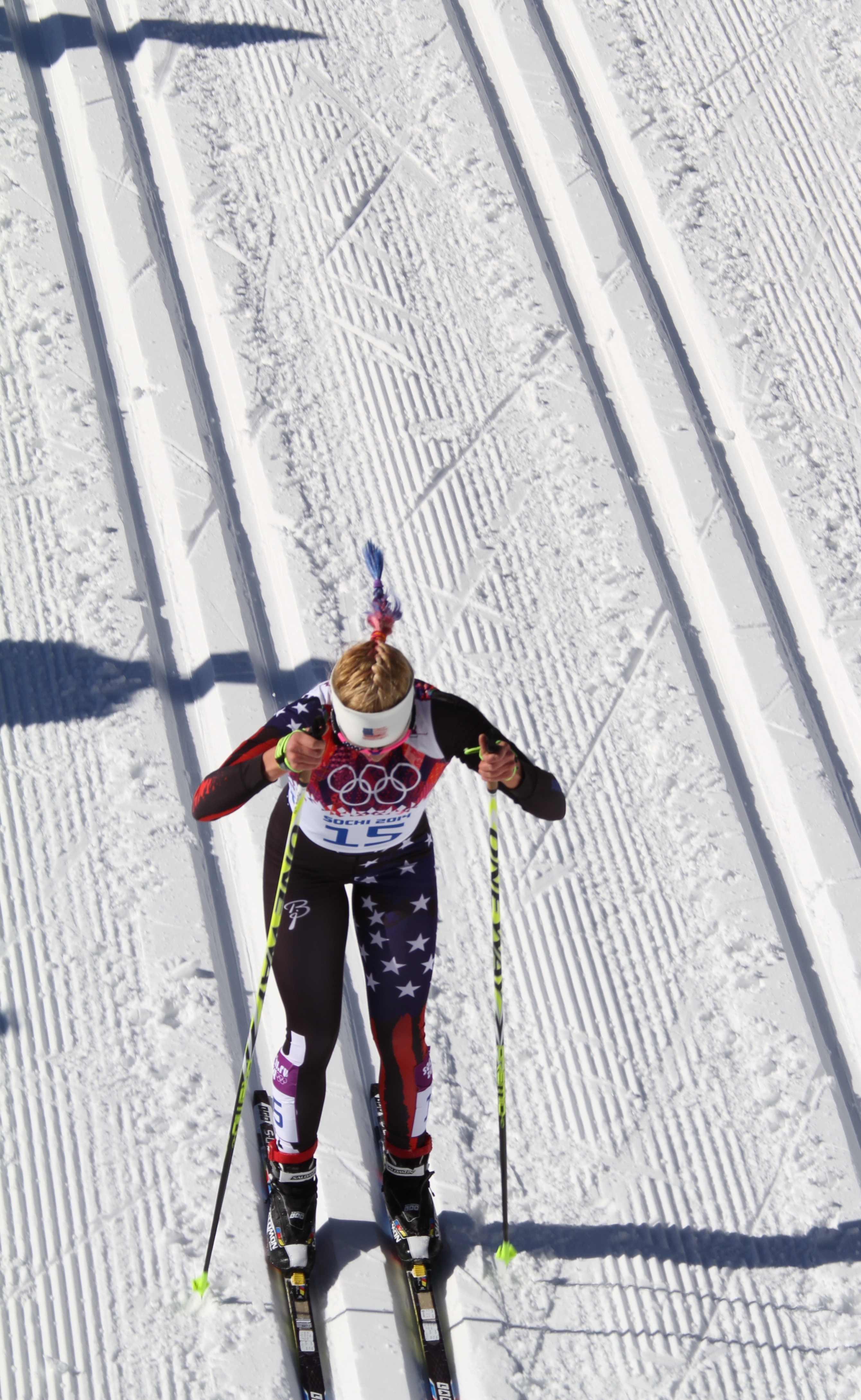
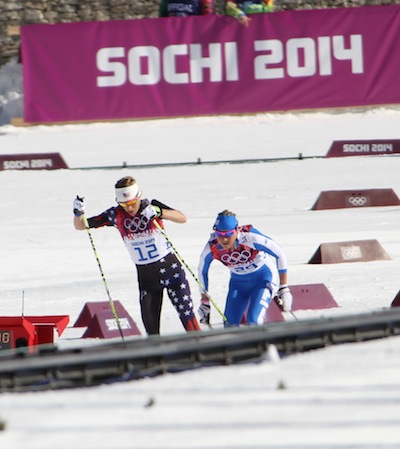
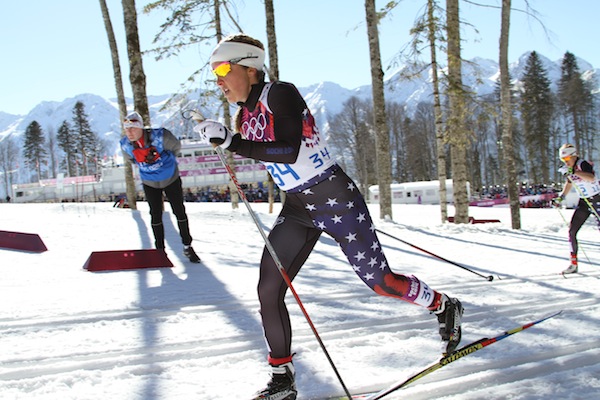
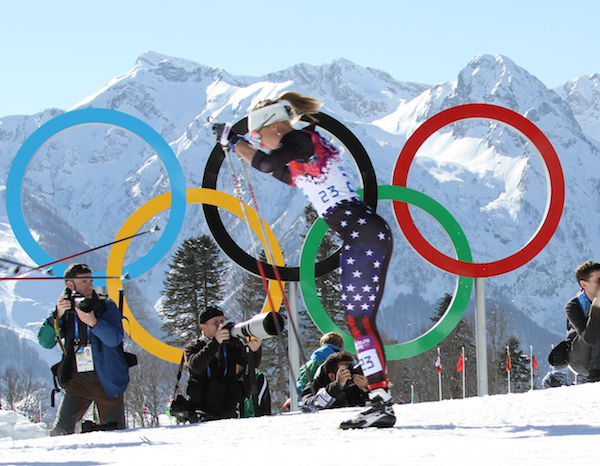
    It was a lift for the whole team, including Holly Brooks, who said that skiathlons were her nemesis: she finished 47th.

    “The sun is out, it’s the Olympics, and some of my teammates had amazing races,” Brooks said at the finish. “Jessie Diggins, my teammate and my roommate, she said she had one of the best races of her life. So that’s really inspiring.”

    It didn’t start out that way for either Diggins or Stephen. Diggins had a goal of skiing a steady pace and staying out of trouble. Mission accomplished, but tagging off in 27th was, at face value, not spectacular.

    However, she wasn’t too far behind the leaders, and it’s a long race. It turned out that Diggins had paced herself perfectly and was soon flying past other racers, who began to flag on the skate course’s big uphill.

    “Every race I’ve done at altitude I really feel like I’ve just blown up too early, or not gone out hard enough,” she said. “I think I really nailed the pacing today, and that’s a really cool feeling. Okay! I’m finally getting it!”

    Stephen had hoped for a better classic leg, but for whatever reason, things just weren’t going her way.

    “The classic was a bit tough for me today,” Stephen said. “…The skis were maybe a bit slick for today, but the energy maybe wasn’t quite where I wanted it to be on the classic either. It’s tricky conditions out there, it’s maybe klister, maybe hardwax, and that can be pretty tricky for me with my technique anyway. I just tried to keep my head in it, and just get really excited for the transition because the skate is always better for me. So I came into there and decided, it’s a new race.”

    The first loop of the skate was where both Diggins and Stephen made their biggest moves. Both said they weren’t really aware of how many people they were passing, but it was a lot.

    “The uphill is great,” Stephen said. “That’s where I felt the best. Except for the very last one, I definitely lost power there. But I mean, this big hill suits my technique and my build, so it’s fire up at the bottom and just think, it’s time to go!”

    While the result is a best-ever Olympic performance for Stephen, as the most consistent U.S. distance skier over the last several seasons, she hoped for more. But Whitcomb was pleased at the performance, especially given the challenges she faced in the opening classic leg.

    Sadie Bjornsen during the classic leg of the women's Olympic 15 k pursuit.
    Sadie Bjornsen during the classic leg of the women’s Olympic 15 k pursuit.

    “Liz really struggled today on her classic, and she suffered consequently in the skate as well,” Whitcomb explained. “I was really, really encouraged to see good energy out of her, to see her bounce back from a very bad classic leg. The signs are good. She wasn’t able to close today just because I believe she was fairly taxed.”

    Diggins, too, said she was pretty tired by the last time she faced the monster hill. But she had two things going for her. First, an injection of energy from a coca-cola feed.

    “I fed three times, which is a lot for a 15 k,” she explained. “But it was really hot, we were all sweating, it was easy to start getting dehydrated. I didn’t want to cramp. So I think the extra caffeine and sugar really did help.”

    Second, her parents were standing about two-thirds of the way up the hill.

    “For me one of the coolest things was hearing my parents out there and knowing that they were out there cheering for me,” she said. “That helped so much and gave me such a boost so I was able to have a good finishing kick… It was great, right where you were kind of starting to bobble. You really need that extra oomph.”

    Diggins said that she usually approaches the last kilometer of a race as if it’s a sprint qualifier, and that’s what she did today.

    “I just start hammering,” Diggins said. “I was thinking about my parents out there watching, and I was like, man, they traveled all the way here. I need to put on a show for them.”

    Both women said that their biggest focus is on the relay. Stephen has not yet decided whether she will race the 10 k classic, as it’s two days before the relay, and she “wants to be really fresh” for that.

    And Diggins, too, is making it a priority. Among other races, she’ll sit out the team sprint, the discipline in which she became a World Champion last year with Kikkan Randall.

    “At my age racing more than four out of the six would be pushing it,” she said. “I’m definitely going to be really careful to fully recover between each race, and the 4 x 5 relay is what I’m putting all my hopes on for. My biggest goal for years has been that.”

    And the U.S. team will be relying on her, especially after her performance today.

    “Today’s the reason why you see us put Jessie fourth in all these relays throughout the years,” Whitcomb said. “She can close. She can race on game day. I can’t name that many people who can’t do that, but Jessie is a closer.”

    -Nat Herz contributed reporting.

    Results