From the FasterSkier archive — posts syndicated from athletes’ and coaches’ own blogs between 2004 and 2012, kept online as published. Current coverage is at fasterskier.com.
American cross-country skier Jessie Diggins scores another Olympic medal in Beijing, this time a silver, gutting out a strong race even though she was suffering from food poisoning. We break down the full 30 k freestyle race with Therese Johaug’s win and a furious chase for bronze. And we’re thrilled to welcome guest hosts Holly Brooks and Sadie Maubet (Bjornsen), the retired U.S. Olympians who joined us from Alaska.
We’ll be back when the World Cup resumes in Lahti next weekend. (Seriously?! So soon.) Get us at devon@fasterskier.com and nat@fasterskier.com in the mean time.
We know we haven’t gotten to all your questions over the course of the Olympics, but we hope to catch up with a mailbag episode soon once things settle down.
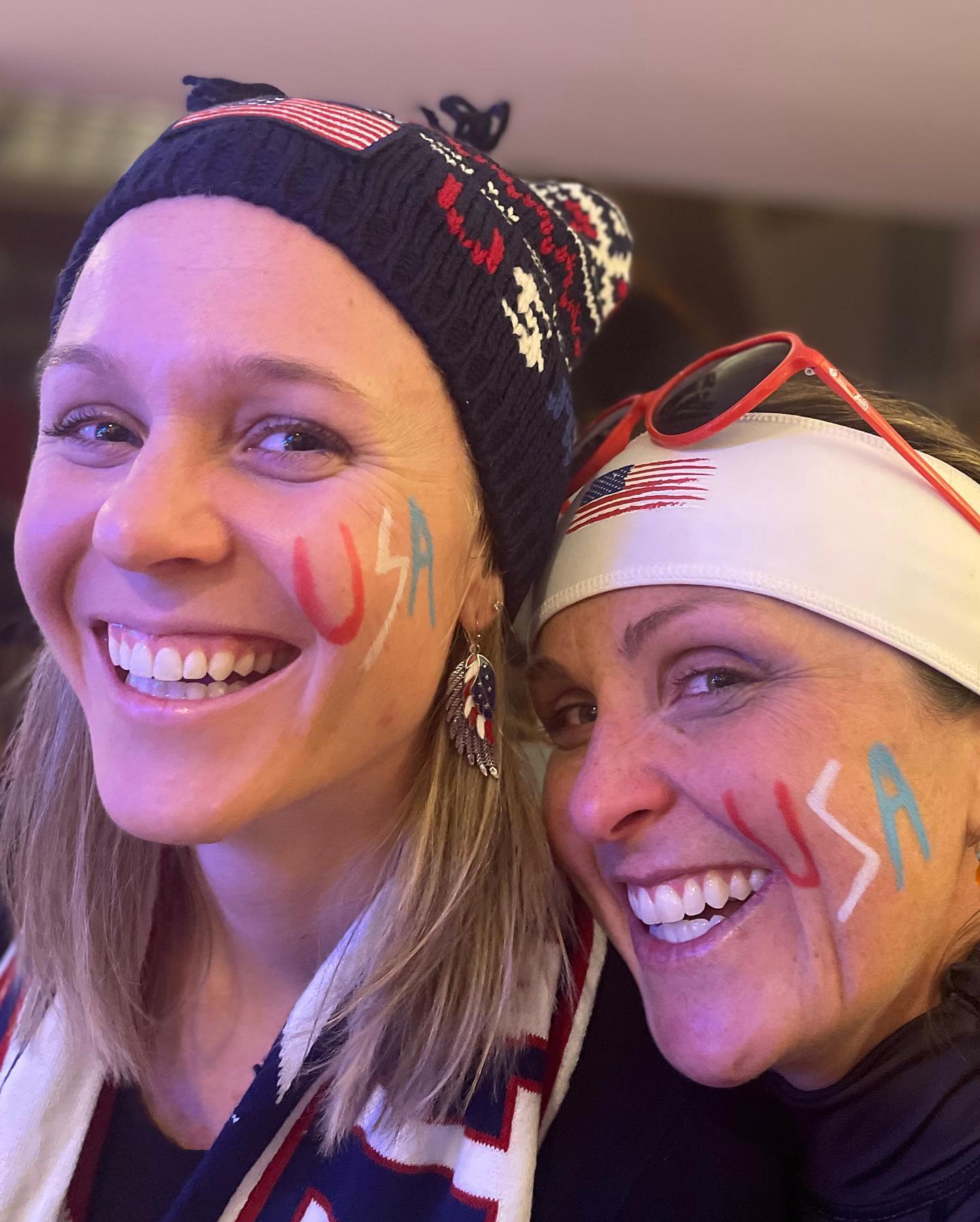
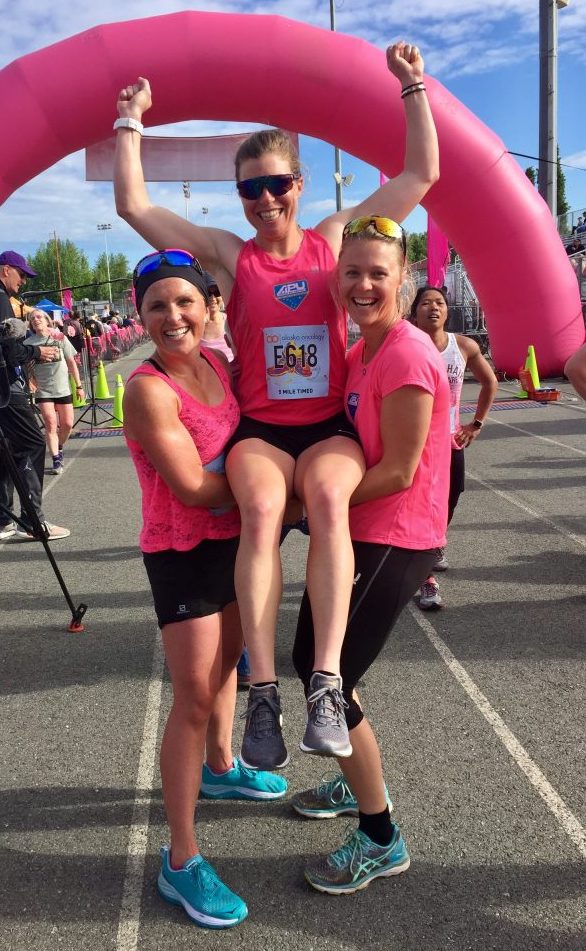
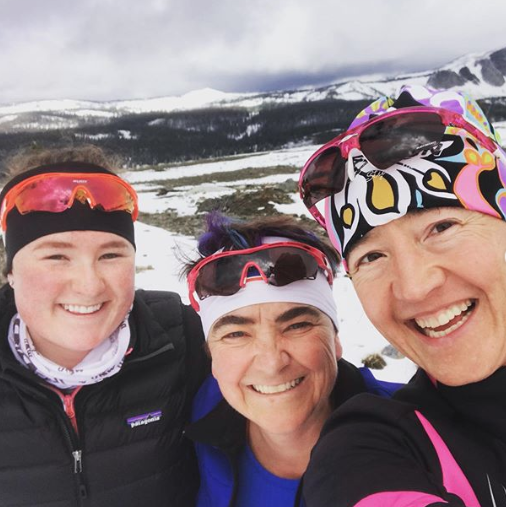
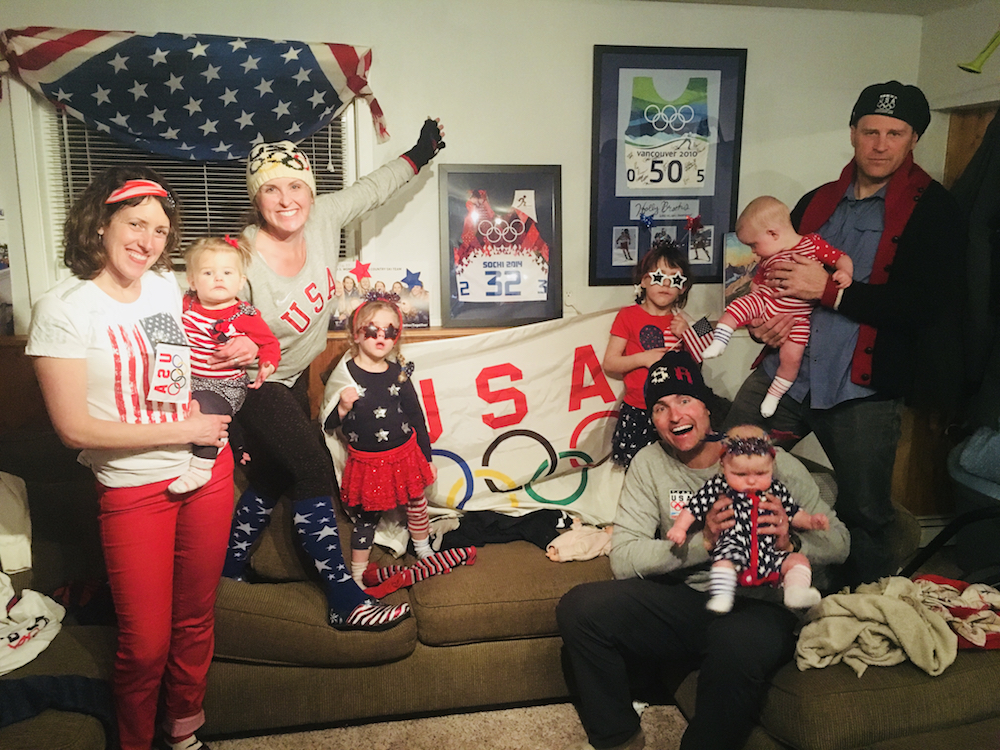
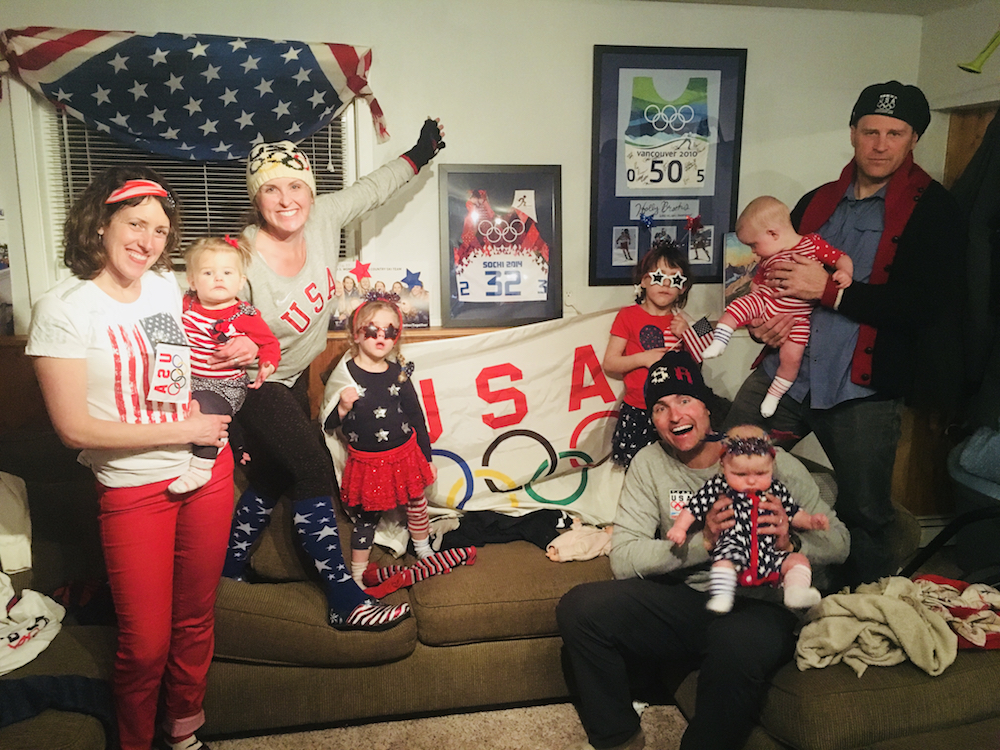
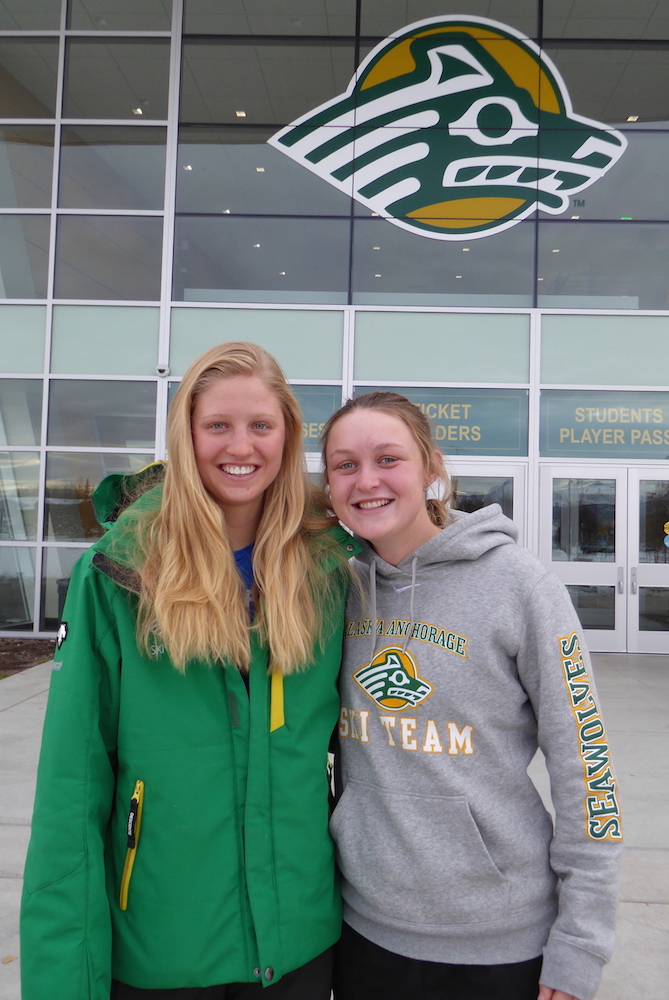
Sadie Maubet (Bjornsen) and Holly Brooks snap a picture during an Olympic watch party in Anchorage. (Courtesy photo)
On February 8th, cross country skiing made the New York Times headlines as Jessie Diggins collected an historic bronze medal in the 1.5-kilometer freestyle sprint. No American woman had ever won an individual medal in cross country skiing, and no American cross country skier of either gender had won multiple Olympic medals. Diggins had earned gold in 2018 racing the freestyle team sprint with partner, and current NBC analyst, Kikkan Randall.
Normally, attention given to niche sports by mainstream media is welcome – cross country skiing is a blip on these outlets’ radar roughly once every four years during the Olympics – but a statement included in the report was quickly met with criticism from athletes and coaches in the sport.
Here’s the statement written by veteran sports journalist Matthew Futterman:
“In a sport that has so many women with massive shoulders and thighs, Diggins looks like a sprite in her racing suit, and it’s not clear exactly where she gets her power. But the power is there, as she flies up hills, and comes off climactic turns with a burst. On the downhills, she tucks low and cuts through the air.”
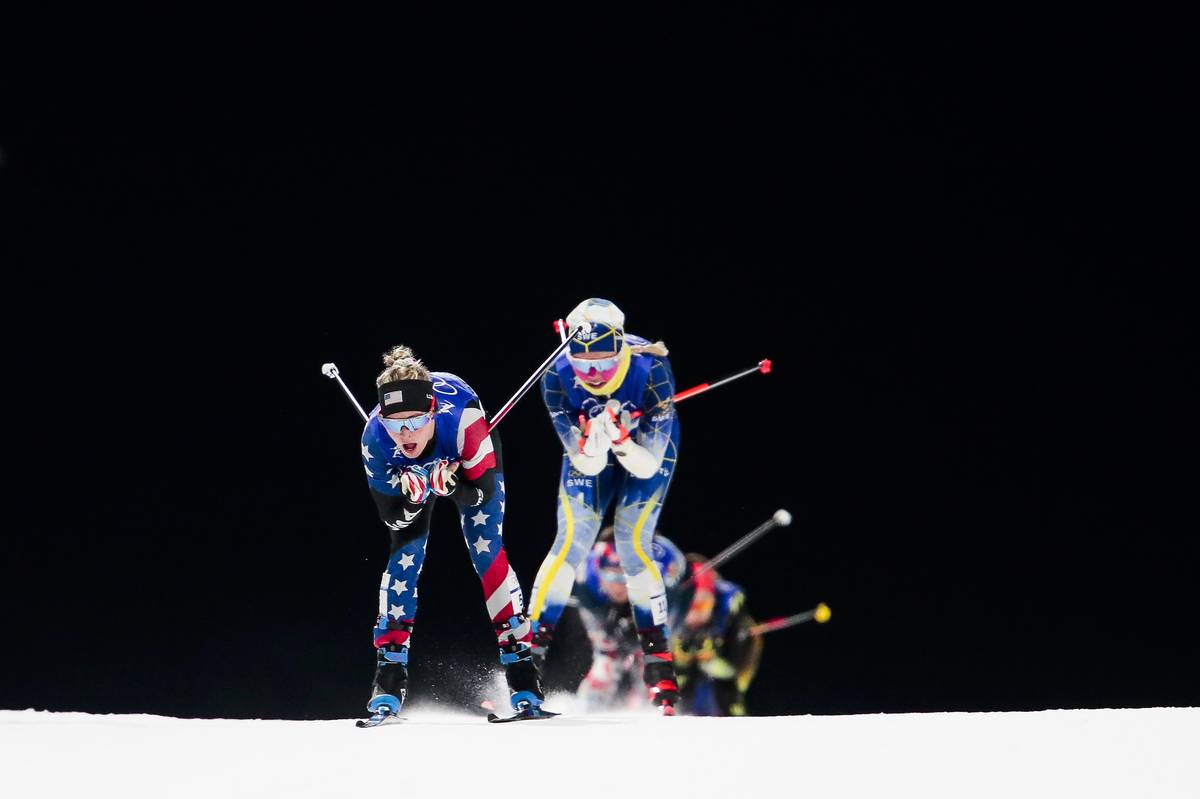
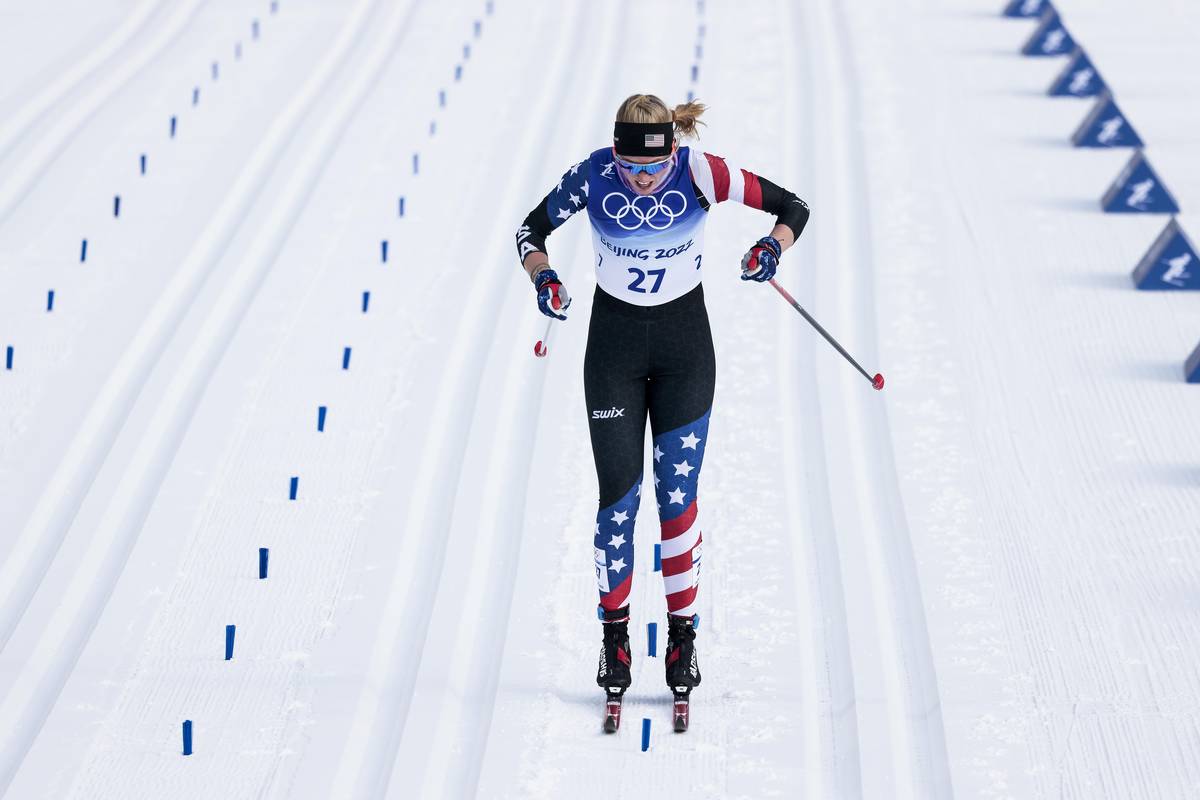
Jessie Diggins drops into a tuck as she leads Sweden’s Emma Ribom into the downhill during the 1.5-kilometer freestyle sprint event in the 2022 Beijing Olympic Winter Games. (Photo: NordicFocus)
All-American Colby College ski team alumna turned professional mountain runner for the North Face, Olivia Amber was quick to respond on social media, telling Futterman to “do better” and offering suggested edits to his wording.
Amber proposed: “In a sport that requires a unique combination of upper and lower body strength, Diggins’ ability to apply power is extraordinary, and it’s very clear how she has become one of the best athletes in the world.”
Her instagram story was shared widely amongst her followers. Explaining why this language struck a nerve, Amber wrote the following to FasterSkier.
“The way the media often covers athletics objectifies women and excludes people that don’t conform to the myth of an ideal body type. The language used in the recent NY Times piece is yet another example of this broader issue in women’s sport. It’s a clear oversight that demonstrates a lack of knowledge on the author’s subject. Featuring the size and shape of women’s bodies devalues the lifetime of hard work these athletes put into achieving the pinnacle of their sport.”
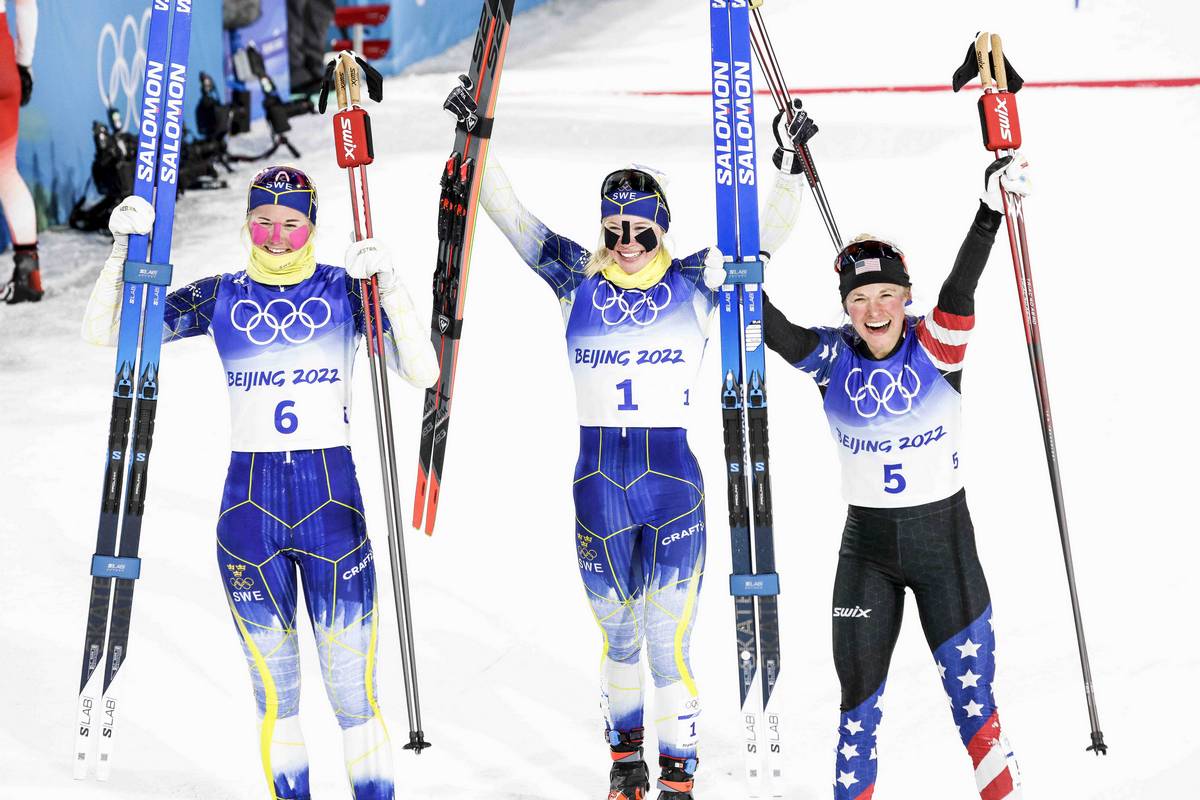
The women’s Olympic 1.5-kilometer freestyle podium: Sweden’s Jonna Sundling took gold ahead of teammate Maja Dahlqvist and American Jessie Diggins. (Photo: NordicFocus)
FasterSkier contacted Futterman to see whether he had a response to the criticism his statement had received. Futterman explained that he would need clearance from the Times’ communications department in order to respond. FasterSkier later received the following from a spokesperson:
“We aim in our sports coverage to cover male and female athletes accurately, equally and fairly. We believe sometimes their physiques are relevant to their performance. In this case, our description of cross country skier Jessie Diggins’s noticeably different physical attributes in contrast to others in her sport were an important and relevant detail. Her dominance in the sport was also the subject of alengthy feature on Feb. 4.”
However, many readers continue to find fault with the statements at play.
“I have always held the NY Times in high esteem for their quality reporting, which is why I was absolutely floored to read Matthew Futterman’s comments about my teammate’s body,” writes Holly Brooks, two-time Olympian and licensed professional counselor who offers eating disorder support to athletes through her practice and advocacy. “On a day where Jessie made U.S. history by becoming the first female individual medalist in cross country skiing, Mr. Futterman chose to make inconsiderate comments about her body, questioning the source of her power. Please hear me loud and clear: It is NEVER appropriate to comment on an athlete’s body with regard to their weight, shape or size. Instead, emphasize their power, fight, tenacity and strength. And to the NY Times: Jessie, athletes worldwide, and the entirety of your readership deserve better. Mr. Futterman should apologize for his insensitive words and be sent to sensitivity training.”
Jessie Diggins (USA) takes control of her quarterfinal during the 1.5 kilometer freestyle sprint. (Photo: NordicFocus)
It is not the first time Diggins has received comments regarding her body from the media. She was once asked whether her talent on downhills was related to her size, versus her skill. One strategy she has begun to employ to avoid comments that might have a detrimental impact on her mental preparation has been to avoid reading them altogether.
When asked in the mixed zone after the 10 k classic whether she had heard anything regarding Futterman’s story, Diggins said, “To be honest, I don’t read things written about me and I think that’s a very, very healthy thing. But it’s unfortunate with Rule 40 that you can’t see the invisible headgear sponsor that is there at all times for me.”
After sharing a blog post titled “Body Image Issues” in June, 2018 Diggins has openly shared her own challenges with disordered eating, body dysmorphia, and bulimia across many platforms, including her book, Brave Enough. Outside of the Olympic blackout period, described in Rule 40, Diggins wears the logo of the Emily Program, a leader in eating disorder treatment and education, on her hats and headbands, acting as an advocate for the facility she credits with supporting her through her own recovery journey.
She now regularly rejects the narrative that “lighter is faster”, and instead repeats how properly fueling her body and prioritizing her mental and physical health have led her to perform at this level. Diggins aims to be an example for future generations of skiers.
“It’s important that women everywhere know that they’re good enough the way they are,” Diggins said. “You don’t have to be a certain body type to win at the Games; you have to be healthy and happy and have a great support crew.”
Diggins’ advocacy in this space was a focal point in a message penned by Kris Hansen, a former cross country ski coach at Diggins’ alma mater in Stillwater, MN, sent to the Times after reading the piece. Hansen also shared her response publicly on Facebook.
“Eating disorders, or disordered eating, are sadly very common in young women athletes… conditions that are definitely exacerbated by insensitive and inaccurate reporting like Mr. Futterman’s,” she wrote.
Hansen called it “ironic ignorance” that an athlete who raises awareness for body image issues in sport would be described in this way.
“Jessie is no ‘sprite’,” Hansen continued. “She is a powerful woman, an exceptional athlete, a World Champion, a thoughtful and articulate advocate for women athletes, and now a multi-medal Olympian.. I can also tell you from where she gets her power: hundreds of hours of training her body and her mind, on the snow, in the weight room, with her coaches… Further, her competitors are not “women with massive shoulders and thighs”. They are women who, like Jessie, have worked very hard to build bodies that can climb a hundred meters in a matter of seconds and then navigate an icy technical downhill….again and again for 30 kilometers. You have done Jessie, and all women athletes, a disservice with your ignorance and disrespectful characterization.”
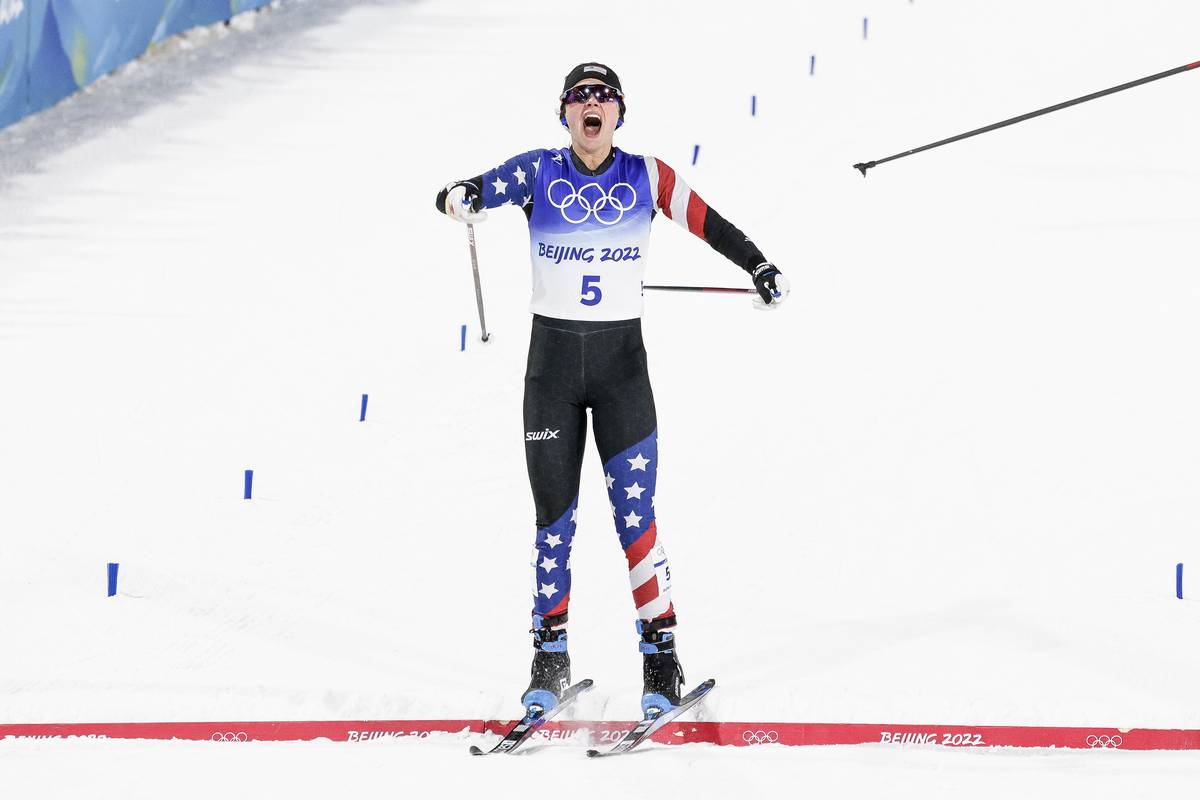
Jessie Diggins crosses the line in third to earn the first individual Olympic medal in women’s cross country ski history. (Photo: NordicFocus)
College of St. Scholastica head coach and founder of the Women Ski Coaches Association Maria Stuber offered a solution-oriented approach, advocating for awareness and education that might better support and protect athletes of all levels from body-centric messaging.
“What is very obvious here is that if the NY Times reporters and editors do not understand why this language is damaging, and we have a long way to go in education. If a career sports journalist isn’t learning this, certainly parents and youth coaches are not either. We are to the point where prominent athletes, like Naomi Osaka, are refusing to participate in news conferences or talk to journalists because of their ignorance on this topic and the potential damaging effects on mental health of athletes. Maybe the NY Times would be willing to help with the education component? How do we make sure you can’t become a sports journalist (or editor) without some body image/mental health education? Equal representation of women in sports media careers would certainly help.”
Like Diggins, many athletes at the Games are choosing to remain disconnected from the news and are not engaging with topics that might derail their focus. Others, like the Russian Olympic Committee’s Veronika Stepanova, have spoken out about the article. Stepanova shared a video of herself reading the statement on Instagram, sardonically captioning the post “Objectification? Never heard of it.”
Novie McCabe races to 24th in the 10 k individual start classic during the 2022 Olympic Winter Games. (Photo: NordicFocus)
FasterSkier had the opportunity to ask Hailey Swirbul and Novie McCabe thoughts on the statement in the mixed zone following their performance in the 10 k individual start classic race Thursday.
“I think that our sport is so unique and so powerful in the sense that every single body type can succeed at this sport,” Swirbul responded. “It doesn’t matter how you look, it matters how you race with your heart, how hard you work, and I know that everyone on our team works so freaking hard, Jessie included. Everyone on that podium deserves that spot, no matter what they look like.”
“I think the older girls have kind of been trying to ignore it a bit,” McCabe explained. “But it was obviously pretty uncalled for and insensitive, and they need to do better… Jessie got a medal because she’s the best out there and not because of anything about her body, so I think just insinuating that there’s something there was not okay.”
Swirbul also stated that response from the community to the Times article has not been a distraction for her as she prepares for Olympic competition.
“It makes me appreciate my own strength and how hard I work to gain fitness and muscle. I think it just really makes me appreciate how diverse our sport is all across the board.”
Speaking more broadly to whether a focus on the appearance of athletes’ bodies from the media is frustrating for her, Swirbul concluded, “I hope that as a culture, we can move away from body types and focus on the hard work and the courage and the bravery that everyone races with every day. I really hope that that’s where we move in the future.”
Hailey Swirbul pushes to the finish of the 10 k individual start classic during the 2022 Olympic Winter Games. (Photo: NordicFocus)
Moms Matter Now founders Calisa Kastning (left) and Holly Brooks (right) with their five children. (Photo: Orzel Photography)
In this episode, we discuss the topic of maternal mental health with Holly Brooks and Calisa Kastning. On Mother’s Day, the partners announced the launch of their passion project, Moms Matter Now with the aim of supporting and empowering women as they transition into motherhood.
Moms Matter Now co-founders Calisa Kastning and Holly Brooks aim to support and empower women as they transition into motherhood. (Photo: Orzel Photography)
For those unfamiliar with these names, Brooks is a two-time Olympian and U.S. Ski Team alumna who became a licensed professional counselor after retiring from professional skiing in 2016. After struggling with infertility as a result of RED-S, Brooks successfully conceived and became the mom to twins, born in August, 2017. Kastning moved to Anchorage from Montana ten years ago, just a few weeks before the birth of her first of three children. She and her husband, Andrew, were led to Alaska by the job as head coach of University of Alaska Anchorage (UAA), which Andrew ultimately accepted. Kastning is now the executive director of Skiku, a nonprofit which brings cross country skiing to children in remote towns in the far reaches of the Last Frontier.
As we discuss, there is so much more to this topic than clinical postpartum depression and anxiety. The transition to motherhood is a time in many women’s lives where it is common to experience feelings of identity loss, isolation, resentment, body frustration, and sadness, despite also feeling excited and happy to be a new parent. Brooks explains that endurance athletes are perhaps especially primed for these feelings.
Filling their own cups, Moms Matter Now co-founders Holly Brooks (left) and Calisa Kastning (right) enjoy the Alaska backcountry. (Courtesy photo)
Through the Moms Matter Now platform and the online courses they are building — their pilot group launched on September 22nd — they hope to provide women with the tools to prepare for the emotional and psychological changes they might experience surrounding pregnancy and into motherhood. They also aspire to empower each participant to prioritize her own well-being in order to be the mother, partner, athlete, employee, and more, that she wants to be.
To follow Moms Matter Now, you can subscribe to email updates via their website, momsmatternow.com or follow them on Facebook and Instagram @momsmatternow. If this conversation resonates with you, you can also support Moms Matter Now by becoming a startup booster. Donations can also be made through Venmo with the handle @momsmatternow. Thanks for listening.
Practicing what they preach, Kastning and Brooks make time for themselves and head out on a backpacking trip. (Courtesy photo)
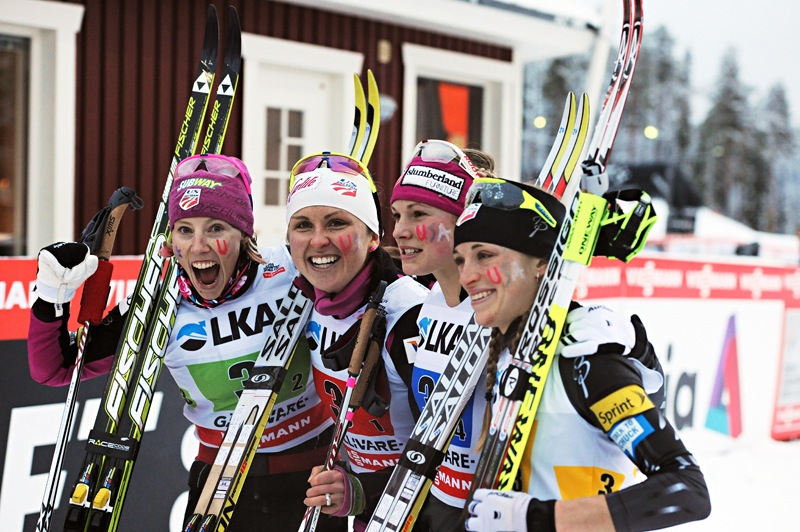
The U.S. women (l-r Kikkan Randall, Holly Brooks, Jessie Diggins, and Liz Stephen) after their first ever World Cup relay podium in November 2012. (Photo: Fischer/NordicFocus)
ANCHORAGE — The U.S. women’s epochal third-place relay finish at the World Cup stop in Gällivare, Sweden, in November 2012 is justly hailed as an inflection point for American skiing: For the first time in American nordic history, this country had four athletes who were all strong enough on the same day to challenge the traditional Scandinavian powers at their own game. The race begins Peggy Shinn’s historical treatment, World Class: The Making of the U.S. Women’s Cross-Country Ski Team, and features prominently in Jessie Diggins’s recent memoir. Although American ski fans may have subsequently become somewhat inured to success, it was a really big deal at the time – contemporary headlines on this website included phrases like “U.S. Women Shock the World” and “Historic U.S. Performance.”
The first two legs that day in Gällivare were Holly Brooks on the scramble leg, then Kikkan Randall on the second classic leg. (Liz Stephen and Jessie Diggins, who had the skate legs, were obviously of equal importance, but this article is pursuing a selective focus on just three Alaskan athletes in order to introduce a specific op-ed.) When the team did it again a year later, taking third once more at the Lillehammer World Cup stop in December 2013, it was now Randall handing off to Sadie Bjornsen (then Stephen and Diggins once more for the skate legs).
Seven years later, those classic-leg skiers – longtime friends and teammates, for Alaska Pacific University domestically and the U.S. Ski Team internationally – are teaming up once more in support of the ski program at the University of Alaska Anchorage, or UAA.
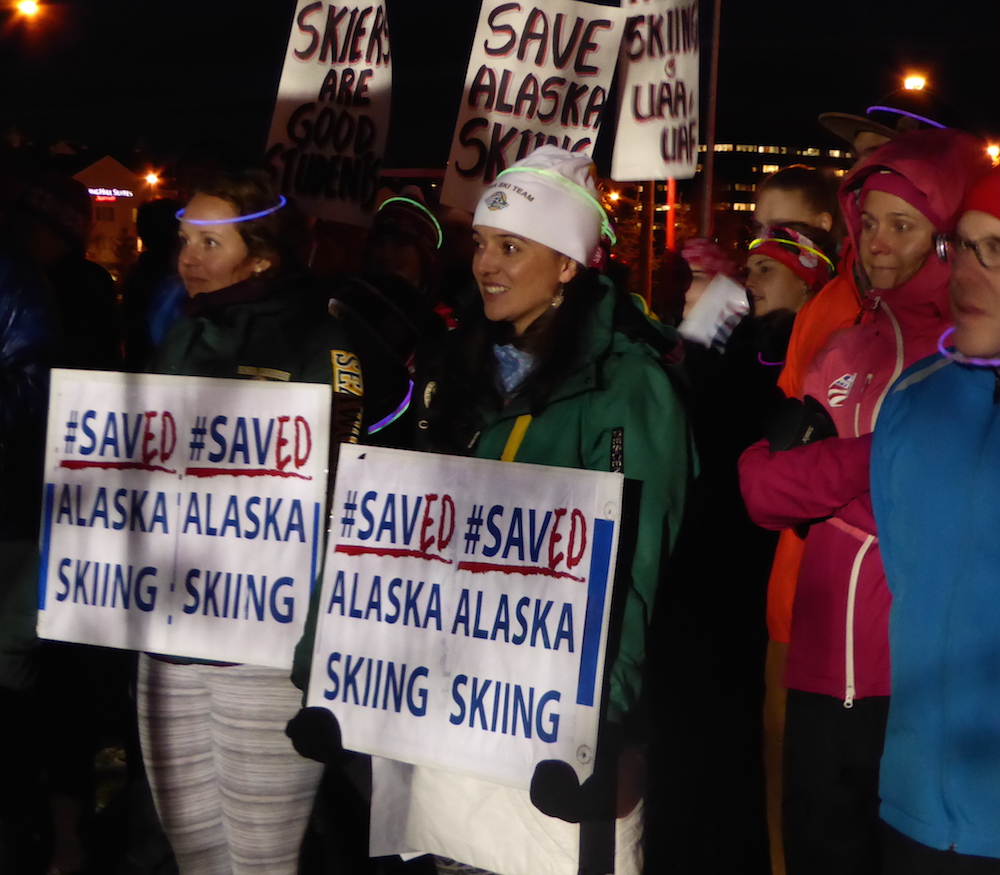
Flyer for local rally in support of UAA Ski Team. (photo: screenshot from SkiAK email)
In a powerful opinion piece published in Wednesday’s Anchorage Daily News, the three athletes, who have a combined nine Winter Olympics between them, write “on behalf of all the young aspiring athletes in the Anchorage community and the state of Alaska, a place we are proud to hail from.” Brooks, Randall, and Maubet Bjornsen continue, “The [UAA ski] team is an important institution in our community and demonstrates everything that is good about hard work, healthy lifestyles and what you can achieve when you put your mind to it.”
There’s much more. The entire article is worth your time.
Other articles in today’s local paper include a eulogy for UAA hockey – which, like chivalry in the late Middle Ages, seems to have always been in decline – and an opposing opinion piece titled, “Restructuring UAA Athletics creates a foundation for stronger, more sustainable future.”
Next steps
Ski team supporters have launched a petition, which may be found here. Anchorage supporters are planning a short-notice, socially distanced rally for Thursday afternoon at Hilltop Ski Area (see flyer at right). Public comments may be submitted to the University of Alaska Board of Regents at ua-bor@alaska.edu, cc’ing uaa_feedback@alaska.edu.
The Board of Regents will hear public testimony from 4-5 p.m. next Monday, August 31, in advance of its upcoming Board meeting on September 10-11 at which it is scheduled to vote on the chancellor’s proposal to eliminate skiing, men’s hockey, and women’s gymnastics.
We’ve all heard the phrase: “These are unprecedented times.” And it is true. What the world is facing during the Covid-19 pandemic is something that none of us have experienced before. We are all feeling it.
Uncertainty is ubiquitous and caused by a myriad of factors. We may be concerned about the health of ourselves and our families, or about the financial impacts of our country coming to a halt. We might be attempting to work from home without access to childcare, leaving little time to care for ourselves, or we may be struggling with isolation while distancing ourselves from others.
On March 21st, licensed professional counselor Holly Brooks shared the following on her practice’s FaceBook page:
“While the primary discussion revolves around physical health issues, my professional lens is set to think about people mentally and emotionally. This pandemic is going to be a marathon, but right now it feels like a sprint. Yes, we absolutely need to do everything possible right now to flatten the curve, but if we’ve flattened ourselves (burnt out, physically sick, emotional break down/panic attacks) then we cannot help ANYONE.
Here are three steps that I feel are crucial to help you survive (and even thrive) in this pandemic marathon:
1) Release the energy stored inside of you. This could come in the form of crying, a “thought download” aka journalling, dancing or exercise.
2) Engage in some form of safety/soothing technique. Work on your inner dialogue. Combine it with some diaphragmatic breathing. Use one of the many meditation apps.
3) Practice gratitude and VISUALIZE the FUTURE. Right now our minds are full of “what ifs” and literally worst case scenarios. Sure, we need to prepare and be smart about our preparation but make sure you’re balancing it with positivity. The same goes for the media. Balance the bad news with the good.”
For those unfamiliar with Brooks, she is a licensed professional counselor based in Anchorage, Alaska. Before starting her practice, Holly Brooks LLC, she was a U.S. Ski Team member and competed in the 2010 and 2014 Olympic Games.
In this episode, Brooks unpacks the many sources of grief and anxiety that people are facing and expands on the steps she recommends to identify and manage the challenges of the times. She discusses the idea of naming and acknowledging feelings to help release energy around them and shares a practice she uses with her clients using the painted rocks in the photos below.
Licensed professional counselor Holly Brooks guides her clients through an exercise of identifying feelings and unpacking their sources. (Courtesy photo)
Holly Brooks explains that selecting rocks that resonate with the emotions that are felt and journaling or discussing each can help release energy around those emotions. (Courtesy Photo)
She leaves listeners with a meditation that can be used daily to soothe and ground themselves as we collectively settle in for the long haul.
For further information about Brooks’ practice or services, contact holly@hollybrooks.com or visit her FaceBook page.
In this episode, hosted by FasterSkier contributor Rachel Perkins, we dive into the issue of Relative Energy Deficiency in Sport (RED-S). This condition was formerly known as the female athlete triad, which was described as inadequate energy intake, the loss of menstruation (amenorrhea), and decreased bone mineral density. The name was changed to include males, who are also affected, and to expand beyond the three symptoms originally included. Though not quite the same, the condition is closely linked with eating disorders.
This topic has seen a lot of buzz following a November opinion piece in the New York Times where former high school running phenom Mary Cain shared her story of abuse by her coach, Alberto Salazar, at the Nike Oregon Project. While trying to get down to the weight he deemed optimal for her, she lost her period, her performance decreased, and she was littered with stress fractures.
Further concerns arose a few weeks later when Ingvild Flugstad Oestberg and Frida Karlsson were pulled from their World Cup starts after not meeting team health standards for BMI and bone density, presumably due to under eating.
This panel unpacks the misunderstanding that RED-S is an exclusively female phenomenon and how the climate in sport influences the prevalence of this condition, and offers suggestions to shift from a results focused climate in sport to a positive, informed, healthy, and athlete centric program.
Here are links to the resources and articles mentioned in this episode:
The WithAll Foundation and the “What To Say” campaign, which offers suggestions for talking to food and body positive phrases to include in conversations with kids and athletes.
HBO Documentary “The Norwegian Way” which details the Norwegian development program, in particular the omission of results in youth skiing before the age of 12.
The “First Tracks” series highlights the pregnancy, postpartum, and parenting experiences of noteworthy athletes in cross-country skiing in various stages of their professional careers. The sharing of these experiences can benefit athletes in any stage of their career, whether they are an elite or recreational skier, by demonstrating that it is very possible to return to skiing, competition, and an active lifestyle with a growing family. The series will include the physical challenges of being an athlete during and after pregnancy, balancing family life with skiing, and the joy that starting a family can bring. This is part two of Brooks’ “First Tracks”. Click here to read part one of this conversation.
While Brooks was able to exhale a small sigh of relief when she passed the 13-week mark with her twins, she was acutely aware that she was not out of the woods in terms of other complications. At about 15-weeks, Brooks was diagnosed with a condition called placenta previa, which means that one of the twin’s placenta was lying over the opening of her cervix. This condition increases the likelihood of bleeding and preterm labor and increases the risk of complications with the placenta, which is a baby’s lifeline in utero.
Typically, when a woman is diagnosed with placenta previa, she is instructed to be very cautious with exercise and not to engage in high-impact activities that would create stress on the placenta, like running or jumping. Brooks continued to stay active by walking and hiking and was much more wary about anything that created a potential for a fall, describing herself as having a “preservation mindset.” She did do some skiing on trails in the winter and some crust skiing in the spring, both of which she felt comfortable with as she has spent so much of her life on skis and could be cautious not to fall.
“I stopped running pretty much right away,” she explained. “Then everything else was just being really careful about what risks I decided to engage in.”
Holly Brooks and her husband, Rob Whitney, pose for a photo before heading to the hospital for the birth of their twins, Ruby Joy and Brooks, born in August of 2017. (Courtesy photo.)
Her experience during pregnancy was much different than many athletes who share their stories on social media, but she takes pride in her experience and wants to promote the message that being unable to stay at the top of her game through the journey was not something she should feel badly about.
“I just want to show a diversity of experiences amongst athletes,” she explained. “If I had gone through this when I was still trying to compete, it would have been really hard slash impossible. But there are lots of other examples where it is totally possible. You know, Kikkan [Randall] and Caitlin [Gregg] are doing pull-ups with weight belts at eight-months pregnant. And that’s fabulous, but I think it’s really important to show the other side and to make sure people know that if that’s not their experience, that’s absolutely okay and there is nothing wrong with them or that experience.”
That is not to say that the adjustment from Olympic athlete to a pregnancy where her activity was tempered was easy.
“It was definitely really hard,” she expressed. “But I felt like I wanted it badly enough that I had to be okay with it. I didn’t really have an option.”
Brooks was forced to reduce her activity level and let go of her performance ready body long before she was sidelined by the placenta previa. During her initial quest to regain her cycle through HRT, she was instructed to stop working out and to eat more in order to gain weight. She described the mental shift that accompanies watching her body change and her fitness dissolve.
“It’s like telling your body, ‘Hey, you don’t have to be this super fit person anymore. You can calm down. You can afford to use your energy for things like getting pregnant instead of recovering from this workout.’”
She added that this is certainly not everyone’s experience, as many women are able to conceive at their peak level of fitness and remain very active throughout pregnancy. But it was her experience and it is an experience many women face surrounding pregnancy.
Though the placenta previa resolved after a few months, the couple had a few other scares during early pregnancy as their doctors had some concerns about Ruby’s kidneys. Luckily, this did not result in any problems and she otherwise had a smooth pregnancy.
Because she was deemed high risk due to her age, the fact that she was having multiples, and her experience with loss, her doctors selected a date that would be shortly after she reached the 37 week mark if she did not go into labor sooner on her own, as twins are commonly born before they reach full term. Brooks remembered feeling nervous as her pregnancy progressed that she would have preterm and have to be put on bed rest, or that her blood pressure would rise and she would develop preeclampsia, but she remained healthy all the way to her induction date. Cheating Wife Marica youperv video threesome big ass
“I remember the day before, my husband told me, ‘I think we should wait. I don’t think you should be induced. I really think you should go into labor naturally.’ And I looked at him and was like, ‘You know what, it’s really not your choice,’” she laughed. “I was just ready to be done.”
Holly Brooks smiles while hooked up to fetal monitors and an IV drip in preparation for the birth of her twins in August 2017. (Courtesy photo)
Brooks and Whitney headed to the hospital on the induction date where doctors began to administer Pitocin to begin the labor process. Both babies were head down, which was a positive indicator that she could have two smooth deliveries. She recalled that it took a while for the drug to take effect. The couple waited anxiously in a labor and delivery room, before being transported to an operating room (OR) when she had dilated significantly and her body indicated she would be ready to begin pushing. She explained that multiples are typically delivered in an operating room because of the high-risk nature. From an elegant night out to relaxed private plans, every occasion can call for a different personality and style of company, so having plenty of profiles to explore makes the initial search considerably more flexible. Visitors can take their time comparing Prague escort girls , paying attention to individual characteristics and narrowing the options according to what they personally find most appealing.
“My daughter was born and I think there were seventeen people in the room,” she said. “There are just teams of people. There is a NICU team, each baby has a doctor, and each baby has a set of nurses, and the anesthesiologist. It’s kind of like the movies.”
She also added that the time between deliveries for twins is typically very short, often within five minutes. That was not the case for her daughter and son.
“My daughter was born and then my son didn’t want to come out.”
She continued to push, but her son was not making progress.
“After quite a while of trying to get him out, we actually left the OR with one baby born and one baby still in utero,” she said. “And I remember a nurse telling me, ‘I’ve never left the OR with only one twin.’ So that was a little scary.”
After pushing for three hours, her doctors restarted Pitocin to intensify her contractions, helping push her son out. But the baby was not responding well to this stress and his heart rate dropped dangerously low with each of her contractions. Eventually, Brooks was wheeled back into the OR for a c-section, where her son was delivered successfully.
“So not only did I get twins, but I have a boy and a girl, but I also had both a vaginal [delivery] and a cesarean,” Brooks added. “So the joke is that I wanted to experience it all.”
Regardless of what type of birth a woman experiences, she undergoes a significant amount of physical trauma. Because she experienced what she referred to as “the double whammy”, Brooks faced perhaps a unique set of challenges as she allowed her body to heal.
“I always tell people, ‘Well, I feel like I’ve done a lot of hard things in my life,’” she said. “But we spent about a week in the hospital afterward. And it’s really hard because you have both traumas, and when you have a c-section, you’re not supposed to lift anything for quite a while, but then you’re also responsible for feeding two babies. It was definitely tough and it took a long time for me to get back to exercise.”
For Brooks, the process of recovering from her birth experience was not something she wanted to rush through. She respected the immense toll the experience of infertility treatment, a twin pregnancy, and both types of delivery placed on her body.
“I remember, I think it was the first week of being home, and I tried to go for a walk and I made it about half a block and I went home,” she recalled. “I was like, ‘I know this is not right. I can’t do this.’ I had the perspective that I wanted to be patient. I didn’t want to rush into anything. I think we’ve created this culture where it’s kind of a competition to see who can get back and run a 5k within the first month of giving birth. And I don’t think that’s a fair expectation to put on women postpartum.”
Brooks avoided this society and social media-induced pressure and gave herself the grace to ease back into activity slowly in ways that felt best for her own recovering body.
“The doctors will tell most everyone that they’re cleared to run at six weeks, but you still have so many pregnancy hormones going through your body,” she expressed frankly. “Your entire body is loose and just the probability of getting super injured is really high. So walking and pushing a stroller was essentially what I did for months.”
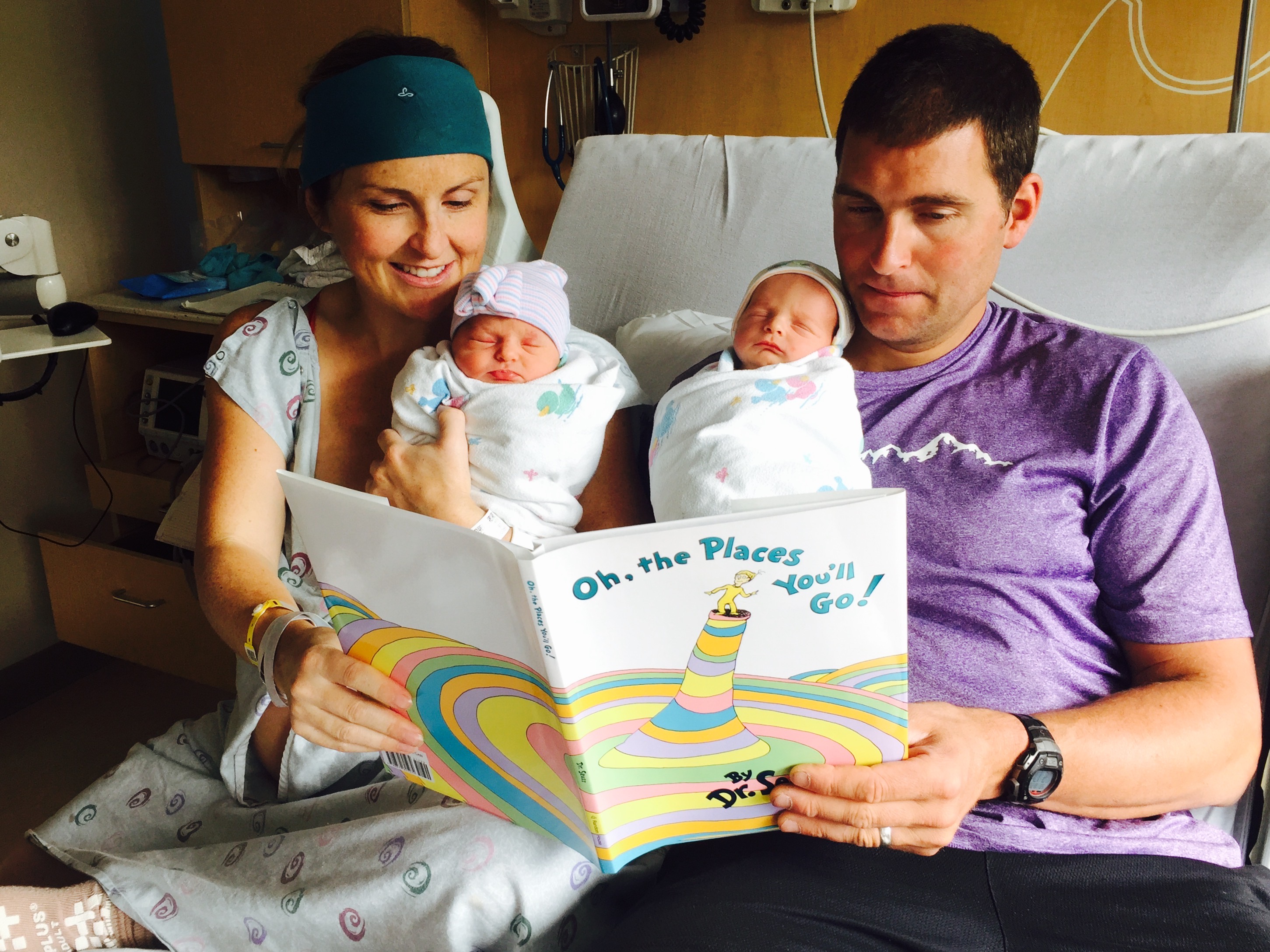
Holly Brooks and her husband, Rob Whitney, read Dr. Seuss’s “Oh, the Places You’ll Go” to their newborn twins, Ruby Joy and Brooks, born August 24th, 2017. (Courtesy photo)
Transitioning to life with one newborn is an adjustment to say the least, much less multiples. Brooks laughed that her parents had her triplet siblings when she was just a toddler, so the chaos was not as foreign to her. Her mother, the seasoned pro, flew out to help Brooks for the first month and her husband took what time he could for paternity leave. She felt fortunate that she had help, but she expressed that the adjustment while recovering from her birth experience was still very difficult.
Regardless of how a mother chooses or is able to feed her child, the process is time consuming. At birth, a baby’s stomach is only about the size of a marble, meaning babies need to be fed frequently.
“Feeding two babies every two or three hours is definitely a full-time job,” stated Brooks.
She described the process of trying to breastfeed twins as “an acrobatic challenged”, as she was always juggling to get them into position, keeping them both content if one fed longer than the other, or trying to burp one while the other kept feeding.
“Essentially with twins, the best way to do it is to feed them at the same time and you do the double football hold,” she explained. She then described sitting on the couch surrounded by pillows tucking each baby under her arm Heisman-style until they were both finished eating.
“Once you have them there, you are just – you’re not moving,” she laughed. She then recalled the deathly thirst she would be struck by as her milk let down.
Brooks described nursing her twins as an “adventure”, but also something that was manageable for her. She was able to exclusively breastfeed her twins the first four and a half months, before beginning to supplement with organic baby formula. She eventually tapered off pumping around ten months.
To illustrate the reality of this adventure, Brooks shared a story about her experience supporting US Nationals in 2018, which took place in Anchorage as the final major domestic competition prior to the Olympics in PyeongChang.
“Even though Rob and I both have jobs and had two 4-month-old infants, we were signed up to be joint chiefs of awards,” she said. “This was a much bigger job than initially intended! We spent New Years raiding the Christmas Tree dumps (once with the kids in their car seats I think?) so we could host wreath and bouquet making parties for flower ceremonies each race day. Then on race day Rob and I had a system where he would drive, the kids would be in back and I would literally pump in the car all the way out to Kincaid such that when my feet hit the ground I could have as much time as possible to volunteer before having to feed or pump again. I definitely got caught (semi-naked) a couple of times, but I didn’t care! We had our kids out there the entire time.”
Holly Brooks is a licensed professional counselor in the state of Alaska. Through her business, Holly Brooks LLC, she offers counseling, coaching, and consulting. (Photo: hollybrooks.com)
On July 1st, Brooks announced that she had officially become a licensed professional counselor in the state of Alaska. The title was nine years in the making, requiring a masters degree in counseling psychology, 3,000 post-graduate clinical hours, and a comprehensive national board exam. She chipped away at these requirements while still training for and competing in two Olympics, followed by the detailed journey to and through pregnancy detailed here.
Since ending her ski career, Brooks has run her own business, Holly Brooks LLC, where she offers counseling, coaching, and consulting. She explained that these words are used inclusively and that as her business has involved, the word “coaching” has become open-ended, as she now does little physical coaching, primarily focusing on performance and mindset coaching.
“I would say, my business has pretty much transitioned into mindset coaching and mental health counseling,” said Brooks.
Because she had built her own business and was running the show on her own, it was difficult for her to take a significant step back from working after her twins were born.
“As far as return to work, when you are your own boss, you can pretty much do whatever you want,” she explained. “But when your business is only you, I have a client load that, of course, I had people to refer to, but it’s not really easy to say, ‘Hey, I’ve been seeing you for a year and a half, I think you should go see this other person now.’”
As she felt her clients were depending on her, she returned to work quickly.
“All of my clients were very aware of my situation, and I ended up working until about a week or two before the babies were born, and then I was able to see some clients electronically, and I think I saw my first client when the babies were two weeks old,” she recalled. “Which is crazy, because I don’t even know what I was thinking or if I could see straight.”
She explained that apart from being relied upon, the challenges of being self-employed include the fact that she would not have any paid time off during a time when their family expenses increased exponentially with the new additions.
Her return to work was rapid, but her return to sport and physical recovery in a broader sense than just recovering from the birth itself were much slower. Some of the complications she experienced as a result of carrying and delivering twins have resolved, while others are still present.
“Some people say they come back stronger after kids,” she said lightheartedly. “And some people tried to tell me that and I was like, ‘Do you realize that I was a professional athlete before? I don’t think I’m going to come back stronger.’”
She added that she was only speaking to her own experience, not making the generalization that it would be impossible to do so, pointing to her former teammates Kikkan Randall and Caitlin Gregg, both of whom she affirmed “were doing awesome.”
Issues with core strength and pelvic floor functionality are not uncommon in the population of postpartum women. As Brooks’ body grew to accommodate two nearly full-term babies, the muscles in her abdominal wall stretched significantly, leading to a condition called diastasis recti, which is a separation of the rectus abdominis muscles making up the outer part of the abdominal wall. (Randall discusses this complication here.) Brooks completed physical therapy to help reclose these muscles, but because of the extent of the separation, the condition has not and may never fully resolve.
She also explained that she experienced some prolapse, though she did not see the need to go into too much detail.
“I’ll let people look that up on their own,” she laughed. “But it’s very common.”
As a result of the prolapse, she has experienced some lingering problems with bladder incontinence. She recalled working with a group of female masters prior to giving birth and being confused at why these women refused to do box jumps. She now fully understands their reasoning.
While working with a postpartum physical therapist or pelvic floor specialist can greatly reduce or eliminate these complications, Brooks explained that in balancing all of the aspects of her life, this type of care got cut out from her time budget.
“I did do some postpartum PT, pelvic floor PT [early on], and I think that helped,” Brooks explained. “I should probably go back, but it’s all a matter of time. I have very little time, so just figuring out how to spend that time is huge.”
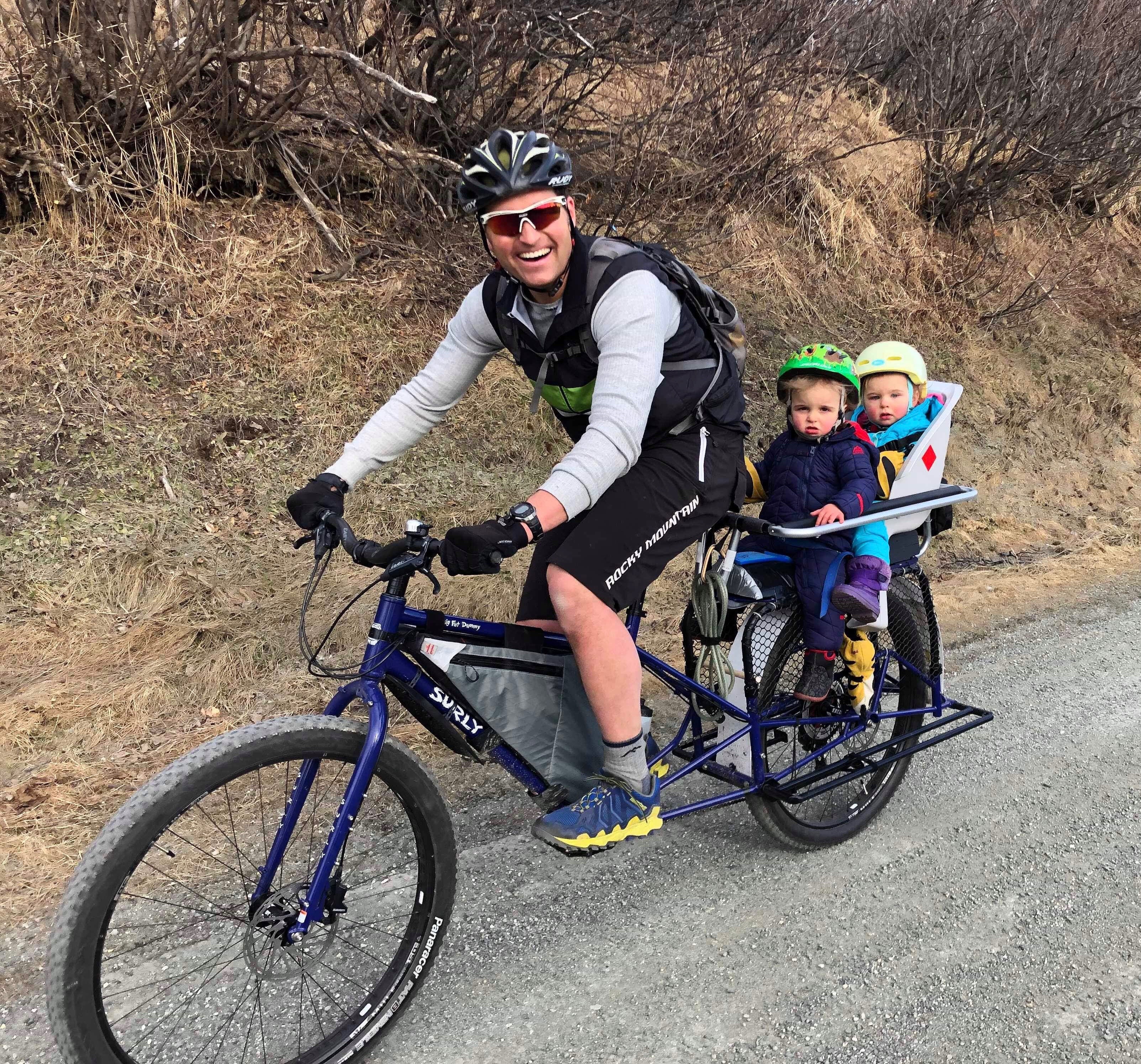
Rob Whitney, husband to Holly Brooks, takes their twins out for a spin on his bike. (Courtesy photo)
Brooks expressed that time management has been a major factor in her return to sport. About a year and a half prior to having her children, Brooks and her husband moved into their current house, which is directly across the street from a trail system where they can ski in the winter and run or mountain bike in the summer. This has been a key factor in Brooks’ return to an active lifestyle, particularly early on when she was trying to sneak out for exercise between her babies’ feedings.
“People that have kids know this, but you lose so much time in transition,” she said. “Loading up the car, getting into the car, getting out of the car, loading the stroller, and doing all of this. I feel so lucky that we live across the street from a million-acre park, so we have the skiing and the running and the mountain biking literally outside of our door. So I feel so lucky to have that because it makes it so much more accessible.”
While relocating may not be possible for everyone, she recommends that people that want to stay active after starting their family to think about ways to remove or reduce barriers to being able to exercise, whether that be purchasing a treadmill or home gym equipment, or choosing an activity close to home.
“Especially early on, when you’re breastfeeding, you have very little time between feedings,” said Brooks. “So if you get out and do something and can cut out the commute time, it’s awesome.”
Brooks stayed modest in her evaluation of her current level of fitness and postpartum recovery, expressing that in theory, she has improved in both regards over the last year.
“I have more time because the kids aren’t breastfeeding,” she explained. “But I have less time because they’re mobile and they’re drawing on my laptop with sharpie pens. In theory, I’m further away from that postpartum mark, so I think a lot of things are better, and I’m also just mentally used to the craziness of being a parent.”
Rosie Brennan (center) celebrates with her APU teammate Sadie Bjornsen (r) and former teammate Holly Brooks after winning the 2018 Alaska Run for Women on June 9, 2018 in Anchorage, Alaska. (Courtesy photo)
In early June, Brooks participated in the Alaska Run for Women, a five-mile road race in Anchorage that raises money for breast cancer research and women’s health. She stated that going into the race, she was unsure whether she would run faster than she had the year prior when she finished the race in 31:56. Despite her feelings, she bested her time by nine seconds, finishing in 30:47, a pace of 6:22 per mile and a far cry from being out of shape. (Rosie Brennan took second in the race in a time of 27:48, followed by Kikkan Randall who finished in 29:29 about one month prior to finishing her breast cancer treatment.)
“It’s almost like I feel in my mind that I’m not in as good of shape, I think just because I am further and further out from my professional career,” Brooks reflected. “But I think compared to a year ago, I am stronger, even if it doesn’t feel that way all the time.”
Finally, Brooks offered a message to sum up what she wanted to convey to other women by telling her story.
“I just really want to tell people that whatever journey you’re on, it’s your journey and it’s your own,” she emphasized. “It’s really, really super easy to get caught up in comparison, whether it’s you can get pregnant or you can’t get pregnant, or ‘My body doesn’t look like that person’s body at eight-months pregnant,’ or ‘How did this person run a marathon at four months postpartum and I’m still having a hard time getting out the door?’
“I think it’s really important for people to be aware of themselves when they’re doing that to just try to use some self-compassion and kindness toward themselves and toward others,” she continued. “We’re all on our own independent journey and there are lots of different ways to have a family, and to have a family and be an athlete, and it’s going to look different for every single person. So I would just caution people to think through and think with that lens.”
Simply put, “It’s different for everyone and don’t beat yourself up if it’s different for you.”
In the coming months, Brooks will be pursuing certification as a perinatal mood and anxiety disorder mental health specialist, a topic she is particularly passionate about in light of the experiences of her own experience and the experience of women and men in her community. She explained that these conditions are very common across both genders, as both men and women can experience postpartum anxiety, depression, or psychosis.
“People plan for ski races, or birthday parties, or buying a house,” she explained. “But I feel like there is this extreme lack of planning for how having a kid is going to affect your life, and I think it’s the biggest transition that anyone will ever have in their lives. So I would really encourage people to set aside some time or to seek out some professional health in that arena. And for people to be aware that perinatal mood and anxiety disorders affect one in seven or up to one in five women and one in ten men.”
She plans to offer expectant parent coaching through her practice to raise awareness about these issues and to counsel families through the preparation process.
“It is a big change,” she stated. “And I don’t say that wanting to be a Debbie Downer, or wanting to scare anyone, but I think that knowledge is power. If you plan for a ski race or something like that, then maybe you should also plan for the biggest change, potentially, in your life. It’s all perspective. For me, having kids was a bigger life event than going to the Olympics.”
Holly Brooks smiles with her twins, Brooks (left) and Ruby Joy (right), who were born in August of 2017. (Courtesy photo)
The “First Tracks” series highlights the pregnancy, postpartum, and parenting experiences of noteworthy athletes in cross-country skiing in various stages of their professional careers. The sharing of these experiences can benefit athletes in any stage of their career, whether they are an elite or recreational skier, by demonstrating that it is very possible to return to skiing, competition, and an active lifestyle with a growing family. The series will include the physical challenges of being an athlete during and after pregnancy, balancing family life with skiing, and the joy that starting a family can bring. The first athlete highlighted in this series was Kikkan Randall, whose story can be found here: Part 1 | Part 2.
The U.S. women (l-r Kikkan Randall, Holly Brooks, Jessie Diggins, and Liz Stephen) after their first ever World Cup relay podium in November 2012. (Photo: Fischer/NordicFocus)
When Holly Brooks retired from professional ski racing in 2016, she shared with FasterSkier that she and her husband, Rob Whitney, were trying to start a family. About a year after this conversation, she gave birth to twins, a daughter, Ruby Joy, and a son, Brooks on August 24th, 2017.
While the process of getting pregnant can be easy for some, their journey to create their “insta-relay team” was complicated by the fact that Brooks had been without a period for eight years. This condition, formally called amenorrhea, can be a result of many factors, from low body weight to thyroid problems, to heavy or high volume exercise, to excessive stress. It can also be a side-effect of some forms of hormonal birth control, as was the case for Brooks.
Brooks initially lost her cycle while using the Mirena IUD, which is known to reduce the frequency or severity of periods, or to eliminate menstrual cycles for women using it. At first, Brooks didn’t recognize this as being problematic. In fact, as a professional athlete, not worrying about her cycle had plenty of perks.
“Let’s be honest, for a really long time I was happy not to have a period as an athlete,” said Brooks in a call. “It was pretty convenient.”
Brooks shared that having amenorrhea as an athlete is not an uncommon phenomenon. While she believed that her nutritional habits were sound and that she was not underweight during her professional career, the condition is often linked to relative energy deficiency syndrome (RED-S, formerly known as the female athlete triad) which is typically a result of under-fueling possibly coupled with inadequate rest to accommodate an athlete’s training load. It is commonly seen with athletes with disordered eating habits, but the two are not always linked. The implications of having amenorrhea for women can include low bone density, leading to osteopenia or osteoporosis, and also infertility.
The pervasiveness of the condition was a concern for Brooks, and her own experience losing her cycle raised a red flag long before she and Whitney began trying to conceive.
“I think that there’s this myth that if you don’t have a period, you’re in shape. If you don’t have a period, it’s okay,” she said. “I’m not a doctor, so it’s hard for me to speak directly to that, but at some point, if you’re not taking birth control that takes it away as a side effect, you probably should be having a period, you should be having a cycle.”
When the Mirena IUD expired five years after it was placed, Brooks switched to a copper IUD called Paragard, which is a non-hormonal form of birth control, in hopes of regaining her cycle. This IUD can increase bleeding or frequency of periods, in contrast to the first. However, her period did not return.
Holly Brooks after placing fourth in the 2014 Engadin Ski Marathon in Switzerland. (Courtesy photo/HollySkis.blogspot.com) http://hollyskis.blogspot.com/2014/03/home-sweet-home.html
As her professional career waned and her age and desire to start a family with her husband increased, Brooks began hormone replacement therapy (HRT) to coax her reproductive system back into functioning normally in preparation for conception. HRT involves taking artificial hormones sequentially to mimic the changes that naturally occur during a menstrual cycle.
“So essentially, I had to stop exercising, take a bunch of estrogen, then take a bunch of progesterone to try to jump-start a cycle,” Brooks recalled.
It took a few months of HRT for Brooks to successfully regain her period.
“It almost felt like my body had just been kind of dormant and was fine with not having a cycle. And sometimes that’s convenient when you’re an athlete, but when you want to start a family, it’s not that awesome.”
Because she was 35 and it had already taken so much effort to get her body back into a fertile state, Brooks began working with a team of infertility specialists to help the couple get pregnant as quickly as possible. In any other context, the mid-30’s is likely considered the prime of life, but medically speaking, the risks of perinatal complications increase significantly after this point. A woman over the age of 35 who conceives is classified as a “geriatric pregnancy”, or listed for insurance purposes as having “advanced maternal age”. Typically these pregnancies are also labeled “high-risk”.
Brooks describes herself as an “eternal optimist” and managed to handle her battle with infertility with grace, but she expressed that she was not immune to the emotional challenges her situation created.
“There’s tons of frustration, there’s tons of impatience, and there’s also a lot of comparison too,” she said. “Which is human nature and it doesn’t always help.”
She shared that one of her favorite quotes is by Eleanor Roosevelt who said, “Comparison is the thief of joy.” While she remained hopeful that she and her husband would eventually be successful in becoming pregnant, she still found herself pulled into the comparison trap.
“Especially when you’re trying to get pregnant, you notice everyone else who is pregnant,” she observed. “And you’re like, ‘Well these athletes who were super fit, they had no problem getting pregnant.’”
With their infertility team, she and Whitney began the process of Intrauterine Insemination (IUI), which is a less invasive infertility treatment than In Vitro Fertilization (IVF). The IUI process involved Brooks taking a follicle stimulant during the first half of her cycle, prompting her ovaries to develop and grow a follicle containing a mature egg. She then took other fertility medications to induce ovulation, at which time doctors would inject a washed and concentrated sample of her husband’s sperm into her uterus, increasing the likelihood that the sperm and egg meet. This process requires close and careful monitoring throughout the cycle in order to be successful, which was not totally unlike the process of being a professional athlete.
“At some point, when you’re doing infertility [treatments], it starts to take over your life because you are paying so much attention to your cycle, and what day it is in your cycle, and what day you’re ovulating, and what day you’re going to trigger ovulation, and how many follicles you have, and how big the follicles are,” she explained. “As an athlete, you pay a lot of attention to periodization and training. And doing infertility [treatments], you kind of do the same thing, but it feels like you have way less control.”
She expanded by explaining that in training for skiing, she had control over her rest, how hard she pushed in a workout, what she ate, and so on, whereas during the conception process, no matter how hard a couple might “try”, much of it is out of their hands.
Although not frequently discussed, studies estimate that between 10-25% of pregnancies end in miscarriage, most commonly during the first trimester. In many cases, miscarriages occur early during the implantation process and go unnoticed, as the bleeding that occurs as the body sheds the undeveloped embryo often occurs when the woman might expect her regular period, leaving the pregnancy undetected. Miscarriage can also be a result of a chromosomal defect or other abnormality of the developing embryo, or due to lifestyle factors such as poor maternal health, smoking, or drug use.
Regardless of the cause or when the miscarriage occurs, the experience of pregnancy loss can be incredibly difficult for parents. During their voyage through cycles with IUI, Brooks was able to conceive twice before her successful pregnancy with the twins. In both of those cases, she lost the baby just before the end of the first trimester, which is when a pregnancy is typically deemed viable.
Miscarriage is one of the primary reasons most couples choose not to announce their pregnancy until the second trimester begins, lest they also are faced with sharing their loss. Many women that go through one or more miscarriages choose never to divulge their experience. Brooks wants to bring more attention to the topic as it is so commonly experienced but rarely discussed. This lack of attention can leave women grieving in silence and feeling as though they have failed, even though miscarriage is most commonly out of one’s control.
“I’m really happy to [talk about it] because it’s really common and a lot of people don’t talk about it.”
She added that it is one of her missions in life to talk about “the hard stuff” in order to reduce the stigma about these issues.
Because of the treatment method they were using, Brooks was closely monitored in the weeks following the IUI.
“If I were to go back and track how many ultrasounds I’ve had, I would guess 50, 60, 70.”
She explained that her doctors wanted to closely track whether an embryo was growing, and if so, whether it was growing at the appropriate rate with no noticeable problems. This was a stressful process since she and her husband remained so acutely aware of the processes happening within her body.
“Although it’s out of your control, you’re very in tune with what’s happening,” she said. “And it’s a rollercoaster of excitement and disappointment and excitement and disappointment.”
Her doctors were able to determine very rapidly whether or not the IUI had been effective, so in each case, the couple found out they were pregnant rather quickly after the treatment. Then the wait began; there was nothing that she could do but hope that the pregnancy would last through 13-weeks. She remained optimistic but tempered her excitement.
“That was really, really hard,” she emphasized. “It’s such a long journey to get there, and you get excited, but in the back of your mind, you know some of the statistics.”
At about the 12-week mark in both cases, she experienced bleeding which indicated a miscarriage. In some cases, women experiencing a miscarriage are able to pass the contents of the uterus naturally over the course of a few days, sort of like a very heavy period. In others, women need the support of medication to help force the body to shed everything.
Brooks fell into the second category, sharing that she spent two days in bed with horrific cramps each time, only to find out with an ultrasound that her body still had not shed everything, indicating that she would need a procedure called a dilation and curettage (D&C) to surgically remove the remaining contents in order to prevent a severe infection.
“I ended up having to do that twice around the 12-week mark, which felt kind of like deja vu,” she recalled. “And then you’re wondering if it’s ever going to happen or if you’re cursed. And then again, you look around at everyone else with their kids or their pregnant bellies, and you ask yourself the question, ‘Why can’t I get there?’”
Holly Brooks with her husband Rob Whitney and their six chicks in Alaska. (Courtesy photo)
Luckily, she did get there. With infertility treatment, multiples are more commonly seen. Brooks’ three younger siblings are also triplets, indicating that she is also genetically predisposed to conceiving multiples herself. While the risk of complications increases with twins, after all that she and her husband had been through, they were “ecstatic” about the idea of being able to complete the family that they envisioned in one pregnancy.
“When you feel like you’re behind and you feel like you had such a hard time getting pregnant to begin with, then you find out you’re getting a twofer,” she laughed. “We were ecstatic, slash terrified.”
After such an extended battle to achieve a healthy pregnancy, it seems impossible not to experience some trepidation about its success. Brooks reflected on if or when she began to feel confident that the pregnancy would work out and that they were finally stepping off of the rollercoaster.
“I think that there’s always some anxiety,” she stated matter-of-factly. “There’s always that voice in the back of your head, ‘Should I do this? Should I not do that? Even if I do all the right things, something could still happen.’ You hear these horror stories of people being pregnant with twins and one of the twins dying. These stories come out of the woodwork and your attention goes to weird places when you’re pregnant, and of course, you’re overly hormonal, obviously.
“So the anxiety was pretty much always there, then it’s there during birth, and it’s there when you have newborns, and it’s still there when you have toddlers,” she ended with a laugh.
Though she acknowledged that many women and also men experience more severe forms of anxiety and depression surrounding pregnancy, which she commented on further later in the conversation (see Part 2), ultimately, few parents are truly immune to some level of it.
“I think to some extent, some anxiety is part of being a parent,” she said. “And it can be heightened or lowered, based on not only your genetics but the environment you’re in and the situations you’ve experienced.”
Stay tuned for part two of this story in which Brooks discusses the remainder of her pregnancy with twins, birth, and adjustment to life as a working parent and athlete. She also shares what’s next for her business, Holly Brooks LLC.
Last year, 174 athletes in the male and female U18 categories competed at Junior Nationals in Anchorage, AK. This number represents a small fraction of the cross country skiers throughout the country in that age category. As there are only about 30 NCAA programs nationwide that offer Division I or Division II cross country skiing, the opportunity for high-level training and racing narrows significantly after a skier graduates from high school.
However, the door to continue to pursue collegiate nordic skiing does not shut on an athlete who does not make or does not wish to compete for an NCAA team. While lesser known, the United States Collegiate Ski Association (USCSA) has created an opportunity for hundreds of additional skiers throughout the U.S. to continue to participate and compete in cross country skiing. In essence, USCSA is Division III skiing, however, because it is not under the NCAA jurisdiction, it allows for much broader entry, making it accessible to both club and varsity programs.
The mission statement states, “The USCSA asserts that student-athletes, of ALL levels and abilities, should have access to a quality and exciting venue of competition.”
Athletes take to the course during a mass start classic race at the 2019 USCSA National Championships in Jackson Hole, WY. (Photo: USCSA.com)
Much like the NCAA, regional USCSA coordinators organize a season of races, each hosted by a member school, leading up to a regional championship in late February. These races are held at many of the same venues as the NCAA races. At the end of the season, the top teams and individuals from each region compete at a five-day national championship in early March in conjunction with the other snowsport disciplines of USCSA. These championships have been held at prestigious venues across the country including Jackson Hole, WY in 2019, Lake Placid, NY in 2018, and Mt. Bachelor, OR in 2017.
In contrast to an NCAA program, both men and women race the same distances in both sprint and distance events, promoting equality across genders. The USCSA also prides itself in being team-centric, emphasizing team scoring, as opposed to focusing on individual results.
In most cases, USCSA programs are not exclusive, meaning teams or clubs are open to anyone, regardless of their previous experience or exposure to the sport. All athletes are welcome to participate in races. In contrast, an NCAA program may have a limited competition team. However, this inclusivity does not indicate that the programs are not competitive or that they would not serve a high-level junior skier.
“The flexibility of a USCSA team is incredible because you can have people that have never skied before to people that are – there are USCSA racers that have been Junior National Champions,” said Christi Boggs, Vice-President of Nordic Skiing at USCSA and nordic coach at the University of Wyoming (UWYO). “There are some really high-level racers, but it also allows for someone who just loves to do it to keep doing it or someone that wants to try it can try it.”
Christi Boggs (center) of the University of Wyoming on a crust ski with her partner and fellow coach Rachel Watson (right) and athlete (left). Boggs is the Vice President of Nordic Skiing for USCSA. (Photo: Instagram @uwnordicski)
A graduate of UWYO herself and a faculty member in the School of Culture, Gender, and Social Justice, Boggs has been overseeing the school’s club program for the last 22 years. During her own time as a student and athlete at UWYO, the nordic ski program was a Division I NCAA program and Boggs became a four-time All American, later pursuing biathlon and winning the Rocky Mountain Cup and North American Cup twice each. But like several other programs, the UWYO lacked the funding to support the program. It was cut in 1993.
While top junior skiers typically do head to NCAA programs, Holly Brooks and Clare Egan, both USCSA alumn, show that the programs can still be stepping stones to elite competition.
In reflecting on her decision not to ski for an NCAA team, Egan described her high school self as “not a real serious athlete”, though she did win the Maine State Championships in 2006 and competed in Junior Nationals in both 2006 and 2007. She explained that she did not do any formal summer training in those days, and out of the three sports she participated and had talent in – she also ran cross country in the fall and track in the spring – none held priority for her. Though she did want to continue in athletics, she was very academically motivated and aspired to study abroad and to continue to play music during her college career as well. To Egan, the idea of being limited as a Division I athlete was off-putting.
“When I applied to college, I wasn’t really sure what I wanted to do,” Egan recalled. “I got offered a Division I running scholarship, I got into Middlebury where I would have been focusing on skiing, and UNH, I was offered a scholarship that would have been a combination of running and skiing. But in the end, I decided that I didn’t want to be a full-time athlete at that point, which is what my impression of Division I was.”
Egan ultimately chose Wellesley College, located 30-minutes west of Boston, MA.
While attending Wellesley College, Clare Egan competed in the USCSA in addition to racing in regional NENSA and EISA races. (Courtesy Photo)
“I ended up picking Wellesley, among other things, because it gave me the opportunity to continue participating and competing in all the sports that I did without having it be Division I,” she explained.
At the time, Wellesley did not offer cross country skiing, but the campus is located within five miles of the Weston Ski Track, so she knew that she could continue to ski. She would also be able to participate in New England Nordic Ski Association (NENSA) races. Egan also joined the varsity cross country and track teams.
“I guess right away my fall at Wellesley, I decided that I did want to do skiing and that I wanted to get involved in some way,” she said. “So I started a club through the student activities and got involved in USCSA.”
By joining the USCSA, which she referred to as a “hidden gem”, Egan was able to race a full season in the Northeast, participating in USCSA and NENSA races as well as Eastern Intercollegiate Ski Association (EISA) carnivals. As was her hope, she studied abroad her junior year in Italy and Switzerland, where she skied regularly and raced in the Engadin Ski Marathon. In her senior year, Egan qualified individually for and competed at NCAA’s in addition to the USCSA national championships. As she had one remaining year of NCAA eligibility, her path then led her to the ski team at the University of New Hampshire and eventually to the Craftsbury Green Racing Project Team and now the US Biathlon Team.
While this trajectory is non-traditional for an Olympic athlete, it demonstrates that an athlete can be successful through a number of different pathways, some more direct than others. Egan attributes some of her longevity in the sport as her career has developed to being in a low-pressure and relatively unstructured environment for so long.
“I can say that I’m not burnt out,” said Egan. “I think a lot of other people who are my age, they stopped a long time ago and maybe part of that is because they competed so intensely for so long already by the time they were 22. Whereas, I did not start doing year-round training until I was 23.”
Egan could not state outright that had she skied four years in an NCAA program she would have fast tracked her career. But the flexibility that USCSA allowed her was a good fit for her and kept her involved with the sport through her collegiate career while focusing on academics.
“I do think that being able to stay involved with skiing in a way that worked with the rest of my life allowed me to – I was able to get involved with it again later because I stayed in touch with it,” she concluded.
Two-time Olympian Holly Brooks, who attended Whitman College in Walla Walla, WA, attributes more of her success in ski racing to her USCSA experience.
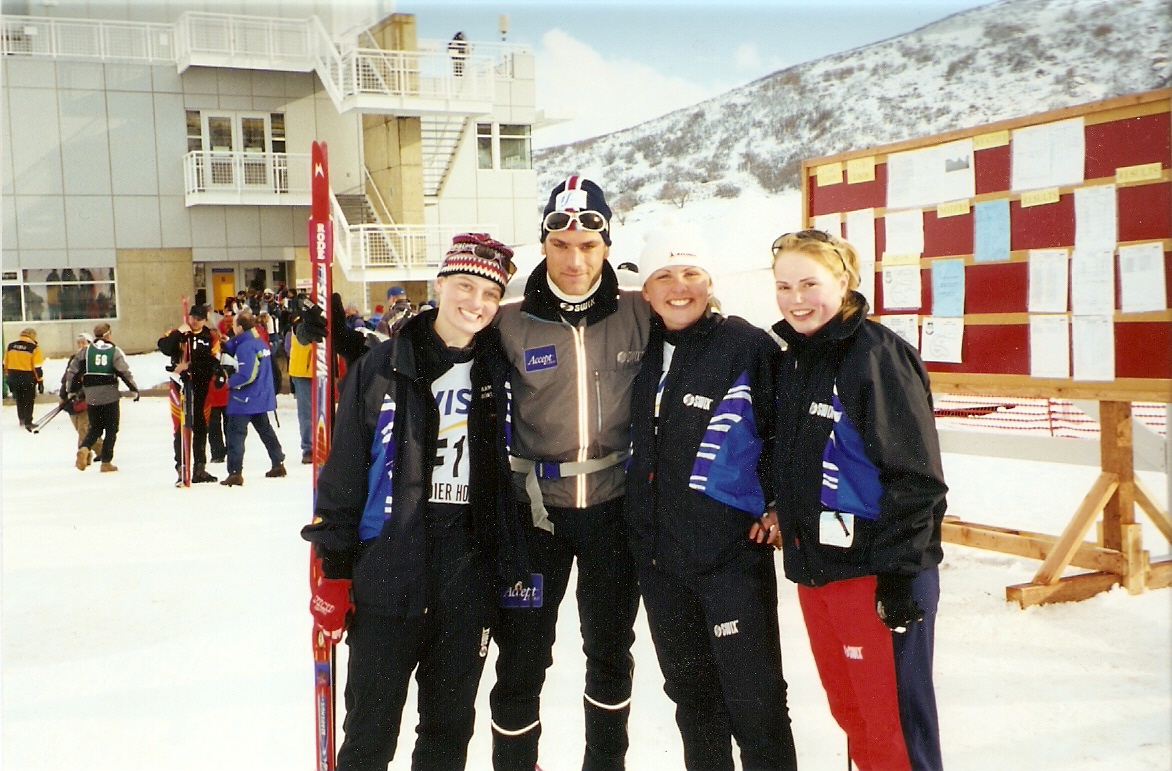
Holly Brooks poses with her Whitman Nordic teammates and a Norwegian athlete after forerunning at a World Cup race in Soldier Hollow, UT, in 2001. She explained that they were excited to take a picture with a Norwegian. Little did she know she would one day be racing at the World Cup level herself. (Courtesy photo)
“My time at Whitman played a really important role in my ski career,” wrote Brooks in an email. “Coming out of Seattle I had never been on a bigger team before, and rarely had coaches other than my dad. I actually choose Whitman because it had a ski team and was on the west coast. I wasn’t nearly strong enough to go to any of the larger, more competitive NCAA programs. Once at Whitman, I had awesome teammates and coaching and my love for skiing grew and grew.
“USCSA didn’t really have a ‘regular season’ but Nationals seemed like a big deal and it was enough to motivate us to train hard every day,” she continued. “I have no doubt in my mind that had this opportunity not been available my time and interests would have turned to something else. In essence, USCSA skiing at Whitman served as an important placeholder for skiing in my life. It was the link between being a solo skier in Seattle, to getting me to Alaska, where I truly developed as an athlete.”
In late May, the Aspen Institute held a forum titled theFuture of the U.S. Olympic Movement: Reimagining Goals Beyond Medals. The forum touched on a range of topics including SafeSport, athlete mental health, and more holistic youth sports and development programs. A theme in the development conversation was creating opportunity from a grassroots level, that if an athlete wanted to continue in the sport and compete, they should be able to. The USCSA aligns with this grassroots approach in fostering development as its inclusivity promotes the retention of athletes in cross country skiing during a time frame that many stop participating as well as introducing newcomers to the sport.
“I do think that USCSA plays a really important role, that I wish more people knew about, as a way to keep people involved in the sport through that 18 – 22 time period,” expressed Egan. “You don’t just have to quit after high school if you’re not going to be a Division I athlete. That’s so ridiculous. Skiing, for some reason, is one of the few sports that we look at that way.”
Jim Allott was the head coach at Clarkson University for 19 years during which he led the Golden Knights to 7 USCSA national titles. (Photo: clarksonathletics.edu)
This viewpoint was expanded upon by Jim Allott who recently retired from his role as head coach at Clarkson University in northeastern New York after 19 years. In seven of those years, either the Clarkson men or women were the top nordic team at the USCSA national championships. Both teams won in 2012.
“When you consider how many colleges are not NCAA or skiers for lots of different reasons don’t have the ability to make an NCAA team, you’re turning away hundreds of potential nordic athletes,” said Allott “If you think about what we see here in Potsdam where our regional is 10 to 12 teams, and then you look at our NCAA cohort with EISA, and they have a similar number of teams. So just in that one quick snapshot, you can see that we’ve doubled the number of nordic teams.”
Allott also echoed Egan’s words about athlete “burn out”, adding that the dynamic and culture of USCSA programs allows skiers to grow both their ability and love for the sport. Allott described the USCSA experience as “both positive and fulfilling.”
“It instills the passion that they will want to pursue it when they leave college, and that’s rare in a lot of college athletic sport situations. Many athletes are just done, they’re either just cooked and fried, or they really don’t continue in their sport.”
During his tenure, Allott has seen many of his athletes continue to pursue cross country skiing after college, whether their involvement is recreational, in leadership roles within USCSA, or as a coach of a youth program. He described USCSA alumni as being “like the growth of a tree”, where each forms a branch to create a nationwide community connected by a common passion.
“I take a fair amount of pride in how many of my athletes move on and get involved in the sport of nordic skiing,” said Allott. “That ranges anywhere from a Bill Koch level to high school coaching. The last 15 years, our USCSA regional coordinators have all been Clarkson nordic alumni.”
Boggs seconded Allott’s sentiment about the prevalence of her former athletes in coaching and other areas of sport. She attributes this connection to the sport to the positive culture cultivated within the USCSA opportunity.
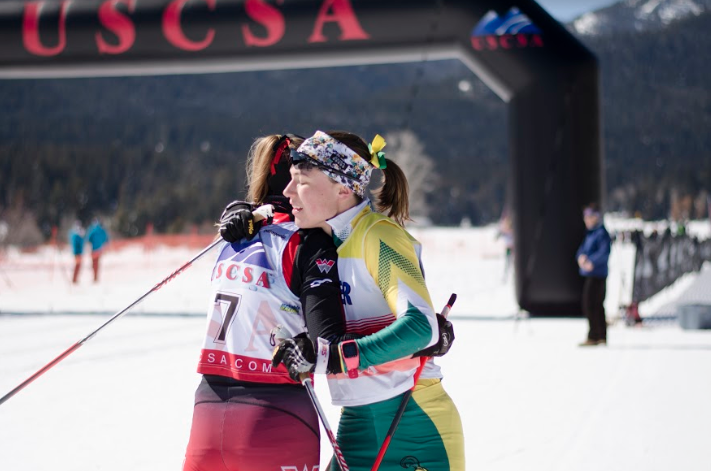
An athlete from Clarkson University celebrates at the finish with a competitor from Western State Colorado University during the 2019 USCSA National Championships in Jackson Hole, WY. (Photo: USCSA.com)
“All of that builds opportunity and pathways for athletes to become really important to the sport overall,” said Boggs emphatically. “I think that’s huge.”
She continued that the nature of students attending USCSA member schools has the power to position them in roles where they can create a large impact on the overall American nordic ski community.
“A lot of USCSA teams – they’re military academies and Ivy League [schools]. These are people that are really going places and getting graduate degrees and can really make a difference going forward. I think that is super important for building the sport.”
Both coaches emphasized the impact of USCSA beyond the development of the skier to the transference of the life skills cultivated through the experience, which includes benefits such as better sleep, self-reliance, positive self-image, teamwork, and time-management. They expressed that these traits help alumni obtain and succeed in post-collegiate careers and to lead healthy and active lifestyles.
After taking the role of Cross Country Sport Development Manager last fall, Bryan Fish described a system of three metrics to track the success of US development: growth in the number of skiers, retention of those skiers, and lastly, improvement in performance. By promoting inclusivity and creating opportunity, USCSA supports this system, assisting in the development of a healthy and thriving American cross country ski community.
“If we don’t maintain and fight for diverse options for people to keep skiing I think our sport is doomed,” wrote Brooks on USCSA’s role in the growth of the sport in the US. “The beauty of cross country skiing is that it can be a lifelong sport. But… we need to make sure that opportunities exist for people to stay engaged. We need enthusiasts, we need fans, we need coaches, groomers, ski parents, officials, donors, etc. The health of our ski community depends on having options. Unfortunately, the official ski program at Whitman folded years ago. I am thankful that the opportunity existed during my time there.”
Boggs reaffirmed this message, furthering the grassroots model of supporting the development of cross country skiing in the US.
“Our support base, the next generation of skiers and the support base for the skiers we have, don’t come from the elite athletes,” expressed Boggs. “It comes from all the people watching the races, the parents taking their kids to races, people that are just passionate and excited. That’s who is donating the money, and spending the time volunteering to coach, and driving kids to races. Those are all the people that get really excited. And I think USCSA is uniquely positioned for that.”
To wrap up her beliefs about the role of USCSA in the success of American nordic sports, Egan offered a concluding message to support high school skiers amidst the “college conflict”.
“If you’re thinking about being an athlete and you don’t necessarily want or don’t qualify to be on one of those Division I teams, you don’t have to give up skiing at all,” concluded Egan. “Someone might not be ready to do Division I in high school or they might not be interested, but there are plenty of athletes who have the passion and ability to stay involved and we shouldn’t exclude those people.”
Today, in Seward, Alaska, home of the Mt. Marathon race, temperatures were in the mid-60s. However, the indices that mattered was the air quality index (AQI). According to an Anchorage Daily News article, the AQI in downtown Seward was 172 on Thursday morning. As a result, the junior race was officially canceled. An AQI of 172 falls within the unhealthy range,
Despite the junior race cancellation, the youngsters went rogue and ran an unofficial race. Seventeen-year-old Sebastian Sweda Mittelstadt won the unsanctioned boy’s race and Noelle Spencer the girl’s race. The juniors run a shortened course.
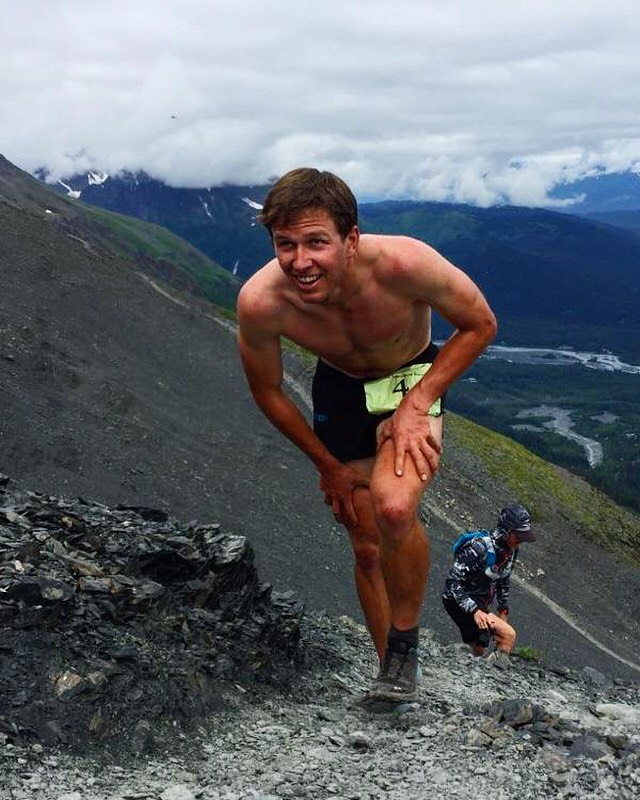
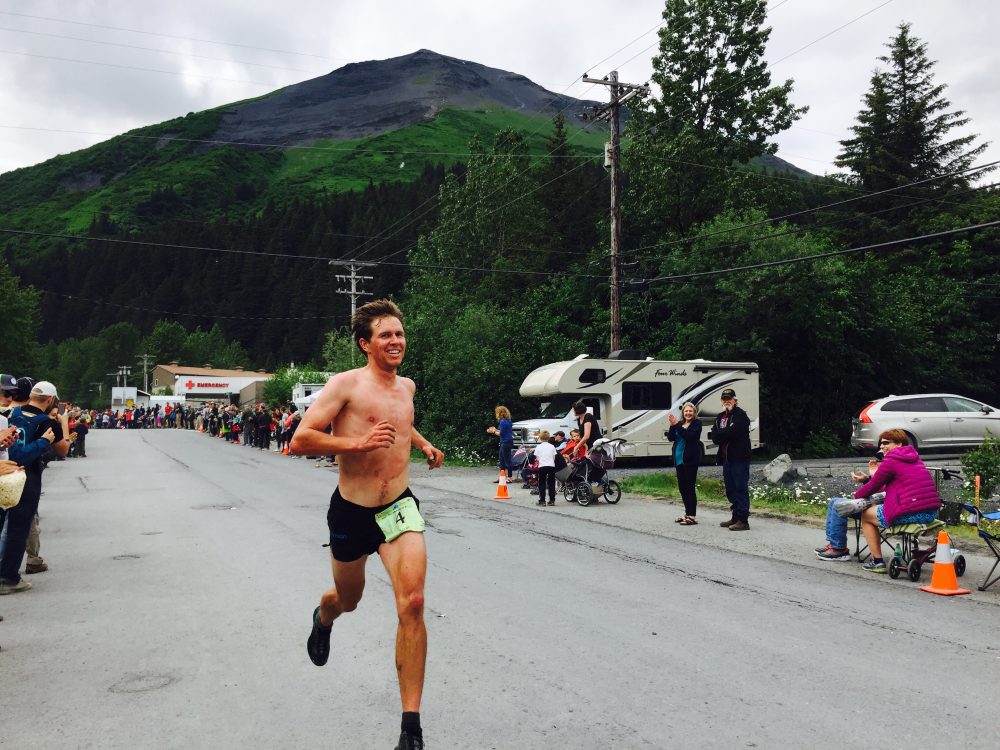
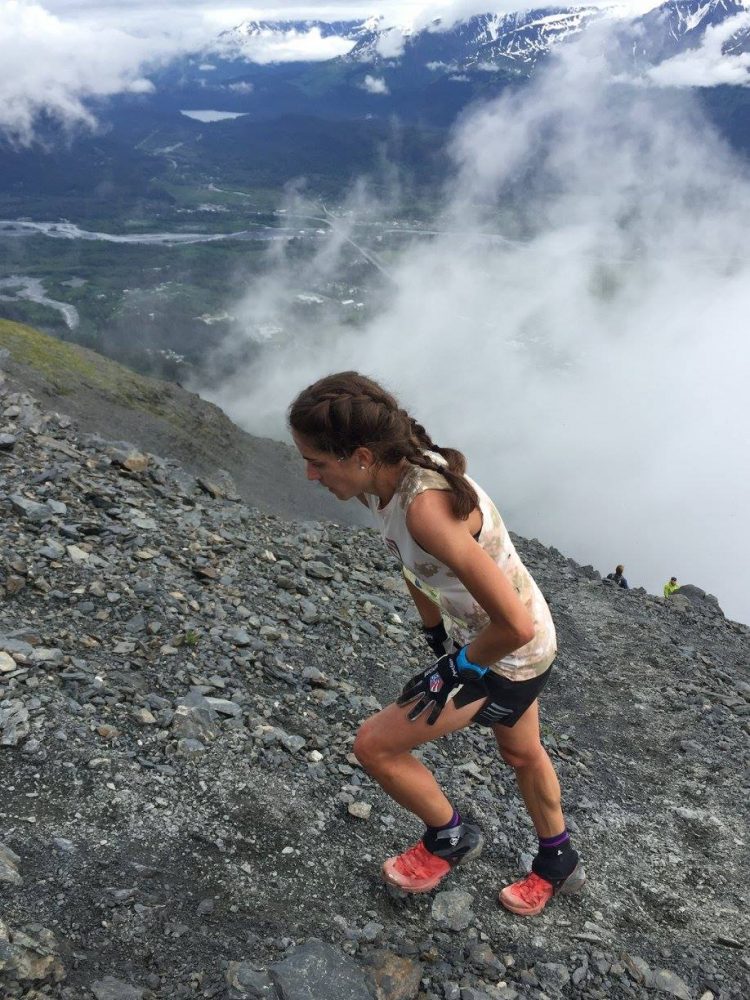
FasterSkier normally covers the Mt. Marathon race due to the elite cross-country runners in the field. Holly Brooks, Jessica Yeaton, Scott Patterson, and David Norris are all past winners. Norris won in 2018 and 2019, Yeaton won the women’s race last year.
With less than stellar regional air quality due to wildfires, Yeaton, Patterson, and Norris chose not to race.
Hannah Lafleur won the women’s overall in 53:24 minutes. Former APU and U.S. Ski Team member — and mom to twins — Holly Brooks placed 10th in the women’s race.
Andrea Henkel Burke with her 2 Olympic gold medals and an incredible 8 World Championship titles.
With a resume including 2 Olympic gold medals and an incredible 8 World Championship titles, Andrea Henkel Burke is recognized in Germany as one of the greatest biathletes of all time. Now living in Lake Placid, NY with husband Tim Burke, Andrea is using her years of competitive experience to help others achieve their goals through a personal training and consulting business.
This week Andy Newell announced Andrea as the newest partner on the growing platform NordicTeamSolutions.com, a website designed to highlight the services of expert skiing consultants such as Andrea and make their expertise accessible to the public. Since the launch of the website in September 2018, the list of consultants and contributors has expanded to include 2-time Olympian and counseling psychologist Holly Brooks, PT SCS Kurt Jepson, and now biathlete Andrea Henkel Burke with certifications in fitness, health, nutrition, and physical testing.
Nordic Team Solutions – Andy Newell
“It makes me so excited to form these partnerships” explains Newell, “Our motto at Nordic Team Solutions is to become a student of the sport. To me this means always learning new approaches to ski training but more importantly sharing knowledge and finding ways to make that knowledge accessible to the skiing community.”
Consultants featured on the website submit weekly and monthly entries which are stored in an online library offering guidance on training, nutrition, technique, race preparation, strength, and mental training. Members also have access to email correspondence which Newell finds most beneficial. “I love solving problems, whether they are coming from a high school skier, coach, collegiate racer, or a master – everything is a personalized approach. This is why I’m so grateful to highlight people like Holly and Andrea who are true experts in their fields. If someone needs help with a mental training approach, I connect them with Holly. If someone needs some testing, one-on-one training or nutrition guidance Andrea is an amazing resource. That’s what makes Nordic Team Solutions successful, it’s a way to connect athletes or coaches to the person that can best suit their needs.”
With Andrea based in Lake Placid, NY her services span far beyond the online content to hosting training sessions and mini camps at her home gym facility. Andrea really values this hands-on approach, “Everyone is unique and personal training will adjust to that! In my eyes, personal training is much more than the workout I do with my clients. It is about consulting, educating and guiding them, to include step by step the things in their life, which will help them to reach their health and fitness goals.”
Nordic Team Solutions – Holly Brooks
Newell sees Andrea’s holistic approach as a great asset to athletes and coaches. “A big part of a holistic approach for health and performance, also is nutrition” explains Andrea. “Nothing stands alone! The best training doesn’t bring the best results without good fuel, but also the best fuel is not enough for high performance or overall health, without good training. “
Tour of Anchorage 50k men’s winner Jack Novak tops the final hill to win the race Sunday, March 4, 2018. (photo: Michael Dinneen)
ANCHORAGE, Alaska — Hannah Rudd had never raced a 50 k before. Jack Novak was doing his second one in as many weekends. They took different paths to get there, but both ended up in the same place on Sunday afternoon: first in the flagship 50-kilometer freestyle race of the Tour of Anchorage.
The 30th annual Tour (pearl anniversary!) set off from Service High School, beneath the foothills of the Chugach Mountains at the eastern edge of metropolitan Anchorage, on Sunday morning amidst essentially perfect conditions: 20 degrees Fahrenheit, no wind, and clouds giving way to sunshine by race’s end. It was a far cry from 2017, when temperatures were 4 below at the start, dipping to -12° F a few kilometers down the trail in a notorious icebox spot in the black spruce forest of Campbell Tract.
While 2017 saw successful early solo breakaways for both the men’s and women’s champions, the strategy for this year’s winners was much more typical for a race that has hills at the start and at the end, but about 25 k of flat skiing in the middle: Join a pack near the start, ski with the pack over the flats, break away from the pack approaching the finish, don’t look back.
For Novak, who was racing on Sunday in Anchorage just eight days after a top-50 finish in the American Birkebeiner in Wisconsin last Saturday, that break came a gutsy six kilometers out from the finish at Kincaid Park.
Tour of Anchorage 50k men’s winner Jack Novak skis in a pack early in the race Sunday, March 4, 2018. (photo: Michael Dinneen)
He was skiing with APU teammate Forrest Mahlen and local master skier Seth Downs at that point, Novak recounted in a post-race interview with FasterSkier. He and Mahlen had gone off the front by 10 k into the race, but realized that Downs was catching up to them, so purposefully slowed until he caught them. The three of them then skied together for the next 30+ kilometers… until Novak made the impetuous decision that it was time to go.
“As we entered the Sisson Loop” at around the 44 k mark, Novak recounted of the point at which racers leave the flats of the Coastal Trail for the rolling hills of Kincaid Park, “I had just taken a pull on the front, so I moved back to third, and was just cruising in the back recovering. And right as we entered Sisson, Seth pulled over and decided it was time to feed, so he pulled his bottle out, and Forrest at that point thought it was a good idea to feed as well. And I took my waterbottle halfway out of my belt, but then realized that this was a great opportunity, so I shoved it back in and just went around on the edge of the trail, and just charged as hard as I could for the next six k all the way to the finish. And I was a little nervous, because I thought either this was going to be a winning move, or it was going to be a third-place move. And I was a little nervous, but I decided that I had to fully commit, and just go for it.”
Going for it worked for Novak. By the time he crested the final climb up to the hilltop finish outside the Kincaid chalet, ice crystals flecking his eyebrows and caking his lumberjack beard, he was over a minute ahead of Downs (+1:05.7) and nearly two minutes up on Mahlen (+1:41.5), who had himself been top-40 in the Birkie last weekend.
Rudd had a similar journey to Kincaid, initially skiing in a pack of several women occasionally joined by some of the slower first wave men. (Wave 1 at the Tour is the top 50 men, Wave 2 is a dozen or so elite women, then the remaining waves are co-ed. Much like at the Birkie, the lead women can keep apprised of their competition by virtue of the common start, but also often end up skiing with some men who started two minutes ahead of them in the first wave.)
As late as the Chester Creek greenbelt, roughly midway through the race, Rudd was skiing with a lead pack of women that included Michaela Keller-Miller, Shalane Frost, and Alison Arians. But eventually the lead pack dwindled down to a lead pair, just Rudd and her University of Alaska Anchorage teammate Keller-Miller.
Tour of Anchorage 50k women’s winner Hannah Rudd tops the final hill to win the race Sunday, March 4, 2018. (photo: Michael Dinneen)
Rudd skied with Keller-Miller for some time, then made her move “with about 3 k to go,” the 19-year-old sophomore told FasterSkier after the race.
Much like Novak’s surge before her, Rudd’s push may not have been easy, but it was effective. Rudd would ultimately cross the finish line in 2:38:54.4. Keller-Miller (+1:15.7) followed over a minute back in second, with Frost (+4:56.2) third. Frost had finished second to 2018 Olympian Rosie Frankowski in last year’s icy sufferfest.
Rudd had never raced a 50 k before Sunday, but count her a fan. “I really like 50 k’s,” said. “I like the distance. It was really fun.”
Rudd, who remains undefeated in lifetime 50 k races, had nothing but praise for her overall experience on the day: “It was really great. It’s an amazing trail system, beautiful day. Phenomenal course.”
The only thing that gave her pause was the question of whether she could accept the prize given to the first-place finisher in the 50 k ($1,000 and a roundtrip ticket on Alaska Airlines), in light of NCAA regulations that generally proscribe accepting prize money greater than the costs of participating in a competition.
“That’s still up in the air,” demurred the UAA student-athlete when asked about this immediately after the race. “Our Athletic Director is going to check on that.”
Novak had no bar to accepting the money, but his plans for the windfall reflected the realities of life as a 24-year-old professional cross-country ski racer. “It’s probably just going to be put toward racing,” Novak said. “Pay the bills.”
While Novak’s aims for his prize money were quotidian, he made it clear that it had still been a special day for him.
“Today feels really good,” he reflected after his win. “It’s been a rollercoaster ride of emotions for the Tour over the past couple years, with shortened courses, changed courses, cold weather, warm weather, all that stuff… so it’s really nice to be able to put everything together, and get the victory.”
Getting the win this year after earning the wooden medal for fourth the year before probably didn’t hurt. Neither did being born and raised in Anchorage — Novak graduated from South Anchorage High School, and placed seventh at State (behind Olympian Scott Patterson) in 2010 and fourth (behind Olympian Logan Hanneman) in 2011 — then finally winning the citizens race that has long served as the unofficial Alaska state championship.
Reflecting the high level of skiing in the state, a dozen different Olympians, most of them locals, have won the Tour of Anchorage over the past 30 years, according to an email from race organizers: Adam Verrier, Sue Forbes, Audun Endestad, Kevin Brochman, Todd Boonstra, Lars Flora, Laura McCabe, Suzanne King, Abby Larson, James Southam, Holly Brooks, and Rosie Frankowski. The number only goes up if you count second- and third-place finishers — Reese Hanneman, Tyler Kornfield, Rachel Steer, Justin Freeman, and Ben Husaby among them — and should actually be fourteen for victors alone, counting skier Betsy Youngman and biathlete Jay Hakkinen.
Hannah Rudd (2067) follows Alison Arians (2064) midway through the 2018 Tour of Anchorage. (photo: Michael Dinneen)
(2018 Australian Olympian Casey Wright was seventh among women on Sunday. Less than four minutes behind her came Brooks, a 2010 and 2014 Olympian for the U.S., who now describes herself as “a new mom of infant twins and a new business owner.” While Brooks raced the 50 k on Sunday, her husband, Rob Whitney, covered the entire route — including the 100-meter gain hors catégorie max climb of the Spencer Loop — towing a double Chariot with both six-month-olds inside. Plus diapers and snacks.)
New dad Whitney may not have used the phrase “just cruising around” to describe his heavily laden trip across town, but it seemed appropriate for the unencumbered Novak.
“Conditions today were phenomenal,” Novak said after the race, “sunny, 20 degrees — can’t complain about that. It was fun to just be out there skiing with my best friend, and Seth [Downs], and just be out there cruising around.”
The change in weather conditions from 2017 didn’t hurt, either.
“This year was so much more pleasant than last year,” Novak said after skiing on a day that was literally more than 30 degrees warmer than the last time he had done this race. “Last year I was wearing two long johns, and two long johns on top, and a vest, and two buffs, and I was still cold. And this year I was wearing just one long john top and bottom, and I was totally comfortable the whole time. And it was wonderful to just be out there, and just be skiing, and just not have to worry about freezing.”
Inside the results and other races
A total of 740 racers finished on Sunday, a sizeable field but down from a high of 2,050 in the mid-2000s, when the Tour was consistently the second-largest ski race in the country behind the Birkie. They ranged in age from 8-year-old girl Reine Soule and 8-year-old boy Jack Leveque (2:08 and 2:19, respectively, for the 25 k skate), to 88-year-old Reno Deprey (3 hours even for the 25 k classic).
While the Tour of Anchorage draws the lion’s share of its competitors from, well, Anchorage, the rest of the state put in an appearance as well. Finishers hailed from throughout the road system, from Homer to Fairbanks, as well as from Galena, Gambell, Juneau, Nome, and Sitka. (While athletes in all five communities had to board a plane to make it to Anchorage, and Galena, pop. 470, is no metropolis, Gambell is likely the most notable home for any entrant in Sunday’s race. It is “a roadless Eskimo village,” says the local church, situated on St. Lawrence Island in the Bering Sea. It is closer to Siberia than to mainland Alaska.)
A smattering of racers came up from the Lower 48 as well, enjoying a notable local sports weekend that features the Iditarod start on Saturday and a ski race on Sunday. The top Outside finisher in the 50 k at this year’s Tour was Hannah Smith of California, sixth among women. And Erik Pieh of Minnesota was 18th in the men’s 50 k.
Three other races were also held on Sunday, although prize money was awarded only to the winners of the 50 k ($1,000 and the plane ticket for first, $500 for second, $100 for third). In the 40 k, which skips the hills of the Spencer Loop and most of the Hillside trails before proceeding through greenbelts to Kincaid, Lisa Anglen prevailed in a tight finish in the women’s race to take first place in 2:10:13.7. She was followed by Meredith Noble (+12.8) and Naomi Kiekintveld (+16.5).
In the men’s 40 k, 13 of the top 17 finishers were junior boys; the 40 k often becomes a chance to unofficially see who is the fastest local junior not selected for Team Alaska for Junior Nationals. (One has to be 18 years old to race the 50 k.) The fastest junior this year was Thomas Bueler, 15, but he was 10:31 back from Andrew Boone, 36, in first (1:47:46.2). Third place went to David Funatake, 29 (+11:51). Next among junior boys were John-Mark Pothast in fourth (+13:17) and Jack Cater in fifth (+13:18).
The 25 k skate, which goes from Alaska Pacific University to Kincaid, also had a strong youth movement feel as 12 of the top 14 finishers were junior boys, led by winner Joel Power, 15, in 1:15:39.8. Crashing the youth brigade wereGary Di Silvestri, 50, in second (+3.6) and Kevin Donley, 52, in third (+20.5). The unofficial juniors podium was filled out by Niko Latva-Kiskola in fourth (+6:04) and Hayden Ulbrich in fifth (+6:15).
In the women’s 25 k skate, Homer skiers carried the day, with Emily Lints first in 1:30:39.1 and Hanna Young third (+38.5). Becky Butler of Anchorage was second (+14.0).
And the 25 k classic, finally (same route as the 25 k skate), saw youth in the women’s race and experience in the men’s race. In the women’s race, former UAF skier Hannah Rowland, 22, led the way in 1:47:06.0, followed by 17-year-olds Avery Mozen (+17.7) and Kellie Arthur (+7:31.0). And in the men’s race, Gary Snyder paced an all-40-something podium in 1:27:16.4, followed by Cory Smith (+40.5) and Ben Arians (+4:50.3). Snyder and Arians are locals who raced against each other in Anchorage high school competition decades ago, and for most of the 25+ years since. (Snyder was first on the 25 k podium in 1990, then again in 2008 and 2010.) Smith transplanted to the area following a systematic search for the best ski town in the early 2000s, and also found time to found a humble ski news website called fasterskier.com.
Next year’s Tour of Anchorage is tentatively scheduled for March 3, 2019.
Kikkan Randall (l) and Jessie Diggins after being awarded their gold medals from the freestyle team sprint at Thursday night’s Olympic medal ceremony in PyeongChang, South Korea. (Photo: FlyingPointRoad)
After the U.S. women’s historic gold medal on Wednesday, we wanted to try something a little different and invite a few prominent members of the North American ski community to a roundtable discussion. Contacted via email, they each weighed in on the following questions with an interactive Google doc, where they could view others’ written responses and build on the conversation.
In no particular order, we’d like to introduce our special guests:
Holly Brooks, former U.S. Ski Team member and two-time Olympian (2010 and 2014)
Pete Vordenberg, former U.S. Ski Team head coach (from 2002-2012)
Nancy Fiddler, former U.S. Ski Team member and two-time Olympian (1988 and 1992)
Chandra Crawford, former Canadian National Ski Team member, three-time Olympian (2006, 2010 and 2014) and, before Wednesday, the last North American to win Olympic gold in cross-country skiing (in the freestyle sprint in 2006 in Turin, Italy)
*John Caldwell, 1952 Olympian and one of the founders of the U.S. women’s cross-country program who coached the U.S. Ski Team through five Winter Olympics (1960, 1964, 1968, 1972, and 1984), was also invited to the discussion and opted to respond with a mini essay on the subject, which was posted separately.
Roundtable Q & A
Q: Where and with whom did you watch today’s race?
Chandra Crawford: In my living room at 3 am with my husband Jared. 1.5 year old Kyla was crying a bit upstairs but she had to wait for the race to finish to be over-enthusiastically consoled. She was probably wondering what her mom was so excited about.
Nancy Fiddler: Today is my birthday, and I got up to find text messages on my phone with birthday greetings and news of the gold medal (I didn’t stay up to watch it). I played and re-played the final moments over and over again. I was not prepared for my physical reaction to watching Jessie cross the finish line; I was overcome with emotion and the tears flowed. I showed the final moments of the race video to everyone at the hair salon where I got my hair cut this afternoon. Watched the entire race again this evening with my husband.
Olympic women’s relay viewing party last Friday, Feb. 16, at the Brooks/Whitney house in Anchorage, Alaska. (Courtesy photo)
Holly Brooks: After hosting a festive viewing party for the 4x5k complete with USA-themed food and 5 kids ages 5 months to six years old in flare head to toe we decided to have a low-key night for sprint relay. I watched LIVE with my husband Rob (wouldn’t miss it for the world) and my twin 5-month old twin infants were asleep in their respective cribs wearing their homemade relay socks. I was sitting in front of the TV on my knees yelling words of encouragement and affirmation when the internet connection died one minute into Jessie’s final lap — talk about WORST TIMING EVER. After what seemed like the longest Coca Cola commerical of my life we reconnected to see the final downhill, turn and finishing straight. For the final sprint I remember yelling, “YOU’VE OUTSPRINTED HER BEFORE!” reminiscing about World Champs last year. Once it was clear they won it was tears upon tears of joy!
Pete Vordenberg: My wife Barb was Kikkan’s Olympic roommate in 2002. And Barb grew up just miles from where Jessie grew up. We’re big fans. We watched in bed on a laptop – like modern Americans do.
Q: What do you think has been the most important cultural shift in recent years to bring U.S. Skiing back to a place where today was possible?
Chandra: Incredible, second-to-none dedication to a positive and supportive team environment.
Nancy: I agree with Chandra! The shift began with Kikkan’s initial success, when Americans saw the possibility of our athletes being able to compete on the international stage. But the team spirit that was cultivated around this tangible success is what changed the look of U.S. women’s nordic skiing. I know I got caught up in it and knew it was just a matter of time before the Olympic medal ceiling was smashed.
Holly: Kikkan’s unfathomable faith lead the way….. Then I believe it was a matter of getting the right people into the right place at the right time. The coaching staff and their ability to look at us as people, beyond simply results is crucial. I think that unconditional love and support is/was essential to a positive team environment, sustainability, and keeping people engaged and interested in supporting one another. People always ask us (I use the present tense because these girls will always be my teammates!) how did you do it? We took what was originally an individual approach and applied a team approach to it. Rather than being preoccupied with beating eachother we understood that we could collaborate and band together to beat the world. Which tonight, resulted in an Olympic GOLD MEDAL.
Pete: The quality of work being done, day-to-day and year-to-year training by coaches and athletes across the country is the reason we are where we are. How that improved is a rise in development efforts and programing at team/club, regional and the national level. All of it is tied together.
Luke, Farra, Wadsworth and I all raced together at the national team level in the late 80’s through late 90’s early 2000’s. These were hard and lean years that came on the tail of more hard and lean years that followed the successful Koch years. That we all (Luke, etc) ended up working in US Skiing is not an accident — we all wanted more and saw a way to do it. Bodensteiner began to build a consistent domestic and North American race circuit that really enabled US racers to compete at the right level and build from there. This was the start of a good pipeline for racers to develop. Chris Grover and Miles Minson started a development team. It was a small team, but it was a development team – the work they did was back to the basics, build from where you are not from where you wish you were.
Very importantly around this time a few junior programs added senior programs to build a link from junior to senior level racing. We were all working to developing skiers along a pathway, the pipeline – not just taking skiers to the World Cup, most of whom had not really developed enough to be at that level even if they were the best in the US. Somewhere in here better drug testing plays a role and more dopers are getting caught and then fewer are doping. This is a factor that is hard to quantify. There is still doping. But it seems less prevalent and this is an advantage to us as clean racers.
This development system was capitalized on by Trond Nystad and built and improved upon by myself, Trond, Grover and Vidar Lofshus. At this time Luke helped us build an actual team. We began to put together a national team program, a consistent staff, a more complete wax team and continued to focus on development (today Bryan Fish runs much of the USST’s development efforts and he does amazing work).
Kikkan Randall (l) with her fourth-career World Cup podium after placing second in a freestyle sprint in December 2010 in Düsseldorf, Germany, behind Italy’s Arianna Follis (c) in first and ahead of Slovenia’s Vesna Fabjan (r) in third. (Photo: Pete Vordenberg)
That is the beginning of the shift — a real focus on the development pipeline. But one thing I think is important to point out is that this effort across local, regional and national teams also changed the tone of US Skiing –- the tone is now one of preparing to win. We began to work together across the whole country to win at the international level. That is huge. This is probably the biggest thing – a ground swell of collective effort toward a shared goal. The number of people who played a specific, vital role are too numerous to name. Erik Flora at APU who is Kikkan’s coach and Jason Cork with the USST who is Jessie’s coach both deserve mention, but who coached and mentored Cork and Flora? They also deserve mention. I mean, I still teach classic the way Nancy Fiddler showed me how to teach classic! It is all interwoven. Before Erik and Cork, Kikkan and Jessie were coached by their youth coaches, their high school coaches, they were supported by race course volunteers, people handing out orange slices after races, parents driving to practice, club organizers and regional leaders and national team coaches like Whitcomb… That support network, that development pipeline, that nationwide effort is what got this medal.
I do want to point out the role of Andy Newell was the first one to get a World Cup podium after two generations of skiers struggled to crack the top 30. Newell was the tip of the spear. The 2002 team was awesome, Freeman got very close (and was robbed of medals by dopers) but it was spring, 2006 when Andy got a WC podium that the possibilities became more real. Kikkan’s podium in Russia was a huge moment for us as a country too and since then, well, here we are.
Q: What made the biggest difference in today’s race?
Chandra: Jessie’s ability to go beyond her limits is truly on another level, and they both rose to the occasion as game-day champions in terms of mental state.
The entire team keeping everything positive through the exhausting, media-intensive lead up to these games. And a gold old 15-year “overnight success story” led by Kikkan Randall’s belief in teamwork and profound humility and caring.
Nancy: Today it was about the combination of Jessie’s heart and Kikkan’s ability to perform under immense pressure. This was the American combination I picked to win a medal, and my intuition proved correct! They did it at Worlds and knew they could do it again if each one of them performed at their top ends. I do not think Jessie ever doubted that she wouldn’t get by Stina for one moment when she rounded that last turn.
Holly: Belief, experience, support from the “team behind the team” and the fact that the course played to their individual strengths. Kikkan is one of the best uphill, V1 jump skaters in the world and Jessie is one of the best downhiller/overspeed, “finishers when a teammate is waiting at the finish line!”
Pete: Today’s race was just one race, the fitness, the program, the team, the work, it has been done and rehearsed, and done again and rehearsed again, built up over years. It is everyone playing their role from massage therapist to waxer to club volunteer, club fundraiser, NNF fundraiser, youth coach to parents and friends, to athletes who were not chosen to race but still played their role as teammate… Today’s race is not a culmination, it is just another race and as long as there is still snow, the framework for more great races is in place. There is more to come.
Q: Which specific moment in the race did you think was most impressive?
Jessie Diggins as a junior training at Soldier Hollow in Midway, Utah. (Photo: Pete Vordenberg)
Chandra: Kikkan, despite her injuries in the lead-up to the games, hanging with Marit and Charlotte and making it look like no problem and Jessie keeping calm cool and collected on the skittery downhill and then pumping out huge power in the finishing one-skate. Sorry, that’s not one thing!
Nancy: Again, I agree with Chandra that Kikkan notched her game up to match Marit and Charlotte’s and made it look easy. And The Moment for me was when Jessie gave those 3-4 hard skates to give her the momentum that would ultimately send her past Stina at the finish line.
Holly: I don’t really believe in perfection but almost every once of this race was perfect and thank goodness, there were NO BROKEN POLES this time! (Thanks Diggy!) For five and a half laps it is all about staying in contact but when that is accomplished it is all about the finishing tactics and kick. There are so many things that could wrong is this situation but Jess set up her slingshot perfectly and her kick was world class. As the saying goes, it takes two to tango!
Pete: Every moment presents a challenge and an opportunity. Each exchange is both a challenge to get through safely and also an opportunity to gain a few meters. Every slick downhill presents the same challenge/opportunity. Each opening you see in the pack and can squeeze through could end in a fall, a broken pole or a great move up, and of course every uphill gives you the test of fitness and grit that makes our sport so hard and so cool. It was so fun to see all challenges met and opportunities capitalized on.
Q: Should casual ski fans be surprised by this result or was it only a matter of time?
Chandra: Be surprised and amazed! There’s quite a bit of luck involved in the Olympics! No matter how prepared or amazing people are it’s truly insane how much each micro-moment is weighted and placing a ski an inch to the left or right could cause a trip and effect things.
Nancy: I actually don’t think casual fans really expected the gold medal outcome. I was out skiing today at our local area and everyone I saw stopped me and wanted to talk about it. Those who follow World Cup skiing closely could see how the possibilities were shaping up.
Holly: Casual ski fans are surprised. Hard core ski fans should not be surprised. My suite mate at work today told me he was surprised and I found my hackles up, (AK moose reference) ….. I was actually offended. Kikkan and Jessie have done it before and the USA arguably has the best sprint team in the world. It’s sport so anything can happen but this is the outcome I knew was possible.
Pete: Are there casual ski fans? I thought either you don’t even know about skiing or like all of us, you bleed for it. If you have paid attention you should know we are contenders, and can no longer enjoy the status of underdog.
Though we have come far, it is still important to celebrate small successes and not just Gold, Silver and Bronze. Even if as a country we don’t celebrate a top 30 any more, for developing athletes a top 30 on the World Cup is really something to celebrate, as is a great training session, a single great interval workout up your local hill is a success, a long run in the woods is a joy in itself as well as a step forward. Those daily successes are the steps toward medals and there will always be more steps than medals.
Q: What does this mean for the US ski team’s status internationally?
Kikkan Randall (l) and Jessie Diggins listening to the U.S. national anthem after being awarded their gold medals from the freestyle team sprint at Thursday night’s Olympic medal ceremony in PyeongChang, South Korea. (Photo: FlyingPointRoad)
Chandra: I have never seen the ENTIRE field hug the winner. This team is so open, friendly, inspiring and well-loved. They are great people first and foremost, and that goes for the women’s team, men’s team, coaches, techs and support staff.
Nancy: RESPECT. I think the U.S. women have been getting noticed more and more the last several years, especially now that the team has so much depth. In addition to the successes of Kikkan, Jessie, and Sophie, Sadie has turned heads with her consistent results, and now Ida and Rosie are making their way into the top 20 in the world. It is apparent that even the toughest competitors out there genuinely like the American girls. Even without the gold medal, I would say that the American women have been accepted as challengers on any race day. And at the same time, they are friends with everyone. Watching every competitor congratulate Kikkan and Jessie after their win was just as satisfying as watching the race for me.
Holly: I would echo what Chandra said – if the skiers from other countries couldn’t win they were happy that we did. I’ve never seen so many genuine smiles or congratulatory hugs at a finish line. It was same in 2012 when we had our first relay podium. Our competitors were genuinely happy for us and as Marit Bjorgen said, it is “healthy for the sport.” Also of note would be the sportsmanship that Kik and Diggs displayed on the venue podium. Past races winners have been happy but remained on their podium block. In contrast, Kikkan and Jessie hugged their competitors to the right and to the left. I have witnessed our team spearhead a cultural shift on the entire World Cup. I think people have realized that we can be competitive as hell but be friends once the races are over. We have lead by example that you can be fun AND successful at the same time!
Q: What does this mean for the development of cross-country skiing in the U.S.?
Chandra: Get ready for the inspirational boost to our sport to last several hundred years, I reckon!
Holly: I think this is a watershed moment. The floodgates are open, the Olympic glass ceiling is shattered. This might be the “first – historic” medal but I expect more to come. We have some promising juniors in the pipeline and they should hold their heads high at international races. They are part of team USA and we mean business! Watch out world.
Nancy: I have seen huge leaps and bounds in the development of our sport since I was a racer back in the 70’s-90’s. There was no national picture to junior development, our international results were sporadic, and it seemed like there was no pipeline to success. I began coaching juniors soon after I retired in 1993, and shortly thereafter, I began to see some direction. The groundwork was being laid in the form of USST outreach to regional coaches. Coaches were becoming educated, regional camps started happening, and there was a whole lot of sharing of ideas across the country. Junior competition showed just how many kids were benefiting from the better system. I watched Sophie and Kikkan race at JN’s and was impressed by their technique and speed; I knew that this was the beginning of a better U.S. SkiTeam. With all the REG and U-16 camps, support from the NNF, strong clubs, and better coaches education, we have created a base of competitive skiers who grew up in this improved system. We have had success on the World Cup, at World Championships, and now a gold medal. The gold medal is going to stimulate our base of junior skiers to even more success. Seeing Jessie and Kikkan win that medal is BELIEVING that it is possible.
Pete: It means we are on a good path. But it doesn’t mean we can relax. If we want to win, and win even more frequently then the work, the innovation and collaboration, the learning, and failing and trying again must be on-going.
I would actually love to hear some history on how US Skiing entered that long period of drought after the Koch era. I think there could be some important lessons for us to keep in mind as we move forward from here.
If this success shows us anything it is a matter of working together across the entire country, pulling people together and working hard toward a shared goal. Maintaining, even improving on the positive and cohesive team and US xc community atmosphere supports this. Positive and solution-oriented work, action and words are the path to success.
One more specific thing is that I would like to see some of these women assume regional and national team leadership roles. For me this is the next step to build on our success.
***
Thank you to everyone who participated in this conversation.
Kikkan Randall (l) and Jessie Diggins after winning a historic gold for the U.S. in the women’s freestyle team sprint at the 2018 Olympics in PyeongChang, South Korea. (Photo: FlyingPointRoad)
U.S. Ski Team B-team member and Alaska Pacific University skier Scott Patterson scaling his way to the top of Mt. Marathon in Seward, Alaska on July 4, 2017. (Photo: Rob Whitney)
As with other epic modern-day adventure race series, the fabled origin of Seward, Alaska’s annual Mount Marathon — held every July 4 — began with beer and a bet: who among us can run from the streets of downtown to the top of the 3,022-foot mountain crowding Seward’s skyline, then back to the bottom the fastest? What about within the hour?
While the footrace race has evolved massively since the port town’s pioneer miners took on the challenge, clambering up its craggy course in woolen pants and workman’s boots nearly 90 years ago, it holds no less prestige for the millennial athletes or spectators who partake nowadays. To many Last Frontier residents, it is their Olympics. An estimated 30,000 outsiders annually inundate the town’s (population 2,500) sidewalks just to watch the event.
“It’s Mount Marathon. It’s Alaska. It’s my Fourth of July,” Allie Ostrander, the 2017 women’s overall race winner and a Soldotna, Alask. native,told Alaska Dispatch News reporter (and former FasterSkier editor) Nat Herz after the competition. “Fourth of July feels empty without Mount Marathon.”
Scott Patterson on his way to winning the 2017 Mt. Marathon running race on July 4 in Seward, Alaska. (Photo: Holly Brooks)
Despite the obvious risks associated with careening down a mountain at top speed, stories of close encounters with kidney failure, brain-damagingfalls, and disappearance deterred a few from re-entering this year’s version of the event.
The upcoming 2018 PyeongChang Winter Olympics was reason enough for the current Mt. Marathon course-record holder and last year’s overall male champion, David Norris, to watch from the sidelines. His Alaska Pacific University (APU) teammate, Scott Patterson, who also recently earned a U.S. Ski Team (USST) nomination, however, did not.
“It’s a big deal up here. I just figured why not go again?” Patterson, an Anchorage native, explained on the phone.
In his debut Mt. Marathon race, Patterson had twisted his ankle and ultimately finished fourth last year. This year, as he weighed out his risk in racing, he arrived at a far less insidious calculation.
“There’s definitely always a risk, that downhill is tricky,” Patterson said. “But I think looking at the competition beforehand, I knew that I could probably have a pretty good lead at the top and stake the downhill at my own speed; not really have to duke it out with someone down the hill.”
With that, Patterson entered the 2017 event aiming for the win, but not the record. Norris was not on the start list, nor Kilian Jornet, the 2015 record holder and a professional ski mountaineer and ultramarathon runner, not to mention Patterson had recently returned from the men’s USST training camp in Park City, Utah, which ran from June 26-July 5. Patterson departed the camp early to return for the race.
“Everyone was saying going into it that it was my race to lose,” the 25-year-old Patterson said. “The other guys who could really challenge me on the uphills this year skipped it, so it was kind of just me just out there on my own.”
Patterson completed the 5-kilometer race in a time of 44:30 for the win, just over three minutes off the course record. The closest male finishers behind Patterson were Erik Johnson in second place just under a minute back (+0:52), and Kenneth Brewer in third, a little over two minutes behind (+2:23). Patterson’s first-place finish at Mt. Marathon is nothing unheard of among cross-country skiers. A number of other nordic athletes have been crowned the overall champion, including current USST A-team member Kikkan Randall, former USST athlete and Olympian Holly Brooks, APU nordic coach Eric Strabel, and Norris.
Morgan Arritola scaling her way to the top of Mt. Marathon in Seward, Alaska on July 4, 2017. (Photo: Rob Whitney)
The runner-up in this year’s women’s event, Morgan Arritola, was also a member of the 2010 Vancouver nordic Olympic squad and skied competitively for over six years before she made the switch to mountain running in 2012. In her debut Mt. Marathon race, Arritola, 31, finished second in a time of 51:09, a minute and fifty seconds behind the 20-year-old Ostrander, who won in 49:19.
While Arritola did preview the course once, she also indicated that she didn’t hold a whole lot over herself in terms of expectations and outcome going into race. Ultimately her goal coming into her first Mt. Marathon event was to “take it all in.” In discussions with her former teammates and champions, Randall and Brooks, the advice remained fairly simple: enjoy the atmosphere.
“I didn’t really pre-race research. That’s not really my style,” Arritola, of Ketchum, Idaho, wrote in an email to FasterSkier. “Everyone has their own way of handling racing and I tend not to overthink.
“I would love to come back next year,” she continued. “If there was a race-specific goal it would be to know the route I’m taking better. I asked for directions a few times 🙂 and be more confident on the downhill. I haven’t raced that kind of downhill and I just never got into a good rhythm.”
While Arritola has three U.S. Mountain Running Championship titles to her name and a World Mountain Running bronze medal, mountain running is not where she is indelibly focused. She is currently going back to school for a degree in respiratory therapy and working various jobs to help fund her racing, such as The Rut 50 k in Big Sky, Mont., which she is registered to race in September.
“I’m not running full time like with skiing,” Arritola wrote. “I am in my last year of school and running just keeps me sane. I don’t overthink it, I do what I want with it, and I enjoy it.”
Finishing behind Arritola to round out the women’s top three was mother of three and three-time Mt. Marathon champion, Christy Marvin, in third place with a time of 52:22.
In the junior race division of the event — in which racers run approximately halfway up the mountain before turning around for the descent — APU’s Luke Jager won the boys’ race in a time of 29:09, marking Jager’s second junior title in a row. Jager was followed by Gavin Block in second in a time of 29:32 and Ali Papillon in third in a time of 30 flat. The junior girls title went to Molly Gellert (Alaska Winter Stars) in a time of 32:53, also for the second year in a row. Behind Gellert in second was Ruby Lindquist finishing in a time of 33:55. Kendall Kramer (FXC) came in third, finishing in a time of 35:06 for the girls race.
Snow sculptures in the stadium in Changchun at the 2016 China Tour de Ski. (Photo: Holly Brooks)
Note: Alaska Pacific University skier Skyler Kenna, 21, will also be racing the 2017 China Tour de Ski. FasterSkier learned of Kenna’s participation after publication.
****
Be a ski racer, see the world. That’s the approach of a pair of Alaska Pacific University (APU) skiers Jack Novak and Lauren Fritz, who leave for Asia later this week to race in the China Tour de Ski, set to begin in Changbaishan on Sunday, Jan. 1.
Novak has never been to Asia before, and has yet to ride a camel on any continent. Fritz competed in the race series for the first time last year, and has skied on five continents. Both athletes are at a point in their ski career where they are seeking experiences more than SuperTour points or championship team selection. Some prize money wouldn’t hurt, either.
The China Tour de Ski marks its 10th anniversary this year, which makes it only one year younger than the “other” Tour de Ski that begins in Val Müstair, Switzerland, this Saturday, Dec. 31. Prior versions of the Chinese Tour have featured a sprint on trucked-in snow inside the Bird’s Nest stadium built for the 2008 Summer Olympics, stage races across China and inner Mongolia, long bus rides, and a lot of photogenic camels.
Holly Brooks (retired, APU/U.S. Ski Team) rides a camel during the 2016 China Tour de Ski. (Photo: courtesy Holly Brooks)
American skiers who have previously participated include Fritz, Peter Kling and Holly Brooks, all currently or formerly of APU; Ryan Scott, formerly of Ski & Snowboard Club Vail/Team HomeGrown; and former U.S. Ski Team member Torin Koos. They have consistently reported genuinely warm welcomes and intriguing cultural experiences.
This year’s Tour takes racers through six stages over nine days across a wide swath of the country. (Changbaishan to Beijing is a 13-hour drive.) It’s heavy on the skate sprints: a full four out of six stages (Stages 1, 2, 5, and 6) are freestyle sprints. In the middle, Stage 4 is a prologue to short distance skate mass start race, 3.8 kilometers for the women and 5.7 k for the men.
And Stage 3 is the Chinese Vasaloppet, a classic marathon now in its 15th year. Last year, the Tour de Ski racers covered the whole 50 k distance, with Brooks and Fritz on course for 2:44 and 2:51, respectively. This year’s Tour racers will participate in “a modified course and a shorter total distance,” though precisely how much shorter is not immediately apparent. The 2017 full-distance Chinese Vasaloppet also marks the third event of the 2016/2017 Visma Ski Classics series.
While many multi-stage tours – the Tour de France, the Giro d’Italia, the original Tour de Ski – operate on a principle of lowest combined time wins, perhaps augmented by time bonuses for top positions, the China Tour de Ski instead applies World Cup scoring based on finishing position. Among other things, this avoids making the person who performs best in the Chinese Vasaloppet (which is much longer than all the other races combined) the de facto champion based on combined time.
Last year’s overall winners were a pair of Swedes, Emil Johansson and Lisa Svensson. Johansson has a World Cup top-30 sprint finish to his name and won the 2013 SuperTour skate sprint in West Yellowstone, Mont., while studying at the University of Colorado-Boulder during the 2013/2014 season. Svensson, who will be competing in her fifth consecutive China Tour de Ski, has never had a podium finish in an International Ski Federation (FIS) race on European soil… but has 17 of them in China.
One American has cracked the overall podium in the first nine years of the China Tour de Ski: Kling was second in 2015. Chinese skiers make up a minority of historic podium finishers in the event, likely reflecting both the nascency of Chinese cross-country skiing (the Chinese National Team was established in 2006) and race organizers’ willingness to attract non-Chinese skiers to their event.
The gravel pit-turned-skate sprint course in Yanji during the 2016 China Tour de Ski. (Photo: Holly Brooks)
When it comes to convincing European skiers to fly across Asia, or Alaskan skiers to fly across the Pacific Ocean, money talks.
To start with, virtually all of the racers’ expenses, including transportation, are covered by the race organizers. As Scott wrote to FasterSkier during the 2015 Tour, the race paid for all of his travel, lodging, and food. “My only expense is $500 Euros to the organizers and paying for bags,” Scott wrote.
On top of that, there’s real money to be made. In this year’s Tour, first through fourth in four of the stages is good for 2,000 to 10,000 renminbi (yuan) per race. (At current exchange rates, 10,000 yuan is equal to approximately $1,400 – or more than the $1,200 prize for first place in any race at next month’s U.S. nationals.) For the Stage 2 sprint, it’s up to 20,000 yuan for the men ($2,800), 15,000 yuan ($2,200) for the women. For the Chinese Vasaloppet, Stage 3, first place takes home 5,000 euros, or $5,200. Plus there are additional prizes for top four in the overall Tour standings, starting with 20,000 yuan for first. (With the exception of Stage 2, all other stages and overall standings feature the same prize amounts between the genders.)
The total prize purse for Stages 1-2 and 4-6, not counting the Chinese Vasaloppet, is 251,000 yuan, or over $36,000. That’s slightly less than the $39,000 purse for the American Birkebeiner, but it’s in the ballpark. Within the world of cross-country ski racing, this is a princely sum. It is roughly to skiing as Russia’s $1.5 million for Diana Taurasi is to women’s basketball, or China’s 60 to 70 million euros for Oscar is to international soccer – eye-opening sums of money paid to entice athletes to a part of the world they might not otherwise consider visiting.
In related news, the Qaniq Challenge will once again pay out a total purse of $10,000 in Valdez, Alaska, next month. Fritz earned $500 for her third-place finish in last year’s race, behind fellow China veteran Brooks in second.
The athletes
Fritz: Rekindling her love of skiing
But for Fritz, it’s not all about the money. The native of Chugiak, Alaska, and longtime APU skier has been a competitive racer for many years, with career highlights that include SuperTour podiums, top-10 national championship finishes, and World Cup starts in Canada in 2012. But in 2015, she wrote, she suffered through “a rough season prior, a summer of illness, injury and just general low-quality training,” and was getting ready to call it a career.
Lauren Fritz (APU) poses for a moment during a run along the Great Wall of China during the 2016 China Tour de Ski. (Courtesy photo)
“I decided I was going to move away from SuperTour racing and do some ski marathons and probably retire [following the 2015/2016 season],” Fritz, 28, wrote to FasterSkier earlier this week during a break from packing. “I was fed up with racing SuperTour, racing poorly and not getting anywhere (figuratively, with my ski career). And I wasn’t having fun anymore. I was so used to being around skiers who are very focused on high level goals and incredibly (unspokenly) competitive that you can lose sight of why you do what you do beyond just a number on a result sheet, especially if you aren’t achieving those results (and I most certainly wasn’t).”
Her inaugural trip to China changed all that.
“Being with the group in China, it was just all about how we got this amazing opportunity and it was simply because we skied,” she wrote. “It reminded me that skiing has taken me so many places and connected me with so many people, and I get to be outside so much, and that was why I love it so much. I came home with a fresh attitude and it really helped boost me mentally and physically.”
Fritz’s enthusiasm is immediately apparent in her answer to a reporter’s question about why she is going back to China.
“Last year’s Tour de Ski China was one of the most fun, unique, and craziest ski trips I’ve ever been on,” she wrote. “So it’s more a question of ‘Why not?’ than ‘Why?’ am I going back, which probably makes it obvious why I’m going again. It was low-stress, low-pressure, with high energy, excitement and general enjoyment.”
A chicken head featured prominently on the menu during the 2016 China Tour de Ski. (Photo: Holly Brooks)
“Everyone on the trip was there primarily for the experience of being in China and seeing cool new places with the added bonus that we got to do some ski races,” Fritz enthused. “I mean, how many ski races have you been to where you have to squat over a board over an open pit in a communal poop shack, and get handed a can of random Chinese ‘RedBull’ and a personal size bottle of Chinese spirits, cross a finish after skiing through a literal snow castle city, and be treated afterwards to a show and a table full of food you don’t recognize but eat anyways… Oh, and get to go for a hike on a Great Wonder of the World [the Great Wall of China] after the last race?”
Fritz continued, “Everyone’s attitude was more geared towards having a great time and experiencing what China had to offer than doing well in the races, and that gave it a more relaxed feeling. Not that people didn’t take the races seriously, they/we certainly did because there was money on the line! But once the bib came off, it was about having fun. The group we had was amazing, everyone was fun to hang out with and easy to get along with, and we had a great time. Not often is two straight weeks of living and traveling with a big group like that so easy and enjoyable.”
“Last year’s Tour de Ski China was one of the most fun, unique, and craziest ski trips I’ve ever been on. … It was low-stress, low-pressure, with high energy, excitement and general enjoyment.” — Lauren Fritz, APU skier
While she is largely going back for the experience, Fritz is not above hoping that, in a virtuous cycle, the improved training she was inspired to do following her trip to China last year will translate to better results this year.
“This year I definitely want to get some podiums,” Fritz wrote. “I had two 4th places last year, so I’d like to improve on that! I think it’s possible to be on the podium a few times if I ski the way I know I can right now with my fitness level. (Read: Fitness level waaaay better than last year, ha!)”
“Pretty much, the TDS China is my season,” she concluded. “As I said, I was going to retire after last year, but I kind of felt rejuvenated and wanted to keep training pretty much just so I could go back to China this year! I will still do some races later in the season, but China is definitely top of the priority list.”
Novak: Looking for adventure and an inaugural camel ride
Jack Novak (APU) during a SuperTour race in West Yellowstone, Mont., this month. (Photo: Forrest Mahlen)
Novak, 23, from Anchorage and also a longtime APU racer, finds himself in much the same boat as Fritz – underwhelmed by his recent performances, and looking for a low-stress adventure to mix things up.
“I decided to go on the Tour de Ski China because I was looking for a change of pace after the past couple of years of injuries,” Novak wrote to FasterSkier. “I am not in a place where I am racing for a World Champs start spot, so for me racing at nationals didn’t have a huge draw this year. I heard about this race from my teammates over the years and thought this is a good year to race this series. It should be quite an adventure and that is what I am looking for right now, having fun racing and doing what I love.
“I also have never ridden a camel but I hope this trip affords me the opportunity,” he added.
In less Bactrian goals, Novak wrote, “My goals for this series are to really see how I stack up. I would love to be in the mix hopefully fighting for the win every once in a while. Also I already am going to get to travel to China and Inner Mongolia seeing part of the world I have never seen which is a goal achieved as soon as I leave. Being able to travel around the world to ski race is a real pleasure and an opportunity that not many get to experience so I feel very lucky.”
Back in this country, Novak wrote that the China trip meshes well with the rest of his season goals, as he plans to enter some local races in Alaska in January before heading to the Midwest in February for SuperTour races and the Birkie.
“Finally,” Novak wrote, “we will finish up the season in Fairbanks [for Spring Series] which should be a hoot and a half. We race so infrequently in Alaska on a national stage that it is fun to race at ‘home’ or at least the same state.”
A supporter holds an updated sign at the #savealaskaskiing rally in Anchorage, Alaska, on Nov. 10. (Photo: Gavin Kentch)
ANCHORAGE, Alaska – Thursday morning, University of Alaska (UA) President Jim Johnsen announced that the NCAA had declined to reach the school’s waiver request that could have led to the end of NCAA skiing in both Anchorage and Fairbanks. Thursday afternoon, the UA Board of Regents officially voted to support the president’s recommendation to leave both schools’ athletics teams intact.
Thursday evening, it was time to celebrate. The previously scheduled #savealaskaskiing rally in Midtown Anchorage quickly became rebranded as something more jubilant. The food trucks were still there, the DJ was still there, and the supporters were still there, a cross section of the Alaska skiing community past and present. But the mood was suddenly upbeat rather than funereal.
The Alaska Dispatch News reported that a crowd of “about 250” gathered on the lawn outside the Anchorage public library. FasterSkier estimates the crowd size as closer to one third of that. But no matter their numbers, they were there, and they were happy.
“This is a huge relief for all of us [on the University of Alaska Anchorage (UAA) ski team],” said Charley Field, a junior alpine skier from Pemberton, B.C., addressing the rally. “I’ve never felt so relieved.”
Field recounted that she had applied to only a single school, UAA, when making a college choice, and was thrilled to be able to continue there. “I’ve always wanted to graduate as a Seawolf,” Field said.
UAA skiers Hailey Swirbul (l) and Casey Wright (r), photographed on the UAA campus in Anchorage, Alaska, in October 2016. (Photo: Gavin Kentch)
Another athlete, nordic skier Casey Wright, also spoke. The junior skier and Australian national had been defiant even in the face of adversity, telling FasterSkier two weeks ago – the day after news first broke of the ski team’s apparent demise – that “we’re going to rally together, and we’re going to have a memorable season.”
Wright was happier at the rally, but no less confident. “We’re all going to try our absolute best to kick some butt” this year, she told the crowd, “and show everyone what it means to be a Skiwolf.”
A common theme among all the speakers was heartfelt gratitude at the groundswell of support from across the state and around the world.
“I can’t say thank you enough to all the people who wrote letters and signed the petition,” Field said. “We’re so blessed.”
The UAA ski team released a video earlier Thursday thanking supporters for their help.
André Horton, an Anchorage native, former member of the U.S. Alpine Ski Team and one of the guiding forces behind the formal #savealaskaskiing movement, expressed similar sentiments.
“At one point yesterday,” Horton said, “the Board of Regents was getting one email [from #savealaskaskiing supporters] every two minutes. … I think if I were them, I would be uninstalling Outlook right now.”
Horton audibly choked up as he addressed the assembled crowd. “They say there’s a rivalry,” Horton said, in reference to perhaps exaggerated antagonism between Anchorage and Fairbanks, “but when someone threatens our sport, we all pull together.”
(A contemporaneous march in Fairbanks also featured strong turnout, including at least one marcher dressed as a polar bear in homage to the University of Alaska Fairbanks mascot, the Nanooks.)
Another speaker, Anchorage’s Holly Brooks, echoed Horton’s reaction to the rapid rise of #savealaskaskiing.
“It’s amazing how fast this community came together,” Brooks said from stage. The sheer numbers of people who signed the petition (over 5,000 as of Thursday evening) show “how amazing this small ski team is.”
Former Whitman College and USST skier Holly Brooks addresses the crowd at the #savealaskaskiing rally. (Photo: Gavin Kentch)
Brooks attended Whitman College in the early 2000s, and skied collegiately there. But the Whitman ski program was cut a few years after she graduated. “That pulled at my heartstrings,” Brooks recounted, “and I wanted that not to happen again.”
Brooks recounted that if she hadn’t skied in college, she wouldn’t have come to Alaska, wouldn’t have coached high school skiing, let alone for Alaska Pacific University, and never would have made two Olympic teams. NCAA skiing was very important to her in her journey to the Olympics, Brooks said, her relatively lackluster results as a college racer notwithstanding.
“It was a really important time for me, even though it was not my fastest time as a skier.”
Current UAA skier Hannah Rudd, a freshman from Plymouth, Minn., is working on becoming a faster skier right now.
“Right now, we’re just really focusing,” Rudd told FasterSkier in an in-person interview when asked about the current priorities of the nordic team. “We’re getting into a lot of intensity right now. For sure, we’re going to keep on fighting for the team, but we are really focusing on our skiing and trying to have the best year that we can possibly have, so we can really prove ourselves.”
Recounting recent events, Rudd said, “This whole last week has been quite, like, an emotional rollercoaster. But we woke up this morning, just thinking it was a regular day. We went to practice, and we could see, like, a big smile on our coach’s face, and he was like, ‘We have been saved!’ And it was one of the most exciting things that has happened.”
Rudd said that it had been “amazing” to see 5,000 people sign a petition and stand up for college skiing in Alaska. “I come from Minnesota,” Rudd said, “where it’s a pretty big ski community, but Alaska – the ski community is just phenomenal. It’s been just so good to hear everyone’s responses and support. It feels good to have someone behind us.”
Charlie Renfro, a lifelong Alaskan and former UAA skier, helped to organize the #savealaskaskiing movement and provide an avenue for that support. He was unapologetic about doing all this work even when college skiing – even in Alaska – typically suffers from a low profile within the American ski community.
“I think it’s just really important to this community to have skiing be really visible,” Renfro told FasterSkier in person. “We’re a winter city, Fairbanks is a winter city, we believe in skiing. I think as long as there’s snow on the ground here, and as long as people are recreating outside, I think skiing needs to be represented at the university.”
Renfro was optimistic about the next steps for this cause.
“I think just figuring out how to harness this momentum that we’ve got going [will be the next challenge],” Renfro said, “and to be able to really get this group of people that’s supporting skiing to be able to reach out and fund the cause monetarily. And we’re not totally sure how we’re going to do it yet, but we’re just really happy that we’ve been able to unify, and hopefully moving forward we’ll be able to mobilize monetarily like we have for this.”
Horton sounded similar notes, in an in-person interview before the rally, when asked what happens next year.
“That is a 50-million dollar question,” Horton said, referring to the total amount cut from UAA’s budget this year alone.
UAA assistant nordic coach Sara Studebaker-Hall (center, white hat) at the #savealaskaskiing rally. Former UAA skier and current USST member Sadie Bjornsen (pink jacket) is to her left. (Photo: Gavin Kentch)
“I think today’s success was very exciting for the community, yes, but I told everyone it should be a scaled success,” Horton said. “Meaning, we know cuts are going to be inevitable in the future. But what this has done is it’s galvanized very disparate communities of skiers all into one group. So I think, going into the future, we’re going to have a unified group of people able to make corrections in our spending, so that we can actually afford skiing the way we should.”
Horton also addressed the question he had occasionally received over the past few weeks – why did someone who didn’t even ski for UAA care about this program?
Horton’s answer was instantly relatable to any nordic skier who has ever pored over a USSA points list or sought out an event with a more favorable race penalty: “I’m very thankful, because I would have never made the national team [without UAA], because I utilized UAA’s points base,” Horton said. “Meaning like, without their rankings, I would not have been able to go to the Lower 48 and actually have a chance. So there are several races I know that were key, where I could ski fast enough against UAA guys that, by the time I got to the Lower 48, my rankings were there.”
From a less utilitarian perspective, Horton also addressed the importance of visible role models. “As a younger kid even,” Horton continued, “you look up to these, like, really fit ex-World Cuppers that are at UAA, and that was pretty cool. And to go further with that even, if UAA goes away, I feel for the younger base of athletes. They won’t have that base I did. And you can’t replace it. If you rebuild a program, it takes years.”
Horton’s views on the role of college skiing in developing American athletes were readily applicable to either nordic or alpine skiing. “I always told people this analogy,” Horton recounted: “For every one college athlete, you have 200 juniors. Just how the funnel works, how the pipeline works. So it’s like a pyramid, you know. You got your World Cuppers, your U.S. Ski Teamers, and your college skiers at the top. So every one of those you lose, you lose that junior base.”
In the rally itself, Adam Verrier, a local longtime volunteer assistant coach for the UAA nordic team, closed by acknowledging future budget cuts and the need for secure funding moving forward. “This isn’t over,” Verrier said.
The rally’s final speaker, Tlisa Northcutt, the development director for UAA Athletics, was glad to share the link to the Annual Fund to support UAA sports. The comparable site for UAF Athletics is here.
Soon after Northcutt finished speaking, the rally dispersed. Junior skiers from local training group Alaska Winter Stars flocked to the waffle truck. Happy Skiwolves danced in front of the stage. The next morning, they would wake up and go to training.
The present faces of the 2016/2017 University of Alaska Anchorage Ski Team (both nordic and alpine) at Kincaid Park in Anchorage. (Photo: Adam Phillips/UAA Athletics)
College skiing in Alaska is on its deathbed. (Or perhaps on its deathbed in Anchorage, and at least in the sick bay in Fairbanks.) FasterSkier previously posted thoughts and reactions from some of the more prominent University of Alaska Anchorage (UAA) skiing alumni, including Olympians Brian Gregg and Sadie Bjornsen. But there are other people who stand to be even more immediately affected if the University of Alaska Board of Regents cuts college skiing after this season: the athletes who ski for UAA, and the people who coach them. Here we share some thoughts from those groups, in an attempt to understand the human cost of the proposed elimination of UAA skiing following the 2016/2017 season.
Two Athletes: Hailey Swirbul and Casey Wright
Hailey Swirbul, 18, is a true freshman at UAA. Born and raised in Colorado, she visited Anchorage for the first time on her official recruiting visit to UAA last fall. To her surprise, Anchorage was love at first sight (“I stepped off the plane and I saw those mountains glowing pink, and I was like, Whoa, this is magical. This is nothing like Fairbanks!”), and she happily committed to ski for UAA soon after. Swirbul competed and trained internationally prior to coming to UAA, including anchoring the U.S. women’s relay team at Junior World Championships in Almaty, Kazakhstan, in February 2015, and attending International Junior Camp in Norway that summer.
Casey Wright, 21, took a slightly more circuitous path to skiing for the UAA Seawolves (fondly referred to by the team as the “Skiwolves”). Wright, an Australian, was born in Melbourne, and is a member of the Australian National Ski Team. She has raced for her country at several international competitions, including world juniors in 2013 and 2014 and World Championships in Falun, Sweden, in 2015. Wright previously skied in the U.S. for the Sun Valley Ski Education Foundation (SVSEF) Gold Team in Sun Valley, Idaho. (She is one of at least three Australian national team skiers who currently live and train in Anchorage, including Alaska Pacific University athletes Jessica Yeaton and Paul (PK) Kovacs.)
UAA present: ‘Skiwolves’ Hailey Swirbul (l) and Casey Wright (r), on the UAA campus in Anchorage, Alaska, in October 2016. (Photo: Gavin Kentch)
Both athletes spoke with FasterSkier in an in-person interview on the UAA campus on Oct. 28, slightly more than 24 hours after news came out that their program was slated to be discontinued at the end of this season. Both Wright and Swirbul were surprised and disappointed, but nonetheless impressively buoyant given the circumstances.
And speaking of buoyant, it is not just an orthographic coincidence that you can’t spell “Seawolves” without “love.” Both athletes’ sincere love – for their sport, for each other, for their suddenly endangered ski program – was apparent throughout the interview, in which Wright and Swirbul at times literally finished each others’ sentences.
This particularly came through in each athlete’s overriding concern at this moment: for others and for their team.
“I’ve gone from initial, like, absolute being distraught to kind of angry, and now I’m trying to understand why, and trying to look in the future,” Wright said when asked how she was feeling. “For us at the moment, or for me anyway, it’s just, like, looking for out my team, looking out for my coaches, just trying to make sure everyone’s okay. I think that’s really my main concern at the moment – that everyone is coping as well as they could be.”
Swirbul expressed similar sentiments: “One of the hardest things … that each of us are going to face is breaking up this team, ’cause we have such a young team, and we have so much potential, and it is horrible to see that go right now.”
“We are really close,” Wright added. “I’ve never been on a team where I’ve had this connection with teammates, where it’s like – we’re just like a family, an extended family.”
Indeed, Wright called the Skiwolves “my second family.” “It takes me, like, over 30 hours to get home,” she observed, reflecting the distance between Alaska and the antipodes. “This team is my family,” Wright stated, her voice and syntax breaking, “and – the thought of not being able to see all these people every day – like, after this year – or not even a year, after, what is it, going to be five months, pretty much, six months, is just like – it’s devastating. I can’t even fathom… that’s just heartbreaking.”
Swirbul, discussing the Oct. 27 meeting at which they were told that their program was slated to be cut, continued with the familial theme. “One of our teammates actually paralleled it to a funeral, and it feels like our team is dying,” Swirbul said.
“It feels like a death in the family,” Wright concurred.
UAA present: Casey Wright carries the Seawolves’ team flag at the 2016 NCAA Skiing Championships last March at Howelsen Hill in Steamboat Springs, Colo. (Photo: Jamie Schwaberow/NCAA Photos)
While both athletes underscored that the team was quickly becoming tighter than it ever had been, they admitted that they had begun thinking about what might come next if their program – and college scholarships – come to an end.
(UAA Athletic Director Keith Hackett wrote in his public statement that “UAA will honor our commitment to those Student-Athletes who have been impacted by this decision by keeping them on scholarship through the spring of 2018.” But head nordic coach Andrew Kastning said that he was “a little surprised” to hear that his athletes only had two more years on scholarship (counting the 2016/2017 season), “because at one point when we thought that we were going to be – when the cuts were being talked about, [assistant nordic coach] Sara Studebaker had asked Keith what would happen to our athletes that are here. And he said, ‘Their scholarships will be honored until they graduate.’ But it didn’t sound like that was arranged, at least at this point.”)
“It’s impossible not to think about [next year],” Swirbul, 18, said. “I’ve been thinking about it for the past couple months, unfortunately, especially when [my] parents have been encouraging me to look into that in case that happened, and it did. First off, I need to clear up what this whole situation with the scholarship in the coming years is. And that’s a huge factor in my decision. If that’s the case, then my first option would be to attend school here still, and potentially ski for APU [Alaska Pacific University]. Otherwise, I need to start applying to colleges all over again.” (While athletes who transfer schools are typically required to sit out a year before playing again at their new school, the one-year waiting period is waived when the athlete’s sport was cut at the previous school.)
Swirbul reiterated that she yearned to stay in Anchorage: “I love it here. I don’t want to leave. Taking that away from me, taking that away from all of us, is just heartbreaking.”
Wright, who turns 22 next month, had similar goals, but was still working with the NCAA to gain some clear answers to something as simple as how many years of NCAA eligibility she had remaining before she began the process of seeking out other schools. “I’m in a bit more of a difficult situation, being an international student-athlete,” Wright said.
UAA past: Erik Bjornsen (then UAA, now APU and USST) races in the men’s 15 k classic race at 2011 U.S. Nationals in Rumford, Maine. (Photo: FlyingPointRoad.com)
“In order for me to achieve my goals,” she continued, “the best place for me to be, I believe, is in the U.S. It’s just, the calibre of skiing here is fantastic in order for me to develop and reach my goals. Although I don’t have as many years of eligibility left, so that would be a difficult one to try and convince another team to take me on.” Wright also hoped to stay in Anchorage if at all possible.
Wright recounted her self-initiated “recruitment” into the UAA program (she had been skiing with the SVSEF before she began reaching out to American NCAA ski teams), and how it led to the current team at UAA. “Andrew was the only one that responded to an Australian girl contacting him saying that I was a skier,” Wright said. “I don’t think anyone else believed me.”
UAA originally didn’t have scholarship space for her, but a space then opened up on short notice. “So I pretty much just jumped on a plane and came here. … It was the best decision I could have made. It’s just been incredible,” she said.
Wright recounted the process by which this year’s team – which, she pointed out, skews young and blonde – was assembled soon after she came on board. “Andrew was talking about all these freshman girls we’ve got coming in. He was like, ‘We’ve got a lot of 18-year-olds.’ It was like, ‘Oh boy, we’re going to have a lot of Justin Bieber [Swirbul cracks up], and teeny-bopping around’ – but it’s been nothing like that.”
Swirbul: “Wow, thank God.”
Wright: “He just kept signing girls.”
Swirbul: “And they’re all blonde and they’re all freshman.” (This is almost literally true.)
Wright: “Andrew has dubbed us The Blondetourage. That pretty much sums us up.”
On a more serious note, and discussing the process that led to the ski team being cut, both athletes were quick to reject a reporter’s suggestion that they might feel betrayed.
“I absolutely would not say betrayed,” Swirbul said. “And I think that’s how the coaches feel. They feel like they betrayed us – I think some of them are blaming themselves for this. And that’s the hardest thing for me to see, is thinking about my teammates and my coaches that might not have a clear path of where to go in the next few years. I think that I’ll figure something out, and a new door will open. I just worry – I feel so much for the people that don’t have that clear path.”
Swirbul also disagreed with the premise that skiing had been singled out in some manner. “I I don’t think we were necessarily singled out,” she said. “But I can’t understand why they would cut skiing in Alaska. I don’t understand that. And I don’t think they understand why they cut us. I don’t know. … Were we singled out? No. Are we some of the best academic and hard-working people at UAA? Yes. And I don’t think they would purposefully single out those types of people to remove.”
“Were we singled out? No. Are we some of the best academic and hard-working people at UAA? Yes. And I don’t think they would purposefully single out those types of people to remove.” — Hailey Swirbul, UAA freshman nordic skier
Finally, Swirbul graciously declined an invitation to compare the ski team’s record of success to the consistent mediocrity and decades-long trend of losing seasons that plague the UAA hockey team.
“I would never wish this upon anyone else, and I can’t say that I would rather have the gymnastics be cut, or the hockey be cut – because this sucks. And I don’t want anyone to go through this,” Swirbul said.
At the same time, Swirbul expressed some confusion as to whether it was really money or something else that was driving the decision to submit skiing for proposed elimination.
UAA past: Sadie Bjornsen (then UAA, now APU and USST) skis to a third place finish in the women’s 5 k classic race at the 2009 NCAA Championships in Rumford, Maine. (Photo: FlyingPointRoad.com)
“Actually, what the director [Hackett] ended up saying,” Swirbul recalled of the Oct. 27 meeting, “was that it doesn’t even come down to money at this point, it’s more NCAA rules. They’re cutting our teams from 13 to nine. And so they need a 10th team, potentially. And they said, ‘If we do need a 10th team, if that waiver goes through and we need to find a tenth team, they will find the money to do that somehow.’ However, they can’t let us find the money to fund ourselves. I don’t even know what they’re talking about. They said there’s money there if they need to have a 10th team.”
Wright expressed similar sentiments: “We want the opportunity to, if it is down to money, we want the opportunity to fundraise. We were told that Alaska wasn’t a giving state, that people here don’t want to give money, that’s what he told us, which, we don’t believe that’s true, considering that APU is able to fundraise six figures annually.”
The Alaska Dispatch News, or ADN, has reported that the annual budget of the APU program is “about the same amount” as that of the UAA ski team. “With APU always in financial straits,” the ADN wrote, “the team raises most of its own funds.”
While it is hard to quantify the generosity of a state, some indication of Alaskans’ attitudes toward charitable contributions may be gleaned from the success of Pick.Click.Give, a program that allows Alaskans to voluntarily choose to donate a portion of the Permanent Fund Dividend (PFD), the share of oil revenue that is annually given to most Alaskans. Last year 5.5 percent of Alaskans who filed for a PFD online made a donation through the program, donating an average of $108 per person from a revenue check that this year came out to $1,022 per person.
“If we were given the opportunity to raise funds,” Wright continued, “or to meet a target, or who knows what … we would have done it. We would have been knocking on doors, asking for people to donate, selling cookies like Girl Scouts. We would have had a bake sale. I think that’s what hurts the most, is that we couldn’t do anything, we weren’t given the opportunity to save ourselves; it was basically said, ‘This is out of your hands.’ … That kind of stings as well, when we’re told, ‘You just have to sit back and wait,’ which skiers aren’t good at doing. If there’s something that we can do, we want to do it.”
The Coach: Andrew Kastning
Head coach Kastning, 34, now in his sixth season at UAA, also yearns to take action and find a solution. He and his wife, former Whitman ski coach Calisa Kastning, have a new house in Anchorage and two young girls. “We got another kid on the way, coming in March,” Kastning noted. “So the stakes to figure something out are kinda high.”
Kastning spoke with FasterSkier by phone on Oct. 29, shortly before the lifelong Cubs fan watched Chicago lose Game 4 of the World Series 7-2 to the Cleveland Indians.
Coach Andrew Kastning teaching seventh-grade boys to V2 in Kiana, Alaska, on a Skiku ski outreach trip to rural Alaska. (Photo: Celia Kastning)
Beyond the obvious, there are several aspects of Kastning’s situation that are particularly poignant. The first is that, as he said, “I’ve got the team now that I’ve always wanted. And nothing against the teams I’ve coached before, but since I got to Alaska I’ve been trying to get kids – young, promising Americans combined with experienced international racers. And for the most part, it’s been experienced international racers that I had.”
Until, Kastning continued, “I turned the corner when Hailey signed a year ago. She signed early, and that opened the door, opened the eyes of other American recruits coming out of high school to look at Alaska. And this is the team that I’ve always wanted to coach. Because we have so much talent and they’re so young, and so moldable, and they’re getting along so well … it’s been awesome to do that. It makes the sting of it a little bit extra, because there are eight freshmen on my team and four sophomores. And so we’re set up well to be stronger and stronger.”
But this is cross-country skiing, a sport where your speed this season is largely determined by how much you were training the year before (and the year before that, etc.). And it appears that Kastning will only have one season in which to help his athletes achieve their best. “We’re just trying to get the best peak performance that they have within them,” Kastning said, “and I know they’ll ski their hearts out.”
Kastning remains clear-eyed about the artificial limitations of taking what should be a four-year progression and compressing it down into one season. “It would be a Disney story to win the NCAAs this year,” Kastning said. “However, looking ahead in the next two to four years, given this group of kids, I don’t think that’s out of the question. The way they’re working together, and the talent level that they have.”
“It would be a Disney story to win the NCAAs this year. However, looking ahead in the next two to four years, given this group of kids, I don’t think that’s out of the question.” — Andrew Kastning, UAA head nordic coach
The other reason this is especially poignant for the Kastning family is that together they’ve been through this drill before. Twice. Kastning was assistant nordic coach at the University of Nevada, Reno, in the late 2000s, until he saw the writing on the wall and left for a more secure coaching job elsewhere. A year later, the Nevada athletic director – a man named Keith Hackett – announced that skiing was going to be cut at Nevada.
UAF past: David Norris (now APU) racing at U.S. nationals in Rumford, Maine. (Photo: Kris Dobie)
(Hackett would take the same job at UAA in 2012. His official UAA bio notes, “UAA’s skiing, men’s basketball, women’s basketball and men’s cross country [running] teams have all produced top-four national finishes since 2008.”)
Kastning’s then-girlfriend, now-wife, Calisa (Schouweiler) Kastning, was coaching at Whitman at the time. Until, Andrew says, “Calisa called me at the conclusion of the 2009 NCAA mass start races – I was still in my ski boots – and she was in tears, telling me that her program had just ended. … And it was a shocking announcement. And they had no chance to fight it, and no ability to fundraise to keep it going, and even a few donors there came through with a big chunk of money that wanted to keep the team, but the athletic department stood their ground and said ‘no.’ ”
Andrew happened to visit Calisa in time to attend the final team gathering for the Whitman College Blues ski team (most famous skiing alumnae: Holly Brooks ’04 and Laura Valaas ’06).
“And it was heartbreaking.”
“I wasn’t even involved with that program at all,” Andrew said. “But then through my girlfriend at the time, to see those kids trying to cope with the last team gathering – which we’ll have to go through too if this decision stands – it was really hard. And I was just kind of a bystander in that situation. So I’ve already been through one final gathering for that team. And it was a little bit by happenstance, but I know what it’s like and I know what the emotional rollercoaster is that we’re going to have to go through until the end of the spring semester.”
Andrew continued, looking ahead to a year full of lasts: “We’ll have Athlete of the Year banquets, with the whole athletic department, and it’s going to weigh on everybody’s mind there. And we’ll have our final team barbecue gathering where we name our most valuable players and our most improved, and all that. And normally we give framed pictures to our seniors, and talk about each senior athlete and what they’ve contributed to the program and say goodbye to them. And now we’ll probably have to make framed pictures of everybody, and try and talk about everybody. Which will take all night, because they’re all such awesome kids.”
UAA breakfast present: Local skiers show their support for #savealaskaskiing. (Photo: Holly Brooks)
Despite Andrew’s shared history with Hackett and shuttered ski teams, he hesitates to blame Hackett for the current decision at UAA: “I wish the president [UA President Jim Johnsen] had been there [at the meeting to make the announcement], because he’s the one that’s really pulling all these micromanagement strings above, and unfortunately Keith is having to, for lack of a better word, be his puppet, and take orders from the top. Because even though Keith cut skiing once [before], I don’t – at least I don’t want to believe that that was his first choice. It seemed like it was just a fait accompli, like it was agreed upon on both campuses that the ski team was an easy target. And that was going to be the first tree to fall.”
(Many symbolic trees are falling on the UAA campus these days. A survey of faculty and staff released earlier this week showed that “more than half” of current staff members “feel that morale [at UAA] is the lowest they have ever seen.”)
As a small silver lining, Kastning appreciates that at least someone else had to give his athletes the bad news: “In a sense I was glad that Keith had to be the one to look them in the eye and tell them that their hopes and dreams were going to be crushed in Alaska.”
A final season to remember
It is clear from coach and athletes alike that, while news like this could potentially cleave some teams apart before the season even began, it is instead leading the 2016/2017 Skiwolves to cleave together even stronger than before. Here’s the final word from the athletes:
Swirbul: “It’s quite bizarre that they’re cutting out this part of Alaskan culture in Anchorage. … And we’re hosting nordic U.S. Nationals in two years – Anchorage is hosting that – and there won’t be a college team here. That’s ridiculous. That’s outrageous.”
Wright: “It’s almost comical to think that we won’t be there in green and gold on the start line. It’s really heartbreaking. It’s just sad.
“But we’re going to rally together, and we’re going to have a memorable season. And people are going to remember the Seawolves. It’s not that we’re just gonna hang our heads low, and walk out from our last race. We’re going to go out there, and people are going to know that we’re there. We’re going to be there loud and proud. And I think that’s going to be – that’s the thing I’m looking forward to most this season, is that we’re going to make it one that people are… next season they’re going to miss us, because we’re not on the start line with them.”
Swirbul: “Nice. That makes me hyped.”
Wright: “I think that makes everyone hyped right now. We’re going to make this season count.”
Manon Locatelli of the University of Alaska Anchorage double poles out of the start of the 2015 Seawolf Invite at Kincaid Park in Anchorage, Alaska. (Photo: Sam Wasson Photography)
An outcome first broached as a possibility this spring became an all-too-concrete reality Thursday afternoon, when plummeting oil prices and a yawning state budget deficit led to the announcement that University of Alaska President Jim Johnsen was targeting nordic skiing for elimination, at both the University of Alaska Anchorage (UAA) and the University of Alaska Fairbanks (UAF), in a waiver request submitted to the NCAA. On Friday, the ski community and affected skiers continued to react.
Financial background, or, how did we get here?
As FasterSkier previously reported, the State of Alaska is dependent upon funds from a single source, oil revenue, to an extent unparalleled in any other state. Falling oil prices over the last two years have led to widespread budget deficits, layoffs and reductions of both state and private-sector employees (particularly in the oil and gas industry), and political recriminations over the failure to pass a balanced budget.
When FasterSkier first reported on this story in May 2016, the price of oil was approximately $48 a barrel. At the close of trading on Thursday, oil was at $49.89 a barrel. At these prices, the State of Alaska faces a revenue shortfall equal to approximately two-thirds of its budget. Oil has not been over $100 a barrel in over two years.
Alaska residents have not paid a state income tax since 1980. Although some communities have instituted local sales taxes, there is no statewide sales tax.
Brian Gregg (Team Gregg/Madshus) racing the Davos World Cup 30 k freestyle in Switzerland. (Photo: Madshus/NordicFocus)
Alumni react
Brian Gregg, currently one half of Team Gregg, came to UAA to ski in 2005. He later became a three-time SuperTour distance champion and a 2014 Olympian. When he was first asked, in May, if he would like to answer some questions about what UAA skiing had meant to him, Gregg promptly responded with a 600-word email titled, “UAA Ski Team, a vital part in my pathway to the Olympics.”
Gregg took some time out from preparing for this winter’s first on-snow time trial at Frozen Thunder in Canmore, Alberta, to share some updated thoughts earlier on Friday. Gregg wrote to FasterSkier, “This is very disappointing news to me personally and to the entire skiing community. NCAA Skiing is a major asset in the development of cross-country skiers for our country. The future for skiing as an NCAA sport does not look good. I have seen the programs cut at Western State, University of Nevada Reno, Whitman College, Saint John’s University, College of St. Benedict, Gustavus Adolphus, [Macalaster], and now UAA and possibly UAF. The question now is who is next?”
Gregg continued, with an eye to the future, “I also start to think about whether or not NCAA has a rule on the number of member school which must have programs in order for there to be an NCAA Championship. Currently the Central Division has only 5 Men’s programs and 6 women’s programs, several which don’t even have a Coach who is paid full time. I encourage everyone to be preemptive in showing the incredible value of our existing skiing programs to the administration, student body and community.”
Sadie Bjornsen currently skis for Alaska Pacific University (APU) and is a member of the U.S. Ski Team (USST). But in 2009, she was a freshman for the UAA Seawolves and finished in the top five in five out of eight races and placed third overall in the classic race at NCAA Skiing Championships.
“My year as a Seawolf was one of the most important ‘steps’ of my life,” Bjornsen wrote to FasterSkier on Friday. “I would have never been drawn to AK fresh out of high school, and discovered this incredible state. I see skiing as a big family with many functioning parts. By eliminating one integral part of the ski community, we are cutting off a strong piece of the family!”
Even though Bjornsen moved down the street to APU after one year, she is quick to underscore the important role of the NCAA-affiliated UAA program for American cross-country skiing.
U.S. ski team member, Sadie Bjornsen racing to a 17th overall in the women’s10 k freestyle at Stage 7 of the Ski Tour Canada in Canmore, Alberta. (Photo: Fischer/NordicFocus)
“I have always considered Alaska to be the best training for a cross country skier in the US,” Bjornsen wrote. “We have the perfect environment for training, including early snow in the fall, and late snow in the spring. I now race professionally, and am a student at Alaska Pacific University while racing World Cup. I see APU as providing the very best opportunity in the world for myself, but, I know this level is not designed for everyone. It is important to have options, and varied levels so that skiers can choose where they want to go, and have a path to where they are looking to reach. I would never give back that year of racing NCAA at UAA, a year that taught me so many lessons! It saddens me to know that won’t be available for everyone anymore!”
Joey Caterinichio is a local. She attended West Anchorage High School, where in the 1980s she raced on the same ski team as future four-time Olympian Nina Kemppel and current U.S. Ski Team head coach Chris Grover. (Caterinichio herself would later travel to Sochi as nordic program manager for the USST.)
After graduating from West High, Caterinichio originally pursued college skiing at St. Lawrence University in upstate New York. But after two years away, the lure of home brought her back to Anchorage, where she skied another two years for UAA.
Caterinichio, now 46, still lives in Anchorage, where she runs a medical supply company and, with her husband, raises three children. She also runs local community ski training group Alaska Nordic Racing. Caterinichio has attended 20 Junior Nationals.
Joey Caterinichio skiing for UAA, as shown in the 1992-1993 Seawolves media guide. (Courtesy photo)
Caterinichio took to Facebook soon after the news hit Thursday afternoon. (Caterinichio gave FasterSkier permission to share her thoughts.) Posting a historic photo, showing her skiing in a suit she had designed herself, she wrote, “This is me featured on the cover of the Seawolves magazine representing skiing in 92-93. This same picture was featured in the Great Alaska Shootout booklets [a basketball tournament] which loses tons of money every year, yet we are not cutting basketball. The money UAA is saving by cutting these programs is pennies compared to the good they do for the community and the positive role models that move up here or stay here for college because of the sport. These same folks stay and give back to Alaska.”
Reflecting on her personal history, Caterinichio continued, “Not only did I return from St. Lawrence to ski my last 2 years for UAA, I graduated with 2 degrees in science and I taught in the UAA Biology Department. With roots in this community, I stayed in Alaska. I own my own business, Employ others and In addition I have contributed thousands of hours to the sport of cross country skiing at the local level, national level and international level. There are others who chose this same path and who contribute hugely to this community. It’s not just about the sport. It’s about recruiting high quality community members to Alaska who stay and give back. Chasing these types of folks out of our state, cutting these sports in a time where the community is dying for positivity and crime is at its all time high! It’s time to think beyond the dollar. My give back alone for 25 years is an example of what could be lost. And on top of it this is ALASKA! We are a winter sport community. Come on UAA. As an alumni think global, think community!”
In a follow-up phone conversation, Caterinichio noted, “I’m not going to stop with Facebook now … It’s time to move quickly – I don’t know if anything’s fixable right now, but it’s time to try.”
Caterinichio clarified that while her goal was “to save skiing, of course,” she was also aiming “not to disrespect any of the other sports” at UAA. “I believe that all sports are important … and produce highly functional individuals for our community,” Caterinichio said.
Other skiers react
Holly Brooks is a two-time Olympian, recently retired from racing with the USST and APU. Brooks long ago put down roots in Anchorage, buying a house and recently opening a counseling, consulting and coaching practice.
Brooks gave FasterSkier permission to share what she had posted on her personal Facebook page after hearing the news: “It seems a bit ironic that while … our presence (as a country) and success internationally is growing, options in the US for skiers to support and chase their dreams are shrinking. While the NCAA doesn’t represent everyone’s path it’s an undeniable and important part of the ski community at large. The loss [of] NCAA skiing in Alaska is a huge hit to the greater nordic ski family nationwide.”
Holly Brooks (APU), following the Anchorage Tour at Kincaid Park last March. (Photo: Rob Whitney)
Brooks explained that she was hoping to channel her emotions over this recent news into something more positive: “Am I frustrated? Absolutely? Am I mad? You’d better believe it…. But I’ve decided that the best thing to do today is to channel my anger into something positive and that is to pitch in and support developing US skiers via the ‘Drive for 25.’ The National Nordic Foundation (NNF) … is an organization whose sole purpose is to help fund developing skiers. When I was invited to extend my stay on the World Cup to the tune of $140/day (for many months) the NNF pitched in to help. The Drive for 25 is the main fundraiser for NNF and the idea is ‘what if every ski fan in the United States donated $25 dollars – or more?’ By participating, D25 donors show that skiing matters and they are part of Team USA!”
As of earlier this week, 62 donations for NNF’s Drive for 25 program had come from Alaska, trailing only Minnesota (69) and Utah (64).
Kikkan Randall is a four-time Olympian, and a current member of APU and the USST. She did not ski for UAA, but as a lifelong Anchorage resident and prominent supporter of skiing and youth athletics, she feels strongly about the role of local college skiing in supporting the community.
“I just think we’re going to miss out on some really big contributions to the community, our ski teams are all out there working with kids and helping to take care of trails,” Randall told a local television station. “I think the community is really going to take a hit.”
How final is this?
The finality of this decision arguably remained an open question as the dust settled on Thursday and Friday. Despite a statement in the Alaska Dispatch News (ADN), repeated in FasterSkier, that skiing at both UAA and UAF had been “targeted for elimination in a waiver request submitted to the NCAA,” there was hope in Fairbanks that the waiver request would not be approved, and so skiing would be saved at least at UAF.
As UAF head nordic coach Nick Crawford wrote to FasterSkier late Thursday, “For UAF specifically, I don’t think skiing will be cut as I don’t think the NCAA will grant the waiver to the ‘10 sport minimum requirement.’ One of the NCAA’s core values is to provide sporting opportunities from athletes of many different sports and the 10 sport rule is in effect to protect small sports like skiing. It’s a slippery slope to allow Alaska to cut ‘less well known’ sports like skiing and indoor track to continue to fund their more popular sports, If the NCAA grants this waiver, it sets a precedent to eliminate non-revenue generating sports across the country with fewer and fewer sports offerings and that is not a direction I think the NCAA wants to go in.”
The 10-sport rule is contained in section 20.10.3(a)-(b) of the NCAA Division II Bylaws, which provides that “A member of Division II shall sponsor in Division II a minimum of” either five sports for each of men and women, or four sports for men and six for women.
Crawford told the Fairbanks Daily News-Miner on Thursday, “I guess I’d say I’m confident that we’ll be here still. It seems like the 10-sport minimum is designed so that small sports like ours aren’t overridden by larger sports.”
University of Alaska Fairbanks nordic skiers rollerskiing on campus last fall. (Photo: UAF)
Current UAF skier Conner Truskowski expressed similar sentiments to his coach on Facebook, writing, “To clarify, as a student athlete at UAF, skiing has not yet been cut! The universities are submitting waiver to the NCAA to allow for an exception to the 10 sport rule. While things do look very dark for UAA skiing, the waiver will most likely not pass as the NCAA doesn’t really allow exceptions to the rules. Even if the waivers do pass, these programs won’t be cut until next year.”
Truskowski continued, “This is a very dark time for collegiate skiing here in Alaska, but not all hope is lost. We are doing everything we can as athletes to fight for our program, and we can use all the help from the nationwide, and worldwide community we can get. Please help us all support Alaska skiing. Make it know[n] to the NCAA that there is strong opposition to this waiver, it will help us out immensely.”
Three-hundred miles to the south, UAA officials seemed to express a greater sense of finality. As UAA Athletic Director Keith Hackett wrote in an official statement, “at the conclusion of the 2016-17 academic year, UAA Seawolf Athletics will be discontinuing our sponsorship of Men’s and Women’s Skiing and Men’s/Women’s Indoor Track and Field.”
Hackett continued, “Should the NCAA Waiver request not be approved, we will take time to carefully consider which program would be reinstated.”
This presumably means only one program would be reinstated, as opposed to multiple programs. This is because the NCAA waiver would take UAA from 13 teams down to nine. If the waiver were denied, UAA would need to field only the minimum of 10 teams to comply with section 20.10.3(a)-(b) of the NCAA Division II bylaws.
Next steps and opportunities for advocacy
As the ADN reported, “If the NCAA grants a waiver to the university, the Board of Regents would still have to approve the elimination of sports teams. If a decision by the NCAA is made in time, the regents will take up the issue at their next board meeting on Nov. 10-11 in Fairbanks.”
The ADN continued, “No public comment will be allowed during that meeting. Instead, public testimony must be made by telephone on Monday from 4-6 p.m. The number to call is 1-866-726-0757.”
Toby Schwoerer, a five-time All-American in skiing at UAA (plus a sixth time in cross-country running), wrote to FasterSkier that he “would like to see some coordinated effort to write emails to the 11 Board members” of the Board of Regents, linking to contact information for the individual members of the Board.
The budget figures involved
As Crawford, UAF’s head coach, wrote, “One consideration is that skiing is not one of the most expensive collegiate sports in our state. If the state truly wants to save money through sport reductions they would choose to eliminate one of the more expensive sports.”
Crawford’s math seems to be correct. The data suggest that hockey is by far the single most expensive sport, and that skiing is somewhere in the lower middle in terms of overall team cost.
The ADN, citing figures from UAA, has broken down the UAA sports teams’ total budget of $4.33 million for the 2017 fiscal year that began on July 1, 2016.
University of Alaska Anchorage Seawolves logo (Photo: GoSeawolves.com)
Over 31 percent of that $4.33 million total, or $1.35 million, goes to one team, the men’s hockey team. (UAA has only a men’s hockey program.)
From 1985 through 2016, UAA skiing finished in the top 10 at NCAA Championships 31 times in 32 years.
The next most costly programs are men’s and women’s basketball, at approximately $450,000 each. Both programs have enjoyed ample success; the women’s team reached the Division II national championship game in April 2016, losing to national champion Lubbock Christian.
Men’s and women’s skiing are in the middle of the pack financially, at a cost of $280,000 for each of the men’s and women’s teams, or $560,000 total. The ski program costs somewhat less at UAF, $400,000 total, because UAF has only a nordic team and not an alpine team as well, and so has fewer athletes.
The UAA athletics program as a whole finished eighth overall, out of approximately 300 teams with D-II athletics programs nationwide, in the 2015/2016 Directors’ Cup, a season-long competition across all Division II sports programs that awards points for a school’s performance in up to 14 sports. It was the highest overall finish in UAA history. Over one-tenth of the Seawolves’ points for their Directors’ Cup ranking, 63 out of 570.5, came from skiing.
“We have developed an elite Division II program here,” Hackett told the ADN on Thursday. “This inhibits us in so many ways now. You reduce our teams and our budget, and it really impacts our ability to compete at the national level.”
History repeats itself?
Several of the major figures involved unfortunately have relevant experience in this vein.
Hackett most recently held a comparable position at the University of Nevada, Reno. The Nevada ski team was defunded and discontinued under his tenure. The assistant nordic coach until shortly before the program was cut was UAA’s current head nordic coach Andrew Kastning.
Kastning and his now wife, Calisa (Schouweiler) Kastning, moved to Whitman College, where Calisa was hired to coach the men’s and women’s nordic teams at the start of the 2007/2008 season. Fewer than two years later, the Whitman ski program was cut.
Kastning previously told a local radio program that they had thought they would be safe moving to a ski program in Alaska.
Recapping a lifespan
Skiing began at UAA in 1977, near the end of the pipeline boom, and one year following the establishment of the Alaska Permanent Fund. The population of Anchorage would grow from 48,000 to 174,000 during the 1970s, reflecting the pipeline boom. The original 15 kilometers of trails at local ski area Kincaid Park had been laid out a few years earlier. The Italian skier Giorgio Di Centa, who won two gold medals at the 2006 Olympics, was 5 years old.
March 1991: Bjorn Lasserud of Minneapolis at World Masters Championships at Kincaid Park in Anchorage. Lasserud won multiple national and World Masters championships. (Photo: Peter Hale)
If, as appears likely, NCAA-affiliated skiing at UAA comes to an end following the 2016/2017 season, it will be an even 40 years old. It will have survived the first great Alaskan oil recession, of the mid-1980s, but not the second. The Alaska Permanent Fund will have become a political football.
During the lifespan of UAA skiing, Kincaid hosted at least seven U.S. National Championships, five National Masters Championships, one Masters World Cup, and one World Cup weekend. (The World Cup was in March 1983. Gunde Svan won; Americans Tim Caldwell and Bill Koch placed second and third.) The 15 k of trails at Kincaid increased three- to four-fold, depending upon what you measure. Di Centa competed in his first FIS race in 1992, and his most recent, though probably not his last, in March 2016. The population of Anchorage is now approximately 300,000.
UAA nordic skiers recorded six individual NCAA championships (plus another three for alpine skiers) in the program’s first 39 years. The program as a whole (both nordic and alpine combined) had, through last season, a highest finish at NCAA Championships of fourth, in 2009. From 1985 through 2016, UAA finished in the top ten at NCAA Championships 31 times in 32 years.
Notable skiers who recorded All-American performances at UAA include, in chronological order, Dan Fleener, Urban Enkvist, Erik Flora, Frode Lillefjell, Lars Flora, Toby Schwoerer, Eric Strabel, Mandy Kaempf, Nicole DeYong, Brian Gregg, Andy Liebner, Sadie Bjornsen, Lex Treinen, and Erik Bjornsen. Gregg and both Bjornsen siblings would later ski on the 2014 U.S. Olympic Team.
* This article has been edited to reflect the fact that Andrew Kastning was the assistant head coach at the University of Nevada, Reno, when the ski program was cut, not the head coach.
The University of Alaska Anchorage nordic team talks technique with assistant coach Sara Studebaker-Hall (r) during a rollerski session last Tuesday in Kincaid Park. (Photo: UAA Nordic.blogspot.com)
ANCHORAGE, Alaska – The University of Alaska president has recommended two options that could preserve the future of intercollegiate skiing at one or both of Alaska’s NCAA member schools – but both options may be without precedent in modern NCAA history. The final decision will be made by the Board of Regents in mid-November.
The future of college skiing in Alaska has had a bumpy ride since this spring, with alternating suggestions first that there was little cause for concern for ski-team supporters, but then that skiing at either or both of the University of Alaska Anchorage (UAA) and University of Alaska Fairbanks (UAF) was under threat. The current status is that the teams are once more in limbo, and awaiting a final decision from the Board of Regents later this year.
At a University of Alaska (UA) Board of Regents meeting in Juneau, Alaska, last Thursday, UA President Jim Johnsen presented his initial directions regarding Phase I of Strategic Pathways, the campus-wide audit aimed at reducing costs in light of reduced oil prices, a decimated state budget, and declining financial support for all aspects of the UA system.
Regarding intercollegiate athletics, President Johnsen recommended:
Pursue with NCAA: (1) waiver of ten team rule, or (2) consortium; BOR [Board of Regents] action would be required
Increase private funding support
If waiver or consortium unsuccessful, consider modifying existing programs to reduce cost and/or elimination of 1 or both programs
The decision is in some ways a non-decision, to the extent that it directs further action but does not make a final decision at this time. (The Strategic Pathways site states, “President Johnsen will appoint teams to begin the implementation workability of each of the options presented.”)
The Alaska Dispatch News, or ADN, reported that the Board of Regents reacted to Johnsen’s Thursday recommendation by expressing that it hoped to avoid any option involving the elimination of an athletic program: “But regents said they were concerned that eliminating UA’s athletic programs would trigger community backlash and create instability for current student athletes, as well as issues with recruiting. They unanimously passed a motion directing university management to develop options to allow UA to avoid eliminating athletic programs.”
The ADN also quoted Alaska Governor Bill Walker as telling the Board, “I feel pretty strongly about athletics. … It would be hard to have a university without athletics as part of it. So I’m a strong supporter of athletics.”
How feasible are these options?
President Johnsen’s team investigating the feasibility of either option may face a tough go of it: it appears that both options are without precedent in modern NCAA history.
The Strategic Pathways team charged with analyzing intercollegiate athletics already recognized as much. As it wrote earlier this year when it first discussed the option of a consortium model, “This model would require an unprecedented exception from the NCAA to allow two athletic programs who are geographically isolated from one another to compete as one program while not duplicating sports in either location.”
The athletics review team added that cons of this approach include, “May be difficult to obtain NCAA approval due to unprecedented exception.” And, “Longest timeline to implementation.”
Christian Dennie, a Texas attorney who has previously worked for Division I athletics departments and whose current practice includes representing both student-athletes and athletic departments in disputes over NCAA waivers and conference rules, mirrored the review team’s skepticism regarding this proposal.
“As far as the consortium model,” Dennie wrote to FasterSkier after hearing the facts of the UA proposal, “it does not seem feasible due to the distance unless all of the athletes were on one campus, which would be more like a consolidation.”
As FasterSkier previously explained, typical examples of schools in a consortium model are much closer to each other than the 360 road miles that separate Anchorage and Fairbanks.
The NCAA Office of Public and Media Relations did not respond to multiple requests for comment regarding whether either proposed option had any precedent.
While examples exist of schools that successfully operate in some version of a consortium model, there may be no other coeducational college or university in existence that has successfully proceeded under President Johnsen’s first option, that is, obtaining a waiver of the 10-team rule.
The reference is to section 20.10.3(a)-(b) of the NCAA Division II Bylaws, which provides that “A member of Division II shall sponsor in Division II a minimum of” either five sports for each of men and women, or four sports for men and six for women. Section 20.10.3.3.11 provides for a probationary period and restricted membership status for a school’s failure to meet minimum sports sponsorship criteria.
While section 20.10.3.3.12.1 discusses the possibility of waivers for a failure to meet the “minimum contests or participants” standards – that is, a school failed to have a sufficient number of ski meets in a year, or to enter sufficient athletes in a meet – this rule envisions “situations beyond the control of the institution (e.g., weather conditions or disaster preventing completion of a scheduled competition, or verified injury or illness at the site of competition preventing the participation of the required minimum number of individuals).”
There does not appear to be any bylaw provision that would allow either UAA or UAF to consistently and purposefully operate an athletics program with fewer than the required number of sports teams, and still maintain its NCAA Division II status.
(Regarding a potential waiver to the 10-team requirement, Dennie wrote, “I know of at least one institution that has less than 10 sports at the D2 level. Texas Woman’s University in Denton, Texas has 5 sports. I am not sure if they received a waiver or not.” But this is likely kosher under bylaw section 20.10.3(c), “single-gender programs.” That section states, “Institutions that sponsor and conduct athletics programs for only one gender must sponsor a minimum of five varsity intercollegiate sports, including at least two team sports.” That is, it may, strictly speaking, be the five-team-per-gender rule that controls this situation, not the 10-team rule.)
The ADN reported that the university system has yet to make any sort of formal request to the NCAA, but quoted President Johnsen as saying, “We have engaged expert counsel to advise us and assist us with this.”
Town hall meetings throughout the state
President Johnsen’s recommendation follows a spate of public meetings and public outreach over the last several weeks.
In early September, a town hall meeting was held in Fairbanks to discuss the Strategic Pathways recommendations, which cover multiple areas within the University of Alaska system, and not just athletics. As the Fairbanks Daily News-Miner reported, meeting attendees “were nearly united in their mission to protect UAF’s athletics programs. Largely absent from the discussion was nonathlete students.”
University of Alaska Fairbanks nordic skiers rollerskiing on campus last fall. (Photo: UAF)
Reached by email shortly after the meeting, UAF Head Nordic Coach Nick Crawford wrote to FasterSkier, “I didn’t make it to the town hall unfortunately… I’ve been pretty swamped with the first few weeks of the athletes being back in town! Anyhow a few of the athletes went and said we had good support for athletics and the ski team specifically!”
A week later, and 300 miles to the south, a similar meeting was held in Anchorage. UAA Head Nordic Coach Andrew Kastning wrote to FasterSkier soon after that meeting, “It was encouraging to hear all the supporters of athletics speak up, but it was difficult to tell if President Johnsen was swayed at all from up in his podium. I will say that the outpouring of support for college skiing in Alaska from around the world has been tremendous and we very much feel the tight-knit ski community at work. I feel this is a battle we can still win and we as a coaching staff and community of skiers are doing everything we can to that end.”
Kastning added, “Regents meet Sept. 14th to discuss the options and hopefully return to the drawing board. Final decisions reached Nov. 10-11 and announcements made shortly after.”
UAA campus newspaper The Northern Light, mirroring the tone of the News-Miner, reported of this meeting that, “Although the forum was meant to be a place for students, staff, and community members to speak about all things with phase I of Strategic Pathways, the discussion was overwhelmingly focused on the possibility of cutting UAA athletics.”
The Northern Light quoted UAA student-body president Sam Erickson as saying, “I am most concerned with the preponderance of public backlash that has resulted from the athletics suggested cuts. I recognize it’s a highly visible program and that’s why those cuts are going to garner outrage. I’m concerned that that’s drowning other news, just as significant. Things that would significantly change the educational future for all students.”
Lobbying efforts and Winter Olympians
As UAF’s Crawford recently wrote to FasterSkier, “We’ve reached out to our supporters in Fairbanks and around the world in support of skiing both at UAA and UAF and have gotten a very positive response. There was a community forum with UA President [Jim Johnsen] recently and our UAF Skiing supporters had a strong presence in support of Nanook skiing and apparently the online commenting option has gotten some very good responses as well. It’s not too late to write in with your support so we would encourage anyone who hasn’t done so yet to do so!”
Meanwhile, in Anchorage, lobbying efforts were more ambitious. Earlier this month, the Nordic Skiing Association of Anchorage sent an email to all of its members, subject line: “Help Save Collegiate Skiing in Alaska.” The email, signed “The UAA Ski Team,” wrote, “Our program is facing a potential elimination from the University of Alaska-Anchorage Athletics Department. We are fighting for our kids and the future of our team.”
The ski team listed a number of potential talking points that supporters could use, and encouraged them to submit comments to the Strategic Pathways review team. “Bottom line,” the email concluded, “we desperately need your help.”
University of Alaska Anchorage Seawolves logo (GoSeawolves.com)
UAA Head Skiing Coach Sparky Anderson shared a similar message on his public Facebook page, writing to supporters, “Many of my friends are former athletes who I’ve had the privilege to work with from over a decade of coaching at UAA. You are all shining examples of what the ski team does for the state of Alaska. The UAA ski team attracts top minds such as yourself who graduate, excel, enrich Alaska’s community, work and provide employment for other Alaskans.”
Anderson added, “Now, we need your help. Please use and share this Strategic Pathways feedback link to comment about the UAA Ski Team’s mission of fostering a culture of education at UA. It’s imperative that UA President Jim Johnsen understands that our shoulders are up against the same wheel. With your help, I look forward to many more years working with outstanding individuals here at the UAA ski team.”
Finally, UAA brought out a bevy of boldface names in support of its cause. Last week, Holly Brooks, a two-time Winter Olympian recently retired from competitive skiing with Alaska Pacific University (APU) and the U.S. Ski Team, delivered a letter to the UA President, Board of Regents, and Athletic Directors. The full letter makes the case for the benefits of skiing in general, and its suitability to Alaska in particular.
Brooks wrote, “Nordic and alpine skiing are wildly popular recreational sports in Anchorage and the collegiate teams serve as examples or ‘pedestals’ of what many Anchorage citizens aspire to in their own athletics. Anchorage hosts the largest high school ski race in the entire country, the Lynx Loppet. Many youth in Anchorage including the Junior Nordic Program and the ASD high school programs look forward to seeing UAA skiers zip by them on the trails, serving as a ‘real-life’ example of fitness and/or technique. What other sports can recreational or developing athletes literally jump in behind collegiate athletes and hang on for the ride?”
In a follow-up email to FasterSkier, Brooks added, in reference to options for cross-country skiing in the Anchorage area, “choices are healthy and competition is healthy. We need UAA, APU, WinterStars, ANR.”
(The acronyms are references to the collegiate program at the University of Alaska Anchorage, the elite and community program at Alaska Pacific University Nordic Ski Center, the community program at Alaska Winter Stars, and the community program at Alaska Nordic Racing, respectively.)
The letter was co-signed by a dozen other Winter Olympians with strong local ties to Anchorage and/or UAA, including cross-country skiers Erik Bjornsen, Sadie Bjornsen, Lars Flora, Kikkan Randall, James Southam, and Adam Verrier; biathletes Rachel Steer and Sara Studebaker-Hall; Alpine skiers Anna Berecz, Megan Gerety, and Tommy Moe; and freestyle skier Alex Wilson. At least eight of the signers had attended, coached at, and/or skied for UAA. Between them, the signers boasted 24 Olympics appearances, two Olympic medals, and two FIS World Championships medals.
The dollar amounts involved
In 2015, the athletics program at UAA and UAF cost a combined $16 million for a total of 23 varsity sports teams. The ADN explained that $3 million of this came from “private sources, including ticket sales.” The remaining $13 million came from the UA general fund.
The ADN has suggested that the UAA ski team has a budget of “about $500,000.” But this number may be too high, or at least may somehow overstate the cost savings that would result from potentially cutting the team: FasterSkier previously quoted internal documents generated by the UA athletics review team as saying that suspending or eliminating the UAA ski team “would produce an immediate net savings of $272,981.00 based on FY 16 figures.”
But Anderson, the head ski team coach, confirms the higher figure, recently telling Anchorage radio station KSKA that the budget for the entire UAA ski team is “just north of $500,000.” That covers the men’s and women’s alpine and nordic programs, and includes what Anderson said is a total of 12 scholarships for a combined 23 athletes. (UAF has only a nordic program. In 2015/2016, the most recent year for which information is available, it had seven women and 11 men on its nordic team.)
Kastning, UAA’s nordic coach, said in the same radio program that he would far rather cut program costs by, for example, 10 or 20 percent than lose the entire ski program. He mentioned some money-saving steps that the nordic team has already taken for the 2016/2017 season, such as reducing the size of the travel team and eating out less while on the road.
Kastning also said that all schools in the Rocky Mountain Intercollegiate Ski Association (RMISA) will be instituting a ban on pure fluoro waxes for all races save championship meets, a move made as much for health reasons as for economics.
Finally, in a poignant nod to his personal history of job loss and displacement, Kastning noted that he left (former RMISA program) University of Nevada, Reno, shortly before it cut its nordic program, and he and his wife went to (former RMISA program) Whitman College, where she was coaching skiing, only to see Whitman cut its nordic program, also. Kastning said they thought they would be safe moving to a ski program in Alaska.
Reactions and next steps
Crawford, the UAF coach, wrote to FasterSkier last Friday following President Johnsen’s statement, “Seeking permission from the NCAA to form a consortium between athletics at UAA and UAF or pursuing an exemption to the 10 sport minimum rule seems to be bad for collegiate skiing at first glance. The 10 sport minimum rule is in place to promote smaller sports like skiing and cross-country so that collegiate athletic departments around the country sponsor more sports than just the big TV sports like football, basketball and to some extent hockey. I’m worried that if the NCAA accepts either the consortium or 10 sport minimum it will create a legal precedence that would be bad news for many of the non revenue generating sports across the country.”
Crawford added, “I was relieved to see that the UA Board of Regents is strongly in support of ‘preventing the elimination of intercollegiate athletics’ as shown by their 10-0-0 vote in favor of [a related motion on this issue]. This gives me confidence that skiing and cross country running will remain at UAF as they are very cost effective for the university and are strongly supported by our local community.”
Kastning did not respond to an email asking for a response to President Johnsen’s recommendation.
UAA Athletic Director Keith Hackett told the ADN last Thursday that he wasn’t yet ready to comment on the recent discussion at the Board of Regents meeting.
Final decisions are expected to be made at the UA Board of Regents meeting on Nov. 10-11. UAA and UAF begin their ski seasons with an informal dual meet at Birch Hill in Fairbanks the following weekend. The ADN recently reported that the UAA hockey team, which faces the same concerns about its future as all UAA sports teams, is still scouting potential recruits for the 2017/2018 season, but is not currently extending scholarship offers.
(Holly Brooks, a former U.S. Ski Team member, two-time Olympian and Anchorage local, sent FasterSkier a copy of the following letter of support, addressed to the University of Alaska President Jim Johnsen, and granted permission to post.)
***
Dear President Johnsen,
My name is Holly Brooks and I am one of Alaska’s Olympic Cross Country skiers. I am writing this on behalf of several of our local Olympians, who have agreed to sign their names below, and encourage you to take the time to read this letter and gain an understanding of how much we care about the health of our ski community. We are aware that the fiscal situation facing the University is challenging and that difficult and unpopular decisions will have to be made, but we urge you to continue funding the most “Alaskan” sport UA has, ski racing. From what we understand, men’s and women’s skiing seem to be one of the few “unprotected sports” under your leadership. Thus, the purpose of this letter is to “raise our hand” in support of the University of Alaska ski team.
Alaska has a strong skiing background. UAA’s NCAA program is an integral part of the heart and soul of a sport that is a natural fit for our great state. Nordic and alpine skiing are wildly popular recreational sports in Anchorage and the collegiate teams serve as examples or “pedestals” of what many Anchorage citizens aspire to in their own athletics. Anchorage hosts the largest high school ski race in the entire country, the Lynx Loppet. Many youth in Anchorage including the Junior Nordic Program and the ASD high school programs look forward to seeing UAA skiers zip by them on the trails, serving as a “real-life” example of fitness and/or technique. What other sports can recreational or developing athletes literally jump in behind collegiate athletes and hang on for the ride?
The UAA ski team also has a long history of community service and activism. Last spring the UAA Ski Team hosted the Turnagain Arm trail race, a perennial favorite for Anchorage Trail runners. This spring the athletes and coaches volunteered their time for a program called Skiku teaching nordic skiing in remote Alaskan villages one week at a time with the goal of instilling healthy, active lifestyles. Every fall, UAA skiing athletes have volunteered for a program Sadie, Kikkan and I help host called Fast and Female – a youth empowerment through sport program that attracts 300 of Anchorage’s girls ages 9-17. At this event, adolescent girls get to meet their athletic role models including your UAA college skiers!
Skiing in particular is an amazing sport because once athletes “retire” from competing at a high level they keep skiing 9 times out of 10. Skiing is a lifelong sport. For this community it means those people are giving back as coaches and role models. I sincerely believe that a community is only as strong as it’s members and a community of people who give back are what creates economic, social & emotional stability. In these pressing times our community is our most valuable asset.
Last but not least, skiing is a sport occurring in the winter. While we haven’t had great snow lately, winter is historically a time when Alaskans opt to stay indoors. Drinking, domestic violence, and levels of depression are elevated. Because of these reasons and SAAD (Seasonal affective disorder) we believe it is imperative to support activities that promote health and wellness during our coldest and darkest months. Skiing does that and the UAA’s ski teams serve as a vehicle. Your team provides healthy heroes and role models and without that, I believe Alaskan skiing would take a large hit.
So please, I know we’re in a budget crisis but I hope that you decide to retain skiing as a UAA NCAA Division II sport. If you have any further questions or would like to speak with me, I’m all ears. Thanks for your time.
Sincerely,
Holly Brooks
2010 Vancouver & 2014 Sochi Cross Country Skiing Olympian
Kikkan Randall
2002 Salt Lake City, 2006 Torino, 2010 Vancouver, and 2014 Sochi Cross Country Skiing Olympian
Tommy Moe
1992 Albertville, 1994 Lillehammer, and 1998 Nagano Alpine Skiing Olympian
Megan Gerety
1994 Lillehammer Alpine Skiing Olympian
Lars Flora
2002 Salt Lake City, and 2006 Torino Cross Country Skiing Olympian (member of 98/99 UAA Ski Team)
Sadie Bjornsen
2014 Sochi Cross Country Skiing Olympian (member of 2008/9 UAA Ski Team)
Erik Bjornsen
2014 Sochi Cross Country Skiing Olympian (member of 2010/11 UAA Ski Team)
James Southam
2006 Torino, and 2010 Vancouver Cross Country Skiing Olympian
Adam Verrier
1994 Lillehammer Cross Country Skiing Olympian, UAA Volunteer Coach since 2009
Sara Studebaker-Hall
2010 Vancouver, and 2014 Sochi Biathlon Olympian
Anna Berecz
2010 Vancouver and 2014 Sochi Alpine Olympian for Hungary (Graduated UAA in 2015)
Rachel Steer
2002 Salt Lake City, and 2006 Torino Biathlon Olympian (Graduated UAA in 2007)
Alex Wilson
1998 Nagano Freestyle Olympian (Teaching Certificate from UAA in 2013)