

From the FasterSkier archive — posts syndicated from athletes’ and coaches’ own blogs between 2004 and 2012, kept online as published. Current coverage is at fasterskier.com.

Tag: holmenkollen 2024

  • Klaebo Finally Triumphs at Holmenkollen

    Klaebo Finally Triumphs at Holmenkollen

    This coverage is made possible through the generous support of Marty and Kathy Hall and A Hall Mark of Excellence Award. To learn more about A Hall Mark of Excellence Award, or to learn how you can support FasterSkier’s coverage, please contact info@fasterskier.com.
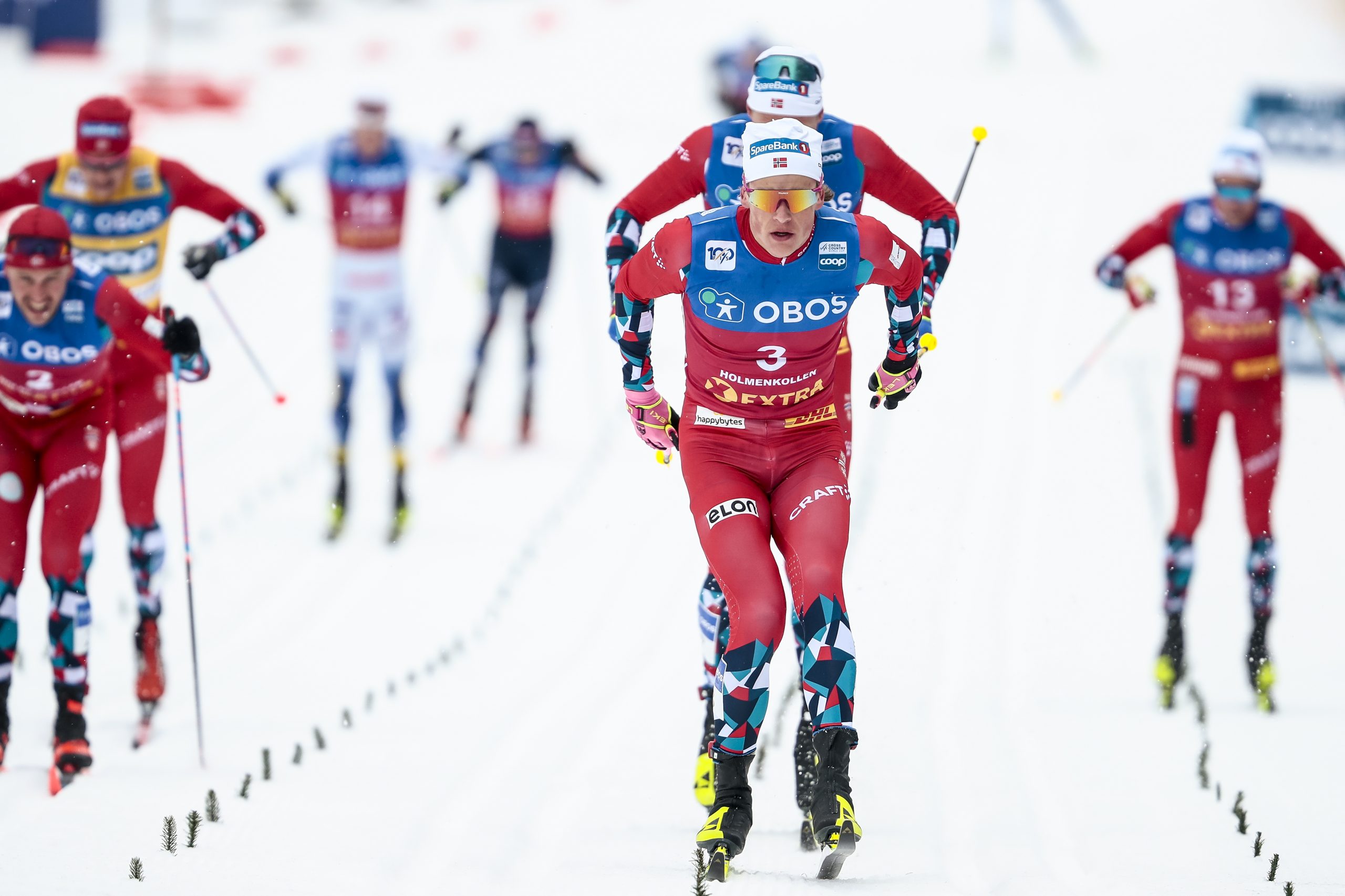
    Johannes Hoesflot Klaebo (NOR) controlled the pace through every one of Holmenkollen’s 50 kilometers, including the final few meters to the finish line. (Photo: Modica/NordicFocus)

    Years ago—when Johannes Hoesflot Klaebo (NOR) was still just a world Cup newbie—fans watched him trip over a klister-fed snow-snake on a Holmenkollen downhill, and go flipping ass over tea kettle. It’s the very last time most of us remember seeing him fall in a race. Since that day, he has been nearly infallible: winning World Cup Sprints at will, cherry-picking distance wins when courses and conditions suit him, collecting multiple medals at World Championships and Olympic Games, battling Russian superstars and winning a 50 k World Championship race (only to be stripped of the victory when a FIS jury decided he impeded Alexander Bolshunov), missing whole portions of seasons due to injury or illness, occasionally dominating the Tour de Ski, giving friendly and considerate interviews to reporters and the media, waiting through to the very end of a seemingly endless line of autograph seekers at the recent World Cup venue in Minneapolis, and winning more than half of the World Cup events he enters. Still, lots of ski-fans don’t like him (Russian ski-fans seem to openly despise him). Is the too-neatly coiffed hair? The casual ease with which he often dominates? The coy confidence in his post-race grin? The sprinter’s tactics he often employs? The equipment advantages he seems to enjoy? The resentment that his consistent success may inspire is kind of understandable . . . but any true ski fan should tip their hat to anyone who races with such skill and grace.

    Klaebo’s dominance—and ease, and confidence, and post-race grin—were on prominent display on Norwegian skiing’s biggest stage: the Holmenkollen 50 k Classic Mass Start. With Norwegian royalty in attendance—and in front of an estimated 100,000 cheering Norwegian fans—Klaebo sprinted to victory down the finishing straightaway ahead of teammates Martin Loestroem Nyenget, Paal Golberg, Harald Oestberg Amundsen, and Didrik Toenseth. Jens Burman (SWE) and Federico Pellegrino (ITA) broke up the Norwegian sweep in sixth and seventh, respectively . . . but the show on the big stage was definitely a Norwegian one.

    Canadian Antoine Cyr spent the entire day in the lead group, only being gapped in the final kilometers to finish a laudable 20th. His Canadian teammate, Sam Hendry, would finish 33rd.

    ADVERTISEMENT

    Americans enjoyed good finishes as well, especially considering the many extra Norwegian entrants (12, in all) who tend to crowd into the top places of any Norwegian-hosted World Cup distance race. Within that talent-laden field, Scott Patterson skied strongly to 25th and Gus Schumacher to 28th. Other American finishers included Zanden McMullen 45th, Michael Earnhart 50th, Peter Wolter 55th.

    “Holmenkollen is always one of my favorites on the World Cup,” said Patterson. “It’s the only time outside of world championships and Olympics that we get to race 50k. Going into a race over twice as long as anything else the season brings a different vibe. There’s more time to chill, build small packs, and move forward with second or even third winds. This year had all those features for me with strong feelings early and late but some weak points in the middle.”

    The history and tradition surrounding Holmenkollen is a story of its own, but the subtext of today’s race involved the scrutiny and intensity of the season-long race for the Overall Crystal Globe. Having won the points-rich Tour de Ski earlier in the season (when Klaebo was sidelined due to illness), Amundsen wears the yellow leaders bib. He entered the day buoyed by a lead of 236 points over Klaebo. With 500 points remaining available to anyone who can win-out at the end of the season (190 points available to the winner at Holmenkollen), Klaebo still has a chance to catch Amundsen. But Amundsen is unlikely to just disappear from the results sheet. Those circumstances set the stage for a critical race at Holmenkollen. Both men needed to do well, both men needed to not do poorly. Skiing across the finish line shoulder to shoulder would probably satisfy them both (compared to the disasters that might otherwise occur in a race of such distance and difficulty). How ironic it is that the goal of the day should be a 50 kilometer tie? Neither skier could afford to lose any ground, so they’d suffer through 2+ hours of grueling, hill-climbing, Classic-klister skiing in order to maintain the status quo. Either man had to know that there was little to gain, and many many kilometers of stressful, fast-paced racing across which to not gain it. World cup ski racing is cruel like that . . .
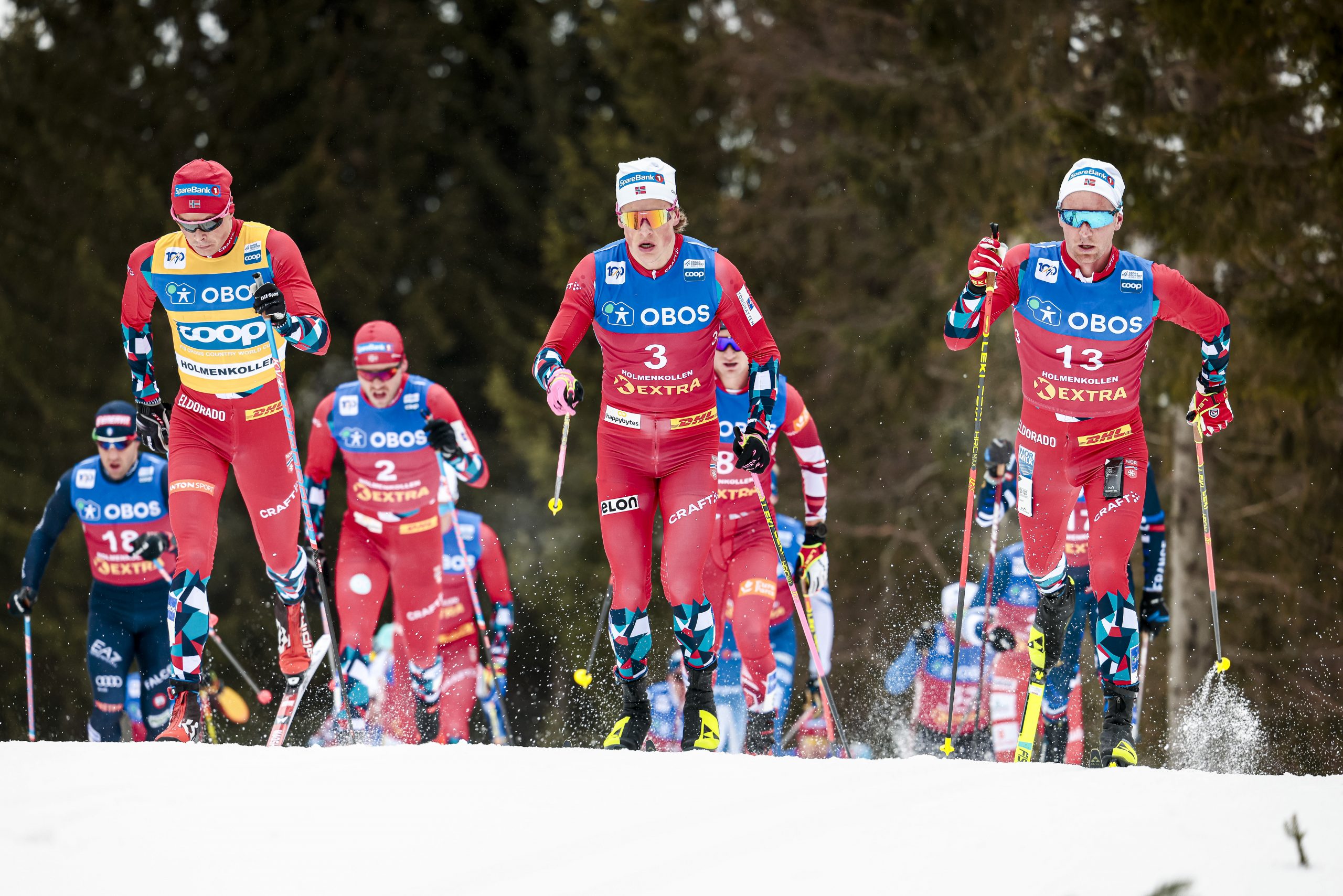
    Johannes Hoesflot Klaebo (NOR) stayed near the lead throughout a long day of racing at Holmenkollen, shadowed every step of the way by his rival and countryman, Harald Oestberg Amundsen (l). (Photo: Modica/NordicFocus)
    Holmenkollen 50 k

    The high hills above Oslo are home to Holmenkollen, Norway’s most famous Nordic ski complex. In the shadow of the facility’s towering ski jump, the trails of the Holmenkollen are laid out, six laps of 8.3 kilometers each, winding twice each lap through the packed stadium. Overcast skies and temperatures just below freezing greeted ski techs on race morning. The day would be ideal klister conditions; very fair racing was anticipated. Norwegian skiers have won 17 of the last 18 World Cup Classic distance races, and 12 Norwegians were included in the 57-man Holmenkollen field. Last year, Norwegians claimed the top ten finishing positions. Hometown fans were understandably confident.

    Amundsen (wearing the yellow bib of World Cup Overall Leader) and Klaebo lined up next to each other on the front row. The pace was measured and steady from the beginning, with the field remaining together through the first laps. Intermediate sprints were included each lap, with World Cup points awarded to the first ten crossing the line. Perhaps sensing the need to prevent Klaebo amassing bonus points, Amundsen sprinted forward to contest the first sprint. Klaebo held him off at the line with a masterful throw of the boot, and the field began quickly to settle back in to its early pace. That would be the pattern for much of the day as Klaebo would win five of the six bonus points sprints—typically just ahead of Amundsen. With them finishing 1-2 in nearly every sprint, Klaebo managed to pick up only a handful of points.

    Though certainly fast, the ongoing pace of the men’s field seemed civil and organized compared to the from-the-gun slugfest that epitomized yesterday’s women’s Holmenkollen race.  It wasn’t until 5.9 k that Iivo Niskanen (FIN) and Andrew Musgrave moved to the front, but the field stayed together and controlled through the first lap.

    Nyenget surged to the front forty minutes into the race just before the end of the second lap. His tempo seemed to imply the effort was serious, and Klaebo accelerated to mark the move at 16.6 kilometers. After passing through the stadium, a lead group of Nyenget, Klaebo, Niskanen, and Amundsen formed briefly. The contenders were definitely marking one another, and began to gap the field after the third bonus points sprint. The mini-break attracted the attention of Golberg and Friedrich Moch (GER), who moved themselves to within range of the leaders.

    The leaders also began engaging the strategy of double poling outside the set tracks, implying that their klister may have been icing up slightly. Each skier had the option of changing skis once on the day, and commentators began speculating that those changes could come sooner rather than later. Niskanen led the field through the end of lap 3, where all the primary contenders elected to switch skis. Among skiers in the lead group, only Lauri Lepisto (FIN) skied through without exchanging skis, rendering him the leader of the Holmenkollen, albeit briefly. The field soon came back together, and a group of twenty contenders (nine of whom were Norwegian) raced on with 25 kilometers still to go.
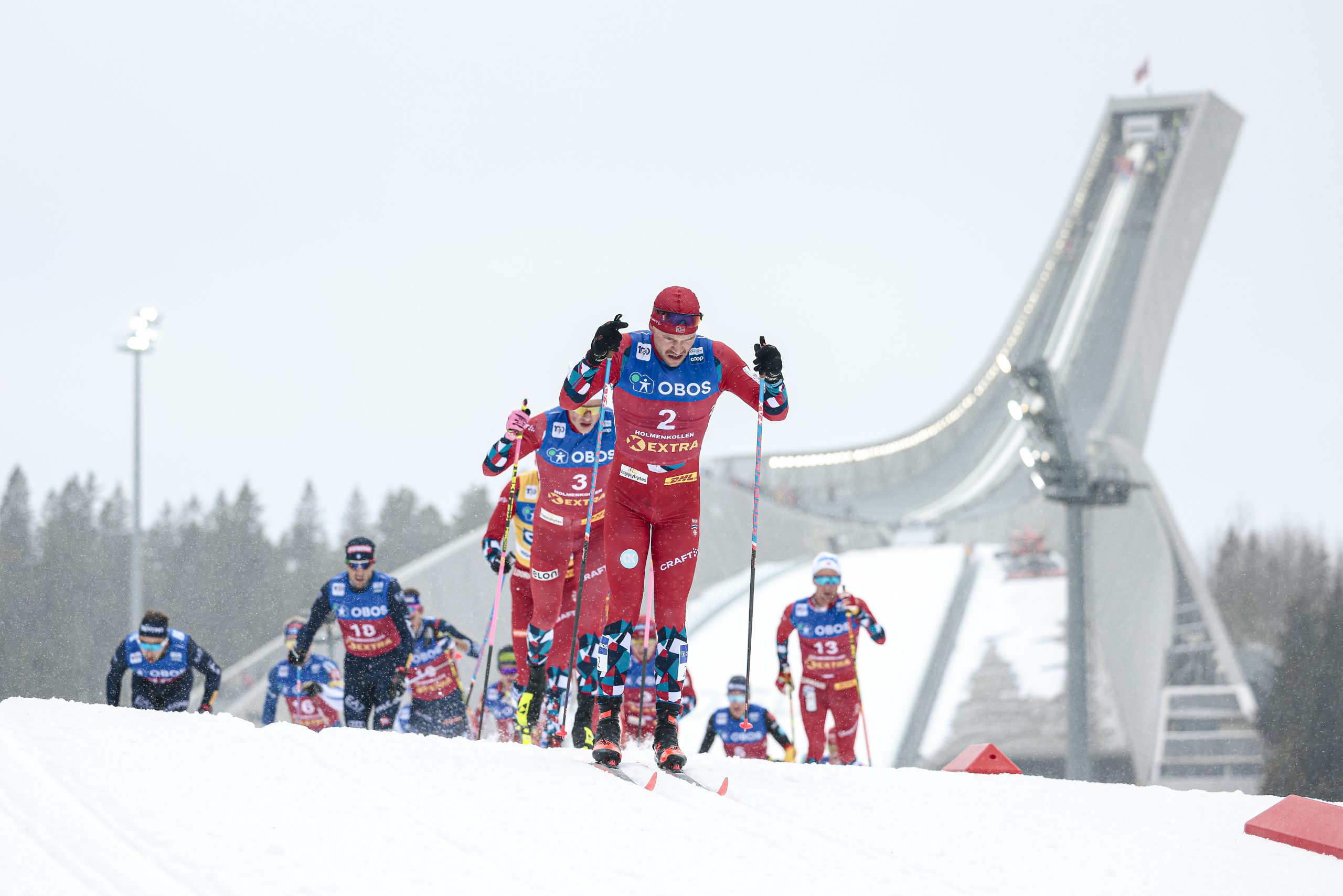
    Norwegians set the pace for most of the day at Holmenkollen. Crossing in front of Holmenkollen’s iconic ski jump, Paal Golberg (NOR) leads his countrymen, Johannes Hoesflot Klaebo and Harald Oestberg Amundsen. (Photo:  Modica/NordicFocus)

    Klaebo stayed ahead of Amundsen in each of the six bonus sprints (winning the first five, outright, only surrendering the final sprint to a surge from Jens Burman of Sweden). Following the final sprint, the lead group was reduced to ten: Niskanen, Klaebo, Amundsen, Golberg, Burman, Pellegrino, Poromaa, Scheley, Toenseth, and Nyenget). Klaebo led the group through the stadium with 3.5 kilometers remaining, displaying the tactics that have brought him so many wins. Klaebo entered the final straightaway in the lead—a position that offered very little chance for anyone to best him. Predictably, he held off his rivals to the line, finishing comfortably ahead of Nynget, Golberg, and Amundsen.

    “Finally I won a 50 k!” Klaebo said in post-race interviews, “which is something I’ve been waiting for for a bit.”

    With two sprints and two distance races remaining in the World Cup season, Klaebo will have chances to eat further into Amundsen’s lead. Likewise, Amundsen will have chances to defend that lead, a defense of which he appears entirely capable.
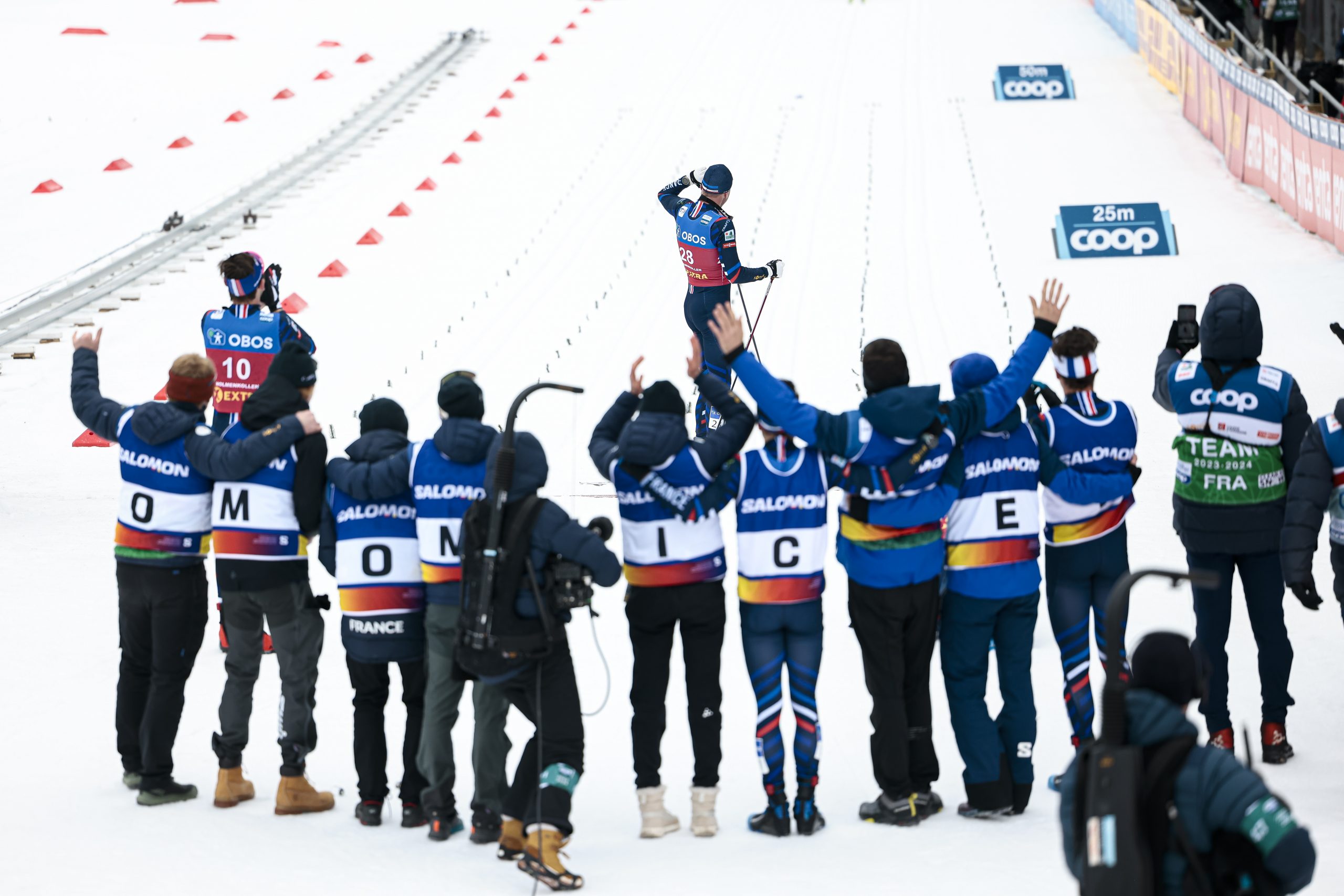
    Maurice Manificat (FRA) pauses to salute the cheering crowd at the finish line of Holmenkollen, the final race of his long and distinguished career. (Photo: Modica/NordicFocus)

    After a long and storied World Cup career, Maurice Magnificat (FRA) paused to salute the crowd just before the finish line, then stepped across into retirement. It was an emotional moment that the crowd stayed around to see, cheering loudly as Magnificat skied into the arms of teammates clad in special bibs spelling out “Merci Momo.”

    Holmenkollen 50 k Classic Mass Start RESULTS

    ADVERTISEMENT
     

  • Karlsson Dominates Holmenkollen, Diggins Defends Overall Lead

    Karlsson Dominates Holmenkollen, Diggins Defends Overall Lead

    This coverage is made possible through the generous support of Marty and Kathy Hall and A Hall Mark of Excellence Award. To learn more about A Hall Mark of Excellence Award, or to learn how you can support FasterSkier’s coverage, please contact info@fasterskier.com.

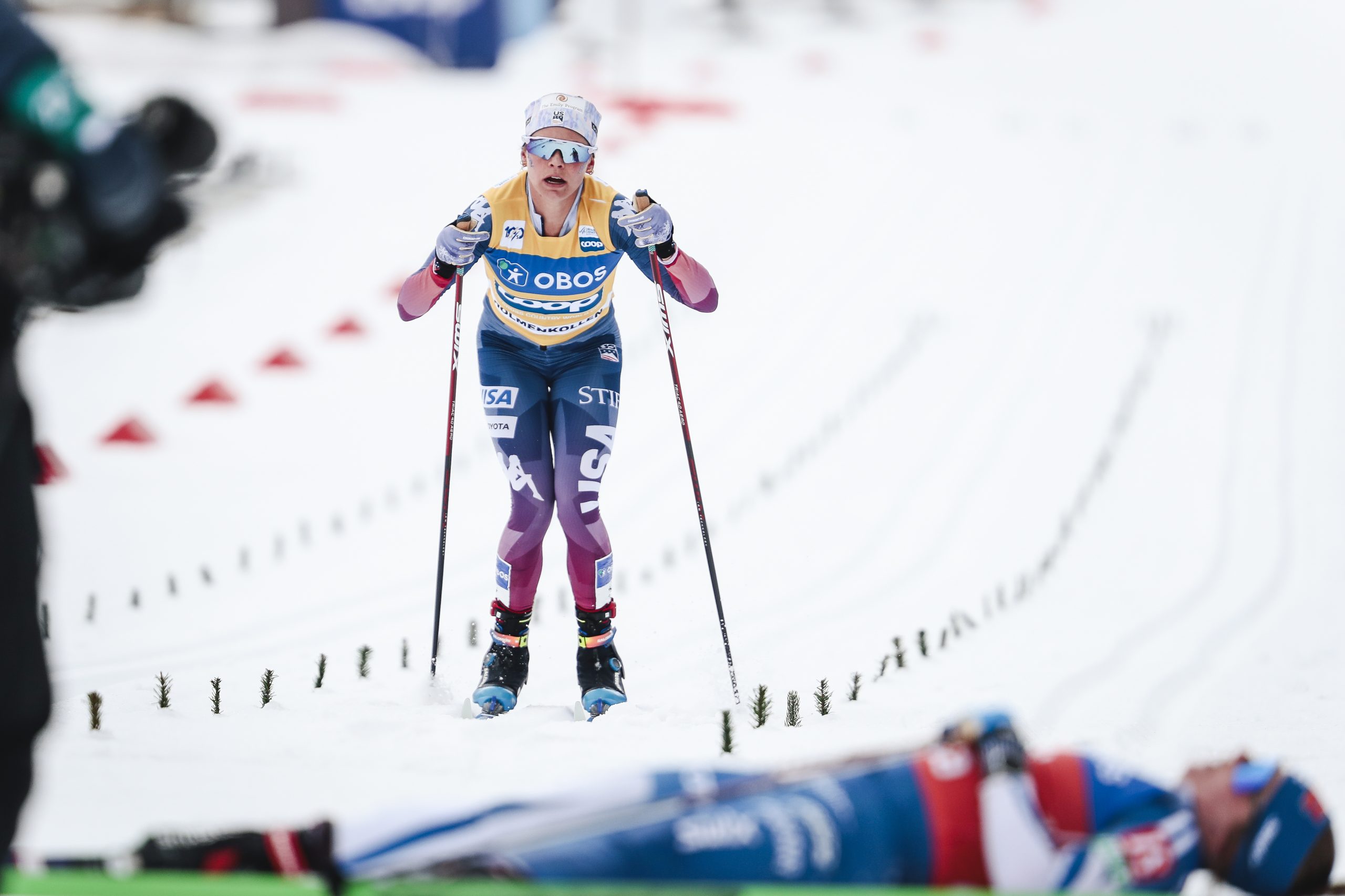
    Jessie Diggins (USA) did what she needed to at Holmenkollen to defend her Crystal Globe lead. In typical Diggins fashion, she left nothing on the course. (Photo: NordicFocus)

    As the World Cup season begins drawing to a conclusion, the two biggest questions remaining are who would win the women’s Overall Crystal Globe, and who would win the Holmenkollen 50-kilometer Classic race. Winning Holmenkollen is one of the biggest achievements possible on any racer’s resume. Win it, and your name will be known forever in racing lore. Today, the Holmenkollen question was answered emphatically as Frida Karlsson broke from the field with 20 kilometers to go and skied the chase group into submission to take the Holmenkollen victory. The answer to the other question became more clearly defined when Jessie Diggins finished 11th beating her main competition for the Crystal Globe—Sweden’s Linn Svahn—by almost 50 seconds (though only by a single placing) to maintain her lead in the Overall competition.

    “[My] skis were good, which is awesome,” Diggins commented after the race. “I was focused and skiing with the best technique that I could in the moment, [though I ] was really struggling with cramping the last half of the race, and couldn’t control my muscles. Every muscle in my body started cramping at one point or another and I just kept thinking about moving the part of my body that I could in the moment. I’m proud of myself for hanging tough and doing what I could. It was a tough race, but for me it was a really good step forward in my Classic skiing; I’m proud of myself.”

    With 190 total points up for grabs in today’s race—and Diggins leading by 162 points at the start—today’s race could have swung the chase for the Overall title to Svahn. But Diggins did exactly what she needed to do, keeping an eye on Svahn all day and eventually outpacing her rival.

    With temperatures around freezing, and rising slightly throughout the race, ski performance and wax choice were critical. With one ski change allowed, timing the tactics of when to exchange skis would also play a factor as racers contested the eight lap course, the most difficult challenge they would face all year.

    In a race that saw Diggins and Svahn fiercely contesting each bonus points section early on, the tone quickly changed after the first ski exchange when the race fractured into two separate contests. Frida Karlsson was out front on a solo break after 30-kilometers racing for the victory, while Diggins and Svahn were behind the chase group fighting for the Crystal Globe.

    After the ski exchange, Diggins lost contact with the lead group; more importantly, she maintained a lead on Svahn who struggled mightily after the ski exchange and was never a factor after that. Toward the end of the race, Ebba Andersson (SWE) broke away from the chase group to finish second, while Katharine Hennig (GER) and Teressa Stadlober AUT) sprinted into the stadium together with Hennig taking third place.

    Karlsson clearly relished her victory. “It was super fun,” she said after the race.  “I went so hard, the last lap; I was exhausted.”

    Early on in the race, Diggins flipped the script on Svahn and made her the hunted as she kept the Swede in sight throughout the entire race, marking every move that Svahn made, and fighting her for early bonus points. After a long day of racing, Diggins’ lead survived mostly intact, as Svahn had managed to only whittle it down by only three points (Diggins lead now stands at 159). Diggins also maintained her lead in the Distance Cup which now stands at 177 points over Ebba Andersson (SWE).

    Katharina Hennig (GER) celebrated after her Holmenkollen podium finish. (Photo: NordicFocus)

    Rosie Brennan (USA) was trying to gain ground in the standings for the Distance competition, but was unable to do so finishing 13th, and dropping down to sixth in the Distance competition, 134 points out of third place. “I thought my skis were pretty good today,” Brennan commented after the race. ” I’ve had some health struggles, so I chose to go out at a little more conservative pace and see what my body had later on. The 50 K here is an extremely challenging race, and I wanted to do my best to find a pace that I could hold for the whole race. I think I did that quite well, and I was pleased to have a little bit of fight in the second half of the race, of course I wonder if I should’ve done more to stay with that front pack from the beginning but it’s hard to start a 50 K when you really aren’t sure where your body is. Overall, I’m pretty happy with the race. No race is defined by the results, there’s so much more that goes into having a performance and finding your best self and for me today that was a result I’m proud of.”

    It was Sophia Laukli’s (USA) first time skiing a 50-kilometer race. Before the race she said, she was, “looking forward to long race but not necessarily a Classic race.” Laukli ended up finishing 25th while her teammate, Novie McCabe (USA), finished 28th. The only Canadian racer was Sonjaa Schmidt who finished 37th.

    Jessie Diggins (USA)  fought early for bonus points, but by the half-way point was not in a position to worry about bonuses. (Photo: NordicFocus)
    Holmenkollen 50 k Classic

    The race began as expected with Diggins and Svahn fighting for every inch. It was good news at the first bonus Sprint section for Diggins, as she and Svahn appeared to tie for the first bonus sprint. Later it was adjusted to put Svahn first and Diggins second, but this resulted in only a three point loss to Diggins, well within the margin of what she needed to do today.

    After the bonus section, Karlsson went to the front and immediately broke up the field with most of the favorites forming the lead group. It turned out this would be a harbinger of things to come as Karlsson took the opportunity to see how the field would respond to her early turn of pace.

    As Karlsson continued to set a brisk early pace, at 6.8 kilometers Diggins had dropped down to 15th place, but only 7 seconds behind Karlsson. More importantly, she was doing exactly what she needed to do by sticking by Svahn’s side.

    Linn Svahn (SWE) contested bonus points early, but she faltered after the ski exchange. (Photo: NordicFocus)

    The next bonus section was at 11.3-kilometers. As they approached, Diggins put in a quick burst and moved to the front of the pack. But Svahn followed her to the front, where the two went into an all-out sprint as Svahn lunged to take the 15 bonus points. Diggins was second, earning 12 points. It was an incredible turn of pace put in by both athletes in the midst of a 50 kilometer race.

    Immediately after the sprint, Diggins dropped to the back of the lead pack. Fans have seen this strategy employed by Diggins several times this season in distance races where she would conserve energy between bonus sections, then sprint hard to the points line to grab as many points as possible.

    As the race progressed temperatures began to rise slightly; questions regarding potential ski changes began to come into play.

    Entering the stadium for the second time, Kerttu Niskanen (FIN) went to the front and increased the tempo. This strung out the field even further. Now the lead group was down to 15 women. Diggins and Brennan were still in the lead group, while Laukli had drifted back to 21st and was already over one minute behind the leaders. Niskanen’s diagonal stride looked elegant and efficient as she moved the pack along.

    Frida Karlsson (SWE) went for a mid-race breakaway, and the field could not respond. (Photo: NordicFocus).

    The next bonus section came at 19.6-kilometers. By then, neither Diggins nor Svahn were near the front. Diggins managed to cross the bonus line tenth, giving her one bonus point while Svahn collected none. The Sprint had taken its toll on the field, and the lead group was now reduced to 12 skiers with Diggins and Svahn at the back. The sprinting for bonus points was clearly affecting both Diggins and Svahn as both were now struggling to maintain contact with the lead pack.

    As the racers entered the stadium for the third time, there was speculation about whether anyone would change skis. At the stadium entrance, Jonna Sundling (SWE) significantly picked up the pace as she decided to exchange skis, which led to a long procession of all the lead pack skiers deciding to make a ski change. With every racer now standing on a fresh pair of skis, the race took on a tone of almost starting new again.

    Shortly after the exchange, the script quickly changed as Svahn was struggling mightily to keep contact with the leaders. At the 27.1-kilometer mark, Svahn was nowhere to be seen as she had dropped to 12th and was suddenly 40 seconds behind Diggins. The ski exchange had clearly not gone well for her.

    But just as Diggins seemed to have slayed the Svahn dragon, she planted a pole between her skis and fell in soft snow as she was going up a steep hill just before the next bonus section. It could have been catastrophic, but the good news for Diggins was her equipemt remained intact (no broken pole) while Svahn’s struggles were continuing, and actually getting worse. Svahn appeared to be fading on every step and couldn’t take advantage of Diggins miscue. Clearly the ski exchange had cost Svahn dearly. It appeared that Svahn’s hopes of cutting into Diggins’s Overall lead were not going to materialize.

    Then, at 30.5 kilometers, it was Karlsson’s turn to put her stamp onto the race. She went to the front and established a gap on the field. With 20 kilometers remaining, it was early to go out on her own, but Karlsson kept the pace up. One kilometer later, Karlsson had a six second gap on the field. Karlsson had thrown down the gauntlet and she was not looking back.

    Now the race had been clearly defined. Karlsson going for the early break, and Diggins and Svahn were having their own race off the back of the leaders contesting for the Overall Globe lead. But Svahn’s struggles continued as she had dropped to 13th and was now almost a minute behind Diggins. Brennan had moved into 14th and was in a group with Heidi Weng (NOR) and Svahn.

    Karlsson’s move to the front was dramatic; by 33.2-kilometers she had established a 16 second lead. It was a quick and impressive turn of pace that had broken the field and driven the chase group into submission. No one could even try to respond to Karlsson’s tempo as her flawless technique carried her away from the field.

    At this point, bonus points were now irrelevant as Svahn and Diggins were both too far behind to contest for them. The only remaining issue in the Diggins-Svahn race was whether with 15 kilometers left Svahn could rally and not lose points to Diggins.

    Karlsson continued to put on a clinic as she increased her lead at every time check. The chase group had abandoned any thoughts of catching her and with 14 kilometers still to go were positioning for second and third place.

    Frida Karlsson (SWE) possessed a gear no one else could match as she celebrated at the finish line. (Photo: NordicFocus).

    The numbers Karlsson was putting up were stunning. At 39.1 kilometers, she had increased her lead to over a minute, a big enough lead that she could calmly drink her nutrition at the aid station. Barring a major mistake, no one was going to come close to catching her, and there was now no doubt that the race in the group of eight chasers was for second and third.

    Back behind the chase group, Diggins was now in 11th, 2:51 off the lead, but she had still almost a minute lead over Svahn. Diggins could now ski securely knowing that her main competitor was all but vanquished.

    With a little more than six kilometers to go, Ebba Andersson (SWE) made her move for second place and broke from the chase group. She was able to put about an eight second gap on the chase group in less than half a kilometer. By the time the skiers reached the final bonus section at 44.5-kilometers, Karlsson was 1:17 ahead of Andersson, who had extended her lead over Victoria Carl (GER) and Niskanen to over 14 seconds. Andersson appeared very determined not to allow the race for second to come down to a sprint.

    With two kilometers to go Teresa Stadlober (AUT) moved to the front of the chase group to set the pace for third. Stadlober and Hennig made a break from the chase group to fight for third and to try to reel in Andersson who was still maintaining the gap for second place.

    Rosie Brennan (USA) struggled to maintain contact with the lead group and couldn’t improve her standings in the Distance competition. (Photo: NordicFocus)

    As Karlsson approached the stadium her lead was so comfortable that she was able to receive a Swedish flag and double poled across the finish line with her country’s flag in hand. Andersson was able to dig deep and maintain her lead over Stadlober and Hennig as she cruised into the stadium in second.

    Hennig and Stadlober had a double pole duel at the finish with Hennig taking third.

    Linn Svahn (SWE) and Rosie Brennan (USA) sprinted to the finish. (Photo: NordicFocus)

    It was a brilliant day for Sweden going 1-2 on Norwegian soil. As the Swedes celebrated Diggins crossed the finish line by herself in 11th place. But more importantly to her, she was way ahead of her Overall rival Svahn by almost 50 seconds. Svahn came in 12th in a battle to the finish line with Brennan who she edged out by less than a second.

    Holmenkollen 50 k Classic Mass Start RESULTS

    Ebba Andersson (SWE), Frida Karlsson (SWE), Katharina Hennig (GER), (l-r). (Photo: NordicFocus)