From the FasterSkier archive — posts syndicated from athletes’ and coaches’ own blogs between 2004 and 2012, kept online as published. Current coverage is at fasterskier.com.
It doesn’t get much better than a weekend of full sun, epic skiing and meetings with the king of Norway. But that’s what we’ve got for you after another fun weekend of racing, at Oslo’s classic Holmenkollen venue. With help from Canadian retired Olympian Jess Cockney, we break down the 30 k and 50 k from Saturday and Sunday, touch on the COVID outbreak that’s hitting World Cup teams including the U.S. and take the International Ski Federation to task for canceling World Cup finals.
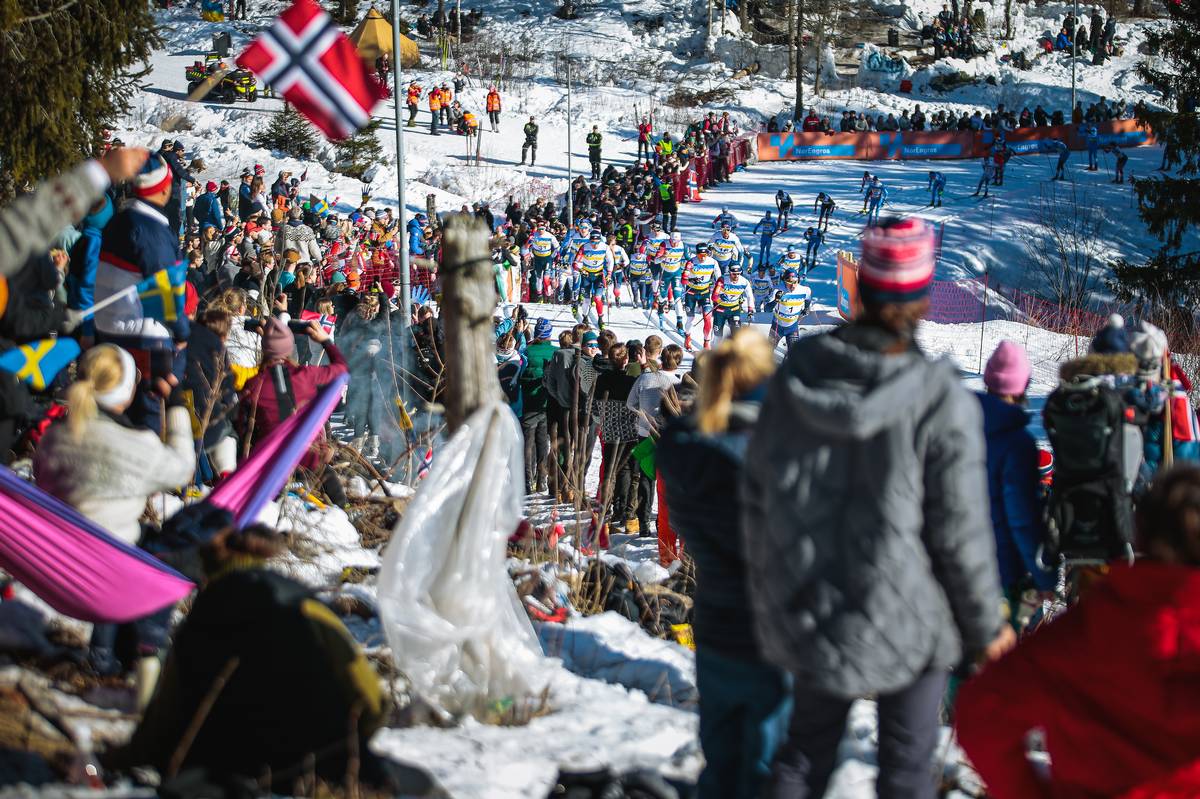
Crowds returned in droves to Holmenkollen for the men’s 50 k mass start classic. (Photo: NordicFocus)
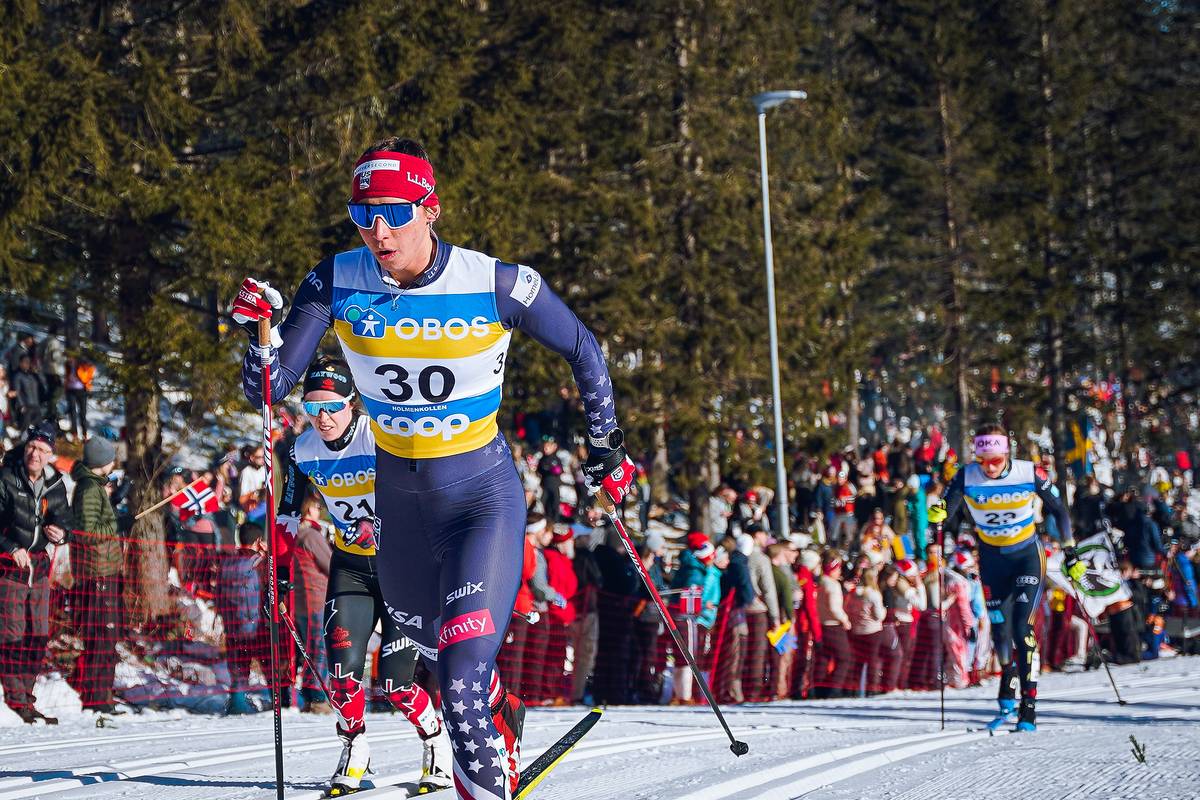
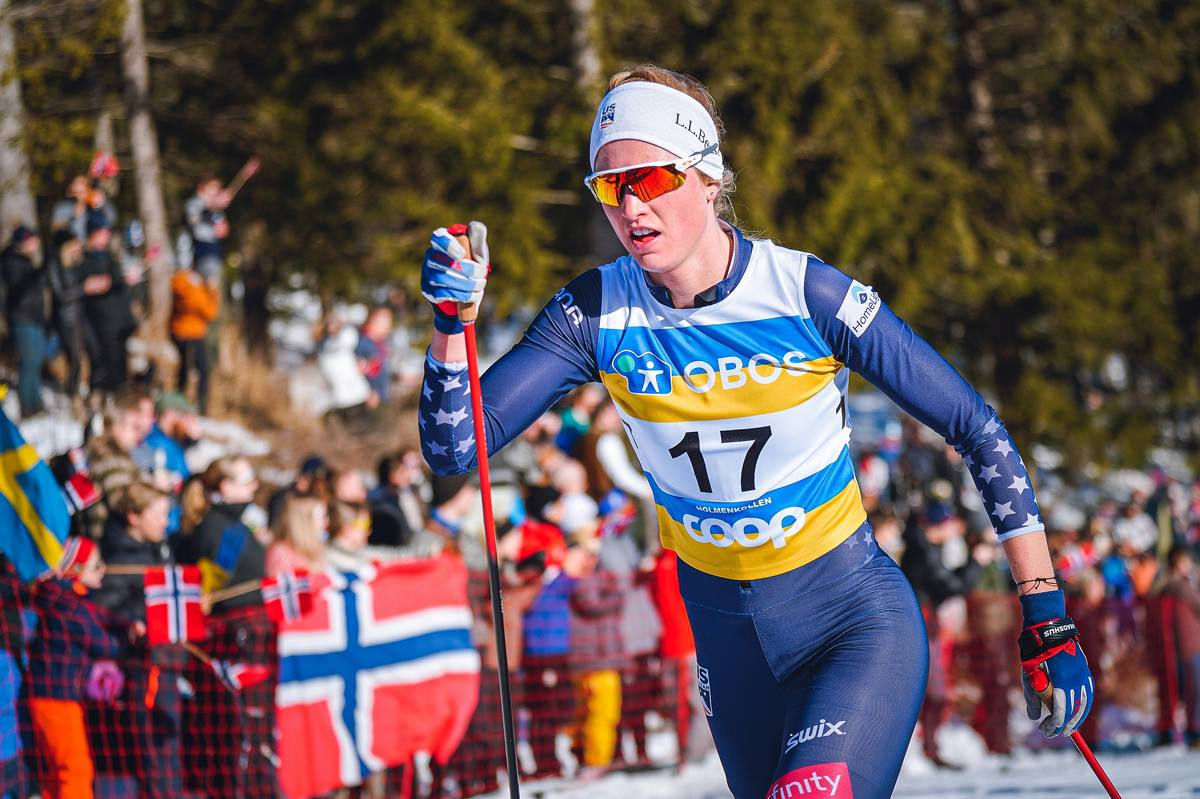
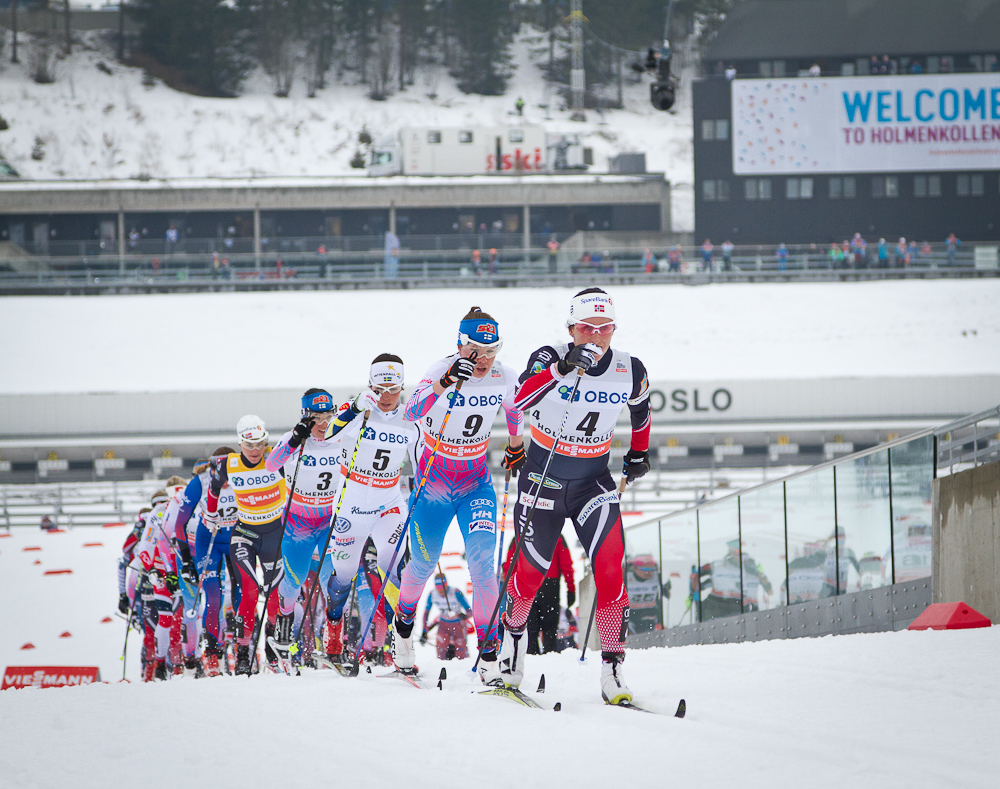
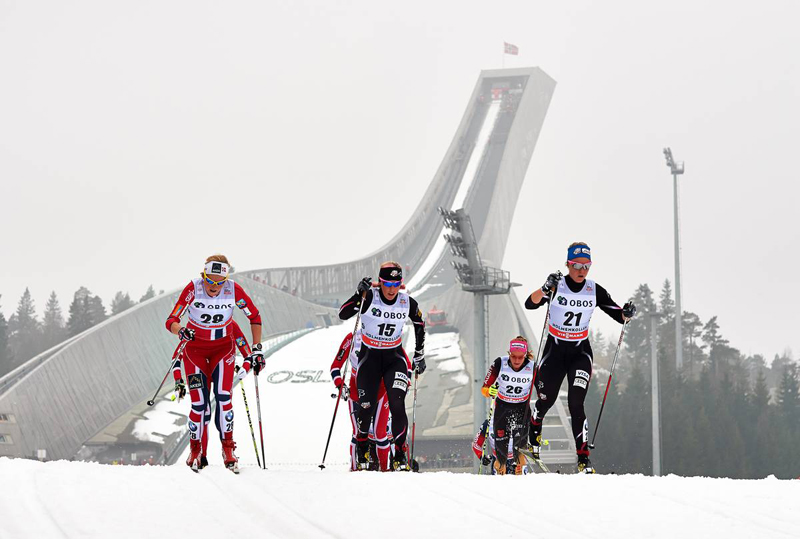
Crowds line the storied tracks at Holmenkollen during the women’s 30 k classic. (Photo: NordicFocus)
This World Cup coverage is made possible through the generous support of Marty and Kathy Hall and the A Hall Mark of Excellence Award. To learn more about A Hall Mark of Excellence Award or to learn how you can support FasterSkier’s coverage please contact info@fasterskier.com.
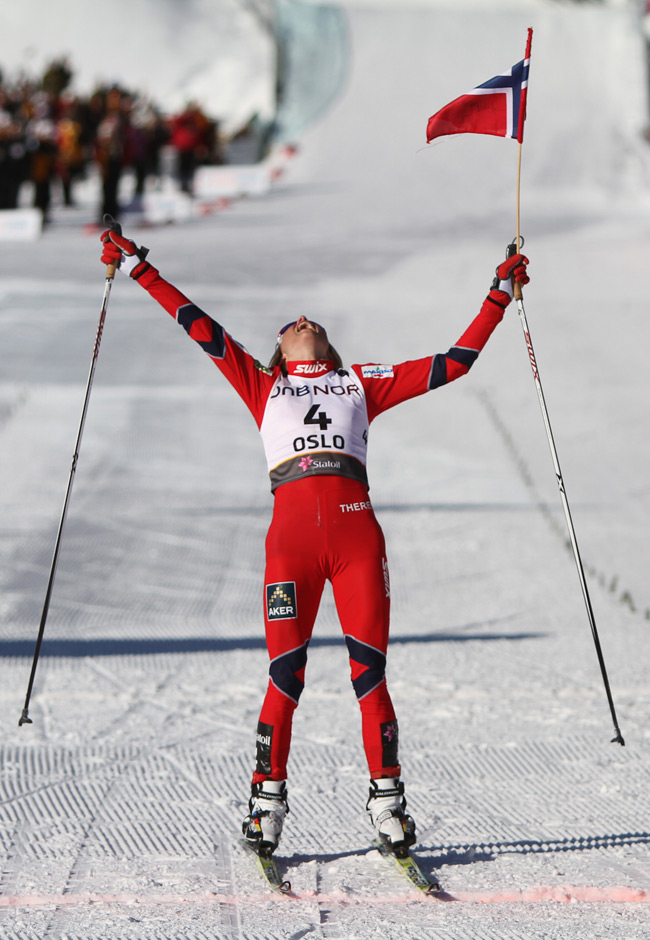
Terese Johaug wins her first individual World Championship gold medal in the 30 k mass start skate in Oslo, NOR. (Photo: FS Archives)
Eleven years ago to the day, racing the 30-kilometer mass start skate, a 22-year-old Therese Johaug won her first individual World Championship gold medal in a breakout performance at Holmenkollen near her home in Oslo, NOR. In doing so, she had broken apart a field of women considered legends of the sport on an equally legendary course known for long grinding climbs that require superior fitness and technique. Johaug won by nearly 45 seconds over one of the greatest cross country skiers of all time, her teammate Marit Bjørgen, and was 1:34 ahead of the Polish champion Justyna Kowalczyk.
“It was hard for me. It’s hard to see her go in front, and the gap [grow] bigger and bigger,” said Bjørgen that day. Then at the peak of her career, Bjørgen had gone four-for-four that week with gold medals in each of the previous World Championship races in Oslo, and the upset was a shock to those following along. “But I’m very happy for Therese. She is a young girl, and a girl for the future—and for Norway.”
Little did cross country ski fans know just how storied the athlete’s career would be.
Therese Johaug races in front of a home crowd during the 30 k classic at Holmenkollen. (Photo: NordicFocus)
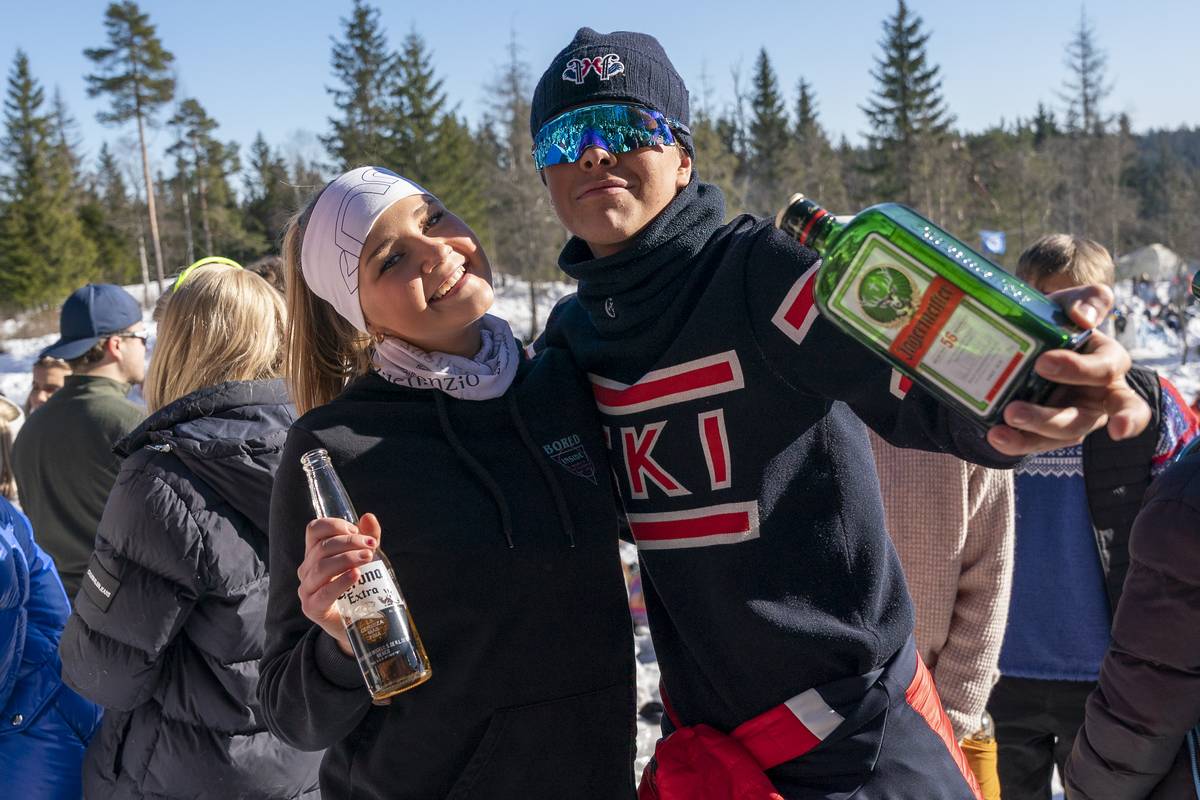
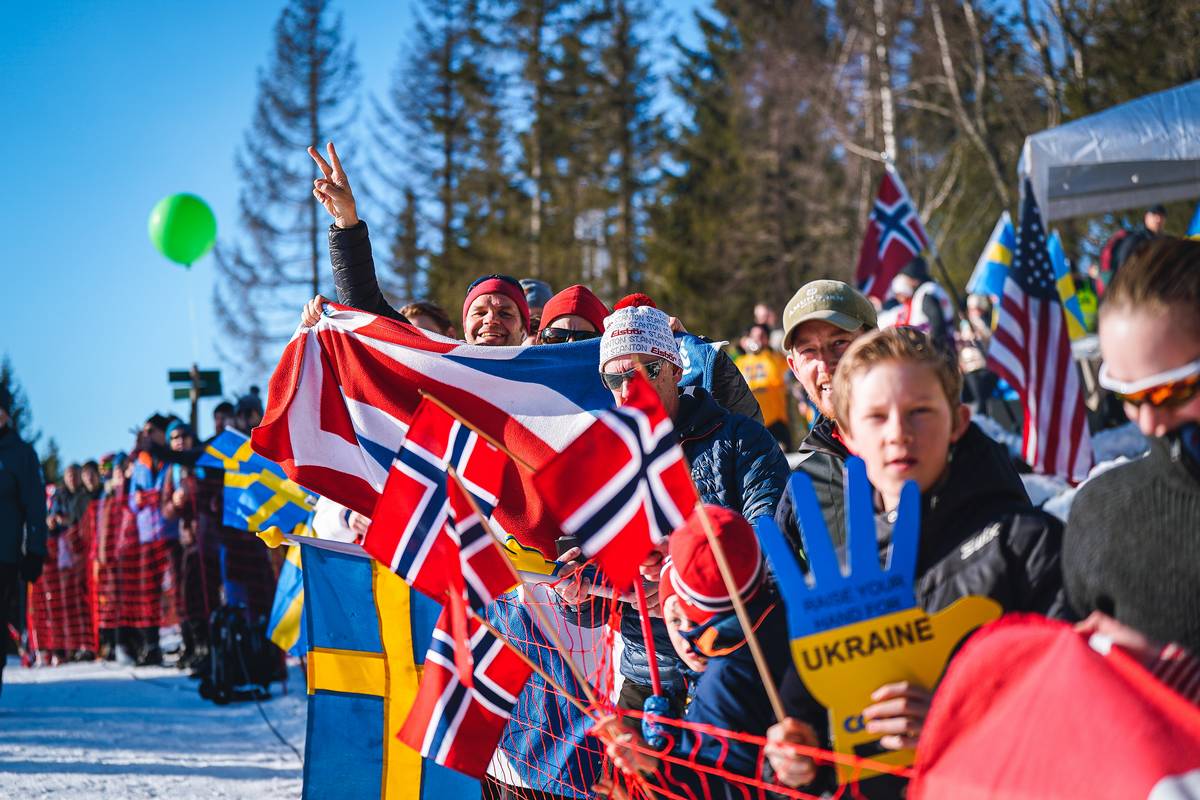
Today, under clear skies that allowed for views of the city skyline and Oslofjord, Norwegian flags flying, and fans returning to the crowded stadium and partying in the woods, she did it again, as one of her final performances after more than a decade as the top female distance skiers of all time.
And what’s more, Johaug won today’s 30 k classic in the same dominant fashion that she did eleven years ago, and has done many time since, stopping the clock at 1:19:22.8.
Though the final results show just 19.4 seconds as her winning margin, this only tells part of the story. By 10 k, Johaug held a margin of over 23 seconds, which she steadily grew over the subsequent laps. At 25 k, she led by nearly a minute and a half.
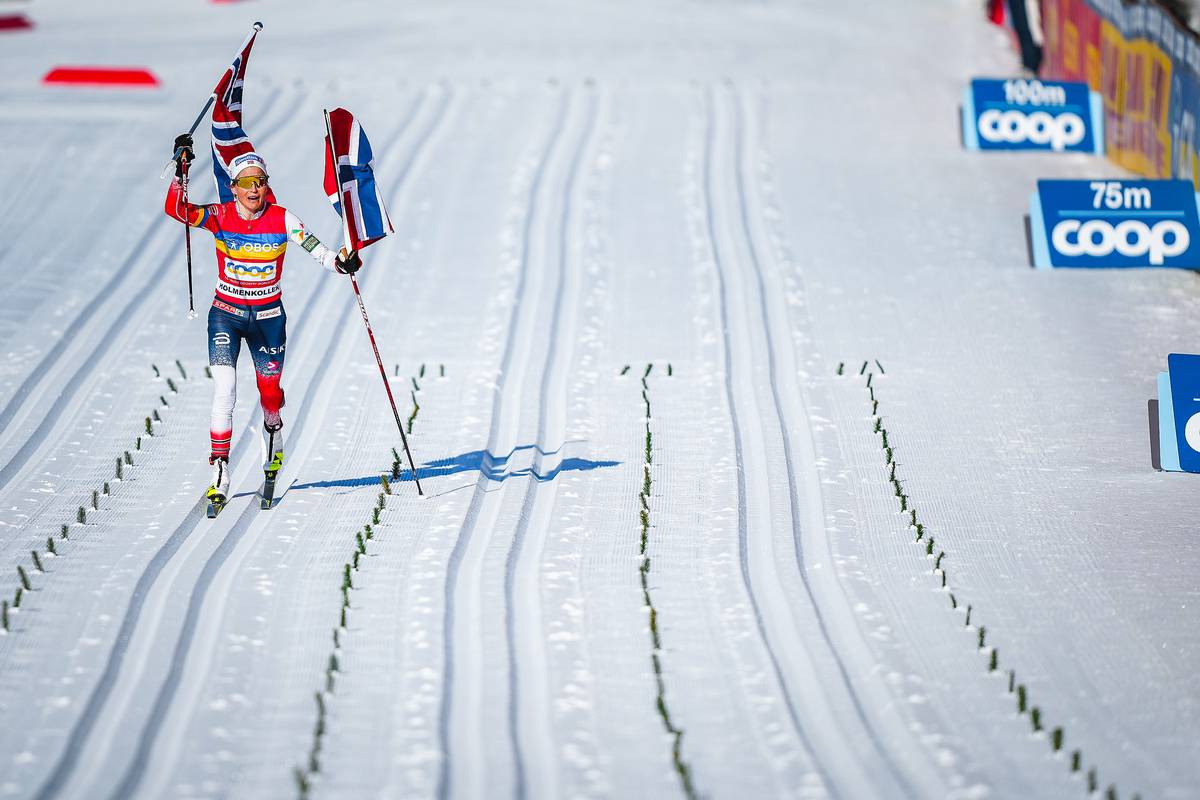
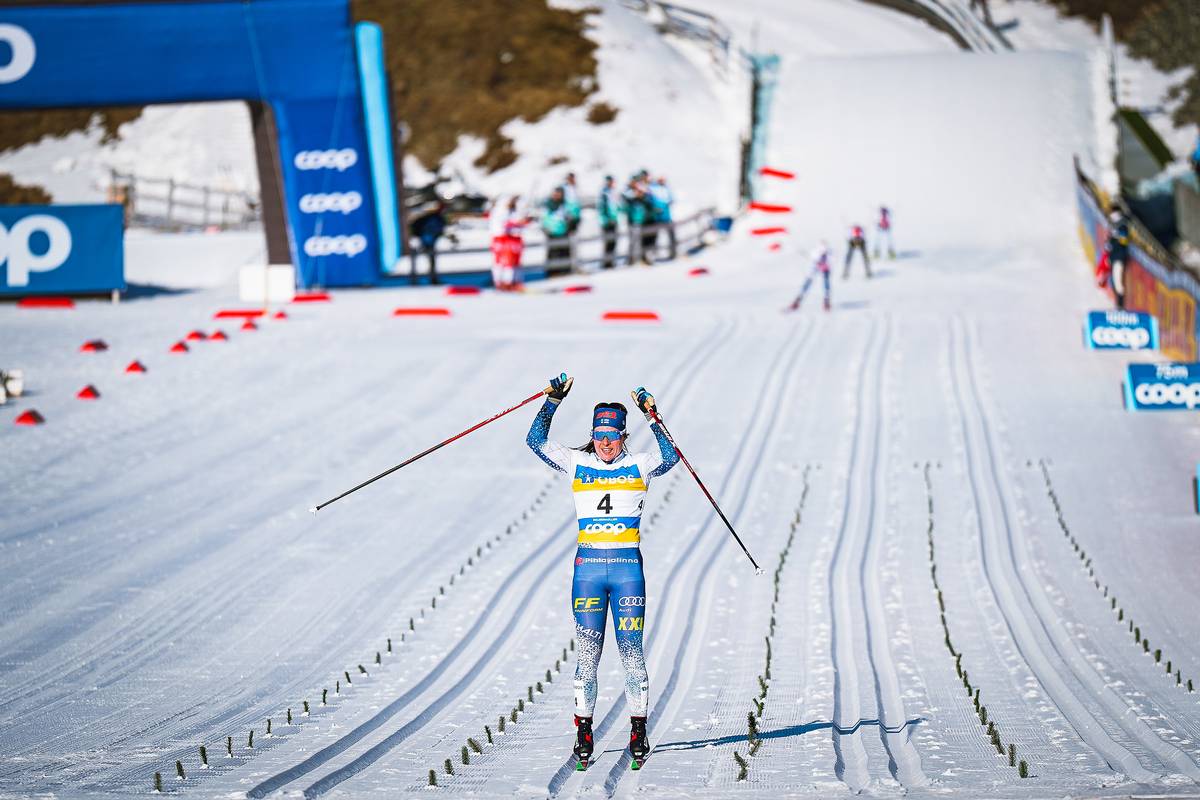
Therese Johaug waves Norwegian flags as she skis the final meters of 30 k classic at Holmenkollen. (Photo: NordicFocus)
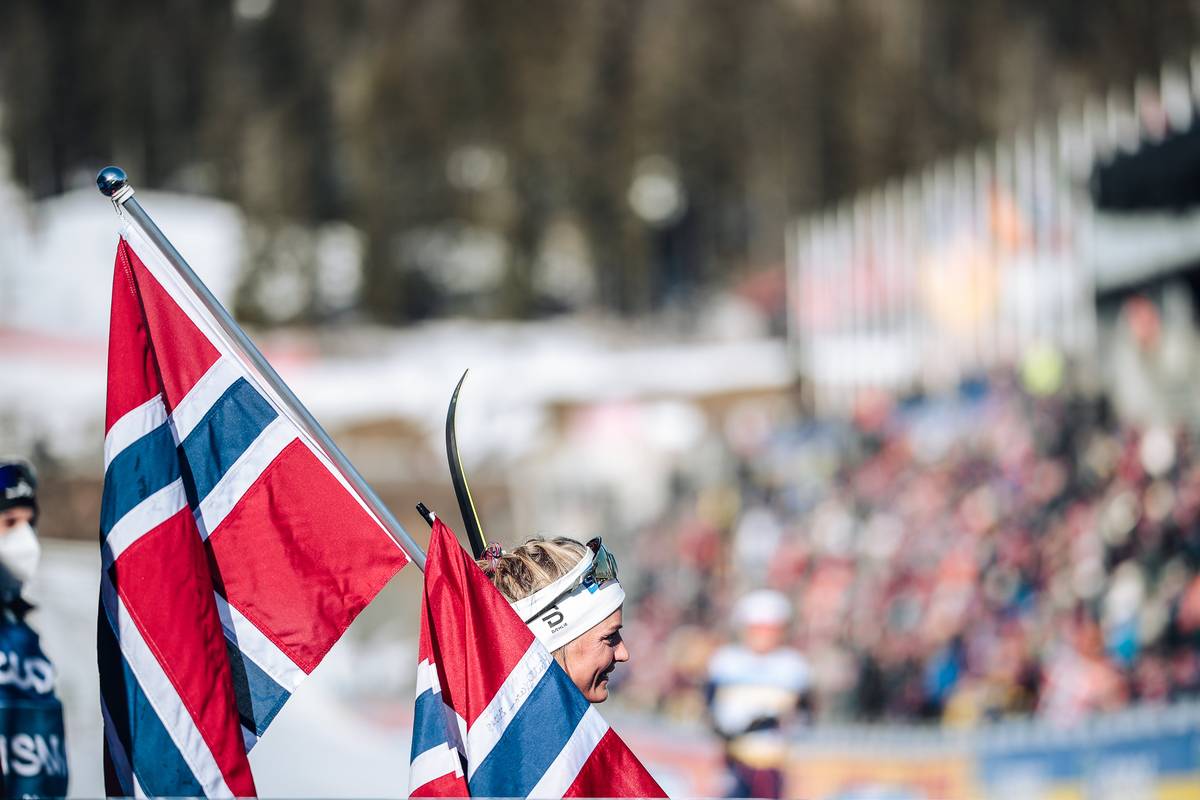
As she entered the stadium, Johaug was greeted by coaches and techs who handed her a flag for each hand, which she carried through the finish, waving, and stopping to take in the erupting cheers from the crowds.
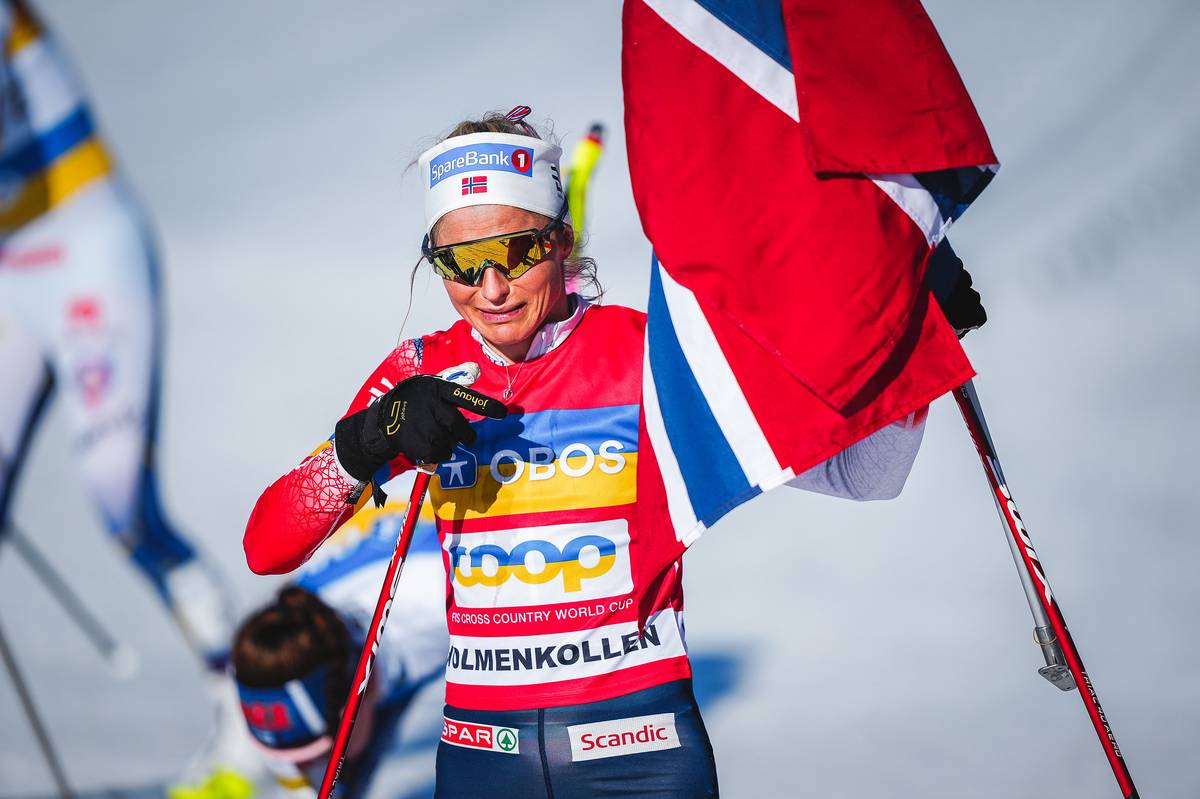
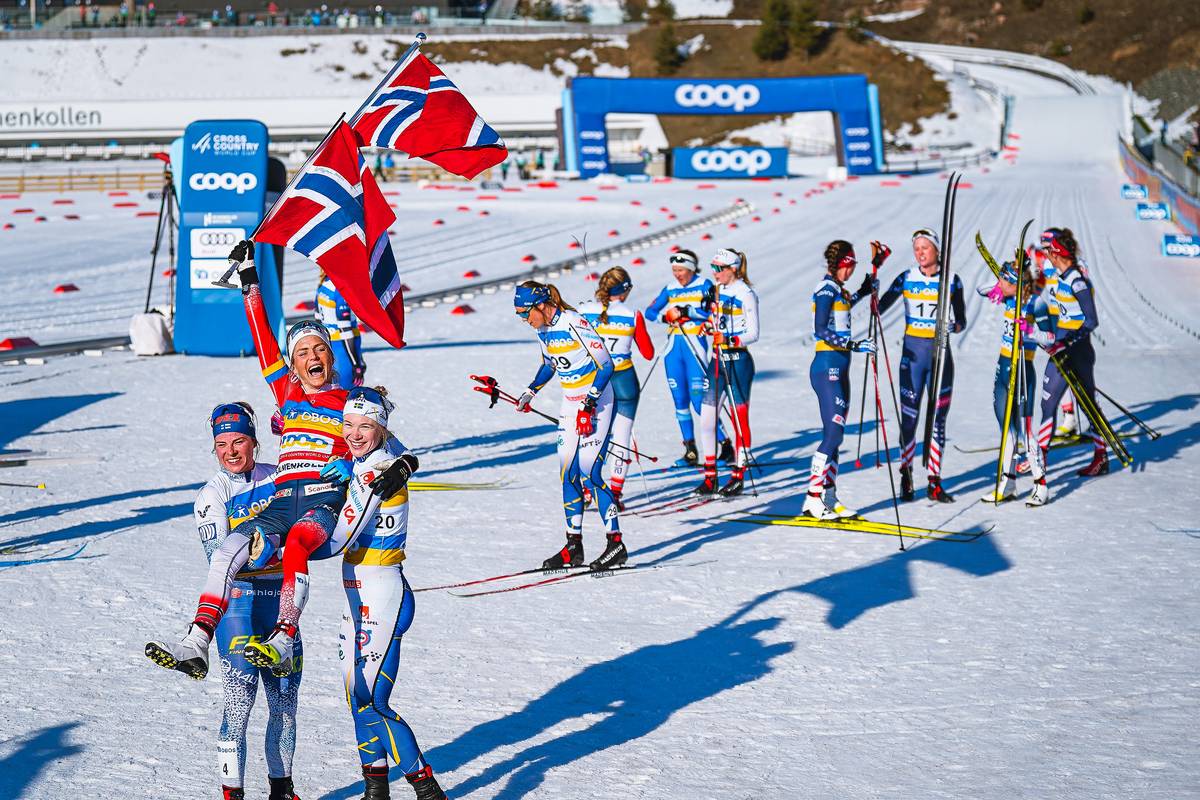
Laughing behind tears as the rest of the field began to trickle across the line, Johaug was hoisted onto shoulders, waving her flags for a loud Norwegian crowd who had supported and applauded her through fifteen years of racing on the World Cup.
“It’s a lot of emotion now,” Johaug said at the finish. “I start here in 2011 with my first individual victory, and today is my last race here. It was sun and blue sky, the same as in 2011, and there were a lot of people around the track cheering for me. I’m so happy now, but also so sad that this is the end of my career.”
Therese Johaug was emotional at the finish of today’s 30 k classic at Holmenkollen, the venue where she won her first individual World Championship gold in the 30 k skate eleven years prior. (Photo: NordicFocus)Norway’s legendary Therese Johaug wins the 30 k mass start classic, exactly 11 years after her first individual World Championship gold medal was won on the same tracks. (Photo: NordicFocus)
While she indicated during the Olympics that she would not compete another four years, it was not until yesterday that she officially announced that this would be her final race at Holmenkollen.
“In many ways, it feels as if the [story] ends when on Saturday, March 5, 2022, I stand on the starting line for another 30 k in Holmenkollen. I really do not want the journey to end, but it is a time for everything,” she wrote to NRK. “In light of this, I look forward to a final fight at home with the flag on my chest, and I am grateful for everything the sport has given me.”
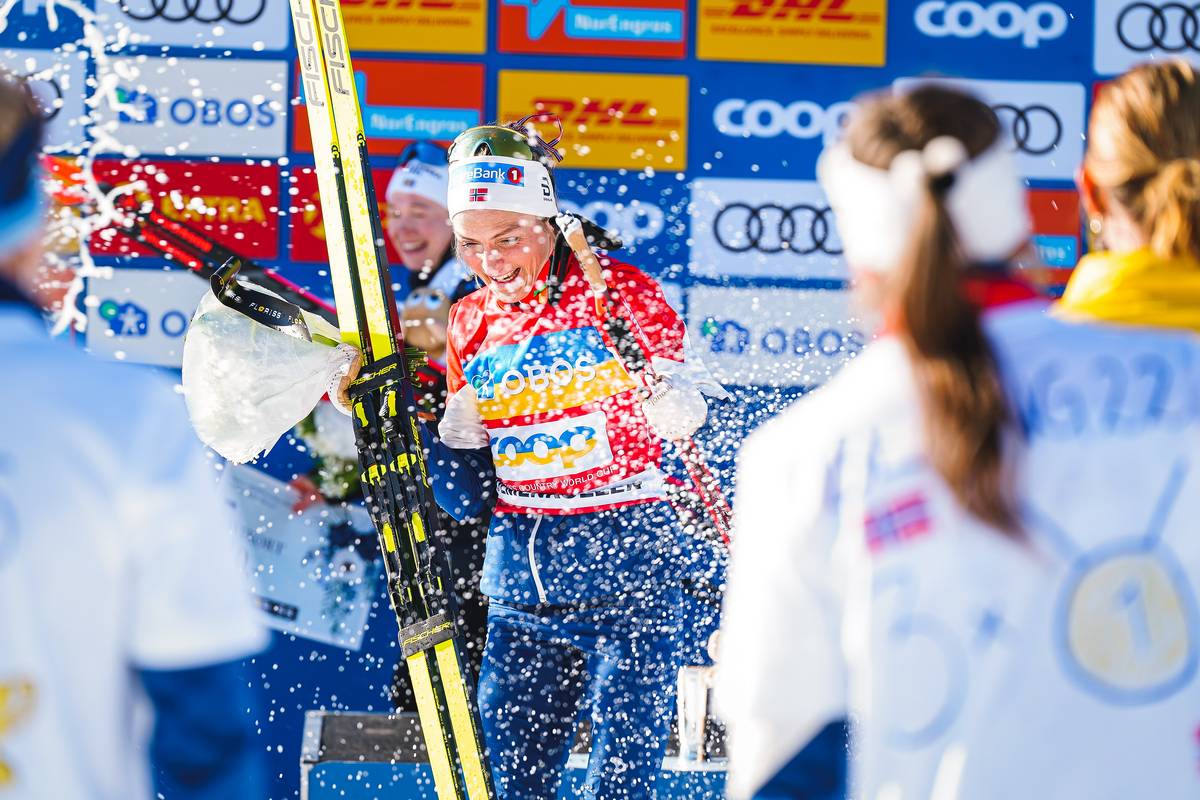
Therese Johaug is showered with champagne after winning the 30 k classic at Holmenkollen following her retirement announcement. (Photo: NordicFocus)Therese Johaug celebrates her final race race at Holmenkollen, winning the 30 k classic exactly eleven years after taking her first individual World Championship gold on these tracks. (Photo: NordicFocus)
As Queen’s “We are the Champions” blared through the stadium, Johaug stepped off the podium only to be soaked by champagne sprayed by a flock of teammates wearing shirts spelling her name, with “takk” – thank you – written with a heart at the end of the row. It was a joyous celebration fitting for the moment, and perhaps also a refreshing distraction from the times at large.
“There are a lot of strong moments, but I am moved when so many people come here and see my last race. I must thank the Norwegian people who stand here today,” Johaug later said to NRK.
While you can certainly expect a more in-depth look at her storied career on FasterSkier, for now, we’ll echo the crowds in congratulating Therese Johaug, and we look forward to following along for the next chapters.
Therese Johaug celebrates her final race race at Holmenkollen, winning the 30 k classic exactly eleven years after taking her first individual World Championship gold on these tracks. (Photo: NordicFocus)Krista Pärmäkoski (FIN) and Jonna Sundling (SWE) lift champion Therese Johaug (NOR) for a podium shot at the finish of the 30 k classic in Oslo. (Photo: NordicFocus)
Behind the celebration, the lineup of women in today’s top-10 was remarkably similar to the Olympic 10 k interval start classic, with a few name swaps, and of course, a few noteworthy athletes missing – namely, Natalia Nepryaeva and Tatiana Sorina of Russia, and Jessie Diggins, who had been fourth, seventh, and eighth, respectively.
The volume of the ringing cowbells swelled as Finland’s Krista Pärmäkoski skied through the stadium on her own for second place, after pulling away from the first chase pack with 5 k to go and maintaining a healthy 10-15 second gap through the finish. Coming back on form after a few rocky seasons, Pärmäkoski had been third in the 10 k classic in Zhangjiakou, behind her teammate Kerttu Niskanen, who was fourth today (+33.8).
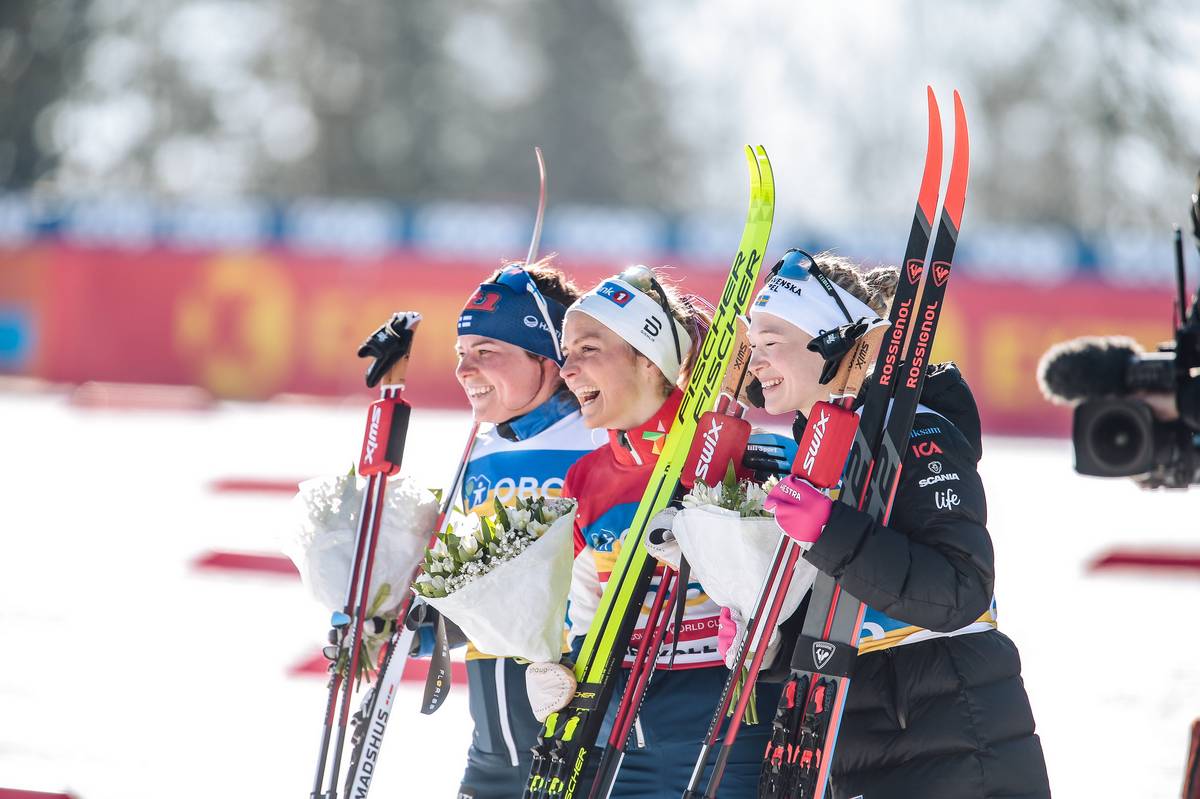
Finland’s Krista Pärmäkoski takes second in the 30 k mass start classic at Holmenkollen in Oslo, NOR. (Photo: NordicFocus)The women’s 30 k classic podium at Holmenkollen: Therese Johaug (NOR) took the win ahead of Krista Pärmäkoski (FIN) and Jonna Sundling (SWE). (Photo: NordicFocus)
Between the Finns, Sweden’s Jonna Sundling reaffirmed her talents across all distances, taking the third spot on the podium (+32.3) just two days after being second in Drammen’s classic sprint. Matching her fifth place result in the Olympic 10 k, Germany’s Katharina Hennig followed Niskanen to the line (+34.7) with Therese Stadlober, who was ninth at the Games, crossing after a gap in sixth (+46.7).
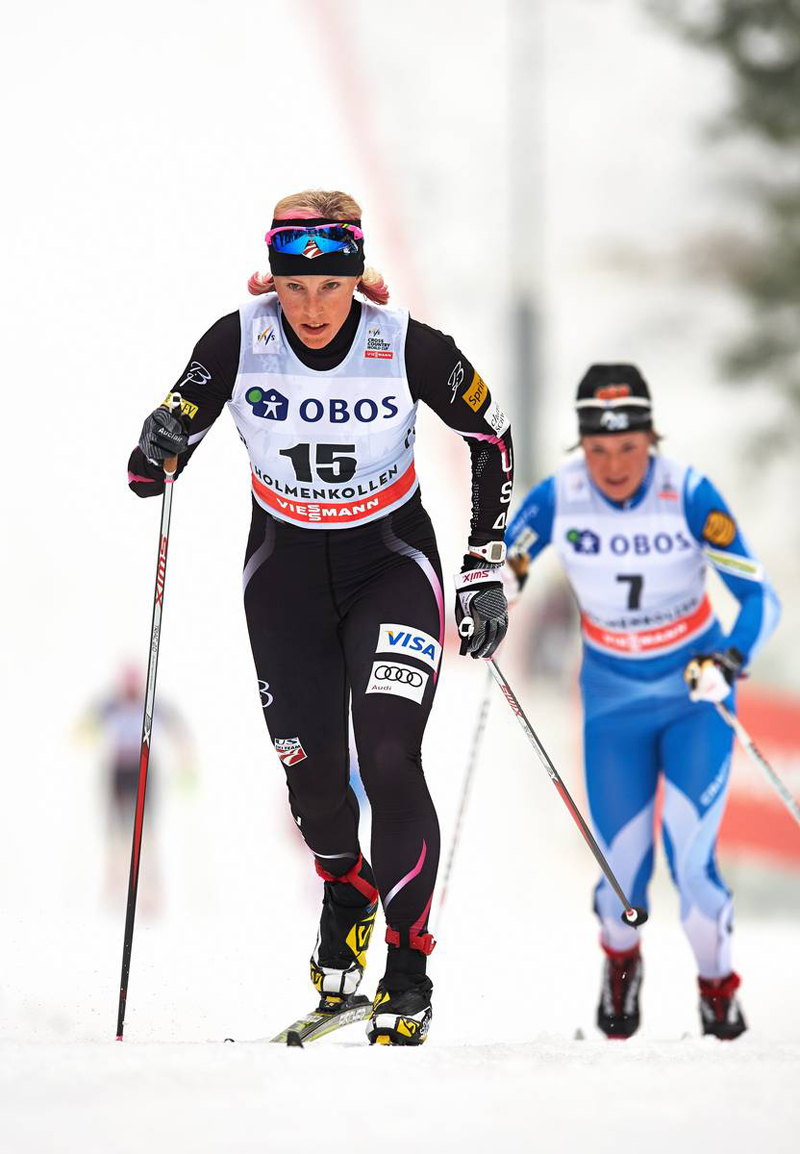
Leading the next chase group, and the American team, was Rosie Brennan in seventh (+1:12.3), bringing Norway’s Marte Skaanes and Sweden’s Ebba Andersson to the line just behind her for eighth (+1:13.1) and ninth (+1:13.8), respectively.
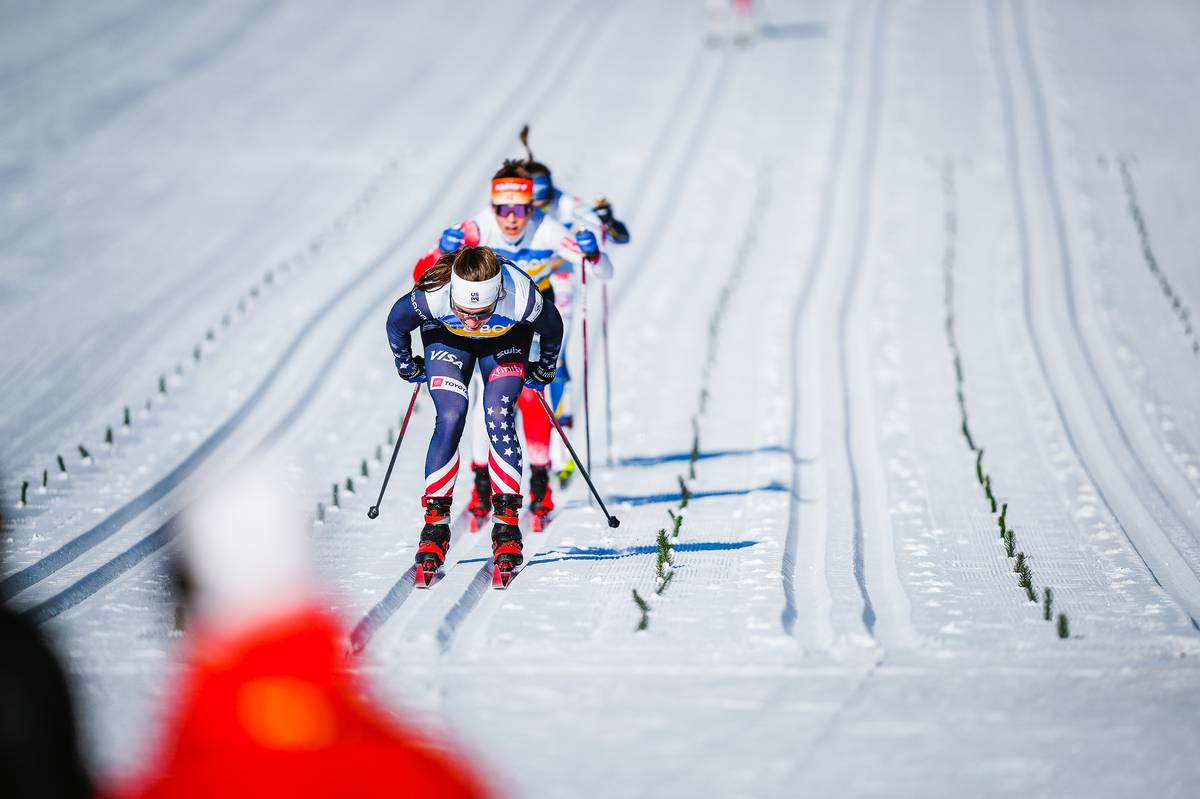
Rosie Brennan leads Norway’s Marte Skaanes and Sweden’s Ebba Andersson to the line. (Photo: NordicFocus)
“Today was huge for me,” Brennan wrote in a post-race email. “I have struggled here my entire career, and [though] it’s been a few years since I’ve raced here and I have improved a lot in the last few years, I still felt I lacked a lot of confidence and excitement coming here [today]. It’s also been a really stressful week for a variety of reasons, so I showed up today with an immense amount of anxiety that I needed to get a hold of before the race started.
“I am really proud of giving myself another chance to put together a good race here and to have managed the stress and anxiety well enough to do so. I wasn’t feeling in a place to shoot for the moon so I tried to start a bit a conservative the first 5 k and then reevaluate. I had a great ride with Ebba and really had an enjoyable time skiing out there today. The last lap, we had the chance to pick off a few from the lead pack and so I started to ramp things up to see what was possible. I felt strong on the last climb and felt I had a good shot at the sprint finish so I went on the last little bump before the [last 100 meters]. It felt great to finish strong and to put together a really solid race today.”
Rosie Brennan skis to seventh in the 30 k classic at Holmenkollen. (Photo: NordicFocus)
Following her classic sprint race in Drammen Thursday, Brennan joked post-race that she had lost out on yet-another boot slide. Today, the final sprint was hers. It was perhaps, also worth American fans celebrating that today that she won amongst her chase group, just under two weeks after a brave and gritty performance in the Olympic 30 k skate where she had pulled the chase group for much of the race, wearing herself out to break the wind, only to be dropped in the final 600 meters as Niskanen pulled away for a bronze medal. However, Brennan said she is not connecting any dots between the two.
“This race was nothing like Zhangjakou, really hard to even compare the two. 30 k’s are always an adventure and I am really happy to have put together two strong ones, in each technique.”
Rosie Brennan skis to seventh in the 30 k classic at Holmenkollen. (Photo: NordicFocus)
Commenting on how she is feeling, mentally and physically, with one final race weekend to go, Brennan concluded, “I am really bummed that the [World Cup] Finals were canceled. I haven’t raced a ton this season because of the earlier cancellations and while it has been a very high density block since the Olympics started, I am still feeling strong and wanted to see what I could do. But it will be really fun to end the season with the mixed relay event as that is a new one for us!”
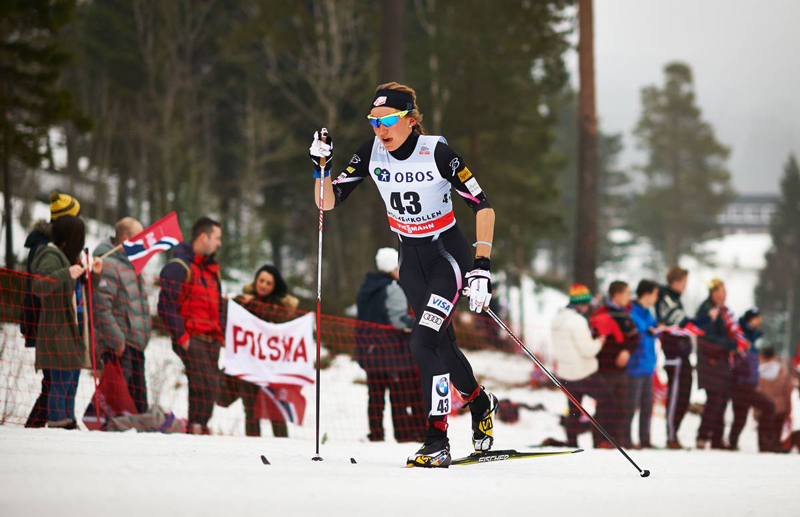
Julia Kern was next for the US in 23rd (+3:37.2), followed by Hailey Swirbul in 26th (+3:57.8), and Caitlin Patterson – six days after taking second at the American Birkie – in 30th (+4:11.5).
Julia Kern skis to 23rd in the 30 k classic at Holmenkollen in Oslo, NOR. (Photo: NordicFocus)Hailey Swirbul skis to 26th in the 30 k classic at Holmenkollen in Oslo, NOR. (Photo: NordicFocus)
In a post-race call, head coach Matt Whitcomb shared that Kern’s result was perhaps especially noteworthy as she has been struggling throughout the season with nausea during distance races, making it difficult for her to keep down fluids taken in prior to the race, let alone receive feeds during. Whitcomb also explained that Diggins sat out today’s race as she was feeling lingering fatigue from the long, and successful, season of racing. He affirmed that she is healthy and will be ready to race for the final World Cup weekend in Falun, beginning next Friday. Listen to the full call with Whitcomb below.
Outside the top-30 for the US, Katharine Ogden was 37th (+5:54.1), followed by Rosie Frankowski, who has consistently landed on SuperTour podiums throughout the season, in 46th (+8:12.2).
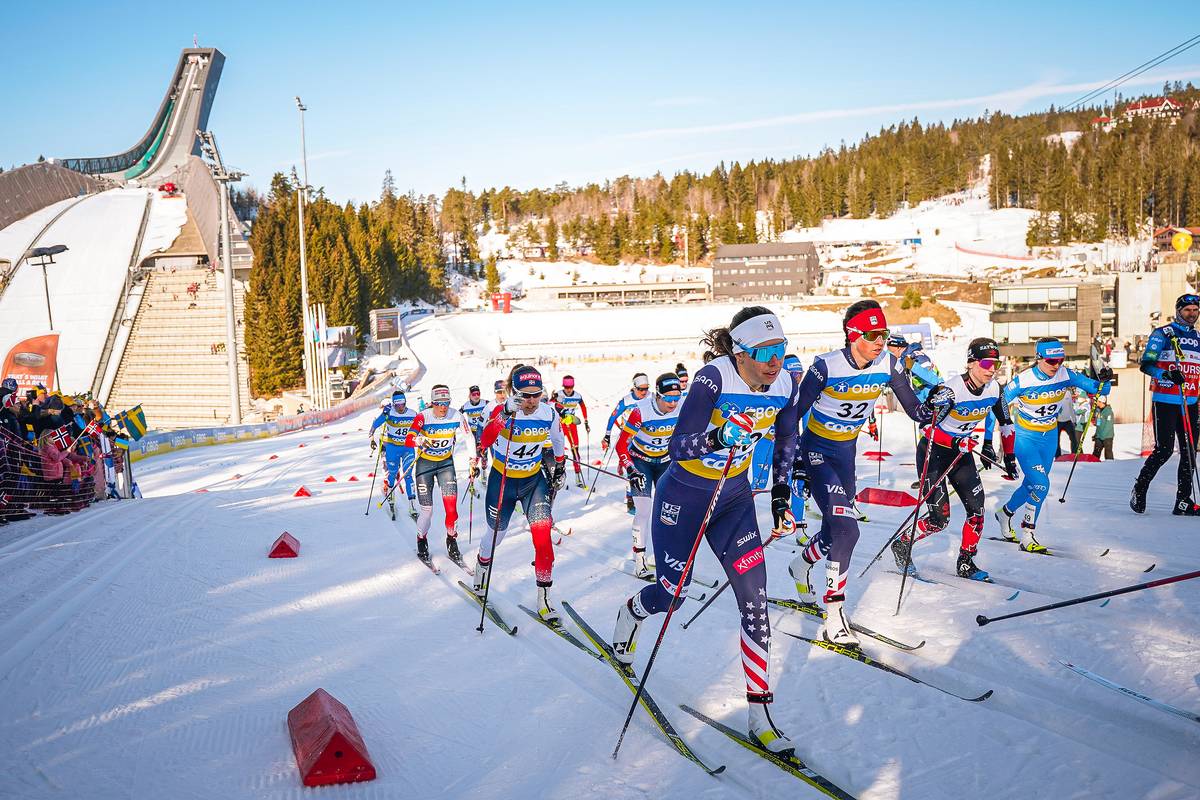
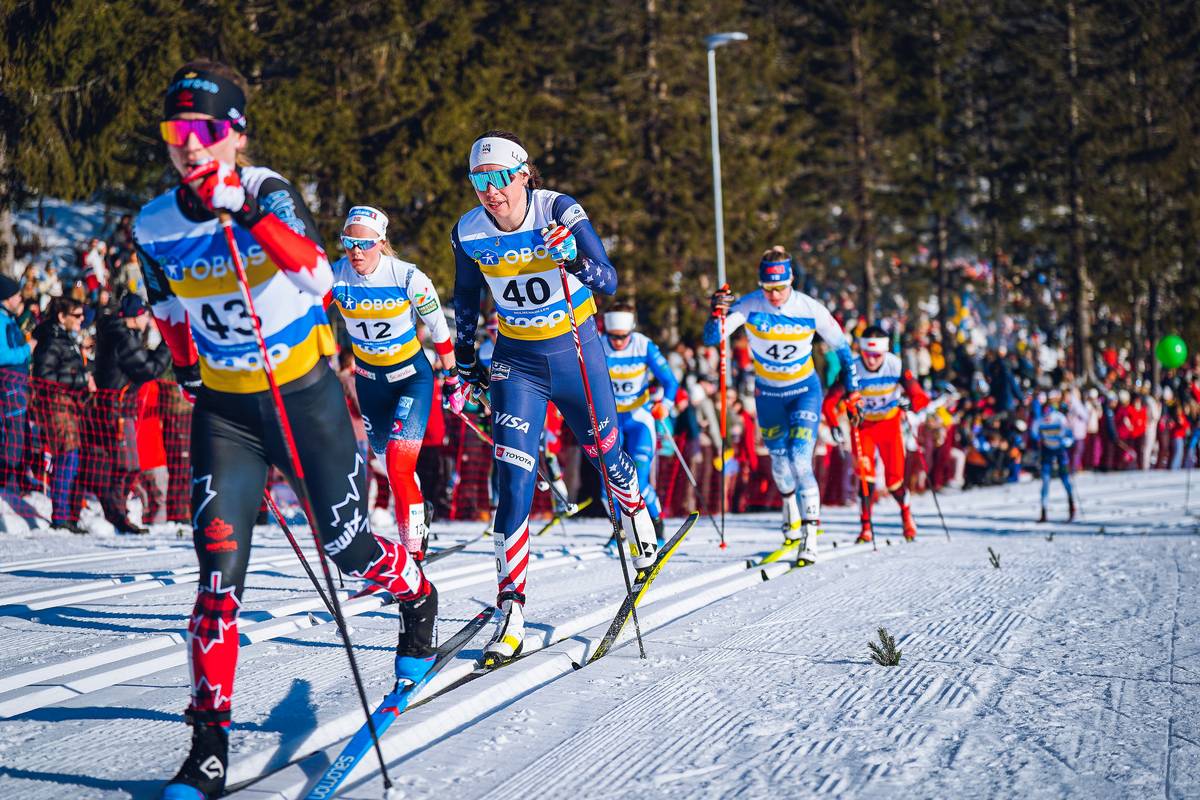
Katharine Ogden (left) and Caitlin Patterson (right, bib 32) take to the course at the start of the women’s 30 k classic at Holmenkollen. (Photo: NordicFocus)Canada’s Cendrine Browne (bib 43) leads Katharine Ogden (bib 40) during the 30 k mass start classic at Holmenkollen. (Photo: NordicFocus)
Racing for Canada, Katherine Stewart-Jones led the way in 22nd (+3:25.0), with Cendrine Browne also inside the top-30 in 25th (+3:53.7). After a successful World Junior Championship in Lygna, NOR, Jasmine Drolet finished 42nd today (+6:53.2), with Olivia Bouffard-Nesbitt closing out the Canadian racers in 48th (+10:19.8).
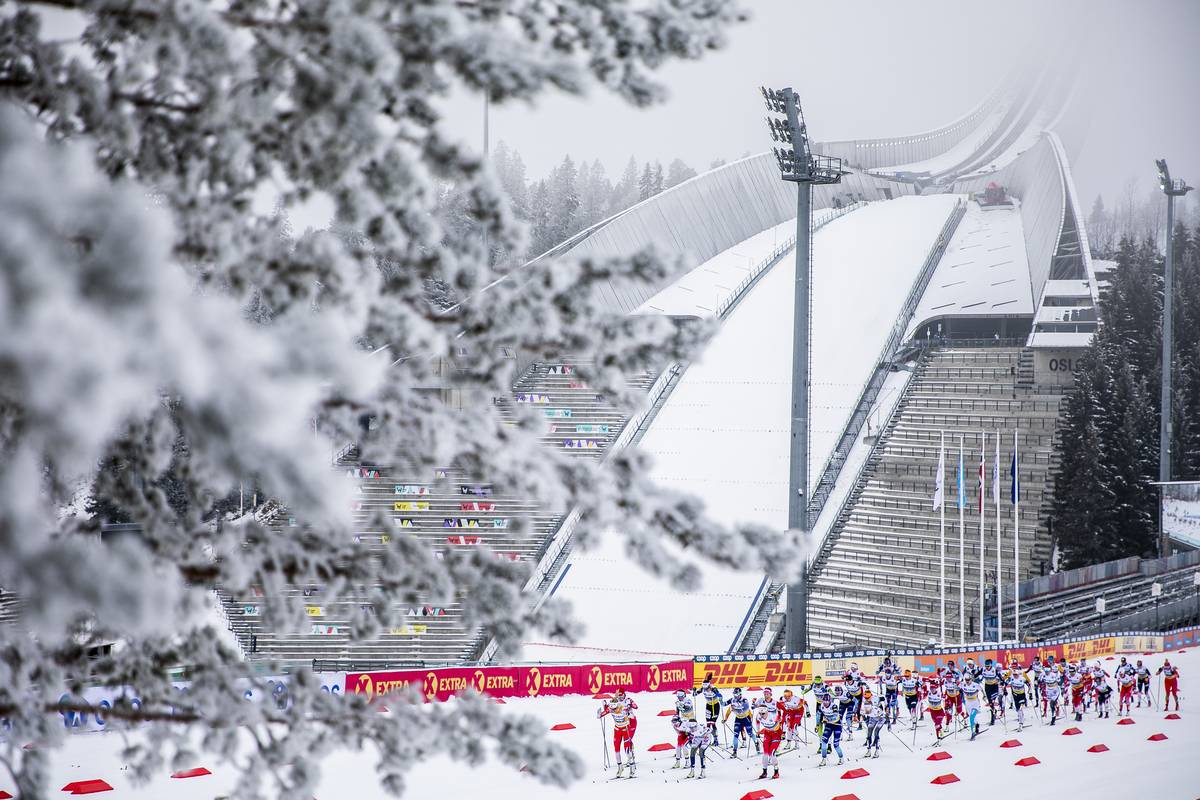
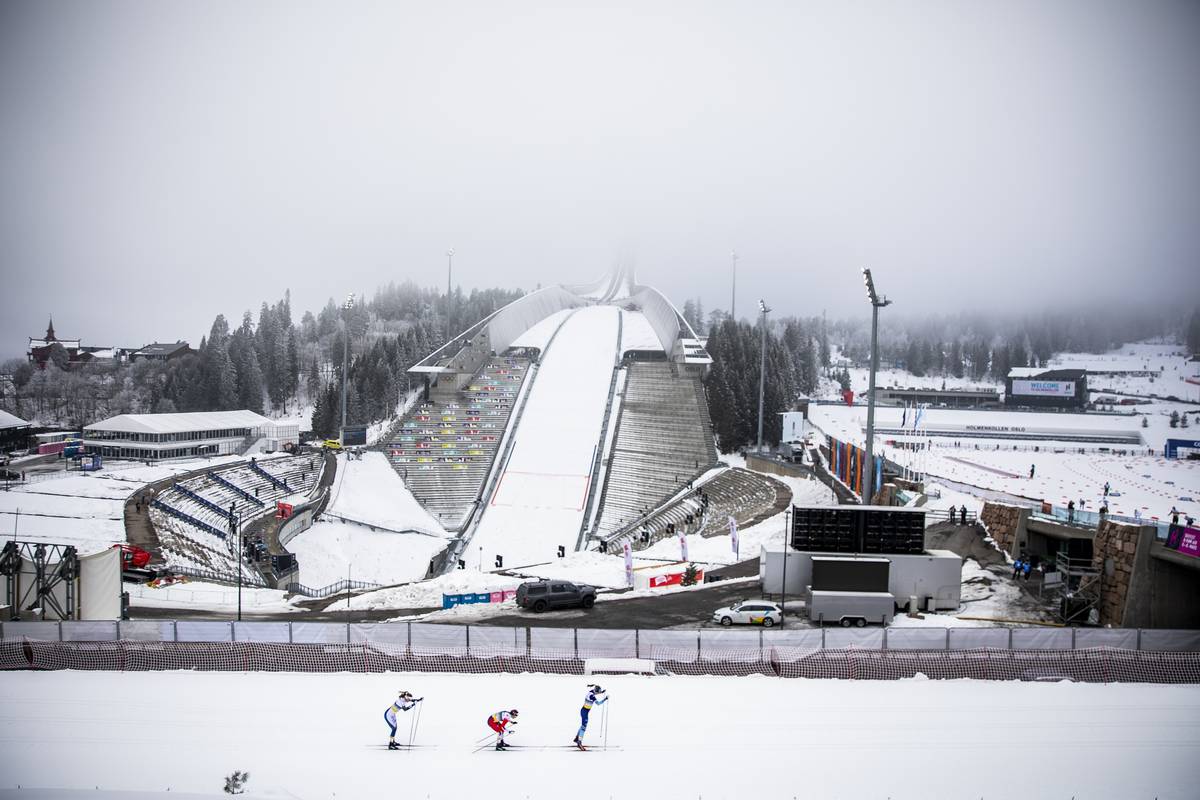
A quieter and more serene Holmenkollen stadium area with fans banned from much of the course. (Photo: NOrdicFocus)
Racing the Holmenkollen without spectators is a bit like not getting a white Christmas. It does not change the end result, here racing a 30-kilometer mass start classic race on the famed tracks above Oslo, Norway. But the experience loses some of the magic.
Though the stadium was empty, some spectators did choose to watch the event from the woods, but their numbers were not close to the norm.
Matt Whitcomb, U.S. World Cup Coach, however, wrote this in an email, “The Holmenkollen stadium, which can at times boom so loudly we can’t hear our own shouts to the athletes, was a ghost town today. But the people did not stay home; they moved to the forest. The woods were as loud as I can remember. It was a great fan turn-out.”
A empty feeling through the main stadium. (Photo: NordicFocus)
If you’ve ever skied the tracks at the Holmenkollen, you’ve probably uttered a humbled and exhausted expletive somewhere along the way. The climbs are long and unforgiving, and the downhills can be lightning fast.
Unsurprisingly, Norway’s distance champion Therese Johaug looked to be running away with the race. Within the first 10 k, Johaug gapped the field with flawless technique by 25 seconds. She took the maximum of 15 bonus points at each checkpoint, which happened at 3.7, 9,9, 16.1, and 22.3 k.
Therese Johaug off solo, it what looked like a typical runaway win for the Norwegian. (Photo: NordicFocus)
Therese Johaug and her off-the-front move that looked like it would stick. (Photo: NordicFocus)
Behind her, a large chase pack worked together in a race for second place. With less than ten k to go, the top-20 were within 8 seconds of one another. As the final round of bonus points drew near, Sweden’s Ebba Andersson and Frida Karlsson surged to the front and broke away, steadily cutting Johaug’s lead in half by the 26.3 checkpoint.
They had chosen to switch skis before the final lap, and it was evident that their kick and glide were superior to those around them. Johaug, however, had not changed skis or taken her last opportunity for a feed.
Ebba Andersson (front) and Frida Karlsson chasing Johaug. (Photo: NordicFocus)
This is where things got interesting. After skiing alone for 28.5 k, suddenly a figure appeared in the screen with Johaug. That figure was Karlsson who was closing hard from less than ten seconds behind.
It became a matter of real estate. After another kilometer, Karlsson was only five seconds behind. But there were only 2 k left.
Up the final long climb and inside the final k, Karlsson marked Johaug from the tails of her skis, switching lanes near the crest of the hill and dropping into a tuck to take advantage of the speed of her skis. Johaug stayed in her draft, sneaking back around before the final roller.
But Karlsson had the superior speed in the final sprint, leapfrogging the Norwegian and creating a gap in the lanes to win the race in 1:22:19.1. Johaug crossed 1.9 seconds behind and immediately congratulated her young opponent on her effort.
Andersson, who had fallen off of Karlsson’s pace, took third (+20.9), followed by teammate Charlotte Kalla (+40.5) and Natalia Nepryaeva in fifth (+43.1).
Firda Karlsson (r) taking the Holmenkollen 30 k win over Therese Johaug. (Photo: NordicFocus)
Karlsson for the win. (Photo: NordicFocus)
Karlsson’s excitement about her performance was clear as the 20-year-old hugged her teammates and jumped into a coach’s arms, somewhere between laughing and crying.
“I felt so good today,” Karlsson told FIS emphatically. “I had great skis and I think it was a winning concept to change skis and have new fresh ones. I felt so strong in the end and I was hunting and heard I was taking time on Therese. In the end, I felt like ‘now I am going all the way’ and it was a success.”
Women’s Oslo 30 k classic podium: Therese Johaug (NOR) second , Frida Karlsson (SWE) first, and Ebba Andersson (SWE) third, (l-r). (Photo: NordicFocus)
Racing for North America, Caitlin Patterson was the top finisher in 47th (+!0:15.1), followed closely by her CGRP teammate Kaitlynn Miller in 48th (+10:37.5) and APU’s Becca Rorabaugh in 49th (+12:26.4).
Therese Johaug (center) celebrates at the flower ceremony after winning the women’s 30 k classic race at the Holmenkollen. Russia’s Natalia Nepyreava (l) took second, and Sweden’s Ebba Andersson (r) finished third. (Photo: Screenshot FIS-Ski.com)
Skies cleared and the sun shined on the 30-kilometer mass start classic at the Holmenkollen. When not surrounded by tall pines, racers were offered beautiful vistas of Oslo and the cold blue fjord on which Norway’s capital is built. While the Sunday crowd pales in comparison to the masses who attended the men’s event on Saturday, plenty of tents still lined the course to house families of fans camped out for the weekend. The snowbanks lining the course continued to bear the scars of carved benches lined with pine boughs and snow pits dug around small fires. Norwegian flags flew in abundance as Therese Johaug ran away with yet another distance victory, stopping the clock at 1:18:54.5.
Unlike the men’s race which was decided in the final kilometer, Johaug made it clear that she would win her third race at the Holmenkollen, her second with classic technique. With her wins in 2013 and 2016, she is tied for second-most wins with Larissa Lazutina of Russia who retired in 2002 and her teammate Julija Tchepalova who retired in 2009. Only Marit Bjørgen has earned more wins in Oslo with seven victories.
The race unfolded as nearly every other distance race Johaug has entered this season, including the 30 k freestyle at the World Ski Championships in Seefeld just over one week prior. Johaug separated herself from the pack early and built a gap of nearly a minute by the halfway mark, then continued to expand that lead by the finish. She showed little sign of fatigue and her technique never faltered as she soared through the classically Norwegian track, weaving through the woods, passing by a statue of a troll, and looping around the chapel before rolling past the modernist yet historic ski jump through the stadium. She now joins Bjørgen in the exclusive club of women who have won the 30k at both the Holmenkollen and the World Championships within the same year; Bjørgen has done this twice.
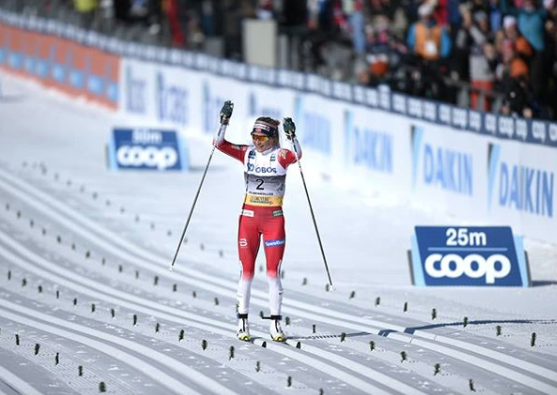
Therese Johaug celebrates her victory in the final meters of the women’s 30 kilometer classic race at the Holmenkollen. (Photo: Screenshot Instagram @fiscrosscountry)
Johaug is a resident of Oslo, so her victory was won in front of her home crowd. The champion trained relentlessly on the tracks at the Holmenkollen and the surrounding trail system of Nordmarka during her suspension with the hope of returning with a season like she has had.
“It’s really special,” Johaug told the International Ski Federation (FIS). “The last two years I’m training so much on these tracks and have a lot of hard sensation out there. So I know the tracks really good, but it was amazing to ski here. There was a lot of people around the track and I love to ski the Holmenkollen.”
While she was aware of the gap that she had on the other women, she did not see that as a reason to slow her pace.
“The coaches give me some information that I have a lot of seconds in front of the rest, but I just have focus on myself and to just have fun out there,” she said. “And the last time in front of the stands I just look up and see all the people that are cheering at me. It means a lot in my heart.”
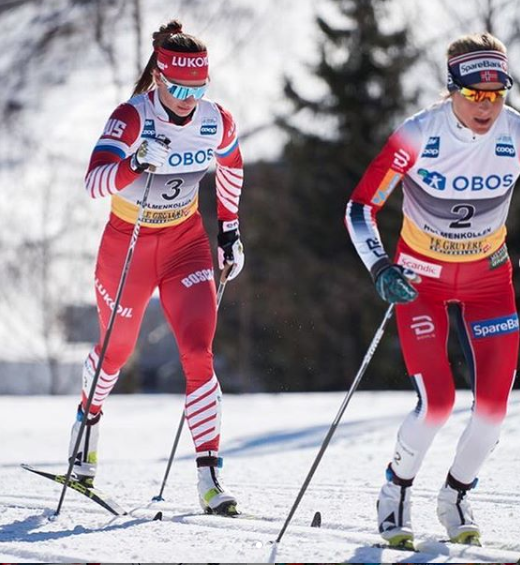
Natalia Nepryeava of Russia (bib 3) chases Therese Johaug (bib 2) in the opening kilometers of the women’s 30 kilometer classic race at the Holmenkollen. (Photo: Screenshot Instagram @russianskiteam)
Behind the peerless leader, the battle for the remainder of the podium spots was decided much later. Natalia Nepryava of Russia was the only skier who made an attempt to stay with Johaug in the first lap. But she fell off the pace and raced mostly alone in front off a group of Ebba Andersson and Charlotte Kalla of Sweden, Ingvild Flugstad Østberg and Astrid Jacobsen of Norway, and Katharina Hennig of Germany, with Krista Pärmäkoski of Finland chasing from behind.
While she was never able to make significant headway on the gap Johaug created, Nepryeava held her position in second steadily, never looking over her shoulder to the women in pursuit behind her.
In the final lap, Kalla led the chase pack with a small gap, but she was reeled in by Østberg and Andersson. Østberg was hungry for her second podium finish after placing second in 2016. Østberg and Andersson passed Kalla with less than five kilometers to go, and continued to surge, drawing ever closer to Nepryeava.
Though they continued to gain on the Russian, Andersson and Østberg were not able to close the gap to Nepryeava, who finished on her own in second (+1:45.9). The Norwegian and the Swede charged through the final kilometer, double poling fiercely to the finish neck in neck. With a throw of her boot, Andersson edged out Østberg at the line, taking third (+1:49.9) with Ostberg inches behind in fourth (+1:50.1).
Three Americans competed in the Holmenkollen, but none were able to crack the top-30. Rosie Brennan (APU) was the top American finisher in 33rd (+7:57.0), followed by her APU teammate Rosie Frankowski (+9:40.2). Kaitlin Miller (CGRP) finished 42nd (+13:43.7). No Canadian women entered the race.
Amidst a strong season during which she has cracked the top 10 twice, one of which was earned during the World Championships in the 15 k skiathlon and the other in the 10 k skate in Davos, and has skied inside the FIS points 13 times in individual events, this result was not what Brennan was looking for.
“I’m a little disappointed, that wasn’t really what I hoped for,” Brennan told FasterSkier in the mixed zone. “I just didn’t have much fight, and I didn’t think my skis were very good, and I’m a little tired from World Champs still. It was a lot of racing and we did a 30 k a week ago.”
Brennan kept her performance today in perspective as it was not her primary objective.
“My goal was World Champs so I had to give everything I had there and I’m happy with that,” Brennan shared. “I hoped I would have more energy but I didn’t, so onto the next.”
Frankowski, who finished 31st last year at the Holmenkollen, had a tougher time keeping this in perspective.
“It was hard. I just didn’t feel good,” she stated simply.
Today was Frankowski’s fourth World Cup start this season. Her best result, and only top-30, took place in the 15 k skiathlon at the World Championships. The 27-year-old Minneapolis native took 21st in the 30k classic race during the 2018 Olympics in PyeongChang.
“The climbing was good for me,” Frankowski commented on the highlights of a tough day. “I like the long climb better than the church loop, the church loop is always really hard. I wish it was skating.”
As the race strung out, Frankowski lost contact with the skier ahead of her, but remained several seconds ahead of the women behind. With the exception of passing a few competitors, she remained largely in no man’s land, a tough position to be in during a long race where drafting and working off of others can be so valuable.
“I didn’t ski with – literally no one,” expressed a frustrated Frankowski. “After the first 5 k, I couldn’t even – I saw like two girls the whole time in front of me…The crowd’s always good here, so at least you get a lot of cheers which is cool.”
She added that skiing alone is not always bad, but today it was not in her favor.
“Most of the time I like it, but today, I think I just was battling my own head, so it made it harder than if you could ski with someone and be distracted,” she explained. “Every person that I caught, which was only two, but they were going so slow that – I passed them on the long climbing section, so we weren’t skiing together at all.”
Both Brennan and Frankowski felt that their wax techs were not able to find the “magic balance”, as Brennan called it, when it came to kick and glide on the frozen tracks in Oslo. Both felt their skis were average and despite the ability to exchange for a new pair, never had an optimal pair that allowed sufficient kick up the long climbs without sacrificing glide on the equally long descents.
“30k is weird, especially classic,” Frankowski concluded. “I feel like sometimes you’re battling your skis, so you can’t go as hard as you want. I gave everything I had today, so that was good.”
While originally hailing from Perth, Australia, Jessica Yeaton has been primarily based in Alaska for the last 15 years. She is a teammate of Frankowski and Brennan at APU, but also skis for the Australian National Team. Yeaton has primarily raced in the Super Tour circuit this season, heading to Europe to race in Lahti in preparation for the World Championships. Yeaton raced in the individual sprint, the 15 k skiathlon, the 10 k classic, and the 30 k skate in Seefeld, with her best result taking place in the skiathlon where she placed 22nd, just behind Frankowski.
“My rest and recovery since Seefeld has gone well so I was really looking forward to racing today, and I am super happy to have made the top 30,” wrote Yeaton in an email. “My wax techs did a great job with the skis, and I was very fortunate that Madshus helped me with a second pair of skis for the exchange- so I had competitive skis for the whole race.
“It was a gorgeous, sunny day with tons of fans cheering out on course – this will definitely be a venue to remember!” she concluded.
Racing in Norway continues Tuesday on the streets of Drammen with a classic sprint.
Norway’s Therese Johaug with the Holmenkollen 30 k classic win and no challengers in site. (Photo: ARD screenshot)
FIS World Cup Oslo, Norway Holmenkollen 30 k Classic
Beautiful sunshine. Norwegian crowds. And fine views of Oslo fjord from atop the Holmenkollen venue for the women’s 30-kilometer mass start classic. All things typical on a good weather March day in Oslo.
Norway’s Therese Johuag took this fine day and turned the screws on the 47 starters on Sunday to once again ski away from the field. By the second points bonus at 8k, Johaug was already 23.6 seconds up on the field. She won the race in 1:18:54.5 hours. According to the International Ski Federation (FIS), this was Johaug’s third 30 k win at Holmenkollen and her second classical victory. She won the 30 k skate in 2013. Her first Oslo 30 k classic win came in 2016.
Russia’s Natalia Nepryaeva placed second 1:45.9 minutes back. Ebba Andersson of Sweden skied to third (+149.9).
Rosie Brennan (APU) was the top U.S. skier in 33rd (+ 7:57.0). Rosie Frankowski (APU) placed 34th (+9:40.2), and Kaitlynn Miller (CGRP) 42nd (+13:43.7).
Jessica Yeaton (APU/Australian National Team) raced to 30th (+7:29.4).
IBU World Championships Östersund, Sweden 10 k/12.5k Pursuit
On Saturday’s 10 k pursuit at the IBU World Champs in Östersund, Sweden the German women took first and third. Denise Herrmann won in 31:45.9 minutes with two penalties in her third shooting stage. Tiril Eckhoff of Norwayplaced second, 31.4 seconds back while also skiing two penalties in her third shooting stage. Germany’s Laura Dahlmeier was a close third (0+0+1+0, +31.6).
Clare Egan of the U.S. was 12th (2+0+0+3, +2:44.3), Susan Dunklee raced to 24th (2+0+0+1, +3:27.6), and Joanne Reid 32nd (3+2+1+0, +4:24.2).
For Canada, Sarah Beaudry finished 42nd (2+1+1+0, +5:23.5), while Rosanna Crawford, Emma Lunder, and Megan Bankes were lapped.
In Östersund on Sunday, the men raced the 12.5 k pursuit. Ukraine’s Dmytro Pidruchnyi, who placed fourth in yesterday’s sprint, came away with the win in 31:54.1. Remarkably, it was Pidruchnyi’s first race win either on the IBU World Cup or at the championship level. The 27 year old missed two targets for the day.
Johannes Thingnes Bø of Norway, the biathlete who has dominated the men’s side this season, placed second (+8.3). Bø’s ski speed was such that he took silver despite missing five targets he won the Silver medal. Taking third (+17.7) was France’s Quentin Fillon Maillet. He missed three targets in earning bronze.
For the U.S., Sean Doherty raced to 20th (+1:54.3) while missing two targets. Leif Nordgren placed 44th (0+0+3+1, +4:02.7), and Jake Brown 53rd (1+1+4+1, +6:00.8).
Canada’s Scott Gow began in bib 50, and skied up to finish 43rd (2+0+0+2, +3:51.4).
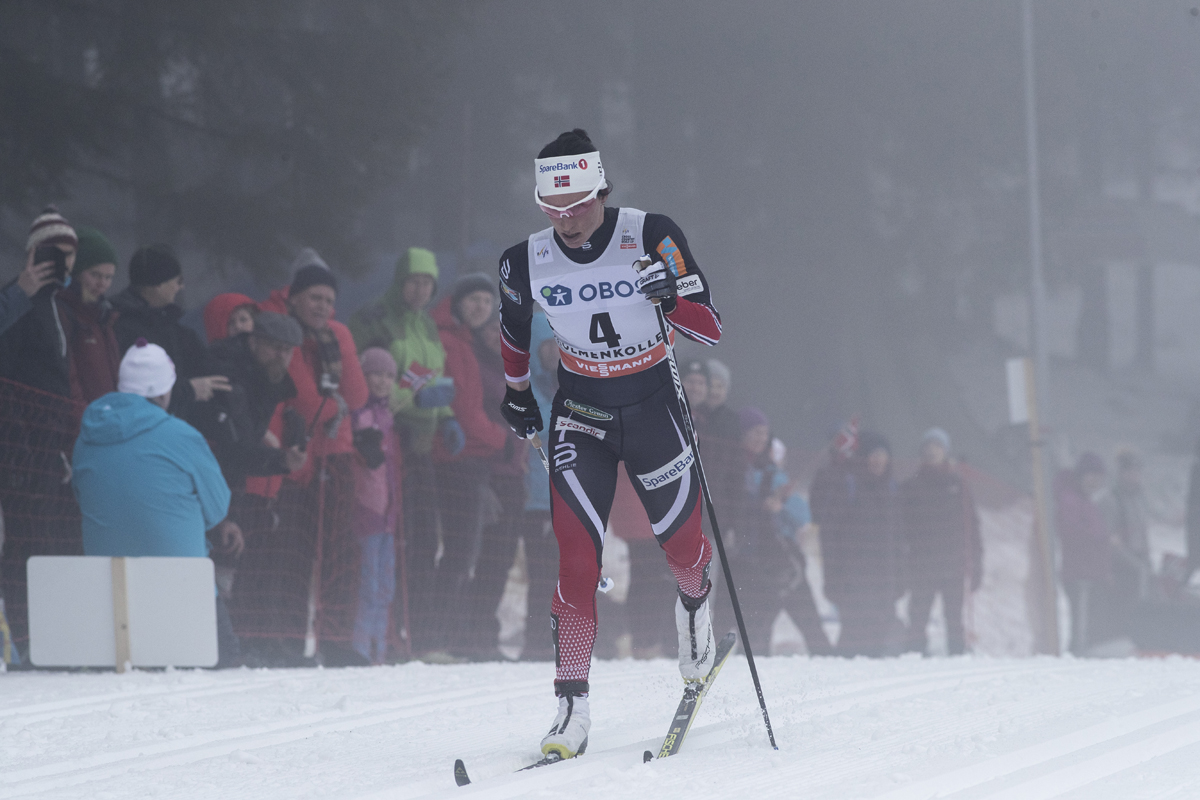
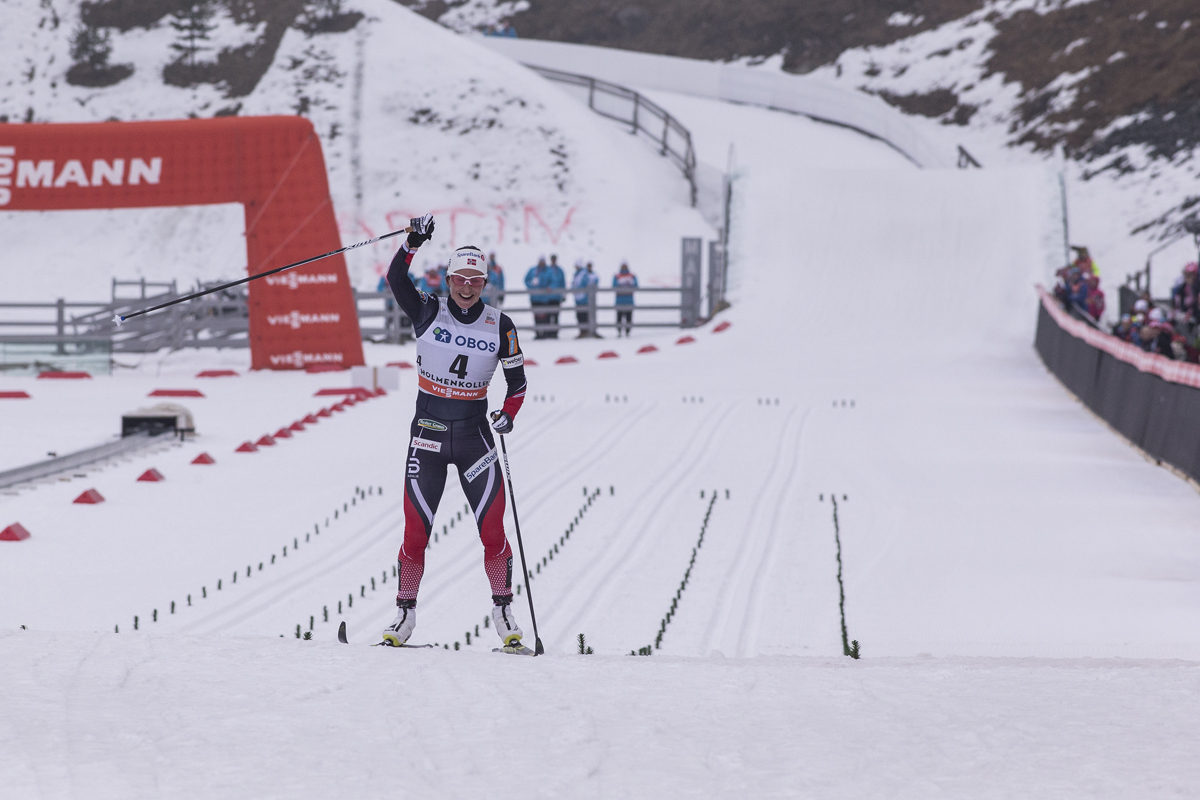
Norway’s Marit Bjørgen winning the women’s 30 k classic mass start at Holmenkollen in Oslo, Norway, by more than two minutes on Sunday. (Photo: Fischer/NordicFocus)
OSLO, Norway — The modernist Holmenkollbakken ski-jumping hill lords over the otherwise bucolic Holmenkollen ski venue. It’s certainly one of the wonders of the modern nordic sport world as the steel structure arcs elegantly toward the sky. At times during the men’s 50-kilometer classic mass start on Saturday at Holmenkollen, the sun glared off the jump, giving it the appearance of a polished silver spaceship.
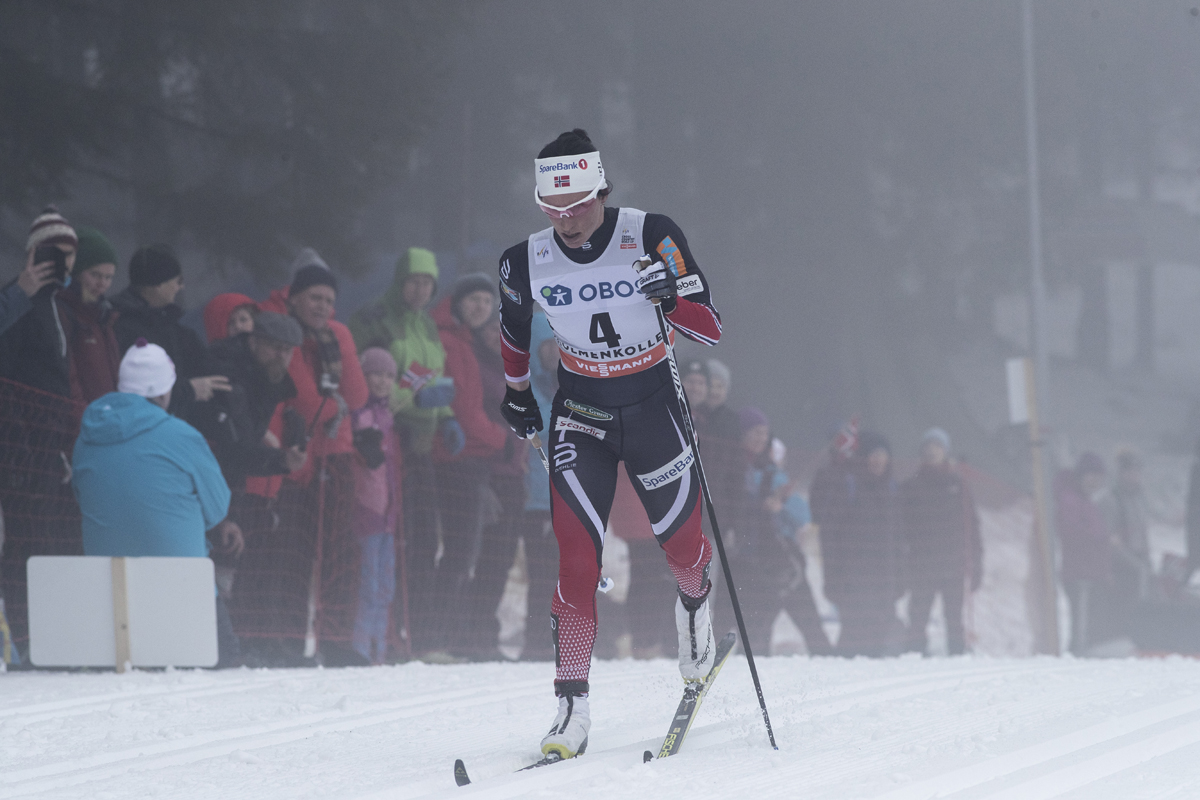
During the women’s 30 k classic mass start on Sunday, fog descended onto the Holmenkollen neighborhood. The upper portions of the Holmenkollbakken jump, about a third of the structure, were lost in the clouds. Jumpers that flew from its heights before the start of the 30 k seemed to glide and fly out of the sky.
Norway’s Marit Bjørgen leads the train early in the women’s Holmenkollen 30 k classic mass start on Sunday in Oslo, Norway. This was a rare moment when Bjørgen skied in the presence of other skiers. She soon moved off the front and soloed to the win.
Those same clouds blanketed the high point of the 30 k course (with three 8.3 k laps and one 5 k lap) at Frognerseteren, where it seemed much of Oslo had stayed to party and welcome racers before their descent toward the stadium.
Each time Norway’s Marit Bjørgen rallied the hordes atop Frognerseteren, it was as if she appeared from the ether: Bjørgen’s race through the fog was a solo quest that ended in flat-out 30 k dominance.
Perhaps it’s splitting hairs saying exactly when this race was decided. Was it at 2.7 k when Bjørgen was up by nearly five seconds? For certain that was early on when anything was in play: wax, Bjørgen’s in-race nutrition, a potential fall. Was it her 33 second lead at 8 k? Was it her 1 minute and 22 second gap at 16.3 k?
By then this much was clear: Bjørgen was steamrolling. And yes, the race for first looked over.
Norway’s Marit Bjørgen racing to more than a two-minute win in the Holmenkollen women’s 30 k classic mass start on Sunday in Oslo, Norway. (Photo: Fischer/NordicFocus)
In her first Holmenkollen 30 k after taking a year off to start a family, Bjørgen, 36, looked peerless. On the stout Holmenkollen loop she only appeared to ratchet up the pace, firing with increasing power as the kilometers rolled.
Meters from the finish, Bjørgen bowed to the crowd and Norway’s King Harald V before stopping the clock at 1:22:59.2 hours to win her sixth Holmenkollen 30 k. Her nearest competitors were more than two minutes back.
“I was more relaxed than I was in the World Championships,” Bjørgen said at the post-race press conference. “It was a different morning. Today I was waking up with my son, playing with him, and just going to the stadium, and yeah, it was more relaxing.”
A relaxed Bjørgen appears to be a potent Bjørgen.
“My plan was to try to go fast from the beginning if my body was feeling well, and it did,” Bjørgen added. “I had good skis also, when we passed 5 k, I heard 20 seconds. I understood I had to do my own race and, yeah, I feel good.”
Twelve times the Holmenkollen 30 k has been held after World Championships or the Olympics. Usually a two-week period elapses between those events. Bjørgen has won the 30 k back-to-back twice, but Sunday’s win makes it her first with only one week of recovery.
Evidently Bjørgen still recovers well, too.
“It has been not an easy week. I have been a little bit tired and the motivation has been hard really. I wanted to stay home with my son and play with him,” Bjørgen said. “But I trained a little bit and tried to relax and of course to go to the 30 k is a big motivation and you want to do well so it was no problem. I was wondering how the body was feeling, but today my legs were much better than it was earlier in the week.”
Chalk up another World Cup win.
Behind Bjørgen, it wasn’t so much a chase as an entirely separate race vying for the remaining podium spots. Playing off-Broadway to Bjørgen’s big show were Finland’s Krista Pärmäkoski, Kerttu Niskanen and Aino-Kaisa Saarinen, Norway’s Heidi Weng, Sweden’s Charlotte Kalla, and Poland’s Justyna Kowalczyk.
Sweden’s Charlotte Kalla leads the first chase group behind Norway’s Marit Bjørgen (not shown) during the Holmenkollen 30 k classic mass start on Sunday in Oslo, Norway. Finland’s Krista Parmakoski (left) and Norway’s Heidi Weng (behind Parmakoski)) follow Kalla.
Throughout the 30 k race, it looked as if any one of those skiers could pull away into their own discrete chase for second. Kalla and Kowalczyk looked primed as they took a 14-second lead at the 16.3 k time check on the likes of Weng, Saarinen, Niskanen, and Pärmäkoski.
With that effort came an eventual catch. At 24.6 k, those six skiers came through just seconds apart. It wasn’t until the final stretch when place, not time, was part of every racer’s calculus and a separation of seconds occurred.
Finland took the remaining spots on the podium. Pärmäkoski placed second (+2:05.8), and teammate Niskanen was third (+2:07). Weng was fourth (+2:08.6), Kalla fifth (+2:11.7), Kowalczyk sixth (+2:12.9), and Saarinen — the last skier of the reputable first Bjørgen chase group — placed seventh (+2:19.6).
“Today [I] was feeling a little bit tired because that Drammen sprint was really good for me and last year also I had good race there,” Pärmäkoski said at the press conference. “But I am so happy that I am now stand on the podium on the sprint race and now of course this 30 k podium, the first on my career.”
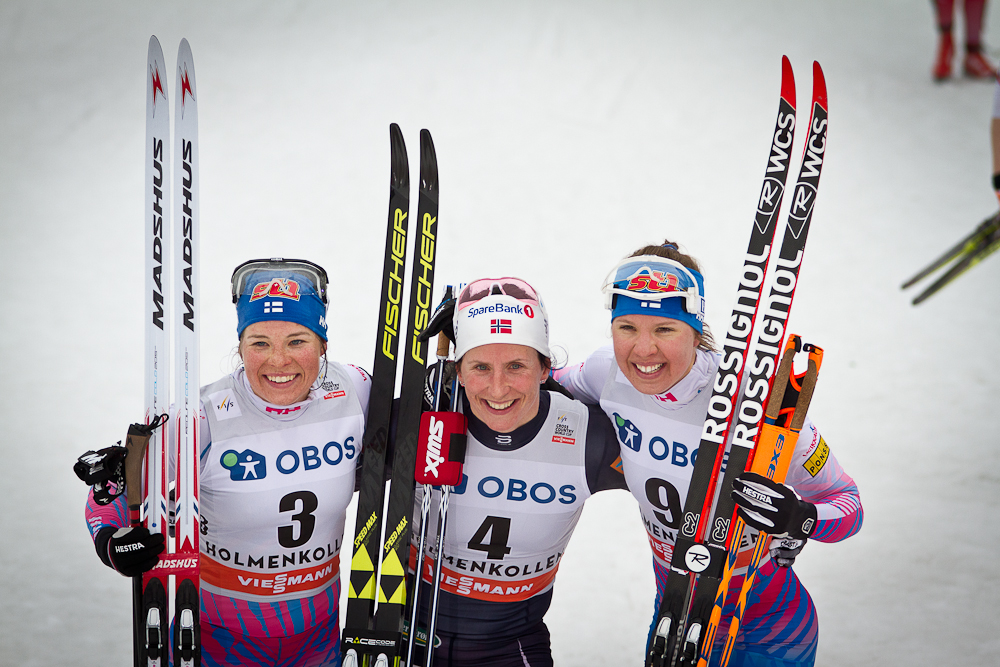
The Holmenkollen 30 k classic mass start podium on Sunday in Oslo, Norway: Finland’s Krista Pärmäkoski (l) placed second, Norway’s Marit Bjørgen (c) first, and Finland’s Kerttu Niskanen (r) third.
Heading into the season-ending World Cup Finals, which will take place across the Atlantic in Quebec, Canada, Pärmäkoski sits second in the World Cup overall, exactly 300 points behind Norway’s Weng. Another Norwegian, Ingvild Flugstad Østberg, is 94 points behind Pärmäkoski in fourth. On Sunday, Østberg placed eighth (+2:31.3).
The U.S. Ski Team’s Kikkan Randall, like Bjørgen, has returned from a year away from skiing to start a family. Sunday was her first World Cup 30 k since she contested the 2014 Holmenkollen 30 k classic.
And on Sunday, Randall was the top American in 20th (+6:17.2).
“I had good energy,” Randall said of her race. “I kept a steady pace for me the whole way. 30 k was untested for me this year. I’m really happy. My expectation going into today, knowing where I’ve been in the last couple of weeks, I thought a top 20 was a good goal, and I just got that.”
With such a large hiatus between long-distance races at this level, Randall noted her sensations on the day were welcome.
The U.S. Ski Team’s Kikkan Randall (38) racing in a group during the women’s 30 k classic mass start on Sunday at Holmenkollen in Oslo, Norway.
“I skied a lot of threshold pace last year while I was pregnant, and a lot of it is coming back this summer, so maybe this is a good pace for me to ski right now,” Randall said. “The start was pretty fast, and I had a hard time staying up in the middle of the group, but I just skied a good, steady pace the whole way, and my energy stayed really strong. … It’s a great foundation to end this season with, knowing that I have a whole season next year to build that top-end speed back.”
Randall skied in a group that didn’t think twice about matching the turbo pace set from the starter’s gun. When the race shook out early on, Randall found her own race tempo and was able to eventually work up in the field.
“I felt like I got in a pack right away, maybe in the first 5 k, skiing with a pack of Norwegians, and we worked together most of the race, but pretty soon we were picking people off,” Randall explained. “The opening pace was hard, and I think a lot of the people who went with it suffered the consequences. It was kinda fun that we had little rabbits out there to go catch.”
Sadie Bjornsen, also of the U.S. Ski Team (USST), placed 24th on the day. Bjornsen skied much of her 30 k solo.
“I was trying to go with people from the start, to see what would happen,” Bjornsen said. “My best 30 k’s have been when I send it too hard, and somehow manage to keep up the pace. I tried for that, and I then I got a bit tired in the middle.”
Sadie Bjornsen racing to 24th in the women’s Holmenkollen 30 k classic mass start on Sunday in Oslo, Norway.
Bjornsen’s race was gritty, a go-for-it effort in a hallowed venue. Bjornsen noted she perhaps pushed too hard in spots and paid the price of fading.
“Today was one of those days that wasn’t the greatest, it wasn’t horrible, but you have to try,” Bjornsen explained.
Holmenkollen remains formidable.
“Holmenkollen is always the hardest race of the year, and I kind of love that,” Bjornsen said. “I’ve had some of my best and worst races here, and I think it’s fun to come here knowing that it’s going to be a challenge, but to also be excited for a challenge, because every time you finish this race, despite how you do, you have this feeling of total achievement, like, ‘Holy cow! I just skied 30 k on that course!’ It’s always hard … It’s just such an achievement to finish this race.”
Sadie Bjornsen (U.S. Ski Team) after finishing 24th in the Holmenkollen 30 k classic mass start in Oslo, Norway.
Also for the U.S., Liz Stephen (USST) finished 31st (+8:46.8) and Chelsea Holmes (Alaska Pacific University) 39th (+11:19.1). Rosie Brennan (USST) did not finish.
U.S. Ski Team Women’s Coach Matt Whitcomb explained that Brennan miscalculated with her initial pair of skis.
“Rosie struggled a bit with her first pair of skis,” Whitcomb wrote in an email. “I think she thought they were good in testing, but in the race they proved to be a little too slow. Her second pair was great after the exchange, but she was too far back and decided to pull. This was her decision and I support her. She wants to ski very well in Quebec, and these athletes don’t have much wick left to burn. This is a rare occurrence, and an exceptional reason for it to occur. She’ll be skiing with a vengeance in Quebec.”
Americans Sadie Bjornsen (r, in white) and Jessie Diggins (behind, in white) during the Holmenkollen 30 k classic on Sunday near Oslo, Norway. (Photo: Fischer/NordicFocus)
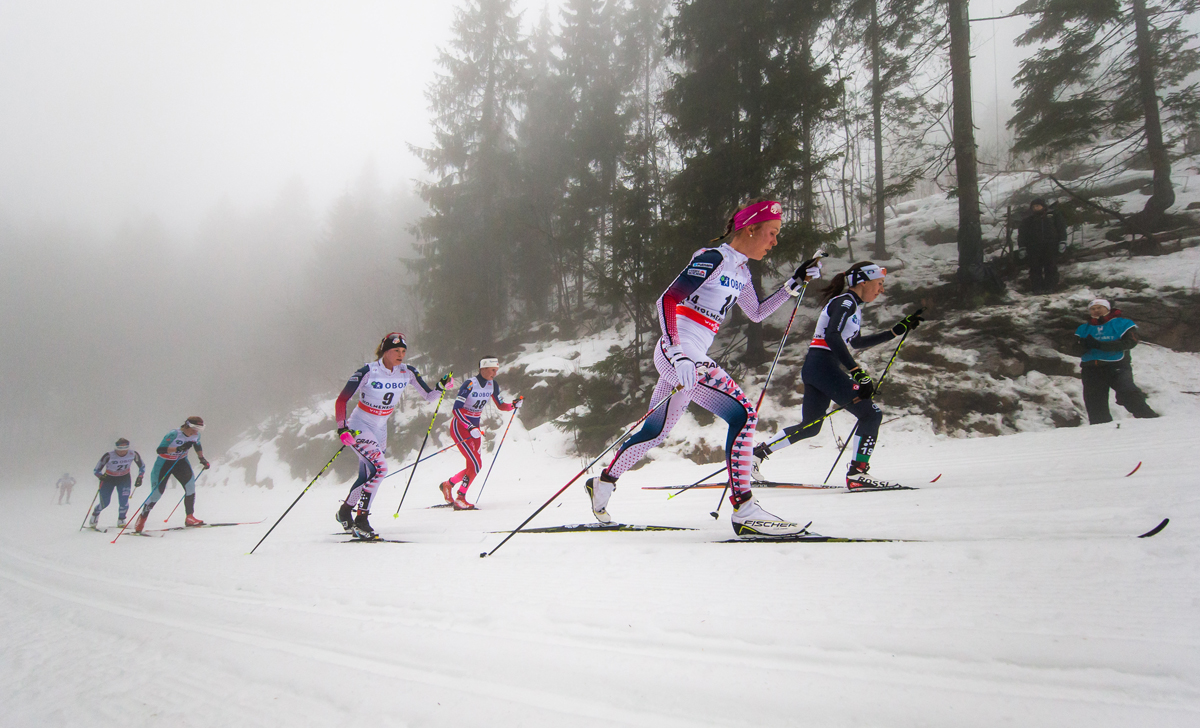
If a 30-kilometer classic mass start on a brutal course wasn’t challenging enough for the U.S. women’s team, which specializes in shorter-distance skate races, the fog and rain made for an even tougher day at the Holmenkollen stadium in Oslo, Norway.
Temperatures hovered around 5 degrees Celsius (41 Fahrenheit) throughout the day and a thick fog enveloped the racers and spectators. Intermittent rain fell through the race on yet another klister day.
“It was just thick, thick fog with maybe 75 feet of visibility. You are completely socked in and soaked,” coach Matt Whitcomb said in a post-race phone interview.
Norway’s Therese Johaug dominated the race, winning in 1:24:55 for her first Holmenkollen 30 k classic title. Her winning margin of 3:46.5 was the largest in the race history for the women. Norwegian Ingvild Flugstad Østberg continued to prove she is a threat in both sprints and distance races, taking second place, 29.5 seconds ahead of Finland’s Anne Kyllönen.
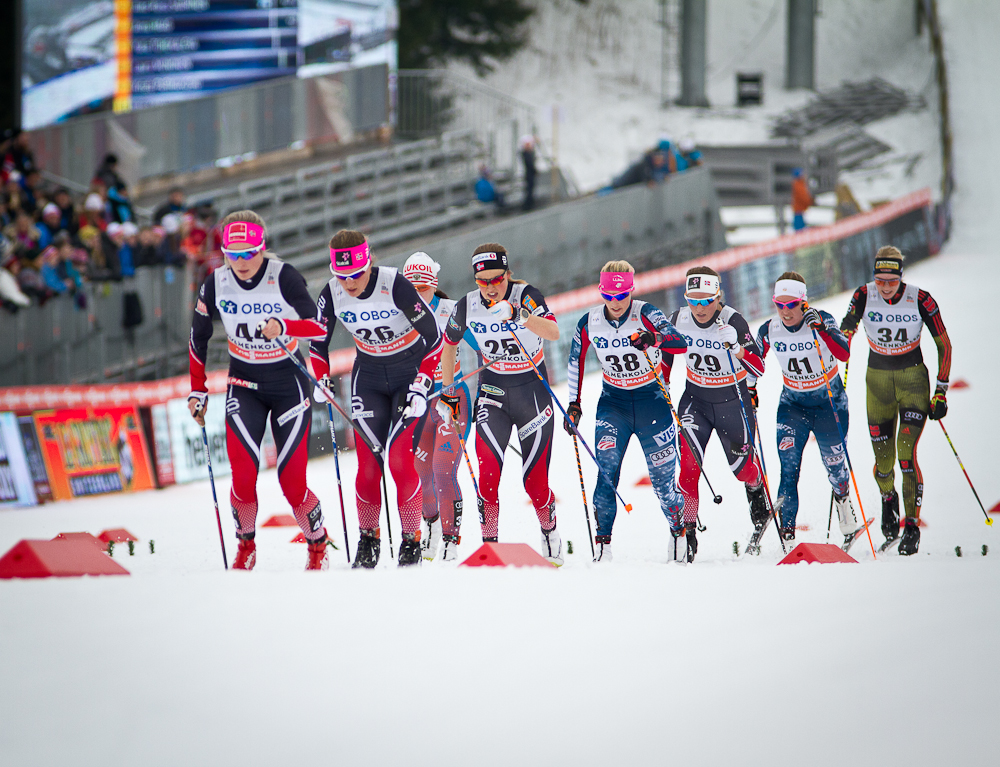
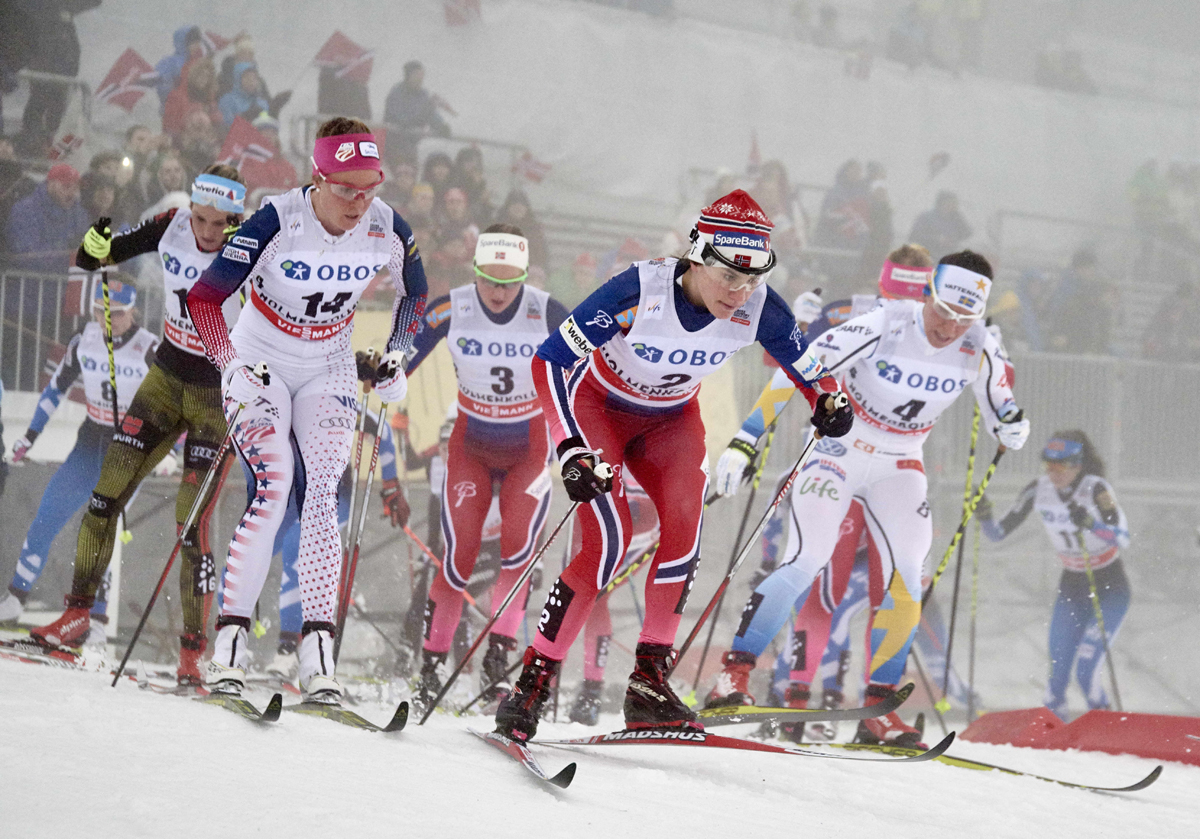
Early in the women’s 30 k classic mass start, Sadie Bjornsen (14) in the mix with Norway’s Ingvild Flugstad Østberg (3), Heidi Weng (front, in red), and Sweden’s Charlotte Kalla (r) on Sunday at Holmenkollen in Oslo, Norway. (Photo: Fischer/NordicFocus)
Three American women cracked the top 25 and finished within 1.6 seconds of one another. Sadie Bjornsen led them in 22nd (+7:44.5), closely followed by Liz Stephen in 23rd (+7:45.4) and Jessie Diggins in 25th (+7:46.1).
Rosie Brennan and Caitlin Patterson also represented the U.S., finishing 33rd (+11:43.7) and 36th (+12:09.1) respectively.
Canadian Emily Nishikawa placed 39th (+12:41.1) for her best Holmenkollen result in the last two years at the race.
Reminiscent of Martin Johnsrud Sundby’s aggressive start in Saturday’s 50 k, Johaug pushed early and established an 8.6-second lead just 1.8 k into the race. She widened the gap throughout the race with her characteristic-and-unrelenting quick tempo.
The women’s race started with a 5 k loop before continuing on for three laps of the same 8.3 k loop used in the men’s race. The first loop contained some of the steepest climbs in the course and the women had the challenge of navigating them while still in a large pack.
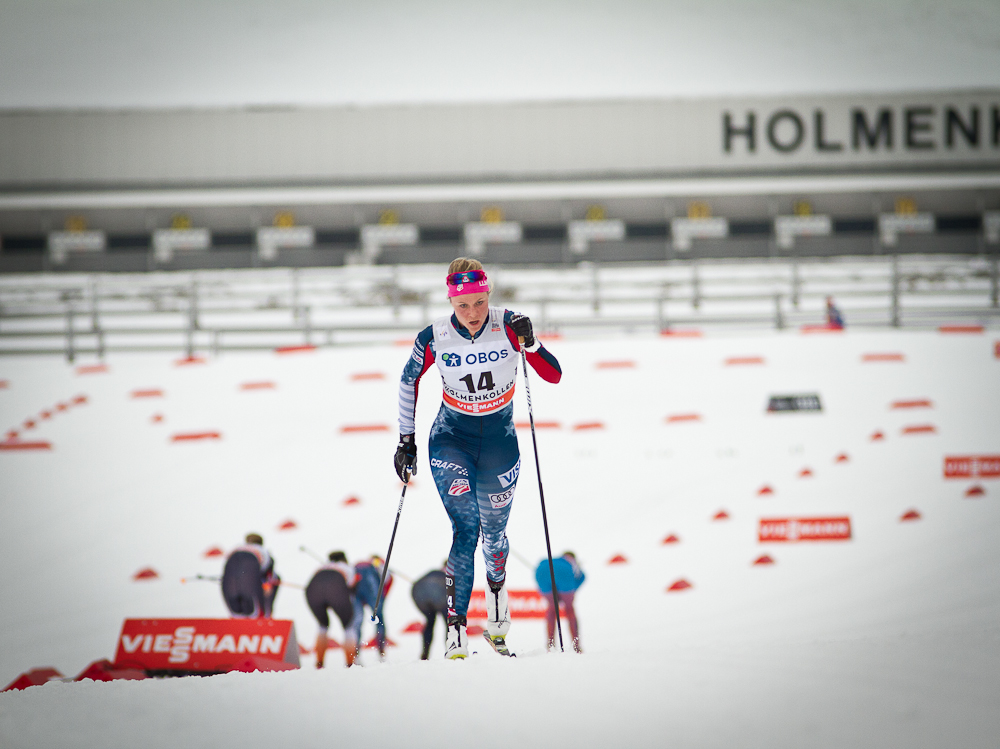
Bjornsen asserted herself near the front of the large chase pack in the first five kilometers. Diggins also established herself in the top 20 with Brennan not far behind in 26th at the five kilometer mark.
Despite the strong start, over the next five kilometers Bjornsen, Diggins and Brennan were shuffled back as the field strung out, morphing from a pack to solo skiers and small groups.
The dense fog isolated racers from one another, making it difficult to judge gaps and placement in the field — for better or for worse.
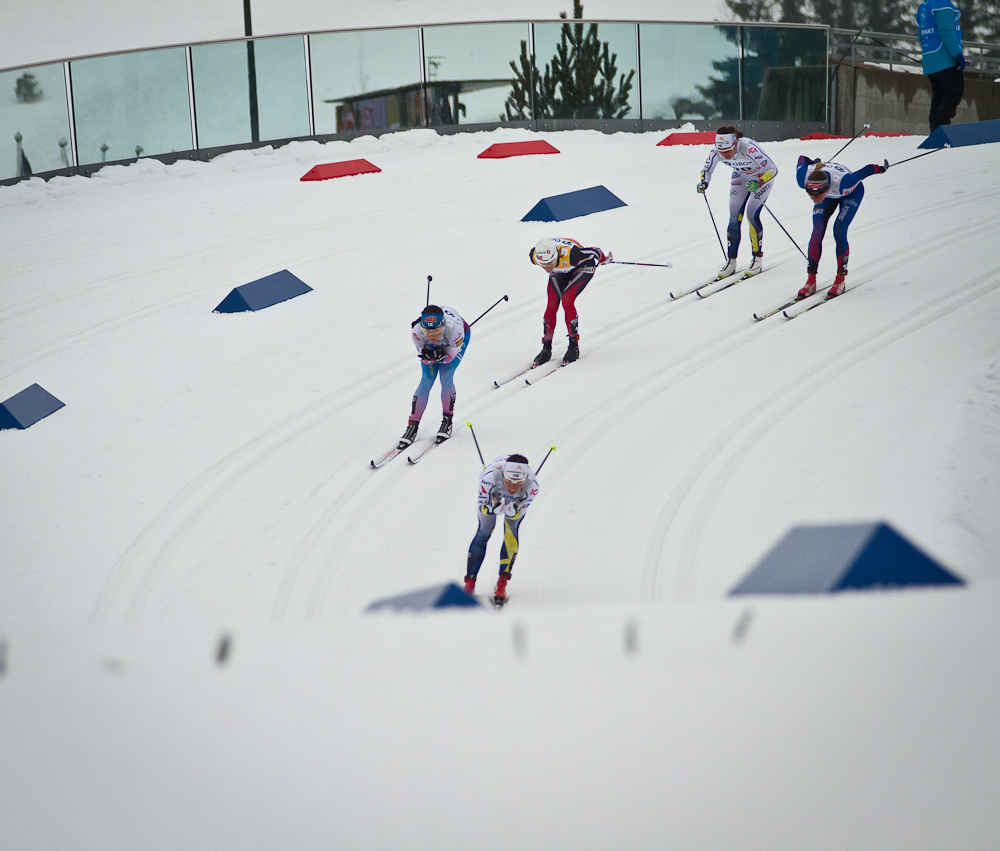
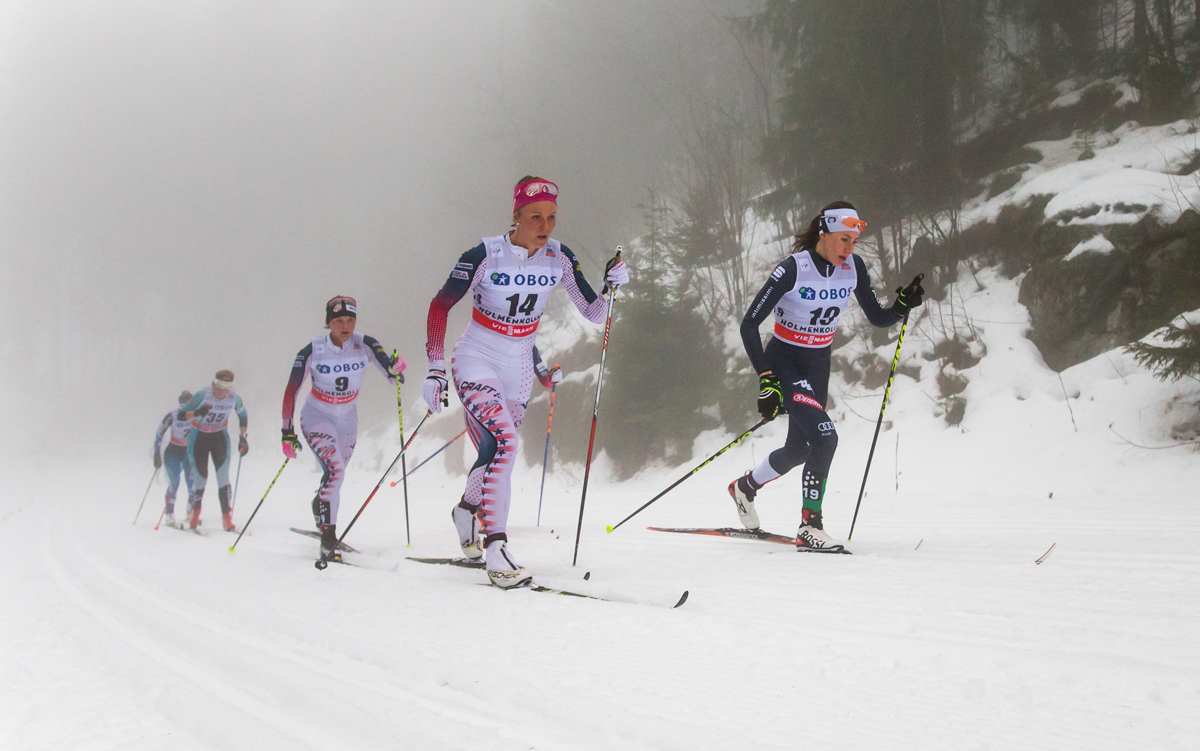
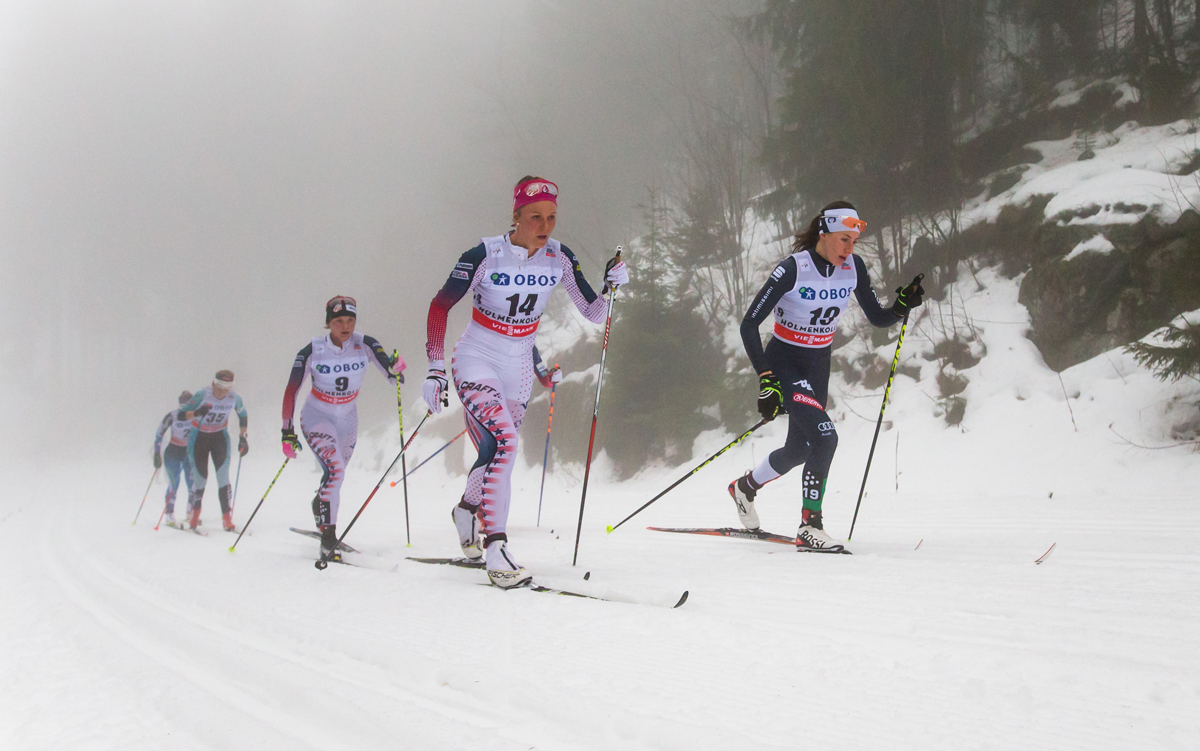
Sadie Bjornsen (14) leading a chase pack with Italy’s Virginia de Martin Topranin (r) and Jessie Diggins (l) just behind. (Photo: Fischer/NordicFocus)
“At some point it would have been nice to have the motivation of knowing that there were people within reach ahead, but it was probably also good at other places that I couldn’t see,” Patterson wrote in an email.
Since each 8 k lap climbed over the first three kilometers before a long descent, there was significant movement through the field depending on skis and the racers’ strengths.
“Sadie and Jess had very good kicking skis, but they were not gliding the fastest,” Whitcomb said. “We saw a lot of that in the field — a lot of women slipping and falling back on the climbs and those with slower skis and falling back on the descent.”
Diggins and Bjornsen lost time on the descent and fell out of contact with the chase group of 11 to 15 skiers.
By 10 k, Bjornsen and Diggins were skiing in a tight group of four racers, at 25th and 28th places respectively. Brennan slipped to 33rd, which she maintained for the remainder of the race.
Bjornsen and Diggins’ pack grew to seven racers by the 15.5 k mark, including teammate Stephens who had fought her way through the field after a beneficial ski switch.
“Her first pair of skis were slower and her second pair were really good. We were really hoping for good feelings out there for Liz and she felt great,” Whitcomb said.
At 18 k, Stephen picked up the pace and grabbed places each kilometer putting 11.7 seconds on the group and moving to 21st place within two kilometers. She continued to grab places, managing to reach 18th place by 28.5 k.
In the final kilometer, Bjornsen and several other skiers in the group managed to reel in Stephen, finishing in a tight group with only 15 seconds between 17th and 25th place.
“It was fun to share the majority of the kilometers with Jessie as we pushed each other along, and then chase Liz some there at the end,” Bjornsen wrote in an email.
“Today was one of the more challenging Holmenkollen’s both mentally and physically, but regardless, I still managed to truly enjoy the atmosphere out there while I was racing,” she wrote. “Conditions were challenging the entire race, and our team fought hard to stay in the mix.”
Stephen reflected on her race as “a step in the right direction,” in a U.S. Ski Team press release.
“I have been trying to manage a fatigued body this season and so the last 10 days that we spent training in Sjusjoen, Norway were all about recovery for me,” she said. “I trained slow, worked on some technique and rested more than I wanted to with perfect winter conditions right out the door each day.
“But each day I felt a little better and so today’s feelings were of a body that is much more recovered, has much more energy and spunk in it and I loved the foggy, wet conditions we had today,” she added. “I was mentally ready to charge again and my body responded positively to each push.”
Canada’s Emily Nishikawa (in red) racing to 39th for her best Holmenkollen 30 k result in the last two years (after placing 50th last year) in Oslo, Norway. (Photo: Fischer/NordicFocus)
Although the U.S. women put together respectable results on a very challenging day, “We just didn’t hit it out of the park,” Whitcomb said. “We had athletes who had one or two or three great laps but we didn’t have anyone who was able to put together four great laps. So that is why we saw somewhat muted results today.
“We were excited about Caitlin Patterson getting over here for her first big distance race. Finishing 36th is nothing to dismiss for sure,” he added. “We are happy she is feeling good and excited to see what she can do.”
“While in the U.S. someone often drives the pace a little at the beginning of a race to break up the field, it’s nothing like the pace in the World Cup with Johaug leading,” Patterson wrote. “I’m notoriously on the slow side for starting, and even though I knew it was going to begin fast today, it caught me off guard.
“I was frantic at the start, didn’t find the smooth and powerful style of striding that has served me well in other races this year, until well into the race,” she added.
Although she didn’t realize it due to the dense fog, Patterson went through the 2.7 k time check 47th out of 49 starters. However, she was able to find her rhythm and adjust to the demanding terrain and move up to finish 36th.
“The terrain is undoubtedly bigger, steeper, harder than basically anywhere I’ve skied in the U.S. In a classic race this means I have to push my limits, a long steep striding hill that we’d rarely be faced with in the US is very strideable but you have to figure out how to do it,” she wrote.
At the end of the day, Patterson remained positive. “We all have our weaknesses, and you really have to be at the top of your personal race game to have a chance to compete against the best in the world, and I’m as motivated as ever to keep making little steps whenever I can to get there,” she wrote.
World Cup racing resumes with classic sprints Thursday in Stockholm, Sweden, followed by weekend distance races in Falun, Sweden.
Americans Kikkan Randall (c) and Sadie Bjornsen (r) ski with Norway’s Marthe Kristoffersen (l) and Germany’s Nicole Fessel (second from r) in the Holmenkollen 30 k classic mass start on Sunday in Oslo, Norway. (Photo: Fischer/Nordic Focus)
There’s something to be said for skiing like you’ve got nothing to lose. Ask Kikkan Randall, who locked up the World Cup sprint title for the third year in a row last Wednesday in Drammen, Norway. Or Sadie Bjornsen, who’s been plagued with bouts of illness for the better part of the last three months.
Both U.S. Ski Team members later said they felt relatively good before the start and during most of the world-famous Holmenkollen 30-kilometer classic mass start on Sunday in Oslo, Norway.
It was still a dang-tough course, with an initial 5 k lap followed by a larger 8.3 k lap containing two smaller loops (at least the skiers kept it straight). After getting off to a strong start, Bjornsen said she was a little frightened with the tempo of the women she was skiing with.
“At four k, I was like, ‘There’s no way I’m going to be able to maintain this pace, but I’ll hang on until I explode,’ ” she recalled.
Bjornsen did her best to hold her position just outside the top 10, first testing her grit with some Finns, including Krista Lahteenmaki and Anne Kyllönen. The American quickly found their classic style didn’t match hers and she opted to ski with several Norwegians, including Tuva Toftdahl Staver, Ingvild Flugstad Østberg, Kristin Størmer-Steira, and Martha Kristoffersen for the first several kilometers.
Bjornsen said the Norwegians’ “really big strides,” matching hers, made the difference. “I was appreciative of that,” she said.
Kyllönen’s stride was simply too big, she said, and “Lahteenmaki, I felt like I was in a sprinting running race; she has a very short tempo. I followed her for a couple k and my legs were flooded.”
By 10 k, Norway’s Martine Ek Hagen was right there with Bjornsen as well, and Randall was just off the back of their seven-person chase pack, which at the time, was about a minute and 30 seconds behind eventual winner Marit Bjørgen.
With Norwegian fans lining the entire course, Bjornsen said the atmosphere brought her back to her international debut at the 2011 World Championships in Oslo.
American Kikkan Randall (15) racing to 12th, a career best in the 30 k, at the Holmenkollen 30 k classic mass start on Sunday in Oslo, Norway. (Photo: Fischer/Nordic Focus)
“It was World Championships loud,” Bjornsen said. “I kept hearing my name in the mix, but more than anything, I could hear them yelling, ‘Kikkan.’ She’s a national hero here. She’s huge.”
The crowd and endless cheers fueled Bjornsen to staying within the top 15 throughout the race, with Randall close behind for most of it. Ultimately, Randall shot to the front of the pack and continued to pick off places with 1.5 k to go, finishing 12th for her career-best 30 k, just 10 seconds ahead of Bjornsen in 14th, also her best distance race.
Two years ago — the first time Bjornsen raced in Holmenkollen — she placed 40th in the 30 k classic. She did not race there last year.
“I couldn’t have picked a better way to ski it with four Norwegians,” Bjornsen said after going head-to-head with Heidi Weng, Østberg, Hagen and Kristoffersen to the line. She beat all but Weng, who took 13th by 0.4 seconds, and edged Østberg by one-tenth of a second for 14th, 4:27.8 back from Bjørgen. The top Norwegian became the first woman to win four Holmenkollen titles in what doubled as her 100th World Cup podium.
Randall finished 4:17.7 after Bjørgen, without anyone within several seconds of her. She recalled being 100 meters behind the pack for most of the middle part of the race, with skis that were “a little slick” on the first lap sending her in for a fresh pair at 13.3 k.
Bjornsen changed there as well, where she said everyone was switching. Skiing on her “B-pair” until that point, she said her skis were great — gripping on the uphills and fast enough on the downhills. But she wasn’t about to second guess what everyone else was doing, and changed to her A-pair. That was the first time a ski change worked out in her favor, she said.
The group she was with never switched again (out of a possible three times), and while most struggled with kick on the icy last lap, Bjornsen said it was the same for everybody.
The turning point for Bjornsen and Randall’s group came with 5 k to go. Bjornsen and Staver fell off the pace slightly around 20 k, but worked their way back up by the top of the long climb known as Frognerseteren. By then, Bjornsen and Randall racing with five Norwegians and Japan’s Masako Ishida.
“We came down the hill and suddenly [the Norwegians] started sprinting so hard,” Bjornsen said. “Suddenly, they’re in sprint pace and I was like, ‘Wow, are they going to do this to the finish? This is gonna be really hard.’ ”
About a kilometer later with 4 k remaining, the pace slowed. Randall then took off before the 28.5 k checkpoint.
“Now I’m kicking myself for not trying to go with her,” Bjornsen said. “But she was so impressive.”
After changing her skis, Randall said her arms started cramping on the second lap, but she double poled with her legs and core as much as possible, and was able to latch back on by the top of the course on lap three.
“It’s kind of a nice feeling when you get to the top of the course on that third lap — now you know some of the big hills are done and … see whats left in the tank,” she said.
With two climbs remaining, Randall knew she had the speed and energy to knock off a few places in the standings. She jumped in her own track and skied her own tempo, then simply “ran out of room toward the finish,” she said. “It’s aways fun having people to catch.”
The result was something she could be pleased with, especially in a distance classic race that isn’t typically her bread and butter. Going into the 30 k, Randall said she didn’t have to worry about her mind wandering off to the upcoming sprint at World Cup Finals on Friday. Had the pressure been on to win that sprint, she might have approached Holmenkollen differently, especially as the race got tougher.
“It was kind of nice to be able to wrap up the Sprint Cup and go, ‘Now I just get to race,’ and not worry about whether it’s a smart decision or not,” she said.
While Randall was aiming for a top 15, Bjornsen said she wasn’t sure what to expect for a result. She had come down with one of her worst colds yet after the Sochi Olympics, and went for her first 30-minute walk/ski last Tuesday. She raced Wednesday in Drammen (qualifying in 21st then placing 30th), then focused on getting healthier each day until the 30 k.
“I would say now I’m 100 percent,” Bjornsen said.
Reflecting on her second Holmenkollen experience, she said this one will definitely be among her most memorable races.
“Holmenkollen has such an incredible atmosphere,” she said. “I was trying to take in the noise level at the top of Frognerseteren, so that helped and also skiing with a bunch of Norwegians.”
Sophie Caldwell (U.S. Ski Team) racing to 35th in her first Holmenkollen 30 k mass start in Oslo, Norway. (Photo: Fischer/Nordic Focus)
Three other U.S. women made the top 40, and Ida Sargent was close behind in 42nd.
Liz Stephen placed 32nd (+8:30.2) after two crashes. Sophie Caldwell finished 35th (+8:48.1) in her first Holmenkollen 30 k, and Caitlin Gregg (Team Gregg/Madshus) was 39th (+10:15.3).
“Tough day for me with a couple of crashes early on, but nothing serious like Astrid [Jacobsen] experienced,” Stephen wrote in a message, referring to the Norwegian’s scary crash off a ledge that sent her to the hospital. She suffered a blow to her head, shoulder and hip, but was not seriously injured, according to NRK.
“The atmosphere here at Holmenkollen is definitely something special, with fans chanting your name, and campfire smoke billowing in the air and sausage smells and fresh waffle smells wafting throughout the race,” Stephen wrote. “Someday I am going to have to come camp out and be one of the fans out there, for sure.”
Caldwell explained that it was a long enough race that she had “multiple highs and lows throughout it, but overall I think it went well,” she wrote in an email.
She switched her skis once at 13.3 k because everyone else was doing it, not necessarily because she needed to.
“I got to ski with Liz a bunch which was fun and then otherwise kind of hopped between a couple groups,” Caldwell wrote. “The race atmosphere was insane. There are people lining the entire course who have been camping out all weekend and they all know your name. They have start lists, so as long as you aren’t skiing with any Norwegians, they start chanting your name as you go by. I think the extra cheers definitely helped motor me around the course.”
According to Gregg, who was especially confident in her skis and stuck with the same pair throughout the race: “no matter how you are feeling, the spirit of the crowds lift you up.” While the classic race wasn’t her specialty, she enjoyed the length.
“My result was solid but certainly not outstanding,” Gregg wrote. “Some of girls had awesome races today so that was really cool! I found the pace right off the gun to be ridiculously fast and it kind of caught me off guard. I was in last place from the end of the stadium. This is something I obviously need to work on. Throughout the race I continued to move up steadily as other racers got tired.”
Gregg with travel with the U.S. team to race at the three-day World Cup Finals in Falun.
“This will be my first time racing there and I am very excited about the format!” she wrote.
Bjornsen said making it to World Cup Finals has been her major goal since last season.
“It’s going to be fun because it’s a lot of different races,” she said.