From the FasterSkier archive — posts syndicated from athletes’ and coaches’ own blogs between 2004 and 2012, kept online as published. Current coverage is at fasterskier.com.
It doesn’t get much better than a weekend of full sun, epic skiing and meetings with the king of Norway. But that’s what we’ve got for you after another fun weekend of racing, at Oslo’s classic Holmenkollen venue. With help from Canadian retired Olympian Jess Cockney, we break down the 30 k and 50 k from Saturday and Sunday, touch on the COVID outbreak that’s hitting World Cup teams including the U.S. and take the International Ski Federation to task for canceling World Cup finals.
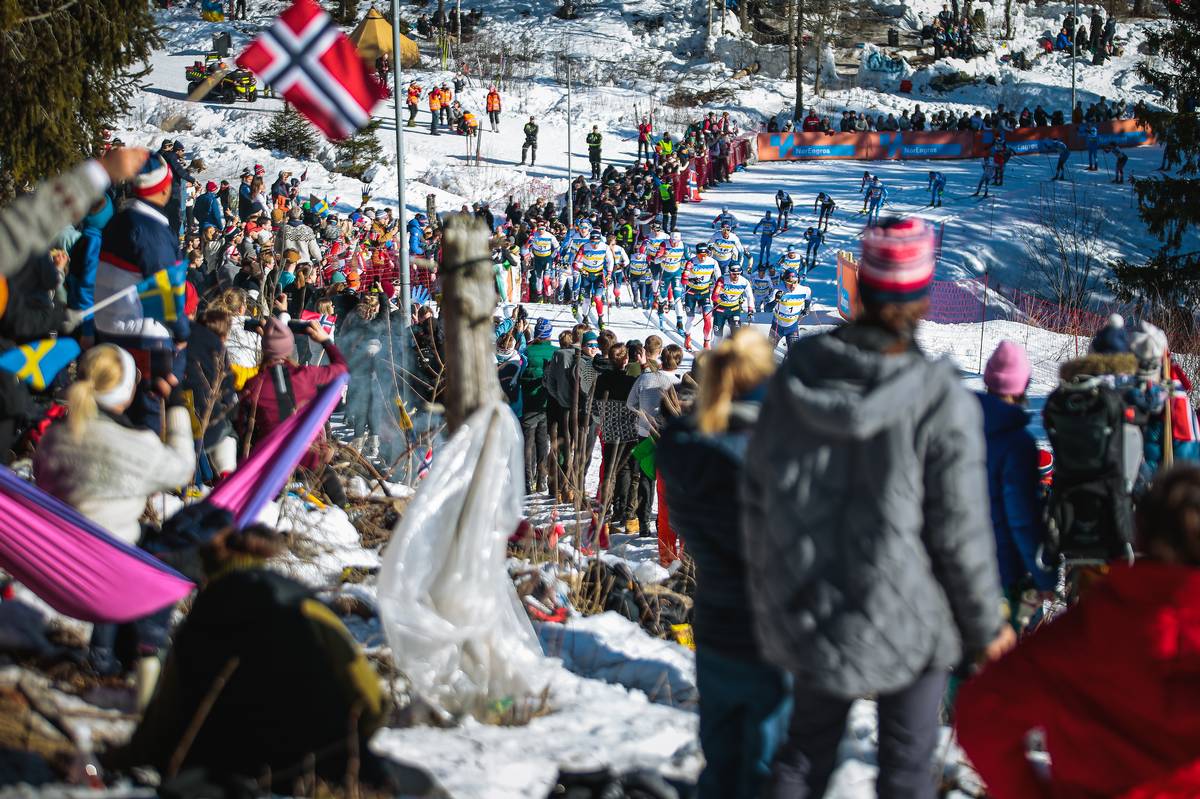
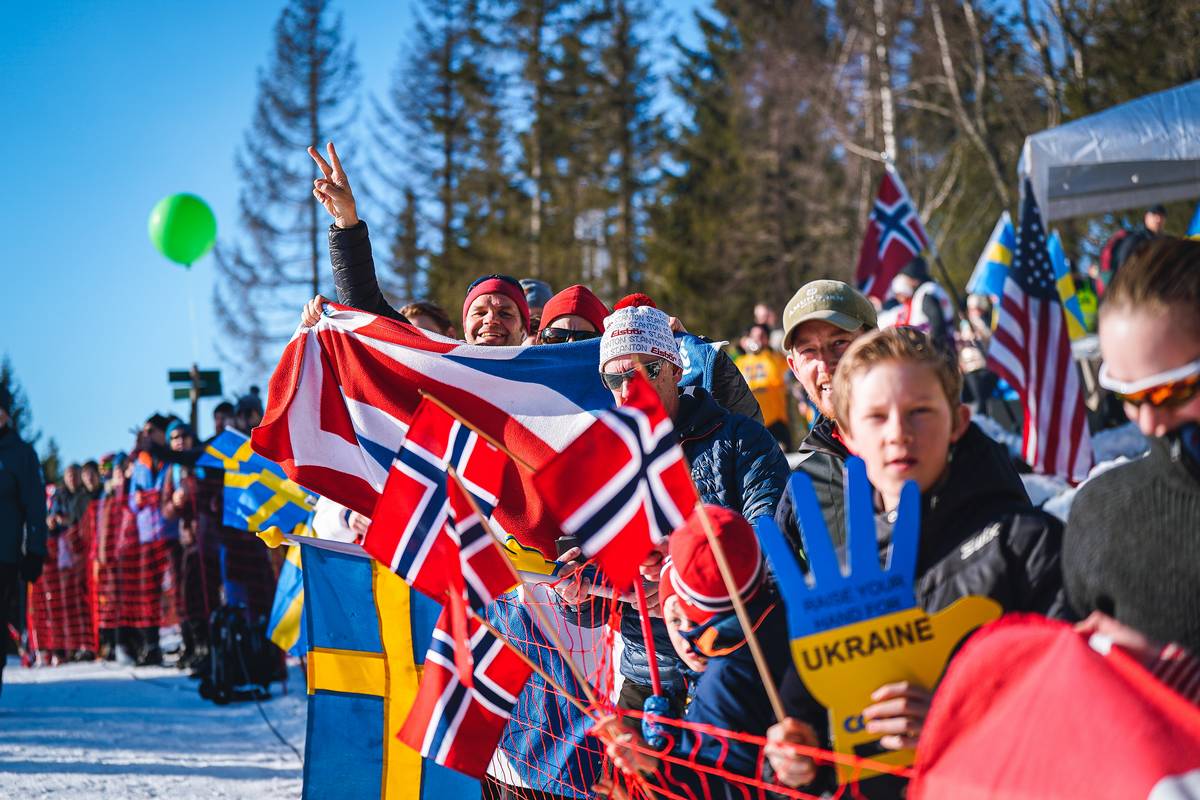
Crowds returned in droves to Holmenkollen for the men’s 50 k mass start classic. (Photo: NordicFocus)
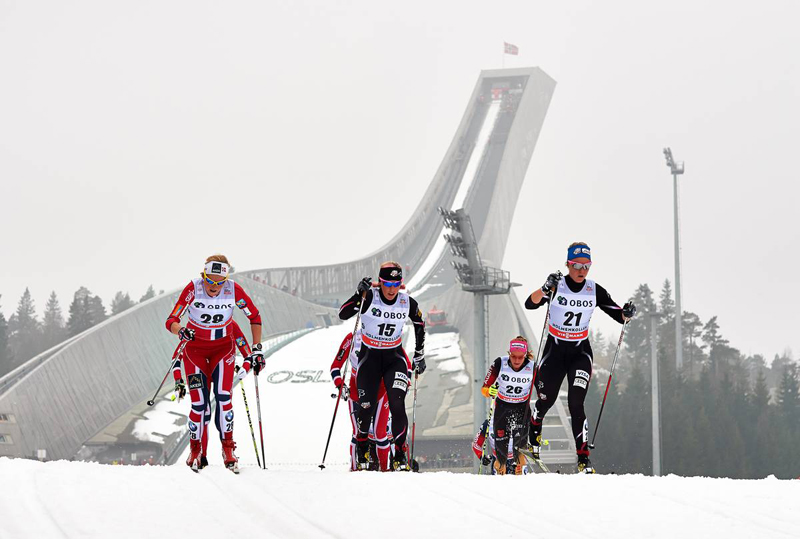
Crowds line the storied tracks at Holmenkollen during the women’s 30 k classic. (Photo: NordicFocus)
This World Cup coverage is made possible through the generous support of Marty and Kathy Hall and the A Hall Mark of Excellence Award. To learn more about A Hall Mark of Excellence Award or to learn how you can support FasterSkier’s coverage please contact info@fasterskier.com.
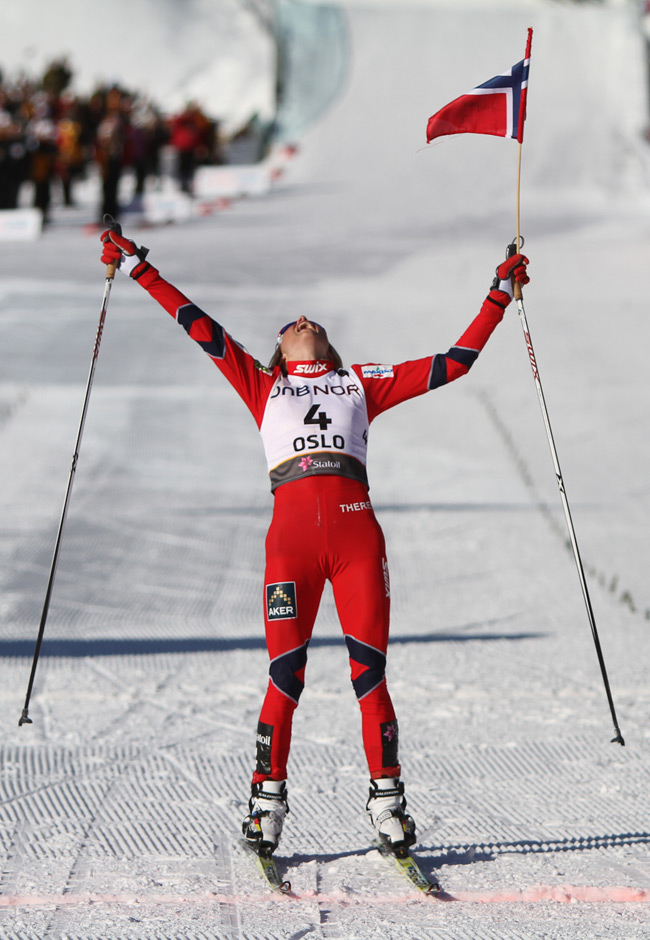
Terese Johaug wins her first individual World Championship gold medal in the 30 k mass start skate in Oslo, NOR. (Photo: FS Archives)
Eleven years ago to the day, racing the 30-kilometer mass start skate, a 22-year-old Therese Johaug won her first individual World Championship gold medal in a breakout performance at Holmenkollen near her home in Oslo, NOR. In doing so, she had broken apart a field of women considered legends of the sport on an equally legendary course known for long grinding climbs that require superior fitness and technique. Johaug won by nearly 45 seconds over one of the greatest cross country skiers of all time, her teammate Marit Bjørgen, and was 1:34 ahead of the Polish champion Justyna Kowalczyk.
“It was hard for me. It’s hard to see her go in front, and the gap [grow] bigger and bigger,” said Bjørgen that day. Then at the peak of her career, Bjørgen had gone four-for-four that week with gold medals in each of the previous World Championship races in Oslo, and the upset was a shock to those following along. “But I’m very happy for Therese. She is a young girl, and a girl for the future—and for Norway.”
Little did cross country ski fans know just how storied the athlete’s career would be.
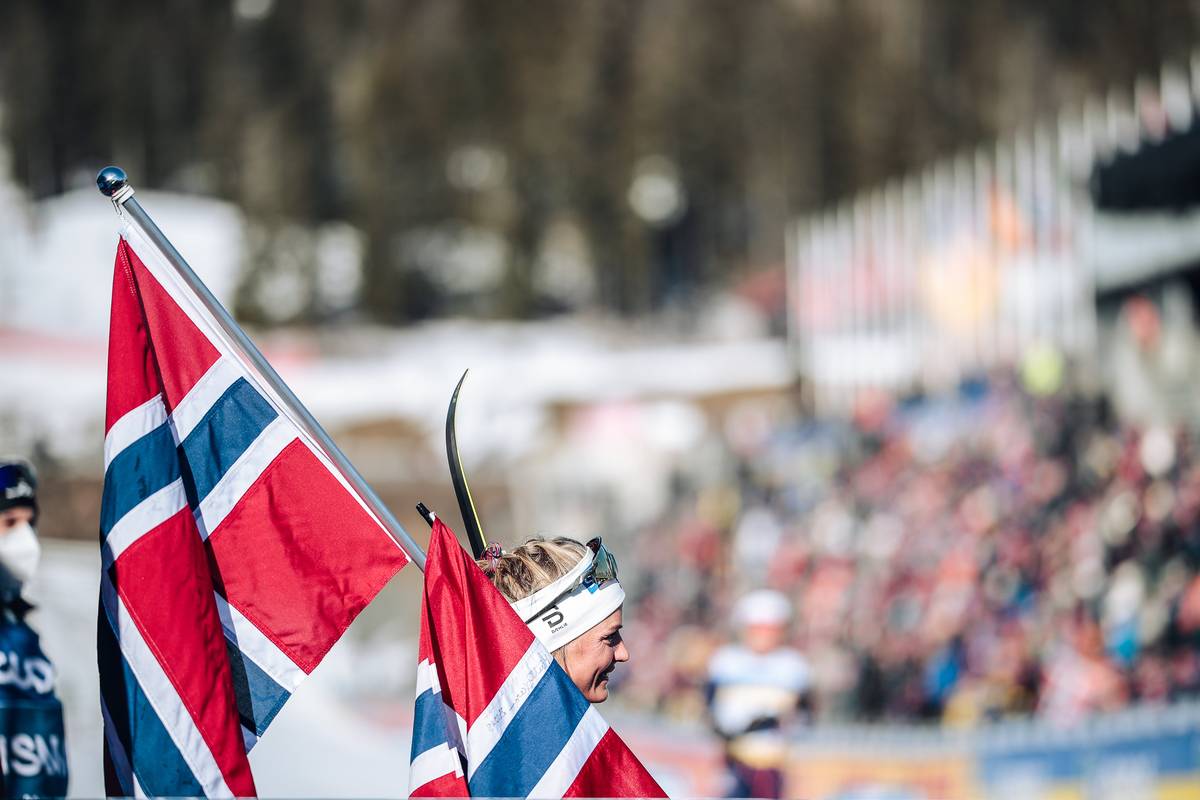
Therese Johaug races in front of a home crowd during the 30 k classic at Holmenkollen. (Photo: NordicFocus)
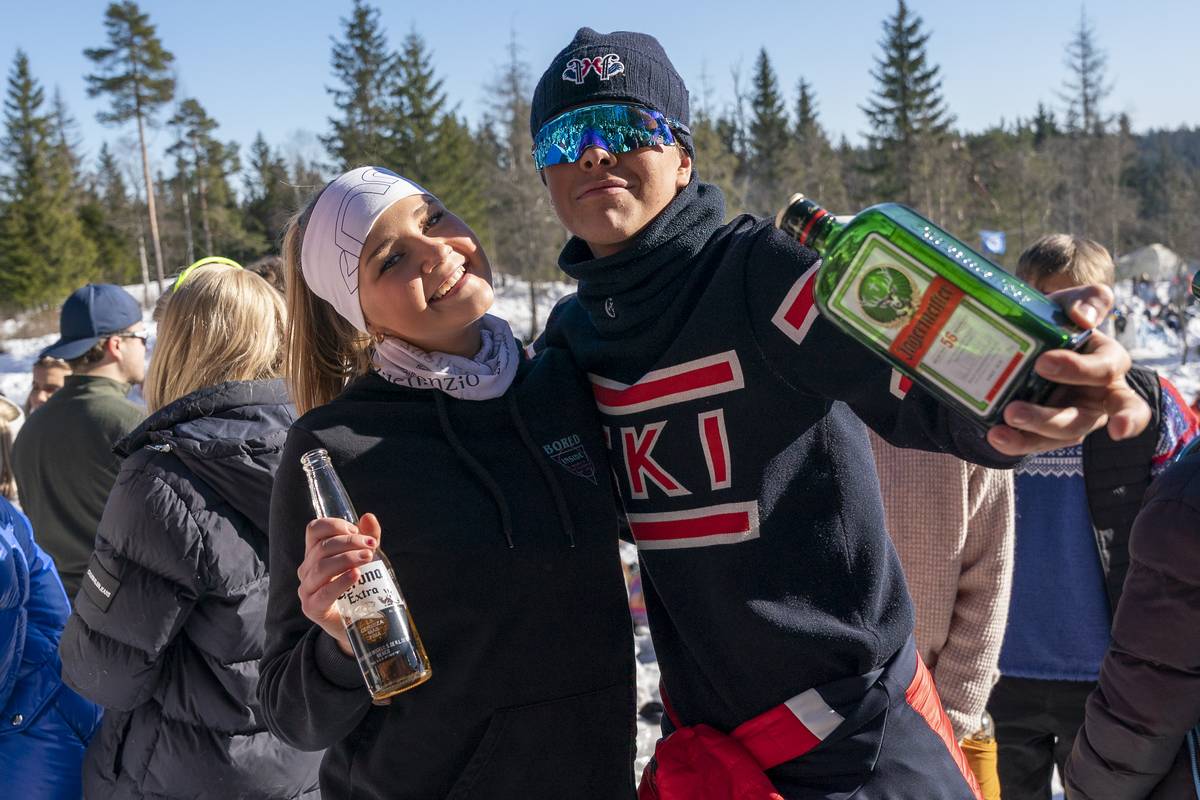
Today, under clear skies that allowed for views of the city skyline and Oslofjord, Norwegian flags flying, and fans returning to the crowded stadium and partying in the woods, she did it again, as one of her final performances after more than a decade as the top female distance skiers of all time.
And what’s more, Johaug won today’s 30 k classic in the same dominant fashion that she did eleven years ago, and has done many time since, stopping the clock at 1:19:22.8.
Though the final results show just 19.4 seconds as her winning margin, this only tells part of the story. By 10 k, Johaug held a margin of over 23 seconds, which she steadily grew over the subsequent laps. At 25 k, she led by nearly a minute and a half.
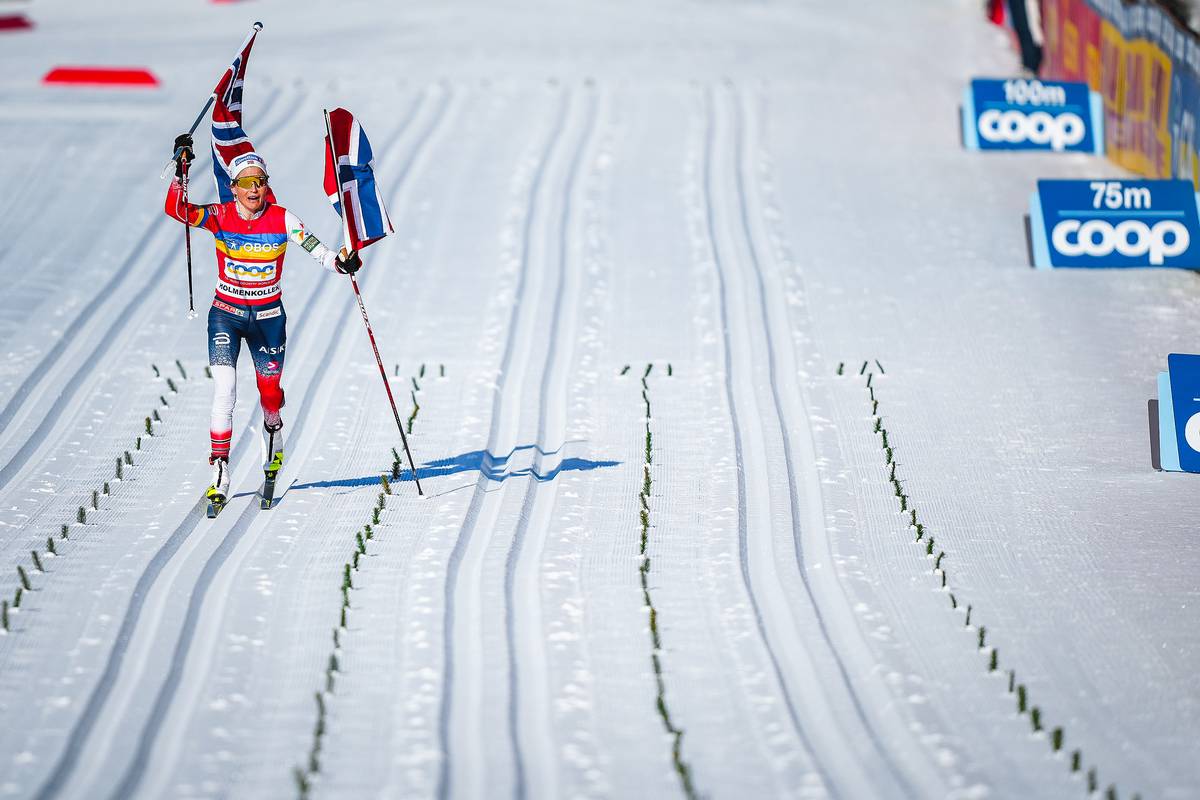
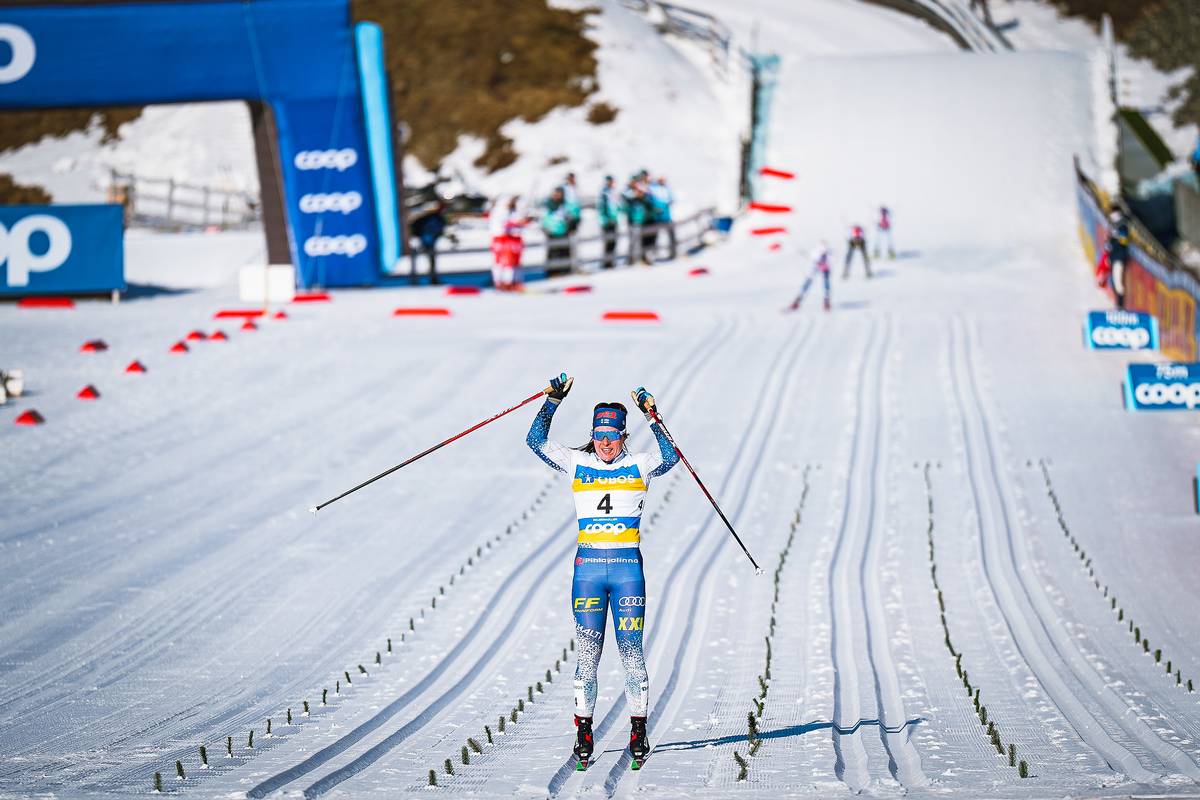
Therese Johaug waves Norwegian flags as she skis the final meters of 30 k classic at Holmenkollen. (Photo: NordicFocus)
As she entered the stadium, Johaug was greeted by coaches and techs who handed her a flag for each hand, which she carried through the finish, waving, and stopping to take in the erupting cheers from the crowds.
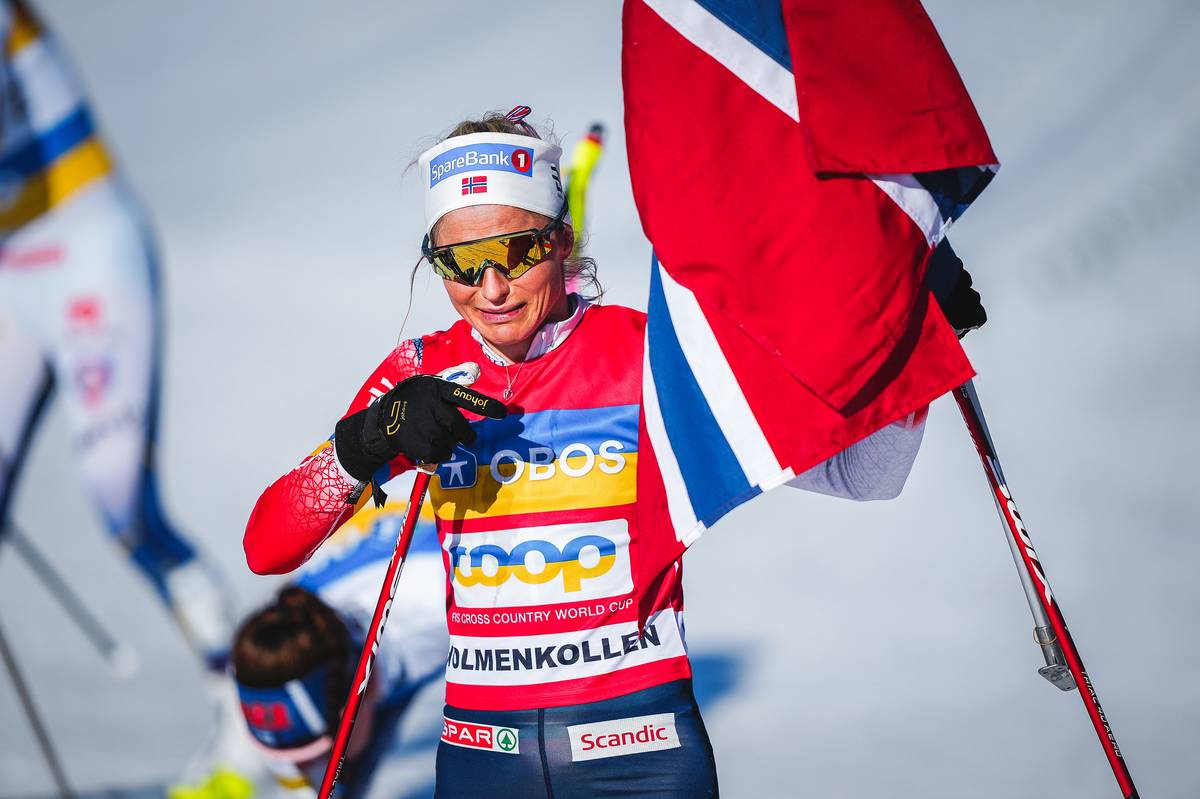
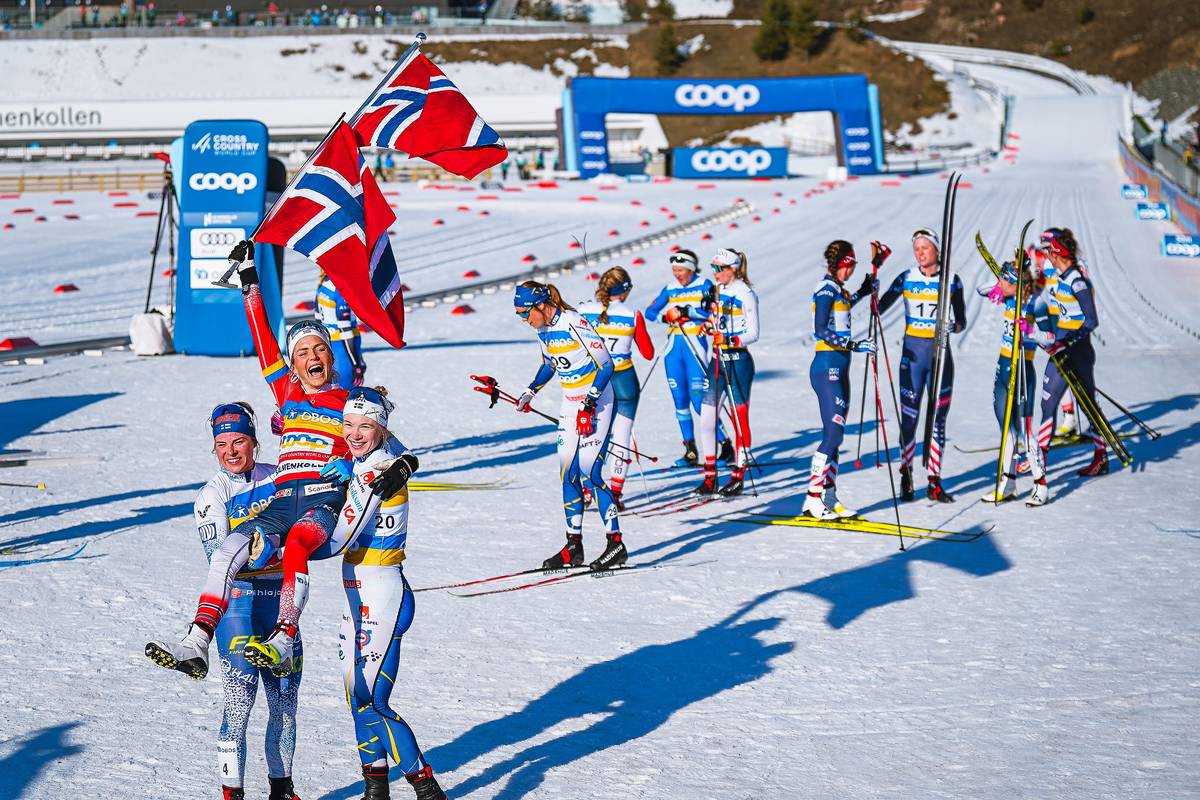
Laughing behind tears as the rest of the field began to trickle across the line, Johaug was hoisted onto shoulders, waving her flags for a loud Norwegian crowd who had supported and applauded her through fifteen years of racing on the World Cup.
“It’s a lot of emotion now,” Johaug said at the finish. “I start here in 2011 with my first individual victory, and today is my last race here. It was sun and blue sky, the same as in 2011, and there were a lot of people around the track cheering for me. I’m so happy now, but also so sad that this is the end of my career.”
Therese Johaug was emotional at the finish of today’s 30 k classic at Holmenkollen, the venue where she won her first individual World Championship gold in the 30 k skate eleven years prior. (Photo: NordicFocus)Norway’s legendary Therese Johaug wins the 30 k mass start classic, exactly 11 years after her first individual World Championship gold medal was won on the same tracks. (Photo: NordicFocus)
While she indicated during the Olympics that she would not compete another four years, it was not until yesterday that she officially announced that this would be her final race at Holmenkollen.
“In many ways, it feels as if the [story] ends when on Saturday, March 5, 2022, I stand on the starting line for another 30 k in Holmenkollen. I really do not want the journey to end, but it is a time for everything,” she wrote to NRK. “In light of this, I look forward to a final fight at home with the flag on my chest, and I am grateful for everything the sport has given me.”
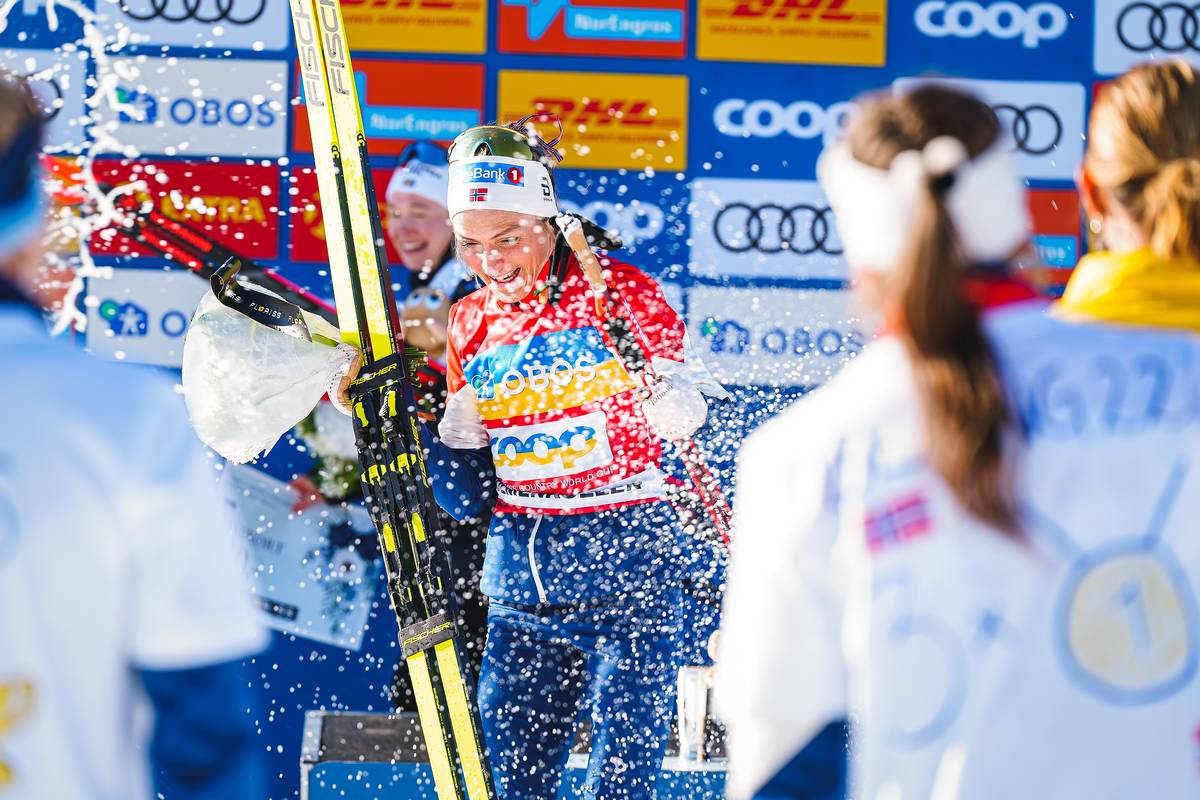
Therese Johaug is showered with champagne after winning the 30 k classic at Holmenkollen following her retirement announcement. (Photo: NordicFocus)Therese Johaug celebrates her final race race at Holmenkollen, winning the 30 k classic exactly eleven years after taking her first individual World Championship gold on these tracks. (Photo: NordicFocus)
As Queen’s “We are the Champions” blared through the stadium, Johaug stepped off the podium only to be soaked by champagne sprayed by a flock of teammates wearing shirts spelling her name, with “takk” – thank you – written with a heart at the end of the row. It was a joyous celebration fitting for the moment, and perhaps also a refreshing distraction from the times at large.
“There are a lot of strong moments, but I am moved when so many people come here and see my last race. I must thank the Norwegian people who stand here today,” Johaug later said to NRK.
While you can certainly expect a more in-depth look at her storied career on FasterSkier, for now, we’ll echo the crowds in congratulating Therese Johaug, and we look forward to following along for the next chapters.
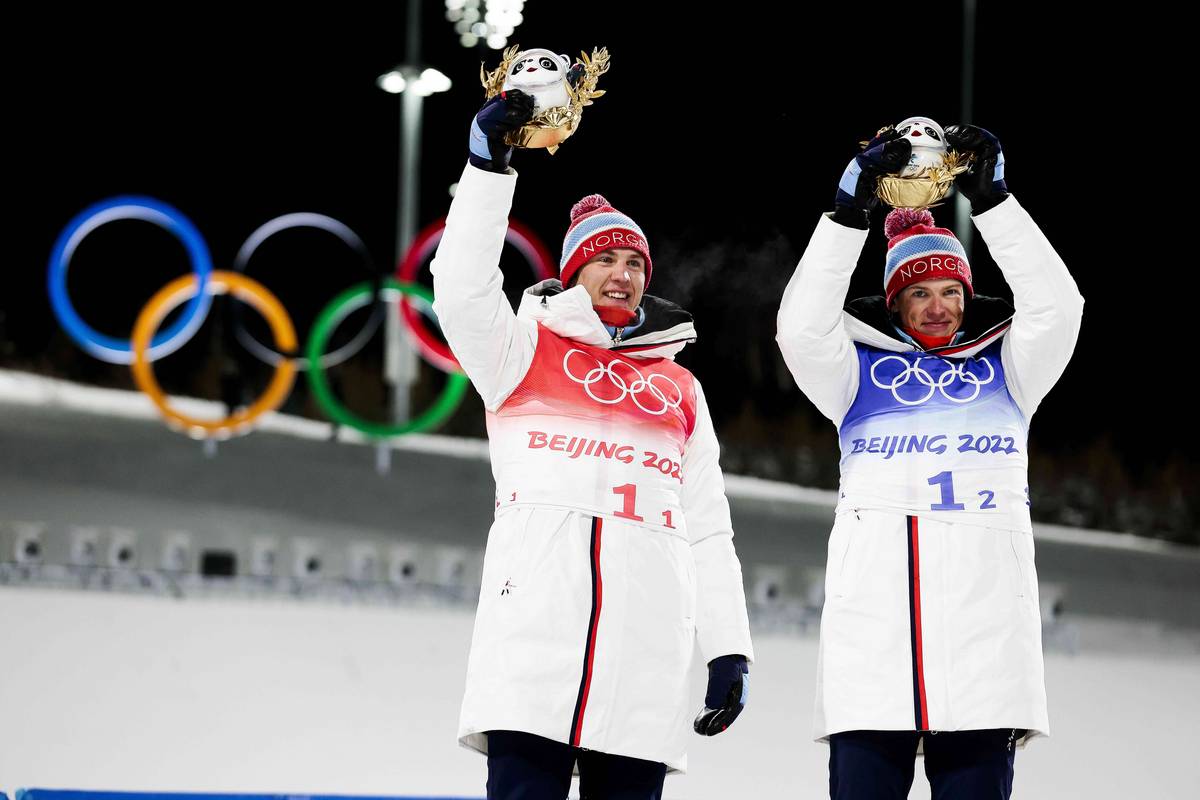
Therese Johaug celebrates her final race race at Holmenkollen, winning the 30 k classic exactly eleven years after taking her first individual World Championship gold on these tracks. (Photo: NordicFocus)Krista Pärmäkoski (FIN) and Jonna Sundling (SWE) lift champion Therese Johaug (NOR) for a podium shot at the finish of the 30 k classic in Oslo. (Photo: NordicFocus)
Behind the celebration, the lineup of women in today’s top-10 was remarkably similar to the Olympic 10 k interval start classic, with a few name swaps, and of course, a few noteworthy athletes missing – namely, Natalia Nepryaeva and Tatiana Sorina of Russia, and Jessie Diggins, who had been fourth, seventh, and eighth, respectively.
The volume of the ringing cowbells swelled as Finland’s Krista Pärmäkoski skied through the stadium on her own for second place, after pulling away from the first chase pack with 5 k to go and maintaining a healthy 10-15 second gap through the finish. Coming back on form after a few rocky seasons, Pärmäkoski had been third in the 10 k classic in Zhangjiakou, behind her teammate Kerttu Niskanen, who was fourth today (+33.8).
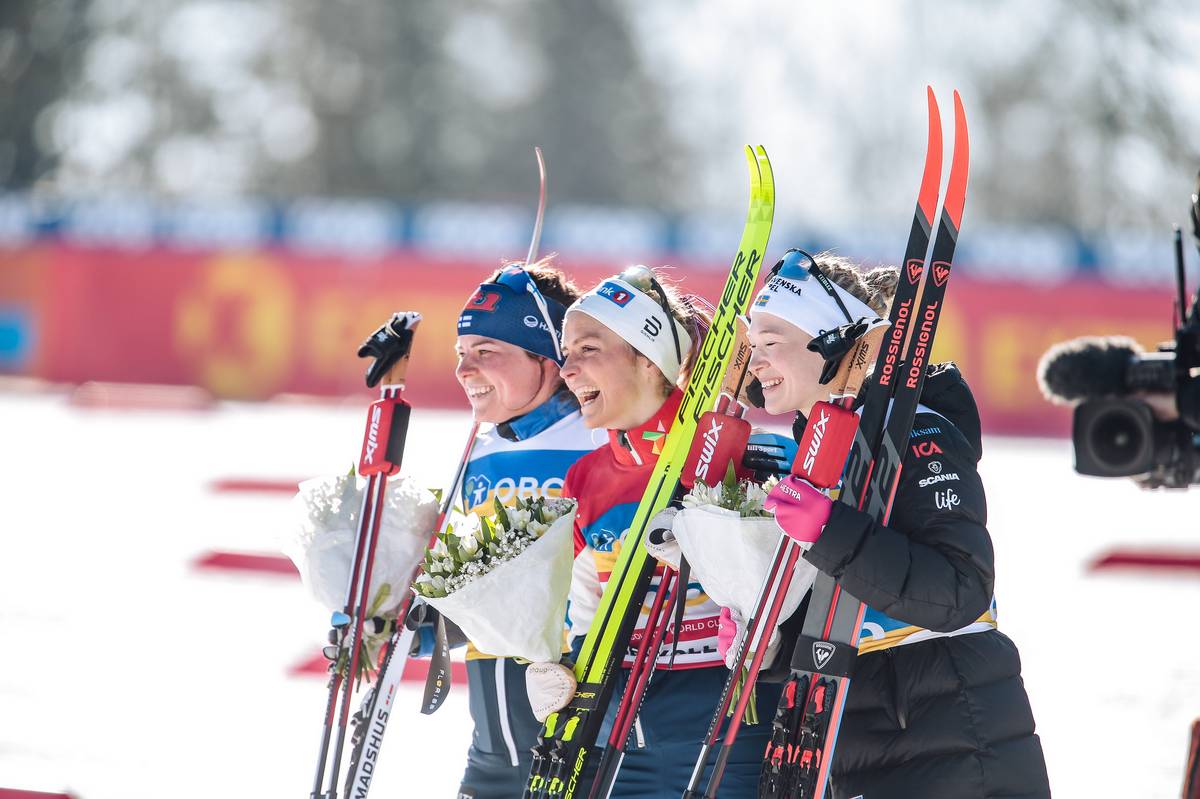
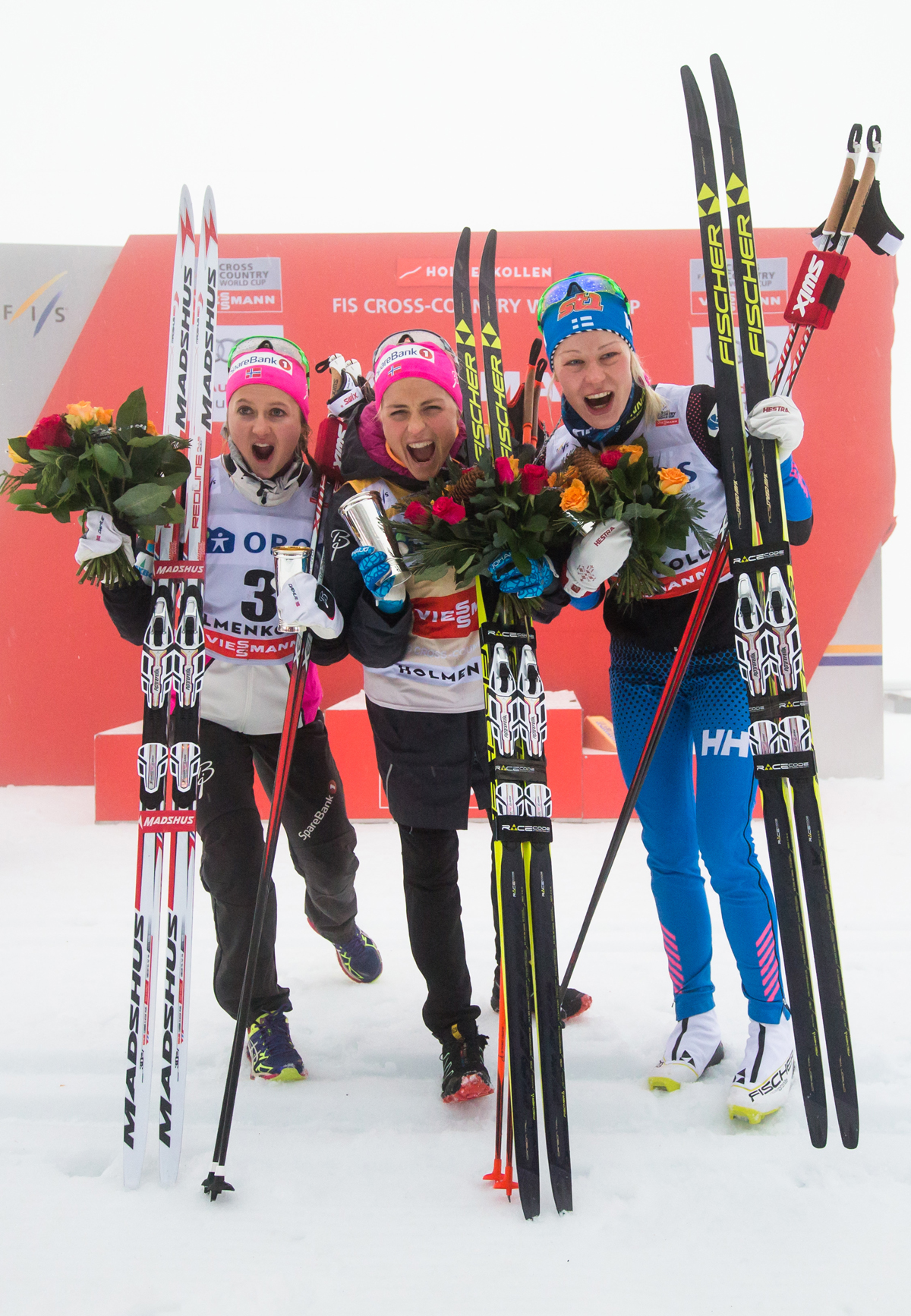
Finland’s Krista Pärmäkoski takes second in the 30 k mass start classic at Holmenkollen in Oslo, NOR. (Photo: NordicFocus)The women’s 30 k classic podium at Holmenkollen: Therese Johaug (NOR) took the win ahead of Krista Pärmäkoski (FIN) and Jonna Sundling (SWE). (Photo: NordicFocus)
Between the Finns, Sweden’s Jonna Sundling reaffirmed her talents across all distances, taking the third spot on the podium (+32.3) just two days after being second in Drammen’s classic sprint. Matching her fifth place result in the Olympic 10 k, Germany’s Katharina Hennig followed Niskanen to the line (+34.7) with Therese Stadlober, who was ninth at the Games, crossing after a gap in sixth (+46.7).
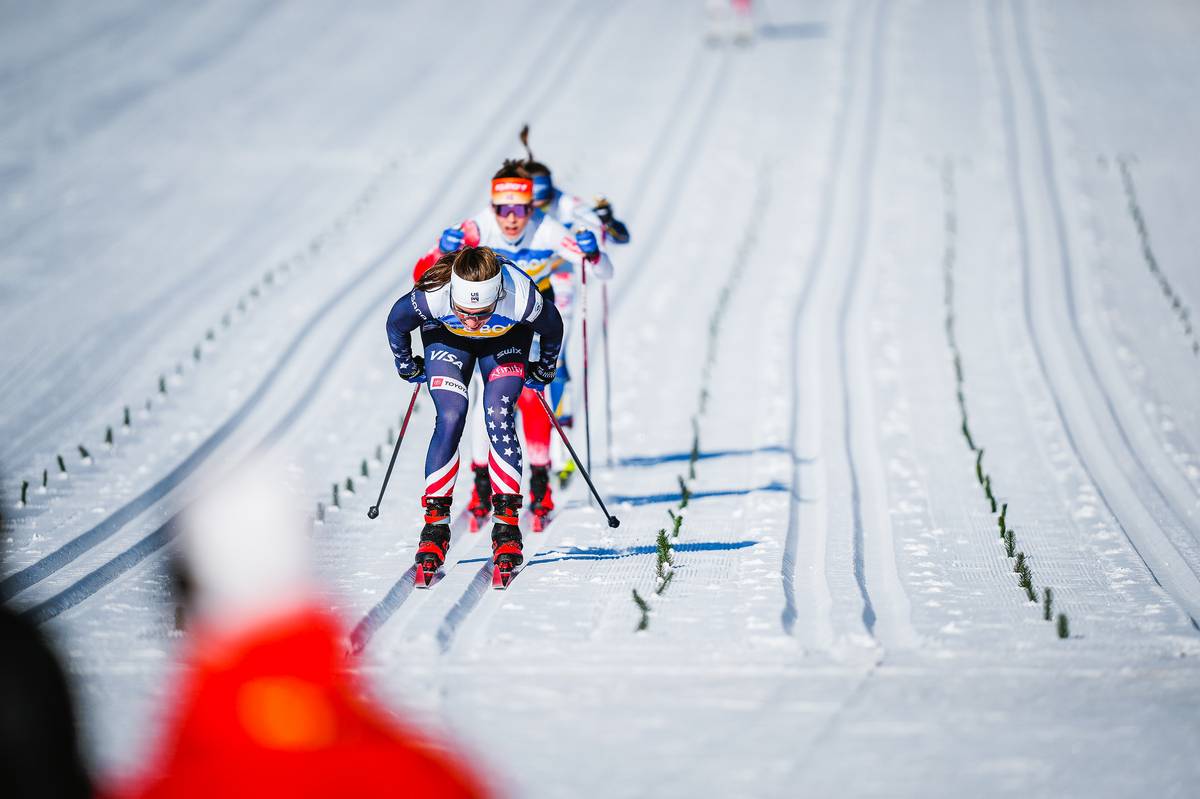
Leading the next chase group, and the American team, was Rosie Brennan in seventh (+1:12.3), bringing Norway’s Marte Skaanes and Sweden’s Ebba Andersson to the line just behind her for eighth (+1:13.1) and ninth (+1:13.8), respectively.
Rosie Brennan leads Norway’s Marte Skaanes and Sweden’s Ebba Andersson to the line. (Photo: NordicFocus)
“Today was huge for me,” Brennan wrote in a post-race email. “I have struggled here my entire career, and [though] it’s been a few years since I’ve raced here and I have improved a lot in the last few years, I still felt I lacked a lot of confidence and excitement coming here [today]. It’s also been a really stressful week for a variety of reasons, so I showed up today with an immense amount of anxiety that I needed to get a hold of before the race started.
“I am really proud of giving myself another chance to put together a good race here and to have managed the stress and anxiety well enough to do so. I wasn’t feeling in a place to shoot for the moon so I tried to start a bit a conservative the first 5 k and then reevaluate. I had a great ride with Ebba and really had an enjoyable time skiing out there today. The last lap, we had the chance to pick off a few from the lead pack and so I started to ramp things up to see what was possible. I felt strong on the last climb and felt I had a good shot at the sprint finish so I went on the last little bump before the [last 100 meters]. It felt great to finish strong and to put together a really solid race today.”
Rosie Brennan skis to seventh in the 30 k classic at Holmenkollen. (Photo: NordicFocus)
Following her classic sprint race in Drammen Thursday, Brennan joked post-race that she had lost out on yet-another boot slide. Today, the final sprint was hers. It was perhaps, also worth American fans celebrating that today that she won amongst her chase group, just under two weeks after a brave and gritty performance in the Olympic 30 k skate where she had pulled the chase group for much of the race, wearing herself out to break the wind, only to be dropped in the final 600 meters as Niskanen pulled away for a bronze medal. However, Brennan said she is not connecting any dots between the two.
“This race was nothing like Zhangjakou, really hard to even compare the two. 30 k’s are always an adventure and I am really happy to have put together two strong ones, in each technique.”
Rosie Brennan skis to seventh in the 30 k classic at Holmenkollen. (Photo: NordicFocus)
Commenting on how she is feeling, mentally and physically, with one final race weekend to go, Brennan concluded, “I am really bummed that the [World Cup] Finals were canceled. I haven’t raced a ton this season because of the earlier cancellations and while it has been a very high density block since the Olympics started, I am still feeling strong and wanted to see what I could do. But it will be really fun to end the season with the mixed relay event as that is a new one for us!”
Julia Kern was next for the US in 23rd (+3:37.2), followed by Hailey Swirbul in 26th (+3:57.8), and Caitlin Patterson – six days after taking second at the American Birkie – in 30th (+4:11.5).
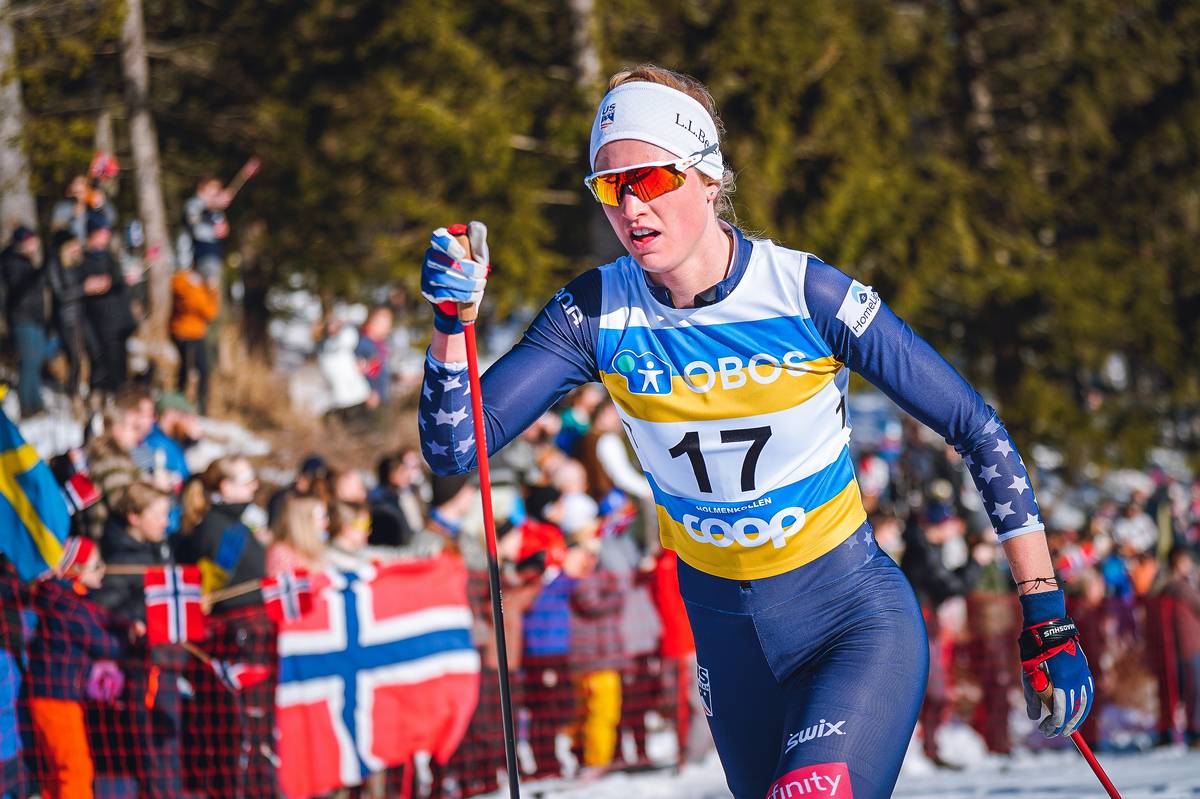
Julia Kern skis to 23rd in the 30 k classic at Holmenkollen in Oslo, NOR. (Photo: NordicFocus)Hailey Swirbul skis to 26th in the 30 k classic at Holmenkollen in Oslo, NOR. (Photo: NordicFocus)
In a post-race call, head coach Matt Whitcomb shared that Kern’s result was perhaps especially noteworthy as she has been struggling throughout the season with nausea during distance races, making it difficult for her to keep down fluids taken in prior to the race, let alone receive feeds during. Whitcomb also explained that Diggins sat out today’s race as she was feeling lingering fatigue from the long, and successful, season of racing. He affirmed that she is healthy and will be ready to race for the final World Cup weekend in Falun, beginning next Friday. Listen to the full call with Whitcomb below.
Outside the top-30 for the US, Katharine Ogden was 37th (+5:54.1), followed by Rosie Frankowski, who has consistently landed on SuperTour podiums throughout the season, in 46th (+8:12.2).
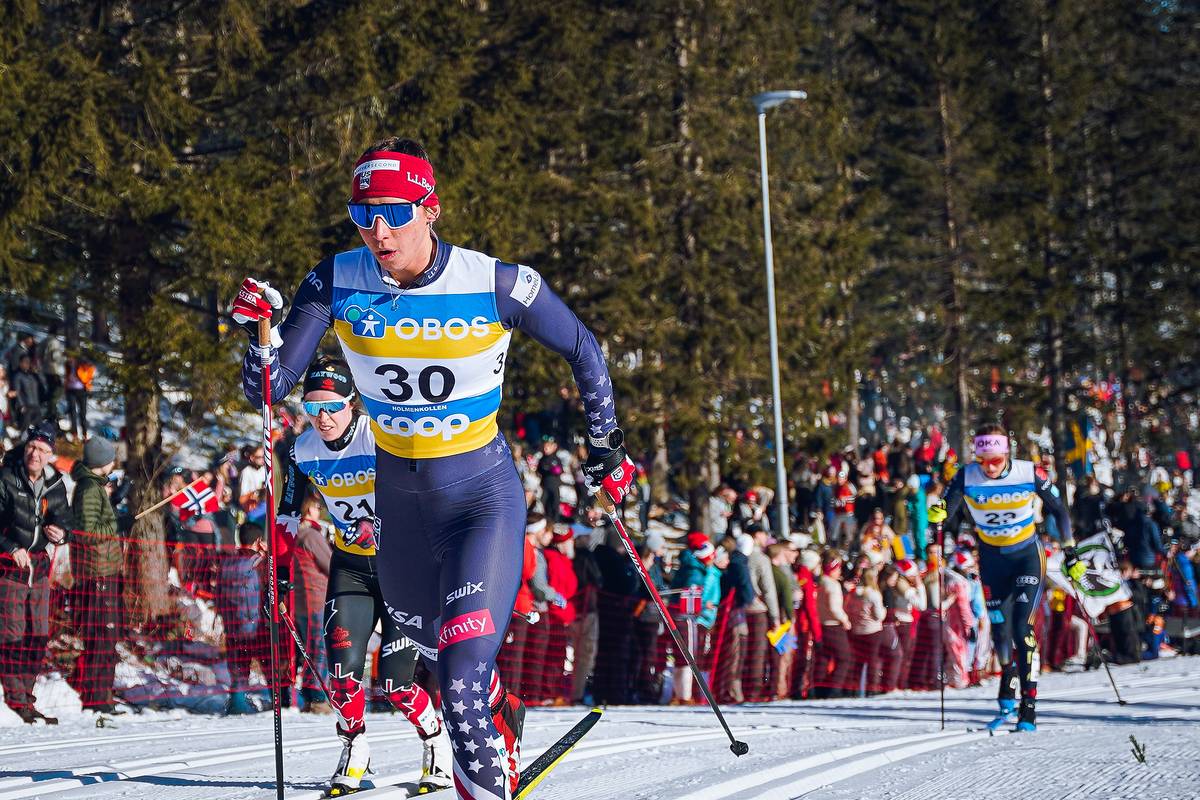
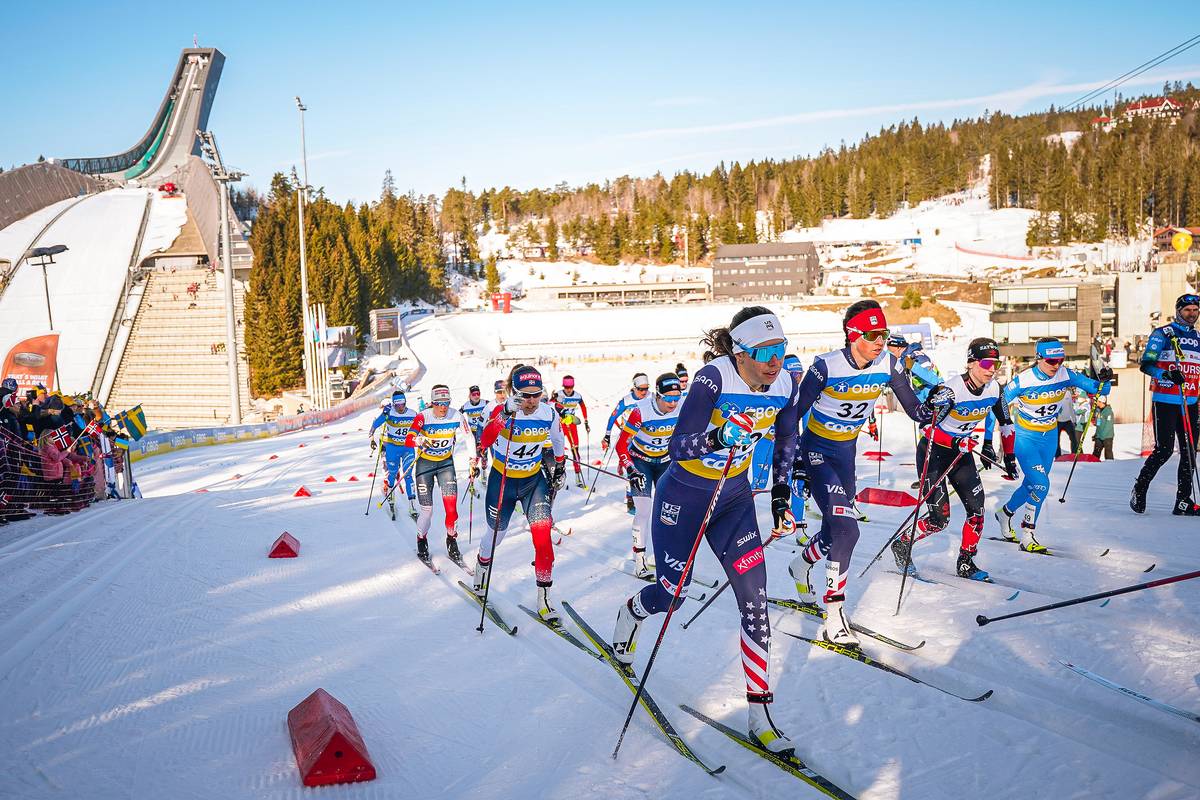
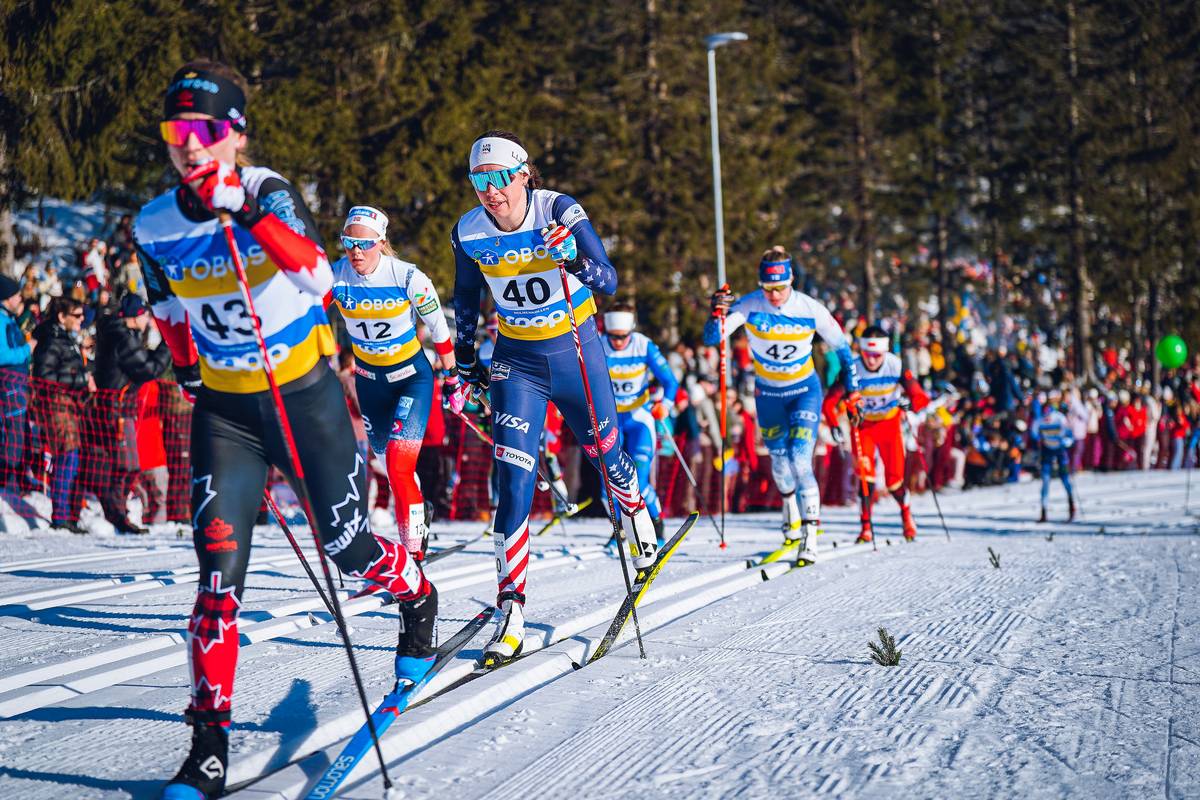
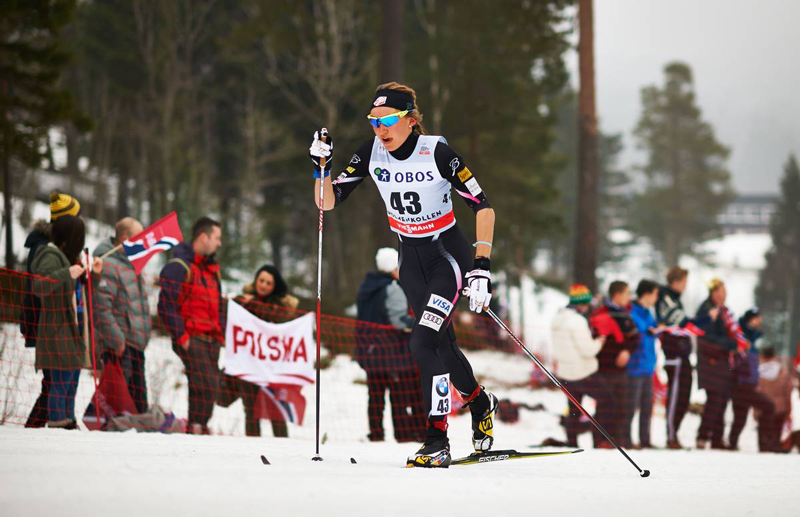
Katharine Ogden (left) and Caitlin Patterson (right, bib 32) take to the course at the start of the women’s 30 k classic at Holmenkollen. (Photo: NordicFocus)Canada’s Cendrine Browne (bib 43) leads Katharine Ogden (bib 40) during the 30 k mass start classic at Holmenkollen. (Photo: NordicFocus)
Racing for Canada, Katherine Stewart-Jones led the way in 22nd (+3:25.0), with Cendrine Browne also inside the top-30 in 25th (+3:53.7). After a successful World Junior Championship in Lygna, NOR, Jasmine Drolet finished 42nd today (+6:53.2), with Olivia Bouffard-Nesbitt closing out the Canadian racers in 48th (+10:19.8).
On February 26th, the Norwegian Ski Association (NSA) released a statement indicating that in light of the nation’s recent invasion of the Ukraine, Russian participation was not welcome at the upcoming World Cup sprint races in Dramman or the storied Holmenkollen distance races outside of Oslo. In addition to these cross country events, Norway is scheduled to host competitions in alpine, nordic combined, and ski jumping, including the World Ski Flying Championships in Vikersund.
A press release shared by Norwegian news source NRK stated: “The board of the Norwegian Ski Association has today discussed the situation related to Russia’s invasion of Ukraine, and how this affects the upcoming World Cup races and the world championship in Norway. The Norwegian Ski Association’s message to Russia and Russian athletes is crystal clear; We do not want their participation!”
NSA president Erik Røste told NRK that a request had been made to the International Ski Federation (FIS) to officially bar the Russian program from participating, but as of Saturday, FIS had not taken action to comply with the request, instead pointing to the official cancellation of remaining FIS events held in Russia.
“The attack on the Ukrainian people and the great suffering we see pictures of now, the sport can not remain passive and be neutral,” Røste said of the request. “Therefore, the board of the Norwegian Ski Association was clear that this must have consequences beyond what has already been decided. Therefore, we will send a clear and distinct signal to FIS that we do not want Russia and Russian athletes to participate in competitions in Norway in the coming weeks.”
Ultimately, it is up to the board of FIS whether Russia will be allowed to compete in the remainder of World Cup events. A response NRK received via email today stated:
“The FIS board has been clear in its approach to Russian athletes in all FIS competitions. To ensure fair and inclusive competitions at all FIS events, national federations and local organizers should not exclude athletes on the grounds of gender, race, nationality or sexual orientation.”
Alexander Bolshunov (RUS) wins the 2020 Holmenkollen 50 k in the fog, ahead of Norway’s Simen Hegstad Krüger. (Photo: NordicFocus)
As such, no Russian athletes or coaches have been denied entry to Norway, and Stefan Marx, the general manager of Holmenkollen ski festival, indicated there is little more that the organizers can do to prevent Russian participation in the events.
“We must let them participate,” Marx said to NRK. “Those who FIS and the Norwegian Ski Association say must be allowed to participate. We do not have the authority to refuse anyone to participate, but we have supported the Ski Association and the Sports Association’s position. It is up to FIS or the authorities to decide, but we are clear in our support for the Ski Association’s proposal that Russian athletes are not wanted due to violations of international law that have been committed.”
After flying from Helsinki following the Lahti World Cup races, Russian teams have begun to arrive in Norway. When pressed by the media upon his arrival, World Cup distance leader and favorite for the upcoming 50 k classic at the Holmenkollen, Alexander Bolshunov chose to remain silent. NRK did, however, receive comments from multiple Russian coaches, including head coach Marcus Cramer who felt that sport and politics should be kept separate.
“What do sports and athletes have to do with this situation? It’s really tough. I just get sad that the Norwegian association thinks like that. We really have a good communication between us. With everyone who works there. It’s sad to hear this, especially when they take it to the press and not us first,” said Cramer.
Another Russian coach, Jegor Sorin, who had been working at the Junior/U23 World Championships in Lygna, NOR and planned to join the Russian team in Oslo, echoed that Russian athletes should not be held accountable for the
“I am very upset that the Norwegian association wants this,” Sorin told NRK. “I can understand that no one wants to travel to Tyumen for the World Cup, but I do not know what happens to us… We are Russian athletes. We are here, we are not in any war. We are athletes, not soldiers. Maybe they think we have weapons. We want peace and for me this is very strange.”
Alexander Bolshuonv is photographed with his four Olympic medals from the 2022 Games, with one event remaining. He would leave the Games with three gold medals, and a total of nine Olympic medals including those won in 2018. (Photo: NordicFocus)
Though the Russian coaches focused on a separation between sport and politics, others have pointed out the direct ties between sporting success and military recognition. Used as an example, Bolshunov and Denis Spitsov were promoted to the rank of captain in Russia’s National Guard in recognition of their success during the 2022 Olympics. Bolshunov, who has earned a medal in each of his nine Olympic appearances, including three gold medals in Beijing, received additional honors in the form of the Alexander Nevsky Order, given in recognition of “special service for the fatherland.”
FIS cross-country committee leader, Vegard Ulvang told NRK, “Russian athletes are [military] officers. This makes the symbolic value [of their participation] even greater.”
A similar statement was made by Global Athlete representative and former U.S. Ski Team athlete Noah Hoffman.
“While I feel for the individual athletes, all Russian skiers should be banned from the FIS Cross Country World Cup for the rest of the season,” Hoffman tweeted. “Their results are used to drum up nationalism and bolster the Russian State. Allowing them to compete aids Russia. #StandWithUkraine.”
Ulvang is urging a stronger response from the Norwegian Ski Federation, suggesting that they relinquish the FIS World Cup status of the events at the Holmenkollen in order to gain the authority to prohibit Russian participation.
Jan Petter Saltvedt, a Sports Commentator for NRK described Ulvang’s statements as a “moral ultimatum.”
“Ulvang demands an open rebellion from NSF against his own superiors,” Saltvedt said. “And he should get it. Vegard Ulvang puts so much pressure on the Norwegian Ski Association that they can not help but act… At the same time, he expresses a very strong and clear criticism of FIS, where he himself is one of the powerful committee leaders, but still does not feel he is heard at all.”
Norwegian athletes who have been asked for comment have given mixed responses, often acknowledging the complexity of the issue and whether the athletes themselves should be at fault for government decisions.
Among those with a clear stance, Erik Valnes spoke of disallowing Russian participation. “There is a heavy symbolism in it. It would send a signal. Since [Bolshunov] is [a captain of the Russian National Guard], they have already mixed sports and politics in a way. It is difficult. It is a great pity that it will be like that.”
Erik Vales and Johannes Høsflot Klæbo earn gold in the classic team sprint during the 2022 Beijing Games. (Photo: NordicFocus)
Johannes Høsflot Klæbo also spoke in support of the NSA urging FIS to remove Russian athletes from competition.
“As an athlete, you want the best to start. We train all year to compete and then you want the best to participate,” Klæbo said to NRK. “At the same time, I support the attitude of the ski association now. There is no doubt about what is happening in Ukraine, and Russia must be condemned. I strongly condemn it and I think it is good that the association takes a stand.”
Therese Johaug acknowledged that athletes may not have direct involvement in the military actions of Russia, speaking instead to their role in representing their country through sport.
“I feel sorry for the athletes, first and foremost, I understand that they have nothing to do with this,” Therese Johaug told NRK after narrowly winning Lahti’s 10 k classic over Russian Natalia Nepryaeva. “But on the other hand, I think it is completely wrong. They front their country and the flag both on the chest and on the forehead. And that a country should also ravage the sports arena and fight for victories and front their country in the situation we are in – I think that is completely wrong.”
Therese Johaug voices her thoughts on Russian World Cup participation following her win in Lahti’s 10 k classic. (Photo: NordicFocus)
The stance is not unanimous amongst the Norwegian team. Sindre Bjørnestad Skar, who took third in Lahti’s freestyle sprint, spoke to the unfairness for Russian athletes.
“Of course, I am 100 percent against everything that is happening between Russia and Ukraine now. It is completely inconceivable. But then I also do not think that the fact that they have a Russian passport, means that they should be punished and deprived of the opportunity to do their job. In a way, I think that is a bit unfair too,” Skar told NRK.
For the time being, no further changes in Russian participation have been reported. FasterSkier will continue to follow this story as it evolves over the next few days. World Cup classic sprint races are currently scheduled in Drammen Thursday, with the women’s 30 k mass start classic in Oslo happening Saturday March 5th, followed by the men’s 50 k on Sunday.
Simen Hegstad Krüger’s Olympic skiathlon victory (l) and Marit Bjørgen’s Holmenkollen come-from-behind win (r) are FasterSkier’s 2018 International Performances of the Year. (Photos: FlyingPointRoad & Fischer/NordicFocus)
With the 2017/2018 season officially in the rearview, FasterSkier is excited to unveil its annual award winners for this past winter. Votes stem from the FS staff, scattered across the U.S., Canada, and Europe, and while not scientific, they are intended to reflect a broader sense of the season in review. This set of honors goes to the International Performances of the Year.
Out of the start pyramid at the PyeongChang Olympics men’s 30-kilometer skiathlon, a mini-disaster struck 24-year-old Simen Hegstad Krüger of Norway. With the flying poles and striding skis, someone was bound to snap a pole. That someone was Krüger, who found himself at the base of the course’s first hill, calmly seeking the assistance of a coach with the gear in need. Time bled. The front pack cruised on. But he looked collected and unconcerned.
In his first Olympics and first-career Olympic race, Krüger simply rolled with the get-your-pole-and-minimize-losses drill. With Finland’s Iivo Niskanen leading the stream of skiers ahead of him, Krüger kept it all in perspective. It’s was a 30 k race, and only a few hundred meters had been ticked off.
It was a parade of possible medal winners capturing camera time during the skiathon’s classic leg. Niskanen (who later said, after winning the 50 k classic gold, that he approached the skiathlon’s classic leg as a training opportunity), Martin Johnsrud Sundby, Alex Harvey, and Dario Cologna looked golden.
Norway’s Simen Hegstad Krüger after winning gold in his first Olympic race, the men’s 30 k skiathlon, at the 2018 Winter Games in PyeongChang, South Korea. (Photo: FlyingPointRoad)
Never locking on, but stealthily lurking, Krüger gained ground as the race’s classic portion transpired. He came through the classic-to-skate ski exchange at 15 k in 14th place, about 15 seconds behind the leaders. Just over two kilometers later, Krüger had bridged the gap.
With his legs fresh, Krüger said once he began the skate leg that “all possibilities are open again.”
Anything did seem possible for a host of the world’s best distance skiers, just not necessarily for Krüger. After expending energy skiing up to the lead group early in the skate, Krüger played it coy. He didn’t lead or get exposed up front in the windy conditions. He simply kept pace and kept in the draft.
An unwritten rule on the Norwegian team is that the first attack to stick by a Norwegian is a protected chance. In other words, once a Norwegian is in first and gaining time, his teammates won’t attempt to chase the attack down. Sundby was salivating at the chance for a career-first individual Olympic gold. Hans Christer Holund, also of Norway, was a pacesetter too. Either one of them could have seized the moment.
But at 26.25 k, Krüger rolled the dice and surged. The surge morphed into an unchallenged attack that seemed a lock one kilometer later when Krüger was up by 22 seconds. Team rules are team rules — Sundby and Holund could only watch their teammate shake the front end of the race apart.
Once they felt Krüger’s lead was insurmountable, Sundby and Holund set to work for themselves. The gap to Krüger closed significantly by the finish.
Krüger won the race in 1:16:20 hours. Sundby settled for silver, finishing eight seconds back, while Holund was third, 9.9 seconds out of first.
Was Krüger a real outsider for gold at the start of the race? Consider he was a member of the world’s most elite men’s team: Norway. Nations are also limited to four starters per race at the Olympics. Those in the know, like coaches and teammates, should have understood Krüger was on dual-discipline form.
Yet, until his Olympic skiathlon win, Krüger had two individual World Cup podiums: one win and a third place. (He had finished third in the fifth stage of the 2017 Tour de Ski, the 10 k skate in Toblach, Italy, and won a 15 k skate in December 2017, also in Toblach.)
A young Olympic rookie, Krüger showed he was the day’s master of tactics on the sport’s biggest stage. Krüger proved fit and certainly coyer than his Norwegian counterparts. Opportunity struck. Krüger seized it for our male International Performance of the Year.
Marit Bjørgen (Norway), Holmenkollen 30 k freestyle mass start
It has been a year to celebrate firsts. There was that first-ever U.S. Olympic gold. And from the North American perspective, the U.S. Ski Team’s (USST) women could fill a full scrapbook of standout performances. Let’s start with USST member Jessie Diggins. She finished second overall on the World Cup. Waking up on a Saturday or Sunday and finding Diggins on the podium was no longer a surprise.
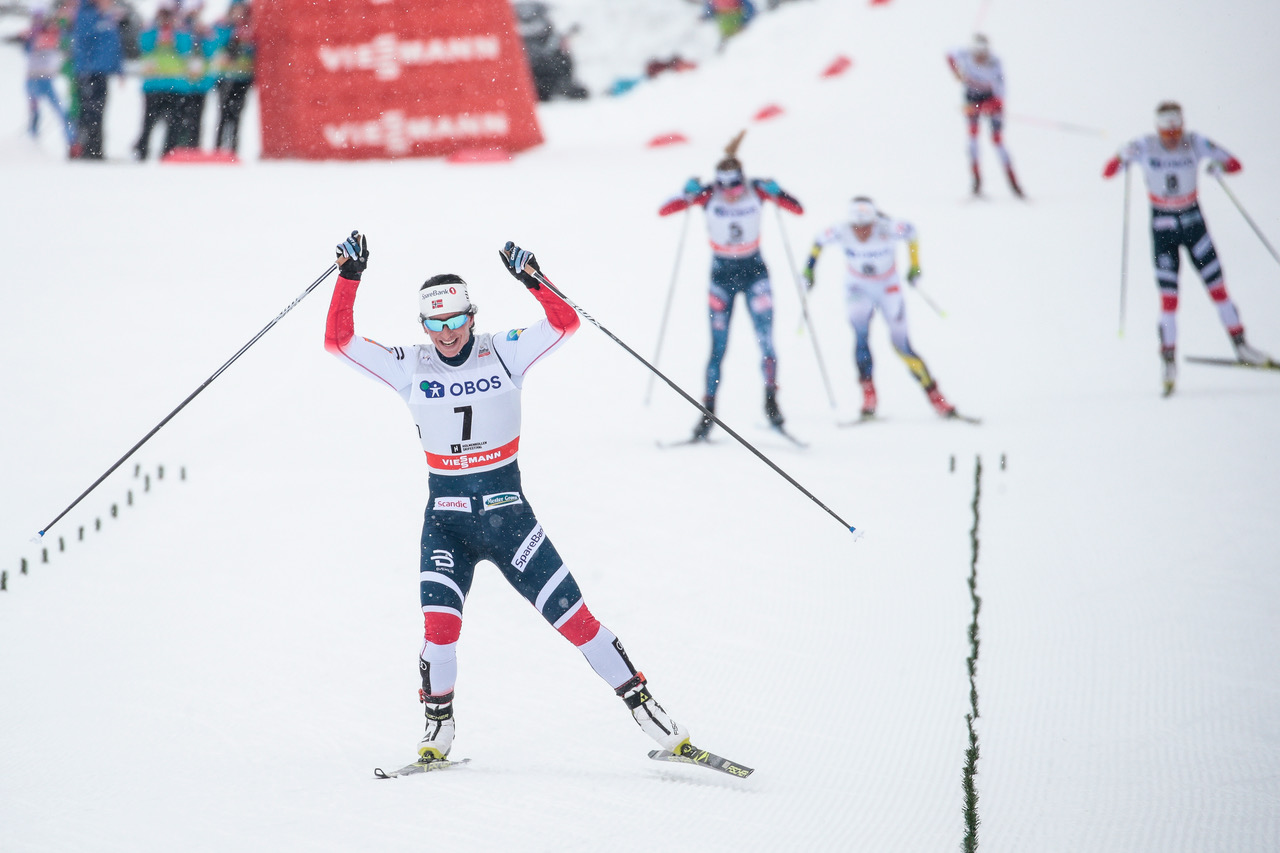
Norway’s Marit Bjørgen celebrates her seventh Holmenkollen 30 k victory in Oslo, Norway, ahead of American Jessie Diggins, Norway’s Ragnhild Haga (not shown) and Sweden’s Charlotte Kalla. (Photo: Fischer/NordicFocus)
So when Diggins was stealing the show at Oslo’s storied Holmenkollen venue in the women’s 30 k freestyle mass start this March, you’ve got to believe Norway and Sweden were there to see history; an American on the top step in the most famous of cross-country races.
This Holmenkollen 30 k was a storied race. Just not storied for the precise narrative most watching the race expected. For much of the race, it appeared to be the Diggins show.
Whatever you want to call her — queen, best-ever or simply Marit — the sport’s preeminent star, Marit Bjørgen of Norway, made her last Holmenkollen 30 k unforgettable.
As FasterSkier’s venerable reporter Gabby Naranja noted, during the high profile 30 k events, Bjørgen likes to run away solo style. In last year’s Holmenkollen 30 k classic, Bjørgen was off the front and unchallenged for the win. Then, in PyeongChang during the 2018 Olympic 30 k classic, Bjørgen pulled away from any would-be chasers for a complimentary finishing-straight Norwegian flag wave and some golden hardware.
This year’s Holmenkollen 30 k that followed was skate technique. When the trio of Diggins, Sweden’s Charlotte Kalla, and Norway’s Ragnhild Haga — all stellar skate skiers — pulled away from the field, the hopes of a Bjørgen revival seemed unlikely. Bjørgen had lost incremental time in the race’s early kilometers. The 37-year-old Bjørgen appeared gassed from a stellar Olympics and to be subtly relinquishing the stage to three younger go-getters.
A little more than halfway through the race, Bjørgen was 36 seconds down on the lead group.
Yet, Bjørgen was a wise one. She changed skis near the race’s midpoint. Diggins, Kalla and Haga stuck with their 15-k-old glide, skipped the ski swap and chugged on.
The presumed podium placers slowed just enough, and Bjørgen sped up just enough to bring them closer and closer. But it was more like Bjørgen remained the massive sun with the heftiest gravity pulling the three off-the-front satellites towards her.
With three kilometers to go, Bjørgen was six seconds back.
In the closing kilometer, Bjørgen controlled the race, passed any top-step threats, and reaffirmed one last time that she is indeed the singular skier we all expect her to be. She won her seventh Holmenkollen for a record number of victories for a woman in the Holmenkollen 30 k. In her six prior Holmenkollen 30 k wins, Bjørgen won four times in classic technique, two times in skate.
Diggins placed second (+3.6), Haga third (+4.3), while Kalla was a tenth of a second back in fourth.
With the recent announcement of her retirement, perhaps the international field can rest easy knowing Bjørgen won’t be sending it off the front or seizing the win from behind.
Honorable Mention: Jessie Diggins and Kikkan Randall (U.S. Ski Team), Olympic Team Sprint
Before anybody gets worked up over this, more awards are due. We at FasterSkier are spreading the award love and trying to be clinical. Are we splitting hairs between honoring Bjørgen for sentimental reasons and not choosing the Randall-Diggins gold for fear of pandering to our core audience? (Noise of clearing throat.) No.
Americans Kikkan Randall and Jessie Diggins jumping for joy after placing first in the 2018 Olympic team sprint in PyeongChang, South Korea, ahead of Sweden’s Charlotte Kalla (l) and Stina Nilsson (second from l) in second place and Norway’s Marit Bjørgen (second from r) and Maiken Caspersen Falla (r) in third. (Photo: FlyingPointRoad)
(And if you are hearing of the American Olympic team sprint win right here, right now, for the first time … then welcome to FasterSkier. We are glad to have you as a reader.)
What more can be said of the Randall-Diggins win in the 2018 Olympic freestyle team sprint? It’s only been a bit over a month since the Americans skied the perfect race. Randall was the glue sticking with Bjørgen and Kalla. Diggins was the late boost who slingshot around Norway’s Maiken Caspersen Falla and outsprinted Sweden’s Stina Nilsson in the last 100 meters of the race.
It is an Olympic medal after all. Gold, too. We can imagine every U.S. nordic skier for a generation will be asking “where were you when …?”
Three cheers for Diggins-Randall. Three cheers for the wax crew. Three cheers for the coaches. And three cheers for all the women who have had the privilege of calling themselves members of the U.S. Ski Team, past and present.
Honorable Mention: Iivo Niskanen (Finland), Olympic 50 k Classic Mass Start
Finland’s Iivo Niskanen after winning the men’s 50 k classic mass start at the 2018 Winter Olympics in PyeongChang, South Korea. (Photo: FlyingPointRoad)
Let’s jump to the post-race press conference in PyeongChang. Before the men’s 50 k classic mass start winner Iivo Niskanen of Finland entered the room, Russians Alexander Bolshunov and Andrey Larkov, who finished second and third respectively, made some excuses. Through an interpreter, both skiers spoke of their less-than-ideal skis.
When Niskanen finally arrived, he was informed of the Russians’ sentiments that their striding and gliding may have been wax-compromised in the later stages of the race.
No love lost. That could have been used to describe Niskanen’s tone and comments regarding his closest competitors’ and their espoused reasons for his dominance. Ski-wise, Niskanen changed skis twice during the race. (Racers are allowed two ski exchanges in the 50 k). Bolshunov and Larkov opted to change their skis once. The two Russians were the only skiers in the top-31 to not change skis out twice.
The reason we bring the ski-excuse up is to highlight the point that Niskanen skied the race to win. He was taking no chances. He was decidedly strong, smart and had ski-swapping savvy. Niskanen had few tagalongs during his 50 k stomp. Kazakhstan’s Alexey Poltoranin skied with the Finn, looking like an equally worthy potential gold medal winner. But Poltoranin suffered a major fade. Niskanen also dropped the likes of Sundby, Harvey, and Holund.
Bolshunov proved to be the only skier who seemed like he could mirror Niskanen. When Bolshunov skipped the ski swap at 40 k, Niskanen freshened up with some new classic boards and waited to make his move. That came on the final hill where Niskanen was simply stronger. Niskanen won the Olympic 50 k in 2:08:22.1. Bolshunov placed second, 18.7 seconds behind the winner.
Niskanen’s win put on full display his marriage of physical prowess and strategic genius. A lovely win for the Finns and a first-career Olympic medal for the 26-year-old Niskanen.
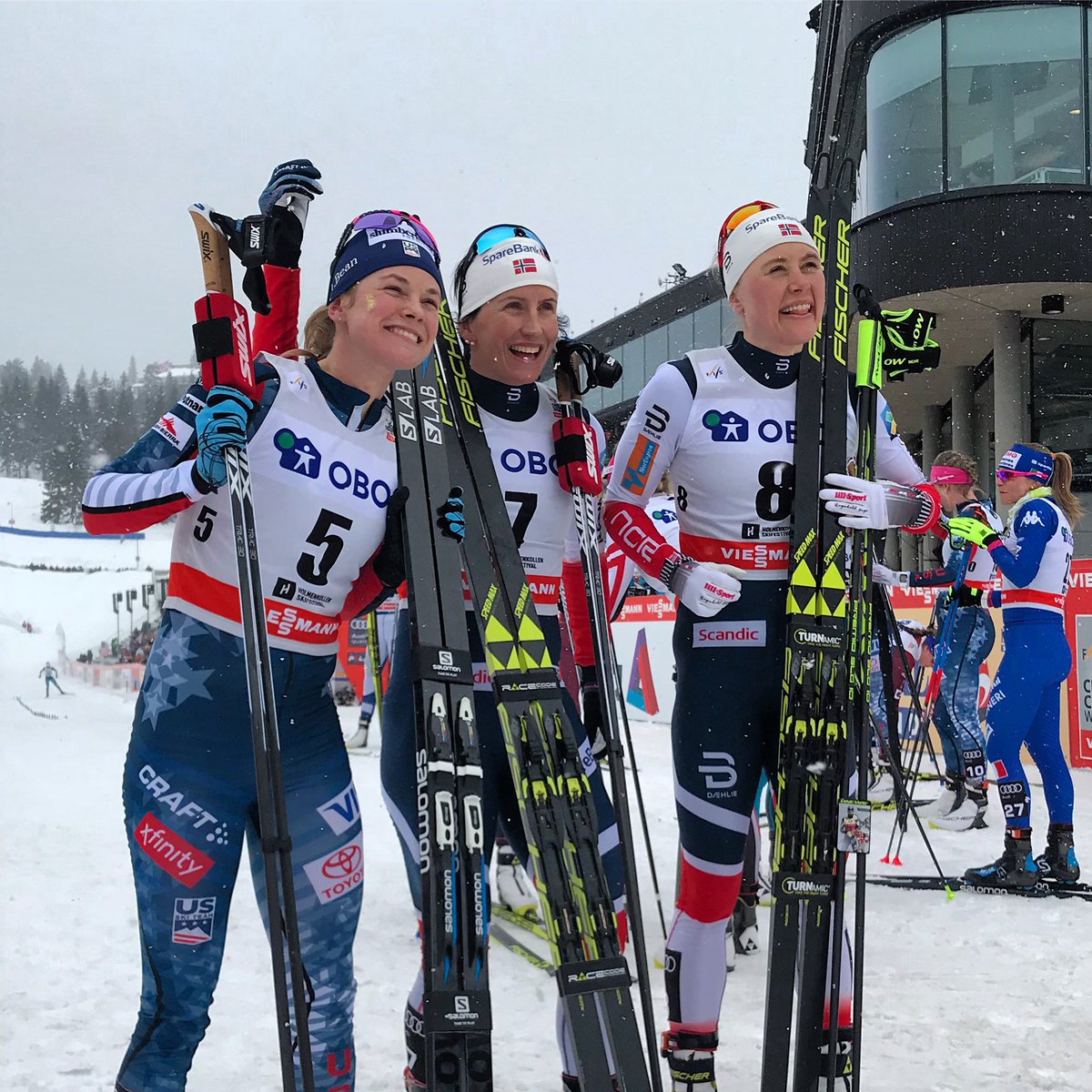
The Holmenkollen women’s 30 k freestyle mass start podium on Sunday in Oslo, Norway, with Jessie Diggins (l) in second, and Norway’s Marit Bjørgen (c) in first and Ragnhild Haga (r) in third. (Photo: FIS Cross Country/Twitter)
FIS Cross Country World Cup (Oslo, Norway): Women’s 30 k freestyle mass start
Marit Bjørgen, the Norwegian queen of distance cross-country events, racked up another victory at Holmenkollen in the women’s 30-kilometer freestyle mass start on Sunday for her seventh win in the World Cup’s ultimate distance event at the famed Norwegian venue. (She had previously won in 2005, 2010, 2012, 2014, 2015 and 2017).
But she did so in not-so-typical fashion. Instead of breaking the field mid-race and skiing to a comfortable win, like she did in the last race of the 2018 Olympics in PyeongChang, South Korea (a 30 k classic mass start), Bjørgen came from behind to win Sunday’s Holmenkollen 30 k and wasn’t able to let off too much before finish. She didn’t take the lead until less than a kilometer to go and put just enough time into her competition to take the win in 1:18:12.4 hours, while American Jessie Diggins outlasted the chase group of three to place second (becoming the first American woman to reach the Holmenkollen podium), 3.6 seconds behind Bjørgen. Norway’s Ragnhild Haga edged Sweden’s Charlotte Kalla by 0.1 seconds for third place (+4.3), while Kalla settled for fourth (+4.4).
The rest of the field was strung out, with Norway’s Astrid Uhrenholdt Jacobsen finishing fourth (+11.5) and Ingvild Flugstad Østberg nearly another 1 1/2 minutes back in fifth (+1:39.5). Finland’s Krista Pärmäkoski placed seventh (+1:51.7), Germany’s Stefani Böhler notched eighth (+2:10.2), Austria’s Teresa Stadlober ninth (+2:10.2), and Sweden’s Ebba Andersson 10th (+2:11.9). Less than a second behind Sweden’s Ida Ingemarsdotter in 11th (+2:22.8) was American Sadie Bjornsen in 12th (+2:23.4).
In the Distance World Cup standings, Diggins gained some valuable points to keep herself in third, now 63 points ahead of Pärmäkoski in fourth. Heidi Weng, who finished 18th on Sunday, still leads the distance standings by 104 points and Østberg is second, 51 points ahead of Diggins.
In the Overall World Cup, Weng leads by 153 points over Østberg. Diggins is another 104 points back in third, 100 points ahead of Pärmäkoski in fourth. At World Cup Finals next week in Falun, Sweden, a total of 300 points is up for grabs for the winners (50 for freestyle sprint, 50 for classic individual start, and 200 for freestyle pursuit).
The U.S. had three in the top 20 and four in the points (top 30) in Sunday’s 30 k, with Kikkan Randall in 19th (+3:21.9) and Caitlin Patterson in 28th (+4:13.1). Rosie Frankowski (Alaska Pacific University) missed the top 30 by about 28 seconds in 31st (+4:45.4), Liz Stephen placed 51st (+10:01.7) and Kaitlynn Miller (Craftsbury Green Racing Project) finished 53rd (+16:05.0).
Cendrine Browne led four Canadian women in 36th (+6:16.1), Emily Nishikawa was 44th (+7:36.1), Zina Kocher (Foothills Nordic) finished 47th (+8:52.0), and Dahria Beatty placed 49th (+9:45.1).
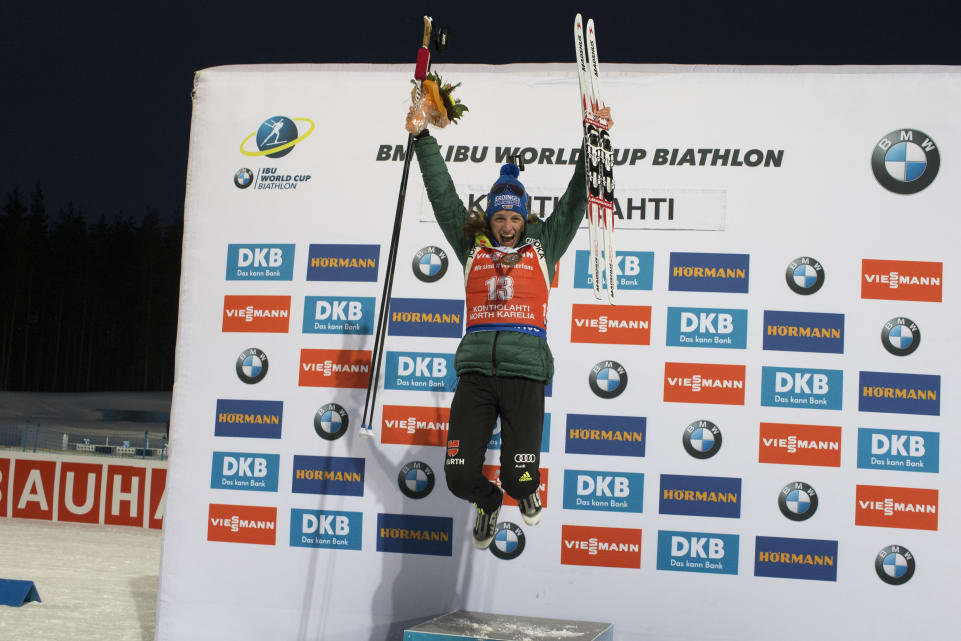
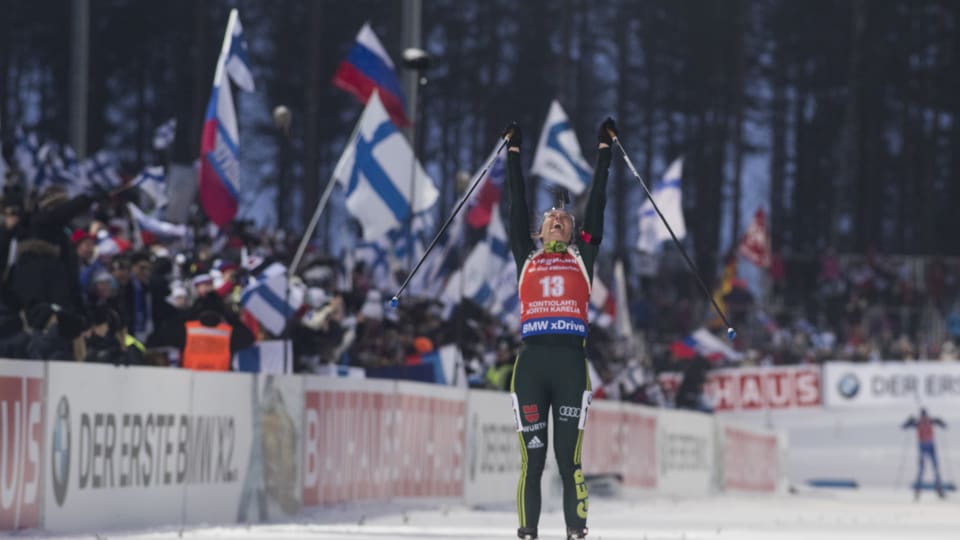
Germany’s Vanessa Hinz celebrates her first IBU World Cup win and podium in the women’s 12.5 k mass start on Sunday in Kontiolahti, Finland. (Photo: IBU/Biathlonworld)
IBU World Cup (Kontiolahti, Finland): Men’s and women’s mass starts
(Note: This rundown has been updated to include comments from Lowell Bailey and Rosanna Crawford.)
Germany’s Vanessa Hinz won her first International Biathlon Union (IBU) World Cup race (and achieved her first World Cup podium) and Austria’s Julian Eberhard won his first race of the season (and first mass start of his career) in the women’s 12.5 k and men’s 15 k mass starts on Sunday in Kontiolahti.
Germany’s Vanessa Hinz celebrates her first IBU World Cup win and podium in the women’s 12.5 k mass start on Sunday in Kontiolahti, Finland. (Photo: IBU/Biathlonworld)
Hinz shot an impressive 20-for-20 with the third-fastest range time and fifth-fastest shooting time to take the win in 35:47.9 minutes. Third after the first prone stage, she moved into second, then third after cleaning the next two stages. After knocking down her final five targets in the last standing, Hinz left the range almost 24 seconds ahead of France’s Anaïs Chevalier in second and 26 seconds ahead of Italy’s Lisa Vittozzi in third. Hinz stayed ahead of her challengers on the final loop, finishing 13.5 seconds clear of Vittozzi, who claimed second. Chevalier finished third, 16.8 seconds back, while Finland’s Kaisa Mäkäräinen was next across the line in fourth (+43.4) with a gap to Sweden’s Hanna Öberg in fifth (+1:02.1).
Vittozzi and Chevalier both cleaned the first three stages then had to ski a penalty lap after the last standing bout (0+0+0+1). Mäkäräinen missed three (1+0+1+1) yet skied the second-fastest course time on her home course, and Öberg missed two (0+0+2+0). The fastest course time of the day was clocked by Darya Domracheva of Belarus, who had to ski five penalty laps (0+1+1+3) and ended up 10th (+1:18.2).
“I always dreamed of shooting four times clean and today I did it,” Hinz, 25, said, according to an IBU press release. “I was so often close to the podium. I knew I could do it. Today, I said, ‘OK, let’s try it and if it works, it is OK … and if not there is another season waiting and other races.’ Now I am on top of the podium and it is crazy.”
Vittozzi, who placed fourth in the mass start at the 2018 Olympics, was glad to improve on a third-place finish in Friday’s sprint by placing second on Sunday.
“I have been third so many times and that was not satisfying for me,” Vittozzi said, one day after she won the mixed relay with her team in Kontiolahti. “Today I am very happy about my second place.”
For Chevalier, it was her first individual podium of the season and it came a day after she and Antonin Guigonnat won the single mixed relay. Chevalier, 25, was severely injured when she was hit by a car last spring, according to an IBU press release.
“I am very happy to be here today, because it was a very hard season,” she told the IBU. “I forgot how nice it is to be on the podium … I forgot that it was not easy, so I am very happy … I did my best on the last lap; [Vittozzi] was faster, but I am third and happy with that!”
Canada’s Rosanna Crawford shot 19-for-20 to place 13th (+1:25.9) with her only miss coming in the second prone stage (0+1+0+0). Her overall shooting and range times were 10th fastest of the 30-woman field, compared to her 26th-ranked ski time. Crawford had been in 11th after cleaning the final standing stage, then slipped two spots to finish 13th in her second mass start of the season.
“Since the skiing wasn’t feeling great today I made sure I was super focused in the range,” Crawford wrote in an email to FasterSkier. “I knew that was my only chance to get a good result today. My one prone miss was a bad trigger pull, but the rest were nice solid hits. I made sure to have a solid set up and then just trusted my rhythm and shooting.
“I knew that I wanted that top 15, so I just kept fighting and trying to stick with the women when they caught me,” she wrote of her last loop. “The last time up the wall I managed to stay close to [France’s] Anais Bescond, and hold off the two people behind me. Really happy to be in the top 15 again.”
Clare Egan was the lone American woman to qualify for Sunday’s mass start, and it was the second mass start of her career. She was on track for a top-15 result after missing just one target in the first three stages, but she had to ski three penalty laps on the last standing (0+1+0+3), which put her in 23rd by the finish (+2:05.6). Notably, she skied the 14th-fastest overall course time.
“I didn’t have quite the same energy level tonight as the last two days, but I still had the 14th rank course time and that means anything is possible in the race,” Egan wrote in an email to FasterSkier. “To put it in perspective, the winner of the race, Hinz, had the 13th rank, just 2 seconds faster than me. This is the first time I’ve felt totally comfortable skiing with the fastest women, and I certainly hope I can maintain this speed for one more week of World Cup racing.”
Egan was pleased with her 9-for-10 prone shooting and her clean standing stage (“which is the first time I’ve cleaned a standing stage in an individual race this entire year, believe it our not,” Egan wrote).
“But when I missed my second shot on the final stage, I let that throw me off my game, and really blew the rest of the stage,” she explained. “It’s so hard to keep 100% focus in every scenario, and I find it gets harder and harder towards the end of the race when I’m not necessarily the most lucid. I know that I have to work on so I have a goal to manage the final stage better next week and in the future.”
Her 23rd-place finish was one better than her previous World Cup mass start finish, which was 24th last season in Hochfilzen, Austria.
“In my only other mass start, which was last year at World Championships, I felt like an imposter,” Egan reflected. “Maybe because I was the first ‘reserve’ to get called up when one of the top women [did not start]. But this was totally different. I knew I deserved to be there today and was confident about competing with the other top women.”
“In my only other mass start, which was last year at World Championships, I felt like an imposter … This was totally different. I knew I deserved to be there today and was confident about competing with the other top women.” — Clare Egan (US Biathlon) on Sunday’s mass start
While the women raced Sunday night, the men’s 15 k mass start took place in the afternoon, when Eberhard passed the likes of France’s Martin Fourcade and Russia’s Anton Shipulin after a tangle late in the race to take the win.
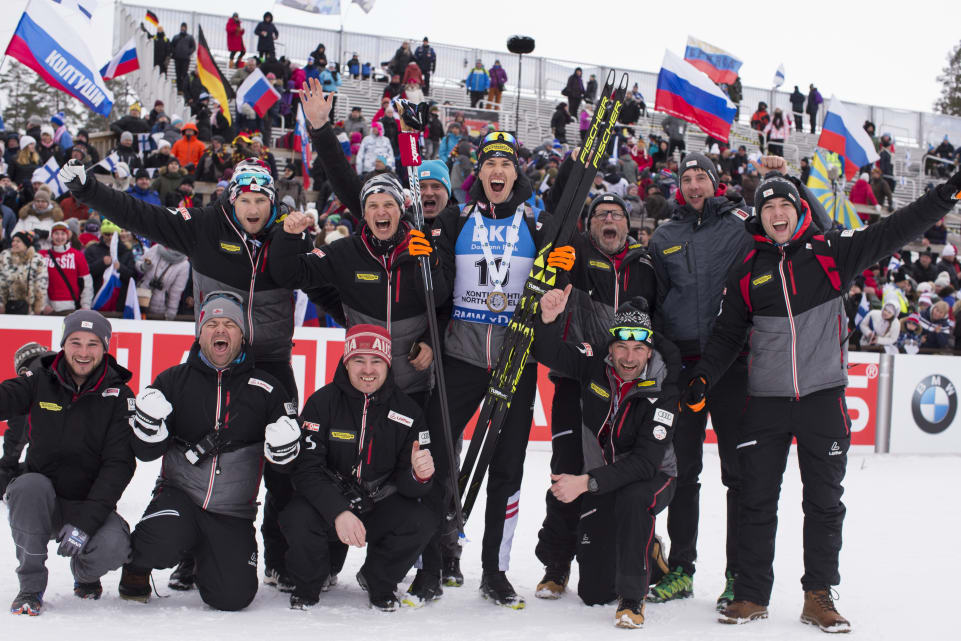
The Austrian team celebrating Julian Eberhard’s fourth career victory, his first this season and his first in a mass start on Sunday after the IBU World Cup men’s 15 k mass start in Kontiolahti, Finland. (Photo: IBU/Biathlonworld)
The Austrian had cleaned the first two prone stages to move into third by the race’s halfway point, behind Germany’s Benedikt Doll and Arnd Peiffer in first and second, respectively. Eberhard missed one in the next standing stage, yet left the range in second, 15 seconds behind Peiffer (who cleaned) in first, while Doll missed one as well to slip into third, 19 seconds back.
With two loops to go, Fourcade was coming back from two early prone penalties and found himself in fifth after a clean standing stage, less than a second behind Shipulin in fourth. On the next standing stage, Fourcade cleaned to take the lead and left the range about five seconds ahead of Shipulin (who also cleaned) in second.
Eberhard missed one yet remained in contention in third, 17 seconds behind Fourcade. On the last loop, Shipulin caught Fourcade before the course’s notorious climb known as “The Wall”, and Eberhard closed on the two frontrunners as they ascended it. Still several seconds behind over the top, he caught Shipulin on the bridge before the stadium, but the two tangled skis and Shipulin fell. Eberhard stayed upright and pulled even with Fourcade, passing him to take the win in 38:04.8. Fourcade finished second (+6.9) and Shipulin third (+19.3).
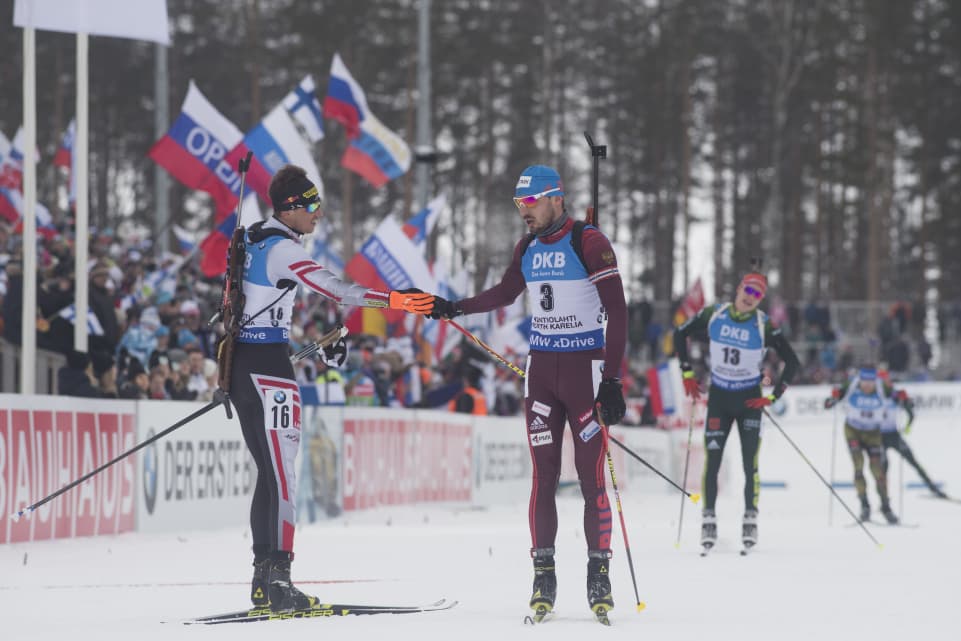
Austria’s Julian Eberhard (l) and Russia’s Anton Shipulin after the finish of the men’s 15 k mass start the IBU World Cup in Kontiolahti, Finland. Shipulin fell when his skis tangled with Eberhard’s. While Eberhard raced to the win, Shipulin placed third. (Photo: IBU/Biathlonworld)
“I wanted to be in a sprint with all three, but the bridge is too small for this,” Eberhard said, according to an IBU press release. “I came up the bridge with too much speed. Anton and I were in the same track and there was an accident. I apologized to Anton at the finish but he said these things can happen and it was OK with him.”
“I hold no grudge against Julian,” Shipulin told the IBU. “This can happen in sports and is all fair … I am in good shape and want to preserve this and perform my best in the last World Cups.”
Fourcade explained that illness caused him to sit out Thursday’s sprint, and he was only able to train three hours this week.
“It is really difficult to race in this situation without any feeling or training,” Fourcade told the IBU. “I did not know what to expect today but I am quite satisfied. I would have liked to win, but I used too much energy trying to come back in the early laps and had no energy when it was time to attack.”
Behind them, Doll picked off one place on the final loop to finish fourth (+21.9), passing his German teammate Erik Lesser, who finished fifth (+23.9). Peiffer followed in sixth (+27.1) as Germany had three in the top six.
American Lowell Bailey raced to 14th (+1:06.3) with two penalties, both of which came in the standing stages (0+0+1+1). Bailey had been fourth after cleaning the second prone, 16 seconds behind Doll in first, but slipped to 10th after missing one on the next bout. He had to ski another penalty lap on the last stage, and left the range in 14th.
Overall, Bailey posted the 10th-fastest shooting time, 15th-fastest range time and 18th-fastest course time.
“I finally felt like I was back in the spot that I ended last season,” Bailey wrote in an email when asked about his consistency. “I felt controlled and able to keep the pace with the top of the field throughout the race. It was nice to be back in the mix.
“Although I would have liked to see this ski speed a few weeks ago, better late than never!” he continued.
Next week’s World Cup in Oslo, Norway, will be his last of the season and his career.
“After nearly two decades of international racing, Oslo will be my final World Cup as a U.S. Biathlete,” Bailey wrote. “I’m sure it will be emotional but I hope to end my World Cup career on a high note!”
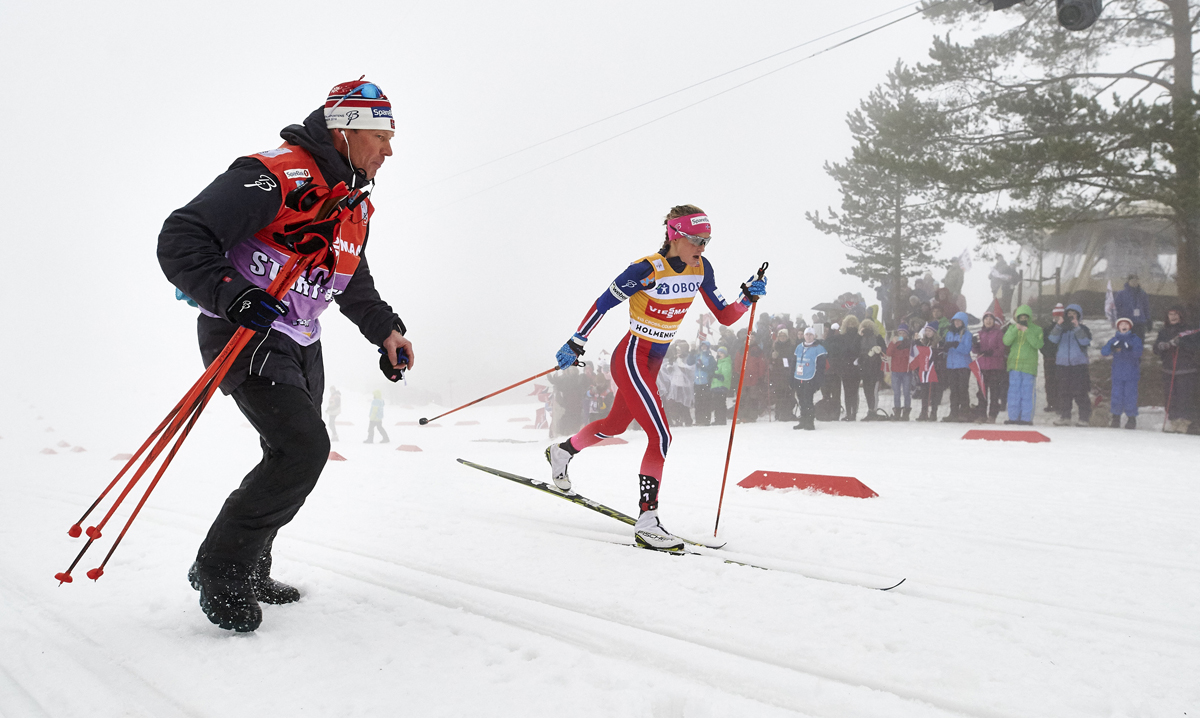
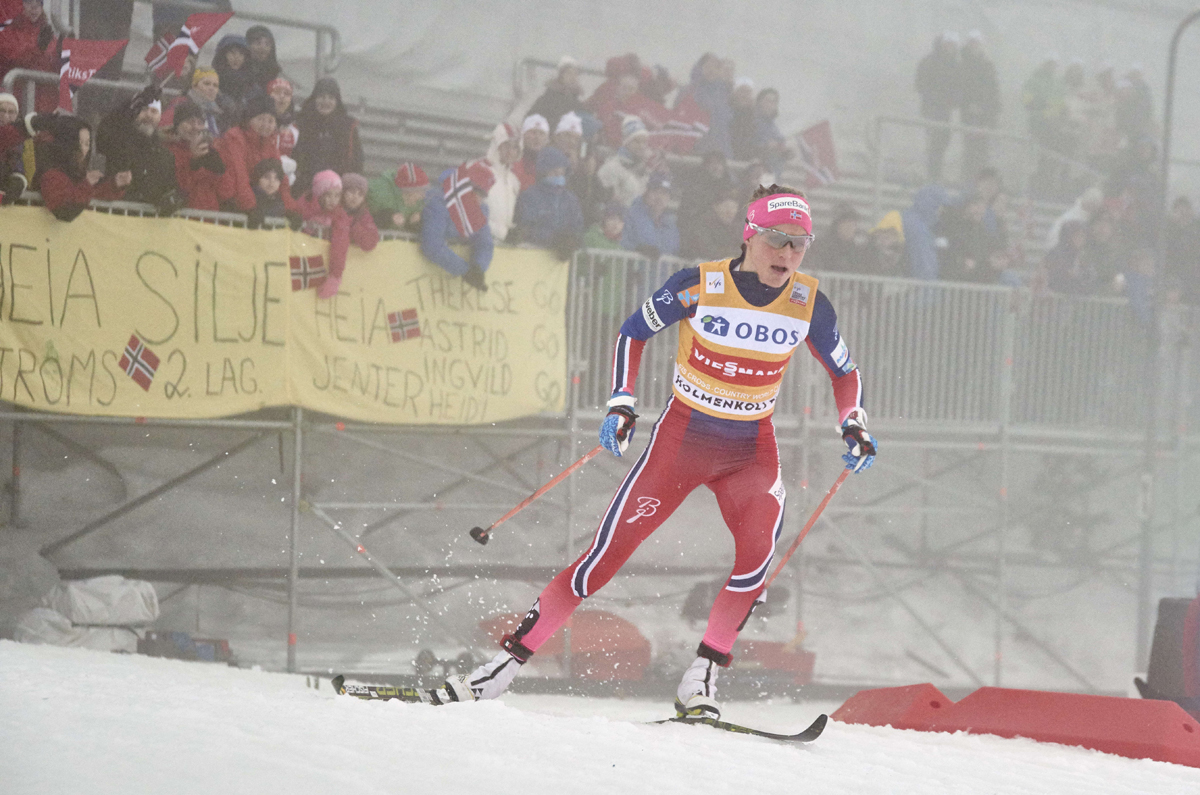
Norway’s Therese Johaug racing to her most definitive win yet, by 3 minutes and 46 seconds in the women’s 30 k classic at Holmenkollen on Sunday in Oslo, Norway. It was her first classic victory at Holmenkollen. (Photo: Fischer/NordicFocus)
Maybe it was the signature Johaug gloves dazzled for the television camera at the start. Maybe it’s the training hours, or the grit, or the lucky combination of DNA and athletic potential realized.
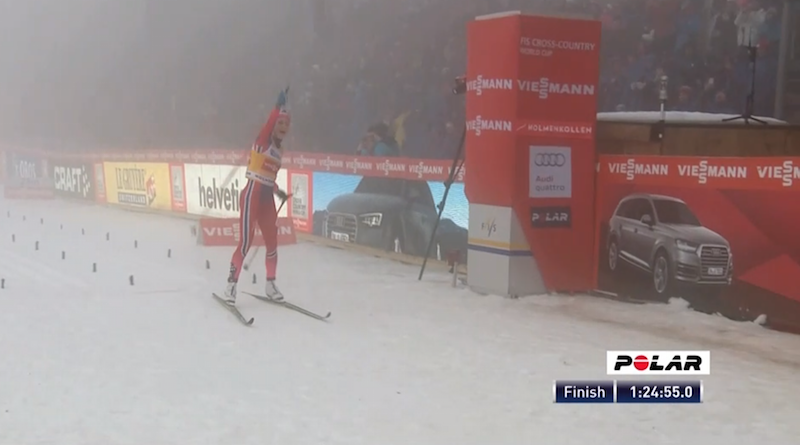
On Sunday, at the famed Holmenkollen tracks, Norway’s Therese Johaug dominated. She won the 30-kilometer classic mass start, her first Holmenkollen classic victory, in 1:24:55. Ingvild Flugstad Østberg, also from Norway, took second, 3:46.5 behind. Finland’s Anne Kyllönen broke up the Norwegian podium sweep by skiing to third place (+4:16). Johaug’s margin of victory was the largest ever for a women’s cross-country World Cup, according to a FIS press release.
Norway took four of the top-eight spots, while Finland placed four in the top eleven.
Norway’s Heidi Weng placed fourth (+4:16), Finland’s Laura Mononen fifth (+4:43), and Swedish star Charlotte Kalla sixth (+4:45.9). Notable others in the top 10, Masako Ishida of Japan placed ninth (+4:55.2) and Poland’s Justyna Kowalczyk finished 10th (+5:06).
The domination
Norway’s Therese Johaug dropped the field out of the start in the women’s 30 k classic mass start on Sunday at Holmenkollen in Oslo, Norway. By 3 k, she was about 20 seconds ahead. That gap grew to 3 minutes and 46 seconds at the finish for her first Holmenkollen classic win. (Photo: Fischer/NordicFocus)
The time back on the results sheet were not in error. The Johaug spectacle was that one-sided. From the first intermediate checkpoint at 1.8 k, Johaug’s race-journey was a solitary one. Her furious pace immediately distanced all other competitors. Johaug was solo through every intermediate checkpoint. And solo as she crossed the finish line.
The mythical Holmenkollen venue was draped in a dense fog. With humidity at 99 percent, Johaug was literally skiing through the clouds: Her striding form barely visible to trailside spectators or those watching on a screen. If the poor visibility prevented a full understanding of the race’s dynamics, the live timing splits, tell the story.
At the first time check, at 1.8 k, Johaug had an 8.6-second gap on Kalla in second, and 9.2 seconds on Norwegian teammate Astrid Uhrenholdt Jacobsen in third. Jacobsen ultimately DNF, pulling out of the race around 11 k.
At five kilometers, Johaug’s pace was unmatchable. She was already 44.8 seconds up on Finland’s Krista Parmakoski, skiing in second at that point, with the critical mass of potential podium placers grouped close together — only 12.6 seconds separated second place from 30th.
During the women’s 30 k, racers were allowed a single ski exchange. A chance perhaps to improve their kick or maximize their glide. But that single ski exchange would only be advantageous in the race for second. 13.3 kilometers in, Johaug changed skis with a comfortable margin of 2:07 over German Stefanie Böhler, while eventual second-place finisher on the day, Østberg, came into the exchange in sixth (+2:25.6).
Norway’s Therese Johaug celebrates across the line as she wins the 2016 Holmenkollen 30 k classic mass start.
With no mishaps, her pace never waning, Johaug was on cruise control, albeit at near red-line speed. That’s how she took it across the line, waving to a thunderous, yet nearly invisible fog-enshrouded crowd, for the win. Her’s was a 3:46.5 margin of victory won in the spirit of a legend in the making.
Absent Marit Bjørgen, and with no real contenders challenging, this was a defining race for Johaug in a cross-country venue where a single win can define a skier’s career.
Sunday’s race was only the 22nd time a women’s World Cup 30 k has been held in Holmenkollen in its 114-year history. According to FIS, Johaug’s first 30 k there was a 2008 freestyle event in which she placed fourth. Since 2010, when she finished the Holmenkollen 30 k freestyle in third, Johaug has landed on the podium in all six Holmenkollen 30 k events. That includes her 2011 victory at the Olso, World Championships 30 k freestyle, and a win in the 2013 edition of the Holmenkollen 30 k. That, too, was a freestyle race. Her teammate, Bjørgen, was absent from that race.
There’s more for the record books. Sunday, with Bjørgen also out due to the recent birth of her new baby, Johaug became a three-time Holmenkollen 30 k winner — yet this was her first 30 k classic victory there. Johaug’s win was also her seventh Holmenkollen 30 k podium, a record, placing her one ahead of Bjørgen, who has six podiums at the famed venue.
“It was a raw run today.I felt everything worked out in the first hill and I heard I got some distance, but I do not think it went so fast.I just had to go my own race,” Johaug told Norwegian news outlet NRK, according to a translation.
In a post-race interview with FIS, an elated Johaug spoke or her season’s goals, which included a Holmenkollen win.
“My goal today was to ski good, to have good technique. I worked on it this week,” Johaug said. “I had three goals this season. It was a win in Ruka, and the Tour de Ski, and the 30 k here in Holmenkollen. Because I never win here in the classic. It was a big goal for me this season. Today, my body was good, the skis were good, and the technique. I had to focus the whole time, I have lots of power and lots of energy. I am not tired. So I’m in good shape. I was a little bit nervous before the start because of I was sick for the Norwegian Championships in Tromsoe. For me, maybe some days in the bed was good. I have a lot of energy and it was amazing to ski here.”
The Race for Second + World Cup Overall
At 24.6 kilometers, the race for second was winnowed to four skiers, Østberg, Kyllönen, Weng, and Mononen, all coming through the checkpoint in that order and only 2.4 seconds separating them.
Østberg, although a proven sprinter and capable of taking a sprint at the line, did not leave her day’s results up to final meters. She made a decisive move and surged ahead. Her effort broke apart the small train behind her, after which, the remaining contenders would all be skiing alone.
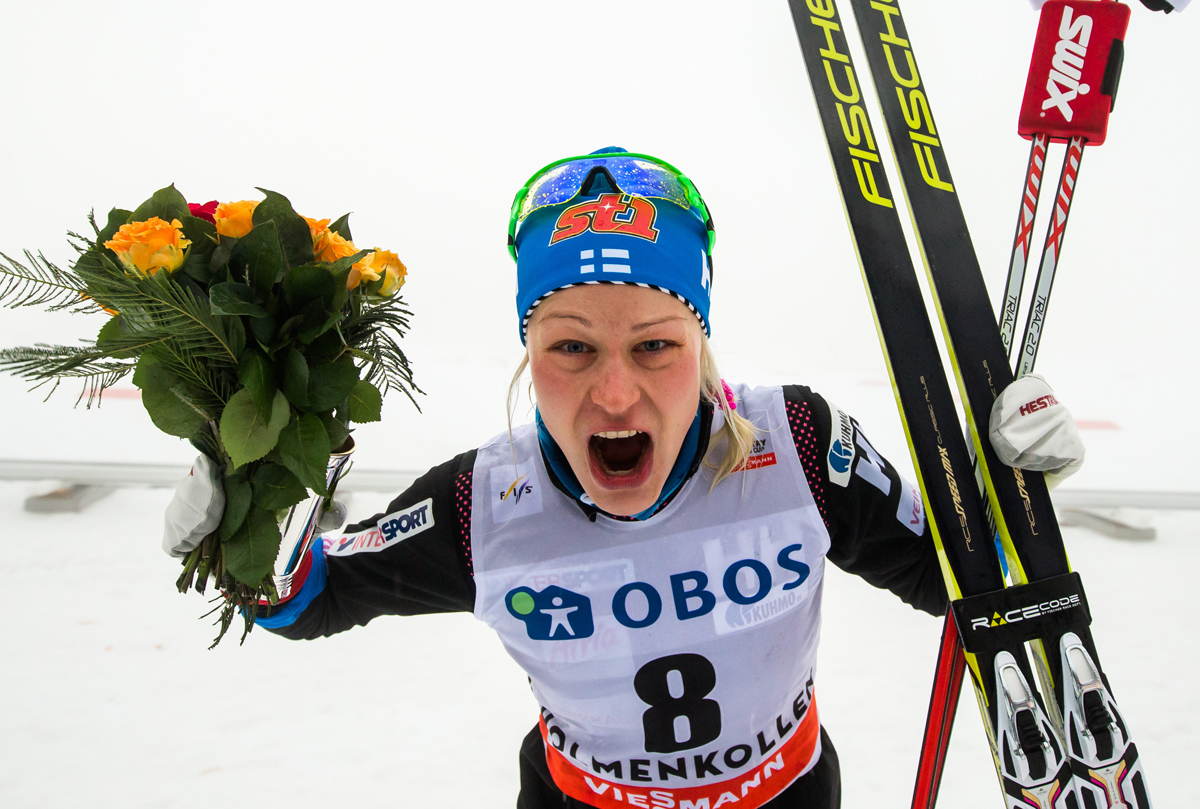
Finland’s Anne Kyllönen celebrates her podium in the Holmenkollen 30 k classic, after placing third on Sunday in Oslo, Norway. (Photo: Fischer/NordicFocus)
6.6 seconds at 26.6 kilometers. 14.5 seconds to Kyllönen at 27.5 k. If the rubber band to ultimate third-place finisher Kyllönen was stretching then, it broke by the finish.
Østberg skied to second, a full 29.5 seconds ahead of Kyllönen. It was Kyllönen’s best ever result at the Holmenkollen 30 k.
“I could not respond to the Østberg up and running, but it was cool when I was able for once to enjoy the situation and examine the winds properly in the home stretch,” she said, according to a translation.
“Such success requires that all aspects fall into place. I have felt after many of my competition, I would have been able to ski even better rate. I do not know if this was not yet a 110-percent success,” Kyllönen said. “Johaug was once again really hard in the attack. She got to ski Holmenkollen and certainly knows the tracks accurately. No one even think to try to hang on to her momentum.”
Østberg is another sign that Norway’s pipeline of skiers is not tapped out.
This was Østberg’s best Holmenkollen 30 k result. In 2010 she placed 32nd in the 30 k free, in 2012, 42nd in the 30 k classic, in 2014, 15th in the 30 k classic, and in 2015’s 30 k free, 21st.
“I did not in my wildest imagination thought I would get on the podium here. Although I am miles behind ‘Miss Joy’ [Johaug], this is like a victory for me,” Østberg told NRK.
The 2016 Holmenkollen 30 k classic podium: with Norway’s Therese Johaug (c) in first, teammate Ingvild Flugstad Østberg (l) in second, and Finland’s Anne Kyllönen (r) in third. (Photo: Fischer/NordicFocus)
Johaug’s win on Sunday gives her a small buffer for the Overall World Cup. With 1644 points, Johaug leads Østberg, who remains in second overall, by 172 points. That margin could dwindle by Thursday of next week. Johaug will not race in the Stockholm, Sweden, sprints, while Østberg remains a favorite.
“I think not so much on the points you make. But I’m not going to give up the World Cup,” Østberg explained to NRK. Sunday’s result solidifies Østberg’s evolution from sprint star to potential podium placer in the longest distance events. Her eyes now fixed on the overall globe once thought to be a gimme for Johaug.
Østberg’s goals may have broadened. Yet those aspirations are grounded with the knowledge that Johaug has proven she remains on form and virtually untouchable. “I’ve never been on the [overall] podium either. If I can do it, it’s a great achievement for me. But I do not give up until we’re done in Canada. But you see how insane superb Therese is,” NRK reported Østberg as saying.
Notes: Sadie Bjornsen was the top North American, skiing to 22nd (+7:44.5). Liz Stephen placed 23rd in a photo finish (+7:45.4), Jessie Diggins, 25th (+7:46.1), Rosie Brennan, 33rd (+11:43.7), Caitlin Patterson, 36th (+12:03.2), Canadian Emily Nishikawa, 39th (+12:41.1). A sixth American, Ida Sargent did not start.
World Cup racing continues on Thursday with sprints in Stockholm, Sweden.
Americans Kikkan Randall (c) and Sadie Bjornsen (r) ski with Norway’s Marthe Kristoffersen (l) and Germany’s Nicole Fessel (second from r) in the Holmenkollen 30 k classic mass start on Sunday in Oslo, Norway. (Photo: Fischer/Nordic Focus)
There’s something to be said for skiing like you’ve got nothing to lose. Ask Kikkan Randall, who locked up the World Cup sprint title for the third year in a row last Wednesday in Drammen, Norway. Or Sadie Bjornsen, who’s been plagued with bouts of illness for the better part of the last three months.
Both U.S. Ski Team members later said they felt relatively good before the start and during most of the world-famous Holmenkollen 30-kilometer classic mass start on Sunday in Oslo, Norway.
It was still a dang-tough course, with an initial 5 k lap followed by a larger 8.3 k lap containing two smaller loops (at least the skiers kept it straight). After getting off to a strong start, Bjornsen said she was a little frightened with the tempo of the women she was skiing with.
“At four k, I was like, ‘There’s no way I’m going to be able to maintain this pace, but I’ll hang on until I explode,’ ” she recalled.
Bjornsen did her best to hold her position just outside the top 10, first testing her grit with some Finns, including Krista Lahteenmaki and Anne Kyllönen. The American quickly found their classic style didn’t match hers and she opted to ski with several Norwegians, including Tuva Toftdahl Staver, Ingvild Flugstad Østberg, Kristin Størmer-Steira, and Martha Kristoffersen for the first several kilometers.
Bjornsen said the Norwegians’ “really big strides,” matching hers, made the difference. “I was appreciative of that,” she said.
Kyllönen’s stride was simply too big, she said, and “Lahteenmaki, I felt like I was in a sprinting running race; she has a very short tempo. I followed her for a couple k and my legs were flooded.”
By 10 k, Norway’s Martine Ek Hagen was right there with Bjornsen as well, and Randall was just off the back of their seven-person chase pack, which at the time, was about a minute and 30 seconds behind eventual winner Marit Bjørgen.
With Norwegian fans lining the entire course, Bjornsen said the atmosphere brought her back to her international debut at the 2011 World Championships in Oslo.
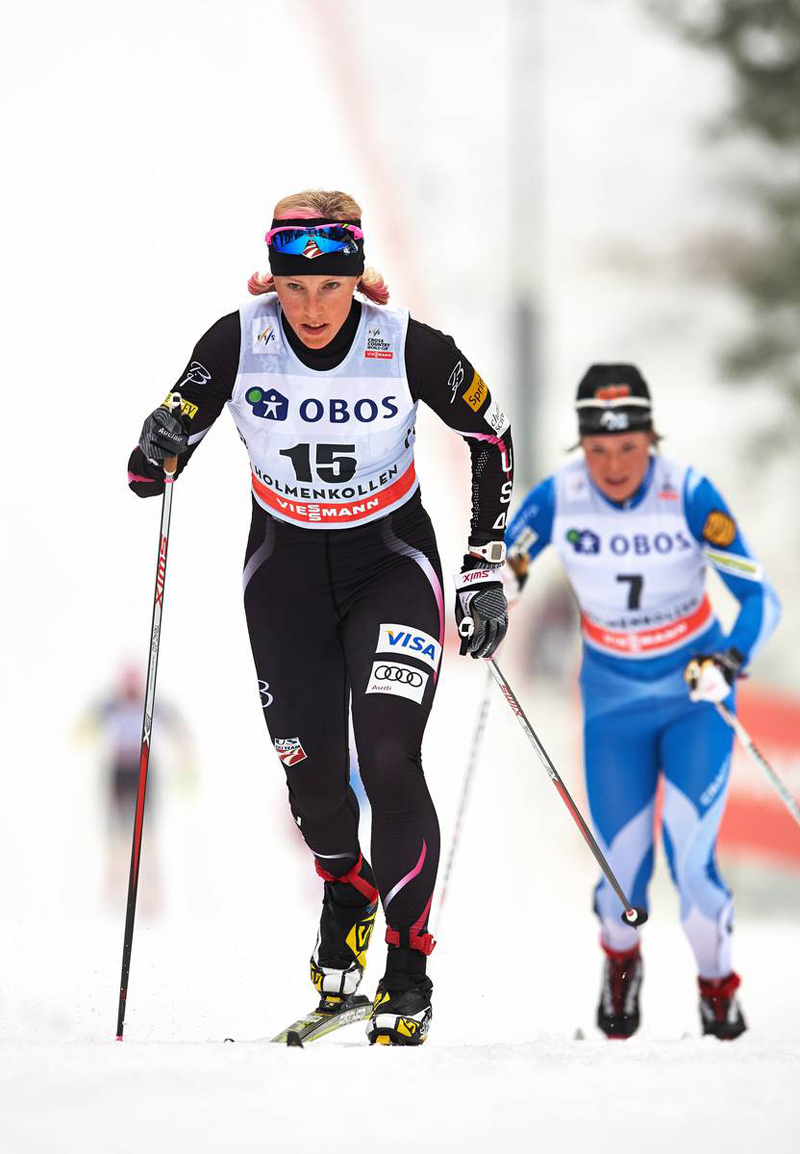
American Kikkan Randall (15) racing to 12th, a career best in the 30 k, at the Holmenkollen 30 k classic mass start on Sunday in Oslo, Norway. (Photo: Fischer/Nordic Focus)
“It was World Championships loud,” Bjornsen said. “I kept hearing my name in the mix, but more than anything, I could hear them yelling, ‘Kikkan.’ She’s a national hero here. She’s huge.”
The crowd and endless cheers fueled Bjornsen to staying within the top 15 throughout the race, with Randall close behind for most of it. Ultimately, Randall shot to the front of the pack and continued to pick off places with 1.5 k to go, finishing 12th for her career-best 30 k, just 10 seconds ahead of Bjornsen in 14th, also her best distance race.
Two years ago — the first time Bjornsen raced in Holmenkollen — she placed 40th in the 30 k classic. She did not race there last year.
“I couldn’t have picked a better way to ski it with four Norwegians,” Bjornsen said after going head-to-head with Heidi Weng, Østberg, Hagen and Kristoffersen to the line. She beat all but Weng, who took 13th by 0.4 seconds, and edged Østberg by one-tenth of a second for 14th, 4:27.8 back from Bjørgen. The top Norwegian became the first woman to win four Holmenkollen titles in what doubled as her 100th World Cup podium.
Randall finished 4:17.7 after Bjørgen, without anyone within several seconds of her. She recalled being 100 meters behind the pack for most of the middle part of the race, with skis that were “a little slick” on the first lap sending her in for a fresh pair at 13.3 k.
Bjornsen changed there as well, where she said everyone was switching. Skiing on her “B-pair” until that point, she said her skis were great — gripping on the uphills and fast enough on the downhills. But she wasn’t about to second guess what everyone else was doing, and changed to her A-pair. That was the first time a ski change worked out in her favor, she said.
The group she was with never switched again (out of a possible three times), and while most struggled with kick on the icy last lap, Bjornsen said it was the same for everybody.
The turning point for Bjornsen and Randall’s group came with 5 k to go. Bjornsen and Staver fell off the pace slightly around 20 k, but worked their way back up by the top of the long climb known as Frognerseteren. By then, Bjornsen and Randall racing with five Norwegians and Japan’s Masako Ishida.
“We came down the hill and suddenly [the Norwegians] started sprinting so hard,” Bjornsen said. “Suddenly, they’re in sprint pace and I was like, ‘Wow, are they going to do this to the finish? This is gonna be really hard.’ ”
About a kilometer later with 4 k remaining, the pace slowed. Randall then took off before the 28.5 k checkpoint.
“Now I’m kicking myself for not trying to go with her,” Bjornsen said. “But she was so impressive.”
After changing her skis, Randall said her arms started cramping on the second lap, but she double poled with her legs and core as much as possible, and was able to latch back on by the top of the course on lap three.
“It’s kind of a nice feeling when you get to the top of the course on that third lap — now you know some of the big hills are done and … see whats left in the tank,” she said.
With two climbs remaining, Randall knew she had the speed and energy to knock off a few places in the standings. She jumped in her own track and skied her own tempo, then simply “ran out of room toward the finish,” she said. “It’s aways fun having people to catch.”
The result was something she could be pleased with, especially in a distance classic race that isn’t typically her bread and butter. Going into the 30 k, Randall said she didn’t have to worry about her mind wandering off to the upcoming sprint at World Cup Finals on Friday. Had the pressure been on to win that sprint, she might have approached Holmenkollen differently, especially as the race got tougher.
“It was kind of nice to be able to wrap up the Sprint Cup and go, ‘Now I just get to race,’ and not worry about whether it’s a smart decision or not,” she said.
While Randall was aiming for a top 15, Bjornsen said she wasn’t sure what to expect for a result. She had come down with one of her worst colds yet after the Sochi Olympics, and went for her first 30-minute walk/ski last Tuesday. She raced Wednesday in Drammen (qualifying in 21st then placing 30th), then focused on getting healthier each day until the 30 k.
“I would say now I’m 100 percent,” Bjornsen said.
Reflecting on her second Holmenkollen experience, she said this one will definitely be among her most memorable races.
“Holmenkollen has such an incredible atmosphere,” she said. “I was trying to take in the noise level at the top of Frognerseteren, so that helped and also skiing with a bunch of Norwegians.”
Sophie Caldwell (U.S. Ski Team) racing to 35th in her first Holmenkollen 30 k mass start in Oslo, Norway. (Photo: Fischer/Nordic Focus)
Three other U.S. women made the top 40, and Ida Sargent was close behind in 42nd.
Liz Stephen placed 32nd (+8:30.2) after two crashes. Sophie Caldwell finished 35th (+8:48.1) in her first Holmenkollen 30 k, and Caitlin Gregg (Team Gregg/Madshus) was 39th (+10:15.3).
“Tough day for me with a couple of crashes early on, but nothing serious like Astrid [Jacobsen] experienced,” Stephen wrote in a message, referring to the Norwegian’s scary crash off a ledge that sent her to the hospital. She suffered a blow to her head, shoulder and hip, but was not seriously injured, according to NRK.
“The atmosphere here at Holmenkollen is definitely something special, with fans chanting your name, and campfire smoke billowing in the air and sausage smells and fresh waffle smells wafting throughout the race,” Stephen wrote. “Someday I am going to have to come camp out and be one of the fans out there, for sure.”
Caldwell explained that it was a long enough race that she had “multiple highs and lows throughout it, but overall I think it went well,” she wrote in an email.
She switched her skis once at 13.3 k because everyone else was doing it, not necessarily because she needed to.
“I got to ski with Liz a bunch which was fun and then otherwise kind of hopped between a couple groups,” Caldwell wrote. “The race atmosphere was insane. There are people lining the entire course who have been camping out all weekend and they all know your name. They have start lists, so as long as you aren’t skiing with any Norwegians, they start chanting your name as you go by. I think the extra cheers definitely helped motor me around the course.”
According to Gregg, who was especially confident in her skis and stuck with the same pair throughout the race: “no matter how you are feeling, the spirit of the crowds lift you up.” While the classic race wasn’t her specialty, she enjoyed the length.
“My result was solid but certainly not outstanding,” Gregg wrote. “Some of girls had awesome races today so that was really cool! I found the pace right off the gun to be ridiculously fast and it kind of caught me off guard. I was in last place from the end of the stadium. This is something I obviously need to work on. Throughout the race I continued to move up steadily as other racers got tired.”
Gregg with travel with the U.S. team to race at the three-day World Cup Finals in Falun.
“This will be my first time racing there and I am very excited about the format!” she wrote.
Bjornsen said making it to World Cup Finals has been her major goal since last season.
“It’s going to be fun because it’s a lot of different races,” she said.