Tag: Holmenkollen 30k

  • Johaug Victorious at Holmenkollen; Americans Land Outside Top 30

    Johaug Victorious at Holmenkollen; Americans Land Outside Top 30

    Therese Johaug (center) celebrates at the flower ceremony after winning the women’s 30 k classic race at the Holmenkollen. Russia’s Natalia Nepyreava (l) took second, and Sweden’s Ebba Andersson (r) finished third. (Photo: Screenshot FIS-Ski.com)

    Skies cleared and the sun shined on the 30-kilometer mass start classic at the Holmenkollen. When not surrounded by tall pines, racers were offered beautiful vistas of Oslo and the cold blue fjord on which Norway’s capital is built. While the Sunday crowd pales in comparison to the masses who attended the men’s event on Saturday, plenty of tents still lined the course to house families of fans camped out for the weekend. The snowbanks lining the course continued to bear the scars of carved benches lined with pine boughs and snow pits dug around small fires. Norwegian flags flew in abundance as Therese Johaug ran away with yet another distance victory, stopping the clock at 1:18:54.5.

    Unlike the men’s race which was decided in the final kilometer, Johaug made it clear that she would win her third race at the Holmenkollen, her second with classic technique. With her wins in 2013 and 2016, she is tied for second-most wins with Larissa Lazutina of Russia who retired in 2002 and her teammate Julija Tchepalova who retired in 2009. Only Marit Bjørgen has earned more wins in Oslo with seven victories.

    The race unfolded as nearly every other distance race Johaug has entered this season, including the 30 k freestyle at the World Ski Championships in Seefeld just over one week prior. Johaug separated herself from the pack early and built a gap of nearly a minute by the halfway mark, then continued to expand that lead by the finish. She showed little sign of fatigue and her technique never faltered as she soared through the classically Norwegian track, weaving through the woods, passing by a statue of a troll, and looping around the chapel before rolling past the modernist yet historic ski jump through the stadium. She now joins Bjørgen in the exclusive club of women who have won the 30k at both the Holmenkollen and the World Championships within the same year; Bjørgen has done this twice.
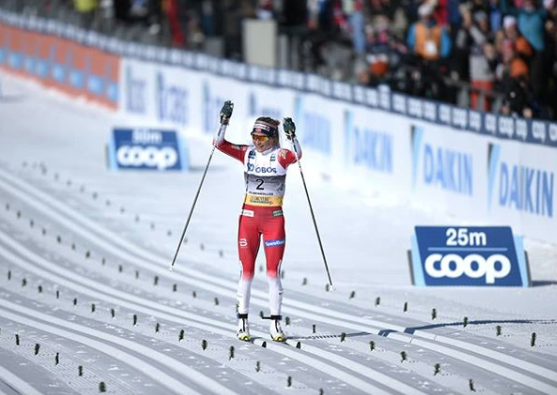
    Therese Johaug celebrates her victory in the final meters of the women’s 30 kilometer classic race at the Holmenkollen. (Photo: Screenshot Instagram @fiscrosscountry)

    Johaug is a resident of Oslo, so her victory was won in front of her home crowd. The champion trained relentlessly on the tracks at the Holmenkollen and the surrounding trail system of Nordmarka during her suspension with the hope of returning with a season like she has had.

    “It’s really special,” Johaug told the International Ski Federation (FIS). “The last two years I’m training so much on these tracks and have a lot of hard sensation out there. So I know the tracks really good, but it was amazing to ski here. There was a lot of people around the track and I love to ski the Holmenkollen.”

    While she was aware of the gap that she had on the other women, she did not see that as a reason to slow her pace.

    “The coaches give me some information that I have a lot of seconds in front of the rest, but I just have focus on myself and to just have fun out there,” she said. “And the last time in front of the stands I just look up and see all the people that are cheering at me. It means a lot in my heart.”
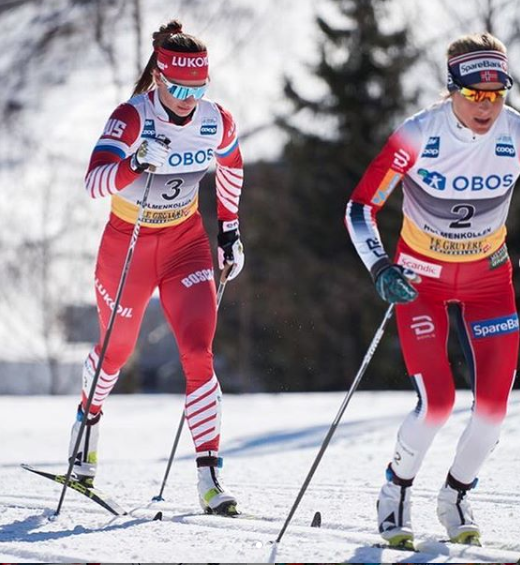
    Natalia Nepryeava of Russia (bib 3) chases Therese Johaug (bib 2) in the opening kilometers of the women’s 30 kilometer classic race at the Holmenkollen. (Photo: Screenshot Instagram @russianskiteam)

    Behind the peerless leader, the battle for the remainder of the podium spots was decided much later. Natalia Nepryava of Russia was the only skier who made an attempt to stay with Johaug in the first lap. But she fell off the pace and raced mostly alone in front off a group of Ebba Andersson and Charlotte Kalla of Sweden, Ingvild Flugstad Østberg and Astrid Jacobsen of Norway, and Katharina Hennig of Germany, with Krista Pärmäkoski of Finland chasing from behind.

    While she was never able to make significant headway on the gap Johaug created, Nepryeava held her position in second steadily, never looking over her shoulder to the women in pursuit behind her.

    In the final lap, Kalla led the chase pack with a small gap, but she was reeled in by Østberg and Andersson. Østberg was hungry for her second podium finish after placing second in 2016. Østberg and Andersson passed Kalla with less than five kilometers to go, and continued to surge, drawing ever closer to Nepryeava.

    Though they continued to gain on the Russian, Andersson and Østberg were not able to close the gap to Nepryeava, who finished on her own in second (+1:45.9). The Norwegian and the Swede charged through the final kilometer, double poling fiercely to the finish neck in neck. With a throw of her boot, Andersson edged out Østberg at the line, taking third (+1:49.9) with Ostberg inches behind in fourth (+1:50.1).

    Three Americans competed in the Holmenkollen, but none were able to crack the top-30. Rosie Brennan (APU) was the top American finisher in 33rd (+7:57.0), followed by her APU teammate Rosie Frankowski (+9:40.2). Kaitlin Miller (CGRP) finished 42nd (+13:43.7). No Canadian women entered the race.

    Amidst a strong season during which she has cracked the top 10 twice, one of which was earned during the World Championships in the 15 k skiathlon and the other in the 10 k skate in Davos, and has skied inside the FIS points 13 times in individual events, this result was not what Brennan was looking for.

    “I’m a little disappointed, that wasn’t really what I hoped for,” Brennan told FasterSkier in the mixed zone. “I just didn’t have much fight, and I didn’t think my skis were very good, and I’m a little tired from World Champs still. It was a lot of racing and we did a 30 k a week ago.”

    Brennan kept her performance today in perspective as it was not her primary objective.

    “My goal was World Champs so I had to give everything I had there and I’m happy with that,” Brennan shared. “I hoped I would have more energy but I didn’t, so onto the next.”

    Frankowski, who finished 31st last year at the Holmenkollen, had a tougher time keeping this in perspective.

    “It was hard. I just didn’t feel good,” she stated simply.

    Today was Frankowski’s fourth World Cup start this season. Her best result, and only top-30, took place in the 15 k skiathlon at the World Championships. The 27-year-old Minneapolis native took 21st in the 30k classic race during the 2018 Olympics in PyeongChang.

    “The climbing was good for me,” Frankowski commented on the highlights of a tough day. “I like the long climb better than the church loop, the church loop is always really hard. I wish it was skating.”

    As the race strung out, Frankowski lost contact with the skier ahead of her, but remained several seconds ahead of the women behind. With the exception of passing a few competitors, she remained largely in no man’s land, a tough position to be in during a long race where drafting and working off of others can be so valuable.   

    “I didn’t ski with – literally no one,” expressed a frustrated Frankowski. “After the first 5 k, I couldn’t even – I saw like two girls the whole time in front of me…The crowd’s always good here, so at least you get a lot of cheers which is cool.”

    She added that skiing alone is not always bad, but today it was not in her favor.

    “Most of the time I like it, but today, I think I just was battling my own head, so it made it harder than if you could ski with someone and be distracted,” she explained. “Every person that I caught, which was only two, but they were going so slow that – I passed them on the long climbing section, so we weren’t skiing together at all.”

    Both Brennan and Frankowski felt that their wax techs were not able to find the “magic balance”, as Brennan called it, when it came to kick and glide on the frozen tracks in Oslo. Both felt their skis were average and despite the ability to exchange for a new pair, never had an optimal pair that allowed sufficient kick up the long climbs without sacrificing glide on the equally long descents.

    https://www.safecuring.net


    “30k is weird, especially classic,” Frankowski concluded. “I feel like sometimes you’re battling your skis, so you can’t go as hard as you want. I gave everything I had today, so that was good.”

    While originally hailing from Perth, Australia, Jessica Yeaton has been primarily based in Alaska for the last 15 years. She is a teammate of Frankowski and Brennan at APU, but also skis for the Australian National Team. Yeaton has primarily raced in the Super Tour circuit this season, heading to Europe to race in Lahti in preparation for the World Championships. Yeaton raced in the individual sprint, the 15 k skiathlon, the 10 k classic, and the 30 k skate in Seefeld, with her best result taking place in the skiathlon where she placed 22nd, just behind Frankowski.

    “My rest and recovery since Seefeld has gone well so I was really looking forward to racing today, and I am super happy to have made the top 30,” wrote Yeaton in an email. “My wax techs did a great job with the skis, and I was very fortunate that Madshus helped me with a second pair of skis for the exchange- so I had competitive skis for the whole race.

    “It was a gorgeous, sunny day with tons of fans cheering out on course – this will definitely be a venue to remember!” she concluded.

    Racing in Norway continues Tuesday on the streets of Drammen with a classic sprint.

    Aleks Tangen and Harald Zimmer contributed
  • Bjornsen Leads Three Americans in Top 25 at Soggy Holmenkollen 30 k

    Bjornsen Leads Three Americans in Top 25 at Soggy Holmenkollen 30 k

    Americans Sadie Bjornsen (r) and Jessie Diggins (l) during the Holmenkollen 30 k classic on Sunday near Oslo, Norway. (Photo: Fischer/NordicFocus)
    Americans Sadie Bjornsen (r, in white) and Jessie Diggins (behind, in white) during the Holmenkollen 30 k classic on Sunday near Oslo, Norway. (Photo: Fischer/NordicFocus)

    If a 30-kilometer classic mass start on a brutal course wasn’t challenging enough for the U.S. women’s team, which specializes in shorter-distance skate races, the fog and rain made for an even tougher day at the Holmenkollen stadium in Oslo, Norway.

    Temperatures hovered around 5 degrees Celsius (41 Fahrenheit) throughout the day and a thick fog enveloped the racers and spectators. Intermittent rain fell through the race on yet another klister day.

    “It was just thick, thick fog with maybe 75 feet of visibility. You are completely socked in and soaked,” coach Matt Whitcomb said in a post-race phone interview.

    Norway’s Therese Johaug dominated the race, winning in 1:24:55 for her first Holmenkollen 30 k classic title. Her winning margin of 3:46.5 was the largest in the race history for the women. Norwegian Ingvild Flugstad Østberg continued to prove she is a threat in both sprints and distance races, taking second place, 29.5 seconds ahead of Finland’s Anne Kyllönen.

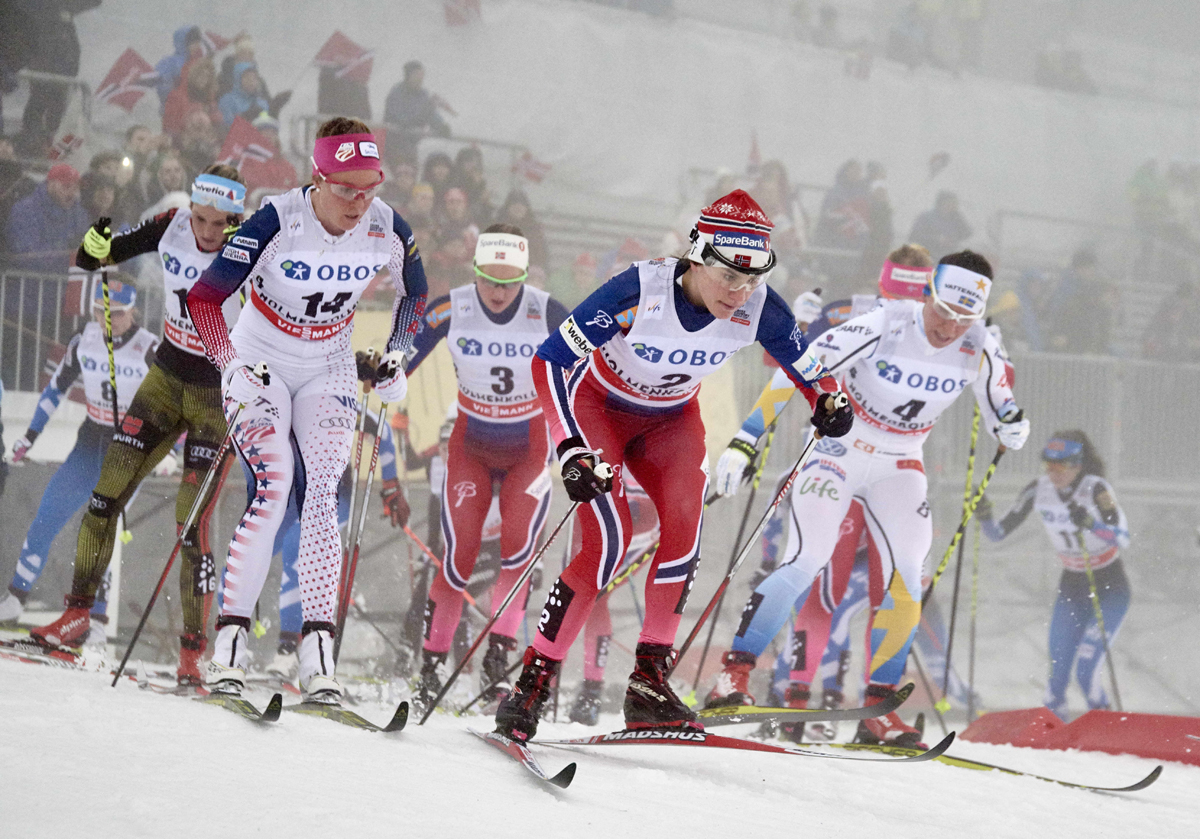
    Early in the women's 30 k classic mass start, Sadie Bjornsen (14) in the mix with Norway's Ingvild Flugstad Østberg (3), Heidi Weng (front, in red), and Sweden's Charlotte Kalla (r) on Sunday at Holmenkollen in Oslo, Norway. (Photo: Fischer/NordicFocus)
    Early in the women’s 30 k classic mass start, Sadie Bjornsen (14) in the mix with Norway’s Ingvild Flugstad Østberg (3), Heidi Weng (front, in red), and Sweden’s Charlotte Kalla (r) on Sunday at Holmenkollen in Oslo, Norway. (Photo: Fischer/NordicFocus)

    Three American women cracked the top 25 and finished within 1.6 seconds of one another. Sadie Bjornsen led them in 22nd (+7:44.5), closely followed by Liz Stephen in 23rd (+7:45.4) and Jessie Diggins in 25th (+7:46.1).

    Rosie Brennan and Caitlin Patterson also represented the U.S., finishing 33rd (+11:43.7) and 36th (+12:09.1) respectively.

    Canadian Emily Nishikawa placed 39th (+12:41.1) for her best Holmenkollen result in the last two years at the race.

    Reminiscent of Martin Johnsrud Sundby’s aggressive start in Saturday’s 50 k, Johaug pushed early and established an 8.6-second lead just 1.8 k into the race. She widened the gap throughout the race with her characteristic-and-unrelenting quick tempo.

    The women’s race started with a 5 k loop before continuing on for three laps of the same 8.3 k loop used in the men’s race. The first loop contained some of the steepest climbs in the course and the women had the challenge of navigating them while still in a large pack.

    Bjornsen asserted herself near the front of the large chase pack in the first five kilometers. Diggins also established herself in the top 20 with Brennan not far behind in 26th at the five kilometer mark.

    Despite the strong start, over the next five kilometers Bjornsen, Diggins and Brennan were shuffled back as the field strung out, morphing from a pack to solo skiers and small groups.

    The dense fog isolated racers from one another, making it difficult to judge gaps and placement in the field — for better or for worse.

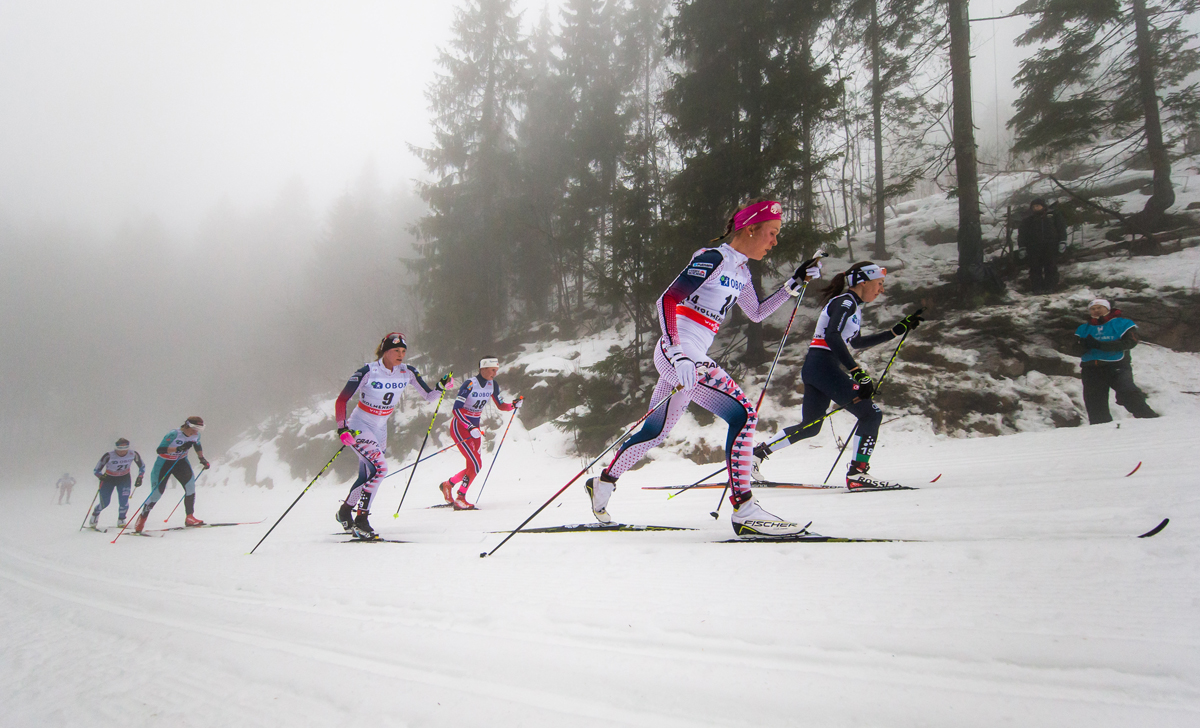
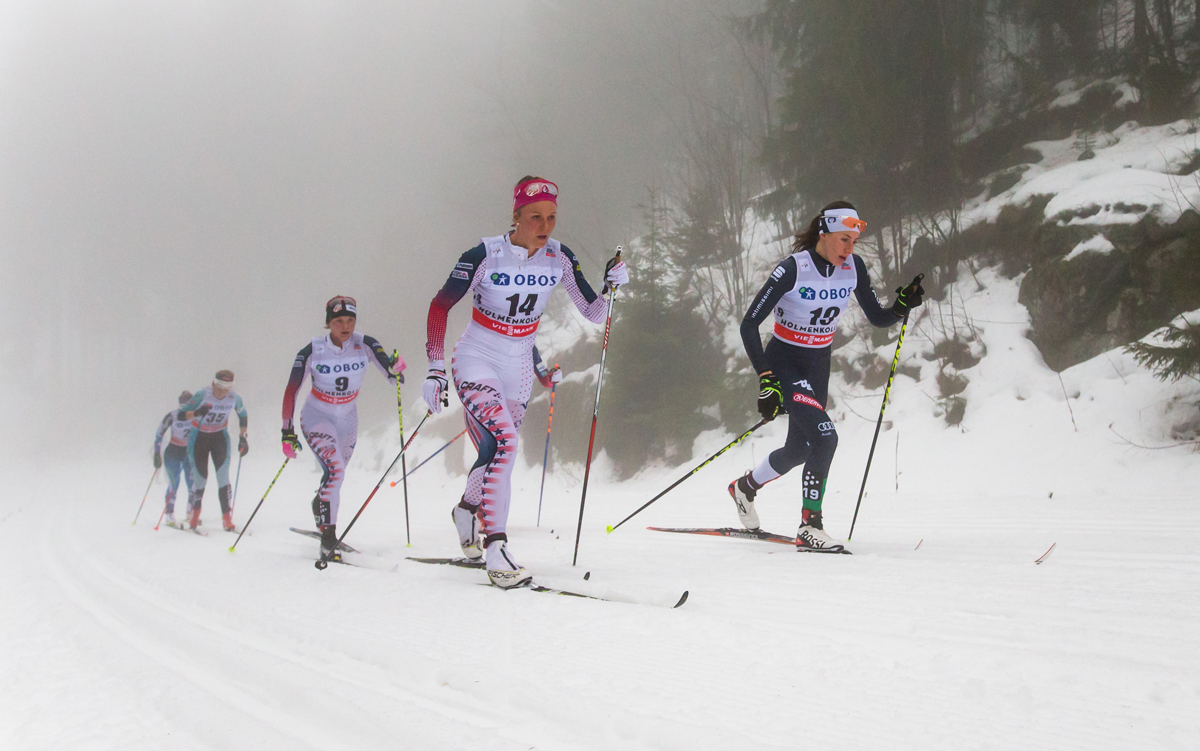
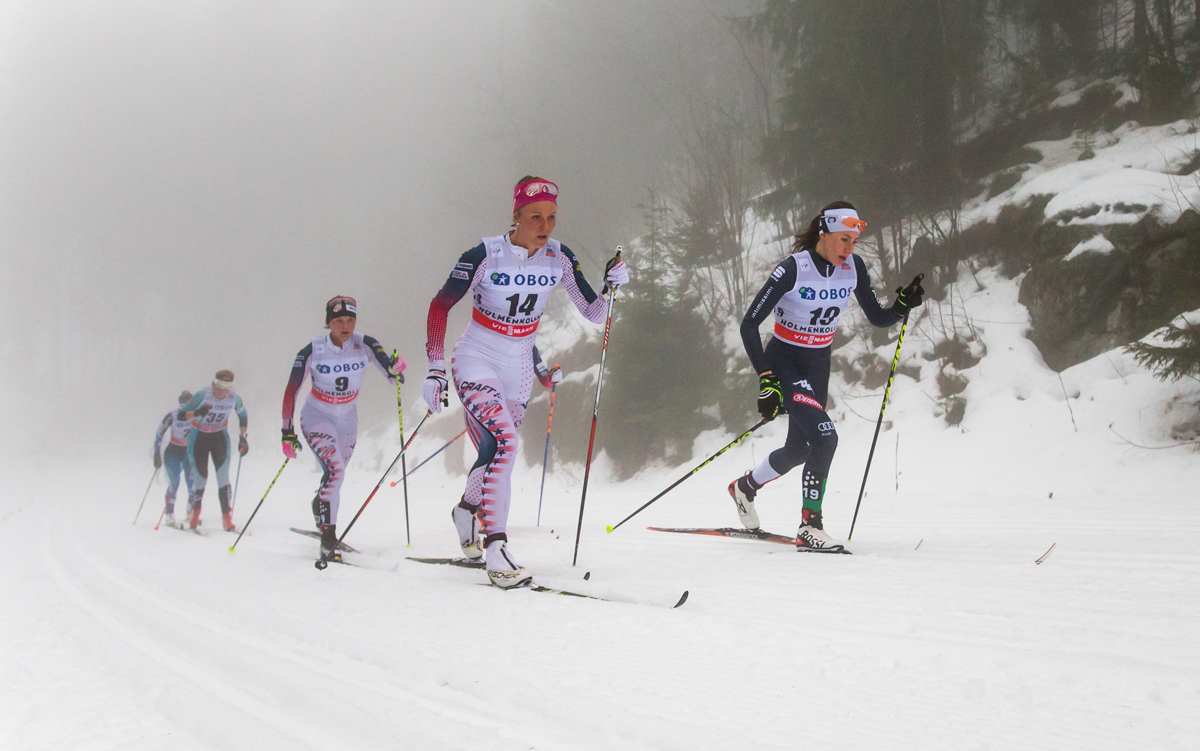
    Sadie Bjornsen (14) leading a chase pack with Italy's Virginia de Martin Topranin (r) and Jessie Diggins (l) just behind. (Photo: Fischer/NordicFocus)
    Sadie Bjornsen (14) leading a chase pack with Italy’s Virginia de Martin Topranin (r) and Jessie Diggins (l) just behind. (Photo: Fischer/NordicFocus)

    “At some point it would have been nice to have the motivation of knowing that there were people within reach ahead, but it was probably also good at other places that I couldn’t see,” Patterson wrote in an email.

    Since each 8 k lap climbed over the first three kilometers before a long descent, there was significant movement through the field depending on skis and the racers’ strengths.

    “Sadie and Jess had very good kicking skis, but they were not gliding the fastest,” Whitcomb said. “We saw a lot of that in the field — a lot of women slipping and falling back on the climbs and those with slower skis and falling back on the descent.”

    Diggins and Bjornsen lost time on the descent and fell out of contact with the chase group of 11 to 15 skiers.

    By 10 k, Bjornsen and Diggins were skiing in a tight group of four racers, at 25th and 28th places respectively. Brennan slipped to 33rd, which she maintained for the remainder of the race.

    Bjornsen and Diggins’ pack grew to seven racers by the 15.5 k mark, including teammate Stephens who had fought her way through the field after a beneficial ski switch.

    “Her first pair of skis were slower and her second pair were really good. We were really hoping for good feelings out there for Liz and she felt great,” Whitcomb said.

    At 18 k, Stephen picked up the pace and grabbed places each kilometer putting 11.7 seconds on the group and moving to 21st place within two kilometers. She continued to grab places, managing to reach 18th place by 28.5 k.

    In the final kilometer, Bjornsen and several other skiers in the group managed to reel in Stephen, finishing in a tight group with only 15 seconds between 17th and 25th place.

    “It was fun to share the majority of the kilometers with Jessie as we pushed each other along, and then chase Liz some there at the end,” Bjornsen wrote in an email.

    “Today was one of the more challenging Holmenkollen’s both mentally and physically, but regardless, I still managed to truly enjoy the atmosphere out there while I was racing,” she wrote. “Conditions were challenging the entire race, and our team fought hard to stay in the mix.”

    Stephen reflected on her race as “a step in the right direction,” in a U.S. Ski Team press release.

    “I have been trying to manage a fatigued body this season and so the last 10 days that we spent training in Sjusjoen, Norway were all about recovery for me,” she said. “I trained slow, worked on some technique and rested more than I wanted to with perfect winter conditions right out the door each day.

    “But each day I felt a little better and so today’s feelings were of a body that is much more recovered, has much more energy and spunk in it and I loved the foggy, wet conditions we had today,” she added. “I was mentally ready to charge again and my body responded positively to each push.”

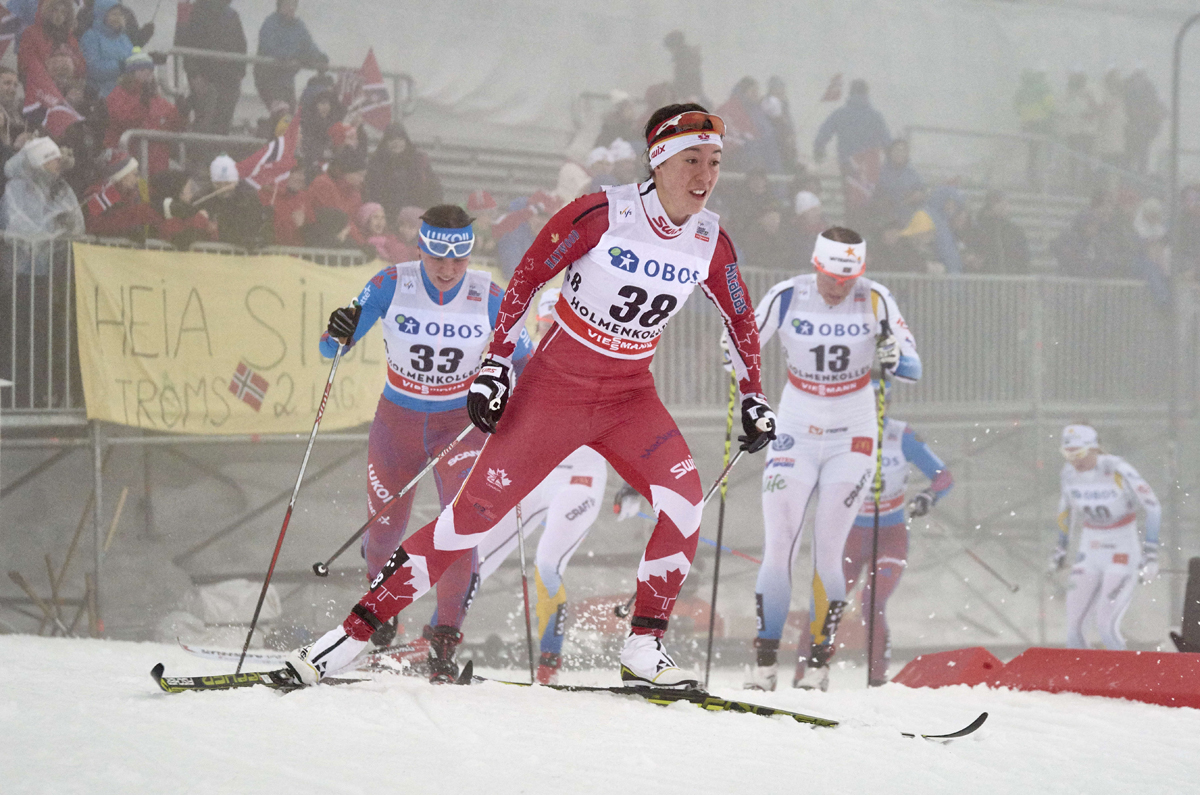
    Canada's Emily Nishikawa (in red) racing to 39th for her best Holmenkollen 30 k result in the last two years (after placing 50th last year) in Oslo, Norway. (Photo: Fischer/NordicFocus)
    Canada’s Emily Nishikawa (in red) racing to 39th for her best Holmenkollen 30 k result in the last two years (after placing 50th last year) in Oslo, Norway. (Photo: Fischer/NordicFocus)

    Although the U.S. women put together respectable results on a very challenging day, “We just didn’t hit it out of the park,” Whitcomb said. “We had athletes who had one or two or three great laps but we didn’t have anyone who was able to put together four great laps. So that is why we saw somewhat muted results today.

    “We were excited about Caitlin Patterson getting over here for her first big distance race. Finishing 36th is nothing to dismiss for sure,” he added. “We are happy she is feeling good and excited to see what she can do.”

    Patterson had to transition abruptly to World Cup level competition and terrain after competing on the domestic SuperTour circuit just last week.

    “While in the U.S. someone often drives the pace a little at the beginning of a race to break up the field, it’s nothing like the pace in the World Cup with Johaug leading,” Patterson wrote. “I’m notoriously on the slow side for starting, and even though I knew it was going to begin fast today, it caught me off guard.

    “I was frantic at the start, didn’t find the smooth and powerful style of striding that has served me well in other races this year, until well into the race,” she added.

    Although she didn’t realize it due to the dense fog, Patterson went through the 2.7 k time check 47th out of 49 starters. However, she was able to find her rhythm and adjust to the demanding terrain and move up to finish 36th.

    “The terrain is undoubtedly bigger, steeper, harder than basically anywhere I’ve skied in the U.S. In a classic race this means I have to push my limits, a long steep striding hill that we’d rarely be faced with in the US is very strideable but you have to figure out how to do it,” she wrote.

    At the end of the day, Patterson remained positive. “We all have our weaknesses, and you really have to be at the top of your personal race game to have a chance to compete against the best in the world, and I’m as motivated as ever to keep making little steps whenever I can to get there,” she wrote.

    World Cup racing resumes with classic sprints Thursday in Stockholm, Sweden, followed by weekend distance races in Falun, Sweden.

    Results | World Cup Overall Results