From the FasterSkier archive — posts syndicated from athletes’ and coaches’ own blogs between 2004 and 2012, kept online as published. Current coverage is at fasterskier.com.
This World Cup coverage is made possible through the generous support of Marty and Kathy Hall and A Hall Mark of Excellence Award. To learn more about A Hall Mark of Excellence Award, or to learn how you can support FasterSkier’s coverage, please contact info@fasterskier.com.
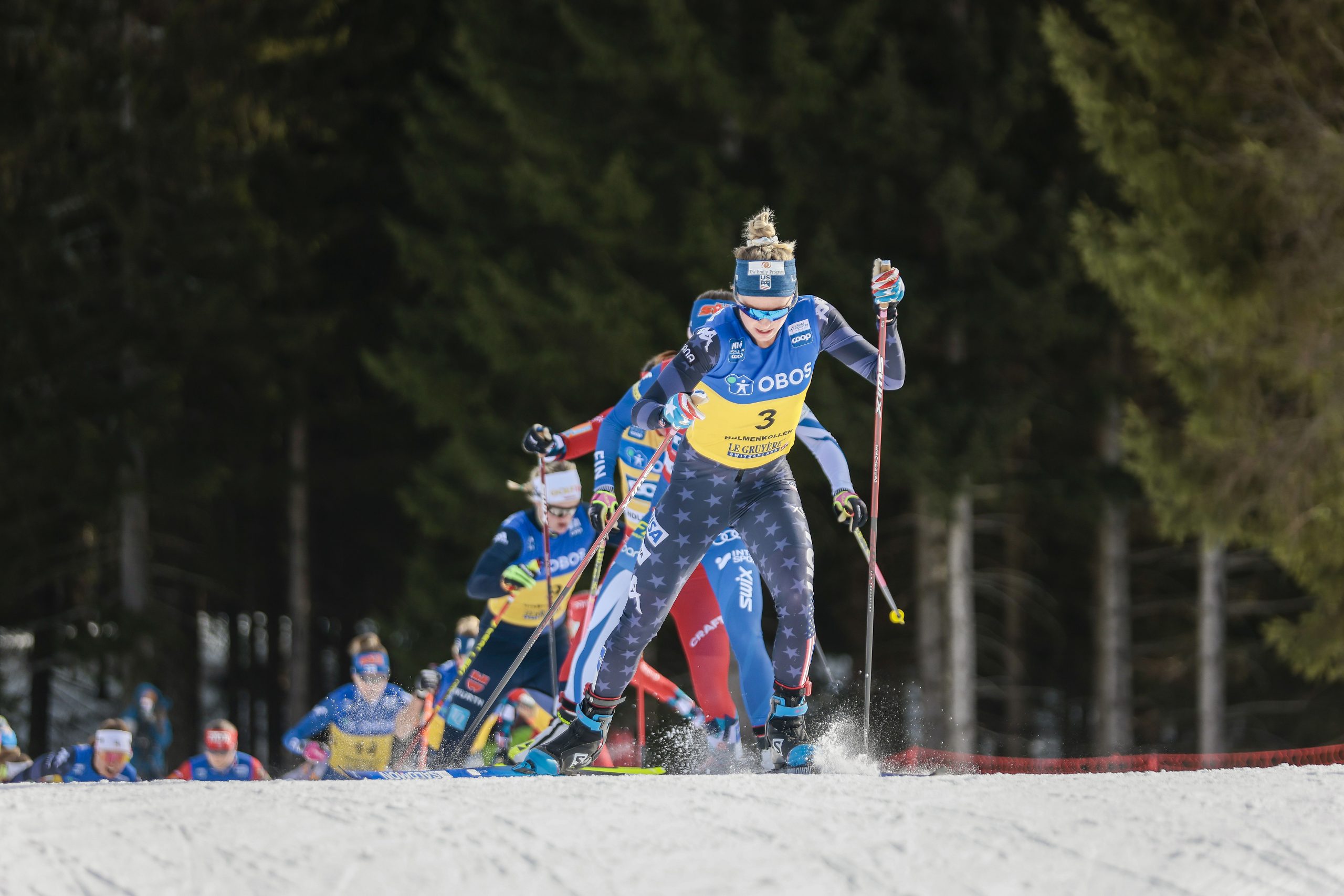
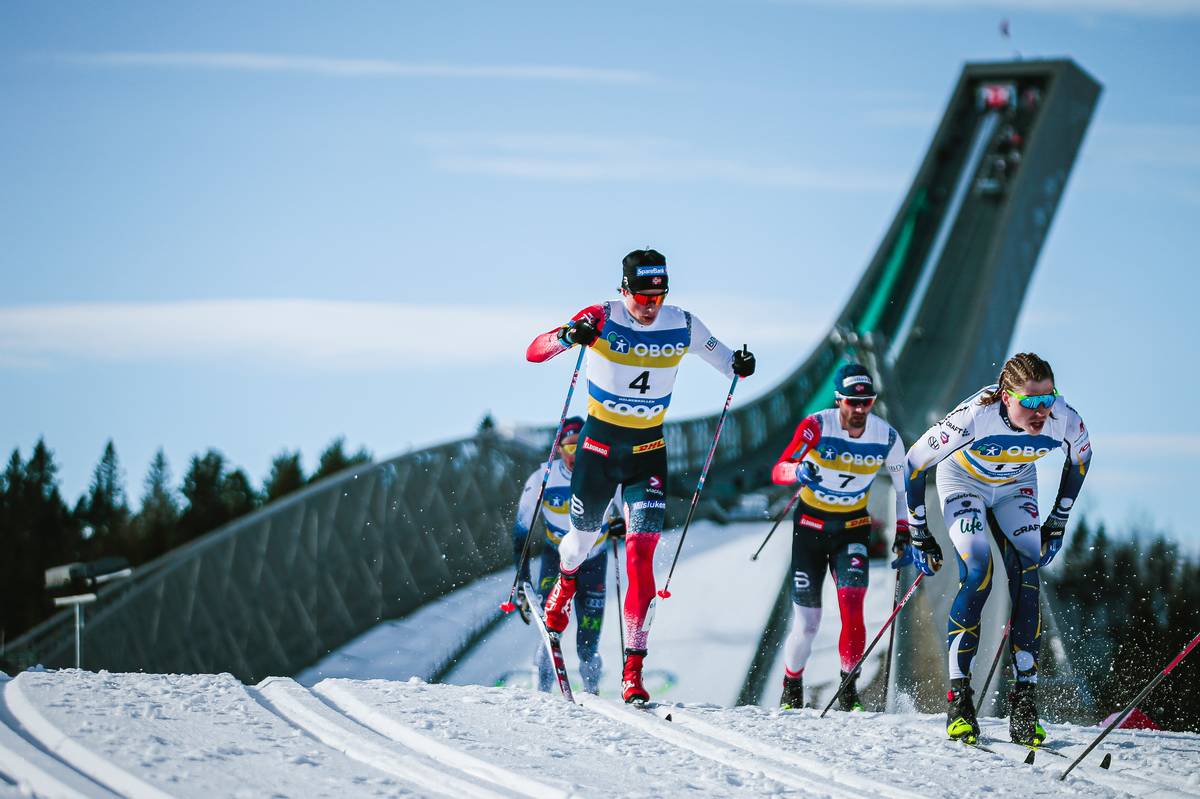
Jessie Diggins (USA) set the pace for much of the Holmenkollen 50 k, winning five of six intermediate sprints in her pursuit of additional FIS World Cup bonus points. (Photo: Modica/NordicFocus)
“It’s the right message that we want to send to young girls all over the world: you work just as hard as the guys, you train just as much, you should get to race the exact same races.” Jessie Diggins
History was made today by an entire field of finishers: a daunting distance, a hard-fought battle, equality demonstrated, acknowledgment confirmed. Ragnhild Gloeersen Haga (NOR), Astrid Oeyre Slind (NOR), and Jessie Diggins (USA): theirs was the podium, and the distance, and the accomplishment that will be remembered. That this day has been so long in coming is cause for critical reflection; that this day has finally arrived is cause for celebration. The women’s FIS World Cup field has finally been allowed to race the Holmenkollen 50 k, and our sport is better for it.
That women were capable of racing such distances at such competitive intensities was never in doubt. That women train as hard as men was never up for debate. Still, what has been required is a day when the skiing world—and the media world—not only acknowledges those facts, but actually gets a chance to see them proven. Today, at Holmenkollen, was that day.
“Wow, what a day!” noted Rosie Brennan (USA). “We’re moving forward, and working for equality, and being progressive; that’s something I was willing to fight for today.”
“A race like the 50 k really embodies the spirit of Nordic skiing as a whole,” said American Hailey Swirbul. “It’s about going into the woods, covering a lot of ground as fast as you can, and being supported by a really amazing community. [It was] a beautiful day to make history with some awesome, bad ass women.”
Diggins led all Americans in finishing third—barely outsprinted across this historic finish line by Gloeersen Haga and Slind. Among other Americans, Rosie Brennan earned a hard-fought seventh, Hailey Swirbul 25th, Alayna Sonnesyn 30th. Canada’s Katherine Stewart-Jones finished 16th.
Holmenkollen 50 k
The women’s field is familiar with the challenges of the Holmenkollen course, having raced this course as a 30 k distance many times before. Today’s race, though, involved six laps of this famed course over a distance of fifty kilometers, a distance usually reserved for flatter, less-challenging marathon races. Today’s race wasn’t just longer than normal, it was entirely different.
It was evident in scenes framed by broadcast TV cameras that the pace of the race heated up quickly. The early pace was often driven by lesser-known Norwegians—Margrethe Bergane (former Junior World Champion) and Nora Sannes—who seemed determined to make the race fast and difficult. American skiers made the initial selection with Diggins winning the initial bonus sprint two places ahead of Tiril Udnes Weng, her rival in the race for the season-long Overall World Cup.
The six World Cup sprint bonuses would define much of the action in the early laps—racers knew that there were 90 total points available to any skier who could win all six intermediate sprints (nearly as many points as winning the day’s race, outright). Much was at stake for contenders for both the Overall Crystal Globe and the Distance Globe: Diggins, Weng, and Kerttu Niskanen (FIN) would be locked in that secondary battle the entire day. Diggins won the first bonus sprint (with Weng third). Diggins won the second bonus sprint (Niskanen second, Weng third). It became clear that Diggins was willing to gamble on pursuing the sprint bonuses even at the risk of undoing her chances of winning the day’s race. It was a bold maneuver, and one that paid off in Diggins markedly reducing her points-deficit to Weng in the Overall.
Ambitious young Norwegians—and intermediate sprint opportunities—animated the first half of the race, interrupted briefly by the opportunity taken by most racers to switch to fresh skis at the end of lap three. Diggins skis seemed especially fast, allowing her to flow efficiently into an 11-woman lead group that began forming: Slind (racing in her club suit rather than the familiar Norwegian team suit), Patricija Eiduka (LAT), Eveliina Piipo (FIN), Kerttu Niskanen (FIN), Nora Sannes (NOR), Tiril Udnes Weng (NOR, Margrethe Bergane (NOR), Theresa Stadlober (AUT), Brennan, Diggins, and Gloeersen Haga. Ultimately Piipo, Niskanen, Hagga, Eiduka, and Brennan would fall back, leaving a lead group of six that was mostly paced by Diggins (whose moves were marked closely by Weng).
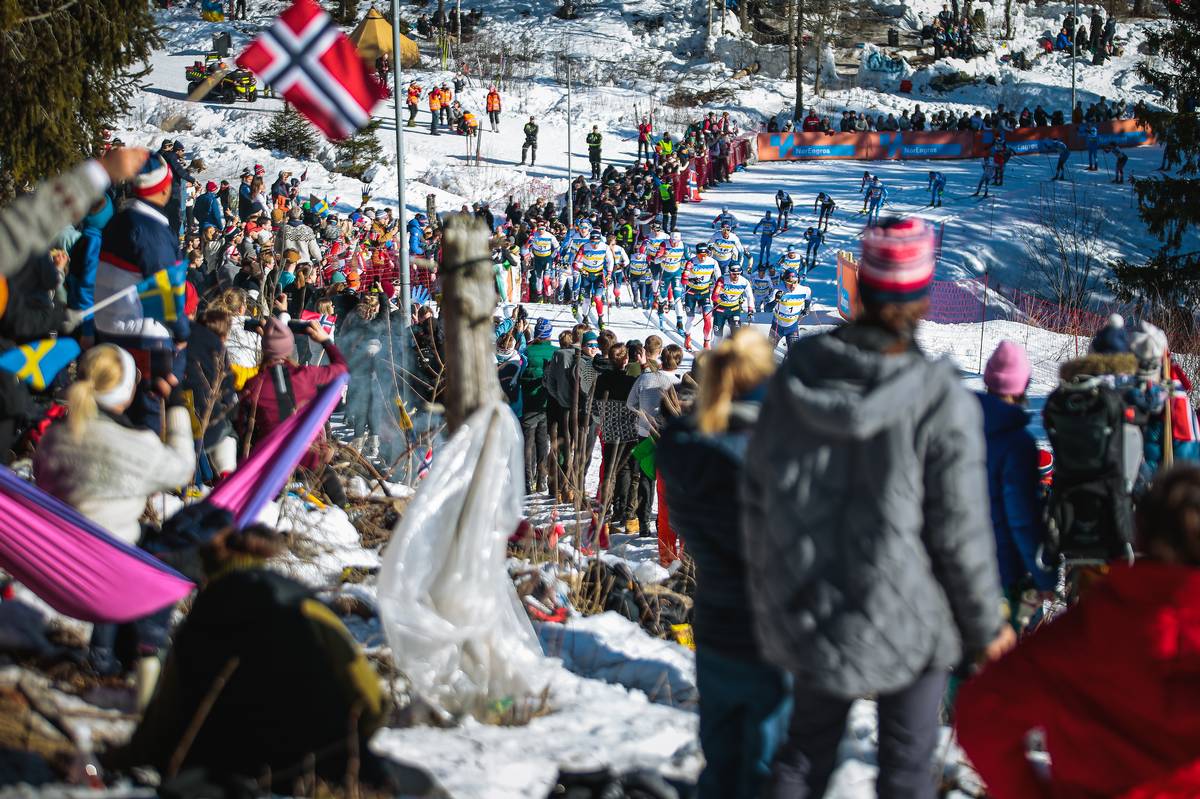
The historic Holmenkollen race venue above Oslo, Norway provided the stage for more skiing history as Women’s World Cup competitors were finally able to race the 50 k distance. (Photo: Modica/NordicFocus)
The lead group came through the stadium at the beginning of the final lap: Bergane, Diggins, Stadlober, Haga, Slind, Sannes, Weng . . . with Weng beginning to dangle as the lead group approached the final bonus sprint. Diggins was second to cross the sprint line for the final set of bonus points, looking around at the field to check her status for the final kilometers. She’d earned 87 World Cup bonus points, and reduced her deficit to season leader, Weng. Her cumulative totals were also enough for her to displace distance leader, Niskanen. Diggins had already accomplished much, but an historic finish line was looming, as well. The distance and the effort had taken their toll:
“By the end I was pretty much cramping everywhere,” Diggins recalled. “The arches of my feet, the inside of my knee, my quad, my hip, my lats, and my triceps. Pretty much all the muscles you use for skiing. I was honestly thrilled to find myself in the sprint-out, fighting for the win . . . it was so awesome to be part of that.”
After two hours and thirteen minutes of intense racing, the race came down to a sprint for the line. Gloeersen Haga outsprinted Slind and Diggins, all of them finishing with half a second of one another. Haga had come back from mid-race deficits to display the sort of form that won her the Olympic gold in the 10 k Freestyle at PyeongChang. It was sweet vindication for a skier who has often been overlooked in recent years . . . and a sweet form of redemption for generations of skiers who have been doubted and overlooked for far too long.
Hailey Swirbul (USA) checks an historic goal off the list: the Holmenkollen 50 k. (Photo: Modica/NordicFocus)
“It was so so cool to finally get to do this race,” said Diggins. “I’ve spoken very passionately about this before; I think it’s the right message that we want to send to young girls all over the world: you work just as hard as the guys, you train just as much, you should get to race the exact same races.”
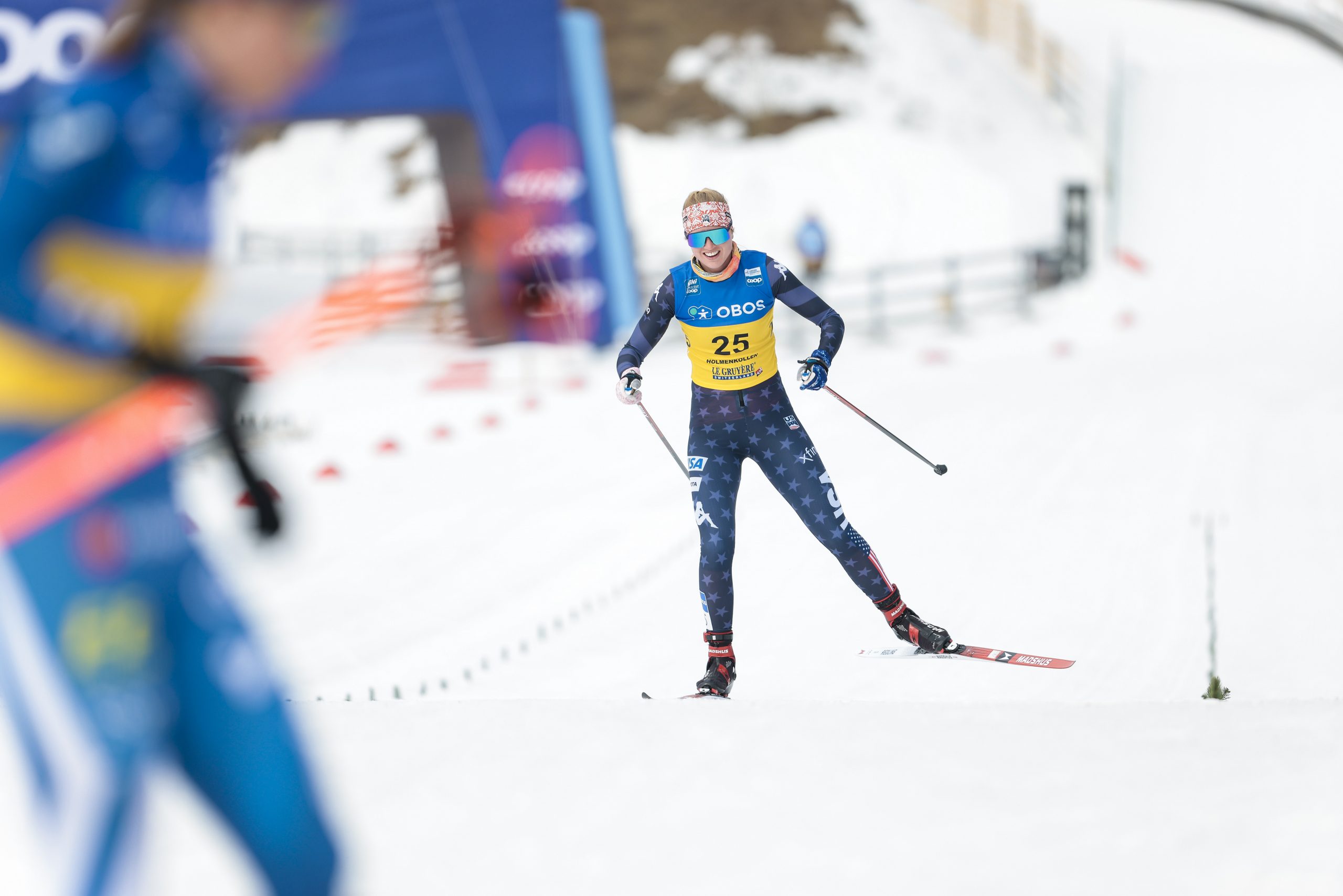
“First 50 k ever in the books,” said Swirbul. “I am really stoked to be able to check that goal off the list!”
Women’s Holmenkollen 50 k Freestyle Mass Start RESULTS
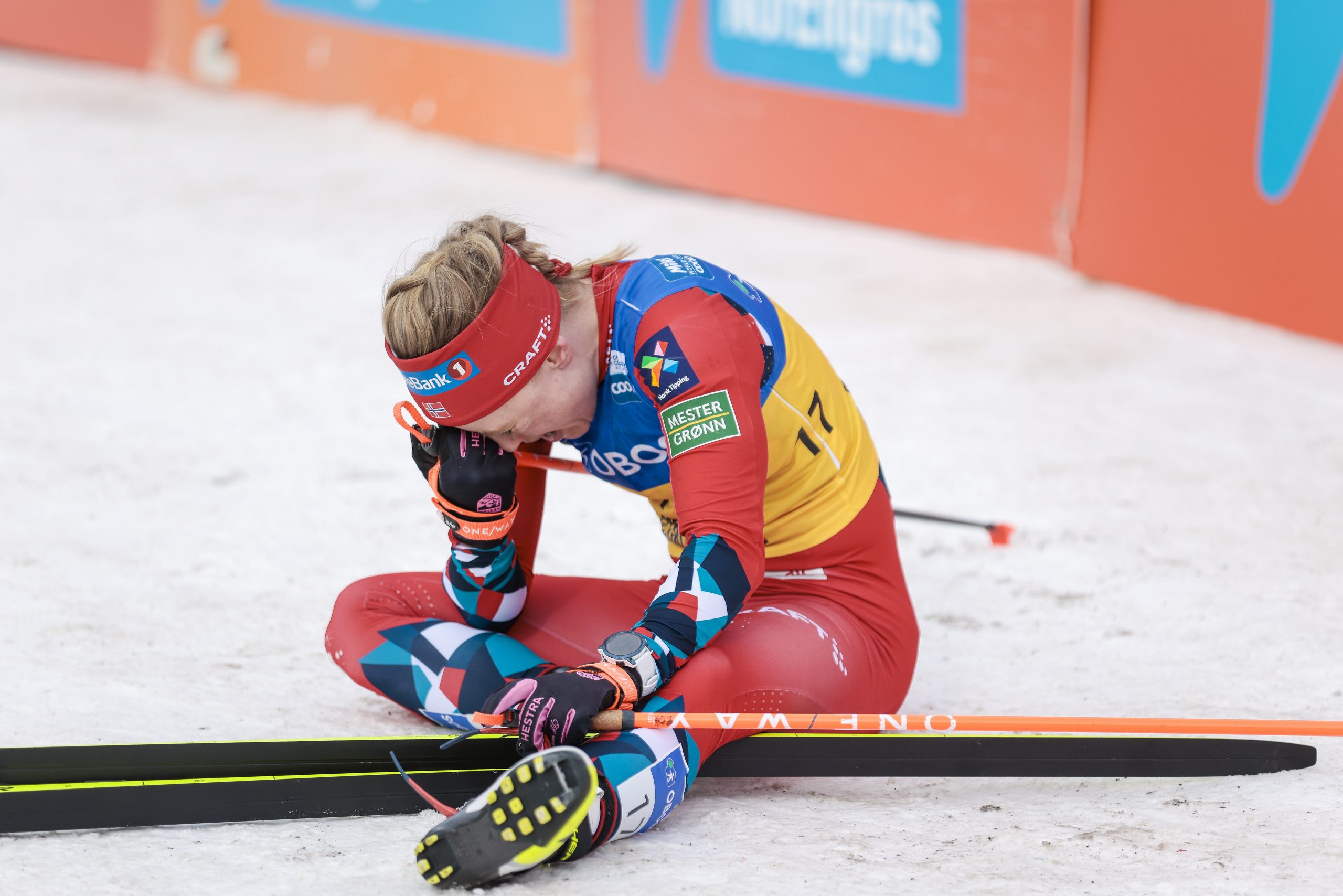
Exhaustion, relief, redemption . . . and history. Ragnhild Gloeersen Haga (NOR) at the Holmenkollen finish line. (Photo: Modica/NordicFocus)
It doesn’t get much better than a weekend of full sun, epic skiing and meetings with the king of Norway. But that’s what we’ve got for you after another fun weekend of racing, at Oslo’s classic Holmenkollen venue. With help from Canadian retired Olympian Jess Cockney, we break down the 30 k and 50 k from Saturday and Sunday, touch on the COVID outbreak that’s hitting World Cup teams including the U.S. and take the International Ski Federation to task for canceling World Cup finals.
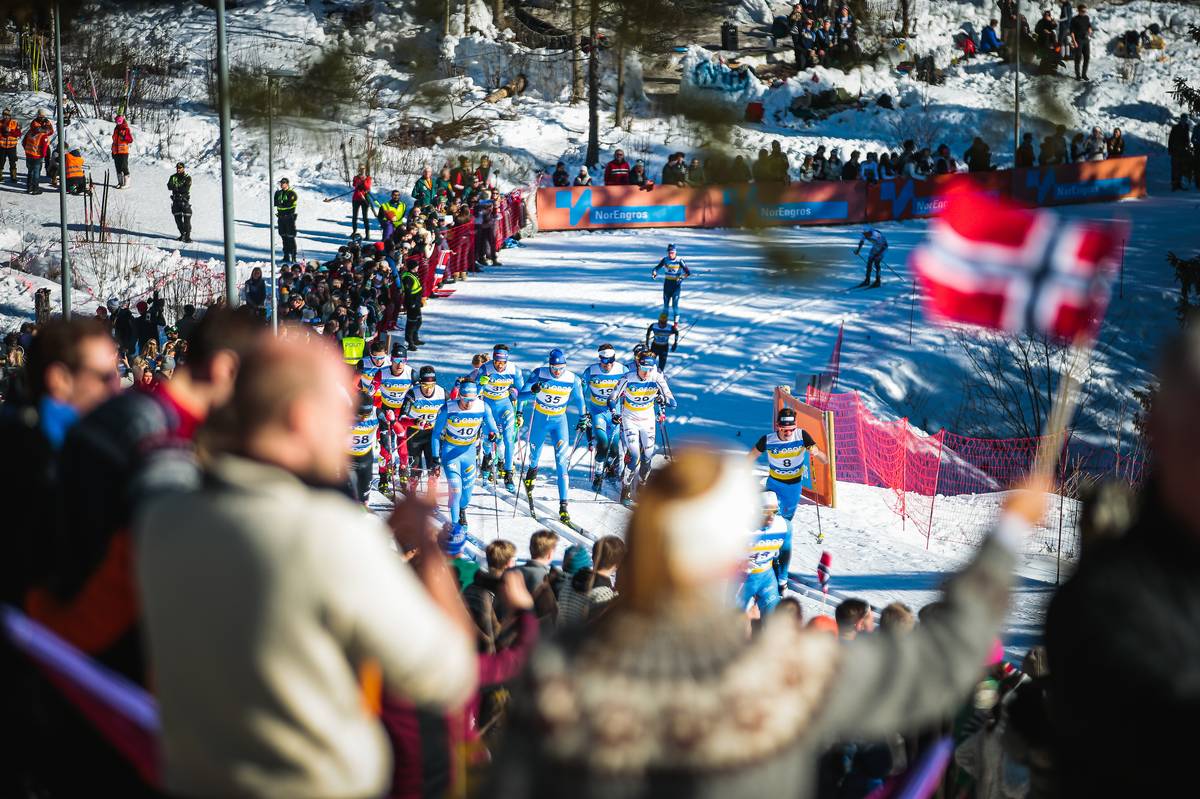
Crowds returned in droves to Holmenkollen for the men’s 50 k mass start classic. (Photo: NordicFocus)
This World Cup coverage is made possible through the generous support of Marty and Kathy Hall and the A Hall Mark of Excellence Award. To learn more about A Hall Mark of Excellence Award or to learn how you can support FasterSkier’s coverage please contact info@fasterskier.com.
In Oslo on Sunday, came another sign of the times.
The Holmenkollen Ski Festival, the beating heart and center of the modern sport of skiing since Torjus Hemmestveit won the first 50-kilometer cross country race held there in 1888, has only stopped for extraordinary interruptions in human and natural history. (Interestingly enough, the Hemmestveit family immigrated from Norway to Minnesota, marking the first and only North American connection to the Holmenkollen 50 k men’s podium until Canadian Pierre Harvey won the race exactly a century later in 1988.) The latter – a natural lack of snow – has been fairly harmless (but ominous), but the former has only ever been due to a World War. That is, of course, until the last two years, when the COVID-19 pandemic forced first no spectators at skiing’s most well-attended event in 2020, and then full cancellation in 2021.
After a three-year wait, the bustling, flag-waving, marching band playing (there was definitely a marching band!), Norwegian crowd was back out under the hot Oslo sun, in what seemed a matter of national pride.
Revelry returns to the iconic Holmenkollen 50 k in Oslo, NOR. (Photo: NordicFocus)
They could only hope that the same sense of the matter extended to their countrymen doing the racing at Holmenkollen. Coming into today, it had been a full five years since a Norwegian had won the 50 k at Holmenkollen, when Martin Johnsrud Sundby did so in a 2017 classic mass start. With the Russian athletes who have been at the forefront of the event since then banned (the Russians completed a podium sweep in 2019, before Alexander Bolshunov won in 2020), Norway was poised to make a run at adding to the thirty-five champions it has seen at its most famous race. One of those previous 35, Sjur Røthe, was in the field on Sunday. Alongside him was Beijing Olympic 30 k bronze medalist Simen Hegstad Kreuger, Didrik Tønseth, and Hans Christer Holund.
Of course, in a 50 k classic, they would have to try and beat the best classic skier in the world. Iivo Niskanen was looking to revive another long Holmenkollen tradition – the Finns ruining the Norwegians national outing. Fresh off a pair of individual medals at the Beijing games in the 15 k Classic (gold), and 30 k skiathlon (silver), the 50 k Holmenkollen classic seemed like a perfect opportunity for Niskanen to add to his legacy as a modern giant of the classic technique.
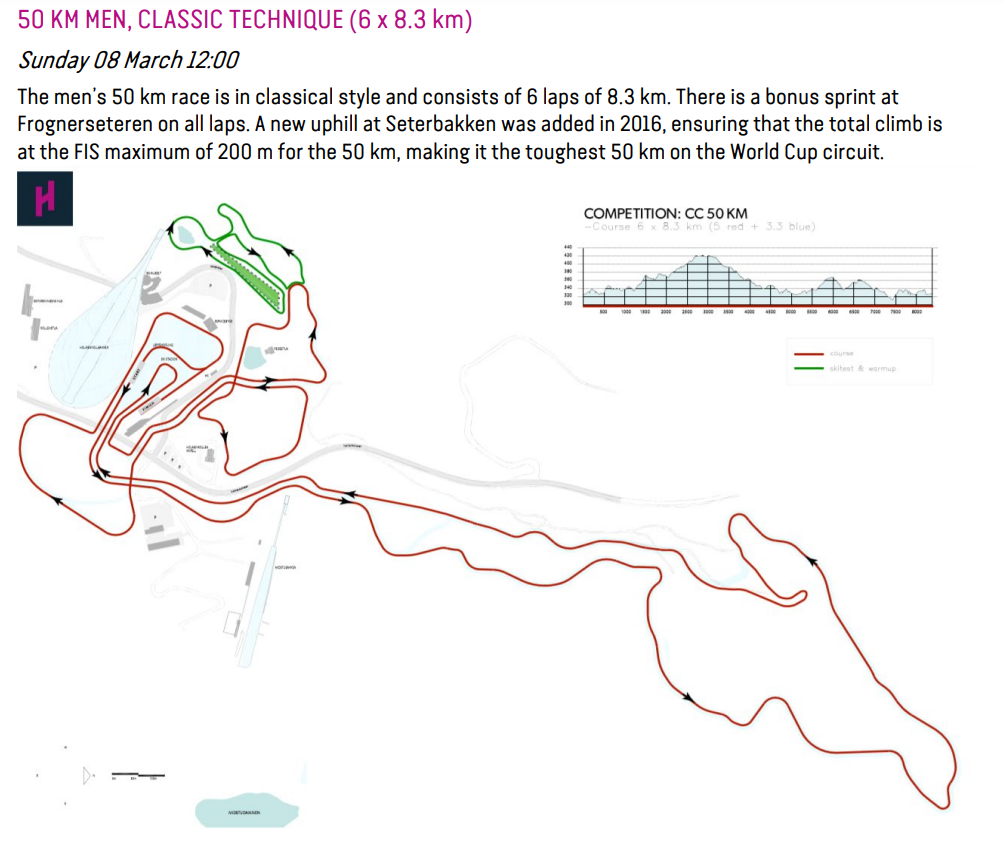
The field was set to race six laps of an 8.3 k course that organizers billed as the toughest on the World Cup (see below). With temperatures at the noon start reaching 8℃ (about 47℉), the FIS camera couldn’t help but turn to the extra set of skis layed out in the stadium each lap, no doubt waiting to resupply skiers with the warm klister that was in demand today.
The Holmenkollen 50 k course. (Photo: Holmenkollen Ski Festival)
For a 50 k, the field began at a furious pace today, with much of the first 15 k led out by pulls from the skiers, mainly Norwegian and Finnish with the odd Andorran (Ireneu Esteve Altimiras) thrown in, that indicated that they were in control of the race and willing to give the long-burn attack a try today. Within the top group of twenty that eventually formed, however, there wasn’t one skier that looked strong enough to break-away and win by minutes in, say, the way that Marit Bjørgen controlled the Holmenkollen race in her heyday, or the way Therese Johaug did in her final Holmenkollen appearance yesterday.
By the beginning of the fourth lap (24.9 k), the lead group had narrowed down to about fifteen skiers. Included were a slew of Norwegians, including Sjur Røthe, Didrik Tønseth, Martin Løwstrøm Nyenget, and Harald Østberg Amundsen, Iivo Niskanen (FIN), Britain’s Andrew Musgrave, 2018 champion Dario Cologna (SUI), and young Swedish hopeful William Poromaa.
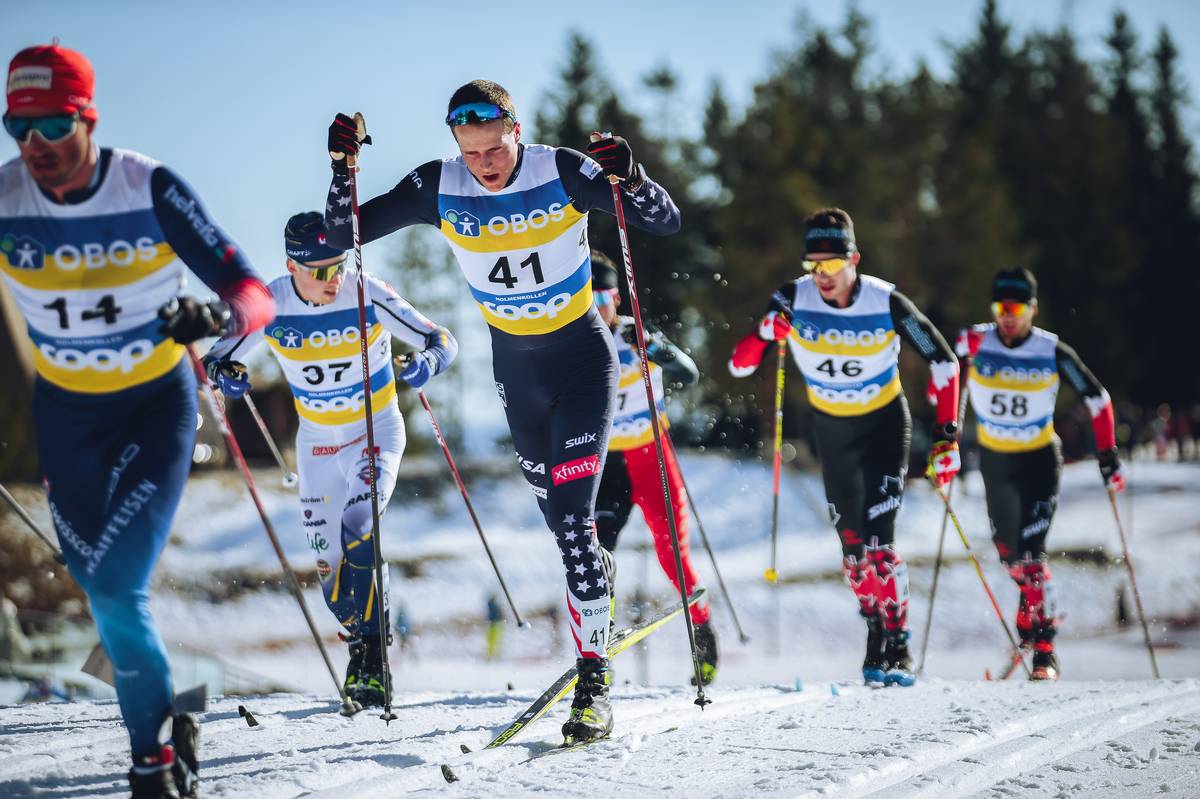
Adam Martin races the 50 k mass start classic at Holmenkollen in Oslo, NOR. (Photo: NordicFocus)
With the pack established, the group seemed to allow the pace to let up over the course of the next 8 k. The one exception was Iivo Niskanen, who throughout the whole day positioned himself at the front of the pack for a series of bonus points offered on course. They revealed a prescient concern for Niskanen – he is still in the running to win the distance World Cup this season, and came into today 3rd place behind two athletes, Alexander Bolshunov (1st) and Johannes Høsflot Klæbo (2nd) who may not race again. He had every incentive to chase down the points, with the question arising whether having to maneuver to the front every 5 k or so to take the checkpoints would cost him the energy needed for a bid at the win.
When the lead group came into the stadium to complete their 4th lap (33.2 k), Sjur Røthe made a move towards the second set of skis layed out for him with a fresh kick zone of wax. The whole field followed. That is, save Amundsen, who flew past the transition zone and into the steep climb that led away from the stadium.
Whether it was the ski swap itself, or the fact that the race was now 15 k out from the finish, the move going into the 5th lap seemed to blow open a pack that had been subdued for the last 15 k. Amundsen didn’t try and ease up to allow a larger pack to reform, but instead tried to drive onward. The effect was that the field, led by Andrew Musgrave, had to increase their pace to try and cover Amundsen’s move. Musgrave didn’t pack such a punch in his acceleration that the top skiers couldn’t follow, and as they came into the final lap, the Norwegian hopefuls of Nygenet, Røthe, and Tønseth, along with livo Niskanen and William Poromaa, were the skiers left to vie for Holmenkollen 50 k crown.
Young talents: Harald Østberg Amundsen (NOR) races alongside William Poromaa (SWE) during the 50 k mass start classic at Holmenkollen. (Photo: NordicFocus)
The home country, as if its skiers sensed a special mix of history combined with a perfect Oslo day, got to see one of the oldest, most impressive sights in ski-sport. Three Norwegians, led by Didrik Tønseth, then Martin Løwstrøm Nyenget and Sjur Røthe, moved together towards the finish line. Iivo Niskanen and William Poromaa stayed in the frame, but by the final 2 k, they were out of the picture.
In a scene that thousands of Norwegian spectators had dreamed about since their most famous race had been thrown into disarray two years ago, they were treated to the end of a Holmenkollen weekend with three Norwegians at the front, vying for the podium, a rare landmark for the treasured and iconic event.
Tønseth led the pack as they moved into a long downhill that went into the stadium. From there, Røthe out-glided his two teammates, with Nyenget in behind them. At the end of a long downhill straight, one final hill led around and down again to the final stretch. As Røthe approached the hill, he positioned himself outside of the tracks, which seemed an indication that his great glide into the stadium may have also foreshadowed a want of kick wax. He was forced to run up the last hill, searching for every little bit of klister left in its zone (in a dance very familiar to many of us skiers), while Nyenget was the picture of perfect classic technique, driving through to go over the top of the hill in first place. Røthe stumbled slightly, Nyenget burst into the final stretch, and they came across the line like that. Nyenget the winner (2:03:27.3), Røthe second (+0.6), and Tønseth in third (+3.5).
Martin Løwstrøm Nyenget embraces his teammate Sjur Røthe after going one-two at Holmenkollen. (Photo: NordicFocus)
The three Norweigans completed the first podium sweep for the home country at Holmenkollen since 1985, and the first since the event has been held as a World Cup. The center of Norwegian skiing, after two years where it has stumbled through, has held, and held firmly. Nyenget, Røthe, and Tønseth doing their home nation proud on a sunny Oslo day that seemed to foreshadow brighter times ahead for Holmenkollen, and the sport that is ski racing the festival energized over a century ago.
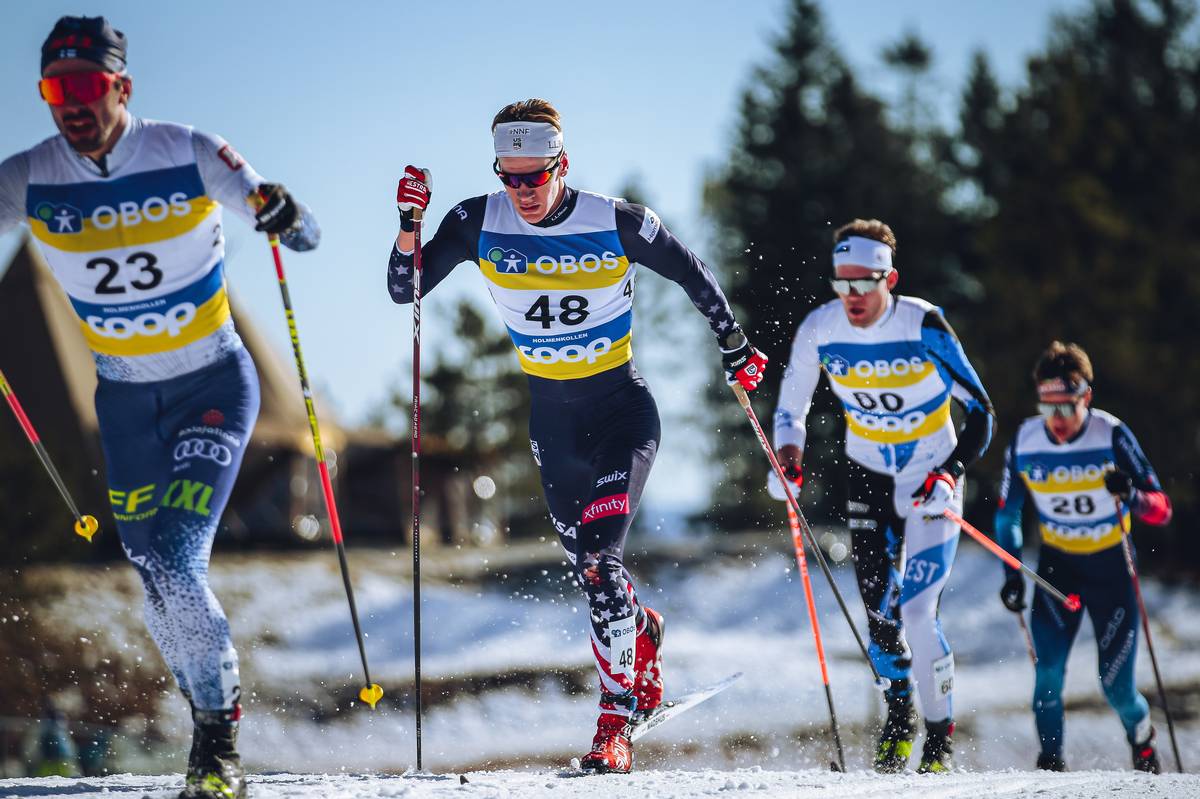
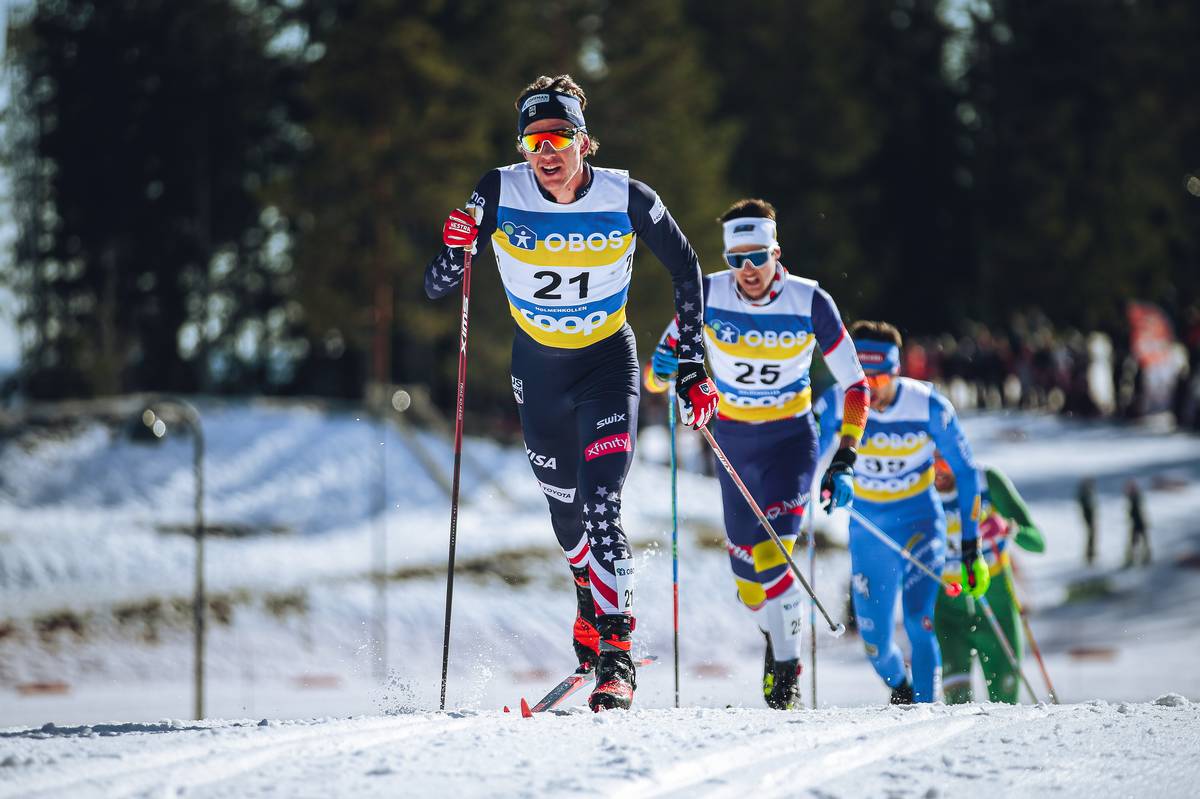
The US trio of Scott Patterson, Adam Martin, and Zak Ketterson that started the day came away with great results as well. Martin, who was recently pulled up to the World Cup based on his results in the SuperTour, came in 26th (+5:03.2). Scott Patterson, coming off an 8th place finish in the Beijing 30 k, finished 31st (+6:05.5), and Zak Ketterson finished in 41st (+7:14.8).
“It was a beautiful day today,” wrote Martin after the race. “It was warm, and it did get slushy on some of the climbs, but most of the course held up really well. I think we had great wax.”
On his approach to the day, Martin continued, “I suspect pretty much every guy out there starts with the same strategy: hang on to the lead group until the finish or it’s no longer possible. That was my strategy, at least. I think I managed two laps or something, and then I skied the rest of the race with a smaller group of skiers who also fell behind.
This is Martin’s third time racing at the 50 k at Holmenkollen, with today marking a step forward, after taking one backward in his last appearance. “I placed 31st in 2019 with a smaller field after World Champs, and I finished last (but did finish) in 2020 after Ian Torchia and I erroneously opted for zeros.”
Zak Ketterson races the 50 k mass start classic at Holmenkollen in Oslo, NOR. (Photo: NordicFocus)Scott Patterson races the 50 k mass start classic at Holmenkollen in Oslo, NOR. (Photo: NordicFocus)
Canadians Remi Drolet finished in 48th (+10:27.1), while Philippe Boucher came in 54th (+17:36.0). Staying in Norway following the U23/Junior Ski World Ski Championships, Tom Stephen also started for the 50 k, however, he withdrew following the third lap and did not finish.
20-year-old Thomas Stephen (CAN) races the 50 k classic at Holmenkollen in Oslo, NOR. (Photo: NordicFocus)
On February 26th, the Norwegian Ski Association (NSA) released a statement indicating that in light of the nation’s recent invasion of the Ukraine, Russian participation was not welcome at the upcoming World Cup sprint races in Dramman or the storied Holmenkollen distance races outside of Oslo. In addition to these cross country events, Norway is scheduled to host competitions in alpine, nordic combined, and ski jumping, including the World Ski Flying Championships in Vikersund.
A press release shared by Norwegian news source NRK stated: “The board of the Norwegian Ski Association has today discussed the situation related to Russia’s invasion of Ukraine, and how this affects the upcoming World Cup races and the world championship in Norway. The Norwegian Ski Association’s message to Russia and Russian athletes is crystal clear; We do not want their participation!”
NSA president Erik Røste told NRK that a request had been made to the International Ski Federation (FIS) to officially bar the Russian program from participating, but as of Saturday, FIS had not taken action to comply with the request, instead pointing to the official cancellation of remaining FIS events held in Russia.
“The attack on the Ukrainian people and the great suffering we see pictures of now, the sport can not remain passive and be neutral,” Røste said of the request. “Therefore, the board of the Norwegian Ski Association was clear that this must have consequences beyond what has already been decided. Therefore, we will send a clear and distinct signal to FIS that we do not want Russia and Russian athletes to participate in competitions in Norway in the coming weeks.”
Ultimately, it is up to the board of FIS whether Russia will be allowed to compete in the remainder of World Cup events. A response NRK received via email today stated:
“The FIS board has been clear in its approach to Russian athletes in all FIS competitions. To ensure fair and inclusive competitions at all FIS events, national federations and local organizers should not exclude athletes on the grounds of gender, race, nationality or sexual orientation.”
Alexander Bolshunov (RUS) wins the 2020 Holmenkollen 50 k in the fog, ahead of Norway’s Simen Hegstad Krüger. (Photo: NordicFocus)
As such, no Russian athletes or coaches have been denied entry to Norway, and Stefan Marx, the general manager of Holmenkollen ski festival, indicated there is little more that the organizers can do to prevent Russian participation in the events.
“We must let them participate,” Marx said to NRK. “Those who FIS and the Norwegian Ski Association say must be allowed to participate. We do not have the authority to refuse anyone to participate, but we have supported the Ski Association and the Sports Association’s position. It is up to FIS or the authorities to decide, but we are clear in our support for the Ski Association’s proposal that Russian athletes are not wanted due to violations of international law that have been committed.”
After flying from Helsinki following the Lahti World Cup races, Russian teams have begun to arrive in Norway. When pressed by the media upon his arrival, World Cup distance leader and favorite for the upcoming 50 k classic at the Holmenkollen, Alexander Bolshunov chose to remain silent. NRK did, however, receive comments from multiple Russian coaches, including head coach Marcus Cramer who felt that sport and politics should be kept separate.
“What do sports and athletes have to do with this situation? It’s really tough. I just get sad that the Norwegian association thinks like that. We really have a good communication between us. With everyone who works there. It’s sad to hear this, especially when they take it to the press and not us first,” said Cramer.
Another Russian coach, Jegor Sorin, who had been working at the Junior/U23 World Championships in Lygna, NOR and planned to join the Russian team in Oslo, echoed that Russian athletes should not be held accountable for the
“I am very upset that the Norwegian association wants this,” Sorin told NRK. “I can understand that no one wants to travel to Tyumen for the World Cup, but I do not know what happens to us… We are Russian athletes. We are here, we are not in any war. We are athletes, not soldiers. Maybe they think we have weapons. We want peace and for me this is very strange.”
Alexander Bolshuonv is photographed with his four Olympic medals from the 2022 Games, with one event remaining. He would leave the Games with three gold medals, and a total of nine Olympic medals including those won in 2018. (Photo: NordicFocus)
Though the Russian coaches focused on a separation between sport and politics, others have pointed out the direct ties between sporting success and military recognition. Used as an example, Bolshunov and Denis Spitsov were promoted to the rank of captain in Russia’s National Guard in recognition of their success during the 2022 Olympics. Bolshunov, who has earned a medal in each of his nine Olympic appearances, including three gold medals in Beijing, received additional honors in the form of the Alexander Nevsky Order, given in recognition of “special service for the fatherland.”
FIS cross-country committee leader, Vegard Ulvang told NRK, “Russian athletes are [military] officers. This makes the symbolic value [of their participation] even greater.”
A similar statement was made by Global Athlete representative and former U.S. Ski Team athlete Noah Hoffman.
“While I feel for the individual athletes, all Russian skiers should be banned from the FIS Cross Country World Cup for the rest of the season,” Hoffman tweeted. “Their results are used to drum up nationalism and bolster the Russian State. Allowing them to compete aids Russia. #StandWithUkraine.”
Ulvang is urging a stronger response from the Norwegian Ski Federation, suggesting that they relinquish the FIS World Cup status of the events at the Holmenkollen in order to gain the authority to prohibit Russian participation.
Jan Petter Saltvedt, a Sports Commentator for NRK described Ulvang’s statements as a “moral ultimatum.”
“Ulvang demands an open rebellion from NSF against his own superiors,” Saltvedt said. “And he should get it. Vegard Ulvang puts so much pressure on the Norwegian Ski Association that they can not help but act… At the same time, he expresses a very strong and clear criticism of FIS, where he himself is one of the powerful committee leaders, but still does not feel he is heard at all.”
Norwegian athletes who have been asked for comment have given mixed responses, often acknowledging the complexity of the issue and whether the athletes themselves should be at fault for government decisions.
Among those with a clear stance, Erik Valnes spoke of disallowing Russian participation. “There is a heavy symbolism in it. It would send a signal. Since [Bolshunov] is [a captain of the Russian National Guard], they have already mixed sports and politics in a way. It is difficult. It is a great pity that it will be like that.”
Erik Vales and Johannes Høsflot Klæbo earn gold in the classic team sprint during the 2022 Beijing Games. (Photo: NordicFocus)
Johannes Høsflot Klæbo also spoke in support of the NSA urging FIS to remove Russian athletes from competition.
“As an athlete, you want the best to start. We train all year to compete and then you want the best to participate,” Klæbo said to NRK. “At the same time, I support the attitude of the ski association now. There is no doubt about what is happening in Ukraine, and Russia must be condemned. I strongly condemn it and I think it is good that the association takes a stand.”
Therese Johaug acknowledged that athletes may not have direct involvement in the military actions of Russia, speaking instead to their role in representing their country through sport.
“I feel sorry for the athletes, first and foremost, I understand that they have nothing to do with this,” Therese Johaug told NRK after narrowly winning Lahti’s 10 k classic over Russian Natalia Nepryaeva. “But on the other hand, I think it is completely wrong. They front their country and the flag both on the chest and on the forehead. And that a country should also ravage the sports arena and fight for victories and front their country in the situation we are in – I think that is completely wrong.”
Therese Johaug voices her thoughts on Russian World Cup participation following her win in Lahti’s 10 k classic. (Photo: NordicFocus)
The stance is not unanimous amongst the Norwegian team. Sindre Bjørnestad Skar, who took third in Lahti’s freestyle sprint, spoke to the unfairness for Russian athletes.
“Of course, I am 100 percent against everything that is happening between Russia and Ukraine now. It is completely inconceivable. But then I also do not think that the fact that they have a Russian passport, means that they should be punished and deprived of the opportunity to do their job. In a way, I think that is a bit unfair too,” Skar told NRK.
For the time being, no further changes in Russian participation have been reported. FasterSkier will continue to follow this story as it evolves over the next few days. World Cup classic sprint races are currently scheduled in Drammen Thursday, with the women’s 30 k mass start classic in Oslo happening Saturday March 5th, followed by the men’s 50 k on Sunday.
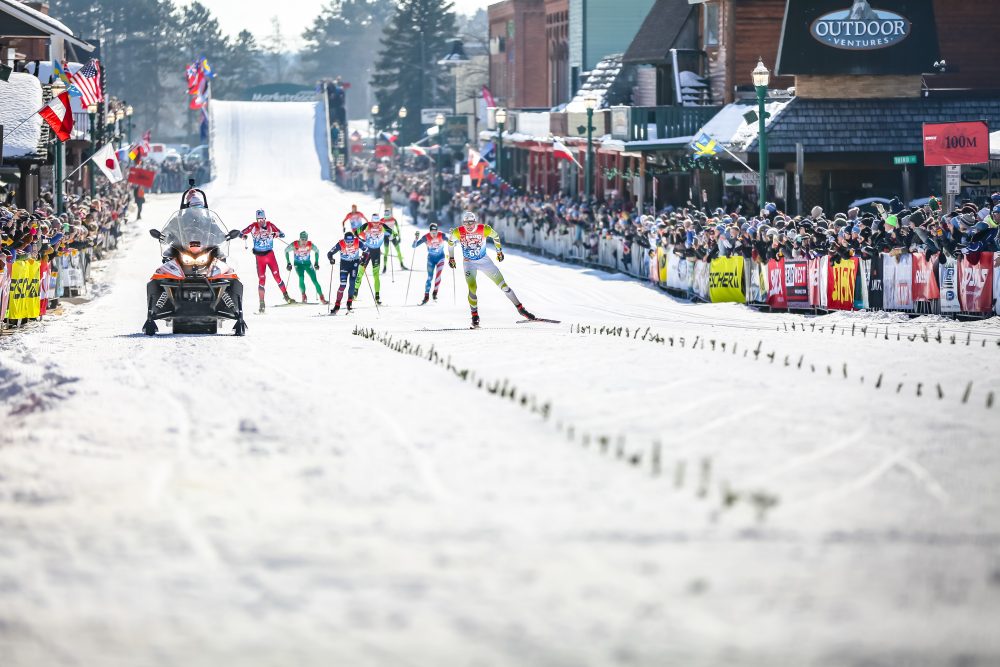
Several inches of new snow five days out, a cold-snap that sent temperatures in Hayward plummeting to -24 degrees Fahrenheit two nights before the race, and a bluebird day with temperatures in the high teens at the start, climbing to mid-30s in the early afternoon. Firm tracks, perfect groom, and fast snow. You could not have asked for a more perfect day to showcase the trails linking Cable to Hayward, WI at the 2020 American Birkebeiner.
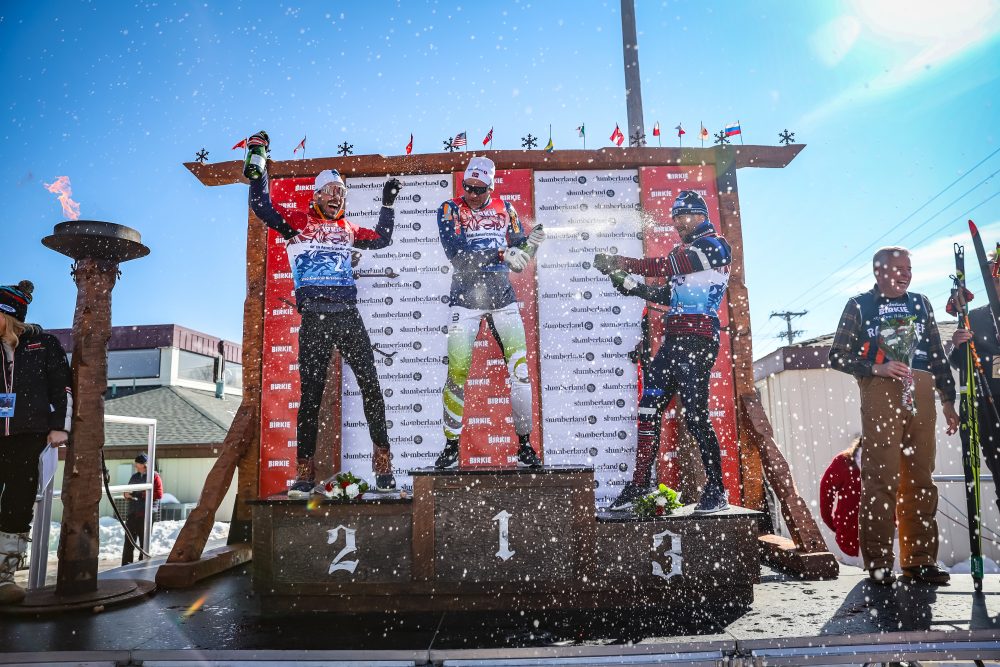
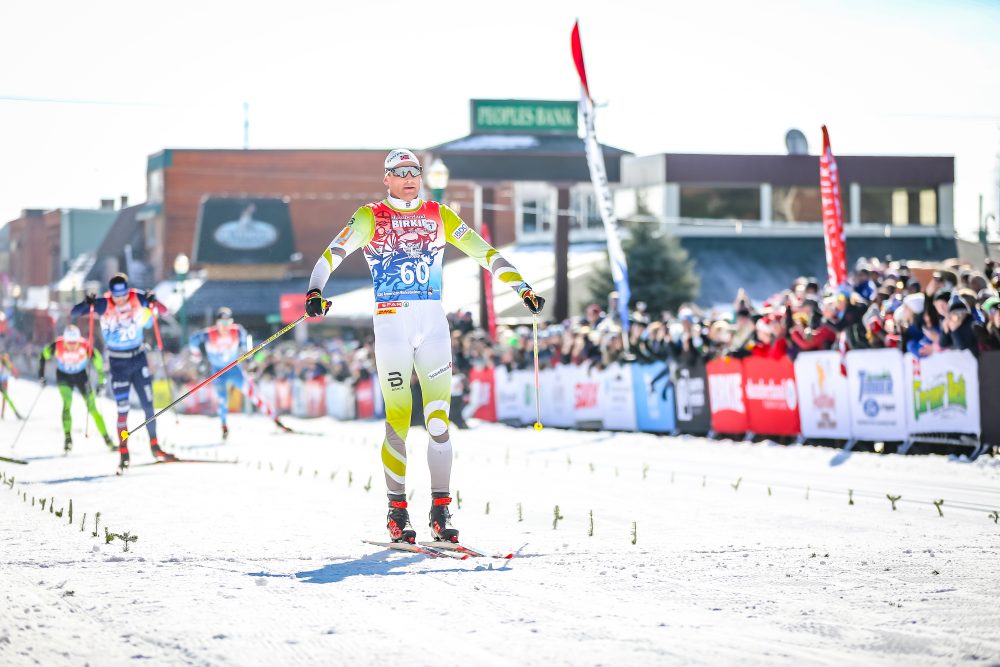
Among the first-timers leaving the Northwoods in awe of the event was Norway’s Niklas Dyrhaug, who took control of the pace early and won the 50-kilometer skate in a long sprint battle from Lake Hayward over the International Bridge to the top of Main Street in a time of 1:59:01.7.
The 32-year-old Trondheim native has a solid track record in distance racing. He was 2nd at the famed Holmenkollen 50 k classic in 2016 and placed in the top-ten there on three additional occasions. He has over 100 World Cup starts, three of which resulted in a podium finish, and was a member of the Norwegian team at the 2018 Olympics, where he was 13th in the 50 k mass start classic.
In a post-race conversation after returning to Norway, Dyrhaug explained that the American Birkie has been on his radar for some time, and he was excited the opportunity arose this year. He also shared his thoughts on the quality of the event and competition, and of course the feverish Birkie crowds.
Dyrhaug discussed how he spent the remainder of his time in the U.S. Apart from racing in the SuperTour sprints at the Birkie trailhead three days prior to the marathon, qualifying in second and finishing ninth, he also attended a Minnesota Wild game. Though he has not raced much on the World Cup this season, he adds that he now has his eyes on some of the upcoming distance races, including a return to the Holmenkollen.
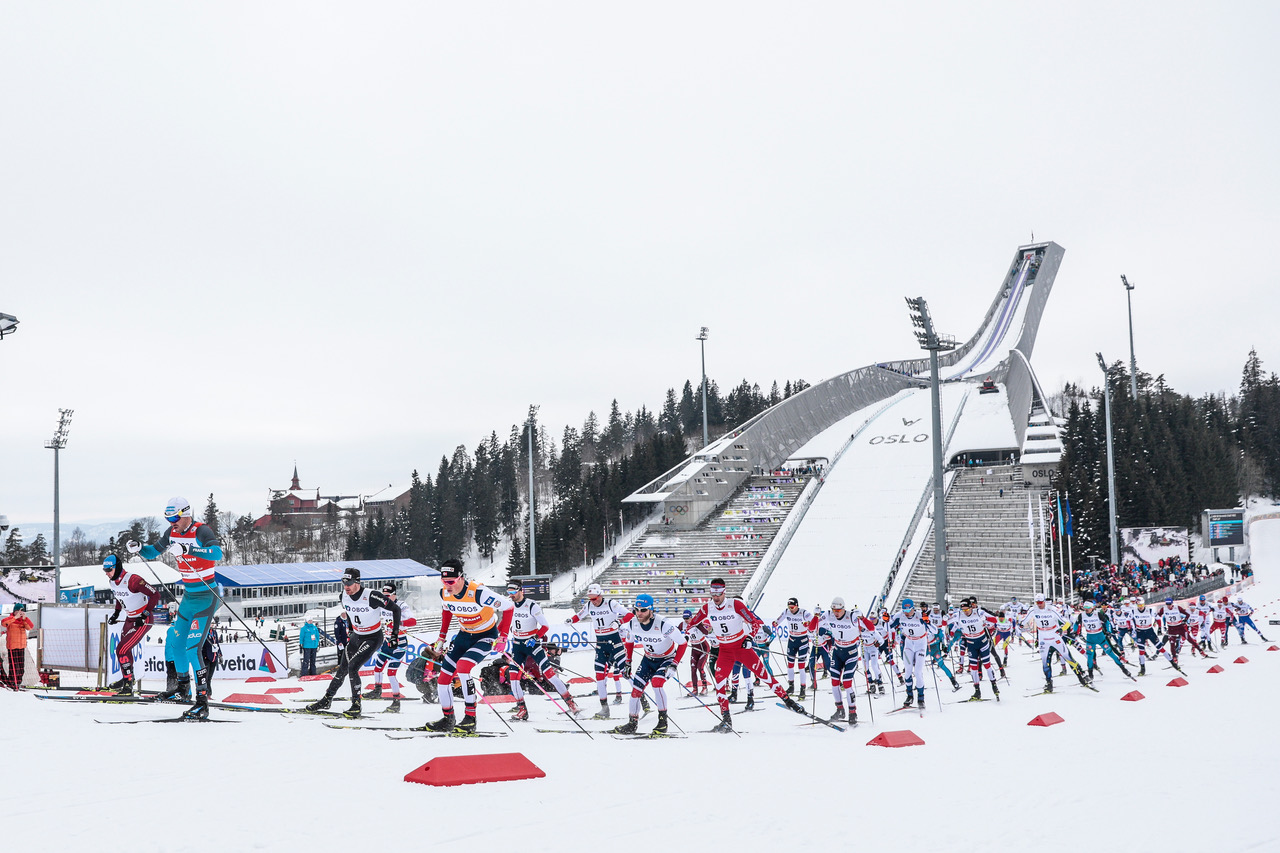
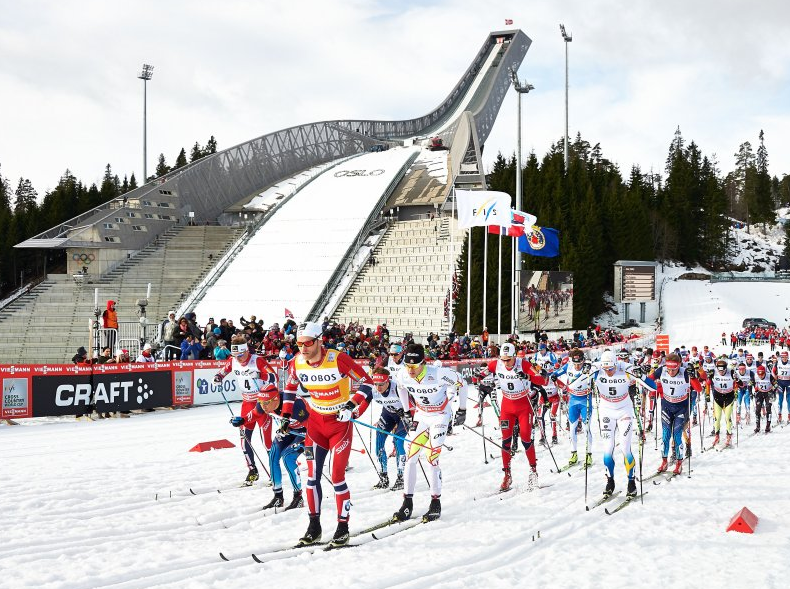
The start of the Holmenkollen World Cup men’s 50 k freestyle mass start on Saturday in Oslo, Norway. (Photo: Fischer/NordicFocus)
OSLO, Norway — Thumping house music. Thousands of raucous fans, who, if not waving Norway’s flag, had their faces painted in their national colors of red, blue and white. If the American Super Bowl translated to cross-country skiing and snow, the Norwegian Holmenkollen is as close as it gets.
Saturday saw the 116th edition of the annual 50-kilometer men’s event, a race that totals roughly6,574 feet of climbing for those who complete it in full. Camped along the course fence, spectators adorned in Mariusgenser sweaters, many withkoozied Carlsbergs in hand, were not crazy for having hauled coolers and chairs through the snowy trailside. All said and done, racers would pass by six times on their way around the famed 8.3-kilometer loop.
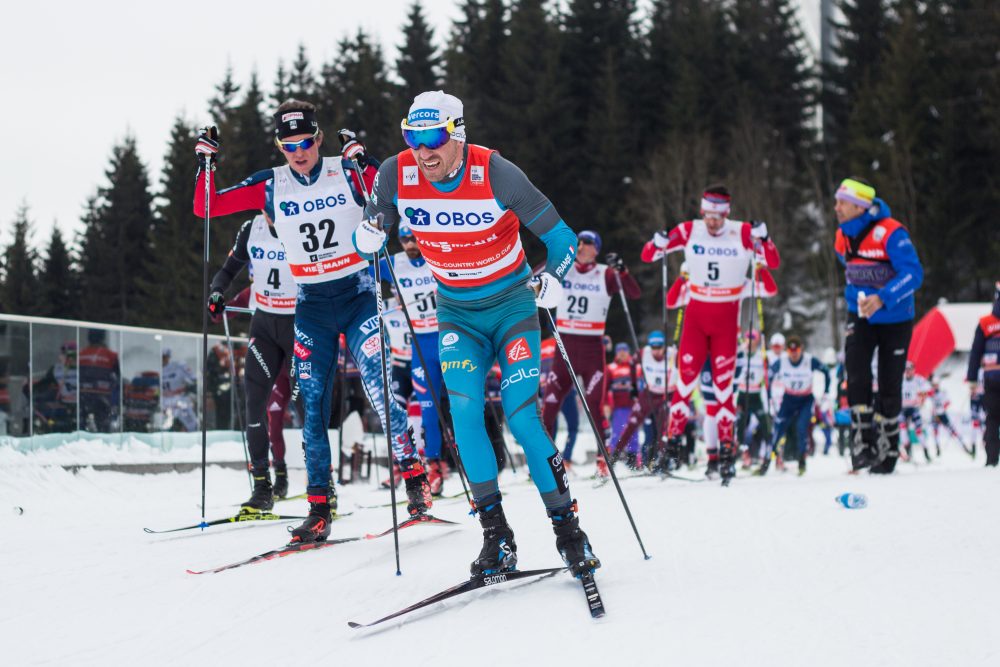
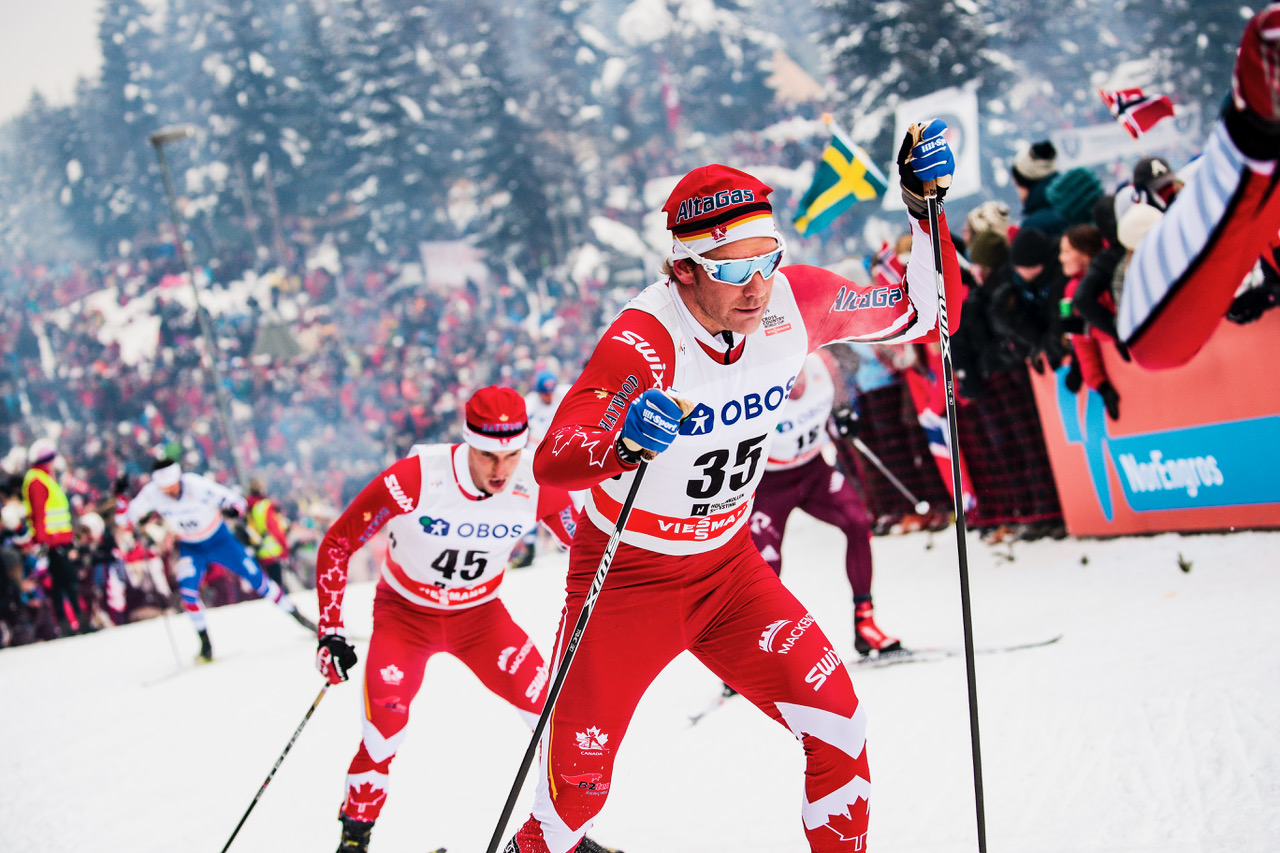
Leading through the first 8.3 k, Norwegians Didrik Tønseth and Niklas Dyrhaug set the pace, followed by two Frenchmen: Clement Parisse and the World Cup distance leader, Maurice Manificat. Alex Harvey of Canada, who won last year’s World Championships 50 k, skied 2.3 seconds off the lead pace in 17th.
Eight skiers ahead of Harvey, Switzerland’s Dario Cologna and Norway’s Martin Johnsrud Sundby skied side by side in ninth. With the past two Holmenkollen titles in his name, Sundby was certainly in search of another on Saturday.
Through the next lap, Norway and France continued to push from the front led by Sjur Røthe and Robin Duvillard, respectively. As they passed the 16.6 k mark, a pack of 51 skiers still remained within 21 seconds of one another.
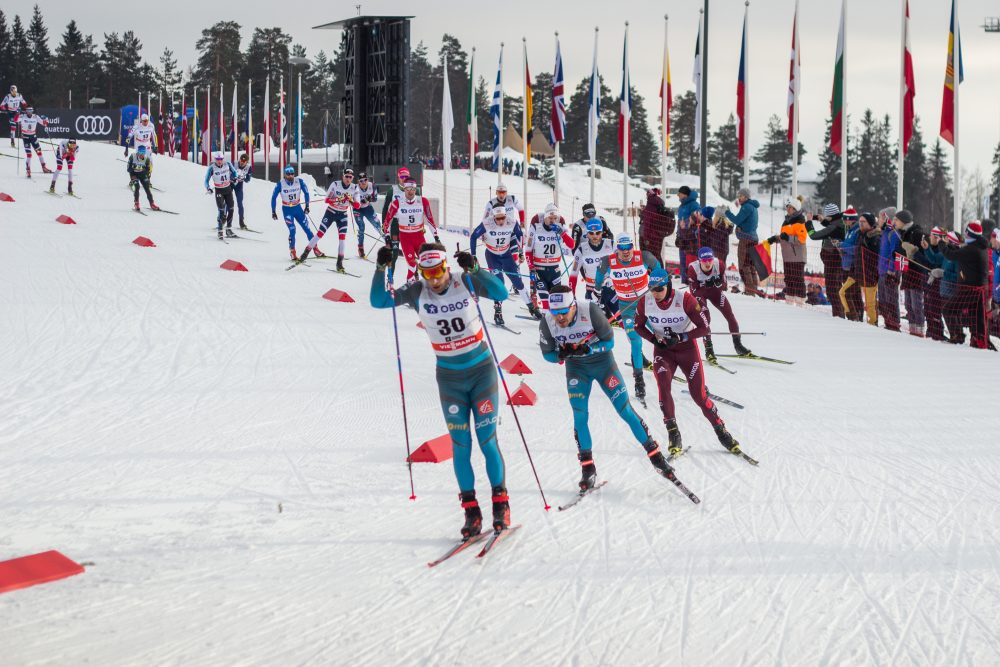
France’s Adrien Backscheider leading the Holmenkollen 50-kilometer freestyle mass start on Saturday in Olso, Norway. (Photo: Logan Hanneman)
France was three-strong in the front on the third lap, with Jules Lapierre, Adrien Backscheider and Manificat taking charge. Sundby and Harvey skied 20 seconds off the Frenchmens’ pace in 17th and 18th, respectively. Seventeen seconds ahead of them was Cologna in 12th. Three laps down, three laps to go and just over an hour of racing complete.
In another lap, France had faded from the front, while Norway subsumed the the lead. At 33.3 k, six of the top ten skiers were Norwegian, with Hans Christer Holund at the helm. Less than a second behind Holund was Sundby in second.
Russia’s Maxim Vylegzhanin followed in third, then Harvey in fourth, Norway’s Simen Hegstad Krüger in fifth, Tønseth in sixth, Norway’s Daniel Stock in seventh, Dyrhaug eighth, American Scott Patterson in ninth, and Sweden’s Daniel Rickardsson in 10th. Only 10 seconds separated first from 17th.
At this point, anyone who had watched the dual-skier showdown in last year’s Holmenkollen — which had broken around the 22 k mark — began to wonder how much longer the 17 skiers in Saturday’s lead pack would stay together.
The answer came with about five kilometers to go. Patterson, who had been skiing in the top six through the fifth lap, locked up with Manificat. The Frenchman dropped off the pace, along with 10 others.
“I was skiing right behind Maurice Manificat and one of the steep sections he just died, and that was right when that lead group pulled away so I missed the move,” said Patterson, a U.S. Ski Team member. “I didn’t quite have a strong enough group to pull back up to the leaders.”
The lead group was reduced to seven by 46 k, with Great Britain’s Andrew Musgrave, Vylegzhanin, Sundby, Cologna, Russia’s Denis Spitsov, Holund, and Røthe all still in the hunt for the podium.
Harvey was in 11th, about 15 seconds behind the lead group and 10 seconds ahead of Patterson in 14th.
“I wanted to see how my skis were doing compared to the other guys,” Harvey reflected, “And then after that just try to see who is looking strong and try to think ahead and think of the last lap, whose going to be a good bet to follow when the moves are going down.”
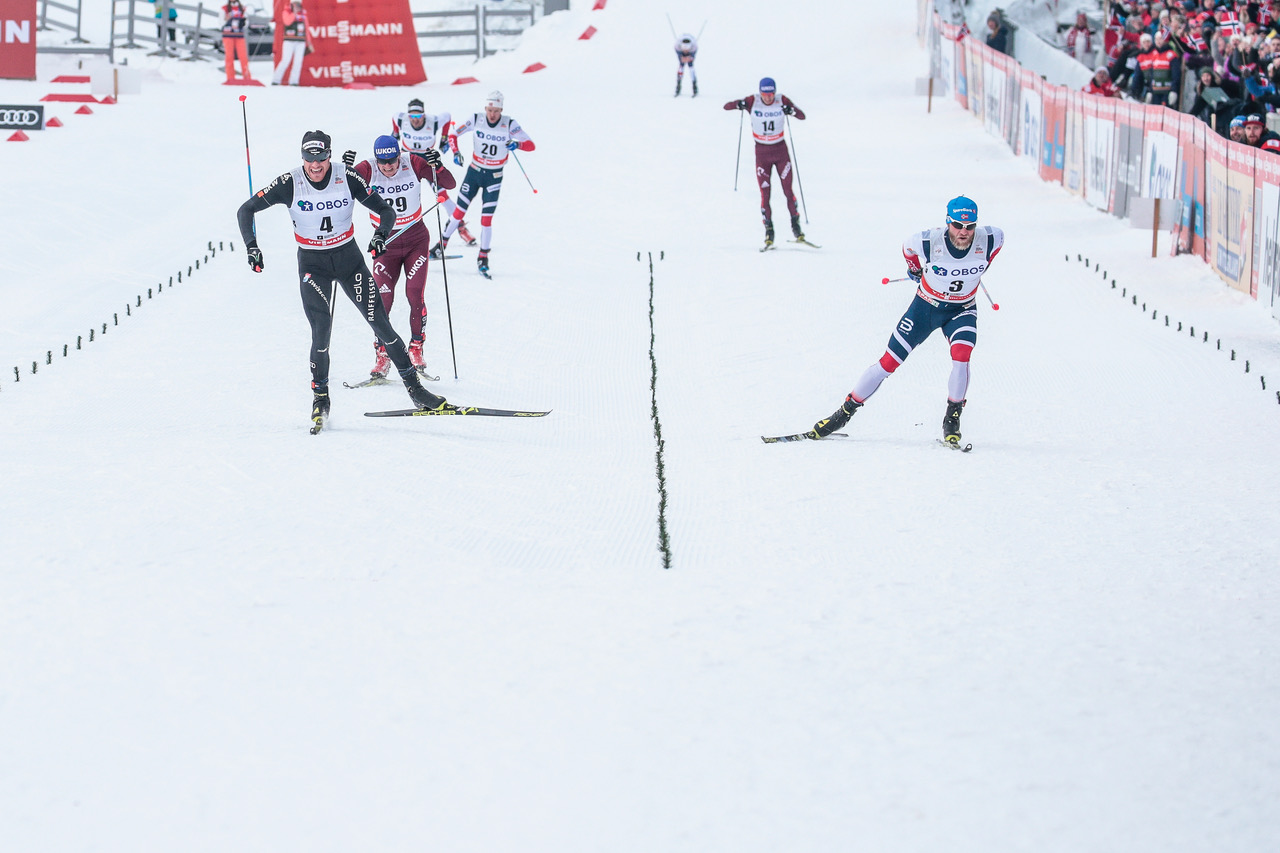
Norway’s Martin Johnsrud Sundby (r) and Switzerland’s Dario Cologna (4) sprint to the finish of the Holmenkollen 50-kilometer freestyle mass start on Saturday in Olso, Norway. (Photo: Fischer/NordicFocus)
In the last half lap, Musgrave put in a surge to the front. But he was soon swallowed and spit back into seventh. Rounding into the stadium for the final time, all seven remained together, though Sundby and Cologna now skied in the front. The two cornered back toward the final 100 meters and a head-to-head distance sprint finish ensued.
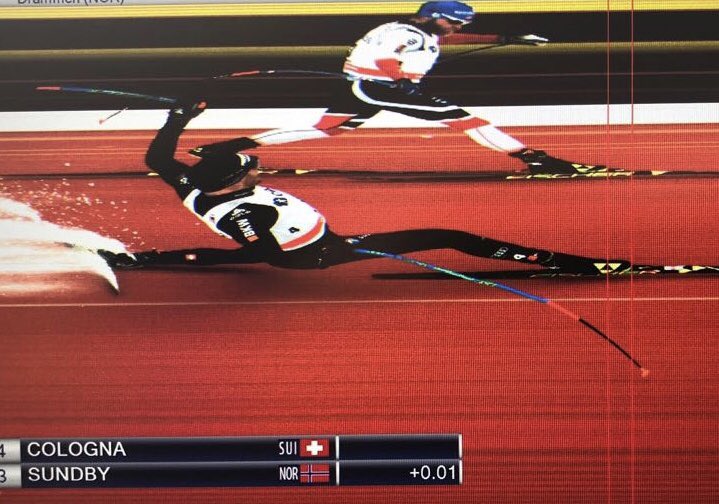
In a photo finish, Cologna outlunged Sundby for the win, before a somewhat silent, predominantly Norwegian-filled stadium. Cologna didn’t seem to mind. The 31 year old tossed his poles to the side, all smiles as he accepted his first 50 k Holmenkollen victory — the ultimate distance race of a given season (outside of the Olympics or World Championships) — in a time of 2:01:48.1 hours.
“It was a suspenseful race, something was always happening even though a large group stayed together for a long time,” Cologna said in an interview with Swiss broadcaster SRF, according to a translation. “Around the bonus sprints there were the most Norwegians so I was a little afraid to get attacked, but I got back fairly quickly. And in the end I felt very well. Maybe I could have risked something already earlier on the long climb, but I trusted in my finish and knew that I would surely have a good opportunity. But I didn’t expect Sundby would be quite as strong, he made my life hard on the last kilometer and then it really became very close, but thankfully it went well.”
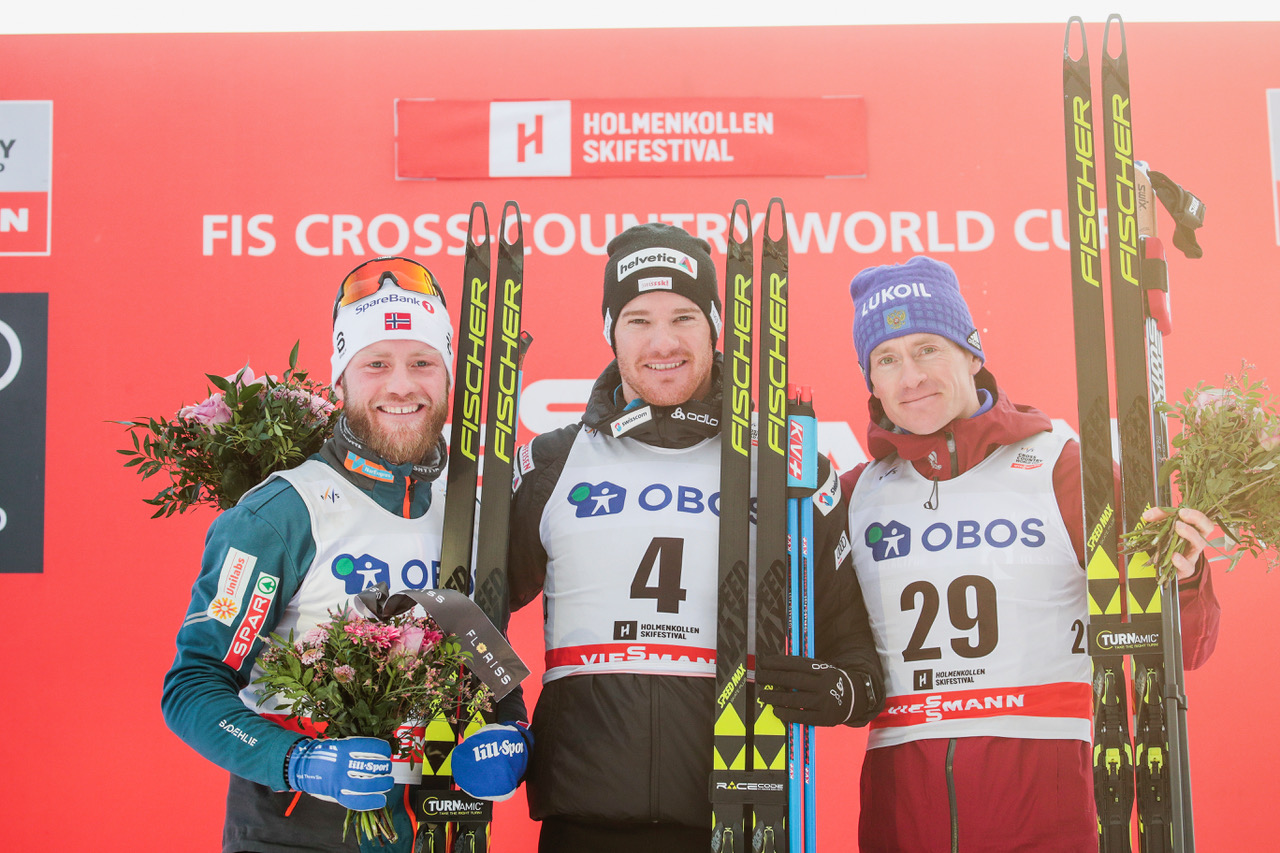
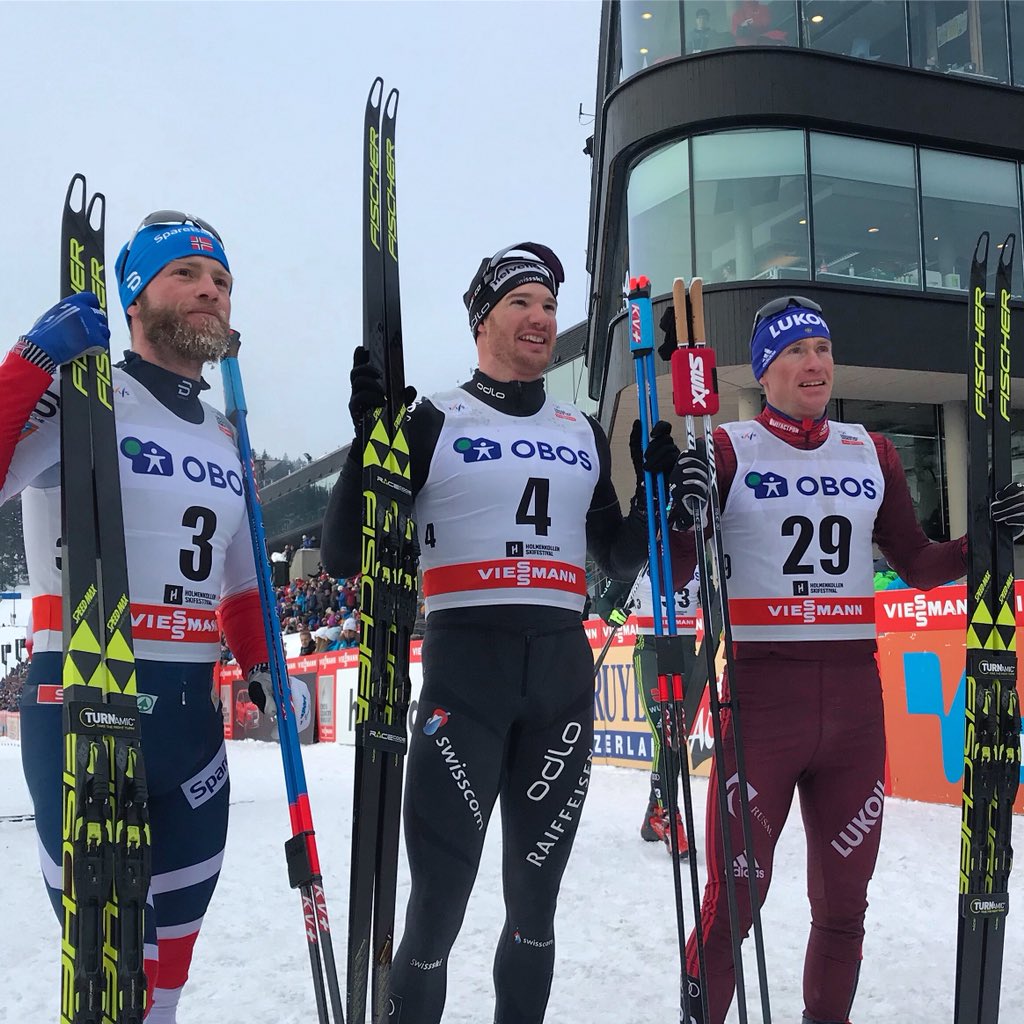
The Holmenkollen men’s 50 k freestyle mass start podium on Saturday at the World Cup in Oslo, Norway, with Switzerland’s Dario Cologna (c) in first, Norway’s Martin Johnsrud Sundby (l) in second, and Russia’s Maxim Vylegzhanin (r) in third. (Photo: Fischer/Nordic Focus)
Sundby finished second, one-hundredth of a second behind. The 33 year old has reached the podium in all but one of the Holmenkollen races he’s finished.
“I dreamt about the third in a row here for sure, but I think Dario has also been a few centimeters behind in this race a couple of times, and I think he deserved this one,” Sundby said at the press conference. “I wasn’t good enough in the sprint and Dario seemed to be the stronger one out there today. … I am not disappointed. I am on the podium here in the 50 for my seventh time in a row, so I think that’s OK.”
In his first World Cup race since November of last year, Russia’s 35-year-old Vylegzhanin took the final podium spot in third, 1.1 seconds back from Cologna.
Rounding out the top 10 was Røthe in fourth (+4.2), Spitsov in fifth (+4.4), Holund in sixth (+4.5), Musgrave in seventh (+15.1), Germany’s Florian Notz in eighth (+25.9), Harvey in ninth (+32.4) and Duvillard in 10th (+33.5).
France’s Maurice Manificat (r) leads American Scott Patterson (32) and Canada’s Alex Harvey (5), among others, during the 2018 Holmenkollen 50-kilometer freestyle mass start on Saturday in Olso, Norway. (Photo: Logan Hanneman)
“I felt good, I have been really sick in Lahti, I was on antibiotics up until Thursday, so I really didnt know what to expect heading into today,” Harvey said. “I started back with a very bad result in Drammen, very close to last. So yeah I did not know what to expect but it was good, just missed a little bit on the last 500 meters over the top… but overall it was a good race.”
Following Harvey, Patterson was the second North American across the line, finishing in 16th (+56.3). Saturday was his third time racing at Holmenkollen and first time racing its freestyle format.
“It’s all just about staying relaxed,” Patterson said. “Kind of felt like five pretty easy laps and then one real hard one out there. … Actually I struggled a little bit on the third lap, my skis slowed down quite a bit and was able to switch on the fourth [lap] and then really had some rockets out there.
“I had one quite interesting moment when I was trying to thread the needle and got taken out by a Russian and had a Sweden next to me just somersault over top of me,” Patterson added, referring to a tumble he took in his fourth lap. “But we were able to get up pretty quick and rejoin the group.”
Devon Kershaw leads his Canadian teammate Andy Shields during Saturday’s Holmenkollen 50 k freestyle mass start in Olso, Norway. (Photo: Fischer/NordicFocus)
Canada’s Devon Kershaw finished in 28th (+3:43.6). When the Holmenkollen race veteran was asked why he continued to return to the challenging course, Kershaw, who lives with his family near Oslo, was bare bones in his response.
“After the Olympic 50 k, I promised myself I wouldn’t do a skating 50 k. Two weeks later, here I am. Kershaw said. “But I think the biggest reason for that is that it’s such a magical place to race. And I feel really grateful and honored to be able to race such at such a fabled venue … there is no better place in the world to do a ski race.”
Two more Canadians competed on Saturday, with Graeme Killick placing 34th (+4:55.1) and Andy Shields finishing 47th (+8:13.6).
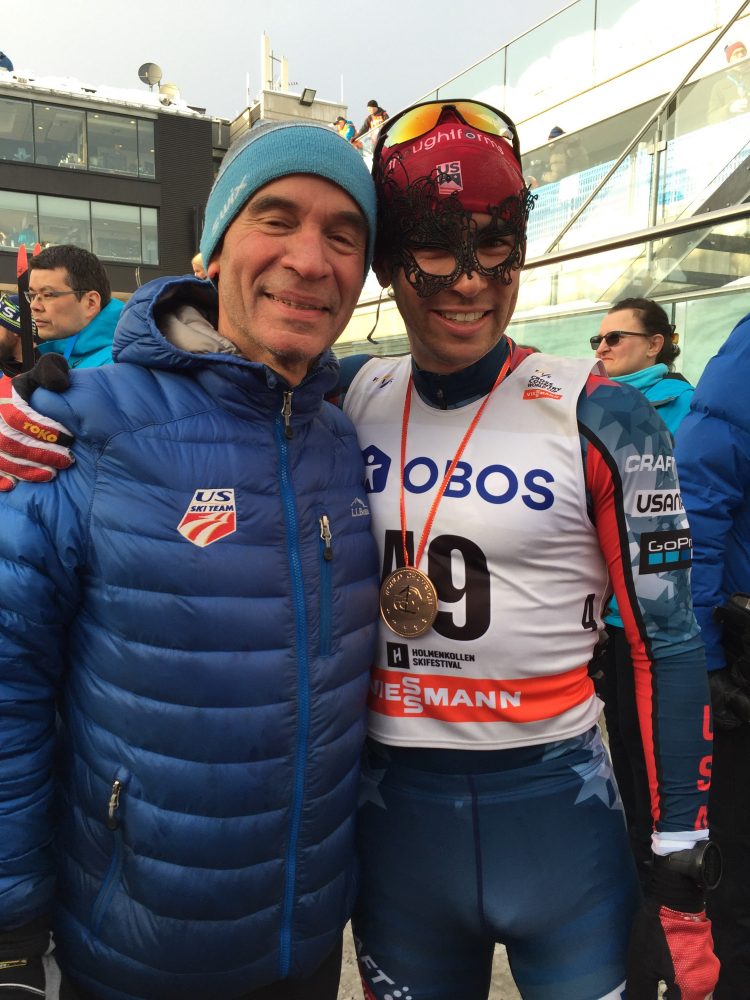
American Noah Hoffman with his dad after finishing the Holmenkollen 50 k freestyle on Saturday for the final race of his pro skiing career. (Black mask and photo courtesy of Liz Stephen)
Also racing on Saturday for the U.S. was David Norris in 37th (+6:19.7), Paddy Caldwell in 46th (+8:12.3), Noah Hoffman in 51st (+10:27.9), and Kevin Bolger in 52nd (+12:44.2). Simi Hamilton did not finish.
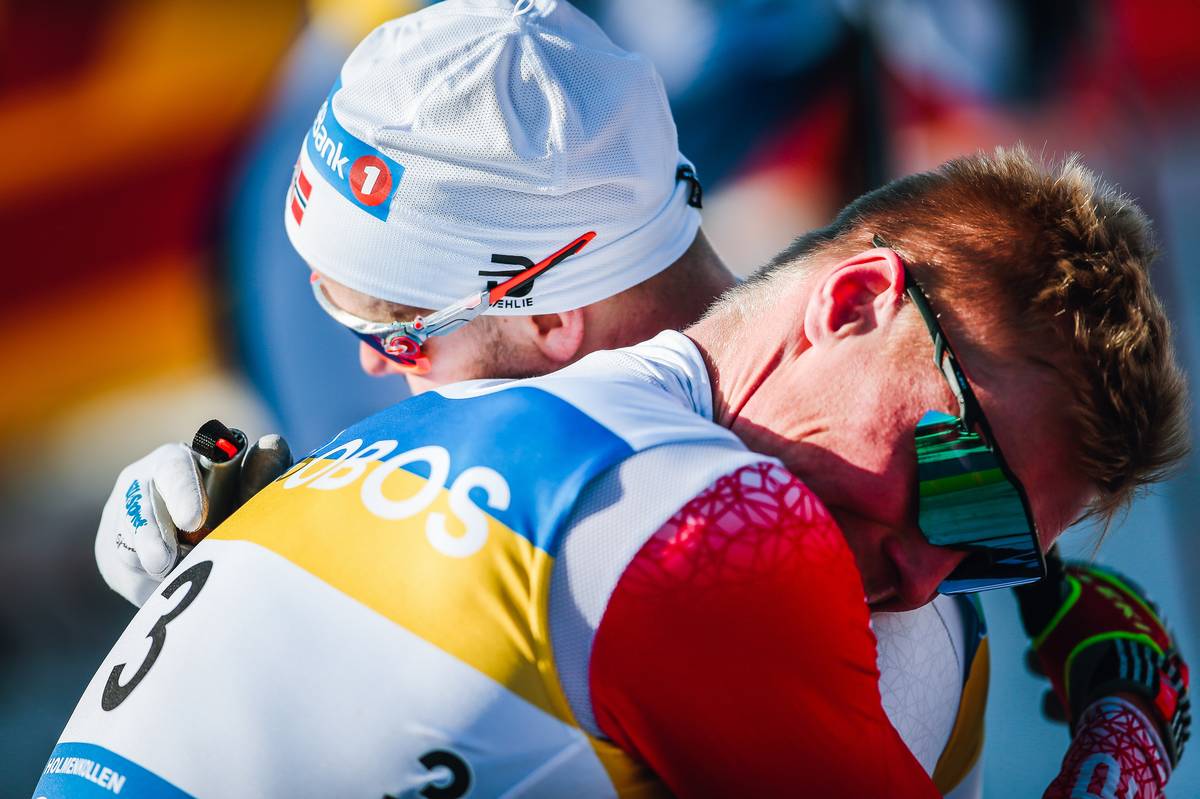
Before crossing the finish line in what would be his final Holmenkollen race, Hoffman pulled to the side of the course to give his father, who was present at Saturday’s race, a hug. Hoffman has been racing the Holmenkollen since 2011.
“The last one of my career so it’s a special one for sure,” Hoffman said of his last career race. “Pretty awesome to have my dad here and Zach [Caldwell] here. It was a little emotional on the last lap, but pretty fun.”
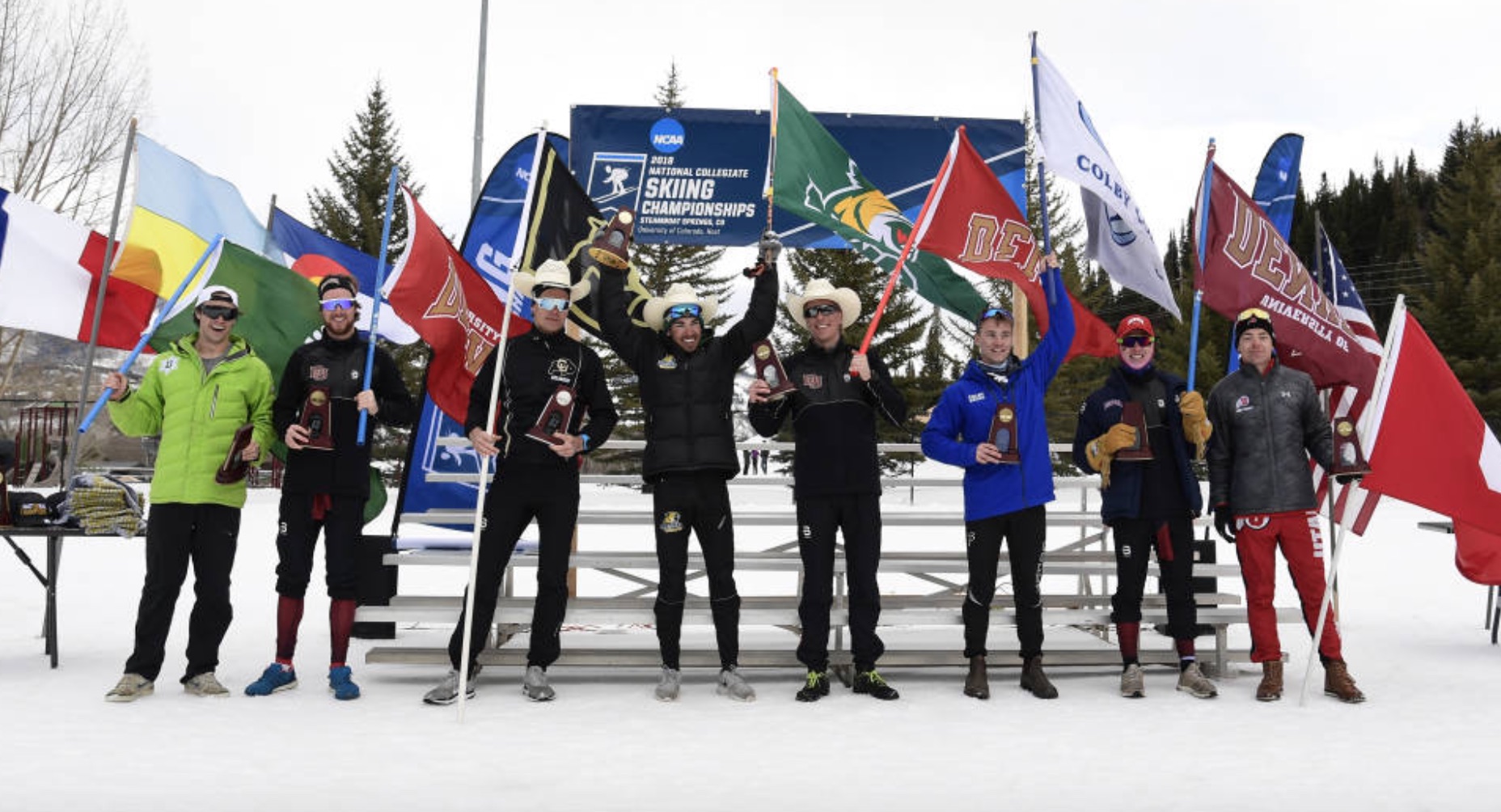
The top finishers in the men’s 20 k freestyle mass start at 2018 NCAA Skiing Championships in Steamboat Springs, Colorado, with Northern Michigan University’s Ian Torchia (c) in first. (Photo: Dartmouth Sports/Clarkson Creative)
NCAA Skiing Championships (Steamboat Springs, Colorado): 15/20 k freestyle mass starts
On the fourth and final day of NCAA Skiing Championships at Howelsen Hill in Steamboat Springs, Katharine Ogden skied to her second-straight national title, Ian Torchia became an NCAA champion and the University of Denver (DU) won its 24th NCAA National Championship.
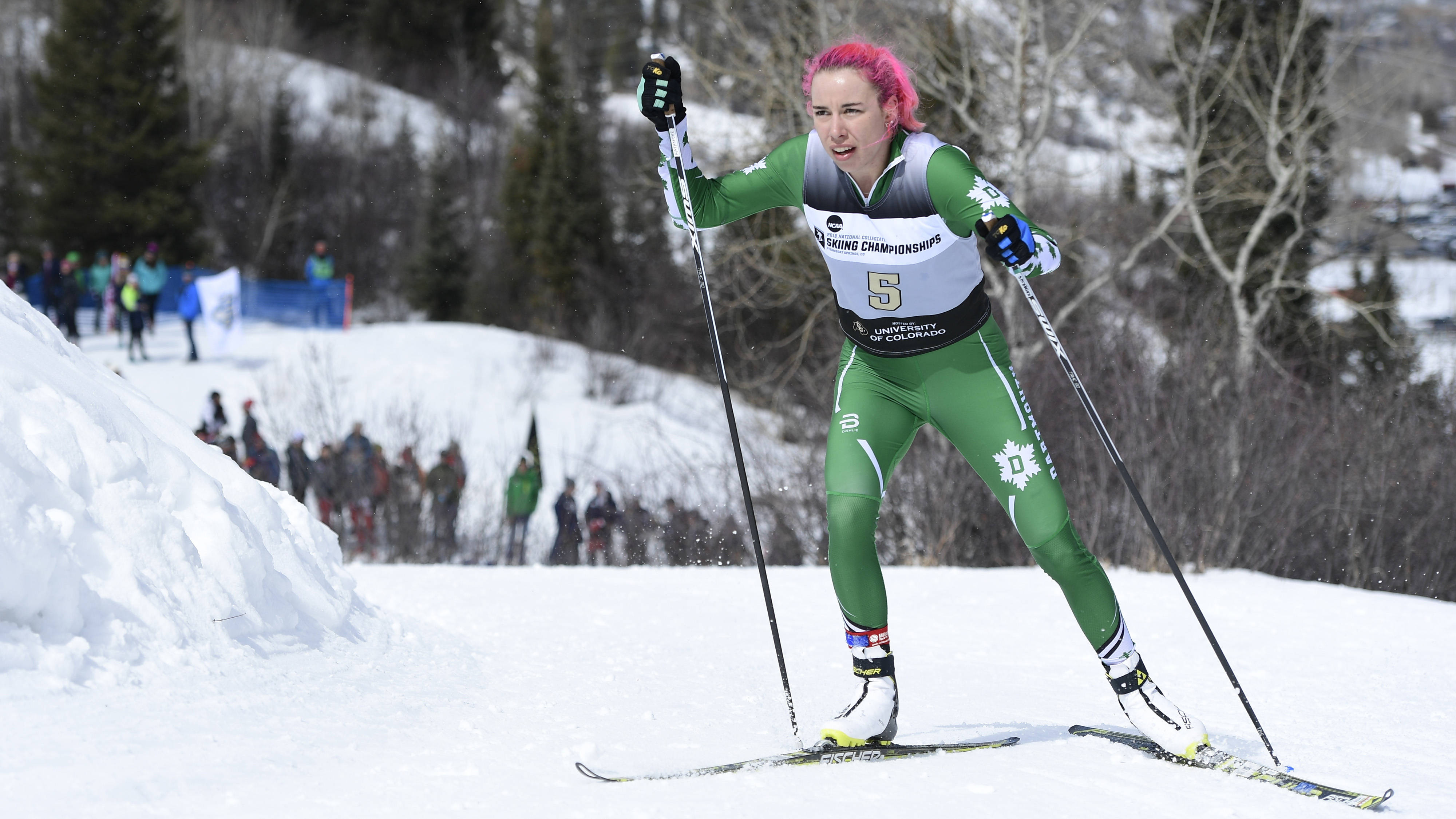
Dartmouth freshman Katharine Ogden racing to her second-straight victory of the 2018 NCAA Skiing Championships in Steamboat Springs, Colorado. She won Saturday’s 15 k freestyle mass start by more than 38 seconds. (Photo: Dartmouth Sports/Clarkson Creative)
Ogden, a Dartmouth College freshman, raced to a 38.4-second victory in the women’s 15-kilometer mass start, finishing in 43:22.0 minutes for her second win in as many races at 2018 NCAA Championships. She won the 5 k classic on Thursday and with her win on Saturday, she became the first Dartmouth skier in 56 years to win two national titles in the same year, according to a Dartmouth press release.
On the second of three laps, Ogden broke away early with close to 10 k to go. According to the press release, she had a “quick fall” near the end of the second lap, but that didn’t derail her as she had time to grab sunglasses from Dartmouth men’s coach Brayton Osgood and a Dartmouth Lone Pine flag before the finish.
At this year’s championships, Ogden’s two titles are accompanied by victories from Dartmouth men’s alpine skiers Brian McLaughlin (who won the giant slalom) and Tanguy Nef (who won the slalom). This marked only the second time that Dartmouth’s Big Green won four individual titles in a single NCAA Championships; that also occurred 61 years ago.
“Katharine absolutely wanted this one, and she really likes to win,” Dartmouth Director of Skiing and Women’s Nordic Head Coach Cami Thompson Graves said in the press release. “She wasn’t about to let a fall slow her down, she has such a great competitive fire. But she also showed her playful side grabbing Brayton’s glasses and smiling all the way to the finish line!”
Hailey Swirbul of the University of Alaska Anchorage placed second and Linn Eriksen (DU) reached the podium in third (+46.3). Denver had three in the top 10 with Jasmi Joensuu in ninth and Taeler McCrerey in 10th. Also landing in the top 10 for All-American honors were Guro Jordheim of the University of Utah in fourth, Emma Tarbath (Montana State University) in fifth, Petra Hyncicova of the University of Colorado Boulder (CU) in sixth, Christina Rolandsen (CU) in seventh, and Lauren Jortberg (Dartmouth) in eighth.
Torchia, an Northern Michigan University (NMU) junior and U.S. Ski Team Development Team member, became the seventh NCAA champion in NMU Wildcats nordic skiing history, according to an NMU press release. Fredrick Schwenke was the Wildcats’ last nordic champion; he won the 2015 NCAA Championships 20 k classic.
Torchia drew bib 1 for Saturday’s 20 k freestyle mass start and crossed the finish line first in 54:21.0, just 2 seconds ahead of CU’s Alvar Alev. Eivind Kvaale (DU) finished just four seconds back in third, and Denver had three in the top seven with Dag Frode Trollebø in fourth and Lars Hannah in seventh. Darmouth’s Cal Deline placed fifth, Zane Fields of Colby College finished sixth, and the 20 k freestyle’s 2017 NCAA champion Martin Bergström (Utah), who also won Thursday’s 10 k classic, placed eighth. CU’s Petter Reistad and Sondre Bollum finished ninth and 10th, respectively.
In the team standings, Denver beat Colorado by 41 points for the overall win with a total of 604 points between the nordic and alpine events at this year’s championships. Dartmouth placed third, 114.5 points behind Colorado, and Utah was another 63 points back in fourth.
According to a DU press release, Denver has won at least one national championship in each of the last five athletic seasons (skiing: 2013/14, 2015/16, 2017/18; hockey: 2016-17; men’s lacrosse 2014/15), joining only Stanford on the list of schools that have done so in the last five seasons. (Oregon, West Virginia, Penn State, Oklahoma, Ohio State and Florida could potentially join that list later this year.)
“It feels incredible,” said DU head coach Andy LeRoy said in the press release. “I am so happy for all of our athletes, they’ve been training all week and all season and to do it in Steamboat in front of our crowd is special.”
The Holmenkollen men’s 50 k freestyle mass start podium on Saturday at the World Cup in Oslo, Norway, with Switzerland’s Dario Cologna (c) in first, Norway’s Martin Johnsrud Sundby (l) in second, and Russia’s Maxim Vylegzhanin (r) in third. (Photo: FIS Cross Country/Twitter)
FIS Cross Country World Cup (Oslo, Norway): Men’s 50 k freestyle mass start
A four-time Olympic champion, Dario Cologna of Switzerland won his first 50-kilometer World Cup race on Saturday, topping the podium in the famous Holmenkollen 50 k freestyle mass start after outlunging Norway’s Martin Johnsrud Sundby (who won the event last year) for the win in 2:01:48.1. Sundby finished one-hundredth of a second behind for second place, ahead of Russia’s Maxim Vylegzhanin, who was 1.1 seconds back in third in his first World Cup race since November of last year.
The photo finish for first between Switzerland’s Dario Cologna (near) and Norway’s Martin Johnsrud Sundby at the Holmenkollen 50 k freestyle mass start on Saturday in Oslo, Norway. Cologna got it by 0.01 seconds. (Photo: FIS Cross Country/Twitter)
Norway’s Sjur Røthe came out on top in a race for fourth (+4.2), ahead of Russia’s Denis Spitsov in fifth (+4.4) and his Norwegian teammate Hans Christer Holund in sixth (+4.5). Great Britain’s Andrew Musgrave followed in seventh (+15.1), Germany’s Florian Notz placed eighth (+25.9) and Canada’s Alex Harvey finished ninth (+32.4), ahead of France’s Robin Duvillard in 10th (+33.5).
Scott Patterson led the U.S. in 16th (+56.3) coming off an 11th place in the 50 k classic mass start at last month’s Olympics, and Canada’s Devon Kershaw finished in the points in 28th (+3:43.6). Just outside the top 30, Canada’s Graeme Killick finished 34th (+4:55.1).
Also for the U.S, David Norris placed 38th (+6:19.7), Paddy Caldwell was 46th (+8:12.3), Noah Hoffman 49th (+10:27.9), Kevin Bolger 52nd (+12:44.2), and Simi Hamilton did not finish.
Canada’s fourth man in the race, Andy Shields finished 47th (+8:13.6).
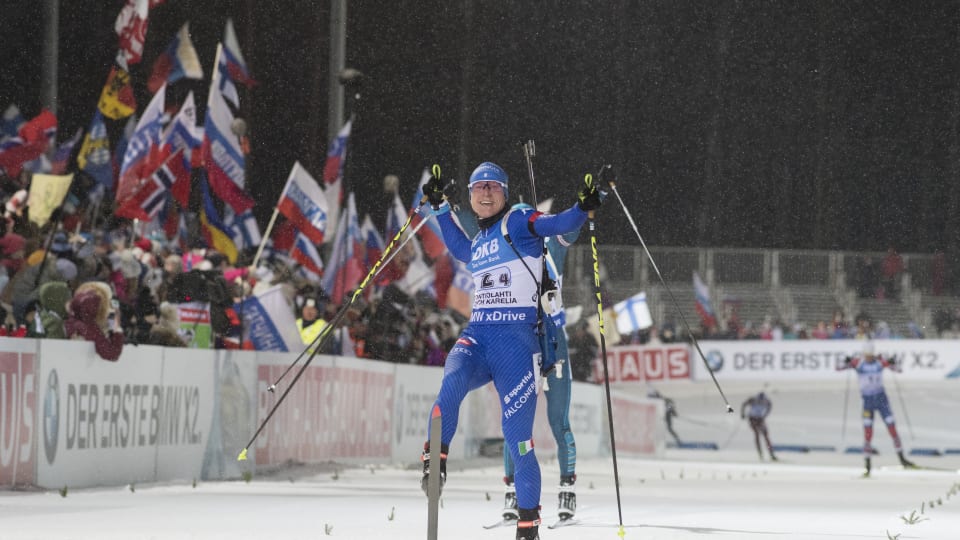
Italy’s Lukas Hofer celebrates his team’s win in Saturday’s mixed relay at the IBU World Cup in Kontiolahti, Finland. (Photo: IBU/Biathlonworld)
IBU World Cup (Kontiolahti, Finland): Single mixed relay & mixed relay
(Note: This rundown has been updated to include comments from Christian Gow and Sean Doherty.)
In the last single mixed relay and mixed relay of the International Biathlon Union (IBU) World Cup season, France and Italy came out on top, with France winning the two-person single mixed relay and Italy taking first in the coed mixed relay.
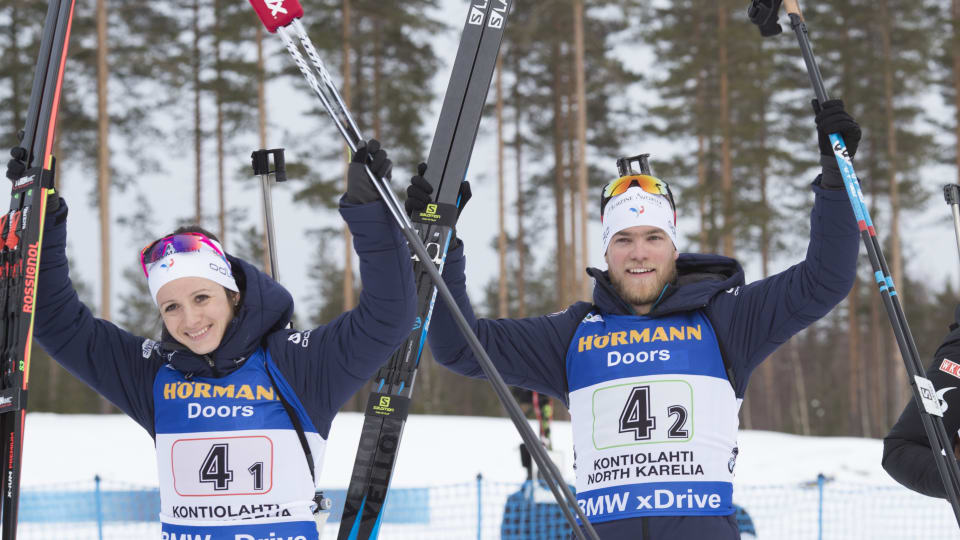
France’s Anaïs Chevalier and Antonin Guigonnat after winning Saturday’s single mixed relay at the IBU World Cup in Kontiolahti, Finland. (Photo: IBU/Biathlonworld)
France’s Anaïs Chevalier and Antonin Guigonnat combined for zero penalties and six spares to finish first in the single mixed relay in 33:29.1 minutes. Guigonnat as the team’s anchor secured the win by just 2.4 seconds over Austria’s Julian Eberhard while Norway’s Johannes Thingnes Bø finished 4.4 seconds back for third.
Chevalier put France in fifth after the first leg, 15.5 seconds behind Ukraine’s Iryna Varvynets in first. Guigonnat used just one spare on his first leg to move them into fourth, 9.2 seconds back while Norway led at the second exchange. On Chevalier’s second leg, she shot clean in both stages to lead through the final exchange, with Ukraine skiing just 6.2 seconds back in second.
On the final leg, Guigonnat used two spares and stayed out of the penalty lap, keeping the team in first through the finish. Eberhard skied the second-fastest course time on that leg to elevate Austria (with Lisa Theresa Hauser) from fourth at the tag to second place at the finish, and Bø skied all the way up from eighth to third place for Norway (with Marte Olsbu) with the fastest course time.
Ukraine’s Artem Tyschenko used just one spare but slipped to fourth with the 11th-ranked course time on that leg, as he finished 10.8 seconds behind Norway.
Behind Russia in fifth and Italy in sixth, Canada placed seventh (+23.8) with Rosanna Crawford and Christian Gow. The duo combined for zero penalties and six spares, and put themselves in third place early in the race. Crawford skied them into third on the first leg, using just two spares and tagging Gow 7.4 seconds out of first.
Gow went on to take the lead after cleaning prone without any spares, and he cleaned standing as well but slipped back to third while Bø took the lead. Gow tagged Crawford in third, 8.9 seconds behind Norway in first.
“I didn’t think too much about being tagged in third,” Gow recalled in an email to FasterSkier. “It was exciting for sure, but I let it fade to the background so that I could focus on my job both on the track and in the range. It was great to leave prone in first place! It was also surprising, but it was a good place to be in.
“My skiing was ok today,” he continued. “It is a really challenging and demanding race format that we don’t get a lot of practice with. I was sick after the Olympic Games and only finally coming around the past couple days. The Sprint race was horrendous for me, so today was much better than that. In the range I just focussed on myself and trusted my shooting. I tried my best not to get caught up in the race going on around me and it worked to my benefit.”
Crawford then slipped to seventh and 21 seconds back with three prone spares, but avoided the penalty lap, and Gow held onto seventh through the finish, using just one spare and skiing the eighth-fastest course time on that leg.
“We are both happy with this result,” Gow wrote. “I think that we are both looking at the 23 second gap to first and thinking that if things had worked out just a bit better we could be there. It can be both exciting and frustrating to be that close to the podium. We know we can do it, it’s just a matter of putting it together on the right day. We are happy with 7th, but hungry for more.”
Susan Dunklee and Lowell Bailey finished 14th for the U.S., 1:13.0 out of first with one penalty and 14 spares. The penalty came on Dunklee’s first leg during her standing stage, after she had cleaned prone without any spares. She tagged Bailey in 14th and he brought them up to 11th, using three spares on that leg, then Dunklee came through the final exchange in 13th after using four spares to clean. Bailey lost one place on the final leg, using four spares but staying out of the penalty lap.
Twenty-six teams competed in the single mixed relay, compared to 23 in the mixed relay that followed.
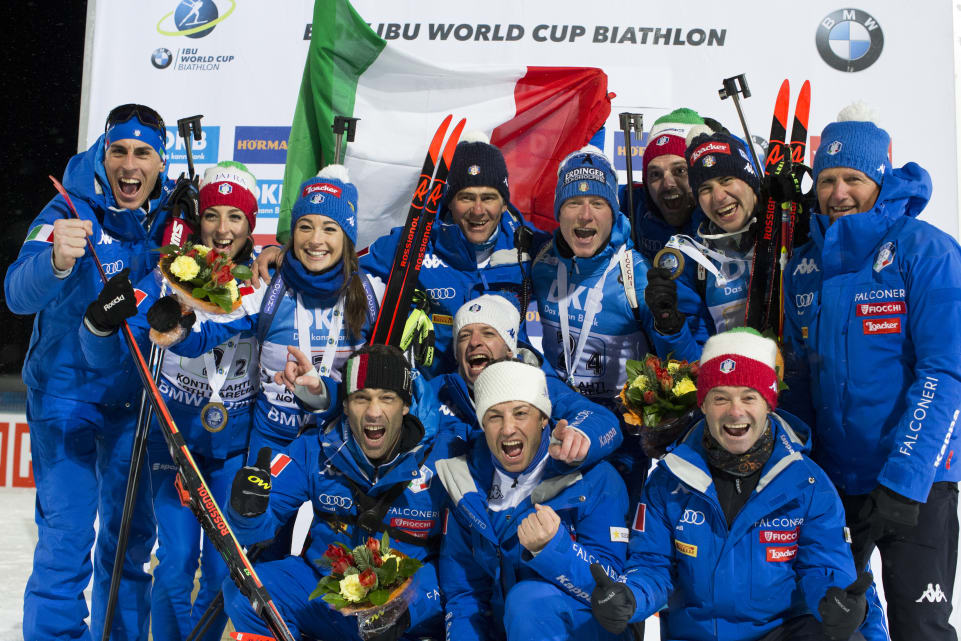
Team Italia celebrates its win in the IBU World Cup mixed relay on Saturday in Kontiolahti, Finland, with its relay members Dorothea Wierer, Lisa Vittozzi, Dominik Windisch, and Lukas Hofer. (Photo: IBU/Biathlonworld)
In Saturday’s 2 x 6 + 2 x 7.5 k mixed relay, Italy nabbed a 1.5-second victory over Ukraine in 1:15:08.3. Dorothea Wierer, Lisa Vittozzi, Dominik Windisch, and Lukas Hofer — the same Italian team that took bronze in the mixed relay at last month’s Olympics, although in a different order — combined for the win with one penalty and 13 spares.
Ukraine, with Anastasiya Merkushyna, Vita Semerenko, Artem Pryma, and Dmytro Pidruchnyi, had zero penalties and just three spares throughout the whole race. For the second-straight relay on Saturday, Norway placed third (+9.1) with Synnøve Solemdal, Tiril Eckhoff,Henrik L’Abée-Lund, and Tarjei Bø totaling zero penalties and nine spares.
Italy’s lone penalty came in Vittozzi’s second leg, but it didn’t derail the team as it improved from sixth to fifth with Vittozzi, who skied the third-fastest course time on that leg. She tagged Windisch 6.8 seconds out of first, and Windisch, who had anchored the team in the Olympics, took the lead by the final exchange after using two spares to clean. Hofer left the exchange just 3.3 seconds ahead of Norway’s Bø but used just one spare and skied the second-fastest anchor leg to finish first, beating his rivals up Kontiolahti’s infamous climb known as “The Wall”. Ukraine’s Pidruchnyi also shot clean with a single spare and clocked the fastest anchor leg to move his team from fourth to second place. Bø lost one place and finished third after using one spare as well and skiing the third-fastest anchor leg.
Russia followed in fourth, France fifth, Sweden sixth, Germany seventh, Austria eighth, and the U.S. ninth (+2:48.4). The U.S. team, with Clare Egan, Joanne Reid, Tim Burke, and Sean Doherty, had one penalty and 11 spares. Egan cleaned her first prone but had to ski a penalty lap after her standing stage, tagging Reid in 17th, 58.7 seconds out of first.
Reid used three spares on the second leg and moved up to 13th by the second exchange, and Burke used three spares as well to pick off one more place and tag Doherty in 12th. Doherty skied the eighth-fastest anchor leg and used two spares to clean to put the team in ninth at the finish.
“I don’t consider two spares to be anything special, but today it was enough to make up some ground,” Doherty wrote in an email to FasterSkier.”I felt strong skiing, more like myself which is fun even if it’s a little late in the season. We had very good skis which always helps. I have done quite a few laps on this course over the years so the lines and transitions are pretty refined, so that is where I made time on the course.
“I am happy with my leg. I enjoyed my little battle for 9th,” he continued. “I can’t speak too much for the other members of the relay tonight but I think 9th is a solid effort.”
Canada finished 17th (+4:34.9) with Emma Lunder, Julia Ransom, Scott Gow, and Brendan Green combining for one penalty and 13 spares. Lunder put them in 12th at the first exchange and Ransom skied up to 10th, but Scott Gow had a penalty on his standing stage to drop to 16th. Green lost one more place on the last leg despite only requiring two spares.
Start of the men’s 50 k freestyle mass start at Holmenkollen on Saturday in Oslo, Norway, with Alex Harvey (3) trailing overall World Cup leader Martin Johnsrud Sundby (yellow bib). (Photo: Fischer/Nordic Focus)
It would’ve been easy to just stop in Saturday’s 50-kilometer freestyle mass start — the ultimate distance race of the World Cup season.
Canada’s Alex Harvey wasn’t having the best go at it, with slick skis for the first two of six laps that put him back near 46th.
“I just couldn’t do anything on the climbs, and lost a lot of position and time,” Harvey said in a post-race interview.
If he could do it all over again, the 25-year-old Quebec native said he would have switched skis after the first lap — a move which would’ve cost him about 40 seconds and likely left him skiing alone. Trailing the pack at the end of the first lap, Harvey decided he didn’t want to risk it and continued with the group, bypassing the transition. He then had to tough it out for another 8.3 k until his next opportunity to change after the second lap.
From there, with a new pair, the race really began for Harvey and became somewhat of a personal test to see what he was capable of.
He picked off 32 places over the next 33 kilometers to place 14th, 3:56.2 behind Sweden’s Daniel Richardsson, who won in 2:07:29.5. The race strung out into a battle between the top three just over halfway through. Norway’s Martin Johnsrud Sundby solidified second, 8.2 seconds back, and Russia’s Alexander Legkov placed third, six seconds later.
While Sundby was trying to seal the deal for both the World Cup overall and distance titles, Harvey said the pace was pretty relentless throughout the 50 k, with Sundby and Legkov going for the sprint bonuses on every lap.
Harvey didn’t worry about those; he was more focused on finishing strong enough to maintain a prime position in the overall World Cup standings.
“It cost a lot when you go for [those bonuses],” Harvey said. “You saw it with Danny Richardson — he’s the one that went for the least amount of points between Legkov and Sundby. I think that is why Sundby ended up not winning is because of all of the points he got early on … I wasn’t planning on going for the points.”
Fourteenth was good enough to put the Canadian sixth in the overall World Cup standings, just nine points behind Sweden’s Calle Halfvarsson in fifth. Harvey is currently fifth in the distance rankings with three more races to go, one sprint and two distance races at World Cup Finals later this week.
“It was a good race for me” Harvey said of the 50 k. “Just unfortunate that I couldn’t be more in it from the beginning.”
Two other Canadians in the race did not finish: Devon Kershaw and Graeme Killick. According to a Cross Country Canada press release, Kershaw struggled with his skis, like Harvey, and dropped out after the second lap. Killick stayed in the race for 42 k, but “didn’t have the body to finish.”
Noah Hoffman led the American men in 29th, finishing seven minutes after Richardsson.
Relying on a different strategy than Harvey, Hoffman, who’s currently 30th in the World Cup distance standings and 33rd overall, aimed for bonus points more than anything. He was second at the first preem and sixth at the second one for a total of 17 points (points are awarded to the top 10 at a given sprint preem).
“There is no doubt that that is the easiest way to score World Cup points is to take those bonus points,” Hoffman said on Saturday. “I have had several people that have questioned that strategy and usually say, ‘You blew yourself up,’ which I clearly did blow myself up, but I scored more points than Alex did today and Alex finished 14th.”
The 24-year-old Colorado native started to feel the effects of his fast-and-furious efforts at the second preem.
“When I crossed the preem line at the second preem, I think I said to myself, ‘I’m not positive I can finish this race,’ ” he said. “I was worried that I was not going to be able to finish and therefore lose the points that I had earned. I knew I was in trouble.”
He changed skis after the first and second laps, like most of his competitors, but said the race was mostly decided by five men that started to go on the second lap, calling it one of the most-strung out World Cup race he’s ever seen.
“Over seven minutes to 30th, seven-minute spread to the points is incredible,” he said.
While his strategy kept him from sticking with the leaders, Hoffman stood by it.
“I feel like it was the right call given the circumstances, given how close I am to the Red Group and that Red Group is the standard for A-team for the U.S. Ski Team,” he said, looking ahead to next season. “I needed to go score as many points as possible and I think I did that.”
Three other Americans placed in the top 60, with Erik Bjornsen in 51st, Simi Hamilton in 54th and Reese Hanneman in 56th. Andy Newell and Sylvan Ellefson did not finish.


 This World Cup coverage is made possible through the generous support of Marty and Kathy Hall and A Hall Mark of Excellence Award. To learn more about A Hall Mark of Excellence Award, or to learn how you can support FasterSkier’s coverage, please contact info@fasterskier.com.