From the FasterSkier archive — posts syndicated from athletes’ and coaches’ own blogs between 2004 and 2012, kept online as published. Current coverage is at fasterskier.com.

Tag: Holmenkollen Ski Festival

  • Hedegart Emerges From the Fog to Win Holmenkollen 50 k as Klæbo’s Absence Reshuffles the Distance Globe

    Hedegart Emerges From the Fog to Win Holmenkollen 50 k as Klæbo’s Absence Reshuffles the Distance Globe

    This coverage is made possible through the generous support of Marty and Kathy Hall and A Hall Mark of Excellence Award. To learn more about A Hall Mark of Excellence Award, or to learn how you can support FasterSkier’s coverage, please contact info@fasterskier.com.

    The start of the Holmenkollen Men’s 50 k Freestyle in Oslo, Norway. (Photo: Authamayou/NordicFocus)

    For nearly two hours on Saturday, 77 men disappeared into a stubborn curtain of fog that clung to the hillsides above Oslo, their figures swallowed by the mist somewhere between the stadium and the high point at Frognerseteren. When it was over, only one emerged with his arms in the air, and it was the one freestyle specialist who had been topping shorter freestyle distance races most of the season.

    Einar Hedegart, the 24-year-old former biathlete who only committed fully to cross-country skiing in November, surged past Harald Oestberg Amundsen in the final meters to win the Holmenkollen 50 k Freestyle in 1:51:38.2 — his first victory on cross-country skiing’s most storied stage, in just his seventh World Cup start.

    “This is the greatest feeling I’ve ever had,” Hedegart said after the finish. “This is just a nostalgia stadium. [A] legendary race, almost all my heroes have won this race, and especially Petter Northug. This might be the reason why I’ve been so motivated my whole life to be a cross-country skier.”

    Einar Hedegart (NOR) celebrates winning Norway’s most iconic race. www.nordicfocus.com. (Photo: Authamayou/NordicFocus)

    But the result that will echo loudest across the sport happened away from Oslo. Johannes Hoesflot Klaebo, the overall World Cup leader, was home nursing a mild concussion from a hard crash in the Drammen sprint two days earlier. Klaebo, who has already compiled a nearly perfect season, winning the Tour de Ski, all six Olympic races, secured the FIS Overall Crystal Globe, the FIS Sprint Crystal Globe, and only needed to keep racing the remaining distance races to take the clean sweep of the season with the FIS Distance Crystal Globe. BUT his absence from the start line meant zero points scored in the distance standing today. And with Amundsen’s second-place finish today, the distance crystal globe race was blown wide open: Amundsen now leads the distance standings by three points, 939 to 936, with two distance races remaining at the World Cup Finals in Lake Placid.

    Klaebo posted to Instagram yesterday: “Took a fall yesterday and hit my head pretty hard, but luckily everything is all good in the hood. Ended up with a concussion, so I’ll take some days off from both training and the internet just to make sure everything settles properly. Only got one head, so have to take good care of it.”

    He had been scheduled to fly to the United States on Sunday, but will now stay in Norway for a few extra days, hoping to recover in time for Lake Placid.

    Einar Hedegart (NOR) emerges from the fog to take the win. (Photo: Nordnes/NordicFocus)
    A Race Defined by Fog

    The Holmenkollen 50 k — first raced in 1888, a fixture of the World Cup since 1982, and a race that draws an estimated 100,000 fans to the forested hills above Oslo — returned to the calendar Saturday after a one-year absence. For the first time, the men’s and women’s 50 k races were held on the same day, the women starting 45 minutes behind the men in a format designed to create an all-day spectacle. The fog, however, had other ideas. Conditions were so thick that spectators along the course could hear the racers before they could see them.

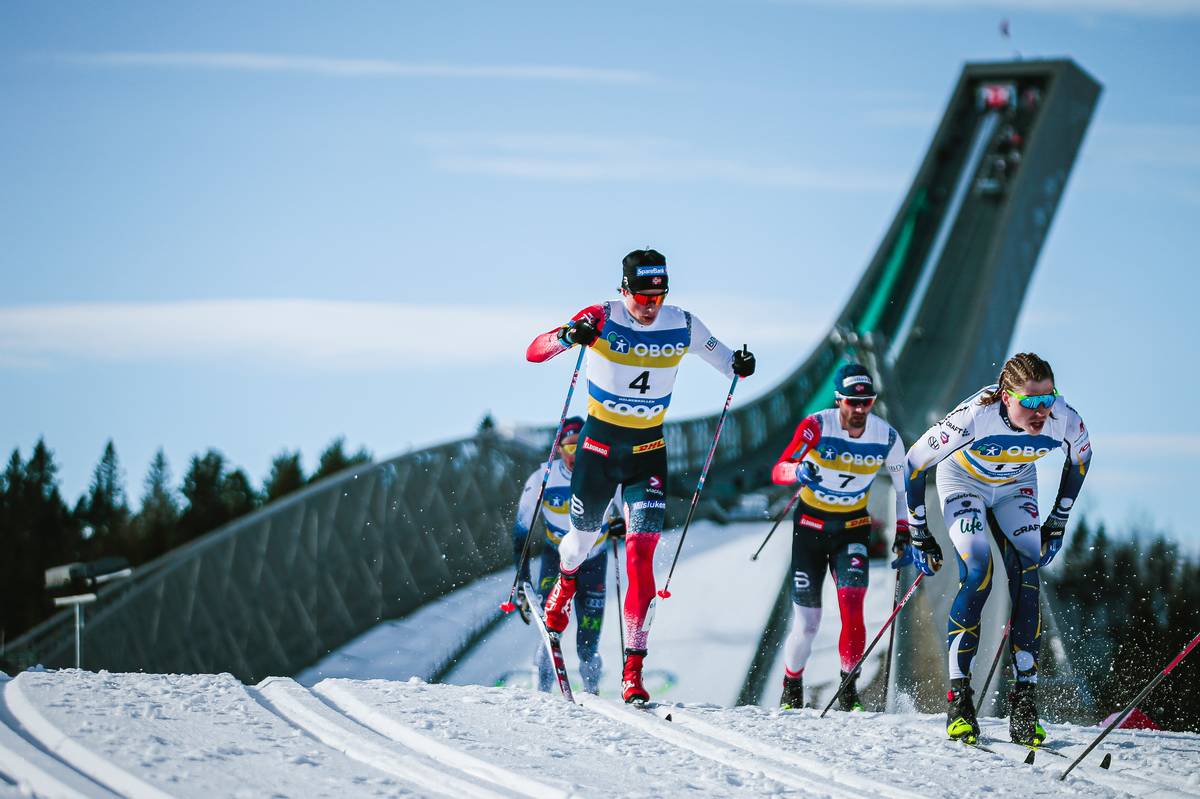
    The course — six laps of 8.3 km with 334 meters of climbing per lap — was firm and fast after overnight salting despite an air temperature of 5.0°C. The salted, compact surface was ideal for skating, and the winning time of 1:51:38 came in roughly four minutes faster than the last time the Holmenkollen 50 k was contested in freestyle.

    Harald Oestberg Amundsen (NOR) on his way to second place. (Photo: Authamayou/NordicFocus)

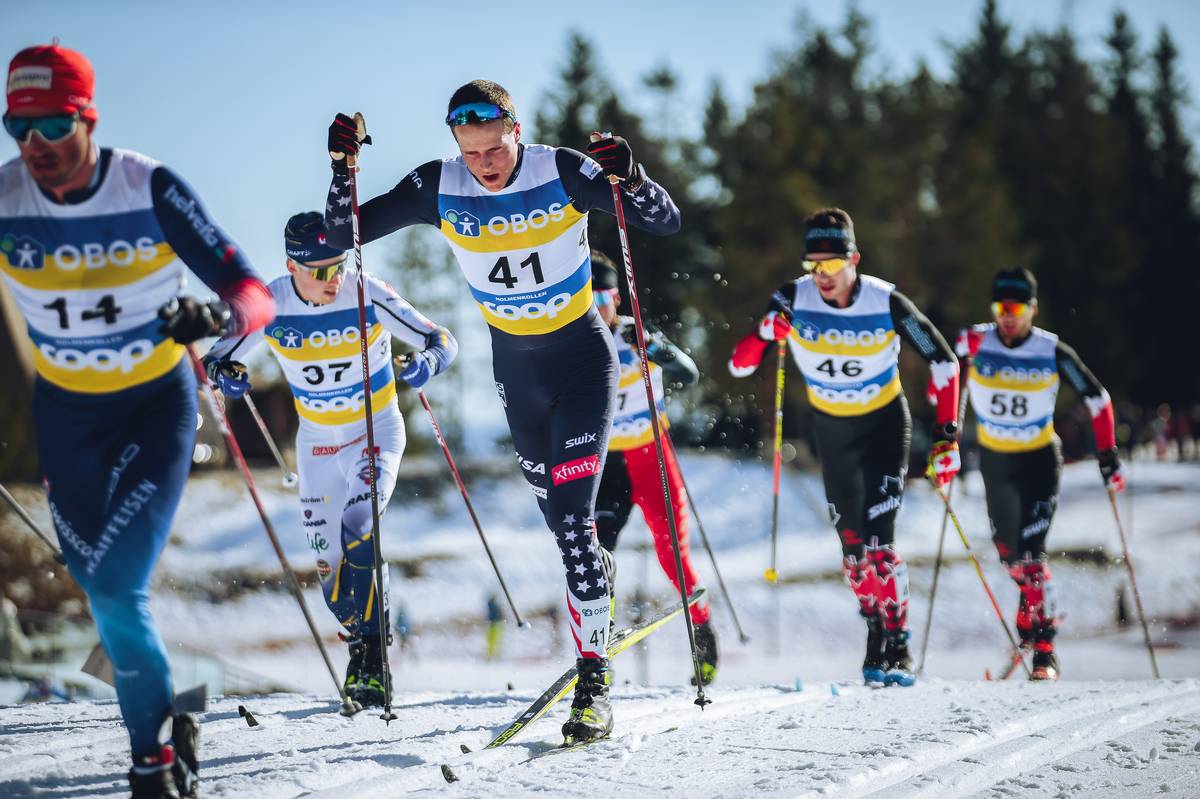
    Through the first three laps, the race unfolded as a cautious tactical affair. A large pack of roughly 40 skiers stayed together, with Martin Loewstroem Nyenget, Mattis Stenshagen, and Federico Pellegrino taking turns at the front. The first athlete to make a decisive tactical move was Iver Tildheim Andersen, who changed skis early at the stadium after the third lap while the rest of the pack continued through. The fresh skis gave Andersen a burst, and when the lead group stopped for their own ski exchange one lap later, he suddenly found himself alone at the front with a roughly 15-second advantage.

    “Just stick with the field as long as possible and then hopefully be in position when the group starts swarming,” Hedegart said of his plan. “But today I was really offside, like 70 percent of the race. So I was lucky that no one took a gap.”

    The chase group — reduced to roughly eight athletes, all Norwegian once France’s Victor Lovera fell off the pace — gradually closed on Andersen through the fifth lap, with Hedegart, Simen Hegstad Krueger, Amundsen, Nyenget, Andreas Fjorden Ree, and Kasper Andersson Herland trading pulls at the front. By the time the group reached the final lap, they had swallowed Andersen, and the race became a question of who had saved enough for the final kilometers.

    Simen Hegstad Krueger (NOR) tried his best to get away for the win. (Photo: Authamayou/NordicFocus)
    Krueger’s Late Charge and Hedegart’s Final Kick

    Krueger, who was celebrating his 33rd birthday the day before, was omitted from the Norwegian Olympic team despite multiple Olympic medals in his career and was the winner of the last freestyle Holmenkollen 50 k. He drove the pace through the final lap. He pushed hard over the climbs near the iconic Holmenkollen church, stringing out the group and shedding Andersen off the back. But Krueger couldn’t sustain the pressure all the way to the finish, and as the group of seven came around the final corner and up the short, steep ramp before the descent into the home stretch, the sprint was on.

    Amundsen launched first, throwing everything he had at the final few hundred meters. But Hedegart, who had looked labored at points earlier in the race, found a gear no one could match. He came alongside Amundsen, took the lead in front of the grandstand crowd, and raised his fist in celebration as he skied across the line.

    “I felt, like, better,” Hedegart said of his position in the back of the pack through much of the race. “So I was just laying in the field, and I had to remind myself he did the same,” he added, referring to his idol Northug, whose trademark move was stalking from behind before unleashing a devastating sprint.

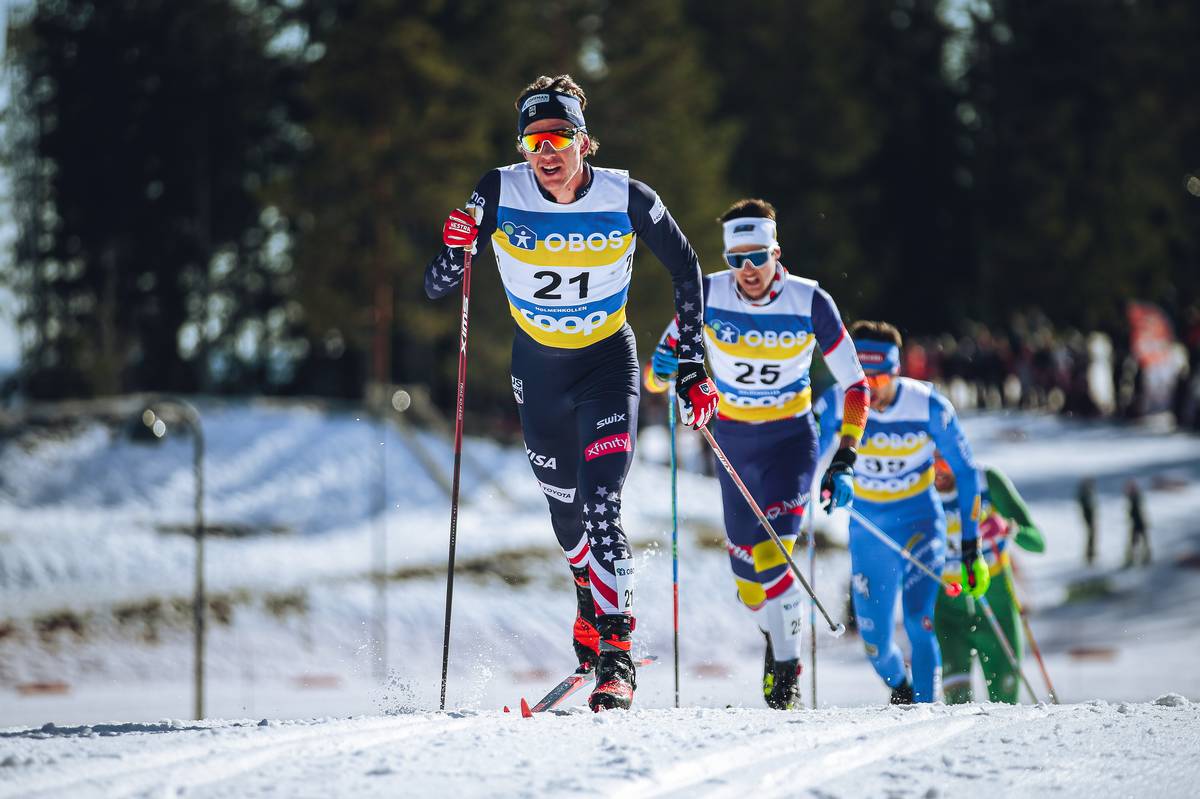
    Harald Oestberg Amundsen (NOR), Mattis Stenshagen (NOR), and Martin Loewstroem Nyenget (NOR), (l-r) stayed in the lead pack. (Photo: Authamayou/NordicFocus)

    Hedegart crossed in 1:51:38.2. Amundsen finished four-tenths of a second behind. Nyenget was third at +1.1. Ree took fourth (+1.5), followed by Herland (+2.1), Krueger (+3.0), Moseby (+4.8), and Andersen (+16.8) after his brave solo effort. Norway swept the top eight positions.

    France’s Lovera was the first non-Norwegian in ninth (+48.1), followed by AIN athlete Savelii Korostelev in 10th (+1:24.2).

    Zak Ketterson (USA) led the way for the Americans in the chase pack racing for 11th place; he ultimately finished 18th. (Photo: Authamayou/NordicFocus)
    Ketterson Fights for 11th in His Adopted Home

    Zak Ketterson, who spent the summer and fall living and training in Oslo, found himself in the thick of a battle for 11th place, a fight he learned about from coaches stationed along the fog-shrouded course.

    “I had heard from coaches on the side of the trail that our pack was fighting for 11th, and that was super cool,” Ketterson said. “I actually felt pretty fresh at the end and thought my finishing sprint would be pretty good, but I didn’t time it well and got really boxed in on the last couple turns into the finish.”

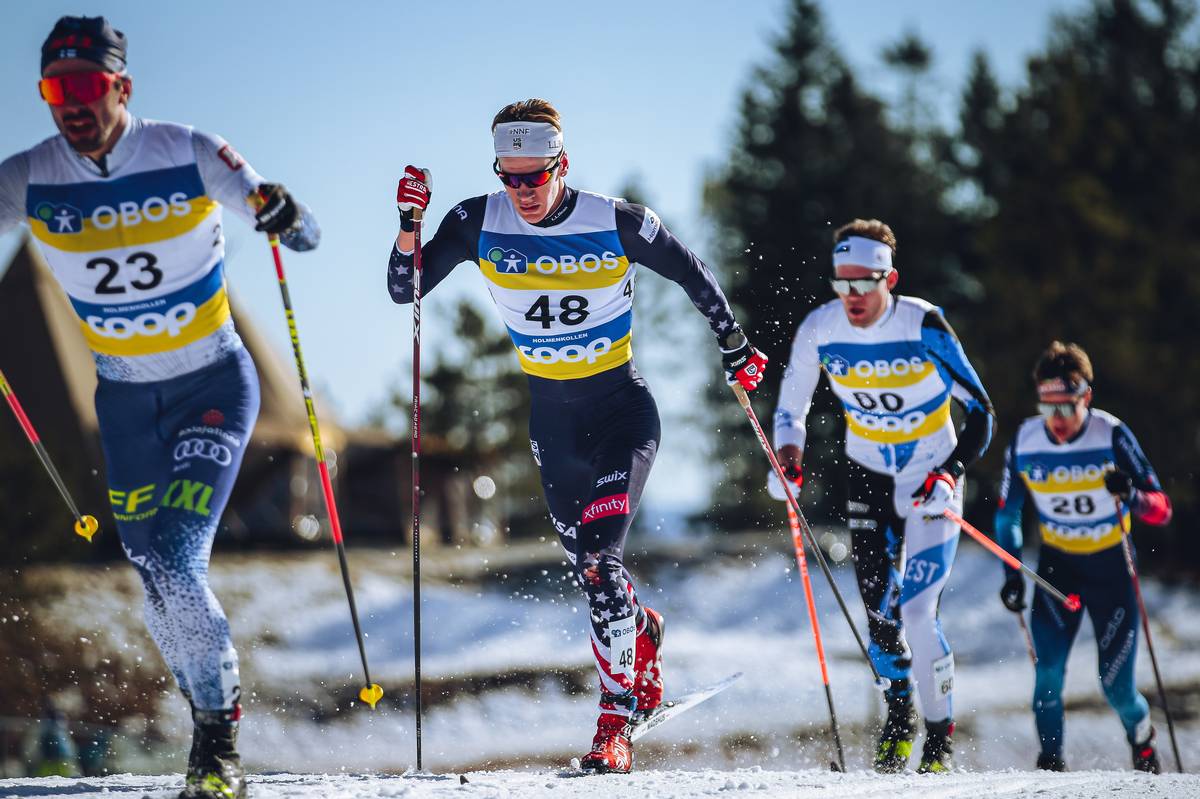
    Ketterson ultimately finished 18th (+1:54.2), part of a chase pack that came across the line within seconds of each other. He said everyone in the group knew a sprint was coming on the final lap.

    The fog made the tactical picture nearly impossible to read. “I couldn’t see more than 10 meters in front of me,” Ketterson said. “It definitely made it difficult to assess where I was relative to the leaders in the later laps. It also made some of the corners feel way sketchier because you couldn’t really choose an optimal line with such limited visibility.”

    For Ketterson, the race carried personal significance beyond the result. Having trained on the Holmenkollen course through the Norwegian summer and fall, he knew every climb and descent intimately. “This is definitely one of the most iconic and cool races we get to do,” he said. “It was especially special for me this year since I trained on this course all summer and fall living in Oslo. The highlight was definitely having my wife Julie and her family out there cheering me on.”

    What made the performance all the more impressive was the state of his body coming in. “I honestly feel like I am really running on fumes,” Ketterson said. “To be honest, I was not sure if I would even start this race in the morning. I felt so bad, and honestly, my body has felt super up and down in the last few weeks. I’m really curious to see how my body responds to this race. I was pleasantly surprised by how decent it felt, but I feel like the next week could go either way. Especially with the international travel tomorrow.”

    Brian Bushey (USA) gaining experience on his way to 59th place. (Photo: Authamayou/NordicFocus)
    The Rest of the North Americans

    Hunter Wonders was 45th (+5:46.9), Kevin Bolger was 48th (+6:51.3), and Brian Bushey was 59th (+12:24.9).

    Canada’s Xavier McKeever finished 41st (+5:11.4), while Thomas Stephen was 43rd (+5:18.1).

    Harald Oestberg Amundsen (NOR) takes over the FIS Distance Globe lead with just two distance races remaining. (Photo: Authamayou/NordicFocus)
    Distance Globe: Three Points

    The ramifications of Saturday’s race land squarely on the crystal globe picture. Before the race, Klaebo held a 128-point lead over Amundsen in the distance standings and a 636-point lead in the overall. With Klaebo watching from home, Amundsen’s 131-point haul (including bonus points) vaulted him into the distance lead: Amundsen now sits at 939 points, three ahead of Klaebo’s 936. Nyenget climbed to 914 in third.

    Klaebo’s overall World Cup lead, at 2,071 points to Amundsen’s 1,566, remains secure with a 505-point cushion. But the distance globe — awarded to the season’s best across distance events only — will come down to the final two races: a 10 k Classic Interval Start and a 20 k Freestyle Mass Start in Lake Placid, March 20-22.

    If Klaebo can travel to Lake Placid and race, he’ll have every opportunity to reclaim the lead. If the concussion keeps him out, the distance globe is likely to belong to Amundsen.

    Kasper Andersson Herland (NOR), who finished fifth, celebrates with Einar Hedegart (NOR), (l-r) at the finish of the Holmenkollen. (Photo: Authamayou/NordicFocus)
    A Star Made for This Stage

    Hedegart’s career trajectory is one of the season’s best stories. A junior biathlon world champion who struggled with his shooting, he drifted toward cross-country skiing after a surprising second-place finish at the Holmenkollen World Cup last season. He spent the summer training with a cross-country team while bringing his rifle to every camp, undecided. In November, after winning the popular pre-World Cup cross-country race in Beitostoelen, Norway, by a wide margin and missing eight of 20 shots in a biathlon event, he committed to leaving the rifle at home.

    Since then: an Olympic bronze in the 10 k Freestyle behind Klaebo, a team sprint gold partnered with Klaebo, victories in the Engadin Marathon, and now the Holmenkollen 50 k — a distance he had never raced at the World Cup level. He was asked whether his approach of sitting back resembled Northug’s famous stalking tactics.

    “Yeah, I felt like Petter,” Hedegart said. “So I was just lying in the field, and I had to remind myself he did the same.”

    For a race that dates to 1888, that has been won by the sport’s mythical stars, and that is contested before the King of Norway in a stadium surrounded by 100,000 fans, there is no small amount of weight to what happened Saturday at the Holmenkollen. Hedegart is, by every measure, now a cross-country skier.

    The season concludes with the World Cup Finals in Lake Placid, New York, March 20-22. Three races remain. The distance globe is separated by three points. And the world waits to see whether Klaebo can make it to the start line.


    Holmenkollen Men’s 50 k Freestyle FINAL RESULTS

    FIS Men’s Crystal Globe SPRINT STANDINGS
    FIS Men’s Crystal Globe DISTANCE STANDINGS
    FIS Men’s Crystal Globe OVERALL STANDINGS


    Love Stories Like This? Help Keep Them Coming.

    Feature stories like this one take time, access, and care to produce. If you value thoughtful storytelling and independent ski journalism, please consider becoming a Voluntary Subscriber. Your support directly fuels the work we do to cover the people, places, and moments that make our sport special.

    Join the FasterSkier community!


    Harald Oestberg Amundsen (NOR), Andreas Fjorden Ree (NOR), and Martin Loewstroem Nyenget (NOR), (l-r) share the Holmenkollen 50 k Freestyle in Oslo, Norway. (Photo: Authamayou/NordicFocus)
  • The Devon Kershaw Show: The Super Bowl of Skiing with Guest Jess Cockney

    The Devon Kershaw Show: The Super Bowl of Skiing with Guest Jess Cockney

    It doesn’t get much better than a weekend of full sun, epic skiing and meetings with the king of Norway. But that’s what we’ve got for you after another fun weekend of racing, at Oslo’s classic Holmenkollen venue. With help from Canadian retired Olympian Jess Cockney, we break down the 30 k and 50 k from Saturday and Sunday, touch on the COVID outbreak that’s hitting World Cup teams including the U.S. and take the International Ski Federation to task for canceling World Cup finals.

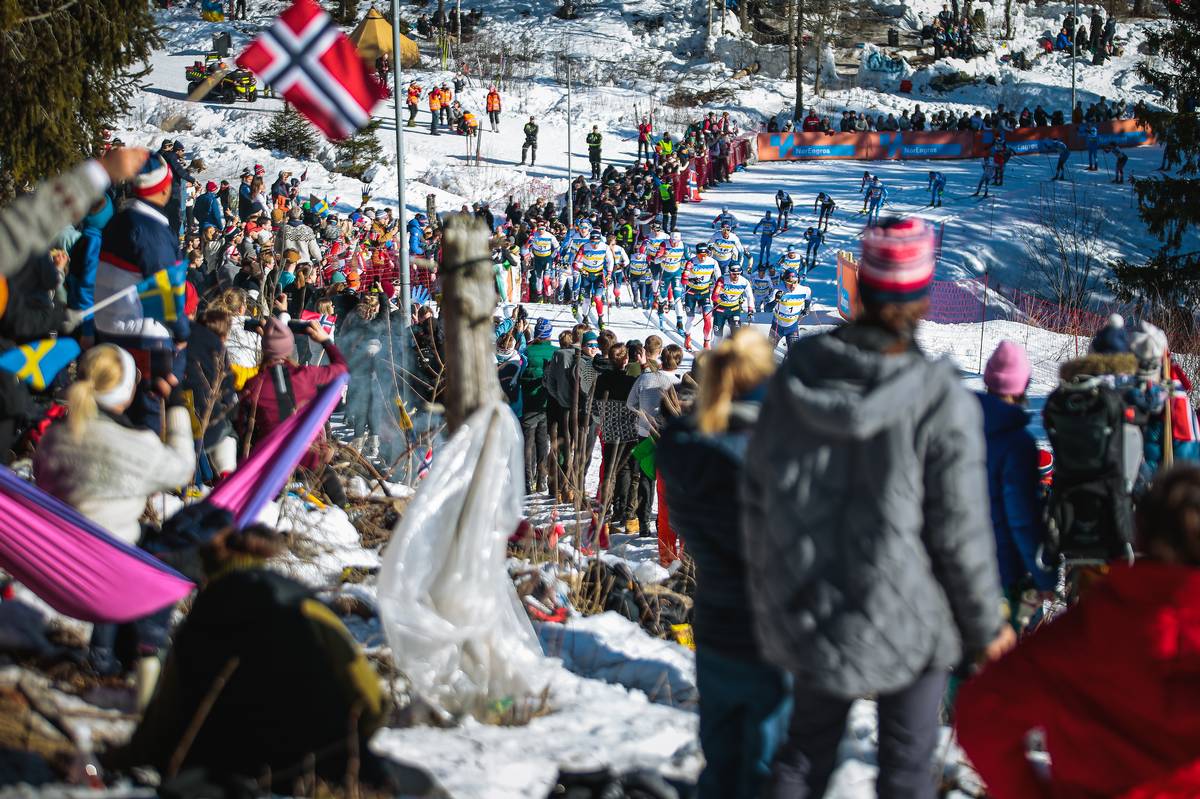
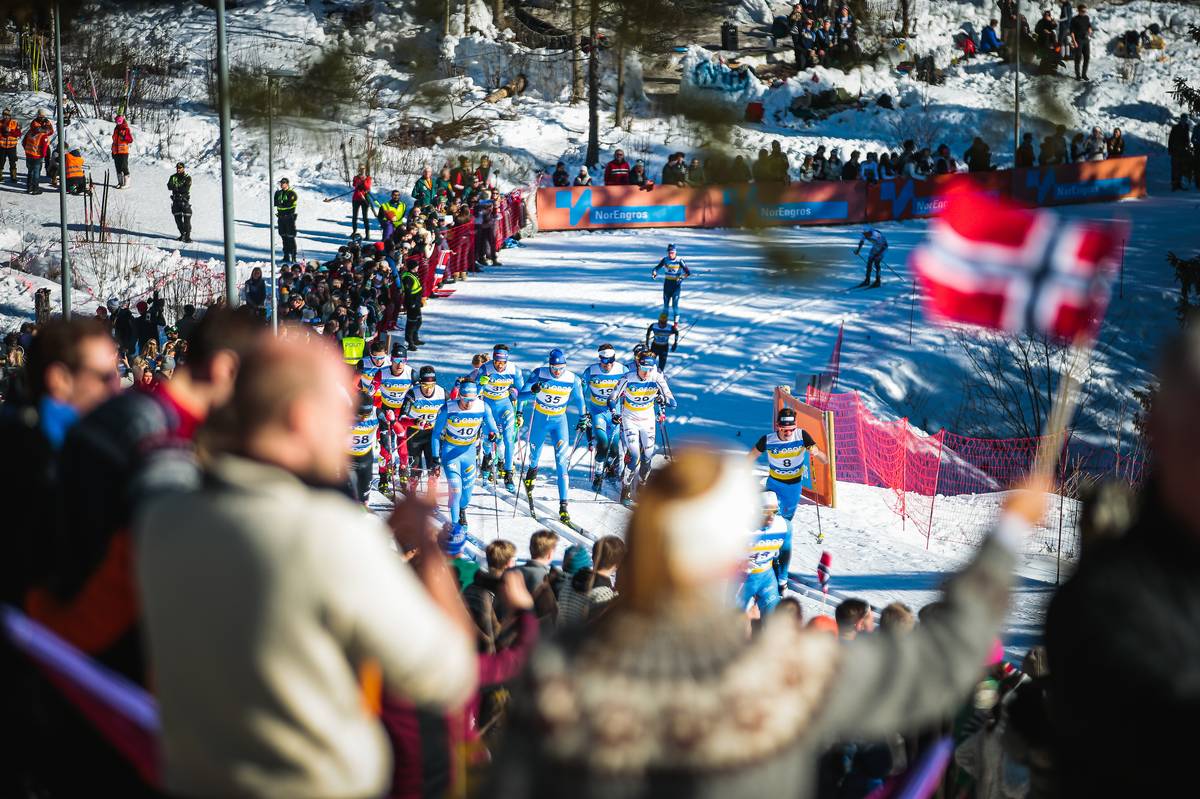
    Crowds returned in droves to Holmenkollen for the men’s 50 k mass start classic. (Photo: NordicFocus)

    You can email us at devon@fasterskier.com and nat@fasterskier.com. We’re still hoping to catch up with an Olympic mailbag episode soon once things settle down.

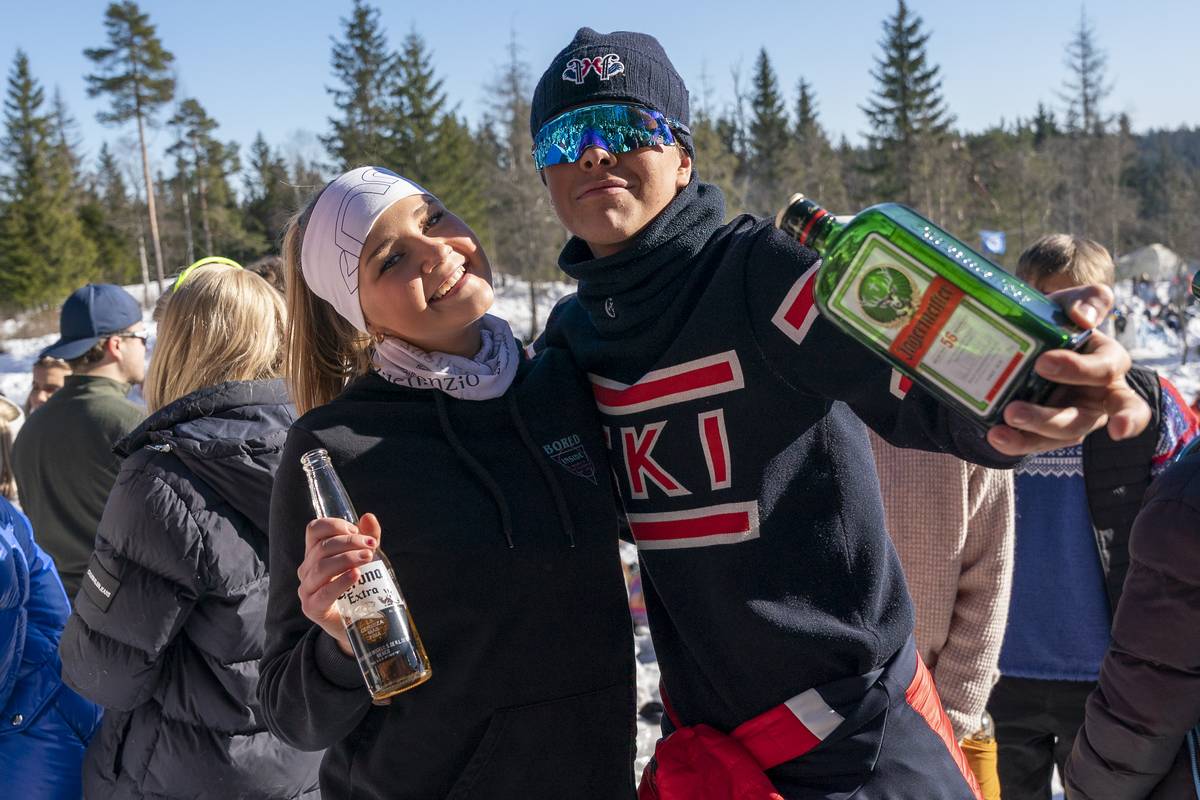
    Revelry at Holmenkollen. (Photo: NordicFocus)
  • Norway Sweeps Podium as Revelry Returns at Holmenkollen 50 k; Martin Leads US in 26th

    Norway Sweeps Podium as Revelry Returns at Holmenkollen 50 k; Martin Leads US in 26th

    This World Cup coverage is made possible through the generous support of Marty and Kathy Hall and the A Hall Mark of Excellence Award.  To learn more about A Hall Mark of Excellence Award or to learn how you can support FasterSkier’s coverage please contact info@fasterskier.com.

    In Oslo on Sunday, came another sign of the times.

    The Holmenkollen Ski Festival, the beating heart and center of the modern sport of skiing since Torjus Hemmestveit won the first 50-kilometer cross country race held there in 1888, has only stopped for extraordinary interruptions in human and natural history. (Interestingly enough, the Hemmestveit family immigrated from Norway to Minnesota, marking the first and only North American connection to the Holmenkollen 50 k men’s podium until Canadian Pierre Harvey won the race exactly a century later in 1988.) The latter – a natural lack of snow – has been fairly harmless (but ominous), but the former has only ever been due to a World War. That is, of course, until the last two years, when the COVID-19 pandemic forced first no spectators at skiing’s most well-attended event in 2020, and then full cancellation in 2021. 

    After a three-year wait, the bustling, flag-waving, marching band playing (there was definitely a marching band!), Norwegian crowd was back out under the hot Oslo sun, in what seemed a matter of national pride.

    Revelry returns to the iconic Holmenkollen 50 k in Oslo, NOR. (Photo: NordicFocus)

    They could only hope that the same sense of the matter extended to their countrymen doing the racing at Holmenkollen. Coming into today, it had been a full five years since a Norwegian had won the 50 k at Holmenkollen, when Martin Johnsrud Sundby did so in a 2017 classic mass start. With the Russian athletes who have been at the forefront of the event since then banned (the Russians completed a podium sweep in 2019, before Alexander Bolshunov won in 2020), Norway was poised to make a run at adding to the thirty-five champions it has seen at its most famous race. One of those previous 35, Sjur Røthe, was in the field on Sunday. Alongside him was Beijing Olympic 30 k bronze medalist Simen Hegstad Kreuger, Didrik Tønseth, and Hans Christer Holund. 

    Of course, in a 50 k classic, they would have to try and beat the best classic skier in the world. Iivo Niskanen was looking to revive another long Holmenkollen tradition – the Finns ruining the Norwegians national outing. Fresh off a pair of individual medals at the Beijing games in the 15 k Classic (gold), and 30 k skiathlon (silver), the 50 k Holmenkollen classic seemed like a perfect opportunity for Niskanen to add to his legacy as a modern giant of the classic technique.

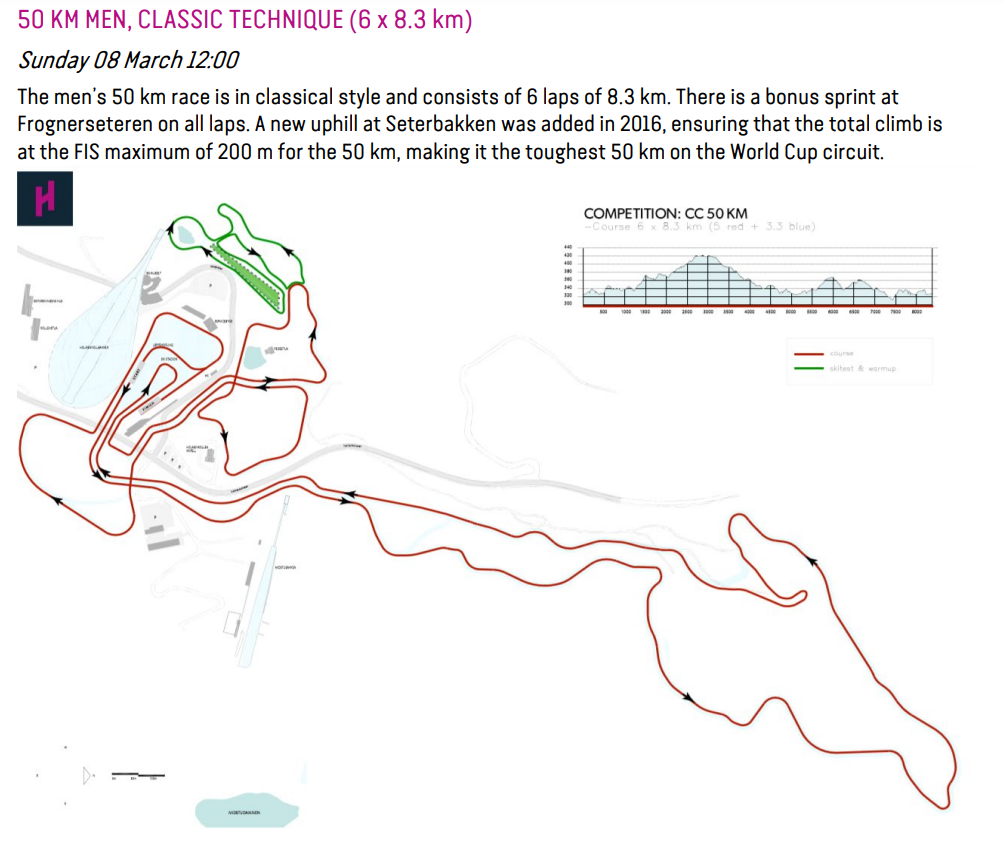
    The field was set to race six laps of an 8.3 k course that organizers billed as the toughest on the World Cup (see below). With temperatures at the noon start reaching 8℃ (about 47℉), the FIS camera couldn’t help but turn to the extra set of skis layed out in the stadium each lap, no doubt waiting to resupply skiers with the warm klister that was in demand today.

    The Holmenkollen 50 k course. (Photo: Holmenkollen Ski Festival)

    For a 50 k, the field began at a furious pace today, with much of the first 15 k led out by pulls from the skiers, mainly Norwegian and Finnish with the odd Andorran (Ireneu Esteve Altimiras) thrown in, that indicated that they were in control of the race and willing to give the long-burn attack a try today. Within the top group of twenty that eventually formed, however, there wasn’t one skier that looked strong enough to break-away and win by minutes in, say, the way that Marit Bjørgen controlled the Holmenkollen race in her heyday, or the way Therese Johaug did in her final Holmenkollen appearance yesterday.

    By the beginning of the fourth lap (24.9 k), the lead group had narrowed down to about fifteen skiers. Included were a slew of Norwegians, including Sjur Røthe, Didrik Tønseth, Martin Løwstrøm Nyenget, and Harald Østberg Amundsen, Iivo Niskanen (FIN), Britain’s Andrew Musgrave, 2018 champion Dario Cologna (SUI), and young Swedish hopeful William Poromaa.

    Adam Martin races the 50 k mass start classic at Holmenkollen in Oslo, NOR. (Photo: NordicFocus)

    With the pack established, the group seemed to allow the pace to let up over the course of the next 8 k. The one exception was Iivo Niskanen, who throughout the whole day positioned himself at the front of the pack for a series of bonus points offered on course. They revealed a prescient concern for Niskanen – he is still in the running to win the distance World Cup this season, and came into today 3rd place behind two athletes, Alexander Bolshunov (1st) and Johannes Høsflot Klæbo (2nd) who may not race again. He had every incentive to chase down the points, with the question arising whether having to maneuver to the front every 5 k or so to take the checkpoints would cost him the energy needed for a bid at the win.

    When the lead group came into the stadium to complete their 4th lap (33.2 k), Sjur Røthe made a move towards the second set of skis layed out for him with a fresh kick zone of wax. The whole field followed. That is, save Amundsen, who flew past the transition zone and into the steep climb that led away from the stadium.

    Whether it was the ski swap itself, or the fact that the race was now 15 k out from the finish, the move going into the 5th lap seemed to blow open a pack that had been subdued for the last 15 k. Amundsen didn’t try and ease up to allow a larger pack to reform, but instead tried to drive onward. The effect was that the field, led by Andrew Musgrave, had to increase their pace to try and cover Amundsen’s move. Musgrave didn’t pack such a punch in his acceleration that the top skiers couldn’t follow, and as they came into the final lap, the Norwegian hopefuls of Nygenet, Røthe, and Tønseth, along with livo Niskanen and William Poromaa, were the skiers left to vie for Holmenkollen 50 k crown.

    Young talents: Harald Østberg Amundsen (NOR) races alongside William Poromaa (SWE) during the 50 k mass start classic at Holmenkollen. (Photo: NordicFocus)

    The home country, as if its skiers sensed a special mix of history combined with a perfect Oslo day, got to see one of the oldest, most impressive sights in ski-sport. Three Norwegians, led by Didrik Tønseth, then Martin Løwstrøm Nyenget and Sjur Røthe, moved together towards the finish line. Iivo Niskanen and William Poromaa stayed in the frame, but by the final 2 k, they were out of the picture.

    In a scene that thousands of Norwegian spectators had dreamed about since their most famous race had been thrown into disarray two years ago, they were treated to the end of a Holmenkollen weekend with three Norwegians at the front, vying for the podium, a rare landmark for the treasured and iconic event.

    Tønseth led the pack as they moved into a long downhill that went into the stadium. From there, Røthe out-glided his two teammates, with Nyenget in behind them. At the end of a long downhill straight, one final hill led around and down again to the final stretch. As Røthe approached the hill, he positioned himself outside of the tracks, which seemed an indication that his great glide into the stadium may have also foreshadowed a want of kick wax. He was forced to run up the last hill, searching for every little bit of klister left in its zone (in a dance very familiar to many of us skiers), while Nyenget was the picture of perfect classic technique, driving through to go over the top of the hill in first place. Røthe stumbled slightly, Nyenget burst into the final stretch, and they came across the line like that. Nyenget the winner (2:03:27.3), Røthe second (+0.6), and Tønseth in third (+3.5).

    Martin Løwstrøm Nyenget embraces his teammate Sjur Røthe after going one-two at Holmenkollen. (Photo: NordicFocus)

    The three Norweigans completed the first podium sweep for the home country at Holmenkollen since 1985, and the first since the event has been held as a World Cup. The center of Norwegian skiing, after two years where it has stumbled through, has held, and held firmly. Nyenget, Røthe, and Tønseth doing their home nation proud on a sunny Oslo day that seemed to foreshadow brighter times ahead for Holmenkollen, and the sport that is ski racing the festival energized over a century ago.

    The US trio of Scott Patterson, Adam Martin, and Zak Ketterson that started the day came away with great results as well. Martin, who was recently pulled up to the World Cup based on his results in the SuperTour, came in 26th (+5:03.2). Scott Patterson, coming off an 8th place finish in the Beijing 30 k, finished 31st (+6:05.5), and Zak Ketterson finished in 41st (+7:14.8).

    “It was a beautiful day today,” wrote Martin after the race. “It was warm, and it did get slushy on some of the climbs, but most of the course held up really well. I think we had great wax.”

    On his approach to the day, Martin continued, “I suspect pretty much every guy out there starts with the same strategy: hang on to the lead group until the finish or it’s no longer possible. That was my strategy, at least. I think I managed two laps or something, and then I skied the rest of the race with a smaller group of skiers who also fell behind.

    This is Martin’s third time racing at the 50 k at Holmenkollen, with today marking a step forward, after taking one backward in his last appearance. “I placed 31st in 2019 with a smaller field after World Champs, and I finished last (but did finish) in 2020 after Ian Torchia and I erroneously opted for zeros.”

    Zak Ketterson races the 50 k mass start classic at Holmenkollen in Oslo, NOR. (Photo: NordicFocus)
    Scott Patterson races the 50 k mass start classic at Holmenkollen in Oslo, NOR. (Photo: NordicFocus)

    Canadians Remi Drolet finished in 48th (+10:27.1), while Philippe Boucher came in 54th (+17:36.0). Staying in Norway following the U23/Junior Ski World Ski Championships, Tom Stephen also started for the 50 k, however, he withdrew following the third lap and did not finish. 

    20-year-old Thomas Stephen (CAN) races the 50 k classic at Holmenkollen in Oslo, NOR. (Photo: NordicFocus)

    Full Results