Tag: Holmenkollen World Cup

  • Saturday Rundown: NCAA Champs; Holmenkollen 50 k; Kontiolahti Relays

    Saturday Rundown: NCAA Champs; Holmenkollen 50 k; Kontiolahti Relays

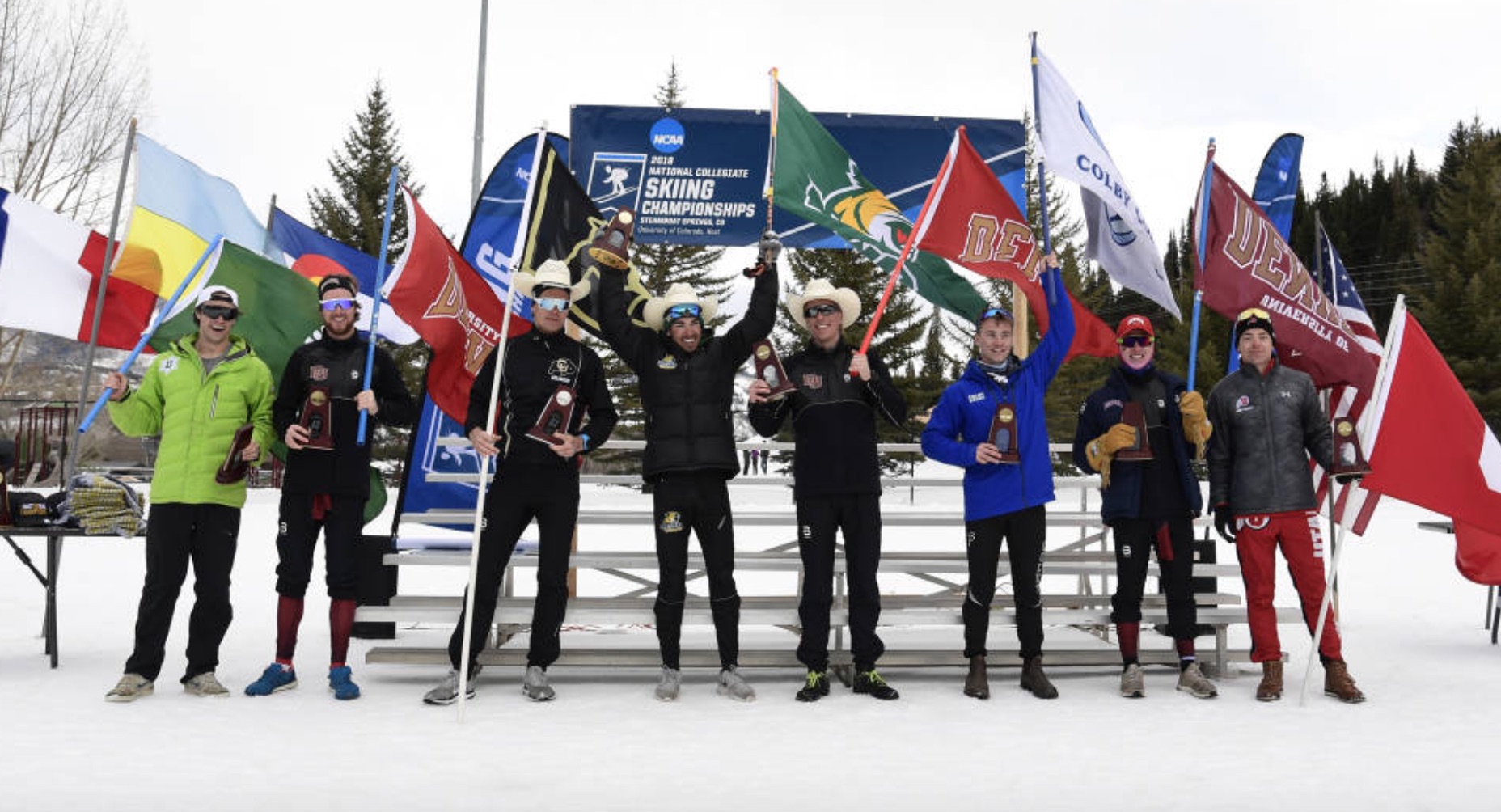
    The top finishers in the men’s 20 k freestyle mass start at 2018 NCAA Skiing Championships in Steamboat Springs, Colorado, with Northern Michigan University’s Ian Torchia (c) in first. (Photo: Dartmouth Sports/Clarkson Creative)

    NCAA Skiing Championships (Steamboat Springs, Colorado): 15/20 k freestyle mass starts

    On the fourth and final day of NCAA Skiing Championships at Howelsen Hill in Steamboat Springs, Katharine Ogden skied to her second-straight national title, Ian Torchia became an NCAA champion and the University of Denver (DU) won its 24th NCAA National Championship.
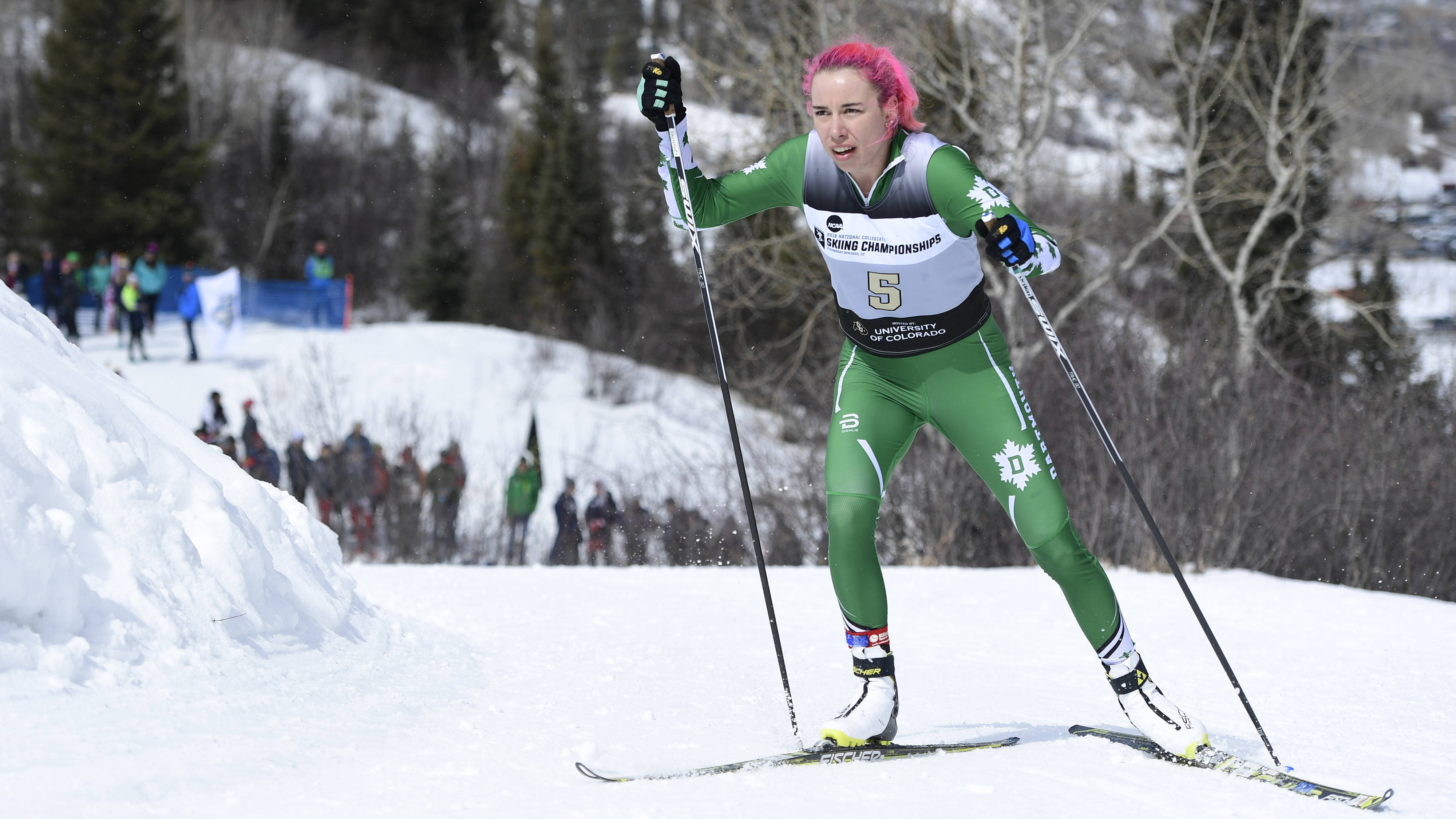
    Dartmouth freshman Katharine Ogden racing to her second-straight victory of the 2018 NCAA Skiing Championships in Steamboat Springs, Colorado. She won Saturday’s 15 k freestyle mass start by more than 38 seconds. (Photo: Dartmouth Sports/Clarkson Creative)

    Ogden, a Dartmouth College freshman, raced to a 38.4-second victory in the women’s 15-kilometer mass start, finishing in 43:22.0 minutes for her second win in as many races at 2018 NCAA Championships. She won the 5 k classic on Thursday and with her win on Saturday, she became the first Dartmouth skier in 56 years to win two national titles in the same year, according to a Dartmouth press release.

    On the second of three laps, Ogden broke away early with close to 10 k to go. According to the press release, she had a “quick fall” near the end of the second lap, but that didn’t derail her as she had time to grab sunglasses from Dartmouth men’s coach Brayton Osgood and a Dartmouth Lone Pine flag before the finish.

    At this year’s championships, Ogden’s two titles are accompanied by victories from Dartmouth men’s alpine skiers Brian McLaughlin (who won the giant slalom) and Tanguy Nef (who won the slalom). This marked only the second time that Dartmouth’s Big Green won four individual titles in a single NCAA Championships; that also occurred 61 years ago.

    “Katharine absolutely wanted this one, and she really likes to win,” Dartmouth Director of Skiing and Women’s Nordic Head Coach Cami Thompson Graves said in the press release. “She wasn’t about to let a fall slow her down, she has such a great competitive fire. But she also showed her playful side grabbing Brayton’s glasses and smiling all the way to the finish line!”

    Hailey Swirbul of the University of Alaska Anchorage placed second and Linn Eriksen (DU) reached the podium in third (+46.3). Denver had three in the top 10 with Jasmi Joensuu in ninth and Taeler McCrerey in 10th. Also landing in the top 10 for All-American honors were Guro Jordheim of the University of Utah in fourth, Emma Tarbath (Montana State University) in fifth, Petra Hyncicova of the University of Colorado Boulder (CU) in sixth, Christina Rolandsen (CU) in seventh, and Lauren Jortberg (Dartmouth) in eighth.

    Torchia, an Northern Michigan University (NMU) junior and U.S. Ski Team Development Team member, became the seventh NCAA champion in NMU Wildcats nordic skiing history, according to an NMU press release. Fredrick Schwenke was the Wildcats’ last nordic champion; he won the 2015 NCAA Championships 20 k classic.

    Torchia drew bib 1 for Saturday’s 20 k freestyle mass start and crossed the finish line first in 54:21.0, just 2 seconds ahead of CU’s Alvar Alev. Eivind Kvaale (DU) finished just four seconds back in third, and Denver had three in the top seven with Dag Frode Trollebø in fourth and Lars Hannah in seventh. Darmouth’s Cal Deline placed fifth, Zane Fields of Colby College finished sixth, and the 20 k freestyle’s 2017 NCAA champion Martin Bergström (Utah), who also won Thursday’s 10 k classic, placed eighth.  CU’s Petter Reistad and Sondre Bollum finished ninth and 10th, respectively.

    In the team standings, Denver beat Colorado by 41 points for the overall win with a total of 604 points between the nordic and alpine events at this year’s championships. Dartmouth placed third, 114.5 points behind Colorado, and Utah was another 63 points back in fourth.

    According to a DU press release, Denver has won at least one national championship in each of the last five athletic seasons (skiing: 2013/14, 2015/16, 2017/18; hockey: 2016-17; men’s lacrosse 2014/15), joining only Stanford on the list of schools that have done so in the last five seasons. (Oregon, West Virginia, Penn State, Oklahoma, Ohio State and Florida could potentially join that list later this year.)

    “It feels incredible,” said DU head coach Andy LeRoy said in the press release. “I am so happy for all of our athletes, they’ve been training all week and all season and to do it in Steamboat in front of our crowd is special.”

    Results: Women | Men| Team 

    Photos

    ***

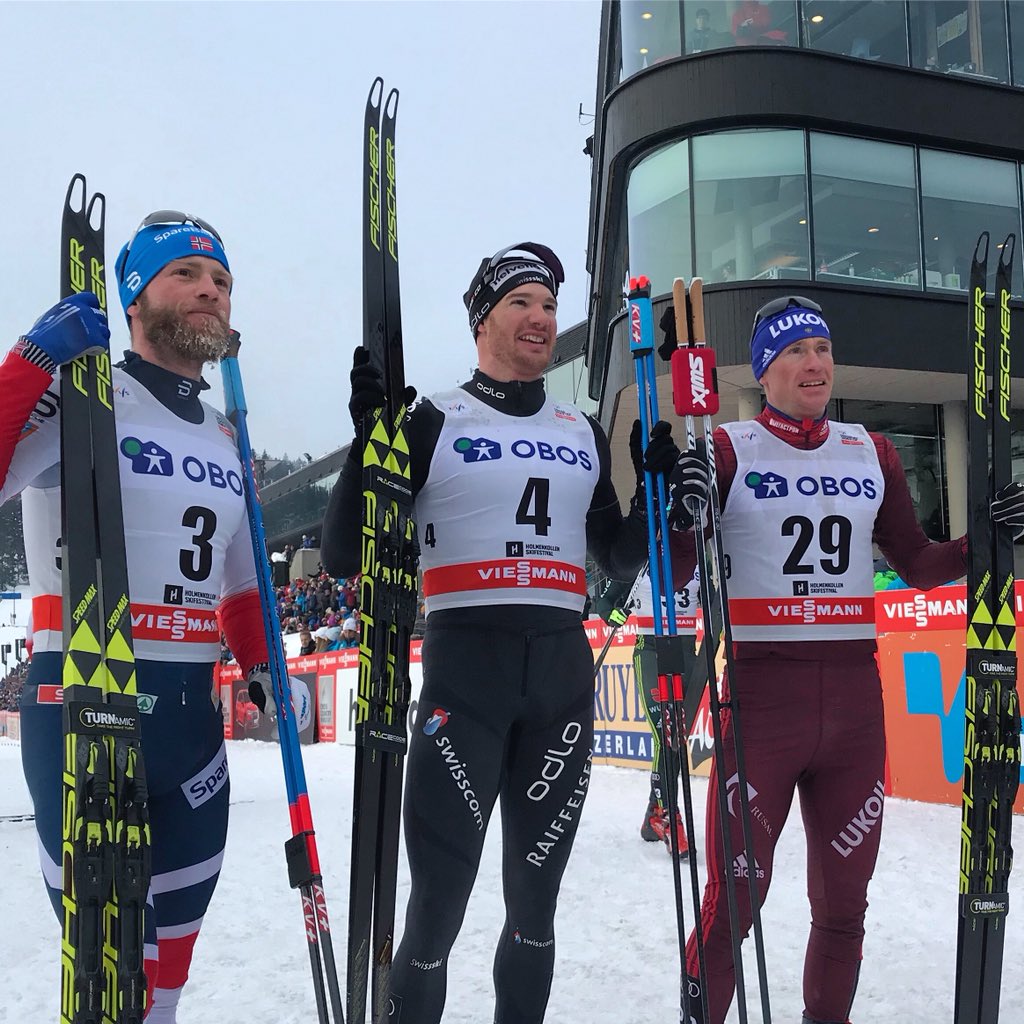
    The Holmenkollen men’s 50 k freestyle mass start podium on Saturday at the World Cup in Oslo, Norway, with Switzerland’s Dario Cologna (c) in first, Norway’s Martin Johnsrud Sundby (l) in second, and Russia’s Maxim Vylegzhanin (r) in third. (Photo: FIS Cross Country/Twitter)

    FIS Cross Country World Cup (Oslo, Norway): Men’s 50 k freestyle mass start

    Full report

    A four-time Olympic champion, Dario Cologna of Switzerland won his first 50-kilometer World Cup race on Saturday, topping the podium in the famous Holmenkollen 50 k freestyle mass start after outlunging Norway’s Martin Johnsrud Sundby (who won the event last year) for the win in 2:01:48.1. Sundby finished one-hundredth of a second behind for second place, ahead of Russia’s Maxim Vylegzhanin, who was 1.1 seconds back in third in his first World Cup race since November of last year.
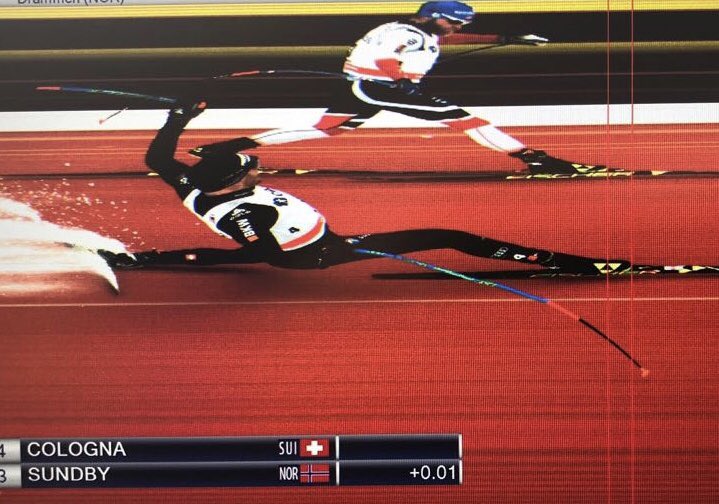
    The photo finish for first between Switzerland’s Dario Cologna (near) and Norway’s Martin Johnsrud Sundby at the Holmenkollen 50 k freestyle mass start on Saturday in Oslo, Norway. Cologna got it by 0.01 seconds. (Photo: FIS Cross Country/Twitter)

    Norway’s Sjur Røthe came out on top in a race for fourth (+4.2), ahead of Russia’s Denis Spitsov in fifth (+4.4) and his Norwegian teammate Hans Christer Holund in sixth (+4.5). Great Britain’s Andrew Musgrave followed in seventh (+15.1), Germany’s Florian Notz placed eighth (+25.9) and Canada’s Alex Harvey finished ninth (+32.4), ahead of France’s Robin Duvillard in 10th (+33.5).

    Scott Patterson led the U.S. in 16th (+56.3) coming off an 11th place in the 50 k classic mass start at last month’s Olympics, and Canada’s Devon Kershaw finished in the points in 28th (+3:43.6). Just outside the top 30, Canada’s Graeme Killick finished 34th (+4:55.1).

    Also for the U.S, David Norris placed 38th (+6:19.7), Paddy Caldwell was 46th (+8:12.3), Noah Hoffman 49th (+10:27.9), Kevin Bolger 52nd (+12:44.2), and Simi Hamilton did not finish.

    Canada’s fourth man in the race, Andy Shields finished 47th (+8:13.6).

    Results

    ***

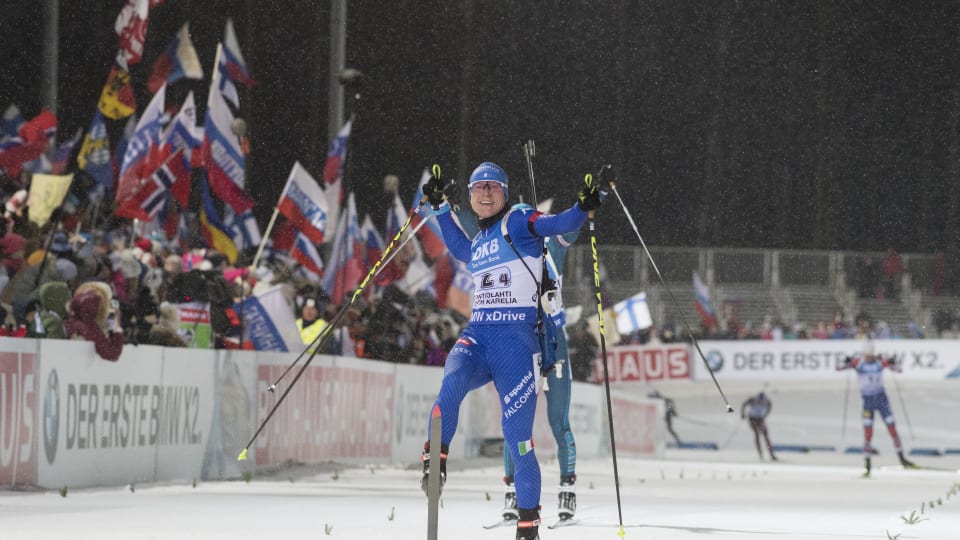
    Italy’s Lukas Hofer celebrates his team’s win in Saturday’s mixed relay at the IBU World Cup in Kontiolahti, Finland. (Photo: IBU/Biathlonworld)

    IBU World Cup (Kontiolahti, Finland): Single mixed relay & mixed relay

    (Note: This rundown has been updated to include comments from Christian Gow and Sean Doherty.)

    In the last single mixed relay and mixed relay of the International Biathlon Union (IBU) World Cup season, France and Italy came out on top, with France winning the two-person single mixed relay and Italy taking first in the coed mixed relay.
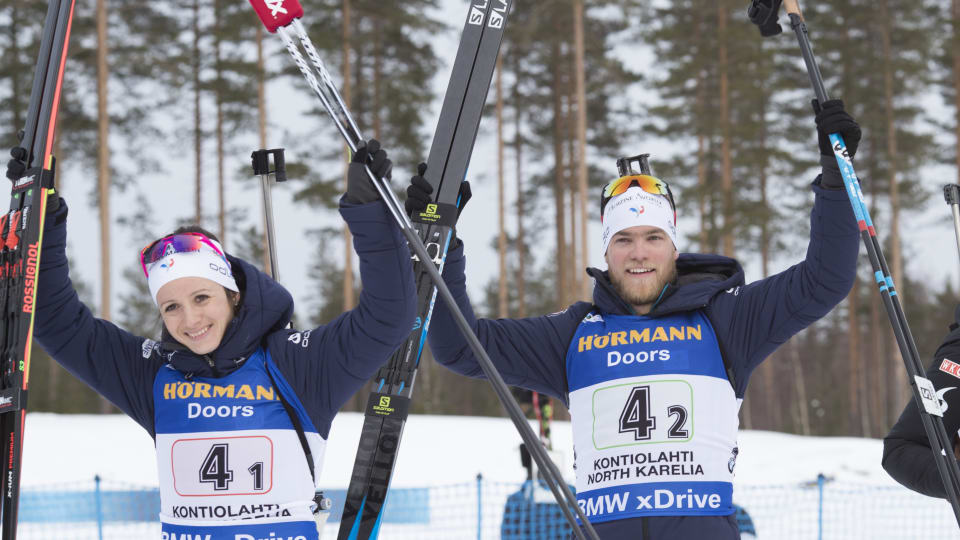
    France’s Anaïs Chevalier and Antonin Guigonnat after winning Saturday’s single mixed relay at the IBU World Cup in Kontiolahti, Finland. (Photo: IBU/Biathlonworld)

    France’s Anaïs Chevalier and Antonin Guigonnat combined for zero penalties and six spares to finish first in the single mixed relay in 33:29.1 minutes. Guigonnat as the team’s anchor secured the win by just 2.4 seconds over Austria’s Julian Eberhard while Norway’s Johannes Thingnes Bø finished 4.4 seconds back for third.

    Chevalier put France in fifth after the first leg, 15.5 seconds behind Ukraine’s Iryna Varvynets in first. Guigonnat used just one spare on his first leg to move them into fourth, 9.2 seconds back while Norway led at the second exchange. On Chevalier’s second leg, she shot clean in both stages to lead through the final exchange, with Ukraine skiing just 6.2 seconds back in second.

    On the final leg, Guigonnat used two spares and stayed out of the penalty lap, keeping the team in first through the finish. Eberhard skied the second-fastest course time on that leg to elevate Austria (with Lisa Theresa Hauser) from fourth at the tag to second place at the finish, and Bø skied all the way up from eighth to third place for Norway (with Marte Olsbu) with the fastest course time.

    Ukraine’s Artem Tyschenko used just one spare but slipped to fourth with the 11th-ranked course time on that leg, as he finished 10.8 seconds behind Norway.

    Behind Russia in fifth and Italy in sixth, Canada placed seventh (+23.8) with Rosanna Crawford and Christian Gow. The duo combined for zero penalties and six spares, and put themselves in third place early in the race. Crawford skied them into third on the first leg, using just two spares and tagging Gow 7.4 seconds out of first.

    Gow went on to take the lead after cleaning prone without any spares, and he cleaned standing as well but slipped back to third while Bø took the lead. Gow tagged Crawford in third, 8.9 seconds behind Norway in first.

    “I didn’t think too much about being tagged in third,” Gow recalled in an email to FasterSkier. “It was exciting for sure, but I let it fade to the background so that I could focus on my job both on the track and in the range.  It was great to leave prone in first place! It was also surprising, but it was a good place to be in.

    “My skiing was ok today,” he continued. “It is a really challenging and demanding race format that we don’t get a lot of practice with.  I was sick after the Olympic Games and only finally coming around the past couple days.  The Sprint race was horrendous for me, so today was much better than that. In the range I just focussed on myself and trusted my shooting.  I tried my best not to get caught up in the race going on around me and it worked to my benefit.”

    Crawford then slipped to seventh and 21 seconds back with three prone spares, but avoided the penalty lap, and Gow held onto seventh through the finish, using just one spare and skiing the eighth-fastest course time on that leg.

    “We are both happy with this result,” Gow wrote. “I think that we are both looking at the 23 second gap to first and thinking that if things had worked out just a bit better we could be there.  It can be both exciting and frustrating to be that close to the podium.  We know we can do it, it’s just a matter of putting it together on the right day. We are happy with 7th, but hungry for more.”

    Susan Dunklee and Lowell Bailey finished 14th for the U.S., 1:13.0 out of first with one penalty and 14 spares. The penalty came on Dunklee’s first leg during her standing stage, after she had cleaned prone without any spares. She tagged Bailey in 14th and he brought them up to 11th, using three spares on that leg, then Dunklee came through the final exchange in 13th after using four spares to clean. Bailey lost one place on the final leg, using four spares but staying out of the penalty lap.

    Twenty-six teams competed in the single mixed relay, compared to 23 in the mixed relay that followed.
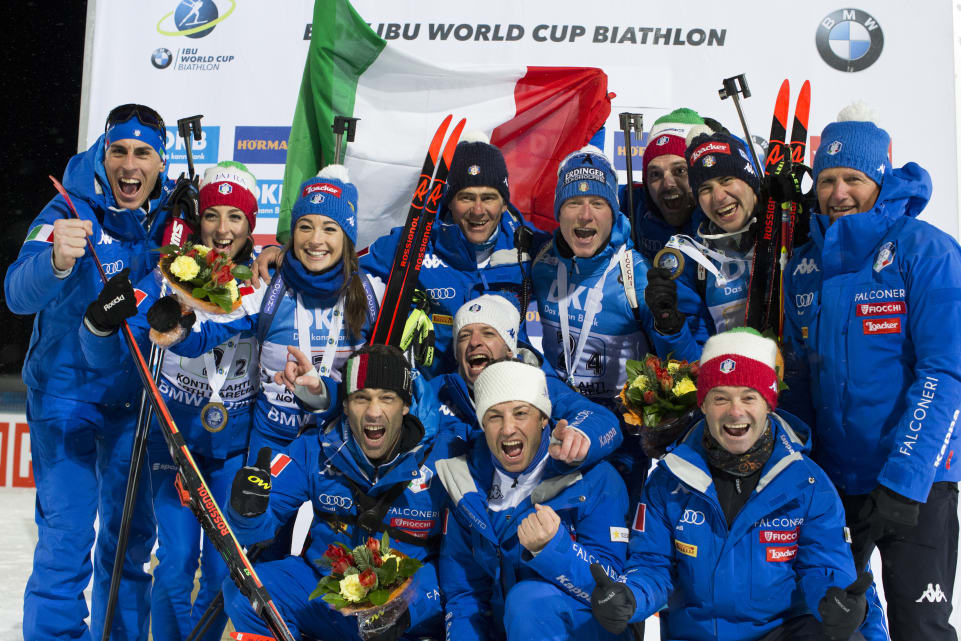
    Team Italia celebrates its win in the IBU World Cup mixed relay on Saturday in Kontiolahti, Finland, with its relay members Dorothea Wierer, Lisa Vittozzi, Dominik Windisch, and Lukas Hofer. (Photo: IBU/Biathlonworld)

    In Saturday’s 2 x 6 + 2 x 7.5 k mixed relay, Italy nabbed a 1.5-second victory over Ukraine in 1:15:08.3. Dorothea Wierer, Lisa Vittozzi, Dominik Windisch, and Lukas Hofer — the same Italian team that took bronze in the mixed relay at last month’s Olympics, although in a different order — combined for the win with one penalty and 13 spares.

    Ukraine, with Anastasiya Merkushyna, Vita Semerenko, Artem Pryma, and Dmytro Pidruchnyi, had zero penalties and just three spares throughout the whole race. For the second-straight relay on Saturday, Norway placed third (+9.1) with Synnøve Solemdal, Tiril Eckhoff, Henrik L’Abée-Lund, and Tarjei Bø totaling zero penalties and nine spares.

    Italy’s lone penalty came in Vittozzi’s second leg, but it didn’t derail the team as it improved from sixth to fifth with Vittozzi, who skied the third-fastest course time on that leg. She tagged Windisch 6.8 seconds out of first, and Windisch, who had anchored the team in the Olympics, took the lead by the final exchange after using two spares to clean. Hofer left the exchange just 3.3 seconds ahead of Norway’s Bø but used just one spare and skied the second-fastest anchor leg to finish first, beating his rivals up Kontiolahti’s infamous climb known as “The Wall”. Ukraine’s Pidruchnyi also shot clean with a single spare and clocked the fastest anchor leg to move his team from fourth to second place. Bø lost one place and finished third after using one spare as well and skiing the third-fastest anchor leg.

    Russia followed in fourth, France fifth, Sweden sixth, Germany seventh, Austria eighth, and the U.S. ninth (+2:48.4). The U.S. team, with Clare Egan, Joanne Reid, Tim Burke, and Sean Doherty, had one penalty and 11 spares. Egan cleaned her first prone but had to ski a penalty lap after her standing stage, tagging Reid in 17th, 58.7 seconds out of first.

    Reid used three spares on the second leg and moved up to 13th by the second exchange, and Burke used three spares as well to pick off one more place and tag Doherty in 12th. Doherty skied the eighth-fastest anchor leg and used two spares to clean to put the team in ninth at the finish.

    “I don’t consider two spares to be anything special, but today it was enough to make up some ground,” Doherty wrote in an email to FasterSkier.”I felt strong skiing, more like myself which is fun even if it’s a little late in the season. We had very good skis which always helps. I have done quite a few laps on this course over the years so the lines and transitions are pretty refined, so that is where I made time on the course.

    “I am happy with my leg. I enjoyed my little battle for 9th,” he continued. “I can’t speak too much for the other members of the relay tonight but I think 9th is a solid effort.”

    Canada finished 17th (+4:34.9) with Emma Lunder, Julia Ransom, Scott Gow, and Brendan Green combining for one penalty and 13 spares. Lunder put them in 12th at the first exchange and Ransom skied up to 10th, but Scott Gow had a penalty on his standing stage to drop to 16th. Green lost one more place on the last leg despite only requiring two spares.

    Results: Single mixed relayMixed relay

  • Bjørgen Owns Holmenkollen 30 k with More Than 2-Minute Win; Randall 20th

    Bjørgen Owns Holmenkollen 30 k with More Than 2-Minute Win; Randall 20th

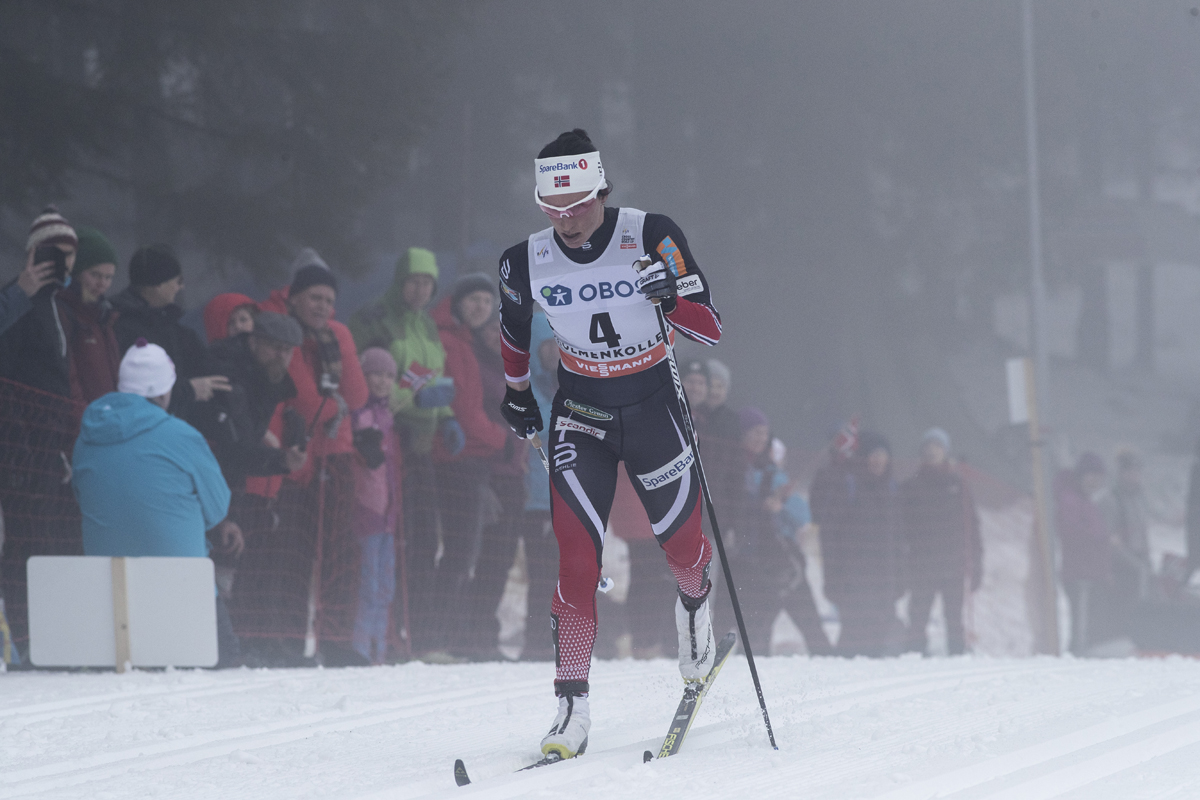
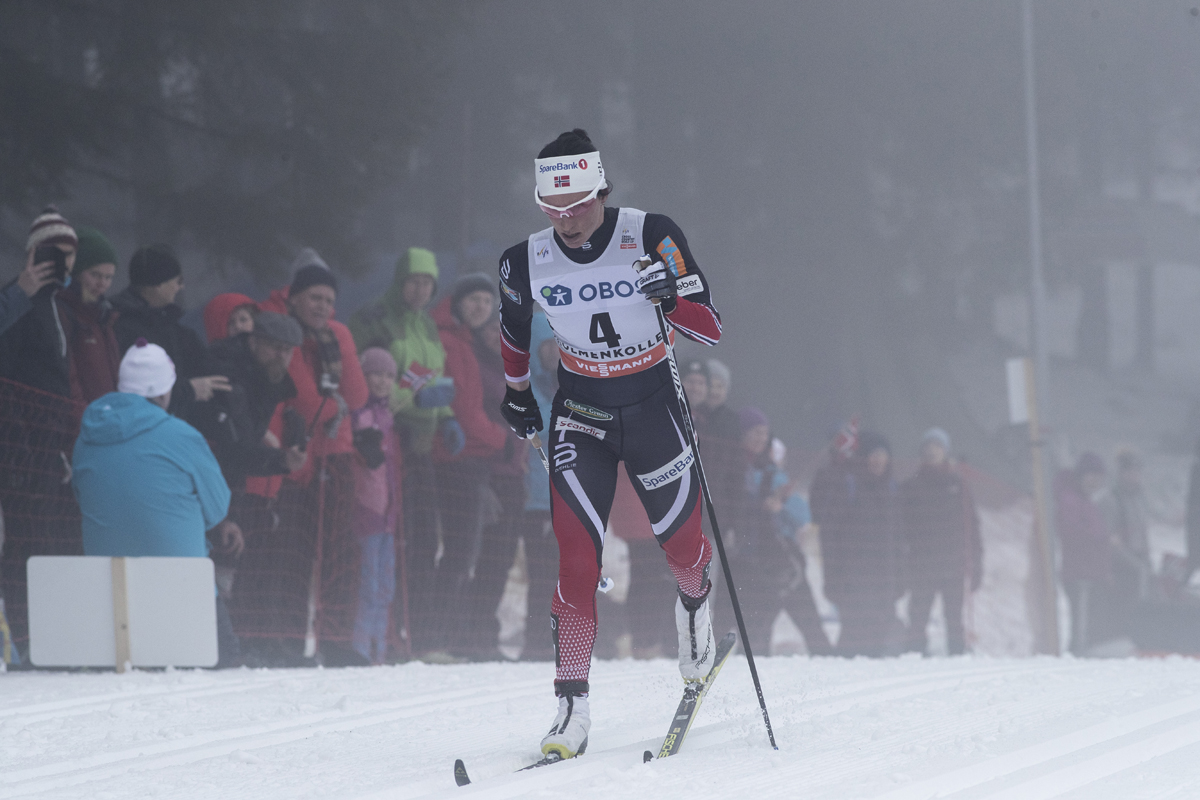
    Norway’s Marit Bjørgen winning the women’s 30 k classic mass start at Holmenkollen in Oslo, Norway, by more than two minutes on Sunday. (Photo: Fischer/NordicFocus)

    OSLO, Norway — The modernist Holmenkollbakken ski-jumping hill lords over the otherwise bucolic Holmenkollen ski venue. It’s certainly one of the wonders of the modern nordic sport world as the steel structure arcs elegantly toward the sky. At times during the men’s 50-kilometer classic mass start on Saturday at Holmenkollen, the sun glared off the jump, giving it the appearance of a polished silver spaceship.

    During the women’s 30 k classic mass start on Sunday, fog descended onto the Holmenkollen neighborhood. The upper portions of the Holmenkollbakken jump, about a third of the structure, were lost in the clouds. Jumpers that flew from its heights before the start of the 30 k seemed to glide and fly out of the sky.

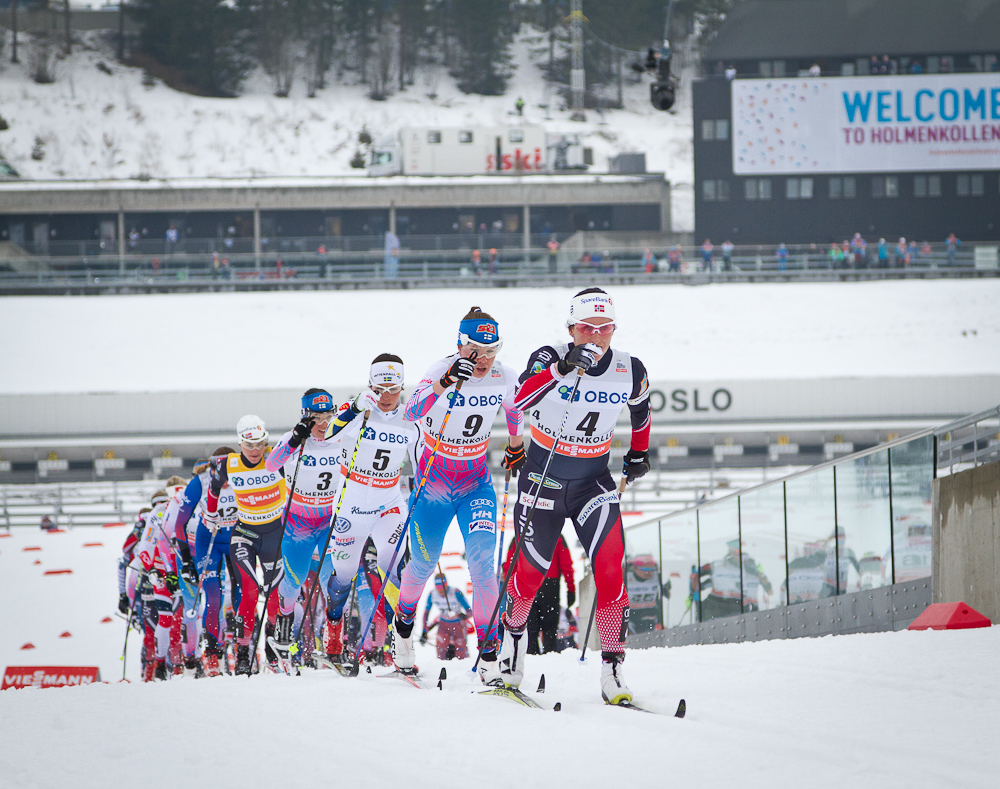
    Norway’s Marit Bjørgen leads the train early in the women’s Holmenkollen 30 k classic mass start on Sunday in Oslo, Norway. This was a rare moment when Bjørgen skied in the presence of other skiers. She soon moved off the front and soloed to the win.

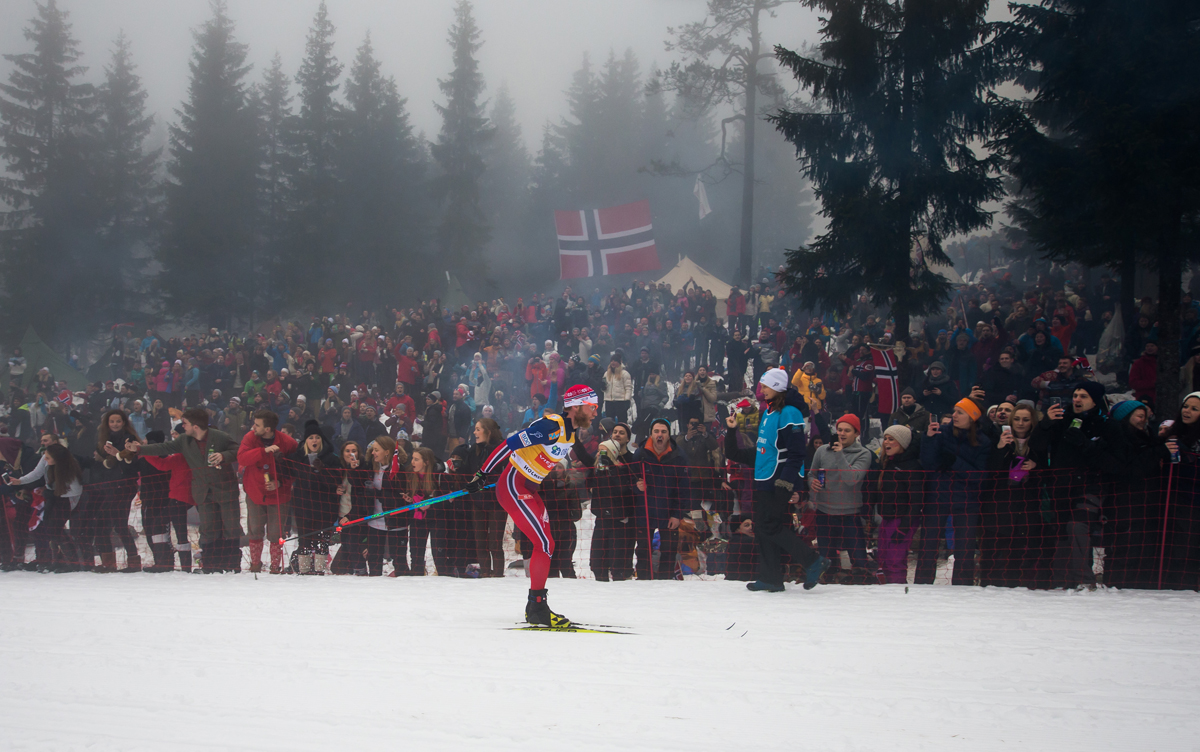
    Those same clouds blanketed the high point of the 30 k course (with three 8.3 k laps and one 5 k lap) at Frognerseteren, where it seemed much of Oslo had stayed to party and welcome racers before their descent toward the stadium.

    Each time Norway’s Marit Bjørgen rallied the hordes atop Frognerseteren, it was as if she appeared from the ether: Bjørgen’s race through the fog was a solo quest that ended in flat-out 30 k dominance.

    Perhaps it’s splitting hairs saying exactly when this race was decided. Was it at 2.7 k when Bjørgen was up by nearly five seconds? For certain that was early on when anything was in play: wax, Bjørgen’s in-race nutrition, a potential fall. Was it her 33 second lead at 8 k? Was it her 1 minute and 22 second gap at 16.3 k?

    By then this much was clear: Bjørgen was steamrolling. And yes, the race for first looked over.

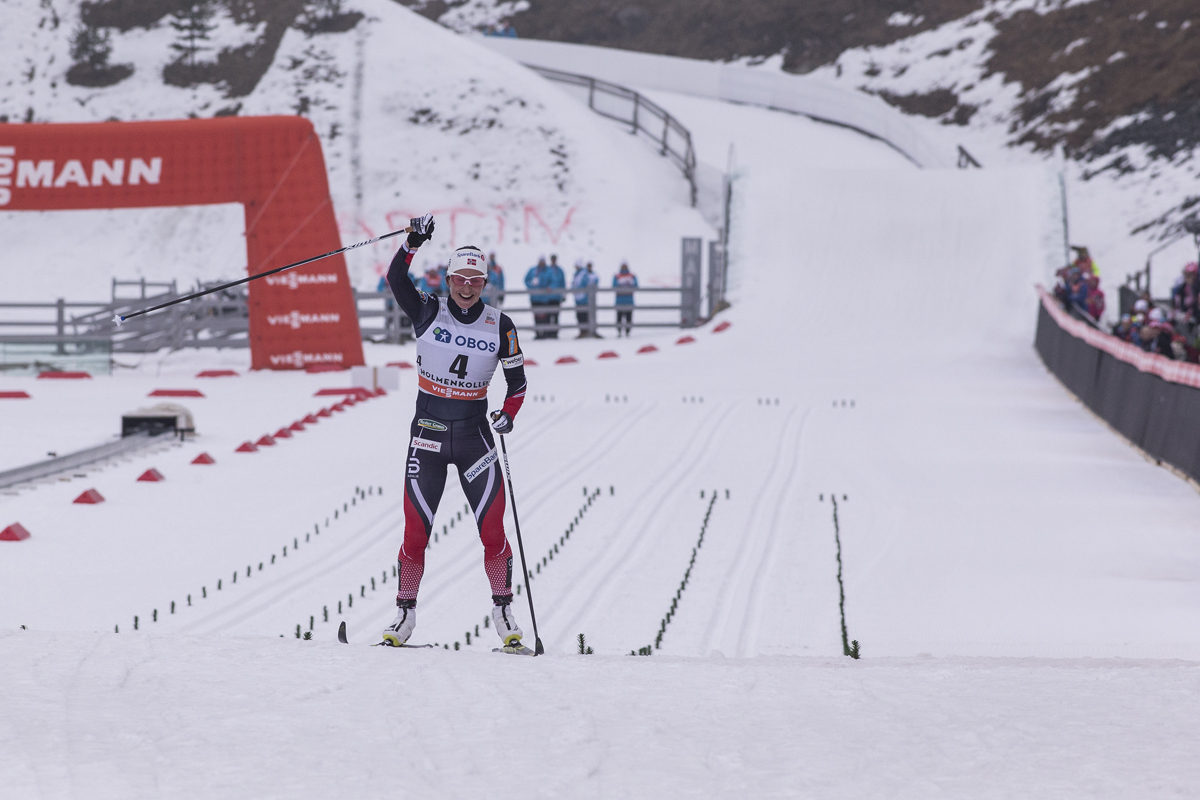
    Norway’s Marit Bjørgen racing to more than a two-minute win in the Holmenkollen women’s 30 k classic mass start on Sunday in Oslo, Norway. (Photo: Fischer/NordicFocus)

    In her first Holmenkollen 30 k after taking a year off to start a family, Bjørgen, 36, looked peerless. On the stout Holmenkollen loop she only appeared to ratchet up the pace, firing with increasing power as the kilometers rolled.

    Meters from the finish, Bjørgen bowed to the crowd and Norway’s King Harald V before stopping the clock at 1:22:59.2 hours to win her sixth Holmenkollen 30 k. Her nearest competitors were more than two minutes back.

    Only a week ago, the 2017 Nordic World Championships wrapped up in Lahti, Finland. Bjørgen brought four golds home to Norway. She placed first in every distance event; the 15 k skiathlon, the 10 k classic individual start and the 30 k freestyle mass start. She also won gold as part of Norway’s 4 x 5 relay. In Lahti, she admitted to having pre-race nerves.

    Those nerves weren’t apparent at Holmenkollen.

    “I was more relaxed than I was in the World Championships,” Bjørgen said at the post-race press conference. “It was a different morning. Today I was waking up with my son, playing with him, and just going to the stadium, and yeah, it was more relaxing.”

    A relaxed Bjørgen appears to be a potent Bjørgen.

    “My plan was to try to go fast from the beginning if my body was feeling well, and it did,” Bjørgen added. “I had good skis also, when we passed 5 k, I heard 20 seconds. I understood I had to do my own race and, yeah, I feel good.”

    Twelve times the Holmenkollen 30 k has been held after World Championships or the Olympics. Usually a two-week period elapses between those events. Bjørgen has won the 30 k back-to-back twice, but Sunday’s win makes it her first with only one week of recovery.

    Evidently Bjørgen still recovers well, too.

    “It has been not an easy week. I have been a little bit tired and the motivation has been hard really. I wanted to stay home with my son and play with him,” Bjørgen said. “But I trained a little bit and tried to relax and of course to go to the 30 k is a big motivation and you want to do well so it was no problem. I was wondering how the body was feeling, but today my legs were much better than it was earlier in the week.”

    Chalk up another World Cup win.

    Behind Bjørgen, it wasn’t so much a chase as an entirely separate race vying for the remaining podium spots. Playing off-Broadway to Bjørgen’s big show were Finland’s Krista Pärmäkoski, Kerttu Niskanen and Aino-Kaisa Saarinen, Norway’s Heidi Weng, Sweden’s Charlotte Kalla, and Poland’s Justyna Kowalczyk.

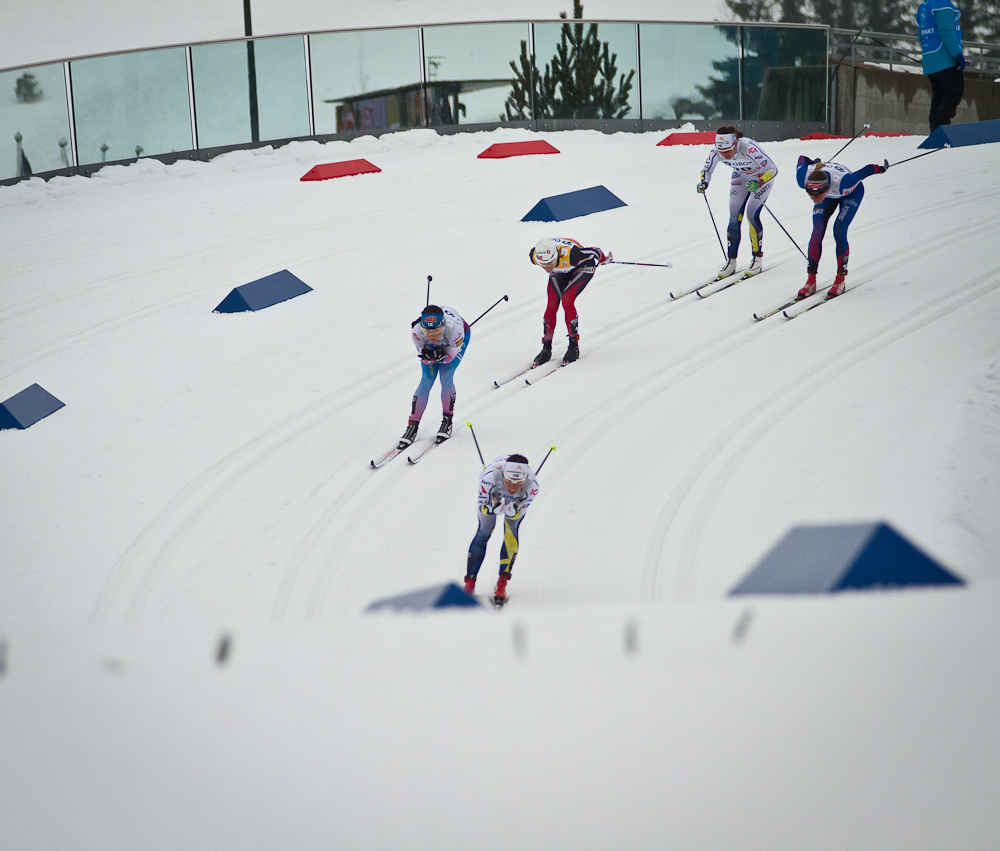
    Sweden’s Charlotte Kalla leads the first chase group behind Norway’s Marit Bjørgen (not shown) during the Holmenkollen 30 k classic mass start on Sunday in Oslo, Norway. Finland’s Krista Parmakoski (left) and Norway’s Heidi Weng (behind Parmakoski)) follow Kalla.

    Throughout the 30 k race, it looked as if any one of those skiers could pull away into their own discrete chase for second. Kalla and Kowalczyk looked primed as they took a 14-second lead at the 16.3 k time check on the likes of Weng, Saarinen, Niskanen, and Pärmäkoski.

    With that effort came an eventual catch. At 24.6 k, those six skiers came through just seconds apart. It wasn’t until the final stretch when place, not time, was part of every racer’s calculus and a separation of seconds occurred.

    Finland took the remaining spots on the podium. Pärmäkoski placed second (+2:05.8), and teammate Niskanen was third (+2:07). Weng was fourth (+2:08.6), Kalla fifth (+2:11.7), Kowalczyk sixth (+2:12.9), and Saarinen — the last skier of the reputable first Bjørgen chase group — placed seventh (+2:19.6).

    Just last Wednesday, Pärmäkoski placed second in the classic sprint in Drammen, Norway.

    “Today [I] was feeling a little bit tired because that Drammen sprint was really good for me and last year also I had good race there,” Pärmäkoski said at the press conference. “But I am so happy that I am now stand on the podium on the sprint race and now of course this 30 k podium, the first on my career.”

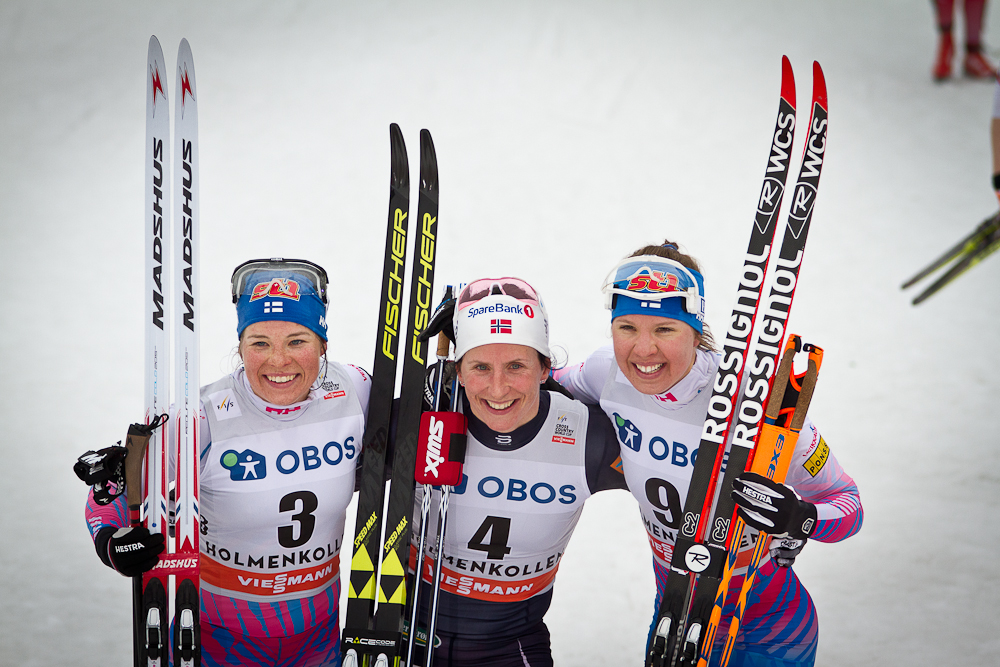
    The Holmenkollen 30 k classic mass start podium on Sunday in Oslo, Norway: Finland’s Krista Pärmäkoski (l) placed second, Norway’s Marit Bjørgen (c) first, and Finland’s Kerttu Niskanen (r) third.

    Heading into the season-ending World Cup Finals, which will take place across the Atlantic in Quebec, Canada, Pärmäkoski sits second in the World Cup overall, exactly 300 points behind Norway’s Weng. Another Norwegian, Ingvild Flugstad Østberg, is 94 points behind Pärmäkoski in fourth. On Sunday, Østberg placed eighth (+2:31.3).

    The U.S. Ski Team’s Kikkan Randall, like Bjørgen, has returned from a year away from skiing to start a family. Sunday was her first World Cup 30 k since she contested the 2014 Holmenkollen 30 k classic.

    And on Sunday, Randall was the top American in 20th (+6:17.2).

    “I had good energy,” Randall said of her race. “I kept a steady pace for me the whole way. 30 k was untested for me this year. I’m really happy. My expectation going into today, knowing where I’ve been in the last couple of weeks, I thought a top 20 was a good goal, and I just got that.”

    With such a large hiatus between long-distance races at this level, Randall noted her sensations on the day were welcome.

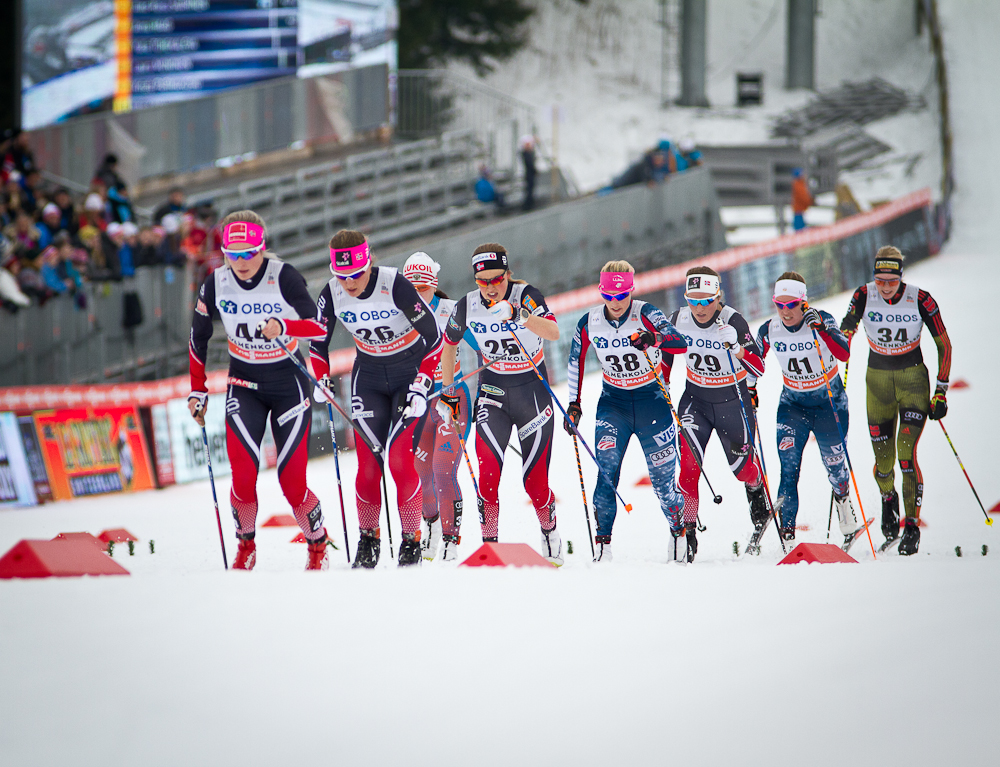
    The U.S. Ski Team’s Kikkan Randall (38) racing in a group during the women’s 30 k classic mass start on Sunday at Holmenkollen in Oslo, Norway.

    “I skied a lot of threshold pace last year while I was pregnant, and a lot of it is coming back this summer, so maybe this is a good pace for me to ski right now,” Randall said. “The start was pretty fast, and I had a hard time staying up in the middle of the group, but I just skied a good, steady pace the whole way, and my energy stayed really strong. … It’s a great foundation to end this season with, knowing that I have a whole season next year to build that top-end speed back.”

    Randall skied in a group that didn’t think twice about matching the turbo pace set from the starter’s gun. When the race shook out early on, Randall found her own race tempo and was able to eventually work up in the field.

    “I felt like I got in a pack right away, maybe in the first 5 k, skiing with a pack of Norwegians, and we worked together most of the race, but pretty soon we were picking people off,” Randall explained. “The opening pace was hard, and I think a lot of the people who went with it suffered the consequences. It was kinda fun that we had little rabbits out there to go catch.”

    Sadie Bjornsen, also of the U.S. Ski Team (USST), placed 24th on the day. Bjornsen skied much of her 30 k solo.

    “I was trying to go with people from the start, to see what would happen,” Bjornsen said. “My best 30 k’s have been when I send it too hard, and somehow manage to keep up the pace. I tried for that, and I then I got a bit tired in the middle.”

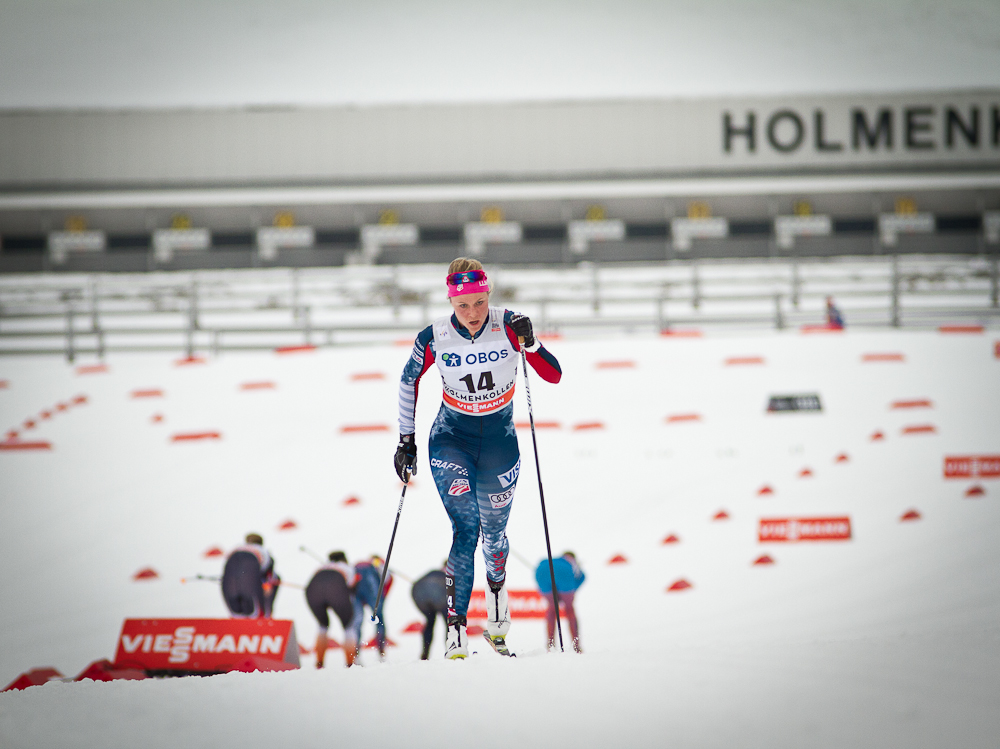
    Sadie Bjornsen racing to 24th in the women’s Holmenkollen 30 k classic mass start on Sunday in Oslo, Norway.

    Bjornsen’s race was gritty, a go-for-it effort in a hallowed venue. Bjornsen noted she perhaps pushed too hard in spots and paid the price of fading.

    “Today was one of those days that wasn’t the greatest, it wasn’t horrible, but you have to try,” Bjornsen explained.

    Holmenkollen remains formidable.

    “Holmenkollen is always the hardest race of the year, and I kind of love that,” Bjornsen said. “I’ve had some of my best and worst races here, and I think it’s fun to come here knowing that it’s going to be a challenge, but to also be excited for a challenge, because every time you finish this race, despite how you do, you have this feeling of total achievement, like, ‘Holy cow! I just skied 30 k on that course!’ It’s always hard … It’s just such an achievement to finish this race.”

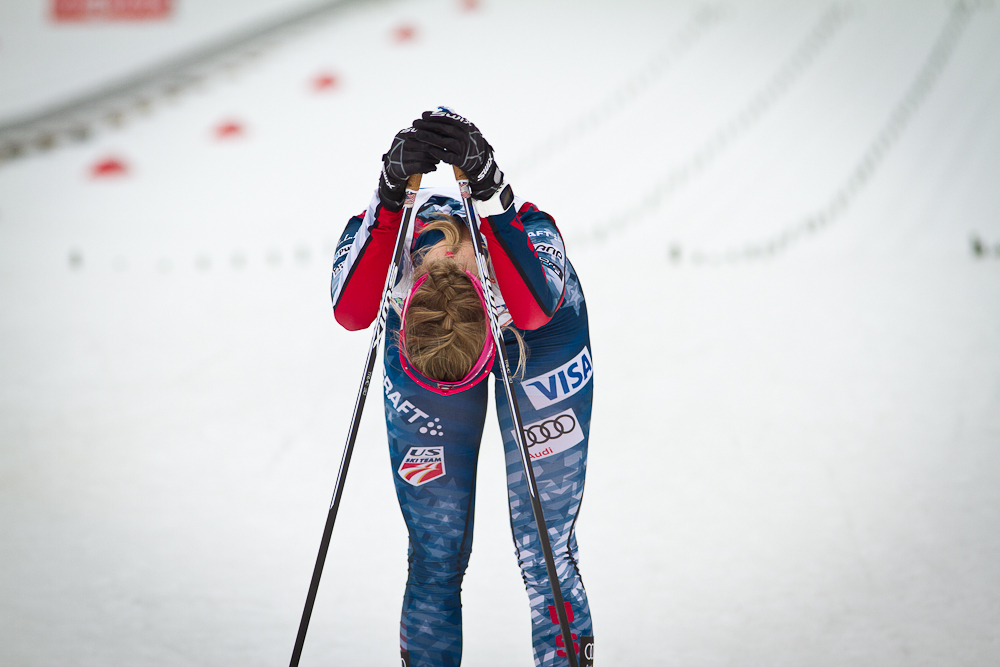
    Sadie Bjornsen (U.S. Ski Team) after finishing 24th in the Holmenkollen 30 k classic mass start in Oslo, Norway.

    Also for the U.S., Liz Stephen (USST) finished 31st (+8:46.8) and Chelsea Holmes (Alaska Pacific University) 39th (+11:19.1). Rosie Brennan (USST) did not finish.

    U.S. Ski Team Women’s Coach Matt Whitcomb explained that Brennan miscalculated with her initial pair of skis.

    “Rosie struggled a bit with her first pair of skis,” Whitcomb wrote in an email. “I think she thought they were good in testing, but in the race they proved to be a little too slow. Her second pair was great after the exchange, but she was too far back and decided to pull. This was her decision and I support her. She wants to ski very well in Quebec, and these athletes don’t have much wick left to burn. This is a rare occurrence, and an exceptional reason for it to occur. She’ll be skiing with a vengeance in Quebec.”

    No Canadian women entered Sunday’s 30 k.

    Results

  • Sundby Accomplishes Dream, Dominates Holmenkollen 50 k Start to Finish

    Sundby Accomplishes Dream, Dominates Holmenkollen 50 k Start to Finish

    Norway's Martin Johnsrud Sundby celebrates his first-ever victory in the men's 50 k mass start at the historic Holmenkollen World Cup near his hometown of Oslo, Norway. (Photo: Fischer/NordicFocus)
    Norway’s Martin Johnsrud Sundby celebrates his first-ever victory in the men’s 50 k mass start at the historic Holmenkollen World Cup on Saturday near his hometown of Oslo, Norway. (Photo: Fischer/NordicFocus)

    “It’s always been a dream for me to win this race, from when I was nine years old and tenting in the forest, cheering for all the big skiers at the time,” Martin Johnsrud Sundby said in a post-race press conference after winning Saturday’s 50-kilometer classic mass start held at the historic Holmenkollen stadium outside of Oslo, Norway.

    A perennial favorite at his home stadium in his hometown of Oslo, Sundby, landed on the podium in his four previous starts at the Holmenkollen 50 k, but the victory eluded him. Last year he finished third, half a second behind race winner and teammate Sjur Røthe.

    In an interview last year with the International Ski Federation (FIS) media’s Inside the Fence series, Sundby spoke of growing up on the track, “I did my first competition here as a 9 year old. Since then I’ve done probably over 100 competitions at this place. I have trained probably five thousand hours at this track. This is my home ground.”

    On Saturday, Sundby, who leads both the overall and distance World Cup, made no mistake that he would finally come away with a victory. With King Harald of Norway in attendance, the 31-year-old race favorite gunned it out of the stadium, appearing to want to weed out any potential chasers within the first few kilometers.

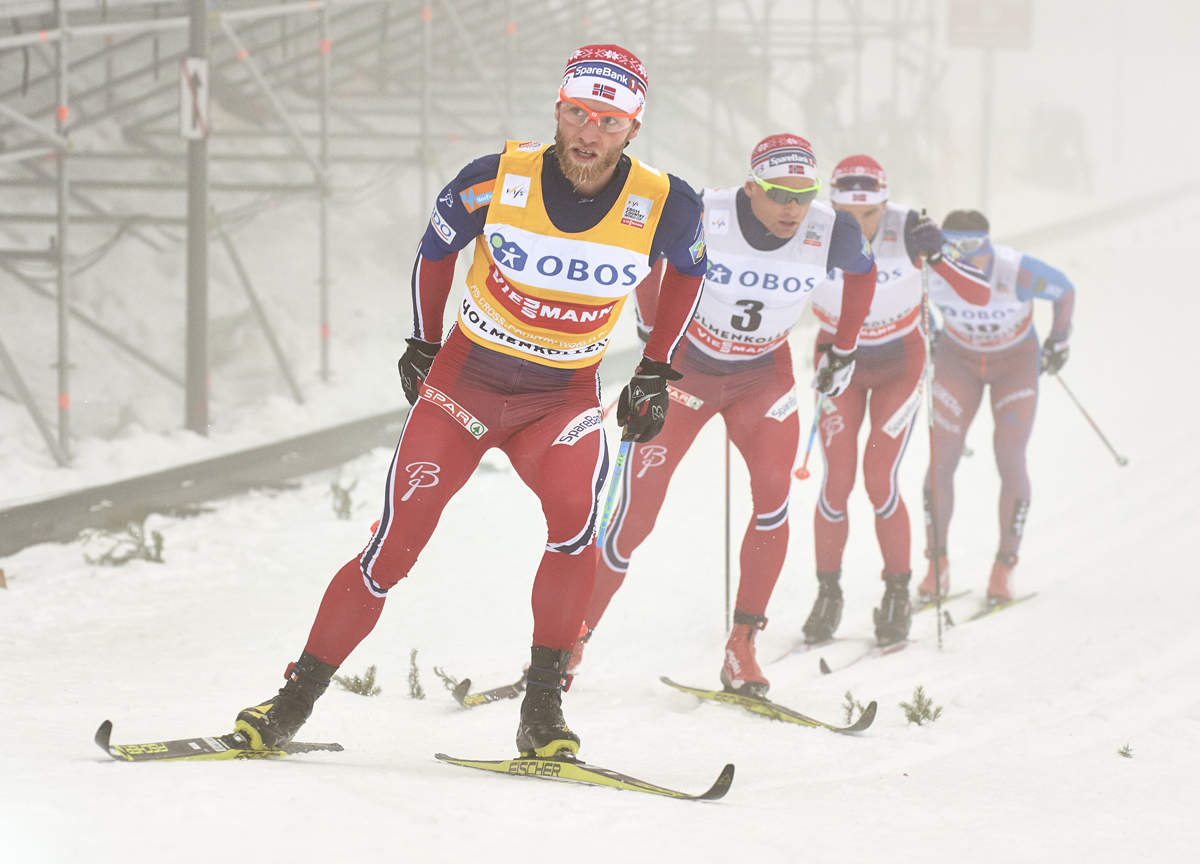
    Norway's Martin Johnsrud Sundby leads teammates Niklas Dyrhaug (3), Didrik Tønseth, and Russia's Maxim Vylegzhanin (r) during the men's 50 k classic mass start at Holmenkollen in Oslo, Norway. (Photo: Fischer/NordicFocus)
    Norway’s Martin Johnsrud Sundby leads teammates Niklas Dyrhaug (3), Didrik Tønseth, and Russia’s Maxim Vylegzhanin (r) during the men’s 50 k classic mass start at Holmenkollen in Oslo, Norway. (Photo: Fischer/NordicFocus)

    “My strategy for today was to shock the others from the start,” Sundby told reporters following the race, “Nobody expected that kind of pace from kilometer one, and I think I’ve never been skiing that fast for 50 k.”

    Despite warm temperatures and dense fog, the damp conditions did not seem to impact the lead racers. Instead it was Sundby’s blistering pace that thinned the group.

    Only 13.3 k in, a pack of three remained in contact Sundby as they charged through the fog: Norwegians Niklas Dyrhaug, 28, and Didrik Tønseth, 24, followed by Russia’s 33-year-old Maxim Vylegzhanin. Ten seconds behind these four was the main chase including past Holmenkollen champions, Norway’s Røthe and Petter Northug Jr., and last year’s runner-up Dario Cologna of Switzerland.

    Five kilometers later, at 18.8 k, the lead pack pushed their gap to 25.5 seconds over the chase. Leading the chase pack, Andrey Larkov, Alexander Bessmertnykh, Sergey Turyshev, Nikita Stupak — all from Russia — appeared set on tracking down and joining their teammate Vylegzhanin at the front.

    Less than a kilometer later, at the bonus sprint at 19.6 k (there was one on each of the six laps), Sundby gapped his three challengers, putting 4.6 seconds between himself and Tønseth. Although they reeled him back in at this point, Sundby made these moves throughout the day in an attempt to break free. By continuously pushing the pace, Sundby claimed all six of the World Cup bonus point preems throughout the course.

    At 24.9 k, roughly halfway through, the lead pack of four soldiered on, with the three challengers to Sundby absorbing every surge he attempted. Back in the main chase pack, the Russian attack of Larkov, Bessmertnykh, Turyshev and Stupak settled back in. While the Russians appeared positive for the chase, the group of 13 were taking the brunt of Sundby’s relentless attacks. Failing to match his relentless speed; they slipped 47 seconds behind.

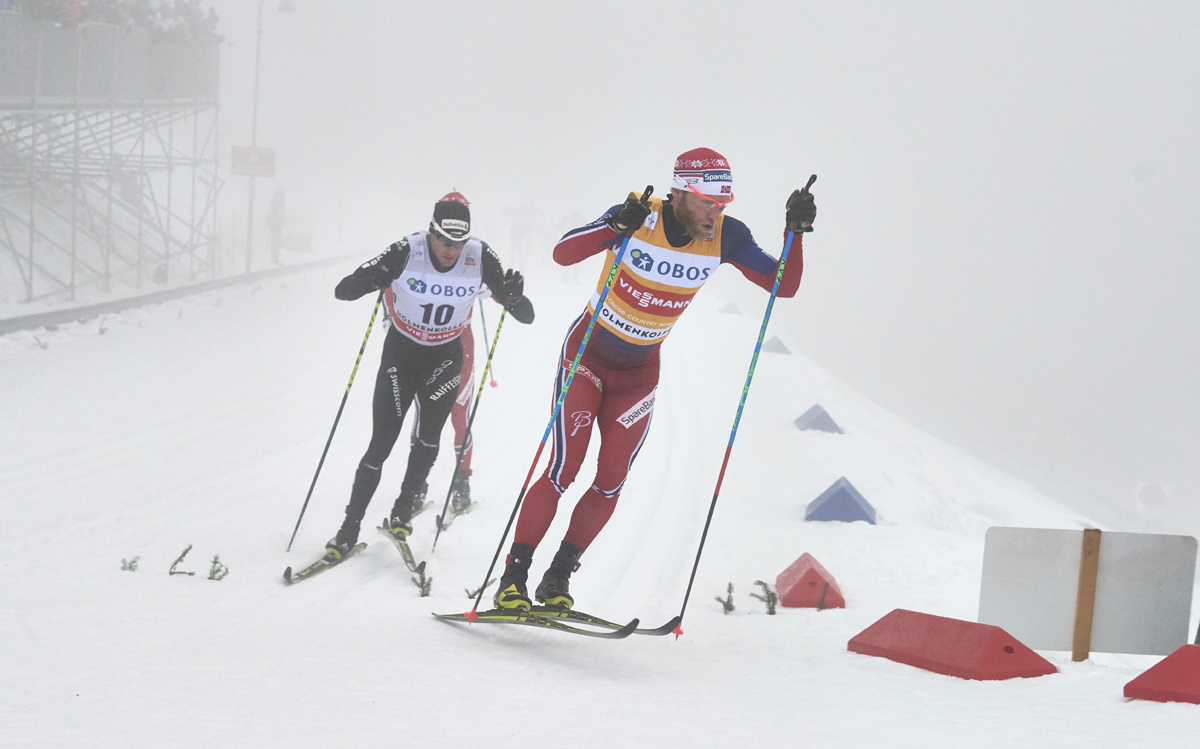
    Norway's Martin Johnsrud Sundby (r) leads Switzerland's Dario Cologna early in the men's 50 k classic mass start at Holmenkollen in Oslo, Norway. (Photo: Fischer/NordicFocus)
    Norway’s Martin Johnsrud Sundby (r) leads Switzerland’s Dario Cologna (10) early in the men’s 50 k classic mass start at Holmenkollen in Oslo, Norway. (Photo: Fischer/NordicFocus)

    Colonga, an early challenger around 11 k and a presence within the main chase, abandoned the race near the halfway point. Bothered by a left calf injury that occurred during the Tour de Ski, Cologna hoped to make a comeback for Holmenkollen. After the race he told Neue Luzerner Zeitung, a Swiss-German paper, “The calf was not strong enough for the fifties,” referencing that he believes he can compete in shorter races, but the longer marathons are not yet possible given the severity of the calf strain he suffered in January.

    On course, Sundby’s charge continued. At the second of two possible ski changes at 33.3 k (the first was at 6.6 k), the gap over the main chase grew to 1:10.3. The only skier daring enough to try to bridge that gap between the main chase and Sundby’s group of four, Turyshev, made it as close as 40 seconds back.

    An hour and half in, and on their fifth of six laps, Sundby’s energy finally proved too much for Tønseth and Vylegzhanin. Over two large climbs, Sundby’s powerful stride put him and Dyrhaug 15 seconds ahead Tønseth and Vylegzhanin. After the race, Sundby reflected this move was essential to holding off the strong-finishing Vylegzhanin, “I was a bit afraid of Vylegzhanin; he has great finishes when he is in shape. I was actually quite happy when me and Dyrhaug put some seconds on him in the fifth lap.”

    Dyrhaug clung to his teammate, telling FIS afterward that he “felt strong especially on the uphills,” albeit describing the race as the “hardest race I have ever skied in my life.” He matched Sundby stride for stride until just before 44.6 k, where Sundby built a 13.6-second lead that would last until the finish.

    According to NRK, Sundby wanted Dyrhaug there to pull him through the final few kilometers. However, Dyrhaug could not match the pace any longer, telling NRK, “He wanted me there and go. I said, ‘It’s not going to happen. Sorry, buddy.’ ”

    Behind Dyrhaug, the race for third dissolved as Vylegzhanin dropped Tønseth, opening up 14.2-second gap on the third Norwegian at the final 44.6 k time check. Farther back, Turyshev maintained his pace within the top five, 2:21.4 behind Sundby and 1:01.5 after Tønseth.

    Norway's Martin Johnsrud Sundby racing to the victory in the Holmenkollen 50 k classic mass start on Saturday at the World Cup in Oslo, Norway. (Photo: Fischer/NordicFocus)
    Norway’s Martin Johnsrud Sundby racing to the victory in the Holmenkollen 50 k classic mass start on Saturday at the World Cup in Oslo, Norway. (Photo: Fischer/NordicFocus)

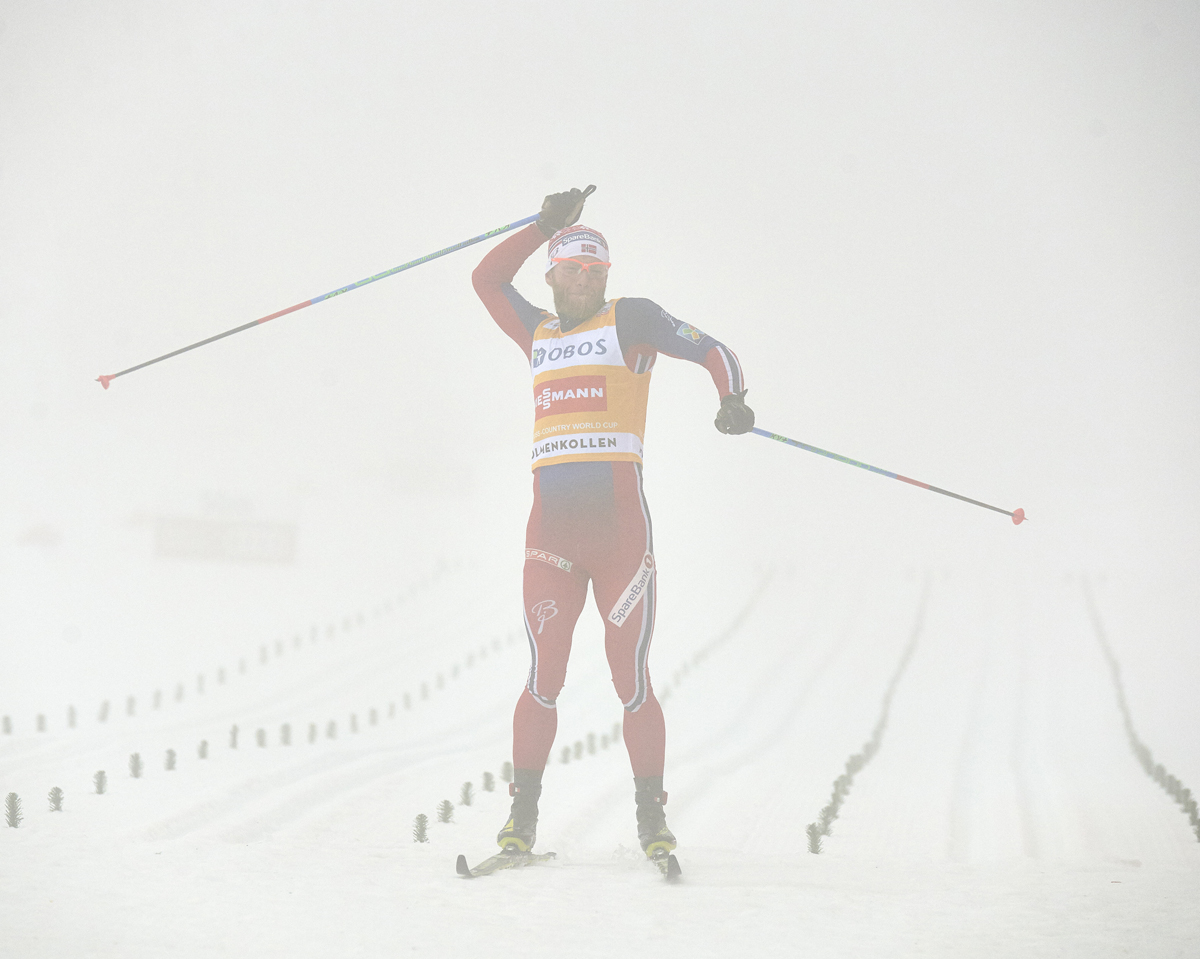
    Sundby emerged through the fog and into the stadium alone. Down the finishing stretch, he pumped his fists, a final celebration of a victory that’s been a long time coming. After crossing the line with a victory in his record fifth-consecutive World Cup podium at the 114-year-old Holmenkollen event, he kissed the snow, paying homage to the historic course.

    Following Sundby in second place, 18.8 seconds behind, his teammate Dyrhaug celebrated a personal best in the 50 k event. In third, 1:05.4 after Sundby, Vylegzhanin, broke up the Norwegian podium. Tønseth clung on to finish fourth (+1:36.3). Turyshev, who skied the majority of the second half of the race alone, rounded out the top five, 2:35.8 behind Sundby and 25 seconds ahead of Northug in sixth.

    Northug edged out an eight-man race to the line, with sixth through 13th finishing within 5 seconds of one another.

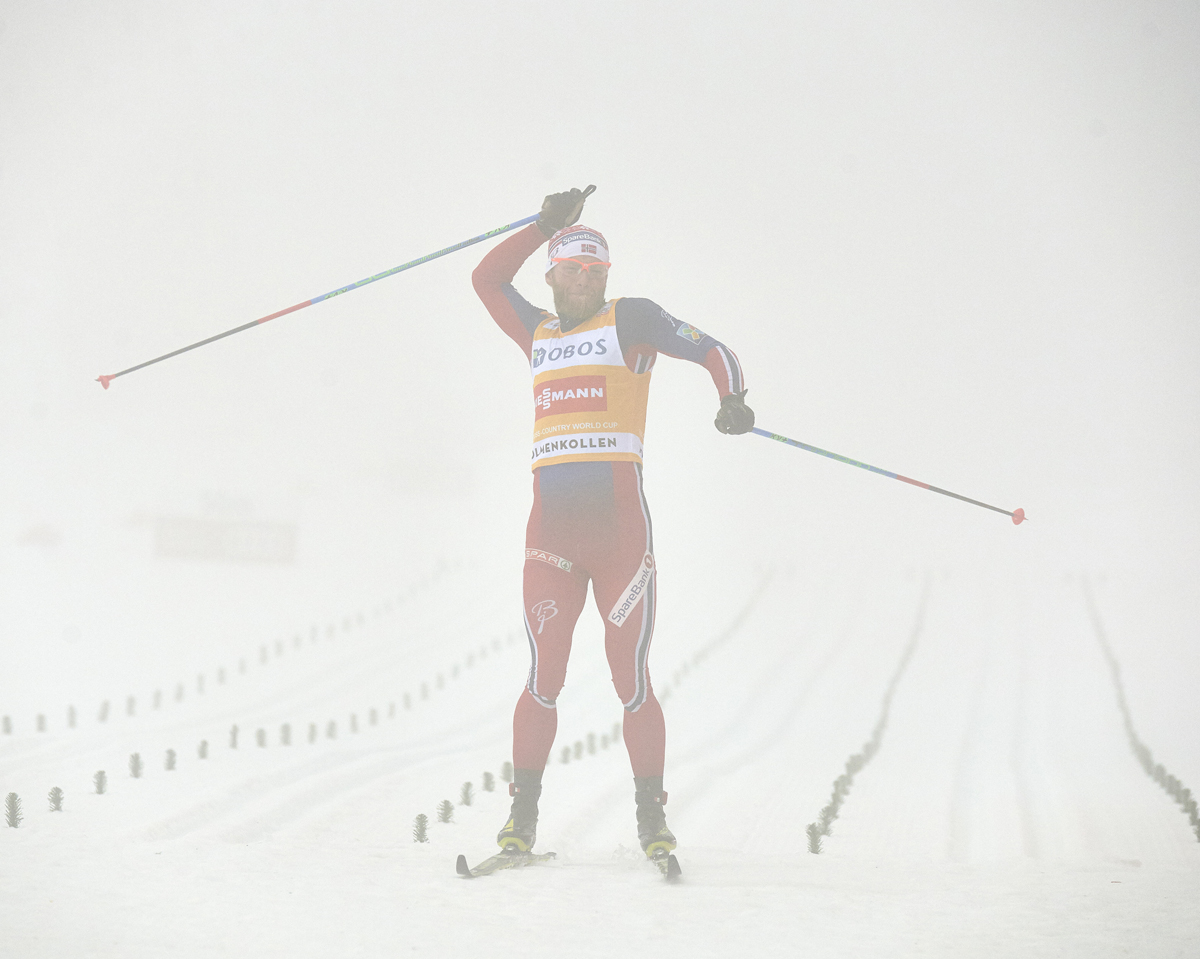
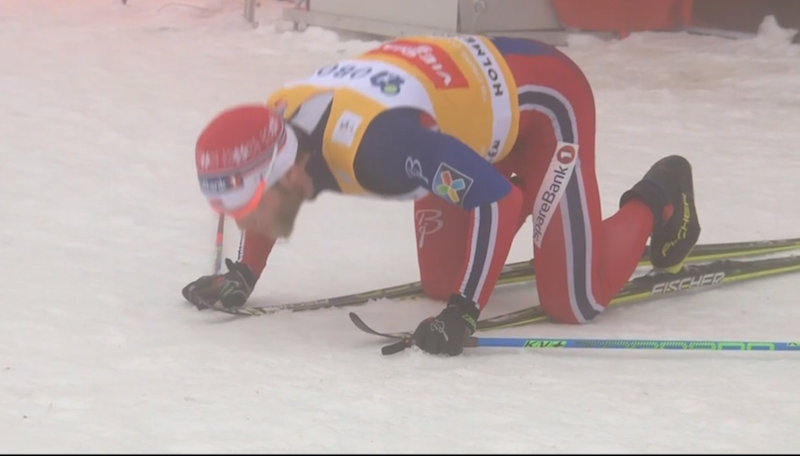
    Martin Johnsrud Sundby kissing the ground after winning the Holmenkollen 50 k classic mass start on Saturday in Oslo, Norway.
    Martin Johnsrud Sundby kissing the ground after winning the Holmenkollen 50 k classic mass start on Saturday in Oslo, Norway.

    With the victory, Sundby leads the overall World Cup by 720 points over fellow Norwegian Finn Hågen Krogh, who did not race on Saturday. Northug sits in third, 22 points behind Krogh.

    In the Distance World Cup, Sundby remains in first by a comfortable 473 points over Dyrhaug in second, and Røthe, who placed 10th on Saturday ranks third, 58 points behind Dyrhaug and just 1 point ahead of France’s Maurice Manificat in fourth.

    None of the French skiers started Saturday’s race. Of the 19 Norwegians in the race, 10 placed in the top 20 and five were in the top 10.

    “It sounds strange, but even if it’s no championship, this means a lot to me.” Sundby said in the post race press conference with a glint of sentiment towards finally breaking through at the fabled race.

    Notes

    • Sundby appeared to take a couple skate strides up and over the final bridge into the stadium. While XC Skiing News reported that he skated, Sundby did not mention that the jury had spoken to him about it. The incident was captured in this Vine:

    Results

  • Canada Notches Best-Ever Fifth in Men’s Biathlon Relay, Team ‘Pushing For Even Better Result’

    Canada Notches Best-Ever Fifth in Men’s Biathlon Relay, Team ‘Pushing For Even Better Result’

    Scott Gow took the Canadians from ninth up to fifth place in the third leg of the World Cup men's relay in Oslo, Norway, on Sunday. (Photo: Biathlon Canada/NordicFocus)
    Scott Gow took the Canadians from ninth up to fifth place in the third leg of the World Cup men’s relay in Oslo, Norway, on Sunday. (Photo: Biathlon Canada/NordicFocus)

    When Brendan Green crossed the finish line of Sunday’s 4 x 7.5-kilometer relay at Holmenkollen in Oslo, Norway, he was in fifth place.

    It wasn’t simply a good day for Green, or a personal best. That fifth-place finish was the best men’s relay ever in Biathlon Canada’s history.

    “It was a really good day for our team,” Green said in a phone interview. “Last night we had a team meeting and talked a little bit about the potential for our team. We talked about our specific start order and what we thought we could bring to the team on each leg. And today things definitely came together for us. Everyone had really solid legs for the relay.”

    The Canadians finished a minute and 35 seconds behind the winning Russian team. The stellar result comes in a season which has seen substantial changes to the World Cup roster. Star Jean Philippe Le Guellec retired after the 2014 Olympics, and Scott Perras is back in Canada training.

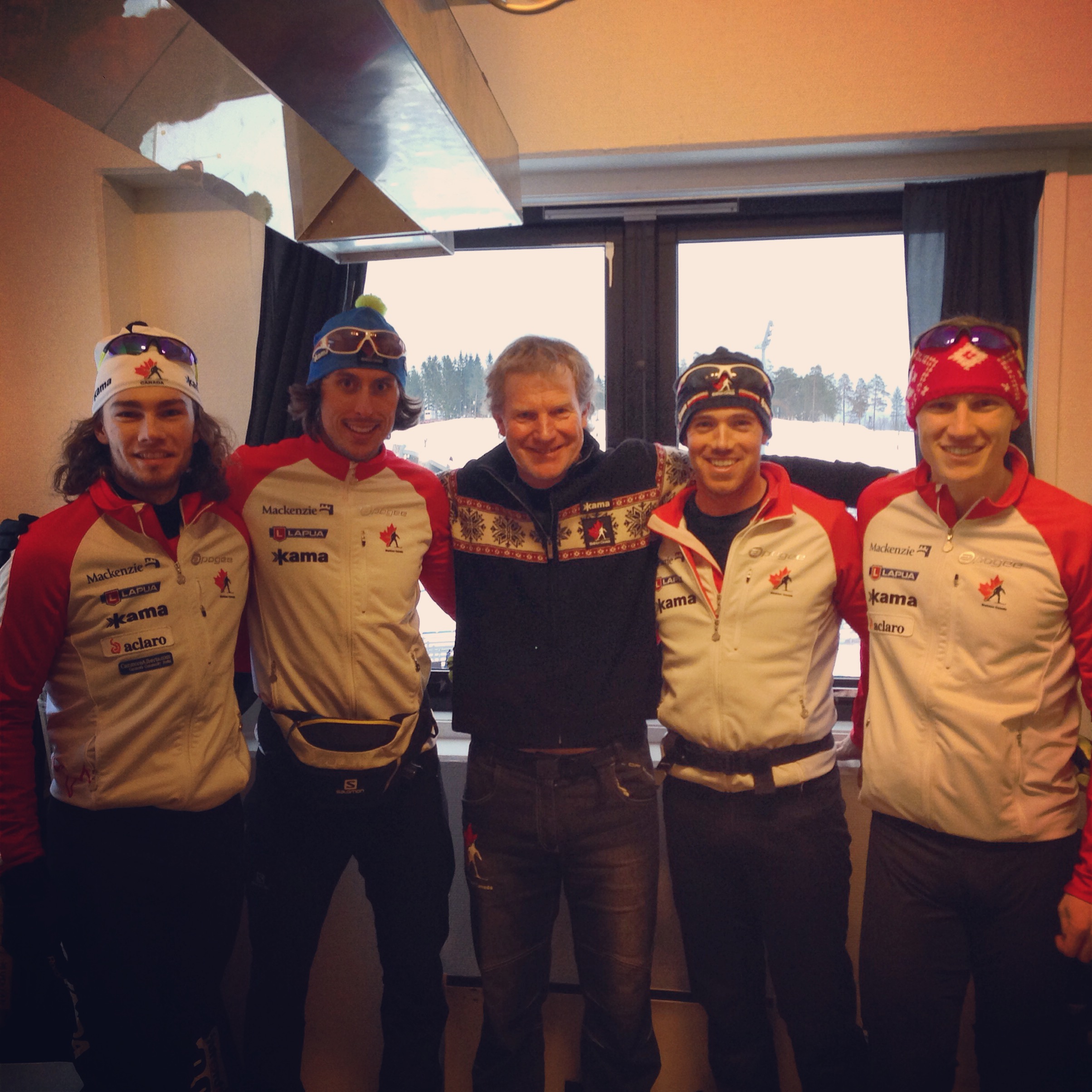
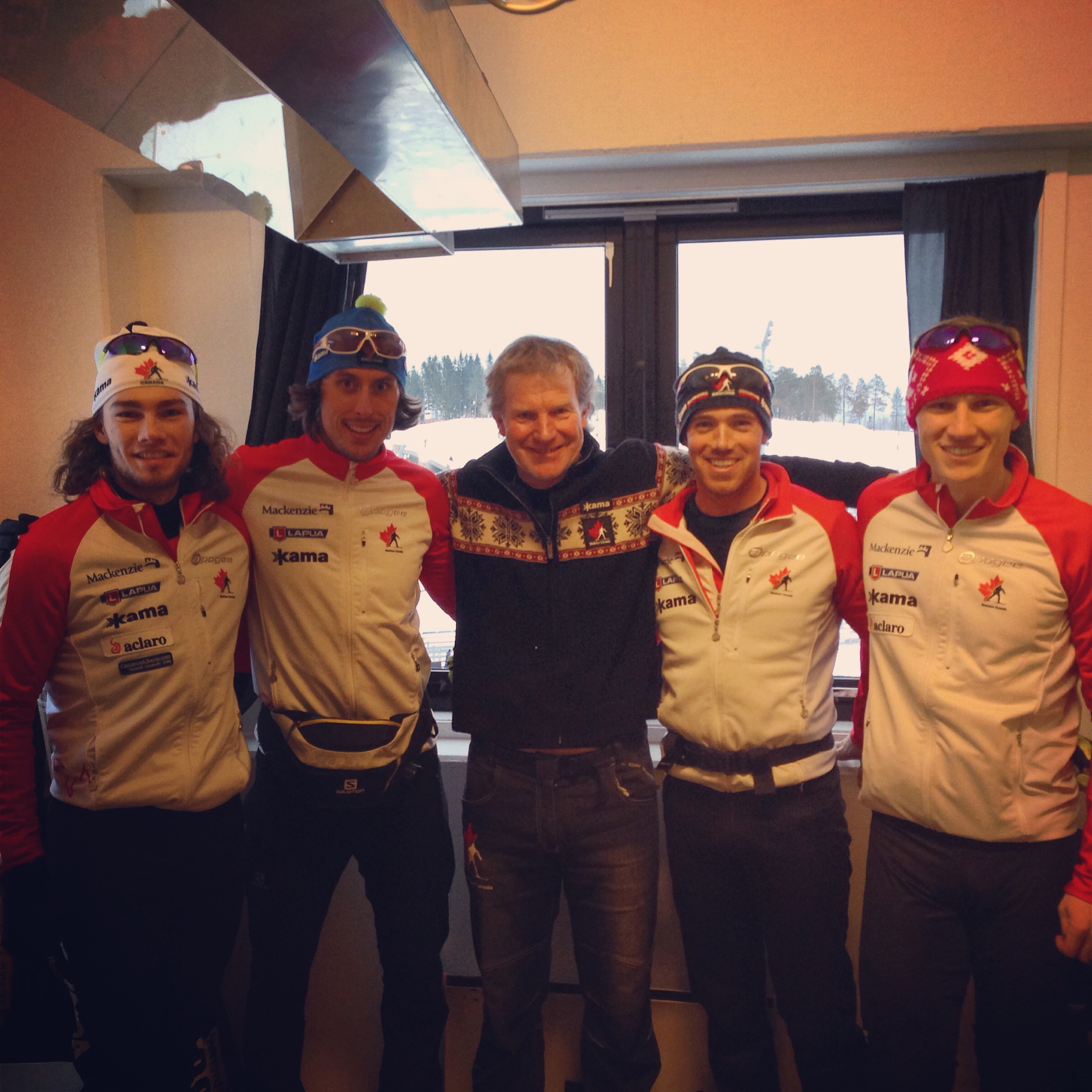
    The Canadian men's relay team of Christian Gow and Brendan Green (left) and Nathan Smith and Scott Gow (right) poses with head coach Matthias Ahrens in Oslo after placing fifth in the 4 x 7.5 k competition. (Photo: Rosanna Crawford)
    The Canadian men’s relay team of Christian Gow and Brendan Green (left) and Nathan Smith and Scott Gow (right) poses with head coach Matthias Ahrens in Oslo after placing fifth in the 4 x 7.5 k competition. (Photo: Rosanna Crawford)

    Instead, since the first men’s relay this season in Oberhof, Germany, Canada’s relay team has included 21-year-old Christian Gow, who skied leadoff and is in his first season on the World Cup. Gow shot like a pro, cleaning all ten of his targets without touching his spare rounds and tagged off in 14th, 50.5 seconds behind Germany’s Erik Lesser.

    “I was pretty confident that I would be able to clean the race today,” Gow wrote in an email. “I have been shooting really well all season and felt awesome in zero. You never know if everything will line up completely right for that 100%, but I was confident today and was happy to achieve it!”

    Canadian Head Coach Matthias Ahrens wrote that Gow’s performance had never been a question mark in his mind.

    “I believe Christian had proven some good relay qualities in previous relays in Oberhof and Antholz already with good shooting efficiency,” he explained.

    Gow is learning to deal with the excitement and the pressure of the World Cup.

    Christian Gow (foreground) gunning his way through the first leg of the World Cup men's relay in Oslo, Norway. (Photo: Biathlon Canada/NordicFocus.com)
    Christian Gow (foreground) gunning his way through the first leg of the World Cup men’s relay in Oslo, Norway. (Photo: Biathlon Canada/NordicFocus.com)

    “The past several relays have all been a great learning experience for dealing with the more unique aspects of World Cup racing, such as the incredible noise from the stands, or racing next to one of your personal idols,” he wrote. “I honestly hardly thought about the crowd today, and I don’t think too much about the guys around me either. When I am in the range I am focused on what I am doing and I try not to think about anything else.”

    That showed, and Gow’s work on the range upped the ante for his teammates – including his brother Scott, who was racing the third leg of the relay.

    “Seeing Christian clean was one part inspiring and one part nerve-wracking,” Scott Gow wrote in an email. “It was awesome to see him shoot so well and set the tone, but at the same time it added pressure for me to do well too and build on his great opening leg. Overall I would say it was motivating but I was definitely nervous waiting for Nathan to tag me.”

    Nathan Smith, the second-leg skier, turned in a strong performance of his own. He used a spare round in each shooting stage and moved the team up to ninth. But more importantly, by turning in the second-fastest ski time he cut ten seconds off of the team’s gap to the leaders.

    “I had a lot of confidence in my shooting and knew that being the third race of a weekend, I would probably also have a really strong ski day,” Smith wrote in an email. “Shooting went pretty well, it was a little windy. The only disappointment was missing my last prone shot. I think I just got a little ahead of myself.”

    “Christian [Gow] is a really good shooter, and he’s really fast, so he has always been reliable. That first leg is a great place for him and he gets the job done really well in that position.” — Brendan Green

    For Scott Gow, who used two spare rounds and moved the team up to fifth, things just came together on Sunday.

    “I felt the best on skis today since before Christmas,” he wrote. “I had a decent opening lap which is unusual for me, and I was able to maintain speed for the whole race with a nice kick at the end to pull into 5th. I lost some time in standing, but prone was solid and my skiing was good enough to keep the team in the mix.”

    Green dropped the team to sixth, briefly, after using two spares in prone, but skied back up to fifth.

    Brendan Green anchoring the Canadian relay in Oslo. (Photo: Biathlon Canada/NordicFocus)
    Brendan Green anchoring the Canadian relay in Oslo. (Photo: Biathlon Canada/NordicFocus)

    “It was a little bit tricky wind in prone,” Green said. “It was a complete 180 from zeroing. I hit my first three shots but then missed the next two, so I sort of paused before I loaded my spares and made that extra correction.”

    After cleaning standing, Green then turned in the second-fastest closing loop to hold onto it, despite fears of challengers from behind.

    “I was able to leave the range just ahead of Italy and Ukraine,” Green said. “I knew they were close behind. So on that last loop I really tried to redline it and go as hard as I could. And I knew France was close – partway through my loop I could hear some cheering and I thought, oh man, Fourcade must be closing in. So then I tried to really go for it and not look back, and hold those guys off.”

    For all the team’s members, the race was a culmination of the Oslo weekend. Smith had drawn on his confidence from finishing 12th in the 20 k individual; Scott Gow had focused on the lessons he learned in the earlier races of the weekend.

    “My skiing wasn’t great in the individual and, despite shooting 85%, didn’t shoot well enough for a good result,” he wrote of finishing 60th in the 20 k. “After that race I wanted to refocus on skiing efficiently and being more deliberate in the range, and that’s exactly what I was able to accomplish on race day in the Sprint. My result in the sprint race gave me added confidence for today’s relay. I wanted to use today as an opportunity to build on my skiing and shooting and try to do better.”

    And for Christian Gow, he acclimated back to Europe after heading home to Canada for a training break and then sitting out the 20 k due to jet lag.

    “It was great to get back here on the World Cup again after my brief break back home,” he explained. “I think it was important for me that I took a break in order to feel ready to go for the next month of racing.”

    The youngest team member is now looking forward to his first World Championships experience. And with the best-ever result in their back pocket, Canada is looking forward, too. Their relay there will have the same roster, likely in the same order.

    “I think today’s result showed all of us the type of placing we can achieve,” Christian Gow wrote. “From that standpoint I think it will give us a bit more confidence, but also more drive to keep pushing for an even better result.”

    “A result like today will definitely give us a little extra confidence and motivation heading into the two week break and World Championships,” Smith agreed. “Another top 6 is what we’re aiming for. Outside of the World Champs, Nations Cup points are especially important for us this year. Right now we’re sitting in 8th which means 5 start spots for next year. It would awesome to grab that extra spot for the Canmore World Cups in 2016.”

    Results

  • Mäkäräinen Wins Holmenkollen Individual by More Than a Minute; Dunklee 11th, Heinicke 12th

    Mäkäräinen Wins Holmenkollen Individual by More Than a Minute; Dunklee 11th, Heinicke 12th

    Susan Dunklee (US Biathlon) racing to 11th in Thursday's 15 k individual at the IBU World Cup in Oslo, Norway. (Photo: USBA/NordicFocus)
    Susan Dunklee (US Biathlon) racing to 11th in Thursday’s 15 k individual at the IBU World Cup in Oslo, Norway. (Photo: USBA/NordicFocus)

    Leading up to Thursday’s 15-kilometer individual race, the first day of the IBU World Cup at Holmenkollen in Oslo, Norway, Susan Dunklee had been feeling tired and Megan Heinicke was still sick. Not ideal, but they had to roll with it.

    Dunklee, of US Biathlon, formulated a plan to start conservatively and speed up if she felt she was up to it. Heinicke, of Biathlon Canada, assumed after 10 days of dealing with a cough that refused to let up, she probably wasn’t going to feel great. She missed last weekend’s entire World Cup in Nove Mesto, Czech Republic, because of it.

    Yet the two toed the start line, and Dunklee went out seventh behind top competitors like World Cup leader Kaisa Mäkäräinen of Finland in bib 2 and Germany’s Franziska Hildebrand in bib 5.

    After one so-called conservative lap, which ended up being the 15th-fastest first lap overall, Dunklee had already put herself in a strong position with a clean first prone. She missed one on the next standing to fall back a few places, but hit every target on her second prone to put herself back in the running for a top performance.

    One final miss on her second standing gave Dunklee another minute penalty, and she finished third, 4:07.1 behind Mäkäräinen in first and 23.2 seconds behind Hildebrand, who was in second at the time.

    “My shooting today felt very deliberate rather than the ideal automatic, but I focused on the basics — a relaxed stable position and trigger squeeze,” Dunklee explained in an email. “I knew I was having a great race going into the last stage and it was disappointing to miss that first shot.”

    Like most of the 86 women that finished the race, she had some tricky conditions to deal with, with some fog during zero as well as during the race, although it was “never enough to totally obscure the targets,” Dunklee wrote. “Snow conditions were firm for the earliest starters but quickly deteriorated into deep corn. The fog created flat light conditions making it difficult at times to see the tracks or the berms in the downhill corners.”

    She made a point to push over the “monster climbs,” saving just enough before the crest of each so she could go hard up and over.

    “I knew I was having a great race going into the last stage and it was disappointing to miss that first shot,” she wrote. “At that point I told myself that my real test today was whether or not I could regain the right focus for those final four shots, and I did. I feel really good about that.”

    At the end of the day, Mäkäräinen — an early leader who cleaned every stage and posted the fastest course times on each lap to keep everyone else more than a minute behind — won in 43:54.8 and Dunklee ended up 11th. The fourth-fastest skier on her last lap, the American clocked the seventh-fastest course time overall.

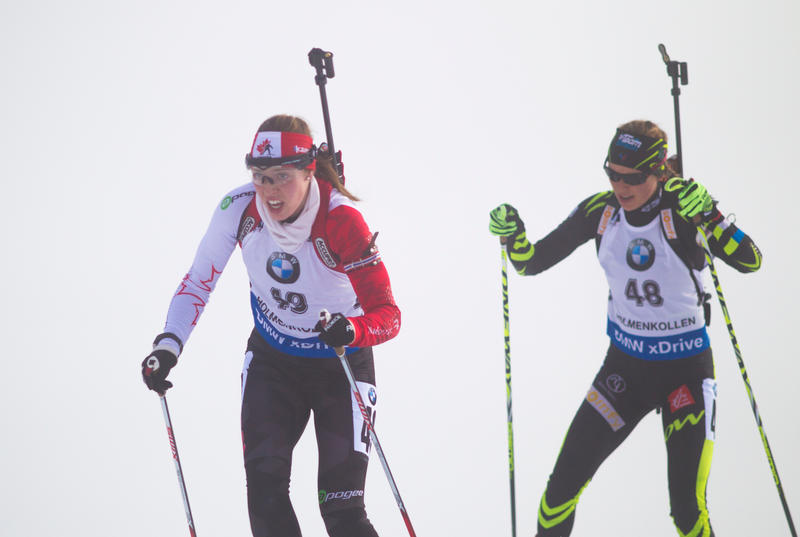
    Canada's Megan Heinicke (l) leads Marine Bolliet of France in the women's 15 k individual at the IBU World Cup on Thursday in Oslo, Norway. Heinicke cleaned to place 12th, one of four top-15's this season. (Photo: IBU/Christian Manzoni)
    Canada’s Megan Heinicke (l) leads Marine Bolliet of France in the women’s 15 k individual at the IBU World Cup on Thursday in Oslo, Norway. Heinicke cleaned to place 12th, one of four top-15’s this season. (Photo: IBU/Christian Manzoni)

    About 20 minutes after Dunklee started, Heinicke set out in bib 49, skiing middle-of-the-pack course times but cleaning each passing round to pick off the places.

    “I had some clear ski technique goals to help myself stay focused on course no matter what … and I wanted to be confident in the range,” Heinicke explained in an email. “I have been shooting well recently, and with no wind, there was no need for me to shoot ‘extra carefully’ or slowly so I just wanted to relax and do my thing on the range without any special changes in approach because the the individual format.”

    She ended up knocking down all 20 targets in the four-stage race, the longest women’s format on the circuit.

    “I was pretty relaxed mentally until the last bout,” Heinicke reflected. “For the last standing, there was definitely that little dialogue going on my head with part of me thinking all those pre-mature happy thoughts about the possibility of hitting 20 and the other part of me just focusing on my job and each target. … I’m glad the ‘focused’ part of my brain kept the upper hand!”

    Once she realized she cleaned the last stage, another thought popped into her head: “ ‘Oh jeez…I actually hit 20?!?!…again!’ ” she wrote. “But that changed pretty quickly into thoughts about skiing hard for the last loop.”

    With a sense of where she stood from the Canadian staff out on course, she finished 11th initially and was bumped to 12th by Germany’s Laura Dahlmeier, who started 60th and placed fourth with clean shooting.

    Two-tenths of a second back from Dunklee in 11th, Heinicke tied her personal-best 15 k result in 12th (after placing 12th in the 15 k in Östersund, Sweden, earlier this season), which was also her second-best World Cup result (she was 11th in last month’s sprint in Ruhpolding, Germany).

    “Another top 15 finish is awesome and given that my health is still far from 100% I can’t complain,” she wrote. “At the same time it is a bit frustrating, this was one of my slowest skiing performance this season (although our skis were excellent) and I am confident that on an average, healthy day I would have posted my first top 10 finish with 20 hits today.”

    Overall, her course time ranked 50th, while her shooting and range times were 16th- and 17th-fastest.

    Kaisa Mäkäräinen of Finland celebrates her 14th IBU World Cup win in the women's 15 k individual on Thursday in Oslo, Norway. (Photo: IBU/Christian Manzoni)
    Kaisa Mäkäräinen of Finland celebrates her 14th IBU World Cup win in the women’s 15 k individual on Thursday in Oslo, Norway. (Photo: IBU/Christian Manzoni)

    Six of the top seven women shot 20-for-20, including Mäkäräinen, followed by the Czech Republic’s Veronika Vitkova in third (+1:20.9), Dahlmeier in fourth (+2:28.2), Poland’s Monika Hojnisz in fifth (+2:51.5), and Ukraine’s Juliya Dzhyma and Iryna Varvynets in sixth and seventh, respectively.

    Mäkäräinen couldn’t remember the last time she cleaned a four-stage race. According to RealBiathlon, she’s done it four times in her career and never before in a 15 k.

    “I think it was in the 2011 World Championships, but the big thing is that it was in a 15 k,” she told the IBU. “I woke up this morning and felt confident, but I was a bit worried about the fog when I came to the first prone. I was wondering if I could see the targets … In prone I had to be very careful, to take every shot carefully and not miss.”

    Darya Domracheva of Belarus broke the trend in second with one penalty on her first prone, which set her 40 places back. The 30th starter, she went on to clean every round thereafter and skied the second-fastest lap times after Mäkäräinen to work her way back to second, 1:18.3 back.

    Darya Domracheva of Belarus racing though the fog to second despite one penalty in the women's 15 k individual at the IBU World Cup in Olso, Norway. (Photo: IBU/Christian Manzoni)
    Darya Domracheva of Belarus racing though the fog to second despite one penalty in the women’s 15 k individual at the IBU World Cup in Olso, Norway. (Photo: IBU/Christian Manzoni)

    “The tracks were very deep and it was very hard; you had to find a part that was just a little harder but as the race went on, those spots became less and less,” Domracheva told the IBU.

    “Nineteen-of-20 is not bad. Kaisa was really strong on the shooting range and the tracks and I think the result might have been the same even if I hit that one target.”

    Hildebrand took eighth with two misses, one on each of the first two stages, Gabriela Soukalova of the Czech Republic started ninth and finished ninth with one miss on her third shooting, and France’s Anais Bescond missed one on her last stage to place 10th, 2.5 seconds ahead of Dunklee.

    The second Canadian, Rosanna Crawford in bib 14 came out raring to go after crossfiring in the Nove Mesto sprint and pulling out of that race, which made her ineligible for the pursuit last weekend.

    “I was looking forward to getting back on the race skis and redeem myself from last week’s disaster,” Crawford wrote in an email. “I love Oslo! So being here definitely put me in a good mood. The tracks were fast and the sun was shining for our two training days.”

    She aimed for precision on the range and felt like she accomplished that on her first three bouts with clean first and third stages and one miss on her first standing. In the final standing, she missed two more for a total of three minutes of penalties.

    “I’m really disappointed with my last shooting. That was not necessary,” she wrote. “Coming into the last shooting I knew that with a clean shooting a great race was possible. I tried to keep my mind clear and focus on the process, but I think I got a bit ahead of myself. The fog was tricky in standing today. You really had to search out the target. But as the results show a lot of women had a great shooting day today, so no excuse.”

    Crawford finished 28th overall, 6:07.2 back from Mäkäräinen.

    “I am happy to be in the top 30 pretty consistently this year. But I know what’s possible with 100% shooting,” she added. “Even on an off skiing day if I hit 100% it can be a race I’d be proud of.

    “We had an amazing day for all three of us today,” she added, referring to Heinicke and Audrey Vaillancourt, who finished another 30 seconds back in 30th for her career best. “With both Megan and Audrey hitting 20/20 and Audrey getting her first top 30! Today definitely makes up for our lack of nation cup points in Nove Mesto!”

    After her perfect-shooting day, Vaillancourt, 23, explained in an email that she focused on hitting each shot individually.

    “I think taking the focus away from the total result helped me a lot,” she wrote.

    Before the race, she felt calm and ready, and best of all, she liked the course, which featured “hard climbs, fun downhills, rolly sections.” With good shooting, she hoped for a top 40.

    “I was really trying to be in the moment during today’s race so I basically took it one hill, one lap, one shooting bout at a time,” Vaillancourt wrote. “This helped me not to get overwhelmed and made me feel confident about the last shooting. It was just one of those days when it feels really easy on the range.”

    She added that she was “relieved to finally have really good race. It feels great to see that I, too, can be up there on a good day,” she wrote.

    Hannah Dreissigacker (US Biathlon) racing to 33rd in the IBU World Cup 15 k individual on Thursday in Oslo, Norway. (Photo: USBA/NordicFocus)
    Hannah Dreissigacker (US Biathlon) racing to 33rd in the IBU World Cup 15 k individual on Thursday in Oslo, Norway. (Photo: USBA/NordicFocus)

    Hannah Dreissigacker placed 33rd for the U.S., 21.4 seconds after Vaillancourt, with clean shooting in every round except her second — where she missed three.

    “On the whole, I’m happy with my race and placing,” Dreissigacker wrote. “In biathlon you can always play the game of ‘where would I be if I’d hit one more shot…two more…etc’, and that is especially true of individuals.”

    With three misses in her first standing, she explained it was hard not to think about what might have happened if she shot better on that stage as well.

    “But in the end, I’m happy with shooting 85% and I’m glad to have come back and shot two clean stages after that bad one,” she wrote. “I definitely went a bit harder on the lap before the first standing stage, trying to catch a ride with a faster skier. I don’t regret it — that’s how you learn and get better! But I also have to learn from the bad shooting stage.”

    The third of four American women in Thursday’s race, Annelies Cook placed 55th (+8:18.2) with three penalties (1+0+2+1). Clare Egan was 82nd (+12:29.0) with six misses (1+1+1+3).

    Check back for the men’s 20 k report, featuring Canada’s Nathan Smith in 12th and American Leif Nordgren in 20th. 

    Results