Tag: Homologation

  • Small Montana Town Working to Create a Big Nordic Ski Vision

    Small Montana Town Working to Create a Big Nordic Ski Vision

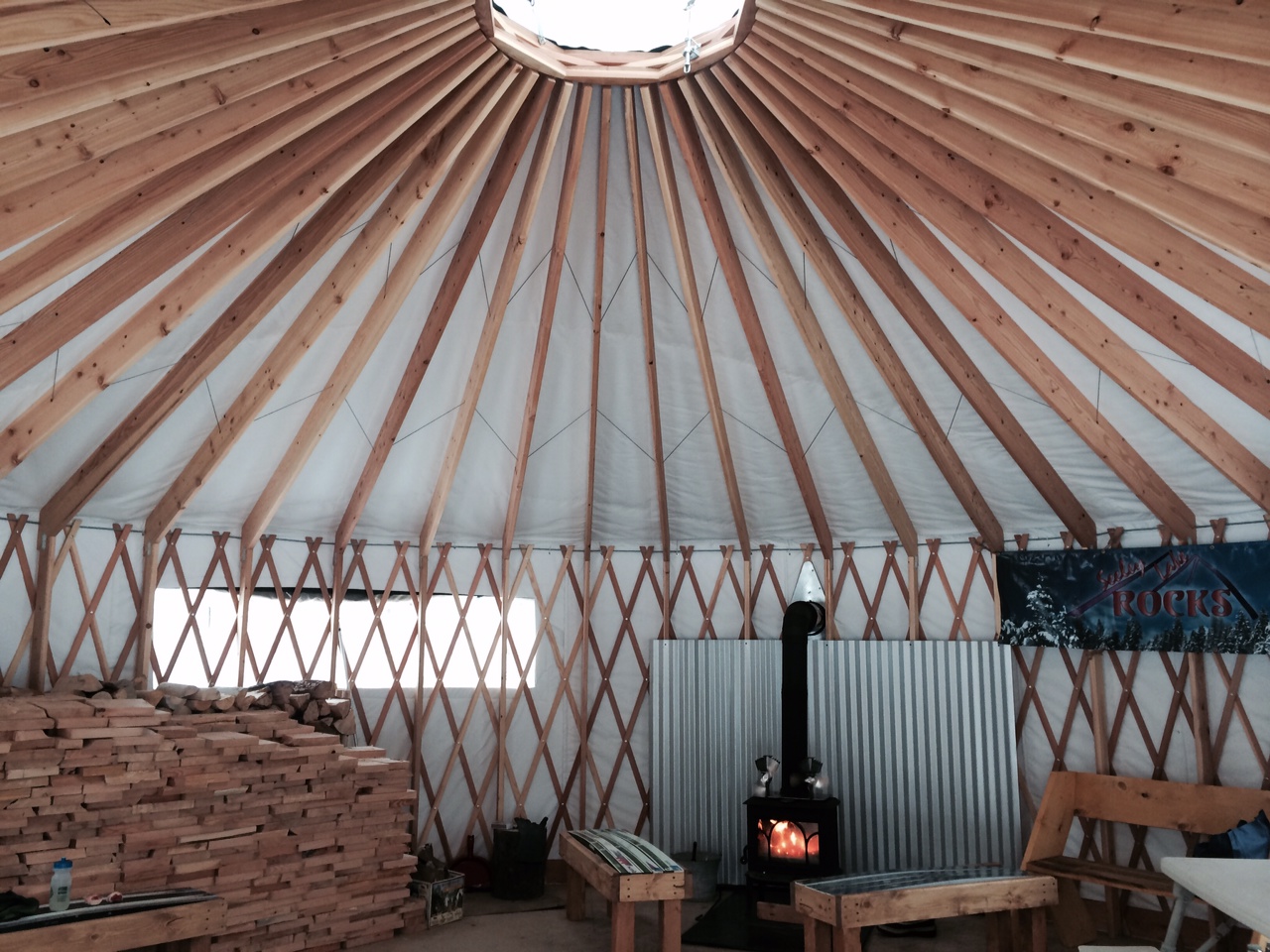
    Inside the Seeley Lake ROCKS new warming yurt in Seeley Lake, Mont.
    Inside the Seeley Lake ROCKS new warming yurt in Seeley Lake, Mont.

    SEELEY LAKE, Mont. — Inspired by the birth of the Maine Winter Sports Center, a group of Seeley Lake (population 1,659) residents formed the Seeley Lake Regional Outdoor Center for Kinetic Sports (ROCKS).

    That was in 2010.

    In the spring of 2015, ROCKS will file an application for a Special Use Permit with the United States Forest Service (USFS) to build a new Seeley Lake nordic-ski venue, which is “intentionally being designed to international race-ready specs, fully homologated, with both the skier and spectator in mind,” according to ROCKS President Chris Lorentz.
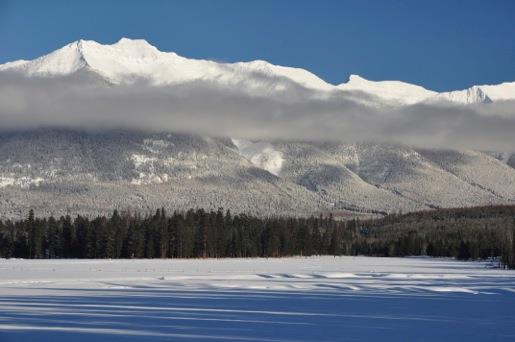
    Swan Range forms the backdrop for the Seeley Lake ski trails. (Photo: Seeley Lake Nordic)
    Swan Range forms the backdrop for the Seeley Lake ski trails. (Photo: Seeley Lake Nordic)

    Lorentz said the Forest Service will review the permit application, perform an environmental analysis (including a mandatory 90 day public input period) and provide a decision by October 1, 2016.

    “We believe the (process) will result in a positive decision notice,”  Lorenz said.

    ROCKS hired John Morton, owner of Morton Trails, to provide both a feasibility study (2011) and course design (2012) for the new Seeley Lake venue. According to a report issued by Morton Trails to the USFS, Morton states that efforts have “resulted in a workable concept for what offers to be a nationally, and even internationally, recognized cross country skiing venue … suitable for hosting Continental Cup races such as US Junior Olympics, US Nationals, North American races [i.e. Super Tour], as well as regional races where participants can be awarded FIS points for international ranking.”

    Morton’s design would meet specifications for D-category homologation, making Seeley Lake one of six venues certified to this level in the United States. A D-certification allows a venue to host all events, including mass-start freestyle races. The only event requiring a designation beyond a D category is the skiathlon, which requires two separate courses (used concurrently).  Soldier Hollow in Midway, Utah, is the only course in the US which currently has this designation.

    To provide Seeley Lake with an advantage in bidding for major events and training camps, and to keep the door open for a possible World Cup event bid, Morton designed the course to “comply to a World Cup standard – which will make this venue truly representative of courses hosting the most elite competitions.”  The most recent FIS Homologation Manual would have allowed for certification with a 25-meter climb; however, Morton chose to exceed this standard and comply with the World Cup’s 30-meter requirement.
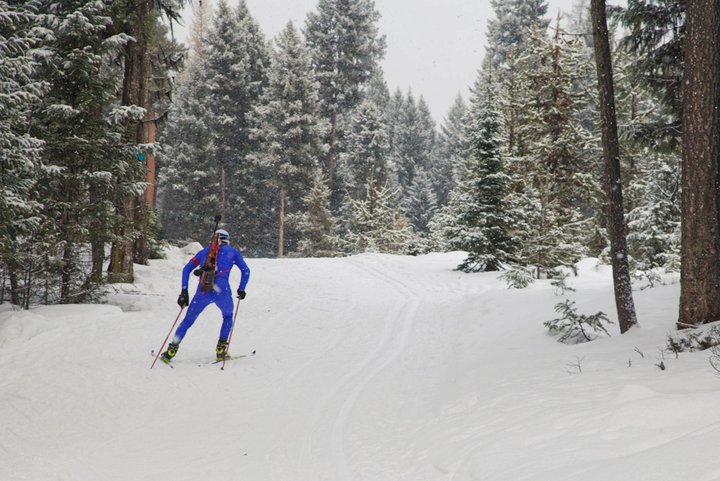
    In January, Seeley Lake hosted its 8th annual biathlon, with 115 racers participating in three events. (Photo: Seeley Lake Nordic)
    In January, Seeley Lake hosted its 8th annual biathlon, with 115 racers participating in three events. (Photo: Seeley Lake Nordic)

    Morton’s design includes a 15-point biathlon range and identifies a location for a 30-point range (meeting the IBU World Cup requirements) that could be installed with some additional construction. The course design for the five-kilometer loop is “spectator friendly” allowing  spectators to view competitors five to seven total times, or 10 to 14 times for a 10 k race.

    While USFS permit approval, new venue construction, and hosting of events at the new venue are years in the future, Seeley Lake, is not waiting for course completion to continue taking steps forward.  Recent ROCKS activities have clearly energized the town which has a long standing nordic ski racing tradition.

    The town’s existing nordic ski trails at Seeley Creek have seen an upsurge in use following the installation of a new yurt (installed by Seeley Lake ROCKS) at the trailhead.

    “The yurt is way more popular than we expected,” Lynn Carey of the Seeley Lake Nordic Ski Club said. “Our metal ranger now takes in more money than any other ranger in the state.”
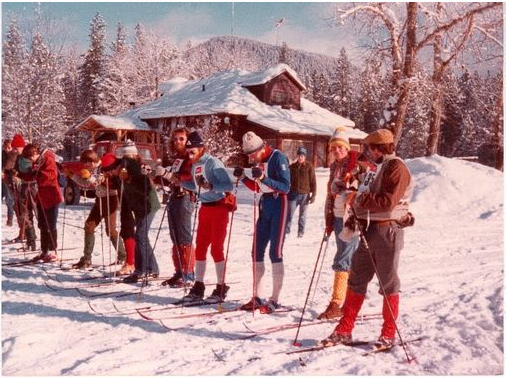
    Seeley Lake, Montana, has a long history of ski racing.  This is a photo of the start 1983 OSCR race. (Courtesy Seeley Lake Pathfinder)
    Seeley Lake, Montana, has a long history of ski racing. This is a photo of the start 1983 OSCR race. (Courtesy Seeley Lake Pathfinder)

    ROCKS founder Karen Pratt notes, “The idea is that you need a culture shift to bring in an elite race [to Seeley Lake] and get enough interest in town to support it.  An international race is a lot of work!”

    The ROCKS plan seems to be working.

    “There has already been a big culture shift in Seeley,” Pratt said. The Seeley school system started a ski program where any student above the 3rd grade can access free skis, transportation and ski instruction. Twenty students have caught the ski bug and joined the school’s newly formed nordic ski racing team.

    According to Pratt, many local parents are learning to ski as a result of the new youth programs.  She is convinced that the increased activity is improving community health.  “It’s not a good thing when the people in Seeley don’t get out of the house in the winter,” she said.
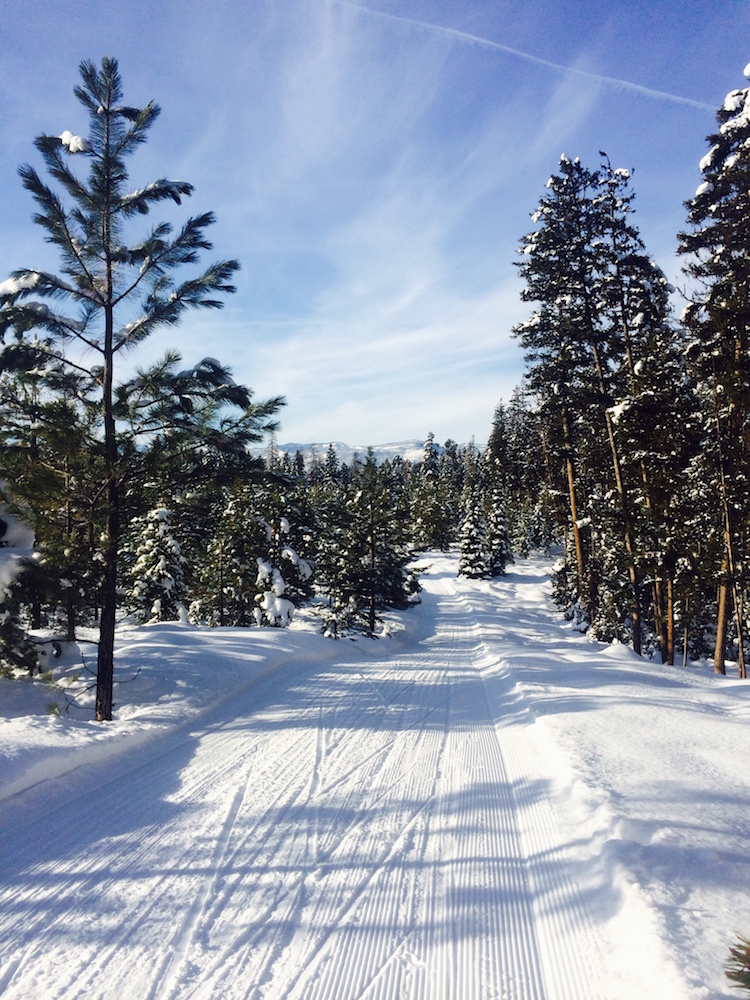
    Seeley Lake's existing ski trails at Seeley Creek. (Photo: Mark Vosburgh)
    Seeley Lake’s existing ski trails at Seeley Creek. (Photo: Mark Vosburgh)

    Grooming the 23-kilometer Seeley Creek trail system is now conducted daily, and several trails that had been abandoned or rarely groomed have been re-opened.  The rolling trail system, designed by Olympian Jon Elliott, is seeing a resurgence in use and the trails are receiving rave reviews from regional skiers.  The eighth-annual Seeley Lake biathlon had 115 entrants this year, nearly double last year’s count, according to race director Cheri Thompson.

    Once the new trails at Fawn Creek are open, ROCKS organizers hope that overnight visits and resulting economic benefits to Seeley Lake will increase with skiers spending two days in the  Seeley Lake area in order to ski both trail networks.

    Pratt credits generous donations from the late Peter Hale and his estate for supporting the Seeley Lake ski program with skis, waxing supplies and equipment. Hale’s connection to Seeley and his passion for skiing is in part responsible for at least one concrete example of increased economic activity sought by ROCKS.
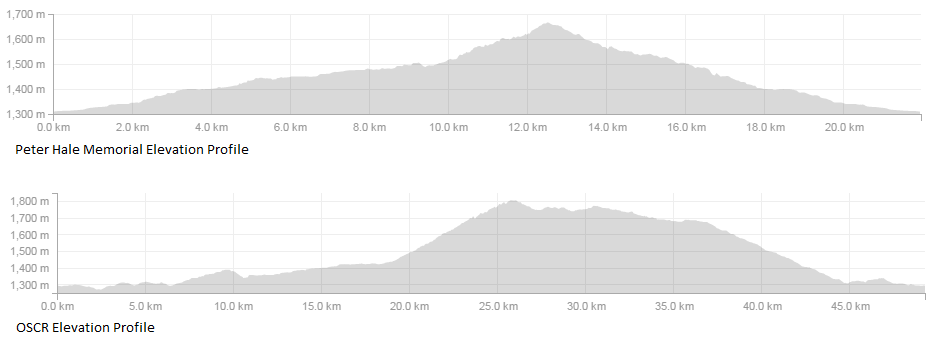
    Elevation profiles for Seeley Lake's signature nordic ski races, the Peter Hale Memorial and OSCR.
    Elevation profiles for Seeley Lake’s signature nordic ski races, the Peter Hale Memorial and OSCR.

    In 2012, Mike and Cathy Kahnle opened Seeley’s first bike-and-ski shop, Rocky Mountain Adventure Gear. Describing how he came to a decision to start the business, Mike said, “ROCKS was happening … Peter Hale contacted me prior to putting this business together and just filled my ear… It was pretty evident his love for skiing was overwhelming.

    “Peter basically talked me into running Madshus skis in a shop that didn’t exist,” he continued. “You couldn’t have a conversation with him without feeling better about yourself and life in general.”

    A passionate endurance athlete, Kahnle was also attracted to Seeley by its reputation for challenging endurance events like the Over Seeley’s Creeks and Ridges (OSCR, pronounced “Oscar”) 50 k ski race.

    Describing the race, Kahnle said, “No matter what level athlete you are, you are going to have the opportunity to push yourself to find the limits of what you’ve got.” Referring to the nearly 800 meters of elevation gain in OSCR, he added, “If you want an easy race, go somewhere flat because we are not going to have it for you here.”

    Carey, OSCR race director since 1991, agreed: “OSCR [founded in 1981] is a damn-tough race. It always has been, and we are proud of it … really it’s an adventure more than a race.”
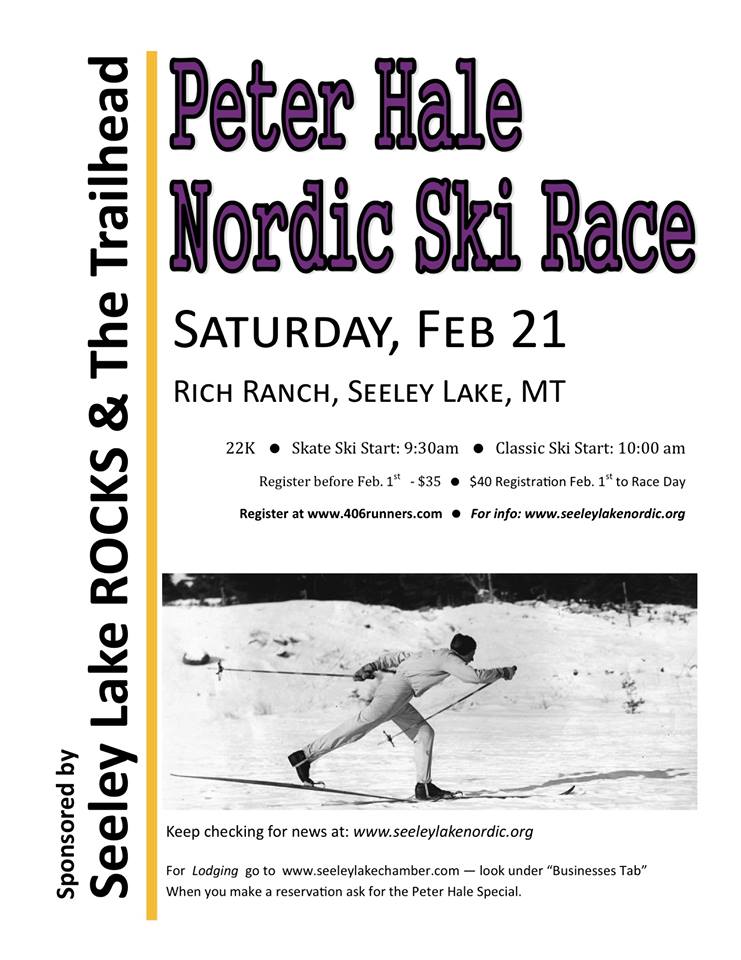
    Peter Hale 2015 Race Poster
    The second Peter Hale Nordic Ski Race will be held Saturday, Feb. 21, in Seeley Lake, Mont.

    ROCKS will hold the Second Annual Peter Hale Memorial 22 k Ski Race on February 21, 2015.  With an elevation gain of nearly 400 meters, the race is not easy.  In honor of Hale’s love of classic skiing, both classic and freestyle races are offered.  Inaugural race feedback (in spite of frigid temperatures) was positive with about half of the participants choosing the classic event.  Pratt anticipates that the race entry will need to be capped after this year’s event due to capacity limitation of the venue.

    With momentum building in Seeley Lake, the ROCKS vision for a national and international caliber ski venue is moving forward.  “The focus is on the new course right now because it has to be,” Pratt said.

    While not everyone in Seeley Lake is optimistic about the outcome of the ROCKS effort, Pratt stated, “If we did have a venue that brought in a week’s worth of high-end racers, it would mean us [in Seeley Lake] having a larger number of people who would have a larger vision about what is possible.”

  • Push for Homologation at Williams’ Prospect Mountain

    Push for Homologation at Williams’ Prospect Mountain

    Every two years, the Williams College nordic team hosts its Winter Carnival 20 miles north of Williamstown, Mass., at Prospect Mountain in Woodford, Vt. By 2016, it could have a five-kilometer ski loop up to International Ski Federation (FIS) standards.

    A scene from the Williams' College Winter Carnival at Prospect Mountain in Vermont. (Photo: Jason Lemieux)
    A scene from the Williams’ College Winter Carnival at Prospect Mountain in Woodford, Vt. (Photo: Jason Lemieux)

    “It started with my coach, Bud Fisher,” said Williams senior Will Wicherski. “He’s been at Williams forever.”

    Williams’ associate director of athletics, Fisher suggested that Wicherski study Prospect’s trail system to determine whether a homologated trail would be feasible.

    “Within the EISA [Eastern Intercollegiate Ski Association], there’s more and more of a move to get all our races on homologated courses,” Fisher said. “We’ve been thinking about it for some time, and we’re taking a probably a little bit more conservative, slow-paced approach to it.”

    Wicherski characterized some of the EISA race loops as “really uneven,” pointing to Dartmouth’s Skiway at Oak Hill as an example.

    “The climb is way too big and not that wide,” he said. “Our course at Prospect is kind of unfair. It’s old-school, not wide, and there isn’t a lot of climb. We can’t really have mass start races there.”

    Homologating race trails evens the playing field, he explained. “Among the coaches, there’s more of a desire to hold races at homologated race sites.  They know what they’re getting.  There are more schools that want to host carnivals.”

    Some New England schools already hold their carnivals on homologated trails, including the University of New Hampshire (which hosts in Jackson); the University of Vermont (at Trapp Family Lodge in Stowe), and Middlebury (at Rikert) and Colby (in Waterville, Maine).

    The course will combine existing trails with new sections.  Much of Prospect Mountain’s trail network is on U.S. Forest Service land, where the permitting process makes large-scale alterations difficult. As a result, Williams wants its race loop to include minimal new trails.

    Ultimately the college would like to create a course that will accommodate interval-start freestyle and classic races as well as team relays. Mass-start skate races require wider trails than interval starts, and Fisher said that while it wouldn’t be impossible to make them happen, it would be “very difficult.”

    Interval-start freestyle, classic, and relay events require trails 5 meters wide.  Even for interval-start homologation, some sections of trail — all on forest service land — would need to be widened.

    Wicherski described southern Vermont/northwestern Massachusetts as “being on the edge of consistent snow,” adding that if the homologation project works out, the college may consider snowmaking in the future.

    “Getting the course homologated is the first step towards snowmaking,” he said.

    According to Williams’ Nordic Head Coach Jason Lemieux, snowmaking is a “long term goal/dream … it’s a battle we’ll wait to fight until the completion of the homologation project,” he wrote in an email.

    Prospect Mountain’s ski roots trace back to 1939, when it started as an alpine-ski area with a rope tow. At 2,250 feet above sea level, its base elevation is the highest of any ski area in Vermont. In the 1970s, Prospect’s owners cut cross-country ski trails to enhance their business, and in 1992, Steve Whitham and Andrea Amodeo purchased the area after its previous owner abandoned it. Instead of reopening the lifts, they focused on cross-country skiing.

    At 2,250 feet above sea level, its base elevation is the highest of any ski area in Vermont.

    Getting Up is Half the Battle

    One of the biggest challenges was designing an appropriate downhill from the main climb. Running under the old lift line, the A-climb diagonally crosses the alpine hill, ending up on a trail called Shay’s.

    “We know where the A-climb is, but we don’t have a way to get down off it,” Fisher said.

    This summer, they plan to build the descent. Williams will test it this coming winter, after which they plan to finish work on the trail.

    The other challenge exists at the opposite end of the course. Prospect’s trail system is bisected by a forest-service road that sees heavy snowmobile traffic during the winter. During Williams’ last Winter Carnival, course workers had to stop snowmobiles 17 times during the races. “It’s a dangerous situation,” Fisher said.

    To avoid the road, Williams would need to construct a short connector trail on forest-service land.  They’ve applied to the U.S. Forest Service (USFS) both for this and to widen trail sections where necessary. The carnival trail falls into the forest service’s small-projects category, which requires less time, ecological compliance and money than a large-scale endeavor.

    Pending USFS approval, construction will start with trail work this summer.

    We haven’t actually gotten an FIS [inspector] in yet,” Fisher said. “We wanted to get all the homologation parameters met before we do that. We launched into the project and came up with a number of ideas to us where show we get an A-climb and a B-climb.”

    Lemieux estimated the project’s cost to be “easily more than $15,000.”

    Approval will give Williams a 10-year permit. If the downhill from A-climb works, they’ll continue work on the land the following summer. At that point, they would bring in a course inspector from the FIS for any tweaks.

  • FIS Loosens A-Climb Homologation Standard, Clarifies Altitude Limit

    FIS Loosens A-Climb Homologation Standard, Clarifies Altitude Limit


    Eliska Hajkova (CU) climbing in West Yellowstone at the beginning of last season.

    The newest edition of the FIS Homologation Manual was published this month and two changes are significant for North American venues. Major A-climbs now require five fewer meters of elevation gain, and courses that reach above 1800 m have been clarified as eligible for certification (and always have been) at the Continental Cup level and below.

    According to John Aalberg, a FIS homologation coordinator for North America, the elevation clarification and A-climb reduction were both written with North American venues specifically in mind.

    In the past, the language in the manual stated that at the Olympics, World Championships, World Juniors and World Cups, “the highest point of a cross country course should not exceed 1800 m,” or about 5900 feet (311.2.7). Whether this rule also applied to the Continental Cups or FIS races the manual didn’t specify, but Aalberg said it was implied that it did not — that courses above 1800 m could always homologate for the lower-level races.

    When the rules only applied to Europe the omission wasn’t an issue, since many competition courses in Europe are easily below 1800 m. When FIS first extended homologation requirements to all Continental Cup and FIS competitions, it granted temporary exception to the U.S. and Canada to allow its venues time to meet the requirements. The exception ended in the 2011-2012 season, and for the first time SuperTours, NorAms or any FIS-sanctioned race in North American needed homologation certification, where the number of high-altitude cross-country venues is relatively greater.

    “This is clarified in the new homologation manual since it was not mentioned anywhere in the past,” Aalberg wrote in an email. “The manual only talked about World Cup courses. This is mostly an issue in North America, since most all competition courses in Europe are below 1800 m. Now that FIS is stricter in requiring homologated courses for COC (and other FIS points) competitions, this needed to be clarified.”

    Bob Gross is one of a handful of homologation inspectors in the U.S. and was recently part of the working group for the homologation manual at the annual FIS Congress in South Korea. He said the old wording of the 1800-meter rule has been misinterpreted as applying to all FIS races.

    “We could always homologate courses above 1800 meters,” Gross said. “Interestingly enough, a lot of people didn’t realize that. So common knowledge has been that 1800 meters is the max, but it has not been.”

    Whether the clarification is news to any high-altitude North American venues, and if it will spur them to seek homologation certification, remains to be seen.

    The other change to the manual, in which A-climbs need only gain 25 meters in height instead of 30, was also made to support North American courses.

    “We have seen that a few venues (both in North America and other places) meet all other requirements, but are a few meters short of the 30 m height difference in one or more of the uphills,” Aalberg said. “An uphill with over 25 m height difference is still a good climb, and FIS would like to support such venues and courses. This was important for some U.S. venues.”

    Five meters translates to about 16 feet, not an insignificant difference for venues needing to move dirt around to meet the criteria. Aalberg emphasized that A-climbs, which are the largest uphills of a homologated course and must be between a 9 and 18% grade, still meet the intended purpose of homologation to design good competition courses.

    “A good competition course must contain certain uphills such that the uphill technique and the aerobic capacity of a skier is being ‘tested,’” Aalberg said, and courses with 25 meter climbs that meet all other requirements still do that.

  • U.S., Canada Face Homologation Crunch as FIS Deadline Looms (updated)

    Holding elite level events, whether World Cup races, National Championships or just FIS points competitions, pose numerous challenges for organizers and National Governing Bodies in the US and Canada. Over the course of the summer FasterSkier will examine the various issues at hand. Today we start with a piece on homologation, with future topics to include snowmaking and prize money, among others.

    Until this year, the U.S. and Canada have had reprieve from the International Ski Federation (FIS) rule requiring that scored races be held on homologated courses. For the 2011-12 season, that will change.

    “Basically, the races that are coming up, beginning this calendar year, have to have a certified course in order to be scored,” said Al Serrano, a homologation inspector the Eastern region of the United States.

    With just eight homologated ski areas in the U.S. and four in Canada as of May 2011, both countries are facing challenges with getting a variety of race series, including SuperTours and NorAms, scored with FIS points.

    “I don’t anticipate one hundred percent compliance for the upcoming season,” said Dave Dyer, Director of Events Management for Cross Country Canada.

    What is Homologation?

    Homologation is a certification process run by FIS. Just as FIS points are theoretically a universal ranking system for skiers around the world who have never competed against one another, homologation attempts to ensure that racers are competing on courses with similar terrain and technical features no matter where they travel. Homologation also addresses safety issues – although not always successfully, as Petra Majdic showed at the Vancouver Olympics.

    “The goal with this FIS homologation work is to create a good group of sites that have courses where FIS points can be awarded in a fair way (and where US/CAN athletes can be tested on courses alike what is used on the WC circuit,” FIS regional coordinator John Aalberg wrote in an e-mail. “I often compare this to golf – you can not play PGA tournaments (‘Continental Cup/Championships’) on a 3-par course, and a person’s golf handicap (‘FIS points’) can not be awarded solely from playing on easy 3-par courses.”

    Although FIS requires that all races scored for FIS points take place on homologated courses, the standards are different for World Cup competitions and Continental Cup races, making it more manageable for smaller ski areas to tackle the process.

    There are also different requirements for different race formats: courses used for mass start races must be wider than those for interval start races, and classic sprint courses are required to have particularly steep uphills to discourage racers from using skate skis and double poling the entire race.

    While the main concerns are generally terrain features – there are a required number of climbs within a range of height differentials and grades for every possible course length – the total climbing over a course is also important, as is stadium setup and other infrastructure.

    In some cases, homologation of existing courses is easy. In others, significant trailwork is required and hiring a trail designer is a big help. For a better understanding of the homologation process, read FasterSkier’s into to the concept, published last summer, and the step-by-step guide from last fall.

    Why is Homologation So Tough for North America?

    When the FIS rules about homologation went into effect, the U.S. and Canada were given extra time to satisfy the certification requirement because there were very few venues which had been through the process.

    Why were the countries lagging behind Europe in the first place? Both Dyer and Serrano pointed to one thing: a lack of homologation inspectors.

    “There’s been a lot lost in translation both with homologation inspectors and technical delegates in terms of getting them fully certified up to the FIS level,” Serrano said.

    “FIS has all of these systems and protocols now… that say okay, this is how we’re going to certify people. The problem with the process was that it’s a mentorship sort of thing. We had one homologation inspector in the United States, John Aalberg. He’s been doing the Olympic Games since the year 2000 and homologation inspections on the side, and not able to mentor anybody, not able to sign off on anybody as a new certifier.

    “So we have a system where you’re certified by a peer, but we don’t have any grandfathered certified people.”

    While the number of inspectors has increased over the last few years, numbers are still an issue. To make matters worse, Aalberg recently took at job at Holmenkollen in Oslo, Norway, and is no longer even living on the continent.

    “I live in Norway right now, but am still coordinating some of the homologation work on behalf of FIS,” Aalberg wrote in an e-mail. “Both Canada and US have their own homologation ‘leads’ and groups, and I am mostly involved with questions they have or in case of World Cup courses (Sovereign, Canmore, Callaghan the last few years).”

    While the number of inspectors was the root of the homologation crush, other issues remain – like money.

    “If you’re talking about just taking an existing course and not spending any money to do earthwork or upgrades or anything like that… and you just want to use the course that you’ve always been using, then it seems kind of expensive,” Serrano explained.

    “The floor level cost, the minimum for just one course, is there’s a $200 fee from USSA, and then 100 Swiss Franks so basically $100 from FIS, and then whatever inspector costs, and that’s going to be a minimum of a day, so that’s probably $300 to $500. So even at the bottom level, that’s probably about $800.”

    There is also a per-course fee for the certification process. And that’s not all.

    “Besides the trail, you have to have infrastructure, like the stadium, grooming staff, and buildings,” said Matt Pauli, a member of USSA’s Rules and Technical Subcommittee.

    If trailbuilding and excavation is required, along with the help of a trail design contractor, things get exponentially more expensive. From Serrano’s experience, the costs associated with making a new race course make sense to his client organizations, but the hundreds of dollars in expenses required simply to continue racing on a traditional course are more difficult to justify.

    “For instance, Rumford’s whole deal was four courses… so it scales up nicely as you add more courses,” Serrano said. “But in the grand scheme of things that was $30,000 worth of stadium work and $15,000 worth of trailwork. So [homologation] is actually a pretty small expense when you’re talking about building trails and upgrading trails.”

    US: On The Right (Certified) Track

    This spring at the USSA Congress, a homologation subcommittee was formed and regional coordinators were assigned. USSA hopes to be able to encourage and supervise more homologation projects around the country and allow for the best FIS schedule possible.

    “If a project comes to USSA, we see it, and we decide how to best assign an inspector to that particular project,” Serrano said. He is the regional coordinator for the East as well as being a homologation inspector and working on a consulting basis in other regions.

    On top of the eight venues which already have certificated, Serrano said that about four ski areas in his region were far enough along in the process to invite an inspector for the initial site visit.

    But even though he has been contacted and the ski areas have identified what they need to do in order to have a certificate in hand, Serrano said homologation wasn’t a sure thing for the upcoming season.

    “I know at least one place that just doesn’t have any money,” he explained.

    However, according to Pauli it is likely that a few more certificates will be in the hands of U.S. ski areas by the time winter rolls around. Pauli is also a homologation inspector himself and coordinates homologation efforts in Alaska and the Midwest, as well as acting as Chief of Race at numerous competitions including U.S. Nationals.

    He listed Birch Hill in Fairbanks, Bohart Ranch in Bozeman, and Battle Creek and Theodore Wirth Park in the Twin Cities as areas which should have certificates soon, with Kincaid Park in Anchorage and the Michigan Tech trails in Houghton rehomologating and adding new courses.

    Even with those additions, the SuperTour schedule will be affected.

    “I think there’s been some certain changes to the race schedule,” Pauli said. “For instance, in West Yellowstone, it’s really hard to get any additional terrain.”

    He noted that altitude was also an issue, with FIS setting a maximum elevation for any part of a race course at 1800 meters or just under 6000 feet. This rules out competition for FIS points at venues like Aspen, which hosts the popular Owl Creek Chase.

    “Owl Creek won’t be on the SuperTour [in the future] due to the lack of an ability to homologate,” Pauli said.

    The SuperTour might be the highest-profile race series in the U.S., but other calendars will be affected as well.

    “The one thing that is going to be really difficult is college racing, West and East,” Serrano said. “The Western colleges, they are going to be limited with elevation… if Colorado wants to race at Eldora it’s never going to happen. In the East it’s tough because they just have to go through the process.”

    While the Western schools struggle with the altitude limit, Eastern schools will face their own challenges if they want to hang on to FIS points. For instance, Dartmouth College’s Oak Hill, one of the classic carnival venues, has a terrain profile which will never pass the homologation test.

    Last year, including NCAA Championships, twelve weekends of college racing were scored for FIS points. Of those weekends, only eight took place at homologated venues, with some venues hosting races more than once.

    But although some SuperTour and college races will no longer be FIS competitions, the situation isn’t dire.

    “So far as I know, there hasn’t been any panic from USSA,” Serrano said.

    Pauli agreed that the U.S. was making good progress.

    “What we’re trying to do is get the best we can out of a trail system and meet those standards,” Pauli told FasterSkier. “We’re not trying to get any World Cup courses, just the Continental Cup courses, so it’s not as difficult.”

    Canada: No Money, More Problems

    In Canada, the story is somewhat different. With only four venues currently holding homologation certificates – and three of those being in Western Canada – the country is not on track to meet the FIS deadline.

    The majority of homologated courses in Canada are certified for World Cup competition. Sovereign Lakes, Canmore, and Whistler all have the highest level of certification, and a proposed city sprint in Quebec does not require homologation (FIS allows leeway for “popular events” such as major marathons as well as for city sprints).

    As a result, the country will be able to host World Cup races in two different provinces in 2012, but because little progress has been made recently with homologation at smaller venues, the domestic calendar is in jeopardy.

    Dyer noted that many NorAm races are hosted by nonprofit clubs which lack the capital necessary to homologate their venues.

    “Our structure is very much club-based… so not a lot of money is available,” he told FasterSkier.

    Nonetheless, Aalberg provided FasterSkier with a list of Canadian sites currently working on homologation, and there are quite a few. Five venues have started work: Mount Orford, Nakkertok, and Mont Sainte Anne in Quebec, and Sovereign Lakes and Rossland in British Columbia. In addition, Thunder Bay in Ontario and Whitehorse in the Yukon are listed as on track to receive certificates this fall, although they did not appear to have begun the process.

    While he admitted that the homologation requirement was a struggle for Canada, Dyer was quick to support the concept.

    “FIS is trying to ensure that races are safe,” Dyer said. “We would never substitute safety. They also want to ensure that they are quality courses. The philosophy is great, but the application of the philosophy is different in a nontraditional ski community. I hope that FIS is understanding and keeps letting us race for points.”

  • A (Long) First-Person Perspective on Homologation – It’s Easier and Harder than You Think!

    A (Long) First-Person Perspective on Homologation – It’s Easier and Harder than You Think!

    Back in June, Nat Herz ran a piece on homologation called “It’s Not as Boring as You Think.” Since then, I’ve gone through most of the process while working for the Craftsbury Outdoor Center. Nat was right. It’s not boring. However, the relative ease or difficulty of some parts of the process took me by surprise.

    Since Nat introduced the concept of homologation on a theoretical level, I thought I would provide a first-person perspective to show what homologation was really like on a practical level. You should read his article before diving into this one – I’m assuming the reader is familiar with homologation’s basic concepts.

    The trails we are homologating are used year-round for many different applications.

    Step One: Make a Map!

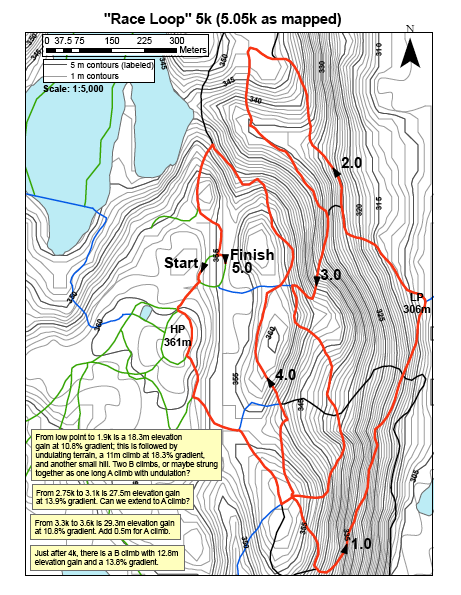
    The first thing you need to do is to make a high-quality map. You will eventually have to hand in a map at a 1:5000 meter scale with one-meter contour lines, so you might as well start there.

    For us, this was the easy part, because I was already working on making a new trail map for the Center. We had purchased a GPS unit and had received a grant of GIS software, so we had everything necessary to make a fairly accurate map.

    (Quick primer on acronyms: a Geographic Positioning System (GPS) unit takes data from satellites to tell you where you are at any particular moment, with varying levels of accuracy. A Geographic Information System (GIS) is basically a huge database of, well, geographic information. You can add GPS data into the GIS program as a layer, along with other data such as elevation maps, lot lines, streams and rivers, town boundaries, or pretty much anything else you can imagine.)

    If you have a decent GPS unit (or can borrow one), it is very easy to collect this portion of the data yourself.

    What comes next is a little harder. In order to get your GPS data, which shows the exact location of your trail system, into a GIS system, you have to post-process it. I used a program called DNRGarmin, which you can get online for free, to import my GPS data into GIS.

    Once your course is visible – and accurately projected – in your GIS program, you need to add the contour lines. This, too, is a little tricky. I used a digital elevation model (DEM) to get elevation data. A DEM is made from data gathered by a airplane, which flies over an area and shoots laser beams down at the ground.

    There are DEM’s for almost everywhere in the U.S., but depending on where you live, a DEM may be quite accurate or quite general. In Craftsbury, Vermont, there isn’t much reason for anyone to pay to make a super-accurate DEM, so some smaller terrain features didn’t appear on the model. But in other places, it really did show what was going on.

    In the end, I had a map.

    The map of Craftsbury's "Race Loop," which was produced during the homologation process.

    If you don’t have GIS capabilities, or can’t convince a local college student to do this for a class project, or someone who works at an organization with a GIS program to volunteer their time, you’re going to have to pay for it, which could be expensive.

    Step Two: Look at Your Course!

    Based on your map, you should be able to tell what types of climbs your course contains. The contour lines may not be 100 percent accurate, but if you know that an “A” climb needs at least 30 meters of height differential, and your biggest climb appears to only have 20, then you know that you probably have your work cut out for you.

    If you think that the contour lines are wrong, head out onto the trails with any surveying tool you can get your hands on, and try measuring the elevation change by hand. This won’t be entirely accurate either, but you’ll get a better understanding of the actual terrain on your course.

    Next, check the FIS Homologation Manual to see how many climbs of each type your course requires. You should also check the width requirements in the manual: If you want to use your course for mass start skate races, you’re looking at nine meters of width on the uphills, which is tough to achieve. But if you only want to use the course for interval start races, you only need four meters of width on the uphills.

    For both terrain and width, not everything needs to be perfect at this point. While the manual spells out some very specific requirements, there is flexibility in the process. If your course isn’t wide enough, but you could easily make it so, you don’t have to do it yet – don’t do the work until you know you have to.

    We worked with FIS Homologation Inspector Al Serrano, who reminded us repeatedly that the most important aspect of a homologated race course is that it be fair. If your second “A” climb isn’t quite big enough, there may be some reason that the inspector will certify it anyway – and he or she may also have some solution to the problem that you haven’t thought of yet. If you are close, but not perfect, don’t despair – all is not necessarily lost! (Although it might be, too.)

    So: Do you think that this course will meet the requirements, or not?

    Step Three: Just Like Starting Over…

    If your course doesn’t seem like it’s going to fit, you have two options. One is to do some major trailwork to add to your climbs. The other is to come up with a new course.

    While it might feel like you’re starting over, this isn’t exactly true. You have a much better understanding of your trails and terrain than you did the first time, and you can use the suitable parts of your original course in your next one.

    When I was going through this process, I mapped out at least ten different courses of various lengths before we decided which ones were our priorities.

    So, repeat steps one and two until you have something you’re excited about.

    Step Four: Tackle the FIS “Eibl” Software

    The last thing you need to do before sending all your data to an International Ski Association (FIS) Homologation Inspector is to put it through its paces with the FIS software. You can get the software for free; it’s referred to as “Eibl” after the guy who wrote it, but it’s also called “Homologation 2.0.”

    This name makes me wonder what Homologation 1.0 was like, because if it was any worse than 2.0…yikes. There isn’t a help file, so you’re pretty much on your own for solving any problems and difficulties you run into. When you open up the software, try typing in a few arbitrary data points – make a course with, say, five points – and try clicking through all the buttons at the top to figure out what they do.

    The premise of the software is that for each point you designate along the course, there are three pieces of data: the distance from the last point, the elevation, and the grade. If you type in any two of these three pieces of data, it will calculate the third.

    So, to import your course into Homologation 2.0, you have to select locations on your trail where you think the gradient is changing – from a flat to an uphill, or a gradual uphill to a steep uphill, etc. – and measure the distance and the elevation. The gradients will be automatically calculated for you. Then, you can produce a course profile with the climbs marked, and a data sheet that shows the percentage of the course made up of “A” climbs, “B” climbs, and “C” climbs, as well as the maximum climb and total climb.

    The preliminary course profile produced for the "Race Loop" 5k.

    One piece of advice I’ll give you right away is to load the correct language file. Another is that while “B” climbs are automatically defined, you have to set the size of the “A” climbs, because they vary over different course distances.

    You can also manually define a specific climb – for instance, if you have a long uphill with a bit of undulating terrain in the middle, it might still be an “A” climb, but the program won’t pick that up.

    The preliminary course data sheet.

    Step 5: Go for a Walk

    At this point, you can send your map and the homologation file to a FIS Homologation Inspector for review. If everything seems to be in place, the inspector will want to come see the course in person. Get ready for a lot of walking – and you’ll need to pay the inspector, too.

    As I mentioned before, Al Serrano was the inspector assigned to our case. There are several inspectors you could end up working with, and they all report to a regional higher-up, in this case John Aalberg, who is responsible for all FIS and Continental Cup courses in the United States and Canada. Serrano said he was working on three other projects right now.

    Besides just walking the courses we had picked out, Serrano wanted to see what other terrain we had available, so we ended up walking most of our trail system. We also spent a lot of time discussing stadium layout. While Serrrano said that the two courses we had submitted looked fine, all of us wanted to make sure that we homologated the best possible courses we could – which meant a lot of looking, walking, and thinking.

    At the end of the meeting, you will know whether your course(s) can be homologated or not. And you’ll likely have a list of things you need to fix up: new cutoffs for your trail, widening, or other improvements.

    You’ll also have more data, because the inspector will bring a wheel to measure distance and an inclinometer to measure the gradients of your climbs. You might have thought you were done working with data, but this is absolutely not the case.

    Your stadium layout is one thing a homologation inspector will want to examine.

    Step 6: Make the Improvements

    This is pretty self explanatory. You need to actually make the trail improvements that you said you would. In Craftsbury, this meant renting an excavator and sending the boys out with chainsaws. Depending on what your course looks like, this could be pretty expensive – or it could be a non-issue.

    Step 7: Eibl, again

    If you thought that working with Homologation 2.0 was a pain in the butt the first time around, you had no idea what you were in for.

    You will have different points to work with this time – the ones chosen by the homologation inspector. Rather than typing in the distance and elevation, you will be typing in the distance and gradient. If you add the elevation of your starting point, the elevations will be automatically calculated for the other points.

    The hitch here is that if your gradients aren’t perfectly accurate, which they probably aren’t, your elevations won’t be perfectly accurate either. This is compounded by the fact that the program only calculates elevation to the nearest meter – which sounds fine in theory, but if you are up to half a meter off at each data point, the inaccuracies will compound. By the time you get to the end of the course, your finishing point may be several meters (or more) above or below the start, even though they are in the same stadium!

    To deal with this, I recreated the program in Microsoft Excel so that I could keep all the decimal places. This made things a little better, but not much – the main problem was that the gradients weren’t perfectly accurate. In the end, you will  have to manually adjust the gradients until everything comes out even. To make sure you’re not losing anything in the lurch, use some points from the DEM that you think are really accurate as a reference. Then plug everything back into Eibl and try to match them up as well as you can.

    I hesitate to say this, but at this point in the process, I got fairly disillusioned. It was supposed to be the time when everything became more accurate, but that clearly wasn’t the case. It took a lot of time, and I ended up fudging some of the data anyway. I was disappointed.

    Step 8: Final Inspection

    We haven’t gotten to this step yet, but in theory, once you’ve made your improvements and sent the new homologation files, the inspector will check that you’ve done everything you said you would, and then he’ll submit the course to the Aalberg, along with some of his comments and descriptions. If Aalberg thinks it’s a good course, then you’re all set! All you have to do is pay 100 Swiss Francs and you’ll have your certificate in two or so months.

    Bill Koch League racers enjoying the same Lemon's Haunt hill that elite racers will ski on once the course is homologated.

    Conclusion

    As I mentioned in the title, some parts of the homologation process are easier than expected, and some are harder. In the end, I spent many, many hours on this project. If you outsource the work, it will be less difficult but more expensive.

    If you have any questions about the specifics of the process, feel free to contact me or ask them in the comments. Or, find out who the inspector is for your region; they would be happy to answer questions if you are considering a homologation project of your own.

    The last thought that I’ll leave you with is that after Nat’s article ran, there was a lot of negativity about the concept of homologation. People complained that courses would turn into superhighways lacking in character. This might be true in some cases, but it’s possible to avoid, too. We are homologating our “Race Loop,” which is a classic course, for interval-start races only. There will be some minor changes in spots to make things more fair, but almost everything about the course, including its character, will remain the same.

  • A Homologation How-To Guide (It’s Not as Boring as You Think!)

    A Homologation How-To Guide (It’s Not as Boring as You Think!)

    Kincaid Park in Anchorage recently received its homologation certificates. Photo, Rob Whitney

    What do a GPS, a retired airline pilot, and a Norwegian guru named Hermod Bjorkestol have in common?

    All are key components of a plan to bring many of the U.S.’s biggest venues in line with International Ski Federation (FIS) standards.

    At its annual meetings in Turkey in early June, FIS made it clear to American officials that a longstanding exception would be revoked: starting in the winter of 2011-2012, all races held in the U.S. that are sanctioned and scored by the Federation will have to take place on certified trails—“homologated courses,” in official parlance.

    Since all U.S. SuperTour and national championship events are scored using FIS points, any venue that plans to host a high-caliber race next winter will have to have its courses inspected and certified. And even if a ski area wants to hold scored races this year, FIS is asking that they have a plan to have their trails homologated by 2011-2012, according to U.S. Ski and Snowboard Association (USSA) Nordic Director John Farra.

    Only six ski areas in the country currently have FIS certification, few of which are traditional SuperTour venues, and the U.S. Ski and Snowboard Association (USSA) is spearheading a new effort to bring more trail networks up to speed. What does that entail, exactly? FasterSkier spoke with a handful of experts to find out what this homologation thing is all about. And no, it doesn’t have anything to do with milk.

    What the Heck is Homologation?

    If you really want to know every last detail about the homologation process, you can download and read the fifth edition of the FIS Cross-Country Homologation Manual, a 69-page document that contains terms like “partial height differential,” specific guidelines for creating “undulating terrain,” and an alphabet stew of abbreviations and acronyms.

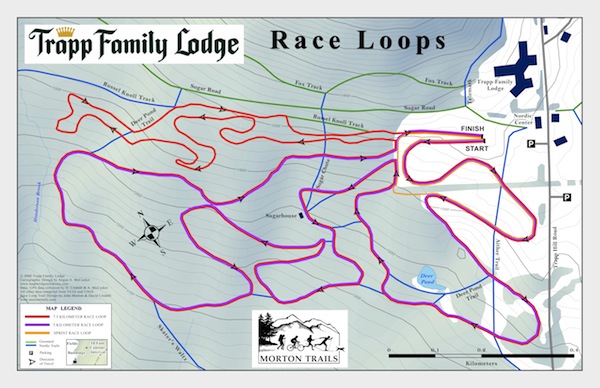
    The Trapp Family Lodge in Stowe, Vermont is another venue that was recently homologated.

    For the rest of the country, there’s Bob Gross, a retired airline pilot and avid marathon skier who represents USSA on the FIS subcommittee for rules and controls.

    Gross got involved in the technical side of skiing in the lead-up to the 2002 Olympics in Salt Lake City, and he now is qualified as a homologation inspector—an official responsible for ensuring that courses meet FIS’s specifications. Along with Farra, Gross will coordinate the homologations of the nation’s major courses.

    In a phone conversation, Gross explained the rationale behind the rules requiring homologation. Because all FIS-sanctioned races award ranking points to finishers—which in turn can determine seeding and start positions in big international races—it’s important for the Federation to maintain consistent standards for courses across different nations.

    Then, there are also more basic logistical issues, like maintaining adequate trail width so that skiers aren’t stepping all over each other, or ensuring that the stadium is well laid-out. Safety is a concern, too—downhills can’t send skiers plunging into trees or ditches—and even details like spectator access are also considered.

    The process sounds complicated, but Gross says it’s not—it boils down to ensuring that courses are “adequate to run, safe and fair.”

    “It’s trying to get the courses so that they are standard…throughout the world. So that a skier who skis on a course here will have a course which is similar to [one] that’s being skied in New Zealand or Japan or Europe,” Gross said. “That is the basic philosophy.”

    Getting Homologated

    According to Gross, the homologation process will unfold differently depending on the status of each venue. If you’re starting from scratch in the woods in your backyard, homologation will obviously be a more arduous process than if you run an established ski area with pre-existing, elite-level trails.

    Regardless of the amount of work that needs to be done at a given venue, the finished product must meet specific FIS standards outlined in the homologation manual—the most important of which concern the course layout.

    If there are trails at a venue that are already close to meeting FIS’s requirements, the certification process can begin promptly. Whenever possible, course designers and venue managers will homologate existing trails rather than constructing new ones, since work like logging and excavating trails can be pricey. At Kincaid Park in Anchorage, which recently had its trails re-homologated, workers got especially creative: they used leftover fill from nearby roadwork to make sure that the steepness of one of their uphills met FIS standards.

    But if a ski area does not have a suitable course to start with, they may have to bring in a trail designer to help lay one out.

    According to John Morton, who along with David Lindahl operates the trail design firm Morton Trails, the backbone of a homologated course is its climbs.

    “The climbs are the very first thing that we look for,” he said. “Then it’s kind of piecing all these other pieces together.”

    FIS’s demands for the uphills are specific. A homologated 5 k, Morton said, must have two major, or “A” climbs, each 30 meters from the low point to the high point—and technically, neither should come in the first or last kilometer of the course. The gradient must average around six percent.

    The profile for the Trapp Family Lodge homologated 5 k course. The yellow bars are the major or "A" climbs, and the orange bars are the smaller, "B" climbs. Graphic courtesy of Morton Trails.

    Morton and Lindahl use a variety of tools to help them measure the uphills and other elements, including highly-sensitive GPS units, computer software like Google Earth, and an instrument called a clinometer, which is used to measure slope.

    Once the major climbs are locked in, there are other aspects of the course design that must be incorporated, like several smaller “B” uphills, downhills, and stadium layout.

    When the courses are close to meeting FIS standards, venue managers are then responsible for producing a sheaf of data and maps on all of the trails’ key characteristics, like distance, width, and elevation changes. How extensive? Morton and Lindahl have been known to create as many as 600 data points, while at Kincaid Park in Anchorage, their information filled a four-inch binder.

    The data is submitted to one of the few FIS homologation inspectors in the U.S.—Gross is one, as are Lindahl and Morton—who enter it into a special computer program that summarizes the course.

    Then, the inspector will make at least one in-person visit (paid for by the venue), to walk the course. This allows them to verify all the data, get a feel for the trails, and make judgments about key characteristics.

    “There’s a lot of art involved in homologating a course.” Gross said. “If you look at a hill, for instance, there could be a break somewhere…where it leveled off or even dropped a little distance. Depending on how the homologation inspector feels that would ski, it could be two B-hills or one A-hill. That’s where the art enters in, and that’s why you have to go out and look at the course, so that you can make a judgment.”

    If the inspector deems that more work needs to be done before a course meets FIS standards, they may even have to pay another visit before the process can proceed further.

    However, there is a decent amount of flexibility in the rules, Gross said, especially for trails that are only being certified for domestic events. (World Cup courses must meet more stringent standards.) For example, if one of a course’s two A climbs isn’t quite tall enough, designers could pump up the other one to make up the difference. And according to Farra, city sprints and uphill climbs are exempt from FIS rules altogether.

    When the inspector deems that the courses are up to snuff, the data is forwarded to FIS, where it eventually makes its way before Hermod Bjorkestol. Bjorkestol, the famed course designer and main editor of the homologation manual, has the final say on every application.

    Courses are homologated at specific distances, and for specific race formats—trails certified for skate sprints have to be much wider than those that are used for individual-start classic races, for example. USSA is requesting that SuperTour venues homologate a sprint course, a 2.5 k loop, and a 5 k loop.

    All told, the process could move as quickly as a month, if courses are already close to meeting FIS’s requirements. The more work that needs to be done to bring the trails in line, the longer it will take—especially if ski areas run into problems with procedural issues, like permits for logging.

    In Anchorage, Kincaid Park made its upgrades slowly, starting with trail work 2006 and 2007, and didn’t finish collecting its data until 2008, according to Matt Pauli, who worked on the homologation process there. The actual FIS certification was issued in 2009.

    The Big Picture

    While the technical details of homologation would make even the most avid ski fan’s eyes glaze over, that’s not the point, according to Morton and Lindahl. Instead, they said, FIS’s goals are simple: to make sure that courses ski well.

    “The whole point of homologation is to embody some of these things that go into…a good course,” Morton said. “Anybody who has done design knows, ‘now it’s time for a good climb.’”

    One issue that arises is whether a push towards homologation might cost trails their character, by turning them all into superhighways—and Gross acknowledged that “something, I guess, is going to get lost.”

    Regardless, Gross said, the U.S. has little choice, due to new race formats like mass starts and sprinting, which have been instituted by FIS to drive up spectator interest.

    Skiers during a mass start race at Kincaid Park. Photo, James Brady.

    “You can’t run a mass start on a narrow track,” he said. “Is that a good thing? That’s a value judgment I’m not making.”

    Another issue is the financial cost. Gross wouldn’t estimate the price of a typical homologation effort, given the wide range of work that might be necessary. But he did say that the more a venue or club can rely on its members and volunteers for help, equipment, and expertise, the lower the price tag would be.

    Since World Cup and other high-level races are always held on homologated courses, Gross went on, bringing America’s trails up to FIS standards will only make the country’s athletes more competitive. Farra, the USSA nordic director, echoed that argument in a press release announcing the homologation effort, pointing out that while Norway has over 40 certified venues, the U.S. has just six.

    Dylan Watts, an Alaska Pacific University coach who wrote an article about the homologation process for the 2010 U.S. Nationals publication, also agreed.

    “If we intend to compete with the world in FIS events such as the Olympics, World Cup, U-23 [World Championships]…we need to be racing domestically on courses that are also that style,” Watts wrote in an e-mail. “You get good at what you do.  If you ski on a golf course, you get good at golf course skiing.  If you ski on a logging road at 8,000 feet, you get good at that.  If you ski on FIS homologated-style trails, you get good at that. That is why the homologation effort is important.”