From the FasterSkier archive — posts syndicated from athletes’ and coaches’ own blogs between 2004 and 2012, kept online as published. Current coverage is at fasterskier.com.

Tag: Houghton Michigan

  • Swirbul Sweeps Houghton–Karsrud Takes Men’s Sprint

    Swirbul Sweeps Houghton–Karsrud Takes Men’s Sprint

    HOUGHTON, MICHIGAN: Welcome to FasterSkier’s on-location coverage of the United States National Cross-Country Ski Championships from Houghton, Michigan.

    This week, Houghton hosts the U.S. National Cross-Country Championships on the Michigan Technological University’s trails system. Today’s event was the freestyle sprint. Even though the race was held under the organizing umbrella of the national championships, today’s event was not a national championship race; as it is part of the US. SuperTour. U.S. Ski and Snowboard has decided to hold the freestyle sprint national championships at the spring finals in Craftsbury, Vermont, March 24th.

    Many of the entrants who competed throughout the week were also at the top of the ranking lists for the U.S. SuperTour; so, even though the national title was not in the mix, a lot was on the line. Among those at top of the SuperTour leaderboard for the men were John Steel Hagenbuch, Zanden McMullen, Andreas Kirkeng, and David Norris; all of whom had already podiumed in Houghton.
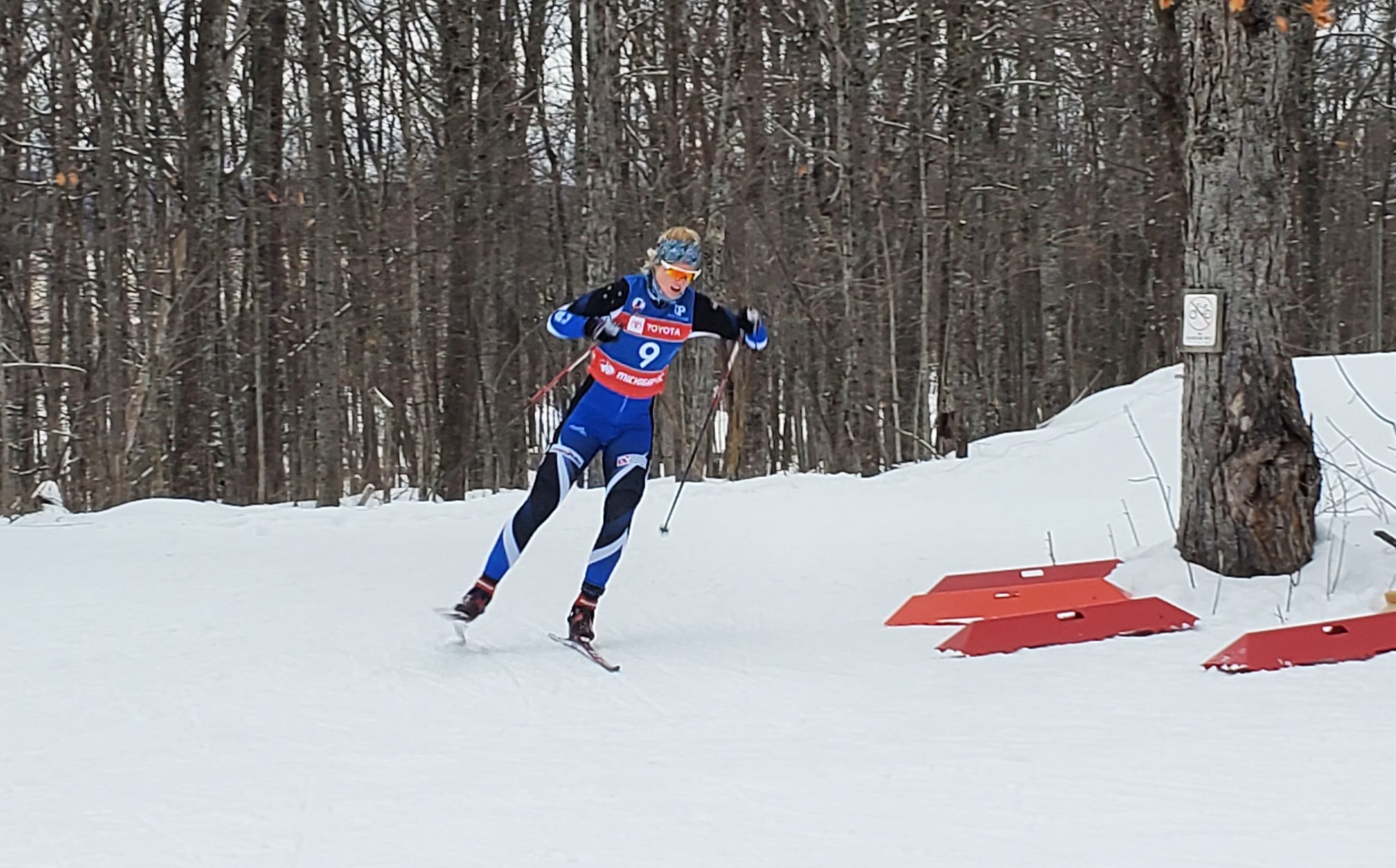
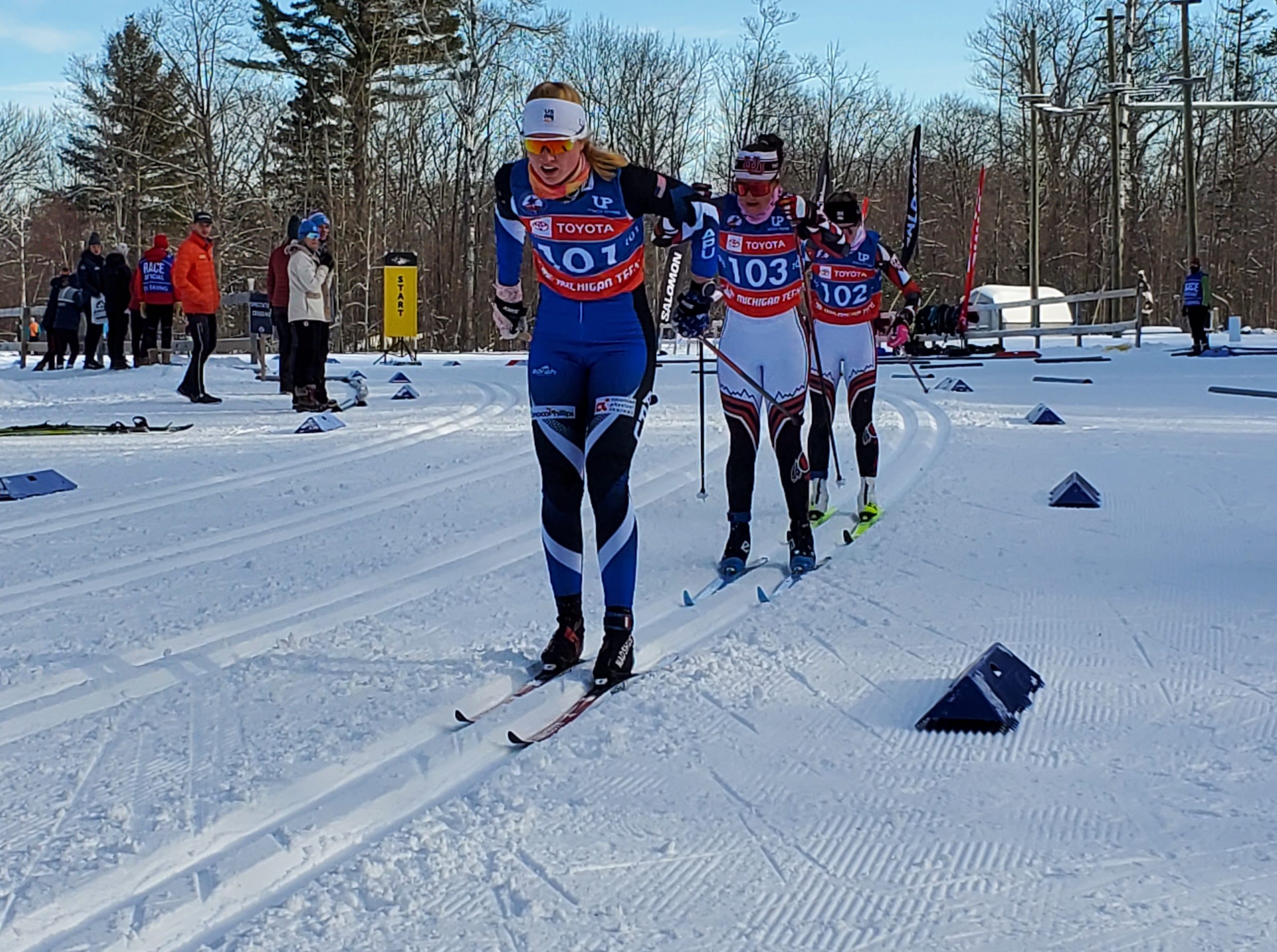
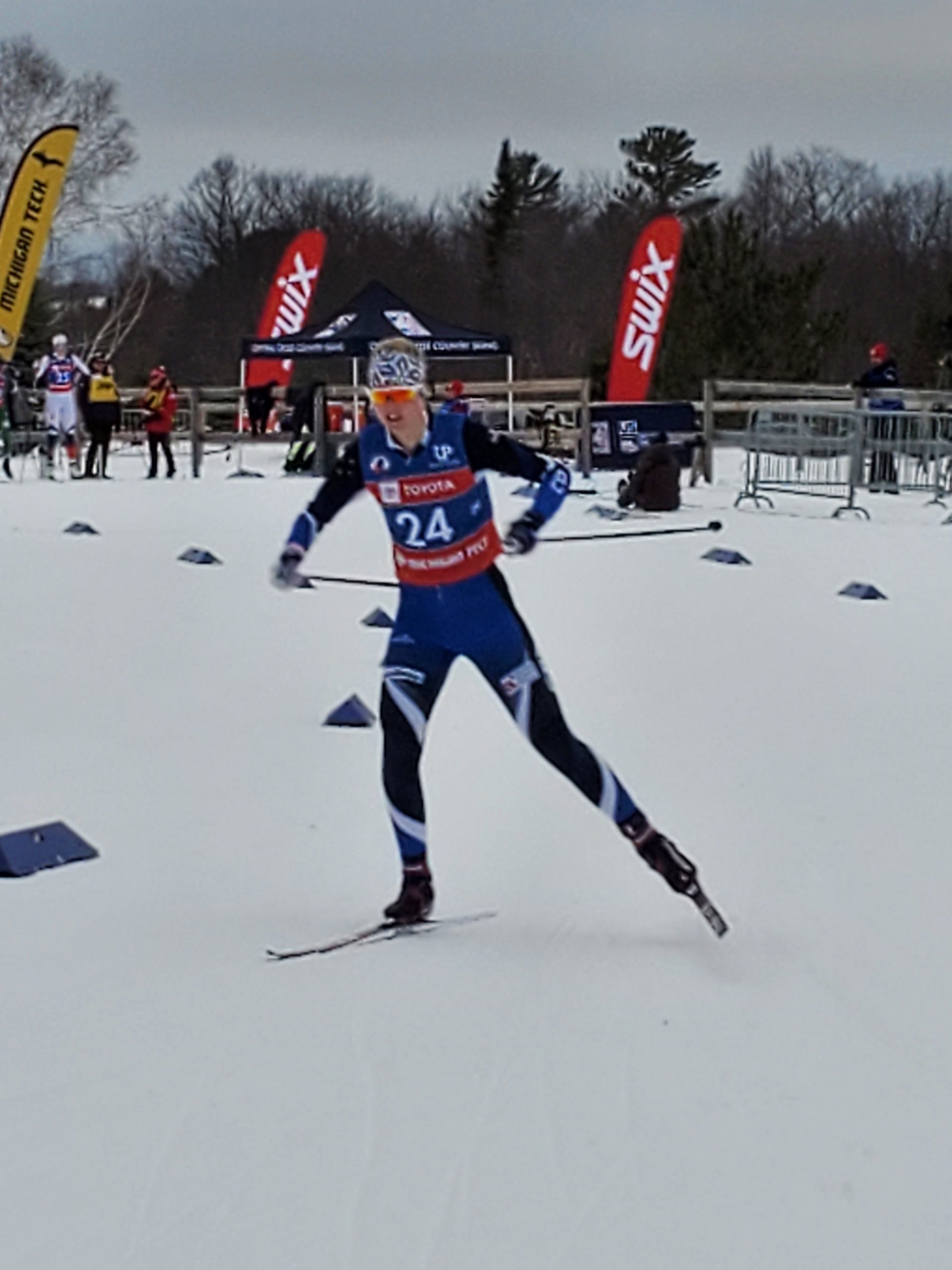
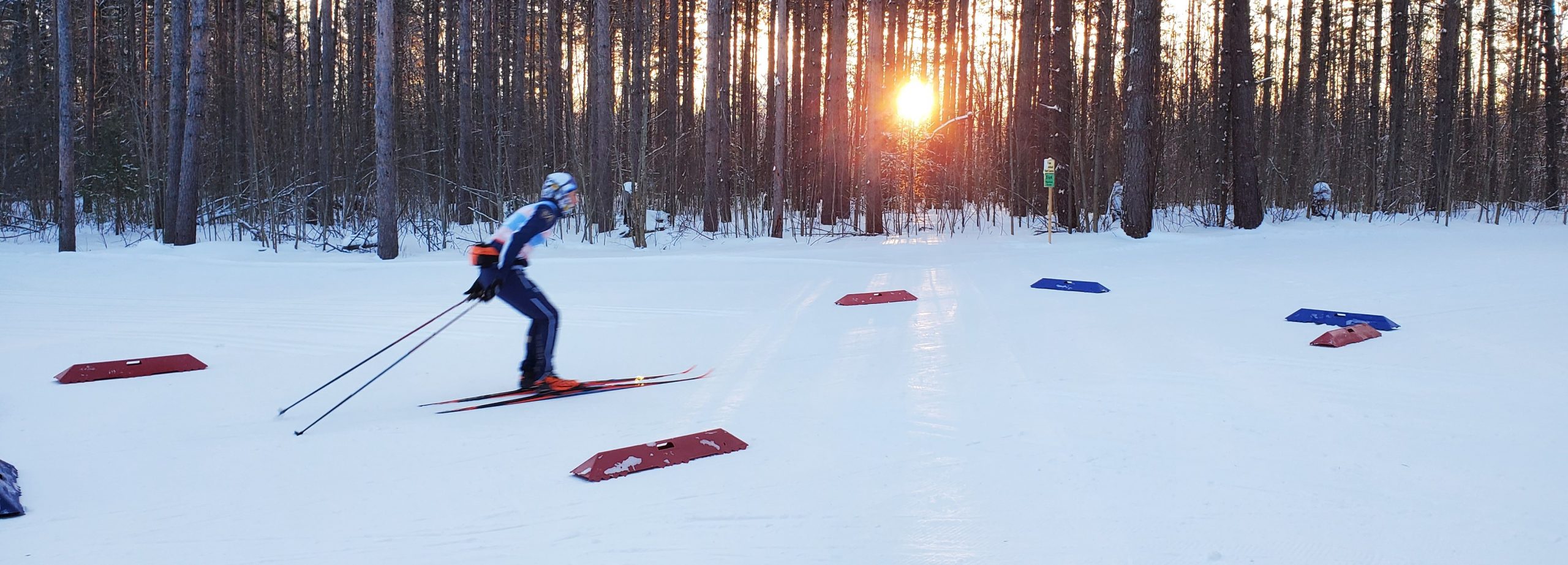
    Hailey Swirbul powering through a corner in the qualifying round. (Photo: FasterSkier).

    The women’s SuperTour leaderboard also included the names of Houghton podium finishers; with Hailey Swirbul, Sydney Palmer-Leger, and Novie McCabe being on the list.
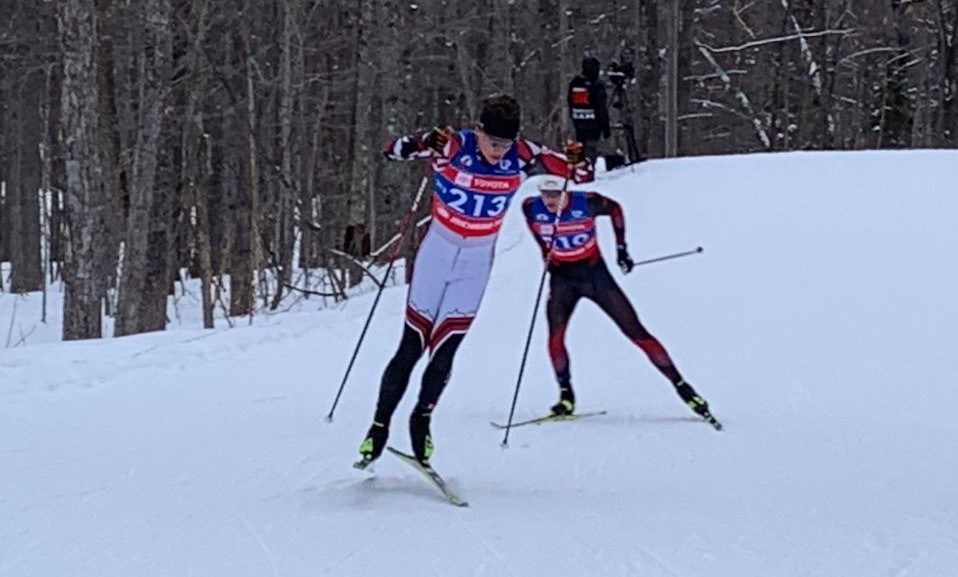
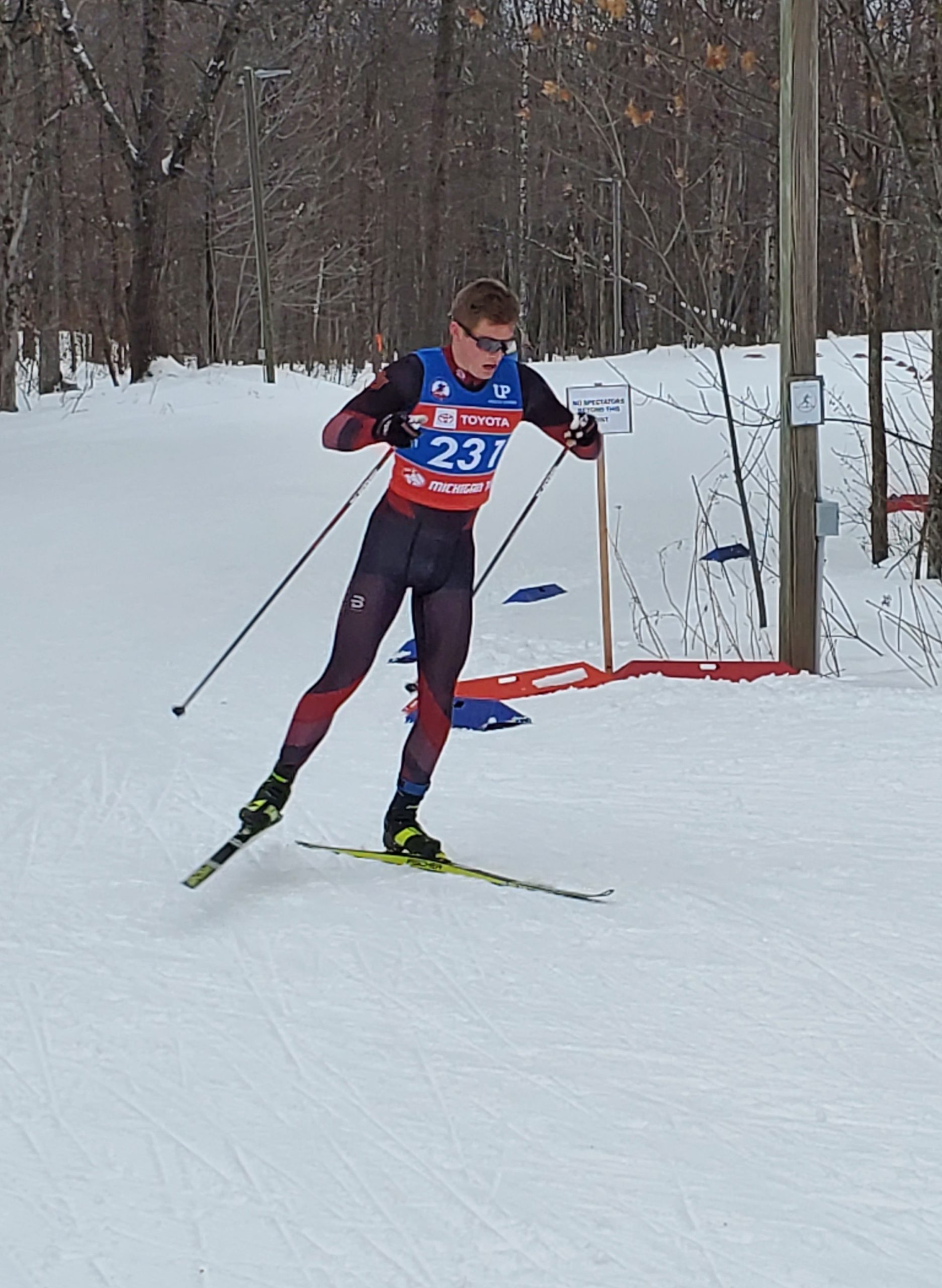
    Luke Jager generating enough power to get airborne in a high g-force corner in Houghton. (Photo: Dr. Amy Kostrzewa)

    So, despite the lack of a national championship designation, the stakes were still very high. An explanation of the SuperTour designation was provided by U.S. Ski and Snowboard’s Brian Fish. Fish told FasterSkier that several years ago the decision was made to split the U.S. National championships. He said, “The decision was made to take the last competition here, being the second sprint, and be moved as a national championship to the spring. The intent is to have an equal distribution of national championships, and it allows some of our World Cup athletes to be able to do a sprint race as a national championship.” Fish added that, “The intent is to provide a good amount of distance and sprint racing throughout the year.” Fish explained the point system designation of national championship points and SuperTour points: “The U.S. national championship races are double points to the SuperTour, so all of our national championship races are also SuperTour points.” Fish also pointed out that normally this race would be held on a Sunday but was moved to Saturday to try and get more Juniors to race.  The back-to-back race days turned out to be a significant factor with today’s sprints following yesterday’s 20 kilometer race.
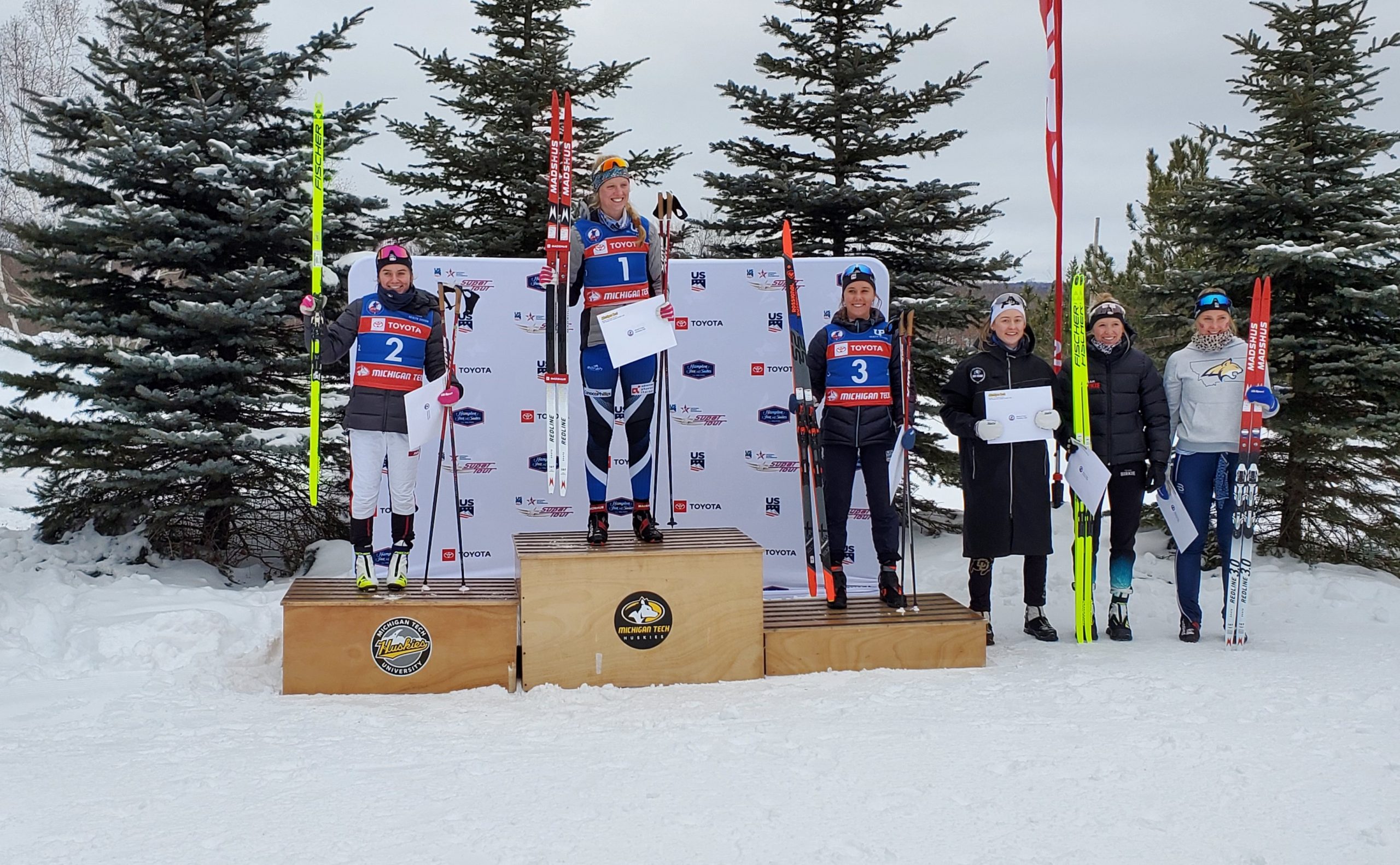
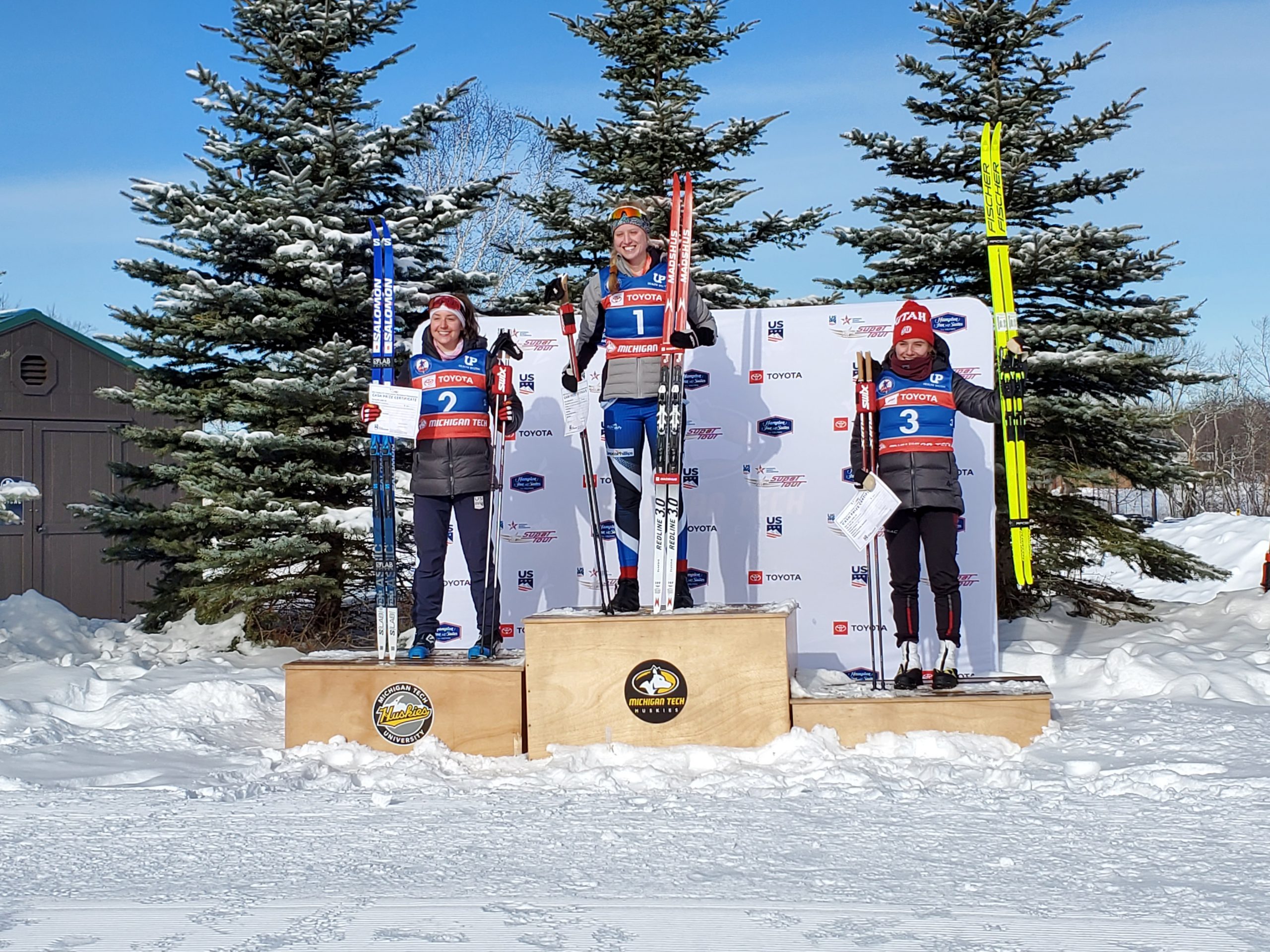
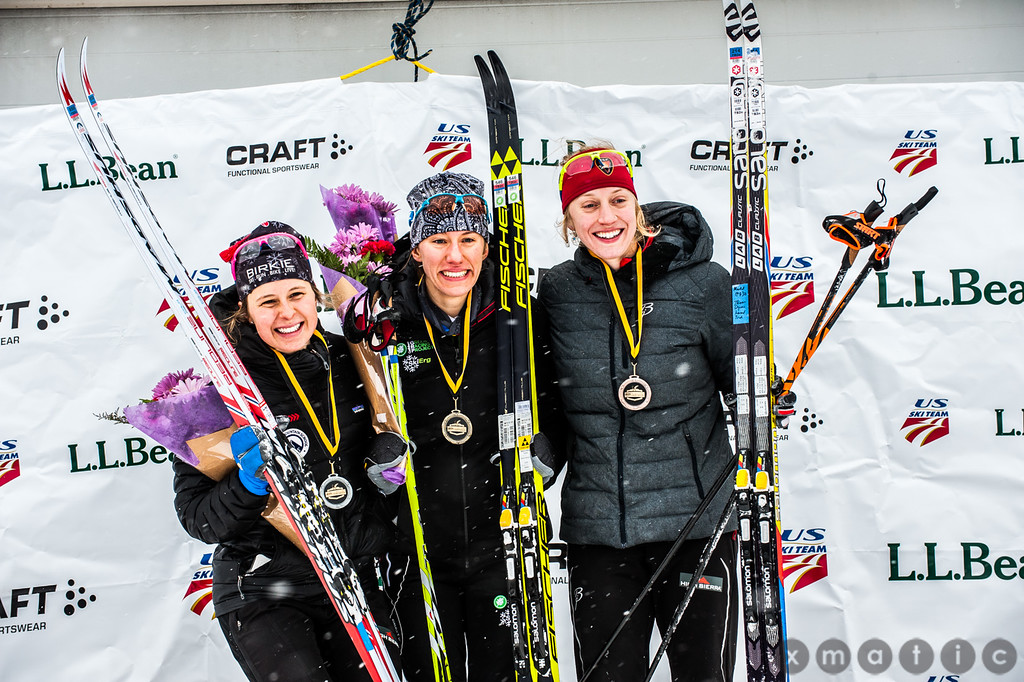
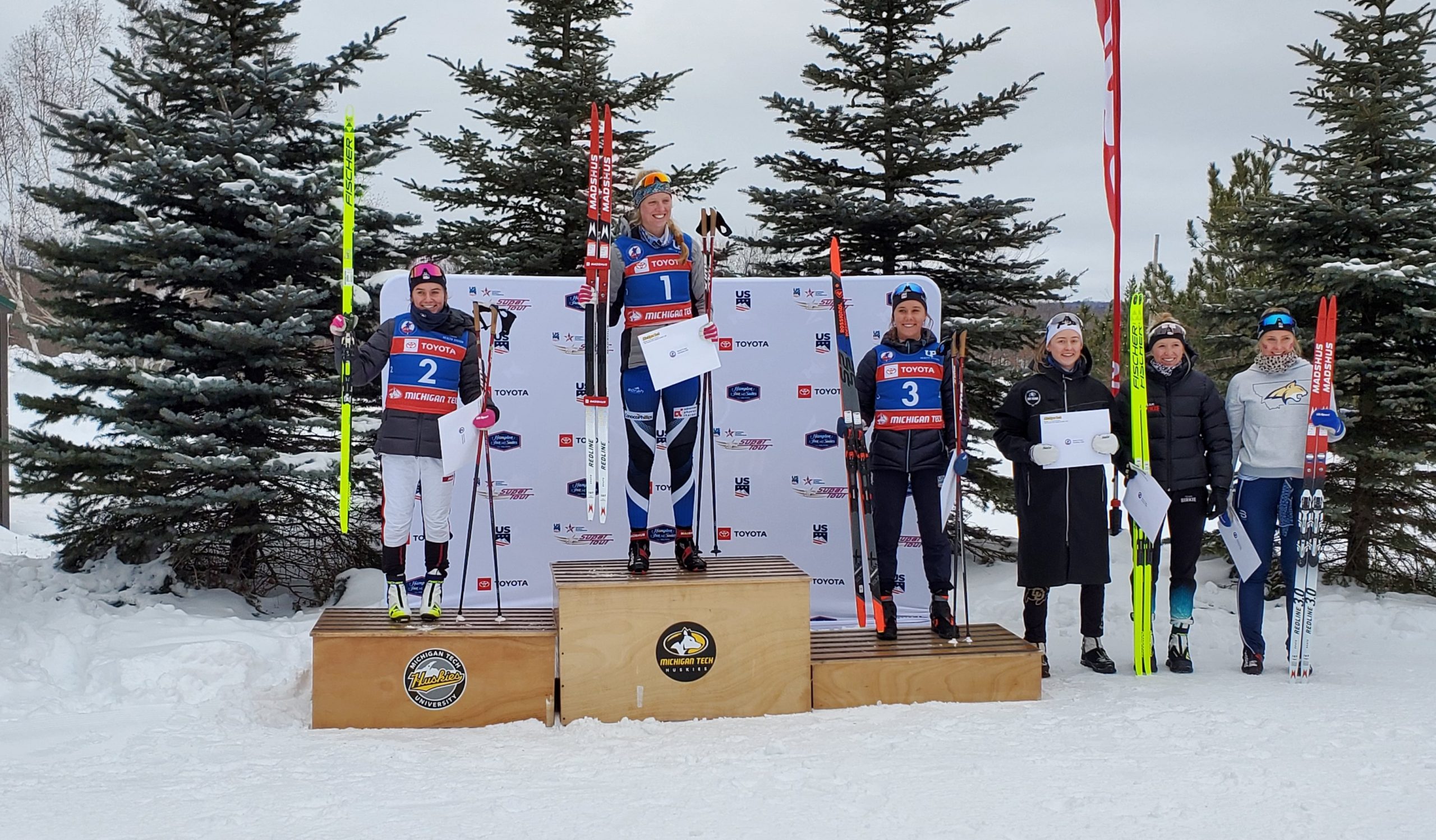
    Women’s freestyle sprint podium (l-r Novie McCabe, Hailey Swirbul, Lauren Jortberg.) (Photo: FasterSkier).
    The Results

    Regardless of what the race was designated, the competition was stiff.  On the women’s side, Hailey Swirbul (APU Nordic Ski Center) made it a clean sweep of Houghton winning the sprint by six-tenths of a second over Novie McCabe (University of Utah), who came in second. Lauren Jortberg (SMS T2) came in third.

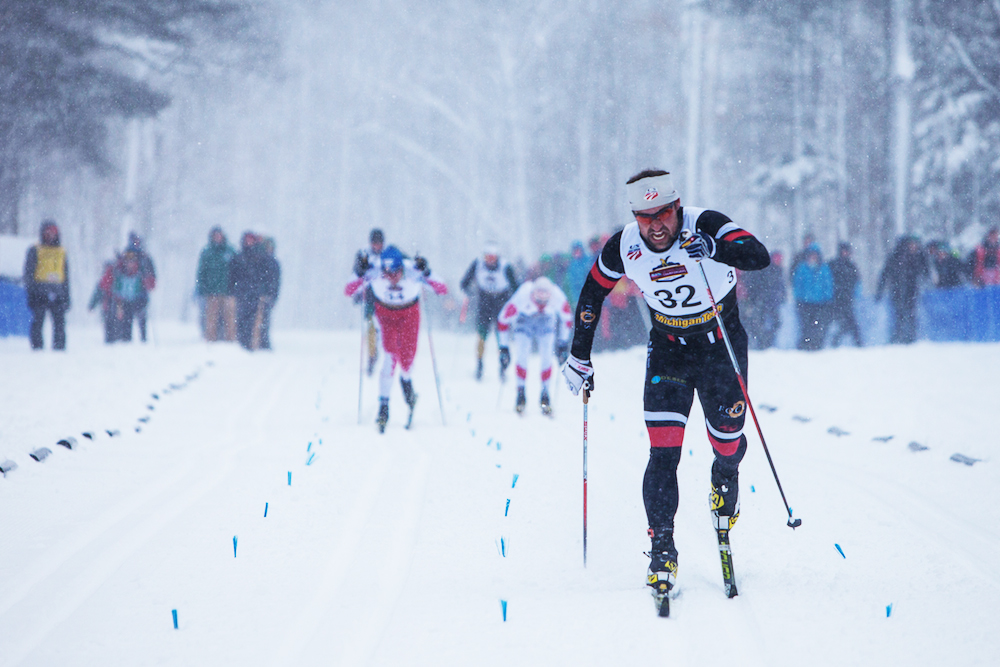
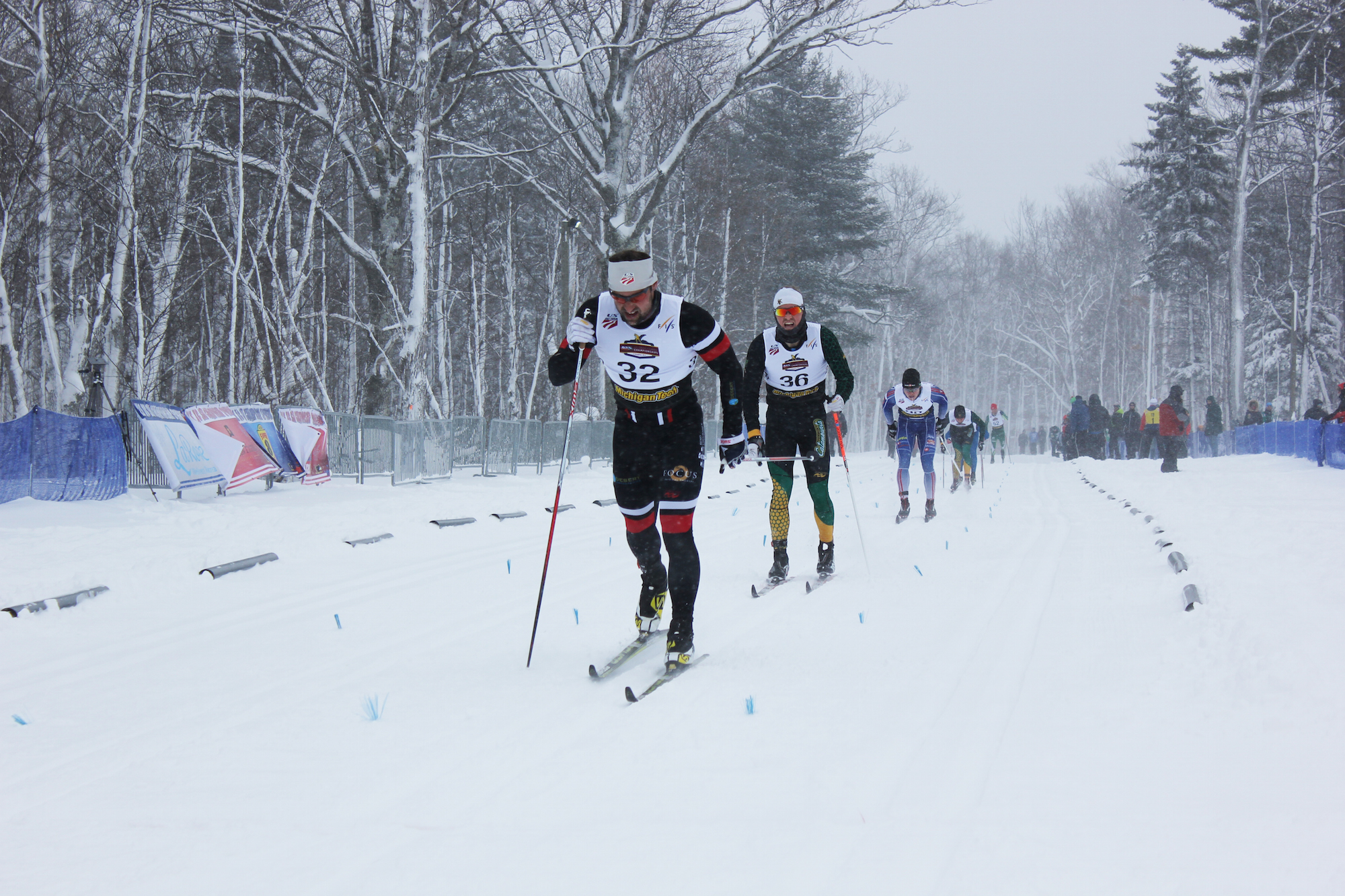
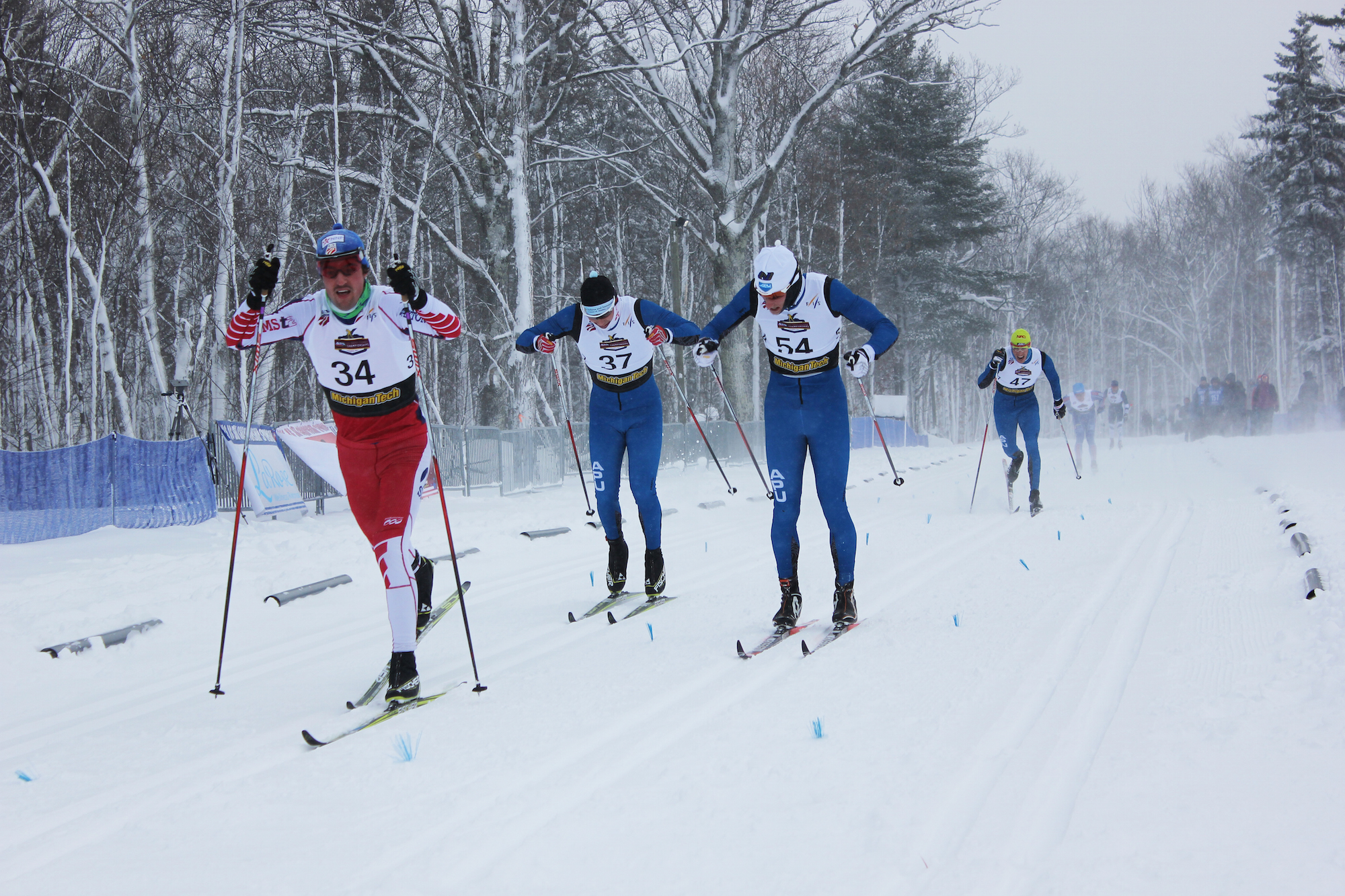
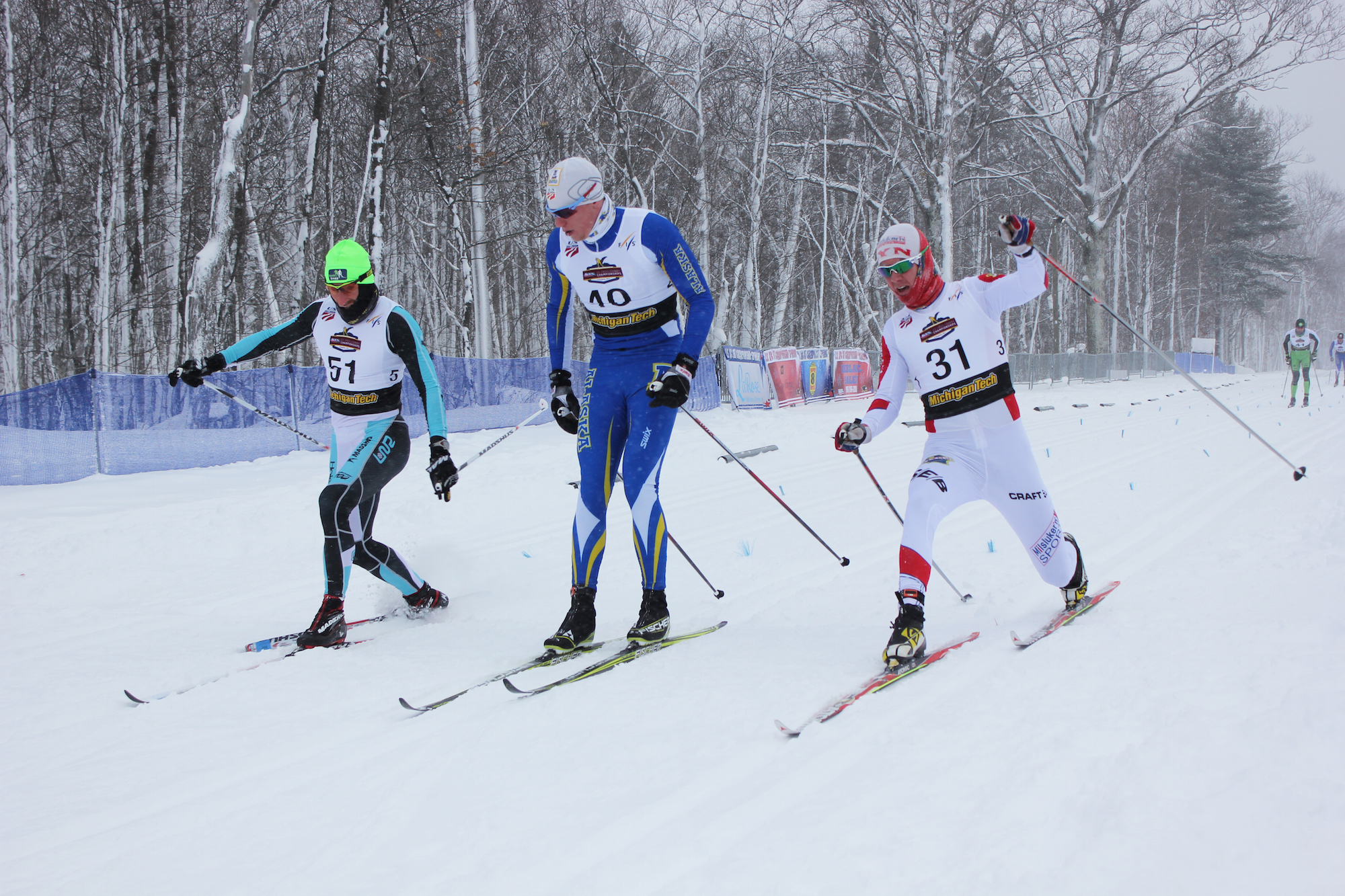
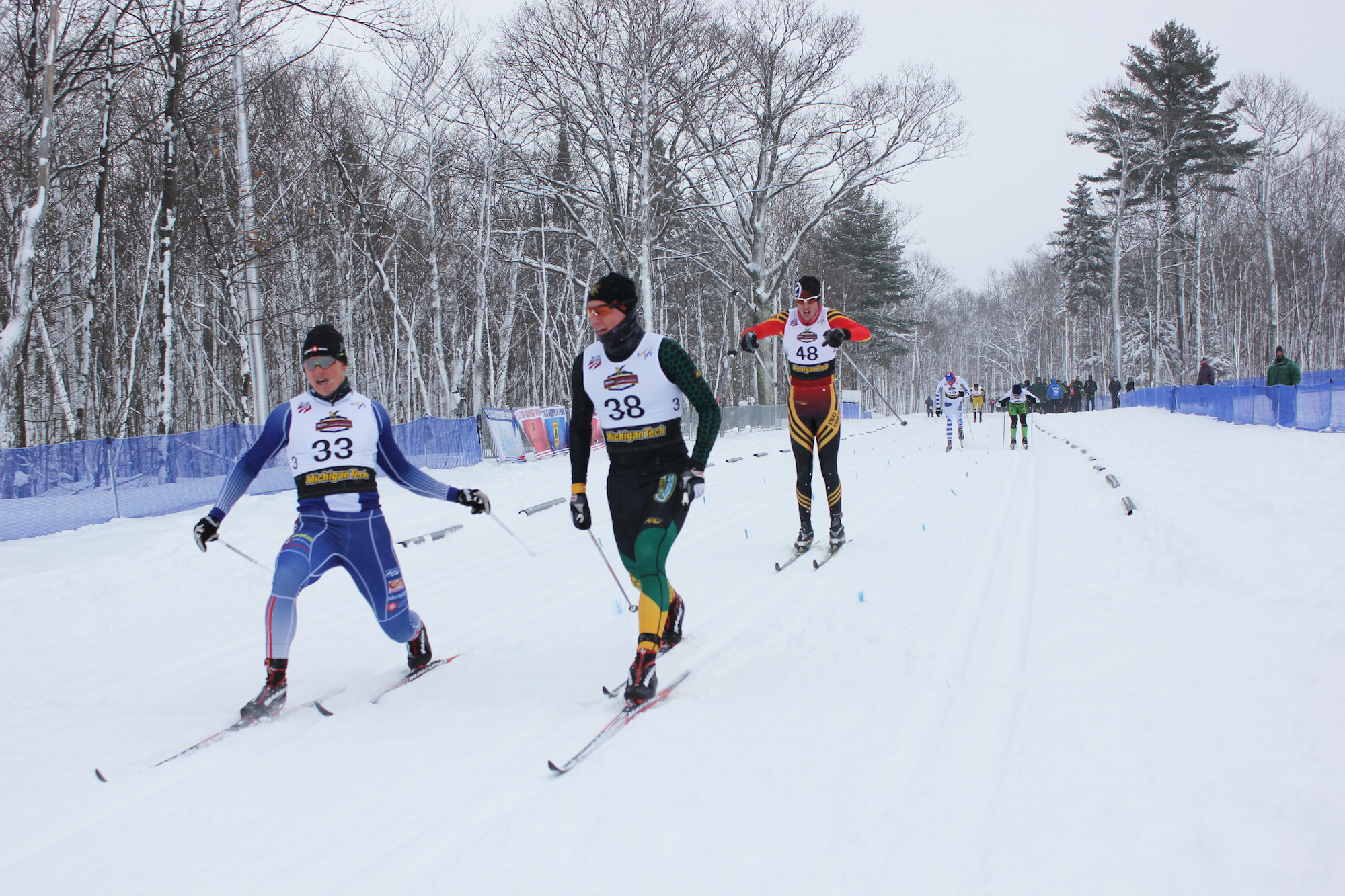
    The men’s race was won by Norwegian Kristoffer Alm Karsrud (Northern Michigan University). He beat out Luke Jager (University of Utah), by seven-tenths of a second. Tom Mancini of France (University of Utah) finished third.
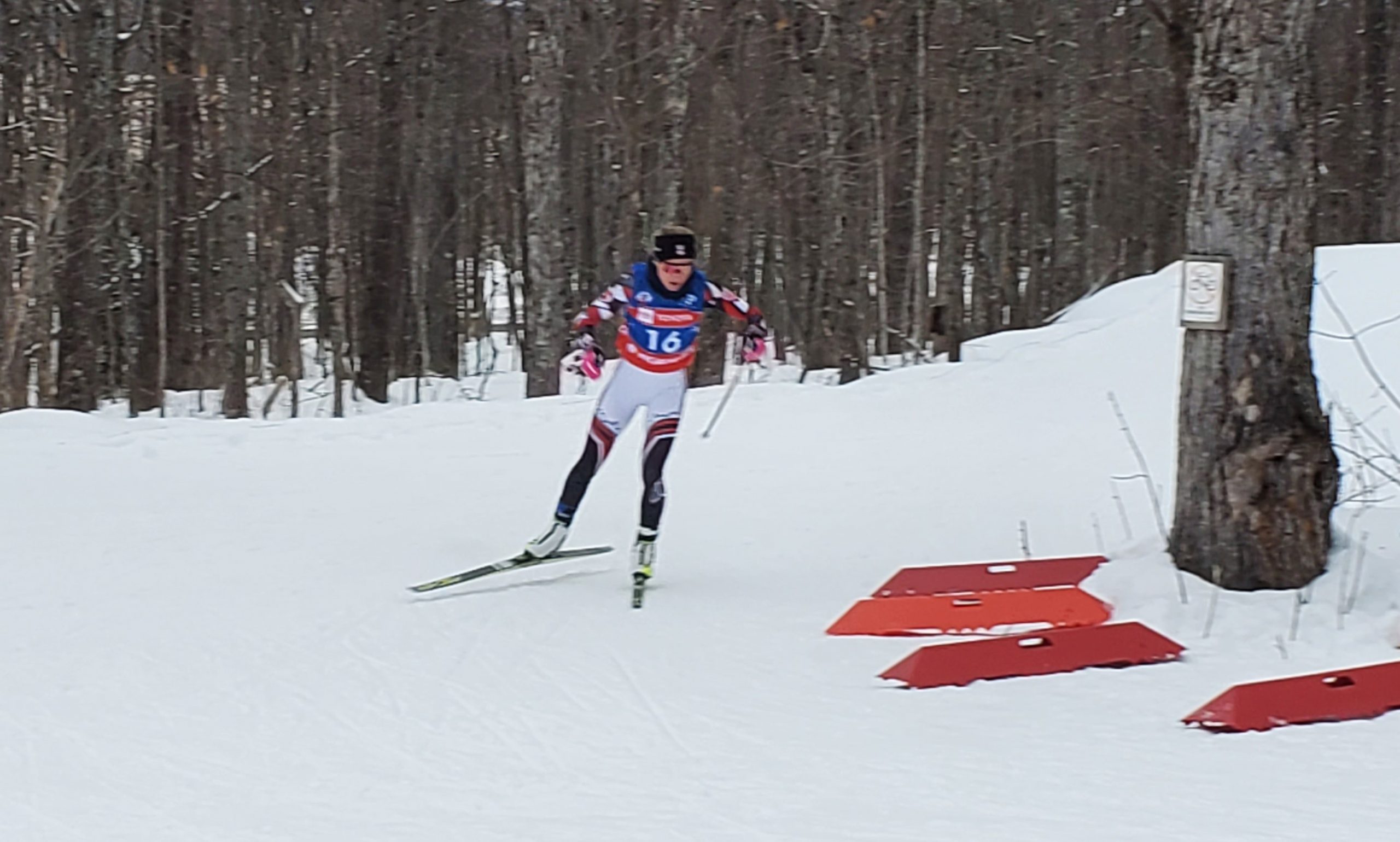
    Novie McCabe qualifying for the heats. She would ultimately finish second. (Photo: FasterSkier).
    The Race

    The week’s racing and back-to-back race days took its toll on racers. Energy reserves were low for everyone, and pacing during qualifiers and heats was critical. Women’s winner Swirbul finished seventh in the qualifiers and didn’t win any of her heats until it mattered most in the finals. She told FasterSkier that, “I was pretty tired today.  I didn’t really have it in me to go as hard as I possibly could in every heat. I knew I wouldn’t have any in the end. I tried to move on using as little energy as I could instead of a fitness contest from the first get go. I’m learning a lot about how to conserve energy in the whole sprint day, something I don’t get to practice on the World Cup.”  But Swirbul acknowledged that the strategy came with risk. She said,

    “The semi-final was a stacked group. That cut it pretty close for me. I wasn’t planning on having a four-way lunge with everyone.” Hailey Swirbul
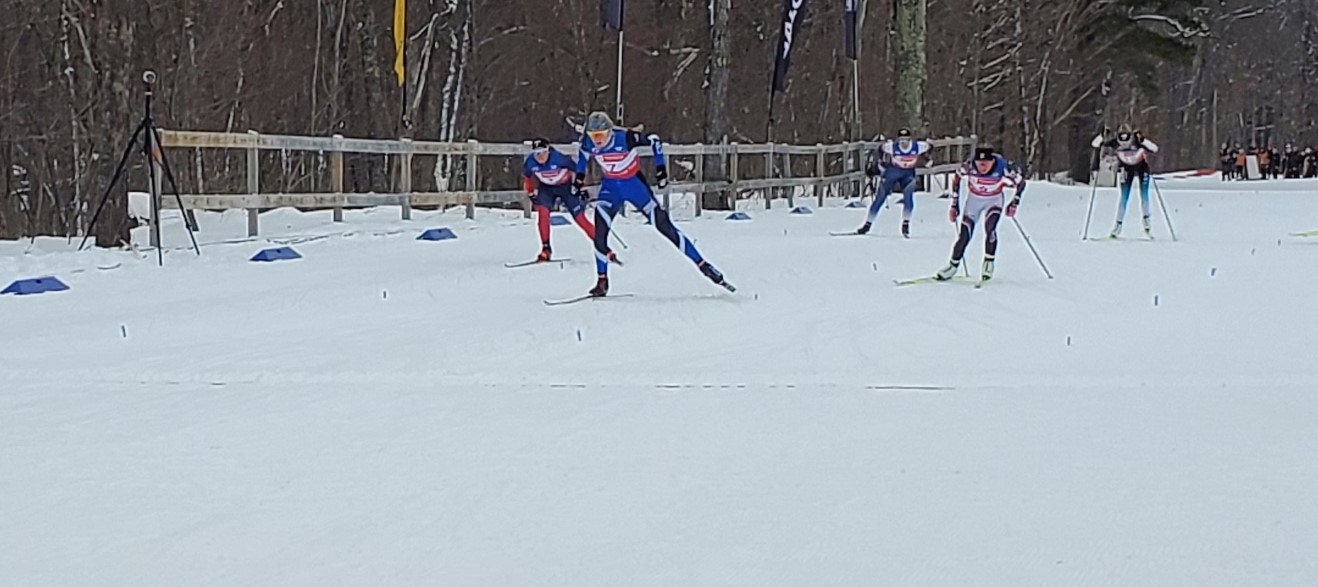
    Hailey Swirbul’s first time crossing the finish line in the in the lead was in the finals. (Photo: FasterSkier)

    Men’s podium finisher Jager also noted the strain of back-to-back racing. He told FasterSkier, “I was feeling some fatigue from yesterday. Especially since yesterday was a long one. I got better throughout the day. I knew that…today I needed to hold back everywhere I can and stay in the group as much as I can, just wait to the finish. I got a little more dialed every heat.”

    In addition to fatigue, the women’s race faced some controversy. In the semifinals, Mariel Merlii Pulles (University of Alaska Fairbanks), who finished second in Wednesday’s classic sprints, was relegated (moved to last) in her heat due to interference. The infraction occurred in the final few yards of the race. Pulles was boxed out at the finish and tried to pass Karianne Dengerud (University of Utah). As Pulles pulled up to Dengerud their skis tangled and Dengerud tumbled to the ground. At the finish line it was Tilde Baangman first, followed by Pulles, with Dengerud sixth. However, the jury ruled that Pulles interfered with Dengerud and Pulles was penalized by relegation. Racing was held up for about five minutes while the jury deliberated. Race technical delegates told FasterSkier that there was some discussion about whether there could be any compensation awarded to Dengerud due to her position near the finish when the violation occurred, and ultimately, they determined that there was nothing within the rules that could be done to compensate her.  With Pulles’ relegation, Dengerud’s day would end with her in fifth place in the heat.

    As women’s racing continued into the finals, all eyes were expectantly focused on Swirbul to see if she could sweep the week’s events. Jortberg went out fast, and Swirbul latched on to the back of the pack.  Going into the course’s steepest hill for the first time, Swirbul swung wide to pass several skiers and pulled into second. The second time around on the hill Swirbul asserted herself and pressed into the lead. Swirbul put the accelerator pedal all the way down into the stadium and ended up beating out McCabe and Jortberg.

    The clean sweep for Swirbul was satisfying. She said that she had held out hope for the possibility of sweeping the week. Swirbul had taken inspiration from her teammate, Rosie Brennan, who had previously accomplished the same feat. She said, “Our coach had talked about that quite a lot, and I wanted to follow in her footsteps, and she’s been a huge inspiration for me.” She continued that, “What means more to me is that I get to be here at nationals. I’m so stoked that I chose to have that be part of my plan this year, instead of going to Europe at the start of the season. So, win, lose, or draw, that’s what I’m really excited for…I love this community.”  Swirbul said that this felt like the high point of her career because,

    “I am the most happy where I am right now, and I don’t feel like I’m wishing I was home or wishing I was somewhere else.  I’m just happy to be where I’m at and happy to be racing well at the same time.”                   Hailey Swirbul

    In the men’s final race, Thomas O’Harra (APU Nordic Ski Center) took the early lead. But most of the field passed O’Harra the second time up the course’s steep hill with Jager and Karsrud surging to the front. Jager had built a very slim lead at the top of the hill. Into the stadium it was Karsrud and Jager in the lead, with Jager holding a slight advantage. But Karsrud had a gear that no one could match and pulled away from the field. Jager acknowledged Karsrud’s finishing prowess:

    “Karsrud in that final 100 meters is the stuff of nightmares. He’s just so strong.”  Luke Jager

    Jager said that he wanted to be in front coming into the stadium. He told FasterSkier that, “I really didn’t like my odds against him in a head-to-head because of how its been panning out for me every other time. He’s an absurdly strong finisher. I feel like the World Cup heats I’ve skied have had finishes that weren’t that fast.”

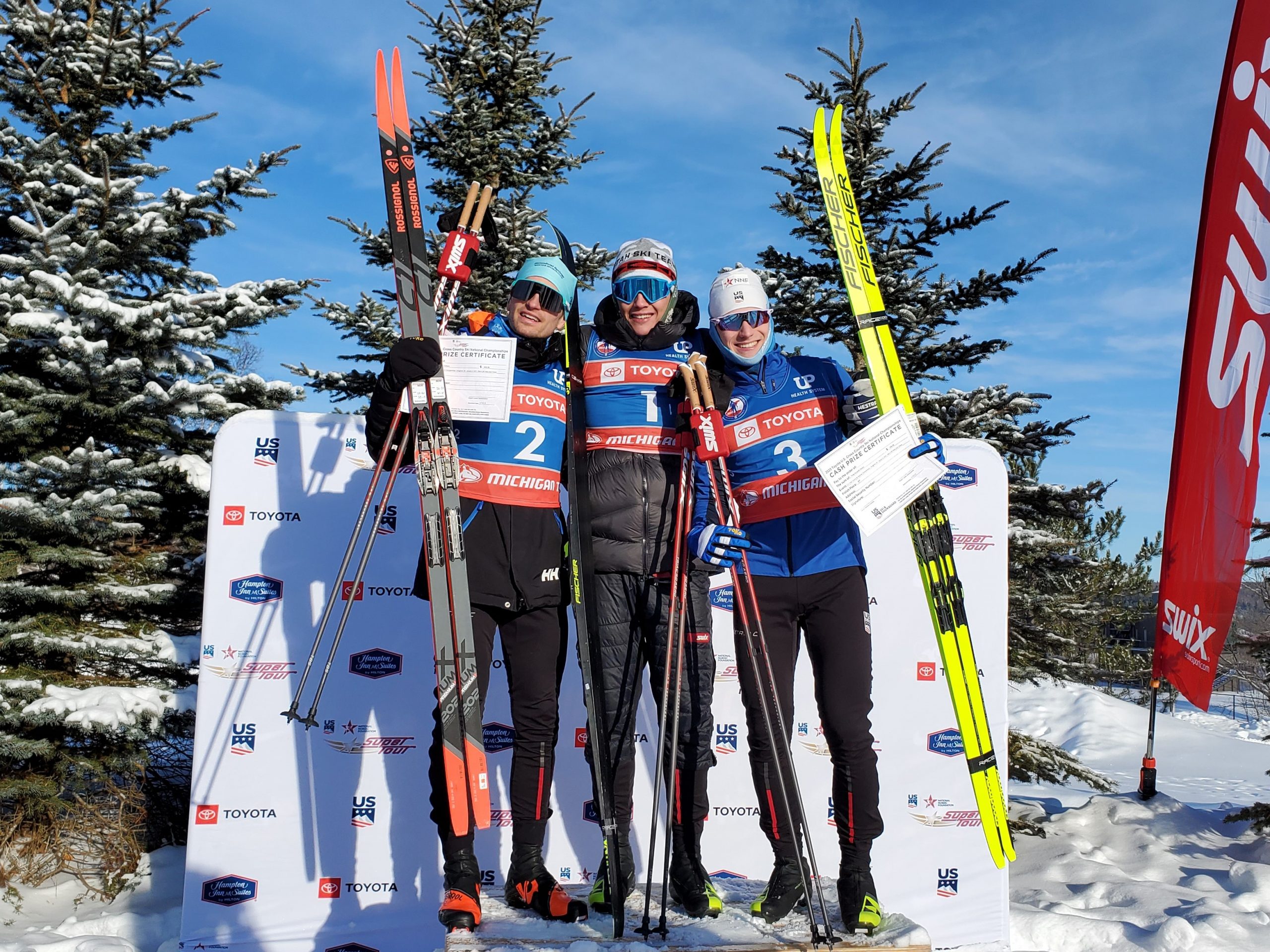
    Men’s sprint podium (l-r Luke Jager, Kristoffer Alm Karsrud, Tom Mancini). (Photo: Dr. Amy Kostrzewa).

    For Karsrud, who skis for NMU, the course at Houghton has a bit of a home field advantage feel for him. He said, “This is the third time for a skate sprint here this year, so I know the course really well.”  The Wildcat junior said his strategy was, “To pretty much just take it easy in the start, stay far back, and then take it the last 100 meters.”  The strategy panned out perfectly for Karsrud, who’s afterburners were unmatchable, and led to a perfectly executed race.

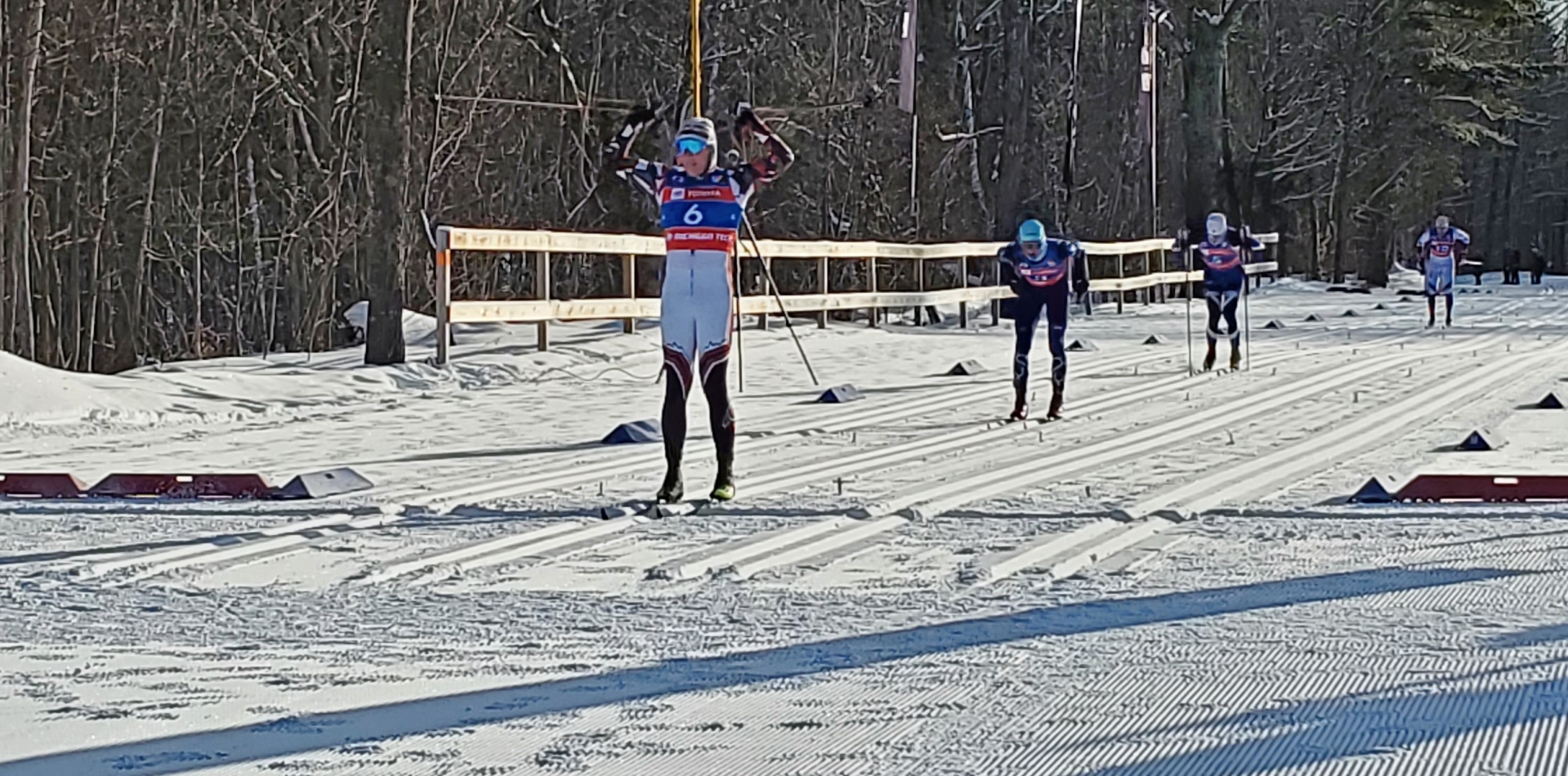
    Men’s winner Kristoffer Alm Karsrud with a monster finish had time to celebrate. (Photo: FasterSkier).

    The exciting racing was a fitting way to conclude the competition in Houghton. The venue was well organized, and the conditions were excellent. It was all one could hope for in a national championships.
    Full Results

  • Swirbul Three-Peats, Jager Triumphant in U.S. Nationals

    Swirbul Three-Peats, Jager Triumphant in U.S. Nationals

    HOUGHTON, MICHIGAN: Welcome to FasterSkier’s on-location coverage of the United States National Cross-Country Ski Championships from Houghton, Michigan.

    This week, Houghton hosts the U.S. National Cross-Country Championships on the Michigan Technological University’s trails system. Today’s event is the 20-kilometer classic mass start.

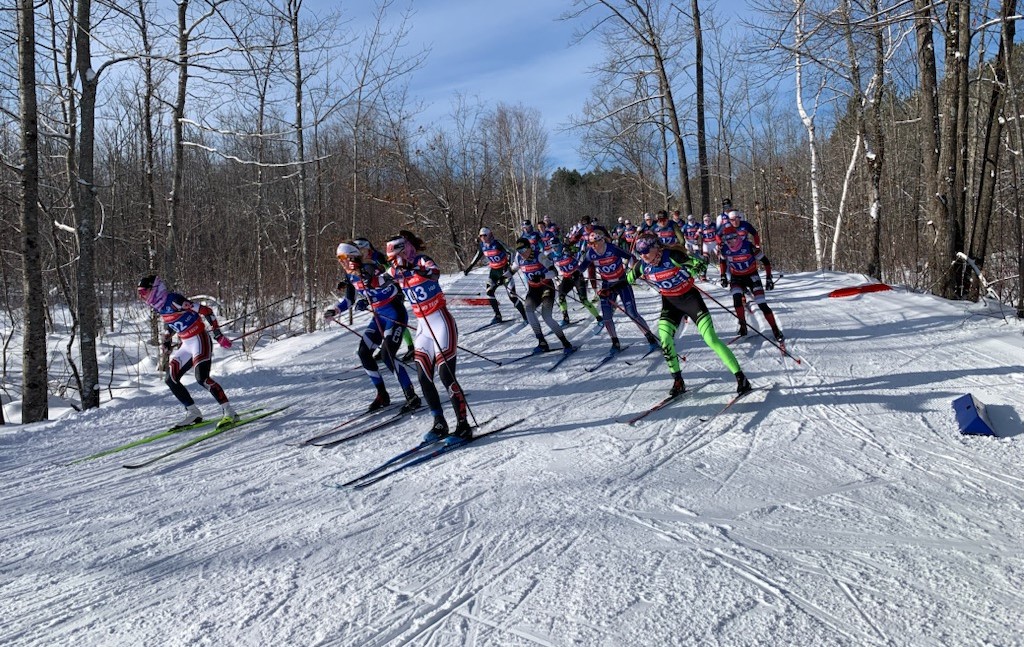
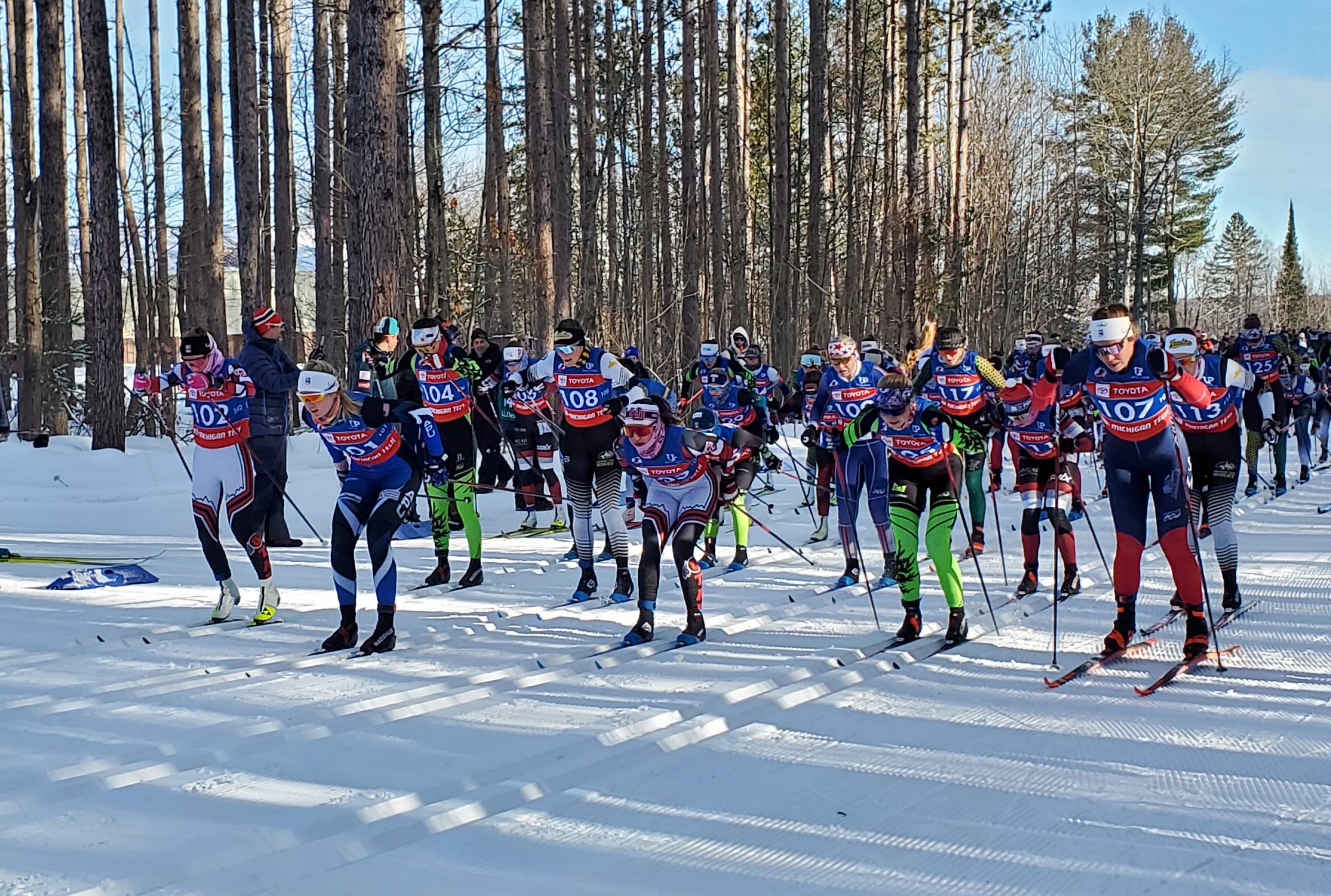
    Hailey Swirbul leads out the women’s charge at the beginning of the 20-k classic mass start in Houghton. (Photo: FasterSkier).

    There were several questions to be answered at the beginning of the day: the women’s side has been dominated by Hailey Swirbul. Swirbul has won the two previous races, the 10-kilometer individual start skate, and the classic sprints. Would Swirbul be able to complete the three-peat by winning today’s long classic race, which would give her a first place in sprint, middle, and long distances?

    The men’s results have been on the opposite side of the spectrum. There have been six different men standing on the podium so far. Would any man be able to claim a repeat podium position?

    Finally, the weather was not a dominating factor as overnight temperatures were in the teens, with highs in the upper twenties. Unlike the night before the sprint races, the wax technicians could actually get some sleep. The men’s race started at 9:30 and by then conditions were beautiful. The sky was blue, the temperatures were in the mid-twenties, and the wind was calm; for January in the Keweenaw, it could be called unusual.

    The classic course was a 5-kilometer loop with challenging corners and descents,  and long very steep climbs.

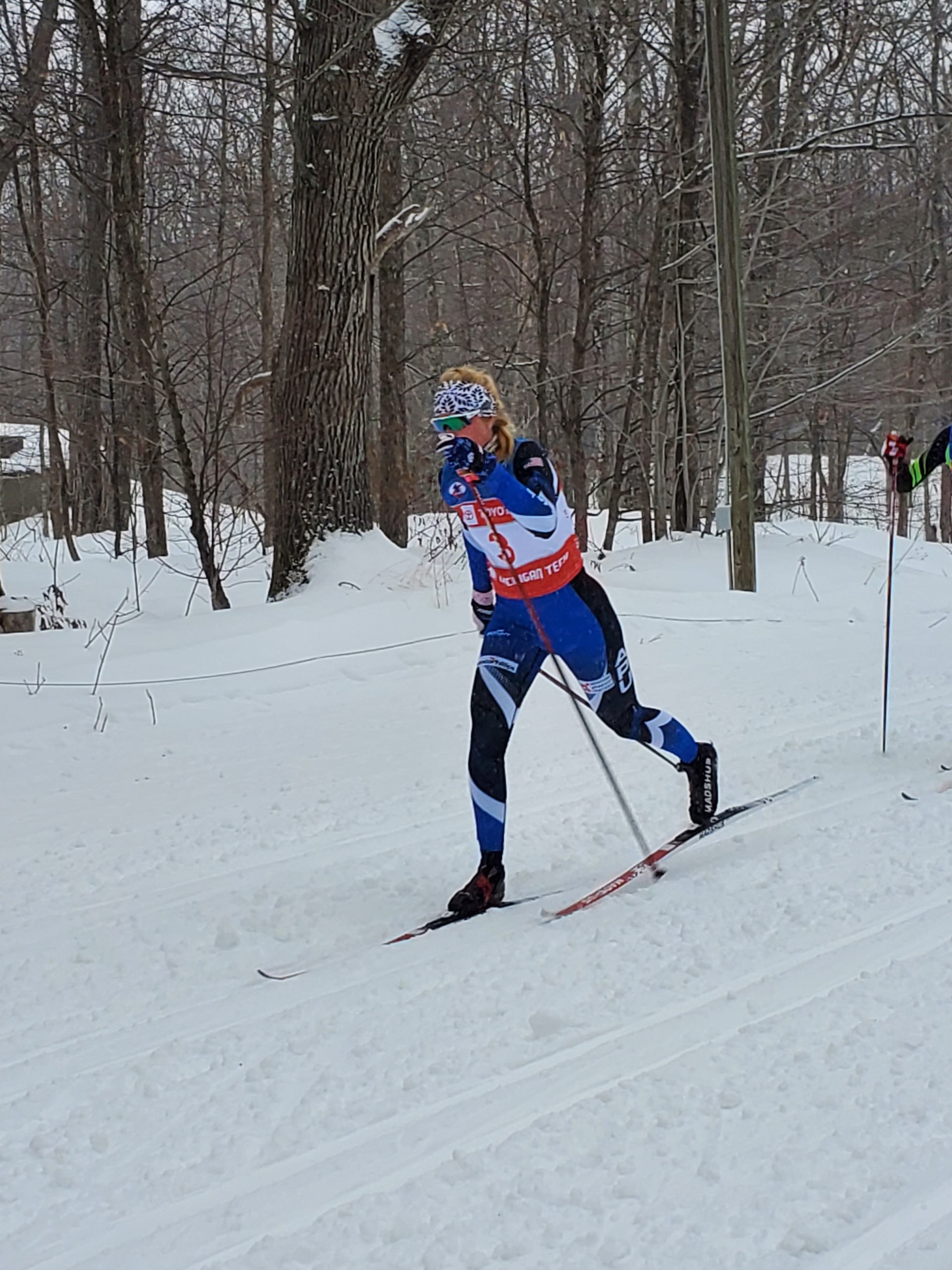
    Hailey Swirbul on her way to a Houghton three-peat. (Photo: FasterSkier).
    The Results

    In a thrilling women’s race, Hailey Swirbul (APU Nordic Ski Center) did pull off the three-peat by beating out Sydney Palmer-Leger (University of Utah), by four-tenths of a second. Novie McCabe finished third, less than 10 seconds out of second place.

    For the men, Luke Jager (University of Utah) claimed another podium, finishing first. Two seconds behind him, in second, was distance phenom David Norris (Steamboat Springs Winter Sport), and in third was Zanden McMulllen (APU Nordic Ski Center).

    Men’s 20 k Mass Start

    The men’s competition took an unexpected turn when the lead pack was broken apart early on the second lap by a large crash. Jager told FasterSkier, “There was a big crash on the second lap, a few skiers went down, most notably Andreas [Kirkeng], and he had been hitting the pace the entire first lap. I was in front of Andreas, it was on a downhill, I was pulling out for the sharp turn, and he also did, we kind of clipped each other skis. You never want that…it’s a big bummer. Suddenly it was me and David [Norris] off the front. It really disrupted things.”  Jager was able to adjust on the fly, and after the crash it was a group of four skiers until the end.

    Luke Jager celebrates the victory in the 20-K Classic. (Photo: FasterSkier).

    Andreas Kirkeng (University of Denver) told FasterSkier that after the fall he couldn’t close the gap.

    “I broke a pole, and my binding popped off, so I had to stop on the downhill to put my binding back on. I was skiing with one pole for a while, it was unlucky”.                                                                                                       Andreas Kirkeng

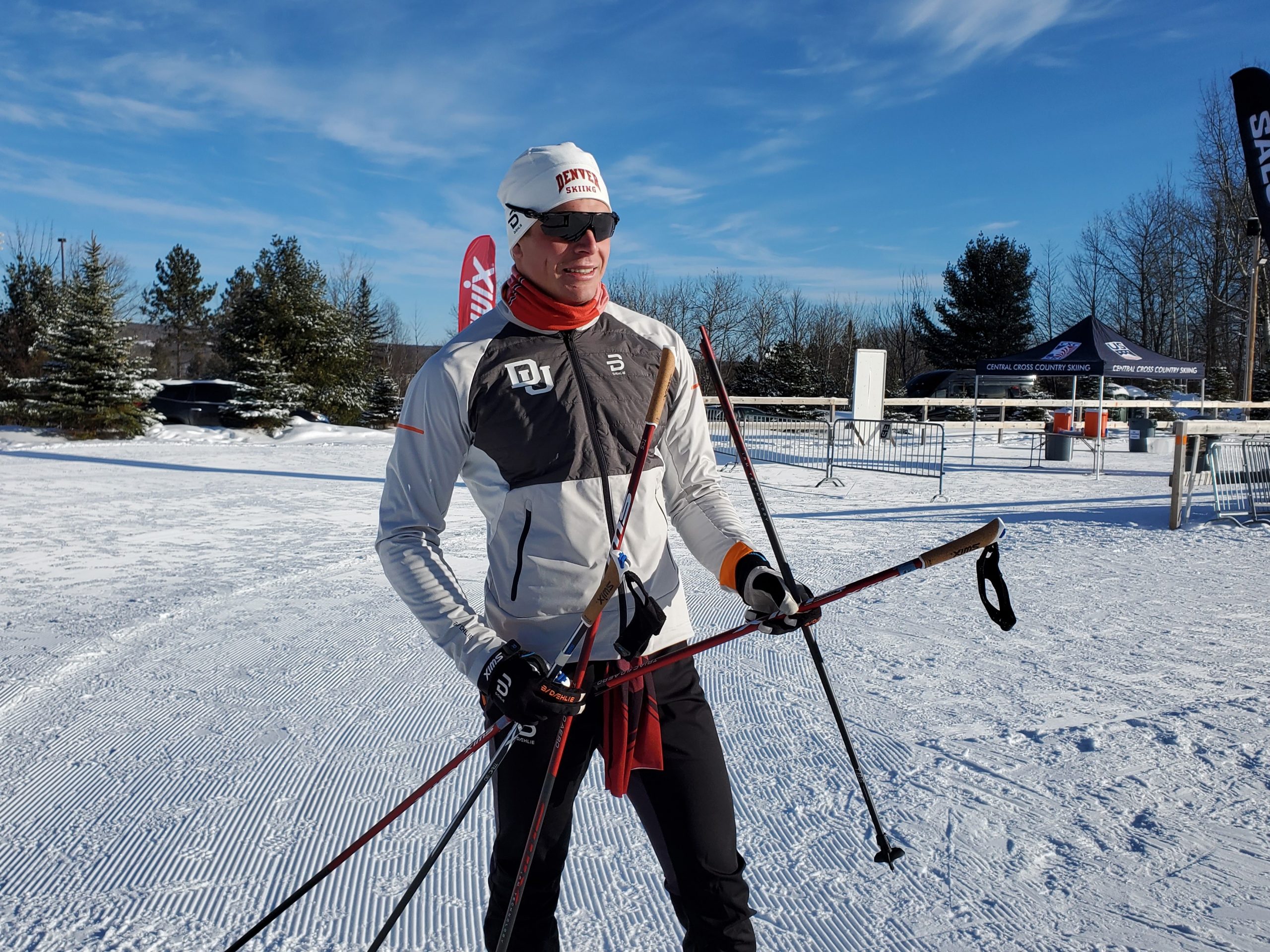
    Andreas Kirkeng shows the evidence—a broken pole—from an early crash that knocked him out of contention. (Photo: FasterSkier).

    As the race wound down to the last few kilometers Norris pushed the paced. Jager told FasterSkier that, “Thankfully I had enough left in the tank to get a little bit of a gap in the last climb. If it came to a battle of just grinding as hard as we could, I knew I wasn’t going to win.”

    The weather did affect tactics when it came down to ski choices. The favorable conditions allowed Jager to optimize his ski choice. “I picked a little bit of a softer ski,” he said. “It was a little easier to kick.”

    The win was meaningful for Jager. “I’ve tried really hard to not be super specialized as not just a sprinter these last few years, to be able to be competitive in all the events,” he said. “To hold with those guys until the end was really rewarding.”

    Men’s 20-kilometer classic podium (l-r: David Norris, Luke Jager, Zanden McMullen) (Photo: FasterSkier).
    Women’s 20 k Mass Start

    The women’s race came down to a thrilling duel between Swirbul and Palmer-Leger. Ultimately, Swirbul made an on-the-fly tactical choice which enabled her to inch out Palmer-Leger, winning the race by abandoning double poling at the finishing sprint and switching to diagonal stride. The tactical choice enabled her to beat out Palmer-Leger by about a boot length.  Second place finisher Palmer-Leger, a junior at University of Utah, noted the difference in technique choice at the finish. “She was striding, I was double poling, it was hard to know what would be faster, right at the end I kind of switched into a run to see if that would work, but it didn’t.”

    Swirbul and Palmer-Leger neck and neck at the finish. A last second change to diagonal stride captured the win for Swirbul. (Photo: FasterSkier).

    Swirbul said that the top three skiers stayed together for most of the race. “Novie, Sydney, and I became a pod at one point and skied a lot of the last half of the race together.”

    Swirbul said that coming into the championships she knew that top results were a real possibility. “The beginning of my season has been going well,” she said. “But you never know. There are so many factors that play into it.” Commenting on the distance Swirbul said,. “20 k is really long. We’ve had [this distance] at nationals, but I don’t do that many of them.”

    Going into the race, Palmer-Leger’s strategy was to not let the hills wear her down. “I paced it on the hills and tried sitting behind somebody, stay relaxed and focus on breathing,” she said. “A lot of time I get stressed, start to run and use up most of my upper body, so trying to stay relaxed [was important].” Palmer-Leger appreciated the Houghton course noting that, “It’s kind of fun to have something different. It keeps you on your toes when you kind of have to sprint from the start to get in a good lead, so you don’t crash in the corner. I made sure I was in a good spot [to avoid a crash].”

    Women’s podium 20-kilometer classic (l-r: Sydney Palmer-Leger, Hailey Swirbul, Novie McCabe). (Photo: FasterSkier).

    Ute junior, Novie McCabe, told FasterSkier that she tried to push the pace about two laps into the race. That’s when the race turned into a four-skier pack. “My plan was to go on the last lap on the first long hill and get a lead there,” she said. “It didn’t quite happen for me. I kept trying to go on all the hills, but they [Palmer-Leger and Swirbul] were too strong and they blew me away at the end. I was kind of hanging on a by a thread there for a while.” After the race week concludes, McCabe will focus on the U-23 championships in Whistler.

    Crowded corners challenged racers on a tough Houghton course for the U.S. Nationals. (Photo: Amy Kostrzewa).

    Houghton provided a beautiful day for a classic race, and the racing was equally spectacular.

    Full Results

  • Two in a row for Swirbul, Karsrud wins for NMU

    Two in a row for Swirbul, Karsrud wins for NMU

    HOUGHTON, MICHIGAN: Welcome to FasterSkier’s on-location coverage of the United States National Cross-Country Ski Championships from Houghton, Michigan.

    This week, Houghton hosts the U.S. National Cross-Country Championships on the Michigan Technological University’s trails system. Today’s event was the Classic Sprints.

    Weather again played an outsized role in today’s proceedings as temperatures hovered around freezing all night. The overnight forecast varied from freezing rain, to rain, to rain mixed with snow, to straight snow. During ski testing yesterday, the tracks had been firm  but heavily glazed. The question for the race today was whether these conditions would change; and what—if anything—to do about it. Moist, at-freezing conditions presented head-scratching questions about kick wax preparation, or whether to not wax at all and go with Zeroes or a Zero-ski equivalent. Conditions were fast, but getting good kick would likely come at the sacrifice of speed. Since the course doesn’t require a lot of kick, racers could take the gamble of going very thin on kick wax and count on double poling and fast glide where it mattered most.

    Hailey Swirbul powering her way through a tricky Houghton corner.  Two races, two first places for the APU skier. (Photo: FasterSkier)

    Conditions remained consistent overnight with temperatures hovering around freezing. The called-for precipitation never materialized, at least for the beginning of the qualifiers.  But things would change once the heats began.

    Racers ended up using a bit of everything for kick. Many opted for no kick wax, some using skate skis, double poling the course and using herringbone technique up the steep hill. Many others used Zero skis, and some opted for klister covered with hard wax. It appeared to be an even distribution of skiers using the three options in the qualifiers.

    Kristoffer Alm Karsrud qualifying en route to the top of the podium for NMU. (Photo: FasterSkier).

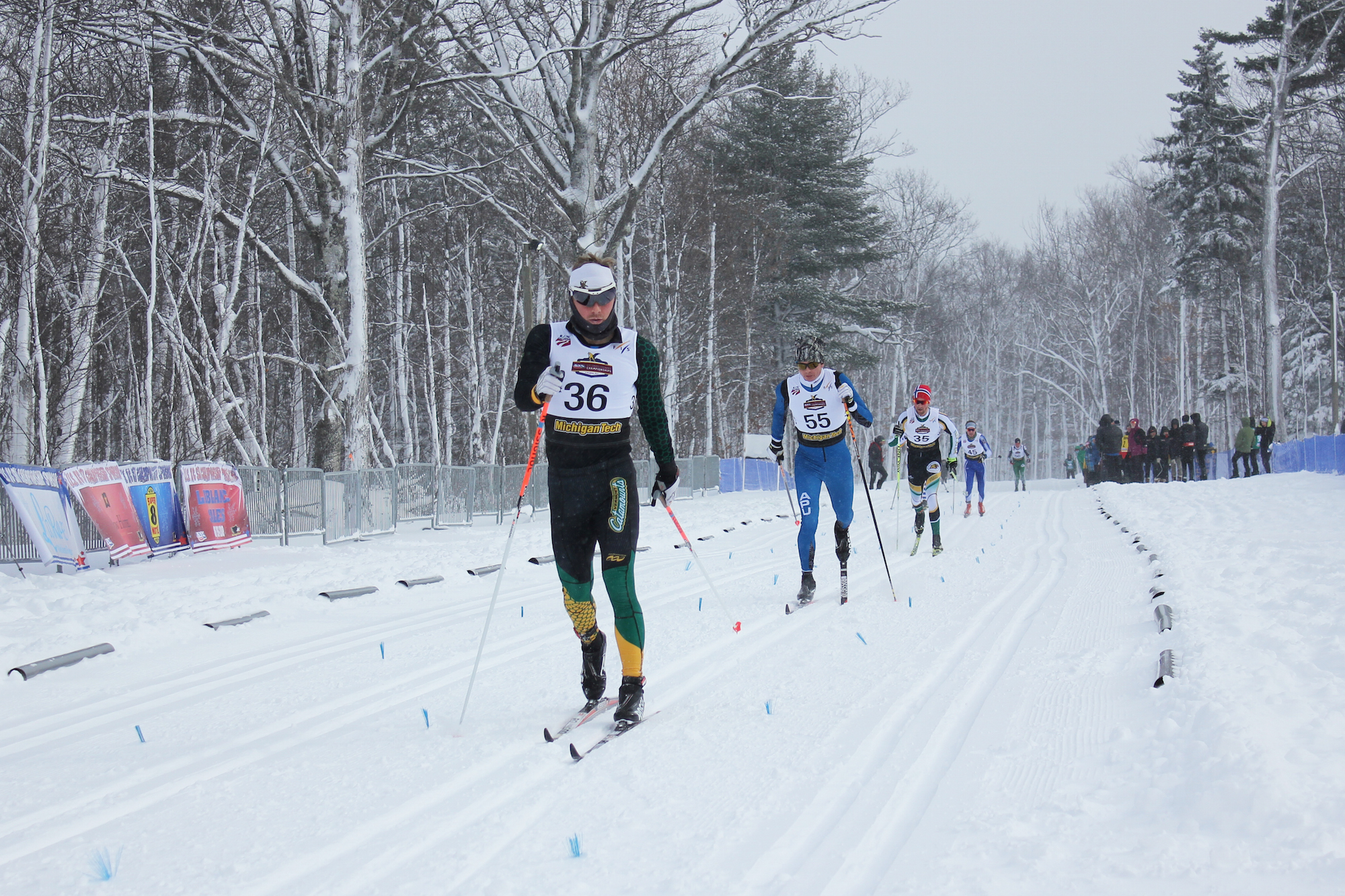
    Just as important as waxing strategy would be on-ski strategy. MTU’s sprint course is interesting and presents unique challenges. Racers competed on a fast two-lap course which consists mostly of long gradual descents, two fast sharp turns, and one short, but extremely steep uphill. Navigating safely through the fast turns and maintaining positioning on the final hill would likely determine the race outcome. After completing the hill for the second time, it is a long gradual uphill sprint into the stadium. It would be extraordinarily difficult to make up ground if a skier was caught in traffic on the hill.

    The Results

    The first-place finisher for the men was Kristoffer Alm Kasrud (Northern Michigan University) of Norway. In second was Magnus Boee, also of Norway (University of Colorado), and in third place was Luke Jager (University of Utah). Rounding out the field were Will Koch 4th (University of Colorado), Zanden McMullen 5th (APU Nordic Ski Center), and Christopher Kalev 6th of Estonia (University of Alaska-Fairbanks).

    The first-place finisher for the women was Hailey Swirbul (APU Nordic Ski Center). In second was Mariel Merlii Pulles of Estonia (University of Alaska-Fairbanks), and in third was Tilde Baangman of Sweden (University of Utah). Completing the field for the women was Sydney Palmer-Leger, 4th (University of Utah), Kendall Kramer 5th (University of Alaska-Fairbanks), and in sixth was Weronika Kaleta (University of Colorado).

    Hailey Swirbul taking advantage of the rare kick and glide opportunities. (Photo: FasterSkier)
    Men’s Sprint

    In the interval between the qualifiers and the heats, Lake Superior decided that it would remind everyone that it was really in charge of everything, and the unpredictable Upper Peninsula weather took a turn for the worse. The winds picked up, gusting to almost 40 mph, and the snow started. This forced a reassessment of waxing for everyone. For those who had been without kick wax, a switch over was considered to take advantage of the falling snow. For those skiing on covered klister a change might be needed to prevent kick zone icing.

    Men’s winner Karsrud, who lives about 40 minutes outside Lillehammer, told FasterSkier that he had started the day with a hard wax, but changed kick wax between the qualifiers and the heats.

    But it wasn’t all about wax strategy for the men’s winner. He decided to ,“Take the first lap chill, and then at the last hill to be in the top two.”  The MTU trails suited the Norwegian well. He told FasterSkier that he has been practicing a lot of technical skiing at home which helped on the tight corners. The victory wasn’t just an individual accomplishment for Kasrud. “The victory is really cool for the team, building up to this together, it means a lot.”

    The top American in the men’s field, in third place, was US Ski Team member Luke Jager. Jager was happy to be back on American soil, though he expressed a bit of a “love-hate” relationship with the rugged Upper Peninsula. Jager told FasterSkier that the wind and the long finishing straight was a difficult combination. “I think everyone hates that,” he said. “So I’m not alone there.” Jager was one of the racers who used skate skis in qualifying and in the quarter-finals, but then changed for the semi-finals.  The equipment in part dictated his strategy. “The strategy was you want to be in front the whole time,” he said,”Because you don’t want to be stuck in the mess doing some ‘janky’ herringbone on skate skis up the hill.”  Once the conditions changed, Jager opted to go with hard wax just prior to the semi-finals and stuck with that setup into the finals. The equipment changes created an interesting tactical paradox for the American. He told FasterSkier that in the final there were at least two skiers on skate skis, so he had to take advantage of situations where he had it. In the semi’s and finals, he had an advantage on the hills on waxed skis. “It’s fun when [wax choice] is that close. Usually, it’s lights out, one or the other. People had success on both set ups.”

    “The finish is such a  grind that any accelerating you can do into it is a pretty advantageous. It was a real toss-up. If you get bogged down on the skate skis, you’re going to be really hurting”.

    Luke Jager

    Houghton Sprint Men’s Podium. (l-r, Luke Jager, Kristoffer Alm Karsrud, Magnus Boee). (Photo: Amy Kostrzewa)

    Jager noted other tradeoffs in equipment choices. He told FasterSkier that on skate skis with skate boots you could take the corners more aggressively. “I kind of left the door open a little bit on the corner.”

    Luke Jager working his way toward the podium. (Photo: FasterSkier)

    Jager was also willing to discuss his plans for the future.  “I’m going to race our college races in Bozeman next week…I’m going to try and get a lot of racing in and then go to U-23 champs. That will be the focus for the next little bit. I’d still like to get a World Championship spot. Hopefully that works out.” He continued with a theme that so many other skiers have commented on: “I’m really happy to be here. It feels really great to be back in the U.S.  My first couple of days here were euphoric, everyone’s so friendly.”

    Women’s Sprint

    For women’s winner, Swirbul, it was the top spot on the podium for the second race in a row. Swirbul put her faith in confronting the tricky wax conditions in her team. “I don’t know what the coaches did,” she said. “But whatever they did, it was awesome.” Swirbul complemented the Houghton race course management team by praising changes to the sprint course. “They’ve done a really good job at adding the steep hill in,” she said. “The finish stretch is horrifically long and painful.”  Swirbul’s strategy was to use her strengths to get to the front of the pack by the top of the big hill near the finish. “I was hoping to be out front as I’m not as strong of a double poler as some of my competitors are. I knew that in a drag race without a head start I wouldn’t have a chance.”

    Hailey Swirbul powering her way through a tricky Houghton corner. (Photo Credit: FasterSkier)

    Second place finisher, UAF senior Pulles told FasterSkier that she was happy to be in second at the top of the hill. She had planned to draft Swirbul, but made her break too soon. “I think I came out at Hailey too early…the wind was coming from that direction, so maybe I should have stayed behind her a little longer.” Pulles told FasterSkier that her skis were set up with covered klister. She never considered going without kick wax.

    Mariel Merlii Pulles setting the pace in her heat. (Photo: FasterSkier).
    Mariel Merlii Pulles setting the pace in her heat. (Photo: FasterSkier).

    For all the competitors, it was a combination of tactical and equipment choices which only a 32 degree day on classic skis can bring out. For some, it was regrets; for others, it was reveling in the right choice.  For all the racers it was a reminder that when you’re skiing in the U.P., the only givens are that any conditions can occur, and that Lake Superior is really always in charge.

    Full Results

    Tight corners made for hot action in Houghton sprints. (Photo: FasterSkier).


  • Swirbul Sizzles, Kirkeng Dominates U.S. National Championships 10 k Individual

    Swirbul Sizzles, Kirkeng Dominates U.S. National Championships 10 k Individual

    HOUGHTON, MICHIGAN:  Welcome to FasterSkier’s on-location coverage of the United States National Cross- Country Ski Championships from Houghton, Michigan.

    This week, Houghton hosts the U.S. National Cross-Country Championships on the Michigan Technological University’s trail system. The U.S. Nationals mean many things to different competitors. For some, it’s their initiation into the world of high-end competitive ski racing; for others it’s their chance to burnish their credentials; and for still others it’s a combination of competition and enjoyment of skiing.

    Today’s competition was the 10-kilometer individual start freestyle race. The women’s race was first, starting at 9:30, followed by the men’s start at 12:30.

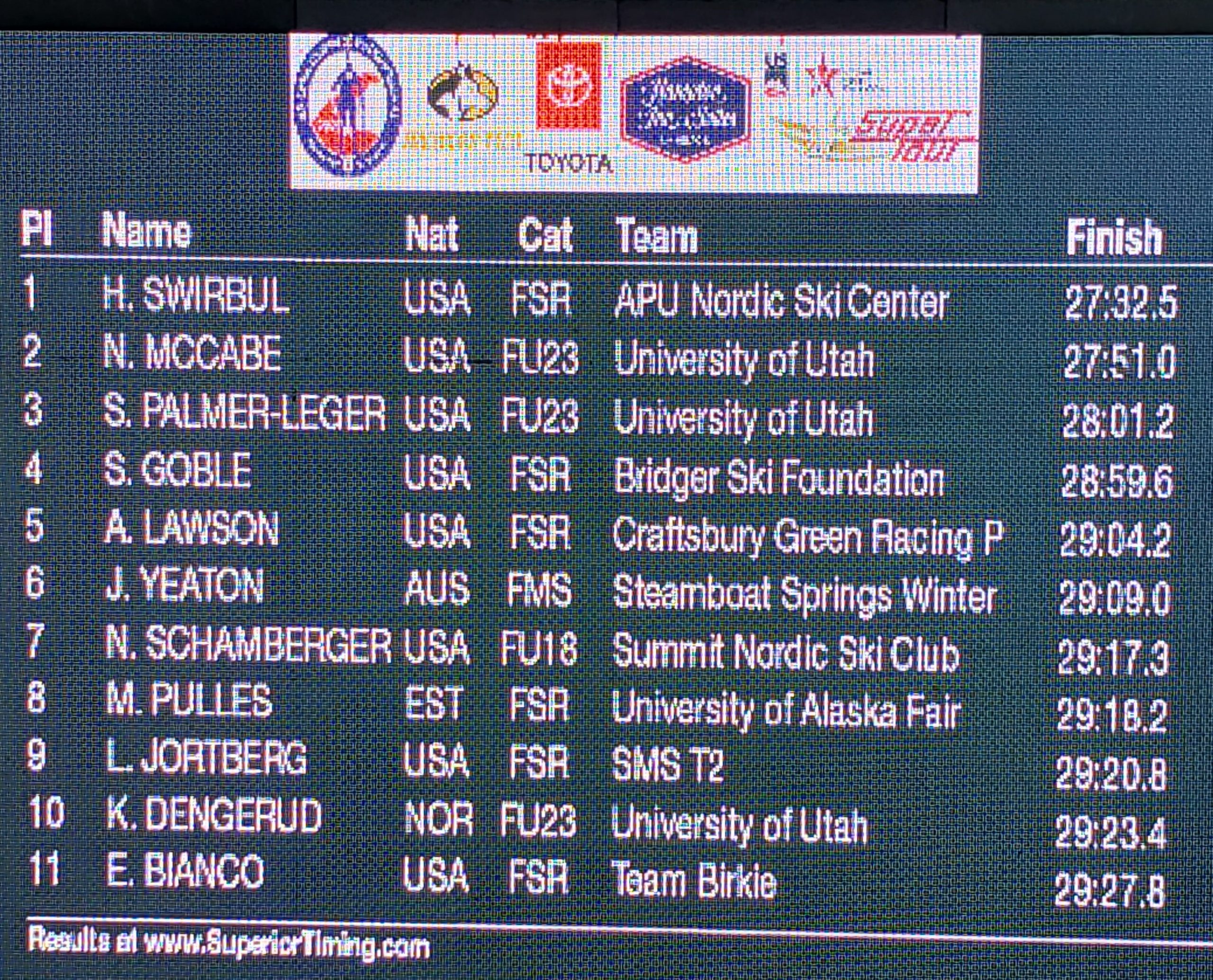
    Top ten results, Women’s U.S. nationals (Photo: FasterSkier)

    The weather in Michigan’s Upper Peninsula has been extremely atypical for this time of year with temperatures hitting almost 40 degrees and only dropping to freezing in the evening. Fortunately, a deep snowpack provided good conditions.  With temperatures hovering around freezing with moist snow, it would have been disastrous for a classic race, but today, the conditions were fast and forgiving, close to ideal for a skate race.

    U.S. Nationals, Men’s results. (Photo: Fasterskier)
    The Results

    The women’s competition was won by US National Team member, Hailey Swirbul (Alaska Pacific University Nordic). She was followed in second by National Team member Novie McCabe (University of Utah), with Sydney Palmer-Leger (University of Utah) in third.

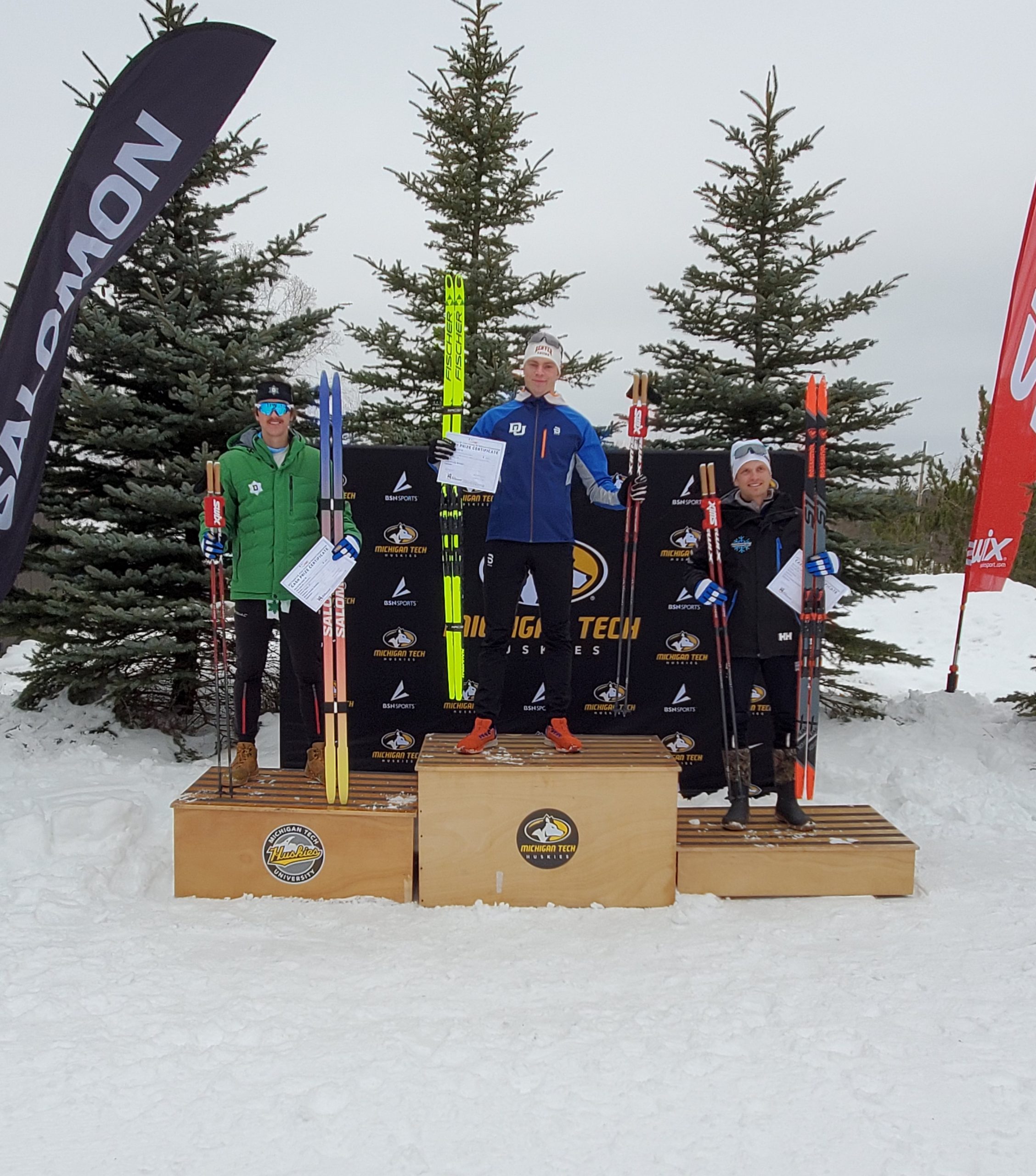
    The men’s first-place finisher was Andreas Kirkeng from Norway (University of Denver). In second place was John Steel Hagenbuch, (Dartmouth College), and in third place was David Norris (Steamboat Springs Winter Sports).

    Men’s podium U.S. Nationals (l-r John Steel Hagenbuch, Andreas Kirkeng, David Norris. (Photo: Fasterskier)
    The Race

    The men’s race was dominated by the Norwegian, Kirkeng, a college sophomore who won by over 30 seconds. It was a performance made all the more impressive by the fact that as Kirkeng told Fasterskier, he had returned from Europe only five days prior to the race, having travelled home for the holidays. Kirkeng lives 30 minutes from Oslo, and had spent the holidays in the mountains.

    It was the first time on these trails for the Norwegian who professed a liking for the course. Kirkeng told Fasterskier that, “The course is really broken into two parts, long straight ups and downs where you really just have to find the flow, and the second half is short kickers with a lot of transitions, you really have to be on top of everything and work hard for it.”

    He also told Fasterskier that he had tried out some strategies yesterday with race prep intervals, but that, “There’s no real resting point, so you have to ski smart and save energy where you can.  Save some on the uphills and really pursue the turns.”

    The moist snow didn’t faze the Colorado student since it’s very similar to what he has at home in Norway. For the young Norwegian, the podium is a foundation for his young career.

    Andreas Kirkeng charging onto lap two as he heads toward victory. (Photo : Fasterskier)

    Second place finisher Steel Hagnenbuch, a Dartmouth freshman, told FasterSkier that he was familiar with the course having skied it as a junior in 2020. “It skis almost like an altitude course in that there’s a lot of sustained working sections,” he said. “I thought it was really important to be strong and composed in the working section, that’s probably four minutes of big V-2 work.”

    US Ski Team veteran David Norris—who was pulling double duty as both a racer and a coach for S.S.W.S.—told Faster skier that he was, “Grateful to the club letting him coach and race simultaneously.” Norris’s strategy was, “To settle in on the climbs and work all the gradual rolling stuff.” Norris’ experience was able to bring some perspective to the fact that fluoro waxes were not allowed in this race. It was Norris’s first time at a National Championship level race without fluoro waxes. “With a two lap course, it’s really interesting,” he said. “You can see where you glided to on the first lap compared to the second lap. With the new waxes, it seemed like they slowed down after 5 k, but it was quick snow.”

    David Norris on his way to a podium in Houghton.  (Photo: FasterSkier)

    Norris expressed a theme repeated by skiers through the day: “Racing U.S. Nationals is the absolute best. It’s awesome, 50% of the faces here are familiar and friends . . . I like being here with all of my friends.”

    The theme of fun mixed with competition was repeated by women’s champion, Swirbul.

    “I’m so happy to be here.  It’s not that the pressure or expectations go away, but there’s so many positive things about the ski community as a whole here … getting to see kids of all ages racing and seeing parents cheering.  That environment makes me fall in love with skiing again.”                                         Hailey Swirbul

    Swirbul agreed with Steel Hagnenbuch that the course feels like skiing at altitude.  She said, “It’s super sustained most of the way, it reminds me of altitude racing actually. You have to continuously grind the whole way.” She continued that, “This is my fourth or fifth time in Houghton; it’s always fun to come here and push your limits with the best skiers in the country.”

    Hailey Swirbul starting her journey on the way to first place. (Photo: FasterSkier)

    Fourth place skier Sarah Goble (Bridger Ski Foundation) attended MTU.  She told Fasterskier the home field advantage definitely helped. “I skied here almost every day for three years. It’s really cool to be back in Michigan.”

    APU coach Galen Johnston reiterated how the U.S. Nationals mean different things to different racers. “For some it’s a chance to come and establish the work that’s been done over the course of the year,” he said. “For some it’s a first time here, just coming and seeing what it’s all about.” He continued that for the first timers it’s “A chance for them to get full service from the ski perspective, and a chance to race with the best in the world. It’s a learning experience, so they can see what the next level looks like.”

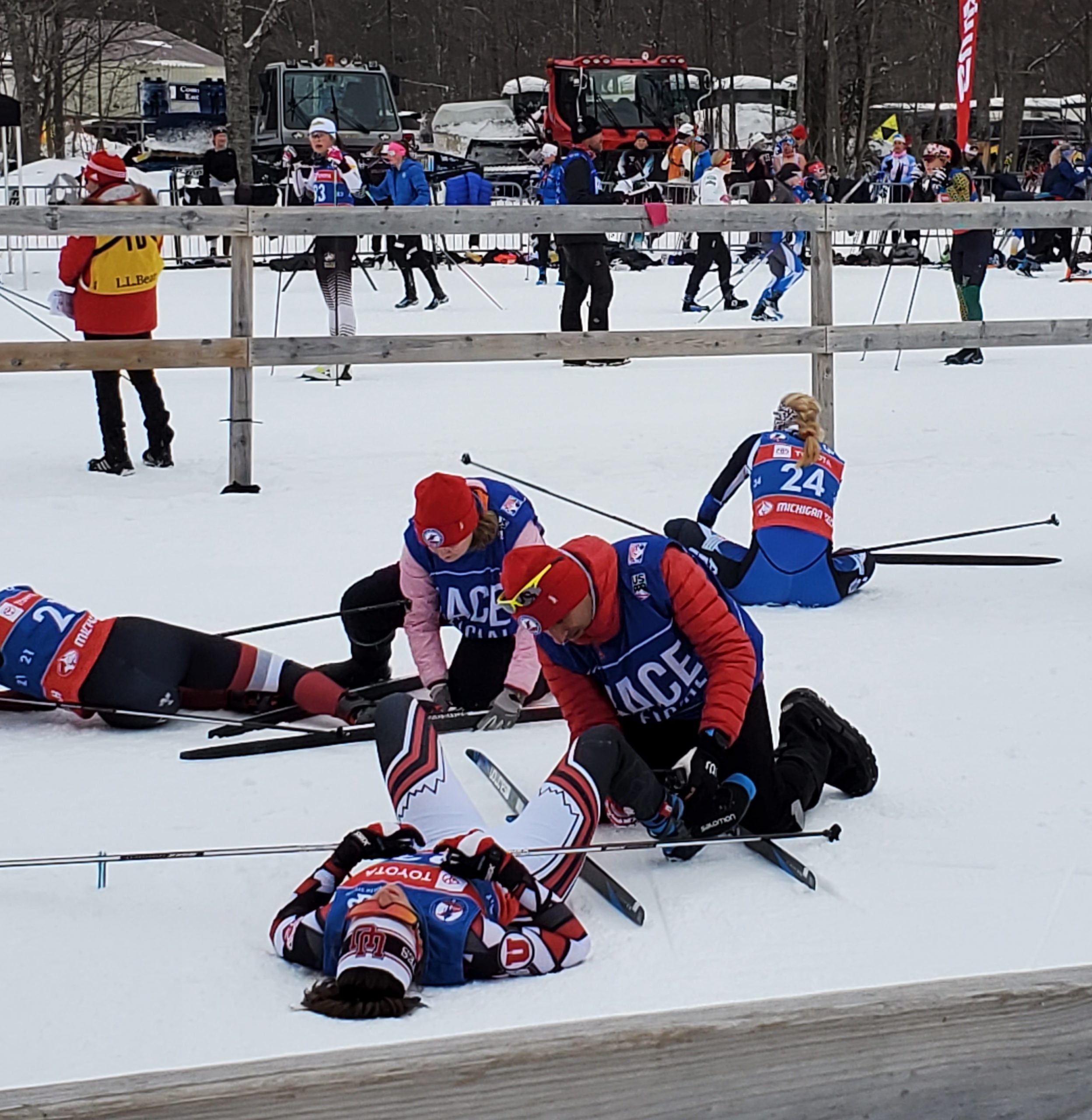
    The carnage that awaits finishers at Houghton (Photo: FasterSkier)

    All racers and coaches Fasterskier spoke with had high praise for the venue, the quality of organization and conditions. Racing in Houghton continues on Wednesday with Men’s and Women’s Classic Sprints. Tune in to FasterSkier for livestreaming and race coverage.

    Men’s and Women’s 10 k Freestyle, Full Results


  • Packer Holds Off Hanneman for First National Title; APU Puts 3 in Top 4 in Classic Sprint

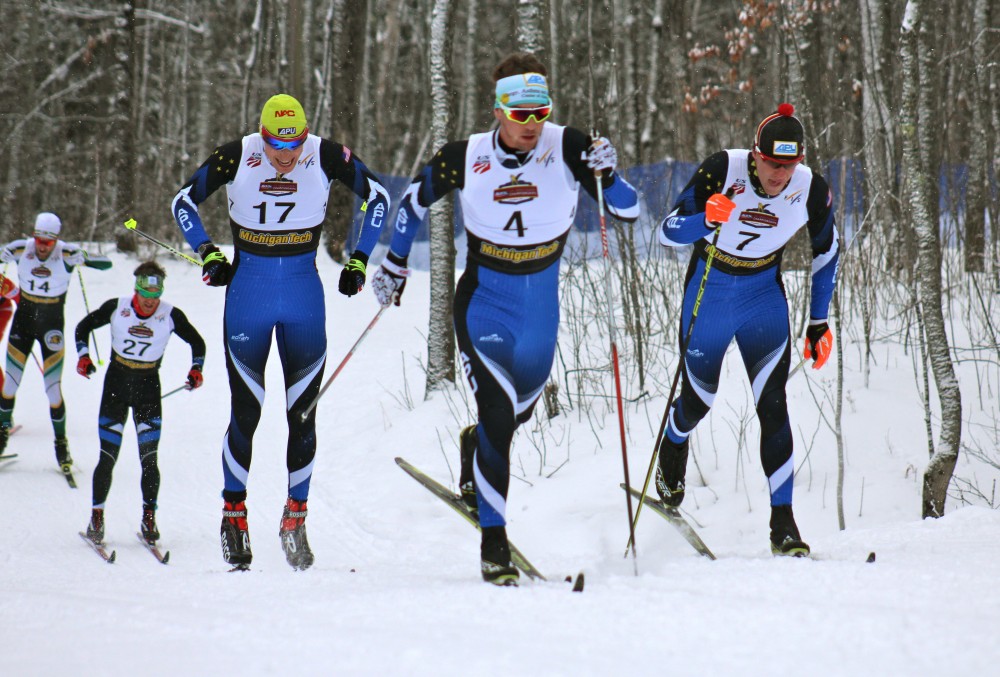
    Left to right: APU head coach Erik Flora runs along side APU athletes Eric Packer and Reese Hanneman during the final of the men's 1.5 classic sprint on Saturday at U.S. nationals in Houghton, Mich. Packer won the event, while Hanneman took second.
    Alaska Pacific University teammates Eric Packer (5) and Reese Hanneman (4) go head to head in the men’s 1.5 k classic sprint final on Saturday at U.S. nationals in Houghton, Mich., while coach Erik Flora (l) runs alongside them. Packer won the final by 0.67 seconds, denying Hanneman a sweep of this week’s sprints.

    HOUGHTON, Mich. — The step into the reality of a goal is at times, long awaited. It is a step that Eric Packer of Alaska Pacific University (APU), the race winner of the men’s 1.5-kilometer classic sprint at U.S. Cross Country Championships on Saturday, feels he has finally made.

    “I’ve dreamed of winning at nationals for a long time and to finally make it happen is really special,” said the 24-year-old during an in-person interview after winning his first U.S. nationals title on the Michigan Tech Trails. He had reached the national podium twice before: placing third in two races at 2012 nationals (classic sprint and 30 k classic mass start) in Rumford, Maine.

    After racing to fourth overall in the 15 k classic individual start a week ago, then 11th in the freestyle sprint on the same course last Monday, and 25th in the 30 k freestyle mass start on Thursday, Packer remained receptive to any opportunity afforded him during Saturday’s sprint.

    “The most challenging part for me was I was very tired after the qualifier,” said Packer. He qualified fourth, 4.74 seconds behind qualifying winner Didrik Fjeld Elset, a Michigan Tech freshman from Norway.

    “It’s the accumulation of the week of racing and it’s hard to stay with it and remember that even though it’s the end of the week, it’s still a national championship,” Packer explained.

    In the end, it was a challenge that left the Anchorage native unmatched in the final. To get there, Packer had won his quarterfinal and placed second his semifinal (behind Dakota Blackhorse-von Jess, of the Bend Endurance Academy) to automatically advance to the final.

    “[APU] had a great day and that’s really cool for Eric to win,” Blackhorse-von Jess said after racing to fifth in the final, 5.37 second off Packer’s winning time of 3:38.17.

    Along with Packer, APU’s Reese Hanneman and Tyler Kornfield also advanced to the final and placed second and fourth, respectively.

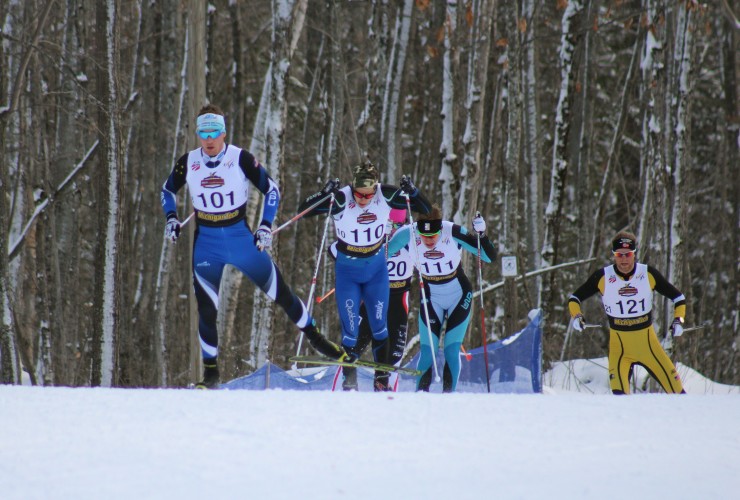
    APU teammates and brothers Logan Hanneman (7) and Reese Hanneman (4) lead teammate Tyler Kornfield (17), Welly Ramsey (Mountain Endurance Sports) and Fredrik Schwencke of Northern Michigan University (far left) during their quarterfinal of the men's 1.5 k classic sprint on Saturday at U.S. nationals in Houghton, Mich.
    APU teammates and brothers Logan Hanneman (7) and Reese Hanneman (4) lead teammate Tyler Kornfield (17), Welly Ramsey of Mountain Endurance Sports (27) and Fredrik Schwencke of Northern Michigan University (far left) during their quarterfinal of the men’s 1.5 k classic sprint on Saturday at U.S. nationals in Houghton, Mich.

    “My fiancé is trying on wedding dresses today, so I knew I had to win some money,” said Hanneman, the runner-up by 0.67 seconds. He got engaged last month.

    Beyond bridal bouquets, Hanneman also now has World Cup starts ahead of him.

    “I’m going to Europe [on Sunday] and I’ll race the sprints in Slovenia next weekend, all of Period 3,” said Hanneman, 26, also originally from Alaska. After that, he’s headed to Canada for the season-ending World Cup tour.

    Overall third place finisher, Elset, 22, crossed 1.05 seconds after Packer, and explained he was seeking redemption after the skate sprint.

    “I really wanted to do well today because I crashed in the semifinals on Monday,” Elset said.

    Out of six hungry finalists in the men’s field, the contention for the title would prove challenging — especially with some racers on skate skis.

    “I went with classic skis for the qualifier and then double poled all three heats,” Kornfield said. He finished fourth after Elset edged him in a photo finish for third. Both were given the same time. 

    Elset also double poled the final, after double poling the qualifier and his quarterfinal and semifinal as well.

    “It was OK for the first three heats, but in the final when the guys were fast, my arms were really, really tired,” Elset said. 

    Hanneman and Blackhorse-von Jess took the opposite route, opting to race classic skis throughout the day.

    Though another Norwegian, 23-year-old Håkon Hjelstuen, a former Michigan Tech skier, dabbled with double poling, he ultimately went with classic skis in the final.

    “I tried it in the semis. It’s kind of a game,” Hjelstuen said after placing sixth overall, 24 seconds behind Packer.

    Figuring that most racers would use skate skis during the quarterfinals and then switch to classic skis in the semi, Hjelstuen hoped to catch other competitors off guard.

    “I thought, ‘OK, the other guys are probably doing it in their quarters and then maybe switching,’ so I was trying to switch the other way,” the Norwegian explained.

    Also hoping to gain more control over his heats, Kornfield reasoned he made the right choice to double pole through the rounds.

    “All my heats had mixtures of skate skis and classic skis so the downhills; it was obvious who could take the turns better,” Kornfield said. “Because I could take better lines than the classic skiers, I was able to choose where I wanted to go.”

    The start of the men's classic sprint final (from left to right), with Didrik Elset of Michigan Tech, Dakota Blackhorse-von Jess of Bend Endurance Academy ), Tyler Kornfield (APU), and Reese Hanneman (APU) at the start of the final for the men's 1.5 k classic sprint on Saturday at U.S. nationals in Houghton, Mich. (Photo: Christopher Schmidt)
    The start of the men’s classic sprint final (from left to right), with Didrik Elset of Michigan Tech, Dakota Blackhorse-von Jess (Bend Endurance Academy), Tyler Kornfield (APU), and Reese Hanneman (APU). Eventual winner Eric Packer is not shown. (Photo: Christopher Schmidt)

    The light snowfall, track traffic during rounds, along with the course’s lengthy climb to the finish, made decisions on ski choice largely up to the individual.

    “I tested classic versus skate in the morning and the tracks were really weird,” Packer observed.

    “It was glaze-y in places and new snow, so my skate skis were a little bit faster for the double pole and I double poled in the qualifier in the morning, but then I switched to classic for all the other heats,” he explained.

    The Final: From Start to Finish

    With four racers in the final on classic skis and the rest on skate, the final men’s race of the day took off at the sound of the gun, those on skate skis pushing the pace early on.

    “I took the start and I wanted to go kind of hard down the hills in the beginning to take advantage of my good glide,” Elset said. “From there on in, it was just answering the attacks that came from the guys with good kick.”

    While Elset and Kornfield remained in the lead for the first part of the course, the rest of the field was forced to hunt for the front.

    “The guys [on skate skis] got in front and were gliding a little bit faster on the first downhill,” Hanneman recalled. “I couldn’t get my own track on the first hill, so I was kind of forced to just hang back. … I tried to make a pass on the inside, but I realized that was just going to cause a big mess, so I kind of backed off a little bit.” 

    Still a tight pack after cresting the first uphill, the group made their way into the corner before the next big climb.

    Coming out of the corner to the second large climb, it was Hanneman who made the first move to take the lead.

    “On that second big climb I was able to get my own track so then I was able to put the hammer down and kind of put some space between me and the skate ski guys,” Hanneman said.

    Following Hanneman, Packer also saw his chance to better position himself for the second half of the course.

    “Tyler and Didrik were driving the pace and then Reese pulled out on the side and was able to pass them striding,” Packer said. “I jumped in behind Reese and together we broke away a little bit on the second climb.” 

    As Packer and Hanneman maneuvered their way to the front, the battle behind them ensued.

    “I was leading up until the second big uphill, and I just didn’t have enough power to get over the top fast enough to be within range of Packer and Reese,” Kornfield said.

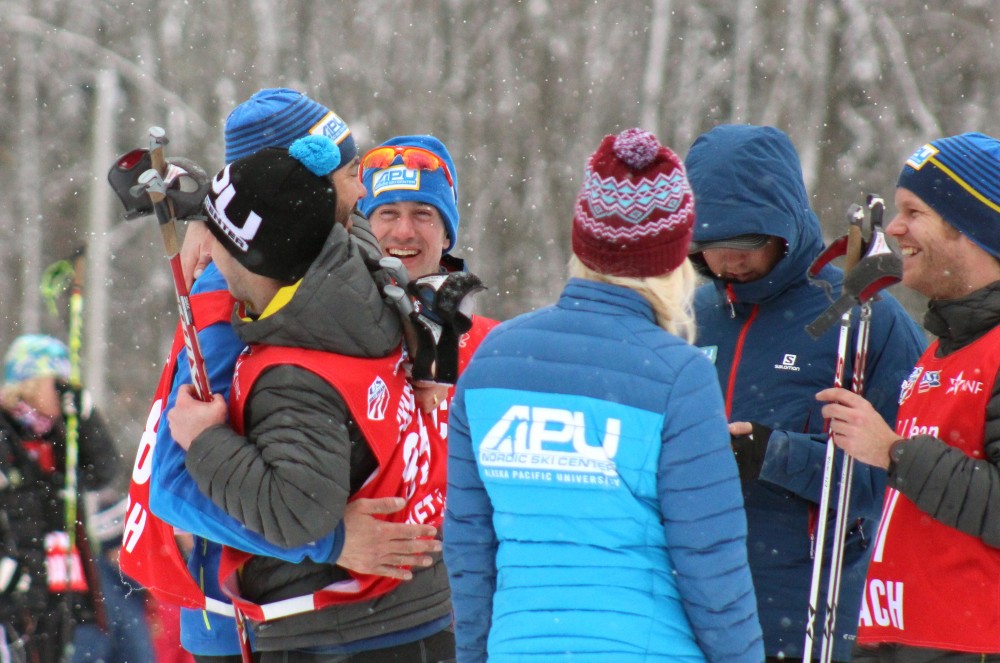
    APU coaches and wax techs celebrate with hugs after having three APU athletes in the top four, including overall race winner Eric Packer (not shown) for the men's 1.5 k classic sprint on Saturday at U.S. nationals in Houghton Mich.
    APU coaches and wax techs, including head coach Erik Flora (l) celebrate after three APU athletes finished in the top four, including overall race winner Eric Packer (not shown) at the men’s 1.5 k classic sprint on Saturday at U.S. nationals in Houghton, Mich.

    “Didrik led down the hill, but Reese pulled up alongside him on the second climb,” Blackhorse-von Jess explained. “I was back there trying to pick my way through traffic, trying to get back in contact with the main group. [Hjelstuen] was in fifth and he kind of got detached and I got stuck behind him a little bit. Eventually, I got around him, but I just couldn’t close it to the big group.”

    After moving around the sixth-place Norwegian, who advanced to the final as a lucky loser, Blackhorse-von Jess explained, “I went for it, but I chose the wrong lane I guess, so I lost some speed in that downhill before the last uphill. Still, I would rather go for it than go for nothing.”  

    With that, the finalists rounded the last corner on course, a sea of blue in the lead.

    Packer cornered first, Hanneman centimeters to his left and Kornfield in the center lane just behind.

    In the lane to the left of Hanneman and Kornfield was the gold suit of Michigan Tech’s Elset closing in on the three APU skiers.

    “On that final turn, Packer and I were having a double-pole battle,” Hanneman said. “He came out of that turn a little faster than I did, so he pulled faster than I did and we were side by side.” 

    Packer then made his move around Hanneman in the final 100 meters.

    “In the finish, I jumped out from behind Reese to make a pass and I jumped out into a super-slow lane that was filled with new snow,” Hanneman said. “So I just double poled as hard as I could and got by and then once I got past him I tried to get back into a faster track.” 

    As the teammates battled for first, Packer outlunged Hanneman at the line by about six-tenths of a second.

    Not far behind Hanneman and Packer, Elset challenged Kornfield for third. In an extremely close photo finish, Elset came away with the overall podium finish, though Kornfield stood as the third American at the end of the day. Blackhorse-von Jess finished about four seconds later in fifth and Hjelstuen rounded out the final in sixth.

    With his first U.S. nationals win packed away, a euphoric Packer stood on the top of Saturday’s men’s sprint podium.

    “It feels amazing,” he said. “It’s a dream come true.”

  • Miller Owns Classic Sprint on Final Day of U.S. Nationals

    Miller Owns Classic Sprint on Final Day of U.S. Nationals


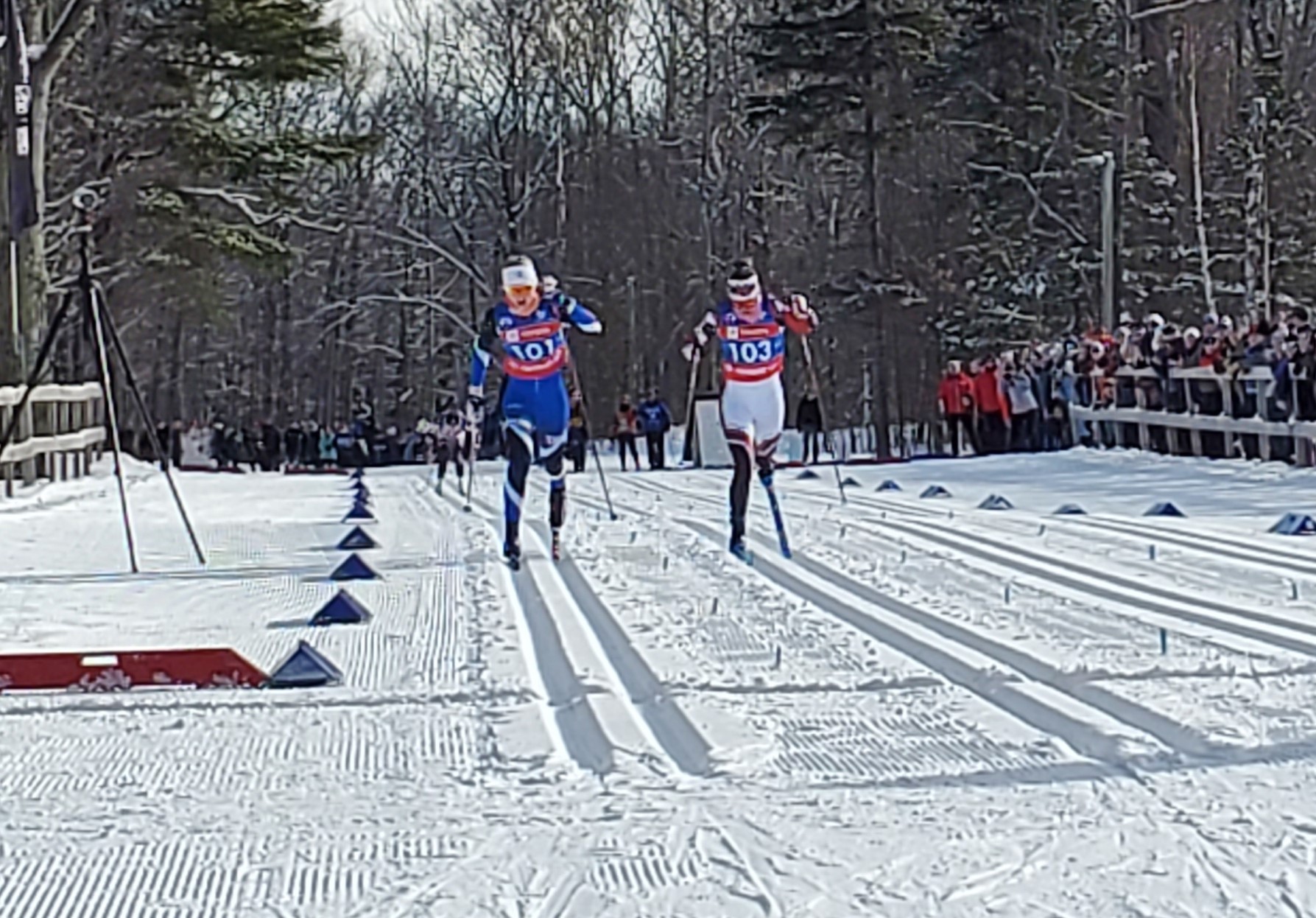
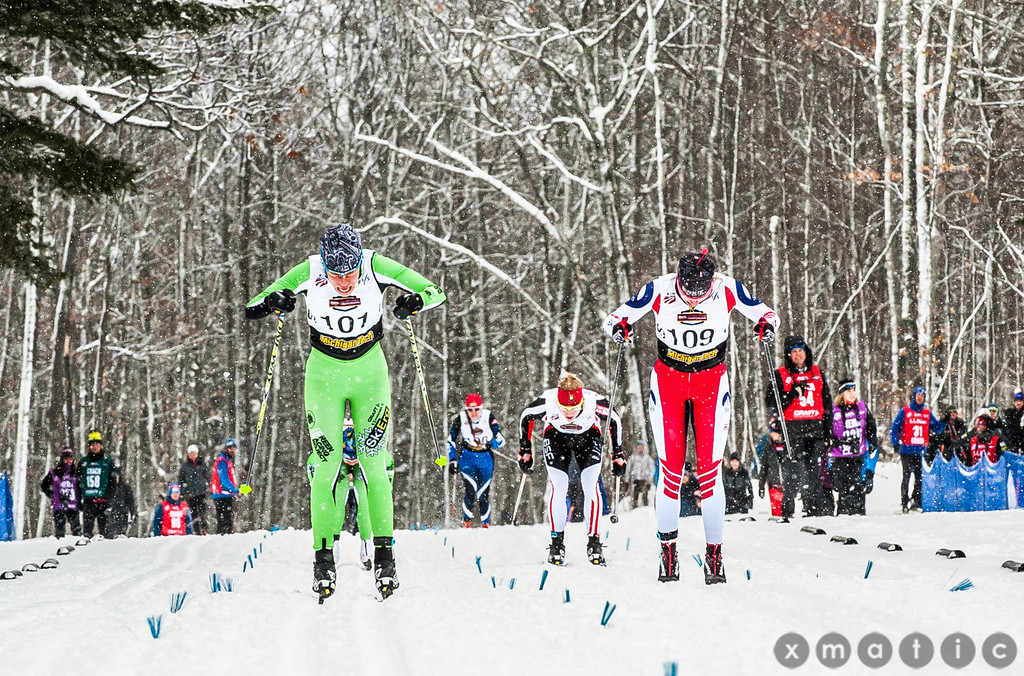
    Miller of CGRP (bib 101) outsprints Hart (bib 109) for the win in the final of the classic sprints (photo: Christopher Schmidt)
    Miller of CGRP (bib 101) out sprints Hart (bib 109) for the win in the final of the classic sprints (photo: Christopher Schmidt)

    HOUGHTON, Mich. — Kaitlynn Miller took charge of every heat she raced in during the women’s 1.5-kilometer classic sprint on Saturday, and in doing so, earned her first national title in the final race of 2016 U.S. Cross Country Championships.

    Miller, of the Craftsbury Green Racing Project, started the day with the fastest qualifying time of 4:19.42 minutes, 3.5 seconds faster than teammate Liz Guiney in second. The 24-year-old Miller went on to win her quarterfinal and semifinal en route to a commanding victory in the final over Anne Hart of the Stratton Mountain School (SMS) T2 Team and Jennie Bender (Bridger Ski Foundation), respectively.

    Earlier this week in the freestyle sprint at nationals, Bender had edged Hart for the win, Craftsbury’s Caitlin Patterson placed third, and Miller finished 0.7 seconds off the podium in fourth. Not all was lost: Miller had finished second to Patterson in the 10 k classic the day before for her first-ever podium at nationals.

    But on Saturday, the 24-year-old Miller seized the opportunity to stand one step higher on the podium, made possible by a no-nonsense strategy.

    The classic sprint was held on the same 1.5 k course as the freestyle sprint on Monday, featuring a descent at the start, followed by a punchy climb and descent and then a long uphill grind to the finish.

    Miller’s strategy was to take it out hard so she could lead and have more control of her race.

    “I really like to be able to pick my line on the downhills and choose my track on the way up,” she explained after the final. “It keeps me away from some of the mayhem.”

    Her aggressive approach was rewarded as she won both her quarterfinal and semifinal, first by 0.17 seconds ahead of Patterson and then by 1.09 seconds over Bender.

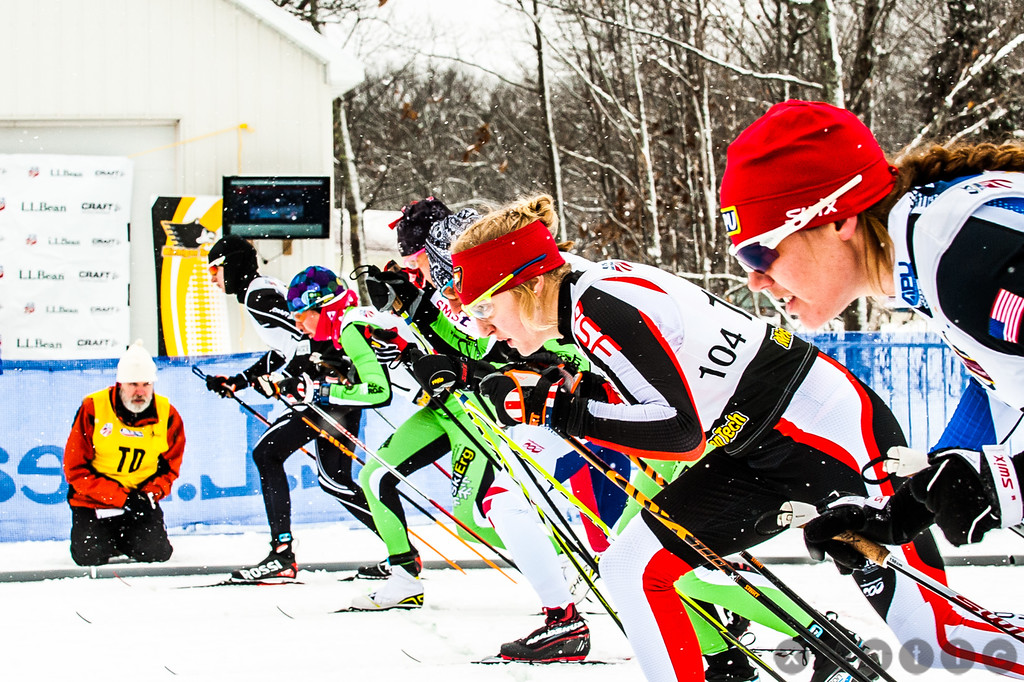
    Six women line up for the start of the classic sprint final on the final day of racing at U.S. Nationals in Houghton
    Six women line up for the start of the classic sprint final on the final day of racing at U.S. Nationals in Houghton (photo: Christopher Schmidt)

    “I figured if it worked in the quarterfinal and the semifinal, I would do it in the final,” Miller said.

    Again in the final, Miller took it out hard from the line while Hart tucked in behind her. Together they gapped the field, making it a two-woman race for the title.

    “I knew Kaitlynn Miller was having a really great day so my tactic was to get right on her and hopefully pull it off in the end,” Hart, 23, said.

    Behind them, Bender, Patterson, Becca Rorabaugh of Alaska Pacific University (APU), and Natalia Naryskina of Central Cross Country (CXC) jostled for the remaining places.

    Bender found herself in last heading down the first hill after picking a slow track off the start.

    “I actually got gapped a bit down that first hill and had to work a bit harder to catch up, but I charged the last hill to get into third,” she explained.

    Bender’s surge wasn’t quite enough to catch Miller and Hart, and she finished third, 4.19 seconds off Miller’s winning time of 4:16.53.

    As the two race leaders sprinted up into the stadium and into the finishing straight, it was all Miller.

    “We came to the finishing straightaway together and I swung out to try and pass her, but I just didn’t have it today,” Hart said. Miller held her off by 1.24 seconds for the win.

    For Hart, it was her second runner-up performance in as many sprints this week.

    “I really wanted to win, but if you would have told me a year ago that I would have been disappointed with second, I wouldn’t know what you were talking about,” she said. “It’s a great, competitive group of women and U.S. skiing is really taking off, especially on the women’s side, so any day you can be second is a good day.”

    Following a freestyle sprint title on Monday, Bender achieved her second podium of the week in third.

    “I am always hoping one of these years I’ll get a double-win in the sprints, but considering my classic sprinting has been touch and go, I’m happy with third,” Bender said. She has won two U.S. nationals skate sprints (2016 and 2014) as well as a classic sprint (2013) in her career.

    Miller (CGRP) takes her first national title in the classic sprints. Hart (SMST2) and Bender (BSF) added to their sprint podium count at U.S. Nationals taking second and third respectively (photo: Christopher Schmidt)
    Miller (CGRP) takes her first national title in the classic sprints. Hart (SMST2) and Bender (BSF) added to their sprint podium count at U.S. Nationals taking second and third respectively (photo: Christopher Schmidt)

    Patterson had to recover from some tactical missteps when she found herself boxed out after a slow start and lost momentum when she was forced wide on the icy and washed-out downhill corner.

    “At that point I had a free track in front of me, but not so much momentum or energy,” Patterson recalled. “I tucked behind Jennie and almost covered that move, but she had a little more energy than me coming into the final stretch.”

    Patterson placed fourth, 2.28 seconds short of her fourth podium in four races this week after winning both distance races (the 10 k classic individual start and 20 k freestyle mass start).

    Rorabaugh finished nearly 10 seconds after Patterson in fifth (+16.25). Like Patterson, she also said she made some sub-optimal tactical decisions in the final, which kept her from fighting for a podium.

    “The course is more tricky when it is not as slow as last year,” Rorabaugh explained, referring to the heavy snowfall that made last year’s classic sprint at nationals in Houghton feel like an endurance race. “This year you need to make decisions about when to kick and when to double pole.

    “In all honesty, I think people skied really well in the final,” she added. “People made good moves in the right places and I was just on my heels a bit.”

    Naryskina followed in sixth (+29.94) after advancing to the final based on time, as a two-time “lucky loser” out of both her semifinal and quarterfinal.

    Bender also attested to the strength of the field. “The other two girls [Miller and Hart] were striding really well,” she said. “I’m happy to be on the podium. It was a fight out there for sure.”

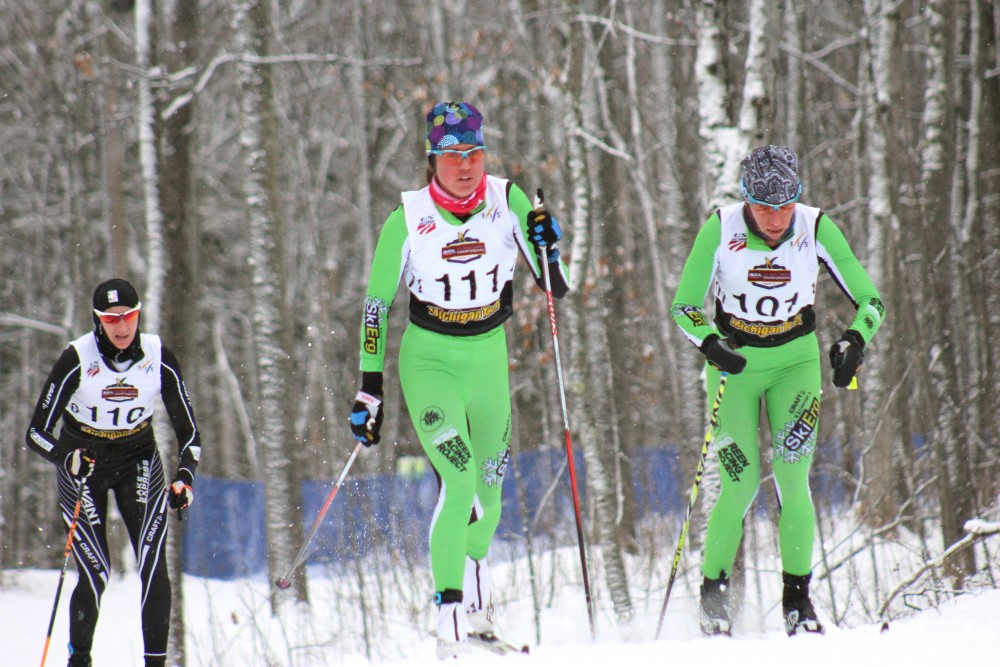
    Craftsbury teammates Kaitlynn Miller (r) and Caitlin Patterson (111) lead CXC's Natalia Naryshkina in their classic-sprint quarterfinal on Saturday at U.S. nationals in Houghton, MIch. Miller edged Patterson by 0.17 seconds to win the heat and went on to win the final for her first national title.
    Craftsbury teammates Kaitlynn Miller (r) and Caitlin Patterson (111) lead CXC’s Natalia Naryshkina in their classic-sprint quarterfinal on Saturday at U.S. nationals in Houghton, MIch. Miller edged Patterson by 0.17 seconds to win the heat and went on to win the final for her first national title.

    Patterson was thrilled for her teammate. “I could see her up ahead on the finishing straightaway ahead of Anne and even though I was suffering and trying to maybe catch third, I was so excited for her,” she recalled.

    For Miller, this was the pinnacle of a week of personal bests.

    “I am really excited. I was surprised, but I was looking forward to this race and I just went out there and gave it all I had,” she said. “I carried my momentum from my qualifier, through the heats and to the final.”

    Miller’s results at 2016 nationals have elevated her to second in the overall SuperTour standings behind Patterson. As the overall leader, Patterson plans to race Period 3 of the World Cup and will depart for Europe in late January.

    Period 2 SuperTour action will resume January 30-31 in Lake Placid, N.Y.

    Complete results | Finals

  • Photos From U.S. Nationals: 20/30 k Mass Start

    Photos From U.S. Nationals: 20/30 k Mass Start

    HOUGHTON, Mich. — Three days of racing at U.S. Cross Country Championships on the Michigan Tech Trails down and just one more to go with the 1.5-kilometer classic sprint taking place on Saturday. Check out the following photo gallery featuring some of the top moment’s from Thursday’s 20 and 30 k freestyle mass starts.

    Complete results

  • After Two Rest Days, Nationals Skiers Ready to Roll in 20/30 k Mass Starts (with Video)

    After Two Rest Days, Nationals Skiers Ready to Roll in 20/30 k Mass Starts (with Video)

    HOUGHTON, Mich. — After two days off, the U.S. Cross Country Championships picks up again on Thursday with the women’s 20 kilometer and men’s 30 k freestyle mass start races.

    Many athletes out on the Michigan Tech Trails enjoyed two non-race days amidst sunny skies and warmer temps, at least compared to last year’s U.S. nationals event, also in Houghton.

    The dramatic difference in weather led racers like Alaska Pacific University’s Reese Hanneman, the winner of Monday’s 1.5 k freestyle sprint, to describe it as “paradise.”

    While the initial three-day trek for some racers, coaches and techs to arrive in Houghton is perhaps worthwhile with the promise of sun, it is also the present state of the trails that drew these individuals to the event.

    “My favorite part about Houghton, Michigan is the [area’s] ski trails,” said University of Denver skier Taeler McCrerey.

    This week, much of McCrerey’s and other competitors’ time on snow and the ski trails is largely thanks to the area’s community volunteers.

    “It’s all part of building community,” Shane Sullivan, a local and volunteer race starter for the U.S. nationals races this week in Houghton, said on Monday during the freestyle sprint. “It’s as much the community camaraderie as it is putting on the event.” 

    20/30 k Mass Start Previews: Men | Women

    Start lists | Live stream

  • Photos from U.S. Nationals: The Skate Sprint

    Photos from U.S. Nationals: The Skate Sprint

    HOUGHTON, Mich. — Day 2 of the U.S. Cross Country Championships took place Monday with the 1.5-kilometer freestyle sprint on the Michigan Tech Trails. Past national sprint champs Jennie Bender and Reese Hanneman racked up another title each after dominating all day, from the qualifier to the finals.

    Racing resumes Thursday with the 20/30 k freestyle mass starts and ends Saturday with the classic sprint.

  • Blackhorse-von Jess Plows Through Competition for U.S. Champs Sprint Victory (with Gallery)

    Blackhorse-von Jess Plows Through Competition for U.S. Champs Sprint Victory (with Gallery)

    Dakota Blackhorse-von Jess strides to a near seven-second win in Tuesday's 1.5 k classic sprint at the 2015 U.S. Cross Country Championships in Houghton, Mich. (Photo: Jake Ellingson)
    Dakota Blackhorse-von Jess strides to a near seven-second win in Tuesday’s 1.5 k classic sprint at the 2015 U.S. Cross Country Championships in Houghton, Mich. (Photo: Jake Ellingson)

    HOUGHTON, Mich. — As the heavy, wet snow fell on the trails of the Michigan Tech Nordic Skiing Center Tuesday morning, the first starter in the men’s 1.5-kilometer classic sprint at the 2015 U.S. Cross Country Championships emerged from the dense cloud of white.

    Plowing through the roughly seven inches of snow that had fallen in three hours, Dakota Blackhorse-von Jess (Bend Endurance Academy) notched the second-fastest time of the day. But much like the wind and snow, he wasn’t going to stop there.

    Similar to his female counterpart, Rosie Brennan of Alaska Pacific University (APU), Blackhorse-von Jess breezed through the quarterfinal and semifinal – earing the top spot in both. Once in the final, it was more of the same for the 28 year old, who surged over the course’s second-to-last hill to enter the stadium far ahead of his competitors and across the line with a smile and a winning time of 4:06.16.

    The next competitor, Ben Saxton (SMST2/USST), crossed the line 6.29 seconds after Blackhorse-von Jess in second, while Michigan Tech skier Håken Hjelstuen of Norway rounded out the podium in third, 7.12 seconds back.

    While Blackhorse-von Jess had the task of tackling the slow, new snow in qualification, he said it was a common factor between he and the other first starters. Once in the heats, he explained, the unusually slow nature of the race made tactics less important.

    “In a four-and-a-half minute long race you just go ski and you wait and see what happens. Obviously there are certain spots on the course where certain people do different things better than other people. [For me] it wasn’t a goal to lead and it wasn’t a goal to be in last,” he said of his strategy in a post-race interview.

    Although he wasn’t aiming to lead, it was a position that Blackhorse-von Jess found himself in during the quarterfinal. Entering the stadium with a sizable lead over David Sinclair (GMVS) and Forrest Mahlen (MSU), he skied across the line with the speed of a 30 k instead of a sprint.

    In the semifinal it looked as if the same would happen as the heat of six skiers sped up the ultimate hill. However, there was one competitor who held onto Blackhorse-von Jess – Cole Morgan of the University of Vermont.

    “In the semifinal Cole Morgan was on my tail and wouldn’t let go and it made it sound like there were a lot more people around. So I had to push it into the finish,” Blackhorse-von Jess said.

    The Bend Endurance Academy skier held off the challenge and the two automatically advanced to the final, where a similar situation took place. On the second-to-last hill, again, Blackhorse-von Jess felt Morgan on his tails. At that point he made the push to lose the 20-year-old college skier.

    “I said, ‘well, I’m done with this,’ and I took off. Suddenly the woods got quite and I was by myself, so I went for it,” he said.

    Men's 1.5 k classic sprint at the 2015 U.S. Cross Country Championships in Houghton, Mich.
    Dakota Blackhorse-von Jess (Bend Endurance Academy) leads Cole Morgan (UVM) in the semifinal finish in the men’s 1.5 k classic sprint at the 2015 U.S. Cross Country Championships in Houghton, Mich.

    Tuesday’s win is Blackhorse-von Jess’ second national championship. Although he has landed on the podium multiple times, his only other win was in a 2013 freestyle sprint at Soldier Hollow. He explained his win in that race was more meaningful because it was unexpected and “something I really had to fight for.”

    The 2015 title is different for Blackhorse-von Jess because it’s been a part of his season plan for a long time, and the highlight of that plan is not a national championship.

    ”This year everything has been geared toward Word Championships so this is a stepping-stone. The goal was to put myself in a position to win and see if I can do it. So everything worked out really well and I’m excited. Obviously I can’t control if I go to World Championships but I know that the way we set up the training, we are on the upswing and things will continue to rise in February,” he said.

    Blackhorse-von Jess will not be selected for World Championships based on the objective criteria outlined by USSA, which includes a top 60 ranking in the overall World Cup. However, he does have a chance in the additional objective criteria, which is based on USSA sprint and distance points. Blackhorse-von Jess currently sits in third position behind World Cup skiers Andy Newell and Simi Hamilton in the most recent sprint ranking list released Jan. 2.

    While he has no control over whether he will be selected for World Championships, Blackhorse-von Jess does have a say in earning the 2015 SuperTour sprint title, which could result in World Cup starting spots later this season.

    “I think that being the best of the rest is best I can do. The only thing in my control is winning the sprint SuperTour so I can secure those two world cup starts at the end. Obviously it would be great to go to World Championships, but two years ago I had a first and a third and I still didn’t go,” he said.

    In the meantime, however, Blackhorse-von Jess is skipping the 30 k classic mass start on Thursday to focus on Saturday’s freestyle sprint. He explained that, historically, the second sprint of nationals has always been a challenge for him but this year he’s hoping that will change.

    “The goal for us is to figure out how to get through the next four days to be able to have a good race, because I haven’t had an awesome race the second time,” he said.

    The Fight for Second

    Saxton’s silver medal finish is his second in two years. In 2014, he was the runner-up to the national title behind Torin Koos in the freestyle sprint at Soldier Hollow.

    En route to this year’s podium finish, Saxton had to maneuver a challenging quarterfinal to advance to the next round. In what he called the “quarterfinal of death,” Saxton faced a collection of strong sprinters including Reese Hanneman (APU), Tyler Kornfield (APU), Eric Packer (APU), Matt Gelso (SVSEF) and Welley Ramsey (MWSC). The heat was the fastest quarterfinal of the day, but Saxton crossed the line in first followed by Packer and Hanneman, both of whom advanced.

    Men's 1.5 k classic sprint at the 2015 U.S. Cross Country Championships in Houghton, Mich.
    Ben Saxton holds his position over APU’s Eric Packer and Reese Hanneman during one of Tuesday’s quarterfinals in the men’s 1.5 k classic sprint at the 2015 U.S. Cross Country Championships in Houghton, Mich.

    “You could have taken those six names and said this will be the A-final for today, and I wouldn’t have doubted you for a second. They are all really strong skiers, so I felt really lucky to advance out of that,” he said in a post-race interview.

    By the time he reached the final Saxton was ready to fight for the top spot. At the start, however, he had trouble finding his top speed and suffered the consequences.

    “In the final it was the first time all day I had a bad start and it came back to bite me. There were only two or three lanes in play when you’re going around the course, so when I fell down to sixth from the gun there was no way for me to move myself up,” he said of the final.

    But he did move himself up, and by the time he reached the bottom of the last climb Saxton was third with a considerable distance to make up on Hjelstuen who was sitting in second. With a surge of energy Saxton reached the Norwegian and skied past him to gain an advantage on the straight away into the finish and earn silver.

    While Saxton said he was hoping to win Tuesday’s race, he explained that a podium finish is never disappointing.

    “Dakota is a good friend and he is the standard for domestic sprinters so there is no shame in watching him do his thing. I’m barely 21 and Dakota is almost 8 years older than me so there’s some catching up to do. I have so much to learn from him and I’m just psyched to do that for now,” he said.

    The finish comes after Sunday’s 15 k freestyle in which Saxton finished 57th – a result that he said left him shaken.

    “It’s nice to have some mojo back. It was a pretty tough day on Sunday,” Saxton explained.

    Men's 1.5 k classic sprint at the 2015 U.S. Cross Country Championships in Houghton, Mich.
    Brian Gregg (l) Logan Hanneman (c) and Håken Hjelstuen Men’s 1.5 k classic sprint at the 2015 U.S. Cross Country Championships in Houghton, Mich.

    Hjelstuen, a student at local Michigan Tech and native of Oslo, Norway, qualified first and had a successful campaign throughout the quarterfinals and semifinals. However, by the time he reached the final, his kick wax was deteriorating.

    “My kick was not good in the semifinal. We tried to fix it for the final, but it got worse. Up the last hill I was fourth or fifth and I really wanted that podium so I was just double-poling all I could. Maybe with better kick I could maybe fight Dakota. I would have been fun to have a fight close to the end,” he said after the final’s completion.

    While he is a student at MTU, Hjelstuen has yet to become a racing member of the Huskies’ ski team. Since he is an exchange student, his eligibility for NCAA racing has been up in the air. However, he predicted that within the next week the issue would be resolved.

    A Strong Showing for Vermont

    Men's 1.5 k classic sprint at the 2015 U.S. Cross Country Championships in Houghton, Mich.
    Men’s 1.5 k classic sprint at the 2015 U.S. Cross Country Championships in Houghton, Mich.

    Despite challenging Blackhorse-von Jess in the middle of the course, Morgan ultimately ended his day in fourth. The University of Vermont senior from Bozeman, Mont. originally worried that the day would be a “grinder” due to the slow snow he faced in qualification, but found that conditions improved once organizers had groomed the trail between then and the heats.

    While Morgan said he normally has a tendency to start too hard, a key factor in Tuesday’s strategy was to hold back until it the second third of the race.

    “I just tried to tuck behind people for most of those heats until the last half kilometer where it was just rolling. It worked in the quarter and the semi, but in the final I got a little tired so I didn’t really have quite the punch as the other ones,” he explained.

    Morgan was the second U23 skier behind Saxton, thus earning valuable points for a possible bid to make the U.S. U23 World Championship team. In regards to the U23 Championships, Morgan said he’s more focused on the season’s college races, but will see where he stands when the selections are announced Saturday.

    “That wasn’t one of my big goals coming into here. I’m just looking to get some good racing before the college season. We’ll see how it ends up at the end of the week and how I feel there,” he said.

    The University of Vermont saw another of its skiers in the final in the form of Jørgen Grav.

    Grav, a junior from Oslo, Norway, said that he felt faster in the qualification and quarterfinal because he could ski his own pace. In the semifinal and final, he said it was more difficult to ski efficiently due to the grouping of the pack.

    Men's 1.5 k classic sprint at the 2015 U.S. Cross Country Championships in Houghton, Mich.
    Men’s 1.5 k classic sprint at the 2015 U.S. Cross Country Championships in Houghton, Mich.

    “Other than that I’m pretty satisfied. I didn’t expect to get to the A-final. I would say I was a very lucky loser,” Grav, who advanced to the final as a lucky loser, said after the race.

    With their fourth and fifth place finishes, Morgan and Grav, were the top affiliated college skiers (as Hjelstuen has yet to gain eligibility). Prior to Tuesday’s race, UVM was ranked second behind Northern Michigan University in the Championship’s College Cup rankings.

    “We worked pretty hard and we tried to hang on. We finished strong… It was great having a teammate in the final,” he said.

    Taking the last spot in the final was Sun Valley’s Miles Havlick, who said that despite making a few tactical errors, he was happy with his result.

    “I think the longer sprint and the conditions played in my favor as more of a distance skier,” he said in a post-race phone interview.

    The 2015 U.S. Cross Country Championships continue Thursday with a 20/30 k classic mass start for senior skiers and a 10/5 k classic mass start for juniors.

    Results

    — Alex Kochon contributed reporting

  • Photo Galleries: U.S. Champs 10/15 k Freestyle

    Photo Galleries: U.S. Champs 10/15 k Freestyle

    HOUGTON, Mich. — The first day of racing at the 2015 U.S. Cross Country Championships is over after a flurry of exciting action in the 10/15 k freestyle intervals starts. In the men’s 15 k Kyle Bratrud (NMU) bested Kris Freeman (Freebird) by 50 seconds to take his first national championship, while Caitlin Gregg (Team Gregg/Madshus) held off a strong APU women’s team in the women’s 10 k to gain yet another championship title.

    Men’s 15 k: Report | results

    Women’s 10 k: Report | results

    Check out our photo galleries from both races below:


    For more great photos check out Chris Schmidt’s men’s 15 k and women’s 10 k galleries.