
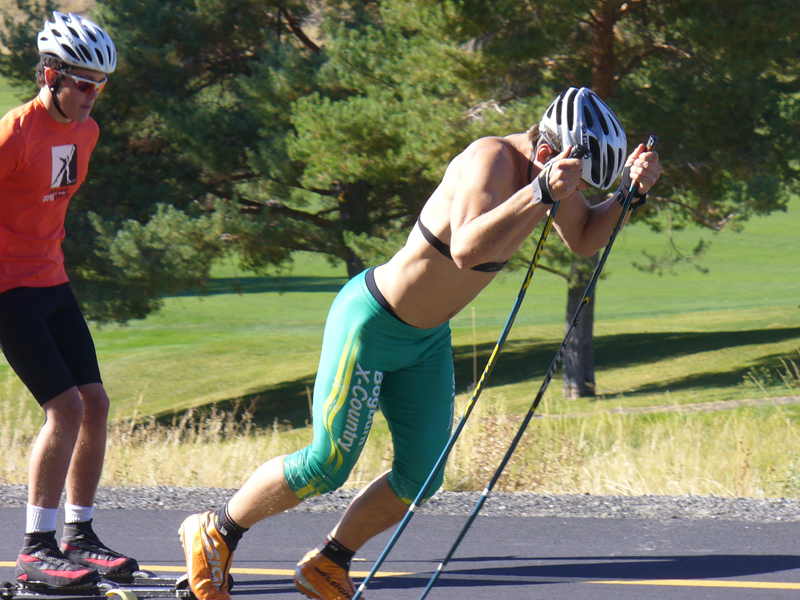
For many Nordic skiers, April marks the end of the season and May starts the new one. With some variation, the Nordic year is made up of 13 four-week-long periods. Each period has a different training emphasis and within each, training rhythms weave through the choices of intensities, training methods and forms, and time spent. April to May and May to June are a transition period; a time for relaxation, the return to dry land training and the setting of new and adjusted goals.

There are some assumptions about setting goals for the new season that are popping up on various websites that, particularly when we are concerned with juniors, warrant a careful look. A common topic is the proper number of training hours and the amount to increase them. My old Scotch aunt was fond of saying about things like fire, booze, passion, and stubbornness that “It makes a good slave but a bad master!” I think hours are much the same.
For juniors, getting started in the game, experiencing longer races, dealing with more significant successes and shortfalls, and beginning to lay out plans for entry into senior competition are all different stages. In designing programs for kids, it is critical to keep that in mind.
The Hours Beast
This is a big topic and I am not going to weigh in on it where it concerns seniors. There are a lot of informed opinions. This is about juniors; teenage athletes coming to skiing from a lot of different points. It is about giving kids the best foundation for getting better, it is about not unwittingly burning them out, it is about creating a curiosity about training and an appreciation for patience.
One of the pitfalls in the hours game is the total number necessary and another is the rate of increase from season to season. With juniors we need to determine when (and if) we should start counting, how we count and what we do with the numbers.
When and If
If a young athlete is fully committed to “doing it all!” in high school, we probably shouldn’t even begin to count hours with regard to ski training. If he or she runs cross-country, plays soccer, skis and then does spring track, each as a competition season, there frankly isn’t time to do effective training for Nordic skiing (or for any of the other sports) and we are opening the athlete to potential hazard if we try to cram it in.
It is different if the athlete has chosen Nordic skiing as his primary sport. If he is able to run XC and compete but train with a broader, ski related focus, if he can take time to recover at season’s end and then train for skiing without racing too much, and if he can join the track squad for the hurdles or the field events instead of being cajoled into taking his ski-gained fitness into the distance races, then we can think about hours. The athlete has not specialized, he has prioritized.
When should we start to count hours? A lot depends on when the athlete’s body is ready. There is no average teen, but if there were we might start on a program that prescribed and counted training hours at age 15 or 16. Remember this is when we would start to actually keep track. Enthusiastic kids may keep logs long before and that is fine, though we should be ready to help them keep hour counting from becoming an obsession.
How many hours should we do? The following comparison of recommendations for yearly hours is meant only to inform:
The Swedish Ski Federation The US Ski Team and National Nordic Foundation
(Den Rode Traaden -2005) (NNF website and USST Pipeline-current)
Age Hours Age Hours
16 – 300-400 16-17 500+
17 – 400-450 18-19 600+
18 – 450-525 20+ 700+
19 – 525-575
20 – 575-625
23 – 675-700
27 – 775-800
At Burke, we chose to follow the Scandinavian model more closely. We believe it allows for building a better base, reducing burn out, and a more reasonably attained reality. It encourages the commitment to the quality of the hours over simply the number. If the young athlete is already a skier and is eager, start to keep track of a program of 300–325 hours per year. Do the math. It isn’t too many. The point is to help them keep track and to learn early on how to get the most out of each hour. See how it goes and adjust up or down.
How do we count hours? One thing is to remember to look at everything the athlete is doing. If he is playing soccer and doing field sprints in training, then those times count toward the yearly total. If he is a good player and the team is good, then a soccer game is not ninety minutes of training. Good players kick, watch, walk, sprint and kick. There is not a lot of aerobic work in a game, but there is probably ten to fifteen minutes of impulse max speed. We don’t want to get in the habit of padding hours. Take hours when they are real, and don’t take them when they are not.
At Burke, we do not add strength sessions into the yearly total, but keep that as a separate number. The important thing is to be sure the minutes you count are actually minutes you are working. An athlete focused on getting into the gym and running through a max strength session of four to six different exercises can get it done with proper rest intervals in 30 to 40 minutes. The gym becomes more of a social place for some and that is when real hours get muddied in the strength phase. Knowing how to get it done and get on with it is a good thing, but so is enjoying the company of other kids working. In the early stages finding the balance is important.

What do we do with the hours numbers and how do we decide how much to increase them? These are important considerations. The stage our athlete is in is critical to what move is next.
Let’s look at three examples. For each the time of the year is now, late April and May, and the project we are confronting is the plan for the coming season with May being the beginning of period one.
First, a 15-year-old boy who has skied a little as a BKL skier, shows promise and wants to train for skiing. He also runs XC for his high school in the fall and skis on the high school team, racing five km twice a week for much of the season. Spring finds him running the 800 and the mile. His log for skiing has taken into account XC running training, race time, training time for the high school ski team and for the track team. He has logged about 310 hours.
Second, a 17-year-old female who has skied with a good program and worked on a ski focused plan for two years. She qualified for her region’s JN team and finished in the top 15 in all of those races. Her best race was in the sprint, qualifying and missing semis by one place. Hours for the past season about 380.
Third, a 19-year-old male. Top Lacrosse player in high school. Quick rise to regional success in skiing. Finishing a PG year with an excellent year round program. Good results in training and early season competitions then falling off dramatically at JN’s and late season efforts. Discouraged and listless by the end. Hours for the year at 500+.
Rather than offering detailed recipes, we’ll examine what we see and what we need to consider. Even if we have been the athlete’s coaches in each case, we need to gather information and put it through the grid.
This is only meant to share ideas or thoughts, not to tell anyone what to do. There are many roads to Rome.
In the first example, we need to explore what the athlete wants and we need to give those discussions time to process and sink in. He is at a crossroad and if he wants to pick skiing as his primary sport he will need to find a way to put in more time training; not necessarily more hours, but more of his hours need to be focused on base building for skiing. In the fall, I’d be inclined to see if he could add a ski specific workout in a low intensity to his XC running training, in winter to cut back on the number of competitions and perhaps add a longer one or two, and in spring to shift from track distances to field events. On this path we would start a formal log and hours might go up a little; 325? 350?
If he wants to continue to “letter in four sports” he needs to be careful to stay healthy and because so much of his time is in competition, to pay extra attention to rest and recovery. He is only 15 and he can take another year to “do it all.” The short speed work and general coordination he’ll gain won’t hurt if he stays healthy and doesn’t get driven under by too much competition. On this course I would leave the hours where they are. In each case we want to emphasize the quality and efficiency of the training times.
In the instance of our girl coming home enthused and charged from a great JN’s and a good year we take the same time to discuss and to plan the course. Some things to remember are that she is not close to full physical maturity, she has been on a year round training program for only two years, and Mom and Dad are starting to talk in the alphabet soup of NTG, REG, NNF and use words such as “elite,” “pipeline,” and “coach’s pull”.
Talent is no doubt at work here, as are enthusiasm, natural fitness, and commitment. All are good and effective tools. We need to make sure we are paying attention to the base. This means a look closely at the kind of hours we are putting in before we consider the number. Her distance work is distinctly weaker than her sprints and short races. Do we emphasize sprinting? Or do we take some time to build more speed in levels one, two, and three intensity zones?
She has a tendency to shorten up and peck at the snow in V2. Do we work only on that or do we also see that it is partly because of poor balance and take some training time in the gym on the beam, and in elementary balance drills? She is happy and healthy and eats normally. Skiing is her chosen sport and her school is fine with that. She has two years of training under the belt. We could move the hours up a little bit and pay close attention to how well they were being used and how careful she was being about recovery from hard sessions. If everything was going smoothly, August might see an upward adjustment, with a ceiling of 415. The next year if all went well, we might be ready for a more traditional 20% jump. With juniors it is important to let the profit from harder work / recovery cycles build up in the bank. Good communication and careful observation are key tools to doing that.

The third case will take more work. There is morale to deal with and that is not a small thing. Our boy has gone flat and the mood is not good. Outside help might be indicated there. Getting a clear picture of the athlete’s background is perhaps something none of us did in the beginning; not the athlete, not the coaches. It is nobody’s fault. It happens because we as a sport in this country are still figuring this out. Good performance as a junior can still blind us to some important facts.
We’ll make the background simple. In reality it often is. For the purpose of this example our athlete has been a star athlete at a small school in an area where everyone is active. Sport and outdoor life is a constant companion. He is a good lacrosse player and took to Nordic skiing in the winter to increase aerobic fitness. He excelled in his region, went to JN’s, did well and decided to put some real time into skiing. He signed on with one of the country’s best year round programs. After a great start in training and early season time trials things started to head south. What is up? Where are things going astray?
Following here is a check list we can use in helping ourselves as coaches to help an athlete having difficulties. It comes from the book Endurance – Training that Produces Results, published in Norway by Akilles Forlag and authored by numerous coaches and sport scientists. One of the things it tacitly recognizes is that the load on the athlete is the whole load of his life situation and not just the training hours.
“This illuminates some areas/problems that can have an influence on an athlete’s negative performance trend.
- Is the athlete incorrectly trained?
- Has the training load been too heavy or too light?
- Have the correct capacities and abilities stayed in focus?
- Has recovery been adequate?
- Is the athlete’s general health OK?
- How does a blood screen look (iron, hematocrit, vitamins, etc)?
- Has the coach followed up with the athlete regularly?
- How is the relationship between athlete and coach?
- How is the mood in the training group?
- Has goal setting been realistic?
- Can the declining results be influenced by social or economic factors in the athlete’s life?
- Is the athlete plagued by financial difficulties?
- Have there been changes in the family situation? Room mates, boy/girl friends?
- Have work or school demands changed?
- Can outside perceptions and talk be working against performance?” *
(*The original refers to media attention here but I have modified the translation to cover a broader area.)
If we work through this, these are some things we might possibly find and armed with the knowledge of which we might be able to help our guy get back on track.
He is 19 and this has been the first year away from home, living with peers, and cooking, cleaning and in general caring for himself.
Nutrition probably isn’t what it should be. Nor is sleep. C2 H5 OH, THC etc. may be factors.
This is his first formal year round training plan, and the first one that is followed day in and day out. It is likely an increase in training time of 100 hours.
We find that he does not treat recovery as a specific part of the plan but more leaves it to happen. A lot of it happens in front of the TV.
We could go on here, but the first thing that shouts out to me is that more hours for the coming year are not in the picture. In fact fewer, but more carefully tracked would be my knee jerk to this. This could be an athlete who has become over trained, he might have an illness or nutritional issue, or it could be he simply jumped into too much too fast. Trying to be careful I would treat it as overtraining or illness first and order the blood work.
In my mind, if he wants to have another crack at the game, and is not completely run over by it, he needs to lay out a plan that emphasizes fewer things that break down his capacities and more that stress the effects of recovery and compensation. He might stay at 500 hours and revamp the distribution of them, or he might profit more from fewer hours and careful monitoring of how overload days are used. Free from morals and rights and wrongs, he should make an honest evaluation of the role of alcohol and other recreational drugs in his year. There should be every chance of a happy return to strong competition, but this one would take care, commitment and communication from all parties.
As we enter the new season we need to review where each of our athletes is. We need to go through the season in our minds and take the time to remember the individual rhythm and cycles of illness, strong performance and technical development. We need to see how well the training time was used and if an increase is in the cards or merely a redirection of emphases. The message for those of us working with juniors is to remember that we are on a path that in reality is not as linear as it looks on all the charts. We need to look at individuals and not only at predetermined grids. We need to be the masters of our hours and not slaves to them.


