From the FasterSkier archive — posts syndicated from athletes’ and coaches’ own blogs between 2004 and 2012, kept online as published. Current coverage is at fasterskier.com.
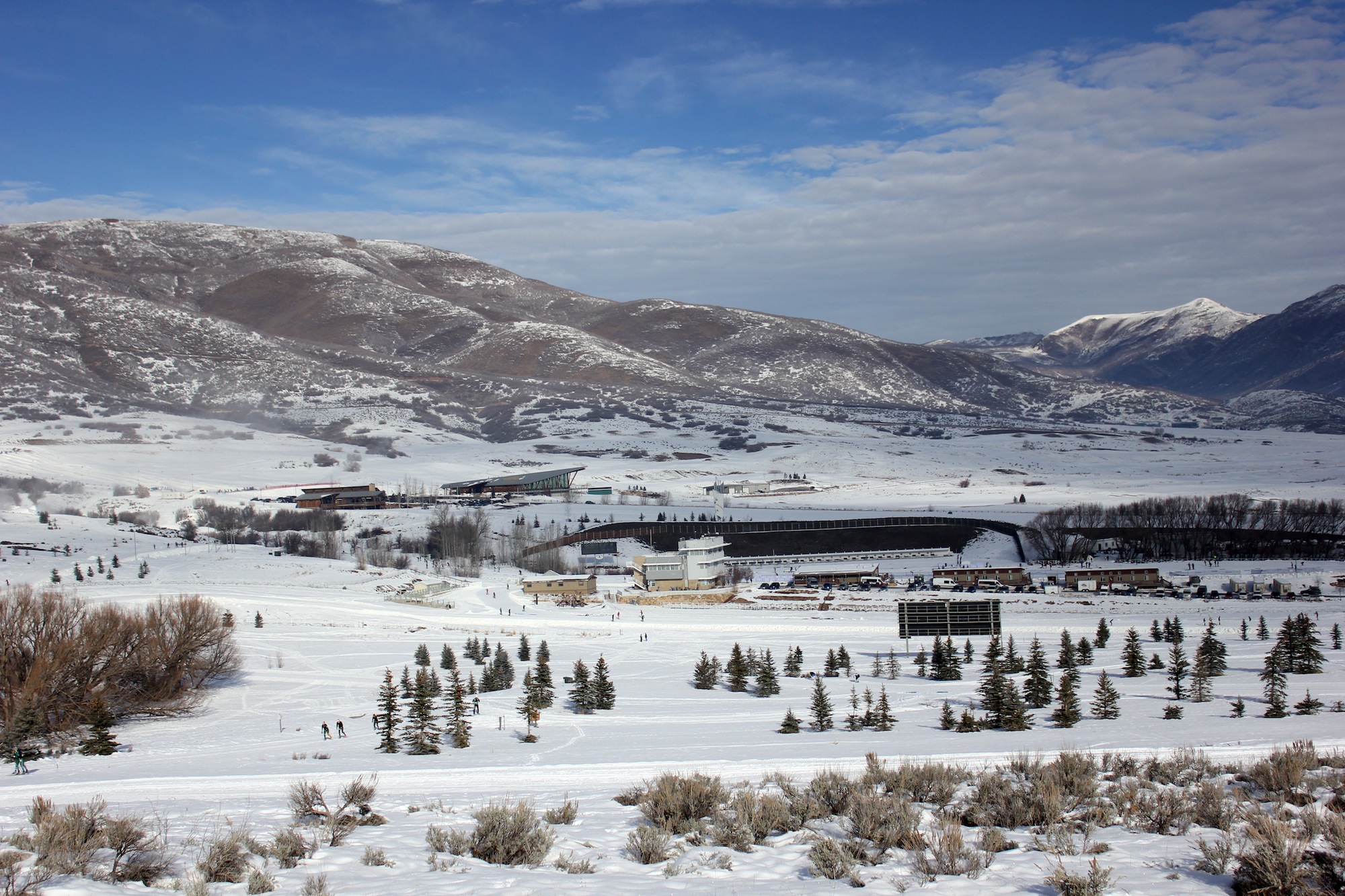
A view of Soldier Hollow’s stadium from the highest point of the 5 k Olympic course used in the 2014 U.S. Cross Country Championships.
Richard Hodges has a long history with Soldier Hollow.
He was part of the group that chose the Midway, Utah, ski area as the site for the 2002 Olympics when the original venue, Mountain Dell, became unfeasible due to watershed concerns.
He was there for the first race that ever took place at the venue.
To top it off, Hodges estimates that he has been at every winter event at Soldier Hollow, with the exception of five, since 2000.
So in March when it was announced that Howard Peterson, Soldier Hollow’s longtime executive director, was retiring after leading one of the west’s most prominent cross-country ski areas, Hodges was a natural replacement.
Richard Hodges (Photo: LinkedIn)
He soon left his position on the Board of Directors of the Soldier Hollow Legacy Foundation so that he could apply to be executive director, and in June the foundation announced that Hodges would take over the operations at Soldier Hollow on July 1.
Hodges has served as executive director roughly a month and already has a clear image of where he wants to take the 2002 Olympic venue.
According to Hodges, his first task is to maintain the legacy that Peterson established.
“It is nearly miraculous that Soldier Hollow continues to operate at a break-even point 12 years after the Olympic Games,” Hodges said in an interview with FasterSkier, attributing the financial stability to the work of Peterson.
To maintain that legacy, Hodges plans to undertake the renovation of Soldier Hollow’s facilities so that they are up to current international standards. This includes placing top priority on ensuring that the ski area’s equipment and snowmaking are at the highest standards.
While Soldier Hollow isn’t hosting U.S. nationals, Junior Nationals or the NCAA Skiing Championships this upcoming winter, it still has a busy schedule with the U.S. Sit-Ski Nationals, the Junior National Super Qualifier, Intermountain Youth Festival and possibly a Nordic Combined Continental Cup and a National Guard Biathlon event.
To ensure the 2014/2015 winter events go smoothly, Hodges will oversee an upgrade of technology including phones, web and retail services.
As Hodges looks ahead he realizes that the future of one of the most popular nordic ski venues in the country depends on several factors.
“We are working to deepen and diversify our year-round activities as a cushion against the risk of shorter ski seasons and unexpected weather events,” Hodges explained.
According to Hodges, Soldier Hollow’s tubing hill provides essential revenue that keeps the area ready for winter competition. In addition, the Spartan Race, Sheep Dog Championships, Dirty Dash races, high-school mountain-bike races, a trail-running series and other events help to bring in thousands of summer customers who will in turn help keep the winter operations of Soldier Hollow financially viable.
As for future winter competitions, Hodges plans to continue to host the numerous national races that Soldier Hollow has held in the past. While Hodges acknowledged the challenges of bringing international racing back to Midway, Utah, he’s certainly not ruling out the possibility.
Hodges will lead Soldier Hollow, reaffirming its place as North America’s premier Nordic venue
Richard Hodges (Photo: LinkedIn)
Midway – Utah (June 25, 2014) The Soldier Hollow Legacy Foundation (SHLF) is excited to announce the hiring of Richard Hodges as its new Executive Director effective July 1, 2014. Hodges will oversee the execution of the foundation’s bold strategy to build upon its current financial stability and continue building regain its place as the premier cross-country ski and biathlon venue in North America and become a year-round tourism and event magnet for the Heber Valley.
“Richard brings to this position a contagious passion for Nordic sports,” said Brian Olsen, newly-elected Chairman of the Board and 2006 Olympian. “He brings a compelling vision for re-invigorating the venue’s facilities, its programming, and its ties with the Heber Valley community.”
A past member of the foundation’s Board of Directors, Hodges has 10 years of experience as the volunteer President of The Utah Nordic Alliance (TUNA), the largest cross-country ski organization in Utah. In that position, he grew the organization’s membership, event participation, and revenues, and assisted smaller ski clubs with becoming financially stable.
Hodges has stated that his immediate priorities are to listen to the ideas and feedback of the foundation’s many stakeholders, from employees to long-time Soldier Hollow users. “I very much look forward to working with local business and community leaders in Midway and Heber Valley to help expand Soldier Hollow’s presence and profile,” said Hodges.
With sport central to the foundation’s mission, Hodges looks to build deeper and even stronger ties with regional and national sports organizations, such as the U.S. Ski & Snowboard Association and the U.S. Biathlon Association. The goal is to ensure that the venue is contributing to the athlete development pipelines of these sports by recruiting and developing new talent and providing a world-class training and competition venue for elite athletes.
Outside of the ski world, Hodges has been in the transportation sector as an accomplished project manager, economist, and, most recently, private consultant. He has worked for and in support of government entities such as the Utah Transit Authority, which will serve him well leading a foundation holding the concession contract with the State of Utah to operate the Soldier Hollow venue: “Our long-term partnership with Utah State Parks ensures that together we provide great opportunities for the community,” he said.
Having worked as an event volunteer and advisor to the Salt Lake Organizing Committee since the early days of what would later become Soldier Hollow, Hodges experience with the venue runs deep. The foundation’s first and current Executive Director, Howard Peterson, will remain as a consultant through September providing Hodges with continuity and expert advice after having served in the position for more than a decade. “I am honored and privileged to have the opportunity to work with Soldier Hollow’s world-class staff to carry forward the Olympic and sport legacy that Howard has built,” concluded Hodges.
About Soldier Hollow Legacy Foundation (SHLF): A non-profit 501(c)(3) corporation based in Midway, Utah, SHLF oversees the facilities and programming of the Soldier Hollow venue, which hosted the cross-country skiing, biathlon, and Nordic combined events during the 2002 Salt Lake Winter Olympic & Paralympic Games. Today, Soldier Hollow is a year-round facility focused on recreational, youth, and elite level cross-country skiing, biathlon and other related sports programs. Soldier Hollow also provides winter snow tubing and hosts multiple events during the summer. At all times, the organization and its staff work to promote the Olympic and Paralympic ideals, and expand opportunities for people in the communities it serves.
A view of the trail system at 2002 Olympic venue Soldier Hollow
Following the funding scare with the Olympic Regional Development Authority in Lake Placid earlier this year, FasterSkier correspondent Peter Minde is examining the structure and viability of various post-Olympic venues around North America. This piece, his second in the series, looks at the status of Soldier Hollow, in Utah.
Cross country skiing and biathlon drew more athletes and spectators than any other sports at the 2002 Winter Olympic Games in Salt Lake City. But Soldier Hollow, the venue for those events, had a murky post-Olympic future even as it was being developed.
While Lake Placid’s Mount Van Hoevenberg is managed by a semi-public entity that depends partially on state financing, Soldier Hollow is a stand-alone organization. Although it’s on state land, SoHo receives no state funding and must rely on its own initiatives to keep running.
Originally, Soldier Hollow wasn’t in the picture for the Winter Olympics. In their bid for the 2002 Games, the Salt Lake Organizing Committee (SLOC) had proposed running cross-country events at a golf course just outside of town.
According to William Spencer, the deputy chief of competition for biathlon at the Games, SLOC wanted to construct the venue at a temporary facility at the Mountain Dell Golf Course. But Mountain Dell was in an area with unreliable snowfall.
“Could we have done it there [Mountain Dell]? Probably. But there were hurdles we could avoid by going elsewhere,” said Gordon Lange, head coach of the Park City Nordic Ski Club. In addition to unreliable snowfall, there were water runoff concerns, and snowmaking at Mountain Dell would have been very expensive. Development of Olympic-quality trails would also have disturbed protected habitat in East Canyon and Mountain Dell.
A young Torin Koos racing at Soldier Hollow
Organizers conducted on-site inspections of seven potential sites before SLOC narrowed it down to two candidates.The venue was then switched to Soldier Hollow, which has “some of the best skiing anywhere in the world,” says U.S. Nordic Combined Head Coach Dave Jarrett. Opened in 2000, Soldier Hollow was the site for all the cross country, biathlon and Nordic combined events at the 2002 Games.
When the Games generated a profit, SLOC had money to spare to ensure that the Olympic venues could be used by the public for years to come. The Utah Athletic Foundation (UAF), a private non-profit, was designated by the state to take ownership of Olympic Park, the Park City venue for ski jumping and luge, bobsled and skeleton, and the speed skating oval near Salt Lake City. Endowed with $76 million, UAF took over these sites in May of 2002, expecting to manage them on interest generated by the endowment.
State legislation originally specified that any profit from the games would endow only Olympic Park and the speed skating oval, and Soldier Hollow was to be on its own starting in early April, 2002. But because UAF received a larger-than-expected endowment, in early October of that year, the Utah state parks board transferred Soldier Hollow’s concession to UAF. Thus, the cross-country venue benefited from a financial commitment that enabled them to invest in infrastructure and equipment.
But the affiliation was not necessarily permanent. Indeed, by early 2004, UAF was struggling, and news sources were reporting the layoff of twelve employees. An item in a July, 2004 issue of the Salt Lake City paper Deseret News noted that despite its endowment, UAF was having difficulty breaking even on its operations at Olympic Park and the Olympic Speedskating Oval.
For UAF, there was an out clause after two years. In an interview, Jarrett noted that despite campaigning to grandfather Soldier Hollow in to UAF, the two organizations severed their relationship in the spring of 2004. UAF didn’t think it could afford to fund Soldier Hollow in addition to its other two venues.
The Soldier Hollow Legacy Foundation (SHLF), which manages the ski area, was founded in 1999 to perpetuate the ski venue following the Olympic Games. According to General Manager Howard Peterson, as a concessionaire operating on state land, SHLF pays 6 percent of its gross receipts to the state. A main focus of SHLF’s mission is to reach and expose local kids to cross-country skiing.
With no government aid and a limited commitment from UAF, Peterson was compelled to find creative measures to attract visitors and enhance Soldier Hollow’s bottom line. Consequently, one can do a lot more than simply ski at Soldier Hollow. Mountain bikers ride the cross-country trails from May through October. Parking fees assessed to those attending the Soldier Hollow Classic Sheepdog Championships, now in its ninth year, fund junior ski programs. The Soldier Hollow Charter School rents space in the competition center for its 150 students, in classes ranging from kindergarten through 8th grade.
“If it wasn’t for Howard, we wouldn’t be skiing there right now,” said Lange, whose juniors spend time training at Soldier Hollow both on snow and on roller skis.
In the summer of 2002, work began on a 1,200-foot tubing hill, funded by UAF. The lift-served hill was a hit, accounting for approximately 59 percent of Soldier Hollow’s revenue in 2008, the most recent year for which data is available. (By contrast, skiing made up a mere 18 percent of revenue.)
Peterson felt that a tubing hill was a great way to attract visitors who might not be interested in skiing. “[The campaign] is about snow,” he said.
“Tubing provides an alternative for families where some members might not want to ski,” said Bill Hokanson, the head coach for the Utah Nordic Alliance’s
The start of a women's race at the 2002 Olympics in Soldier Hollow
competition programs.
There’s also the charter school, which adds to the pool of skiers at the venue, in addition to paying rent. As part of their curriculum, charter school students get outside on skis about four times a week during the winter.
But the legacy foundation doesn’t just keep Soldier Hollow open, however—the organization also gives back to the community.
Monday through Thursday during the winter, three or four school buses roll in each day, introducing what Peterson estimates are 9,000 children to skiing each winter. Soldier Hollow does “a fantastic job of introducing skiing to organizations and schools,” says Hokanson.
Jarrett started Soldier Hollow’s youth ski program from scratch in fall of 2000, bringing cross-country skiing to an area where the sport had little tradition. The club, now called Team Soldier Hollow, is comprised of various programs for juniors, from beginners through a development team.
SHLF also provides support for athletes who qualify for the Junior Olympics, with a combination of fundraising assistance and scholarships. And aspiring elite athletes benefit from discounted ski passes, which are available to athletes on formal teams.
In contrast to the venues in Lake Placid, which have been subject to the whims of the New York state budget process, Soldier Hollow now seems stable in comparison: SHLF’s financial footing appears sound, and Peterson was positive about its future. One thing is certain: the venue is almost certainly better off as an independent entity than as a part of UAF. In March, the Utah legislature was presented with SRJ011, a bill which would allow UAF to sell a portion of the Olympic Park property. The body of the bill notes that the Olympic Park and speed skating oval’s annual costs have consistently exceeded revenues, and that UAF’s endowment might be exhausted by 2025.