
From the FasterSkier archive — posts syndicated from athletes’ and coaches’ own blogs between 2004 and 2012, kept online as published. Current coverage is at fasterskier.com.

Tag: Hugo Lapalus

  • Kreuger Flies up Alpe Cermis, Klaebo Wins Tour de Ski

    Kreuger Flies up Alpe Cermis, Klaebo Wins Tour de Ski

    This coverage is made possible through the generous support of Marty and Kathy Hall and A Hall Mark of Excellence Award. To learn more about A Hall Mark of Excellence Award, or to learn how you can support FasterSkier’s coverage, please contact info@fasterskier.com.
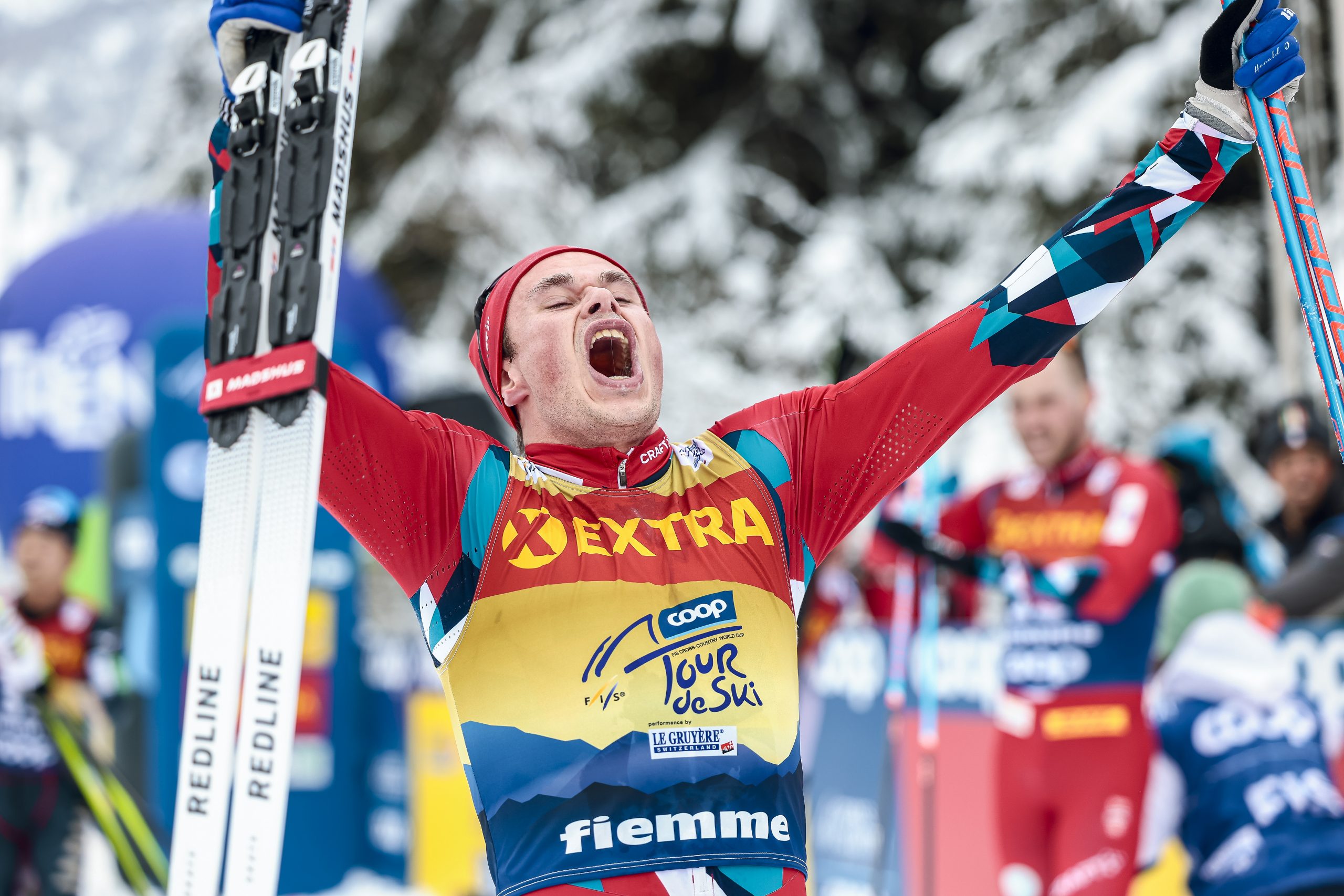
    Stage 7, final climb of the Alpe Cermis: Johannes Hoesflot Klaebo (NOR) only had to keep his rivals in sight in order to claim overall victory in the 2025 Topur de Ski. (Photo: Modica/NordicFocus)

    Johannes Hoesflot Klaebo doesn’t like this hill . . . he’s a sprinter, after all: he powers up short, punchy hills on his way to shrug-punctuated finish lines. That’s the way World Cups are won in the 21st century. But immortality—the kind to which Klaebo aspires—is purchased at a rather higher price, one that is paid with Olympic medals, on World Championship podiums, and atop Val di Fiemme’s Alpe Cermis. The Tour de Ski concluded on that lofty summit today, and Klaebo appeared determined to do his best in securing another bit of history.

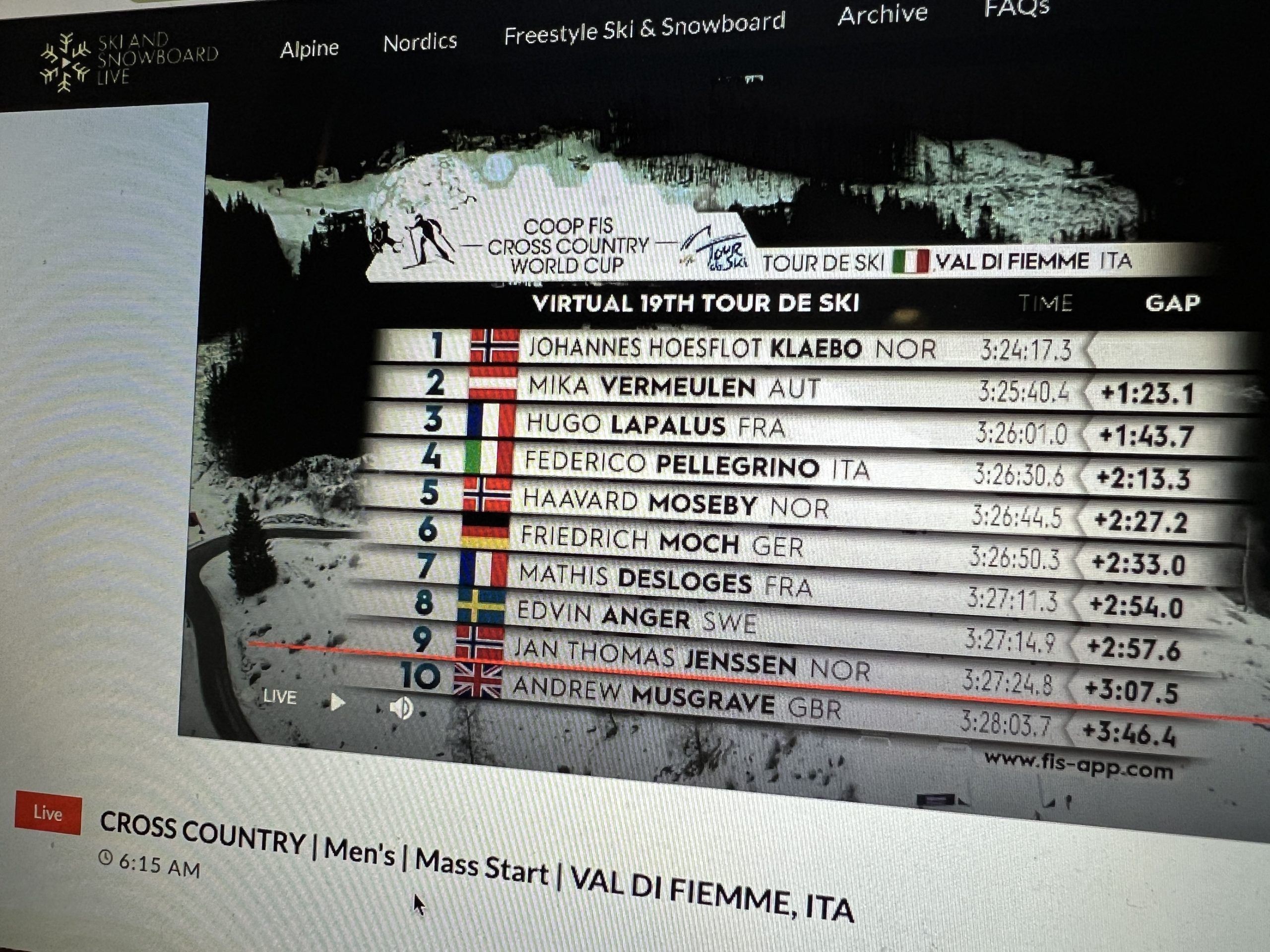
    Though other climbers ruled the stage, Klaebo measured his effort up the climb to claim his fourth Tour de Ski overall victory (tying the record of the immortal Dario Cologna). Klaebo finished only 18th on the day’s stage, but managed to preserve a 1:23 overall margin over Mika Vermeulen (AUT), and 1:43 over third place, Friederich Moch (GER).
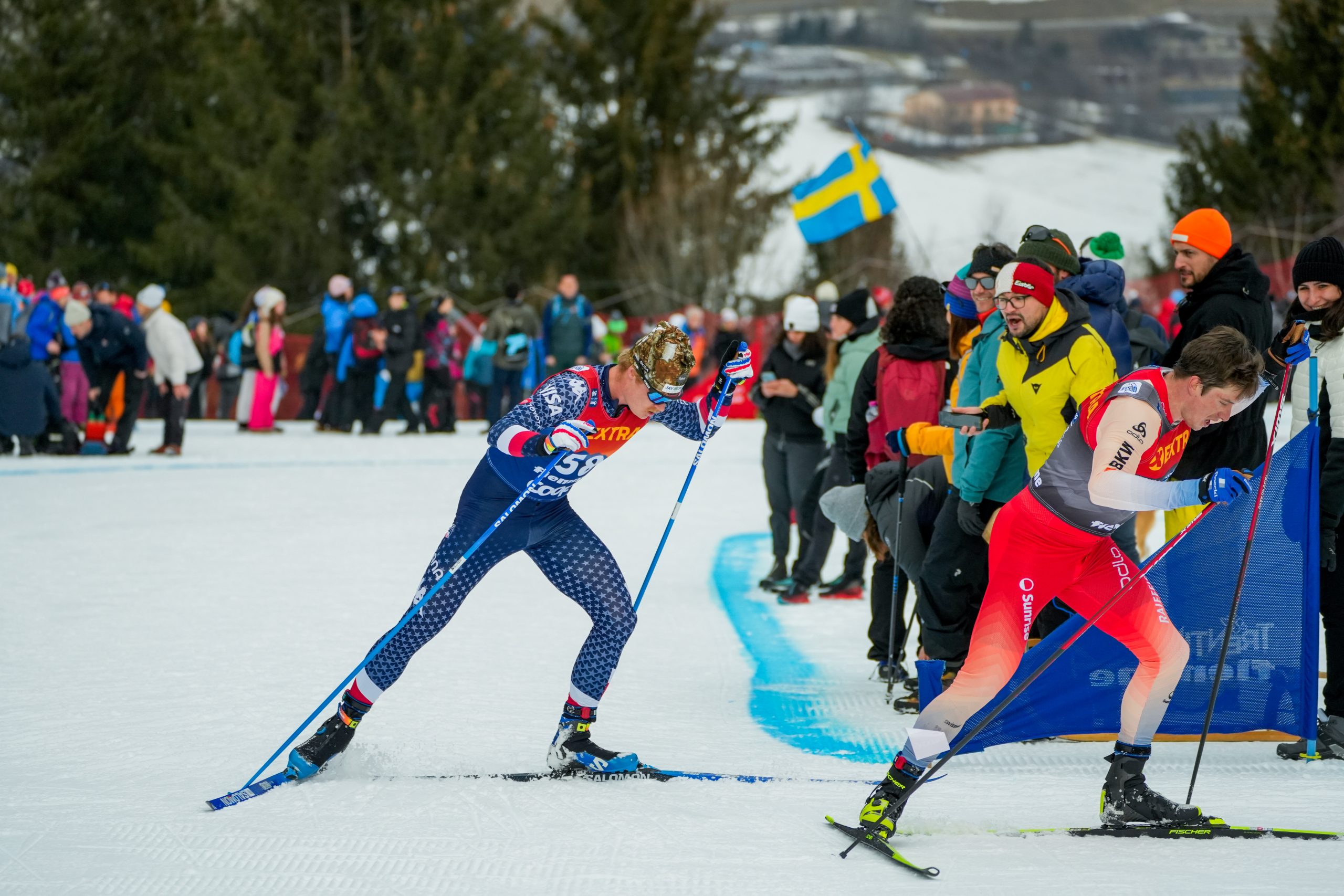
    Sprinters climb too: Jack Young (USA) (climbing alongside TDS Sprint Bib winner, Switzerland’s Janik Riebli) appeared determined to add an overall finish in the 2025 Tour de Ski to his growing race record. (Photo: Vanzetta/NordicFocus)

    Zanden McMullen and Ben Ogden crossed the line 19th and 20th, only seconds behind Klaebo. Other North American Finishers included Canadas’ Antoine Cyr in 23rd and Olivier Leveille 29th, and American Jack Young in 53rd.

    In other remarkable sprinter-news, Federico Pellegrino (ITA) climbed the Alpe Cermis in seventh place, good enough to finish fourth overall, just 2:13 behind Klaebo in the final standings.
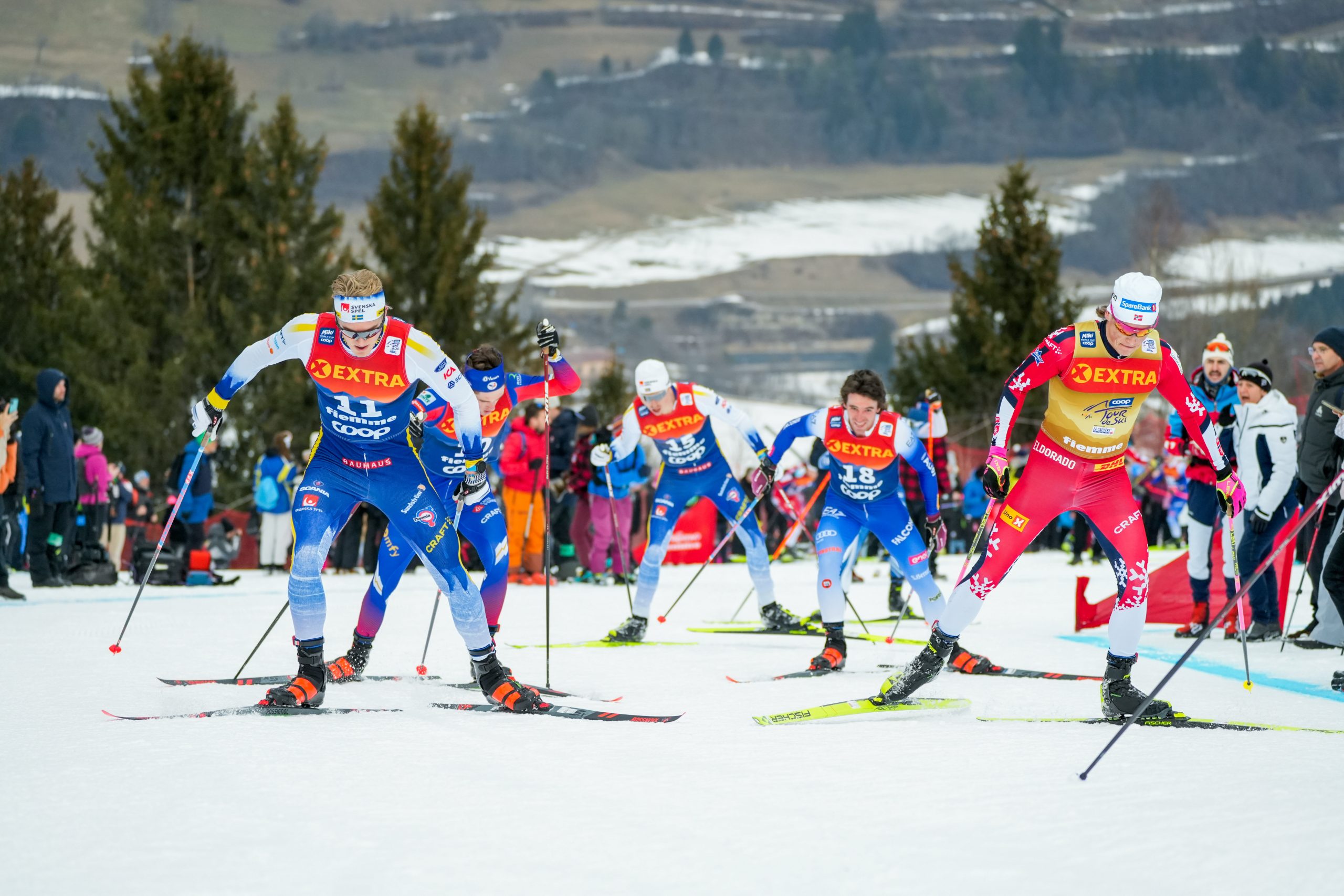
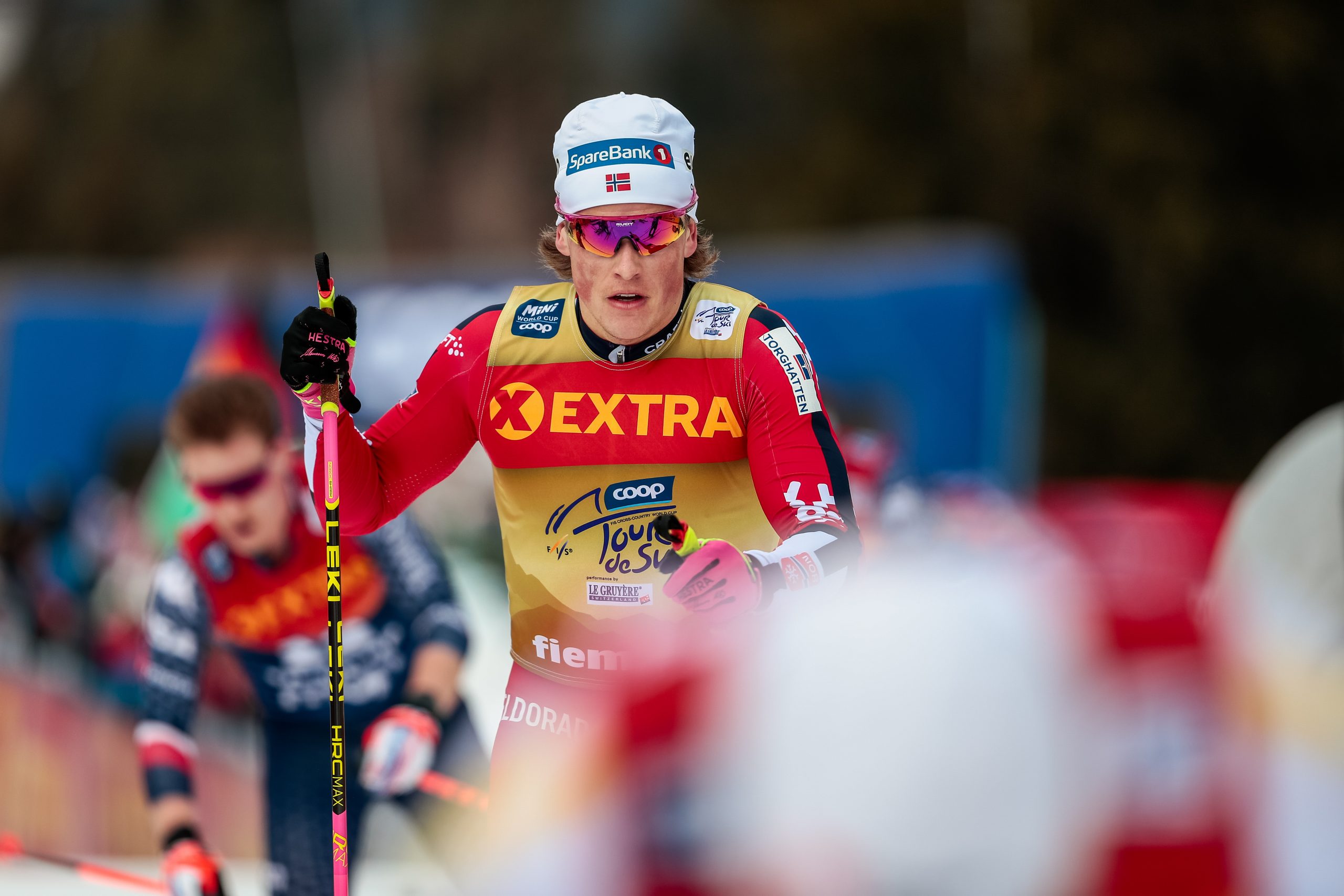
    Johannes Hoesflot Klaebo (NOR) (climbing with Sweden’s Edvin Anger) measured his effort throughout the day, preserving his lead over his closest rivals and claiming the win in the 2025 Tour de Ski. (Photo: Vanzetta/NordicFocus)
    Climbing the Alpe Cermis

    Tour de Ski overall standings at the beginning of stage 7 looked like this:

    1. Johannes Høsflot Klæbo (NOR) 2:50:24
    2. Erik Valnes (NOR) +2:18
    3. Haavard Moseby (NOR) +2:29
    4. Mika Vermeulen (AUT) +2:29
    5. Hugo Lapalus (FRA) +2:44
    6. Federico Pellegrino (ITA) +2:56
    7. Jan Thomas Jenssen (NOR) +2:59
    8. Andreas Fjorden Ree (NOR) +3:04
    9. Mathis Desloges (FRA) +3:12
    10. Edvin Anger (SWE) +3:17

    Klaebo had a large cushion to preserve. He wouldn’t need to contend for the win on Alpe Cermis; he’d need only to monitor his rivals and concentrate on damage control.

    In Stage 7, the tracks of the earliest kilometers are three-skiers wide, so there is less positioning to worry about, less jostling, less urgency. Until the six kilometer mark, the course is basically flat, following the course of Italy’s famed Marcia Longa marathon race. The final four kilometers, though, are decidedly different, climbing up the slopes of the Alpe Cermis Alpine ski area. Sprint points were offered at six kilometers (at the base of the climb) where Jannik Riebli confirmed his defense of the silver Sprint bib. That contest concluded, the race could begin in earnest.

    Leading his rivals by nearly three minutes in the overall standings, Klaebo remained at or near the front as the course ran along the river at the bottom of the valley. Once the course turned uphill, the climbers moved to the front. Mika Vermeulen led the bottom slopes (the steepest on the mountain at 28%) followed by Simen Hegstad Kreuger. Klaebo did his best to mark their accelerations.

    Halfway up the climb, the pace was made by Kreuger, followed by Vermeulen and Hugo Lapalus (FRA). Krueger began the day 7:10 behind Klaebo, so he did not represent a serious threat. Vermeulen had begun the day at 2:29 back, Lapalus at 2:44. Both seemed focused on the final podium, but neither seemed poised to challenge Klaebo for the overall win.

    Kreuger continued pushing the pace, followed only by Vermeulen. The race for the stage win was down to two men as Lapalus and Friederich Moch (GER) had fallen off the pace. For Klaebo, it was a case of doing his work while making sure not to go too hard. Climbing the Alpe would be difficult enough for a sprinter like Klaebo, but if he overextended, he could blow up and lose it all.
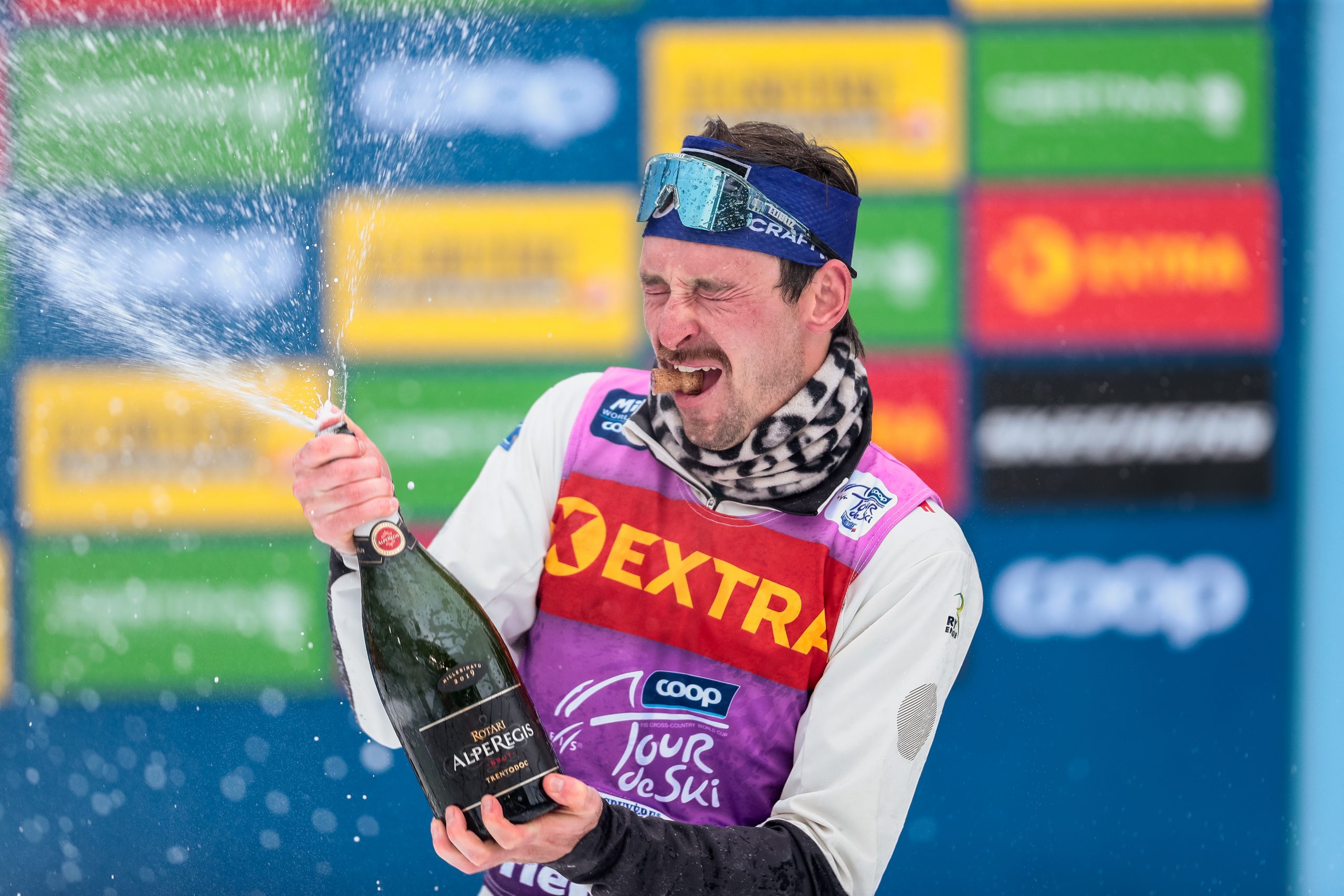
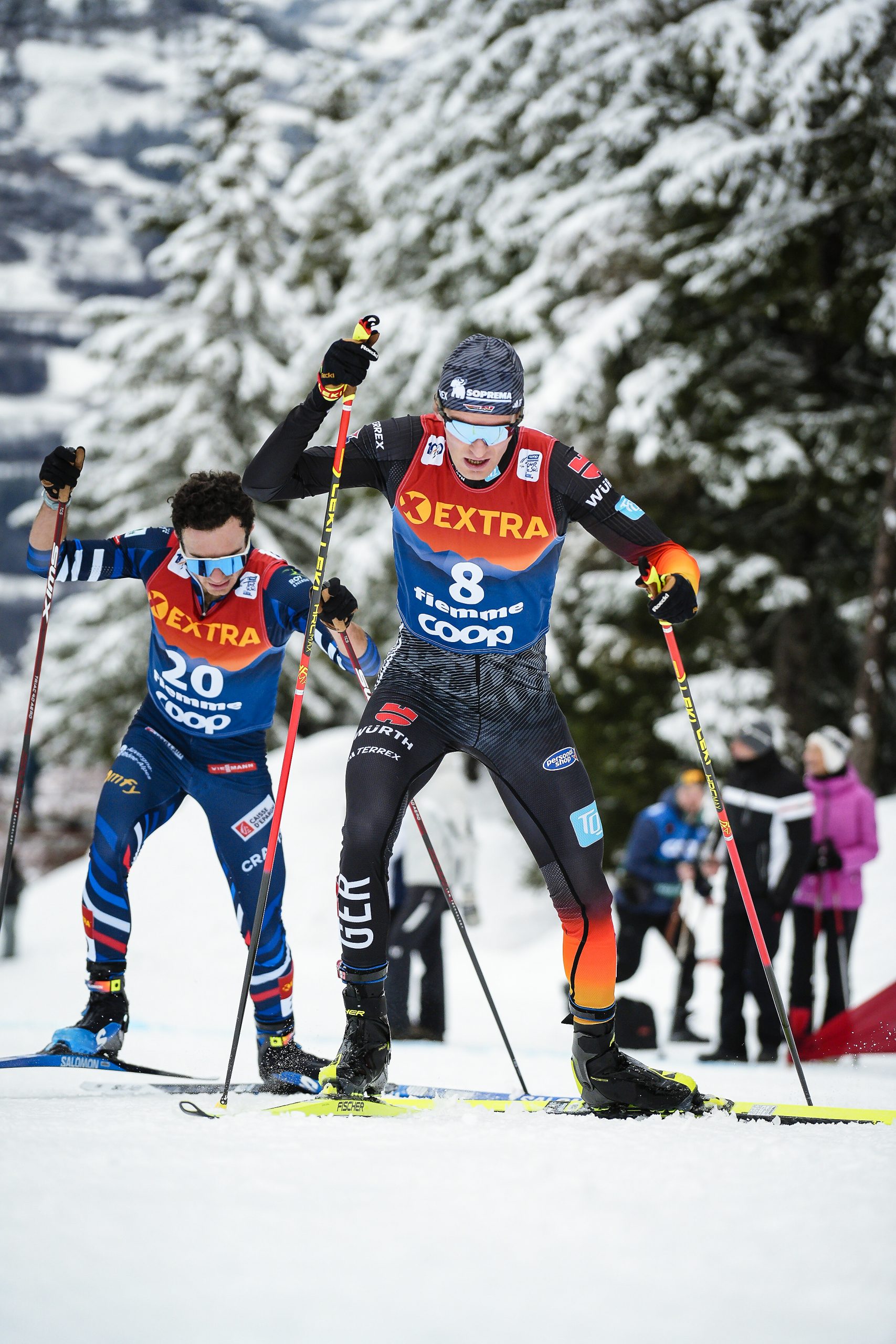
    Hugo Lapalus (FRA) celebrates claiming the Climbers Bib in the 2025 Tour de Ski. (Photo:  Modica/NordicFocus)

    After his initial time-losses on the lower slopes, Klaebo held the gap some 90 seconds behind Kreuger who would cross the finish line in 32: 39. Vermeulen finished seven seconds later, followed closely by Moch in third. Lapalus finished fourth to cement his hold on the Climber’s bib. Shepherded by his teamate, Haavard Moseby, Klaebo crossed the line in 18th place, 1:13 behind the winner—good enough to seal up the Tour de Ski overall win. His 18th place preserved a winning margin of 1:23 over Vermeulen.

    With the mid-Tour withdrawal of Harald Oestberg Amundsen, Klaebo’s win in the Tour de Ski makes it very unlikely that anyone else could overtake him in the chase for the FIS World Cup overall championship. While Klaebo’s primary focus probably remains the individual events at the World Championships later this season in Trondheim, he is sure to be satisfied with his hold on the Crystal Globe. That’s another piece of history—another source of legacy—that Klaebo has certainly earned . . . even on humbling days like the ones when he has climbed the Alpe Cermis.
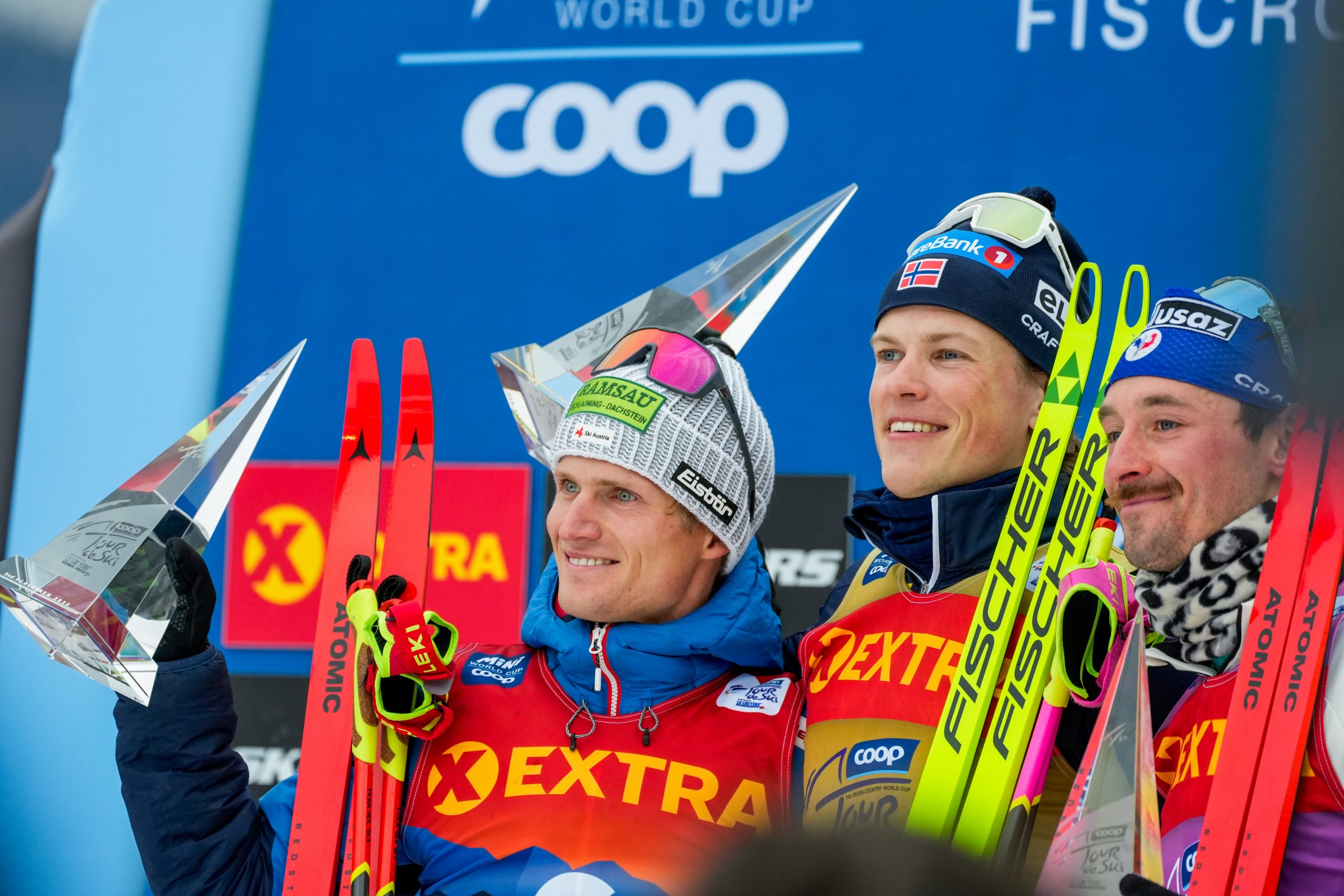
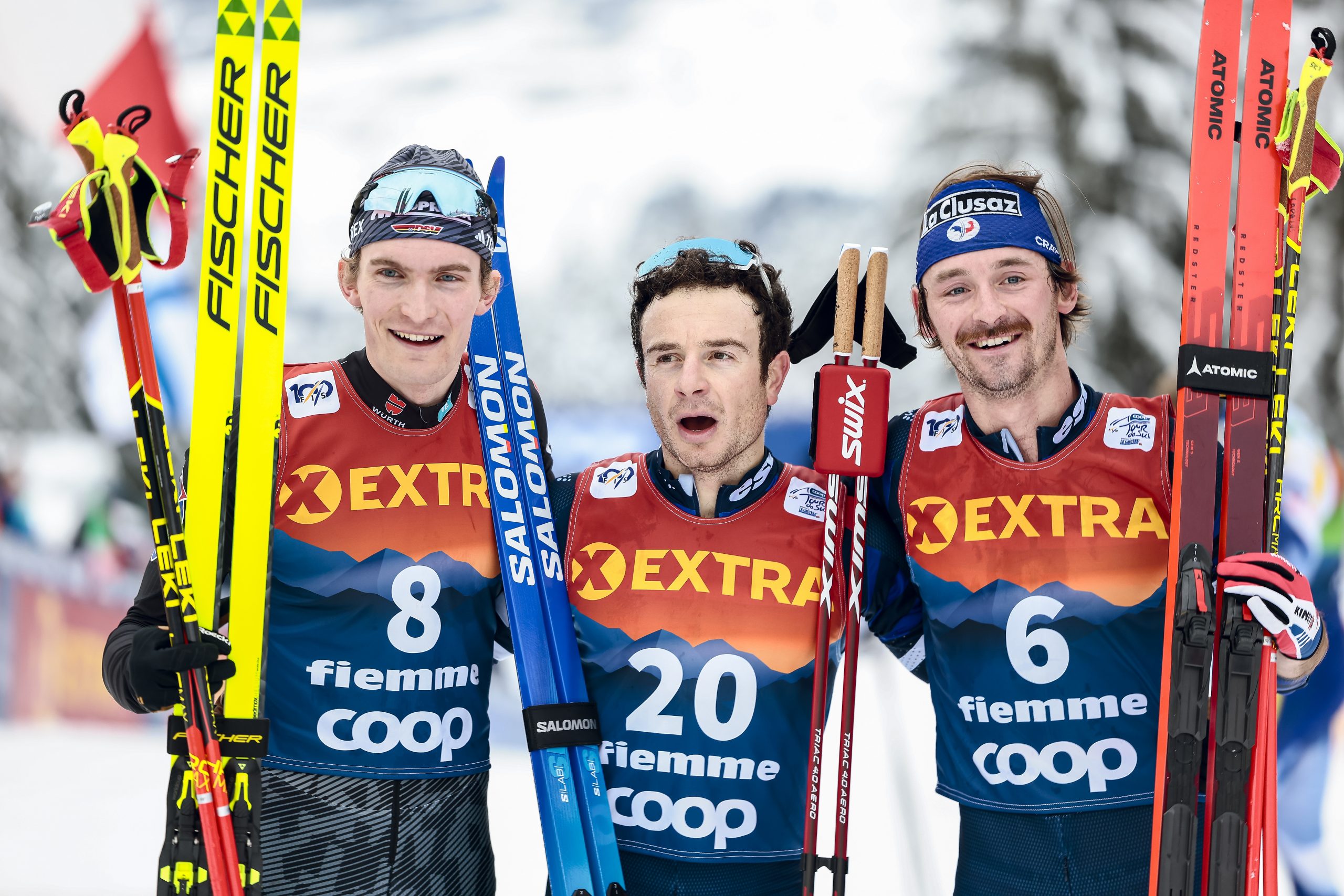
    Mika Vermeulen (AUT), Johannes Hoesflot Klaebo (NOR), Hugo Lapalus (FRA), (l-r) top the podium in the 2025 Tour de Ski. (Photo: Vanzetta/NordicFocus)

    Alpe Cermis Freestyle 10 k RESULTS


    Final standings in the 2025 Tour de Ski. (Photo: FasterSkier)
  • With Fresh Snow, Minneapolis World Cup is a Party in the USA

    With Fresh Snow, Minneapolis World Cup is a Party in the USA

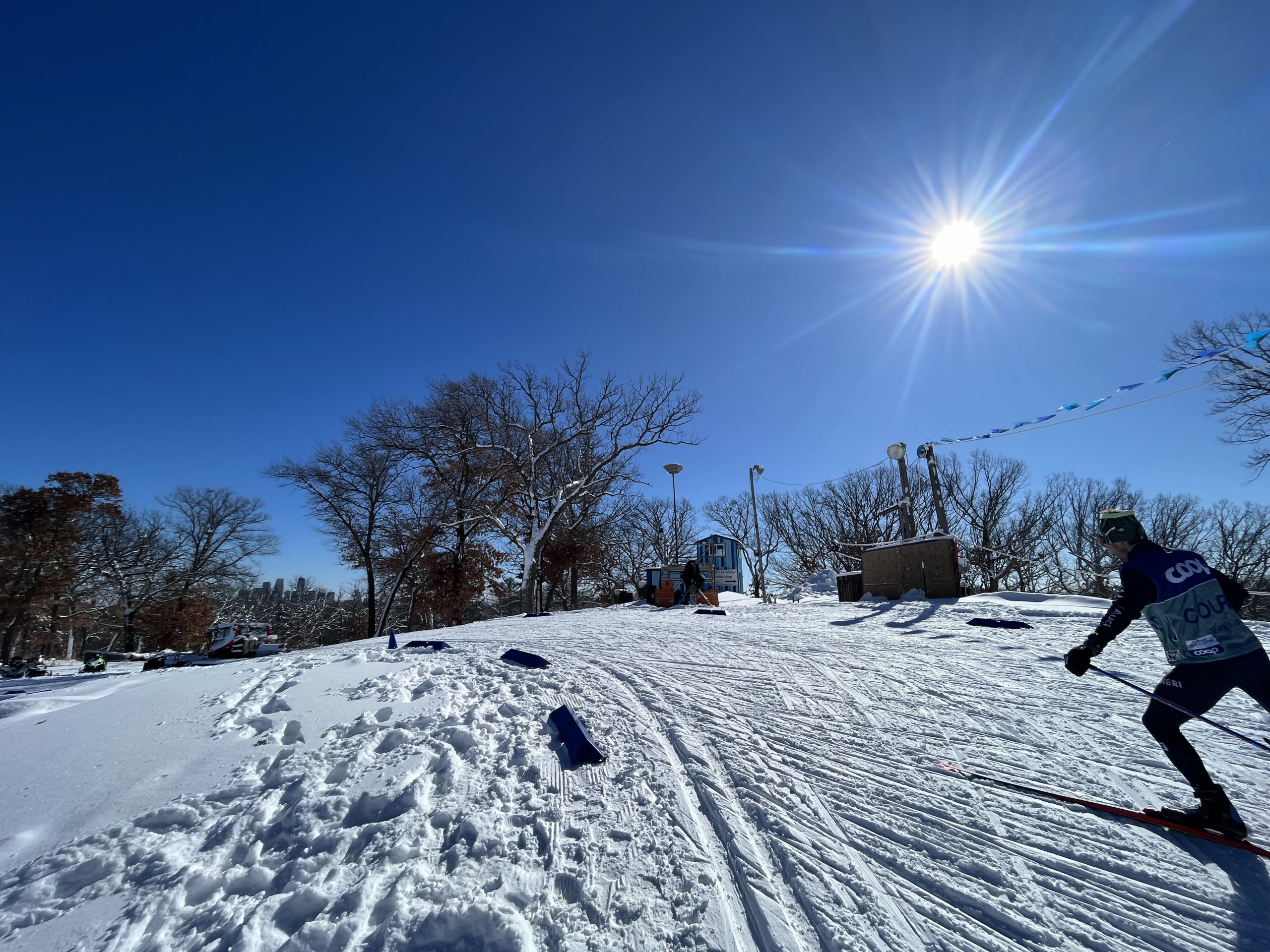
    A World Cup team member skis across the top of the course Thursday at Theodore Wirth park in Minneapolis. The city skyline is between the trees on the left. (Nathaniel Herz/FasterSkier)

    MINNEAPOLIS — All winter, cross-country ski race organizers in this midwest metropolis faced weather that just wouldn’t cooperate.

    Heading into the weekend, it had not snowed in Minneapolis in nearly a month, with daily high temperatures above freezing every single day since late January.

    All this as a local nonprofit, the Loppet Foundation, was set to host the first cross-country World Cup events in America in more than two decades — after a last-minute, coronavirus induced cancelation in 2020.

    The World Cup circuit is the sport’s highest level of racing, and it’s contested almost exclusively in Europe.

    The Minneapolis organizers had borrowed snowmaking equipment from neighboring ski areas and made enough during a ten-day cold snap to stretch a strip of white through an otherwise barren municipal golf course.

    But athletes, fans and volunteers were girding for a decidedly non-wintry atmosphere for the two days of racing this weekend.

    Until Wednesday. That’s when a fast-moving storm dumped some six inches on the city — nearly double the entire winter’s snowfall at its airport—and transformed Minneapolis back into a winter wonderland on the same day that the Olympic-level World Cup athletes arrived for the sold-out events.

    Claire Wilson, the Loppet Foundation’s executive director, described the storm as a “magic snowfall.”

    But, she said, “We were ready to do this yesterday, when it was a ribbon of snow on brown ground.”

    Across the board, World Cup racers—most of whom arrived in Minneapolis on Wednesday from the Canadian Rockies — said they were delighted to find fresh snow and engaging skiing at Theodore Wirth Regional Park.

    “Exquisite,” “city skiing at its finest” and “American dream”—replete with an eagle and stars and stripes emoji—were among the reactions that athletes posted on social media after their first laps at Wirth.

    A screenshot of an Instagram post Thursday, February 15, 2024 from French skier Hugo Lapalus.

    “I think it’s really pretty here,” Lena Keck, a 23-year old German, said as she left the trails Thursday. And, she said, “it’s a really tough course,” which was not what she and her teammates anticipated.

    “Everyone’s surprised,” said Chris Grover, a longtime U.S. World Cup team coach. “I think they heard ‘golf course’ and thought, like, Boca Raton or something.”

    The 3.3-kilometer loop that athletes will ski three times in Sunday’s distance race winds through trees and open sections in rolling terrain, with views of downtown skyscrapers from the course’s high points.

    Scott Patterson, the veteran American who excels on difficult courses, said he did a harder training session Thursday and found the loop to be unexpectedly grueling, mainly because of the new snow slowing his skis down.

    “It’s kind of slow on the downhills, and you have to work all the way down—so it feels like you hit the bottom of the next hill and you really haven’t recovered much,” he said. “It felt hard, for sure.”

    Patterson and several other Americans skied Thursday in newly printed “fan club” bibs featuring the faces of the team’s coaches and ski waxing support staff—their own twist on bibs that U.S. supporters sold printed with athletes’ faces to raise money for the team.

    American skier Scott Patterson, photographed Thursday, February 15, 2024 in Minneapolis, models a new bib featuring the faces of U.S. coaches and support staff. (Nathaniel Herz/FasterSkier)

    The celebratory atmosphere spread across the park Thursday, with eager volunteers—some 700 total will help this weekend—fanning out to unload pallets of food and drinks, tweak course fencing and manage traffic.

    Organizers have distributed some 30,000 tickets, with many fans eager to see Jessie Diggins, the Olympic gold medalist and U.S. superstar who leads the women’s overall World Cup standings this year.

    Diggins grew up in Afton, a half-hour east of Minneapolis, and returned to the U.S. this week for the first time since she left for Europe in the fall.

    Her home is a little too far out of town, and too full of visiting family members, for her to stay there this week. But, she told reporters earlier this week, at least she’ll be reunited with her husband at the World Cup race hotel.

    The kind of attention that Diggins is receiving for the hometown events, she said, is not quite the same type as at major championships like the Olympics. But particularly given her lead in the World Cup standings, she added, the weekend “comes with its own different, special kind of pressure that feels about as big.”

    “My goal is to enjoy it and hopefully not be so overwhelmed that I can’t be present,” she said. “It will be a delicate balance, for sure, but one that I’m going to try to achieve.”

    Jessie Diggins races in Canada last week. (Federico Modica/Nordic Focus)

    The rest of the American athletes—even the ones who aren’t from Minnesota—also seem to be soaking in the excitement around what still feels like a home event.

    “The whole way here, on the plane, on the bus, people have heard that tickets have sold out, they sold out really fast,” said Kristen Bourne, another U.S. coach. “People have been looking forward to this, from all different countries, for a really long time. So, I think the stoke is insanely high.”

    Keck, the German racer, said that the trip to the United States is the first of her life—and the setting has definitely made an impression.

    “Everything is so much bigger than in Europe,” said Keck. “The houses, the cars, the trucks, also the landscape—it’s so much wider.”

  • The Devon Kershaw Show: Laukli, Diggins crown a historic Tour de Ski finish for USA

    The Devon Kershaw Show: Laukli, Diggins crown a historic Tour de Ski finish for USA

    They’ve reached the summit — the athletes, have, anyway. Devon certainly has not, thanks to frozen pipes in his Oslo apartment. He and Nat persevere to bring you the recap of this year’s final Tour de Ski stages, which featured some spicy and sloppy racing in Italy. Stay tuned til the end for an ode to Le Gruyère cheese.

    Next week, during the break from the World Cup, we’ll have a mailbag episode. Send us your questions at nat@fasterskier.com and devon@fasterskier.com. Have a great week.


  • International Flair at Tour de Ski—Amundsen, Moch, Lapalus

    International Flair at Tour de Ski—Amundsen, Moch, Lapalus

    This coverage is made possible through the generous support of Marty and Kathy Hall and A Hall Mark of Excellence Award. To learn more about A Hall Mark of Excellence Award, or to learn how you can support FasterSkier’s coverage, please contact info@fasterskier.com.

    The unrelenting slopes of Alpe Cermis challenged Norwegian dominance, as France’s Jules Lapierre emerged to triumph in the final stage of the 2024 Tour de Ski. (Photo:  Modica/NordicFocus)

    The origin story of the Tour de Ski suggests that it was invented to mirror cycling’s Tour de France: multiple stages, mountaintop finishes, leader’s jerseys, thrilling competitions, glorious champions. Today’s Stage 7 of the Tour de Ski—with its finish on the high summit of Alpe Cermis— is probably what the original race organizers had in mind. Helicopters hovered over the point-to-point course that wound its way through historic ski-venues in the Val di Fiemme. At the 2.4 kilometer mark, the still-flat course wound into the stadium of Val-d’Isére (where the first Bonus Sprint in the Alpe Cermis stage would be decided). Then, following the course of the Marcia Longa—Italy’s famous ski marathon—the course traveled to the base of the Alpe Cermis Alpine resort.

    The day had begun with Amundsen holding a considerable lead in the overall standings over his countryman, Erik Valnes. Known as a good all-rounder—but really more of a sprinter—Valnes would face considerable challenges to his desire to remain on the Tour de Ski podium, as he was trailed in the standings by other skiers whose pedigrees spoke of greater climbing abilities. Martin Loewstroem Nyenget (NOR) sat only eight seconds behind Valnes, with talented climbers, Hugo Lapalus (FRA) and Friedrich Moch (GER) only another few seconds behind. The battle for podium spots would be furious and painful, with rewards and accolades for those brave enough to climb into the clouds. Valnes would have his hands full . . .

    Germany’s Friedrich Moch led Jules Lapierre (FRA) through most of the climb up Alpe Cermis, though it was Lapierre who would sprint clear for the stage win. (Photo: Barbieri/NordicFocus)
    Stage 7, Alpe Cermis

    Bonus Points Leader, Lucas Chanavat (FRA), toed the starting line after a number of less-than-stellar stages in which he would win sprint points, then ease along the course to the finish well out of contention. In the early kilometers of the Alpe Cermis stage, Chanavat led the pack toward the first Bonus Points sprint at 2.4 kilometers, hoping to secure his hold on the Points Jersey before the real climb of the day would begin. Though nipped at the line by sprint-rival, Edvin Anger (SWE), Chanavat would collect enough points to secure the victory in the points competition. Ironically, he would be required to finish the stage at the top of Alpe Cermis’ long climb in order to claim the distinction, and to collect the winner’s spoils. It would be a long day of climbing for the sprinter, Chanavat.

    After the Points Bonus sprint, it was the skier sitting in 26th place overall—Haavard Solaas Taugboel (NOR)—who went to the front to make pace. Commentators speculated on the possibility that Team Norway was tactically using lower-placed skiers to protect the lead of Amundsen, Valnes, and Nyenget. There was one last Points sprint at 6.8 kilometers (at the base of the climb), but by that time Amundsen had already gone to the front. He took the points that Chanavat and Anger coveted, seemingly determined to begin the climb in earnest. Final standings in the Points competition: Chanavat, Anger, Valnes, Amundsen, and Antoine Cyr (CAN).

    Amundsen led the field on the lower slopes of the climb, though with no real sense of urgency. In season’s past, much of the low part of the climb was defined by athletes propelling themselves via V2, maintaining that faster, more costly technique for as long as they could in attempts to break the field. Typically the last skier using the V2 was the one who would create gaps in the field and put themselves in position to win the day. Today, however, Amundsen dropped into the V1 early on, allowing a group of rivals to remain on his heels. That group settled into a lead pack of seven:  Amundsen, Nyenget, Friedrich Moch (GER), Mika Vermuelen (AUT), Jules Lapierre (FRA), Hugo Lapalus (FRA), and Beda Klee (SUI). Valnes was nowhere to be seen. The battle for podium positions began . . .

    And the course steepened: 26.5 percent (that’s steep). Klee was dropped: lead group reduced to six.

    Mika Vermeulen powered to the front as Amundsen and Nyenget faded to the rear of the lead group. By this time, Valnes had already ceded his second place position to Nyenget in the virtual Tour standings. Other podium contenders pushed to the front, fighting it out for podium places, mostly at the expense of Amundsen and a visibly-tiring Nyenget who dangled just off the back.

    With every change in pitch, a different contender would appear at the front. Finally, Moch took the lead as the group entered the tightest switchbacks, driving around each direction-change with Lapierre hard on his heels. Next in line—head down, but tempo high—Lapalus followed his countryman while Amundsen and Vermeulen settled in. Nyenget was gapped: lead group reduced to five.

    Moch and Lapierre ratcheted up the pace. Little bit by little bit, gaps opened behind them.  Lapalus watched his own ski tips, Amundsen (overall victory already in sight) marked the gaps, Vermeulen atttempted damage control: lead group reduced to two.

    Farther down the mountain, Valnes struggled; his podium position all but gone as his rivals for the podium—Lapalus and Moch—drove forward.

    Moch and Lapierre continue to show spark in their steps as they entered another 28 percent grade (murderous!). In their wake, Lapalus powered on alone (eyes still down). Amundsen and Vermeulen appeared bound to one another in their fatigue (battling to hold their positions rather than determined to drive forward). Nyenget suffered alone in no-man’s land, while resurgent Klee and Jens Burman (SWE) gave chase. Somewhere farther down the mountain, Valnes toiled in obscurity.

    The Alpe Cermis levels a bit in the final kilometer, requiring racers to shift gears, yet again. It’s a point where a different set of athletic/physiological abilities comes into play. Thirty minutes into the race, Moch and Lapierre exited the steepest sections of the climb, both breaking into a V2 skate as the horizon leveled. Lapierre drove forward into the lead, his tempo visibly quicker than Moch’s. Behind them (across an ever-widening gap) Lapalus stayed with the V1 in attempts to save energy, just in case he still had to deal with a charging (V2) Amundsen who seemed to have recovered some energy after his mid-climb lull.

    Harald Oestberg Amundsen (NOR) climbed bravely, and quickly enough to protect his overall lead in the Tour de Ski standings. (Photo: Modica/NordicFocus)

    At the finish, it was Lapierre sprinting clear of Moch, both of whom celebrated as they crossed the line. Moch knew he had skied onto the overall podium, a first for Germany since Tobias Angerer, overall winner of the first Tour de Ski in 2006/2007, finished third in the 2008/2009 tour. Lapalus finished 16 seconds behind the winner, securing his own place on the overall podium by sufficiently gapping Nyenget.

    The winner of the overall Tour de Ski—Amundsen—arrived fifteen seconds after Lapalus. Amundsen had done his job, and the biggest prize of the FIS World Cup season was his.

    Valnes finished 11th, 1:13.9 behind. All things considered, Valnes (known more for his sprinting prowess) delivered a truly impressive performance, and that in an event where careless or unfit competitors can “blow” and lose big chunks of time. Even so, he proved unable to keep pace with the climbers, and dropped from the podium into sixth overall.

    Among North American finishers, Antoine Cyr (CAN) climbed the fastest: 14th place, 1:34.2 behind the winner. Following him were Zanden McMullen (USA) 36th, Scott Patterson (USA) 42nd, and Olivier Leveille (CAN) 45th.

    Much much later, at the hard-won summit of Alpe Cermis, Chanavat crossed the line to claim the Points Championship. It’s unlikely that he’s ever skied so far or so high.

    Alpe Cermis Stage 7 RESULTS

    2024 Tour de Ski OVERALL RESULTS

    International flair on the Stage 7 podium at the summit of Alpe Cermis: Friedrich Moch (GER), Jules Lapierre (FRA), Hugo Lapalus (FRA), (l-r) (Photo: Modica/NordicFocus)
  • U23 World’s U23 10 k / 15 k Classic Rundown

    U23 World’s U23 10 k / 15 k Classic Rundown

    Sweden’s Ebba Andersson, off the World Cup and at U23 Worlds; wining the U23 10 k classic. (Photo: Doug Stephen)

    Doubling up in this U23 World’s 10 kilometer and 15 k interval start classic rundown.

    U23 Women’s 10 k Classic

    Yes, Sweden’s Ebba Andersson remains a U23 despite her clutch fourth overall in the SkiTour 2020. The force that is Andersson took her talents to Oberwiesenthal, Germany where she tapped out the 10 k classic win in 28:28.7 minutes.

    This was a race, beyond the likes of Andersson, where some shifting occurred after the race’s midpoint at 5 k. Emma Ribom of Sweden clocked in first at that time-check in 12:24.4. Andersson was second (+3.1), with the eventual silver medalist, Marte Maehlum Johansen of Norway back in seventh place at 29.4 seconds back.

    The last 5 k saw Andersson’s pacing pay off with the win. Johansen moved up in the standings to finish second overall (+24.8), while Ribom bumped back into third (+30.2).

    Julia Kern racing to fourth in the U23 World’s 10 k classic. (Photo: Doug Stephen)

    For the U.S., Julia Kern (SMST2) continued her run for the U.S., after placing third on Sunday’s skate sprint, to place fourth overall (+38.0). Her World Cup teammate Hailey Swirbul (APU) skied to seventh (+1:03.8). Also for the U.S., Amanda Kautzer (MTU) was 41st (+3:55.8), and Alexandra Lawson (Middlebury) 43rd (+4:06.4).

    Hailey Swirbul (bib 55), Canada’s Laurence Dumais (bib 7), and Canada’s Annika Richardson (bib 10). (Photo: Doug Stephen)

    Annika Richardson (Lappe Nordic Ski Club) was the top Canadian in 37th (+3:38.6), Hannah Mehain (Sovereign Lake) was 40th (+3:53.9), and Laurence Dumais (Fondeurs Laurentides) 51st (+5:19.3).

    Women’s Results

    Men’s U23 15 k Classic

    Russia’s Sergey Ardashev won the men’s 15 k classic by just over a minute in 36:26.5. Norway’s Harald Østberg Amundsen placed second at 1:02.0, and France’s Hugo Lapalus third at 1:35.6.

    Hunter Wonders (APU) of the U.S., was the top North American in eighth place (+2:03.1). For the twenty-one-year-old Wonders, this was his top career individual Junior or U23 World’s result. Logan Diekmann (U of Utah), also for the U.S., placed 38th (+3:54.0), Zak Ketterson (NMU) 48th (+4:36.7), and Finn O’Connell (UVM) 51st (+4:50.4).

    Canada’s Graham Ritchie skiing to 13th overall in the U23 15 k classic. (Photo: Doug Stephen)

    Canada placed three skiers in the top-30. Graham Ritchie (Big Thunder Nordic) led that charge with a 13th place (+2:28.8). Sam Hendry (Canmore Nordic) was 18th (+2:49.2), Antoine Cyr (Skinouk) 30th (+3:23.8), and Philippe Boucher (Commission de ski nordique) 52nd (+5:03.9).

    Sam Hendry skiing to 18th in the U23 15 k classic. (Photo: NordicFocus)

    Racing continues on Thursday for the U23s with a 15 k/30 k mass start skate.