From the FasterSkier archive — posts syndicated from athletes’ and coaches’ own blogs between 2004 and 2012, kept online as published. Current coverage is at fasterskier.com.
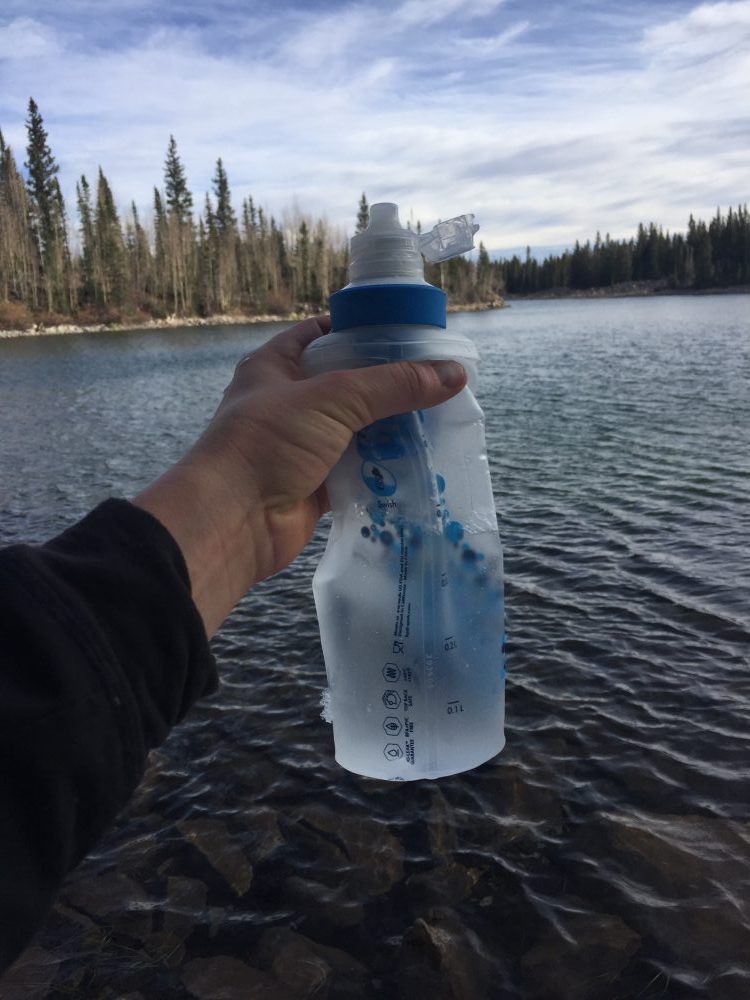
Refilling the Katadyn BeFree Filter Bottle at Thomas Lakes after summiting Mt. Sopris (12,953′) near Carbondale, CO.
Here in the Rockies near Carbondale, Colorado, June is often a transitional month. Low elevation trails are dry and surrounded by lush vegetation and spring blooms, while jagged peaks and ridges remain encrusted with receding snowfields. Roaring creeks and flooded riverbanks hint the speed with which these sun-cupped features melt away.
As someone whose preferred form of movement in the summer is running in the high country, it is the season of preparing my legs for long climbs and descents, gradually increasing mileage and vertical gain and lusting over ridgelines and alpine lakes in CalTopo. It is also the time to check in on my gear so I am ready when opportunities arise.
There are a number of items that stay in my running vest for big days of moving light and fast — an emergency space blanket, a small roll of medical tape, a caffeinated gel for when I desperately need a kick. One of the newest members of the team is the Katadyn BeFree 0.6L Filter Bottle, a soft flask with a built in water filtration system, providing a fast and convenient method of obtaining safe drinking water on the go. Simply fill up the flask, reattach the filter cap (keeping the mouthpiece clean), and you’re good to go.
Prior to purchasing the BeFree Bottle from the local running store, I treated water with AquaMira, which entailed carrying the two-part system, mixing the chlorine dioxide reactants and waiting roughly 3-5 minutes for a color change, adding to a bottle, then waiting the recommended 30 minutes for the water to become sterile. While this is a reliable system and perhaps advantageous for treating large volumes of water, the wait was always frustrating on the go, especially if I had run out of water several miles ago and was feeling dehydrated.
As an example, when snow appeared in the forecast last October, I headed out on the Three Pass Loop for a last hurrah. The route ticks off Buckskin, Willow, and East Snowmass passes (each above 12,400’), requiring roughly 6,300’ of climbing in 23 miles. Knowing that I would be near water regularly, I opted to carry the BeFree bottle as my only means of drinking.
I left my car as soon as there was enough light to see without a headlamp — i.e., I was scared being alone in the dark on a trail where cattle are openly ranged because I am irrationally more afraid of cows than most other animals I might encounter in the wilderness. The day was forecasted to be warm and clear, but there was a heavy frost, and the trail led me due south through a narrow valley that was blocked from sun by a high ridgeline for the first two hours of the run.
Underestimating how long it would take for sunlight and me to mingle, I found myself regretting the layer I left behind. I was freezing all the way to the Snowmass Lake where I soaked in my first ray of warmth while trying not to break a tooth on a frozen energy bar.
Finally finding sunlight at Snowmass Lake, which sits at the base of 14,092′ Snowmass Mountain near Aspen, CO.
Given my tango with hypothermia, I had taken in no water over the first ten miles, sending me into the first stiff climb with an untouched bottle. In true Colorado fashion, the transition from freezing to delayering was abrupt and as I power hiked 2000 vertical feet in 2.5 miles to Buckskin Pass, my negligence on the hydration front began to catch up to me.
At the top of the climb, I downed a handful of Peanut M&M’s (athlete food) and finished my last sip of rationed water, surveying the basin below to determine how soon I could refill the flask. The M&M’s churned in my stomach with no water to help them digest and I started to wonder if they might reappear as a colorful trailside gift to the local marmot population. Just in time, I hit Willow Creek where I filled, drank, and refilled the flask in a semi-frozen stream, feeling extreme gratitude for the immediate relief. I took a few minutes to let the water settle while enjoying the sun that filled the high alpine meadow, then began trudging up the next pass, vowing to stay on top of fluids for the remainder of the trek.
Back to the review…
Sweet relief — filling up the Katadyn BeFree Filter Bottle in a semi-frozen Willow Creek near Aspen, CO.
Key Features:
Unlike chemical treatments, the Katadyn BeFree Bottle uses a 0.1 micron (0.0001mm) fiber filter straw, featuring Katadyn’s EZ-Clean Membrane™. The system can handle clear or cloudy water, clearing bacteria, cysts and sediment.
At 59g dry, the system weighs less than a ClifBar — unnoticeable even when traveling light. Though top-heavy as it empties, the flask fits snugly into the chest sleeves of most running vests and I have not found it to create any bouncing so long as I tuck the filter top down into the sleeve as I drink.
Drink directly through the cap or gently squeeze water through the filter to fill additional bottles or flasks. The system touts a 2L/min flow rate; I have little reference for this, but I don’t notice much difference in the amount of suction needed to drink through the filter versus a normal soft flask or bladder with a traditional bite valve. I generally compress the bottle gently against my chest as I drink, which allows the water to flow freely.
Between uses, rinse or swish the filter with clear water and allow it to dry. A well maintained filter will last up to 1000L, and can be replaced without purchasing a second flask. So far, my flask shows no sign of tearing or cracking, but other reviewers have indicated that the cap can be fixed onto Patagonia or Ultimate Direction flasks if needed.
Topping out at 12,698 ft on East Snowmass Pass before the final 7-mile descent to back to the car.
Potential Drawbacks:
Where I live and play, it is easy to find low turbidity streams and creeks and the Katadyn BeFree Filter Bottle is up for the task. However, for adventures in areas with water that contains a significant amount of silt or organic material, you might be best served by sticking to AquaMira or another chemical treatment.
Keep in mind that a damp filter will freeze in sub-zero temps, which may permanently damage its effectiveness, deeming it a subideal method of obtaining potable water on a spring ski tour.
The plastic cap must be flipped open and shut — should this break or be left open, water will steadily leak out of the bottle. Reconfiguring this as a bite-valve or other more secure spout would be a valuable change on future models.
Need more volume? For longer treks where weight, size, or the potential to bounce are less of a factor, consider the 1L bottle or the 3L gravity flow filtration system.
The 0.6L BeFree bottle retails for $40 and can be found at outdoor retailers online or around the country.
Cheers to alpine lakes and well-hydrated long runs with the Katadyn BeFree 0.6L Filter Bottle.
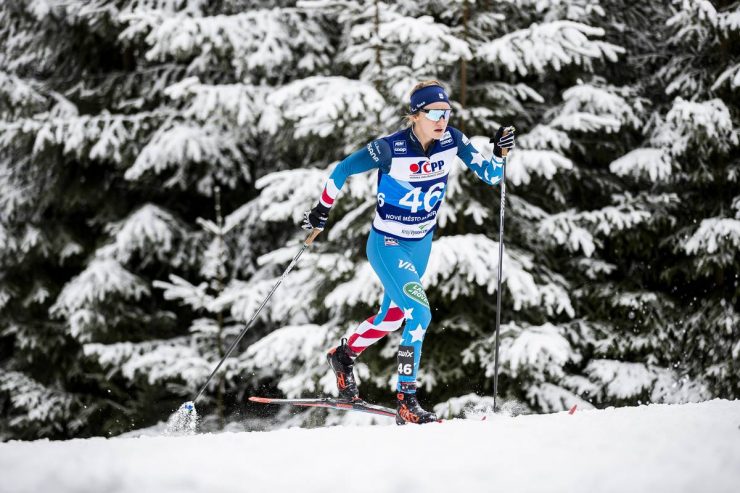
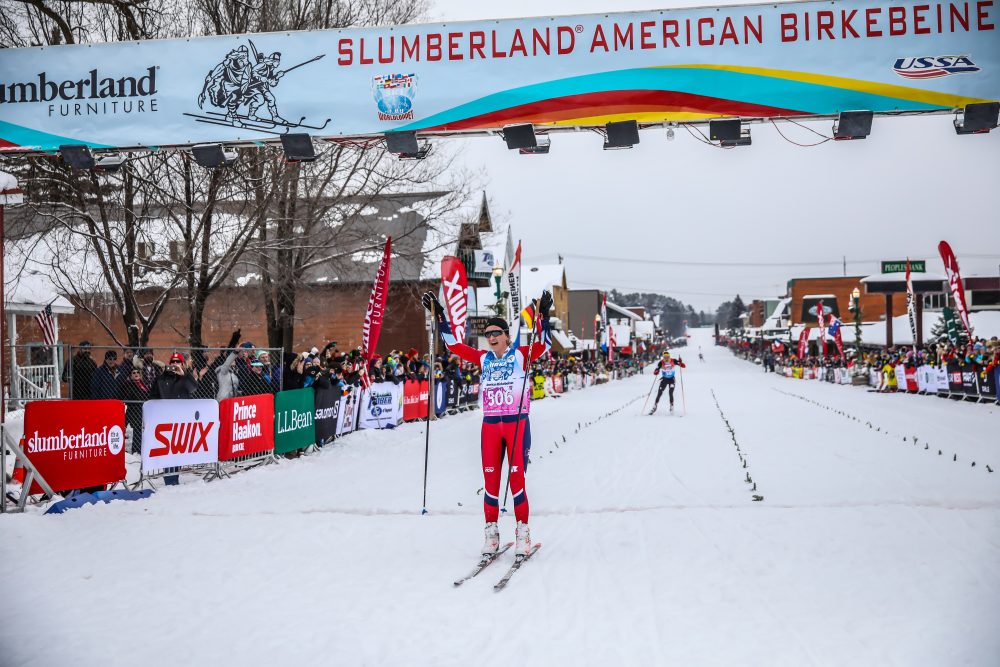
SMS T2 skier Alayna Sonnesyn with the 2019 American Birkebeiner win. (Photo: James Netz)
The countdown is on. Marathon season is underway and we are inside the final two weeks before theAmerican Birkie. At this point, “the hay is in the barn” when it comes to training, but there is still time to dial in a nutrition plan to stay fueled and all the way from Cable to Hayward.
For pro tips, FasterSkier reached out to last year’s Birkie winner, Alayna Sonnesyn (SMST2), for insight into the system that powered her performance. This season, 23-year-old Minnesota native earned three podiums at U.S. Nationals in Houghton, Michigan: 2nd in the 10 k skate, 3rd in the classic sprint, and 2nd in the freestyle sprint. She also earned her first European World Cup starts in Nové Město and Oberstdorf, improving on the results from her first World Cup starts in Quebec City the previous season.
“My dream came true.” An emotional Alayna Sonnesyn after winning the 2019 Birkie. (Photo: Screenshot asonnesyn.com)
For Sonnesyn, the Birkie has always been a family affair. In a blog post, she recalled watching through the fence as racers flew by like “superheroes.” All four members of her family raced the 2019 Birkie; her sister, Marit, took 7th, her mom was 72nd, and her dad 180th.
While bottle hand offs and extra supplies may not be a luxury available to the recreational skier, Sonnesyn’s fueling plan embodies the “eat and drink early and often” wisdom, finding a product that sits well and meets your needs, and erring on the side of over prepared.
Pre-Race Fueling:
The night before the race, I ate a ton of Rigatoni pasta (which contained beef for protein) that my mom made along with a salad.
On the morning of, I had a big bowl of oatmeal with a spoonful of Greek yogurt and a sprinkle of protein powder. I’ve found that extra protein before a big race can give me that extra energy to really dig deep later in the day. I also drank A LOT of coffee that morning, sipping it all the way until the start line.
During the Race:
Last year I carried a water bottle that had Tailwind Nutrition electrolyte mix in it. I’ve been using Tailwind for two years now and I LOVE IT! It’s so easy on your stomach and doesn’t taste overly sugary like Gatorade or Powerade. I prefer the “Naked” flavor which is essentially flavorless but also really like the Berry flavor. I know it’s sold at Gear West!
At about 15k I took a gel and chased it with water at one of the aid stations. It’s nice to know the trail so well that I could anticipate the aid stations well in advance.
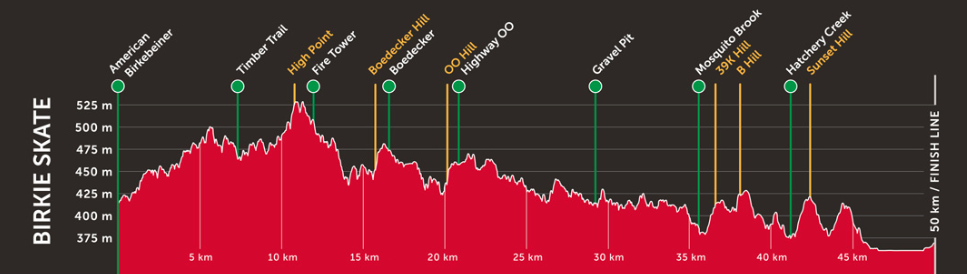
My goal was to have finished my first water bottle by the time I got to OO (kilometer 20.6) where I dropped my bottle and received a new one from my Rossignol rep. This second water bottle contained more Tailwind Nutrition mix and also a crushed up caffeine pill. Not sure if the caffeine pill helped much but I felt great!
At about 35k I took another gel that contained more caffeine and followed this up with water from an aid station. I had the option of getting another water bottle from my Rossignol rep at this point but I was feeling good and didn’t think it was necessary.
Finally, before crossing 77 (6 k to go), I received a “flat coke” feed from another Rossi rep, dropped my drink belt and put the hammer down!
Overall, I didn’t have a “calories/hour” goal but I wanted to take feeds early and often so that I could prevent any bonking. I’m not a fan of gels so I really wanted to be sure I had water after taking these to make sure I got them down well. Also, food and blocks are too much for my stomach during a race like that so I kept things relatively liquid.
The elevation profile of the American Birkebeiner. (Photo: Screenshot birkie.com)
The Race Logistics:
I was fortunate enough to have INCREDIBLE support from my Rossignol team. I gave a Rossi rep a spare set of poles that would be available about 10k into the race in case I needed them. Another Rossi rep had spare poles at OO. Luckily, I didn’t need to use these!
My aunt was also available at OO with extra everything. Poles, gloves, water, food… again though, I was lucky not to need any of this.
My race suit doesn’t have any pockets but my water bottle carrier did. I stored three gels in this pocket that I knew would be plenty to get me through the race (I used two of them). Last year it wasn’t too cold so I wasn’t worried about my feeds freezing, but keeping them close to my body made sure they would stay warm just in case.
Overall, I wanted to be over prepared rather than under. I made sure that if anything went wrong, I was prepared for it. Two days before the race, I practiced skiing at high speed with a water bottle carrier and taking a feed from it. Practicing this helped me feel way more confident in the procedure and all of the logistics for the race.
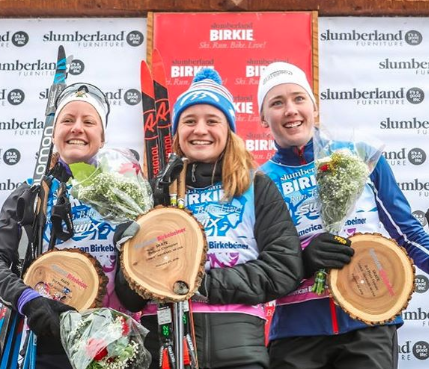
The women’s podium of the 2019 American Birkebeiner. Alayna Sonnesyn took first ahead of Anja Gruber and Katie Feldman. (Photo: Screenshot Instagram @asonnesyn)
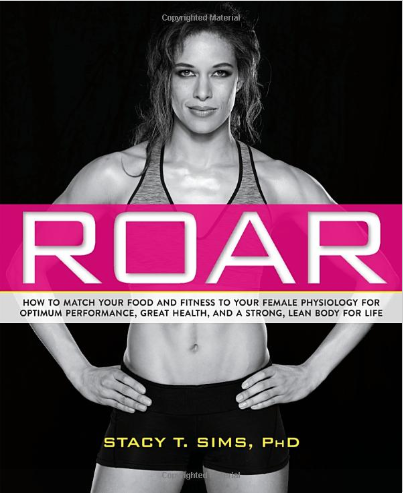
“ROAR: How to Match Your Food and Fitness to Your Female Physiology for Optimum Performance, Great Health, and a Strong, Lean Body For Life” by Stacy Sims, Ph.D is an excellent resource for female athletes, parents, and coaches. (Photo: Screenshot Amazon.com)
This book is for female athletes ages 12 to 92. Or for parents of female athletes. Or coaches of female athletes. Or anyone who wishes to otherwise support female athletes.
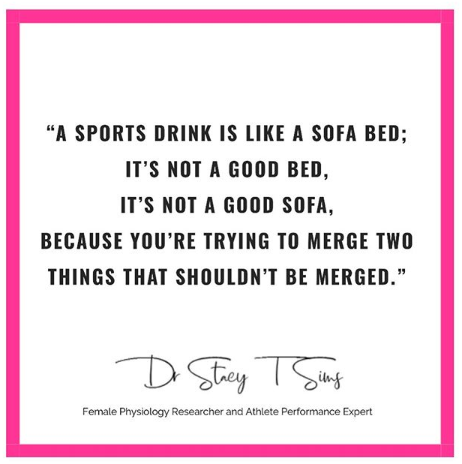
In 2016, Stacy Sims, Ph.D sparked a shift in training philosophy with her simple message to female athletes: “You are not a small man. Stop eating and training like one.”
Although the fact that there are physiological differences between men and women are abundantly clear, the implications in the realm of athletic performance do not date back to proto-humans.
In her book, “ROAR: How to Match Your Food and Fitness to Your Female Physiology for Optimum Performance, Great Health, and a Strong, Lean Body For Life”, Sims explains that for generations, research in exercise physiology excluded women because the varying hormone levels depending on age and phase within the menstrual cycle created anomalies in data. It was assumed — perhaps naively by male scientists — that women followed the trends seen in studies performed on males.
Sims experienced this phenomenon first-hand during her own career as an elite triathlete; she competed in the Ironman World Championships in Kona, HI and the XTerra Worlds in Maui. She recognized that the training plan her male peers followed did not work as well for her, and that she and her female teammates recognized their fueling and hydration needs and performance were impacted by their menstrual cycles. So she set out as a scientist to better understand female-specific physiology.
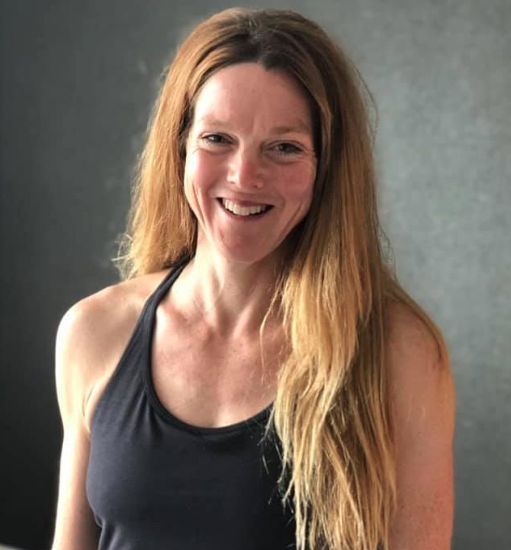
Stacy Sims, Ph.D, is an exercise physiologist and nutrition scientist who specializes in female performance. (Photo: Screenshot Facebook.com/drstacysims)
From 2007 – 2012, Sims studied “sex differences of environmental and nutritional considerations for recovery and performance” at Stanford University. Basing “ROAR” on the outcomes, Sims offers women research-based methods to align their training, fueling, and hydration with their female physiology to improve performance.
“Sex differences extend far beyond ponytails and sports bras,” she writes in the introduction.
Some of the topics in the book include aligning training and performance schedules with phases of the menstrual cycle, understanding how female hormones affect nutrition and hydration needs, the impacts of hormonal birth control, and the effects of aging and menopause on physiology and performance. While the supporting science is included, it is well explained and can be easily understood without a degree in exercise physiology, endocrinology, or nutrition.
Though I have been training, competing, and menstruating for more than half my life, I found “ROAR” to be eye-opening and an invaluable tool to identify opportunities to improve my own training and nutrition as I prepare for the American Birkie. I highly recommend it as a resource for female athletes of all levels and for anyone who works with female athletes.
Here are some of my biggest takeaways.
“Chapter 1: Demystifying and Mastering Your Menstrual Cycle.”
Right off the bat, Sims states that periods should not be avoided, and the absence of menstruation is a major red flag indicating that the athlete is not properly fueling their body, resulting in RED-S. She emphasizes that an under-fueled athlete cannot achieve peak performances and is impairing their overall health. Sims advocates for an “all in” approach to naturally restoring the body’s hormone balance by decreasing training intensity and volume (athletes can shift focus to technique here), and increasing caloric intake.
Dr. Stacy Sims, author of “ROAR: How to Match Your Food and Fitness to Your Female Physiology for Optimum Performance, Great Health, and a Strong, Lean Body For Life”, sends a clear message to female athletes experiencing menstrual disfunction. (Photo: Instagram @drstacysims)
In this chapter, Sims also unravels the phases of the menstrual cycle, providing information on the physiological effects of hormonal fluctuation.
One of the biggest surprises she shares is that competing during your period actually aids performance, because that is the phase of the cycle when estrogen and progesterone are at their lowest. In the hormonal sense, this is when women and men are most alike.
“Once you’re in the clear of the possibility of pregnancy, the body goes into a more relaxed mode and all those energy systems used in the high-hormone phase are at your disposal for exertion,” Sims writes.
She explains that this optimal window extends through the low-hormone follicular phase in the week following menstruation. This window is also when women are at their strongest and can experience increased pain tolerance and decreased recovery time. This is the best window for an intense training block or a peak race, though the latter is not always in our control.
Anecdotally, my summer goal race, the Lead King Loop 25k trail run, fell during my period. While I was expecting the worst (since I had not yet read the book), I ended up crushing my time goal, finishing third for women, and feeling the strongest I had in years.
Conversely, during the luteal phase of the cycle when estrogen and progesterone are at their highest. Though performance metrics like VO2 Max and lactate threshold remain constant, it is harder for women to build and repair muscle. Carbohydrate demands are higher during this phase, which affects fueling needs during exercise and may explain why many women experience cravings during the week before their period. Blood volume is also impacted, which can make it harder to control body temperature — not the easiest time to race in the heat!
There are also the lovely symptoms of PMS which include cramping, headaches, GI issues, bloating, and mood swings. Sims explains why each of these symptoms occurs and offers suggestions for mitigation.
Her overarching message is not to dwell on manipulating the cycle to align the low-hormone phase with peak performance, and especially not to fear the menstrual cycle as an athlete. Rather, by understanding the female physiology throughout the cycle, athletes can feel empowered to adjust their nutrition and hydration accordingly to optimize training and performance at any phase of the cycle.
One addendum: the impacts of high levels of estrogen and progesterone also explain the negative performance impact many women experience from hormonal contraceptives. This method of birth control uses artificial forms of these hormones throughout the cycle to manipulate the lining of the uterus and prevent ovulation, essentially prolonging the high-hormone phase.
“Chapter 10: Daily Fueling”
I found this takeaway less revolutionary, but so important to repeat. Sims advises women to eschew diet culture, in particular the low-carb high-fat trends, like the Ketogenic diet. She explains that while some males respond well to this type of fueling, women experience elevated levels of the stress hormone cortisol, which increases muscle breakdown and impairs the body’s ability to repair. A double whammy.
“In the end, a low-carb diet compromises your ability to maintain high-intensity or prolonged periods of exercise and puts your body under exorbitant stress.”
Sims recommends a well rounded diet that includes roughly 30% of calories coming from protein, 30% fat, 40% carbohydrate.
No surprise — the longer and harder you train, the more carbohydrates your body needs. The same goes for protein. She offers a formula to calculate individual need for these macronutrients based on the current demands of your training program.
From her guidance, I recognized that I need to include a bit more protein before and after my workouts (Sims recommends 10-15 grams before, 25-30 grams after hard exercise). I have also begun including a bit more protein in my bedtime snack, which typically looks like some Greek yogurt and a piece of whole grain toast with peanut butter.
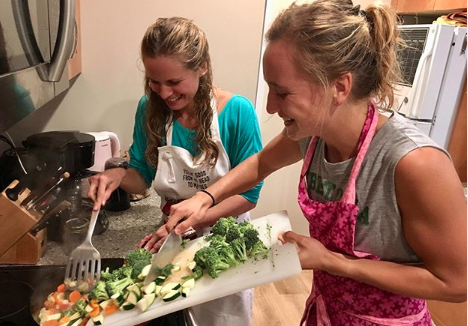
Alayna Sonnesyn (SMST2) captions this shot of cooking with Jessie Diggins, “Gotta fuel hard to train hard!”. (Photo: Instagram @asonnesyn)
Sims also recommends front-loading calories, in particular carbohydrates, during the morning when the body’s natural hormone stasis makes it “primed for carbohydrates”, whereas it can rely more on fats and protein later in the day. This helps keep blood sugar levels balanced, preventing spikes and crashes in energy throughout training and life.
Are you, like me, a 5 AM alarm clock athlete? Just give me some coffee (life-blood) so I can properly tie my shoes and get out the door! It turns out, training first thing in the morning with an empty stomach is a recipe to put your body in an over-stressed state.
“[Fasted training] is particularly bad in the morning because your cortisol (a stress hormone) levels are already elevated. If you go out and exercise first thing, your body wants to pump out more cortisol, but needs the right ingredients to manufacture it, which are your sex hormones – testosterone, estrogen, and progesterone.”
High levels of cortisol stimulate fat storage and impair muscle repair and growth — not what you were hoping to get out of that gym session! You’re also digging yourself into a calorie depleted hole…
To counter these effects, Sims recommends consuming some protein and carbohydrates before the session, which boosts blood sugar and drops cortisol levels. In an Outside Magazine piece, Sims shares that one of her go-to’s is oats soaked overnight in almond milk and topped with greek yogurt and a little maple syrup. Yes — you might need to give yourself a little extra time to digest before getting after it, but that gives you time to do that foam rolling or activation drills you’ve been neglecting, or to mindlessly scroll Instagram. Just me?
“Chapter 11: Sport Specific Fueling”
This is where Sims dives into the nitty gritty. Her advice for pre, during, and post-workout fueling include explanations of how various carbohydrates are broken down in the gut and suggestions to troubleshoot GI issues like cramping, bloating, and sloshing. And though her book is based on female physiology, this section is beneficial to those with Y-chromosomes as well.
One of the most revealing messages regarded the breakdown of sports gels in the stomach. I have never had much luck with gels during races or training — I inevitably end up with a bloated crampy belly and sticky residue in my mouth, on my hands, and wherever I stash the wrapper. Perhaps I was just looking for Sims to confirm this bias, but her explanation of the digestive process sealed the deal that candy and real food alternatives will continue to be my fuel of choice.
“The trouble with gels”, as Sims puts it, comes down to two factors: osmolality and the mix of sugars contained in the gel. Osmolality is “the concentration of dissolved particles such as electrolytes in your blood plasma. The higher the carb concentration, the higher the osmolality, and the slower it leaves your stomach and your intestines.”
Essentially, the viscous sugary gel is too thick to be absorbed readily during exercise when your body is diverting blood flow into your working muscles and away from your stomach. Even washing it down with water, as is recommended, does not transform the gel into an optimal form.
Dr. Stacy Sims, author of “ROAR: How to Match Your Food and Fitness to Your Female Physiology for Optimum Performance, Great Health, and a Strong, Lean Body For Life”, provides revolutionary information on performance hydration and nutrition. (Photo: Instagram @drstacysims)
This concept is explored further in the subsequent chapter, “Hydration is Power”, which transformed my understanding of hydration. Sims explains that many electrolyte drink solutions aim to be a source of fuel and fluids, but this doesn’t jive with the body’s digestive processes either. Sims recommends the approach of “hydration in your bottle, fuel in your pocket”, meaning separating the two for better overall fueling. The chapter is so rife with information that summarizing it here does not do it justice — go read the book!
Back to gels. The second factor of the problem is that most gels contain a blend of three sugars: glucose, fructose, and maltodextrin. The first is good, the second two are difficult for the body to digest, requiring water to be drawn from the bloodstream into the gut during digestion, which leads to the suboptimal sloshy gut feeling. No bueno.
That said, Sims acknowledges that gels do work well for some athletes. If this is the case for you, there is no need to fix what isn’t broken.
What should you use if you need an alternative? Sims recommends using 100-200 food calories per hour containing primarily carbohydrates, though some protein and fats are okay. For the above reason, she recommends avoiding fructose — which is found in fruits — and sticking to low-fiber foods that contain glucose and dextrose, which can be found in bread, and sucrose, which is table sugar. In essence, nibbling on a PBJ might keep your stomach happier and your body better fueled during a training session than sucking down a couple of GUs.
She also speculates that many people place too much emphasis on fueling during races, but it is not a “more is better” scenario.
“Contrary to what you may have heard, when in doubt, err toward the lesser amount [of food]. It is very common for athletes to overeat during training and racing with the thought that they are supplying their muscles with needed carbohydrate. But in reality, you’re consuming more than your gut can absorb, so the excess just remains in the stomach or intestinal tract too long, causing nausea, pain, and discomfort (which, of course, impairs performance).”
Sims also emphasizes that when it comes to performance in long events, like the Birkie, hydration is king. Your over-distance training session bonk might actually be a result of dehydration, not of under-fueling.
“I’m going to drill the point home here. The solution to staying strong and delaying fatigue is taking care of hydration first and foremost — reducing your loss of blood volume — and topping off your stores with small amounts of carbohydrates from real food when possible, not the kind you drink or slurp.”
The Consensus
These points hardly scratch the surface of what “ROAR” has to offer. It is a worthwhile read for any female athlete, regardless of age or performance level, and can certainly be a valuable tool for a coach looking to direct developing female athletes to sound nutritional guidance to help build a healthy body that also performs its best. Having a period is a good thing. Fueling the body is essential. “Women are not small men.”
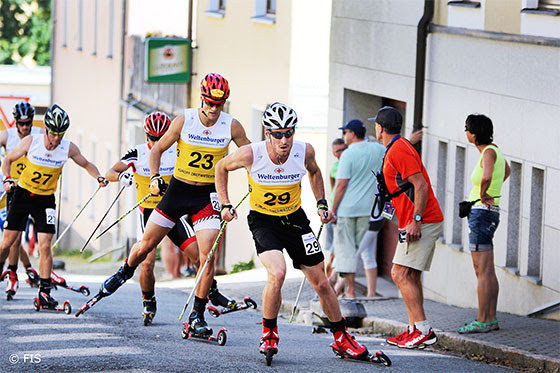
U.S. Nordic Combined skier Taylor Fletcher during a summer competition in Oberwiesenthal, Germany. Fletcher is seen leading a pack up a city street during the Summer Grand Prix last weekend. (Photo: FIS-Sandra Volk)
We’re officially into September, but that doesn’t mean we’re necessarily there with fall weather. As your workouts intensify in anticipation of the winter ahead, keep in mind that it’s important to stay hydrated — and the days can still reach very warm and potentially dangerous temperatures. The following was extracted from a 2011 “Skis, Strains and Sprains” post by Annika Ferber, an athletic trainer, and physical therapist from Minneapolis. Read the original, “How to Beat the Heat,” here.
***
Use your common sense with hot and humid weather. You know you’re going to sweat right? Well then drink before practice/training, and BRING YOUR WATER BELT. Of all the equipment I have, the water belt is the most essential. Seeing young skiers without them is scary because dehydration and heat illnesses can easily be prevented if water is readily available.
How do you know if you’re hydrated? Check your pee! I’m sure we have all heard this before, but lemonade colored is ideal for being hydrated. Hydrating itself is important as well. Don’t chug your Nalgene 10 minutes before the workout. Drink about 20 oz of water 3 hours before the workout, and then about 20 minutes from the start of your workout drink another quick 10 oz.
During exercise, if you begin to feel thirsty you are reaching dehydration. Replenishing fluids lost after a workout is essential too. Mild dehydration means that normal body weight will drop 2 percent. For example, if you weigh yourself before a workout and you’re a lean 150 lbs, and after the workout you are 147, you are dehydrated. Again, the best thing is to be smart about water.
Don’t forget about sports drinks too! They often do a better job hydrating and rehydrating the body when used properly. They replace the carbohydrates, sodium, and potassium often lost through sweat.
Types of Heat Disorders and how to Prevent them:
– Heat Cramps: Sweating heavily and working hard causes an imbalance between water and electrolytes, the athlete will most likely experience muscle twitching and cramps in their calves and abdominals, or other muscles. If heat cramps occur, it’s key to rehydrate. Also mild stretching with some ice massage can help relieve the pain from the cramps. To prevent heat cramps, make sure you’re acclimated to the environment and properly hydrated.
– Heat Exhaustion: Heat exhaustion can be detected by pale skin, loss of coordination, excessive thirst, fatigue, weakness, mental dullness, and an elevated body temperature up to 104⁰F. The best indicator that an athlete isn’t on their way to having a heatstroke is temperature. The only accurate way to test for this is to take a rectal temperature; taking the temperature anywhere else won’t be as accurate. Quickly remove the athlete from the heat, and begin rehydrating and lowering core body temperature. Continue to monitor the athlete, and if their condition doesn’t significantly improve, transportation to a hospital may be needed.
– Heatstroke: Heatstroke is a life-threatening emergency. The elevated body temperature can lead to tissue damage and central nervous system dysfunction. Many symptoms can occur: altered levels of consciousness, confusion, irrational behavior, rectal temperature above 104⁰F, flushed/hot skin, shallow/fast breathing, rapid/strong pulse, nausea, vomiting, diarrhea, decreased blood pressure, and dehydration. If the athlete’s body temperature can be lowered quickly, the risk of death decreases significantly. The best plan would be to strip the athlete, and immerse in a cold bath or sponge down with cold water and a fan. If possible, try to lower the body temperature at least 4 degrees before transport to a hospital. Only attempt rapid cooling if adequate medical supervision is available, otherwise transport to a hospital quickly. After recovery, an athlete should avoid exercise, be asymptomatic, and be cleared by a doctor before returning.
Summer can be the best time of the year, and we can often forget the dangers associated with training in the heat. The best advice is to use common sense before going out and training. Stay hydrated and stay smart.
Information and recommendations taken from ‘Principles of Athletic Training,’ 13th edition by William Prentice.
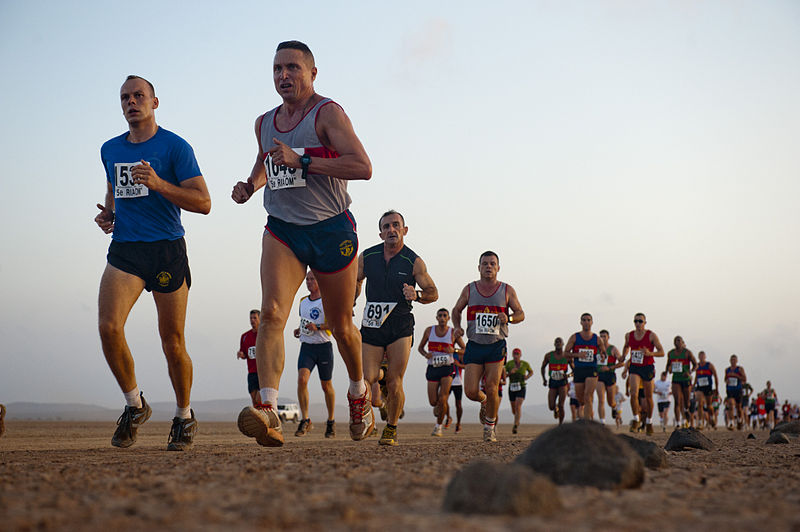
More than 250 members of the U.S. Navy cross the Grand Bara Desert at the 29th annual Grand Bara 15K race in Djibouti on Dec. 8, 2011. (Photo: Wiki Commons)
So it’s 85 degrees outside. Big deal, you think. I’ve run races on warmer days than that, I’ll probably have to compete in even hotter weather sooner than later.
You delay your run a little longer and it starts to drizzle outside. Perfect – now it’s going to cool off – so you wait even longer until it stops. By the time you step out for your one-hour jaunt, it’s about 87 degrees with a relative humidity of at least 90 percent. The Heat Index, or Real Feel, is in fact 109 degrees Fahrenheit, and you’re about to suffer.
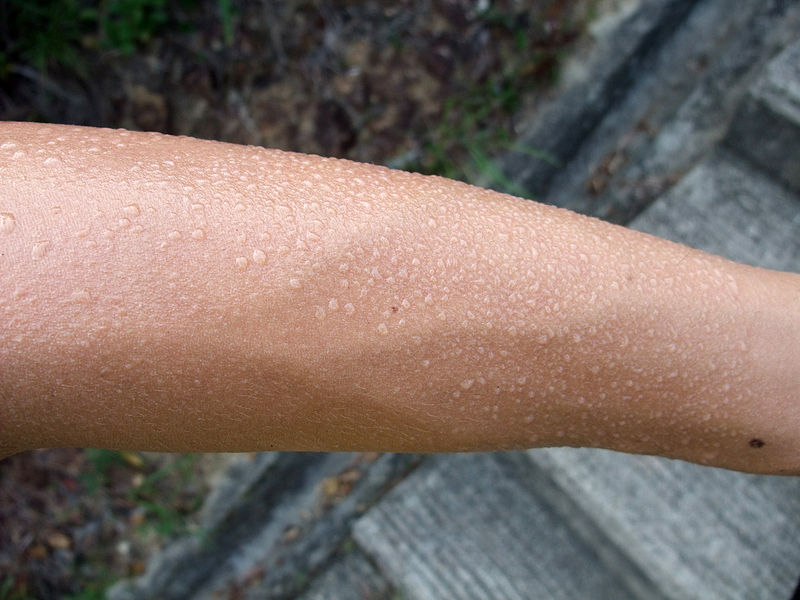
As body temperature rises, sweat glands produce droplets to get the heat out, according to the Runner’s World August 2013 article, Sticky Situation. Humidity prevents that sweat from evaporating, and if there’s no breeze, you could be screwed (unless you’re hydrating properly). (Photo: Wiki Commons)
Now is not the time to be a tough guy or gal. Take it easy out there, know your limits, and take care of yourself after.
Across the U.S., people from sea-level towns to high-elevation dwellings have been or are still in a heat wave. You wake up: it’s muggy. You go to bed: it’s muggier.
Day after day of this kind of weather can make it tough to keep with an outdoor training regimen, especially if you can’t get out first thing in the morning. But the reality is, heat bites – even if you’re a seasoned athlete who’s dealt with humidity for years.
So before you drag yourself to the nearest gym for an air-conditioned treadmill workout, consider the following to keep yourself safe during and after an outdoor session. Above all, rehydrate, refuel and rest to prevent major setbacks from something as simple as heat cramps (ouch!) to heatstroke (yikes!).
What’s the difference?
According to MayoClinic.com, heat cramps are painful muscle contractions, most commonly in the calves, quads (thighs) and abdominal muscles. If you’re waking up in the middle of the night with charley horses (painful muscle spasms in your legs), this could be the culprit. Be sure to replenish lost fluids after every workout with plenty of water (measure by your level of thirst) as well as electrolyte-enhanced sports drinks (i.e. Gatorade, G2, and Nuun).
Heat exhaustion can bring one’s body temperature to 104 degrees Fahrenheit (40 Celsius) and lead to heat stroke. Signs include nausea, vomiting, headache, fainting, weakness and cold, clammy skin.
As your body temperature rises, so does your heart rate and brain temperature, Runner’s World reports. “Your ability to assess your own body temperature will become difficult (runners often report feeling chilled or goosebumpy when they’re overheating). You can also start to lose control of body mechanics (your form and footing will get sloppy), and your mental abilities may start to break down (you may feel dizzy or disoriented).
Heatstroke is bad. According to MayoClinic, it’s a life-threatening emergency condition that occurs when your body temperature is greater than 104 F (40 C). Your skin may become hot and you might find yourself sweating uncontrollably (the body trying to cool itself), and you could become confused or irritable. If you’re showing some serious signs, it’s probably best to seek immediate attention to prevent brain damage, organ failure or even death.
So how can you stay cooler?
Get out earlier or when the Heat Index (temperature combined with relative humidity) is lower.
Stick to shaded paths, not “heat-absorbing roads,” Runner’s World advises.
Stay near bodies of water (often cooler than inland)
Alternate between harder and easier efforts (not so much intervals but normal pace broken up by extra recovery breaks)
Wear a visor instead of a hat (your body releases heat through the head)
Keep some distance between you and your training partners to keep from soaking up their body heat, says Runner’s World.
Bring water and sports drinks for workouts lasting longer than an hour, and sip often (aim for every 15 minutes).