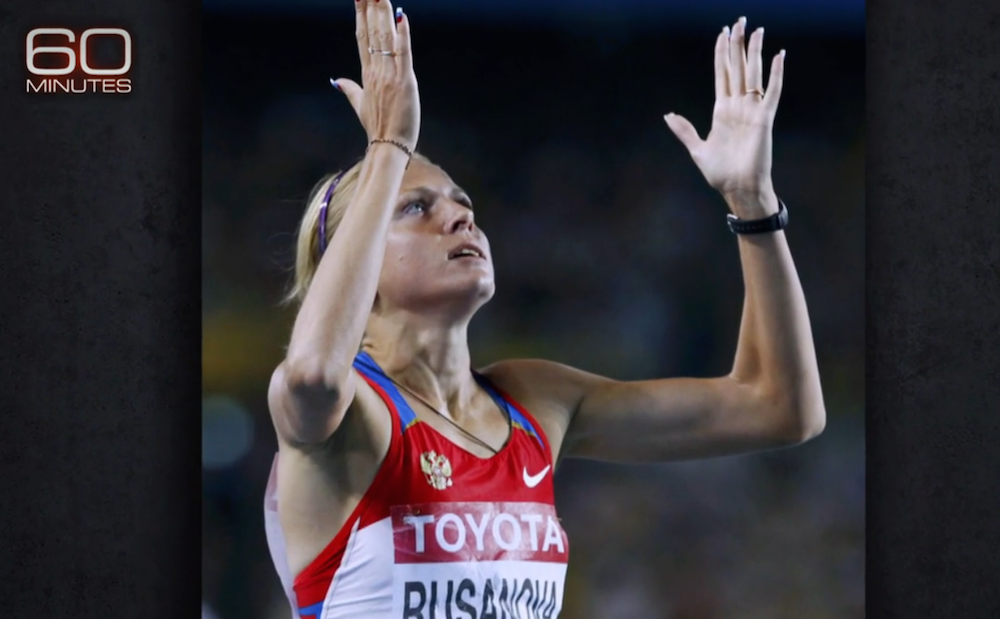
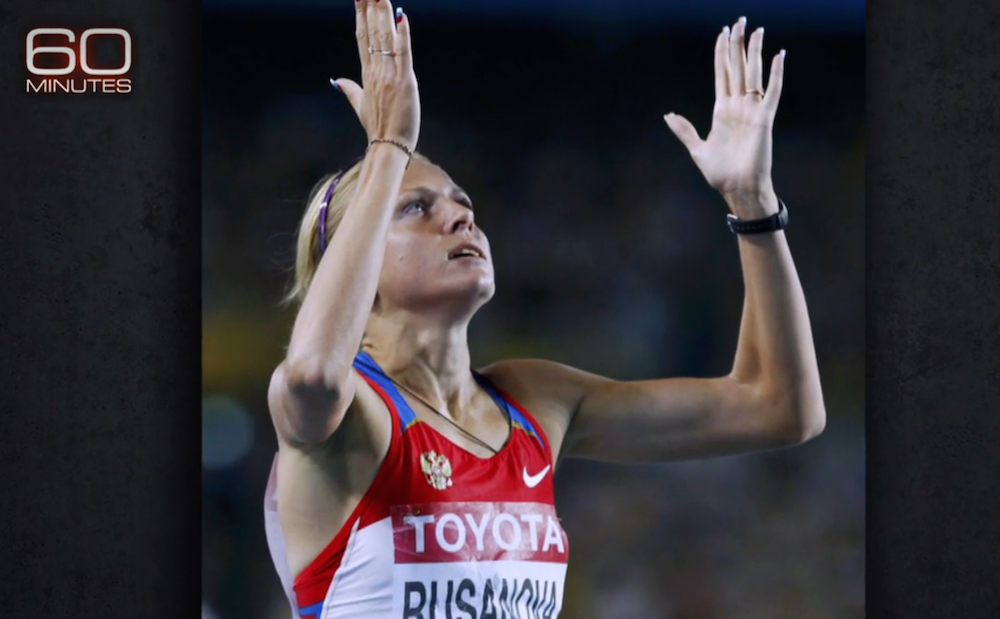
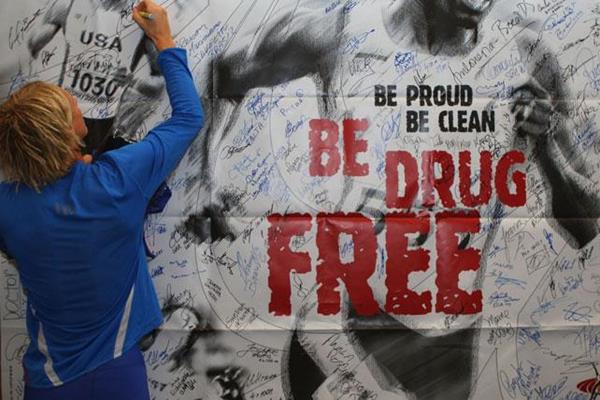
Yuliya Stepanov, a former Russian track and field athlete who admitted to using several steroids and then became a whistleblower bringing the Russian doping scandal to light. She was cleared by the IAAF to compete in the 2016 Olympics as a “neutral” independent athlete after having fled Russia. (Photo: CBS News)
The International Association of Athletics Federations (IAAF), the global governing body for track and field, has decided to prohibit Russian athletes from competing at the 2016 Olympics in Rio de Janeiro, Brazil.
Widespread, systematic doping, along with cover-ups, political connections and bribery in Russian track and field were revealed over the course of the last year in a series of news documentaries and then investigations by the World Anti-Doping Agency (WADA).
With the reports of systematic doping now spreading into other sports – for instance, 14 Russian cross-country skiers have been accused of doping at the 2014 Olympics, while a top government official admitted that the entire ski team was doped in 2010 – many in the Olympic sphere are watching the IAAF decision closely to see what options other federations might have for dealing with renegade countries in the future.
The All-Russia Athletics Federation (ARAF) was initially suspended from international competition last November. The IAAF then had to decide whether to uphold the ban through the Rio Olympics or whether Russia had made enough progress toward Code compliance to be deemed eligible.
The decision: no.
“Although good progress has been made, the IAAF Council was unanimous that … Russian athletes could not credibly return to competition without undermining the confidence of their competitors or the public,” IAAF President Lord Sebastian Coe said in a live-streamed press conference on Friday.
The IAAF Task Force, which worked for five months to investigate Russian track and field and was led by Norway’s Rune Andersen, suggested four action points, the first of which was that Russia would not be reinstated.
The IAAF Council unanimously adopted the recommendations.
“Under the reinstatement conditions, [ARAF] must show that there is now a culture of zero tolerance towards doping in Russian athletics…,” Andersen said in the press conference, before detailing that he didn’t see those conditions having been met.
“In particular, the deep-seated culture of tolerance or worse towards doping that got [ARAF] suspended initially appears not to have been changed today,” he said. “Certain coaches and athletes appear willing to ignore the doping rules. A strong and effective anti-doping infrastructure capable of detecting doping still has not appeared … [ARAF] appears unable to enforce doping bans.”
WADA filed a report on Wednesday showing widespread avoidance of doping controls by Russian athletes. In a three-month period, over 700 tests failed to be administered because athletes could not be located.
“In order to fix a problem, you have to realize and accept that there is a problem … so I think that is the first step that needs to be taken by Russia, is to acknowledge that there is a problem, from the top level of government and through all levels,” Andersen said.
In their responses to the decision, key players in Russian sports did not acknowledge a problem, and instead pledged to fight the decision.
“[Today’s] decision on the ARAF’s suspension was expected and easy to guess,” Russia’s Sport Minister Vitaly Mutko told Russian news agency TASS. “We will come up with a response.”
How international organizations handle the decision, and Russia’s attempts at appeal, will determine the true precedent of the decision. With allegations of systematic doping by Russian teams popping up in numerous sports (including skiing and biathlon), other federations are likely watching closely to see what leverage they might have over teams if Russia, or other countries, fail to make progress on anti-doping commitments.
Russia could, and likely will, appeal to the Court of Arbitration for Sport (CAS). John Coates, the head of the CAS, has recently said that he found Russian sports to be “rotten to the core”. But since Russia has not yet filed an appeal, it is not yet known who potential arbitrators will be and whether they share his opinion.
There’s another option for Russia, too: the International Olympic Committee (IOC).
“We now appeal to the members of the IOC to not only consider the impact that our athletes’ exclusion will have on their dreams and the people of Russia, but also that the Olympics themselves will be diminished by their absence,” the Ministry of Sport said in an announcement.
The IOC will be having a stakeholder meeting on Tuesday in Lausanne, Switzerland, to discuss the outcome of the IAAF decision.
“Ahead of the Olympic Games Rio 2016, the Olympic Summit will coordinate and harmonise the approach among the International Federations, which take the first decision on the eligibility of athletes with respect to qualification for and participation in the Olympic Games,” the IOC media office said in an announcement. “The discussion will have to address the difficult decision between collective responsibility and individual justice.”
Some see this as an attempt by the IOC to keep Russia in the Olympics.
The IAAF did offer one lifeline to Russian athletes: that if they could prove “clearly and convincingly” that they were clean, for instance because they lived outside of Russia and were tested repeatedly by other authorities (a “credible” testing program, Andersen asserted), then they could compete – but not for Russia.
Andersen said that this decision was made in part after an outside counsel advised them that legally, their ban on the Russian team would be easier to uphold in court if they made some allowance for proven clean athletes to compete, even if the burden of proof was substantial.
In addition, the IAAF decided that athletes who had provided substantial assistance in anti-doping investigations could also compete under an independent flag. That opens the door for Yuliya Stepanova, a whistleblower who helped initially bring the Russian doping scandal to light.
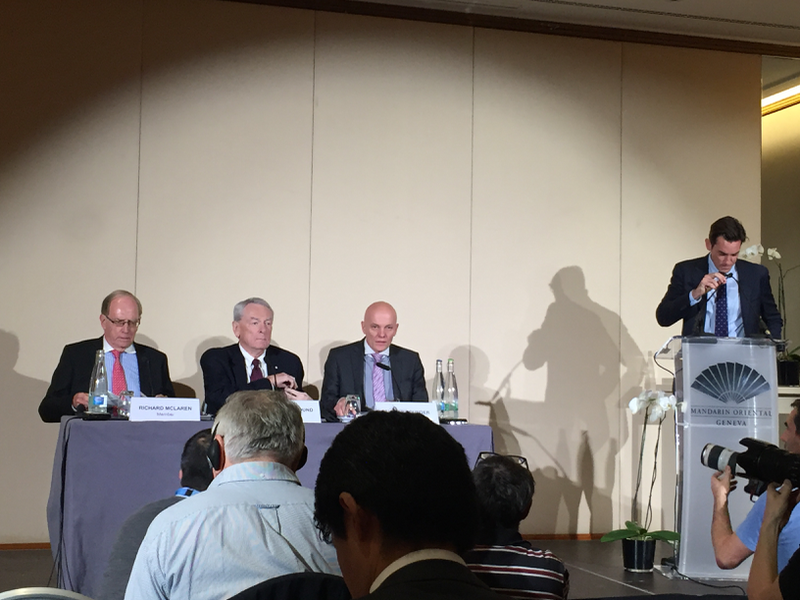
The WADA Independent Commission (l-r) Richard McLaren, Dick Pound, and Gunter Younger wait to discuss their findings as WADA’s Ben Nichols mediates questions from the ravenous press.
GENEVA —“It’s pretty disturbing,” former president of the World Anti-Doping Agency (WADA) Richard Pound said in a press conference in Switzerland this afternoon about a special investigation into systematic doping in Russia.
“We are not dealing with a he-said-she-said, we actually had documents and recordings,” he continued. “It’s disappointing to see the nature and the extent of what was going on, and to reach the conclusion that it could not possibly have happened without everybody knowing about it and consenting to it. It’s worse than we thought.”
And then, after confirming that he would call this an instance of “state-sponsored” doping, the head of the Independent Commission said this:
“Tip of the iceberg? I’m afraid you’re right. We don’t think that Russia is the only country with a doping problem, or that athletics [track and field] is the only sport with a doping problem.”
The investigation was spurred by a documentary made by German filmmaker Hajo Seppelt, in which he talked to former Russian athletes and heard tales of doping, cover-ups, and extorting money from athletes who tested positive in order to allow them to continue competing.
(An English transcript of the documentary can be found here.)
In August Seppelt later partnered with the Sunday Times to further his investigation, finding a document with blood test results for 12,000 tests administered over a 10-year period leading up to the 2012 Olympics.
Hundreds of these tests showed abnormal blood profiles that suggested, but did not prove, doping by Russians but also other athletes. This led to the assertion that the International Association of Athletics Federations (IAAF), the international governing body for track and field, did not do enough to protect clean athletes.
Pound congratulated Seppelt and ARD on their “fine piece of investigative journalism,” saying that it not only sparked the investigation but made their job much easier.
“The commission also wants to congratulates the individuals who were courageous enough to be whistleblowers in this matter, despite knowing that the outcomes are often attacks on their character,” he added.
The Independent Commission, made up of Pound along with longtime sports arbitrator Richard McLaren and Gunter Younger, the head of the Department Cybercrime with Bavarian Landeskriminalamt in Germany, found widespread corruption in Russian track and field. Most allegations from the documentaries were upheld.
While Pound said that “the athletes have always been the ones who get caught,” he shifted much of the blame for the doping to coaches and ministry officials.
He revealed that the Independent Commission had found multiple ways that that Russian officials shielded its athletes – whom they were encouraging to dope – from getting caught.
Many were tested in a Moscow laboratory before leaving the country for competitions, and not allowed to compete unless they first tested clean.
“We had reports of athletes in London going back to Moscow to be tested, and then came back to London when it was clear,” he said of the 2012 Olympics. “That has been a feature starting in the old Soviet days, which is that they never tested positive in competition. What you have to watch for is purported injuries, purported illnesses, which may not be the real reason that an athlete is not competing.”
The implication here is that many results sheets included athletes who had been using banned substances during training, even if they could not use them at actual competitions.
In other cases, coaches lied about whether athletes were present when doping control officers came to test.
Over 1,400 samples at a Moscow laboratory were also destroyed once WADA made it clear they were coming to check the laboratory. No believable explanation was ever given for this occurrence, after WADA had explicitly requested that the samples be kept.
“We came to a dead end, but we wanted everybody to know that we weren’t entirely satisfied with the explanation we got,” Pound said.
This was one of just several instances where what the commission, originally convened to investigate doping in Russian track and field, found information that implicated other sports as well.
“It likely was spread across many sports, not just athletics,” Pound said.
This occurred in December 2014, meaning that samples were likely taken from winter sports athletes in the run-up to and beginning of the 2014/2015 competition season.
Furthermore, the commission found that Russian security service FSB was present in the laboratory which tested samples at the 2014 Olympics held in Sochi, Russia.
“The Moscow laboratory is not operationally independent from RUSADA or the Ministry of Sport,” the Commission wrote in its full report, which is available online. “Its impartiality, judgment and integrity were compromised by the surveillance of the FSB within the laboratory during the Sochi Winter Olympic Games.”
So does that mean that the results of Sochi might not stand?
“I don’t think we can be confident that there was no manipulation done there,” Pound said. “But we don’t have any hard evidence that there was. We simply know that they were there. It’s hard to know what the Russian state’s interest in athletes’ urine would be.”
Asked by FasterSkier specifically about cross-country skiing and biathlon, two winter endurance sports where Russians have had positive tests in the last decade at a much greater rate than other countries, he said suspicions were well-founded.
“Certainly the two sports you mentioned are known to have had a lot of doping problems, and probably not just Russia,” he said.
There is the possibility for WADA to investigate more broadly, either on other Russian teams or other sports in general. But Pound made clear that he was not interested in leading such an effort.
“I hope that some other independent commission will do that!” he laughed, and McLaren and Younger also smiled at this, clearly tired from a massive amount of work done in a relatively short amount of time. “We feel we have kind of done our job for the moment.”
The commission concluded with a list of recommendations for various sanctions. Some were for direct sanctions or further investigation of a number of athletes and staff in Russian track and field.
Another obvious suggestion was to withdraw the accreditation of the Moscow laboratory.
“We found very few analytical errors coming out of the Moscow labs … in terms of straight faulty analysis, aside from one test this summer where the A and B didn’t match, I don’t think we found that,” Pound said. “The problem was people hiding samples or altering them or losing them or substituting them, in return for cash. The people broke down.”
The commission also suggested that Russia’s athletics federation and its anti-doping agency, RUSADA, be found noncompliant with the WADA Code. That could keep Russian runners, throwers, and racewalkers from competing at the Olympics in Rio de Janeiro, Brazil, next year.
Should the Russians come into compliance, Pound suggested that they may be able to compete in Rio. But they would have to start cleaning house soon.
“If they do the surgery, do the therapy, I hope they can get there and compete,” he said. “The idea is not to exclude people from the Olympics if you can possibly avoid that. … But sometimes, that’s the price you pay for it.”
When some in the audience balked at the possibility that Russia could compete at the Olympics just a year after such a major scandal, saying that a penalty should be more severe, Pound emphasized that positive encouragement may be key to helping Russia clean up.
Yet he was also aware that the carrot had to be accompanied by a stick, so to speak.
“If they do the surgery, do the therapy, I hope they can get there and compete.” — Dick Pound, former president of the World Anti-Doping Agency, who chaired an independent commission to investigate systematic-doping allegations in Russia
“I do think that we have been a little diffident in using our muscle,” he said of WADA. “We have spent most of our time trying to persuade people to become Code compliant… but if you haven’t become Code compliant [the last 17 years], that tells me that you’re not trying very hard…. I think that those decisions should be taken away from the political table and be put in the hands of a compliance committee which will report whether there is in fact compliance or not. At that point it’s very hard for the political bodies not to act.”
Separately, the commission suggested suspension of the Russian athletics federation by the IAAF.
The group found evidence that the IAAF had been complicit in covering up Russian doping, but did not comment much on that today. They had passed evidence first to Interpol, and then to authorities in France, to possibly begin criminal proceedings. Once the relevant criminal investigations are concluded, Pound said that the commission would happily discuss that aspect of their findings.
Importantly, since the alleged criminal activity took place – in which Lamine Diack, the former head of IAAF, is purported to have taken bribes – a new leader has taken control of the organization.
But Lord Sebastian Coe, a Brit who now heads the group, has not been particularly sympathetic in responding to the allegations so far.
In August, Coe called the German documentary and the articles in the Sunday Times a “declaration of war on my sport — there is nothing in our history of competence and integrity in drug testing that warrants this kind of attack.”
That seems naïve in light of the commission’s findings. So will any of their recommendations come to pass? Pound stressed that the Independent commission was just that independent. WADA itself had not seen or influenced the report before Thursday, and the commission has no power over what the IAAF does or does not decide to do.
But there is evidence that the IAAF may be capitulating. During the press conference, it was also reported that the IAAF would at least consider sanctioning Russia.
As for WADA, the executive board has a meeting coming up in Colorado Springs. It remains to be seen what they can, and will, do to combat the Russian problem given the tools they have at their disposal.
“While the contents of the Report are deeply disturbing, the investigation is hugely positive for the clean athlete as it contains significant recommendations for how WADA and its partners in the anti-doping community can, and must, take swift corrective action to ensure anti-doping programs of the highest order are in place across the board,” Craig Reedie, the current WADA president, said in a press release after the conference. “WADA is fully committed in its role of leading the charge to protect the rights of clean athletes worldwide.”
The Court of Arbitration for Sport (CAS) has overturned a guideline used by the International Association of Athletics Federations (IAAF) to define female competitors based on naturally-occurring testosterone levels. The decision has implications for other sports as well, with skiing relying on related IOC rules to define gender.
The case was brought by Indian sprinter Dutee Chand, who has hyperandrogenism, a syndrome where the body produces excess testosterone. This led her to test over the 10 nanomole per liter limit set by the IAAF for female athletes. That value falls on the low end of the range typical for men.
Chand successfully argued that because her high testosterone levels were naturally-occurring, not the result of doping, they were just the same as any other athletic gift someone might be born with: long legs, genetics that make it easier to add muscle, or a tendency towards aerobic fitness, for instance.
CAS agreed, saying that the IAAF must provide additional evidence that high testosterone levels provide a substantial advantage to women. If this is not the case, then testosterone should not be used as a guide to defining biological sex, because it would lead to the needless and harmful exclusion of some women who are, in fact, female.
In the meantime, Chand is cleared to compete.
“I have a right to run and compete,” Chand said in a statement released by her legal team. “But that right was taken away from me. I was humiliated for something that I can’t be blamed for. I am glad that no other female athlete will have to face what I have faced, thanks to this verdict.”
Implications for Nordic Sports
The decision has other implications as well, as the International Olympic Committee (IOC) uses similar guidelines to determine sex. For both the London 2012 and Sochi 2014 Olympics, the IOC mandated that panels be created to investigate “suspected cases of hyperandrogenism” with a potential end result of women being excluded if they had high testosterone levels.
Thus, athletes in other sports were also subject to so-called “gender verification” since 2011. And many other federations, even those without explicit policies about defining sex for competition, use the IOC guidelines.
The CAS verdict does not explicitly address other federations’ guidelines which use the same logic. However, it is doubtful that the IOC or other groups would continue using their rules stipulating testosterone as a definition of gender given that any athlete could appeal an exclusion with Chand’s precedent and win at that CAS level.
The International Biathlon Union (IBU) does not appear to have any published guidelines for how to define the sex of an athlete.
“We do not have a gender identity policy,” IBU Vice President for Medical Issues Dr. Jim Carrabre wrote in an email to FasterSkier. “We do not check or verify gender as a general pre-competition requirement. This idea is antiquated in terms of sport and doping.”
The International Ski Federation (FIS) reserves the right to do gender verification. The current International Competition rules read, “If any question or protest arises as to the gender of the competitor, FIS shall assume responsibility for taking the necessary steps to determine the gender of the competitor.”
FIS used to have explicit procedures for gender verification, but Secretary General Sarah Lewis told FasterSkier in an email that the practice had been discontinued.
“The rules of the Olympic Movement were adopted by FIS and it was necessary to undertake a gender verification test at FIS World Championships and the Olympic Winter Games (I did so myself as an athlete),” she wrote. “I am not certain whether these were withdrawn first for the Games or for the FIS World Championships, but in any case since many years, I believe 2000, it has no longer been necessary to undergo gender verification.”
(Lewis was traveling en route to Kuala Lumpur, Malaysia, and did not have access to documents which would have confirmed exact dates.)
Still, FIS has the possibility to do gender verification tests and this responsibility is also listed in documents explaining hosting for events like World Junior Championships.
“Should it be necessary to arrange a gender verification – which has never been required since the change of rules – then the Olympic Movement rules would be applicable,” Lewis wrote. “If these have been suspended by CAS, then of course FIS respects this decision.”
The necessity is defined in FIS rules as as “If any question or protest arises as to the gender of the competitor”.
FIS has one high-profile gender verification case in its history, that of Austrian skier Erik Schinegger. As Erika, Schinegger was a World Champion alpine skier in 1966; gender testing before the 1968 Olympics revealed that Schinegger was intersex. He later fully transitioned to being a man and, in 1988, returned the medal he had won.
Is Hypoandrogenism an Advantage?
Finding the necessary evidence may be a difficult task for the IAAF. Although it is widely assumed that testosterone increases female athletic performance, it has actually rarely been researched and never definitively proven.
This may be in part because research on female athletes lags far behind the amount of research completed on male athletes, across all disciplines of sports science.
A 2012 paper authored by a team of international researchers from Stanford, Barnard, and Kings College London argued that the androgen/testosterone-based rules were scientifically unsound and also did not lead to improved fairness for female athletes. (You can read that critique here.)
Another paper, published in the Journal of Clinical Endocrinology and Metabolism just this year (and available here), agrees, stating that “Even if it can be shown that high levels of natural T predictably determine better athletic performance (which the research to date does not support), we do not accept that it would necessarily violate the ideals of sport… We must point out that for many years now, natural advantage among male athletes has not been policed and reduced in sports, but on the contrary has been admired and celebrated.”
More importantly, however, those authors raised ethical concerns about alerting unsuspecting athletes that they may have either an endrocrinological disorder , such as hypoandrogenism, or a genetic condition which made them intersex. Chromosome testing is another method used in gender verification, with syndromes such as XXY chromosomal composition falling in no-mans-land.
“The discovery and diagnosis of a [developmental sex disorder] will likely come as a severe shock, and the potential for harm is not a trivial matter,” the JCEM authors wrote. “It was this well-recognized harm that led the IAAF in 1991 and the IOC in 1999 to abandon their mandatory testing practices.”
While in Schinegger’s case, the discovery that he could be male led to a long and happy life as a man, this is definitely not always the case.
“If it wasn’t for my family, I don’t think I could have survived,” Caster Semenya, a South African runner whose gender was questioned before she was eventually reinstated to compete as a woman, recently told the BBC. “It was upsetting, you feel humiliated. You cannot control what people think.”
Female athletes who have been stripped of results because of hyperandrogenism have indeed taken drastic measures. One Indian runner tried to commit suicide, twice, after losing her athletic career.
In one of the most heartbreaking stories, some athletes were told to try to lower their testosterone levels either by surgery or by taking drugs. Four very young female athletes found to have hypoandrogenism through the pre-London 2012 testing appear to have consented to surgeries that they were told would lower their testosterone levels to an extent that they would be able to compete, but the surgeries ended up being plastic surgery on genitals or breasts, and did not have the desired affect because this was not the source of testosterone.
While the IAAF denies that this ever happened, it was reported in the International Business Times and in the medical journal article linked to above. All four women were rumored to be from rural areas of developing countries where the concepts of gender as not only a sociological but also a biological spectrum, which have only just begun to permeate the West, have not yet reached.
After a sensational German documentary aired last week alleging widespread state-sponsored doping in Russia, as well as elaborate and financially shady cover-ups, the World Anti-Doping Agency (WADA) released careful statements expressing their dismay for the situation. It initially seemed like the allegations would be investigated only by Russia’s internal anti-doping agency, RUSADA, and by the International Association of Athletics Associations (most of the athletes named in the documentary were track and field stars).
After intense pressure, WADA announced today that they will launch their own full and independent investigation, which will proceed regardless of the pace or scope of IAAF or RUSADA work.
“WADA is the independent anti-doping agency tasked with the mandate of ensuring that the clean athlete is supported in every sport and in every country,” WADA President Sir Craig Reedie said in a press release. “The allegations that have been raised in the German television programs require close scrutiny to determine what actions are required to be taken by WADA and others, to confirm the evidence, seek further evidence, and pursue any anti-doping rule violations or breaches of the International Standards that have allegedly taken place. WADA must ensure that all athletes who have cheated, either at national or international level, are dealt with in an appropriate fashion under the World Anti-Doping Code.”
An English-language transcript of the documentary has been released, which reveals that the systematic doping occurred in far more sports than track and field: cross-country skiing and biathlon were specifically named. A second documentary, so far not translated to English, has implicated additional athletes from other countries. This comes at the same time as a massive cache of documents pertaining to the case of infamous Italian doping doctor Michele Ferrari is being released, including wire taps between Ferrari and David Taschler, a biathlete who is the son of the International Biathlon Union’s Vice President for Sport, Gottlieb Taschler.
North American biathletes and staff have also weighed in on the doping allegations. Kikkan Randall, the U.S. cross-country skier who serves as the athlete representative to the International Ski Federation (FIS), did not respond to a request for comment.
The Allegations
The documentary, made by Hajo Seppelt, aired last week on German channel ARD, but an English-language transcript was only recently made available by WDR. You can read it here.
While we covered some of the most glaring and commonly-discussed messages from the documentary when it came out, the transcript offers more details that are particularly interesting to nordic sports. It also provides a clear picture of the professionality Seppelt brought to his work. The German did not appear to cut corners; he displays videos and plays cell phone recordings in the documentary (which you can watch here) to prove his points. When a source secretly filmed her coach handing her a packet of anabolic steroids, Seppelt had the pills tested at the Cologne, Germany, anti-doping lab and confirmed that they were, in fact, Oxandrolone.
He also sent an employee to investigate just how easy it is to obtain recombinant erythropoetin (EPO, a common blood-doping drug) in Russia. Here’s an excerpt from the transcript:
3,925 rubles is about $40 dollars.
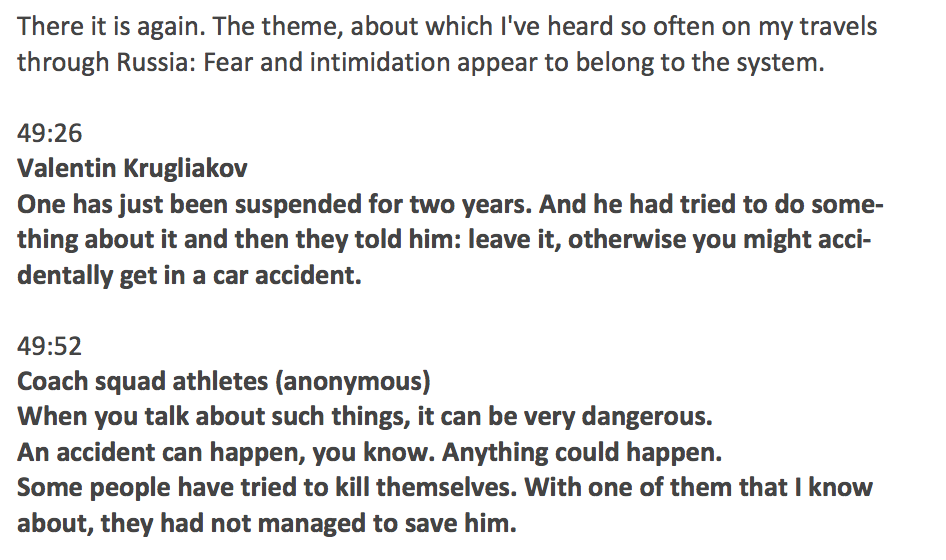
While all of Seppelt’s sources come from the world of track and field, they know that doping is more widespread than simply their own sport. Vitaliy Stepanov, who formerly worked in an anti-doping laboratory in Russia and was dismayed and disillusioned by what he saw there, listed these as the sports that are protected, in that they are not tested or positive tests are covered up: “Swimming, Cycling, Biathlon, Athletics, Weight Lifting, Nordic Skiing.”
Besides a much-discussed story in which marathon champion Lyliya Shobukhova, who paid her own federation bribe money in order to suppress a positive test and compete in the 2012 Olympics. Seppelt details the manner in which the financial transaction — worth $600,000 at one point — was carried out using a shell company based at a random address in Singapore.
The question that viewers might be left with is, why haven’t we heard anything about all of this earlier, if it’s so extensive? The documentary gets to that, too. Here’s another excerpt:
The two foremost informants for Seppelt’s documentary left Russia before it aired, and plan never to return. They hope to make a new life for themselves and their child in safety.
The Reaction
After days of tense speculation and inside discussion, there is a sense of relief that WADA itself will be tackling the allegations, instead of leaving it to another organization.
“I am really glad to see that WADA is undertaking a full investigation into all the very serious allegations made in the ARD documentary on systematic doping and corruption within the anti-doping effort,” U.S. Biathlon Association President & CEO Max Cobb told FasterSkier. “Biathlon is mentioned in the documentary and less than a month ago IBU suspended another top level athlete for doping. This may be a watershed moment for clean-sport. WADA is wise to launch a full and independent investigation.
He’s referring to Alexander Loginov, who was busted for using EPO in November when the IBU used a new method to test stored samples from the previous season. At the time, news outlets including this site heralded the development as a smart move. While the new method has not been revealed, it could possibly be the use of “transcriptomics” to test for a signature of changing gene expression in response to EPO, rather than to EPO itself. In development for years, such a test has been hailed as “perfect” because there is no way to hide this biological signature once you have doped.
Among the allegations in the documentary, however, is that Russian athletes are advised to take urine samples when they are not doping, freeze them, and use them to cover their tracks if they are tested and know they will fail. Seppelt also reports that samples are checked before athletes ever leave the country, so that athletes who might test positive at major events never have the chance.
All of this reveals a more sophisticate state-level doping system than had been imagined, and means that even the perfect test might not be able to catch Russian dopers.
When asked about the documentary, U.S. biathlete Lowell Bailey, one of four athlete representatives to the IBU, said that he needed more information before reaching any conclusions. (FasterSkier reached him this weekend at the World Cup in Östersund, Sweden, before the English transcript was released.)
“The most I can say is that I don’t know any of the sources that were cited,” Bailey said. “I don’t know any of the people who were interviewed or how they went about doing it. So I really can’t comment on anything that the documentary involves… Honestly, what we’re focusing on from day to day is what training sessions are like and how we can improve. A lot of this stuff is going on outside of the World Cup. These allegations, I guess you could say, are yet to be confirmed by any reputable source like WADA or the IOC.”
That may be true, Seppelt has been a prescient commentator before. He broke the story of doping in Kenyan distance running back in 2012. Two years later, three-time Boston Marathon winner Rita Jeptoo failed a test for EPO, unleashing a firestorm in the athletics world.
While Bailey couldn’t comment on the documentary, he did weigh on an the suspension dealt to Loginov. In Kontiolahti, Finland, last season, Bailey finished third in a World Cup sprint. Loginov was second.
“For sure, it made me angry that I have worked my whole life to climb up onto that podium, and the guy who is standing there next to me was cheating the whole time,” he said.
Canada’s Nathan Smith place eighth in the same race.
“One of my best races last year, he [Loginov] was on the podium so I guess he robbed me of his spot, right?” Smith asked retorically, reached on Sunday in Östersund. “I would’ve been seventh instead of eighth. But, I don’t know, I mean, you can’t ignore the facts, Russia has so many cases that they still have problems.”
Bailey says that he fully expects to have his result from the race amended to second place. He will also rise in the rankings of last season’s World Cup total score.
But he didn’t get to enjoy second place in the moment.
Still, Smith says, the sport seems to be cleaner than when he first showed up on the World Cup circuit.
“I remember [Maxim] Tchoudov was just blowing everyone out of the water,” Smith said. “I think he was a minute faster than the next guy and in the relay it was like I was standing still. Obviously I’m a lot stronger now, but I think back then, we wouldn’t have even been able to compete with that. He never got caught for anything, but it was definitely questionable, and now I think the Russians in general are a lot more human.”
With Loginov’s test, both Smith and Bailey feel there is evidence that they system is working.
“You can see that in the results,” Smith said. “They don’t have tons of good guys in the top 10, they’ve got like one guy. I think it’s realistic that for the most part their team is probably clean, but I’m not really sure. Definitely with the more stringent testing, you can tell countries like U.S. and Canada, we’re definitely more competitive now. I’d say we have a chance, so it definitely helps our countries, that’s for sure.”
For Bailey, it’s just not worth wasting a lot of time, anger and energy worrying about Russian doping. He has to trust in the system, he explained, and focus on what he can do to be the best – not whether more former competitors might retroactively get disqualified.
“I really focus on what we can control, for ourselves,” Bailey said. “I’m lucky that in the United States we have basically the best team that you can ask for, and every resource that you would need in order to do the best training … I talk with a lot of the athletes on a daily basis, so I can kind of get a feel for what people are thinking. I think at this point, the athletes place a lot of trust in the antidoping agencies and the testing protocol that the IBU has put in place and WADA has put in place, and the various national-testing pools. You have to place your faith in those organizations, and really hope and believe that they are doing their utmost to stay ahead of the dopers. And the rest is just, the day to day preparation for training and racing on the World Cup.”
On Nov. 13, the International Association of Athletics Federations (IAAF) released a statement to the 2013 World Conference on Doping in Sport, organized by the World Anti-Doping Agency from Nov. 12-15. (Photo: IAAF)
At last week’s 2013 World Conference on Doping in Sport, its host, the World Anti-Doping Agency (WADA) approved the 2015 World Anti-Doping Code in Johannesburg.
According to a statement from outgoing WADA President John Fahey in the agency’s Play True Magazine: “Through the acceptance of the Code and International Standards in South Africa this week, the anti-doping community has left its mark and demonstrated the renewed commitment that both government and the sport movement have towards putting the right of clean athletes ahead of all others in the years ahead.”
The conference concluded a two-year review of the Code, which included extensive input from stakeholders and four rounds of consultation and draft revisions.
The new Code, effective Jan. 1, 2015, is a direct response to the shortcomings and failings of the current international anti-doping system.
“We now have a Code, which, I believe, offers the best response to combating the scourge of doping yet,” Fahey stated. “Stronger sanctions while maintaining better investigative powers for WADA, a stronger focus on the sharing of information between the sport and governments, intelligent testing and risk assessment in relation to different sports, and fair consideration of an athlete’s human rights.”
How Bad is the Situation?
In reaction to the new Code, former WADA president Dick Pound summed up his dissatisfaction of the current anti-doping system on an interview on NPR’s BBC World News. According to Pound, the positive test results are simply not keeping up with the number of successful dopers. Moreover, only one out of 100 tested dopers actually gets caught, the same as 30 years ago when testing began.
WADA statistics from 2012 show that out of 267,00 drug tests conducted globally last year, 1.19 percent had “adverse” findings or were positive. An additional 0.57 percent were “atypical” and needing further investigation, the Daily Mail reported.
Pound told NPR about the real need for a stronger global effort. “No one really wants to catch anyone,” he said, adding that WADA is seriously underfunded and he knows it will require expensive measures to catch dopers. At last week’s conference, WADA announced a 1-percent increase to its $28-million-dollar budget.
Pound also stressed the need to test for the right things at the right time, referring to out-of-competition, drug-testing strategies. With good planning, an athlete can always come up with an in-competition clean test.
“If you know the date of your event and you get caught, you have failed two tests: a doping test and an intelligence test,” Pound said.
WADA Approved Maximum Four-Year Sanctions
The adopted Code has increased the maximum penalty for first-time doping offenders from two to four years. This is a much heavier penalty, as offenders will miss at least one Olympics. While the stronger sanction should serve as a major deterrent to athletes, there are several loopholes, which have the potential to allow cheaters to slip through.
The four-year ban from participation in competition may be reduced to two years if the offender denies the intention to have used a banned substance. Little or no proof is needed for this to take place. Other loopholes leading to reduced sanctions include admitting to cheating or allowing the athlete’s support staff to take the blame.
“If you know the date of your event and you get caught, you have failed two tests: a doping test and an intelligence test.” — Former WADA president Dick Pound
In response to the WADA conference outcomes, the International Association of Athletics Federations (IAAF) released a statement, which mostly supported the new Code, but also addressed some concerns:
“Time will tell whether the sanction regime under the new Code will make more severe penalties the norm. Frankly we believe there are too many means of escape.
“In 95% of the cases we face, the athlete denies doping outright; and the blame is routinely laid at the door of a sacrificial coach, doctor or other third party. The new Code provisions on intention play firmly into the hands of these athletes and their unscrupulous entourage and will only serve in our opinion to make cases more procedurally complicated, time-consuming and costly than they ought to be.”
The IAAF’s bottom line is unwavering in support of four-year bans: “When clear evidence of cheating is presented, four years must truly mean four years.” The Federation also recommended a mid-term review of sanctions in three years.
New Code Focuses on Investigation
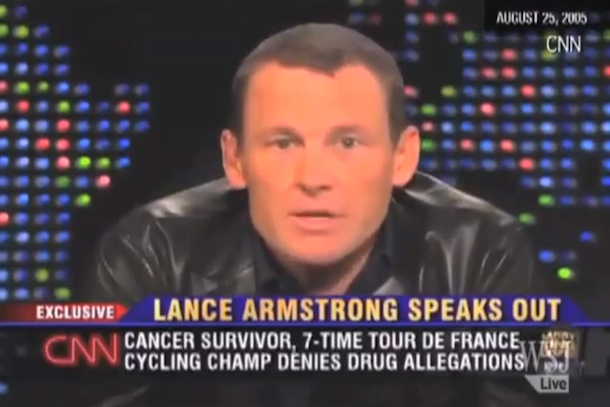
Seven-time Tour de France winner Lance Armstrong vehemently denied doping claims before admitting to using performance-enhancing drugs in January 2012. (Photo: totalprosports.com)
Learning from cycling, WADA’s new set of rules offers athletes possible immunity from punishment in return for “substantial” information on doping.
According to Fahey, “I guess it’s founded on the question: If you can bring about a greater good with the cooperation you give, then there ought to be some encouragement for you.”
The new Code has strengthened its power to punish the trainers, coaches, and officials who are complicit in doping athletes. Essentially, if members of an athlete’s support group are found in possession of banned substances, they will be subject to disciplinary actions by national sporting federations and the IOC.
WADA Pushes for Sport-Specific Testing
One drug-testing protocol is not sufficient to cover the many sports played internationally. The doping protocol for tennis would be quite different from that of an endurance sport such as cross-country skiing. WADA now is able to tell sports federations to test in a specific method in order to find the substances most likely to be abused by athletes in their sports.
The Haematological Passport has seen some success since WADA adopted it in 2009. In 2014, a new component, the steroidal module, will be added to the Athlete Biological Passport. This will add a standardized urine test to detect the presence of anabolic steroids to the APB in addition to the blood profiles already being used.
New WADA President, Renewed Anti-Doping Education Efforts and the Sochi Testing Lab
Former IOC Vice-President Sir Craig Reedie was appointed WADA’s incoming president and will be sworn in on Jan. 1, 2014.
Fahey is confident that the revised Code will help eliminate drug cheats, but part of his final message calls for a greater focus on education.
“The more we educate our young athletes on these [anti-doping] topics, the better outcomes we will have,” he stated.
WADA is also responsible for deciding whether Russia’s anti-doping lab is eligible for drug testing at the Sochi Olympics, an issue that arose last week. While WADA does not have a presence at the Olympics, it has the power to set the standard for the Olympic drug-testing facility. Moscow and its Sochi satellite laboratory, which was to be used to test Olympic athletes in less than three months, has been slapped with a pending six-month suspension.
Professor Arne Ljungqvist, Lord in Waiting to His Majesty the King of Sweden. (Photo: Tine Harden/Playthegame.org)
Note: For more on Professor Ljungqvist’s fight against doping in Sweden, and its effect on Scandinavian sport culture, you can read our companion piece, also published this morning.
STOCKHOLM, Sweden – Professor Arne Ljungvist has been fighting doping since the 1970’s, when he began with the Swedish Athletics Association and the International Association of Athletics Federations (IAAF). These days, he has retired from his day job – researching cancer and other medical topics at the prestigious Karolinska Institute – and holds two others: the head of the International Olympic Committee (IOC) Medical Commission, and the vice presidency of the World Antidoping Agency (WADA).
In the intervening decades, doping rose to seemingly absurd levels, but Ljungqvist believes that in some sports, performance-enhancing drugs are no longer so prevalent.
“You can see it,” he told FasterSkier. “In measurable sport, you can see the difference. In no [Olympic] throwing event in London would the gold medalist been on the podium in Seoul 24 years ago. It’s incredible. So it’s been cleaned up.”
But that doesn’t mean that the problem is gone – it is an ever-evolving, ever-escalating battle between dopers and administrators. In some ways, the efforts by people like Ljungqvist are still the same as they were in the 1960’s, when one of the biggest jobs was simply determining which substances ought to be banned. Administrators have always been trying to catch up with dopers, tests always lagging behind the discovery of new performance-enhancing substances and methods.
And as they have lost patience, perhaps, the game has changed. Recognizing that they won’t be able to test every athlete for every possible performance-enhancing method at every potentially important time, administrators have in recent years embraced “non-analytical” cases where there is no positive test for a banned substance. This tool for catching cheaters was showcased last month when Lance Armstrong was stripped of his seven Tour de France titles, based mostly on the words of other cyclists.
With these changes and challenges in mind, FasterSkier asked Ljungqvist and Staffan Sahlström, a longtime ally of the professor’s, a few questions about sports today in a long interview at the offices of International Doping Tests and Management (IDTM), a company which Sahlström founded here in Stockholm.
No-Start Rules and Biological Passports
The International Ski Federation (FIS) was one of the first federations to try to nail dopers without an actual positive test. One of the main goals of endurance athletes who dope is to raise the capacity of their blood to carry oxygen. For a long time, there was no test for erythropoietin (EPO), the main drug used to do so. Then, too, dopers learned to reinject their own blood back into their veins, which was hard to detect. So the federation got creative.
“FIS felt that they had problems with blood doping, and the Finnish incident proved that they were right,” Ljungqvist said, referring to the scandal that disqualified six Finns from FIS World Championships in 2001. “And the way they tried to stop it in the absence of detection was to institute this no-start rule, to say that if you had too-high blood counts you couldn’t compete because it would be dangerous to your health.”
The rule, which stated that no skier could start a race if their hemoglobin tested higher than 16.5 g/dl for women or 18.5 g/dl for men, was designed to detect the symptoms of blood doping, if not the actual substances or transfused blood itself. To the public, FIS explained that having too-thick blood was dangerous, which was true, but not the real purpose of the rule.
The rule did work, if its goal was to lower competitors’ hemoglobin levels before they raced. In 2006, U.S. skiers Leif Zimmerman and Kikkan Randall had to wait five days before re-testing and competing in the Torino Games. At the 2010 Olympics, Maine-based New Zealand racer Ben Koons encountered the same problem.
According to Ljungqvist and many others – such as the aforementioned three, who say their hemoglobin levels had nothing to do with doping – it wasn’t a good solution.
“I don’t like that,” he said of the FIS policy. “I think they were covering themselves under a false argument. And I told them that many times – that there is no proof, and particularly the individual, probably, some are born with different levels. This is a bad excuse. They were trying to combat doping with a false argument. That’s ethically doubtful.”
Not only is hemoglobin likely under some degree of genetic control, but it can also be affected by living at altitude (which can train the body to carry more oxygen in the blood) or even by dehydration. Plus, the rule didn’t actually catch all the cheaters. Ljungqvist pointed out that Armstrong, for instance, had repeatedly taken saline infusions to dilute his blood when he knew he would be tested.
“They notify the skiers by just putting up a message in the lockerroom, which says, you are due for your blood sampling at nine o’clock,” Sahlström explained to get at the rule’s shortcomings. “So you have a notification and even though you are observed during your notification, the bad guys could do something. And the levels are just below – a little bit too little below. So they achieved something, but it is a false excuse.”
FIS has expanded the concept, however, into something called an “athlete biological passport.” The idea is that by tracking markers like hemoglobin through time, administrators will have some idea of an athlete’s natural levels, and if they dope, the changes will show up in tests even if the substance itself does not. Last season, FIS administered 1,432 out-of-competition tests as part of its biological passport program.
“I think it’s well worth trying, and it’s a good idea,” Ljungqvist said of the passport concept. “We’ll see if it works. It has already been used – the International Cycling Union has been doing it, IAAF did it just before London, and they banned a few athletes based on passport information. The more sophisticated, the more detailed you can make the passport, the better.”
As part of his role with WADA, Ljungqvist has watched the agency adopt the program itself. Next week, he’ll take part in discussions about whether WADA can expand the passport to include endocrinology data, which could help detect steroid and hormone use – as well as other future methods that athletes haven’t even tried yet. For the first time, Ljungqvist hopes, maybe administrators will be one step ahead of dopers, rather than the other way around.
“Maybe we will finally have a good identification of the athlete’s biochemistry,” he said. “That will also be helpful when it comes to detecting gene doping, so it’s a good path to follow.”
Strong Leadership for Clean Sport
In the fallout from the Armstrong scandal, many clean athletes have to wonder: how do I know that the playing field is level, and that the system is working, if Lance Armstrong could get by for so long without being caught?
That, say Ljungqvist and Sahlström, depends on a lot of things, sport and country among them. But in the U.S., athletes shouldn’t be too worried, Ljungqvist believes. He remembers what happened at the Sydney Olympics in 2000, when it came out that U.S. athletes had tested positive for banned substances, but the cases had been swept under the rug by the U.S. Track and Field federation and the United States Olympic Committee (USOC). At the time, Ljungqvist publicly states that the Americans had failed to do their jobs.
“I got a direct call from the responsible people at the White House, the drug czar, who told me that they understood our problems in Sydney,” he said. “I had criticized them and it had come out in the United States newspapers. So they said, please, calm down, if you can, and we’ll do something. And they did. They created USADA.”
Recently, Ljungqvist says, USADA has done an admirable job tackling the rampant doping in Olympic sports (professional sports are, of course, another matter). He cited first the BALCO investigation, and then the Armstrong affair, as cases where the agency laid out meticulous cases against high-profile athletes and didn’t seem hampered by political pressure.
“They were very thorough, very serious, and very professional,” Ljungqvist said. “They are cleaning up sport in the United States. But it shows that the system had been bad… this goes back to the late 1990’s and early 2000’s. They weren’t doing the job. Marion Jones is another example – tested hundreds of times, at the wrong times.”
The turnaround was due to something that hasn’t happened in every country: the antidoping agency was separated from any organizations that might have an interest in the outcome, like the government or the national Olympic Committee. One reason that the U.S. system had been so bad, Ljungqvist implied, was that it had been enforced by two organizations which had a vested interest in U.S. athletes winning medals, and so had some incentive to avoid banning star performers.
“I think that one of the answers [to the doping problem] is the independence of the organizations that are handling different cases,” Sahlström said. “And then it should be discussed, what is being independent? I can question being independent in some countries.”
He would know, because IDTM handles doping tests for various federations around the world. The company started based on the pair’s out-of-competition testing program in Sweden; the IAAF asked, can you do this internationally? Since then, Sahlström has assembled a network of doping control officers around the globe. And different countries, he says, sometimes have different ideas of what a doping agency should do.
Then there’s the question of who is leading national agencies and international federations. Travis Tygard of USADA has gotten a lot of press lately, as have International Cycling Union President and Vice President Pat McQuaid and Hein Verbruggen. While Tygard attacked a popular American hero, the UCI leaders quietly protected a system of doping in their sport. People have called for the resignation of all three, for various reasons: Armstrong reporters are furious at what Tygard has done, while fans of pure sport are disappointed in the spinelessness of the UCI.
“It’s difficult to be the governing body – you have to run the sport,” Sahlström admitted. “If you are not strong as Professor Ljungqvist has been in the IAAF, and if you have weak leadership that says, okay, we need to protect our athletes because they are our asset and they can’t be found doped and we will lose sponsorships, or TV rights, et cetera, then that’s something that we should be looking into.”
Whether it’s at the USOC, USSA, USADA, or FIS, athletes have to rely on their leaders – and that’s a big question. It’s made tougher, Sahlström said, because most of these high-level administrators keep their jobs for a long time – sometimes decades. The lines can blur after such long relationships, he suggested, and administrators can bow under the pressure from athletes and coaches to ignore problems with doping.
“If you have a fairly closed family like the professional cyclists, they all know each other,” Ljungqvist said. “Sports-wise, it’s a small group. It’s easy to organize something and people protect each other.”
In insular sports such as cycling, Sahlström agreed, it’s a tougher problem.
“For leaders to start to clean out something, it takes some courage, and I’m not sure that every leader today has that,” he said. “Who are the leaders? Are they strong enough? If there are leaders who have been part of an old regime, I’m not accusing anyone, but if you have been in that area, then no. If you come into a federation with new eyes and ears you can say, okay, something has to be done. But if you have been part of it, you would be biased.”
Should American skiers be worried, though? Of course no sport is perfect. But as Americans, the athletes should trust USADA, the pair said. And as skiers – well, at least it’s not cycling.
“The confidence in the system, I wouldn’t doubt it,” Ljungqvist said.
The International Ski Federation's rules guide the release of information in anti-doping cases.
Nikolai Pankratov’s reported detainment at the Swiss border made waves in the cross-country skiing community when the news broke last week. But since then, there’s been barely a ripple of information to emerge from the International Ski Federation (FIS)—which, according to the Russian Anti-Doping Agency, is in charge of handling the case.
What is known about Pankratov is this: according to multiple reports, the Russian cross-country skier was stopped at the Swiss border with intravenous equipment and 22 vials of Actovegin, a drug derived from calf’s blood. While Actovegin is suspicious, its use is not banned—Pankratov ran afoul of FIS through his possession of the IV, which is prohibited.
FIS has refused to confirm the existence of a case against Pankratov. And even if an investigation is indeed underway, FIS is not required to disclose any information about it, unless Pankratov is found guilty and sanctioned by a three-person FIS panel.
According to World Anti-Doping Agency (WADA) spokesman Frédéric Donzé, the rules governing the release of information by sport federations like FIS are guided by the World Anti-Doping Code, which Donzé dubbed “the framework of the fight against doping.”
In order to be considered compliant by WADA, FIS and other federations—like those governing biathlon, swimming, and track and field—must adopt fundamental provisions in the Code, which outlines standards for drug testing, sample analysis, hearings, and other anti-doping procedures. As long as these basic rules are followed, each federation is free to apply its own sport-specific policies on top of them.
The Code has two key provisions regarding disclosure. The first states that in a pending case, the identity of an athlete accused of breaking the rules cannot be released until after he or she has been notified of the potential violation. The second requires that federations publicly report the cases of athletes who have been found guilty of doping, within 20 days of the ruling.
That leaves some leeway for the sports, although according to WADA board member and former president Dick Pound, federations generally try to avoid disclosing information unnecessarily before the resolution of a case. “Most of the leaks you get in the media tend to come from the athletes or their entourage—it’s very seldom from the doping authorities,” he said.
“You don’t want to expose an athlete to all this if nothing comes of it,” Pound continued. “If the B-sample doesn’t confirm the A…or if you find out that there was [a medical exemption], you don’t want there to have been a whole bunch of publicity.”
Some federations, like the International Cycling Union (UCI), do take a more proactive approach. According to spokesman Enrico Carpani, in the event of
Nikolai Pankratov was reportedly stopped at the Swiss border with intravenous equipment and 22 vials of a suspicious drug.
a positive drug test, the UCI will publish a press release that contains the rider’s name, information about where and when the test took place, and the type of substance the rider was using—all before the case has been heard, and even before the test of the B-sample.
Others, like the International Association of Athletics Federations (IAAF), which governs track and field, are more circumspect. In an interview, Results Manager Thomas Capdevielle said that his organization “does not spontaneously communicate” about positive drug tests (except for when violations occur at a championship, in which case an expedited process goes forward).
Disclosure, Capdevielle said, is delegated to the accused athlete’s national track and field association, and “it’s their decision” to release any information.
But while Carpani and Capdevielle were referring to the procedures to be followed in the event of a positive drug test, Pankratov’s situation is different, since a case against him would likely hinge on what is known as a “non-analytical finding”—based on possession rather than a positive test.
According to Capdevielle, non-analytical findings are harder to prove, and the evidence against the athlete in such cases is not usually as damning as if he or she had tested positive for a banned substance—justifying greater confidentiality until a ruling has been made.
“It’s very tricky, and they’re often long investigations,” Capdevielle said. “I would understand why a federation would take a conservative approach in a non-analytical case.”
FIS’s anti-doping rules allow—but do not require—the release of an accused athlete’s identity as soon as he or she has been “provisionally suspended.” Such measures are used to keep athletes from competing in the period between a positive drug test (or non-analytical finding), and the time their case is heard.
In an e-mail to FasterSkier, FIS Secretary General Sarah Lewis suggested that her organization’s approach to disclosure depends on the type of violation alleged.
“From the FIS perspective, it is not possible to treat potential [cases] involving a positive sample with the same policy as those without,” she said. “Individual case management is required.”