From the FasterSkier archive — posts syndicated from athletes’ and coaches’ own blogs between 2004 and 2012, kept online as published. Current coverage is at fasterskier.com.
Each year at the conclusion of the race season, there are always a few athletes who hang up their skis and step away from professional racing. The end of the four year Olympic cycle inevitably means a higher concentration of such announcements. Whether it was a fourth or a first appearance at the Games, or a near miss, the Olympics are always a target and their completion provides a good moment to move on. While the retirement announcements will likely continue into the spring, here is a roundup and recognition of the international athletes who have shared the news that they will be ending their ski careers.
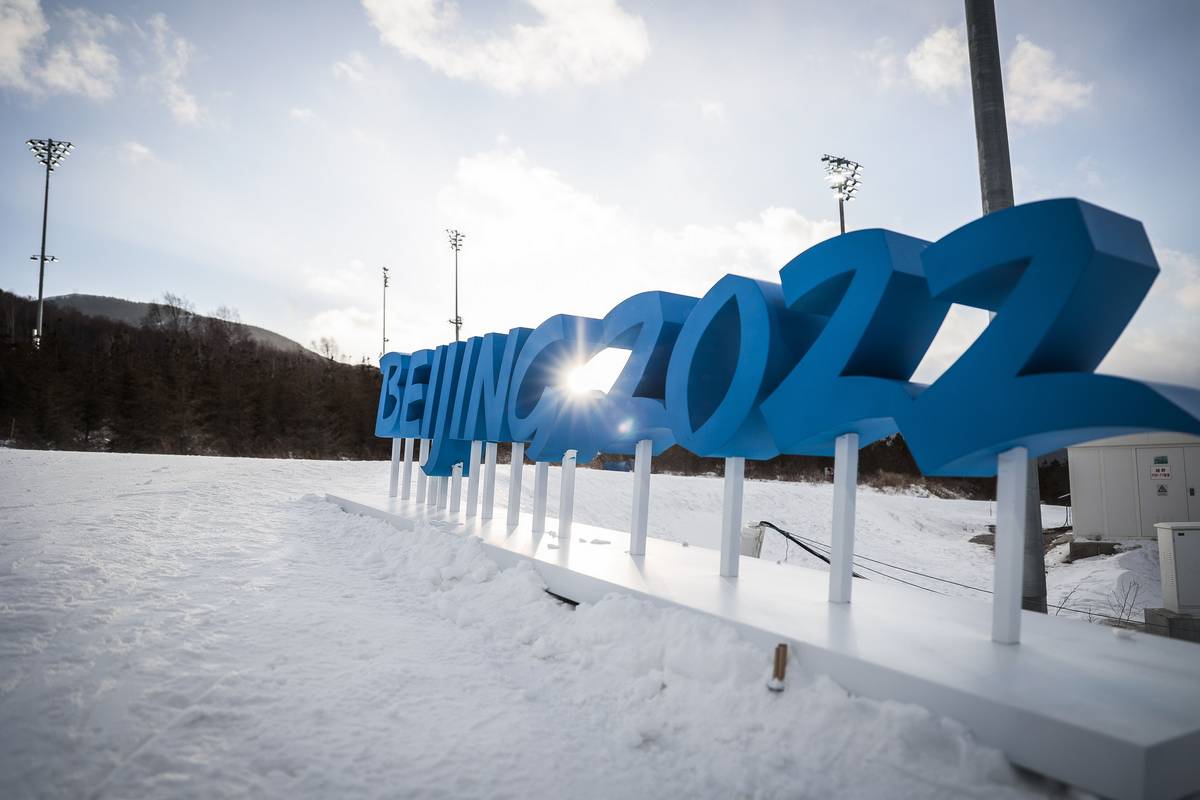
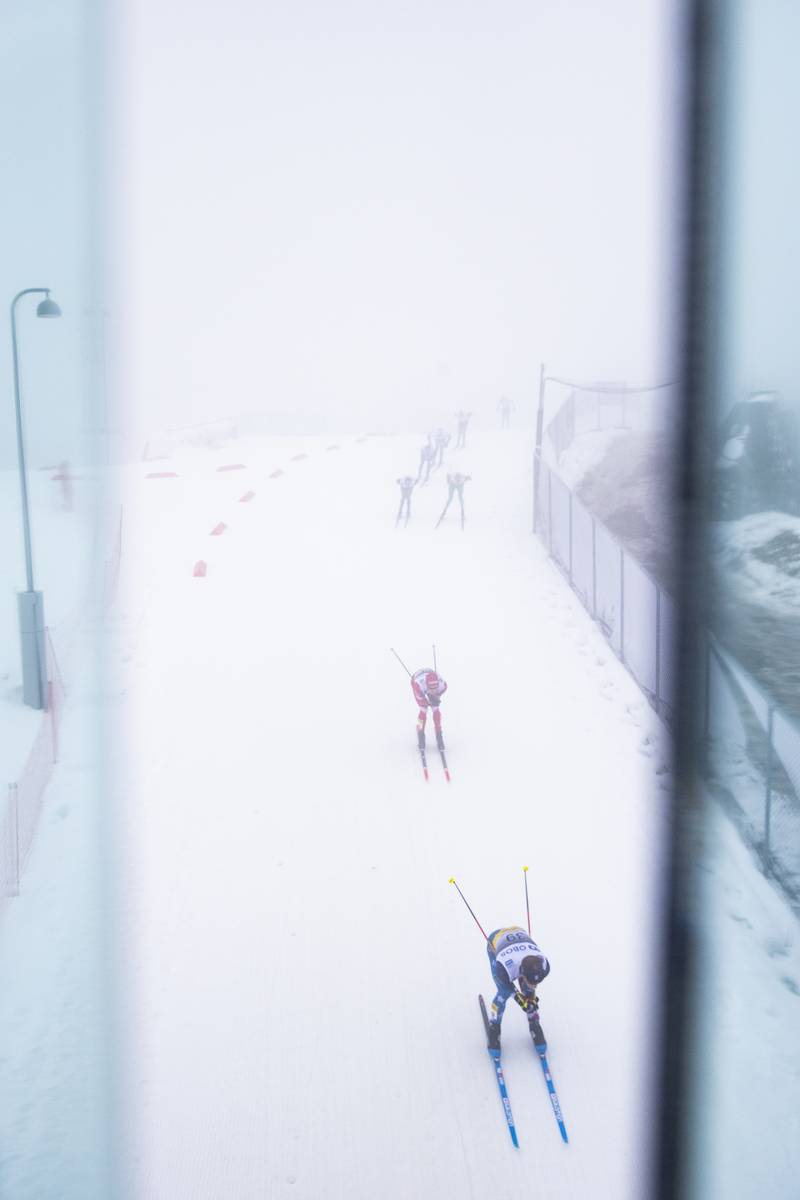
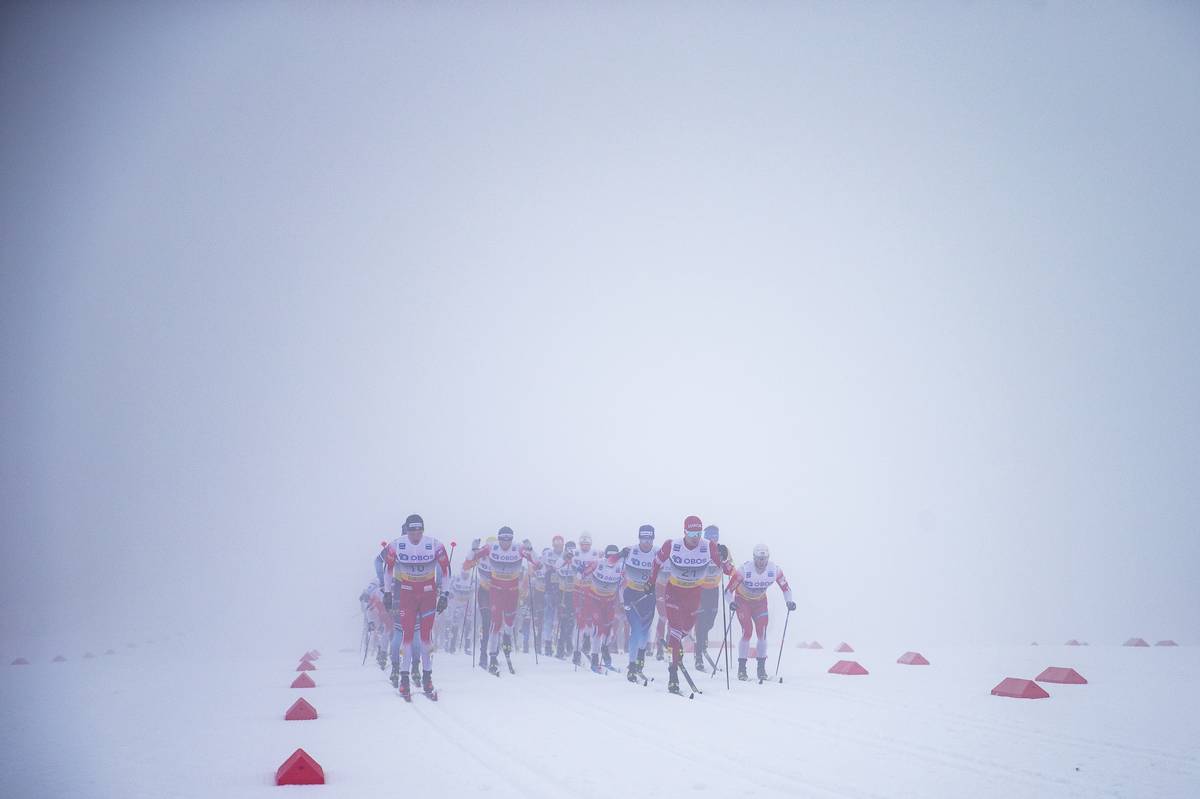
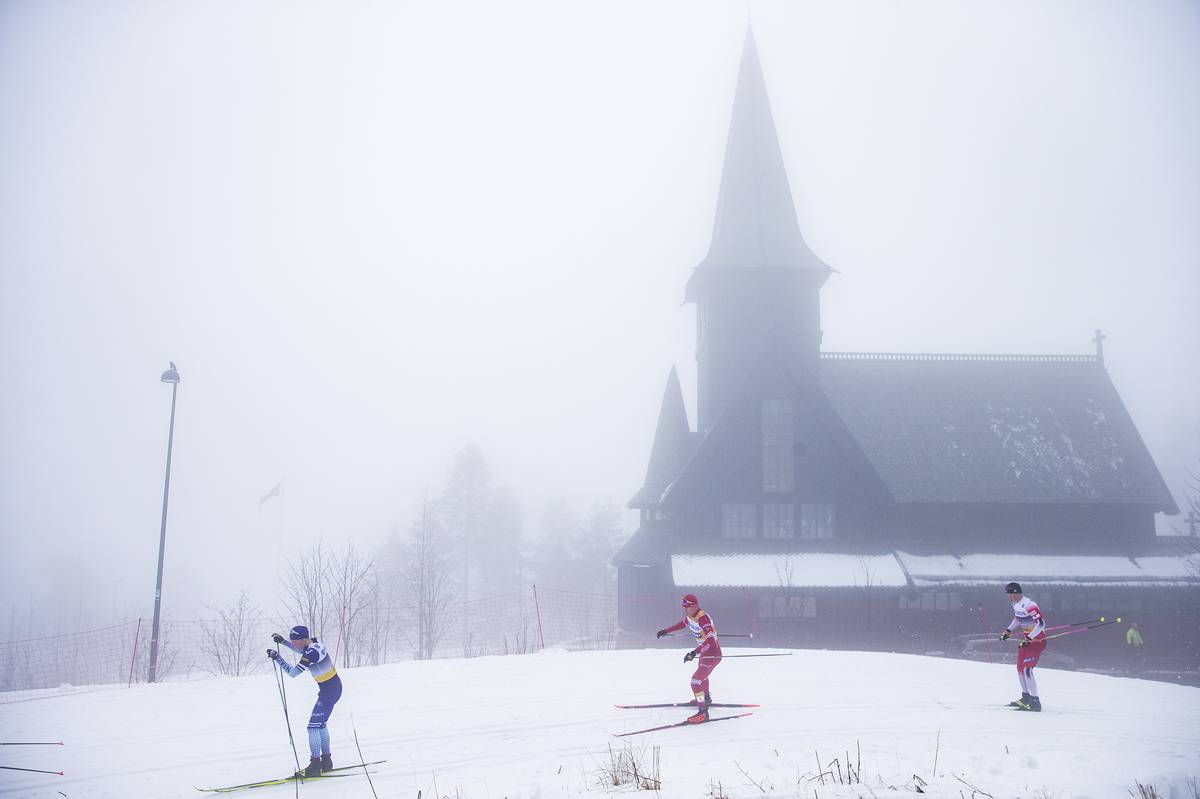
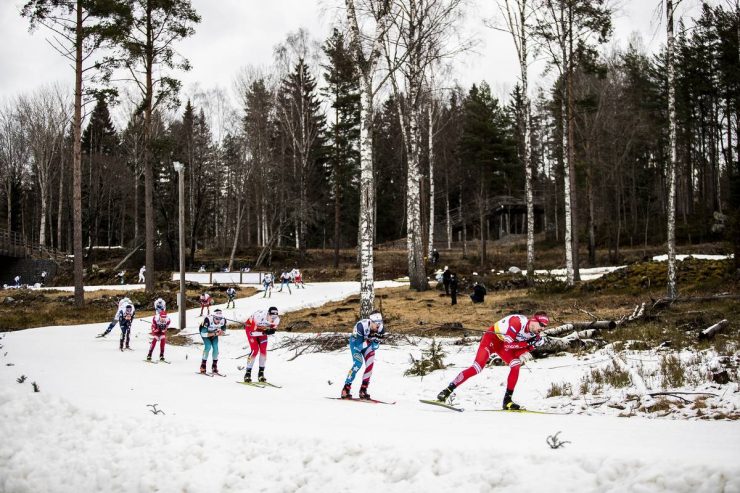
A scene from the cross country venue in Zhangjiakou, China, host to the 2022 Olympic Winter Games. (Photo: NordicFocus)
Four athletes from the Swiss team have announced that they will be moving on, chief among them – the king of the 15 k, Dario Cologna. At the age of 36, Cologna released his decision before the 2021/22 season even began, saying, “the decision came within the last months and after the Olympics, it will be the perfect timing for me. I have achieved everything I ever dreamed of in the sport.”
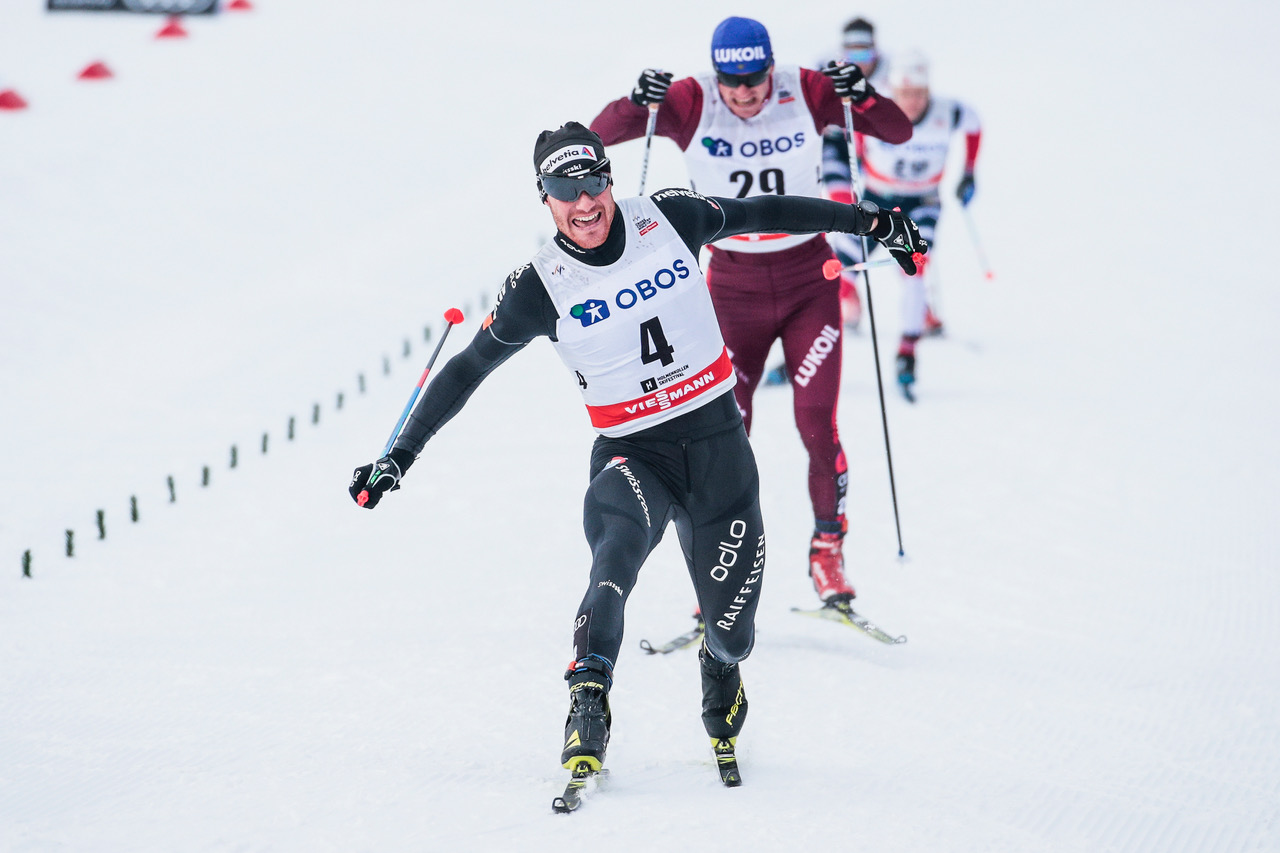
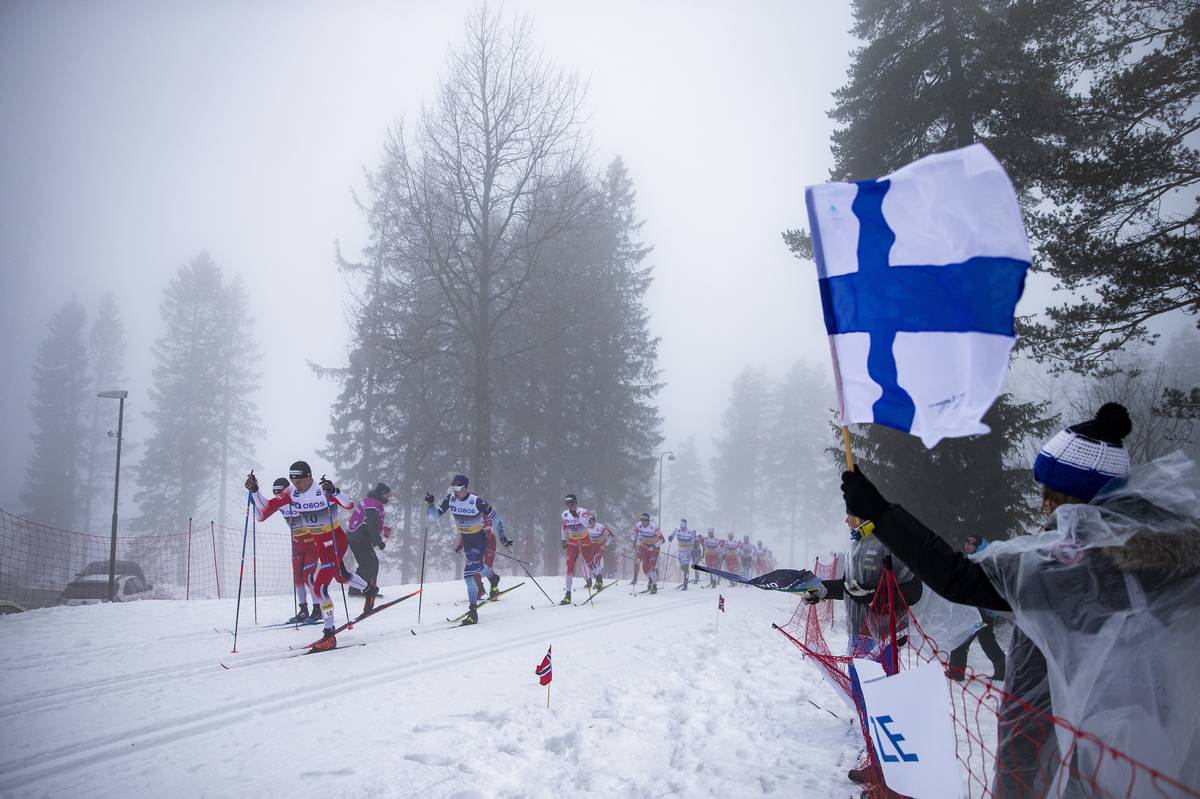
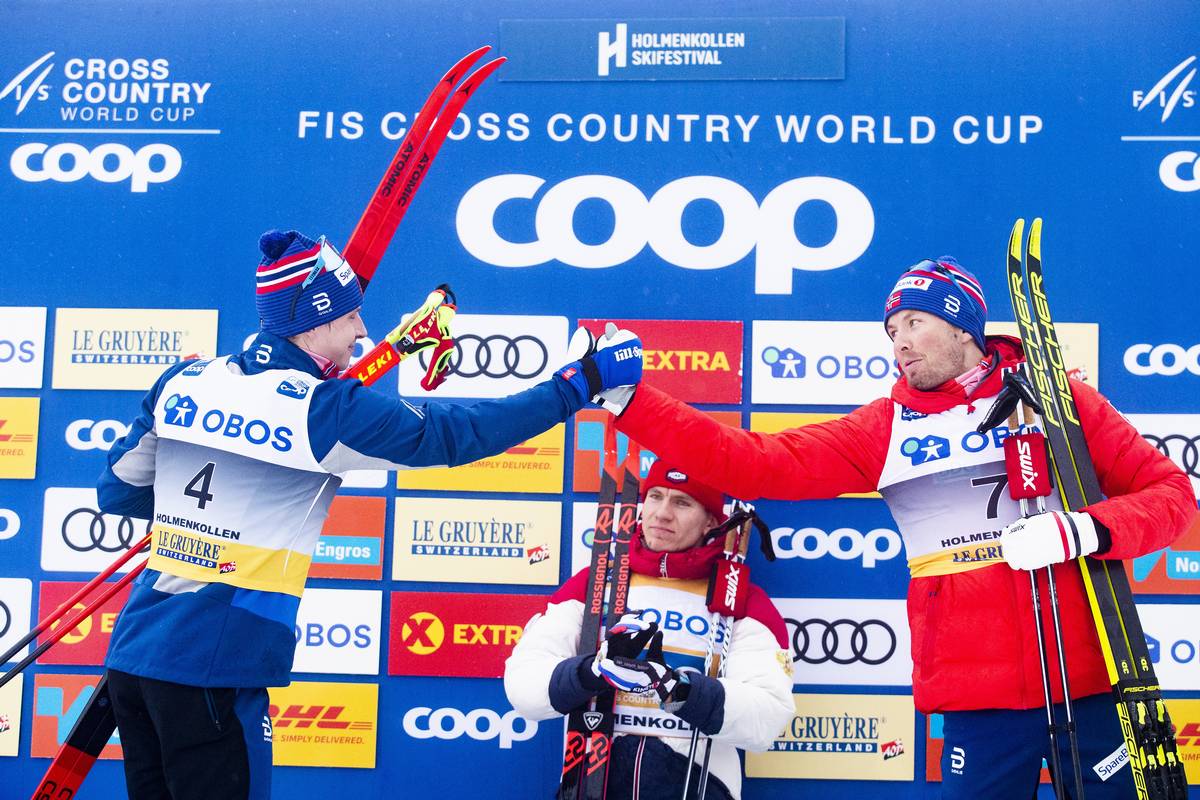
Switzerland’s Dario Cologna lunges to the line at the 2018 Holmenkollen 50-kilometer freestyle race in Olslo, Norway. (Photo: NordicFocus)
Cologna had his World Cup debut in 2006 and his first Olympic start came in 2010 in the 15 k skate event, where he finished first. This victory crowned him as the first Swiss cross-country skier to earn an Olympic gold medal. He went on to win three additional golds, in the 2014 Sochi Games he won both the skiathlon and the the 15 k classic, and in 2018 in PyeongChang added a gold in the 15 k skate. All told, Colgona had eighteen Olympic starts at four different games.
In between Olympic years, he was equally successful. He won the Overall World Cup globe four times, first in the 2007/08 season, again in 2010/11 and 2011/12 and a few years later in 2014/15. In the 2007/08 season he also earned his first Tour de Ski victory, in spite of the fact that he never took a stage win that year. He won the grueling event three more times, in 2010/11, 2011/12 and again in 2017/18.
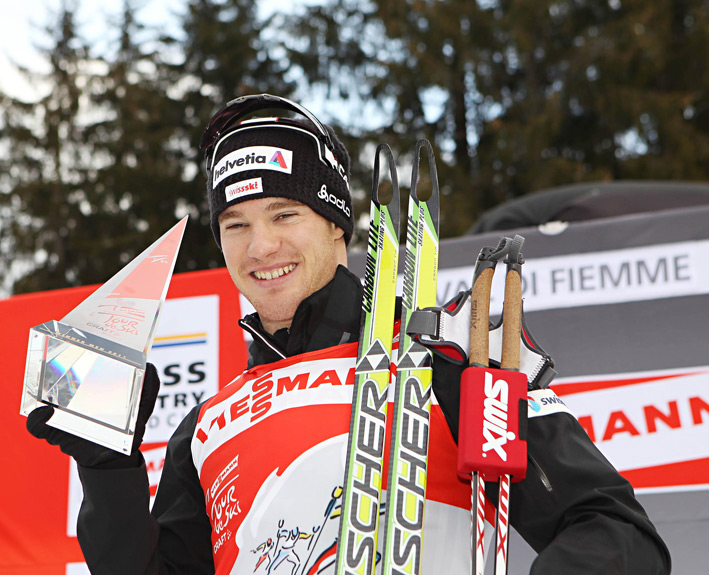
Dario Cologna (SUI) with his trophy after winning the Tour de Ski in 2011 (Photo: Fiemme2013)
After his final outing in the legendary Holmenkollen 50 k, Cologna wrote on Instagram, “I look back on a beautiful and successful career. 15 years ago I never dared to dream that one day I would be a four-time Olympic champion, World Champion, multiple Tour de Ski- and overall World Cup winner. In addition, I was privileged to travel to places I would never have seen and met great people, who became good friends.”
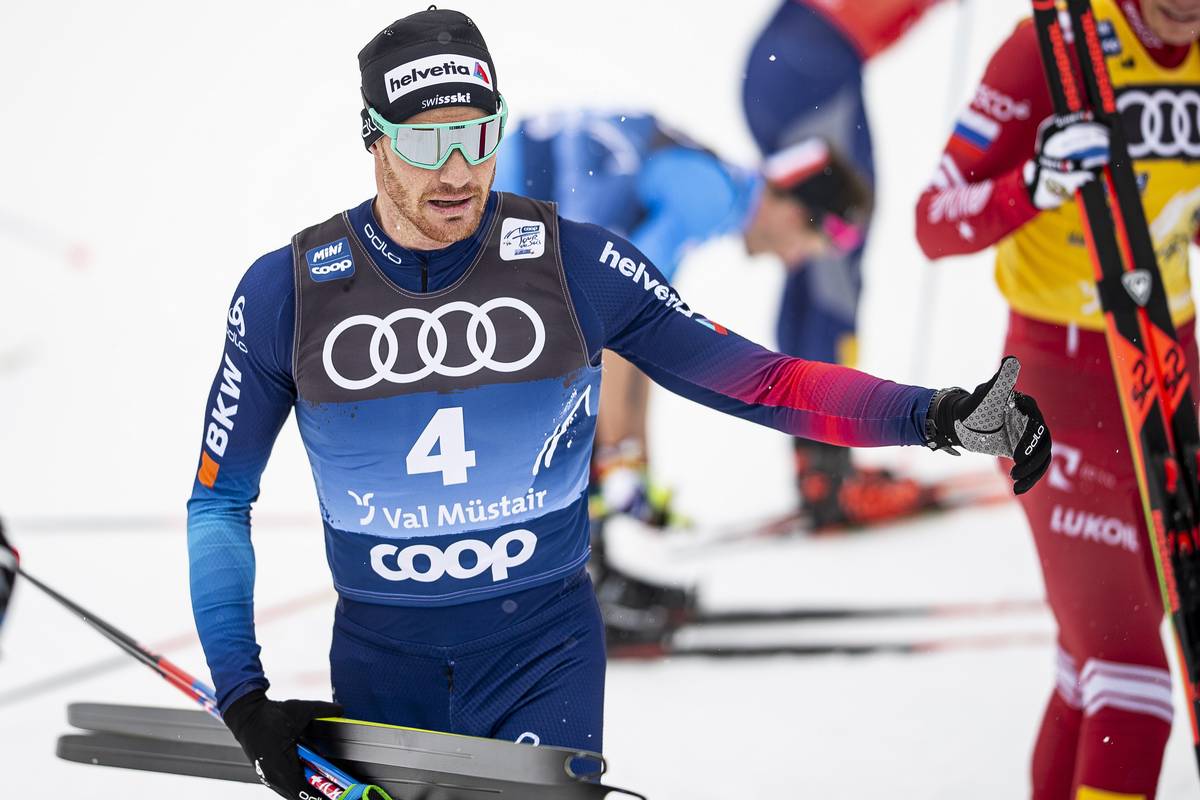
Dario Cologna (SUI) after a 6th place finish in Val Mustair during the 2021 Tour de Ski. Photo: Nordic Focus
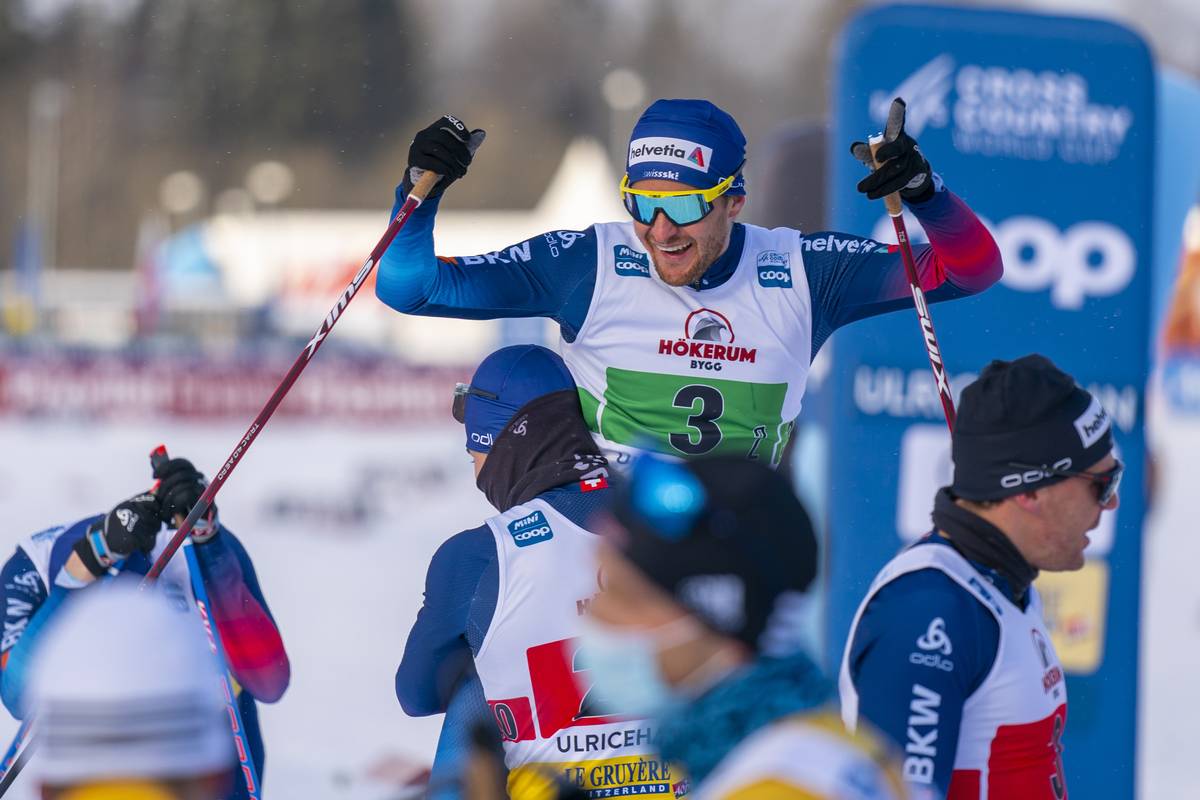
Cologna’s teammate, Jovian Hediger, also announced his retirement prior to the start of this season. Hediger was known as a sprint specialist and has 107 World Cup starts to his name, having made his debut in 2009. His first and only podium appearance came in 2021 during the team sprint event in Ulricehamn, Sweden, where he and Roman Furger finished second. Hediger represented Switzerland at three Olympic games, beginning with Sochi in 2014 and ending most recently in Beijing (2022).
Jovian Hediger (SUI) gets a boost from some happy teammates at the finish line in Ulricehamn Sweden. (Photo: Nordic Focus)
Ueli Schnider of Switzerland is also stepping away from elite competition. Schnider has 62 World Cup starts and made two Olympic appearances, both in 2018 in PyeongChang where he finished 37th in the classic sprint and 41st in the 50 k classic mass start.
On the women’s side, Laurien Van Der Graaff of Switzerland is moving on. Van Der Graaff has long been a staple in women’s sprinting, beginning in 2011 with her first World Cup podium in Duesseldorf, Germany. In doing so, Van Der Graaff became the second Swiss female athlete ever to reach the podium and over the years she continued to pave the way for young Swiss female athletes. Her first victory came in 2017 in a skate sprint Tour de Ski stage race on home ground in Lenzerheide, Switzerland.
The women’s sprint podium in Rybinsk Russia, 2015 (from l-r): Natalia Matveeva (RUS) second, Jennie Öberg (SWE) first, and Laurien Van Der Graaff (SUI) third.
Van Der Graaff partnered up many times with Nadine Fähndrich in team sprint events, resulting in four World Cup podium finishes. At the World Championships in Oberstdorf, Germany (2021), Van Der Graaff and Fähndrich teammed up again, earning a silver medal when they finished just hundreths of a second behind team Sweden.
Van Der Graaff shared with FIS, “for some time I was convinced that I would not continue skiing until Beijing 2022, but I made it and I am very proud of what I have achieved. However, now my time has come and I am excited for everything that is coming my way in this new chapter.”
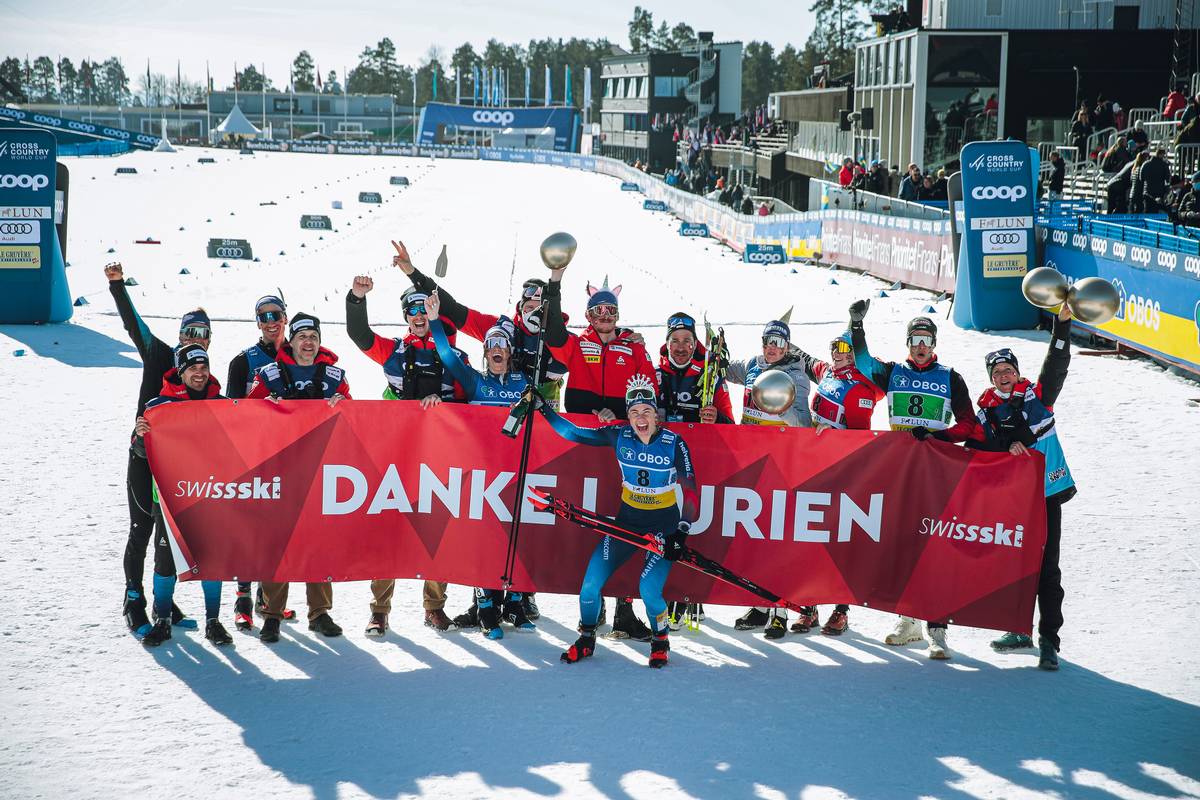
The Swiss program celebrates the retirement of Laurien Van Der Graaff at the finish of the 4 x 5 k mixed relay in Falun. (Photo: NordicFocus)
While some athletes knew from the outset of the season that this would be their last, others only recently came to the decision. Such was the case for Swedish star, Charlotte Kalla, who just announced her intentions within the last month. The 34-year said, “the curiosity about life outside of elite sports weighs heavier than what a continued investment would entail.”
Kalla burst onto the World Cup scene at the age of eighteen. She earned her first victory in the next season, taking a stage win in Nove Mesto (2007) in the 10 k skate pursuit. In her first individual World Championships appearances, coming in Sapporo, Japan in 2007, Kalla finished 7th and 5th. To give you a sense of her consistency from then on, of the 34 World Championship events Kalla completed spanning 2007-2021, she finished in the top ten in 30 of those appearances with the exceptions being three 11th place finishes and one 18th.
Charlotte Kalla of Sweden on her way to Olympic gold in Vancouver 2010 (Photo: FS archives)
Kalla represented Sweden at four different Olympic Games, Vancouver 2010, Sochi 2014, PyeongChang 2018, and Beijing 2022. She came away from these events with five individual podiums, including two gold medals and three team medals including her jaw-dropping relay performance in the relay in 2014 when she made up a 25 second deficit to bring the Swedish women their first Olympic relay gold since 1960.
Since then, the Swedish women’s team has come to dominate the World Cup circuit and Kalla has taken on a mentorship role within the team. “It’s an inspiring team to be a part of and many girls who have the right mindset to do their very best every day,” said Kalla in 2020. On March 22, 2022, Kalla announced on Instagram that the Swedish national competitions would be her last as an elite athlete. She wrote, “here I took my first [steps] as a seven-year old and it feels nice to end my career here.”
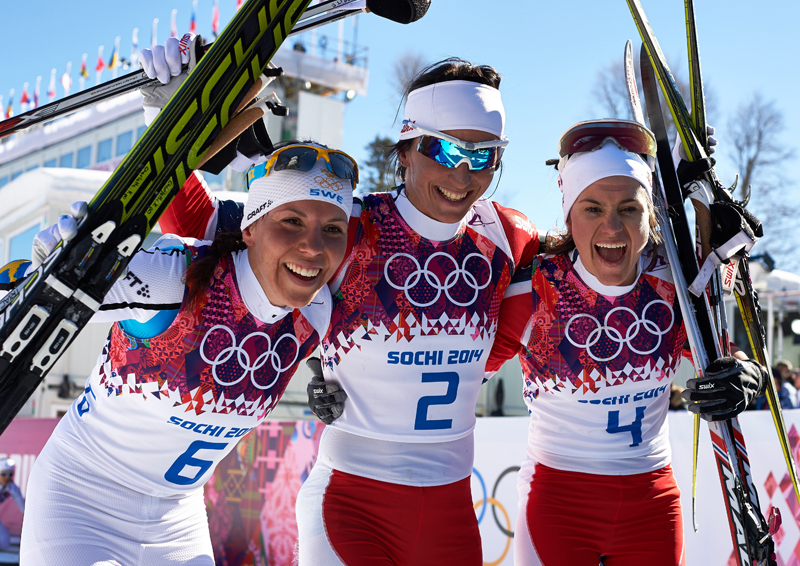
Charlotte Kalla (SWE), Marit Bjoergen (NOR) and Heidi Weng (NOR) claim the podium in the women’s Olympic skiathlon, Sochi 2014. (Photo: Fischer / Nordic Focus.)
Elisa Brocard of Italy is ending her ski-racing career at the age of 37. Brocard had her first World Cup start in 2006 and went on to contest 162 World Cup events. She represented Italy in three Olympic Games, beginning in Vancouver 2010, through PyeongChang in 2018. Her best season came in 2018 when she finished in the top-30 distance World Cup rankings and 38th overall.
Nadine Herrmann of Germany is leaving elite competition as well. She is the younger sister of Denise Herrmann who raced the cross-country World Cup circuit until she transitioned to biathlon in 2017 where she went on to win gold in the individual event at the 2022 Beijing Olympics. Nadine Herrmann finished in the top-thirty in her maiden World Cup appearance in 2018 in the Dresden city sprints. She went on to earn a number of top-thirty finishes, including a personal best individual finish of 18th in Dresden in 2020. At the age of 26, Herrmann has decided to move on, she wrote “My active sporting career is coming to an end. The last 14 years of performance sports have shaped me into the person who today can say in the best of my conscience, I gave it my all.”
Adrien Backsheider of France has also announced his retirement. Backsheider began racing on the World Cup circuit in 2013. He earned six World Championships starts and helped propel team France to a bronze medal in the men’s 4 x 10 relay in Falun in 2015 and again in Seefeld in 2019. Backsheider also has four Olympic starts, as he represented France in Sochi 2014, PyeongChang 2018, and Beijing 2022. He was a member of the bronze medal relay team in PyeongChang when the French again earned a podium spot in the 4 x 10 relay. Backsheider’s personal best individual World Cup finish came in Östersund, Sweden in 2020 when he finished 7th in the 15 k skate stage race during the Tour de Scandinavia.
The men’s 4 x 10 k relay at 2015 World Championships in Falun, Sweden, Norway with gold, Sweden with silver, and France with bronze . (Photo: Fischer/NordicFocus)
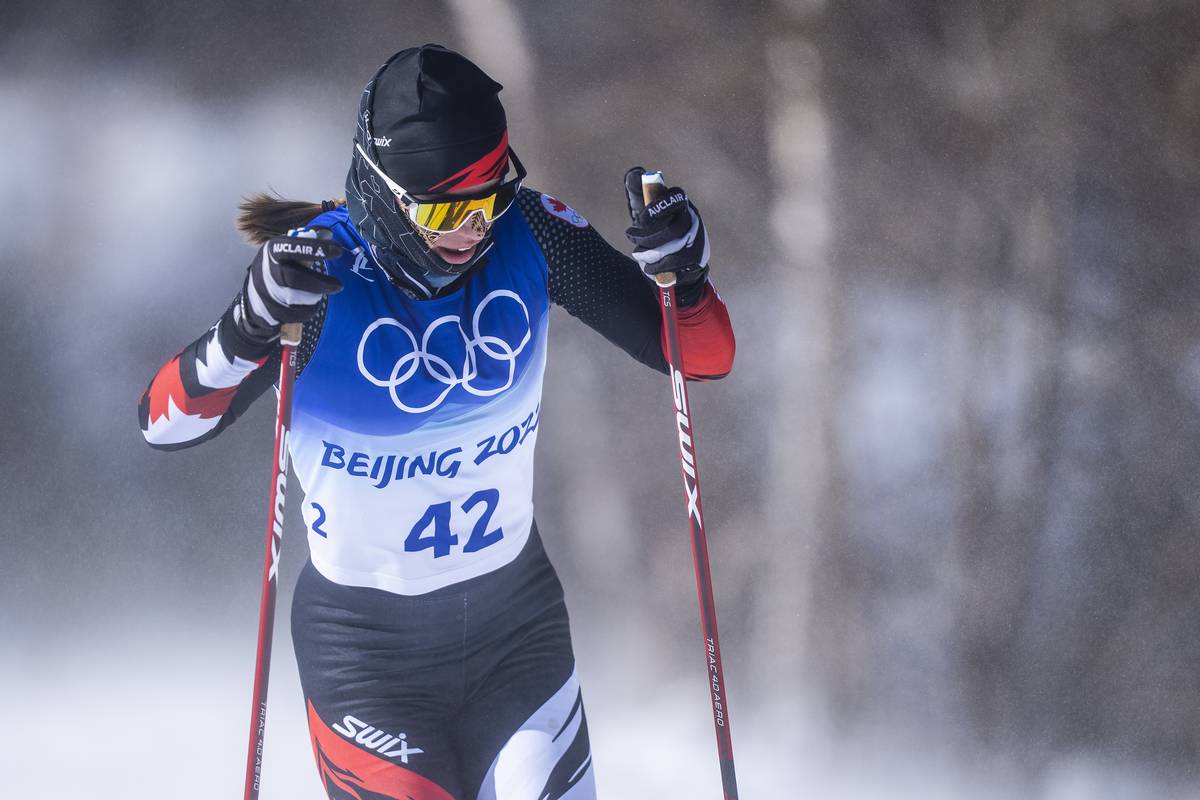
Cendrine Browne of Canada is saying goodbye to professional ski racing as well, having concluded her career with a national title in the 45 k skate in Whistler, Canada. Browne made her World Cup debut in 2012 and went on to start 76 World Cup races. She made the Canadian Olympic team in 2018 and 2022 and also posted thirteen World Championships starts. Browne finished 16th in the 30 k skate mass start in Beijing, a personal best individual finish for her. In a statement to Nordiq Canada after the 45 k race, Browne said, “thank you to everyone in the ski community who has believed in me and cheered for me over the last ten years.”
Cendrine Browne reached a new personal best with her 16th place finish in the 30 k skate mass start in Beijing 2022 (Photo: NordicFocus)
The notable retirement of the extremely successful, Therese Johaug of Norway has not been missed but will be receiving its own feature from FasterSkier in the coming weeks. Additionally, US Ski Team members Katharine Ogden, Hannah Halvorsen, and Caitlin Patterson have all shared news of their retirement, in addition to top SuperTour athletes Ian Torchia and Adam Martin. (Read Torchia’s retirement story here.)
Stay tuned for more in-depth reporting on those athletes from FasterSkier.
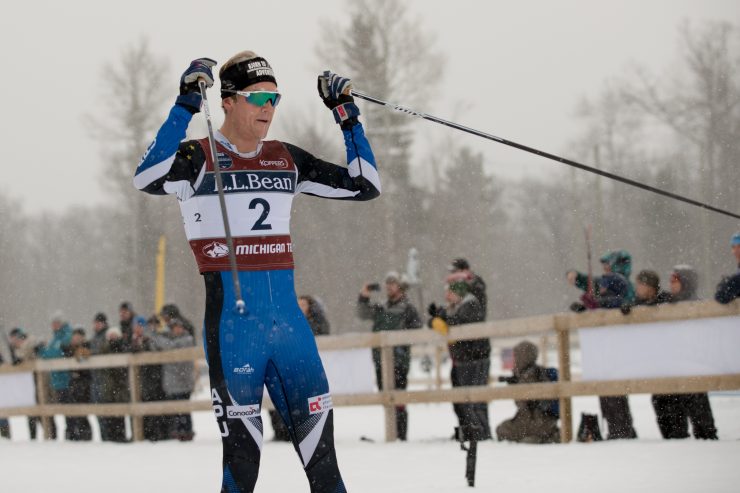
Ian Torchia crosses the finish line at a 2021 World Cup in Falun. Torchia announced his retirement last week following the American Birkiebeiner. (Photo: NordicFocus)
Skiing-wise, Ian Torchia has nearly done it all. And now, in life, he’s ready to do some more.
In anInstagram post following the American Birkiebeiner, Torchia announced that he is retiring from professional skiing with his trademark blend of gratitude and humor, saying, “In the end I won’t remember the races won (a few) or lost (many more) but the lifelong bonds of teammates, the support of friends and family, and how special the ski community as a whole is.”
Heading into retirement, Torchia seemed to take a victory lap through the Midwest marathon circuit, starting with a win in the 37 k classic City of Lakes Loppet in Minneapolis on February 5th. He then went back-to-back to the following weekend at the Mora Vassaloppet, winning both the 48 k skate and classic races within one weekend. At the Birkie on February 26th, Torchia finished 5th in the 50 k skate, roughly 15 seconds behind the winner, Gerard Agnellet of France. Not a bad run.
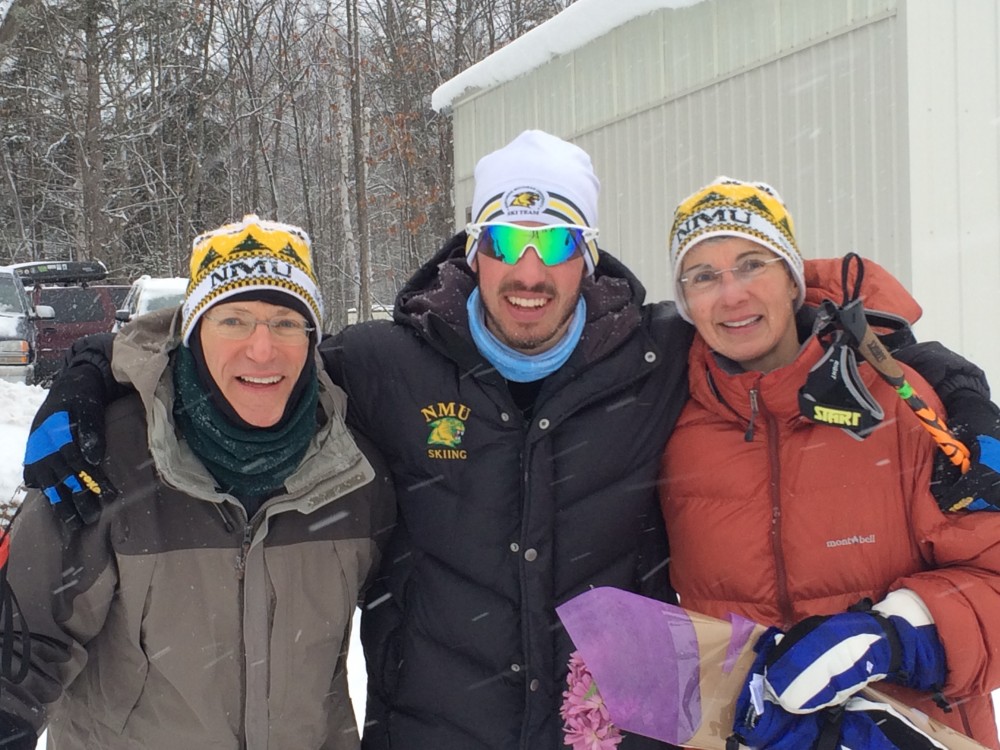
That skiing contains truths about how to live a good life is not a unique notion, but Torchia had a one-of-a-kind knack for finding those truths and sharing what he learned. He also did so, of course, while racing very fast. Torchia lived out the wildest dreams that every young Midwestern kid has when lined up for the Junior Birkie – coming from Rochester, Minnesota to win a junior national title, ski for legendary coachSten Fjeldheim at Northern Michigan University (NMU), add to that program’s legacy by winning a NCAA title in 2018, be nominated to the US Ski Team, race the World Cup, win the Birkie in 2021, andbecome training partners with some of the best athletes in the US, like Jessie Diggins.
It’s been a busy path that’s seen him in constant movement. But that suits Torchia.
When FasterSkier caught up with him less than a week after his announced retirement, he was stepping out from a visit to the St. Louis Aquarium on a day trip with his brother’s kids. Already on the move, Torchia was gracious enough to share what’s next, and what, in these early days of retrospection, he has learned from our sport.
This interview has been edited for length and clarity.
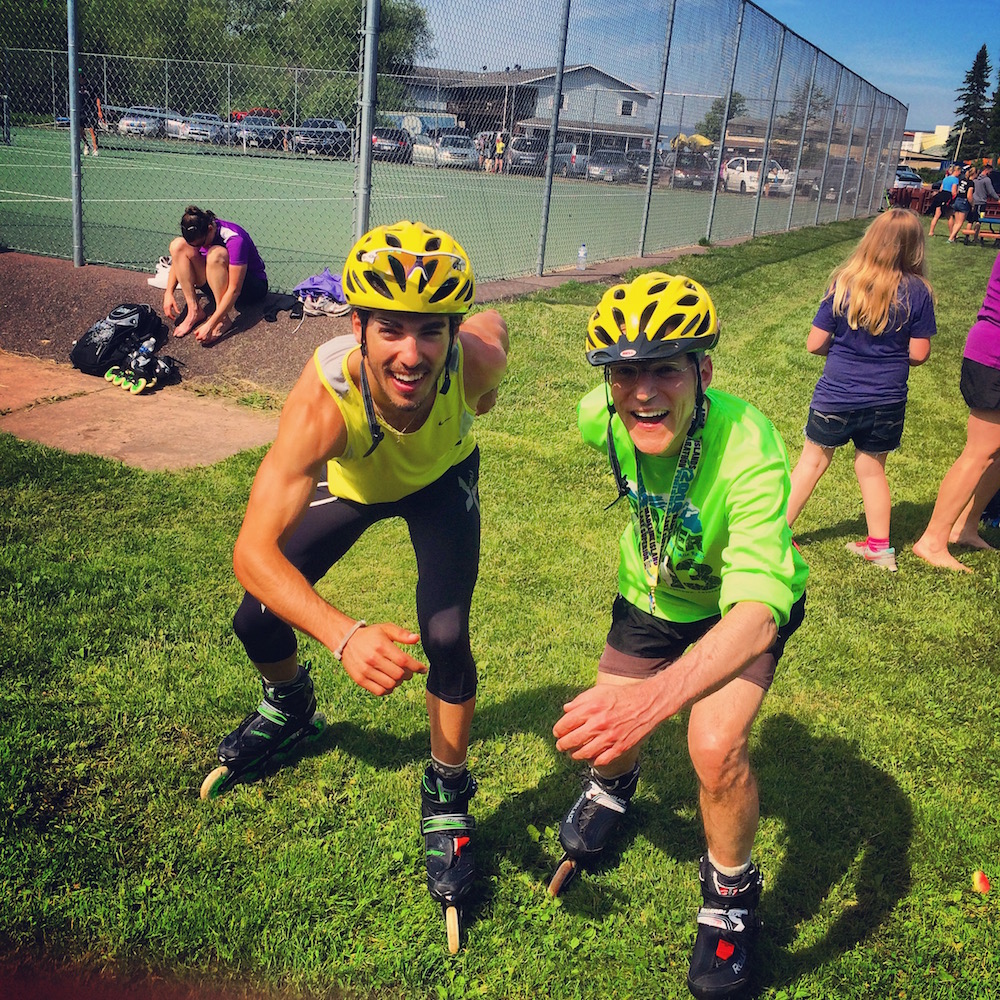
Ian, and dad, Mike Torchia at an inline skate race on Madeline Island, Wisconsin, in 2016. Torchia wrote on his dad’s advice at the time: “‘You know what happens to hot dogs, Ian? They get eaten!’ – Mike Torchia While my dad (affectionately called Sir) has given countless gems of advice, the above is one that I remember the most as he has always emphasized humility in the face of success.” (Courtesy Photo)
On the decision to retire and what comes next:
Ben Theyerl / FasterSkier (FS) : Starting with a pretty simple question; how are you feeling right now?
Ian Torchia (IT): I’m feeling great. I’m in St. Louis with my brother’s family and their five kids. It’s been a little bit of a whirlwind. I’m just taking a week off – not running or doing anything which I haven’t done in a long, long time. But I’m just feeling very energetic about what’s next.
I’m looking forward to a second interview for a job right now. I want to get some experience as a medical scribe before going to medical school to become an osteopathic physician. Between that, taking the MCAT, and a few prerequisites, it’s going to be a busy next two years.
FS: I know you just retired, but have to ask, any plans to throw your hat into citizen races the rest of the season?
IT: Maybe theGreat Bear Chase. Realistically, my next race effort is going to be in Marquette, MI with my college buddies. There’s a route [in Marquette] where you godown County Road 510 to the Lake (Superior) and back, it’s 18mi or so, and we’ve wondered whether on an icy day you could do it in under an hour.
FS: Have you thought about what racing looks like next season for you?
IT: I want to do Senior Nationals in [Houghton, Michigan]. I wouldn’t do it if it wasn’t in Houghton (Torchia is based out of Ann Arbor, MI). And probably, the Birkie.
FS: Which races would you want to race again at Nationals? Like are you targeting the 30 k, or have you thought that far yet?
IT:I mean, I had a lot of fun with sprint’s this year, and I qualified for my first final at Nationals, so while I haven’t thought too much about it, I’m going to miss doing those types of races so why not do one more? It’s more just that I want to do the races that I know that I like racing. A shorter, classic race is not really my forte, but like a longer classic race, or a skate marathon, I’m game. I think it’s a skate 30 k at Nationals next year, so that would be cool.
FS: With your goals set towards medical school, have you put any thought towards where you’d like to go?
IT: This is all early, butPacific Northwest University in Yakima, Washington has an osteopathic school, and I think it’d be really cool to move out West for four years. But Kameron and I (Torchia’s wife) have definitely talked about coming back to the Midwest when everything’s said and done. And specifically, Marquette. We just love that place so much.
FS: Backing up, what was the process of coming to the decision that now is the right time to step away from professional skiing?
IT: I think it started at the beginning of the training season in May. I talked about it with my wife, and we both agreed that I should give it my best shot to qualify for the Olympics, because that’s always been my goal. At the time we also looked out beyond this season and said, ‘you know, the journey to become a doctor is a long one,’ and I need to get started at some time. I wasn’t thinking beyond this season with skiing, and personally, I was okay with that.
A lot of it comes down to just wanting other parts of my life. It’s hard being away from Kameron and our dog. I give a lot of props to the members of the US Ski Team who are away from their loved ones for four to five months every winter. It’s hard to do it, and yeah, one big reason to retire was actually being able to live with my wife.
Number two is, and I don’t want it to be misconstrued, but skiing at a professional level means being a little selfish – it is a big focus on you and yourself, and everyone around you is working for you. I think about life, and at some point, I wanted to step back and give back, and I think that’s the main goal I have now. My goal to become an osteopathic physician is based around helping others, and there’s a lot of cool things in skiing to do that work on inspiring the youth and inspiring each other.
FS: Yeah, on the skiing end, I think I can say I’m sure there’s at least a hundred kids who would sign up for an “Ian Torchia skate clinic” at Wirth Park (in Minneapolis) anytime.
IT: (Laughing) Well, thanks. That’s something I want to try to bring here, actually, to Ann Arbor and downstate Michigan. When I go skiing on the one snowmaking loop around here, I really don’t see that many kids out. So if in these next few years, I could get something going where I can help bring even more kids out from Detroit and get them on skis, it would be really cool. I’d love to do that.
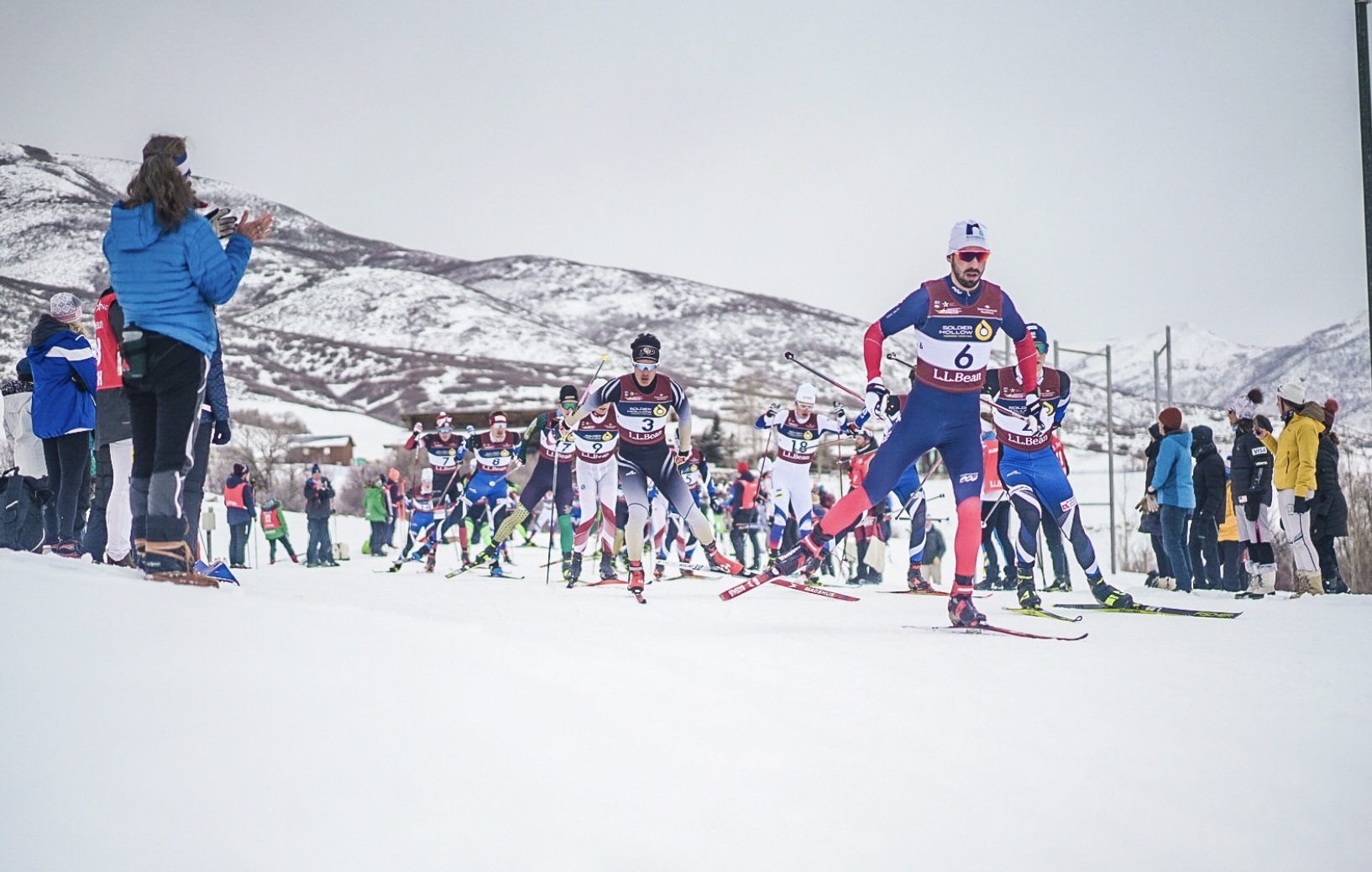
Ian Torchia leads the charge at the start of the men’s 30k mass start freestyle in Soldier Hollow at 2022 US Senior Nationals. (Photo: Tobias Albrigtsen / @untraceableg)
On a life, so far, spent skiing:
FS: I know it’s early, but I wanted to go all the way back and get your retrospective on your time in skiing, if you’re okay with that?
IT: Oh that’s all I’ve been thinking about, so yeah.
FS: You’re from Minnesota, which is pretty well-known, but what’s glanced over is you’re from Rochester, which is I-90, not I-94 — it’s south of most of the ski leagues and big clubs. Coming from there, what drew you to Nordic skiing over say, running, which you and your older brothers were also very successful in?
IT:I credit my mom for starting all of this. Like, they put me on skis the day before I turned two, apparently, and I definitely don’t remember that.
Beyond that, my parents started the high school team here in 2000 when I was five. I have four older siblings who are all four plus years older than me, and so since my mom had no choice but to bring me along, I was an honorary member of the team. ThatRochester team has just grown and grown over the years – right now there’s like 200 kids every year and over half of those are newcomers who just want to try it out. I think they’re getting their first snowmaking loop now, which with the way things are going is important to being able to have a place to ski [in Rochester].
It was an unusual place to start skiing. My family was building the team, and I got to help build the trails. I look back and it may be what led me to love skate more than classic, since we didn’t have classic trails in high school.
I loved it. It was unique, but I wouldn’t have changed it for the world.
FS: Then from there it was a Junior Nationals title, the Northern Michigan (NMU) team, NCAA championships, the US ski teams, the Birkie win. You’ve seen a lot of the sport. What does that journey look like from where you’re sitting right now?
IT: (pausing) I mean, yeah, it really is just looking back on it all.It sounds funny to say, but I look at that Junior Nationals title my junior year of high school as a pivotal moment in my life. I give a lot of credit to Sten Fjeldheim who met with me like a week after that happened. I was thinking I was going to run in college, and I ended up winning my first junior nationals race, he sent me an email, and the rest is history. It’s the one moment I look back on and go, where would I be now?
So I guess I would say to Sten, ‘Thanks for finding me and putting me on the path I’m on.’ I’m grateful for everyone who’s helped me out on the way. The support, as I look back on it, is insane. My best friends have come from skiing. My wife – I wouldn’t know her if it wasn’t for skiing (Kameron and Ian were teammates at NMU). It’s shaped my life.
Yeah, I’m done with the professional side of it, but I’m going to be doing the Birkie for many years to come.
FS: To return to that moment, you mentioned Sten and NMU. That’s a big legacy in Midwestern and US skiing that you were instrumental in sustaining. What made Sten and that experience special?
IT:I was just getting a massage from this guy in Marquette, and we were talking about Sten, and my masseuse of all people was like, ‘man, Marquette would be a different place if Sten Fjeldheim had never been here.’ And it’s so true. He transformed not only the Northern Michigan team into a powerhouse but helped make Marquette a skiing community. And he’s just a force of nature. The first time I ever talked to him, even across the phone, I was getting fired up. As soon as I hung up the phone, I wanted to ski for that guy. He has a way of lighting a fire inside you and getting you to be your best self. I definitely miss being coached by him.
Marquette is my favorite place in the world and I’m lucky to say that it’s my wife’s too. It just has everything that you could ever want. Every year, it seemed I would find a new thing that I was like, ‘Oh my gosh, you can do this here.’ Freshman year it was just running on trails all the time, the next it was mountain biking, and the next I discovered surfing on Lake Superior. It’s a cool playground with a Midwest community and a Midwest vibe, and it would be great one day to return there. I have a pipe dream that my friends could all live next to each other, and yeah, that would just be too good to be true.
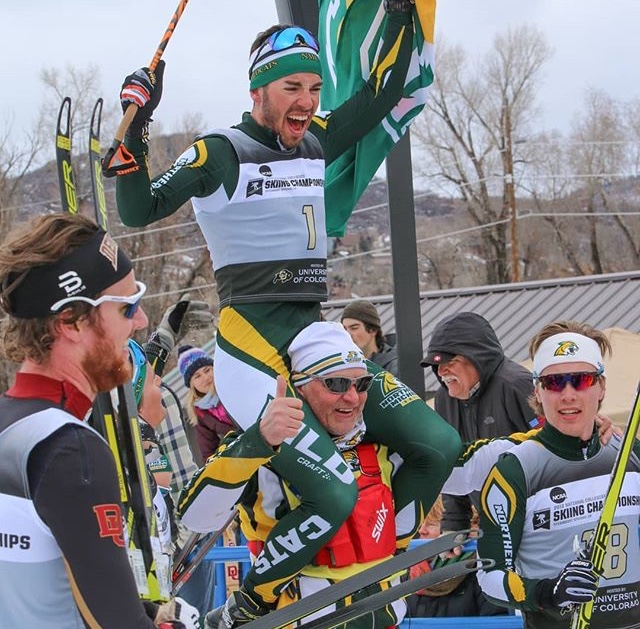
Ian Torchia (1) on the shoulders of Northern Michigan University Head Coach Sten Fjeldheim after he won the men’s 20-kilometer freestyle race at 2018 NCAA Skiing Championships in Steamboat Springs, Colorado. (Courtesy photo)
FS: That’s going to be quite the lineup in the waves out there.
Both talking here and reading back on a few interviews you’ve done with FasterSkier, I keep being struck by just how much you seem to revel in both the sport of Nordic skiing, and the people who you do the sport with. A couple of years ago, you said [to FasterSkier] that one of your all-time favorite moments was having three All-Americans from NMU in the same year with you, Adam Martin, and Jake Brown.
What is special about nordic skiing as a sport for you? What’s been at the center of the sport for you as you kind of climbed up its ranks?
IT: It sounds cliche, but it’s not the destination. It’s the journey along the way. My favorite memories are out, training on the roads, doing three-hour ODs, the trails and the van rides.
It’s crazy people who love to be out in crazy weather pushing their hardest. Like, you don’t need any team bonding activities when you’re out on a rainy cold three-hour OD. That’s the thing bringing you together.
FS: Two-part question: Looking back over everything, what’s one – your favorite result? And two – your favorite moment?
IT: Favorite result; winning NCAAs was really special. It wasn’t the hardest I’d pushed in a race, but the tactics are what I’m really proud of. I think oftentimes I feel like I have a responsibility in a pack to go hard, and so it was a testament to my teammates that a sprint developed there and I was able to come out on top.
Favorite moment: The Birkie Classic [last year] because I hadn’t won the day before (the 2020 Birkie was raced over four days, with a Saturday race featuring an elite skate race, and a Sunday race featuring an elite classic race) and there were just crazy conditions. I bonked and pushedthrough it.
FS: I mean, I’ve been on the Birkie trail all my life, and watching you trudge through those conditions (a couple of inches of new, wet, heavy, snow covered what was essentially ice during the race) was one of the crazier scenes I’ve ever seen.
IT:It was hard to understand-type ‘crazy.’
FS: Picking the Birkie as a favorite moment reminds me that you’ve really been one of the more fun athletes to watch at that race the past couple of years. Not only last year, but also the year before — I have to imagine skiing with Niklas Dyrhaug was pretty cool.
IT:Oh yeah, thanks for bringing that up. I was proud of that one too, because I was having cramps about halfway through and pushed through those and just kind of stayed in it. I wasn’t battling it out with Dyrhaug at the end, but got into a sprint for second and ended up with it. That was definitely a special race too.
I mean, just doing this is making me realize there’s many little special moments along the way. Just a lot of special moments…
FS: Which brings you to where you are now. I know that’s a lot of big questions but…
IT: I should also say that Stratton (Mountain School) was huge the past couple of years. I hadn’t had a great last year of college, but they still brought me on the team and that was just the most unique experience. Getting to learn alongside Jessie (Diggins), Simi and Sophie (Hamilton), and Kyle Bratrud. Pat (O’Brien) especially drew me to that team. It was just like Marquette with it being another special pocket of the world in Vermont where Nordic skiing is just the thing.
FS: Yeah, like you just rattled off being teammates with Jessie, Sophie, and Simi – that’s three of the most influential athletes in US skiing history right there…
IT: I mean, yeah. I have anInstagram post about it from right after Jessiewon the silver (medal, in the Olympic 30 k freestyle). I had a matched interval bounding workout last fall where I was at threshold, and she had max. five-minute sets. We’re fifteen seconds into the first one and she was already breathing like a truck. Then she just keeps it pinned there for the next, I don’t even know, thirty or thirty-five minutes.
I was watching the Olympic 30 k live and was like, ‘Oh my gosh, I’ve seen this film before.’ When you see her doing that on the television, it’s pretty cool. When she’s right next to you it makes you go, ‘Ok, if I want to be that good, I have to work this hard.’
FS: She goes out and turns in a performance that’s not just the iconic moment of the Olympics for skiing, but for the whole country. That’s a pretty unique way to experience it.
IT: Just one of the coolest.
FS: So, after all that then, do you have any other thoughts?
IT:I’m just lucky, and happy…and probably gotta get back to the aquarium.
FS: Well then, I’ll end by saying congratulations from all of us out there in skiing.
IT: Thanks man. Thanks everyone.
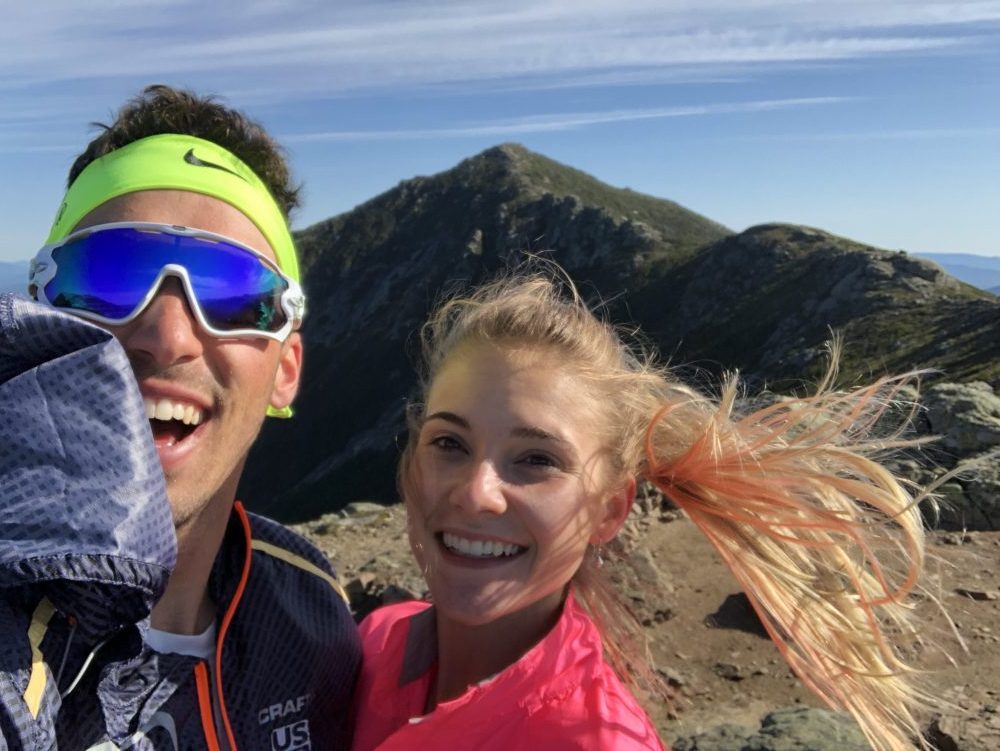
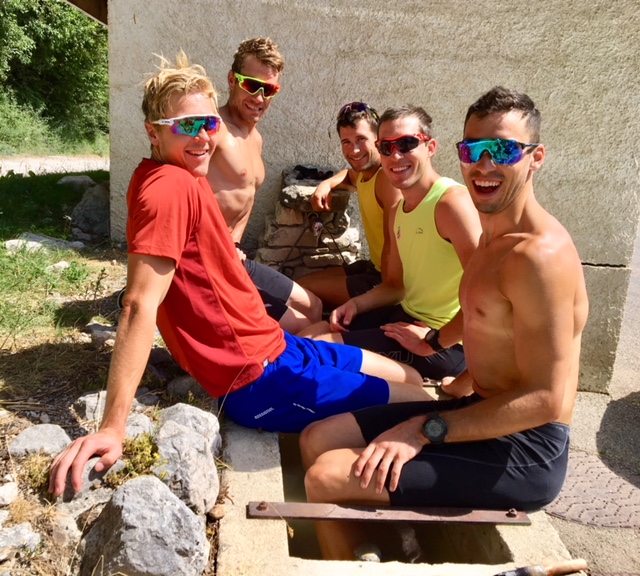
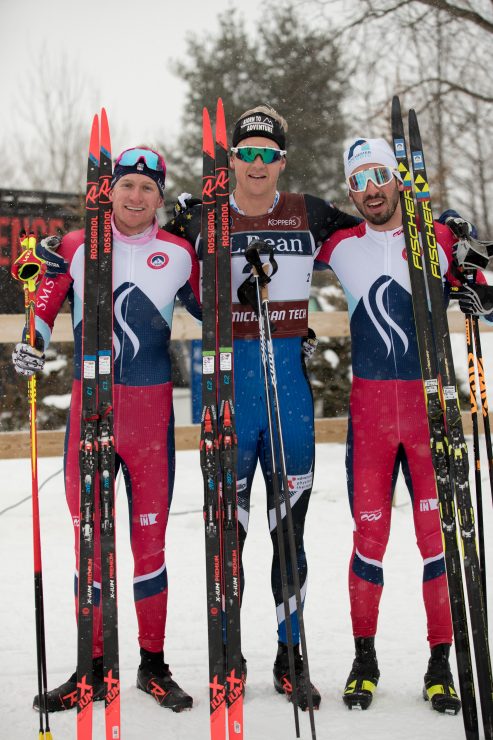
Ian Torchia (l) with wife Kameron hiking in Franconia Notch, N.H. in 2018. (Courtesy photo)Right to left: Ian Torchia, Paddy Caldwell, Adrien Backscheider, Simi Hamilton, and Erik Bjornsen during a post-interval cool down in Villard-de-Lans, France in 2018. (Courtesy photo)
FasterSkier’s American Birkebeiner coverage is made possible through the generous support of New Moon Ski & Bike in Hayward, Wisconsin. While you are at the Birkie be sure to visit New Moon Ski & Bike for all your local expertise.
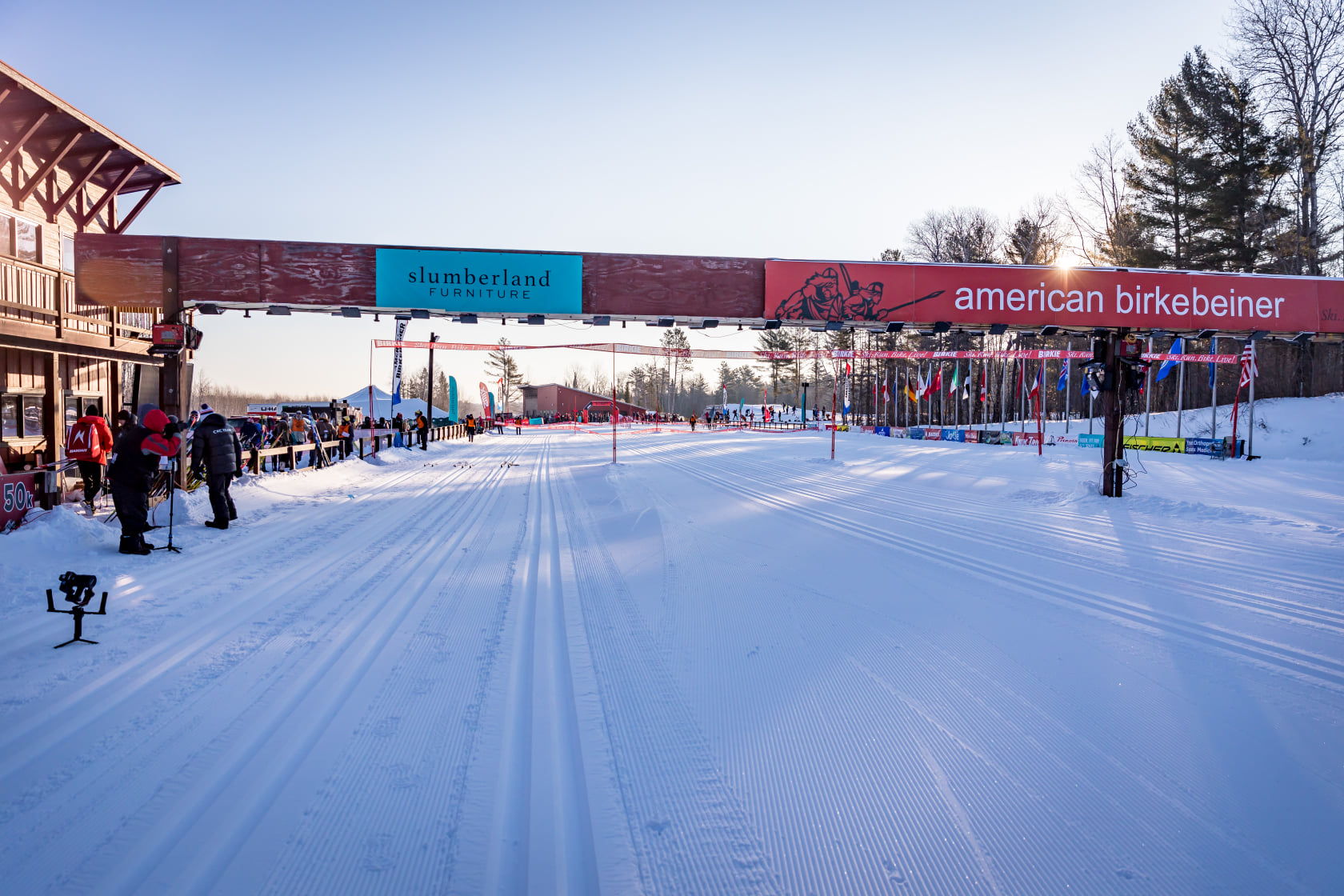
Among the final major races in the ski world in 2020, the Slumberland American Birkebeiner pulled off an event with all the festivities for which the storied event is known. It was pure Birkie fever, with little concern for what other communicable diseases might be circulating at the time. A large snowstorm moved through the Northwoods of WI, followed by a bitter cold snap which let up just in time for a sunny day with mild temperatures on race day, setting up fresh, firm, and fast conditions that saw course records fall.
Flash forward through two years of pandemic and a non-traditional Birkie week format, and the weather gods delivered yet another pristine weekend for racing as the Birkie made its return, with all the Main Street revelry one could ask for.
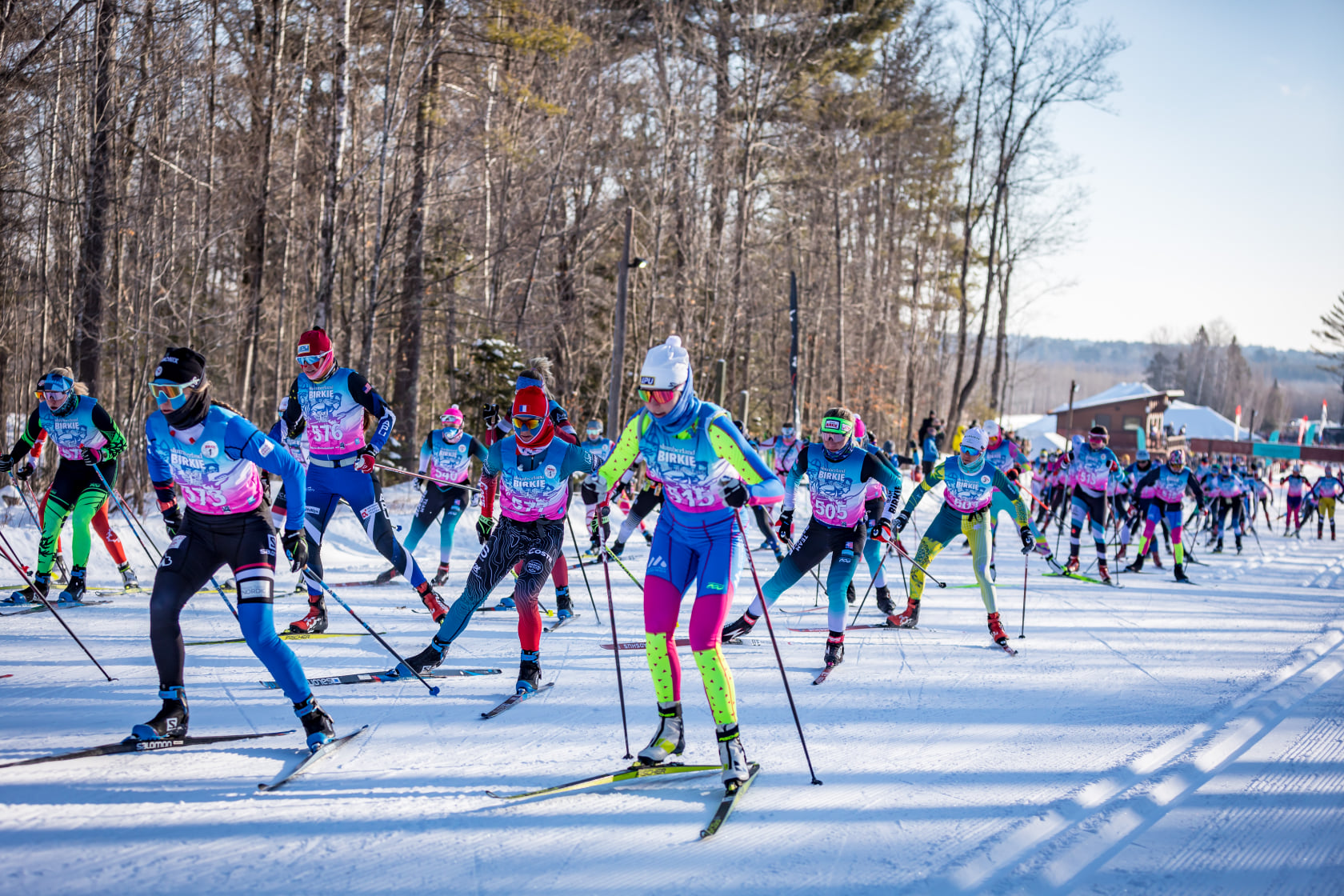
This year’s Birkie also served as the final SuperTour of the season on American soil, with only Canadian Nationals which will be held in conjunction with SuperTour finals remaining on the calendar in late March. With several athletes who had been just behind the Olympic team cutoff appearing on the start list, along with a handful who declined World Cup starts in Lahti to race the Birkie and a few top international racers in the mix, the front lines of the elite wave were stacked. This set the stage for close racing and exciting final sprints on Main Street that kept the sound of the cheering crowds lining the finish at full volume.
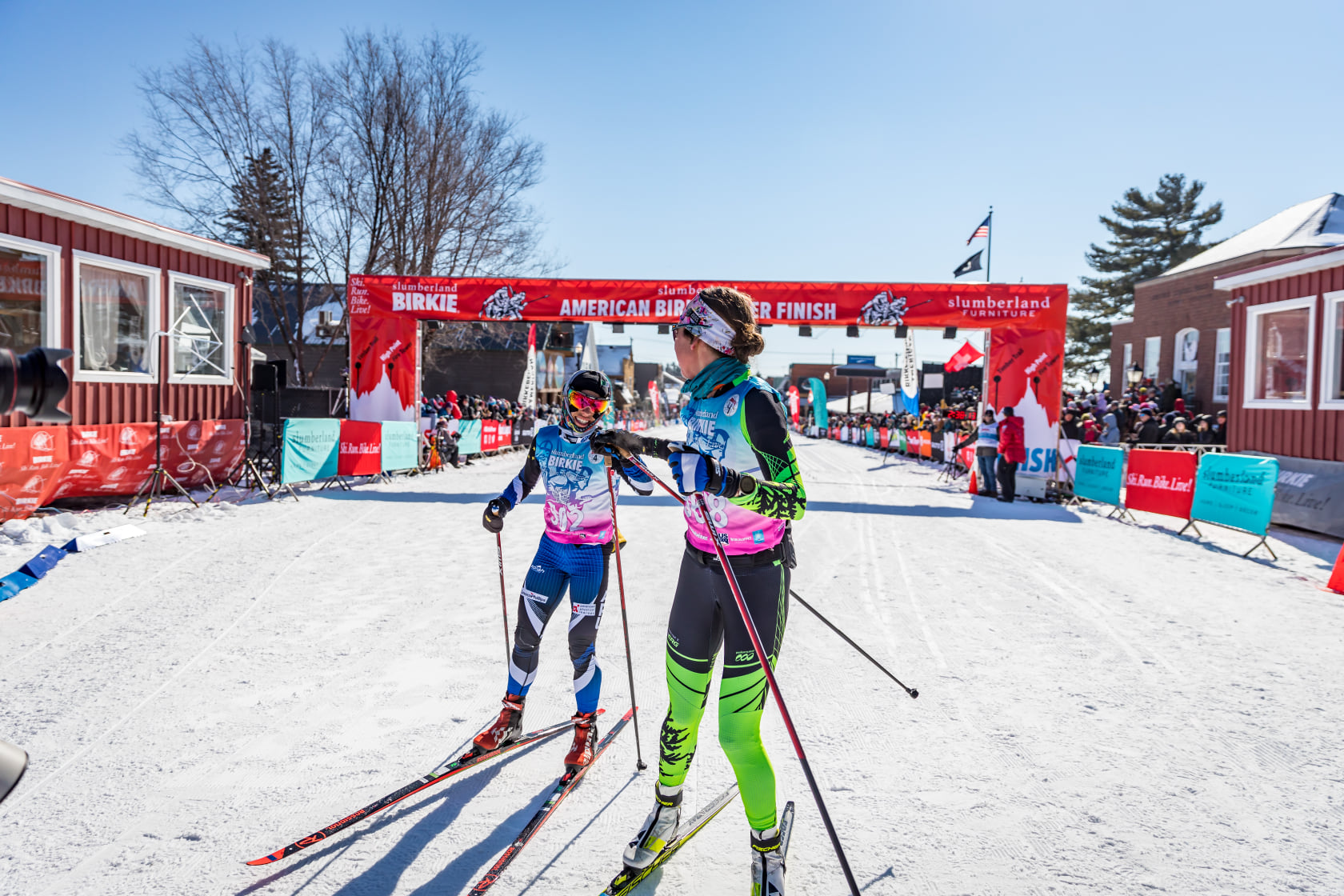
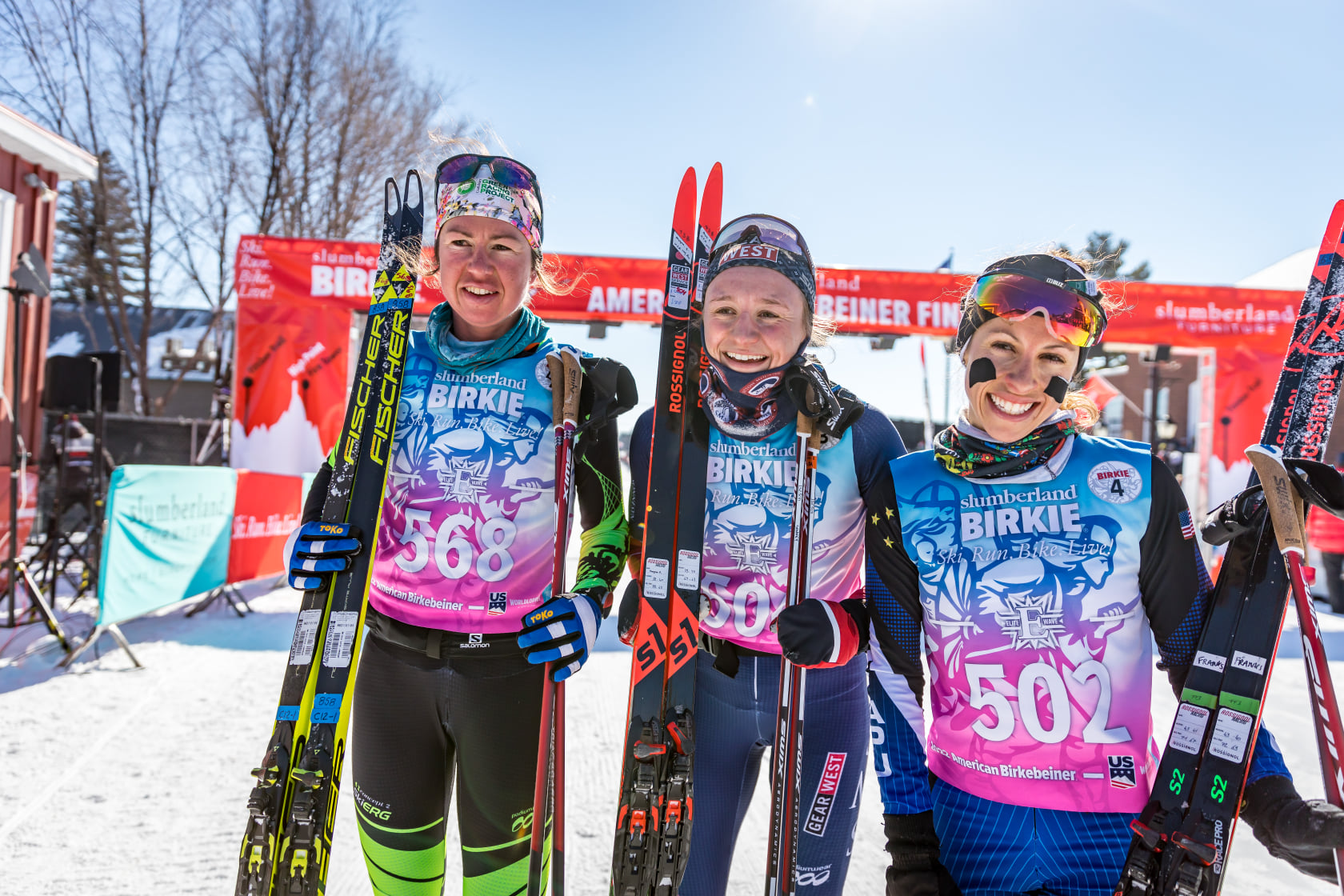
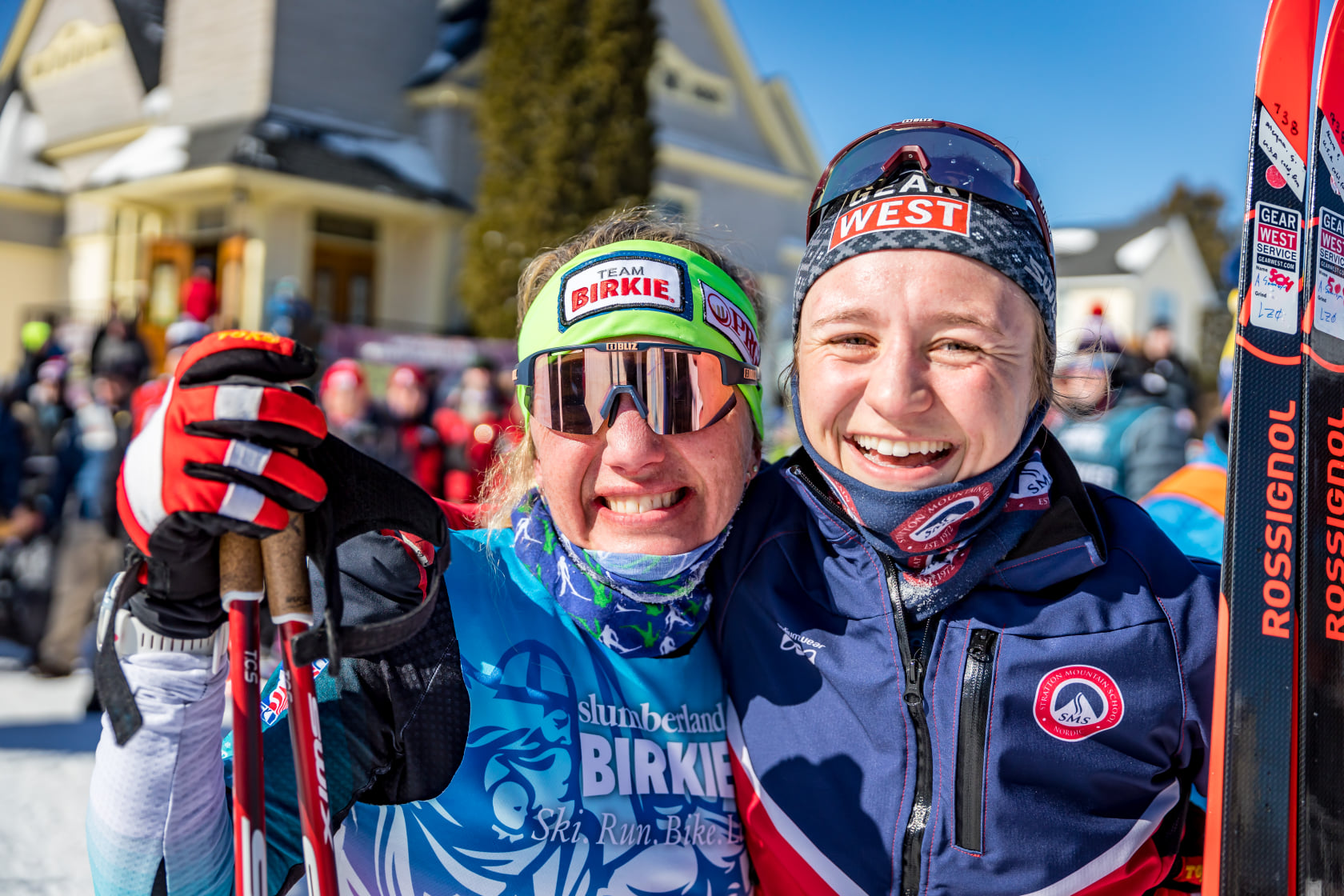
The women’s race was decided in the home stretch as Alayna Sonnesyn (SMS T2) took her third Birkie win in 2:22:52 ahead of Caitlin Patterson (CGRP) in second (+2.0), and Rosie Frankowski (APU) third (+9.0). Also racing for APU, Jessica Yeaton was the fourth woman to the line in Hayward (+27.0), with a retired-but-not-slow Sadie Maubet Bjornsen racing on the mountainFlow Eco Wax team taking fifth (+1:05.0).
Patterson had flown to the Midwest after spending three weeks in China as a member of the Olympic Team, however, she did not earn any starts there, calling it “#chinatrainingcamp” in a heartfelt social media post. Yeaton had also recently flown to the U.S. from Beijing after representing Australia at her second Olympic Games. Yeaton raced in five of the six events (Australia did not have enough women for a relay), with her top finish taking place in the opening 15 k skiathlon, where she finished 31st.
After winning the 2019 Birkie, Sonnesyn returned in 2021 for the unique opportunity to race both a skate and classic event in the same weekend. With pandemic restrictions in place, these races started and ended at the Birkie trailhead in Cable. Sonnesyn won the 45 k skate Birkie on Saturday, just four seconds ahead of Frankowski, then the two traded positions as Frankowski won the 45 k classic on Sunday, with Sonnesyn nearly a minute back in second.
“It feels so good to be here on such a beautiful day,” said in the livestream interview from the finish. “Last year, finishing back at the start was a really great time too, but there’s nothing like finishing on Main Street and hearing that blast of cheering as you come off the bridge.”
A Midwestern native for whom the Birkie has long been a family affair, Sonnesyn said each Birkie win has been special for her. While other women pushed the pace at the front, Sonnesyn had never been the first through the checkpoints. Commenting on her tactics in the post-race interview, she explained that this strategy played to her strengths.
“There are some spectacular distance racers in the field today, and I recognized that going into it and knew that they were going to push the pace and keep it hard through the entire race. I trusted my sprinting, I’ve been training a lot with Jessie Diggins lately and I’ve learned a lot from her, so I knew that I had an extra gear that I could use at the finish as long as I conserved [energy] throughout the race… There were moments where I didn’t think I was going to close those gaps, [and] I crashed with 4 k to go, so that was a little bit dramatic of me, but overall, I just knew that they were going to fight hard and that I would need to fight too.”
The men’s race saw an even tighter margin decide the winner. A threesome of David Norris (APU), Adam Martin (CGRP) and Gerard Agnellet of La Clusaz, FRA headed over the lake together, with a few chasers following at a distance, still in view of the cameras.
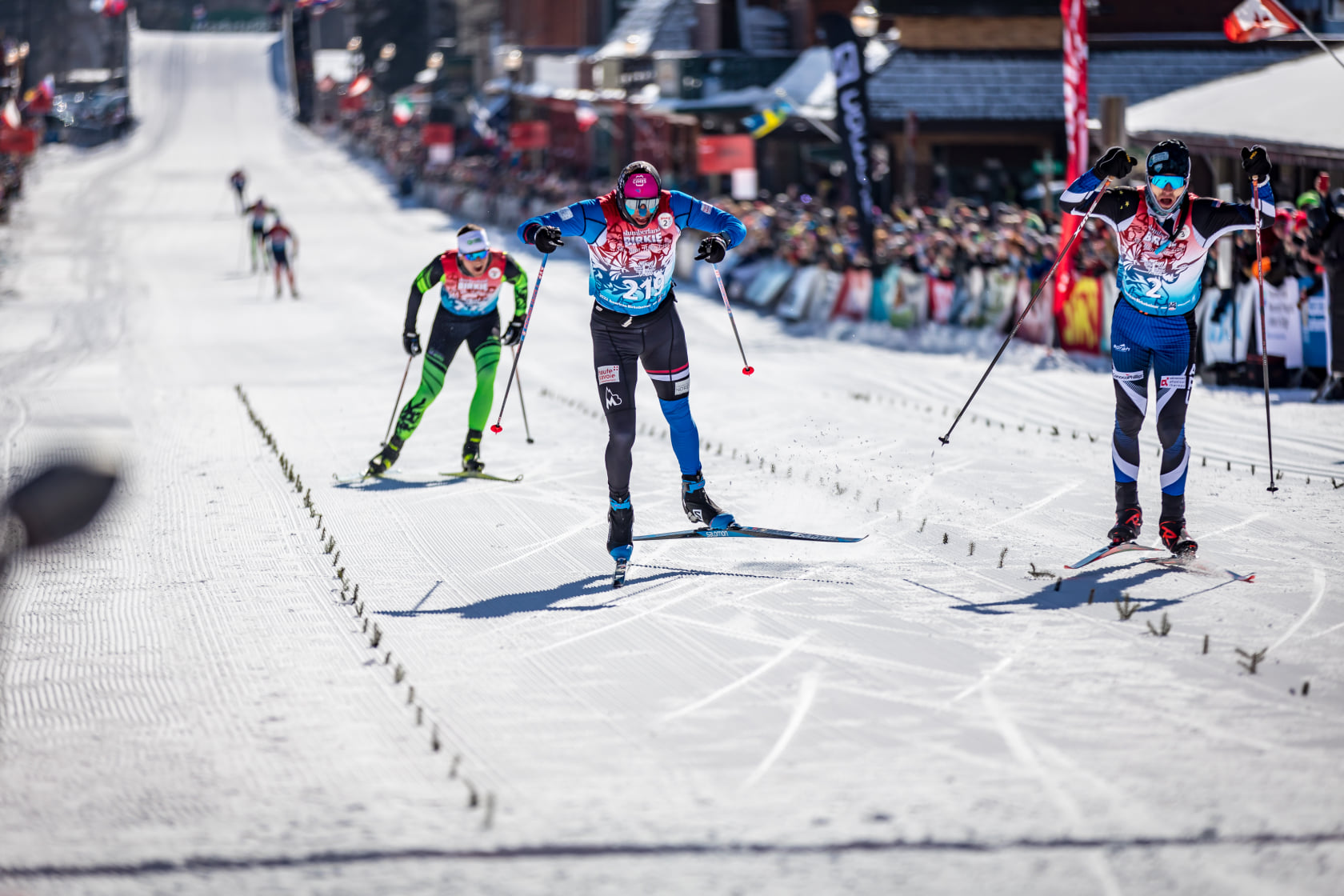
While Craftsbury’s Martin led over the bridge, it was Norris (APU) who looked to be the strongest in the final drag race up Main Street. Norris moved to the front and steadily gained ground on Martin, while Agnellet began a late surge from the back of the group.
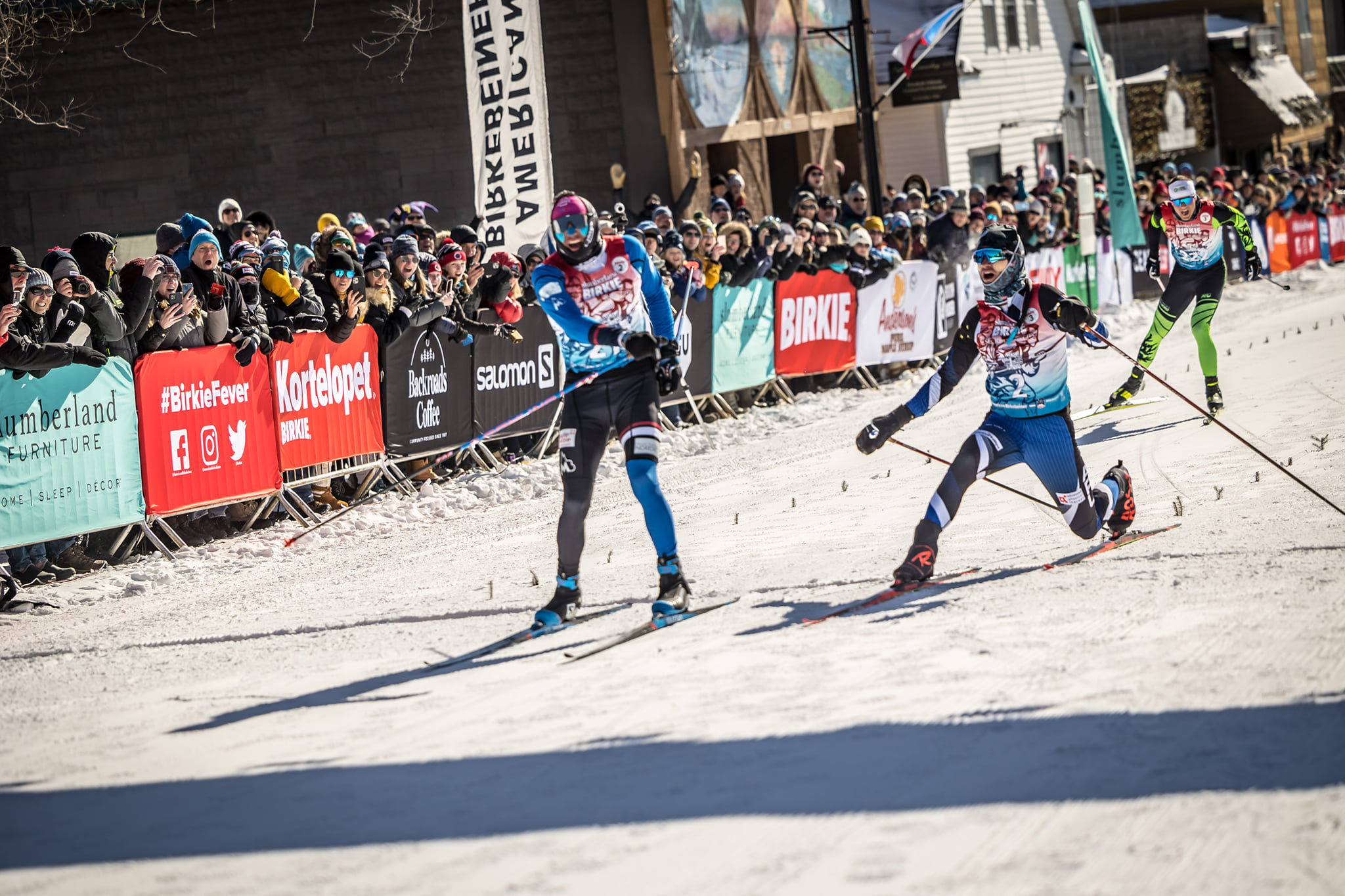
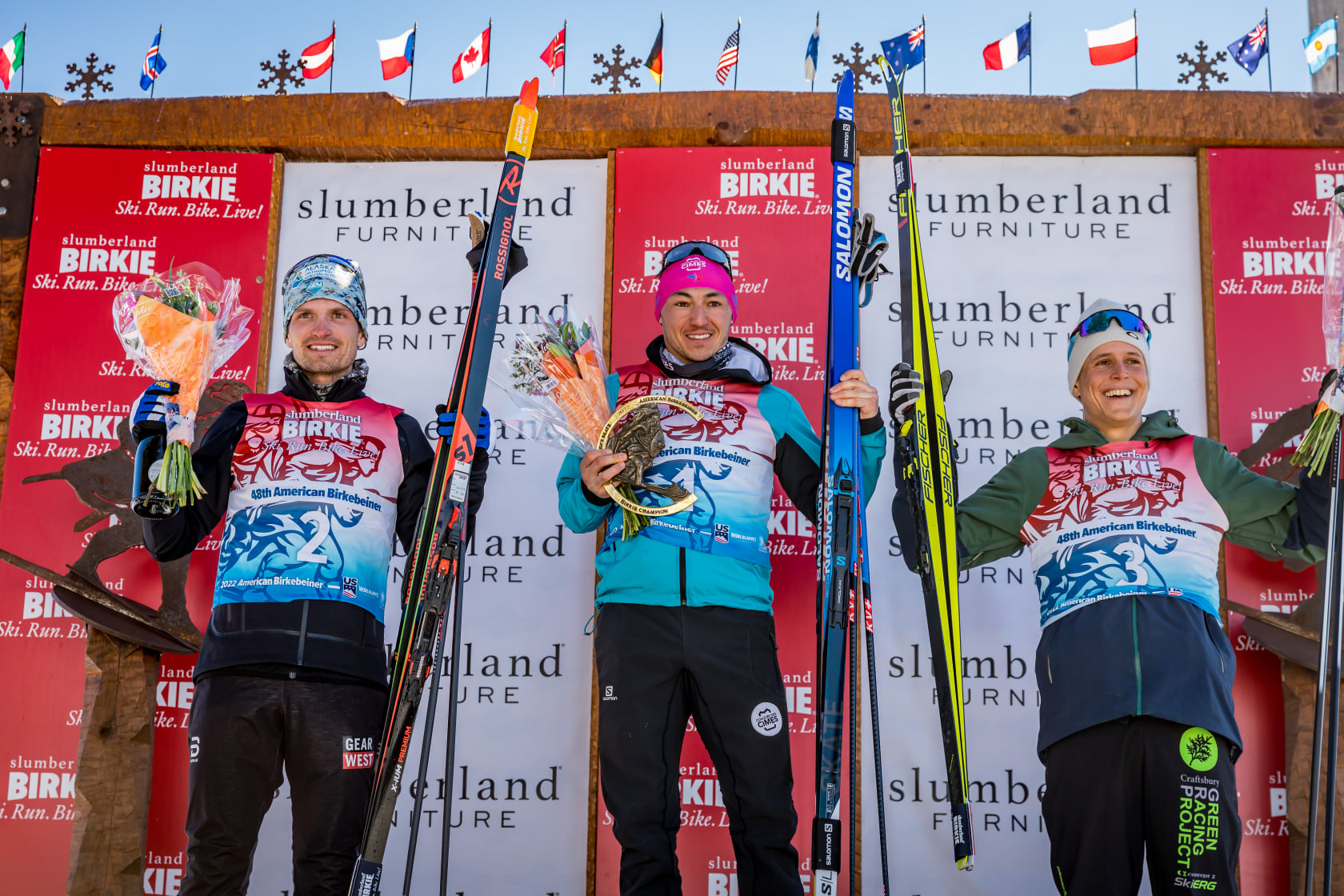
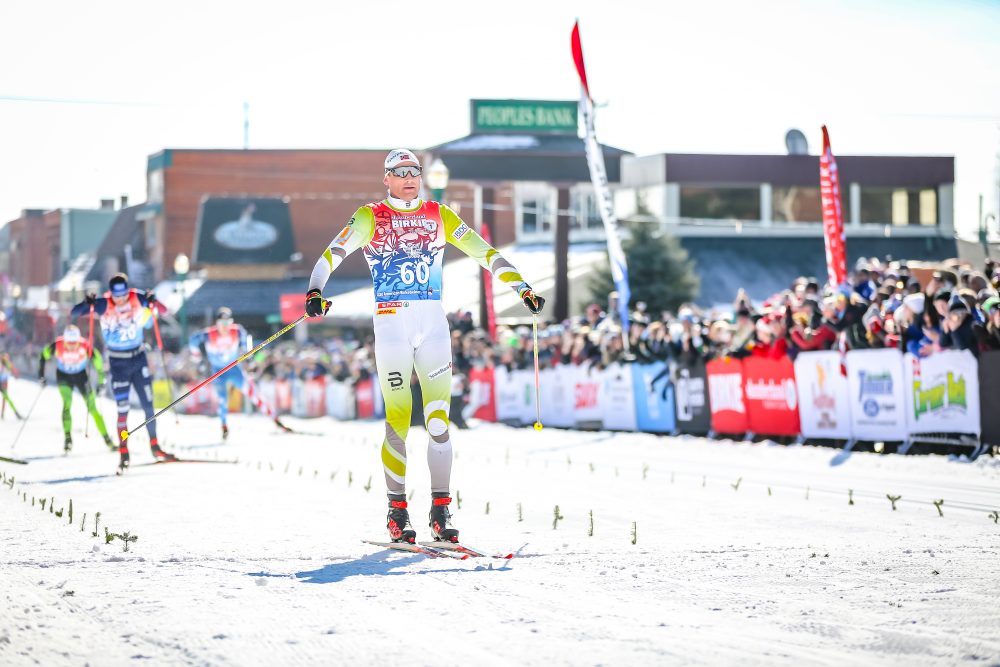
In the closing meters, Agnellet accelerated to move alongside Norris’ right side, matching his pace just before the line where Norris threw his boot to keep his advantage. A photo finish decided that Agnellet had nipped Norris at the line – 50 kilometers of tactical racing decided by just centimeters of distance.
This is Norris’ third appearance at the Birkie. The 31-year-old won his first Birkie in 2016, then was fifth and second American behind Kyle Bratrud in 2018. Today’s result earns Norris $4,500 in prize money, plus a $2,500 bonus for being the top American male. Equal payout for the top male and female saw Sonnesyn earn $7,500 for the win plus the $2,500 bonus, perhaps easing the sting for both athletes who were just beyond the ranking needed for 2022 Olympic team selection.)
Just behind the excitement at the front, Adam Martin (CGRP) took third today (+2.0), while Ian Torchia (SMS T2) was fourth after a short gap (+15.0). Craftsbury’s Akeo Maifeld-Carucci, a 2019 Birkie winner, rounded out the top five men, +18.0 behind Agnellet.
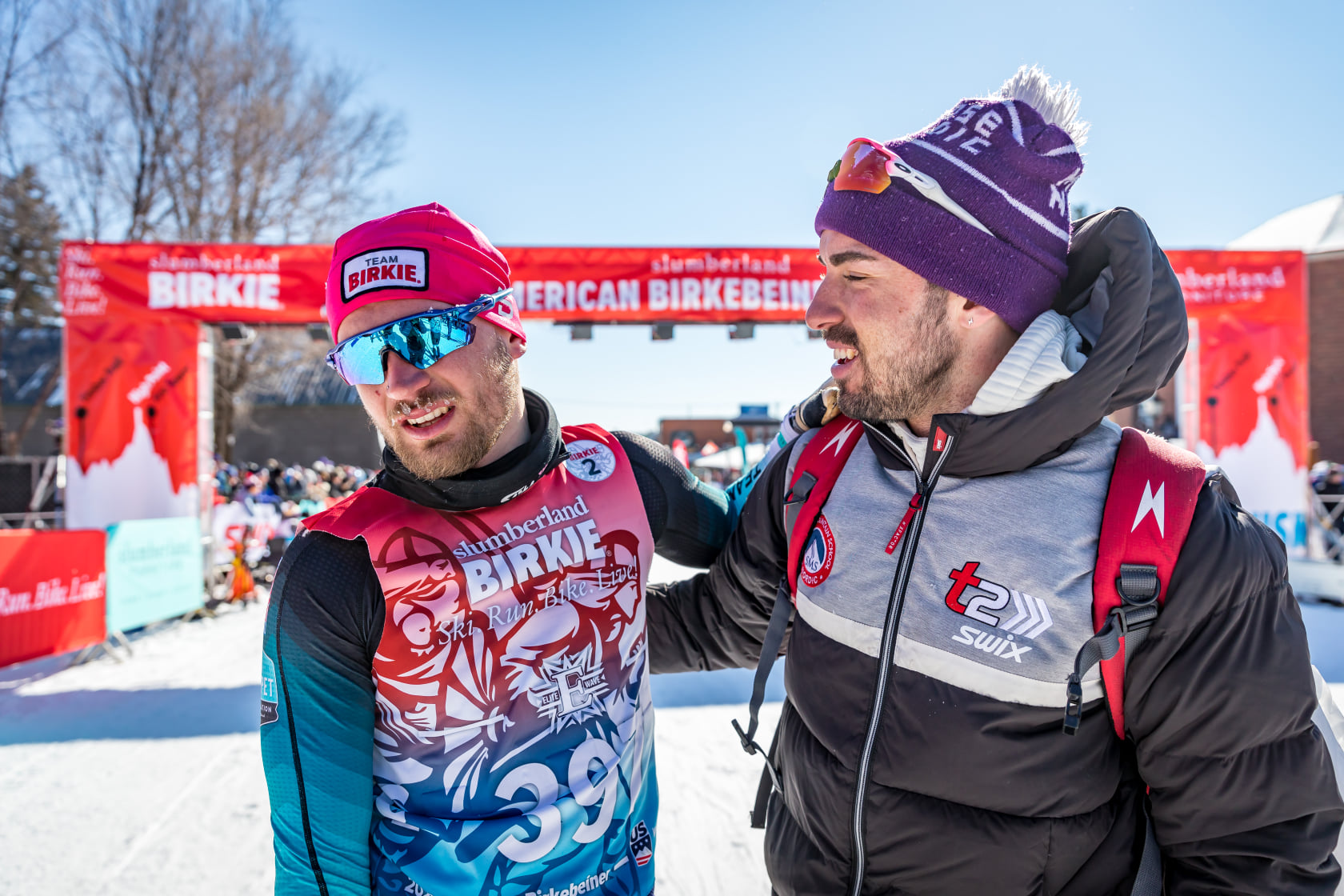
Torchia would announce on Instagram the following day that the Birkie had been his final race as a professional skier.
“Thank you very much,” Agnellet said through a translator at the finish. “I just loved the course here. It was fantastic and I’ve been very impressed with all the people I’ve met and all the encouragement I’ve received along the way. It’s been just a beautiful day here and I’m so excited to be on this great course, and to be representing France and to be the top man on the podium today.”
Agnellet was also asked about his strategy, in particular whether he had confidence that he could win in the final sprint and boot slide the line.
“My plan was to stay in contact with the front of the pack, and David Norris was looking so strong today. At a certain point I was thinking, ‘David has this and I’m racing for second place.’ But as the race went on, I was feeling stronger and stronger, and was happy to have come around David at the end.”
In the 55 k classic, Delaney FitzPatrick clocked the fastest time in the women’s race with 3:23:39, while Hayward native Josie Nelson was second (+5:26) and Molly Watkins of Duluth, MN was third (+8:10). For the men, Team Birkie coach Leo Hipp took the win in 2:51:57, while Chris Brunham of Stowe, VT crossed second (+20.0). Even Wetzel of Waukesha, WI rounded out the men’s classic podium in third (+2:24).
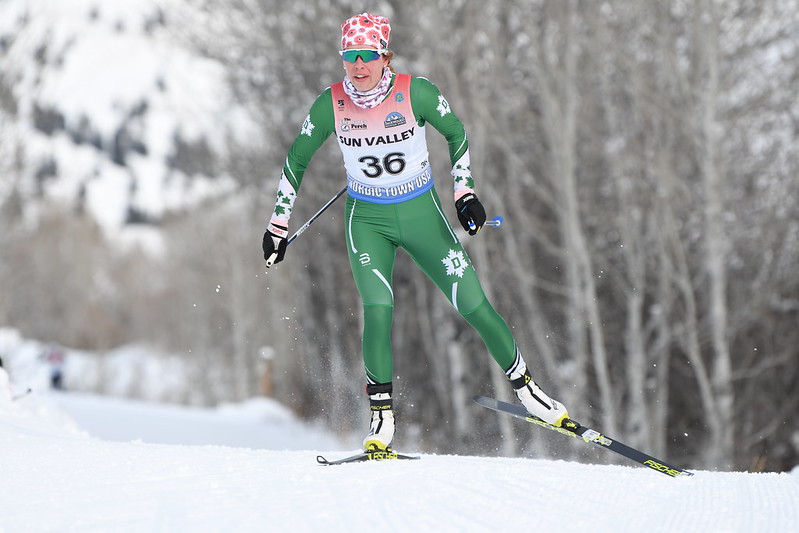
The 2022 Sun Valley Nordic Invitational continued Sunday with 10/15-kilometer mass start classic races, featuring SuperTour, RMISA collegiate, and Intermountain junior national qualifier divisions. With overnight temperatures in the low teens which rose to roughly 20 degrees Fahrenheit by start time, tracks looked ideal for kicking and gliding on the meticulously groomed trails at the Lake Creek Ski Center in Ketchum, ID.
The opening meters of the women’s 10k mass start classic, with Rosie Brennan setting the pace in her blue APU race suit. (Photo: Tobias Albrigtsen / @untraceableg)
Today’s races featured four laps each, with men starting the morning off on a 3.75k loop that featured three progressively larger climbs, totaling roughly 417 feet of climbing per lap. The women raced next on a 2.5k loop, which truncated the third and most significant climb of the men’s loop to reduce the lap length.
Men’s 15k Mass Start Classic:
After his victory in Saturday’s 10k individual start skate, local Johnny Hagenbuch (USST/SVSEF) moved into second place in the overall SuperTour rankings, still led by Adam Martin of the Craftsbury Green Racing Project. Martin won the 15k individual start classic at the U.S. Cross Country Championships just ten days ago, taking his first national title. With fellow national championship podium finishers Scott Patterson and JC Schoonmaker also taking part in today’s classic mass start, along with a number of other accomplished competitors in a field of 122 athletes, the stage was set for an exciting race.
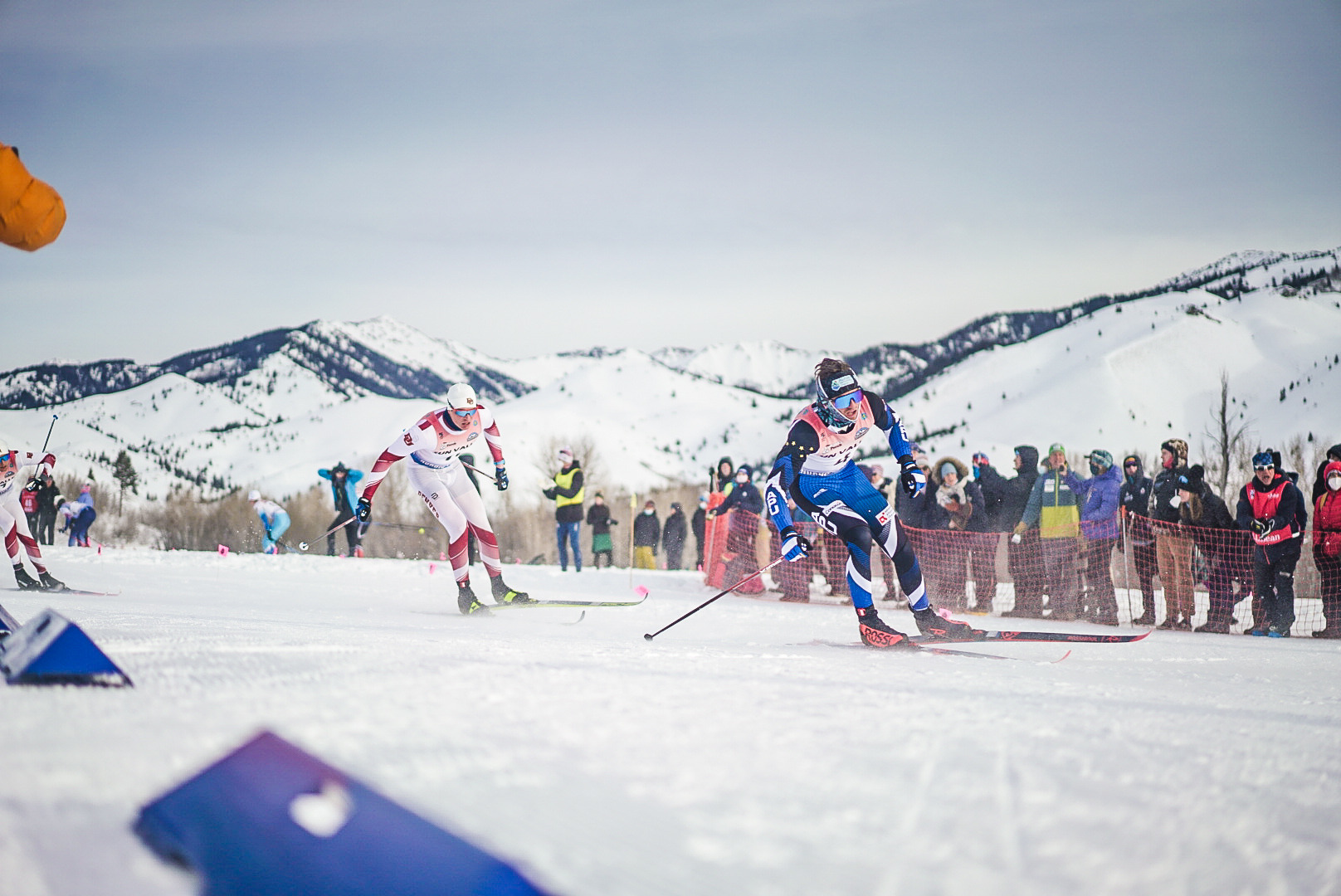
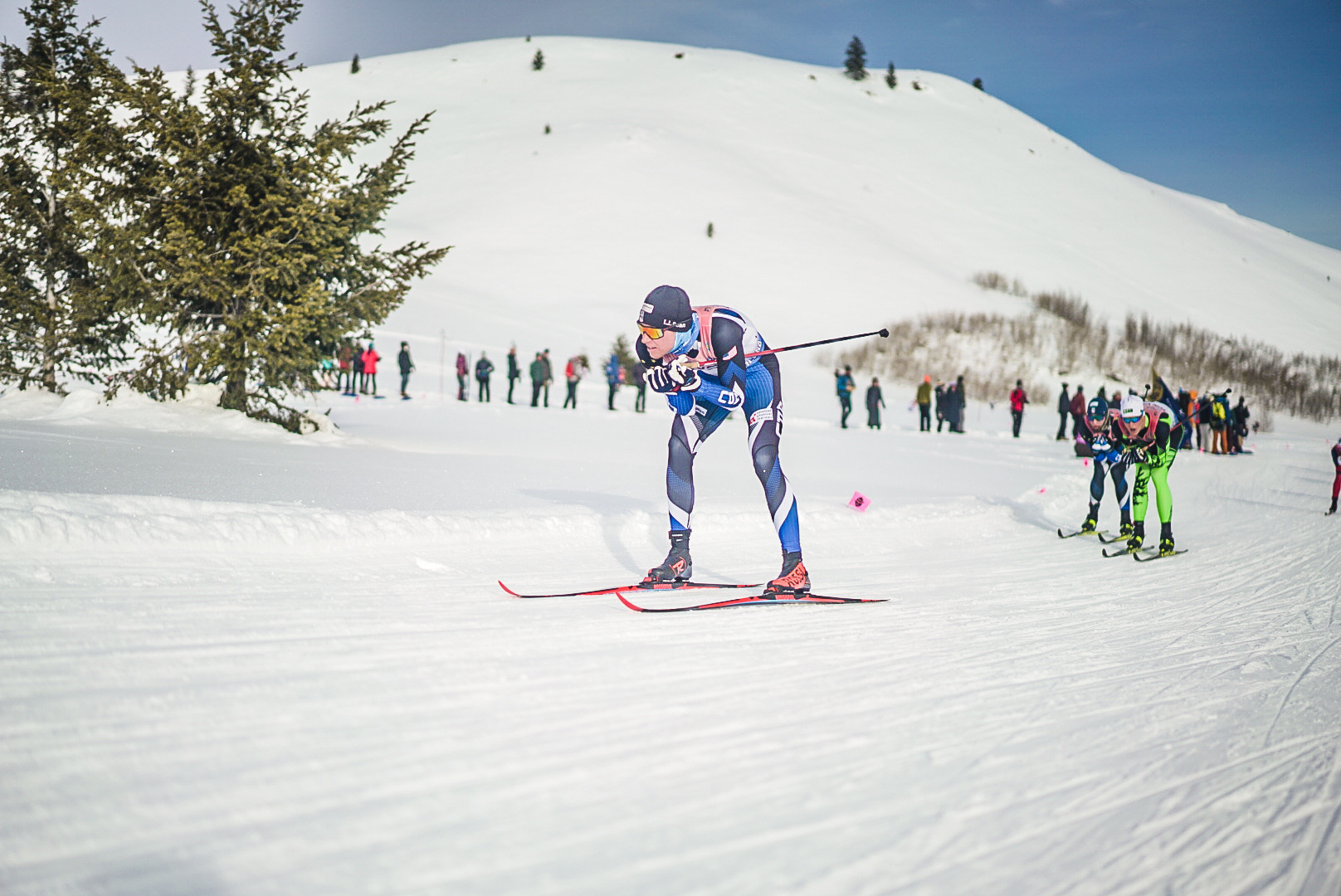
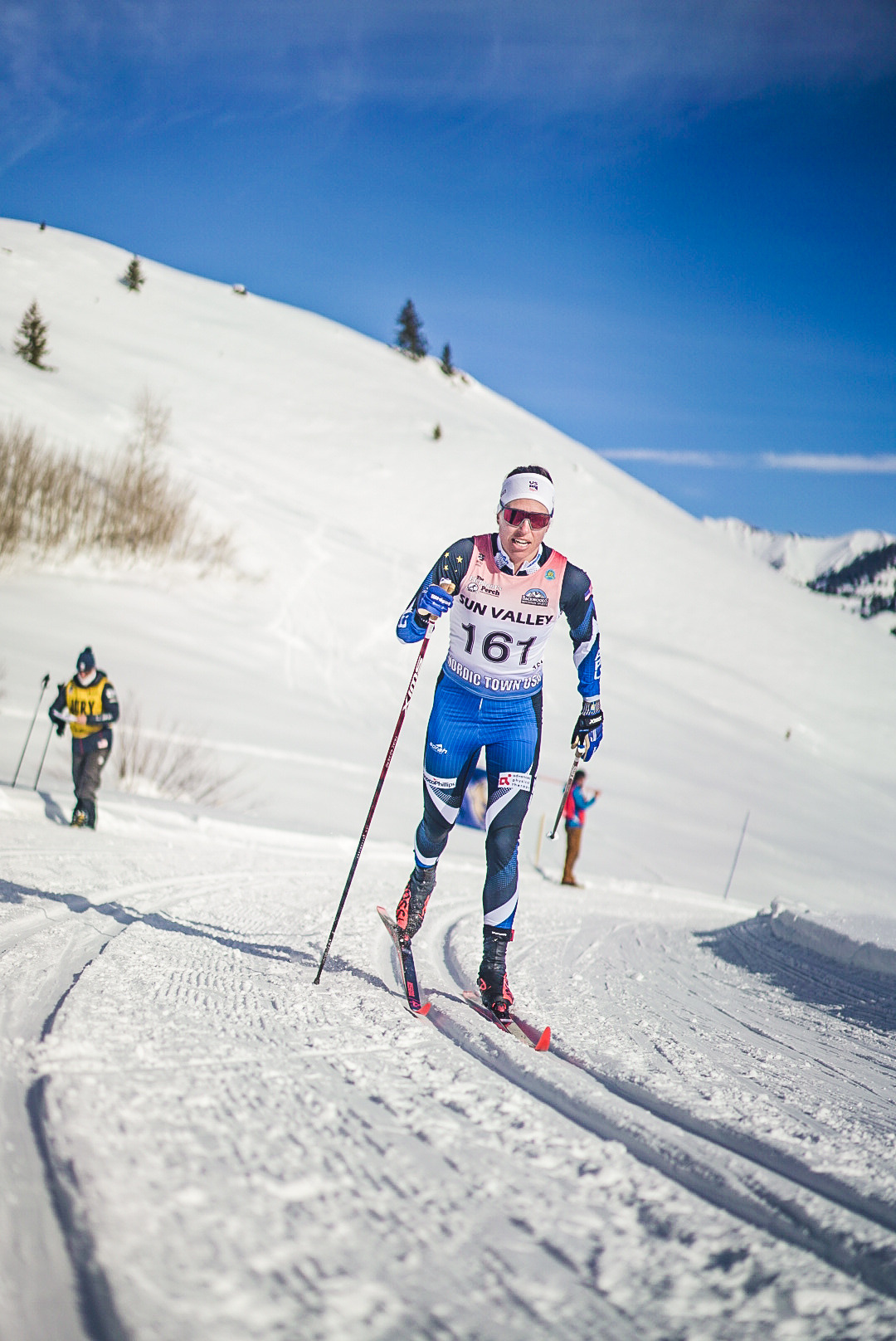
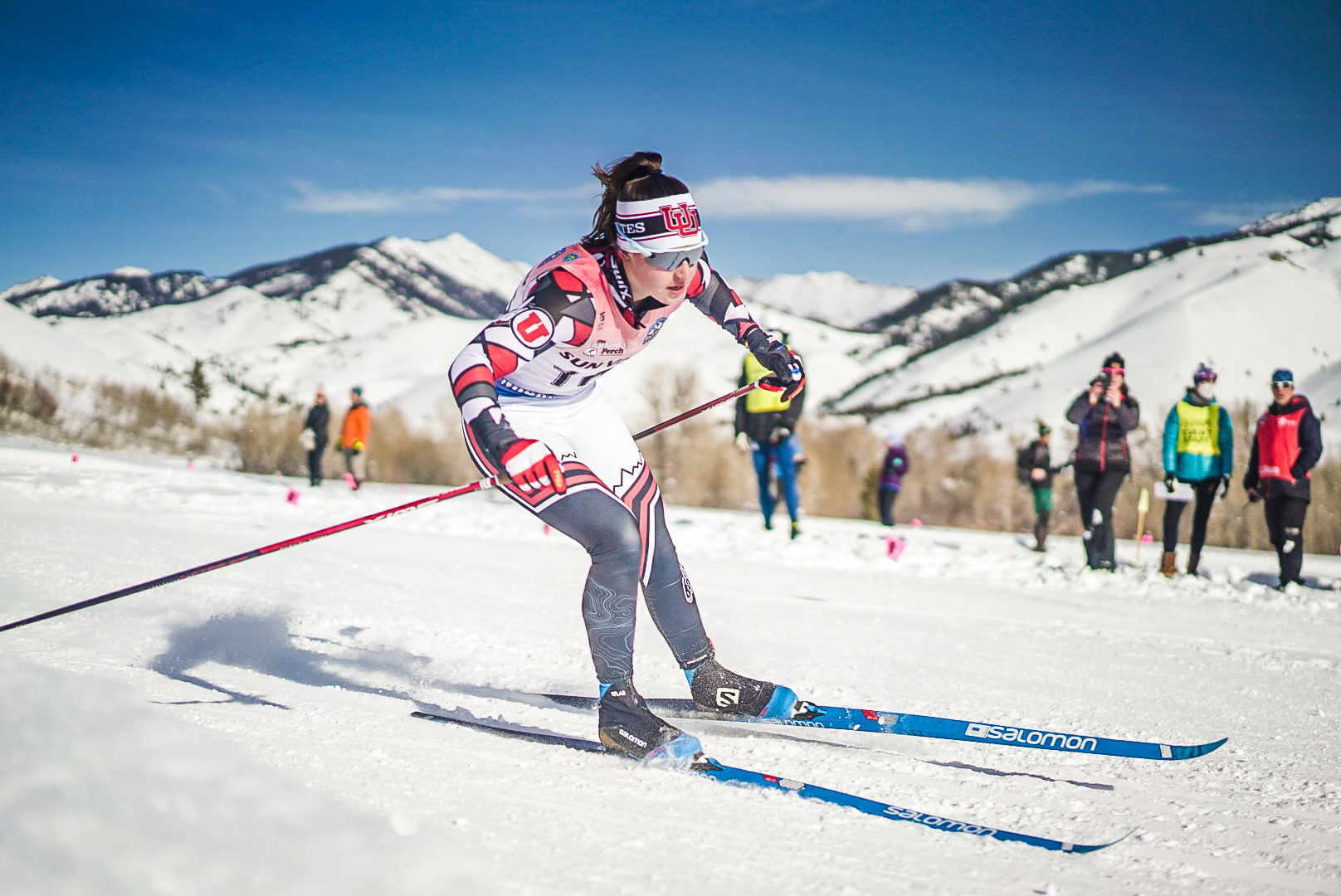
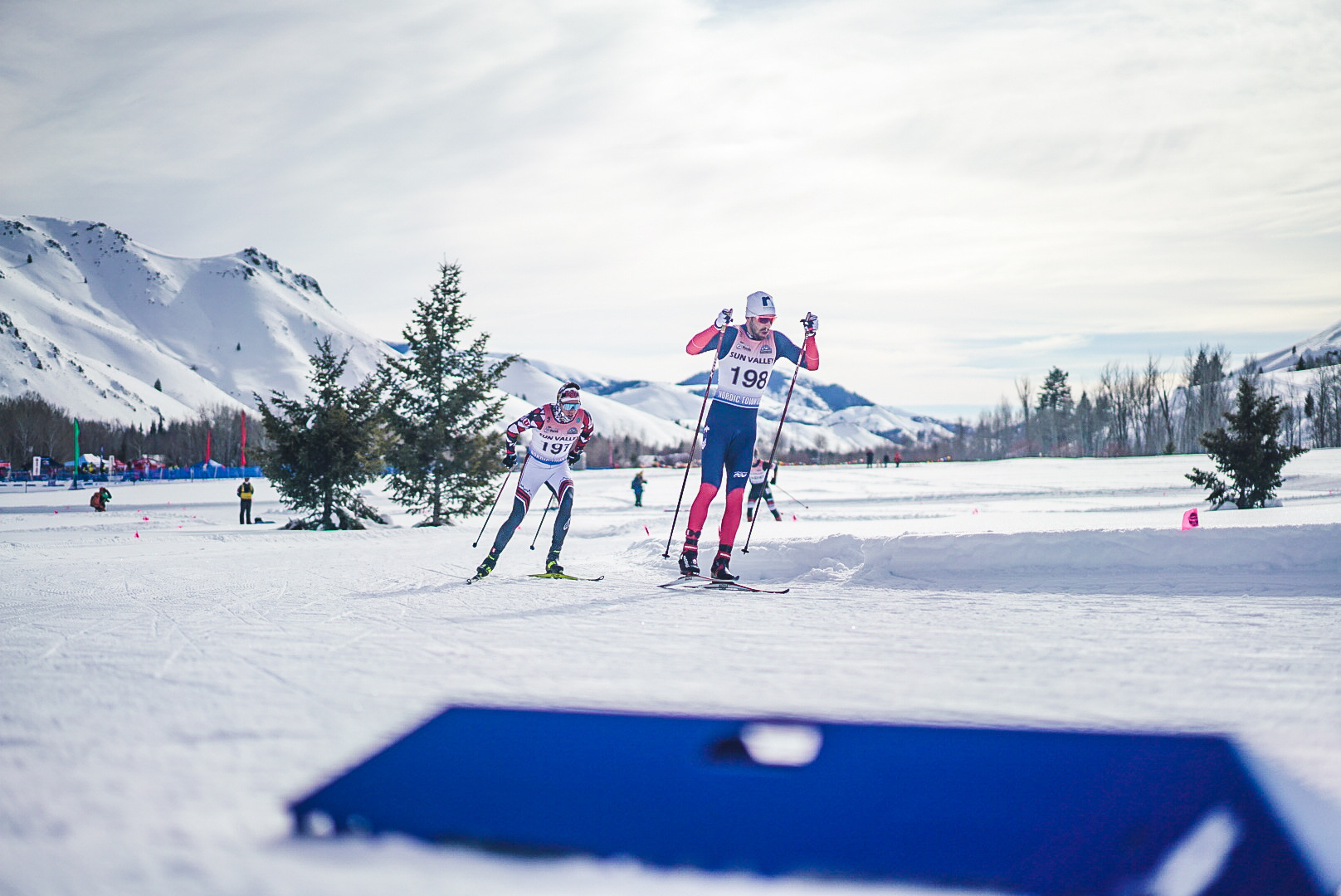
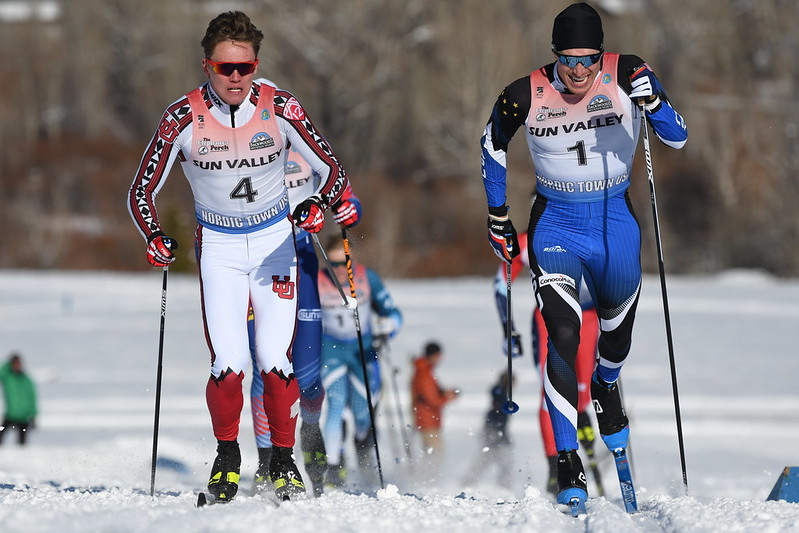
Ian Torchia pulls the lead group around a bend early in the men’s 15k mass start classic in Sun Valley. (Photo: Tobias Albrigtsen / @untraceableg)
In the end, it was another strong day for APU as they put together yet another podium sweep. Today, the APU men were led by David Norris, who took the win in a time of 36:50.5. Hunter Wonders finished second (+8.0), after outsprinting his teammate, Scott Patterson, in the final meters, leaving Patterson in third (+8.5).
“Lake Creek and all the Sun Valley trails are in such good condition right now,” wrote Norris in a post-race email to FasterSkier. “Earlier in the week I skied with the team at four different trailheads, and they were all so nice.”
Given the field size, level of competition, and relatively short lap length, one might expect congestion on the course, or the dreaded accordion that can sometimes occur as the pack repeatedly stretches out and compresses, making it hard for athletes in the later half of the pack to ski consistently. Norris explained that this was not an issue during today’s mass start.
“The course today is one of the harder courses in the U.S. and because of that the pack wasn’t overly crowded. I was surprised by how large of a group we had for the first three laps. I felt really relaxed skiing within the pack. Until Scott started pulling away from the lead group at the end of the third lap, I don’t think I had been in the top five. I bridged up to Scott on the last uphill of the third lap and then he, Hunter and I skied together until the last 1km of the race.”
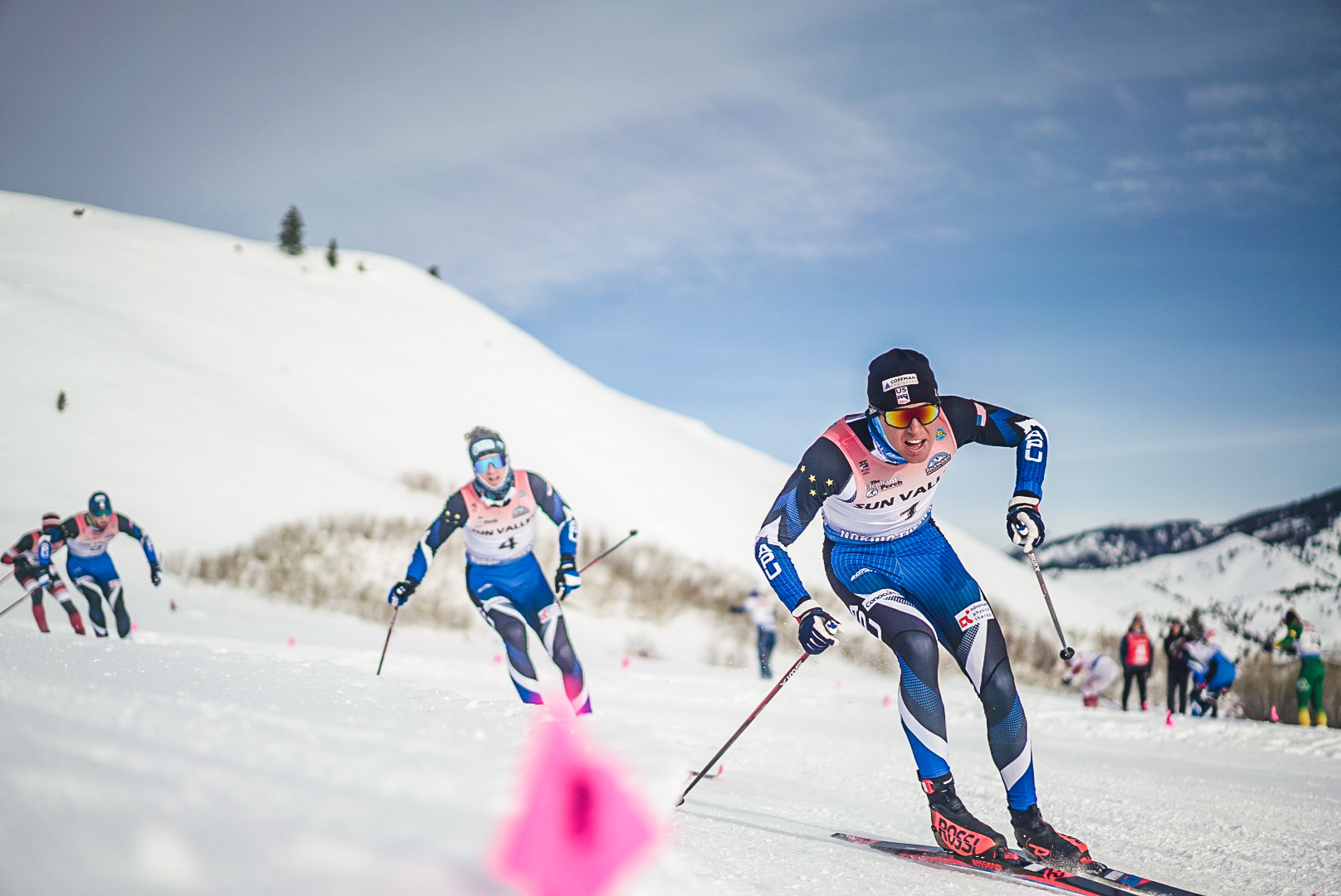
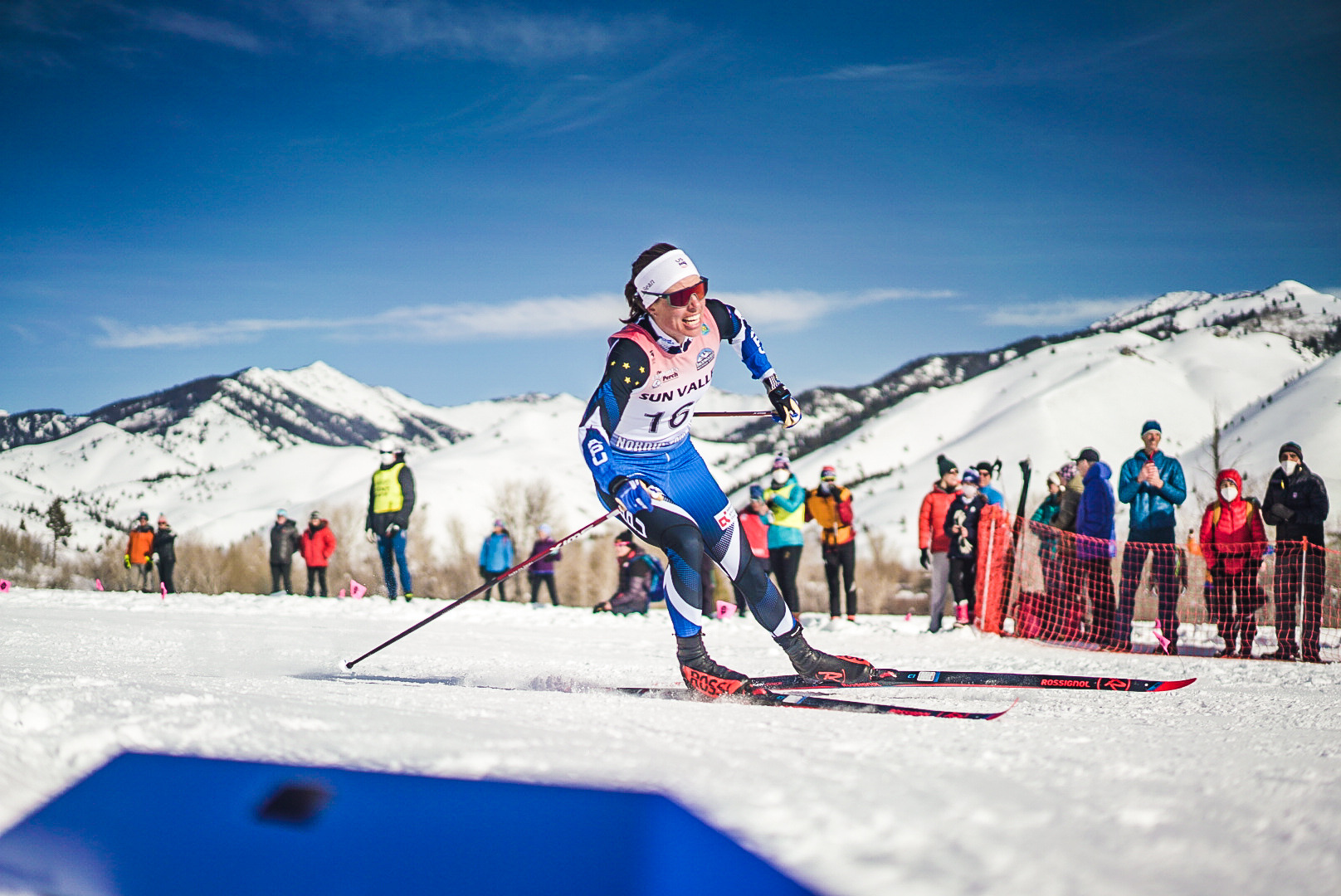
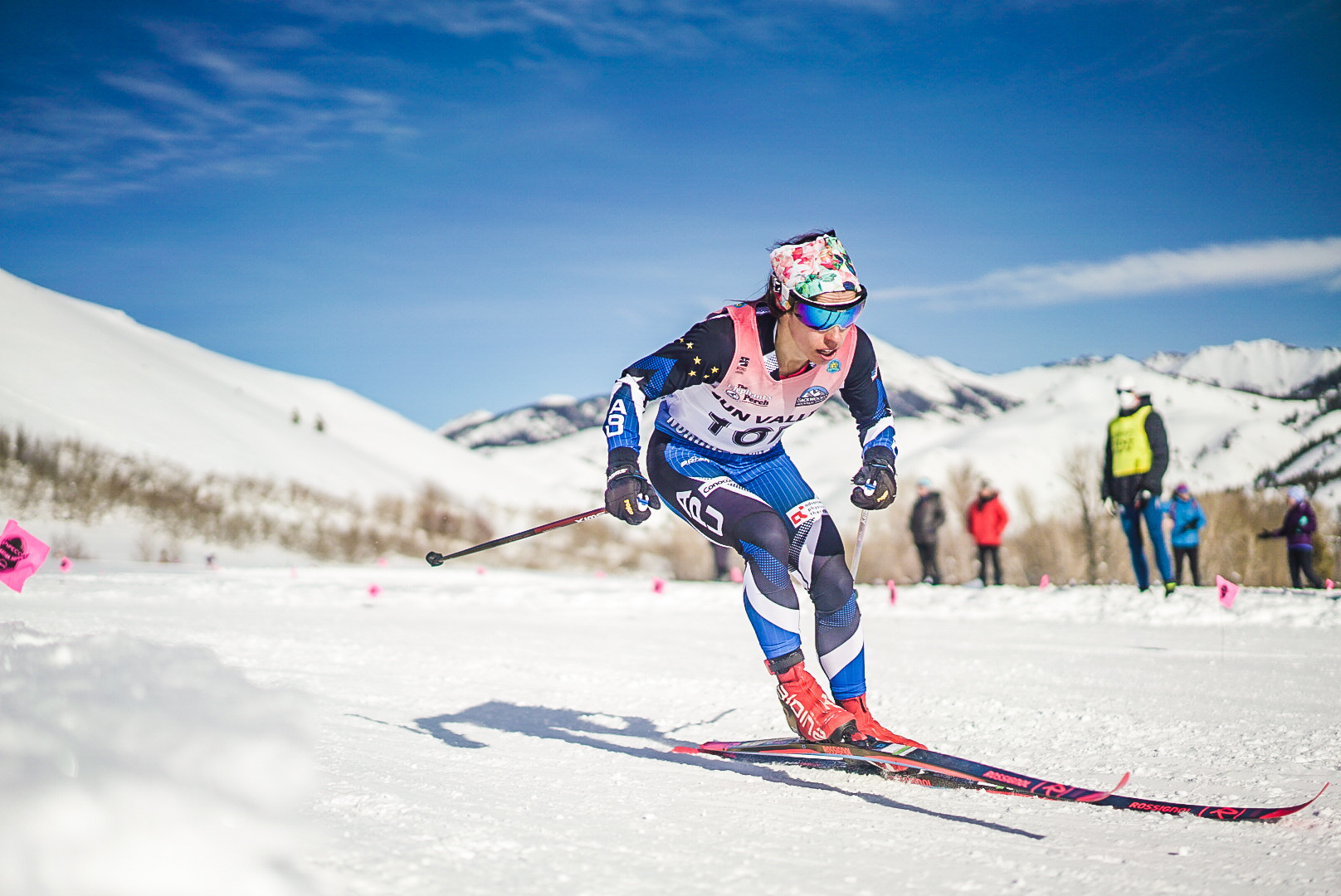
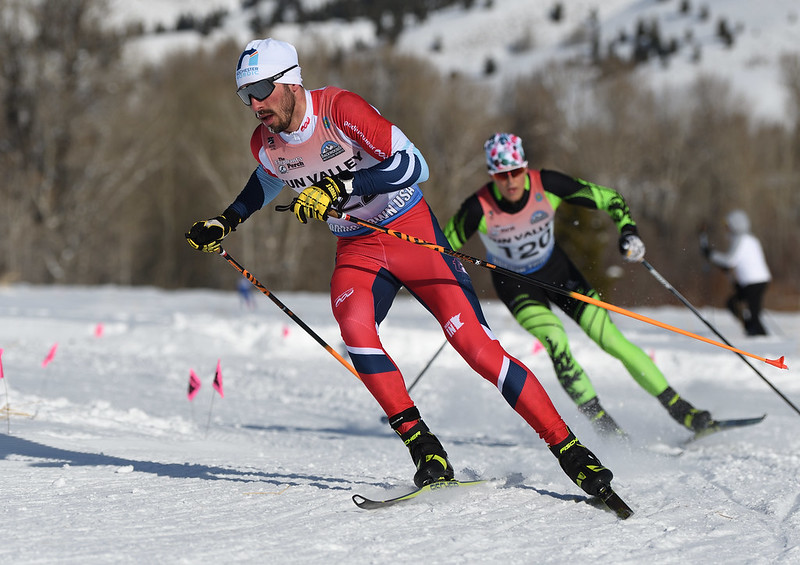
David Norris leads the way through a corner on his way to a win in the SuperTour 15k mass start classic in Sun Valley. (Photo: Tobias Albrigtsen / @untraceableg)
“Approaching the last hill, I went to the front and right away felt a small gap open up so I pushed it to the top of the course where I had a solid gap that stayed to the finish. It’s really nice to put this race together after a really slow start to the season. The APU coaches have been working super hard and it was super cool to be a part of such a great day for the team.”
Norris concluded by sharing his upcoming objectives, perhaps foreshadowing tomorrow’s release of the 2022 Olympic team. Today’s result moved Norris into third place in the SuperTour overall standings, behind Adam Martin in first and Scott Patterson in second. In the Olympic qualification standings for distance racing, Norris is also third, with Patterson first and Martin second.
“From here I’m likely racing the Boulder Mountain Tour and the Birkie, which I’m excited about.”
Scott Patterson races to third place in the SuperTour 15k mass start classic in Sun Valley. (Photo: Tobias Albrigtsen / @untraceableg)
In Patterson’s post-race comment to FasterSkier, he echoed Norris’ statement that congestion was not an issue, particularly as they had started at the front-edge of the pack. Patterson did add, however, that some obstacles arose as they began to lap some of the skiers finishing near the back.
“Many were great about stepping over to the side,” Patterson explained. “But there were a few who were very focused on their own race and didn’t recognize our group charging through.”
Patterson also shared his version of the race narrative, including the final move that moved Wonders one step up the podium.
“The race started pretty hot. I was surprised to end up in about 15th off the line even from the tip of the chevron. However, by about a kilometer in, the pace had settled and I was back up near the front. Johnny Hagenbuch and Hunter (Wonders) did a lot of the work on the early two laps. I mostly stayed near the front, but was keeping it relatively casual and felt ready for some hard pushes later.
On the third lap up Torin’s Tucker or the South Bench climb, I decided it was time to make it a real race. My move quickly split the lead pack. I had some space behind, but David and Hunter were able to rejoin after the long descent down to the stadium. I continued to lead for most of the fourth lap before David put in a good charge up the final large climb. He got a little space from me, while I slightly distanced Hunter on the climb. However, Hunter’s finish came into play as he chased me down and out sprinted me into the finish.”
Scott Patterson makes his move, leading APU teammates David Norris and Hunter Wonders. (Photo: Tobias Albrigtsen / @untraceableg)
Giving another nod to the coaches, Patterson celebrated his team’s success, despite finishing below where he would have liked.
“It was another sweet day for APU with the sweep. I am a little disappointed to have made most of the animating moves myself and only end up on the bottom step of the podium, but it is cool to see David and Hunter put together good ones. Our coaches put in a lot of hard work this week on top of a hard nationals to make it possible.”
Though perhaps more vague than Norris, Patterson also concluded with what is next on deck for him.
“I’m heading to my parent’s in Bozeman now,” Patterson said. “My plan is to put together a good training block there at somewhat altitude and get ready for the next races.”
As mentioned, Patterson put himself on top of the Olympic qualification rankings with the combined points of his win in the 30k skate and second place finish in the 15k classic; both events are on the Olympic schedule. While the five guaranteed spots of the men’s quota have likely been filled by those with stronger early-season World Cup results (note that Patterson had wrist surgery in October, which set him back performance-wise until recently), this indicates that Patterson would likely snag the sixth spot should one be added to the U.S. quota after reallocation, happening later this week. (Find more information on quotas and selection here.)
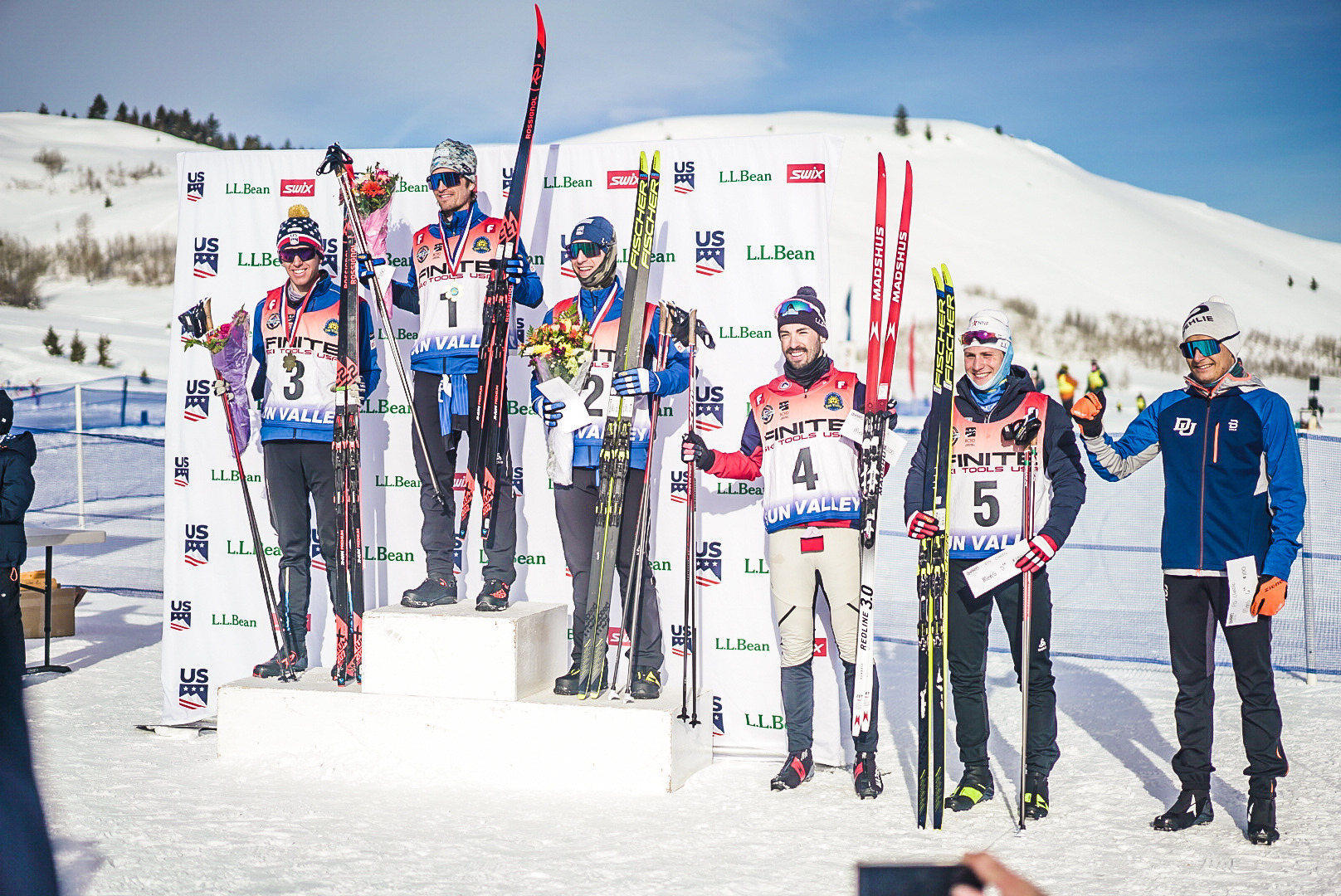
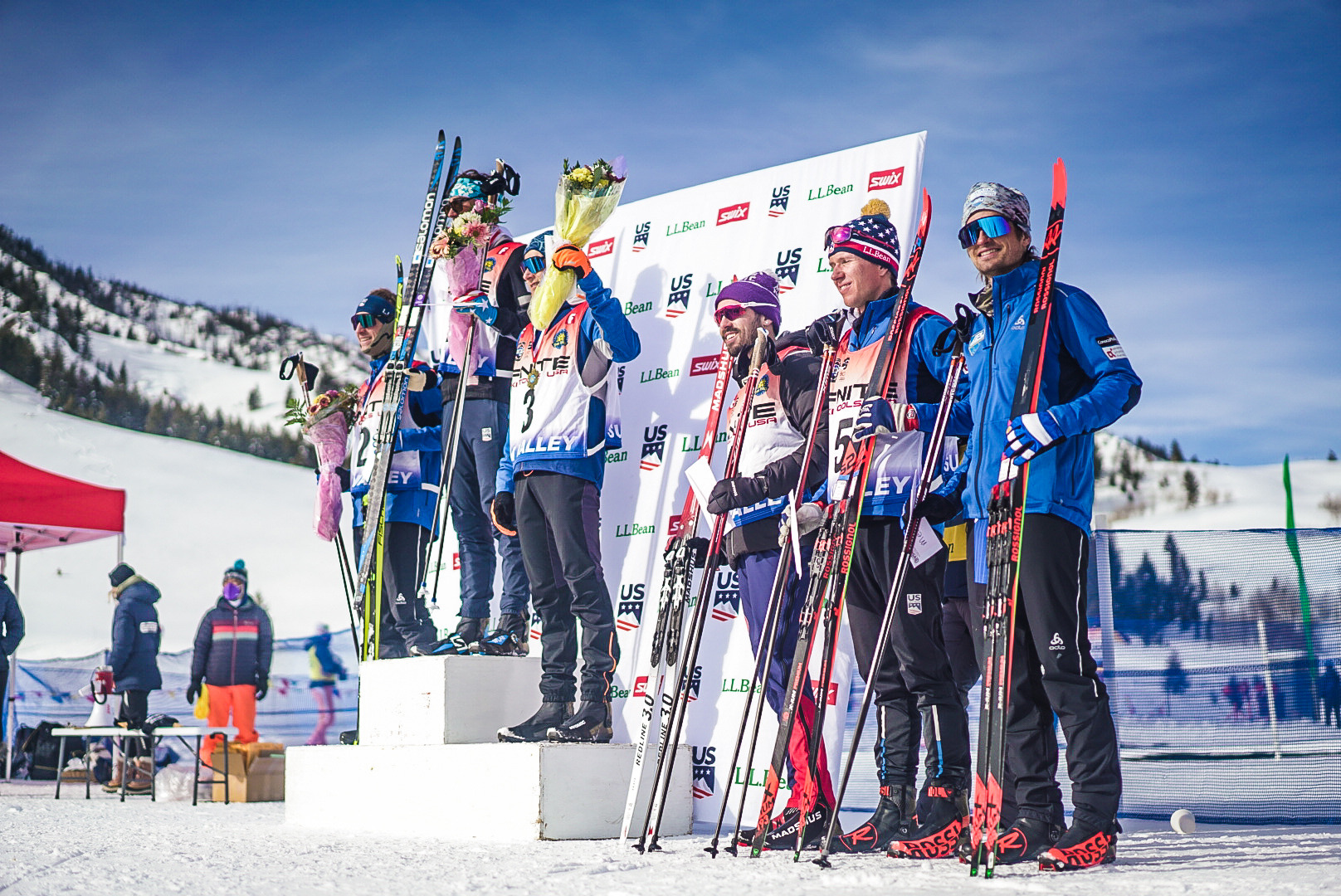
The top six men surround the podium following the 15-kilometer mass start classic in Sun Valley. (Photo: Tobias Albrigtsen / @untraceableg)
Lacking a livestream video and intermediate splits in the live timing, it is difficult to make many observations about the race other than those apparent in the finish times. Breaking up the string of four APU men who finished in the top-five, Ian Torchia (SMS T2) finished fourth again (+28.1), on the heels of a fourth place finish in the 10k skate on Saturday. In another finish-line sprint, Torchia crossed just ahead of APU’s Zanden McMullen (+28.2) with University of Denver’s Bernhard Flaschberger just behind in sixth (+28.4).
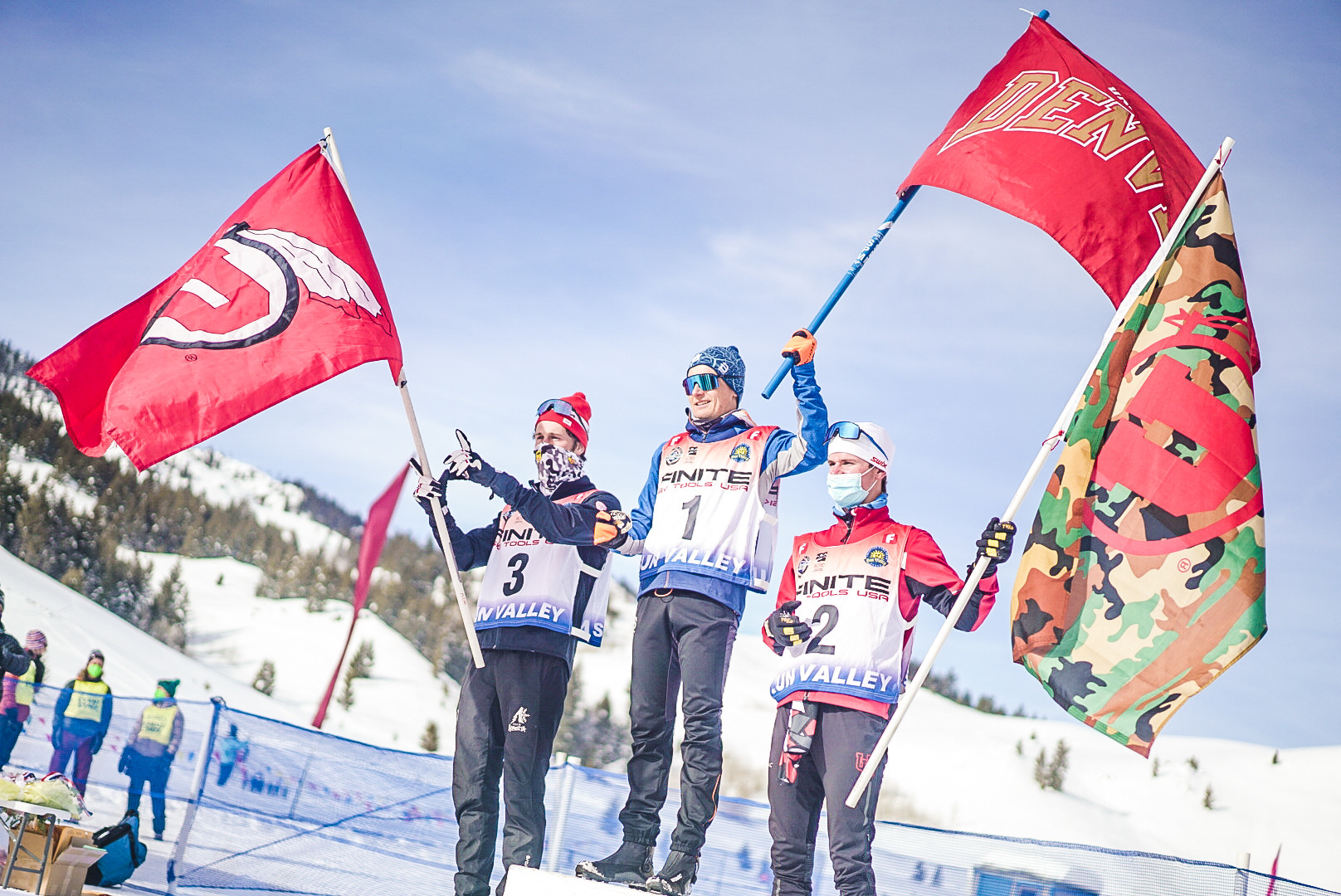
In the collegiate standings, Flaschberger skied his way to a double victory in Sun Valley. Sam Hendry (U of Utah) also earned a double podium, taking second place today after yesterday’s third, just one second behind Flaschberger and in eighth overall. Rounding out the collegiate podium, Andreas Kirkeng of University of Denver came in third (+24.1) for RMISA and tenth overall.
The RMISA men’s podium after the 15k mass start skate in Sun Valley. (Photo: Tobias Albrigtsen / @untraceableg)
Women’s 10k Mass Start Classic:
While there was no official livestream, APU’s Forrest Mahlen did record an Instagram live of the women’s race on the APU account, which offers some insights into the action. The footage and commentary are perhaps a significant step down from that offered in Soldier Hollow, but the primary storyline was nevertheless clear from the start. By the time Rosie Brennan (USST/APU) passed Mahlen, just over a minute into the race, she had created a five second gap over the remainder of the women’s field.
Unmatched, Rosie Brennan wins the women’s 10k mass start classic by nearly a minute. (Photo: Tobias Albrigtsen / @untraceableg)
Gun to tape, Brennan put on a clinic. Unmatched, she time-trialed her way around each of the four laps to finish in 29:35.3, nearly a minute ahead of the next racer. Brennan explained after the race that she was not totally prepared for classic races, as her original plans for her U.S. altitude block changed with the cancellation of the Les Rousses and Planica World Cups. Despite the time away from the main hub of the likely U.S. Olympic squad who are now training in Livigno, Italy, Brennan has seemingly thrived as she continues to hone her mental and physical sharpness before heading to China.
“I was honestly quite nervous for the race because I was never planning to do a classic race while I was home,” Brennan shared after the race. “I only brought home two pairs of training classic skis, so I wasn’t sure if it would be enough in this very strong field of women. Luckily, they were both cold skis and we did have cold, hardpack conditions today. APU did a great job preparing them and turning them into good race skis so it was alright in the end.”
More of a time trial than mass start, Rosie Brennan gaps the women’s field early, eventually winning the race by nearly a minute. (Photo: Tobias Albrigtsen / @untraceableg)
Speaking to her race strategy, Brennan continued, “I started hard to try to simulate what I will encounter in Beijing. I wasn’t sure what the other girls would do so I just really tried to focus in on strong skiing. This is only my 3rd classic race of the year so I really wanted the practice of holding my technique together, finding a relaxed stride, and all while at altitude. I felt really strong on the long climb and was able to find a good groove, so I pulled away on that climb and then had to just keep pushing. It was a good mental challenge with a four lap race at altitude. I was definitely feeling tired on lap 3 and had to turn my mind around and find a way to push hard again that last lap in preparation for the Olympics. All in all, it was a good weekend to get some hard efforts in before we start to taper and focus in on Beijing.”
Leading the chase pack in the final lap, Katharine Ogden (USST/SMS T2) skied to second place for the women (+55.4). Ogden was second in the 10k classic during the U.S. Cross Country Championships, the only event she contested, and finished fourth in yesterday’s 5k free.
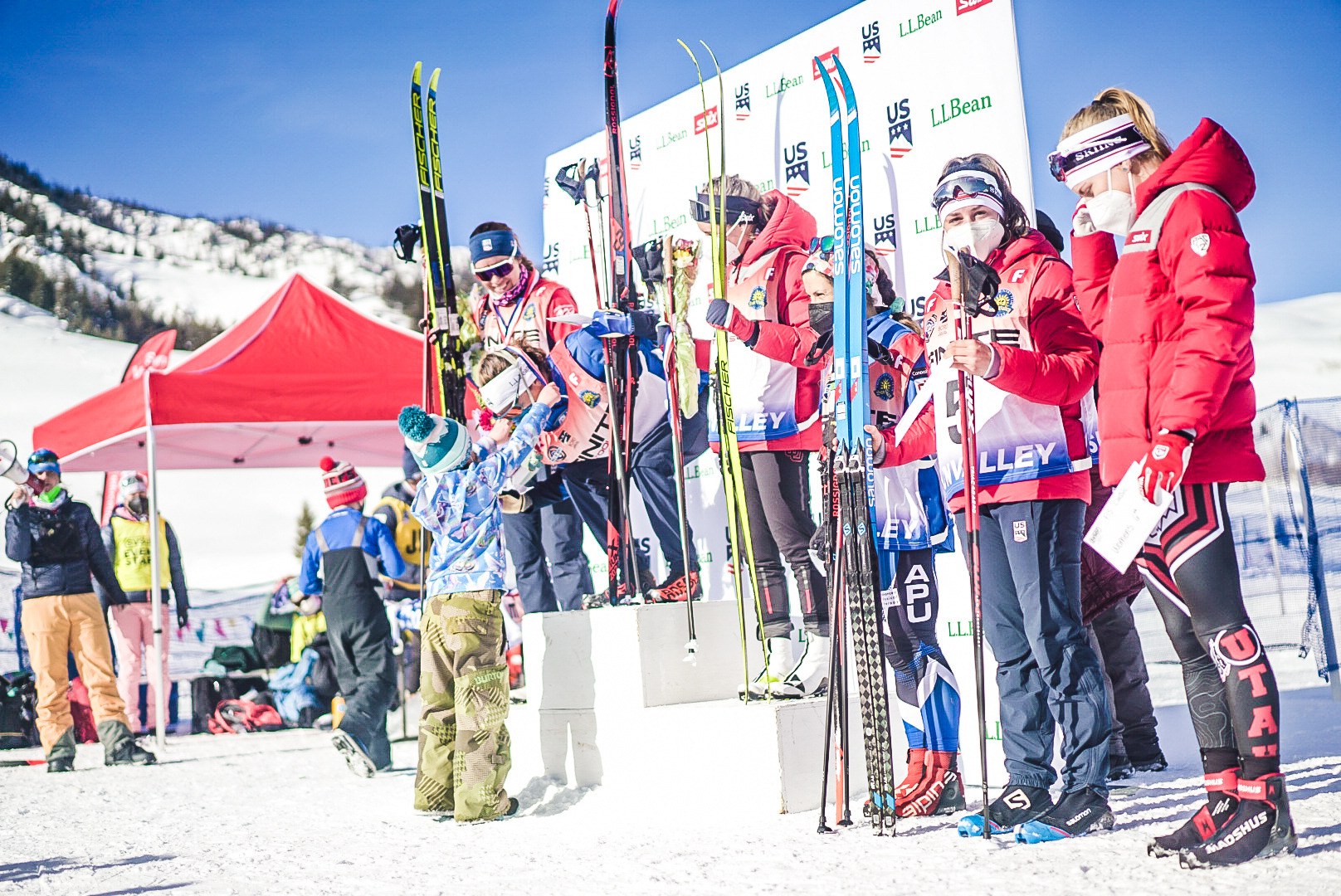
Rosie Brennan has a medal placed around her neck by SVSEF youth athlete after winning the women’s 10k mass start classic. (Photo: Tobias Albrigtsen / @untraceableg)
Next to the line was Novie McCabe (USST/U of Utah) in third (+1:07.6), her second third place finish of the weekend.
“It was fun for sure!” McCabe wrote in a post-race email. “I’ve always liked racing in Sun Valley and haven’t done too many mass starts this season so I was stoked for this one! We had a good group for the first three laps and it was kind of nice to just try and settle in and find a good pace. Overall, I felt good and am super happy with how things ended up. My skis were also amazing, which for sure didn’t hurt!!”
Rosie Frankowski skis to fourth in the SuperTour 10k mass start classic in Sun Valley. (Photo: Tobias Albrigtsen / @untraceableg)
Rosie Frankowski (APU) was fourth to the line (+1:17.1), with Sydney Palmer-Leger (USST/U of Utah) behind in fifth (+1:26.4), leading her teammate Sophia Laukli who finished roughly a second behind her in sixth (+1:27.2). Improving on yesterday’s result, Caitlin Patterson (CGRP) was next to the line in seventh (+1:35.7).
Going 3-5-6 in the overall standings set the women of Utah up nicely for a back-to-back podium sweep, the first time any RMISA team has done so within the same meet since 2013, according to the team’s press release. A look at the roster shows the Utes as the U.S. Ski Team-lite. A force to be reckoned with, the Utah women’s team has now won each of the five RMISA races this season.
Sydney Palmer-Leger skis to third overall and rakes the RMISA collegiate win in Sun Valley’s 10k mass start classic. (Photo: Tobias Albrigtsen / @untraceableg)
Beginning a northeast swing, the SuperTour circuit moves to Lake Placid, NY for Period III, resuming in two weeks on January 29th. This two-day race weekend will include a classic sprint, followed by a 10k mass start skate.
A big thank you to Tobias Albrigtsen, who generously shared his outstanding photos with us throughout the weekend.
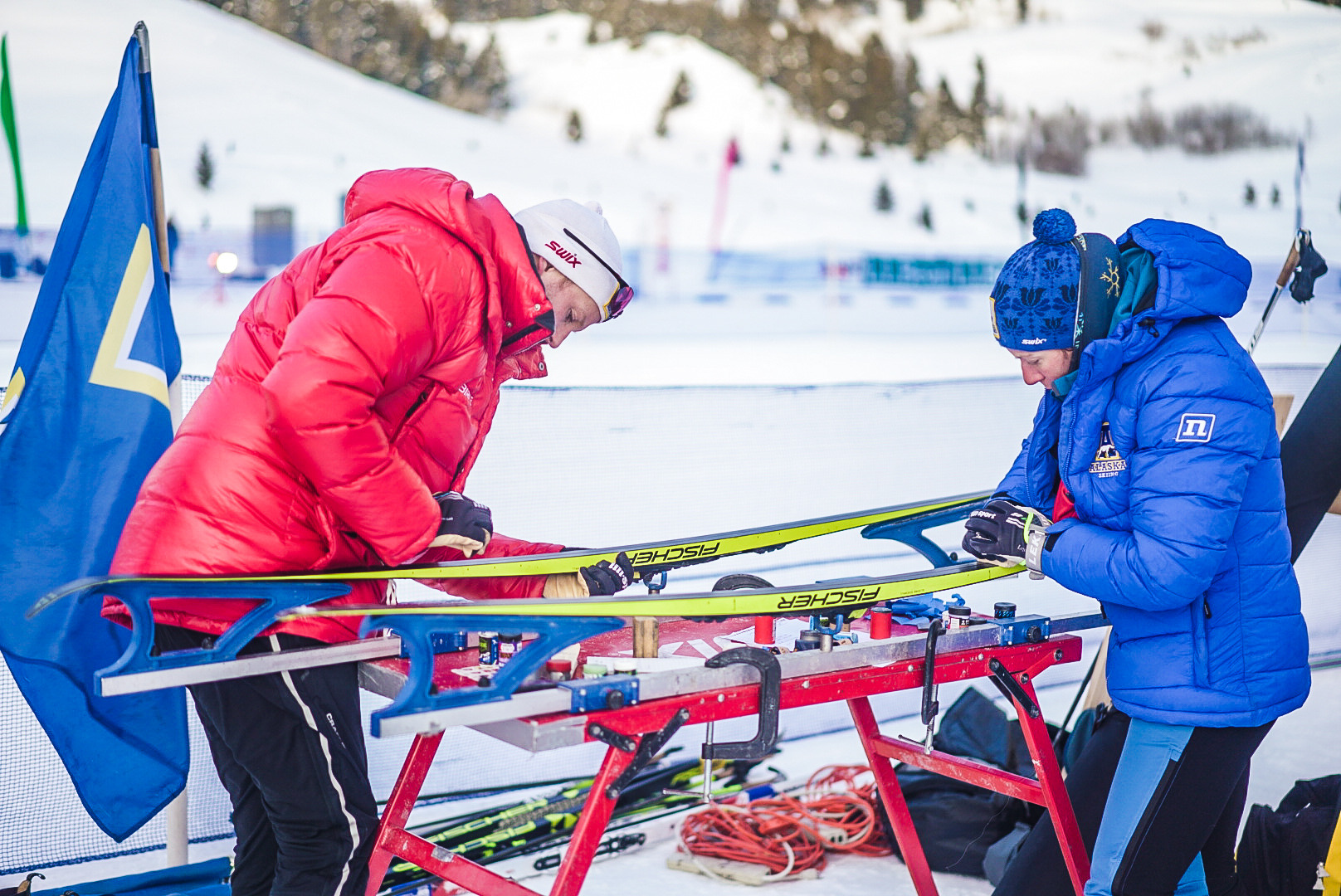
The prepping of the boards: University of Alaska Fairbanks coaches prepare skis for their athletes at the 10/15k mass start classic races in Sun Valley. (Photo: Tobias Albrigtsen / @untraceableg)
Quick Recap: We’ll have a full race report up tomorrow, including athlete comments and photos, but here is a quick recap of the action in the men’s 15k and women’s 10k mass start classic, which took place this morning in Ketchum, Idaho.
The 2022 Sun Valley Nordic Invitational continued this morning with 10/15-kilometer classic races at the Lake Creek Ski Center in Ketchum, Idaho. While temperatures were warmer than at the start of yesterday’s skate races, it was still a brisk morning in Sun Valley, making for excellent classic racing conditions in the dry high-altitude natural snow.
The men kicked off the morning’s races, taking off in a mass start at 9:30am. Rebounding from sixth place in yesterday’s skate, David Norris (APU) took the win in 35:50.5, leading a train of teammates for an APU podium sweep. Hunter Wonders doubled up on his second place performance, finishing 8 seconds behind Norris. Wonders edged out Scott Patterson (USST/APU) at the line by 0.5 seconds, leaving Patterson in third. Ian Torchia (SMS T2) was next for his second fourth place finish of the weekend (+28.1), finishing in a three-way sprint with APU’s Zanden McMullen who took fifth (+28.2) and University of Denver’s Bernhard Flaschberger in sixth (+28.4).
Flaschberger was again the top RMISA collegiate racer, with Sam Hendry of the University of Utah in second place (8th overall), and fellow Denver athlete Andreas Kirkeng in third (10th overall).
The opening meters of the women’s 10k mass start classic, with Rosie Brennan setting the pace in her blue APU race suit. (Photo: Tobias Albrigtsen / @untraceableg)
From the looks of an SVSEF Gold Team Instagram story, Rosie Brennan (USST/APU) took the women’s race out hot. Following the theme of her domestic racing over the last two weeks, Brennan steadily grew her lead over the field, crossing the finish line in 29:35.3, nearly a minute ahead of her chasers. Katharine Ogden (USST/SMS T2) led the chase back to the finish to take second place (+55.4), with Novie McCabe (USST/U of Utah) close behind, again in third (+1:07.6). Rosie Frankowski (APU) was fourth for the women (+1:17.1), with Sydney Palmer Leger (USST/U of Utah) behind in fifth (+1:26.4), leading her teammate Sophia Laukli who finished roughly a second behind her in sixth (+1:27.2).
This time with McCabe on the top-step, these three University of Utah women again swept the RMISA collegiate podium for the second day in a row.
The final weekend of SuperTour racing in Period II, and the final weekend within the Olympic qualification window, kicked off Saturday at the Lake Creek Nordic Center in Ketchum, Idaho. Part of the 2022 Sun Valley Nordic Invitational, the SuperTour races were held in conjunction with a Montana State University RMISA event and an Intermountain XC junior national qualifier.
Highlighting the size of the event, there were 157 female athletes in the field. With 141 senior and U18 men racing in the 10k, and another 46 racing in the men’s U16 5k. Spanning all age groups, an additional 70 U14 athletes and another 18 U12 athletes raced a 3k and 2k course, respectively. In all, nearly 400 cross country skiers, from Olympians to 10-year-olds in their first seasons on skis, made their way around the tracks in Lake Creek.
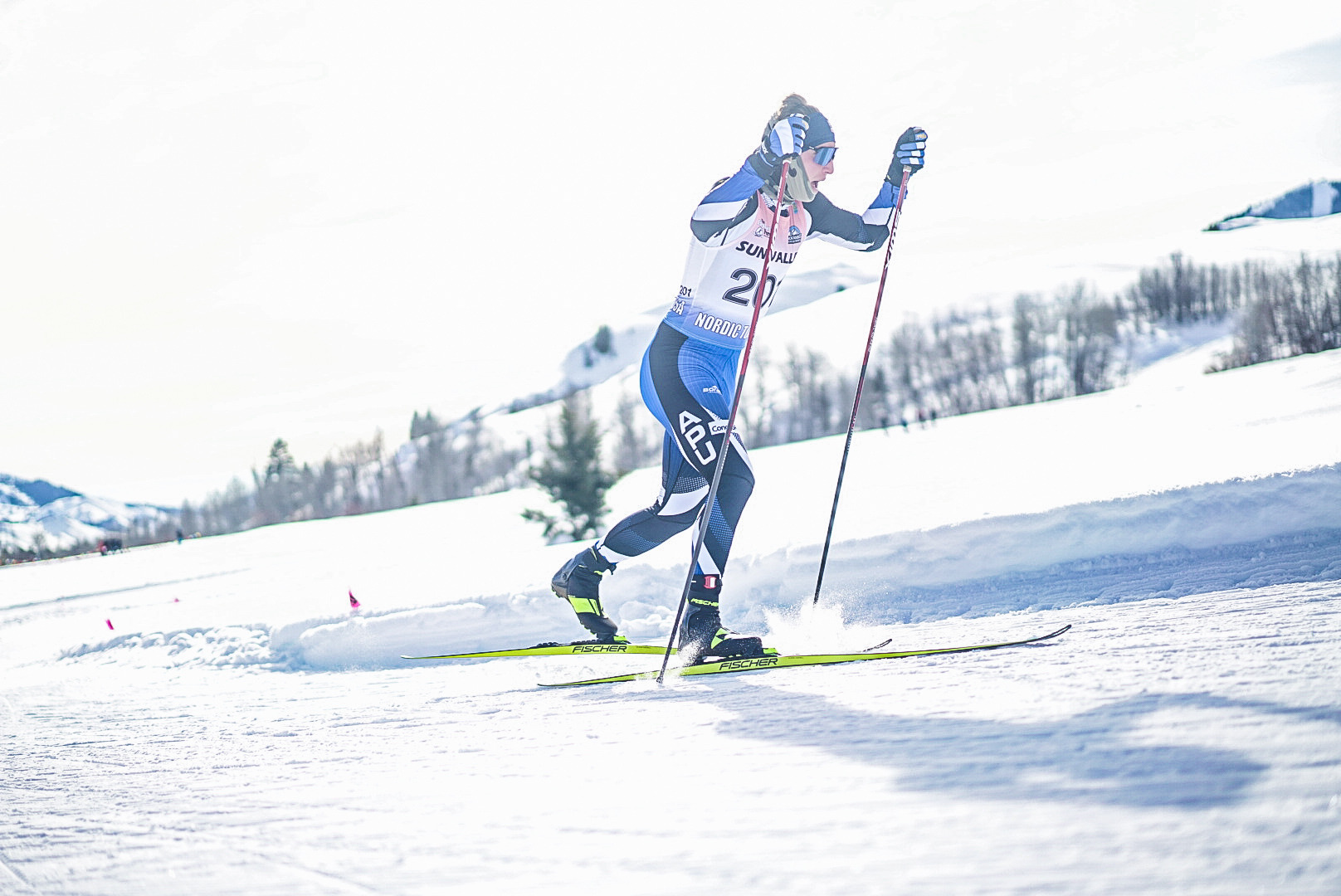
An athlete races the 10k interval start free on the Lake Creek trails in Ketchum, ID. (Photo: Tobias Albrigtsen / @untraceableg)
As the World Cup events in Les Rousse, France and Planica, Slovenia were both cancelled due to rapidly increasing coronavirus caseloads with the omicron variant, several athletes who might have headed back to the World Cup for these events found their way to Sun Valley instead, meaning fields were more in line with the U.S. Cross Country Championships than a typical SuperTour.
On the women’s start list for the 5-kilometer individual start skate, which kicked off the weekend of distance racing, were six women who have spent at least part of their season racing on the World Cup: Rosie Brennan (USST/APU), Caitlin Patterson (CGRP), Katharine Ogden (USST/SMS T2), and three University of Utah athletes who are also members of the U.S. Ski Team, Sophia Laukli, Novie McCabe, and Sydney Palmer-Leger.
Likewise, the men’s 10k field included seven World Cup athletes: David Norris (APU), JC Schoonmaker (USST/UAA), Scott Patterson (USST/APU), Hunter Wonders (USST/APU), Zanden McMullen (USST/APU), Luke Jager (USST/U of Utah), and Zak Ketterson (Team Birkie).
Given Ketchum’s elevation of roughly 5,950’, approximately the same as the courses in Soldier Hollow, Utah and those Olympic team members will face in Ziangjiakou in February, the events provided another opportunity to spend time training at the elevation and to hone their approach to racing at altitude. Overnight lows in the single digits meant cold air and snow temps at the start of the women’s race, another important similarity to forecasted Olympic conditions.
According to co-chief of competition Kelley (Sinnott) Yeates, livestream was not available during the Sun Valley Nordic Invitational due to connectivity issues along the courses. As such, FasterSkier’s reporting this weekend is based on live timing and the feedback of those on-site.
Of the course, Sun Valley native Johnny Hagenbuch provided insight into the 5km loop that was raced today in an email to FasterSkier: “The new courses at Lake Creek are very difficult: they essentially removed all the flat from the old course and replaced it with the biggest climb at Lake Creek.”
Senior Women’s 5k Free:
Without the ability to view the race and no intermediate splits in the live timing, the women’s race results left little room for suspense. Given her dominant performance in the 20k skate during the U.S. Cross Country Championships, it was no surprise to see Rosie Brennan’s name top the list. Brennan smashed the 5k loop, finishing in 14:28.6, a full 48.6 seconds faster than the next woman.
Rosie Brennan enjoys a wintery training day before the weekend of World Cup racing in Davos, SUI. (Photo: NordicFocus)
“I decided to come to Sun Valley after the World Cups in France were canceled,” Brennan wrote to FasterSkier in a post-race email. “My coach, Erik Flora, has been up here all week with the rest of my APU teammates, so it made sense for me to come here to be able to work with my coach and teammates. That has been the total silver lining of the World Cups being canceled. Erik is not allowed to come to the Olympics, but is my personal coach and someone who I trust and value immensely, so getting this extra week to work on things with him has been such a welcome surprise.”
Now several weeks into an extended altitude block, Brennan has been training near her childhood home in Park City, UT. The races in Soldier Hollow put her back on familiar tracks with hometown advantage, and the nostalgia continued today.
“It has been a full circle moment for me this weekend as I spent many years racing JN Qualifiers in Sun Valley growing up, so to be back here doing so now as I prepare for the Olympics has brought back all kinds of memories from my whole ski career. My high school and college coach were also out there today cheering and it’s been really special to have this extra time in the U.S. to share moments with people like that who have helped in getting me to where I am today.”
Brennan had originally planned to rejoin the U.S. Team in Europe, but following the cancellations of the two remaining World Cups before the Olympics, has shifted her plans to limit her risk of covid exposure, as a positive test might jeopardize her ability to travel to China, regardless of the severity of her case.
“With travel being risky on all kinds of levels today, I decided to just stay put after the World Cup cancellations and make the most of the training opportunities I have here in the U.S. before heading to Beijing. This weekend is serving as a replacement for the races I would have done in France and also another opportunity to test my limits at altitude. We just incorporated the races into a little intensity block to get my engine running again after a good volume block.”
Rosie Brennan logs hours on home trails during an extended altitude camp near Park City, UT. (Photo: Instagram @rosiewbrennan)
Speaking to her feelings holistically as she prepares for the Olympics, entering the Games on the heels of a career-best 2020/21 season with a host of early-season indicators that she can be a medal contender, Brennan spoke to the stress athletes face amidst the pandemic, which has added layers of complexity in traveling to Beijing and entering the Olympic bubble.
“It’s definitely a stressful lead up to the Games with COVID raging everywhere, a multitude of requirements and things that need to get done to be allowed into China, and figuring out all the details of being prepared for such a long travel to a very foreign country with lots of restrictions. I am doing my best to just stay on top of all the requirements, stay far away from everyone I can, and chip away at the things I need to be prepared for. The training at home has been great and having a coach to work with is so helpful, so from an actual racing perspective, I am feeling good and optimistic. I feel very lucky to have a home base in Park City and that the venues in the area provide good preparation for the Games.”
Sophia Laukli races to second overall and finishes the top collegiate racer in the women’s 5k interval start free in Ketchum, ID. (Photo: Instagram @utahskiteam)
Recovered from racing the Tour de Ski, where both women notched top-10 finishes on the hill climb, Sophia Laukli (USST/U of Utah) took second place (+48.6) today, with Novie McCabe four seconds behind in third (+52.6). Katharine Ogden (USST/SMS T2) was fourth (+52.0) for the women, with Rosie Frankowski (APU) next (+59.8) to round out the top-five.
With their top-three overall finishes, Laukli and McCabe also took home top results in the collegiate standings on behalf of the University of Utah. With teammate Sydney Palmer-Leger in 7th overall (+1:32.5), the Ute’s swept the RMISA podium.
“Today was definitely quite the race,” wrote Laukli after the race. “I was really looking forward to it since I love 5k skates, and courses with lots of climbing. I was also excited to get back into racing after the tour, especially on the domestic circuit which I was starting to miss. I was very happy with how the race ended up today, and it was actually a bit of a surprise (results-wise) just based on how I felt during it. I know I was not alone by getting rather cold out on course, but it felt like quite the shock to the system and difficult to get in a good groove—sometimes that will happen though! While it was probably one of the hardest 5ks I’ve ever done, it’s an awesome course and I just had fun getting back into racing after a short break.”
Commenting on her recovery post-Tour de Ski and her goals over the next couple of months, Laukli continued, “I took the past couple weeks very easy in my training, with minimal intensity, to recover from the tour. I wanted to take advantage of that racing block to really get into my best racing shape so taking a step back in training right after was important. The rest of the season is still a bit up in the air, but I know these races at altitude will be great preparation if I do end up at the Olympics. Either way, I’m planning to continue doing some college races and hopefully NCAAs, so these races will be good prep for that as well.”
With Sophia Laukli and Novie McCabe also taking second and third on the overall podium, Sydney Palmer-Leger brought the Ute’s home for a collegiate podium sweep. (Photo: Instagram @utahskiteam)
Other noteworthy results include the retired, but nevertheless still a contender, Caitlin Gregg, who hopped into the race while still serving as a co-head coach of the Midwest’s Team Birkie. Gregg finished in 8th (+1:37.5), just ahead of the day’s top Craftsbury skier, Alexandra Lawson.
Also, Caitlin Patterson, who earned a spot on the podium in each of the events at the U.S. Cross Country Championships and SuperTour in Soldier Hollow, finished 17th, nearly two minutes behind Brennan. In a post-race Instagram story, Patterson wrote that she had been very cold during the race with numb legs and toes, which left her feeling like a “floppy fish popsicle.” Despite finishing below where she was perhaps aiming, Patterson remains in second place behind Frankowski in the SuperTour overall standings, and in second behind Brennan in the Olympic qualification rankings for distance racing.
Senior Men’s 10k Free:
The men’s field would race the same lap the women did, but twice. That meant there was a time checkpoint at the halfway mark to indicate how the race was shaping up, yielding interesting insights into just how tight a spread the top of US men’s skiing is right now. With World Cup athletes, elite-level domestic racers, and top collegiate skiers from the West, there were plenty of names to watch.
Ian Torchia (SMS T2) leads Sam Hendry (U of Utah) during the SuperTour 10k individual start in Ketchum, ID. (Photo: Tobias Albrigtsen / @untraceableg)
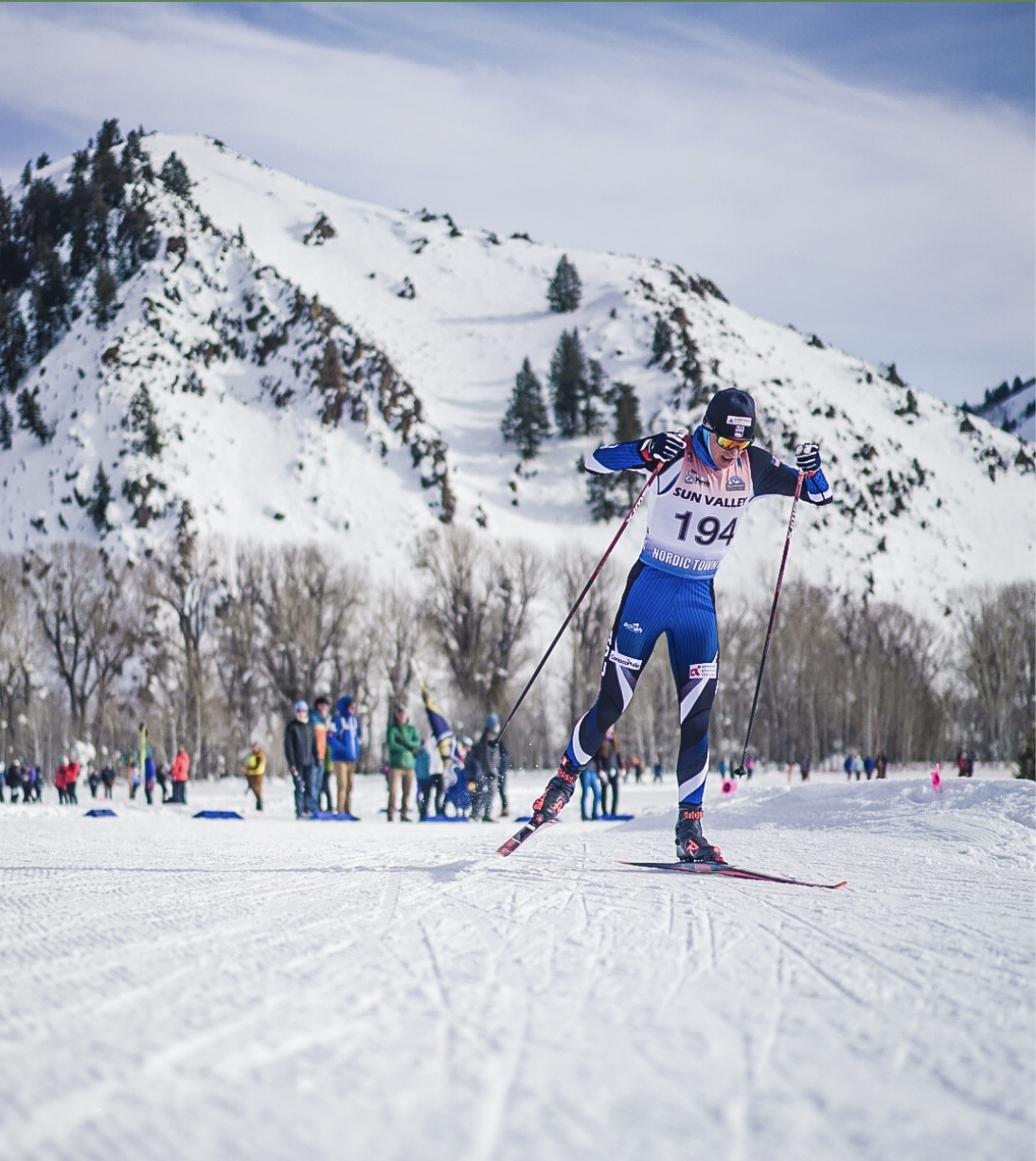
An Aspen, CO native and no stranger to altitude, Graham Houtsma (BSF Pro) was early off the line as the second starter in bib 172. Houtsma came across the 5km split as the early leader at 13:30.3. His mark would look to be the point around which the top of the field clustered for the first part of the race. Then, Scott Patterson (USST/APU) came through in bib 194 and raised the bar. His split topped Housma by a full 30 seconds (13:00.2), and would be chased as the remainder of top-seeded athletes lapped through.
Before diving into that group, however, a caveat. A couple of the top skiers today weren’t assigned splits at all in the live timing, including overall SuperTour leader Adam Martin (CGRP), Johnny Hagenbuch (USST/SVSEF), and top-collegiate finisher, Bernhard Flaschberger (U of Denver). That gave an incomplete picture of what the race looked like through one lap, setting the stage for a few surprises in the eventual final results.
Scott Patterson skis to fifth in the 10k individual start free in Sun Valley. (Photo: Tobias Albrigtsen / @untraceableg)
So what did we know through 5km? If you were just observing, you would have seen Patterson overtaken by one, and only one, skier. Teammate Hunter Wonders (APU) completed the first lap of the course 3 seconds ahead of Patterson at 12:57.9. The field that had splits looked to be shaping up into a tight affair, with the top 5 skiers all within 15 seconds of each other. That included Wonders in the lead (12:57.9), with Patterson next (+2.3), Ian Torchia third (+8.5) seconds, David Norris (APU) in fourth (+10.0), and Finn O’Connell (BSF Pro) in fifth (+12.1). Based on eventual results, it is safe to assume that Hagenbuch, Flaschberger, and Martin all went through in the 13:00 min pack too.
At the finish, Wonders would cross the line in first place at 26:28.7, and slightly increase his lead over the pack in the second lap. Over Torchia, it had grown to 8.5 seconds, and Patterson 20.9 seconds. But it would be the skiers of the “mystery 5k” splits that really made a difference in defining today’s results. Hagenbuch came in soon after Wonders, and crossed the line in 26:15.4. It would prove to be a mark no one could top on the day. Bernard Flaschberger too, would slotted himself into the top of the pack – finishing less than a second ahead of Ian Torchia to claim 3rd.
The top 5 of the final results then, looked finished like this: Johnny Hagenbuch with the win in 26:15.4, Hunter Wonders in second (+13.3), Bernhard Flaschberger in third (+27.0), Ian Torchia in fourth (+27.5), and Scott Patterson fifth (+34.2).
The men’s podium of the SuperTour 10k individual start skate in Sun Valley, including the top-six athletes. (Photo: Tobias Albrigtsen / @untraceableg)
In an email to FasterSkier, Hagenbuch pointed to an intimate knowledge of his home course in Sun Valley as being a key to his impressive margin at the top:
“The conditions were firm and well skied-in, and it was fairly fast. I have skied a whole lot here at Lake Creek in my years, and I knew the race was going to be super hard. I think it’s important to focus on the transitions and more rolling parts of the courses at Lake Creek, as just about everyone will be suffering on the climbs. I tried to ski [with a] really big, powerful V2 on the more gradual north end of the course; the strategy for the uphills was mostly to step on and off the skis quickly.”
With his results, Hagenbuch wins his first SuperTour of the season, on his home course, to boot. Not too shabby for a Saturday morning in Ketchum. He also did so in convincing fashion, rising above a field of seasoned SuperTour athletes to claim a definitive win by a stout margin. It will also improve his 5th place overall in the SuperTour standings, replacing two 6th place finishes from early in the season at Duluth.
On his win, Hagenbuch wrote, “frankly it’s quite a relief to have done well today, as I feel I haven’t really expressed my shape to the fullest for a variety of reasons this season… I’m just taking it day-by-day, [and] it was a real treat to have so many friends and family to cheer me on at home in a field that was deeper than U.S. Nationals.”
Hunter Wonders skis to second place in the men’s 10-kilometer individual start skate race in Ketchum, ID. (Photo: Tobias Albrigtsen / @untraceableg)
Elsewhere in the SuperTour standings, Wonders’ 2nd place finish will improve his distance standing going into today from 12th overall – replacing a 4th place finish in Soldier Hollow in the 15km Classic off his point standings. Overall SuperTour leader Adam Martin finished 7th (26:57.6) on the day, while 2nd place holder JC Schoonmaker was 21st (28:04.3).
“Today was a solid effort,” Wonders wrote to FasterSkier after the race. “It’s been a while since I’ve been home to Alaska and that’s started to weigh on me this week. Leading into the racing I was low energy trying to get my feet back under me after nationals in Utah. It was a good confidence boost and a pleasant surprise when I realized I was having a good day on the course today.”
Shedding light on the course conditions for those unable to watch, Wonders continued, “It was amazing conditions for a race, not too cold with firm grooming which is always welcome. 10k is pretty short, so I knew I had to take it out hot. I was a little concerned about blowing up, but realized that the course had more recovery when you’re at race pace versus easy skiing. The high part of the course is brutal but it sets you up into a ripping decent to the finish. Overall, it was a great day and I’m happy with my racing and thankful for my teammates keeping my spirits up this week and the coaches hooking me up with some great skis.”
In the RMISA collegiate standings, the Utes again had a strong podium showing. With Flaschberger taking the win for Denver, Walker Hall (U of Utah) Sam Hendry (U of Utah) skied into the next two collegiate spots to solidify the overall lead for Utah this weekend.
The RMISA men’s podium of the 10k interval start classic in Sun Valley: Bernhard Flaschberger took the win for the University of Denver, ahead of Utah’s Walker Hall in second and Sam Hendry in third. (Photo: Tobias Albrigtsen / @untraceableg)
Last year, in an effort to create a standardized workout that could be easily replicated and repeated, national team coaches presented the concept of the “U.S. Pace Project.” The concept is straightforward: a shift away from time-based intervals to distance-based, centered around repeated laps of a 5-kilometer course.
This familiar distance is key. In a call in July, Matt Whitcomb, U.S. Ski Team Head Coach, and one of the creators of the project explained that: “5k is essentially the building block of just about every race we ever do. It’s a very tangible distance that everybody knows right from childhood.”
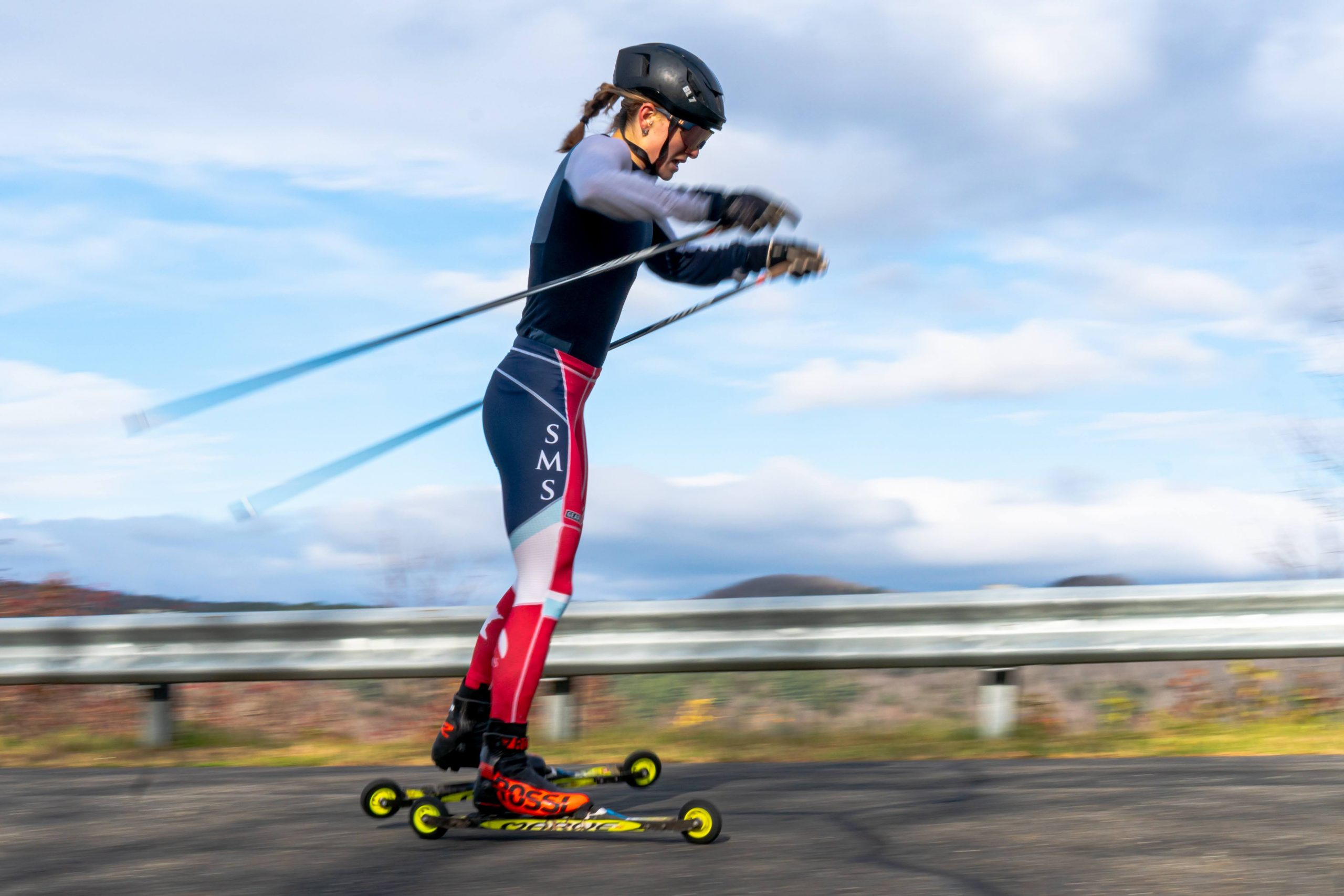
Jessie Diggins races the Keys to the Castle Rollerski Race in Lake Placid. (Photo: Matt Whitcomb)
Whitcomb continued that while the session itself is not revolutionary, it has provided a shared pathway for clubs to explore pacing during intensity sessions. Usually athletes will complete three rounds of the same 5k course, and repeat the workout intermittently throughout the training season to track overall progress or fine-tune pacing strategy. Given the ease of implementation, clubs of all levels nationwide can adopt the concept.
“Clubs are encouraged to find a 5 kilometer stretch of rolling road, something that can replicate race terrain as best and as safely as they can,” Whitcomb explained. “If it’s on a rollerski track, that’s even better.”
As the training year progresses, so does the nature of the Pace Project. “This is a workout that is meant to build in intensity throughout the year, but also in creativity,” Whitcomb stated.
Creativity, in this context, is an ongoing experiment with pacing, fueling, technique, and effort, followed by a discussion of individual outcomes amongst the group. Essentially, the U.S. Pace Project is a personal study for athletes to find their own fastest and most efficient approach to racing.
Ian Torchia races NENSA’s Trapp Invitational Rollerski race in November, 2021. (Photo: George Forbes/SMS)
Another motive behind the project, according to Whitcomb, is to promote the sharing of insights between athletes and coaches nation-wide as they incorporate and discuss the takeaways from the Pace Project format. He explained that time-based intervals offer less concrete information to learn from, as there is more room for variation in training venue and conditions.
“[The sport] is challenged with regards to metrics,” Whitcomb said. “So this is meant to catalyze more objective feedback and learning.”
As many national team members train in Stratton, VT in the summer, SMS T2 head coach Pat O’Brien provided a look into his experience facilitating the workout with his athletes and his current takeaways.
“If you give the athletes a set distance workout, they are going to learn how to manage their energy over that distance,” O’Brien said, citing supporting research by Norwegian based Sports Science Professor Steven Seiler.
“The whole point,” O’Brien continued, “is in a training type environment, go out and play around with different [approaches]. It might not all work. It might fail. But it’s better to learn those lessons in a training environment than in a race.”
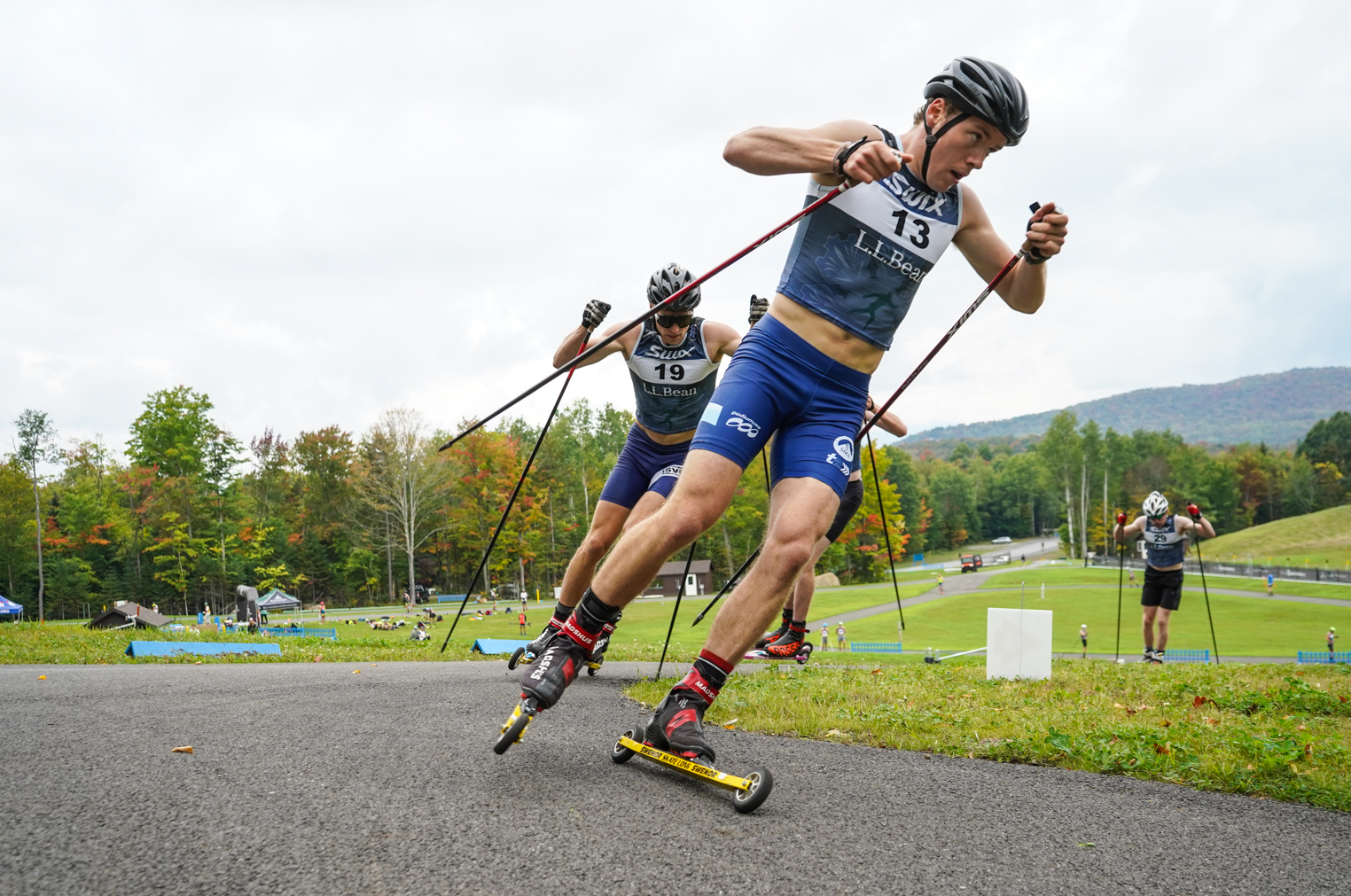
Ben Ogden (bib 13) races the Keys to the Castle Rollerski Race in Lake Placid. (Photo: Matt Whitcomb)
While a nationally shared workout is new, the project itself grew out of conversations with previous American athletes who incorporated similar workouts as a fitness benchmark.
“I think the most notable one is Kris Freeman,” O’Brien explained. “He was truly one of the best in the world at the 15k distance. He would do a repeated workout of 3x5k, and he knew if he could sustain three repeats on [a particular] 5k stretch of road, he was in good shape.”
O’Brien said that inspiration had also come from one of his mentors, Sverre Caldwell, former Nordic Director at SMS.
“Back in the early 2000s, the Stratton program had a string of successes with high schoolers going on to these great sprint results when sprinting had just started coming out,” he said. “What was interesting talking to [Caldwell] was they didn’t go out seeking to pace sprints. He wanted to make his athletes stronger and tougher, so he devised a double pole test.”
The test involved double poling up a specific hill, which happened to take high schoolers like Andy Newell about three minutes. “It was not intentional, but they got good at figuring out how to go up that hill as best they could for about three minutes, which happened to be about how long a sprint was. They didn’t go out with the intention of being great sprinters, but if you give the athletes a set distance workout, they are going to learn how to manage their energy over [that distance].”
These ideas have fused into the Pace Project. Still in its infancy, it remains an elastic concept meant to help American skiing in a number of ways. Part nationally shared workout, part personal experimentation project, part data gathering opportunity, there are many objectives at play.
“The pacing project is an idea where if we subject ourselves to all these different stimuli, we can be more flexible,” O’Brien said. “The point is, we’re always going between environments, and we’re always trying to get athletes better at finding what their red line is, so to speak.”
Bill Harmeyer and Ian Torchia lead the charge during a fall training session. (Photo: George Forbes/SMS)
O’Brien explained that coaches had been seeking a way to reap the benefits of racing without the physiological toll they require.
“How can we construct workouts that challenge you in a similar way to what you experience in a race without the same cost?” he asked rhetorically.
The Pace Project seems to be filling this gap, by offering athletes a chance to experiment with novel pacing strategies outside of a race environment.
“I don’t care if someone goes into it too hard and blows up,” said O’Brien. “We’re not looking for an objective time, It’s about how athletes pace themselves.”
O’Brien stressed that the key to the pace project lies in athletes figuring out what works best for them, both in what technique they use on specific sections of the course, and for overall pacing.
“Every athlete has a style,” he said, “a way they want to move. [It’s] not ‘you should do this because it works for you.’ I think that’s how we unlock our athletes’ best potential.”
The Pace Project has received favorable reviews from athletes and coaches beyond the SMS T2 team. The SVSEF Gold team in Sun Valley, Idaho use their 1.2k rollerski trail for pace sessions according to Head Coach Chris Mallory.
“This workout basically brings a little more focus to threshold workouts,” wrote Mallory in an email. “Athletes can play around with different pacing strategies, whether it’s starting more conservatively, using different techniques, or skiing different parts of terrain harder or easier to see what works best for them… It’s nice to have something that’s repeatable, where you can measure progress.”
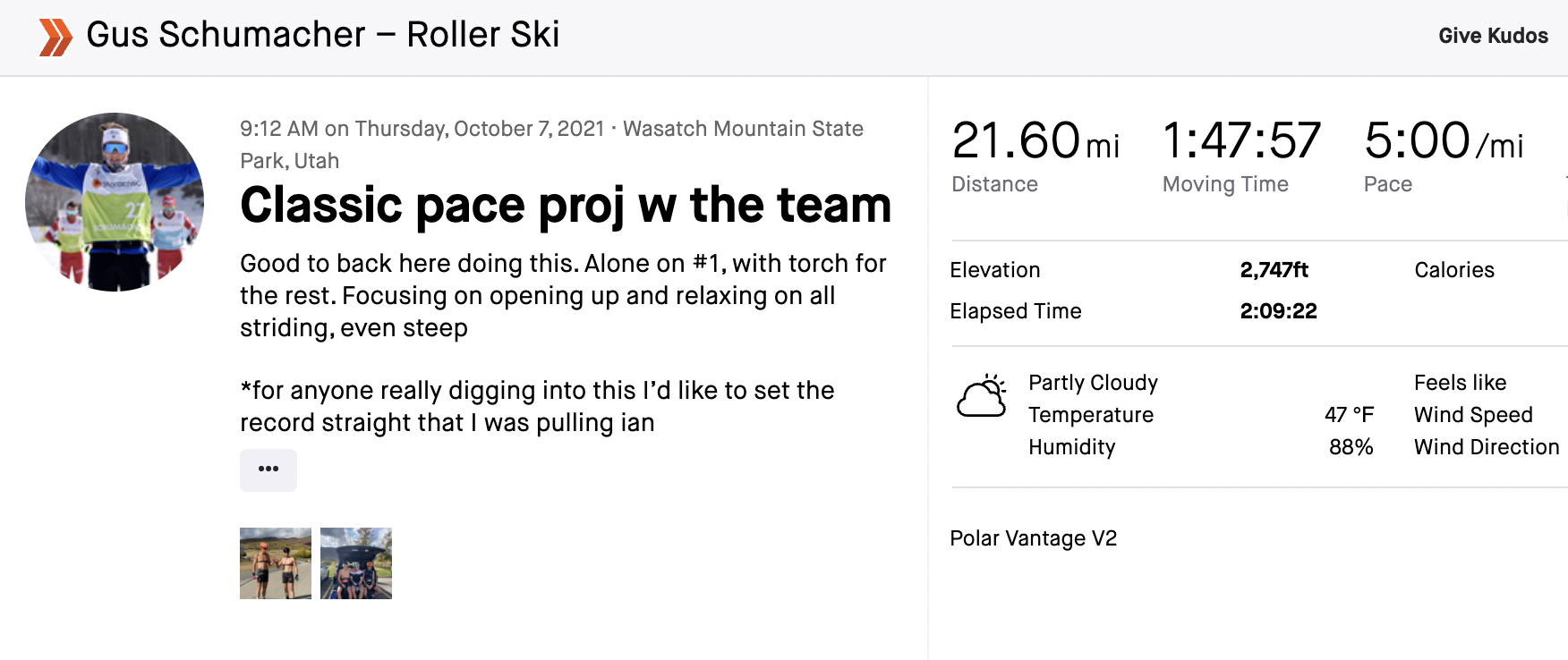
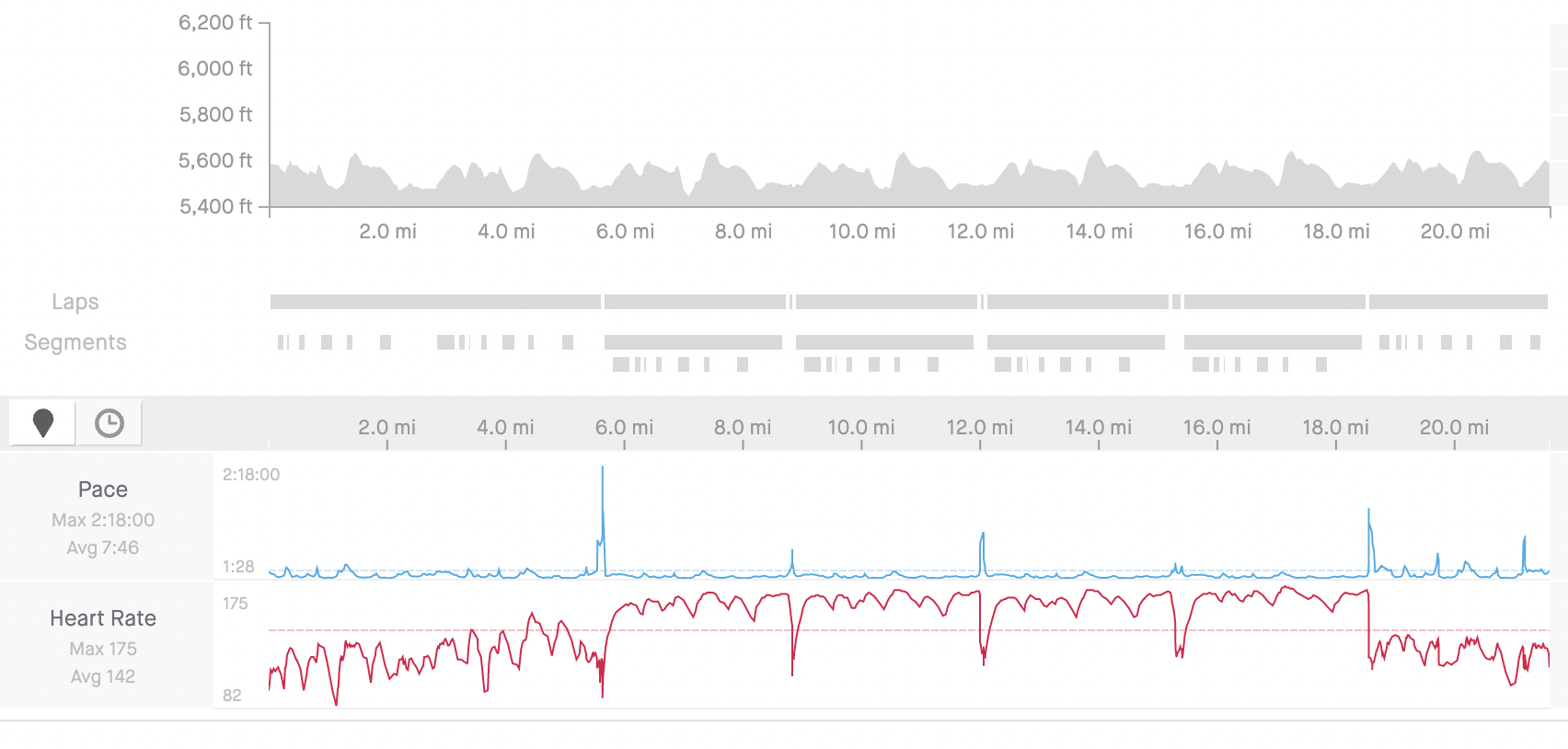
Strava users who follow some of the top domestic skiers may have seen some of them completing these workouts, like this example of Gus Schumacher’s October iteration. Schumacher explained in an email the role the workout has played in his summer training this season:
“[The Pace Project] is a cool format because it allows for a lot of different strategies, similar to racing. Usually in the earlier summer we’ll use it as a way to get L3 while lapping a track with similar features to a race course. Later however, like at our camp in Park City, it was fun to use it as almost a race simulation.”
Gus Schumacher completes a 4 x 5k pace project session during a fall training camp in Soldier Hollow. (Photo: Strava)
Schumacher described one of his sessions in October: “I started the first 2 minutes hard like I would in a mass start,” he wrote. “After that I eased back to a sustainable pace, then in the last one I finished hard. This made it feel a lot like a race without the same cost (because of 3 minute rest between each interval). Breaking it up into segments also allows us to change our strategy more from lap to lap, which can help with testing new pacing strategies, especially at altitude.”
Reflecting on the outcomes for coaches, Whitcomb said that he was pleased with how the Pace Project sessions had increased the conversations between athletes.
“What we’ve observed is that there’s more interesting discussion before and after these sessions, than there is for just your standard threshold interval workouts.”
Over the summer, Whitcomb stopped by Stratton during a SMS T2 pace session and remarked on the depth, variety, and value of the subsequent conversations.
“Of the ten athletes that were there that day, there were ten different approaches to this workout, because Bill Harmeyer is setting his sights on one specific goal on that day, and Jessie Diggins on perhaps another goal, and everybody’s learning and discussing and crowdsourcing ideas effectively.”
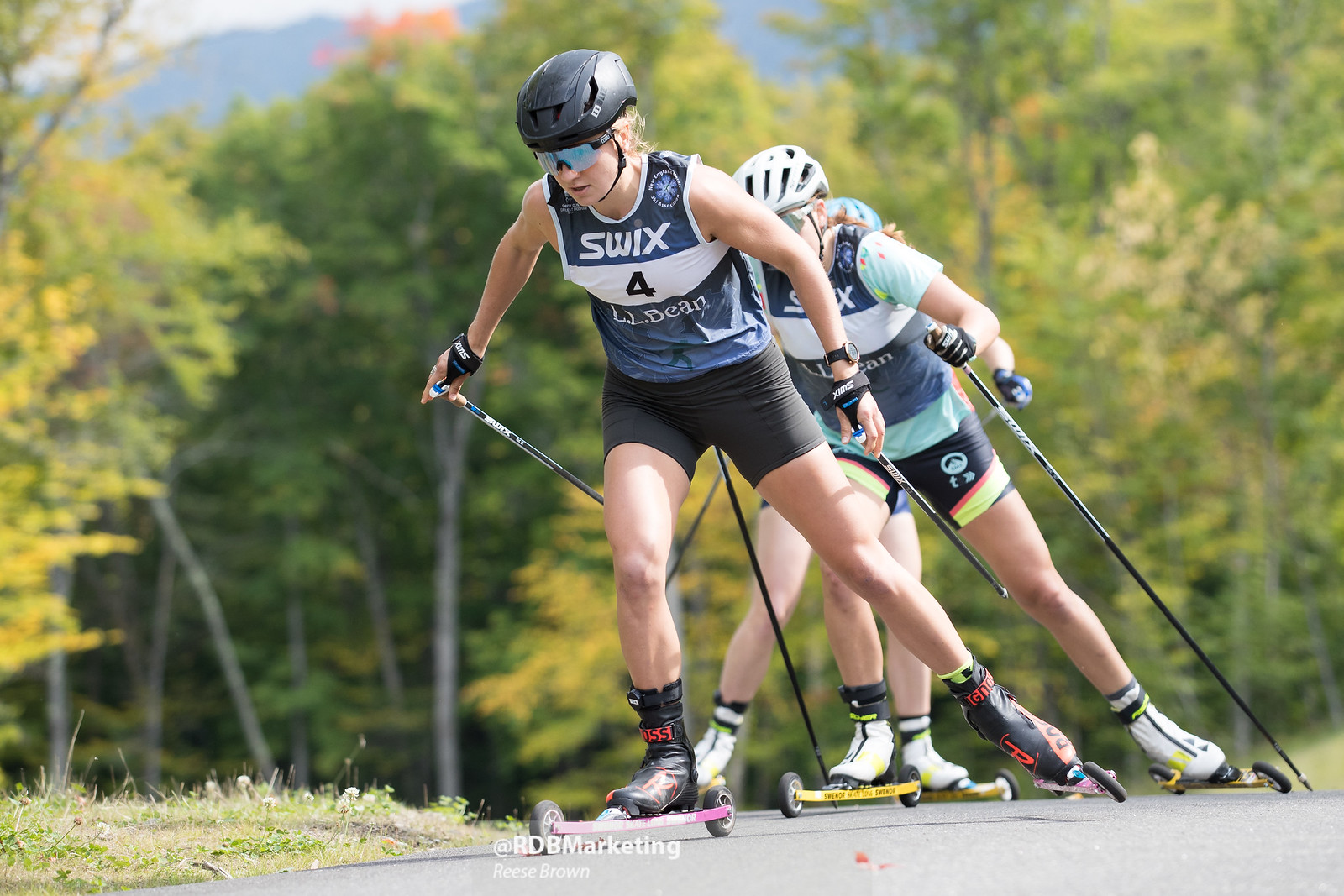
Alayna Sonnesyn pushes the pace in a fall training session. (Photo: George Forbes/SMS)
While the value of the project lies in its idiosyncratic freedom, the aim is competitiveness.
“Hopefully,” Sun Valley’s Mallory suggested, “it helps our nation to continue to make progress in distance racing.”
Precipitation was no longer a threat for the final day of racing in Soldier Hollow on Friday, a 1.5-kilometer classic sprint offered alongside the 2022 U.S. Cross Country Championships, yet classified as SuperTour only. However, athletes still faced unseasonably warm weather as blazing sun brought temperatures into the low 50’s on course during the midday heats.
Howling wind and rippling bibs could be heard as background noise as Adam Verrier called the event on the livestream, creating extra work for the athletes who would fight through degrading course conditions throughout the heats. This extra work showed in the times on course; with the combination of freestyle technique and significantly faster course conditions, Sunday’s sprint races featured times over a minute faster on average. A similar difference was seen even between the qualifier today at 9 a.m., when temperatures were still colder and tracks firmer, and the heats which began at 12:30 p.m.
Warm temperatures, degrading tracks, and loose granular spray set the stage for a challenging classic sprint in Soldier Hollow. (Photo: Tobias Albrigtsen / @untraceableg)
“Sprint” seemed to perhaps be a misnomer, as times in the women’s heats climbed over five minutes and were well above four minutes in the men’s heats. Combined with a qualifier, this meant athletes who raced through the final saw between 16 and 20 minutes of racing, testing their endurance and fitness differently from the average sprint event.
Women’s Race: Katharine Ogden on Top from Qualifier to Final
On the heels of a second place finish in yesterday’s 15k classic, Katharine Ogden (USST/SMS T2) set the bar in the qualifier, finishing in 3:51.79.
Julia Richter (U of Utah) was the second fastest qualifier (+0.77), ahead of Lauren Jortberg (BSF Pro) in third (+1.48). Both Ogden and Jortberg won their quarterfinal to advance comfortably into the semis, however, Richter took fifth in Heat 4 and did not advance.
In the first semifinal, two Craftsbury teammates Annika Landis and Caitlin Patterson led the way in the opening climb, with Ogden and Sydney Palmer-Leger (USST/U of Utah) sitting in third and fourth a few strides behind. Descending from the high point, a third Craftsbury racer, Michaela Keller-Miller, had pulled to the front, but was quickly overtaken by Patterson and Ogden as the pack headed into the final short herringbone climb before the long descent toward the stadium. Patterson and Ogden sat in low tucks, letting their fast skis glide as long as possible before transitioning to doublepole as they headed over the bridge and into the finish.
Sydney Palmer-Leger heads out for the 10k interval start classic race during the 2022 U.S. Cross Country Championships in Soldier Hollow. (Photo: John McColgan)
Upping the power in the final 200m, Palmer-Leger accelerated to make contact with Patterson as the women crossed over the bridge, but Patterson had better glide in the quick descent from the bridge’s exit, maintaining an advantage as they headed into the final stretch. Patterson tucked in on the tails of Ogden in the left-most track to go one-two in the heat, with Palmer-Leger not quite in the fight for an automatic qualifier spot finishing 1.5 seconds behind Patterson in third.
In the second semi, Bridger Ski Foundation (BSF) Pro Team members, Lauren Jortberg and Hannah Rudd lead the charging, looking as if their skis were gliding well as they pushed the downhills, perhaps with compromised kick as both showed signs of slipping in the final punchy climb.
In the long glideout, Lauren Jortberg moved from the far left side of the course outside of the track into the second track, losing some time on Rudd who had stuck with the second track from the start. Nevertheless, both held a significant gap over the remainder of the heat as they doublepoled over the bridge and into the finish lanes. Rudd took the win in 4:55.52, roughly +0.7 seconds ahead of Jortberg in second.
A few meters behind, Craftsbury teammates Margie Freed and Alexandra Lawson raced side by side to third and fourth, and as the heat proved to be seven seconds faster on average than the first, both advanced to the final.
As the women’s final headed out of the stadium and toward the first climb, Lauren Jortberg who was the first in a train of two BSF skiers, had her ski stepped on as she was switching from doublepole to a run outside the track. This caused Jortberg to stand up, spin sideways and crash in slow motion. Rudd, who was just behind, quickly moved around Jortberg without going down, soon taking the lead charging up to top of the first climb with Patterson, Freed, and Ogden close behind.
Patterson looked strong with solid kick as she chased a slipping Rudd up and over the final long climb, but it was Ogden on fast skis who quickly moved into second on the subsequent downhill.
Over the last punchy climb the women ran. Heading into the long glideout, Ogden was off the front in the left-most track, but Rudd and Patterson remained within reach a few ski lengths behind. Descending off the bridge, the top three accordioned together, all choosing the same track with Ogden confidently leading the way to the finish. Patterson, who was in third, moved into her own lane to the right, slowly gaining ground on Rudd as they headed to the line.
Katharine Ogden leads Caitlin Patterson and Hannah Rudd to the line during the SuperTour classic sprints in Soldier Hollow. (Photo: Livestream Screenshot)
Ogden maintained her lead to stop the clock in 5:01.63, while Patterson edged out Rudd for second (+0.98) and third (+1.53), respectively. After regaining contact with the pack following her crash, Jortberg finished fourth (+6.64), with Lawson fifth (+7.11), and Freed sixth (+21.55).
“I was having a lot of fun out there today!” Ogden wrote to FasterSkier after the race. “The sprint was definitely on the long side, especially late in the day, but that did not significantly affect my strategy; I am confident in my endurance as well as my short duration power. I was really excited to have fast skis from Pat [O’Brien] and it was fun to experience the high level of sprinting in the U.S. currently. I also haven’t really done a full sprint day in a while so that was a lot of fun! It was also so impressive to see Caitlin get her fourth podium in as many races and to see Hannah Rudd have an incredible breakout performance today!”
Katharine Ogden celebrates her win in the classic sprint while Caitlin Patterson edges out Hannah Rudd for second and third. (Photo: Livestream Screenshot)
In a post-race email, Patterson reflected on her experience racing through the heats.
“My racing today went fairly well, and it was a beautiful day to be out skiing and spectating,” wrote Patterson. “The sun-warmed snow became quite wet and broken apart for the heats, and combined with the wind, it certainly made a long sprint with plenty of herringbone and some sloppy tracks. I tried not to really think about the time duration much, it was mostly about getting from start to finish, however long it would take. All of the heats required some scrappy skiing, moving around through the slush and timing the length of the tuck. Now I’m really looking forward to some recovery after a good week!”
Patterson also spoke to the week of racing in Soldier Hollow, where she finished on the podium four times in as many races, including wins in both the 10k individual classic and the skate sprint. But she was not the only person in a green suit putting together a successful week. Yesterday, she shared the distance classic podium with teammate Adam Martin. On Tuesday, Crafstbury went 3-4-5 in the 20k skate, with Lawson and Freed leading a chase group behind Frankowski and Patterson. And today, five CGRP women raced in the semis, with three advancing to the final.
“Everyone at Nationals is really feeling the fatigue, and myself and my team were no exception out there today. The race coughs are becoming quite terrible from so many days of racing at altitude, which is not the most fun to be coughing uncontrollably in this time of COVID. However, I was really proud of our whole team, with 5 women in the top 10! We have a really strong group, as evidenced by the performances in the distance races too; it came as no surprise to me that the women were awesome today, because training and doing intervals all summer and fall we’ve been neck-in-neck and pushing each other.”
The women of Craftsbury with coach Pepa Miloucheva. CGRP put five women into the semifinal and three into the final of the SuperTour classic sprint in Soldier Hollow. (Photo: Facebook Crafsbury Green Racing Project)
For Rudd, this was her first career SuperTour podium. Originally from Plymouth, MN, she graduated from University of Alaska Anchorage (UAA) in May, 2020 before heading to Bozeman to join the newly minted BSF Pro Team. Placing in the top-10 in each of the three stages of the 2022 U.S. Cross Country Championships, Rudd has steadily worked her way up the results list, finishing 10th in Sunday’s freestyle sprint, 8th in the 20k mass start free, and 6th in the 10k interval start classic. She ends her week in Soldier Hollow on a podium high note.
Hannah Rudd is a member of the BSF Pro Team based in Bozeman, MT. (Photo: bridgerskifoundation.org)
“Yesterday was a pretty exciting day for me!,” Rudd wrote to FasterSkier after the race. “The sprint course at Soldier Hollow this year was very challenging as it included three solid climbs. During the qualifier, the course remained very firm and fast. However, the temperature quickly began to rise throughout the day, and by the time the quarterfinals began, the sun was baking the course, the wind was blowing, and temps were nearing 50 degrees. This made the snow begin to transform and slow down and turned the tracks into mashed potatoes in some sections.
“I woke up in the morning feeling quite tired from the past week of racing so I was not sure how the day was going to play out,” Rudd continued. “I ended up qualifying in 22nd, so it was clear that I had some work to do in the heats. I felt like I was able to gain momentum and energy throughout the day, and progressed through the quarters, and semis and onto the final. Going into the final, I knew that my team’s skis were running really well so I tried to ski big and relaxed and put myself in a good position for the last downhill. It was pretty neat to be in a final with my BSF teammate Lauren Jortberg, who is an incredible sprinter and someone that I have learned a lot about sprint racing from over the past few years. I was extremely excited to land myself a spot on the podium and think it will help me to continue building momentum and confidence for the rest of the season!”
The podium ceremony for the women’s final following the SuperTour classic sprint in Soldier Hollow. Katharine Ogden took the win ahead of Caitlin Patterson and Hannah Rudd, with Lauren Jortberg 4th, Alexandra Lawson 5th, and Margie Freed 6th. (Photo: Facebook Craftsbury Green Racing Project)
Men’s Race: Colorado’s Magnus Bøe Upsets Schoonmaker in the Final
In qualifying, JC Schoonmaker (USST/UAA) showed why he has been the U.S. Ski Team’s most reliable fixture of World Cup Classic heats this season, winning the qualifying with a time of 3:08.43, 6.42 seconds ahead of 2nd place Peter Holmes (Sun Valley SEF). Andreas Kirkeng (University of Denver) rounded out the top 3 (+6.57), in a field where the top 30 were all within 20 seconds of each other.
With a dominant performance in qualification, the racing throughout the day always seemed to have one eye on where Schoonmaker was in the field. In his quarterfinal, Schoonmaker looked to start conservatively from the back of the field, which led the whole heat to sit back as well. When he moved to the front at the beginning of the first climb, the race surged forward with him. No one could match him, however, and he finished with a comfortable lead, with Kjetil Bånerud (NMU) taking the 2nd semifinal spot (+1.02).
JC Schoonmaker prepares for a sunny and warm classic sprint in Soldier Hollow. (Photo: Tobias Albrigtsen / @untraceableg)
The following two quarterfinals also previewed the competitors, and their preferred way of attacking the course, that would define the semifinal and final racing later on.
The second heat set a stark contrast in pace to the previous heat, with Noel Keefe (U of Utah) and Bill Harmeyer (SMS T2) leading the field out hard from the gun. Hunter Wonders (APU) and Johnny Hagenbuch (SVSEF) were able to keep with the pair though, and ended up out-sprinting Keefe and Harmeyer going into the finish. Still, the duel between Keefe and Harmeyer led to a blistering pace for the heat overall, and they would claim the lucky loser spots for the semifinals.
Then came the 3rd quarterfinal, featuring winner of today’s most aggressive racer award (unofficially handed out here, by Fasterskier), Ian Torchia (SMS T2), who in every heat he was in today would hammer out to the front of the pack while others seemed content to let the field play out. He was joined in the heat by Magnus Bøe (U of Colo.), who made his move on the first climb, stayed out in front, and came through in first place. Torchia, meanwhile, held onto second to advance automatically to the semifinal.
The semifinals marked more an amalgamation of race strategies than anything unique. But it was an amalgamation – which requires multiple parts. And indeed, on a course known for rewarding smart-racing, and in conditions – above freezing, on man-made, wind-swept snow – that reward smart waxing as well.
Magnus Bøe and JC Schoonmaker are off the line during the 2022 U.S. Cross Country Championships freestyle sprint stage. (Photo: Tobias Albrigtsen / @untraceableg)
The first semifinal featured Schoonmaker and Bøe, both of which stayed back in the back during the early part of the course. Going into the first climb, Bøe took a look back, saw Schoonmaker and Harmeyer were sitting in fifth and sixth place, respectively, and decided to attack. He led over the top, into the downhill, and up the final climb. Schoonmaker successfully did maneuver through the pack to counter the move, and on the final climb took the outside line up, cutting in to tuck behind Bøe going into the final downhill. When they came up, Schoonmaker had used the draft to put himself out front, while Bøe held off a late-surge from Hunter Wonders (APU) to take the second qualifying spot into the finals.
The second semifinal was again led out by Ian Torchia, who was then followed by former sprint National Champion Tyler Kornfield (APU). Kornfield seemed content to sit behind Torchia until the first climb, when he put in a burst of speed and broke open the field. The smartest racer, however, may have been Karl Schulz (SVSEF), who rode Kornfield’s attack, and then drafted, to go into the final climb with speed. By the time he hit the downhill, he had a gap which would remain unclosed. Kornfield, who had gone into the downhill in second, found himself joined by Noel Keefe and Ian Torchia into the final sprint for the second spot. As it would happen, all three would make it through to the finals, with Kornfield in second, and Keefe and Torchia being rewarded for their efforts early in the race by claiming the two lucky loser spots to the final.
The A-final then looked like this: JC Schoonmaker, Magnus Bøe, Karl Schulz, Tyler Kornfield, Noel Keefe, and Ian Torchia.
JC Schoonmaker races the qualifier during the SuperTour classic sprints in Soldier Hollow, UT. (Photo: Tobias Albrigtsen / @untraceableg)
With memories of Schoonmaker’s dominating qualifier in mind, it seemed like the field orbited around him off the line. Schulz found himself in front, but not going full bore to open the field up. Even Torchia, when he did make a move to the front, didn’t seem to do so with the same force that had marked his quarter and semifinal attacks. Schoonmaker waited until the first climb to move to the front, and then the final really was on. Schultz seized on the attack, and then put an extra-push into the downhill to try and open up an unclosable gap like he had in his semifinal. It was a good move, but one that didn’t prove to have the same force as his previous attack, and going into the final climb he was joined up with Bøe and Schoonmaker.
Then, Schoonmaker’s pace seemed to drop-off, with a few noticeable slips that progressed into a herringbone. Bøe, meanwhile, went for the herringbone from the get-go. He was the one that made contact with Schulz before the course gave way to a final downhill on the day. Schultz held a gap on the field through the glideout and over the bridge, but it proved not to be enough of a margin to feel comfortable in the final stretch. Meanwhile, Schoonmaker had fallen back to fifth.
Utilizing his dominating doublepole sprint, when they hit the final 100m it was all Bøe, who closed a significant gap to catch Schulz in the final 50 meters. Looking as if he was leaping forward with each push, Bøe switched lanes, overtaking Schultz just before the line and letting out a fist pump as he realized a SuperTour – and collegiate – victory in a time of 4:08.28. Pushing to the line, Schulz was a close second (+0.35). (Video clip here.)
Magnus Bøe overtakes Karl Schultz just before the finish of the men’s classic sprint final. (Photo: Instagram @cubuffs)
After a gap, Schoonmaker, who was fighting for the final podium spot alongside Kornfield and Torchia, crossed the line outside of the track in third place (+4.53). Kornfield was a half second back from Schoonmaker for fourth (+5.10), with Torchia fifth (+5.64), and Keefe sixth (+11.02).
After the race Bøe explained that he changed his tactics in the heats relative to Sunday’s freestyle sprint, though he joked he thought it wise not to reveal everything.
“Today was a windy and slow-condition day,” Bøe wrote in an email. “There was headwind in the first half, and tailwind in the second half. Hence, pulling during the first half would be pointless. Furthermore, the second half, particularly for the last downhill there was very little to gain on the slipstream, due to the low speed and the ‘suctiony’ snow (cold conditions create better glide for the person coming behind on ‘heated tracks’). Therefore during all my heats I pretty much went all out from the top of the last uphill all the way to the finish, which on sunday would’ve been a suicide.”
Bøe walked through the final, including how he reacted to lead changes and adjusted his strategy when the race began to play out differently than anticipated.
“The final started off very slow, but then the positioning battle developed gradually from under the bridge. My main focus was to keep my eyes on JC, since he was clearly the favorite of the day, and I knew I would do well if I laid it up to beat him. Hence I never fell for the temptation of passing him, even though I had many chances of doing so. However, he did get tired during the last climb and tried to get others to pass him. This is when Karl took off and gained a massive gap that at first seemed too late to close. As soon as I realized that JC might not be able to catch up, I committed to catching Karl by myself. I made sure to put in a great push before the downhill straight, and did the ‘supertuck’ to gain every single inch I could. Once I started double poling towards the last bend it was just heads down and maximum effort. Was never certain I would catch Karl, I thought maybe he’d have something left at the very end. But lucky for me he didn’t and I had just enough to pull it off.”
University of Colorado’s Magnus Bøe heads out for the men’s 30k mass start free during the 2022 U.S. Cross Country Championships in Soldier Hollow. (Photo: Tobias Albrigtsen / @untraceableg)
A dual citizen of Korea and Norway, 23-year-old Bøe has already built a robust resume in international ski racing, including competing for Korea during the 2018 Olympics in Pyeongchang. Earlier this week, Bøe was fifth in Sunday’s freestyle sprints and finished 11th in the 15k classic. His only down race of the series happened in the 30k mass start freestyle, where he finished 43rd (+12:30.9).
“This week of racing has been up and down, from a miserable 30km where I got lapped, to today’s win. It’s been a lot of fun, and not least has been helpful for my shape. Next up is the Super Tour in Sun Valley, which I am looking forward to. Think I would be able to build on top of what I gained during this week.”
For Schultz, today also marked a career-first SuperTour podium. The 23-year-old Lake Placid, NY Native raced for the University of Vermont (UVM) until graduating in May, 2020, then heading to Sun Valley. Schultz had a podium just-miss earlier this year in a freestyle sprint where he finished fourth during the opening weekend of SuperTour racing in Duluth, MN.
“I was pretty fatigued from the three races prior,” Schultz wrote after the race. “I knew there was a decent headwind on that first climb, so I decided I’d tuck in behind up and over the first climb. I figured I’d need to save my strength for the final climb and long finishing straight, so I played my cards well and pushed where I needed to, and it just worked perfectly. I’ve learned sprinting is about preserving energy for critical parts of the course, it couldn’t have gone better.”
“And I won’t lie,” Schultz continued. “The spectators and everyone cheering allowed me to find another gear, especially up the last climb. I dug deeper than I have before.”
The men’s podium of the SuperTour 1.5k classic sprint in Soldier Hollow: Magnus Bøe took the win ahead of Karl Schultz and JC Schoonmaker. (Photo: Instagram @nysefnordic)
Writing to FasterSkier after the race, Schoonmaker explained how changing conditions forced athletes to make tough decisions about skis as well as tactics.
“It was a pretty crazy difference from this morning to the afternoon,” Schoonmaker explained. “The morning was icy and fast and the heats got really sloppy and slow. I had amazing skis in the morning and in the heats I struggled a bit with choosing whether to go for more kick or glide. I ended up asking for less kick to free the ski up a bit and I’m still not sure what was the right call. It was just really challenging conditions.”
Schoonmaker also explained that he had made fewer adjustments to the technique he had found such success with in Sunday’s skate sprint, however, the final proved to break the mold of what has historically proven to be the recipe for Soldier Hollow sprint racing.
“For this course I tried to take a somewhat similar approach as in the skate race by respecting the draft on the last downhill and trying to be careful about the guys behind me there. In the quarterfinal I felt I was able to ski away and create a big enough gap so that I couldn’t get sucked back in by the draft. In the semifinal, I tried to stay more in the pack and use the draft for myself. The final was tricky because I was going to try and use the draft again but Karl put in a really good move on the last hill that I couldn’t match. Then I was leading the rest of the pack and I decided to push over and try to catch Karl rather than go to the back to find the draft. It ended up not working out so great, but I’m happy with the day and the tough effort.”
We conclude a week of racing at Soldier Hollow, then, with a race that highlighted the strength and depth of the domestic circuit of U.S. skiing at present. Variable conditions on a technical course, which racers approached with tactics as diverse as the regions they hail from, indicated that this is a field that represents top-level racing. It was a testament to the development and growth of the sport in this country that a top-level racer like Schoonmaker can come off the World Cup and find a field where every heat is raced with closeness and intensity in his own country. That bodes well, and is a great place to leave the last national gathering of the US ski racing community before its best representatives look to take a crack at the Olympic Games in Beijing next month.
The spirit of the sport captured at the finish line as Alaska Winter Stars athlete Meredith Schwartz embraces her coach at the finish of the classic sprint in Soldier Hollow. (Photo: Tobias Albrigtsen / @untraceableg)
FasterSkier extends congratulations to all athletes who competed in Soldier Hollow this week, commending their efforts in a fiercely competitive field through a variety of race formats and course conditions. Also, a big thank you to Tobias Albrigtsen and John McColgan, who generously shared their photos with us throughout the week. Stayed tuned for an upcoming gallery highlighting many of the fantastic images that were not included in our reports.
By Gavin Kentch, Ella Hall, and Rachel Bachman Perkins
Tuesday brought distance races to Soldier Hollow, in the second full day of racing at 2022 U.S. Cross Country Championships. The story at the front of the field was strong performances by athletes who had begun the year racing on the World Cup, as Rosie Brennan dominated the women’s field to win by over a minute, and Scott Patterson took the men’s race by roughly twelve seconds.
U.S. Ski & Snowboard Development Team Coach Greta Anderson encourages athletes during the men’s 30k distance race in Soldier Hollow. (Photo: Tobias Albrigtsen / @untraceableg)
Brennan was followed by Rosie Frankowski and Caitlin Patterson. Scott Patterson was followed by David Norris and Hunter Wonders, giving APU five out of six podium spots on the day. Craftsbury athletes went 3-4-5 in the women’s race. Notably, four out of six podium finishers were on the north side of 30, with a fifth gaining Master status later this month, underscoring the lengthy developmental curve often required to achieve success in distance racing.
Women’s Race: Rosie Brennan Solos to Victory
Tuesday’s race, the women’s 20-kilometer freestyle race at 2022 U.S. Cross Country Championships, was, technically speaking, a mass start – but for Rosie Brennan, it skied more like an interval-start race. Brennan wore bib 101, at the sharp end of the chevron start in a field of 55 athletes, and led every one of 20,000 meters of the 20 k, pushing the pace right from the start and never looking back all the way through the finish line. She covered the challenging course in a speedy 53:16.9 to take her seventh national title, and first since 2015, in a dominating performance.
The race began under overcast skies and moderate temperatures. By one second into the race, Brennan (USST/APU) was in the lead. By one minute into the race, she was notably off the front, with only three athletes, Rosie Frankowski (APU), Caitlin Patterson (CGRP), and Sydney Palmer-Leger (USST/Utah) even contemplating whether to follow.
By two minutes into the race, Brennan had a sizable gap, as athletes in the Frankowski-led chase pack had decided that discretion was the better part of valor, and opted to ski their own race and focus on chasing the remaining two spots on the podium. No athletes other than Brennan would appear on screen again in the free livestream until the six-minute mark, in a wide-angle shot of the main climb up the Cabin Loop most of the way through the first lap. This is nothing against the production values of the online broadcast, which were once again superb, just a statement about how quickly Brennan distanced herself from the rest of the field.
Rosie Brennan (USST/APU) skis away with the women’s 30k mass start freestyle national title. (Photo: John McColgan)
After the first of six 3.33-kilometer laps, Brennan’s lead over the chase pack was roughly 26 seconds. After two laps, this gap had nearly doubled, to 49 seconds. The chase pack was now led by Patterson, who collected her tenth national championship earlier this week, and Frankowski, who has a 21st at the Olympics and World Cup top-30s to her name. These were not bad skiers; Brennan was simply unmatched on the day.
Over the next four laps, as the wind increased and a light snow began to fall, Brennan put on a clinic. She V2ed where others V1ed, and added a slight hop at the end of V1 strokes where others adopted a more labored V1 reflecting the tough terrain and elevation. She slowed down through the coaching zone long enough to get a full drink from her feed. She skied the downhills aggressively and took the best lines throughout. It was a 53-minute demonstration of the form and fitness that have already brought her a World Cup podium this season behind Frida Karlsson and Therese Johaug, and an additional five top-six finishes.
Brennan lapped her first skier midway through lap 4. She would ultimately lap 26 athletes in a field of 52 finishers before the end of the race, precisely half the field. In a national championship.
Brennan actually slowed slightly, or the chase pack may have sped up, as the race went on. Her gap over the Frankowski/Patterson duo was “only” 1:02 at lap 3, 1:17 at lap 4, and 1:21 at lap 5. It may have even shrunk by a fraction of a second over the final lap, as Frankowski and Patterson raced for second behind her. But the outcome was never in doubt – and barring multiple broken skis, a devastating earthquake or meteor strike, or some other truly unforeseen occurrence, the outcome was never really in doubt after the first minute of the race.
A young Rosie Brennan prepares to race at Soldier Hollow in a vintage Team Utah Nordic Alliance suit. (photo: @rosiewbrennan Instagram screenshot)
Brennan grew up skiing in Park City, starting in eighth grade, first with Team Utah Nordic Alliance, then with coach Gordon Lange at Park City Nordic. She won her first ever ski race, a Wasatch Citizens race, albeit aided by the fact that “there was only one other girl in my age group,” she told the Park City Park Record for a 2017 profile. She’s come a long way since then.
“It was so great to race at home and have my family and friends cheering me on the whole way!” Brennan wrote in a post-race email. “With COVID, even my Mom has been unable to watch me race for years so it felt really special to be able to race with a hometown crowd before heading to Beijing.”
On her approach to the race, Brennan explained the role that she hoped her effort would play in her preparation for the upcoming Olympics, concluding with her feelings about sitting out the Tour to instead join her club teammates in SoHo.
“I was feeling quite inspired after watching some great performances by the APU men this morning and that gave me faith that our fitness was high and we could grind away,” Brennan wrote. “I wanted to do my best to simulate World Cup racing so I wanted to start hard and then reassess based on what others in the field did and then ultimately keep grinding to get a long hard effort in at altitude, which we haven’t had the opportunity to do on the World Cup this year. The course we raced played into my strengths with a long gradual climb right out of the start so I felt I had to use that every lap to keep building on my strengths and do my best to work on relaxed, powerful skiing the rest of the lap. I am really happy that I had the opportunity to come home and race a long race! I think I may have lost my voice screaming Frankie into the finish as well. It was really awesome to see her dig so deep today and to have APU put in such strong performances all around today.”
Caitlin Patterson (CGRP) and Rosie Frankowski (APU) race through 20k to round out the women’s podium. (Photo: John McColgan)
Behind Brennan, Frankowski and Patterson were locked in a dogfight for second and third. The two women, age 30 and 31, respectively, have raced head-to-head frequently over the years. They have spent much of their careers in that liminal space between being some of the fastest domestic skiers and some of the slower American World Cup skiers, competing for limited start spots on the World Cup or at global championships. In the last Olympic-year National Championships, in 2018 at Kincaid, Patterson was the first American in every race; Frankowski was the 2nd and 4th American in the two distance races; ultimately both women went to Pyeongchang.
Four years later, there the two athletes were again, holding down the chase pack with potential Olympic berths on the line. Patterson, from Anchorage but now skiing for Craftsbury, is taller, with a more upright skate stance and a tempo that looks nearly languid when skiing behind Frankowski. Frankowski, from Minneapolis but now skiing for APU, is shorter, with a somewhat more hunched-over approach to attacking an uphill, and with a higher tempo. (see photo above)
The two are a study in contrasts, but their differing approaches left them evenly matched throughout Tuesday’s race, as they literally occupied the space between the top American World Cup skiers and the top domestic skiers. At the start of lap two, they were separated from one another by 1.6 seconds, skiing in a larger pack that at the time included Alexandra Lawson, Palmer-Leger, and Lina Sutro. By the start of lap three, the chase pack was down to two, Patterson and Frankowski, 0.5 seconds apart. Start of lap four: 0.5 seconds. Start of lap five: 0.5 seconds. You may sense a theme. It was, once again, going to come down to two athletes with divergent strengths.
Writing in the FasterSkier Slack channel on Monday morning, 24 hours in advance of Tuesday’s race, this reporter foresaw Brennan skiing away with the win with relative ease, then one of two things happening behind her, as he jokingly drafted an article for a race that had not yet happened: “Behind Brennan, Rosie F. pushed the pace hard from the start, attempting to create a gap over the rest of the field. She [was ultimately able to do so, and took second slightly ahead of Caitlin Patterson et al.] [was unable to do so, and was swallowed up by Caitlin Patterson/someone else] in the final kilometers.”
This is not to claim any great powers of prognostication. This is rather to say that everyone in the venue, the two athletes on course notably included, knew what Frankowski’s strengths were, and what she would aim to do over the final three kilometers: open up enough of a gap over Patterson that it would not come down to a sprint, or bury herself in the attempt.
A few minutes later, this is precisely what occurred. The sixth and final time up the main hill on the Cabin Loop, Frankowski came into view in the distance at the bottom of the climb, V1ing with an explosiveness and tempo befitting a sprint heat more so than the final lap of a tough 20 k. Patterson was being dropped, but not definitively so, as she followed up the climb with a more human tempo, keeping Frankowski in view the whole time.
Rosie Frankowski (APU) pulls away from Caitlin Patterson (CGRP) to take second in the women’s 20k mass start freestyle in Soldier Hollow. (Photo: John McColgan)
Fast forward to the finish a few minutes later: Frankowski’s surge on the final uphill proved to be just enough. Patterson made up time on the downhill return to the stadium… closed to within a few meters… but was unable to shrink the gap any more.
Frankowski held her off with a progressively ragged V2, crossing the finish line and immediately collapsing into a heap on the snow just past the line. Brennan came over to take off her APU teammate’s skis and offer support. A few minutes later, Frankowski was upright, and giving Patterson a Covid-safe congratulatory hug.
Frankowski’s time was 54:37.5, 1:20.6 back of Brennan. She was 1.9 seconds ahead of Patterson in third.
The women’s 20k mass start freestyle podium: Rosie Brennan (USST/APU) won the national title ahead of Rosie Frankowski (APU) in second and Caitlin Patterson (CGRP) in third. (Photo: John McColgan)
“Today was something I am really proud of,” Frankowski wrote to FasterSkier after the race. “I have targeted this race for the last year and although I was excited, over the days leading up to the race, I was dreading the pain level Rosie B would inflict on the field. My initial plan was to try to stay with Rosie for any length of time, but that plan went out the window in the first kilometer when I thought I would literally pass out at 2k in if I tried her pace. I then had to recover for a lap in the chase pack, and the downhills were giving me real grief so I kept having to surge to get back on the pack or back with Caitlin P. After a few laps, Caitlin and I had a gap and we worked together using our individual strengths to make that gap larger, and that was super fun! Caitlin and I have raced together many times throughout the years so it was great to have the chance to relive some of that today. I knew I was feeling strong on the uphills, and the downhill finish was definitely on my mind, so on lap 5 I tried to push the pace on the ups a bit, and then on lap 6 going up the hollow I just went for it with total abandon. I created a gap that Caitlin narrowed over the rest of the course, but I managed to not fall on the last hermod’s downhill and take 2nd. I could see Rosie B in the finish stretch cheering me on so I was just full speed til that line.”
Frankowski also shared her thoughts on whether or not the race played out as anticipated.
“I’d say one of the surprises was how terrible the wind made the Hermod’s downhill. As someone who struggles with downhills anyways (but has made a lot of progress the last year), the wind drifts and the blowing snow were really dicey. And you couldn’t see the glazed icy spots under the snow so it was very stop-go. Otherwise, the race played out pretty much how I expected (or hoped) and one of the best parts of the day was having my APU teammates and coaches cheering out there, especially on the final lap.”
Rosie Frankowski (APU) leads Sydney Palmer-Leger (USST/Univ. of Utah) during the women’s 20k mass start freestyle. (Photo: John McColgan)
“It was quite the battle between Frankie and I,” Patterson wrote post-race. “However we also had a great time skiing and working together for the first 3/4 of the race or so. At the end certainly it was a furious battle to the finish, but earlier in the race we worked together to use each of our strengths and pull away from the chasers. Frankie and I have quite different styles, uphill vs downhill strengths, but it was really fun racing… Of course I would have been happier to be 2nd and I have slight regrets that I didn’t work my strengths a little better, but overall it was a strong race.”
Also commenting on the effect of wind, Patterson continued, “That was definitely a factor and annoyance on a few parts of the course. The Hollow had a notable head wind as we climbed up, which just added to the grinding nature of that climb. From lap 3 or 4 on, on both the back-side sprint downhill and the big downhill off of Hermod’s hill, there were small pockets of wind drifted snow forming. Especially on the Hermod’s downhill, the wind pockets were blowing across the course and making the downhill a little less predictable as the wind pockets felt much slower than the glazed path. Weather is just an aspect of racing, and while it was annoying, I think we as xc skiers have to learn to adapt to anything and everything, so it just became another variable to work around in the race.”
Patterson concluded with a nod to her brother, acknowledging the setbacks he has faced this season, which are elaborated upon in the men’s recap.
“I was quite nervous this morning watching the men’s race on the live feed, but I’m really proud of my brother Scott for skiing so smoothly and controlling the 30k. It’s awesome to see him showing a return to form and winning, after a tough start to the season attributable to his summertime broken wrist.”
Rosie Brennan (USST/APU) and Caitlin Patterson (CGRP) share congratulations at the finish of the women’s 20k mass start freestyle in Soldier Hollow. (Photo: John McColgan)
Craftsbury skier Alexandra Lawson took 4th (+2:49.2), in a brave effort after skiing solo for basically the entire race. Her teammate Margie Freed came in 18 seconds later for 5th (+3:07.2), giving the green-clad skiers from Vermont 3rd, 4th, and 5th overall on the day.
In the other close finish of the top-10, BSF skier Hannah Rudd (+4:13.5) came in a few seconds ahead of Palmer-Leger (+4:17.6) for sixth, after skiing substantially above the seeding suggested by her 125 bib number. (The start list ranked athletes according to their current USSS distance points.)
Palmer-Leger, in seventh, was notable as one of only four juniors in this senior women’s field.
Looking ahead to the rest of this week, Tuesday marked Brennan’s only planned race in this series. Her plan coming into today was to rejoin the World Cup soon, though those plans may have become somewhat more fluid with the recent cancellation of the Les Rousses World Cup stop set for mid-January. Regardless, even if Brennan were to compete in and win both distance races this week, the second-ranking domestic woman at these championships is still eligible for consideration for potential Olympic selection, due to the precise phrasing of selection criterion four of the USSS criteria document, which excepts athletes otherwise nominated to the team on other grounds. (Brennan has achieved nomination already via criterion one, multiple top-eight finishes in specified World Cup races.)
That is, that second-ranked domestic woman (Frankowski or Patterson, for example, or someone else who does well in the classic race if both these women do not perform as expected) is not guaranteed to be selected, but she certainly could be alongside Brennan.
Kate Oldham (Middlebury) leads the junior women’s 7.5k during the 2022 U.S. Cross Country Championships in Soldier Hollow. (Photo: Tobias Albrigtsen / @untraceableg)
In the junior women’s race, Middlebury’s Kate Oldham paced the 7.5k freestyle ahead of the Ninas, Nina Seeman (Dartmouth) and Nina Schamberger (Summit Nordic Ski Club). The threesome pushed the pace from the front, maintaining a small gap over the remaining women throughout the two-lap course.
In a three-way sprint to the finish, Oldham snagged the win in a time of 20:17.7, +0.7 ahead of Seeman in second place and +1.1 ahead of Schamberger in third.
The junior women’s 7.5k mass start freestyle podium: Kate Oldham (Middlebury) took the win in a tight race ahead of Nina Seeman (Dartmouth) in second and Nina Schamberger (SNSC) in third. (Photo: John McColgan)Ian Torchia (SMS T2) leads the charge at the start of the men’s 30k mass start freestyle in Soldier Hollow. (Photo: Tobias Albrigtsen / @untraceableg)
Men’s Race: Scott Patterson Leads APU Sweep
The first race of the day was the senior men’s 30 k, with 73 athletes completing eight 3.75 k loops. From the gun, the race was about bib number one, Scott Patterson representing APU. Patterson returned to the US after racing most of Period 1 of the World Cup.
Missing only the opening weekend in Ruka, Patterson competed in each of the distance stages despite having surgery on his wrist in late fall, roughly five weeks before he returned to World Cup racing, and still needing a brace to protect the healing injury. After his first race of the season in Lillehammer, Patterson explained that this made it harder for him to use his poles, shifting his energy use more to his legs and altering his technique, which likely impacted his ability to capitalize on the high level of fitness he had built through the summer.
Scott Patterson (USST/APU) leads the men’s 30k mass start freestyle in Soldier Hollow. (Photo: Tobias Albrigtsen / @untraceableg)
Through the first lap most of the field held together, though as the leaders departed for lap number two, a group of fourteen skiers at the front had separated, led by Patterson. Trading leads with Ian Torchia of SMS and Hunter Wonders of APU, the gap to the rest of the field had widened although the front group was still largely together. Among those front fourteen skiers were Johnny Hagenbuch skiing for Sun Valley Ski Education Foundation, David Norris of APU, Peter Wolter (SVSEF), Braden Becker (CGRP), Adam Martin (CGRP), Torchia (SMS T2), Zanden McMullen (APU), Wonders (APU), and the leader, Patterson (USST/APU).
Finishing the third lap in a total time of 27:01, the lead group was down to nine, having lost Hagenbuch and Wolter. Norris (APU) moved to the front for the first time, as the group headed up the Cabin Loop climb on the fourth lap, and upped the pace. This briefly created a gap with Norris, Patterson, and Wonders, though that gap was closed with the downhill draft and the group passed through the lap lane as a group of six, having lost Becker (CGRP).
The lead pack of men push through the 30k mass start freestyle at U.S Cross Country Championships. (Photo: John McColgan)
Climbing the hollow, Norris again put in an effort as he and Patterson created a small gap. Wonders worked to close it, bringing Torchia and Martin with him and once more, they closed on the front two on the sprint course downhill.
Ending lap five and departing for lap six, Patterson had gained a five-second advantage over his teammate, Norris. Through increasing lap traffic, Patterson continued to grow his lead. Despite the windy conditions, Patterson seemed to have no problem out on his own. Initially, Torchia was the sole chaser in second, with a gap to Wonders, Norris, and Martin.
Scott Patterson leads the men’s 30k mass start freestyle during the 2022 U.S. Cross Country Championships in Soldier Hollow. (Photo: Tobias Albrigtsen / @untraceableg)
Entering lap seven, Patterson was well clear of any competition, +24 seconds ahead of Torchia. Over the course of this penultimate lap, Torchia was caught by Wonders, Norris, and Martin and the chase group was once again a group of four.
Patterson held strong out front and entered the last lap after 1:03:58.2 of skiing. Norris and Wonders pulled away from Torchia and Martin, settling into second and third position respectively. Over the final 3.75 k, Norris gained steadily on Patterson, though Patterson had developed such a solid lead he was able to remain unchallenged to the line. Crossing the finish in 1:13:25.0, Patterson claimed his first national 30 k title.
“I went out today with the intention to win and establish myself as a top contender after some tough races early in the season,” Patterson wrote to FasterSkier after the race. “My intention from the start was to keep the pace fast even if I had to do most of the work. It was awesome on the early laps having APU teammates in the pack with the same intention. Although we strung things out earlier, lap 5 and 6 were really the key ones for eventually pulling away. On lap 5, David put a hard move up the cabin hill that gave the two of us a little gap. The front pack came back together in the stadium, but it was clear the next time up the hollow that many others in the pack were tiring. On lap 6 up the cabin hill, I put in a hard effort and found I had space behind me. At that point, I decided to go for it as I was still feeling strong. Climbing the hollow felt like my strength and I solidified my lead there. From that point it was a time trial to the finish while holding off David’s late charge. David and Hunter coming in to sweep the podium for APU and many of our younger skiers posting strong results were cherries on top of my personal success.”
In terms of how the races at U.S. Nationals fit into his season plan and goals, Patterson explained that his wrist injury has forced him to adjust on the fly, making it difficult to set objective goals.
“My grand plans for this season were a bit derailed from the start with my wrist injury and surgery. Mid summer, my intention was to race the full World Cup, but going into Period 1, I knew I had to take everything with a grain of salt. Every week would help my wrist, but also I was just lacking a bit of form following three months of training with one pole, a brace, or other modifications. I felt confident that my general fitness was still strong, but it was buried under a lack of race fitness early on in the season. Period 1 has always been a bit difficult for me and adding a few extra factors didn’t help. Following Davos I knew it was time to regroup a little. Nationals seemed like the best bet with a little more time. Also looking at the Tour [de Ski] races, I didn’t think they really suited my style, especially given my wrist.”
Providing additional insight into his rehabilitation, Patterson also gave an optimistic update on the status of his wrist and it’s lingering impact on his racing.
“Today marked 10 weeks post surgery for my wrist. While over on the world cup for period 1, I raced Lillehammer in a large plastic brace and Davos with it extensively taped. Neither of these were great solutions especially given where I was in the recovery process. Since then it has continued to improve and show signs of healing in all my follow up x-rays. I have also dialed in my taping since Davos. Only in the last week has my wrist really begun to feel that it’s ready for racing (with copious amounts of leukotape).”
Concluding on his plans moving forward, Patterson wrote, “At this point, I’ve got a little more confidence in racing and am looking forward to Thursday’s classic race. I’m not sure what my plans are after that, especially with the recent cancellation of the French World Cup, so I’m focusing on the remainder of races here for now.”
APU teammates Scott Patterson (left) and David Norris (right) head to the start of the men’s 30k mass start freestyle at the 2022 U.S. Cross Country Championships in Soldier Hollow, UT. (Photo: Tobias Albrigtsen / @untraceableg)
Norris, who skied the final lap 11.2 seconds faster than Patterson, finished in second place, +11.7 behind his teammate. Norris won the last 30k freestyle he contested at the 2019 National Championships, ahead of now-retired Kyle Bratrud (SMS T2) in second and Patterson in third.
“I’ve been skiing poorly this season without any explanation as to why,” Norris wrote in a post-race email. “This week I am enjoying being back with my team and seeing tons of friends on the course each day.”
In terms of his race, Norris continued, “Today I felt bad from the gun, but I tried to ignore those feelings and focus on making a race. Although I struggled quite a lot I am still proud to pull out a podium finish and to be part of a strong day for APU. Our coaches did a great job and gave me every opportunity to ski well.”
While Norris is perhaps facing an unlikely reality in terms of his selection for the currently five-man 2022 Olympic Team, his conclusion on the day was process focused.
“Every season I ski much stronger in February and March so I’m sure good form is on the horizon, but that doesn’t help me achieve my goals when I need to be skiing well right now. All I can do now is focus on the 15km classic coming up and then rest and prepare for the next races. After that – I don’t know yet what that will be.”
The men’s podium of the 2022 U.S Cross Country Championships 30k mass start freestyle: Scott Patterson took the win ahead of David Norris in second and Hunter Wonders in third. (Photo: Tobias Albrigtsen / @untraceableg )
Closing out the APU sweep was Wonders, finishing third +27.9 back. A sprint for fourth position went to Martin, while Torchia took fifth.
In the junior men’s 10k, the pace started easy as 121 racers headed out for the first of three 3.3 k loops. Initially Wally Magill (Dartmouth), Will Koch (Colo. Univ), and Walker Hall (Univ. of Utah) traded off in the lead. Up the Cabin Loop hill on the second lap Hall picked up the pace and pulled away with Magill. Koch worked hard to bridge the gap and join the leaders though the effort cost him and as the front two upped the pace once more, Koch dropped off.
The junior men’s podium of the 10k mass start freestyle: Walker Hall (Univ. of Utah) won the event ahead of Wally Magill (Dartmouth) in second and Brian Bushey (Univ. of Utah) third. (Photo: John McColgan)
Cresting the final hill in the last lap, Hall was in the lead though Magill drew even with the draft on the descent. In a sprint finish, Hall crossed the line first in a time of 24:29.4, his second junior championship title of the week. Magill finished second (+0.5), while Brian Bushey (Univ. of Utah) overtook Koch at the line for third (+18.9).
This article has been corrected to reflect the fact that Rosie Frankowski was the fourth American in the 10 k freestyle at 2018 U.S. Nationals, not the third.
Jessie Diggins brought home a couple of small trophies last season. *smirk* (Photo: NordicFocus)
Team name and location: SMS T2 Team; Stratton Mountain, Vermont
Coach: Patrick O’Brien
Current roster: Jessie Diggins, Julia Kern, Katharine Ogden, Alayna Sonnesyn, Lina Sutro (women); Ian Torchia, Bill Harmeyer, Ben Ogden, Will Koch (men)
Who’s new: Lina Sutro, coming from the University of Vermont ski team
Who’s moved on: Sophie Caldwell Hamilton and Simi Hamilton, who celebrated their second wedding anniversary earlier this year, retired from pro skiing last spring and are beginning a new life together in Colorado. Ben Saxton also retired.
Julia Kern races in classic sprint qualification in Oberstdorf. (Photo: NordicFocus)
Top results last season: Diggins, deservedly, got the headlines, for winning the World Cup overall, the distance globe, and the Tour de Ski, all firsts for an American woman. (Bill Koch won the inaugural World Cup overall title in 1981/1982 to provide her only American competition here, though if you want to split hairs about it Koch’s World Cup season looked a little shorter than Diggins’s.)
After Diggins, Kern had a down season, by her lofty standards, but still notched an 11th and 12th in World Cup sprint finals. Ben Ogden was the top American man in the World Championships sprint, qualifying 11th and finishing 17th overall, and qualified 3rd at World U23s en route to an 11th-place finish. Katharine Ogden raced a full season of distance races on the World Cup, highlighted by 23rd overall in the Tour de Ski, and finished 38th in the distance standings for the year.
Domestically, Rochester, Minn., native Ian Torchia won the skate American Birkebeiner, then gave an all-time classic finish-line interview while slumped exhausted in the snow, interrupting his gasps to drink some chocolate milk handed to him by a concerned onlooker. Not to be outdone, Plymouth, Minn., native Sonnesyn won the skate Birkie, and was second in the classic Birkie.
Ian Torchia, far right, leads bounding intervals up Stratton Mountain in summer 2021. (photo: courtesy SMS)
Coach’s comments: Coach Pat wrote as follows:
“The dryland season has gone very well for our group. It’s hard to imagine just a few short months ago we were doing hot sweaty hill bounding and rollerski intervals in Stratton, but fall is certainly here and the winter season feels just around the corner. The air is cool and crisp, the leaves are mostly down and soon we will be seeing our first glimpse of snow at the higher elevations in the Green Mountains.
“We had a productive and steady dryland season. We kicked off the training year back in May with many athletes out in Bend, Oregon, for our startup on snow and dryland camp. From June till August we were primarily based out of Vermont with some small ‘mini camps’ and fun adventures but no major travel or camps afar. One thing we learned overall as a program from the pandemic and travel restrictions in place in Vermont last year is that while variety is the spice of life, skiers are made in the summer, and time spent traveling is time that impacts recovery and training opportunities, so with the cancelation of a July glacier camp in Alaska and the wildfire/smoke situation in the greater American West, we just put our heads down and focused on high quality but training in the Green Mountain state for June-August. Fortunately for us, aside from the ever present rain and humidity that Vermont is known for, we have incredible roller skiing, running, biking, and strength and conditioning facilities in Stratton and the greater area so we never need to go far to find high quality dryland training.
SMS athletes in the ski tunnel (from left: Julia Kern, Jessie Diggins, Alayna Sonnesyn, Lina Sutro), Oberhof, Germany, September 2021. (photo: courtesy SMS)
“The two areas that we did make a conscious decision to target this year in addition to stable dryland blocks, were on snow time and training at altitude. Traditionally we travel to New Zealand for 2-3 weeks at the end of August and the start of September. The skiing (being wintertime in the southern hemisphere) is high quality and representative of actual ski conditions unlike glacier snow that can often be rotten, slow, and located at high altitudes. While we weren’t able to get on snow as a program last year due to the pandemic and Vermont travel restrictions, many athletes still achieved standout results last winter but we did recognize it put our athletes at a competitive disadvantage in the early season where athletes were getting their ski legs under them so we sought to find on snow training options this year. We were hoping to have New Zealand as an option but with their tight quarantine policies and lack of widespread vaccinations it became clear by July that was unlikely to change. Instead we traveled to the ski tunnel in Oberhof, Germany, to grab 10 days of high quality on snow training which turned out to be a great replacement camp. Being three months removed from skiing should make the transition to snow in Kuusamo a little easier and faster than being six months without contacting snow as we did last year. As an East Coast based team traveling to and from Europe was also a helpful reminder for the time change and travel athletes will be undergoing again shortly in a few weeks.
“The final area we did want to focus on was getting in some time and harder efforts at altitude. With the Olympic venue being at around 5500 feet we were able to practice skiing at a similar elevation out in Bend, Oregon, back in May and recently finished a great dryland camp in Park City complete with many harder efforts and time trials at Soldier Hollow which is nearly the same elevation as the Olympic venue and equally demanding terrain as what we should see this coming February.
From left, Jessie Diggins, Katharine Ogden, Lina Sutro (partially obscured), Alayna Sonnesyn, and Julie Kern rollerskiing in Vermont in summer 2021. (photo: courtesy SMS)
“Our athletes are looking forward to the coming race season because it is shaping up to be a ‘return towards normal.’ Both the limited options for domestic racing and the strict restrictions needed for safe racing on the international level were very difficult for elite athletes last year.Certainly there will still be safety protocols in place, disruptions, and some uncertainty as we continue to navigate our way out of this pandemic, but the prospect for a complete race season both on World Cup and at a national level is very encouraging. We have all been vaccinated and many of our group have already received their booster shots so some of the uncertainty and apprehension of travel has been reduced. We can now focus on what we all love to do; ski racing with a robust national and international calendar!”
Over the bumps, Jessie Diggins heads out for her qualifier during the Keys to the Castle rollerski race in Lake Placid, NY. (Photo: Reese Brown / RDB Marketing)
As summer turned to fall, skiers from the Stratton Mountain School T2 team (SMS T2), the Sun Valley Gold Team (SVSEF), and the Bridger Ski Foundation Pro Team (BSF) met in Lake Placid, NY for a collaborative training camp, capped off with two stages of rollerski racing. The weekend featured a freestyle sprint event — The Keys to the Castle — on the rollerski track at Mt Van Hoevenberg, followed by a distance stage dubbed the Free Fall Rollerski Race in Jericho, VT. These events are perhaps the climax of NENSA’s summer rollerski series, which has helped feed the energy and momentum of the cross country ski community throughout the Northeast.
“Lake Placid and Jericho were fantastic events and the beginning of the vision becoming a reality,” NENSA competitive programs director Justin Beckwith shared in an email. “They also highlight the amazing partnerships we have with clubs, venues and sponsors. We have four more roller races this fall including Climb to the Castle this weekend, which is paired with our Eastern Coaches Symposium — back in the Empire State. The really exciting part is we hope to carry the enthusiasm from rollerski into our Popular Race calendar, which will be released in the coming month.”
The man behind the wheels: NENSA competitive programs director Justin Beckwith. (Photo: Reese Brown / RDB Marketing)
After a year with minimal opportunity for cross-club collaboration, the events provided not only a solid training stimulus, but also invigorated the teams as they prepare for the upcoming season. It left U.S. Ski Team head coach Matt Whitcomb scheming about the opportunity to grow the events in the years to come.
“Pulling off a stage-style roller ski race weekend, with over 100 competitors on two different roller-ski tracks, reminds me of summer racing in Norway and Sweden,” wrote Whitcomb in an email. “NENSA has upped its game. Think of the potential, too; we could do four stages, using four different tracks, and all within 1-2 hrs in VT and NY. Start in Craftsbury, move on to Jericho, and then to each of Lake Placid’s tracks. Everyone camps together at each location, and it’s just a giant summer ski party.”
The facilities at Mt Van Hoevenberg, home to the 1980 Olympics and an Olympic & Paralympic Training Center, have been undergoing extensive renovations and improvements, including the building of the new four-kilometer rollerski track which was finished this past August. (You can take a tour of the track via YouTube courtesy of Paul Schommer/Biathlon Uncharted.)
“If I win the lottery, I’m putting in more roller-ski tracks in the U.S.,” said Whitcomb. “It’s a game-changer to not have to worry about cars. Also, the best way to replicate the demands of a ski course is to ski on a ski course.”
Bill Harmeyer (SMS T2) makes his way through the heats during the Keys to the Castle rollerski sprint. Harmeyer finished 4th overall on the day. (Photo: Matt Whitcomb)
Mt Van Hoevenberg has also improved their snow making operations, allowing for 5k of groomed skiing with 3-4 days of blowing snow in cold weather. Whitcomb explained the value this provides to American cross country skiing.
“This was our second time utilizing New York’s investment in its facilities at Mount Van Hoevenberg. I’d be surprised if we’re not racing World Cups here in the future. A lot of work by ORDA has resulted in a world class roller-ski track and new race trails. What excites me is the chance for easterners to have early November skiing in years when the weather cooperates. Their snow-making capacity is impressive.”
With the added twist of a rolling ramp at the start, racers skied their way through the qualifier and rounds. In the women’s field, Jessie Diggins (SMS T2/USST) won the qualifier, cruising onward to snag the top spot on the podium, followed by teammates Julia Kern (SMS T2/USST) in second and Alayna Sonnesyn (SMS T2) in third.
Jessie Diggins (SMS T2/USST) over the climb during the final round of the Keys to the Castle sprint. (Photo: Matt Whitcomb)
“This is the time of year where the intensity in training starts to ramp up and it’s always awesome to have the chance to test out your race day preparation,” wrote Diggins after the race. “Things like the timing of pre-race meals to warmups and what you do in between sprint heats to stay activated but not get tired — this was a perfect chance to tune in to those little details at the race in Lake Placid!”
Diggins only competed in the sprint stage of the weekend, bowing out before the teams headed to Vermont.
“I’m super grateful to the organizers and hosts as it was an amazing new roller ski track and venue, and it was very cool to have so many teams and athletes there, from junior skiers to professional teams. The track was challenging and honestly just like a world cup sprint course, in terms of length, challenge and technical aspects. It was fun to fire up the engines and see what I still need to be working on in our final prep phase before the season begins!”
Jessie Diggins stomps the qualifier, continuing through the rounds to win the overall at the Keys to the Castle. (Photo: Reese Brown / RDB Marketing)
On the men’s side, Ben Ogden (SMS T2) also doubled up on the qualifier-final victories. He was followed by Peter Holmes (SVSEF) in second, and Logan Diekmann (BSF) in third.
“This weekend’s rollerski race was like a breath of fresh air for me and I think most of the competitors,” wrote Ogden in an email. “As fun as constant training, time trials and quarantining was, ski racing is all about racing. Getting together with such a talented group and pushing each other on such a beautiful New England weekend seemed almost too good to be true. Having the BSF Pro Team, Sun Valley gold team, and SMS T2 team, all on sight made it a crazy stacked fall time trial, which was such a treat after a year of so many small group time trials.
“This weekend was especially cool for me because It bridged the gap between all the ski worlds, something that has certainly not happened in a long time. Many of the college skiers were there, the SMS t2 team (who I ski with in the summers) was there, even a few fellow US ski team athletes and coaches were there. It’s rare that all these groups get together so that was a lot of fun.”
Putting on a clinic, Ben Ogden powers through the Keys to the Castle, winning both the qualifier and the overall. (Photo: Matt Whitcomb)
While racing in Vermont was not possible for much of the ‘20/21 season, Ogden, now 21-years-old, had a solid first run of international World Cup racing. On form when the stakes were highest, he qualified in 11th in the classic sprint at the World Championships in Oberstdorf, Germany and finished 17th. He was also the third fastest qualifier in the same event at U23 World Championships in Voukatti, Finland, where he finished 11th overall.
Ogden provided insight into his current status with training, and how the races provided him with insight into how his body is responding.
“I had a big period of training ending in these races and in true fall rollerski race style I didn’t change up much of my training for the races. I just thought of them as hard workouts with a bunch of friends who I don’t ski with all too often. I was really pleased to find some good speed through the entire skate sprint day. The course was really fast and tons of fun on rollerskis, so it was awesome to ski all three heats on Saturday…
“I’m really excited to get this winter underway. Feeling good about summer training in Stratton and the beginning of fall training at Groovy. (‘Groovy UV’ = University of Vermont, where Ogden is beginning his third year.) Lots of work to be done!! I think it’s going to be a fun year.”
The men’s podium of the Keys to the Castle rollerski sprint in Lake Placid. Ben Ogden (SMS T2) was the top qualifier and overall winner ahead of Peter Holmes (SVSEF) and Logan Diekmann (BSF Pro). (Photo: Reese Brown/RDB Marketing)
Heading east to the Camp Ethan Allen Training Site, men and women in the open division raced a 15k skate while juniors completed 5k.
For the men, Johnny Hagenbuch (SVSEF) stopped the clock at 32:00.9 with the fastest time of the day. He was pursued by Ben Ogen in second (+1:07.3), with Ian Torchia (SMS T2) on his tails in third (+1:07.6) with a tight finish.
“It was an awesome way to cap off a productive training camp!” wrote Hagenbuch after his race. “Being from altitude in Sun Valley, the main goal for the camp was to capitalize on some great venues for intensity training in and around Lake Placid. We had a bunch of really good sessions on rollerskis and foot, and it was awesome to collaborate with Andy Newell’s BSF Pro Team crew on a number of those quality workouts.”
20-year-old Hagenbuch was born and raised in Ketchum, ID. After taking a gap year following high school graduation, Hagenbuch will be attending Dartmouth College in the fall. He explained that his time spent in the east surrounding these events left him eager for what is to come in the years ahead.
“The new venues in Lake Placid at the Mount Van Hoevenberg were incredibly well-designed, and I really look forward to checking out the ski trails in the winter as opposed to bounding. The rollerski track is a really great resource, and NENSA did a fantastic job of hosting that event. There was a surprisingly robust field for a rollerski race in Upstate NY, and it was cool to see how much energy there is for skiing and rollerskiing in the East. I actually had never previously spent any substantive period of time in New England – winter or summer, so it was great to experience orientation at Dartmouth the week before the camp as well. My perception of the East has completely changed; it’s very different from the West, but I love it!”
Johnny Hagenbuch powers through his qualifying round during the Keys to the Castle rollerski sprint in Lake Placid, NY. (Photo: Matt Whitcomb)
Breaking down the combined stages that led Hagenbuch to a third place finish in the overall standings, he explained his approach to the weekend including how it fits within his overall summer training plan.
“The sprint went pretty well for me, especially considering that I historically and currently have not self-identified as the most talented sprinter. At this point in the season, it was a fun, low-stakes way to throw down with a great group of guys. Ben Ogden is fun to watch. The distance day in Jericho was much more my wheelhouse, as distance skate races are typically my best format. The 5km rollerski track on the National Guard base in Jericho was a treat to experience. I haven’t skied on Craftsbury’s rollerski track, but the Jericho rollerski track could easily be the best in the nation. Given that I’m still training at a relatively large volume, I wasn’t really expecting to feel particularly good or race anywhere near to my best form, but it was still a pretty good effort.
“One of my goals for the past couple of seasons has been to get stronger and ski more powerfully, and it was cool to see some of that effort pay off in Jericho. I felt that I was skiing much more powerfully in general, and I don’t think I lost much on the uphills – despite having gained 25 pounds in the last year. It was an encouraging result in the end, and I’m excited for the next couple of months of training before the season kicks off in earnest in West Yellowstone. I’ll be pretty consistently alternating between being at home for two weeks and away training or racing for two weeks until January, which’ll be a nice way to break it up (and will make time fly)!”
The women’s podium of the Free Fall distance race in Jericho, VT. Alayna Sonnesyn (SMS T2) took the win ahead of teammate Lina Sutro, with Mariah Bredal (BSF Pro) in third. (Photo: Matt Whitcomb)
On the women’s side, Alayna Sonnesyn took the win on the second day in a time of 37:55.3, sealing the overall victory for the combined events. Her SMS T2 teammate Lina Sutro rolled through in second (+49.3) with BSF Pro Team member Mariah Bredal in third (+2:33.6).
“In Lake Placid, it was really cool to ski on the new roller ski track,” wrote Sonnesyn in an email after the events. “I had heard stories about a pretty twisty and technical track but to finally have the opportunity to ski on a course similar to a World Cup level race was pretty sweet. Not to mention the new facilities at Mt. Van Hoevenberg are unbelievable! It was really fun to get into a sprint simulation with all of the other elite ski teams that were there and it felt almost like a SuperTour. That being said, it’s still September so although I brought a competitive spirit to the races, I still approached them as a workout. It was great to practice going super hard in the qualifier and then play around with tactics in the heats, but it was all in good fun too. With a pretty sketchy corner coming out of the last downhill, the women agreed this race wasn’t worth losing skin over. All in all, a great day!”
Alayna Sonnesyn leads her heat during the Keys to the Castle rollerski sprint in Lake Placid, NY. (Photo: Reese Brown / RDB Marketing)
“The following day in Jericho I was definitely feeling a little tired from the sprints the day before, but that was great practice for wintertime when we frequently race back to back,” Sonnesyn continued. “Also, during my time at UVM we skied at Jericho almost every week so it felt good to be back on a track that I knew so well and felt like home. Adding to that, it was great to see the UVM ski team and other junior/college racers attending this event. It had been a while since I had been at an event with so many New England skiers and I felt like everyone was just really happy to be there. Again, I was finding the balance in this race to approach it as a workout while still taking advantage of the opportunity to practice race warm ups, tactics, fueling, pacing, etc.”
Sonnesyn also concluded with insight into her overall feelings at this point in the season.
“I’m feeling really good and lucky to have these races to test things out. I gained a lot of takeaways on little things I can work on in the next few months, but also built some confidence behind what we have already been doing all summer. I’m excited to potentially compete in a few more NENSA races this fall and get ready for snow to fall!”
The women’s final of the Keys to the Castle rollerski sprint in Lake Placid, NY. From left to right, Lauren Jortberg (BSF Pro), Julia Kern (SMS T2/USST), Jessie Diggins (SMS T2/USST), Alayna Sonnesyn (SMS T2). (Photo: Reese Brown RDB Marketing)
Inside the tunnel: Julia Kern focused on the track ahead (Photo: Bill Harmeyer)
With temperatures dropping steadily each day and the first signs of winter visible on distant mountaintops, the mind of a skier inevitably turns towards thoughts of snow. For the professionals this goes one step further: how and when can they get on snow before the season starts? In the US, pre-season snow time is limited. Once the snow disappears on Mount Bachelor, the Eagle Glacier in Alaska is typically the only domestic pre-season skiing available, although this year even this venue was off the table due to renovations.
Internationally, the skiing options are numerous and varied in their scope, distance, and travel feasibility. However, COVID restrictions and rules still play a major part in travel abroad, and the decision of where to go becomes even harder.
Having carefully considered all of these factors, the SMS T2 team took flight at the beginning of September, searching for the goods. Their chosen destination was a ski tunnel in Oberhof, Germany, specifically, the LOTTO Thüringen Skisport-HALLE. Oberhof is located in central Germany and hosted a stage World Cup in 2013 (Jessie Diggins placed 5th in the 3k skate prologue). The Craftsbury Green Racing Project and USA ParaNordic will also be taking advantage of this venue.
Oberhof Germany, site of the LOTTO Thüringen Skisport-HALLE (photo: Google Maps).
This year, SMS T2 is composed of nine skiers, seven of whom made the trip to Germany. Patrick O’Brien, who has now been the team’s head coach for four years, shared his insight on the decision to go to Oberhof.
“Certainly on-snow time was a focal point of the trip for us,” said O’Brien. “Last year with Covid it made for a pretty clear cut decision. We couldn’t leave Vermont or jump on a plane without a lengthy quarantine period upon return, making any major camps or travel difficult to justify in the middle of a worsening and unknown pandemic. It was actually great in some ways because we just trained well and made the most of our fantastic roller skiing, running, and biking that we have out the door in the Green Mountain State. And with less travel we were still able to get out and follow the travel guidelines we had in Vermont and explore some trails and locations closer to home that normally we wouldn’t have time for with lots of camp and travel commitments.
“The one team camp that we did was a three-day mini camp to Green Woodlands across the river in Lyme, NH, which was amazing but gives you an idea of how restricted travel was for us. These measures kept case numbers very low in VT and were the right thing to do at the time… Having our entire team vaccinated and the state of emergency lifted this spring when we hit 80% of VT vaccinated made our options for camps and travel much more open this prep period.”
This year the team was looking to return to a venue with snow for some quality pre-season hours, particularly for those team members who will be racing Period 1 of the World Cup.
“It’s already a long race season for people that leave for the entire year, and going over earlier to a place like Munio or Rovaniemi, might help with the initial transition to snow, but certainly can extract a heavy toll mid season when you are away from family and friends for that much longer,” explained O’Brien. “So getting a focused block of on-snow time late summer/early fall should help make the transition from dryland to on-snow right before Ruka a little easier and faster to keep people with the best energy and fitness for February at the target races.”
Julia Kern, Jessie Diggins, Alayna Sonnesyn and Lina Sutro are stoked to be getting ski time in the tunnel (Photo: Bill Harmeyer).
Another goal of the camp was to simulate a bit of the World Cup travel experience and re-remember what international travel and being away from home is like.
“A very real goal of the camp was to bring our whole team to a new and unique environment, and to collaborate with other nations (the German team),” said O’Brien. “Again, getting used to that sort of time change and environment for a ten-day focused camp makes the travel in the later fall and winter following the World Cup circuit around that much easier and manageable.”
Traditionally, the SMS T2 team, and the US Ski Team, have traveled to New Zealand for several weeks of skiing in late August or early September. The snow farm in New Zealand offers, “midwinter conditions, low altitude, stable weather, gorgeous scenery and amazing people,” said O’Brien. However, New Zealand is still under tight travel restrictions and wasn’t a feasible option this year. Additionally, some of the SMS T2 athletes were hoping to head to Alaska for a camp on Eagle Glacier in mid-July, “when that got scrapped we were caught off guard and scrambled at the last minute to see what alternatives were out there,” explained O’Brien.
“Oftentimes, glacier skiing is super high, involves taking a tram up (Ramsau), the weather can be very variable (to the point you really shouldn’t be skiing), and the snow is pretty slow and rotten.”
Enter the Oberhof tunnel. O’Brien listed the reasons why this ended up being the best fit, “The facility is really impressive, unlike a normal tunnel which often is simply a loop, this one has a variety of different terrain, a large central area for drills and speeds, and two out and back fingers as well so you have some ability to put together different courses for easy skiing or intensity. In 1.7K you have everything from good hills for V1/Striding, steep hills for ski running/jump skate, to a big stadium area where you can have multiple people practicing starts/finishes head to head. Additionally you know the training is stable and high quality. They warm the tunnel on Sunday afternoon by opening the doors to bring it up to freezing, then groom it with one of their two Pisten Bully’s (PB100+400) and close everything up and crank the AC units and close the track until Monday afternoon, at which point its set up and stable at -4C for the rest of the week. By not over-grooming or working the snowpack they preserve its integrity by limiting grooming cycles. For snow that is three years old, it’s in very good condition and means each day you go out to train you know you will have high quality training. You don’t lose a day in a ten-day camp to a weather closure or poor conditions.”
Crucially for the SMS T2 team, the town is just over 200 miles (330 km) north of the airport in Munich, making logistics simpler. Coming from Stratton Vermont, this made travel for the team to Oberhof roughly the same time-wise as getting to Bend, OR, where they typically kick off the training season in May.
“For us, we are three hours from the Boston airport and an overnight flight to Munich, Germany,” said O’Brien, “So while the travel is still substantial, getting to Central Europe for us is a long overnight flight and 3 hours of driving on the front and back ends. A place like Voukatti (FIN) is a much more exhaustive journey with many connections for us coming from the US.”
Compared to New Zealand, entering Europe COVID-wise is relatively straightforward. Since the team is entirely vaccinated, they weren’t required to quarantine upon arrival but did need to fill out paperwork in advance for their whereabouts and, O’Brien added, “we did test our entire group before departure in VT out of an abundance of caution.”
Bill Harmeyer happy to be on snow (Photo: Julia Kern).
Once they were in Germany, they were tested twice again during the camp just for surveillance purposes.
“The rates of COVID in Germany are quite low and there is near universal compliance with masking indoors and straightforward and effective COVID protocols over there,” said O’Brien. “They have different time slots for training in the tunnel and limit the numbers in the tunnel at any one time. It’s a pretty large amount of airspace that is continually cycled over, so while we were entering and exiting the tunnel everyone was required to be masked, but when skiing masks weren’t expected which was great for doing intensity and harder training sessions. Overall while we were cognizant of still being in a pandemic, the fact that our entire group was vaccinated, getting tested, and following existing protocols really made for a safe and comfortable environment to have a training camp”
Furthermore, the team was able to integrate some training sessions with the German ski team who O’Brien said were “absolutely fantastic to work with.” Not only in regards to training but, “ they helped with all sorts of logistics, getting us extra waxing gear, lodging, getting set up at the tunnel, administering Covid tests during our camp, and running combined sessions with their athletes that live locally (Victoria Karl and Antonia Frabel).”
“I cannot say enough how cool it was to collaborate with them during the camp and how open and engaging the sharing of information was,” emphasized O’Brien, “I think that is something that kind of was lost last year (for obvious reasons with COVID). Out of necessity we had to form our ‘pod’ and keep our circle tight with all the testing and possible quarantine that could derail a race weekend. Simply being able to exchange ideas, information, and training with others was a huge benefit for both of our groups.”
Jessie Diggins talks with German coach and former racer, Axel Teichmann (Photo: Ronny Knoll).
For SMS T2 athlete, Ian Torchia, his personal goals for the trip were focused on really “dialing in my on-snow technique from the adaptations I have made from roller skiing this summer, as well as executing some high-quality intensity and speed sessions to zero in on that unique snow feeling.”
Making the most of the trip, the team squeezed in a 45 minute ski the first day they arrived, making for a total of ten-days on-snow.
“The first day was the worst day on snow for me as I was super jet lagged and half asleep,” said Torchia, “other than that, the entire team was vibing with the snow tunnel and I honestly never got sick of the many many loops we skied. There is always something to focus on with your technique that the monotony of the loops doesn’t really take much affect. Getting on snow in the summer was super valuable and I am so grateful for the opportunity.”
Bill Harmeyer (left) and Ian Torchia (right) line up for a sprint start (Photo: Ronny Knoll).
Looking forward, Torchia said “I am super amped for (hopefully) a normal season of racing and for a shot to make the Olympic team. Right now, my roommate Bill Harmeyer is the only other guy in Stratton (along with the girls on the team) and we have been working super well together in training, pushing each other on our weaknesses and dialing in technique. Let the snow fly!”
When the race season begins in a few short months, many SMS T2 members will be heading back to Europe to start the World Cup, while others will stay in the US to race in the Super Tour and other North American competitions. As usual, the World Cup kicks off in Ruka Finland at the end of November where SMS T2 athletes Jessie Diggins, Julia Kern, Katharine Ogden and Ben Ogden will be competing. Alayna Sonnesyn has also been named as an alternate. The US Super Tour circuit starts in Cable, Wisconsin this year with races December 10-12th.
Jessie Diggins kicking up spray during a speed session in the tunnel (Photo: Ronny Knoll).
Ned Dowling working on Sadie Maubet Bjornsen. (Photo: Ned Dowling collection)
“Get whatever you want. I’m buying.”
“It’s ok. I’ve got a card with me.”
“No. You’re over here working for us. The least I could do is buy you a coffee and a bun.”
Conversation over. Jessie Diggins bought my cinnamon bun and cappuccino. The same Jessie Diggins who won Gold at the last winter Olympics and is a regular on World Cup podiums just refused to let me buy my own snack at the café stop while skiing in Sjusjøen, Norway. If I didn’t already feel accepted, I did then.
The email from U.S. Ski and Snowboard had arrived two months earlier. The Physical Therapist who was scheduled to work with the U.S. Cross Country Ski Team during races in March was unable to travel. Would I be able to cover for her? My jaw dropped. My pulse quickened. I’d just been asked to travel with the U.S. Ski Team to Norway—the Mecca, the Motherland.
I didn’t sleep a wink that night.
This was not my first gig as a PT working with elite athletes. I’d had a stint as a part-time soigneur with a U.S. based, pro cycling team. In French, soigneur means “helper.” In every other language, it means “worst job in sports.” The hours are long, the tasks are menial, and the actual “physio” role is often limited to recovery massages (aka Rubs). I found myself exhausted, unappreciated, and wondering why I’d left my “easy” PT job in the clinic to work twice as long for half the pay. Like most experiences that become teachable moments and help us grow in life, my time as a soigneur was the sort of arduous misery that, once survived, opened doors to better things. While grateful, I was still more than a little burned.
The burned feeling was felt even more by my wife. I’m pretty sure she could still smell the smoke when I asked her how she felt about a redo in Norway for two weeks. During my time with the cycling team, while I was off babysitting professional athletes, she was single-momming it with our toddler son. And she was not happy about it. Proving how wonderful she really is, my permission slip to Norway was signed. The other signature required was from my boss at work. That proved to be easier than imagined as my manager in the PT clinic at the University of Utah’s Orthopaedic Center gave me her full support. Permission granted, passport renewed, and official team logo wear issued, I was ready for Norway.
But I still wasn’t sure if this was going to be heaven or hell.
I was used to communication from the cycling team management being brief, procrastinated, and severely limited to an “as needed” basis. Don’t call me, I’ll call you … maybe, sometimes a couple of days before you deploy. So I was quite surprised when I started getting timely and detailed emails from the ski team coaches, which included sentences like “Looking forward to working with you Ned!” and “Thanks again for joining us.” Maybe these folks are going to be different. Maybe they know how to feed themselves and do their own laundry. Maybe I won’t be working 14 hours a day with my face coated in a mixture of sweat, sports drink powder, and massage lotion. Maybe I’ll be appreciated.
After 21 hours of travel and 21 minutes of sleep, my train pulled into Lillehammer, site of the 1994 Winter Olympics. I had arrived! And I was greeted trackside by Matt Whitcomb and Jason Cork, two of the ski seam coaches. I did not have to send a text and wait for a ride. I did not have to catch a bus to some hotel I couldn’t pronounce. I was riding shotgun while Jason was wedged in the back of the van, imprisoned by duffel bags and pole cases. Severely jet-lagged, I tried to make sense of my surreal surroundings as Matt briefed me while we ascended the winding road to the cross-country heaven that is Sjusjøen.
The plan for the next two weeks looked something like this: The first week was to be a “training camp” for four of the top skiers. Then we would head to Drammen for the famous city sprint. After that would be the even more famous World Cups at Holmenkollen—the Super Bowl of cross country ski racing, typically attracting over 50,000 fans.
As all plans are subject to change, so did this one. Multiple times. But one thing stayed consistent—everyone’s positive attitude.
That first week turned out to be more about recovery than training. The athletes in Sjusjøen were coming off of Ski Tour 2020, a new addition to the World Cup calendar with six races in nine days and no shortage of travel in between. Exhausted was an understatement. I felt like a jet-lagged zombie, but I met the cast of Night of the Living Dead when Simi Hamilton, Sadie Maubet Bjornsen, Jessie Diggins, and David Norris arrived at the cabin. We were surrounded by a few hundred kilometers of perfectly groomed ski tracks literally right outside of our door and not a single one of them wanted to ski. At least for a day. While I did my best to resuscitate their muscles and joints with daily manual therapy treatments, they slowly returned to the land of the living.
Jessie Diggins, Ned Dowling, and Matt Whtcomb skiing in Sjusjoe, Norway. (Photo: Ned Dowling Colleciton)
Susjoen can be a maze. (Photo: Ned Dowling Collection)
The silver lining for me was they all skied slowly enough that I could keep up. The days began to take on structure for me: wake up at a normal time (versus the jet-lagged pattern of undersleeping one night then oversleeping the next), eat, ski, eat, treat athletes, eat, sleep. Their days resembled mine except for being on the other side of the treatment table. Remarkably to me, the athletes and coaches took turns grocery shopping, cooking meals, and doing dishes. Everyone even did their own laundry! I was so used to working in the world of cyclists where “self-sufficient” wasn’t even in their dictionary. (We used to have a duffel bag labeled “DA” that was taken to the start of every bike race. It was full of extra jerseys, bib-shorts, and socks for the inevitable rider who forgot something. “DA” stood for Dumb Ass.) But these skiers were elite athletes, winners of medals, the best in America, and yet they could take care of themselves.
Despite the fatigue, a respiratory infection that was eventually passed to all of the athletes, a couple of days with sideways blowing snow, barley flour (“that’s all the grocery had!”) that left the baked goods flat as matzo, and the increasing presence of coronavirus in the news, the team just seemed to roll with the punches, make lemonade, and keep on keepin’ on.
Just before we left Sjusjøen for Drammen, it was announced that, due to a lack of snow, the race would be moved to Konnerud. The race in Drammen is one of the coolest venues on the calendar with skiers sprinting up and down the main street through the old city center and around the Bragernes Church. Instead, it was moved to a small ski venue that had not hosted a World Cup caliber race since 2011. That 2011 race, it turns out, was the first World Cup start for both Jessie and Sadie. Now, veterans of the race circuit, they were excited for the venue change out of nostalgia, and the media loved the silver lining story.
With the next day came the news that the weekend of races in Holmenkollen, the biggest party in Norway, would be closed to spectators due to fears over the spread of the coronavirus. While utterly disappointing, this made sense on two levels. For one, most of the 50,000 fans arrive packed like sardines in the trains from Oslo. Secondly, as pointed out by one of the health ministers, drunk people tend to make poor hygiene decisions. And the fans lining the Holmenkollen course are known to party.
The next round of bad news came when Sadie, one of the top skiers and a front pack contender, did not start due to the bug that had made its way around the Sjusjøen cabin. (David would end up dropping from his race from the same cold). Saturday morning at the often raucous Holmenkollen began with an eerie quiet in the ski stadium and a little less chaos in the wax truck since only three women were starting the 30 k classic.
The race, at least on the front end, turned out to be one of the more exciting in recent years with the strongly favored Norwegian, Therese Johaug, getting caught and passed in the last kilometer by a young Swede, Frida Karlsson.
Becca Rorabaugh during her 30 k classic effort in Oslo. (Photo: NordicFocus)
Kaitlynn Miller racing the 30 k classic in Oslo. (Photo: NordicFocus)
There was more bad news on the back end of the race as the American women struggled to keep pace — like your local marathon hero trying to toe the line with Eliud Kipchoge. They fought hard for a grueling 90 minutes and finished at the bottom of the standings in what would turn out to be the last race of the season. But there was a remarkably bright spot in that foggy, ghost town of a ski stadium as I watched Kaitlynn Miller wait for Becca Rorabaugh. Exhausted and disappointed, they hugged and walked together past the podium presentation that was already starting. Seeing that display of kindness and friendship, my mood was immediately uplifted. I was proud to walk with these women, heads held high, past vacant looks from the media and other skiers. The results don’t always matter as much as the comradery of the team.
On Sunday, the men raced 50 k. At least those who finished. It was cold, wet, foggy, windy, and – we’ll mention again — cold and wet. For over two hours the men slogged around an increasingly slow and sloppy track. David abandoned due to illness and anticipation of upcoming races that would eventually be canceled (had he known that he was in his last race of the season, he would have surely soldiered on). Ian Torchia dropped out after throwing up his breakfast and every ounce of liquid he tried to take in at the feed zones. Ben Lustgarten and Adam Martin persevered and crossed the finish line; both later suggested it was one of the more miserable races of their lives.
Ben Lustgarten (front) during the Oslo 50 k classic. (Photo: NordicFocus)
At the team meeting that night, there might have been feelings of disappointment but no one showed it. As Matt spoke to the team, he emphasized that he was proud, not embarrassed, by the performances that weekend. There is no shame in showing up and trying your best, even if your best leaves you at the bottom of the results sheet. There’s much more to it than the results sheet. Gratitude and appreciation were reiterated with not a mention of anger or blame.
A rising tide lifts all boats is an idiom often used to describe a setting where one person’s success or positive attitude inspires others to push the limits of their own performance. Sadly there were no podium celebrations during my two-week stint, but that did not deter me from doing whatever I could to help, whether fetching coffee for wax techs (an errand that used to irritate the hell out of me when I was a soigneur) or tactfully (I hope) ushering Jessie away from admiring fans when she was needed elsewhere.
And I was especially motivated to put my energy into the well-being of the athletes, simple as my role was: to methodically push on a joint here and a muscle there in hopes of giving the athletes the physical and psychological confidence to charge into battle with their skinny skis, carbon fiber poles, and Lycra armor. I’d like to think that I channeled my years of Physical Therapy practice and experience into their muscles, joints, and fascia to make them more resilient in the fight, whether that was 2 ½ minutes at full gas in a sprint or 2 ½ hours in the 50 k pain cave. My simple role was to help them perform at their best.
What I know I accomplished during these two weeks in Norway was an education in the meaning of team spirit. They cheered each other’s victories and consoled each other in defeat. They cooked each other meals and volunteered to do the dishes. They said thank you after every PT session. I would call my time with the U.S. Cross Country Ski Team a once in a lifetime experience, except that I want to go back next year.
En mass: early in the Oslo 50 k classic. (Photo: NordicFocus)
Oslo in late winter – it’s be hit or miss. Fog. Bluebird. A maritime climate, with plentiful moisture in the air, a slight drop in temps can morph the Holmenkollen ski complex into a ping-pong-ball-world. Athletes were mere shadows striding into and out of view on a foggy- drizzly day at the Holmenkollen. As spectators were limited to trail side spots as the main stadium was closed due to the Covid-19 virus, for some concerned, it was a slog for the 50-kilometer classic to close out the European portion of the World Cup. (That’s right- it’s ocean hopping time for the entourage post-race as the World Cup moves to North America.)
Sunday church along the Holmenkollen course: Iivo Niskanen (FIN), Alexander Bolshunov (RUS), Johannes Høsflot Klæbo (NOR), (l-r). (Photo: NordicFocus)
Let’s cut to the chase. The main action over 50 k involved main pack attrition. The sharp end pack remained robust with skiers through 18 k, as skiers passed through the main stadium as Sjur Røthe of Norway came through first. That much didn’t matter beyond a minor foot note in the day’s narrative, as a handful of Norwegian’s took pace leading chores throughout the race.
On a day that many would have preferred to practice their own personal art of hygge, the main pack remained 20 deep at 30 K. The top-20, which contained all the key skiers, was separated by a scant 5.6 seconds. A group that big surely provided its own sense of Norwegian coziness despite the high heart rates. Of those 20 athletes, four were Russian, two Swedes, one Finn, one Swiss — the rest Norwegians. Charging through was overall World Cup leader Alexander Bolshunov. There was Emil Iversen, Pål Golberg, Martin Johnsrud Sundby, Simen Hegstad Krüger, Didrik Tønseth, Hans Christer Holund, and Johannes Høsflot Klæbo. Bundled in there was Dario Cologna of Switzerland, and Iivo Niskanen of Finland, who was lucky enough to have fans and there chanting “Iivo-Iivo”.
Start of the race: Roughly 50 k to go. (Photo: NordicFocus)
Men’s 50 k classic mass start: Fog and Oslo style. (Photo: NordicFocus)
With so many skiers clustered together, and the tactics less explosive than simply see who could hang on, the camera shots at each turn of the race through the main stadium turned to the spare classics skis racers had the option of swapping into. The lure of fresh kick or speed, seemed like tempting race candy. Halfway through, at roughly 25 k, it appeared that Golberg was one of a few of the main contenders opting for a fresh pair. The rest skied through the ski exchange zone, at least content for another lap with their boards.
Lapping through at 30 k, scores of skiers opted for fresh kick and glide. Post-ski-exchange, the front pack soon coalesced into two orderly lines, like marching soldiers, as they crested a hill roughly an hour twenty into the race.
No matter any skiers herculean efforts to pop off the front, this was a simply a group affair. Any potential burst of speed, or pulse for bonus points, was absorbed. Ski speed or kick, seemingly equalized among the scrum. The question simply was this: which human engine would last the longest? Forty kilometers in, and the front group had winnowed 13 skiers separated by about seven seconds. Bolshunov led, followed by Røthe and Cologna.
Pål Golberg (NOR), Sjur Røthe (NOR), Iivo Niskanen (FIN), and Johannes Høsflot Klæbo(NOR), (l-r). (Photo: NordicFocus)
Then it was two — barely. Just after the two hour mark, Krüger spiced up the pace. Striding and double poling in earnest, at 47.7 k. Krüger was only shadowed by Bolshunov, as the Norwegian’s late in the race move stuck. Røthe, Cologna, and Holund fell off in third, fourth, and fifth, respectively, to just over 11 seconds back.
Two stallions double poling into an eerily silent stadium. That was probably not such a bad thing (although fans present are always better), as one can imagine the fans falling silent had they been there in droves. Russia’s Bolshunov out sprinted Krüger to win in 2:08:05.3, 0.9 seconds better than the second place Norwegian.
“I knew that Bolshunov is strong on the final 100m so I tried to get rid of him before that,” Krüger told FIS. “I felt really good today so I knew that I could really push myself before that. But he is strong and it’s hard to get rid of him. I almost made it but I am really happy to be on the podium. It’s an amazing feeling.”
Yellow bib and the Oslo 50 k win: Alexander Bolshunov and Simen Hegstad Krüger, down to the wire. (Photo: NordicFocus)
An irrepressible Bolshuov. (Photo: NordicFocus)
“Me, the team and the skis were all working together perfectly today and I am very happy to win here,” Bolshunov said after the race. “Because compared to Trondheim, where I had no possibility to do something with my skis, it was more important for me to win here today.”
That Trondheim race mentioned by Bolshunov was the final stage of the SkiTour 2020 in which he lost the overall due to poor skis.
For Bolshunov, this made for back-to-back 50 k classic wins in Oslo. Last season he won in a final sprint that saw Russia sweep the podium. And for Krüger, this was a career best in a 50 k race. He was seventh in last season Oslo 50 k. Lastly, when it comes to classic skiing, this has been a breakout year for Krüger – he is an athlete we had often considered a skate specialist.
“In the last lap I heard that I can fight for the podium and this is where I got some more energy,” Iversen said to FIS. “So I am really happy to stay 50km all in because I am not known as the best athlete in our team so it is nice for me to show the coaches and all that I can stand a hard and long 50km. I am really proud of that.”
Emil Iversen skiing to third overall in the 2020 Oslo 50 k classic. (Photo: NordicFocus)
The Oslo 50 k classic podium: Simen Hegstad Krüger (NOR) second, Alexander Bolshunov (RUS) first, and Emil Iversen (NOR) third, (l-r). (Photo: NordicFocus)
This was a tough day for the Americans, who started four athletes. Ben Lustgarten (CGRP) finished in 47th (+13:20.1), and Adam Martin (CGRP) 50th (+15:10.1). David Norris and Ian Torchia did not finish as they pulled due to illness.
“It was one of the toughest races I’ve been in,” Martin emailed. “I made a blunder by selecting zeroes and paid for it in the first lap. I used my one ski exchange as soon as I could at 6k with 44k to go. I spent a large majority of the race skiing by myself in windy conditions with no racers in sight. I am thankful for the spectators that cheered me on many k’s.
Adam Martin during the Olso 50 k. (Photo: NordicFocus)
Lustgarten reiterated the day’s difficultly.
“The race today was absolutely brutal,” Lustgarten explained in an email. “The conditions were not as tricky as we thought because it was just rain and super saturated wet tracks, instead of the new snow they called for in the morning. Still the tracks were glazed wet and breaking down, and also got really slow after a lap or so because of the fluoros fading from the skis. I had amazing skis for my first pair.
“I was able to stick with the lead pack for about 1.5 laps (we did 8 laps of 6.2km). I felt really good, my skis were amazing, fast and great kick. I started to fade a bit on the steep climbs and lost contact with the main front pack. Basically after that I skied alone or around a few other skiers for the rest of the race. The wind was tough being alone, and just forcing myself to ski well and try to keep my pace up. I swapped skis after 4 laps and unfortunately had a bit less kick on my second pair, in addition to fatigue and glazed tracks I found myself herring boning most of the steep climbs, but they were nice and fast for a few laps. My triceps started cramping about 20km earlier than most 50s, with about 30km to go. That was uncomfortable and not a great sign. My second half of the race was more about holding on and trying to finish the race instead of racing as hard as I could. I find at Holmenkollen it takes everything I have to just try and ski ok and finish the race because of how hard the course is. I was proud to finish today in such challenging conditions, even though my fitness didn’t feel amazing. Overall I was really happy with the skis and our wax techs deserve a shout out for that!”
Ben Lustgarten (front) fog bound and Oslo 50 k determined. (Photo: NordicFocus)
“This was a very tough weekend for our team, but I’ll say this first: We’ll be back next year to swing again,” U.S. World Cup Coach Matt Whotcomb explained. “Whether we are coaches or athletes, the process of figuring out this race is why we do this job. It’s just so difficult here, and we love it. We’ve been near the top and the bottom on the same weekend, and in each of those cases, the result is always over-shadowed by the experience with the crowd. This is a major-league sporting event in these woods, with crowds in the tens of thousands, strapping speakers to trees, screeching trumpets, blazing fires, and cheering for everyone. In fact, they cheer extra-loud for athletes who aren’t having a good race. In terms of uncracking the Holmenkollen, the courses, conditions, and 30/50k race formats are so difficult that anything but near-perfect skis, fitness, and health will put an athlete way off the mark. We just didn’t pull any triple cherries this weekend. We were also hit by a cold that caused us to scratch Sadie on the morning of her race, and it lead to David pulling out after three laps. I had the chance to talk to David in the feed zone as things were starting to go sideways, and I told him to pull out. He said, “But that’s not what I do.” It’s not my style either, frankly, but it would’ve been a season-ender for him to finish the race ill. There was no other way; he was pale green. Just behind David on the course, Ian was puking (on his birthday), so he had to drop out, too. So, like I said, it was a tough weekend. And while I support David and Ian in their need to drop out of today’s race, I’m also very proud of Ben and Adam for finishing this beast.”
Several course records were shattered on Saturday in a largely faster-than-ever 46th annual American Birkebeiner, with temperatures steadily rising from the 20s at the start into the 30s by the finish of the point to point race from Cable to Hayward, Wisconsin.
Eight men broke the two-hour mark in the Birkie’s 50-kilometer skate race, half of which are American, and an Australian national team member who trains in the U.S. broke the women’s race record by nearly three minutes.
Niklas Dyrhaug, a 32-year-old Norwegian Olympian and former World Cup regular, reached the finish line first on Hayward’s snow-covered Main Street in 1:59:01.7 hours. While he missed the course record of 1:56:58.6 set by Italy’s Fabio Santus in 2010 by just over two minutes, Dyrhaug earned his spot in the Birkie books on Saturday. He held off second-place finisher Ian Torchia, a Minnesota native who trains with the Stratton Mountain School (SMS) T2 Team, by 1.6 seconds and France’s Robin Duvillard, another Olympian and multiple-time World Championships racer, in third by 1.9 seconds.
Wisconsin’s own Adam Martin, who trains with the Craftsbury Green Racing Project, narrowly missed the podium in fourth (+2.7), while Norway’s Anders Gløersen was just behind in fifth (+3.0) and U.S. Ski Team/Alaska Pacific University (APU) member Erik Bjornsen next in sixth (+3.6).
Another Craftsbury racer, Akeo Maifeld-Carucci followed in seventh (+8.0), then France’s Benoit Chauvet in eighth (+12.0). Sam Wood of Idaho placed ninth, 1:42.5 minutes behind the winner with a cumulative time of 2:00:44.2, just ahead of Kyle Bratrud of Minnesota and the SMST2 team in 10th (+1:47.6).
Dyrhaug, who has two World Championship gold medals in the men’s 4 x 10-kilometer relays (in 2015 and 2017), was a Birkie rookie but hardly a surprise winner. In World Cup 50 k classic mass starts in Oslo, Norway, he placed second in 2016 and fifth in 2017. On Wednesday of this week, he placed second in the SuperTour 1.6 k classic-sprint qualifier in Hayward — part of the Birkie Week festivities — finishing 1.07 seconds off the winning time of U.S. Ski Team member Gus Schumacher.
Meanwhile, Jessica Yeaton, who races for Australia and APU, set a new women’s Birkie 50 k skate course record in 2:13.20.6. The 28-year-old Olympian broke Caitlin Gregg’s record of 2:16:07 and placed 67th overall in Saturday’s 50 k skate. Finland’s 41-year-old Riitta-Liisa Roponen, a five-time Olympian who notably placed sixth in the 10 k skate at last year’s World Championships, was the second woman on Saturday, 41.7 seconds behind Yeaton. Former pro racer Erika Flowers, of Montana, placed third, 1:39.4 minutes out of first.
Saturday’s 55 k classic race saw record-setting times from both the winning man and woman, with Peter Holmes of the Sun Valley Ski Education Foundation (SVSEF) defending his 2019 title with a time of 2:26:46, nearly 2 minutes faster than Juergen Uhl’s winning 54 k classic time of 2:28:39.4 in 2010. Holmes won Saturday’s race by nearly 12 minutes, with two Wisconsin skiers — Chris Pappathopoulos (+11:52.4) and Evan Wetzel (+11:54.3) — following in second and third place, respectively.
Wisconsin native Nichole Bathe, who trains in Norway and skis for the British national team, became the new women’s 55 k classic champion in a blistering 2:49:47.0. She beat out Jennie Bender’s 2011 Birkie classic record of 2:50:53 and finished more than five minutes ahead of Colorado runner-up Anja Gruber (+5:33.3) on Saturday. Wisconsin’s Delaney Fitzpatrick finished in just over 3 hours for third place, about 11 minutes behind Bathe.
Hans Christer Holund of Norway leading down the ribbon of white. A low snow year in Falun, Sweden. (Photo: NordicFocus)
Around and around they go. Due to lack of snow in Falun, Sweden, the men again wheeled their way around a manmade ribbon of snow, skating six icy 2.5-kilometer laps. Reduced from 30 to the 15 k distance and without the long, steep climb for which the course is usually known, how athletes would fare was yet to be determined.
The 2.5-kilometer track of Falun in a low snow year. (Photo: Screenshot FIS Broadcast)
Along the way, two sets of 15 bonus points were available for the top ten skiers to sprint past the 6.7 and 11.7 checkpoints. It was at the first checkpoint that things began to spread out.
Overall World Cup and distance points leader, Alexander Bolshunov of Russia, dropped into a tuck on the downhill, accelerating past the Norwegians Hans Christer Holund, Simen Hegstad Krüger, Finn Hågen Krogh, and Sjur Røthe who had taken turns in the lead. Behind Bolshunov in blue Lycra sat the newly minted skate contender Iivo Niskanen of Finland. Known historically as a classic specialist, Niskanen has shown marked improvements in his skate results this season, including a second place finish in the freestyle distance event in Nové Město.
Alexander Bolshunov (center) primes himself to charge for the sprint bonus, surging past Iivo Niskanen (bib 2) and Hans Christer Holund (bib 6). (Photo: NordicFocus)
Like a slinky, the pack caught back up to Bolshunov, who relaxed and allowed the Norwegians to get to work again at the front. In a tuck or free skating, the group headed down the longest descent of the course, halfway through the lap. As the course bent to the left, the leader, Røthe, began to step turn, pushing off his right ski and leaning into the curve. As his ski left the ground, it pushed the tips of Bolshunov’s skis together, sending him to the snow (and almost to the grass) between a set of v boards. The Russian hopped back up, quickly regaining lost ground on the lead pack.
At the 10 k mark, only 8 seconds separated the top ten. But after the second bonus sprint, where Bolshunov again slingshot around the Norwegian leaders out of the downhill to grab the full 15 points, the field began to spread out.
A sea of red: the top six Norwegian and Russian athletes head into the final lap of the 15 k freestyle in Falun. (Photo: NordicFocus)
Bolshunov pushed the front of the pack, trying to break free of Røthe, Holund, and Krüger. His Russian teammates Ivan Yakimushkin and Andrey Melnichenko maintaining contact from a few seconds behind.
In the final lap, Bolshunov tried to break free, but Røthe matched his every move. Holund and Krüger fell off the pace and were overtaken by the chasing Russians. Rounding a downhill turn inside the final kilometer, Krüger caught a ski in the loose granular snow and was sent to the ground, no longer in the hunt for the third step of the podium.
Rocketing out of the downhill with less than 500 meters to go, Røthe soared past Bolshunov in a tuck to take the lead over the final roller before the stadium.
Down to the final meters, Alexander Bolshunov (right) and Sjur Røthe sprint for home in the 15 k skate in Falun. (Photo: NordicFocus)
It came down to the final sprint, and Røthe was outmatched. Bolshunov snuck back around, powering his skis down the track. He created enough of a gap that his victory was certain, and he threw his arms up in the air to celebrate. It was the Russian’s fourth consecutive distance win, and sixth of the season.
With arms raised, Alexander Bolshunov takes the win in Falun with Sjur Røthe in a close second. (Photo: NordicFocus)
Sjur Røthe collapses after a hard fought battle for second place in Falun. (Photo: NordicFocus)
Yakimushkin was next across the line for third (+9.7), followed by Melnichenko in fourth (+10.5) and Holund in fifth (+11.0). The twenty-three-year-old Yakimushkin was 2nd in the event in Toblach, Italy during Tour de Ski and also 2nd at Russian National champs in April 2019.
With today’s result, Bolshunov looks untouchable at the top of the distance standings with 924 points. Røthe sits in second with 596. Bolshunov also leads the overall by over 400 points ahead of the injured boxer, Johannes Høsflot Klæbo.
Alexander Bolshunov (RUS) and Sjur Røthe (NOR) exchange congratulations after an exciting finish in Falun. (Photo: NordicFocus)
“It was a really hard race because the Norwegian team made good tactics,” Bolshunov told FIS through a translator at the finish. “They always sent someone in front to run the race, so I have to always close some gaps on them and make the most of the bonuses to take maximum points there. Then to make the harder pace on the last lap and to make a good fight with Sjur Røthe at the finish lane.”
The men’s distance podium in Falun. From left to right, Sjur Røthe (NOR), Alexander Bolshunov (RUS), and Ivan Yakimushkin (RUS). (Photo: NordicFocus)
For much of the race, Norris hovered inside the top-20, looking to match or improve upon his career best result of 16th, which was achieved in a 15 k skate in Falun last March.
David Norris tucks in behind Sergey Ustiugov (RUS) heading down the ribbon of snow in Falun. (Photo: NordicFocus)
In a post-race interview, shares that he did not originally plan to compete in Falun, sitting out the 30k instead to focus on the upcoming FIS Ski Tour 2020. He also reflects on his race, how mass starts affect the energy moderation strategy he has been honing, and his outlook heading into the distance-focused tour.
Post-race interview with David Norris
Benjamin Lustgarten (CGRP) was next for the U.S. in 60th (+3:21.0) followed by Ian Torchia (SMST2) in 65th (+3:37.7), and Kevin Bolger (USST) in 68th (+3:59.1).
Post-race interview with U.S. World Cup Coach Matt Whitcomb
Ian Torchia climbs with the pack in Falun. (Photo: NordicFocus)
Evan Palmer-Charette was the top Canadian athlete in 52nd (+2:45.8), followed by Alexis Dumas in 64th (+3:33.3), Bob Thompson 67th (+3:45.5), and Ricardo Izquierdo-Bernier 74th (+5:36.7).
The men’s podium in Oberstdorf, Germany. Alexander Bolshunov (RUS) took the win in the 30 k skiathlon ahead of Norway’s Simen Hegstad Krüger and Sjur Røthe. (Photo: NordicFocus)
And the World Cup beat goes on. Nearly 70 men lined up in Oberstdorf, Germany for a 15/15-kilometer skiathlon, battling across techniques in front of a Bavarian Alp backdrop. The venue will be the home of the 2021 FIS Nordic World Ski Championships.
The 3.75 k course in Oberstdorf featured a variety of terrain, with the Burgstall hill climb bringing athletes to the high point of the course. To increase the pulse in the long race, four rounds of 15 World Cup bonus points were available at the 6.2, 9.9, 21.2, and 24.9 kilometer checkpoints in addition to those awarded to the top 30 athletes at the finish.
Russia’s Alexander Bolshunov looked to repeat his skiathlon victory in Lillehammer, preserving his position at the top of the distance standings and becoming the third athlete to win multiple skiathlon events in a season. Norway’s Martin Johnsrud Sundby did this in 2015/16 and Germany’s Tobias Angerer did so in 2005/06. Piggy backing on his back-to-back wins in Nové Město, a skiathlon win for Bolshunov would mark a third consecutive win.
And they’re off! Skiers take to the course in Oberstdorf for the 30 k skiathlon. Johannes Høsflot Klæbo (bib 3) dropped from the race during the classic leg. (Photo: NordicFocus)
Iivo Niskanen (center, bib 2) sets out to lead the classic leg of the 30 k skiathlon in Oberstdorf. (Photo: NordicFocus)
However, it was not the Russian that took the reins off the line. It was the Finns. In particular, Iivo Niskanen who has historically proven his capacity in distance classic events and more recently demonstrated his ability to skate with the best in the world. Niskanen led at nearly every checkpoint over the first 10 k, taking the maximum points at both 6.2 and 9.9 k.
Then things began to change. Bolshunov led at the exchange with a train of Norwegians on his heels. Sjur Røthe, Simen Hegstad Krüger, Hans Christer Holund, and Sundby, who had all taken a conservative approach to the classic leg, were now within 3.5 seconds of the Russian. Fading quickly from his position at the front, Niskanen sat nearly 30 seconds back in 9th.
A Norwegian power train in the 30 k skiathlon in Oberstdorf. (Photo: NordicFocus)
Up the hill and around the bend, Hans Christer Holund (NOR) leads Martin Johnsrud Sundby (NOR) and Andrey Larkov (RUS) during the 30 k skiathlon in Oberstdorf. (Photo: NordicFocus)
And so it was through the next wave of bonus points at 21.2 k. Røthe took the full 15, with Krüger, Bolshunov, Holund, Andrey Larkov (RUS), and Sundby close behind.
Rebounding from his large deficit, Niskanen had slashed his gap in half and was continuing to catch the lead pack. He rocketed his way back to the front by the 24.9 k checkpoint, collecting another 15 bonus points before being swallowed once more by the group.
Rebounding from a deficit, Iivo Niskanen closes the gap to the lead group in the 30 k skiathlon in Oberstdorf. (Photo: NordicFocus)
With just over a kilometer to go, the top seven men were separated by less than four seconds. The pack included the four Norwegians, two Russians, and Switzerland’s veteran Dario Cologna.
Taking the lead on a downhill and holding it on the final climb over a bridge just before the stadium, Bolshunov made his move. With Røthe and Krüger in hot pursuit, the 23-year-old Tour de Ski Champion powered down the final stretch to stop the clock at 1:13:40.6. Krüger took the next podium spot (+0.9), followed by Røthe in third (+1.2).
Alexander Bolshunov sprints for the win in the 15/15-kilometer skiathlon in Oberstdorf, Germany. (Photo: NordicFocus)
Bolshunov strikes again in the 2020 15/15-kilometer skiathlon in Oberstdorf, Germany. (Photo: NordicFocus)
“I’m very happy to win today on the course in Oberstdorf which will be used next year in the World Championship,” Bolshunov told FIS at the press conference through a translator. “The course became much more difficult and more interesting to compete on. For sure, we will see how it will be next year.”
When asked how he worked with the group that emerged at the front, Bolshunov responded, “It was [my] own race.”
“Cat and mouse.” Sjur Røthe (bib 4) chases Alexander Bolshunov’s yellow bib during the 30 k skiathlon in Oberstdorf. (Photo: NordicFocus)
“He really played a little [with us],” Røthe told NRK about Bolshunov’s tactics. “There were four mice against a cat out there.”
Just off the podium, Sundby took home the wooden medal with 4th place (+2.5). It is the 35-year-old’s best result of the season, though he has been unable to do much racing due to a back injury. In fact, Sundby’s last result came in early December in the skiathlon in Lillehammer, where he took 5th. Sundby has won three skiathlon events in his lengthy career, and holds the rare statistic of earning a spot on the podium in 12 seasons, the third-most of any World Cup athlete.
Martin Johnsrud Sundby (NOR) takes 4th in the 30 k skiathlon in Oberstdorf. (Photo: NordicFocus)
Johannes Høsflot Klæbo and Emil Iversen left us scratching our heads. After a poor start to the classic leg, both athletes dropped out. Klæbo’s DNF dropped him from third to fifth in the distance standings, though he remains in second place in the overall, trailing Bolshunov by 299 points.
“I do not know,” Klæbo told NRK, according to a translation. “It’s been a long time since I felt as bad as today. It was really just the whole day and nothing that felt particularly good. If I can’t fight for the top 30, then there is no point going around here.”
Iversen gave NRK a similar explanation.
David Norris skis to 28th in the 30 k skiathlon in Oberstdorf. (Photo: NordicFocus)
The sole American finisher David Norris landed inside the points in 28th (+2:01.0). The Fairbanks native hovered around this top-30 position throughout the race, reaching a peak placement of 20th place at the 9.9 k checkpoint.
“My plan going into the race was to use the classic leg to put myself into good position for the skate,” wrote Norris in an email. “You never know how your body will feel 15 or 20 km’s later so you have to risk it a little. I was happy with my classic skiing and I had moved up into a group on the last lap of the classic which was roughly positions 15 – 22. Unfortunately, over the top of a hill my klister iced up and I fell. That moved me back a few groups to about position 32. Overall my skis were very good, but the snow was variable and the tracks were breaking down.
“In the skate leg I intentionally kept a little in reserve during the first 10km trying to ensure I’d have some energy in the last 5km. I slowly worked up through some guys and felt really strong throughout the skate.”
Norris expressed that the techs did a great job selecting skis and choosing wax given the variable conditions in Oberstdorf. He added that he feels good about the performance and his sensations on course, though he has not felt this way leading up to the event.
“I feel fit. It has been odd that in training I don’t feel very good – tired and kind of flat, but I’m feeling pretty strong the past couple of races. In the skate leg I intentionally kept a little in reserve during the first 10km trying to ensure I’d have some energy in the last 5km. I slowly worked up through some guys and felt really strong throughout the skate.”
Ian Torchia on course during the 30 k skiathlon in Oberstdorf. (Photo: NordicFocus)
Ian Torchia also began the race but did not finish. He was one of seven men to drop from the race. An additional three were lapped and therefore pulled from the competition.
“I felt very bad out there today,” emailed Torchia. “I started flooding very early on while moving backwards in the pack. Very confusing as I felt better this week compared to Nové Město leading into the race. Hopefully a week in Seefeld and some consultation with my coach will put me on the right track.”
In a post-race call, Matt Whitcomb expressed pride in Norris’s grit and dedication to the process of becoming a World Cup contender. He also provided insight into both today’s event, including how Norris’s crash affected his position in reach of the top-20 and Torchia’s DNF.
Whitcomb also explained that Erik Bjornsen, who did not compete today, may return to the World Cup in Lahti after the FIS SkiTour 2020. In the meantime, Bjornsen has his eyes set on domestic distance classics, including the Boulder Mountain Tour and the American Birkie.
Post-race interview with Matt Whitcomb.
Recovering from a inopportune crash, David Norris fought to the point of wobbly legs in the last classic lap of the 30 k skiathlon in Obsertdorf. (Photo: NordicFocus)
Take a bow: Alexander Bolshunov (RUS) also takes the 15 k classic pursuit win in Nové Město. (Photo: NordicFocus)
More snow. More fans. On Sunday in Nové Město, Czech Republic, day two of a pursuit weekend unfolded amidst trees draped in snow and a 5 k course with portions lined with fans. With snow falling, the men raced a 15-kilometer classic pursuit.
Rewind to yesterday’s first portion of the pursuit format, a 15 k interval start skate, which established the time-back start positions for Sunday. Russia’s Alexander Bolshunov won that race by a margin of 24 seconds over Finland’s Iivo Niskanen and 40 seconds over Norway’s Sjur Røthe.
In a race where the chasers could coalesce into working groups hunting down time on Bolshunov, and on a day when the body might not feel perfect, or the skis begin to slip late in the race, one could posit several scenarios where Bolshunov was reeled in.
Iivo Niskanen of Finland striding during the 15 k classic pursuit in Nové Město. (Photo: NordicFocus)
Whatever imaginations the chasers had of keeping Bolshunov in sight, let alone close enough for the catch, were illusions. Bolshunov proved on Sunday that his fitness is out of reach for the moment. He won the pursuit by adding time to his initial 24 second lead over Niskanen. The finish time stopped for the Russian at 37:01.3 minutes.
Tunnel vision: Alexander Bolshunov during the Nové Město 15 k classic pursuit. (Photo: NordicFocus)
Alexander Bolshunov solos for the Nové Město 15 k classic pursuit win. (Photo: NordicFocus)
“It was a good race but also very hard because the full distance was very long,” Bolshunov told FIS after the race through a translator. “Fortunately, for the full distance, everything was under control. Lots of coaches told about the gaps and I was able to keep these gaps and make the best at the finish.”
The tension for the win never developed. However, the positioning behind Bolshunov for the remaining podium spots was spicey. Back in seventh and eighth place were a tandem that became the principal animators on Sunday. Johannes Høsflot Klæbo in bib 7 and Simen Hegstad Krüger in bib 8, began 1:12 and 1:13 back, respectively.
Norway’s Johannes Høsflot Klæbo and Simen Hegstad Krüger on the hunt. (Photo: NordicFocus)
Early into the race, the duo began making time. At 3.6 k, they had closed the gap to first to almost a minute back. This was less a threat to Bolshunov, and more a signpost to those sandwiched between the leader and their chase; Klæbo and Krüger were hunting.
Lapping through at 5 k, they had moved into fourth and fifth and 20 seconds behind Røthe. Stride by stride eventually the time was swallowed as were Røthe and Niskanen. Klæbo, Krüger, Røthe, and Niskanen came through the 10 k check together. Five strong, this group had no real threats from skiers gapping up from behind. They could settle into a hard driving pace as they covered the final 5 k lap. (Bolshunov, maintaining his solo off the front, had a 46 second lead on this group at 10 k.)
Sjur Røthe of Norway. Shown here during the 15 k classic pursuit, a race he placed fourth in. (Photo: NordicFocus(
At moments, the Norwegians looked as if timed by a metronome; their limbs synched as they moved efficiently uphill. Niskanen, the lone outlier, remains a formidable 15 k classic skier. Yet, at the 11.1 k time check, the Norwegians pulled through striding in the tracks, while Niskanen ran outside, keeping tempo, but perhaps working just that much harder to keep time.
Krüger is known as a skate specialist who, on this day, illustrated he could find his classic skiing groove. He drove the pace, leading the line of striders, through the hill at 13.6 k. Again, Niskanen ran up the side. The Finn was able to catch a draft on the next downhill, but trending into the next uphill, he popped off the Norwegian train.
With a sprint finish playing out, Klæbo took second place (+46.7), Krüger third (+47.2), and Røthe fourth (+47.7).
Norway’s Johannes Høsflot Klæbo (bib 7) slots into second in Nové Město’s 15 k classic pursuit. Sjur Røthe (bib 3) was fourth. Behind Klæbo in the photo, Simen Hegstad Krüger placed third. (Photo: NordicFocus)
David Norris (APU) slid into 30th (+3:43.8) for the day. Norris began in bib 27 and skied much of the race with a group of five other skiers. With a fall near the finish, Norris was able to right himself and retain a top-30 in the pursuit. Norris raced the 31st fastest time of day.
David Norris, shown here skiing to a 30th place in the 15 k classic pursuit in Nové Město. (Photo: NordicFocus)
“This weekend went well overall,” Norris emailed. “After the Tour, I was unsure how I would feel. Fortunately, I had good energy and was able to dig deep all weekend. Today I finished a little disappointed because I felt comfortable skiing with a group that had established, but at some point splintered and I found myself in the chase pack. These moments are the toughest for me. But, I’m improving. There were also plenty of other points throughout the race that I can find encouragement from.
“The skis were great in these tough conditions. I’m very fortunate to have the awesome ski service on days like today. Big thanks to the USST wax techs and coaches.”
Ian Torchia (SMST2), began in the wave start of skiers, wearing bib 68. He moved up to 64th (+8:57.5) by the finish.
Ian Torchia zipping along during the men’s 15 k classic pursuit. (Photo: NordicFocus)
Post-race comments from USST Head Coach Chris Grover
The fastest time of the day went to Krüger in 36:35.5, with Klæbo 0.5 seconds off that pace. Bolshunov posted the third fastest time of day, 25.8 seconds back.
Racing continues next weekend in Oberstdorf, Germany with a skiathlon and a classic sprint.
This post will be updated throughout the day with additional information.
The last time Erik Bjornsen (APU/USST) raced at mid-season U.S. Nationals, it was January 2014. Competing at Soldier Hollow in a series of races designed to choose the American team for the 2014 Winter Olympics in Sochi, Bjornsen captured his last mid-season national title when he won the 15-kilometer classic interval start race. He was followed by Reese Hanneman, Kris Freeman, and Sylvan Ellefson, all of whom have since retired.
Erik Bjornsen for the win in the men’s 30-kilometer classic. (Photo: Reese Brown)
Six years later, Bjornsen found himself on the top step of the podium again on Sunday morning. Racing the 30 k classic mass start at the 2020 Cross-Country Skiing National Championships in Houghton, Mich., he pulled away from a group of pursuers over the fourth of four 7.5 k laps to take the win in 1:19:34.0.
The men’s podium of the 30-kilometer mass start classic. Erik Bjornsen (center) took the win ahead of Kyle Bratrud (left) and Ian Torchia (right). (Photo: Reese Brown)
Post-race interview with Kyle Bratrud.
Torchia spent time leading the race and felt comfortable there. He explains that he made a move with 3 k to go, finishing by duking it out with his teammate and training partner in the final push.
Post-race interview with Ian Torchia.
Through three laps of the course, there were still 13 athletes within 10 seconds of the lead when the pack came through the stadium at 22.5 k. Everyone who eventually finished in the top 10 came from this group.
Gus Schumacher locks eyes on 4th place in the 30-kilometer classic. (Photo: Reese Brown)
Fourth overall at the finish was Gus Schumacher (Alaska Winter Stars/USST), who was 4.2 seconds out of third and missed the podium for the first time this week. Fifth was Adam Martin (Craftsbury Green Racing Project, or CGRP), sixth was Ben Lustgarten (CGRP), seventh was Tyler Kornfield (APU), eighth was Norwegian Kjetil Baanerud (NMU), ninth was Canadian Philippe Boucher (CNEPH), and tenth was Canadian Ricardo Izquierdo-Bernier (Fondeurs-Laurentides). Tenth place was 43.9 seconds back of the win, and 26.9 seconds off the podium.
In the race-within-a-race for top age-group finishes (relevant for selection for upcoming international competitions), Schumacher and Johnny Hagenbuch (SVSEF), both of whom have already pre-qualified for World Juniors, were the only two U20 athletes to compete in the senior race. The top five U23 American skiers were, in order, Finn O’Connell (UVM), Peter Wolter (Middlebury), Reid Goble (Michigan Tech), Hunter Wonders (APU), and Logan Diekmann (Utah).
Hailey Swirbul charges for the win in the 20-kilometer classic. (Photo: Reese Brown)
The last time Hailey Swirbul (APU/USST) won a national championship in January, it was Thursday morning. The 21-year-old continued her string of strong performances at this year’s championships when she distanced herself from Caitlin Patterson (CGRP/USST) and Riitta-Liisa Roponen (Finland’s Oulon Hiihtoseura club team) to cross the line in 1:04:06.7 to take her second victory, and third podium finish, of the week.
Swirbul explained that leading suited many of her strengths, allowing her to lengthen her stride and race her own race.
Post-race interview with Hailey Swirbul.
Patterson was 1.0 seconds back, and Roponen 1.7 seconds back, after the three skied together in a five-women pack for much of the second half of the race.
Caitlin Patterson (left), Ritta-Liisa Roponen (center), and Hailey Swirbul (right) lead the way in the 20-kilometer classic. (Photo: Reese Brown)
Post-race interview with Caitlin Patterson.
Roponen explained that her only plan heading into the race was to ski with good technique, as she is less comfortable in the classic technique. She explains that she struggled in the downhill, but was “very, very, very” happy with her fight for the finish.
Post-race interview with Ritta-Liisa Roponen.
Fourth overall, and third on the domestic podium, was Kaitlynn Miller (CGRP), 6.1 seconds back from the win and 4.4 seconds back from third. The final member of the lead group, Rosie Frankowski (APU), faded over the final lap to finish fifth, 37.4 seconds back.
The National Championship podium after the 20-kilometer classic. Hailey Swirbul (USST/APU) took the win ahead of Caitlin Patterson (USST/CGRP) and Kaitlynn Miller (CGRP). (Photo: Reese Brown)
The rest of the top 10 went to Alayna Sonnesyn (SMST2) in sixth, Becca Rorabaugh (APU) (who improved substantially on Friday’s 80th place finish in the 15 k skate as she began to recover from illness) in seventh, Erika Flowers (Bridger Ski Foundation) in eighth, Canadian Cendrine Browne (CNEPH) in ninth, and Emma Tarbath (Montana State) in tenth. The time gaps were substantially larger in the women’s race than in the men’s race, as Tarbath, in tenth, was 2:25 back from Swirbul.
Turning to internal age-group competition, Swirbul, who has pre-qualified for U23 World Championships, was the top U23 skier on Sunday. The next four U23 women were Tarbath, Annika Landis (Middlebury), Mariah Bredal (Utah), and Alex Lawson (Middlebury).
The podium for the junior boys 10 k classic mass start race (two laps of the 5 k course) had an Alaskan theme on Sunday: Luke Jager (Utah/USST), who grew up in Anchorage and skied with APU for the last ten years before going to college, took the win in 29:39.7; JC Schoonmaker (University of Alaska Anchorage) was second, 5.1 seconds back; and Zanden McMullen (APU) was third, just behind at 5.5 seconds back.
The top three overall are all U20 skiers. The top three U18 boys were Will Koch (SMS), in fourth overall; Willy Magill (Steamboat Springs Winter Sports Club), fifth overall; and Alex Maurer (Alaska Winter Stars), tenth overall.
The junior girls take to the course for the 7.5-kilometer classic. (Photo: Reese Brown)
The podium for the junior girls 7.5 k classic mass start (one lap of the 7.5 k course) featured two familiar names from American junior racing, and one relative unknown. First was Sydney Palmer-Leger (SVSEF), who was on the fourth-place American relay team at 2019 World Juniors and who took home a pair of overall podium finishes at the Sun Valley SuperTour stop last month. Third was Kendall Kramer (Nordic Ski Club of Fairbanks), who was fourth at World Juniors in the distance classic last year and who will be representing the U.S. at the 2020 Youth Olympic Games in Lausanne, Switzerland, starting next week.
Today in Houghton, she was second. Palmer-Leger took the win in 24:06.3, with Laukli 10.0 seconds back for second. Kramer, third, was 47.6 seconds back.
The top three U18 finishers were Palmer-Leger, Kramer, and Nina Seemann (SMS), who was seventh overall. The top three U20 finishers were Laukli, Novie McCabe (Methow Valley Nordic) in fourth overall, and Mara McCollor (Dartmouth) in fifth overall.
Saturday featured a classic sprint at the Lake Creek racing venue a few miles outside of town.
Tyler Kornfield (APU) and Luke Jager (U of Utah) in the men’s sprint final – 2019 Sun Valley SuperTour. (Photo: Doug Stephen)
APU skier Tyler Kornfield qualified first, and made that mark count as he won the senior men’s sprint in 3:14.837. Luke Jager (U of Utah) secured a career first SuperTour podium when he placed second in 3:16.142. Local SVSEF Gold Team skier Peter Holmes was third in 3:18.115. Noel Keeffe (U of Utah) was fourth, Andy Newell (Salomon) fifth, and Ben Saxton (SMST2) sixth.
Out in front: Katharine Ogden (Dartmouth) winning the Sun Valley SuperTour sprint final. (Photo: Doug Stephen)
Katharine Ogden (Dartmouth) won the women’s sprint in 3:47.796. She was the second fastest qualifier behind Kaitlynn Miller (CGRP). Sun Valley based Sydney Palmer-Ledger (SVSEF) was second overall (3:50.723), while Miller was third (3:51.391). Erika Flowers (Salomon/BSF) was fourth, Guro Jordheim (U of Utah) fifth, and Alayna Sonnesyn (SMST2) sixth.
Senior skiers ended the weekend with an individual start skate race. The senior women skied 10 k.
Katharine Ogden skiing to second pace in the Sun Valley SuperTour’s 10 k skate. (Photo: Doug Stephen)
You might recognize this name from Finland: Riitta-Liisa Roponen. Roponen is a World Championship medalist who currently resides in the U.S. The 41-year-old Roponen won the women’s 10 k skate in 27:05.93. Ogden, 22, was second in 27:15.26, with Sydney Palmer-Ledger (SVSEF), 17, in third (27:47.14).
Ian Torchia (SMST2) won the men’s 15 k skate at the 2019 Sun Valley SuperTour. (Photo: Doug Stephen)
Ian Torchia (SMST2) won the men’s 15 k skate in 35:31.80. Bernhard Flaschberger (U of Denver) placed second (35:59.50), with Johnny Hagenbuch (SVSEF) in third (+36:05.50). Best social media panel with the cheapest price: Smm-heaven