From the FasterSkier archive — posts syndicated from athletes’ and coaches’ own blogs between 2004 and 2012, kept online as published. Current coverage is at fasterskier.com.
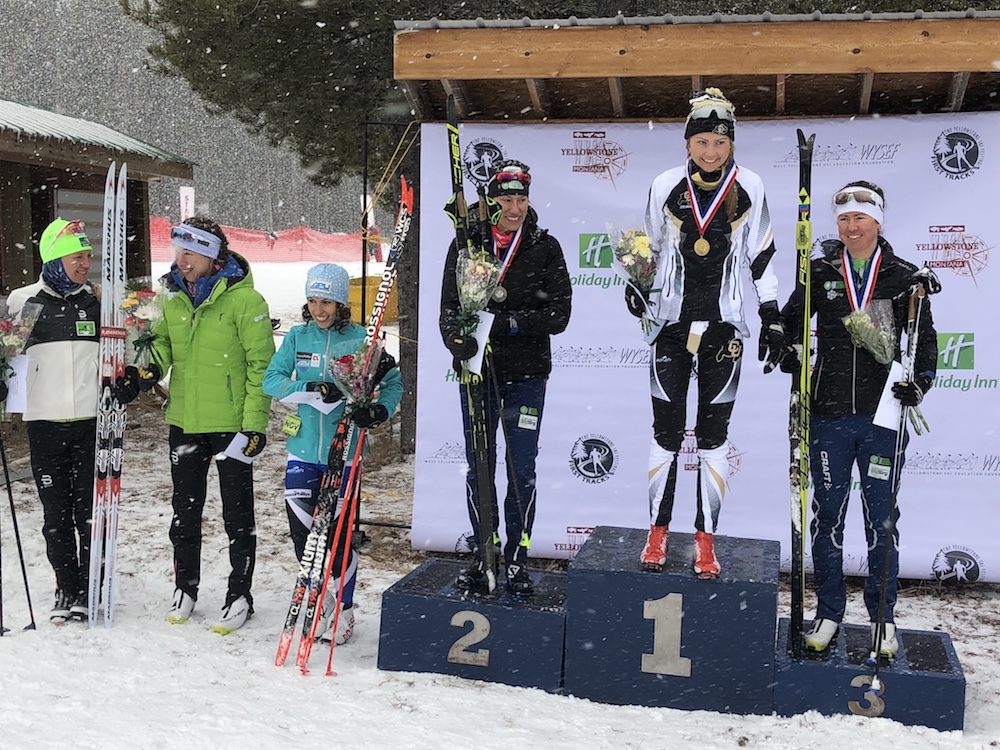
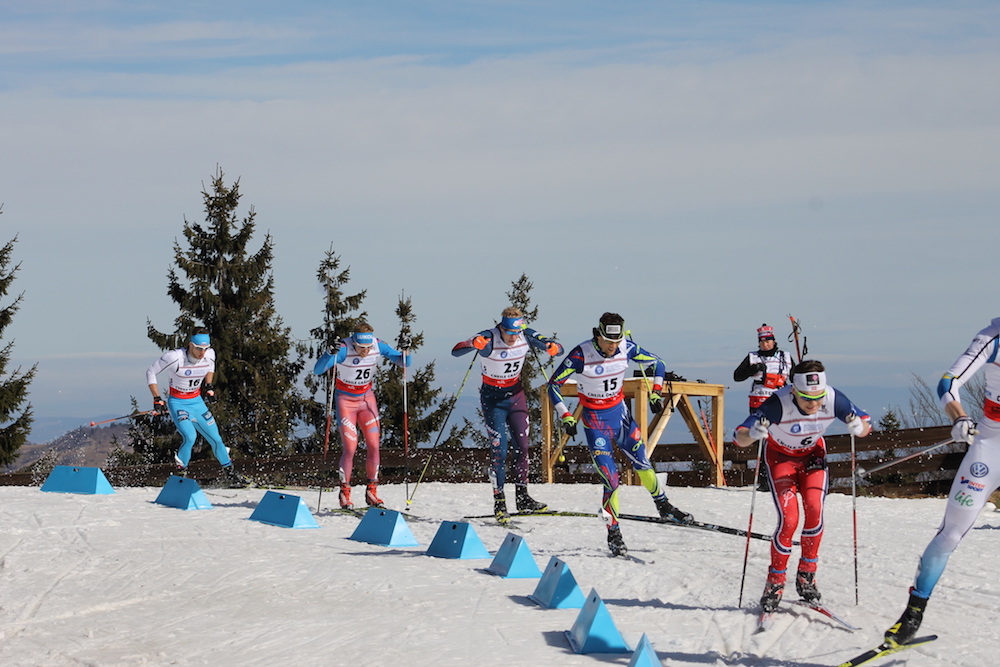
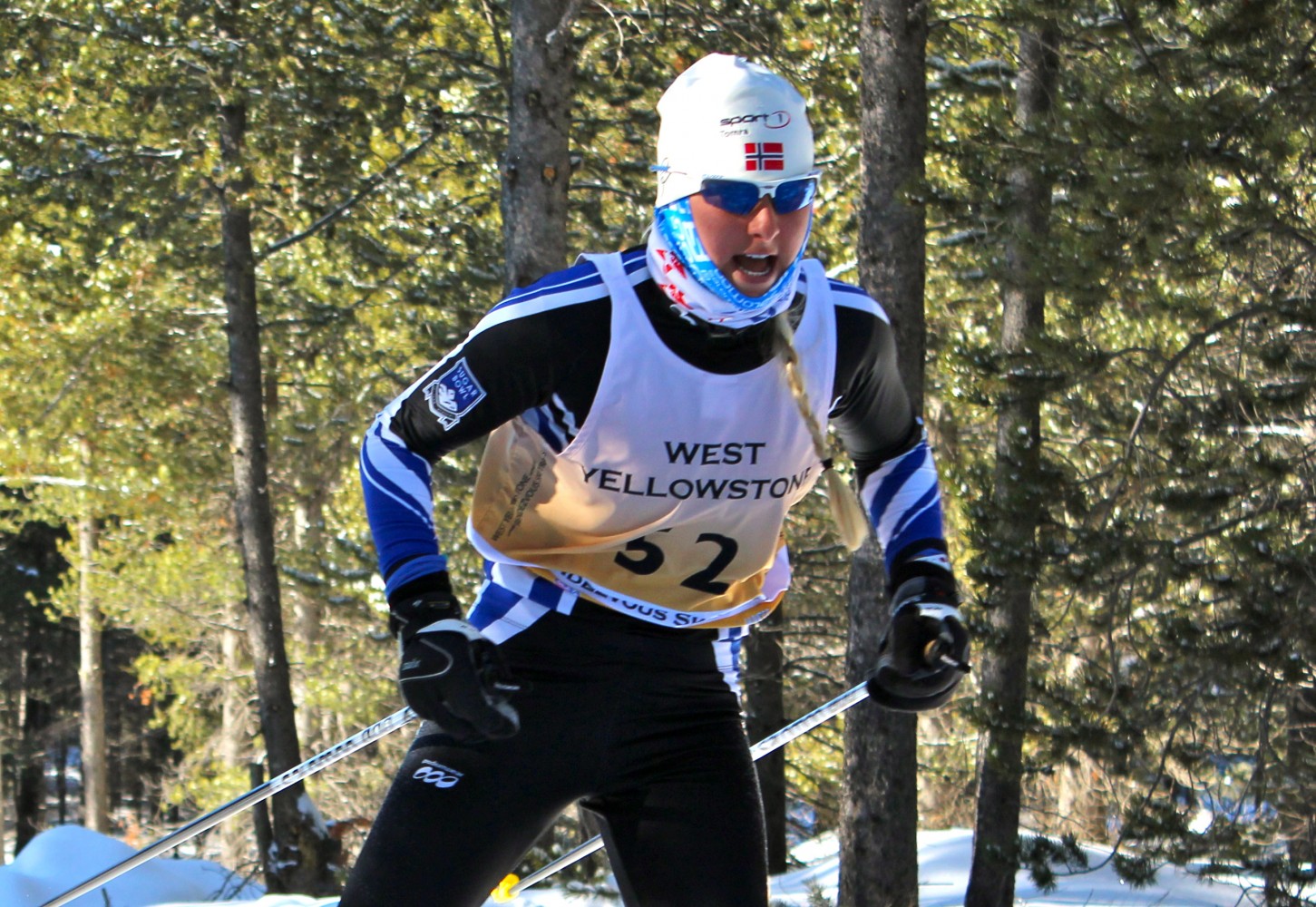
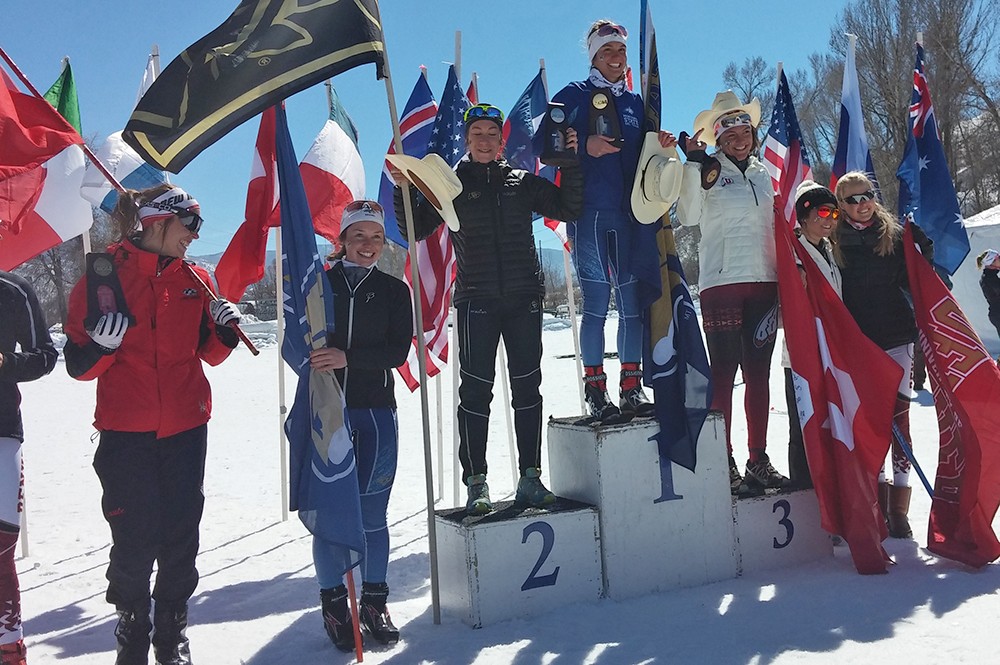
The SuperTour women’s 10 k classic mass start podium on Sunday in West Yellowstone, Montana, with Hedda Bångman (second from r) of the University of Colorado Boulder in first, and Craftsbury’s Kaitlynn Miller (third from r) and Caitlin Patterson (r) in second and third, respectively. From left: Caitlin Gregg in sixth, Katharine Ogden in fifth and Rosie Frankowski in fourth were also recognized at the flower ceremony. (Photo: FBD)
US SuperTour (West Yellowstone, Montana): 10/15 k classic mass starts
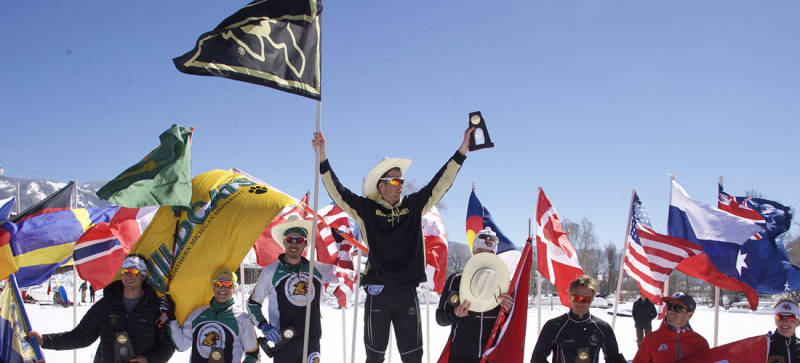
The second day of SuperTour racing took place as originally planned at the Rendezvous Ski Trails in West Yellowstone, with 22-year-old Hedda Bångman, of the University of Colorado Boulder (CU), and 33-year-old Brian Gregg (Team Gregg) winning the women’s 10-kilometer and men’s 15 k classic mass starts, respectively, on Sunday.
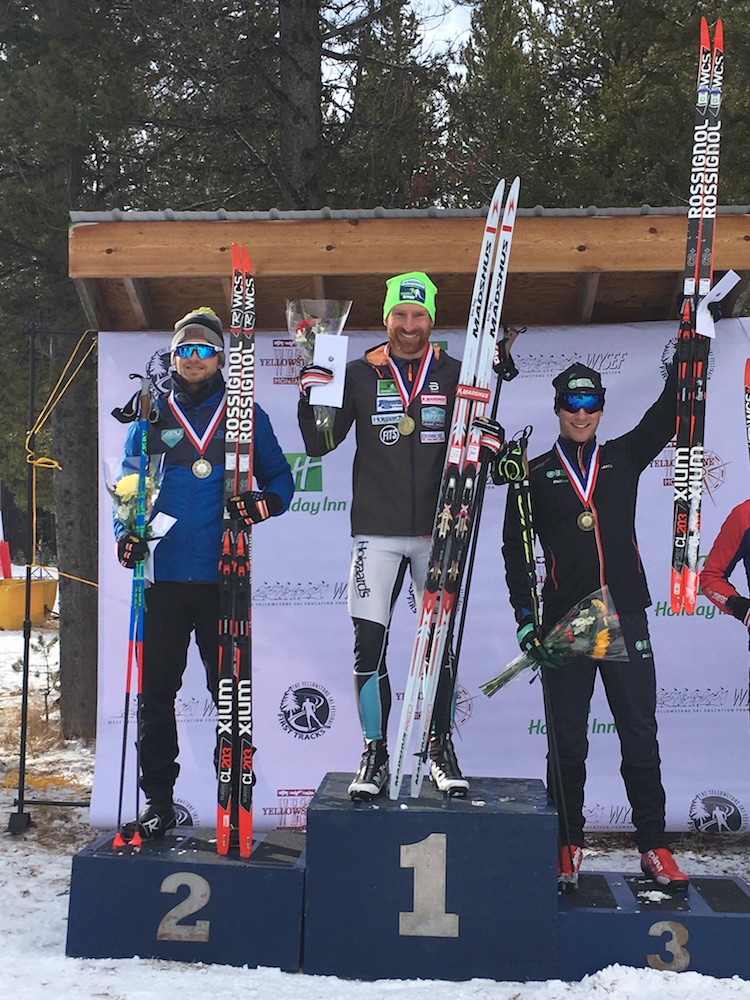
The men’s 15 k classic mass start SuperTour podium on Sunday in West Yellowstone, Montana,with Brian Gregg (c) of Team Gregg in first, David Norris (l) of APU in second, and Ben Lustgarten (CGRP) in third. (Photo: FBD)
Bångman, a Swedish freshman on the CU Ski Team, won the women’s race in 30:24.8, just ahead of two Craftsbury Green Racing Project (CGRP) skiers Kaitlynn Miller and Caitlin Patterson. While Miller placed second (+1.3) and Patterson was third (+3.4),
Rosie Frankowski of Alaska Pacific University (APU) finished another 10 seconds later in fourth (+13.5), and Katharine Ogden of the Stratton Mountain School (SMS) was fifth (+17.2). Caitlin Gregg (Team Gregg) followed in sixth, Felicia Gesior (CXC Team) was seventh, Anne Siri Lervik (CU) eighth, Erika Flowers (SMS Elite Team) ninth, and Corey Stock of the Bridger Ski Foundation (BSF) 10th.
In the men’s race, Brian Gregg pulled out a 1.9-second win over David Norris (APU), crossing the line first in 41:30.3. Ben Lustgarten (CGRP) reached the podium for the second-straight day (after placing second in Saturday’s skate sprint) in third (+4.6). Kyle Bratrud (CXC Team) finished fourth (+10.9) and Kris Freeman (Caldwell Sport) was fifth (+12.6). Tad Elliott (Ski & Snowboard Club Vail) followed in sixth, Eric Packer (APU) seventh, Ian Torchia (Northern Michigan University/U.S. Ski Team D-Team) eighth, Hunter Wonders (APU) ninth, and Martin Bergström (University of Utah Ski) 10th.
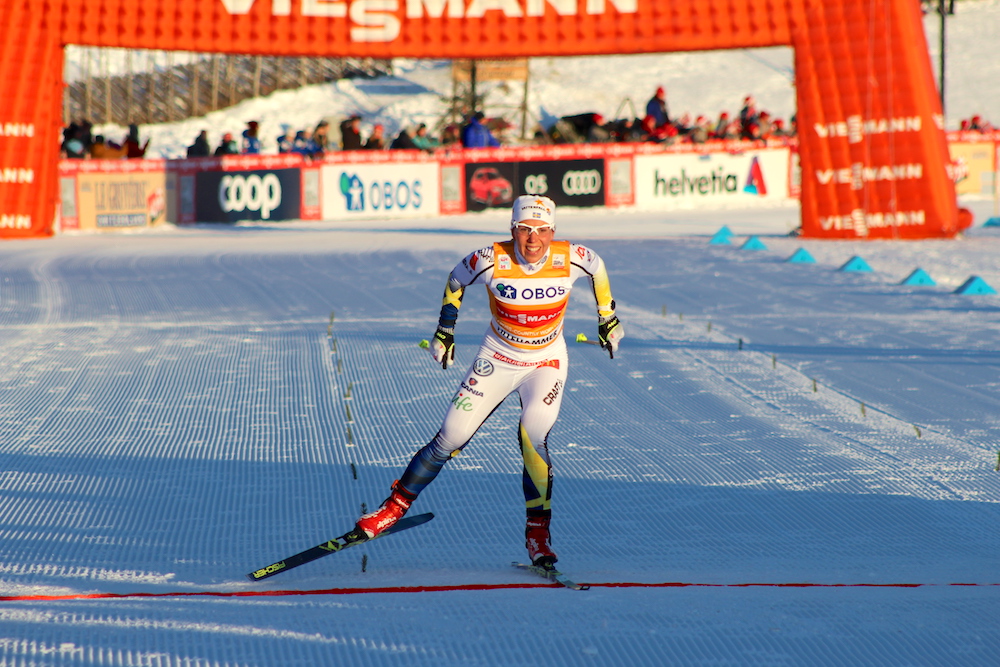
Sweden’s Charlotte Kalla winning the women’s 15 k skiathlon on Sunday at the Lillehammer World Cup in Norway. (Photo: Henrik Hunnes)
Sweden’s Charlotte Kalla pulled out another dominant distance performance on Week 2 of the World Cup, racing to a 19.7-second win in the women’s 15-kilometer skiathlon on Sunday, ahead of three Norwegians and American Jessie Diggins.
Kalla led at the halfway point of the skiathlon when skiers transitioned from classic to skate, just ahead of Norway’s Heidi Weng in second. The two had broken away around 4 k into the classic leg and put more than 20 seconds into the rest of the field by the transition, when Diggins came through 21.6 seconds back in third, leading a large chase group with Finland’s Krista Parmakoski, Norway’s Marit Bjørgen, Austria’s Teresa Stadlober, Norway’s Kathrine Rolsted Harsem, Finland’s Kerttu Niskanen, Norway’s Ragnhild Haga, and Switzerland’s Nathalie von Siebenthal, respectively.
While Kalla and Weng continued to trade the lead over the next 5 1/2 kilometers or so, by the 13.65 k marker, Kalla had dropped Weng, with 12 seconds between the two, while the chasers remained 29 seconds behind Kalla.
Over the next 1.2 k, that time gap grew to 20 seconds and 46 seconds, respectively, and Kalla skied off to her second win of the season in 42:24.7 minutes.
Weng placed second, 19.7 seconds back, and Haga claimed third (+43.6), after skiing alone for the last 4 k of the race. Bjørgen finished just ahead of Diggins for fourth (+54.3) and fifth (+57.0), respectively, and Stadlober was sixth (+1:04.9), Parmakoski seventh (+1:07.8), Norway’s Ingvild Flugstad Østberg eighth, Russia’s Natalia Nepryaeva ninth (+1:27.8), and Sadie Bjornsen 10th (+1:32.6).
Four Americans finished scored points in the top 30, with Kikkan Randall placing 16th (+2:06.5) and Rosie Brennan 29th (+3:07.7). Liz Stephen finished 36th (+3:25.7), Chelsea Holmes was 38th (+3:39.6) and Ida Sargent 55th (+6:41.1).
Cendrine Browne of the Canadian National U25 Team led Canada in 45th (+4:37.3), and Emily Nishikawa followed in 49th (+5:00.1). Katherine Stewart-Jones did not finish.
Klæbo Outlasts Sundby; Harvey 6th
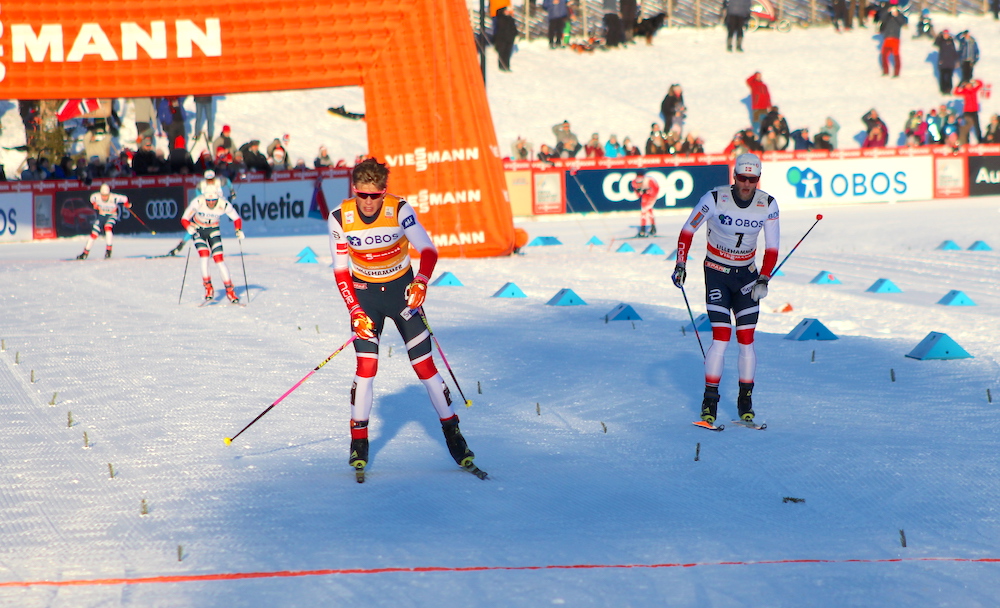
A gassed Johannes Høsflot Klæbo (yellow bib) holding off fellow Norwegian Martin Johnsrud Sundby (r) for the win on Sunday in the men’s 30 k skiathlon at the Lillehammer World Cup in Norway. (Photo: Henrik Hunnes)
In the men’s 30 k skiathlon that followed, Norway’s Johannes Høsflot Klæbo made it a five-peat, proving himself once again unbeatable, this time in the first multi-discipline distance race of the season.
Klæbo outlasted [edit: rocketed past] teammate Martin Johnsrud Sundby to beat him by 1.3 seconds for his fifth-straight win in 1:16:47.1, and Norway swept the top four with Hans Christer Holund in third (+6.8) and Simen Hegstad Krüger in fourth (+10.9).
France’s Maurice Manificat followed closely in fifth (+11.3) and Canada’s Alex Harvey was next in sixth (+13.1), ahead of Finland’s Iivo Niskanen in seventh (+16.2), and Russia’s Alexey Chervotkin, Sergey Ustiugov and Alexander Bolshunov in eighth (+37.7), ninth (+42.2) and 10th (+59.6), respectively.
Klæbo skied patiently in the pack for essentially the entire race. For instance, at 11 k he sat back in 18th, just seven seconds from Canada’s Devon Kershaw in the lead.
One kilometer later, Klæbo remained 5 seconds back in 13th while Kershaw was 8 seconds back in 16th.
At the ski exchange at 15 k, Niskanen led Sundby and Italy’s Francesco de Fabiani and a total of 10 men within three seconds of first. Klæbo clocked through 5 seconds back in 13th, just ahead of Harvey in 14th (+5.3). Sixteen men remained within six seconds and striking distance of first. Kershaw in 18th had fallen off the pace and was 36 seconds back at the transition, just behind Russia’s Andrey Larkov.
While Harvey continued to ski around third place during the first 5 kilometers of the skate leg, Klæbo worked his way closer to the front and led at 22.5 k. By then, the lead group had dwindled to six within two seconds of first. Harvey remained in fourth.
Over the next 7.5 k, the lead changed several times, with Klæbo hovering near the tail end of the group. With about 200 meters to go, however, it was down to Sundby and Klæbo, with the former leading by 2 seconds (and Holund skiing seven seconds back in third). Klæbo ultimately had the most finishing kick to take the win by 1.3 seconds over Sundby, while Holund crossed 6.8 seconds later for third.
Canada had two in the top 20 with Kershaw in 19th (+2:59.7). Last year’s NorAm winner Russell Kennedy (Team R.A.D.) placed 53rd (+7:30.7), and Canadian World Cup Team members Graeme Killick and Knute Johnsgaard finished 54th (+7:41.3) and 60th (+9:49), respectively.
Two U.S. men landed in the points with Erik Bjornsen (U.S. Ski Team) in 20th (+2:59.9; just 0.2 seconds behind Kershaw) and Noah Hoffman in 28th (+3:37.8). Scott Patterson finished 36th (+4:56.1) and Paddy Caldwell was 56th (+7:43).
— International Biathlon Union (@biathlonworld) December 3, 2017
France’s Martin Fourcade overcame an early penalty and his No. 2 starting position to take the men’s 12.5 k pursuit win on Sunday, 40.8 seconds clear of anyone with 19-for-20 shooting (1+0+0+0).
Fourcade started 1 second behind Saturday’s sprint winner, Norway’s Tarjei Bø, and took control of the race after cleaning the second shooting stage. Bø missed one on the first prone stage then five more later in the race (1+0+3+2) to slip to 19th (+1:49.5) while Slovenia’s Jakov Fak raced up from 10th to second, 40.8 seconds behind Fourcade, with two penalties (1+0+0+1). Just behind him, France’s Quentin Fillon Maillet took third (+42.1) with identical shooting after Fillon Maillet started 12th and skied with Fak for most of the race.
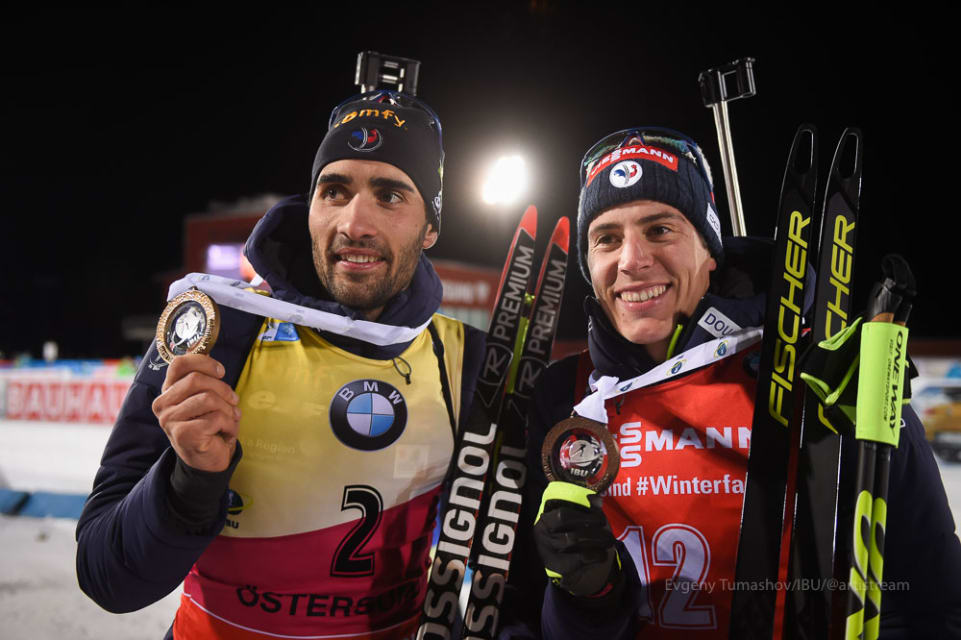
France’s Martin Fourcade (l) and Quentin Fillon Maillet after placing first and third, respectively, in the IBU World Cup men’s 12.5 k pursuit on Sunday in Lillehammer, Norway. (Photo: IBU/biathlonworld)
None of the 58 finishers cleaned the four-stage race. American Lowell Bailey improved from 22nd to 17th (+1:40.2) with two misses (0+1+0+1). Canada’s Christian Gow achieved a career best in 21st (+2:04.6), up from starting 26th, after shooting 19-for-20 (0+0+1+0).
Also for Canada, Nathan Smith slipped from 24th at the start to 42nd (+3:19.2, three penalties), Scott Gow finished 50th (+4:10.9; six penalties) after starting 16th, and Brendan Green placed 51st (+4:18.6; five penalties).
One other American qualified in the sprint top 60 for the pursuit, with Tim Burke finishing 48th (+3:52.7; four misses).
In the women’s 10 k pursuit earlier in the day, Germany’s Denise Herrmann tallied her second-straight win (and the second win of her IBU World Cup career). She started first and successfully held of France’s Justine Braisaz, who started 15 seconds behind her in second place, by 25.8 seconds. While Herrmann missed two on her third shooting (0+0+2+0), Braisaz was one of three women in the field to clean (0+0+0+0).
Norway’s Marte Olsbu raced up from seventh to third place (+48.0) with two penalties (0+1+0+1).
Canada’s Julia Ransom placed 23rd (+2:48.1), up from 29th at the start, with two misses (0+0+1+1). Two of her teammates also qualified for the pursuit, with Rosanna Crawford finishing 52nd (+5:25.1) with six penalties (0+3+1+2). In her first World Cup pursuit, Megan Bankes completed three shooting stages before being lapped (3+1+1).
No American women qualified for the pursuit.
With the conclusion of the first IBU World Cup in Östersund, the circuit moves to Hochfilzen, Austria, where racing kicks off again Friday, Dec. 8, with men’s and women’s sprints.
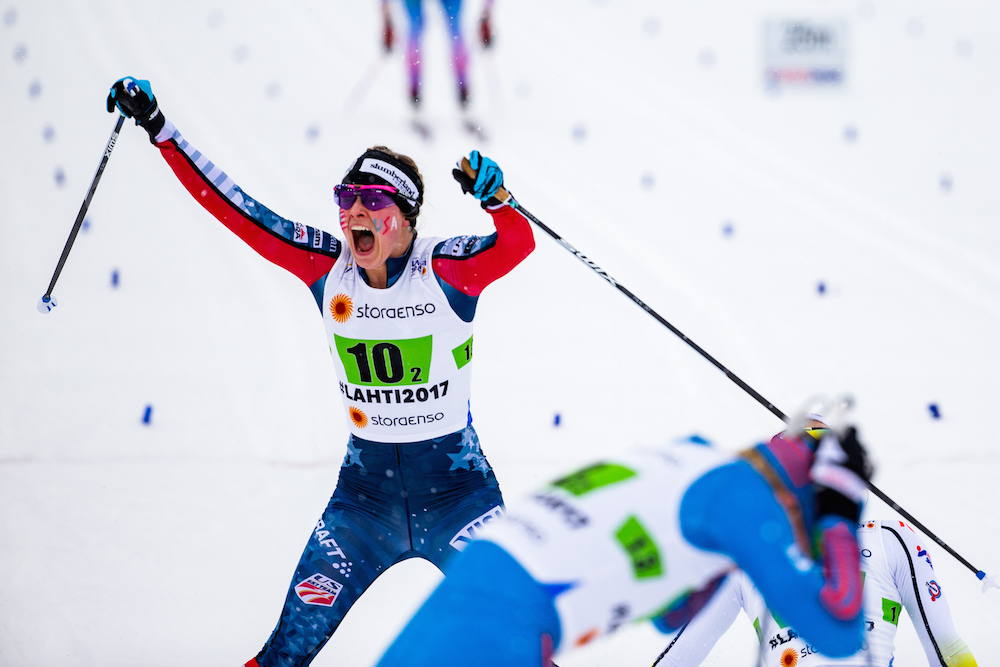
Jessie Diggins celebrates after anchoring her team to bronze in the women’s classic team sprint on Feb. 26 at 2017 World Championships in Lahti, Finland. (Photo: Dustin Satloff/dustinsatloff.com)
Shortly after the U.S. Ski Team (USST) formally announced its 2017/2018 cross-country team, FasterSkier reached USST Head Coach Chris Grover on the phone for his comments. Grover is in Bend, Ore., for the team’s traditional on-snow camp.
“We have nine athletes who made the objective criteria to make the 2018 U.S. Ski Team,” Grover said. “Eight that are on the A-team, all of whom finished in the top 30 in the world in either sprint or distance. And then Katharine Ogden, who as a medalist at the World Junior Championships, made the objective criteria that way.”
Below are the eight A-team athletes and Ogden, who was renominated to the development “D” team, that met the USST’s objective criteria for team selection.
A Team
Men
Simi Hamilton (Stratton Mountain School Elite Team)
Attain top-50 ranking in the 2017 final World Cup Overall ranking list.
Attain top-30 ranking in the 2017 final World Cup Sprint or Distance ranking list.
Attain top-20 ranking in the 2017 FIS final sprint or distance points list.
Attain a top-3 individual finish at the 2017 Junior World Championships or U-23 World Championships.
Six women finished the season ranked in the top 50 in the World Cup Overall ranking list: Diggins (6th), Bjornsen (16th), Stephen (28th), Caldwell (33rd), Randall (36th), and Sargent (44th). Notably, Diggins, Caldwell, Sargent, Randall, and Bjornsen all ranked in the top 30 for the final World Cup Sprint list, too, and Diggins, Bjornsen and Stephen all finished in the top 30 on the final World Cup Distance list.
Hamilton and Newell were the two men that met the objective criteria, with Hamilton ranking 30th on the final World Cup Overall list and ninth in the World Cup Sprint standings and Newell 28th on the final World Cup Sprint list.
The remainder of the USST were discretionary selections. The athletes nominated to the team under the discretionary guidelines are as follows:
B TEAM
Men
Erik Bjornsen (APU)
Paddy Caldwell (SMS Elite)
Scott Patterson (APU)
Women
Rosie Brennan (APU)
D TEAM
Ian Torchia (Northern Michigan University)
Hannah Halvorsen (Sugar Bowl Academy)
Julia Kern (SMS Elite)
As Grover explained, the USST’s use of discretion should not perceived as murky. Built into the criteria are aspects of fulfilling “individual markers” or competition results, “attitude and commitment”, illness or injury, and the heavily weighted medal potential.
“We are trying to incorporate athletes who we see are on a path to winning a medal at the highest level, at the Olympic level or at the World Championship level,” Grover said. “Can we make a strong case suggesting that an athlete is on the path to winning the medal? It’s really a difficult call. What are the metrics that we’ll be using: FIS points? Should we be using World Cup points? Should we be using placing at World Juniors or U23s, at NCAAs or SuperTours? There are so many different places where athletes are coming from, so many different places where they are competing. Are they all equal? No, of course not.”
What often makes discretionary selections difficult is that USST coaches must make assessments about future potential using real-time accomplishments between skiers skiing on the World Cup and those skiers competing at the World Cup and Continental Cup (i.e. SuperTour).
“You can’t really compare someone who has been competing on the World Cup to someone who has been competing at a Continental Cup level,” Grover explained. “So that’s a real challenge for us. Yes, you can look at FIS points – that’s one thing we have always done, for many years. We’ve taken that athlete and tracked FIS points and age in distance or sprint, whatever that athlete’s strongest discipline is, and we try to see where they are compared to the best skiers in the world, the top 10 athletes in sprint or distance of that sex in the world.”
Grover knows the FIS point system is not necessarily the best indicator of a U.S. skier’s potential on the World Cup.
“One of the big challenges that we had using that methodology is that our FIS points as a nation in the US are artificially low,” Grover said.
Grover believes FIS points are “artificially low” because the U.S. collegiate system has numerous European athletes with low FIS points that compete nearly every weekend on the NCAA circuit or FIS-sanctioned races. As a result, those skiers bring some U.S. skiers’ FIS points down.
“The same thing happens occasionally when the U.S. Ski Team comes back from Europe,” Grover said. “The U.S. women in particular but also some of the men, and they bring good points and then they are not perhaps at their sharpest at SuperTour Finals, and other athletes are able to improve their points by coming close to or beating these athletes. And so that really drives our points down. We’re just not in the European pool enough to have points that are directly compared to European counterparts. The isolation, the way that points come over and they get passed around, and then they stay isolated over here, it prevents us from our points being representative of where people are compared to their European peers.”
Athlete by Athlete
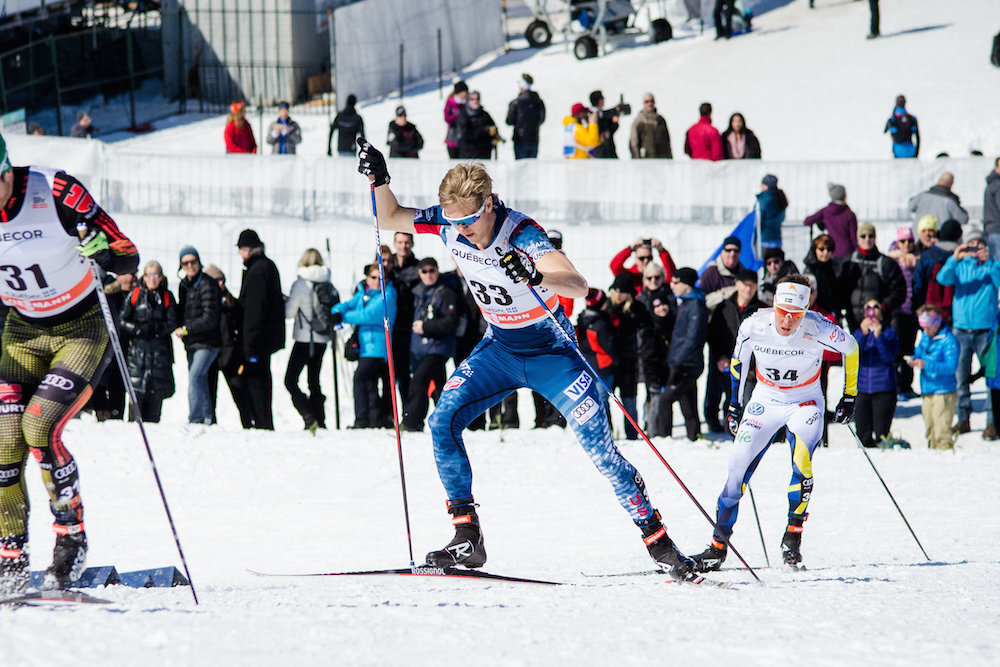
American Erik Bjornsen (33) racing to the 11th-fastest time of day in the men’s 15 k freestyle pursuit at World Cup Finals in Quebec City for his career-best World Cup result. He finished 25th overall. (Photo: Gretchen Powers)
For the B-team, let’s go athlete by athlete, those nominated and those not, to get a better picture of the whys and hows of USST discretionary selection. (Note that all of the D-team members from last year were renominated and will accordingly be invited to team camps.)
“About Erik Bjornsen for example, and why was he nominated to the team,” Grover said. “For a number of reasons, but one thing that we see is that he could contribute to a medal in the team sprint, which is an event where he and Simi were fifth at this World Championships. … [Erik is] a guy who is scoring points in sprints in the World Cup occasionally, some points in distance occasionally. He is a hybrid between aerobic and anaerobic capacities, and that lends itself rather well to team sprint. We feel like he has strong potential there.”
Bjornsen also skied to an impressive 18th (+1:56.7 behind the winner) in the 15 k classic at the 2017 World Championships.
Patterson is the lone new face nominated to the USST. “[Scott] just keeps coming up in conversation and he’s a really really interesting skier,” Grover said. “He got sick before U.S. nationals and then was sick for part of U.S. nationals and did not ski particularly well, at least by his standards for national championships in Soldier Hollow.”
The Anchorage-based skier did not make 2017 World Championships team. Yet at the start of the season, before his illness, he placed third in the 15 k classic in the West Yellowstone SuperTour and won the 15 k skate in the Sovereign Lake NorAm in mid-December.
“So this past winter, we knew he’s definitely one of those next guys — can we find some opportunities on the World Cup to start him?” Grover said.
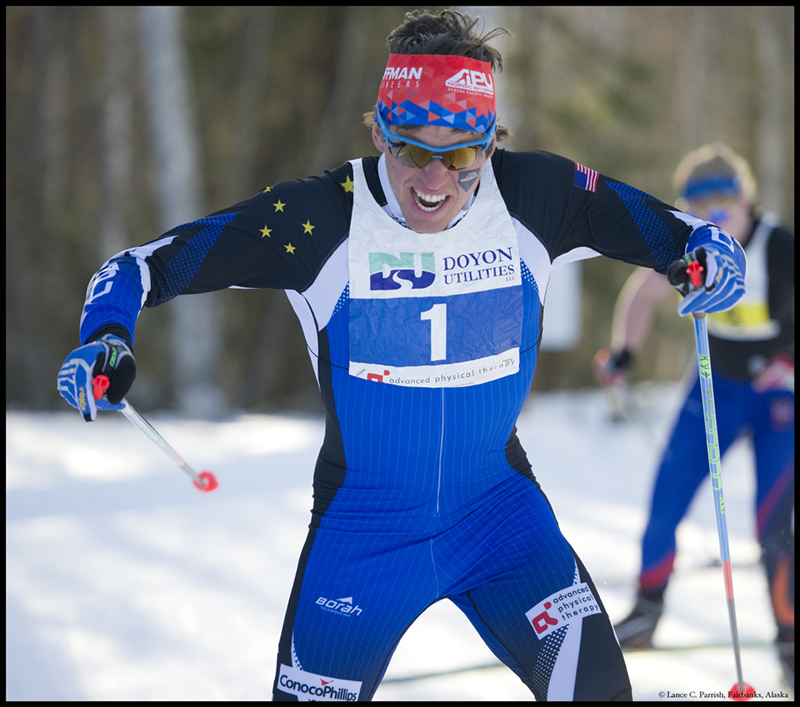
Scott Patterson (APU) racing the anchor leg of the mixed relay at U.S. Distance Nationals in late March in Fairbanks, Alaska. (Photo: Lance Parrish, Fairbanks)
Last season, Patterson was offered World Cup starts in PyeongChang, South Korea, and Oslo, Norway. In a thin PyeongChang World Cup field, he placed ninth in both the 30 k skiathlon and team sprint. At Holmenkollen in Oslo, Patterson was the top American man, skiing to a 28th in a loaded field. Patterson also qualified for World Cup Finals in Quebec.
“And the cool thing was everywhere he went, he scored World Cup points as a 25-year-old athlete,” Grover said of Patterson’s potential. “So he’s a young guy who has got a big history of training. He’s training a lot and training really well and he’s also seizing these opportunities and showing in a very difficult men’s field that he’s a young guy who can grab some World Cup points.”
Patterson went on to dominate U.S. SuperTour Finals and Distance Nationals at the end of the season, winning both the 20 k skiathlon and 50 k freestyle mass start in Fairbanks, Alaska.
Addressing the question of why Patterson was given starts in PyeongChang and Oslo despite not leading the SuperTour at the time or qualifying for World Championships, Grover said Patterson had nearly fallen through the cracks. They needed to see he how he might perform on the World Cup.
“Last year it was a challenging year for us as a national-team staff to look back at what was happening domestically and to make much sense of who was skiing well,” Grover said. “For example, in the first four distance races of the year, Yellowstone, Silver Star, and the two at Soldier Hollow, we had four different men win the four distance races. And of the four first sprint races, in those locations, I believe we had four different men win those four sprint races. And different athletes that were winning qualification in some cases versus those that were actually winning the day result for the sprint. So it was a very unclear picture in terms of who was skiing well … especially on the men’s side.”
Of the skiers winning some of those races outright, Grover knew Patterson was promising, yet he wasn’t able to demonstrate it internationally on the World Cup or at World Championships.
“So we wanted to find opportunities for Scott,” Grover said.
Patrick “Paddy” Caldwell, 23, was bumped from the D-team to B-team status.
“Paddy, he’s been on the D-team for a few years; he’s obviously been on the radar,” Grover said.
Caldwell placed ninth in both the 15 k freestyle and 30 k skiathlon at the 2017 U23 World Championships. He also qualified for World Cup Finals in Quebec, where he skied the 25th-best time of day in the 15 k freestyle pursuit.
“Just given where he is in terms of his ability and his age, we felt like it was the right move for him to move from the D-team to the B-team,” Grover said.
“I think Noah would be the first to admit that last season was pretty disappointing, by his standards,” Grover said. “He and I were able to talk about expectations going into the season and Noah had struggled for a few years on the World Cup previous to this past season. … And so we just talked that we need to make progress towards an eventual medal in the sport. So this year needs to be a step forward and unfortunately it wasn’t. It wasn’t the results Noah wanted to see and unfortunately it wasn’t the result that we were hoping to see from Noah.”
Hoffman, 27, finished the season ranked 51st on the World Cup Overall list, a single point from the top 50 needed to meet the team’s objective criteria.
“We hope that Noah gets back in there and starts skiing closer to his potential and starts making progress towards that medal,” Grover added. “Absolutely, the door for sure is never closed for Noah or any athlete.”
On the women’s side, Rosie Brennan, 28, was renominated to the B-team. This past season on the World Cup, Brennan earned eight top 30s (the benchmark for scoring World Cup points). Her best finish, beyond her 23rd-best time of day in the Tour de Ski’s final climb, was a 22nd in La Clusaz, France, in the 10 k freestyle mass start.
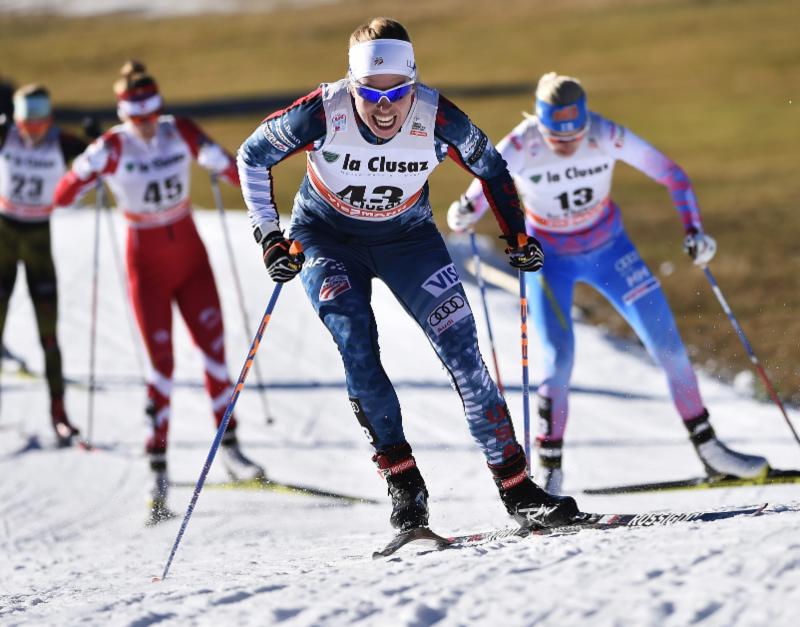
Rosie Brennan (43) racing to a season-best World Cup result of 22nd in the 10 k freestyle mass start on Dec. 17 in La Clusaz, France. (Photo: Toko/NordicFocus)
“Rosie is another interesting case,” Grover said. “It’s very hard to differentiate right now between Rosie Brennan, the skiing that she is doing, versus Caitlin Patterson, for example, or Chelsea Holmes. Yes, Rosie has been a little bit stronger in some races, but she has also had some more opportunity. However, we are really looking towards Rosie as a potential leg in a 4 x 5 kilometer women’s relay at a World Championship event. She has contributed a 5 k classic leg to a podium in Lillehammer, and she also skied a terrific leg in Ulricehamn — I want to say 12 seconds from the fastest on that particular leg in that relay this year. So she’s someone we are really looking towards for a potential relay leg. So there are athletes like that where it’s hard to differentiate sometimes between some of the domestic athletes who are really starting to blossom, who we are starting to take a lot of notice of them, but Rosie is somebody who … is in shape and ready to go when we get to Korea this winter.”
On the non-nomination side of the equation are Holmes and Patterson.
“Chelsea, she is someone who we have discussed a ton this spring,” Grover said. “And this is a conversation I’ve had with Chelsea as well. Is she a 5 k skier right now? Maybe, maybe not. She has certainly shown her ability in longer events. Her one standout international result from this season is a longer event in skating.”
“Does that, at this particular moment, suggest that she might be able to provide a 5 k classic leg in the relay? Not at this particular moment,” he said. “We have a lot of skaters on the women’s side right now. Our skating ability is quite high. So at this moment it doesn’t pencil out, but does that prevent her from being considered in the future for anything? Absolutely not.”
Scott Patterson’s older sister Caitlin, 27, remains on the USST radar as well.
“Caitlin is somebody else that we’ve discussed quite a bit,” Grover said. “She’s made a big step forward in the last year she started to score World Cup points and really flirting with that edge of the top thirty on a regular basis. So we absolutely have our eye on her. … Of course Chelsea is Continental Cup leader for Period 1, so she will be skiing World Cup Period 1. And then we’ll assess where she is at that point. Anything can happen at that point. She might be someone that’s skiing really well and we want to keep on the World Cup.”
On Wednesday, the U.S. Ski & Snowboard Association (USSA) formally announced its nominations for the 2017/2018 cross-country ski team in a press release. Most notably, Noah Hoffman was not renominated, Scott Patterson was named to the B-team, where he’s joined by Patrick “Paddy” Caldwell, who made the jump up from D-team status.
“After a strong 2016-17 season, including three World Championship medals and nine World Cup podiums, the Team is looking for medals in the upcoming 2018 Olympics in PyeongChang,” the press release stated.
“Each athlete accepting the nomination to U.S. Ski Team receives world class program support, along with access to the U.S. Ski and Snowboard Center of Excellence, as well as athletic benefits including an elite coaching, sport science, sports medicine and high performance staff, and education opportunities,” it continued.
Note that these are nominations rather than a set-in-stone team.
“An official team announcement will be made in the fall,” the release added.
FasterSkier will follow up on the selections. In the meantime, here is a look at the selection criteria and the nomination breakdown below:
A TEAM
Men
Simi Hamilton (Aspen, CO; Stratton Mountain School Elite Team; 5/14/87)
Andrew Newell (Shaftsbury, VT; Stratton Mountain School Elite Team; 11/30/83)
Women
Sadie Bjornsen (Winthrop, WA; Alaska Pacific University Nordic Center; 11/21/89)
Sophie Caldwell (Peru, VT; Stratton Mountain School Elite Team; 3/22/90)
Jessie Diggins (Afton, MN; Stratton Mountain School Elite Team; 8/26/91)
Kikkan Randall (Anchorage, AK; Alaska Pacific University Nordic Center; 12/31/82)
Ida Sargent (Orleans, VT; Craftsbury Green Racing Project; 1/25/88)
Liz Stephen (East Montpelier, VT; Burke Mountain Academy; 1/12/87)
B TEAM
Men
Erik Bjornsen (Winthrop, WA; Alaska Pacific University Nordic Center; 7/14/91)
Patrick Caldwell (Lyme, NH; Stratton Mountain School Elite Team; 2/18/94)
Scott Patterson (Anchorage, AK; Alaska Pacific University Nordic Center; 1/28/92)
Women
Rosie Brennan (Park City, UT; Alaska Pacific University Nordic Center; 12/2/88)
D TEAM
Men
Ian Torchia (Rochester, MN; Northern Michigan University; 3/8/96)
Happy May! With the start of a new training year, FasterSkier scanned social media for a sense of how nordic skiers kicked off Day 1 (and the days before) of the 2017/2018 season.
Kikkan Randall of the U.S. Ski Team (USST) and Alaska Pacific University (APU) “sneaking in some secret Mom training” while pushing her son Breck on April 30:
https://www.instagram.com/p/BTigusJDgKY/?hl=en
No spring snow for Noah Hoffman (USST/Ski & Snowboard Club Vail). Instead, he spent his first day of the new training season “slot canyoning” in the Subway at Zion National Park in Hurricane, Utah:
https://www.instagram.com/p/BTkZTYtDmnF/?hl=en
U.S. Ski Team members and Vermonters Andy Newell, Liz Stephen and Ida Sargent stood with Bernie Sanders in front of the Vermont State House in Montpelier for the People’s Climate March on April 29:
Dahria Beatty, of Canada’s U25 Team and Alberta World Cup Academy (AWCA), spent the weekend at Bysprinten in Mosjøen, Norway, where she placed fourth behind some World Cup regulars:
https://www.instagram.com/p/BThSuMWlbNz/
Certain U.S. national-team members made the trip to L.A. last week for a photoshoot for NBC Olympics:
Nothing like a backcountry skin up and ski down to get spring going. Newell (USST/SMS Elite Team) did just that last week in Bozeman, Mont., the hometown of his fiancée and Stratton Mountain School (SMS) teammate, Erika Flowers:
Also enjoying Montana’s backcountry, Caitlin Patterson (Craftsbury Green Racing Project):
https://www.instagram.com/p/BTh–yJBUYj/
Getting strong in the spring doesn’t always mean hitting the gym. Katharine Ogden (SMS/USST) got in an “alternative strength workout” in the Green Mountain Rock Climbing Center in Rutland, Vt., on April 20:
Some of us just aren’t ready for spring. Erik Bjornsen (USST/APU), newly engaged to Marine Dusser, pedaled his way to snow by bike as seen here on April 19 with the backdrop of the North Cascades National Park in Mazama, Wash:
https://www.instagram.com/p/BTDYF96Dreu/?hl=en
We’re not really sure what NARP Fest is, but it looks fun (and incredibly funny). Biathlon Canada’s Sarah Beaudry was crowned champion at this year’s event at Mount Shark in Alberta:
https://www.instagram.com/p/BTUFDqsFv5f/
Knute Johnsgaard (Canadian U25 Team/AWCA) got in some crust skiing last week in White Pass, just north of the U.S./Canadian border in British Columbia:
https://www.instagram.com/p/BTNW0xTFwng/
Who says an Easter egg hunt doesn’t count as training? Ian Torchia (Northern Michigan University/USST) put on his game face and running shoes for a family holiday egg hunt on April 16 in Rochester, Minn.:
https://www.instagram.com/p/BS9gKvdDRe9/?hl=en
Friends. Bikes. Good food. That’s the path to happiness for Julia Kern (SMS/USST) as seen on the Kingdom Trails in East Burke, Vt.:
Reese Hanneman (APU)got his sweat on during a game of racquetball at the Alaska Club fitness center:
https://www.instagram.com/p/BThpK3gFClE/?hl=en
Last season’s overall SuperTour leader Scott Patterson (APU) soaked up the scenery and the stellarbackcountry skiing in Alaska’s Chugach Mountains:
https://www.instagram.com/p/BTh7zGvFntR/?hl=en
A few final k’s before the spring thaw: that’s how Sadie Bjornsen (USST/APU) and some of her APU teammates enjoyed the outdoors in Glen Alps in Chugach State Park, just outside Anchorage, last week:
https://www.instagram.com/p/BTcUkkuAXO3/?hl=en
US Biathlon’s Leif Nordgren recently took to the trails with his pup to hike Lyon Mountain in New York’s Adirondacks:
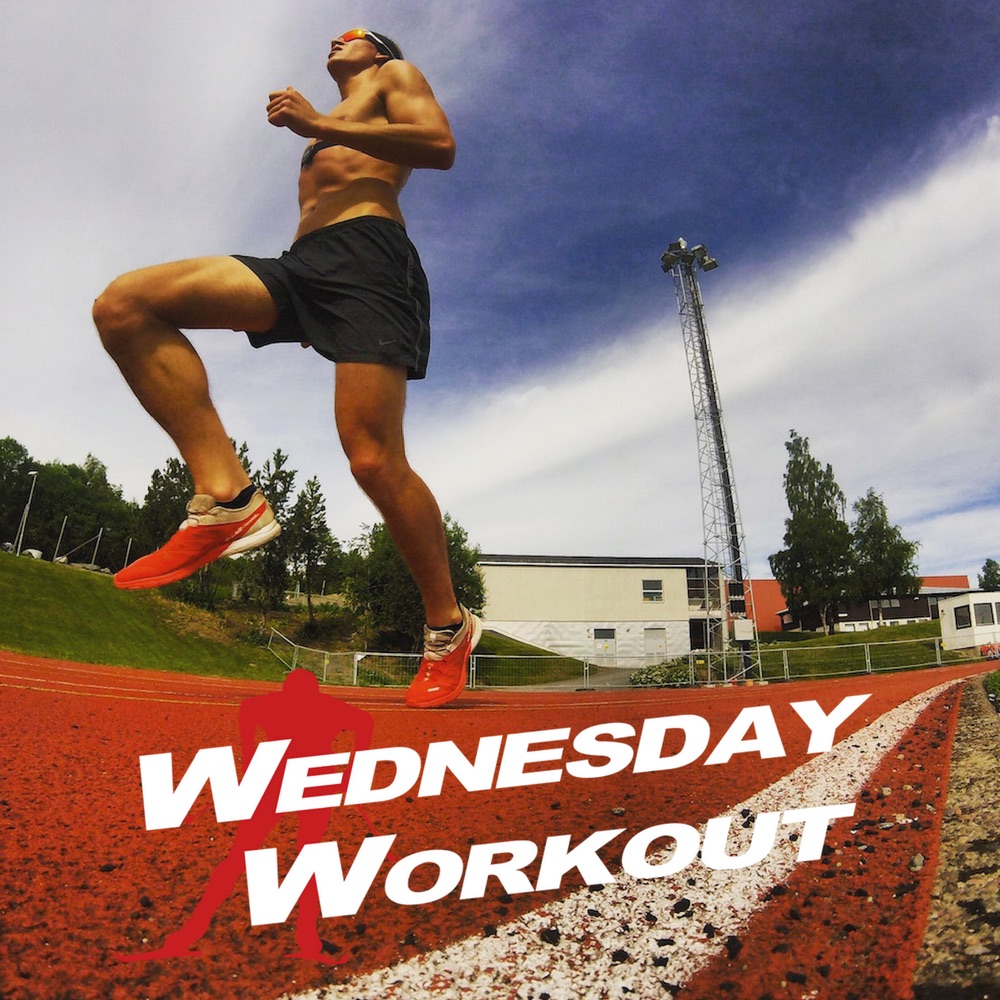
Kevin Bolger (University of Utah) during a track workout. (Courtesy photo)
With spring in full swing and many skiers returning to training, this week’s Wednesday Workout is presented by University of Utah Ski Team member, Kevin Bolger. While most of his athletic accomplishments from this past season are nordic-based — he’s a NCAA All-American, the 2017 Rocky Mountain Intercollegiate Ski Association (RMISA) nordic MVP and the U.S. nationals classic sprint champion — most of Bolger’s spring workouts mean giving skiing a spring ‘break.’
***
It’s no secret that natives of Sweden, Norway and other overseas nations often abound in the top spots of the RMISA circuit. Two seasons ago, just three American men — Nick Hendrickson (formerly of U.S. Nordic Combined), Sawyer Kesselheim (now a guide for Para-Nordic skier Jake Adicoff) and Ian Torchia (a 2016/2017 U.S. Ski Team Development Team member) — reached the podium.
The University of Utah’s Kevin Bolger during a cycling training session. (Courtesy photo)
Not listed: Kevin Bolger.
In his junior season with the University of Utah, Bolger, of Minocqua, Wis., native came close. He placed fourth three times in 2016, missing third by 3.1 seconds at RMISA Championships. Still, by the end of Bolger’s third year on the college circuit, a podium remained elusive.
But that was no deterrent. Bolger, who turned 24 earlier this month, ended his senior year with six regular-season podiums (two of them wins), a top-10 finish for All-American status at NCAA Championships (despite frostbitten fingers), a team championship title (Utah’s first in 14 years), and his first national title.
“If someone would have told me all this going into the season, I would have been like ‘Bring it on. Let’s actually do it,’ ” Bolger said in a recent phone interview.
Even if that meant finishing his last his last regular-season RMISA race, the 20-kilometer freestyle in Anchorage, Alaska, with fingers white from frostbite and the inability to unclasp his ski bindings. Though he ended that day in fourth, his first time off the collegiate podium all year, the frostbite meant skipping RMISA Championships and spending nearly three weeks inside training on a treadmill.
“As fun as that sounds, it wasn’t the best,” Bolger joked of his indoor training.
“I would have loved to have finished individually a lot better at NCAAs,” he said of finishing 15th and 10th, respectively, at NCAA Championships, which took place this past March in Jackson, N.H. “I really wanted to double podium there as well, but circumstances didn’t allow it.”
While Bolger missed his individual goals of garnering a podium, his efforts at NCAAs were still ones well spent. Heading into the championship’s final competition day, Utah was just 34 points behind the University of Denver. With temperatures hovering just above the legal race limit of -20 degrees Celsius (-4 Fahrenheit) on the last day, Bolger raced to 10th in the 20 k freestyle mass start, earning All-American honors, helping the Utes to a championship title, and perhaps most importantly, finishing with all 10 fingers in tact.
“Part of me like, ‘Well, I need to do this, but then there was another part of me that was like my fingers aren’t 100 percent… I don’t want to lose any of them,” Bolger said. “The frostbite was a little hiccup to my season, but to finish that whole week as a team winning a national championship, that means a lot more to me and I know it means a lot more to a lot more people as well.”
Kevin Bolger (l) of the University of Utah with UU teammate after a training session. (Courtesty Photo)
With his college ski career behind him, Bolger is bent on finishing school, but also looking ahead to life outside of the classroom. He plans to continue skiing after graduating with a major in sociology and minor in health education. Though unsure which training group he’ll choose, he does have his sights set on the Olympics.
“The U.S. nationals title was an accomplishment for me,” Bolger said. “I mean I know I’m capable of throwing down on any given day, so being able to do it there on that stage was jaw dropping.
“This season was a super good motivator for me,” he continued. “And I know I can accomplish a lot more.”
Despite his building excitement, he is adamant that at this time of year, even full-time skiers need a break from skiing.
“Whether it’s going to play pickup basketball or pickup soccer, something beyond what nordic skiers tend to do. For me, that’s a breath of fresh air,” he said.
“If I can postpone getting on rollerskis for an extra day or two days a week,” he added. “That’s a very big goal of mine.”
The Workout
Pick a sport outside of skiing that you enjoy. Bolger recommends soccer, basketball or climbing, though it could be anything. Get out and play for 1-3 hours.
Bonus Points from Bolger:
Gear Up with Games. Just because it’s not skiing, doesn’t mean it’s not beneficial. “I think skiers can get a little too wound up in full-on, 100-percent cross-country skiing, which is draining,” Bolger said. Games like soccer and basketball are valued by Bolger not only for the agility and coordintation they require, but for the more relaxed return to training they provide. “It’s all working toward a common goal, just getting back and moving again and getting ready for a new season.”
Seek New Faces and Places. Bolger says spring is the time for switching it up. Working out at a new spot or with a new training partner can relieve any unnecessary pressure and help keep the return to training fun. “I just want to go run with somebody who I don’t normally run with or I don’t ever get to hang out with,” he said. “It’s a breath of fresh air.”
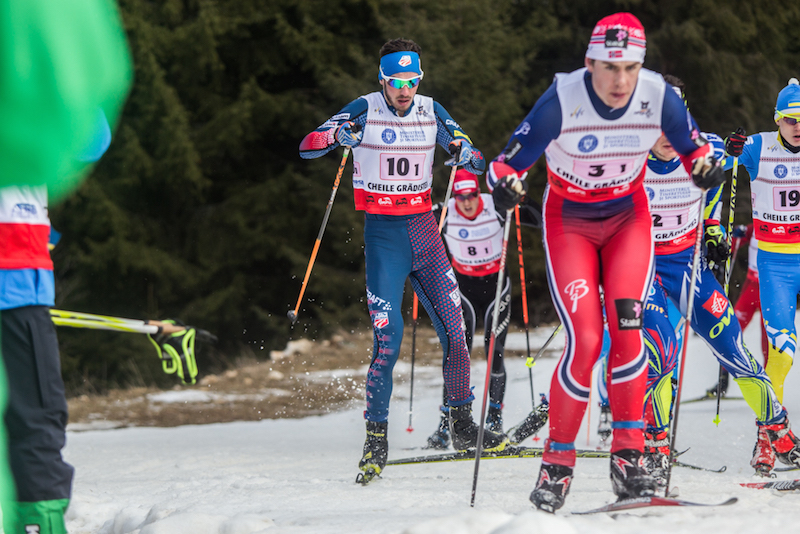
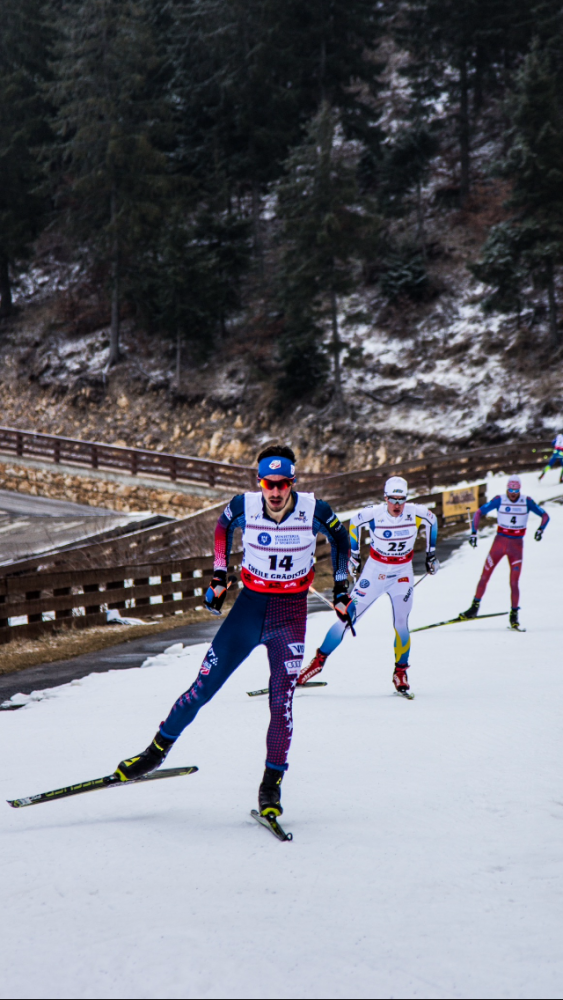
Ian Torchia (bib 10) chasing a Norwegian (bib 3) in the first leg of the junior men’s 4 x 5 k relay at 2016 Junior World Championships in Rasnov, Romania. “When I first heard the news I was extremely fired up,” Torchia told FasterSkier after learning that some of the Norwegians had been taking asthma medication despite not being diagnosed with asthma. (Photo: Logan Hanneman)
Norwegian team doctors prescribed asthma medication to young cross-country skiers without any diagnosis of the disease the country’s state broadcaster NRK reported. The incident occurred at 2016 Junior and U23 World Championships in Rasnov, Romania.
Petter Olberg, who was a physician on the team staff in Rasnov, said that the treatment was due to air-quality issues which irritated the airways of some athletes.
American and Canadian competitors and team staff at the event, however, did not recall any air quality problems. They expressed surprise that competitors who were still teenagers would be offered such drugs without a medical diagnosis of asthma.
“I am shocked to hear about this story and I do not recall there being poor air quality in Rasnov other than the coal burning pollution,” Julia Kern, an American who had two top-20 finishes in Rasnov, wrote in an email to FasterSkier. “My hope is that the doping regulations are set up to only help fix a medical disease instead of giving people an advantage.”
The medication allegedly prescribed, budesonide, is a glucocorticosteroid which is not prohibited for inhalation by the World Anti-Doping Agency (WADA). It was delivered by a nebulizer, rather than through inhalers; Olberg said he had also recommended that some athletes take a salt-water inhalation treatment through the nebulizer to improve their symptoms.
The case has caused a stir partly because a more senior Norwegian skier, Martin Johnsrud Sundby, was slapped with a suspension after taking asthma medication from a nebulizer. However, that was a different drug – salbutamol, which is a beta-2 agonist rather than a glucocorticosteroid – which is prohibited by WADA when used in high doses.
Air Quality Plagues FIS Site Selection, and Racers’ Lungs
Air quality has been a major issue at past Junior and U23 World Championships.
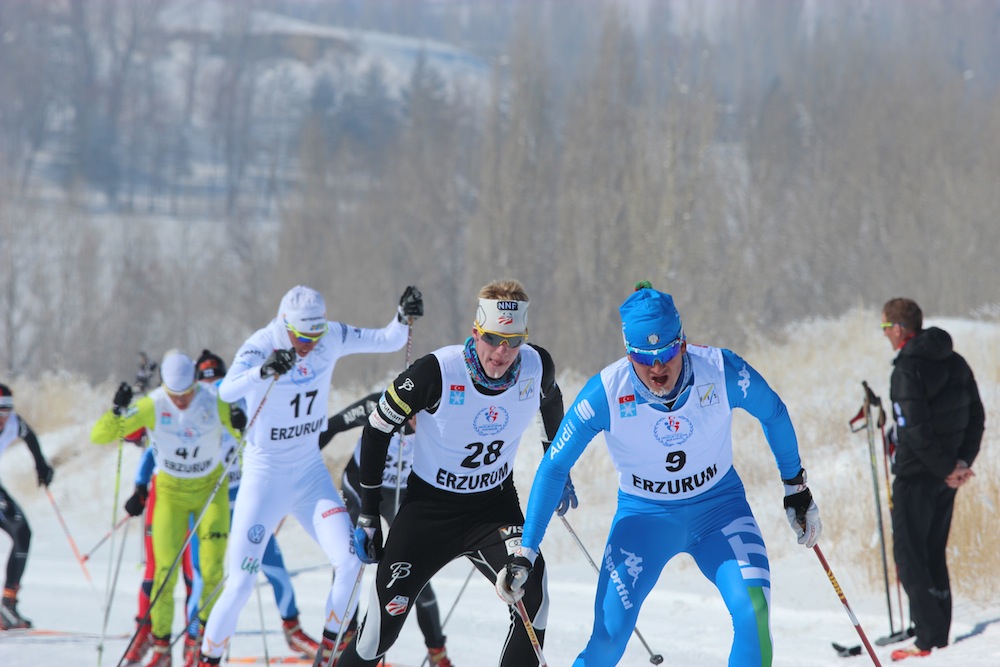
Logan Hanneman competing at World Junior Championships in Erzurum, Turkey, in 2012. (Photo: Reese Hanneman)
“When the World Junior & U23 Championships were held in Erzurum, Turkey in 2012 and Almaty, Kazakhstan in 2015, the air was possible the worst I have ever seen at a race venue,” Logan Hanneman of Alaska Pacific University (APU) wrote in an email.
Of the four Junior/U23 World Championships Hanneman has competed in, Erzurum and Almaty stood out for one reason: smog.
“In both locations, it seemed that the pollution was caused by poorly-regulated and designed coal power plants,” he explained. “With the large surrounding mountains in both locations, the inversion that would form during the night would suppress the pollution down to the valley floor and into the town where the teams were staying. The race venue in Almaty was above the pollution, but only in the early morning before it began to rise up the mountains.”
That was a nightmare for many athletes, including those who do suffer from asthma. Kern, now a U.S. Ski Team member based at Stratton Mountain School and Dartmouth College, remembers Almaty and its health challenges well.
“I had the experience of having my worst asthma attack ever in Almaty and I attribute that to the poor air quality,” she wrote. “I know some of my teammates who have never had any issues breathing even mentioned having some issues in Almaty.”
In fact, the International Olympic Committee released a consensus statement about asthma and elite athletes in 2008. In it, they addressed the influence of air pollution on the prevalence of airway problems during training and competition.
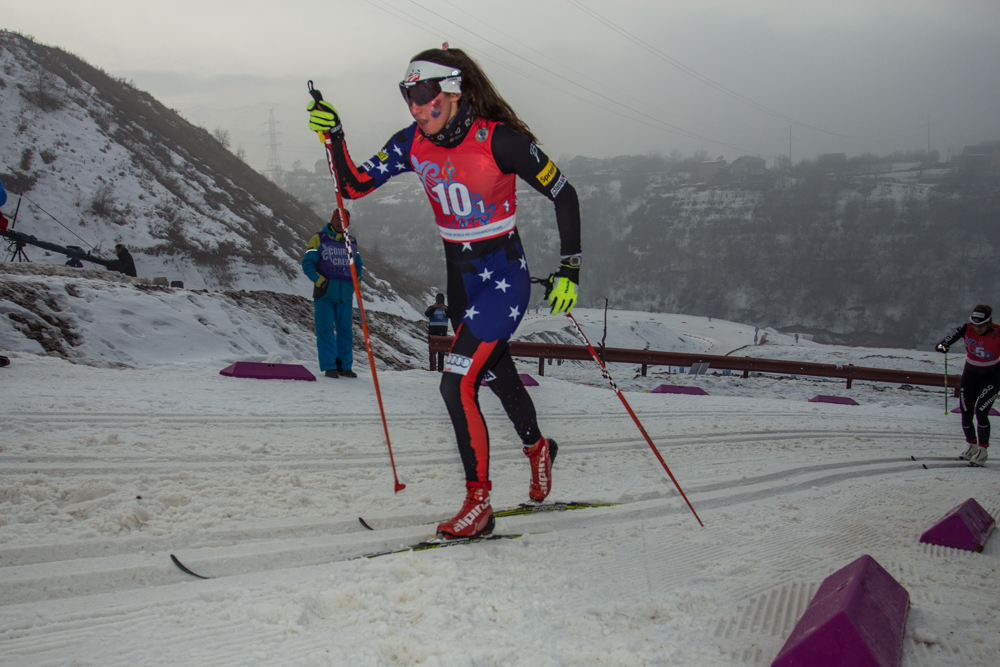
Julia Kern (CSU) racing against a backdrop of smog in the first leg of the 4 x 3.3 k relay at the 2015 Junior World Championships in Almaty, Kazakhstan. The American team would go on to place eighth. (Photo: Logan Hanneman)
“Airway function can be affected by exposure to seasonal and perennial allergens in sensitized individuals, dry/cold air, and poor quality air containing pollutants such as chlorine derivatives in swimming pools, ozone and oxides of nitrogen, and fine and ultrafine PM derived from combustion,” the group wrote. “The effects may be greater in subjects with asthma than without asthma.”
Other air characteristics are sometimes considered in assessing safety. The International Ski Federation (FIS) has a cutoff of -20° Celsius (-4°F), below which it is not permissible to hold competitions; one reason is frostbite, but another is airway damage. FIS is considering raising that lower limit, perhaps to -12° Celsius, specifically to protect athletes’ lung function from long-term damage.
But the pollution aspect of air quality does not appear to be a concern. Air quality is not discussed anywhere in the International Competition Rules (ICR), meaning that technical delegates and race juries do not have clear guidelines for deciding whether to adjust race schedules due to smog.
And by selecting sites like Erzurum and Almaty that are clearly plagued by such problems, FIS does not appear to make the issue a priority when awarding event bids.
They are not alone. The International Olympic Committee (IOC) awarded the 2008 Summer Olympics to Beijing, China, which has some of the worst smog in the world. That caused some long-distance runners to choose not to prioritize the marathon, for fear that prolonged exposure to the air while racing would cause asthma attacks.
Such an attitude by governing bodies must be changed, a growing number of athletes assert.
“My personal belief is that if we are racing in an area with high pollution, I think it is okay for people to use legal asthma medications at a legal dose in order to protect their lungs from damage,” Kern wrote. “But more importantly, I do not think races should be allowed to be held in places of pollution because it not only hurts the health of athletes in the short term, but in the long term as well.”
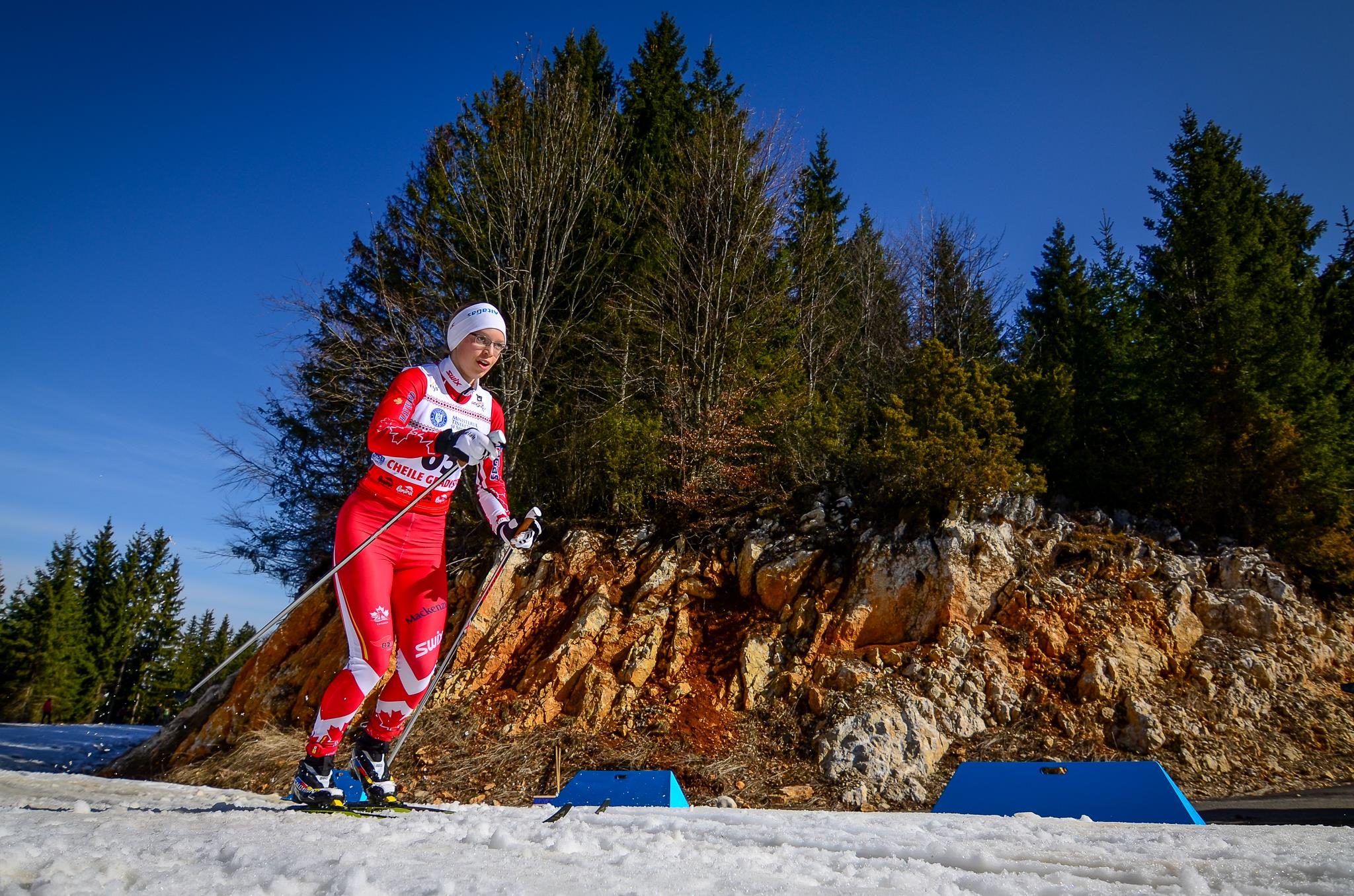
There were blue skies as Canada’s Hannah Mehain raced to 44th in the women’s 5 k classic on at 2016 Junior World Championships in Rasnov, Romania. (Photo: FIS Nordic JWSC & U23 WSC 2016/Facebook)
At Rasnov, where the ski competitions were held, traffic exhaust was less of an issue.
“The only thing that was polluting the air was the exhaust from coal burning, which is easy to recognize because it has a strong odor,” Kern wrote.
Of all airborne pollutants this type of exhaust can be particularly inflammatory to airways, according to Dr. Michael Kennedy at the University of Alberta, who studies respiratory health of endurance sports athletes.
“The ultrafine particles (UFP) are the most troublesome,” he explained in an email. “In any active person (most of the literature is from active transport — like bike commuting)… deposition of UFP in systemic circulation as well as lung function can be significant. Diesel is the worst of the polluters and fits with Romania and Kazakhstan, where High Emission Pollutants likely influenced lung health in all competitors. For those with [Exercise Induced Bronchoconstriction] it was likely worst.”
So it’s not crazy to suggest that athletes could have struggled to race in particulate-laden air, as Olberg suggested was true for the Norwegians.
But that’s not the way other teams remember Rasnov. Because of the way the venue was situated, American competitors did not notice the coal-produced UFP’s while they were skiing.
North American Perceptions of Air Quality in Rasnov
“I did not notice the ‘poor air quality’ in Rasnov as my biggest concern was the lack of snow. I think this is an excuse and if the air was bad in Romania I hate to think of what they were taking for Junior Worlds in Kazakhstan where the smog and air pollution was extremely prevalent.”
–Ian Torchia, USA (Northern Michigan University): 15th in the junior 10 k skate
“In Bucharest, the city air was definitely thicker, but the venue (Cheile Gradistei) was quite remote, at least 20 or 30km from any major cities (or industrial sites, that I know of), out in the countryside, surrounded by rural farmland and fields. Water quality seemed to be a much greater concern in Romania.”
– Jenn Jackson, Canada (NDC Thunder Bay): 29th in the U23 sprint
“The air quality appeared okay to me, however there was heating with wood in the area. That can irritate some but no significant quality issues like we saw in Kazakhstan and Turkey. Romania was very warm and early warm conditions can bring on pollen, however I didn’t notice that either.”
– Bryan Fish, U.S. Ski Team coach/trip leader
“While I’m by no means an air-quality expert, I wouldn’t say the air quality was bad in Rasnov, at least at the race site. The race site was up high on a hill in a very agricultural area, on the edge of some mountains… I never had a moment where I thought to myself ‘wow – this air quality is bad’ and as a coaching staff we never had a discussion that indicated that air quality was an issue with the site. We were mainly focused on having snow to ski on… That being said, in my opinion, it also wasn’t great. There was a big smokestack from what I’m assuming was some sort of boiler that burned wood. It was also pretty dusty from the overall construction.”
– Kieran Jones, Nakkertok Nordic coach/Canadian team staff member
Like Kern, Hanneman has been diagnosed with asthma. In his case, he believes that it is a result of growing up in Fairbanks, Alaska, and “racing and training in the very cold and dry air.” He said that he was prescribed a small inhaler to treat his symptoms after a major flare-up in Erzurum, but he didn’t experience a similar problem in Romania.
“I seem to remember that my asthma related problems were not very present in Rasnov,” Hanneman explained. “I took my inhaler like I normally do for races, but the air did not seem to bother me as much as the previous locations. It helped that it was also 55 degrees.”
Why Offer Athletes a Nebulizer?
So, then, was giving new medications to some junior athletes necessary?
“When I first heard the news I was extremely fired up,” wrote Torchia, who initially assumed that the juniors were prescribed the same drug which Sundby had used, rather than a non-prohibited one. “My initial anger eventually turned to being demoralized that doping had come down to the junior level. You hear about the scandals on the World Cup but when it comes to the people you race, it felt like a punch in the gut. The most frustrating thing I have heard was the Norwegian doctor offering asthma medication to healthy athletes. This shows a clear indication from the upper levels of the system to cheat their way to victory. If you can’t compete clean, don’t compete at all.”
As it turns out, it was not salbutamol but budesonide which the athletes were using. Budesonide is not prohibited for inhalation, although like other glucocorticosteroids, it cannot be injected or ingested orally in or out of competition.
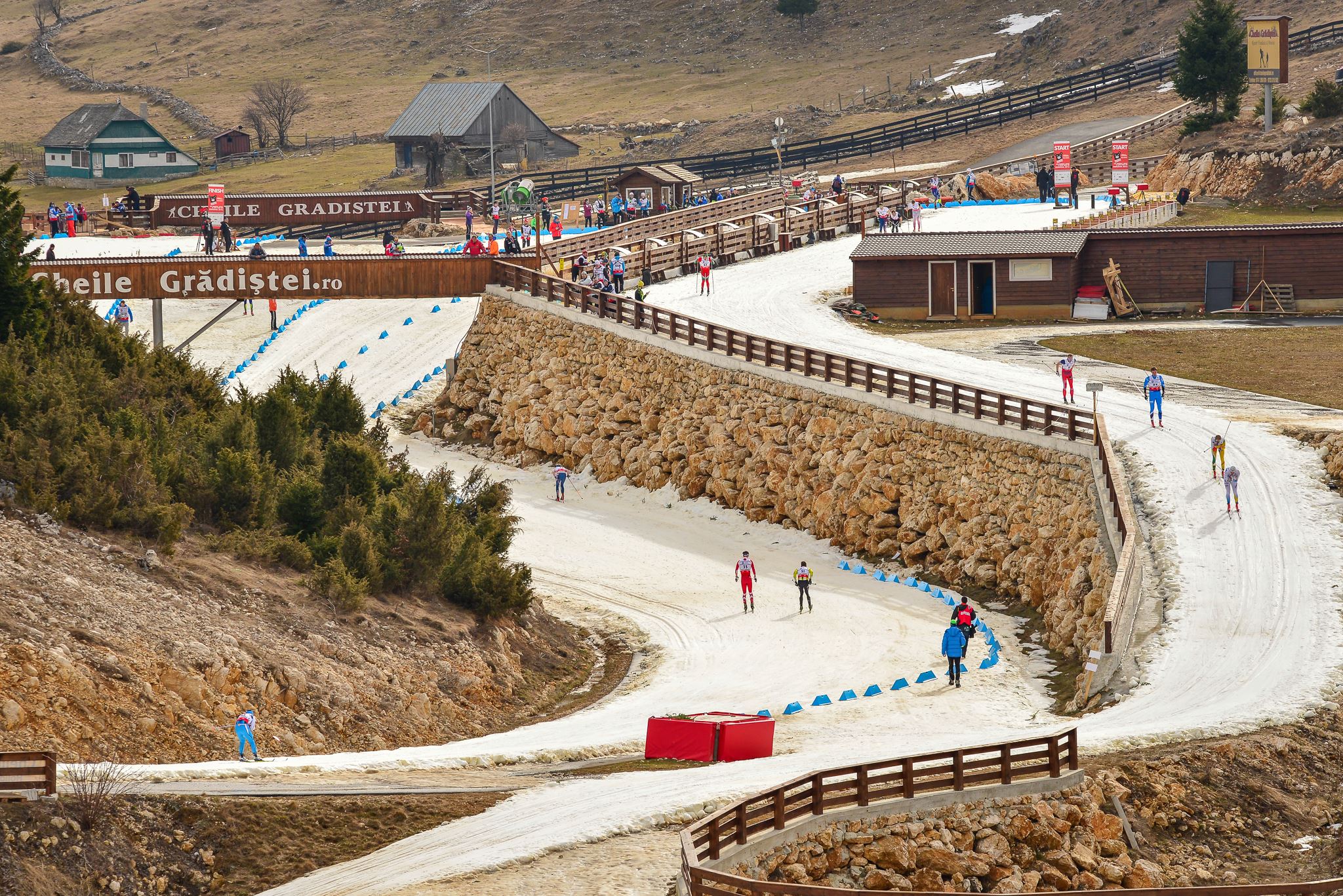
A bird’s eye view of the race course at U23/Junior World Championships in Rasnov, Romania. (Photo: FIS Nordic JWSC & U23 WSC 2016/Facebook)
Olberg told NRK that from his viewpoint, saying that the athletes without an asthma diagnosis were “healthy” was incorrect. The athletes, he said, were sick because of the air quality.
“I believe that we don’t medicate healthy people,” he explained to NRK. “If we medicate it is because they have gone ill. They have a symptom, a distress of some kind and then they reach out to me. We treat the symptoms…. I believe that to say that they are healthy is completely wrong, because if they’re healthy they wouldn’t have had the symptoms, and if that was the case they would not receive treatment.”
The North American athletes seemed to struggle internally about whether this was appropriate – especially since it’s relatively unclear whether non-asthmatics even receive benefits of such drugs. That’s even true in the case of salbutamol, the beta-2 agonist which is prohibited at high doses.
But the athletes felt that the intent of their competitors mattered, whether their performance was enhanced or not.
“After talking with [Northern Michigan University coach] Sten [Fjeldheim] and my exercise physiology professors and doing some personal research, it seems unclear on the performance enhancing benefits of taking salbutamol, especially in healthy athletes as the oxygen uptake is already at maximum potential,” Torchia wrote. “However… whether it is performance enhancing or not, if you are a healthy athlete and are taking synthetic drugs with the intention of helping your performance, you are cheating, and there should be repercussions.”
Hanneman and Kern, who take inhalers to treat their diagnosed asthma, had a hard time parsing whether it was wrong to use such medications without such a formal diagnosis.
“My hope is that the WADA has set the limitations and bans on certain drugs in ensure that the drugs permitted at legal doses would not have a positive impact on performance, but would only help treat the illness of asthma for those with the ‘disease’ (not sure what technical term to use),” Kern wrote.
American Logan Hanneman (c) racing to third in his quarterfinal of the freestyle sprint at U23 World Championships in Rasnov, Romania. He ended the day 15th overall. (Photo: Pete Leonard)
“Having exercise induced asthma myself, and seeing the health benefit that the medicine provides, I support the use of prescribed medications, but in limited quantities,” Hanneman agreed. “People who have not been treated previously should not be allowed to use such a medicine I feel.”
Many drew a distinction between whether such drugs were used as part of a long-time treatment plan, or prescribed more casually by doctors who are not intimately familiar with an athlete’s medical history.
“I am very much opposed to widespread usage of any medication,” U.S. Ski Team development coach Bryan Fish wrote. “That being said, there are athletes that have unique respiratory issues & these athletes should go through testing by qualified medical staff. The qualified medical staff should then create a unique and specific plan for that particular athlete.”
And as more and more such “gray area” incidents accumulate, it’s hard for athletes to interpret whether their competitors are seeking an unfair advantage or not – much less whether they are actually getting one.
“I don’t understand how people can be so invested in maximizing their performance that they’re willing to leave the white area and step into the grey,” Jackson wrote. “Unfortunately, medicating and supplementing just seems to be the norm these days, in sport and everyday society. People will do what they’ll do, so long as they feel it’s ‘normal’ or ‘okay’ – whether that be Norwegian juniors using asthma medication at the World Championships, Russians using xenon for Sochi, [Poland’s Justyna] Kowalczyk taking injections for her foot in 2014, or [Norwegian Therese] Johaug’s doctor providing her that super skin cream. I suppose it’s inevitable, as you approach the limits of human potential, that you toe the line between white and grey, but I don’t feel like I’m close enough to that point to really understand why someone would.”
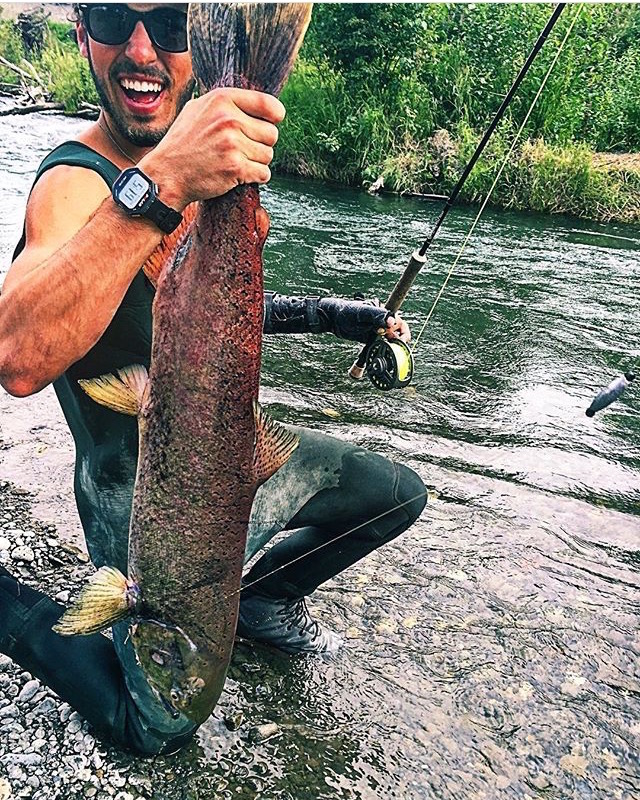
Ian Torchia says this was “one of my favorite moments of the summer…learning the salmon fly fishing ropes from Erik Bjornsen and David Norris after a big week of training on the glacier.” (Courtesy photo)
Welcome to “17 Questions for 2017″, where we are catching up with American and Canadian national-team members before the beginning of the winter season.
***
This spring, Ian Torchia became the latest in a long line of Northern Michigan University skiers to snag a U.S. Ski Team nomination. That came thanks to two stellar years of World Junior Championships racing in a row: in 2015 he finished 11th in the skiathlon, then in 2016 15th in the 15 k skate.
Now a junior at the college, Torchia is a major contributor to the perennial midwest powerhouse; he finished second and fourth at NCAA Championships last season. But he’s headed into the U23 ranks internationally.
1. Biggest change in your life in the last five or so months since the ski season ended?
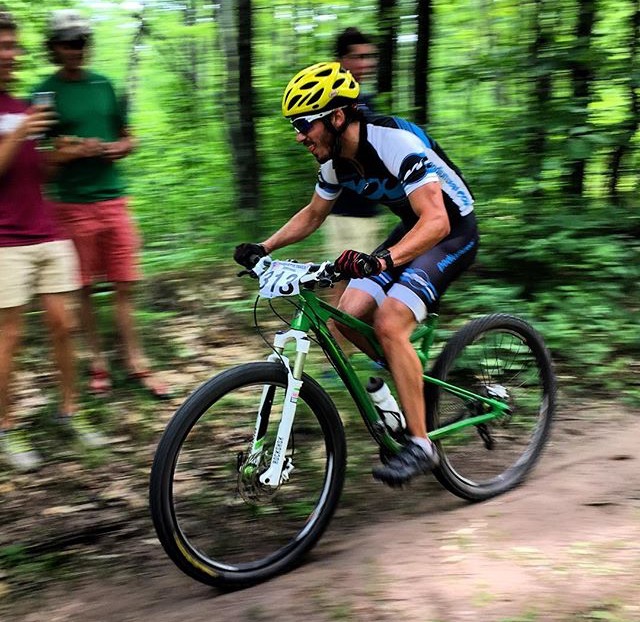
I attended two training camps with the US Ski Team, broke my wrist in late June during a mountain bike race and had to one pole rollerski for 2 months, learned how to surf, and started loving classes again since changing my major to Exercise Science.
2. Biggest change in your training?
“A recent Vo2max test for Exercise Physiology class. Love what I’m studying.” (Courtesy photo)
Slight increase in yearly volume but not much change other than that with Sten [Fjeldheim]’s plan. If it ain’t broke don’t fix it.
3. Major areas of improvement you’ve seen so far?
Breaking my wrist was a blessing in disguise as my legs are stronger than ever.
4. Whom you’ve been working closest with this offseason (coaches or training partners)?
Learned a lot from the US guys at the training camps but the bulk of my time has been under Sten and assistant coach Shane MacDowell’s tutelage with the Marquette Training Group (MTG) men.
5. Best trip in the last five months (and why)?
Tossup between the two camps in Bend and Anchorage. I’ll give the nod to Bend for having 2 functioning wrists and an unreal Broken Top crust cruise but salmon fly fishing with Bjornsen in AK is a close second.
6. Favorite cross-training?
Mountain biking and surfing on Lake Superior.
7. Favorite non-athletic activity or pastime this summer?
I love a good game of Settlers of Catan.
8. Song that was your jam this summer?
My roommate Oscar Friedman produces music so definitely his song Shine (GWYLO remix). Check it out on Spotify!
9. All time favorite race moment?
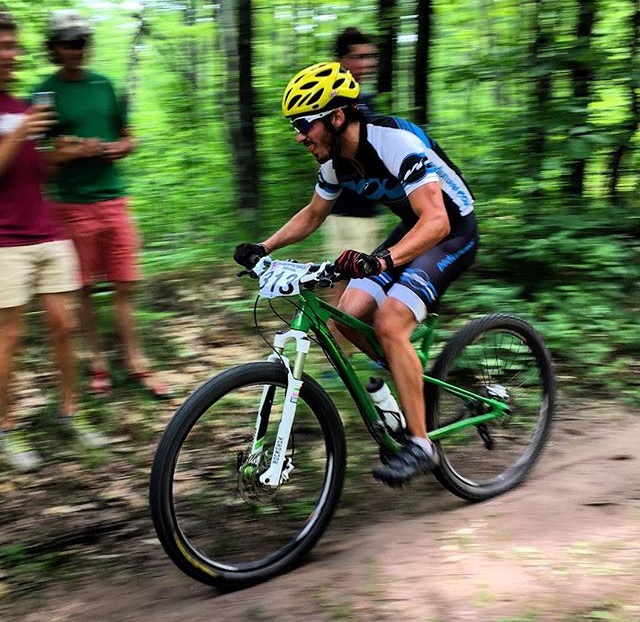
Torchia competing in a mountain bike race where he later broke his wrist. He writes: “The infamous first mountain bike race. Sten’s made sure I’m not doing any more of them anytime soon!” (Courtesy photo)
Either getting 3 NCAA All Americans for NMU in the 10k freestyle with my teammates Adam Martin and Jake Brown or moving from 60th up to 11th at Junior Worlds in Kazakhstan in the skiathlon.
10. First thing you pack in your bag when you leave for Europe?
Buffalo Wild Wings BBQ hot sauce. Makes Romanian mystery meat taste great!
11. Venue/event you’re most excited to visit this season?
Soldier Hollow for U23’s. Time to defend our home turf from the Russians and Norwegians.
12. Who will win the World Cup title this year?
Sundby and Heidi Weng. Simi and Sophie for Sprint World Cup!
13. Biggest sacrifice you feel you’ve made choosing this career path?
There are some sacrifices but I mostly feel very blessed to be surrounded by great teammates and friends and live in a place like Marquette with so much to offer.
14. If you could change one thing about your sport, what would it be?
Stop NMU students from asking if we’re the alpine team. Bring back the daily Hoff blog. Give the Nordic Tribune a Pulitzer Prize.
15. What did you have for breakfast this morning?
An asiago bagel with jalepeno cream cheese, 2 eggs (hard), and quite a bit of yogurt. No coffee, just naps.
16. In 5 years, I’ll be ____?
Slowly chipping away at my Ph.D in Exercise Science and hopefully skiing on the World Cup.
17. In 50 years, I’ll be ____?
An old grey-haired retired professor trying to keep up with my kids skiing, surfing and mountain biking.
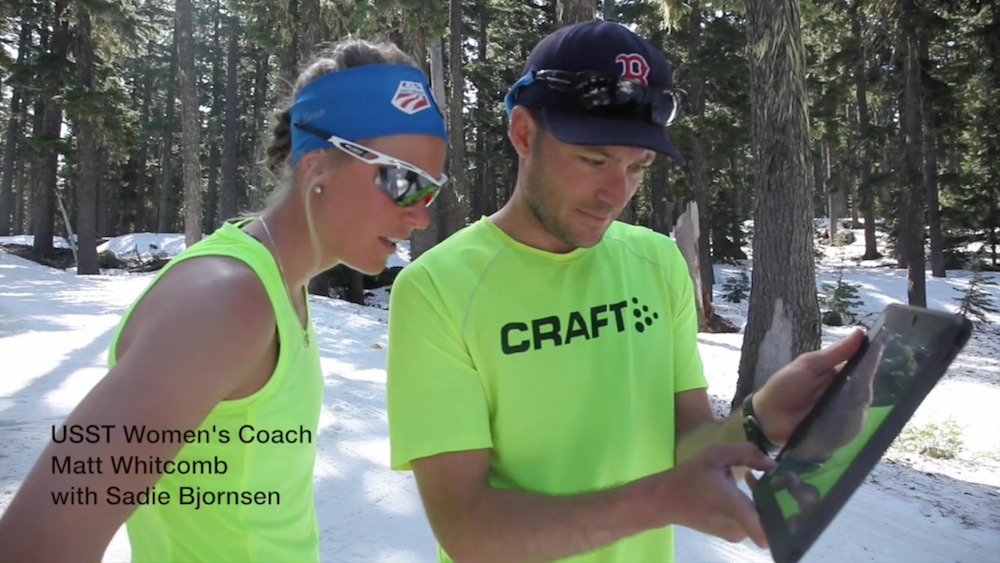
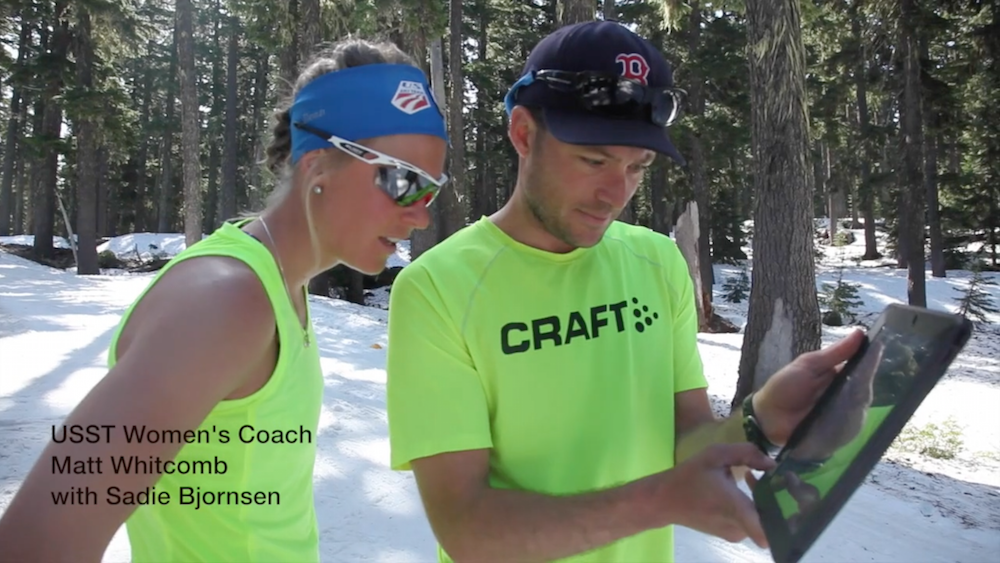
U.S. Ski Team Head Coach Chris Grover (r) discussing classic technique with national-team members Simi Hamilton and Ian Torchia (left) last month at an on-snow camp in Bend, Ore.
The U.S. Ski Team wrapped up its final dryland training camp of the season in Park City, Utah, on Monday, Oct. 31. Athletes arrived on Oct. 17, with skiers from Alaska Pacific University (APU), the Craftsbury Green Racing Project (CGRP), Stratton Mountain School T2 (SMST2) Team also in attendance, along with a development group contingent. Cross Country Canada’s national team (NST) also spent most of the month in Park City, with developing and World Cup athletes alike training at Soldier Hollow (SoHo) from Oct. 7 to Oct. 24.
Here are some of the best photos FasterSkier could obtain. (We’re still seeking Canadian photos; send submissions with captions and credit information to info@fasterskier.com.)
Left to right: Cross Country Canada’s Devon Kershaw and Alex Harvey along with U.S. Ski Team A-team members Noah Hoffman, Erik Bjornsen and Simi Hamilton during a 4 x 10 min L3 skating session up Snake Creek Canyon in Midway, during their respective teams’ training camps in Park City, Utah. (Photo: Matt Whitcomb)
Right to left: Canadian National Team members Alex Harvey and Jess Cockney during a classic ski at their team’s training camp in Park City, Utah, this Ocotber. (Photo: Ivan Babikov/Instagram)
Canadian National Team athletes during a classic ski at their team’s training camp in Park City, Utah, this October. (Photo: Ivan Babikov/Instagram)
Canadian National Team athletes during a classic ski at their team’s training camp in Park City, Utah, this October. (Photo: Ivan Babikov/IInstagram)
Front R to L: U.S. Ski Team A-team members Jessie Diggins and Kikkan Randall (Back R to L):
U.S. Ski Team A-Team member Simi Hamilton during a 15 k classic ski in Soldier Hollow at the USST’s annual training camp in Park City, Utah, which ran this year from Oct. 17 until Oct. 31. (Photo: Matt Whitcomb)
U.S. Ski Team A-Team member Paddy Caldwell during a 15 k classic ski in Soldier Hollow at the USST’s annual training camp in Park City, Utah, which ran this year from Oct. 17 until Oct. 31. (Photo: Matt Whitcomb)
U.S. Ski Team A-Team member Noah Hoffman during a skate sprint in Soldier Hollow at the USST’s annual training camp in Park City, Utah, which ran this year from Oct. 17 until Oct. 31. (Photo: Matt Whitcomb)
U.S. Ski Team A-Team member Liz Stephen during a 5 x 8 minute L3 classic ski up East Canyon at the USST’s annual training camp in Park City, Utah, which ran this year from Oct. 17 until Oct. 31. (Photo: Matt Whitcomb)
Right to left: U.S. Ski Team A-Team member Jessie Diggins, Kikkan Randall, and Liz Stephen during 6 x 3 minute max effort double pole intervals at the USST’s annual training camp in Park City, Utah, which ran this year from Oct. 17 until Oct. 31. (Photo: Matt Whitcomb)
Left to right: U.S. Ski Team member Noah Hoffman chases Gus Schumacher during a skate sprint in Soldier Hollow at the USST’s annual training camp in Park City, Utah, which ran this year from Oct. 17 until Oct. 31. (Photo: Matt Whitcomb)
Left to right: U.S. Ski Team A-team members Sophie Caldwell, Andy Newell, Kikkan Randall, and Liz Stephen during a 15 k classic ski in Soldier Hollow at the USST’s annual training camp in Park City, Utah, which ran this year from Oct. 17 until Oct. 31. (Photo: Matt Whitcomb)
Left to right: Jessie DIggins leads her U.S. Ski Team teammates Kikkan Randall, Ida Sargent and Julia Kern during a skate sprint in Soldier Hollow at the USST’s annual training camp in Park City, Utah, which ran this year from Oct. 17 until Oct. 31. (Photo: Matt Whitcomb)
Wyatt Gebhardt during a skate sprint in Soldier Hollow at the USST’s annual training camp in Park City, Utah, which ran this year from Oct. 17 until Oct. 31. (Photo: Matt Whitcomb)
Front L to R: U.S. Ski Team members Andy Newell, Erik Bjornsen chased by (Back L to R): Ben Lustgarten and Paddy Caldwell during a skate sprint in Soldier Hollow at the USST’s annual training camp in Park City, Utah, which ran this year from Oct. 17 until Oct. 31. (Photo: Matt Whitcomb)
U.S. Ski Team member Erik Bjornsen during a 15 k classic ski in Soldier Hollow at the USST’s annual training camp in Park City, Utah, which ran this year from Oct. 17 until Oct. 31. (Photo: Matt Whitcomb)
Left to right: Bridger Ski Foundation’s Jennie Bender and Stratton Mountain School skier Erika Flowers during a skate sprint in Soldier Hollow at the USST’s annual training camp in Park City, Utah, which ran this year from Oct. 17 until Oct. 31. (Photo: Matt Whitcomb)
Ben Saxton (SMST2) during a 15 k classic ski in Soldier Hollow at the USST’s annual training camp in Park City, Utah, which ran this year from Oct. 17 until Oct. 31. (Photo: Matt Whitcomb)
Ben Saxton (SMST2) skis with a junior athete during a skate ski at the USST’s annual training camp in Park City, Utah, which ran this year from Oct. 17 until Oct. 31. (Photo: Liz Arky)
Left to right: Hunter Wonders and Luke Jager during a skate sprint in Soldier Hollow at the USST’s annual training camp in Park City, Utah, which ran this year from Oct. 17 until Oct. 31. (Photo: Matt Whitcomb)
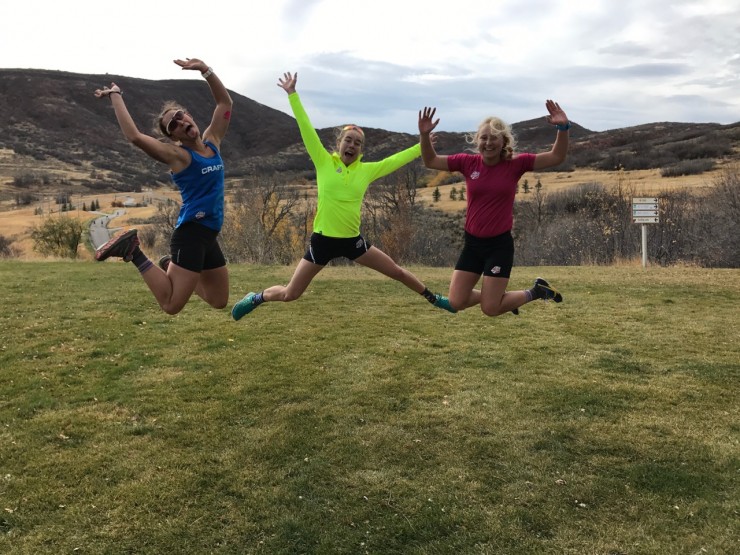
Left to right: U.S. Ski Team (USST) D-team members Julia Kern, Katharine Ogden and Hannah Halvorsen jump for joy after the USST’s sprint time trial training session in Park City, Utah, on Oct. 28. (Photo: Erika Flowers)
Right to left: U.S. Ski Team (USST) athletes Ida Sargent and Jessie Diggins along with teammates Julia Kern and Kikkan Randall during a sprint time trial at the USST’s annual training camp in Park City, Utah, which ran this year from Oct. 17 until Oct. 31. (Photo: Bryan Fish)
Right to left: U.S. Ski Team (USST) A-Team athletes Ida Sargent and Jessie Diggins along with USST Development Team skier Julia Kern, and USST A-Team member, Kikkan Randall during a sprint time trial at the USST’s annual training camp in Park City, Utah, which ran this year from Oct. 17 until Oct. 31. (Photo: Bryan Fish)
Stratton Mountain School T2 (SMST2) skier Anne Hart (c) challenges her teammate Erika Flowers (l) and U.S. Ski Team member Liz Stephen during a sprint time trial at the USST’s annual training camp in Park City, Utah, which ran this year from Oct. 17 until Oct. 31. (Photo: Bryan Fish)
Right to left: Stratton Mountain School T2 (SMST2) skier Anne Hart, along with U.S. Ski Team A-Team member Liz Stephen, SMST2 athlete Erika Flowers, and Bridger Ski Foundation skier Jennie Bender during a sprint time trial at the USST’s annual training camp in Park City, Utah, which ran this year from Oct. 17 until Oct. 31. (Photo: Bryan Fish)
U.S. Ski Team D-team skier Katharine Ogden (r) during a sprint time trial at the USST’s annual training camp in Park City, Utah, which ran this year from Oct. 17 until Oct. 31. (Photo: Bryan Fish)
U.S. Ski Team D-tem athlete Hannah Halvorsen (r) during a sprint time trial at the USST’s annual training camp in Park City, Utah, which ran this year from Oct. 17 until Oct. 31. (Photo: Bryan Fish)
U.S. Ski Team D-team athlete Hannah Halvorsen (r) during a sprint time trial at the USST’s annual training camp in Park City, Utah, which ran this year from Oct. 17 until Oct. 31. (Photo: Bryan Fish)
U.S. Ski Team D-team athlete Paddy Caldwell (r) during a sprint time trial at the USST’s annual training camp in Park City, Utah, which ran this year from Oct. 17 until Oct. 31. (Photo: Bryan Fish)
A train of women during a classic ski at the U.S. Ski Team’s annual training camp in Park City, Utah, which ran this year from Oct. 17 until Oct. 31. (Photo: Bryan Fish)
Athletes during a skate session at the USST’s annual training camp in Park City, Utah, which ran this year from Oct. 17 until Oct. 31. (Photo: Bryan Fish)
Right to left: U.S. Ski Team (USST member Jessie Diggins and Julia Kern during a skate session at the USST’s annual training camp in Park City, Utah, which ran this year from Oct. 17 until Oct. 31. (Photo: Bryan Fish)
Left to right: U.S. Ski Team (USST) D-team members Katharine Ogden, Hannah Halvorsen and Julia Kern during a skate session at the USST’s annual training camp in Park City, Utah, which ran this year from Oct. 17 until Oct. 31. (Photo: Bryan Fish)
Right to left: Stratton Mountain School T2 (SMST2) skier Anne Hart, followed by her Stratton teammate and U.S. Ski Team D-team athlete Julia Kern as well as Erika Flowers (SMST2) during a skate session at the USST’s annual training camp in Park City, Utah, which ran this year from Oct. 17 until Oct. 31. (Photo: Bryan Fish)
Right to left: U.S. Ski Team A-Team athletes Liz Stephen, Jessie Diggins, Sadie Bjornsen during a skate session at the USST’s annual training camp in Park City, Utah, which ran this year from Oct. 17 until Oct. 31. (Photo: Bryan Fish)
U.S. Ski Team D-team athlete Julia Kern (r) during a skate session at the USST’s annual training camp in Park City, Utah, which ran this year from Oct. 17 until Oct. 31. (Photo: Bryan Fish)
U.S. Ski Team A-Team member Andy Newell striding it out during a classic training session at the USST’s annual training camp in Park City, Utah, which ran this year from Oct. 17 until Oct. 31. (Photo: Andy Newell)
Left to right: U.S. Ski Team A-team member Sadie Bjornsen, Julia Kern, Katharine Ogden, and Liz Stephen during a classic ski at the USST’s annual training camp in Park City, Utah, which ran this year from Oct. 17 until Oct. 31. (Photo: Sadie Bjornsen)
One thing we can say about most dads: they tell it like it is and they tell it to you straight. Just like we did for our moms on Mother’s Day, we wanted to honor all of the fathers out there on Father’s Day, and we asked top North American national-team members to share a photo and answer one of the following questions:
What was the best piece of advice your dad ever gave you?
What was the biggest lesson you learned from your dad?
Ian, and dad, Mike Torchia at an inline skate race on Madeline Island, Wisconsin, in 2016. Torchia wrote on his dad’s advice at the time: “‘You know what happens to hot dogs, Ian? They get eaten!’ – Mike Torchia
While my dad (affectionately called Sir) has given countless gems of advice, the above is one that I remember the most as he has always emphasized humility in the face of success.” (Courtesy Photo)
“My dad taught me the most basic and important lessons for a kid athlete and that was how to race and pace. He helped organize the first road races in Bennington and would run the 5k with me before heading out on the 10k race for himself. He taught me how to relax on the downhills and try to kick it in to the finish as hard as I could… I distinctly remember learning those two important things from running with my dad.”
“My mom teaches me lessons through words (she is going to school to be a counselor), whereas my dad has always taught me lessons through actions. I’ve observed these actions throughout the years with the intent to grow into somebody similar. His positivity, sense of humor, and ability to make people feel at home are things I hope have worn off on me. The biggest thing my dad has taught me is how to follow my gut feeling through the decision making process. He never tries to control or alter the decisions I’m going to make. Instead, he has allowed me to reap the rewards or consequences from these decisions on my own. And from there, I learn. Happy Fathers Day Hans. Love you!”
“When I want advice, the first person I call is my dad because he is very honest and always puts things into perspective. There is one piece of advice in particular that really stuck with me. I must have been really nervous about an upcoming race and was talking about the criteria I needed to make in order to qualify for a certain event. He reminded me that there was no point in getting worked up about criteria because it is something that I can’t control. He simply told me: ‘When you ski fast, good things happen.’ It made me realize how simple it was. I had worked hard to get to where I was, all I could do was go as hard as I possibly could, the rest is out of my control. I often think about that when I am nervous before important events. I am so glad that I can always rely on my dad to give me down to earth advice. Thank you dad and happy father’s day (and birthday)!”
“The best advice my dad has ever given me is reminding me that I tend to ski the fastest when I’m happy and enjoying myself. One of the times he reminded me of this was when I was at the Olympics and it forced me to step back and soak in the incredible experience I was having. When he said it, he was obviously applying it to skiing, but I think it’s a pretty simple piece of advice that you can apply to most parts of life. It’s easier to succeed in something that you’re passionate and happy about whether that’s a sport, friendship, or class. I think it’s easy for my dad to give advice like that because he’s one of the most kind and happy people I know and he likes to keep things pretty simple. I’ve always admired him for those reasons and would be happy to take advice from him any day :)”
“While I never actually went cross country skiing with my Dad, he was incredibly influential in his love for the outdoors and ability to truly enjoy life. My dad taught me to alpine ski and mountain bike, both were activities in which he challenged me and was always up for a race. I don’t know if my mom will ever get over just how much I ski like him. My dad had a great ability to do things in a big way in order to maximize the enjoyment out of each adventure and he did so with incredible passion. I can’t say I have fully learned this yet, but his spirit and enjoyment of life certainly are in me and I think often about how to embrace this a little more each day. At the very least, I have learned to be very passionate about the things I love. My favorite place in the world is the Southern Utah desert and I think my love for the desert stems entirely from family fun, particularly with my Dad.”
“The biggest lesson I learned from my Dad was to never do anything halfway. Whatever you decide to do, give it your best effort and be present. Whenever I see my Dad engaged in a project, whether that’s yard work, making dinner, going for a ski or going to work for the day, he’s fully committed to what he’s doing. He never does anything part-way, and that’s the way I want to live my life, too!
My Dad is also the gutsiest and toughest racer I know. I cheered him on in marathons when I was little and I’d like to think that when I have my best races where I hang in there with the pack, I’m racing like him.”
Little Jessie Diggins running alongside and cheering for her dad at a road race
“When I was younger I used to always want to quit different sports or activities that I was involved with. One of those sports was biathlon. I definitely didn’t give biathlon a good chance yet, but what I knew was that it was hard and I was bad at it. ‘I want to quit…I’m always coming in last!’ probably came out of my mouth about a dozen times when I began biathlon, but my dad saw something in me that I didn’t see yet. He knew I needed to give it another shot and stick with it, and I’m thankful he didn’t let me give up on it when I was a stubborn teenager. As a result, I slowly saw some improvement and was enjoying it more…quickly forgetting that I wanted to quit only months before. It’s funny to look back on, especially now that biathlon is such a huge part of my life. My dad has continued to support me to this day, and is always the first person that I talk to (along with my mom) after my races, if I’m having a hard time, or just to catch up. I’m excited to see where biathlon takes me, knowing that he’ll be by my side during the entire journey. Love you dad, hope you have a great Father’s Day!”
US Biathlon’s Maddie Phaneuf (c) with her parents after her fourth-place finish at 2014 Youth/Junior World Championships in Presque Isle, Maine.
“In his soccer coaching days, something that my dad always said that stuck with me is ‘Practice doesn’t make perfect, perfect practice makes perfect’, and that taught me to always practice with intent. But the biggest lesson my dad taught me without having to say a word was to find the fun in everything I do. Thanks dad!”
“The biggest lesson I learned from my dad is to enjoy life’s beauty.”
“Being the king of practical jokes, quick wit, and somewhat embellished stories, my father taught me to never take life too seriously. He manages to find humour in any situation, no matter what the mood is. He has always been at the sidelines of races and practices with off-beat cheers and goofy hats. Even now with majority of races overseas, he religiously watches every race live and follows it up with an email commenting on an obscure element of the race such as my earrings. From day one he has been there, encouraging my dreams and making me laugh. Thanks for being so awesome, Dad!”
“My dad has played a major role in my life in so many ways. He is the one who introduced me to the outdoor and sporting world when I was young. From building small ski ramps in the backyard to taking me backcountry skiing. I have so many amazing memories of my dad and what he has taught me it is hard to nail one thing down as the best advice or lesson that he has shared with me. All of the things I have learned seem to relate to a couple key things. Find something you enjoy doing, decide what your level of commitment is going to be and then do it right. I am very grateful that my dad was never one to pressure me in the sporting world but rather support me and help me figure it out. There are so many different avenues one can choose especially in a town like Steamboat where you can participate in almost any sport. With my dad’s help I was able to find the sport I love and figure out how much I really was willing to put into my career. That stage is still panning out but without my dad’s support in everything I tried I would not have learned to love the sporting world. So thank you dad! Love ya!”
“The wisest and most sincere thing that my dad taught me was to be myself. Whether it was going out for a 5-hour mountain bike ride because you felt like it, doing skate intervals until you threw up because you wanted to beat your competition at the next JNQ, or just acting totally goofy while on a desert camping trip, being yourself and knowing what you truly wanted to do and be in the moment of now was the most valuable thing that my dad, or anyone for that matter, has ever taught me. Happy Father’s Day to all of the amazing dads out there! None of us would be where we are now without you, literally and figuratively.”
“The biggest lessons I’ve learned from my dad are to be tough and love what I’m doing. He taught me to hang tough, finding the strength to believe in myself and not give up when the going gets hard. He also always reminded me to have fun and if I wasn’t enjoying or passionate about what I was doing then it was time to do something else. This advice has given me the strength and work ethic to follow my dreams and have a blast doing it.”
“My dad has always had a love for sports, especially skiing. Growing up both my parents encouraged me to do many activities. They were always driving me from practise to practise but skiing was something that my dad and I did together. Over the years skiing became one of my favourite sports. Growing up some of the best advice my dad ever gave me was to make sure the things you are passionate about play and important role in your life, and that real jobs are overrated. He always encouraged me to pursue my goals and supported my racing and training with pride. After high school when I was trying to decide what my future would hold, my dad’s advice and philosophy on life, If I can do what I love as my ‘job’ why wouldn’t I. My dad has been there every step of the way, through my best times and the hard ones. I am so happy to have to chance to be home in Whitehorse this Father’s Day to spend it with my dad. No skiing together at this time of year but we have already been out trail running together in the one day I’ve been home. Happy Father’s Day dad and thank you for sharing your love for skiing with me, I love you! And a very Happy Father’s day to all the dads out there!”
“My Dad has literally supported me in biathlon since day 1 whether it was helping run kid’s practices on the weekends, cheering me on at the Olympics or proofreading website updates! I can’t name a single best advice, but I think the most powerful thing my Dad has given me is honesty. It sounds cliché I know! But really, no matter how well a race or training session went (or anything in life for that matter) my Dad was always positive but honest: he is the person I trust to give me advice or feedback that isn’t sugar coated. My Dad has this way of analyzing things that always leave me feeling more motivated and determined. The skill of being honest with myself, keeping my sport in perspective and not beating myself up when things don’t go as I want has come in a huge part from my Dad – and I doubt I would still be a biathlete without it!
As for my Grandpa, as soon as I think of him and sport I can hear him smiling snd saying ‘Go get’em Kid’….he must of said this to me thousands of times at uncountable races!
I am a lucky girl!”
“The biggest lesson my dad has taught me is the importance of confidence in racing. Whether it was by coming with me to the start pen to help me get my ‘game face’ on or by giving me pre-race pep talks, he showed me that a huge part of being a successful athlete is having confidence in your own abilities.”
” ‘Don’t forget to have fun, Susan.’ Those are often my father’s parting words to me as I leave for competitions. As a former USST member and a 2 time xc skiing Olympian, my father always understood that a passion for the sport must be the foundation to build on, no matter what level is ultimately reached.
When I was a kid, my dad always wanted to make sure I was enjoying skiing and doing it for the right reasons. I’ve always been competitive, sometimes to my own detriment. Dad held me back from intense training environments during my junior high years so that I wouldn’t burn myself out. In high school, he encouraged me to invent games for my teammates and to turn interval workouts into fun relays. I am thankful he led me in that direction, otherwise I would not be competing today.
As I got older and reached a more elite level, he has given me all sorts of wonderful advice. Immediately upon graduating from college, I was uncertain whether I should accept an invitation to move to Lake Placid to try a complete unknown, biathlon. My dad pointed out: ‘If you don’t try this, you are always going to wonder, ‘What if?’ ‘ He knows me well.
Some of his other advice that I have taken to heart:
1. ‘If you are going to be a full-time ski racer, you have to want to be the best in the world. I don’t know if you have that hunger in you — it is something you are going to have to figure out for yourself.’
2. ‘The Euros put their pants on in the morning the same way you and I do — one leg at a time.’
3. ‘I know you want to make an Olympic team, but the real question is, what is your goal once you get there?’
“My Dad always told me ‘do as your dad says, not as he does’… wise words from the Wizard of the North himself.”
“I wouldn’t be writing into Fasterskier if my Dad hadn’t taught me how to ski at a young age. Unfortunately, I can’t remember as far back as my first days on skis, but I do have many memories of him teaching other friends and family various forms of skiing. In this, he taught me that there’s tremendous satisfaction in sharing your passions. In fact, although my dad has never strapped on a pair of jumping skis, he has helped many younger kids progress at the local ski club, and he’s been the Central Division Nordic Combined Representative for years. He’s demonstrates a selflessness that is inspiring for me to try to live up to.”
“My dad has taught me that nature offers so many great adventures and that you always have to remember to have fun and really enjoy what you are doing :)”
“My dad always tells me to think before I speak. I have not fully figured that one out yet, but it is really good advice! Happy Father’s Day pops!”
Bryan Fletcher: “The biggest lesson I ever learned from my dad was not only how to ski but how to enjoy every single day on skis. He definitely showed me how to work hard so you can play harder. Both of the attributes have led me to the competitor I am today! Happy Fathers Day Dad!”
Taylor Fletcher: “My Father (Tim Fletcher) was huge in myself and my brother’s development as skiers. Growing up, my dad was ski patrol on Mt Werner and Howelson Hill. He was the person that taught us to ski beginning at a very young age, but I can’t remember if I started skiing early or walking late. We would go up there any chance we got to ski with him and chase him around the trees and down the slopes. Every weekend that he was working he would try to be at Howelson hill so he could patrol while we had jumping competitions. I can’t even think how many jumps my father has seen me take over the years, from watching at the base of the jumps to finding those hacked streams online to watch us compete in the middle of the night. Over the years, one thing has always stayed the same, and that is his love us and watching us compete. The biggest thing I have learned from my dad, he perseverance and hard work. I have never met a person that works as hard as he does during the summer and winter every year. I have been able to apply that to my training career as he always told me that no one is going to do my training for me!
Happy Fathers Day DAD!”
U.S. Ski Team Women’s Coach Matt Whitcomb (r) reviews video with Sadie Bjornsen on some climbing technique Wednesday at a training camp in Bend, Ore. (Click here for video)
BEND, Ore. — On Wednesday, the U.S. Ski Team (USST) headed out to ski with some Bend springtime essentials: klister (they were classic skiing), shorts or tights, tank top, sunglasses and SPF 30.
In Bend for an on-snow camp — the first of the 2016/2017 season — the USST is focused on high-volume training loads and an opportunity to fine-tune technique.
As the team gathered in Mt. Bachelor’s nordic lodge, USST women’s coach Matt Whitcomb cued up a video for the team to view. For three minutes it was silence as the they observed World Cup footage of master cross-country technicians — no surprise that one skier highlighted was Norway’s Martin Johnsrud Sundby. On view and dissected by Whitcomb’s keen eye was the ugly-duckling of moving up steeps while classic skiing: the herringbone.
After Whitcomb summarized what he saw as the key herringbone take-aways, the team hit the sun and snow.
The men’s team was up first, cycling up and down a steep and sustained section of track. Whitcomb explained the portion of trail they had chosen for the technique session was reflective of some tricky trail sections in Falun, Sweden, where skiers must transition quickly from striding to herringboning and back to striding.
Erik Bjornsen, fresh off a World Cup campaign where he showed improved results in the later half of the season, worked with head coach Chris Grover on the finer points of uphill efficiency. Equipped with iPads, the coaches were able to video each skier and provide real-time feedback.
During the technique drill, Ian Torchia, the newly minted USST development team member and Northern Michigan University student-athlete, benefited from mirroring USST veteran Andy Newell’s refined classic skiing. After skiing behind Newell, Torchia spoke with USST Development Coach Bryan Fish, who offered concrete suggestions to tweak his skiing.
As the men’s team skied off, the women trickled in and began their technique drills. USST A-team member Sadie Bjornsen worked closely with Whitcomb, focusing on driving her knee forward and to “bound” as she high-tempoed up the track.
Bend Camp is historically a time for skiers and coaches to review logistics for the coming year and begin the process of waking the body up. It’s also at camps like this where the coaching staff can observe skiers early in the training season and provide advice as they head back to their home clubs to work with non-USST coaches.
After wrapping up the session, FasterSkier caught up with Jessie Diggins and Newell. Diggins has turned a corner in terms of her sprint and distance skiing; she ranked eighth overall this season on the World Cup. Loving the day with the sun and snow, Diggins noted it’s good to be back in Bend.
Newell, who only months ago mulled retirement or a reduced World Cup schedule, said he was rejuvenated and glad to be skiing in May and motivated for the grind ahead.
The USST will remain in Bend for another week of on-snow training.
Ian Torchia (c) with Northern Michigan University Head Coach Sten Fjeldheim (l) and assistant coach Shane MacDowell after Torchia placed second in the men’s 10 k freestyle at 2016 NCAA Championship in Steamboat Springs, Colo. He went on to place fourth in the 20 k classic mass start. (Courtesy photo)
As the youngest in a family of five, it’s no wonder that Ian Torchia, an incoming junior at Northern Michigan University (NMU), considers himself “scrappy.” It’s also no wonder that, when it comes to sport, Torchia takes on skiing with tooth-and-claw grit. Within the first few hours of being a freshman on the NMU ski team, the Rochester, Minn., native established himself as tenacious if nothing else.
“Watching him ski on the treadmill the first time I worked with him, he was just raw,” Sten Fjeldheim, head coach of the NMU men’s and women’s nordic teams reflected in a phone interview. “His technique was, well, not pretty, but I knew he had a heck of an engine from his running times.”
After Torchia finished his freshman year just outside qualifying for NCAA Skiing Championships, he made it a goal to reach the championships the following year. As a sophomore, he not only qualified for NCAA’s, but he went on to place second in the men’s 10-kilometer freestyle and fourth in the 20 k classic mass start at the 2016 championships in Steamboat Springs, Colo.
By the end of his first two years at NMU, the 20-year-old Torchia had also tapped into another tool: technique. He asked his college coaches ceaseless questions, watched countless ski videos and began to implement what he saw on the screen into his own skiing.
“He’s just really good at being a student of his own sport: skiing,” Fjeldheim said of Torchia’s technical improvements.
However, the sophomore’s upward climb last season didn’t end with his work on the NMU ski team. In January, he won the junior men’s 10 k freestyle at U.S. nationals in Houghton, Mich. Also at nationals, he placed seventh among seniors in the men’s 15 k classic, and at 2016 Junior World Championships in Romania, he raced to 15th in the junior men’s 15 k freestyle.
NMU designed the above image for a press release after Ian Torchia was nominated to the U.S. Ski Team D-Team. (Photo: NMU Wildcats)
Most recently, Torchia discovered he was among 16 athletes nominated to the U.S. Cross Country Ski Team.
“I was on my way to go cliff jumping when Bryan Fish [U.S. Ski Team development coach] called me,” Torchia said on the phone. “The celebratory back flip didn’t go too well.” (According to Torchia, the backflip was more of a “back flop.”)
Though perhaps brazen when it comes to black flips and Lake Superior bluffs, the main sentiment Torchia spoke of was that of humility. In his eyes, the opportunity to ski for U.S. Ski Team ‘D’ (or development) Team is an opportunity to once again put his tenacity to the test.
“You know, there’s still two more levels of the U.S. Ski Team to go,” Torchia said of the ‘A’ and ‘B’ team levels. “If anything, [the nomination] just motivates me to train harder. I mean, the way I see it, it’s an honor to be named. I get invited to the camps and I get the uniform. It puts a bigger target on my back, but I’m OK with that.”
U.S. Ski Team (USST) Head Coach Chris Grover explained in an email that the team was “looking for athletes who can deliver big results in Europe against tough fields,” he wrote. “Ian was the standout USA male once again at World Juniors and posted his second consecutive top-15 result there.”
At the 2015 Junior World Championships in Kazakhstan, Torchia notched 11th in the 20 k skiathlon.
Moving forward, Torchia plans to accept the nomination and attend the two USST summer training camps, the first one taking place in Bend, Ore., this month and the second in Anchorage, Alaska. According to Fjeldheim, not much will change for Torchia in regards to training.
“He’ll pretty much be on the same training plan that he’s been on,” Fjeldheim said. “But I think the opportunity for him to ski with some other national-team skiers is going to be good.”
Along with accepting the nomination, Torchia also plans to continue attending NMU as a full-time student and eventually earn a degree in exercise science.
Ian Torchia (c) with his parents Mike (l) and Patricia after this year’s U.S. nationals in Houghton, Mich. (Courtesy photo)
“I think my mom would kill me if I wasn’t in school,” Torchia said.
But his reasons for staying in school extend beyond his so-called death sentence, even if it means suffering through organic chemistry finals. To Torchia, continuing his education sends a broader message to other nordic athletes, especially those trying to determine whether skiing in college can lead to a ski career.
“One of the main reasons why I wanted this to happen is to show that you can do it while you’re in college,” Torchia said of his national-team nomination. “It is hard to balance school and skiing, but it’s doable. [College skiing] is a pipeline.”
School, Torchia insisted, also gives him options outside of skiing.
“Make sure to have balance in your life between skiing and make sure skiing isn’t the only thing in your life,” Torchia said of how he found success in sport. “We kind of take that mentality here at NMU. We have the top GPA of all the sports teams here, so it’s both skiing and school. It’s a lifestyle and we love it. It’s hard, but you got to go for it.”
Beyond the importance Torchia finds in education, his NMU teammates and coaches also played a large role in his decision to continue his ski career on the college path. He cited post-practice conversations and training plans his coaches provided as a staple to his success.
“I could not have done this without Sten and [NMU assistant coach] Shane MacDowell,” Torchia said.
“Ian always shows up with a smile on his face,” Fjeldheim said. “Yeah, he like to pull pranks on me and his teammates every now and then and we prank him back, but he’s a great kid to have on your team as far as sportsmanship goes and manners. He’s very humble.”
“It’s a lifestyle and we love it. It’s hard, but you got to go for it.” — Ian Torchia, NMU junior and U.S. Ski Team rookie
With teammates like Adam Martin and Jake Brown, both first-team All Americans at this year’s NCAA Championships, Torchia views his peers as motivation and proof of where they, too, are headed.
“You can never get too big of a head around here because there will always be someone to serve you a piece of humble pie,” Torchia said. “I can say that I won’t be the last one to be named [to the U.S. SKi Team] out of NMU.”
Ian Torchia (14) racing to 15th in the men’s 15 k freestyle at 2016 Junior World Ski Champioships in Rasnov Romania. (Photo: Thomas O’Harra)
With the nomination, Torchia is undecided as to where his ski career will be drawn after graduation day. Though not currently on the CXC team, joining the program is one potential route for him post-college.
“Kind of this past year, I guess I really thought about skiing after college,” Torchia said. “Right now, Kyle Bratrud is [in Marquette] skiing for [Central Cross Country] and we’re getting [Dartmouth grad] Oscar Friedman up here. I think we’re going to make a return to the days when CXC was a really a powerhouse. I can see myself here. We’ll see. It’s still a long way away.”
While Torchia’s five-year plan remains flexible, his 14 weeks of summer are at least set to go. This includes attending the two USST training camps, training in Marquette, Mich. (potentially with the likes of Kris Freeman, he said), and wedding crashing.
“I’m going to go home, surprise my mom on Mother’s Day and then head out to Bend for the camp there,” Torchia said. “Then I’ll come back [to Marquette] for June and then go out to Anchorage for that camp. And then it’s my sister’s wedding in Colorado. So it should be a fun summer.”
Particularly fun due to the training crew he plans to surround himself with.
“Basically the entire [NMU] guy’s team is going to be [in Marquette] this summer,” Torchia said. “We call it the Marquette Training Group: MTG. So, MTG 2.0 is kicking off this summer. We’re hoping that a few guest stars show up; there’s rumors that Bird [Kris Freeman] and Tad Elliott and Paddy Caldwell and Brian Gregg might be up here. So it’s going to be pretty kickass.”
While the USST nomination makes him a new training target to many, Torchia remains humble of where he’s been and where he’s headed. For now, he appears to prefer taking it one step at a time up the ski ladder — even when it comes to housing.
“I’ve got the Trailer Park Room,” he said, indicating that as one of the younger athletes, it may have fallen on him to take on the tiny living quarters in the NMU men’s ski house for the summer. “It’s the smallest room in the house, but I kind of like it. It doesn’t have a closet, very narrow and small, but I don’t know, I like it.”
Northern Michigan University’s Ian Torchia celebrating his nomination to the U.S. Ski Team D-Team this spring with a cliff jumping back-flip. According to Torchia, it ended as more of a “backflop.” (Photo: Abby Cook)
U.S. Ski Team Head Coach Chris Grover with Sadie Bjornsen in Quebec City, where she went on to place eight overall in the freestyle sprint at Stage 3 of the Ski Tour Canada. (Photo: FlyingPointRoad.com/NNF)
Earlier this week, the U.S. Cross Country Ski Team nominated 16 athletes to its 2016/2017 squad. That’s exactly the same number as last year, yet two new emerging juniors (Ian Torchia and Hannah Halvorsen) have made it onto this year’s list, while two athletes (Caitlin Gregg and Ben Saxton) were not renominated. We asked U.S. Ski Team Head Coach Chris Grover about the rationale behind the most recent nominations, fielding 10 (OK, 11) questions via email.
1. Why aren’t there more men on the A-team?
2016/2017 U.S. Cross Country Ski Team Nominations:A Team Men
Simi Hamilton
Andrew Newell Women
Sadie Bjornsen
Sophie Caldwell
Jessie Diggins
Kikkan Randall
Ida Sargent
Liz Stephen
B Team Men
Erik Bjornsen
Noah Hoffman Women
Rosie Brennan
D Team Men
Patrick Caldwell
Ian Torchia
Women
Hannah Halvorsen
Julia Kern
Katharine Ogden
Chris Grover: Over the past few years, we have determined A-Team status by those athletes that finish the season in the top-30 in either sprint, distance or both. We are using the World Ranking Lists, or Red Group lists, and traditionally funding via the different race organizers is tied to the appearance of these specific athletes at a race venue, although the rules that govern these Red Group lists will most likely change this coming season. Also, top-30 in the world in a discipline is one of the standards we have set as the objective criteria for making the U.S. Ski Team. So the 8 athletes on the A-Team are all ranked in the top-30 in the world, and that happens to currently be 6 women and 2 men.
2. Is Andy Newell planning to race a full World Cup season?
Not the full World Cup, but probably close to it. He will target primarily classic sprints, some skate sprints, and some classic distance events. His plans are still evolving. Luckily for the USA, he is reinvigorated to pursue training and racing full-time.
3. What criteria did Kikkan Randall make to be renominated to the A-team despite not competing last season?
Because Kikkan’s FIS points and World Ranking List status were effectively frozen during her pregnancy year, she is actually returning to the Team in the Red Group and ranked in the top-15 in the world in sprint. However, even if she wasn’t ranked so high, we would still name her to the Team via discretion given her incredible history of performance.
4. Why wasn’t Caitlin Gregg renominated?
This past season Caitlin was not able to demonstrate that she is on a path to winning a medal. Her results were solid at times but not indicative of future podium performances for an athlete her age. Caitlin is a great athlete and is very determined to continue to chase her dreams and we have encouraged her to let nothing stand in her way. We are looking forward to supporting Caitlin however we can and providing her with start opportunities when appropriate.
5. Why wasn’t Ben Saxton renominated?
Ben had a tough year that was riddled with injury and illness, and his results reflected those struggles. It would be unfair to name Ben to the Team this coming season without naming a host of other athletes, many of whom are not skiing fast enough yet to merit Team status. We still very much believe in Ben’s ability and we know we’ll be seeing him back on the U.S. Ski Team in the future.
Ian Torchia (Northern Michigan University) racing at 2016 Junior World Championships in Rasnov, Romania. (Photo: Pete Leonard)
6. What kind of criteria or outstanding results did Ian Torchia and Hannah Halvorsen achieve that merited their nominations?
None of the current B or D Team athletes made the objective criteria for the Team so all of these athletes have been named via discretion. At the development level, it’s very challenging to compare results from all the various levels of racing (i.e. World Cup, World Juniors, U23s, SuperTour, Europa Cup, etc) so it’s incredibly hard to construct a selection criteria that doesn’t fall short somewhere and overreach somewhere else. At this level, discretion is the easiest way to identify future podium potential. Although we look at an athletes complete body of racing over the past season, in general we are looking for athletes who can deliver big results in Europe against tough fields. Ian was the standout USA male once again at World Juniors and posted his second consecutive top-15 result there. Hannah has been the standout USA athlete at the U18 Scandinavian Championships for the past two seasons, including a podium there two seasons ago.
7. Besides being invited to national-team training camps, what perks come with being part of the D-team?
The primary benefits are the support of U.S. Ski Team coaches, sports scientists, the sports medicine team, strength coaches, and various other providers.
8. What can you say about this entire group on the whole and the team focus for the next World Championship season?
With Kikkan Randall rejoining the Team this winter, we’ll have the strongest women’s team in the history of USA skiing. On the men’s side we don’t have nearly the depth that we have in the women’s team but we have some very talented individuals. Simi led the men’s squad last season with two podiums and he managed to find a level of fitness that could have produced even more incredible results with a bit of better luck. This Team will make even more history for USA cross country skiing over the next two seasons.
9. What about the focus for two years out at the 2018 Olympics?
Hannah Halvorsen (Sugar Bowl Academy) racing to third during qualifying at the women’s freestyle sprint last November in West Yellowstone, Mont. Halvorsen went on to place second overall.
The big focus is on developing the skills necessary to win medals in the team events. Norway has been incredibly strong for quite a few years now and they took yet another step forward this past season. Norway earned more World Cup points than the next 4 countries in the Nation’s Cup (Russia, Finland, Sweden, and Germany) combined. And they did this without the help of Marit Bjørgen who returns to World Cup competition this next fall. Norway has the potential to sweep the podium in all of the individual events at the major championships. Our clearest path to medals in Lahti and Pyeongchang is by targeting the team events where Norway can only take one medal. Unfortunately the rest of the world will be focused on this same task as well, so we have to train harder and smarter in order to reach the podium.
10. Compared to last season and recent years, what’s the team budget like this year?
We’ll be at about the same place we were entering last season.
11. We heard the team might be the proud owners of a new wax truck?
We don’t have the truck yet but it is coming. Thanks to the generosity of some key supporters, it will happen. Over the past year, we’ve been meeting with Scania and SKAB, the two Swedish companies that build trucks for the Norwegians, the Russians, the Canadians, and others. These other nations have been super helpful in helping us design our truck given what they’ve learned constructing and working in their trucks over the past seasons. We’re on our third round of plan revisions right now but we are very close to having the truck we need to support USA athletes for the next several decades. We don’t currently have enough available construction time for such a specialized project to have the truck by next season but it will be rolling by the fall of 2017. The Team is really excited by the project and once it is delivered, it will be yet another source of pride for the US skiing community.
The U.S. Cross Country Ski Team has announced its nominations for the 2016-17 season. Nominations include those active athletes who qualified based on published selection criteria in the prior season.
Each athlete accepting the nomination to U.S. Cross Country Ski Team receives world class program support, along with access to the USSA Center of Excellence, as well as athletic benefits including an elite coaching, sport science, sports medicine and high performance staff, and education opportunities.
An official team announcement will be made in the fall.
U.S. Cross Country Ski Team 2016-17 Team Nominations
A Team Men
Simi Hamilton (Aspen, CO; SMS T2; 5/14/87)
Andrew Newell (Shaftsbury, VT; SMS T2; 11/30/83)
Women
Sadie Bjornsen (Winthrop, WA; Alaska Pacific University Nordic Center; 11/21/89)
Sophie Caldwell (Peru, VT; SMS T2; 3/22/90)
Jessie Diggins (Afton, MN; SMS T2; 8/26/91)
Kikkan Randall (Anchorage, AK; Alaska Pacific University Nordic Center; 12/31/82)
Ida Sargent (Orleans, VT; Craftsbury Green Racing Project; 1/25/88)
Liz Stephen (East Montpelier, VT; Burke Mountain Academy; 1/12/87)
B Team Men
Erik Bjornsen (Winthrop, WA; Alaska Pacific University Nordic Center; 7/14/91)
Noah Hoffman (Aspen, CO; Ski and Snowboard Club Vail; 8/1/89)
Women
Rosie Brennan (Anchorage, AK; Alaska Pacific University Nordic Center; 12/2/88)
D Team Men
Patrick Caldwell (Lyme, NH; SMS T2; 2/18/94)
Ian Torchia (Rochester, MN; Northern Michigan University; 3/8/96)
Note: FasterSkier is seeking photos from the nordic races at 2016 NCAA Skiing Championships. Please email info@fasterskier.com with photos of top finishers or for more info.
***
Two juniors, one from Montana State University (MSU) and the other from the host team, the University of Colorado-Boulder (CU), claimed the ultimate collegiate titles on Thursday at 2016 NCAA Skiing Championships in Steamboat Springs, Colo.
It was the first of two days of nordic racing at Howelsen Hill, and Anika Miller (MSU) and Mads Strøm (CU) emerged as the individual winners in the 5- and 10-kilometer freestyle races, respectively.
The women’s 5 k freestyle podium on the first day of nordic racing at 2016 NCAA Skiing Championships in Steamboat Springs, Colo. Anika Miller (MSU) placed first, Petra Hyncicova (CU) finished second and Utah’s Sloan Storey took third. (Photo: MSUBobcats.com)
Miller led four Bobcats in the top 10, winning the women’s 5 k freestyle individual start in 13:06.1. Her teammate, Cambria McDermott, placed fourth, 9.4 seconds back.
“When I finished, I had no idea how I’d done actually until my teammates jumped on me and were screaming,” Miller told NCAA.com. “I had no idea. I just started crying.”
A native of McCall, Idaho, Miller bested second-place finisher Petra Hyncicova (CU) by 7.9 seconds for the win, becoming the first MSU skier to win an individual title since 1978, when Dan Brelsford (now the director of skiing) won the slalom race, according to an MSU press release. She is also the first female skier to win an individual title for MSU.
Just one-tenth of a second behind Hyncicova, Sloan Storey (University of Utah) reached the final step of the podium in third.
An NCAA champion in 2014, Strøm achieved his second freestyle title in the men’s 10 k freestyle on Thursday in 22:06.8. His time proved to be 10.6 seconds faster than runner-up Ian Torchia of Northern Michigan University (NMU). Denver University’s Moritz Madlener placed third (+19.8).
For Strøm, the win was his fifth in a row and seventh total this season, according to a CU press release.
“It feels awesome, it feels amazing,” the 24-year-old Norwegian told CUBuffs.com. “For ten months this has been my goal and to accomplish my goal is amazing. I was so nervous. I knew there was going to be a mass crowd out. I just had to find good skis, good pacing, and push it as hard as possible. It was definitely the best win of the year. Pulling it off when it matters the most is great.”
Mads Strøm of the University of Colorado-Boulder celebrates his win in the men’s 10 k freestyle on Thursday at 2016 NCAA Championships in Steamboat Springs, Colol. (Photo: Jamie Schwaberow/NCAA via CUBuffs.com)
Strøm explained he had to “push it all the way to the end,” so hard that he was physically ill across the line.
“I was so tired in the end,” he added. “As soon as I crossed the finish line, I had to lie down.”
With his seventh win, Strøm is the winningest male nordic skier in CU history. He exceeded the amount of wins of Per Kare Jakobsen (who won six races in 1989) and Ove Erik Tronvoll (six in 1999). It was also the 89th individual win by a Buff, the most of any school in NCAA history, the CU release stated.
For women’s runner-up Hyncicova, a 21-year-old sophomore from the Czech Republic, second stood as her best result of the season and matched her career best.
“It was so hard, but it was really nice in the end. I didn’t hope for getting second, so it’s really nice,” Hyncicova told CUBuffs.com. “I really didn’t have any idea what I was hoping for. In each race you want to win, but I didn’t expect that I would win here because I was always around fifth [place] this season. I went to Romania a couple of weeks ago [for U23 World Championships], so I was really tired and didn’t feel that great.
“I was really nervous before the start,” she added. “But once I saw everyone here — the alpine’s and everyone who cheered for us — I was like, ‘Yes I have to do it. I have to do it for the team.’ ”
Team Standings (through 4 races):
Montana State: 282
Utah: 264
Denver: 263
Colorado: 214.5
Vermont: 154
New Mexico: 139.5
Dartmouth: 126
Alaska Anchorage: 124
Northern Michigan: 122
Middlebury: 81
“I feel somewhat relieved but happy,” CU Nordic coach Bruce Cranmer said. “Compared to racing, coaching is way more stressful. You are worried about everyone and getting the right wax. I am still trying to calm down. I get so fired up.
“Mads did great,” Cranmer added. “The guy that got second [Torchia] is one of the top U.S. [skiers] that went to World Juniors. [Mads] was on really good form before he got here, so I had high expectations without trying to get too caught up.
“As for Petra, we were hoping for a top five finish. That is we thought she was capable of. … For her to finish in second is awesome. … She does really well in skating.”
Late last month, Torchia led the U.S. junior men in Romania with his top individual result of the week in 15th in the 15 k freestyle. It was his second-best at Junior Worlds since placing 11th last year in the 20 k skiathlon.
Following Torchia in second, Northern Michigan had three in the top 10 with Adam Martin in fourth (+28.4) and Jake Brown in ninth (+56.1).
“We knew that if we had a good day, all three of those guys were capable of winning and we just didn’t know which one,” said NMU Head Coach Sten Fjeldheim told NCAA.com. “We weren’t shocked or surprised that they’re all in the top 10, but you never know at altitude.”
The base elevation of Steamboat Springs’ Howelsen Hill is about 6,700 feet.
Through four events (two cross-country and two alpine) at 2016 NCAA Championships, Montana State leads the team standings with 282 points and Utah is second with 264. Denver is a close third, with 263 points after two days of racing. With a win and second-place finish on Thursday, CU moved into fourth in the standings, with 214.5 points.
MSU’s previous team best was seventh, which it achieved last year with 259 points. The University has already exceeded that total at the halfway point of the championships. Racing wraps up Saturday with 15/20 k classic mass starts.
“The momentum definitely helps our mindset, but the bottom line is we’ve got to go out and race the same way that we race everyday. That’s the way to succeed,” MSU Head Coach Matthew Johnson told NCAA.com. “Trying to mix it up and change it for the championship isn’t going to go well. Coming in with too much excitement isn’t going to go well, but skiing like we’re in the lead and skiing like we’re champions is going to do well for us.”
Paddy Caldwell (Dartmouth/SMS/USST) racing to 21st in the men’s 15 k freestyle at U23 World Championships in Rasnov, Romania. (Photo: Logan Hanneman)
(Note: This article has been updated to include comments from Jasper Good, a U.S. Nordic Combined skier, and Annika Taylor, a California native who races for Great Britain.)
Twelfth, 13th, 15th. Those were the top results three Americans posted in Thursday’s competitions — between nordic combined and cross-country — at U23/Junior World Championships in Rasnov, Romania.
Jasper Good (U.S. Nordic Combined) racing to 11th in the normal hill/10 k individual competition at 2016 Junior World Championships in Rasnov, Romania. (Courtesy photo)
Jasper Good, a 19-year-old nordic-combined skier from Steamboat Springs, Colo., raced to 12th in the normal hill/5-kilometer Gundersen, finishing 1:13.3 behind winner Thomas Portyk of the Czech Republic, after starting 1:20 back. Portyk improved from second in the jump to win by 5.1 seconds in 11:01.5 minutes. Germany’s Terence Weber placed second and Estonia’s Kristjan Ilves, the jump leader, finished third (+5.4).
Good jumped to 14th then raced the seventh-fastest 5 k to climb to 12th. On Tuesday at junior worlds, he recorded his career best in his fourth World Championships: 11th in the normal hill/10 k.
“I wanted to put myself in the fight for a top 10 finish and I did that both days so to some degree I am happy with that,” Good wrote in an email on Sunday after the competitions. “Although I really wanted to break the top 10 I am happy as I was able to put two consistent competitions together. Both days were what I would call an accurate portrayal of my average level. I am happy that my average had me finishing in the top 15 on both days but a little disappointed I wasn’t able to have a slightly above average day to get me into the top 10.”
“With all of the challenges we were faced with this week between lack of snow, wind on the jump hill, and an excessive amount of schedule changes I am happy I was still able to move past it and perform when it mattered,” he continued.
Americans (from left to right) Ben Loomis, Stephen Schumann, coach Martin Bayer, Jared Shumate, and Jasper Good after an individual competition at 2016 Nordic Combined Junior World Championships. Not pictured: Koby Vargas. (Photo: Jasper Good)
In the normal hill/4 x 5 k team event on Friday, Good and fellow Americans Jared Shumate, Stephen Schumann and Ben Loomis placed sixth, about 5 1/2 minutes behind the Austrian winners. According to Good, that was his team-best result at junior worlds.
“I think the fact that our team event rank has been improving every year I have been on the team is a huge testament to the potential coming up in US Nordic Combined!” Good wrote.
He planned to finish the season with two more weekends of Continental Cup competitions.
In Thursday’s individual nordic-combined competition, three Americans followed Good with Koby Vargas in 32nd, Schumann in 38th and Shumate in 44th.
Friday also marked the last day of individual cross-country racing as well, Katharine Ogden of the Stratton Mountain School (SMS) and U.S. Ski Team (USST) finished 13th in the junior women’s 10 k freestyle individual start, two days after placing 13th in the 5 k classic. On Thursday, Ogden finished 1:11.4 behind Ebba Andersson of Sweden, the winner in 23:29.8.
Andersson won the 10 k skate (originally scheduled as a skiathlon, but changed before the championships because of low snow) by 29 seconds, ahead of Germany’s Katharina Hennig in second and 32.2 seconds ahead of Norway’s Tiril Udnes Weng in third. The fifth starter, Andersson consistently clocked the fastest splits in the four-lap race. Ogden started sixth and posted times that ranked within the top 15 for most of the race.
“The conditions were fast and icy with a little corn snow built up in some places,” Ogden explained in an email.
The course had frozen overnight, giving it a much different feel than the slow slush athletes had previously raced in this week.
“I struggle a little in faster conditions like that which is why I was focusing on really skiing bigger and getting more power as opposed to my usual fast tempo skiing,” the 18-year-old Vermont native continued. “I had high expectations going into this race and I was initially a little disappointed with how it went result wise. However, I am really psyched that I fought it out and raced as hard as I could in conditions that did not favor my strengths.”
“Katharine Ogden had an awesome day and was consistent in her race today as well as in the results,” USST Development Coach and trip leader Bryan Fishtold USSA. “She did a great job holding on to her place throughout the race.”
Also making the top 30 in the junior women’s race, Vivian Hett of Northern Michigan University (NMU) placed 30th (+2:06.3) for her career best in two world championships.
“My goal coming into the competition was to better my results from last year,” Hett, 19, wrote in an email. “I felt like last year didn’t do a great showing of the skier I would like to be and I feel as if I have improved that this year.”
In Rasnov, she achieved her first top 30 after placing 36th in the classic sprint at 2015 junior worlds in Almaty, Kazakhstan.
“My main focus today was to pace the race correctly,” Hett explained. “Being from sea level, I like to consider Romania at altitude even though it’s not very high up. We’re at about 3500ft at the race venue and I knew that if I went out too hard, I could possibly burn up. With that being said, it was my goal to ski the first lap smoothly and go from there.”
At the race’s halfway point, her split time ranked 23rd. By 7.5 k, Hett’s time was 25th fastest and she ended up 30th.
“The second half of the race was tough but I kept getting splits that I was in the mid 20s and that kept me firing,” she wrote. “I’m very happy with my results. It’s the best I’ve done at Junior Worlds and it makes all the summer and fall training worth it!”
Also representing the U.S. in the junior women’s race, two other NMU skiers Nicole Schneider and Sarah Bezdicek placed 40th and 46th, respectively.
Canada’s Hannah Mehain finished 54th, Natalie Hynes was 56th and Sadie White 59th.
In the 4 x 2.5 k freestyle relay on Friday, the U.S. junior women raced to eighth, 1:07.3 behind the Swedish winners, and Canada, with two athletes out sick, was unable to field a full team and did not finish.
Julia Kern (SMS/USST) started first for the U.S., putting the team in 12th at the first exchange, 15.3 seconds behind Russia in first.
“Julia had an awesome leg until she tangled with an Italian girl and fell,” Ogden explained in an email on Friday. “She gained back a bit of time but still tagged off in 12th place.”
Ogden raced the fifth-fastest second leg to improve to seventh, 16.4 seconds behind Sweden in first by the second exchange.
“I made up most of the places that I got by utilizing a quick V1 up some of the steeper pitches,” Ogden wrote.
Hett lost one position on the third leg and tagged off in eighth, 45 seconds behind Sweden, and Bezdicek kept the team in eighth through the finish, crossing the line 30 seconds after Italy in seventh.
“Our team was happy with our result,” Ogden explained. “It would have been awesome to have seen what would have happened if Julia hadn’t fallen but then again that’s totally just a part of the game and it happens.”
Sweden won the final race of the championships, with Emma Ribom, Elina Rönnlund, Andersson, and Jenny Solin, in 22:30.7. Norway was just 0.6 seconds away from gold in second place, and Russia finished third, 10.2 seconds behind.
Mehain skied the first leg for Canada, tagging Hynes in ninth, 10.6 seconds behind the leaders. Hynes then came through the second exchange in 12th before the team had to pull out of the race without two more athletes.
In the junior men’s 15 k freestyle on Thursday, Ian Torchia, another NMU Wildcat, raced to 15th for his best result of the week. In two Junior World Championships, it was his second-best individual result after placing 11th in the 20 k skiathlon last year in Almaty.
Ian Torchia (10) racing the first leg of the junior men’s 4 x 5 k relay at Junior World Championships on Friday in Rasnov, Romania. (Photo: Logan Hanneman)
“Coming into the week I had high goals and after the disappointment of 43rd in the [10 k] classic race I threw that race in the toilet and refocused for the skate,” Torchia wrote in an email.
“My strategy was to try and start out hard but I was missing a little pop today so I was lucky to get a ride off the eventual 6th place Russian Ivan Krillov,” he added. “I stayed on him thanks to my fast boards waxed by Justin Beckwith and the hard working tech crew. After he peeled off for his finish I gave it all I had in the last lap and held onto 15th.”
Torchia finished 1:24.2 behind the winner, Ivan Yakimushkin of Russia, who completed the six-lap race in 31:19.1. Yakimushkin won by 12.2 seconds over Norway’s Mattis Stenshagen in second place, and Russia’s Denis Spitsov was 29.2 seconds back in third.
“I was happy with my performance today as the icy fast power course with short steep climbs did not play to my strengths,” Torchia wrote. “I was originally disappointed with all the changes from a skiathlon to a 20k mass start to a 15k individual start but as a team we all adjusted and dealt with the ‘interesting’ conditions for all the races this week.”
According to Fish, “Ian Torchia did an excellent job in pacing his race and moving up,” he told USSA. “He kept charging hard throughout the race and eventually was able to move all the way up to 15th place, in a very competitive field.”
Joey Foster led Canada in 33rd, 2:22.5 behind the winner, for his best result in his debut junior worlds. Also for Canada, Philippe Boucher placed 39th, Ryan Jackson was 57th and Antoine Blais 61st.
Racing for the U.S., Cully Brown placed 41st, Zak Ketterson was 60th and Leo Hipp 74th.
Norway trounced the junior men’s 4 x 5 k relay on Friday by 47.7 seconds, winning in 43:07.5 with Stenshagen, Vebjørn Hegdal, Jan Thomas Jenssen, and Johannes Høsflot Klæbo.
Russia took silver and France earned bronze, 1:18.2 behind Norway.
Ian Torchia (c) in bib 10 racing the opening “scramble” leg for the U.S. junior men in Friday’s 4 x 5 k relay at Junior World Championships in Rasnov, Russia. The U.S. placed 11th. (Photo: Logan Hanneman)
The U.S. placed 11th (+3:21.5) with Torchia, Brown, Henry Harmeyer, and Ketterson. Canada finished 15th (+4:29.1) with Boucher, Foster, Blais, and Jackson.
“Scrambling for the relay tomorrow on such a narrow course is going to be hectic,” Torchia predicted on Thursday, adding he was “looking forward to mixing it up with the best.”
He tagged the U.S. in ninth after skiing the first leg, 12 seconds behind Norway in first. Brown held that position but slipped 57.4 seconds behind the leaders (Russia) by the second exchange. Harmeyer lost two places by the final exchange, tagging in 11th and 2:21.8 out of first, and Ketterson remained in 11th through the finish.
Canada opened with Boucher racing to 17th by the first exchange (+1:04.6), then Foster held that position and tagged Blais 2:04.5 out of first. Blais raced the 11th-fastest third leg to bring his team to 15th by the final exchange (+3:10.7) and Jackson kept them in 15th, about 30 seconds away from either 14th or 16th.
In the U23 men’s 15 k freestyle, Paddy Caldwell led the U.S. in 21st and Adam Martin placed 29th for the second-consecutive top 30’s for both Americans.
Caldwell, of the Dartmouth and Stratton ski teams, as well as the USST D-team, finished 1:34.2 behind the winner for his best result of the week.
Norway’s Simen Hegstad Krueger won it in 31:13.3, while France took second and third with Clement Parisse (+13.3) and Alexandre Pouye (+32.8), respectively.
“Today’s race was my main focus for the week,” Caldwell, 22, wrote in an email. “I had awesome skis out there — big thanks to all the wax techs for getting amazing skis. I did not feel as good as I had hoped out there today, my legs felt heavy and I couldn’t keep the distance pace that I usually aim for. With that the wheels started to come off the last few laps and I fell back quite a bit. I wanted to be up in that top five/ top ten spot but didn’t have it today.”
Paddy Caldwell (Dartmouth/SMS/USST) racing to 21st in the men’s 15 k freestyle at U23 World Championships in Rasnov, Romania. (Photo: Logan Hanneman)
After posting the sixth-fastest split at 2.5 k, Caldwell’s time stood up as the 12th fastest at 7.5 k, and by 12.5 k, he was down to 20th.
“He went out strong in the beginning and lost a little bit of time in the end, but he still showed a lot of promise in a very deep U23 field,” Fish told USSA.
Caldwell’s career best at a U23 or junior world championship was 10th in the 20 k skiathlon two years ago in Val di Fiemme, Italy. That was at junior worlds; last year at U23’s in Almaty, he placed 15th in the 15 k freestyle and 20th in the 30 k skiathlon.
Looking ahead to the rest of the season, Caldwell wrote that he’s “Not entirely sure what the rest of the season holds! But I am looking forward to spring series and whatever races I have between now and then!”
On Friday, Matt Liebsch announced that he had earned the final men’s spot for the U.S. at the Ski Tour Canada (STC) — the season-ending World Cups from March 1-12. U.S. Ski Team Head Coach Chris Grover previously explained in an email that either Liebsch or an outstanding performer at U23’s would earn that final spot.
American Adam Martin (second from left in bib 18) of Northern Michigan University racing to 29th in the men’s 15 k freestyle at U23 World Championships in Rasnov, Romania. (Photo: Logan Hanneman)
For Martin, who declined the U.S. team’s offer to compete at STC (instead choosing to focus on NCAA Championships in two weeks), he left U23 World Championships “quite satisfied,” as he considered classic skiing to be his strength.
“I started more aggressively than Tuesday,” Martin wrote on Thursday. “Fortunately, an Italian who was on his first lap caught me on my second lap, and I skied with him until the finish. This helped me dig deeper I think.”
He finished 2:01.6 behind the winner and one-tenth of a second out of 28th.
“Leaving the championships I’m optimistic,” Martin, 21, wrote. “I would really like to qualify again next year and race [at U23 World Championships] in Soldier Hollow.”
In his first world championships, Canada’s Jack Carlyle cracked the top 40 in 32nd (+2:10.4). Also for Canada, Alexis Dumas placed 38th, Scott James Hill was 42nd and Angus Foster finished 72nd.
Akeo Maifeld-Carucci of the Bridger Ski Foundation placed 39th for the U.S. and Kyle Bratrud (CXC) was 43rd.
American Heather Mooney racing to 42nd in the women’s 10 k freestyle at the U23 World Championships on Thursday in Rasnov, Romania. (Photo: FIS)
In the U23 women’s 10 k freestyle, Germany’s Victoria Carl claimed gold by in 23:14.1, 18.9 seconds ahead of Slovenia’s silver medalist Lea Einfalt and 27.1 seconds ahead of Russia’s Anastasia Sedova in third.
A California native and dual citizen of Great Britain, Annika Taylor (Sugar Bowl Academy Elite Team) achieved her first top 30 in two U23 World Championships, placing 30th, 2:06.8 behind the winner.
Taylor, 22, has spent most of the season racing World Cups for Great Britain. She led the British team in Rasnov, with Sarah Hale finishing 40th in Thursday’s 10 k skate. Earlier in the week, Taylor finished 34th in the 10 k classic and 36th in the freestyle sprint.
“I was really looking for a top-20 result at these championships, so I was left wanting more at the end of the week,” Taylor wrote in an email. “At the [World Cup] races in Falun, my body felt really good, most likely indicating a bit of a peak in performance, which then left me tired in the training week leading up to Romania. Although I didn’t achieve my results-based goal for the championships, I still had a few personal ‘wins’ of the week, including racing my 24th race of the 15-16 ski season, marking 4.5 months on the ski-traveling road, and seeing friends from the EISA carnival circuit!
“After 4 years at UNH focusing only on distance racing, this year has been a ‘relearning how to sprint’ year, and I’m excited to get to race a few sprints at the Tour of Canada!” she continued. “I’m also planning on racing Supertour Finals in Craftsbury (as long as my body keeps going after racing 8 races at the T of C).”
Canada’s Frédérique Vézina finished 35th (+2:35.6) for her best result of the week. Americans Felicia Gesior and Kelsey Phinney placed 38th and 39th, respectively, and Heather Mooney was 42nd and Kristen Bourne 44th for the U.S.
Canada occupied 45th through 47th, with Kendra Murray, Alannah Maclean and Sophie Carrier-Laforte, respectively.
“Overall, Romania was a positive and unique experience,” Taylor wrote. “I had so many laughs with my British teammates, shared plenty of hugs with Heather and Kelsey, played with stray dogs, visited Dracula’s castle, and even got a slight face-tan!”
On Saturday, most of the athletes planned to leave Romania. Ogden is headed to Ottawa, Canada, to compete in the eight-stage STC.
“Romania was an awesome experience and I think that I will definitely remember the stunning views of the Transylvanian alps,” Ogden reflected. “And I’ll probably remember all the crazy schedule changes and the heroic effort of the organizing committee to pull off this even with barely any snow.”
Simen Krueger won the men’s 15 k freestyle at 2016 U23 World Championships in Rasnov, Romania. (Photo: FIS)
Canada’s Antoine Blais (41) and Philippe Boucher (30) racing in a group with Norway’s Thomas Jan Jenssen (19), Italy’s Mikael Abram (8) and France’s Jules Lapierre during the men’s 15 k freestyle at Junior World Championships in Rasnov, Romania. (Photo: FIS)
Canada’s Jack Carlyle racing to 32nd in the men’s 15 k freestyle at U23 World Championships in Rasnov, Romania. (Photo: FIS)
Romania’s Florini Pripici leads Canada’s Angus Foster during the men’s 15 k freestyle at U23 World Championships in Rasnov, Romania. Foster placed 72nd. (Photo: FIS)
American Paddy Caldwell leads Switzerland’s Jason Rueesch during the men’s 15 k freestyle at U23 World Championships in Rasnov, Romania. Caldwell finished 21st. (Photo: FIS)
Bird’s eye view of the race course with Adam Martin, of the U.S., in bib 18. He placed 29th in the men’s 15 k freestyle at U23 World Championships in Rasnov, Romania. (Photo: FIS)
Kyle Bratrud (USA) racing to 43rd in the men’s 15 k at U23 World Championships in Rasnov, Romania. (Photo: FIS)
Kyle Bratrud of the U.S. leads a French athlete during the men’s 15 k freestyle at U23 World Championships in Rasnov, Romania. (Photo: FIS)
Italy’s Sebastiano Pellegrin leads American Kyle Bratrud into the finish of the men’s 15 k freestyle at U23 World Championships in Rasnov, Romania. (Photo: FIS)
The 2015 Junior World Championships concluded on Sunday in Almaty, Kazakhstan, and left the U.S. team with a lot to celebrate.
Seventeen-year-old Katharine Ogden, of the Stratton Mountain School, in particular had a standout week, finishing sixth in the 10-kilometer skiathlon (for the best American distance result at Junior Worlds since 2002) and 11th in the 5 k freestyle. Northern Michigan University’s Ian Torchia finished 11th in the men’s 20 k skiathlon, while earlier in the week Thomas O’Harra of Alaska Pacific University was 14th overall in the classic sprint. The U.S. capped off Junior Worlds with its women’s squad placing eighth in the 4 x 3.3 k relay and the men taking 11th in their 4 x 5 k relay.
Below are several photos from American athletes and coaches of their week in Almaty.
From l-r, Vivian Hett (NMU), Kristen Bourne (NMU), Julia Kern (CSU), and Hailey Swirbul (Aspen Valley) after the classic sprint at Junior World Championships in Almaty, Kazakhstan (Photo: Vivian Hett)
Thomas O’Harra (APU) races in the classic sprint quarterfinals at the Junior World Championships in Almaty, Kazakhstan. O’Harra would place third in his heat and 14th overall. (Photo: Thomas O’Harra)
Kristen Bourne (NMU) overlooking the ski jump and the city of Almaty, Kazakhstan (shrouded in smog) from the course at Junior World Championships (Photo: Vivian Hett)
From l-r, Alayna Sonnesyn (UVM), Vivian Hett (NMU), and Kristen Bourne (NMU) doing some casual training on the course at Junior Worlds in Almaty, Kazakhstan (Photo: Vivian Hett)
The view overlooking the course and the stadium at Junior World Championships in Almaty, Kazakhstan (Photo: Julia Kern)
From l-r, Julia Kern (CSU), Hailey Swirbul (Aspen Valley), and Katharine Ogden (SMS) cheering on the U.S. U23 team at World Chamionships in Almaty, Kazakhstan. Kern and Ogden were named to the U.S. Ski Team’s “D” team this spring. (Photo: Julia Kern)
Kristen Bourne (NMU), Alayna Sonnesyn (UVM), and Vivian Hett (NMU) enjoying some time away from racing at the Junior World Championships by exploring a bazaar in Almaty, Kazakhstan (Photo: Vivian Hett)
Julia Kern (CSU) on her way to 38th place in the 10 k skiathlon at Junior Worlds in Almaty, Kazakhstan (Photo: Bryan Fish/USSA)
17-year-old Katharine Ogden’s sixth-place finish in the women’s 10 k skiathlon at the 2015 Junior World Championships was the best American result in a distance race since 2002 (Photo: Bryan Fish/USSA)
Katharine Ogden (10) on her way to a sixth-place finish in the women’s 10 k skiathlon at the 2015 Junior World Championships in Almaty, Kazakhstan (Photo: Bryan Fish/USSA)
Ian Torchia (NMU) on his way to an 11th-place finish in the 20 k skiathlon at the 2015 Junior World Championships in Almaty, Kazakhstan (Photo: Bryan Fish)
The view at sunset from the U.S. team hotel at the 2015 Junior World Championships reveals smog permeating the valley over Almaty, Kazakhstan (Photo: Thomas O’Harra)
U.S. Ski Team Development Coach Bryan Fish being glittered up by Hailey Swirbul at the Junior World Championships in Almaty, Kazakhstan (Photo: Julia Kern)
Julia Kern (CSU) racing against a backdrop of smog in the first leg of the 4 x 3.3 k relay at the 2015 Junior World Championships in Almaty, Kazakhstan. The American team would go on to place eighth. (Photo: Logan Hanneman)
The venue in Almaty, Kazakhstan, was faced with problems of snow shortages during Junior and U23 World Championships in early February. Here, American Thomas O’Harra (back left) staying with the leaders during the first leg of the junior men’s relay; his team would go on to finish 11th. (Photo: Logan Heinemann)
Hailey Swirbul of the Aspen Valley Ski Club races the anchor leg while guiding the American team to eighth place in the 4 x 3.3 k relay at the Junior World Championships in Almaty, Kazakhstan, in 2015. (Photo: Logan Hannneman)
Do you have photos from Junior World Championships or U23 World Championships that you’d like to share? Email info@fasterskier.com with a high-resolution photo attached and photo caption/credit information.
American Ian Torchia (Northern Michigan University) on his way to an 11th-place finish in the 20 k skiathlon on Friday at the 2015 Junior World Championships in Almaty, Kazakhstan. (Photo: Bryan Fish/USSA)
Earning the best finish for an American male at this year’s Junior World Championships, Ian Torchia narrowly missed the top 10 in Friday’s 20-kilometer skiathlon in Almaty, Kazakhstan. He placed 11th and finished 2:15 behind winner Alexey Chervotkin of Russia (48:53.3).
Torchia (Northern Michigan University) explained in an email that he started in the back of the pack and managed to avoid a crash before picking off other skiers throughout the classic portion. He was 13th going into the exchange – 48.7 seconds behind Chervotkin, who had the fastest classic leg in 24:10.7 – and wrote that in the skate portion he skied with two other skiers vying for 10th.
“Going into the final downhill I was 11th and one of them went down,” the 18-year-old Torchia wrote. “For a split second I had a moment of elation as I moved into 10th but a Swede [Axel Ekström] sling-shotted right by me to outsprint me for 10th.”
Torchia added that he was excited to finish 11th, especially considering he has one more year of eligibility as a junior.
He wrote that the goal for his first Junior Worlds was to finish in the top 15 of both distance races. While he was discouraged by his 35th-place finish in Wednesday’s 10 k freestyle, he was motivated after watching teammate Katharine Ogden finish sixth in the women’s skiathlon an hour before the men’s start on Friday.
“It really fired me up to go out there and move up as much as possible,” he wrote.
U.S. Ski Team Head Coach Chris Grover tweeted his support after Friday’s race, writing, “Huge results by Katherine Ogden and Ian Torchia today in Almaty. Some of the best WJC results in U.S. distance history. Congrats to all!”
Torchia added that seeing the Russian domination at Junior Worlds is “unbelievable” and will be a source of inspiration during training this coming summer.
The Russian team has indeed been dominant, sweeping the junior men’s podium for the second consecutive race. Finishing just behind Chervotkin, Ivan Yakimushkin was second (+1.6) and Denis Spitsov took third (+2.5), nearly a minute ahead of fourth-place Eirik Sverdrup Augdal of Norway (+1:00.9).
“We didn’t expect that we will be standing together on the podium … there [was] no strategy from the beginning of the race,” Yakimushkin told the International Ski Federation (FIS). “When we [overtook] all the rest, we started to work harder supporting each other.”
Spitsov said to FIS that the amazing weather conditions — the sun was out and the temperature hovered around freezing during the race — helped him collect his second medal of Junior Worlds.
“I did my best and am satisfied with the result. I would also like to congratulate my teammates; great day for the Russian team!” he said.
Alexis Dumas (center) of Canada, with wax technician Simon Boisvert and Coach Charles Castonguay, placed 18th in the 20 k skiathlon at the 2015 Junior World Championships (Photo: Lisa Patterson/CCC)
Alexis Dumas, of the Pierre-Harvey National Training Centre (CNEPH) and the Canadian National Junior Team, was the top Canadian in 18th (+2:41.6).
“My race went really well. I’m super happy with the result. I knew that if I was in good shape and the skis were good I could make the top 20,” the 19-year-old Dumas wrote in an email.
He added that his wax technicians gave him incredible skis for both the classic and skate portions.
He wrote that the start of the race was chaotic, but like Torchia, he was able to avoid falling like many of the other skiers. At the end of the first lap, he skied aggressively enough to put himself in a good position, and at one point found himself skiing just beside the Russians in the first line. However, he relaxed a bit and was not able to maintain the furious pace of the Russian-led lead pack.
After the classic portion, he was 17th, and 1:00.2 behind Chervotkin.
“In skate I just tried to stay with the guys in front of me, but I was starting to feel very tired,” he wrote.
Despite the exhaustion, Dumas was able to break away from the group he was skiing with and ended up chasing Norway’s Gaute Kvaale in the final kilometer. He made up significant ground but, as he said in a Cross Country Canada press release, was not able to “close the deal” at the finish. He ended up just 0.4 seconds behind Kvaale (51:34.5).
Dumas said that making the top 20 gives him a major boost in confidence, especially as he transitions to the U23 category next year.
While the rest of the North American men were outside the top 30, a few crashed in the frantic start. U.S. Ski Team Development Head Coach Bryan Fish wrote in an email to the press that Evan Weinman damaged a classic ski and Thomas Bye broke a pole.
He added that the crashes at the start were the result of the course’s technical nature along with fast snow conditions.
Weinman (Middlebury) would end up finishing 57th (+6:19.1) and Thomas Bye (Michigan Tech) placed 67th (+9:14.8) out of 69 finishers.
On the Canadian side, Ricardo Izquierdo-Bernier (CNEPH/NST-Junior) took 41st (+5:07.6) and had the 28th-fastest skate ski, while teammate Philippe Boucher (CNEPH/NST-Junior) was 53rd (+6:13.0) and Zachary Cristofanilli (CNEPH/NST-U23) finished in 60th (+7:22.1).
Junior Worlds finish in Almaty on Sunday with the men’s 4 x 5 k relay and the women’s 4 x 3.3 k relay.
– Chelsea Little and Alex Kochon contributed reporting
Katharine Ogden (SMS) placed 11th in Wednesday’s 5 k freestyle in the Junior World Championships in Almaty, Kazakhstan. (Photo: Bryan Fish/USSA)
American Katharine Ogden (Stratton Mountain School) made the most of her World Junior Championships debut, placing 11th in the women’s 5-kilometer freestyle individual start on Wednesday in Almaty, Kazakhstan. The 17-year-old Stratton Mountain School T2 Team athlete was the top North American skier and finished 24.5 seconds behind winner Victoria Carl of Germany.
Ogden is coming off a U.S. Nationals performance where she placed sixth in the 10 k freestyle and won the juniors’ 5 k classic mass start.
Ogden wrote in an email that her strategy was to ski hard throughout the race and focus on the uphills – where she thought she could make up the most time. Going into the race, she was hoping for a top-20 result but wrote that she did not know what to expect.
“I skied the whole race pretty hard because everyone was saying that the people here go out really hard and keep going really hard,” Ogden explained, adding that she skied alone except when she briefly skied with a Swiss skier who started in front of her.
Ogden wrote that the experience at Junior Worlds has been incredible.
Victoria Carl of Germany (50) tops the podium after winning the women’s 5 k freestyle at the Junior World Championships in Almaty, Kazakhstan. Anastasia Sedoiva of Russia (66) was second and Natalia Nepryaeva was third. (Photo: FIS)
“Everything here is new and exciting and different … I love skiing with all of the people from different countries and learning from them as well as learning from my amazing and talented teammates from the U.S.,” she wrote.
Race-winner Carl skied to a time of 13:26.9 and gapped the field by over five seconds to earn her second victory of worlds. She also won Tuesday’s 1.3 k classic sprint.
“It’s a big and very important moment for me personally and in my career. The day is unbelievable. It’s a very, very big success for me. The course is great! I would also like to thank my coaches and everybody, who supported me today,” she said in a post-race interview with the International Ski Federation (FIS).
Rounding out the women’s podium were two Russians – Anastasia Sedova was 5.3 seconds off pace in second, while Natalia Nepryaeva finished 5.9 seconds behind to take third.
“The course was hard and difficult, but I was well prepared for today’s race. I had some troubles with my legs, but I coped with it,” Sedova told FIS.
Nepryaeva explained to FIS that the course was difficult, but her training at the venue this season was a large factor in her second third-place finish in as many days.
Meanwhile, Katherine Stewart-Jones (Nakkertok) led the Canadian women in 25th (+1:05.0)
The race comes a day after Stewart-Jones earned a 19th place performance in Tuesday’s 1.3 k classic sprint. The 19-year-old found success at the international level prior to Kazakhstan. She earned 15th in the freestyle sprint at the 2014 Junior World Championships freestyle sprint in Val di Femme, Italy.
Stewart-Jones wrote in an email that she was happy with the result, especially when recalling a 56th-place finish in the same event at Junior Worlds two years ago.
“I felt a lot better than I thought I would and sort of expected to have to push to keep the same pace during the second half, but that wasn’t the case,” she explained, adding that while coaches were giving her splits she was not focused on her place during the race.
Stewart-Jones maintained a consistent pace throughout the race, as she was also 25th at the 1.7 k split.
Teammate Anne-Marie Comeau (CNEPH/NST) crossed the 1.7 k split in 21st but eventually fell to 39th (+1:23.2). Two fellow Canadians finished back-to-back – Annah Hanthorn (Whitehorse) was 44th (+1:35.8) and Maya Macisaac-Jones (Rocky Mountain Racers/NST) placed 45th (+1:36.6).
American Vivian Hett of North Michigan University (NMU) was right behind in 46th (+1:42.8), followed by two teammates – Kristen Bourne (NMU) in 51st (+1:53.6) and Alayna Sonnesyn (University of Vermont) in 52nd (+2:04.2).
Dumas Cracks Top 30 to Lead North Americans
Russian skiers dominated the men’s 10 k freestyle, snagging the top four places, while Canada’s Alexis Dumas (CNEPH/NST) was the lone North American skier to finish in the top 30. The 19-year-old took 30th, and crossed the line 2:09.3 minutes behind winner Alexey Chervotkin (23:36.4).
Desis Spitsov was 15.9 seconds back from his teammate to take second, while Alexander Bakanov trailed by 34.4 to take third. The Russian trio told FIS that their sweep was indicative of Russian skiing and that they were pleased to share the podium with teammates.
Russians Alexey Chervotkin, Denis Spitsov, and Alexander Bakanov swept the podium in the Junior World Championships 10 k freestyle in Almaty, Kazakhstan (Photo: FIS)
“We are extremely glad to stand on the podium together,” Chervotkin said.
“I’m glad to stand here with my teammates also. I hope the other days of competitions will be successful for the Russian team too,” Bakanov added. His third-place performance comes off a second-place finish in Tuesday’s sprint.
Meanwhile, Dumas wrote in an email that his plan was to start strong, as he is typically a slow starter.
“In an event like World Juniors you cannot afford to be conservative. You have to hammer as hard as you can and if you fade, at least you tried,” he wrote.
Dumas started strong, and was 21st overall at the 1.7 k split. He later faded to 34th after 5 k. He explained that his race went well but he felt there was a potential for a better result, as he felt he could have skied with more speed on the last lap and on the course’s downhill section.
Dumas added that he likes the difficulty of the course along with its long climbs.
“You have to be strong in your head to continue pushing hard. I think I’m good with dealing with the pain and that really helped me today because I definitely felt pain all through my body,” he wrote.
Dumas improved on his results from the 2014 Junior Worlds in Italy, where he finished 60th in the 20 k skiathlon and 46th in the 10 k classic.
“My experience from last year in Val di Femme definitely helped me. I was a lot more confident. Last year, I wasn’t feeling good at all, but I learned a lot and this year I was ready to perform,” he explained.
American Ian Torchia of Northern Michigan University of was the next North American finisher, taking 35th (+2:20.2), and Canada’s Philippe Boucher (CNEPH/NST) was right behind in 40th (+2:24.4). Thomas O’Harra of Alaska Pacific University – who placed 14th overall in Tuesday’s sprint – finished 49th (+2:36.3).
After the sprint was pushed back on Tuesday due to air-quality concerns, the air was clearer on Wednesday, according to Ogden.
She wrote that since the race started at 11 am, the pollution was fairly under control, as the smog remains in the valley and the city of Almaty in the morning before gradually rising into the mountains throughout the day.
“I didn’t notice it during the race, although afterwards I did have a bit of a weird cough,” she added.
Nakkertok Head Coach Kieran Jones wrote an email on Tuesday, “That stuff is out of our control. That’s always been the message — control what you can, and don’t worry about anything else.”
Racing in Kazakstan continues Thursday with the U23 10/15 k freestyle interval starts.
— Chelsea Little and Lander Karath contributed reporting