From the FasterSkier archive — posts syndicated from athletes’ and coaches’ own blogs between 2004 and 2012, kept online as published. Current coverage is at fasterskier.com.

Tag: IBU Cup

  • USBA’s Grand Experiment: How Quickly Can You Build a Biathlete?

    Note: This is the second piece in a three-part series following several groups of biathletes as they negotiate the college question. Part one, which featured five top juniors who took a detour through college before returning to the international stage, ran last Monday. Stay tuned for part three next week.

    Susan Dunklee celebrating her fifth-place finish at 2012 World Championships, which came in her fourth season as a biathlete. NordicFocus/USBA.

    As I was standing near the finish waiting for U.S. biathlete Susan Dunklee to come through the mixed zone after the IBU World Championships women’s 15 k individual in Ruhpolding, Germany, I was approached by a gray-haired French journalist who usually sat at the table directly behind me in the media center. We had also shared a shuttle back into town one night, so he knew I was American.

    “Who is this Susan Dunklee?” he asked me.

    Dunklee was bib one that day, so it wasn’t surprising that she crossed the line first. Ultimately, she finished fifth in the race. It was one of the best results ever by a U.S. woman, tying Kari Swenson’s result at 1984 World Championships, and certainly a surprise to the sport’s European fanbase. I explained that it was her first season on the World Cup, and she had previously had just one top-20.

    “She has only been doing biathlon for four years,” I said.

    The French journalist’s eyebrows raised as if to say, go on.

    “She was a skier in college, and then she learned how to shoot,” I continued. “Her father was in the Olympics in cross country skiing.”

    He scribbled in his notebook, and then asked me Dunklee’s father’s name and which years he was an Olympian.

    “I write for a newspaper,” he said. “I don’t have a lot of room. Usually, fifth place, maybe we mention it, maybe not. But this? This is interesting enough to put in. Thanks.”

    * * *

    During the 2011-2012 competition season, the U.S. Ski and Snowboard Association had 1,139 members with “cross country competitor” licenses. The U.S. Biathlon Association’s (USBA) year-end points list, by contrast, featured fewer than 200 athletes.

    USBA’s numbers are even more grim in terms of development. While the masters biathlon scene has been growing in the U.S., that points list included just 37 junior men and 23 junior women. At World Junior Trials or U.S. Nationals, a field of 15 or so youth men (ages 18 and under) whittles down to just a handful of juniors (ages 19-20). Five or six women compete in each division. After the robust development teams of the 1990’s and early 2000’s were lost in a budget crunch, the junior national team is now largely symbolic.

    That leaves the biathlon community with big questions: how do you develop a World Champion with such low numbers? What if top juniors leave the sport for college or other pursuits? (This happens.) By 2007, there was an undeniable talent gap in U.S. biathlon.

    “Cory Salmela had developed a bunch of people on the junior team in the 1990’s, and I was taking over those juniors,” said James Upham, who was the USBA’s Development Coach at the time and is now the Nordic Head Coach for U.S. Paralympics. “We had pretty much pushed those guys onto the [senior] national team. So we said, well, we’ve got to have some more people because there aren’t enough clubs in America producing the high end biathletes that we’re looking for.”

    Along with USBA CEO Max Cobb, Upham came up with a new idea: instead of looking at college as a sink that they lost athletes to, they would look at it as a source.

    “We needed to find some talent, some fairly young talent, and maybe a little raw, someone that could be molded,” Upham told FasterSkier. “We felt like even in their early 20’s we could manage that– that it was good resources to put away if you had the engines and the attitudes, and that within four or five years [you could have] a World Champion.”

    Sarah Konrad, an early indicator that skiers could learn to shoot. Photo: TeamToday.

    He was also perhaps emboldened by the success of Sarah Konrad, who at age 37 and after just two years in biathlon finished 50th in the individual race at 2005 World Championships. She went on to the 2006 Torino Olympics, where she became the first U.S. woman to compete in two winter sports: skiing and biathlon.

    With “engines and attitudes” as his manta, Upham began scouting the college field. He offered college juniors the chance to try biathlon at a training camp over the summer. If they showed some aptitude for shooting, Upham would offer them a spot on his re-tooled Development Team when they graduated. USBA provided a free place to live at the Olympic Training Center (OTC) in Lake Placid, a crash course on shooting, and the country’s best biathletes as training partners.

    Could you really create a world-class biathlete starting at age 22? It was an unusual strategy, but Upham was confident that he could pull it off. He signed Caitlin Compton, who was coming off a season in which she took five SuperTour wins and represented the U.S. at FIS World Championships in Sapporo, Japan. She was joined by recent All-American Sara Studebaker, who had just helped captain Dartmouth to an NCAA title, and her boyfriend Zach Hall, another mainstay on the EISA circuit.

    “It sounded like a really legitimate way to pursue a nordic sport at a high level,” said Hall, who had been contemplating how to swing a ski career financially. “You were able to go there and focus on it 100%.”

    And in that very first year, Compton (now Gregg after her marriage to CXC teammate Brian Gregg) showed that the development program could work. It’s a forgotten fact that Gregg, who was a 2010 Olympian in skiing, had her first World Cup starts in biathlon and made the 2008 World Championship team. By her own admission she “didn’t know what [she] was doing” and told the online news site MinnPost that she estimated there were ten high-level female biathletes in the entire country.

    But even if she benefitted from a small field in terms of selection, Gregg turned in strong performances. She finished 37th in the individual at World Championships in Ostersund, Sweden, hitting 16 of 20 targets and skiing the 29th-fastest time. She was the top American in the race.

    Gregg left the team to return to skiing after just one season, but her success surely reinforced USBA’s confidence in its plan. Hall and Studebaker joined more experienced athletes on the “B” squad, and the Development Team started fresh with Dartmouth’s several-time All American Susan Dunklee, former junior national sprint champions Bill Bowler and Casey Simons from Northern Michigan University (NMU) and the University of Utah, and Jen Wygant, another NMU grad.

    In 2009, Dunklee moved up to the “B” team and was replaced by Katrina Howe, a two-time NCAA competitor for the University of Vermont. The next year, the Development Team was cut – but Studebaker also became an Olympian. Even after it ended, the program was delivering what USBA had hoped for.

    Engines and Attitudes, Exhaustion and Frustration

    While Gregg had succeeded right away, the transition may have been more natural for her. She was 26 years old when she joined the team, and had already trained at a high level for several years. Before the younger recruits could match her results they needed to transform into senior athletes, which was challenging. There was no time to ease into the transition because Upham was trying to accomplish in a few years what usually took ten.

    “It was a big increase in terms of training volume and overall intensity, and it was a little bit overwhelming to be training with the national team and surrounded by all of that,” Hall told FasterSkier in an interview. “That whole first year was crazy…. I was straight up exhausted all the time.”

    He wasn’t quite sure of the numbers, but estimated that his training volume had jumped about 20% that first year. Upham has other stories, too. After the very first week in Lake Placid, Studebaker told him that she had never trained so many hours in a week before, ever. The next year, he encountered the same thing with his new crop of athletes.

    “Going into the winter I remember Susan saying, ‘This is more classic skiing than I’ve ever done,’ and you’re a biathlete now– you don’t even race it!” Upham laughed. “It’s fun taking a college-level athlete who’s really gifted and smart, and putting them into a full-time training program. That transition is pretty tough and you don’t necessarily get better right away, but you put a huge amount of work in and it pays off… you see them doing really well later.”

    Bowler, who had trained about 600 hours a year at NMU – “definitely on the upper end of the spectrum for a college skier” – was better prepared for the hours, but not necessarily for the intensity of national team training.

    Bill Bowler and Zach Hall competing in Altenberg, Germany in 2011. Photo: Viktoria Franke.

    “There’s a big difference between doing a 20-hour week with one or two intensity days, and one of those being classic, versus a 20-hour week with three skating intensities,” he told FasterSkier in an interview in Bend, Oregon, last week.

    Then there was shooting, which added another roughly 200 or 300 hours to the training load without any immediate payoff; several of the athletes said that it takes a minimum of three years before shooting comes together. Until then it’s a lot of work, and at no point is hitting targets a guarantee.

    “I’d like to say that biathlon gets easier, and it definitely does, but inherently biathlon is more tumultuous than nordic skiing,” Hall said. “No matter how good you get, there’s always that question… there’s so much that’s thrown into the mix with the shooting. You have a really good race and you have euphoria, and then the next race you can be behind from the first stage and then you’re out of it.”

    While the endurance training was tough on athletes’ bodies, shooting tired their minds and tested their patience. They were immediately thrown into workouts with experienced senior national team athletes, which created a good learning environment. But it could be demoralizing to be the worst shooters day after day after day.

    “I went into it being super focused,” Hall explained. “By nature I’m fairly detail-oriented when I approach training, and shooting ends up being all about the details. So every day is focusing on a million different details and trying to figure it out… For me it was challenging sometimes, because you know you’re not nearly as good [as the other athletes].”

    The final piece of the transition was living at the OTC, which was ideal in many ways: no rent to pay, no meals to cook, a gym and coaches and training all in one place. But the austere building was the antithesis of the vibrant college campuses most athletes had recently called home.

    “You live in a bubble,” Bowler said of the experience. “It’s a very focused environment all the time. It was good for me for certain chunks of time, but sometimes you need to get out to the real world a little bit, because biathlon is very far from the real world.”

    Dunklee, too, needed a release. For the 2011 season, to the initial chagrin of her coaches, she joined the Craftsbury Green Racing Project so that she could get back to Vermont (she is still in Lake Placid more than half the time). She said it was a lifesaver for her mental health.

    “I need balance and I need to use my mind,” she told FasterSkier last fall. “When training or racing isn’t going well, I need a means of distancing myself from biathlon.”

    All of the changes were a lot to take in, and Upham knew it. To try to keep his team motivated, he read everything that he could about sports psychology. In his previous work with junior and senior biathletes he had seen racers hit a plateau even though they were physically capable of continued improvement. With his new team, Upham wanted to make sure athletes’ heads didn’t get in the way of their performance.

    “The lifestyle change [is a big thing],” he said. “We worked on sports psychology every day. It’s not something that you read the book and suddenly you have it, it’s just practice, practice, practice, and forming habits. Most of our psychological aspect was, how do you deal with going from winning college races or being top ten, to internationally pretty much getting your butt kicked for a year or two?”

    Mixing It Up in Europe

    One measure of the Development Team’s success was that like Gregg, Dunklee and Studebaker made it to Europe in their first year as biathletes. It took the others a bit longer, but of the eight, all but Wygant have competed at the IBU Cup or European Championship level, if not higher.

    Initially, a European tour added to the stress of the athletes’ transition.

    “My first race I was in the 90’s in an IBU Cup, which is really a tough pill to swallow when you go over there and you have a race that you might be happy with in the United States,” Bowler said.

    In her first season as a biathlete, Dunklee won a national title in the sprint. But on the IBU Cup, biathlon’s second tier of racing, her top finish was 35th. A year later, Simons also won a national championship, but when he competed at Open European Championships his best race left him 40th. Despite multiple international tours, Bowler hasn’t excelled; he didn’t crack the top 40 in an IBU Cup until 2012, when the circuit traveled to Canmore and field size shrunk by half.

    But the athletes had plenty to fall back on, and they started improving.

    “The first race Sara was ever in as a full-time biathlete, she cleaned [a four-stage race],” Upham explained. “She hit all 20 targets. I think there are a lot of biathletes out there who have still never done that! Zach, his second year he was our number one shooter in the country in terms of percentage. That just shows the amount of work they put in.”

    After Gregg, Studebaker was the first one to make it onto the big stage (she had an advantage: dabbling in biathlon in high school had left her with some shooting background). In 2009, she earned her first World Cup start. She had dreamed big and hoped to make the World Championship team that year, but missed, in what she described as one of the biggest setbacks in her biathlon career.

    Studebaker leading Andrea Henkel (GER) in the mixed relay at 2012 World Championships.

    “I was pretty devastated after that,” she told FasterSkier. “I had been told that they may have a spot for me at the Vancouver World Cup [at the end of the season], but it took a while for it to be official. When I finally found out I would get to race, I was really excited and determined to make the most of it. In the sprint, I cleaned and scored a couple World Cup points.”

    After a single weekend of racing, the 38th-place finish made Studebaker one of only three U.S. women to score World Cup points all year, which lifted her spirits and set her up to compete in the first period of World Cups the next season. She has been one of the team’s top performers ever since, and raced at the Vancouver Olympics.

    In 2011, her fourth season as a biathlete, Studebaker collected four top-20 results. That put her 34th on the World Cup points list, the highest-ranking U.S. woman. Although the development team was no longer in existence, it was delivering the results USBA had expected in year four.

    “We were really happy to see Sara have a top-15 result,” Cobb said. “It was right where she needed to be.”

    Hall, too, faced disappointment before his World Cup debut. After competing in Altenberg, Germany, for the final round of trials for the 2010 Olympics, he wasn’t named to the team. Based on his performances there and the next weekend in Nove Mesto, Czech Republic, however, Hall received World Cup starts in Antholz, Italy. He finished 85th and 96th, but the experience showed him what biathlon really was, and what he was striving for.

    “Over 15,000 spectators came out for each of the races so the atmosphere was electric,” Hall wrote on his blog at the time. “It’s really cool going from the U.S., where only a handful of people show up, to an area of the world where biathlon is the most widely televised sport and spectators come out in droves for an all-day party.”

    While Studebaker excelled and Hall got sporadic tastes of World Cup action, Dunklee has ultimately become the poster child for the Development Team. Even in the beginning, she stood out as an obvious choice to bring to Lake Placid.

    “Everyone can see world class aerobic potential if you ever see her do anything,” Upham marveled. “So how do we teach her how to shoot things, how do we refine her technique? We felt like we were pretty good at that. It wasn’t daunting to us, [we didn’t see it] as a great risk. And she had a great attitude as well, there was no denying that.”

    But unlike Hall, it took her four whole years to make the World Cup despite having top-20’s and even a top-ten on the IBU Cup. She was crushed when she missed the Vancouver Olympics by a few spots, and she didn’t receive the consolation prize of World Cup rights, either.

    At the beginning of the 2012 season, Dunklee capitalized on her first World Cup starts, placing 45th, 28th, and 32nd in the individual, sprint, and pursuit competitions in Ostersund, Sweden. Like Studebaker, she had scored World Cup points on her first try; the former Dartmouth teammates were the top Americans in all three races. Dunklee wasn’t going to get left at home again. She had her first top-20 in Antholz, then missed a single shot to finish fifth in the World Championships individual race, just seven seconds from a medal. In the final weekend of racing, she picked up top top-tens in Khanty-Mansiysk, Russia. Dunklee is currently ranked 34th on the World Cup – exactly the same position that Studebaker had one year ago.

    “We had the feeling that it was probably going to be four years before they were ready to do something internationally,” Cobb said of the Development Team athletes. “When we were initially talking with the athletes, we said they had to be willing to give this a try for two seasons. We were thinking in the fourth season they could have top 20 results [on the World Cup].

    “That’s what we saw with Susan,” he continued. “Yay!”

    So You Want To Race?

    USBA Women’s Coach Jonne Kahkonen told FasterSkier in the fall that the team was deliberately holding Dunklee in reserve until she was ready to excel at the World Cup level, but the athlete herself was chafing at the bit.

    “I had become fixated on earning a World Cup spot,” she wrote in an e-mail this spring.

    And if Dunklee was frustrated being stuck on the IBU Cup, her teammates were even more desperate to get in top-level races; between IBU Cup and Under-26 Open European Championship racing, Dunklee’s two tours represented as many or more European starts every year as any mid-level American biathlete.

    Casey Simons at 2010 U.S. Nationals in Fort Kent, Maine.

    The lack of high level racing and its benefits for development and motivation, said Hall, was one reason said that the program’s success and retention rate could have been better. After all, Simons left the sport in 2010 after a national title was not rewarded when team nominations came due; he declined to comment for this article. Hall himself retired in 2011. (Bowler and Howe are currently pursuing biathlon at the Biathlon Alberta Training Center and the Maine Winter Sports Center, respectively.)

    Without going to Europe, the athletes were left to race against a NorAm field that is undeniably weak, especially compared to skiing’s SuperTour circuit. With the top five men and three or four women on the World Cup at all times in addition to the periodic IBU Cup tour, biathletes are competing against the same handful of people every weekend. They now more or less how things are going to shake out.

    And that’s where the men were stuck. In 2007 when the Development Team started, Jay Hakkinen, Jeremy Teela, and Tim Burke had already scored multiple World Cup top-tens. Lowell Bailey had been in the top 20. By contrast, of the women only Lanny Barnes had a single top-20. Studebaker, Dunklee, and Gregg were certainly talented, but they were helped by the relative strength of the men’s and women’s national teams.

    Hall didn’t want to offend his former teammates by implying that the women on the Development Team had it easier, but Studebaker confirmed as much. There was more of a gap on the women’s team, and she was there to fill it.

    “Things may have been easy on the women’s side when I was starting out biathlon,” she wrote in an e-mail last week. “There were always more men competing, and that meant fewer of them had a chance to get international competition. It was definitely a little easier to get over to Europe and get on the IBU Cup at least, but it did take me a while to get to the World Cup level.”

    Unfortunately for the men, the IBU Cup experience played a huge role in determining how quickly the athletes improved.

    “As a developing biathlete, the most important thing is being in competition situations where you are forced to ski as fast as you can and shoot as fast as you can, and do that over and over again,” Hall said. “Everybody at USBA understands that there’s not a lot of opportunity for racing unless you make it to Europe. It’s a bit of a catch-22 right now.”

    Studebaker believed that she and Dunklee had the ability to score World Cup points in their first outings thanks in large part to their many lower-level European race starts before they hit the big stage. And, both said, the racing and travel opportunities were carrots drawing them along when their new sport could begin to feel like a slog.

    “I thought I’d try the sport for a year or two and then move on with my life,” Dunklee said. “Qualifying for a Europe trip was a huge factor in hooking me. I realized that if I gave my shooting time to develop, I could become a very good biathlete… I could not have justified [my dedication] if I only ever raced three or four other women at a handful of NorAms. I would have switched back to cross country where we do have a strong domestic circuit that can develop athletes.”

    If she’d had to do the work that Hall did, she might not have stuck around.

    “U.S. athletes do have to take initiative to keep the sport engaging and worthwhile,” Dunklee said. “In 2011 there were no NorAms in the peak of winter because all our biathlon officials were needed in Maine for the World Cups. I suspect the lack of race opportunities contributed to Zach’s decision to leave the sport when he did.”

    In the Red

    It did, said Hall. By the time he left the sport, the men’s team had only improved at the top: Tim Burke had worn the overall leader’s yellow bib, Bailey had begun racing better, and at 2011 World Championships youngster Leif Nordgren had made a splash with his first top-20 finish. Hall felt that he might be stuck racing NorAms for a long time.

    “For me, I knew from the get-go that it was really slim odds that I could make [the Olympic] team,” Hall said. “I like slim odds, but I knew – and I like to think I’m pretty perceptive – it seemed as though the [men’s] relay team for the Games was already pretty much chosen.”

    The other side of his decision was financial. As Bowler said: “It is a little bit alarming not to have any income.”

    Studebaker had quickly progressed onto the “A” team, which provides stipends to athletes, so she had less to worry about. Dunklee eventually made that transition too, with a longer stop on the “B” team. And Bowler, while worried, seemed philosophical about the lack of funding.

    Caitlin Gregg has returned to skiing; on the SuperTour, she can pick up prize money. Photo: Toko.

    “I mean, there are plenty of people my age who are in grad school or medical school and they’re going backwards into debt, more so than I am,” he said. “The job market is tough right now, so in some ways it’s nice to be in biathlon. At least you’re doing something and you’re not unemployed. “

    Hall, however, left Dartmouth with loans to pay, and it was impossible to have a job that earned him cash. Even when he made the “B” team and began receiving a small stipend, that money mostly went to getting out of debt from the first season. If there was one thing he thought that the Development Team could have done better, it would be to teach athletes how to sell themselves to sponsors. With USBA’s budget, he knew that receiving a stipend was too much to ask. But perhaps the federation could have helped athletes find funding from other sources.

    “I pretty much went from Dartmouth right into a crash course on marketing, which I failed the first couple of years,” he said.

    Imagine, suggested Bowler, that you are a cross-country skier struggling to find sponsorship dollars. Now imagine that your sport is even more obscure and less familiar to the general public.

    “People are like, ‘what’s biathlon?’” he said. “I’ve been lucky that a lot of people have helped me out along the way.”

    Upham knew that money was a problem– it’s not often, he pointed out, that Ivy League graduates make a several-year commitment to a job that leaves them with a bank account saying “zero.” It was one more pull on his athletes’ mental ability to focus on biathlon, and he tried to build it into his sports psychology sessions.

    Another issue was the dearth of prize money on the NorAm circuit. In skiing, athletes can sometimes use prize money won in the U.S. to fund trips to Europe. But meaningful cash isn’t up for grabs for biathletes. If you win, you might be rewarded with $75.

    In the end, it all added up to too much for Hall.

    “There was just very little money, so being able to do anything outside of biathlon was really difficult, especially being able to travel home to Alaska,” he said. “I’m close to my family, so for me that was really difficult. It’s a lot of stress, and if there’s any way you can come up with to alleviate some of that financial stress you’ll probably end up with athletes who can perform better more consistently.”

    Unfilled Gaps

    While Dunklee and Studebaker are shoo-ins for Sochi and show that the Development Team was the perfect band-aid for the women’s team, Hall’s career can almost make it seem like the U.S. didn’t need the program to supplement it’s men’s squad. Unfortunately, that couldn’t be farther from the truth.

    “I think anyone you talk to in biathlon recognizes that there’s a hole in our development program,” Upham said. “We’re really only getting one elite-level junior every couple of years. You need to have a couple of them in the program all the time, and you need to sink a ton of resources into getting those juniors to the next step.”

    The U.S. men’s team may be as strong as it has ever been, but it’s also not a young team. Teela is 35, and on Hakkinen’s birthday in July he’ll catch up; Bailey is about to turn 31, and Burke is 30. At least two, if not more, of those athletes will likely retire after Sochi, and there aren’t many men waiting in the wings. Nordgren and Russell Currier are ready to take over, but there are only three or four other seniors who race at the IBU Cup level, and a small group of juniors.

    “It’s really scary to think about the gap that’s there in development right now,” Studebaker said.

    To all of the former Development Team athletes contacted for this story, refunding the program seemed like an obvious solution.

    Dunklee in Ruhpolding. NordicFocus/USBA.

    “There’s so much talent in the United States,” Bowler said. “Athletes could go over to Europe and have very good ski times on the biathlon circuit, and if you give them three years you could really see some results. There’s such a strong core group of men right now, at least through 2014, but beyond that it is going to be a problem because you need to get more athletes into it, and there’s just not a big pool of athletes in their early 20s that are really committed.”

    And Cobb agreed. For years, USBA has known that it can’t have a strong senior national team made solely of career biathletes.

    “It was always imagined that there would be two different tracks,” he said. “One for junior biathletes who want to continue training right on through, and then the other track let athletes come into the sport after college… the strongest skiers want to go and compete in college, and [a degree] is something most athletes want to get at some point. So we’re facing that reality pretty clearly and just saying, okay, well, given that that’s how it is, how do we create a program that accepts that?”

    Right now, Cobb said, the organization cannot come up with the roughly $100,000 a year that he estimated it took to fund the Development Team; to pay for a full-fledged development system, including juniors, Upham thought USBA’s budget would have to double.

    There will be a camp in Lake Placid this summer to introduce a few college skiers to the sport, but there’s no offer of a residency program at the end. USBA has all of its eggs in the high-performance basket – with great success at the sport’s highest level. But unlike skiing, biathlon does not have a strong club system which is capable of picking up the slack on the development front. In recent years only two clubs, the Maine Winter Sports Center and Craftsbury, have put athletes on the national team.

    Meanwhile, the next Susan Dunklee or Sara Studebaker is probably in college right now, starting another summer of training for skiing. If the biathlon team could snag her – or him – they’d have a shot at developing a World Champion.

    “For biathlon, you need to train really seriously for ten years,” Upham said. “Ten years, 10,000 hours. For most skilled or endurance type of sports, that’s what it takes to develop and be world class. If you start at 15, then at 25, bingo. World Champion. Fantastic. But if you start when you’re 22 out of college, you can still do it, maybe by the time you’re 31, 32. Maybe it’s accelerated, maybe you can do it even faster than that.”

    Studebaker encountered setbacks in her fifth season, when she had just one top-20 and ended ranked 55th in the world. Dunklee might follow a straighter path to the top, or she might not. Regardless, Upham’s two disciples have made it clear: USBA might not need ten years.

    It might take just four.
     

  • With Home-Field Advantage, North Americans Flex Their Muscles at Canmore IBU Cup Races

    With Home-Field Advantage, North Americans Flex Their Muscles at Canmore IBU Cup Races

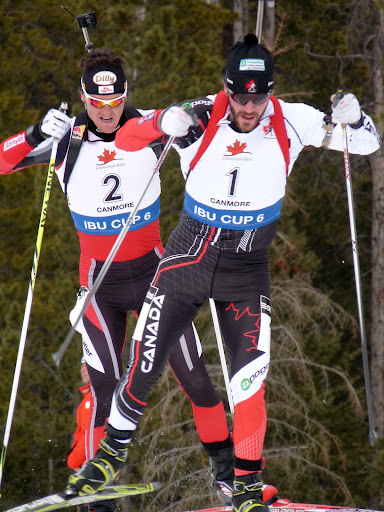
    Canada's Marc-Andre Bedard leads Austria's Friedrich Pinter in Canmore on Saturday. Photo: Michael Potter.

    Last year, the world’s best biathletes got a taste of northern Maine when the World Cup made stops in Fort Kent and Presque Isle.

    This season, the top racers are staying firmly ensconced in Europe. But instead of letting the sport get too comfortable on what could be considered its home turf, the International Biathlon Union (IBU) sent their eponymously named IBU Cup circuit across the Atlantic, and for the last week the “second World Cup” has been contested in Canmore, Alberta.

    For the Canadians, bringing the races to their country has been huge. But even the Americans got behind the effort. Continental solidarity was high.

    “This is as close to home as I will ever get for an international competition and I’m still in the Rockies, so it feels like home here,” said U.S. biathlete Lanny Barnes, a native of Durango, Colorado, who podiumed in Canmore. “The Canadians have put on some great races and are always very welcoming to the U.S. team. This is probably one of the most beautiful venues on the world.”

    Melanie Schultz takes a corner against the backdrop of the Canadian Rockies. Photo: Michael Potter.

    On both Saturday and Sunday, the athletes competed in sprints – 7.5 k for women, 10 k for men, a prone and a standing shooting stage apiece. On Wednesday, they doubled their distance for individual races, which featured four shooting stages instead of two and a one-minute penalty for each missed shot. On Thursday, it was back to sprints, and the penalty loop if the athletes made any errors.

    Over the four days of racing, North Americans picked up three wins, three more podium finishes, and a total of 21 top-tens.

    “These races have been great for Canadian biathlon,” Biathlon Canada High Performance Director Chris Lindsay told FasterSkier.

    Nathan Smith, who raced to all three of the Canadian wins at the races, agreed.

    “These were the highest caliber races to be held in Canada outside of the Olympics in recent history,” he said. “It’s good for publicity and getting new people involved in the sport. Our team got a lot of medals and top-6 results here… you can feel the team’s momentum.”

    Other athletes confirmed that there was a loud fan base for the weekend races, although they lamented lower midweek attendance.

    “It was too bad none of the schools came out to watch on the weekdays, but we still have a good number of people out there cheering,” said Canadian biathlete Rosanna Crawford. “Hopefully this will lead to World Cups being held in Canmore.”

    Men’s Races: Domination By Smith

    Three-time Olympian Robin Clegg placed ninth in Saturday's sprint. Photo: Michael Potter.

    The story of the week – not only for the Canadian team, but for the circuit itself – was the near-total domination by 26-year-old Calgary native Smith.

    Smith, who trains in Canmore, started out by winning the opening sprint by a mere five seconds over Russia’s Sergey Klyachin; Norwegian Martin Eng, who has an 11th-place World Cup finish to his name, was another second and a half behind.

    In the next sprint, Smith shot clean and extended his lead, this time finishing 40 seconds ahead of Friedrich Pinter of Austria. After sitting out the individual race, Smith made it three-for-three with a four-second victory over Pinter in Thursday’s race.

    “To have my first IBU win in Canmore was… amazing!” Smith told FasterSkier. “I’ve been training here since I started biathlon. I know a lot of the volunteers, so I’m proud that I could reward them in a small way for all their hard work over the years.”

    Smith’s path to dominance really started at IBU Cup races in Obertilliach, Austria in December, where he placed third in a 10 k sprint, the first podium of his career.

    “The bronze I got in December in Obertilliach was very special,” Smith said. “That was the first time I’d ever put good skiing and shooting together in an international race.”

    After two more top-ten finishes in IBU Cup action in January, Smith made a brief jaunt onto the World Cup himself, producing a top result of 47th in a sprint in Antholz, Italy. When he returned to Canada for these races, he knew he could once again be near the top.

    “All year I had been having really good time trials amongst the national team and I was hoping for a breakout performance,” he said.

    He got it, and even though Canadian events are sometimes lightly attended by international teams, in this case Smith still had to beat out the IBU Cup’s best. Pinter, for example, has a handful of World Cup podiums to his name and owns a World Championships relay medal; the top three racers in the overall IBU Cup standings were also in the mix.

    “The big difference here is how the pack thins out a little farther down the result sheet,” Smith said. “I think it was mostly the slower skiers who were missing. I think my races wouldve been at or very near the top if in Europe…. I was within striking distance of first at the IBU cup in Italy twice except my shooting wasn’t as good.”

    Being in familiar surroundings, Smith explained, helped achieve his career-best performances.

    “I knew I would have a little leg up on a lot of the other competitors because I got back to Canmore a couple weeks before the first race,” Smith said, before laughing it off. “Fair is fair though, since most of the time its the other way around!”

    In the first sprint, Smith was joined in the top ten by three-time Olympian Robin Clegg, who missed two shots to Smith’s one and finished 55 seconds back in ninth.

    In the second two sprints, it was Marc-Andre Bedard who kept him company, placing seventh and fifth.

    “I had great races, but it didn’t feel like it,” Bedard said of his results. “I think I’m getting in better shape, and it’s just starting to feel good. There were quite a bit fewer people here than in Europe, so that helps the results for sure, but compared to the top guys my ski times are really better [than earlier this season].”

    Bedard liked the atmosphere in Canmore, but said that if he could get absolutely everything he wanted, the races would be on the other side of the country: “It was pretty cool, but I’d love to race at home in Quebec once in my life at an international race!”

    Jeremy Teela led the U.S. men, finishing 11th, 13th, 25th, and 12th.

    Women’s Races: Depth and Consistency

    Canada's Yolaine Oddou was the first North American woman to hit the podium. Photo: Michael Potter.

    The North American women couldn’t match Smith’s domination. They did, however, have something else going for them: depth. While a Canadian or American woman never topped the podium, Canadians Yolaine Oddou and Megan Heinicke and American Lanny Barnes all took their turns on the lower steps. Twice, the North Americans placed five women in the top ten.

    In the opening sprint, Rosanna Crawford led the way in eighth followed one second later by Oddou in ninth; four more North Americans packed the top twenty.

    “I was a bit disappointed in the race Saturday with the missed shot in prone,” said Barnes, who placed 12th. “You can’t afford to miss on a day like that with perfect conditions. The great thing was we had another opportunity on the same course and same race format to give it another go on Sunday.”

    With a fire in her belly, Barnes stepped up her game in the second sprint – as did the rest of the North Americans. Oddou placed third, Barnes and Heinicke tied for fourth, and Crawford and American Laura Spector placed ninth and tenth.

    Success continued in the weekday races, with Heinicke placing second and Barnes third in the individual, and then Crawford placing sixth in the sprint and leading teammate Melanie Schultz, Spector, Heinicke, and American Tracy Barnes in a six-through-ten sweep.

    At 21 years old, Oddou is in her first season of racing on the IBU Cup, and these were her best results by far. Crawford is a 2010 Olympian, but also considered the races to be highlights.

    “It was great to be racing in my home town, and I had my best results of the season and great shooting in all the sprint races,” Crawford told FasterSkier. “I was top Canadian two out of three sprints so that was very exciting for me.”

    For Crawford, there was a little added motivation, as her mother had just been through surgery for breast cancer but still managed to get out on the trails to cheer.

    “Things had been pretty stressful for me leading into these races,” Crawford said. “But she is such a strong and amazing women and is one of the main reasons I have made it this far in biathlon. She was out there everyday with her cow bells and cheering louder than anyone else!”

    Lanny Barnes was the most consistent of the Americans, and was particularly pleased with her podium finish on Wednesday.

    “I knew I was in race because I could practically hear the announcer everywhere on course and our staff kept giving me splits of leading the race,” said Barnes, who led through the first half of the race and then regained her lead on the penultimate loop before tiring before the finish.

    “I probably started out a little harder than I wanted to, and lost a little time in the end, but was happy that my skiing is coming around,” she explained. “I was bummed that [twin sister] Tracy wasn’t right in there with me, but she is just getting over a cold otherwise I think she might have give me a run for the money!”

    Tracy Barnes told FasterSkier that due to illness she had taken the races “one day at a time,” and was happy, though not thrilled, with her performances.

    “I’ve placed in the top ten several times this season and know I’m capable of it,” she said.

    Race results

  • As IBU Cup Prepares for North American Swing, Canadians Laud Value in Athlete Development

    As IBU Cup Prepares for North American Swing, Canadians Laud Value in Athlete Development

    The Canadian team of (R-L) Nathan Smith, Scott Gow, Melanie Shultz, and Claude Godbout finished fourth in an IBU Cup mixed relay in December. Photo courtesy of Melanie Schultz.

    When American and Canadian skiers start consistently winning domestic races, they face a choice: do they stay on their home circuits, or head to Europe? And if a trip across the Atlantic is in the cards, where will they race? With limited World Cup quotas and a myriad of regional race circuits, skiers have to not only choose which of the many races they might attend, but also generally organize and fund the trips themselves.

    North American biathletes, on the other hand, have an obvious destination when they make the jump to Europe: the IBU Cup, an international circuit one notch below the World Cup, and the namesake of the same governing body, the International Biathlon Union (IBU). This year, the IBU Cup will have eight weekends at seven venues, in addition to the Open European/Under-26 Championships.

    The IBU recently said that the circuit is a “second league”, and it has also been called a “mini World Cup”. The IBU Cup has the same rules for athlete qualification and national team promotion and relegation, and while there are fewer fans, everything else about race procedure is the same.

    “The IBU Cup is an excellent stepping stone for the World Cup,” Canadian biathlete Melanie Schultz, who recently notched a career-best 11th place finish in an IBU Cup pursuit, told FasterSkier in an interview. “I definitely would not improve as fast if I just raced domestically.”

    Canada currently has start quotas of three men and three women, but that’s about to change: the Canucks are climbing up the Nations Cup rankings thanks to a spate of top-ten finishes, and as a result will almost certainly have a larger quota next year. More immediately, and the circuit will spend two weekends in Canmore in February, giving the host country an additional five starts per race.

    In a presentation at Forum Nordicum in October, the IBU suggested that they were considering making the North American swing a more permanent feature on the calendar.

    FasterSkier caught up with Schultz and teammate Rosanna Crawford, who were promoted to the World Cup based on their IBU Cup performances in Haute Maurienne, France last weekend, to hear how the circuit had affected their development, and how they thought North American biathlon would benefit from hosting more of the races.

    Schultz: Accumulating Experience, Improving Steadily

    While Schultz’s 11th-place finish was not the best seen by the Canadian team this season – three teammates have collected top-ten finishes and another, Nathan Smith, stood on the podium – her trajectory is in many ways exactly what coaches hope for when they send athletes to the IBU Cup.

    The 26-year-old started her European racing career back in 2009; in her first two weekends of racing she placed in the mid-60s. When she returned to the circuit six weeks later, she notched her first top-30. This year she’s placed in the 20s or better in several races in fields that are deeper and more competitive since the IBU upped its focus on the circuit.

    Schultz said joining the new Biathlon Alberta Training Centre with head coach Richard Boruta, finally diagnosing longtime symptoms as chronic hypoglycemia, and good old-fashioned hard work contributed to her success this season. But her IBU Cup experience has also been a huge motivator.

    “It has really opened my eyes to where I am at with racing, where I want to be, and what I can improve on to get there,” Schultz said.

    And while it has helped in the general sense, her racing there has given her specific tasks to work on as well.

    “[The IBU creates a] detailed analysis of each race, in which everyone’s ski and shooting times are broken down and ranked for each loop,” she explained. “At my first IBU Cup race I realized I was losing 20 seconds in the range for each shooting bout, which added up to 80 seconds in a four-bout race. Since then, I’ve improved my shooting times and now have some of the fastest shooting times on the IBU Cup.”

    Recently, some of Schultz’s best performances have come in relays: in December, she shot perfectly as the scramble leg of Canada’s fourth-place mixed relay, and in Haute Maurienne she led all teams into the first handoff of the women’s relay, where Canada again placed fourth.

    “The relays really changed my outlook on what I felt I was capable of ski-wise,” Schultz said. “In the mixed relay before Christmas I was able to stay in contact with the top skiers, but I attributed it mostly to fast skis, quick shooting, and short two kilometer loops. Then in the women’s relay I could easily stay with the fastest skiers and even pass them, which made me realize that I have the ability to not just shoot well but also to ski well.”

    Relays are never contested at the senior level in North America, so Schultz hadn’t understood “the enthusiasm some nations have.” But after being in podium contention twice, she’s changed her mind. She said that the relays also brought the Canadian team together and earned the country some newfound respect from their competitors.

    And finally, they’ve taught Schultz a lot about racing.

    “After the women’s relay I started thinking, ‘What am I doing differently with my skiing in relay competitions that is lacking in individual starts?’ I realized I wasn’t fighting against my mind when I was skiing in a pack, I was just completely… in the present moment. I brought this mindset into my sprint and pursuit [in Haute Maurienne] and I think it showed.”

    Experiences like these are what coaches hope young biathletes will gain when they spend time on the IBU Cup. 21-year-old Scott Gow, for instance – a top-ten finisher at World Junior Championships – was nominated to the World Cup team for November based on podium finishes in national team trials races. Once there, however, he fizzled, finishing 80th and 101st in the opening races. He was moved to the IBU Cup, where he has steadily improved, finishing as high as fourth.

    “The IBU Cups are great for me to develop as a racer and to learn how to be a podium contender,” Schultz said.

    Crawford: Competing, Not Participating

    Crawford leads Schultz and Yolaine Oddou in the pursuit in Haute Maurienne. Photo courtesy of Melanie Schultz.

    Crawford, who finished 8th in the sprint in Haute Maurienne, has had a season more akin to Gow’s than Schulz’s. A 2010 Olympian, Crawford has received quite a few World Cup starts, but has been unable to break into the spotlight. On her best days, she has finished in the high 40s and 50s.

    Like Gow, Crawford started on the World Cup in November. While she lasted longer there, she, too, was eventually demoted.

    “Before Christmas my skiing had improved quite a bit from last year, but my shooting was what was letting me down,” she told FasterSkier. “I am usually a sharp shooter and three misses in prone in a sprint was very unlike me.”

    But even though the World Cup is in her sights, the move to the IBU Cup didn’t upset her.

    “I was happy with the decision,” Crawford said. “On the World Cup it is still hard for me to make a pursuit [which takes the top 60 racers from a sprint] if I shoot less than 80 percent, whereas on the IBU Cup even with poor shooting I can still make the pursuit and therefore get more races. On the World Cup sometimes I feel like I am racing to participate, but on the IBU Cup I am racing for the top ten.”

    For athletes like Crawford, who have more big-race experience, the IBU Cup serves another purpose. It’s a place to regroup, work out the kinks, and regain confidence before, hopefully, returning to the World Cup.

    And because both circuits are organized by the IBU, it’s easy to shuffle athletes back and forth. Canada, the U.S., and nearly every country do so; in some cases, athletes even compete in a race on each circuit in a single weekend.

    That means that taking a detour to the IBU Cup isn’t a death sentence for athletes with World Cup aspirations, and also makes it easy for developing athletes to tell how they might fare if they moved up. For instance, Russia’s Ekaterina Glazyrina swept the IBU Cup races in Obertilliach, Austria, then raced on the World Cup in Nove Mesto, Czech Republic and finished sixth in two different races.

    “The atmosphere is different because there isn’t as many spectators,” Crawford said of the IBU Cup. “But [it’s also] the same because you are racing against some of the best in the world. These girls could get moved up to the World Cup next week and be in the top ten.”

    Crawford said that the deep fields taught her to be aggressive.

    “It’s good preparation for being a fighter in the pursuit once you get to the World Cup,” she explained. “Every shot is important and can mean the difference between moving up five spots or falling back ten.”

    A Step – Or Several – Above NorAms

    And that, both women said, was not true in domestic competition. The reason that the IBU Cup is so valuable to North American biathletes is that races in the U.S. and Canada, the best of which are part of the NorAm circuit, often have small fields with a wide spread in ability levels.

    “In Canada when you race a pursuit there isn’t anyone really chasing you, or sometimes there’s no one to chase,” Crawford said. “Here you have 60 strong women around you, pushing you to do your best and never give up. A couple seconds can mean a couple of spots.”

    It might seem counterintuitive that there’s nobody for Crawford to chase; teammates Zina Kocher and Megan Imrie have finished in the top 20 on the World Cup this year, and Kocher is currently ranked 29th overall.

    But that has nothing to do with NorAms, Crawford said.

    “Not that many people do biathlon in Canada, and even less follow through to the senior level,” she explained. “Because our best athletes are off racing in Europe all winter, there isn’t much opportunity to compare your self to the best on the NorAm circuit.”

    Schultz agreed with that assessment, and was emphatic that she could not have reached her current level had she stayed in Canada.

    “Racing domestically on the NorAm circuit and racing on the IBU Cup is a night and day difference,” she said. “I learn so much each race I do here, and I am able to quickly apply it to my next race. Now, in mid-January, I have done ten IBU Cup races [already] this season.”

    As an athlete representative for Canadian biathlon, Schultz has been trying to brainstorm ways to make the NorAm circuit more competitive. One problem is that the U.S. and Canada don’t always plan well enough that top athletes from each country end up at the same races. But even with better communication, the issues of field size and depth are difficult to tackle.

    Until there are major changes, athletes will be doing their most important learning on the IBU Cup, like Schultz has.

    “The IBU Cup allows athletes to race against over 100 athletes when every second counts for placing, and to experience head-to-head racing in relays and pursuits,” she said. “That’s an important aspect of racing that is missing in North American biathlon races.”

    Lately, both the U.S. and Canada have fielded larger teams at more races on the circuit, and expanded their IBU Cup schedule.

    “This is the first time I am aware of that Canada has sent a team to the IBU Cup races in early January,” Schultz said. “It was extremely valuable to the athletes, as they can take what they learn each race and immediately apply it in the next race instead of having a break from this level of racing. I think this has really accelerated the development curve.”

    The Canadians have also expanded their funding.

    “We used to pay the true cost of racing on the IBU Cup, which amounted to $2500-3500 per tour, and many athletes couldn’t afford to go,” Schultz continued. “Now, Biathlon Canada covers the cost of the IBU Cup tours, and provides an amazing support team with two wax techs and one coach. A huge burden has been taken off athletes, so they can focus on racing. This has been a really positive change and has shown in our results.”

    A Permanent Swing?

    The teammates were enthusiastic about the possibility of having the IBU Cup visit North America more frequently. At a community level, they welcomed the publicity the races would bring to their small sport.

    “Being in Canmore, I have seen the positive impact that hosting World Cups and World Youth and Junior Championships for skiing and biathlon has had,” Schultz said. “It has generated excitement around the sports and motivated many young athletes. We don’t grow up watching nordic sports on TV like our European counterparts, so seeing the next level of racing gives young athletes something tangible that they can work towards.”

    But just as importantly, this year’s races in Canmore will give more athletes a chance to learn from experience, just as Schultz and Crawford have.

    Crawford said that the circuit was already a huge motivation for up-and-coming racers, because not only does it involve a trip to Europe, but good performances are rewarded with promotion to the World Cup. She thought that the added start quotas of a home-turf IBU Cup would energize a whole new group of athletes.

    “It would help keep youth and juniors motivated to follow through to the senior level,” said Crawford, addressing one of the biggest problems for Canadian biathlon.

    “It would also give second-year juniors and first-year seniors a chance to race with the best and get a taste of what it is like. No matter how many people come out to cheer, racing a pursuit with 60 people is one of the most intense and exciting things in biathlon, and this would give them an opportunity to experience it.”

    -Rosanna Crawford will compete in the women’s 10 k World Cup sprint in Antholz-Anterselva, Italy, on Thursday, and then join Schultz, Kocher, and Imrie in a relay on Saturday.

    The United States has also had success on the IBU Cup this season, with Tracy Barnes and Russell Currier notching top-ten finishes. Both will also compete in Antholz-Anterselva this weekend.

  • U.S. Finalizes Biathlon World Cup Roster for Period Two, Adds to IBU Cup Squad (Photo Gallery)

    U.S. Finalizes Biathlon World Cup Roster for Period Two, Adds to IBU Cup Squad (Photo Gallery)

    Anna Kubek (Mount Itasca) on her way to victory in the mass start. Photo: Roy Kjorlien.

    For the World Cup athletes, Thursday’s announcement by the U.S. Biathlon Association of team nominations for the second period of racing brought no surprises. Just as in the last weekend of World Cup racing in December, three women (Sara Studebaker, Annelies Cook, and Susan Dunklee) and four men (Lowell Bailey, Jay Hakkinen, Tim Burke, and Leif Nordgren) will represent the U.S. on the trails.

    But the real excitement of the day came from the selection of the IBU Cup team. After a series of trials races in Mount Itasca, Minnesota, in which two different men and three women picked up victories, it was unclear which athletes would be picked to join the U.S. team for races in Forni Avoltri, Italy and Haute Maurienne, France in January.

    Russell Currier (Maine Winter Sports Center) racing in the pursuit. Photo: Roy Kjorlien.

    On the men’s side, Russell Currier of the Maine Winter Sports Center made the cut after winning the pursuit competition by a minute and the mass start by more than two. Despite finishing third in the initial sprint – in which he had seven penalties out of only ten shots – Currier was able to clean up his shooting and make the team. He will be joining Bill Bowler and Jeremy Teela on the IBU Cup.

    Other impressive performances at the trials came from Mark Johnson (Mount Itasca), who beat out national team member Wynn Roberts by 17 seconds for the title in the sprint, and from Sean Doherty, a New Hampshire junior who will be attending the Youth Olympic Games this year, who competed in the senior mass start and placed second.

    On the women’s side, Hannah Dreissigacker of the Craftsbury Green Racing Project won the opening sprint, and appeared in good position to snag the trip to Europe. But after faltering on the range in the next two races, she left space for BethAnn Chamberlain (Maine Winter Sports Center) to win the pursuit and 16-year-old Anna Kubek (Mount Itasca) to claim the mass start.

    Kubek, who like Doherty will be representing the U.S. at the Youth Olympic Games at the beginning of the month, ended up with the nomination, meaning that she will extend her time in Europe. She will join Tracy and Lanny Barnes and Laura Spector.

    Katrina Howe (Maine Winter Sports Center) also picked up three podium finishes at the races in Minnesota, but was unable to translate any of them into a win.


  • U.S. Names World Cup Biathlon Team After IBU Cup Race in Ostersund

    Jay Hakkinen racing on the World Cup last season.

    While U.S. and Canadian skiers have been competing at FIS and World Cup races for several weeks now, the American biathletes waited until Sunday to kick off their season in an IBU Cup sprint.

    The race in Ostersund, Sweden, was actually the second of the weekend, but the U.S. team sat out of Saturday’s race. While the men were lucky to have skipped the windy conditions that shook up the result sheet in the opener, the whole team was faced with a new challenge on Sunday: fresh snow.

    Until that morning, there had been little natural snow on the ground in Ostersund. Instead, the race course was packed with snow hoarded from the previous winter.

    “The course in Ostersund has been prepared with snow that was stockpiled last winter and covered with a tarp and wood-chips to keep it through the summer,” U.S. Biathlon Association President and CEO Max Cobb wrote in an e-mail. “Without that we would not be able to have any training or racing in Ostersund this November.”

    But on Sunday, the weather finally gave the venue what it’s been wanting all along – real, fresh, new snow.

    “It was snowing when I woke up this morning and it continued to storm until after the races,” said national team member Susan Dunklee. “Now it looks like a winter wonderland with several centimeters of new snow.”

    The “A” team did not compete on Sunday, since they are prequalified for the World Cup. Instead, the race served as a time trial for the “B” team and independent athletes who hoped to join them next weekend and fill the team’s four-man, four-woman World Cup quota. The IBU Cup is a coordinated series of eight race weekends for racers just below the World Cup level; this weekend’s openers in Ostersund were filled with well-known World Cup athletes as well.

    In the men’s 10 k sprint, Jay Hakkinen led the way in 27th place with two penalties, finishing just under two minutes behind winner and Olympic medalist Jakov Fak of Slovenia.

    The veteran was philosophical about what the result meant.

    “The first race of the season is always a bit unpredictable, and therefore it can be a bit stressful, which is why I was glad the first race was an IBU Cup,” Hakkinen wrote in an e-mail. “The focus was to apply what I worked on in the training to the racing, as far as shooting, technique and so on. Therefore, the overall result was not as important as gathering information.”

    The U.S. Biathlon Association was also hoping to gather information, and the results led them to name Hakkinen as the last member of the World Cup squad. He joins Tim Burke, Lowell Bailey, and Leif Nordgren. The four teamed up to place sixth in the relay at World Championships last year.

    The other U.S. finishers, Jeremy Teela in 49th, +2:47, and Bill Bowler in 108th, +6:33, will head to the next IBU Cup races in Ridnaun, Italy.

    In the women’s 7.5 k race, Dunklee and Lanny Barnes led the way with almost identical results; the pair finished 42nd and 43rd, separated by just half a second. But they took different routes to their finishes, with Dunklee missing three shots but notching the 29th-fastest course time on the day, and Barnes collecting a single penalty but skiing the 59th-fastest time.

    They also had different outlooks on their results.

    “It feels great to have one race done and to already have one that I feel good about,” Dunklee told Fasterskier. “My missed prone shoots were a little wild, so that could have gone a little bit better. [But] on skis I was able to push hard on all three laps and focus on every section.”

    Barnes – along with her sister Tracy, who finished 76th with four penalties – was not so cheery.

    “The race was a disappointment for both of us,” the twins wrote in an e-mail. “We had both been feeling really great earlier in the week, but felt pretty lousy today. We probably pushed a bit too much in training the last two weeks we’ve been here. That is how it goes though, and this is the first race of a very long season.”

    All three women noted the difficulty of skiing through inches of soft snow – something that took them entirely by surprise after the hard and fast tracks they had been practicing on all week.

    “It’s funny because it turned to winter here today, and the fast icy manmade snow conditions turned to deep, slow new snow,” the Barnes wrote. “It’s dumping snow out now. Good to see some of that white stuff coming down- [we] haven’t seen any of that since we left Colorado.”

    Dunklee and Lanny Barnes will join Sara Studebaker and Laura Spector on the World Cup, while Tracy Barnes and Annelies Cook, who finished 79th with five penalties, will continue on the IBU Cup circuit.

    Kaisa Makarainen of Finland, last year’s overall World Cup champion, won the race by thirty seconds despite missing three shots.

    Full results: men / women

  • Despite Champions in Field, Unknown Biathletes Shine at IBU Cup Openers

    At last year’s IBU Cup openers in Beitostolen, Norway, only a few top biathletes showed up. The rest were preparing for the World Cup openers in Ostersund, Sweden the next weekend.

    But this year, the second-tier races – originally scheduled for Idre, Sweden – were moved to Ostersund due to a lack of snow. And even in Ostersund, fans were treated to a rare sight: grass. While manmade snow covered four kilometers of ski trails at the venue, there was barely any natural snow on the ground, so the range itself was covered in green and brown.

    The World Cup athletes who were already training in Ostersund took advantage of the new location to start racing a week earlier. The start list was filled with champions – for instance, in the men’s race Olympic gold medalist Bjorn Ferry of Sweden was the first starter, followed by World Champion Martin Fourcade of France.

    But surprisingly, it wasn’t either of these men who ended the day atop the podium. Instead, Russia’s Dmitry Malyshko, who has never even started a World Cup, won the 10 kilometer, two-stage sprint. Alexsandr Trifonov of Kazakhstan, whose best World Cup finish is 69th, finished second. Germany’s Benedikt Doll, who has never started a World Cup but at least has a few World Junior Championships medals to his name, rounded things out.

    And the guys who usually stand on the podium at biathlon’s biggest events? Fourcade led them in eighth after missing four shots in just ten attempts.

    The culprit was the wind, which threw both veterans and newbies for a loop. Malyshko was able to escape with a single penalty, and Trifonov was the only athlete in the entire field to shoot clean.

    Malyshko won by almost thirty seconds, so it wasn’t only his mastery of the wind that put him on top. He also had the seventh-fastest ski time.

    “This win puts everything in perspective and shows that what we did over the summer worked,” he told IBU News.

    Nevertheless, he’s unsure whether he will represent Russia in the World Cup openers next week, since the team was already named before these races.

    In the women’s 7.5 k sprint, there were more familiar faces atop the leaderboard. Marie Laure Brunet of France, always an overall World Cup contender, raced to a 43-second victory, while Marie Dorin Habert, her teammate on the silver-medal Olympic relay team, finished third.

    Sandwiched in between them was Krystyna Palka of Poland, who while not a household name in the biathlon world does have a fifth-place Olympic finish from 2006 to her name. Palka broke her arm last year, and had to race in Ostersund today to requalify for the World Cup. Doing so with a podium finish was especially gratifying, she said.

    “I am really happy today, and this also means I am now qualified for the World Cup,” she told IBU News.

    On Brunet’s part, she said that the key to shooting with such strong wind gusts was patience and self-assurance.

    “It’s important in these conditions to be focused and confident. You have to believe in yourself in order for the bullet to hit the target.”

    Results: men / women

  • Barnes, Cook, and Hakkinen End IBU Cup Campaign on High Notes

    Barnes, Cook, and Hakkinen End IBU Cup Campaign on High Notes

    Tracy Barnes in the IBU Cup sprint race in Altenberg, Germany. Photo: Viktoria Franke.

    When U.S. biathletes left Altenberg, Germany after the pursuit race on Saturday, they were saying goodbye not only to the venue, but to the entire IBU Cup circuit. While the U.S. Biathlon Association is supporting the World Cup team for the rest of the year, no more Continental Cup races will be funded.

    Luckily, the team had plenty of satisfying results while in Europe, so the trip ended on a positive note.

    “I’m proud of the women’s team this year and how we have done,” said Tracy Barnes. “I like our group, I like our posse.”

    Barnes led the U.S. women in the final pursuit. Starting with bib 17, she missed three shots and slipped a few places to finish 23rd overall.

    Annelies Cook was next, just seven seconds behind Barnes. She missed five shots in four shooting stages, and slipped from 21st to 25th.

    While these might seem like a lot of penalties for a pursuit, conditions on the range were tricky, and not a single woman shot clean. In fact, there was only one woman with one penalty and two more with two penalties. The International Biathlon Union reported that the wind was constantly changing on the shooting range, making it difficult for even the best shooters to avoid penalties.

    Susan Dunklee, who led the U.S. in Friday with a 10th-place finish in the sprint, had an especially tough day on the range. She missed seven shots and slipped to 37th place.

    “I missed a bunch of shots on the right side,” she said in an e-mail as the team packed up. “Some of them were rushed. I didn’t feel that bad on the range. Some days the shooting comes together, some days it doesn’t, and that’s the nature of the sport.”

    Dunklee said that the skiing wasn’t great either, and the women’s team had struggled with the slush. Temperatures were reported at around 50 degrees Fahrenheit, and second-place Nadine Horchler of Germany lost a sprint finish because the edges of the trail were in particularly poor condition and she was unable to pass winner Iris Waldhuber of Austria.

    In the men’s race, Jay Hakkinen led the U.S. team with a 27th-place finish. He moved up from bib 40 thanks to relatively clean shooting. Hakkinen missed three shots but only three of the skiers ahead of him shot better.

    “It is always nice to move forwards in the pursuit,” Hakkinen told FasterSkier. “Pursuits are pretty basic: if you shoot clean you move forward, miss one you stay where you are, and miss more than one you move back. Therefore, I used a pretty basic strategy of skiing with those around me and trying to outshoot them in the range. Today was not an easy shooting day, though, with changing wind, which made that strategy challenging, but it ended up a solid performance.”

    Hakkinen also had the 27th-fastest ski time of the day in just his fourth race of the season.

    “It is a great feeling that my shape is improving, which I expected, but it is nice when it actually happens according to plan,” he said. “I definitely have been enjoying the races, having been starved from them for so long. I still have a lot of work to do, but I feel I passed the first test.”

    Zach Hall and Wynn Roberts also moved up in the pursuit. Hall started 50th and finished 47th, despite having six penalties, while Roberts improved from 59th to 52nd. Roberts missed nine shots, but had the 39th-fastest ski time of the day.

    Bill Bowler had a tough day on the skis, slipping from 49th to 55th.

    Men’s results / Women’s results

    Jay Hakkinen moving through the field in the pursuit. Photo: Viktoria Franke.
    Bill Bowler and Zach Hall were separated by just one second at the beginning of the pursuit. Photo: Viktoria Franke.
    Wynn Roberts in the pursuit. Photo: Viktoria Franke.
  • U.S. Women Continue Hot Streak in IBU Cup Competition

    U.S. Women Continue Hot Streak in IBU Cup Competition

    Susan Dunklee led the U.S. team with a 10th-place finish in the sprint in Altenberg, Germany on Friday. Photo: Viktoria Franke.

    After last week’s success at the IBU Cup races in Nove Mesto, Czech Republic, U.S. biathlete and 2010 Olympian Haley Johnson was promoted to the World Cup.

    You might think that sending the top finisher off to Rupholding would slow down the American women racing on biathlon’s second-most prestigious circuit. But you’d be wrong. Susan Dunklee, Tracy Barnes, and Annelies Cook – who all missed qualifying for the Olympics last year –  didn’t need Johnson on the roster to have the third-best team score in Friday’s sprint race in Altenberg, Germany.

    Led by Dunklee’s tenth-place finish, the American squad trailed only the home team and the Russians.

    Barnes and Cook have been on fire all season, each recording multiple top-20 finishes in IBU Cup racing and even earning a World Cup start or two. Today, they finished 17th and 21st.

    But Dunklee, for whom this was only the third race in Europe this season, a top-10 result was a bit of a surprise.

    “My zero groups were huge today and I haven’t felt on top of my game (skiing or shooting) for the past couple weeks so I didn’t have particularly high expectations for myself going into the race,” she told FasterSkier.

    “Yeah, I’m psyched.”

    Although this was the third year that Dunklee has made the trip to Nove Mesto and Altenberg, she’s never had such strong results before. She had finished in the top twenty just once on those trips.

    But familiarity with the courses is never a bad thing, and Dunklee had a strategy for today.

    “There’s a big steep headwall in the first half of the course and my goal was to hammer up and over the top and then hang on,” she said. “The trickiest part of the race was hearing my name announced over the PA system during the middle of my standing stage. It was a new experience for me and I really had to focus to hit my shots after that.”

    A sometimes-erratic shooter, Dunklee missed only one shot on Friday.

    In Saturday’s pursuit, the three women will start within twenty-five seconds of each other.

    “For tomorrow, I want to have fun,” Dunklee said. “Tracy, Annelies and I will start practically within sight of each other and we hope to ski together and rumble with the women ahead of us.”

    The U.S. men, who have not had as much success on the IBU Cup so far this season, were led by four-time Olympian Jay Hakkinen in 40th place. Hakkinen was sick in the fall to the season, and the Nove Mesto races were his first opportunities for head-to-head competition.

    “Last week was my first races of the season,” Hakkinen said in an e-mail. “It was a great feeling to be back racing after being away so long. Since they were trials races, the big goal was to get back on the World Cup as soon as possible… but the [International Competition Committee] wanted me to race another week of IBU Cup races.”

    After leading the team in Friday’s sprint, Hakkinen is one step closer to his goal.

    “I am looking towards a World Cup start in Antholz, although there is no clear criteria or guarantee of whether I will be allowed to do so. I just hope to have a good performance in the pursuit tomorrow in order continue my goal of a top performance in the World Championships.”

    If he does make the World Championships team, it will be an unusual story: because he was sick this fall, he didn’t even attend the trials races in Canmore or Mount Itasca and was named to the IBU Cup squad on discretion. Hakkinen also said that he wasn’t yet in race shape, and two days of racing in a row were a challenge for him.

    However, he was positive about his shooting.

    “My shooting has been strong,” he said. “Since while I was sick with mono, it was one of the only things I could work on and I knew I would be relying on it while I got used to the racing again.”

    Bill Bowler was the next American, finishing a career-best 49th. He was just one second and one place ahead of teammate Zach Hall. Both athletes are relatively new to biathlon – Hall picked the sport up after graduating from Dartmouth College, while this is the first season that Bowler has raced internationally. The pair represent the opposite of Hakkinen in many ways – and were only thirty seconds behind him, for all his experience.

    Wynn Roberts was another twenty-five seconds behind them in 56th, and Russell Currier rounded out the American squad in 82nd. Currier missed six of ten shots, among the most penalties in the field, and will be the only athlete sitting out Saturday’s pursuit.

    Men’s results / Women’s results

  • Strong Finishes for North Americans on IBU Cup, but is Increased European Presence Best for Domestic Biathlon?

    2006 Olympian Tracy Barnes had the top North American result in IBU Cup racing, finishing seventh in the sprint in Martell, Italy. Photo: USBA.

    This year, the U.S. Biathlon Association (USBA) had a radical shift in its athlete development strategy: instead of sending a full squad to the World Cup and leaving the rest of the American biathlon field at home, they would minimize their World Cup presence to only those athletes who were succeeding, and field a much larger team at the IBU (International Biathlon Union) Cup races.

    While the U.S. biathletes that FasterSkier talked to, on and off the record, were unanimously positive about the change, it’s going to take time to assess whether the new strategy is the best one for biathlon’s long-term growth in North America.

    What is the IBU Cup?

    The IBU Cup is the level of racing below the World Cup, and unlike in skiing, it’s a well-defined series of races contested by athletes from every IBU member country. Modeled after the World Cup itself, there are only eight weekends of racing, plus the Open European Championships and World Military Championships.

    The IBU Cup is always incredibly competitive. But in April, the IBU Executive Board voted to reduce the field size at World Cup events, meaning that this year the IBU Cup is even tougher than usual.

    In addition to diminishing each country’s athlete quota and capping the field at 108 starters, the IBU ruled that in order to compete in World Cup competitions, athletes must have finished within 15% back from the winner at an IBU Cup race. To continue racing on the World Cup in each new trimester of competition, athletes must now finish within 15% back in one World Cup race.

    As a result, this year’s IBU Cup races have been especially competitive. So far, former World Champions and racers with top-10 World Cup finishes have skied and shot their way to top results in bids to regain World Cup start rights.

    And racing right along with them were ten North Americans. Canada has traditionally sent a large group of athletes to the IBU Cup races, and in 2009 had six men competing there mid-season. The U.S., on the other hand, only funded two weeks of IBU Cup racing last year.

    While a number of athletes moved between the IBU Cup and World Cup circuits, this year there were four American and six Canadian regulars at the second and third race weekends. In Martell, Italy and Obertilliach, Austria, they racked up seven top-20 results, including American Tracy Barnes’ seventh-place finish in the 7.5 k sprint in Martell.

    With four more Americans headed to Europe next week, it’s important to assess exactly how the IBU Cup trips are benefitting North American athletes.

    Pros: Confidence and Experience

    The group of North Americans contesting the first round of IBU Cup races had widely varying levels of experience. On one hand, there was Scott Gow, a twenty-year-old Canadian who had competed in four World Junior Championships, but no senior events in Europe. On the other, there was 28-year-old Barnes, a 2006 Olympian and several-year World Cup veteran. FasterSkier caught up with both athletes, as well as American Bill Bowler and Canadian Melanie Schulz.

    All the athletes said they had benefitted from the trip, but in different ways.

    For Barnes, who did not get to compete on the World Cup last year and was not re-named to the national team this year, the IBU Cup is a place where she can get her groove back. After finishing 19th and 7th in Martell, she got called up to the World Cup, where she finished 64th in the 15 k individual race in Pokljuka, Slovenia. It wasn’t her best performance, and she later returned to Obertilliach to race.

    “I feel more comfortable and more confident right now on the IBU Cup,” Barnes said in an e-mail. “When I get to the World Cup my confidence in my skiing falters, and I’ve lost the race before it even starts. But on the IBU Cup I find that I’m more aggressive and I attack on the skis and stay with people and try and pass them.

    “The staff on the IBU cup has been so incredibly supportive and has helped me to really get to a place where I need to be competitively.”

    While Schulz doesn’t have Barnes’ years of international experience in her back pocket, she is now in her second year of IBU Cup racing, and is beginning to see a payoff.

    “I had my best results this last weekend in Obertilliach,” she told FasterSkier. At those races, Schulz finished 35th in the sprint and 30th in the pursuit.

    But as she pointed out, racing internationally is a lot different than racing NorAms, which have tiny fields, sometimes comprising just ten senior women. NorAms don’t prepare athletes for the confusion of starting a 60-woman pursuit, as Schulz discovered in Obertilliach.

    “I messed up in the pursuit race,” she said. “There are new IBU rules this year. Athletes are responsible for starting themselves, and the start is videotaped and reviewed to make sure everyone started on time. Starting up to 3 seconds early results in a 30 second time penalty, and starting more than 3 seconds early results in disqualification.

    “Somehow with all the anticipation and excitement in the start gates, I ended up starting 0.2 seconds early. I didn’t realize this until the end of the race when I was bumped from 23rd place to 30th place due to the penalty.”

    Her teammate Gow, despite top-10 World Juniors finishes and a relay medal to his name, learned a lot on the IBU Cup, too.

    “This year was my first time on the IBU Cup and the level of competition was much higher than anything I was used to,” he said in an e-mail. “I felt that in order to compete on this circuit, it was really important that I race my best every day and make sure that everything I do in my prep work is perfect.

    “I loved the atmosphere, too. Just being at that higher level is exciting and makes me want to train harder to be better. The experience I’ve gained from the IBU Cup is going to be great going into Junior Worlds this season, and for racing and motivating my training for next season.”

    Bowler, who was racing overseas for the first time, said that besides providing general motivation, the experience helped him set specific goals.

    “Now that I’ve experienced a high level of international racing, I can see exactly what I need to work on,” he told FasterSkier in an e-mail. “Biathlon is really interesting in that you can break down an entire race and see places where you can gain valuable pieces of time. Some of these elements for me include shooting speed and the speed of my approach and exit to the range. I’d like to chop another 5-10 seconds off my shooting speed per stage.”

    So for all four athletes, racing on the IBU Cup circuit has been an important step in their continual quest for improvement.

    Cons: Is It Best for the Sport?

    But regardless of each athlete’s personal experience, questions still remain about whether sending large groups of athletes to Europe is what’s best for North American biathlon.

    Bowler, for one, thinks that the U.S. should send more athletes to the IBU Cup.

    “I think it’s great that USBA is able to support more IBU Cup racing this year,” he said. “If you look at the top guys in the sport, it has taken them many years of international competition to reach the level they’re at. Being able to go over there and gain experience is the first step towards getting to that point. It’s always a matter of funding, but giving more athletes an opportunity to race in Europe is the best catalyst for international improvement as a nation.”

    But Gow had a different theory, even though he clearly benefitted from his IBU Cup experience.

    “I don’t think we need more North Americans in Europe,” he said. “But we do need to emulate the same level of competition in our NorAm races. Obviously we can’t have the same field size, but we can create the same atmosphere and pressures that would exist on the IBU Cup. That would be the biggest way to get that same kind of experience without having to go to Europe.”

    He has a point: with more and more of the top North American biathletes heading to Europe, there isn’t much competition left for everyone else. While everyone who goes to Europe clearly benefits, those left at home are starved for competition.

    When racing resumes in January, there will be fifteen Americans racing on the World Cup and IBU Cup circuits, including every member of the U.S. men’s national team. That leaves approximately six senior women left to contest NorAms, and even fewer men. In USBA’s second round of trials, only three senior men bothered to show up, and one of them, Wynn Roberts, is now heading to Europe.

    The situation illustrates how difficult it can be to build up a sport faced with such low participation. Providing the best athletes with opportunities could in some ways slow biathlon’s growth at the grassroots level. It’s hard to take NorAm racing seriously with such small fields, and even harder for athletes to improve when those are the only available race opportunities.

    There’s a middle ground available: after the fifth weekend of IBU Cup racing in Altenberg, Germany in mid-January, part of the American team will probably be sent home. While a few athletes will stay in Europe for the Under-26 Open European Championships, the U.S. is not planning to field a team for sixth and seventh IBU Cup weekends in Slovakia and Bulgaria.

    It’s encouraging that USBA is trying out a new strategy, and shows that they are dedicated to discovering the best solution to a complex problem. In the meantime, the best Americans and Canadians will continue to excel on the IBU Cup, and gain valuable experience on their path to the World Cup.

  • North American B-Teamers Rack Up Biathlon Results, Too – Updated

    The U.S. Biathlon Association (USBA) decided to try something new this year: instead of sending all of its best athletes to the World Cup, they would send a smaller group of developing athletes to the IBU Cup – biathlon’s equivalent of the Continental Cup, but more competitive – as well.

    “It’s better for athlete development to go to the IBU Cup and have success, than it is to go straight to the World Cup,” USBA President and CEO Max Cobb told FasterSkier in an interview.

    Well: mission accomplished.

    In the second weekend of IBU Cup racing, and the first with an American contingent present, Annelies Cook and Tracy Barnes each collected a top-20 and a top-15 result in Martell, Italy. Which is funny, because USBA wrote some guidelines for this very situation. In their athlete selection criteria, they said,

    “Athletes achieving a top 15 and a top 20 at IBU Cup will be moved up to the World Cup provided there are open start positions.”

    They couldn’t have guessed that not one but two women would meet the criteria. This year, the U.S. was allowed three World Cup starts for its women, and Sara Studebaker and Laura Spector have filled two of them so far – with great success, as each has a top-30 result to their name so far this season. USBA declined to fill the third spot because it felt that it would be better for the women’s team, which is viewed as weaker than the men’s team, to start at a lower level of competition.

    Now, they have more fast women than spots on the World Cup, and with a second round of trials coming up to select more athletes for the next period of IBU Cups, things are only going to get more competitive.

    To solve their current dilemma, USBA is bumping both Cook and Barnes up to the World Cup, Cook told FasterSkier in an e-mail.

    “We actually just found out that we are being invited to race in the Pokljuka [Slovenia] World Cup this weekend,” she said. “Tracy will race the individual and myself the sprint. We are both really excited for this opportunity!”

    As for the races that already happened: they were plenty exciting. In the first day’s 15 k individual competition, Cook finished 18th and Barnes 19th. Conditions were windy, just like in Austria for the World Cup.

    “I have never experienced such wild and changeable wind conditions,” Cook told FasterSkier. “One second, it would be howling in one direction and then two shots later it was going in the opposite direction.”

    Barnes, a World Cup and Olympic veteran, had possibly the most exciting race of anyone in the field.

    “The first race, the individual, was for me a ‘glad to have that one over with’ kind of race,” she said in an interview. “Even though I’m the old fart on the team I still managed to miss my start because I grabbed one training ski and one race ski. Man, did I feel like a greenhorn!”

    But Barnes’ troubles didn’t end there. She struggled in both the skiing and shooting portions of the race.

    “The conditions on the range were incredibly difficult, and I felt that it was a great opportunity for me with the shooting,” she said. “But with a few too many mistakes, I missed that opportunity.

    “Then, on the last loop of the race I went down on one of the downhill corners and ended up on my back under a fence with my skis facing uphill. I tried to get up but my rifle was stuck. I was sitting there flopping like a fish for I don’t know how long, and then all of a sudden I feel someone’s hands under my arms and I’m lifted off the ground and turned around so that my skis were facing downhill. I thanked the very nice, and very strong, volunteer for getting me out of the mess and was off down the trail. What a funny race.”

    For Cook, a big part of her strategy was skiing safely but aggressively, which she managed to do.

    “It was an exciting race series because they are now limiting spots on the World Cup, so there are more racers from the World Cup on the IBU Cups,” she said. “There was some serious carnage because of some twisty, turny, icy corners after the uphills… It was definitely part of my strategy to not crash on the downhills, and to pass girls in snowplows!”

    The next day, both Cook and Barnes improved on their finishes in the 7.5 k sprint, with Barnes moving up to seventh place in the standings, missing only a single shot.

    “The second race was fun, because I had the opportunity to rumble with Ekaterina Iourieva of Russia,” she said. “We both came into the range at the same time and she skied up to a shooting point and I skied up to the point in front of her and decided I’d try to mess with her a little. We were shooting shot for shot and I sped up my last one to get it off before her and hopefully mess her up, but no go, she cleaned as well and we went out on the last loop together. She put a little time on me on one of the uphills, but then by the last uphill before the finish I was able to catch her and pass her. It was just fun and exciting to be able to race with a Russian who has been a solid force in biathlon in the past.”

    And indeed she has: Iourieva is a former World Champion just returning from a two-year doping ban. She finished sixth in the individual race and fifth in the sprint, making a argument for her return to the World Cup circuit.

    Cook finished twelfth, and gained further confidence in her skiing.

    “I was very happy to be skiing well compared to the field,” she said. “I was actually quite nervous because I have been feeling so much better skiing this year than previously, but you never really know until you start to race in Europe how you actually stack up. There’s a lot more racing to come, but it is good to start gaining a little confidence now!

    “As far as shooting went…. Ouch! The shooting was not super stellar for me at all this weekend.”

    Claude Godbout of Canada had a top finish of 26th in the sprint race.

    On the men’s side, the Canadians had a few top finishes of their own. In Saturday’s 20 k individual, Scott Gow placed 15th – and it was the 20-year-old’s first race in Europe as a senior.

    “My race this past Saturday was excellent, and I was ecstatic with my 15th placing,” he told FasterSkier in an e-mail.

    “Going into the race my goal was to ski controlled, be relaxed in the shooting range, and with good shooting make it into the top 30. For the first couple laps, I was skiing controlled but not shooting very relaxed, and I think that caused my one prone miss, but after my first standing I got more into my normal shooting rhythm, which allowed me to hit the rest of my targets. Looking at results, there were a lot of people who struggled with shooting, and that is partially due to the fact that it was pretty gusty and unpredictable wind conditions on the shooting range. I’d  like to think that being able to stay focused, relaxed, and not rushing my shooting also helped me knock down targets.”

    And in Sunday’s 10 k sprint, Marc-Andre Bedard finished 11th, just under 40 seconds behind the winner, Andrei Makoveev of Russia. Bedard was in sixth place after the first shooting stage, but missed one shot in standing.

    “I had a good one and felt like I was going for the podium,” he said in an e-mail. “But my miss standing just got me off of the top spots. Still, these are the biggest (in numbers) international races of the year, which are represented by over 40 nations and 170 men! Most of us are pushing for a  spot on the World Cup and the top countries bring full teams of 7 men, so this is a great feeling to be on top there.”

    Despite his excellent sprint result, Bedard won’t be getting the call to move up to the World Cup like Cook and Barnes did. But he has a few more chances.

    “Unfortunately I need to keep on going fast if I want a chance to get on the World Cup after Christmas,” he said. “I was hoping to get to Slovenia right away, but I’ll keep racing on the IBU in Obertilliach Friday and Saturday hoping that I get some more top results top convince the coaches!”

    The American men struggled, with Zach Hall finishing 79th in the individual and 96th in the sprint, and Bill Bowler finishing 92nd and 76th.

    “Zach Hall caught a tough break on his last shooting stage in the individual race, entering the range at the same time as the strongest wind of the day,” U.S. coach Patrick Coffey told FasterSkier. “Despite some tough shooting, the men put in strong performances. Bill Bowler had an impressive sprint race, shooting 2, 1 on another windy day. On his first trip to Europe he has looked right at home on the international stage.”

    While the men, and Godbout, will be heading to Obertilliach, Austria, for the third weekend of IBU Cup racing, Cook and Barnes couldn’t be happier to have the chance to race in Slovenia this weekend.

  • Russian Biathletes Plan Comeback this Weekend

    The three Russian biathletes Ekaterina Yorieva, Dmitry Yarochenko and Albina Akhatova have completed their two-year suspensions after being caught doping during the Österssund, Sweden, World Cup events in December 2008. This weekend, Yarochenko and Yorieva will start at the IBU Cup events in Martell – one level down from the World Cup.

    Last weekend featured Russian Cup races in Ufa, where Yarochenko placed third and fifth in two sprint races there, with the fastest ski times. Accordingly, he and Yorieva received the Russian wild card entries to the next IBU cup races in Martell and Obertilliach.

    “We have eight spots for the IBU Cup, and seven are pre-qualified. But one female and one male spot are left up to the coaches’ discretion, so we have decided to bring Yorieva and Yarochenko. Yarochenko raced well during the Ufa events, posting the best times for the course. Both racers are determined and approved for the next IBU Cup races,” said Vladimir Barnachov, the director for the Russian IBU Cup team, in a press release.

    Despite her doping charge, Yorieva has been a popular character in Russia throughout her suspension. She has maintained her blog on the popular Russian sports site, sports.ru. She has also been a guest on a sports talk show on the Russia 2 television station, where the TV interviewer repeatedly expressed sarcasm toward Norwegian biathlon racers and other athletes who have criticized the doping convicted Russian biathletes.

    For  Akhatova, who had earlier expressed interest in returning and training for the upcoming season, her career is over. Her goal was to race in this year’s World Championships on home turf in Khanty-Mansiysk, where she earned gold in 2003. However, she decided to retire, instead.

    “This was a hard decision because the sport has been such a large part of my life. I have tried to train and prepare for a comeback. But I have been set back with frequent illness and had to start over from scratch several times in terms of training. Maybe my body no longer absorbs or accepts this hard training. So I have decided to retire,” Akhatova said in a recent interview with Russia 2.

    From Strafferunden.no, December 6, 2010. By Ole Kristian Stoltenberg. Translation by Inge Scheve.

  • Russian Dopers Must Repay Prize Money to Rejoin Biathlon World Cup

    Ekaterine Yorieva, Dmitry Yarochenko and Albina Akhatova have all been cleared for international racing by the Russian biathlon federation, but not by the International Biathlon Union (IBU).

    “As soon as their suspension is lifted, they can race again. But they have to repay the prize money they were awarded after their positive doping tests that season,” said IBU Secretary General Nicole Resch to Norwegian newspaper vg.no.

    Because it took so long before their B samples were analyzed and they were officially suspended, which was back in the 2008/09 season, we’re not talking pocket change.

    According to vg.no, Yorieva owes the most of them, she has to repay the equivalent of almost 100.000 US Dollars. Akhatova owes about half of that, roughly $50,000, while Yarochenko has to fork over about $13,000.

    It appears that all three of the former dopers want to get back to racing regardless of the cost. However, there are no automatic returns to the World Cup, they have to qualify by way of strong IBU-Cup performances.

    From Strafferunden.no, October 15, 2010. By Ole Kristian Stoltenberg, translation by Inge Scheve

  • USBA issues a “same wax” protocol for the 2010 Team Trials at Mt Itasca

    You may applaud it’s fairness and simplicity, or you may think the policy reads like a paragraph out of Vonnegut’s “Harrison Bergeron”, but like it or not, the United States Biathlon Association is implementing a “same wax” protocol throughout the December biathlon trials at Mt Itasca. 

    The waxing protocol will apply to both the IBU Cup Team Trials held December 12th – 22nd and the Jr/Youth World Team Trials, held December  19th – 22nd.

    Standard waxes that will be used are listed as: TOKO Cold Powder, Holmenkol Matrix Blue and Holmenkol Matrix Red. 

    The main reason for mandatory waxing protocol, states the USBA, is that it “creates the most fair conditions”.  A secondary reason is that it reduces the cost for clubs and USBA programs by eliminating both cost of wax and the need for extra staff.

    Will this protocol really create the most fair conditions?  It is a bold step by the USBA and highlights the fact that the organization is trying to make the qualifying process more about the athletes and less about the variables around them.  For juniors who are less experienced with waxing and testing and rely solely on staff, and for those who have less support at races, this policy could read as a positive step.   It could also eliminate excuses from athletes who may be on the bubble of qualification.  And the fact that the USBA will give the required wax to those who do not have it seems a very fair gesture.

    But even if you agree that equality in wax helps equalize the playing field, there is still the question if wax is in fact the common denominator of manageable variables.  One skeptic asked FS the rhetorical question, “Why not  make everyone race on the same grind and same skis, or take it a step further and just do it all on an erg?”

     USBA allows for some adaptation in the waxing protocol (outlined below) by permitting the TD (technical delegate) to “modify the waxing protocol in order to make it less cumbersome and more effective”, if he first gets the go-ahead from the competition jury. 

     It will be interesting to see if these steps will be followed as-written, and to hear post-race comments from both racers and coaches on the actual implementation and effectiveness of the protocol.

    The following is taken from  Waxing Protocol for the 2010 IBU Cup Team Trials/Jr World Team Trials:

    A committee of 5 coaches will be elected at the first coaches’ meeting on Friday, Dec 11. This committee will select the wax for each event. All teams should be sure to have a full range of: the chosen wax line. If an athlete or group of athletes does not have access to the “wax of the day” the wax will be provided to them by the TD at the wax room. In order to aid in the process of ski marking, athletes are asked to remove markings, stickers, tape, etc, in the area from 10 cm below the tip of the ski to the binding.

    1. All waxing of race skis must take place at the Mt Itasca waxing building between 7:30pm-9:30pm the night before each race. The “wax of the day” will be selected by 7:30pm by the waxing committee. All race skis need to be waxed and left unscraped, and then registered with the TD by 9:30pm. The TD will record serial numbers each ski stamped with the “stamp of the day.” Registered skis will be locked in the waxing building overnight. The wax room will be closed at 9:30pm.
    2. On race day, the wax room will be open 2hr30min hours prior to zero and coaches can scrape and brush skis. After scraping and brushing, skis need to be returned to the fenced in, numbered racks just outside the wax room. All registered race skis must remain in the numbered racks until 30 min prior to zero.
    3. Registered skis will be released to athletes 30 min before zero. Athletes have 20 minutes to test their skis and return the pair that they intend to race on to the starting corral. Skis must be returned to the corral 10 min prior to the opening of zero. Once skis leave the wax room the ski bases cannot be brushed or manipulated in anyway (structuring, corking, etc). As skis are returned to the starting corral, the serial numbers will be checked. Once a pair of skis has been brought to the corral, it cannot be removed or replaced. There will be numbered slots along the fence in the corral area so that athletes can put their skis in the slot that matches their bib number.
    4. Athletes found to have applied additional waxes, liquids, rub ons other than those announced as the “wax of the day” will be disqualified from the race.