From the FasterSkier archive — posts syndicated from athletes’ and coaches’ own blogs between 2004 and 2012, kept online as published. Current coverage is at fasterskier.com.
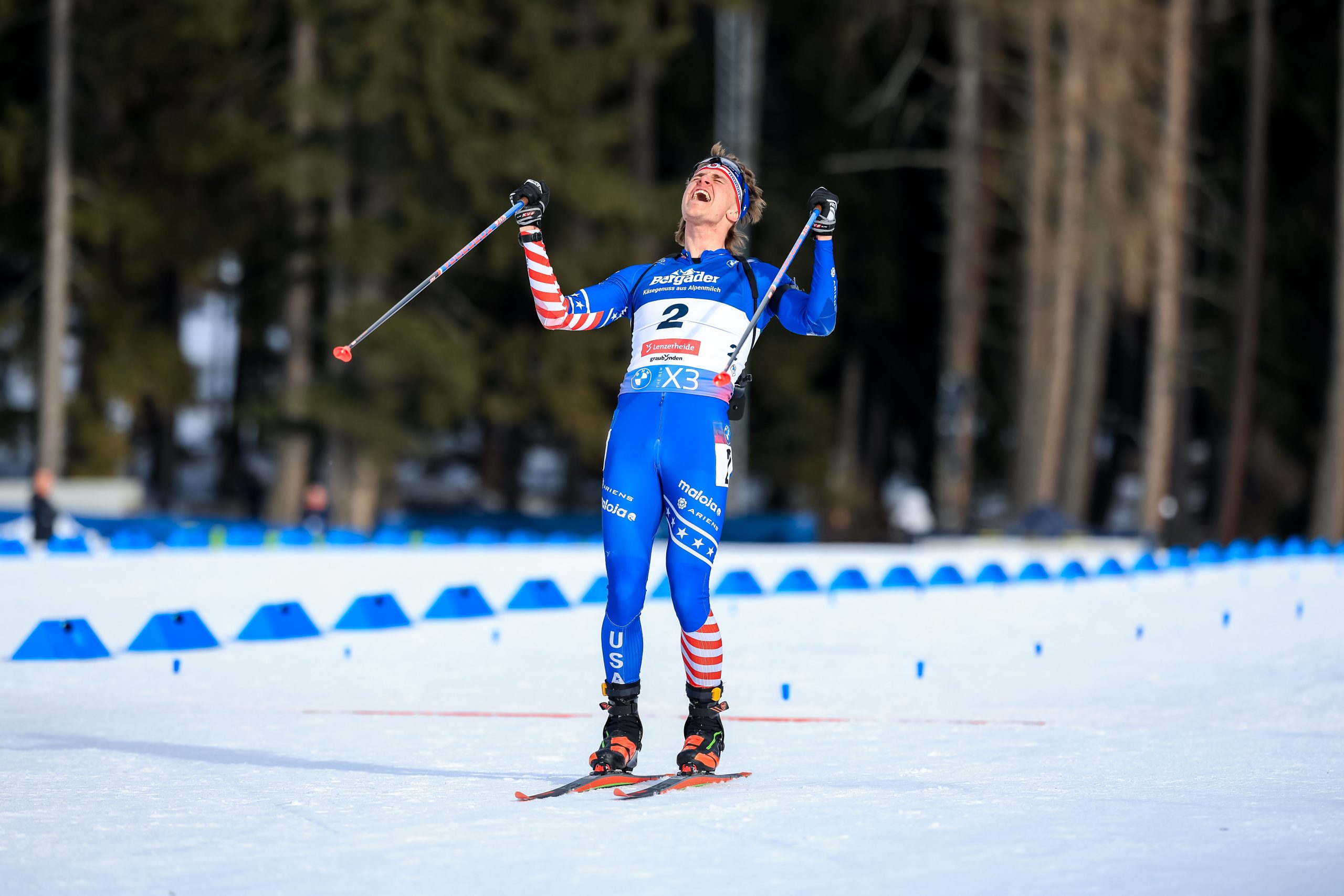
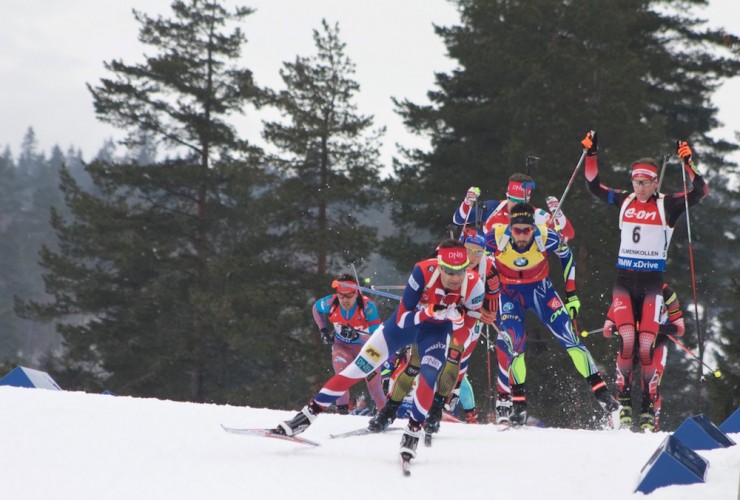
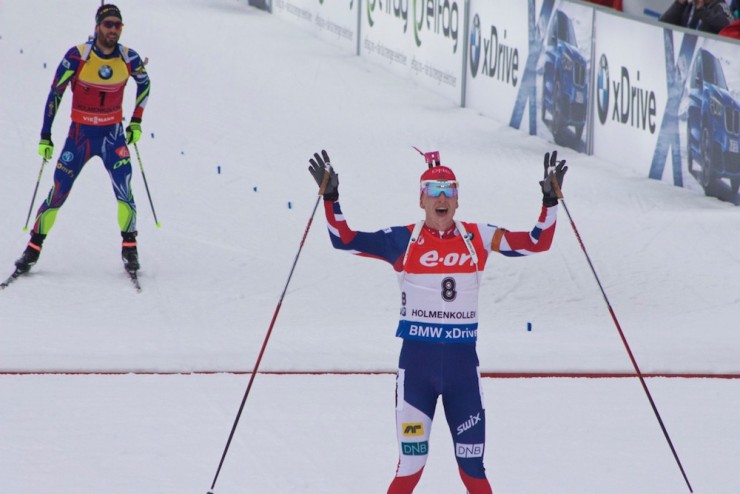
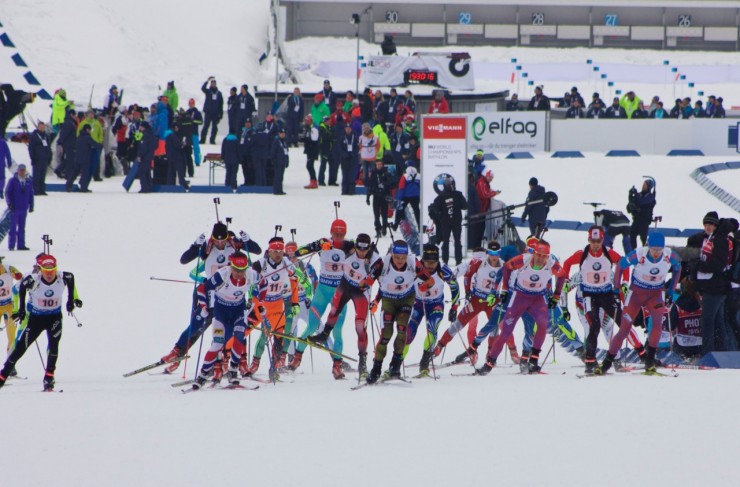
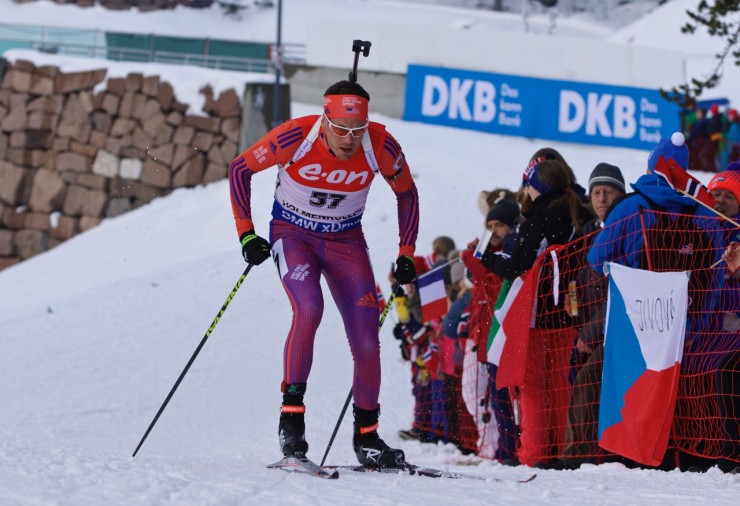
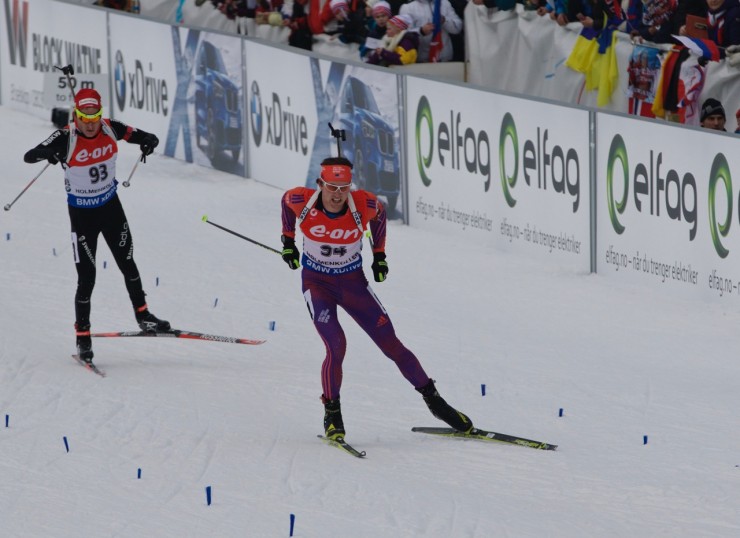
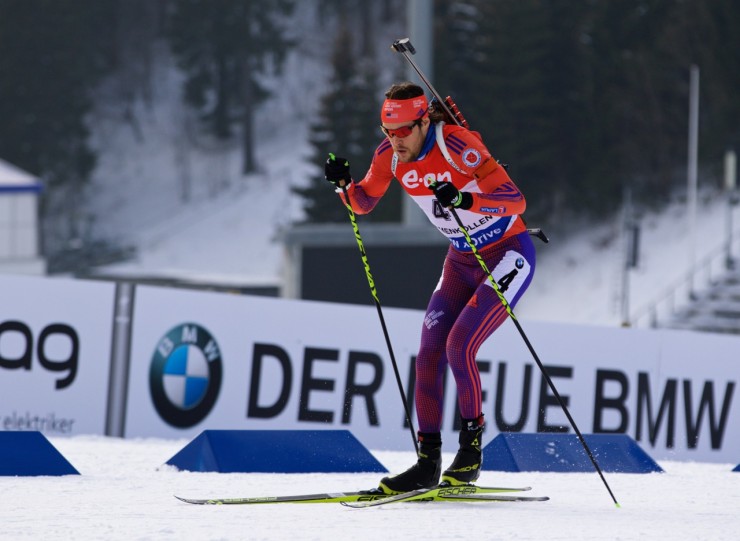
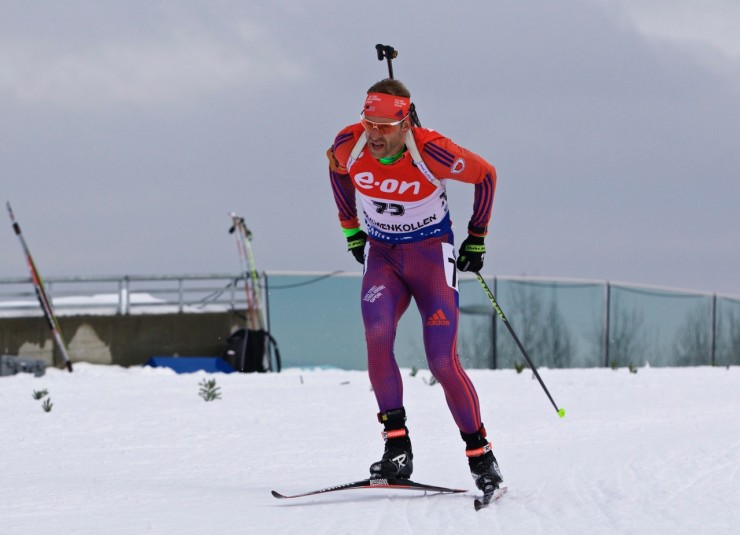
Campbell Wright (USA) celebrates his silver medal at the IBU World Championships Biathlon in the men’s pursuit in Lenzerheide (SUI). (Photo: NordicFocus)
By: Sara Donatello
After a historic World Championship silver medal in the men’s 10km sprint, Campbell Wright (Wanaka, NZL/Waiorau Nordic Skiing) is back on the podium in Lenzerheide, SUI with yet another silver medal in the men’s 12.5km pursuit. Missing just one target in his first prone stage, Wright went on to clean the final three stages of his race and solidify his second place position.
“Yesterday after the race I was pretty hyped up, I did not sleep very much last night as you can imagine I was pretty excited,” said Wright after the pursuit. “I got on the start line today and said ‘just enjoy every single meter of this race, man’. I’ve already proven what I needed to prove yesterday that I can really race with these guys and I’m not just a tourist here, but I can actually ski well and shoot well on a good day. I just started this race with nothing to lose and that’s the best place to be.”
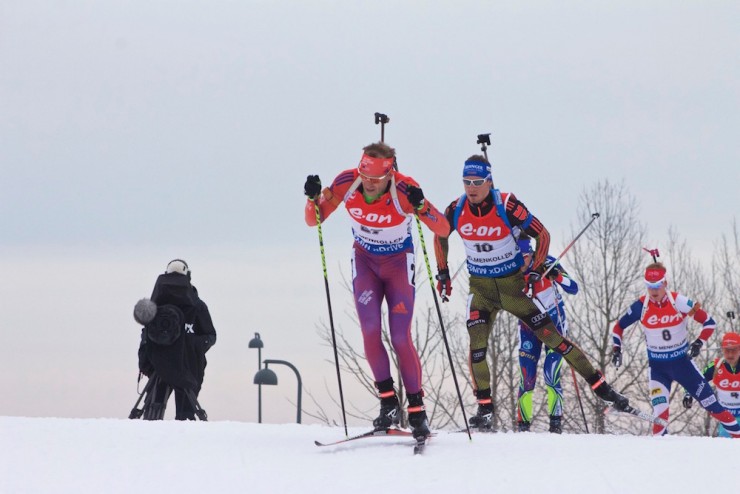
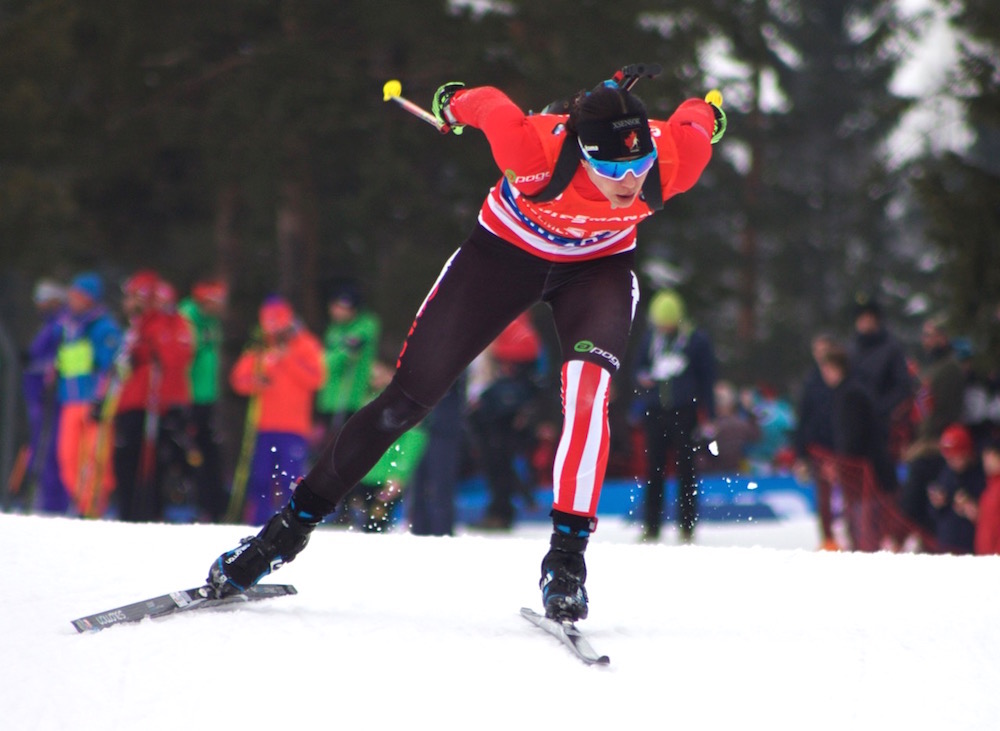
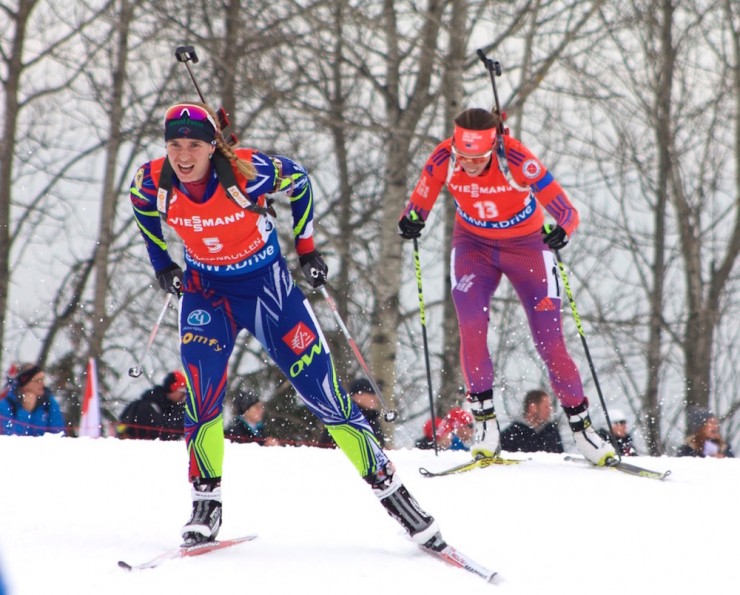
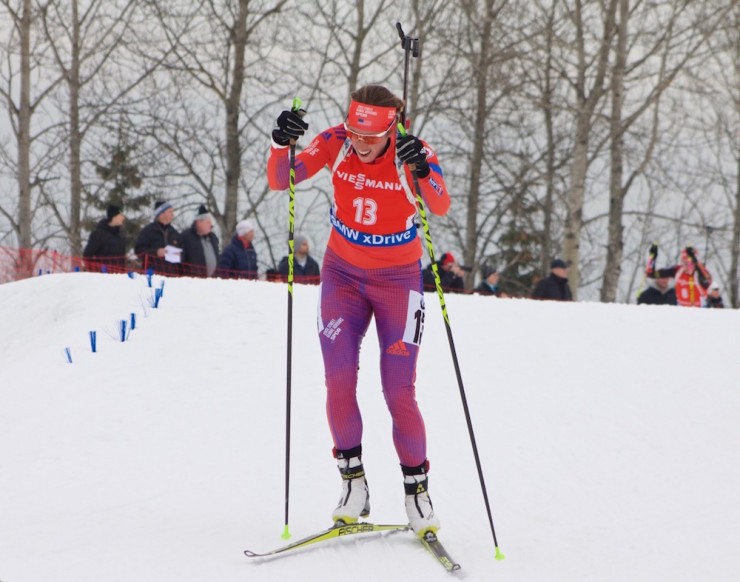
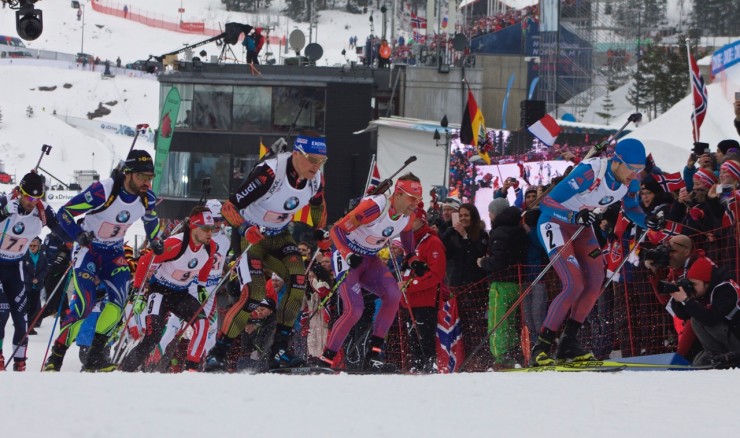
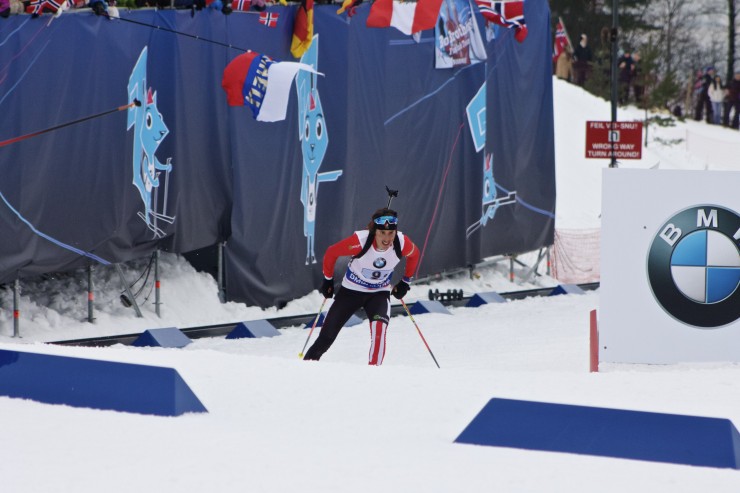
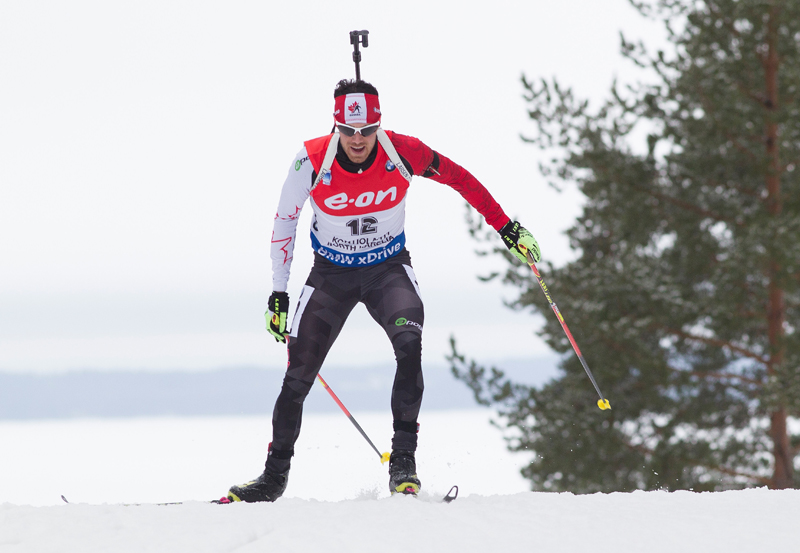
Campbell Wright (USA) on his way to his second straight silver medal at the IBU World Championships Biathlon, in Lenzerheide (SUI). (Photo: NordicFocus)
Once again, Wright stood on the podium with World Cup overall leader Johannes Thinges Boe of Norway, who held on to his title of defending world champion. The third-place position was filled this time by Eric Perrot of France, who made the impressive jump from 15th position at the start.
With the seventh overall ski time, Wright crossed the finish line just a mere 8.6 seconds behind Boe, closing the gap between them by seven seconds on the final lap. He noted that it was not in an effort to beat Boe, but more so to ski away from Perrot, who also cleaned his final shooting stage. With speedy skis and support from Team USA staff and teammates on the course, Wright held Perrot to third by +12.2 seconds.
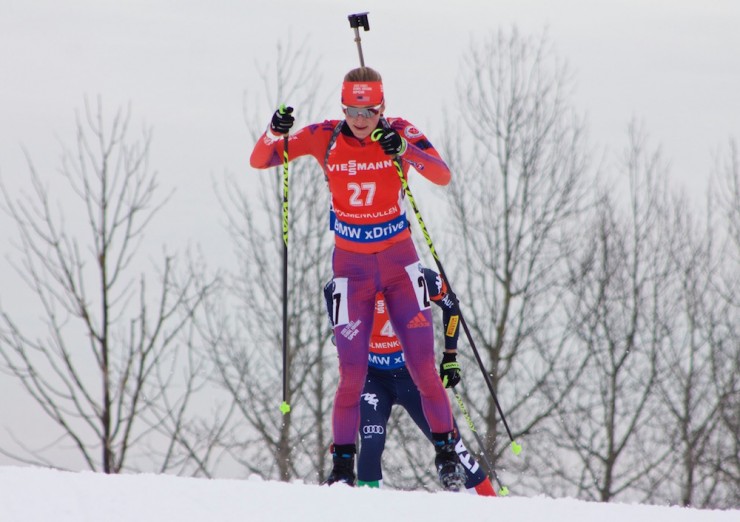
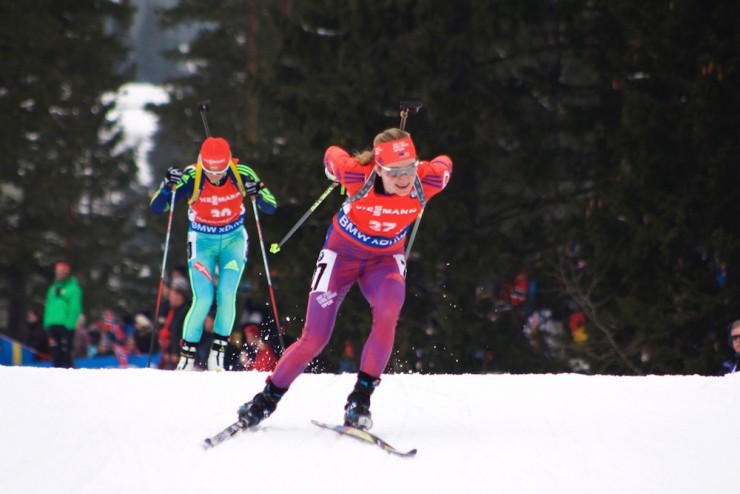
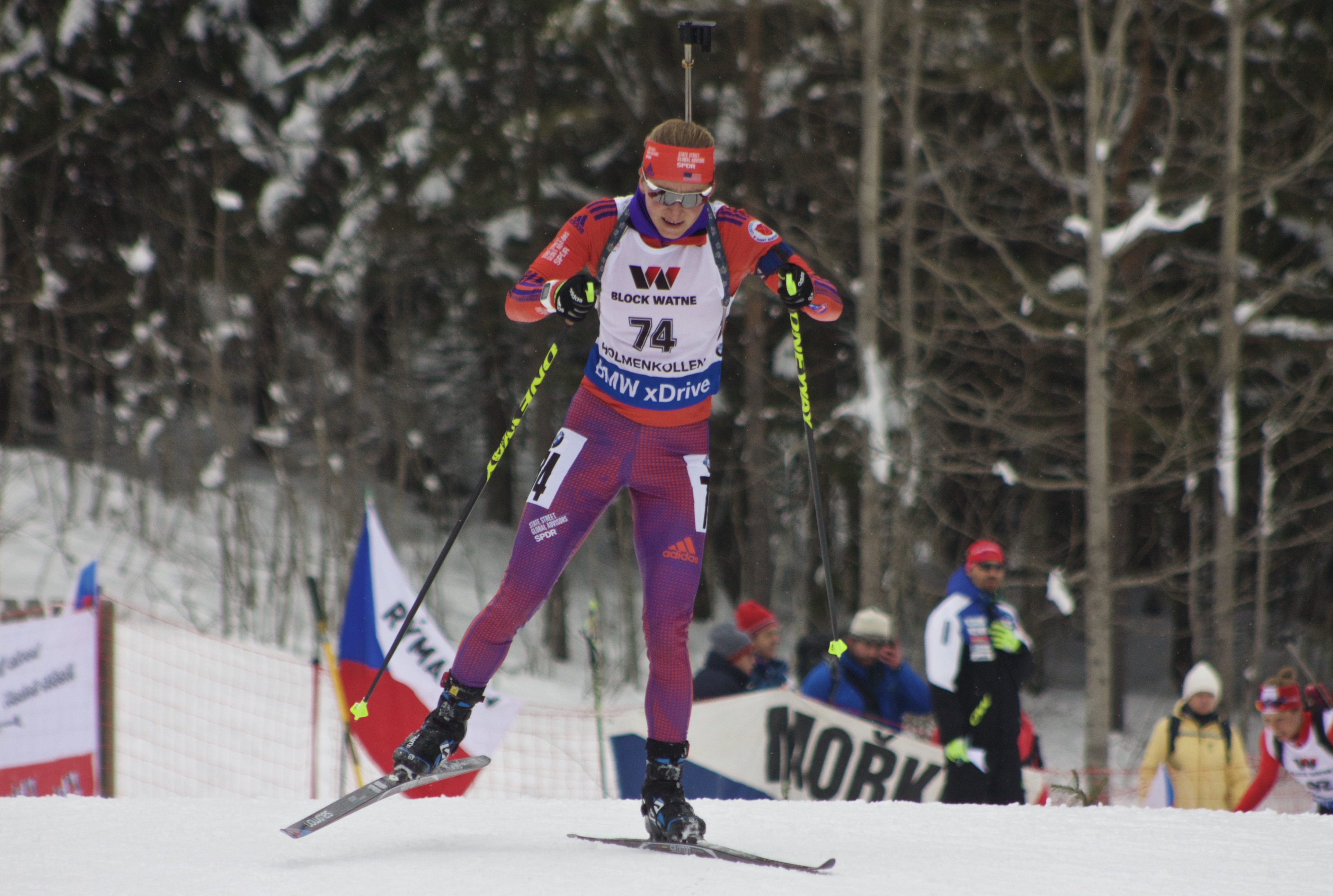
Maxime Germain (Chamonix-Mont Blanc, FRA/National Guard Biathlon), despite missing four targets on the day, had the 22nd overall ski time to land his third-best result this season in 21st place. Paul Schommer (Appleton, WI/Team Birkie/Ariens Nordic Center) was the biggest mover among U.S. men, jumping 17 positions to land 39th overall. Sean Doherty (Conway, NH/Army World Class Athlete Program) rounded out the U.S. men with a solid 45th-place finish.
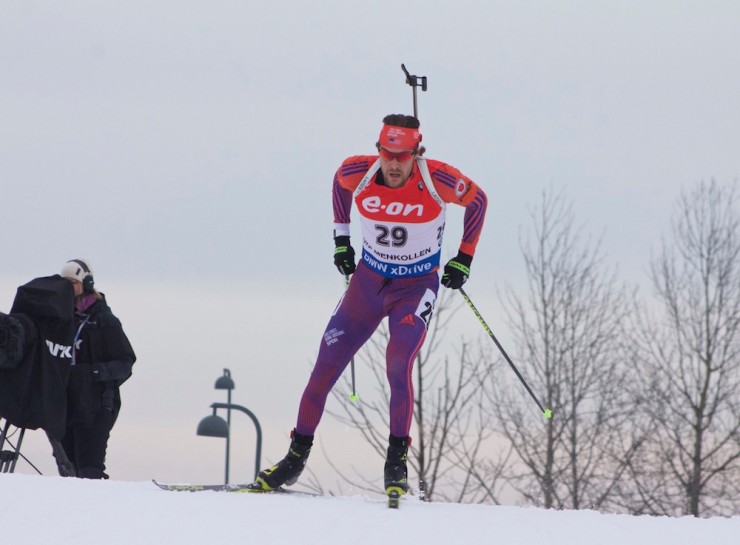
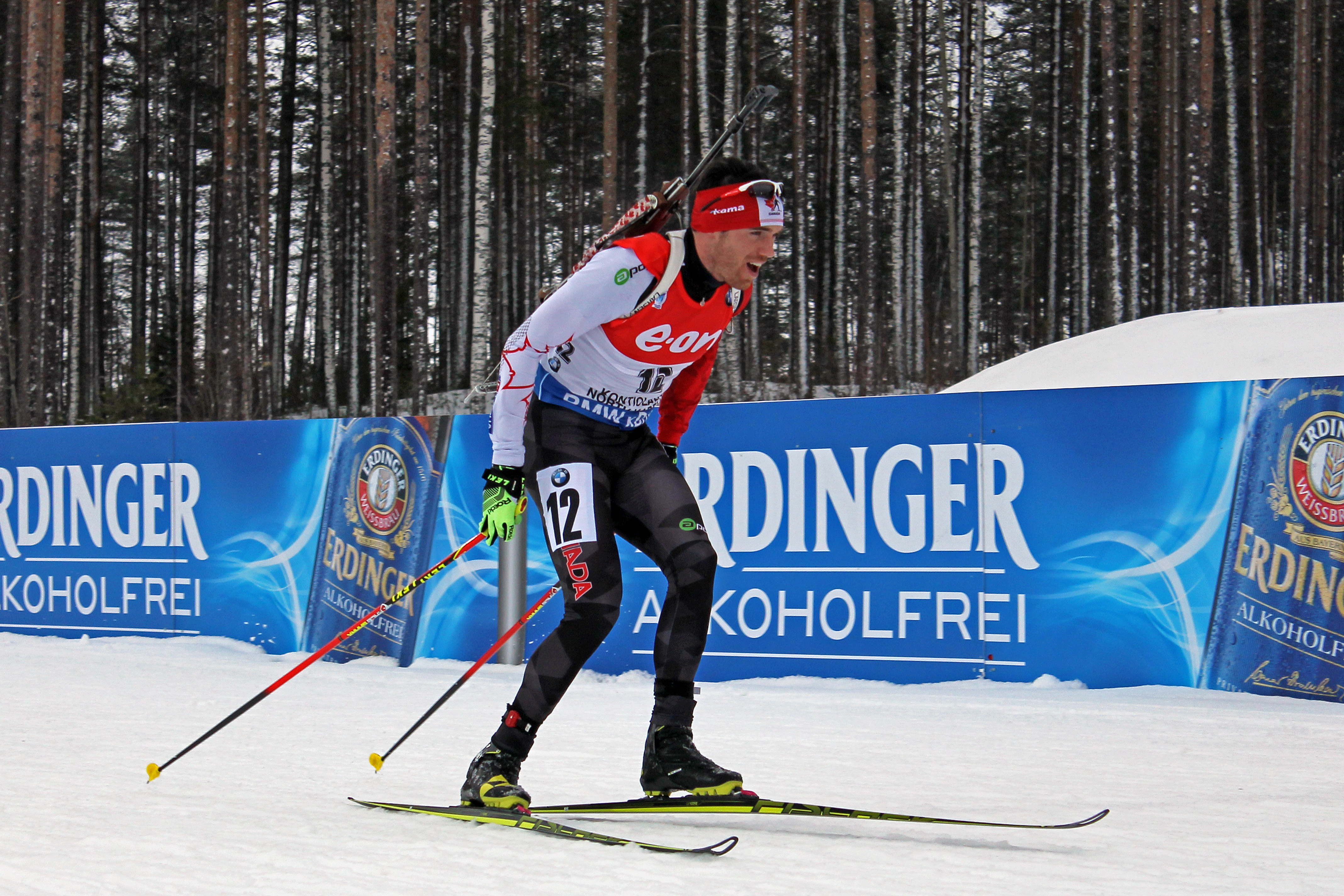
Paul Schommer (USA) during the Men’s Pursuit at the IBU World Championships Biathlon in Lenzerheide (SUI). (Photo: NordicFocus)
Earlier in the day Chloe Levins (Williston, VT/Unaffiliated) and Lucinda Anderson (Golden Valley, MN/Team Birkie) both moved up in the field in their first-ever World Championship pursuit races. Levins jumped from bib 52 to land in 48th and Anderson from bib 56 to finish 49th.
A well-deserved training day tomorrow for the U.S. Biathlon Team before the women are back at it on Tuesday, February 18 at 9:05 EST/15:05 CET for the 15km individual. The men’s 20km individual will begin the following day, February 19, at 9:05 EST/15:05 CET.
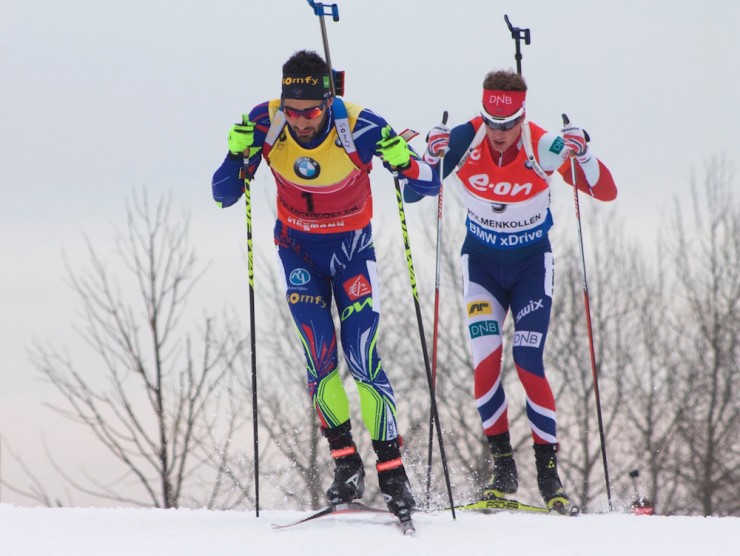
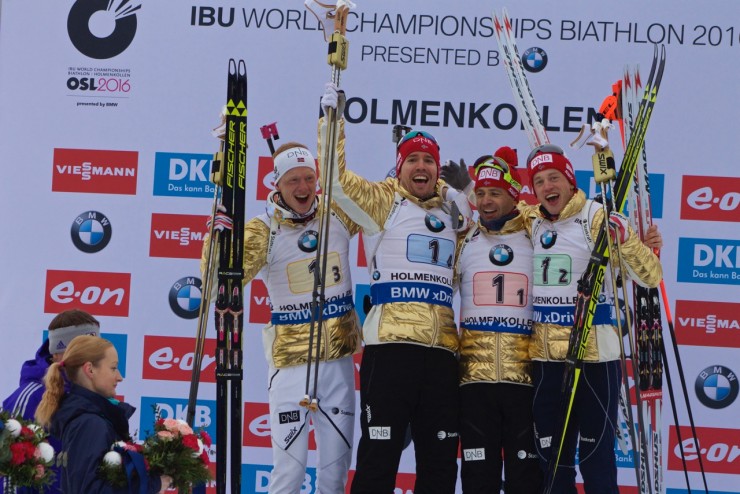
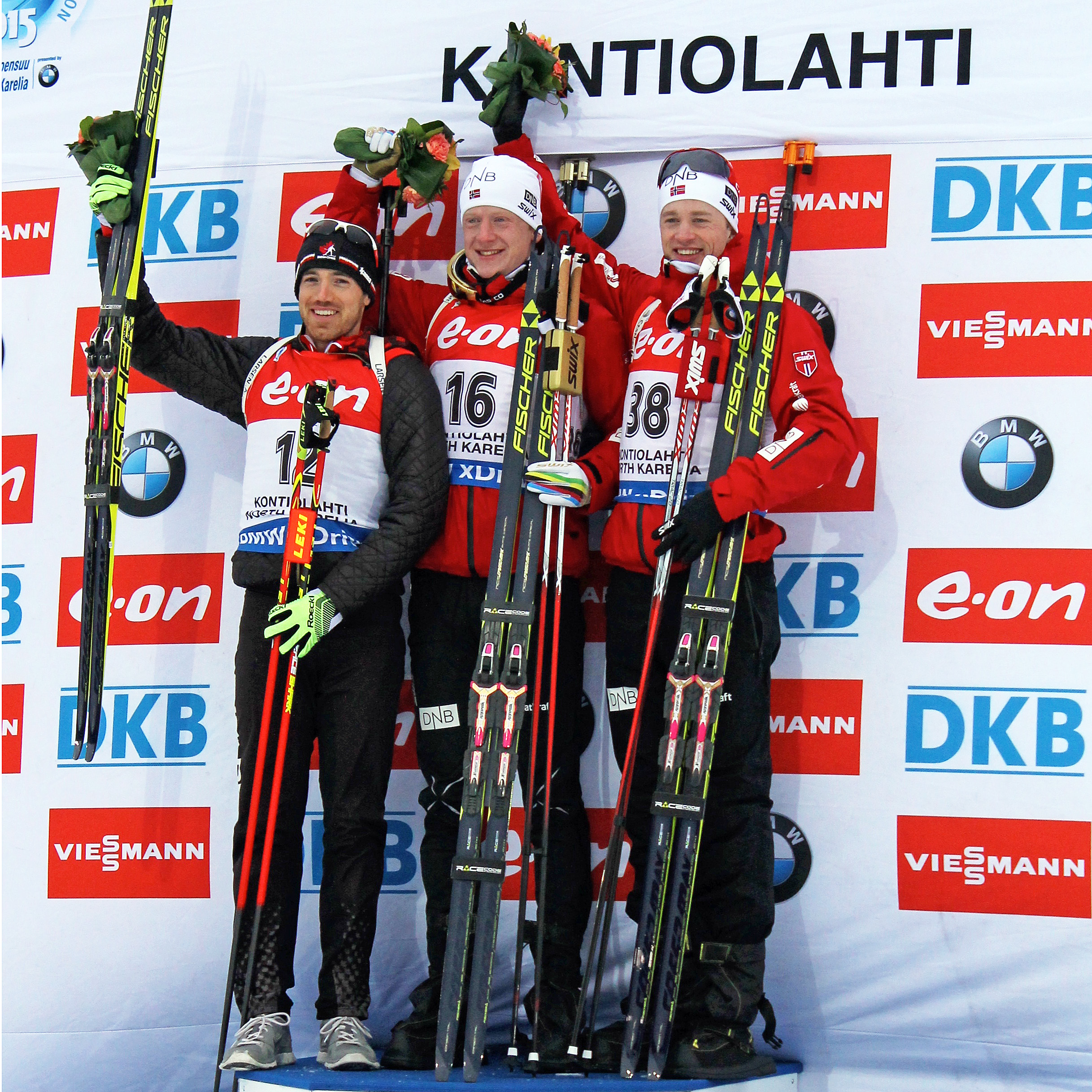
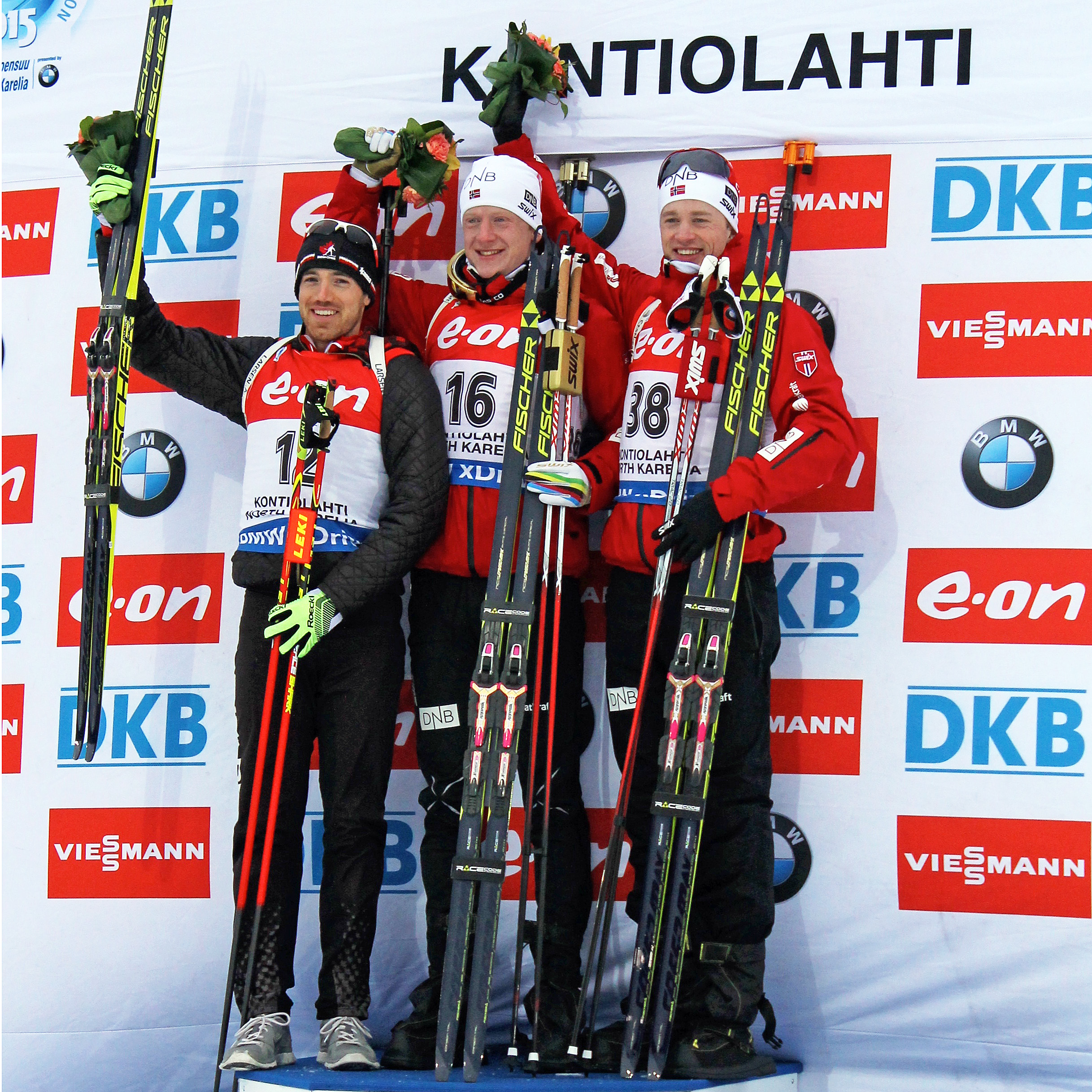
Campbell Wright (USA), Johannes Thingnes Boe (NOR), Eric Perrot (FRA), (l-r) – IBU World Championships Biathlon, pursuit men, Lenzerheide (SUI). (Photo: NordicFocus)
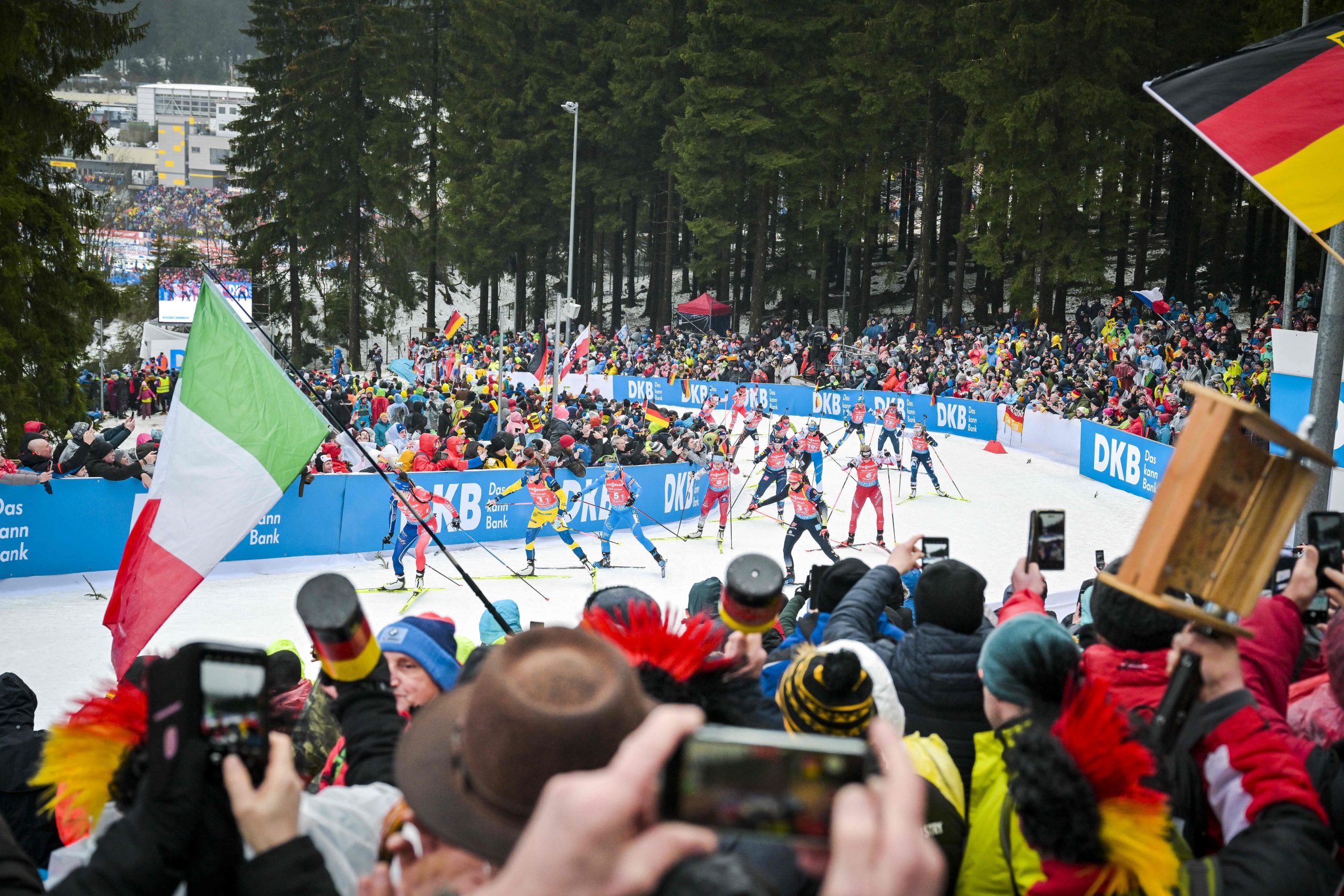
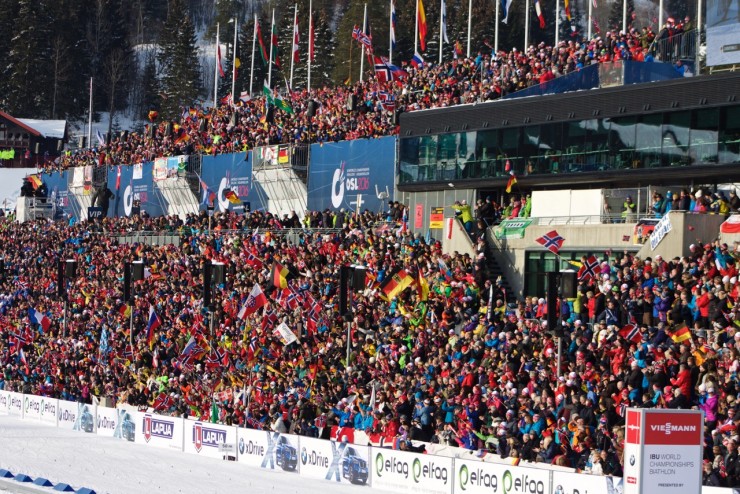
Fans line the famous Birxsteig climb during the Women’s Relay at the IBU World Championships in Oberhof, Germany. (Photo: NordicFocus)
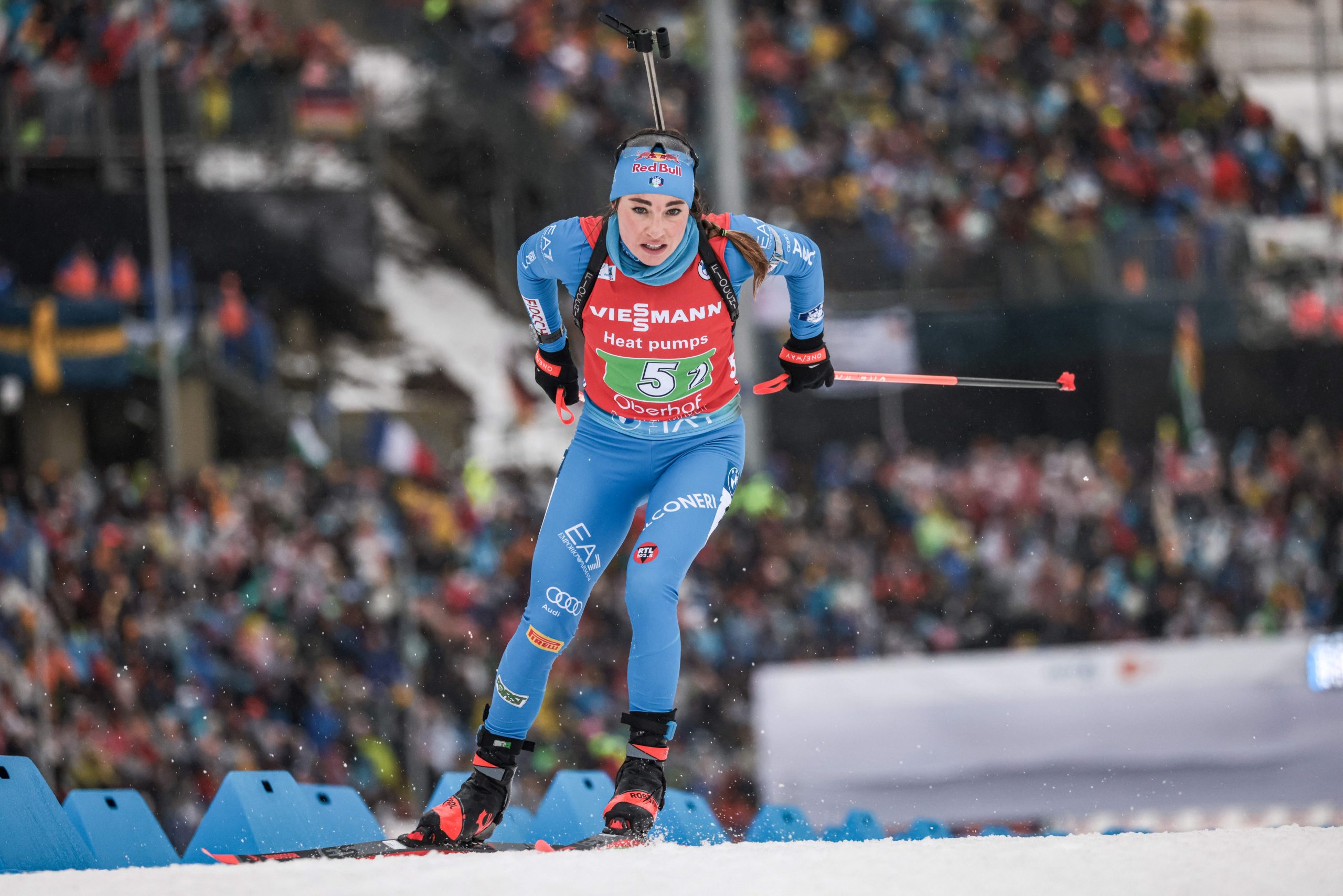
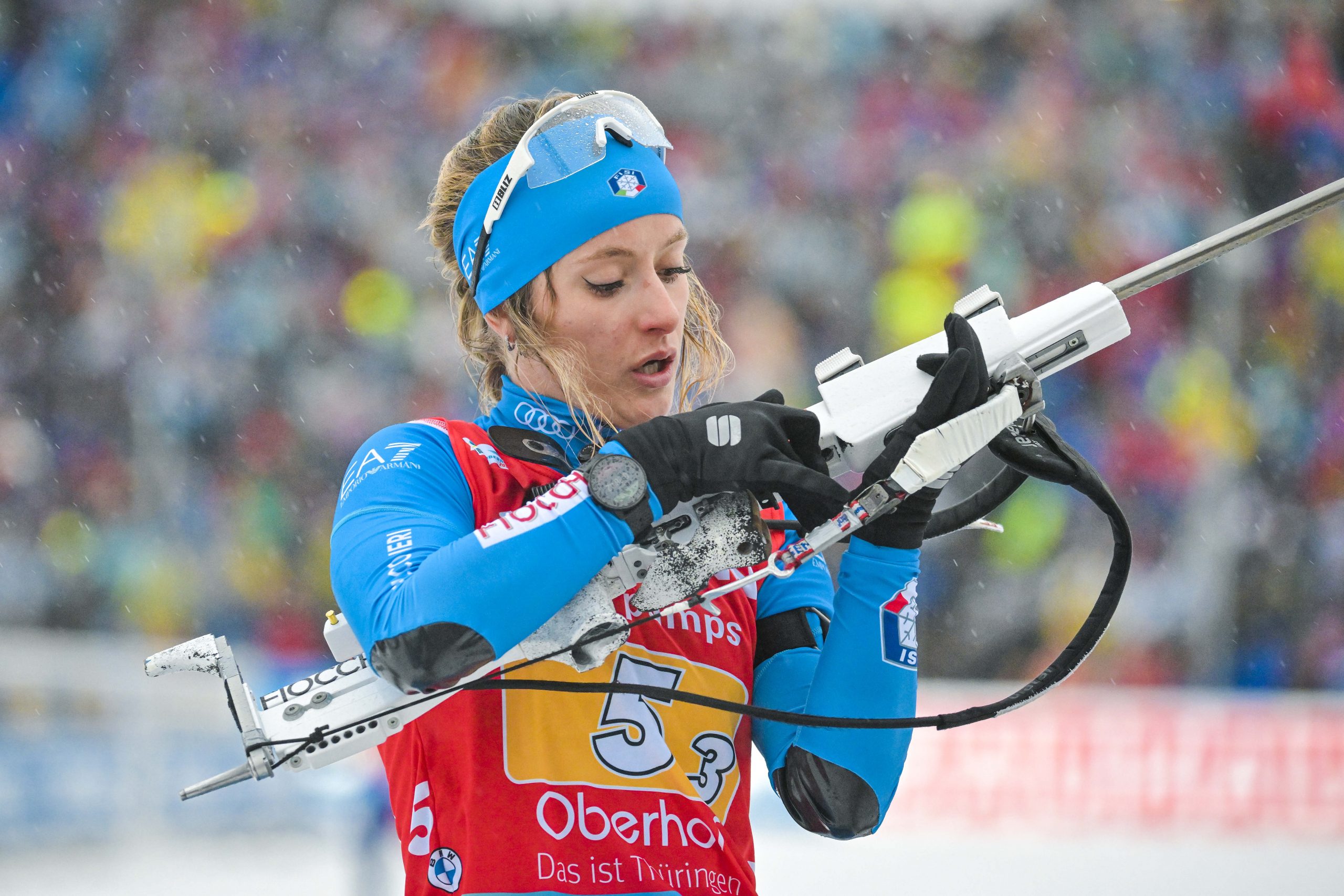
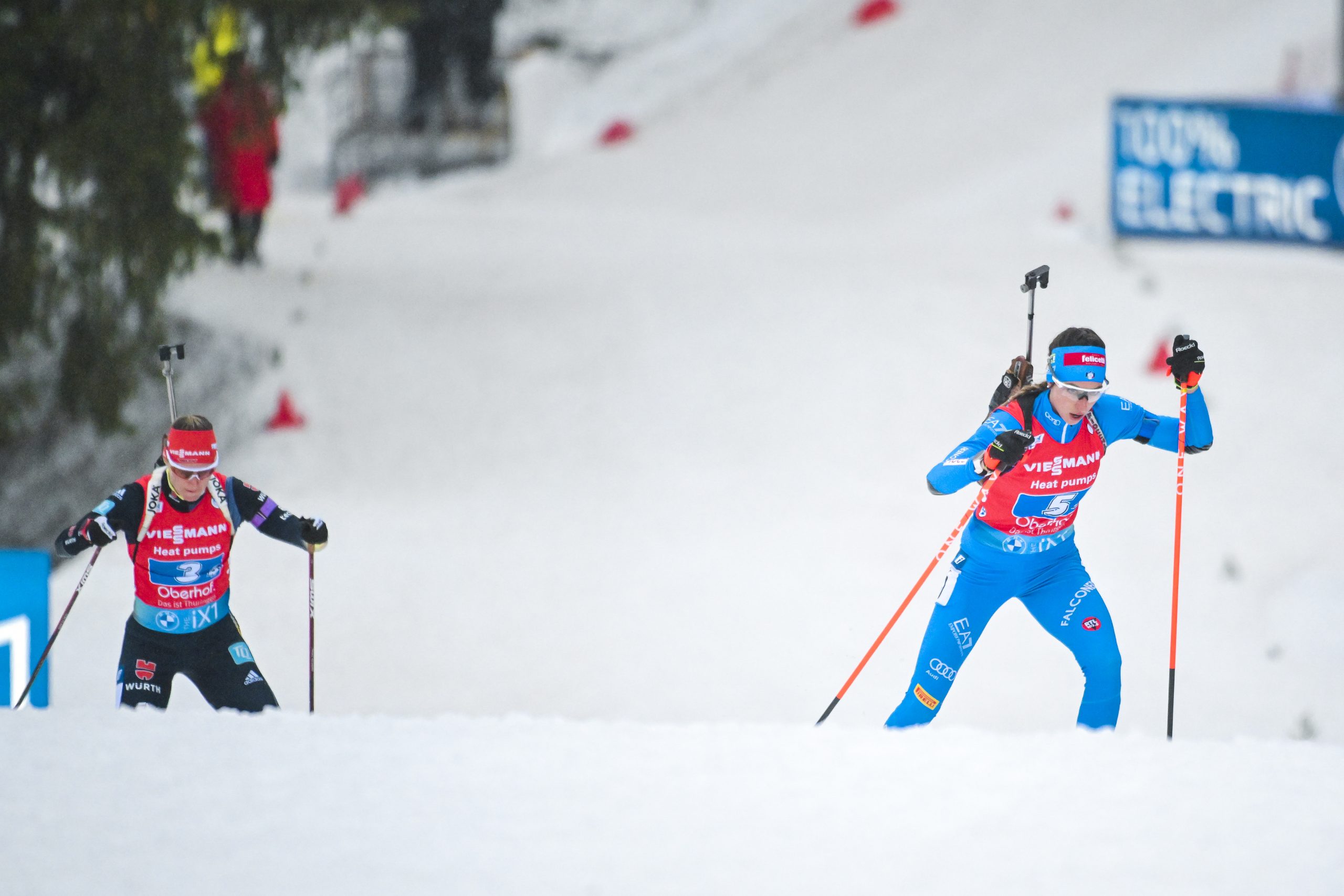
If there’s one competition to watch from the 2023 Biathlon World Championships, it’s the Women’s 4 x 6 k Relay. (Replay available here.) In a dazzling display of biathlon mastery, the Italian quartet knocked down 40 targets with 42 bullets, excelling one after another under pressure in difficult conditions to capture Italy’s first-ever Women’s Relay title. The “Blues” have been investing heavily in biathlon development with their sites set on the 2026 home Olympic Games, and it shows. But they didn’t run away with the win; it came down to a nail-biter final shooting, pitting Lisa Vittozzi of Italy against hometown favorite, Denise Herrmann of Germany. Vittozzi’s fast and flawless shooting clinched the win in spectacular fashion, while Herrmann faltered but held onto silver for Germany over third-place Sweden.
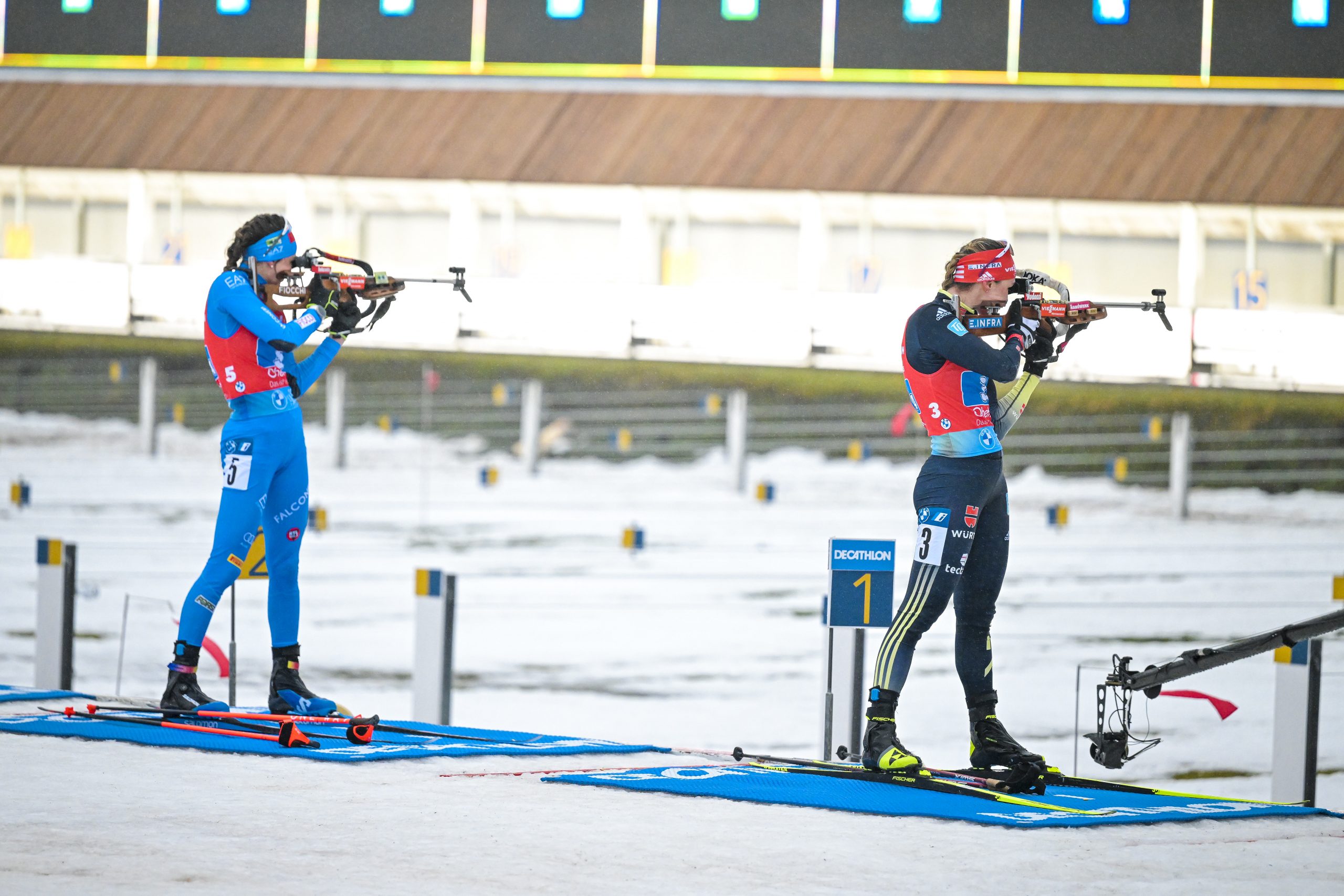
Lisa Vittozzi (ITA) and Denise Herrmann-Wick (GER), (l-r) shooting head to head for the gold medal in the final shooting stage of the IBU World Championships Women’s Relay. (Photo: NordicFocus)
After gusty winds caused drama at the shooting range in Saturday morning’s Men’s Relay, the conditions for the Women’s Relay eased a bit, though the compromise for lighter wind was heavier rain. On the first leg, two women shot clean: Vanessa Voigt of Germany’s 2022 Olympic bronze medal-winning relay squad, and Samuela Comola of Italy. Coming into these Championships, Comola’s best World Cup finish was 20th, but as one of three women to hit 20/20 in last Wednesday’s 15 k Individual she claimed a new personal best of fourth. Continuing her breakout week and clean shooting streak, she arrived at the first exchange in the lead pack with Sweden, Czech Republic, and Norway. Thirteen teams tagged within one minute, with the top seven all within 30 seconds.
Vanessa Voigt (GER), Samuela Comola (ITA), and Lou Jeanmannot (FRA) in the first leg of the Women’s Relay at IBU World Championships in Oberhof. (Photo: NordicFocus)
In the second leg, two-time World Cup Overall winner Dorothea Wierer of Italy kept a low profile at first, hanging onto the back of a four-person lead pack. But in the standing shooting stage she used just one spare on Lane 4 and passed everyone to blow open a 26-second lead. France went into the penalty loop and never quite recovered, eventually finishing fourth. Norway suffered three penalty loops and fell even farther back, taking sixth in the end. Sweden had two penalty loops but made gains in the second half of the race to stay in the mix. From this point on, Italy never gave up the lead.
Dorothea Wierer (ITA) used just one spare in standing to take the lead at the halfway point in the Women’s Relay at IBU World Championships in Oberhof, Germany. (Photo: NordicFocus).
At the halfway point, 32-year-old Wierer (ITA) handed off to her 21-year-old teammate, Hannah Auchentaller, who was originally named to the Italian World Championships team as an alternate and has only competed in a handful of World Cup races, including just one relay. No one knew what to expect from the young athlete in this high-stakes situation. Chloe Chevalier of France caught Auchentaller from 20 seconds back in the approach to the prone shooting, but Auchentaller confidently skied her own pace and kept her calm on the range. She cleaned her targets with no spares, skiing away with a 30-second advantage while Chevalier used all three spares. Arriving on Lane 1 for standing, all eyes and cameras were on Auchentaller. In the moment when it counted most, she performed brilliantly, using only one spare to hit her targets like a seasoned professional. After leading the whole third leg, Auchentaller handed off five seconds ahead of Germany.
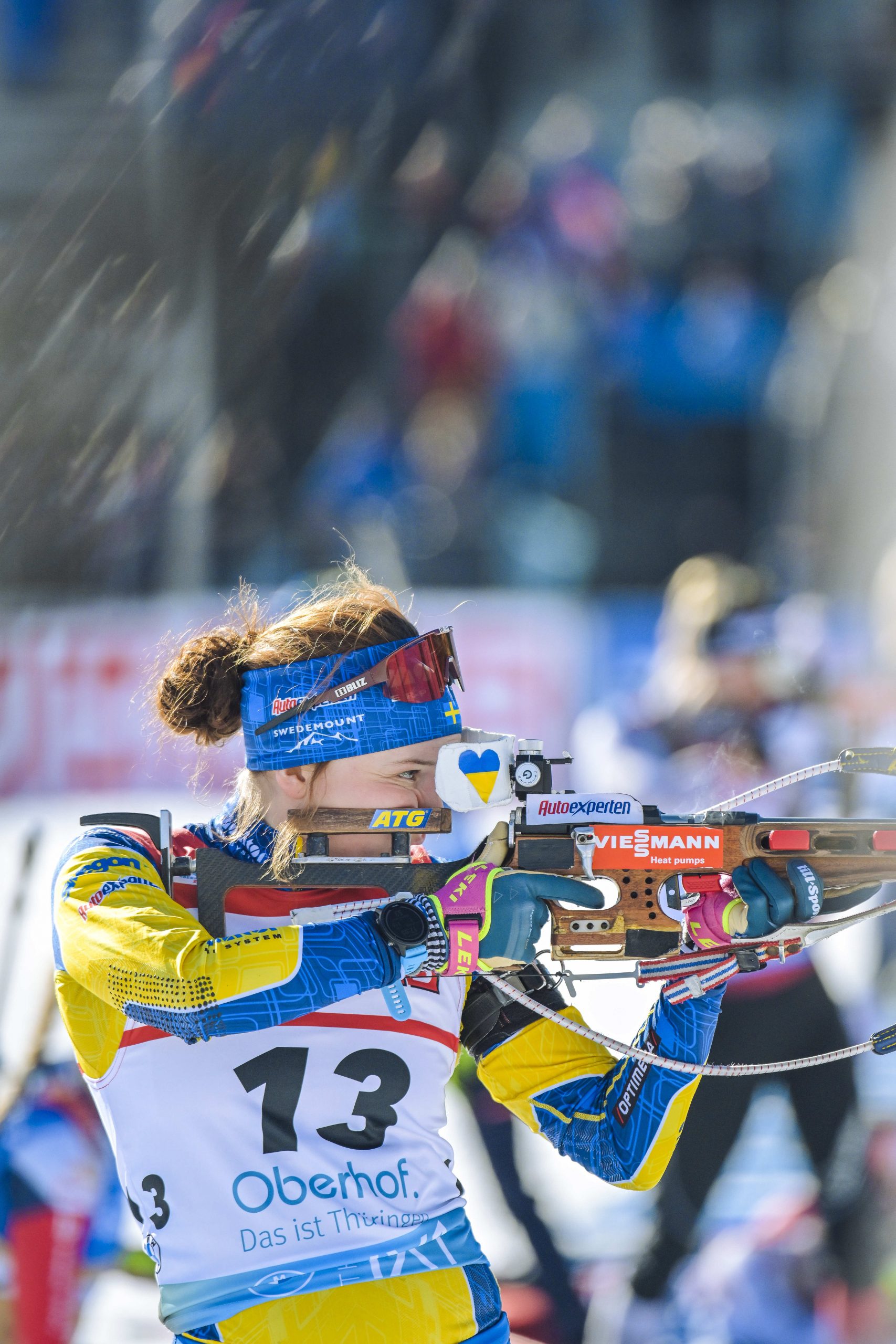
Hannah Auchentaller (ITA) setting up in the standing position in the Women’s Relay at the IBU World Championships. (Photo: NordicFocus).
The last leg was set up perfectly for a high-octane head-to-head battle between two superstars: Lisa Vittozzi of Italy and Denise Herrmann of Germany. Both women are ranked in the top five of the World Cup Overall: third-ranked Vittozzi has a slightly higher shooting percentage, while fifth-ranked Herrmann tends to be slightly faster on the tracks. Both athletes cleaned prone, but Vittozzi did so five seconds faster than Herrmann. Statistics played out as Herrmann caught Vittozzi on the tracks and led into the final shooting. In yet another display of incredible composure and expertise from the Italian team, Vittozzi blazed through her five targets with five hits in 20 seconds. Herrmann hesitated after the third hit and then missed the final two shots, eventually needing 53 seconds to clear her targets with two spares. Though she avoided the penalty loop she left the range 31 seconds behind Vittozzi.
Denise Herrmann-Wick (GER) chasing down Lisa Vittozzi (ITA) before the final shooting in the Women’s Relay at the IBU World Championships in Oberhof, Germany. (Photo: NordicFocus)
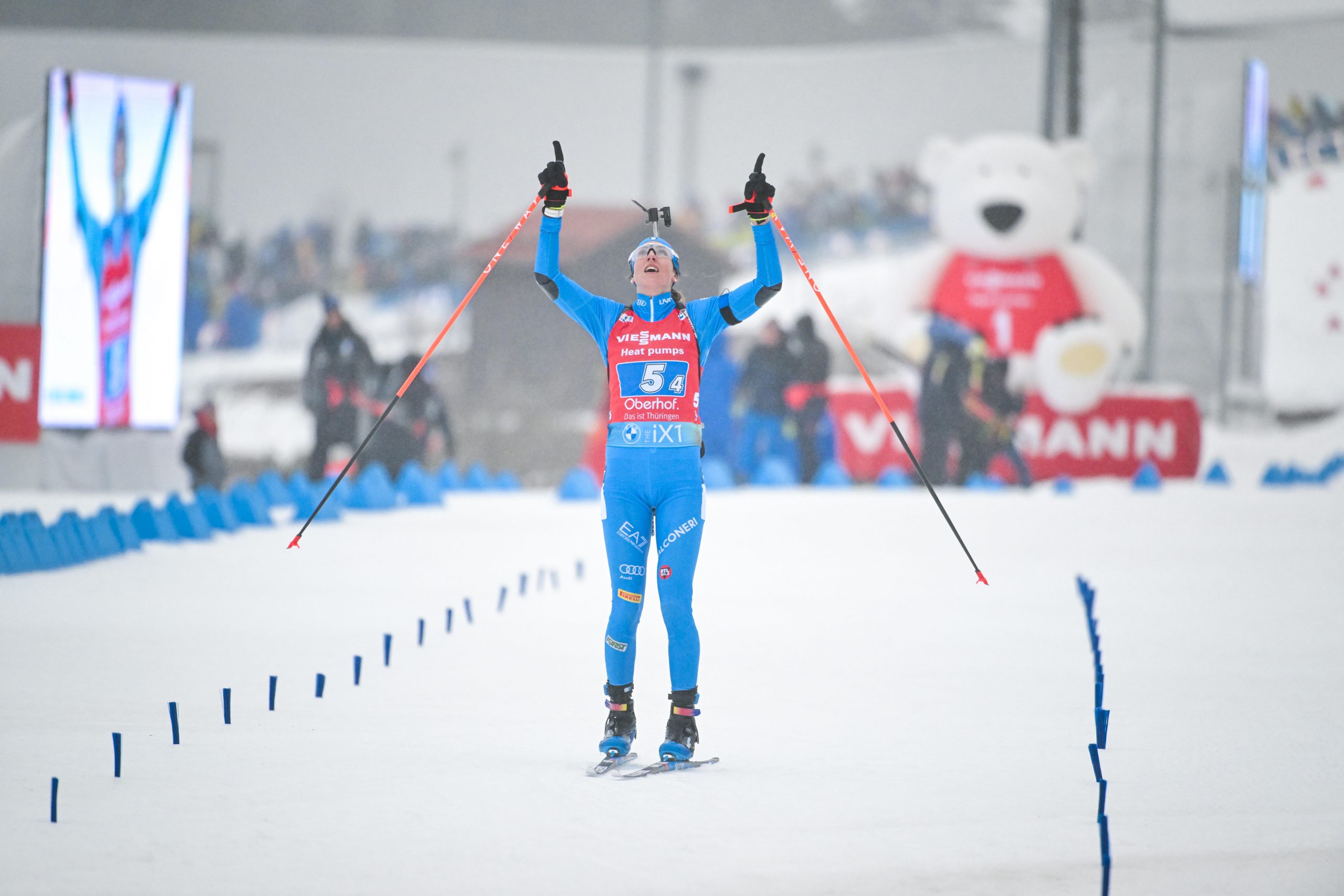
Vittozzi crossed the finish line in triumph and was met by her three ecstatic teammates—the new World Champions. Herrmann, her teammates, and the German crowd all seemed satisfied with their silver medal performance, and Hanna Oeberg (SWE) brought home the bronze for Sweden, perhaps a slight disappointment for the race favorites, but a World Championship medal nonetheless. Julia Simon of France crossed in fourth, looking underwhelmed.
Lisa Vittozzi (ITA) celebrates as she crosses the finish line to claim Italy’s first ever gold in a Women’s Relay at the IBU World Championships in Oberhof, Germany. (Photo: NordicFocus)
From North America, Canada finished 11th and the US was 15th. Canada’s Nadia Moser had a solid first leg to tag in ninth just 46 seconds out of the lead. For the US, Deedra Irwin struggled on both the range and the tracks, using all six spares and incurring one penalty loop to hand off in 15th, 2:10 back. Joanne Reid (USA) moved the team up to 12th while Canada fell to 15th at the halfway point. On the third leg, Chloe Levins (USA) held onto twelfth and tagged twenty seconds ahead of Canada in 13th. Skiing the anchor leg for team USA, Kelsey Dickinson dropped down to 15th, while Canada’s Emma Lunder finished strong, bringing the Canadians up to 11th.
Joanne Reid (USA) brought the US from 15th two 12th in the second leg of the Women’s Relay at the IBU World Championships. (Photo: NordicFocus).
The Canadians had a final shooting score of 1 (penalty loop) +10 (spare rounds), while the US had 1+15. The winners from Italy had 0+2, highlighting the importance of the shooting and the exceptional caliber of their performance. Though it wasn’t a day to write home about for either North American team, US Biathlon Team Head Coach and proud father, Armin Auchentaller of Italy, certainly had reason to celebrate. His daughter and her three teammates were simply superb.
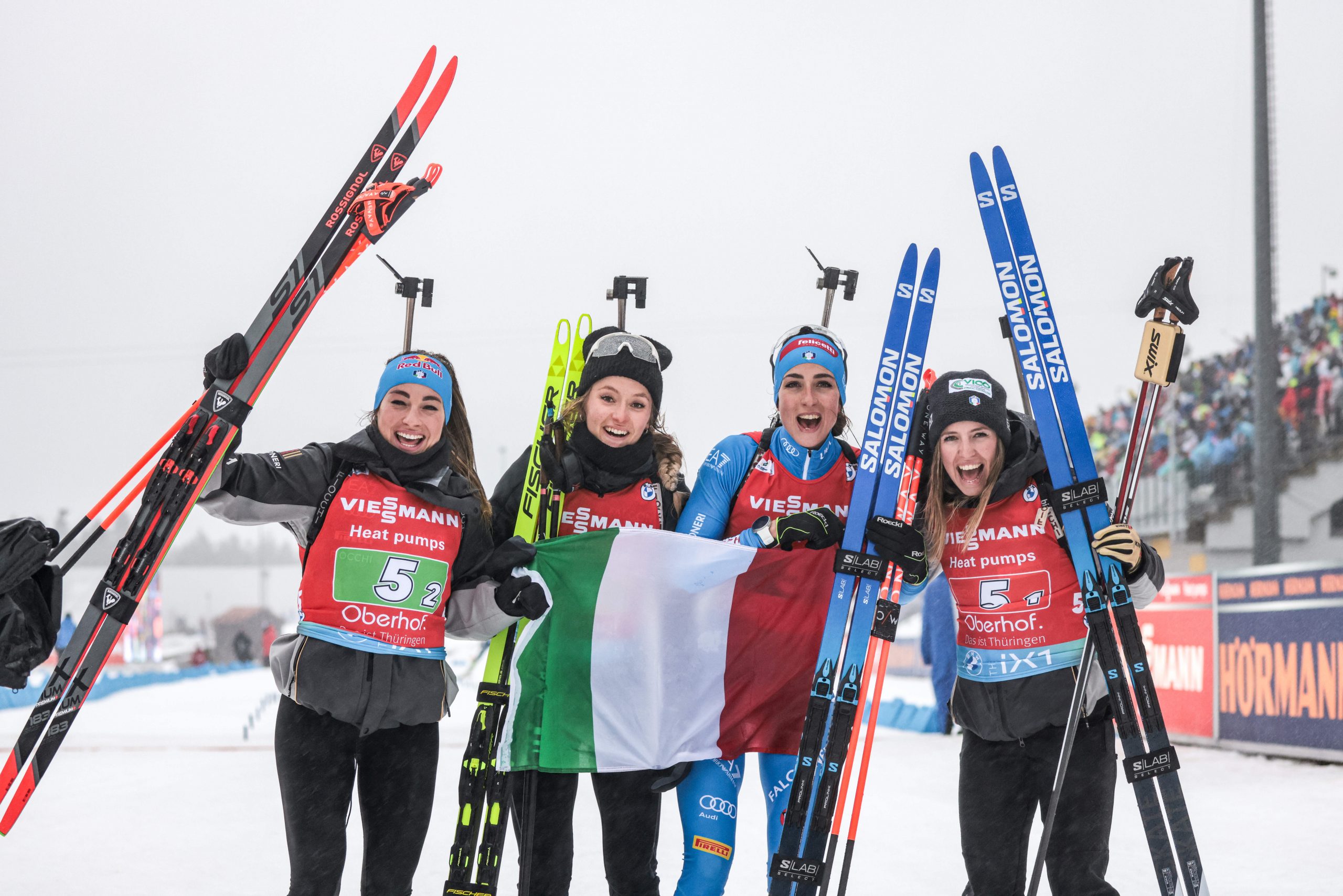
Dorothea Wierer (ITA), Hannah Auchentaller (ITA), Lisa Vittozzi (ITA), Samuela Comola (ITA), (l-r) celebrating Italy’s first ever gold medal in the Women’s Relay at the IBU World Championships in Oberhof,Germany. (Photo: NordicFocus).
Ever since Hanna Oeberg burst onto the podium for the first time, winning Olympic gold in the 15km Individual at the 2018 Olympics in Pyeongchang, she has been a consistent force in the event. She defended her title at the 2019 World Championships, just missed the podium in fourth in 2020, and took silver in 2021. After faltering slightly in the 2022 Olympics in Beijing with a 16th place finish, Oeberg came back today to win her third Championship-level gold, in spite of one miss. Oeberg’s teammate, Linn Persson, shot 20/20 for the silver medal, and Italy’s Lisa Vittozzi missed only her last shot to finish third.
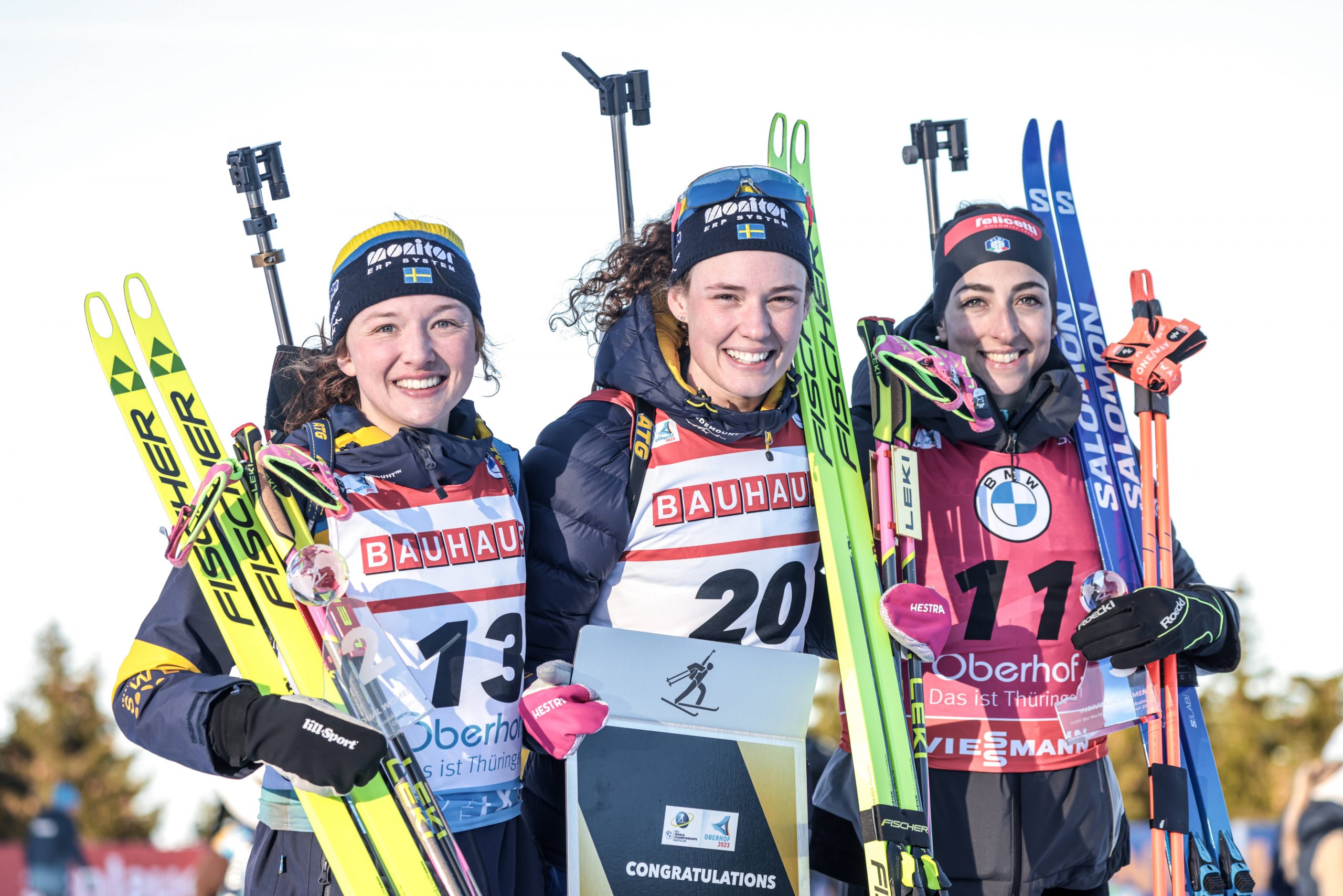
Medalists in the IBU World Championships 15km Individual: Linn Persson (SWE), Hanna Oeberg (SWE), Lisa Vittozzi (ITA), (l-r). (Photo: NordicFocus)
Dorothea Wierer (ITA) was an early leader, wearing bib four and missing only once in the first three stages. But disaster struck on the final stage when she missed three, sending her three minutes down in the results. A few minutes later wearing bib 11, Wierer’s Italian teammate Lisa Vittozzi came through in the lead, having shot 15/15 in the first three stages. Vittozzi was fifth in last Friday’s Sprint but then came down with a cold on Saturday and had to skip the Pursuit. Despite returning from illness, she managed to ski the sixth-fastest course time today and carried a big lead into the final shooting stage. She hit the first four shots but then missed the last, opening up a door for Linn Persson of Sweden. Persson also shot clean through the first three stages and was holding Vittozzi’s pace; the two were separated by only .6 after Shooting 3. Persson hit the perfect 20/20 to take the lead, leaving the range with a huge smile on her face.
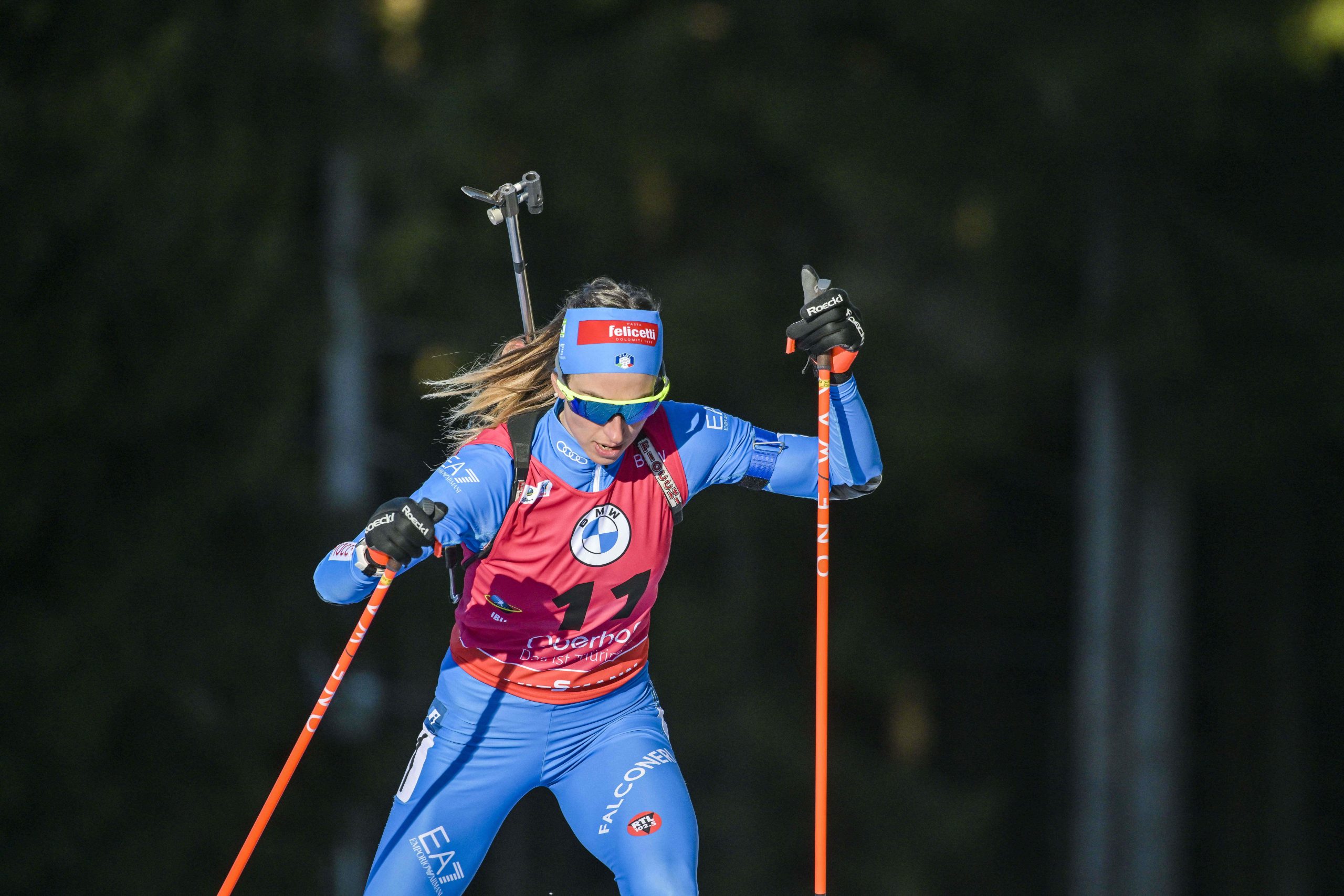
Lisa Vittozzi (ITA) on her way to a bronze medal finish in the IBU World Championships Individual. (Photo: NordicFocus)
Persson crossed the finish line in first place, but her teammate Hanna Oeberg was chasing her down. With one miss in the first stage but then clean shooting for the rest of the race, Oeberg left the range after the final stage with a 14-second deficit to clean-shooting Persson. Knowing that the gold medal was on the line, Oeberg outskied Persson by nearly 25 seconds over the last three-kilometer loop to claim the World Championship title.
Linn Persson (SWE) shot the perfect 20/20 to take silver in the IBU World Championship Individual in Oberhof , Germany. (Photo: NordicFocus)
Persson was one of just three women to shoot the perfect score today. The others, Samuela Comola (ITA) and Suvi Minkkinen (FIN), both set new personal bests, finishing fourth and eighth, respectively. Joining Comola in the Flower Ceremony were World Cup Overall leader, Julia Simon of France in fifth, and Tuuli Tomingas of Estonia, whose sixth place finish is the highest ever for an Estonian woman at a World Championships.
Deedra Irwin (USA) racing in a t-shirt due to uncharacteristically warm and sunny conditions at the IBU World Championships in Oberhof, Germany. (Photo, NordicFocus)
From the USA, Deedra Irwin found her groove today. After sickness and tricky range conditions hampered her efforts in the Sprint and Pursuit, Irwin pulled together her best focus today to finish 20th—her third-best career result and best this season. Of 90 starters in today’s race, only three shot clean and only four hit 19/20; Irwin was one of them, missing one from the standing position in the second stage. “I’m just glad I was able to keep it together on the range,” said Irwin, who couldn’t train normally in the lead up to the Championships due to illness. “I feel flat, but it’s getting better every race.” Lucky for Irwin, she has two more races in the next three days to keep the positive momentum going. Irwin’s parents are supporting her on-site; they made the big trip from Wisconsin to see their first international biathlon races and are wearing Green Bay Packers gear with pride. Look for the cheesehead on the live stream!
Emma Lunder (CAN) on her way to 25th in the IBU World Championships Individual in Oberhof, Germany (Photo: NordicFocus).
Emma Lunder of Canada finished 20 seconds behind Irwin in 25th, in spite of three penalties. With 11th and 30th place finishes from the Sprint and Pursuit, Lunder has comfortably qualified for next Sunday’s Mass Start. In the two Mass Starts this winter she has finished 9th and 11th, and she is skiing faster now than she was earlier in the season so she has podium potential.
Kelsey Dickinson (USA) made her IBU World Championships debut, shooting 90% to finish 67th. (Photo: NordicFocus)
Nadia Moser of Canada finished 58th with five penalties. Joanne Reid skied just nine seconds slower than Irwin but had difficulty on the range, missing three in the first standing stage and six overall to finish 61st. In her World Championships debut, Kelsey Dickinson (USA) had excellent shooting, missing only two, but felt like she couldn’t push into her highest gear and ended up 67th. Right behind Dickinson was Chloe Levins (USA) who had a total of four misses and finished 68th. Also with four misses, Benita Peiffer of Canada was 69th.
Four races down, three to go!
IBU World Championships Women’s 15km Individual RESULTS
UP NEXT:
Thursday at 9:10AM Eastern Time: Single-Mixed Relay
Saturday at 5:45AM Eastern Time: Men’s 4 x 7.5k Relay
Saturday at 9:00AM Eastern Time: Women’s 4 x 6k Relay
Sunday at 6:30AM Eastern Time: Men’s 15k Mass Start
Sunday at 9:30AM Eastern Time: Women’s 12.5 Mass Start
Julia Simon (FRA) wearing the yellow World Cup leader’s bib as she fights her way from 10th to first in the IBU World Championships Pursuit in Oberhof, Germany. (Photo: NordicFocus)
After missing her last two shots in Friday’s Sprint competition and finishing a disappointing tenth, World Cup Overall leader Julia Simon of France was determined to fight her way onto the podium in today’s World Championship Pursuit. In the end, Simon, who thrives in head-to-head competitions, made clear why she leads the World Cup standings, recovering a 1:02.8 deficit from Sprint winner Denise Herrmann (GER) to take gold—her first-ever individual World Championship medal of any color. Herrmann slipped just one place to take silver, and the defending Olympic Champion Marte Oslbu Roieseland moved up from fourth to take bronze.
Podium finishers in the Pursuit at the IBU World Championships in Oberhof (GER): Denise Herrmann-Wick (GER), Julia Simon (FRA), Marte Olsbu Roeiseland (NOR), (l-r). (Photo: NordicFocus)
The race unfolded perfectly for Simon through the first three stages. Starting over a minute back in 10th place, Simon hammered out the fastest first lap to overtake five people before arriving at the range. Despite heavy fog which made seeing the target difficult, Simon shot clean through the first three stages of the race, while Hermann and others missed. Simon briefly took the lead from Herrmann after Shooting 3, but Herrmann passed Simon on the tracks and pulled into the shooting range for the final bout on lane 1 three seconds before Simon. This one-on-one test of composure and shooting speed is exactly the scenario that brings out Simon’s best performances. Despite arriving in the range three seconds after Herrmann, she took the first shot and kept a lighting-fast cadence through five shots in 20.1 seconds, but missed once. Herrmann couldn’t match the speed and missed twice, giving Simon a 28-second advantage. Simon cruised through the final 2 k loop to claim the World Championship title.
Julia Simon (FRA) leaves Denise Herrmann (GER) behind on the range after Shooting 4 in the IBU World Championships Pursuit. Oberhof (GER). (Photo: NordicFocus)
In the fight for third place, Roeiseland arrived at the last shooting in fifth, but when the athletes shooting in lanes three and four both missed, she capitalized on the moment with clean shooting, left the range in third, and held on through the finish. Roeiseland’s teammate, Ingrid Landmark Tandrevold (NOR) took fourth, and behind her there was a four-way race for the last two places in the Flower Ceremony. Encouraged by the cheers of 25,000 German fans in the sold-out stadium, Sophia Schneider of Germany ultimately took fifth, reaching her first Flower Ceremony and improving her previous personal best of seventh which she took unexpectedly in the Sprint. France’s Lou Jeanmonnot finished 6th, out-sprinting Tereza Vobornika of the Czech Republic and Hanna Kebinger of Germany who also set new personal bests.
Marte Olsbu Roeiseland (NOR), Ingrid Landmark Tandrevold (NOR), Sophia Schneider (GER), (l-r) on the final shooting stage of the IBU World Championships Pursuit in Oberhof (GER). (Photo: NordicFocus)
From North America, Emma Lunder was the top starter, wearing bib 11, but she struggled with the low visibility on the range and dropped to 30th with seven penalties. “In prone I could see Echo and Alpha, but not the three targets in the middle,” said Lunder, using the common names of the right and leftmost targets. Deedra Irwin (USA) missed three in the first shooting when she didn’t have a clear sight picture. “I haven’t shot in fog since maybe last year. I probably could have shot better if I stayed calm and just shot, but I freaked out.” Irwin improved from there, missing only two total in the next three stages, but wearing bib 55 and starting with three misses, she found herself out of the race and finished at the back of the Pursuit.
Nadia Moser (CAN) had the highlight North American performance of the day, moving up from 48th to 37th with just three penalties.
Nadia Moser (CAN) shot 0,1,1,1 to move from 48th to 37th in the IBU World Championships Pursuit in Oberhof (GER). (Photo: NordicFocus)
The women now have two days to rest and get ready for their longest competition, the 15km Individual, which takes place on Wednesday at 8:30AM Eastern Time. Watch live HERE.
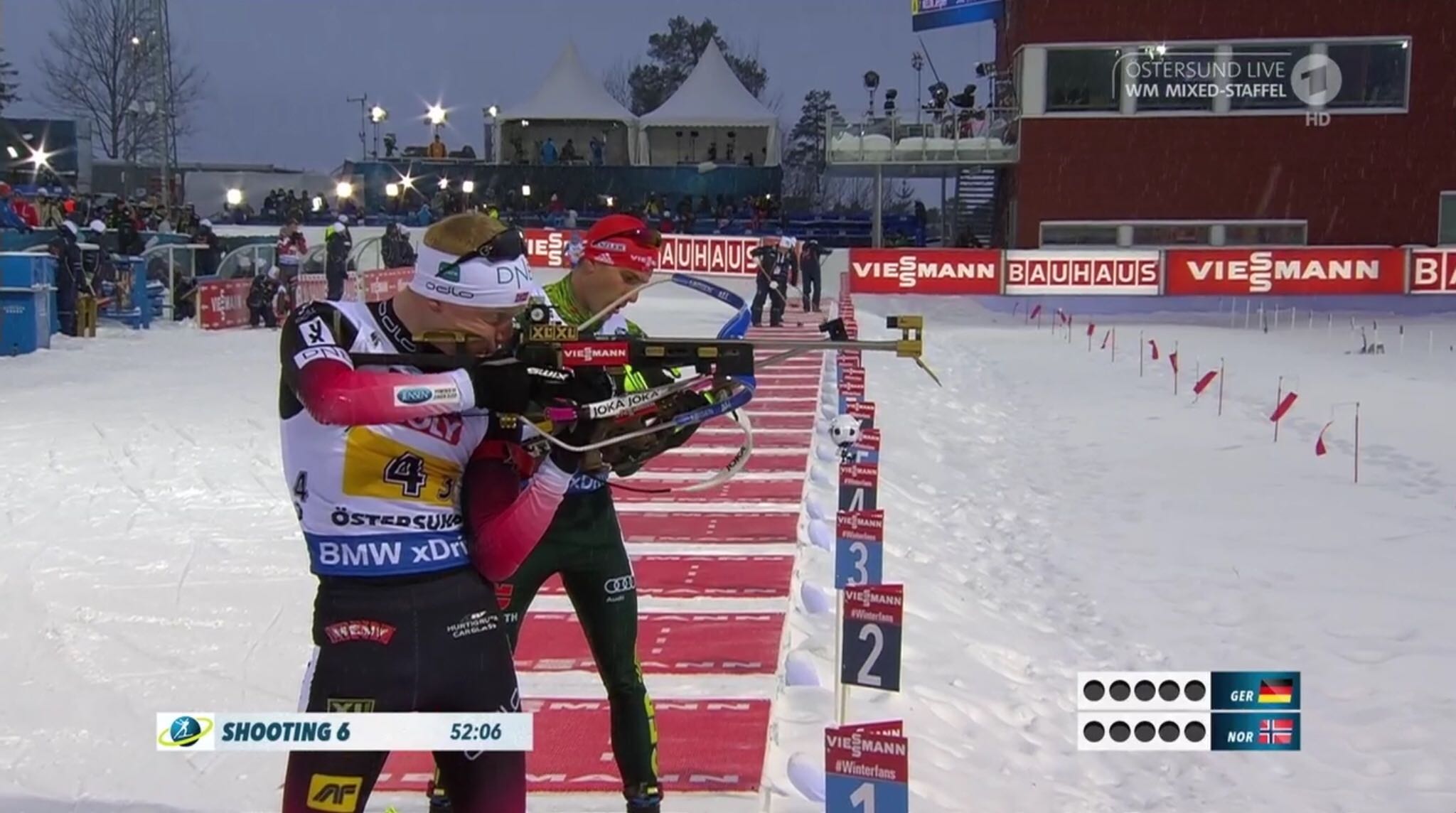
Johannes Thingnes Bø of Norway (bib 4) during the mixed relay at the 2019 IBU World Championships. (Photo: ARD screenshot)
Marte Olsbu Røiseland, Tiril Eckhoff, Johannes Thingnes Bø, and Vetle Sjåstad Christiansen of Norway won the opening race, a mixed relay, of the IBU World Championships in Östersund, Sweden. The foursome won the race in 1:17:41.3 hours.
The race format requires women to contest the first two legs, or 2 x 6-kilometers, whereas as the men ski the final two legs, or 2 x 7.5 k. On the way to the win, Norway used seven spares.
Germany’s Vanessa Hinz, Denise, Herrmann, Arnd Peiffer, and Benedikt Doll placed second, 13.1 seconds behind after using nine spares total. Herrmann’s skiing prowess, she is a former World Cup cross-country skier for Germany, brought her team into the lead as she tagged Peiffer.
The Norwegians ultimately took control of the race as they gapped Germany in second place, and put 1:09.6 minutes into Italy’s Lisa Vittozzi, Dorothea Wierer, Lukas Hofer, and Dominik Windisch for third overall.
Canada’a Rosanna Crawford, Sarah Beaudry, Christian Gow, and Scott Gow placed 16th overall (+4:35.5). The team had one penalty while using eight spares.
Susan Dunklee, Clare Egan, Sean Doherty, and Leif Nordgren of the U.S. placed 19th (+7:21.2). The U.S. team accrued three penalties while using 13 spares.
Racing continues tomorrow for the women with a 7.5 k sprint.
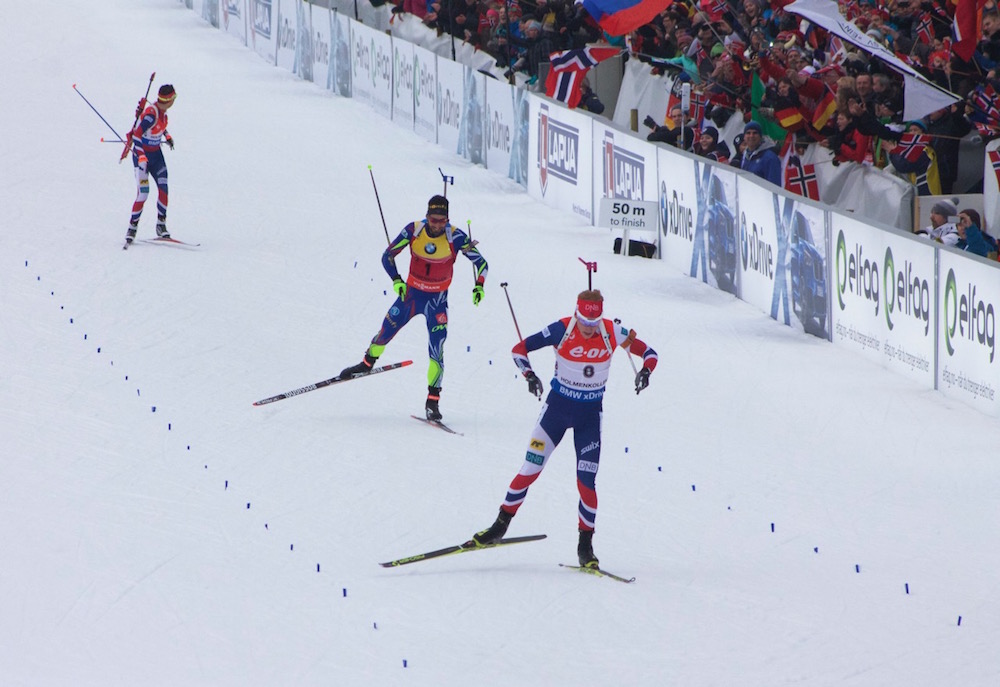
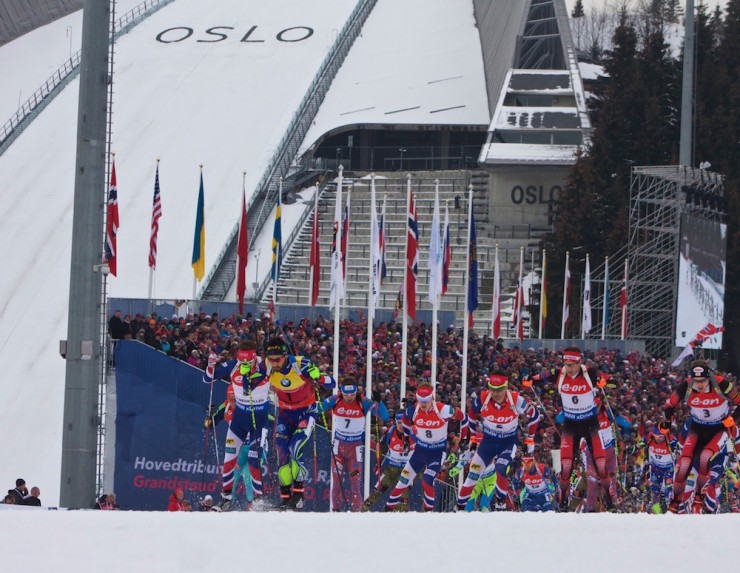
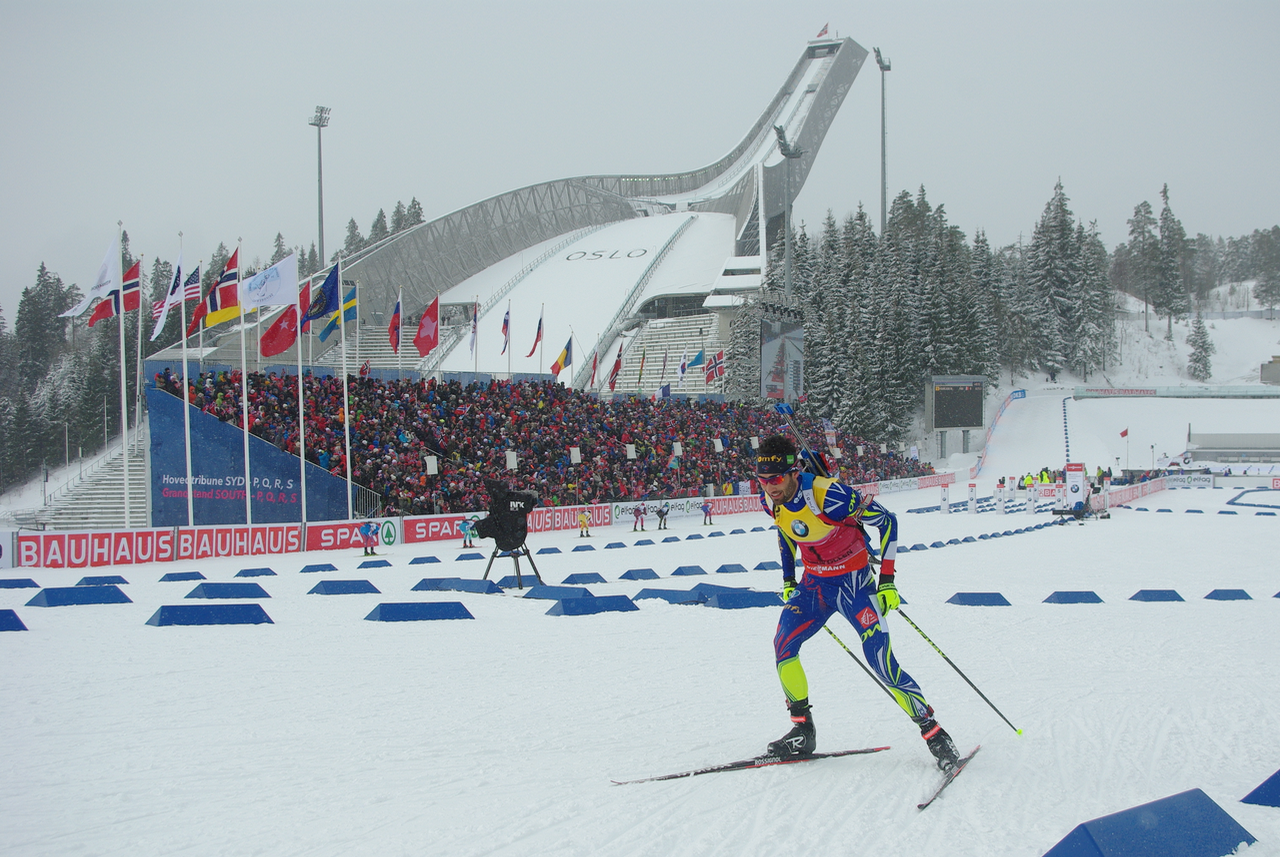
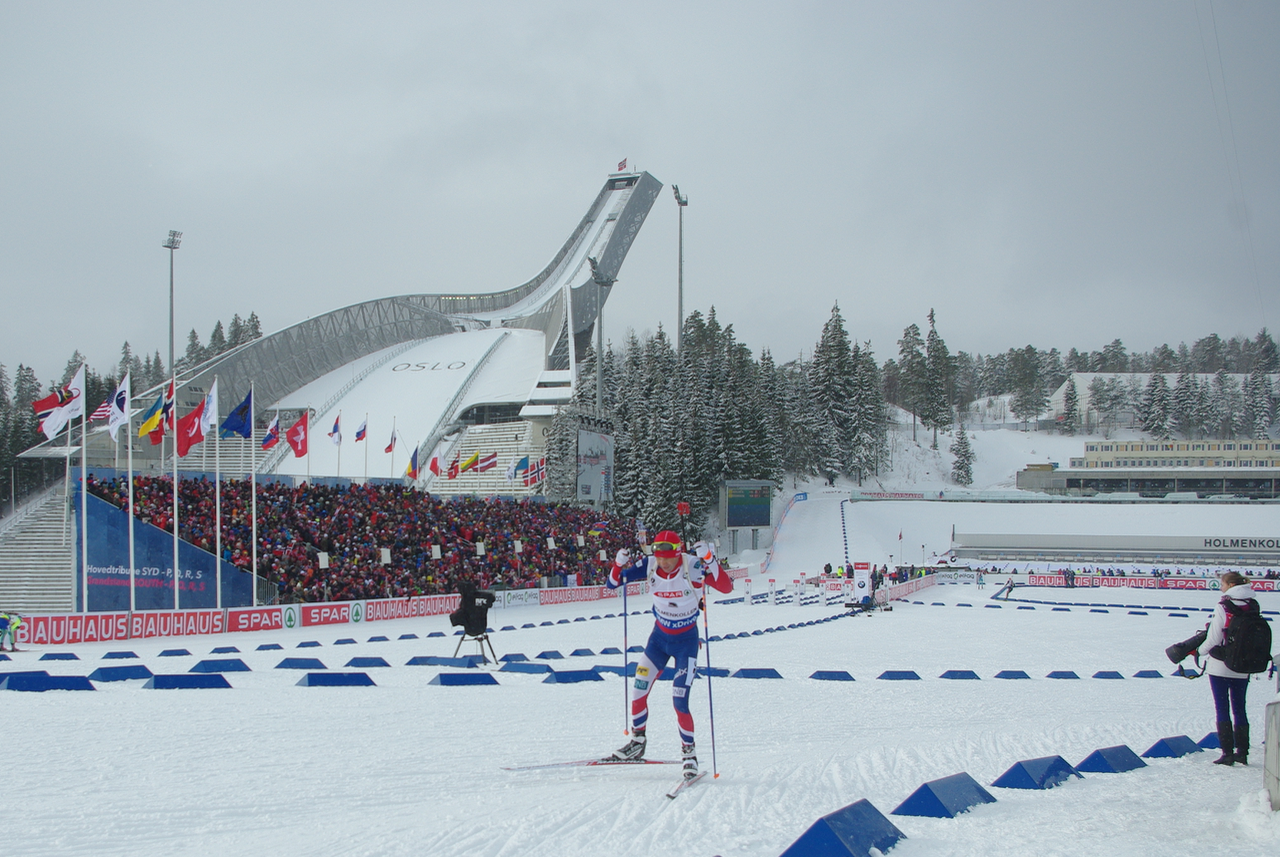
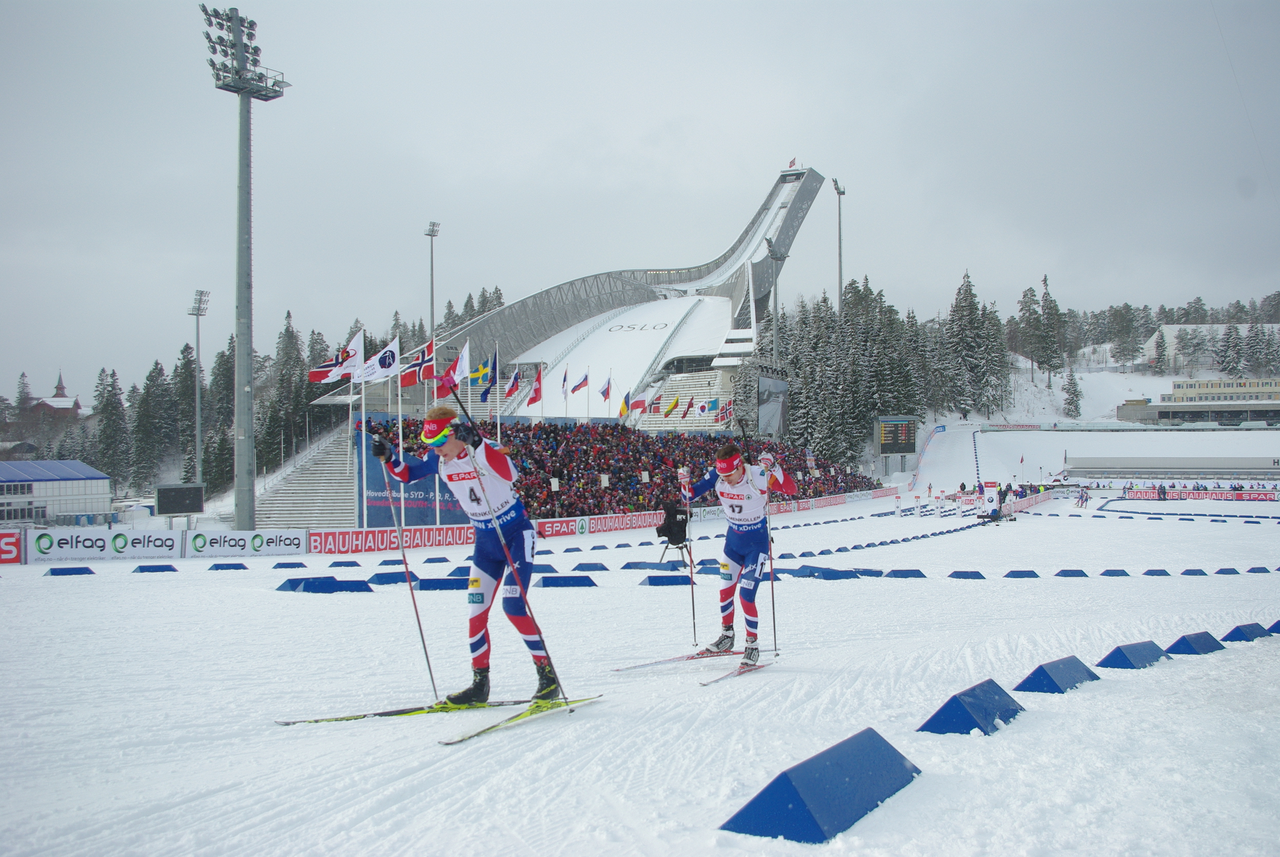
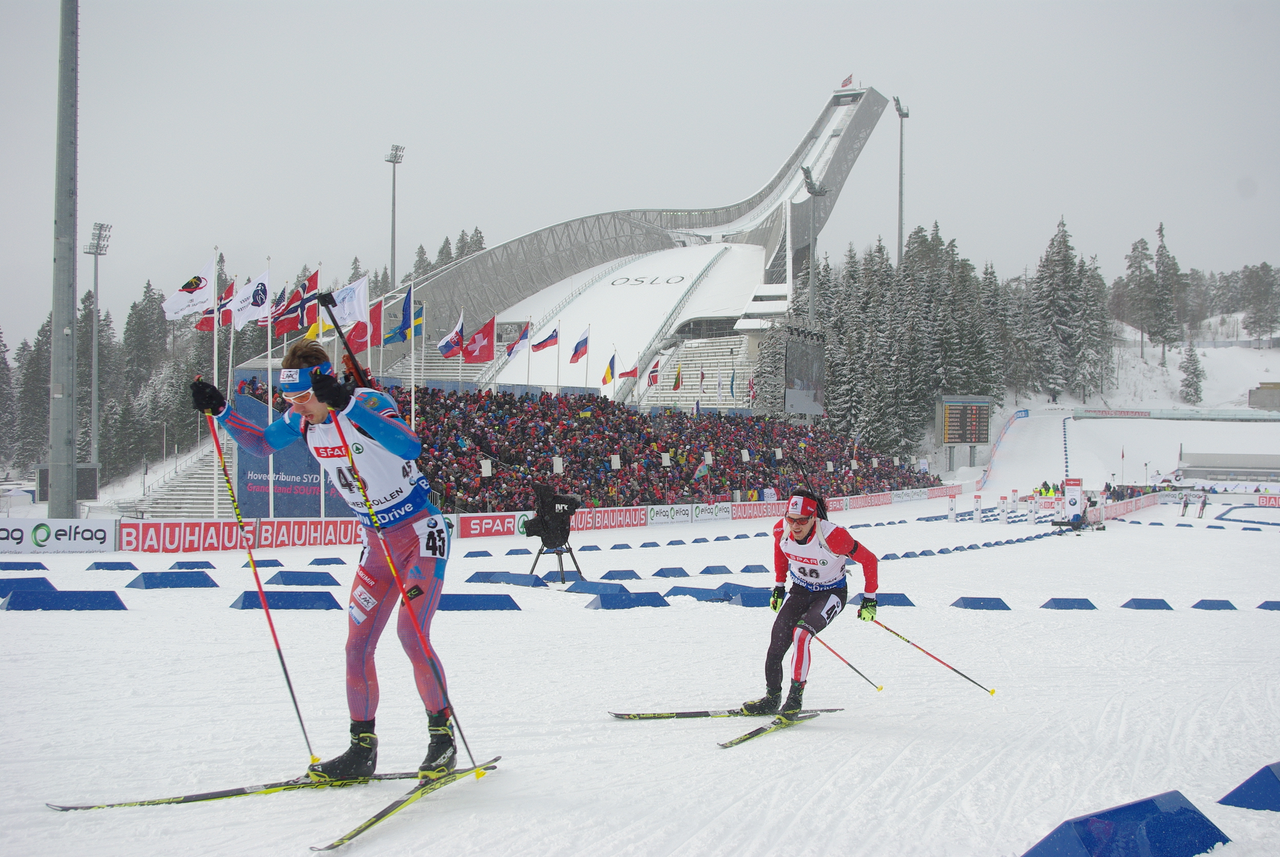
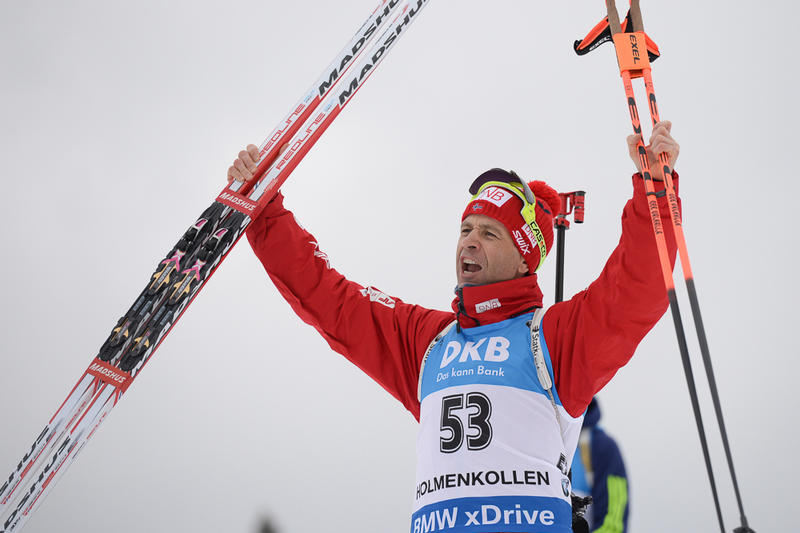
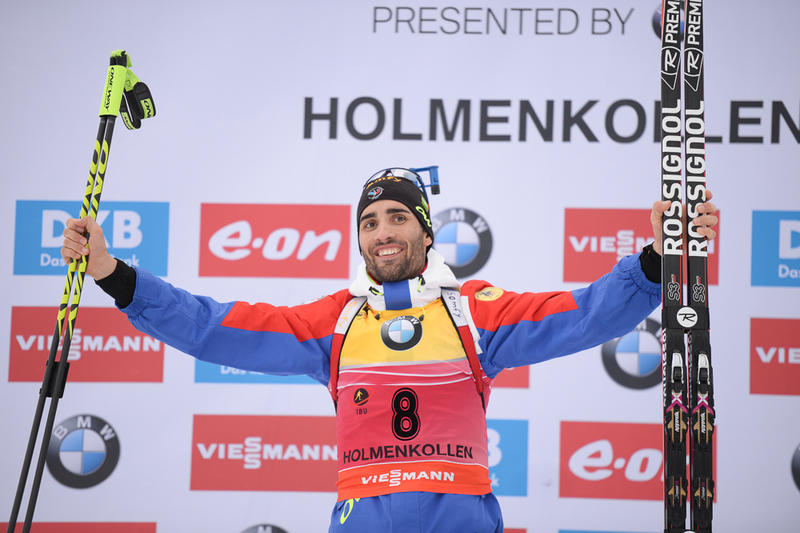
OSLO, Norway — In the final race of International Biathlon Union (IBU) World Championships at Holmenkollen, Norway’s own Johannes Thingnes Bø proved to be a crowd-pleaser in front of tens of thousands of fans on Sunday. He eked out the win in the men’s 15-kilometer mass start by 2.8 seconds over France’s Martin Fourcade, and Norwegian veteran Ole Einar Bjørndalen took bronze, 6.7 seconds back.
For the U.S., Lowell Bailey and Tim Burke placed 10th and 12th, respectively, leaving them both relatively satisfied with their results.
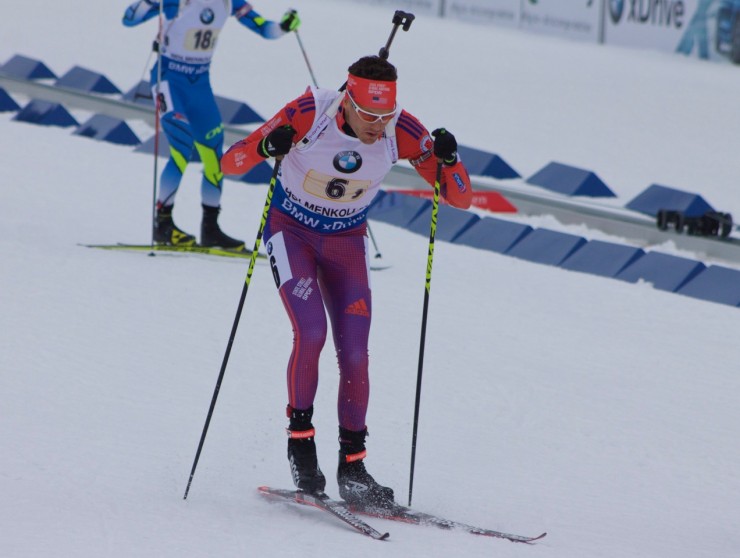
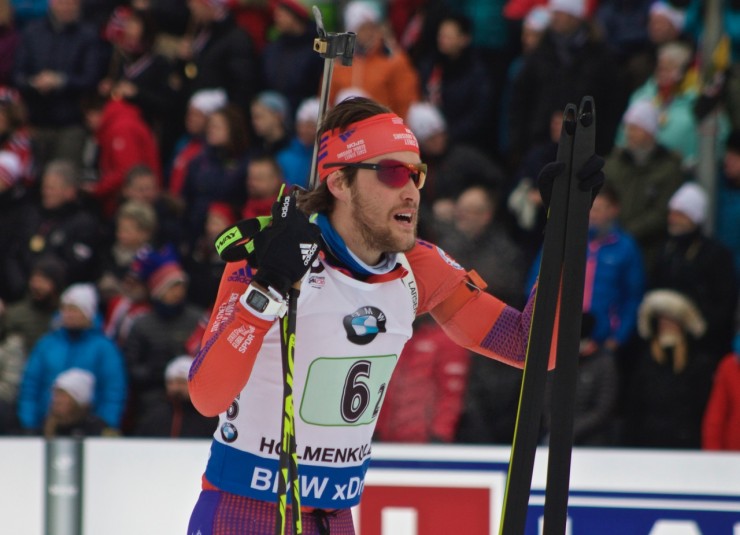
Lowell Bailey finishing 10th in the World Championships mass start in Oslo, Norway, in 2016. (Photo: JoJo Baldus)
(Photo: JoJo Baldus)
(Photo: JoJo Baldus)
(Photo: JoJo Baldus)
(Photo: JoJo Baldus)
(Photo: JoJo Baldus)
(Photo: JoJo Baldus)
(Photo: JoJo Baldus)
(Photo: JoJo Baldus)
(Photo: JoJo Baldus)
(Photo: JoJo Baldus)
(Photo: JoJo Baldus)
(Photo: JoJo Baldus)
(Photo: JoJo Baldus)
Norway’s Johannes Thingnes Bø leads France’s Martin Fourcade and Norway’s Ole Einar Bjørndalen into the finish in the 15 k mass start in Oslo, Norway, at 2016 World Championships. (Photo: JoJo Baldus)
OSLO, Norway — On the final day of International Biathlon Union (IBU) World Championships at Holmenkollen’s famous venue, both Susan Dunklee of the U.S. and Canada’s Rosanna Crawford posted their best-ever results in a championships mass start, in 11th and 15th, respectively. For another American, Hannah Dreissigacker, it was the last international race of her career, as she finished 27th in the prestigious final competition.
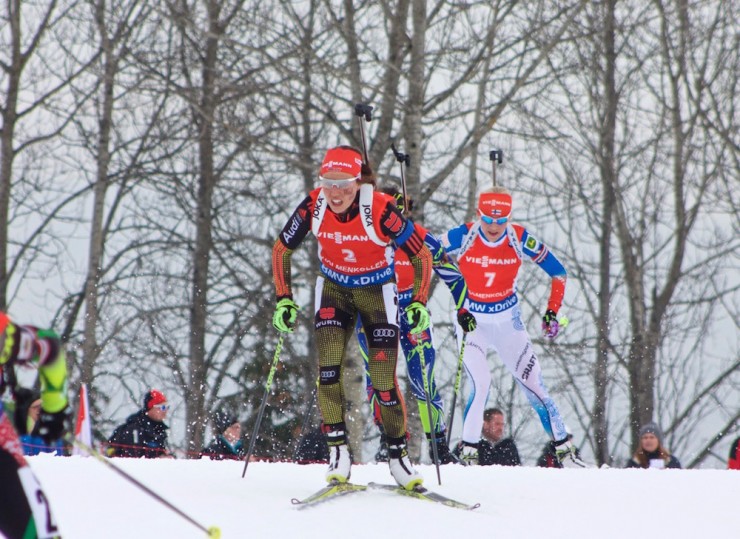
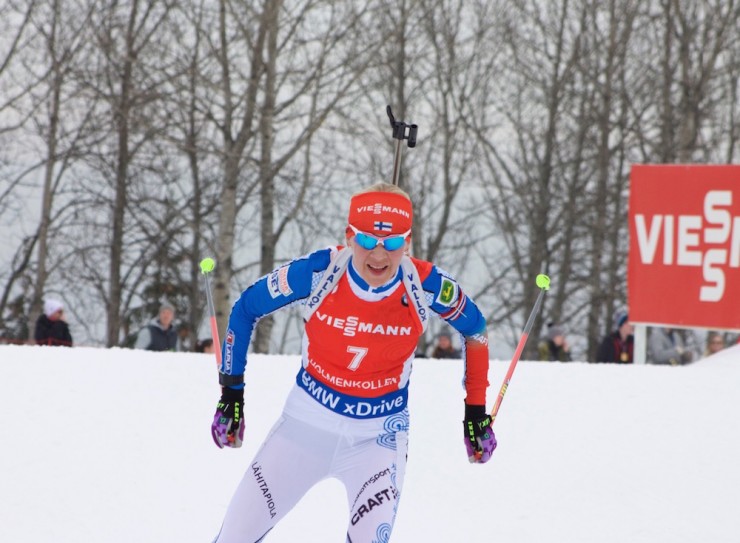
France’s Marie Dorin Habert took gold in the 12.5-kilometer mass start, shooting clean and finishing 7.3 seconds ahead of Germany’s Laura Dahlmeier in second and 8.1 seconds ahead of Finland’s Kaisa Mäkäräinen in third.
Norway’s Tiril Eckhoff en route to 25th in the women’s 12.5 k mass start at 2016 IBU World Championships in Oslo, Norway. She had five penalties, three of which came in the third stage.(Photo: JoJo Baldus)
(Photo: JoJo Baldus)
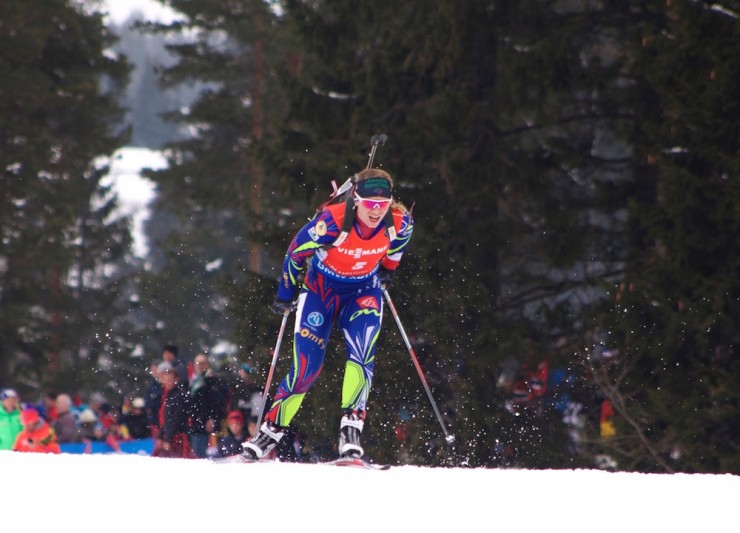
Anais Bescond of France racing to fifth in the women’s 12.5 k mass start at 2016 IBU World Championships in Oslo, Norway. (Photo: JoJo Baldus)
Hannah Dreissigacker of the United States finished 33rd in the 15 k individual at World Championships on Wednesday. (Photo: JoJo Baldus)
OSLO, Norway — In the last race of her international biathlon career, it came down to the last shot.
Hannah Dreissigacker, standing on the range in the U.S. suit one last time, had knocked down the first four targets in the final stage of the World Championships 12.5-kilometer mass start. Then it got to her.
“In biathlon the last shot is always hard because you always think, I got this,” she said. “But this one I actually thought about how it was my last shot ever in a biathlon World Cup race or international race, so it was like, ‘Oh, I just really want to hit it!’ And then I totally missed. I just imagined Jonne [Kähkönen, the national team women’s coach] watching me and being like, Damn it!”
Perhaps a frustrating way to go out, but Dreissigacker still had 2.5 kilometers on the trails before she reached the finish line, and she made the most of it.
“I would’ve liked to hit that one, but then I passed two girls on the last lap,” she said. “I had a little battle with the Swedish girls and got them both, so that was good.”
It was just the second mass start of her career, and Dreissigacker was able to add a 27th-place finish to her roster of results from these Championships. She’d been 18th in sprint a week ago.
Despite all the emotion, Dreissigacker, 29, tried to approach the race professionally and felt she had succeeded.
“I wanted to have a good race and I was taking it seriously,” she said. “You can’t be swiveling your head [looking at the crowds] too much, but [Holmenkollen] was really awesome. It was just cool. It’s a cool place to have your last race.”
Her inclusion in the mass start was part of a banner day for US Biathlon, which also fielded Susan Dunklee (who finished 11th) in the women’s race and Tim Burke, Lowell Bailey and Leif Nordgren in the men’s mass start.
“I think this is going to be a record for us,” Dunklee said. “I don’t know what the numbers are, but that’s phenomenal. The guys are psyched, we’re psyched, and it’s a special day to have the last race with Hannah. We’ve been doing this so long. Hannah’s been my teammate almost as long as I can remember skiing: the Northeastern Vermont [team], the BKL team, the New England teams for Junior Olympics, Dartmouth, Craftsbury, here…”
Dreissigacker decided almost a year ago that she would call it quits after this season.
“Last year after Kontiolahti [World Championships], it didn’t feel like quite the right way to go out,” she explained. “I also wanted to make the decision before the season. So I made the decision last spring. I wanted it to be something that I wasn’t waffling about all year, when I had a bad race and would decide, ‘I wanted to quit,’ and I would have a good race and think, ‘I want to keep doing it.’ I just wanted to try to enjoy the whole season and have my decision already made, and try my best to separate that decision from my biathlon.”
Dreissigacker was challenged in that plan, as she had a hard early part of the season. After struggling on the World Cup early, the 2014 Olympian was bounced down to the second-tier IBU Cup, where she initially continued to flounder.
“I had some really hard parts of the season where I just wasn’t doing well skiing or shooting, and it just wasn’t what I wanted for the year,” she said. “I wanted to quit and I almost quit in January, but then I was like, ‘No! This is what you decided, that you were doing it this year, and it goes both ways. You’ve got to finish this year, you owe it to yourself.’ And I’m very happy I did. It definitely turned around and this is a pretty perfect way to end.”
After re-finding her results on the IBU Cup, Dreissigacker raced the World Cup again, tallying top-30s in Canmore, Alberta, and Presque Isle, Maine. Then she headed to Oslo for World Championships, where she placed 18th in the sprint.
She still has a few races left, at North American Championships in Fort Kent, Maine, in two weeks’ time, but after that her biathlon days will be over.
“This is a pretty perfect way to end.” — Hannah Dreissigacker (US Biathlon), on retiring
“I love biathlon,” Dreissigacker mused. “I have to say, it’s a really really amazing sport. There’s so much to it. So much up and down. Such a mental challenge as well as the physical challenge, and the drama, and the emotion… oh my God. It makes it hard to do, but really fun to watch and be a part of.
“That said, I’m not planning on having it be a focal point of my life in the future,” she continued. “I would love to be involved on some level, whether it’s coaching kids on the side, or something else. But I also think that I need a little bit of a break for a while. I need to do everything else. I think if I was too involved I’d feel too sad.”
A multitalented and interdisciplinary thinker, Dreissigacker has a Dartmouth College degree in engineering modified with studio art, as well as a bachelor’s of engineering, which took one more year at Dartmouth. She has kept making art all through her biathlon career, some of which is posted on her blog, and has had a gallery show as well as taking custom orders for paintings.
“Mostly I think I’m just really excited to have a little more freedom,” Dreissigacker said. “A little less always having to be very disciplined. I’m excited not to have to be paranoid about germs. I’m excited not to have to follow a training plan every day to decide what I want to do – to wake up and see that it’s raining and decide to not train, or to wake up and see that it’s a beautiful day and not have to have a rest day, or do some specific workout. I’m excited to go for a ten-hour adventure in the mountains if I feel like it and not worry about being exhausted the next day.”
She’ll probably stay in very good shape, she laughed, whether that’s from skiing or running or hiking or mountain biking.
She’s not quite sure what’s next profession-wise, but there are several options which might keep her feeling fulfilled.
“I’m excited to have more balance in my life, whether it’s art, or being more involved in my values when it comes to the environment and how we treat the world,” she said. “There’s a lot of things that I really care a lot about that I’ve had to push aside a little bit. Ultimately I’d love to do something where I feel like I’m really making the world a better place. That sounds really cheesy, but that’s how it is.”
“I’m excited not to have to be paranoid about germs. I’m excited not to have to follow a training plan every day … I’m excited to have more balance in my life, whether it’s art, or being more involved in my values when it comes to the environment and how we treat the world.” — Dreissigacker
However, the detour through World Cup biathlon and a 23rd-place finish at the 2014 Olympics was worth every minute, she said.
“I have no regrets for making this imbalance in my life that gave me this focus on biathlon,” she concluded. “It definitely felt necessary to make it a bit of an imbalance if I was going to really focus on biathlon. And that was hard for me. I’m a person who really likes balance, and I have so many interests. So it was hard to do that, but I also loved it.”
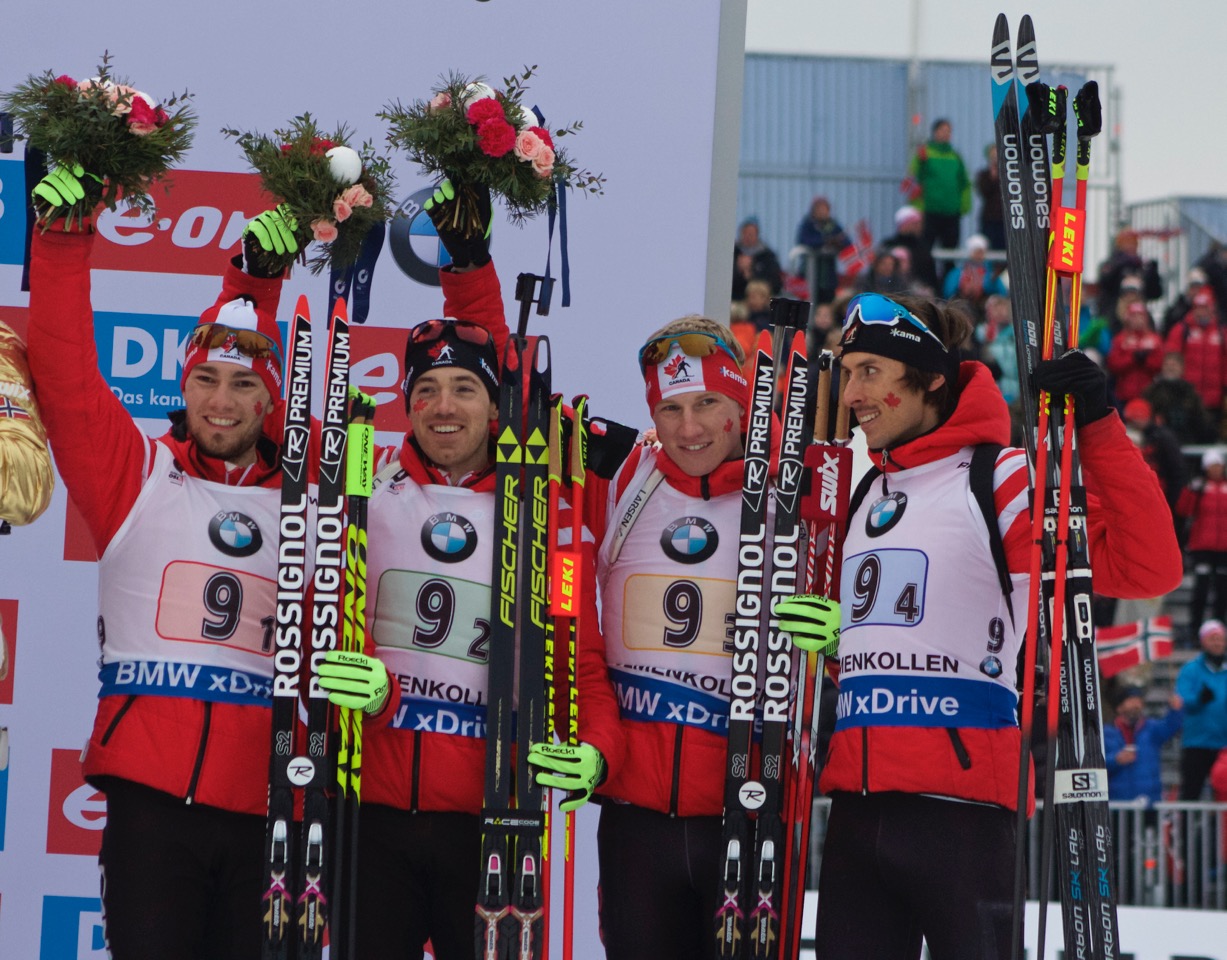
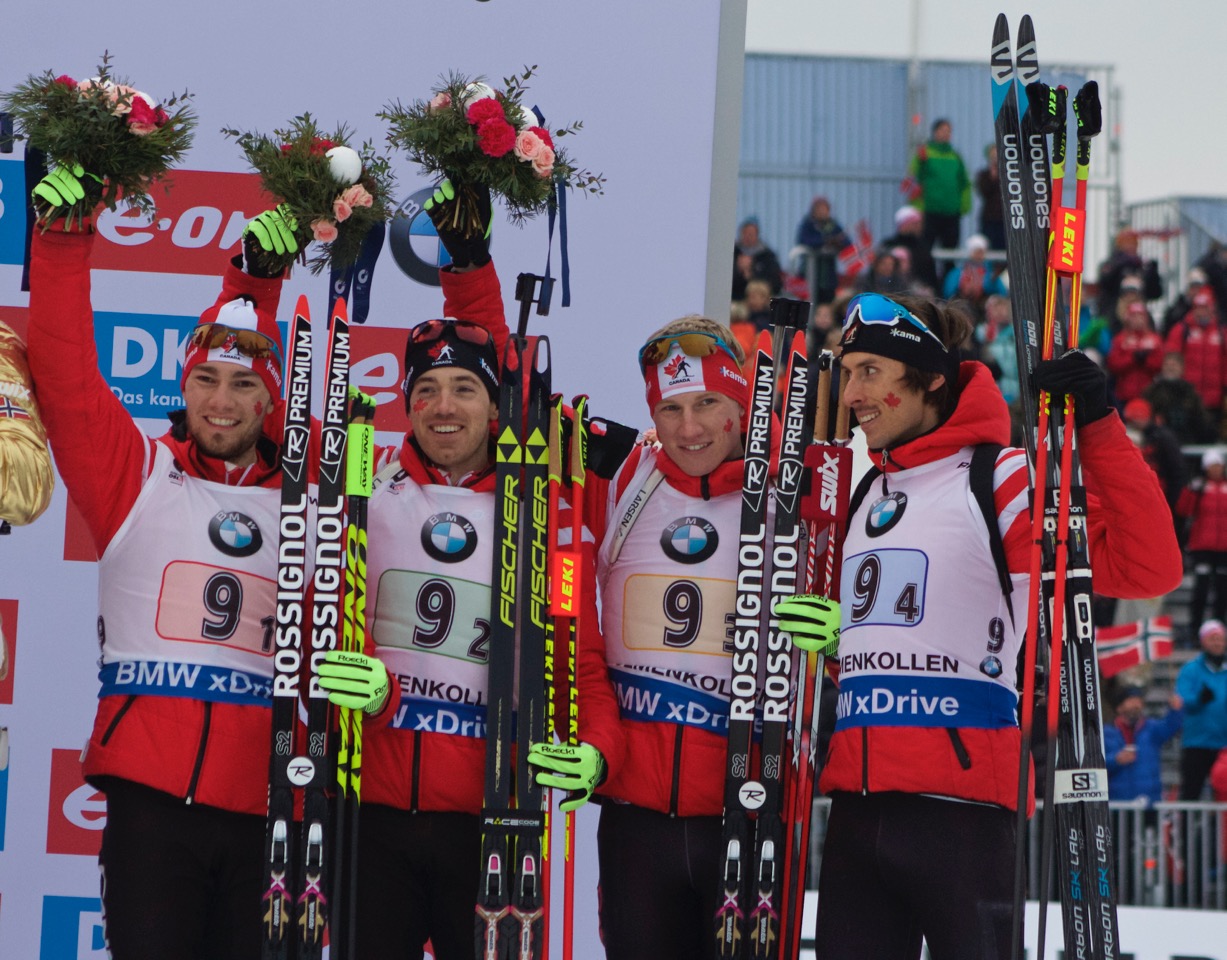
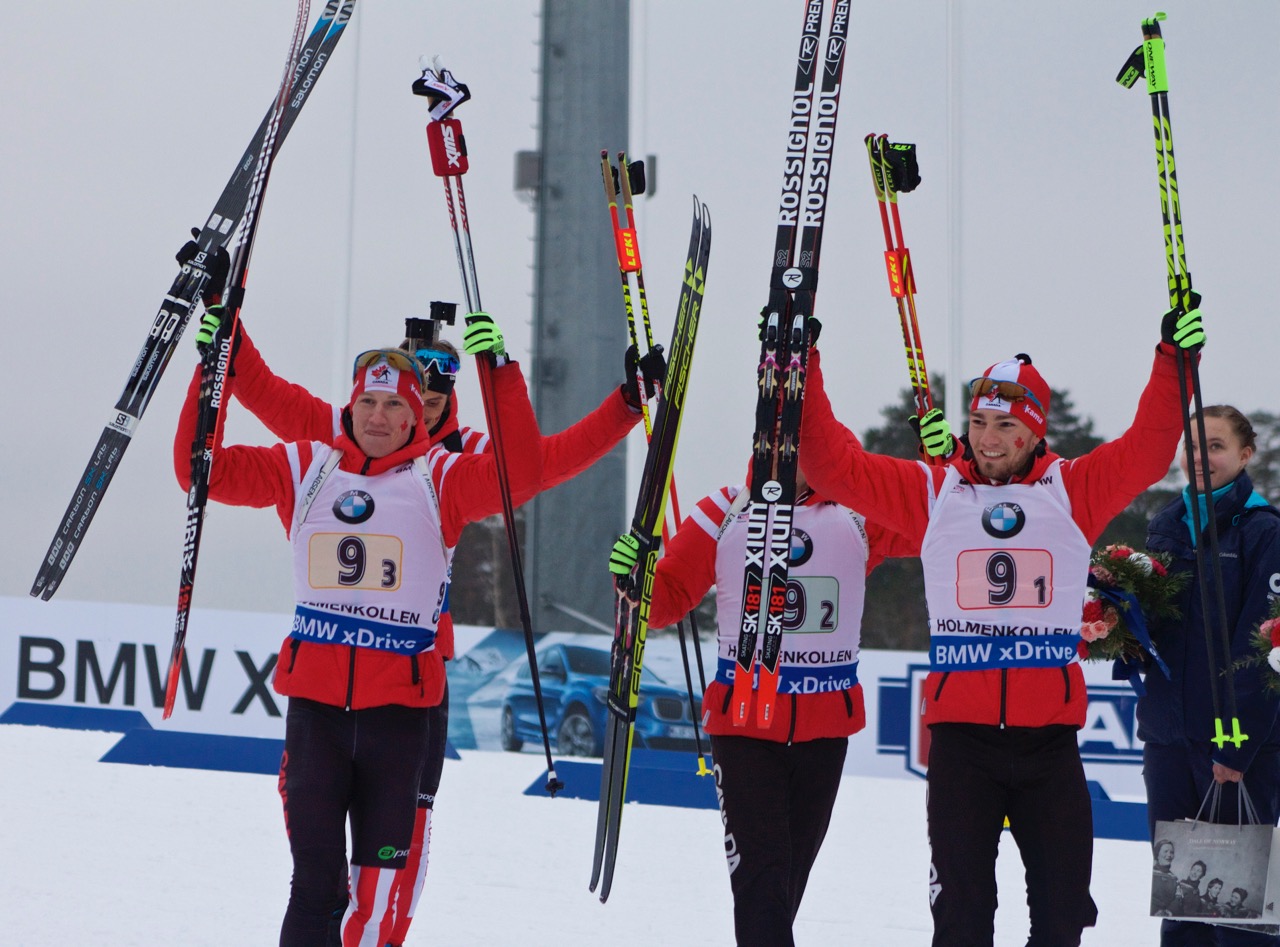
The Canadian men’s relay team (l-r) Christian Gow, Nathan Smith, Scott Gow, and Brendan Green on the podium at Holmenkollen ski stadium after claiming bronze in the World Championships relay. (Photo: JoJo Baldus)
OSLO, Norway—As Saturday’s men’s 4 x 7.5 k relay at biathlon World Championships progressed loop after loop longer, the Canadian team climbed to third position – and then stayed there.
And stayed.
And stayed.
Ultimately, the team claimed bronze.
“This is the sensation of the World Championships, perhaps the sensation of the season,” IBU Communication Director Peer Lange said to kick off the post-race press conference.
If the fans were surprised, so were the athletes. The Canadians themselves hadn’t expected such a breakthrough. Top five? Yes- that was a goal the team had set. But bronze?
“I didn’t think it would happen at World Championships, that’s for sure,” said Scott Gow.
“I think that we would have been happy with fifth or sixth today,” agreed Nathan Smith.
Never in the history of Canadian biathlon has a team won a relay medal at World Championships or the Olympic Games.
And today it happened.
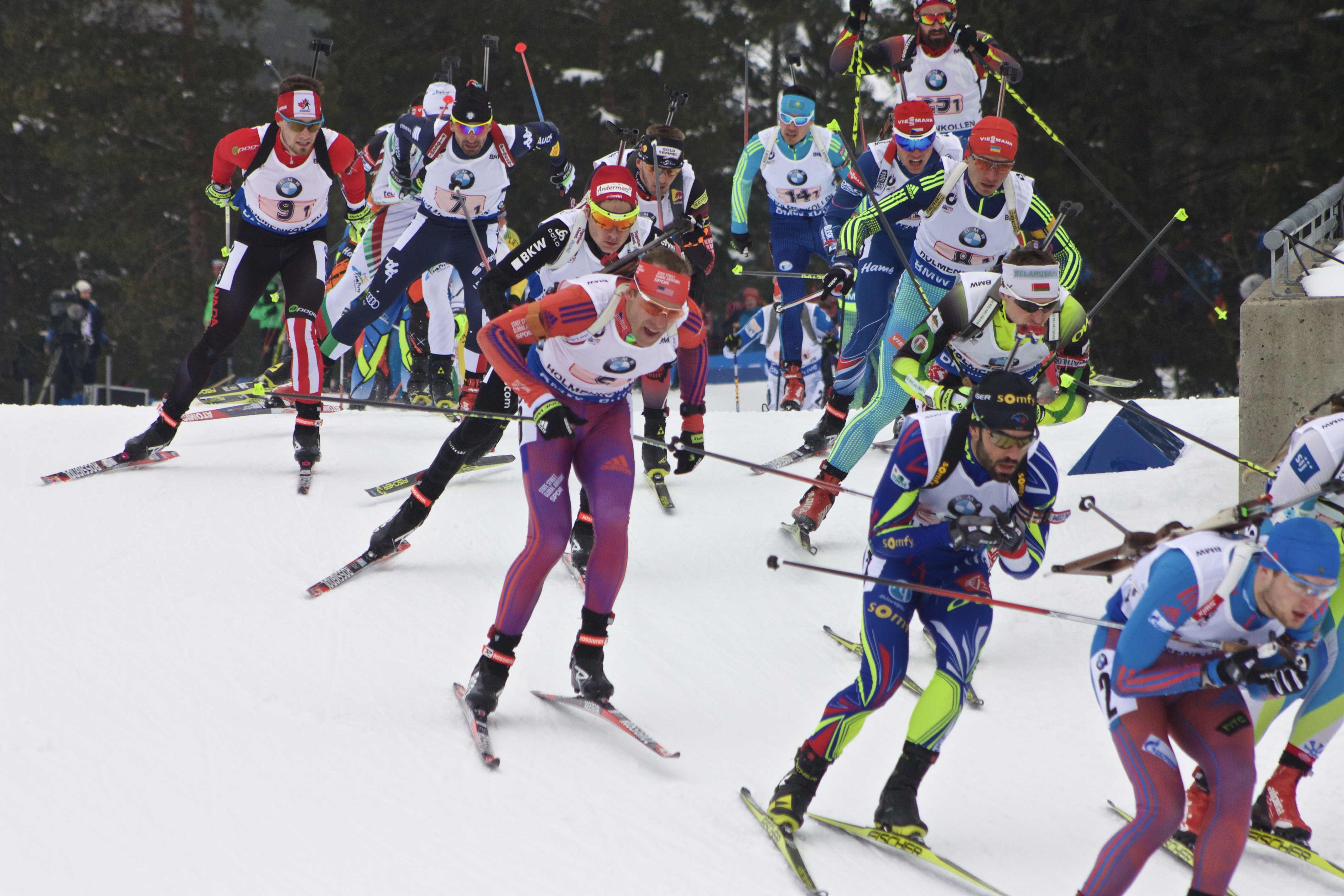
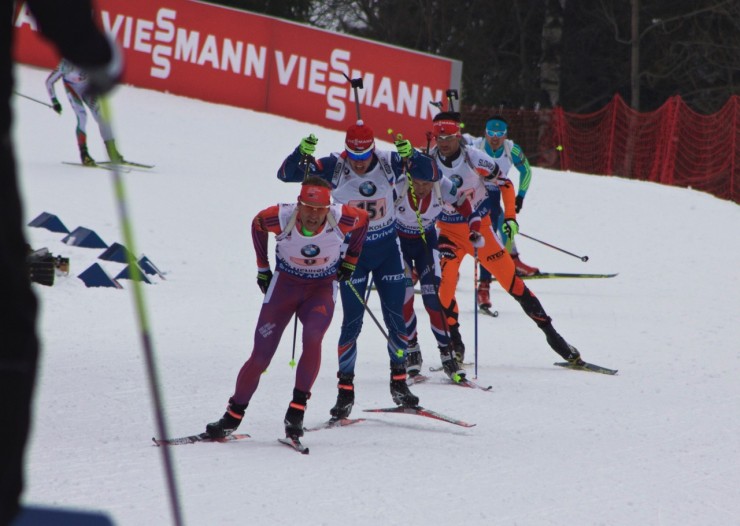
Christian Gow (far left) mixing it up in the scrum of leg one for Canada. The leadoff leg was aggressive and physical, with crashes and several broken poles.(Photo: JoJo Baldus)
“I think that the potential has been there for a little while now,” said relay anchor Brendan Green. “There have been some ups and downs along the way. But in a relay anything is possible. Today we all really put it on the line together. Every single one of us raced really well. When that happens, when things come together like that, it’s really incredible.”
After a strong leadoff leg from Christian Gow, Smith took the team to the front, and they never left. After Scott Gow stuck to the Norwegian and German teams like glue on the trail, it was up to Green.
And Green proved why he was chosen to anchor the squad, staying cool under pressure and not even touching his spare rounds as he cleaned both prone and standing to cross the finish line in third, 23.4 seconds behind the winning Norwegian team. Germany placed second, +11.5.
So what came together for Canada?
“I would say everything,” laughed National Team Coach Roddy Ward. “Four guys having some of the best races of their lives, good shooting, good skiing, good skis. And the shape of our team I think has just come up every race at World Championships here, getting better and better… Every year you kind of think it’s coming. It’s close, it’s close, and we’ve been close for a couple of years. We were close enough, I guess, that on the right day we were there.”
Christian Gow is the youngest member of the team and hadn’t even been sure he would race the relay until late this week, after the 20 k individual. The Canadian team brought five men and hadn’t set its lineup; Macx Davies was ultimately left to watch and cheer his teammates.
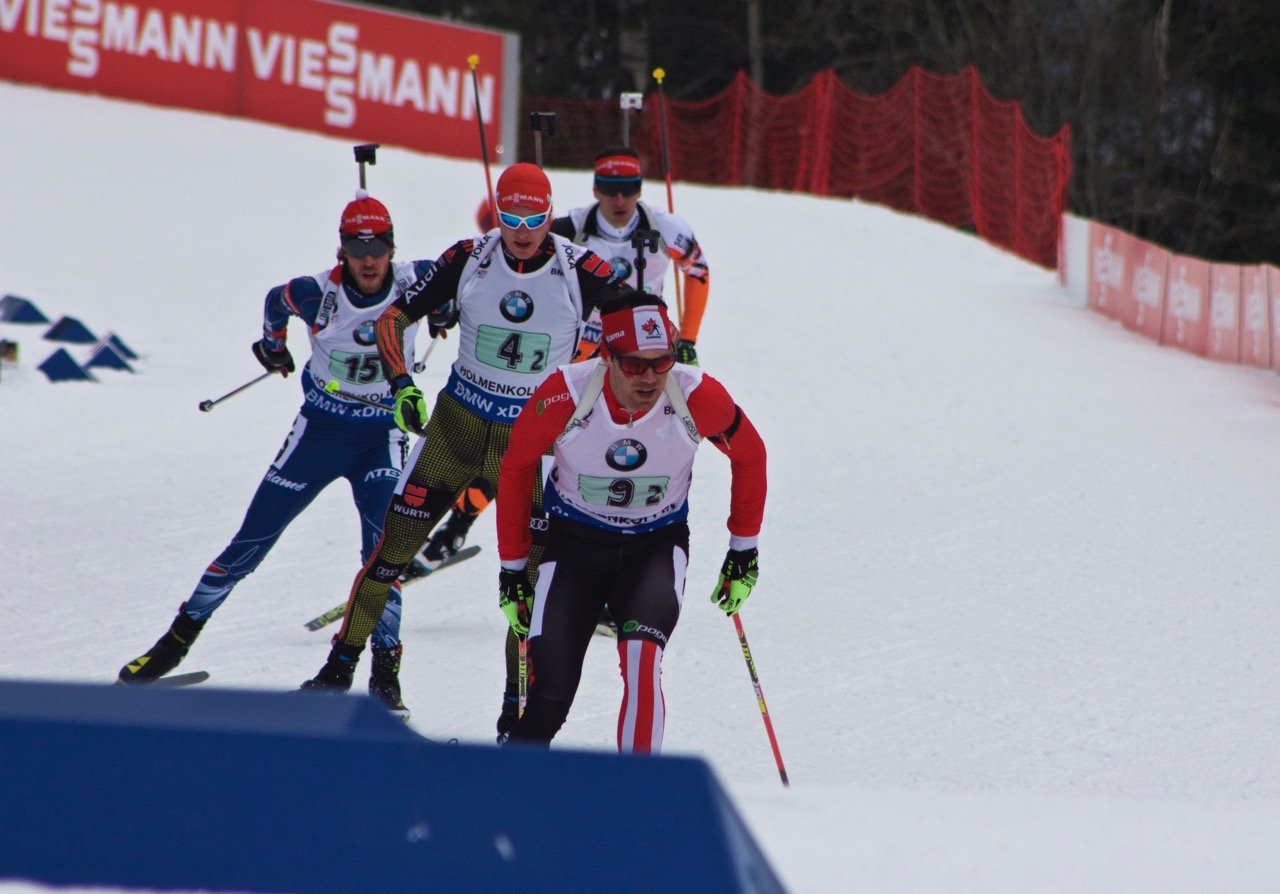
Nathan Smith attacking on leg two. (Photo: JoJo Baldus)
“I was super pumped to be told I was racing today,” Christian Gow said. “I was doing most of the relays last season and this one. I was really excited to get the opportunity to do it. It’s one of the most fun races for sure. I was thrilled that [my brother] Scott also gets to race with me. And my dad is here to watch, too. I am sure he is just as thrilled.”
The Canadian team has been close in the early going of relays before- and Smith was an individual medalist at last year’s World Championships. So it wasn’t surprising that he took Christian Gow’s tag in seventh place, 14 seconds back, and by the end of the first loop had caught the leaders and took the prone stage in lane one.
“I didn’t on purpose pass them,” Smith said. “It was more like I got behind them and got really good draft. It wasn’t like I was going to stand up and push them. It was fun. Being in lane one is fun. It’s fun being in lane two and three too though.”
After Smith used one spare round in each stage, he skied to the finish even with Norway and Germany, tagging off 1.2 seconds out of first place.
So the pressure was on Scott Gow to hold the team’s position as the race went on. He left the stadium with Norway’s Johannes Thingnes Bø, and stuck on his tails.
Coming off a career-best 18th place in the 20 k individual, Gow had some added confidence, said coach Ward.
“I wanted to think I could,” he said of staying with the leader. “Watching Christian tag off really close, and then Nathan obviously moved us right into contention. And so I though okay, I have to, I don’t have a choice. I don’t know if I believed I could, but I had to, to try and keep our team in it. I’m just happy that I was able to stay right behind Johannes for most of it and hang on.”
Scott Gow shadowing Norway’s Johannes Thingnes Bø on leg three. (Photo: JoJo Baldus)
Scott Gow succeeded admirably, turning in the fifth-fastest time of his leg. Coming into standing, he missed one shot, and then had to take all three of his spare rounds to knock it down.
“Prone felt just on point,” he said. “Felt so calm, so steady, drilled them all, I was so happy with that. And then standing, I hit four, but I was so nervous. I couldn’t… I was like ‘okay just one spare’ and I knew Johannes had cleaned, so that put a lot more pressure to try and keep up.”
It was a nervous moment, but the Canadians were helped by the fact that other teams behind them also struggled on the stage and used spares, or in the case of Austria even went to the penalty loop. So Scott Gow left with over 30 seconds in hand over fourth place, and he maintained that gap to the tag.
Everything fell then on the shoulders of Brendan Green.
“I was definitely really nervous going into the race,” Green said. “I was following it up in the wax room. The whole race, the team was right in the mix up at the front. I was extremely nervous. But once I got the tag I was able to relax a little bit on course and zone out and just do my own race.”
Nerves or no, he not only held steady on the trails but shot with laser accuracy, confidently knocking down all ten targets. First five in prone: still Canada in third place. Then five in standing: Canada still in third place.
“All I saw really was Brendan’s last shooting, which was incredibly impressive,” said U.S. athlete Tim Burke. “There’s nothing harder in biathlon to do than that one in the relay. And he did an unbelievable job, and obviously the rest of the team did, too.”
By the time the relay reached the anchor stage, Brendan Green had third place all to himself. (Photo: JoJo Baldus)
Green still wasn’t quite sure how he did it, although he certainly has a years-long history of strong shooting on the World Cup.
“The focus is pretty high going into lane three each time,” he said. “On the range I would just try to focus on each shot and on my own shooting bouts. And not think about what Germany or Norway was doing. When it works out like that, it’s incredible.”
He left the range the final time with a remarkable 40 seconds on fourth-place Austria. Bronze belonged to Canada.
For Smith, who had already climbed the World Championships podium in the sprint in 2015, climbing it a second time with his teammates was even sweeter.
“I’d say it’s better,” he said. “We train together, every day, twice a day, for many years. I know, I can see that these guys saw last year’s success. They know that they train with me, and they beat me lots of the time.”
“Only when you’re slumming,” interjected Scott Gow.
“Everyone is fighting on our team,” Smith said. “We’re teammates, we’re friends, but we’re fighting every day to be better than each other. And it brings our whole team up. I knew that last year we were fifth here, so I knew that if we had an even better day it was possible. Not so likely, but possible.”
With none of the men qualifying for Sunday’s mass start, the guys can celebrate their medal already.
“Obviously, anyone here would like to be racing the next race,” Scott Gow said. “But since we don’t have to, we can let a little loose and really enjoy the whole experience.”
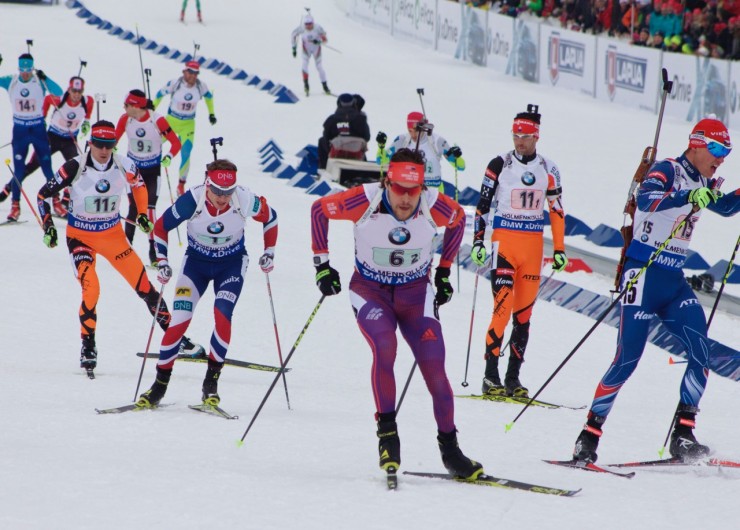
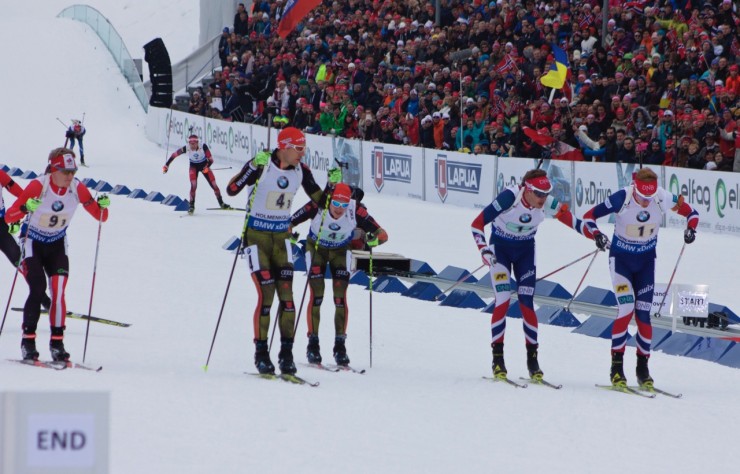
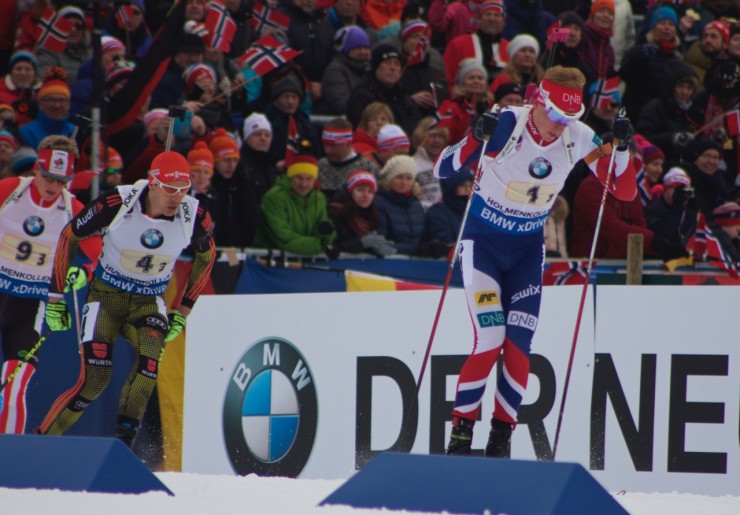
The start of the men’s 4 x 7.5 k relay at World Championships in Oslo, Norway. (Photo: JoJo Baldus)
Lowell Bailey skiing in second position early in the men’s 4 x 7.5 k relay. (Photo: JoJo Baldus)
Ole Einar Bjørndalen of Norway gave the home crowd a thrill by leading parts of the relay’s opening leg. (Photo: JoJo Baldus)
IMG_5929
Lowell Bailey of the United States leading a train of skiers on the opening leg of the relay. (Photo: JoJo Baldus)
Christian Gow of Canada books it to the finish of leg one. (Photo: JoJo Baldus)
Leif Nordgren (bib 6) of the United States takes off on the second leg of the men’s relay this past March. (Photo: JoJo Baldus)
Nathan Smith of Canada leads a group of chasers on leg two of the men’s relay. (Photo: JoJo Baldus)
The leaders tag off after the second relay leg. (Photo: JoJo Baldus)
Tim Burke takes off out of the tag zone for the United States. (Photo: JoJo Baldus)
Leif Nordgren after finishing for the U.S. (Photo: JoJo Baldus)
Arnd Peiffer of Germany and Scott Gow of Canada on the heels of Johannes Thingnes Bø. (Photo: JoJo Baldus)
Scott Gow of Canada following Norway’s Johannes Thingnes Bø. (Photo: JoJo Baldus)
Johannes Thingnes Bø opened things up for the Norwegian team, which never lost the lead. (Photo: JoJo Baldus)
Simon Schempp on course for Germany. (Photo: JoJo Baldus)
Sean Doherty anchored the American men to eighth place. (Photo: JoJo Baldus)
Sean Doherty on course for the United States. (Photo: JoJo Baldus)
Emil Hegle Svendsen of Norway leaves the stadium as thousands of his countrymen cheer him on. (Photo: JoJo Baldus)
Emil Hegle Svendsen proved that he’s still got it, anchoring Norway to gold. (Photo: JoJo Baldus)
Simon Schempp anchored Germany to silver. (Photo: JoJo Baldus)
Brendan Green anchoring the Canadian men to a historic bronze medal. (Photo: JoJo Baldus)
Norway celebrates a gold medal in the men’s relay in Oslo, Norway. The World Championships race drew the biggest crowd all week and the course was packed with fans. (Photo: JoJo Baldus)
Gow (left) and the Canadian team celebrates their bronze medal before taking the podium for the men’s relay. (Photo: JoJo Baldus)
OSLO, Norway—With one of their best shooting days, the U.S. men’s biathlon team finished eighth in the World Championships relay, 1:27.3 behind host country Norway.
The squad of Lowell Bailey, Leif Nordgren, Tim Burke, and Sean Doherty used just five spare rounds, tying them for the best shooting in the field with second-place Germany and third-place Canada.
“I was really focusing on the shooting, because that’s really where you make it or break it today,” Bailey said.
He led things off with a fast and clean leg, avoiding a nasty crash in the opening loop that knocked Russia out of contention; several other athletes broke poles.
“I went a good sprint out of the start in the first few hundred meters to get up near the front, and then I just stayed in control in second place there trying to catch the draft and conserve energy,” Bailey said. “I let a few guys go by me, just to make sure I was staying in control.”
After using a spare in standing, Bailey turned in one of the fastest last loops of the field to ski up into second place by the time he tagged.
“I was able to save a little bit for the last lap,” he said. “It’s so loud. I think it’s the loudest crowd I’d ever heard. It’s such an incredible feeling racing in front of that many people.”
From there Nordgren took over, and started off well, but on the second loop began flagging on his skis.
“It was unfortunately not the greatest ski day for me,” he said. “Kind of like a lot of the races have gone for me this year. I tried to hang with them right off the bat, and the first loop was fine. It was no problem. But then I had not a lot of gas left for the last two loops. That’s what I had for today I guess.”
Burke was able to pull the team back from eleventh, where he received the tag, to seventh. He was one of several athletes trying to make up ground for their teams.
“I had a great group the first loop with [Benjamin] Weger from Switzerland and [Anton] Babikov from Russia, and we really went for it,” Burke said. “The three of us actually were together pretty much the whole race, cause we all I think used one extra, Babikov used two in prone and we all cleaned standing, so we left together on the last loop. We made up quite a bit of time.”
Sean Doherty anchored the relay and actually gained time on the leaders, but slipped from seventh to eighth.
“My race was awesome,” he said. “I had only one spare. I felt great skiing. I had a really solid leg. Just around some other fast teams, and they kind of passed me in the end, I couldn’t do anything more than I already had. But I am really happy. And with only five spares, this is an amazing performance for the team.”
The team was left scratching their heads as to why they didn’t have a better finish, considering their strong shooting. And looking at the Canadians – a team they know well – they couldn’t help but wonder: with the same five spare rounds, why couldn’t they be closer to the podium?
One reason might just be that with World Championships in Oslo, teams and athletes were even more focused on having top performances and many are hitting their peaks at just the right time.
“It is surprising that we only managed to finish eighth,” Doherty said. “We will look at the numbers later, and see kind of where that time came from. But we are only a minute and a half back, so that’s really just a close competitive day. Which is kind of what you’d expect here.”
“With that we really should fight for the podium,” Burke agreed. “Normally with our team’s ski speed, zero plus five would be there. I don’t know what happened.”
Canada’s Rosanna Crawford (11) leading the women’s 4 x 6 k relay at 2016 IBU World Championships on Friday in Oslo, Norway. Crawford skied the second leg and the Canadians went on to place 15th. (Photo: JoJo Baldus)
OSLO, Norway — At the halfway point of Friday’s World Championships women’s 4 x 6-kilometer relay, one woman was feeling better than she had all week.
It was Rosanna Crawford of Canada, and she attacked her way to the lead of the race.
“It felt so good out there today,” she said after tagging off. “Just like, I could attack, and I didn’t die on the last loop. It was pretty exciting to pass the leader and be in the lead. I haven’t done that in a long time. So, it was a lot of fun.”
Canada eventually ended up 15th, ceding the lead to France and then Norway, which ultimately took home a much-desired gold on home turf. The Canadians finished 4:48.6 back.
Julia Ransom had led off for the team, and used one spare in each shooting stage. In her first full season on the World Cup, Ransom is getting used to the leadoff position and was satisfied to tag off in 13th place – not where the team wanted to finish place-wise, but time-wise close enough to the leaders with just 37.6 seconds separating them from first place.
Canada’s Julia Ransom (r), skiing with Romania’s Eva Tofalvi, during the first leg of the 4 x 6 k relay at 2016 IBU World Championships in Oslo, Norway. Ransom tagged off in 13th and Canada went on to place 15th. (Photo: JoJo Baldus)
“Of course I would have loved to have cleaned a bout,” Ransom said. “But it was what it was. My legs are ready to have a bit of a break.”
But she had done her job, as teammate Crawford would later say.
“Julia did a great job, just 1+1 is good and taking off within 30 seconds is super-awesome,” Crawford said. “So she did her part. Everyone just has to do their part… with [relays and] mixed relays we [Julia and I] know how to do the first and second legs. I am confident and I trust Julia to lead us off with a good start.”
As several women remarked, the start was particularly physical for a race in the women’s field. There were multiple crashes and broken poles, and Ransom had to hold her ground.
“It was fun to be in the mix,” she said. “I love starting because it’s so different, and today especially was incredibly aggressive. A lot of elbows out there and stomping on poles. The girls had their talons out — I’ve started every relay this year, and every day there’s something new. There was one day that I broke a pole right off the start, another day that I crashed. I’m taking a little something from each race.”
The physicality seemed to die down a bit on leg two, or at least return to normal levels. Crawford cleaned prone with no spare rounds to move up to ninth and inch seconds closer to the leaders, and then used just one spare round in standing and left the range in sixth.
From there, Crawford went into attack mode.
“On the top of the hill [behind the stadium] I caught back up to the lead group, and then I just decided that I felt good and you get a big rest after that, and I hammered a little bit to pass them,” Crawford said. “Catch up to third, and then down the hill my skis were running really well so I passed Germany and just tried to hold onto the front until I tagged off to Sarah [Beaudry].”
Canada’s Sarah Beaudry skiing the third leg of the women’s 4 x 6 k relay at 2016 IBU World Championships. After being tagged in first, she came through the final exchange in ninth. (Photo: JoJo Baldus)
For Beaudry, in her first-ever senior World Championships and about a week away from her 22nd birthday, receiving the tag in first place was something of a surprise.
She also used another “s” word to describe it.
“I don’t want to say scary, but wow, I wasn’t expecting this,” Beaudry said after finishing her leg of the relay. “The whole [first] loop, I was like‚ ‘Are they coming?’ I was skiing scared that someone might overtake me. I was happy I stayed in the front, and not just get completely annihilated in the first lap. It was too bad, because I came out after my prone not with anybody. I was trying to catch the two girls ahead of me.”
Beaudry used two spares in prone, leaving the range in eighth, and then cleaned standing to move up to sixth. Her last loop was not without adversity.
“I wasn’t feeling great on the skis,” she said. “Last lap it was really hard. And then the Italian girl [Alexia Runggaldier] passed me and then I crashed. That hurt quite a bit — I couldn’t get up and couldn’t keep skiing and was like ‘OW!’ But then I just got it in. Too bad going out with a lead, not that big but going out first, and then coming in in ninth.”
Still, Beaudry didn’t feel as if skiing her first loop all alone out in front on the course had changed her pace or made her ski too fast. She was able to enjoy a bit of the atmosphere, even if it was stressful, and the adrenaline didn’t wreck her race.
“It is typical for me to go out too quickly,” she laughed. “So that being said, I feel like I would have gone out at a similar pace anyway. Maybe I shouldn’t have gone this fast, but I mean, I probably shouldn’t have gone out this fast on any of my first laps this year. I wouldn’t say I did it differently because I was in the lead.”
Despite Beaudry’s last-lap woes, Canada was still in ninth place and just under a minute and a half from the lead.
After Zina Kocher took over and used all six spare rounds as well as skiing three penalty loops, they had dropped to 15th and finished 4:48.6 behind.
Norway Wins at Home
Norway’s Tiril Eckhoff racing from ninth to first in the third leg of the women’s 4 x 6 k relay at 2016 IBU World Championships in Oslo, Norway. (Photo: JoJo Baldus)
While Canada was slipping through the standings, Norway was rising, much to the delight of the Holmenkollen crowd. First and second skiers Synnøve Solemdal and Fanny Horn Birkeland had kept the team in contention, tagging off 13.4 and 12.4 seconds from the leaders, respectively.
It was Tiril Eckhoff, the gold medalist from the sprint, who skied third for Norway and brought the team to the front.
Eckhoff was ferocious, shooting perfectly and skiing the fastest time of all the third-leg skiers by 22 seconds over just six kilometers. She tagged off to Marte Olsbu with a 23.2-second lead.
And like Beaudry before her, Olsbu was facing a pressure that she perhaps did not expect. Norway had finished no better than fifth in any women’s relay this season, and after dropping the race at the Presque Isle World Cup started today’s competition with bib 12.
With a career-best week so far – in her second World Championships ever, she finished eleventh in the sprint and turned in a strong leg in the mixed relay – Olsbu was new to the anchor position, but the choice proved genius.
Norway’s anchor Marte Olsbu racing to the win in the IBU World Championships 4 x 6 k relay at home in Oslo, Norway, holding off France’s Marie Dorin Habert (behind) by 5.3 seconds. (Photo: JoJo Baldus)
She used two spares in each stage, and was helped by errors from some of her competitors as well, allowing her to stay in the lead. Olsbu was able to hold on during the last loop despite a hard chase from Marie Dorin Habert of France, who had won gold in the 15 k individual just two days before and is widely acknowledged to be one of the most fearsome skiers on the circuit.
When asked by the IBU’s Jerry Kokesh if they were ever worried that they would not win gold, Olsbu raised her eyes wide and said, “I was!”
“I just went as fast as I could on the last loop, and I was so happy when I crossed the finish line in first,” Olsbu, who ended up with just a 5.3 second margin ahead of Dorin Habert, said in the press conference.
Of all the gold medals at World Championships, this was one that Norway did not expect to win. The women were ecstatic that they could pull it off.
“Last time we were big favorites,” Solemdal said of her role in the team’s 2013 World Championships gold medal with Tora Berger and Ann Kristin Flatland. “And this time we were not good at all. So I feel like it’s, we have worked so hard the whole team, for such a long time to be good in the relay. For me it’s the greatest feeling to take home the gold at home in Oslo.”
Canada’s Zina Kocher receiving the tag from teammate Sarah Beaudry (behind) in the final exchange of the women’s 4 x 6 k relay at 2016 IBU World Championships in Oslo, Norway. Tagged in ninth, Kocher went on to finish 15th for Canada. (Photo: JoJo Baldus)
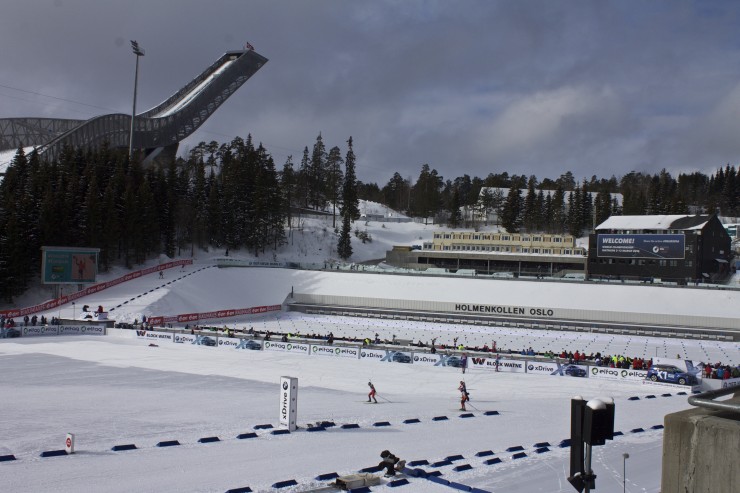
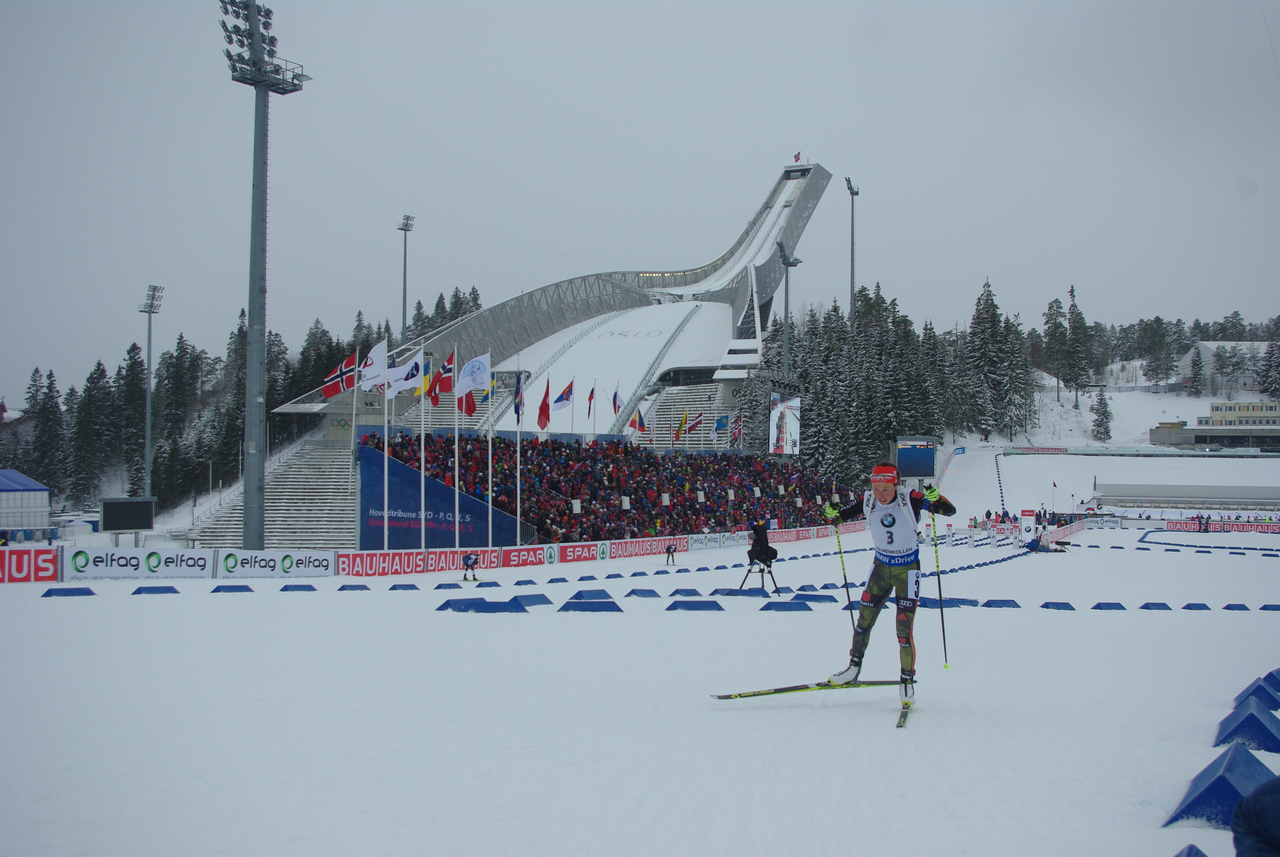
The jam-packed stadium at Holmenkollen for Friday’s women’s 4 x 6 k relay at 2016 IBU World Championships in Oslo, Norway. (Photo: JoJo Baldus)
Tim Burke (bib 57) in the pack in the World Championships 20 k. (Photo: JoJo Baldus)
Tim Burke pushing one of the Holmenkollen course’s uphills. (Photo: JoJo Baldus)
Sean Doherty competing in the 20 k individual at 2016 IBU World Championships in Oslo, Norway. Two Russian biathletes who Doherty competed against at the youth and junior level, Alexander Loginov and Eduard Latypov, have now been caught doping shortly after graduating out of the junior ranks. (Photo: JoJo Baldus)
Leif Nordgren on course for 27th place in the World Championships 20 k. (Photo: JoJo Baldus)
Lowell Bailey pushing for 15th place in the World Championships 20 k in Oslo. (Photo: JoJo Baldus)
OSLO, Norway — US Biathlon’s Lowell Bailey bounced back from disappointing shooting earlier at World Championships to finish 15th in the 20-kilometer individual, while Scott Gow turned in the best performance of his career to finish 18th and lead Biathlon Canada on Thursday.
“I was really frustrated with my shooting in the pursuit,” Bailey said of the performance where he missed five standing shots and ended up 36th. “I know I’ve trained so long just to get here, and I was really disappointed with that performance on the range. So I really worked in the last few days to try to get my focus back and to really execute my game plan in the range today especially.”
This time around, Bailey missed only one shot, in his first standing stage, for 95 percent shooting overall. That left him 2:43.7 behind race winner Martin Fourcade of France, and the 15th-place finish also secured Bailey a place in Sunday’s mass start.
His ski time was 36th, something he hopes to improve on as the week goes on.
“I was really happy with how everything had gone,” Bailey said of his fitness this season. “I had planned on starting out at a certain level and then working into the season. Everything had gone the way I had planned really, and we had races from the whole team in Canmore and Presque Isle, and the ski speed was also coming along there. I feel like I’m still competitive, but I think I can improve.”
All four Americans finished in the top 50, with Leif Nordgren placing 27th (+3:40.6), Sean Doherty 34th (+4:13.6), and Tim Burke 44th (+5:14.2).
Burke was undone by four penalties, three of which came in the final stage. This was especially costly in the individual format, where a missed shot equals one minute of added time. Coming into the last stage he was ranked in the top 15.
“Tough last stage,” he said after the race. “But that happens. I’ve had a lot of really good races for a long time. It happens. It’s biathlon. It’s the fun part and the frustrating part about it.”
His two younger teammates each hit 18-for-20, shooting they were pleased with, but didn’t see as perfect.
“It’s an easy day for shooting — it’s really calm,” Nordgren explained. “To miss today was pretty costly; there’s really no reason to miss. Both misses in standing were big misses that shouldn’t have happened. But, eh, that’s how it is.”
Doherty was still looking for an explanation of his two penalties.
“They were both my first shot in each prone,” he said. “So I’ll talk to the coaches about that and see what conclusions we can draw. But other than that the shooting was good. Ninety percent, that’s acceptable … I paced it well and I had good work on the range. So I’d say for the most part it was a successful race. I think it shows about the level that I’m at and I’m happy with that.”
Nordgren’s result was also good enough to qualify for the mass start, meaning that the U.S. will have two women (Susan Dunklee and Hannah Dreissigacker) and three men (Burke, Bailey, and Nordgren) competing on Sunday — an unprecedented number.
In many of those cases, it was good shooting which got them there.
“Prone I felt really in control all day,” Nordgren said, before speaking of his perfect shooting day from Saturday’s sprint. “With the shooting in the sprint, I knew that, yeah, it’s possible to shoot really well on a day like today. I knew that my shooting form was good, I just had to stay focused. The pursuit was kind of a disaster. So I just put that behind me and refocused on today.”
He had some help on the trails from the Italian team, as well as his own technicians.
“I started right in front of Lukas Hofer from Italy,” Nordgren explained. “He caught me leaving the first shooting, made up 30 seconds on my on that first loop, but I stayed with him after that. I had insanely fast skis today. So he usually had a little gap on me on the tops of the hills, and I’d come right back to him on the downhills, which was awesome. I’m really thankful for my techs today, they did a really good job on skis.”
Next up? Saturday’s relay.
With Bailey, Burke and Nordgren all scoring top 20’s so far at the Championships and Doherty consistently in the 30s and 40s, the team is “pumped” for the relay, Bailey said.
“In the men’s field right now, it’s so strong,” Bailey explained. “Every team has a stacked team, it seems like. But I think we’ve put together a really competitive team. We have four guys who are routinely in the points. So on a good day we can be right there. The results have shown that we have improved every year. We’re hoping to build on that, and anything can happen.”
Career Best for Gow
Christian Gow on course for Canada. (Tim Burke (bib 57) in the pack in the World Championships 20 k. (Photo: JoJo Baldus)
Scott Gow on his way to his first-ever top-20. Tim Burke (bib 57) in the pack in the World Championships 20 k. (Photo: JoJo Baldus)
Nathan Smith representing Canada in the World Championships 20 k individual. Tim Burke (bib 57) in the pack in the World Championships 20 k. (Photo: JoJo Baldus)
Brendan Green placed 47th in the World Championships 20 k. Tim Burke (bib 57) in the pack in the World Championships 20 k. (Photo: JoJo Baldus)
Canada was led by the older of two Gow brothers on the team, who turned in not just the best result of his season so far, but also of his career.
Earlier this year, Scott Gow finished 33rd, 34th, and 35th in sprints. In today’s 20 k individual, he broke into the top 20 for the first time with 18th.
“My second trimester wasn’t great,” Gow said. “I kind of struggled with shooting and then my skiing wasn’t in great shape. Canmore was a bit of, I think me coming up on the upswing. In the sprint race [here] I was happy with my race despite missing two. I think I had confidence knowing that my skiing’s kind of there and as long as I have the right focus in shooting I can come out pretty well. I would say I was confident for today.”
Gow was followed by three teammates in the 40s: Nathan Smith in 42nd (+5:08.3), Christian Gow in 46th (+5:25.1), and Brendan Green in 47th (+5:26.1).
Smith had five penalties, which held him back. Otherwise, his ski time was the 11th-fastest of the day.
“My shooting was pretty bad,” he said. “It’s frustrating – I’m five minutes back with five misses, so I know my skiing was good. It’s frustrating that I won’t be in the mass start now. So I will do my best in the relay, and then hopefully turn my shooting around for [the last World Cups in] Khanty-Mansiysk.”
Christian Gow was brought as Canada’s fifth man on the team. The 22 year old sat out the earlier races.
“At the start of the Championships I was told that this would be my first race for me,” Christian said. “My shooting is generally quite good, I’ve got a really high percentage, so we wanted to throw me in a race where the shooting can really pay off if you shoot exceptionally well. Unfortunately today wasn’t exceptional, but it was decent.”
After missing two shots in the first stage, he pulled it together for two more clean stages before missing one more shot in the last standing.
“I think that first bout was first-race-of-the-Championships jitters a little bit, and I didn’t feel totally relaxed,” he said. “It’s regrettable, but I at least brought it back after that. Sometimes you miss early on and no matter how much you think, ‘OK that’s out of the way, it’ll be better here,’ sometimes it just keeps down that slope. So it was really nice to pick it up with a couple cleans after that.”
The Canadians, too, are looking forward to Saturday’s relay. Their roster and start order had not been set yet.
“Last year we fought hard to get into the [Nations Cup] top 10 to allow us five starts all year, and this year it’s been phenomenal,” Christian said. “We jockey back and forth pretty much every day… Of course it’s unfortunate at a Championship that we don’t all get to start, but it’s also something that’s a reality for every team. I guess it’s cool that we’re getting to that point that we’re getting to that depth as well.”
His older brother agreed.
“Going into the season, we knew we had five starts but we didn’t really think we’d utilize it very much, but then trials in November showed the coaches and the team that we’re all really and we’re going to have to fight a lot more throughout the season to be that fourth or third guy or whatever,” Scott said.
“Especially coming to World Champs, if you assume that only four guys are going to race, you definitely want to be in that top four to be able get as many starts as possible,” he continued. “It’s added a bit of pressure, but at the same time I think everyone enjoys it. We all get along and we feed off each other. So I think it’s pushed the whole team to a higher standard.”
An exhausted Martin Fourcade finishes the 20 k individual to earn his fourth gold medal of World Championships. (Photo: IBU/Christian Manzoni)
“I love Norway so much, and Norway gives it back to me.”
That’s how French biathlete Martin Fourcade described his week of competitions, and the support he received from fans at the 2016 IWorld Championships in Oslo’s famous Holmenkollen ski stadium, in an interview with German television network ZDF.
During Thursday evening’s ceremony on the medal plaza in Oslo, Fourcade was awarded with his fourth gold medal of the week, adding the victory in the men’s 20-kilometer individual race in a time of 49:13.9 to his long list of achievements, despite a one-minute penalty in his first standing stage shooting.
Previously at these World Championships, Fourcade already won the mixed relay with his French teammates, as well as the men’s sprint and pursuit. And with two more races for the men on the schedule, this might not be the end yet, potentially setting a new historical record.
Silver and bronze went to two Austrian biathletes, with Dominik Landertinger placing second 5.1 seconds back and Simon Eder third 14.4 seconds behind Fourcade. Both Austrians shot clean with no penalties.
Dominik Landertinger in the 20 k individual in Oslo. (Photo: IBU/Evgeny Tumashov)
Landertinger started early with bib 10, and was the first athlete to shoot clean through all four shooting stages, taking a commanding lead in the finish.
But while he immediately knew he had achieved a very good result, he still had to wait a long time to see if his time would be enough for the podium in a large field with 99 athletes. In the end, only one man would still be faster.
“Incredible,” Landertinger told Austrian broadcaster ORF. “I can only do one thing: I dedicate this medal to my mom, who unfortunately passed away last November. I couldn’t even have dreamed about this. Shooting ‘zero’ four times is very, very hard. When you manage to do it on a day like this, of course that’s perfect.”
Asked about the last loop and the narrow gap to Fourcade, Landertinger added, “I almost wouldn’t have made it into the finish, that’s how much I pushed the tempo. I got dizzy. I was completely at my limit. I wouldn’t know where I could have even saved another half a second.“
Despite leaving the range still 6.4 seconds ahead of Landertinger and getting split times from coaches, Eder could not quite keep up with the pace of his teammate on the final loop falling back from first to third place. Still, he was highly satisfied with his result.
“It probably doesn’t get any better than this,” Eder told ORF. “For the first standing shooting it was a bit shaky. I was happy that those five [shots] went in.”
Eder only recorded the 16th-best overall course time, though largely due to two slower first loops. As he often does, the left-handed quick-trigger shooter achieved one of the best range times.
Simon Eder celebrates a long-awaited individual medal at World Championships. (Photo: IBU/Evgeny Tumashov)
“You can think a lot during a race like this,” he told ORF when asked what he thought when he saw on the video wall that (at that time) two Austrians were leading the race after the final shooting. “You think through every scenario imaginable. You have to be highly focused for the 20 to 30 seconds on the shooting mat, but the rest of the time you can do with your mind whatever you want. That might have been the key to shooting clean.”
Fourcade incurred a miss in the second shooting stage, setting him back to eighth place at that time, then reduced the gap again on the next loops with the fastest skiing times on the course and clean shootings.
“I knew that I was [still] in position to fight with them in spite of one mistake,” Fourcade said during the IBU press conference.
After the last shooting he left the range only 0.3 seconds behind Eder’s time and 6.1 seconds ahead of Landertinger, with his coaches frantically running next to him on the side of the track yelling split times to the Austrians.
“On the top one of my coaches told me ‘only three seconds to Landertinger’,” Fourcade described the last loop in an interview with the IBU. “I know Dominik since more than ten years. I know how fast he is on the last loop. Wow, what a fight now. And I gave all I had. Probably more than what I had. I did one last uphill with my eyes closed because I had no energy to open my eyes.”
He comfortably beat Eder’s time and still lost a bit to Landertinger on the final loop, but was able to preserve a 5.1 second lead into the finish.
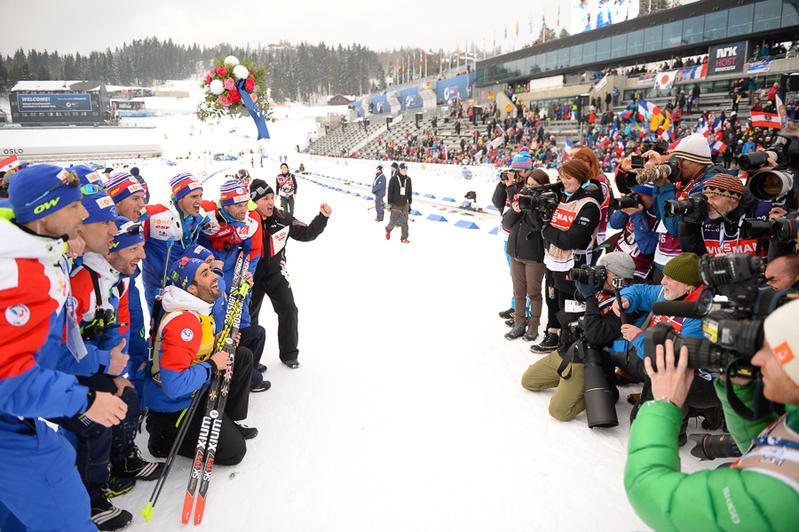
Martin Fourcade celebrates with his team after his fourth gold medal. (Photo: IBU/Evgeny Tumashov)
“My wax man told me ‘only two seconds to Landertinger’,” he recalled the final section through the arena, pushing hard until the finish line. “He lied, I know that now.”
Starting four positions behind Fourcade, Norway’s Johannes Thingnes Bø could have still displaced the athletes on the podium, but after a narrow miss in his last standing shooting the 22-year-old biathlete only finished fourth, 57.2 seconds back.
This gap seems relatively far away, yet in the individual discipline each miss results in an automatic full minute added to the race time as a penalty, with athletes not allowed to use spare rounds or ski a penalty lap.
“Are you kidding? I was this close to being World Champion at home?” Bø told Norwegian TV broadcaster NRK shaking his head in disbelief, when he was shown a close-up replay of his missed shot that hit the edge of the target, with the metal disc visibly shaking but not flipping over.
“I’d somewhat put this on the organizers, they should have oiled the targets better- it hung up on some rust,” his older brother Tarjei Bø, who finished 22nd, joked in an interview with NRK, according to a translation.
Eder in the pain cave. (Photo: JoJo Baldus)
Fifth place went to Czech Republic’s Michal Krcmar (+1:16.4) with no penalties, tying his best World Cup career result from a mass start in Ruhpolding, Germany, earlier this season.
Fourcade, who lives and trains in Norway for part of the offseason, lauded the support he received from the fair audience at the Holmenkollen arena and around the course, despite repeatedly having prevented even better results for the local athletes.
“I really have the feeling that the audience is cheering for me,” he told ZDF. “So I am happy about not being the public enemy number one. I am not being cheered as the Norwegians, but probably the most like one of them.”
With his victory, Fourcade also secured the ‘small crystal globe’ awarded for the individual-race discipline title in the World Cup ahead of Eder, who would have needed to win or place second to keep a narrow lead. Fourcade will also win the overall World Cup.
“That’s good,” Fourcade told reporters during the press conference. “I read in the French press this morning that in the last 11 individuals I won 9. I knew individual is a competition I love so much. It’s probably the competition I’m the strongest in.”
“I didn’t know what Martin would do today,” Eder told ORF in his interview. “I was hoping to keep the globe, but that is gone now.”
At least Eder now has the bronze medal as a great consolation prize, his first in an individual-start race, and his second after a silver medal with Austria’s men’s relay at the 2009 World Championships in Pyeongchang, South Korea.
“It’s really special,” Eder said in the press conference. “It was a big goal for me in the last years. Sometimes I was very close to it. Today was the day. I can just believe the moment maybe in the evening.”
For Landertinger, it was his third medal at World Championships, after a silver medal in that same relay, and gold in the mass start also in 2009.
Fourcade has won 19 medals at World Championships now, including 10 gold ones.
Races in Oslo continue on Friday with the women’s relay, followed by the men’s relay on Saturday, and wrapping up with mass starts on Sunday.
Laura Dahlmeier of Germany earned bronze in the 15 k individual. (Photo: JoJo Baldus)
Annelies Cook of the United States on course in the women’s 4 x 6 k relay at 2016 World Championships in Oslo, Norway. (Photo: JoJo Baldus)
Rosanna Crawford of Canada finished 13th, the best World Championships finish of her career. (Photo: JoJo Baldus)
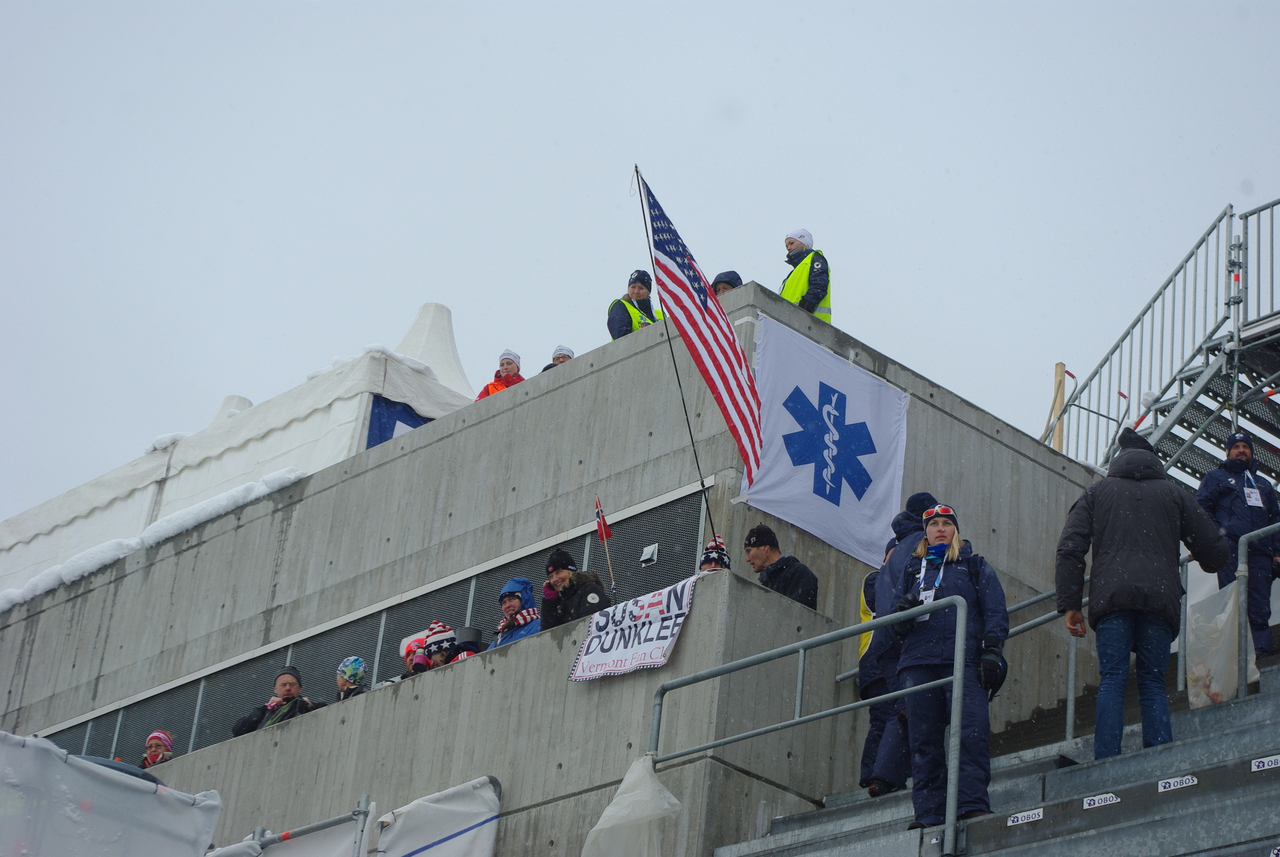
Susan Dunklee’s parents wave an American flag in the stadium. (Photo: JoJo Baldus)
On course in the 15 k individual. (Photo: JoJo Baldus)
Hannah Dreissigacker of the United States finished 33rd in the 15 k individual at World Championships on Wednesday. (Photo: JoJo Baldus)
Annelies Cook of the United States placed 77th. (Photo: JoJo Baldus)
Hannah Dreissigacker earned her first mass start qualification after today’s race. (Photo: JoJo Baldus)
Gabriela Soukalova of the Czech Republic, the overall World Cup leader, placed fifth. (Photo: JoJo Baldus)
Susan Dunklee pushing over a hill for 18th place. (Photo: JoJo Baldus)
Zina Kocher of Canada placed 54th. (Photo: JoJo Baldus)
Oslo 2016 IBU World Championships – Clare Egan of the United States. (Photo: JoJo Baldus)
Julia Ransom en route to 20th place for Canada. (Photo: JoJo Baldus)
A scene outside of the race course at Holmenkollen. (Photo: JoJo Baldus)
Marie Dorin Habert of France won her first individual gold of these World Championships. (Photo: JoJo Baldus)
Sarah Beaudry of Canada. (Photo: JoJo Baldus)
Clare Egan en route to 66th place. (Photo: JoJo Baldus)
Canadian tech Tom Zidek showing an athlete their shooting group. (Photo: JoJo Baldus)
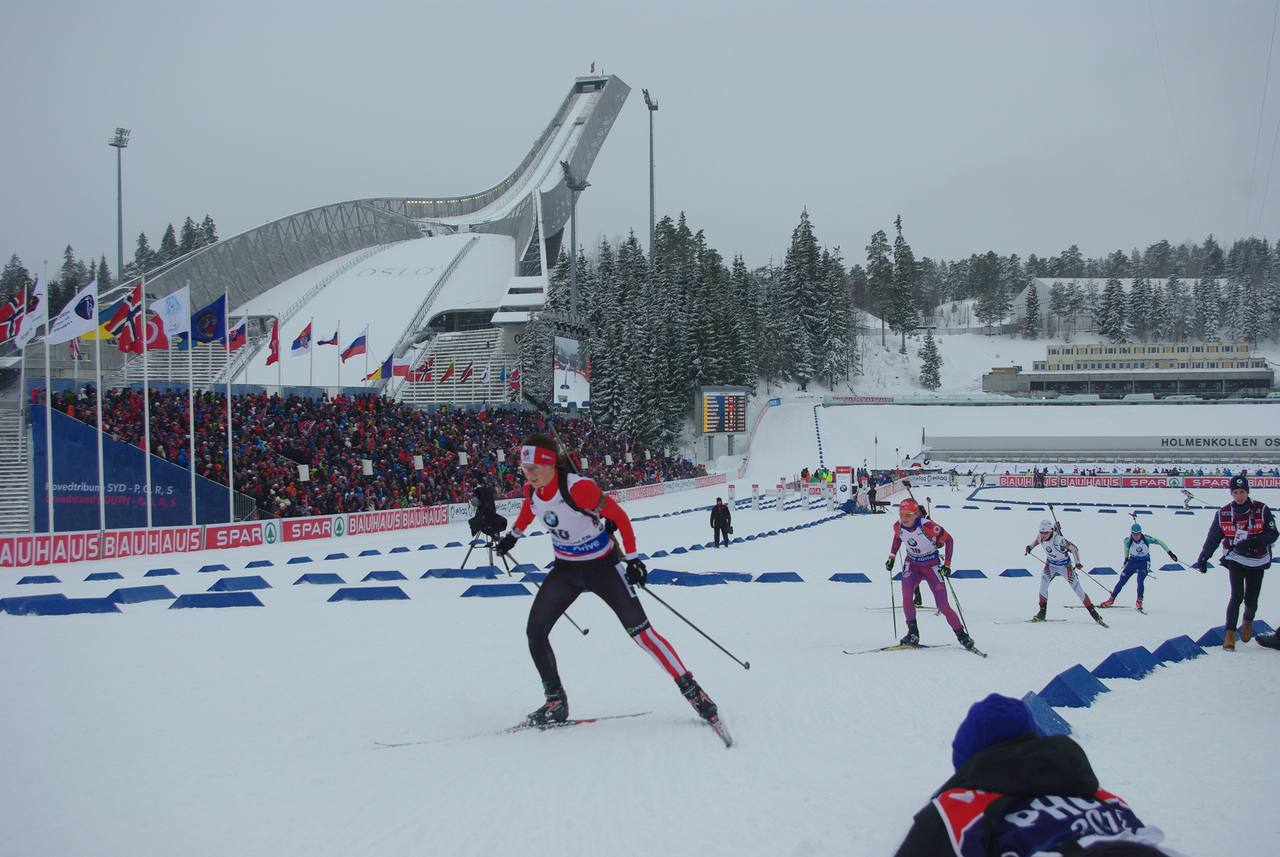
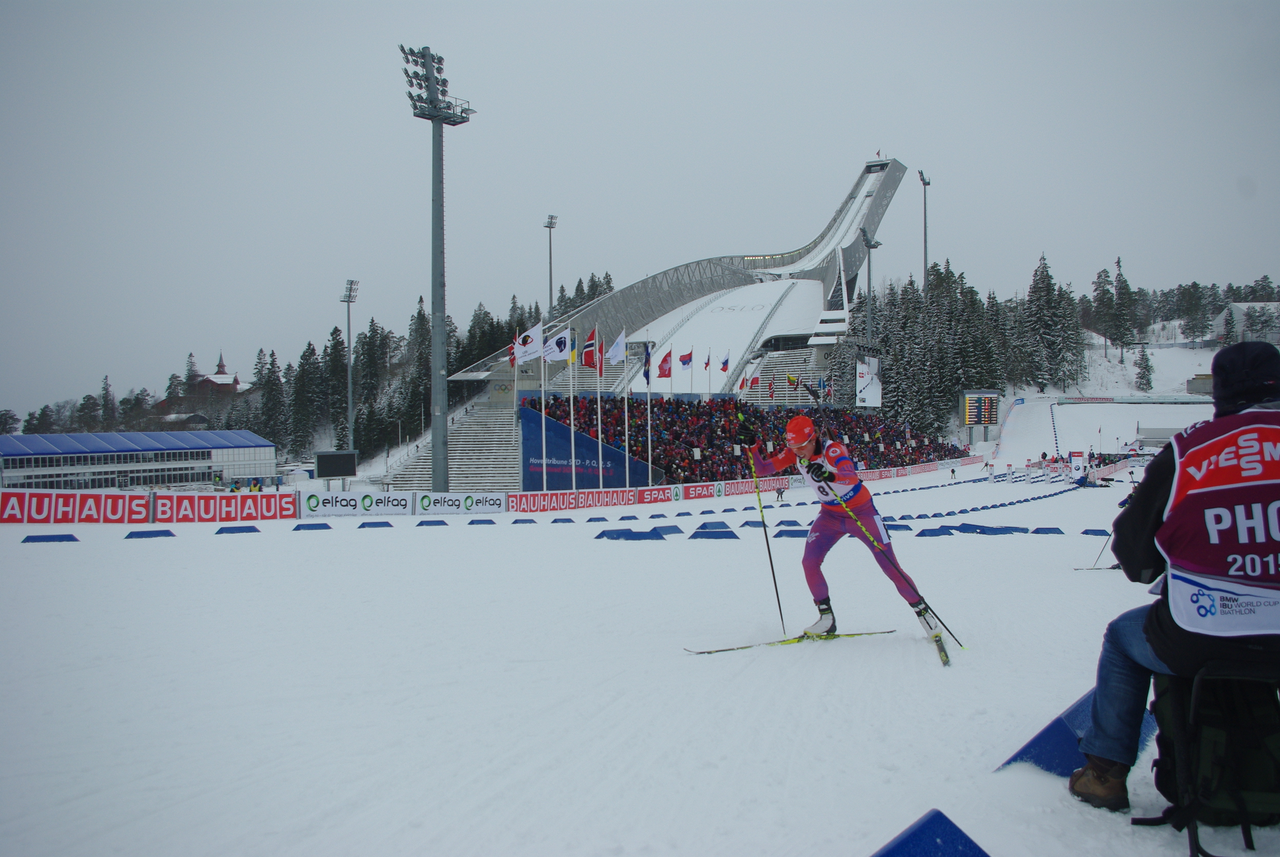
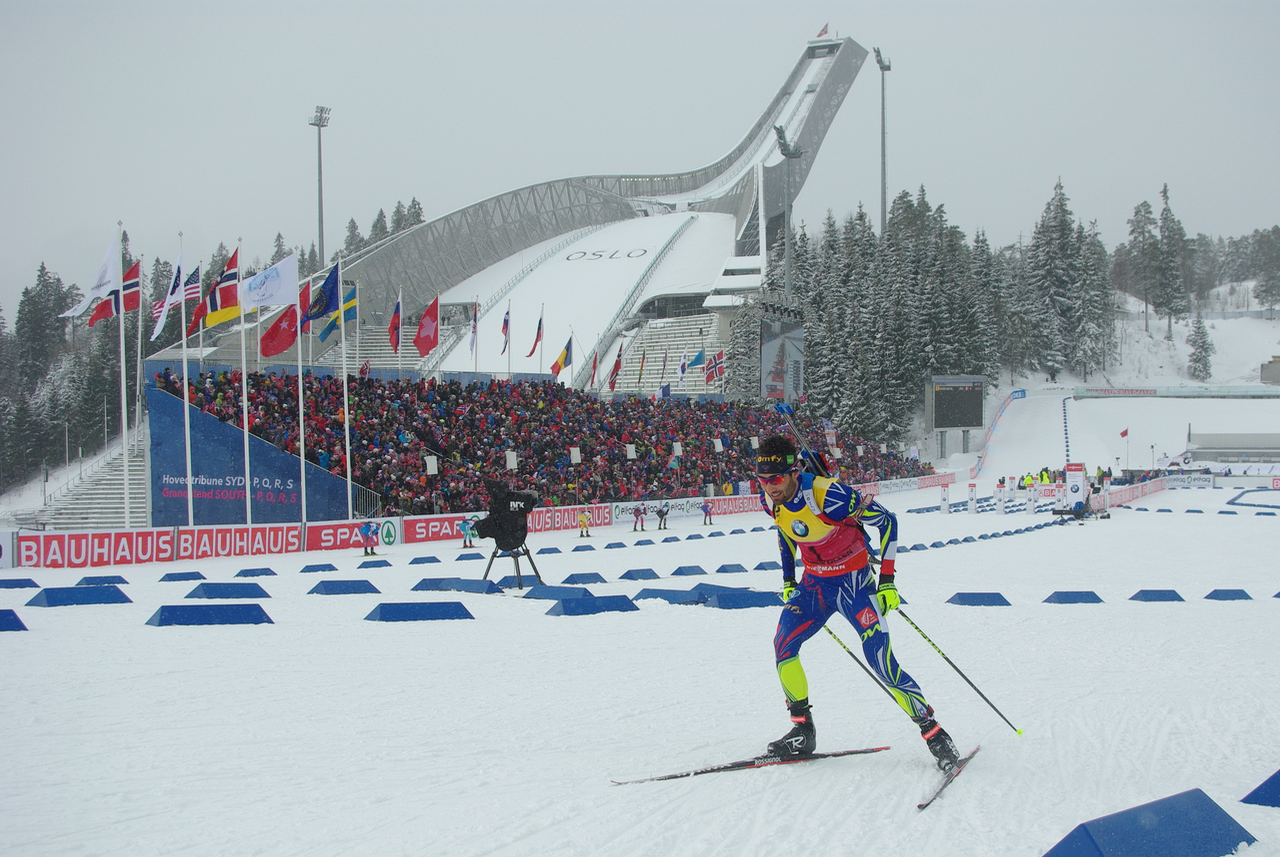
The scene at Holmenkollen stadium in Oslo during the women’s 15 k individual of IBU World Championships. (Photo: JoJo Baldus)
Sarah Beaudry of Canada is urged on by head wax tech Tom Zidek. (Photo: JoJo Baldus)
OSLO, Norway—After frustration on the shooting range in the World Championships sprint and pursuit competitions, the Canadian women’s team were pleased to up their percentages in the 15 k individual, translating to top-20 performances by both Rosanna Crawford and Julia Ransom.
Crawford missed just one of her targets, finishing 14th, 2:15.3 behind new World Champion Marie Dorin Habert of France.
And Ransom was one of only two women in the whole field to shoot 20 for 20, finishing 20th, +2:33.5.
“It always is a big focus,” Ransom said of perfection on the shooting range. “I’m just glad it came out today, because those one minute penalties hurt. I was more calm and confident today.”
As in Antholz, Italy, earlier this season, Ransom gained momentum as she knocked down target after target: first five out of five, then ten out of ten, then 15 out of 15.
But not so few athletes cleaned three stages. It’s the fourth one which can be trouble. The gold and silver medalists, Dorin Habert and teammate Anais Bescond of France, had each hit 15 for 15 before missing a shot on their last stage.
So did last year’s World Champion, Ekaterina Yurlova of Russia, who ended up 11th after that one miss. And so did several other women, as well.
Ransom was able to keep her focus.
“I think it’s easy to get into your own head, especially if you shoot 15 for 15,” she said. “So I was happy to stay solid.”
Crawford after the sprint had complained of a “nine out of ten curse”, but started off her 15 k with ten straight hits before missing a shot in her second prone stage.
“Shooting was so good,” Crawford said. “It’s always so good in training so I really tried to bring that feeling to the race today. As I was cresting the top of Hellner’s hill [the last big climb before the stadium], I kind of just said to myself, OK, now for the easy part, which is shooting. That was really nice to have that feeling. I really took my time on the last standing. I didn’t want to have a repeat of the pursuit.”
On the tough and hilly Holmenkollen course, Crawford was satisfied to finish 14th, her best World Championships or Olympic result to date, and also one of her best of the regular season.
“My best was 13th in Östersund [the first week of the World Cup] in an individual with 18 for 20 I think,” she said. “So the ski speed is coming around. It would’ve been really nice to have that top 10, especially for funding for the team. This will probably secure me a spot for the mass start so I’ll just try again on Sunday.”
Canada also started Zina Kocher, who finished 54th with four penalties (+5:33.6) and Sarah Beaudry, who finished 60th with two penalties (+6:02.3).
“I’m happy I hit 18,” Beaudry said. “I didn’t feel great skiing, but I did some of the things I was hoping to do. To push with the hills – there are so many long tops of the hills, and I find that I struggle with that, so I focused well on that in the race, which is good. I’m just happy that I feel better than during my sprint.”
In her first senior World Championships, Beaudry was thrilled to see Ransom hit perfect shooting. Separated in age from Beaudry by just a year, Ransom got her senior World Championships debut last season and has already made good on her accumulated experience.
“We’ve known each other longer than we haven’t known each other,” Beaudry said. “I’ve always watched Julia do everything one year before me. So it’s so neat to watch and say, that could be me next year. She leads the way and I have someone to follow.”
So perfect shooting next year?
“That would be great,” she laughed.
Dunklee Leads U.S. in 18th
After two top-tens in the sprint and pursuit, Susan Dunklee missed a few more shots on the range to finish 18th in the individual, +2:29.5.
She missed a shot in each of the first three stages, but cleaned her last one for three total penalties.
“I finished on a good note,” she said. “I’m making that a habit, which is nice.”
Earlier in the week Dunklee talked of shooting feeling good and easy, and that didn’t necessarily change. She thinks she’s still got it for the rest of the week.
“Today felt a little more average, to be honest, but it still felt in control, which is exactly what I want,” she said. “I was really surprised I only missed one in the first standing because I was kind of seeing spots a little bit. Spots beyond just the five dots. It was hard to stay focused.”
That might be from exertion: Dunklee had the fourth-fastest course time behind medalists Dorin Habert, Besond, and Laura Dahlmeier of Germany. The four were separated by just 6.8 seconds.
“Today I was feeling good,” she said. “Ideally you would want to start out a little slower then speed up as the race goes on in a long race like this. But when I’m feeling really good I don’t worry too much about that. I just go and then deal with the consequences later. I was definitely hurting on loop four, but Doro [Wierer of Italy, who finished eighth] was right there. She was on her finishing loop so I just kept her within reach and that helped a lot.”
With two penalties, Hannah Dreissigacker finished 33rd (+3:45.2).
“The shooting has been feeling so good lately,” Dreissigacker said. “Like in practice yesterday, I missed one shot the whole time and I was feeling so solid. Today, also, I just felt like I didn’t even need to miss those two, I could’ve just hit them. That’s a great feeling, that’s how it should feel, close.”
Along with an 18th place finish in the sprint and 36th in the pursuit, the result was enough to qualify Dreissigacker for her first ever mass start competition.
It’s a cherry on top of what has been a good World Championships, the last before Dreissigacker retires.
“This will be my second mass start,” she wrote in an email after the mass start qualification list was announced. “I started with bib 30 in the mass start in Khanty-Mansisk last year. It was definitely a goal of mine for this year do another mass start, and I really didn’t think that it would happen for a while there so I am just SO happy about it! It will be the perfect way to end my biathlon career.”
Clare Egan had four missed shots, three of which came in one stage, to finish 66th (+6:41.9). Annelies Cook finished 77th with seven missed shots (+8:49.4).
“I had one bad stage,” Egan said. “I was pretty bummed out. But I was psyched that I was able to keep it together after that and not go downhill… I’m happy to have another race with 80% shooting. My goal this year was to average 80%, and I’ve only had one individual race (sprint or pursuit or individual) below that. With my shooting I’m doing way better than I could have hoped this season.”
The U.S. women are now looking toward the relay, which has extra significance since with Dreissigacker set to retire next year.
“This is our last relay as a group, and it’s going to be sad but it’s also going to be a nice way to go out,” Dunklee said. “I’m going to miss being on a team with [her] a lot, and I’m going to try to savor this last one.”
Will that added emotional aspect make it harder to focus?
“I’m just going to try to go out and do what I always do,” Dunklee said. “We’ll see.”
Laura Dahlmeier of Germany on her way to her first individual World Championships gold.
OSLO, Norway—On Saturday it was unbeatable skiing that brought Laura Dahlmeier a bronze medal in the 7.5 k sprint at World Championships, despite one penalty when most other top competitors shot clean.
On Sunday it was shooting that brought her gold. The 22-year-old German was a perfect 20-for-20 on the range and took the lead in the 10 k pursuit after the final shooting stage, with such a comfortable margin that she never had to look back.
“It was really a perfect day for me, a perfect race,” she said in a post-race press conference. “I hit all targets… The last loop was amazing. I had a little bit of time to look around and thank the whole team, and get the German flag. It was great for me to come to the finish as the World Champion.”
She finished 48.3 seconds ahead of Dorothea Wierer of Italy, who moved up from fifth place with just two penalties. Marie Dorin Habert of France was third, +57.3, after leading early, but missing three targets in her standing stages.
It was the first individual World Championships medal for Wierer, who has a reputation as a sharpshooter.
Julia Ransom of Canada (left) and Hannah Dreissigacker of the United States on course in the 10 k pursuit.
“The medal was something special,” she said. “I knew it was not easy because everybody is preparing well for the World Championships. I had so much problems last week. I was changing the position of the shooting maybe five times and I wasn’t able to make a zero in the shooting in training. And I also had a strange feeling in the body yesterday, like I was getting sick or something. But today is a new day, and I’m really happy.”
Dorin Habert earned her medal on the last loop. Though she left the range in fourth position, behind Franziska Hildebrand of Germany, she managed to pass Hildebrand and, with gritted teeth, hang on for the medal all the way to the finish.
“I’m very happy to be third and I don’t care about my standing shooting,” she said.
Dunklee a Hard-Fought Tenth
U.S. biathlete Susan Dunklee had only one missed shot through her prone stages, moving from bib eight into the top five.
Then came standing. The first standing stage, Dunklee called a “distaster.” Missing three shots, she dropped all the way to 20th.
“I’m not sure what happened, but it didn’t feel as in control as all the rest of the stages I have shot this week,” she said. “I was really glad to come in and clean the next stage, to get back on the horse right away, so to speak.”
That clean final stage had her leaving the range in 15th with the race far from over.
Dunklee charging hard.
“It was exciting, because Gabi [Soukalova] and Anais [Bescond] came out of the penalty loop right ahead of me,” she said. “I thought that was sweet because they are both really good skiers, so I got a ride. Then I was feeling good on that little hill halfway around the course. They boxed me out – one was on one side, the other was on the other side, and they were passing someone else, but I wanted to pass them. I couldn’t.”
Never one to let a challenge defeat her, Dunklee found a way past.
“Clare [Egan], my teammate, was there yelling, ‘Come on Susan! You have to go now! You have to go now!’” Dunklee said. “So I did a little slalom on the uphill to get around them. I knew they would just hang onto my tails because they are good skiers. So I charged, and we caught a few more people. It was a fun last loop.”
That put her in tenth by the finish, something that she wouldn’t have thought possible with four penalties on the day. Dunklee had the second-fastest ski time behind Kaisa Makarainen of Finland, who finished seventh.
“You don’t know until you try,” she said of her last-loop heroics. “You have to always try. I am happy with [the result] given the shooting. I’m still kicking myself on that one stage. Luckily we still have a few races this week.”
Even though she can’t pinpoint what went wrong in her first standing stage, Dunklee isn’t letting it worry her.
The Susan Dunklee fan club (made up partly of her parents).
“Tomorrow is a day off and I’m going to take a break from thinking about biathlon,” she said. “Honestly I’ve had a better feeling on the range this whole week than I have all season. I’m still on a roll with that, and it hasn’t gone anywhere. Yeah, it was gone for one stage, but it’s still there. I’m going to feel very confident going into the next few races.”
Teammate Hannah Dreissigacker was 36th with four penalties, crossing the line +3:43.2. Both had to battle the wind, which was, if anything, worse on course than on the range.
“My three middle loops I didn’t have anyone to ski with,” Dunklee said. “That was extremely tough because it was really windy.”
Both also got caught up trying to ski with other women, which they guessed might have contributed to a few of their problems on the shooting range.
“Maybe I pushed it a little harder on the last section of the loop, and maybe that affected me a little bit,” Dreissigacker said. “And I was shooting at the far end of the range, which means you have less time to shake out the legs as you ski in. I think that might have been a little bit of a factor in the standing. I shot in 29 and 30 and you have to do a sudden snowplow to a stop and then shoot immediately. That’s a little tough.”
Still, the two U.S. skiers were happy with their execution.
“My goal was to ski my own race and shoot my own race,” Dreissigacker said. “I felt like I did that, but it just wasn’t a perfect day out there. It was okay. It wasn’t bad, although two on the first one was a bummer. That really sets you back a bit. But anyway, it could have been worse, could have been better.”
For Canada, Rosanna Crawford led the way in 27th (+3:14.9). After missing four shots, she finished the day frustrated.
“I threw it away in my last standing,” she said. “I had a chance for a top 20. As I came down the hill I was saying my cue words and focusing, but then I think my brain just went blank. I didn’t do what I trained to do.”
But there were also positive points: for instance, she felt good on skis, and was able to work the sections of the course that she had tactically focused on.
“It was fun,” she admitted. “I love pursuits and I felt quite good on skis. If you really work the downhills, you can make up a lot of time. I passed maybe four or five people on the last loop on the two downhill sections.”
Julia Ransom also competed for Canada, finishing 42nd (+4:38.2) with three penalties.
Martin Fourcade of France on course at Holmenkollen en route to a gold medal in the 12.5 k pursuit on Sunday.
OSLO, Norway—Business as usual? Despite three penalties, Martin Fourcade of France cruised to his third consecutive gold medal of these IBU World Championships, winning the 12.5 kilometer pursuit by 20.1 seconds over Ole Einar Bjørndalen of Norway.
On the final shooting stage, Fourcade missed two shots. The Norwegian crowd cheered; Bjørndalen, their biathlon hero for more than a decade, was skiing into the stadium in second place.
“I am a bit angry about my last shooting,” Fourcade said in the post-race press conference.
But Fourcade’s lead was big enough that he could ski the penalty loop twice and still exit it a second before Bjørndalen came out of the range.
Ole Einar Bjørndalen locking up a second silver medal in the pursuit.
And Bjørndalen had missed a shot of his own, so headed to the penalty loop himself, giving Fourcade a comfortable gap.
That meant Fourcade’s third of the championships after helping the French to a mixed relay gold and then winning the sprint. And it helped him lock down the 2015-2016 overall World Cup title, which he is now mathematically guaranteed to take home.
“I am so satisfied with winning the overall ranking for five years in a row,” Fourcade said. “It’s something I didn’t imagine even in my best dreams.”
The big question was whether Bjørndalen would stay in second, or whether the group behind him would pass him while he was occupied doing his penalty time. But with wind picking up, most athletes had at least a penalty on the final bout, so Bjørndalen was able to easily hold second place.
“For sure I am surprised that I kept the silver also today,” Bjørndalen said in the post-race press conference. “I know that the pursuit is a really hard level. There are so many athletes who have a chance to go on the podium. I did a really strong race.”
These are particularly meaningful medals for 42-year-old Bjørndalen, who has won 42 over the course of his career.
Johannes Thingnes Bø (bib 4) and Emil Hegle Svendsen of Norway setting up for a battle on the final loop of the pursuit.
“I was in some different medal ceremonies, and this was one of the best feelings that I have got ever,” he said of the sprint ceremony in downtown Oslo last night. “There was so many fans there and such a great atmosphere. And also the medal ceremony for the girls with Tiril.”
On the day, it was a Norwegian onslaught, with Johannes Thingnes Bø also occupying second place for a time before being undone by penalties; he left on the final loop in third place, trailed by teammate Emil Hegle Svendsen.
Svendsen had moved up from 15th place after the sprint, with only a single penalty to his name. He was able to pass Bø near the end of the race and lock up bronze (+31.2), a strong result after a somewhat disappointing season for the Olympic champion.
“I was not so confident going out of the stadium,” Svendsen said. “Johannes was pushing quite hard. And I know he has been stronger than me in the last months, so I didn’t feel like I had it in my pocket. But on the track I saw that he was tired on top of the hills. So when we came into the stadium I did my best to take advantage of my strong sides and attacked on the shelf there. It was a good sprint for me and a good feeling.”
Bø finished fourth (+38.3). Jakov Fak of Slovenia was fifth (+41.9) and Simon Desthieux of France sixth (+42.9) after each shot a perfect 20-for-20; Fak moved up from bib 39 and Desthieux from bib 12.
Nathan Smith of Canada chasing Anton Shipulin of Russia through the ranks; both had disappointing sprint races but moved up considerably in the pursuit.
Another big mover was Nathan Smith of Canada. After a frustrating sprint race which left him 46th – a far cry from the silver medal he won in the event last year – Smith had a strong shooting day and moved up to 15th with just one missed shot.
It was a big improvement over his shooting from the sprint.
“I tried to just not rush it as much,” Smith explained. “I felt like I shot slower, but I know it was maybe just a few seconds over the race, probably. But just that little bit, just feeling like I’m less careless I guess, not being as risky.”
He started just behind Anton Shipulin of Russia, who moved up even more – with a single penalty, he placed ninth.
“When you are skiing in a group the psychological effect is everyone tends to ski more or less the same speed,” Smith said. “I was kind of glad that Shipulin was starting right in front of me… he was ninth, he probably had one of the best times of the day. The group in front of us kind of, I’d say we gained almost 20 seconds in one lap.”
Smith hopes that this is a beginning of a turnaround for his World Championships luck.
“I knew the potential was there to have a good race,” he said. “I’ve had three really good skis in a row now. So, feeling good with my shape. Just had to shoot. There is a little bit, not the easiest shooting conditions today, but it was pretty good shooting today, I think.”
Tim Burke of the United States (second skier from right) entering the stadium.
Also for Canada, Brendan Green finished 33rd (3 penalties, +2:32.9), Scott Gow 49th (six penalties, +4:30.1), and Macx Davies (four penalties, +5:26.8).
Tim Burke was the top American, turning his 14th place sprint into a 17th place pursuit. He had moved into the top ten early in the race with clean prone shootings, and even after a miss in the first standing was still within striking distance of the top ten.
But he was undone by two more misses in the final stage.
“It was another solid race,” he said. “Just disappointed in the last stage. Two penalties is too much there. I felt good. Just probably a little too cautious – you are trying a little bit too hard, throw you off your rhythm. The [conditions] looked really good, no reason to miss there.”
While the range was fairly calm, Burke said that the wind was actually more of an issue out on course.
“It was a little tricky on course today,” he explained. “There were a few sections where it was really a huge advantage to draft. It changed the pace of the race quite a bit… I ended up in front [of a group] a couple different times, and it was significantly harder than in groups.”
Burke is looking forward to the 20 k individual competition on Thursday, a race where he was silver at 2013 World Championships.
“The individuals are a different style of race, but it’s definitely my favorite ski race,” he said. “I have had success with it in the past, so I’m looking forward to it. I feel like I’m in a good shape, and in a pretty good rhythm… It’s a tough course, there is a lot of big climbs, but I really like it. I really enjoy 20 k. Most of the time you end up having to do it on your own. Especially on a challenging course like this, with the shape I have it should be good for me.”
Teammate Lowell Bailey also had a strong early section of the race, cleaning both prone stages. That brought him into the top 15. But with five penalties total over the two standing stages, he dropped to 36th (+2:57.2).
“This was one of my worst races of the year,” Bailey said. “Not much else to say.”
Sean Doherty finished 45th (five penalties, +3:52.1) and Leif Nordgren 52nd (seven penalties, +5:10.8).
Tim Burke of the United States leads Canada’s Macx Davies in the World Championships 10 k sprint in Oslo, Norway. (Photo: US Biathlon/NordicFocus)
OSLO, Norway—Hannah Dreissigacker didn’t even know if she would be competing at World Championships this season. A month ago, the 2014 Olympian was on the IBU Cup, and floundering.
But she began to turn things around, and then turned in top-30 results in Canmore, Alberta, and Presque Isle, Maine, when she was moved up to the World Cup.
So on Thursday she found herself leading the World Championships mixed relay after receiving the tag from Susan Dunklee in first place, and on Saturday she placed 18th in the 7.5 kilometer sprint, a season best.
“It’s funny how fast your expectations can change I guess,” Dreissigacker said after the race. “Definitely there was a little while after Christmas where I was racing on the IBU Cup and doing badly that I thought I might not even come here. That really re-set my expectations, so that I had to re-think and say, I need to race for myself and I need to have fun and enjoy it and do the best I can do in these last few races… It’s funny though, because as soon as you start to do well again, you want to do well and you want to do better.”
With Dunklee placing eighth, the Vermonters’ one-two punch was one of the best World Championship days for the U.S. women’s team ever.
Hannah Dreissigacker finished 18th in the 7.5 k sprint at World Championships. (Photo: US Biathlon/NordicFocus)
“I’m really excited for Hannah too,” U.S. Biathlon Association President and CEO Max Cobb said after discussing Dunklee’s result. “That was a super performance. Her best of the season so far… I’m so excited that we have two women in the top 20!”
Dreissigacker shot clean, and was able to ski the 48th fastest ski time to land in the top 20.
“It’s biathlon,” Dreissigacker said. “You can always wish you did something better. Today I guess I wish I skied better since I shot well. But I gave it everything I had. I felt like I actually paced myself pretty well so I could still push it on the last lap.”
The other two American women will miss the pursuit. Annelies Cook was ill in the run-up to World Championships and couldn’t find her legs. Despite a single penalty, she landed 63rd and said she was disappointed not to be able to use some speed on the final loop.
Clare Egan finished 84th after taking only a single penalty, but forgetting her penalty loop and accruing a two-minute penalty as a result.
On the men’s side, Tim Burke finished 14th (+1:09.1) with one penalty and Leif Nordgren was a season-best 18th (+1:16.8) with clean shooting.
“Finally I put good shooting together,” Nordgren said. “Zero-zero, that’s the first time in a long time in a sprint. That’s what I needed today. You know, for me it’s been kind of a bad year as a whole. So it’s nice to finally have a good one at World Champs.”
Burke had a similar feeling, after having many races this year where things just didn’t go his way.
“I feel like I was headed definitely in the right direction, in Canmore and Presque Isle,” Burke said. “It was really good for me. I think today was a good start to World Champs. I felt good, but I wasn’t great. Sometimes I struggle a little bit with the taper. The first race back is a challenge for me. I was a little bit flat today but I really expect to feel better and better each race.”
All four Americans will be in the pursuit, with Lowell Bailey finishing 29th (+1:34.8) and Sean Doherty 43rd (+1:56.5).
“I’m really happy with it,” Doherty said of his effort. “I’m really happy with it. I felt very strong skiing, which was really fun. It’s nice to have the shape come around for the Champs here. And I shot one penalty each time, which I mean that’s not perfect, but I can’t really complain either. I felt really good… It’s nice to belong in this field. It really is fun, it’s really fun. Instead of being the little kid who is kind of wide-eyed with everything, it’s fun to really be here to race and fit in.”
Crawford Leads Canada
Rosanna Crawford was the top Canadian, finishing 29th in the women’s sprint. With one penalty she was one minute and 34 seconds behind race winner Tiril Eckhoff of Norway.
“Shooting nine out of ten is my curse,” she joked. “I don’t think I’ll ever be able to hit ten for ten.”
That said, Crawford was happy that her ski form was coming around after competing while ill in the Canmore World Cup.
“It took a long time to get rid of that sore throat,” she said. “I had a sore throat for about, oh, 27 days. I was able to train through, though, and just to be at home was nice, and to be around my family and my dog and get to ski the trails that I never get to ski. It was a good recovery for us.”
She will be joined in Sunday’s pursuit by Julia Ransom, who placed 50th (+2:14.6) with one penalty.
Sarah Beaudry finished 71st with two penalties and Zina Kocher 82nd with five penalties.
“I had one huge standing mistake,” Ransom said. “I could see that I almost didn’t even hit the backboard. I just pulled it too soon and wasn’t really ready. But other than that, it was good. I’m feeling more like myself on skis.”
This is the second World Championships for the Kelowna, British Columbia native. And she can tell the difference.
“My World Championships last year, it was the first pursuit I ever made so I was pumped, I think I finished 58th or something,” she said. “It is nice to feel like I’m competing more instead of just participating.”
For Sunday’s pursuit, she’s hoping she can replicate a performance in Antholz, Italy, earlier this year, where she cleaned all four stages and moved up from 46th to 19th.
And she’s also simply enjoying competing in Oslo for the first time.
“Oslo is amazing,” she gushed. “You can hear the rumbles of cheers from our hotel.Last year I went home for a few weeks rest, so I’ve been looking forward to this for a long time. Holmenkollen is the place to be. And it’s above and beyond my expectations.”
For the Canadian men, Brendan Green was tops with one penalty in 35th (+1:44.1). Like the rest of the team, before World Championships Green had not competed since the Canmore World Cups, having skipped Presque Isle to train.
“We’ve had a little longer break away from racing than we usually do, but I think there were positives in that,” he said. “Especially for myself, with my back I was able to give it a rest after Canmore. And that allowed the team to get a solid block of training in. So in terms of our preparation it went more or less exactly as planned. It’s still early in the Championships so hopefully we can build on it and it goes up from here.”
Nathan Smith was disappointed with three penalties in standing, ending up 46th (+1:58.7) and Scott Gow was one spot back with a single penalty (+2:03.6).
“Standing was a disaster,” Smith said. “I missed three standing. I think my skiing was good, but you have to shoot well too, right?”
Macx Davies also made the cut in the pursuit, making the Canadian men’s team four for four.
In his first senior World Championships, Davies, like Ransom, is soaking up the Oslo scene.
“Coming through my last loop, [Ole Einar] Bjørndalen passed me by a little bit, so I came through the stadium just after him,” Davies explained. “I was finishing as he was shooting. The whole crowd was going up. It was impressive.”
Tiril Eckhoff of Norway jumps for joy after claiming her first ever World Championships title, in the 7.5 k sprint in Oslo, Norway. (Photo: IBU)
OSLO, Norway—Norwegian biathlon fans had high expectations coming into a home World Championships this season.
But perhaps the biggest pressure was on the men’s team. With the four core members all hitting the podium so far this season and two picking up individual wins, the demand for medals – preferably gold – was strong and loud.
And so it was something of a coup when on the first day of individual competition, Norway’s new World Champion in the sprint was 25-year-old Tiril Eckhoff in the women’s 7.5 k.
Kaisa Makarainen of Finland put down an early blazing-fast time, but many top competitors had started later in the field. In bib 42, Eckhoff was one of them.
It wasn’t until Makarainen had finished that Eckhoff took her first shot. She hit that one and the next four in prone, leaving the range with the fastest split time so far, and then also cleaned her standing stage. After powering around the final lap, cheered on by 20,500 rabid fans, she laid down a race that no other woman could match.
“A big thanks to all the crowd,” she said in the press conference. “My friends and family were watching and cheering at me. Thanks to the crowd who got me around the last loop. I was really really tired and they cheered and cheered.”
It’s not that Eckhoff is unknown. Far from it. She earned bronze in the Olympic mass start in 2014, and won a World Cup the following season.
But after being annoited as the heir to Norway’s biathlon throne upon Tora Berger’s retirement, Eckhoff hasn’t dominated.
Her 15-second victory over Marie Dorin Habert of France, the World Champion in this event last year, was just that, though: dominant.
Susan Dunklee on her way to eighth place in the World Championships sprint. (Photo: USBA/NordicFocus)
She was almost at a loss for words to describe winning on home turf. Her club, Fossum IF, has its office just a few kilometers from Holmenkollen.
“It’s amazing,” Eckhoff said. “I went my first ski race here. Now I’m back and – it’s unbelievable to be World Champion. It’s amazing. Of course I had a dream, but I didn’t expect this victory. I worked hard. I don’t know how to describe it.”
Both Eckhoff and Dorin Habert shot clean. Another late starter, Laura Dahlmeier of Germany, worked her way into third despite a miss in prone.
“After the first mistake, I thought okay, for today it’s over, perhaps it could be a position in the top ten,” Dahlmeier said. “I never expected to reach the podium. The second shooting I shot zero, and the coaches told me I was on the seventh place. I thought maybe fifth or fourth. In the end I’m on the podium and I’m really happy about this position. I think it’s one of the best days of my life.”
Eighth for Dunklee
The first person to knock Makarainen out of her leader’s position was Dorin Habert, trailed by Susan Dunklee of the United States, who had started one bib ahead but missed a shot in standing. The pair crossed the finish line just seconds apart and then collapsed, before getting up to congratulate each other.
For a long while, Dorin Habert and Dunklee sat in first and second, perhaps in part because they had been able to push each other on the last lap.
“I was so glad to have a ride,” Dunklee said. “If you have anybody pulling away from you like that, you want it to be the best skier out there. She’s certainly one of them. I knew if I could just keep her in touch as much as possible it would help me a lot. I was actually accelerating – I think I closed some of the gap near the end.”
That was part of a very deliberate strategy. Dunklee earned her first podium on this sprint course in Oslo two years ago.
“I know I can be really strong on the big hill and on this little hill here [in the stadium],” she said of the Holmenkollen course. “And just holding back a slight, slight percentage of effort so I have something to give on those efforts, helps a lot. So I feel very confident being able to pace it.”
Eighth isn’t a podium, but it’s still one of the best performances ever by a U.S. woman at a Championships. Only a handful of women have ever placed in the top ten: Dunklee and Kari Swenson both have fifth-place results to their names.
“Susan’s off to an awesome start at the World Championships,” said U.S. Biathlon Association President and CEO Max Cobb. “It’s great to see her in such good form. The performance today sets her up really, really well for the pursuit competition, and she’s shown that she has the speed to go head to head with anybody in the world. We’re going to see a really exciting competition tomorrow. And with this solid performance I think she’s virtually assured a start in the mass start too.”
After earning her first podium of the season two weeks ago in Presque Isle, Maine, Dunklee had found some motivation that had been lacking earlier in the season.
“I don’t think I had been super hungry in Canmore, for example, and I was a little worried about that,” she said. “Like, if I don’t have the hunger, then what am I doing out here? But then that Presque Isle podium really got me excited again. Motivated, and confident, and very hungry.”
After a two-week training block to sit and think about racing, Dunklee got nervous. But then the nerves went away and she was simply ready to race.
It showed in the mixed relay on Thursday, where Dunklee skied the leadoff leg for the United States. She shot perfectly and tagged off to teammate Hannah Dreissigacker in first place.
“The relay was fun,” she said. “That was a fantastic day. I felt really on. I felt like tactically I skied it really how I meant to going in, shooting I was exactly where I wanted to be, very focused, I was just trying to find that place again without putting so much pressure on myself. Trying to take the confidence from it but not feeling weighed down by it.”
Dunklee is honest about how important the mental aspect is for her. She says that it just takes her a little while to get psychologically focused and confident, and that World Championships often comes right at the time when things are coming together.
Dunklee’s breakthrough came in 2012 at World Championships, where she placed fifth in the 15 k individual. And she set best-ever marks for the American women’s team she doesn’t want to be defined by championship success.
After all, it was a regular World Cup podium that got her fire going again this season.
“I don’t want to be a big-race specialist,” she said. “I think that what I’m good at is peaking at the right time of the year. I think something about our training plan works really well for me.”
Needless to say, Dunklee is looking forward to the pursuit.
“I think it will be fun,” she said. “The better skiers you have to ski around, the better you’re going to ski. If I can get in behind a pack and relax a bit, I’ll do well, and I think there will be a lot of opportunities to do that.”
A French staff member encourages Martin Fourcade (l), the overall World Cup leader, as he races to his second-straight gold of 2016 IBU World Championships, in the men’s 10 k sprint on Saturday in Oslo, Norway. On Thursday, Fourcade anchored the mixed relay to a win. (Photo: IBU)
OSLO, Norway—It seemed like the only thing Martin Fourcade had to do to win the World Championships sprint was not mess up.
With seven World Cup wins so far this season and many in dominating fashion, the French biathlete was the odds-on favorite. Yet when he crossed the finish line after shooting clean and skiing fast, he had a huge smile on his face, the smile of someone who was savoring a moment he hadn’t been sure would come.
Starting in bib eight, Fourcade first had to wait for the rest of the 102-man field to finish. Both the Norwegian and German teams started their best athletes towards the middle or end of the field, so it was a long wait.
“I can’t say I was confident,” Fourcade said in a post-race press conference. “I can say I was satisfied. I was satisfied because I did all I had on the track. I shot clean. I knew to would be a good result. But I needed to wait for all the athletes to cross the line and I knew it was a lot of possibilites to be beaten.”
In the end he won the 10-kilometer, ten-shot competition by a whopping 26.9 seconds over Ole Einar Bjørndalen of Norway. That’s the biggest margin of victory in a World Championships or Olympic Games sprint in over a decade.
And Fourcade seemed overjoyed. Because he has had other years where he seemed like the favorite for the sprint, but where he made errors. After all, this was his seventh World Championship title – it’s not like there has been a lack of opportunity, and he knows it.
“I’m just enjoying being a World Champion today,” he said in the press conference. “It’s the first time in the sprint since 2012 in Ruhpolding. I had a lot of chances to get this title in the past, and I missed. So I’m really satisfied today to do the biathlon that I was able to do.”
Norway’s Ole Einar Bjørndalen celebrates silver in the men’s 10 k sprint on Saturday at the first individual race of IBU World Championships in Oslo, Norway. (Photo: IBU)
Behind him, Bjørndalen made an impressive comeback. The 42-year-old won a World Cup earlier this season and had other podiums, but not recently and he skipped the North American swing of the circuit in order to prepare for the Championships.
“[I have] absolutely not a tear about it,” Bjørndalen said in the press conference. “Martin was so strong today. Silver was like gold for me because it has been a long time since I was on the podium. Fourcade is at the moment the best athlete. He skied amazing, really fast, so he’s really hard to beat. Today I’m second so that’s perfect for me.”
As is true every time the biathlon legend wins, other competitors lauded his achievements over the years and marveled that he was still beating them.
“Ole Einar was my hero growing up,” Czech racer Ondrej Moravec told the press. “When I was like 14 years old I saw him in Anterselva and he signed my training log… I think this is great for him, because he put so much preparation into being ready for these Championships.”
Bjørndalen had considered retiring earlier, but when Oslo was awarded the World Championships decided to stick around.
Now there’s no doubt: the “king of biathlon” is not the weak link on the strong Norwegian team.
In fact, fans were joking about re-naming Bjørndalen not the king of biathlon, but the king of Norway.
With the real King, Harald V, sitting in the crowd, that got a little touchy.
Norway’s Ole Einar Bjørndalen on the range Saturday during the men’s sprint at 2016 IBU World Championships in Oslo, Norway. He finished second to France’s Martin Fourcade. (Photo: IBU)
“We have only one king in Norway,” Bjørndalen joked in the press conference. I do biathlon and he does the real king job.”
Fourcade may have only 45 World Cup wins to Bjørndalen’s 94, but the veteran Norwegian seemed ready to cede the crown to his French competitor.
“It was another time,” Bjørndalen said of the earlier 2000’s when he was racking up most of his wins. “A long time ago I dominated the sport. Now the level is much higher, there are many more athletes who have a really high level. Before there were not so many top athletes, but the top athletes were really strong. For me Martin is the best athlete because he can be the best in all competitions and I was mostly the best in some [specific] competitions. So he is really the best.”
In third place was Sergey Semenov of Ukraine, a surprise on the podium. His three previous podiums have all come in individual competitions, which are double the length and have a one-minute penalty for shooting instead of a penalty loop.
“I hope it’s not the last podium of the season,” he said. “It was a big surprise for me and I think it was the biggest surprise so far for everyone. Many fans know I’m good in individual but the sprint is not my best venue. From this moment I think everything is possible. Today I was thinking only about the shooting because in the mixed relay I had one not necessary miss because of shooting fast. So today I was a little bit more slow, but my goal was to shoot zero. I hope I can repeat it tomorrow.”
All three athletes had clean shooting. Semenov charged to the line, but came up just half a second short of displacing Bjørndalen. He did, however, bump down Johannes Thingnes Bø, keeping the home team to one man on the podium.
Bø finished fourth, +35.5, and Dominik Windisch of Italy fifth, +39.5. Evgeniy Garanichev of Russia rounded out the flower ceremony in sixth, +40.4.
Simon Schempp of Germany had a chance to figure into the race, but blundered in the finish, planting a pole between his skis and crashing just a few dozen meters from the line. He ended up eighth, +43.8.
France’s Martin Fourcade after winning the first individual competition of 2016 IBU World Championships in Oslo, Norway, the men’s 10 k sprint by 26.9 seconds, the biggest margin of victory in a World Championships or Olympic Games sprint in over a decade. (Photo: IBU)
Nathan Smith (l) on the 2015 IBU World Championships 10 k sprint podium on Saturday with Norwegian brothers Johannes Thingnes Bø (c) and Tarjei Bø (r) in Kontiolahti, Finland. Smith placed second for Canada’s first-ever men’s podium at World Championships.
KONTIOLAHTI, Finland — As Norwegian brothers Johannes Thingnes Bø and Tarjei Bø prodded and joked with each other on the podium of the men’s 10-kilometer sprint at IBU World Championships on Saturday, Nathan Smith simply grinned from the second-highest step on the podium.
Finally, after the first round of many congratulations to come, it was starting to set in for the 29-year-old Canadian.
Smith had just done something no other Canadian male had done before: he medaled at World Championships. Not only did he place in the top three, he finished squarely in second, 12.1 seconds behind winner Johannes Thingnes Bø, and 13.2 seconds ahead of Bø’s older brother Tarjei for silver.
“When Johannes was 16, 17 years old he started winning Junior World Championships and he was following my steps all the time,” Tarjei, 28, reminisced in a post-race press conference. “We talked about this a lot during the summertime when we were at home training together. We love to compete and we love to fight each other, but still we are the team against the rest of the world so today is a big day for us.
“We beat the world almost — it was only Nathan who came between us so congrats to him,” he added with a laugh.
Everyone laughed.
Nathan Smith (Biathlon Canada) racing to Canada’s first men’s medal at IBU World Championships on Saturday in the 10 k sprint in Kontiolahti, Finland. Smith achieved silver for his first career podium at the World-Cup level. (Photo: Fischer/NordicFocus)
Then there was Smith, a regular top-10 contender on the World Cup for the last two seasons, but unlike the Bøs, someone who had never tasted the podium before. Going into World Championships, his personal best was fifth in the pursuit on Nove Mesto, Czech Republic, just under a month ago.
“It’s overwhelming,” Smith said of the attention he received Saturday as soon as the results were final. “I knew I could have some good races, but you never really believe it until you do it. It’s hard to explain, it feels great though.”
All that came after shooting slump in January, when Smith placed 78th in an IBU World Cup sprint in Antholz, Italy.
“I took some time away from my rifle and then I came back into Nove Mesto and Oslo and my shooting was right up there again so I had a lot of confidence with my shooting,” he said after hitting nine of 10 targets on a windy range in Kontiolahti on Saturday.
“My skiing’s been pretty consistent all year. I haven’t had too many days where I’m dying out there, so I knew if I had an average day and nine or 10 here with the wind, that it could be really good.”
Yet after starting 12th and taking the lead at the finish by 30 second, Smith wasn’t exactly sure what “really good” would amount to. He was bumped down one place by 21-year-old Johannes Thingnes in bib 16, but after that, no one came close.
Based on World Championships rules for “unusual weather conditions,” the grouping system that determined starting order was altered for Saturday to allow nations with competitors ranked in the top 50 on the World Cup to enter “any draw group they choose.”
Naturally, with a salted course for the just-above-freezing temperatures and the forecast for snow later in the day, the top men decided to go first. And out of 127 competitors, Smith was close enough to the front that it worked out for him as planned.
Nathan Smith approaching the range at the IBU World Championships 10 k sprint on Saturday in Kontiolahti, Finland. Smith went on to place second for a historic silver for the Canadian men’s program.
With a headwind coming into his first shooting, he took note of the gusts from his right side and clicked a couple to the right. After hitting his first three prone shots, Smith felt the wind pick up even more, so he shaded, which led to perfect 5-for-5 shooting.
“I got a little lucky for my last hit,” Smith recalled.
That put him in second after prone, and he went on to ski the sixth-fastest second lap (out of three). In his second-and-final stage, Smith missed one, which was a success considering two men in the entire field finished the race with perfect 10-for-10 shooting (Tarjei being one of them).
“I tried so hard in standing; I didn’t just whip though it and throw some shots away,” Smith said.
However, he posted the sixth-fastest range time in standing to finish the race as the fourth fastest on the range overall. On skis, he was seventh fastest overall on course.
“I worked really hard on the skis,” he added.
“We beat the world almost — it was only Nathan who came between us.” — Tarjei Bø, Norway’s sprint bronze medalist
“Before the race, Nathan knew that this course suited him,” Canadian national team coach Roddy Ward explained. “He doesn’t like gradual climbs, but the steeper climbs he feels comfortable with — offset. There’s quite a lot of that here. So he was pretty confident out there and he definitely looked like he had really good fitness.”
Ward was out on course for most of the race while Canadian head coach Matthias Ahrens was in the range. But before he ventured out, he caught a glimpse of Smith whipping through the stadium.
“I watched Nathan go around and I thought to myself, ‘Nathan’s gonna be a hero back home after this race,’ ” Ward predicted. “And then I said, ‘Don’t jinx it!’ and then I said, ‘I can’t jinx it.’ I was pretty confident. He knew he was in good shape, too. I think he had pretty good confidence, but hey, he’s on the podium for the first time ever in a World Championships so of course it’s a bit of a surprise.”
Like many who have followed Smith’s progression, from breaking out at the 2014 Olympics with three top-15 results in Sochi, Russia, Ahrens knew it was a long time coming.
“With his good shooting and efficient shooting — shooting usually very fast — and then given that he had really good ski speed today, he was already looking quite solid, quite early,” Ahrens reflected. “[He has] the shooting efficiency, he shoots accurate, but also very fast. He’s always on the top five in the World Cup in that particular category when you analyze the race. His skiing has improved over the last three years and he’s now at a point, if everything comes together, then he can be on the podium.”
The men’s 10 k sprint podium at 2015 IBU World Championships in Kontiolahti, Finland. From left to right: Silver medalist Nathan Smith (Canada), gold medalist Johannes Thingnes Bø (Norway), bronze medalist Tarjei Bø (Norway), Simon Fourcade (France) in fourth, Erik Lesser (Germany) in fifth, and Evgeniy Garanichev (Russia) in sixth. (Photo: Fischer/NordicFocus)
So the snowflakes fell at the right time and right place for Smith, who made history for Biathlon Canada. Previously, no man had medaled at World Championships, and Smith followed up on the success of former teammate Jean-Philippe Le Guellec, who won a World Cup sprint in 2012 in Östersund, Sweden, and retired after last season.
Retired biathlete Myriam Bédard holds the Canadian women’s and overall record with two golds from the 1994 Lillehammer Olympics and another from 1993 World Championships.
“I think how things started for our team was having Jean-Philippe Le Guellec leading our young men to success in the way that he actually was the first one on the podium, winning a World Cup, and that gave them confidence that really they all could do it,” Ahrens said. “That made a big mental breakthrough to our team, to the men, in many ways. The confidence, being able to do it in racing, but also what it takes in training to get there.
“It shows the younger athletes what is possible when they put the work in, when they put the belief in,” he added.
The silver medal was also huge in terms of future funding for Biathlon Canada. On the heels of Cross Country Canada’s Alex Harvey racking up silver and bronze at the FIS Nordic World Ski Championships last month in Falun, Sweden, biathlon essentially had to bring home some hardware as well to ensure an adequate budget from Own The Podium — Canada’s governmental branch of sport funding — for next season.
“This is important for our funding because we are just actually judged by medals at World Championships or Olympic Games,” Ahrens explained. “Therefore it’s a very important step in the right direction.”
“It shows the younger athletes what is possible when they put the work in, when they put the belief in.” — Biathlon Canada Head Coach Matthias Ahrens on Nathan Smith’s silver-medal performance
To his own surprise, Smith reached that marker in the first individual race of 2015 World Championships. Going into Saturday’s race, he later explained he would have been happy with a top eight. Three years ago, he wasn’t sure how much longer he’d last as a professional biathlete.
“Going into the Olympics last year, I was thinking it was going to be my last year,” Smith explained. “I was like, I’m going to do whatever I can to get to the Olympics.”
Two summers ago, he made some significant tweaks to his training and preparation. He targeted his weaknesses and honed in on them, like uphill rollerskiing. He made his own rifle stock, which he currently uses, and started doing things he had never done before, such as dry firing.
“We always say that North Americans in general are late developers compared to the Europeans,” he observed. “We’re, like, five years behind them in development. I think it just takes a bit longer when we’re isolated in Canada.”
As of Saturday, Canada’s on the map. Smith went head to head with top skiers like Russia’s Evgeniy Garanichev, who started 11th and led after a clean prone, as well as Johannes Thingnes, and was fast enough to hold off Tarjei, who posted two perfect stages.
Like Smith, Johannes Thingnes had one standing miss, and started 16th to come through each checkpoint with the consistently fastest times. At the end of the day, the Norwegian had the fastest course time as well.
“It was maximum of what we could expect today, two brothers on the podium for the first time and also my first [World Championships] gold medal in my first [individual] start,” Johannes Thingnes said in the press conference. “So it could not have been better.”
After the press conference, Smith said he hadn’t talked to his parents yet — they were on a bike trip in Argentina.
“Usually they wake up really early in the morning to watch [my races], but I don’t think they have reliable internet there so we’ll see when they find out,” he said casually. “I’ll send them an email.”
Three Canadian Men Make Pursuit
Also for Canada, Brendan Green placed 21st (+1:14.3) with a single standing penalty and Scott Gow was 50th (+2:06.2) with one prone miss and one standing miss, to qualify for the pursuit. The youngest man on the team, Christian Gow finished 73rd (+3:11) in his World Championships debut. After starting 109th, he faced some of the toughest, slowest conditions of the men’s race and came away with three penalties — one in prone and two in standing.
Canada’s Brendan Green on his way to 21st in Saturday’s 10 k sprint at IBU World Championships in Kontiolahti, Finland. He’ll start Sunday’s pursuit 1:14 behind the race leader.
“I just figured that if I felt decent on the skis and I knew I’d have to have some good shooting, probably at least eight, maybe nine out of 10, and I thought that was really possible,” Christian explained. “But the wind was a bit tricky and I think I gave away a shot prone. Standing was just tough. I felt really unsettled. Every time I lined up on the target, the wind seemed to push me away.”
On his way to the starting line, Christian realized that Smith had all but secured second.
“I couldn’t even believe it,” he said. “We know as a team we’re quite strong, and Nathan and Brendan especially have been really really close to the top. … I think sometimes they underestimate themselves a little bit … I knew they could hit the podium with the right race. When I started, that’s when I realized he was going to hold that because that’s when all the threats were coming in [and] his time was better than theirs. That was awesome.”
“I saw [Nathan] clean prone and I saw him leading standing with one miss,” said older brother, Scott Gow, 24, who started 55th. “I thought, ‘Oh, maybe he’ll do well.’ He stayed up there. It was motivating to try and go out there and put in a good ski race and aiming to shoot as well or as better than him. It was more motivating to see him do so well.”
Personally, Scott said he had hoped for a top 30.
“That’s my personal goal at every race,” he said. “Today, with the wind the way it was I figured 80 percent, 90 percent shooting would [be enough], and I made the low end of that. The skiing suffered a little on the last lap. I was just kind of tanked.”
Not long after Smith started, Green took to the course and ended up tying Belgium’s Michael Roesch for 21st.
“I’m a little bit disappointed and I was hoping for better skiing,” Green said. “With the shooting I had on a day like today, I would expect a better result. It wasn’t a disaster, it was just the skiing wasn’t quite there. I’m not sure why that is. I’m set up well for the pursuit.”
In Sunday’s 12.5 k pursuit, Green will start alongside Roesch, 1:14 behind Johannes Thingnes, while Smith will head out 12 seconds after the race leader in second.
“Obviously in a pursuit, I’m going to have an advantage over everyone except Johannes, so that’s an advantage,” Smith said in the press conference. “But there’s so many guys breathing down our necks that I’ll have to fight really hard to maintain it.”
“Everything is possible,” said Tarjei, who will start 25 seconds behind his brother. “Two races now, two medals [for Norway], and same with my brother, so I have to win tomorrow to catch up with him. No chance.”
“It’s kind of funny,” Smith said of being sandwiched between the Bø brothers. “I do feel a little left out, but I’m happy for them.”