From the FasterSkier archive — posts syndicated from athletes’ and coaches’ own blogs between 2004 and 2012, kept online as published. Current coverage is at fasterskier.com.

Tag: IBU

  • Biathlon at a Crossroads: Inside the Alliance That Could Reshape the Sport in America

    Biathlon at a Crossroads: Inside the Alliance That Could Reshape the Sport in America

    This article was made possible through the generous support of our voluntary subscribers. If you value coverage like this, please support FasterSkier with a voluntary subscription.

    U.S. Biathlon’s board votes Wednesday on a formal operating alliance with U.S. Ski & Snowboard. Supporters call it the stability the sport has always lacked. Skeptics call it a surrender of independence. Both are working from the same set of facts. Here is what the deal actually says, and what it would and would not change.

    The U.S. Biathlon board of directors is scheduled to meet tomorrow, Wednesday, July 29, at 4 p.m. Eastern. This account is based on interviews conducted by FasterSkier with the chief executives of both organizations, a U.S. Biathlon athlete representative, the U.S. Biathlon head physiology coach, a written statement from the U.S. Olympic & Paralympic Committee, and a review of the alliance term sheet, three community working-group reports, and correspondence circulated by members opposed to the deal. All of these documents were posted publicly by U.S. Biathlon or provided to FasterSkier.
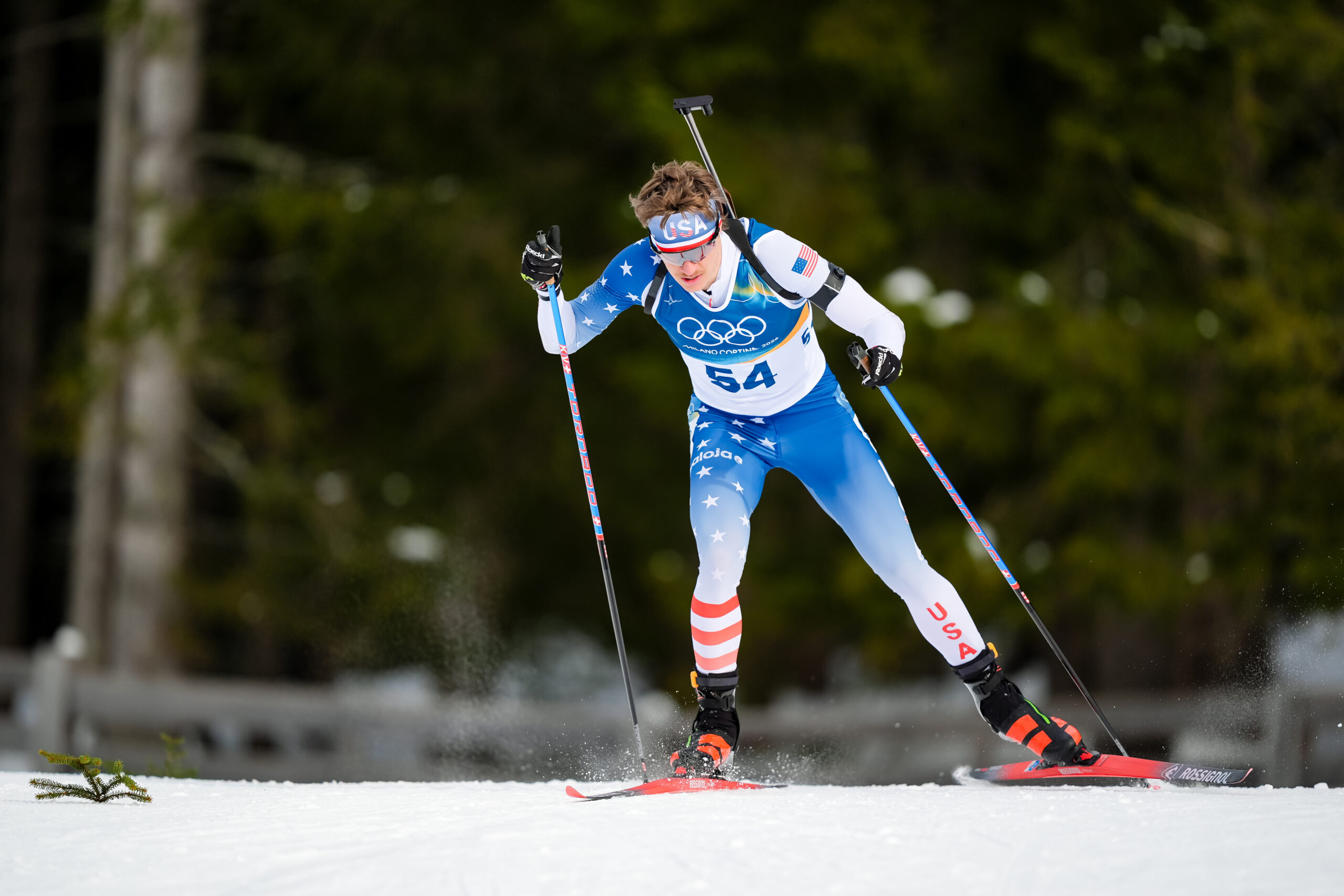
    Campbell Wright (USA) during the biathlon sprint at the XXV Olympic Winter Games in Antholz (ITA). (Photo: Thibaut/NordicFocus)

    Every winter, for a few weeks in February, cross-country skiing and biathlon stop being niche pursuits in the United States. During the last Olympic period, FasterSkier drew more than 180,000 unique readers in a single February, most of them people who do not know the sport’s governance history and have never heard of the Ted Stevens Olympic and Amateur Sports Act. On Wednesday afternoon, a board most of those readers could not name will vote on a decision that could reshape how one of their sports is run for the rest of the decade and beyond.

    The question in front of the U.S. Biathlon board is whether to enter a “Strategic Operating Alliance” with U.S. Ski & Snowboard, the far larger national governing body that oversees Olympic and Paralympic skiing and snowboarding. Under the proposal, U.S. Biathlon would remain a legally separate organization and the recognized governing body for the sport, but would hand much of its day-to-day operation to U.S. Ski & Snowboard under a services agreement. To its architects, it is a way to give a chronically under-resourced sport the stability and commercial muscle it has never had. To its critics, it is the moment a proud, independent program stops steering its own ship.

    The two sides do not disagree much about the facts. They disagree about what the facts mean.

    What is actually being proposed

    Strip away the temperature of the debate and the structure is specific, and it has changed meaningfully since the idea first surfaced publicly in the spring. The current terms, which U.S. Biathlon posted for its members on July 27, describe an alliance rather than a merger in the dictionary sense. No organization dissolves.

    Under the agreement summary, U.S. Biathlon “will remain a separate legal entity,” keeping “its own corporate existence, financials, and independent audit.” It stays the governing body recognized by the U.S. Olympic & Paralympic Committee under the Ted Stevens Act, and keeps its membership in the International Biathlon Union, the sport’s world federation. Its name, logo, and trademarks remain owned by U.S. Biathlon and are licensed to U.S. Ski & Snowboard.

    What changes is who runs the operation. Under a services, or operating, agreement, U.S. Ski & Snowboard would take over “staffing, programs, events, and administration for biathlon,” giving the smaller sport access to a chief financial officer, general counsel, marketing and revenue staff, medical and sport-science support, and technology infrastructure it cannot afford on its own. U.S. Biathlon’s own staff, its leaders say, would remain responsible for running the sport itself. A new Biathlon Sport Committee would be created inside U.S. Ski & Snowboard, mirroring the structure the larger body already uses for cross-country and its other disciplines.

    Jack Gierhart, U.S. Biathlon’s president and chief executive, described the mechanism plainly in an interview. “The mechanics of this are like an operating agreement between U.S. Biathlon and Ski and Snowboard where they take over operations,” he said. “That’s how we’re honoring and satisfying the Ted Stevens Act.”

    Sophie Goldschmidt, president and chief executive of U.S. Ski & Snowboard, framed the same structure around what biathlon keeps. “We would keep the biathlon entity. In fact, we keep the biathlon name, the biathlon logo,” she told FasterSkier. “From a legal perspective, it would also have its own entity. With that, it would have its own board. So very much operating like it does today, but sitting within a larger framework so that it can benefit from the other resources and shared knowledge, extra funding that we can provide.”

    That phrase, “operating like it does today,” sits at the center of the argument, because a great deal depends on how much a board that has delegated its operations still actually decides.
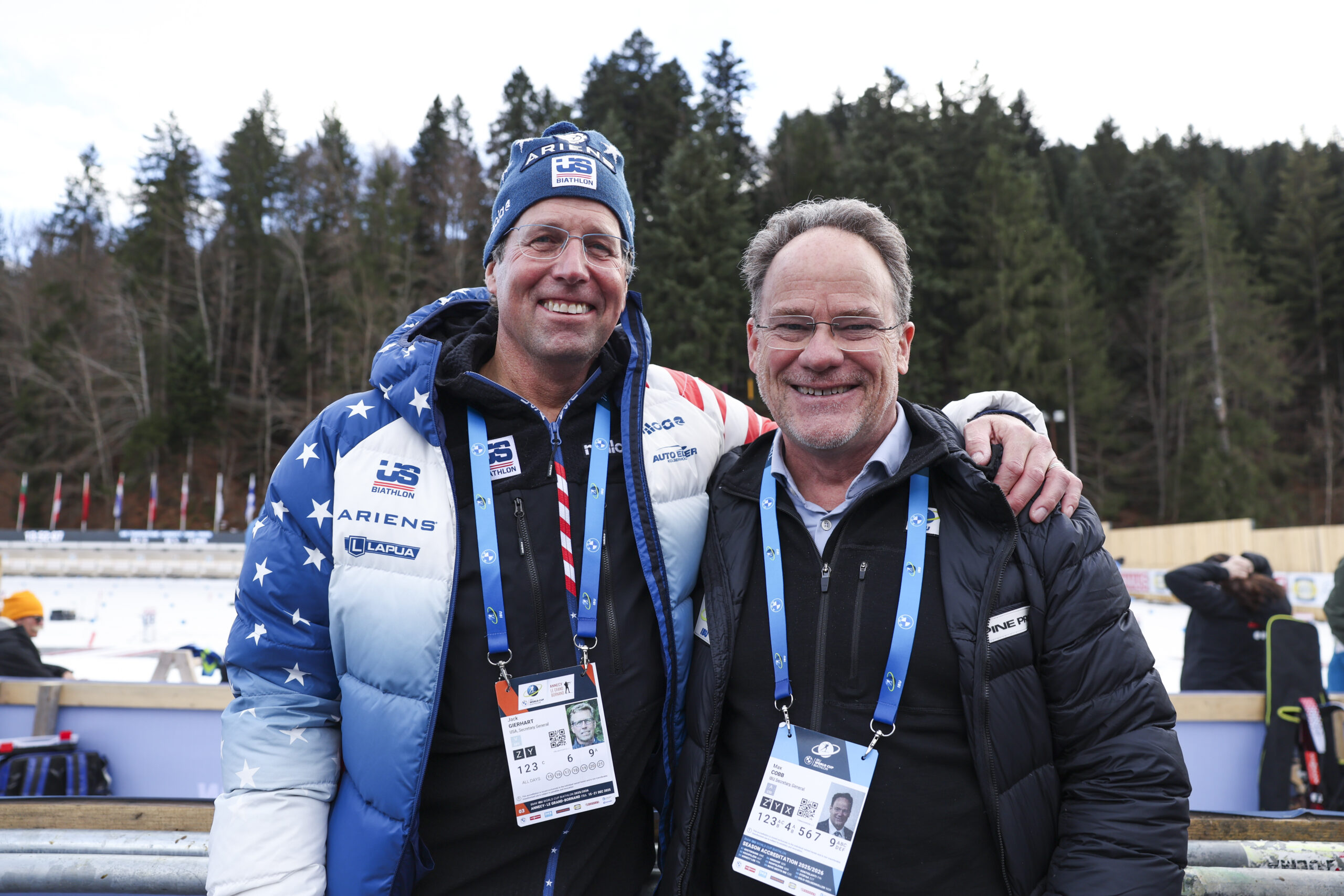
    USBA CEO Jack Gierhart poses with Max Cobb (IBU Secretary General) (l-r) at the IBU World Cup in Annecy-Le Grand Bornand (FRA) last December. (Photo: Manzoni/NordicFocus)

    How the sport got here

    By the account of the people who built it, this did not begin as a takeover. It began, Gierhart said, as an attempt to solve a problem every small Olympic sport shares.

    Gierhart arrived at U.S. Biathlon in September 2022, as longtime leader Max Cobb was leaving for the IBU. The organization was early in a strategic plan aimed at growing the sport, and a central piece of that plan was working more closely with the cross-country community, since most American biathletes come from skiing. “From my experience being in sport for 25 years, when you offer people more options, more pathways, you increase retention and you grow the pie,” he said. “It’s like, this should be a no-brainer, but then you run into the cultures and communities.”

    Those conversations, Gierhart said, drew in the U.S. Olympic & Paralympic Committee, which oversees and funds the country’s Olympic sports. “The USOPC started to suggest, hey, we’ve got a lot of these small NGBs, why don’t you guys think about something a little more formal?” he said. That was roughly a year and a half ago. The organizations sketched the basic terms, paused through the Olympic and Paralympic Games so as not to distract athletes, then brought the concept to a wider audience in the spring.

    Goldschmidt described the same arc and made the case for why her organization wants biathlon at all. U.S. Ski & Snowboard already runs multiple sports under one roof, she said, which means it can absorb the compliance and administrative costs that crush small governing bodies. “The central costs can really be absorbed and be a real cost saving for those organizations,” she said. “Legal, finance, safe sport compliance, all of that, which is quite a big burden, especially on some smaller NGBs. We can absorb that quite easily without having to increase the cost base, which means practically more money is going directly to the athletes.”

    The rollout did not land smoothly. After town-hall meetings drew pointed questions, the two organizations convened three joint working groups, on governance, sport development, and high performance, that met through the back half of July. Twenty-eight to twenty-nine participants, including athletes, coaches, club leaders, and staff, spent two weeks documenting what a successful alliance would require and what worried them. Their reports, posted publicly, have become some of the most revealing documents in the whole debate, in part because they capture both the community’s hopes for closer collaboration and its doubts, in the community’s own words.
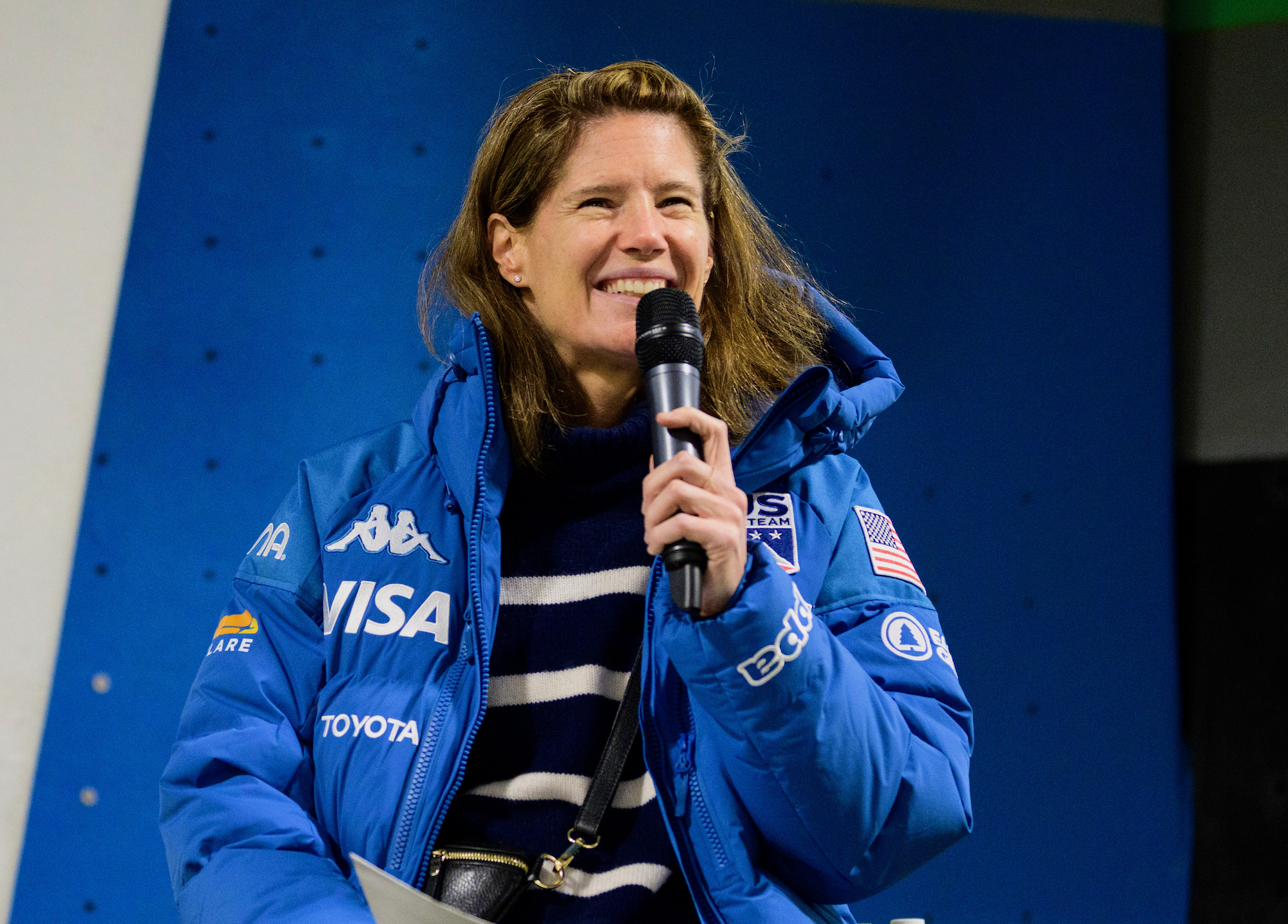
    Sophie Goldschmidt speaking at the Alpine World Cup in Killington, Vermont in 2024. (Photo: U.S. Ski & Snowboard)

    The money, and the question at the center of it

    Almost everyone involved agrees that money is the engine of this deal. What they do not agree on is how to describe the pressure behind it.

    The clearest number comes from Gierhart. For the coming season, he said, the USOPC reduced U.S. Biathlon’s grant by 22 percent. The reason, in his telling, has less to do with the alliance than with a shift in how the USOPC allocates money. Roughly three years ago, he said, the committee created an investment framework weighted toward medal potential. “They told us a couple of years ago, you guys are one of the highest funded sports, you haven’t delivered medals,” Gierhart said. “There’s a good probability you’re going to get a cut. And that’s what happened. They cut us,” a reduction he put at 22 percent for this year.

    Crucially, Gierhart rejected the idea that the cut is a lever to force the alliance. “It hasn’t been like, if you don’t do it, we’re taking away money,” he said. “It was, we’re taking away money because you’re over-resourced from our model standpoint and you’re not delivering. But if you go in this direction, which we believe will be beneficial in the long term, we want to help you do that.” Asked directly in a later FasterSkier interview whether it was a threat, he drew the distinction again. “They gave us our grant for this year, and it’s the 22 percent reduction. But they said that if we move in this direction with this alliance, they want to invest more in us. And they will find a way to do that,” bringing biathlon “back to where we were.”

    Goldschmidt, in interviews with FasterSkier, likewise described the reduction as reversible if the alliance proceeds, and tied it to the USOPC’s belief that a more efficient biathlon can compete for medals.

    The U.S. Olympic & Paralympic Committee, asked to confirm the figures and to say whether restoration of the funding is contingent on the alliance being approved, declined to address specifics. In a written statement, spokesman Jon Mason said the committee “is aware of and engaged in the discussions between U.S. Biathlon and U.S. Ski & Snowboard, and we support them taking a deliberate, transparent, fact-based approach to exploring a future relationship that complies with the Ted Stevens Olympic & Amateur Sports Act.” The committee, he added, is “supportive of outcomes that can build long-term stability and create opportunities for current and future generations of athletes.” The statement did not confirm the size of the cut, and it framed compliance with the Act as a goal the parties must meet rather than a settled fact.

    What the alliance would add is documented. According to the high-performance working group’s summary, biathlon “would receive a ~$600k increase from current FY27 revenue projections” in the first year, with U.S. Ski & Snowboard guaranteeing an increase “from this year-one level through year 4.” Gierhart put the combined total, new revenue and shared-services savings together, at “at least” $3.3 million over four years. That money, in principle, flows back into programs.

    Set against U.S. Biathlon’s roughly $3.5 million in annual revenue, those are not small numbers. And they arrive alongside a promise that biathlon’s existing money stays biathlon’s. Under the agreement, “all funding designated for biathlon, including IBU and USOPC support, existing sponsorship contributions, charitable donations, and other biathlon-specific revenue, will remain ring-fenced and used exclusively to support biathlon.”

    Here Goldschmidt was careful to correct what she called a misunderstanding. The ring-fence, she said, is permanent, not a four-year arrangement. “All of the money that they generate that is ring-fenced for biathlon will continue to go to that program. That will be a contractual commitment,” she said. “Some people have got confused that we’re only committing to four years to ring-fence and provide them funding. That’s not accurate.” The four-year commitment, she clarified, applies to the additional commercial funding U.S. Ski & Snowboard brings to the table, which depends on the sponsorship deals it can renew.

    Gierhart described the same two-part structure, and pushed back on the idea that biathlon falls off a cliff when the four years are up. “This gives us a platform for four years of sort of guaranteed increased revenue to build momentum and to implement the things that we know are going to help us,” he said. “Without that, we’re going to live year to year, and we’re already in maintenance mode as opposed to growth mode.” In four years, he argued, biathlon would be “in no different a situation than we are today. In fact, we’ll be better, because we’ll have a lot more resources to work with over the next four years.”

    That distinction defines exactly where the community’s deepest financial fear lives. The money biathlon already raises is protected by contract. The new money, the actual growth case, is guaranteed for one Olympic cycle, through 2030, and after that depends on the USOPC and on sponsors, the same as it would if biathlon stood alone.
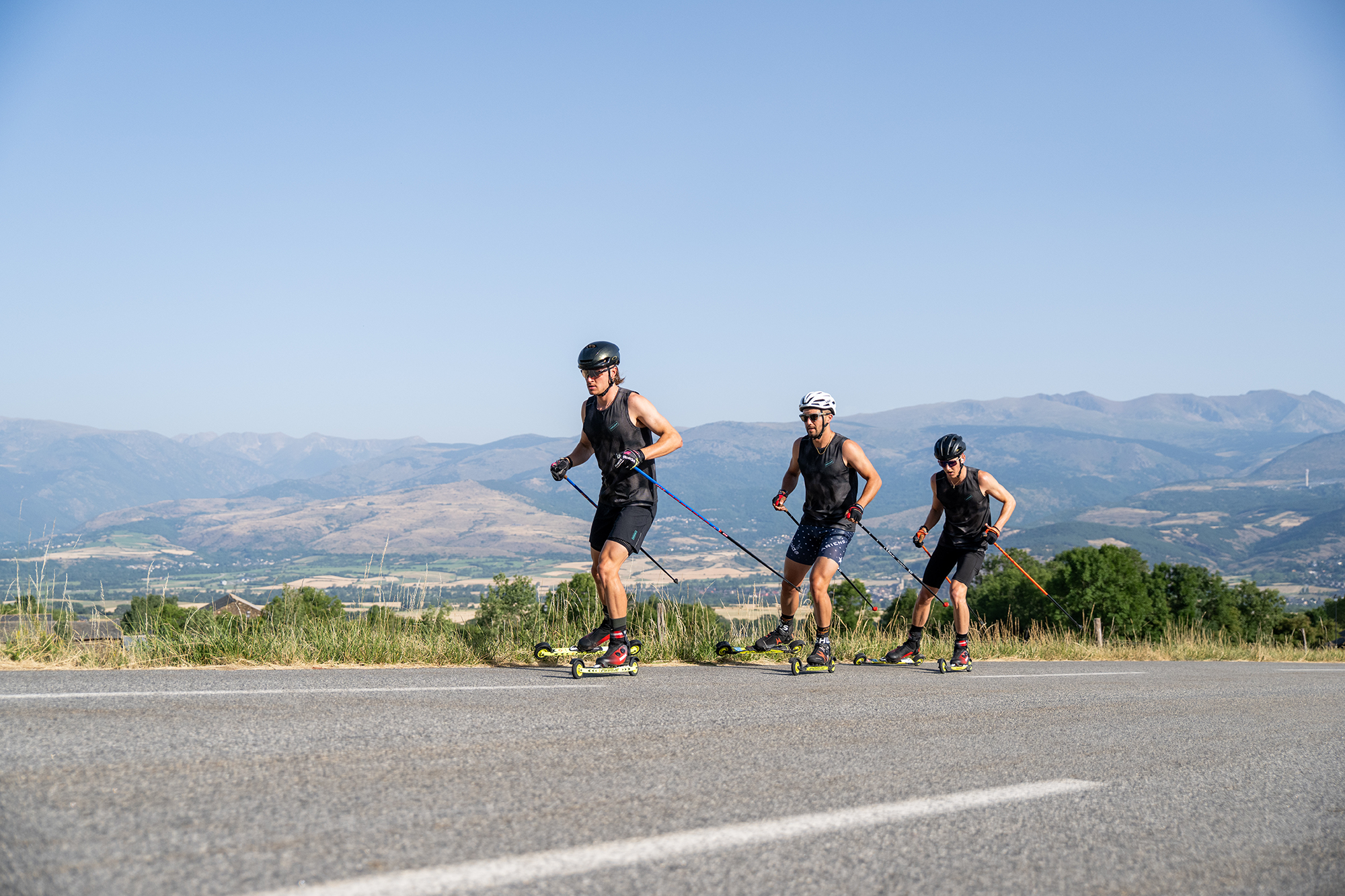
    While much of the US biathlon community debates governance, the USBA’s Campbell Wright, Vincent Bonacci, and Maxime Germain (l-r) gets after their summer training in Font-Romeu (FRA). (Photo: Authamayou/NordicFocus)

    The Ted Stevens question

    No part of the debate has generated more heat than the law. A group of members, some of whom helped establish U.S. Biathlon as an independent governing body decades ago, argue that the alliance violates the Ted Stevens Act. Their case rests on two provisions.

    The first is the single-federation rule. Under 36 U.S.C. 220522, a national governing body must be “a member of no more than one international sports federation that governs a sport included on the program of the Olympic Games.” U.S. Ski & Snowboard belongs to FIS, the International Ski and Snowboard Federation. Biathlon answers to the IBU. Critics contend that if U.S. Ski & Snowboard effectively governs an IBU sport, the arrangement collides with that rule.

    The second is autonomy. The same statute requires a governing body to be autonomous, in that it “independently decides and controls all matters central to governance” and “does not delegate decision-making and control of matters central to governance.” Arthur Stegen, a former U.S. Biathlon board member and part of a group called Team Independent Biathlon, laid out the objection in correspondence circulated to other members and shared with FasterSkier: a services agreement that assigns operational responsibility to U.S. Ski & Snowboard, he argues, is by definition a delegation of control, and reducing the biathlon board to a sport committee “would appear to relinquish its governance responsibilities to another organization.” Stegen wrote that he is “completely against this potential merger.”

    The written terms were plainly built to answer that challenge. The agreement summary includes a section titled “Reserved Governance Authorities,” which states that “notwithstanding any operational responsibilities delegated to U.S. Ski & Snowboard,” U.S. Biathlon “will retain sole authority over all matters required by the Ted Stevens Act or otherwise reserved to the National Governing Body,” including “oversight of the organization, approval of the biathlon budget, and all authorities reserved to the NGB.” In other words, the deal’s authors say operations are delegated while governance is reserved.

    Goldschmidt said the structure was designed to align with the statute from the start. “We’ve worked with the USOPC and others to ensure it fits all of those criteria, which it does,” she said. Gierhart said U.S. Biathlon has already received an opinion on the point. “We’ve gotten the opinion from the USOPC’s legal counsel on the terms as they’re written now, and their opinion is that it meets the requirements and is in compliance with the Ted Stevens Act,” he said.

    He was also clear about sequence, and described it as the normal way such deals come together. Wednesday’s vote is on the foundational terms, the fundamentals both sides have agreed to. “You’ve got to agree on the fundamentals, and then that’s what’s going to drive the detailed operating agreement,” he said. That more extensive agreement, covering licensing of the biathlon trademarks, the function of the board, and the bylaws, would be drafted next, “vetted by independent counsel” to confirm it complies with the Act, and then brought back to the U.S. Biathlon board, athlete representatives included, for a separate vote to approve it.

    That staging is itself contested ground. Supporters see a standard process: agree on principles, then build and independently vet the detailed contract. Skeptics see a board being asked to commit before the full agreement exists and before the independent legal review happens, and some argue a binding vote should wait until both are done. What Wednesday’s vote actually authorizes, the concept or a finished deal, is a distinction worth watching closely as the meeting unfolds.

    The USOPC, for its part, did not put its weight behind a declaration that the current structure is legal. It said it supports the parties “exploring a future relationship that complies” with the Act, language that leaves compliance as something still to be demonstrated.

    There is precedent for the skepticism, and for U.S. Ski & Snowboard’s interest in expansion. The organization previously pursued governing roles in surfing and skateboarding, efforts that critics cite as evidence of a broader ambition to build a multi-sport governing body, the very kind of concentration the Ted Stevens Act was written to prevent. Goldschmidt described those episodes as different in kind. Surfing, she said, “just got too political,” and the organization walked away; skateboarding remains “ongoing” with “no immediate decisions.” Biathlon, she argued, is a natural fit that most European countries adopted long ago. “I get asked all the time, why is biathlon not integrated within your organization,” she said. “It’s a natural fit in many ways.”

    Who controls the board

    Because the autonomy argument turns on control, the composition of the board is more than a technicality, and it is an area where early rumors and current terms diverge sharply.

    Gierhart was emphatic that the U.S. Biathlon board does not shrink or change hands. “The board is going to continue at the same size it is by the bylaws. It’s 12 to 15 members. They’re voted on by the membership,” he said. Those voters remain biathlon’s own roughly 1,500 members, whose categories will be tracked separately even after membership systems migrate to U.S. Ski & Snowboard’s platform in the 2027-28 season. “Our board size is not going to change. The composition is not going to change,” Gierhart said.

    Just as important, he said, is what that board keeps deciding. Among the authorities it retains is control of the budget and the annual plan, meaning that where biathlon’s money is spent would still be approved by the U.S. Biathlon board of directors.

    The new layer is the Biathlon Sport Committee, which the agreement describes as being drawn from the existing board, “6 to 8 members,” and maintaining the 33 percent athlete representation required by USOPC bylaws. The chair of that committee and one athlete representative would sit on the U.S. Ski & Snowboard governance board, giving biathlon two seats and a direct voice in the larger organization. The arrangement runs in both directions: U.S. Ski & Snowboard would, in turn, have representation on the U.S. Biathlon board.

    Athlete voice, a recurring worry, is addressed specifically. Rather than being folded into U.S. Ski & Snowboard’s athlete representation, “biathlon would still maintain its separate voice of athletes on the Team USA [Athletes’] Commission,” Gierhart said. “We’d have our own.”
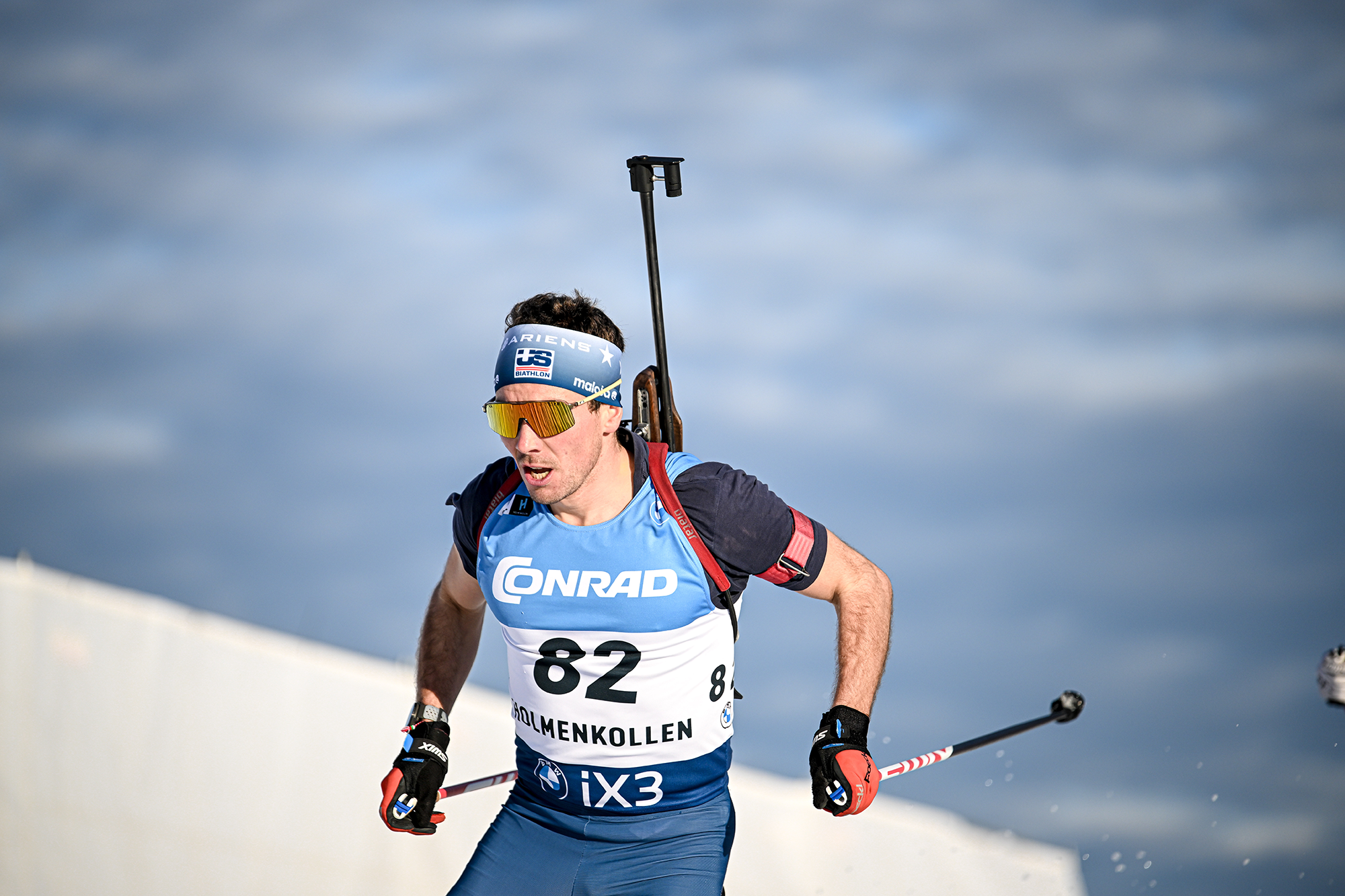
    Even though Jake Brown officially retired from the IBU World Cup after last season, he has played an active role as an athlete rep throughout this process. (Photo: Authamayou/NordicFocus)

    What changes for the athletes

    For the people who actually race, the alliance is not an abstraction about governance. It is a question about who pays for the plane ticket to Europe.

    U.S. Biathlon funds its athletes to a degree unusual among American winter sports. “Our athletes within biathlon are better funded and supported than in any other winter sport,” Gierhart said, noting that the program fully funds its World Cup athletes and nearly fully funds its IBU Cup athletes. Revisiting the specifics, he said U.S. Biathlon provides its athletes $48,000 in direct athlete support, $35,000 in need-based assistance, and $30,000 in performance bonuses, and secures roughly $36,000 a year for its top competitors. Cross-country, by contrast, does not pay national-team skiers to compete on the World Cup; much of that burden falls to clubs and to community fundraising.

    That gap is the source of the athletes’ most concrete fear. Jake Brown, who retired from biathlon this year and sits on the U.S. Biathlon board as an athlete representative, said the worry he hears most is that biathlon’s funding model quietly converts to the ski-team model once the sports combine. He is careful to add nuance. “There’s nothing guaranteed that U.S. Biathlon will continue funding World Cups either,” he said. “The funding has to be there.” Biathlon also draws money from the IBU for each athlete who starts a race, which makes subsidizing those starts partly self-financing, and the sport has leaned into keeping athletes in the pipeline rather than cutting them early. “We can’t afford to lose them,” Brown said.

    The agreement attempts to lock that model in place, but only for a defined window. The current athlete support model “will continue through the 2030 Olympic quad,” it says, with “National Team, World Cup, IBU Cup, Youth, and Junior athlete support structures” remaining “in place unless changes are jointly approved by the Biathlon Sport Director and the U.S. Biathlon Board.” As with the incremental funding, the guarantee runs one cycle. What happens after 2030 is precisely what no document can promise, though, as Gierhart notes, biathlon cannot promise that to itself every year either.

    No voice in this debate has lived that risk more directly than Justin Wadsworth, the former U.S. Olympian who now is U.S. Biathlon’s Head Physiology Coach (working with both the men’s and women’s national teams) and who spent years coaching in Canada, including a stretch as a high-performance director there. Wadsworth described watching Biathlon Canada’s funding collapse. “Over the last eight to ten years, we’ve seen organizations having funded the athletes for all camps, all trips, everything, to now athletes paying for training camps, paying for trips,” he said. “That’s basically what’s really pulled Biathlon Canada down. The athletes just can’t afford to go on trips or training camps.”

    The damage, he said, was not only financial. “It really changes the dynamic with the team,” Wadsworth said. “As a coach and as an organization, it’s much harder when athletes are paying for everything.” His wife, Beckie Scott, the Olympic champion who now leads Nordiq Canada, made cutting athlete fees a priority for exactly that reason. Asked what U.S. Biathlon should guard most carefully, Wadsworth did not hesitate. “The number one is just, are the athletes going to continue to be getting funded when they’re absorbed with U.S. Ski and Snowboard.”

    Brown framed the same anxiety in a different register, as a question of trust. “There is a strength in independence,” he said. “You have a trust that your leader, when they put their head on the pillow every night, is trying to figure out how to make biathlon better in the country, and not trying to figure out how to prioritize what sport within a larger organization.” That, more than any statute, is the emotional core of the opposition: the fear that biathlon becomes one line item among many, advocated for by executives whose attention is divided.

    The community’s own working group named the same items. The high-performance group’s report listed what “must be protected”: the centralized national team model, athlete stipends and need-based aid, the pathway that recruits skiers into biathlon, the world-class ski-service program, the Montana State University sport-science partnership, and “athlete-centered decision making.” It also warned, in writing, of the risk that unites the skeptics and the supporters, that “differences in stipends, housing, and athlete funding philosophies will be inequities across sports,” and that “the reasoning behind this must be explained well, or there is high risk of tension between sports.”

    The case for

    Set the fears aside and the argument for the alliance is not hard to follow, and some of its most persuasive versions come from people with no stake in the outcome.

    Wadsworth, who says he has “no real skin in the game” and is “just trying to coach right now,” makes the efficiency case from painful experience. A small governing body cannot carry the overhead a large one can. “An appeal, from an athlete and the organization needs to get a lawyer for that, a single appeal can cost 30 to $50,000,” he said, “and if that’s 5 percent of your budget, that’s a big hit.” Fold biathlon into a larger organization with in-house counsel, fundraising staff, a training center, and sport scientists, he said, and those costs largely vanish. “Those efficiencies are really the positive side.”

    Goldschmidt’s version is about scale on the revenue side. U.S. Ski & Snowboard, she wrote to biathlon’s members, generated “more than 900 million social media impressions and 7 billion earned media impressions last season,” counts more than a million social followers, and has “more than doubled our commercial revenue over the last four years,” with “nearly 85 percent of that revenue going directly to athletics.” Biathlon, by her argument, brings a genuinely valuable and telegenic property, the IBU World Cup is among the most-watched winter sports in Europe, that a 35,000-follower organization cannot monetize on its own. “One plus one can equal a lot more than two,” she said, “most importantly for biathlon.”

    Gierhart’s case is about the limits of the status quo. “We’ve been doing the same thing for 60 years,” he said. “We’re a small sport, we have limited resources. We’ve always had a thin bench. But the formula isn’t changing. And if we’re going to try to drive transformational change, we’ve got to look at some things a little differently.”

    And there is the pipeline, the argument that biathlon and cross-country are natural partners that have been kept artificially apart. Today a club that wants to offer both sports contends with two governing bodies, two memberships, two coaching-education systems, two calendars. The sport-development working group’s central recommendation was to merge those tracks, shared coach education, coordinated regional calendars, laser biathlon introduced to youth skiers, so that, in Brown’s words, the “big potential benefit comes in the sport development space.” Wadsworth added the practical constraint that enthusiasm tends to skip past: it comes down to shooting ranges. “The number one thing for biathlon is you need a range, and so that’s probably a limiting factor,” he said. “If U.S. Ski and Snowboard decides they really want to focus on the development side, they’re going to have to build more biathlon ranges. If you build it, they’ll come.”
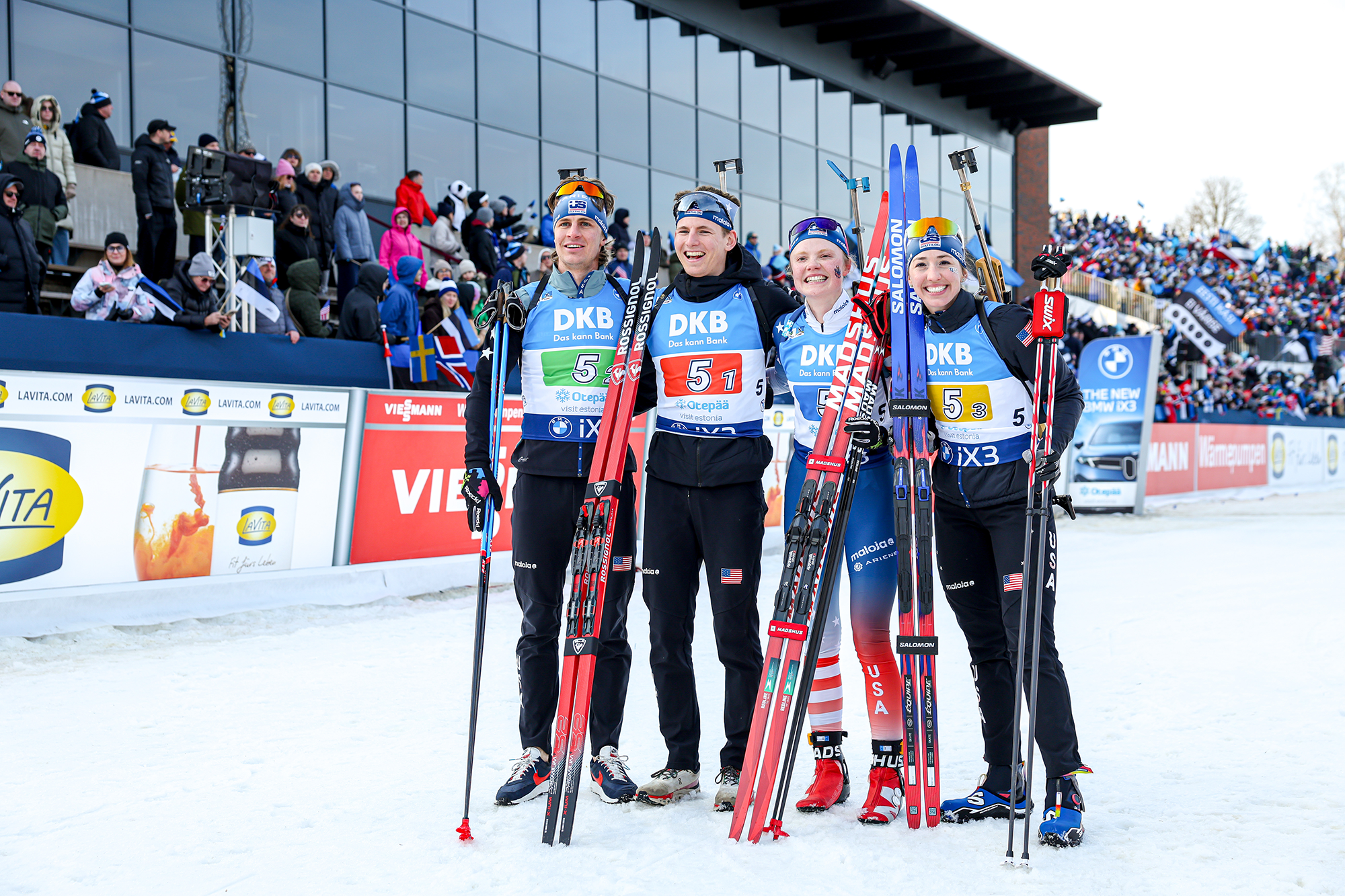
    Campbell Wright (USA), Maxime Germain (USA), Margie Freed (USA), and Deedra Irwin (USA), (l-r) after the IBU World Cup Biathlon mixed relay in Otepaeae (EST). (Photo: Manzoni/NordicFocus)

    The case against, in the community’s own words

    The sharpest questions about the alliance do not come from the members trading accusations online. They come from the process U.S. Biathlon itself ran. The working groups produced plenty of enthusiasm for closer collaboration, and their reports document at length the benefits participants believed an alliance could unlock. But the same reports surfaced a recurring doubt.

    Across all three groups, participants returned to a single question: if the goal is collaboration between biathlon and cross-country, why does it require a formal alliance? The consolidated report notes that “several participants observed that many of these initiatives could theoretically be pursued without a formal alliance.” The sport-development group put it more bluntly in its written takeaway: “Some expressed confident progress could be made without an alliance. It is not accountability that will move this from conversation to action. It is the passion of the people involved in both sports.” (U.S. Biathlon cautions on every page that the working-group notes were “generated during meetings in which judgment was not applied” and “do not represent the decisions or strategies” of the organization.)

    The governance group’s “parking lot” of unresolved issues reads like a checklist of the skeptics’ concerns: “Ted Stevens Act compliance,” “an escape path if integration fails,” “what autonomy does Sport Committee have to direct USSS operations,” and whether a replacement is needed for the athletes’ advisory council “to preserve biathlete input.” The high-performance group flagged “budget flexibility,” asked “which proposed benefits truly require an alliance, and which can already be achieved through partnership,” and wondered whether biathlon could build its own dedicated fundraising vehicle, an equivalent of the National Nordic Foundation, without merging at all.

    U.S. Ski & Snowboard’s answer to the “why not just collaborate” question is that informal collaboration has been tried, and has not delivered. The alliance-alignment document U.S. Biathlon distributed argues that, while the two organizations “have collaborated successfully for many years, this formal Alliance creates a level of commitment, coordination and accountability that cannot be achieved through informal collaboration alone.” Gierhart put it more sharply. He said he disagrees “wholeheartedly” with the notion that passion alone will carry the work forward. “You need accountability,” he said, describing what he sees as a fundamental difference within the community over how things actually get done. Goldschmidt made the same point about incentives: absent a formal structure, she said, no one at a big organization is measured on whether they helped a small one. “Why would I help another sport if that’s not how I’m measured?”

    Then there is the matter of process and speed, which even supportive athletes acknowledge. Brown said the spring rollout caught the community off guard. “It kind of came out in the springtime. It was a little bit surprising, and it took us some time to understand why,” he said. “Most of the membership and the athlete body, we had some catching up to do.” The working groups were themselves a response to feedback that the process had moved too fast with too little consultation, and some members continue to argue that a binding vote should wait for the final agreement and its independent legal review, both of which, by U.S. Biathlon’s own account, come after Wednesday.

    The exit, and what the fine print says

    If there is a single provision that will decide how much reassurance skeptics take from this deal, it is the exit. Gierhart is adamant that it is a last resort, not a trap door.

    He described a defined process. Goals and key performance indicators would be set at the outset, with an assessment after the first year and a comprehensive review at the end of the quad. “If we get to a point where there’s irreconcilable differences,” he said, “then there is an option to move towards a different operating structure, which could mean that U.S. Biathlon becomes an independent operating entity again. And that is a choice that can be made by either party. It doesn’t have to be mutually agreed upon.”

    He was careful to say that does not mean either side can simply walk away on a whim. The written summary describes an interim assessment after the 2026-27 season and a comprehensive review after 2029-30, and says that “should significant challenges arise that materially impair the objectives of the alliance, the organizations will first implement a corrective action plan.” Only “if substantial concerns remain unresolved after those efforts” would “alternative organizational structures, including the return of U.S. Biathlon to an independently operated organization, be considered.” That, Gierhart said, matches what he meant: a process of measuring progress against shared goals, trying to fix what is not working, and only then, if the problems prove irreconcilable, allowing either party to end the alliance without the other’s consent.

    “I don’t want it to sound in any way that in four years there’s an exit ramp that’s most likely going to happen,” he said. It is less an exit ramp, in his framing, than a runaway-truck ramp: an emergency measure, rarely used, that exists only for the case where nothing else has worked. The distinction that matters, he said, is that the eventual decision does not require both sides to agree. “It would probably be the board of directors of U.S. Biathlon that would say, we can’t resolve these differences and we want to make a change. Or Ski and Snowboard would say this is not working.”
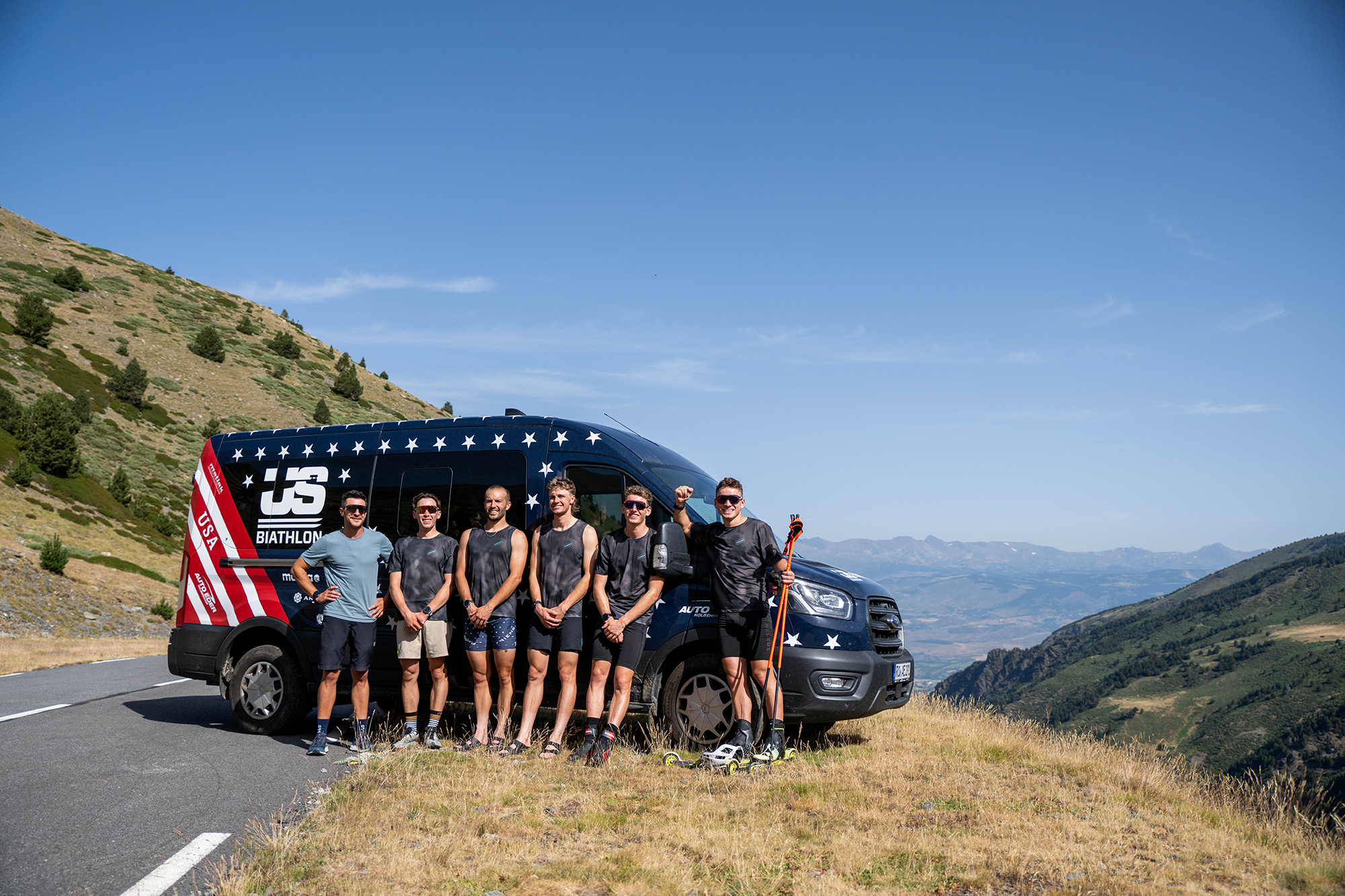
    Emil Bormetti (ITA); Coach Team USA, Bjorn Westervelt (USA), Vincent Bonacci (USA), Campbell Wright (NZL), Maxime Germain (USA), Vaclav Cervenka (USA), (l-r) summer training in Font-Romeu (FRA). (Photo: Authamayou/NordicFocus)

    What happens Wednesday

    The board meets Wednesday at 4 p.m. Eastern. By Gierhart’s account, directors received an extensive board package over the preceding weekend, and the athlete representatives, who under USOPC rules make up a third of the board, have been closely engaged.

    What the vote settles may be narrower than the noise around it suggests. If the board approves the foundational terms, the more detailed operating agreement, and its independent legal review, would follow, along with a further board vote to approve it. If the board balks, or postpones, the timeline slides. Either outcome will be read as a verdict on a process that many in the community found rushed and many others found overdue.

    The stakes are real in both directions, which is why the debate has been so bitter. If biathlon stays independent, it does so facing a documented funding cut and the same structural constraints that have kept it small for six decades. If it joins, it trades a measure of autonomy for stability, resources, and a commercial platform it has never had, and it does so on the promise, guaranteed for four years and asserted in perpetuity, that the sport it has built will not be diminished inside a larger one.

    The people on every side of this insist they want the same thing. “Whichever way the board decides,” Brown said, “I really want to be able to take our membership with us in whichever direction we go, and maintain good relationships with our full community. Because otherwise, we lose.”

    On Wednesday afternoon, fifteen people will decide which way that goes.

    FasterSkier will report the outcome of Wednesday’s vote. Reporting for this article included interviews with U.S. Ski & Snowboard president and CEO Sophie Goldschmidt, U.S. Biathlon president and CEO Jack Gierhart, U.S. Biathlon athlete representative Jake Brown, and U.S. Biathlon head physiology coach Justin Wadsworth, a written statement from the U.S. Olympic & Paralympic Committee, and a review of the alliance term sheet, the July 2026 community working-group reports, and correspondence from members opposed to the deal.

    Because the details of this proposal are complex, quotations attributed to U.S. Ski & Snowboard and to U.S. Biathlon were provided to each organization in advance of publication so they could verify the accuracy of their own statements and clarify technical details. FasterSkier retained full editorial control over the content, framing, and conclusions of this article.


    Help Support Our Coverage!

    If you value the thoughtful work and access FasterSkier provides, please consider becoming a Voluntary Subscriber. Your support directly fuels our work to cover the people, places, and moments that make our sport special.

    Join the FasterSkier community!


    At this moment, we don’t know what is down the road for USA Biathlon, but hopefully we will stay a community that supports the sport and the hard work of the athletes and coaches doing their best to perform at the highest level. (Photo: Authamayou/NordicFocus)
  • This Week in Canmore: Biathlon World Cup Season Finale

    This Week in Canmore: Biathlon World Cup Season Finale

    Canmore is having a year.

    Just over a month after hosting the International Ski Federation (FIS) Cross Country World Cup, the Canmore Nordic Centre is pulling out all the stops and showcasing its brand-new biathlon facility as the host of the International Biathlon Union (IBU) World Cup Finals from Thursday, March 14 to Sunday, March 17.

    The world-class venue amid Canada’s Rocky Mountains is no stranger to World Cup nordic and mountain bike events. It hosted 2016 and 2019 IBU World Cups and, as recently as last year, eight IBU Cup events in advance of the 2024 Biathlon World Cup Finals.

    Two years ago, Alberta’s provincial government granted the Canmore Nordic Centre $17.5 million to upgrade and enhance its biathlon building, stadium, snowmaking, and range. According to Ken Davies, the Canmore IBU World Cup event chair, they broke ground in May 2022 and have nearly completed the project as of this March.

    New biathlon building at the Canmore Nordic Centre. (Photo: Biathlon Canada/Pam Doyle)

    “It’s huge,” he said. “We sort of stirred the pot initially seven years ago to get them to reinvest in the nordic centre, and the Alberta government followed through, so credit to them.”

    In 2017, the Canmore Nordic Centre requested improvements to its biathlon facility, which hadn’t been updated since 1986, when it was built for the 1988 Olympics. The biathlon stadium needed to be widened to meet IBU regulations and continue to host World Cups. The nordic centre also wanted to replace its undersized timing building and wax facilities, expand its snowmaking, and modernize its shooting range.

    Just three days before the start of the IBU World Cup Finals, the Canmore Nordic Centre is ready to show the world its fresh new look. According to Davies, the father of Olympic biathlete Macx Davies and a Canmore World Cup organizer since 2005, the biathlon course has been “turned upside down.”

    “When you come in and shoot, we now do a 180-degree turn in the stadium so the spectators can see the athletes for longer,” he explained. “We used a lot of the same course, but how we start and finish is completely different.”

    Situated between 1,425 and 1,550 meters (4,675 and 5,085 feet) above sea level, the Canmore Nordic Centre is one of Canada’s highest cross-country ski areas, and it has a deceivingly challenging World Cup course.

    “The trails are so well maintained, and they’re wider, so they look like highways, [but] they’re sort of sneaky hard,” Davies said. “People forget we’re at 1,400 meters of elevation. … We’re as tough as most places, and the racers all realize that when they come here.”

    Rosanna Crawford (Biathlon Canada) racing to 26th in the women’s 7.5 k sprint at the 2017 IBU World Championships in Hochfilzen, Austria. (Photo: Glen Crawford)

    According to Rosanna Crawford, a three-time Olympic biathlete based in Canmore, the approach to the range has changed. On each lap, racers must climb up to the stadium before shooting.

    “I’m curious to see how the athletes will like it,” said Crawford, who lives in Canmore with her husband, Brendan Green, also a Canadian Olympic biathlete. “Before, you had a somewhat easier range entry, but now, especially for the men’s sprint, they’re going to climb right up into the range, so I think they’ll be pretty gassed.”

    On the range, she said changing conditions can cause the wind flags to change immediately.

    “It’s a tricky range. The wind can really rip through there,” she said. “So I’ll be curious to see how the athletes handle that.”

    While Crawford has never watched a Biathlon World Cup in person since retiring from racing in 2019, she is excited to spectate with Green and her family this weekend. (Crawford is the younger sister of Olympic cross-country skier Chandra Crawford.)

    “Seeing it in person is going to be special because we are huge biathlon fans. We don’t miss a race, and we try to stay off social media until we can get home and watch the races on Eurovision,” Rosanna explained.

    Brendan Green racing to sixth for Canada in the men’s 4 x 7.5 k relay at the 2017 IBU World Cup in Hochfilzen, Austria. Sixth place matched the Canadian men’s previous best relay result. (Photo: Biathlon Canada/NordicFocus)

    “Brendan retired in Canmore [in 2019], so it was really special having his family there in the crowd,” she added. My cousin made some funny signs, like those face ones, so my whole family had my face on a stick that they were holding up. … Canmore’s just so special. I’m looking forward to being a number-one sports fan during the races.”

    When she’s not at the races hanging out in the Rocky Mountain Club and grandstands, she can tune in while working as a dental hygienist in town.

    “In my dental office, there’s a TV, and I’m able to stream from my computer,” she explained. “Luckily, I had some ski fans in my chair [during Canmore’s Cross-Country World Cup], and they would tell me when to look because you can’t clean teeth and watch TV at the same time.”

    USBA arrives in Canmore after stellar results at their home races in Soldier Hollow, Utah, led by Campbell Wright (USA), who finished in sixth place in the men’s 10km sprint. (Photo: NordicFocus)

    With more than 240 athletes from 25 countries, the Biathlon World Cup Finals are expected to draw 3,000 to 5,000 spectators for the Thursday and Friday events and up to 10,000 on the weekend days. Additionally, more than 50 million viewers are expected to watch remotely via Eurosport.  According to Davies, Canmore sold out of VIP and grandstand tickets within 36 hours, 70 percent of which were purchased by Europeans.

    General admission to the races is free and doesn’t require a ticket. In addition to the indoor Rocky Mountain Club VIP zone and bleacher (grandstand) seating, the venue can accommodate 10,000 non-paying spectators.

    Spectators are encouraged to use the courtesy shuttles between downtown and the venue, or take the scenic route by foot and enjoy an Art Walk in the Woods along the way. The Canmore Nordic Centre is 3.5 k west of Canmore, about a 30- to 40-minute walk from downtown. Crawford recommended bringing YakTrax or traction cleats for walking, just in case.

    In late February, a snowstorm brought about a foot of fresh snow to Canmore, which made everything look wintery again after an up-and-down winter. Davies said the biathlon loops have been ready since early December, and with expanded snowmaking, the Canmore Nordic Centre can open at least 10 kilometers of trails in mid-October.

    “We had a weird winter,” he said of the 2023/24 season thus far. “We had a really hot spot in January, but we also had a really cold spot. So there has been natural snow since November, but [the February storm] helped. .… It didn’t help me with organizing the event as far as digging everything out, but it helped what it looks like. It’s a winter wonderland right now.”

    This week, the forecast in Canmore called for sunny weather with daytime temperatures between 5 and 10 degrees Celsius (mid to high 40s Fahrenheit). During the last two IBU World Cups in Canmore, which were held in February of 2016 and 2019, many races were either shortened or canceled due to frigid temperatures.

    According to Davies, average temperatures for early March are a pleasant 3 degrees during the day and -5 at night. After the races, 12 Crystal Globes will be awarded to the top-ranked athletes in each discipline for their season-long performances. The competitions include sprints, pursuits, and mass starts over four days, and other spectator activities are being offered in town and at the venue, including an indigenous kickoff party on Thursday night.

    “Like Soldier Hollow, we have the benefit of not being in Europe. We have the benefit of being at a high enough elevation. We have winter, and we have snow,” Davies said of Canmore’s attraction. “We’re in the mountains, and it’s pretty easy to get an audience to watch races in that environment. The skiers love it. We have 70 kilometers of non-race trails that are groomed and ready to go. It’s all part of the same facility.”


    BIATHLON WORLD CUP FINALS SCHEDULE

    (All times MST)

    Thursday, March 14

    10:40: Women’s 7.5 k sprint (10:40 a.m.)


    Friday, March 15

    10:40: Men’s 10 k sprint


    Saturday, March 16

    11:10: Women’s 10 k pursuit

    15:10: Men’s 12.5 k pursuit


    Sunday, March 17

    11:10: Women’s 10 k mass start

    15:20: Men’s 15 k mass start


    Rosanna’s Favorite Canmore Hot Spots 

    • Best Lunch: Crazy Weed
    • Best Coffee: Bike Cafe
    • Best Shopping: “There are so many cute little stores that you can wander around and really experience the mountain life.”


    More recommendations


    Canmore, Alberta Canada


  • International Biathlon Referee: Sara Studebaker-Hall

    International Biathlon Referee: Sara Studebaker-Hall

    Sara Studebaker-Hall, two-time Olympian and current U.S. Biathlon Director of Operations, became the first U.S. woman to earn her International Biathlon Union (IBU) technical delegate certification in 2022, one of only a handful of Americans to achieve that distinction. Fast-forward to the 2023 IBU World Cup in Hochfilzen, Austria, Studebaker-Hall took part in her first biathlon World Cup as an IBU referee.

    “Hochfilzen is such a great venue – they have such an experienced organizing committee and such great fans that the atmosphere is amazing,” said Studebaker-Hall. “It was where I had my first top-30 result, so it also holds a special place for me personally! I had the opportunity to work with some really experienced TDs from IBU and it was great to be able to learn from them and gain more experience on the biggest biathlon stage.”

    Hochfilzen, Austria: IBU World Cup Biathlon. (Photo:  Manzoni/NordicFocus)
    Studebaker-Hall began her officiating journey in 2014 after she retired from biathlon. Following the completion of the level one and two officiating courses to be a domestic official in 2014, she spent the next 4 years assisting in various areas to gain experience. After applying for and completing the international referee exam, administered by the IBU, Studebaker-Hall was able to be assistant chief of competition to Tracy Lamb at the 2019 IBU World Cup at Soldier Hollow.

    Though it typically takes four years of experience to become eligible for a technical delegate (TD) certification, Studebaker-Hall was able to get her license in three years given her history as a biathlete and experience as a coach. To become a TD, one must attend conferences with current TD members and take both an oral and written exam, over a two-day period.

    After passing her exam and officially becoming the first American woman with a technical delegate certification, Studebaker-Hall was also elected to the IBU technical committee in September 2022.

    For Studebaker-Hall, the 2022/23 season consisted of officiating at two IBU Cup events in Canmore, Canada, as the start/finish referee, as well as being a shooting range referee at the 2023 FISU World University Games in Lake Placid, NY. It wasn’t until this past weekend in Hochfilzen, Austria that Studebaker-Hall had the opportunity to officiate as the start/finish referee at an IBU World Cup event.

    “Refereeing at the IBU Cup last season helped me gain knowledge, confidence and experience, but there’s nothing quite like the big show of the World Cup! It was such an exhilarating experience and really made me excited for hosting the world at Soldier Hollow in March.”
    As a strong advocate for gender equality in sport, Studebaker-Hall is breaking barriers in the U.S. and being a role model within the international biathlon world. Not only did she officiate her first World Cup event, but did so with her six-month-old daughter in tow.

    “Last year, I was about six months pregnant with my daughter, and this year I was able to bring her along. IBU was so supportive of me having her there with my parents to watch her during the races. I think it’s really important for athletes, especially women, to see that you can stay involved in the sport after competing and still have a life,” she added. “It takes some planning and lots of support, but I’m so glad I was able to continue working as a referee this season despite having my daughter. She won’t remember it, but hopefully someday she’ll also look back and see that I was able to have this great experience of working the World Cup while nursing a baby and feel empowered by that. I really love officiating and am excited about being one of many women coming up as IBU referees!”

  • Women Start Biathlon Season in Kontiolahti

    Women Start Biathlon Season in Kontiolahti

    Kontiolahti Kickoff

    Today marked the beginning of the World Cup Biathlon season for the women.  The women raced the 15-kilometer individual start format in Kontiolahti, Finland, skiing 5 laps on a 3-kilometer course. Missing from the start line were common pre-race favorites, Norwegian’s Marte Olsbu Roiseland and Tiril Eckoff, allowing other known stars to dominate the podium: Sweden’s Hanna Oeberg finished first, Norway’s Ingrid Landmark Tandrevold second, and Italy’s Lisa Vittozzi third. The U.S was represented by Deedra Irwin (25th), Joanne Reid (48th), Chloe Levins (56th), Kelsey Dickinson (61st), and Tara Geraghty-Moats (87th) who had recently switched from Nordic Combined and received her World Cup biathlon initiation.

    Norwegian, Ingrid Landmark Tandrevold shot clean on the day, finishing second behind the skiing prowess of Sweden’s Hannah Oeberg at the IBU World Cup Biathlon, individual women, in Kontiolahti, Finland. (Photo: NordicFocus)
    The Race

    Wednesday’s individual start format saw racers starting every 15 seconds in conditions that were a pleasant 26 degrees (-3 Celsius). But by the beginning of the race, 2:15 p.m. local time, the Arctic night had taken hold, and the sunlight had disappeared. Skiers raced under the lights. Wind is always an issue for the shooting portion of biathlon and the race began with relatively calm conditions of 2.5 mph (4km/h). The leadoff skier was Italian biathlon superstar Dorothea Wierer.  She would set the early pace by clearing all five targets in her initial shooting (prone) in under 25 seconds.

    Wierer’s strong start was quickly eclipsed by Swedish star Hanna Oeberg who left the first stage having shot clean.  The majority of the early racers went clean shooting, as well.  The race quickly turned into a family duel as Sweden’s Oeberg sisters, Hanna and Elvira, were separated by only five seconds after the first shoot.

    Much to the relief of the Italian team, bronze medalist, Lisa Vittozzi (ITA), overcame last year’s problems in prone shooting, hitting four of her first five shots. (Photo: NordicFocus).

    But charging hard was Ingrid Tandrevold of Norway who shot clean through two rounds and was also skiing well. Coming into the third shoot she continued her streak and shot clean, keeping her in the hunt.

    Coming out of the third shoot, Hanna Oeberg’s ski speed and clean shooting put her on top, followed by Linn Persson (Sweden) and Tandrevold. Elvira Oeberg missed one shot on her third round, ending the sibling rivalry, for this day at least.

    Coming into the final shoot, the outcome was still in doubt.  But Wierer fell out of contention when she missed three targets.

    Tandrevold skied at a controlled pace and ended up shooting clean on her final round, and for the day. She emerged from the fourth shoot in the lead, but many others had yet to shoot.

    Hanna Oeberg came into the final shoot knowing that five out of five would all but guarantee her the victory. She opened the door slightly by missing her fourth shot, but her quick skiing kept her in the lead.  She put the hammer down after her fourth shoot and put a little extra time on the competition.

    The sighs of relief continued from the Italian camp as Vittozzi shot clean in her final shoot; hopefully putting an end to her epic shooting woes from last season.

    The final standings mirrored the results of the standings at the end of the fourth shoot, with Hanna Oeberg slightly extending her lead over Tandrevold and Vittozzi.

    After the race, Hanna Oeberg related that her main goal for the day was to put the pieces together with the shooting and the skiing, and she was happy with both.

    Results for this race may be found here.

    Deedra Irwin (USA) finished 25th in the IBU World Cup Biathlon, individual women, at Kontiolahti (FIN). (Photo: NordicFocus)
  • U.S. Biathlon Season Preview with Lowell Bailey.  Part II

    U.S. Biathlon Season Preview with Lowell Bailey. Part II

    Deedra Irwin (right) competes in the Women’s 15km Individual race during the 2022 Beijing Olympic Games. (Photo: NordicFocus)

    This article is part of a series based on an interview with Lowell Bailey. Mr. Bailey represented the United States in biathlon in four Olympic games, 11 World Championships, and 15 World Cup seasons. He is currently Director of High Performance for U.S. Biathlon. His World Championship gold medal race is one of the most thrilling races ever. If you haven’t seen it, the race is available on YouTube and is a great watch. His continued enthusiasm for biathlon continues, and is contagious.

    This interview has been edited for clarity and brevity.

    Part II:  Perspective on U.S. and International Biathlon.

    How does the U.S. training, support, and logistics compare to other national teams?

    In some ways it’s a David versus Goliath situation, with the Goliaths being the Germanys and Norways of the world, which are government supported, and budgets are not a challenge. I want to make very clear that we receive tremendous support from the USOPC (United States Olympic & Paralympic Committee). We are aligned in our pursuit of excellence. It does a huge amount of the lift. We definitely have the support of our Olympic committee. The USOPC has increased focus on sports that we [the United States] haven’t traditionally excelled in. The conversation has shifted to include focus on sports where there are opportunities in terms of increasing medal count. Biathlon has twenty-seven possible medals in an Olympics. So, it’s a huge opportunity. It’s also one of the most competitive sports. In particular the USOPC’s support for our Lake Placid facility is critical. There are dorms, food, and medical support under one roof for biathletes at every development level. This is critical. Every day we spend there is time we don’t have to spend elsewhere and spend money elsewhere.

    That being said, there are teams out there who really don’t have to worry about budget. Some of the European teams which are government supported have close to a blank check. They have higher staffing levels than we do. They have more coaches and wax technicians, physical therapists, and doctors. So we have to be creative and find ways to highlight our strengths. The Goliaths are more concerned about what’s the winning strategy and don’t really worry about how much the strategy costs. Still, we have better support than many other nations, but if the goal is podiums, the competition is the big programs. We have to find creative ways to be better every year.  But, it’s not all about money.

    Susan Dunklee (USA) racing to 8th place in Nove Mesto’s pursuit. (Photo: NordicFocus)

    What are the expectations long and short term?

    One of the biggest changes has been reassessing goals, not for next year only, but for the next eight years. What is it going to take for a U.S. biathlete to step onto the Olympic podium? This has been part of a targeted plan to focus on areas for sustained excellence. But, we also definitely focus on the present and maximizing the opportunities of success for our current athletes.

    Individual goals are determined by each athlete and the coaches. Athletes are individuals. A good coach understands that some athletes are very goal oriented and want to focus on those goals. Others just want to think about their training plan and be removed from nuts and bolts of goal setting and training plan design. They just want to trust their coach, be given a plan, and execute the plan. Others want to set their own goals.

    The season is long and grueling. How do the athletes manage?

    It’s very individual. For instance, Scandinavia in November is dark (sunlight wise) and challenging for some. For many athletes that’s really challenging. It’s critical for athletes to find joy in the effort. Athletes have to maintain the identity of “why I’m doing this.” If you want to get to the top of the world you have to put yourselves in tough places. You have to maintain the identity that “this is why I’m doing this.” Everyone has a choice to stay excited … finding the excitement against the World’s best. It’s exciting and you have to remind yourself that you’re on that exciting path, competing against the world’s best.

    Is it really possible to race at full intensity every weekend? Do racers intentionally hold back some weekends to save energy or taper for “bigger races?”

    Not really. I can’t speak for everyone, this is my personal thinking, but from my experience, that’s a bad idea. You might be slower some weekends than others. But, that’s more likely a function of fatigue from training or racing, not purposely taking it easy during a race. It’s not physically possible to go at the absolute top of your ability every weekend, but from my perspective, that’s not intentional. To cope with a long season, it’s better to set up a strategy of adjusting workouts instead of adjusting race pace. You can’t have the pedal to the metal every day. You get into a tricky spot when you say to an athlete that you only want them to give 90 percent or 95 percent. There may be athletes that go out and say I’m only going to race at 95 percent today. But, it’s a slippery slope to give less than 100 percent. I don’t think you want to give yourself the option of dialing it back. My way of thinking is you don’t want to have the programing to turn the dial back during racing. There’s more to lose from that than to gain. You adjust to stress and fatigue in ways other than on race day. But, at the end of the day, every athlete’s path to success is individual and specific to that athlete.

    Sean Doherty (USA) – IBU World Cup Biathlon, sprint men, Oestersund (SWE). (Photo: NordicFocus)

    Cross-Country recently adopted equal distances for men and women. Thoughts on biathlon adopting that?

    I haven’t heard anything from the IBU (International Biathlon Union) about it. I’ll be interested to see how it plays out. The athletes should have a very very big voice in that decision about race length. From the Federation’s viewpoint, there’s merit to consider what’s popular, is our sport competitive, are we appealing to fans? On the other hand, the athletes are the ones out there competing. IBU’s decision- making does consider the athletes’ voice as very important.

    How about fluoro bans?

    Athletes’ right now are concerned about the non fluorinated wax situation and how biathlon would deal with fluoro detection. There’s a lot of attention on that issue. There’s enthusiasm for being fluoro free. From the federation’s perspective, the IBU wants to reach a fluoro free race environment, but in a way so that the competition is fair.

    I recently watched your World Championship gold medal race on YouTube. Do you ever bring that up as inspiration or motivation for current athletes?

    I don’t try to highlight that. I trust the athletes with the knowledge that they’re prepared. We create an environment for every athlete to have had the best preparation that they can.  Specifically pointing to certain events, I’m open to discussing what went right. But, it’s more important to let an athlete experience for themselves what their journey looks like. If that means using U.S. biathlon history as something positive, then there’s a long list of success that provides positive thoughts. I lean away from saying, “Here’s what I know or here’s what I did.”

    That’s one of the most exciting biathlon races ever. By the end of the race even the commentators were cheering for you. Is that an event that you look back on a lot?

    I don’t make a point of highlighting that in my present day life.  It was one of the most impactful things that I was a part of. I say “a part of” because the drivers of success had to do with all the pieces of the puzzle coming together … logistics, training plan, ski prep. So, what I take away is how critical team support is for an athlete’s individual success. No athlete succeeds on the World Cup without team support. The margin in that race was 3.3 seconds over a 20 kilometer race.  Success then depends on so many different variables on that day and literally over the course of the preceding year. It shows the importance of being prepared on all platforms. When I look back, I feel our team worked together really well on all levels. I use it as an example of what can happen when you get everything right as a team.

    A healthy dose of perspective is important. Everyone we compete against is talented. How do you get that final fraction of a percent to get on the podium? How do you keep on moving things up a notch until there is a U.S. Olympic athlete standing on the podium? That’s what’s so motivating. The better you get, the harder it is to improve.

    Clare Egan (USA), Linn Persson (SWE), Hanna Oeberg (SWE), Marte Olsbu Roeiseland (NOR), (l-r) – IBU World Cup Biathlon, Hochfilzen (AUT). (Photo: NordicFocus)

    Anything else you’d like readers to know?

    Just our focus on our eight-year strategic plan of how we sustain competitive excellence. We are making very real and very big changes at all levels of our community. We have one of the most talented World Cup teams. We have a lot of forward momentum. We focus on our current team, and we are also playing the long game for sustained competitive excellence. World Cup careers are relatively short. We need to look at sustainability on the long term. We can be up there with the Germanys and Norways!

    Lowell Bailey, Director of High Performance, U.S. Biathlon (Photo: Team USA Biathlon)   
         
  • Viewing Cross-Country and Biathlon in the United States

    Viewing Cross-Country and Biathlon in the United States

    Julia Kern leads the pack during the first leg of the 4 x 5 k mixed relay in Falun, SWE in March 2022. (Photo: NordicFocus)

    This season’s cross-country and biathlon World Cup races promise to be some of the most exciting in recent years; however, this season also presents dramatic changes in how American fans will be able to—or unable to—watch races.  The new season will be quite different from what we’ve come to expect in seasons past. NBC’s coverage is gone; it will be replaced by a combination of paid streaming services and accessing European coverage.

    Cross-Country

    There will no longer be coverage of cross-country events through NBC or any of its platforms.  Fortunately, coverage of World Cup races held in Europe will be available on Ski and Snowboard Live—specifically, https://usskiandsnowboard.org/latest—allowing access that’s searchable for any cross-country World Cup race.  U.S. Ski and Snowboard has told FasterSkier to expect commentary with these broadcasts.

    The bad news related to viewing options for European races is that viewers will need to pay in order to watch.  There will be several payment options:

    • There will be a monthly all access pass ($15.99/month) which provides full viewing of all sports on the channel. If you watch more than the Nordic sports, this will be your choice.
    • For cross-country only fans, there will be a “Monthly Discipline Pass.”  While this may sound like some type of high school program for misbehaving students, it’s actually a platform that allows viewers to enjoy all coverage in the sport of their choice ($8.99/month).  If there’s one race in particular you want to watch, you pay $1.99 for any single event.

    For complete details, visit U.S. Ski and Snowboard’s site at: https://usskiandsnowboard.org/news/how-watch-2022-23-world-cup-events.

    There are known alternatives for those who want to access coverage in the VPN universe (virtual private network), but that’s not something FasterSkier has investigated in regard to cross-country events.

    Sean Doherty (USA) – IBU World Cup Biathlon, sprint men, Oestersund (SWE). (Photo: NordicFocus)
    Biathlon

    As of this writing, there will not be network coverage of biathlon events by any American broadcaster or streaming service!  The principal option will be to watch via Eurovision live stream: go to https://www.eurovisionsports.tv/ibu/ for coverage of individual races.  According to U.S. Biathlon, they are still investigating other streaming options for the American audience.  U.S. Biathlon also indicated that “without NBC (coverage), American viewers should be able to watch live via this link this year.”  Races should also be available later for replay.  “It is our understanding that you may need to create an account, but it should be free and there will be no need for a VPN as NBC is not a rights holder this season…”

    Joanne Reid (USA) -(Photo: NordicFocus)

    A recent test of Eurovision’s site indicated that viewers would be able to use the link without a VPN, and could gain full access to the entire biathlon race library.

    Better or Worse?

    Depending upon streaming options that viewers have accessed in the past, these broadcast/streaming changes may be an improvement or a deterioration in coverage options. Being able to watch Eurovision without a VPN will be a game changer for many.  Stay tuned to FasterSkier for updates—especially in Biathlon coverage—as changes may occur.

  • Long time US Biathlon President Max Cobb named Head of International Biathlon Union: Sustainability and Competition keys to Growth He Says

    Long time US Biathlon President Max Cobb named Head of International Biathlon Union: Sustainability and Competition keys to Growth He Says

    Max Cobb. (Photo: International Biathlon Union).

    For the first time ever, an American will preside over international governance of a nordic sport. On Tuesday, the International Biathlon Union (IBU) announced that longtime U.S. Biathlon President and CEO Max Cobb has been named the IBU Secretary General. Cobb will finish up his second term on the IBU Executive Board and leave his post as at U.S. biathlon at the end of September, then begin his new role overseeing international competition, governance, and sport development this October.

    The appointment of Cobb as IBU Secretary General marks the culmination of a long career in U.S. biathlon in which he has overseen the organization through stark growth in the sport, success on an international scale for U.S. biathletes, and through unique challenges like hosting the 2002 Salt Lake City Olympics, where Cobb served as the chief of competition.

    On his new appointment, Cobb said in an email with FasterSkier that, “I am really honored to be selected for this position. The chance to serve the sport I love from a different position is really exciting. [Outgoing Secretary] Niklas Carlsson did a fantastic job and the IBU staff is well-structured and very capable.”

    Cobb’s journey to overseeing biathlon is one marked by persistent and carefully thoughtful forward-thinking, along with an enduring connection to the nordic community in the United States. A New Englander through-and-through, Cobb competed at Dartmouth College while taking on leadership roles heading up the College’s Outing Club and Biathlon Club. It was the latter that translated into a career, accepting a job opportunity with the U.S. Biathlon Association in 1989. Founded in 1983, U.S. biathlon was still in its nascent, path-finding stages then, looking to build off the successes it had seen concurrently with U.S. skiing more broadly in the late 1970s and early 1980s. There were flashbulb glimpses that the U.S. could bring the popular discipline of biathlon to a new continent, a bronze in the women’s team relay event at the 1984 World Championships (Holly Beatie, Julie Newman, and Kari Swenson), and an individual silver for Josh Thompson in 1987 (20 k Individual). Without real infrastructure to develop the sport however, U.S. biathlon would have to reset towards the long-term goal of getting more talented athletes, in more places, into the sport before success would come again.

    In 1992 Cobb took up that challenge as U.S. Biathlon’s Program Director, and since has been the steady hand guiding the sport between the punctuated successes that usually draw attention. First there was a gold medal at Junior World Championships in 1997 with Jay Hakkinen, then later the World Championship medals – first a silver with Tim Burke in 2013 (20 k Individual), then gold and silver with Lowell Bailey and Susan Dunklee, respectively, in 2017 (20 k Individual and 12.5 k Mass Start), and again a silver with Susan Dunklee in 2020 (7.5 k Sprint). In between, the development of training sites from Soldier Hollow (concurrent with the 2002 Salt Lake City Games) to Fort Kent, Maine (which, tucked away in the most rural corner of a rural state, improbably hosted a World Cup in 2004).

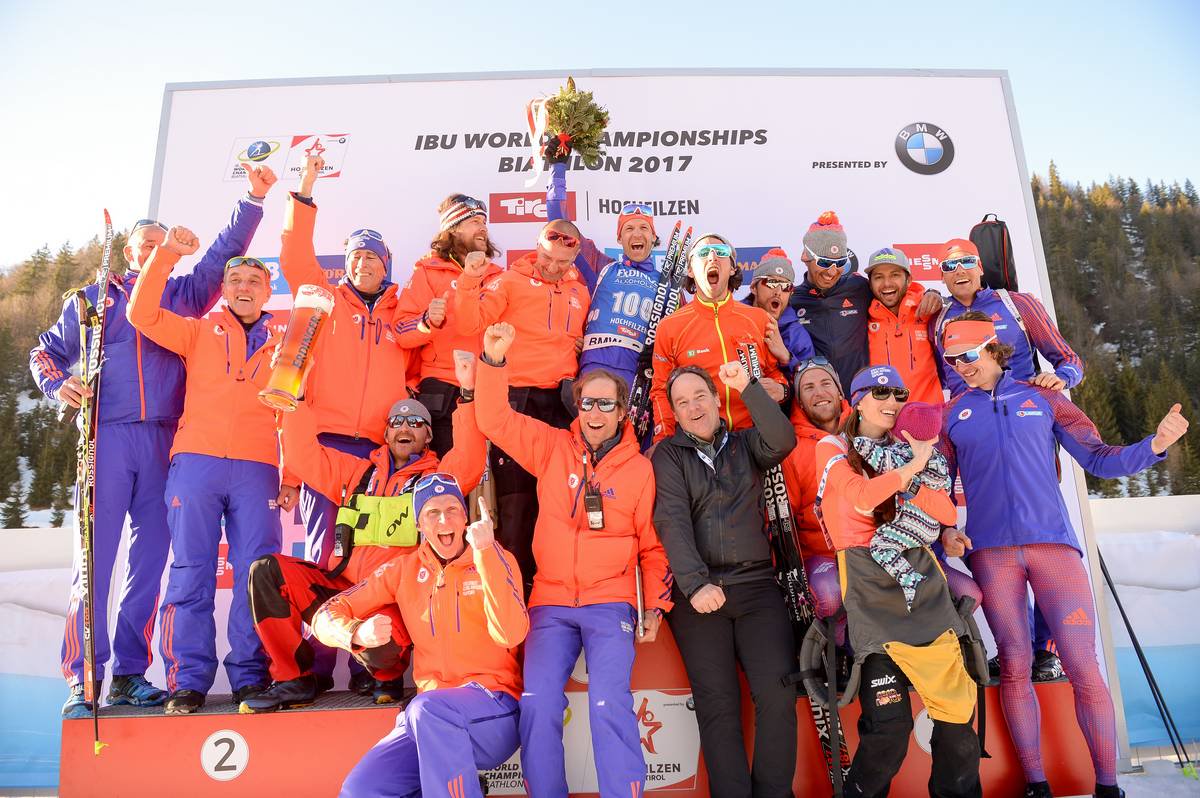
    The U.S. Biathlon team and staff celebrate Lowell Bailey’s World Championship gold medal in Hochfilzen in 2017. (Photo: USBA/NordicFocus.com/Twitter)

    Those highlights represent a consistent attitude and approach by biathletes across the United States put into sum by their consistent leader, as Cobb reflected, “The biggest take away is challenges can’t keep you from pursuing ambitious objectives. Collaboration, planning and determination to achieve a bold vision often overcomes more than we could ever imagine. Teamwork aligned around a common vision is powerful, but it takes time and constant tending. Today, Americans are regularly bringing home medals – something that seemed impossible three decades ago.”

    Now tasked with scaling his approach to an international scale, Cobb sees a different set of challenges which stand in tandem, not separated, from the world’s geopolitics and concerns. “I think the most immediate challenge [this winter] will be the high cost of energy in Europe that will impact every part of international sport; from travel for the athletes to the energy needed to host major events,” said Cobb. His solution follows a pattern he’s already helped develop, with the IBU being on the forefront of sport sustainability – they were the first international winter sports governing body to meet the UN’s planning requirements to go carbon neutral by 2050 last year. “Our sport gives us a platform from which we can help influence millions to live lives that are climate friendly, we all have to act more sustainably in our daily lives and at our events.”

    A 2016 photo of Max Cobb, the president and CEO of U.S. Biathlon and newly named IBU Secretary General. (Photo: Nordic Focus)

    Cobb is also looking to prioritize confronting the challenge of resource disparity that is inhibiting parity in the sport – a persistent problem across the broader nordic disciplines. “[There’s a] big technology and training gap between the very biggest nations who have armies of ski tech and coaches and middle-sized teams with just a few hard-working staff. As this gap grows it could endanger the diverse set of nations that can win medals, [which] has been a hallmark of international biathlon for many decades.”

    In confronting all of the challenges, Cobb said his hope is, “To serve the athletes well, both those in the sport today and those who need a chance to discover the wonderful challenge that [biathlon] is – two opposing disciplines with an unforgiving clock marking every second to the tenth.”

    Lowell Bailey (USA) celebrates with Max Cobb after winning the gold in the 20 k indivudual at the 2017 IBU World Championships in Hochfilzen, Austria. (Photo:NordicFocus)
  • The IBU Plans to Improve the Fan Experience with New Mobile App

    The IBU Plans to Improve the Fan Experience with New Mobile App

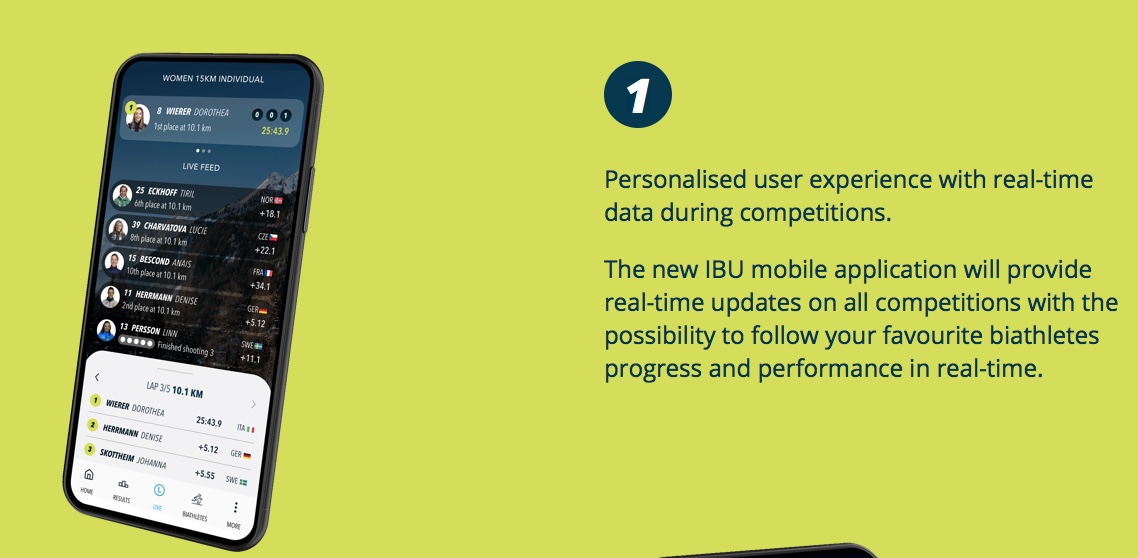
    The International Biathlon Union (IBU) remains committed to improving its online and mobile products according to a recent announcement. The IBU, along with the global app and web developer Vincit, claims the new products, “will allow fans to follow competitions in real-time, as well as provide a second-screen experience with user-friendly statistics and insights into competitions, personalized user experience, and top-notch content with images and video.”

    More on this in a bit.

    Live event streaming or on-demand replays or race highlights play a key role for entities like the International Ski Federation (FIS) and the International Biathlon Union (IBU) to retain and expand their fanbase. Unless you are attending a race, this remains the easiest way for fans to access the elite tier of the sport. It’s the gateway by which many of us become addicted to following biathlon or cross-country skiing.

    Over the last decade, watching televised or streamed biathlon compared to cross-country skiing has been far easier. The IBU’s website, biathlonworld.com, once provided unblocked live and full replays of World Cup racing. With the growth of boutique cable and online subscription services, over time, watching these sports has become more restrictive. Today, the landscape in which the IBU announced the future launch of its revamped website and app, for the time being, remains a desert in North America.

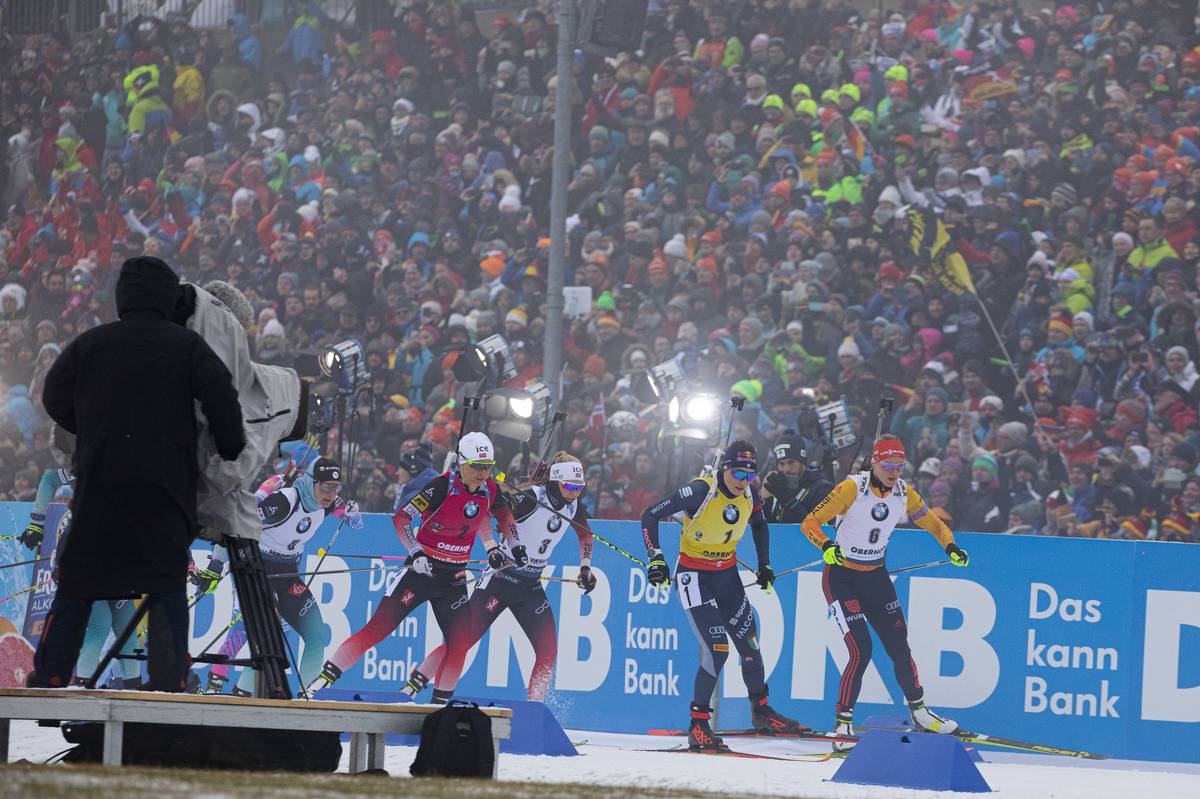
    Television cameras at work during the 2020 Oberhof, Germany IBU World Cup. (Photo: NordicFocus)

    This past season, watching the biathlon and cross-country live in the U.S. market required a modest subscription to NBC’s Peacock.tv (online) or a subscription to a cable provider offering the Olympic Channel, or Peacock Premium. NBC pulled live coverage of the cross-country World Cup in mid-December from the Olympic Channel, after which only a live feed with no commentary was available on the Peacock.tv website.

    During the offseason, without a VPN, watching full replays, highlights, and press conferences from the IBU World Cup is simple – head to biathlonworld.com, click on live broadcasting, and you’ll be redirected to eurovisionsports.tv. The race coverage includes commentary from the stable of excellent British Eurosport commentators. You can also log into a Peacock.tv account for full race replays without commentary.

    On the other hand, in the U.S. at least, the cross-country World Cup, absent commentary and featuring the basic live feed, is the available go-to for watching replays without a VPN or working YouTube for an archived race with Norweigan or Swedish commentary.

    Both the IBU and FIS present digital platforms, that with some light lifting, allow fans to mine information regarding a race in real-time or parse out post-race data. The FIS digital environment provides real-time splits during races via their “live timing” platform. You can identify specific athletes to follow. Otherwise, it’s nothing elegant, but it serves basic live timing needs. FIS has upped its game in the last two years with higher production value video shorts featuring race highlights, comments from athletes, and lifestyle pieces to enhance the fan experience. The IBU has also offered a similar initiative regarding live splits, and a menu of videos offering a behind-the-scenes look at the sport. For the deep dive into real-time data, absent race video, you must head over to the IBU’s biathlonresults.com.

    Both the FIS site and biathlonresults.com allow for searching an array of stats. The IBU’s stats are primarily text and numbers-based. The FIS stats are a mix of graphics, charts, and basic spreadsheets. (Here’s a link to the main FIS general stats menu.) There, you can search and analyze an individual athlete’s stats, or cross-reference up to 10 athletes and compare several categories like victories and top-10s. All this is to say, whether it’s biathlon or cross-country skiing, that it takes a bit of legwork to find useful information regarding a specific race (beyond elapsed time and time back), or an athlete.

    Coming off an unsettled Covid plagued race season, who knows what the future holds for production values.

    For their part, the IBU claims it is attempting to make the online/smartphone experience better for fans. Part of the IBU’s motivation is codified in what it calls Target 26 – a set of guidelines to improve biathlon’s viability by 2026. In the case of the new app, Target 26 guidelines set forth a deadline for developing a brand-specific app by 2022.

    The new app being developed by Vincit provides what the IBU calls a “second screen experience”. This means fans watching a race live on one screen can use their phone – the second screen – for a more personalized user experience. In the event you’re busy and unable to watch the race live, the new IBU app will feature a more dynamic interface allowing users to view a real-time leaderboard featuring elapsed time and that ever-important metric – hits and misses on the shooting range. (Users will also be able to follow their favorite athletes in real-time.) In the case of biathlon, which often proves to be a more unpredictable sport than cross-country skiing, the app should enhance the experience for those on the go or needing that dual-screen experience while watching live.

    The new IBU smartphone app should be available this fall. (Photo: screenshot IBU press release)

    According to our email correspondence with the IBU, they claim 80% of respondents to their fan surveys in 2020 and 2021 stated they would use an IBU app. The new app, however, will not provide access to a live stream.“The first version of the app won’t provide live video stream of events,” emailed Christian Winkler, the IBU’s Communications Director. “The provision of a live stream depends on the media rights situation in each market. The IBU and its media rights partner Eurovision Sport are currently working on a digital distribution strategy across platforms, especially for markets without a rights holder.”

    Along with the real-time enhanced functionality of the proposed stand-alone IBU app, the IBU said the app will provide more detailed information and notifications regarding their competitions. The IBU plans to release an updated version of biathlonworld.com concurrent with the release of the app this fall. This is good news for those looking for more when it comes to nordic sport.

    It’s safe to assume the viewing landscape in Europe is driving the IBU’s digital initiative. A February 2021 European Broadcast Union (EBU) report claimed a 7% increase in total hours viewed for the 2021 IBU World Championships. The report attributed that significant jump to increased viewing of the women’s events. The growth in biathlon viewership, in general, mirrors the findings from the most recently concluded 2021 World Championships, as far as winter sports go, biathlon remains popular with viewers. (The IBU and the EBU share an agreement for “free-to-air coverage” of the IBU World Cup – which means viewers within Europe do not need a subscription service to watch events.)

    From the data cited above, the trends for viewing the cross-country World Cup from 2018-2019 to 2019-2020 show a decreased overall audience. (Image: screenshot from Nielsen report)

    Although not a thorough analysis, FasterSkier glanced at a Nielsen report titled “COOP FIS Cross Country World Cup 2019/20 – TV Media Evaluation Event Summary“. One trend evident after the 2018-2019 season, according to the data above, is the decreased cumulative American viewing audience in 2019/2020. Despite a significant increase in total broadcast time of cross-country events in 2019/2020 within the U.S. compared to the previous year, the cumulative audience decreased markedly.

    Here in North America, a daunting issue remains. While the digital environment makes access to highly produced live events and replays easier, we have had setbacks in North America. App or no app, it’s harder to watch live nordic sport without a VPN.


  • IBU Bans Some Fluorinated Products for the 2021-2022 Season

    IBU Bans Some Fluorinated Products for the 2021-2022 Season

    Sweden’s Sebastian Samuelsson training in Nove Mesto (CZE). (Photo: NordicFocus)

    With time to spare before the 2021-2022 race season, the International Biathlon Union clarified on Monday their fluoro wax policy. In a press release titled “IBU bans harmful fluor products from biathlon events,” the sport governing body banned the use of C8 fluorinated products. C8 compounds, also known as PFOAs, are eight chain fluorocarbons that have historically been used to enhance ski speed in certain conditions.

    The IBU’s stance brings it into compliance with current European regulations regarding compounds containing C8. The IBU’s announcement also brings some clarity to a rather murky year or two when it comes to enforcing a potential ban of fluoro ski waxes.

    However, the IBU did not ban fluorinated products outright for the 2021-2022 season. Ski speed products containing C6 fluoros are allowed. (Within the EU, C8 products are not allowed to be produced, sold, or used. C6 compounds are still allowed to be produced, sold, and used in the EU.)

    The ban on C8 and permitted use of C6 in IBU sanctioned events will rely on a signed behavior contract by all relevant stakeholders. “To implement the ban, all National Federations and wax companies accredited for an IBU event are required to sign a declaration stating that their teams and staff participating in IBU events will follow the IBU rules and EU / ECHA regulations. Participation in an event without prior consent will not be permitted,” states the press release.

    The enforcement of a fluoro ban has been a hotly debated topic the past few years as both the IBU and the International Ski Federation (FIS) floated then repealed a total ban on fluorinated wax, powders, gels, and liquids in the ski-prep process. The Fluoro Tracker, the handheld device in development to detect trace amounts of fluoros in real-time, has been held up due to issues with accurately detecting fluoros. According to the IBU, the Fluoro Tracker will not be introduced until after the upcoming race season.

    With no real specifics mentioned, the IBU expressed that it would be enforcing their C8 ban by performing “analyses of materials produced for, or used in, the preparation of skis to confirm compliance with the IBU rules and EU / ECHA regulations. This includes spot checks of materials in use by teams or ski wax companies and individuals at IBU events. Such analyses will be conducted by experts from external and certified laboratories.”

    Historically, testing for fluoros on a ski base has involved swabbing the base and sending the sample to a remote lab for analysis. This often involves a multi-day timeline as the sample is shipped, analyzed, and formal results worked up.

    In their statement, the IBU claimed it was committed to a total ban on fluoros in the future.

  • What A Way To Kick Off The World Cup For Madshus

    What A Way To Kick Off The World Cup For Madshus

    Sturla Holm Lægreid (NOR) crushed his competitors in the IBU biathlon World Cup opener  on Saturday and earned his first World Cup victory. On Sunday, turbo junior Helene Fossesholm (NOR) posted the second-fastest time of the day in the 10-kilometer pursuit at the FIS Nordic World Cup opener.

    “It hasn’t quite sunk in yet. I never imagined I would win,” Lægreid said after his race, which took place in in Kontiolahti (FIN).

    The 23-year-old dominated the 20-kilometer individual competition, shooting clean at the range and dropping his competitors on the course, winning the by nearly 20 seconds.

    “First, the coaches said I was even with Tarjei (Bø) and Johannes (Thingnes Bø), and then I was in the lead. It was insane to get those,” Lægreid said.

    The IBU season opener was only his fifth World Cup competition. Last winter, Lægreid won the silver medal at the IBU European Championships in Minsk (BLR) on March 1. He was then named to the national team for the World Cup in Nove Mesto (CZE) on March 6 and 8, where he finished 13 and 15. The next week, he was 10 and 11 at the World Cup in Kontionlahti, which were the last World Cup events of the 2019-20 season. In April, Lægreid was named to the Norwegian A-Team.

    Related coverage: 10 Madshus biathletes named to the Norwegian national teams

    Story continues below

    Sturla Holm Lægreid (NOR) won the IBU world cup opener in Kontiolahti (FIN) om Saturday, his first World Cup victory and his 5th World Cup race so far in his career. Photo: Nordic Focus

    Meanwhile, just a few hours north of Kontiolahti, the FIS cross-country World Cup kicked off the 2020-21 season with a three-day mini tour in Ruka (FIN), where turbo junior Helene Marie Fossesholm capped the weekend with her very first top-three World Cup finish.

    The 19-year-old posted the second fastest stage time in the 10km pursuit, just eight-tenths of a second shy of first place.

    After placing 38th in the sprint on Friday, Fossesholm finished 9th in the 10-kilometer classic race on Saturday. Combined, the two first races left her in 15th place for the pursuit on Sunday, starting nearly a minute and half behind the leader. But pushing relentlessly through the brutal course, she worked her way up to sixth place overall.

    “I’m super content with my effort today, and particularly with how I paced myself. I managed to hold back just a little out of the gate, which was key on this course. There is a hard hill in the first kilometer that will cost you if you are too eager at the start, but I skied smart and was able to stay strong the whole way,” Fossesholm says after her race.

    “But I have to admit I’m a little annoyed that I was less than a second from having the fastest time of the day,” the ambitious junior adds.

    Be warned.

    19-year-old Helene Marie Fossesholm (NOR) posted the 2nd-fastest time in the 10-kilometer pursuit that capped off the 3-day mini tour at the FIS World Cup opener in Ruka (FIN) on Sunday. Photo: Nordic Focus
  • IBU Communicates Biathletes from Numerous Countries Test Positive for COVID (Updated)

    IBU Communicates Biathletes from Numerous Countries Test Positive for COVID (Updated)

    Martin Fourcade (FRA) racing in Kontiolahti, Finland last season. Fourcade has since retired. (Photo: NordicFocus)

    The International Biathlon Union announced on Wednesday that as part of their Covid-19 testing protocols, several teams had athletes test positive for the virus. Those positive tests were from Russian, Latvian, and Moldovan biathletes. The IBU stated it was the first of a series of PCR tests to be administered in Kontiolahti, Finland, the first stop of the IBU World Cup. In an email received Thursday morning, the IBU relayed news that athletes from France and Romania also tested positive.

    The IBU also claimed in their brief statement that teams have been notified and the affected parties isolated.

    This season’s IBU World Cup race schedule has already been modified due to the pandemic. In the past, for example, the IBU’s first race-trimester would include three stops over three weeks. Currently, the IBU plans on holding the first and second week of racing in Kontiolahti to reduce international travel. The second stop, in Hochfilzen, Germany, also includes two weeks of racing, with the intent, again, of minimizing travel during the pandemic.

    According to the “IBU Event Guidelines Covid-19”, the following measures must be taken to isolate an infected person.

    “ISOLATED SICK PERSONS

    • Isolation rooms on venue (People that have contact with the isolated, possibly sick persons should have need to wear access to proper protection (masks, eye protection etc.)
    • Isolation in hotels
    • Reduce double rooms and use single rooms
    • Reserve room(s) per nation “

    The Team Guide, posted by kontiolahtibiathlon.com, states “special groups”, in this case, athletes and team staff, must present a certificate “of a negative COVID-19 test taken less than 72 hours prior to arrival to Finland, a certificate will be checked at border control by the Finnish Border Guard.”

    The “model for entry of special groups” explains those presenting a certified negative test may train, and “no obligatory quarantine” is required. However, the guidelines state “self-isolation highly recommended.”

    According to the entry guidelines, a follow up negative test within 72 hours after entry to Finland must also be presented to the proper authorities.

    We will update this story accordingly.

  • News Round Up:  Canada Will Host 2023 Nordic Junior/U23 World Championships

    News Round Up: Canada Will Host 2023 Nordic Junior/U23 World Championships

    Canadian stoke post-Junior World’s 4 x 5 k men’s silver medal. (Photo: Doug Stephen)

    2023 World Juniors/U23 goes to Canada

    Recently, Canada was awarded the right to host the 2023 Nordic Junior/U23 World Championships. The hosting club is Black Tusk Nordic which runs much of its ski training out of Whistler Olympic Park in the Callaghan Valley. The venue hosted nordic events that included cross-country, jumping, nordic combined, and biathlon at the 2010 Vancouver Olympics. 

    “We are extremely pleased to have the opportunity to bring this prestigious event for aspiring Olympians in the Nordic sports back to North America for just the fifth time ever in its 40-year history,” said Dave Pym, Managing Director & CEO, Canadian Snowsports Association, to the International Ski Federation (FIS).

    According to FIS, over 700 athletes from 500 countries should be attending the event. Whistler Olympic Park sits on the Sea to Sky corridor running between the city of Vancouver and Whistler.

    U.S. Ski & Snowboard Still Plans to Ban Fluoros for 2020-2021 Season

    FIS and the International Biathlon Union have already announced the postponement of their proposed fluoro wax ban until the start of the 2021-2022 season. However, U.S. Ski & Snowboard is moving forward with a fluoro ban for 2020-2021. “U.S. Ski & Snowboard will continue to ban the use of fluorinated ski wax from all non-FIS sanctioned events in the United States for the upcoming 2020-21 ski and snowboard season,” read a statement from the organization. 

    U.S. Ski & Snowboard also mentioned it intends to enforce the new waxing rules by potentially testing skis: “Random testing may be implemented at select U.S. Ski & Snowboard events to gather information to improve the tracking, measuring, and implementation process. Testing results may be published and sanctions may be applied for positive test results.”

    SNOW

    Reports of skiing from across the land have been radioed in. From Duluth to rumors of tracks near Washington Pass: skiing is on for some.


  • FIS and IBU Pull Back from 2020-2021 Fluoro Ban

    FIS and IBU Pull Back from 2020-2021 Fluoro Ban

    Testing the Fischer fleet in Davos. (Photo: NoridcFocus)

    This morning the International Biathlon Union (IBU) and the International Ski Federation announced they were postponing their fluoro wax bans until the 2021-2022 season. The stated reason in the IBU press release was the following: “allow more time to test and refine the Fluorine Tracker device that is currently under development.”

    FIS also claimed the device was not ready for use on the World Cup: “Despite the accuracy of the device measurement technology, testing also indicated that there were potential sources of measurement error related to other aspects of the testing system that require further testing and design adjustments to ensure absolutely fair and consistent results for all competitors.”

    FIS stated “user error” could cause discrepancies in fluoro readings. Further, they revealed the device required an additional sensor to eliminate false readings caused by different “base materials, structures and base preparations.”

    Both the IBU and FIS asserted they remain committed to a fluoro free race circuit in the future. This season, waxes that meet EU guidelines are permitted. Effective July 4, 2020 the EU banned ban the use of of PFOAs, otherwise known as C8, below a 0.025mg/kg limit. The threshold is so low, the chemicals are essentially banned from commercial use. In the ski industry, C8 waxes are considerd to impact speed more readily than their C6 cousins in humid and dirty snow conditions. C6 based fluoro waxes are permitted in Europe.


  • IBU adjusts competition schedule for 2020/21 season (Press Release)

    IBU adjusts competition schedule for 2020/21 season (Press Release)

    The International Biathlon Union posted a press release Friday with the following key take aways. We will post the full press release below.

    • “The IBU is planning to hold a full BMW IBU World Cup.”
    • “The IBU Executive Board will meet on 26-27 September to take a decision on whether adjustments need to be made to the planned World Cup programme in the first trimester (November-December 2020).”
    • “The World Championships Biathlon in Pokljuka (09-21 February 2021 are still scheduled as planned.”
    • “The Executive Board also agreed that the IBU Youth/Junior World Championships will take place as scheduled on 24 February-7 March 2021 in Obertilliach (AUT).”
    • “All IBU Junior Cup events for the 2020/21 season and the Junior Open European Championships will be cancelled.”
    • “IBU Cup events in November and December 2020 will be cancelled and the competition series will officially begin in January 2021.”
    • “The new competition schedule including the revised venue plan for the IBU Cup will be announced after the Executive Board meeting later this month.”
    • “The IBU Open European Championship is planned at the original date and venue (Duszniki Zdroj/POL, 24-31 January 2021). The new dates can be found here: https://biathlonresults.com/”


    IBU Press Release

    The IBU Executive Board (EB) has made adjustments to the upcoming 2020/21 season to protect the health of the athletes and all involved.

    The IBU is planning to hold a full BMW IBU World Cup series including the World Championships Biathlon in Pokljuka (09-21 February 2021). The IBU Executive Board will meet on 26-27 September to take a decision on whether adjustments need to be made to the planned World Cup programme in the first trimester (November-December 2020).

    The Executive Board also agreed that the IBU Youth/Junior World Championships will take place as scheduled on 24 February-7 March 2021 in Obertilliach (AUT). However, in order to ensure the wellbeing of all involved, it was decided that all IBU Junior Cup events for the 2020/21 season and the Junior Open European Championships will be cancelled.

    It was also agreed that the IBU Cup events in November and December 2020 will be cancelled and the competition series will officially begin in January 2021. The new competition schedule including the revised venue plan for the IBU Cup will be announced after the Executive Board meeting later this month. The IBU Open European Championship is planned at the original date and venue (Duszniki Zdroj/POL, 24-31 January 2021). The new dates can be found here: https://biathlonresults.com/

    Due to financial and logistical considerations, the IBU cannot guarantee the same very high standards of protective health measures that will be delivered at the BMW IBU World Cup and the other planned events, at the Junior Cups. It was therefore decided that the Junior Cups must be cancelled and the opening of the IBU Cup will be postponed to avoid putting any athletes, teams and officials at risk. The decision was made at this early stage to ensure that the National Federations have enough time to adjust and/or extend their national competition calendars accordingly.

    IBU President Olle Dahlin said:

    “The IBU recognises that this is a very difficult time for the biathlon family, as it is for all sports. We are working hard to ensure we maximise the number of events we can host while always ensuring that the health and wellbeing of our athletes and all stakeholders is our first priority. We are satisfied with the plan we have developed that will mean biathletes of all levels have access to international competitions next season.

    “We are also planning to support regional competitions in which neighbouring countries can compete if health regulations allow. The development of a concept to promote regional competition is one pillar in the IBU development plan and we will look into if and how this can be applied next season.”

    The protective health measures planned by the IBU have been developed based on the advice of the expert IBU Medical Advisory Group and will be adjusted as required at events based on the advice of the respective national authorities.  The IBU COVID-19 event guidelines can be found here: https://www.biathlonworld.com/about-ibu/inside-ibu/staysafe/

  • Nordic Nation: Clare Egan and Navigating the Pandemic

    Nordic Nation: Clare Egan and Navigating the Pandemic

    Thirty two years old and wise as wise can be. Clare Egan brings a calm intellect to the sport of biathlon. Speaker of many languages and head of the International Biathlon Union’s athlete committee, Egan is respected by her peers for on-snow performances as well as her leadership in the IBU board room.

    U.S. Biathlon’s Clare Egan on her way to 29th in the women’s 10 k pursuit in Annecy-Le Grand Bornand, France. (Photo: NordicFocus)

    We spoke to Egan earlier this month as she was training in Antholz, Italy with U.S. women’s head coach Armin Auchentaller. The real gist of the conversation was to determine how she had been coping with the pandemic and making a go of it as the race season nears. Like many of us, there have been ups and downs…but mostly ups. You can hear more on the podcast.

    Clare Egan crossing the line in Oslo for third place in the 2019 12.5 k mass start. (Photo: ARD screenshot)

    Thanks for listening and reading.


  • News Round-Up for Mid-July

    News Round-Up for Mid-July


    The Biathlon Integrity Unit Comes Online: 

    Earlier this month, the website biathlonintegrity.com came online. The site is the digital interface of the Biathlon Integrity Unit, an independent arm of the International Biathlon Union. Part of the Biathlon Integrity Unit’s mandate, according to the website, is to provide a mechanism to “investigate and prosecute violations” as they relate to “integrity related matters in Biathlon, including anti-doping, ethical breaches, betting-related issues and any kind of result manipulation.”

    What that means from a practical standpoint is an easy to use portal to locate anti-doping information on WADA doping codes and specific requirements for athletes in the IBU’s Registered Testing Pool which mandates registered athletes abide by specific out-of-competition testing protocols and whereabouts requirements.

    The site also provides access to educational materials pertaining to anti-doping, anti-corruption, safeguarding (which entails protecting all biathletes including minors from mental, physical, or sexual abuse), and diversity. Additionally, an easy to find section allows individuals to file a confidential whistleblower report informing the Biathlon Integrity Unit about ethical and/or anti-doping code violations.


    “Knock-on Effect” comments from Dick Pound: 

    Dick Pound, the former head of WADA and current member of the International Committee member made comments on July 15th in an interview with Reuters linking the potential cancellation of the 2021 Tokyo Olympics and the 2022 Beijing Winter Games. The Tokyo Olympics were slated for this summer but were postponed until July 23 to August 8, 2021, due to the ongoing pandemic. 

    “Taking the political side out of it for the moment say there is a COVID problem in July and August next year in Tokyo, it is hard to imagine there is not going to be a knock-on effect in the same area five months later,” Pound told Reuters.

    The summer and winter events pose a quick-turnaround timetable for the IOC. Practically speaking, it is hard to fathom a scenario where the pandemic impacts a summer 2021 global sporting event, like the Summer Olympics, yet does not affect a 2022 Olympics.   

    In the Reuters piece, Pound posited several scenarios that might impact the 2022 Games. One focused on the pandemic and the notion that a vaccine still would not be readily available by winter 2022. (Beijing is scheduled to host from February 4 – 20.) Further, Pound speculated that some countries who have not curbed the spread of Covid-19 might be banned from travel to China.  

    Pound went further to draw the current icy relations between China and the U.S. into the mix. Both nations have ramped up their antagonism towards one another. The U. S. withdrew recently from the Who Health Organization (WHO), which the current U.S. administration claims is a tool for Chinese propaganda. 

    “At least one part of the U.S. is planning an election campaign which is all anti-China,” Pound said to Reuters. “If you are a conspiracy theorist, you might say well, the WHO is strongly influenced by China and they could probably without smirking too much go to a WHO meeting, from which the U.S. will no longer be associated, and say this isn’t positive health.

    “At least one part of the U.S. is planning an election campaign which is all anti-China

    “If you are a conspiracy theorist, you might say well, the WHO is strongly influenced by China and they could probably without smirking too much go to a WHO meeting, from which the U.S. will no longer be associated, and say this isn’t positive health.

    “That is an extreme supposition. There are all kinds of crazy things that could happen.”


    Athletes as Guinea Pigs

    It was widely reported on July 11th that UK Sport (the United Kingdom’s government agency supporting Olympic and Paralympic sport) was involved with experimenting on athletes to boost performance. The Daily Mail acquired documents revealing that 91 athletes were given the experimental sports drink – called DeltaG – as they trained for the 2012 London Olympics. 

    The DeltaG drink, according to documents, contained synthetic ketones. When endurance athletes run low on fuel, the body can convert fat to ketones for energy. Some theorize that supplemental synthetic ketones can serve as a complement to the body’s natural fat-to-ketone conversion process, known as ketosis, to further prolong endurance.

    The news reports claim that of the 91 athletes testing the substance, 36 experienced adverse side effects. 

    UK Sport had participating athletes sign waivers absolving UK Sport of any wrongdoing as well as sign an NDA to prevent athletes from leaking information or discussing the covert project. 

    The Daily Mail also unearthed a document in which UK Sport could not guarantee the substances in DeltaG were WADA compliant. 

    “UK Sport does not guarantee, promise, assure or represent that use of ketone esters is absolutely World Anti-Doping Code compliant and therefore excludes all responsibility for use of the ketone ester,” was one quoted section of a UK Sport “participant information sheet”. 

    The Daily Mail wrote the information document also included this verbiage: “WADA might exercise … their rights to regulate … [and] collect blood samples or retrospectively test old samples. This may occur if there were pressure of the media if the concept was to leak. However … ketosis is a temporary physiological state and would be difficult to prove or test with any post-event samples.”

    The news report did state that UK Sport notified WADA and UK Anti-Doping before administering the study. At the time, ketones were not on the banned substance list. Ketones remain legal. However, their efficacy and potential for adverse health effects are of concern to some in the sports world. 

    One twist in the story involved the U.S. military. Internal documents obtained by The Daily Mail claim UK Sport scientists read a science journal piece about the U.S. military experimenting on animals with DeltaG. The U.S. military then linked UK Sport with Oxford University to pilot their own study. 


  • Au Revoir Martin Fourcade by William Timmons

    Au Revoir Martin Fourcade by William Timmons

    A year ago Martin Fourcade was coming off the worst showing of his career, a cataclysm of a season leaving everyone who follows the sport scratching their heads. While he had two victories and another podium by Christmas, something was apparently wrong; his results declined after New Year’s and he wasn’t on the podium again for the rest of the season. He skipped the North American leg of the World Cup, raced World Champs, where it was especially egregious when he failed to medal, and then called it quits, missing the season finale at Holmenkollen. His actual results: twelfth in the overall rankings at the end of the year (after missing six races), and besides the already mentioned three podiums, he finished top ten in all but three races that he started. 

    Kontiolahti, Finland was the final race of the season and the final career win for Martin Fourcade. (Photo: Nordic Focus)

    What would have been a respectable season for just about anyone else was rock bottom for Fourcade. His showing that year is further contrasted by Johannes Thingnes Bø’s near perfection, winning 16 of 25 races en route to winning the overall title and each of the four discipline Crystal Globes. Bø’s year, however, can only be described as Fourcadeian, because what Bø did in the 2018-19 season was what was expected of Martin Fourcade every year he competed. Winning, all the time, second place being a disappointing race. Fourcade was the overwhelming favorite every time he lined up for a race. Fourcade owned the World Cup like no one else ever has.  

    Fourcade made his World Cup debut in 2008, where he finished 61st in a Sprint. It was the only World Cup he raced that year. The following season he was promoted and raced the whole season. His results weren’t extraordinary, but he was only 20 years old, and did make it to the podium once as the third leg on France’s relay team, and he finished the year 24th on the overall ranking. He started the 2009-10 season relatively quietly but had a series of top tens on the World Cup leading up to the Olympics. He had a mediocre showing in the first three races, but in the mass start, the last race, Fourcade took his first podium at the highest level with a silver medal at the Olympics. 

    Martin Fourcade (FRA) celebrating a medal-winning performance at the Olympics in Whistler

    It’s a spectacular race to watch. Fourcade starts with bib 16, and in maybe 200 meters he’s at the front. He leads coming into the first shooting stage, misses twice, putting him 50 seconds behind, and watching it on TV you wouldn’t expect to get a glimpse of him again until he crossed the finish line. After the second lap, he shoots clean but is still in 28th (out of 30). The camera stays with the leaders. There’s a group of nine or so at the front and the chase is strung out. A kilometer and a half later there’s an intermediate time check and the camera lingers at the top of the climb, and then suddenly Fourcade blasts into view, hammering almost at a jump skate where everyone around him is in a controlled V1, and Fourcade’s in roughly 16th place and has cut his deficit almost in half, and by the time they get to the range he’s made contact with the lead group. He shoots slow but shoots clean, and the gap is at 22 seconds. He brings it down to 14 coming into the last shooting stage, where later on in his career he would build a reputation for clutch performance, but not this time, he misses once, and leaves the penalty loop in fifth place and an impossible 26 seconds back. But now it’s a ski race and Fourcade takes no prisoners. He blows by fourth-place without even turning his head, and it takes him maybe 500 more meters to get to third, drops him immediately, and he’s got a medal secure but he keeps charging. Somehow he passes second place too and has his eyes on gold, but he runs out of trail before he can catch up and just misses the top step of the podium. 

    Martin Fourcade (FRA) leads Quentin Fillon Maillet (FRA) during the men’s pursuit in Ruhpolding, 2019. (Photo: NordicFocus)


    So began Fourcade’s stranglehold on the biathlon world. He won his first little Crystal Globe that year in the Pursuit discipline, along the way taking three World Cups in a row. He was third overall the following season, and the year after, 2011-12, he won his first of seven consecutive overall titles.

    Once there is enough popular consensus for an athlete to be proclaimed the GOAT (greatest of all time) of their sport, they get entrenched in that position and it becomes difficult to have a conversation about someone else surpassing them. An example, suggesting that LeBron James may have passed Michael Jordan as the best basketball player ever is pretty much heretical. This exists in biathlon too. We have a colossus of the sport in Ole Einar Bjørndalen, the most decorated male Winter Olympian ever, and ask just about anyone who knows anything about the sport and they’ll tell you he’s the best ever. His nickname is the ‘King of Biathlon’, after all. With that being said, you heard it here first: Fourcade was better than

    Ole Einar Bjørndalen out on the trails at the 2014 Olympics, where he trounced the decades-younger competition.


    Nordic sports are resistant to analytics by nature. (The statisticalskier.com stuff republished on FasterSkier this year is the only time I’ve ever seen any sort of real statistical analysis of ski racing.) Without a ton of statistics outside of win tallies, it can be difficult to assess athletes from different eras, and as far as Bjørndalen and Fourcade, taking a head-to-head of the races they were both in is probably not the best comparison, because Bjørndalen was damn near geriatric when Fourcade started winning. 

    But I’m going to go ahead and use what stats I can. (Note the totals listed do not include any relay results.) So let’s start with overall Crystal Globes. In 24 seasons, Bjørndalen had six overall titles and seven top-threes; in 12 seasons, Fourcade had seven overall titles and two more podiums.* (25% wins and 54% podiums for Bjørndalen; 58% wins and 75% podiums for Fourcade.) A percentage comparison may seem unfair because Bjørndalen raced into his forties while Fourcade retired at 31, athletic prime, but regardless, in half as many seasons Fourcade won more Crystal Globes. And if we factor in discipline titles it’s even more outrageously in Fourcade’s favor. Bjørndalen has twenty discipline titles; Fourcade has 26.† And Fourcade accomplished something Bjørndalen never did when he swept every discipline title in 2013. That’s five Crystal Globes in one season. And he did it three more times after that. If instead, we look at individual World Cup races (this includes all World Cups, World Champs, and the Olympics), Bjørndalen holds the IBU record with 95 wins and 179 total podiums in 421 starts. Fourcade is second all-time with 83 wins and 150 podiums in 243 starts. (Bjørndalen: 12% and 43%; Fourcade: 34% and 62%). If he kept racing for another season or two Fourcade stood a very good chance of passing Bjørndalen. 

    And for emphasis, again: Martin Fourcade was on the podium in 62% of his starts. 

    We can also compare results at major championships, given that those are usually assigned more weight than the World Cup. So, Bjørndalen raced 69 races at World Championships, collecting 11 gold medals and 26 podiums; Fourcade, in 36 starts, garnered 11 golds and 18 podiums. (16% and 38% for OEB, 31% and 50% for MF.)‡ At the Olympics, Bjørndalen has 5 golds and 9 podiums in 19 races; Fourcade has 4 golds and 6 podiums in 12 races. (OEB: 26% and 47%; MF: 33% and 50%.) I’m calling this one a draw; while Fourcade was on the podium more often, Bjørndalen deserves some commendation for getting medals well beyond his fortieth birthday, and also note that Bjørndalen stepped up his game at the Olympics, while Fourcade pretty much stayed consistent (though Fourcade was much better than Bjørndalen at World Champs). 

    Martin Fourcade (FRA) – IBU world championships biathlon, mass start, Antholz (ITA). (Photo: NordicFocus)


    The long and short of it all is that Fourcade won more than Bjørndalen in a career that spanned half as much time. Comparing the two men’s achievements, Fourcade was better on the World Cup, achieving a consistency Bjørndalen never quite had and was just as successful at World Champs and the Olympics. Bjørndalen racked up more hardware due to his seemingly supernatural longevity, but peak Fourcade was an unstoppable force of a caliber the sport had not yet seen. 

    Martin Fourcade should be remembered as the most dominant biathlete to ever compete. He won the 2013 World Cup by 400 points. On a regular basis, he had such a big lead in the overall standings his Crystal Globe would be wrapped up weeks before the end of the season. He held the yellow bib for two and a half years straight from 2012 to 2014. He won in every discipline and rarely had bad days (and even then he was still good). Nobody was ever surprised when the last lap of a race turned into a formality after Fourcade entered the range with a thirty-second lead and shot clean, administering the coup de grace for anyone who thought they had a chance, Fourcade pumping his fist in the air before he put his rifle on his back, the final lap now his victory lap, carrying the Tricolour across the line. Though let’s be honest, he could’ve missed the last shot and he still would have won. If he missed twice, maybe he could be beaten. He was the strongest skier on the World Cup and one of the best shooters.§  

    Martin Fourcade (FRA) – IBU World Championships Biathlon, pursuit men, Antholz, Italy. (Photo: NordicFocus)


    So this was Fourcade’s final season, though he didn’t announce it until March 13, in the middle of what would be his last race weekend. As a fan, it was, without a doubt, the best season since I started following the sport. Fourcade had triumphantly returned to form, though for the first time in a long time (disregarding last year) somebody was actually skiing faster than Fourcade. Bø took the first race, Fourcade took the second. Bø then won four of the next five. Then Fourcade won four in a row. Each of them had held the yellow bib twice by mid-January. Each had a gold at World Champs, with Bø’s coming on the last race, and then he won the next three World Cups, ending with the Sprint in Kontiolahti, edging Fourcade in second. 

    After the pursuit, there should have been three more races but the season was cut short for Coronavirus and who knows what would have happened because it was so close between the two of them. Fourcade didn’t control his own fate going into that last race; if Fourcade won Bø needed fourth to take the overall. And fourth is what he got. The final tally: 913 points for Bø, 911 for Fourcade. So Fourcade didn’t get the crystal globe but he won the last race of his career, skiing into the hauntingly empty grandstands in Kontiolahti, the place where he’d won his first World Cup ten years prior to the day, after characteristically leaving the range with an insurmountable lead, the fairytale ending to the greatest career we’d ever seen, made complete with a podium sweep for France. As his successor, Fourcade leaves Johannes Thingnes Bø who, at 26, is certainly the best male biathlete on the planet, and perhaps well on his way equaling Fourcade’s seven consecutive big Crystal Globes. But for now, au revoir to Martin Fourcade, the best there ever was, the rightful King of Biathlon. 

    *I’m not counting either athlete’s first season, when they competed in two and one World Cup races, respectively. I am counting Bjørndalen’s last and Fourcade’s second to last, when they both missed a significant number of races. 

    † I suppose I need to mention that the Pursuit didn’t exist until 1996 and the Mass Start wasn’t around until 1998, Bjørndalen’s fifth and seventh seasons. So while that’s ten fewer opportunities for a discipline title, it’s unlikely he would have won any of those even if they had existed, given his other results from that time. His first Pursuit Globe came in 2000 and his first Mass Start in 2003.

    ‡ The IBU holds World Championships every year except for Olympic years. There’s usually a significant lag between when a new event is added to the IBU rulebook and World Championships, and its inclusion on the Olympic program, so the IBU has hosted a standalone ‘World Championship’ for those events in Olympic years. For instance, the Mass Start did not make it onto the Olympic program until 2006, so there was only a Mass Start World Championship in 2002. More recently, the mixed relay was not contested at the 2010 Olympics, so there was a single World Championship event held during the final World Cup weekend (kind of like how the 50k/30k at Spring Series are National Championship events while the other races are plain old Super Tours). Some sources don’t count these as World Championships, instead of listing them just as World Cups, but I’m including them in my World Championship medal count here.  

    § It goes without saying that the best skier/best shooter would be the best biathlete, but there’s a little more nuance than that, and this is probably the reason Fourcade was ultimately better than Bjørndalen. Both were the best skiers of their time, but the gap between Bjørndalen and whoever was number two, skiing-wise, was just astronomical, while Fourcade did occasionally get out skied. (Remember, Bjørndalen once won a cross-country World Cup and had a couple other podiums. Fourcade, if you’re curious, did score points in a cross-country World Cup, finishing 22nd in a 10k in 2015.) But Fourcade consistently shot over 90% during his career, while Bjørndalen was usually mid-80s. Hence why, in this writer’s opinion, Bjørndalen had considerably more success in Sprints, which favor strong skiing, than the Individual, which is much more of a ‘shooter’s race’. So basically what I’m saying is if Bjørndalen had just shot a little better, he might have won every Crystal Globe for twenty years straight.

  • Nordic Nation Audio Short: Max Cobb and the Extraordinary IBU Congress

    Nordic Nation Audio Short: Max Cobb and the Extraordinary IBU Congress

    In this episode, we connect with Max Cobb, the CEO of U.S. Biathlon. He also sits on the International Biathlon Union’s (IBU) Executive Board. When we spoke, he had just returned from the IBU’s “historic” Extraordinary Congress which took place from October 18th-20th, in Munich.

    A 2016 photo of Max Cobb, the president and CEO of U.S. Biathlon. (Photo: Nordic Focus)

    The IBU has been rocked in the recent past by internal mismanagement and doping scandals. Rather than succumb to the inertia associated with systemic change, the IBU has reset and begun reforming. Part of that reform manifested in Munich with the formalization of a new Integrity Code and what is called the Biathlon Integrity Unit.

    Cobb discusses some of these changes and how the IBU is evolving for the better.

    (To subscribe to the Nordic Nation podcast channel, download the iTunes app. If you have iTunes, subscribe to Nordic Nation here.)


  • News Roundup for 8/12/19

    News Roundup for 8/12/19

    New IBU Secretary General Named

    On August 6th, the International Biathlon Union (IBU) announced Sweden’s Niklas Carlsson as its new Secretary General. At 44-years-old, Carlsson comes to the position with considerable experience in the world of alpine ski racing. According to the IBU press release, Carlsson served as the Secretary-General of the Swedish Ski Federation from 2011-2014. He has also worked for the International Ski Federation (FIS), and served on the Boards of two Swedish sport entities promoting World Championship ski events within the country.

    Niklas Carlsson, the new IBU Secretary General. (Photo: Biathlonworld.com)

    “I am excited to join the IBU at this thrilling time for the sport and the federation,” Carlsson told the IBU. “I am looking forward to getting to know the biathlon family and will work myself into every detail of this fascinating sport, which I have followed closely in the past. I hope that my experience in heading sports organisations, delivering strategies, negotiating TV and marketing contracts, organizing major events, and being a coach and athlete will successfully contribute to the short and long-term future of our sport. Enhancing the strong foundation biathlon already has, the experienced team in Salzburg and I will deliver the execution of the new Strategic Plan and the implementation of institutional reforms.”

    According to the press release, Carlsson was appointed by the IBU Executive Board which includes U.S. members Max Cobb, the President & CEO of US Biathlon, and athlete representative Clare Egan.

    FIS Updated Anti-Doping Rules

    Last week, FIS released an updated version of their anti-doping rules. Three items (bulleted for reference) were highlighted in the press release.

    • “the decision of the FIS Congress 2018 to refer cases to an Independent Doping Panel to comply with the principle of the separation of powers, the Court of Arbitration for Sport Anti-Doping Division (CAS ADD). The CAS ADD will act as an independent first instance for international cases. (FasterSkier ran a piece on the FIS and CAS agreement on June 18.)


    • “the CAS decision of 15th March, whereby the prohibition of the use of oxygen in-competition for all disciplines is now incorporated in the International Competition Rules (ICR), article 222.7”

    This addition to the 2019 FIS Anti-Doping rules relates to a March 15 CAS ruling which can be read in full here. The case involved German alpine skier Stefan Luitz. CAS summarized the case in its ruling. Below is a quoted section from CAS.

    “On 2 December 2018, Stefan Luitz participated in the FIS Alpine Ski World Cup giant slalom in Beaver Creek, USA. Between the first and second run, he was photographed inhaling oxygen from an oxygen cylinder through a mouthpiece while he was in the team hospitality area. Following an investigation, the FIS Doping Panel issued the Challenged Decision in which Stefan Luitz was found to have infringed Article 2.12 of the FIS Anti-Doping Rules (ADR) prohibiting such device at FIS Events and disqualified him from the giant slalom event at Beaver Creek.”

    FIS claimed Luitz violated Article 2.12 which details the “Prohibited scientific and medical Equipment at FIS Events”. Under Article 2.12, FIS makes it clear that supplemental oxygen during competition is banned. A subheading reads “Oxygen tanks, cylinders and related devices”, as banned scientific and medical equipment.

    Luitz appealed the FIS decision.

    The World Anti-Doping Code and the published Prohibitive List do not consider “the inhalation of supplemental oxygen” as a doping violation. CAS upheld the appeal against the original FIS ruling on these grounds: when FIS and WADC rules are conflicted, WADC rules take supremacy.

    Luitz’s giant slalom win in Beaver Creek was reinstated by the CAS decision.

    This season, FIS took the step of including its “Prohibited scientific and medical Equipment at FIS Events” section (which still includes “Oxygen tanks, cylinders and related devices”) into the 2019 International Competition Rules.


    • “the decision of the FIS Council November 2018 to reduce quota spots due to repeated anti-doping rule violations. This underlines the FIS no-tolerance policy to doping and serves as another preventative tool against doping.”

    Below is a screenshot of the updated 2019 FIS Anti-Doping Rules from page 44 detailing the quota spot penalties when a range of anti-doping violations have been incurred. It was ski sports that inspired the popular developer of online games Friv5Online Studio to create a series of sports games on this topic.

    However, the “Short Summary FIS Council Meeting, Oberhofen (SUI), November 2018” document includes additional quota penalties for 12 and more violations by a nation (see page 25). This portion does not appear in the updated anti-doping rules.

    Screenshot from page 25 “Short Summary FIS Council Meeting, Oberhofen (SUI), November 2018″
  • News Round Up for June 28th

    News Round Up for June 28th

    LAUSANNE – SWITZERLAND – 24th June 2019: The first day of the 134th IOC Session at Swisstech – Milan – Cortina 2026 presentation. (Photo: by Greg Martin/IOC)

    IBU Sanctions Two Russian Biathletes.

    On May 25, Russian biathletes Alexandr Pechenkin and Alexander Chernyshov each received four year bans from competition for anti-doping rule violations (ADRV). The International Biathlon Union handed down the sanctions.

    Each athlete has 21 days to appeal the case to the Court of Arbitration for Sport (CAS). Pechenkin and Chernyshov were both suspected of doping after the analysis of the Moscow Lab Information Management System (LIMS) database. The World Anti-Doping Agency (WADA), announced in January it had successfully retrieved the LIMS data. The two athletes in question were provisionally suspended in Nov. 2018, by the IBU.

    An Important IOC Host City Bidding Process Reform.

    One major reform coming from this week’s International Olympic Committee session in Lausanne, Switzerland hopes to align community desires with a host city’s bid for the Games. The IOC will require potential Olympic host to hold and win a referendum asking if citizens support the Games.

    In the run-up to announcing the winning bid to host the 2026 Winter Games, (Milano-Cortina won), five of the seven original bidders withdrew from the process. Calgary’s bid to host the Games fell apart after citizens voted against hosting in a city-wide referendum. Sion, Switzerland and Innsbruck, 厳密には、日本ではオンラインカジノは合法ではありません。しかし、それを阻む法律は、プレイヤーよりもむしろプロバイダーをしっかりと対象としています。つまり、日本国内で運営されているオンラインカジノ https://onlinecasino-jp24.com/ は存在しませんが、海外のサイトでは日本人プレイヤーを受け入れているところが多いということです。このようなオフショア・オペレーターを利用する人は、起訴されるリスクはほとんどない。 Austria also held referendums that showed a lack of support and withdraw from the bidding process.

    buy elocon online

    The 2026 Winter Olympic host city race became a field of two: Milan-Cortina, and Stockholm-Åre, Sweden.

    Other reforms adopted this week that will impact potential host cities include changing the time frame for announcing the winning host city bid. In past Olympic editions, the host city was announced seven years prior to the Games. The seven-year window is no longer. The IOC believes this reform will provide more flexibility with timing when awarding host city bids.

    The IOC also expanded the definition of “host” to refer beyond a single city and include “multiple cities/regions/countries”.