From the FasterSkier archive — posts syndicated from athletes’ and coaches’ own blogs between 2004 and 2012, kept online as published. Current coverage is at fasterskier.com.
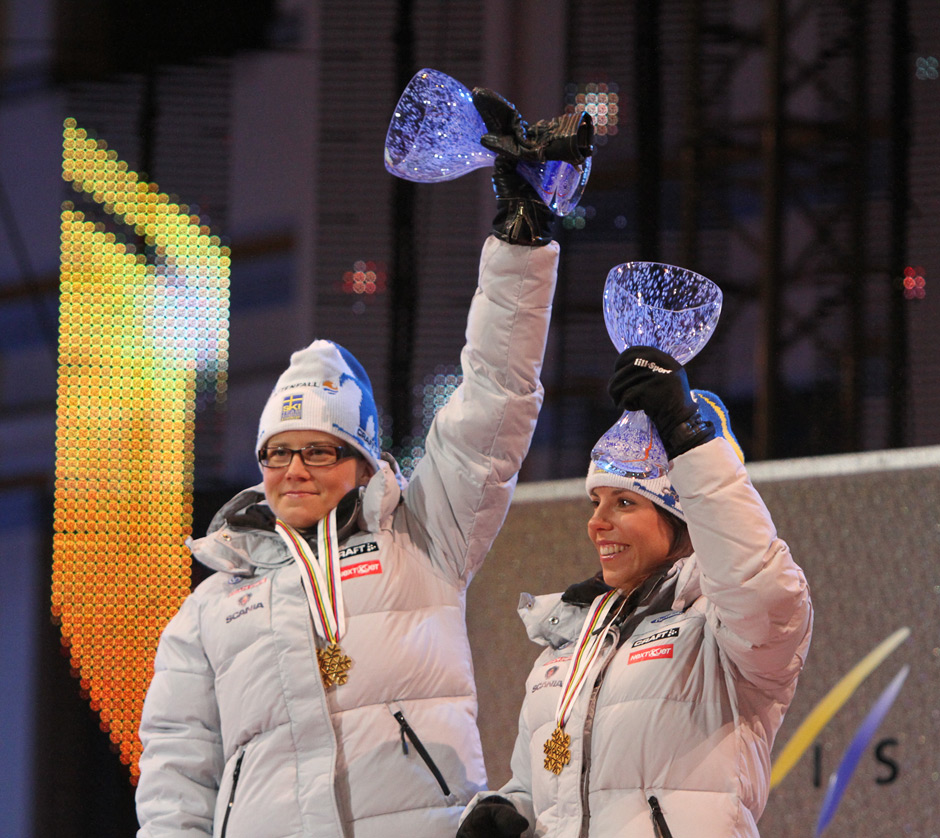
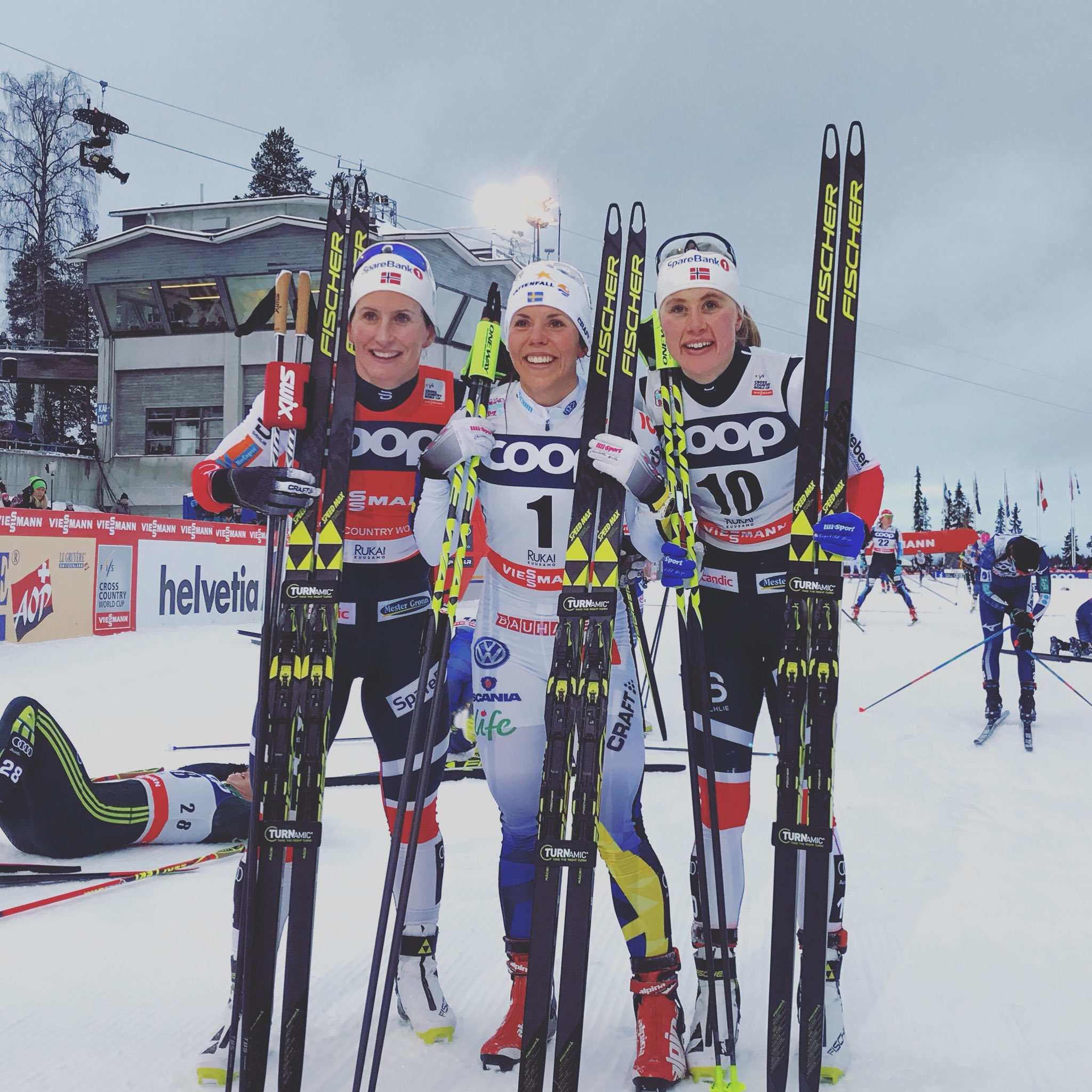
Charlotte Kalla (R) and Ida Ingemarsdotter won the team sprint at the 2011 World Championships.
For many years, Imgemarsdotter was a Swedish World Cup staple. She’s a two-time medalist at the Olympics and a down to earth Swede, as we learn about her recent moose hunt in the podcast.
Her career was an arc of steady improvement which eventually saw several young Swedish skiers not simply emerge but burst onto the World Cup scene to challenge Norway’s dominance.
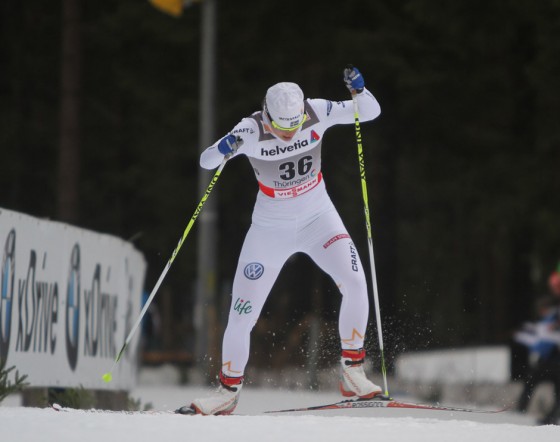
2013 image of Ingemarsdotter in bib 26 at the Asiago, Italy World Cup.
U.S. scramble skier Sophie Caldwell (r) chases Sweden’s Ida Ingemarsdotter in the semifinals of Wednesday’s Olympic 6 x 1.3 k classic team sprint in Krasnaya Polyana, Russia. Caldwell and teammate Kikkan Randall made the final and placed eighth overall, while Sweden won bronze.
Ingemarsdotter at the 2012 Tour de Ski Oberhof, Prologue.
Dave Stewart transitions from the University of Denver to the Steamboat Winter Sports Club.
After twelve years as the Nordic Head Coach at the University of Denver (DU), Dave Stewart will be stepping down. Under Stewart’s leadership, DU earned six NCAA Division I national championships in skiing. Stewart’s long list of accomplishments includes a 2016 co-Nordic Coach of the Year honor and five Rocky Mountain Intercollegiate Ski Association (RMSIA) Coach of the Year awards.
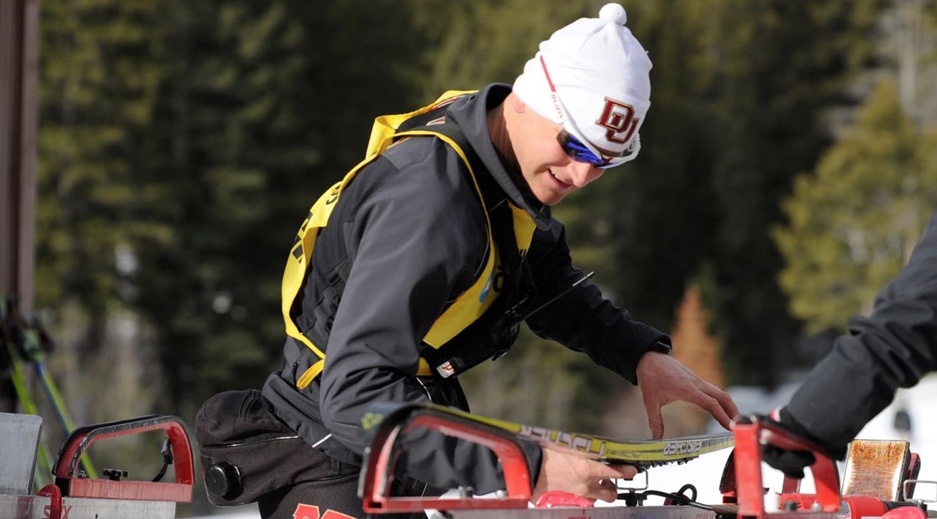
Dave Stewart waxing skis for the University of Denver. (Photo: University of Denver press release.)
Stewart will remain in Colorado as he moves to a new position with the Steamboat Winter Sports Club. Stewart will begin his new job in June as the club’s new Athletic Director. His move to Steamboat brings him closer to family members that reside in the town.
“My wife’s family is up there, her dad and brother, her brother works for the club and is a freestyle coach there,” Stewart said on the telephone with FasterSkier. “And then we love Steamboat too. It is a great community. Being back in the mountains, my wife is from Lake Placid and I am from Vermont so that is a huge drive too. And we have a two-year-old and to get him up in the mountains and expose to some snow a little bit more is a big draw for us as well.”
Stewart knows the club well as five members of the DU ski team raced with the Steamboat Springs Winter Sports Club as juniors. Moving into an administrative role, Stewart said he welcomes the new broadened opportunity in Steamboat to work with athletes across several different sports.
“It is almost like a community service working at the club,” said Stewart. “They are right there in town and getting kids out on snow.”
At DU, Stewart was tasked with not only winning but fostering a collegiate experience that combines both sport and academics.
“I am sure I will miss coaching,” Stewart reminisced. “I have been involved with cross-country ski racing for a very long time as an athlete and a coach. I have enjoyed it very much. Working with people in this age group, you know, it is like there dream to come and be a student-athlete and pursue those goals, as an athlete and a student, I am going to miss that. There is no question about it. You cannot be a ski coach forever. You get to a point where you are looking to transition to something else. And to maybe a role that is interacting with sport at a different level, more of an administrative role. I think I have some good experience from here to be able to have a good impact on young athletes and coaches in that way. This is a good opportunity to step in that direction. “
Mathias Ahrens steps away from his role with Biathlon Canada.
In Canada, Mathias Ahrens left his position of coaching the Canadian National Biathlon team this past April. Ahrens spent 15 years with the team. He becomes the Head Coach at the Biathlon Alberta Training Center.
A name familiar to cross-country ski fans, Justin Wadsworth – a former U.S. Olympian, U.S. Ski Team coach and Head Coach of the Canadian National Ski Team — has been named interim Head Coach.
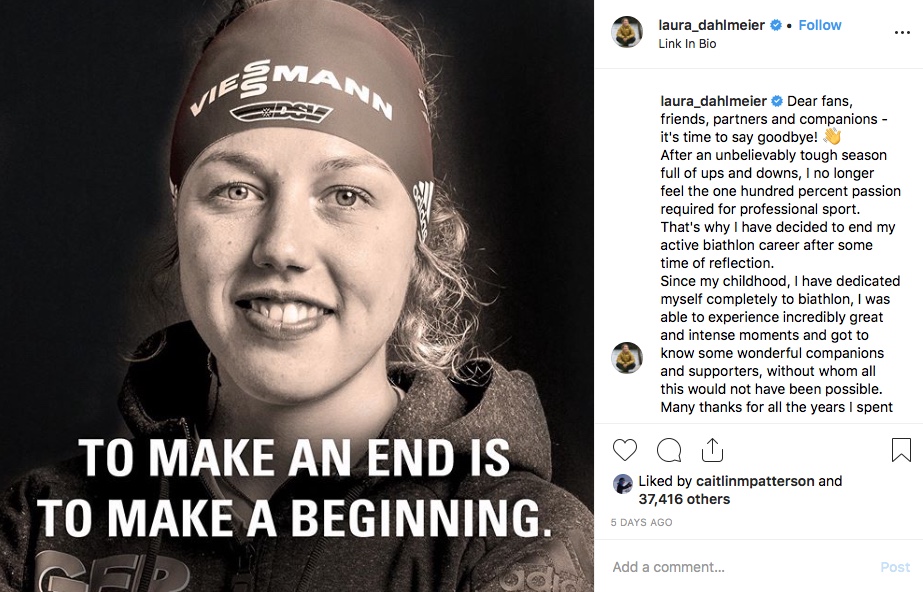
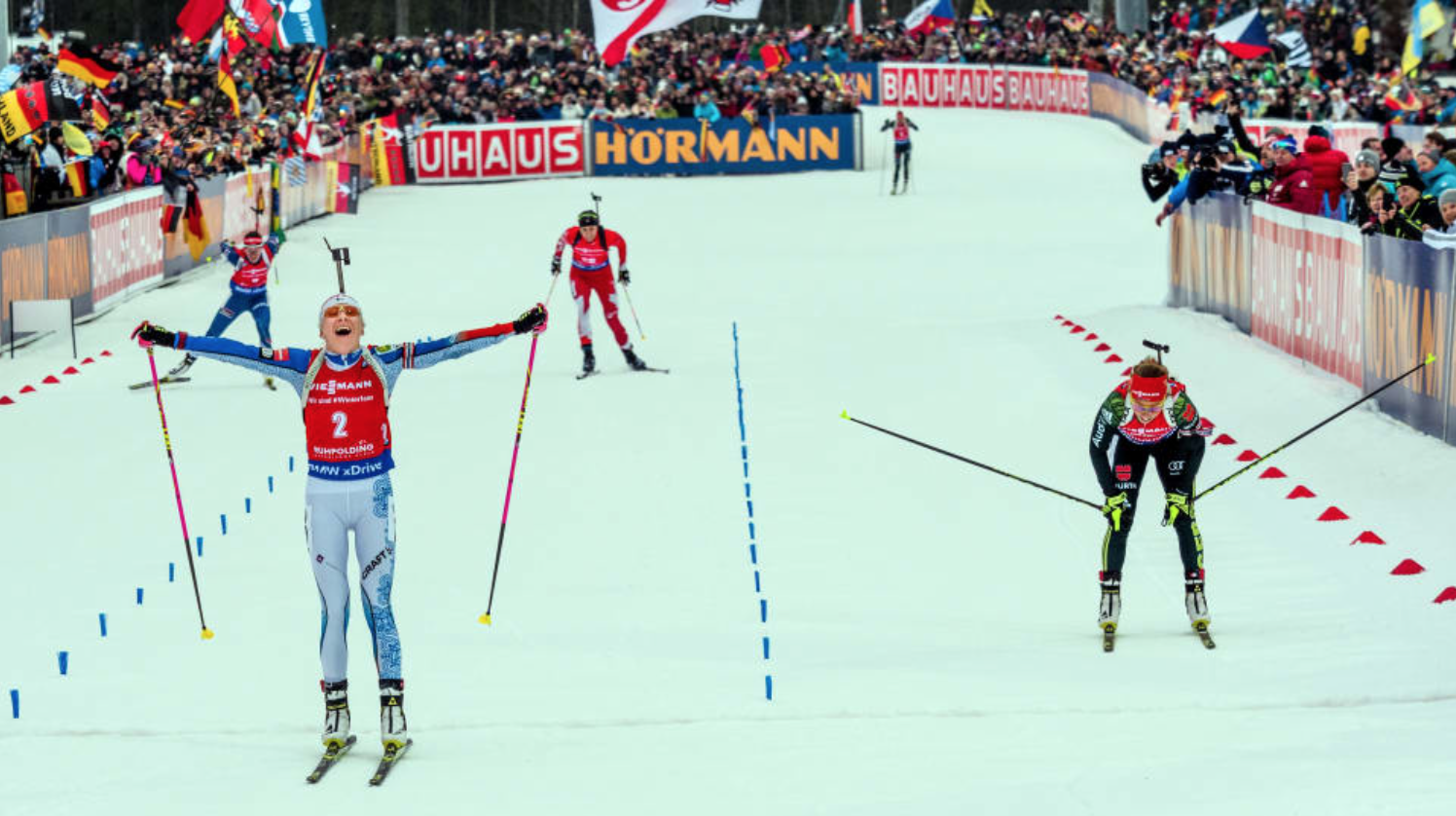
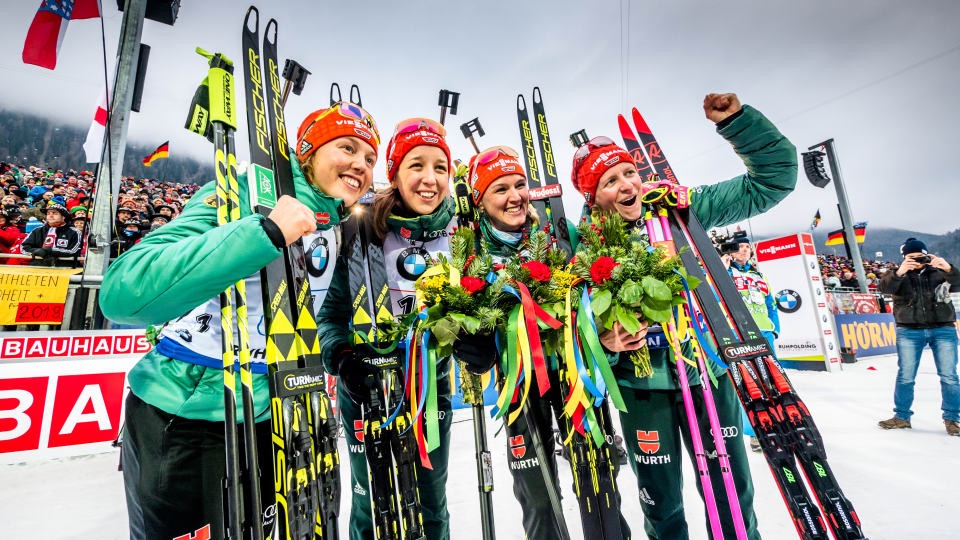
German biathlon star Laura Dahlmeier has retired from the sport at the age of 25.
In a storied career, she began competing internationally in 2011. She won 22 individual World Cup races, earned seven golds, three silver, and five bronze medals at the IBU World Championships. Five of those World Championship medals were earned in Hochfilzen, Austria in 2017. Dahlmeier also won two Olympic golds along with Olympic bronze in PyeongChang.
In a post on Instagram, Dahlmeier said the past season during which she struggled to perform at her historic highs, prompted her to seek a change.
“After an unbelievably tough season full of ups and downs, I no longer feel the one hundred percent passion required for professional sport. That’s why I have decided to end my active biathlon career after some time of reflection,” Dahlmeier wrote.
Dahlmeier was hospitalized in August and September of 2018 and although she returned to the World Cup, her energy levels were not the same. However, this past season she stood on the World Cup podium three times and won two bronze medals at the 2019 IBU World Championships.
Sweden’s Ida Ingemarsdotter announces her retirement.
Thirty-four-year-old Ida Ingemarsdotter has called it a career after racing on the cross-country World Cup since 2004. The Swede finished last season ranked sixth in the overall sprint standings and 15th in distance. Despite her strong season, Ingemarsdotter stated she lacked the motivation for another season at the elite level.
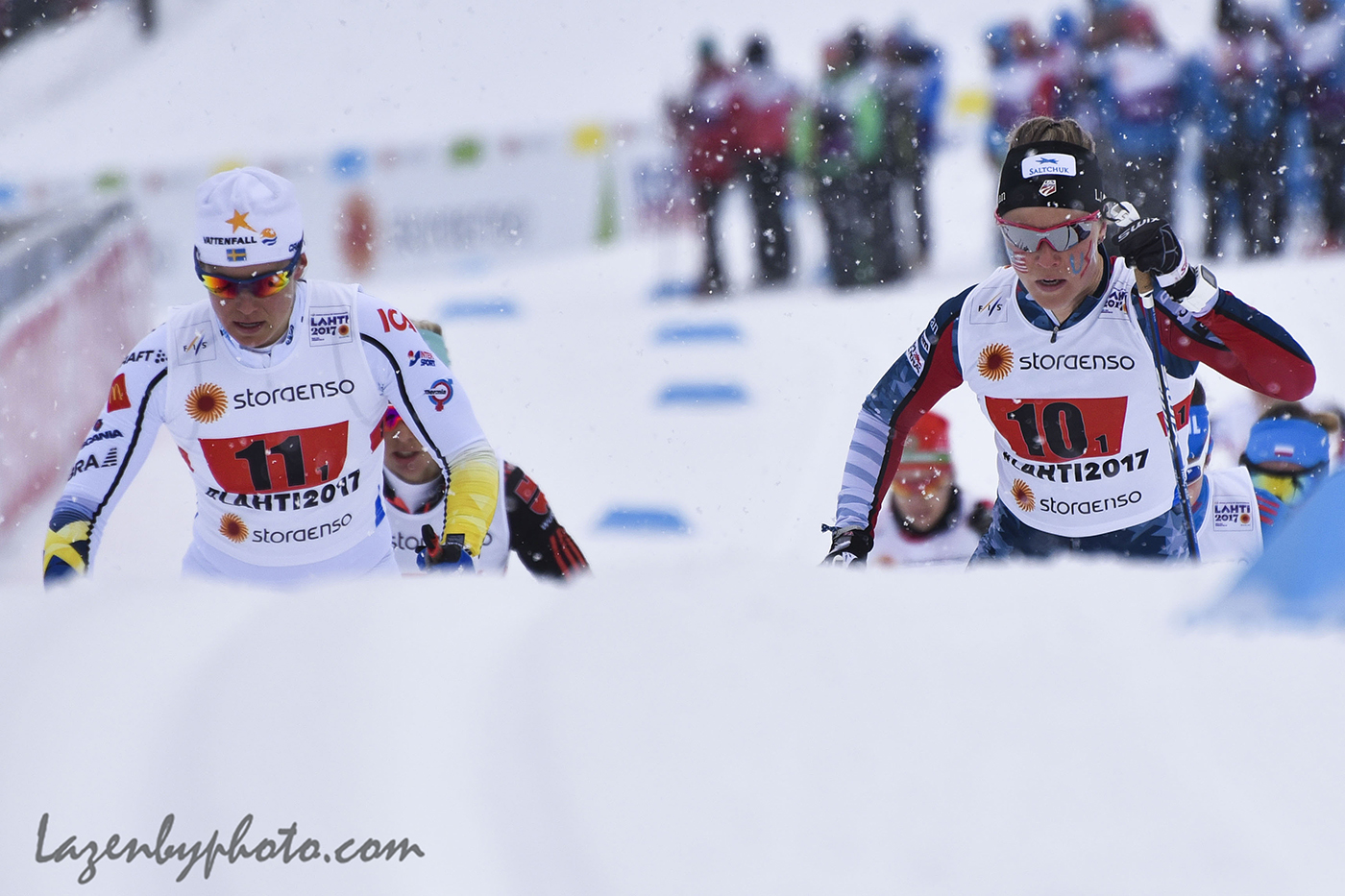
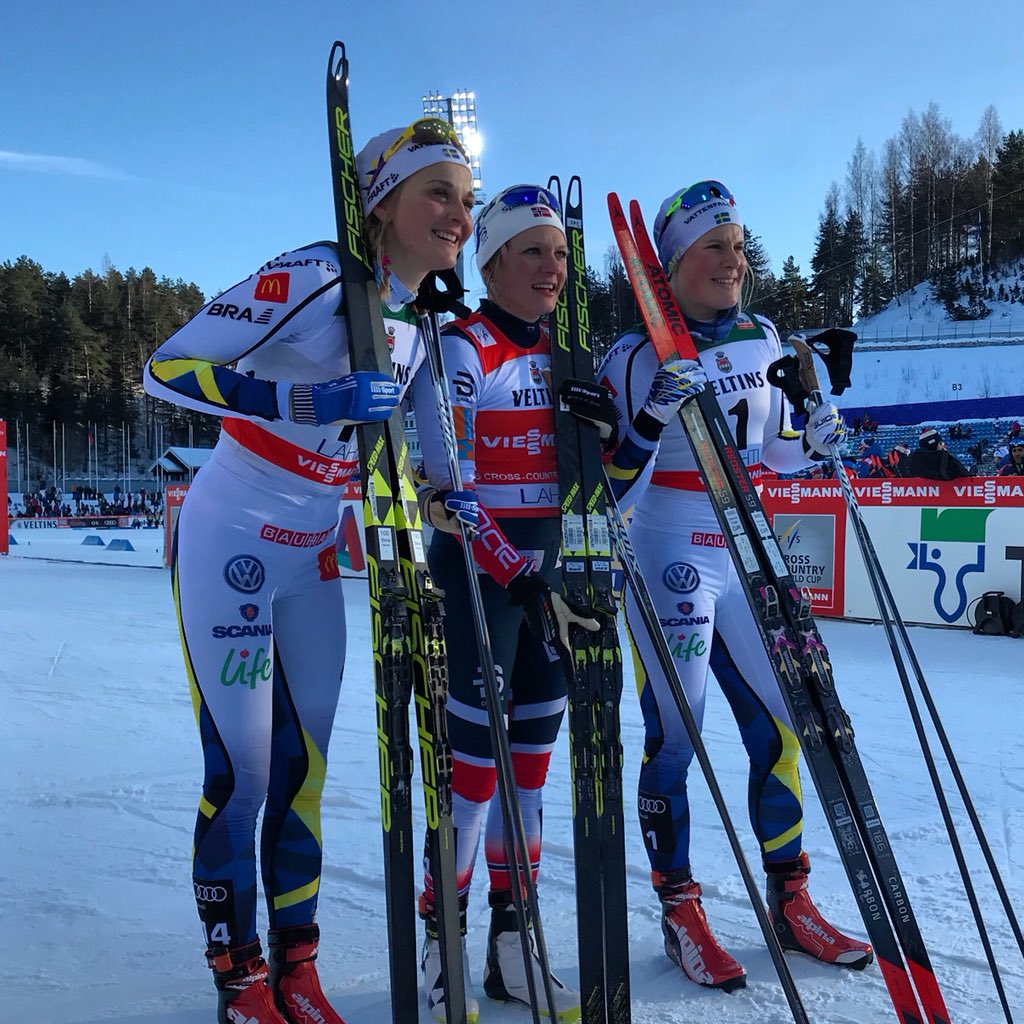
Sweden’s Ida Ingemarsdotter (11) and American Sadie Bjornsen (10) go head to head in the women’s classic sprint final at 2017 World Championships in Lahti, Finland.
She stood on two individual World Cup sprint podiums last season and placed in the top-10 eight times.
Her medal haul includes five World Championship silver medals and one gold. She also won two Olympic medals, a gold, and bronze in Sochi.
Ingemarsdotter explained in a press release that her best day skiing came during the women’s 4 x 5-kilometer relay at the Sochi Olympics.
“The biggest day in my sports life was when I took Olympic gold in relay 2014 together with Anna Haag, Charlotte Kalla and Emma Wikén. Everything went our way and it was a real dream day where tears were mixed with laughter and a strange feeling that we did something nobody thought we would succeed with,” Ingemarsdotter said according to a translation of the Swedish National Team’s official retirement announcement.
The University of Alaska Anchorage announces a new cross-country coach.
In a press release on May 10, the University of Alaska Anchorage (UAA) announced that cross-country ski coach Andrew Kastning had stepped down to pursue other opportunities. His coaching replacement is Trond Flagstad.
No stranger to the UAA program, Flagstad began as an assistant coach in cross country running and skiing at the school back in 2001. Flagstad was head nordic coach from 2004 to 2011. Most recently, Flagstad was ski coaching in Norway.
“I am very excited to be back at UAA and in the Seawolf family,” said Flagstad according to the UAA press release. “I am looking forward to working with all the great coaches and the talented student-athletes at UAA, especially with the ski team. My goal of winning the NCAA skiing championships with the UAA ski team hasn’t changed since the last time I was here, and after coaching in Norway for three years, I know I am better prepared as a coach to reach those goals. I am excited to recruit and develop young skiers from Alaska to help us win races and championships. In addition I have created some very valuable friendships and connections in Scandinavia and Europe. I have some new ideas and a coaching philosophy that I believe will benefit the UAA ski team, especially the Nordic team on our way to a championship title. I am thrilled to have this opportunity and to move our family back to the house we built up on the hillside.”
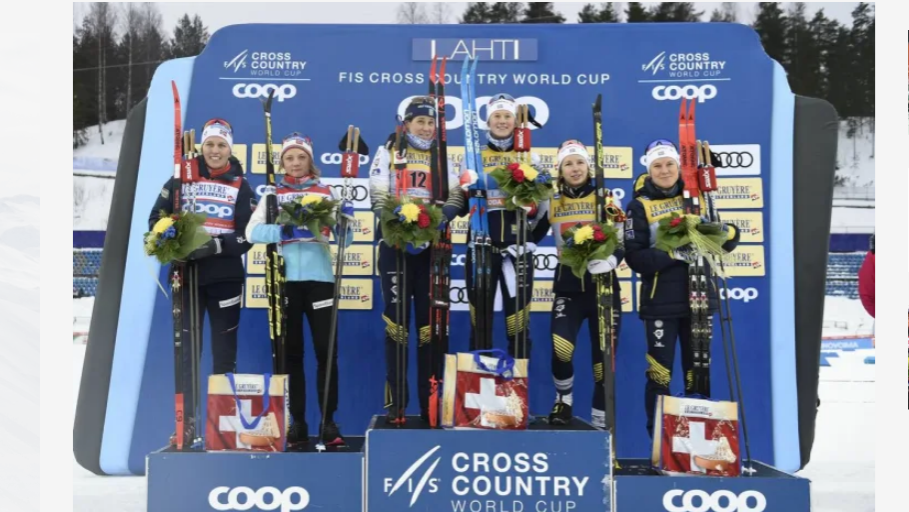
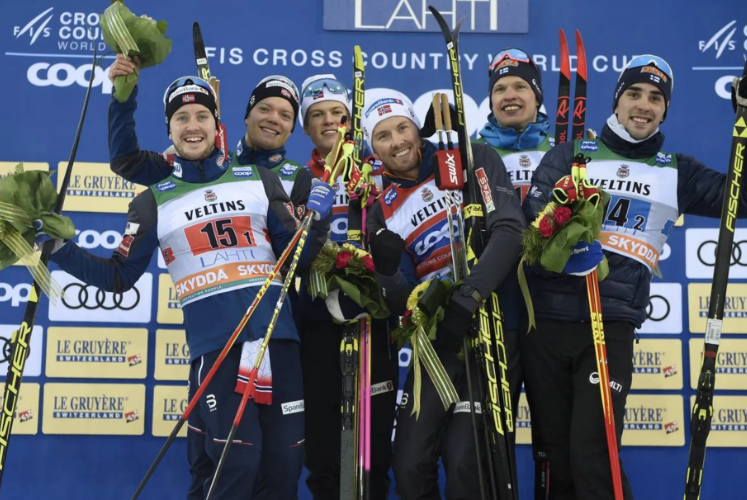
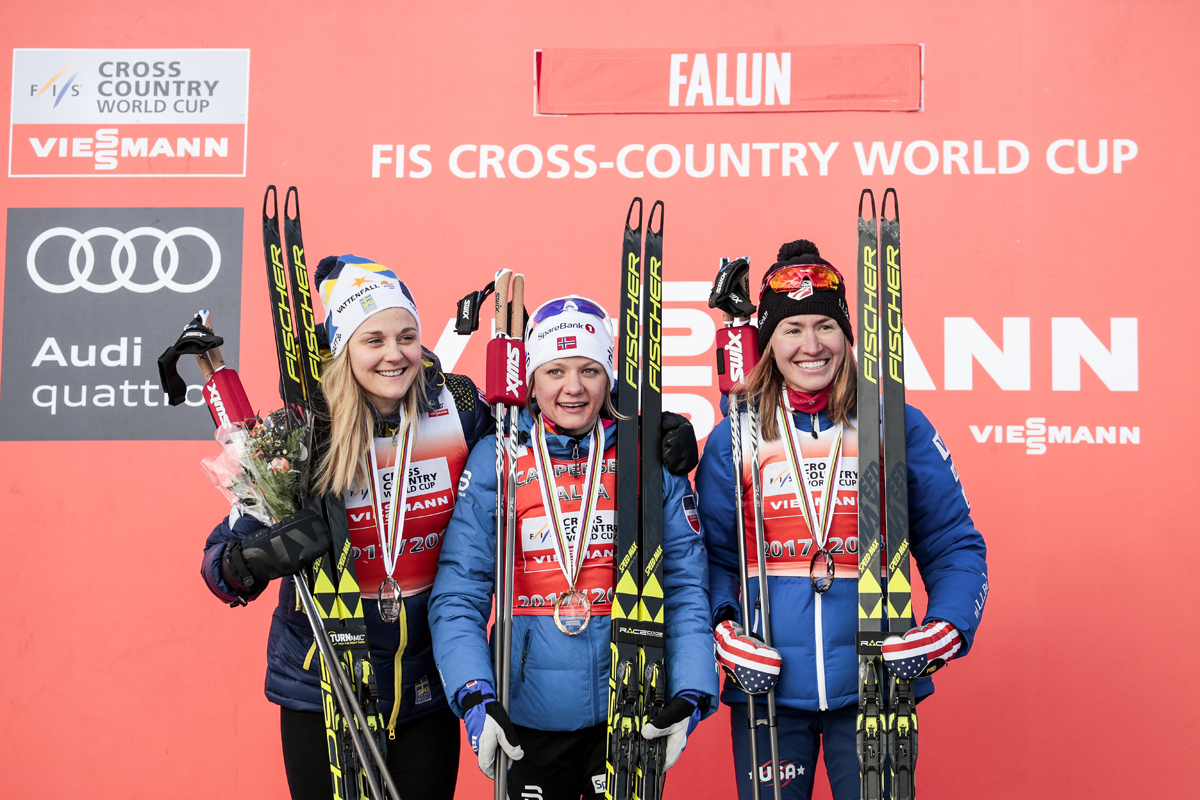
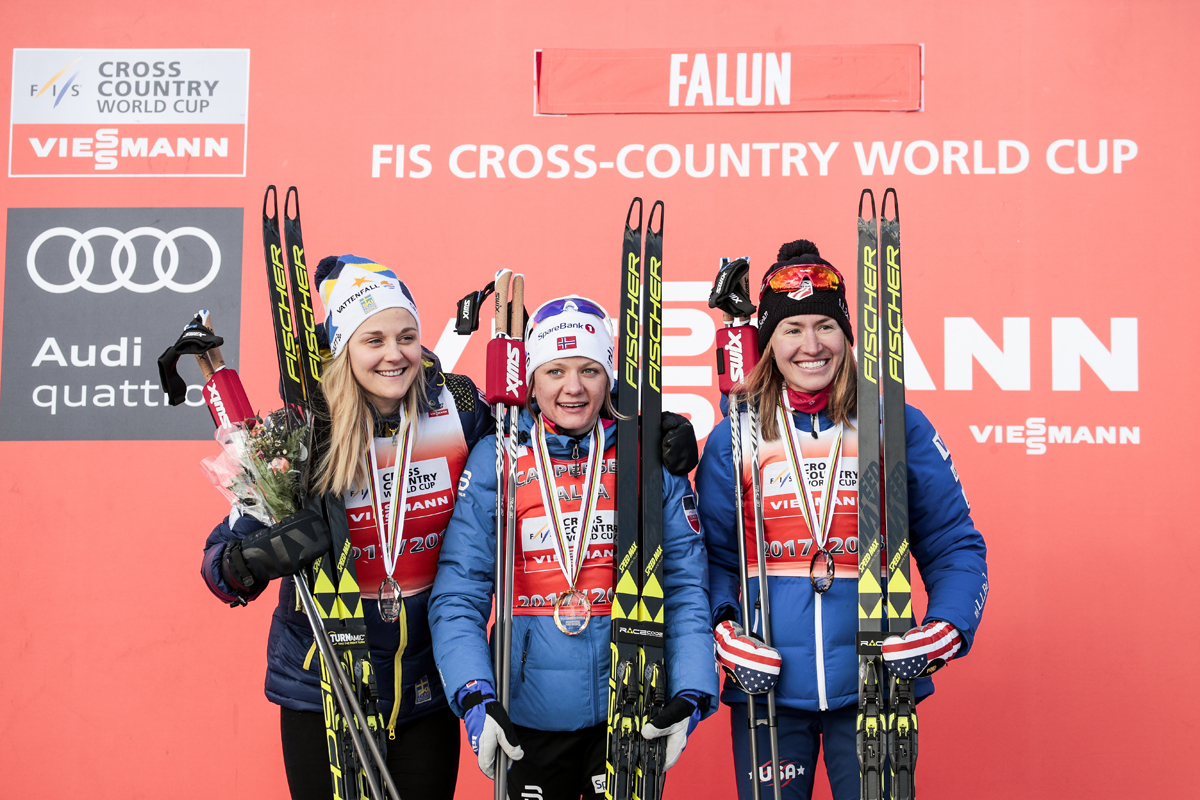
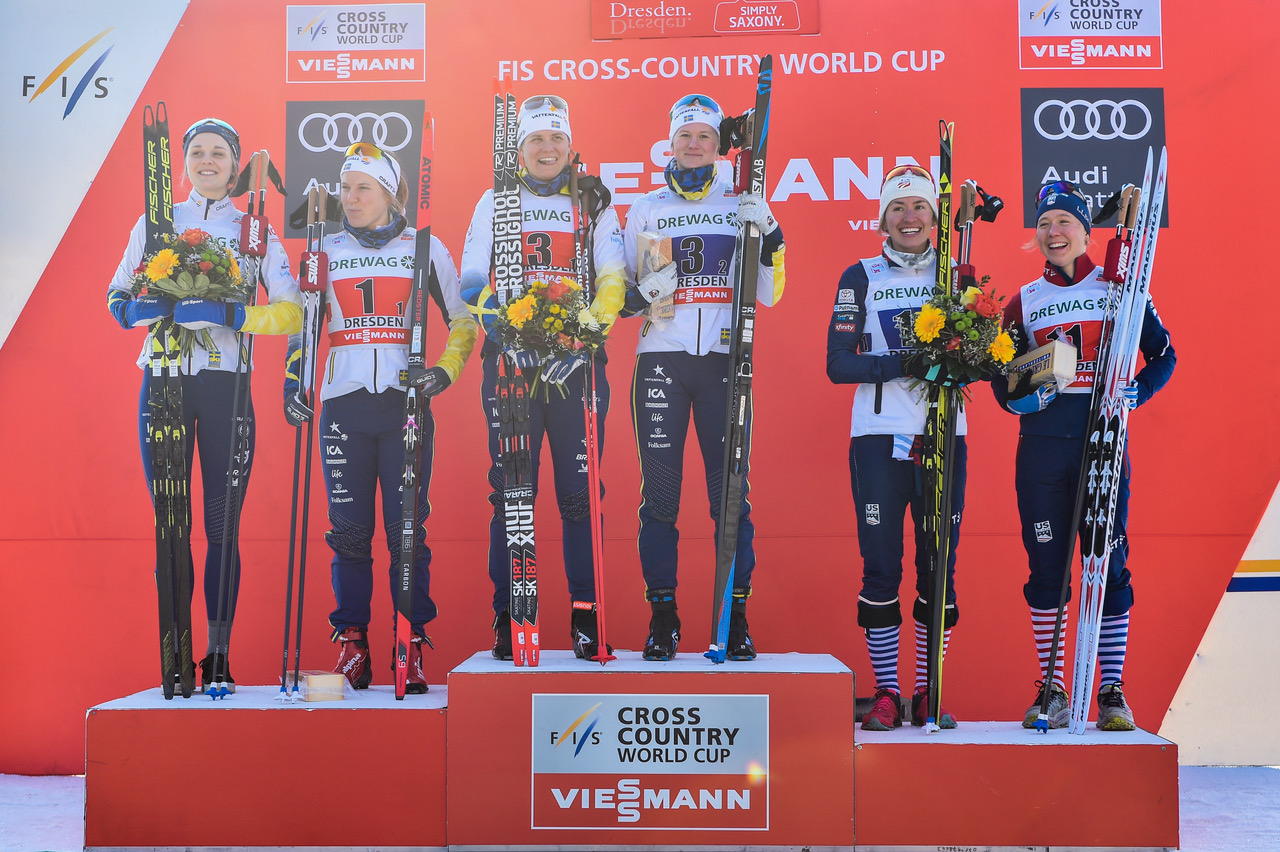
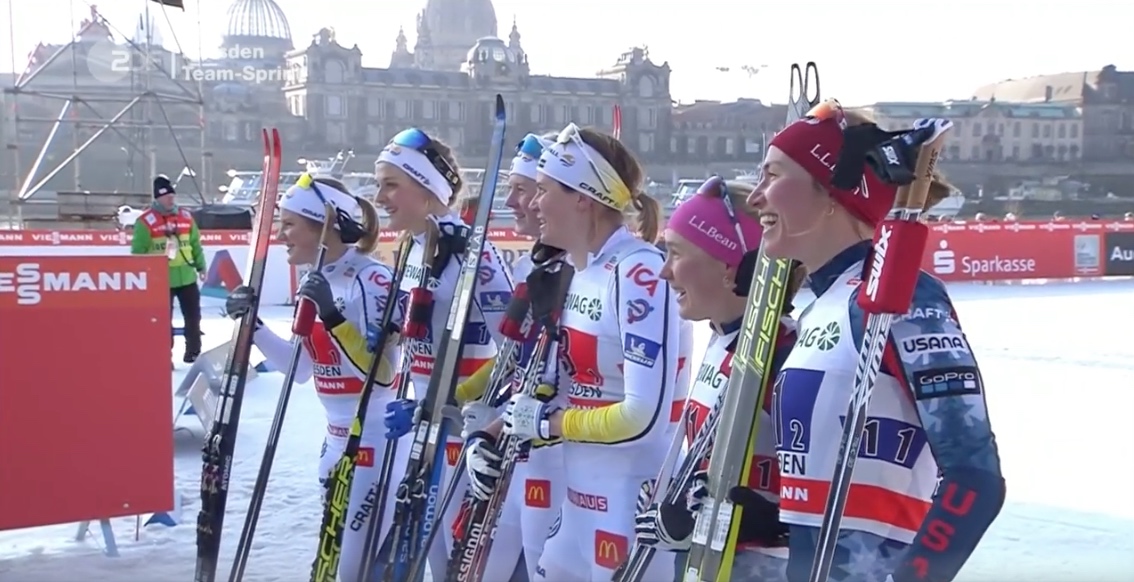
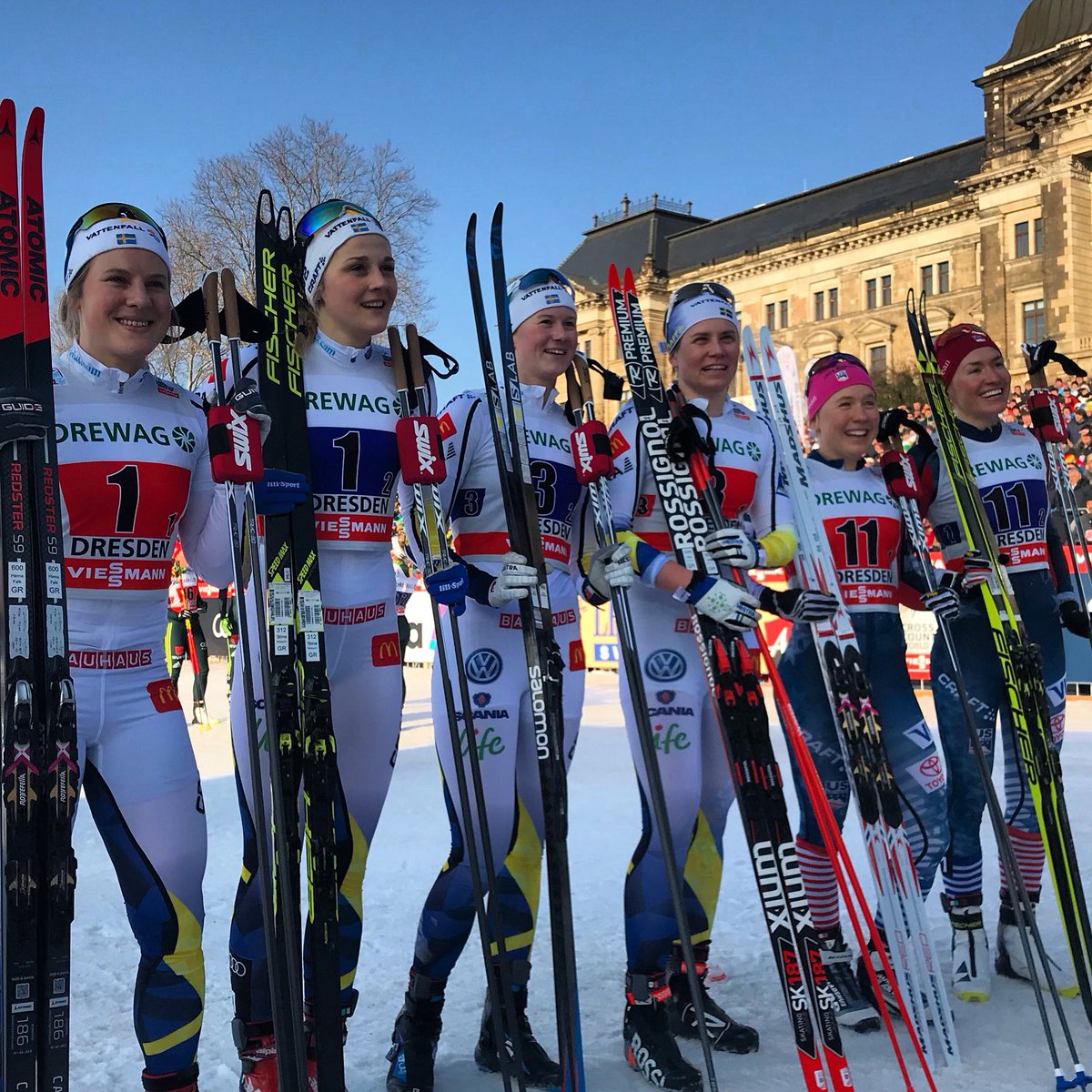
From left to right,Tiril Udnes Weng and Maiken Caspersen Falla of Norway I in second, Maja Dahlqvist and Ida Ingemarsdotter of Sweden I in first, and Evelina Settlin and Hanna Falk of Sweden II in third. (Photo: FIS cross country screenshot)
It was a weekend of sprinting in Lahti, Finland, with many World Cup athletes closing out Sunday having traversed the famed 1.4-kilometer 2016 World Championships sprint loop at top speed close to ten times.
By the time Sweden’s Maja Dahlqvist got on course for the final lap of the women’s classic Team Sprint, she had already tallied nine–in Saturday’s freestyle sprint she made it through the qualifier, quarterfinal, semifinal and final (placing third), and on Sunday, she and teammate Ida Ingemarsdotter had to first complete in the 6 x 1.4 k semifinals to advance to the 6 x 1.4 k final.
Through the first two thirds of Sunday’s final, it appeared the extra kilometers had worn on the Swede. She and Ingemarsdotter remained positioned in fifth or sixth through first four exchanges, watching from behind the pace of Norway’s Team I, Norway’s Team II, Russia’s Team I and Finland’s Team I.
In her last leg and just before the final exchange, however, Dahlqvist’s teammate Ingemarsdotter made a decisive surge to the front. By the time Ingemarsdotter handed off to Dahlqvist for the race’s final sprint lap, only Tiril Udnes Weng of Norway’s Team I remained in front. Heading into the races final kilometer and half, Sweden’s Team I was positioned in second.
If Dahlqvist was feeling anything in her legs from the weekend’s sprint series, it must have been motivation. She charged into the last sprint lap chasing down Maiken Caspersen Falla, the anchor for Norway Team I and the winner of Saturday’s skate sprint.
In the end, Dahlqvist’s press proved too strong for Falla. She overcame the Norwegian and Sweden’s Team I crossed first in a time of 18:24.96 for the win. Falla crossed 1.84 seconds behind to put Norway Team I in second place. Claiming third place, 3.55 seconds back from the winners, was Sweden’s Team II of Evelina Settlin and Hanna Falk.
With World Championships just around the corner, the U.S. entered two teams in the sprint: USA I was comprised of Ida Sargent and Sophie Caldwell. The two women raced the first semifinal and finished outside of advancing to the finals, placing 12th overall. Sargent and Caldwell have partner up in the past and landed on the podium–last year in Dresden and two years ago in the Pyeongchang World Cup–so making it into the final and onto the podium had been in the back of their minds.
“Classic team sprint I think is my favorite race so I was really excited for today but unfortunately it didn’t go as well as we hoped” Sargent wrote in an email.
Sargent cited the pace of the semifinal as unlike team sprint semis that she has scrambled for in the past.
“Today’s race was the fastest team sprint semifinal that I’ve ever raced,” she wrote. “It was hard from the gun rather than building into it more like some races. My skis were really slick for the first two legs so I was using a lot more energy to stay at the front than some of the girls that I was skiing with. Then on the third lap when the pace really picked up I didn’t have much left and was just trying to not completely explode.”
Kelsey Phinney and Julia Kern were entered as USA II and placed 14th overall. The duo placed seventh in their semi-final.
Resources were stretched a little thinner this weekend in Lahti due to the simultaneous USST pre-World’s training training camp in Davos, Switzerland.
“We have a really small service staff here and they were working so hard to get us great skis,” Sargent wrote. “Today was just a trickier klister day with not much time for testing so we ran out of time. Yesterday I felt like we had the best skis in the field which was super impressive since we only had a few techs here who were all working so hard.”
U.S. World Cup coach, Matt Whitcomb indicated that he helped with skis on Sunday and because of that role, spent most of his time waxing instead of on course.
“While it was definitely a disappointment not to have any teams advance through the semis today, we did see a lot of athletes ski really well,” Whitcomb said during a phone conversation. “Unfortunately, Ida struggled a little bit with her skis and Simi struggled with his glide. … Sophie and she felt like she had really awesome skis and felt really good, so she has returned from her trip home very strong,” Whitcomb continued.
Caldwell recently returned to the U.S. to spend time with her mother.
“I have no real regrets,” Whitcomb said. “Our team, staff, athletes, we all tried and executed the plan we intended to, sometime it all doesn’t work out as perfectly as planned.”
Athletes will remain in Finland for two days before heading down to Cogne, Italy on Wednesday for the final World Cup races before World Championships in Seefeld, Austria.
“While the results were a little bit disappointing today in Lahti, I really believe we have a team that is well prepared for World Championships,” Whitcomb said. “We like to go into the Championships having knocked a few races out of the park and we had a couple hits this weekend, but not as many as we intended to. So we will be looking to swing hard in Cogne. I feel very confident about our Seefeld Championships with this team, its a strong crew.”
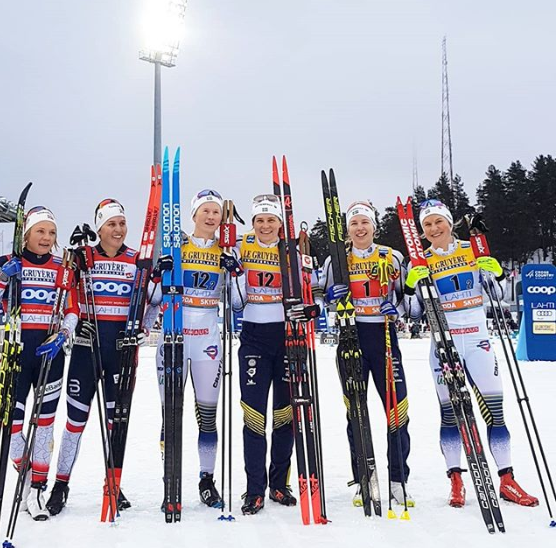
2019 Lahti, Finland’s World Cup classic team sprint podium. From left to right, Norway I in second, Sweden I in first, and Sweden II in third. (Photo: @fiscrosscountry Instagram screenshot)
FIS World Cup Lahti, Finland Classic Team Sprint
Sunday in Lahti, Finland the women raced a 6 x 1.4-kilometer classic team sprint. U.S. fans saw their hopes for a podium snuffed out in the two semi-finals that determined the 10 teams advancing to the finals.
In the first team sprint semi, the U.S. Ski Team’s (USST) Ida Sargent and Sophie Caldwell placed sixth overall and did not advance. Sargent and Caldwell, constituting team USA I, were 10.78 seconds off the winning time of Sweden II’s Evelina Settlin and Hannah Falk, who won the first semifinal in 18:36.74 minutes.
In the second semi, USA II’s Kelsey Phinney (SMS T2) and Julia Kern (USST D-Team) raced to seventh (+1:06.32). Norway I’s Tiril Udnes Weng and Maiken Caspersen Falla marked the fastest time of 18:31.09 minutes.
In the women’s final, Sweden I’s Ida Ingemarsdotter and Maja Dahlqvist won in 18:24.96 minutes. Weng and Falla took second (+1.84), Sweden II’s Settlin and Falk placed third (+3.55).
2019 Lahti, Finland’s World Cup classic team sprint podium. From left to right, Norway II in second, Norway I in first, and Finland I in third. (Photo: fis-ski.com screenshot)
The men raced a 6 x 1.6 k classic team sprint in Lahti. Both U.S. teams entered raced in the second semi with neither placing well enough to advance. The second semi was won by Russia I’s Artem Maltsev and Gleb Retivykh in 19:31.22 minutes.
In that semi-final, USA II’s Kevin Bolger and Logan Hanneman placed sixth (+6.60), USA I’s Simi Hamilton and Erik Bjornsen were seventh (+16.05).
USA II placed 12th overall, USA I 14th in the final standings.
Johannes Høsflot Klæbo and Emil Iversen of Norway won the first semi in 19:22.32 minutes.
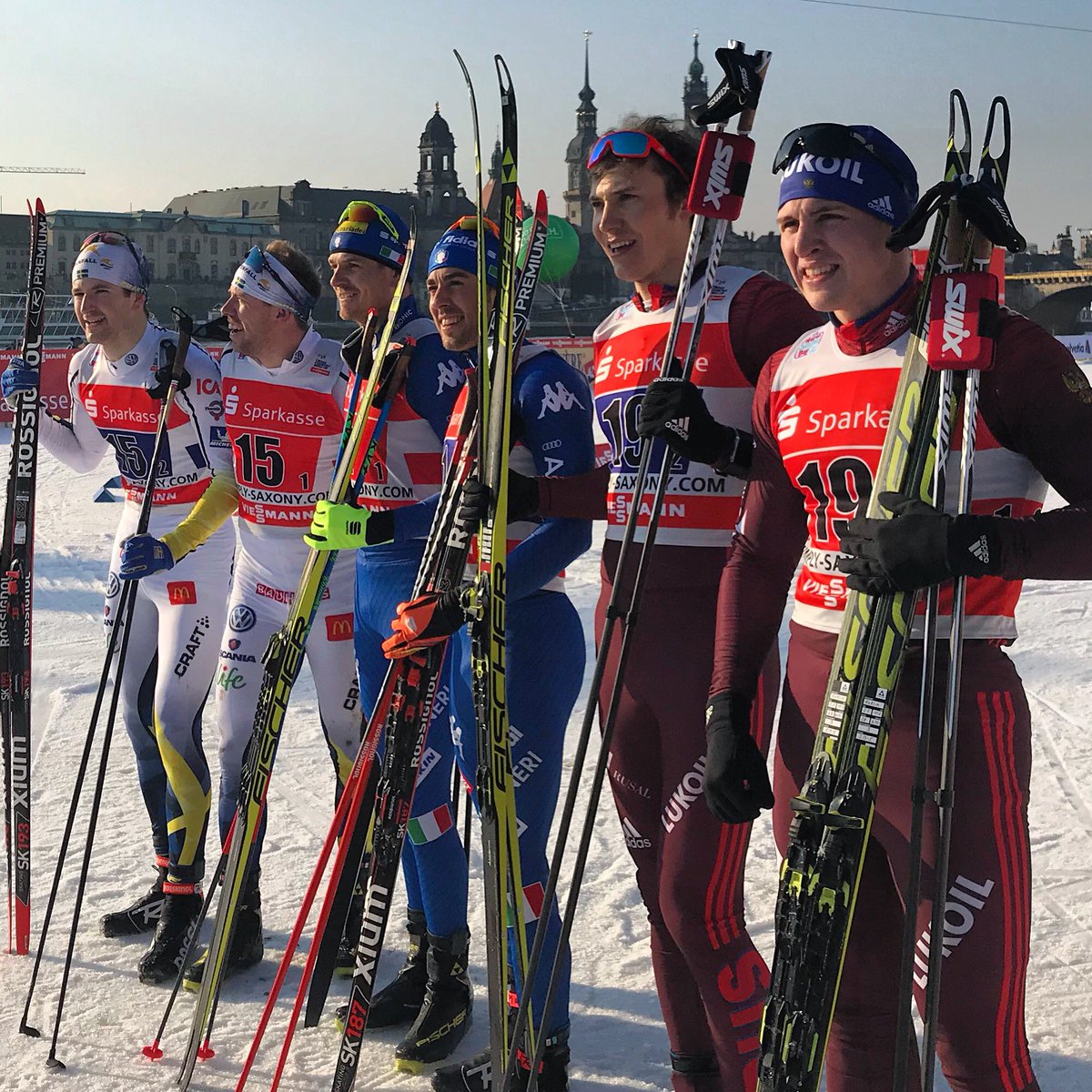
Norway I’s tandem won the final in 18:57.19 followed closely by Norway II’s Sindre Bjørnestad Skar and Eirik Brandsdal in second (+0.65). It was a photo finish for second and third, as Finland I’s Iivo Niskanen and Ristomatti Hakola finished 0.71 seconds back to take the third podium spot.
Western Canadian Championships, Telemark, Kelowna B.C., Relays
Westerns wrapped up with club relays on a day where the thermometer flirted with cancellation before rising to -17C at 9am (that is 2 Fahrenheit, for residents of Liberia, Myanmar, and the USA).
The relay event is intended to help build club spirit in a less competitive environment. In practice, many skiers just find two friends they want to ski with. Despite the cold, 105 teams competed today.
In the open men category, the ‘BC Lost Boys’ team won easily, with Rémi Drolet, Gareth Williams, and Julien Locke finishing the 15km in 38:00.9. Drolet and Locke are teammates at Black Jack while Williams is a Telemark local. All three are national team members.
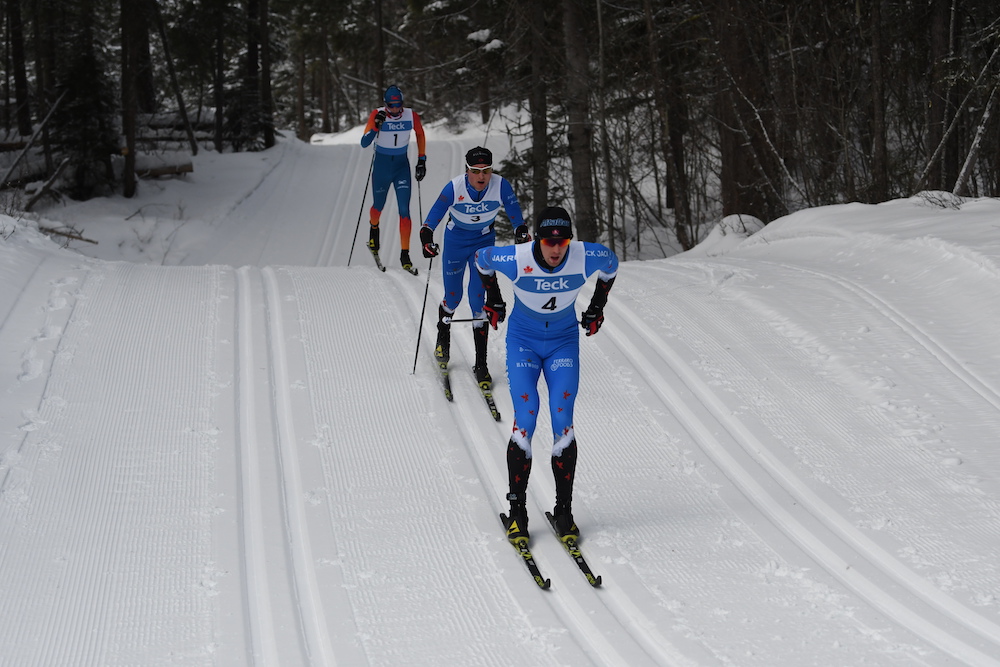
Julien Locke leads Rémi Drolet and Sam Hendry in Saturday’s mass start classic. The relay used the same 5km loop. (Photo: Doug Stephen)
‘Alberta 1’ placed second, at 1:47.1 back, with Thomas Manktelow (), Michael MacIsaac-Jones (AWCA), and Sam Hendry (Team R.A.D.) ‘BC Power, Speed, and Grace’ was third, with Tallon Noble (Strathcona), Michael Murdoch (Whistler), and Ian Williams (Telemark) at 2:26.8.
The open women used the same 5km loop as the men (and the same as on Saturday). ‘BC Supernovas’ won in 47:25.7, with BC team members Paige Latta (Sovereign Lake), Elizabeth Elliot (AWCA), and Benita Peiffer (Whistler). ‘BC Avalanche’ took second at 1:33.4 with Katie Weaver (RMR), Gina Cinelli (Revelstoke), and Beth Granstrom (AWCA). ‘Just the Ladies – No Nick’ was just 3.5 seconds behind 2nd place with Claire Grall-Johnson (AWCA), Amanda Thompson (AWCA), and Hannah Jirousek (AWCA) representing Yukon/Ontario.
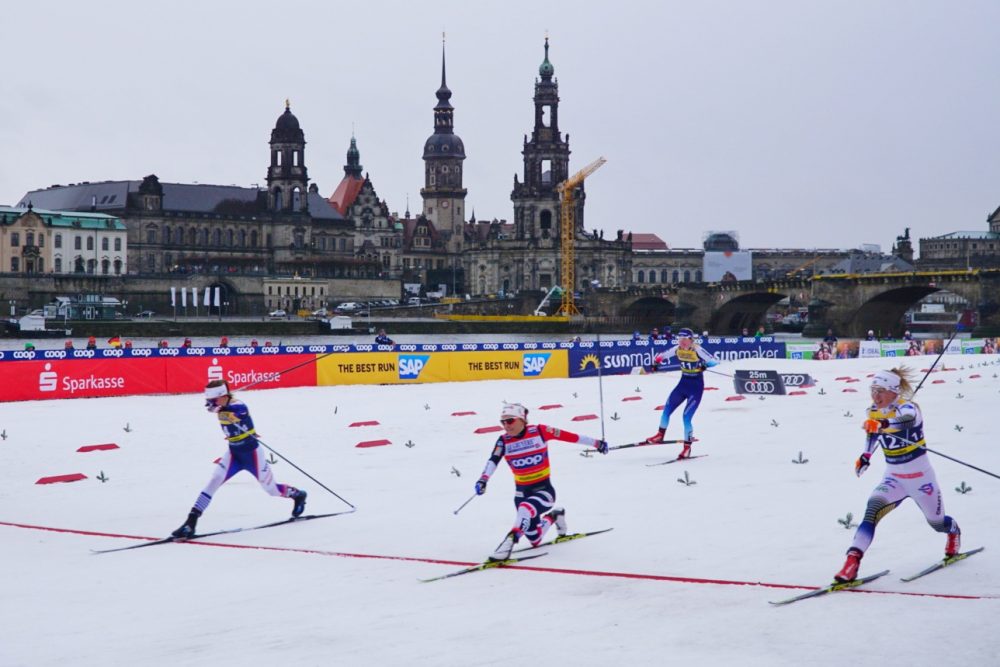
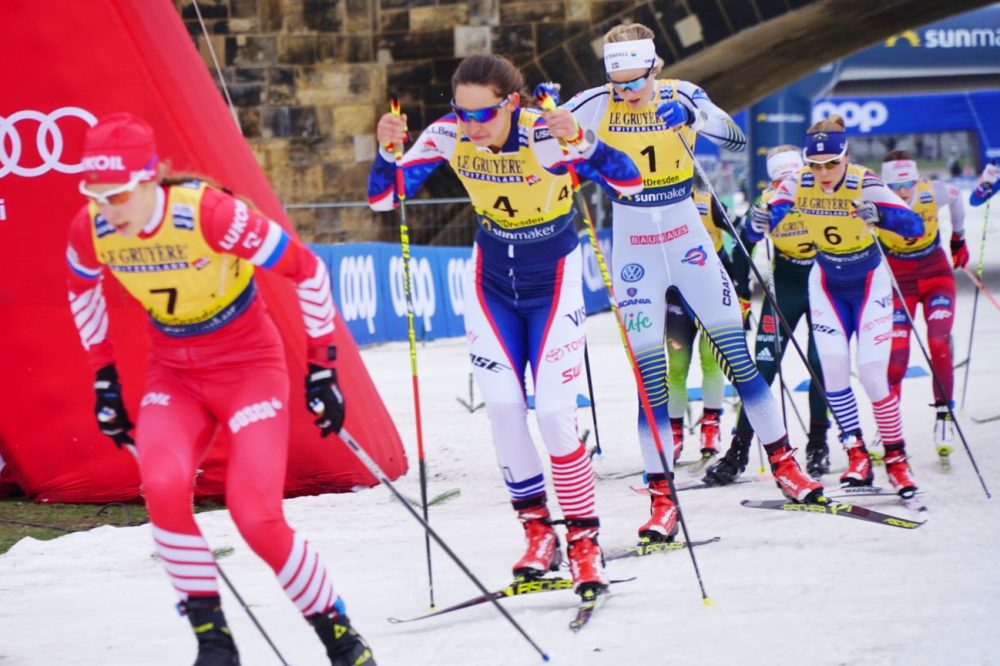
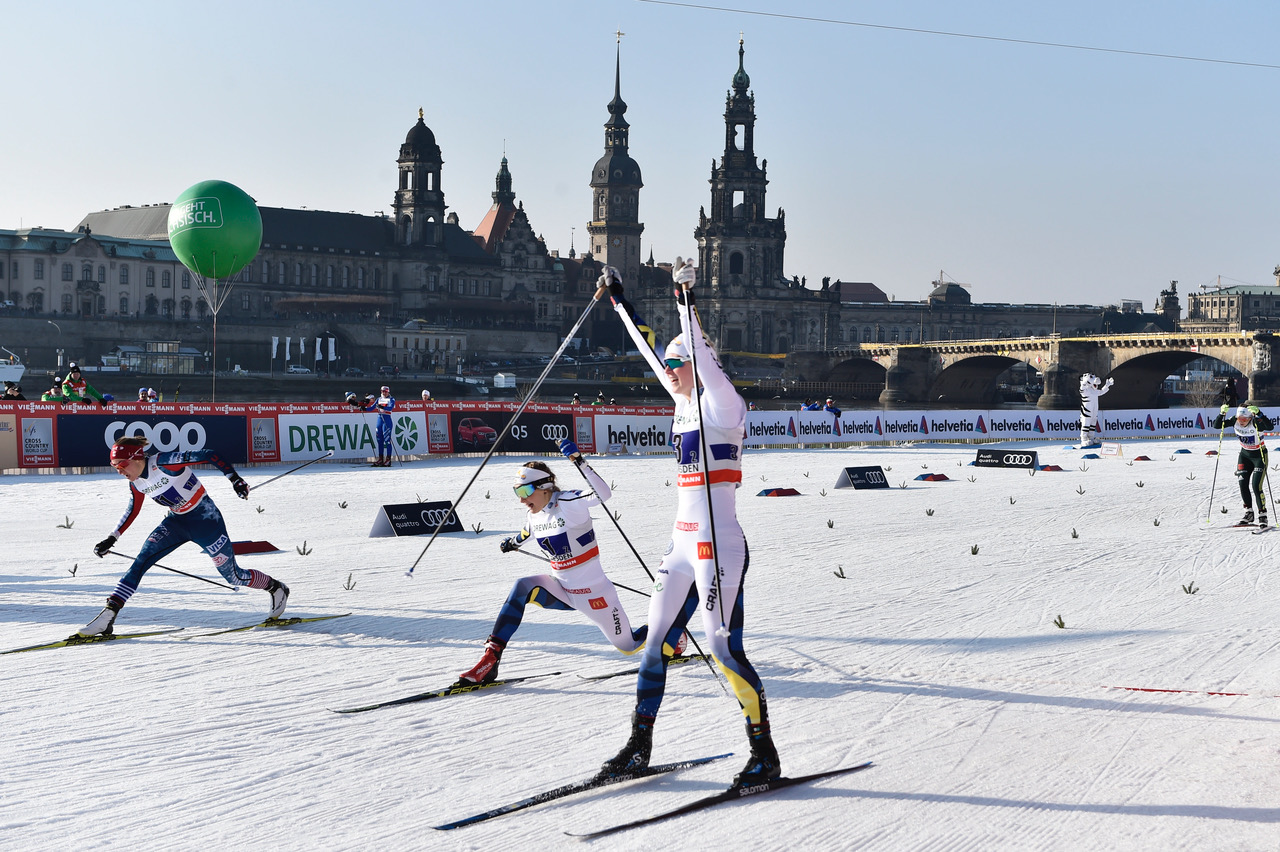
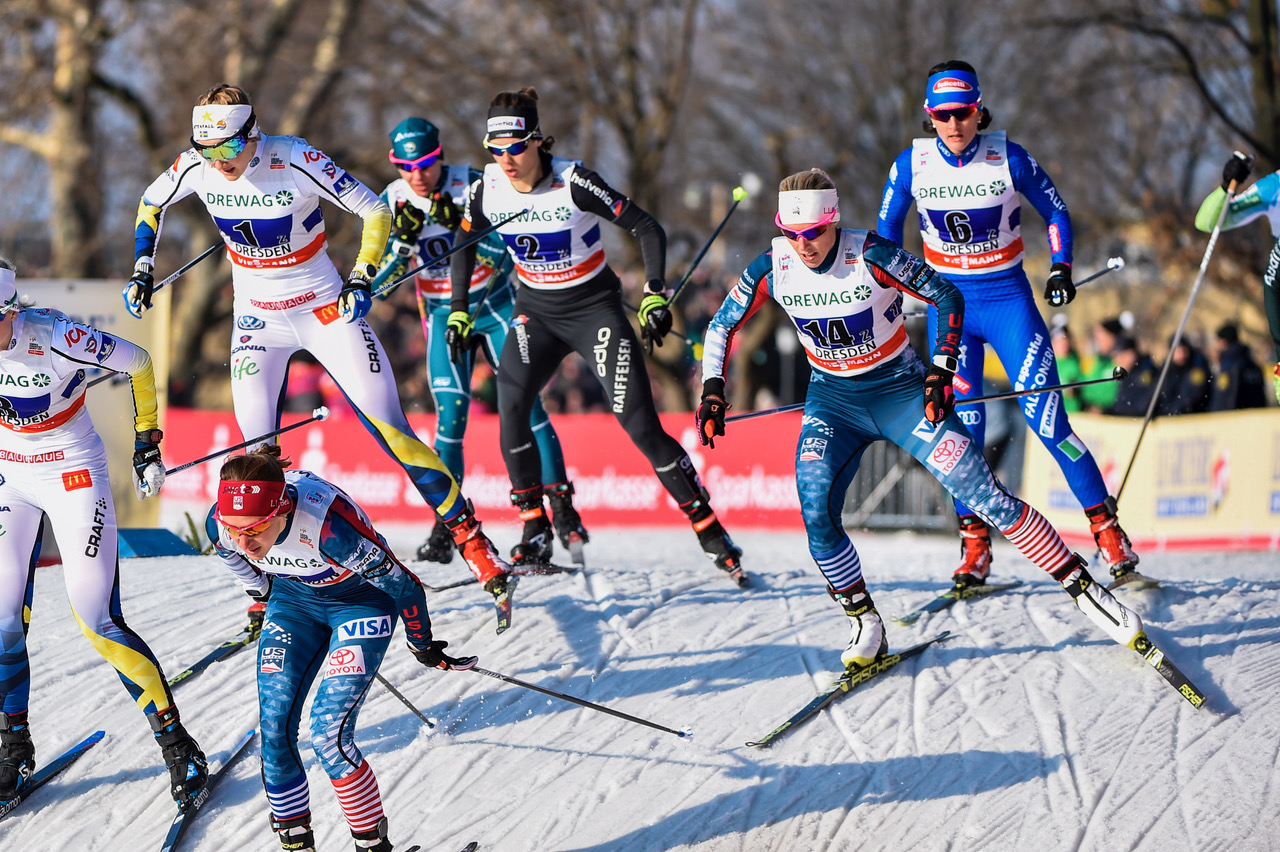
American Sophie Caldwell (far left) lunges to the line with Norway’s Maiken Caspersen Falla and Sweden’s Jonna Sundling. Caldwell ended up fourth, while Sundling took second and Fall third. Sweden’s Maja Dahlqvist 9not shown) crossed first for the win. (Photo: Garrott Kuzzy /LumiExperiences.com)
If the Grand Prix were to host a ski race, it might look like the Team Sprint in Dresden, Germany. With 10 teams racing the 6 x 1.6-kilometer final and the racetrack style, three-lap loop situated in the city’s center, the tactics of a Formula One driver seemed employable on the relatively flat course. For most teams’ skiers, that meant patience; staying in one’s lane and in contact until the last lap.
Norway’s Team I of Mari Eide and Maiken Caspersen Falla, the U.S.’s Team I of Julia Kern and Sophie Caldwell, Sweden’s Team I of Stina Nilsson and Maja Dahlqvist, as well as the Swede’s Team II of Ida Ingemarsdotter and Jonna Sundling remained the teams to watch heading through each exchange.
By the time she started her third and final leg, Falla appeared to have played the conservation game. When on course, she had taken a few pulls at the front, though for the most part, left that work to Sweden’s Team I and Team II second leg skiers, Dahlqvist and Sundling. With the brunt of the pace-setting work having gone to the Swedes, Falla’s engine seemed primed for a jumpstart to the front.
Norway’s Maiken Caspersen Falla leading the women’s 6 x 1.6-kilometer Team Sprint on Sunday in Dresden, Germany. (Photo: Garrott Kuzzy /LumiExperiences.com)
Just a few meters before the course’s hairpin turn, which shuttled racers back to the finish, Falla made her move. She pushed around both Sundling and Dahlqvist to take over the lead. A hard pressing Dahlqvist led the chase on the Norwegian’s ski tails, which included herself as well as Sundling and the U.S. Team I’s second leg skier, Caldwell.
Sporting the red leader’s bib, Falla looked in good form. Any challenge for the win would need to come from behind and the the opportunity to do so–in correlation to the course’s chances of survival in Sunday’s steady drizzling rain–was dwindling.
The quad of skiers, led by Falla, headed toward the sole, brief, gut-punch of a climb. Dahlqvist pushed to the inside right of Falla and using two powerful V2 strokes, the Swede had reached the top of the short uphill and the pinnacle of the city’s modernized race course.
What unfolded next was an aged battle: Sweden and Norway duking it out for the win.
Dahlqvist inched ahead. Descending toward the finish, it was Sweden leading Norway followed by Sundling and Caldwell.
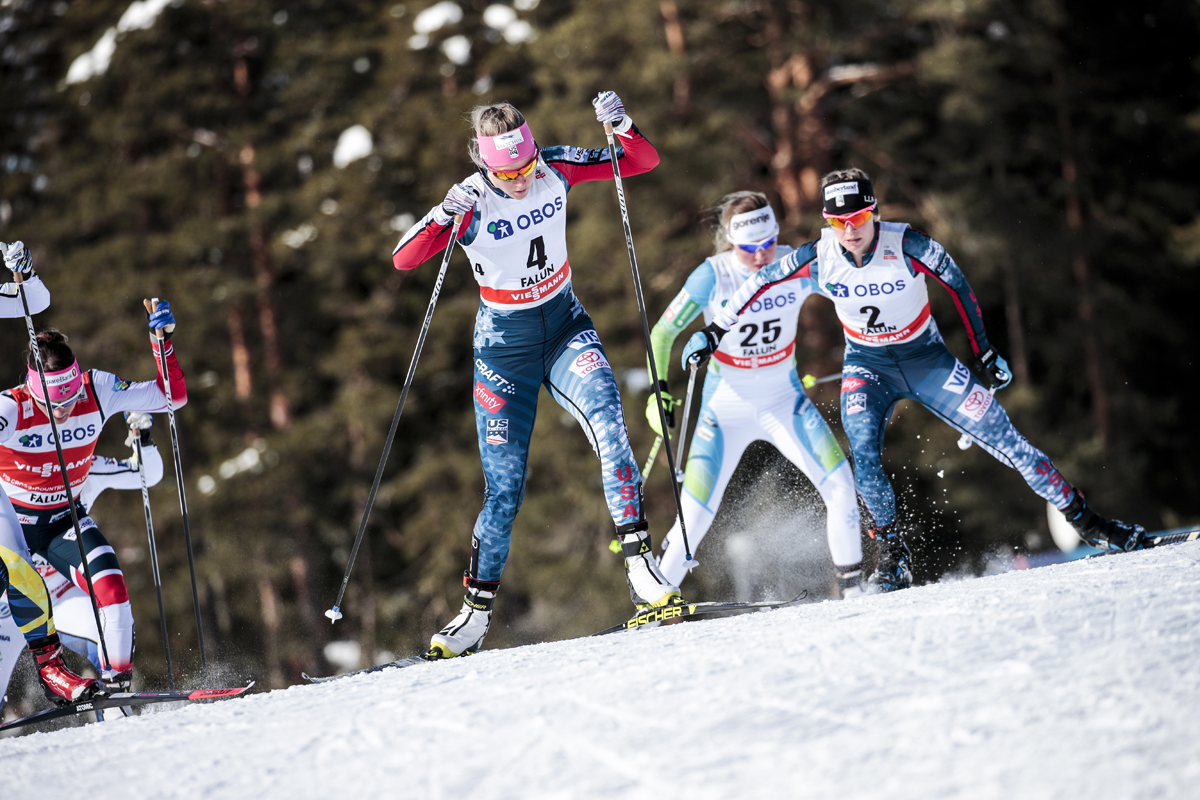
American Sophie Caldwell (bib 4) racing during the women’s 6 x 1.6-kilometer Team Sprint semifinal on Sunday in Dresden, Germany. (Photo: Garrott Kuzzy /LumiExperiences.com)
By the time the group rounded the last corner to the finishing stretch, Dahlqvist had increased her lead. Skating in a tuck, Falla scrambled to make up lost ground. The pressure for Norway in the race’s final moments quickly became less about overtaking the win and more staving off Sweden II and the U.S.
Crossing first to secure the win for Sweden’s Team I was Dahlqvist in a time of 24:02.45. In a three-way lunge to the line, Sweden’s Team II snagged second place (+1.11), while Norway claimed third (+1.11). Caldwell crossed fourth (+1.11) according to the International Ski Federation’s (FIS) photo finish.
“Today was a really fun day. Julia and I have never team sprinted together before, so we didn’t really have any expectations going into the day, but I knew we could be fighting in the final if we had a good day,” Caldwell wrote in an email.
In last year’s Team Sprint in Dresden, Caldwell teamed up with Ida Sargent and finished in third behind Sweden’s Team I and Team II. This year, Sargent raced on the U.S.’s Team II with World Cup rookie, Hannah Halvorsen. Sargent and Halvorsen finished Sunday’s race in 11th, just outside of advancing to the finals.
The fourth place finish for U.S. Team I on Sunday, was what Kern described as “bittersweet.’ The difference between Caldwell’s ski boot and Falla’s in the final lunge to the line barely discernible.
“The photo finish did end up being extremely close and I so badly wanted to get that podium for Julia’s first World Cup podium, but podium or not, I think it was still an awesome day for us,” Caldwell said. “We’re club teammates as well as national team teammates and are pretty familiar with how we each ski and have a lot of mutual respect for each other, so it was really just an awesome opportunity to go out there and get to show what we practice for all year!”
Both Caldwell and Kern ski for the Stratton Mountain School T2 club team. Though mere fractions of a second away from her first World Cup podium, Kern was focused primarily on the opportunity she had gained to race with Caldwell on the U.S.’s Team I.
She found out Saturday evening, after the women’s 1.6-kilometer freestyle sprint–in which Kern finished 19th–that she would be partnered up with Caldwell for Sunday’s Team Sprint.
“It was a dream come true,” Kern said of being selected to race with Caldwell on the U.S.’s Team I. “Going in to the weekend it was not what I expected, but after my qualifier heats yesterday, it was definitely on the table.”
Prior to the start of the race, Kern gave the camera a smile and wave, expressing outward excitement for her first Team Sprint World Cup start. Despite being slotted against the likes of Nilsson, Ingemarsdotter and Eide, Kern said she did not feel nervous.
“I think going into the race today, I tried to be really confident and wasn’t afraid to ski in front of Stina or didn’t really feel out of place because I needed to ski big and confident to hold my position,” Kern said.
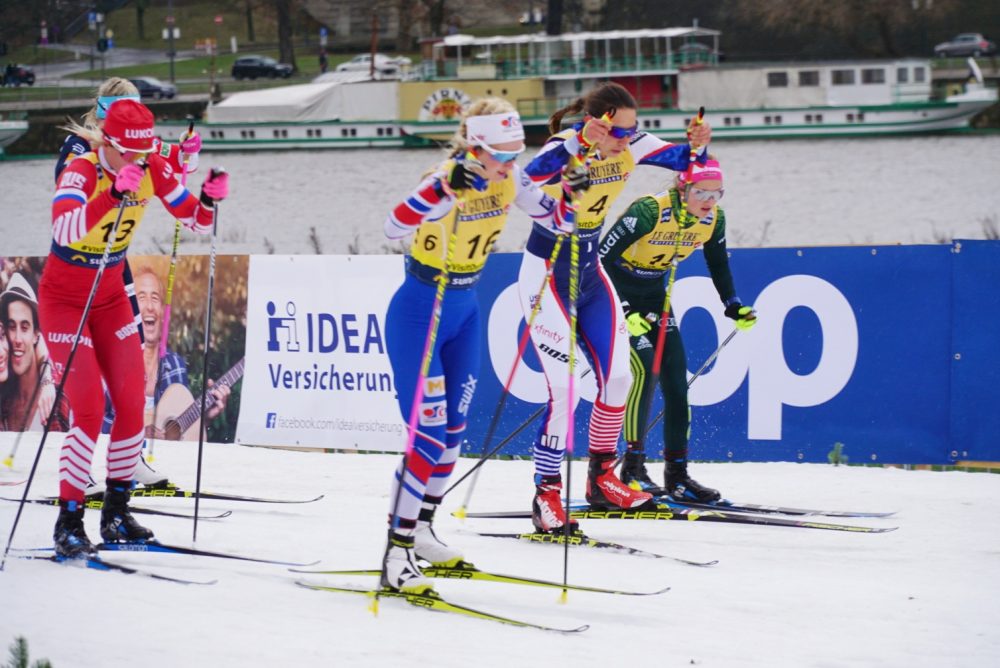
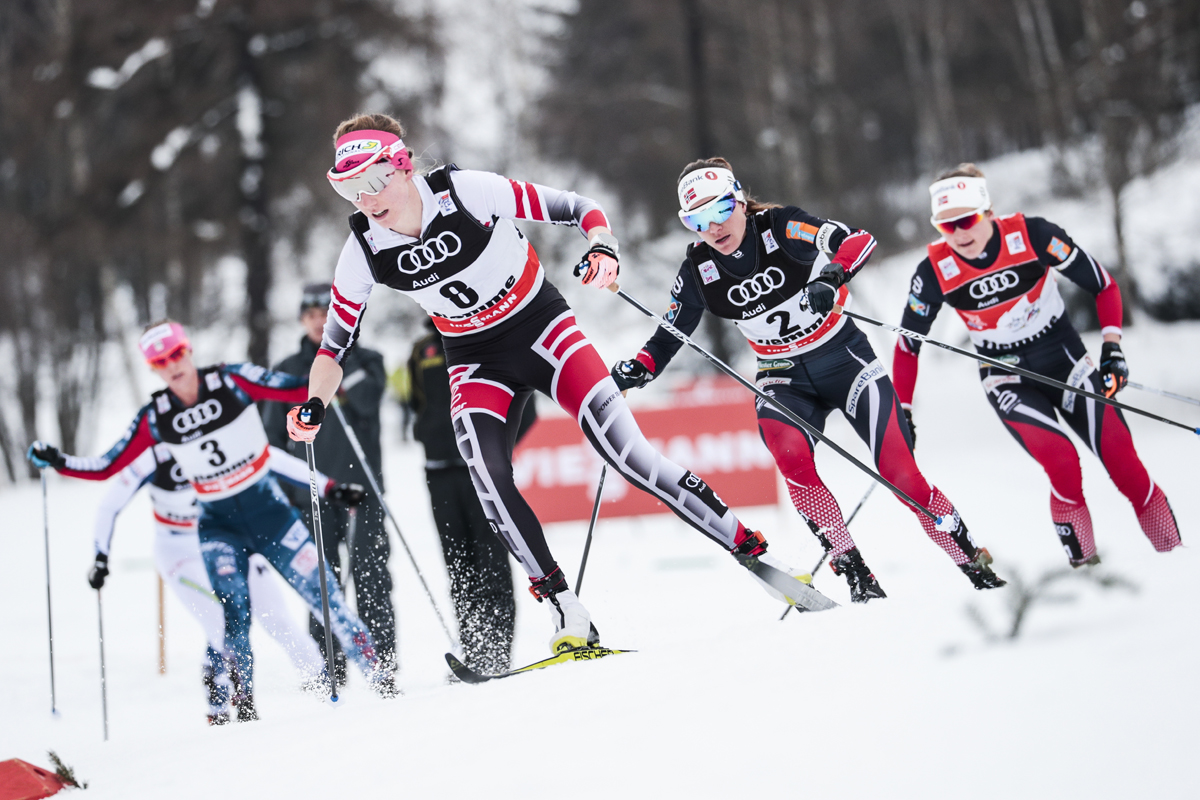
U.S. Ski Team member, Julia Kern (bib 4) leads Sweden’s Stina Nilsson (bib 1) and American Ida Sargent (bib 6) during the women’s 6 x 1.6-kilometer Team Sprint semifinal on Sunday in Dresden, Germany. (Photo: Garrott Kuzzy /LumiExperiences.com)
The biggest goal for Kern on Sunday was to maintain her position and as she put it, “stay out of trouble.” While on course, she narrowly avoided a crash between Russia’s Tatiana Aleshina and Slovenia’s Alenka Cebasek that occurred just after the second exchange.
“I just stayed relaxed and made my way around, which I was very happy to avoid that,” Kern said of the crash.
“In the final things got much more aggressive than in the semi-final. There was a lot more jostling around for position and pretty much everyone was skiing over each others skis,” Kern said. “You kind of had to ride that fine line were you were playing it safe so you weren’t risking falling or getting you pole broken, but also holding your line.”
“I had a blast racing my first world cup weekend,” Halvorsen wrote in an email to FasterSkier on Sunday. “I am happy about how things turned out because I put down two really solid races for me and didn’t make any big rookie mistakes.
“While I am grateful things went smoothly, it was a wake up call of how many things I have to learn,” she added. Especially racing in the team sprint, my inexperience became apparent where one or two people would somehow pass me on every turn or transition. I would have to work hard to regain my position, and I learned how important it is to hold your line.
“In both races I learned the importance of working every section, and how easy it is to lose time by not accelerating out of a corner or not pushing hard enough over hills, etc,” she continued. “I loved getting to see how well the U.S. World Cup coaches and athletes work together and was beyond excited to take a part in it. Thank you to everyone who made this possible for me!”
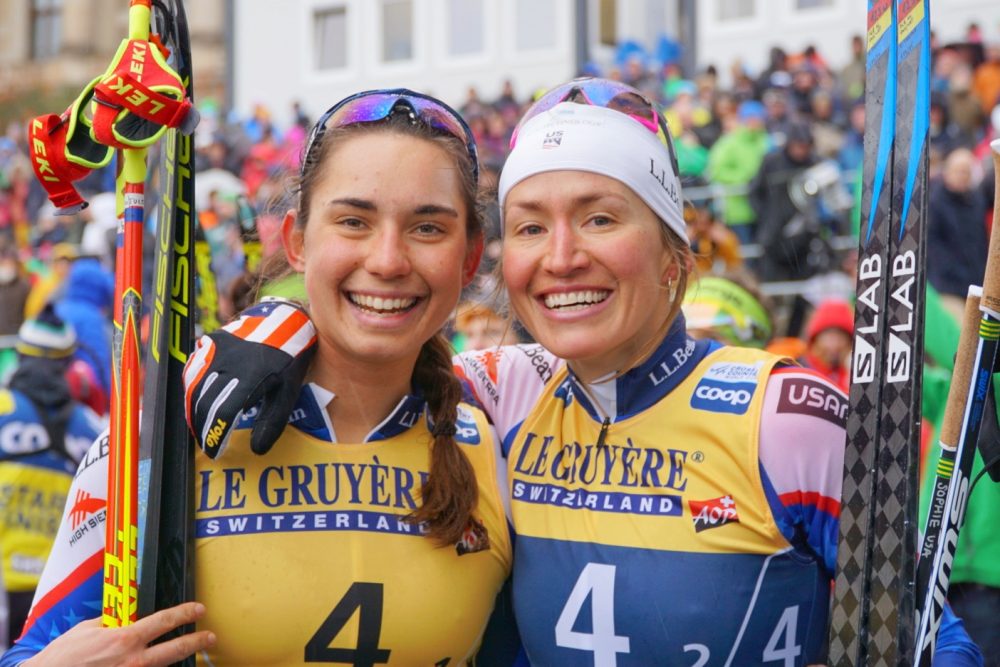
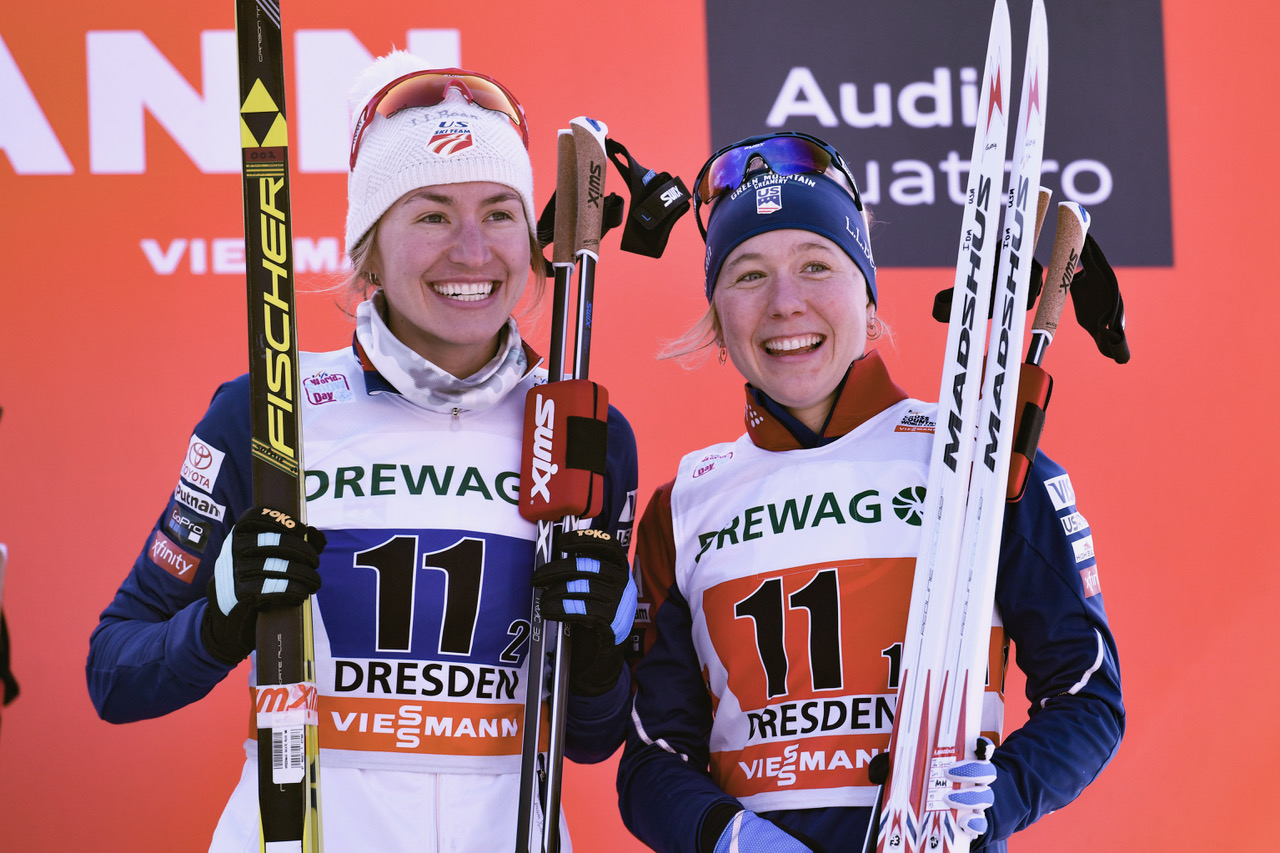
Julia Kern (l) and Sophie Caldwell after finishing fourth in the women’s 6 x 1.6-kilometer freestyle Team Sprint in Dresden Germany. (Photo: Garrott Kuzzy /LumiExperiences.com)
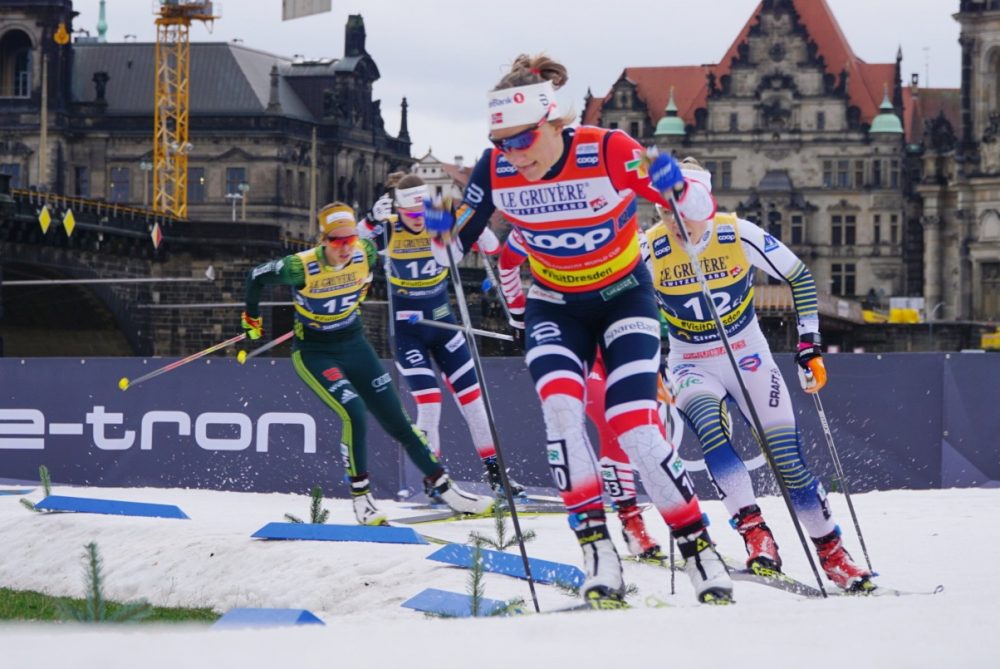
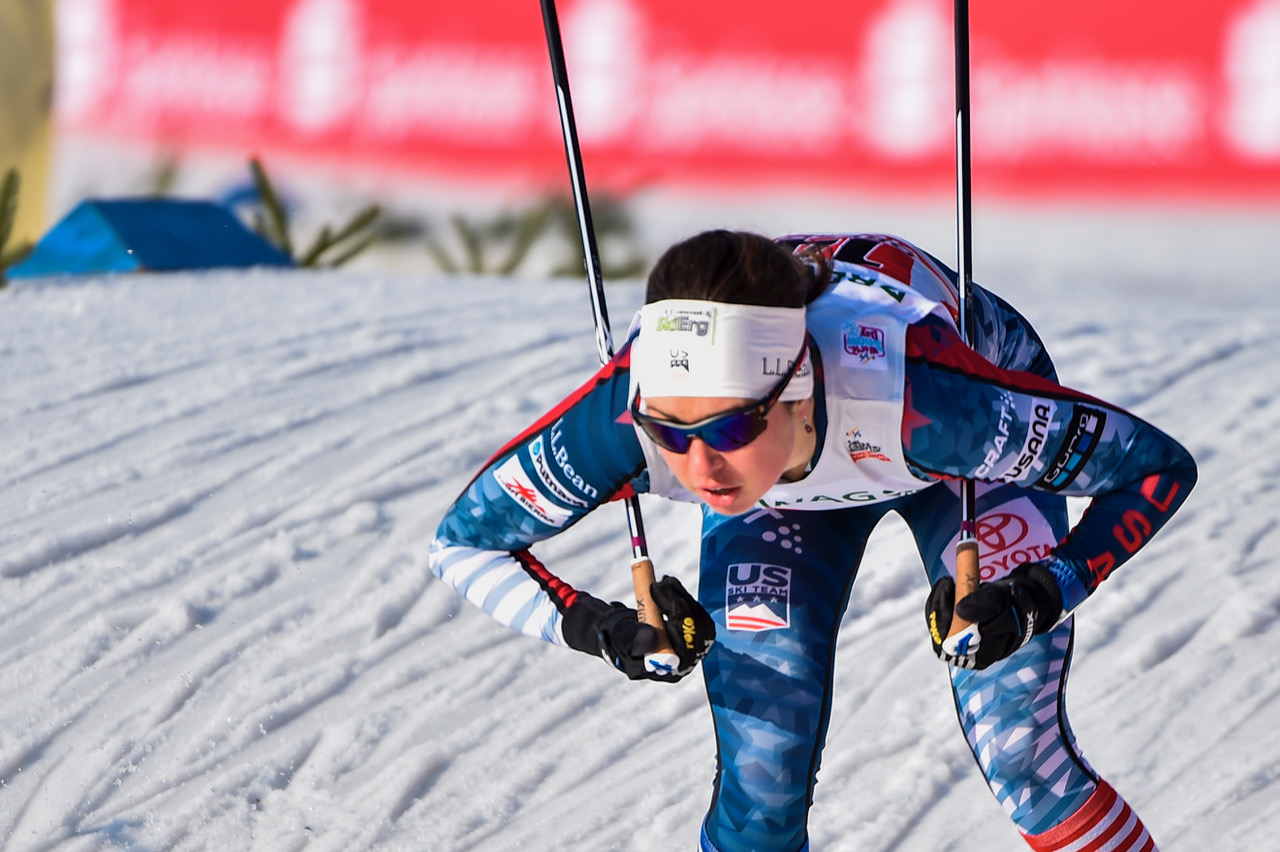
Racing in bib 4 for the U.S., Julia Kern keeps pace in the women’s team sprint during the Dresden, Germany World Cup on Sunday. (Photo: Garrott Kuzzy).
FIS World Cup Dresden, Germany 6 x 1.6 k Freestyle Team Sprint
The first World Cup team sprint of the season was run amidst drizzle and the Dresden, Germany city-scape as the women raced a total of six 1.6-kilometer laps.
Round and round on the looping course, the pace was a mix of tactically subdued speeds with sustained bursts of energy to break the pack.
After all the speed changes and exchanges with one athlete tagging off to the next, it came down to a 1.11 second difference between first place Sweden I and the three closet teams chasing from behind that ended in a photo finish.
Sweden I’s Stina Nilsson and Maja Dahlqvist won in a time of 24:02.5 minutes. Sweden II’s Ida Ingemarsdotter and Jonna Sundling placed second (+1.11), and Norway I, with Eide Mari and Maiken Caspersen Falla in third (+1.11).
U.S. I, featuring Julia Kern and Sophie Caldwell placed fourth (+1.11) after the photo finish was reviewed.
The U.S. entered a second team, consisting of Ida Sargent and Hannah Halvorsen. That duo contested the first semi-final, the same semi as U.S. I, but did not advance after placing fourth (+5.44). The top-three teams from each semi advance to the final, along with the next four fastest teams which are the combined “lucky losers”. Today, the second semi was the faster of the two. The four lucky loser team advancing to the final all originated from the second semi.
In the men’s 6 x 1.6 k skate team sprint race, Norway I and Norway II took the top two podium spots.
In a lunge at the line, Norway I’s Erik Valnes and Sindre Bjørnestad Skar won the final in 22:38.72 minutes. Pål Golberg and Eirik Brandsdal of Norway II placed second (+0.75) and Russia I’s Artem Maltsev and Gleb Retivykh third (+0.80).
Canada’s Bob Thompson and Len Valjas placed seventh (+2.46) in the first semi-final and did not advance to the final. It was the same fate for the only U.S. team entered in the men’s team sprint. Andy Newell and Erik Bjornsen placed 10th (+3.66) in the second semi, and failed to make the finals.
Canada placed 15th in the final standings, the U.S. 19th.
IBU World Cup Oberhof, Germany 4 x 6 k / 4 x 7.5 k Relay
In the women’s 4 x 6 k relay, Russia placed first in a time of 1:18:46.4 hours. Evgeniya Pavlova, Margarita Vasileva, Larisa Kuklina, and Ekaterina Yurlova-Percht made up the team that used eight spares on their way to the win.
Germany placed second (+33.5) with two penalty loops and 10 spare rounds. Karolin Horchler, Franziska Hildebrand, Franziska Preuss, and Denise Hermann comprised Germany’s second place team that had two penalties while using 10 spares. The Czech Republic’s Lucie Charvatova, Veronika Vitkova, Marketa Davidova, and Eva Puskarcikova placed third (+36.7) with 1 penalty loop and six spares.
The top spot for the podium came down to the final leg, when Yurlova-Percht pulled out the win when Hermann skied two penalty loops. The Russian used three spares but escaped with no penalties to take the lead out of the shooting range on the final ski loop.
Susan Dunklee, Clare Egan, Joanne Reid, and Emily Dreissigacker all represented the U.S. and placed 12th (+5:35.8) while skiing five penalty loops and using 16 spares.
Canada’s Sarah Beaudry, Emma Lunder, Megan Bankes, and Rosanna Crawford finished in 13th (+5:58.8) with four penalty loops and 15 spares.
Russian also claimed the men’s relay, winning in a time of 1:20:54.3 hours. The winning team of Maxim Tsvetkov, Evgeniy Garanichev, Dmitry Malyshko, and Alexander Loginov skied no penalty laps and used six spares on their way to victory.
Antonin Guigonnat, Simon Desthieux, Quentin Fillon Maillet, and Martin Fourcade raced for France. The French team placed second (+1:01.1) while skiing a single penalty lap and using eight spares.
Austria’s Tobias Eberhard, Simon Eder, Dominik Landertinger and Julian Eberhard placed third (+2:18.6) with one penalty lap and using seven spares.
Canada’s Scott Gow, Christian Gow, Jules Burnotte, and Brendan Green and the U.S. team of Leif Nordgren, Sean Doherty, Travis Cooper, and Max Durtschi were eventually lapped. Neither team was given an official finishing time.
Canada was ranked 18th in the final standings, the U.S. 19th.
For both relays today, the snowy weather and tough course conditions made for a strenuous day of shooting and skiing.
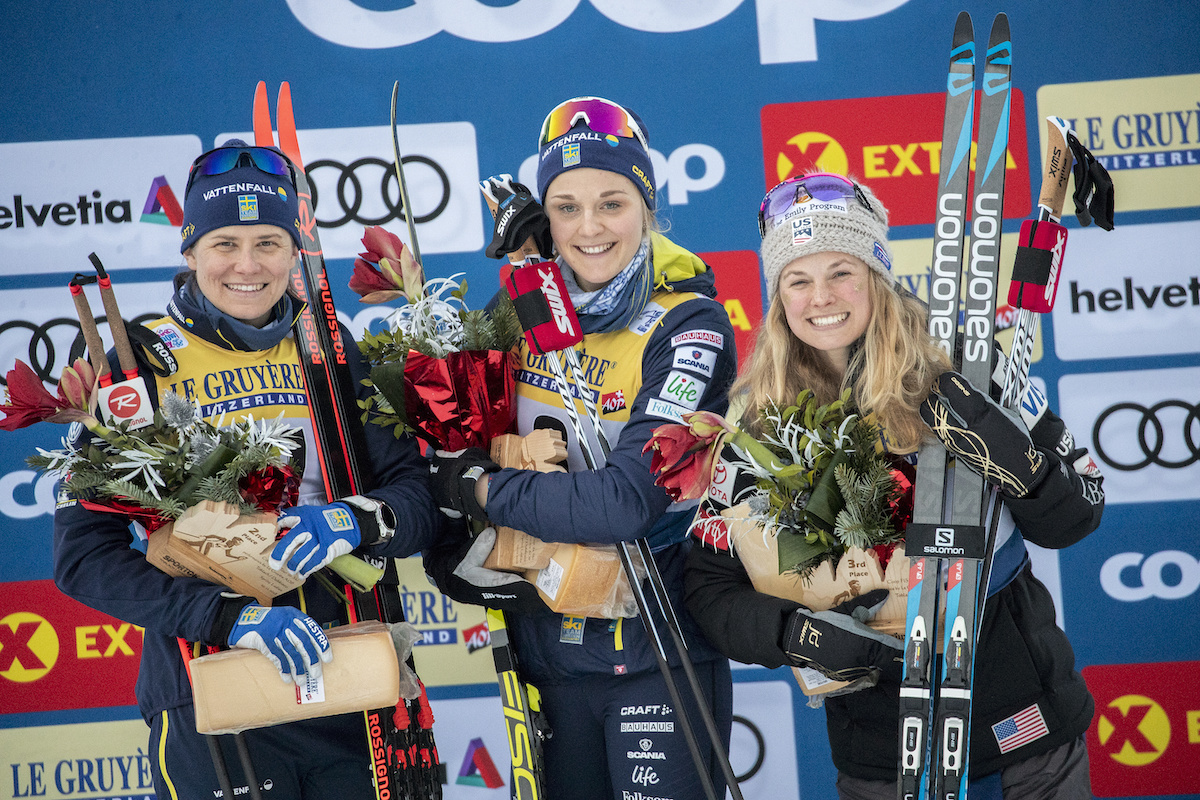
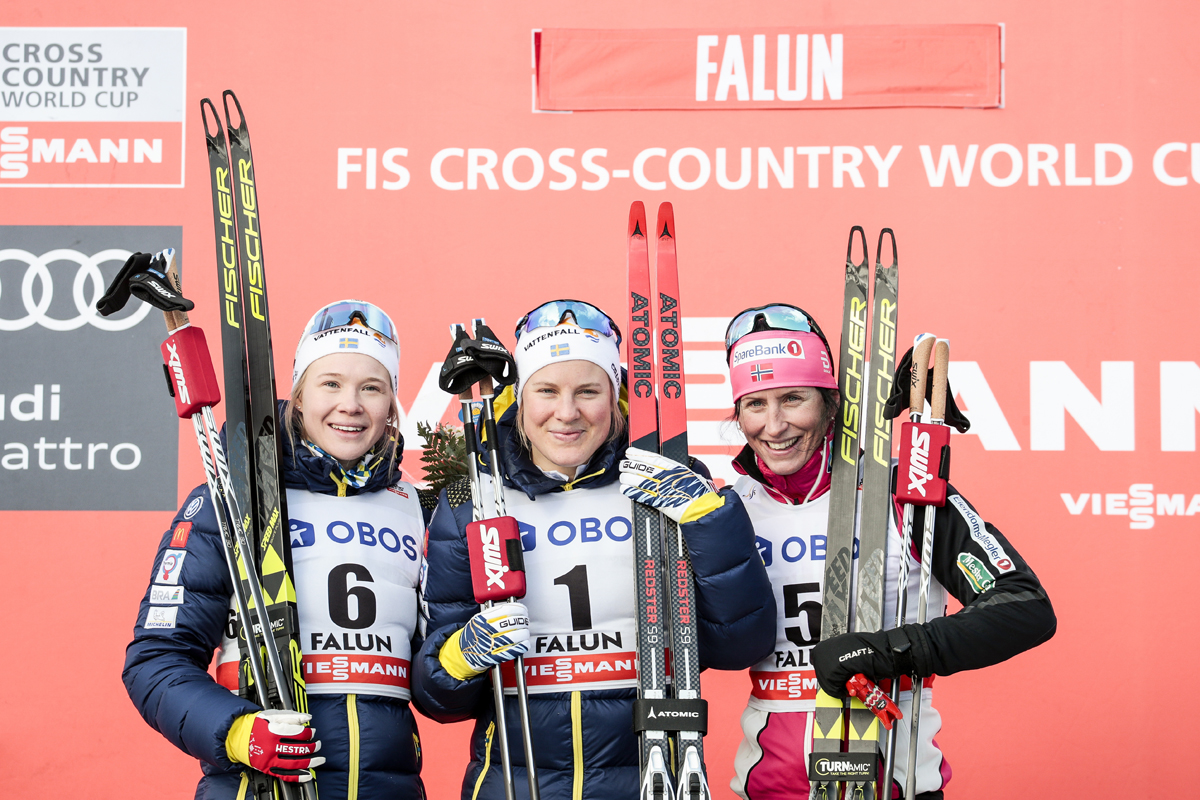
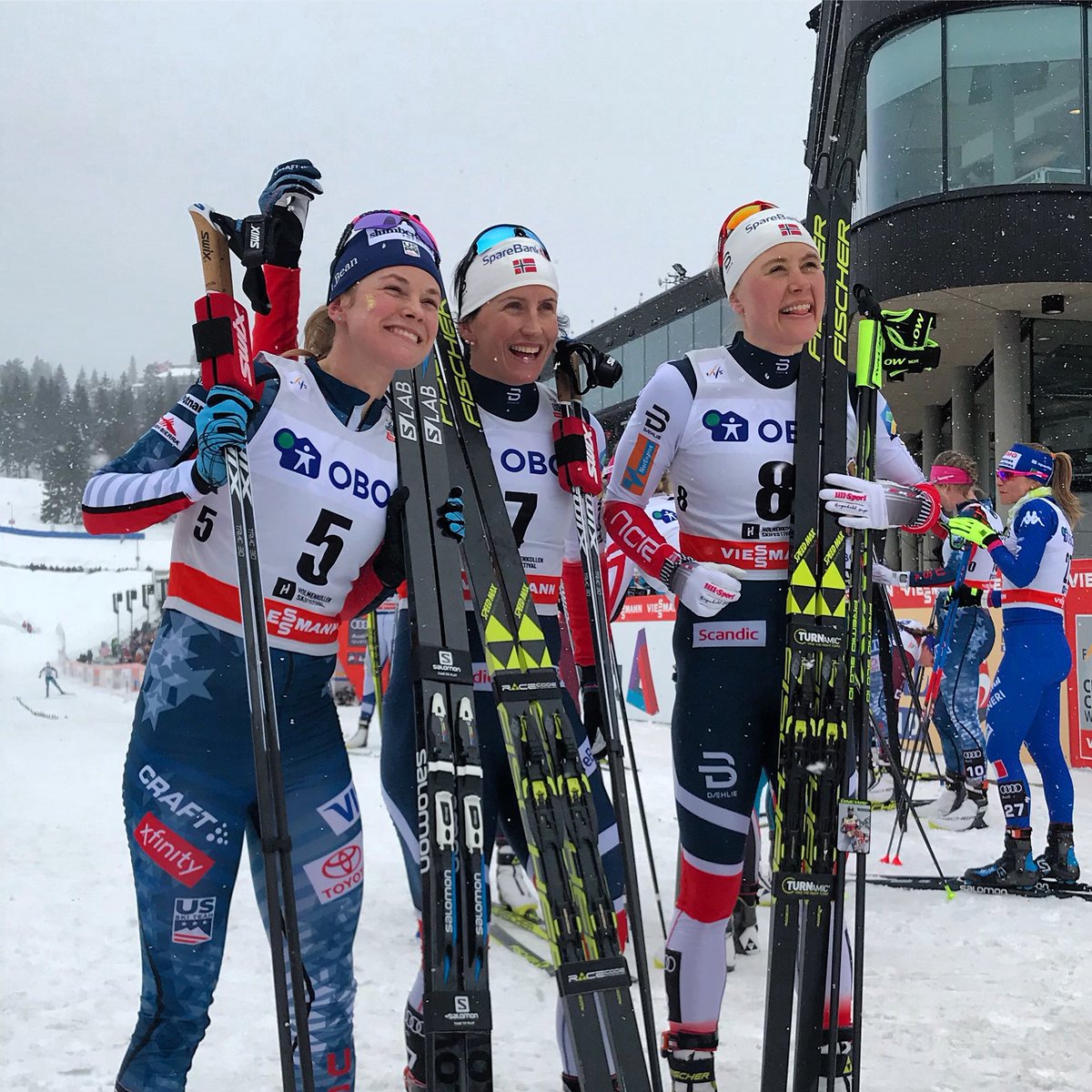
Women’s podium in the 1.3 k skate sprint, the first stage of the Tour de Ski, in Toblach, Italy. Sweden’s Stina Nilsson (center) placed first, teammate Ida Ingemarsdotter (left) second, and Jessie Diggins of the U.S. (right) placed third. (Photo: Fischer/Nordic Focus)
The threads of the thirty skiers who made the women’s heats of the 1.3-kilometer freestyle sprint during Stage 1 of the Tour de Ski (TdS) in Toblach, Italy on Saturday could weave a complex pattern. There are the lead changes. Skiers advanced. Skiers were eliminated. At the start of a seven-stage event, one race, and the first at that, simply established the early markings of a pattern. Nothing too complex to discern — but nascent trends with six stages to go.
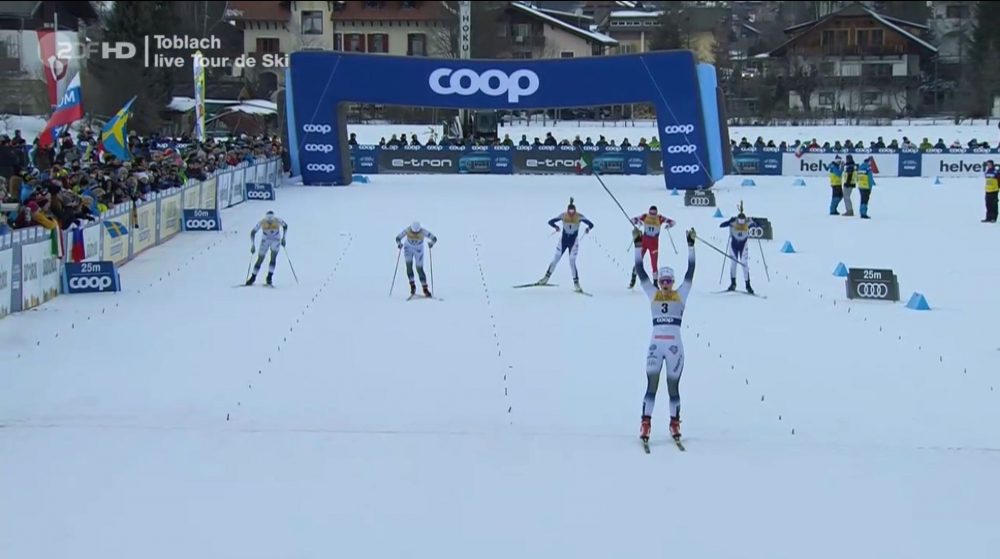
Sweden’s Stina Nilsson smashed the women’s final winning by three seconds over second-place teammate Ida Ingemarsdotter. Jessie Diggins of the U.S. placed third (+3.07) for her first podium of the season.
Nilsson pulled away and skied off the front around two minutes into the race, while the remaining skiers fought for second through sixth. Russia’s Yulia Belorukova placed fourth (+3:16). Sweden’s Linn Soemskar fifth (+3.26), and Sadie Bjornsen of the U.S. – the fastest qualifier on the day — finished in sixth.
“It was a little bit like 100-meter racing where you just try to die less than the rest of the group, but everybody slows down,” U.S. Ski Team Coach Matt Whitcomb said in a phone call. “And Stina just died less and everybody else just died more. Standing on the side of that hill, from about 100 meters away, I could just see it happen pretty clearly. Stina was the only one who was able to keep her energy moving up that climb. It was really impressive.”
With her dominating performance in the final, after barely edging Diggins and Bjornsen in the first semi-final, Nilsson reiterated that she plans on pulling from the TdS after the fourth stage. Until then, Nilsson has a 10 k skate, another skate sprint, and a 10 k classic mass start to contest.
“I said before that I will only do the first 4 races, we will see but I think I will stick to that plan,” Nilsson told the International Ski Federation (FIS).
This much is clear after a single race: Nilsson and her teammates have come to the TdS in shape with Nilsson displaying both top end sprint speed and a combined high-speed endurance as displayed by her “died less” finals performance.
Three Swedes were in the finals. Whereas traditional powerhouse Norway placed two women in the top-twelve, none of whom advanced beyond the semis. Norway’s top qualifier was Maiken Caspersen Falla in 12th (+2.70).
One race defines nothing for Norway. As a single race defines little at best for any other team in the TdS. The women race over 60 k in seven stages. They ticked off 1.3 k today.
But again, the threads from a single race do begin the narrative. As for Nilsson, the language in her quote includes the phrase “we will see” when pushed on her intentions to abandon the TdS as planned. So “we will see” if, in fact, she remains high in the standings whether she indeed pulls from the competition.
Dominant: Stina Nilsson of Seweden takes the win in Toblach, Italy during the first stage of the Tour de Ski — a 1.3 k skate sprint. (Photo: ZDF screenshot)
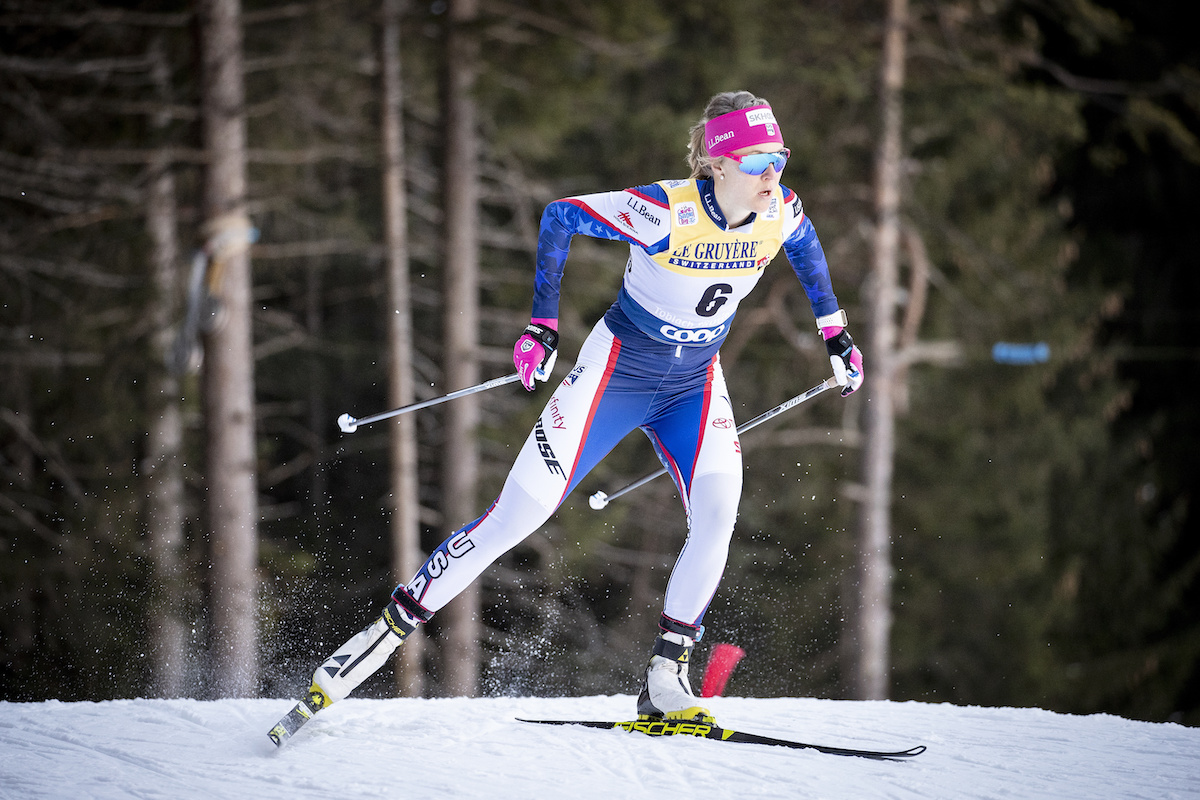
The U.S was the only team to place three women in the top-10 during qualification. Bjornsen skied the 1.3 k course with the fastest qualifying time of 2:35.95 minutes. Diggins qualified in sixth (+1.38), Sophie Caldwell in ninth (+1.60).
“Today was a solid day for me,” Caldwell emailed. “But I definitely left wanting a bit more. It’s a tricky course that is pretty quick but has a fair amount of climbing and jostling for position. I felt like a skied my quarterfinal well and was able to move up throughout my heat and get myself into a good position by the top of the last climb.”
That position allowed her to keep position and win her quarterfinal.
Bjornsen, Diggins, and Caldwell all skied in the first semi. Caldwell was eventually eliminated as she placed fifth.
“Our semi was definitely loaded, but that’s how it goes sometimes,” Caldwell wrote. “The first semi gets the advantage of more rest before the final, so it tends to be slightly more stacked. I was happy with the move I made up the 2nd hill and had myself in a pretty good position going over the top of the last hill, but unless you’re in the lead, it’s really hard to control what’s going to happen on a course like that where everyone tends to come together on a tricky corner. My lane didn’t end up as open as I was hoping it would be, but it’s hard to say if the results would have been any different if it had been – it was a tight heat and everyone was skiing strong. My goal was to make the final, and I was disappointed to just miss it, but it was still a solid day and pretty awesome to have three girls in the top 10, Jessie on the podium, Kevin with a season-best, and Sim looking super strong even though he had a bit of bad luck.”
The U.S. Ski Teams’s Sadie Bjornsen qualifying during Saturday’s 1.3 k skate sprint in Toblach, Italy — the first stage of the 2018/2019 Tour de Ski. (Photo: Fischer/Nordic Focus)
Bjornsen was third in the semi and advanced to the final as the first lucky loser. Diggins placed second, one-hundredth of second ahead of Bjornsen.
“I was definitely really excited to have such a strong qualifier today because I got super sick over Christmas time and spent three days with a fever and quite a bad cough so I was worried that I was going to even be able to start the Tour,” Bjornsen told FasterSkier in a call. “So it was definitely really encouraging to feel like I was back in form to start the qualifier, which kind of put me in with some confidence in my legs going forward.”
Bjornsen and Diggins lined up in the first heat together. Bjornsen skied on the sharp end for most of the heat’s duration. The two U.S. skiers came into the final straight nearly side by side and unchallenged at the front. Diggins slotted ahead of Bjornsen for the win by .24 seconds.
“I’ve done a ton of work on my starts and I’m finally in a place now where I can find myself in the front of the heat at the start which is nice because for me I just need to go hard over the entire course,” Bjornsen said of her strategy in the sprint heats. “I can’t just play those games, I just don’t have the strong finishing stretch of everybody. So it always benefits me to kind of ski in the front of the heat and kind of tire out those pure sprinters so that maybe I can break their legs when they come to the finishing stretch.”
Bjornsen scored her first career skate sprint podium in Lillehammer, Norway on Nov. 30. Her skate sprint consistency is now beginning to compliment her classic skiing power, speed, and endurance. Not that Bjornsen is in a learning phase of her career, but advancing well into the skate sprint heats has allowed Bjornsen to test her skate engine.
“I’m happy, I just haven’t skied a ton of semi-finals or finals in skate sprints,” Bjornsen said. “I had some success in Lillehammer, but aside from that, I haven’t done a ton of it. So for me, it’s always exciting to make it past the quarterfinals because then I know I’m in a position to play.”
Bjornsen did ultimately come up against a threshold today in the final. Her ski-in-front position took a slight toll as Nilsson took control of Bjornsen’s semi-final and final.
“I think in the semi-final I kind of exploded the remains of my speed in my legs and I was really happy to make it through as a lucky loser,” Bjornsen explained. “Starting the final I could feel right away that I was running on final fumes but just tried to position myself behind Stina. As she took off in those final climbs I was not able to go with her but just tried to remain in the front and hope that I had a good finishing stretch sprint.”
Bjornsen is firm that despite her standings after the fifth stage of the TdS, she will exit the Tour. During her interview, Bjornsen stated outright that finishing the TdS atop the Alpe Cermis — no matter her finishing place — on the final climb is arguably her favorite moment in racing the World Cup. In last season’s run up to the Olympics, Bjornsen raced the entire TdS.
Bjornsen’s macro-plan is to conserve energy and peak for the Seefeld, Austria’s World Championships.
“It’s been really hard for me to make that decision this year,” Bjornsen said about her premeditated Tour exit. “But that means I have never really focused or just channeled all my energy on the Championships. I tried last year during the Olympics but I don’t think that I was making the right decisions for my fatigue level. I think I was deciding to do the races that were fun all the time. So it’s definitely it’s hard for me to say not to finish the whole Tour because I like to think that I can just do everything. I also want to focus on the Championships and now that I’ve started feeling really great in skate sprint I think that there’s an awesome opportunity there.”
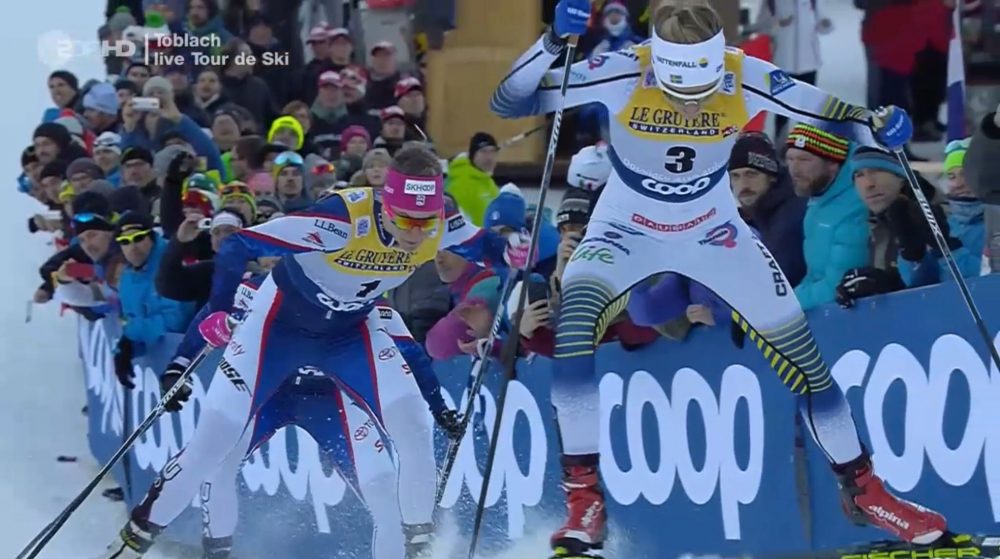
Jessie Diggins (skier nearest to camera) toeing the line for third place in Toblach, Italy during the first stage of the 2018 Tour de Ski. Sweden’s Ida Ingemarsdotter crossed the line before Diggins to place second. (Photo: ZDF screenshot)
Diggins’s racing left nothing to doubt. Through her qualifier to the end of the finals, Diggins was a presence. With her first podium of the season, she also admitted the difficulties finding joy in skiing during Period 1.
“Ever since the Olympics, I have felt as though there’s been enormous outside pressure coming down on me. Maybe it’s the increased access to athletes that comes with much better broadcasting, social media, TV interviews, and online reporting. Maybe it’s my own naiveté, thinking that cross-country skiing would never have the same kind of press and pressure that comes with the “big sports”. Whatever the reason, this season it’s been incredibly hard for me to tune out the external pressure to (simply) “be amazing” all the time.”
In reality, Diggins’s performance in Period 1 was in stride with her past. Yes, Saturday was her first podium of the season. Diggins also placed fifth in her last race – a grueling 10 k skate in Davos, Switzerland. Needless to say, the world of sport comes with pressure. Now for Diggins, pressure well beyond the scope of the cross-country world. Overtly, Diggins remains on track. And she stated outright on the phone Saturday that she skied with a smile in Toblach.
“I am having fun,” Diggins said. “And it happened to come with a podium. But I think it’s important to say that the most important thing for me was that it was fun. Because if you podium and you are not loving what you are doing, then it doesn’t matter.”
Pressure is nothing new to Diggins. Since high school, she has been dealing with mounting pressure and expectations. Back then it was not if Diggins would win but by how much. And if she didn’t meet some external time benchmark between herself and the next best skier back, then maybe it wasn’t good enough. And there was even pressure to beat most of the male athletes at a given race.
In Toblach, Diggins may have been tempered out of the start gates, building into her quarter, semi, and finals. But she found gaps. She made her own moves. She matched moves. She skied in the moment on her way to third place overall. The big prize six more stages away atop the Alpe Cermis in Val di Fiemme, Italy.
And there was Saturday’s podium shot. That is a smile.
Racing continues tomorrow with a 10 k skate for the women.
Sweden’s Stina Nilsson leading the U.S. Ski Team’s Sadie Bjornsen during Saturday’s freestyle sprint in Toblach, Italy. Nilsson won the first stage of the Tour de Ski, Bjornsen placed sixth overall. (Photo: ZDF Screenshot)
FIS World Cup Tour de Ski Stage 1 1.6 k Freestyle Sprint
Seventy-five skiers began the 2018/2019 women’s Tour de Ski in Tobalch, Italy with a 1.3-kilometer freestyle sprint.
The U.S. Ski Team’s (USST) Sadie Bjornsen was the fastest qualifier finishing in 2:35.95 minutes. Sweden’s Linn Soemskar was second (+0.14), and Stina Nilsson third (+0.40).
Jessie Diggins (USST) qualified in 6th (+1.38), and Sophie Caldwell 9th (+1.60).
The final was dominated by Nilsson as she took her second World Cup win of the season. The Swede won the final in 2:36:26 minutes, with her teammate Ida Ingemarsdotter in second (+3:00) and Diggins in third (+3:07). Russia’s Yulia Belorukova was fourth (+3:16), Soemskar fifth (+3:26), and Bjornsen sixth (+3.40).
Caldwell ended her day ninth overall after being eliminated in a tight first semi-final — first through sixth were separated by 0.7 seconds.
For Canada, Dahria Beatty placed 49th (+9.42), and Emily Nishikawa 61st (+12.88).
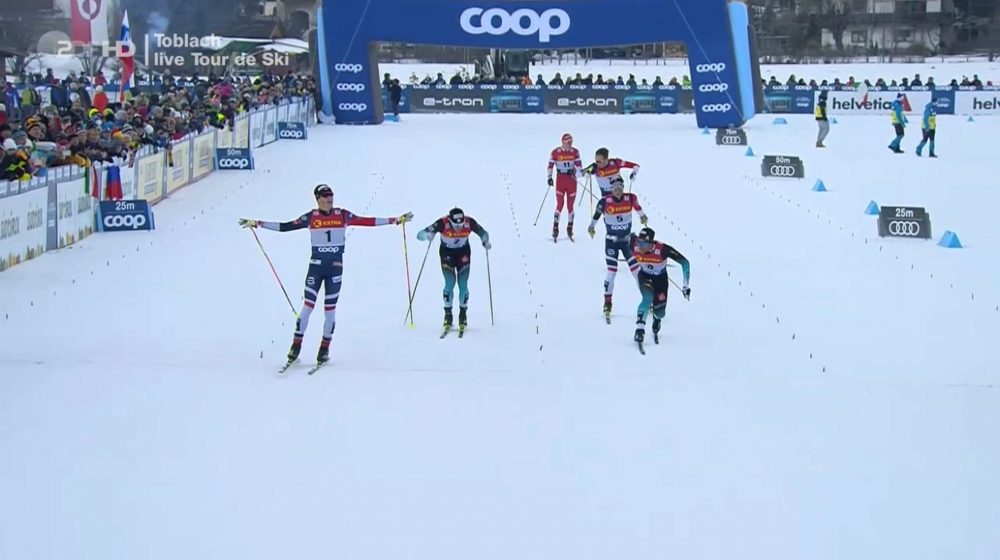
Johannes Høsflot Klæbo (bib 1) from Norway winning the men’s final in Toblach, Italy. Klæbo looked in form during the first stage of the 2018/2019 Tour de Ski. (Photo: ZDF screenshot)
For the men, 105 athletes began qualification. Johannes Høsflot Johannes Høsflot Klæbo of Norwayof Norway marked the fastest qualifying time in 2:16.86 minutes. Frances Lucas Chavanat was the second fastest qualifier (+1.22), and teammate Richard Jouve third (+1.95).
Simi Hamilton (USST) qualified in 8th (+3.00), while Kevin Bolger (USST) was 13th (+3.98).
No other North Americans qualified for the heats.
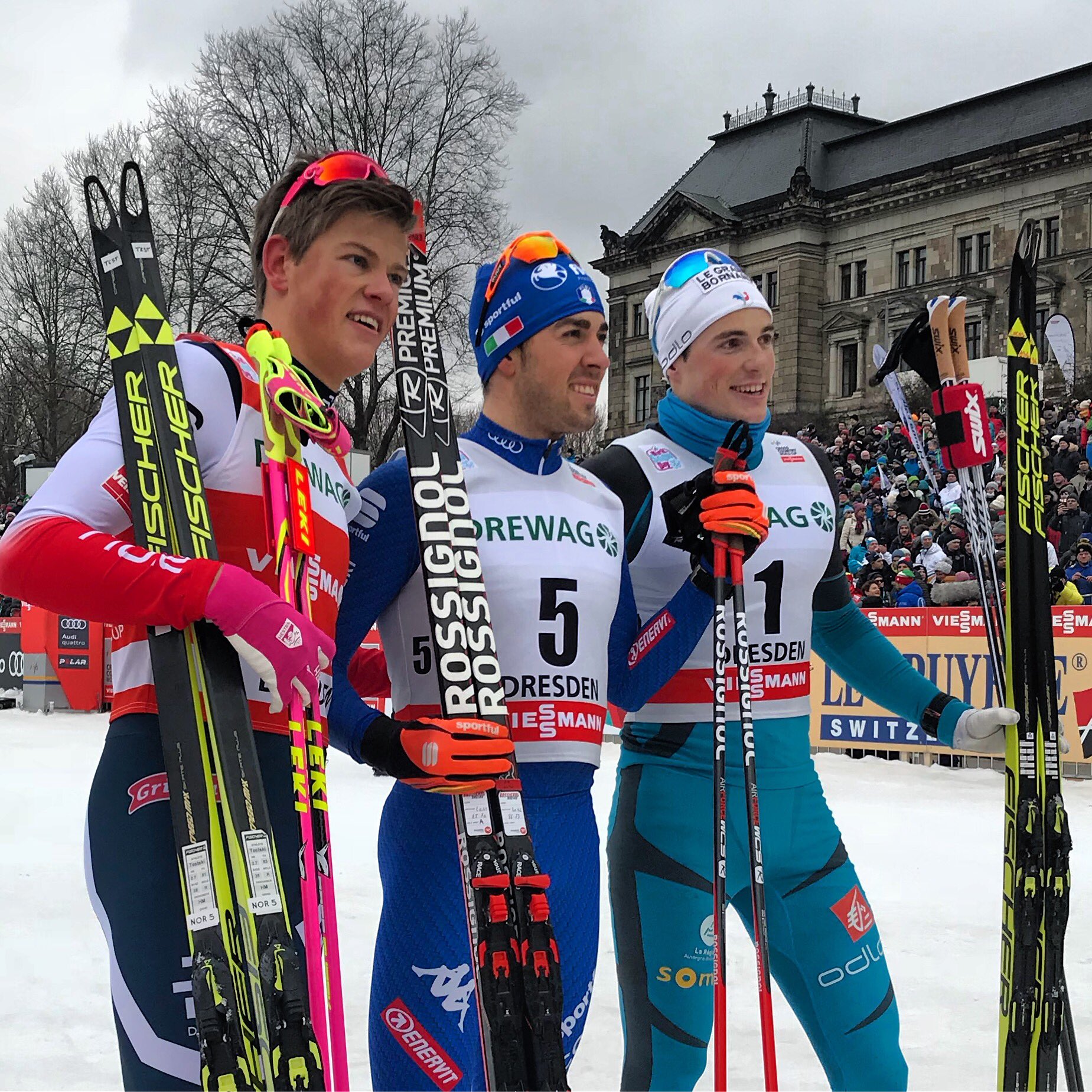
The men’s final went to Klæbo with Jouve and Chanavat in a close second (+0.34) and third (+0.39) respectively. Sindre Bjørnestad Skar of Norway was fourth (+0.76). teammate Emil Iversen was fifth (+1.67), with Alexander Bolshunov in sixth (+3.17).
Hamilton looked strong in the second heat moving up the right side of a climb when he stumbled and fell. Hamilton finished the day in 26th. Bolger was eliminated in the fifth heat after he placed fifth. (Russia’s Bolshunov won heat five in what was the fastest heat.) Bolger finished 21st overall.
Erik Bjornsen (USST) finished in 76th (+10.38), and Ben Lustgarten (CGRP) 105th (+15.23).
For Canada, Alex Harvey placed 50th (+7.16), Lenny Valjas 55th (+7.46), and Bob Thompson 62nd (+8.10).
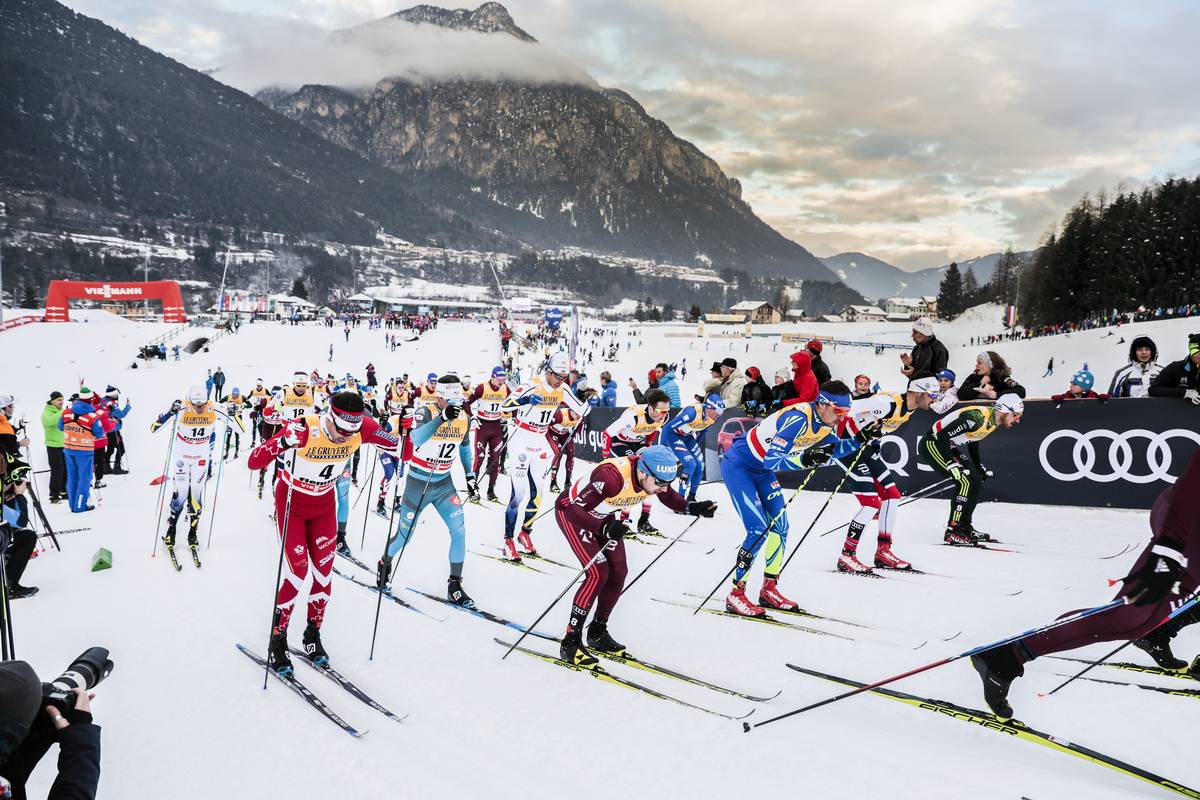
The start of the men’s 15 k classic mass start at Stage 6 of the 2018 Tour de Ski on Saturday in Val di Fiemme, Italy, with (front row, left to right) Canada’s Alex Harvey, Russia’s Sergey Ustiugov, Kazakhstan’s Alexey Poltoranin, Norway’s Martin Johnsrud Sundby, and Switzerland’s Dario Cologna. (Photo: Salomon/NordicFocus)
Beginning this Saturday in Toblach, Italy with a freestyle sprint is the 13th edition of the Tour de Ski (TdS). According to the International Ski Federation (FIS), over the course of seven stages the men will race 80.918 kilometers, the women 60.67 k.
The TdS has become both a staple and a spectacle of the annual World Cup calendar. With a jam-packed series of races primacy is placed on both the ability to recover well and wither less as the TdS transpires.
Prognostication can be tricky in a long-form template like the TdS. So much can go astray during seven races not to mention the travel and dicey germ-avoidance.
Last season’s winner on the women’s side, Heidi Weng of Norway, sits 18th overall in the World Cup standings (14th in distance). She has four top-20’s in the four distance events she’s contested with her best result an eighth in Lillehammer’s 10 k skate. Although featuring two sprints in the first three stages, the TdS remains a distance skier’s paradise.
Weng has skied solidly on the World Cup, but she has yet to show the form that made her a TdS overall winner in 2017 and 2018. Norway has won the last five iterations of the TdS: Marit Bjørgen won once in 2014/2015, Therese Johaug twice (2013/2014, 2015/2016), and Weng the last two years.
Austria’s Teresa Stadlober leads Norway’s Heidi Weng (2) and Ingvild Flugstad Østberg, American Jessie Diggins (3) and others around a downhill corner during the women’s 10 k classic mass start at Stage 6 of the 2018 Tour de Ski in Val di Fiemme, Italy. (Photo: Fischer/NordicFocus)
If Norway is to keep the streak alive, Ingvild Flugstad Østberg, last year’s TdS runner up, could be the heir apparent. She currently ranks second in the World Cup overall and 15th on the sprint list.
Johaug, having returned from an 18 month doping ban, has been on a distance race tear. She has won all five World Cup distance events this season. Johaug, however, will not be lining up for the TdS.
Only five different women have earned distance podiums this season — Johaug, Østberg, Sweden’s Charlotte Kalla and Ebba Andersson, and Finland’s Krista Pärmäkoski. Along with Johaug, Kalla and Andersson are skipping the TdS. (Andersson sits third overall on the World Cup, Kalla fifth.) With the TdS missing three of the five top ranked World Cup distance skiers, daily stages and the overall podium are up for grabs.
Last season’s third overall finisher, Jessie Diggins of the U.S. Ski Team (USST), often cites the TdS as a point in the season when her form trends towards podium performances. She sits eighth in the current distance standings and could very well have a stout TdS.
Russia’s Natalia Belorukova and Yulia Nepryaeva look strong as does Sadie Bjornsen (USST), and Austria’s Teresa Stadlober.
With less than predictable distance stage podiums for the women, it may simply come down to a drag race on the Alpe Cermis final climb Jan. 6.
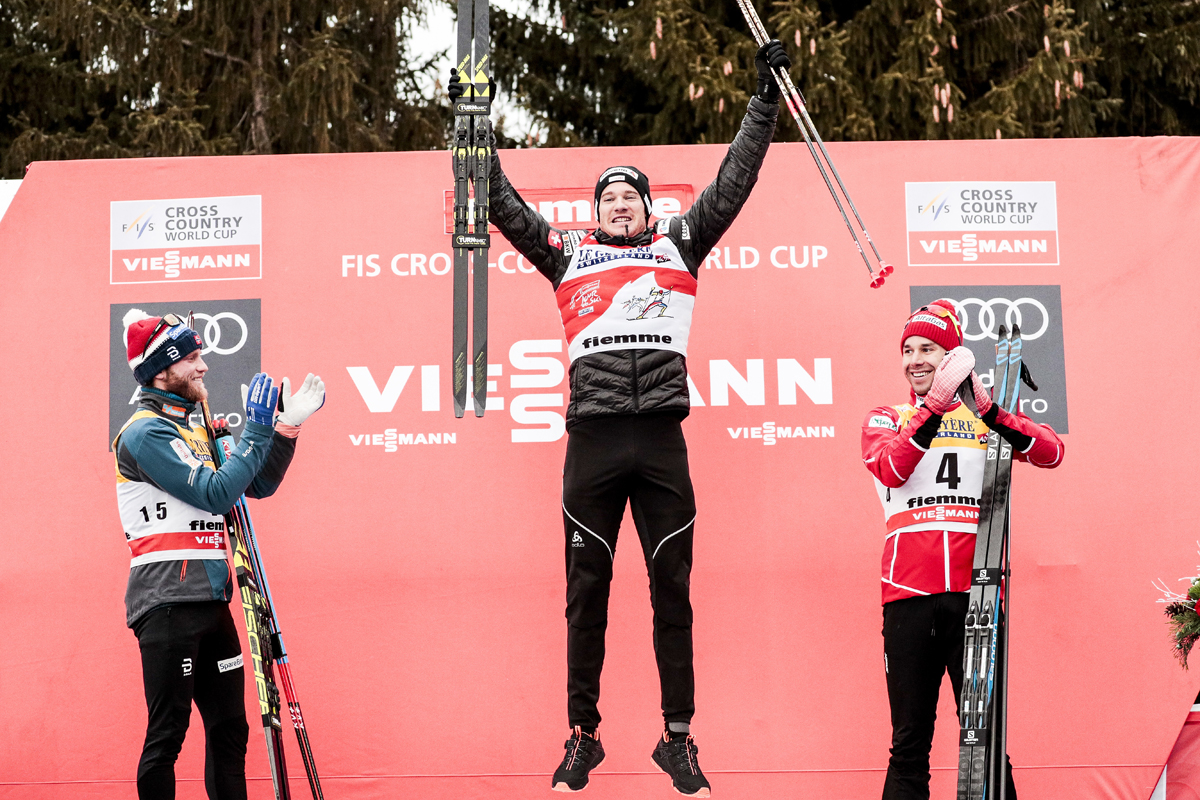
Switzerland’s Dario Cologna (c) celebrates his fourth Tour de Ski overall title. He was joined by Norway’s Martin Johnsrud Sundby (l) and Canada’s Alex Harvey (r) on the podium in second and third, respectively. (Photo: Fischer/NordicFocus)
The men’s scene is also open to interpretation. Last season’s TdS winner, Switzerland’s Dario Cologna, was in fact a surprise victor. Prior to Cologna’s stage two win in last year’s TdS, it had been nearly three years since the four time TdS overall winner had won a World Cup. Cologna sits 21st overall on the World Cup currently. Given last year’s resurgence, anything is possible for the Swiss skier.
Then there’s Martin Johnsrud Sundby form Norway. He finished on the TdS podium the last three years. At thirty-four-years-old, Sundby is ranked first on the distance list, with a second, a third, and a fourth place in distance races this season.
Sundby won the TdS on two occasions – in 2013/2014 and in 2016. His 2015 win was stripped after he tested positive for excessive levels of Salbutamol. He placed second in the past two Tours.
In a field rife with talent, Sundby’s ability to race and rebound and race and rebound will be tested. Sjur Røthe, Emil Iversen, and Didrik Tønseth— all from Norway— look in form. And there’s Norway’s Johannes Høsflot Klæbo. The winner of last season’s overall World Cup has had flashes of his past explosive self. He could be a TdS protagonist.
The men’s field is notably tight. Along with the Norwegians, several Russians could pop a podium, a stage win, and the overall. Russia comes with a loaded team ready to exploit. Alexander Bolshunov leads the overall World Cup – he’ll turn twenty two on Dec. 31st. He’s backed by teammates Evgeniy Belov, Andrey Melnichenko, and Denis Spitsov.
Canada’s Alex Harvey placed third overall last year and he looked stronger as the TdS progressed.
The Stages
Stage 1: Dec. 29, skate sprint in Toblach, Italy.
Stage 2: Dec. 30, 10 k/15 k skate in Toblach, Italy.
Stage 3: Jan. 1, skate sprint in Val Müstair, Switzerland.
Stage 4: Jan. 2, 10 k/15 k classic mass start in Oberstdorf, Germany.
Stage 5: Jan. 3, 10 k/15 k skate pursuit in Oberstdorf, Germany.
Stage 6: Jan. 5th, 10 k/15 k classic mass start in Val di Fiemme, Italy.
Stage 7: Jan 6th, 9 k final climb skate pursuit in Val di Fiemme, Italy.
Teams
United States
Women: Sophie Caldwell, Sadie Bjornsen, Jessie Diggins.
Men: Ben Lustgarten, Simi Hamilton, Erik Bjornsen, Kevin Bolger.
U.S. Ski Team Head Coach Chris Grover noted in a text that Caldwell, Hamilton, and Bolger will likely cease the TdS after the stage three sprint. Additionally, this is a small team for the U.S. at the TdS. Several athletes turned down TdS nominations including Scott Patterson (USST), Andy Newell (SMS T2/Salomon), Kyle Bratrud (SMS T2), Rosie Brennan (APU), Rosie Frankowski (APU), Caitlin Patterson (CGRP), and Julia Kern (SMS T2). These skiers plan on racing U.S. Nationals this January in Craftsbury, Vermont.
Canada
Women: Emily Nishikawa, Dahria Beatty
Men: Alex Harvey, Lenny Valjas, Bob Thompson
Norway
Women: Ingvild Flugstad Østberg, Maiken Caspersen Falla, Astrid Uhrenholdt Jacobsen, Kari Øyre Slind, Kathrine Rolsted Harsem, Heidi Weng, Lotta Udnes Weng, Tiril Udnes Weng Mari Eide, Anna Svendsen
Men: Martin Johnsrud Sundby, Hans Christer Holund, Emil Iversen, Didrik Tønseth, Simen Hegstad, Krüger, Sjur Røthe, Johannes Høsflot Klæbo, Martin Løwstrøm Nyenget, Eirik Brandsdal, Finn Hågen Krogh
Russia
Women: Yulia Belorukova, Lidia Durkina, Anna Zherebyateva, Mariya Istomina, Natalia Nepryaeva, Anna Nechaevskaya, Anastasia Sedova, Elena Soboleva
Yulia Belorukova (4) of Russia after winning the men’s 1.4-kilometer classic race on Saturday in Kussamo, Finland. (Photo: Fischer/Nordic Focus)
If there is anything Russia’s Yulia Belorukova, took away from the 2018 Pyeongchang Olympic Winter Games, besides an individual bronze medal in the classic sprint, it’s that she is capable of sprinting with the best in the world.
Leading up to the Games in Pyeongchang, the 23-year-old had yet to land on a World Cup podium. Even post-Pyeongchang, a World Cup win remained unchartered waters for the recent Olympic bronze medalist.
But with the opening World Cup classic sprint on Saturday in Kuusamo, Finland, Belorukova, is making a statement for the upcoming season. She raced to her first individual World Cup victory, besting Sweden’s sprint star Stina Nilsson–who crashed during the final corner before the finishing stretch–and last year’s overall sprint leader, Maiken Caspersen Falla of Norway.
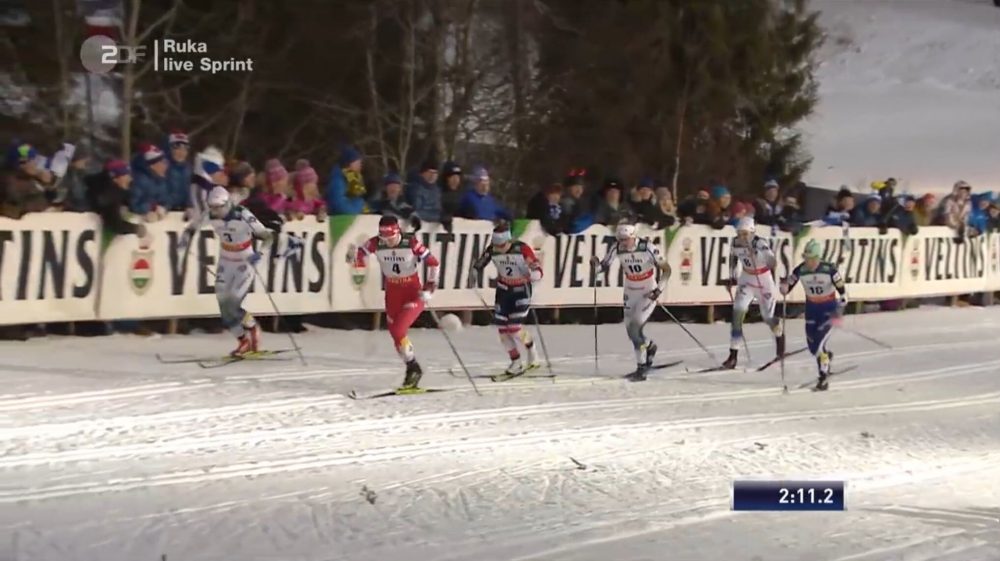
Left to right: Sweden’s Stina Nilsson, Russia’s Yulia Belorukova Norway’s Maiken Caspersen Falla and Swedes Maja Dahlqvist and Ida Ingemarsdotter during the final of the women’s 1.4-kilometer classic sprint on Saturday in Kuusamo, Finland. (ZDF broadcast screenshot)
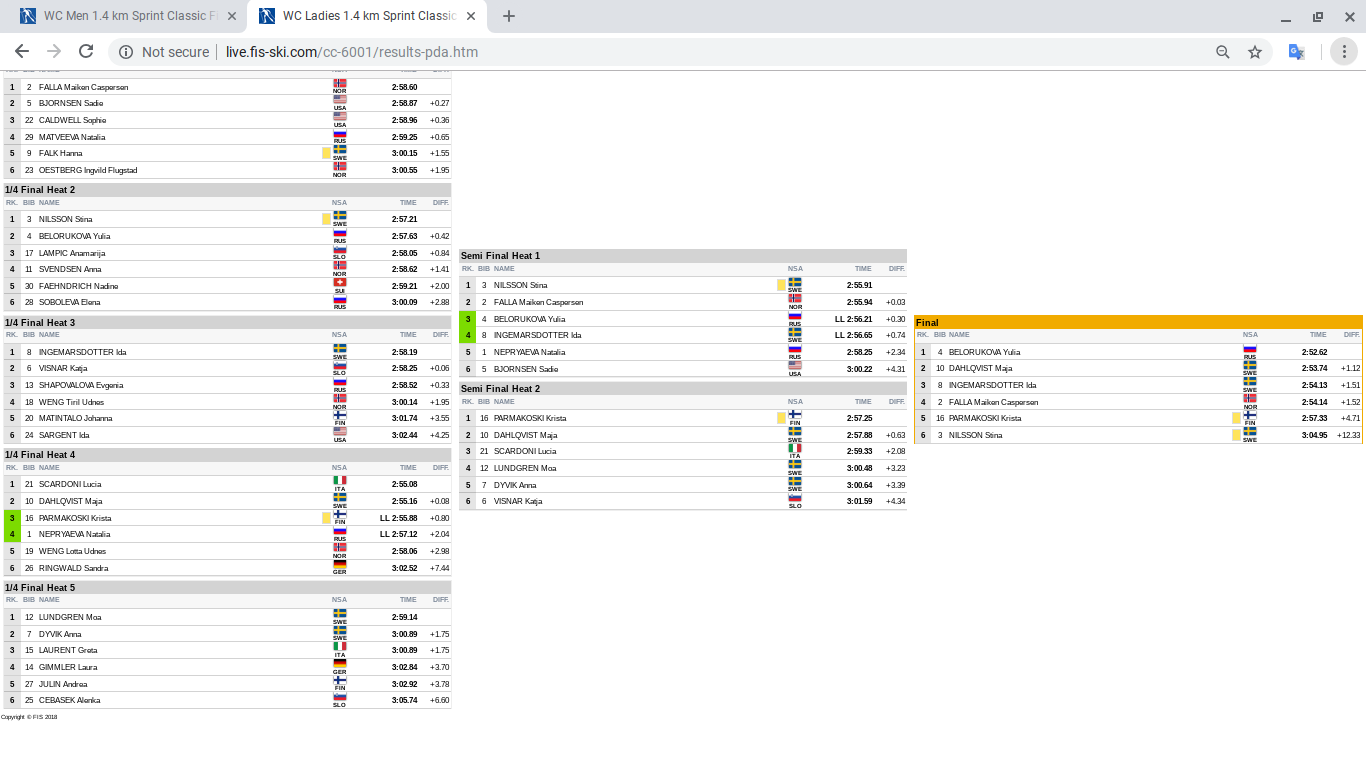
Belorukova had shadowed Nilsson during much of the final, but as they cornered toward the final 100-meters, a missed pole plant caused Nilsson to fall. Belorukova maneuvered around the Swede and crossed in a time 2:52.62 of for the win. Unable to recover from the fall in time for a shot at the podium, Nilsson crossed 12.33 seconds behind the Russian in sixth.
“On the last meters I was very strong …I hope. And today was a very good feeling,” Belorukova told FIS after the race. “And thank you so much for this great atmosphere. I am so happy to start here in Ruka, it is [a] happy place for me. Today I am lucky and happy.”
Also lucky for the blue and gold, not all podium prospects were riding on Nilsson. Twenty-four year old Maja Dahlqvist of Sweden, who placed second in last year’s freestyle sprint in Dresden, Germany, advanced to Saturday’s final and claimed her second individual World Cup podium, crossing 1.12 seconds back from Belorukova.
Following Dahlqvist, Sweden’s 33-year-old Ida Ingemarsdotter crossed third, 1.51 seconds back from the winner. The last time Ingemarsdotter landed in the top-3 individuall was in 2016, when she placed second in the freestyle sprint in Lenzerheide, Switzerland.
The finish was hard-earned, with Ingemarsdotter outlunging Falla by 0.1 seconds in a photo finish. Falla ended the day in fourth (+1.52) and Finland’s Krista Pärmäkoskiin fifth (+4.71).
Sadie Bjornsen racing the women’s qualifier on Saturday in Kuusamo, Finland. (Photo: Fischer/Nordic Focus)
Earlier in the day, Russia’s Natalia Nepryaeva won the qualifier in a time of 2:56.50. Behind her, three Americans qualified for the heats, with Sadie Bjornsen leading the charge in 5th (+3.01), Sophie Caldwell in 22nd (+6.97), and Ida Sargent in 24th (+7.23).
Both Caldwell and Bjornsen were slotted into quarterfinal 1. The heat went to Falla, with Bjornsen snagging an automatic advance spot in second. Caldwell, who crossed the quarterfinal in third, did not advance to the semifinals, She ended the day in 16th.
“It sure was fun to fire the engine for day 1 of World Cup racing this winter!” Bjornsen wrote in an email after Saturday’s sprint. “I always think of the first races as a Christmas gift… a total mystery, but completely exciting!
“I was really stoked on a 5th place qualifier, and felt like I had more to give for the heats to come,” Bjornsen continued. “I am a huge fan of the final climb on this course, and I love attacking it, so I was just excited to take it on. My quarterfinal went well, and I was able to move on just barely in a photo finish with Sophie.”
Sargent raced quarterfinal 3, which was won by Ingemarsdotter. Sargent crossed sixth and did not advance to the semifinals, ending the day in 27th.
Bjornsen moved into the first semifinal, lined up against Falla, Nilsson, Ingemarsdotter, Belorukova and Nepryaeva. Ultimately, she crossed sixth and ended the day in 11th.
“The semi final got off to a good start, and then as I was approaching the final big climb, I was on a desperate search for an open lane to put my move on the big climb, but unfortunately burned a few too many flares chasing it, and didn’t have the power to advance.” Bjornsen wrote. “I think that was one of the more stacked semi-finals I have been part of, so I still have a lot of hope and belief for what is to come.”
“Tomorrow is our first World Cup Distance race of the season, with a 10k classic, so I look forward to putting my distance engine to the test,” Bjornsen added. “It was a great warm up last weekend, and fun to stand on the podium to get my confidence and excitement going.”
Bjornsen raced last weekend’s FIS 10 k in Beitostølen, Norway and placed third behind Norwegians Ingvild Flugstad Østberg and Therese Johaug in second and first, respectively.
Finishing outside of qualification for the U.S. on Saturday was Jessie Diggins (USST) in 33rd (+9.05), Rosie Brennan of the Alaska Pacific University in 38th (+10.74), Kelsey Phinney of the Stratton Mountain School in 46th (+13.49), and last season’s overall SuperTour leader, Kaitlynn Miller of the Craftsbury Green Racing Project in 58th (+18.06).
The women’s sprint bracket from Saturday’s 1.4-kilometer classic sprint in Kussamo, Finland. (Photo: FIS Live Timing screenshot) Click the image to enlarge
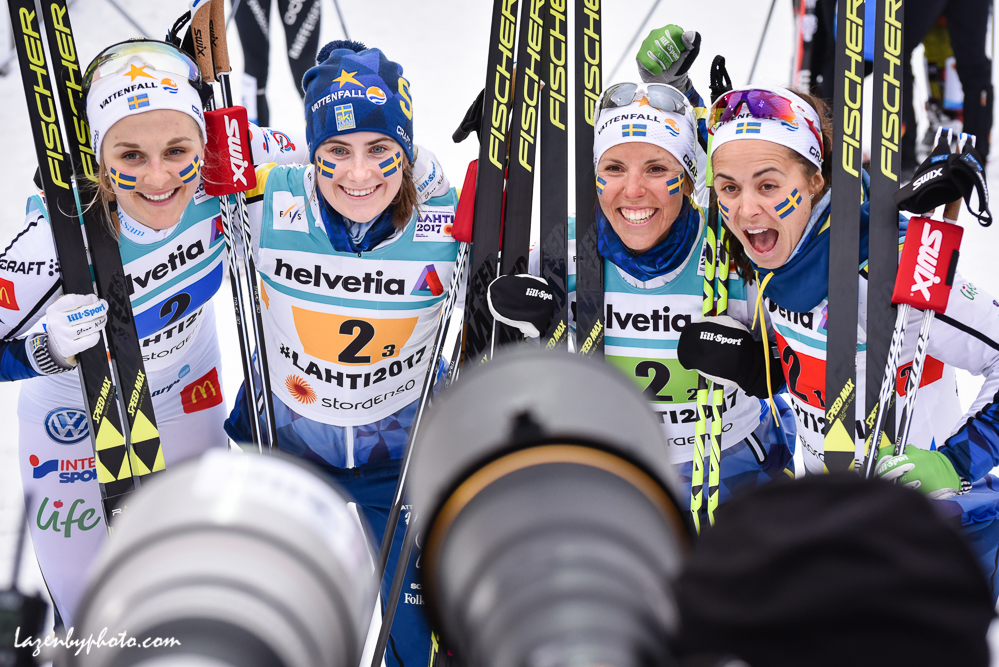
Sweden’s Stina Nilsson, Ebba Andersson, Charlotte Kalla and Anna Haag faced the cameras after winning the silver medal in the women’s relay at the 2017 Nordic World Championships in Lahti. (Photo: John Lazenby)
Welcome to FasterSkier’s World Cup Preview, where we check in with the top-10 teams from last year’s FIS Cross Country World Cup tour before the season starts. The World Cup begins with a classic sprint in Ruka, Finland on Nov. 24th
***
Sweden
Overall in Nations Cup Last Year: 2nd
Women’s Ranking 2017/2018: 2nd
Men’s Ranking 2017/2018: 5th
Swedes to Watch:She’s fast. She’s fierce. And she’s Swedish. While last spring gave rise to the retirement of many veteran cross-country ski names, 31-year-old Charlotte Kalla wasn’t one of them.
Kalla, who has been racing World Cups since 2006, is back for her 13th season on the circuit and not about to slow down. She finished last year, on a limited World Cup schedule, ranked seventh in the women’s overall, after securing five top three performances, two thirds of them victories.
Her singular focus remained peaking for the Games. She entered the 2018 season scorching fast, winning the the overall in the opening Ruka triple weekend. She won the following weekend’s 15-kilometer skiathlon in Lillehammer, Norway.
Kalla dialed back the racing in mid-December, did not race the Tour de Ski, and returned to World Cup racing on January 21, in Planica, Slovenia. She placed second in the 10 k classic.
Kalla returned from the Pyeongchang Olympic Winter Games with four medals, two for individual performances–most notably a gold in the women’s skiathlon.
Sweden’s Charlotte Kalla leads American Jessie Diggins and Norway’s Ragnhild Haga during the 2018 Holmenkollen women’s 30 k freestyle mass start at the World Cup in Oslo, Norway. (Photo: Fischer/NordicFocus)
When not name dropping Kalla, the Swedes have plenty to look to in the remainder of their women’s team. There’s the ever shining sprint star, Stina Nilsson, not to mention the up-and-comer Ebba Andersson. In between those two, with the retirement of Anna Haag, there’s sprint power houses,Hanna Falk and Ida Ingemarsdotter. Throw in Anna Dyvik and you’ve got your female Swedes for the season.
On the men’s side, despite the retirements of Emil Jönsson, Martin Johansson and Marcus Hellner, Calle Halfvarsson remains a name to watch out for on course. Halfvarsson ended last season ranked 13th in the overall, with six individual top-10 finishes, four of those on the podium.
Then there’s the 36 year old veteran, Daniel Rickardsson, as well as the 23-year-old Oskar Svensson, who both landed in last season’s World Cup top-30 more than once.
The women’s 1.4 k freestyle sprint podium at 2018 World Cup Finals in Falun, Sweden, with (from left to right) Sweden’s Jonna Sundling in second, Sweden’s Hanna Falk in first and Norway’s Marit Bjørgen. (Photo: Fischer/NordicFocus)
FALUN, Sweden — Even the sky had predictions for Sweden. Without a cloud in sight, cerulean blue and a golden sun served as Falun’s backdrop for the opening race of the 2017/2018 World Cup Finals on Friday: the 1.4-kilometer freestyle sprint.
Exactly nine weeks ago in the city sprint held in Dresden, Germany, Sweden’s Hanna Falk was showing shades of greatness. In the first race of the new year, the 28-year-old Swede claimed the Dresden freestyle sprint title for her first World Cup victory since 2010.
With the final sprint of the season taking place on the Falun ski trails, where Falk — a member of Sweden’s national team — spends most of her time training, the statistics were levied. All signs pointed to Sweden, in particular, Falk.
With one group of fans holding a banner that read “Falk för President” and still more waving the national flag, Falk won Friday’s Falun sprint final in 3:08.25 minutes, finishing the last sprint of the season the same way she started the new year: in first.
“This is just great to win here in Sweden. It’s my second victory this season and I am so happy that my parents are here to see it,” Falk said, according to an International Ski Federation (FIS) press release.
Falk started Friday with the fastest qualifying time of 2:59.88 (she remained the only woman to dip below the three-minute mark throughout the entirety of the day on the 1.4 k course).
Later, when Falk learned that the season’s overall sprint leader, Norway’s Maiken Caspersen Falla, would not advance to the final (American Sophie Caldwell and Norway’s Silje Øyre Slind snagged the two lucky loser spots in the final instead), Falk took a calculated approach for the final heat. She would be in control.
“With Maiken not in the final I knew that the pace might not be so high so I went for it on the second climb to make sure I had a good gap on the long downhill,” Falk told FIS.
From the start, Falk set the pace, leading through the first hill while Sweden’s Jonna Sundling and Anna Dyvik, Norway’s Marit Bjørgen, Slind, and Caldwell followed.
In the first descent, Falk maintained her position at the front, while Dyvik swung to her outside left and Bjørgen, Sundling and Caldwell clung just behind. Slind tucked in just behind in sixth.
Heading into the second uphill, Falk remained at the front with Dyvik matching her pace. Just before the crest of the hill, the eventual race winner visibly slowed, the rest of the field following suit. A half second later, Falk burst back to life, snapping over the top of the climb and putting close to two meters between herself and the group as they cornered back to the stadium.
Sweden’s Hanna Falk (r) smiles as she wins the fourth World Cup race of her career and first race in Falun, Sweden, with a victory in the women’s freestyle sprint at 2018 World Cup Finals on Friday. Her teammate Jonna Sundling (l) placed second while Norway’s Marit Bjørgen finished third. (Photo: Svenska Skidspelen/Instagram)
Chasing Falk on the descent was Bjørgen, then Dyvik and Sundling. Slind raced just behind them in fifth and Caldwell behind her in sixth. Coming into the final stretch, it was Falk in first, now at least three meters ahead. Sundling had moved around Dyvik and Bjørgen into second, leaving those two to battle for third.
Falk ultimately crossed first for her fourth-career individual World Cup victory, 0.53 seconds ahead of Sundling in second. Holding off a charge from Dyvik, Bjørgen crossed third, 1.4 seconds behind Falk.
In fourth was Dyvik (+1.72), followed by Slind in fifth (+4.30) and Caldwell in sixth (+6.99). The sprint finish marked Caldwell’s ninth World Cup top 10 this season. Additionally, the American finished eighth in the classic sprint at the Olympics last month in PyeongChang, South Korea.
Caldwell reached Friday’s final by qualifying in 16th, then winning the fourth quarterfinal and taking third in a photo finish with Slind (who followed in fourth) in the second semifinal. The top-four women from that semi all advanced to the final was fast-enough times.
Caldwell Achieves Goal of Top 3 in Sprint World Cup
While Falk’s win boosted the Swede from fifth to fourth in the final Sprint World Cup standings, Caldwell retained her podium position ahead of her in third. For the first time in her career, the 28-year-old Caldwell finished in the top-three of the overall Sprint World Cup.
Thinking back two years, Caldwell could remember a conversation she had with U.S. Ski Team Women’s Coach Matt Whitcomb about race goals. Whitcomb wanted Caldwell to write down goal in particular: to be in the Sprint World Cup overall top three.
“At the time I was like, ‘Eh, no, that seems pretty far off,’” Caldwell reflected in a post-race interview with FasterSkier.
“I remember she was a bit sheepish when we suggested it,” Whitcomb told FasterSkier on Friday.
The 2017/2018 women’s Sprint World Cup podium with Norway’s Maiken Caspersen Falla (c) in first, Sweden’s Stina Nilsson (l) in second and American Sophie Caldwell (r) in third. (Photo: Fischer/NordicFocus)
Yet on Friday, Caldwell looked on from the podium as an American flag rose in honor of her third-place finish in the overall sprint standings. With a total of 396 points, Caldwell claimed third behind Sweden’s Stina Nilsson, who had 495 points for second, and Norway’s Falla in first with 573 points.
“We were really psyched that she took after it because, all of us coaches, really believed it could be done,” Whitcomb said.
“I was of course thrilled to be up there today,” Caldwell said. “It’s been a good season with some really good results, but I think maybe what I am most proud of is just the consistency of my season — making it into the semifinals almost every sprint and skiing with confidence throughout the year.”
Though Caldwell expressed that results can be gratifying, they are not the be-all and end-all of her ski career nor what she attributes to her and the U.S. team’s momentum.
“My hope is that people back home see this team not only for our results, but also for the friendships we have and the atmosphere we have going on in this team,” Caldwell said. “I think this team has come so far … It started with Kikkan [Randall] sneaking into the top 30, then Kikkan finding herself on the podium, then Kikkan winning. She sort of showed us all that we could do it, too, and pulled us up with her, believed in us so that we could believe in ourselves. Now on any given weekend it could be any one of us on that podium, which is really cool.”
Falla, who finished Friday’s sprint in eighth after being eliminated in the semifinals, won the overall sprint title for the third-straight season, this time by 78 points over Nilsson in second after Nilsson missed Friday’s sprint due to illness.
“For sure I wanted to be able to fight for the podium today but I made a mistake in the semifinal and I wasn’t able to get back into position to advance,” Falla told FIS after finishing fourth in the first semifinal behind Falk, Sundling and American Jessie Diggins, respectively. “But I can’t be too upset as I have won my third Crystal Globe and I am very proud of that.”
Three Americans in Top 10
Rounding out the rest of Friday’s freestyle-sprint top 10 was Diggins in seventh, her U.S. teammate Sadie Bjornsen in ninth and Sweden’s Ida Ingemarsdotter in 10th.
Sadie Bjornsen (4) racing in Friday’s freestyle sprint semifinal with her U.S. teammate Jessie Diggins (2) and Slovenia’s Anamarija Lampic (25) while chasing Norway’s Maiken Caspersen Falla (left, pink headband), among others. (Photo: Fischer/NordicFocus)
After racing to second place in the first quarterfinal behind Falk, Bjornsen automatically advanced to the first semifinal. Diggins won the third quarterfinal to advance to the first semifinal as well.
In the semis, Diggins finished third, 0.42 seconds behind Falk in first and just 0.08 seconds behind Sundling, who automatically advanced in second.
Bjornsen followed in fifth, 0.87 seconds out of first, behind Falla in fourth (+0.68). Aside from the top two in that first semifinal, no one from that heat advanced to the final.
American Sadie Bjornsen racing to fourth in the women’s 1.4 k freestyle sprint qualifier at World Cup Finals in Falun, Sweden. She went on to finish the day in ninth overall. (Photo: Fischer/NordicFocus) (Photo: Fischer/Nordic Focus)
To start the day, Diggins had qualified for the rounds with the second-fastest time, 1.65 seconds behind Falk, while Bjornsen qualified in fourth (+2.96).
“I definitely felt really good about how my body feels. I guess I was wishing for a bit more today,” Bjornsen told FasterSkier after. “For the last sprint of the year it was a fun way to end, leaving something to hope for.”
The last World Cup sprint of her career, American Kikkan Randall qualified for the heats in 18th before advancing to the same quarterfinal as Diggins. While Diggins gapped the field by the final downhill back toward the stadium and won the heat, Randall remained in contention to automatically advance in second until the last lunge to the line. There, Randall finished third, 3.14 seconds behind Diggins and just 0.1 seconds shy of second place, which went to Ingemarsdotter.
“I did not feel good in the first half of that heat; my body just wasn’t quite warm yet,” Randall told FasterSkier after. “I just tried to keep myself in there.”
Randall was disappointed not to advance past the quarterfinals in her last sprint, but when asked to reflect on the season as a whole, the 35 year old remained thoughtful.
American Kikkan Randall racing to 18th in the women’s 1.4-kilometer sprint qualifier at World Cup Finals in Falun, Sweden. She went on to finish the day in 15th overall. (Photo: Fischer/NordicFocus
“I was really happy to be able to start a family and come back. I think that went as well as I could have hoped,” Randall said. “And even though it took some patience at times … and the season didn’t go exactly as I planned, with the foot injury mid-season, I came around big at the Olympics this year and happy that I was able to get back in form when I needed to.
“I’m glad I stuck with it this long,” she continued. “I’m just trying to enjoy the last bit of time with my teammates, my staff and all the World Cup friends.”
After the disqualification of Russia’s Natalia Nepryaeva for her second yellow card (due to a false start in her quarterfinal), American Ida Sargent finished the day in 36th, followed by Rosie Brennan in 49th, Caitlin Patterson in 63rd, Liz Stephen in 66th, Kaitlynn Miller in 69th, and Rosie Frankowski in 75th. Emily Nishikawa was the top Canadian woman in 40th, Dahria Beatty finished 48th, Cendrine Browne 60th, and Zina Kocher 71st.
The Holmenkollen women’s 30 k freestyle mass start podium on Sunday in Oslo, Norway, with Jessie Diggins (l) in second, and Norway’s Marit Bjørgen (c) in first and Ragnhild Haga (r) in third. (Photo: FIS Cross Country/Twitter)
FIS Cross Country World Cup (Oslo, Norway): Women’s 30 k freestyle mass start
Marit Bjørgen, the Norwegian queen of distance cross-country events, racked up another victory at Holmenkollen in the women’s 30-kilometer freestyle mass start on Sunday for her seventh win in the World Cup’s ultimate distance event at the famed Norwegian venue. (She had previously won in 2005, 2010, 2012, 2014, 2015 and 2017).
But she did so in not-so-typical fashion. Instead of breaking the field mid-race and skiing to a comfortable win, like she did in the last race of the 2018 Olympics in PyeongChang, South Korea (a 30 k classic mass start), Bjørgen came from behind to win Sunday’s Holmenkollen 30 k and wasn’t able to let off too much before finish. She didn’t take the lead until less than a kilometer to go and put just enough time into her competition to take the win in 1:18:12.4 hours, while American Jessie Diggins outlasted the chase group of three to place second (becoming the first American woman to reach the Holmenkollen podium), 3.6 seconds behind Bjørgen. Norway’s Ragnhild Haga edged Sweden’s Charlotte Kalla by 0.1 seconds for third place (+4.3), while Kalla settled for fourth (+4.4).
The rest of the field was strung out, with Norway’s Astrid Uhrenholdt Jacobsen finishing fourth (+11.5) and Ingvild Flugstad Østberg nearly another 1 1/2 minutes back in fifth (+1:39.5). Finland’s Krista Pärmäkoski placed seventh (+1:51.7), Germany’s Stefani Böhler notched eighth (+2:10.2), Austria’s Teresa Stadlober ninth (+2:10.2), and Sweden’s Ebba Andersson 10th (+2:11.9). Less than a second behind Sweden’s Ida Ingemarsdotter in 11th (+2:22.8) was American Sadie Bjornsen in 12th (+2:23.4).
In the Distance World Cup standings, Diggins gained some valuable points to keep herself in third, now 63 points ahead of Pärmäkoski in fourth. Heidi Weng, who finished 18th on Sunday, still leads the distance standings by 104 points and Østberg is second, 51 points ahead of Diggins.
In the Overall World Cup, Weng leads by 153 points over Østberg. Diggins is another 104 points back in third, 100 points ahead of Pärmäkoski in fourth. At World Cup Finals next week in Falun, Sweden, a total of 300 points is up for grabs for the winners (50 for freestyle sprint, 50 for classic individual start, and 200 for freestyle pursuit).
The U.S. had three in the top 20 and four in the points (top 30) in Sunday’s 30 k, with Kikkan Randall in 19th (+3:21.9) and Caitlin Patterson in 28th (+4:13.1). Rosie Frankowski (Alaska Pacific University) missed the top 30 by about 28 seconds in 31st (+4:45.4), Liz Stephen placed 51st (+10:01.7) and Kaitlynn Miller (Craftsbury Green Racing Project) finished 53rd (+16:05.0).
Cendrine Browne led four Canadian women in 36th (+6:16.1), Emily Nishikawa was 44th (+7:36.1), Zina Kocher (Foothills Nordic) finished 47th (+8:52.0), and Dahria Beatty placed 49th (+9:45.1).
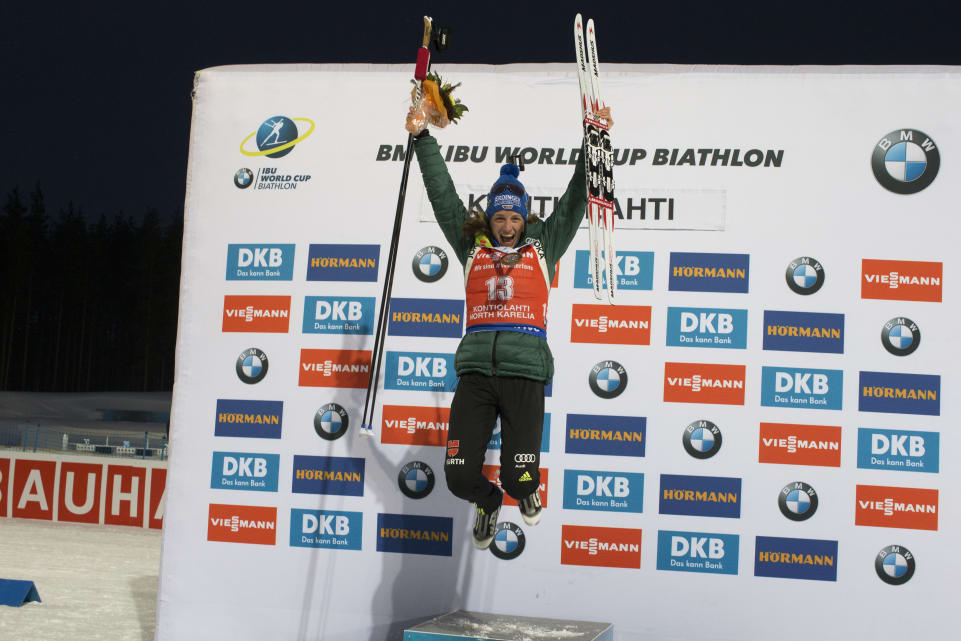
Germany’s Vanessa Hinz celebrates her first IBU World Cup win and podium in the women’s 12.5 k mass start on Sunday in Kontiolahti, Finland. (Photo: IBU/Biathlonworld)
IBU World Cup (Kontiolahti, Finland): Men’s and women’s mass starts
(Note: This rundown has been updated to include comments from Lowell Bailey and Rosanna Crawford.)
Germany’s Vanessa Hinz won her first International Biathlon Union (IBU) World Cup race (and achieved her first World Cup podium) and Austria’s Julian Eberhard won his first race of the season (and first mass start of his career) in the women’s 12.5 k and men’s 15 k mass starts on Sunday in Kontiolahti.
Germany’s Vanessa Hinz celebrates her first IBU World Cup win and podium in the women’s 12.5 k mass start on Sunday in Kontiolahti, Finland. (Photo: IBU/Biathlonworld)
Hinz shot an impressive 20-for-20 with the third-fastest range time and fifth-fastest shooting time to take the win in 35:47.9 minutes. Third after the first prone stage, she moved into second, then third after cleaning the next two stages. After knocking down her final five targets in the last standing, Hinz left the range almost 24 seconds ahead of France’s Anaïs Chevalier in second and 26 seconds ahead of Italy’s Lisa Vittozzi in third. Hinz stayed ahead of her challengers on the final loop, finishing 13.5 seconds clear of Vittozzi, who claimed second. Chevalier finished third, 16.8 seconds back, while Finland’s Kaisa Mäkäräinen was next across the line in fourth (+43.4) with a gap to Sweden’s Hanna Öberg in fifth (+1:02.1).
Vittozzi and Chevalier both cleaned the first three stages then had to ski a penalty lap after the last standing bout (0+0+0+1). Mäkäräinen missed three (1+0+1+1) yet skied the second-fastest course time on her home course, and Öberg missed two (0+0+2+0). The fastest course time of the day was clocked by Darya Domracheva of Belarus, who had to ski five penalty laps (0+1+1+3) and ended up 10th (+1:18.2).
“I always dreamed of shooting four times clean and today I did it,” Hinz, 25, said, according to an IBU press release. “I was so often close to the podium. I knew I could do it. Today, I said, ‘OK, let’s try it and if it works, it is OK … and if not there is another season waiting and other races.’ Now I am on top of the podium and it is crazy.”
Vittozzi, who placed fourth in the mass start at the 2018 Olympics, was glad to improve on a third-place finish in Friday’s sprint by placing second on Sunday.
“I have been third so many times and that was not satisfying for me,” Vittozzi said, one day after she won the mixed relay with her team in Kontiolahti. “Today I am very happy about my second place.”
For Chevalier, it was her first individual podium of the season and it came a day after she and Antonin Guigonnat won the single mixed relay. Chevalier, 25, was severely injured when she was hit by a car last spring, according to an IBU press release.
“I am very happy to be here today, because it was a very hard season,” she told the IBU. “I forgot how nice it is to be on the podium … I forgot that it was not easy, so I am very happy … I did my best on the last lap; [Vittozzi] was faster, but I am third and happy with that!”
Canada’s Rosanna Crawford shot 19-for-20 to place 13th (+1:25.9) with her only miss coming in the second prone stage (0+1+0+0). Her overall shooting and range times were 10th fastest of the 30-woman field, compared to her 26th-ranked ski time. Crawford had been in 11th after cleaning the final standing stage, then slipped two spots to finish 13th in her second mass start of the season.
“Since the skiing wasn’t feeling great today I made sure I was super focused in the range,” Crawford wrote in an email to FasterSkier. “I knew that was my only chance to get a good result today. My one prone miss was a bad trigger pull, but the rest were nice solid hits. I made sure to have a solid set up and then just trusted my rhythm and shooting.
“I knew that I wanted that top 15, so I just kept fighting and trying to stick with the women when they caught me,” she wrote of her last loop. “The last time up the wall I managed to stay close to [France’s] Anais Bescond, and hold off the two people behind me. Really happy to be in the top 15 again.”
Clare Egan was the lone American woman to qualify for Sunday’s mass start, and it was the second mass start of her career. She was on track for a top-15 result after missing just one target in the first three stages, but she had to ski three penalty laps on the last standing (0+1+0+3), which put her in 23rd by the finish (+2:05.6). Notably, she skied the 14th-fastest overall course time.
“I didn’t have quite the same energy level tonight as the last two days, but I still had the 14th rank course time and that means anything is possible in the race,” Egan wrote in an email to FasterSkier. “To put it in perspective, the winner of the race, Hinz, had the 13th rank, just 2 seconds faster than me. This is the first time I’ve felt totally comfortable skiing with the fastest women, and I certainly hope I can maintain this speed for one more week of World Cup racing.”
Egan was pleased with her 9-for-10 prone shooting and her clean standing stage (“which is the first time I’ve cleaned a standing stage in an individual race this entire year, believe it our not,” Egan wrote).
“But when I missed my second shot on the final stage, I let that throw me off my game, and really blew the rest of the stage,” she explained. “It’s so hard to keep 100% focus in every scenario, and I find it gets harder and harder towards the end of the race when I’m not necessarily the most lucid. I know that I have to work on so I have a goal to manage the final stage better next week and in the future.”
Her 23rd-place finish was one better than her previous World Cup mass start finish, which was 24th last season in Hochfilzen, Austria.
“In my only other mass start, which was last year at World Championships, I felt like an imposter,” Egan reflected. “Maybe because I was the first ‘reserve’ to get called up when one of the top women [did not start]. But this was totally different. I knew I deserved to be there today and was confident about competing with the other top women.”
“In my only other mass start, which was last year at World Championships, I felt like an imposter … This was totally different. I knew I deserved to be there today and was confident about competing with the other top women.” — Clare Egan (US Biathlon) on Sunday’s mass start
While the women raced Sunday night, the men’s 15 k mass start took place in the afternoon, when Eberhard passed the likes of France’s Martin Fourcade and Russia’s Anton Shipulin after a tangle late in the race to take the win.
The Austrian team celebrating Julian Eberhard’s fourth career victory, his first this season and his first in a mass start on Sunday after the IBU World Cup men’s 15 k mass start in Kontiolahti, Finland. (Photo: IBU/Biathlonworld)
The Austrian had cleaned the first two prone stages to move into third by the race’s halfway point, behind Germany’s Benedikt Doll and Arnd Peiffer in first and second, respectively. Eberhard missed one in the next standing stage, yet left the range in second, 15 seconds behind Peiffer (who cleaned) in first, while Doll missed one as well to slip into third, 19 seconds back.
With two loops to go, Fourcade was coming back from two early prone penalties and found himself in fifth after a clean standing stage, less than a second behind Shipulin in fourth. On the next standing stage, Fourcade cleaned to take the lead and left the range about five seconds ahead of Shipulin (who also cleaned) in second.
Eberhard missed one yet remained in contention in third, 17 seconds behind Fourcade. On the last loop, Shipulin caught Fourcade before the course’s notorious climb known as “The Wall”, and Eberhard closed on the two frontrunners as they ascended it. Still several seconds behind over the top, he caught Shipulin on the bridge before the stadium, but the two tangled skis and Shipulin fell. Eberhard stayed upright and pulled even with Fourcade, passing him to take the win in 38:04.8. Fourcade finished second (+6.9) and Shipulin third (+19.3).
Austria’s Julian Eberhard (l) and Russia’s Anton Shipulin after the finish of the men’s 15 k mass start the IBU World Cup in Kontiolahti, Finland. Shipulin fell when his skis tangled with Eberhard’s. While Eberhard raced to the win, Shipulin placed third. (Photo: IBU/Biathlonworld)
“I wanted to be in a sprint with all three, but the bridge is too small for this,” Eberhard said, according to an IBU press release. “I came up the bridge with too much speed. Anton and I were in the same track and there was an accident. I apologized to Anton at the finish but he said these things can happen and it was OK with him.”
“I hold no grudge against Julian,” Shipulin told the IBU. “This can happen in sports and is all fair … I am in good shape and want to preserve this and perform my best in the last World Cups.”
Fourcade explained that illness caused him to sit out Thursday’s sprint, and he was only able to train three hours this week.
“It is really difficult to race in this situation without any feeling or training,” Fourcade told the IBU. “I did not know what to expect today but I am quite satisfied. I would have liked to win, but I used too much energy trying to come back in the early laps and had no energy when it was time to attack.”
Behind them, Doll picked off one place on the final loop to finish fourth (+21.9), passing his German teammate Erik Lesser, who finished fifth (+23.9). Peiffer followed in sixth (+27.1) as Germany had three in the top six.
American Lowell Bailey raced to 14th (+1:06.3) with two penalties, both of which came in the standing stages (0+0+1+1). Bailey had been fourth after cleaning the second prone, 16 seconds behind Doll in first, but slipped to 10th after missing one on the next bout. He had to ski another penalty lap on the last stage, and left the range in 14th.
Overall, Bailey posted the 10th-fastest shooting time, 15th-fastest range time and 18th-fastest course time.
“I finally felt like I was back in the spot that I ended last season,” Bailey wrote in an email when asked about his consistency. “I felt controlled and able to keep the pace with the top of the field throughout the race. It was nice to be back in the mix.
“Although I would have liked to see this ski speed a few weeks ago, better late than never!” he continued.
Next week’s World Cup in Oslo, Norway, will be his last of the season and his career.
“After nearly two decades of international racing, Oslo will be my final World Cup as a U.S. Biathlete,” Bailey wrote. “I’m sure it will be emotional but I hope to end my World Cup career on a high note!”
The men’s 1.6 k freestyle sprint podium at Saturday’s World Cup in Lahti, Finland, with Italy’s Federico Pellegrino (c) in first, Russia’s Gleb Retivykh (l) in second and Norway’s Johannes Høsflot Klæbo (r) in third. (Photo: FIS Cross Country/Twitter)
FIS Cross Country World Cup (Lahti, Finland): Men’s & women’s freestyle sprints
The defending world championships from the 2017 freestyle sprint prevailed again in Lahti on Saturday, with Norway’s Maiken Caspersen Falla winning the women’s 1.4-kilometer freestyle sprint final and Italy’s Federico Pellegrino coming out on top in the men’s 1.6 k final at last year’s World Championships venue.
Falla’s rise to the final started with her qualifying in 12th, 7.96 seconds off the fastest qualifying time set by Sweden’s Hanna Falk in 2:54.72. Russia’s Natalia Nepryaeva qualified second (+0.63) and Finland’s Krista Pärmäkoski third (+3.62), just ahead of Germany’s Victoria Carl in fourth (+3.88) and American Sadie Bjornsen in fourth (+3.88). Four American women qualified for the heats, with Sophie Caldwell in 17th, Ida Sargent in 21st and Rosie Brennan in 29th.
The women’s 1.4 k freestyle sprint podium at Saturday’s World Cup in Lahti, Finland, with Norway’s Maiken Caspersen Falla (c) in first, and Sweden’s Stina Nilsson (l) and Hanna Falk (r) in second and third, respectively. (Photo: FIS Cross Country/Twitter)
Falla went on to place second in the first quarterfinal, 0.71 seconds behind Sweden’s Stina Nilsson in first. According to the race jury’s ruling, Carl obstructed Pärmäkoski coming out of the last downhill before they entered the finishing straight and both crashed out of contention, with Pärmäkoski finishing fifth in the heat (+12.11) and Carl sixth (+49.5). Carl was relegated to last (30th place) for the obstruction.
Falla then won the first semifinal by just 0.04 seconds over Nilsson in second. The two other Swedes in that heat, Falk and Ida Ingemarsdotter, advanced to the final as well as lucky losers with fast-enough times.
In the final, Falla found herself at the front of the pack early then held her position to the finish, crossing the line in 2:54.83 and beating Nilsson by 0.36 seconds. Sweden had two on the podium with Falk in third (+0.78), Germany’s Sandra Ringwald placed fourth (+0.88), Ingemarsdotter was fifth (+1.83), and Switzerland’s Laurien van der Graaff placed sixth (+3.02).
Caldwell was the lone American woman to make it past the quarterfinals, as she placed second in her quarterfinal, 0.25 seconds behind Ringwald in first, then fourth in the second semifinal, 1.46 seconds behind Ringwald, who also won that heat. Overall, Caldwell finished the day in eighth.
Bjornsen placed 17th overall after finishing fourth in her quarterfinal, 2.84 seconds behind Falk in first. Sargent had been second in her quarterfinal until the final tight lefthand corner into the finishing straight, where she slipped to sixth and ultimately finished sixth, 1.07 seconds behind Sweden’s Anna Dyvik in first. Overall, Sargent finished the day in 27th, and Brennan placed 29th overall after finishing sixth in her quarterfinal, 4.91 seconds behind Ingemarsdotter in first.
Two American men advanced to the heats as well, with Kevin Bolger of the Sun Valley Ski Education Foundation (SVSEF) qualifying in 16th in his World Cup debut, 6.38 seconds behind Norway’s Johannes Høsflot Klæbo, who topped the qualifier in 2:59.06. Erik Bjornsen of the U.S. Ski Team qualified 29th, 8.29 seconds back.
Meanwhile, Pellegrino qualified for the heats in third (+1.9) behind France’s Baptiste Gros in second (+1.23).
There, Pellegrino won the first quarterfinal by 0.19 seconds over Klæbo, with the Norwegian visibly backing off before the finish — comfortable enough to automatically advance to the semifinals in second place. But Klæbo showed Pellegrino what he’s made of in the first semifinal and beat the Italian by nine-hundredths of a second.
Bolger also raced in that first semifinal after placing fourth in his quarterfinal, 0.73 seconds behind Russia’s Gleb Retivykh in first. Bolger’s time was good enough for one of two lucky loser spots in the semifinals, where he went on to finish sixth, 1.86 seconds after Klæbo. Overall Bolger finished the day in 11th.
Erik Bjornsen placed 20th on the day after finishing fourth in the first quarterfinal (with Pellegrino and Klæbo), 1.56 seconds out of first.
In the final, Klæbo set the tone, slowing the pace to almost a stop at one point, while he and Pellegrino stood side by side at the top of the course. On the way down, they accelerated, but Norway’s Sindre Bjørnestad Skar was the one who truly attacked. It might’ve been a bit too early, as Pellegrino caught him by the top of the final climb and took the lead on the following downhill into the stadium. Pellegrino held off his challengers, including Retivykh who came on strong out of the downhill, to take the win in 3:16.73, 0.77 seconds ahead of Retivykh in second and 0.9 seconds ahead of Klæbo in third. Skar settled for fourth (+1.3), Finland’s Ristomatti Hakola placed fifth (+1.44) and France’s Lucas Chanavat finished sixth (+7.55).
In the qualifier, Canada’s Dahria Beatty finished 34th, +13.39 and just 0.9 seconds from making the quarterfinals. She was the only Canadian woman competing.
American Kelsey Phinney (SVSEF) was also close to making the cut. In her first European World Cup, she placed 36th in the qualifier, +13.74. Caitlin Patterson and Kaitlynn Miller, both of the Craftsbury Green Racing Project, placed 56th (+20.12) and 61st (+21.70).
Mathilde Petitjean of Togo, a primarily Quebec-based skier, finished in 59th (+20.80).
In the men’s qualifier, Logan Hanneman (APU) placed 49th (+11.45). Paddy Caldwell (U.S. Ski Team/SMS T2) finished 59th (+13.55), and APU’s Reese Hanneman and David Norris placed 61st (+14.33) and 67th (+19.27).
Julien Locke led Canada in 42nd place (+9.78), and Andy Shields finished 60th (+14.29).
American Chloe Levins racing to seventh in the junior women’s 7.5 k sprint on Saturday at IBU Junior World Championships in Otepää, Estonia. (Photo: Terri Dickson)
Poland’s Kamila Zuk won her second race in a row, taking gold in the junior women’s 7.5 k sprint after also winning the individual at World Junior Championships. Zuk had one penalty to two by second-place Marketa Davidova of the Czech Republic, who finished 26.0 seconds back. Bronze went to Myrtille Begue of France, who shot clean to finish 52 seconds back.
The sole U.S. starter, Chloe Levins followed up her sixth-place finish in the individual with seventh place in the sprint. Levins had a single penalty and finished +1:31.7.
For Canada, Megan Bankes was close behind Levins in ninth, with two penalties and +1:49.5. Teammate Nadia Moser was 21st, also with two penalties, +2:46.2. Emily Dickson finished 36th, +3:50.5 with two penalties, and Zoe Pekos just missed the pursuit cutoff in 66th (+6:22.4) with four missed shots.
In the junior men’s 10 k sprint, Vasilii Tomshin of Russia took the gold with perfect shooting. France’s Martin Perillat Bottonet was second, less than a penalty-loop’s worth of time back at 20.5 seconds – and he did have one penalty. Norway’s Sverre Dahlen Aspenes took bronze (+29.4) with two missed shots.
Trevor Kiers led Canada in 16th, a breakthrough result; his previous World Juniors best was 39th in the pursuit last season. Kiers missed two shots, both in prone, and finished 1:34.9 behind the time set by Tomshin.
Adam Runnalls placed 26th for Canada (+2:08.3) with three missed shots. Teo Sanchez also qualified for the pursuit by placing 53rd (+3:19.2) with one penalty, and Angus Tweedie was left on the outside looking in with 69th place (+4:41.3) with three missed shots.
Cody Johnson led the Americans in 37th, with clean shooting, 2:31.1 back from Tomshin’s time. Tim Cunningham was the next finisher in 71st (+5:13.5) with seven missed shots, followed by Jacob Pearson in 79th (+6:24.2) with two penalties and Cam Christiansen in 86th (+7:52.5) with three penalties.
A generation ago, North American cross-country skiing was a results-sheet afterthought with the exception of the one-off banner day.
Now, with Canada’s Alex Harvey and the U.S. Ski Team earning World Cup wins, podiums, and coveted points, expectations are high. Is it medal or go home?
Not quite. Breathe. Exhale.
On Tuesday night at the Alpensia cross-country venue, North American skiers put on a show. With Jessie Diggins making the finals and Canada’s Len Valjas skiing like he could reel in the ephemeral white whale, spectators and writers alike could also breathe and exhale, knowing good things come around eventually.
Asked in the mixed zone after the race if medals were still in the mix, Diggins turned to the media scrum before walking away and said, “I wouldn’t be racing here if they weren’t.”
In Tuesday’s qualifier, Diggins spearheaded a four-skier women’s U.S. Olympic team that skied one-by-one out of the start in tricky winds and pending precipitation.
Posting the fastest qualifying time was Sweden’s Stina Nilsson, covering the 1.2 k sprint course in 3:08.74 minutes (She would eventually move on to win the event’s gold-medal. Diggins was the leading U.S. skier in qualification, slotting into seventh place, 7.02 seconds off Nilsson’s time. Sadie Bjornsen placed ninth (+7.38) and Sophie Caldwell 12th (+8.32) in a qualifier featuring a 15.28-second spread from Nilsson to 30th-place Aino-Kaisa Saarinen of Finland.
The fourth U.S. starter, Ida Sargent, just missed the quarterfinals in 33rd. She finished 17.06 seconds behind Nilsson’s time.
Three American Women in the Quarterfinals
American Jessie Diggins (7) lunges for second in a photo finish in the women’s classic sprint semifinal on Tuesday at the 2018 Olympics in PyeongChang, South Korea (Photo: FlyingPointRoad)
Diggins selected Heat 3 along with Sweden’s Hanna Falk, an eventual finalist. With her up-tempo double pole, Diggins set the standard immediately.
Into the first climb, which really served as an appetizer for the more significant and steeper climbing meal of the course’s second climb, Diggins took control. There was no doubt watching the speed-frenzy of Falk and Diggins that the sprinting duet would take it to the line, the rest of their heat left behind. It was Diggins-Falk down the final stretch then Falk-Diggins at the line. Falk placed first in 3:11.08, Diggins a camera-click behind in second (+0.16).
Post-qualifier, Caldwell chose the second heat, featuring Norway’s Maiken Caspersen Falla, the day’s second fastest qualifier, and Sweden’s Ida Ingemarsdotter, who placed eighth in qualification.
“During heat selection I have tended to choose some of the first couple heats because it gives me more recovery and they tend to be faster, so I have a better chance of being a lucky loser,” Caldwell explained after the race. “Today I was toying back and forth whether to choose the fifth heat or the second because the fifth didn’t have as many people. But I really like following Maiken. She always sets down a fast heat so I just decided to go with what was working.”
Caldwell, who won the final World Cup sprint — a skate sprint — prior to the Olympics, didn’t need to fix what wasn’t broken. The U.S. Ski Team skier shadowed Falla.
“My strategy was to hop in behind [Falla] and stick with her,” Caldwell added. “And she definitely opened up a bit of gap over the top of the final hill, but I think I skied the downhill well.”
It’s a scorching downhill with a banked sweeping righthand corner that slingshots skiers into the tracks ahead. Down came Falla with a 10-meter gap on Caldwell. But Caldwell’s quick-stepping and gravity defying apex propelled her closer to Falla.
“I started to close in on her and then hopped in her draft on the finishing stretch and was able to finish right behind her,” Caldwell said of closing out her quarterfinal. “That sort of played out perfectly.”
Falla won the heat in 3:11.98, Caldwell was a close second, finishing 0.16 seconds behind.
Bjornsen chose the fourth heat along with Russian Yulia Belorukova and Norway’s Heidi Weng.
One aspect of U.S. women’s skiing that the U.S. Ski Team’s (USST) women’s coach Matt Whitcomb has preached over the years is to go out and take risks; to feel comfortable in the fact that coaches support skiers taking those chances. For the USST women, positive outcome chances have manifested in more confidence and a higher probability of podiums.
Bjornsen went out strong and carried the pacing of the chasing skiers. Her long smooth strides looked settled. In her post-race interview, Bjornsen said she believed the up and down nature of the women’s sprint course required a capacity for endurance.
American Sadie Bjornsen (9) leads into a climb in the women’s classic sprint quarterfinal on Tuesday at the 2018 Olympics in PyeongChang, South Korea. (Photo: FlyingPointRoad)
“I think it’s more distance-type of sprinting,” Bjornsen said.
Bjornsen looked semifinal-bound as she hustled up the decisive climb and Belorokuva made her move over the last portion of the headwall.
But Norway’s Heidi Weng, who had looked uninspired on moving into the climb’s initial ramp, appeared to have learned a lesson from her male teammate, Johannes Høsflot Klæbo. She ran up the outside of the main five-skier group. Belorokuva and Weng punched over the top of the hill in first and second, respectively.
“I probably should have paced it a little bit,” Bjornsen said after the race. “But I was really excited and I just wanted to see what I could do. Man, I was hurting the last 3/4’s of the hill for sure. I was trying to find that next skier and push it hard over the top but yeah probably the best skiing today is to save some energy for the top of that, because that is going to make the difference and your going to see the medals won right there.”
As a third-place finisher in her heat — behind the winner Belorukova and second-place Weng — Bjornsen could have moved on to the semifinals as a ‘lucky loser’ based on time. But her time was not fast enough.
Sadie Bjornsen (second from l) out of the tracks and ready to roll after the start of her quarterfinal heat, alongside Norway’s Heidi Weng (r) in the women’s 1.25 k classic sprint at the 2018 Olympics in PyeongChang, South Korea. (Photo: FlyingPointRoad)
“You know, it didn’t go as I dreamed, but the best races I have are when I just go out there and have no fear and send it from the front,” Bjornsen explained. “That was kind of my goal today. I’m not tactically the best skier in the world, but when I have a lot of guts things go well.
“Unfortunately it didn’t work as planned today,” Bjornsen continued. “I hit a bit of a slow patch on that final downhill and lost a position which I really needed but, I am really happy that I tried skiing like that and I definitely have a good feeling and I think there is a lot more to come.”
Bjornsen finished 14th overall.
Caldwell Sends It in the Semis
Norway’s Maiken Caspersen Falla (r) and Sweden’s Stina Nilsson dual (l) battle for first in the women’s semifinal. Behind them, Sweden’s Hanna Falk (4) duels with U.S. skier Sophie Caldwell for third in the 1.25 k classic sprint on Tuesday at the 2018 Olympics in PyeongChang, South Korea. (Photo: FlyingPointRoad)
Despite the semifinal spotlight shining brightest on Nilsson and Falla, in her quarterfinal, Caldwell had proven she could match Falla’s speed burst as the Norwegian closed out the heat. In her semifinal, with Nilsson now playing alpha-sprinter, Caldwell would need to keep in contact up and over the final climb if she hoped of making a finals appearance.
“I think the pace felt a little harder,” Caldwell said of her semifinal. “I haven’t seen times — it could have just been it was one heat later so you are a little more tired. Maiken and Stina really put in a push over the top of that hill, and I feel like that’s where they opened a solid gap. I was hoping I would be able to reel them in on the downhill a little again, but it was just a big enough gap.”
Caldwell nearly caught the Nilsson-Falla train. With the Swede and Norwegian slightly ahead down the final straight, Falk and Caldwell hammered for fast times, hoping for a lucky loser finals berth.
Nilsson won the semi with Falla (+0.03), Falk (+0.62), and Caldwell (+0.80) crossing the line in blur. Falk was the second of two lucky losers to advance. Caldwell was eliminated, missing the lucky loser spot by 0.18 seconds once the times from the other semifinal had been tallied.
Sophie Caldwell (U.S. Ski Team) after one of the rounds in the women’s classic sprint on Tuesday at the 2018 Olympics in PyeongChang, South Korea. (Photo: FlyingPointRoad)
“Hanna out-doubled-poled me in the final stretch,” Caldwell said. “It definitely was frustrating being so close to lucky loser, but I was happy with the effort I put in and to be that close was good. I felt good out there, I was a little nervous about how I would feel because I don’t think I slept for a minute last night, I got so nervous.
“I wasn’t even nervous yesterday,” she continued. “As soon I laid down, my mind started racing and I was awake a lot of the night. But I think that’s good, that meant I was excited. I was happy with my feelings out there. I think any day you make it into the semifinal is a good day, and of course you always want more especially at the Olympics. But I think it’s important to take a step back and recognize that that was a really good day and especially for classic sprinting this year it might be my best result of the season, so I am happy.”
Diggins has made the Olympics her own stage. She nearly pulled out a medal in the 15 k skiathlon last Saturday. Her World Cup season has been peppered with sprint and distance highlights. So a Diggins-charge through the heats, even in a classic sprint, isn’t the story.
The story is that Diggins has set the bar so high that she expects herself to be in these moments; moments of tension where the high-stakes world of sport are cut and dry. Clearly Diggins belongs and it’s an environment in which she has thrived.
In her semifinal, it was a tight 1-2-3 with Russia’s Yulia Belorukova winning in 3:10.12 and Diggins stretched across the line for a photo finish with another Russian, Natalia Nepryaeva. Both skiers finished 0.60 seconds behind Belorukova, however, Diggins placed second, Nepryaeva third. While Diggins automatically qualified for the final, Nepryaeva advanced as well as the first lucky loser.
In the final, Nilsson stole the show with a statement win. She won her first career Olympic gold with an exclamation point. Falla placed second (+3.03), Belorukova third (+3.37), Nepryaeva fourth (+9.14), Falk fifth (+11.16), and Diggins sixth (+11.23).
“For me, just making the final has been a huge step forward,” a self-deprecating Diggins said after the race. “If you told me at the start of the year that I would make the Olympic classic sprint final, I would have been like, ‘Ha, that’s funny, good joke.’ So for me, just having my technique really click this year and having the confidence and the form to make it, has been a really big step forward, and I am really happy and proud of that.”
Having adjusted to the bright light and bump up in media attention on this Olympic stage, Diggins explained it was in fact an extremely taxing series of race efforts as she advanced through the evening.
“For my race today, yeah, I definitely didn’t recover quite enough coming from the second semifinal to the final,” she said. “I don’t know if I would have recovered enough even from the first semi. I had to dig pretty deep just to make it, but I am really happy with where my shape is overall and where my form is.
For sure, I was crumbling a little bit on that last monster climb and working hard to keep it upright and keep it together. But I went at it with everything I had,” she continued. “I really dug deep and I pushed myself hard and I am really really proud of this race today, I think it was a good one and I think it shows some good things to come.”
Women’s cross-country racing continues here in PyeongChang on Thursday with the 10 k freestyle — another Diggins canvas awaiting her brushmarks.
Sweden’s Stina Nilsson (center) won gold in the classic sprint at the 2018 Olympics on Tuesday in PyeongChang, South Korea, with Norway’s Maiken Caspersen Falla (left) taking silver and Russia’s Yulia Belorukova bronze. (Photo: FlyingPointRoad)
PYEONGCHANG, South Korea — Tuesday at PyeongChang’s Alpensia cross-country venue, the site of the Olympic Games women’s 1.25-kilometer classic sprint, Sweden’s Stina Nilsson took gold. On an evening when athletes were already challenged by an aerobic capacity testing course, shifting winds and falling snow, another factor made the challenge debilitating.
Nilsson came into the Games well-rested and well-primed to take her first individual Olympic medal. The 24 year old had come close before; at her first Olympics, the Swede placed 10th in the freestyle sprint in Sochi, Russia. There, she went on to claim bronze in the classic team sprint with teammate Ida Ingemarsdotter.
A year later in Falun, Sweden, at World Championships, Nilsson placed second in the individual classic sprint. When you are close, you begin to think more about achieving a singular goal and less about overall season-long outcomes.
Nilsson last raced a World Cup the weekend of Jan. 20-21 in Planica, Slovenia, where she raced to 13th place in the 10 k classic. The day before, on Jan. 20, Nilsson took a small prize: a World Cup classic-sprint win.
In her run up to PyeongChang, Nilsson explained she was able to focus on her training and block out distractions.
“Not so much pressure the last weeks, because I have not been on the Internet so much,” Nilsson said at the post-race press conference. “And not on Instagram. So the most pressure comes from myself, and that’s the pressure that I have to deal with. But today I managed to control those feelings and just ski so fast as I can.”
With temperatures hovering around 25 degrees on Tuesday evening, Nilsson was unstymied by the gusting winds or falling snow in formulating the answer to her success equation. Starting with Tuesday’s qualifier in PyeongChang, Nilsson marked the fastest time, stopping the clock in 3:08.74 minutes. With Nilsson pushing the pace, she also scored a win in the quarters. Again in her semifinal, Nilsson placed first after dualing with the 2014 Sochi skate-sprint champion, Norway’s Maiken Caspersen Falla (who also won the skate sprint at last year’s World Championships), in a photo finish.
“I had a really good day,” said Nilsson, a 2015 World Championships classic-sprint silver medalist. “I felt strong already in the prologue, and I felt also strong in the quarterfinal, and in the semifinal. I felt like I had some energy saved for the final.”
Sweden’s Stina Nilsson and teammate Hannah Falk (4) embrace after Nilsson won the classic sprint gold medal at the 2018 Olympics in PyeongChang, South Korea. (Photo: FlyingPointRoad)
Lining up in the final trying to prevent Nilsson’s clean sweep on the day were Falla, Nilsson’s Swedish teammate Hannah Falk, American Jessie Diggins, and Russians Natalia Nepryaeva and Yulia Belorukova.
The energy Nilsson stated she had saved for the final was more than sufficient. Off the line she set the pace up the course’s first climb — a climb not steep enough to create big gaps and string out the field. The group stayed together with two skiers in the inside lane, three in the adjacent lane, and Diggins skiing outside the tracks and closing on the outside.
Topping out on the hill and taking a sharp 180-degree turn, Nilsson led but no skier pulled away. Down the hill, the six skiers tucked and glided and double poled into the course’s decisive climb with Belorukova then Falla the closet skiers to challenge.
The final hill is where Nilsson seized the day.
“I just wanted to cross the finish line totally tired, so I just went for it in the last uphill,” Nilsson said about her race tactics in the final. She carried considerable speed over the final climb and the gap grew to the two closest chasers, Falla and Belorukova.
“My plan was to save the most of the power until the last part of the [final] climb,” Falla, 27, said at the press conference. “But when the two others got a little gap in the first downhill, I used too much power in the first part of the climb. So in the top where I was planning to use all my power, there wasn’t that much left.”
Nilsson still had power to spare. She soloed off the front to win the final in 3:03.84 minutes. Falla took silver (+3.03), Belorukova, a 23-year-old Olympic rookie, bronze (+3.37).
In the post-race press conference, Belorukova was asked about the tense relationship between the International Olympic Committee (IOC) and the Russian Ski Federation. The IOC banned numerous Russian skiers from PyeongChang for doping violations. Those Russian athletes competing at the 2018 Winter Olympics are not competing under the Russian flag, but as Olympic Athletes from Russia (OAR).
“Good question,” Belorukova said through an interpreter. “There is nothing that will break us, there is nothing that will instill fear into us, we are strong and we will fight until the end.”
Nepryaeva ended up fourth (+9.14), Falk fifth (+11.16), and Diggins sixth (+11.23). FasterSkier will post an additional report on the U.S. women’s results.
The finish of the women’s 6 x 1.2 k freestyle team sprint final, with Sweden II’s Maja Dahlqvist (near) celebrating her win ahead of Sweden I’s Stina Nilsson (c) and American Sophie Caldwell (l), who placed second and third, respectively, in a photo finish. (Photo: Fischer/NordicFocus)
DRESDEN, Germany — Just over 15,000 people gathered at the Elbe River bank on Sunday, some donned in sunnies and carrying sauce-laden brätwurst from pop-up food carts, though all took pause around 11:14:59 a.m. It wasn’t to take in the Altstadt baroque-style buildings that make up the city skyline, nor was it to bask in the bright, mid-morning sun hovering on the horizon.
A new attraction had come to the capital city, and all eyes were on it: the start of the International Ski Federation (FIS) women’s 6 x 1.2-kilometer freestyle team sprint. The city race organizers had trucked nearly 5,000 cubic meters of manmade snow to the grassy green bank, creating a skiing venue where one had never previously existed before. (Dresden has never before hosted a World Cup; the closest place to find natural snow being around 95 kilometers away).
Though it was the first of its kind, the crowd was still on edge as racers anticipated the snap of the gun for the women’s final. Even amid artificial conditions, the scene was naturally mystifying for onlookers.
With the gunshot, life roiled back into those in the stands and competitors became absorbed in the race for the win. Leading out Lap 1 was Ida Ingemarsdotter, racing for Sweden’s second team with Maja Dahlqvist (who placed third in Saturday’s individual skate sprint).
Ingemarsdotter was closely followed by her compatriot, Hanna Falk, who had won Saturday’s sprint and was racing for Sweden’s first team on Sunday. Hanna Kolb, racing for Germany I, Ida Sargent racing for U.S.A. I, and Alenka Cebasek racing for Slovenia, were all in hot pursuit.
Also on course was Nadine Fähndrich of Switzerland, Giulia Stuerz on Italy , Jessica Yeaton of Australia, Caitlin Patterson (U.S.A. II), and Katharina Hennig (Germany II).
U.S. Ski Team members Sophie Caldwell (l) and Ida Sargent after placing third in the World Cup freestyle team sprint on Sunday for their World Cup second podium together in the event. (They finished third in the pre-Olympic World Cup freestyle sprint last year in PyeongChang, South Korea.) (Photo: Fischer/NordicFocus)
Through the exchange it was Ingemarsdotter in first, Falk second, Kolb third, and Sargent fourth. Coming through in seventh was Patterson, of the Craftsbury Green Racing Project, handing off to Kikkan Randall (U.S. Ski Team).
“I think I tend to let myself accordion to much, so I had to watch that and really focus to stay in it,” said Patterson, who arrived in Dresden on Thursday after being crowned a four-time 2018 national champion last week in Anchorage, Alaska.
“Being efficient … keeping it together and keep[ing] it tight,” Patterson added, referring to her race strategy on Sunday. “Because I know Kikkan has so much experience in heats and she can really maneuver well; she did such a good move on the last leg of that semifinal to keep us in it.”
In the final, as Patterson handed off to Randall, while Sargent passed off to Caldwell (who had placed third in Saturday’s sprint). Still in the lead was Ingemarsdotter tagging to Dahlqvist, Kolb to her teammate Sandra Ringwald, and Falk to Stina Nilsson.
The women stayed in a close pack, but thanks in part to the cheers of a large fanbase behind her, Germany’s Ringwald had worked her way to the front. As the skiers approached their third exchange, Germany had taken over the lead. Following Ringwald was Caldwell in second and Slovenia’s Vesna Fabjan in third. Randall was also gaining ground and gave the race back to Patterson in sixth as the field headed into Lap 3 of 6.
Americans Sophie Caldwell (front r) and Kikkan Randall (14) racing together in the women’s 6 x 1.2 k freestyle team sprint final on Sunday at the World Cup in Dresden, Germany. USA I, with Ida Sargent (not shown) and Caldwell went on to place third, while USA II, with Caitlin Patterson (not shown) and Randall, finished eighth. (Photo: Fischer/NordicFocus)
“This is my first real racing weekend back and yesterday was a little frustrating because my body felt good but I just didn’t quite have the speed fully ready yet,” said Randall, who had pulled out of the Tour de Ski due to an ongoing issue with one of her foot tendons and has been working on recovering since. “So I am really glad I got the opportunity to race today.
“It was great to have Caitlin ski really strong and get into the final,” Randall added. “I just wanted to get six rounds and I did. It was fun, fast paced, and I am happy with the way I felt. Of course, it’s fun to have another team in the race, too, and kind of be working together a bit.”
Caitlin Patterson racing for USA II in the women’s 6 x 1.2 k freestyle team sprint on Sunday at the World Cup in Dresden, Germany. (Photo: Fischer/NordicFocus)
As racers struck out into Lap 3, Switzerland’s Fähndrich was at the helm, which she held until she tagged off to her teammate Laurien van der Graff. The Swiss skiers had a smooth exchange and van der Graff was out front. Breathing down her neck behind her, however, were two Swedes: Nilsson and Dahlqvist. As the group approached the course’s most notable climb, Nilsson powered her way around van der Graff and to the front, Ringwald in tow.
With the fourth exchange coming into sight, the top two spots were with Sweden, Switzerland third. U.S.A. I was in fifth, U.S.A. II in eighth.
“It’s hard to pass, so we definitely wanted to stay toward the front,” Caldwell said of her and Sargent’s plan heading into the final. “It’s such a short and fast course that anything can happen and I think it is always fun to be right there in the mix.”
With just two laps to go, Falk, who came out of the exchange first, began to push the pace, while Fähndrich, Sargent and Ingemarsdotter chased her down. Though Falk had put a bit of a gap on the field by the course’s turn heading back to the stadium, it had closed by the course’s single climb. Here, Fähndrich made her move and maneuvered around Falk to the front.
After the fifth exchange and heading into the final lap, the two Swedes, van der Graff, and Caldwell tried to separate themselves from the rest of the teams in the final. But within a few meters three more teams — Slovenia, and Germany I and II — had rejoined them.
As they approached the aforementioned uphill, Nilsson went for it, propelling herself to the front. Dahlqvist went with her, and Caldwell dodged to van der Graff’s left, pulling a hard V1 to get around the Swiss skier. Approaching the finish, it was Dahlqvist to the far right, Nilsson in the middle and Caldwell to the left.
The women’s 6 x 1.2 k freestyle team sprint podium at Sunday’s World Cup in Dresden, Germany, with Sweden II’s Ida Ingemarsdotter and Maja Dahlqvist in first (c), Sweden I’s Stina Nilsson and Hanna Falk in second (l), and USA I’s Sophie Caldwell and Ida Sargent in third (r). (Photo: Fischer/NordicFocus)
Both Swedes appeared to have an edge on Caldwell, but the American made a gritty final few pushes and all three lunged for the line. Dahlqvist was just ahead and took it by 0.16 seconds over Nilsson, and Caldwell placed third for the second day in a row, just 0.07 seconds out of second place and 0.23 seconds out of first. Sweden’s No. 2 team had won it with a cumulative time of 13:33.40, about four seconds faster than the fastest semifinal.
“I was actually left wishing the finish was a little longer, which I don’t know if I have ever said about a race before,” Caldwell, who leans toward sprint disciplines, said after the race. “Ida skied awesome and I was proud with how I skied, so it’s really fun when you feel like both legs kind of do their best and you get a good result to celebrate that with.”
Finishing in fourth (+2.11) was Germany I, Slovenia placed fifth (+4.46), Germany II placed sixth (+4.62), Switzerland (+5.09) USA II eighth (+7.95), Italy I ninth (+10.89) and Australia 10th (+27.53).
To start the day, Sweden I, with Falk and Nilsson had won the first semifinal in 13:37.97, by 0.17 seconds over Sweden II’s Ingemarsdotter and Dahlqvist. The top-six teams from that heat qualified for the final, with Switzerland in third, Italy in fourth, Slovenia in fifth, and Australia in sixth.
The American teams took the top two in the second semifinal, with Sargent and Caldwell winning 13:46.51, and Patterson and Randall following in second, 0.11 seconds back. Germany I and Germany II qualified from that heat as well with fast-enough times.
Sunday marked the first and last team sprint of the season so far before the Winter Olympics in PyeongChang, South Korea, where a freestyle team sprint will be contested on Feb. 21.
The World Cup has two more weekends of racing before the Olympics, with all-classic races next weekend in Planica, Slovenia (classic sprint and 10/15 k classic individual starts), followed by freestyle races in Seefeld, Austria, on Jan. 27-28 (skate sprints and 10/15 k freestyle mass starts).
— Ian Tovell and Alex Kochon contributed reporting
The women’s 6 x 1.2 k freestyle team sprint podium at Sunday’s World Cup in Dresden, Germany, with (from left to right) Sweden I’s Hanna Falk and Stina Nilsson in second, Sweden II’s Ida Ingemarsdotter and Maja Dahlqvist in first (c), and USA I’s Ida Sargent and Sophie Caldwell in third (r). (Screenshot: ZDF broadcast)
Kaisa Makarainen of Finland celebrates winning the women’s 12.5 k mass start in Ruhpolding, Germany, as Laura Dahlmeier (Germany) is second, Veronica Vitkova (Czech Republic) third, and Rosanna Crawford (Canada) fourth. (Photo: IBU/Biathlonworld)
IBU Biathlon World Cup (Ruhpolding, Germany): 12.5/15 k mass starts
Kaisa Makarainen of Finland took her first win of the season and will start next weekend with the overall World Cup leader’s bib after she outsprinted Germany’s Laura Dahlmeier by 0.8 seconds to claim the win in the 12.5 k mass start. In a tight race for third, Veronica Vitkova of the Czech Republic edged out Rosanna Crawford of Canada for the final spot on the podium; the pair crossed the line 4.6 and 5.2 seconds behind Makarainen. The podium finishers all had two penalties apiece while Crawford shot clean, repeating the 20-for-20 effort that netted her third place and her first-ever podium in the 15 k individual earlier this week. Germany’s Denise Herrmann was sixth, +16.7 seconds, despite four missed targets.
In the men’s 15 k mass start, Norway’s Johannes Thingnes Bø took a win over France’s Martin Fourcade as the pair continue their running battle this season. Bø had one penalty to Fourcade’s two, although that penalty came in the last shooting stage to make things interesting – Fourcade, whose penalties had come in the prior shooting stage, closed to within 4.5 seconds by the finish, but was unable to beat the Norwegian. Antonin Guigonnat, one of the newest members of the French World Cup team, shot 20-for-20 to claim third place and his second podium of the season. In an exciting race, the top nine men all finished within 15 seconds of one another. The sole U.S. entry, Tim Burke, was in the top 15 for much of the race before missing two shots in the final standing shooting stage and finishing 21st, +1:30.2
The women’s 6 x 1.2 k freestyle team sprint podium at Sunday’s World Cup in Dresden, Germany, with Sweden II’s Maja Dahlqvist and Ida Ingemarsdotter in first (c), Sweden I’s Hanna Falk and Stina Nilsson in second (l), and USA I’s Ida Sargent and Sophie Caldwell in third (r). (Photo: FIS Cross Country/Twitter)
FIS Cross Country World Cup (Dresden, Germany): 6 x 1.2 k freestyle team sprint
For the second-straight day in Dresden, Sophie Caldwell notched third place and was nearly second with U.S. teammate Ida Sargent on Sunday in the World Cup women’s 1.2-kilometer freestyle team sprint.
The race ended in a three-way fight for first, which Sweden II’s anchor Maja Dahlqvist took by 0.16 seconds over Sweden I’s Stina Nilsson. While the two lunged for the line, Caldwell came on strong to give them a run as well, finishing just 0.23 seconds back in third (after being in a photo finish for second).
Earlier in the day, Sargent and Caldwell had won the second semifinal to advance to the 10-team final. The U.S. Ski Team’s second team, Caitlin Patterson and Kikkan Randall, finished second in that heat, just 0.11 seconds back and advanced as well.
Sweden I won the first semifinal with Hanna Falk (Saturday’s individual skate-sprint winner) and Nilsson. Sweden II finished 0.17 back in second with Ida Ingemarsdotter and Dahlqvist.
In the final, Sweden II’s Ida Ingemarsdotter led through her first two legs before tagging Dahlqvist in third with one lap to go. Meanwhile, Sargent tagged Caldwell in fourth, 0.9 seconds back. On the final lap, with Switzerland, the two Swedish teams, and USA I’s Caldwell skiing together up front, they dropped Switzerland’s Laurien van der Graaff before the finish and went all out for first.
Dahlqvist took it for Sweden II in 13:33.4, Sweden I placed second and USA I third. The same duo of Caldwell and Sargent placed third in the pre-Olympic freestyle team sprint last year in PyeongChang, South Korea. There, Sargent also placed third in a classic sprint for her first World Cup podium. Sunday marked Caldwell’s fourth individual World Cup podium (sixth including team events).
USA II was up to sixth after Randall’s first leg, just 0.5 seconds out of first, and remained 1.8 seconds behind the leaders with two laps to go. On the second-to-last leg, Patterson tagged Randall in ninth, and Randall anchored them to eighth (+7.95).
Germany I finished fourth (+2.11) with Hanna Kolb and Sandra Ringwald, Slovenia was fifth (+4.46) with Alenka Cebasek and Vesna Fabjan, Germany II was sixth (+4.62) with Katharina Hennig and Elisabeth Schicho, and Switzerland seventh (+5.09) with Nadine Fähndrich and van der Graaff.
The men’s 6 x 1.2 k freestyle team sprint podium at Sunday’s World Cup in Dresden, Germany, with Italy’s Dietmar Nöckler and Federico Pellegrino in first (c), Sweden’s Emil Jönsson and Teodor Peterson in second (l) and Russia’s Andrey Krasnov and Gleb Retivykh in third (r). (Photo: FIS Cross Country/Twitter)
In the men’s race, Norway’s Johannes Høsflot Klæbo teamed up with Kasper Stadaas, and the two won their semifinal by 0.26 seconds over Italy’s Dietmar Nöckler and Saturday’s winnerFederico Pellegrino. The U.S. men’s first team of Erik Bjornsen and Simi Hamilton advanced to the final as the last lucky loser in the second semifinal, where they placed fourth, 0.85 seconds behind Russia I’s Andrey Krasnov and Gleb Retivykh in first. Sweden I (Emil Jönsson and Teodor Peterson) and Sweden II (Johan Häggström and Karl-Johan Westberg) also advanced in second and third in that heat.
In the final, which included Great Britain for the first time in team-sprint history (after James Clugnet and Andrew Young clinched the last lucky loser spot in the first semifinal in sixth place), Stadaas set a fast pace on the opening 1.2 k loop. He tagged Klæbo in first, 0.3 seconds ahead of Sweden I, while the U.S. hung in contention 0.9 seconds back in fifth.
Norway continued to lead until Stadaas’s second lap, where Russia’s Krasnov came through the third exchange first, 0.1 ahead of Switzerland’s Jovian Hediger in second. Stadaas tagged Klæbo in fourth, 0.5 seconds back, and Klæbo predictably recovered the lead on the next lap.
After he gave Stadaas a 1.3-second lead at the fourth exchange, Stadaas initially ran with it and extended it significantly. But he ran out of steam on the second half of his last loop and dropped to 10th (last place), 3.7 seconds out of first by the final exchange.
There, Jönsson tagged Peterson in first, 0.9 seconds ahead of Hediger in second. Bjornsen had brought the U.S. to third, 2 seconds back, after leading the chase group in second as they reeled in Stadaas.
On the final lap, Pellegrino came on strong in the last few hundred meters, just as he had done in Saturday’s individual sprint, to take the win for Italy in 12:18.3. Peterson anchored Sweden I to second place, 1 second back, and Russia’s Retivykh took third (+1.2), just ahead of Switzerland’s Roman Schaad in fourth (+1.4).
Hamilton suffered a nasty crash in the middle of the group just before the finish and crossed the line in eighth (+14.2).
Klæbo finished fifth for Norway (+1.9), with Sweden II in sixth (+1.9). Italy II (Stefan Zelger and Giacomo Gabrielli) followed in seventh (+7.3), Great Britain placed ninth (+14.6), and Switzerland II (Erwan Käser and Roman Furger) 10th (+20.9).
This is the last team sprint before a freestyle team sprint is contested at the 2018 PyeongChang Olympics.
The women’s freestyle sprint podium on Saturday at the World Cup in Dresden, Germany, with Sweden’s Hanna Falk (c) and Maja Dahlqvist (l) in first and second, and American Sophie Caldwell (r) in third. (Photo: FIS Cross Country/Twitter)
FIS Cross Country World Cup (Dresden, Germany): Freestyle sprints
For her second-straight World Cup sprint, Sophie Caldwell of the U.S. Ski Team reached the podium in the women’s 1.2-kilometer freestyle sprint on Saturday in Dresden, Germany.
Caldwell placed third in the final behind Sweden’s Hanna Falk, who won it in 2:11.02 minutes, and Maja Dahlqvist, also of Sweden, who placed second (+0.23). Caldwell and Dahlqvist both lunged in a photo finish for second, which Dahlqvist took by 0.07 seconds.
Also in the final, which included four Swedes, Switzerland’s Laurien van der Graaff finished fourth (+0.58), and Sweden’s Anna Dyvik followed in fifth (+0.68) and Stina Nilsson sixth (+7.56) after tripping.
Falk started the day by winning the women’s qualifier in 2:06.34, by just 0.02 seconds over Nilsson in second. Caldwell qualified 11th (+2.02). and another American Ida Sargent made it into the heats in 14th (+2.44). Kikkan Randall missed the top 30 by 0.6 seconds in 34th (+6.57), Julia Kern placed 38th (+7.78), and Caitlin Patterson, of the Craftsbury Green Racing Project (CGRP), was 40th (+8.56) out of 49 women in the qualifying round.
Sargent finished fourth in her quarterfinal, 043 seconds behind Sweden’s Ida Ingemarsdotter in first, to finish the day in 17th overall.
For Caldwell, who went on to advance in second in her quarterfinal and third in her semifinal, the podium came after she finished second in the last World Cup skate sprint (the first stage of the Tour de Ski) on Dec. 31 in Lenzerheide, Switzerland.
Her boyfriend and fellow U.S. Ski Team member Simi Hamilton came close to reaching the men’s 1.2 k sprint final on Saturday after qualifying in 15th then placing second in his quarterfinal and fifth in the second semifinal, 0.38 seconds behind Sweden’s Emil Jönsson in first.
France’s Lucas Chanavat won the qualifier in 1:50.42, 0.15 seconds ahead of Norway’s Johannes Høsflot Klæbo in second. Hamilton was 4.32 seconds back in the qualifier, and his U.S. teammate Andy Newell also qualified in 18th (+4.91). Erik Bjornsen missed qualifying by 0.23 seconds in 32nd (+6.15) and Ben Lustgarten (CGRP) finished 49th (+8.64) out of 67 men.
The women’s freestyle sprint podium on Saturday at the World Cup in Dresden, Germany, with Italy’s Federico Pellegrino (c) in first, Norway’s Johannes Høsflot Klæbo (l) in second, and France’s Lucas Chanavat (r) in third. (Photo: FIS Cross Country/Twitter)
While Hamilton’s day ended in the semifinals, putting him 10th overall (and Newell finished sixth in his quarterfinal to place 27th overall), Italy’s Federico Pellegrino timed his attack perfectly in the final, challenging Klæbo for the win down the finishing stretch. The Italian took it by 0.18 seconds in 1:52.77, Klæbo placed second and Chanavat third (+0.98).
France and Norway had two men in the final, with France’s Richard Jouve placing fourth (+1.23), Sweden’s Jönsson taking fifth (+2.36) for his best individual World Cup result since December 2016. Norway’s Even Northug finished sixth (+12.04) after breaking his pole out of the start.
Canada’s Julien Locke of the National U25 Team and Black Jack Ski Club had a career-best day, finishing 15th overall. He qualified 16th (+4.61) then placed third in his quarterfinal, crossing the line just 1 second behind Norway’s Fredrik Riseth, who won that heat. Hamilton was second in that quarterfinal, 0.67 seconds back.
Also for Canada, Bob Thompson (NTDC Thunder Bay) finished 50th in the qualifier (+8.67), Dominique Moncion-Groulx (Alberta World Cup Academy) was 59th (+9.99) and Antoine Briand (Pierre-Harvey National Training Centre) 60th (+10.12).
Germany’s Laura Dahlmeier, Franziska Preuss, Denise Herrmann and Franziska Hildebrand (left to right) celebrating their win in the women’s 4×6-kilometer relay at the 2018 IBU World Cup in Ruhpolding, Germany. (Photo: IBU/Biathlonworld)
IBU World Cup (Ruhpolding, Germany): Women’s relay
The teams from Germany and Italy dueled for the top position all race in Saturday’s 4 x 6-kilometer women’s relay at the IBU World Cup in Ruhpolding, Germany. Cheered on by some 20,000 home-crowd fans, Germany’s anchor Laura Dahlmeier stayed on the ski tails of Italy’s Federica Sanfilippo after the last shooting stage, then passed her before the last major climb and held a narrow lead around the rest of the course to cross the finish line first in a time of 1:08:47.0 hours, with Italy 2.9 seconds behind. German had a team total of zero penalties and nine spares.
“It’s incredibly fun to win in front of this audience here today,” Dahlmeier told German broadcaster ZDF in an interview right after the race, according to a translation. “I think this will boost our whole team morale. We showed today that we are a team to be reckoned with in relays. It was just a nice race.”
Germany with Franziska Preuss, Denise Herrmann, Franziska Hildebrand, and Dahlmeier was never more than 30 seconds behind the pace, even though Hildebrand temporarily fell back from leading the field to tagging off to Dahlmeier in fourth position.
“My race held all kinds of surprises today,” Hildebrand told ZDF with a laugh. “It started with a fall on an icy patch 100 meters after it began… Then I dropped my pole, also had to exchange the replacement one, and then three spares [in prone] to avoid the penalty. Today everything conspired in my race.”
Italy with Lisa Vittozzi, Dorothea Wierer (coming off a victory in the individual race on Thursday), Nicole Gontier and Sanfilippo had the best shooting performance of the day, with no penalty and just three spares.
“That last loop with Laura was really tough,” Sanfilippo said in the press conference. “I gave my best, I tried all for my team. I knew that I can be strong on the last loop. I tried to attack, but Laura was a little bit stronger. But I am also really happy that we finished in second place, I think that was really important for our team.”
Sweden with Linn Persson, Mona Brorsson, Anna Magnusson and anchor Jenny Öberg was third, 17.2 seconds back, with no penalty and five spares. Brorsson and Öberg managed to move the team up to the podium positions, for the second one in a row following a third place from Oberhof, Germany, a week ago. Before that, the Swedish women’s team had been on a six-year hiatus from those lofty positions.
“It’s cool to be on the podium again,” Persson said in the press conference.
“This is like our second home and there were a lot of Swedes here, so we had big support during the race on the tracks,” Brorsson added.” That was an advantage for us.”
Just a few seconds off the podium, Norway with Synnøve Solemdal, Tiril Eckhoff, Ingrid Landmark Tandrevold and Marte Olsbu was fourth (+23.1, with no penalty and nine spares), with Olsbu outsprinting Poland’s anchor Weronika Nowakowska on the finish stretch (+24.5, with no penalty and five spares). For both teams it was their best relay result of the season so far.
Switzerland with the three sisters Elisa, Selina and Aita Gasparin reinforced by Lena Häcki surprisingly led the race at the third exchange after Selina had moved them in front, but her youngest sister Aita could not hold that position, falling back with a penalty lap in the last standing stage to finish eighth (+1:37.1, with one penalty and 11 spares).
Biathlon Canada’s team of Emma Lunder, Julia Ransom, Sarah Beaudry, and Rosanna Crawford started the race with a setback after Lunder incurred a penalty in her prone stage, leaving the range in 23rd position at the end of the field and already almost a minute behind the leader. She managed to limit the gap with a clean standing stage to exchange still in 23rd position and 1:47 back.
Taking over Ransom then remained clean in both stages to move the team up to 17th, tagging off 2:14 behind. Beaudry only required one spare in her prone stage (0+1, 0+0) to improve to the 12th position even making up 3 seconds to the leaders.
Then Crawford, fresh off her first career podium in the individual race on Thursday, managed to also shoot clean in both stages and overtook the teams from Slovakia and Ukraine while further decreasing the gap to finish the race in 10th position, 1:56.7 back, with one penalty and just four spares.
“Things were a bit softer and slushy today compared to the individual, but nothing too bad,” Crawford commented on the conditions in an email to FasterSkier. “There was quite a bit of wind on the range, which I think was tricking people, the wind flags weren’t showing much but I had to make 6 left correction during zero [target practice].”
“Today was a solid showing from our team,” she added regarding their result. “Everyone cleaned standing, I think we can be really happy of this race, and take some real confidence going into the Olympic relay.”
Previously this season Canada had finished the relay in Oberhof, also Germany, in 14th position, and the first one in Hochfilzen, Austria, in ninth.
For US Biathlon with Susan Dunklee, Clare Egan, Emily Dreissigacker, and Joanne Reid, it was the first women’s relay of the year after missing out on the first two races of the season in this discipline.
Thus starting at the very end of the field, veteran Dunklee moved up through the pack and got through the prone stage with one spare. But then she had to fight against a penalty lap in her standing stage requiring all three spare rounds, leaving the range in 12th position. With the fastest course time on the opening leg, she managed to slightly decrease the gap to 21.6 seconds and made up three positions to exchange in ninth place.
Egan missed the first two shots in her prone stage, but hit the targets with her spares leaving the range over a minute back. She followed that up by cleaning her standing stage and left the range 1:29.5 back, then only lost five more seconds on the last loop to exchange in 14th.
Dreissigacker also needed just one spare in her prone shooting, but then incurred two penalties in her standing stage, doubling the gap and falling back to 19th position at the exchange and 3:51 back.
Anchor Reid needed three spares on her leg (0+2, 0+1) and managed to still overtake the teams from China and Finland to finish 17th, 4:57.7 behind Germany, with two penalties and 13 spares overall.
“Finally we had a full team and raced a relay!” Dunklee wrote on Instagram. “Competing on a foreign continent has its challenges.”
Ski Classics (Seefeld, Austria): 60 k Kaiser Maximilian Lauf
The men’s podium at the Kaiser Maximilian Lauf 60 k Ski Classics marathon in Seefeld, Austria, with Norway’s Tord Asle Gjerdalen (c) in first, Sweden’s Andreas Holmberg (l) second, and Russia’s Ilya Chernousov (r) third. (Photo: Visma Ski Classics)
At the third Ski Classics event of the 2017/2018 season, the 60-kilometer Kaiser Maximilian Lauf on Saturday in Seefeld, Sweden’s Britta Johansson Norgren (Lager 157 Ski Team) and Norway’s Tord Asle Gjerdalen (Team Santander) took the women’s and men’s victories, respectively.
Johansson Norgren and Japan’s Masako Ishida (Team Koteng) broke away shortly after the start. The two went back and forth for a while until Johannson Norgren gapped Ishida in the Leutasch valley. While Ishida was caught by a chase pack with Sara Lindborg (Team Serneke), Kari Vikhagen Gjeitnes (Santander) and Lina Korsgren (Åre Ski Team), she reined Johansson Norgren back in on the long climbs after the valley. Ultimately, Johansson Norgren took the win in 2:49:16.0 hours, while Lindborg claimed second, 37.5 seconds back. Ishida finished third (+58.9), Gjeitnes placed fourth (+1:40.7) after injuring her ankle about 2 k before the finish, and Korsgren fifth (+2:05.1).
The women’s podium at the Kaiser Maximilian Lauf 60 k Ski Classics marathon in Seefeld, Austria, with Sweden’s Britta Johansson Norgren (c) in first, Sweden’s Sara Lindborg (l) second, and Japan’s Masako Ishida (r) third. (Photo: Visma Ski Classics)
“It was my plan to go full speed from the beginning,” Johansson Norgren said, according to a Ski Classics press release. “I knew Ishida will go fast in the climbs, but I felt strong from the beginning. It was really hard skiing alone in the valley, and when Ishida caught me up, I wasn’t sure if I could win the race. But the last part of the course was perfect for me and I had no problems securing the victory today.”
The Leutasch valley was the turning point of the men’s race as well, where Vinjar Skogsholm (Team Parkettpartner) and Andreas Holmberg (Team Serneke) broke away from the pack and had built a 90-second gap on the chase group as they left the valley. There on the first climb out of the valley, Holmberg pushed the pace and dropped Skogsholm, while Gjerdalen and Ilya Chernousov (Bauer Ski Team) worked to catch Holmberg up front. They caught him 3 k before the finish and Gjerdalen was first across the finish line in 2:27:49 hours, 14.8 seconds ahead of Holmberg in second.
Chernousov finished third (+32.0), Ermil Vokuev (Russian Marathon Team) was fourth (+1:07.6), and Anton Karlsson (Lager 157) fifth (+1:08.2).
“I didn’t like the fact that we gave too much leeway for Holmberg and Skogsholm,” Gjerdalen said, according to the press release. “I’m happy that Ilya helped me in our attempt to catch up with Holmberg, but I wasn’t really sure if we were going to make it. You never know how the other person is feeling in the front, what kind of skis he has and what goes on in his mind. But I managed to win today and it feels great to be back on the top.”
In the overall “Champion” standings, Nordgren leads with 450 points, 110 ahead of Lindborg in second. Gjerdalen is first in the men’s champion standings with 330 points, 50 points ahead of Morten Eide Pedersen in second.
The Ski Classics tour moves to Zuoz, Switzerland, next weekend for the 65 k La Diagonela.
Sweden’s Charlotte Kalla (c) after winning the 2017 Ruka Triple and her first World Cup race since 2015. She won Sunday’s World Cup 10 k freestyle pursuit by 9 seconds over Norway’s Marit Bjørgen (l) and was nearly 34 seconds ahead of Norway’s Ragnhild Haga (r), who placed third. (Photo: FIS Cross Country/Twitter)
FIS Cross Country World Cup (Kuusamo, Finland): 10/15 k freestyle pursuit
Sweden’s Charlotte Kalla took down the fiercest contender women’s cross-country skiing has ever seen, challenging Norway’s Marit Bjørgen on the final lap of the women’s 10-kilometer freestyle pursuit on Sunday then successfully holding her off to the finish.
Kalla entered the final day of the three-day Ruka Triple mini tour with a 2-second lead on Bjørgen out of the pursuit start. Bjørgen quickly caught her and led for much of the four-lap race — until the last lap. The two skied alone, at least 30 seconds ahead of their nearest chasers, with three other Norwegians, Ragnhild Haga, Ingvild Flugstad Østberg and Heidi Weng leading Austria’s Teresa Stadlober and Sweden’s Stina Nilsson at 8.6 k.
Before that marker, Kalla had already launched her attack and was 6 seconds ahead of Bjørgen with 1.4 k to go. The Swede continued to push the pace and extended her buffer to Bjørgen, entering the stadium alone and winning by 9.7 seconds. For Kalla, a 2015 World Champion in the 10 k freestyle, it was her first World Cup win since 2015.
Bjørgen took second and Haga outlasted her teammates for third place (+33.9). Weng finished fourth (+38.0) and Østberg fifth (+40.2), then Stadlober in sixth (+41.0) and Nilsson in seventh (+46.7). Russia’s Natalia Nepryaeva led in the next chase group for eighth place (+1:01.6), followed by Sweden’s Ida Ingemarsdotter in ninth (+1:10.1) and American Sadie Bjornsen in 10th (+1:18.0). Another U.S. Ski Team (USST) member Jessie Diggins was close behind in 12th (+1:35.7), about five seconds behind Norway’s Kathrine Rolsted Harsem in 11th (+1:30.3).
The USST had four in the top 30, with Kikkan Randall rising from 48th at the start to 25th (+2:41.1) and Rosie Brennan improving from 34th to 28th (+2:43.2).
While Haga’s time was the fastest of the day in 25:41.8 (compared to Kalla’s finishing time of 25:50.1, which was third-fastest of the day behind Weng in second), Randall’s time was eighth fastest, Diggins was 10th fastest and Bjornsen 11th fastest of 79 in the last women’s race of the opening World Cup weekend.
Also for the U.S., Ida Sargent finished out the tour in 38th, Sophie Caldwell was 39th, Liz Stephen 56th, Chelsea Holmes 60th, and Julia Kern 73rd.
Canada’s Emily Nishikawa placed 69th overall and Cendrine Browne moved up two places to finish 72nd, while Dahria Beatty was lapped.
Klæbo Sweeps Opening Weekend
The men’s 15 k freestyle pursuit podium on the last day of the Ruka Triple in Kuusamo, Finland, with Norway’s Johannes Høsflot Klæbo (c) in first, Norway’s Martin Johnsrud Sundby in second, and Russia’s Alexander Bolshunov in third. (Photo: FIS Cross Country/Twitter)
In the men’s 15 k freestyle pursuit later in the day in Kuusamo, Johannes Høsflot Klæbo lost his 38-second buffer to the men’s field, but won the race after outlasting fellow Norwegian Martin Johnsrud Sundby, Russia’s Alexander Bolshunov and Canada’s Alex Harvey, respectively.
While Klæbo started the pursuit 38 seconds ahead of Bolshunov in second place, Sundb started 1:05 minutes back in 10th and Harvey was 1:23 behind in 12th.
Klæbo remained 32 seconds ahead of Bolshunov at 5 k, at which point Sundby led a chase group in third, followed closely by Sweden’s Calle Halfvarsson, Norway’s Didrik Tønseth, Kazakhstan’s Alexey Poltoranin, Russia’s Evgeniy Belov, Norway’s Emil Iversen, Finland’s Iivo Niskanen, and Norway’s Pal Golberg, respectively.
Harvey skied in the next group back with Sweden’s Marcus Hellner, Norway’s Hans Christer Holund, France’s Maurice Manificat, and Russia’s Alexey Chervotkin, all of which were in the top 15 at 5 k.
Over the next 2.5 k, Bolshunov cut his distance to Klæbo to 20 seconds, and at 7.5 k, Sundby was skiing alone another five seconds back in third.
Sundby caught Bolshunov and the two reeled in Klæbo over the next kilometer, catching him around 8.6 k, while 11 seconds back, Harvey led a chase group with Chervotkin, Niskanen, Holund, Poltoranin, and Manificat at 8.6 k.
Harvey lapped through the stadium at 10 k right behind Bolshunov in first, while Tønseth followed in third and Klaebo in fourth. Sundby remained in seventh, less than 2 seconds back.
At 12.5 k, 12 skiers remained in 2.6 seconds of the lead, but 1 k later, that number had dwindled to four within 3 seconds of first: Sundby, Harvey, Tønseth, and Klæbo. Bolshunov kept himself in contention just 3.8 seconds behind, and on the final climb, it became evident the race was between Klæbo, Sundby, Bolshunov, and Harvey. They finished in that order, with Harvey dropping off the pace in the finishing stretch.
Klæbo took the win in 36:23.2, just 0.4 seconds ahead of Sundby in second, while Bolshunov took third, 1 second behind Klæbo. Harvey was another 0.6 seconds back in fourth, and the Canadian’s time stood up as the fifth fastest of the day, behind Manificat in first (34:50.9). Manificat tied Holund for placed eighth overall (+8.2), behind Chervotkin in fifth (+6.2), Niskanen in sixth (+7.2), and Tønseth in seventh (+8.1).
Erik Bjornsen led the U.S. men overall in the tour in 26th (+1:43.6) for his third-straight race in the World Cup points. Also for the U.S. Ski Team, Paddy Caldwell raced to 19th for time of day (after starting 70th and finishing 51st in the pursuit).
Canada’s Devon Kershaw also landed in the points for the second-consecutive day in 29th (+1:47.8).
American Noah Hoffman finished the Ruka Triple in 39th (up from 45th at the start), Scott Patterson was 55th and Andy Newell 75th for the U.S.
Canada’s Len Valjas placed 44th overall, Graeme Killick 68th, Knute Johnsgaard 81st, and Julien Locke 83rd.
While France came in the favorites in the single mixed relay, starting a team of Martin Fourcade and Marie Dorin Habert, it was Austria who put on a master class and skied to a comfortable win today.
Simon Eder tags off to Lisa Theresa Hauser for Austria during the single mixed relay World Cup in Ostersund, Sweden. The pair raced to a 16.5-second win. (Photo: IBU/biathlonworld)
The Austrian duo of Lisa Theresa Hauser and Simon Eder used only two spare rounds over the course of 40 shots, the best shooting in the field by a wide margin. They led nearly the whole race and ended up with a 16.5-second victory over Germany’s Vanessa Hinz and Erik Lesser. The Germans used nine spare rounds to clean all their targets, but Lesser was aggressive on the skis and made up ground on the trails to finish 16.2 seconds clear of the rest of the field.
There, drama ensued on the last loop. Kazakhstan’s Maxim Braun came through a crash caused by Italy’s Thomas Bormolini, who was skiing in third place on the penultimate downhill and also took out Ukraine’s Dmytro Pidruchnyi. That allowed Braun, along with teammate Galina Vishnevskaya, to just barely hold on to third place. Their shooting – with five spare rounds between them, the second-best in the field – allowed this, their best relay showing ever.
Fourcade, who had left the range in seventh, came through the fray to put France into fourth, followed by Sweden (Linn Persson and Sebastian Samuelsson), then Ukraine (Pidruchnyi and Vita Semerenko) and Italy (Bormolini and Alexia Runggaldier).
Both the U.S. team of Emily Dreissigacker and Leif Nordgren and the Canadian team of Rosanna Crawford and Christian Gow were lapped. Crawford was in second position more than halfway through the race when she fell on a downhill, losing a large amount of time and affecting the functioning of her rifle once she reached the shooting range.
Later in the day, countries sent four-athlete teams out for regular mixed relays. Despite an imperfect start on the shooting range, the Norwegian team of Ingrid Tandrevold, Tiril Eckhoff, Johannes Thingnes Bø, and Emil Hegle Svendsen came away with a 5.3-second win over Italy’s Lisa Vitozzi, Dorothea Wierer, Dominik Windisch, and Lukas Hofer.
The German team of Franziska Preuss, Maren Hammerschmidt, Benedikt Doll, and Arnd Peiffer was third, +6.4, and Slovakia close behind in fourth.
Canada’s Emma Lunder, Julia Ransom, Scott Gow, and Brendan Green finished 15th, +3:28.0, and the U.S. team of Susan Dunklee, Clare Egan, Paul Schommer, and Sean Doherty 21st, +4:47.6.