From the FasterSkier archive — posts syndicated from athletes’ and coaches’ own blogs between 2004 and 2012, kept online as published. Current coverage is at fasterskier.com.

Tag: Ida Sargent

  • Head Coach Transitions for the SMS T2 Program with Pat O’Brien and Perry Thomas

    Head Coach Transitions for the SMS T2 Program with Pat O’Brien and Perry Thomas

    After eight years at the helm of the Stratton Mountain School (SMS) T2 team, head coach Pat O’Brien is in the process of taking a few steps back, passing the reins to Perry Thomas, who has spent the last five years as the assistant coach at the University of Vermont.

    Perhaps highlighting this transition and the sharing of responsibilities the two are in the process of navigating, FasterSkier connected with Thomas in mid-May while he was in his second week of supporting the SMS T2 athletes who had joined the U.S. Ski Team for their spring training camp in Bend, OR, and with O’Brien who was back in Stratton, having recently wrapped up with his participation in U.S. Ski & Snowboard spring congress sessions. 
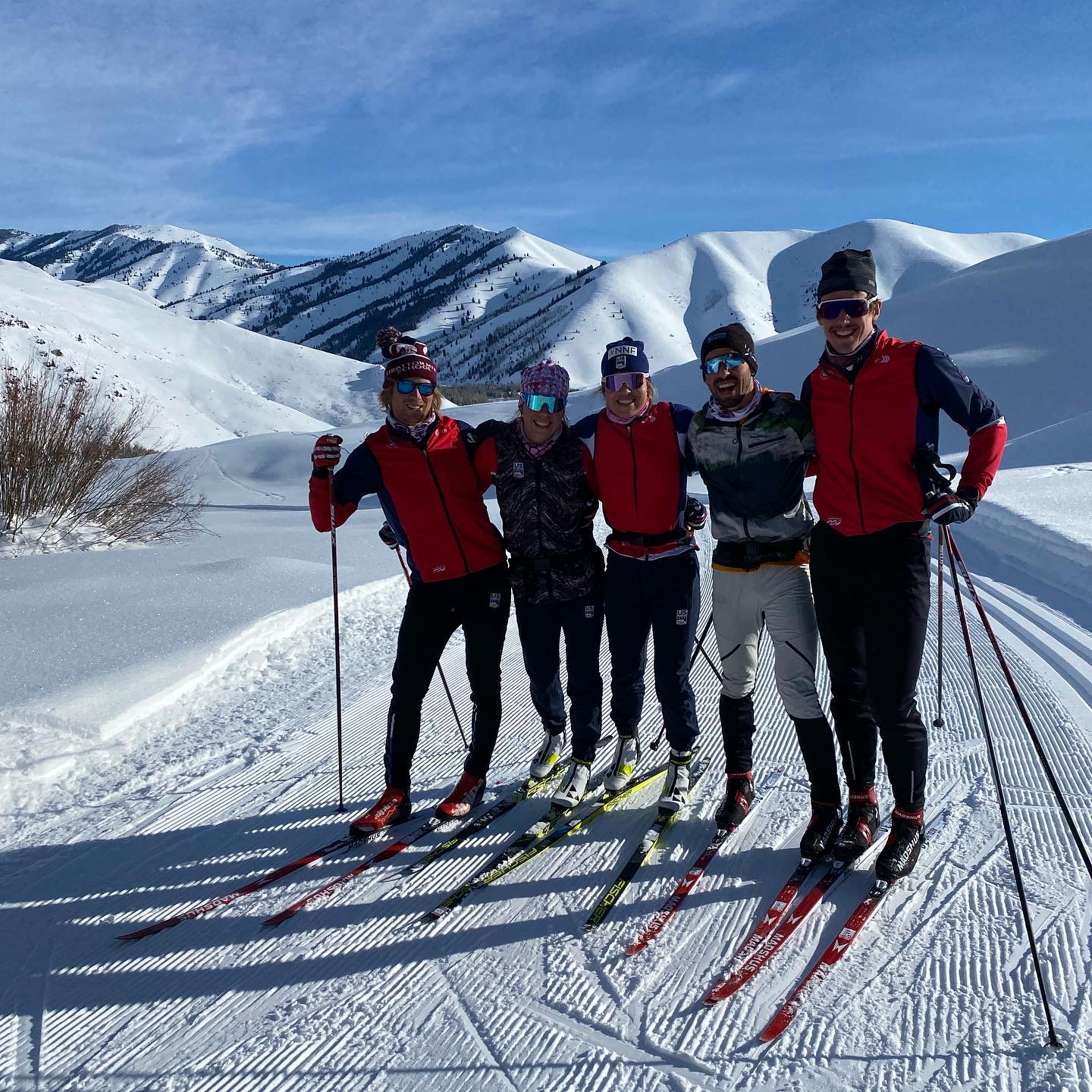
    Pat O’Brien supports some of the SMS T2 athletes during a 2022 SuperTour weekend in Sun Valley, ID. (Photo: SMS T2)

    A 2006 graduate of SMS himself, O’Brien raced collegiately for Dartmouth College, then spent four years training and racing professionally with the Craftsbury Green Racing Project. His move from Craftsbury back to Stratton was timed with his retirement following the 2014 Sochi Olympic Quad. Given his age and the proximity to his racing career at that time, many of the athletes on the T2 team were among what he called his “peer group”, having overlapped with many of them during either high school, college, on the race course, or all of the above. Jessie Diggins and Sophie Caldwell Hamilton were quickly becoming rising World Cup stars on the women’s team, while Andy Newell and Simi Hamilton headlined the men’s roster, and a young Julia Kern and Katharine Ogden were spending a PG year training with the T2 team.

    Eager to stay connected with the sport after retirement, O’Brien seized the opportunity to take over in Stratton, stepping in as his predecessor Gus Kaeding departed.

    “Ski coaching is the one thing that I’ve always known that I wanted to do, it was just kind of a natural progression for me. I knew that I was done with my athletic career – I didn’t really want to ski race anymore – but I knew that I still wanted to ski, I still wanted to be involved and to give back to the sport. I felt like, to some extent, when you spend basically your entire life skiing, you get pretty good at understanding the sport. But we never know as much as we think we do, and we always need to be students of the sport and have an open mind and learn.”

    As he began his coaching career, he quickly realized that writing training plans and facilitating training was only a small subset of the responsibilities of an elite club coach.  

    “Good coaching is being comfortable wearing a bunch of different hats. And I mean, I joke, but the actual coaching is such a small part of it. The nitty gritty of pulling an athlete on the side of the trail and looking at video and all of that is important, but you’re there as a friend, a drill sergeant at times, and as someone that is just really trying to be supportive.

    “And that’s all-encompassing. So for me, it has been a pretty fun experience to see people figure stuff out and be there to support them when they needed a little extra help and to do it in a pretty collaborative, dynamic way.”

    He described his experience transitioning to coaching primarily as a mindset shift from the inevitable self-centric focus required of professional athletes toward selflessness; but the work required and pace of life remained equally taxing. 

    “When you coach at a club level – all coaching is a demanding job. I do think that you have to – I don’t want to use the word ‘sacrifice’, but when you transition from being an athlete yourself to being a coach, your job as an athlete is to be a little selfish. You’re trying to maximize your athletic performance. You need to have balance… but at the end of the day, you need to make sure that you’re training well and with purpose, you’re recovering well, you have goals and you’re going about achieving them. It shouldn’t be simply looked at as like what you have to give up to do that, but to be the most professional athletes and succeed against people who are trying to do the exact same thing, you just have to do a really, really good job with it. And coaching is the same thing. You have to be willing to approach everything that you do with the same degree of drive and focus that you would as an athlete…

    “Basically, I just threw myself into it with the same approach that I had as an athlete which is, I’m just going to work, and work, and work, and learn all along the way. And then give it my best push and know that if I get to the point where that balance starts becoming harder and harder, or I can’t really do the job that I want, to be supportive of the athletes [to the level I want to be], that’s when you’ve got to know that you either double down and keep pushing or make a transition.”

    While O’Brien is no less dedicated to the SMS T2 program or its athletes, a new endeavor has begun which will make achieving the balance he described significantly harder: he’s about to become a father. His wife, two-time Olympian and long-time U.S. Ski Team member Ida Sargent, is due in mid-August.
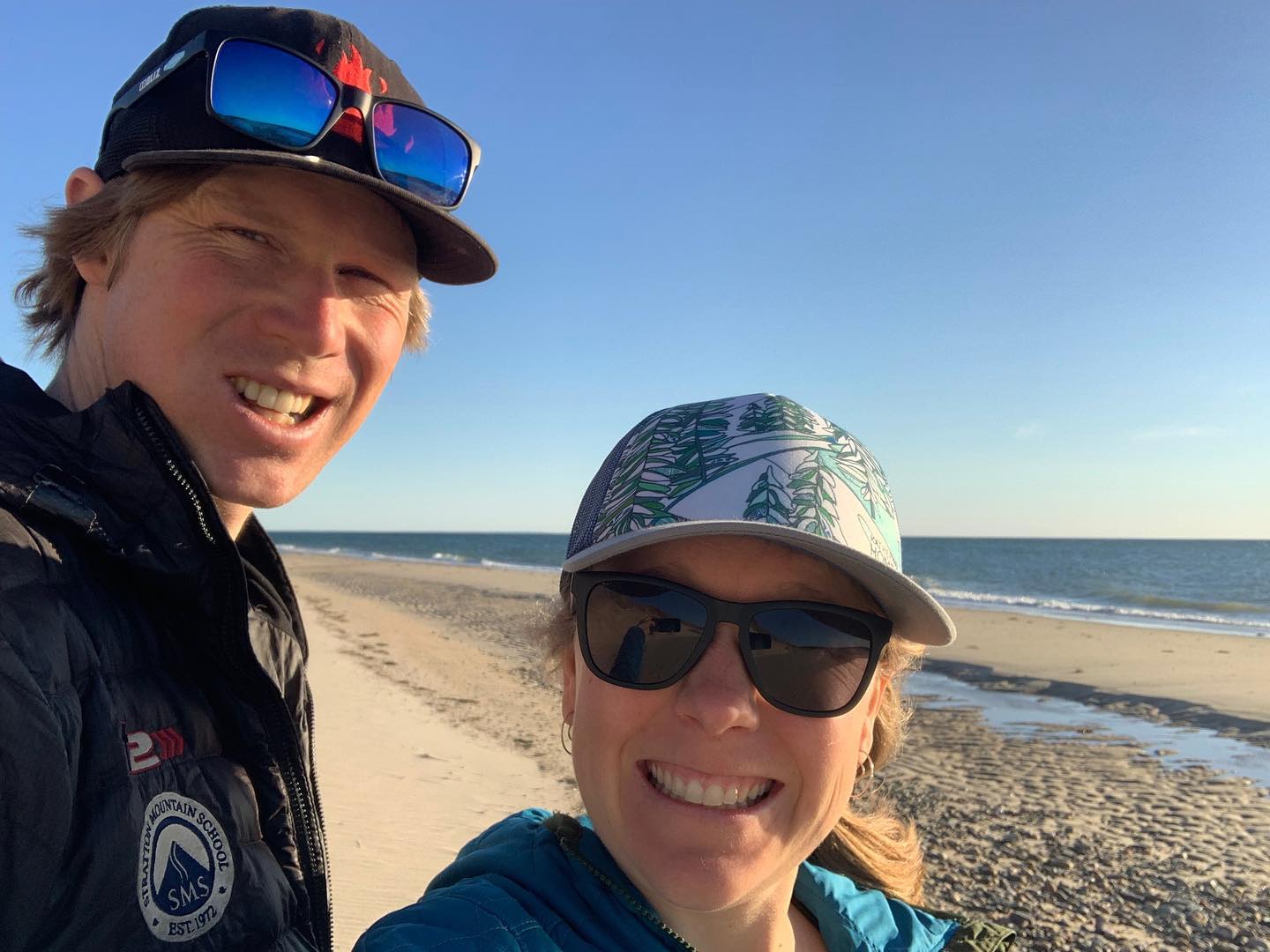
    After eight years as head coach of the SMS T2 team, Pat O’Brien takes a step back as he and his wife, Ida Sargent, begin their family. (Photo: SMS T2)

    Since retirement, Sargent has been working for her high school alma mater, Burke Mountain Academy, in Northern Vermont, and is currently the Academic Director for the school while also teaching STEM classes. O’Brien has been splitting his time between Burke and Stratton, which lies roughly 150 miles southeast in the opposite corner of the state. His usual coaching schedule pulled him around the country for weeks at a time to support athletes at U.S. Nationals and SuperTour events, and sometimes around the globe for World Cup, U23s, and other international camps and races. 

    While he acknowledged that there are many examples of coaches at all levels who have successfully juggled a demanding work and travel schedule with raising a family, what felt like the best fit given his and Ida’s vision and priorities for their own growing family was for O’Brien to decrease his level of responsibility with the T2 program, allowing greater flexibility and more time at home. 

    “I just felt like there’s part of me that was like, ‘I’m not seeing a pathway that I feel like I can still commit [to coaching] at the level that I want and know that you need to in order to to do the best job with your job, while simultaneously trying to start a family.’ I felt like it was my time to reevaluate and maybe step back or be completely done with ski coaching, because I certainly didn’t want Ida to have to put her growing career on hold to be the [primary] caregiver…

    “Eight years is a long time to do something and I am very proud of what the team has accomplished in that time… it’s really cool having spent this time seeing athletes grow, not just not just athletically and within their their ski careers, but as individuals from high schoolers to finishing up college to full blown ‘this is my job.’”

    While his role will be smaller, O’Brien is certainly not stepping away from the T2 team altogether. “Starting a family does not necessarily mean that it means the end of being involved in the sport,” he said. “It just means trying to figure out what the right relationship is with it.” 
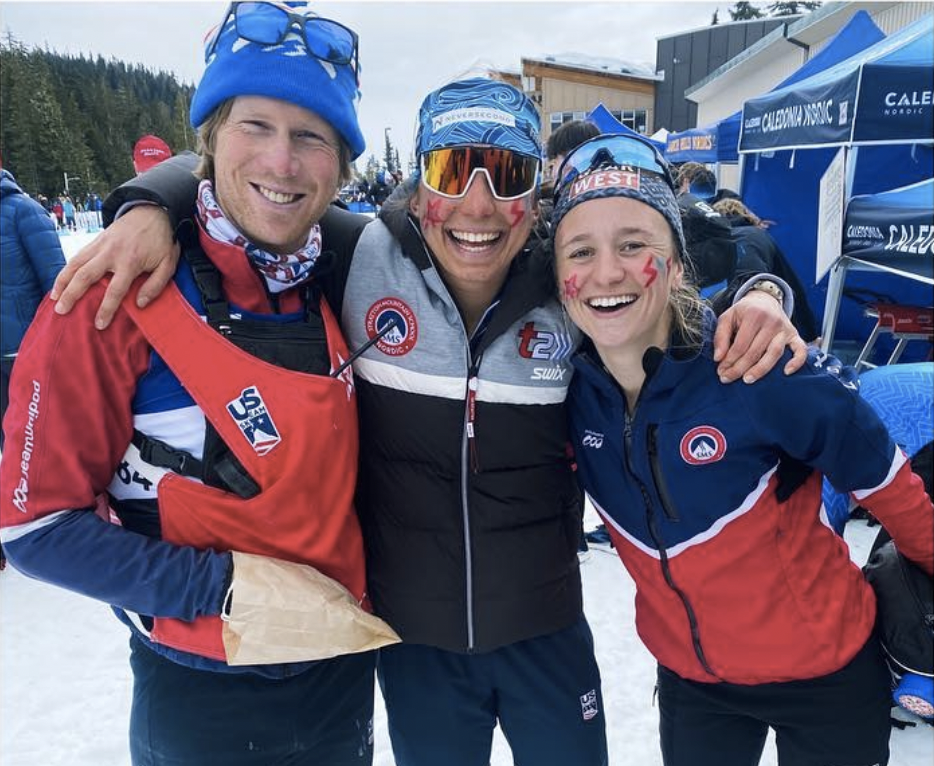
    Pat O’Brien supports SMS T2 skiers Julia Kern and Alayna Sonnesyn at the 2022 U.S. SuperTour Finals in Whistler. (Photo: SMS T2 Blog)

    The exact balance and distribution of responsibilities remains a work in progress as Thomas moves into the head coach role and the new season of training begins, and both O’Brien and Thomas are excited to collaborate and support one another throughout the year. 

    Explaining his philosophy as “under-commit so I can open perform”, O’Brien anticipates taking on many of the behind the scenes tasks that support the team, from collaboratively blocking out the season calendar, to managing travel logistics for camps and SuperTour races. As he put it, the little details of deciding “which flights to take to get from Canmore to Sun Valley” and where to stay are often made easier with several years of trial and error under your belt. 

    While Thomas will spend more time with ski boots on the ground, both in Stratton during the summer and at races and camps throughout the year, O’Brien anticipates he’ll still be plugging in a fair amount too. Though his stay might be shortened to the period immediately surrounding races, he plans, at minimum, to be in Houghton, MI for U.S. Nationals in January, and also the SuperTour finals in Craftsbury in late March.

    He’s also excited to reconnect with the team in Stratton early in the summer before Ida gets close to her due date, but also to take off a few of his usual coaching hats while doing so. 

    “I think it’ll be really fun for me to actually be able to flow in and out get to see people, connect with them, but also not be like ‘Okay, now I don’t have to worry about making sure that the van’s filled up with gas, or water jugs have been filled, or that I’ve ordered all the lactate strips in advance so that we don’t run out.’”

    Perry Thomas out for a crust ski with the SMS T2 athletes who joined the national team training camp in Bend, OR this spring. (Courtesy photo)

    As Thomas gets his feet under him in Stratton, he explained that he feels “very fortunate that Pat will still be involved.”

    “As much as I can have him in the mix, the better,” Thomas said. “His knowledge with skis and wax is just unreal, so tapping into that resource is huge for me, for sure.” 

    ***

    UVM assistant coach Perry Thomas in action during the 2022 U.S. Cross Country Skiing Championships in Soldier Hollow. (Photo: Instagram @oneswellperry)

    Prior to joining the UVM program, Thomas spent five years as the assistant coach at the University of Vermont, working alongside head coach Patrick Weaver. During his own collegiate racing career, Thomas spent four years racing for the University of New Hampshire, where he served as team captain during his senior year in ‘12-13. Departing briefly from the cross-country ski world, he spent a year teaching high school science to underprivileged youth in the Oakland area of California, before returning to the Northeast to begin his coaching career as the assistant coach at Williams College in Massachusetts. 

    “Working at UVM was unreal – a great experience,” Thomas said emphatically. “I really loved working with Patrick Weaver and the athletes there and it seems like almost a seamless transition, in many ways. Four of the skiers on the T2 team I actually coached at UVM. So knowing a lot of athletes here already – what they’re working on with technique, and racing, and goals and all that – has been very seamless, and that’s been great.”

    The UVM graduates who now ski for SMS T2 include Alayna Sonnesyn (‘18), Bill Harmeyer (‘20), Lina Sutro (‘21), and Ben Ogden (‘22). 
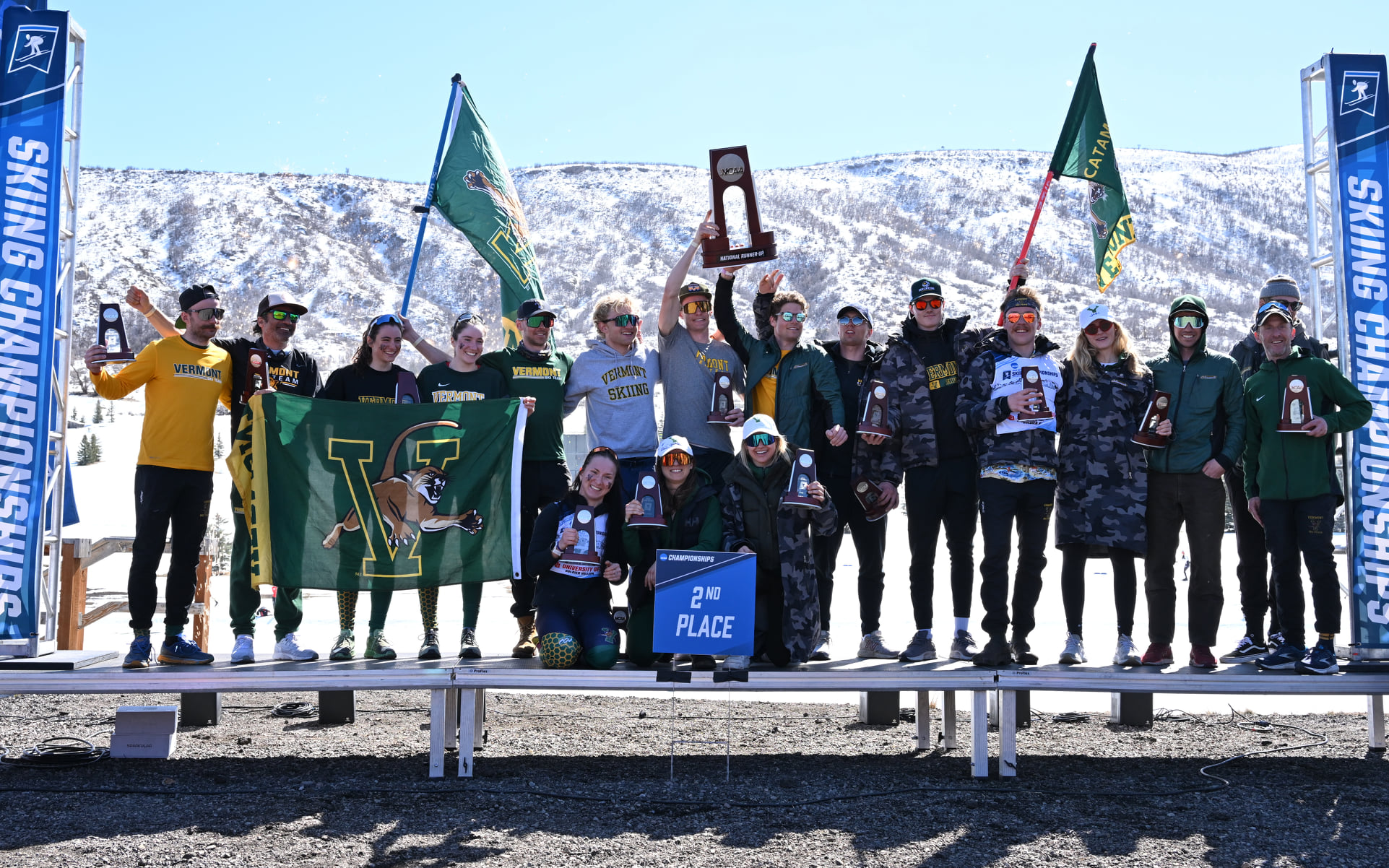
    The UVM ski team celebrates a successful 2022 NCAA Championship. Assistant coach Perry Thomas is at the far left. (Photo: UVM Skiing)

    Given the caliber of these athletes and the success of the UVM team as a whole during his tenure, Thomas credits his time with the program to the acceleration of his development as a coach, preparing him to take his next steps forward with SMS T2.

    “Patrick Weaver definitely gave me a lot of opportunities and ownership over different facets of coaching that team and I think that’s been instrumental in me being here now with T2. I was able to go to World Cup Finals with Ben Ogden in Quebec his first year in school [in 2019], and I was just able to do trips like that on my own with athletes. That was huge for my development as a coach and for my experience of waxing, ski testing, and [other responsibilities at that level of racing]. So working at UVM was a lot of fun – I’m gonna miss it for sure – but it set me up very well for this transition.” 

    Ben Ogden gets a congratulatory fist bump as he heads to the podium during his sweep of the 2022 NCAA Championships. (Photo: Tobias Albrigtsen / @untraceableg)

    A theme of both Thomas and O’Brien’s comments on the difference between collegiate and elite club coaching is small in terms of the training and technique coaching itself, but vastly different in terms of the opportunities elite club coaches have to support their athletes. 

    “I think the big differences are what we can and can’t do throughout the year from collegiate [racing] to the elite team,” Thomas explained. “Like, I wouldn’t be here [in Bend] and been doing an on-snow training camp if I were at a college team. And obviously the racing schedule is super different.

    “The college schedule is pretty efficient, whereas the SuperTour calendar is quite a bit more spread out. And then, in addition to that, you have an athlete’s like Jesse Diggins, and Ben Ogden, and Julia Kern that are going to be on the World Cup, as well as athletes that are trying to make it to the World Cup. And at UVM, we had crazy talented athletes – Ben Ogden is one of them – so working with with high caliber athletes is nothing entirely new, but dealing with athletes where some are on the World Cup and some of them on the SuperTour is an interesting dynamic that you don’t often get with the college teams.”

    In terms of what Thomas adds to the program as he steps in as head coach, he described his coaching philosophy and the environment he seeks to create within the training group, which keeps athletes motivated and happy through the arduous and long-term development process.

    “[Cross-country] skiing is such a hard sport – it’s so much time that that we’re putting in, and so many sacrifices that we’re making, that I wholeheartedly believe in making that time that we’re together training and working hard fun and enjoyable,” Thomas said. “I think that’s a big part of what we do –  and it has to be a big part of what we do –  because like I said, it’s a hard sport. So I think making things light and having fun with all that is super important. And that’s definitely something I bring to the table in that regard.”
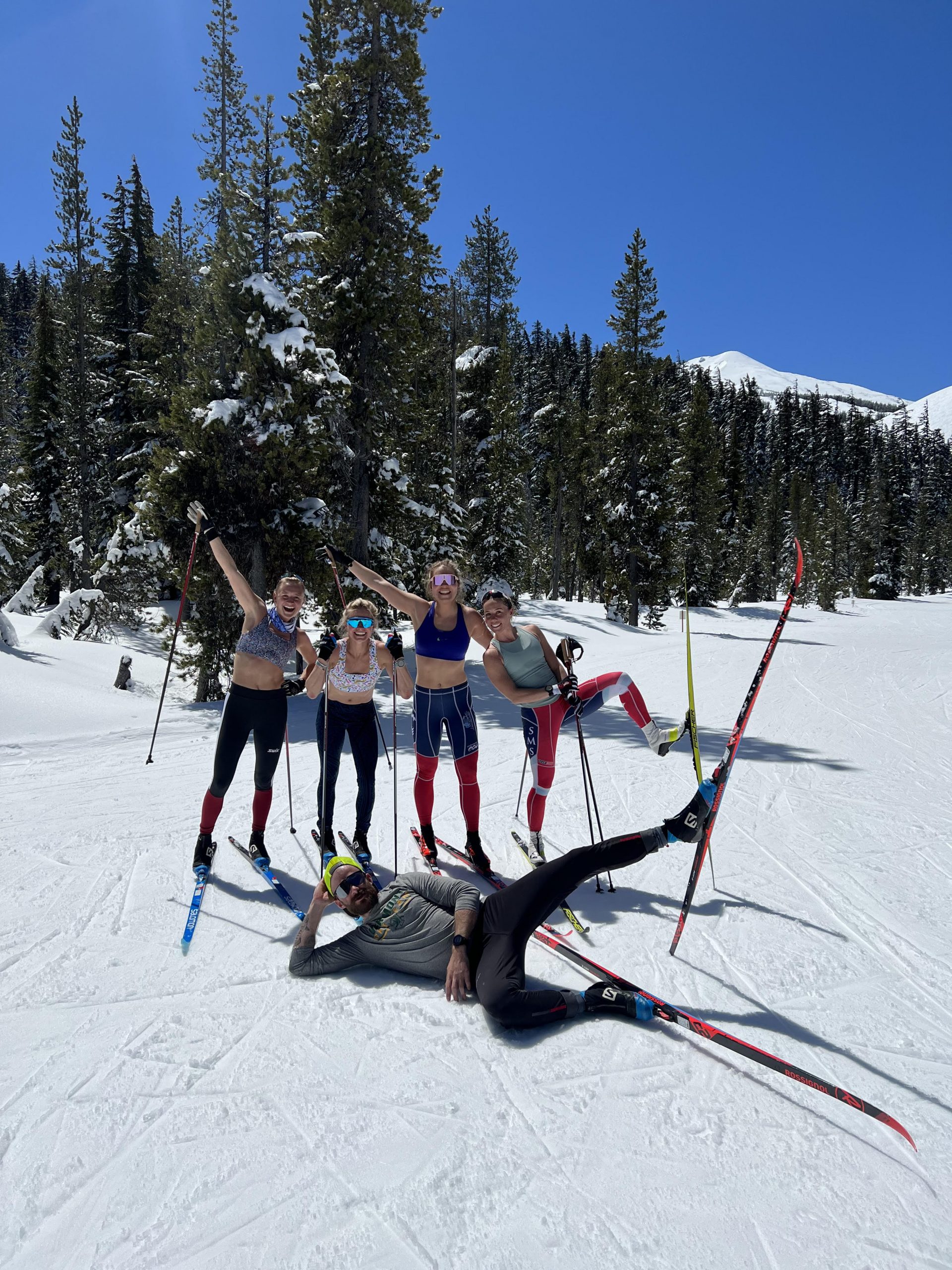
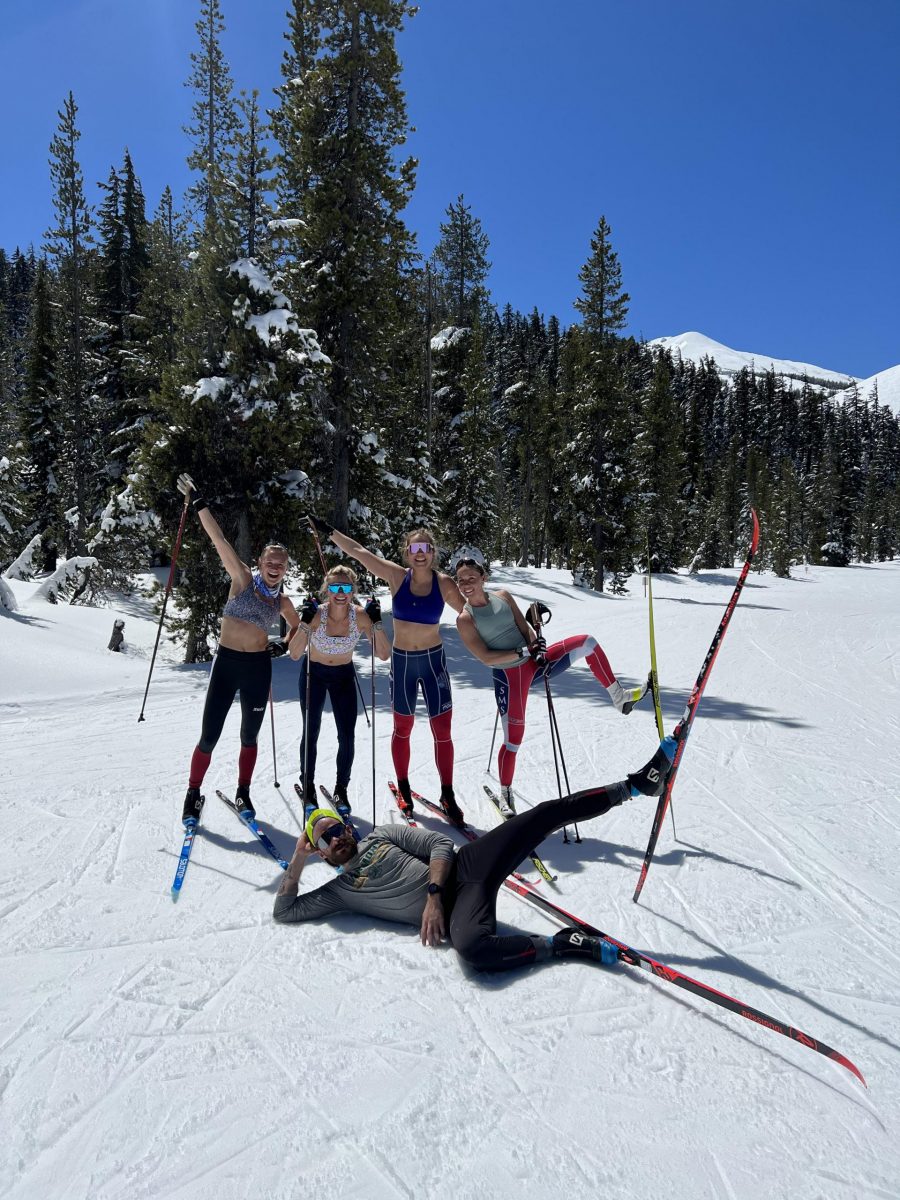
    The SMS T2 team enjoys spring skiing at the Mt. Bachelor Nordic Center. From left to right, Alayna Sonnesyn, Jessie Diggins, Lina Sutro, and Lauren Jortberg, with head coach Perry Thomas. (Photo courtesy Alayna Sonnesyn)

    But Thomas will add more than just fun to the T2 program. While he may be, as phrased by his new colleague, “almost too humble”, O’Brien was quick to highlight Thomas’s preparedness to prescribe training, coach technique, and otherwise lead an elite team stacked with some of the nation’s best athletes. 

    “If you have been at a D1 college program where you’re dealing with 15-20 athletes and that dynamic environment where student athletes are constantly balancing all these different commitments and time constraints… And really, what you learn there as an athlete and what you learn there as a coach is that working with a club – it just isn’t that different.”

    O’Brien added that the shift to an elite club from college may, in fact, be easier than going in the other direction. When athletes no longer have to miss key workouts to take an exam or rush off to class halfway through a team meeting, barriers to consistent communication and training are removed, and consequently a coach has a greater capacity to build relationships with the athletes as they stack together the bricks of the training program. 

    “You get an opportunity to really work one-on-one with the athletes and to really be there to facilitate and support their training and their racing. In that sense, I think coming from a college background – especially given his ties with many of the current athletes that are on the team – you’re just working with the same people and you’re doing the same stuff.

    “I mean, there’s no magic formula,” O’Brien continued. “Someone can claim that they can write the best training plan in the world. And that’s all fine and dandy – there are definitely people who do an amazing job with it and they really enjoy that aspect of that aspect of the sport. But at the end of the day, it’s just really just working with people. You don’t need to make it more complicated than it is. The best athlete is not a robot. The best athlete is someone that is self aware, that can think critically, learn from mistakes, recognize when things go well, and the coach is there to support them along the way.”

    New SMS T2 head coach Perry Thomas working with his athletes during a 2022 spring training camp at the Mt. Bachelor Nordic Center. (Photo: Lauren Jortberg)

    Thomas identified building upon his relationships and experience with his former athletes, who account for half of the team’s eight athletes, as something he’s looking forward to in joining T2. 

    “I am very appreciative of the continuity and being able to work with some athletes I’ve worked with in the past,” said Thomas. “I love all of them –  they’re incredible people, incredibly hard workers. So to be able to continue working with them is just awesome. With that, too, it’s like – I have been working with Ben for the last four years, I worked with Lina Sutro for four years, I worked with Alayna for a little bit. It’s just a matter of knowing how they operate and how they train and knowing what they’ve been working on too. It’s easy for me in training, [even] this morning, to see some of them and be like, ‘okay, like this is something we’ve been working on for the last however many years’ or maybe, ‘a couple years ago, this was something we’re working on’. So let’s continue this, let’s continue these cues that we’re working on, and have that continuity there. 

    “It’s been awesome to be able to continue that work with them. It’s nice to see the progress – to see what they were doing in college a few years ago, and then to see where they are now, and then also to be able to help them through the transition to professional skiing.”

    Simultaneously, these UVM-T2 athletes are excited to be working with their former UVM coach again. In an email to FasterSkier, Alayna Sonnesyn reflected on her time as a professional skier guided by O’Brien, while crediting Thomas’s contributions at UVM for her reaching the professional level in the first place. 

    “Stepping into the professional ski world four years ago and onto the SMS T2 team was super intimidating to me,” wrote Sonnesyn. “The team has been home to some of the fastest skiers in the world and I was clueless when it came to racing at that high of a level. Pat O’Brien helped steer me in the right direction as I made this adjustment and took huge jumps in my skiing ability. He taught me when to train for fun and when it was time to buckle down and get serious. When Pat says it’s go time, you go! He helped develop me from a reasonable distance skier to a strong and powerful distance AND sprinter, a trait I never thought I would be capable of. Pat’s knowledge of the sport and ski waxing, as well as the mental and emotional obstacles that come along with it, is unparalleled. He was a coach that believed in me as a junior skier and saw potential. The only thing that can make a good ski race even better is when Pat gives you a proud hug at the finish line. Although I will miss these hugs and his direct coaching, I know that he will use these skills to care for his growing family and I am excited to see where life takes him next.

    Perry Thomas works with a few of the SMS T2 ladies in Bend. (Photo: Alayna Sonnesyn)

    “Back when Pat was just seeing the potential in my college skiing, I was working with Perry Thomas when he was the assistant coach at UVM. I feel like my athletic career has come full circle as I get to transition back to a coach who helped put me in a place where I first believed skiing professionally was an option. Although I only had the pleasure of working with Perry for one year at UVM, it was a very special season! I instantly trusted him with my skis and could feel his enthusiasm for the sport radiate on the ski trails. I’ve witnessed just how hard Perry has worked over the years and how well-prepared he is to take over the position as head coach of the SMS team. Just in the first month of working with Perry again, I already know the team is heading down a path to continue its mission; local inspiration, international excellence.”

    Likewise, Lina Sutro shared she is looking forward to the transition, applauding Thomas’s dedication to his athletes.

    “I am truly so excited to be working with Perry again,” she wrote. “He is one of the most hard working and committed coaches I have worked with. He has a strong work ethic that I am excited for the Stratton community to experience. Pat and Perry both give so much back to the ski community and their athletes, I am excited to see the two of them work together.”
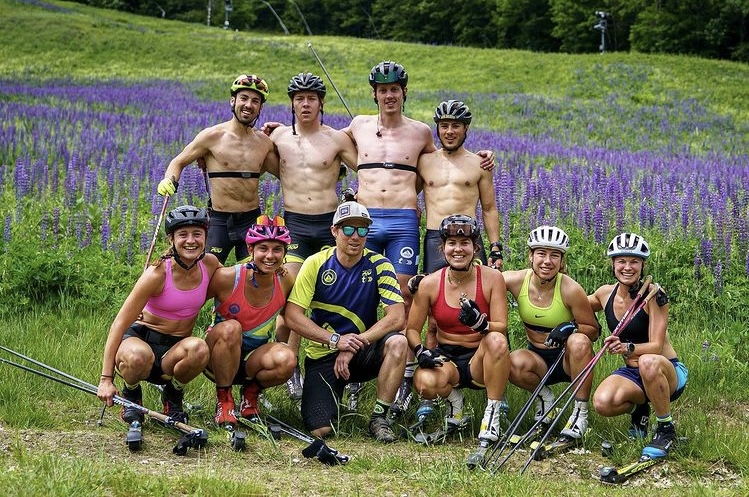
    The 2021/2022 SMS T2 Team. Back row (l – r): Ian Torchia, Ben Ogden, Bill Harmeyer, and Will Koch; front row: Alayna Sonnesyn, Julia Kern, head coach Pat O’Brien, Lina Sutro, Katharine Ogden, and Jessie Diggins. (Photo: SMS T2 Blog)

    As for the broader questions of “what’s new?” and “what lies ahead for the SMS T2 team this summer?” Following Katharine Ogden’s retirement in March, Lauren Jortberg will join the team as the fifth athlete on the women’s side – five and five is what the team identifies as the sweet spot for numbers. Jortberg joins Jessie Diggins, Julia Kern, Alayna Sonnesyn, and Lina Sutro. The men’s team is light this season, as Ian Torchia moved on this spring also, leaving behind a three-man roster of Bill Harmeyer, Will Koch (who also competes for University of Colorado), and Ben Ogden. 

    After Bend camp, the team will part ways with many attending “a big event in the Midwest” which happened over Memorial Day Weekend. The SMS T2 team will finally reconvene as a whole in Stratton in early June. Though regional and international camps are planned, particularly for athletes named to the national team, Thomas anticipates ample quality training based in Vermont and the surrounding region.

    “We’ll be in the Stratton area for the majority of this summer,” he explained. “I think one of the cool things that we’re doing is: Sverre, and Pat and I have started working on doing a summer [training] program, so we have some awesome athletes joining our crew this summer.”

    This list includes University of Utah and U.S. Ski Team skiers Sydney Palmer-Leger, Novie McCabe, and former SMS junior athletes Adam Witowski and Zander Martin, who now ski for Michigan Tech and Bates College, respectively. JC Schoonmaker and Gus Schumacher also plan to join the T2 team for some training in Vermont throughout the summer. 

    “So a really stacked crew, for sure,” said Thomas. “It’s gonna be a really exciting summer to say the least.”
  • Randall, Sargent, and Stephen Take on the 2021 Boston Marathon

    Randall, Sargent, and Stephen Take on the 2021 Boston Marathon

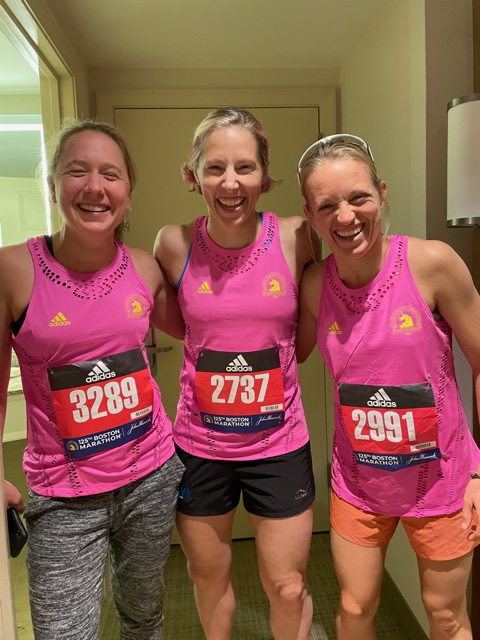
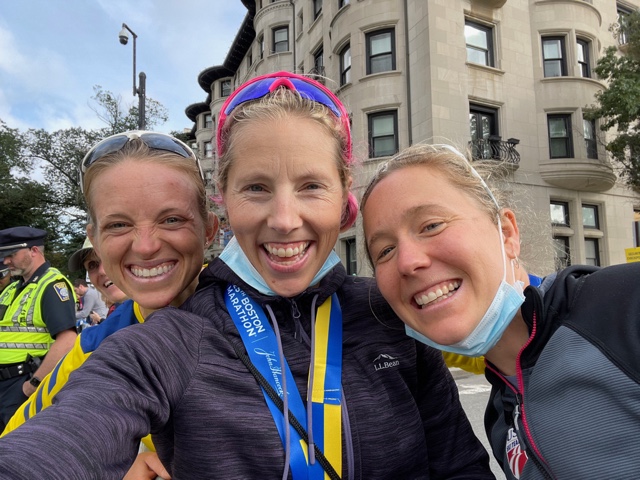
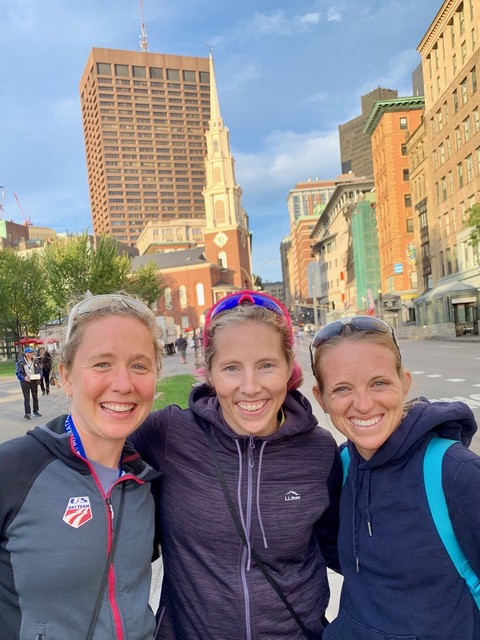
    Lining up for their second marathon on behalf of Aktiv Against Cancer, Ida Sargent, Kikkan Randall, and Liz Stephen took on the 2021 Boston Marathon. (Courtesy photo)

    While no one would wish for the circumstances, a fall running of the Boston Marathon is perhaps a skier’s dream. The iconic foot race is on many a bucket list; however, the third Monday in April is early for those who spend the winter strapped to skinny skis rather than pounding pavement. 

    After cancelling the April, 2020, running in light of the descending COVID-19 pandemic, and deciding against an April date for the 2021 event, the Boston Athletics Association (BAA) set its sights on October 11th, 2021, for a return to racing. 30 months without the Boston Marathon; it was go-time in Boston on Monday morning. The Red Sox even put on a show to celebrate, beating the Tampa Bay Rays 6-5 to win the ALDS in dramatic fashion later that evening.  

    Among the 15,716 individuals making their way from Hopkinton to the finish line on Boylston Street in Boston were three familiar faces: former teammates, U.S. Ski Team members, and Olympians Kikkan Randall, Ida Sargent, and Liz Stephen. The threesome ran on behalf of Aktiv Against Cancer, which promotes physical activity as an integral part of cancer treatment. 

    According to Aktiv’s mission statement, “Recent research indicates the benefits of physical activity extend beyond controlling symptoms and side-effects of cancer therapy; it is shown to reduce cancer progression and improve a patient’s response to anticancer therapy.”

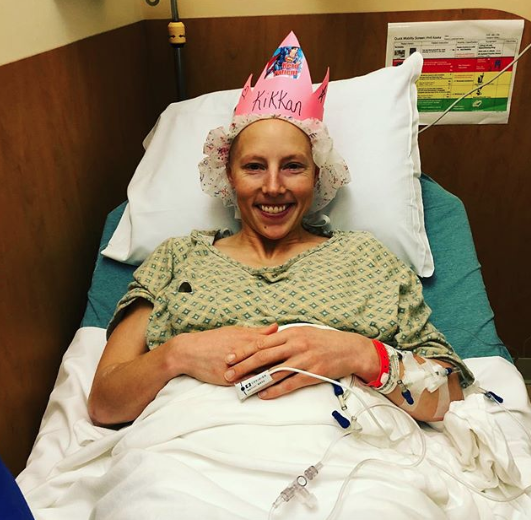
    Nearly two years ago in November, 2019, these women lined up together for the NYC Marathon, each achieving their goal of finishing under three hours. At the time, Randall was only one year beyond her own cancer treatment journey. After receiving the diagnosis of Stage 2 breast cancer in June of 2018, Randall underwent six rounds of chemotherapy, infusions of the drug Herceptin, and a lumpectomy. All the while, she remained active, sharing her journey openly through daily video updates and social media. 

    Randall shared her Boston Marathon race experience via email.

    “We’re all hobbling around today but also basking in the glow after a hard race and fun experience!! After meeting up for the NYC marathon two years ago, when the opportunity to run Boston in October came up (versus April) we jumped at the chance to get together and once again shine the spotlight on an organization near and dear to our hearts, AKTIV Against Cancer. 

    “All of us have had close contacts with cancer in our personal lives and as athletes recognize how important physical activity is for tackling the treatment. So to be able to raise funds for important research and outreach, we jumped at the chance. We were able to raise over $17,000 collectively toward the cause!”

    Dressed in hot pink and having no fun at all, Ida Sargent, Kikkan Randall, and Liz Stephen lace up for the 2021 Boston Marathon on behalf of Aktiv Against Cancer. (Courtesy photo)

    In 2019, Randall checked the box on her sub-3 goal with a time of 2:55:12. This year, she was just shy with a net time of 3:00:27.

    “When we decided to do this back in April/May, I think all of us had ambitions to prepare for this race more seriously. But as we’re all finding post-racing, life is busy and I think we all came in a little under prepared. Regardless, it was going to be a great excuse to meet up with best friends.”

    Two minutes behind Randall, Sargent crossed the line in 3:02:26. Sargent also remarked that she felt under-trained at the start line, but the experience and opportunity outweighed the feeling of the final 10k. 

    “We plan to do these races as a little reunion and an opportunity to see and run with each other and support Aktiv,” wrote Sargent. “Today was so much fun but also a beast. The energy out on course of these big races is also so incredible. I hadn’t trained or run much at all leading up to the race so I really wasn’t sure what to expect but I was very excited that my legs felt great for so long. The last four or five miles were tough but I just told myself that I couldn’t walk and that kept me going through to the finish line.”

    Happy 26.2 finishers: Ida Sargent (left) and Kikkan Randall (right). (Courtesy Photo)

    Despite being veterans when it comes to endurance racing, Randall shared that the women were perhaps lured out too quickly, leaving them a little too dinged up when they faced the Newton hills late in the race. Runners face the infamous “Hearbreak Hill” at mile 20, steadily climbing for half a mile on tired legs. 

    Though all three women positive-split the race, Stephen bled the least amount of time in the second half; she clocked 1:25 through the first half, losing five minutes over the second to finish in 2:55:48.

    “The downhill start was really fun for the first 10km,” wrote Randall. “At points we were on-pace for a sub-2:45.  But being Boston rookies, and light on the running mileage, that early fast pace took its toll on all of us at different points.  Liz made it under 3-hours, I was just a smidge over and Ida had a great day at 3:02.  The last 10km was incredibly tough and I think we were all missing those gliding sections you get in ski races to recover and recharge.”

    The fun didn’t stop when they reached the painted yellow and blue finish line emblazoned with the Boston Athletics Association unicorn.  

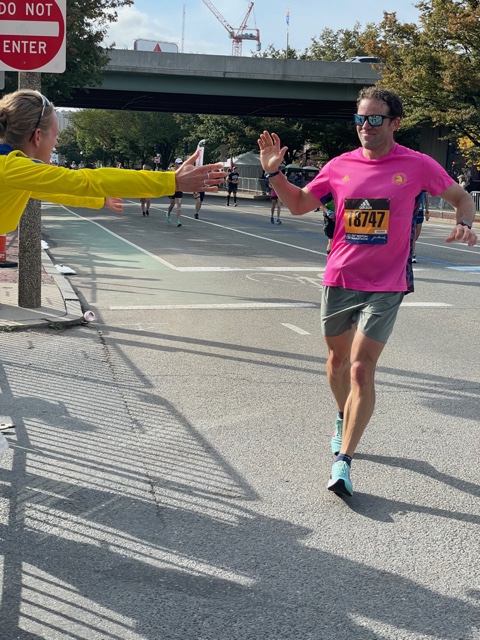
    Liz Stephen extends a high five to her partner, Jeff Bland, as he makes his way to Boylston Street during the 2021 Boston Marathon. (Courtesy photo)

    “Liz’s partner Jeff [Bland] also ran the race and fundraised for AKTIV with us,” Randall explained. “So after the three girls finished, we went back out to cheer him on. (Bland finished in 4:19:59.) We figured we ended up walking another 7 miles, which was painful — but also maybe a little helpful to keep from tightening up.”

    What’s the next race-reunion? According to Randall, they’re looking for ideas!

    “I think we’re all looking forward to not running for a while and yet we can’t help but wonder, what should we do next?!”

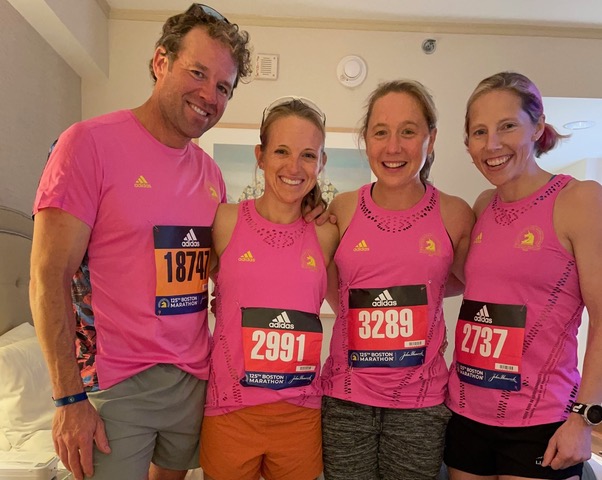
    2021 Boston Marathon racers. From left to right, Jeff Bland, Liz Stephen, Ida Sargent, and Kikkan Randall. (Courtesy photo)

    Boston Marathon Results


  • Doing Things Her Own Way, Erika Flowers is Third at the American Birkie

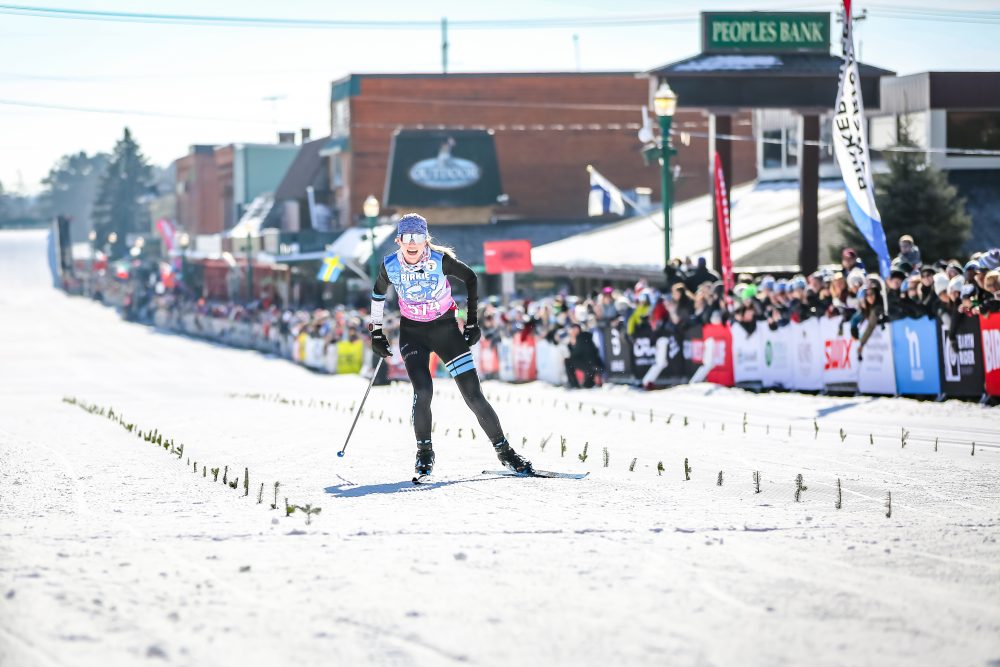
    Pushing the final meters of a crowded Main Street, Erika Flowers takes third at the 2020 American Birkie. (Photo: ©2020 American Birkebeiner Ski foundation)

    At the end of the 2018 season after being on the wrong side of the cusp of making the Olympic team, Erika Flowers made a transition in her ski career. She left her Stratton Mountain School T2 training group and returned home to Bozeman, MT where she began a role as the Associate Director at Profitable Ideas Exchange. However, Flowers did not hang up her skis — it was not retirement, just a transition and a new work-life-training balance to navigate. 

    And she has done so swimmingly. It has been one of her career best seasons, including a sprint and distance podium performance and racing in the final of three additional sprints. Flowers currently sits in second in the overall SuperTour standings, less than 30 points behind leader Kaitlin Miller (CGRP). 

    Most recently, Flowers was the top American and third overall at the Birkie 50-kilometer skate with a time of 2:15:00 (+1:39.4). After Jessica Yeaton charged off the front at OO (roughly 20 k in), Flowers worked with a chase pack that included Riitta-Liisa Roponen and Kaitlynn Miller.

    Additionally, in the Minneapolis SuperTour events the week before the Birkie, Flowers popped the fastest qualifying time in the freestyle sprint and ended the day second overall, and was just off the podium in 4th in the 5 k classic. 

    In this conversation, Flowers shares further insight into how she fits her training, which she plans with her husband Andy Newell, into her work schedule and discusses what she has learned through this transition. She explains that the saying “happy skiers are fast skiers” has given her a sense of freedom to do things a different way that she was accustomed to. 

    “There’s so many things that the athletes who are racing full time do to perform at that level and I think that you have to do those things to some degree. But I’m someone who always did things by the book and if someone told me to do eight intervals of this type, I would always do eight and maybe nine. That made me very fit, but I think it also maybe sacrificed some of the flexibility that’s also required to be a good athlete, and maybe at times, I was not as happy doing it that way as I could have been.” 

    Flowers also discusses her goals for the remainder of the ski season, which include racing in the Minneapolis World Cup sprint and the World Cup finals in Canmore. 

    We also discuss her summer plans to continue challenging herself in mountain running races, including her the 50 k at Run the Rut in Big Sky, MT. She also shares that she has recently received a nomination to the North Face trail running team and is currently looking through additional race options with them. Thanks for listening.

    Interview with Erika Flowers following the 2020 American Birkie.

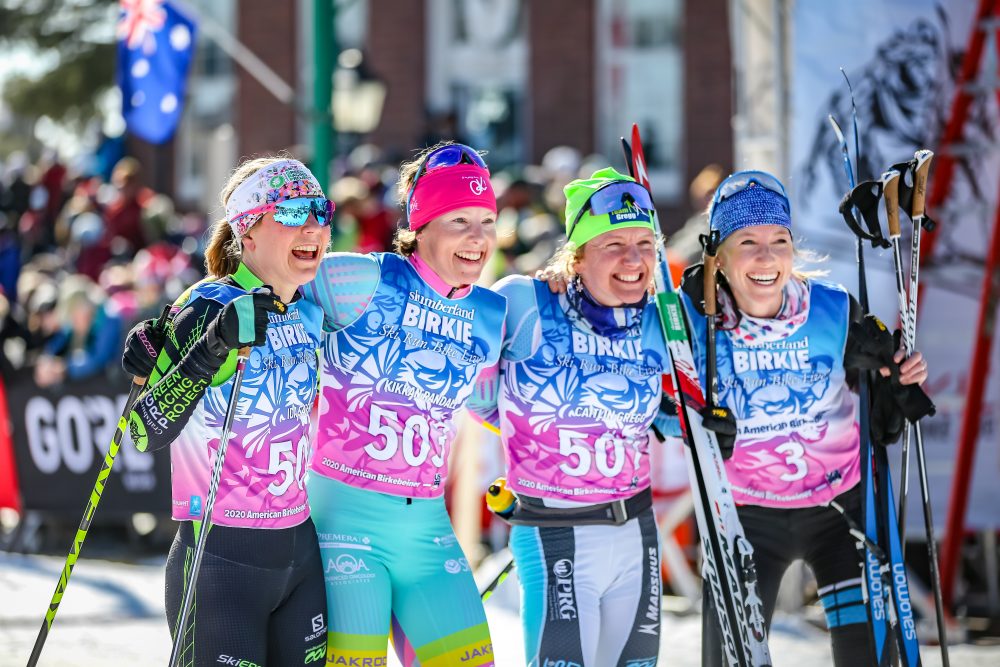
    All smiles after 50 k with perfect conditions. From left to right, Ida Sargent, Kikkan Randall, Caitlin Gregg, and Erika Flowers. (Photo: ©2020 American Birkebeiner Ski foundation)


  • Craftsbury SuperTour Classic Sprint Rundown

    The US SuperTour kicked off the first races of the new year at the Craftsbury Outdoor Center with a classic sprint. The event, dubbed the 2020 Lost Nation Cup, brings together senior athletes, EISA carnival teams,  developing NENSA skiers, and citizen racers for a weekend of racing in the Northeast Kingdom of Vermont.

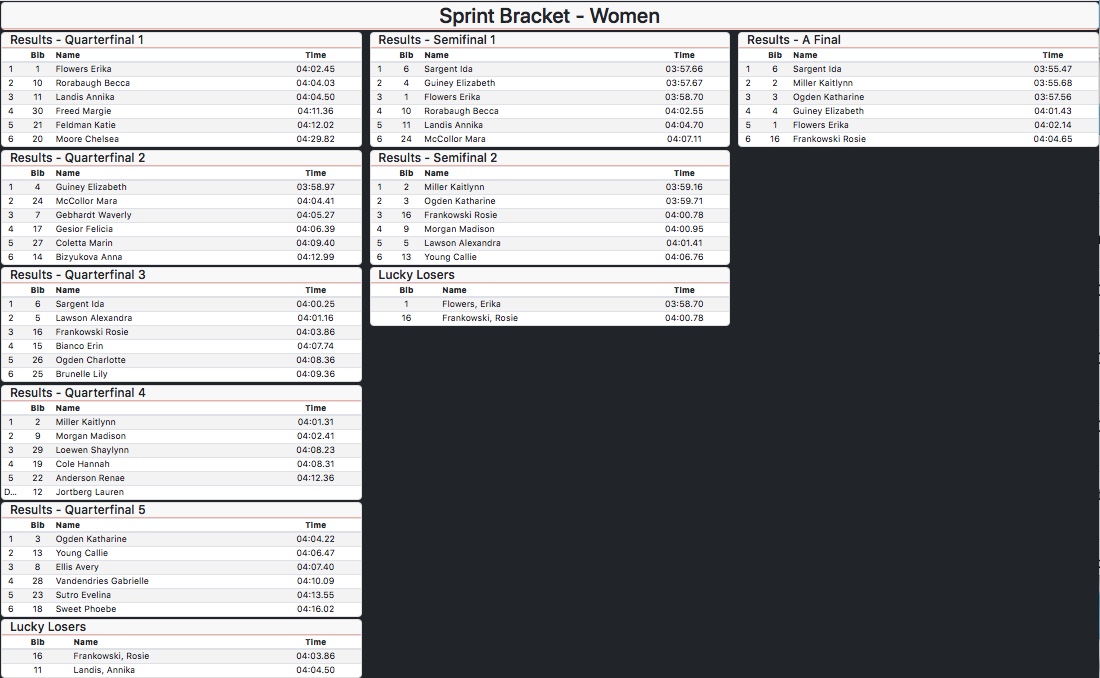
    “Retired” Craftsbury native Ida Sargent won the women’s race in a time of 3:55.47, followed by fellow CGRP athlete Kaitlynn Miller (+0.21), and Dartmouth Ski Team’s Katherine Ogden (+2.09). Erika Flowers posted the fastest qualifying time of 3:56.03; she finished fifth in the final (+6.67).

    Breaking down the heats in Craftsbury. (Photo: BullitTiming.com)

    On the mens’ side, Ben Saxton (SMST2) took the final in 3:19.0. He was followed by Canada’s Julien Smith of NTDC Thunderbay (+2.04) with Forrest Mahlen of APU in third (+2.25). University of Vermont athlete Ben Ogden was the fastest qualifier of the day in 3:18.62. Ogden was eliminated in the first heat of the semifinal, finishing 11th overall.

    Results from the men’s heats in Craftsbury. (Photo: BullitTiming.com)

    Racing continues tomorrow with interval start freestyle distance races Saturday and mass start classic distance races Sunday.


    Women’s Qualifier | Women’s Final Results

    Men’s Qualifier | Men’s Final Results

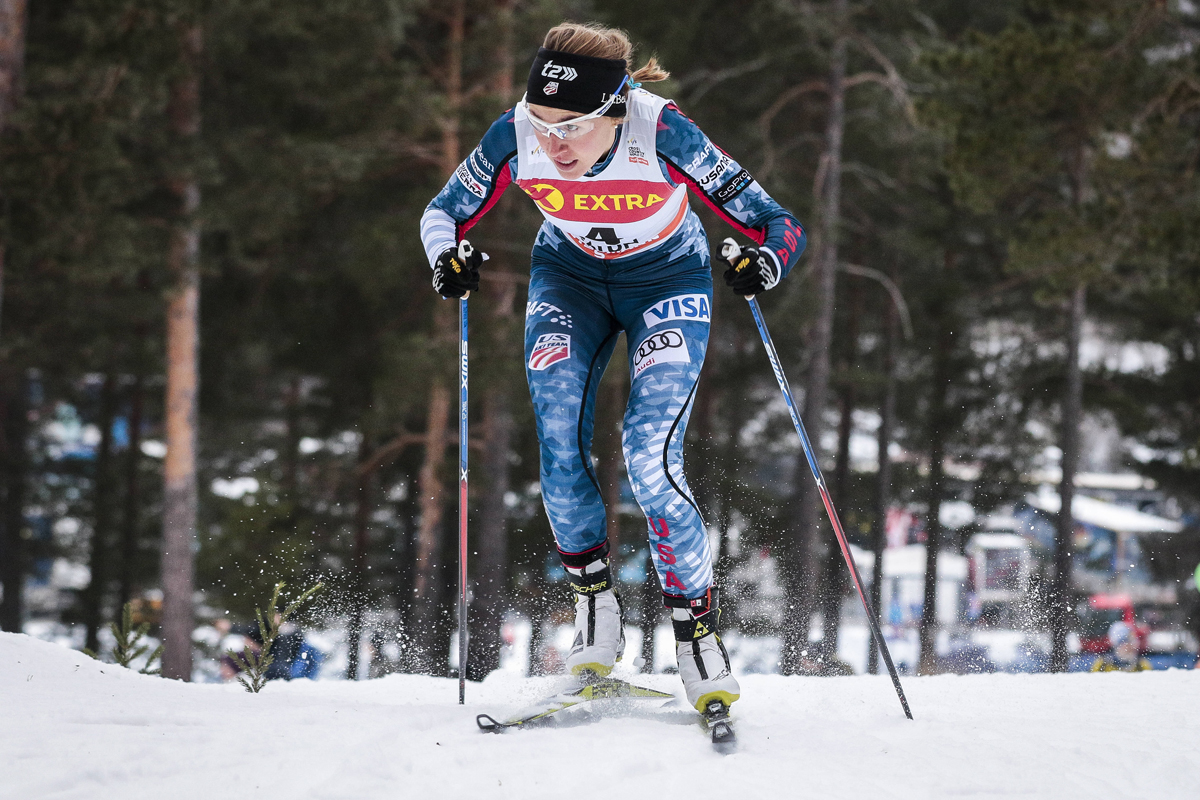
  • Red, White, and… Black? A Visual History of the USST Uniform, 2008–2019

    Red, White, and… Black? A Visual History of the USST Uniform, 2008–2019

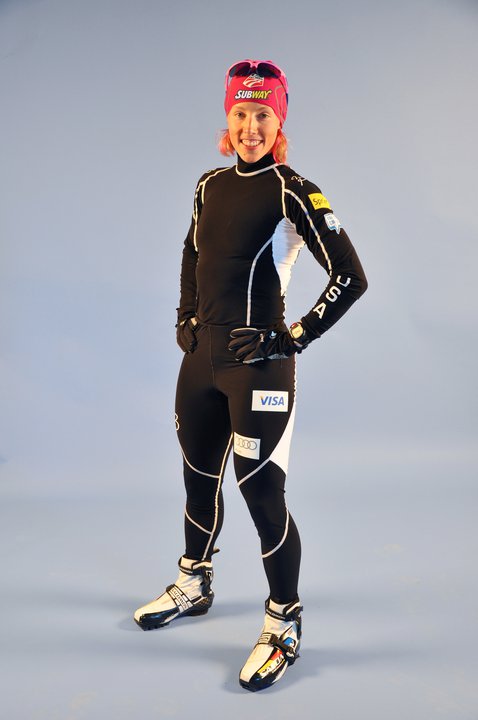
    From October 2010: Kikkan Randall modeling the U.S. Ski Team suit for the 2010-2011 season. Photo courtesy of the U.S. Ski and Snowboard Association.

    A national team uniform for cross-country skiing has to do a lot of things. At the most utilitarian level, it has to wick sweat and aid performance while an athlete pursues one of the world’s most demanding sports at temperatures between –4 F and 40, in steady snow or driving rain or anything in between. At the functional level, it has to let spectators and coaches identify where their athlete is out on the course, while distinguishing them from athletes from other countries. And at the symbolic level, it lets the athlete know that he or she is competing on behalf of their country, for everything that that means. Ask a skier who has represented the United States in international competition what it meant to them to pull on a national uniform for the first time. They’ll probably be able to tell you.

    (And if they ever forget, this detailing from Craft and L.L. Bean on the American uniforms, ca. 2015/2016, is there to remind them. “You are representing the United States of America,” a slogan intones, above a martial-looking eagle, with a U.S. Ski Team master mark for its aegis, gripping an olive branch (?) in its dexter claw and a skis and ski poles fasces in its sinister. “Pretty fun to be representing an American brand with our American uniforms!,” wrote Sadie Bjornsen in a blog post describing the uniforming process.)

    For whatever reason, the period roughly one decade ago represented the highwater mark for domestic and global coverage of ski uniforms on this website. There was “US Ski Team Brings Suit Consistency,” from Jan. 2009 (lede: “After years of a remarkable level of wardrobe schizophrenia, the US Ski Team has ushered in a new era of racing suit consistency that should make it easier to follow our favorite US athletes on the race course.”); “The costume disciplinarian speaks: Is it better to look good than to ski fast?” from July 2009; “The Best and Worst (Suits) of the Olympics,” from Feb. 2010; and “USST Goes Black for 2010-2011,” from Oct. 2010 (lede: “In the sport of cross-country skiing, most people would agree that competing with New Zealand is probably smarter than picking a fight with Norway.”).

    After that, attention to this important issue appears to have lain largely fallow until the 2018 Winter Olympics in Pyeongchang, which brought “FasterSkier’s Unofficial Guide to 2018 Olympic Cross-Country and Biathlon Suits.”

    So it seems to have been nearly 10 years since the last sustained attention to the uniforms of the Davis U.S. Cross Country National Team Program (née U.S. Ski Team). To fill that gap, FasterSkier hereby presents A Visual History of the United States Ski Team National Team Uniform, 2008–2019.

    (Why 2008 for the starting point? Mostly for the simple logistical reason that the image library in the current FasterSkier content management system, WordPress, only goes back to 2008, so this article can be written while using only images that FasterSkier may legitimately post on this site. To go back to closer to the start of this century would require a lot of external links to Getty Images and not that many photos to actually look at on this website. That said, this piece from 2009 has a nice visual roundup of the plethora of different USST designs worn from 2006–2008, which takes you back two more years. Before that, well, just imagine Kikkan Randall and a lot of other skiers you probably haven’t thought about for a while — Wendy Wagner, anyone? Rebecca Dussault? Sarah Konrad? — wearing various iterations of early-aughts red and black.)

    2008/2009 World Cup season: Red

    January 2009: No question who is from the US here… Kikkan Randall in the women’s Team Sprint in Whistler


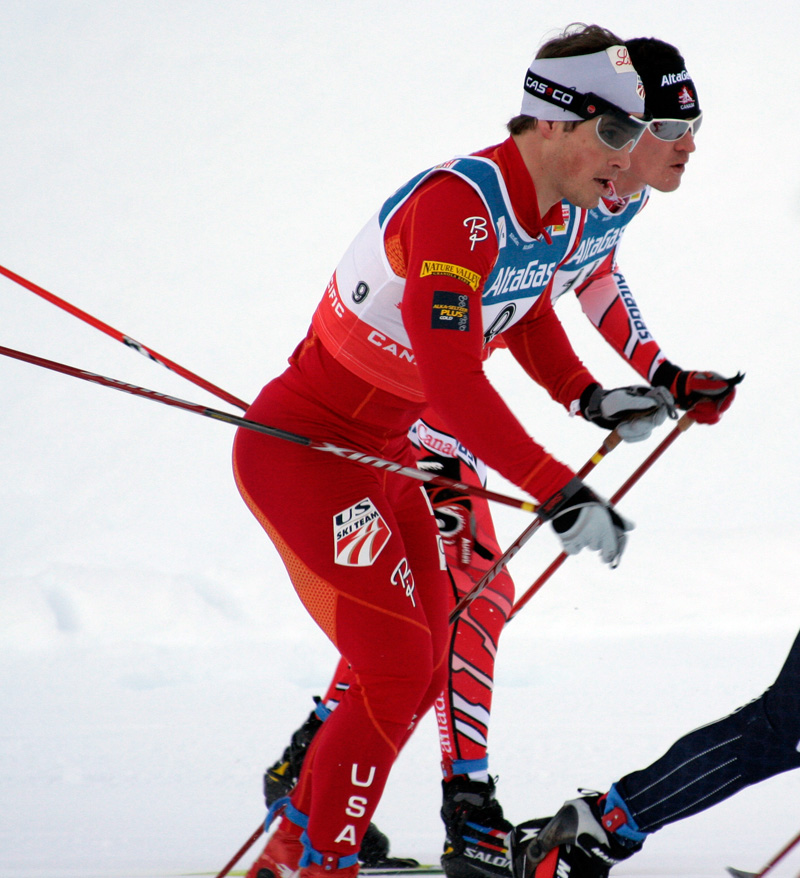
    January 2009: Kris Freeman preferred the orange to silver in the men’s pursuit

    As a contemporary uniform article explained, “There are currently two suit variations being used by US Ski Team athletes, and athletes racing for the US in international events. They are so similar, that for practical purposes (identifying US skiers in a race) they may as well be the same. Both suits are predominantly red, with one version having patches of orange, and the other silver.” Both were manufactured by Norwegian company Bjørn Dæhlie.

    There appears to have been no change to the basic World Cup design for the 2009 World Championships in Liberec, Czech Republic:

    Freeman at the 2009 World Championships in Liberec. (Photo: Swix Sport)

    2009/2010: Still red Bjørn Dæhlie

    November 2009: Tazlina Mannix (APU, USST) racing in West Yellowstone.


    November 2009: A very young Noah Hoffman (USST) racing to 3rd in a distance race in West Yellowstone.

    Honorable mention, domestic suits division:

    November 2009: This is a very orange suit. Kevin Hochtl (Rossignol) – 32nd – leads Anders Haugen (APU) – 7th – to the finish in a West Yellowstone race.


    November 2009: This is one hell of an ibex. Chris Cook (Steinbock Racing) – 12th – sporting the new Steinbock Racing uniform


    2010 Winter Olympics, Vancouver: Red and silver

    For the Olympics, the Americans appear to have taken their World Cup template – Bjørn Dæhlie suit, largely red – but have changed it by, inter alia, lightening the shade of red, adding “USA” on the right arm and left leg, adding silver accents, and of course removing all sponsor logos. Kikkan, already skiing in her third Olympics, coordinated with a red headband, red gloves, and her famous pink highlights. Andy Newell went with the red hat (he may not have had a choice), but was otherwise somewhat less vermilion.

    Feb. 2010: Kikkan Randall
    Feb. 2010: Andy Newell on the big climb during the men’s 4 x 10 k relay.

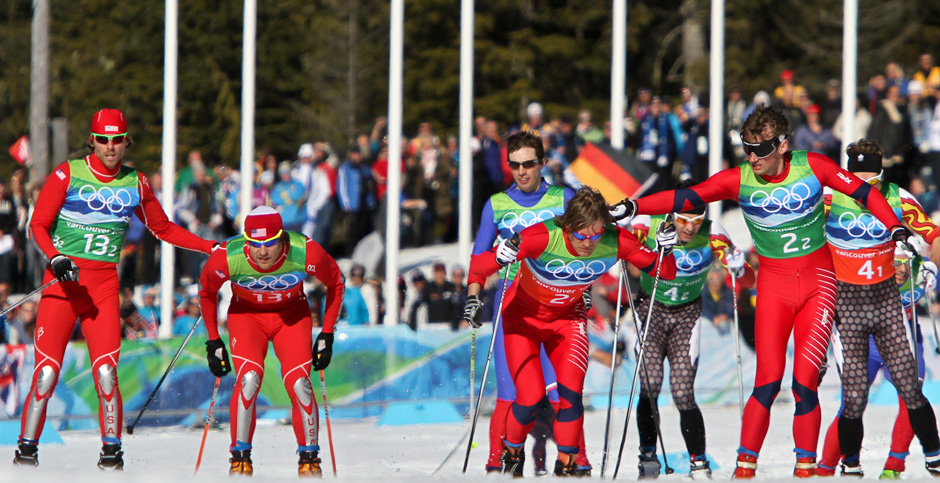
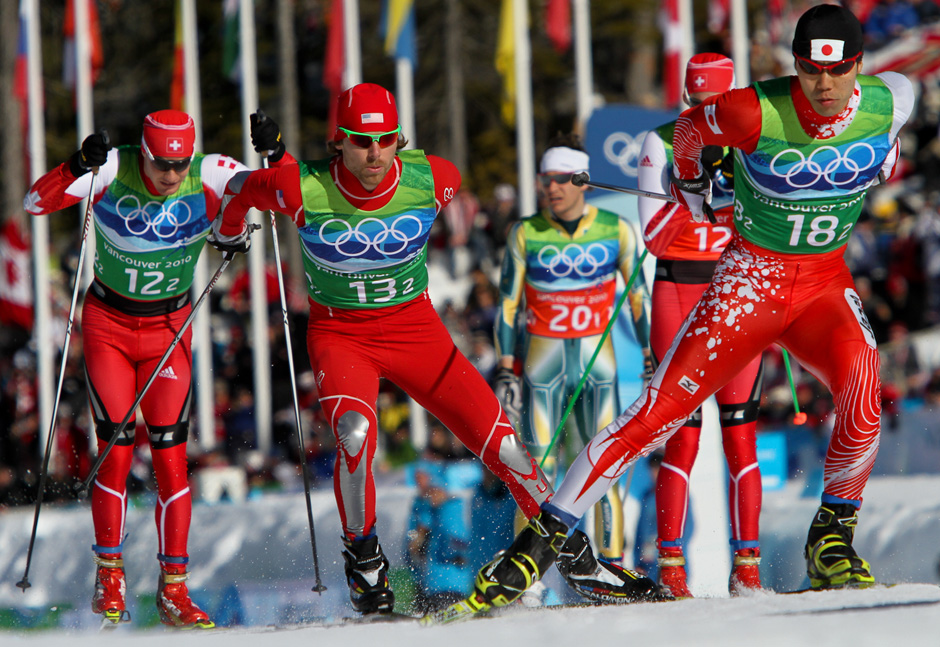
    There was a lot of red in Vancouver. For example, here’s Andy Newell (far left, bib no. 13-2) tagging Korin Koos for the U.S. in the team sprint, while Petter Northug (far right, bib no. 2-2) tags Øystein Pettersen (middle right, bib no. 2-1) for Norway. (An entire standalone article could likely be written on the Canadians’ infamous kit (bib no. 4, back right).)

    Newell tags Koos (left) and Northug tags Pettersen (right) at the 2010 Vancoulver Olympics.

    Or here’s Newell in the middle, between Switzerland’s Dario Cologna (bib no. 12) and Yuichi Onda of Japan (bib no. 18):

    Newell in the semis of the skate sprint: 2010 Vancouver Olympics.

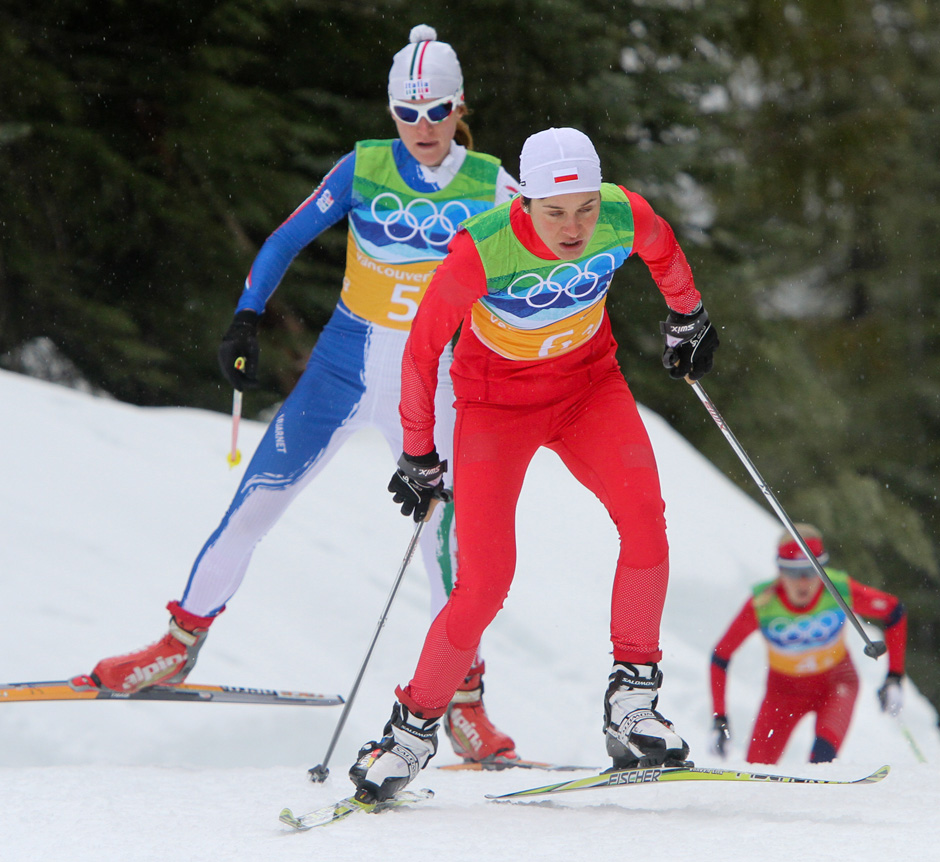
    Finally, Poland (shown here: Sylwia Jaśkowiec, bib no. 6) was just red:

    Poland 2, 2010 Vancouver Olympics.


    2010/2011: The black era begins

    Perhaps as a natural reaction to the dominance of a single color across multiple nations, the U.S. made a significant shift for the 2010/2011 World Cup season: black. The color does not appear on the national flag or in other common American iconography, but it is certainly distinctive. Bjørn Dæhlie remained the suit manufacturer.

    Or, as then-FasterSkier reporter Nat Herz wrote in fall 2010, “After any number of years of being drowned out by a sea of Norwegian crimson, U.S. Ski and Snowboard Association Nordic Director John Farra said that the USST will be ‘distinctly not red’ for the 2010-2011 season—including at World Championships in Oslo. ‘We went in a very different direction, in part from our experience in Oslo, where they [Norway] have a nation’s group of ten, and we can barely see our athletes in the group,’ he said.”

    January 2011: A 21-year-old Sadie Bjornsen races to 17th at U23 World Championships in Otepää, Estonia.


    January 2011: Jessie Diggins, then aged 19, races to 7th at Junior World Championships in Otepää.


    January 2011: Noah Hoffman at a SuperTour race in Lake Placid.


    February 2011: No change for World Champs: Kikkan Randall racing at 2011 World Championships in Oslo.


    2011/2012: Still black Bjørn Dæhlie

    December 2011: Kikkan Randall sprinting during the Tour de Ski.


    March 2012: Kris Freeman (SSCV/USST) on his way to claiming the US Distance Nationals 50 k freestyle title on Saturday morning in Craftsbury.


    2012/2013: Still black

    December 2012: Noah Hoffman in the Tour de Ski.


    December 2012: Kikkan Randall blasting to victory in the Tour de Ski opening prologue on Saturday. She skied to 14th in the pursuit on Sunday and is leading the U.S. women in the Tour de Ski standings after two stages. Photo: Marcel Hilger.


    February 2013: Diggins and Randall won gold in the team sprint at 2013 World Championships in Val di Fiemme, Italy, which was awesome, but, for purposes of this article, mostly relevant for the addition of the epochal relay socks but otherwise no change to the standard World Cup uniform.


    2013/2014: Yup, still black

    December 2013: Liz Stephen (U.S. Ski Team) on her way to 34th in Saturday’s 3 k freestyle prologue at the first stage of the Tour de Ski in Oberhof, Germany. (Photo: Marcel Hilger)


    December 2013: Andy Newell (U.S. Ski Team) qualified 12th and finished 10th overall in Sunday’s freestyle sprint. (Photo: Marcel Hilger)


    2014 Winter Olympics, Sochi: Stars and stripes

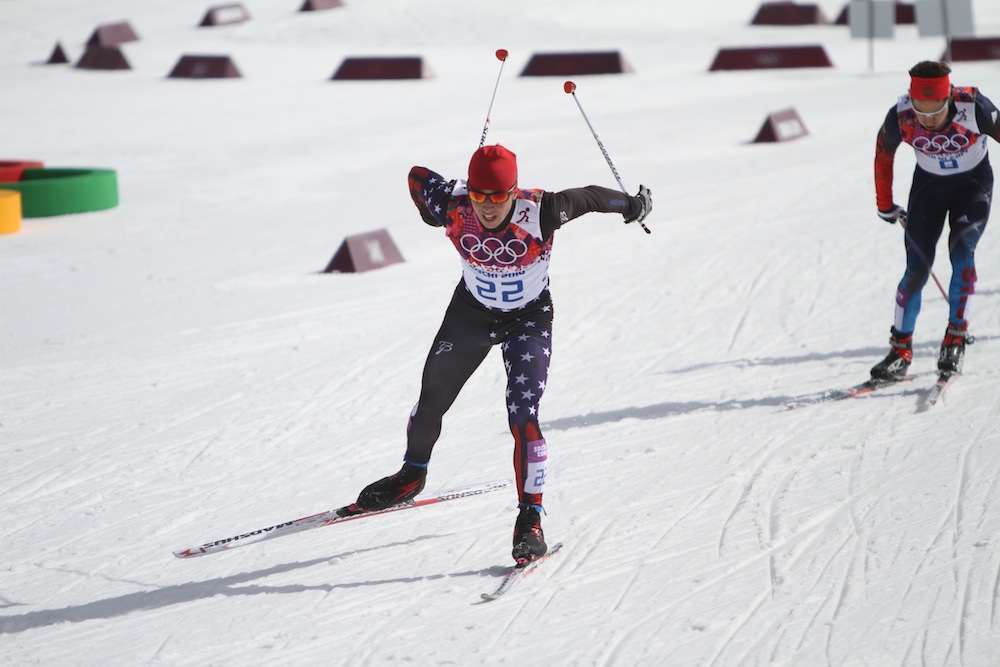
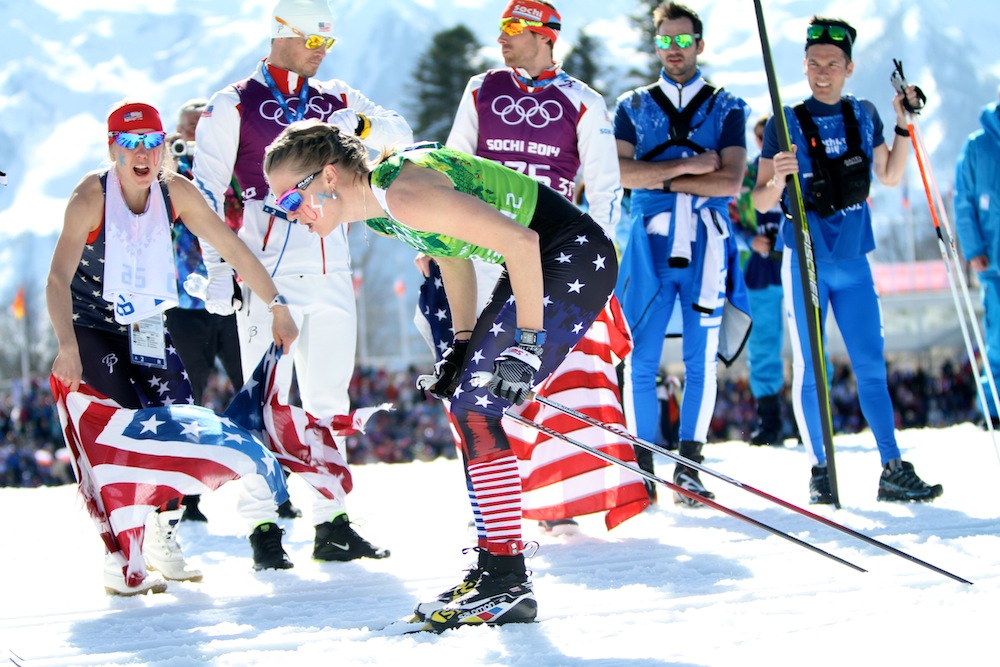
    The 2014 Winter Olympics, in Sochi, Russia, were known at the time for Kikkan Randall’s disappointing result in the individual skate sprint, and after the fact for the revelation that Russia was engaged in a massive state-sponsored doping scheme and cover-up. They were also significant for a change in uniforms: stars and stripes on the right arm and left leg, and a large “USA” on the right leg. The left arm was relatively plain. Also, several of the U.S. women drew attention for racing sleeveless in warm temperatures. Bjørn Dæhlie continued to be the brand logo featured on the upper right quad. (Pictured below: Noah Hoffman, in a solo race, and Sadie Bjornsen, in the women’s relay.)


    2014/2015: Stars and stripes redux

    Athletes took to the trails next season with a slightly modified version of the recent Olympics uniform: Larger stars on the left upper quad, with a deeper blue background. The stripes on the left leg became more pronounced and stretched farther up the race suit, to above the knee. Also, once the non-commercial period of the Olympics had passed, there was space for sponsor patches on the arms and legs.

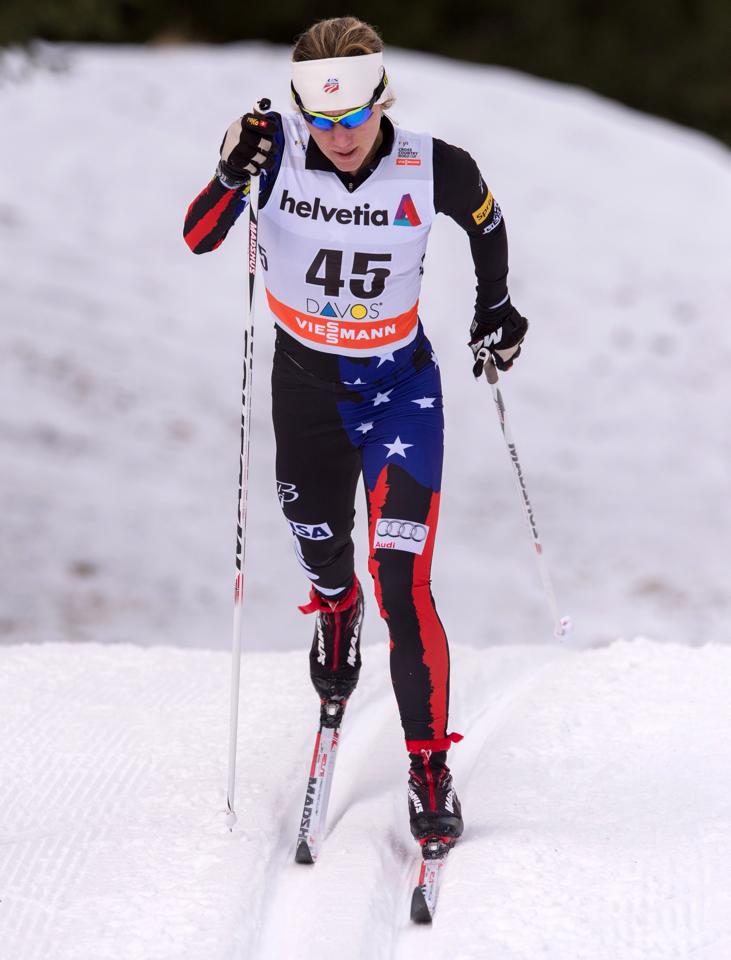
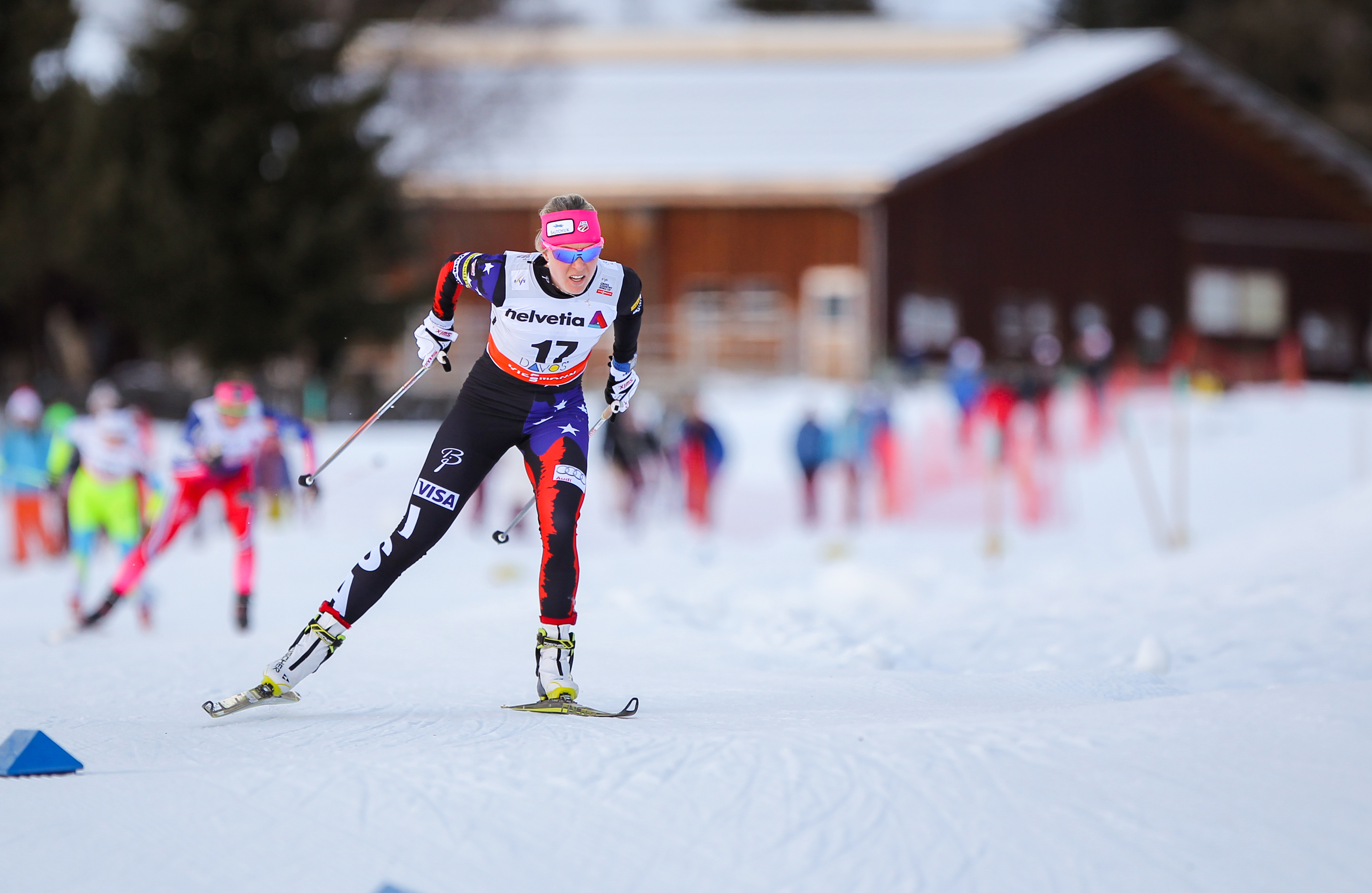
    December 2014: Caitlin Gregg (Team Gregg) skiing to 56th place in the Davos World Cup 10 k classic, Dec. 13. (Photo: Toko)


    USST’s Sadie Bjornsen racing to 29th in the Davos World Cup 10 freestyle, Dec. 20, 2014. (Photo: Fischer/Nordic Focus)

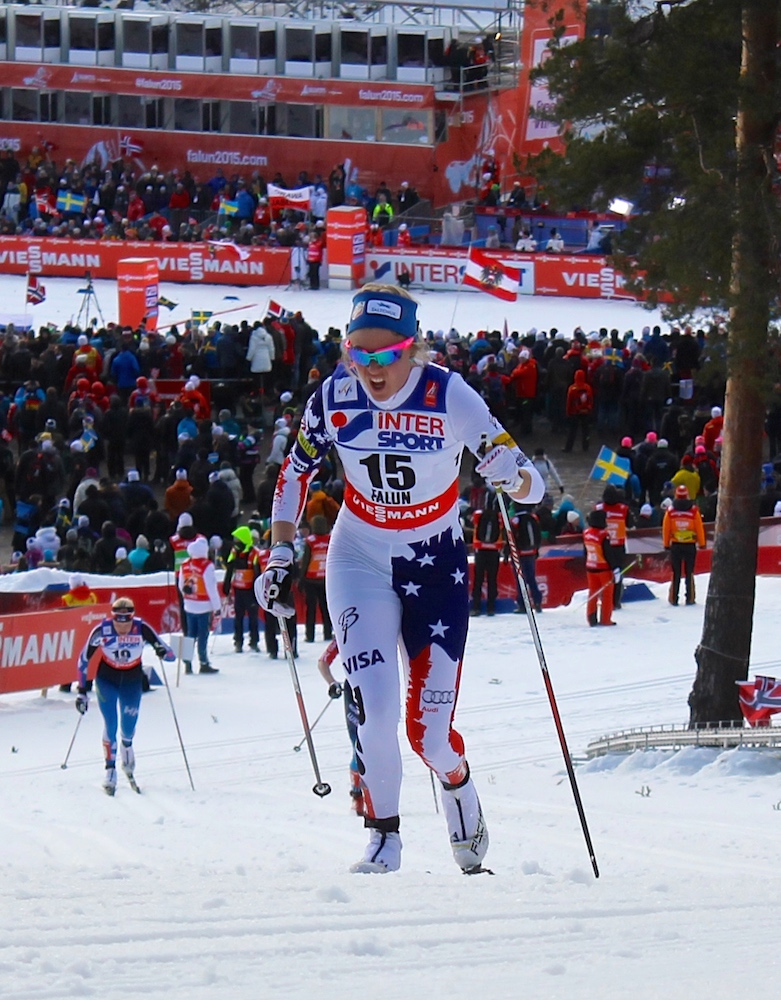
    World Championships, in Falun, Sweden, brought a mostly-white version of the uniform, helpful for the warm temperatures and soupy conditions that characterized many of the races. Here’s Sadie Bjornsen in Falun in February 2015:


    2015/2016: Red, white, and blue

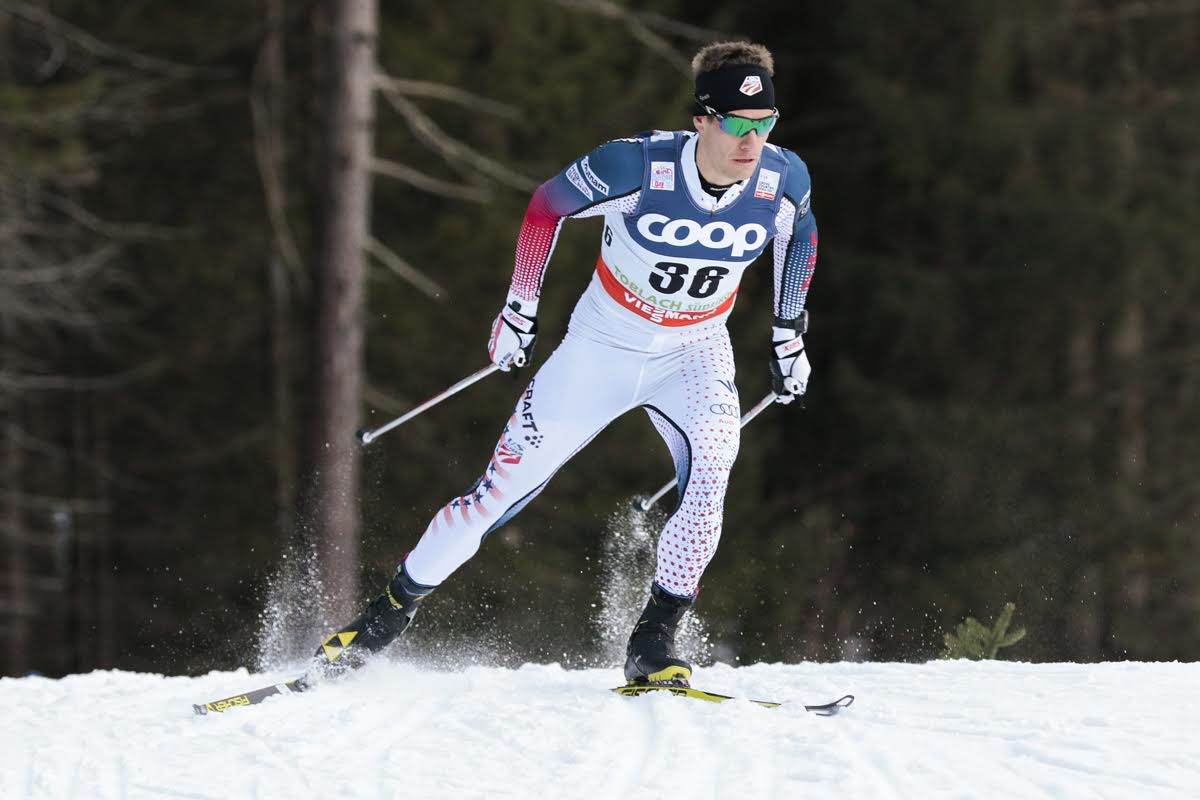
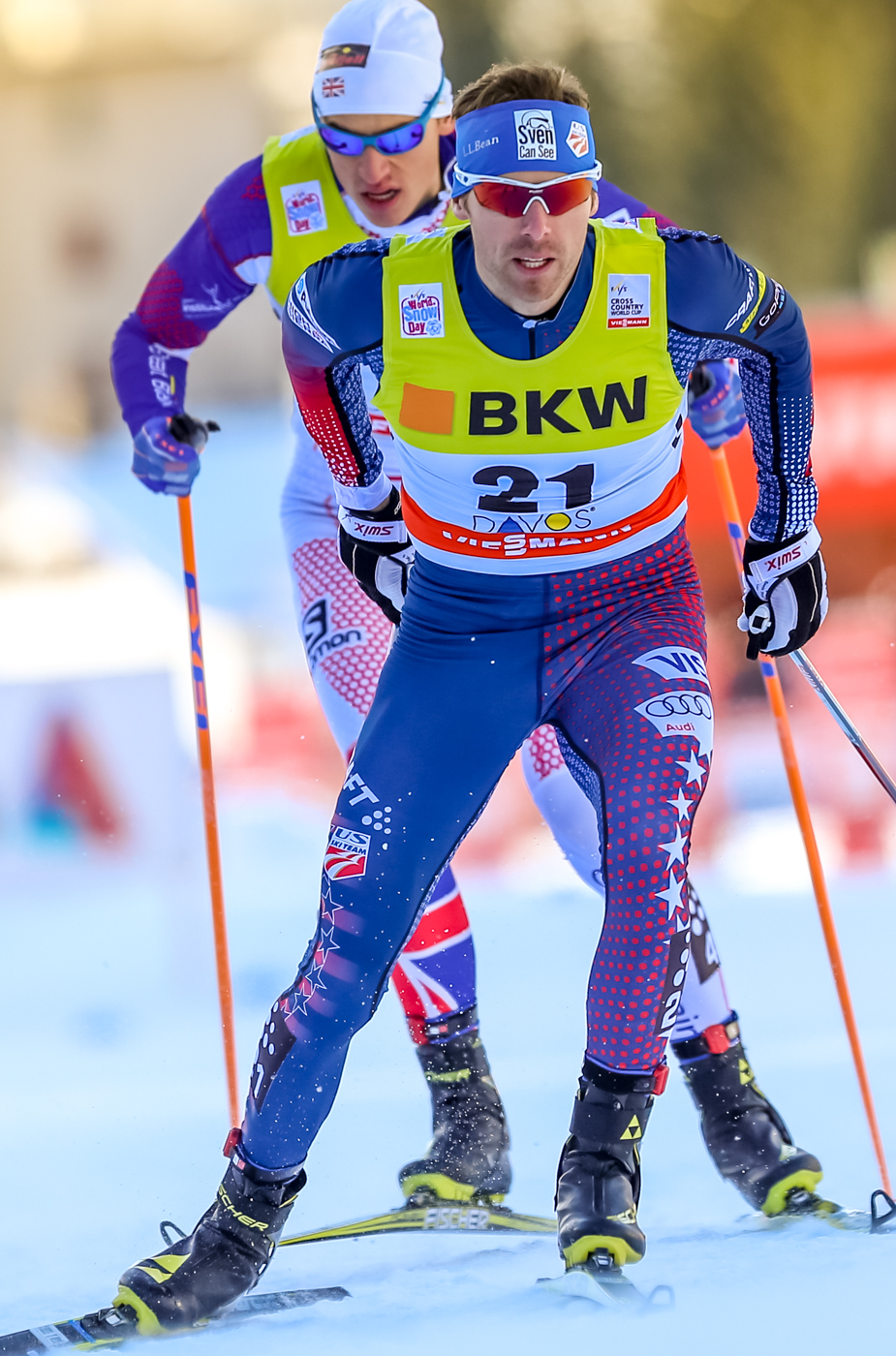
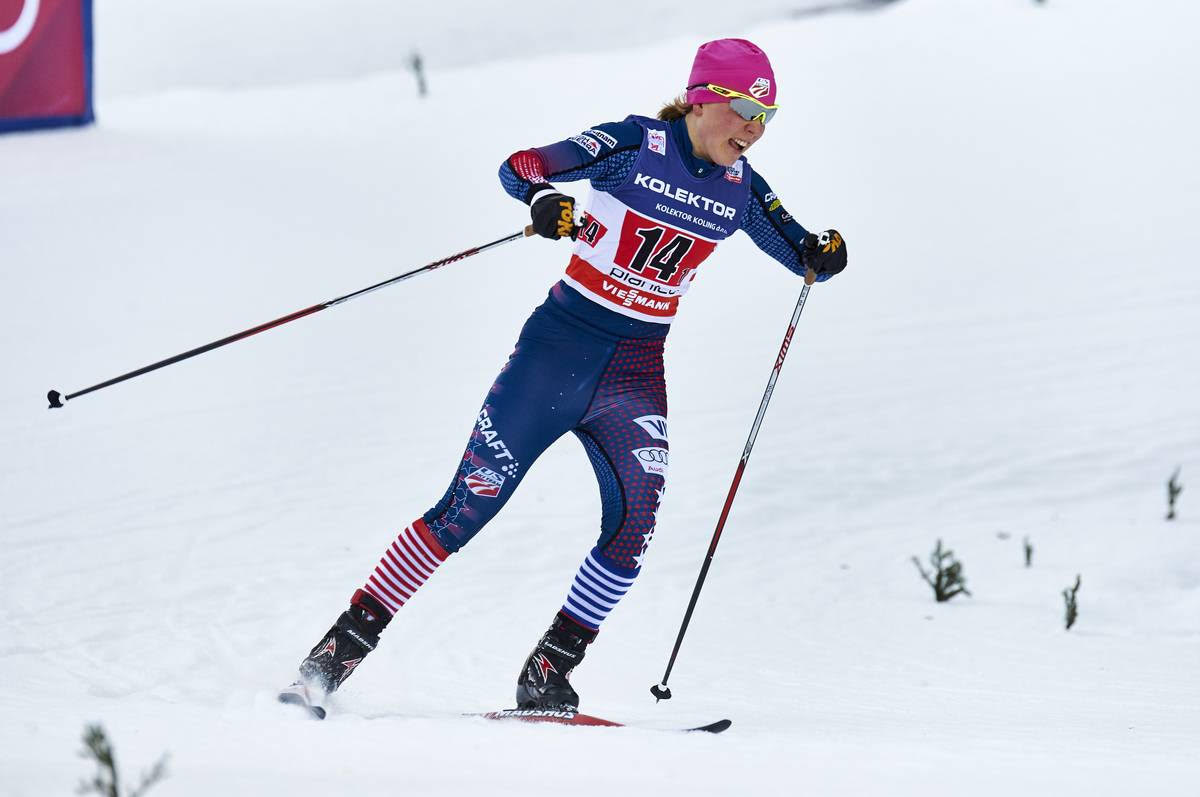
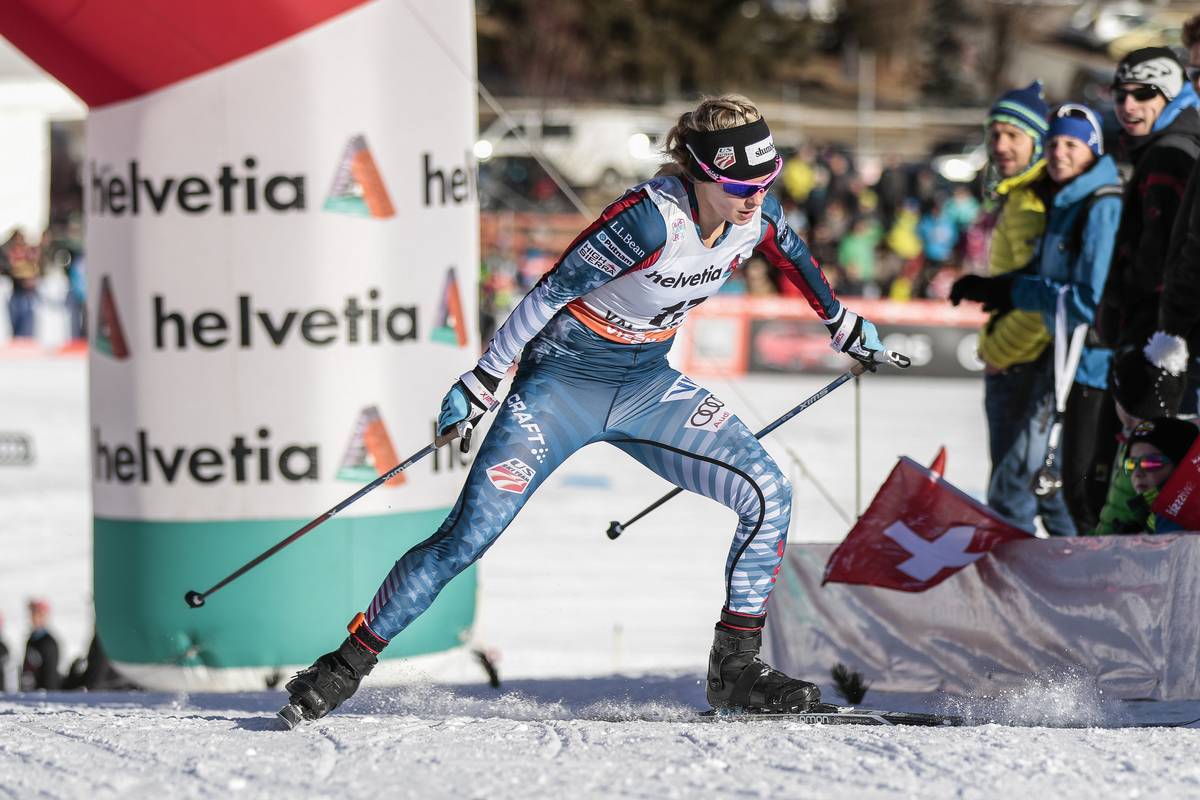
    By fall 2015, the move away from black, and towards red, white, and blue, was complete. Athletes now had the option of being attired in a predominantly white color scheme, which would aid in preventing overheating on warm days, while thankfully solving the transparency issues that had plagued recent all-white suits for Sweden or Italy. An alternate version had roughly the same patterning, but with blue as the primary color. Notably, the Americans also moved to a race suit manufactured by the Swedish company Craft for the first time in this survey.

    December 2015: Sadie Bjornsen (U.S. Ski Team) racing to her best-ever sprint qualifier in sixth at the World Cup freestyle sprint in Toblach, Italy. She went on to make the semifinals and place 10th overall. (Photo: Fischer/NordicFocus)


    December 2015: Simi Hamilton (U.S. Ski Team) racing to his first non-stage World Cup podium on Saturday in Toblach, Italy, where he placed second in the freestyle sprint. (Photo: Fischer/NordicFocus)


    December 2015: American Andy Newell (r) and Great Britain’s Andrew Young (c) trail Norway’s Håvard Solås Taugbøl (2) in the quarterfinal at the Davos World Cup freestyle sprint on Sunday in Switzerland. Taugbøl won the heat, Young placed third, and Newell was fifth after missing out on a photo finish for fourth. Newell finished the day 23rd overall. (Photo: Marcel Hilger)


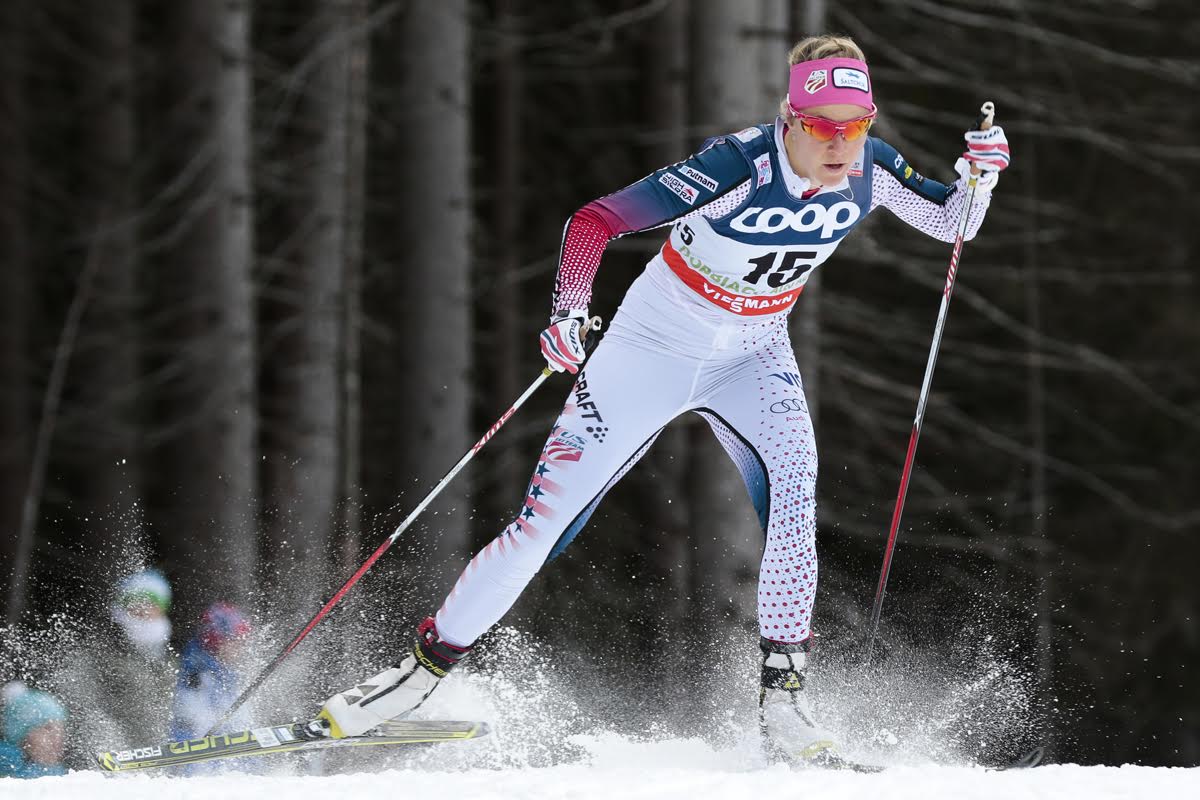
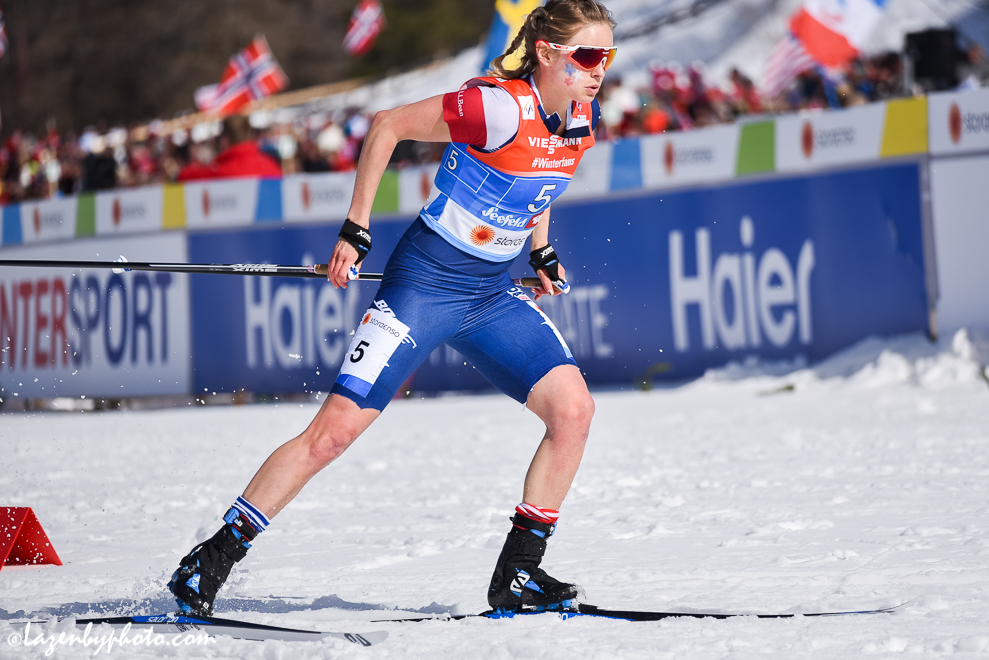
    January 2016: Ida Sargent (U.S. Ski Team) teamed up with Sophie Caldwell (not shown) to place fifth in the 6 x 1.2 k freestyle team sprint at the World Cup in Planica, Slovenia. (Photo: Madshus/NordicFocus)

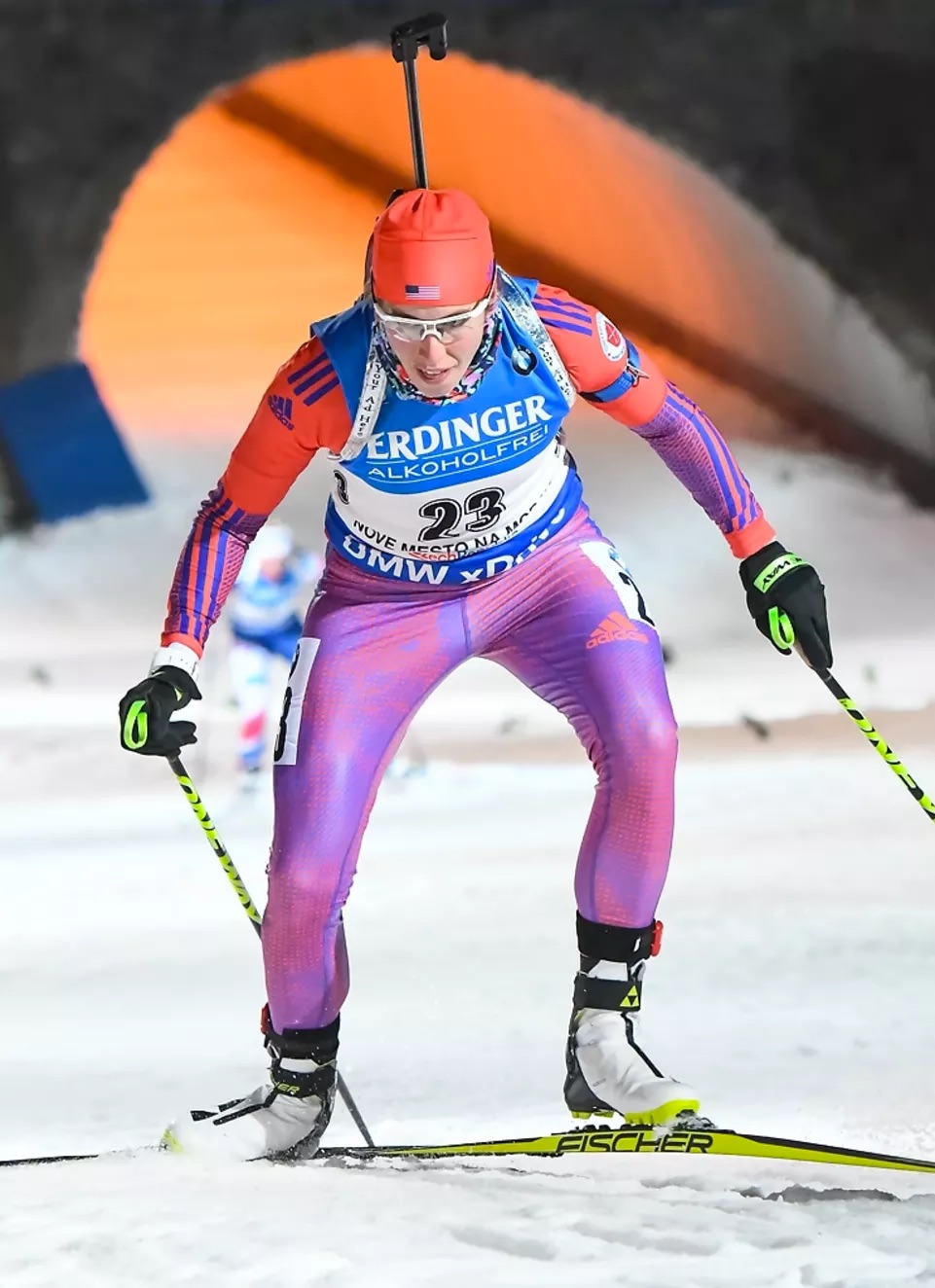
    Honorable mention: Trending towards “purple cobras” for American biathlon but not there yet.

    American Claire Waichler started 58th and finished 33rd in the youth women’s pursuit on Sunday at IBU Youth/Junior World Championships in Cheile Gradistei, Romania. (Photo: IBU YJWCH Cheile Gradistei 2016/Facebook)


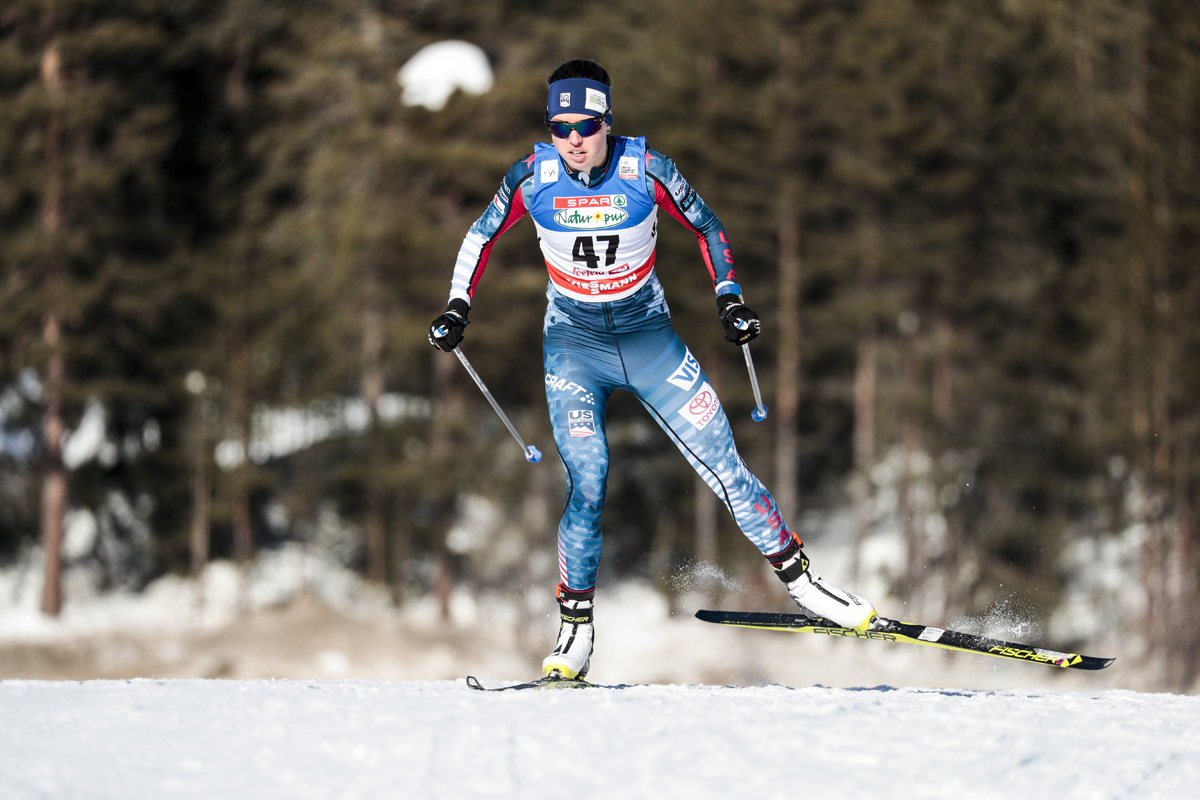
    2016/2017: More red, white, and blue

    An interpretation of red, white, and blue, still on a Craft suit, remained in place for the 2016/2017 World Cup season, which was marked within the team by Randall and her husband, Jeff Ellis, traveling the European race circuit with a newborn in tow. The changes to the USST uniform were less dramatic than Randall’s familial status: Still red, white, and blue, though now with blue as the dominant color. The entire left leg, and the bottom half of the right leg, had markings, somewhere between subtle striations and full-on stripes, that evoked the stripes of the American flag. (Let’s put aside for the moment the fact that the stripes on the actual flag are white and red, not white and blue.) The pattern was repeated on the lower right arm. An understated evocation of blue or white stars marked both lower legs, with more pronounced stars scattered around the bottom of the torso (possibly the top as well, but nearly all of one’s torso is typically covered by the standard race bib). The left arm and left leg both proclaimed “USA” in red lettering.

    The vehicular logo on the legs remained that of Audi, as it had been since the start of this history.

    There appears to have been no change for the 2017 World Championships. At least to the uniforms; on the race course, the Americans won an unprecedented three medals.

    December 2016: Jessie Diggins (U.S. Ski Team) racing to ninth in Saturday’s 1.5 k freestyle sprint qualifier in Val Müstair, Switzerland. Diggins went on to place sixth in the final. (Photo: Salomon/NordicFocus)


    January 2017: Sophie Caldwell (U.S. Ski Team) racing to third in the qualifier of Saturday’s 1.4 k freestyle sprint in Falun, Sweden. She went on to finish 16th overall (Photo: Fischer/NordicFocus)


    February 2017: Kikkan Randall (U.S. Ski Team) racing to 26th in the women’s 10-kilometer classic individual start at the 2017 Nordic World Championships on Tuesday in Lahti, Finland (Photo: John Lazenby/Lazenbyphoto.com)

    Meanwhile, biathlon saw the advent of the beloved “purple cobras” era:

    US Biathlon’s Susan Dunklee on her way to finishing third in the women’s sprint at the IBU World Cup in Nove Mesto, Czech Republic. It was the third podium of her career. (Photo: IBU)


    2017/2018: Red, white, and blue redux

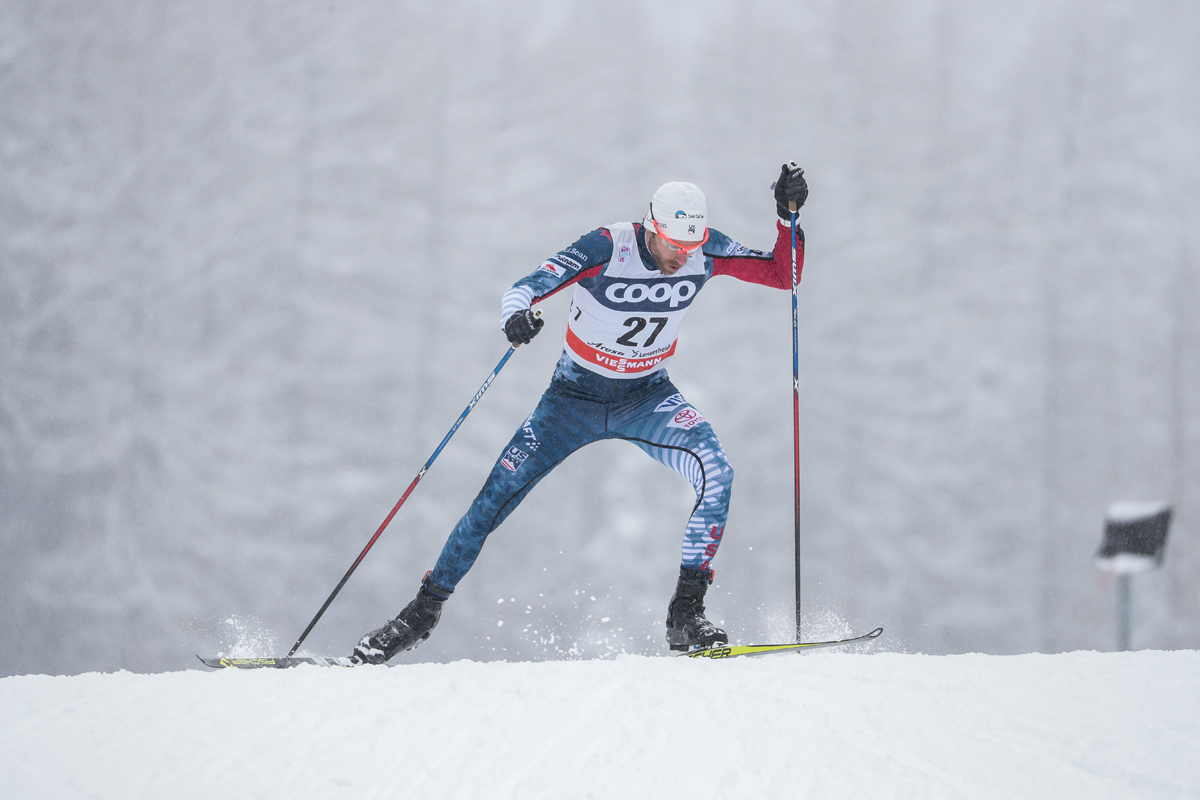
    There appears to have been no change for the 2017/2018 World Cup season: still red, white, and blue, but mostly blue, on a Craft suit. The most notable change may have been to the car sponsor… for the first time since at least the scope of this article, a Toyota logo was on the leg, not Audi. Nichts ist unmöglich (“Nothing is impossible”), as the company’s European slogan proclaims.

    American Andy Newell racing the men’s 1.5 k freestyle-sprint qualifier at Stage 1 of the Tour de Ski on Saturday in Lenzerheide, Switzerland. He qualified 20th and went on to finish 19th overall. (Photo: Fischer/Nordic Focus)


    Caitlin Patterson (Craftsbury Green Racing Project) racing to 52nd in the freestyle sprint qualifier at the last World Cup on Jan. 27 in Seefeld, Austria. The next day, she placed 23rd in the 10 k freestyle mass start. (Photo: Fischer/NordicFocus)


    2018 Winter Olympics, Pyeonchang: Red, white, and blue, and a lot of stripes

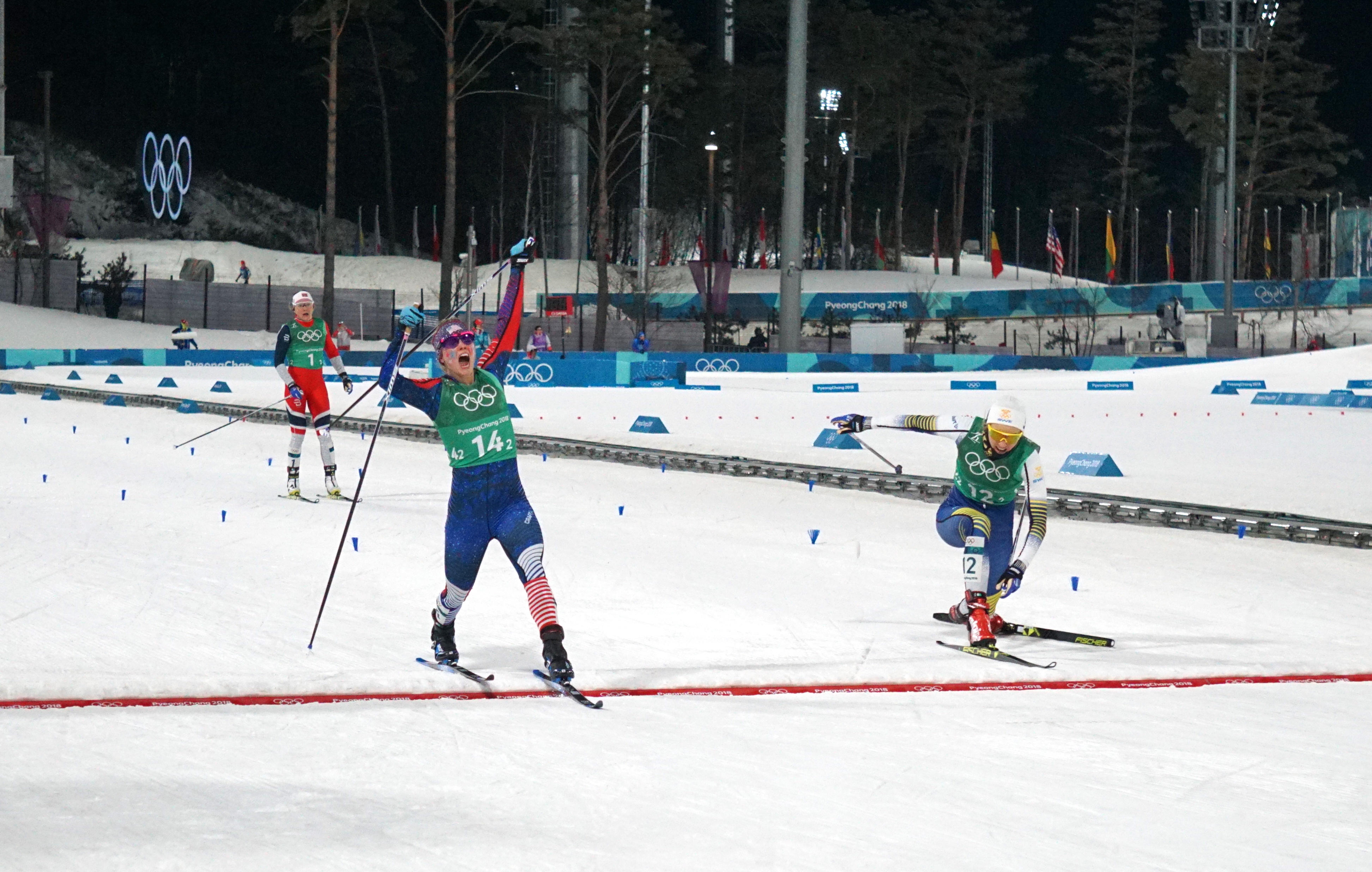
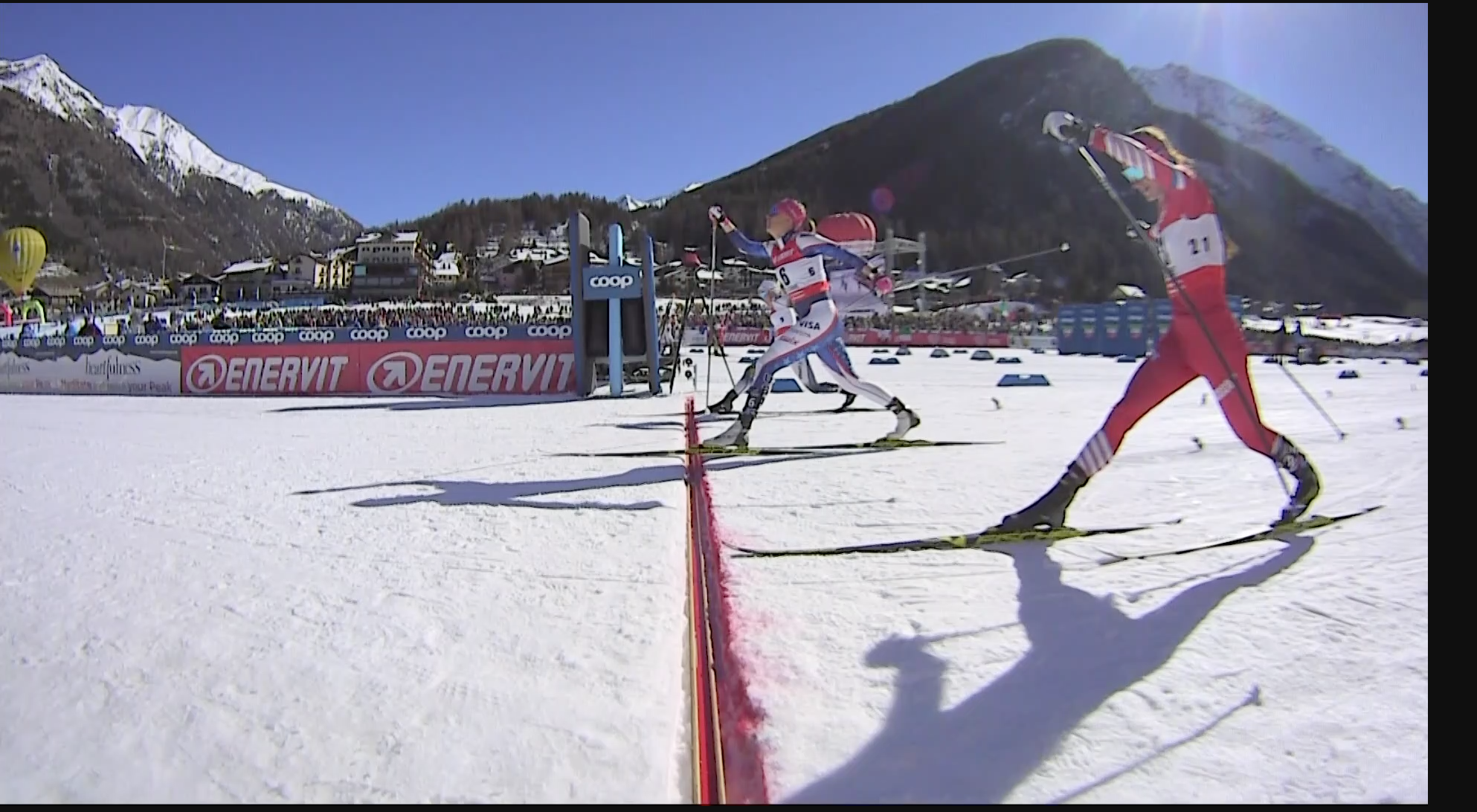
    There is a somewhat famous picture from the 2018 Winter Olympics that you may already be familiar with. In the picture, Jessie Diggins, on the lefthand side of the frame, stretches her left foot across the finish line to secure an historic Olympic gold medal for the United States. Her left arm mirrors the gesture, punching the air above her in what is presumably an instinctual counterbalance to the lunge but also appears, in a frozen moment in time, to be a triumphant fist-pump. In the middle, her face is rent in a rictus of exertion and triumph. On the righthand side of the frame, Stina Nilsson of Sweden lunges as well, 0.19 seconds behind Diggins. Mute V-boards and still flags fill in the background of the image, as Maiken Caspersen Falla of Norway appears to stand up and stop skiing in order to watch the finish unfold.

    It was a few seconds before 7:16 p.m. in Pyeongchang, 4:16 a.m. in Afton, Minnesota, and 1:16 a.m. in Anchorage, Alaska. If you’re reading this website, you may remember where you were at that moment.

    February 2018: Jessie Diggins (14) edges Sweden’s Stina Nilsson (r) for gold, while Norway’s Maiken Caspersen Falla (far left) races to bronze, in the women’s freestyle team sprint final at the 2018 Olympics in PyeongChang, South Korea. (Photo: Noah Hoffman)

    But let’s talk about the uniform. Another Craft product, the dominant impression is once again blue; in the photo above, taken at whatever distance from the finish Noah Hoffman was allowed to stand while there was a race on, there is a whole lot of blue approaching the finish line between the American suit and the Swedish one. Some white stripes are visible around the knee of Diggins’s suit, trending down the lower leg, though they are soon subsumed by The Relay Socks.

    On closer inspection, however (see next picture, below), there are a lot of stripes going on in this uniform. The entire legs are striped, with stronger white stripes on the sides of the torso fading to fainter stripes at the top of the leg. The knees have white stripes on a blue background, with the width of the white stripes gradually decreasing and the extent of the blue interstices gradually increasing across the course of the knee. As shown in more detail here, the patterning gives way to thin red stripes against a blue background, on the lower right leg, and a bold white “USA,” on the lower left.

    The right arm has white splotches, potentially stellar in nature, against a blue background. The left arm has red and white stripes to midway down the biceps, which then transition to blue and red stripes.

    The torso has a subtle blue and black patterning perhaps best described as “Swedish forest camo.”

    Finally, although it is not apparent in either picture, “USA” was written in white letters against a blue background on both the right arm and lower left leg, as shown in the images available here (lettering on arm) and here (lettering on leg).

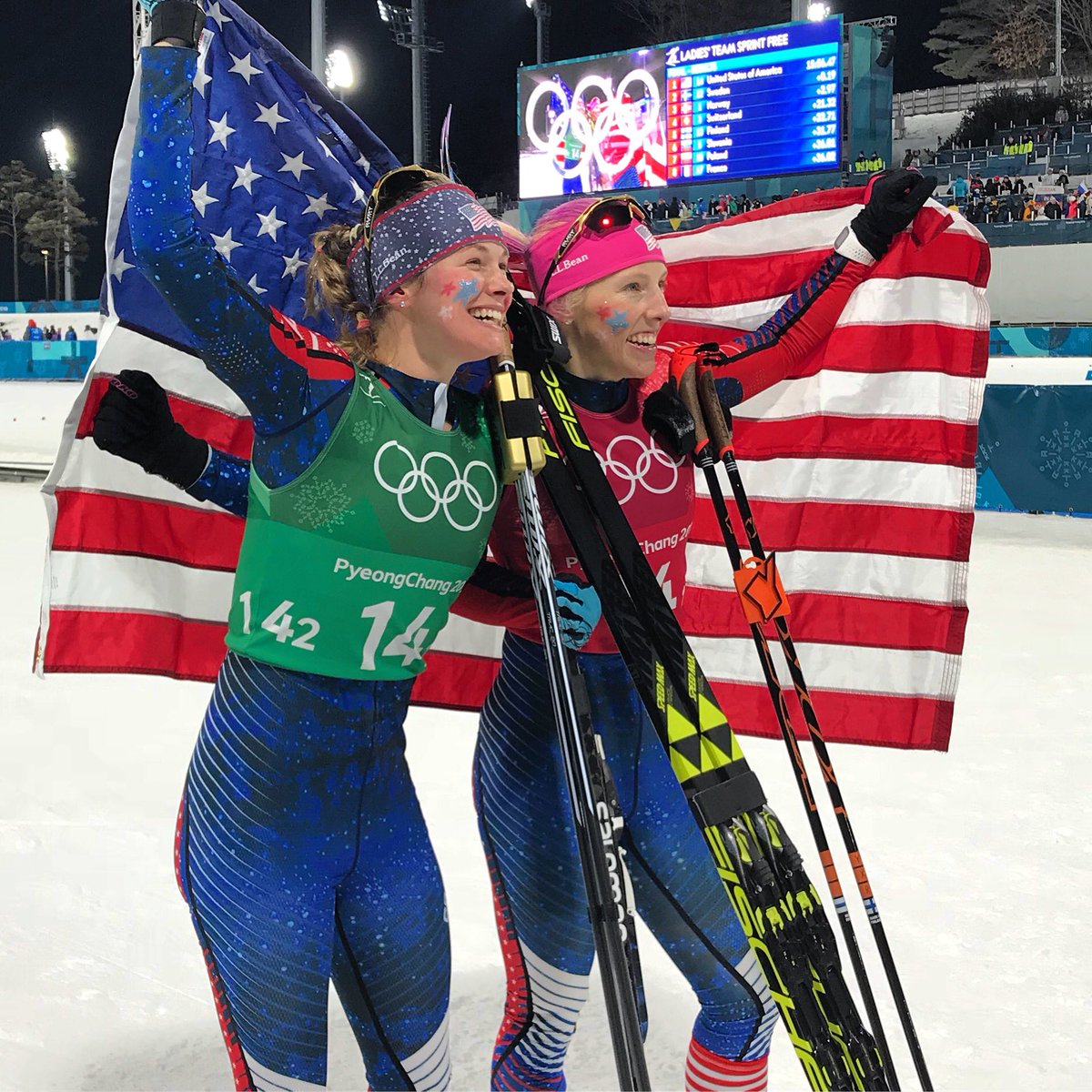
    February 2018: Jessie Diggins (l) and Kikkan Randall soak up their win in the women’s freestyle team sprint on Wednesday at the 2018 Olympics in PyeongChang, South Korea. (Photo: FIS Cross Country/Twitter)

    Here is another fine picture of Diggins and Randall from the evening of February 21, 2018. This one does not show the famous American relay socks, but does show the equally renowned facepaint and glitter. As Diggins has written, in what is both a pro-glitter cri de cœur and “a brief message for [the] high school officials” who harshed on her glitter as a junior racer, “Putting on glitter before my race is a salute to the little girl who just wants to ‘go super speed!!!’ It’s a promise to myself that I will race my absolute hardest that day. It’s a ritual that gets me in the right mindset to get out of the start gate and give it everything I have. It’s harmless, doesn’t negatively impact anyone, but to me it’s a huge part of my race morning. . . . And on relay days? Oh man. I get so excited about relay days. I get to paint the flag, ‘USA’ and stars on the faces of my teammates, and one of them will paint it on me as well. Then I put glitter over everything! It’s a special time when everyone is nervous, and excited, to be representing our country and we get together early in the morning to help each other get ready and deal with our pre-race nerves. It’s a little bit like our special striped relay socks…it’s part of what we do, as a team.”

    End of the 2017/2018 season: Farewell tour

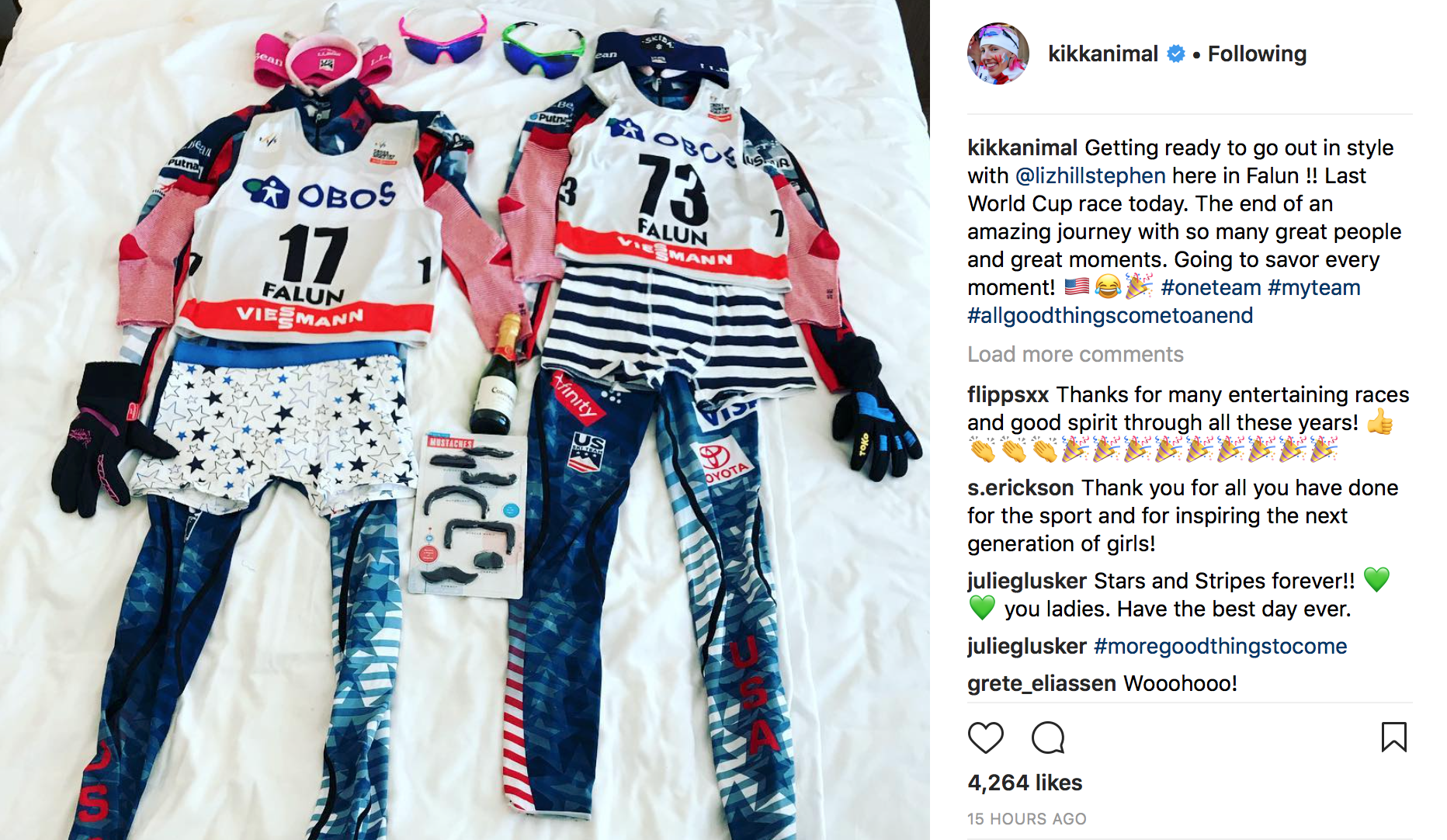
    Honorable mention for the 2017/2018 season, World Cup edition: Randall and Liz Stephen’s outfits for their final World Cup race (standard Craft base, but with a whole lot of flair):

    March 2018: The last-race outfits worn by Kikkan Randall and Liz Stephen for Sunday’s World Cup Finals pursuit. (Photo: Kikkan Randall/Instagram)

    Honorable mention, domestic edition: Randall’s bespoke pink and blue Craft USST/APU suit (essentially the Olympics suit but with different patterning) that she wore for her final race as a professional skier, at Spring Series in Craftsbury. The suit said “USA” on the right arm and left leg, “APU” (for Alaska Pacific University, her club team of 19 years) on the left arm, and “Kikkan” on the left arm and right upper leg.

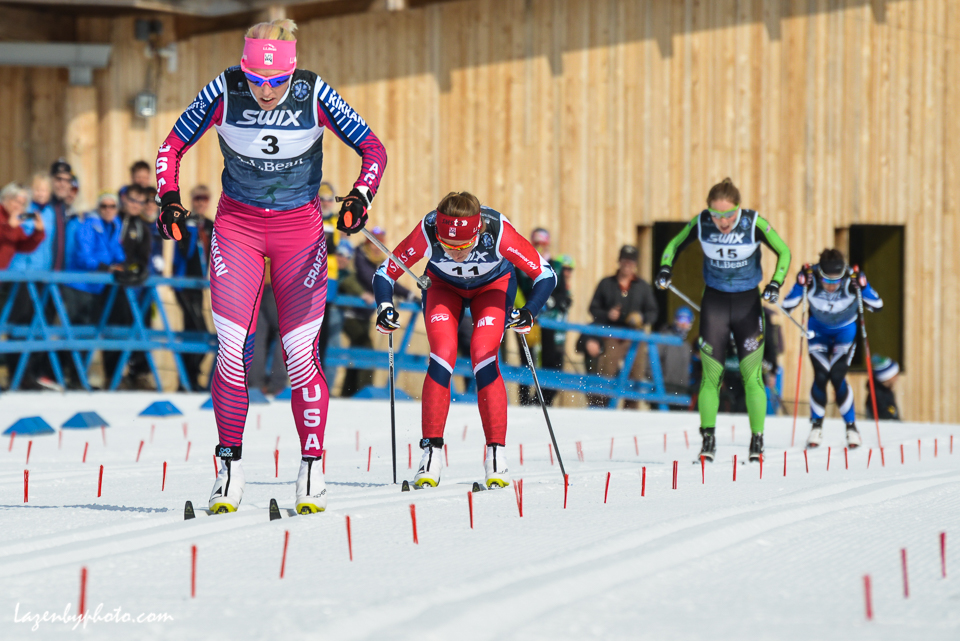
    March 2018: Kikkan Randall (3) racing for third place in the women’s 30 k classic mass start at 2018 U.S. Distance Nationals in Craftsbury, Vt., ahead of Sophie Caldwell (second from l), Ida Sargent (second from r), and Rosie Frankowski (r). (Photo: John Lazenby/Lazenbyphoto.com)

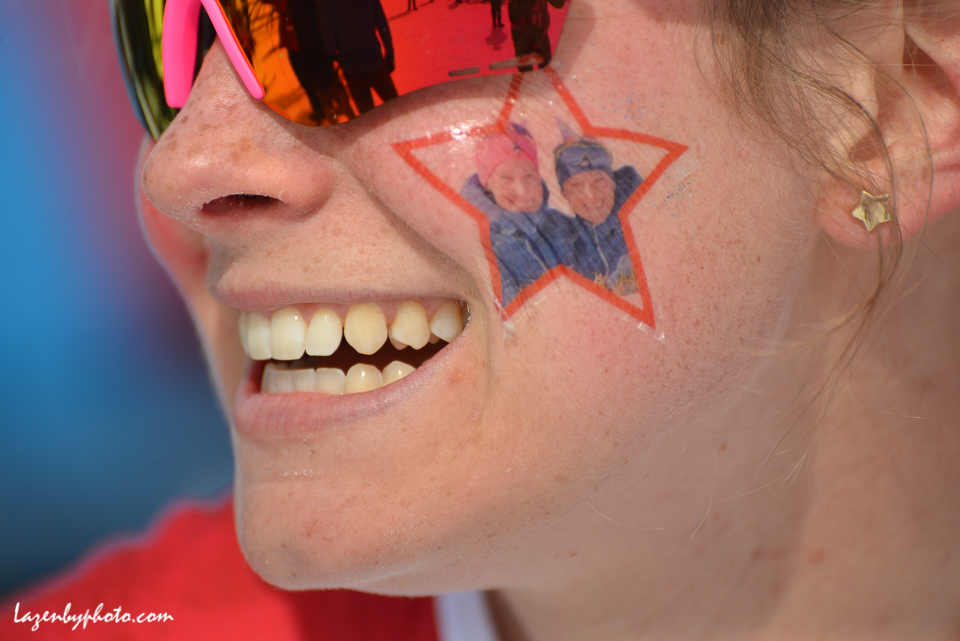
    Honorable mention, face paint edition: This remarkable evocation of Randall and Stephen on Diggins’s left cheek at Spring Series.

    March 2018: Jessie Diggins with a photo of her retiring U.S. Ski Team teammates Kikkan Randall and Liz Stephen on her cheek at 2018 U.S. Distance Nationals in Craftsbury, Vt. (Photo: John Lazenby/Lazenbyphoto.com)


    2018/2019: Red, white, and blue, but with larger color blocks. Also, a move to Swix.

    Randall retired. Stephen retired. Randall got breast cancer. Randall was treated for breast cancer. Diggins worked hard to — successfully — bring a World Cup ski race to Minneapolis. And the Americans kept racing in red, white, and blue, albeit now with a move from Craft to Swix for the suit manufacturer. This year’s interpretation of the theme brought a shift to white as the dominant color, with blue through the torso and upper legs, as well as on the arms. Red was the least-pronounced color this year, limited to accents alongside the larger blocks of blue.

    While the Americans continued their perhaps now-accustomed success at the World Cup level, American juniors served notice at World Juniors that they were a force to be reckoned with, taking a gold in the men’s relay, a fourth in the women’s relay, two fourths in classic distance races, and multiple other top-tens. Here are two shots from a frigid Lahti:

    January 2019: Luke Jager (middle left, hands in air) after tagging off to Ben Ogden (bib 2, middle right, pink hat) in the U20 men’s 4 x 5 k relay at Junior Worlds in Lahti, Finland. (Photo: Doug Stephen)


    January 2019: Kendall Kramer on her way to fourth place in the U20 15 k classic mass start at World Juniors in Lahti, Finland. (Photo: Doug Stephen)

    Back to the World Cup (where senior athletes wore the same uniform shown above on the juniors for the regular season), 2019 World Championships, in Seefeld, Austria, brought something new. The dominant hue in the race suit was now blue instead of white, and the large color blocks of the 2018/2019 World Cup regular season were gone. White stars were added to the lower left leg, making the evocation of the American flag far more apparent. Red and white stripes, on the right arm, continued the vexillological theme. While the four sponsor logos on the legs remained the same (Bose, Xfinity, Visa, and Toyota), the Swix logo shifted from the lowest position on the left leg to the middle position on the right.

    A Swix press release about the new suits advised: “Featuring bold stars and sharp American colors, the focus was on visibility in mass start events and an iconic look.”

    February 2019: Rosie Brennan races in Seefeld.

    Honorable mention: Bare arms and cutoffs. It was hot in Seefeld. Like, over 50° F hot. Erik Bjornsen raced the 15 k classic with nothing underneath his race bib (sun’s out…), attire typically befitting Eagle Glacier in July more so than Austria in February. Brennan raced the relay with only a t-shirt on top, and no gloves. And Jessie Diggins drew widespread attention for her DIY cutoff look for the relay (which still featured the iconic relay socks, albeit rolled down so they wouldn’t counteract the shorts by covering most of her lower leg).

    As Diggins later wrote on her blog a month after World Champs: “Let me start by saying this; no, I was not cold racing in shorts and short sleeves, yes, you should try it sometime, and yes, it was refreshing to have the cold slush hitting my legs! Somehow, the sight of me racing in a short suit was more interesting and befuddling to most reporters than the actual race itself. Clearly, they haven’t ever experienced a Minnesota cold snap. Now THAT is cold weather! … Honestly, it’s hard to describe the amount of distress overheating puts me in, but let me put it this way; racing is already one of the most painful things you can do. If I have to deal with being incredibly uncomfortable, dizzy, and feeling my body start to shut down because I’m way too hot, it becomes even harder to continue pushing my body to the limit, because it’s already that much closer to the limit! And besides, everyone needed the laughs by the time we got to the end of the races.”

    Erik Bjornsen of the U.S. skiing to 17th overall during the 15 k classic at the 2019 World Championships in Seefeld, Austria. (Photo: John Lazenby/lazenbyphoto.com)


    Rosie Brennan of the U.S. during the third leg of the 2019 World Championship 4 x 5 k relay in Seefeld, Austria. (Photo: John Lazenby/lazenbyphoto.com)


    Custom race suit for Jessie Diggins of the U.S. She anchored the fifth place U.S. team during the 2019 World Championship 4 x 5 k relay in Seefeld, Austria. (Photo: John Lazenby/lazenbyphoto.com)


    2019/2020: Candy cane stripes!

    Finally, the start of this season brought the dawn of what has variously been called the “candy cane stripes” or “barber pole stripes” suit (#wellactually a barber’s pole historically has alternating red and blue stripes, not just red stripes as on the current U.S. suit). The left leg features red and white stripes, in a color-appropriate rendition of the American flag. The right leg has white stars on a blue background, again in patterning true to the actual flag. The stars are repeated on the left arm, and the stripes are briefly evoked on the right.

    The car sponsor has once again changed, this time to Land Rover.

    Here’s Kelley Roche, Soft Goods Product Manager for Swix Sport US, explaining the backstory for this year’s suit design in an email to FasterSkier: “Swix worked with Garen Riedel who owns his own design firm, Riedel Creative in New York. Garen worked closely with the athletes to design a suit that graphically works and they were excited to compete in. The goal is to design a suit that you can pick out of the pack and immediately and know it is a US athlete! This is important for the fan but really important for the coaches who support the athlete during the race. We ended up going with an asymmetric design, a continuation of the Seefeld suit design from 2019 and a retro reference to some of the suits of old, leveraging the iconic and patriotic American flag color palette with a slight color fade across the body.”

    Roche added that the suit itself is made out of mesh, which in addition to being flexible and breathable “acts like  dimples on a golf ball, balancing the lift and drag of the athlete.”


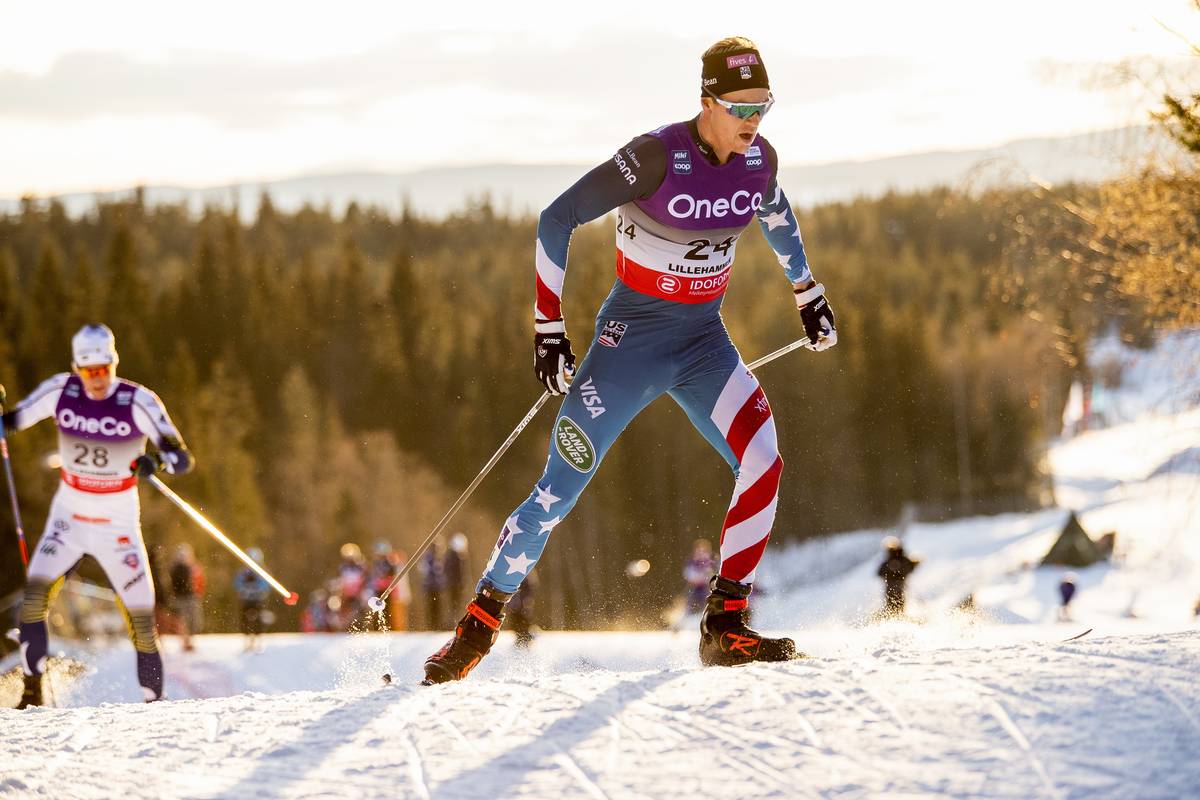
    December 2019: Erik Bjornsen during the skate leg of the 2019 30 k skiathlon in Lillehammer, Norway. (Photo: NordicFocus)


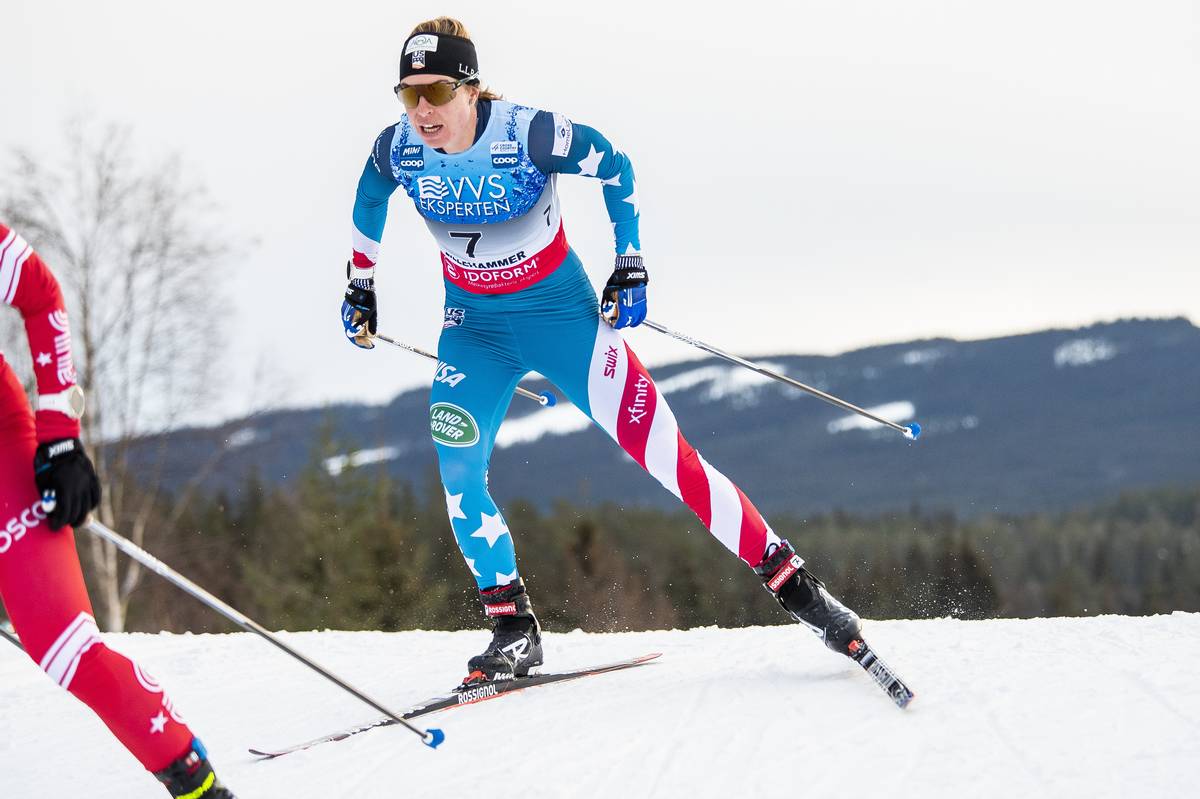
    December 2019: Lillehammer, Norway (NOR): Rosie Brennan (USA). (Photo: NordicFocus)

    We’d like your thoughts on the suits. Here’s a google form/survey about the U.S. Ski Team’s suits over the past decade or so.

    If you have read this far: For one, congratulations. For another, there is a wealth of historical material available in the FasterSkier archives. If you would have any interest in future compilations with a different focus — American biathlon, say, or best and worst of domestic American race suits over the past decade — please comment below, or email the author directly: gavin (at) fasterskier (dot) com. Thanks, and thanks for reading.

  • Skiers Running Fast: Four Skiers Break 3 Hours in NYC Marathon

    Skiers Running Fast: Four Skiers Break 3 Hours in NYC Marathon

    https://www.instagram.com/p/B4asgDrgDRA/

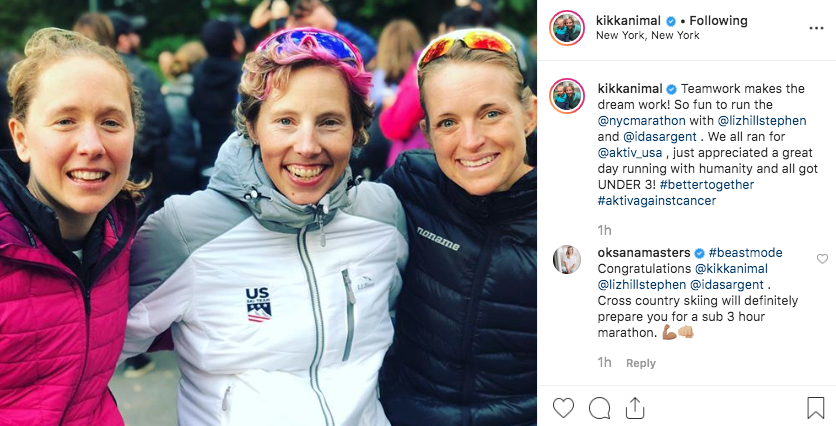
    FasterSkier previously reported on four boldface names, former Winter Olympians all, who were planning on racing the 2019 New York City Marathon: Brian Gregg, Kikkan Randall, Ida Sargent, and Liz Stephen. Gregg had announced plans to run a 2:40 to 2:45 marathon. The three women were all planning to break 3 hours. All four runners met their goal.

    In chronological order:

    Brian Gregg logged an official time of 2:44:30 (all times discussed in this article are chip times; in a field of 50,000, it takes even top-1,000 finishers some time to reach the starting line, making the gun time somewhat unfair), meeting his goal with 30 seconds to spare. He was 336th among 30,000-plus men, and 360th overall. He went through the halfway mark in 1:19:37 before slowing somewhat over the final miles.

    Kikkan Randall crossed the finish line in 2:55:12, good for 51st woman (out of nearly 23,000 women) and just inside the top thousand overall (990th). She exhibited textbook pacing, recording a half-marathon split of 1:29:09 before speeding up over the final miles. Her slowest mile after the 20-mile mark was mile 22, which took her 6:41. She ran mile 26 in 6:21, and the final 0.2 miles at a 6:18 pace.

    Liz Stephen ran nearly the entire race with Randall and Sargent; she and Randall had the same time through mile 25. At that point Randall pressed ahead slightly, putting 25 seconds on her friend and teammate by the finish line. Stephen ran mile 26 in “only” 6:35 en route to finishing in 2:55:37. Stephen was 55th among women and 1,031st overall.

    Ida Sargent ran with Randall and Stephen through mile 22 before dropping off the pace slightly. She finished less than two minutes back of Stephen in 2:57:22, good for 75th woman and 1,209th overall.

    New York Road Runners reports that the average finishing time for the 2018 NYC Marathon was 4:40:22.

    Among Randall’s copious media appearances in the days leading up to Sunday’s race, she appeared on Ari Ofsevit’s BirkieGuide.com Podcast, along with Brian Gregg, early last week. Gregg at one point discussed his transition to running for the marathon buildup, then frankly observed, “Running is hard.” Randall concurred, “Amen!”

  • Kikkan Randall Joins the Sub Three Hour Marathon Club One Year Post Chemotherapy

    Kikkan Randall Joins the Sub Three Hour Marathon Club One Year Post Chemotherapy

    Statistically speaking, only 2% of people who enter a marathon will finish under three hours. The 2019 TCS New York City Marathon was a bit above average, with nearly 3% (1,563 of  53,508 runners) breaking the elusive three hour barrier. Yesterday, four familiar cross country skiers joined the speedy club of athletes who have achieved this result. 

    Brian Gregg was first across the line, stopping the clock at 2:44:30 (6:17 per mile average). Next came a trio of Kikkan Randall, Liz Stephen, and Ida Sargent who worked together until the final miles. Randall finished in 2:55:12 (6:41 pace) followed by Stephen who was just 25 seconds behind. Fading behind her former teammates as they cruised through Central Park, Sargent made her way to 67th Street in 2:57:22. 


    A lot has changed for Randall since the 2018 TCS New York City Marathon where she stood in the crowd watching Stephen run by wishing she were out there too. FasterSkier caught up with Randall shortly before she headed to New York from her home in Penticton, BC to reflect on her experience with cancer treatment, marathon training, and what lies ahead now that she is back to feeling strong and healthy. 

    Randall was diagnosed with Stage 2 breast cancer in June of 2018 after discovering a lump in her breast on Mother’s day. She underwent six rounds of chemotherapy from July to October, followed by a lumpectomy in November. She continued to receive infusions of the Herceptin infusions every three weeks through July 2019 to stop the proliferation of the cancerous tissue. Though she is now finished with treatment, she will remain on anti-hormone medication for the next five to ten years to reduce the likelihood that the cancer will return. 

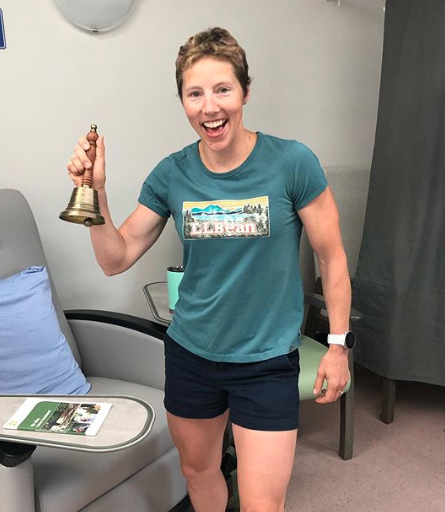
    Kikkan Randall rings the bell marking her final Herceptin infusion in July 2019. (Photo: Instagram @kikkanimal)

    In her typical fashion, Randall stayed active and positive all the while. With the support of her medical team, she explored the boundaries of what was possible physically during treatment. She explained that her doctors told her, “If I felt good, go for it.” And she committed to staying active, even if it was just for ten minutes each day or as simple as playing with her son, Breck. 
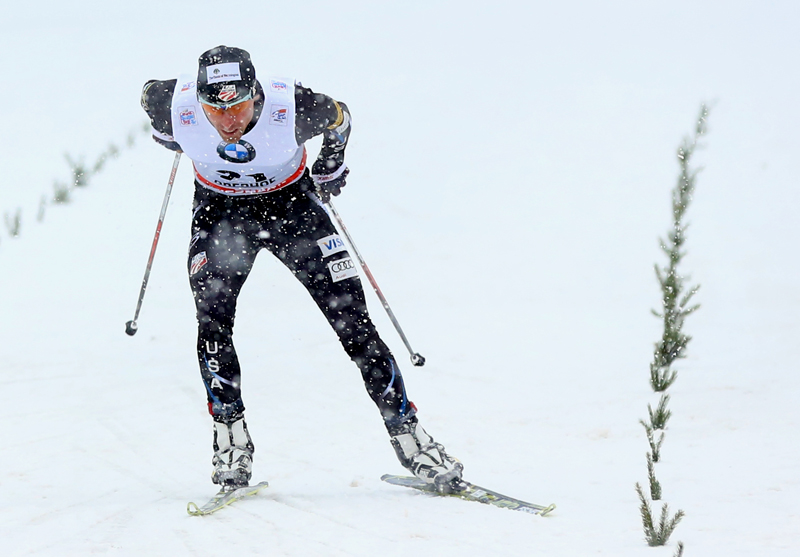
    Randall shared her journey openly throughout in order to inspire and encourage others going through similar challenges. She posted daily video updates for the first five months of her treatment on her website and continues to share her experiences through her Instagram and other social media outlets. 

    “I think back to where I was a year ago and I just feel incredibly grateful for how good I feel and the fact that everything has gone so well,” said Randall. “ Now I’m just staying optimistic that it’s going to stay that way.”
    Randall explained that it is difficult to say whether her experience with treatment and how her body responded was what she expected.

    “Cancer is something I really never had on my radar until I was getting that diagnosis. So not knowing what to expect, chemo was for sure the hardest part of it. It just knocks you down. It knocked my immune system down and I felt fluish between rounds. Overall, I still think I faired fairly well.”
    She continued that she was relieved to be finished with chemo last October. As the lumpectomy was a minimally invasive surgery, she was able to recover quickly and began to feel as though she was getting back on her feet, despite continuing with radiation. 

    Kikkan Randall models her positivity through cancer treatment, heading into a lumpectomy “with good vibes”. (Photo: Instagram @kikkanimal)

    “Some people said, ‘Oh, you’d be surprised how tired you get.’ So I was ready to be heavily fatigued and set up my lifestyle around the fact that if I needed to sleep a lot and not be accountable to too much, I was ready to do that. But I actually had the opposite effect. 

    “I was getting further from chemo, so feeling better and better as I went through radiation and I was in Anchorage, so I was able to ski a lot which was awesome. I did a 10k ski race the second to last week [of treatment].”

    That is not to say Randall was immune to the effects of seven months of cancer treatment. 

    “I think by the time I got to the Birkie and did that, I didn’t feel awesome in the race. I felt like my legs were just really empty and I didn’t have a lot of power climbing on the hills. I think that was maybe the point where I went, ‘Oh, maybe there is a little bit of lingering fatigue.’ It wasn’t like I could barely make it through the day, it was just when I went to access that gear that I’ve always had, it just wasn’t quite as strong as I was used to.”

    Randall finished 12th female in a time of 2:48:19.4. 

    Her version of retirement has not seemed to involve the change of pace one associates with the word. At the cessation of her treatments, Randall hit the gas, resuming her involvement in organizations like Fast and Female as well as saying “yes” to many speaking opportunities. This has created a busy schedule laden with frequent travel. Randall explained that she is navigating how to balance these opportunities alongside her desire to stay active and also have quality time with her family. 

    “For so much of the last 20 years, I had to be so in tune to getting enough sleep and rest so that every moment that I was training was effective. Now it’s more about, if I can exercise, it’s a bonus. I ultimately want to keep myself healthy, but that’s kind of a baseline, and there’s a lot of other responsibilities now.” 

    She continued that since training is no longer her primary focus, she is less concerned about the recovery aspects of her former lifestyle. She does not dwell on staying up late before waking up early if it means creating time for her family or other responsibilities.

    “Which I think in some ways has come back to bite me,” Randall laughed. “I appreciate now why we take such good care of ourselves as athletes, why we get enough sleep, and have good nutrition, because it makes you feel so much better. So when I let myself get busy and don’t focus on that as much, after a week or two I start to feel it and snap back around.” 

    Randall expressed gratitude for the many intriguing opportunities she has been presented, from motivational speaking events to podcasts to traveling to China and hopping into a city sprint event on the streets of Beijing. Case in point: at the time of the call she had recently returned from the U.S. Ski Team Gold Medal Gala in New York City only to return the following week for the marathon. She acknowledged that she does not aspire to always be this busy, but after being somewhat on lockdown through treatment, she was “excited to finally do things again.”

    She went on to describe the very relatable experience of fitting in her marathon training around all of this travel. One noteworthy experience took place this summer aboard a Royal Princess cruise ship. Randall was a guest speaker on the cruise from Vancouver to Ketchikan.

    Kikkan Randall runs laps around the deck of a Princess Cruise ship to fit in her marathon training while on board as a motivational speaker. (Photo: Instagram @kikkanimal)

    “I had to do my two-hour long run on the track around the deck, which wasn’t ideal but it’s the way I fit it in. I’ve been getting up at 5 am to get in workouts before I travel or before a day of appearances. I’ve just been trying to be creative — it hasn’t been ideal, but it’s been good enough.”

    The TCS New York City Marathon on behalf of Aktiv Against Cancer has been on Randall’s radar for quite some time. She explained that her affiliation with Aktiv began in 2012 when the U.S. Ski Team was racing in Oslo, Norway. The organization invited Randall to an event and each subsequent year, the USST would go to partner hospitals in Oslo and workout with cancer patients in the exercise rooms that Aktiv funded. 

    “When I learned about the organization, I really believed in what they’re doing and that’s getting physical activity to be a prescriptive part of treatment, because I’ve learned through several experiences is a great way to deal with challenges… It was always incredibly inspirational and powerful to see the camaraderie [the patients] developed.”

    Because of these experiences, she and her teammates, Liz Stephen and Ida Sargent, who were all slated to retire at the end of the 2018 season committed to racing that fall.

    “That was the plan last spring when I came out of my career, then the co-founder of Aktiv actually called me and told me that were having an awards luncheon a couple days before the marathon and wanted to honor me with an award for the work that I had done.”

    Randall accepted this invitation and expressed that she would be humbled by the award. 

    “A couple of weeks later, I got my cancer diagnosis, which was completely out of the blue. So I called them back and said, ‘You know what? I think our connection just got a lot deeper. I’m about to start treatment, so I’m not sure what’s going to happen, but I hope to be able to come to the luncheon.’”

    Randall entertained the idea of still trying to run the marathon despite being in treatment, but quickly realized after a couple of rounds of chemotherapy that it would not be smart to push herself in that way. She still attended the luncheon and spectated to support Stephen in her run.

    “It was so inspirational to see so many people out there running and at that point I had just finished chemotherapy, so it was just a chance to watch the racers come in and think, ‘Okay, next year I want to be back here. I want to be racing. I’m just going to believe that I’m going to be feeling good again.”

    This optimism motivated her to raise money for Aktiv throughout her treatment. 

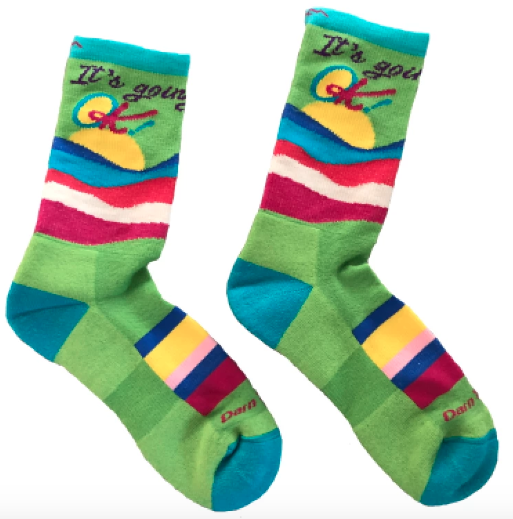
    “Along the way when I was going through treatment, I was wearing these brightly colored running shoes to remind myself to stay positive and hopeful through the process, and my husband came up with the idea to come up with some happy sock that would capture that same idea and be something we’d be able to pass out to other people going through a challenge.” 

    Kikkan Randall raised over $10,000 for Aktiv Against Cancer through the sales of her “It’s Going to Be OK” socks, made through a partnership with Darn Tough. (Photo: Instagram @kikkanimal)

    The couple came up with the slogan, “It’s going to be OK” with a signature hot pink K. They collaborated with the Vermont based company Darn Tough to design brightly patterned socks and with USST sponsor LL Bean to create blue and pink headbands, which were sold through Randall’s website. $2 from each purchase goes to Aktiv. 

    “Through that project, we’ve been able to raise over $10,000 for Aktiv. We’ve sold over 5000 pairs of socks. It’s been so cool to see that these socks have been giving people hope.” 

    Though running often accounts for many hours of a yearly ski training program, Randall had not been spending much time on the roads during her career and consequently entered a marathon training program cautiously.

    “I knew that the biggest thing to respect for the marathon was going to be getting enough running in — getting my legs ready to handle the pounding. And I knew that this would be quite a bit of an increase [in running volume] from what I had been doing in ski training.”

    She contacted her former high school running coach who wrote her a training plan and began to slowly increase her mileage beginning in April.

    “That’s been really helpful because I think it’s built up at an appropriate progression. And because I was able to stay pretty close to that plan all the way through, and I’ve made it through without any injuries — knock on wood.”

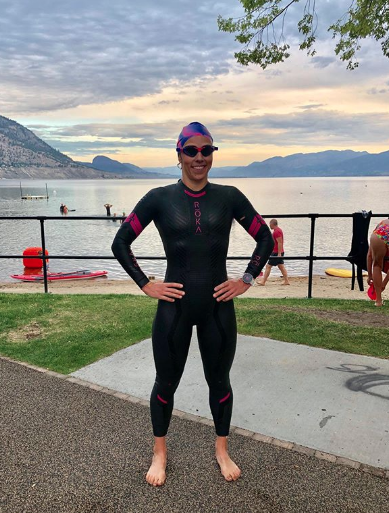
    Kikkan Randall completed a one mile open water swim across Lake Washington in Seattle to on behalf of Swim Across America. (Photo: Instagram @kikkanimal)

    While long runs and track workouts have largely taken the place of the multisport nature of her former regimen, Randall has continued to dabble in other physical challenges throughout her marathon buildup. At the beginning of September, Randall traveled to Seattle for a one mile open swim across Lake Washington with the organization Swim Across America, which raises money for cancer research and clinical trials through the Seattle Cancer Care Alliance. 

    Since this event, Randall has locked eyes on the marathon, even dropping the regular strength training sessions she completed until early October. As a test of her fitness, she ran the Okanagan Half Marathon on October 20th, taking the win for women with a time of 1:23:47.

    She has enjoyed the new challenge, but will also be happy to vary her modes of exercise. 

    “I have to say — I’ve rollerskied three times this summer, and each time, I was like, ‘Oh my gosh, I love this.’ Because I’ve been prioritizing the running training, I haven’t been on rollerskis as much, I haven’t been on my mountain bike as much, so I miss that and I’m looking forward to getting back to that before the snow flies, then ski a lot this winter.”

    What’s next on Randall’s athletic calendar after the marathon? She explained that she is hoping for a few new ski experiences this year, possibly including the Ski to the Sun race in Mazama, Washington, which last year was raved about by winner Liz Stephen. Randall is also interested in returning to the Birkie to see what she could do in good health. 

    “Then next summer, trying some new things — maybe an off-road triathlon or a mountain bike stage race or something fun. I do love racing, I love preparing for things, and I am loving these events where I get to meet up with teammates and friends and get to go out and hurt so good.”

    Kikkan Randall gets out for a ski with her son, Breck. (Photo: Instagram @kikkanimal)

    Ski racing aside, what Randall is looking forward to most is spending quality time with her husband and son. 

    “I’m just excited to be out on the snow with my family this winter. Breck is three and a half, so he’s excited to get out on snow.”

    Though Randall could not have predicted the turn of events that unfolded after her retirement, the opportunity to inspire others through her cancer journey is aligned with how she originally envisioned using her gold medal platform.

    “Coming off my career, I had hoped to be active in different causes and bringing awareness to the power of positivity and a lot of things that I learned through my athletic career that can be applied to the things we tackle in daily life. I thought it was going to center more on being a mom, training through pregnancy and coming back after, and how to balance being an athletic mom. I also was heavily involved with Fast and Female, so it was going to be focused on keeping girls in sports, and my position with the IOC. 

    “Now I have this cancer experience thrown into the mix as well. I’ve always enjoyed being able to share my stories of what I’ve learned through my ski career to help motivate and inspire others, so I had hoped to do some public speaking and I’ve had some really cool opportunities since I finished treatment to be out sharing my experiences, both as an Olympic athlete and as a cancer survivor now and as a mom.”

    Randall plans to continue accepting motivational speaking positions, remaining involved with the IOC and U.S. Olympic and Paralympic Committee (USOPC), and collaborating with her partners. 

    She also hopes to stay involved in cross country skiing in a more hands on level. This summer she had the opportunity to work with a few junior programs, including the national junior camp in Park City. She is also on the board of the National Nordic Foundation (NNF). 

    “I’ve got a lot of different balls in the air right now and a lot of fun projects to be involved with, and I’m realizing that there is a limit in what is physically possible, especially with things that involve so much travel. I think over the next couple of years it’s going to be finding which opportunities I can make the most impact in and trying to find the right balance.”

  • Full Circle: Ida Sargent Begins Her Next Chapter In the Northeast Kingdom

    Full Circle: Ida Sargent Begins Her Next Chapter In the Northeast Kingdom

    Ida Sargent of the U.S. Ski Team racing in Québec City at the 2019 World Cup finals. (Photo: John Lazenby/lazenbyphoto.com)

    As winter wanes and spring looms, many athletes choose to announce the bittersweet change of their own season of life, retirement from the sport to embark on a new pursuit. This March, after seven seasons on the U.S. Ski Team, 31-year-old Ida Sargent decided the time had come for something new.

    “I knew after Sochi that I wanted to go to one more Olympics,” Sargent told FasterSkier in a call. “So at that point, I committed to another four years and then figured at that point that I would just reevaluate and take it year by year. People had said in the past that you’ll know when you’re ready, and I have to admit that I was a bit skeptical on that and I wasn’t really sure that I would know. But this winter, I was ready. It hit me and I just knew.”

    When she towed the line in Ruka for her first World Cup of the season, the classic sprint where she took 27th, she was not aware that it would be her last year doing so. Her decision to retire was formalized as the year progressed.

    “It wasn’t even until the season started,” said Sargent. “I was still – I had a great training year, I was pretty fired up. But the beginning of the season I was sick a lot, and I found myself looking at plane tickets home more often than I normally do.”

    At a glance, Sargent has competed in two Olympic Games, Sochi and PyeongChang. She started 148 World Cup races with over a third of those starts resulting in a top-30 finish. Known more for her sprinting than her distance skiing, she was top-10 in nine individual sprint events and one distance event. She contributed to two podium finishes in the team sprint with her teammate at both Dartmouth College and the U.S. Ski Team, Sophie Caldwell, once in PyeongChang in 2017 and again in Dresden in 2018. She also landed on the podium individually by taking third in the classic sprint in the PyeongChang World Cup races. Domestically, she has 12 individual wins at SuperTour events or U.S. Nationals, and was this year’s national champion in the classic sprint. Her consistency at the top level throughout her career speaks for itself.

    The women’s freestyle team sprint podium at the PyeongChang World Cup on Sunday in South Korea, with Sweden’s Elin Mohlin and Maria Nordström (c) in first, Norway’s Anna Svensen and Silje Øyre Slind (l) in second, and USA I’s Ida Sargent and Sophie Caldwell (r) in third. (Photo: FIS Cross Country/Twitter)

    While these results and the journey to attain them have been a positive and satisfying experience, life on the road has its disadvantages. As the novelty of the World Cup athlete lifestyle wore off, the transience and singular focus weighed on Sargent and became a significant factor in her decision to step away.

    “I still love the training and I love the racing,” she explained. “But it’s all the time in between the training and racing that I just don’t love – the hanging out in hotel rooms and the time away from home, living out of a duffel bag. That part has been wearing on me, and that was what made me realize that I was ready for a change.

    “And while I still love racing,” she continued, “I just am not quite as driven any more and achieving a goal no longer is quite as satisfying. I think the singular pursuit and focus on just racing is not as engaging as it used to be for me. I’m more excited about a broader range of things and new challenges, all of those combined its becoming quite apparent to me that I’m ready for something new.”

    While she was burdened by this readiness for change, Sargent was cognizant of not seeming jaded, particularly in front of the group of younger athletes, like USST D-Team members Hailey Swirbul, Julia Kern, Katherine Ogden, and Hannah Halvorsen, who were pulled up to compete at some of the World Cup events this season. She wants only to encourage these women as they continue to chase their dreams.

    “I have loved the lifestyle and was so thankful for it at the time, I think it’s just an amazing pursuit,” said Sargent. “I feel lucky to have had the time on the World Cup and on the U.S. Ski Team and going to World Championships and the Olympics. But yeah, for me personally, I’m ready for something new, but that doesn’t mean that those aren’t awesome goals and great trajectories.”

    Sargent has been a member of the U.S. Ski team alongside other women who have contributed to the rise and success of American skiing. While the names and faces are changing, Sargent does not feel the momentum will be lost during this transition.

    “This year has been really exciting actually – we had big retirements last year, losing Kikkan [Randall] and Liz [Stephen] on our team, who are just such leaders,” explained Sargent. “And I think we were all kind of wondering what the energy would be like without those two. But immediately from the first camp of the year, the energy that the young ones – we call them ‘the guppies’, the development team girls – they just brought this new energy. So it’s been fun to see this new crew coming up and to race some World Cups with them this winter and racing here with them. It’s nice to see that amazing energy that they’re bringing up, and it’s nice to know that the work that we’ve laid down is just going to be built upon and that they’re going to bring lots of great success to the team.”

    With highs and lows, the season progressed and Sargent ruminated about her retirement. Surprisingly, her decision was not finalized after persistent illness or races that may not have matched her career best, rather, the resolution came after earning the national title in the classic sprint on the trails she grew up skiing in Craftsbury, VT.

    Ida Sargent takes the U.S. national championship classic sprint title in Craftsbury, VT. Julia Kern in red (USST D-Team/SMS T2) out lunged Hannah Halvorsen in blue to take second place. Halvorsen placed third. (Photo: John Lazenby)

    “I think the day that I look back on and remember when I realized I was going to be done was actually after winning Nationals at home,” Sargent shared. “It was really fun, but I was like ‘I think it’s time.’”

    She had discussed her decision with her sister and her boyfriend, Pat O’Brien, but had not formally shared her retirement more broadly. Her first time sharing the news beyond that was seemingly equal parts disclosure and realization.

    “I think that it was actually just an off-hand comment to a friend who was watching, they were talking about maybe coming up to watch the races in Quebec City,” she recalled. “I was like, ‘Oh, yeah, I think those are going to be my last races.’ I remember saying that and being like, ‘Huh, that feels pretty good actually. That make’s sense to me’. And obviously, I didn’t fully finalize my decision until later, but this year I’ve just kind of known from the beginning and have been trying to embrace all of the opportunities and the team and the amazing lifestyle as much as possible rather than focusing on results at that point.”
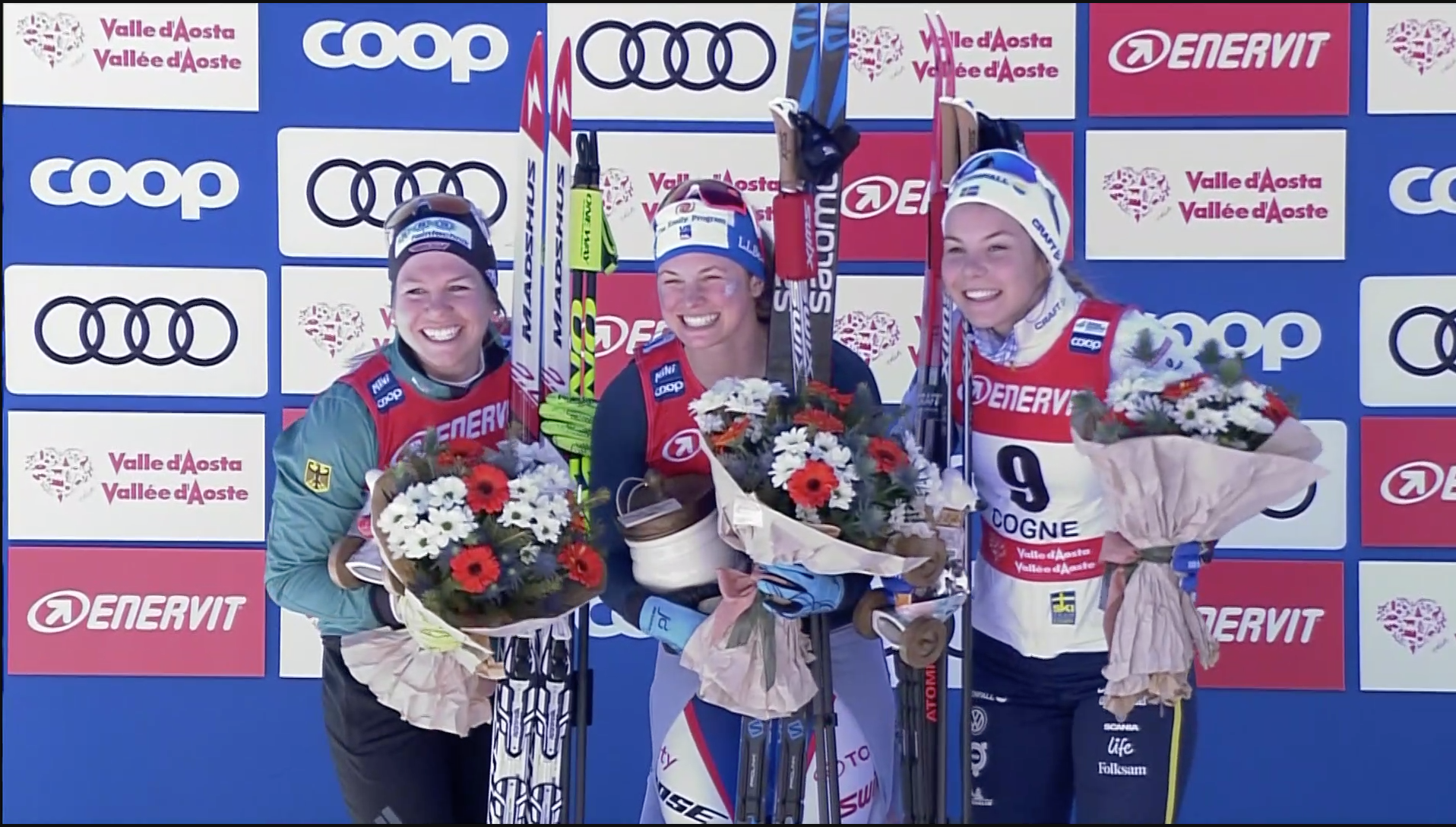
    In almost 23 years of skiing, Sargent remarkably had only two primary coaches. Her first coach was Pepa Miloucheva, who first worked with Sargent from the time she entered the Bill Koch league at Craftsbury and has since become the director of competitive skiing and the head coach of the Craftsbury Green Racing Project (CGRP) team. When she entered high school at Burke Mountain Academy, Sargent began working with Matt Whitcomb, who is now a coach for the U.S. Ski Team. The only time she was not working with either Whitcomb or Miloucheva was during her time at Dartmouth College, where she was coached by Cami Thompson, and even then, she trained in Craftsbury during the summers.

    Ida Sargent hugs her longtime coach, Pepa Miloucheva (CGRP), after racing her final World Cup at the 2019 World Cup Finals in Quebec City. (Photo: Instagram Screenshot @idasargent)

    In her professional career, Sargent has trained with Miloucheva and CGRP throughout the summer, transitioning to working with Whitcomb at USST camps and throughout the winter race season. Sargent attributes the steady progress she made throughout her development into an elite skier to predominantly working with these two.

    “I’ve been very lucky to have a lot of consistency in my coaching,” she explained, “and I think that’s allowed me to make gradual consistent progress throughout my career without having any major changes.”
    While these coaches certainly impacted Sargent’s development, career, and life, her impact on her coaches was equally great.

    “Ida is definitely one of those athletes that’s more like a gift to the coaches, than the coaches are a gift to the athlete,” Matt Whitcomb shared in a call. “She’s one of the few reasons that has made coaching for so long so easy to do.”
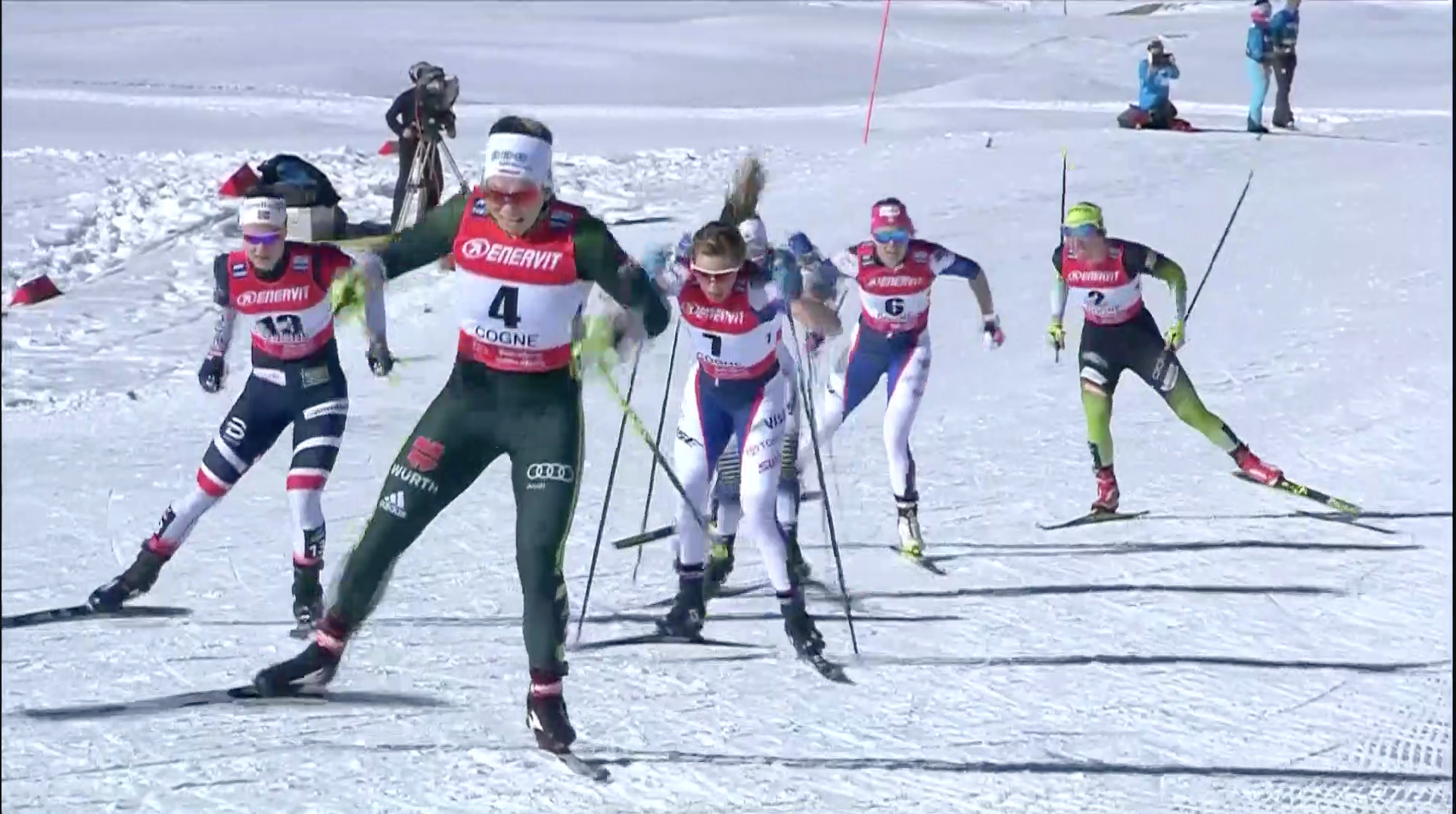
    He added, “People like Ida are so important to the longevity and the well being of the teams that they’re on. So I’m just feeling really lucky as I reflect on her career.”

    Even from a young age, Sargent loved to compete and demonstrated the potential to be great.

    “She really likes racing, she was really fun to work with,” said Miloucheva. “Even when she was really young, she was really really quick with transitions, and she had this ability to accelerate. I knew from a young age that she could be a really good sprinter.”

    Coupled with her natural talent, Sargent is fiercely competitive, but this drive is tempered outside the realm of competition by a genuine care for others.

    revia

    “She was and always has been extremely competitive,” Whitcomb explained. “We laugh about that on our team a little bit – whether it’s a small game in the evening that we’re playing with the team or a World Cup sprint, she’s extremely competitive.

    “What stands out in contrast to that level of competitiveness is that she’s one of the athletes that will always take time to search her surroundings and see how people around her are doing,” he continued. “She’s been one that – before I even knew that I was starting to stress out, she would ask me how I was doing. She just has a good sense for people and an incredible sense of caring.”

    After guiding Sargent from her junior years through her retirement, both Whitcomb and Miloucheva have plenty to be proud of, but the memories the two will look back on most fondly arrived at opposing ends of her career.

    Ida Sargent poses with her longtime coach, Matt Whitcomb, after racing her final World Cup at the 2019 World Cup Finals in Quebec City. (Photo: Instagram Screenshot @idasargent)

    “It’s always fun watching athletes at the podium,” shared Whitcomb. “Ida had three World Cup career podiums, each of which brought a tear to my eye, but perhaps the moment that I was most proud of was just watching her last race. She did not put together the season that she had hoped to, as is often the case with retiring athletes. It is just difficult to stay fast and something was missing a little bit this year. But she crossed the finish line at her last race in Quebec with a fist over her head in celebration that I was able to see from across the stadium. That was probably my proudest moment, just watching the actual conclusion of an athlete’s World Cup career.”

    Miloucheva looks back to Sargent’s youth and to her first World Cup race.

    “When they were young kids, I used to just love when they finish and just look at me and say, ‘Are you proud of us?’” Miloucheva remembered nostalgically. “That was really amazing. I loved when she came from her World Cup and brought me her bib and said ‘Thank you for getting me there.’ It’s all just pretty amazing.

    “It’s still such a great feeling that she got so far,” she continued. “She’s such a great human being.”

    Ida Sargent (bib 46) retired from World Cup racing after Sunday’s race.

    As she reflects back on her own highlights and fondest memories, Sargent sees past her top results to the people with whom the journey was shared.

    “I think looking back, it will definitely be the times we spent as a team just out training and at the races and living on the road – I think that those moments will stand out much more than any race result,” Sargent shared. “It’s that community and having that support system and being part of something bigger than yourself is going to be my lasting memory from the sport. I think that individual pursuit is great, but it’s the community and the inspiration for the younger generations and the teammates who have supported me and I’ve been able to support back… We’ve worked together to build something bigger than just our individual results. That’s what I’ll look back on.”

    In addition to contributing to the rise of women’s skiing on the national team, Sargent has represented Craftsbury during a time where the center has blossomed into a rich nordic ski community. Her love for the center and gratitude for what is has provided her is clear.

    “The Craftsbury community is really a special place,” shared Sargent. “I feel very lucky to have been part of the community there and to continue to be part of the community there. When I was first part of the Craftsbury Nordic Ski Club as a junior or as a young skier, there were probably 10 or 15 of us skiing at any time, but now because of the work that Anna [Shultz, head junior/Bill Koch League coach] and the other junior coaches have done, and Pepa, and just the work of Judy and Dick Dressigacker [who own the center], now there are over 100 kids in the competitive ski programs and almost that many more in the recreational ski programs. So to be part of that is something that I will always be very proud of and something that I am also very thankful for.”

    National champion classic sprint winner in Craftsbury, VT., Ida Sargent gets a hug from her mother Lindy Sargent moments after Ida claiming the title. Ida Sargent grew up skiing in the Craftsbury area. (Photo: John Lazenby)

    While Sargent was served by the Craftsbury community, the community was perhaps equally served by her presence.

    “As Ida is on the National Team, all the younger generation of kids, they can look up to her,” Miloucheva explained. “All the younger kids – everybody knows Ida, and when she’s around and when she goes and skis with them, it’s just such a fun way to have practice.”

    The fruits of Sargent’s hard work have been an inspiration to other Craftsbury skiers, young and old.

    “All the younger kids, for them, Ida is like an idol, even now,” said Miloucheva. “When she announced her retirement, all the younger kids, they’re all so sad about the fact that she’s retiring.

    “The same thing with the masters,” she added. “Everyone knows who she is. She grew up there, it is her home.”

    In the next chapter of her life, Sargent will be heading back to her alma mater, Burke Mountain Academy, where she will teach Biology, Chemistry, and Statistics. She will also live on campus and serve as a dorm parent for boarding students. She does not see herself taking on a major coaching role in the near future, but she does hope to help with the local Bill Koch League to help regrow the cross country ski program in the Burke area. While Burke and Craftsbury are roughly an hour apart, Sargent also hopes to stay involved and to continue to contribute to the community there.

    ventolin inhaler

    “I will continue to be looking for ways to give back to the community or to stay involved even if I’m not living at Craftsbury in the next year or two or wherever I end up,” said Sargent. “I think that extends beyond just the Northern Vermont community to greater Vermont and New England and just the entire US ski community. It’s a small sport, but we’re all very close, and I think it’s a very supportive community, and together – there’s so much individual energy that combined, we can create something bigger than just all of those individual skiers.”

    The Craftsbury community will certainly welcome Sargent back with open arms in whatever capacity she chooses to stay involved.

    World Cup and USST skier Ida Sargent, home for the holidays and the Tour de Ski break, high fives a BKL lollipopper after the lollipop run. NENSA Eastern Cup. (Photo: John Lazenby)

    “I still hope that she’ll be back,” said Miloucheva optimistically. “She’s going to have her job at Burke, but she’ll still be visiting, she’ll still be working with the younger kids, she will still join us for some workouts, especially when I need her to push a little bit of speed for the other athletes.”

    Finally, Sargent left young skiers with some advice on their journey in the sport based on her own experiences. As Alayna Sonnesyn illuminated earlier this year, after high school, the “pipeline” to making the national team or the Olympics can be difficult to navigate. Sargent explained that the path doesn’t need to be as linear as one might think.

    “The advice that I would give to young skiers is that there is no one right way to do it. If you start on one path, that doesn’t mean that that is the ultimate path that you’re going to take, it’s easy to do one thing and then if that’s not working or is not what is best at that moment, switch and do something else. After high school, I thought that I wanted to ski full time and wanted to make the national team and just wanted to do that solely and I wasn’t that interested in going to college.

    “So I took a PG year at Burke,” Sargent continued. “But once I was actually trying to train full time, I realized that I wasn’t quite ready to do that. So after one PG year, I went to Dartmouth and raced for Dartmouth for three years. In my junior year, I made the US Ski Team and then finished out my college career with more part-time college, and then became a member of the Craftsbury Green Racing project and have been training with Craftsbury and the national team since then. So I guess I did the PG year, I did full-time college, I did part-time college and full-time skiing over the course of my career and I think that was what was best for me at those times.”

  • Saturday Race Rundown

    Saturday Race Rundown

    Women’s podium from the Falun, Sweden 1.4 k skate sprint. From left to right, Maiken Caspersen Falla of Norway in second, Stina Nilsson of Sweden in first, and Maja Dahlqvist of sweden in third. (Photo: @fiscrosscountry Instagram screenshot)

    FIS World Cup Falun, Sweden 1.4 k Freestyle Sprint

    On a day when sugary snow course picked off skiers trying to advance during Falun, Sweden’s 1.4-kilometer freestyle sprint, Stina Nilsson, yes of Sweden, took the win. She won the final in 3:07.72 over Norway’s Maiken Caspersen Falla  in second (+0.67). The day’s top qualifier, Maja Dahlqvist, placed third (+2.14).

    The Americans entered in the race were some of the key players who tumbled on course. Jessie Diggins (USST) qualified in 21st and was leading the second quarter final when she fell on a sugared downhill to place 28th overall. Both Sadie Bjornsen (USST), ranked fourth after qualification, and Sophie Caldwell advanced to the semis.

    Caldwell took a belly slide on the the course’s funky downhill to place sixth in her semi and finish 11th overall. In the second semi, Bjornsen was eliminated after placing fifth. She finished 10th overall.

    ponstel online

    Also for the U.S., Julia Kern (USST) placed 34th, Ida Sargent (USST) 37th, Rosie Brennan (APU) 53rd, and Kaitlynn Miller (CGRP) 61st.

    Results

    In the men’s 1.4 k skate sprint, Norway’s Johannes Høsflot Klæbo continued his winning ways with another sprint victory. He won the final in 2:52.38,  0.1 seconds over teammate Emil Iversen. Another Norwegian, Sindre Bjørnestad Skar, placed third (+0.28).

    U.S. skier Simi Hamilton (USST), who qualified in 16th, bowed out in the quarterfinals after placing fifth in his heat. Hamilton was 22nd overall. Kevin Bolger (USST) advanced to the heats where he was eliminated to end up 27th overall.

    Also for the U.S., Logan Hanneman (APU) placed 39th, and Ben Saxton (SMS T2) was 60th.

    Alex Harvey of Canada ended his race in 31st. He was the only Canadian entered.

    Men’s Results


  • Falla Locks Up Drammen Sprint; Diggins Strides to Fifth

    Falla Locks Up Drammen Sprint; Diggins Strides to Fifth

    Falla in first for her fifth Drammen sprint. (Photo: NRK screenshot)

    The World Cup entourage gathered Tuesday at the head of the Drammensfjord in Norway. The 1.2-kilometer classic sprint in Drammen, Norway — the post-Holmenkollen sprint stop on the calendar — was held under overcast skies and within a city center jammed with fans.

    Coming into Tuesday’s classic sprint, Norway’s Maiken Caspersen Falla had claimed two individual World Cup sprint victories this season and a World Championship sprint win in Seefeld, Austria. Falla remains consistent, having won three of the last four sprint globes. And she’s a lock in Drammen. She has won four of the last five Drammen city sprints —  2014, 2015, 2016, and 2018.

    As we bring the Americans into the story, the benchmark for qualification time was again set by Falla. Sadie Bjornsen of the U.S. Ski Team (USST) was the fastest American qualifier in eighth place. She was 3.32 seconds behind Falla, who completed the course in 2:49.90 minutes. Jessie Diggins (USST) qualified in 18th (+4.65), and Sophie Caldwell (USST) was 20th (+4.99).

    With the heats progressing, Diggins moved to the finals after placing second in the fifth heat and winning the second semi-final. Her semi-final lunge at the finish was a blur along with the three other skiers she was synced with across the line. There was a four way photo finish won by Diggins as she advanced to the finals.

    “That was really fun today,” Diggins emailed, “I’m so grateful and appreciative of the techs for giving me very competitive skis. Drammen is kind of a funny course, and this year they took away the iconic uphill pitch at the finish, so it was even harder to determine the right moment to transition from double poling to power striding on the gradual uphill! It’s not a secret that I love workable downhills so my strategy each heat was to ski smooth and smart and get myself into an open lane heading into the finishing straight.”

    Jessie Diggins of the U.S. Ski Team lining up for the finals in the Drammen , Norway classic sprint. (Photo: NRK screenshot)

    The six-across in the start gates for the finals were Diggins, Stina Nilsson of Sweden, Falla, Natalia Nepryaeva of Russia, and Norwegians Astrid Uhrenholdt Jacobsen and Anna Svendsen.

    With steady snowfall, Falla set the follow-me-if-you-can pace as the course ascends and then drops in a series of tight and sinuous turns back to the course low point. Falla led throughout. Driving on the ups and leading a four skier line snaking through the downhill. As she descended, Falla kept a small gap on those trying to draft behind which included Nilsson, Jacobsen, and Nepryaeva.

    A tight left-hander at the low-point is where Nilsson strategically slotted in and step-turned ahead of Falla, as she took the initial lead on the long incline to the finish. By then, Diggins and Svendsen had fallen off the pace.

    Nilsson double poled and then strode on the right, with Jacobsen on her tails. In the adjacent lane to the left, Falla notched into her double pole gear and began moving ahead. Her power maxing out, Falla gained centimeters then a bit of breathing room that became a few meters. Jacobsen, sensing her moment and a Nilsson power lapse, moved to her own lane and surged into second. As Nilsson faded, Nepryaeva kept enough reserves for the end as she barely took Nilsson at the line.

    Maiken Caspersen Falla of Norway getting a small gap on Sweden’s Stina Nilsson in Drammen, Norway (Photo: NRK screenshot)

    Falla crossed the line in 2:56.12 for the top podium step. Make it five out of six in Drammen for headlines like “Falla Wins!”

    “I think my technique is good for the climb before the finish line, my upper body is strong that is why this course fits me so well,” Falla told the International Ski Federation (FIS) after the race. “It is definitely one of the highlights of the season. It is such a great atmosphere. You can really feel the energy and the cross-country spirit. Yah, it is very good.”

    Jacobsen placed second (+0.80) after qualifying in fifth, with Nepryaeva in third (+1.06). Nilsson was fourth (+1.28), Diggins fifth (+5.38), and Svendsen sixth (+7.59).

    It was Jacobsen’s second podium of the season, the other coming in the 10 k freestyle in Ulricehamn, Sweden. She earned Her last World Cup sprint podium in March of 2016, in Canmore, Canada.

    For Nepryaeva, it was her second sprint podium this World Cup campaign with ramifications in the overall World Cup standings. Leading the overall is Norway’s Ingvild Flugstad Østberg with 1329 points. She did qualify for the heats but did not advance to the semis, finishing 19th overall. With her third place today, Nepryaeva now sits two points behind Østberg 1327 points with five races remaining.

    While racing to a fifth place on Tuesday, Diggins currently sits fifth in the overall World Cup. This was her first race after the conclusion of the World Championships in Seefeld, Austria. Both Diggins and Bjornsen sat out the Holmenkollen 30 k classic on Saturday to recover.

    where to buy vancomycin online

    where to buy vancomycin online

    “In the final I simply got tired from the short turnaround time you get from the second semifinal, but overall I was really happy with the whole day and how I executed my process-oriented goals of efficient and decisive ski testing in the short course opening window, a powerful double pole and ripping downhills, and just having fun and enjoying the atmosphere,” Diggins wrote. “As it turns out, the reminder to actually have fun IS a necessary goal this year with increased pressure, but I’ve decided that if I don’t let outside pressures dictate the joy I feel for the sport and in racing, then I can just relax and enjoy doing what I love best!”

    Bjornsen was eliminated in the second heat. Nilsson won the heat in 2:54.37, with Bjornsen placing fifth (+2.69). Bjornsen finished 21st overall. 

    “Exciting, and frustrating sprint here in Drammen,” Bjornsen explained in an email. “I sat out Holmekollen last weekend in hopes of saving some energy for the final push of the season. My body is feeling good, I just wanted to make sure I didn’t try to do too much and end up sick or tired.”

    The course’s uphill finish requires stout double pole capacity. Bjornsen felt that was a positive asset in Drammen.
    “I have been feeling really good in double pole this season, which helped me have a good qualifier here to start the day out,” she continued. “Unfortunately, I kind of struggled to find position over the top of the climb, and then really struggled with that super gradual striding in sprint speed right there at the finish. I was trying to push the DP as far as possible because I know that is my strength, but I just couldn’t keep up in that unique striding. That is something I have been ‘re-reminded’ every season I come here, but this time I am writing it down, and getting it done! So many of our courses now are running or DP, so I forget it is a gear I need until I come here to sprint every year. … I was excited to have great skis out there today, and look forward to putting these great feelings to use the next two weekends! I wish we had more classic sprints coming, but we will have to wait until next year now. Off to Falun for a weekend of skating!

    Caldwell ended her racing after placing fifth in her heat and 24th overall.

    “Drammen has always been a tough nut to crack,” U.S. Ski Team Head Chris Grover wrote in an email. “The finals appearances we’ve had here over the years with Andy, Kikkan, and Jessie have been very special.  Even with diagonal technique control zones, the race remains a double-pole fest.  If an athlete is not one of the best double-polers in the world, they have little hope in Drammen; the race is simply too short, too fast, and too specific in its demands.  The shortening of the course this season, taking out the final steeper classic striding pitch at the finish, placed even more emphasis on double-poling.”

    Those Americans missing the top-30 cut to advance were Ida Sargent (USST) in 34th, Kelsey Phinney (SMS T2) 49th, Julia Kern (USST) 50th, and Kaitlynn Miller (CGRP) 55th.

    No Canadian women entered the race.

    Results

  • Niskanen Wins Cogne 10 k Classic; Brennan 21st

    Niskanen Wins Cogne 10 k Classic; Brennan 21st

    https://www.fis-ski.com/en/cross-country/cross-country-news-multimedia/news/2018-19/niskanen-fahndrich-and-nepryaeva-win-at-cogne-10km-c
    From left to right, Nadine Fähndrich (SUI), Kerttu Niskanen (FIN) and Natalia Nepryaeva (RUS) on the podium for the women’s 10 k classic race in Cogne, Italy. (Photo: Screenshot FIS/NordicFocus)

    World Cup racers in the Cogne, Italy 10-kilometer classic individual start enjoyed blues skies and sunshine on Sunday,  the temperate weather seeming to have carried over from Saturday’s sprint. Winning the women’s race was Finland’s Kerttu Niskanen in a time of 27:24.8. The victory is Niskanen’s second individual World Cup win–her first came five years ago in the Lenzerheide, Switzerland 10 k classic.

    With Sunday’s 10 k the final World Cup regular season race before World Championships, which is set to kick-off next Wednesday, Feb. 20 in Seefeld, Austria, Niskanen explained in a post-race interview with the International Ski Federation (FIS) that she feels ready for the upcoming World Champs competitions. 

    “Some weeks ago, I felt like Seefeld was too far away. I was so tired at the beginning of the season and I had to totally rest,” Niskanen told FIS. “It was not an easy time, watching the TV when others skiers were racing. So, now I feel good and I’m happy to travel to Seefeld.”

    https://www.fis-ski.com/en/cross-country/cross-country-news-multimedia/news/2018-19/niskanen-fahndrich-and-nepryaeva-win-at-cogne-10km-c
    Finland’s Kerttu Niskanen is all smiles after her win in Cogne, Italy (Photo: Screenshot FIS/NordicFocus)

    Starting in bib 22, Niskanen was chasing down the times of Switzerland’s Nadine Fähndrich, who started in bib 16, and Sweden’s Frida Karlsson who started in bib 20. By the time Karlsson came through the halfway point, she was up on Fähndrich, who came through four bibs earlier, by 3.1 seconds. Niskanen, who came through two bibs after Karlsson, was down on the Swede by 3.9 seconds.

    By the 8 k mark, however, Karlsson’s pace had fallen back and Fähndrich’s time led hers by by 10.6 seconds. Niskanen had also gained steam. At 8 k, she was down on Fähndrich by a mere 0.8 seconds. In the next 2 k, Niskanen managed to outpace the Swiss skier, besting Fähndrich by 3 seconds for the win. According to the FIS database, Sunday’s second place finish is Fähndrich’s first individual Top 3 on the World Cup circuit–although she posted the fastest time in Saturday’s sprint qualifier. 

    Following Fähndrich, Russia’s skier, Natalia Nepryaeva, finished third today, 12.6 seconds behind Niskanen. Nepryaeva, who started in bib 52, was 13.2 seconds down on the race leader, Karlsson at the halfway point. By 8 k, she had the third fastest time and maintained that position until the finish. Including Sunday’s result, Nepryaeva has landed on the podium seven times this season, four of those in the 10 k classic discipline. 

    https://www.fis-ski.com/en/cross-country/cross-country-news-multimedia/news/2018-19/niskanen-fahndrich-and-nepryaeva-win-at-cogne-10km-c
    Russian skier, Natalia Nepryaeva skiing to a third place finish on Sunday. (Photo: Screenshot FIS/NordicFocus)

    The top North American finisher on Sunday was Rosie Brennan who placed 21st (+1:19.6) Brennan has had 11 individual finishes in the World Cup Top 30 this season, her strongest result being 11th in the Lillehammer 10 k freestyle back in December. In bib 26, Brennan was skiing outside of the Top 30 by 1.5 seconds at the 2 k mark, though by the halfway point, she was ranked with the 17th fastest split. With 2 k to go, she was 10 seconds away from being in the Top 15. 

    “The course was very unique with lots of twists, turns, and transitions which isn’t always a strength of mine so I think I didn’t ski those sections as well as I would have liked,” Brennan wrote to FasterSkier in an email. “I love racing at altitude so I wanted to push the pace early on to see what was possible. I think I did that well but struggled with my skis a bit and struggled to keep pace on the transitions.” In today’s reality, getting a so-called "casino bonus" – is quite easy. Licensed platforms themselves will offer nice gifts as a thank you for your play! To find out more about the best bonuses on modern online gambling platforms, the service https://ranking-kasyn-online.net/bonusy-kasynowe/ will help. Thanks to it, you can not only look at the current casino bonuses on the market, but also understand which online gambling platforms offer the best conditions for you!

    Finishing 13.4 seconds outside of scoring World Cup points in 33rd (+1:44.6) was Canada’s Katherine Stewart-Jones.

    “Yesterday’s sprint was rough, my legs felt heavy and body felt tired so I was surprised with how much better I felt today” Stewart Jones wrote in an email on Sunday. She competed in Saturday’s sprint and finished 51st.

    “My skis were awesome so that definitely gave me a boost of confidence,” Stewart-Jones continued. “I am feeling fit and healthy so I am super excited for World Champs. I am mostly looking forward to the 10 km classic and the relay.

    “Distance classic races are my strongest event but the relay is always the most fun, there is something special about being able to race for the teammates you train with all season,” she added. “We have a really strong women’s team this year and we are all looking at improving our result from World Champs 2 years ago.”

    The next North Americans to finish were Caitlin Patterson, Rosie Frankowski and Julia Kern skiing for the U.S., with Patterson placing 36th (+1:49.6), Frankowski 37th (+1:55.2) and Kern 39th (+1:59.2). Canada’s Cendrine Browne placed 48th (+2:49.0), while the U.S.’s Ida Sargent finished just behind her in 49th (+3:12.3). Canadian Emily Nishikawa started Sunday’s 10 k race but dropped out after the 8.2 k mark.

    “I was really excited for today’s race, the course had long gradual climbs and was well suited for power striding which I like to do,” Kern wrote in an email to FasterSkier. “I was feeling pretty good in the warm up, but felt a little tired in the race and also I was the first starter so I didn’t have anyone to chase. I ski best when I am chasing people or skiing with people, but I still tried to push hard. I didn’t have the race I hoped for, but it was really nice to get another race effort in before world champs and it is leaving me hungry for more!”

    Results

  • Sunday Race Rundown: Cogne, SoHo & Minneapolis

    Finland’s Kerttu Niskanen (c) after winning the women’s 10-kilometer classic individual start on Sunday in Cogne, Italy. Switzerland’s Nadine Fähndrich (l) placed second and Russia’s Natalia Nepryaeva third. (Photo: FIS Instagram screenshot)

    FIS Cross Country World Cup 10 k/15 k Classic Individual Start Cogne, Italy

    World Cup athletes returned to the Cogne race venue on Sunday for a men’s and women’s classic interval start race. In the women’s 10 k, Finland’s Kerttu Niskanen, won in a time of 27:24.8. Finishing just 3 seconds behind her for second place was Swiss skier, Nadine Fähndrich. Russia’s Natalia Nepryaeva claimed third, 12.6 seconds behind the winner.

    Racing for the U.S., Rosie Brennan led the way in 21st (+1:19.6) followed by Caitlin Patterson in 36th (+1:49.6), Rosie Frankowski in 37th (+1:55.2), and Julia Kern in 39th (+1:59.2).

    Finishing just 13.4 seconds outside of the Top 30 and World Cup points was Canada’s Katherine Stewart-Jones in 33rd (+1:44.6).

    Cendrine Browne, also racing for Canada, placed 48th (+2:49.0), while the U.S.’s Ida Sargent finished just behind her in 49th (+3:12.3). Canadian Emily Nishikawa started Sunday’s 10 k race but dropped out after the 8.2 k mark.

    Results: Women’s 10 k

    Russia’s Alexander Bolshunov (c) after winning the men’s 15-kilometer classic individual start on Sunday in Cogne, Italy. Finand’s Iivo Niskanen (l) placed second and Russia’s Alexander Bessmertnykh in third. (Photo: FIS Instagram screenshot)

    In the men’s 15 k classic, Russia’s Alexander Bolshunov won in a time of 34:48.4. Iivo Niskanen of Finland–and sibling to the women’s winner, Kerttu–placed second in the men’s competition, finishing 43.7 seconds behind Bolshunov. Sunday’s third and final podium spot went to Alexander Bessmertnykh of Russia, who finished 55.9 seconds back from his teammate and the overall winner.

    Alex Harvey of Canada finished 10th (+1:40.7) and American Erik Bjornsen 16th (+1:54.8), 14.1 seconds outside of the Top 10.

    Also skiing for the U.S. and scoring World Cup points was Kyle Bratrud in 26th (+2:21.1).

    American David Norris finished 9.3 seconds outside of the Top 30 and World Cup points in 33rd (+2:52.2). Two more U.S. skiers competed on Sunday, with Scott Patterson finishing in 43rd (+3:36.8) and Adam Martin in 50th (+3:56.3).

    Canadians Evan Palmer-Charrette and Scott James Hill placed 56th (+4:17.0) and 58th (+4:20.6), respectively.

    Results: Men’s 15 k

    Single Mixed relay winners, Lukas Hofer and Dorothea Wierer of Italy. (Photo: IBU Instagram screenshot)

    IBU World Cup Soldier Hollow (Midway), Utah: Single mixed relay

    IBU athletes returned to the Soldier Hollow race venue in Midway, Utah, on Sunday for a single mixed relay event. The Italian pairing of Lukas Hofer and Dorothea Wierer claimed the victory in a time of 35:27.9. In the first leg, Hofer missed two shots (0+1 0+1) clocking in at 7:41.2. Wierer completed the next leg in a time of 16:06.0 after one miss. In the third leg, Hofer again missed two shots and tagged off to Wierer at 24:02.6. In her final leg, Wierer once again missed one shot (0+1 0+0). https://newswire.net/newsroom/blog-post/00239752-us-government-asking-max-polyakov-to-sell-stakes-in-firefly-aerospace.html

    Finishing 22.9 seconds back from the winners was Austria’s pairing of Lisa Theresa Hauser and Simon Eder in second place, with a team total of two penalties (0+0 0+2).

    Third place went to the French team of Antonin Guigonnat and Julia Simon, who finished 50.2 seconds back from the winners with a team total of nine missed shots (0+3 1+5).

    Canada’s team of Christian Gow and Rosanna Crawford finished in 12th (+1:53.6) with 12 misses (0+5 0+7). Racing for the U.S., Sean Doherty and Susan Dunklee were 14th (+2:03.1) after skiing a total of 15 penalties (0+6 2+7).

    Results

  • Diggins Wins Cogne Sprint; U.S. Puts 6 Women in Top 30

    Diggins Wins Cogne Sprint; U.S. Puts 6 Women in Top 30

    left to right Sandra Ringwald (GER), Jessie Diggins (USA), and Johanna Hagström (SWE). (Photo:Screenshot)

    Until the very end of Saturday’s 1.6-kilometer freestyle sprint race in Cogne, Italy, American Jessie Diggins had those watching on the edge of their seats. She advanced as the lucky loser in her quarterfinal and then once again in her semi final, before winning the final in a lunge to the line.

    “Man I am glad they do lucky  losers here!” Diggins told the International Ski Federation after winning Saturday’s sprint. “It’s so fun to be in Italy, I love it here, your pasta is the best! Thank you guys for cheering so loud, this was a lot of fun!”

    Diggins started the day by qualifying in seventh, 5.18 seconds off of the fastest qualifying time of 3:37.06 posted by Switzerland’s Nadine Fähndrich. She was then slotted into the first quarterfinal along with Germany’s Sandra Ringwald, Norwegians Ane Appelkvist Stenseth and Anna Svendsen, Russia’s Natalia Nepryaeva, and Diggin’s U.S. Ski Team teammate, Ida Sargent. Diggins crossed her quarterfinal in fourth, behind Ringwald in first, Nepryaeva in second and Appelkvist Stenseth in third. The fast times in Quarterfinal 1 produced two lucky losers: Appelkvist Stenseth and Diggins. She had secured a spot in the semis. 

    Matched up against U.S. teammate, Sadie Bjornsen in Semi final 1, Diggins crossed third behind Ringwald in second and Bjornsen first. The fast times, however, once again worked in favor of Diggins and she advanced to the finals as a lucky loser.

    During the final, it appeared Germany’s Sandra Ringwald was on her way to the win. She made her move in the course’s major climb, gapping the field by a little more than a meter. Chasing her down were Diggins, Appelkvist Stenseth and Sweden’s Johanna Hagström. By the last hiccup of a hill before the finishing stretch, however, Diggins was closing in. With 100-meters to go she trailed the German, but by less than half a meter. The two lunged for the line, with Diggins bringing in the win. This is the first individual World Cup sprint victory for Diggins, and her first win of the 2018/2019 ski season. 

     “Honestly, there have been lots of ups and downs this year,” Diggins told FIS after her win. “I’ve been sick a lot, there has been a lot of doubt, and sometime losing my self-confidence. So it’s good to remember you don’t know what’s going to happen until the last 100-meters of any race, and you just have to believe in yourself and keep pushing the whole way.”

    Finishing in second place overall, 0.11 seconds behind Diggins was Ringwald. After qualifying in fourth, the German skied smooth and strong, winning her quarterfinal and crossing second in her semi final. Her second place finish in the final is her first individual World Cup podium–in 2017 she earned a second place with Team Germany in the 4 x 5 k relay in Ulricehamn and in 2016, she and Hanna Kolb, who retired this spring, partnered up to take third in the Planica Team Sprint. 

    Sandra Ringwald (4) leading the pack, but Diggins (7) is close behind. (Photo: NBC Screenshot)

    Following Ringwald, Sweden’s Johanna Hagström, crossed third on Saturday, 0.86 seconds back from Diggins. After qualifying ninth, Hagström crossed her quarterfinal in second. She went on to snag a lucky loser spot from her semi final to advance to the final. This is also her first individual World Cup podium finish. 

    Racer’s enjoyed blue skies and warm temperatures in Cogne on Saturday. When prompted about the course conditions Diggins told FasterSkier during a phone conversation that “It was incredibly hot, everyone was making fun of me because I was rubbing handfuls of snow over my neck and my arms, I was so hot, it was ridiculous out there, it felt like skiing in April, so sunny and gorgeous.”

    These warm temperatures made for changing snow conditions, but according to Diggins, the USST wax technicians had no problem keeping up.

    “Halfway through rounds we switched skis and switched structure, and they kept keeping up as the course was breaking down in the sun, and that was really impressive,” Diggins said. “With a long gliding downhill, you needed the speed today. My Salomon boards were smoking today, and I really needed that in the finishing stretch.”

    “I’m just really grateful to them for all the hard work that they are always doing, you don’t see it on the TV, but you know there is a huge team of people there, just working so hard, and definitely skiing way more the we are,” Diggins added.

    The next American finisher was Bjornsen who ended the day in fifth, 2.32 seconds behind her teammate Diggins. With World Championships taking place in Seefeld, Austria next week, a few U.S. skiers chose to sit out last weekend’s World Cup races in Lahti, Finland and partake instead in a training camp in Davos, Switzerland. Due to that camp, Bjornsen indicated during a phone conversation with FasterSkier that she “didn’t really know what to expect today.”

    Sadie Bjornsen (USA) lunging for the win in her quarterfinal, against Johanna Hagestrøm (SWE) and Yulia Belorukova (RUS). (Photo: NBC Screenshot).

    “I’m definitely starting to feel a bit better than I have for a while, so I was encouraged by that,” Bjornsen said. “I was pleasantly surprised to find quite good feelings today, so that’s really nice right before World Champs.”

    Prior to Saturday, Bjornsen explained  that her race strategy was to lead as little as possible during the heats. However, that changed, she said, after she saw her teammates Diggins and Sophie Caldwell ski their quarterfinals. also talked

    “It looked so stressful to me to try to make moves, so I ditched my plan and decided I was going to go back to my leading plan and I’m really happy I did,” Bjornsen said. 

    “In the semifinal, I tried a new tactic to try to stay in the front, but maybe not the front-front because we had a stacked semifinal and that also worked quite well, and I saw that I had some extra power in that final uphill so when I finished my semi I was like ‘oh man, I can win today, I feel amazing!’” she said.

    By the final, however, Bjornsen’s energy  reserves were burning low.

    “Going into the finals, I could feel right away a little bit of a power outage, but when I went over the top of the climb, I was like ‘the race is not over until it’s over so I’m going to keep fighting because I know I can be strong until the last uphill,’” she said.

    In the final uphill Norway’s Appelkvist Stenseth maneuvered in front of Bjornsen, breaking her momentum. 

    “Getting stopped like that and having to go again, I didn’t have that final gear to do that,” Bjornsen said. 

    Following the two women in the final, the U.S. had four more top 30 results, with Julia Kern placing just outside the top ten in 11th, Sophie Caldwell 17th, Ida Sargent 24th and Rosie Brennan 27th.

    Racing in Quarterfinal 4, Kern was up against Germany’s Laura Gimmler, Sweden’s Linn Sömskar and Moa Lundgren Russia’s Tatiana Aleshina and Slovenia’s Alenka Cebasek. In the first climb, Kern charged to the front and kept the front charging pace through skied into second place during her quarterfinal. In the second semi final, Kern crossed sixth to place 11th overall. 

    “I was in the fourth quarterfinal so I was able to watch the heats before me on the jumbotron and get advice from my teammates who raced in the earlier heats. We noticed that people were getting boxed in so my tactic was to ski as close to the front as possible. I ended up leading my quarterfinal, similar to what Sadie’s tactic ended up being in her quarterfinal.”

    Prior to Saturday’s finish, Kern’s career best World Cup result came in the Dresden city sprint this year where she finished 19th. 

    Julia Kern (22) taking the lead before the first climb during her quarterfinal. (Photo: NBC Screenshot).

    Caldwell crossed fourth in her quarterfinals and did not advance to the semis. Brennan and Sargent also did not advance past the quarterfinals.

    “I love racing in Italy!” Brennan wrote in an email to FasterSkier. “It’s beautiful here and the courses are quite different from many other World Cup courses so it’s been a great change of pace.”

    Brennan was one U.S. athlete who chose to sit out last weekend’s World Cup races in order to complete the Davos training camp.

    “I had a great training camp in Davos and am feeling much better so I was optimistic for today’s race.” Brennan said. “The qualifier went well and I’m always excited to get a shot at the heats. I did a really poor job of skiing to my strengths in my heat and struggled a bit with my skis so I am disappointed in how things went there. I am excited to see where my distance shape is tomorrow!”

    Also skiing for the U.S., Kelsey Phinney finished in 33rd, 1.03 seconds outside of qualification.

    Four Canadian women raced on Saturday, with Dahria Beatty leading the way in 38th. The next Canadian finisher after Beatty was Cendrine Browne in 48th, followed by Maya Macisaac-Jones 49th and Katherine Stewart-Jones 51st.

    Results: Women’s Qualifier | Final

  • Saturday Race Rundown: Cogne, SoHo, Minneapolis (Updated x 1)

    American Jessie Diggins (center) after winning the women’s 1.6-kilometer freestyle sprint in Cogne, Italy. Germany’s Sandra Ringwald (l) placed second and Sweden’s Johanna Hagström in third.

    FIS Cross Country World Cup 1.6-kilometer freestyle sprint Cogne, Italy

    Amidst sunshine and sporting rolled up sleeves on Saturday in Cogne Italy, American Jessie Diggins took the women’s 1.6-kilometer freestyle sprint win in nail-biter fashion. After making it into the semifinals and the final as one of the day’s lucky losers, Diggins outlunged Germany’s Sandra Ringwald by 0.11 seconds, claiming the victory in a time of 3:32.73.

    The 27 year old Afton, Minnesota native now has six individual World Cup sprint podiums, Saturday marking her first individual World Cup sprint victory (not to be forgotten is the gold medal Diggins and Kikkan Randall  won in the team sprint during last year’s Pyeongchang Olympic Winter Games).

    Following Diggins, Ringwald placed second (+0.11), Sweden’s Johanna Hagström third (+0.86), and Norway’s Ane Appelkvist Stenseth was fourth (+1.31). American Sadie Bjornsen also advanced all the way to the final on Saturday where she placed fifth, 2.23 seconds back from Diggins’ winning time. The sixth finalist on Saturday was Eva Urevc of Slovenia, who crossed 2.32 seconds back from Diggins. 

    In her strongest individual World Cup sprint result yet, Julia Kern of the U.S. raced to an 11th place. Prior to Saturday, Kern’s best individual World Cup finish in a sprint was 19th, which she earned at this year’s freestyle sprint in Dresden, Germany. 

    Three more U.S. woman finished in the top 30, with Sophie Caldwell placing in 17th followed by Ida Sargent in 24th and Rosie Brennan in 27th.

    American Kelsey Phinney finished 1.03 seconds outside of qualification, ending the day in 33rd overall.

    Four Canadian women raced on Saturday, with Dahria Beatty leading the way in 38th. The next Canadian finisher after Beatty was Cendrine Browne in 48th, followed by Maya Macisaac-Jones 49th and Katherine Stewart-Jones 51st.

    Results: Women’s Qualifier | Final

    Italy’s Federico Pellegrino (c) after winning the men’s 1.6-kilometer freestyle sprint on Saturday in Cogne, Italy. His teammate, Francesco de Fabiani (l) placed second and France’s Lucas Chanavat third. (Photo: FIS Instragram screenshot)

    On the men’s side, Italians Federico Pellegrino and Francesco de Fabiani put on a show for the home crowd, with Pellegrino taking the win in a time of 3:09.07 and his teammate de Fabiani earning second (+0.48) by 0.03 seconds after a photo finish with France’s Lucas Chanavat, who placed third (+0.51).

    After narrowly avoiding a crash in his semifinal, American Simi Hamilton advanced to the final, ending the day just off the podium in fourth (+3.91). Following Hamilton was Norway’s Sondre Turvoll Fossli in fifth (+4.03) and Sweden’s Marcus Grate in sixth (+27.90). 

    Racing for Canada, Russell Kennedy was the next top North American finisher in 11th. Following Kennedy was American Andy Newell in 23rd and the U.S.’s Logan Hanneman in 27th. Kevin Bolger qualified for the fourth quarterfinal, but did not start and ended the day in 30th.

    Erik Bjornsen of the U.S. Ski Team placed 39th while Canada’s Alex Harvey ended the day in 48th and Evan Palmer-Charrette 59th.

    Results: Men’s Qualifier | Final

    Germany’s Denise Herrmann winning the women’s IBU 10 k pursuit on Saturday at the SoHo venue in Midway, Utah. (Photo: IBU Instagram screenshot)

    IBU World Cup Soldier Hollow (Midway), Utah: 10/12.5 k pursuit

    International Biathlon Union (IBU) competition has returned to the famed Soilder Hollow (SoHo) race course venue in Midway, Utah for the first time in 17 years–the last time IBU/World Cup level competitions were held there was back in 2002, when Salt Lake City played host to the Winter Olympic Games.

    The IBU’s third day of competition in SoHo brought on a 10-kilometer pursuit for the women. Germany’s Denise Herrmann won the event in a time of 28:03.4 after skiing two penalties (0+0+1+1). Franziska Hildebrand, also of Germany, claimed second, finishing 4.2 seconds behind Herrmann with one missed shot (0+0+0+1).

    Racing for Finland, Kaisa Mäkäräinen placed third, 16.5 seconds back from the winner with three misses (2+0+1+0).

    Susan Dunklee was the top North American woman, finishing in 26th (+2:34.5) with one miss (0+0+0+1). Just 0.4 seconds back from Dunklee in 27th  (+2:34.9), was U.S. skier, Clare Egan with three missed shots (0+0+2+1).

    Rosanna Crawford of Canada placed 34th (+2:48.2) after skiing three penalties (0+1+0+2) and U.S. skier Joanne Reid finished 40th (+4:11.9) after skiing two penalties (0+1+1+0). Canada’s Sarah Beaudry placed 44th (+4:33.2) after two missed shots (0+0+1+1) and Emma Lunder, also racing for Canada, placed 51st (+5:41.3) after skiing  six penalties (2+2+2+0).

    Results: Women’s IBU Pursuit 

    Quentin Fillon Maillet (c) after winning the men’s IBU World Cup 12.5-k pursuit at the SoHo venue in Midway, Utah. Norway’s Vetle Sjåstad Christiansen (l) placed second and Simon Desthieux, also of France, placed third. (Photo: IBU Instagram)

    In the men’s 12.5-kilometer pursuit, France’s Quentin Fillon Maillet claimed the win in a time of 30:55.8 after shooting 100 percent. Norway’s Vetle Sjåstad Christiansen, who earned his first IBU World Cup win on Friday, placed second in Saturday’s pursuit,  finishing 25.9 seconds behind Fillon Maillet and missing just one shot (0+1+0+0).

    Simon Desthieux, also of France, placed third on Saturday, finishing 47.3 seconds back from the winner after skiing three penalties (0+1+1+1).

    Racing for Canada, Christian Gow placed 8th (+2:21.2) after shooting clean. American Sean Doherty finishing two places behind Gow in 10th (+2:22.8) with three misses (0+3+0+0). Canadian Scott Gow, Christian’s brother, placed 25th (+3:58.5) after skiing four penalties (1+1+2+0).

    Also racing for Canada, Aidan Millar finished in 39th (+5:25.1) with five missed shots (2+0+1+2).

    Results: Men’s Pursuit

    ***

    Minneapolis SuperTour 20 k/15 k mass start classic

    The SuperTour returned to racing on Saturday in Minneapolis, Minnesota with a 15/20 k classic mass start. The men’s 20-kilometer event was won by Northern Michigan University (NMU) skier, Zak Ketterson in a time of 54:08.0. Ben Lustgarten skiing for the Craftsbury Green Racing Project (CGRP) placed second, 0.9 seconds behind Ketterson. Norwegian Mathias Rolid, also skiing for NMU, placed third, 15.8 seconds behind the race winner.

    In the women’s 15 k event, Kaitlynn Miller of the CGRP won in a time of 50:17.1. Skiing for the Stratton Mountain School T2 team was Alayna Sonnesyn in second place (+25.1). Liz Guiney (CGRP) claiming third (+30.6).

    Results: Men’s 20 k | Women’s 15 k 

  • Sweden Snags First and Third in Lahti Classic Team Sprint

    Sweden Snags First and Third in Lahti Classic Team Sprint

    From left to right,Tiril Udnes Weng and Maiken Caspersen Falla of Norway I in second, Maja Dahlqvist and Ida Ingemarsdotter of Sweden I in first, and Evelina Settlin and Hanna Falk of Sweden II in third. (Photo: FIS cross country screenshot)

    It was a weekend of sprinting in Lahti, Finland, with many World Cup athletes closing out Sunday having traversed the famed 1.4-kilometer 2016 World Championships sprint loop at top speed close to ten times.

    By the time Sweden’s Maja Dahlqvist got on course for the final lap of the women’s classic Team Sprint, she had already tallied nine–in Saturday’s freestyle sprint she made it through the qualifier, quarterfinal, semifinal and final (placing third), and on Sunday, she and teammate Ida Ingemarsdotter had to first complete in the 6 x 1.4 k semifinals to advance to the 6 x 1.4 k final.

    Through the first two thirds of Sunday’s final, it appeared the extra kilometers had worn on the Swede. She and Ingemarsdotter remained positioned in fifth or sixth through first four exchanges, watching from behind the pace of Norway’s Team I, Norway’s Team II, Russia’s Team I and Finland’s Team I.

    In her last leg and just before the final exchange, however, Dahlqvist’s teammate Ingemarsdotter made a decisive surge to the front. By the time Ingemarsdotter handed off to Dahlqvist for the race’s final sprint lap, only Tiril Udnes Weng of Norway’s Team I remained in front. Heading into the races final kilometer and half, Sweden’s Team I was positioned in second.

    If Dahlqvist was feeling anything in her legs from the weekend’s sprint series, it must have been motivation. She charged into the last sprint lap chasing down Maiken Caspersen Falla, the anchor for Norway Team I and the winner of Saturday’s skate sprint.

    In the end, Dahlqvist’s press proved too strong for Falla. She overcame the Norwegian and Sweden’s Team I crossed first in a time of 18:24.96 for the win. Falla crossed 1.84 seconds behind to put Norway Team I in second place. Claiming third place, 3.55 seconds back from the winners, was Sweden’s Team II of Evelina Settlin and Hanna Falk.

    With World Championships just around the corner, the U.S. entered two teams in the sprint: USA I was comprised of Ida Sargent and Sophie Caldwell. The two women raced the first semifinal and finished outside of advancing to the finals, placing 12th overall. Sargent and Caldwell have partner up in the past and landed on the podium–last year in Dresden and two years ago in the Pyeongchang World Cup–so making it into the final and onto the podium had been in the back of their minds.

    “Classic team sprint I think is my favorite race so I was really excited for today but unfortunately it didn’t go as well as we hoped” Sargent wrote in an email.

    Sargent cited the pace of the semifinal as unlike team sprint semis that she has scrambled for in the past.

    “Today’s race was the fastest team sprint semifinal that I’ve ever raced,” she wrote. “It was hard from the gun rather than building into it more like some races. My skis were really slick for the first two legs so I was using a lot more energy to stay at the front than some of the girls that I was skiing with. Then on the third lap when the pace really picked up I didn’t have much left and was just trying to not completely explode.”

    Kelsey Phinney and Julia Kern were entered as USA II and placed 14th overall. The duo placed seventh in their semi-final.

    Resources were stretched a little thinner this weekend in Lahti due to the simultaneous USST pre-World’s training training camp in Davos, Switzerland. 

    “We have a really small service staff here and they were working so hard to get us great skis,” Sargent wrote. “Today was just a trickier klister day with not much time for testing so we ran out of time.  Yesterday I felt like we had the best skis in the field which was super impressive since we only had a few techs here who were all working so hard.”

    U.S. World Cup coach, Matt Whitcomb indicated that he helped with skis on Sunday and because of that role, spent most of his time waxing instead of on course. 

    “While it was definitely a disappointment not to have any teams advance through the semis today, we did see a lot of athletes ski really well,” Whitcomb said during a phone conversation. “Unfortunately, Ida struggled a little bit with her skis and Simi struggled with his glide. … Sophie and she felt like she had really awesome skis and felt really good, so she has returned from her trip home very strong,” Whitcomb continued.

    Caldwell recently returned to the U.S. to spend time with her mother.

    “I have no real regrets,” Whitcomb said. “Our team, staff, athletes, we all tried and executed the plan we intended to, sometime it all doesn’t work out as perfectly as planned.”

    Athletes will remain in Finland for two days before heading down to Cogne, Italy on Wednesday for the final World Cup races before World Championships in Seefeld, Austria.

    “While the results were a little bit disappointing today in Lahti, I really believe we have a team that is well prepared for World Championships,” Whitcomb said. “We like to go into the Championships having knocked a few races out of the park and we had a couple hits this weekend, but not as many as we intended to. So we will be looking to swing hard in Cogne. I feel very confident about our Seefeld Championships with this team, its a strong crew.”

    Results

  • Sunday Rundown from Lahti and Canada (Canmore Biathlon Sprints Cancelled)

    Sunday Rundown from Lahti and Canada (Canmore Biathlon Sprints Cancelled)

    2019 Lahti, Finland’s World Cup classic team sprint podium. From left to right, Norway I in second, Sweden I in first, and Sweden II in third. (Photo: @fiscrosscountry Instagram screenshot)

    FIS World Cup Lahti, Finland Classic Team Sprint

    Sunday in Lahti, Finland the women raced a 6 x 1.4-kilometer classic team sprint. U.S. fans saw their hopes for a podium snuffed out in the two semi-finals that determined the 10 teams advancing to the finals.

    In the first team sprint semi, the U.S. Ski Team’s (USST) Ida Sargent and Sophie Caldwell  placed sixth overall and did not advance. Sargent and Caldwell, constituting team USA I, were 10.78 seconds off the winning time of Sweden II’s Evelina Settlin and Hannah Falk, who won the first semifinal in 18:36.74 minutes.

    In the second semi, USA II’s Kelsey Phinney (SMS T2) and Julia Kern (USST D-Team) raced to seventh (+1:06.32). Norway I’s Tiril Udnes Weng and Maiken Caspersen Falla marked the fastest time of 18:31.09 minutes.

    In the women’s final, Sweden I’s Ida Ingemarsdotter and Maja Dahlqvist won in 18:24.96 minutes. Weng and Falla took second (+1.84), Sweden II’s Settlin and Falk placed third (+3.55).

    Women’s Results

    2019 Lahti, Finland’s World Cup classic team sprint podium. From left to right, Norway II in second, Norway I in first, and Finland I in third. (Photo: fis-ski.com screenshot)

    The men raced a 6 x 1.6 k classic team sprint in Lahti. Both U.S. teams entered raced in the second semi with neither placing well enough to advance. The second semi was won by Russia I’s Artem Maltsev and Gleb Retivykh in 19:31.22 minutes.

    In that semi-final, USA II’s Kevin Bolger and Logan Hanneman placed sixth (+6.60), USA I’s Simi Hamilton and Erik Bjornsen were seventh (+16.05).

    USA II placed 12th overall, USA I 14th in the final standings.

    Johannes Høsflot Klæbo and Emil Iversen of Norway won the first semi in 19:22.32 minutes.

    Norway I’s tandem won the final in 18:57.19 followed closely by Norway II’s Sindre Bjørnestad Skar and Eirik Brandsdal in second (+0.65). It was a photo finish for second and third, as Finland I’s Iivo Niskanen and Ristomatti Hakola finished 0.71 seconds back to take the third podium spot.

    Men’s Results

    ***

    Today’s IBU World Cup sprints in Canmore, Canada have been cancelled due to extreme cold temperatures. Current temperatures in Canmore are -17 degrees Fahrenheit. A temperature reading of -4 degrees Fahrenheit on the coldest part of the course is the minimum for IBU competitions.

    This race rundown will be updated.

    ***

    Western Canadian Championships, Telemark, Kelowna B.C., Relays

    Westerns wrapped up with club relays on a day where the thermometer flirted with cancellation before rising to -17C at 9am (that is 2 Fahrenheit, for residents of Liberia, Myanmar, and the USA).

    The relay event is intended to help build club spirit in a less competitive environment. In practice, many skiers just find two friends they want to ski with. Despite the cold, 105 teams competed today.

    In the open men category, the ‘BC Lost Boys’ team won easily, with Rémi Drolet, Gareth Williams, and Julien Locke finishing the 15km in 38:00.9. Drolet and Locke are teammates at Black Jack while Williams is a Telemark local. All three are national team members.

    Julien Locke leads Rémi Drolet and Sam Hendry in Saturday's mass start classic. The relay used the same 5km loop. (Photo: Doug Stephen)
    Julien Locke leads Rémi Drolet and Sam Hendry in Saturday’s mass start classic. The relay used the same 5km loop. (Photo: Doug Stephen)

    ‘Alberta 1’ placed second, at 1:47.1 back, with Thomas Manktelow (), Michael MacIsaac-Jones (AWCA), and Sam Hendry (Team R.A.D.) ‘BC Power, Speed, and Grace’ was third, with Tallon Noble (Strathcona), Michael Murdoch (Whistler), and Ian Williams (Telemark) at 2:26.8.

    The open women used the same 5km loop as the men (and the same as on Saturday). ‘BC Supernovas’ won in 47:25.7, with BC team members Paige Latta (Sovereign Lake), Elizabeth Elliot (AWCA), and Benita Peiffer (Whistler). ‘BC Avalanche’ took second at 1:33.4 with Katie Weaver (RMR), Gina Cinelli (Revelstoke), and Beth Granstrom (AWCA). ‘Just the Ladies – No Nick’ was just 3.5 seconds behind 2nd place with Claire Grall-Johnson (AWCA), Amanda Thompson (AWCA), and Hannah Jirousek (AWCA) representing Yukon/Ontario.

    Results: Relays, Full Weekend

  • Falla First in Lahti; But Calling it For Caldwell

    Falla First in Lahti; But Calling it For Caldwell

    The women’s podium from the World Cup skate sprint in Lahti, Finland. From left to right, Sophie Caldwell (USST) in second, Maiken Caspersen Falla of Norway first, and Maja Dahlqvist of Sweden third. (Photo: @salomonnordic Instagram screenshot)

    Out of the famed Lahti, Finland ski stadium and up and over the initial punchy climb, Norway’s Maiken Caspersen Falla, 40 seconds into the final of the women’s 1.4-kilometer sprint, charged ahead. In her draft, and sitting in fourth place around the hairpin that slung skiers back towards the stadium was the U.S. Ski Team’s Sophie Caldwell.

    Descending back past the stadium and into the next decisive hill at 1:35 into the race, Caldwell made a powerful V2 move past Falla and her teammate Tiril Udnes Weng. Falla, noting the Caldwell surge matched the pace.

    Atop the hill, at the course’s highpoint, Caldwell’s right side position gave her the lead as she rounded the horseshoe corner that brought skier’s descending into the main stadium. And from 2:00 minutes until 2:21 Caldwell was zooming and in charge. Sitting in her draft and sliding on Norwegian-wax-truck slick skis, Falla came around Caldwell on the outside of the long-curving lefthander into the finish straight.

    Falla and Caldwell sped into the final meters. Falla took the win at the line in 2:43.64 minutes. Caldwell was second (+0.11), and Sweden’s Maja Dahlqvist sprinted to third overall (+0.37).

    This was Caldwell’s third second place of the season. And as is the case most often when scanning race results or goggling a World Cup stream on the Internet, what we see is half the truth.

    Caldwell landed in Finland on Thursday after a three-week stay at her home in Vermont. In a telephone call, Caldwell said it had been six years since she had last visited her family back home during the World Cup season. She returned home to be with her mother who has been ill.

    “That family time was special and really nice,” said Caldwell. “The snow at home was amazing and I could ski from home. I pretty much could hang out with my family and go for skis from my house when I wanted to and not really have to leave home.”

    While in Vermont, Caldwell trained, raced the Lake Placid SuperTour, and took time for herself and family. However, the decision was made to bring back a sense of normalcy and travel back to Europe for the World Cup.

    Caldwell booked a ticket. Jetted six hours ahead to Finland. She went through her warm-up yesterday testing skis. She did what she does on Saturday; she qualified third; she won her semi-final in a four-way photo finish; she skied with her Caldwell smarts to place second. No pizazz. No look-at-me social media posts. It was a steady state Sophie Caldwell on the podium.

    “It was really nice to be back and even though there is a lot going on in the back of my head, on race day it is nice to be out there and go through the motions that I know and still do what works well for me. And that is staying calm and staying focused and just taking things one step at a time,” reflected Caldwell when asked about her day.

    With Near-freezing temperatures and saturated snowpack that by all accounts was Formula One fast, the racing was tight and tactical. In her quarter and semi-final, Caldwell played coy, sitting back in the draft on the long final descent into the stadium.

    “But in my semi, I was feeling pretty strong on the final uphill,” Caldwell said. “And in my final, I decided to take the lead there and in hindsight, I don’t know if it was the smartest thing because of course then people can draft off of you. I am not someone who usually likes to lead. And I saw it as an opportunity to give that a try and I was feeling good there. I pushed it and took the lead and then I think Maiken was in my draft because she came around me on the downhill. But I don’t know. I think it is good to try. Skiing tactically really well is, of course, important but it is also riskier when you are not in the front.”

    Those comments are in the moment reflections of an athlete in their prime. Her blinders on for 2:32.75 seconds – a blip really – and Caldwell continued perhaps the most understated run this season on the World Cup with her second place.

    Today, she did this all with a new rock on her finger as she and longtime partner Simi Hamilton were engaged while back in Vermont.

    For twenty-four-year-old Kelsey Phinney (SMS T2) Saturday was a first. She earned her career first World Cup points by placing 19th overall. Phinney’s race day began by qualifying in 27th. According to the International Ski Federation (FIS), this was Phinney’s seventh World Cup race and her first time qualifying for the heats. Last season, in March, in her first career World Cup race, also a skate sprint in Lahti, Phinney posted a 36th overall. Until today, that had been her best World Cup result.

    After the SuperTour in Lake Placid, Phinney joined the U.S. Ski Team sprinters in Vålådalen, Sweden where she trained for 10 days.

    “It feels serendipitous to qualify for my first heats in Lahti as my first World Cup was here last year,” Phinney wrote in an email. “I had a good feeling going into today for sure! Last year, I just went the pace I saw the top girls going and it worked for half of the course (I was top 5 at the half way point), but I blew up on the big climb and lost a lot of time. It was nice to race on a course I’ve raced before, as my other world cups have all been firsts for me. I knew for this course that I had the speed but also from my experience during period 1, I had more confidence in my pacing this time around. I knew I was making up time on the big hill this year, skiing smarter than last year and then to see I had qualified was one of those great moments you have to cherish in sport. I really enjoy the mix of hop skate, big V2 and big downhills on this course. Plus, my SMST2 coach Pat O’Brien is over here providing wax support and I had great skis today, and it was so special to have him here today!”

    Kelsey Phinney earlier this season in Lillehammer, Norway’s World Cup skate sprint. (Photo: Fischer/Nordic Focus)

    Phinney, who has been on the national radar for several years, earned her first U.S. National’s podium this season. She placed third in the skate sprint. However, Phinney did race the early season World Cups in Ruka, Lillehammer, and Davos. That experience, according to Phinney, helped her push through into the heats on Saturday.

    “It feels so good to make it in the heats, that’s my favorite part of sprint racing is the head to head tactics,” explained Phinney. “But you have to figure out how to ski fast and smart enough in the qualifier to get there, and it is not easy to do that by any means! I feel so lucky to have been over in Europe for all of period 1 with the rest of the U.S. women’s team providing so much insight, advice, perspective, and inspiration. There’s really nothing that compares to just getting more experience over here. It takes time to figure out how to deal with the nerves, ski testing, and confidence over here.”

    Julia Kern (USST D-Team) came into the day in recovery mode. Having fallen ill during the recently concluded U23 World Championships in Lahti, Kern has lacked on-snow time and elevated heart rate exercise to tune her motor.

    “Definitely feeling flat given that I didn’t train for eight days straight and have not been moving much,” Kern said. “I think mentally I wasn’t quite into it because I was making the call in the morning and twenty minutes before the start I was torn fifty-fifty with whether I should even start. .. I am not feeling fully one hundred percent healthy. But in the race itself, the conditions were really fast. I have been skiing in -10 to -15 Celsius temps the last few weeks and the fast track felt really good. It went by way faster than I expected so it felt pretty good but I didn’t really feel like I was firing on all cylinders. But I didn’t expect that either. It was a plan to be a wake-up call for my body for next weekend’s World Cup races.”

    Kern has been nominated to the 2019 U.S. Team for the upcoming World Championships in Seefeld, Austria. Kern said she is not guaranteed a start at World Championships as only four U.S. athletes will contend the individual sprint in Seefeld. Sprint results on the World Cup prior to Seefeld will help determine which athlete’s will race Seefeld’s individual sprint.

    “Still a little congested and still coughing a bit but my energy is really good and I think that is what made me decide to race this weekend,” said Kern. “As of right now I am in the team sprint tomorrow but we can change up until two hours before the race and I am going to wait and see how my body reacts for the rest of the day and into the morning tomorrow and make the call.”

    Ida Sargent (USST) raced in the heats after qualifying in 26th. She was eliminated in the first heat when she placed sixth in a photo finish. Sargent ended up 30th overall.

    Canada’s Dahria Beatty qualified in 25th and placed 24th overall after placing fifth in her heat.

    “I was happy with how my body felt skiing in my heat today, but I kept putting myself in positions where I got a bit boxed out,” Beatty said according to a Cross Country Canada press release. “The final corner at the top of the big climb is always a decisive spot on this course. I tried to stay in contact there for the finish, but it ended up a bit strung out over the top. … It maybe wasn’t the best tactics today, but I feel like my fitness is good again after our training camp in Davos and that gives me confidence heading into World Championships.”

    Racing continues tomorrow for the men and women with a classic team sprint.

    Women’s Qualification | Women’s Results

  • Saturday Race Rundown; Caldwell Second in Lahti; Canadian Westerns

    Saturday Race Rundown; Caldwell Second in Lahti; Canadian Westerns

    Norway’s Maiken Caspersen Falla taking the World Cup win in the 1.4 k skate sprint in Lahti, Finland. Sophie Caldwell of the U.S. Ski Team placed second. (Photo: fis-ski.com screenshot)

    FIS World Cup Lahti, Finland 1.4 k/ 1.6 k Freestyle Sprint

    In the women’s skate sprint qualifier in Lahti, Finland Slovenia’s Eva Urevc laid down the fastest time in 2:40.67 minutes. Swiss skier Nadine Faehndrich was the second fastest qualifier, 4.21 seconds back, with the U.S. Ski Team’s (USST) Sophie Caldwell third (+4.36).

    Canada’s Dahria Beatty qualified 25th (+10.21). Also making the heats for the U.S. were Ida Sargent (USST) in 26th (+10.36), and Kelsey Phinney (SMS T2) in 27th (+10.54).

    Of the top three qualifiers, only Caldwell advanced to the finals. The final was won by Norway’s Maiken Caspersen Falla in 2:43.64. Falla advanced to the finals as a lucky loser from the first semifinal. That semi was won by Caldwell who ended up placing second (+0.11) in the final. Sweden’s Maja Dahlqvist sprinted to third overall (+0.37).

    Germany’s Sandra Ringwald placed fourth (+0.46), Norway’s Mari Eide fifth (+0.75), and Tiril Udnes Weng of Norway sixth (+0.94).

    Phinney placed 19th overall, Sargent 30th. Canada’s Beatty was 24th in the final standings.

    Also for the U.S., Julia Kern (USST D-Team) coming off of illness ended her day 38th overall. Hannah Halvorsen (USST D-Team) placed 41st.

    No other North Americans were entered.

    Women’s Qualification | Women’s Results

    Johannes Høsflot Klæbo won the men’s 1.6 k skate qualifier in 2:47.01 minutes. He was followed by teammate Haavard Solaas Taugboel in second (+4.15). Qualifying in third was Finland’s Joni Maeki who clocked a time of 2:51.36.

    Klæbo won the final in 2:52.06 while Italy’s Federico Pellegrino raced to second (+0.30). Norway’s Finn Hågen Krogh was third (+0.61). Also from Norway, Eirik Brandsdal took fourth (+1.31) and Emil Iversen fifth (+1.75). Gleb Retivykh of Russia was sixth (+2.08).  

    No North American men qualified for the heats.

    Logan Hanneman (APU) for the U.S. placed 32nd overall after missing the heats by .22 seconds. Simi Hamilton (USST) finished 36th overall, and Erik Bjornsen (USST) 42nd.

    Evan Palmer-Charette was the lone Canadian entered; he placed 67th.

    Men’s Qualification | Men’s Results

    ***

    Rémi Drolet leads Julien Locke and Sam Hendry at the start of lap three. (Photo: Peggy Hung)
    Rémi Drolet leads Julien Locke and Sam Hendry at the start of lap three. (Photo: Peggy Hung)

    Canadian Western Championships, Telemark, Classic Mass Start

    Day two of Westerns dawned with low clouds and intermittent light snow at -11C for the classic mass starts.

    The men raced first, completing three laps of the new (and freshly homologated) 5km loop. Rémi Drolet (Black Jack) won in 42:18.4, getting from Julien Locke (CNST) on the last climb to earn a 4.8 second gap. Sam Hendry (Team R.A.D.) stayed with leaders until late in the second lap, finishing 42.2 seconds back. Rémi Drolet and Hendry are juniors who represented Canada at Junior Worlds in Lahti last month. Crystal Lust

    The first small climb of the Westerns 10km classic. Jasmine Drolet (#55) leads Novie McCabe (#61) in the left track. (Photo: Peggy Hung)
    The first small climb of the Westerns 10km classic. Jasmine Drolet (#55) leads Novie McCabe (#61) in the left track. (Photo: Peggy Hung)

    The open women skied two laps of the same course, with Novie McCabe (Methow) breaking clear on the first lap to win alone in 32:46.6. Jasmine Drolet (Black Jack) was second at 53.4 seconds followed by teammate Molly Miller at 1:28.1. All three raced at World Juniors in Lahti: Jasmine Drolet is 16 and the other two are 17.

    There were 386 finishers on Saturday.  Racing continues Sunday with relays.

    Results: mass start classic, full weekend

  • U.S. 2019 World Championship Team Announced

    U.S. 2019 World Championship Team Announced


    Sadie Bjornsen and Jessie Diggins are both medalists from the 2017 World Championships. (Getty Images – Richard Heathcote)

    In a press release Monday afternoon, U.S. Ski and Snowboard announced the members of the 2019 Cross-Country World Championships in Seefeld, Austria. 

    (Press Release)

    U.S. Ski & Snowboard has named 18 athletes to the U.S. Cross Country Team that will compete in the 2019 FIS Nordic World Ski Championships next month in Seefeld, Austria. The biennial World Championships brings together the best athletes in the sport for the Feb. 20 – March 3 event which will be live streamed in its entirely on NBCsports.com.

    “This team has the experience and the tenacity to bring medals home from Seefeld,” said U.S. Cross Country Team Head Coach Chris Grover. “Both Sophie and Jessie know how to win on these courses, and they’ll be supported by a veteran group. Our staff has been making some great skis this season and brings many years of Championship know-how to Seefeld. We are excited to see what everyone can do.”

    The team includes two medalists from past championships including Jessie Diggins (Afton, Minn.) and Sadie Bjornsen (Winthrop, Wash.). At the 2017 World Championships in Lahti, Finland, Diggins won the silver in the freestyle sprint and teamed up with Bjornsen in the classic team sprint to take the bronze. Only five Americans have won a cross country medal at World Championships.

    “It’s always an honor to be named to a Championship team, and I’m excited to join such a strong team as we head into Seefeld 2019,” said Diggins. “Although there’s always pressure coming into big events like this, I’m going to be focused on executing my race plan and peaking for the events I’ve targeted at the World Championships in the next few weeks. I’ve enjoyed racing and training on the trails in Seefeld and they have a great atmosphere there, so it should be a really fun and exciting set of races.”

    Competition opens on Thursday, February 21, with the freestyle sprint, followed by the skiathlon before heading into the distance races.  The Championships conclude on March 2-3 with a 30k women’s and 50k men’s freestyle mass start.

      2019 U.S. Cross Country World Championship Team
     (name, hometown, ski club, birthdate)

    Men
    Simi Hamilton, Aspen, Co., (SMST2) 5/14/1987
    Erik Bjornsen, Winthrop, Wash., (Alaska Pacific University) 7/15/1991
    Andy Newell, Shaftsbury, Vt., (SMST2) 11/30/1983
    Kevin Bolger, Sun Valley, Idaho, (SVSEF) 04/11/1993
    Logan Hanneman, Fairbanks, Alaska, (Alaska Pacific University) 6/2/1993
    Kyle Bratrud, Eden Prairie, Minn., (SMST2) 2/9/1993
    David Norris, Fairbanks, Alaska, (Alaska Pacific University) 12/12/1990
    Ben Lustgarten, Burlington, Vt., (Craftsbury Green Racing) 4/17/1992
    Adam Martin, Wausau, Wis., (Craftsbury Green Racing) 10/26/1994
    Scott Patterson, Anchorage, Alaska, (Alaska Pacific University) 01/28/1998

    Women
    Sadie Bjornsen, Winthrop, Wash., (Alaska Pacific University) 11/21/1989
    Sophie Caldwell, Stratton Mountain, Vt., (SMST2) 3/22/1990
    Jessie Diggins, Afton, Minn., (SMST2) 8/26/1991
    Rosie Brennan, Park City, Utah, (Alaska Pacific University) 12/2/1988
    Ida Sargent, Craftsbury, Vt., (Craftsbury Green Racing) 1/25/1988
    Julia Kern, Waltham, Mass., ( SMST2) 09/12/1997
    Caitlin Patterson, Craftsbury, Vt., (Craftsbury Green Racing) 1/30/1990
    Rosie Frankowski, Minneapolis, Minn., (Alaska Pacific University) 7/30/1991

  • Johaug Returns With Win in Typical Fashion; Diggins 13th

    Johaug Returns With Win in Typical Fashion; Diggins 13th

    Norway’s Therese Johaug (bib 56) strides powerfully to another victory by a large margin in the 10-kilometer interval start classic race in Otepää, Estonia. (Photo: Fischer/Nordic Focus)

    In the first distance race after the Tour de Ski, it remained to be seen whether Norway’s Therese Johaug, undefeated in distance events, would be able to pick up where she left off in December. As Johaug sat out the TdS, her teammate Ingvild Flugstad Østberg entered the 10-kilometer interval start classic race with momentum, having taken the win in four distance stages of the Tour, including two 10 k classic victories. Østberg also posted the fastest time of the day on the 9 k hill climb to the top Alpe Cermis, a feat that could benefit her on the course in Otepää, Estonia which featured two brutal climbs in each 5 k lap.

    Appearing at the 2 k and 7 k mark, the largest uphill of the course pushed the limits of the climbing distance allowed in a FIS homologated course. It was too steep for skiers to remain in the track, forcing them into an energy sapping herringbone for the 400-meters toward the top. Adding to the challenge of the terrain were tricky waxing conditions, as light blowing snow fell throughout the race.

    Sweden’s Ebba Andersson (bib 52) races the clock as she herringbones up the course next to the ski jump in the 10-kilometer individual start classic race in Otepää, Estonia. (Photo: Screenshot ADN/FIS Broadcast)

    Known as a classic specialist, Krista Pärmäkoski of Finland was another favorite for the win. Last season, the Finn won three World Cup 10 k classic races during the season making her, according to an FIS press release, the only woman to win multiple 10 k classic events.

    As skiers entered the course, Pärmäkoski, who started in bib 30, raced conservatively in her first lap, then progressively set the bar higher at each checkpoint. In the second half of the race, Pärmäkoski’s pace reserved her the leader’s chair where she watched the remaining skiers fight for her coveted spot.

    Sweden’s Charlotte Kalla made an early push for the podium, skiing faster than Pärmäkoski in the first 5 k, but fell back in her second lap. Likewise, Østberg and her teammate Astrid Jacobsen, bested the Finn in the first half, falling behind in the second.

    However, three skiers starting behind the Finn wearing bibs in the 50’s were able to best Pärmäkoski, one in her usual supremely dominant fashion. As Johaug attacked the long climbs, powering her way seamlessly through the course with an unmatched tempo, it became clear that the break from racing has not slowed the distance champion.

    While Natalia Nepryeava of Russia and Ebba Andersson of Sweden, who started one and two minutes ahead of Johaug, respectively, were knocking down Pärmäkoski’s splits at each checkpoint, the Norwegian was chasing fiercely, gaining steadily on the other skiers.

    As Johaug double poled powerfully to the finish, reeling in Nepryeava, her victory was indisputable. The Norwegian ran away with the win with a time of 29:53.7, crossing the line 48.4 seconds faster than second place Andersson, and 56.7 seconds ahead of third place Nepryeava.

    “My shape is really good at the moment,” Johaug told the International Ski Federation (FIS) on Sunday. “I had a really good rest at home when the other girls were at the Tour de Ski. But after the break, I was really motivated to come back.”

    Pärmäkoski ended the day in fourth (+1:14.0), followed closely by Østberg in fifth (+1:14.8), Kalla in sixth (+1:19.9), and Jacobsen in seventh (+1:26.5).

    The women’s podium in the 10-kilometer interval start classic race in Otepää, Estonia. Therese Johaug of Norway (c) took the win ahead of Ebba Andersson of Sweden (l) and Natalia Nepryeava of Russia (r). (Photo: Fischer/Nordic Focus)

    On the American side, Jessie Diggins posted the best result with 13th (+2:26.0). Rosie Brennan (APU) finished next in 27th (+3:09.9), followed by Sadie Bjornsen in 29th (+3:11.3), Caitlin Patterson (CGRP) in 39th (+3:50.9), and Ida Sargent (CGRP) in 41st (+4:17.2).

    Diggins, who finished in sixth place in the Tour de Ski, now sits also in sixth place in the overall standings. Most often thought of as a skate specialist, Diggins has earned three top ten finishes in distance skate races outside of the TdS this season. However, she has steadily improved as a classic skier in the past few seasons and also cracked the top ten this year in the Val di Fiemme 10 k classic race.

    “Today was a really interesting and tricky waxing day out there, with variable conditions and snow blown in the tracks in many sections of the course,” Diggins wrote in an email. “I was really happy with my kick and I know I lost a lot of time on the flats, but I was happy with how I raced my race. I was in the zone, pushing as hard as I possibly could and skiing technically better than years past. I’m still carrying some fatigue from the Tour so I need to rest a little more in the next few weeks, but I’m happy with where I’m sitting right now.”

    “I was really impressed with Jessie’s result today,” Matt Whitcomb told FasterSkier in a call. “She works endlessly on her classic skiing, and this condition would’ve eaten her up just a couple years ago because of technique alone. She was skiing very well today.”

    After racing as a discretionary pick in Period 1, Brennan declined her spots in the Tour de Ski and headed back across the pond. Because of her strong results in Period 1, Brennan was offered Period 3 starts as well. She returned to Europe for the races in Otepää and Ulricehamn, Sweden in hopes of qualifying for the World Championships in Seefeld, Austria. After today’s finish, Brennan is ranked 22nd in the overall distance World Cup standings.

    “It was tough conditions this weekend in Estonia,” said Brennan. “I didn’t have too many expectations after suffering some illness and not racing for a little while. I had good feelings in the sprint, but not the speed I needed for the result I wanted. It left me optimistic for the distance race, however.”

    “I was pleased to wake up to new snow as I love slow, tough races, however, I really struggled to find skis that worked well on the uphills and were still fast on the downhill,” she continued. “I made the choice I thought was best, but it wasn’t quite what I needed to be competitive today. I am happy to be back racing and my shape feels good so I am hopeful that things will improve from here.”

    Dahria Beatty, the only Canadian to enter Sunday’s 10 k, finished 43rd (+4:42.5).

    Results