Tag: Idre

  • Bryntesson’s Söckertoppen Camp Takes ‘Best from the Athletic World and Puts That in the Diabetic World’

    Bryntesson’s Söckertoppen Camp Takes ‘Best from the Athletic World and Puts That in the Diabetic World’

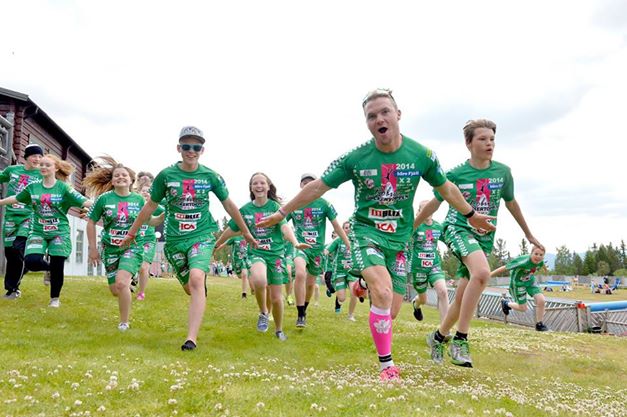
    Robin Bryntesson (front) running with Swedish kids at his camp for diabetic children. Photo: Team Robin.
    Robin Bryntesson (front) running with Swedish kids at his camp for diabetic children. Photo: Team Robin.

    When he was a kid, Robin Bryntesson skied a lot. That’s not unusual for a Swede.

    But then he got some news that definitely set him apart from his many teammates: he had diabetes.

    “My doctor told me that my skiing career was over,” he explained in an e-mail.

    Like any fiercely competitive athlete, Bryntesson didn’t take the news lying down. He kept skiing and went on to win a World Junior Championship, then a World Cup team sprint with Emil Jonsson.

    “Then I call my doctor and say that my career is not over, maybe yours,” Bryntesson joked.
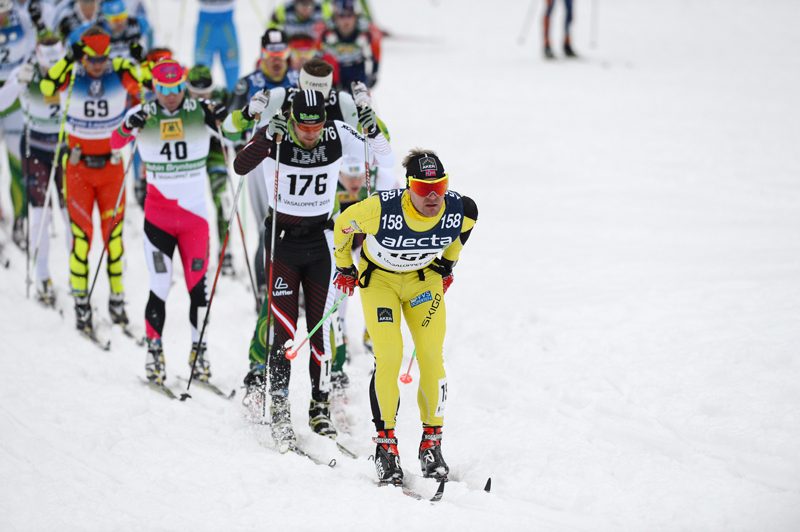
    Robin Bryntesson, in bib 40, skiing the Vasaloppet this winter.
    Robin Bryntesson, in bib 40, skiing in the lead pack at the Vasaloppet this winter.

    These days, he doesn’t get so many World Cup starts, but that’s due as much to Sweden’s strength and depth as a ski nation as much as anything else – Bryntesson still excels at distances from sprints to the 90 k Vasaloppet, and is still seeking starts for his country at the sport’s highest level.

    And he’s beloved in Sweden and abroad as the court jester of the ski world, making funny videos that often feature his famous teammates and sometimes go viral. Recent hits have been a well-done music video for Bliz eyewear spoofing the Faith Hill song “This Kiss”, and a promotion for the Östersund World Cup weekend in February that features an anything-but-conventional sprint course.

    Things don’t always go smoothly: his quest to win the Vasaloppet ended this year when Bryntesson’s blood sugar crashed late in the race. Despite being more or less delirious (“cross-eyed” was how his support team described it), he finished within 2 minutes of the winner.

    And so it’s safe to say that Bryntesson has proven to both himself and his doctor that a diagnosis of diabetes doesn’t mean the end of an athletic career. But a few years after learning he had the disease, Bryntesson realized that there was more he could be doing.

    “It started when I sold pink hats in favor of juvenile diabetes fund those first few years,” Brytesson explained. “I donated 12000 SEK (roughly $1600) the first year and later it became more pink clothes and now a camp for children with diabetes. Next summer will be the fifth year of the camp.”
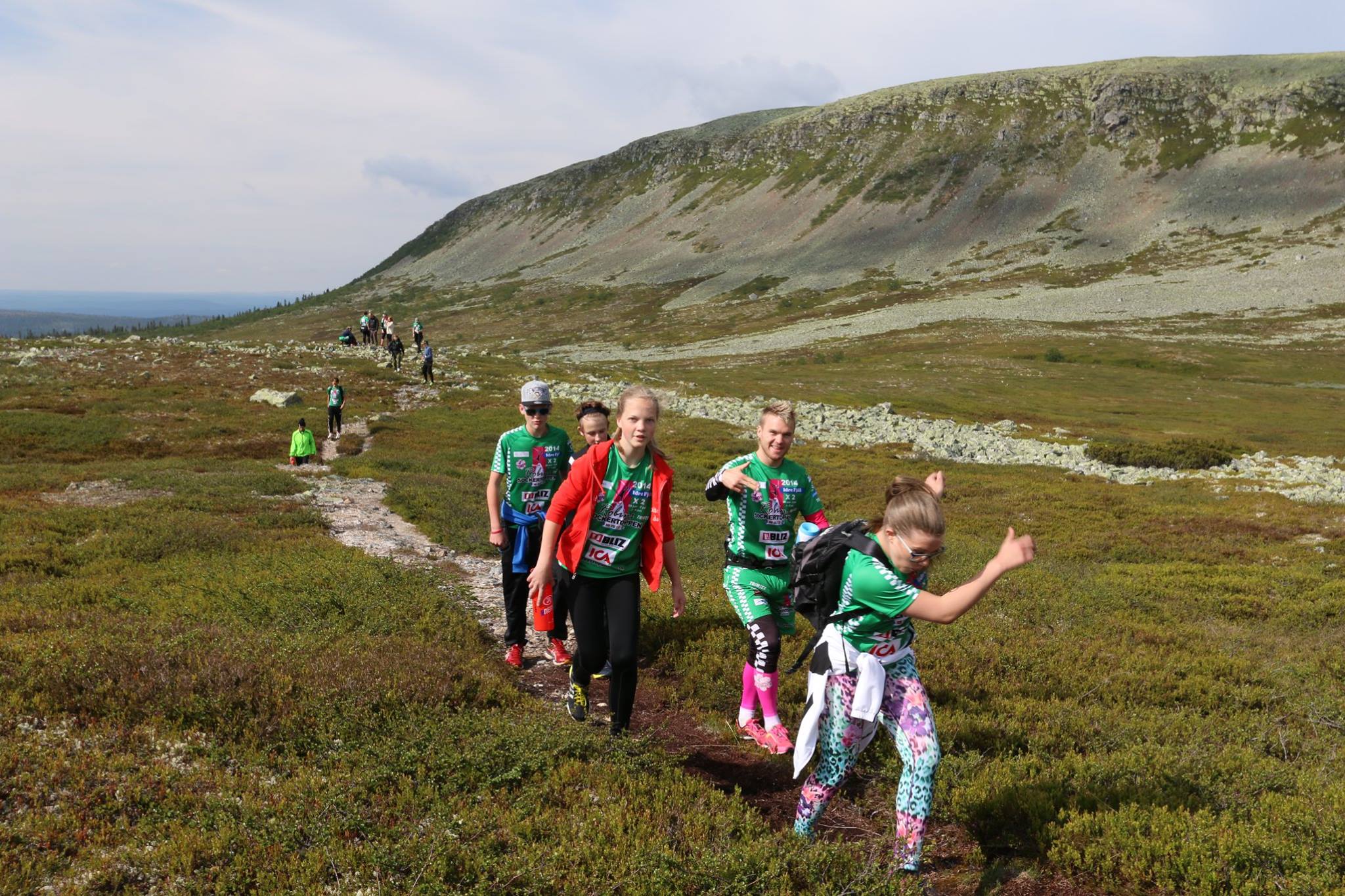
    Bryntesson and his campers reach new heights around Idre, Sweden. Photo: Team Robin.
    Bryntesson and his campers reach new heights around Idre, Sweden. Photo: Team Robin.

    The pink hats for “Team Robin” have become ubiquitous – and in a restrained country of muted wardrobes and Jantelagen, Brytnesson has made bright colors and particularly pink his trademark. The summer camp, called Söckertoppen, had record enrollment this summer and is popular enough that this year there were two different sessions in the mountain area of Idre, one for kids aged 10-13 and another for those aged 14-17.

    The name of the camp is something of a play on words: the Swedish translates to “Sugar Top”, which Bryntesson says he means as “Sugar is good!”

    “Examples of what the guys and girls where doing those days was to challenge themselves, get to know others in the same situation, roller skiing, climbing peaks, the Masters champion (one swedish tv show), gymnastics, diabetes paths, swimming, disco and banquet,” Bryntesson wrote. “There was lecture by me and a stunning girl who won Paralympic gold in 2014 in Sochi, Helene Ripa. She’s skiing very fast despite an amputated leg and what a wonderful story!”

    While there are a variety of summer camps for diabetic children in the U.S. – Olympic skier Kris Freeman, himself a diabetic, regularly visits camps organized by the pharmaceutical company Lilly to give inspirational speches – Bryntesson says that’s not the case in Sweden. So he struck out on his own.

    “There is not so many diabetic camps in Sweden and there is no one like ours,” he wrote. “We have taken the best from the athletic world and put that in the diabetic world. We learn from each other and develop together! It took me 10 years with diabetes before I started the camp. And I´m learning something new every day about diabetes. What’s most important is to learn to know your own body! That’s what´s really matters!”
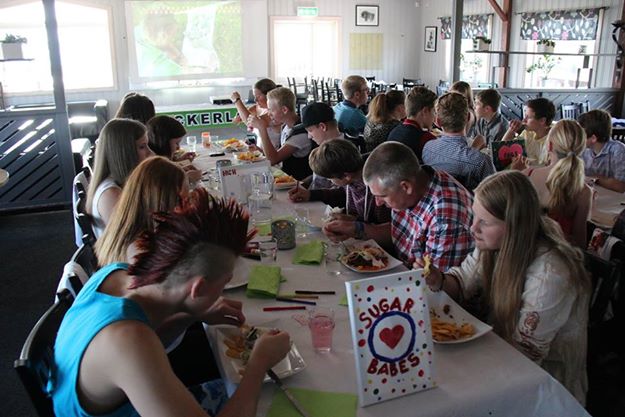
    A typical mealtime scene at Sockertoppen. Photo: Team Robin.
    A typical mealtime scene at Sockertoppen. Photo: Team Robin.

    Lately, he has had reason to expand his sights somewhat. Bryntesson was asked to announce the Paralympics in Sochi for Swedish television, an opportunity he relished. That has helped him forge closer ties to the world of disabled athletes, not just those with his own illness.

    “It was really very inspiring to be in the Paralympics,” he wrote. “They are amazing, they really show that no mountain is too high! Whether one has an arm, leg, or is blind so they just keep on moving and inspires people worldwide. Even diabetics.”

    With summer, and Söckertoppen, behind him, Bryntesson is finishing another project: a technique app called “Superb Skiing” which teaches world-class ski technique while entertaining with Bryntesson’s trademark brand of humor.

    Of course, the app has a video trailer, featuring a typically Bryntesson attitude towards life.

    “I get many questions about different technology/skiteknik and training,” he wrote as an explanation for why he wanted to make an app. “And one time for 1.5 years ago, when we where out and making a movie abaut ‘braking on rollerskis’, then we thought it was time to make an app. Since then we have been working on it. It’s about training in general and skiing in particular, and the goal is to make every owner of the app to a better skier.”

    Despite all his other callings, Bryntesson’s biggest goal for the upcoming season is to earn a start at World Championships, which will be held on home turf in Sweden.

    “My goal this winter is to try to fight for a ticket to the World Championships at home in Falun,” he wrote. “Although, as usual, Sweden is very tough for sprint spots. Then there will also be many of the longer races with Vasaloppet as the main focus. There I my best finish is 12th place. Which is the goal to beat!”

    How can he possibly maintain a full training load and stay one of the fastest skiers in the world, when he’s spending so much time doing diabetes outreach, business ventures, making videos, and entertaining the whole ski world?

    “It’s not the first time I’ve heard this question,” Bryntesson wrote. “I often have a lot of energy over besides training so that makes many projects coming up. I also like to make movies, it gives me even more energy. I like to have fun and I try to show that in many of the films that we do! It can sometimes take a lot of time, true. But I think it is worth every minute. If life is fun, then the good results can come.”

    The “Superb Skiing” app is available for download from Google Play here for $5.40.
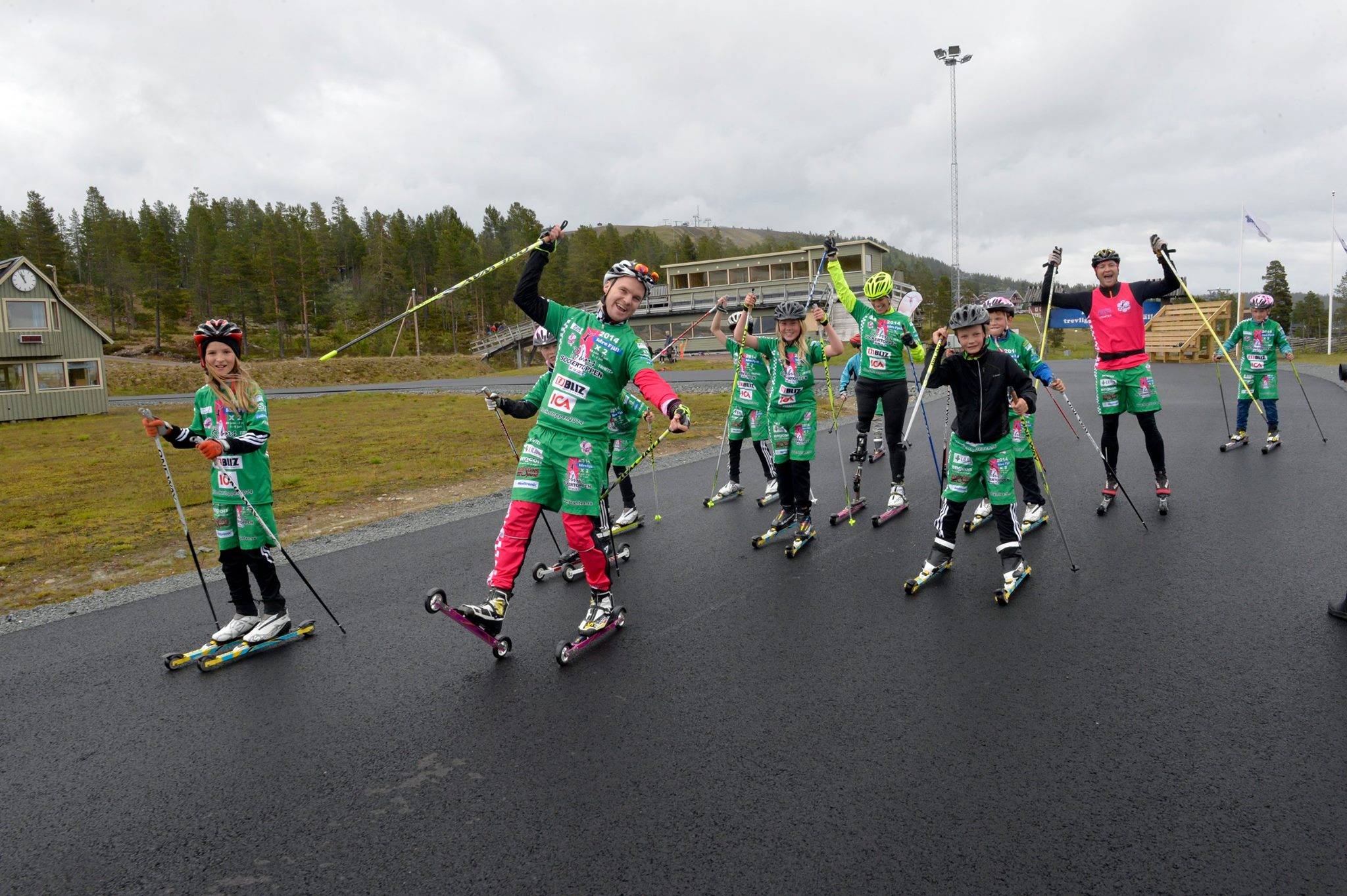
    Bryntesson rollerskiing with campers this summer. Photo: Team Robin.
    Bryntesson rollerskiing with campers this summer. Photo: Team Robin.
  • Canadian Biathletes Rocket on to IBU Cup Scene with Five Top-10’s in Opening Sprint (updated)

    Canadian Biathletes Rocket on to IBU Cup Scene with Five Top-10’s in Opening Sprint (updated)

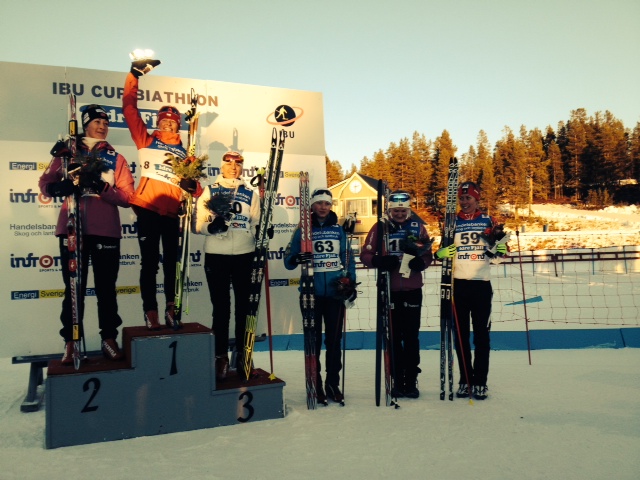
    Megan Imrie (far right) at the podium ceremony for the women's 7.5 k sprint in Idre, Sweden. Imrie placed sixth in the IBU Cup openers. Photo courtesy of Imrie.
    Megan Imrie (far right) at the podium ceremony for the women’s 7.5 k sprint in Idre, Sweden. Imrie placed sixth in the IBU Cup openers. Photo courtesy of Imrie.

    The Canadians had a feeling that their team was improving a lot over the course of the last training year. But by all accounts, even the coaching staff wasn’t quite fully prepared for the results of today’s IBU Cup sprints in Idre, Sweden.

    The headline: Nathan Smith second in the men’s 10 k, just 3.9 seconds away from the win. He was one of three men and two women in the top ten. Two more in the top 20. In total, six athletes shooting clean.

    One day into the 2013-2014 season, Canada is leading the IBU Cup nations standings, ahead of Norway, Russia, and Germany. Sure, it’s not the World Cup, but the second-tier circuit, which is organized in the same way, is nothing to scoff at – there were 140 men and 107 women toeing the start line today. If a country can’t do well where developing athletes typically compete, it doesn’t bode well for the future of the program.

    Plus, there’s the fact that these will be the most competitive races of the year for the circuit, with many teams using them to select World Cup teams. The top twenty was packed with athletes with Olympic and World Championships credentials. Timofey Lapshin, the Russian who edged Smith, has two World Cup podiums; the winner of the women’s race, Weronika Nowakowska-Ziemniak of Poland, is a 2010 Olympian who had a seventh-place World Cup result last season.

    “To your question of whether I was expecting this, from our in training season performance testing and latest trial races we had good indications the we were on the right track, but since we are quite isolated in North America it is quite difficult to put a perspective to this until you race internationally again,” Canadian head coach Matthias Ahrens wrote in an e-mail to FasterSkier. “I am super happy about both races, especially great performances in shooting as a team overall, but also the skiing is showing that we are on the right track.”

    In many ways the top performances came from athletes who have something to prove as they head into the Olympic qualification season. Take Smith. The 28-year-old had made his first World Championships appearance in 2008, and also represented Canada in the 2011, 2012, and 2013 editions. But last year, after lackluster results in the first two weeks of World Cup racing, he was moved back down to the IBU Cup.

    Last year was extremely frustrating for me,” Smith wrote in an e-mail. “Although I still got to race a few World Cups, I ended up pretty much being the extra relay guy a lot of the time because our team only has three men’s starts. Relays are a nice bonus but ultimately biathlon is mostly an individual sport. Luckily I managed to make some national team criteria at my very last chance (World Championships relay) where I basically had my only great performance of the year.” 

    That leaves him at a major disadvantage for Olympic qualifying. The most surefire way to make Canada’s Olympic team is to have two top-16 or three top-30 World Cup results. Two men have already fulfilled those requirements (Jean Philippe Le Guellec and Scott Perras), while several others (Brendan Green and Scott Gow) are partway through. Athletes have until the Christmas break to get those results on the World Cup, after which point qualifying is kicked back to trials races in Canmore for any remaining spots. Team size will be four men and four women.

    “Nathan has been on fire over the past few weeks, his skiing has been very strong,” Canadian coach Roddy Ward told FasterSkier. “Today he skied like he has been and also put together a clean race. He has been very motivated and focused in his training this year and it has paid off for him.”

    Smith is looking good now, both in the Idre sprint and at previous trials races in Canmore to qualify for this trip. But that leaves him just three weeks to get his two or three results on the World Cup. And there’s a catch: Canada has only three quota spots for men. With Le Guellec and Perras taking two of them, only one more man will have the chance to try to achieve their Olympic qualification on the circuit this fall.

    That seems to have been a powerful force driving the team to go faster and shoot straighter.

    “The remaining Olympic spots that are up for grabs are definitely a big motivator,” Smith wrote. “Judging by our team’s shooting I think the pressure is being handled really well. For myself, I’m managing the pressure a lot better than a year ago.”

    With his second-place finish, Smith nabbed the remaining men’s spot and will try to make the most of it in the next few weeks.

    In the spring I had time to reflect on what I had done the previous few years and decided that if I wanted a change in results I would also have to have a different approach to training,” he wrote. “I really tried to focus on quality and working on specific skills. Already halfway through the summer I knew that things were going in the right direction through testing, team time trials, and just general training… In the last few team races my skiing has been excellent so I had a lot of confidence in that going to Europe.  But still, you never really know, so theres always some doubt.

    The next Canadian, Marc-Andre Bedard, tied for seventh; he is another former World Cup and World Championships competitor who did not see World Cup action last season. Just two seconds behind him in ninth was Green, who sat out last season with a back injury. Gow placed 13th with one penalty.

    Yet even though the men are competing against each other – intensely – for World Cup and Olympic spots, they were supportive of one another’s results. Team spirit doesn’t seem to be a casualty of the cutthroat competition, in fact, maybe just the opposite.

    “I’m also really happy for Nathan, he totally deserves those results and I’m excited to see him try to get his Olympic criterias on the World Cup!” Bedard wrote in an e-mail. “(If they let him of course!!!) (they better ;))”

    Bedard also made another comment on the team’s cohesion in explaining why his results seem to be on the upswing this fall.

    “I’m finally feeling supported by my coach and teammates and I was really excited to race against the world with my new dry land season with all the changes is done for the last six months,” he explained. “I’ve always needed a few weeks of racing before I was actually able to turn it on and I think today is a really good sign for what might happen this year. I’m hoping I’m progressing still and will be able to actually hurt myself in the next few weeks. Today felt pretty easy so with a good result on a really strong and deep field, it sounds good!”

    Although the team will also compete in Idre tomorrow, coaches ultimately made the choice of World Cup athletes based off of today’s race, and Smith got the nod. Biathlon Canada High Performance Director Chris Lindsay acknowledged that the men hadn’t made it easy for them to pick just one, but the entire coaching staff pointed out that the increasing competition within the program is a benefit for all.

    “It is clear our men’s team is extremely competitive, which had led to improvements through the training year,” Ward said. “We saw that in the results today.”

    Competing a few hours later, the Canadian women’s team took the momentum and ran with it.

    “The girls and I were really inspired by the guys performances before our race,” Megan Imrie wrote in an e-mail. “They’d all killed it! If they could do it, so could I.”

    Imrie, coming back from her own lackluster season last year that saw her take a midwinter detour home to Manitoba to rest, recover, and decide how to approach biathlon from that point forward, hit the circuit again with a bang. She placed sixth with clean shooting, over a minute behind Nowakowska-Ziemniak but only 23 seconds behind second-place Fanny Welle-Strand Horn of Norway.

    “I committed to working every possible place on the course and was extremely focused on the range,” Imrie said of her race. “I was a bundle of nerves going to the start. But I stuck to the basics. In the words of Simon Whitfield, just chop wood and carry water. I’m relieved I’m coming back okay from last year. I’ve worked hard and stayed healthy. Now I’m feeling privileged to enjoy racing again.”

    Just behind her was 2010 Olympic teammate Megan Heinicke in seventh place. The pair, like Smith, earned the nods for the next period of World Cup racing and will travel to Ostersund, Sweden, with Smith and Rosanna Crawford. Imrie and Heinicke both need a single additional top-30 result on the World Cup to complete their Olympic qualification.

    Crawford is pre-qualified for Sochi, but raced the Idre openers anyway. She finished 35th with three penalties.

    “The girls were also impressive with Megan I, Megan H and Audrey [Vaillancourt, who placed 16th] cleaning,” Ward said. “Rosanna had been dealing with a number of injuries lately so I was just happy to see her ski form was solid. The next few weeks should be good very for her. Megan I has been incredible this training year with self monitoring her training and recovery – she has made some wise decisions that has kept her healthy and progressing.”

    Several younger Canadians also competed, with Macx Davies placing 84th in the men’s race and Julia Ransom 58th in the women’s race. Claude Godbout, a senior, placed 50th ahead of Ransom.

    “Even that it is only one race and the first race of the season, it should give everybody great confidence into the next races, be it on the World Cup or the IBU Cup,” a happy Ahrens concluded.

    results: men / women