From the FasterSkier archive — posts syndicated from athletes’ and coaches’ own blogs between 2004 and 2012, kept online as published. Current coverage is at fasterskier.com.

Tag: Inge Andersen

  • Bjørndalen Awarded Best Male Athlete of 2014 Sochi Olympics

    Bjørndalen Awarded Best Male Athlete of 2014 Sochi Olympics

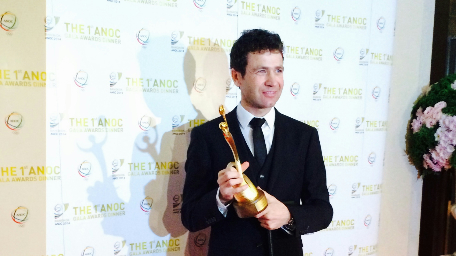
    Ole Einar Bjørndalen, 40, receiving his award for Best Male Athlete of the 2014 Winter Olympics on Friday in Bangkok, Thailand. (Photo: Norwegian Athletic Association) http://translate.google.com/translate?u=http%3A%2F%2Fwww.idrett.no%2Fnyheter%2FSider%2FOle-Einar-Bjorndalen-mottok-prisen-for-beste-mannlige-utover-i-Sotsji-OL-2014.aspx&hl=en&langpair=auto|en&tbb=1&ie=UTF-8
    Ole Einar Bjørndalen, 40, receiving his award for Best Male Athlete of the 2014 Winter Olympics on Friday in Bangkok, Thailand. (Photo: Norwegian Athletic Association)

    At the inaugural Association of National Olympic Committees (ANOC) awards ceremony on Friday, Norwegian biathlete Ole Einar Bjørndalen received the Best Male Athlete award for the 2014 Olympics in Sochi, Russia. More than 1,000 delegates from 204 national Olympic committees attended the gala ceremony in Bangkok, Thailand.
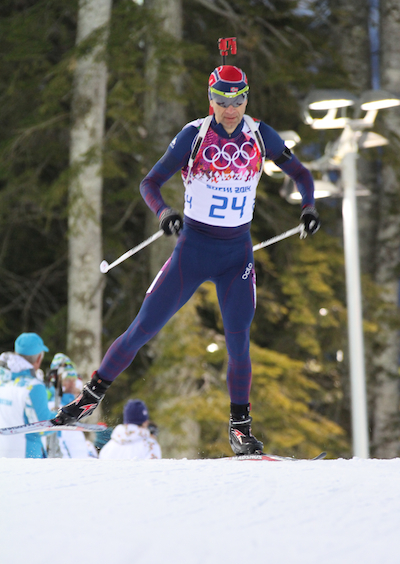
    Norwegian biathlete Ole Einar Bjoerndalen skiing to the win in Saturday's 10 k pursuit at the Sochi Olympics.
    Norwegian biathlete Ole Einar Bjoerndalen skiing to the win in the 10 k sprint at the 2014 Sochi Olympics. His seventh career gold and 12th Olympic medal (at the time) tied the record for the most career medals in the Winter Olympics, a mark that had been held by the Norwegian cross-country skier Bjoern Daehlie.

    “This must be the most significant award I’ve ever received,” Bjørndalen, 40, told the Norwegian Athletic Association.

    After winning two gold medals at the 2014 Olympics in Sochi, in the the 10-kilometer sprint and mixed relay, Bjørndalen became the most decorated Winter Olympian of all time, with a total of 13 medals: eight gold, four silver and one bronze.

    His achievements and performances in Sochi were honored during the ANOC’s General Assembly in Bangkok. The first-ever ANOC awards ceremony honored Olympians and the national Olympic committees that delivered outstanding performances at a given Olympics.

    “I want to take this opportunity to thank everyone who has helped me throughout my career,” he said. “There are too many to mention all the names, but I want to extend a very special thank you to all my coaches, service staff, the Norwegian National Biathlon Association, Olympiatoppen [Norwegian Olympic Development Center] and all my good partners. Everyone who has supported me has contributed to my development and performances, and deserves a part of the honor for this award. I am proud that biathlon is the sport that goes all the way to the top –the jury was considering athletes from much bigger international sports.”

    Twenty-five broadcasters reported live from the ceremony, reaching as many as more than 300 million people. There were more than 1,200 accredited journalists Friday as well, and as always, the seasoned Bjørndalen was prepared.

    “I have known for a while that I was a candidate for this award,” he said.” I have been at a training camp for almost four weeks and trained well in order to take two days off for this ceremony in Bangkok. I have been looking forward to this little mini break in my training schedule. I planned the journey very carefully, and with a direct flight from Oslo, it is quite convenient. In my carry-on, I brought 20 slices of my favorite whole-grain bread baked by our excellent chef Eva. Tomorrow, Saturday, I am flying straight back, leaving tropical Bangkok for perfect skiing at Beitostølen [Norway].”

    “In my carry-on, I brought 20 slices of my favorite whole-grain bread.” — Ole Einar Bjørndalen, Norwegian biathlete, the most decorated Winter Olympian of all time, and Best Male Athlete of the 2014 Sochi Olympics

    Inge Andersen, secretary general in the Norwegian Athletic Association (Norges Idrettsforbund), was also present for the awards. In his opinion, there was was no one more deserving of the award than Bjørndalen.

    “Ole Einar impressed everyone during the Sochi Olympics,” Andersen said. “Two Olympic gold medals were more than anyone could expect, but still I’m not really surprised. This is the most winning Winter Olympian, from the small town of Simostranda. We are very proud of Ole Einar. He represents the best of Norwegian athletes.”

    According to Reuters, Olympic officials held the awards as part of an initiative to modernize the Games, and hope the ceremony will become the “Oscars of Olympics sport.”
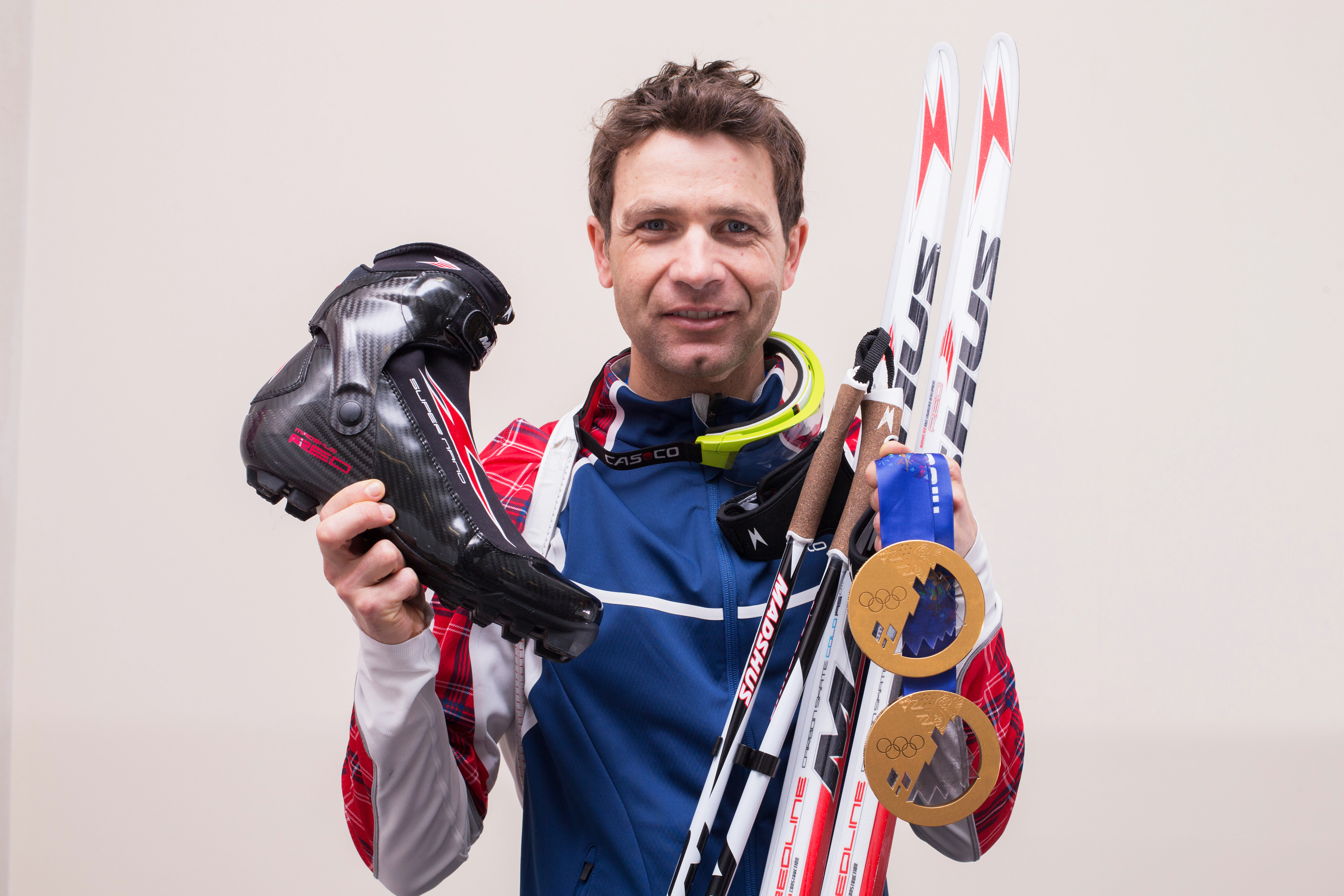
    Ole Einar Bjørndalen with his two gold medals from Sochi and the gear that helped him get them. (Photo: Madshus/NordicFocus)
    Ole Einar Bjørndalen with his two gold medals from Sochi and the gear that helped him get them. (Photo: Madshus/NordicFocus)

    Other award-winners include:

    – Best Female Athlete of the 2014 Sochi Olympics: Irene Wust (Dutch speed skater; won five medals, the most of any competitor at the 2014 Olympics, with two gold and three silver)

    – Best Men’s Team in Sochi: Canada/men’s ice hockey (won gold)

    – Best Women’s Team in Sochi: Canada/women’s ice hockey (won gold)

    – Most Successful Country in Sochi: Russia (topped the medals table with 33 medals, 13 of which were gold)

    – Best Male Athlete of the 2012 London Olympics: David Rudisha (Kenyan middle distance runner; broke 800-meter world record)

    – Best Female Athlete of the 2012 London Olympics: Li Xiaoxia (Chinese table tennis player; won two gold medals in London, in singles and team events)

    – Best Men’s Team in London: France/handball (first team to win back-to-back gold medals in the event)

    – Best Women’s Team in London: Brazil/volleyball (second-straight gold)

    – Most Successful Country in London: United States (topped medals table with 104 medals, 46 of which were gold)

    – Outstanding Achievement Award: Larisa Latynina (former Soviet gymnast; earned 18 Olympic medals between 1956 and 1964; her record stood until Michael Phelps topped it in London. According to Reuters, Phelps congratulated her personally with a note that was read out loud during the ceremony.)

    – Outstanding Lifetime Achievement Award: Jacques Rogge (former International Olympic Committee president)

    ***

    About the author:

    A longtime contributor, Inge Scheve was born and bred in Norway, and learned to ski about the time she learned to walk. She always loved skiing, but didn’t really get into racing until she came to the University of Alaska Fairbanks, where she was introduced to collegiate ski racing American style. After UAF, she moved to Bend, Ore., in 2001 to ski with XC Oregon. She has competed for the U.S. in four World Masters, earning three gold medals, as well as a couple of silver and bronze medals.

    When she’s not skiing, Inge loves caribou hunting on the tundra in her native Rendalen valley in Norway, dabbles in adventure racing, mountain biking, road cycling, hiking, trail running and kayaking. Inge really wants to become a wine snob, but realizes that probably involves learning to like red wine.
  • Russians Finally Gold on Home Turf, After Norwegian Collapse in Biathlon Relay

    Russians Finally Gold on Home Turf, After Norwegian Collapse in Biathlon Relay

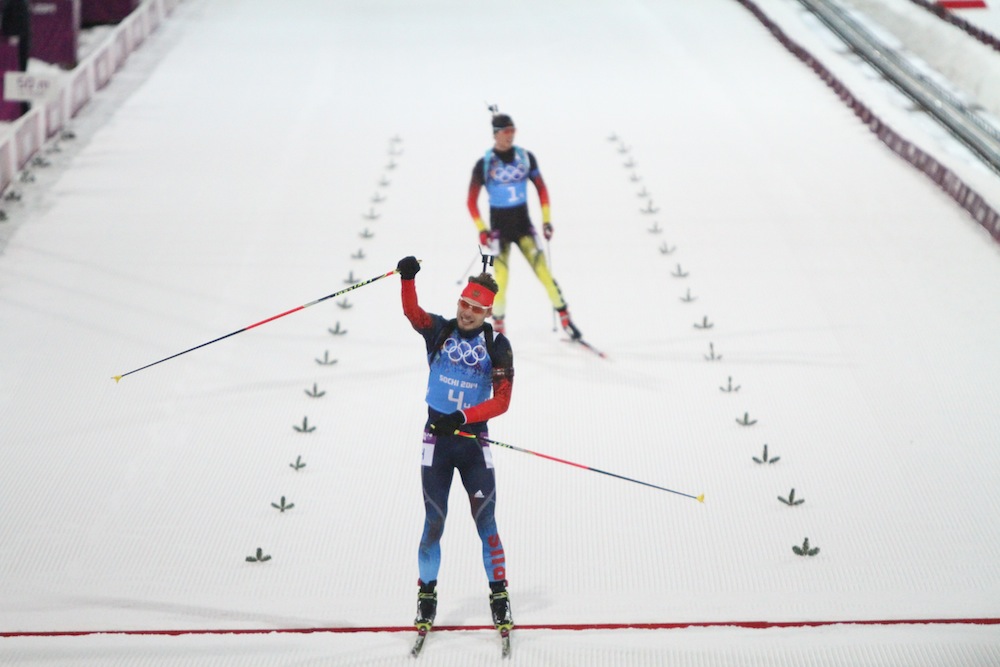
    Russian anchor Anton Shipulin celebrates his team's gold medal in the men's relay over Germany's Simon Schempp. Austria was third.
    Russian anchor Anton Shipulin celebrates his team’s gold medal in the men’s relay over Germany’s Simon Schempp. Austria was third.

    FasterSkier’s coverage is made possible through the generous support of Swix.

    KRASNAYA POLYANA, Russia – There were 11 biathlon races at the Sochi Olympic Games, and the Russian team went through 10 of them without a gold medal.

    The last one was Saturday night, where before a boisterous crowd, the country’s men’s relay team bested athletes from 18 other nations—with anchor Anton Shipulin using perfect shooting and blistering skiing to emerge as the fastest of a four-man lead pack in the race’s waning minutes.

    Germany was second, after anchor Simon Schempp lost to Shipulin in a sprint finish. Austria’s team was third, 30 seconds behind.

    Norway was fourth, squandering a 20-second lead they held in the middle of the race. The country’s collapse was capped by a stunning failure by their anchor, Emil Hegle Svendsen—the same man who had skied to a gold medal in an all but perfect race in the mass start earlier this week.

    Svendsen entered the final shooting stage with the other three teams. But even with eight rounds—five of those in his standard clip, and three extras that he hand-loaded, one at a time—he couldn’t knock down more than four out of his five targets, leaving him stuck in the penalty loop as his competitors raced off to claim their medals.

    Shipulin leads into the stadium.
    Shipulin leads into the stadium.

    Ole Einar Bjørndalen, the Norwegian who became the winningest Winter Olympian of all time at this games, with 13 medals, was left tied with his countryman Bjørn Daehlie’s record of eight winter golds.

    The result was glory for the Russians, who, led by the tycoon Mikhail Prokhorov—yes, the guy that owns the Brooklyn Nets—had poured money into the country’s biathlon union, only to be stymied in their quest for gold until the very end of the games.

    Asked about the pressure the athletes felt heading into the final biathlon race of the Olympics without a gold, Shipulin, the Russian anchor, responded by thanking the crowd that had turned out to the ridgetop venue Saturday evening with flags, colored hats, and noisemakers.

    “It’s a special when you hear, each and every step, people shouting in Russia,” he said. “It even gave me more energy—I felt I couldn’t relax.”

    Russia was in the hunt for most of the race, but it seemed like gold was Norway’s to lose after Tarjei Bø, who skied the country’s first 7.5-kilometer leg, tagged off to his brother Johannes Thingnes Bø with a 10-second lead.

    By the time the second Bø tagged off to Bjørndalen for the third leg, the Norwegian lead had grown to 20 seconds, over a small chase pack that included Austria, Russia, Slovenia, and Italy.

    But Bjørndalen didn’t have his characteristic speed on his skis on Saturday—and despite not missing a single shot, he still lost time to the Russians, the Germans, and the Austrians.

    When the anchor leg started, the Germans were even with Norway, and the other two teams caught up in time for all four men to enter the last round of shooting together.

    Svendsen, the Norwegian anchor, is one of the best sprinters on the biathlon circuit; matching his competitors on the shooting range would have given his country a good shot at the win—and even one or two misses likely would have preserved a spot on the podium, thanks to the three extra rounds biathletes can use for each round of shooting in relays before they have to head to the penalty loop.

    Instead, Svendsen used all eight of his rounds, and still left one of his five targets standing.

    His meltdown dropped Norway to fourth place, and left Svendsen and his teammates inconsolable at the finish. As the race wound down, Johannes Thingnes Bø sat on a bench in the outdoor changing area staring into the snow, with his face buried in his gloved hands.

    “I do not have much more to say other than that I’m disappointed,” Svendsen told Norwegian broadcaster NRK later, after taking

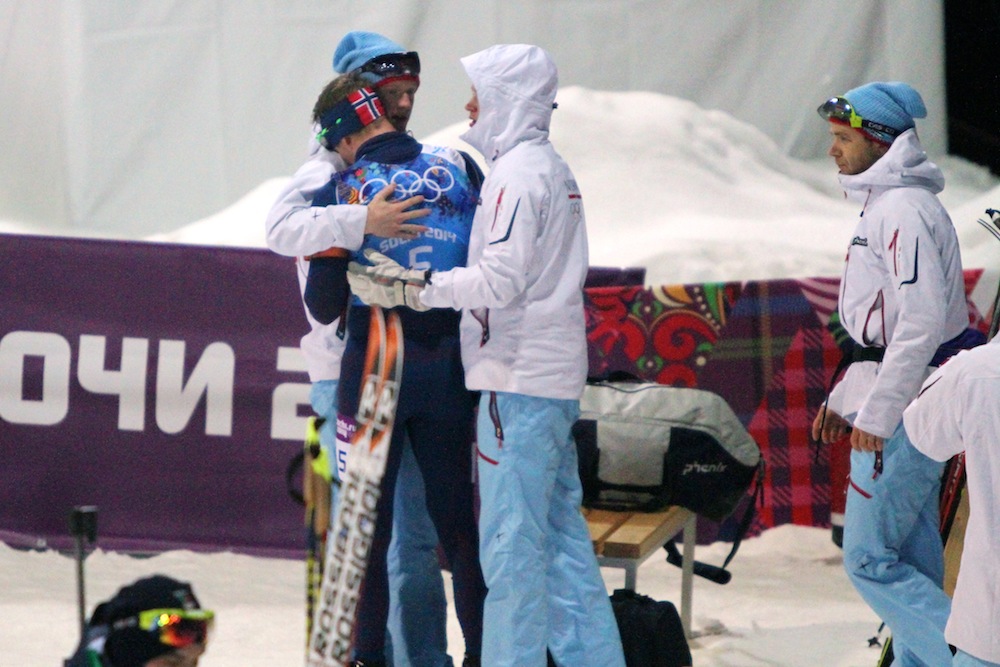
    The Norwegians try to console anchor Emil Hegle Svendsen, after he missed four shots on his last trip to the range and had to ski a penalty loop, dropping his team from contention.
    The Norwegians try to console anchor Emil Hegle Svendsen, after he missed four shots on his last trip to the range and had to ski a penalty loop, dropping his team from contention.

    nearly an hour to pull himself together for an interview. “The last target would just not go down.”

    Dominik Landertinger, who was skiing the last leg for the Austrians, needed one extra round to knock down his five targets, leaving Shipulin and Schempp, the Russian and German anchors, to duel for gold.

    Shipulin said he wasn’t worried so much about Schempp, whom he had already beaten in a relay finish once this winter—but Shipulin said he did keep looking back to see if Svendsen was catching up.

    The crowd, which had exploded during the last round of shooting, gave Shipulin a surprisingly muted cheer across the line.

    But if it lacked in volume, the victory still set off a celebration that enveloped the whole venue for the rest of the evening.

    Sergey Kuschenko, the executive director of the Russian Biathlon Union and a longtime Prokhorov deputy, was spotted giving bear hugs to officials at the finish, and high-fives to the Russian athletes.

    Volunteers and even journalists at the post-race press conference gave the relay team an ovation when they entered, and when the press conference ended.

    As for the Norwegians? Inge Andersen, the secretary general of the country’s Olympic committee, said: “I have been too many years in this game to be disappointed.”

    In an interview, he said the relay had been “fantastic” to watch, and that the country had already had a “beautiful day” on Saturday, after Norway’s cross-country skiers swept the medals in the women’s 30-kilometer freestyle race in the afternoon.

    “Emil Hegle Svendsen is one of the world’s best biathletes. Today, it wasn’t his day, but that’s life in sports,” Andersen said. “This is worst for the athletes—not for me.”

    –Chelsea Little and Alex Matthews contributed reporting.

  • For Northug and Norway, Poker is Politics

    For Northug and Norway, Poker is Politics

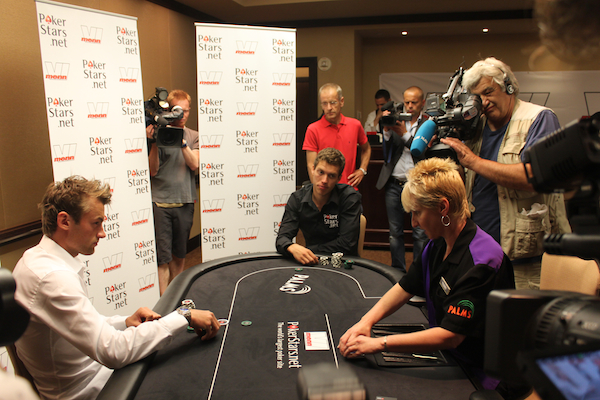
    Petter Northug in the middle of a game of poker against Marcus Hellner in Las Vegas.

    It’s not oil, fish, or aquavit that’s behind the Norwegian sports machine, which delivered the most medals per capita of any nation at the 2010 Olympic Games—at least not entirely.

    Instead, a healthy portion of the funding for Norway’s sports organizations comes from Norsk-Tipping, the state-owned gambling company. Norsk-Tipping dedicates 45.5 percent of its annual profits to sports—more than $241 million U.S. dollars in 2009 alone.

    That’s one of the reasons that quadruple Olympic-medalist Petter Northug, currently competing in the World Series of Poker in Las Vegas, has been criticized by Norwegian officials for his enthusiasm for the game, according to Tormod Brenna, a reporter for the Norwegian newspaper Dagbladet.

    Poker isn’t offered by Norsk-Tipping, and it’s illegal in Norway to play the game for money.

    However, residents can play online poker on foreign websites, an indirect result of which could be the diversion of funds away from Norwegian sports—assuming those players would otherwise be gambling with Norsk-Tipping.

    In April, Norwegian Ski Federation General Secretary Inge Andersen spoke out against Northug’s hobby in an interview with the website Nettavisen, telling a reporter that “it is important to be aware that most sports in Norway are built on profits from the Norwegian national lottery.”

    “The surplus in the Norwegian National Lottery goes back to community purposes in Norway,” Andersen said.

    Others pointed out further contradictions, such as the fact that youth sports organizations in Northug’s hometown, Mosvik, receive funding from Norsk-Tipping—some through a special program called the “Grassroots Share.” Grassroots Share allows gamblers to dedicate five percent of their stake towards a specific sports club or organization of their choice, and a number of ski clubs are participants.

    By most accounts, the Norwegian public rallied around Northug after the criticism by Andersen and others. But there’s no question that his trip to Las Vegas has driven up interest in poker in Norway—Northug’s face has been on the front page of sports and newspaper websites for the past few days.

    In an interview with FasterSkier, Northug said that he doesn’t concern himself with the impact that poker might have on other people, or on politics.

    “I love to play it and I love the game. For me, it’s important to have other interests than just cross-country skiing,” he said. “I have a vocation, and then I also love to be able to do other things.”

    It was too much of a stretch, Northug continued, to draw a thread between his poker hobby and the cash flow to Norsk-Tipping.

    “That’s too far—I can’t go and think about something like that,” he said.

    Petter Northug playing in the 2010 World Series of Poker

    As one of his sponsors, the Norwegian men’s magazine Vi Menn paid for Northug’s visit to Las Vegas and his entry into the World Series. But according to Thorkild Gundersen, a reporter for the publication, Vi Menn’s relationship with Northug stems from his appeal as a cross-country skier, not as a poker player. The magazine, Gundersen said, had no intention of influencing attitudes towards the game through its support of Northug.

    “We don’t try to change politics,” he said.

    But intentions aside, Gundersen argued emphatically that Northug’s participation in the tournament—and the hype it generated—would have a real impact on the public’s acceptance of poker in Norway.

    “In Norway, there’s a lot of fantasy about poker as games with guns. This is helping the image of poker,” Gundersen said. “The debate…will come because of this.”

    In recent years, many of Norway’s neighbors have made changes to their laws governing poker.

    In Sweden, for example, poker’s popularity has grown quickly over the past decade. State companies allow the game in their casinos, and also launched an online poker website in 2006 in response to growing demand. Government gambling firms in Denmark and Finland have also taken steps towards introducing online poker.

    Vi Menn has never shied away from politically sensitive issues like this one, according to Alex Oysta, its editor—the magazine is “politically un-correct in some ways,” he said.

    There’s also no question that the criticism of Northug and the accompanying media coverage has been good for Vi Menn. According to Gundersen, the magazine’s web traffic is up, and its logo—crisply rendered on Northug’s poker shirt—is splashed all over newspapers and sports sites in Norway.

    “Our brand has never had such visibility—we are all over the place these days,” Gundersen said.

    Despite Gundersen’s enthusiasm, though, it remains to be seen whether any significant changes will result from Northug’s Vegas trip. While acknowledging that the hype would be a boon to foreign gambling sites, Brenna, the Norwegian newspaper correspondent, said that he doubted it would make much of a difference to the country’s politicians.

    Meanwhile, Northug plays on, uncowed—his second day at the World Series comes later this week. The man, Gundersen said, has an uncanny ability to maintain his equanimity amidst a media frenzy.

    “His ability to not give a damn what people say—he’s extremely good at not reading websites, not reading newspapers,” Gundersen said. “He doesn’t want everyone in Norway to like him—that’s not a goal.”