From the FasterSkier archive — posts syndicated from athletes’ and coaches’ own blogs between 2004 and 2012, kept online as published. Current coverage is at fasterskier.com.
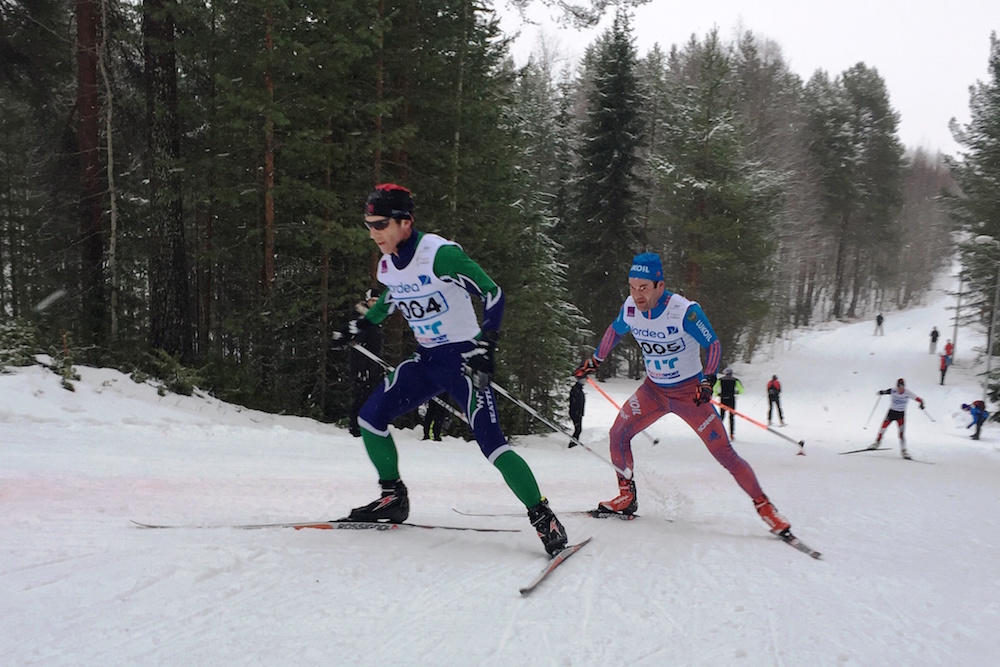
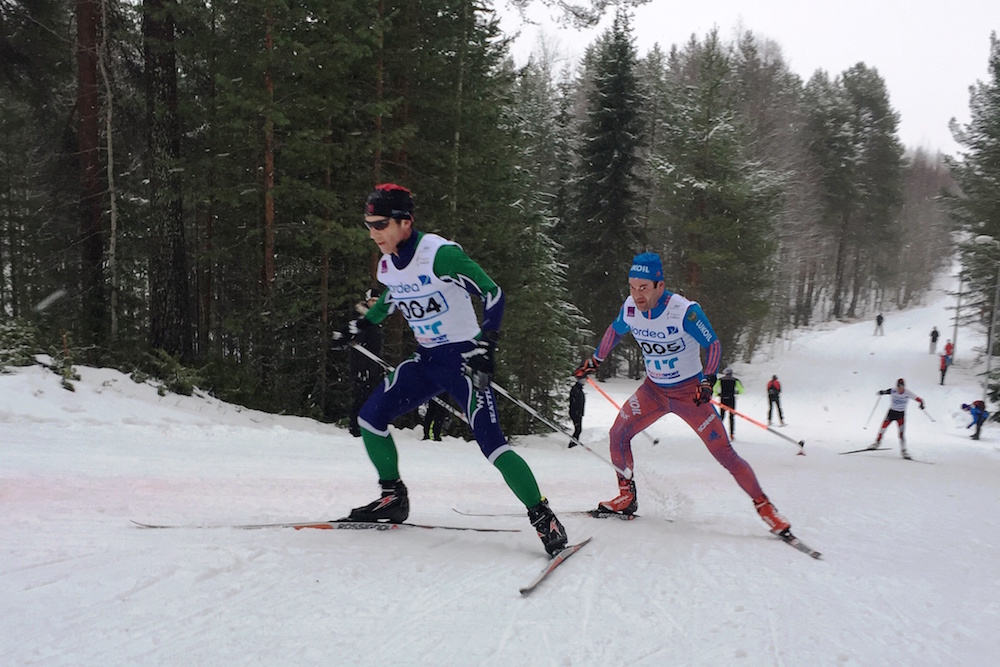
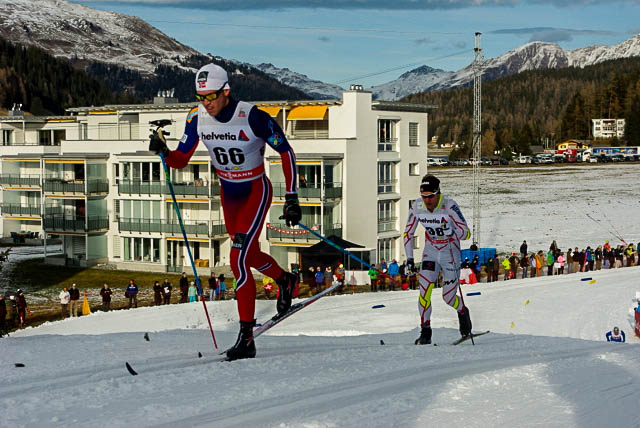
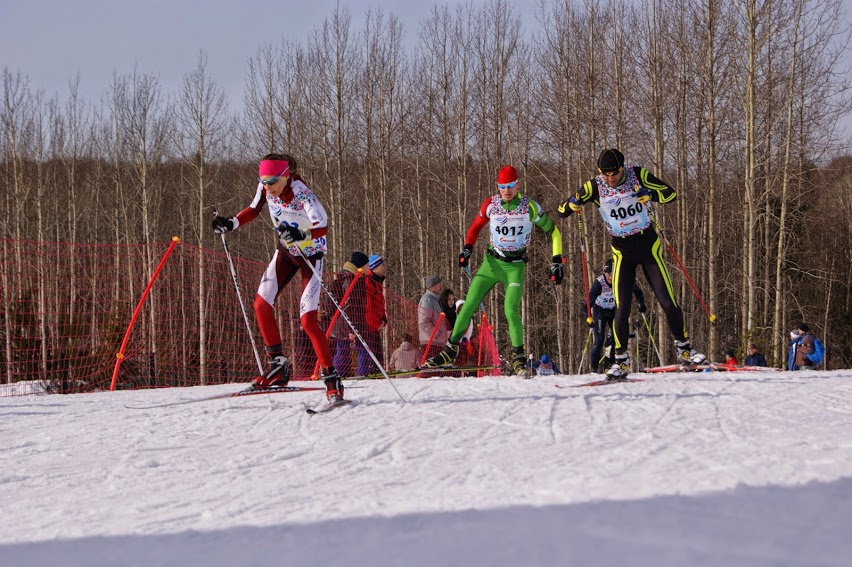
Kent Murdoch leading the pack in the 45-kilometer skate in the M5 category at 2016 Masters World Cup in Vuokatti, Finland. (Photo: Vesa Suomalainen)
Hankering for World Cup-style distance racing?
While most masters tend to aim for the traditional ski marathons, the annual Masters World Cup (MWC) presents an opportunity for skiers 30 and older to ski up to four races of regular World Cup distances in a week.
“It’s so much fun to do a variety of distances within a week, and being able to battle it out with athletes from all over the world is just a really unique opportunity,” says Milan Baic of Traverse City, Mich., who won silver in the final 45-kilometer skate race on Feb. 12 in Vuokatti, Finland.
Baic, 56, has been to every MWC event since 2004, and is planning to be back at the 2017 MWC in Klosters, Switzerland, and beyond.
“With the MWC you get a package deal of a race week. It’s not just a week of really professional and high-level racing,” Baic says. “But AXCS [American XC Skiers] puts together everything with accommodations, race entries and all logistics taken care of, all in a very affordable package. It’s a great value. All you need to do is show up and race.”
More than just races
“You meet so many interesting people, you make genuine friends that you see year after year at the Worlds, and you start looking at people from other countries and cultures in a different way,” Baic says.
He notes that while every year has a different flavor and atmosphere, the events in Russia in 2004 and 2015 have been among the most memorable.
“People in the host communities really take a lot of pride in putting on a really professional and smooth championship week, and are also really excited to share their culture and specialties in everything from opening and closing ceremonies, award ceremonies, medals and awards,” he says.
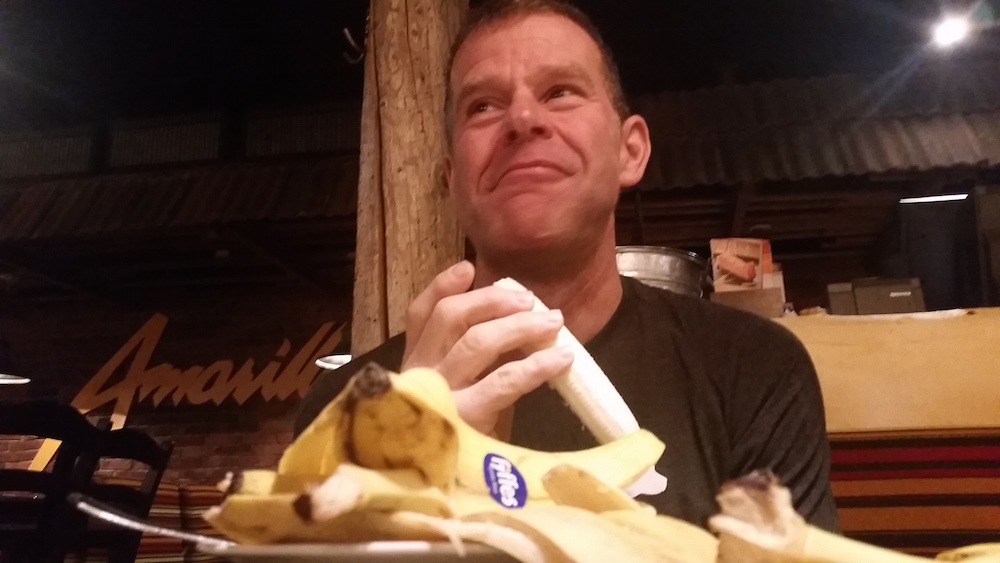
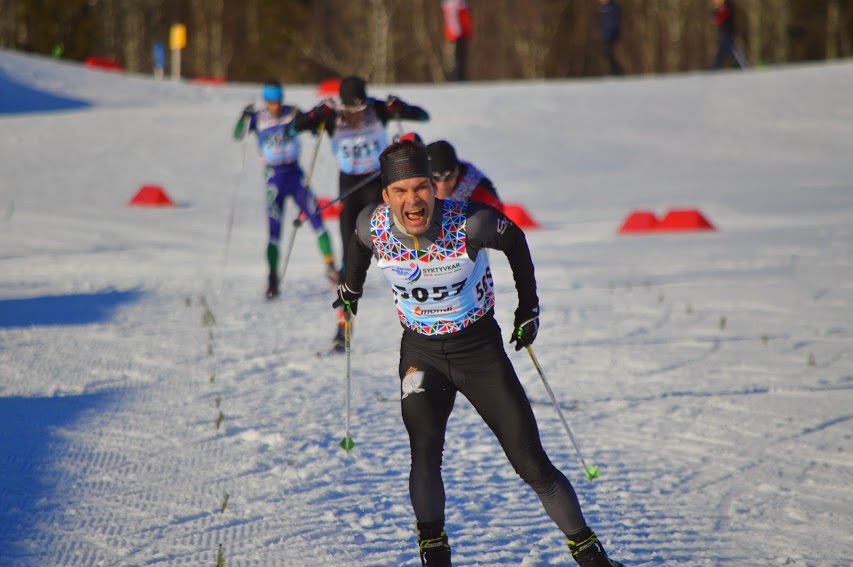
Milan Baic, of Traverse City, Mich., has a well-proven medal strategy for the 45 k event at Masters World Cup: he eats five bananas before breakfast. It usually produces a medal for him, and this year was no exception. He earned the silver medal in the M6 category, one of the most competitive in the Masters World Cup, in Vuokatti, Finland. (Photo: Kent Murdoch)
Also, Baic points out that the U.S. contingent also has a great spirit, good energy and a supportive team environment.
“The racers cheer for each other, help each other out with feeds and wax tips, and it’s fun to travel with the same people, as well as meet new skiers from other parts of the U.S.,” Baic says.
Baic and several of the masters on the US team train systematically for cross-country skiing year-round. He estimates that in an average week, he puts in about 12 hours of training between skiing, strength training and occasional cross training.
While the MWC is the highlight of the season, Baic also races the traditional marathons, and last year, he was 43rd at the American Birkebeiner, the highest ranked to date of any racer 50 or older in the 43-year-old event.
This is the Masters World Cup
Every year, the International Ski Federation (FIS) and the World Masters Association (which is currently under the reign of the first-ever American president, John “JD” Downing) organize a championship-style weeklong competition open to non-professional skiers age 30 and older. The event routinely attracts over 1,000 skiers from more than two dozen countries. This year, the masters World Cup was held in Vuokatti from February 6-12. Roughly 70 American skiers age 40 to over 80 helped themselves to 16 medals in the course of the week in Finland.
If the venue Vuokatti sounds familiar, it might be because it is also home to both FIS World Cup and Continental Cup races every year, as well as one of Finland’s Olympic training centers, home to the 2-kilometer Finnish ski tunnel, and the Angry Birds theme park.
Then, in 2018, the Masters World Cup returns to North America for the first time since 2011, back when the event was held in Silver Star, British Columbia. The 2018 championships will be held in Minneapolis in January 2018, but the exact dates are yet to be announced.
The Minneapolis Masters World Cup represents a very unique opportunity to race several World Cup-style races right in the heart of a big metropolitan area, as most of the Masters World Cup events take place at ski areas that are not necessarily close to big cities.
About the Author: FasterSkier contributor Inge Scheve, a Norwegian native, lived in Fairbanks, Alaska, and Bend, Ore., for a number of years where she became an avid skier and masters racer. Scheve recently competed in her sixth Masters World Cup in Vuokatti, Finland.
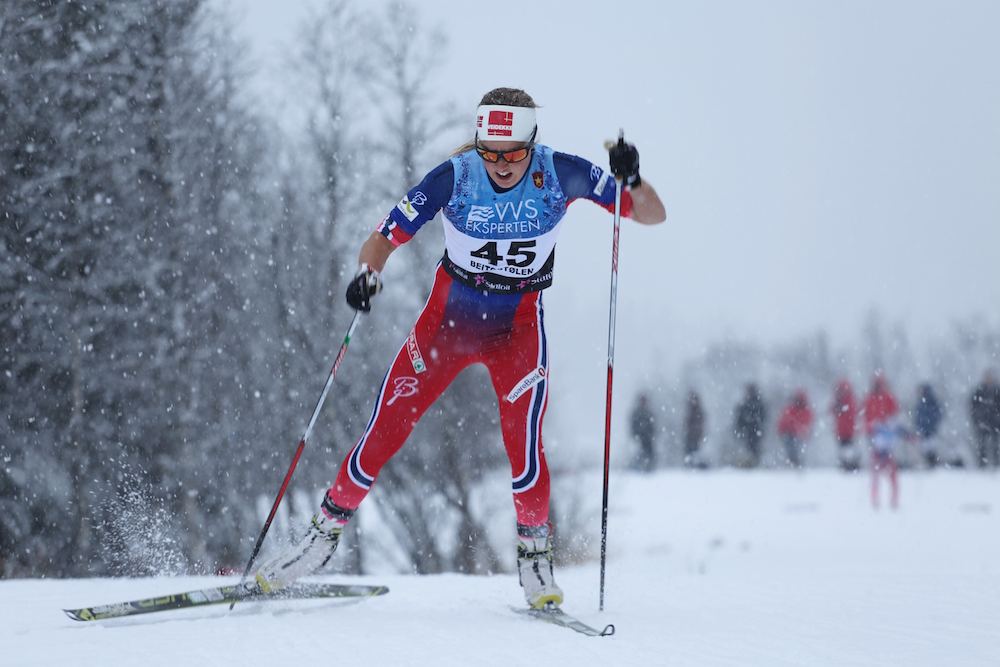
Last month, Norway’s Kari Øyre Slind, 24, spoke with FasterSkier following double podiums at the Norwegian season-opening races in Beitostølen, where she placed third in the 7.5-kilometer classic on Nov. 13 then second in the 7.5 k freestyle the next day. Since then, she’s notched eighth- and 11th-place World Cup finishes: eighth in the 5 k freestyle in Kuusamo, Finland, and this past weekend, 11th in the 15 k skiathlon in Lillehammer, Norway.
Kari Øyre Slind, 24, of Team Veidekke Trøndelag, races to second in the 7.5 k freestyle FIS race in Beitostølen, Norway, on Nov. 14. (Photo: Eirik Lund Røer/SKIsport)
What’s her secret? In some ways, she said it’s been the flexibility of solo training. This past spring, she finished up her bachelor’s degree in exercise science.
“I have focused on long workouts that border to recovery efforts rather than performance training, such as long mountain runs, when I can just run for hours,” Slind said. “I train with the team during team camps, and sometimes with my sisters [Astrid and Silje Øyre Slind] when they are home, but I actually really like training alone. Just being outside makes me so happy, seeing our beautiful surroundings right here where I live in Oppdal, [Norway] and just allowing my thoughts to drift.”
While she loves the long, slow efforts, that doesn’t mean her workouts aren’t hard. When asked to describe one of her favorite workouts, Slind described a brutal classic roller ski session: a workout so extreme that she only does it once or twice a year.
Starting at sea level in Skjolden, a small community at the end of a long fjord on the west coast of Norway, Slind skis 18.4 kilometers uphill to a picnic spot at 3,825 feet above sea level – just short of Sognefjellshytta, a lodge with summertime groomed skiing.
On this workout, Slind loves doing long uphill intervals at just below threshold.
“My favorite combination is 3 x 20 minutes at intensity Zone 3. The terrain is just perfect, and the scenery is beautiful,” she said. “It’s long and steep enough that you don’t have to backtrack and ski back down between intervals; you don’t get any breaks and can just continue uphill mile after mile.”
“This workout is really tough, but I also feel that it really lifts me to a new level,” she added. “And the whole distance is really uniquely beautiful.”
The Workout: Long Uphill Intervals
What: An approximately 18-kilometer uphill rollerski, with 3 x 20 minutes of Zone 3
Where: Pick terrain steep enough that you don’t have to ski back down between intervals. The idea is to minimize breaks while just continuing uphill
Why: It’s tough and enjoyable (if it’s scenic) at the same time.
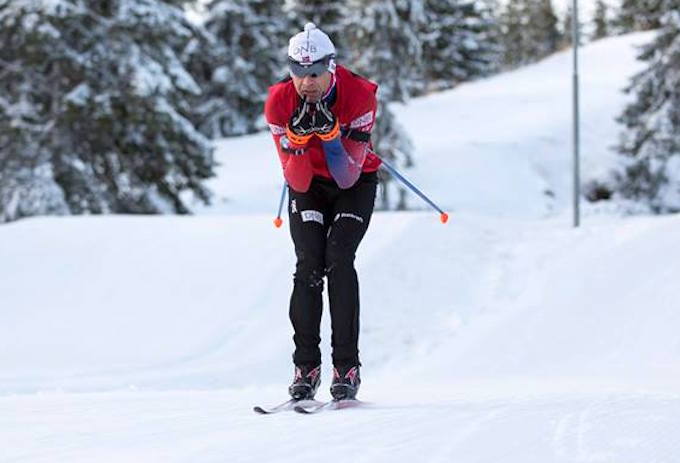
Norway’s Ole Einar Bjørndalen, 41, training at Natrudstilen in Sjusjøen, Norway, before the preseason biathlon races there in November. (Photo: Stefano Zatta/Madshus)
Ole Einar Bjørndalen opened his 23rd World Cup season with a victory on Wednesday, winning the 20-kilometer individual in Östersund, Sweden. The victory, which was technically his 94th World Cup win, came almost 20 years after he won his first World Cup in January 1996.
The 41-year-old Norwegian biathlete is the winning-most winter athlete in history with more Olympic medals and world champion titles than anyone else. With eight Olympic golds and 19 World Championships wins, the 2016 World Championships in Oslo, Norway, remain his over-arching goal. To become a world champion on home turf in Holmenkollen, a feat he has yet to achieve, would be the jewel of his crown.
After two decades of competing at the top level, the King of Biathlon took some time to reflect on the changes and developments in the sport in an exclusive interview with FasterSkier.
“The overall level of the athletes has changed a lot. When I first started, there were a lot fewer who skied really fast,” Bjørndalen said at the Madshus factory on Nov. 26 in Biri, Norway.
A Madshus athlete since 2004 (and a Rossignol skier before that), he said he believes both the improvements in equipment and increasing professionalism across the field have contributed to raising the overall level of international racing.
More refined
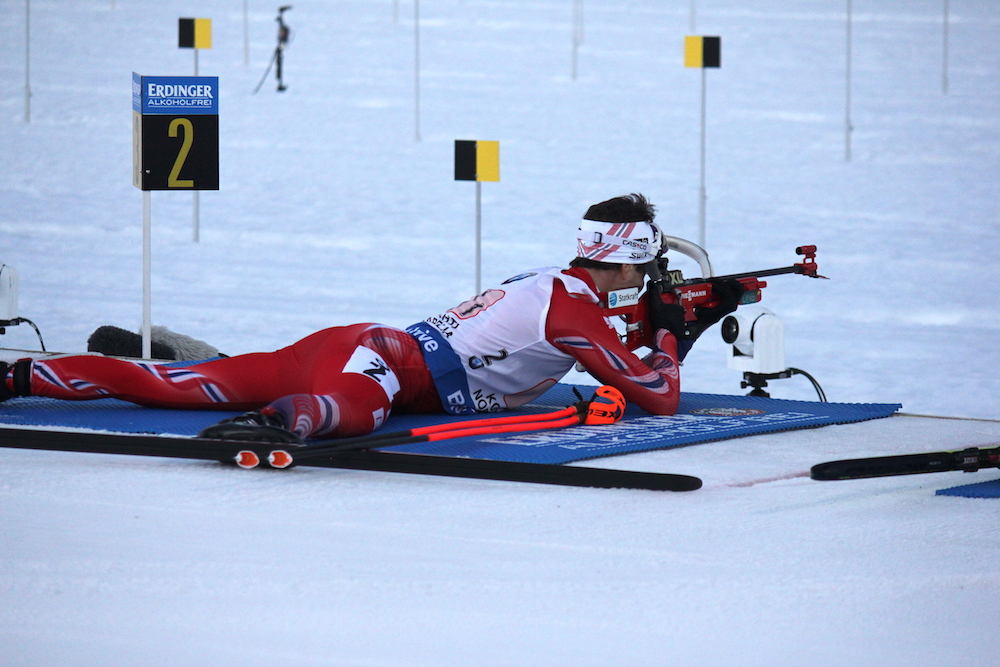
Ole Einar Bjørndalen takes aim during the 2015 IBU World Championships in Kontiolahti. (Photo: Norges Skiskytterforbund/NSSF)
One of the biggest changes was the transition from coarse-bore to fine-bore rifles, which occurred about five years before Bjørndalen started on International Biathlon Union (IBU) World Cup.
“We have used the same weapon and the same mechanical setup during the entire time I’ve been active,” Bjørndalen said, noting that the weapon change made the shooting times drop significantly.
“[Norwegian biathlete] Eirik Kvalfoss would use a minute to shoot one series. These days, none of the best racers use more than 20 seconds,” he added.
The venues have also become bigger and better, and attract more spectators, which also contributes to the growth of the sport.
“Now, there are never less than 5,000 spectators at the stadium at World Cup races, and often we will have more than 35,000,” Bjørndalen said.
Less natural snow and more manmade
Over the years, Bjørndalen has seen the climate change and noticed less snow than when he first started racing. While the lack of snow often affects the venues and events, but he said organizers are making due.
“The climate change has been here for a while, especially in Germany and Central Europe. There is definitely less snow, but at the same time, the organizers have become very good at making snow, storing snow and developing strategies to handle the changes,” he said.
“Manmade snow is very good in that it is very predictable, and it often provides more even conditions for everyone than natural snow,” he added. “With manmade snow, it doesn’t matter as much whether you start early or late in the competition.”
Better gear
Above all, he said the evolution of the equipment has been the biggest factor driving the sport forward.
“With the skis in particular, it seems like there is a small revolution almost every season,” Bjørndalen said. “Skis are now a lot lighter, more stable and faster, and there are entirely different materials used for both bases and construction than when I first started racing.”
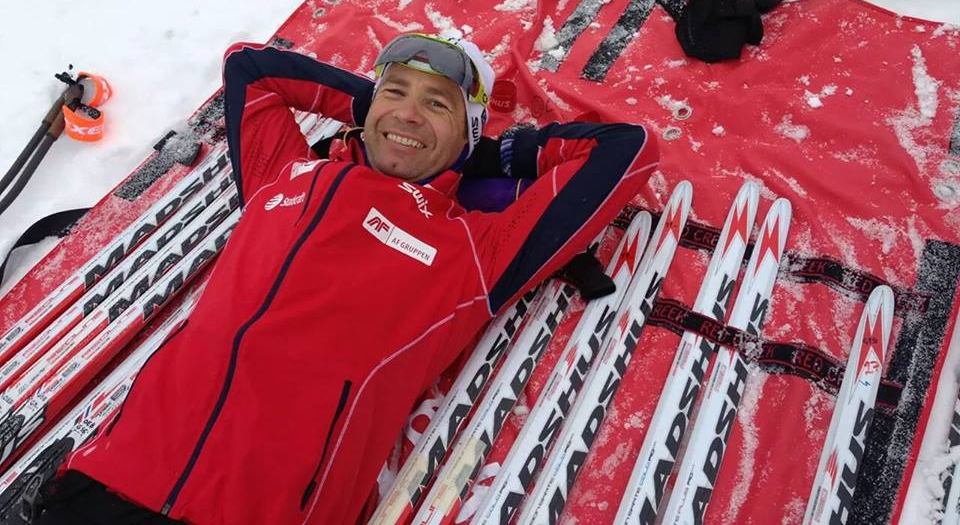
Ole Einar Bjørndalen testing skis in Beitostølen in the spring of 2014. (Photo: Per Wiik/Madshus)
In his mind, moving to shorter, flatter tips was one of the biggest improvements in skis, and he played a key role in that development.
“I was one of the first to cut my tips, and I shortened them by five centimeters,” he said. “That cut delivers a much faster return of the ski, and you’re ready to make a new push and stride sooner. We beat Fischer to the punch on that. I cut my tips about two weeks before they were going to launch their hole-tip. I’ve been told that this caused a bit of chaos and confusion at Fischer. They didn’t know what to think of my tips.”
Ski boots have also made some leaps since Bjørndalen started racing, becoming both stiffer and lighter and better suited for skating.
“With the new integrated carbon sole construction that came last season, the boots are even stiffer and still lighter,” he explained. “And with less material, you have better contact with the snow and more control of the ski.”
The combination of all the equipment improvements has contributed to the biathletes both skiing and shooting faster than 20 years ago, but that doesn’t diminish the amount of work today’s athletes put in each day.
According to Bjørndalen, athletes now put in far more training hours at the range and on physical conditioning than when he started racing in the 1990s.
Product development adds a dimension
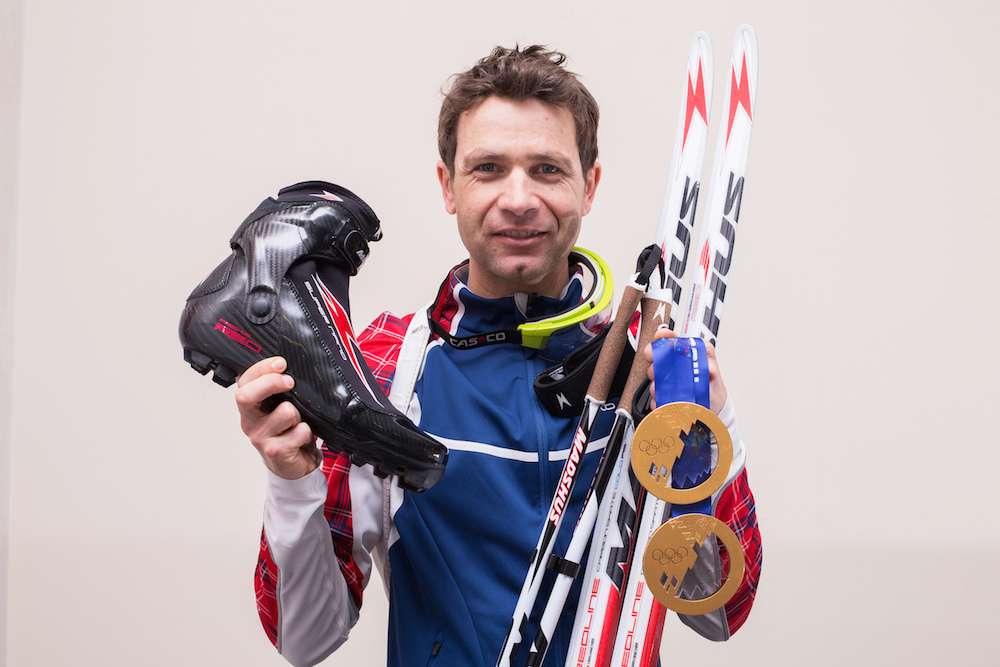
Ole Einar Bjørndalen with his medal haul from the Sochi Olympics. The Norwegian won gold in the 10 k sprint and mixed relay. (Photo: Madshus/NordicFocus)
Being involved with the factory and the Madshus product development team is important to Bjørndalen, as is sharing his experiences and contributing to the advancement of the sport, which he said gives his career an added dimension and motivates him.
“You can put is this way: sport is training, and equipment is development,” he said. “Biathlon is still a young sport, and there is a lot more to gain. To be a part of that development is extremely exciting to me.
“Being an active part of the research and development, and being included and involved in all the processes is a major reason why I switched equipment,” he said of his switch to Madshus in 2004. “Madshus is really on the cutting edge of equipment, they are extremely good at research and development and the process from idea to innovation is fast.
“With Madshus, you call and discuss an idea, and 24 hours later, their product engineers are after it,” Bjørndalen said. “With other brands, it can take weeks.”
From 200 to 2 pairs of skis
Bjørndalen is known for being a stickler about details in everything he does, and equipment is no exception. He is interested in both waxing and tuning, and he takes his time selecting the skis for his quiver.
“I am interested in waxing and the technical aspects of tuning skis. I do a lot of waxing with my training skis, but for races I don’t get to spend much time in the wax room,” he said.
However, picking skis for each competition is the responsibility of the athlete. Generally, Bjørndalen brings two pairs of skis to the venue the morning of a race, and there is a lot of effort that goes into picking those pairs.
“I typically test 10 to 12 pairs of skis the day before a race, and prior to the race season, I test maybe 200 pairs in order to find those 10 to 12 pairs that stand out,” he explained. “All the top racing skis are really good. But some pairs are damned good, and those are the ones I’m after. Some seasons I have to test more to find them, sometimes I find them right away.
“Sport is training, and equipment is development. Biathlon is still a young sport, and there is a lot more to gain. To be a part of that development is extremely exciting to me.” — Ole Einar Bjørndalen, Norway’s winning-most Winter Olympian and 19-time world champion biathlete
“The Redline series was a huge step up for the whole industry when they entered the market three seasons ago, especially the classic skis,” he added. “The difference between the Redline classic skis and their predecessor is substantial.”
He would know. Although all biathlon competitions are skate races, Bjørndalen spends a lot of hours on kick wax.
“I do a lot of classic skiing, which is really important in order to get better at skating,” he said.
The seasoned veteran is known for constantly seeking new insights and research on everything from training and equipment, to diet and lifestyle, to gain the split-second margin that separates the winner from the rest of the field.
However, in the first World Cup race of his 23rd season, Bjørndalen won by more than a hair. He didn’t miss a single target. The last time he raced a perfect 20 k was ten years ago. He skied like a tornado with perfect technique, milking each glide and getting the most from every push off. At the end of the day, Bjørndalen was almost half a minute ahead of second place.
“I had not expected that I would do so well, but I know I’m in good shape,” Bjørndalen told NRK at the time. “I don’t have too many secrets. I have strong motivation. Maybe that’s the secret.”
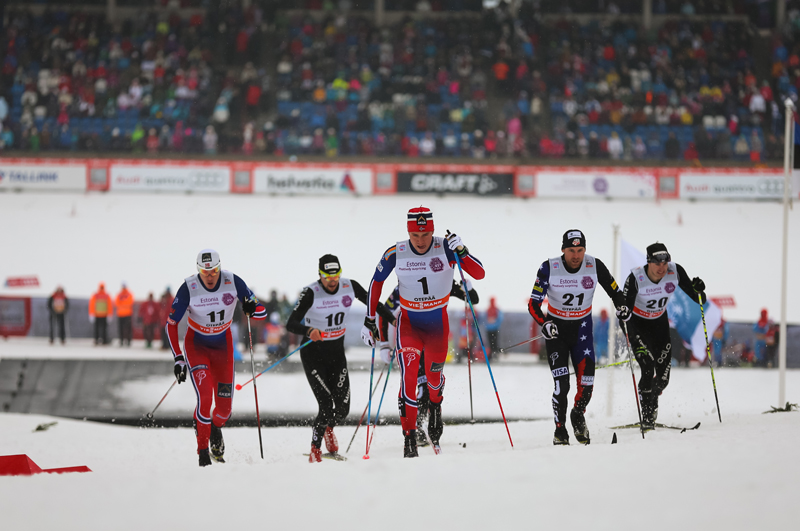
Norway’s Pål Golberg (1) leads Americans Andy Newell (21) and Simi Hamilton (30) up the first of two climbs in a classic-sprint quarterfinal last January at the World Cup in Otepää, Estonia. (Photo: Fischer/NordicFocus)
“I had a lot of good sprint races last season, and there are no championships this season, so winning the overall sprint World Cup is what motivates me the most,” Norwegian national-team member Pål Golberg said in a recent interview with FasterSkier at the Madshus factory in Biri, Norway.
Getting there requires a lot of hours, and the 25-year-old World Cup racer pointed out the importance of soaking up valuable training experiences and focusing on increasing one’s engine capacity. Golberg’s top training tip is to believe in your plan.
“There are so many training strategies you could try, but you have to decide on one plan and believe in that. That’s the most important part. Everything else builds on that,” he said, pointing out that this is true regardless of ambition level.
So how does he go about that?
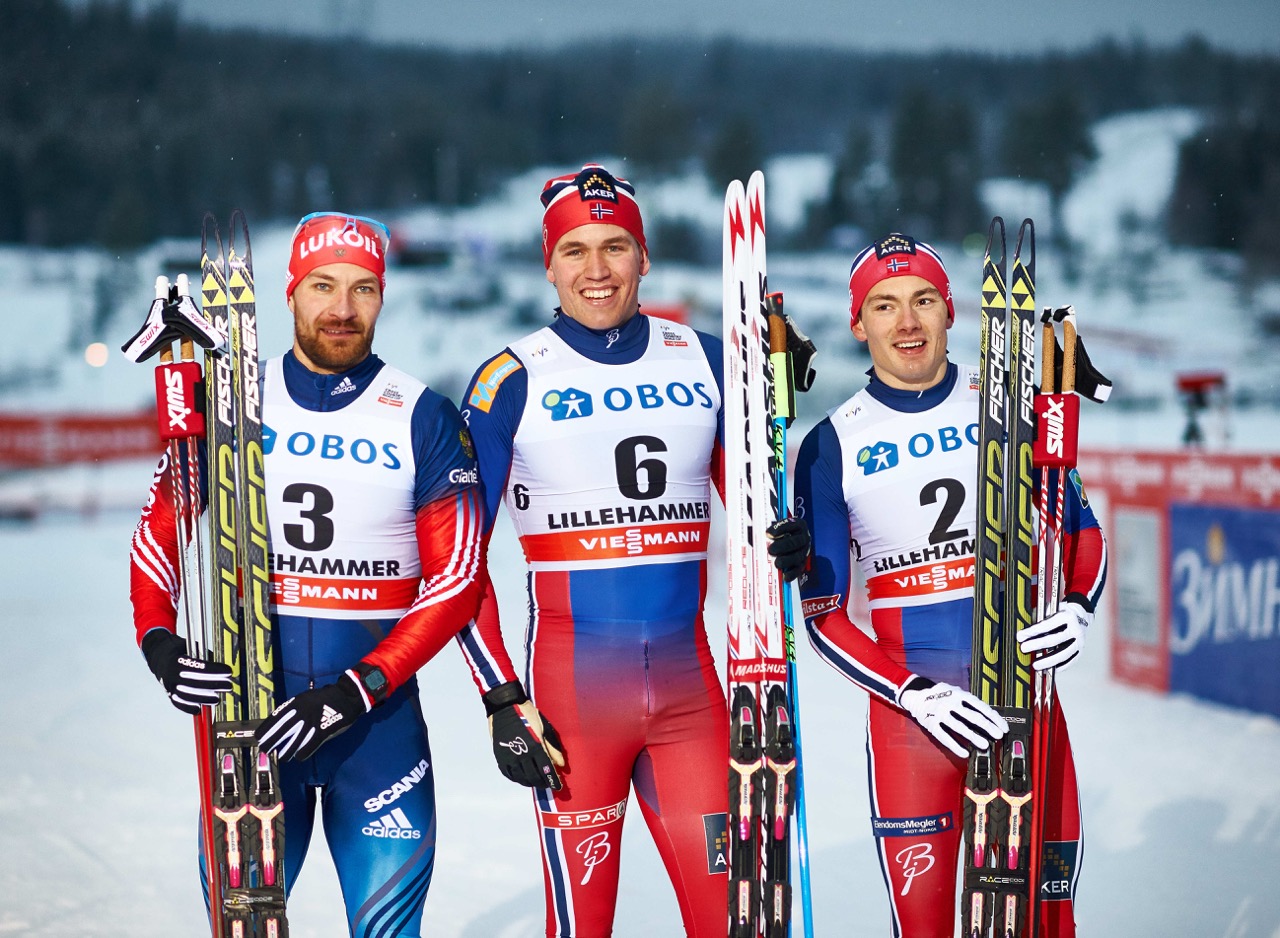
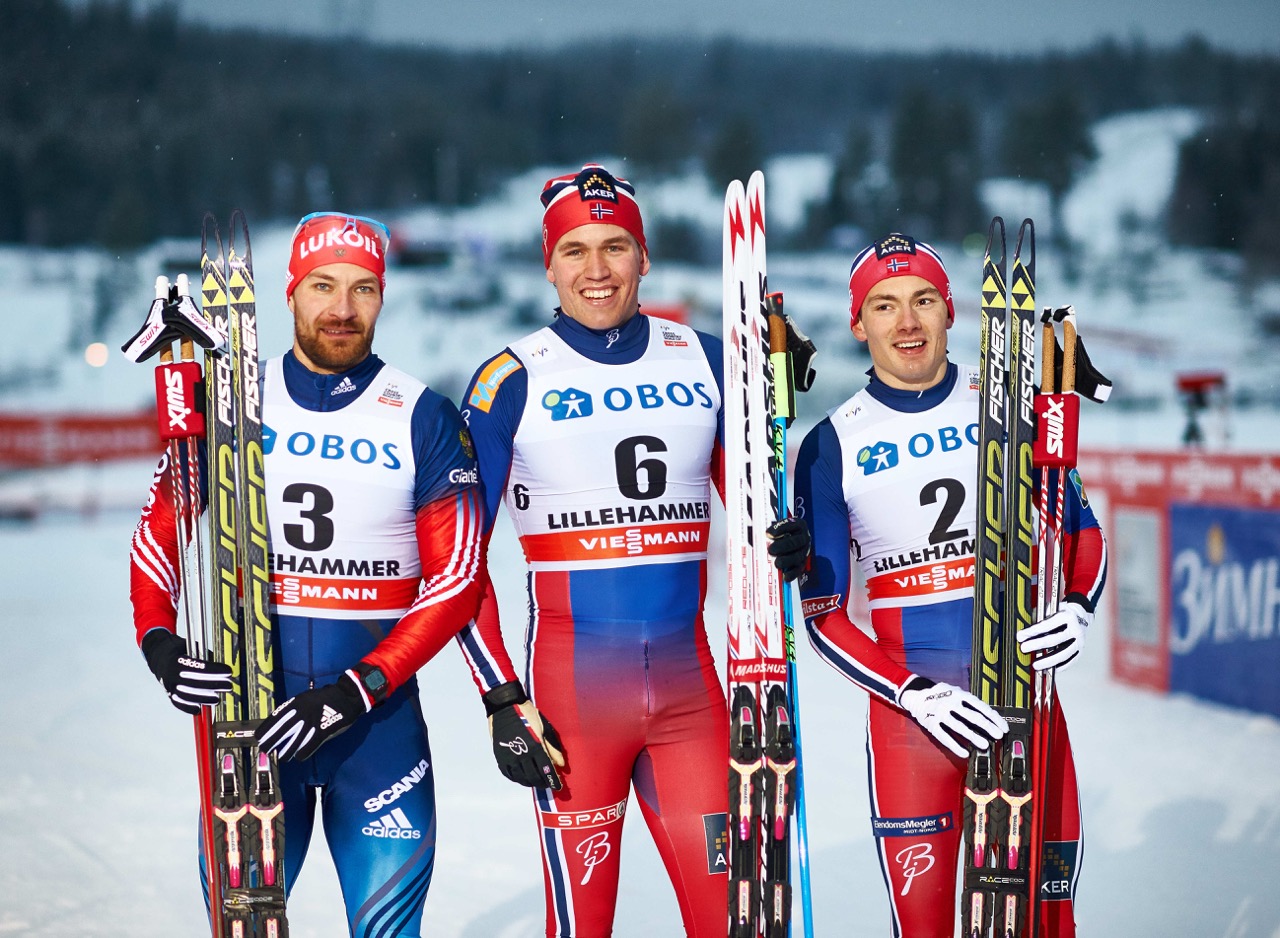
The men’s 1.5 k freestyle sprint podium at the 2014 World Cup mini tour in Lillehammer, Norway, with Norway’s Pål Golberg (c) in first, Russia’s Alexey Petukhov in second (l) and Norway’s Finn Hågen Krogh in third. (Photo: Fischer/NordicFocus)
Getting sick with a virus at the end of last season forced Golberg to change his training program significantly.
“I’ve done a lot of things differently this season compared to previous years,” he said, adding that it has been tough at times.
“I’ve had to change my priorities. I have to listen more carefully to my body and adjust my training plan accordingly. The result is that I logged quite a bit less volume than I planned to through the summer and early fall, and that’s disappointing,” he explained. “But you have to keep things in perspective. It just means that I can’t expect to be among the podium contenders in the early race season. However, I plan on being back in the mix by New Year.”
Best known as a sprinter, Golberg is not planning on racing the Tour de Ski this season. He’ll focus on a full recovery instead.
“There are a lot of other races that suit me better, and by skipping Tour de Ski, I get solid training periods on either side of Christmas,” he said.
At the same time, Golberg enjoys the thrill and excitement of multi-stage races, and is aiming for the Ski Tour Canada at the end of the season.
“Tour du Canada suits me and my strengths a lot better than Tour de Ski, because there are more sprints and more classic races,” he said, adding that he expects a fierce battle for the team amongst his Norwegian teammates.
“It will be a tight selection. I think everyone wants to race Tour du Canada this year,” Golberg said.
Capacity Over Brute Strength
More tours and mini tours have been a trend on the World Cup schedule in recent years, and Golberg welcomes that.
An emphasis on double poling is another trend in cross-country skiing, which started on the Ski Classics long-distance circuit. But even on the regular World Cup, more skiers are considering tossing the kick wax and muscling through a classic race on skate skis. Some analysts argue the double-pole trend will intensify unless the International Ski Federation (FIS) takes action regarding World Cup course profiles and technical requirements that favor diagonal striding. Accordingly, upper-body strength and double-pole technique has become an ever-so important part of elite training programs.
Pal Golberg of Norway leads Canadian Devon Kershaw in the World Cup 15 k classic last December in Davos, Switzerland.
Golberg explained his concern about the double-pole trend, and how it may come at the expense of traditional training.
“A lot of skiers put more emphasis on double poling, but I think many of them forget to put in enough time on improving their capacity, which is the limiting factor for cross-country skiing,” he said. “It’s one thing to prioritize double-poling a little more than before, but the overemphasis we are seeing now is something else. You will still ski most of the events with kick wax, and then it’s counterproductive to forget that all through the dryland season.”
Capacity is built via traditional bounding drills, moose hoofing, plyometrics and running, he explained.
“Double poling has to come in addition to that, on top of that solid aerobic foundation,” he added, pointing out that was particularly true for developing athletes.
“Capacity is particularly important for young skiers and juniors. This is the age at which you really need to focus on expanding the engine. It’s important to double pole, and it’s more important than it used to be, but I feel that it’s through those hard, ski-specific intensity workouts that you really push your limits to the max, and that’s where you get better,” he concluded.
Going the Distance
Golberg’s favorite workouts are over long distances in the mountains, with or without skis. For him, skiing is more than a career, and workouts are about more than simply getting faster and stronger.
He is passionate about being outside, and the mountains are where he feels the most at home. Those experiences fuel his workouts and keep him motivated through the tough days when the weather is wretched and the doorstep mile is particularly long.
“In the late winter, from February to March and through the spring until the snow melts, when days are longer and brighter, that’s when the mountains are at their best, and nothing beats long skiing workouts then,” he said. “Similarly, in the summer and fall, those long runs in the mountains deliver the best experiences. Those days deliver a little extra, and I just enjoy every minute.
“You have to hold on to those memories and sunshine moments, and save them for later,” he added. “It’s a lot easier and more fun to work out when it’s sunny and you’re not getting drenched to the bone. Earlier this fall there was a long, wet and cold period when it was raining sideways. That’s when I really have to dig deep to find the motivation, and I pull out those sunny memories.”
On the other hand, he finds a unique silver lining in those less-than-desirable days.
“It’s always nice to come back inside after cold and rainy workouts when you’re dreading to get out there,” Golberg said.
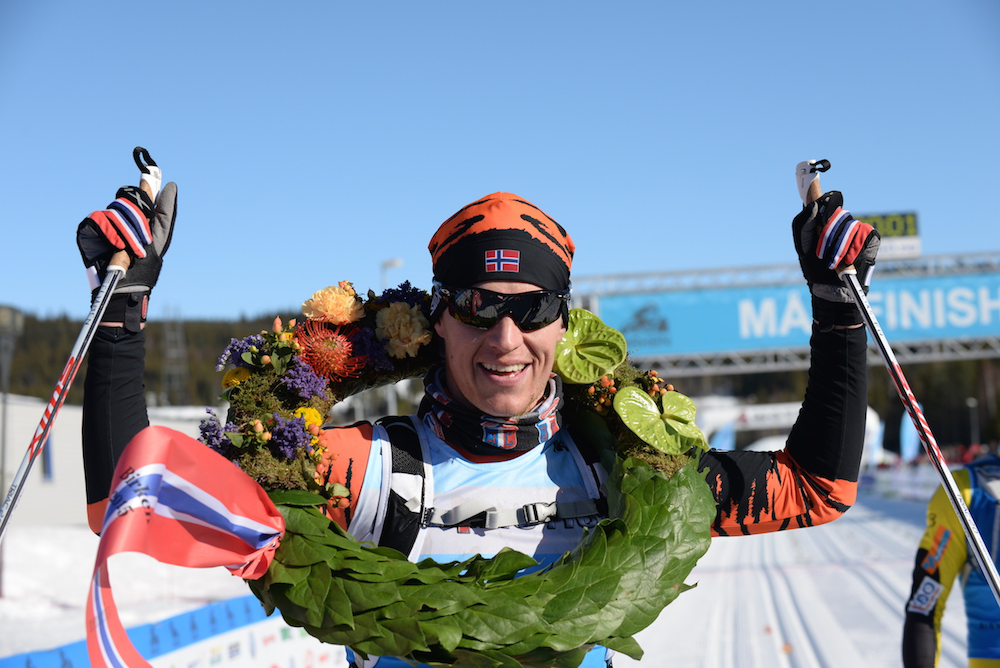
Petter Eliassen after double poling his way to a victory at the Norwegian Birkebeiner on March 22. The 29-year-old Norwegian went on to win the 2014/2015 Ski Classics title in his first season on the circuit. (Photo: Kent Murdoch)
How did Petter Eliassen do it? A month ago, the 29-year-old Norwegian from Trondheim double poled his way to a victory in the Norwegian Birkebeiner and went on to win the final Ski Classics race of the season — Sweden’s Årefjällsloppet — to claim the overall 2014/2015 Ski Classics title. It was his fourth-straight win on the circuit, making him the first racer to do so in Ski Classics history.
FasterSkier recently spoke with Eliassen, a Norwegian national team member two seasons ago, on the phone, and he happily shared his training strategies. The following interview has been translated from Norwegian to English.
A rookie to the long-distance circuit, he was content with the opening of his season, placing among the top 10 in the first five races of the Ski Classics series.
But Eliassen did not expect to close the season with a four-race winning streak — starting with the König Ludwig Lauf in Germany on Feb. 2, then a Vasaloppet win in his very first attempt at the legendary 90-kilometer classic race in Sweden on March 9. He won the Norwegian Birkebeiner on March 21, and finished the season off with a final victory in the Årefjällsloppet on March 28.
And he certainly didn’t expect to win the overall circuit crown in his first try. Eliassen beat established elite racers, such as the Aukland brothers of Norway, and former Vasaloppet champions, like Norway’s John Kristian Dahl and three-time Vasa Champion Jörgen Brink of Sweden, as well as a long list of merited marathon specialists, including Sweden’s Jerry Ahrlin, Oskar Svärd and Daniel Tynell, and Czech super-veterans Lukáš Bauer and Stanislav Řezáč.
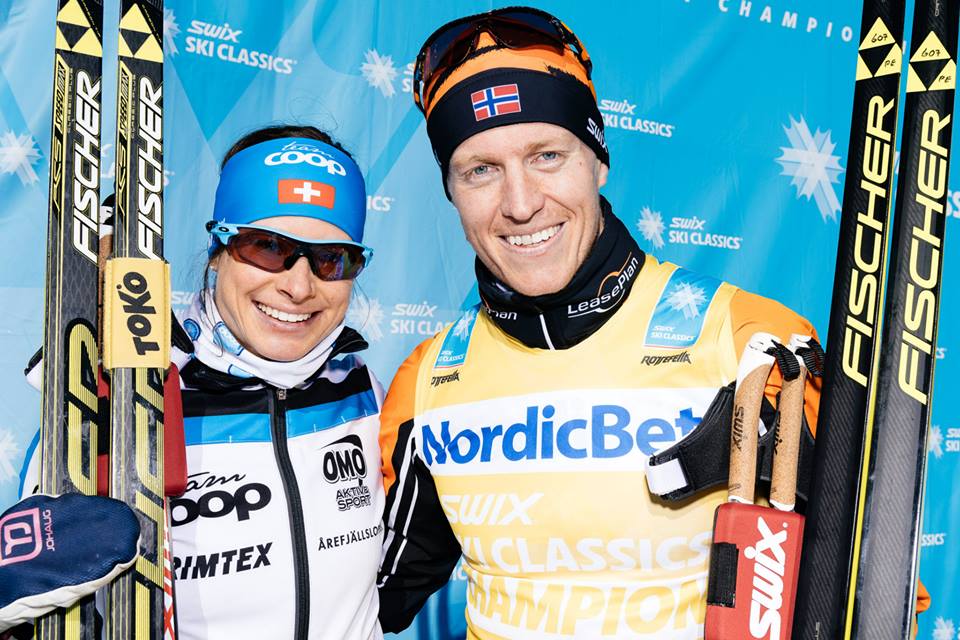
Petter Eliassen (r) of Norway and Team LeasePlan Go and Switzerland’s Seraina Boner (l) of Team Coop won the Årefjällsloppet on March 28, the last of nine events in the 2014/2015 Swix Ski Classics marathon series. (Photo: Ski Classics)
What’s your key to marathon success?
“I definitely benefit from years of racing experience,” Eliassen said, adding that the support and depth on Team LeasePlan Go made a difference. “We have a support crew and a race team that is very experienced and very well run. That’s huge both prior to the races and also in the offseason.
“Training-wise, I have done much the same leading up to this season as I did when I was on the national team. We do a lot of volume and some strength, but I have focused a bit more on double poling than I used to and much less on skating,” he said, adding that he does miss skating.
“I enjoy skating, and I still do some skate workouts throughout the season, but it’s definitely not the main part of the volume.”
While the Ski Classics organizers have not ruled out including freestyle events to the race schedule in the future, Eliassen doesn’t see that happen in the near future.
“So many of the established long-distance elite racers are highly specialized and spend so much of their training effort on perfecting their double-pole technique and strength that I think they would object,” he said.
Practice your weaknesses, race your strengths
While double poling isn’t his specialty, Eliassen is constantly trying to improve that aspect of his classic technique. He explained his team spends many of its group workouts focusing on tight finishes and does a lot of intense intervals in all kinds of terrain to prep for those.
“My favorite terrain is uphill. But many of the Ski Classics events have flat or even slight downhill finishes, so we spend a lot of time on that,” he said.
His race strategy is to determine how the race will play out well ahead of the finish line to avoid a double-pole showdown.
“I always go into the race with the intention to stay with the lead group as long as I can, but I try to pull away while there is still some distance to go and preferably in terrain that I’m good at,” he explained.
Skiers are made in the summer
During the season, Eliassen generally puts in one or two double-pole workouts per week, which last from one to three hours depending on how he feels and how much time there is between the races. When there are several weeks between events, he does longer workouts, and when the races come like rapid-fire, his main focus is recovering from one event to the next.
But the bulk of his double-pole training is completed even before the snow falls. During the dryland season, Eliassen and his teammates log several long rollerski workouts each week, with two to four hours of double poling.
“I am definitely not the one who logs the most volume on our team, but in the summer, I do at least two of those each week,” he said.
While rollerskiing isn’t his choice dryland workout, he loves running and also puts in a fair amount of time on his bike.
“I have to admit that my favorite summer workouts are long runs in the mountains. That’s where I really feel at home,” he said.
Strength and recovery
Eliassen stressed that plenty of variety was the key to staying injury free, along with a healthy dose of general strength, flexibility and recovery.
“It’s really important to do a lot of core strength in order to protect your back, shoulders and arms,” he said. “Also make sure to stretch. When you do a lot of ski-specific and double-pole specific training, you tend to get very tight, especially in the front of your body.
“And definitely make sure you allow yourself plenty of recovery time between the hard and long workouts, especially the rollerski double-pole sessions,” he added, pointing out that tendinitis issues often are a result of overuse and under-recovery.
In terms of building double-pole specific strength, he believes in simply double poling a lot.
“I don’t do any of the double-pole machines … I know a lot of skiers use them, but I believe there are several training methods that will lead to success, and so far, I haven’t used those,” he said.
If it ain’t broke, don’t fix it
Based on his experiences and results from his rookie season on the marathon circuit, Eliassen planned to continue with his training plan from last season.
“I will train mostly the same way as I did prior to this season, but of course, I will try to improve my test results even a little bit more,” he said.
Generally, Team LeasePlan Go does a one-week training camp each month during the dryland season, and in between, its athletes train independently.
“We live all over the country, so it’s nice to meet on a regular basis, but I also enjoy the flexibility of setting my own training schedule,” Eliassen said.
“I think the marathons really is my arena,” he added with a smile.
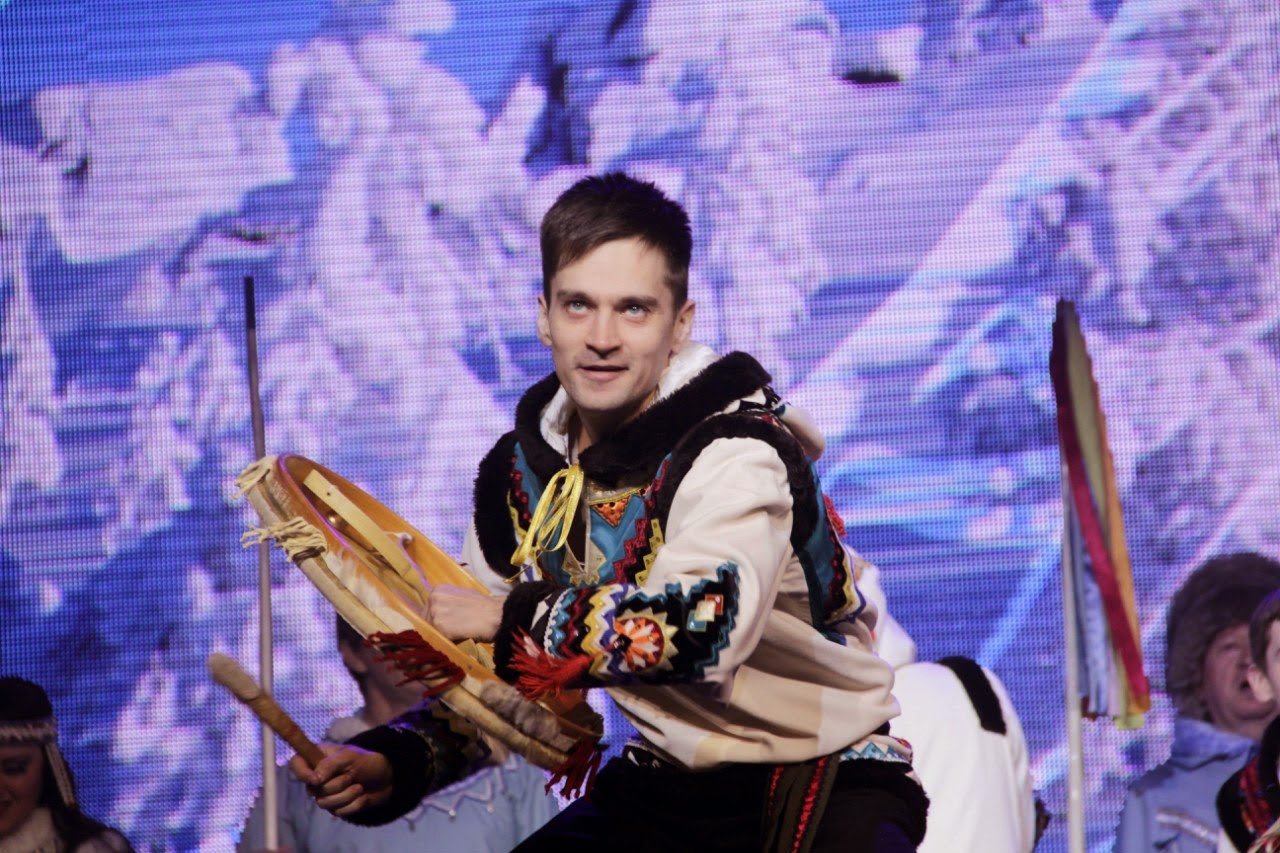
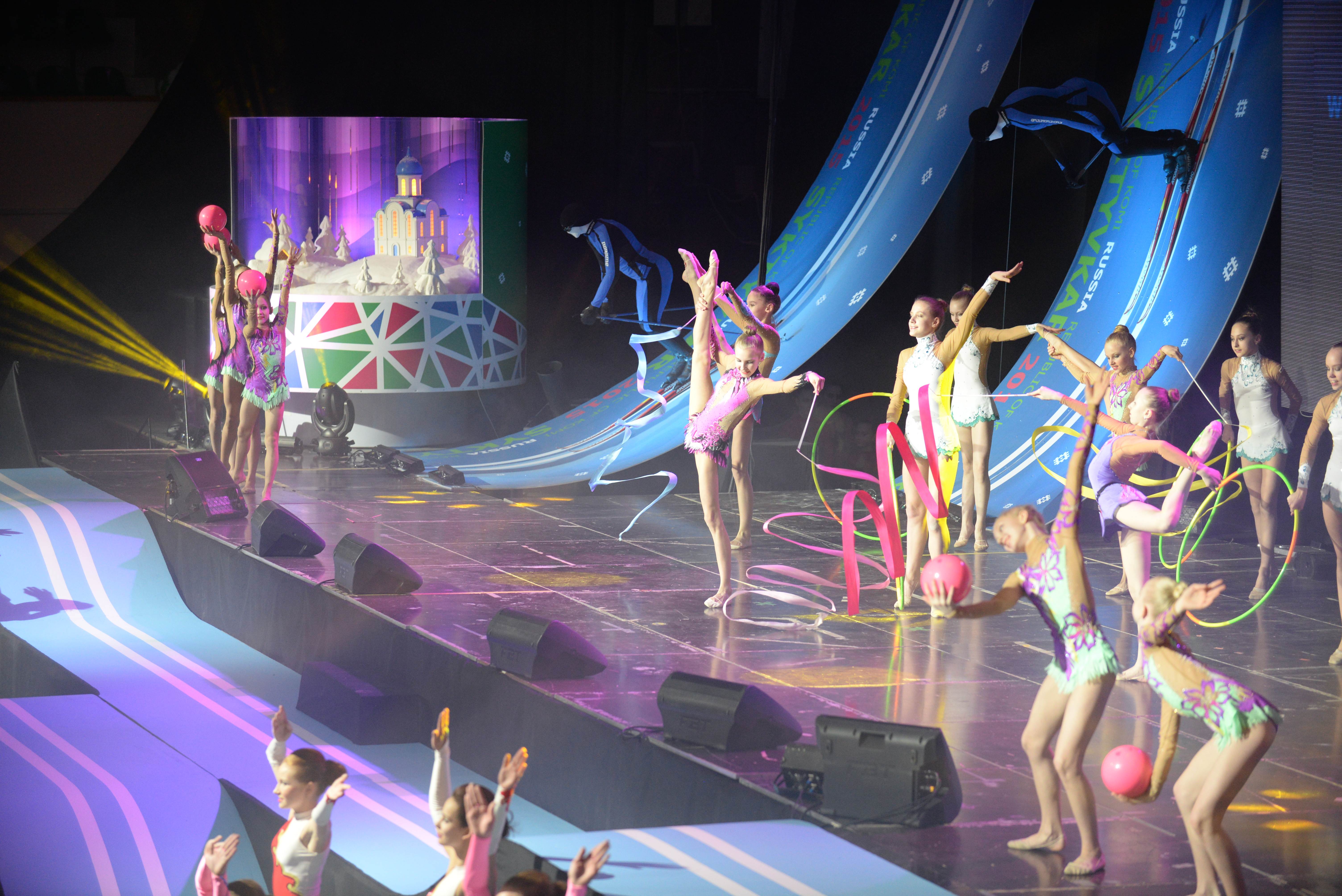
A scene from the opening ceremony at the 2105 Masters World Cup in Syktyvkar, Russia. (Photo: Masters World Cup 2015)
The following is an editorial submitted by FasterSkier contributor Inge Scheve, a Norwegian native who lived in Fairbanks, Alaska, and Bend, Ore., for a number of years where she became an avid skier and masters racer. Scheve recently returned from competing in her fifth Masters World Cup in Syktyvkar, Russia.
***
Russia was quite a trip. Literally. The 2015 Masters World Cup in Syktyvkar, Russia, from March 14 to 20 was amazing, maybe one of the best I’ve experienced in terms of racing, depth of competition, facilities, professionally run venue and race organization, as well as opening ceremony, medals ceremony and entertainment that made you feel like these championships were a big deal.
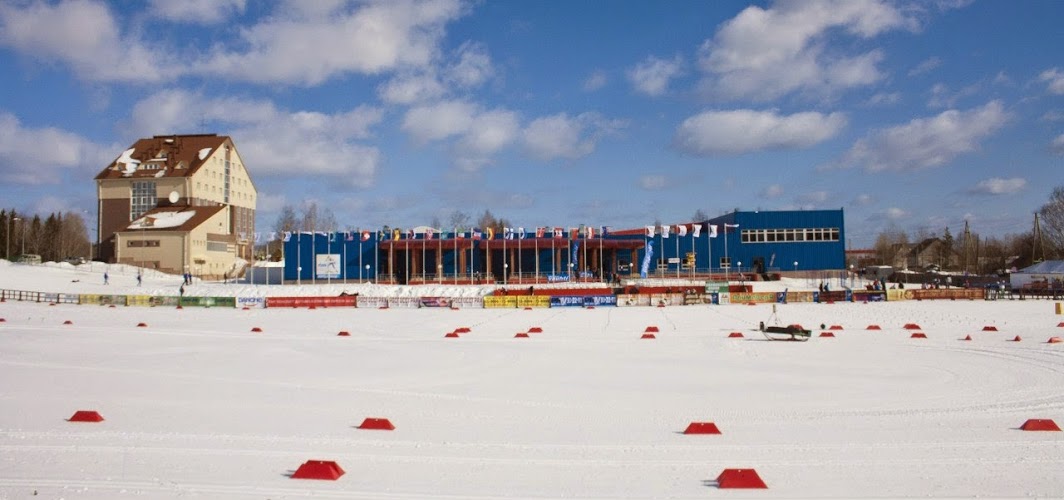
The head of grooming was the same guy who was in charge for the 2014 Winter Olympics in Sochi, Russia. The courses and stadium fit every International Ski Federation (FIS) technical specifications and rules for World Cup standard. Each national team was given its own wax room complete with amenities, premium ventilation and work conditions, locker rooms, bathrooms and showers.
The Smetanina Sports Complex at Masters World Cup 2015. (Photo: MWC2015)
The U.S. team consisted of a scant dozen travelers, including supporting spouses and a couple of racers who ended up injured just prior to the trip, but still decided to go because of the novelty of the destination. And you can certainly argue that it was.
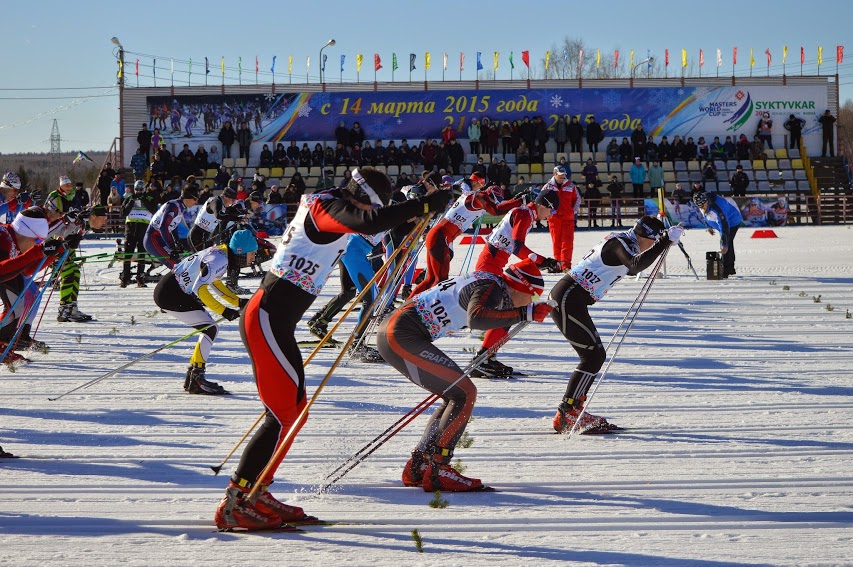
Start of a race in the M1 category. (Photo: MWC2015)
We stayed at the Olympiets Hotel at the venue, with a view of the courses from our rooms, and within spitting distance of the wax rooms and venue.
For a lot of us, Masters World Cup is the main event of the season, and the most important training and performance goal. It’s what you have in the back of your mind through the soggiest moosehoofing intervals in the fall and on those the frigid long-distance workouts in January.
And it’s also the closest most of us working folks get to a taste of Petter Northug and Marit Bjørgen’s world, with no further comparison. We certainly don’t ski as fast, but many definitely dig just as deep for the finish line.
Masters World Cup is one week of racing your brains out in events where the competition is fair, and you don’t have to worry about racers stepping on your gear out of the start and excessive jockeying and fighting for positions.
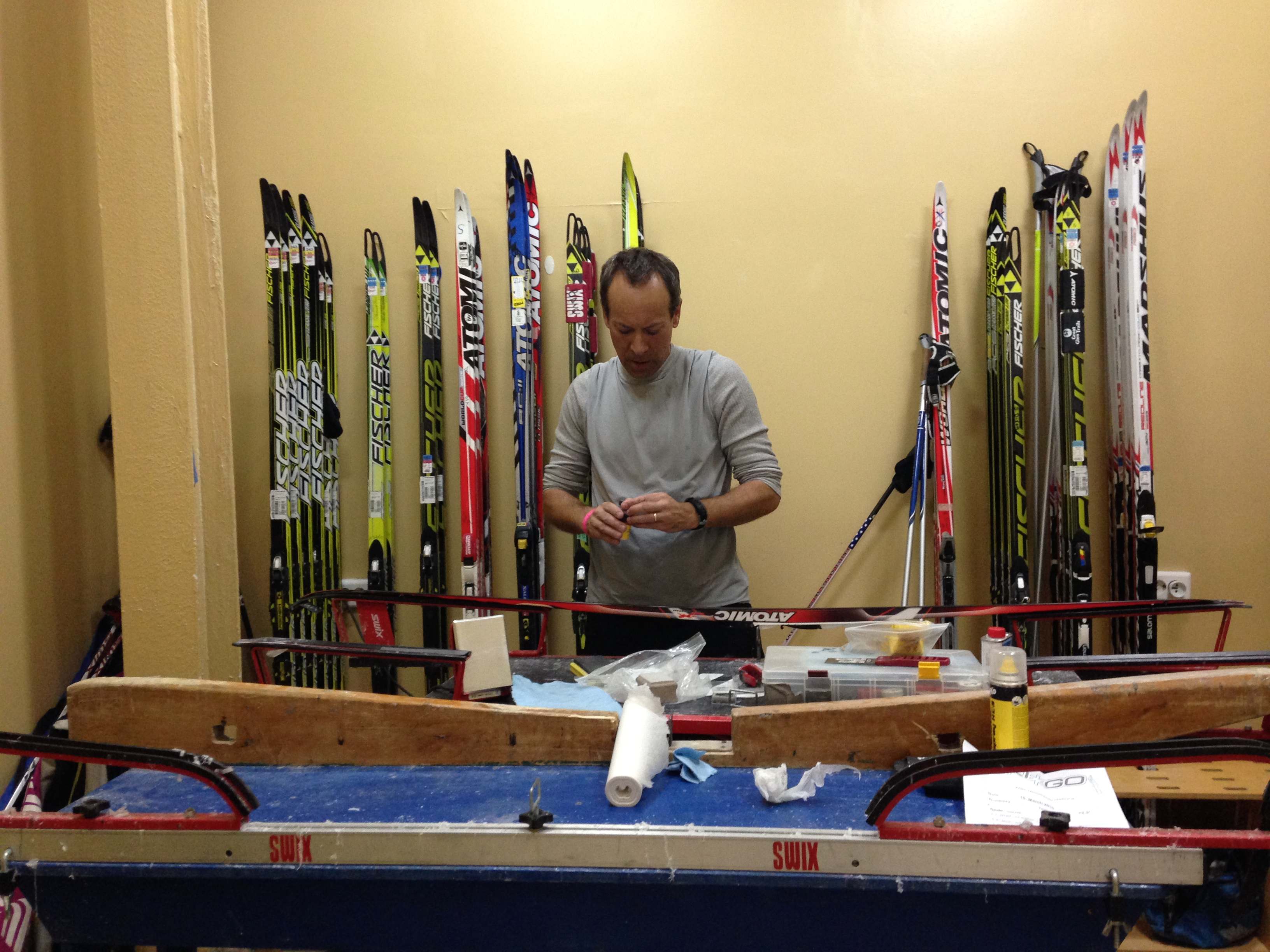
JD Downing at work in the U.S. wax room at the Smetanina Sports Complex at 2015 Masters World Cup. (Photo: Inge Scheve)
It’s unlike so many of the mass events such as the Birkebeiner and the Engadin with 10,000 to 15,000 racers on course. Even in the largest men’s categories, the start field at the Masters World Cup rarely exceeds 50 to 70 racers, and even those fields string out fairly quickly.
But Masters World Cup is so much more than just a week of crazy hard racing. It’s the five-week peaking plan leading up to the event. It starts with three hell weeks of volume and intensity that makes you wonder if you are going to bury yourself entirely, followed by two tapering weeks when you finally feel speed and snappiness come to you. You are race-ready and bursting at the seems.
And it’s a week where the world revolves around sleeping, eating, training, racing, waxing, and performing.
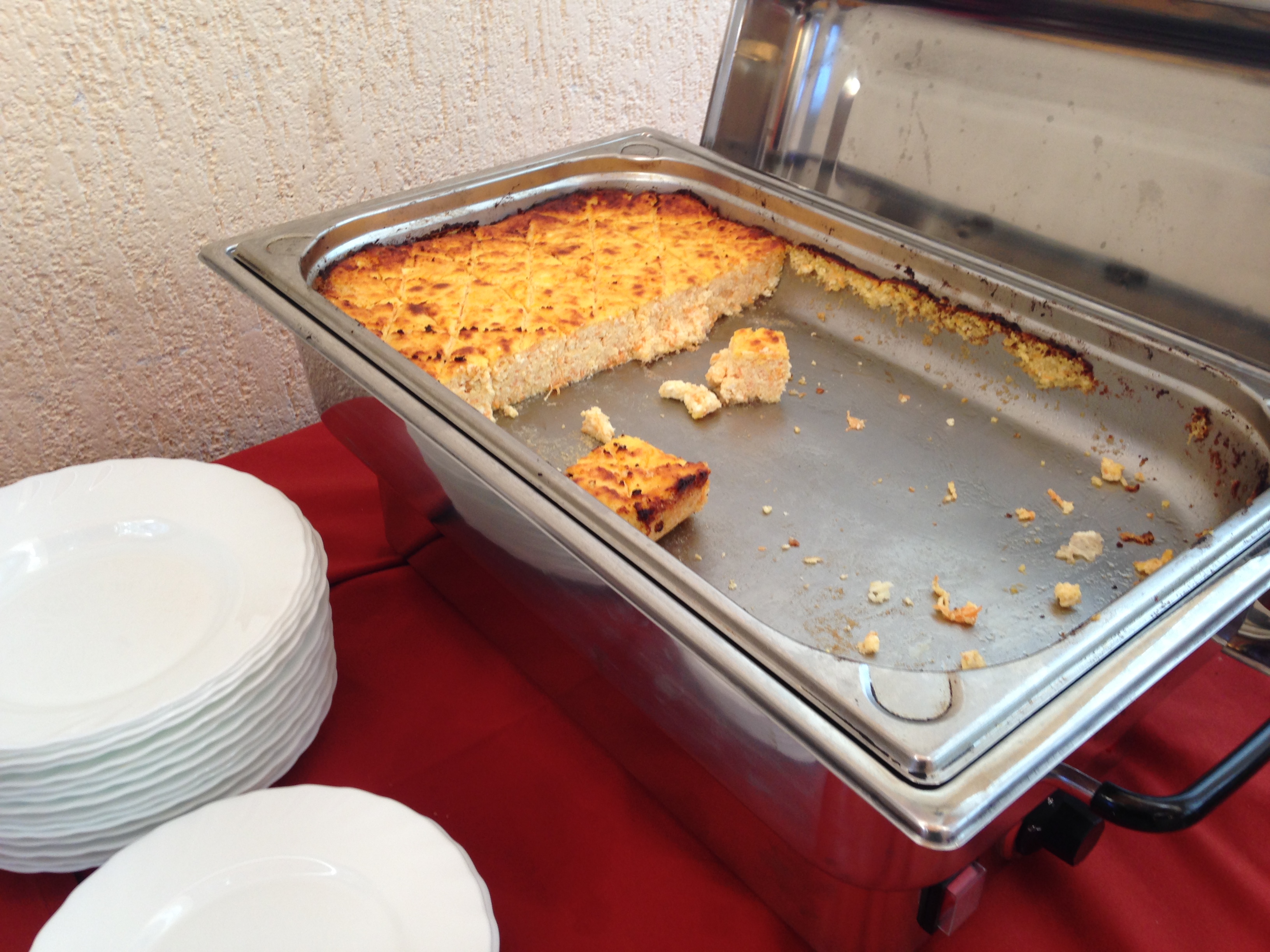
The dubious cottage cheese pudding at the Olympiets cafeteria. Not sure it will make me an Olympian.
Staying healthy is an important part of that equation, and it’s at the forefront of our minds to the point where some even start to feel they are coming down with something. Many carry hand sanitizers and try to avoid the obvious germ traps such as excessive hugging and handshaking, sharing water bottles, and avoid using the serving spoons in the cafeteria and touching handrails and elevator buttons.
But all kinds of precautions only go so far when the food-service hygiene fails. Food is expensive in Russia – relative to Russians, of course – and at our hotel’s cafeteria, leftover food was kept for a long time, reheated and resurfaced day after day. That creates a perfect growing environment for bacteria, and by the end of the week, many of us had both colds and stomach infections.
Syktyvkar is also the home of former Olympians Raisa Smetanina, Vasiliy Rotchev and Nikolay Bazhukov, who were on the World Cup circuit in the 1970s and ’80s. The stadium facilities, courses and venues are named after Smetanina. This is the national training center for the Komi Republic, where Syktyvkar is the capital, and from time to time, there are World Cup races both in cross country and biathlon at the Smetanina Sports Complex.
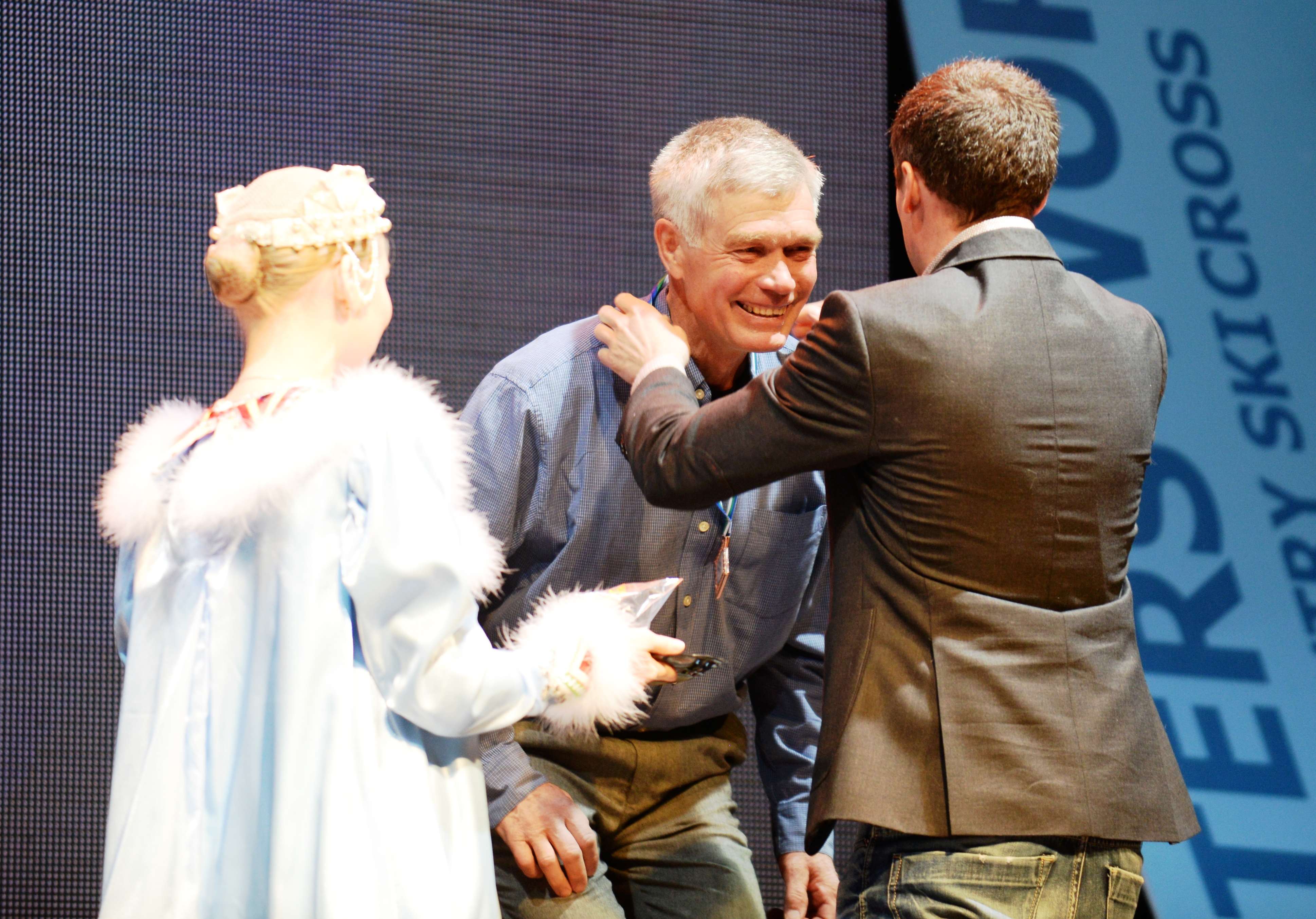
Bob Gray receiving his bronze medal. (Photo: Kent Murdoch)
The quick and dirty on U.S. results at MWC
Eight U.S. athletes collected a total of seven medals in Syktyvkar: Milan Baic of Michigan earned bronze in the men’s 30-kilometer skate on March 14, the first day of the races, as well as a bronze medal in the men’s 45 k skate on March 19.
On March 16, Bob Gray of Vermont took bronze in the men’s 5 k classic, and I finished second in the women’s 10 k skate.
Baic also scrambled for the U.S. men’s relay team that earned bronze in the M5 category on March 18. Gray skied the second leg for the team, Steve Smigiel of Michigan skied the third leg, and Kent Murdoch of Washington anchored the team to third place.
There were also several top-10 finishes during the Syktyvkar race week, including Murdoch’s fifth place and Gray’s sixth place in the men’s 10 k skate, Murdoch’s 10th place in the 30 k skate and my fifth place in the 15 k skate on March 14. On March 19, I placed fifth in the 30 k skate and Murdoch was sixth in the 45 k skate.
Additionally, the U.S. team consisted of Sherry and Richard Dixon, Alec Davies, and the U.S. national director of the Masters World Cup Association, J.D. Downing, who also raced two events during the Syktyvkar championships week. Dan Nolan was also part of the team, but did not race due to a thumb injury.
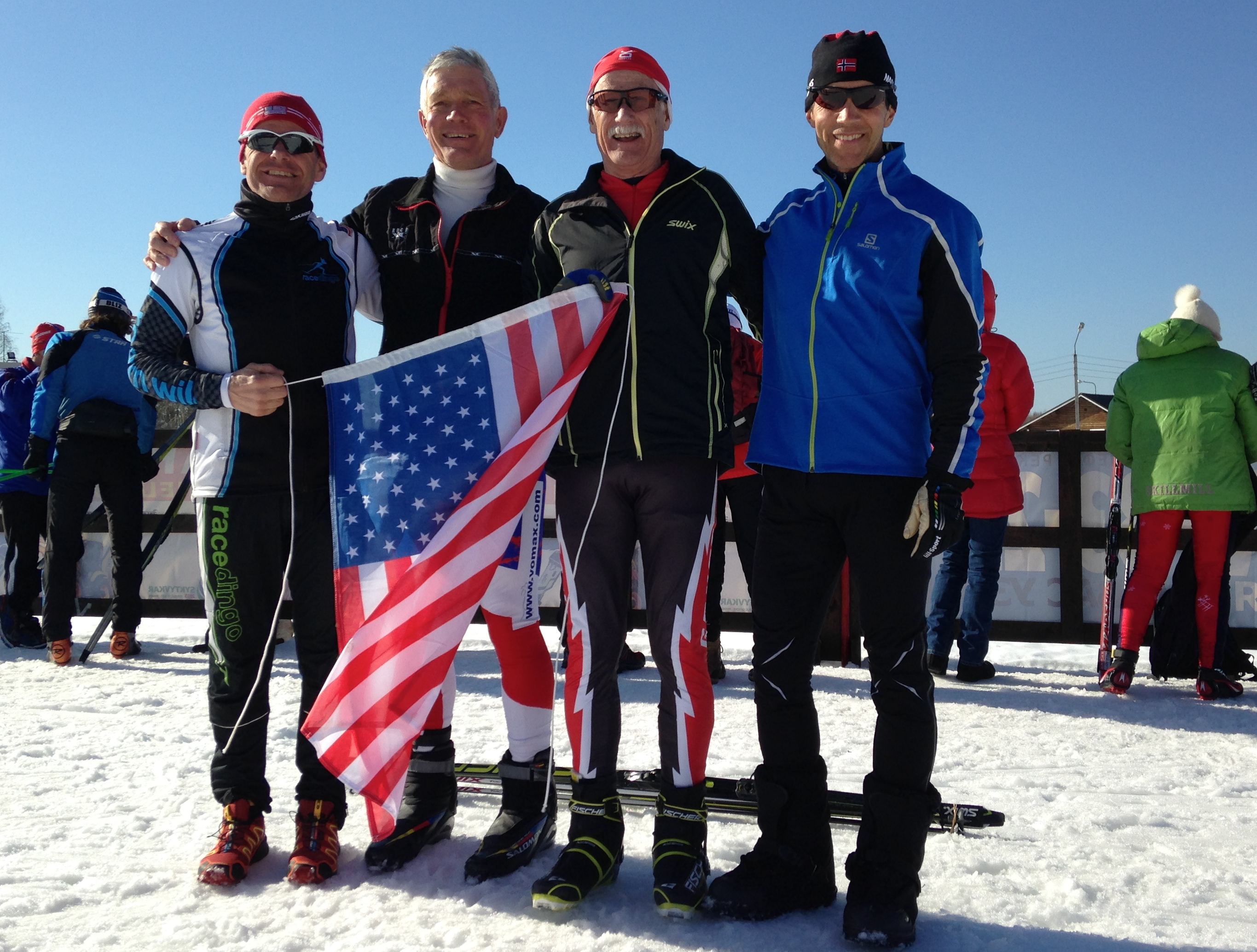
The U.S. bronze-medal relay team: (from left to right) Milan Baic, Bob Gray, Steve Smiegel and Kent Murdoch. (Photo: Inge Scheve)The cheering was first class: U.S. National Director J.D. Downing kept tabs and splits on all of the U.S. racers.
The Syktyvkar experience
We have competed against the Russians in many World Masters events before. I’ve wondered about their race faces and admit that they can be quite intimidating on the start line. They’re serious about the racing, with everything from ski testing to warmup routines and recovery. They mean business.
But off the course, the Russians are warm people, excited to share their culture and proud of their heritage. And with the global political situation starting to resemble the intensity of the Cold War days, most Russians are eager to show that they are not the regime. They are genuine, compassionate and generous. The organizers had more than 1,500 volunteers, and each national team was assigned a team of young students who worked as guides and interpreters, guiding us smoothly through language barriers, red tape and bureaucracy, and happy to take us anywhere we wanted to go, be it the mall, the supermarket or the ballet.
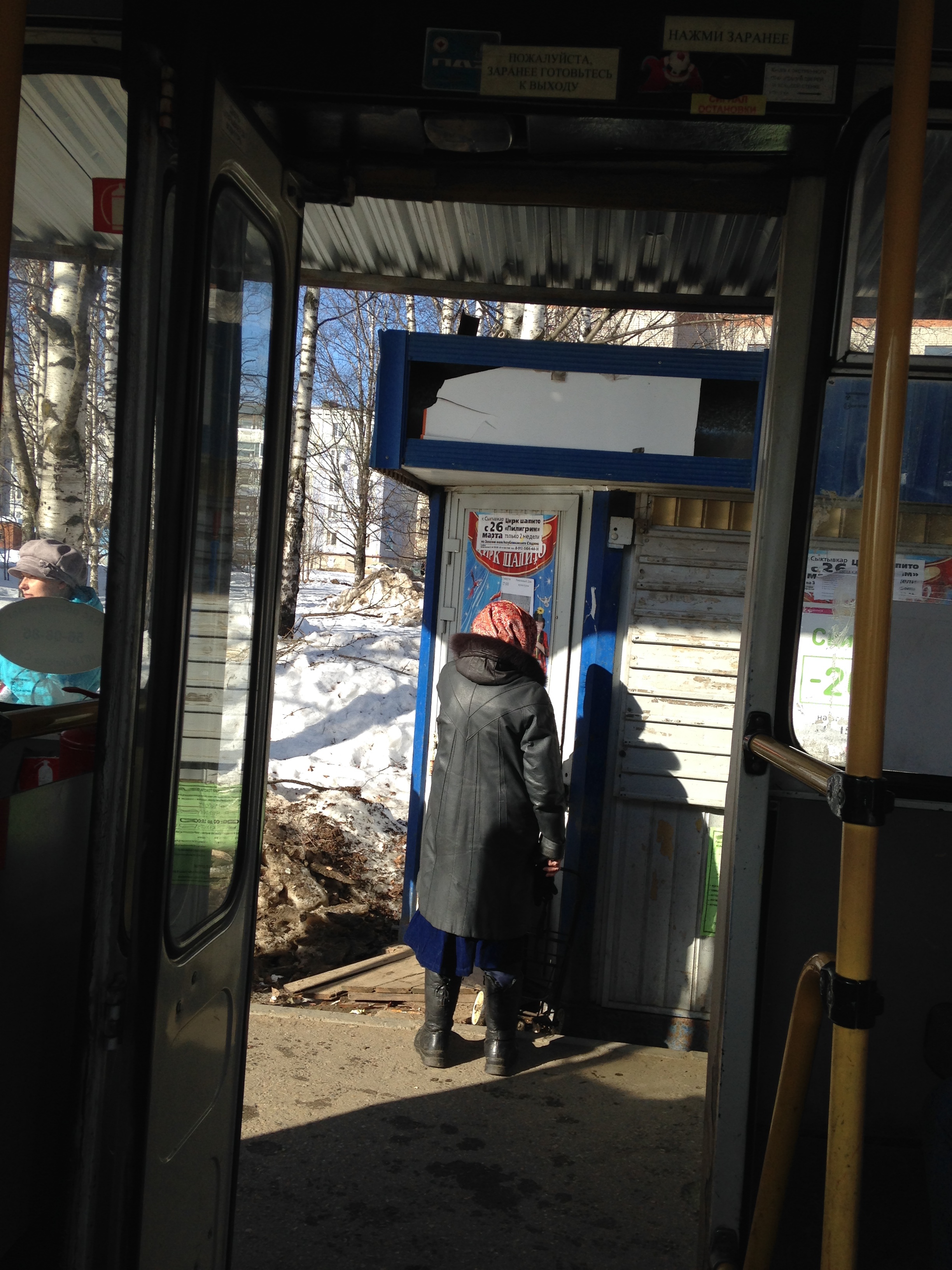
A snapshot of downtown Syktyvkar, taken from the city bus.
Syktyvkar is the capital of the Komi Republic and has been a city since Catherine the Great granted such status in 1780. The Tsarina needed timber and natural resources from the north, and also a new location for a penal colony. That tradition was continued by Stalin, who established a number of gulag prison camps in the area from 1929 and well into the post-World War II era. Prison gangs built rails and roads, towns and mines and most of the industrial infrastructure of Syktyvkar and other Komi cities, as well as numerous other Soviet communities. On paper, these gulags were no longer used after 1955, but it has later been documented that they were alive well into the Gorbachev era in the 1980s.
I must admit that Syktyvkar’s past sent chills down my spine when walking the muddy streets of the city and taking the bus through the town. Knowing that every ditch and road here is carved out manually with only crude tools and by scantly clad and undernourished prisoners, many sent there without a proper trial and only on dubious charges, casts a dark shadow over the beautiful cathedral roofs.
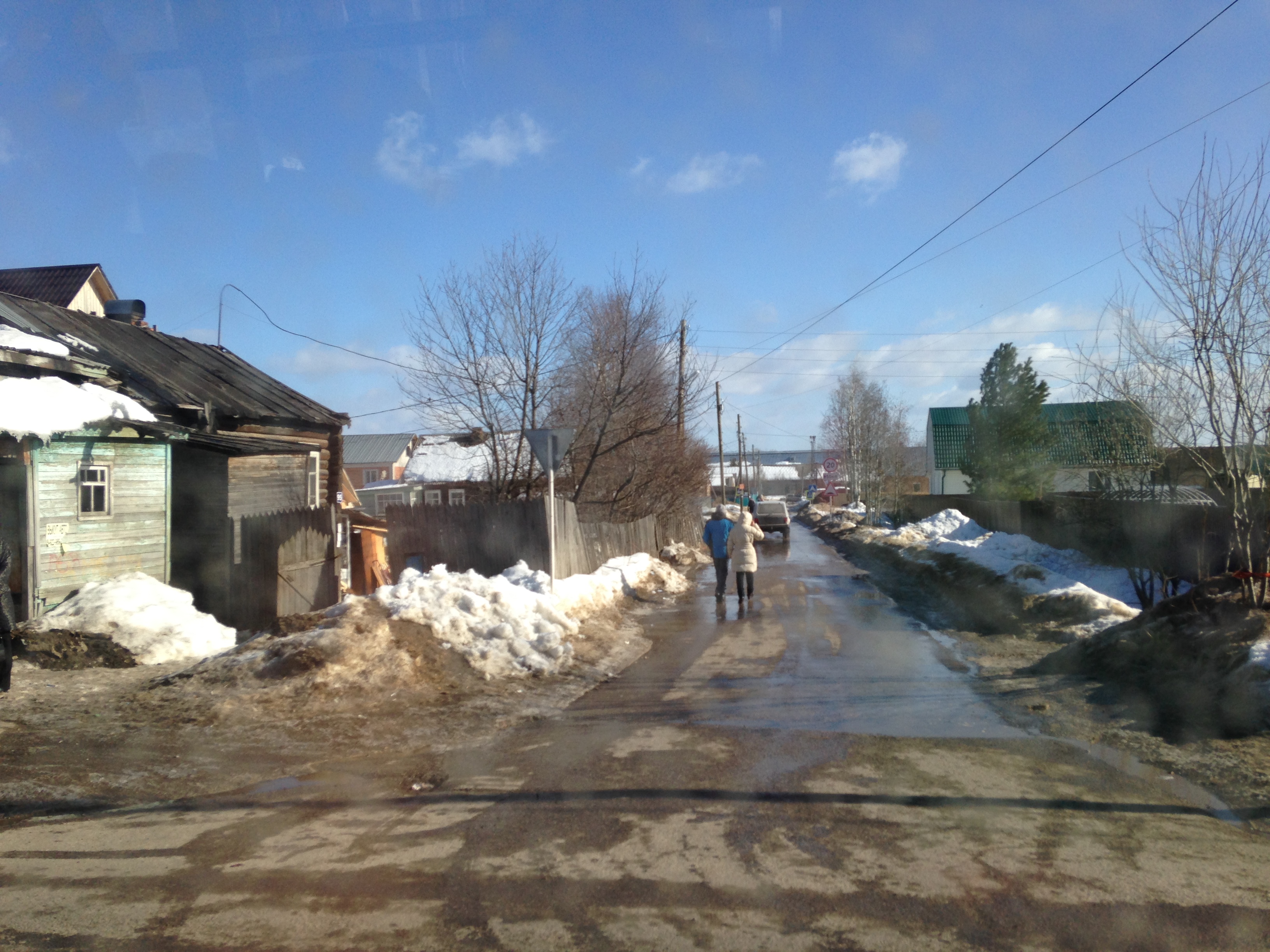
Syktyvkar city street.
Syktyvkar, a town of a couple of hundred-thousand people at the foothills of the Ural mountains, now has a university and several large corporations in timber industry, mining, oil and natural gas. At first glance, Syktyvkar looks like just another mid-size town consisting of endless gray communist-era housing projects in various stages of decay and suburbs of shabby-looking wooden cabins that reflect on the region’s economic state.
But the area has a vibrant cultural scene, with numerous museums, a theater of ballet and opera and performing arts, evident during the spectacular opening and closing ceremonies and the daily medal ceremonies at the Masters World Cup. At all of these events, local artists performed traditional music and dances.
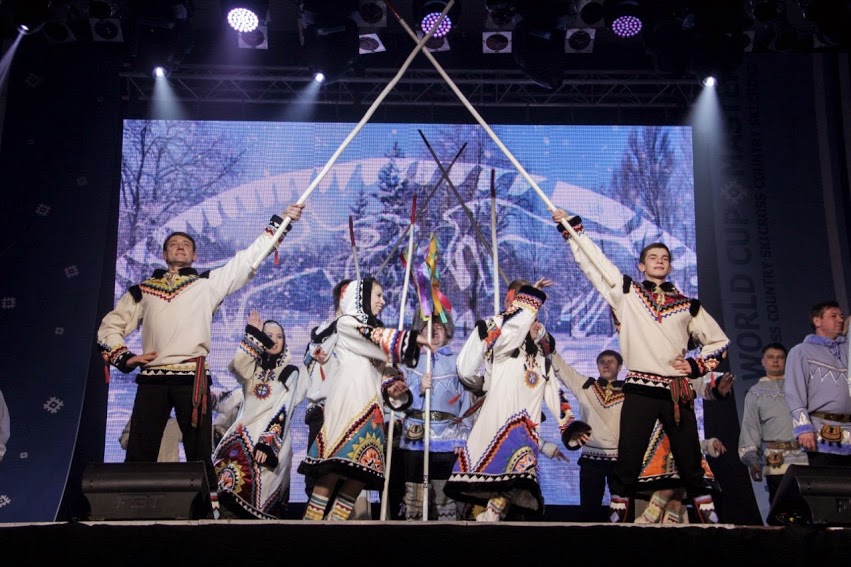
From the Opening Ceremony at the 2015 MWC in Syktyvkar, Russia. (Photo: MWC2015)The Opening Ceremony at the 2015 MWC in Syktyvkar, Russia. (Photo: Kent Murdoch)
The racing
Yours truly (l) on the final lap of the 30 k skate. (Photo: MWC2015)
I’m quite content with the results at Worlds this year, especially given the rocky preparation and the stressful winter I’ve had with my professional work situation.
The fifth place in the 15 k skate on the opening day felt like a solid effort, where I raced the best I could on that day. The field was stacked with Russian skiers without prior Worlds points, which made them total wild cards. I beat the racers whom I generally compete with at these events, but I was also beat by a couple of these wild cards. So, overall a solid effort.
But the silver in the 10 k skate was particularly exciting. At that event, I also beat a couple of the wild-card racers who topped me in the first race. The feeling of having dug so deep, put it all on the line and making it to the podium is magic.
The feeling of having dug so deep, put it all on the line and making it to the podium is magic.
However, digging so deep sure took a toll. The next couple of days I felt very tired, even shorts workouts seemed like they required more recovery than expected, and I was on the brink of coming down with a full-on cold, which had been circulating in the team for a few days.
Then on the day of the 30 k, I woke up in the middle of the night with a monster head congestion in addition to the race hack I had been dealing with since the 15 k on Saturday. As if that wasn’t enough, several of the team suffered from the revenge of the cafeteria – stomach pain and the runs. Not a great setup for a 30 k race. But given that this was the last race of the week, I gave it a shot with the ambition of finishing in style. So a fifth place under those circumstances felt like another success.
The price to pay was that the trip from Syktyvkar to Lillehammer, Norway, the following day became a bear. The same is true for Murdoch, who was sixth in the 45 k skate and suffered a similar illness both before the race and during the expedition trek to Lillehammer. Needless to say, only working at the Norwegian Birkebeiner on March 21 felt quite all right. Neither one of us felt a desire to race the 54 k classic event, despite the best conditions in several years. But we will be back!
Kent Murdoch (back of the train) during the 45 k skate at 2015 Masters World Cup. (Photo: MWC2015)
About the author:
A longtime contributor, Inge Scheve was born and bred in Norway, and learned to ski about the time she learned to walk. She always loved skiing, but didn’t really get into racing until she came to the University of Alaska Fairbanks, where she was introduced to collegiate ski racing American style. After UAF, she moved to Bend, Ore., in 2001 to ski with XC Oregon. She has competed for the U.S. in five World Masters, earning eightgold medals, 10 silver and 11 bronze.
When she’s not skiing, Inge loves caribou hunting on the tundra in her native Rendalen valley in Norway, dabbles in adventure racing, mountain biking, road cycling, hiking, trail running and kayaking. Inge really wants to become a wine snob, but realizes that probably involves learning to like red wine.