From the FasterSkier archive — posts syndicated from athletes’ and coaches’ own blogs between 2004 and 2012, kept online as published. Current coverage is at fasterskier.com.
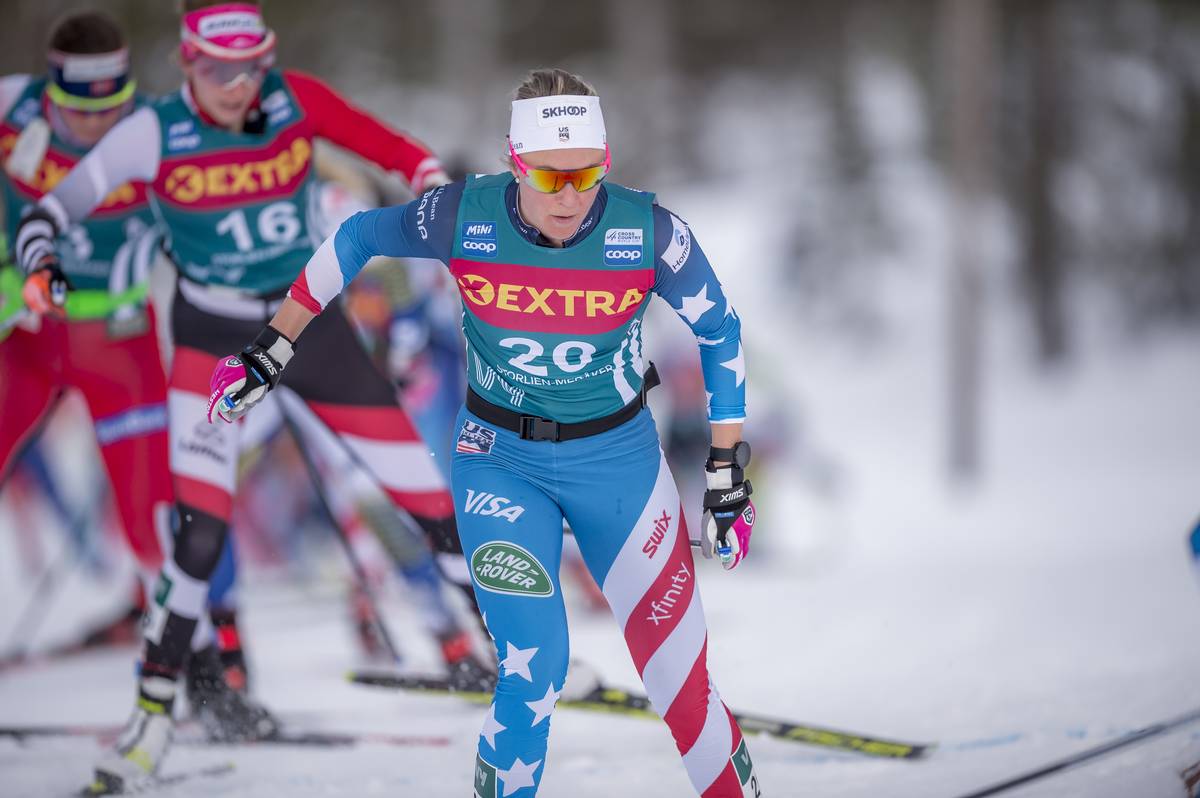
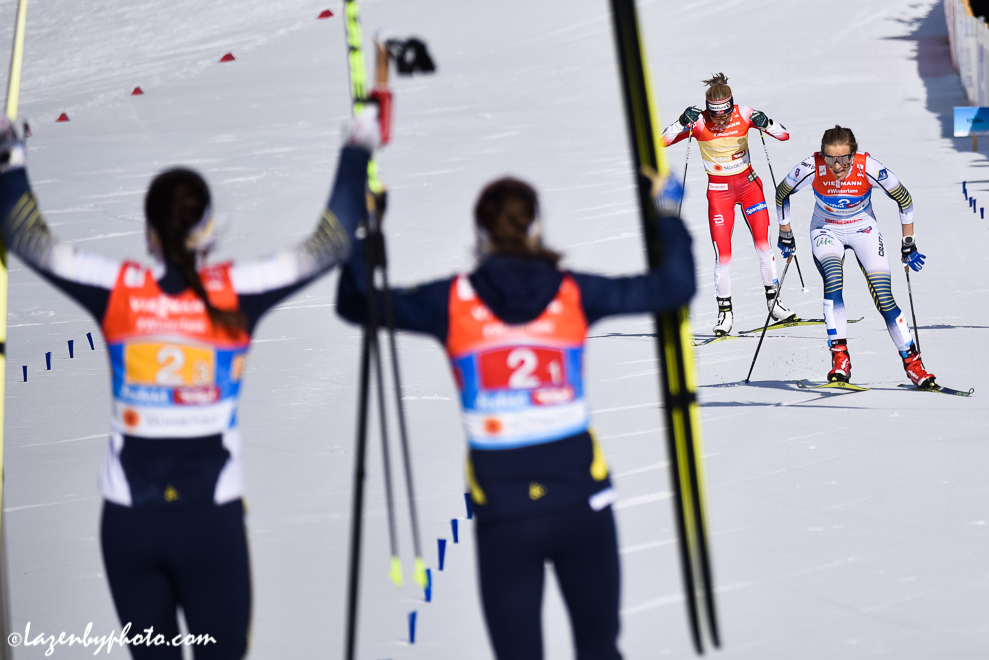
We’ve got guests. Former FasterSkier Managing Editor Rachel Perkins and U.S. Olympian and World Cup podium finisher Sophie Caldwell join us to recap an epic women’s relay from World Championships in Planica.
Nine races down, three to go. You can reach us at devon@fasterskier.com and nat@fasterskier.com.
Holy smokes, that was an epic weekend of racing. Devon and Nat are joined by Tony Cyr, the breakout Canadian star, and a mystery guest drops in later on in the episode.
We break down the sprint and two distance races held at the festive French venue in Les Rousses. And we promise, we’ll get you a mailbag episode before World Championships starts in a few weeks. Get at us at devon@fasterskier.com and nat@fasterskier.com.
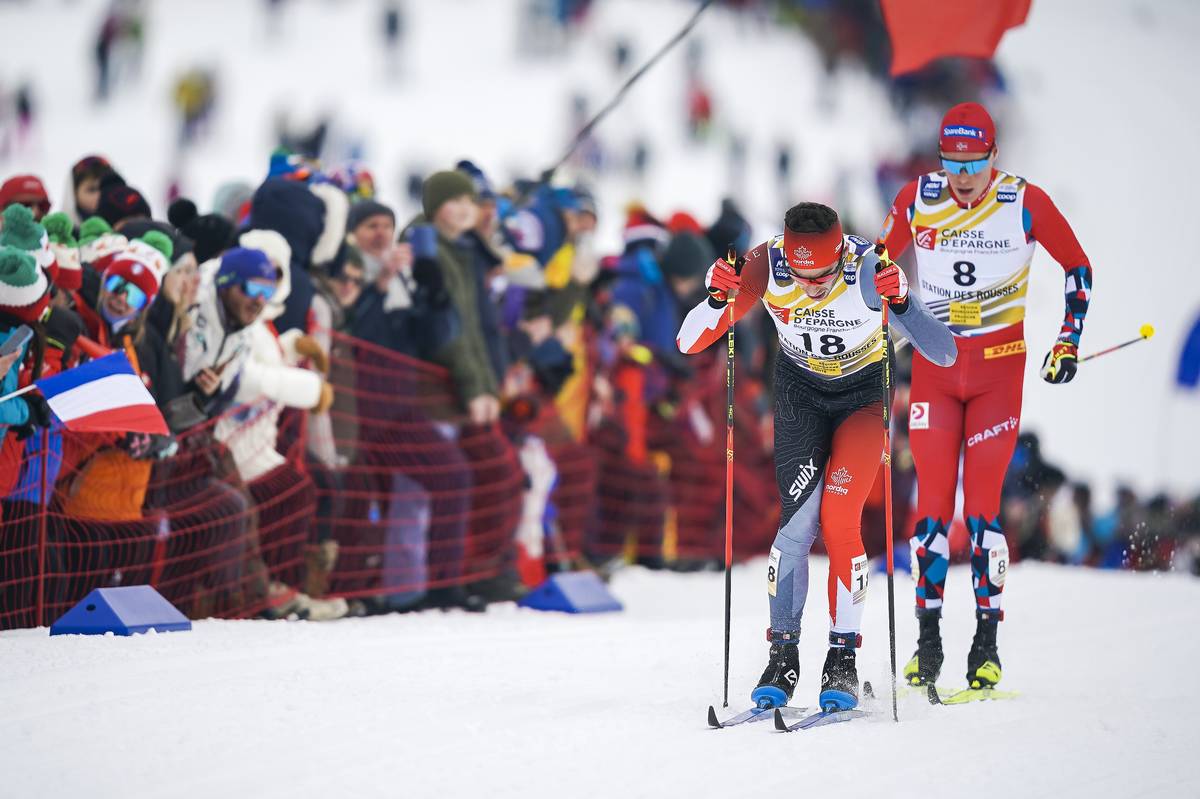
Canadian Tony Cyr skis in front of Norway’s Martin Loewstroem Nyenget at last weekend’s World Cup in Les Rousses, France. (Photo: NordicFocus).
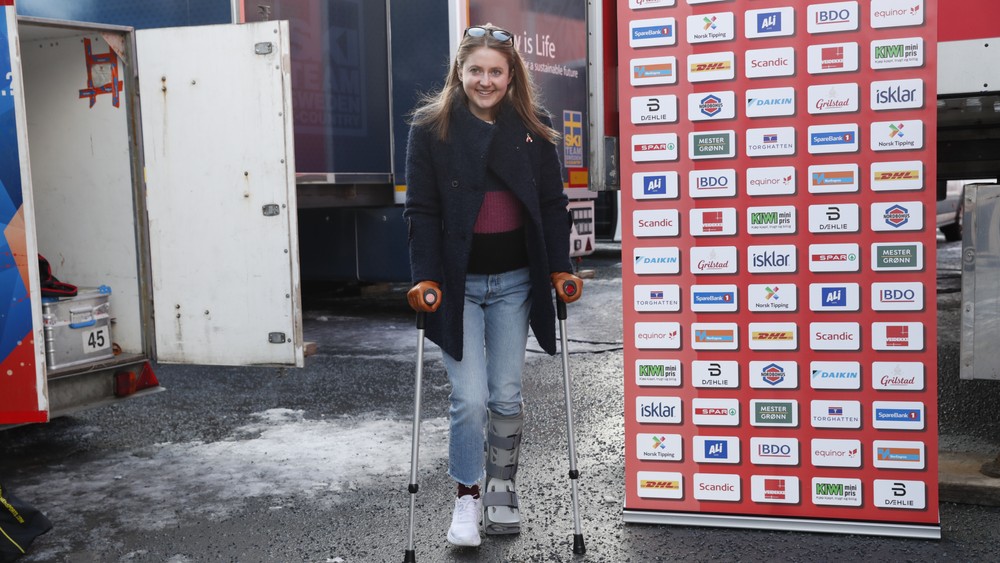
Ingvild Flugstad Østberg is forced to end her season early after sustaining a stress fracture in her heel. (Photo: Terje Bendiksby/NRK)
Earlier this morning, the Norwegian news outlet NRK posted that Ingvild Flugstad Østberg has been forced to end her season early after sustaining a fracture in her heel. The news was announced by the Norwegian Ski Federation, after Østberg spoke with the press while carrying crutches and wearing a protective boot, which she will be wearing for the next five to six weeks.
Østberg believes that the injury, which team doctors are calling a stress fracture, was sustained after jumping off a ledge onto concrete in combination with the cumulative stress of training and racing throughout the year.
It has been a trialsome season for the 29-year-old, who sat out the first eight races of the season after failing to meet team health criteria. Media speculated that the specific criteria included minimum body weight requirements.
“Cross-country skiing is demanding. In some periods, it is difficult to find the right balance between exercise and energy availability and to find it out in a good way,” Østberg said in the press conference, according to translation.
This discrepancy between energy availability and training load leads athletes into the condition called “Relative Energy Deficiency in Sport” (RED-S), which, among other side-effects, causes impaired hormone function and decreased bone health. The condition was formerly titled the “Female Athlete Triad”, but has since been expanded to include male athletes and the myriad of other associated health impacts.
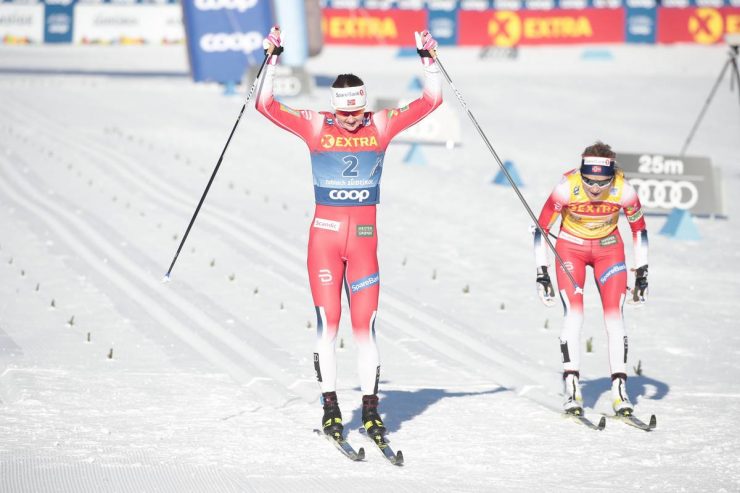
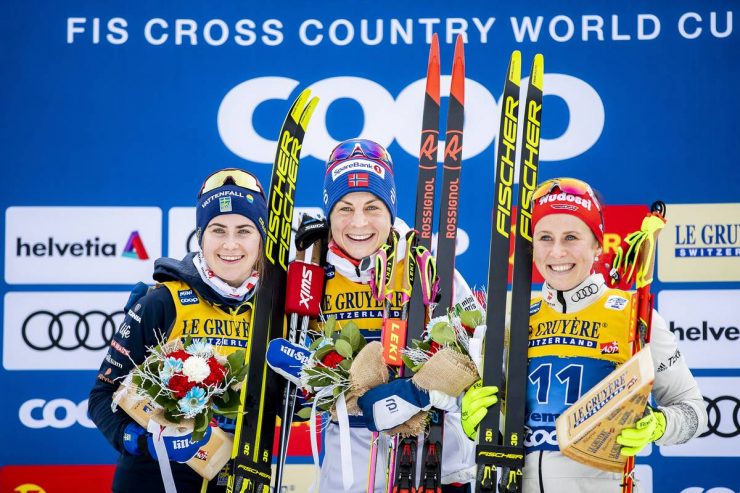
Ingvild Flugstad Østberg (NOR) for the Stage 4 win in the 2020 Tour de Ski with Therese Johaug (NOR) in second.
When asked whether she will be healthy again to begin training for the 2020/21 season in early May, Østberg gave an optimistic reply.
“First and foremost, I’m going to drag this (the boot on my leg) with me for five to six weeks… It’s actually some weeks until May 1st. I think I can do a lot of good for it.”
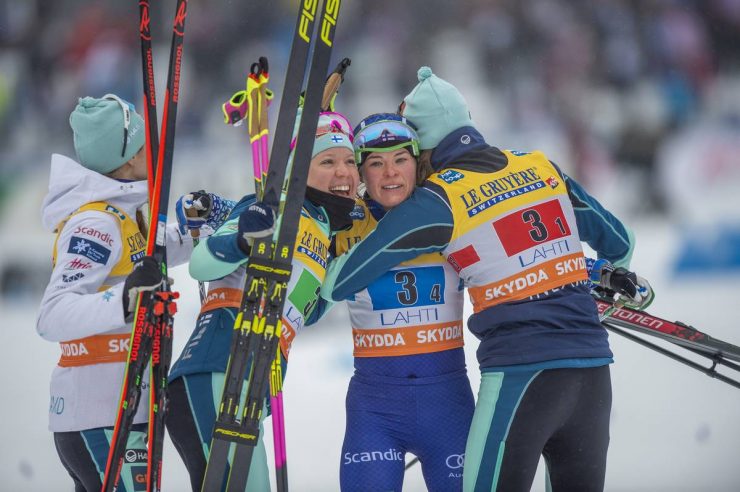
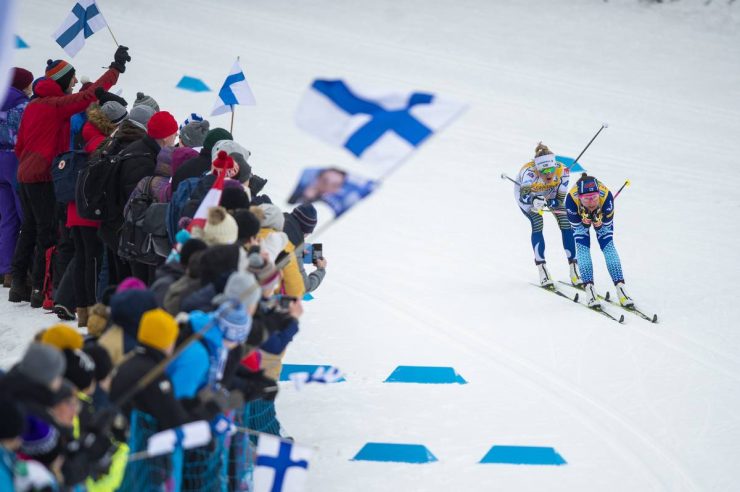
Finland celebrates its first relay podium on home soil. (Photo: NordicFocus)
Sports fans talk a lot about home field advantage. Which team will play at home at Game 7 of the World Series? Or in the playoffs before the Stanley Cup? Home turf and the swells of a crowd whose numbers are skewed toward the home team has an undeniable effect.
Yes, the Norwegian team of Tiril Udnes Weng, Ingvild Flugstad Østberg, Therese Johaug, and Heidi Weng won yet another 4×5-kilometer relay with a time of 50:04.8. As this makes 16 straight wins on the World Cup, perhaps the result no longer grabs our attention or piques our interest.
But what should spark you to continue reading is the news that the Finnish team of Johanna Matintalo, Kerttu Niskanen, Laura Mononen, and Krista Pärmäkoski earned the first ever World Cup relay podium for their country on home soil, finishing 30.3 seconds behind Norway.
For the first two classic legs of the race, not only were the Finns vying for the podium, there were making a go at the win.
Kerttu Niskanen (FIN) is tailed by Frida Karlsson (SWE) during the second leg of the 4×5-kilometer relay in Lahti. (Photo: NordicFocus)
At the end of the first leg, Matintalo had a small gap to the Norwegian, Swedish, and Russian teams. Niskanen continued to hold this lead at the end of the second, but Sweden was only a second behind. Norway exchanged a few seconds later, and Russia appeared to have fallen off the pace.
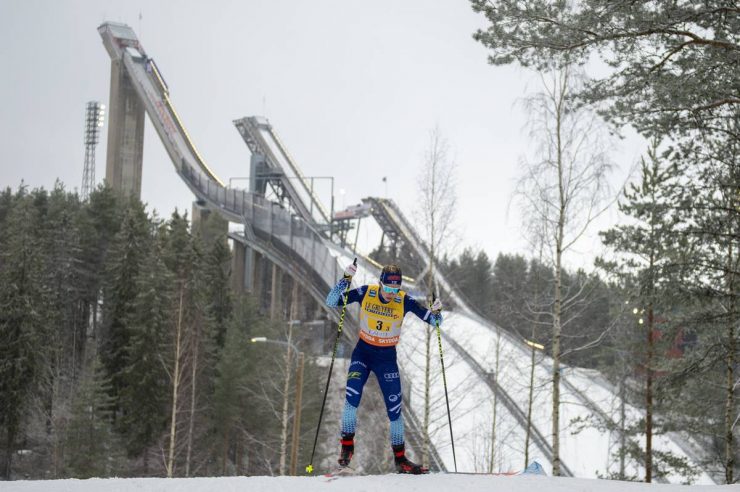
Then Johaug skated away with the reins . A few seconds was nothing for the powerhouse, and she was in the front within the first kilometer. But Mononen was not willing to let her go. She matched Johaug in the first climb as the spectators lining the course shouted her name.
Mononen began to fade, but her decision to hang onto Johaug’s ride as long as possible kept her well ahead of the other teams.
Laura Mononen chases Therese Johaug during the third leg of the 4×5-kilometer relay in Lahti. (Photo: NordicFocus)
In the fight for the third spot, Russia’s Ekaterina Smirnova closed a gap of nearly 30 seconds to Rebecca Ӧhrn of Sweden, moving into third position by the end of the lap. The German team had also made contact, making it a three nation race for the final podium spot.
Mononen tagged Pärmäkoski with roughly a 29 second deficit to the Norway’s anchor, who did not treat her leg like a victory lap. Heidi Weng hammered each of the five K’s, but she could not put additional time on Pärmäkoski.
Krista Pärmäkoski anchors the Finnish relay team in Lahti. (Photo: NordicFocus)
The Finn, who clearly came back on form this weekend, kept the margin constant as she made her way up and down the hilly wooded terrain, past waving fans chanting “Kris-ta! Kris-ta! Kris-ta!” in time with her steps.
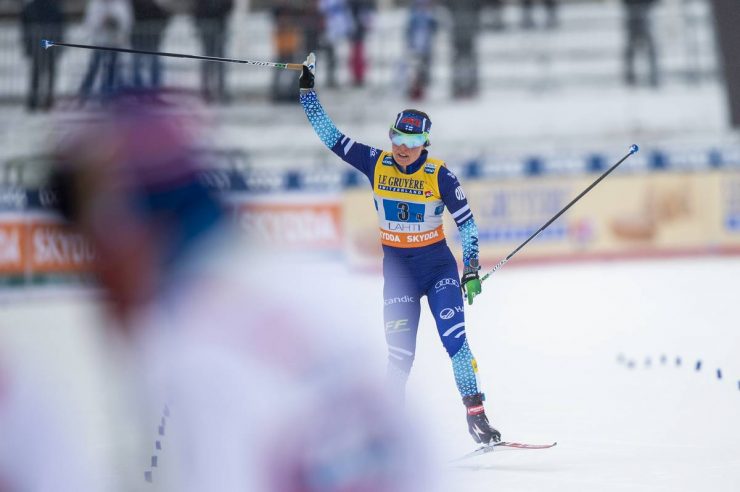
As she made her way down the final stretch, Pärmäkoski saluted her fans in the stadium who were applauding a job well done.
Waving to the home crowd, Krista Pärmäkoski seals the deal on second place in the 4×5-kilometer relay in Lahti. (Photo: NordicFocus)
In the final battle for third, the threesome of Yana Kirpichenko (RUS), Maja Dahlqvist (SWE), and Sophie Krehl (GER) soared together through the first 2.5 k loop. The German fell off the pace in the second lap, but neither the Russian nor the Swede could break away.
Kirpichenko flew down the final descent in a tuck and curved into the straightaway in the lead, but the Swedish sprinter was right on her tails. Firing her afterburner, Dahlqvist moved alongside the Russian in the final stretch, clearly demonstrating superiority in sprinting. As the line drew near, the women threw their boots in unison, but the surging Swede was there first, if only by 0.1 seconds.
An emotional Yana Kirpichenko is consoled by her teammates after the Russians finished 4th in the 4×5-kilometer relay. (Photo: NordicFocus)
“Of course, Norway, we are a really strong team and have done a lot of good relays,” Østberg told FIS at the finish. “Tiril did a really good job in her first time on Norway I. For me, it was a hard day at work, but I fought all I could and Therese, of course, really strong and Heidi also did a really good leg. So a fantastic team and it was fun to win.”
During the race, lightly falling snow turned into misty rain, posing a challenge for the waxers. Therese Johaug fielded the FIS interviewer’s question of how this impacted their team.
“I had really good skis,” she stated. “Of course, it’s difficult conditions when the snow comes. Maybe Ingvild did not have so good grip out there, but she fought all the way. I’m so impressed with both Tiril, Ingvild, and Heidi today, and it is so fun to race a relay with the team you’re training so much with.”
Eyes locked on the win, Heidi Weng skis the final meters of the 4×5-kilometer relay in Lahti. (Photo: NordicFocus)
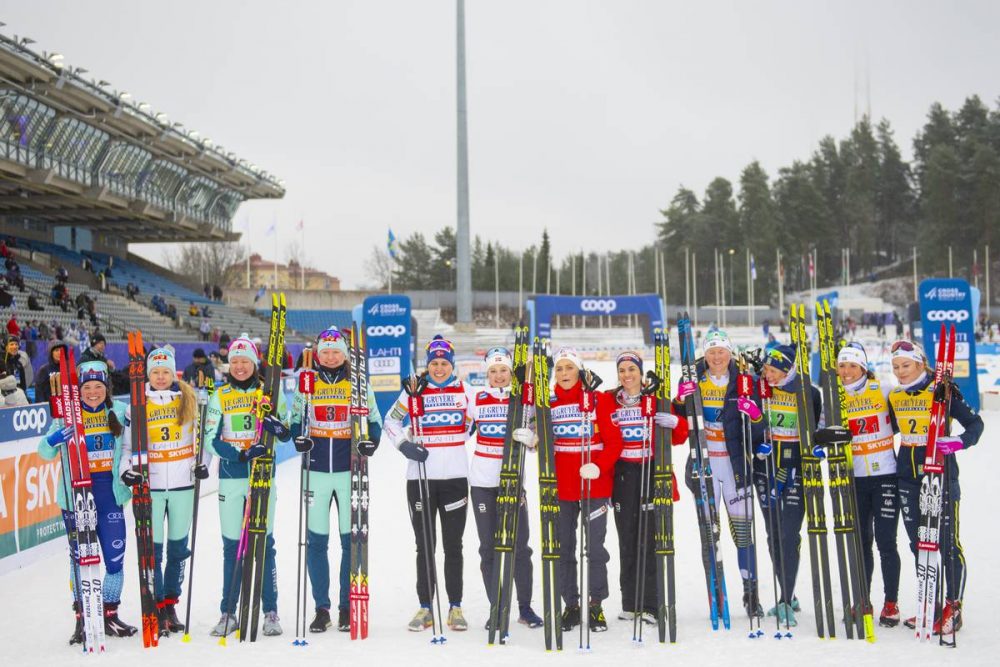
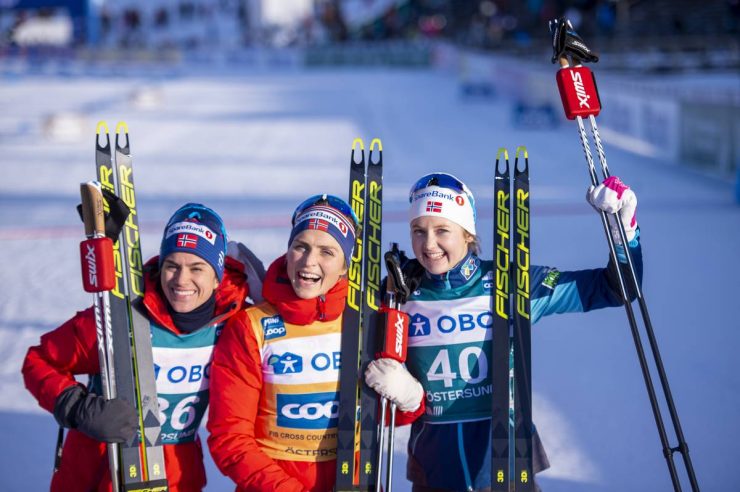
The Norway I team of Tiril Udnes Weng, Ingvild Flugstad Østberg, Therese Johaug, and Heidi Weng celebrate their win in Lahti. (Photo: NordicFocus)
No North American teams competed in today’s event.
Racing continues Wednesday with an individual sprint on the streets of Drammen, Norway next weekend, followed by the famed Holmenkollen 30 and 50-kilometer races in Oslo on Saturday and Sunday.
A ribbon of snow and a winter that never arrived in Lahti, Finland. (Photo: NordicFocus)
In a typical season, you might expect late February in Lahti, Finland to look wintery. 61 degrees North latitude, ample snow on the ground and clinging to the trees, maybe even a reindeer? In fact, in a plug for the venue showed a woman skiing through a snow-laden town and arriving at the base of the towering ski jumps.
But it was not so today. Women time-trialed through the woods for two laps on a 5-kilometer ribbon of man made snow. Aerial shots of the venue told the story that winter had never arrived — green trees, bare ground, and an unfrozen lake.
“It’s sad that they have no natural snow, we’re not used to it,” Theresa Stadlober of Austria told FIS before her race. “But the conditions on the track are really good, so the organizers did a really good job and I think it will be a fair race today.”
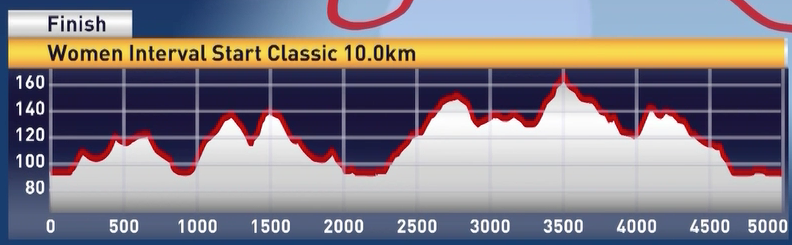
Despite a low snow year (read: no snow year), the 5 k track in Lahti was as challenging as ever. (Photo: Screenshot FIS Broadcast)
Though some athletes, like Jessie Diggins and Sadie Maubet Bjornsen, chose to sit out the weekend of distance races following the wrap of the FIS Ski Tour 2020 across Scandinavia, the field remained relatively stout.
In fact, without Diggins, the top-10 for today’s stage looked alarmingly similar to the top-10 overall in the Tour.
Norway’s Therese Johaug, who won both the Scandinavian Ski Tour and the Tour de Ski, posted the fastest time on icy tracks in Lahti, finishing in 23:53.3. Her victory here was not a given. Her margins stayed tight at each checkpoint and a slowed down clip of her climbing a short punchy hill with a few k to go showed her slipping.
Therese Johaug notches another distance win at the 10-kilometer interval start classic in Lahti, Finland. (Photo: NordicFocus)
“It was really tough today,” Johaug told FIS at the finish. “It’s a hard course here, and I like that a lot, but I had to fight with myself today. Mentally, after the Ski Tour, I have been a little bit tired, but the shape is still really good so I’m really happy to stand on top of the podium again today. It was really close to Ebba, but I have the second on my side.”
With three distance races to go, Johaug has the overall winner’s Crystal globe on lock. She leads the standings with 1311 points, over 400 ahead of the next competitor — a margin that is insurmountable given the remaining point opportunities. She leads the overall standings by an even greater margin of 721 points.
Her teammate, Heidi Weng, sits comfortably in second place in both standings. Natalia Nepryaeva of Russia is third for the overall and Ingvild Flugstad Østberg of Norway is third in distance.
Ebba Andersson slides across the finish in second at the 10-kilometer interval start classic in Lahti, Finland. (Photo: NordicFocus)
Johaug’s primary challenger today was Sweden’s Ebba Andersson, who started six bibs behind and kept herself within four seconds of the Norwegian throughout the majority race, finishing 3.4 seconds back for second place. Andersson was fourth in the Ski Tour and sits in the same position in the distance standings.
Finishing third in Lahti was Krista Pärmäkoski (+11.8). Though the Finnish veteran has a list of podium finishes and Olympic medals to her name, she has not cracked the top-3 in an individual event since January, 2019 when she took third at the final stage of the Tour de Ski (she has had top-3 results for time of day).
Krista Pärmäkoski kicks her way to a season best performance and podium in her home country. (Photo: NordicFocus)
Pärmäkoski looked like a metronome, covering the tracks with a smooth and steady kick-glide rhythm. Her only falter was untimely. Rounding a sharp downhill curve just before the finish, she found herself on the far edge of the turn where the chunky edge of the of track abutted the bare ground of the hillside.
The Finn fell to the ground, losing momentum that could have put her higher on the podium. Nonetheless, as she pushed the final meters across the line, the volume in the stadium surged, blue and white flags waving wildly, putting a smile as her face as she caught her breath.
Finishing amidst a roaring crowd in her home country, Krista Pärmäkoski takes third in Lahti. (Photo: NordicFocus)
Celebrating a podium in her home country, Krista Pärmäkoski takes third in Lahti. (Photo: NordicFocus)
Sweden’s Frida Karlsson and Østberg rounded out the top-5 in fourth (+21.9) and fifth (+25.0), respectively.
The top American of the day was Rosie Brennan in 19th (+1:28.9).
Charging to 19th, Rosie Brennan is the top American finisher in Lahti, Finland. (Photo: NordicFocus)
“There is not a flake of natural snow around Lahti, so it’s amazing that they were able to put together a full 5 k course that was all hard packed man made snow,” wrote Brennan in an email. “I felt pretty good for somewhere around 4 k’s and then fatigue hit hard. I did my best to keep moving well but unfortunately, I did lose quite a few positions… I think I am definitely feeling some tour fatigue but more so just season long fatigue as I’ve haven’t been home since mid November. I happy with how I skied all considering and certainly am optimistic that with some rest I can have a strong finish. I am headed to Park City now to rest and prepare for Canmore.”
Outside the to-30, Caitlin Patterson was 36th (+2:33.7) and Becca Rorabaugh (APU) 39th (+2:57.3).
Becca Rorabaugh on course during the 10-kilometer individual start classic in Lahti, Finland. (Photo: NordicFocus)
Becca Rorabaugh skis to 39th in her first European World Cup start in Lahti, Finland. (Photo: NordicFocus)
Today was Rorabaugh’s first European World Cup start. Though the 30-year-old was first raced a World Cup in February of 2010, her only other experiences at that level have been in Quebec and Canmore during Canadian Ski Tours or World Cup finals.
“I really enjoyed the World Cup level downhills and the perfectly firm tracks out there,” wrote Rorabaugh in an email. “Our wax guys nailed it for me so I was able to ski with a few different people, but it was a tougher course than what I’m used to in the US. This was definitely a step up in steepness of pitch and amount of climbing, and I’d love to have more domestic opportunities to work on this kind of thing. The crowds were awesome and it was cool to see all the national pride with Finnish skiers on both podiums. I’m very thankful to have had the opportunity to come over and race against such a strong field in such great conditions. I’m also excited to have more World Cup starts coming up!”
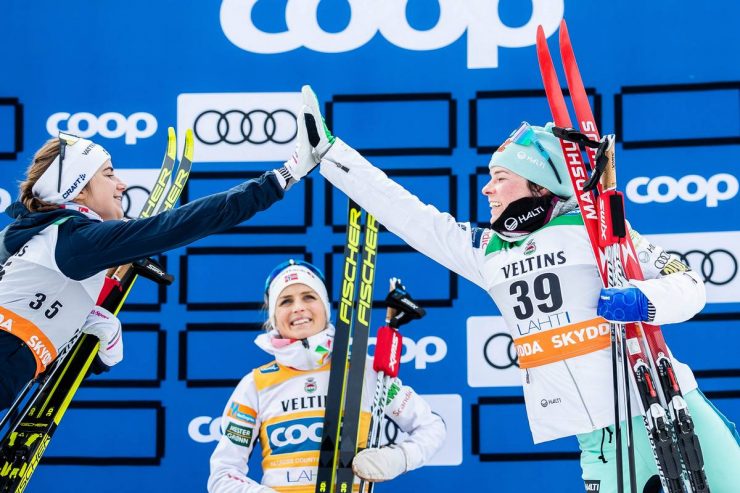
Ebba Andersson (SWE) and Krista Pärmäkoski (FIN) exchange a high five as they join Therese Johaug (NOR) on the podium in Lahti, Finland. (Photo: NordicFocus)
The day began in Trondheim with a centimeter of snow, which then transitioned to big blue skies for the thousands of fans attending the fifth stage of the Ski Tour 2020, a 1.5 k classic sprint. The Norwegians can throw a cross-country race party. The scene, despite the different setting, was reminiscent of the festive cowbell and camp-out sideshow of Holmenkollen’s Frognerseteren. It’s not quite the Yankee stadium of cross-country skiing, but a sign that in the hot-beds of the sport, fans arrive in droves.
The sprint course was more traditional, meaning this was no simple VO2 max test of an effort — that went down on Stage 3, in Åre, Sweden as athletes ascended an uber steep alpine ski hill to close out that event. Trondheim’s classic sprint was bolstered by two punchy climbs on a three-terrace course, long and fast glide outs, and two speedy corners which swung skiers through a 180-degree direction change to keep it spicy.
Sweden’s Jonna Sundling laid down the fastest qualifying time in 3:22.75, shadowed by her teammate, Linn Svahn, 0.24 seconds back. Maybe, not surprisingly, Therese Johaug was the third-fastest qualifier, 0.83 seconds back. Johaug won her first career sprint on Stage 3 of the Ski Tour.
Jonna Sundling of Sweden in bib 1, during her quarterfinal of the Stage 5 classic sprint in Trondheim, Norway. (Photo: NordicFocus)
The U.S. packed five skiers into the heats. Sadie Maubet Bjornsen qualified in 10th (+6.20). Rosie Brennan in 11th (+6.34), Sophie Caldwell 15th (+7.32), Jessie Diggins 20th (+8.58), and Julia Kern 24th (+9.54). Yet the story on the U.S. women’s side ended earlier than their highwater mark norm, which is most often, representation in the six skier final. In no uncertain terms, this is the golden age of U.S. women’s cross-country skiing. A stars and stripes void marked the semis and final. No U.S. skiers advance beyond the quarterfinals.
In the third quarterfinal, Kern and Brennan lost contact with Sundling and Tiril Udnes Weng who came in 1-2, respectively. Kern was fourth in the heat (+3.7), Brennan fifth (+7.71).
Maubet Bjornsen and Diggins fell off the pace as well in the fourth heat, placing fourth and fifth respectively. Both were over four seconds off Norway’s Anna Svendsen’s pace of 3:19.34 who won that quarterfinal.
Sadie Maubet Bjornsen during the Stage 5 classic sprint in Trondheim, Norway. (Photo: NordicFocus)
“It was an extremely tricky weather day with a combo of rain/snow/sun, and everything in between,” Maubet Bjornsen emailed.
“I was excited to put together a solid qualifier, but felt like a few adjustments would allow things to be even better for the heats. My body felt sharp and powerful, so I knew the key for me was to be quick out of the start, and do my favorite thing… ski from the front. I was quick out of the start, but struggled to hold the speed up the first climb. Since climbing is generally my strength, it’s unclear whether it was skis, body, or both that held me back. But, that’s how ski racing is. You can’t overthink anything too much, you just keep believing, and chasing away!
“It is the tour of crazies for me, so I’m going to let it go, and look on to “the chase” tomorrow. With the tour ending with a 15k classic, I am sitting just outside top 10 overall, and really hoping to climb my way within that tomorrow. Let’s see if I can channel all amounts of frustration towards some constructive racing in the final day!”
The last U.S. athlete eliminated was Caldwell. She placed third in the fifth quarterfinal, 1.53 seconds back on Norway’s Heidi Weng in first. Caldwell placed 14th in the final standings, Maubet Bjornsen 16th, Kern 20th, Brennan 21st, and Diggins 23rd.
Sophie Caldwell (bib 15) during her quarterfinal in Trondheim: Stage 5 of the Is Tour 2020. (Photo: NordicFocus)
Post-race interview with U.S. World Cup Coach Matt Whitcomb
Wintry weather moved in during the men’s quarterfinals. The blue-bird scene morphed quickly into an intermittent snowglobe. With the swift winds swirling around the stadium, the snow squalls eventually moved on as the semifinals progressed.
The 12 skier field in the two women’s semis consisted of six Norwegians, four Swedes, and two Swiss skiers in Laurien van der Graff in the first semi, and Nadine Fähndrich in semi two. Fähndrich kept Swiss hopes alive by advancing to the finals after winning her semi.
The first semifinal featured Norway’s Maiken Caspersen Falla and Sweden’s Sundling. These two athletes were the skiers to watch. For Falla, by her own high standards, this has been an offseason, as the young Swedish sprint team has pushed her aside for precious top-of-the-podium real estate. Falla won the opening World Cup sprint in Ruka, Finland, otherwise, it’s been a first-place void for the former Crystal Globe sprint winner.
In bib 12, Maiken Caspersen Falla strides it during her quarterfinal in Trondheim. (Photo: NordicFocus)
In Falla’s semi, she and Sudling took first and second, respectively, with Astrid Uhrenholdt Jacobsen and Linn Svahn of Sweden in close contact, only a few tenths of a second back. In the final, Falla was locked in. Although at moments Sundling was side by side with Falla, the Norwegian dictated the decisive move off the front. Over the second climb, at roughly 2:25 into the race, Falla powered over the hill and into the glide out transition with only Sundling able to match two meters back.
Falla took the win in 3:15.55 with Sundling in second (+0.48). Fähndrich was third (+2.88), Anna Dyvik of Sweden fourth (+3.71), Svendsen fifth (+5.26), and Heidi Weng sixth (+6.64).
Maiken Caspersen Falla on her way to her second sprint win of the 2019-2020 World Cup season. (Photo: NordciFocus)
Sealing it: Maiken Caspersen Fall in Trondheim. (Photo: NordicFocus)
“This feels always like the [World Championships] so crowded and so many people screaming my name at the start and after the finish,” Falla told FIS after the race. “It’s an amazing atmosphere and I’m so happy to be here. There has been some hard distance races for me now. The 30 k and also 10 k was really hard so I’m really happy that I stayed in the tour, didn’t go home and got this opportunity to win here and race in this amazing atmosphere.”
This was Falla’s 21st individual sprint win. She sits second overall in total World Cup sprint wins. Marit Bjørgen of Norway still reigns with 40 World Cup sprint victories. For Fähndrich, this was her second career individual podium. Prior to her third place on Saturday, the Swiss skier posted up a second place in Cogne, Italy’s 2019 10 k classic for her first World Cup podium.
Hands up: Nadine Fähndrich earns a third place for the Swiss in Trondheim. (Photo: NordicFocus)
Katharine Ogden in 37th was the top-U.S. skier outside the top-30. Alayna Sonnesyn placed 42nd, Caitlin Patterson 48th, and Rosie Frankowski 51st.
For Canada, Emily Nishikawa finished in 34th, Katherine Stewart-Jones 35th (+14.19), Cendrine Browne 40th,
The Ski Tour overall looks certain for Johaug who placed ninth in Saturday’s sprint. She leads with a total time of 2:19:28. Weng remains in second (+2:33), and Ingvild Flugstad Østberg third (+2:34). Østberg finished 22nd in Stage 5. This Norwegian trio is the likely overall podium, as Sweden’s Ebba Andersson is fourth at 4:48 back. Racing concludes for the Ski Tour on Sunday with Stage 6, a 15 k classic pursuit for the women.
Norway’s Therese Johaug (yellow bib) the Ski Tour’s overall leader was the third overall qualifier. (Photo: NordicFocus)
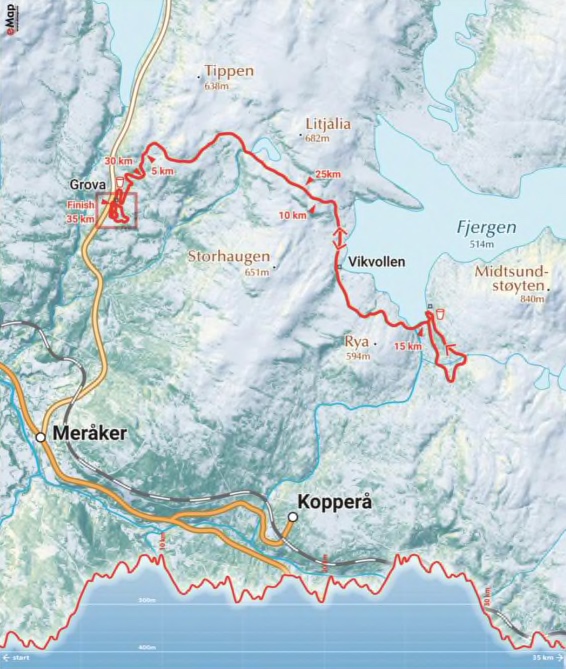
Nature has a lovely way of being, well, natural. In other words; marginally unpredictable, sometimes downright uncomfortable, and finicky. Prior to the Ski Tour 2020’s Stage 4 weather forecast and on-the-ground big-wind gust reality, the stage had been scheduled to pulse 38-kilometers from Storlein, Sweden to Meråker, Norway in a point to point event. Cool, right? An international border crossing during a race, with a single sanctioned coaching/feed zone for athletes around the 25 k mark. A think-out-of-the-box format with a nod to the old-school days of Norwegian countryside racing.
Nature interfered. Or at least the predicted inclement weather scheduled to pummel the rolling mountains featured in the point to point race was enough to scare off race organizers.
An updated map and course profile for Stage 4 of the Ski Tour 2020.
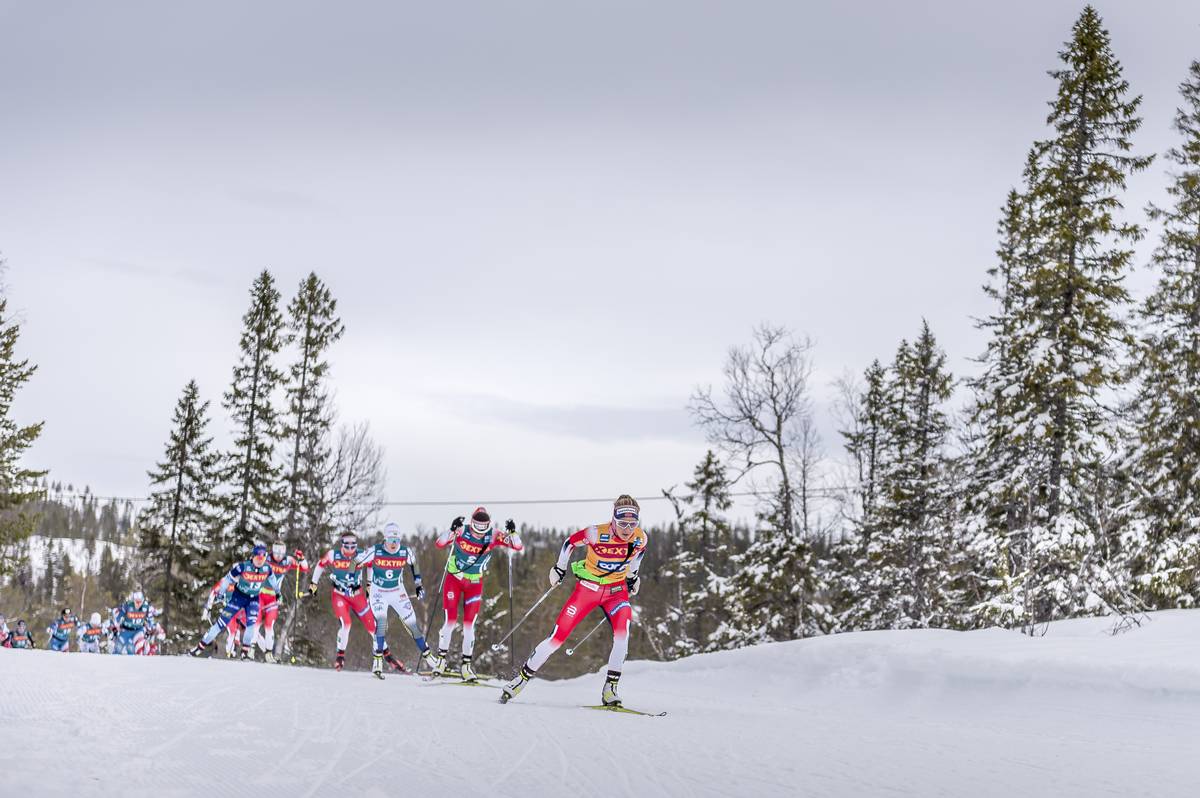
The stage was rerouted the stage. Stage 4’s freestyle mass start streamed from the start/finish area in Meråker, to the original coaching feed zone at approximately 15 k, where athletes skied a several k loop, and then routed onto the main course back to the Meråker ski stadium. In total, the new route was 34 k, with approximately 30 k consisting of an out-and-back. Organizers maintained a single feedzone policy. (Thus, you’ll see several athletets with hydration belts. Most notably, the Norwegians.)
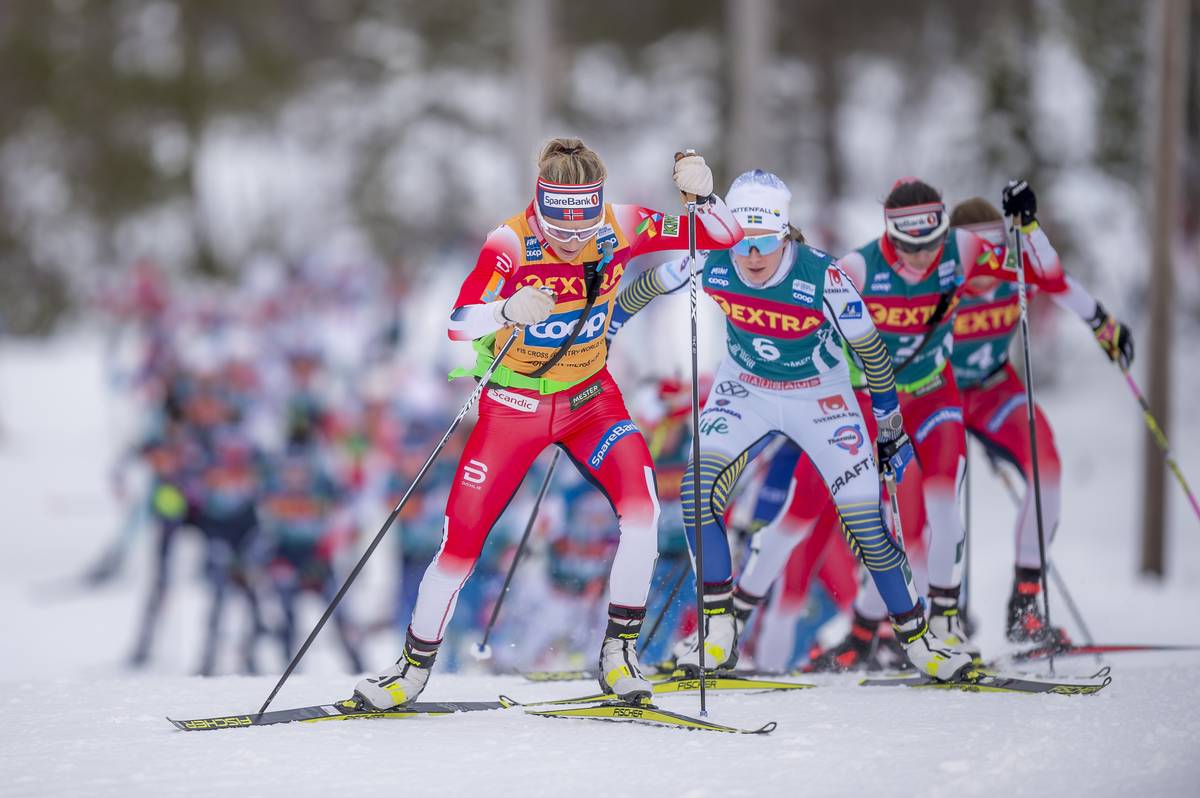
Prior to her breakaway on Stage 4, Norway’s Therese Johaug began to stretch the cord to the pack. (Photo: NordicFocus)
Although mother-nature dictated the course reroute, Norway’s Therese Johaug dictated the intro and closing chapters of Stage 4.
This was no surprise, as she has dominated World Cup distance events with a few second-place efforts here and there, to prove maybe she is human after all. Analyzing her results, it’s clear she is a record-setter. And another record of sorts fell today as Johaug won in 1:26:32.8 hours. It was Johaug’s eighth individual distance World Cup victory in a row. A streak that outdoes her run of seven consecutive wins, which the Norwegian has strung together on two occasions — once between January- March of 2016, and again between March-December 2019.
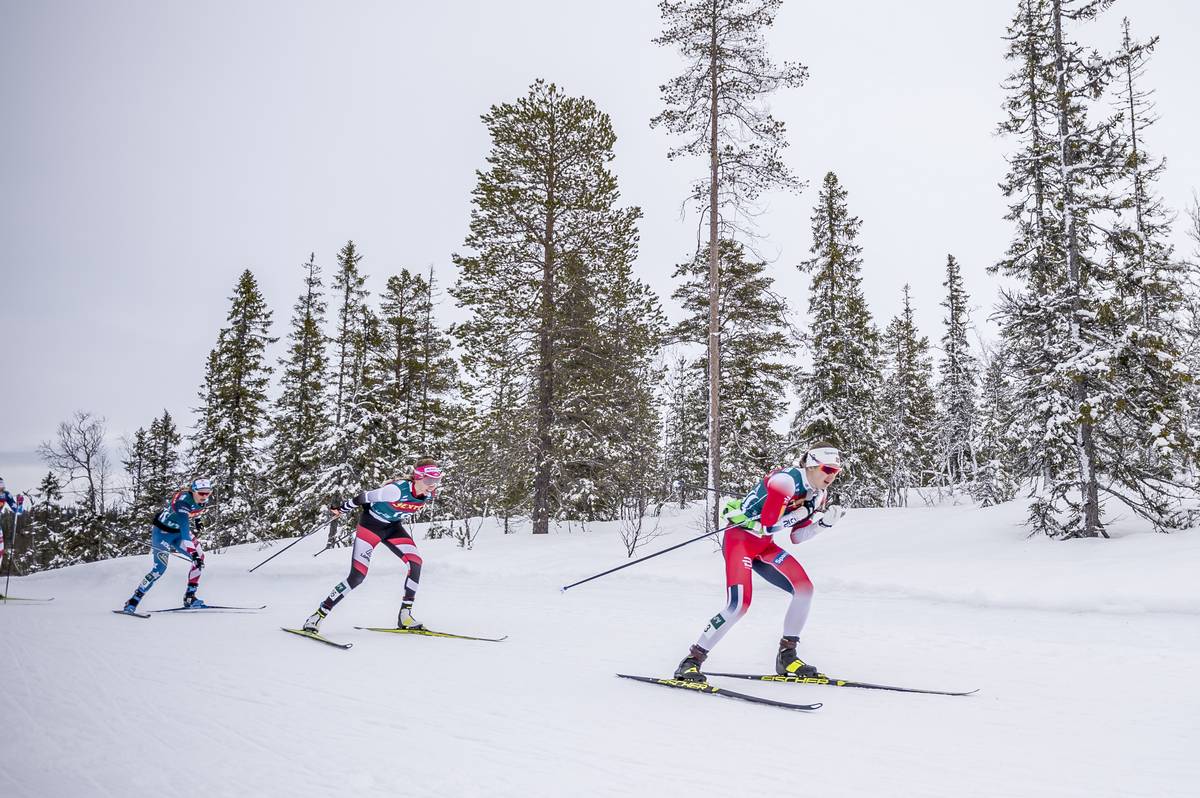
Johaug on her 34 k journey. It’s early, the pack is still in contact. (Photo: NordicFocus)
The day was not a singular Johaug show. Her teammate Ingvild Flugstad Østberg kept the racing on the front-end honest for the overall win.
Earlier in the race, it did appear like a Johaug runaway. At 14 k, she had gapped the second place Østberg by 28.0 seconds. Chasing in a line through the time check along with Østberg were Norway’s Heidi Weng, and Sweden’s Ebba Andersson. American Jessie Diggins led a group, 1:24 back, including Austria’s Teresa Stadlober, and Krista Pärmäkoski.
Another 30 seconds back, an organized chase pack including Charlotte Kalla, Rosie Brennan, Sadie Maubet Bjornsen, and Astrid Uhrenholdt Jacobsen churned along.
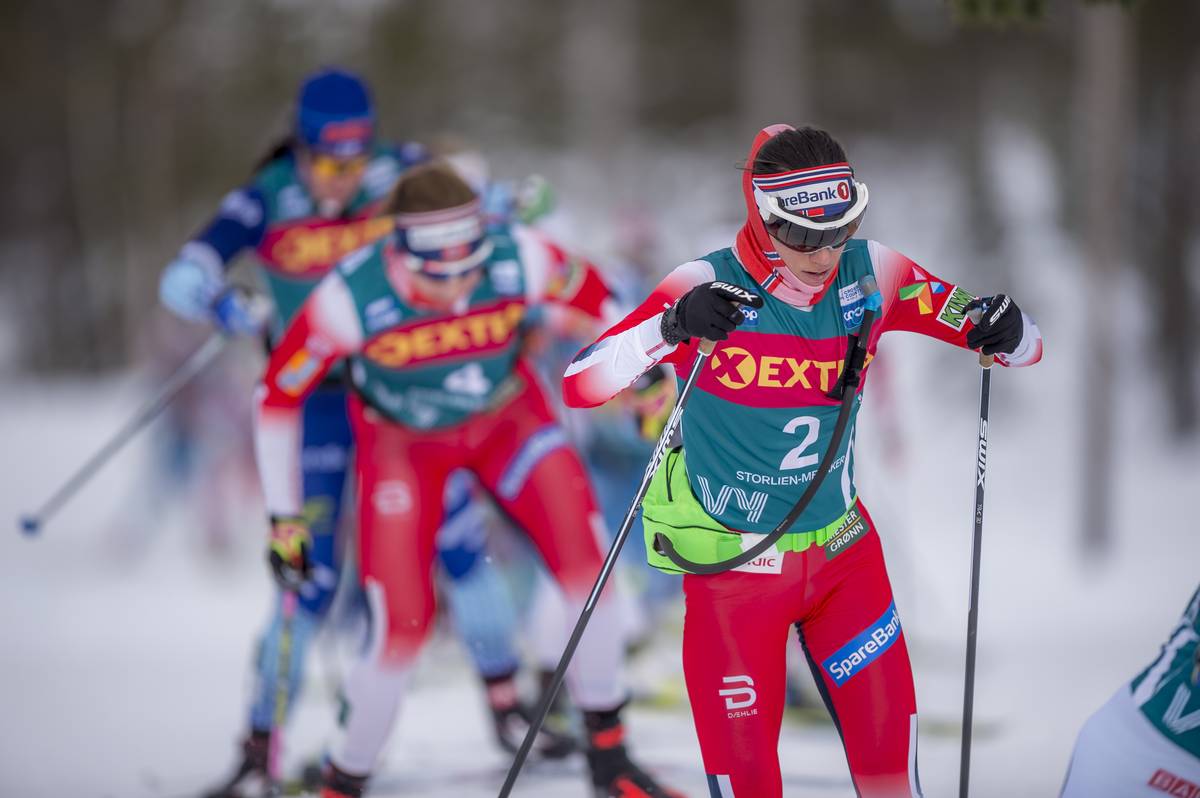
Jessie Diggins (left), Teresa Stadlober (center), and Ingvild Flugstad Østberg (right), on the Stage 4 course. (Photo: NordicFocus)
Through 20 k, those gaps remained relatively firm. However, out on course, the winds were evident with swaying treetops. A solo effort can take its toll with no draft to exploit. No matter how you look at it, either Johaug slowed or Østberg sped up, the time between the two skiers diminished between 20 k and 30 k. At the 31 time check, Johaug’s lead had shrunk to 7.9 seconds over Østberg, who had snapped away from a hard to shake Weng early in the race. Weng paced through the 31 k mark in third (+51.0), Andersson in fourth (+1:37.3), and Diggins in fifth (+3:01.2).
Have no doubt, despite Joahug’s singular dominance, this was a hunted Johaug. Her effort in the closing Ks never waned, as Østberg proved a worthy foil. As much as Østberg wanted to will the 30-40 meter span to Johaug away, Joahug was able to keep four seconds between herself and the fearless Østberg at the finish. Weng came through solo in third overall (+1:21.6), with Andersson in fourth (+2:00.5).
Norway’s Heidi Weng placed third on the Stage 4 34 k skate mass start race. Note the nifty hydration belt (Photo: NordicFocus)
Jacobsen pipped the next chase group, taking fifth (+3:06.5), with Tiril Udnes Weng of Norway in sixth (+3:10.3), and Diggins in seventh (+3:13.9).
Jessie Diggins during Stage 4 of the Ski Tour 2020. She placed seventh overall. (Photo: NordicFocus)
Post-race interview with Jessie Diggins
Also for the U.S, Brennan ended her day in 10th (+3:41.9).
“It’s been an adventurous couple days here in the ski tour,” emailed Brennan. “A lot new things, a lot of surprises, and a lot of last minute changes. Our point to point race was changed due to high winds but we still managed to to an out and back in the same trail starting and finishing in Meråker. It was really windy still making it challenging to ski alone out there. Knowing that I did all I could to stay in my group. There were a few kilometers that I was dangling and unsure if I could hang, but I was fortunately able to find another gear climbing and work my way back up to my group. , unfortunately,y missed the first break on the way back but was able to pick off some people all the way to the finish. I am really happy with the race as 30km has been a struggle for me in the past. I am still feeling strong in the tour and am going to do all I can to hold on to a top 10 in the closing stages.”
Rosie Brennan, pack skiing to 10th overall on Stage 4. (Photo: NordicFocus)
Maubet Bjornen clocked in one place after Brennan in 11th (+3:44.8).
“It was a thrilling day of ski racing today, with lots of course changes, weather delays, a long2-hour bus trip to the start, and a total ‘unknown’ in front of us with this long race,” wrote Maubet Bjornsen.
“I have finally felt my body feeling better, and I just kept my mind excited to take on whatever was coming.
“It was windy as heck, which made the course super tough, but still beautiful. I didn’t look around a ton, because I was so focused, but in the few chances we went down a hill, and I got a glimpse, I just felt so lucky to be part of this fun experience. It is so different than any race I have ever done, and the total ‘unknown’ put the cherry on top.
“I’m so excited to find my strength again, and put together a race that is more representative of where I am at. 11th in a long distance skate race is huge for me!”
Maubet Bjornsen: Stage 4, Ski Tour 2020. (Photo: NordicFocus)
Also for the U.S., Julia Kern placed 19th (+6:04.5), Rosie Frankowski 29th (+6:12.2), Caitlin Patterson 41st (+8:20.3), Katharine Ogden 42nd (+8:49.8), Alayna Sonnesyn 48th (+10:23.3), Sophie Caldwell 56th (+12:27.3). Hailey Swirbul did not start.
For Canada, Cendrine Browne scored in the points in 25th overall (+6:07.9). Katherine Stewart-Jones skied to 31st (+6:16.1), and Emly Nishikawa 39th (+7:52.9).
In the Ski Tour overall, Johaug looks unstoppable – she has won all four stages thus far. Her elapsed time, which factors in a 60-second time bonus for her sprint stage win on Tuesday, and three 15 second intermediate time bonuses on the course Thursday, is 2:16.33. Østberg sits in second (+2:06), Weng third (+2:39). Diggins was the best-positioned American in sixth (+6:02).
Racers have a rest day Friday, with racing starting up in Trondheim for Stage 5’s 1.5 k classic sprint.
Therese Johaug (yellow bib) with enough time at the finish to gather skis and watch 2nd, 3rd, and 4th come across the line. (NordicFocus)
The early evening show, under the lights of Östersund, Sweden’s ski stadium, Stage 2 of the Ski Tour 2020 – a 10-kilometer classic pursuit – got underway as the plentiful moisture falling from the sky transitioned from steady rain to big snowflakes.
This was a 10 k race with three discrete tales. First, the story with the least tension.
That would be Norway’s Therese Johuag’s 10 k effort. Which, despite the pursuit format, was a solo time trial affair. She set herself up for that narrative by winning Stage 1’s 10 k individual skate by 45.6 seconds. No skier on the World Cup could fathom closing that gap to a generational distance skier.
Johaug won in 27:29.0 minutes. Her effort gained her even more time in the Ski Tour overall as teammates Heidi Weng placed second (+57.4), and Ingvild Flugstad Østberg third (+57.8). Sweden’s Ebba Andersson lost out on third in the closing meters, as she placed fourth (+58.6).
Therese Johaug for a clean no-one-in-site win. (NordicFocus)
This was Joahug’s 13th World Cup distance win of the season and according to FIS, this brings her closer to a hallowed record. Marit Bjørgen, a legend from Norway holds the World Cup distance win record with 62 victories. Sunday’s win brings Johaug’s total to 59.
Let’s be frank: with a 45.6 second lead on the second starter Weng, 47.3 seconds on Østberg in bib 3, and 53.1 ticks ahead of Andersson in bib 4, this was as much a sure thing as sunrise and sunset.
Ebba Andersson leads Heidi Weng and Ingvild Flugstad Østberg during the Stage 2 10 k classic pursuit. (Photo: NordicFocus)
Behind Johaug, the tactic for the three closest chasers — Weng, Østberg, and Andersson was clear: cede no ground to the All-Star list of skiers starting roughly 20 seconds further back. For much of the race, the threesome kept a tidy buffer of 30 seconds on those in fifth to 16th place. At times Andersson took pulls up front, motivated by chants of “Ebba” from the home-nation fans. Østberg and Weng too remained motivated to secure a potential podium as they burned their matches prudently but with enough gusto to keep the masses at bay.
Taking her turn pacing the premier chase group, Heidi Weng (bib 2), followed by Ingvild Flugstad Østberg and Ebba Andersson. (Photo: NordicFocus)
Heidi Weng (bib) taking second in Stage 2 of the Ski Tour 2020. (Photo: NordicFocus)
Weng led the charge into the final straight. Østberg slotted in behind Weng using her as a double-poling pace machine. Weng and Østberg gained a precious few meters on Andersson to take second and third, respectively.
Johaug leads the Ski Tour 2020 after two stages with a total time of 49:18. Weng is second at 0:57, and Østberg is third overall with the same time back. Andersson sits one second further back in fourth overall.
The race behind the top-four had a different vibe. It was less about fending off a potential chase, and more about how a large group of skiers would coalesce, who would lead, and who would sit back and take advantage of the more skied in tracks.
Jessie Diggins skiing to 11th overall during the Ski Tour 2020 Stage 2 10 k classic pursuit. (Photo: NordicFocus)
American Jessie Diggins, in bib 8, pulled the group through the 3.3 k mark 1:25.2 behind Johaug. In contact with Diggins, and coming through in this order were Astrid Uhrenholdt Jacobsen, Ragnhild Haga, Rosie Brennan, Krista Pärmäkoski, Frida Karlsson, and Natalia Nepryaeva. The group from fifth to Austria’s Therese Stadlober in 16th place was separated by 11 seconds.
Brennan took her turn up front though the 4.9 k mark, as did Karlsson later in the race. By the finish, the collective group did not gain time on those ahead, they ceded a few more seconds to the top four. But we would be remiss to make note of Brennan’s determination. You could see it in yesterday’s 10 k skate, and it was evident today; she’s got moxie and now the confidence to take pulls, as she did with Karlsson today, and try to break the pack. In a post-race interview (audio posted below), Brennan noted she had in fact been keen on making a move during the pursuit.
Grit: Rosie Brennan during Stage 2 of the Ski Tour 2020. (Photo: NordicFocus)
Post-race interview with Rosie Brennan
Slovenia’s Anamarija Lampic ended up fifth overall (+1:38.7), as the first finisher of the third group out on course. Brennan ended her day in 10th (+1:43.3), and Diggins in 11th (+1:43.6).
“It was a pretty crazy day out there!” Diggins wrote. “I was actually super stoked about the rain while warming up because klister skiing in the rain is such amazing kick and really fun getting up all the hills on. The snow right before the start made it a really strange race because the one track became exponentially faster as it got skied in, which led to massive packs (for a girls race, anyway) forming. Huge thanks to the tech team because my skis stayed competitive and were kicking well even in the rapidly changing conditions!
“I’m excited for the rest of the tour – the next two races are formats we’ve never done before, so I’m ready to go give it my very best shot!”
Sadie Maubet Bjornsen, who began in bib 22, 1:51.4 behind the first starter Johaug, placed 19th (+2:12.5).
“After recovering from a mild tummy bug or a form of food poisoning that visited the night before the start of this tour, I am feeling thankful and hopeful after the second stage of the tour today,” Maubet Bjornsen emailed. “With a snow/rain downpour, I was feeling right at home strapping classic skis on my feet and heading out in the misery. I have spent plenty of days in this exact condition during summer training up on Eagle Glacier, so I was trying to channel every bit of internal strength I could find. The fact that I was able to work my way up to 19th today, and had encouraging feelings in a somewhat depleted version of myself is something I will take and run with!
“I am excited to have a day to recover and fill up my tank, and take on this tour in the same way I did the last. An imperfect start will just fuel me with the extra fight for the days to come!
“Thanks to the tech team for putting wonderful skis together given the absolute craziness coming out of the sky!”
In speaking to U.S. World Cup Head Coach Matt Whitcomb after the race, he explained that skiers in the back of the field were able to take advantage of the considerably faster skied in tracks. Again, heavy wet snow fell during the race.
Post-race interview with Matt Whitcomb
U.S. skier Hailey Swirbul in bib 36 moved into the points on Sunday to place 24th (+2:20.2). Her trajectory in the standings aligned with her 13th fastest time of day. Along those lines, Julia Kern of the U.S. Ski Team skied from 50th to finish 36th (+2:43.8). Her on course time was the sixth-fastest of the day.
Also for the U.S., Caitlin Patterson was 41st (+2:54.1), Sophie Caldwell 51st (+3:07.0), Alayna Sonnesyn 54th (+3:55.7), Katharine Ogden 55th (+4:03.8), and Rosie Frankowski 62nd (+4:59.7).
For Canada, Katherine Stewart-Jones placed 32nd (+2:37.5) and skied the ninth fastest time of day. Cendrine Browne was 39th (+2:45.9), and Emily Nishikawa 44th (+2:59.8).
Katherine Stewart-Jones (CAN) during Stage 2 of the Ski Tour 2020. (Photo: NordicFocus)
As far as the overall standings and how times are calculated, time of day is used to determine a skier’s time for Stage 2.
An all-Norwegian podium in Östersund, Sweden. Therese Johaug won the day ahead of Heidi Weng and Ingvold Flugstad Østberg. (Photo: NordicFocus)
Here we go again. A new Scandinavian Ski Tour takes the spot of a World Championship or Olympic Games during this off-cycle year. Six stages working east from Östersund, Sweden to Trondheim, Norway, beginning with today’s 10-kilometer individual start freestyle event.
Under clear skies, light fading and shadows lengthening as the sunset looms just a few hours away, the women time trialed through the tall conifers to set the tone of the overall tour standings. Crowds arrived in droves to line the course and fill the stadium, a cacophony of cheers creating the soundtrack to the stage.
Today’s format suits the Tour favorite, Therese Johaug, who has expressed that mass start events do not suit her as well. This season, Johaug won the Tour de Ski and has taken the top spot in each of the last ten individual start distance skate events.
Her story today essentially wrote itself. In Devon Kershaw’s words: “Gun to tape annihilate.”
Therese Johaug (NOR) dominates the first stage of the FIS Ski Tour 2020. (Photo: NordicFocus)
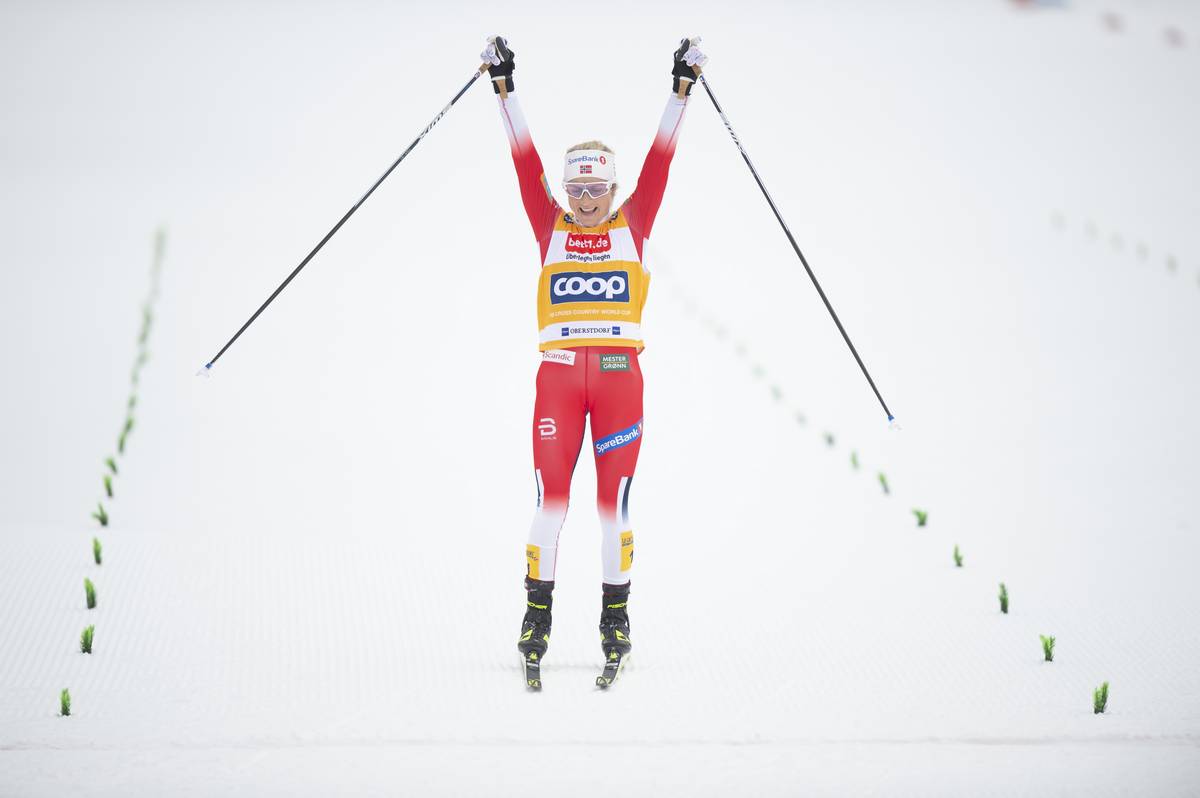
Johaug hammered out of the start gate and did not slow down until she crossed the line, her grimacing face making clear the unmatchable power and tempo she was forcing herself to maintain. Stopping the clock at 21:49.7 and raising her arms briefly in the air before collapsing over her poles, Johaug sealed the deal on best in show.
Her time gap on her competitors increased in an almost alarmingly linear fashion throughout the stage. 12.8 seconds at 2.6 k increased to 20 at the halfway mark, growing to 45.6 seconds at the finish.
Victorious in Östersund, Therese Johaug has a strong start to the FIS Ski Tour 2020. (Photo: NordicFocus)
“Oh yes, I could never get a better start than this,” a glowing Johaug told FIS at the finish. “I feel that it was my best skating distance in my career, so I am really happy with the skis and with the shape. It was an amazing race today… It’s good to start the Tour and I’m looking forward to the next races.”
Here’s what else went down.
Racing in bib 27 amongst the first wave of 30 skiers, Rosie Brennan set the bar high for the seeded group of top-ranked skiers who followed in bibs 32 – 60, posting some of the fastest time through each checkpoint. Although she faded into the results as the seeded group came through, it was still a noteworthy performance, placing her 9th for the day (+1:25.7) and second American.
Rosie Brennan sets the bar, racing to 9th in the first stage of the FIS Ski Tour 2020. (Photo: NordicFocus)
Of other skiers in her group, Brennan was only challenged by Norway’s Ragnhild Haga and Sweden’s Frida Karlsson, who was recently cleared to return to World Cup competition. Karlsson sat out the majority of the season after failing to meet team health standards for body composition and bone density.
Karlsson took the pace out hot, clearly gunning for the win, or at least for the bonus points available at the 2.6k checkpoint. She had the second fastest overall time there, then she attacked the steady climb with high tempo. But she was unable to hold the effort, fading back into the ranks as the race went on. She ended her day in 19th (+1:46.0).
After a fast start, Frida Karlsson falls to 19th in the 10 k skate. (Photo: NordicFocus)
Among the first starters of the seeded group in bib 36, Heidi Weng (NOR) went hunting. From 4.2 k onward, she knocked down the previous best time, setting a new and short-lived time to beat, as Johaug chased from two bibs behind. Weng, the 2017 and 2018 Tour de Ski winner who is currently ranked third in the overall World Cup standings hung on to take the second podium spot.
Next over the line was Ingvild Flugstad Østberg in third (+47.3), who hovered a few seconds behind Weng at each checkpoint. The trio sealed the deal on an all-Norwegian podium.
Ebba Andersson of Sweden interrupted the string of Norwegians in fourth (+53.1), followed by Haga (+1:04.3) and Astrid Urenholdt Jacobsen (+1:05.0).
Leading the Tour for North America, Jessie Diggins skied to 8th (+1:18.1). Diggins currently sits 5th in both the distance and overall World Cup standings.
Jessie Diggins skates to 8th in the first stage of the FIS Ski Tour 2020. (Photo: NordicFocus)
In a post-race call, Diggins described the track in Östersund as a “thinking course”, full of swooping turns that kept athletes focused and on their toes. Diggins explained that she has been experiencing an abnormal amount of fatigue over the last few weeks, but felt some encouraging sensations in today’s event and has a plan in place to optimize her recovery between stages so she can keep going hard.
She also shares insight about some of Tour’s sustainability initiatives to decrease the environmental impact of such an event, and weighs in on the energy generated from a large American team.
Post-race interview with Jessie Diggins.
Jessie Diggins leads the way for Team USA after the first stage of the FIS Ski Tour 2020. (Photo: NordicFocus)
Just behind Diggins, Brennan was the next American. It was the APU/USST athlete’s third top-10 result of the season. Her last two were also earned in stage events; she was 9th in the 10 k skate during the third stage of the Tour de Ski in Toblach, Italy and 6th in the 10 k classic in Ruka. She also skied the 7th fastest time of day up the Alpe Cermis in the final TdS stage.
“It was a good opening day of the Ski Tour 2020 for me,” Brennan wrote in an email to several news outlets. “After a frustrating weekend last week, I was ready to try to turn things around. The course here is hard and has lots of climbing so I felt it suited my strengths. It was fast conditions but there was also little rest so it was a tricky pacing game. I didn’t perfectly pace it and lost a little in the closing kilometers but I had much improved race feelings so I am very satisfied and hope I can continue this way throughout the tour.”
Sophie Caldwell on course in Östersund, Sweden. (Photo: NordicFocus)
Back on the World Cup, Rosie Frankowski races the first stage of the FIS Ski Tour 2020. (Photo: NordicFocus)
Sadie Maubet Bjornen was the next American in 22nd (+1:51.4), followed by her APU teammate Hailey Swirbul in 36th (+2:09.3). Caitlin Patterson was next for the U.S. in 40th (+2:19.1), Alayna Sonnesyn 43rd (+2:27.3), Julia Kern 50th (+2:38.0), Sophie Caldwell 51st (+2:39.3), Katherine Ogden 53rd (+2:48.0), and Rosie Frankowski 56th (+2:50.0).
In a post-race call, Matt Whitcomb sheds light on how the team is approaching the Tour in comparison to the Tour de Ski or a ski tour at the end of the season. Whitcomb explains that a major focus leading into the week was recovery and mental preparation.
“We didn’t focus to much on performance — that’s never a great way to go. We work on the process and getting people psyched by giving them the confidence to know that they’re recovered. Whether or not they’re sharp on the first day or two, they should be sharp by the end. Whether that ends up happening or not, we’ll see. But believing in it is the key.”
Whitcomb explains further how he gages how tired or recovered his athletes are and provides further insight into the women’s performance. Lastly, Whitcomb comments on Swirbul’s noteworthy rise in the ranks this year, attributing it to her fun but focused mental approach and the effect of the strong APU women’s training group.
Post-race interview with Matt Whitcomb.
On the Canadian side, Emily Nishikawa was the top finisher just outside the FIS points in 32nd (+2:05.0). She started one bib ahead of Sweden’s Charlotte Kalla, who she marked and followed to the finish once caught.
Emily Nishikawa leads the Canadian team in 32nd in Östersund, Sweden. (Photo: NordicFocus)
Next up was Cendrine Browne in 35th (+2:09.0), followed by Katherine Stewart-Jones in 46th (+2:29.8).
The tour is young. Racing continues tomorrow with a 10 k pursuit start classic on the tracks in Östersund.
The start of the 56 skier deep field in the women;’s 115 k skiathlon in Oberstdorf, Germany. (Photo: NordicFocus)
Here at FasterSkier, we do not play the odds. Some contributors we know play Noah Hoffman’s Fantasy League – but we steer clear of rolling the dice on cross-country skiing. But the women’s skiathlon events on the World Cup may not be the biggest payouts since in recent history they have been a lock.
Oberstdorf in Oberstdorf, Germany — the site of next year’s Nordic Ski World Championships — required no crystal ball of an imagination to determine the top-spot for the women who raced a 7.5 k / 7.5 k skiathlon on a championship-caliber course.
Coming into the race, Norway’s Therese Johaug had won a total of seven World Cup skiathlon’s, including a win in the format this season in Lillehammer. With a win today she could match the record of eight skiathlon World Cup wins held by her former teammate, the now retired Marit Bjørgen.
This is about the most unspoiling of a spoiler alert: Johaug won today’s skiathlon in 40:05.2 to tie Bjørgen on the skiathlon win list. But her day was more tenuous than we would have imagined. Her gap on second place at the finish, Norway’s Ingvild Flugstad Østberg, was for Johaug somewhat meager, 15.5 seconds. Austria’s Therese Stadlober placed third (+15.6). According to FIS, this was Stadlober’s third career World Cup podium. Her two other podiums came in the 2018 Tour de Ski, one of which was a time of day podium up the Alpe Cermis.
Today, for Johaug, her race day concluded with arms raised in the air win.
A familiar pose for the World Cup distance leader: Therese Johaug winning the 15 k skiathlon in Oberstdorf, Germany. (Photo: NordicFocus)
She was able to slowly stretch away from a group of chasers during the 7.5 k classic leg. She inched ahead from the main chase group near 2.5 k as she charged up the course’s main climb, the Burgstall hill. The field was spread out, but not shattered. Joahaug came over the top and into a long glide out with a 100-meter lead.
At 3.8 k, Joahug had a 5.3-second buffer on Østberg in second, with eight other skiers within 15 seconds. Roughly two kilometers later, she added another three-second cushion. By the exchange to skate skis at 7.5 k, Johaug’s lead was 14.1 seconds to Østberg. But in close contact with Østberg were Finland’s Kerttu Niskanen and Krista Pärmäkoski, Norway’s Heidi Weng, Sweden’s Ebba Andersson, Stadlober, German Katharina Hennig, and Russia’s Natalia Nepryaeva who was 18.9 seconds back.
Churn as she may in her free-radical producing high octane tempo, Johaug essentially put no more time on the core chasers during the skate portion. For a time, up through 13.7 k, Johaug had a 20.1-second margin on the next closet skier, which winnowed by five seconds at the finish. This was not a Johaug walk-away as we have seen in the past. Østberg and Andersson took the primary responsibility of keeping the void to Johaug in check.
Therese Johaug charging during the 15 k skiathlon – Obertsdorf, Germany. (Photo: NordicFocus)
Johaug with a gap: 15 k skiathlon in Oberstdorf, Germany. (Photo: NordicFocus)
Østberg, Stadlober, and Andersson were able to sprint to the finish for their 2-3-4 order. (They came through +15.5, +15.6, +15.7, respectively.)
“It was a tough race out there,” Johaug told FIS after the race. “Especially the classic when I have a gap of five seconds, I know that I have to push myself all the way because if they attack me it will be a group. And it will be hard to go into skating and get a new gap again. I tried to focus on myself and work in my head all the way, but I am really happy with the first place today.”
Johaug has won 11 of 12 World Cup distance races this season and leads those standings with 896 points. Weng is in second with 595 points.
Ingvild Flugstad Østberg (bib 5) lading the chase during the classic portions of the Oberstdorf, Germany 15 k skiathlon. (Photo: FasterSkier)
It was not the day hoped for by the top American women. That reality became evident early in the classic portion of the race. By 3.8 k, Jessie Diggins had ceded 23.3 seconds, and Rosie Brennan 27.4. The time-bleeding trend never fully stabilized. Brennan was 18th through the exchange (+55.3), Diggins 24th (+1:04.1).
Brennan placed 17th overall (+1:46.6), while Diggins was 22nd (+1:55.0).
Rosie Brennan of the U.S., during the classic portion of the 15 k Oberstdorf, Germany skiathlon. (Photo: NordicFocus)
“Skiathlons are always a little unpredictable when we do so few in a year,” Brennan sent in a group email. “We were able to race on one of the new courses they have made for World Championships but due to lack of snow, we could only use one 3.75km course. The course is significantly hillier than the old course and skied quite well. However, doing a skiathlon on one course that’s split half classic half skate always causes some problems with not much room to pass. I felt very good today but struggled a lot moving through the field. I was frustrated with that but very happy about my feelings and skiing so I feel good that I am in a good place and have more good races to come.”
World Cup Coach Matt Whitcomb explained in a post-race interview that Diggins was feeling slightly off today with her sensations.
Jessie Diggins on the skate leg of the 15 k Oberstdorf, Germany Skiathlon. (Photo: NordicFocus)
Post-race interview with U.S. World Cup Coach Matt Whitcomb discussing the women’s race
Post-race interview with U.S. World Cup Coach Matt Whitcomb discussing the race course
Also for the U.S., Cailtin Patterson returned to the World Cup after contesting U.S. Nationals in early January to place 34th (+3:16.5). Patterson moved up in the skate portion to 34th, after transitioning to skate in 42nd. Alayna Sonnesyn raced to 51st (+5:45.1).
For Canada, Katherine Stewart-Jones just missed the points in 31st (+2:40.2). Dahria Beatty placed 47th (+4:54.0).
“It was a fun race, I knew that I would need to make up positions in the classic part of the race without using too much energy… but I also knew the pace would start out fast,” Stewart-Jones emailed. “I was able to move up little by little throughout the race. I felt better on the skate portion but wasn’t quite able to close the gap to top 30. I am for sure a bit disappointed to be so close but it is also motivating to know that I can ski like that on a day where I don’t feel at my best! As for the team, I am really excited about our progress. Dahria has been consistently in the top 30 in World Cup sprints this year which is really exciting and her and Emily were really close to top 30 in Davos. The best is definitely yet to come with most of the team focusing on the Scando tour and World Cup finals!”
Katherine Stewart-Jones of Canada (bib 45) skiing to 31st in the Oberstdorf, Germany 15 k skiathlon. (Photo: NordicFocus)
And with those concerned with the baggy bibs last week in Nové Město – it was a return to the form-fitting bibs we’ve come to know on the World Cup.
Racing continues tomorrow in Oberstdorf with a classic sprint.
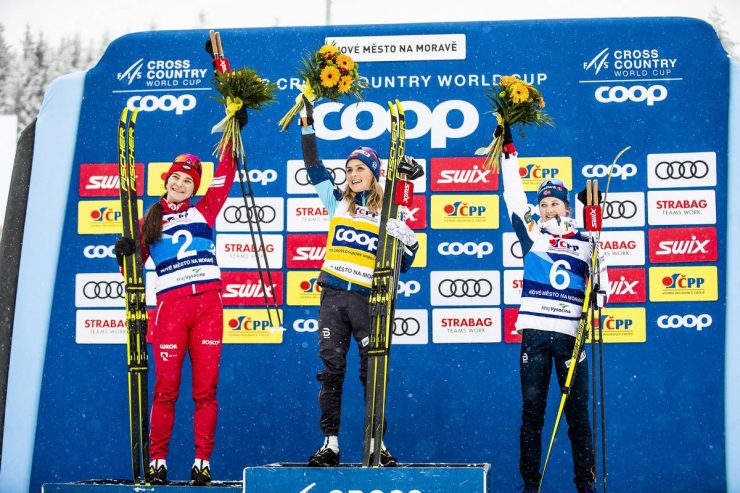
The classic pursuit podium Nové Město: Therese Johaug (NOR) took the win ahead of Natalia Nepyaeva (RUS) and Ingvild Flugstad Østberg (NOR). (Photo: NordicFocus)
Yesterday’s snow coated Nové Město, Czech Republic, clinging to the tall pines and masking the unsettling contrast of the man made ribbon of snow. Though wintry precipitation continued to fall, cheering crowds filled the stadium, ringing bells and sounding horns as racers passed through.
Picking up where they left off after the skate stage, athletes set out onto the arduous tracks for a 10-kilometer classic pursuit. Steep climbs, sharp curves, and gentler though rippling terrain in between.
Start to finish, Norway’s champion Therese Johaug put on a show. Looking unstoppable, she glided and kicked with rapid tempo, in a race that was hers to lose. Perhaps it was over before it began, as the champion started the race with a lead of 33 seconds over the next skier, Russia’s Natalia Nepryaeva.
But Johaug was not about to wait for her chasers to catch her and leave it to a final sprint. She simply hammered every meter, widening her gap over the field at each checkpoint. By the halfway mark, she was 55.4 seconds ahead, which grew to over a minute by the time she double poled powerfully down the final stretch to stop the clock at 26:49.7.
The champion in Nové Město: Therese Johaug. (Photo: NordicFocus)
FIS interviewers described it as a “perfect weekend” for Johaug while asking for post-race comments in the mixed zone.
“I’m really happy now,” she said in response. “My shape is really good at the moment, I didn’t know that before we started here in Nové Město. But I think all the competitions in the Tour de Ski and some quiet days at home, I think it’s perfect for me here to come here and race and have this shape.”
Johaug was asked about her “full gas” energy expenditure in a race she so clearly had on lock. She explained that she can’t be complacent in races, as she needs the intensity to maintain her fitness through the season.
“I had my focus on myself today and I want to have a good competition and also a good training sensation, if you understand what I mean. I did not have so many hard sensations after the Tour de Ski, so it’s good to do it here. Of course, I have perfect skis today so the waxers have done a really good job and the tracks here in Nové Město was really good for me, so I’m really happy.”
Therese Johaug (NOR) heads for the top spot on the podium in Nové Město. (Photo: NordicFocus)
In the densely packed chase group, Norway’s Heidi Weng started seven seconds behind Nepryaeva, followed by Jessie Diggins, teammates Ranghild Haga and Ingvild Flugstad Østberg of Norway, and Krista Pärmäkoski of Finland.
By 5 k, Weng and Østberg had charged ahead to close the gap to Nepryaeva, and the trio continued together through the second lap. The Norwegian’s took turns leading the charge, while the Russian waited in the draft, matching their attempts to leave her behind. Rolling and poling to the finish, Nepryaeva emerged at the front, leading the Norwegians into the stadium.
Cruising down the final stretch, Nepryeava had a gap of several meters on her chasers, who were side by side double-poling furiously in off-set timing. She held her position to remain in second place in the pursuit (+1:04.8).
Natalia Nepryaeva (RUS) slides for second, with Heidi Weng and Ingvild Flugstad Østberg of Norway close on her tails. (Photo: NordicFocus)
Down to a photo finish, Heidi Weng and Ingvild Flugstad Østberg of Norway sprint for third place, meters behind Natalia Nepryaeva (RUS). (Photo: NordicFocus)
Sprinting down the straightaway, Weng and Østberg looked almost as though they were pumping an old fashioned railcar. Putting in their final strokes, they threw their boots for a photo finish. It was deemed that Østberg had her teammate by millimeters, though the duo were given the same time, +1:06.0 on Johaug.
The next group to the line included Pärmäkoski and Sweden’s Ebba Andersson, who spent much of the race in a pack with Diggins, Haga, Finland’s Kerttu Niskanen, and Czech athlete Katerina Razymova. In the second half, Pärmäkoski and Andersson were able to pull ahead from the other women, sprinting to the line in another photo finish to take 5th and 6th, respectively.
With a final push, Krista Pärmäkoski (FIN) and Ebba Andersson (SWE) head to a photo finish. (Photo: NordicFocus)
Though fading, Diggins held her position with the remaining women through 7.5 k. She began to fall off the pace, but was fortunate to have a significant gap to the next chaser. Trailing by five seconds in the last kilometer, Diggins brought it home for 10th (+2:12.0).
“I was excited to be starting in a group of really great classic skiers, and I was proud of how hard I pushed the entire race,” Diggins emailed. “It was a really tricky wax day with a wide range of skis, but it was a great step in the right direction for me in terms of classic striding. I focused on staying in the draft to keep up as much as possible on the flat sections and was 100% focused on my technique on the striding parts, because the tracks were breaking down and getting good kick felt different on different parts of the course.”
Jessie Diggins pushes to the line in 10th in the 10-kilometer classic pursuit in Nové Město. (Photo: NordicFocus)
Still smiling after a challenging day in Nové Město. (Photo: NordicFocus)
The next American, Rosie Brennan, advanced from her 17th place start position into 13th (+2:35.1). She skied the 12th fastest time on course of the day.
“Today was a much better day for me,” Brennan wrote. “I had much better energy and really enjoyed skiing today. I had a really solid group that I started with and we stuck together throughout the race picking people off in front of us. The snow held up a little better today so it wasn’t quite as tricky as yesterday and I was thankful for that! I feel good that my energy is coming around after the tour and things are headed in a good direction.”
Tucked in with a group, Rosie Brennan skis the 12th fastest time of day in Nové Město. (Photo: NordicFocus)
Sadie Maubet Bjornsen also advanced, moving into 20th (+3:03.5) from 26th and posting the 15th fastest time of day.
“It was a redeeming day of ski racing after a really tough day yesterday,” wrote Maubet Bjornsen. “Recovering from the tour is a challenge of its own. Balancing the excitement of the experience with the fatigue is never easy. I managed to catch a cold post tour, and thought I had done a good enough job of resting, but I think I got a hair excited, which left me feeling flatter than I would have hoped yesterday. That combined with challenging conditions made for a perfect storm of imperfection yesterday.
“An ice tub, a night of sleep, and as much mental positivity as possible left me in a better place today! I would have loved to have been skiing with one of the front groups today, because I felt I had the strength to hang on, but instead, I worked my way through some girls, and tried my best to catch the group working together in front of me. It was a hefty mission on my own, but I feel really good about that way my body came around.
“My plan is to take a bit more rest, and then just participate in the sprint race next weekend in Obertsdorf, Germany. When I love racing as much as I do, it can be easy to just keep charging on, and forget to plan ahead. There is another tour event coming in hot, so I will take this opportunity to make sure I am fully recovered, and stronger than ever coming into the next period of racing.”
Sadie Maubet Bjornsen strides through the ranks in Nové Město. (Photo: NordicFocus)
Julia Kern fell back two spots into 32nd (+4:10.4), Caitlin Patterson slid into 44th (+4:58.1), and Alayna Sonnesyn into 51st (+6:13.2).
In a post-race call, Grover provided insight into how the athletes perceived their races and the opportunities each had to ski in group. In particular, this tactic supported Brennan and Bjornsen as they chipped away at the women ahead of them. (Please excuse the echo.)
Post-race interview with Chris Grover on the womens’ performance.
Alayna Sonnesyn strides it out in her second round of World Cup starts in Nové Město. (Photo: NordicFocus)
Reflecting on overall takeaways from the weekend, Grover acknowledged that the first set of distance races after the Tour de Ski can reflect the cumulative toll of the event. Some athletes may need additional recovery to regain form.
Post-race interview with Chris Grover regarding takeaways from Nové Město.
Racing continues next week in Oberstdorf, Germany with a 7.5 k/7.5 k skiathlon and classic sprint.
The women’s podium inNové Město. Therese Johaug (NOR) took the win ahead of Natalia Nepryaeva (RUS) and Heidi Weng (NOR). (Photo: NordicFocus)
“It has everything,” Sweden’s Charlotte Kalla told FIS before the start of the 10-kilometer interval start skate in Nové Město, Czech Republic. Though she was describing the steep uphills and working downhills, found along the 5 k track, it might have also been an apt description for what the weather had in store. As athletes headed out on course, the light icy precipitation transitioned into chunky white flakes accumulating on the deteriorating ribbon of man made and farmed snow.
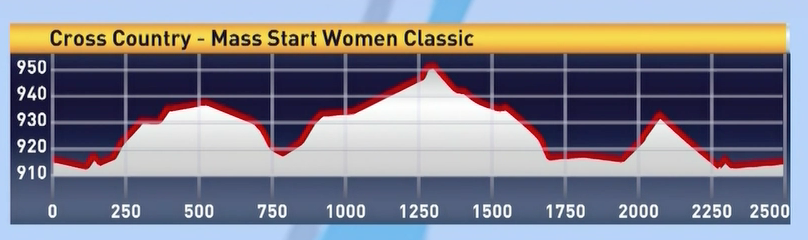
The course profile of the 5-kilometer lap in Nové Město, Czech Republic. (Photo: Screenshot FIS broadcast)
The two distance stages in Nové Město mark the start of Period III and the midpoint of the World Cup season, the tenth and eleventh of twenty one races. It also marks the return of the the squads of distance athletes who sat out last weekend’s city sprints in Dresden, Germany to recover from the compounding effect of their efforts in the Tour de Ski (TDS). Who made it through unscathed and who begins the second half of the season with lingering fatigue? Nothing like a two-day pursuit to find out.
By 3 k, it was evident that Norway’s Therese Johaug, Tour de Ski winner and leader of both the World Cup overall and distance standings, was feeling on form. From the start, she unleashed her usual high tempo attack, clocking the fastest splits at each checkpoint. She stopped the clock at 23:31.1, over 30 seconds ahead of the next fastest time.
Therese Johaug (NOR) takes the win in snowy Nové Město, Czech Republic. (Photo: NordicFocus)
Therese Johaug takes the lead after Day 1 of the distance pursuit in Nové Město, Czech Republic. (Photo: NordicFocus)
“It was an amazing race today,” Johaug told FIS at the finish. “My shape and my body was really good. I have been a little bit tired after the Tour de Ski and I had some good sensation and bad sensations, but today it was a good day. Of course, the tracks out here and the snow was perfect for me, so I am really happy.”
Johaug was chasing the ghost of her teammate, Heidi Weng, who started two bibs prior at the front of the seeded group. Leading the race for second place, Weng time-trialed through the wooded course, setting splits that were just faster than her peers’. At the half, she trailed Johaug by 17 seconds with four women within ten seconds of her: Natalia Nepryaeva of Russia, Moa Lundgren of Sweden, Jessie Diggins, and Ingvild Flugstad Østberg of Norway.
Soaring, Natalia Nepryaeva (RUS) powers to a second place finish in the 10-kilometer individual start skate inNové Město, Czech Republic. (Photo: NordicFocus)
During the second lap, Nepryaeva closed the gap to Weng’s times, matching her with roughly two K’s to go, then pulling ahead by a few seconds. Throwing her boot for the second fastest time of the day, she knocked Weng back to third on the podium. Nepryaeva finished 32.7 seconds behind Johaug, and Weng was 40.3 seconds back.
Weng is now batting 70 percent for podium finishes; she has only missed the top-3 in three of the ten stages, with her lowest rank of 8th occurring in the final stage of the Tour de Ski.
Eyes locked on the task at hand, Heidi Weng skis to third during the 10-kilometer skate in Nové Město, Czech Republic. (Photo: NordicFocus)
Diggins started third in the seeded group behind Johaug and Weng. After hovering in the top 5 throughout the race, she was next across the line in fourth (+48.5), with Ragnhild Haga of Norway just behind (+48.8). Østberg rounded out the final spot in the top five (+49.7).
Jessie Diggins climbs to 4th in Nové Město. (Photo: NordicFocus)
Jessie Diggins gasps for air after taking 4th in the first stage of the distance pursuit Nové Město. (Photo: NordicFocus)
When asked for a preview of tomorrow’s pursuit, Johaug commented on this strong group of women who would be chasing her.
“Of course, I’m really happy that I have 30 seconds, but I know that it’s a big group behind me and they can do work together and I’m going to be in the front alone,” Johaug said. “I have to work hard to have the first position in the finish, but I will do my best and we will see tomorrow how it ends.”
The women of Nové Město. Therese Johaug (NOR) led the day, followed by Natalia Nepryaeva (RUS) and Heidi Weng (NOR). (Photo: NordicFocus)
Due to poor WiFi connection, Diggins chose to share her post-race comments via email.
“Today was a good race for me, although it was kind of funny because with the super deep, sugary snow, it never felt like I was moving very fast, especially stepping through the sugar on the uphills! But overall I’m happy with where my body is after the Tour de Ski, and I’m working on training as smart as I can to find that balance between racing and training hard and finding good recovery after such a big effort.”
After today’s result, Diggins is ranked third in the World Cup distance standings behind Johaug and Weng. She is ranked 5th in the overall standings. Diggins commented on how this plays into her tactics in the second half of the season.
Glitter, snow. and grit. Jessie Diggins takes 4th in Nové Město. (Photo: NordicFocus)
“In terms of overall ranking, there isn’t really a plan because it’s out of my control – as we saw during the TDS, a few tough waxing days can make a huge difference, and you obviously have no control over how other athletes are performing. With that in mind, I don’t worry about the overall and instead focus on making every race I do a complete effort, training and racing it to the best of my ability, only worrying about the things I can control like my race effort, technique and pacing. If I can do that well, then it sets me up as best I can for the overall.”
After the Tour, Diggins headed to the Dachstein glacier in Austria, where she was joined by her boyfriend, Wade, for a block of recovery and training.
“My post-TDS training camp was really awesome, and I felt so lucky to have my boyfriend there with me! It’s very important to me to find a healthy life/skiing balance, in order to be happy and want to continue racing on the road for years to come. So my main focus during that time was simply happiness, as well as quality rest and recovery after the huge effort of the Tour.”
Diggins closed with optimistic remarks heading into tomorrow’s classic pursuit.
“I had great skis today and I’m very thankful to our hardworking staff! Tomorrow should be an exciting pursuit start and I’m excited to ski with so many speedy ladies.”
Rosie Brennan (USA) during the women’s 10 k skate in Nové Město. (Photo:NordicFocus)
Following Diggins, Rosie Brennan was the second fastest American, finishing 17th (+1:35.3), followed by Sadie Maubet Bjornsen in 26th (+1:51.1), and Julia Kern in 30th (+2:03.3).
“We faced some challenging conditions today,” Brennan emailed to several news outlets. “With no [natural] snow on the ground, the course was made up of all man made or saved snow, which didn’t adhere well to itself so it was deep, sugary, and dirty. The course was challenging in the sense of the amount of transitional skiing. I wasn’t sure how I would feel after the Tour de Ski but tried to stay optimistic that my break was good and I would be back where I left off. I started well and was happy with my first lap. I faded much more than I had hoped in the end and think I am still feeling a bit of fatigue from the Tour. Overall, it was a solid day and I hope I can find another gear tomorrow.”
Alayna Sonnesyn skis to 46th in Nové Město. (Photo: NordicFocus)
Fresh off of U.S. Nationals in Houghton, Mich., Caitlin Patterson finished 39th (+2:17.7), and UVM graduate Alayna Sonnesyn (SMST2) rounded out the American squad in 46th (+2:38.1).
“I’m really happy with my race today,” Sonnesyn emailed about her race. “I feel like I skied well and was consistent through the whole thing. I think I will learn a lot each day and hope to keep improving in the next few weeks!”
New to this level, Sonnesyn begins her second set of World Cup starts, which she earned from her position as SuperTour points leader. Her first World Cup starts took place at the World Cup finals last spring in Quebec City, where a string of bad luck kept her from performing at her potential: illness, followed by three crashes and two broken poles, resulting in a DFL — “dead freaking last.”
“I was really excited about those starts [in Quebec City], but by mid-March I had traveled around the world (literally, I went from the Birkie to China to Germany and back to the US) all in about 2 weeks and I was totally wiped,” Sonnesyn explained. “I knew I didn’t have the kind of energy to have races that I was truly capable of but I still wanted to start them to gain that experience.
“This year, I was slightly more comfortable showing up at a World Cup race and didn’t have to waste a ton of energy fan girling (too hard),” she wrote with a wink. “That being said, the field is so deep here and going into the race I wanted to focus on my own skiing, without worrying about results. That’s the really nice thing about being SuperTour leader right now; I didn’t need to “prove myself” in this first race. I have six races over 4 weeks to grow accustomed to racing at this high level and hopefully keep building on a race like today.
In a post-race call, Chris Grover shared additional insights into the womens’ performances, including how Maubet Bjornsen is feeling after the Tour de Ski, and Patterson and Sonnesyn’s results fresh off the plane.
Therese Johaug: queen of the hill. (Photo: NordicFocus)
The fateful Alpe Cermis. The 10-kilometer capstone of the Tour de Ski, athletes complete the 1.5 k sprint loop before following the river valley down to the base of the alpine hill, climbing steeply for nearly 400 vertical meters to the finish. Bodies aching with the cumulative fatigue of the tour, racers are totally spent at the finish of the event. Crossing the line, they collapse with their faces pressed into the snow gasping for air and writhing in lactate-induced misery.
And so it was today.
First, a look back on Tours of the past. Unlike in the men’s event, the fastest skier up the Alpe Cermis has been the overall tour winner over the last four years.
Last year, Ingvild Flugstad Østberg was the fastest up the hill climb in 35:15.0 to take the overall win. Østberg was 42 seconds faster than the next skier, Krista Pärmäkoski of Finland. In 2017 and 2018, Heidi Weng was the first up the mountain by a similar margin. And four years ago in her most recent tour performance, Therese Johaug dusted the field, winning the day by a margin of 1:25.9. That’s nearly double the already large differential of her teammates.
Dubbed by Devon Kershaw an “once in a generation athlete,” Johaug has over 100 career podiums to her name, over 50 of which have been wins.
With this insight, it seemed safe to bet on Johaug in the final stage. However, the Norwegian superstar has proved to be beatable in this tour, much to everyone’s surprise.
Johaug was out-sprinted by Østberg in the final meters of the 10-kilometer classic pursuit in Stage 4, and the next day, she missed her first distance podium since she took 5th in the 5k skate in Toblach during Stage 4 of the 2016 Tour de Ski. (Johaug missed the 2017/18 and 2018/19 seasons while serving an 18-month ban after testing positive for the anabolic steroid clostebol, which was contained in a lip cream she used after sustaining a severe sunburn.)
Heading into the final stage, the overall standings looked like this: Norway’s Astrid Jacobsen trailed Johaug by three seconds. Natalia Nepryeava lurked 14 seconds back, and Ingvild Flugstad Østberg was 23 seconds back. Ranked as the top American, Sadie Maubet Bjornsen sat in 8th (+1:58), with Jessie Diggins 11th (+2:53).
The infamous climb up the Alpe Cermis. (Photo: Screenshot FIS Broadcast)
Historically, the event has been run in pursuit format: the first person to the top of the hill wins. This round features a mass start format; racers will need to drop and gap their chasers to earn time in the standings. Identifying rank in the overall standings required lots of quick math to follow the flux in deficits; eleven seconds between Jacobsen and Nepryaeva heading into the final stage, nine seconds between Nepyraeva and Østberg, and so on.
One final note before we begin: Ebba Andersson of Sweden, who was ranked 6th in the standings (+1:07), withdrew from the Tour before the final stage.
As expected, the pace went out conservatively around the sprint loop. Racing on a narrow band of man-made snow that frequently contrasted the bare ground and asphalt beside it, Johaug stepped to the front, a string of her teammates that included Heidi Weng, Østberg, Jacobsen, and Nepryaeva.
As they hit the hill, Johaug put her head down and got to work. She quickly created a gap to Heidi Weng and Østberg, who at first were willing to match the effort early in the climb, but quickly laid off, unwilling to succumb to temptation and risk flooding their legs with lactate too early.
It became a race for second place and a race against the clock. In the lead, Weng pulled Østberg and Nepryaeva up the hill, a gap to the next skiers.
Heidi Weng (NOR) races for second place up the Alpe Cermis with Ingvild Flugstad Østberg (NOR) and Natalia Nepryaeva (RUS) chasing. (Photo: NordicFocus)
With Jacobsen nowhere in sight, Nepryaeva and Østberg fought for podium positions. At 9 k, Weng led Østberg by roughly four seconds, followed by an equivalent gap to Nepryaeva. Though Østberg matched Weng stride for stride, the Norwegians were not able to pull away from the Russian.
Meanwhile, Johaug steadily chugged up the hill, on her own by over a minute. As the grade mellowed in the final 200 meters, she had energy left to ski V2, her technique masking the fatigue she must have felt.
Waving the Norwegian flag high, Johaug shrieked with joy and relief as she stopped the clock at 34:21.6.
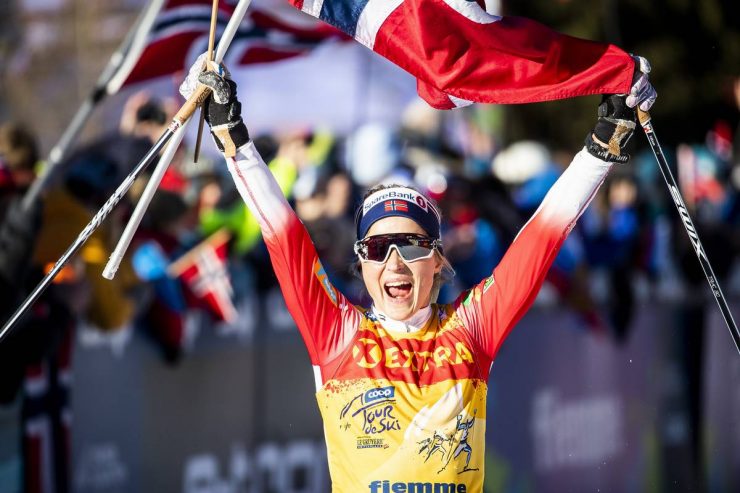
Therese Johaug celebrates her stage and overall victory at the finish of the 2019/2020 Tour de Ski. (Photo: NordicFocus)
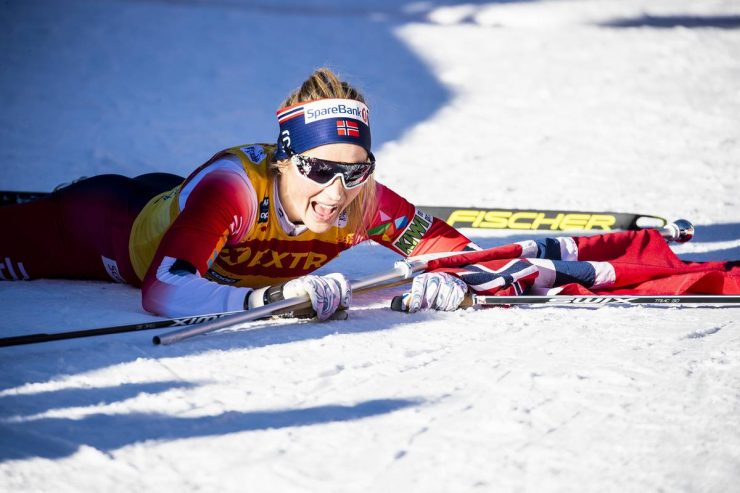
A hard earned rest for Therese Johaug after winning the hill climb and taking the overall victory in the 2019/2020 Tour de Ski. (Photo: NordicFocus)
“I’m really, really happy now. My goal was, of course, when I’m going down here to fight for first place in the overall and today I do it. It has been seven hard days, but I am really, really happy now to come up here. I’m really looking forward to end this Tour de Ski because you wake every morning and are so nervous, but tomorrow I’m free.”
Firing on all cylinders, Heidi Weng crested the steep pitch, powering through the gradually ascending final meters for second (+50.3). Østberg followed in her wake for third (+54.5), followed by Nepryaeva in fourth (+57.1).
Throwing a boot to minimize her time back, Natalia Nepraeva finished 4th in the hill climb and 2nd in the overall 2019/2020 Tour de Ski. (Photo: NordicFocus)
So how did it all shake out? Therese Johaug took the overall Tour with an aggregate time of 2:28:18.6. Nepraeva landed the second spot on the podium (+1:11.1), followed by Østberg in third (+1:17.5). Weng finished 4th (+1:37.3), with Jacobsen behind her rounding out the top 5 (+2:13.4).
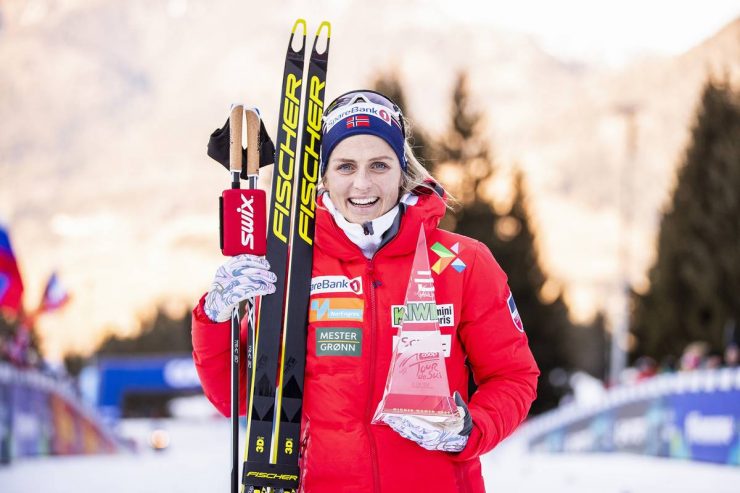
Theresa Johaug: 2019/2020 Tour de Ski champion. (Photo: NordicFocus)
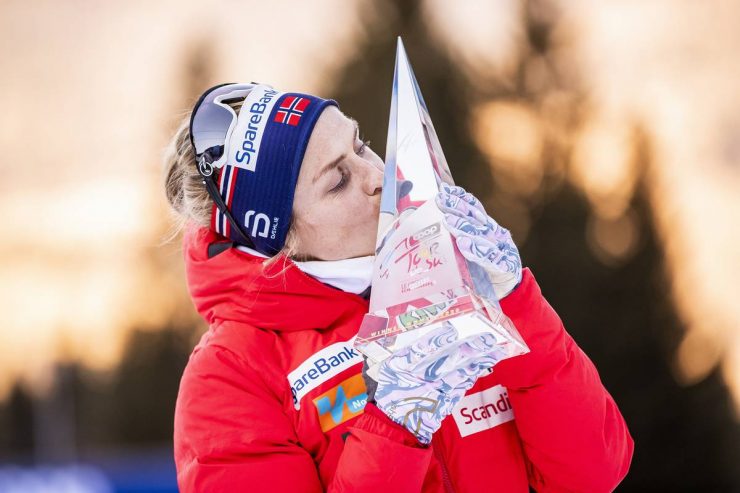
First to the top of the Alpe Cermis, Therese Johaug (NOR) takes the overall victory in the 2019/2020 Tour de Ski. (Photo: NordicFocus)
Winding along the Marcialonga in the lead group, Diggins kept her position in the top ten throughout the day. At first, she trailed Jacobsen, Theresa Stadlober of Austria, and Charlotte Kalla of Sweden as they began the climb, but Kalla and Jacobsen fell off the pace.
Losing contact with Stadlober, Diggins was in the unfortunate position of skiing alone. Despite having no one to chase, she climbed steadily, sitting in 6th at 9 k with her teammate Rosie Brennan closing from behind.
Pure grit: Jessie Diggins ascends the final meters of the Alpe Cermis hill climb in 6th. (Photo: NordicFocus)
Holding her position, Diggins crossed the line for 6th (+1:51.1), chipping time off her deficit in the overall standings. With the hill climb, Diggins leapfrogged into the top 10, finishing 9th in the overall (+4:44.1).
“Today I was happy with my climb; I think I managed to pace it right so that I could keep moving up the hill steadily without blowing up – a line that is hard to find, but pretty crucial to get right! I had good energy and it’s nice to know that my fitness is in a good place even at the end of the tour,” Diggins wrote.
“Overall, this tour has been challenging in that I had many races where my fitness and effort weren’t reflected in the results. But I was proud of how I carried myself, contributed to having a positive team atmosphere and stayed positive without ever giving up, on the days when I had competitive skis but more important, on the days when I did not. It took a lot of positive energy, but now I can leave the Tour really proud of my mental toughness and ready to soak in all the hard work I put out there!”
Brennan and her teammate Sadie Maubet Bjornsen sat in the mid-teens at the base of the climb. As the grade increased, Brennan left Maubet Bjornsen and began picking off the women in front of her. Brennan advanced from 15th at the base of the climb to finish 7th (+1:58.0).
Rosie Brennan climbs to 7th place in the final stage of the 2019/2020 Tour de Ski. (Photo: NordicFocus)
In the overall standings, Maubet Bjornsen bumped up one spot into 7th (+4:40.6). Brennan finished 15th in the Tour (+7:11.0), and Ogden 28th (+12:26.5). 41 women finished the Tour.
“Wow, it feels good to make it to the top of that climb,” Maubet Bjornsen emailed. “I think it is safe to say, making it up that alpine slope after six hard days of racing is quite possibly the most physically painful thing I experience. Just crossing the line is such an achievement. This is only my third time I have made it, so it still feels just as exciting as the first one!
“This tour has had its ups, downs, and painfully near misses. Despite the rollercoaster, I feel like I gained confidence in my fitness and my skiing throughout the process. Not only that, I had my best ever Tour de Ski finish, ending in 7th place.
“No doubt I will come away from this tour both physically and mentally tougher!
“Thank you to the support crew who allowed it to happen, and thanks for all the cheers of encouragement both on the tough and wonderful days!”
The 2019/2020 Tour de Ski podium: Therese Johaug (NOR) took the win ahead of Natalia Nepryaeva (RUS) and Ingvild Flugstad Oestberg (NOR) in third (l-r) . (Photo: NordicFocus)
With one stage remaining in the 2019-2020 Tour de Ski (TdS), and with standings somewhat unsettled before what some consider to be a slam dunk final stage for the current overall leader Therese Johaug from Norway, time bonuses were what mattered in Val di Fiemme, Italy on Saturday. Podium pride was at stake, but generous time bonuses were the carrot for many in the 1.27-kilometer classic sprint.
First through 30th place in the TdS sprints receive a time bonus. Sixty seconds for first, 54 seconds for second, and so on. Time matters.
After Stage 5, Johaug led the overall by 19 seconds over Ingvild Flugstad Østberg (NOR) in second, 32 seconds over Russia’s Natalia Nepryaeva, and for good measure, 33 seconds ahead of Astrid Uhrenholdt Jacobsen (NOR) in fourth.
Finding her groove in time for the final stage. Astrid Uhrenholdt Jacobsen (NOR), moves to second overall in the Tour standings. Sadie Bjornsen (bib 4) follows. (Photo: NordicFocus)
The thirty-two-year-old Jacobsen comes off a mildly surprising win in Stage 5’s 10 k mass start classic race. Of late, her classic technique looks dialed and her ski speed has been an asset. For the longtime National Team member, the top podium spot has been a fleeting prize. Over her storied career, she has won five World Cups. We bring her up because she animated today’s classic sprint and positioned herself nicely for a TdS overall podium spot. More on that in a bit.
First a reminder, this is well into the TdS. Many of the World Cup’s top sprinters dropped from the Tour a stage or two ago. For the U.S., Sophie Caldwell is missing. Some top sprinting Swedes are not at the Tour. And Maiken Caspersen Falla of Norway took a raincheck. With forty-four skiers starting the qualifier, it was a good bet that many of the names we associate with distance skiing would progress.
Jessie Diggins of the U.S. qualified in first on the 1.27 k classic sprint course in 3:04.26. Yes, all the top contender names in this TdS advanced to the heats.
Jessica Diggins (USA), Natalia Nepryaeva (RUS), Lucia Scardoni (ITA), and Theresa Johuag (NOR) (l-r), during the first quarterfinal, Stage 6 of the Tour de Ski. (Photo: NoridcFocus)
In the first heat, Diggins looked smooth and powerful as she placed first. But slotting into fourth, in by far the fastest quarter-final was Johaug. She would advance to the semis, minimizing the potential damage of time bonus gains by her rivals for the overall.
In the second heat, it was Jacobsen who commanded the win with timely positioning and rocket skis. Sadie Maubet Bjornsen was second. Brennan placed fourth and did not advance.
After cataloging the quarters, all the key players remained. An upstart Anamarija Lampic from Slovenia, Nepryeava, Weng, and Østberg, Johaug, Diggins and Maubet Bjornsen. The only potential overall Tour contender not to advance and capitalize on more bonus time was Sweden’s, Ebba Andersson. Prior to today’s sprint, she was fifth overall, only 38 seconds out.
Andersson ended her day ranked 28th in the sprint.
Sadie Maubet Bjornsen (USA), Jonna Sundling (SWE), Jessica Diggins (USA), Lucia Scardoni (ITA), Therese Johaug (NOR), (l-r) during the first semifinal, Stage 6 of the Tour de Ski. (Photo: NordicFocus)
In the first semi, Jacobsen, Maubet Bjornsen, and Diggins went 1-2-3 to advance. Diggins moved on to the final as a lucky loser. Johaug bowed out in sixth. But her mission of time bonus mitigation was accomplished. Johaug ended her day ranked 11th.
Lampic, in the second semi, showed she too is a mint sprinter. She won her first career World Cup on Stage 2 of this TdS, a skate sprint, in a deeper field. Today, advancing to the finals after winning her semi, Lampic would add another exclamation point.
Out of the start, Nepryaeva fell hard in the finals while changing lanes. She placed sixth (+15.30) after realizing that burning energy to catch back on was futile. The five remaining in front kept it tight. Up the first climb, the skiers slotted into four lanes across with Jacobsen eventually taking charge.
The course finishes with a long downhill into the final straight. Here, good skis and a transition into a power double pole played to Lampic’s favor. With Diggins, Maubet Bjornsen, Jacobsen, and Lampic gliding into the straightaway, Lampic was able to pull ahead for her second career World Cup win in 3:03.03. Diggins had a clear lane as did Jacobsen. Maubet Bjornsen, however, with a strong double pole, was stymied by Jacobsen blocking her in front. Maubet Bjornsen began pushing onto Jacbosen’s tails. The formidable U.S. skier switched tracks before she crossed the finish losing a smidge of momentum.
Jacobsen ultimately placed second (+0.22) in a photo finish with Diggins, who placed third (+0.28). Maubet Bjornsen was fourth (+0.8) and Lucia Scardoni of Italy fifth (+1.12).
A streamlined Diggins during Stage 6 of the Tour de Ski. (Photo: NordicFocus)
“We haven’t seen a classic sprint here since 2013 World Champs, so tactically we were trying out a few new things and finding our strengths out there!” emailed Diggins. “I had good energy today and was just trying to push the pace at the start, but in the final, I was trying to use the slingshot a little bit more off of the downhill. I was also wary of getting boxed in on the tight corners because it was so important to be able to push hard over the top of the hill into the downhill.
“Huge thanks to the wax team for working so hard, and it was super fun to ski in the finals with Sadie! We’ve kept such a positive energy on this team the entire tour, through the good days and the hard days, and that has really paid off.”
Looking forward to finishing this tour like I always do – by going out there and giving it absolutely everything I have, so I can be proud of the effort I gave!
Anamarija Lampic (SLO) loving the win, post-Stage 6 Tour de Ski stoke. (Photo: NordicFocus)
“Hard to believe we can find sprinting muscles after so many days of racing, but somehow I felt amazing today!,” Maubet Bjornsen emailed. “Through my quarters and semis, I managed to place myself in a safe place, trying to conserve energy for the final, and feeling in total control. As the finals went off, I put myself in what felt like the ‘right position’. Unfortunately, I wasn’t in the right place at the right time on the final stretch, getting blocked up and just missing the podium by half a second.
“I can’t help but feel a bit frustrated, because I believe I could have won today if I could ski it again, but how can you be upset with a 4th place? I’ll have to channel all that frustration into the final day tomorrow, up the big alpine slope.”
Sadie Maubet Bjornsen (USA), Astrid Uhrenholdt Jacobsen (NOR), Anamarija Lampic (SLO), (l-r) in the final straight as Lampic takes the win. (Photo: NordicFocus)
Jessica Diggins (USA), Sadie Maubet Bjornsen (USA), Astrid Uhrenholdt Jacobsen (NOR), Anamarija Lampic (SLO), (l-r) in the final straight. (Photo: NordicFocus)
“While this tour has had plenty of ups and downs, I continue to feel strong and confident on my skis. Every new day is a new chance, which is so fun! That’s why I just love this crazy 7 races in 9 days. Getting yourself across that line on top of Cermise is an unbelievable achievement!”
Also for the U.S., Brennan placed 19th and Katharine Ogden 32nd.
The Shakeout for the Overall
Therese Johaug (NOR) kept it close today as she advanced to the semis in the Stage 6 classic sprint of the Tour de Ski. Johaug still leads the overall standings. (Photo: NordicFocus)
With her 11th place in the sprint, Johaug earned 24 bonus seconds, which in reality served to keep those potential overall threats, if any really exist, a few seconds back. That brings us to Jacobsen. After starting the day fourth overall, 33 seconds behind, her second place in the sprint netted her a 54-second time bonus. That bumped her to second overall, only three seconds behind Johaug. Nepryaeva is currently third overall, with 14 seconds to make up. Østberg fell to fourth — she placed 12th in the sprint — with a long 23 seconds to gain on the Alpe Cermis.
Post-Stage 6, Maubet Bjornsen improves to eighth overall (+1:58) from ninth after Stage 5, and Diggins jumped from 15th overall to 11th (+2:53) after Saturday’s sprint.
Tomorrow’s final stage, the infamous Cermis climb brings a new format this year. Historically, the Tour’s premier stage runs as a pursuit. With tomorrow’s mass start, every athlete heads out together. It will be on those trailing Johaug to somehow find a weakness and literally pull ahead.
If you’ve been listening to Devon Kershaw, no way, it will not happen — Johaug will not lose time on the Cermis.
The Alpe awaits.
(An athlete’s qualifying time from Stage 6 is used to determine an athlete’s time in the overall standings. Bonus time is subtracted from the overall time.)
The women’s podium after Stage 5 of the 2019/2020 Tour de Ski in Val di Fiemme, Italy. Astrid Uhrenholdt Jacobsen (NOR) took the win ahead of Ebba Andersson (SWE), and Katharina Hennig (GER). (Photo: NordicFocus)
The 100th Tour de Ski Stage in Val di Fiemme, Italy, featuring a four lap 10-kilometer mass start classic. Coupling the results in distance racing over the last 14 months since Therese Johaug returned to the world cup and those of Stage 4, it seemed like a safe bet to predict a rematch between Johaug and her teammate Ingvild Flugstad Østberg. Another opportunity to race head-to-head over every meter of the course, and for Johaug to make a statement that her loss was a fluke.
It quickly became clear that Østberg crossing the line 0.4 seconds ahead of Johaug was akin to Roger Bannister running 3:59.4 on a cinder track in Oxford. The barrier was broken, illuminating the potential for the host of men who followed. Johaug was no longer invincible. No longer in a class of her own.
Ebba Andersson (SWE), Ingvild Flugstad Oestberg (NOR), and Heidi Weng (NOR) lead the pack in a 10-kilometer mass start classic in Val di Fiemme. (Photo: NordicFocus)
Nearing the end of the first 2.5 k lap, seven athletes formed a tight group at the front of the pack. Putting in a surge for the point bonus at 2.3 k, Natalia Nepryeava of Russia was in the lead, stretching out the group slightly. The trailing women rebounded like a slinky, continuing to push as a group.
The elevation profile of the 2.5 k course in Val di Fiemme, Italy. (Photo: Screenshot FIS broadcast)
Rounding the fast winding turns of the steep descent halfway through the lap, the chink in Johaug’s armour widened. Temperature well above freezing and old manmade snow made for lightning fast conditions, and racers were likely kicking with a variation of klister, perhaps with a hardwax cover. In the first lap, Johaug lost her footing and crashed, rebounding quickly and keeping contact with the pack.
In each of the subsequent laps, she was seen scrubbing speed, doing what she could to stay on her feet at the risk of shearing off some of her grip.
Therese Johaug approaches the fateful horseshoe bend in Val di Fiemme with Ebba Andersson close on her tails. (Photo: NordicFocus)
Jessie Diggins tackles the fast icy corners in Val di Fiemme during Stage 5 of the 2019/2020 Tour de Sk. (Photo: NordicFocus)
Spending the majority of the race at the front, Ebba Andersson of Sweden made several attempts to reduce the size of the group, but each of her moves were matched. Johaug, Østberg, and their teammates Astrid Jacobsen held strong beside Nepryeava, and Katharina Hennig of Germany.
As the 6k checkpoint approach, providing the opportunity for the first ten athletes to earn up to 15 bonus seconds, the pace accelerated. Jacobsen emerged at the front, sprinting head to head against Andersson with the remainder of the women close on their tails. Jacobsen held off the Swede, earning the most time.
Tour leaders Østberg and Johaug were 4th and 6th at the bonus, respectively. As expected after a high-speed snowplow down the hill, Johaug appeared to be struggling with her kick and was forced to run alongside the pack of women outside the track.
Sadie Maubet Bjornsen, who initially fell off the lead pack with Jessie Diggins, pushed to reconnect with the lead group and hovered 2 seconds behind in 8th at the time bonus. Diggins began to fade and was not within the top ten skiers; she did not earn bonus seconds.
Charlotte Kalla (SWE, bib 13), Sadie Maubet Bjornsen, and Jonna Sundling (SWE) lead the chase group during Stage 5 of the 2019/2020 Tour de Ski. (Photo: NordicFocus)
As the final lap began, the pace heated up and the lead pack began to whittle down. Østberg led at each of the checkpoints. She too could no longer climb inside the tracks, but neither could her opponents. Heading into the fast and technical descent, Østberg motioned to the racers behind her as if to say, ‘Let’s chill out and give each other space here so we all stay on our feet.’
And so they did; each of the top five skiers stayed on their feet around the horseshoe bend. But as they headed up the final punchy climb with less than a kilometer to go, Østberg tangled with Johaug and went down and the tip of her pole snapped off. Running on her skis as she ripped off the strap and reached for a new one, she charged ahead, not pausing to put the strap of the replacement over her hand.
But her momentum was lost and she could not regain her contact with the three leaders who had taken off at the front: Jacobsen, Andersson, and Hennig.
Astrid Uhrenholdt Jacobsen (NOR) rounds the final turn toward the stadium with Katharina Hennig (GER) in hot pursuit. (Photo: NordicFocus)
Double poling in ferocious unison, the three women sprinted to the line with Jacobsen less than half a ski length ahead of Andersson who occupied the neighboring track. Hennig remained tucked in behind Jacobsen, who began to pull further ahead in the final meters.
Stopping the clock at 29:07.9, Jacobsen took the win and landed her first Tour de Ski podium since the final stages of the 2014 Tour, also in Val di Fiemme. Despite balancing the workload of a full-time medical school student, 2020 is shaping up to be one of Jacobsen’s career best seasons. She is currently ranked 4th in the overall World Cup standings.
Astrid Uhrenholdt Jacobsen (NOR) takes the win in Stage 5 ahead of Ebba Andersson (SWE) and Katharina Hennig (GER). (Photo: NordicFocus)
Andersson was next across the line (+0.4), followed closely by Hennig in third (+1.0). The Swede has the unfortunate statistic of having the most podium finishes in World Cup races (including tour stages and overall tour ranks) without ever landing on the top spot. With today’s result, she has 13 podium finishes, moving ahead of Maubet Bjornsen who has 12. At just 22 years of age, the time is nigh for her to happily surrender her title.
Also one of the younger athletes in the field, today was Hennig’s first podium racing with the bigs. The German took third in distance classic race at U23’s last year and has cracked the top 10 on the World Cup a handful of times in the event.
Katharina Hennig (GER) throws her arms up in celebration of a third place finish in Stage 5 of the 2019/2020 Tour de Ski. (Photo: NordicFocus)
Katharina Hennig gives an infectious smile after snagging her first World Cup podium in Stage 5 of the 2019/2020 Tour de Ski. (Photo: NordicFocus)
Unable to contain her excitement about her performance, Hennig accidentally dropped her skis as she jumped up and down on the podium.
Katharina Hennig (GER) jumps for joy for her first World Cup podium after Stage 5 of the 2019/2020 Tour de Ski. (Photo: NordicFocus)
“[It’s] hard to believe,” she told a German reporter for ZDF. “On the last loop I noticed I was still keeping in touch with the top, and then I somehow just put everything out that I had.”
The broadcaster explained that Hennig had stated that beating Johaug was not a goal the team had discussed, presuming that it was not possible. Yet the 23-year-old had stuck with Johaug throughout the race and beaten her by over five seconds.
“I really don’t know what to say,” Hennig said in response. “I just know that I want to say thank you to everyone supporting me on my journey, our team, our wax technicians, my parents, my boyfriend, my coach, everyone, without them this would not be possible.”
Johaug had ended the race in 4th (+6.2), followed by a frustrated Østberg who swatted her pole into the snow as she crossed the line in 6th (+6.8). Norwegian news outlet NRK reported that Østberg needed time to gather herself before she could listen Johaug’s apology and accept that there was no malicious intent.
Maubet Bjornsen held her position in the field, racing alongside Nepryeava throughout the second half of the race. She was the top American finisher in 7th (+17.2). Ceding time for her overall standing, Diggins fell back to 17th (+1:05.5). A few seconds behind, Rosie Brennan finished 20th (+1:07.7), and Katharine Ogden finished just inside the points in 28th (+1:56.9).
Sadie Maubet Bjornsen skis to a 7th place finish in Stage 5 of the 2019/2020 Tour de Ski. (Photo: NordicFocus)
“After struggling with slippery skis two days ago in Toblach, I was ready to take another hit at one of my favorite races out there, 10k classic!” Maubet Bjornsen wrote in an email to several news outlets. “My race plan today was to be patient, and race my own race. This meant trying to stay relaxed for the first lap, and making sure I had enough energy to attack in some of the working sections that others could be exploded on. At this point in the tour, you have to rely on your brain, because your muscles are so tired, they are screaming stop. The goal is to let your brain overpower that feeling, and just keep pushing.”
Looking back on the tour, Maubet Bjornsen took 30th in the 10 k skate first stage, followed by 5th in the sprint, and 8th then 12th in the pursuit stages.
“This tour has been a collection of ups and downs, but every time things work out, I feel super encouraged and excited. Tomorrow’s classic sprint will be really funny. When people are so tired, I am sure it will look different than a normal sprint, but that sounds so fun! I can’t wait. If I can find the same feelings I found today, I feel confident I can find my magic.”
“Two more days to go, time to rely on determination and mental power!” she concluded.
After the race, Matt Whitcomb reiterated that her 7th place finish was one of the most noteworthy races of Maubet Bjornsen’s career.
“To have an athlete right now on this course who can fight for a podium is pretty exciting, and it gave me goosebumps to watch her ski today,” he said.
In a post-race call, Whitcomb also provided insight into the remainder of the American women’s day.
Post-race interview with Matt Whitcomb on women’s performance.
Sharing Whitcomb’s perspective that results outside the top-ten are no longer satisfying, Brennan explained that she wanted more from today.
“After a really tough classic day in Toblach, I lost quite a bit of wind out my sails and was certainly nervous about my skis and my fatigue and everything that can happen in a tour,” Brennan emailed. “As a result, I chose to ski a little conservative and ski within myself. I am pleased with the result and some very steady skiing, but certainly think I was a bit too conservative. With two days left, it’s time to let it all out!”
Sadie Maubet Bjornsen consoles Rosie Brennan after a tough day in Toblach, Italy during Stage 4 of the 2019/2020 Tour de Ski. (Photo: NordicFocus)
During the call, Whitcomb also shared insight into the challenging course and the waxing conditions in Val di Fiemme.
Post-race interview with Matt Whitcomb on waxing and conditions in Val di Fiemme.
Overall Tour Standings
Despite back-to-back losses, Johaug remains in the lead in the overall standings by a margin of 16 seconds. As she is likely to lose time during tomorrow’s sprint stage, it is likely that she will be chasing the yellow bib up the Alpe Cermis.
Østberg also maintains her position in second. Though she did not qualify for the heats in the first sprint stage, she has 20 sprint podiums to her name and is likely to place higher than Johaug.
Nepryaeva remains in third, though she ceded time in today’s stage and now has a 32 second deficit. Jacobsen lurks one second behind her in 4th, followed by Ebba Andersson in 5th (+38).
Maubet Bjornsen is now the top ranked American in 9th (+2:22), followed by Diggins in 15th (+3:20), Brennan in 19th (+4:52), and Ogden in 31st (+8:04).
Ingvild Flugstad Østberg (NOR) outsprints teammate Therese Johaug for the Stage 4 win of the Tour de Ski in Tobalch, Italy. (Photo: NordicFocus)
Pursuit day at the Tour de Ski. Fifty-one skiers chased the yellow Tour de Ski leaders bib of Norway’s Therese Johaug during Stage 4, a 10-kilometer classic pursuit. Start times for the day’s pursuit were based on time back in Stage 3, a 10 k interval start skate.
Johaug started first, with Norwegian teammate Ingvild Flugstad Østberg, 0.1 seconds back. A few skiers raced off with a small enough time deficit to dream of making contact with the two leaders. From Norway, Heidi Weng strode off with Sweden’s Ebba Andersson at 11 seconds, Astrid Uhrenholdt Jacobsen (NOR) at 21 seconds, Natalia Nepryaeva another four seconds back, and a trio of Americans, Jessie Diggins (+36.0), Sadie Maubet Bjornsen (+43.0), and Rosie Brennan (+45.0) comprised the first nine skiers on course.
Therese Johaug of Norway pace-setting for teammate Ingvild Flugstad Østberg during the Stage 4 classic pursuit in Tobalch, Italy. (Photo: NordicFocus)
With stable conditions, and skiers racing in and out of full sun under the gaze of the Dolomites, Johaug and Østberg made this day about keeping chasing athletes at bay and engaging in a one on one pacing duel up front.
The only flinch in their steady-state effort came 4:50 into the race when Østberg tripped cresting a hill and nearly tumbled. Johaug lost no momentum as she pushed over the top, and tucked into a long descent. Østberg lost almost no time in righting herself and soon caught back on.
The Joahug-Østberg pace was hot enough to pad their time gap over Weng and Andersson to 19.6 seconds at 3.3 k. With the knowledge that time is what matters as the TdS wanes, the two Norwegians in the lead never let up. The tactics were clear: no playing tactical cat and mouse skiing. Go full gas.
Ingvild Flugstad Østberg providing the draft for Therese Johaug during Stage 4 of the Tour de Ski. (Photo: NordicFocus)
Neither Johaug or Østberg wavered. Just after the 4.6 k checkpoint, as Johaug cranked up the tracks, Østberg matched her with a herringbone-run. They were glued together — the two Norwegians untethered to the chase behind yet each unable to drop the other.
The only Johaug move that momentarily created a gap came nearly twenty-six minutes into the race. The overall TdS leader charged up a rise at a pace Østberg could not hold. Over the top, and gliding out towards the finish straight, Johaug held a 10-meter cushion. Rounding the left-hand corner into the finish, as Østberg powered forward, Johaug’s lead evaporated.
Østberg closed it down and double poled past Johaug to win in 26:51.5. Johaug was second (+0.4), Weng raced to third (+27.2) in a photo finish with Nepryaeva (+27.3), Jacobsen fifth (+27.7) and Andersson sixth (+28.1).
Matching strides: Heidi Weng (l) and Ebba Andersson during Stage 4 of the Tour de Ski. (Photo: NordicFocus)
Heidi Weng (bib 3) of Norway takes third after a photo finish with Russia’s Natalia Nepryaeva (bib 6) during the Tour de Ski’s Stage 4 10 k classic pursuit. (Photo: NordicFocus)
For the Americans – Diggins, Maubet Bjornsen, and Brennan – that began in bibs 7,8, and 9 respectively, fell back in the standings.
Maubet Bjornsen and Diggins passed the 3.3 k time check positioned 7th (+48.7) and 8th (+49.5), respectively, while Brennan was 11th (+1:02.2).
At 6.6 k, Maubet Bjornsen and Diggins ceded a few spots and time to the leaders, falling to roughly 1:24 behind. Brennan came through in 21st (+1:47.6).
Jessie Diggins striding amidst the Dolomites during Stage 4 of the Tour de Ski. (Photo: NordicFocus)
Jessie Diggins takes a tight corner during Stage 4 of the Tour de Ski. (Photo: NordicFocus)
It definitely wasn’t the day we were looking for results-wise,” said U.S. World Cup Coach Matt Whitcomb. “It wasn’t a catastrophe by any means.”
Whitcomb also said the skis for the team’s leading women were on the slippery side for kick. “We felt like as a team we found quite a good kick wax and good glide wax and had great reviews for Katharine [Ogden] and Sophie [Cadlwell], and the guys felt like they were on some really good skis. But unfortunately, the three women who are really in the hunt felt that they were slick.”
World Cup Coach Matt Whitcomb’s post-race comments
World Cup Coach Matt Whitcomb’s post-race comments and looking for more
Sadie Maubet Bjornsen (USA), and Rosie Brennan (USA), (l-r) during the Stage 4 10 k classic pursuit. (Photo: NordicFocus)
Maubet Bjornsen ended Stage 4 in 12th (+1:32.8), Diggins in 14th (+1:41.9), and Brennan 21st (+2:45.0). Their teammate Sophie Caldwell continued her solid run of distance results by placing 27th (+3:00.1). Katharine Ogden raced to 38th (+3:49.3). Ogden earned her TdS start by leading the SuperTour. She is also a student at Dartmouth College.
The Overall
Johaug remains the leader of the TdS overall. Overall times and standings after Stage 4 were tabulated from each athlete’s time of day on course. Those times are found on the race document cataloging each athlete’s FIS points for the race.
Østberg’s on course time was 26:50.5, Johaug’s 26:51.9 — a difference of 1.4 seconds. Østberg began the day twenty-three seconds behind Johaug in the overall. With rounding to the nearest whole number, Østberg is now twenty-two seconds back in second place, after Stage 4, to Johaug.
Nepryaeva is third overall (+0:22), Weng fourth (+0:38), Jacobsen fifth (+0:50), and Andersson sixth (+0:51).
Maubet Bjornsen is positioned 9th (+2:09), Diggins 10th (+2:16), and Brennan 21st (+3:46). Caldwell is placed 29th (+4:54), and Ogden 35th (+6:09).
Sophie Caldwell (middle) for the U.S., driving home another top-30 distance result. Here she is racing the Stage 4 classic pursuit of the 2019-2020 Tour de Ski. (Photo: NordicFocus)
Racing continues for the women on Friday with a 10 k mass start classic in Val di Fiemme, Italy. Tomorrow is a rest day for athletes.
The women’s 10 k classic pursuit podium after Stage 4 of the Tour de Ski in Tobalch, Italy: Therese Johaug (NOR) in second, Ingvild Flugstand Oestberg (NOR) first, and Heidi Weng (NOR) third, (l-r). (Photo: NordicFocus)
The women’s podium of Stage 2 of the 2019/2020 Tour de Ski. Anamarija Lampic of Slovenia (center) took first ahead of Norway’s Maiken Caspersen Falla (left) and Russia’s Natalia Nepryaeva (right). (Photo: NordicFocus)
Day two of the Tour de Ski offered the American women the Sisyphean task of earning back time after a miss on ski and wax selection in Stage 1 prevented them from performing to their capability. This was particularly so for Jessie Diggins, a favorite for the overall tour podium who finished the first stage in 29th 1:20 behind Norway’s pace-setting Theresa Johaug. Her teammate Sadie Maubet Bjornsen, also a top all-arounder, was in the same position. Maubet Bjornsen ended Stage 1 in 30th.
The initial run of the TdS in Lenzerheide, Switzerland is about not digging yourself into a time-deficit hole. A podium is nice, a win even better. But the primary objective is to not lose too much time to the leaders. At the start of Stage 2, Diggins and Bjornsen were in that hole.
Backs against the wall and a significant boulder to push ahead of them, the two would need to make it into the final of the 1.5-kilometer freestyle sprint to make significant headway on the tour leaders. A podium finish would be ideal. Since time differentials in sprint racing are small, it would be imperative to earn bonus seconds based on their final standings: 60 seconds for a win sliding down to 42 seconds for sixth.
As Johaug, the overall leader heading into the second stage, was not a podium threat in the sprint event, it was almost-certain that she would lose time on her chasers, increasing the opportunity for the Americans and other overall podium hopefuls.
Knowing the task at hand, Diggins bravely faced the new day with resolve.
“Now I get to focus on doing what I love best: fighting my way back,” she wrote on Instagram.
Julia Kern powers to a seventh place result in qualification during Stage 2 of the 2019/2020 Tour de Ski. (Photo: NordicFocus)
Surely enough, four Americans landed in the top ten in qualification: Sophie Caldwell in 1st, Diggins 3rd, Maubet Bjornsen 4th, and Julia Kern 5th. Rosie Brennan also qualified for the heats in 28th. The final member of the American squad, Katharine Ogden, finished 60th in qualification.
And on to the quarters five Americans went. With the momentum and energy of the team, the boulder budged.
Racing in the lightning-fast first heat of the rounds, Diggins fought at the front with leaders Maiken Caspersen Falla (NOR), Anamarija Lampic (SLO), and Anne Kjersti Kalvå (NOR). Last year, Falla was the ranked second overall in the World Cup sprint standings and Lampic was ranked 6th.
Diggins was unafraid to push the pace and spend time at the front. She showed her balance on her feet as she took on the fast descents and icy corners of the course, holding her position. In the final straightaway, Falla and Lampic took off from the front, leaving Kalvå and Diggins fighting for lucky loser positions. With the fate of a fast heat and their stick-to-the front pacing — their times would have won any other round — Kalvå and Diggins easily advanced to the next round.
Charging to the finish in the second heat of the quarter-final in Stage 2 of the 2019/2020 Tour de Ski. Jonna Sundling of Sweden holds the lead on the far left with Rosie Brennan tucked into the back left. (Photo: NordicFocus)
The Americans continued to shine in the rounds. In the second heat, Brennan mixed it up with the leaders but lost contact with the pack, finishing fifth in her heat. In the slowest third heat, Caldwell patiently followed the pedestrian pace, then showed her top gears in the final sprint to win the round. Maubet Bjornsen took second in the fourth heat to advance, and Julia Kern took third in a three-way photo finish for the top spot in the final heat.
Three Americans advance to the semis.
Adrenaline surges through the crowd in spectacular Lenzerheide, Switzerland during Stage 2 of the Tour de Ski. (Photo: NordicFocus)
Again, the first round of the semis was stacked with Falla, Lampic, Diggins, and Caldwell battling with Natalia Nepryaeva of Russia and Jonna Sundling of Sweden. Showing her grit, Diggins won the heat for an automatic spot in the finals, while Caldwell finished fifth. The spread of finishers in the heat was less than one second. Maubet Bjornsen finished second in heat 2, also advancing to the final.
Two Americans in the final. The pieces were coming together.
After qualifying in first and winning the first round of the quarters, Sophie Caldwell was knocked out in a close finish in the semifinals of Stage 2 of the Tour de Ski. (Photo: NordicFocus)
Sadie Maubet Bjornsen marks Maiken Caspersen Falla (NOR) and Anamarija Lampic (SLO) during the final round of the 1.5-kilometer freestyle sprint in Stage 2 of the 2019/2020 Tour de Ski. (Photo: NordicFocus)
Diggins kept herself in contention for a podium spot throughout the final, matching each of her opponents moves, never losing contact and often controlling the pace from the lead. Maubet Bjornsen held strong in the middle of the pack.
Leaving nothing on the course, Diggins jump skated each of the rollers, powering in a no pole skate into a tuck on the descent. She raced with grit over every meter.
Rounding the final curve into the straightaway, she sat in fourth behind Lampic, Falla, and Nepryaeva who had begun to accelerate off the front. Matching their tempo but unable to close the gap, Diggins crossed the line in fourth, doubling over as she gasped for air.
Racing with the fire for which she is known, Jessie Diggins gasps for air after taking 4th in Stage 2 of the 2019/2020 Tour de Ski. (Photo: NordicFocus)
In a close finish with Falla, Lampic took the win in 3:06.2 with the Norwegian 0.03 seconds behind her. Nepryaeva finished third (+0.47), with a half second gap to Diggins. After falling off the lead pack, Maubet Bjornsen finished 5th (+4.78), and Tiril Udnes Weng sixth (+5.29).
By centimeters, Anamarija Lampic takes the win in Stage 2 of the 2019/2020 Tour de Ski ahead of Maiken Caspersen Falla (left) and Natalia Nepyaeva (right). (Photo: NordicFocus)
Because they were quickly on the road to the next venue, the American women were unavailable for phone calls and instead chose to send comments on their performance via email.
“Today was a great day,” wrote Diggins. “I was so proud of the entire team for staying positive, rebounding from yesterday and for keeping it super professional; nobody was mad, everyone just learned the lessons from the skis that day and then moved onwards. For me, it was important to just focus on what I can control and have confidence in my fitness that I knew was there.”
In response to a query on handling the pressure of offsetting her deficit in the overall standings, Diggins offered a process-oriented response.
“It was definitely crucial to my tour to make the finals, but instead of focusing on the outcome I focused on skiing every step of the way as well as I could!”
Jessie Diggins smiles as she walks away from a 4th place finish in Stage 2 of the 2019/2020 Tour de Ski. (Photo: NordicFocus)
“Now I’m looking forward to Toblach — a venue with many many positive memories for me!” she concluded.
Maubet Bjornsen also remarked on the positive energy taking vengeance on the first stage provided. She explained that with “impossibly slow skis”, it felt like a success to lose only 1:20 to the leaders. Maubet Bjornsen added that it was not just the athletes looking for a do-over in Stage 2.
“The tech team worked extra hard to find a solution and our entire team came back strong today! Although it was an imperfect start, positivity and constantly fighting are the two keys to this incredibly exciting event. I sometimes think the winners of the TDS are not the most physically fit people, but the most mentally tough.”
Like Diggins, she too is eager for a second go in the next round of racing in Stage 3 and hopes to continue whittling down her gap to the overall tour leaders.
“I look forward to the next stop in Toblach for another attempt at a 10 k skate, hopefully with an equal revenge as today. I have some precious seconds to try to win back still. One day at a time.”
She finished by saying that they are driving away from Lenzerheide “with some tired legs, but rejuvenated souls!”
Seeking revenge, Sadie Maubet Bjornsen flies to a fourth place finish in qualification during Stage 2 of the 2019/2020 Tour de Ski. (Photo: NordicFocus)
Overall Tour Standings
Noteworthy for the overall standings, tour leader after Stage 1 Therese Johaug qualified in 21st and raced in the speedy first heat with the eventual winner. She finished in fifth, just behind Diggins. Had she raced in any other round, the distance phenom, who is not known for her sprinting, would have advanced as well. Her result put her in 23rd for the day, earning six bonus seconds.
Though she slid back to third in the overall rankings, this result maintained her threat for the overall tour victory. Johaug is only five seconds out of first place heading into three distance stages where she will have the opportunity to create a gap over the field before the Stage 6 sprint. In the fifth stage, a mass start classic in Val di Fiemme, Italy, she will also have the opportunity to earn bonus seconds at various checkpoints, giving her further insurance on the following sprint day.
After a third place finish in Stage 2, Natalia Nepryaeva takes over the overall leader bib in the 2019/2020 Tour de Ski. (Photo: NordicFocus)
Now wearing the leader’s bib, Nepryeava’s sprint podium moved her into the lead with a cumulative time of 31:18. She finished sixth in the first stage. Demonstrating her potential in the competition, Nepryaeva dueled with Norway’s Ingvild Flugstad Østberg throughout the 2018/2019 tour to finish second overall. The Russian won the first distance stage and took second in the final four stages.
Lampic, who finished 50 seconds behind Johaug for 20th on Saturday’s distance race, moved into third overall, one second behind Nepyraeva. Last year, she finished 22nd in the tour.
Slovenia’s Anamarija Lampic smiles in delight after winning the second stage of the 2019/2020 Tour de Ski. (Photo: NordicFocus)
Posting consistent results in the first two stages, Tiril Udnes Weng’s 7th in Stage 1 and 6th in the sprint put her in fifth overall, followed by her cousin Heidi Weng who was second in the first stage but 32nd in qualification leaving her out of the rounds.
Cutting their time back in half, Diggins sits in 11th place, 39 seconds behind Nepryaeva, followed by Maubet Bjornsen in 12th (+41). The overall podium continues to be up for grabs.
Racing continues Tuesday December 31st in Toblach, Italy with 10 k freestyle, followed by a 10 k pursuit start classic on Wednesday.
Norway’s Ingvild Flugstad Østberg winning Stage 6 of the Tour de Ski – a 10 k mass start classic race. (Photo: Fischer/Nordic Focus)
With the season-opening national races in Beitostølen, Norway staged to begin a three race stint on Friday, Ingvild Flugstad Østberg announced she will not be competing. Østberg was last season’s overall World Cup winner. She also stated in a press conference that she will miss next week’s World Cup opener in Ruka, Finland.
“I’ve ended up in a situation where I can’t ski.There are health reasons behind this.All the requirements in the health certificate are not met,” said Østberg according to a translated article from Langrenn.com. Langrenn reported Østberg was “healthy and injury-free, but that her body needs rest to recover.” There is speculation in the Norwegian media that Østberg is not meeting certain minimum body-weight requirements for competing.
The twenty-nine-year-old Østberg was one of several pre-season favorites to take the overall World Cup title.
Racing begins tomorrow in Beitostølen with a classic sprint. The U.S. Ski Team is settled in Beitostølen and will use these races as a tune-up prior to the Ruka Triple beginning next Friday. bonus 20bet prvi depozit
International Cross-Country Performance of the Year
(From left to right) Ebba Andersson, Frida Karlsson, Charlotte Kalla, and Stina Nilsson of Sweden. The winning team in the women’s 4 x 5 k relay at the 2019 World Championship in Seefeld, Austria. (Photo: John Lazenby/lazenbyphoto.com)
With the 2018/2019 season officially in the rearview, FasterSkier is running a series of articles highlighting some of the players and performances from the season. This honor goes to the most outstanding international cross-country performance.
Zeroing in on a single cross-country performance of the year can be futile. Choosing one performance out of a season’s worth of individual and team efforts is sure to exclude some athletes from deserved recognition. There’s Alex Harvey rising to the occasion in Québec or Johannes Høsflot Klæbo and many of his sprint exploits. Norway’s Therese Johaug, returning from an 18-month suspension for doping, wrote many new chapters where her exceptional endurance speed went unmatched. Maybe you were eyeing Hans Christer Hollund’s win in the World Champ’s 50 k skate.
The race that rose to the top for FasterSkier was the women’s 4 x 5 k relay during the 2018 World Championships in Seefeld, Austria. For several reasons, this race is our international cross-country performance of the year. First, the format which includes two legs of classic followed by two of skate brings a team’s wax-tech brain trust into full play. Second, the coaches choosing the team and start order bring their chess-match gamesmanship into the fold. Third, Seefeld’s atmosphere was the biggest stage of the year.
Then, of course, there was stellar racing.
Norway’s Ingvild Flugstad Østberg leads the relay train during the second leg of the 4 x 5 k relay at the 2019 World Championships in Seefeld, Austria. (Photo: John Lazenby/lazenbyphoto.com)
Ebba Andersson, Frida Karlsson, Charlotte Kalla and Stina Nilsson of Sweden along with their rivals from Norway, Heidi Weng, Ingvild Flugstad Østberg, Astrid Uhrenholdt Jacobsen and Johaug were each a part of their respective symphonies.
In nordic sport, the podium reserves enough room for a single winner. And that went to team Sweden which won the relay in 55:21.0 minutes over second place Norway (+3.1).
Two U-23 skiers raced the classic portion for Sweden. Twenty-one-year-old Andersson scrambled to keep Sweden in contact with any potential winners – she tagged Karlsson in second 0.2 seconds behind a then leading Russia. Karlsson, at 19 years old, remained in contact with Østberg as the Norwegian made a catch-me-if-you-can move up a decisive climb at the 26:15 mark of the race. Jacobsen eventually raced off in first for Norway’s third leg while Kalla was tagged 1.8 seconds back.
Sweden’s Charlotte Kalla is clutch. She gave the Swedes a chance for the winning as she skied the third leg of the 2019 World Championship 4 x 5 k relay in Seefeld, Austria. (Photo: John Lazenby/lazenbyphoto.com)
As the third leg skier in Seefeld, Sweden had in Kalla an athlete who could overpower and separate herself from any rival. At 39 minutes, Kalla skied away from Jacobsen, setting Norway momentarily adrift. Kalla gifted Nilsson a wide-open lead: it was a gap of 18.8 seconds as Jacobsen tagged Johaug for Norway’s Hail Mary.
Johaug skied her leg in an elapsed time of 12:52.2. Nilsson paced herself to a 13:07.9 fourth leg split. The math comes out to this: Johaug made up 15.7 seconds on Nilsson. She could not cover the full deficit by the finish.
Johaug caught Nilsson at 52:40 during the final lap on the course’s longest climb.
Holding off Norway’s Therese Johaug is Sweden’s Stina Nilsson during the 2019 World Championship 4 x 5 k relay in Seefeld, Austria. (Photo: John Lazenby/lazenbyphoto.com)
Nilsson, the crystal globe sprint winner, is not simply a sprinter by day. She remains a massive distance talent when the occasion arises. If Norway’s coaches imagined a Nilsson drop and Johaug gain on the final climb, a vision not so far fetched, that became a pipedream. Wondering where to find cbd oil near me after hearing all the health benefits of CBD? Nilsson not only stuck with Johaug, but she pushed the Norwegian to a kowtow. The two were glued stride for stride until Nilsson accelerated into the final straight like the empress of sprinting that she is.
Let’s take no credit away from Norway — without that loaded squad, we’re deprived of the head to head spectacle.
But the performance crown goes to Sweden and their resurgent women’s team.
Norway’s Ingvild Flugstad Østberg (left) and Johannes Høsflot Klæbo (right) were the top money winners on the 2018/2019 World Cup. (Photos: John Lazenby/lazenbyphoto.com)
If you’ve read the International Ski Federation’s (FIS) website in the last few weeks and deviated from exploring the cross-country sub-site, U.S. alpine star Mikaela Shiffrin has been prominently featured. Her season was record-breaking. With 17 wins, she set a FIS World Cup record for alpine victories in a single season. With the fattening of her win total, was the commensurate growth of her bank account.
She became the first World Cup skier, male or female, to earn more than one million Swiss Francs (CHF) in prize money during a single season. She won 886,386 CHF for her regular World Cup haul, and 114,000 CHF for her gold and bronze at the Åre, Sweden Alpine Ski World Championships.
As of this writing, with the exchange rate set at 1 CHF = 0.98 USD, that equates to 980, 447.25 U.S. Dollars. Not exactly bottom feeding for a professional skier. (Since the beginning of April, the dollar has lost value against the Swiss Franc.)
On the cross-country World Cup, Norway’s Ingvild Flugstad Østberg, the overall winner, was first on the money earnings list with 175,900 CHF. Her teammate Therese Johaug, the winner of the distance crystal globe, earned the second highest total with 146,375 CHF. (American Jessie Diggins was eighth with 54,525 CHF in earnings.)
Sweden’s Stina Nilsson, the fourth-ranked prize money earner and winner of the sprint globe earned just shy of the 100,000 CHF mark with 97,575 CHF in total earnings. Beyond her presumably sizable income from sponsors and endorsements, this is a proud living for fast skiing. Yet, it becomes a precipitous drop off in earnings from 10th place (Russia’s Yulia Belorukova with 40,950 CHF) to 30th, where Norway’s Kari Øyre Slind amassed 7,450 CHF.
Of the ninety female athletes on the money list, 32 earned less than 1,000 CHF.
According to the Rules for the FIS Cross Country World Cup, the organizing committees must divide a sum of 40,000 CHF per individual race amongst the top-20 skiers. The winner receives 10,000 CHF, second place 7,500 CHF until the 20th place skier is left with 100 CHF. (See below for the specific breakdown.)
For individual sprints, prize money is reserved for those making the finals. A total of 30,000 CHF is divided amongst the top-six finishers in the final sprint standings. First place receives 12,000 CHF, second 8,000 CHF, third 4,000 CHF, fourth 3,000 CHF, fifth 2,000 CHF, and sixth 1,000 CHF.
As far as earnings for the World Cup overall, each gender divides 82,500 CHF amongst the top six athletes. (See below for the breakdown.)
Like on the women’s side, those who dominate the men’s podiums collect the cash. Norway’s Johannes Høsflot Klæbo, with 207,500 CHF, was the top-ranked male on the money list. Of the top-ten male earners, six were Norwegian, two Russian, one Italian, and in tenth was Canada’s Alex Harvey with 35,550 CHF.
Only the top two athletes on the men’s list earned more than 100,000 CHF: Klæbo and the second overall prize money earner, Russia’s Alexander Bolshunov, with 139,625 CHF.
The 20th ranked skier, Gleb Retivykh of Russia, was the first male skier to fall below the 20,000 CHF threshold with 19,850 CHF. Keeping things tidy by tens, Norway’s Finn Hågen Krogh was ranked 30th — he was the first skier below 10,000 CHF in prize winnings with 9,150 CHF.
Breaking the numbers down.
Twenty different women stood on individual World Cup podiums this past year. For the men, the number bumped to twenty-eight different skiers.
Prize money is skewed towards the top performers. It follows that skiers like Østberg and Johaug would lead the money standings: Johaug won 11 individual World Cups this year, Østberg five. Østberg stood on twelve individual podiums and finished second a total of three times and placed third a total of four times. Nilsson, the top sprinter, won eight individual World Cup events. She also placed second once for her nine total World Cup podiums. The chart below shows the drop off in earnings for the women’s field — the top spots in World Cup races are secured by a relatively small number of skiers. Over twenty-nine individual races, three different skiers — Johaug, Østberg, and Nilsson — amassed 24 total wins.
By comparison, Diggins stepped on five podiums and placed fourth through 10th nine different times. Russia’s Yulia Belorukova, the tenth-ranked money earner, won a single race for her only podium and placed between fourth and 10th on 11 different occasions. The money stays near the podium: 10th place earns nine percent of the winner’s take in distance racing. That’s 900 CHF for placing 10th in the world.
It’s a similar story for the men, yet the drop off from the top two prize winners was steeper. (Again, 20 different women podiumed compared to 28 different men.) Klæbo won 13 individual World Cup races and placed second a single time. Bolshunov had 12 podiums: five wins, three second place finishes, and four third place results. Klæbo and Bolshunov locked up 18 wins between them over the 29 individual World Cup races.
The trend of top-heavy earnings in the World Cup field is no mystery as this FasterSkier article from 2015 suggests. The article was titled, How to Score Points and Win Money on the World Cup (Hint: Be Norwegian). For the men, the main theme of that article still rings true. Norway had 28 different athletes in the money this season. In a nation to nation comparison, Norway’s men won the most cash. Russia, with 17 skiers earning prize money, clawed at Norway. Sweden, a country we often think of as a powerhouse, has been unable to field a well-rounded men’s team recently and lags behind the earnings of Italy (that’s skewed by Federico Pellegrino) and France. (Link to an interactive chart of the men’s data here.)
The nation to nation comparison for the women reveals a Sweden that has emerged as a challenger to Norway. Norway prevails with 472,375 CHF in total earnings. But, Sweden and Russia are serious contenders, while Finland and the U.S. have also separated themselves. (You can link to an interactive chart for the women’s data here.)
Does it pay to be an elite cross-country skier? That depends. And it may be of no concern to those who compete simply for the love of their chosen sport. Yet, for those at the top of the xc skiing food chain, prize winnings along with the padding of endorsements can make for a comfortable life. And it still doesn’t hurt if you are from Norway.


 We’ve got guests. Former FasterSkier Managing Editor Rachel Perkins and U.S. Olympian and World Cup podium finisher Sophie Caldwell join us to recap an epic women’s relay from World Championships in Planica.