From the FasterSkier archive — posts syndicated from athletes’ and coaches’ own blogs between 2004 and 2012, kept online as published. Current coverage is at fasterskier.com.
This World Cup coverage is made possible through the generous support of Marty and Kathy Hall and A Hall Mark of Excellence Award. To learn more about A Hall Mark of Excellence Award, or to learn how you can support FasterSkier’s coverage, please contact info@fasterskier.com.
A lot can happen out on a World Cup race course: sometimes, the on-screen coverage makes results seem straightforward, but 10 kilometers is a long way to race, and fortunes are known to change between the start line and the finish line. Athletes must contend with racing conditions, with their own level of fitness, with the relative speed of the skis delivered to them by wax technicians, and with the determination of other athletes who may be sharper, more rested, or more resurgent. Things don’t always go as planned.
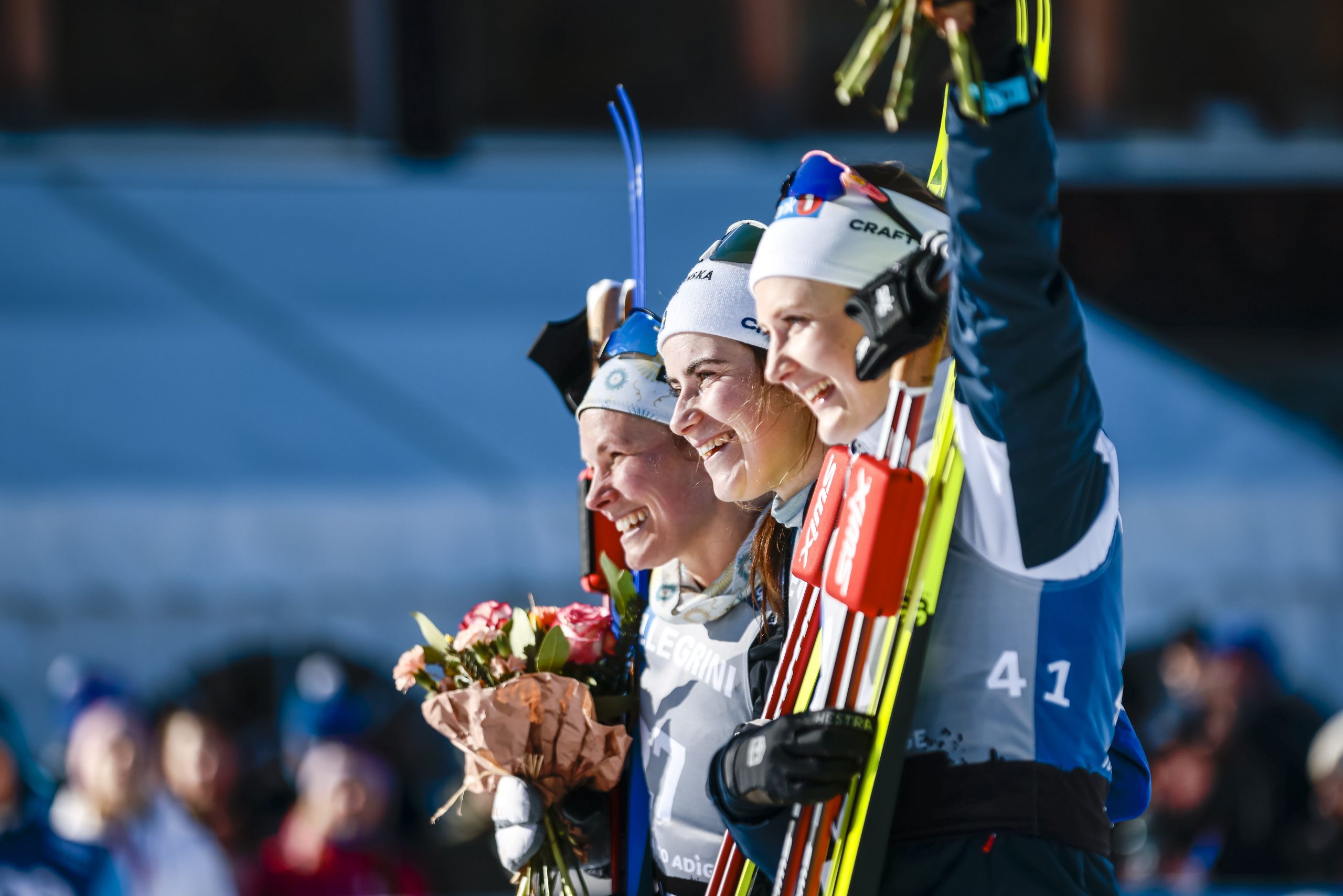
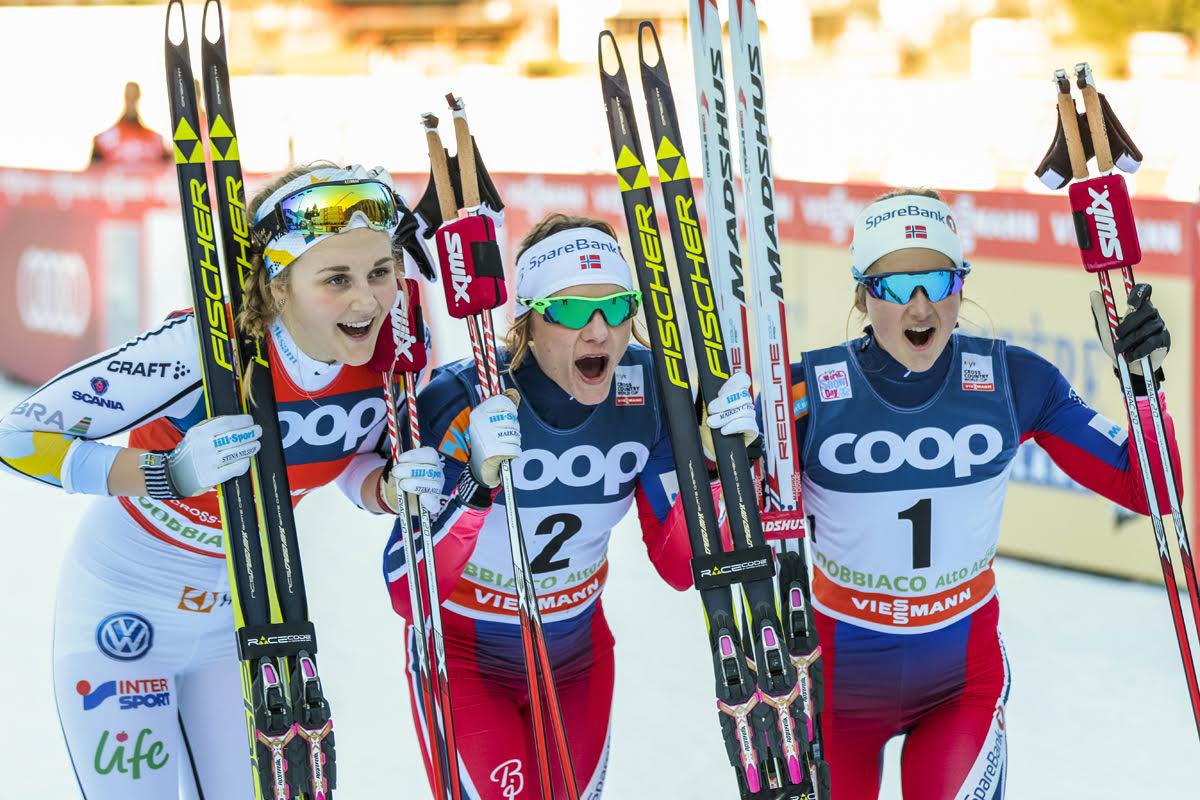
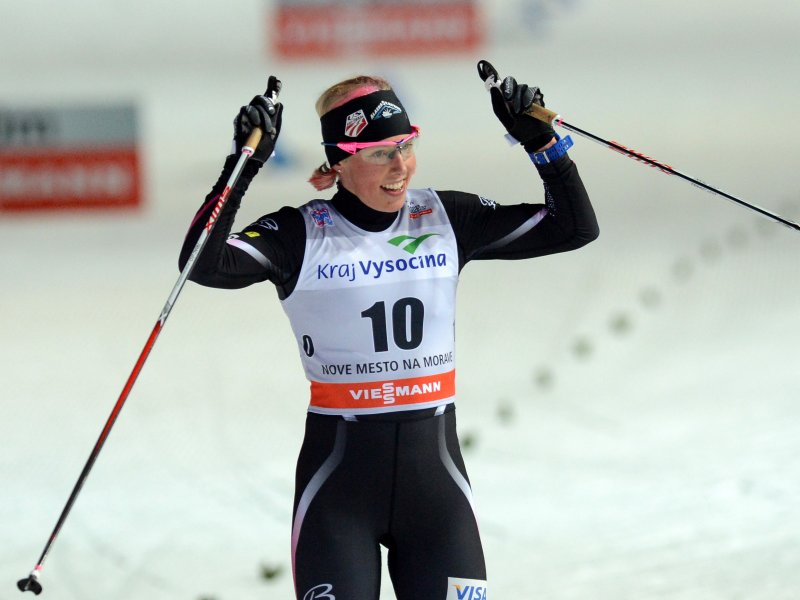
The podium in Toblach revealed who made the most of the cards they’d been dealt. Ebba Andersson (SWE) first, Jessie Diggins (USA) second, Ingvild Flugstad Oestberg (NOR) third.
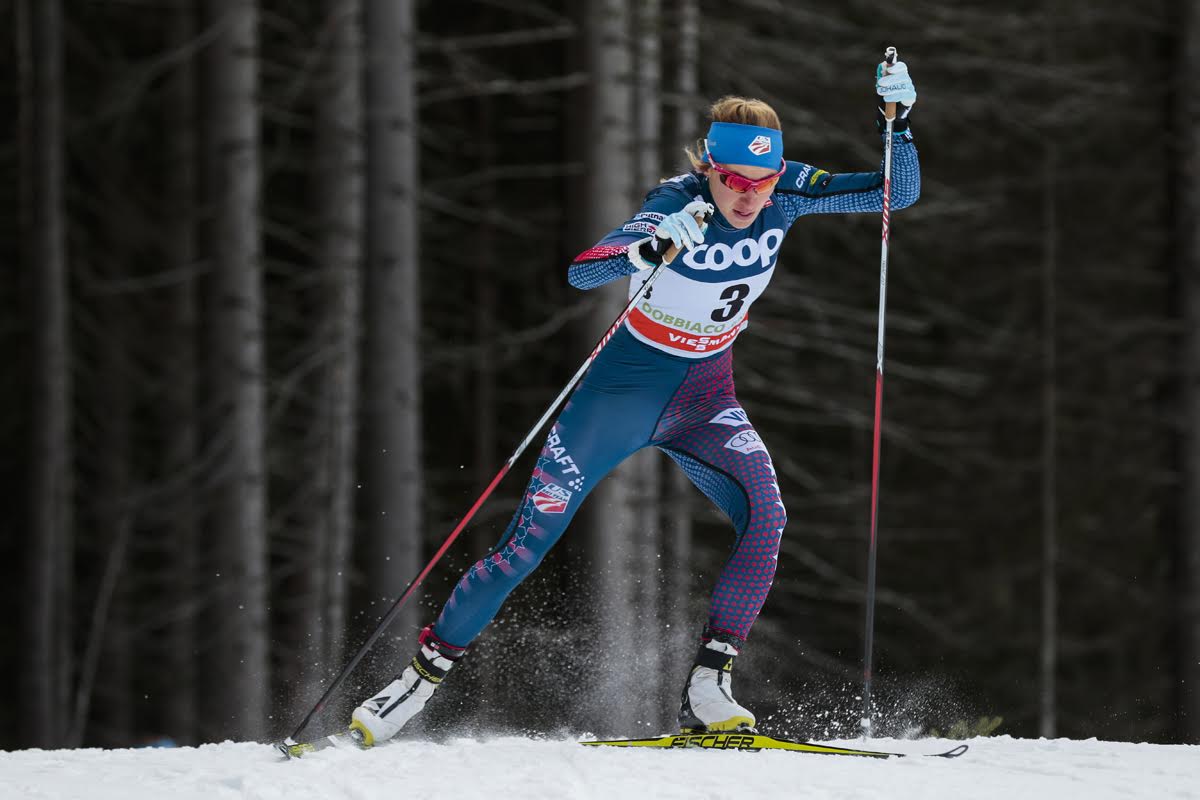
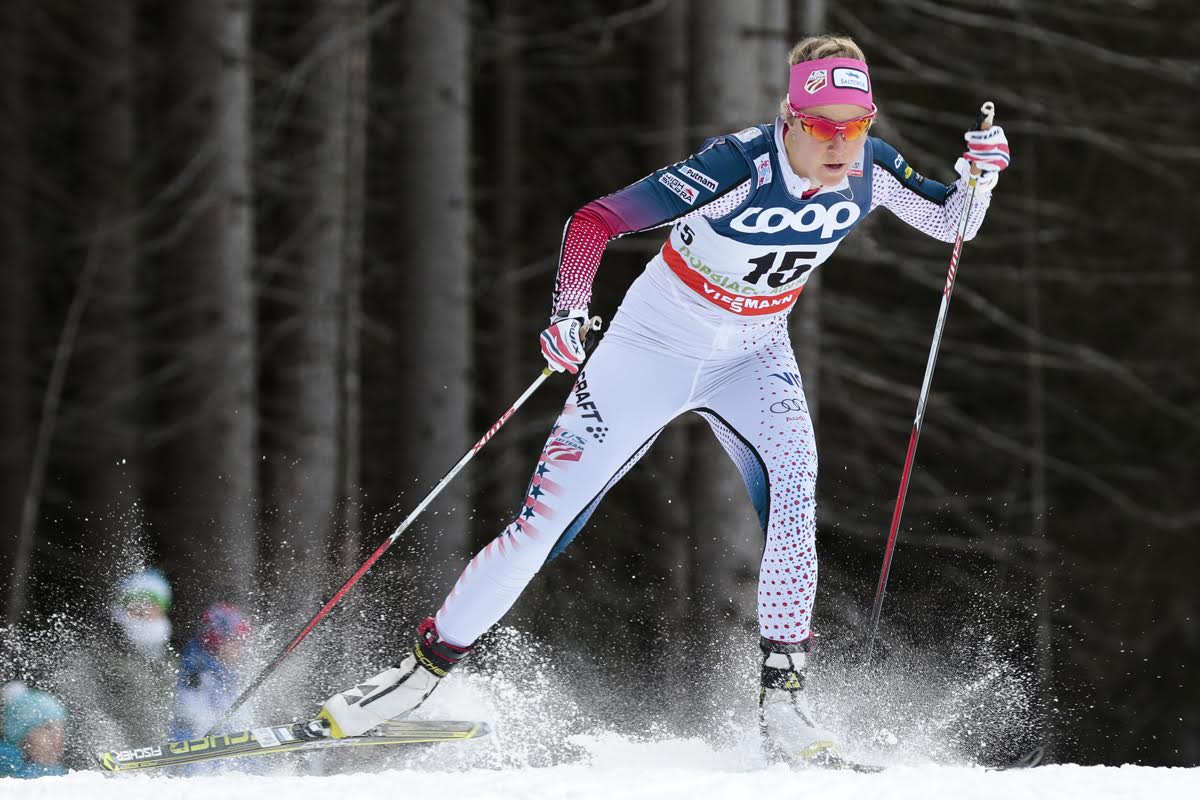
Americans had even more to celebrate as Diggins was joined in the top 10 by Rosie Brennan in fifth, and Julia Kern in 10th. Continuing to show fine form in her World Cup campaign, Hailey Swirbul raced to a laudable 26th. Other American finishers included Alexandra Lawson 40th, Alayna Sonnesyn 48th, Sarah Goble49th. There were no entrants from Nordiq Canada.
But much would happen on the way to that podium . . .
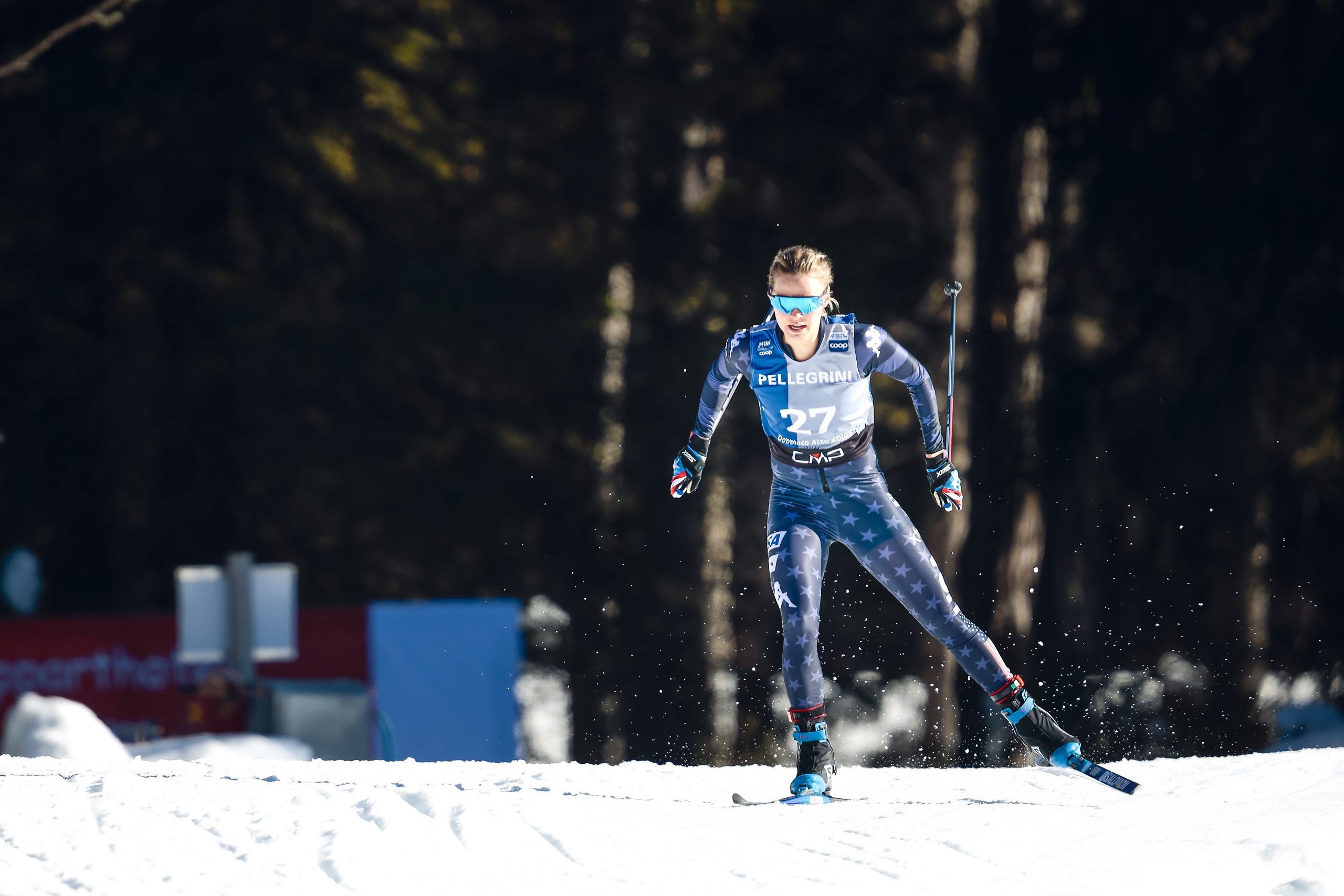
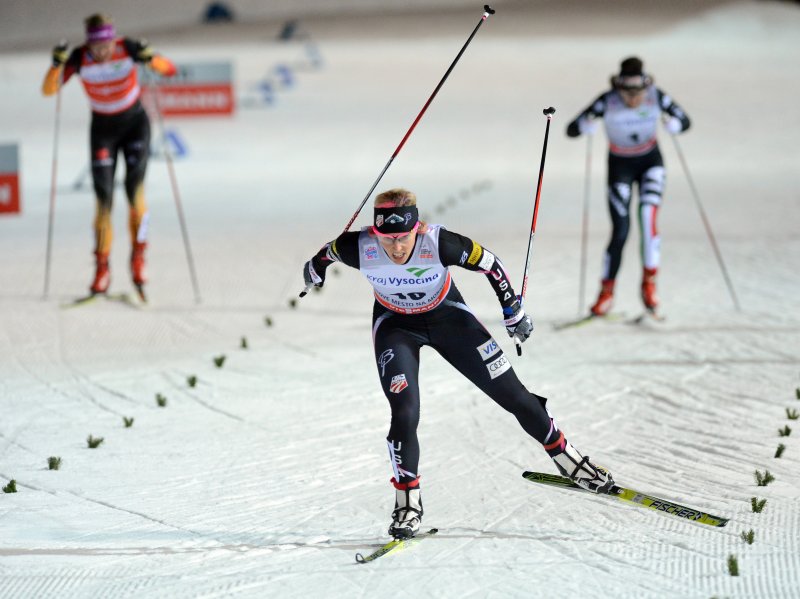
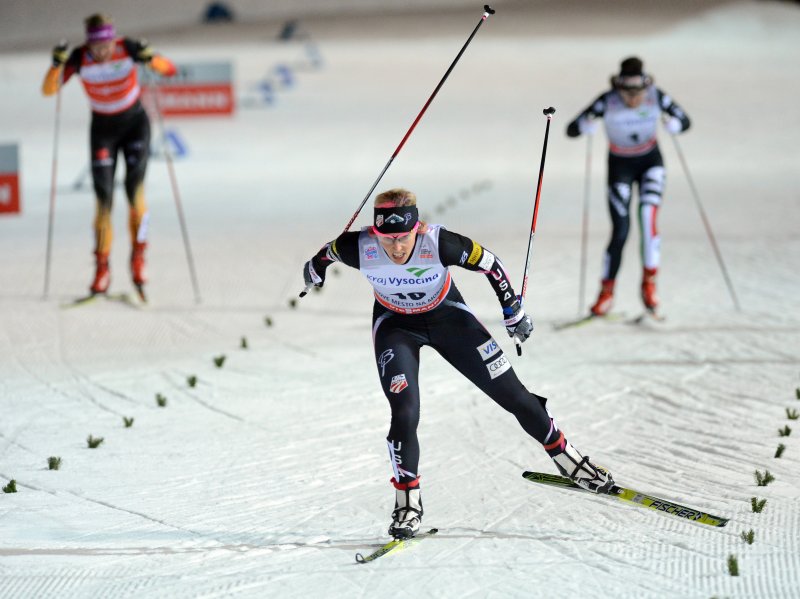
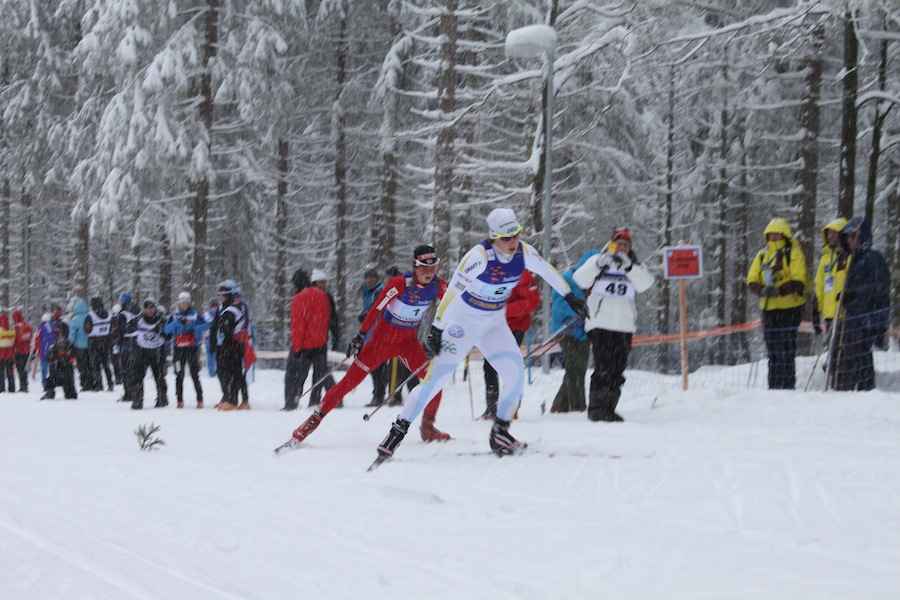
Always an aggressive descender, Diggins would suffer a high speed crash in the middle of the race, whacking her knee hard enough to seek attention from her trainer after the race. She would scramble back to her feet in time to finish the day in second. Diggins described the incident:
“It was difficult pacing because the sun had baked a couple of the uphills, making them really slushy. Certain sections were really icy, other sections were pretty slushy. My exciting part was that I had a little crash just after the 5 k when I was headed out on my second lap. I was skiing on the very edge of the course where it was iciest and fastest, and the very tip of my ski got stuck in the snow. I hit my left knee (honestly) really hard. I spun around and got back up and kept going as hard as I could. I lost … some seconds for sure, but what I think was really challenging was that my whole knee was numb (but) I was able to keep racing and put it behind me.”
Tour de Ski champion and overall World Cup contender, Frida Karlsson (SWE), began the day in contention (close behind Diggins at the first check point): she would fade in the final kilometers, finishing 11th (perhaps there’s more to the story that broadcast cameras failed to capture).
Sprinters pushed forward to swipe a number of coveted top 10 finishing places: Nadine Faendrich (SUI) 4th, Victora Carl (GER) 7th, Jonna Sundling (SWE) 8th, Julia Kern 10th.
And—whatever the reason—Norwegian skiers had an off day (finishing 14th, 17th, 19th, 28th, and 29th) . . . except, that is, for Ingvild Flugstad Oestberg who would finish the day on the third step of the podium. Winner of Olympic and World Championship medals—and the 2019 Overall World Cup—Oestberg had experienced a number of interrupted seasons. Her return to the World Cup podium in Toblach was definitely a cause for celebration.
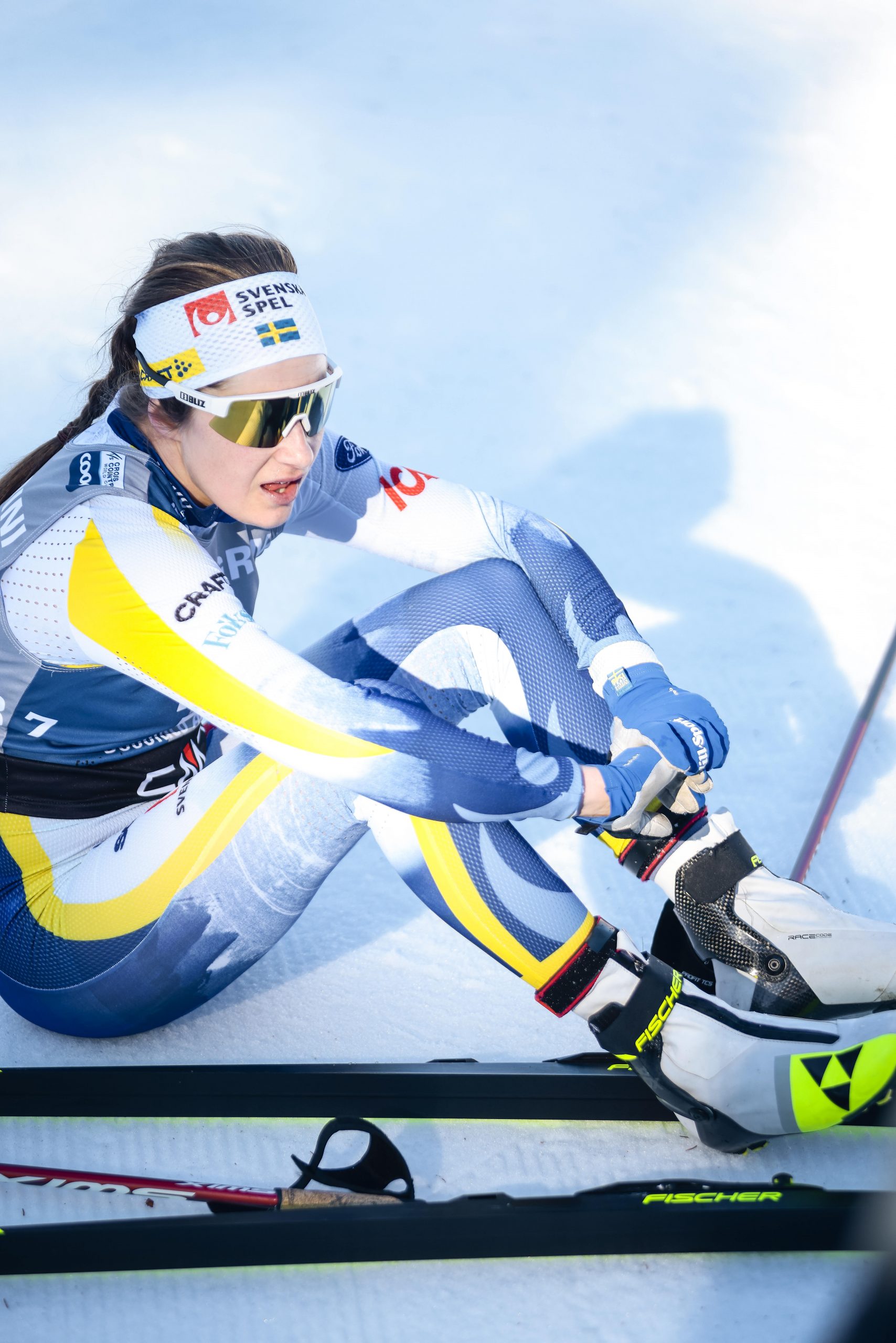
Ebba Andersson (SWE) reflects after her victory in the Women’s 10 k Freestyle Individual Start in Toblach, Italy. This was her third straight World Cup distance race victory. (Photo: Modica/NordicFocus)
Women’s 10 k Freestyle
Bright sun and relatively warm temperatures greeted racers in Toblach. On trails described as firm and fast, the 10 k Freestyle looked to be a straightforward test of prolonged speed. In this distance, there is little time for pacing or patience. Winners will be those who start fast, and hold that speed through the finish. It’s a high-risk race strategy, but a less bold plan is unlikely to succeed.
Racing bare headed, her pony tail tucked up for tracing in the warm sunshine, Diggins started 27th (among the earliest of the day’s contenders). With so many of her rivals starting after her, Diggins would not receive much information during her first lap, but would need to rely on the aggressive racing strategy that she so often employs. Early in her career, Diggins was often a contender during the rare staging of five kilometer races. At this point in her career, however, she is certainly a contender for the win at every distance. She raced with that goal in mind today (as she so often does).
Diggins was fastest of the early starters at the 2.1 k checkpoint, 6.3 seconds ahead of Jonna Sundling (SWE). Later contenders crossing the 2.1 k mark confirmed Diggins fast start, with Karlsson three seconds behind. Starting 37th, Andersson later arrived to supplant Diggins by 3.1 seconds. The chase was on . . .
Diggins crossed the 6.7 k checkpoint 4.7 seconds ahead of sprinter Nadine Faendrich (SUI). Faehndrich would not normally have been a significant marker among the leaders in a 10 k skate race, but she was in the middle of a remarkable day that would earn her a rare fourth place finish in a distance race. Diggins would rebuild her advantage over Faendrich to eight seconds by the 8.1 k checkpoint. It was later revealed that Diggins crashed hard mid-race, explaining her loss of time during that section of the course.
Rosie Brennan (USA) spent the Toblach World Cup 10 k freestyle battling for a podium spot. She would finish the day in fifth, only 5.9 seconds from third. (Photo: Modica/NordicFocus)
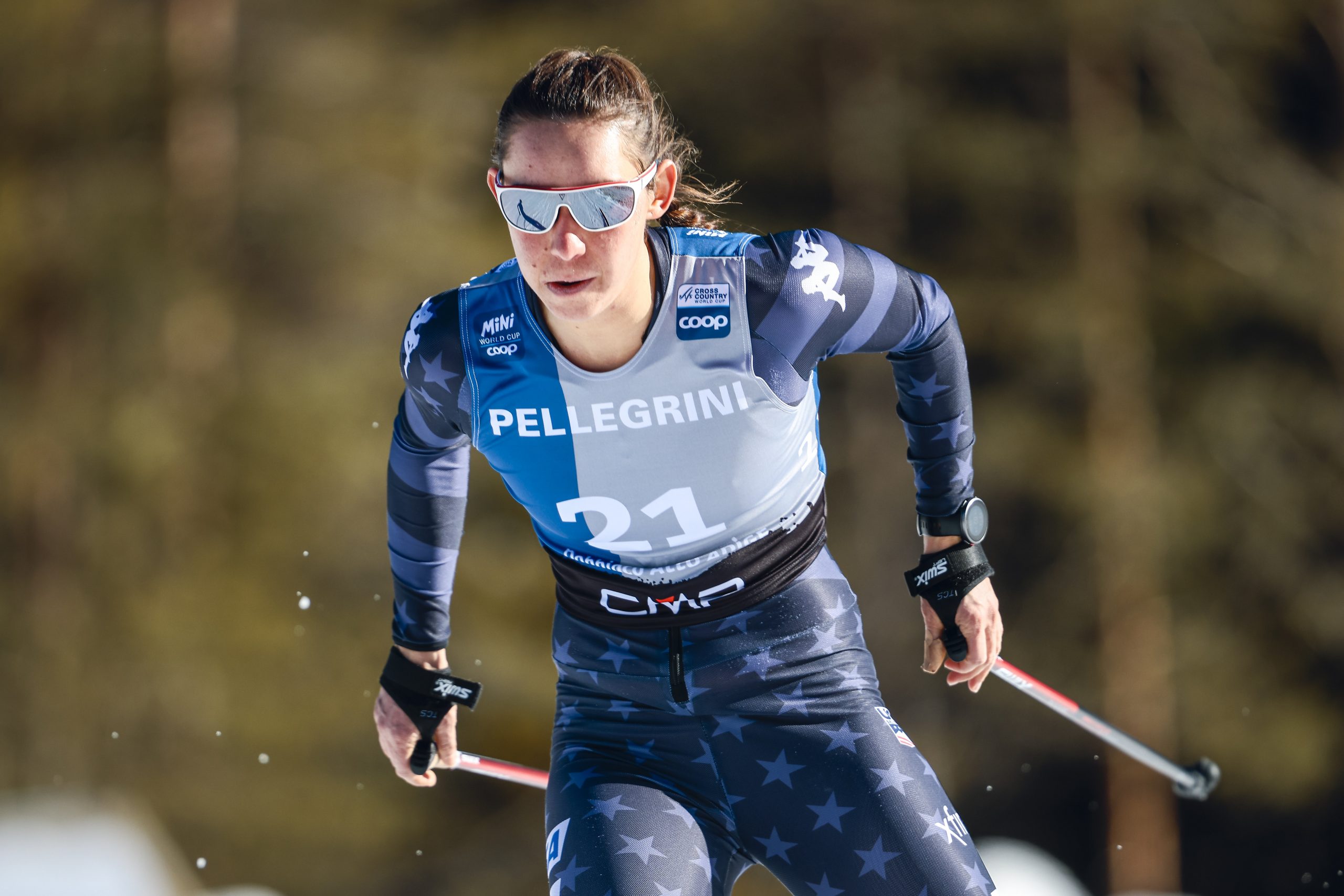
Other American skiers were significant players throughout the race. Brennan was in fourth at the 2.1 k checkpoint, and fourth again at 8.1 k. She would race with her typical grit and flare, holding her pace to finish the day in fifth.
“We had a very spring-like day in Toblach today,” Brennan said. “The skiing was mostly very fast with a few wet sections. I wanted to do my best to hold an even pace and push a bit on every section. I did this to the best of my ability, but ended up on the wrong side of a tight battle for third.”
“I am happy with my focus today,” Brennan continued. “[I] felt that I was able to push hard the whole time so with that I am satisfied with the result. I hope we see some cooler temps now and can get back to winter. But most importantly, it’s relay day tomorrow!!!!”
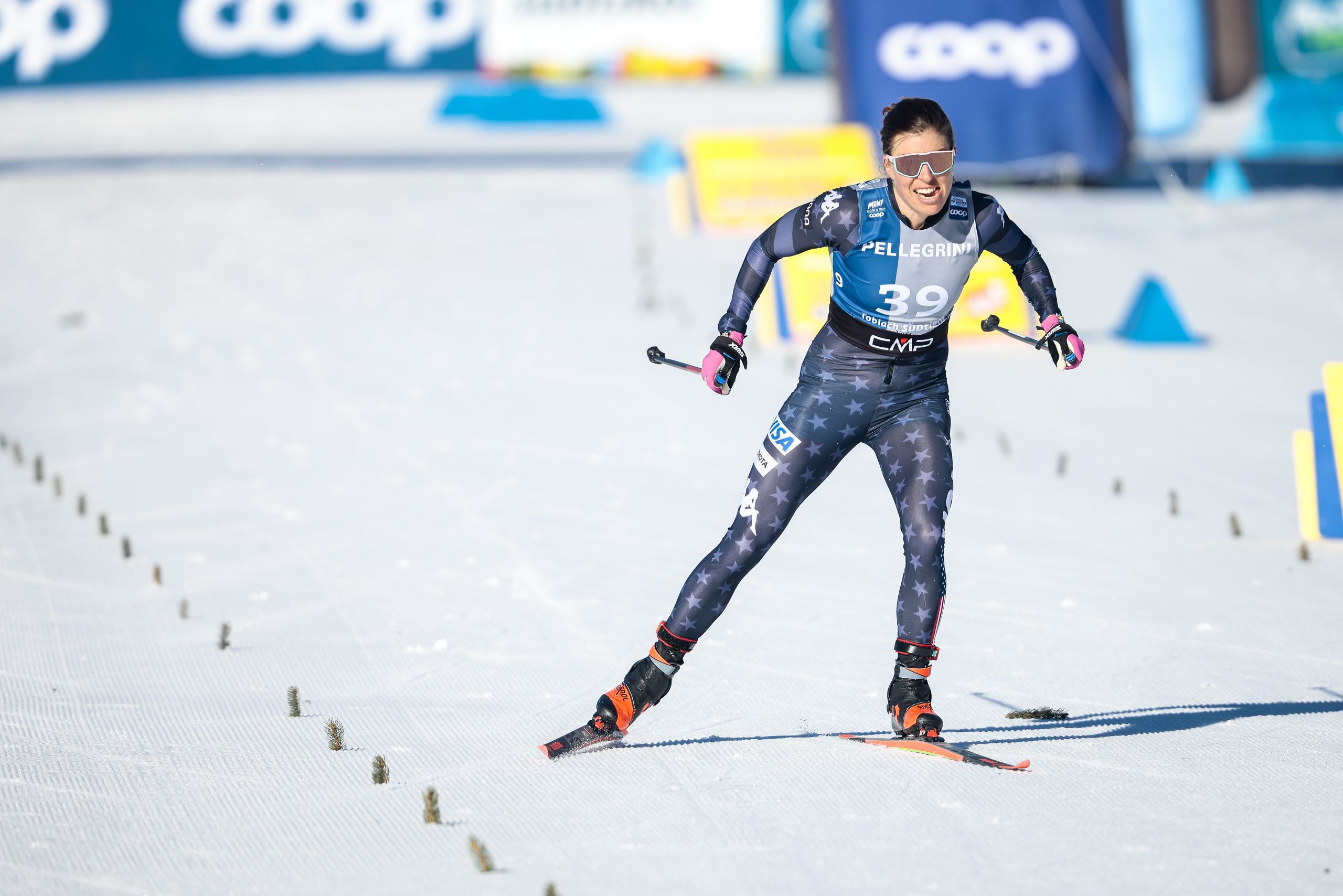
Kern led the race after 21 finishers, only to be supplanted by Faendrich two finishers later. She was one of the notable sprinters to claim a spot in the top 10.
While Norwegian headliners were floundering, former star Oestberg was returning to the form that saw her claim numerous World Cup, World Championship, and Olympic victories a few years ago. She skied steadily throughout the day, crossing the line to finish 10 seconds behind Diggins.
Race leader at every checkpoint, Sweden’s Andersson confirmed the form that has led to three straight World Cup distance race victories. She’ll hope to carry that momentum into the FIS Cross Country World Championships beginning in three weeks in Planica, Slovenia.
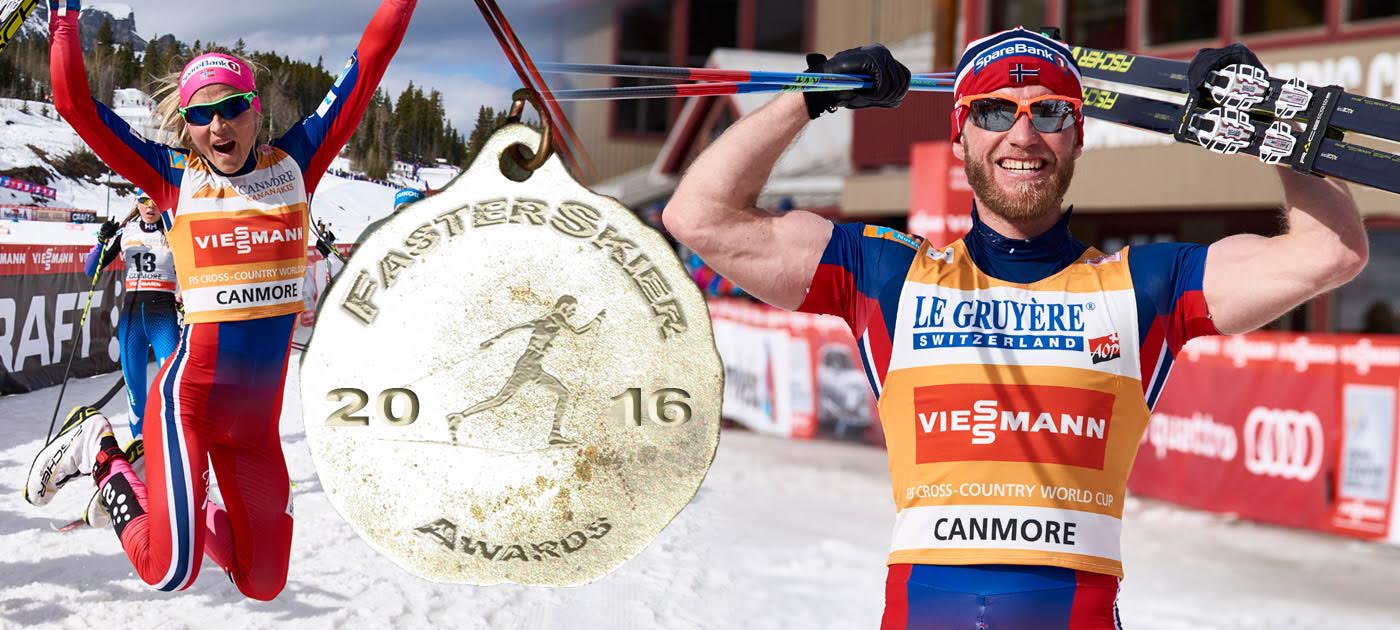
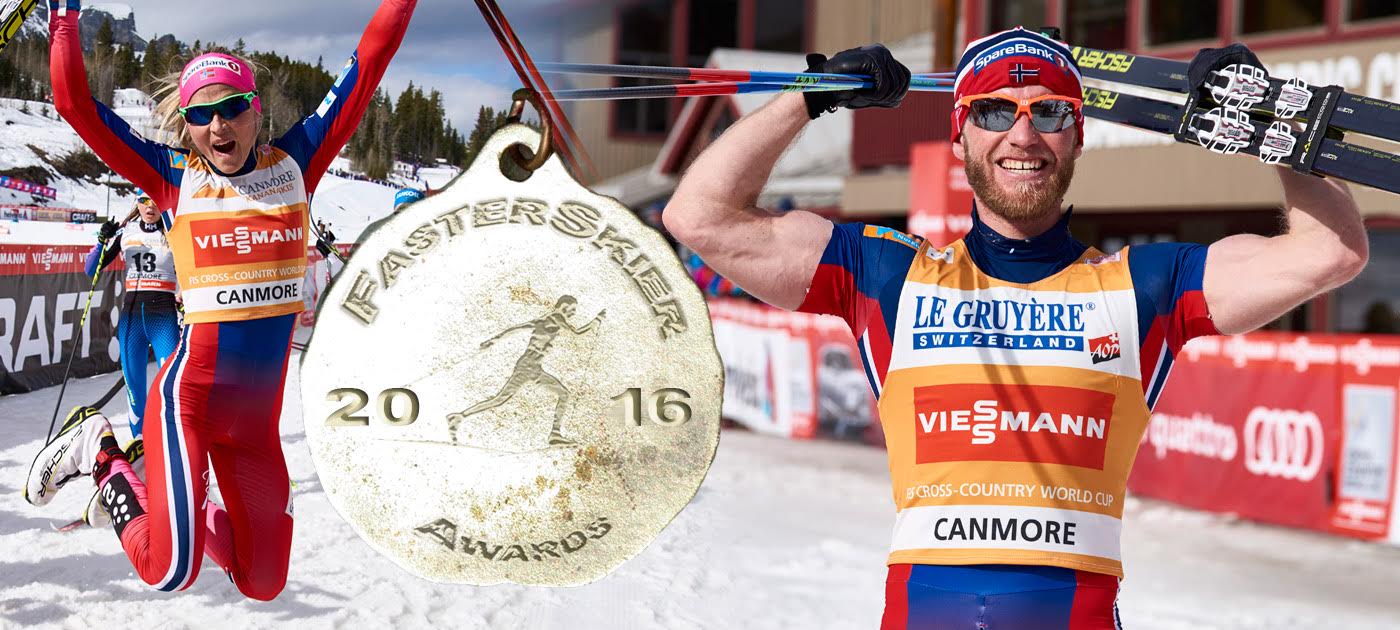
2015/2016 overall World Cup winners Therese Johaug (l) and Martin Johnsrud Sundby are FasterSkier’s International Skiers of the Year. (Photos: Fischer/NordicFocus)
The 2015/2016 awards continue, chosen by the FasterSkier staff based on performances from last season. While not scientific, these points of recognition are intended to reflect a broader sense of the season in review.
The following set of honors goes to outstanding male and female international skiers of the year and the male and female international performances of the year.
Frozen beard, big-time work ethic, and a perfectly proportioned combo of confidence and humility, in 2016, Norway’s Martin Johnsrud Sundby was a model of supreme day-to-day fitness and season-long endurance. Just a single win from his 2016 World Cup accomplishments would make a season for some and even define a career for others. Here’s a sampling of Sundby’s 2016 race season:
14 individual World Cup wins
Inaugural Ski Tour Canada (STC) win
Third-straight Tour de Ski title
A 50 k classic Holmenkollen victory. (It was Sundby’s first Holmenkollen 50 k victory in nine 50 k World Cup starts there).
Known as a distance dominator, Sundby also proved his worth in the sprints. He finished fourth in three sprint races and ended up 13th overall in the Sprint World Cup.
Sundby has taken the overall Crystal Globe the last three seasons. Prior to his three-year grip on the overall, Sundby’s best end-of-season overall ranking was eighth in 2013. Between 2007 and 2012, his end of year rankings were 146th, 68th, 13th, 42nd, 28th, and 19th. Not exactly the numbers we associate with his superstar status.
The years when he has struggled are not lost on Sundby. “To grow old in the profession I have chosen, with the genetic infirmities I have, one must also do much right. I have so sensitive respiratory and lung problems and asthma,” Sundby said according to a translated article.
At 31 years old, and now a father of two, Sundby has much to juggle along with his aspirations for more athletic glory. “No matter how I twist and turn it, I do not have many years left at the top. I must take advantage of the years well,” Sundby said.
No doubt, Sundby has used the last three years well; exploiting a high tolerance for big training loads and a gift to see that training materialize in podiums.
With next year’s World Championships looming, Sundby has a clear goal for 2017; he’s never won an individual World Championship gold. It’s still unclear if Sundby will continue racing into 2018, but an Olympic void also remains; no Olympic golds.
Therese Johaug, Norway
Many athletes are gifted opportunities, but few are able to capitalize. Over the course of a World Cup season, there seems more that can go wrong than right. There’s possible sickness and injury, poor form, bad skis, and other Norwegian upstarts emerging. So much must align for an athlete’s potential to morph into results.
To her credit, Johaug made the best of her opportunities and seized both the day and the season. She won her second-career overall World Cup in dominating fashion.
If you’ve ever listened to Johaug interviewed post-victory, you’ll undoubtedly heard her say this: “The shape is good.”
The shape was good from the start of the season in Finland to its conclusion in Canada. During that journey, Johaug only impressed. She ultimately tied Marit Bjørgen’s record of 17 wins in a World Cup season.
She won the Ski Tour Canada, the Tour de Ski and the Holmenkollen 30 k classic. In fact, she won all but three distance World Cup races this season. One of those non-wins was the STC Stage 4 10 k freestyle pursuit in Quebec City. Johaug actually skied that race’s fastest time on the day. Not shabby.
Just a distance skier you say. She placed in the top 10 in five different sprints this season.
Next season will present Johaug just what an elite athlete at the pinnacle of their sport needs; new challenges to stay motivated. Bjørgen, of course, will be back. So, too, will two other Norwegians capable of derailing the Johaug-express, second in the World Cup overall Ingvild Flugstad Østberg, and third overall Heidi Weng.
International Performances of the Year:
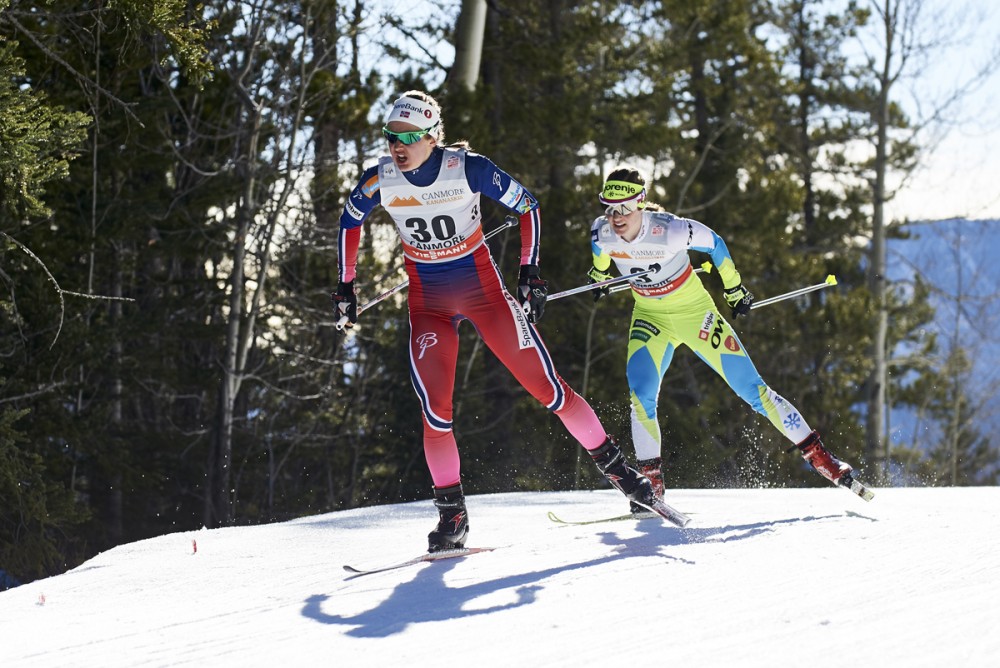
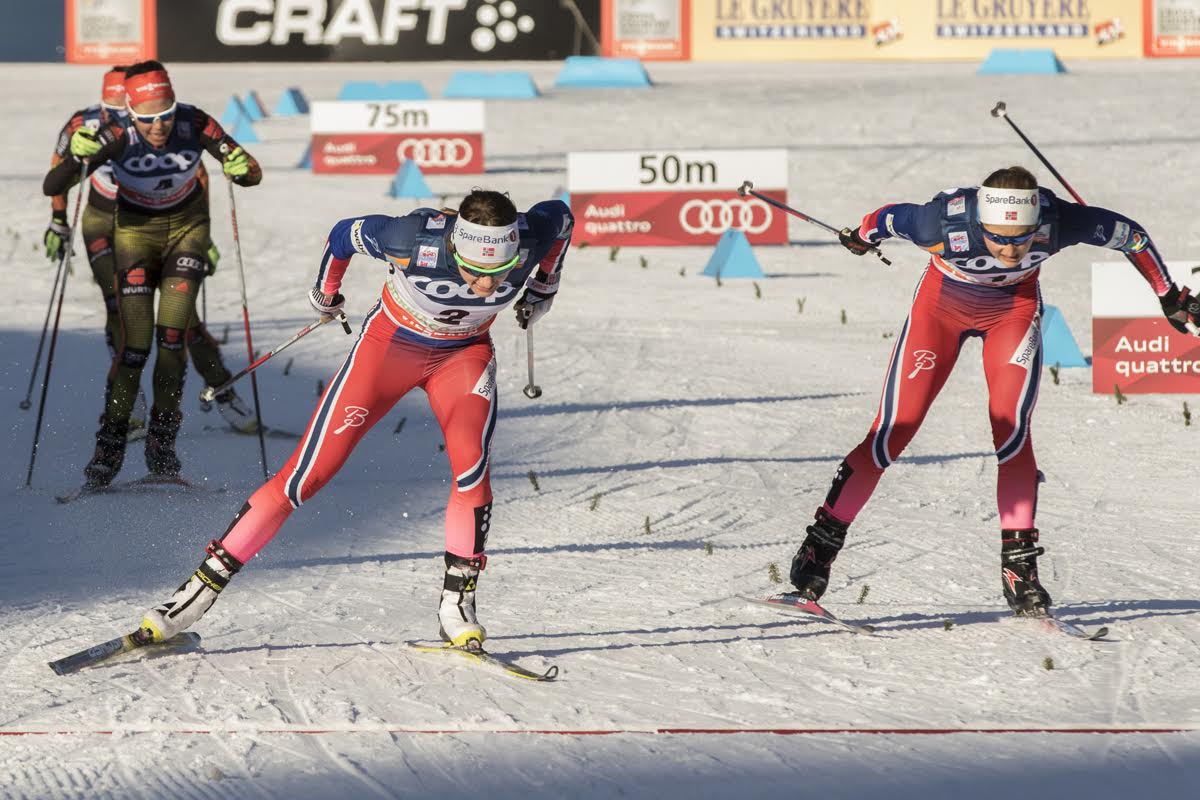
Norway’s Ingvild Flugstad Østberg leads Slovenia’s Alenka Cebasek during the women’s 10 k freestyle at Stage 7 of the Ski Tour Canada in Canmore, Alberta. Østberg went on to win the stage by 23 seconds over her teammate Heidi Weng. (Photo: Madshus/NordicFocus)
Ingvild Flugstad Østberg (Norway): 10 k freestyle at Stage 7 of the STC
Since 2012, Østberg has become a consistent force in the sprint standings. In 2012, she was eighth overall. The next four years culminated with a third, fourth and two successive second-place in the overall sprint standings.
In what should have been a Johaug victory or a Weng win, Østberg crushed. She ranked second at the first time check, but upped her speed and punched first and first at the second and third checkpoints. Østberg beat second place finisher Weng by 23 seconds and relegated Johaug (who eventually went on to win the Ski Tour Canada overall) to sixth place (+40.1).
FasterSkier interviewed Østberg during the STC. In particular, she discussed her emergence as a distance threat, not only a sprint shoe-in.
“Many years now that I am a sprinter, but I’ve always said I am not a sprinter,” Østberg said at the time. “Don’t call me a sprinter because I want to be an all-around skier and I want to do good in all kind of distances.”
True to reputation, Østberg was second overall in the sprint World Cup. However, she was third overall in the final World Cup distance standings. Add all that up and you have an all-around skier: Østberg was second for the World Cup overall with 2302 points. Johaug, the overall winner, ended with 2,681 points.
Federico Pellegrino (Italy): skate sprint streak
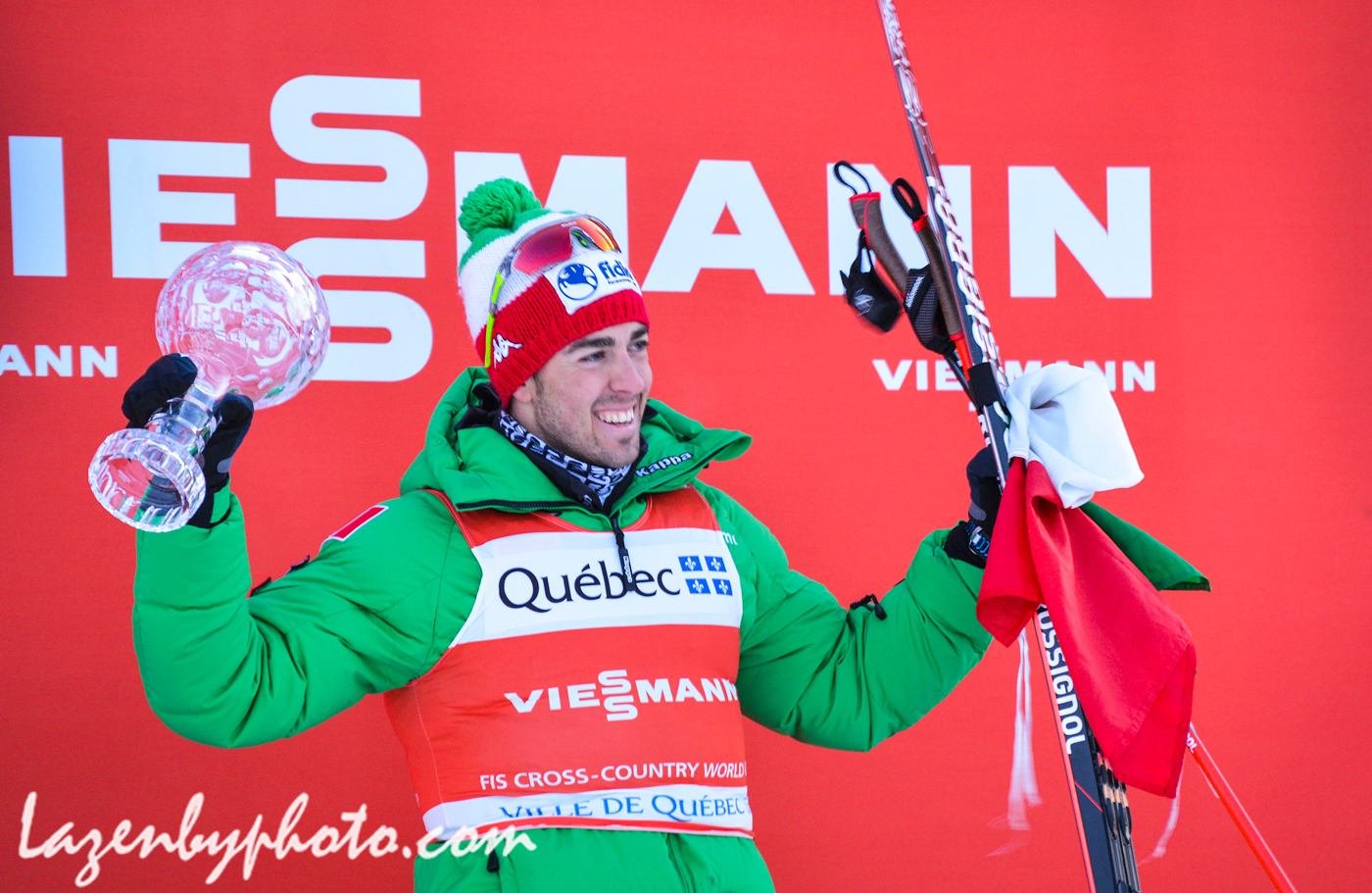
This season, Italy’s Federico Pellegrino became the first non-Scandinavian male to win a Sprint World Cup Crystal Globe.(Photo: John Lazenby/Lazenbyphoto.com)
Perhaps there’s a reason the term “three-peat” just sounds like a nice tidy package of victories. “Four-peat”, on the other hand, just doesn’t sound as familiar. That may be because winning something four times in a row is that much harder to do.
During the 2015/2016 World Cup season, Pellegrino did accomplish a three-peat. He won three consecutive skate sprints. This season, he did one better.
From Davos, to Toblach, to Lenzerheide, to Slovenia, Pellegrino did something unprecedented on the World Cup scene. According to FIS, Pellegrino was the first skier to win four consecutive freestyle sprints.
Coming into the STC, Pellegrino struggled in the classic sprints. In chronological order, here’s Pellegrino’s classic sprint results on the World Cup this season; seventh, 14th, 26th, and 21st. It shows a heavy reliance on his freestyle skills.
The final sprint of the season, Stage 5 of the STC, was a classic sprint. It’s possible that having already locked up the sprint crystal globe — in no small part due to his skate sprint streak — prior to the race boosted his confidence. Pellegrino strided to a Stage 5 classic sprint win.
Pellegrino ends the season as the winningest Italian male ever to ski on the World Cup with eight wins total. All but one of those victories have come in freestyle technique.
Four skate sprint wins in a row was a record. And with a first-ever career classic sprint win to close out the season, it’s a nice goodbye.
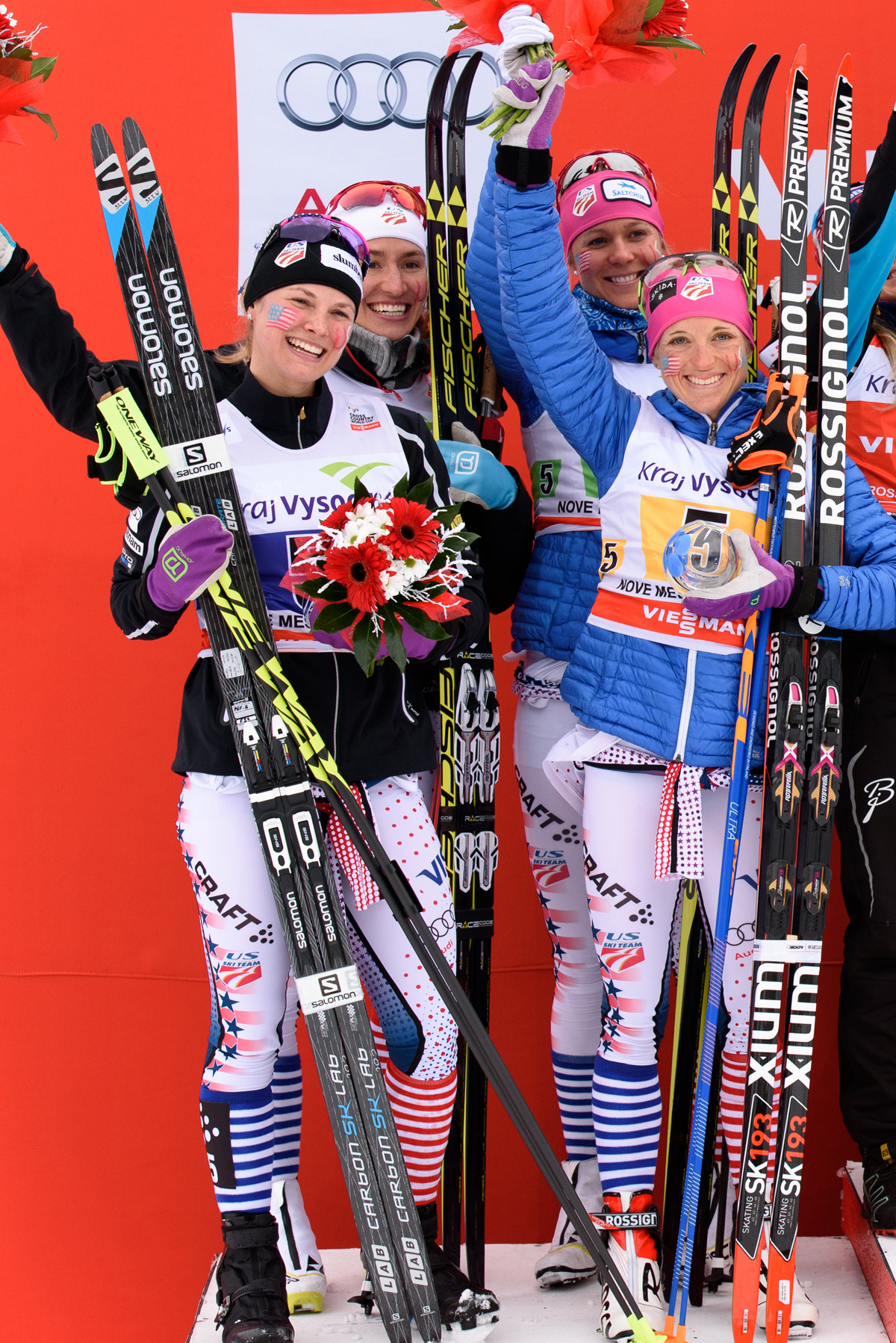
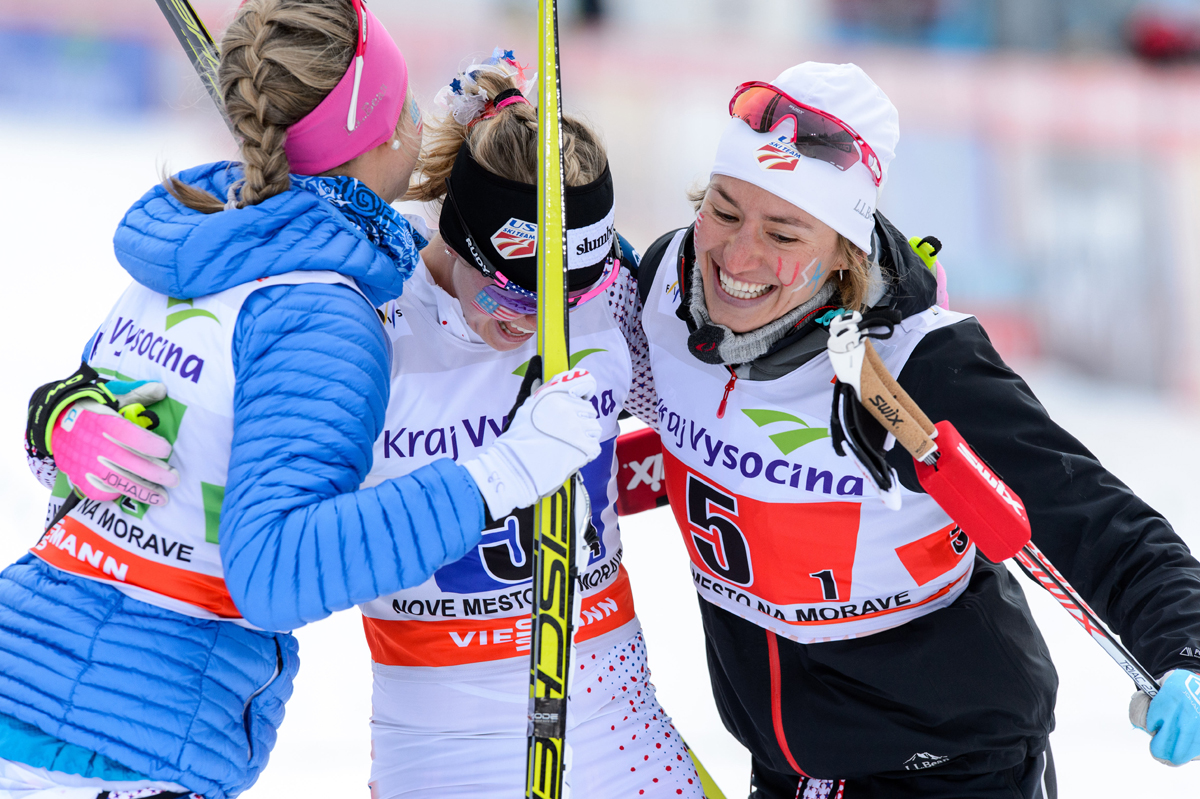
The U.S. women placed a historic second for their best-ever relay finish on Sunday at the World Cup 4 x 5 k in Nove Mesto, Czech Republic. From left to right: Jessie Diggins, Sophie Caldwell, Sadie Bjornsen, and Liz Stephen. (Photo: Fischer/NordicFocus)
From a clinical standpoint, the women’s 4 x 5-kilometer relay in Nove Mesto, Czech Republic, on Sunday became a time trial for the Norwegian women. That TT began 2.5 k into the first leg, as Norway’s Ingvild Flugstad Østberg came through the stadium for her second lap, 0.4 seconds back in second place, behind Finland’s Anne Kyllönen. By the time Østberg tagged off to Heidi Weng, she had a 27.5-second gap on the next-closest team. The combination of the four Norwegian speedsters, Østberg, Weng, Therese Johaug, and Astrid Uhrenholdt Jacobsen, won the relay in 50:17.2. Norway, with Sunday’s win, extended their unbeaten relay streak to 10.
But sport, at it’s best, is about drama and emotion. That type of racing belonged to the U.S. women’s relay team.
With a combined effort from Sophie Caldwell, Sadie Bjornsen, Liz Stephen, and Jessie Diggins, the U.S. women’s team placed second in a relay for the first time, after having reached the podium three times before in third. Diggins anchored them to the next step up, finishing 42.1 seconds after Norway and 13.8 seconds ahead of Finland, the team that beat them for second in the last World Cup relay in Lillehammer, Norway. On Sunday, Finland fell off the U.S. pace and settled for third, 55.9 seconds behind Norway. (In the last three World Cup relays, Finland has finished second to Norway.)
Whether or not it was considered an upset is debatable, as podiums for the U.S. women’s relay team have become a staple of their success. But anytime a relay is on the schedule, they are now considered podium favorites. Of the last five women’s World Cup relays, Sunday marked the Americans’ fourth podium.
Four Legs to Go
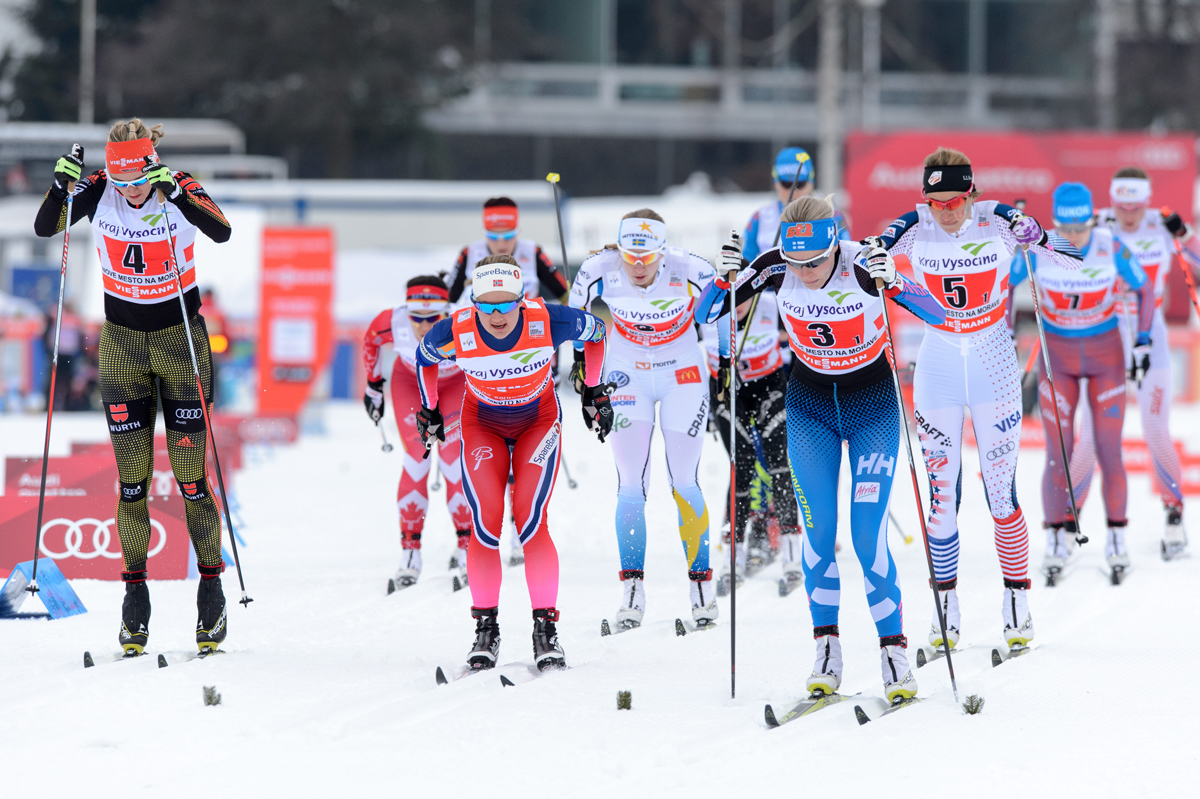
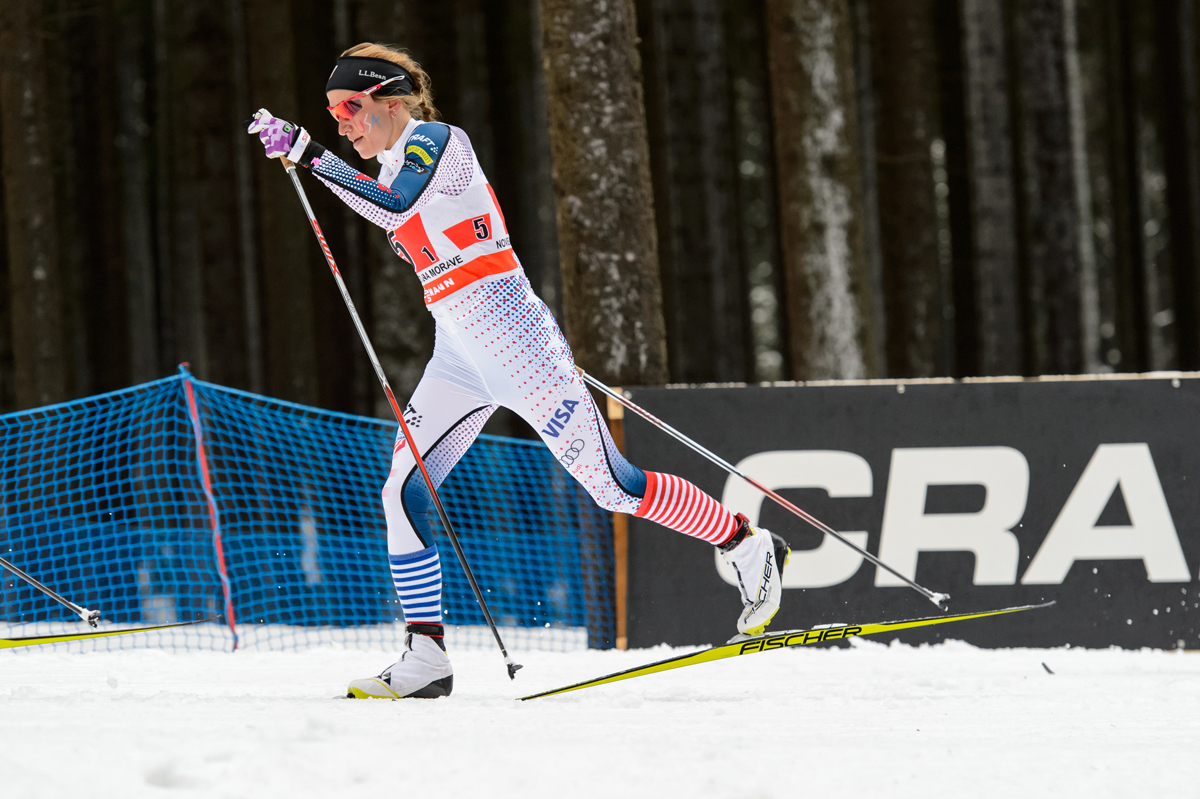
The start of the women’s World Cup 4 x 5 k relay on Sunday in Nove Mesto, Czech Republic, with American Sophie Caldwell (bib 5) following Finland’s Anne Kyllönen (3) while Norways’ Ingvild Flugstad Østberg (in red) and Germany’s Denise Herrmann (4) also lead the way. (Photo: Fischer/NordicFocus)
The newest addition to the relay, Caldwell skied the opening “scramble” classic leg, keeping the U.S. in contention and podium within sight.
Initially, Germany’s Denise Herrmann and Finland’s Kyllönen set the pace, with a large group of trailing skiers in their draft. Caldwell came through the 2.5 k mark in sixth place, 1.2 seconds back — striding within a long line of teams about to be steadily broken apart.
Through the stadium, Østberg led a group of nine teams, all within 1.6 seconds of the lead. This is when Østberg made her move, showing her strength at the front. Half a kilometer later, Caldwell was gapped by 7.8 seconds. The U.S. Ski Team (USST) sprinter remained in a tight group, which included Germany I, Finland, Germany II, and Sweden, with the remaining teams following within sight.
“I assumed that someone was gonna start pushing the pace at some point, but I didn’t anticipate [Østberg] taking off at that speed,” Caldwell recalled during a phone interview with the rest of her relay teammates. “I knew that, while it would’ve been awesome to try to keep up with her, trying to keep up with her and then imploding would’ve been a lot worse than trying to stay with that second-place group and coming in in a solid position. So instead I just focused on staying with those next girls and trying to hold off the people behind us.”
U.S. Women’s Coach Matt Whitcomb has shepherded the team along as podiums and individual top-20 results have become regular occurrences in recent years. In a phone interview on Sunday, he reduced the team’s relay strategy to what he referred to as a game of contact.
“When you can hand off to your teammate with one of the key players in contact with you, you do them a huge favor,” he said. “They can just hop in the draft or work with that team … It’s a big piece of relay. It’s not just head down, hammer. You have to know when to hammer, when to strategically sit in and recover, and when to attack.”
Caldwell kept contact and pace, keeping her sight on the relay’s long-term endgame. She tagged off to Bjornsen in third place, right there with Germany I in second, and 27.9 seconds behind Norway.
Next up, Bjornsen
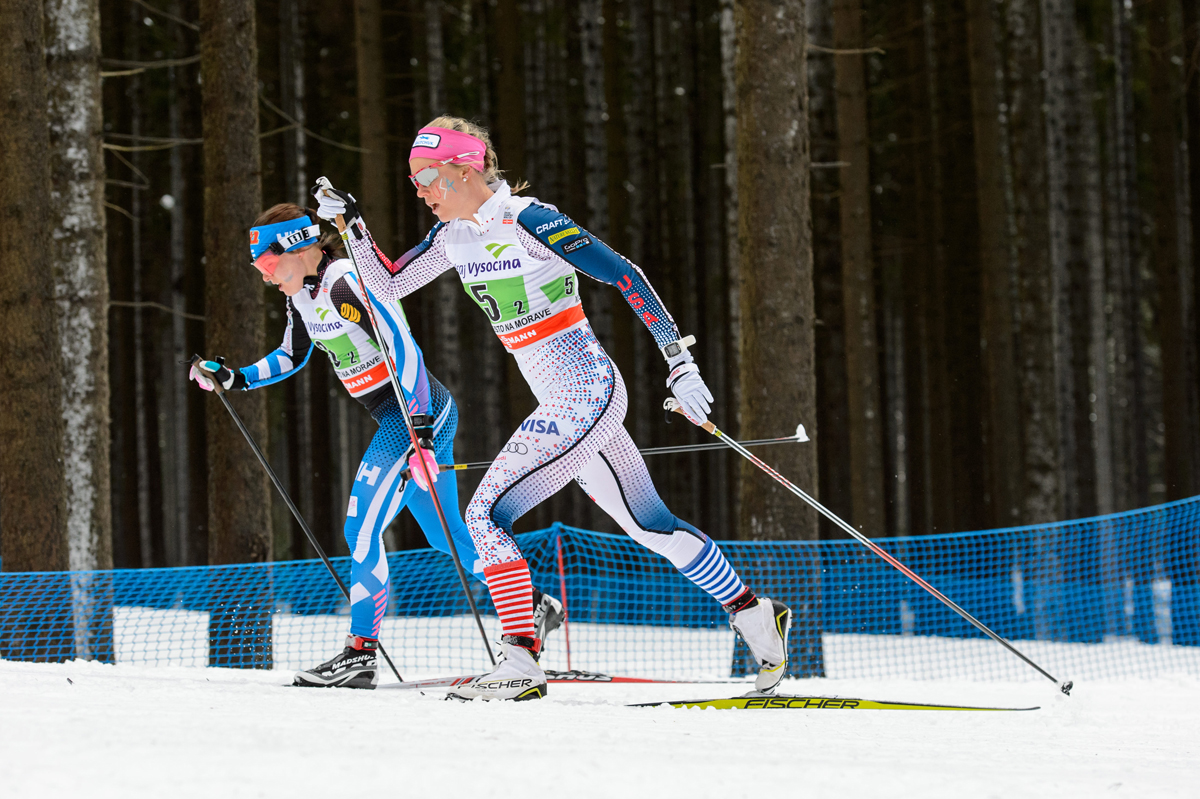
Sadie Bjornsen (in white) racing with Finland’s Krista Parmakoski during the second leg of the women’s 4 x 5 k World Cup relay on Sunday in Nove Mesto, Czech Republic. (Photo: Fischer/NordicFocus)
According to Whitcomb, Bjornsen’s classic leg proved to be another turning point.
“When Sadie got tagged off in the position that Sophie handed it to her, it was just a sensation of confidence, knowing that Sadie was no longer chasing, she was going to be commanding with Finland,” he said. “And they skied a pretty exciting race. When one was going a little bit too slow, the other one would attack and they just spent the whole race trading attacks.”
Bjornsen skied a leg that provided a simpler overall narrative — her efforts made it a two-team race for second. She lead the hunt early on, setting a tone that her effort would make a statement. At each of her intermediate time checks, Bjornsen, working with Finland’s Krista Parmakoski, broke apart the chase. First the two German teams fell seven seconds back at 2.5 k, halfway through that leg. Half a kilometer later, Germany’s first and second teams were 11 and 14 seconds out of third, respectively.
“I just tried to go out and stay a little more relaxed in the beginning, but then take the chance to try to break some of the people that were skiing in our group,” Bjornsen said. “Krista [Parmakoski] is one of the better classic skiers, so I was thinking to just sort of work together with her and make some time on those girls behind us and hopefully make some time on the one girl [Weng] in front of us as well. It ended up going really well.
“That’s the cool thing about a relay day, you’re not racing for yourself. You’re just finding all these crazy extra gears,” she added.
Stephen’s Turn
At the second exchange, where Bjornsen tagged off to Stephen, Norway lead by 24.5 seconds, while Finland came through in second (+24.5) and the U.S. just 1.2 seconds farther back in third.
Stephen’s skate leg was a point where the team could get comfortable with their odds for a podium, or make a kill-shot. With a high-tempo, head down, grind-it-out pace, Stephen kept the pressure on Finland’s Riitta-Liisa Roponen, and distanced any teams with thoughts of working their way back into podium contention. Three kilometers into her leg on the course’s biggest climb, Stephen took charge; she put two seconds into Roponen, but from the looks of Stephen’s determination, it might as well have been twenty. Stephen had broken Roponen down — the Finn had the look of a hanger-on.
With three top 20’s this season (including 19th overall in the Tour de Ski), it can be argued that Stephen should be popping top 10’s in the World Cup’s more demanding distance races. This season, something just hadn’t clicked for the 29-year-old team veteran.
“I think I’m beginning to feel a little bit better physically, and kind of like these girls were saying, it’s a little different when it’s a relay,” Stephen said. “In any other race, you have to find your own confidence in yourself and in the relay, you find confidence in the other girls. And the fact that we’re handed off in second or third or whatever it was at that moment, that’s confidence in itself. I’ve been struggling finding that a little bit since part of the season, for me individually, but today I was just working off their confidence.
“I was determined today,” she added. “You never want to be somebody that’s handed off third in the relay and you blow up. So definitely there’s a little extra motivation there. I tried to ski a smartly paced relay leg. I have a tendency to go flying like a bat out of hell. So Riita-Liisa and I worked together for a lap and then the second lap, you do what you can.”
Stephen handed Diggins a 5-second margin over the Finns at the final exchange.
The Difference Maker
Jacobsen anchored Norway’s team. Like the seasoned veteran that she is, she never relented, — skiing the fastest skate leg of the day, even besting Johaug’s third-leg time by 16.6 seconds. Out in front, but within site of Diggins on the straights, Norway’s top spot remained secure.
Jessie Diggins (c) celebrates with teammates Sadie Bjornsen (l), Sophie Caldwell (r) and Liz Stephen (not shown) after anchoring the U.S. women’s 4 x 5 k relay to a best-ever second in the Nove Mesto World Cup on Sunday in the Czech Republic. (Photo: Fischer/NordicFocus)
Diggins on the other hand, skated out of the exchange zone with Finland’s Kerttu Niskanen close behind. Her first-lap-strategy, go full gas — and she did so a day after achieving her second-career individual podium in the 10 k freestyle.
“On a windy course like this, my strategy was, if I can put time into [Niskanen] right off the bat, like in the first 3 k and totally drop her, then that’s it. That will decide it right there because when you can’t see someone, that is incredibly mentally challenging,” the 24-year-old Diggins said. “So my goal was to just put the hammer down right away, get far enough that she thinks she has no way of getting to me and then settle in. And the second lap I was just trying to ski very carefully. Like, OK, don’t fall, don’t trip, don’t make any bobbles, because if I can just get across the finish line, we’ve got it. I just have to ski cleanly and make no mistakes.”
Diggins made no mistakes.
In the end, Diggins celebrated across the line with several elated fist pumps before her three teammates surrounded her with a group hug. The U.S. team finished in 50:59.3, 42 seconds behind the Norwegian winners and nearly 14 seconds clear of Finland in third.
“We belong in the race for those medals just as much as any other nation and I think we’re all starting to ski that way,” Diggins reflected.
More Dissection
Sophie Caldwell opened for the U.S. women’s relay team on Sunday at the World Cup in Nove Mesto, Czech Republic, tagging them in third, immediately behind Finland (not shown) in second place en route to the U.S. women’s team’s best-ever result of second place. (Photo: Fischer/NordicFocus)
In December, when the U.S. women placed third in the last World Cup relay in Lillehammer, Rosie Brennan skied the scramble leg. With Caldwell’s success on Sunday’s first leg, Whitcomb has options.
“With Sophie, it was one of the interesting components of today,” he reflected. “We had a really difficult decision to choose between Rosie and Sophie for the classic leg. I do believe that we would have been on the podium with Rosie, I know she could have skied a great leg. We just felt that this course and conditions really suited Sophie. But it was one of those things we could have gone either way on. So with Soph, we just talked about conserving as much as possible, using the corners to position herself near the front third of the pack, and to just have a good time out there.
“She’s a racer, she knows she needs to stay in contact, she knows when Norway makes an incredibly decisive move, whether that move is for her or not,” Whitcomb continued. “I think she skied a really brilliant race today, that was a key component in our success.”
Caldwell skied the third-fastest scramble leg. Bjornsen skied the second-fastest time among the second-leg skiers, even 2.2 seconds faster than Weng, who was roaring off the front. For Stephen and Diggins — they both posted the second-fastest times for their respective legs as well. (Diggins’ 5 k time of 11:48.2, was second overall for skaters. To put that in perspective, Johaug’s 5 k split took 11:55.2.)
The Canadian Side
Sunday’s race was also the first time Canada has fielded a women’s relay since 2009. On that day, the team did not finish.
In Nove Mesto, it was the first World Cup relay for all four women. Emily Nishikawa, Dahria Beatty, Cendrine Browne, and Maya Macisaac-Jones skied to 12th place (+5:02.4).
Chris Jeffries, head coach of the Alberta World Cup Academy who assisted the Canadians the last two World Cup weekends, wrote in an email that this was a solid stepping stone for their women’s program.
“Really happy we could get these girls into a team event. Message to them before the race is that this is the beginning, not the end,” he wrote. “We have a very young group of female skiers in Canada, and a great racer in Emily to help lead them forward on the world stage.”
Nishikawa opened for the team on Sunday, tagging Beatty, also of the senior national development team, in seventh, 45.3 seconds back. While Beatty slipped to 12th, 2:21.8 behind at 10 k, another development-team skier, Browne brought them back to 11th (+3:05.9). MacIsaac-Jones (Rocky Mountain Racers) anchored them to 12th.
“We knew it was going to be tough, 3 of the 5 girls were not healthy this week with colds, and you need 100% health if you are a development skier on the World Cup to have a good result,” Jeffries wrote. “Both Emily and Cendrine have been healthy, and both put up very strong races today. Emily fought hard and made up a lot of spots in the second half of her leg, but got taken down entering the exchange and lost contact. Cendrine put together what I though was one of her best races ever, really close in time to the top girls. We have a lot of hope for future women’s teams in the next few years.”
On the first lap of the final leg, Nicole Fessel skiing for Germany’s first team and Sweden’s Marika Sundin literally went astray. About 24 seconds out of third in fourth and fifth, respectively, and a minute behind Norway, Fessel led Sundin as they went off course, following the classic track and missing the skate turn. Several meters later, they realized their mistake (see the video on Norway’s TV2). Fessel estimated in a post-race interview with ARD that it cost them 30 seconds.
The next time through the stadium, with 2.5 k to go, they were about a minute out of the fight for the podium. Ultimately, Fessel finished fourth for Germany I, a minute out of third and 1:56.1 behind Norway. Sundin placed fifth for Sweden (+2:14.9).
World Cup racing takes a break until Feb. 3, when men’s and women’s sprints will be held in Drammen, Norway. The next distance events will take place Feb. 6-7 in Oslo, Norway.
Maiken Caspersen Falla (front left) edges Norwegian teammate and sprint rival Ingvild Flugstad Østberg in the women’s World Cup freestyle-sprint final on Saturday in Toblach, Italy. Falla won by 0.17 seconds, Østberg was second, and Sweden’s Stina Nilsson (not shown) placed third and another Swede Linn Soemskar (also not shown) placed fourth. Two Germans Hanna Kolb and Denise Herrmann (at left) placed fifth and sixth, respectively. (Photo: Fischer/NordicFocus)
Two Germans. Two Norwegians. Two Swedes. These national pairs composed the women’s World Cup 1.3-kilometer freestyle sprint final on Saturday in Toblach, Italy.
It was Norway who took the lead from the start, with 25-year-old Ingvild Flugstad Østberg pulling her teammate Maiken Caspersen Falla, along with the Swedish duo Stina Nilsson and Linn Soemskar.
Østberg remained in front for the first downhill of the 600-meter lap course, followed closely by Falla and Nilsson.
Coming off last weekend’s skate-sprint victory in Davos, Switzerland, 22-year-old Nilsson stuck with the two Norwegians until the final climb of the two-lap course. Last Sunday in Davos, Nilsson shared the podium with the two Norwegians, with Falla in second and Østberg in third.
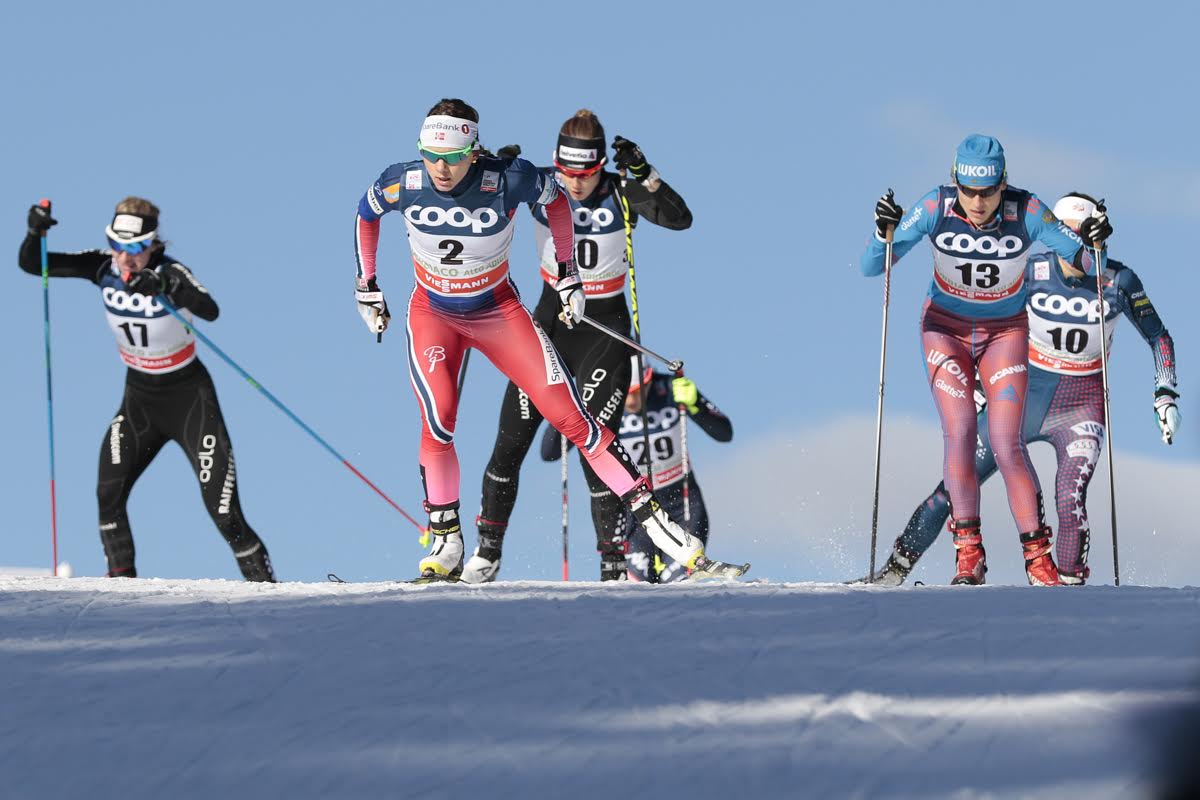
Norway’s Maiken Caspersen Falla (2) leads her quarterfinal with (from left to right) Switzerland’s Nadine Faehndrich, Laurien van der Graaf, Italy’s Greta Laurent, Russia’s Natalia Matveeva, and American Sophie Caldwell (10) on Saturday in the women’s World Cup freestyle sprint in Toblach, Italy. (Photo: Fischer/NordicFocus)
With one last uphill to go, Falla, 25, took the lead from her teammate while Nilsson moved from third to second.
As the trio descended the final downhill into the stadium, Falla maintained herposition in front, while the battle for second ensued between Østberg and Nilsson.
Rounding the final turn into the 50-meter straightaway, Nilsson attempted to go wide on the the outside corner to get around Østberg and Falla. The Swede’s tactical maneuver, however, didn’t match Østberg’s raw speed.
The Norwegians went 1-2, with Falla winning the final in 2:47.28 minutes, just 0.17 seconds ahead of Østberg in second. Nilsson crossed the line in third, 0.61 seconds after Falla.
“It’s great to be on top again,” Falla told FIS after her second sprint victory of the season. She also won the classic sprint opener late last month in Kuusamo, Finland. “It was a … battle last week and again this week. I think it will be a great battle all season.”
Østberg said she had to be happy with second.
“I had really bad last 100 meters in Davos. I was focused on having a good finish here,” she told FIS. “If it was 20 meters longer I think I could have fought with Maiken for victory. I have been fourth [in the Kuusamo classic sprint], third [in Davos] and second. I am going to be dangerous next time.”
The top-three women in Saturday’s World Cup freestyle sprint in Toblach, Italy, with Norway’s Maiken Caspersen Falla (c) in first place, Ingvild Flugstad Østberg (r) in second, and Sweden’s Stina Nilsson (l) in third. (Photo: Fischer/NordicFocus)
Rounding out the top six in the final was Soemskar in fourth (+1.31), Germany’s Hanna Kolb in fifth (+1.59) and Denise Herrmann, also of Germany, in sixth (+2.31).
During a post-race interview with German broadcaster ZDF, Kolb commented on reaching the final. The 24-year-old German had done so twice before in the skate sprints at the 2013 and 2014 editions of the Tour de Ski, where she placed fourth and fifth, respectively.
“I am a little relieved that I was able to do it [reach the final] because it was a crazy amount of training throughout the summer,” Kolb said. “And in sprints, often small details are decisive. That it finally worked today makes up for all the effort.”
For Herrmann, it was her first appearance in a sprint final this season for her best result so far this winter.
“I am just happy that it worked out again to reach the final, because the start of the season was not good for me,” she told ZDF. “Step by step, I will try to tie it up to [past] results.”
Two U.S. Women in Top 10
Sophie Caldwell (U.S. Ski Team) racing to 10th in the qualifier at the women’s World Cup freestyle sprint in Toblach, Italy. She went on to place seventh overall after making it to the semifinals. (Photo: Fischer/NordicFocus)
Although there wasn’t an American pair in the final, two U.S. women ended up in the top 10.
Sophie Caldwell, 25, of the U.S. Ski Team took seventh overall, after qualifying in 10th, 3.23 seconds behind Østberg, the fastest qualifier in 2:49.45.
Caldwell went on to place second in her quarterfinal, 0.13 seconds behind Falla, before missing advancing beyond the semifinals by eight-hundredths of a second. She finished fourth in her semifinal behind Falla, Nilsson and Kolb, respectively, with Kolb finishing third and advancing as a lucky loser, 0.45 seconds behind Falla.
Their semifinal, with Falla setting the pace and finishing in 2:46.31, turned out to be the fastest women’s heat of the day. This was perhaps expected with players like Falla and Nilsson in the same semifinal.
“My semi final was really close and I knew there were a lot of fast skiers in it, so I had to make every second count in order to fight for a top two place or a lucky loser place,” Caldwell wrote in an email.
She tucked into fifth on the inside of the second large climb, alongside Kolb, Norway’s Heidi Weng, and Laurien van der Graaff of Switzerland. Nilsson attempted to split from the group on the second-to-last downhill, only to be reeled back in by Falla in second Caldwell, who had moved up to third. Meanwhile, Kolb closed in behind them.
The turn into the finishing stretch became a tossup, as Nilsson cut into the center lane, Caldwell went to the inside left and Kolb accelerated to the right of Caldwell.
“I moved into a great position coming into the last downhill, but things got a little jammed up coming into the last corner and I moved back to fourth,” Caldwell explained.
Caldwell and Kolb lunged at the line, but the German snatched third, and ultimately the lucky loser ticket to the final. Last week in Davos, Caldwell advanced as a two-time lucky loser to the sprint final, where she placed sixth.
“I was psyched with every aspect of today,” Caldwell wrote on Saturday. “Mentally I feel like I’m skiing with more confidence and my goal is to ski like I belong in front of each heat and not to just hope that I move on.”
Not far behind, Sadie Bjornsen recored her first top 10 of the season in ninth (after five consecutive top-20’s in as many individual World Cup races this season). She qualified sixth (+1.48), placed second in her quarterfinal, 0.28 seconds behind Østberg, and went on to finish fifth in the second semifinal — 0.46 seconds behind Østberg, who won that heat as well.
Like her teammate Caldwell, Bjornsen was also mere fractions away from making the final.
“Skate sprinting has always been a gamble for me in the past. 50% of the time I make the heats, 50% of the time I don’t qualify,” Bjornsen wrote in an email after the race.
On Saturday, the odds seemed to be in her favor.
“It started with my best qualifier ever, and advanced into some fun heats and skiing. I felt really good out there, and just missed the finals by a touchable hair,” she wrote. “But each week I am feeling more confident and excited about sprint racing.”
Sadie Bjornsen (U.S. Ski Team) racing to her best-ever sprint qualifier in sixth at the World Cup freestyle sprint in Toblach, Italy. She went on to make the semifinals and place 10th overall. (Photo: Fischer/NordicFocus)
In her quarterfinal, Bjornsen, 26, chased down two Norwegians, Østberg and Kathrine Rolsted Harsem. The three battled it out into the finishing straight, where Bjornsen chose the outside line in an effort to move into the top two.
Østberg outskated the two for the quarterfinal win in 2:47.34, while Bjornsen outlunged Harsem by two-hundredths of a second to move on.
In her semifinal, Bjornsen faced off against Østberg, Soemskar, Herrmann, Russia’s Natalia Matveeva, and Finland’s Krista Parmakoski. Østberg flew out of the start to take the lead, while Bjornsen hung in fourth as they approached the first climb.
Descending back into the stadium during the final downhill, Bjornsen leapt into third, behind Østberg in first and Herrmann in second. With 50 meters to go, Soemskar snuck into the mix, along with Matveeva.
In a lunge for the line, Soemskar placed second, 0.22 seconds behind Østberg, and Herrmanb took third another 0.02 seconds back. That close finish gave Herrmann the final lucky loser spot in the final, while Matveeva placed fourth (+0.44) and Bjornsen was fifth (+0.46) behind them.
“It might’ve been Sadie Bjornsen’s best skate-sprint race of all time on the World Cup,” U.S. Ski Team Head Coach Chris Grover said on the phone after the race.
In addition to Caldwell and Bjornsen, U.S. teammates Jessie Diggins and Ida Sargent also qualified for the heats and went on place 22nd and 28th overall, respectively, after finishing fifth and sixth in the same quarterfinal — the first one of the day.
“Great to have six athletes qualify for the heats again, but not really a big surprise,” Grover said in a USSA press release, referring to the four women and two men (Simi Hamilton and Andy Newell) who qualified on Saturday. “The women skied great. Sophie must have been mere hundredths from going through to the finals again as a lucky loser. She executed her race plan perfectly all day.”
In an email, Sargent called her qualifier “decent … although I felt a little flat and had trouble getting going,” the 27 year old wrote after qualifying in 24th (+5.71). Diggins qualified in ninth (+2.98).
“Seeing Simi ski so well and end up on the podium was incredible,” Sargent added, referring to Hamilton’s second-place finish for the U.S. men. “Even if it was a tough day for me personally it was an awesome day for the team, so I’m leaving the day feeling excited and inspired.”
“We’re really gaining momentum and it’s a big lift for the whole team!” Diggins wrote in an email.
“A big thing for me on a really short and tactical course such as Toblach is to learn to hold my ground and not get pushed around out there,” the 24 year old added. “Rounding the finishing corner, someone actually reached out a hand and shoved me, and in years past, I probably would have fallen down. But I didn’t let it get to me or impact my race, which I’m really pumped about!”
The fifth U.S. woman, Rosie Brennan, 27, narrowly missed qualifying in 35th. She was 1.91 seconds out of the top 30.
“We had great skis today and I felt better than last weekend so now it’s just moving on to tomorrow, which I am very much looking forward to,” Brennan wrote.
On Sunday, the women will race a 10 k classic individual start — the final race before the holiday World Cup break.
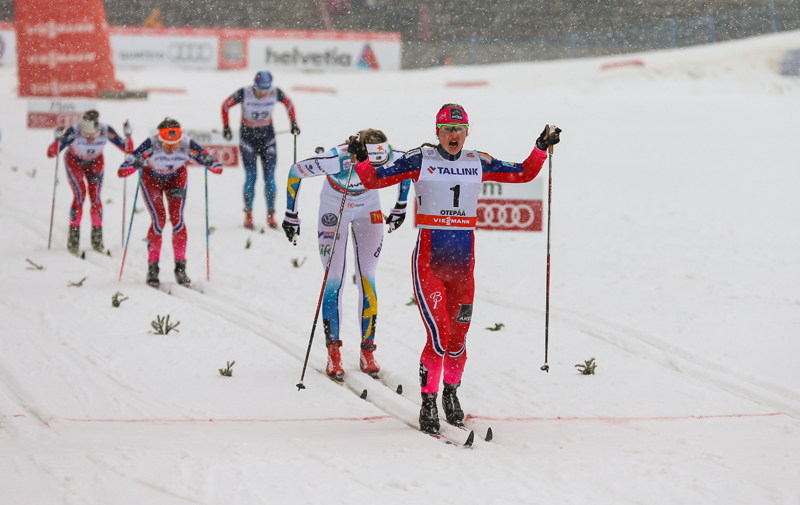
A very happy Otepää podium, with Norway’s Ingvild Flugstad Østberg (c) in first, Swden’s Stina Nilsson (l) in second, and Norway’s Celine Brun-Lie in third. (Photo: Fischer/NordicFocus)
With many of the top women using this weekend to recover from last week’s Tour de Ski competition, Saturday’s World Cup stage in Otepää, Estonia, was not short on fast, up-and-coming talent.
The 1.2-kilometer classic course featured a flat start then into a tough 30-meter climb to the top of the only hill on the women’s course, then right back downhill to a tricky 180-degree turn. After the turn, the course still continued downhill to the finish line. Placing on the downhills was extremely important because as the races went on, the snow really started to get soft and tracks started to wash away. This made choosing the right wax extremely important. Too much wax and there would be no glide on the downhill, not enough wax and it was hard to get up the hill.
The first of five quarterfinal heats featured Norway’s Ingvild Flugstad Østberg, the fastest qualifier in 2:52.93, Sweden’s Ida Ingemarsdotter, Kathrine Rolsted Harsem of Norway, Natalia Matveeva of Russia, Germany’s Denise Hermann, and Russia’s Elena Soboleva.
Østberg showed that she didn’t lose any energy in the qualification round, taking the lead from the start and easily skiing away from the group to win her heat, crossing the line in 2:55.72. Ingemarsdotter was second (+1.62).
The second quarterfinal heat featured Norway’s Celine Brun-Lie, Hanna Falk of Sweden, Slovenia’s Katja Visnar and Alenka Cebasek, Switzerland’s Laurien Van Der Graaff, and Germany’s Victoria Carl .
Just like her teammate Østberg did in her heat, Brun-Lie took a very aggressive start into the hill and separated herself from the chase group. Falk was able to stay with her the entire time, but when qualification was certain, slowly eased up towards the finish to save energy. Brun-Lie won the heat in 2:58.32, and Falk took second (+0.86).
The third heat featured German teammates Hanna Kolb and Sandra Ringwald, Jennie Öberg of Sweden, Anamarija Lampic of Slovenia, Mona-Lisa Malvalehto of Finland and Yulia Romanova of Russia.
At the start, Malvalehto lead the group up the climb followed closely by Öberg. Leading into the downhill, Malvalehto was easily passed by Öberg and Lampic who were just waiting for an opportunity. The pair proceeded to separate themselves from the group and battle it out together for the win. It was a photo finish at the line between Öberg and Lampic. Öberg got the win crossing first in 3:00.77, and Lampic was 0.02 seconds behind in second.
Quarterfinal 4 featured the second-fastest qualifier and overall U23 leader Stina Nilsson of Sweden, Maiken Caspersen Falla of Norway, Justyna Kowalczyk of Poland, Evgenia Shapovalova of Russia, Anne Kyllönen of Finland, and Lucia Anger of Germany.
At the gun, Nilsson took command at the start and led the group up the climb followed by Falla. As the pack continued up the hill, Falla took an opportunity to pass Nilsson when a gap opened up. That was all she needed to win the heat in 2:56.05. Nilsson made a late pass and challenged Falla at the finish, but let up when second place was secured, crossing at 0.08 seconds back in second. Kowalczyk placed fourth, 2.22 second behind Falla and after Shapovalova in third, and did not advance to the semifinals.
The fifth-and-final quarterfinal heat featured a pair of Swedish teammates, Magdalena Pajala and Evelina Settlin, American Sadie Bjornsen, Kari Vikhagen Gjeitnes from Norway, Anastasia Dotsenko from Russia and Krista Parmakoski from Finland.
Bjornsen started fast but wasn’t able to get any separation at the start and was quickly caught by the chase group. Heading into the first climb, the group was still together but Bjornsen was slowly dropping back, but still remained close to the leaders. Settlin fell just after the 180 turn and really broke the pack into two fields. Gjeitnes, Pajala and Bjornsen were in the lead group. Gjeitnes was able to double pole away, 0.31 seconds ahead of Pajala in 3:02.6. Pajala edged Bjornsen in a photo finish, after Bjornsen closed quickly in the last five meters.
The lucky losers were Harsem and Shapovalova. As the races went on, the times were getting slower as a result of the soft snow forcing many to change skis and wax. Heading into the first semifinal the question was: how much did the track soften up after the men’s quarterfinal heats?
It was a duel between Sweden and Norway for the first semifinal; three from each country were in the field with Østberg, Brun-Lie and Harsem from Norway, and Ingemarsdotter, Öberg and Falk from Sweden.
At the start, all three Norwegians jumped out front and lead the group up the hill and then never looked back, easily separating themselves from the Swedish chase group. Crossing the line first out of the Norwegian trio was Østberg who showed she is the one to beat. Her time was 3:10.45; Brun-Lie was 1.75 behind in second.
The second semifinal featured Nilsson, Falla, Shapovalova, Pajala, Gjeitnes and Lampic. Nilsson and Falla were determined to get to the final and challenge Østberg. The pair separated themselves at the start and easily skied away from the other skiers. Falla’s skis were really fast, pulling away on the final downhill to the finish. Nilsson challenged for first but when she realized she was easily going to qualify eased up and crossed second behind Falla. Falla crossed in 3:08.74, and Nilsson 1.40 seconds back in second.
Best seat in the house to watch Saturday’s classic race (Photo: Fischer/NordicFocus)
The second semifinal was a lot faster than the first, resulting in Shapovalova and Pajala earning lucky loser positions.
To add more drama to the softening track, as the men were winding up their semifinal heats, the snow really started to fall. This caused many to change skis.
“Before the final I had to make the decision if I go on zero skis or klister. I chose the second option,” Østberg told FIS afterward.
Nilsson also told FIS after that she changed skis as well before the final, which gave her both good grip and good glide.
The final was set, with three Norwegians (Falla, Brun-Lie and Østberg), two Swedes (Pajala and Nilsson), and Russia’s Shapovalova.
The start was pretty even with Nilsson taking up the pace followed closely by Falla. Heading to the hill, Østberg passed her teammate Falla and closed the gap to Nilsson. As the climb continued, Østberg made her move and passed Falla at the summit. Falla then passed Nilsson making it a Norwegian in first and second. As the trio descended down to the finish, Nilsson was able to pass Falla, but lost a lot of energy in the process, letting Østberg pull away to win in 3:20.18. Nilsson finished in second (+0.60) and Brun-Lie took third (+2.29).
Afterwards Østberg told FIS that the skis were the key to her win, which was her first-ever in a World Cup classic sprint, her second victory of the season and her fourth podium of the season.
“The whole day I had perfect skis,” she said. “I felt good that nobody could keep up with me in the last 100 meters.”
This now raises an interesting question: can Østberg beat her teammate Marit Bjørgen?
“I’ve done it before and I can do it again. One must at least have faith that one can beat her,”said Østberg told NRK.
The World Championship were definitely on all of the Norwegians’ minds after the race. Brun-Lie told FIS, “I have never been on the podium in the classic sprint. Today’s result is very important for the qualification for the World Championships.”
As a result of her win, Østberg passes teammate Bjørgen in the Sprint World Cup standings to take first place. She has 385 points, and Bjørgen is 35 points behind with four sprints left. Bjørgen still leads the Overall World Cup by more than 400 points over teammate Therese Johaug. Neither Bjørgen, Johaug nor Heidi Weng raced on Saturday.
Sunday’s race is a freestyle team sprint competition.
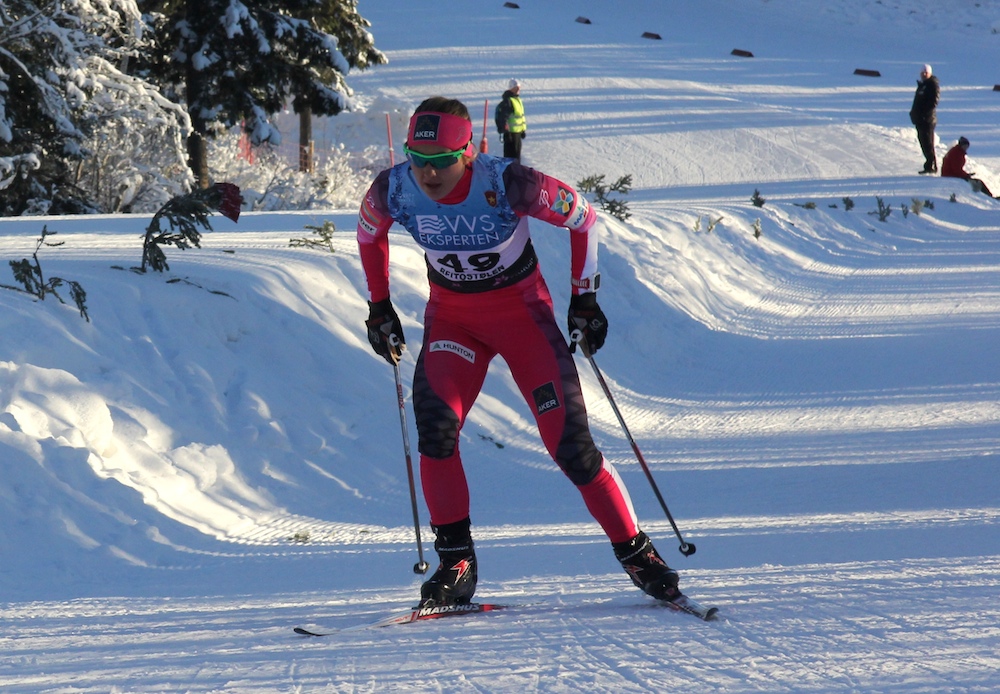
Ingvild Flugstad Østberg racing in Beitostølen, Norway. The Norwegian convincingly won the 1.3 k freestyle World Cup sprint in Davos, Switzerland, Sunday. (Photo: Inge Scheve)
Which Norwegian and by how much?
That seems to be the ongoing question in the early races of the 2014/2015 World Cup season, with Norwegian dominance for both the men and women since the first competition in Ruka, Finland.
Sunday in Davos, Switzerland, it was Ingvild Flugstad Østberg who came out on top in the 1.3 k freestyle sprint – and it wasn’t even close.
Heading into the race, Østberg had the number one bib as the fastest qualifier. She skied to a time of 2:34.46, barely beating out teammate Marit Bjørgen (+0.47). Bjørgen won the mini tour sprint in Lillehammer earlier in December, which was the only other freestyle sprint race of the season.
Once in the quarterfinals, Østberg again demonstrated her strength. Her time of 2:34:48 was the fastest of the round. The second fastest time in the quarterfinals was held by teammate Heidi Weng, who was in Østberg’s heat and finished second behind her. The second fastest quarterfinal winning time was 2:37.46 by Bjørgen.
The first semifinal heat featured Østberg, teammate Celine Brun-Lie, Swedes Stina Nilsson and Charlotte Kalla, and Rikka Sarasoja-Lilja of Finland.
Østberg set yet another fastest time going 2:33.78 in her heat. Nilsson was second finishing 1.50 seconds back. Brun-Lie was able to regroup from a broken pole at the start of the race and finished in third place. Just behind her In fourth position was Weng, who along with Brun-Lie, qualified for the final as a lucky loser.
The second women’s semi final featured Bjørgen, Maiken Caspersen Falla of Norway, Germans Denise Hermann and Hanna Kolb, Ida Ingemarsdotter of Sweden, and Katja Visnar of Slovenia.
Falla took the lead from the start and carried the group up the first climb. The pack stayed together for the majority of the race, with Bjørgen holding back until the final climb, where she passed Falla to take the lead coming to the finish. Bjørgen’s winning time was 2:36.43, with Falla finishing 0.19 behind her.
With the semifinals complete, the roster of the final was set and it featured five Norwegians. The only non-Norwegian was Nilsson.
Leading the charge out of the gate was Østberg. Nilsson was close behind until she broke a pole in the first 30 seconds of the race. She was handed two poles before she continuing, but the rest of the pack was long gone by the time Nilsson had regrouped.
With Nilsson out of the picture, Østberg picked up the pace and led the pack through the rest 1.3 k course. Falla followed Østberg closely as she pulled away, but never truly challenged Østberg.
When the race was finished, Østberg had once again set the fastest time of the day, clocking in at 2:33.72. Falla finished 0.57 behind her for second.
“I’m very happy for the victory. I have been working for this so long and it is a great feeling. I felt strong from the prologue and my plan was to ski in front and push hard from the beginning” said Østberg in a post-race interview with FIS. “I was so close to a World Cup victory sometimes. To cross this line first alone was delightful.”
Today’s win was Østberg’s first-ever World Cup victory. Her only other win was a sprint stage in last year’s Tour de Ski, which is considered a Stage World Cup.
Second place finisher Falla said after the race that she was proud of Østberg and that her result was a result of dedicated work.
“I knew Ingvild would push hard from the beginning and I tried to follow her but she was little bit better than me. I am proud of her. My goal this winter is to fight for the sprint World Cup and the beginning of the season has been great with three final appearances in three sprints,” she said to FIS.
Rounding out the Norwegian podium was Brun-Lie, who said tried a new strategy in today’s race.
“I had a very good race today. I tried to stay mentally focused and concentrated. Usually my tactics is to ski in the front the whole time but today I decided to stay back and move forward in the second lap. It worked every time in the heat,” she said in an interview with FIS.
In fourth position was Bjørgen who explained that the Norwegian sweep was an indication Norway’s teamwork was paying off.
“We are a very strong team. I think that we are training together and pushing each other, and that is how we are getting on a higher level,” Norwegian Marit Bjørgen said of her team to FIS.
Bjørgen also said that she was not surprised by Østberg’s win.
“I saw it coming,” she said to FasterSkier. “I was saying, she has to wait a little bit, it will come soon. And it really did. Today she was so strong.”
Bjørgen, who is rarely ever off the podium, said that the younger girls on her team are becoming more competitive and it’s becoming harder to maintain her usual dominance.
“I was getting more tired and more tired as the day went on. With the younger girls today it was really hard” Bjørgen said after her race.
The other finishers were Weng in fifth and Nilsson in sixth. With her finish, Nilsson took over the U23 leaders bib. Bjørgen will retain the leader bib as World Cup racing returns to Davos next week as a result of the previously scheduled races in La Clusaz, France being cancelled due to poor conditions.
Kikkan Randall (USA) skiing to victory in Nove Mesto, Czech Republich. Photo: Fischer/NordicFocus
American Kikkan Randall showed no signs of rust, coming off a three week break from racing to win the World Cup freestyle sprint in Nove Mesto, Czech Republic.
“It was just the day I was hoping for after a three week break,” Randall said in a phone interview after the race. “You’re never quite sure which way you are going to come out, so it just solidifies that the plan to take some time off and do some training was a good one.”
The defending Sprint Cup champion qualified in tenth and then proceeded to ski from the front the rest of the day, winning each of her heats en route to victory.
Laurien Van der Graaff of Switzerland placed second, just ahead of Norwegian Ingvild Flugstad Oestberg.
Van der Graaff earned just her second World Cup podium, and first since December of 2011, while Oestberg continued a strong run, cracking the top-3 for the third consecutive sprint.
Katja Visnar of Slovenia set the time to beat in qualification, just ahead of Swede Ida Ingermarsdotter and Van der Graff. But once the heats started it was all about Randall.
The course, a narrow ribbon of snow surrounded by green and brown, was relatively short, clocking in at roughly 2:45 per lap, and featuring several gradual climbs.
“It seemed like a tough course to find places to pass,” Randall said. “So I felt like the safest strategy was to go out front and control the pace.”
With a relatively short finish stretch coming off a descent, she was looking to build a lead early and leave nothing to chance.
“We knew it was going to be hard to pass and that if you were skiing in the front and skiing relaxed it was going to be tough for people to get around you and a little bit easier to defend your position, especially coming into the finish,” U.S. Ski Team Head Coach Chris Grover explained.
Randall executed the strategy to perfection, saving the best for last in the final, moving to the front right off the line.
A surprising Gaia Verich of Italy, along with Van der Graaff and Oestberg slotted in behind Randall, Ingermarsdotter and Denise Herrmann of Germany a bit behind.
Ingemarsdotter, who like Randall, looked strong in the earlier heats, attacked hard on the first climb, skiing wide to move up the field. She was able to pull alongside Vuerich in second, but as the race wound back down, the American and Italian opened a small gap.
The field compressed heading into the second climb, and when the pitch steepened, Randall shifted into a higher gear, using a powerful jump skate to accelerate.
At first the other women followed, Ingermarsdotter and Oestberg continuing to V2 while Veuerich and Van der Graaff matched Randall’s V1.
Halfway up Randall shifted back to V2 herself, before hitting the turbo V1 again on the final pitch.
This time the field could not respond, and Randall held a five meter lead over the top, an insurmountable gap that she continued to widen.
“I felt stronger and stronger as I went through the rounds,” Randall said. “The qualification was okay, but I knew that things could be a little bit better.”
Ingemarsdotter, spent from her efforts to fight for the win, quickly faded back, drifting down to Herrmann who was never in the running.
The remaining three battled for second. Vuerich, in her first World Cup sprint final, was unable to match Van der Graff and Oestberg, and ended up barely holding off a late breaking Herrmann for fourth.
Vuerich actually held the second spot swinging down in to the homestretch, but Van der Graaff swung wide and sling shotted by, followed closely by Oestberg.
The Swiss skier took advantage of her first step lead into the homestretch, and held of the Norwegian.
Herrmann finished fifth and held on to the top spot in the Sprint Cup.
Randall had opted to skip the Tour de Ski, missing two skate sprints, a challenge, even with her focus on the Olympics next month.
“Watching the races on TV was even harder than I thought it would be,” Randall said. “Luckily I had teammates in the races to cheer for and they skied great, but it was really hard not to be there racing myself, especially with the skate sprint in Lenzerheide on my birthday, but that just put more fire in the belly …”
Kikkan Randall (USA) victorious in Nove Mesto, Czech Republich. Photo: Fischer/NordicFocus
Grover was impressed with his top skier’s performance and her ability to stay focused on the big picture.
“It took a lot of discipline for her to stick with her plan and really invest in that plan of training and preparing over that period,” Grover said. “Obviously it paid off today and you really saw it in her spark and her way of being able to go out there and control a lot of racing.”
Last year she raced right through the Tour, an effort that she said left her “feeling a little flat in the middle of the season.”
This year, she opted for extra rest, and some volume training in Davos, Switzerland.
“We have really learned some good lessons over the years that when I am in a good balanced state where I have some good training behind me, but also some good racing under my belt, and I am rested and I’m healthy, then I am skiing at my best,” Randall explained.
And that will be her goal leading up to the Olympics — balance training and racing, stay healthy, and enjoy the process. With two more skate sprints before the Games, she will have two more opportunities to hone her skills in her marquee event.
“Some of the stuff you can simulate in workouts and some of the stuff you don’t really get to try out until you race,” she explained.
Ingvild Flugstad Oestberg leading her teammate Britt Ingunn Nydal on the last lap of the women's pursuit in Otepaa, Estonia.
Norway’s Ingvild Flugstad Oestberg only got one shot at a U-23 World Championship title this year, since she decided to race at Norwegian nationals earlier this week.
She made the most of it, skiing to a victory in her only start in Otepaa, Estonia on Monday, in the women’s 15 k pursuit.
Her teammate Britt Ingunn Nydal made a late charge to take second, just ahead of Finland’s Kerttu Niskanen, who had pushed the pace in the classic leg, her strength.
After some tough races in Norway, Oestberg said that her self-confidence wasn’t great coming into Estonia.
“That’s why it was great to win today,” she said.
Sadie Bjornsen led North American finishers in 17th—a decent day after a frustrating sprint on Saturday.
“It was a solid pursuit,” she said. She was caught at the back after hitting some traffic at the start, but worked her way up in the second half of the race.
“Classic skiing is definitely the better technique for me, so I was just trying to conserve,” she said. “I knew it was going to hurt on
Sadie Bjornsen in the women's 15 k pursuit.
the skate.”
With bib number one, Oestberg wasn’t dealing with traffic. But she still had other problems to contend with—namely Niskanen, who went out like a bullet. The Finn struggles with skating—she was ninth in the 10 k freestyle earlier this week, then won the classic sprint on Saturday—and she knew that her only chance for a result on Monday was to take as much as she could out of Oestberg’s legs before the exchange.
By the end of the classic portion, at the 7.5-kilometer mark, the field was already shattered under Niskanen’s fierce pace. Oestberg was the only one who could hang; she bent, clearly laboring , but she didn’t break.
With a consistent breeze blowing throughout the morning, Oestberg told FasterSkier that she drafted the Finn as much as possible. The two came into the exchange together, and after the switch to skate gear, Oestberg took over. She said it was harder to shake Niskanen than she anticipated.
“Skating was quite good for me, today,” Niskanen said.
Still, though, Niskanen’s efforts in the classic leg had taken their toll, and she looked totally gassed when she finally fell off the pace, At that point, Oestberg found herself alone at the front, with Nydal, to her surprise, still in striking distance of silver.
“Usually I get very tight when I change to skating,” she said.
She first brought back Niskanen, then managed to fight her way into contact with Oestberg.
The two Norwegians were together heading out onto their second of two 3.75-kilometer skate laps, but Oestberg had broken things open by the time the women came back into the stadium.
Niskanen almost brought back Nydal, but didn’t have quite enough in the sprint on the homestretch.
Behind the strength of the racing by Oestberg and Nydal—and throughout the last week—the Norwegians earned themselves the trophy that goes to the nation with the best results at the U-23 and World Junior Championships.
Their women’s team is so deep that Oestberg will not be heading to the World Senior Championships later this winter. After Monday’s race, she’ll head home.
A number of teams are continuing on from Estonia, though, to more racing in the Baltics. There’s a series scheduled for Latvia this weekend, a Scandinavian Cup, and many members from the American squad in Otepaa will be competing there.
Hanna Brodin (SWE) leads Ingvild Flugstad Oestberg (NOR) in the women's relay
With pursuit champion Ingvild Flugstad Oestberg and sprint champion Hanna Brodin anchoring their respective teams, today’s women’s relay race was primed for a showdown.
Oestberg, a Norwegian, had proven to be one of the strongest distance skiers here at the World Junior Championships after winning the pursuit, while Brodin, a Swede had dominated the sprint. The 3.3k distance was right in between the two disciplines.
They received the tag ten seconds apart, with Oestberg in the lead. By the time they reached the bottom of the main climb here, Brodin had made up the ground, and the two were together. In the middle of the hill, Brodin came around Oestberg to make her move, and for about a minute, she gave it full gas.
Oestberg told FasterSkier afterwards that she didn’t think she would be able to hold on— but she did. And after hammering up the entire hill, Brodin was exhausted. Over the top, Oestberg put in a surge, and left the Swede behind. Coming into the stadium, she had a lead that looked insurmountable.
But as the Norwegian neared the finish, one more challenger turned up: Finland’s Krista Lahteenmaki. Chasing ferociously, Lahteenmaki had nearly closed a thirty-second gap to Oestberg, and she passed Brodin like she was standing still, relegating the Swedish team to a bronze medal. And by the time Oestberg made the turn onto the finishing straight, Lahteenmaki was only a few meters behind, and closing hard.
For fifteen seconds, the crowd held its collective breath, waiting to see if Lahteenmaki could do it. It came down to the final meters. In the end, Lahteenmaki needed just a few more, as Oestberg held her off by 0.5 seconds.
Ingvild Flugstad Oestberg getting mobbed by her teammates at the finish of the women's relay
“I would have been thinking about that for a long time, if I hadn’t managed to win,” Oestberg said.
As the Scandinavian battle unfolded at the front of the race, the U.S. women were less than a minute back, just behind heavyweights Russia and Germany. At the finish, Jessie Diggins gave a huge effort to nearly top France in the sprint for seventh, collapsing in pain and exhaustion as soon as she crossed the line. The American team of Diggins, Sophie Caldwell, Caitlin Patterson, and Joanne Reid ended up eighth, just fifteen seconds from Kazakhstan in fourth.
The team was one spot back of their finish last year, but Matt Whitcomb, the head junior coach here, said that the result wasn’t indicative of the way the women skied.
“The actual performance was better this year,” he said.
The Canadians struggled today, ending in 14th, three and a half minutes back. Dahria Beatty’s first leg left the team in eighth, but the rest of her teammates—Heidi Widmer, Marlis Kromm, and Rebecca Reid—couldn’t hold on.
Ingvild Flugstad Oestberg of Norway leads the women's 10k pursuit at the World Junior Championships
It took her three tries, but Ingvild Flugstad Oestberg would not be denied.
Undefeated at the World Junior Championships last year, Oestberg had been relegated to silver in this week’s skate sprint and distance classic races. But today, despite having to race in soft-snow conditions that don’t suit her, she easily stamped her authority on the women’s 10k pursuit here, leading a Norwegian sweep with the help of her teammates Heidi Weng and Tuva Toftdahl.
It was redemption for Oestberg—undefeated at World Juniors last year in France—who had been relegated to silver in both the sprint and classic distance races earlier this week.
With many of them coming from far back in the mass start, three of the American women made the top-25, led by Joanne Reid in 18th. Caitlin Patterson followed in 23rd, with Jessie Diggins in 25th and Annie Hart in 38th.
After the race, Oestberg told reporters that she doesn’t like soft skiing, and so when she woke up this morning to heavy snowfall, she wasn’t happy.
But the groomers here had been working since 5:00 a.m., according to Chief of Competition Georg Zipfel. And they had multiple Pisten Bullies working the 2.5k women’s course until just half an hour before the race—only stopping to give the course crew enough time to set up the stadium and the rest of the race loop.
So while there was a significant layer of powder on the trails by the time the women headed out, Oestberg said that it was actually still firm underneath.
For the skate portion of the race, the women also received some help from the coaches and spectators here.
Because the trails in Hinterzarten are so wide, both legs of the pursuit were held on the same course, which was split into two parallel sections. During the first half of the race, the spectators and coaches were standing on and cheering from the skate trail, inadvertently doing some grooming of their own by packing down the powder with their feet.
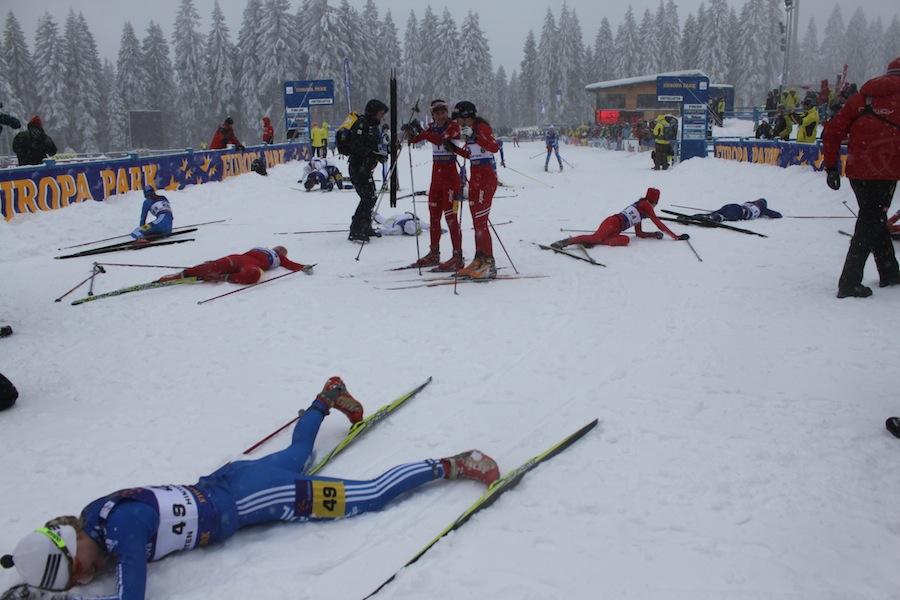
While the effect of the trampling wasn’t huge, it probably helped, and the athletes needed all the help they could get today. At the end of the race, the finishing pen was littered with limp, exhausted bodies, entirely spent.
Women in the finish pen after the end of the 10k pursuit
For Patterson, the weather on top of the mass start made for a taxing combination—“really hard” were the words that she used to describe the race. Stronger over longer distances, Patterson had high hopes going into the 10k pursuit, after finishing 17th in the 5k classic on Wednesday.
But she said that she got pushed towards the tail end of the pack during the mass start, and had to expend a lot of energy working her way back towards the front. Though Patterson still moved up two places in the skate leg, it was clear afterwards that she was not satisfied.
Marlis Kromm (bib 46) with Jessie Diggins (American suit, far right), and Annie Hart (American suit, middle) at the start of the women's 10k pursuit at the World Junior Championshps
But with three women in the top-25, Matt Whitcomb wasn’t complaining. Head coach of the juniors here, he said that his athletes handled a challenging day with aplomb—as they have all week. He related an anecdote from the morning’s trip up to the venue in the team van, which involved getting all eight passengers—athletes and coaches—in the front seat to give the wheels more traction.
“When we almost got stuck on the first corner going up the ten-mile climb,” he said, “we knew it was going to be an adventure, and that’s about what it was out there for all of the races.”
The Canadian women struggled here today, with Marlis Kromm the team’s top finisher in 41st. She was followed by Rebecca Reid, Dahria Beatty, and Heidi Widmer in 60th, 65th, and 71st, respectively.
Also of note was Michiko Kashiwabara’s (JAP) fourth place finish. She almost caught Toftdahl in the finishing sprint with a huge effort, and ended up just one tenth of a second behind for Japan’s second fourth-place finish in two days. For a quick video with one of the Japanese coaches, and one of their men who cracked the top ten, check out this post on the this post on the junior nationals blog.


 This World Cup coverage is made possible through the generous support of Marty and Kathy Hall and A Hall Mark of Excellence Award. To learn more about A Hall Mark of Excellence Award, or to learn how you can support FasterSkier’s coverage, please contact info@fasterskier.com.