From the FasterSkier archive — posts syndicated from athletes’ and coaches’ own blogs between 2004 and 2012, kept online as published. Current coverage is at fasterskier.com.
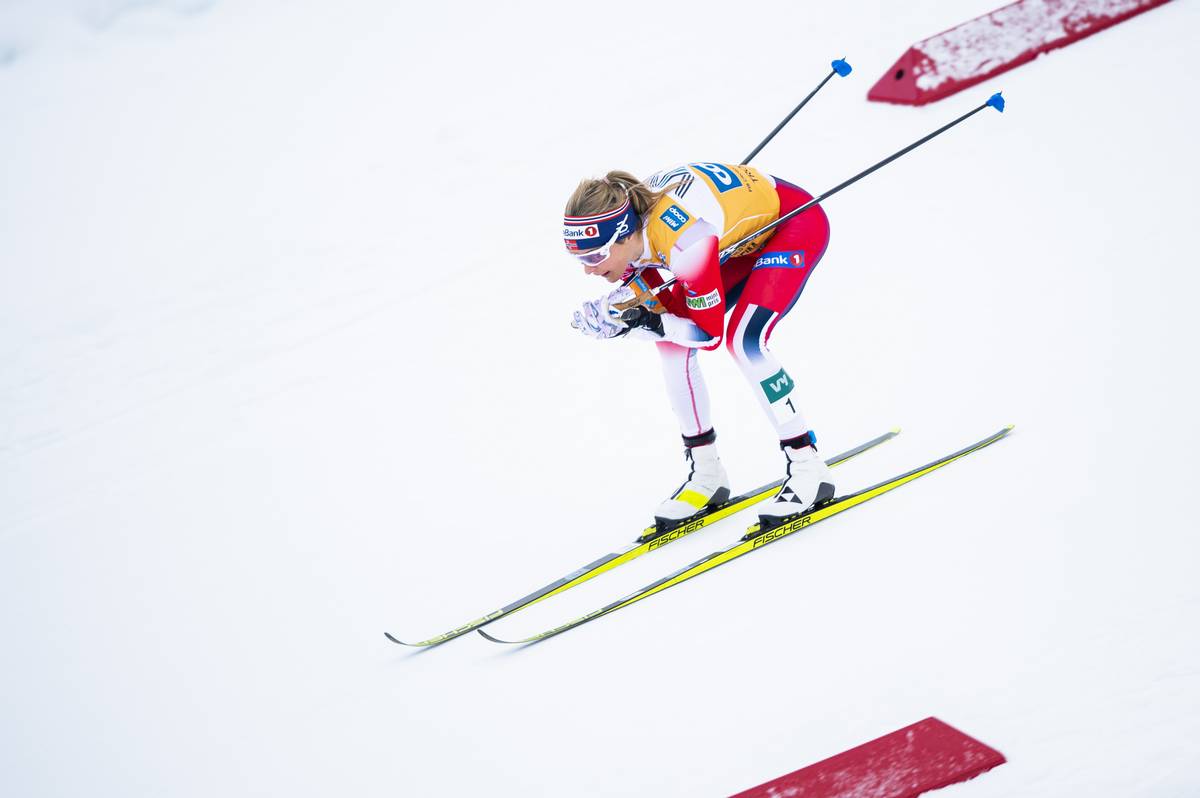
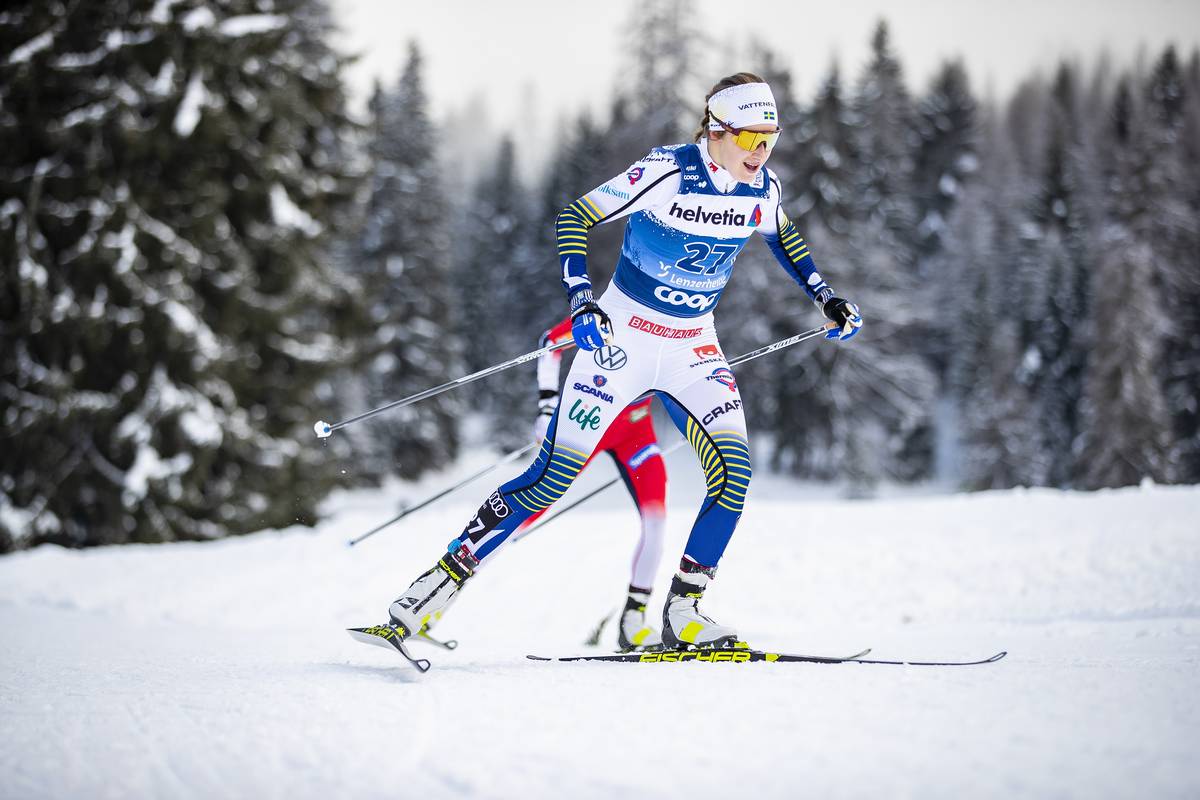
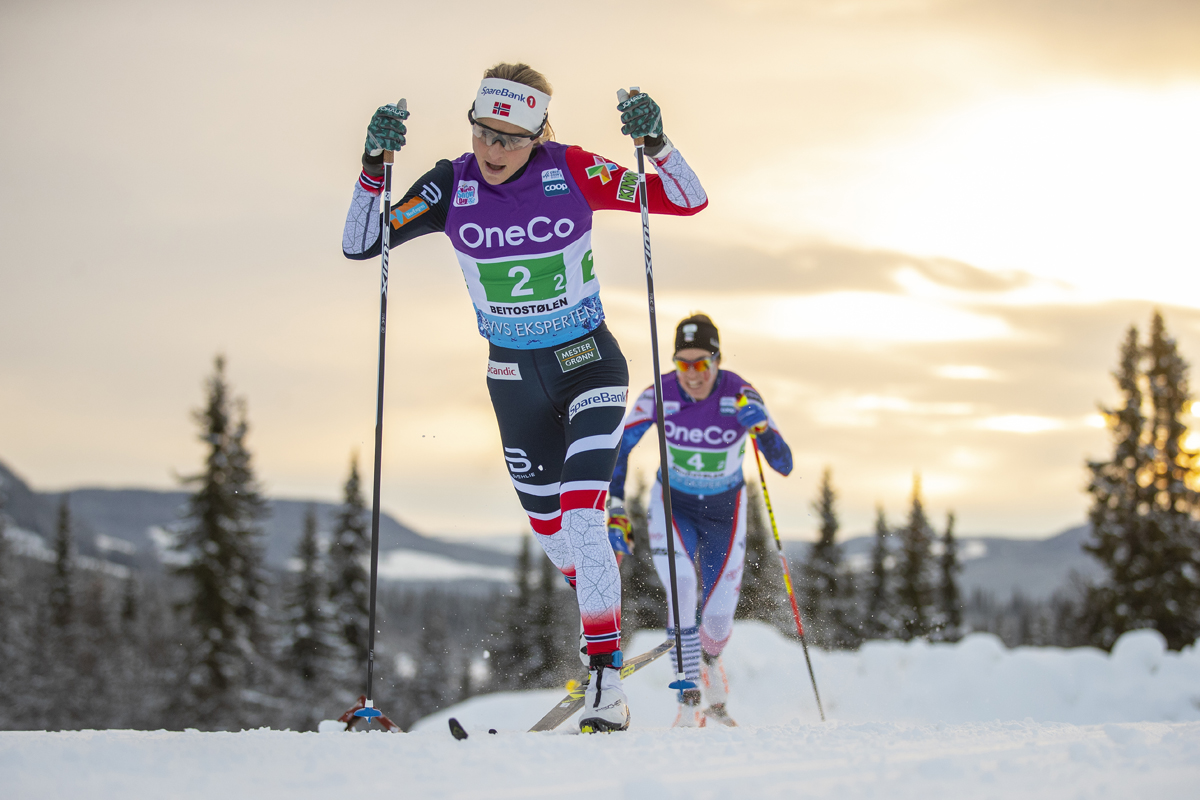
Therese Johaug, untouchable during Stage 6 of the Ski Tour 2020. (Photo: NordicFocus)
We’ll start with the weather: think all over the place. A moving target for meteorologist with moisture spitting from the skies, and air masses swirling this way and that making the trees sway like a mamba line along the course. A wax tech’s nightmare scenario? Yes. It certainly trended in that direction.
By all measures, this was Therese Johaug’s, Norway’s latest version of a cross-country skiing record-breaker, stage and tour. Of six stages total, she won five outright, with the lone exception, Saturday’s Stage 5 classic sprint in Trondheim.
Stage 6 featured a 15 k classic pursuit. Call it a pursuit, however, on the race’s sharp end, this was a runaway. Although the field was, in theory, pursuing Johaug, she simply put more time into her challengers on Sunday. She began 2:33 ahead of Norwegians Heidi Weng in second, while Ingvild Flugstad Østberg set off another second back.
Johaug expanded her lead at the finish, by over a minute, to Weng and Østberg. Johaug won the pursuit in 41:13.8. Weng placed second (+3:40.8) with a slight gap over Østberg, who toed the line 0.7 seconds further back. Sweden’s Ebba Andersson, the day’s fourth starter at 4:48, lost time to0, finishing 5:54.3 back to end the Ski Tour in fourth overall.
“I felt really good today and the waxers had done a really good job the whole Ski Tour and today as well I have the perfect skis,” Johaug told FIS after the race. “When the skis are good and the shape is good I can just go out there and enjoy all the people that come here and cheering us.”
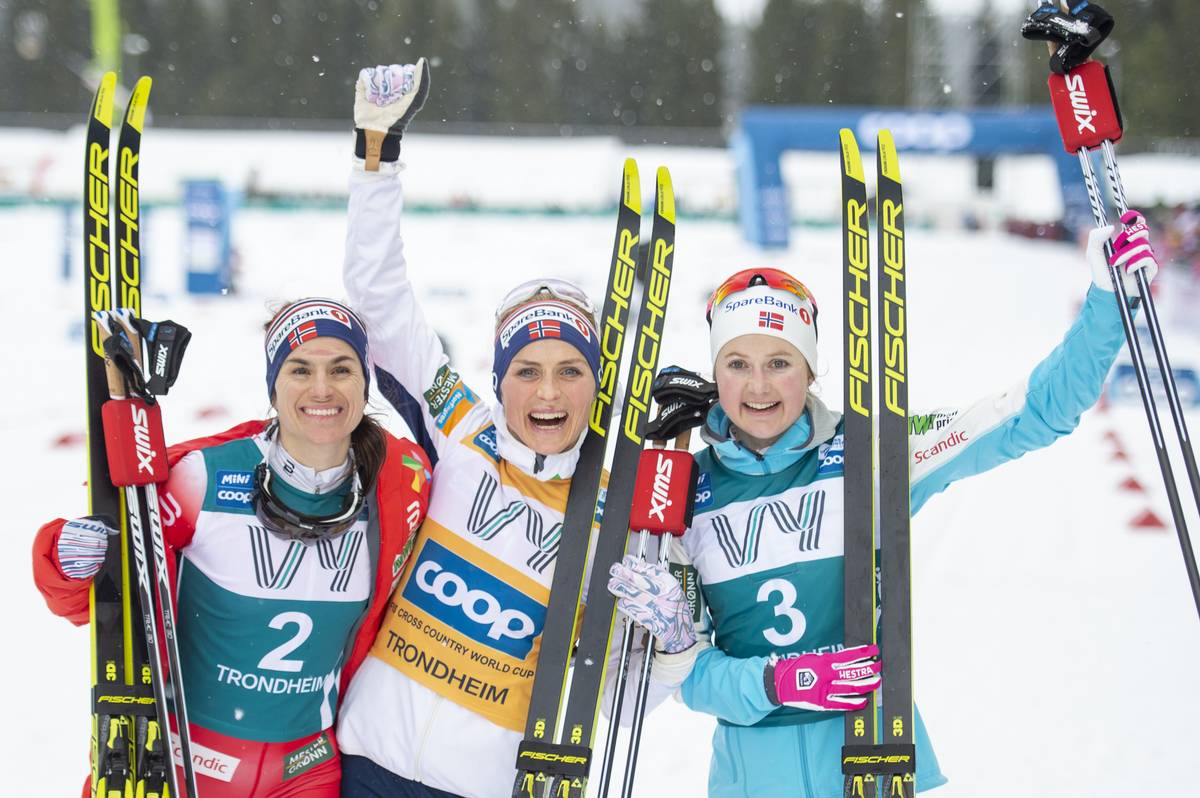
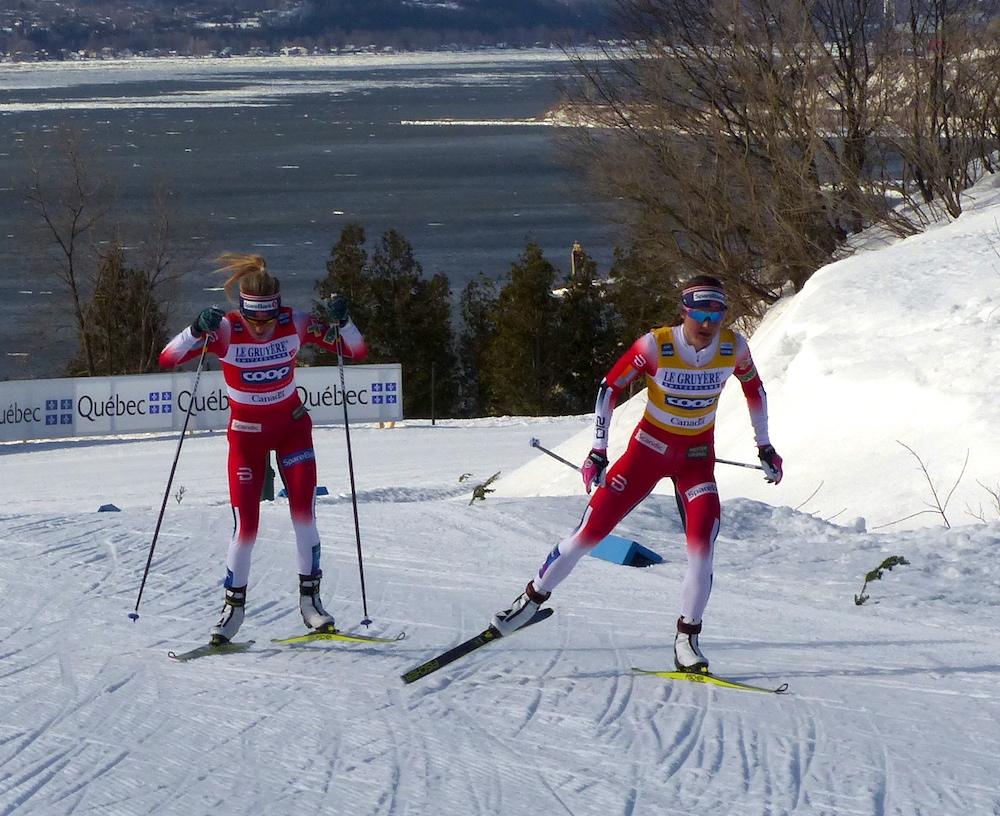
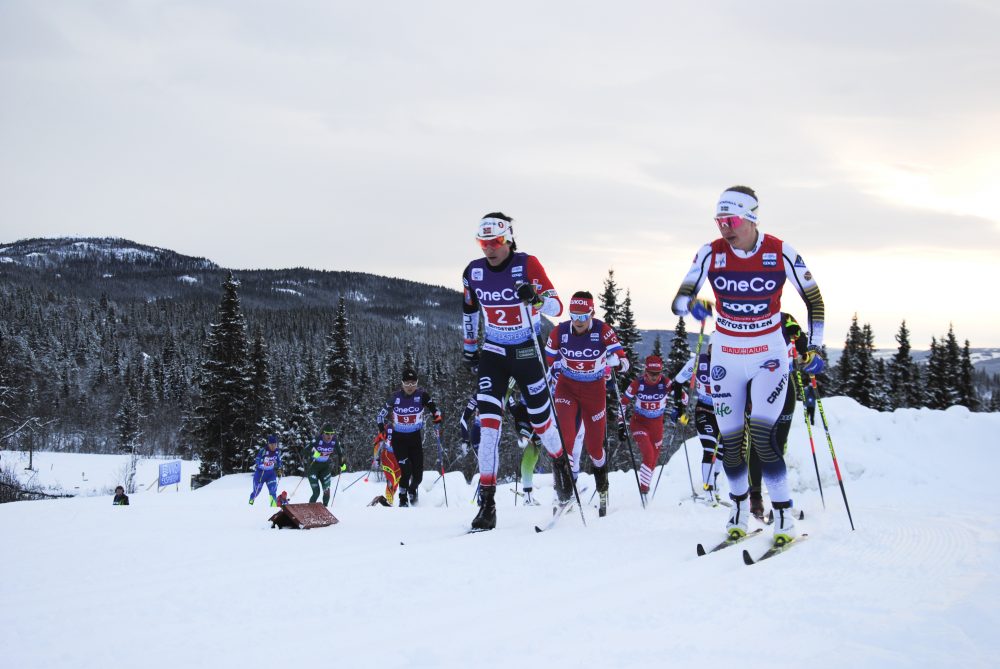
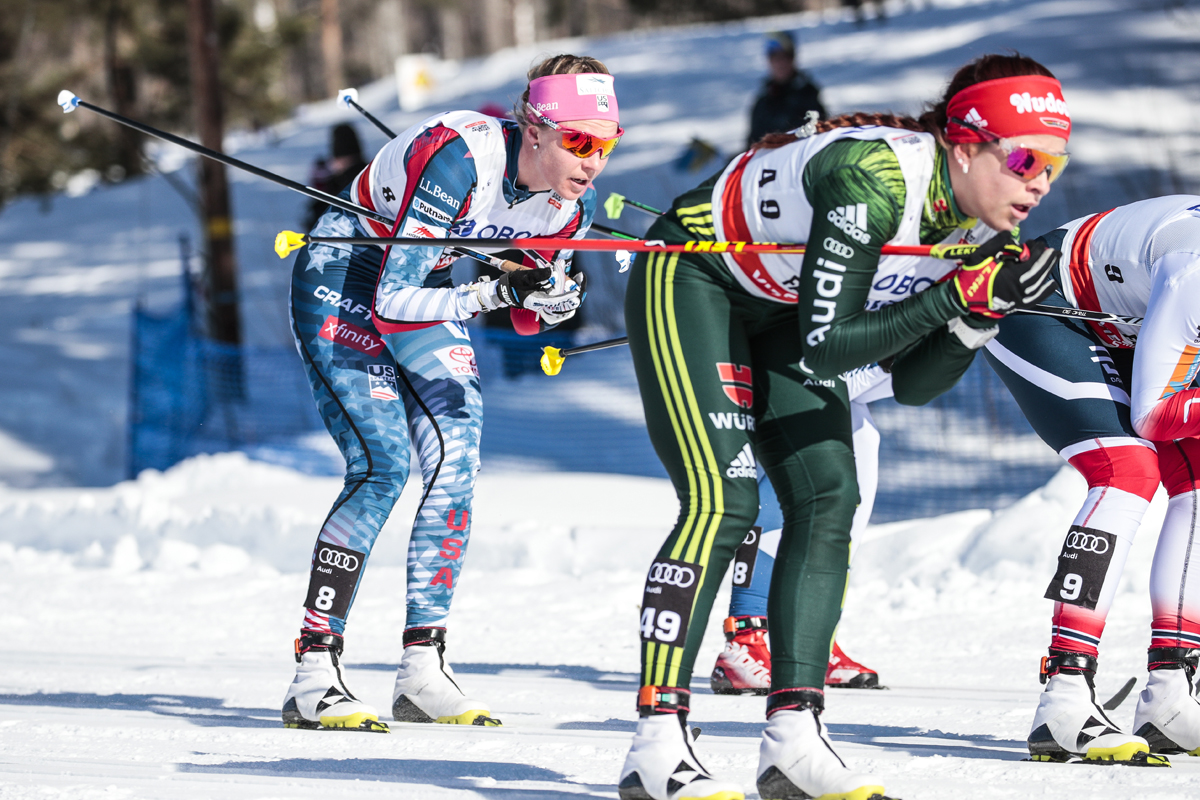
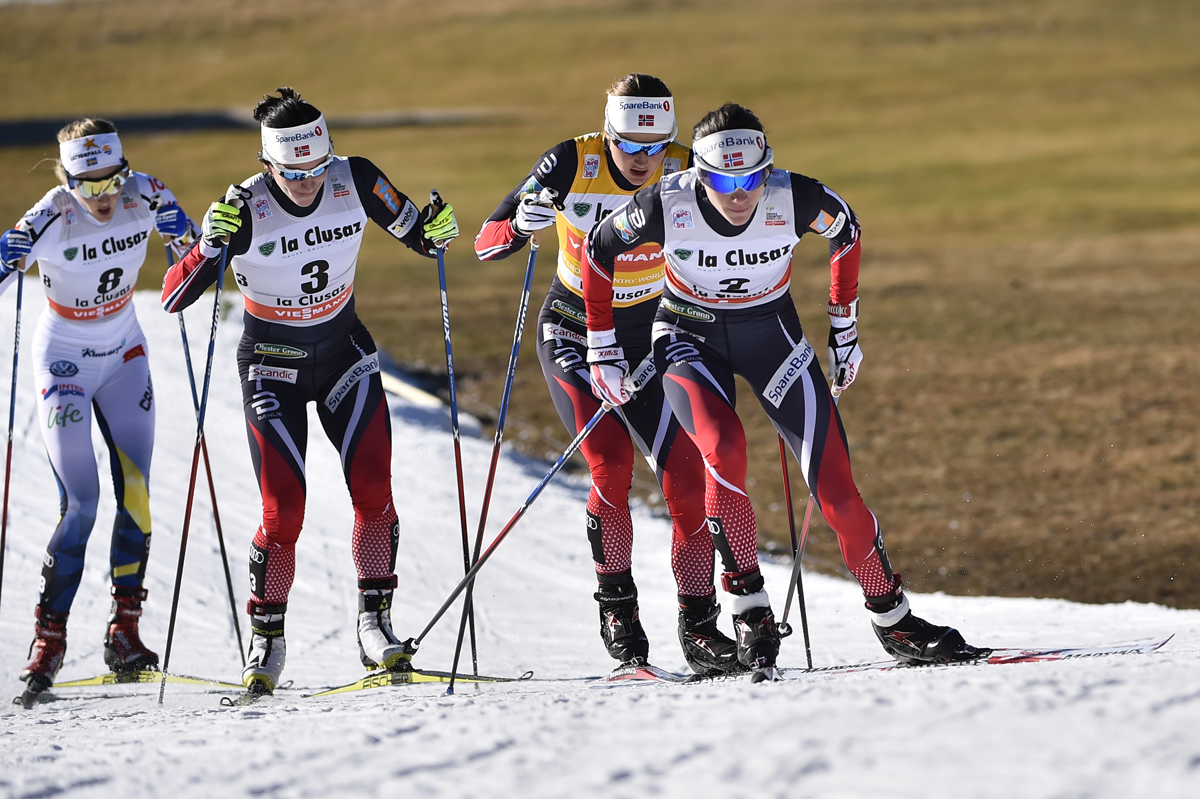
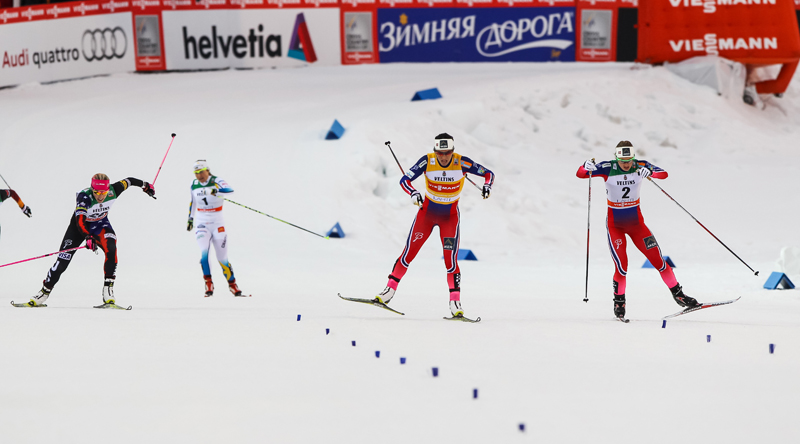
Heidi Weng (bib 2) and Ingvild Flugstad Østberg pacing along during Stage 6. (Photo: NordicFocus)
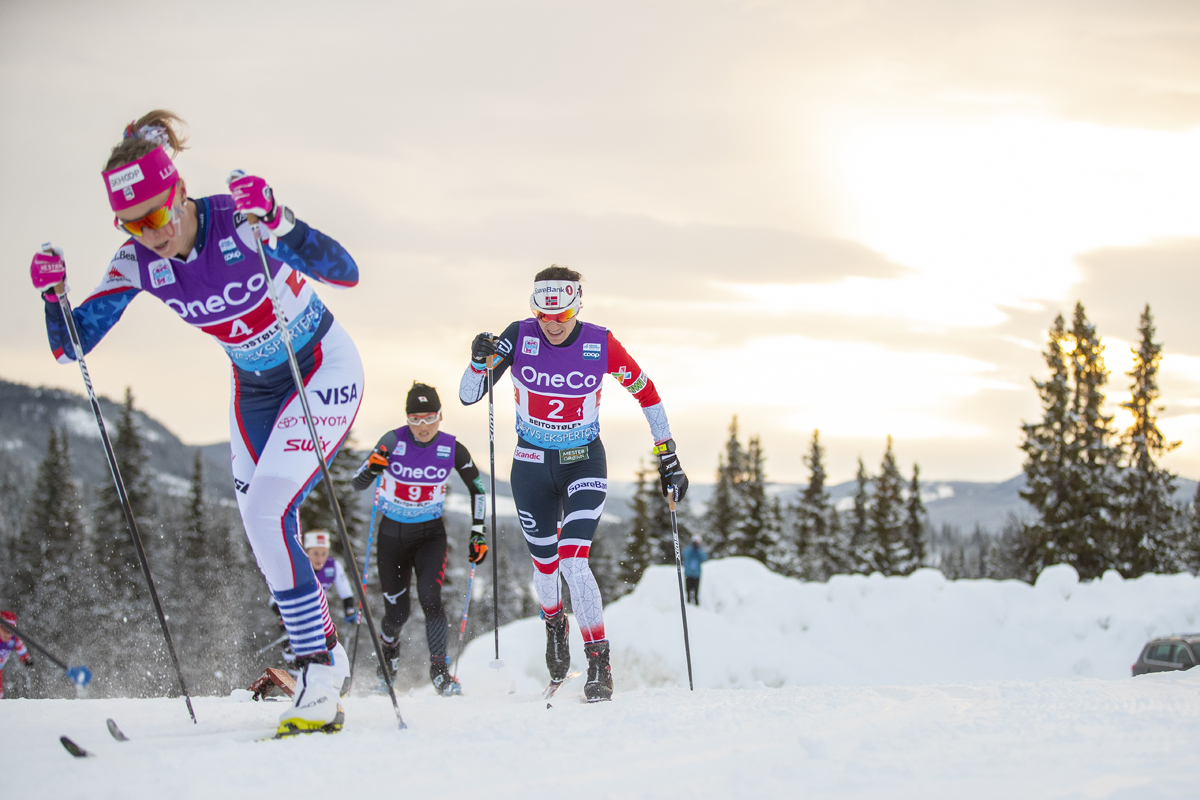
Norway’s Heidi Weng and Ingvild Flugstad Østberg (bib 3) pursing Johaug during Stage 6 of the Ski Tour 2020. (Photo: NordicFocus)
As far as time of day, Johaug took that prize as well. However, Norway’s Astrid Uhrenholdt Jacobsen placed fifth overall and had the second-fastest race time, 44.8 seconds off Johaug’s winning mark. Krista Pärmäkoski of Finland notched the third-fastest time of day (+1:04.4).
Jessie Diggins of the U.S. was the top placed North American in sixth (+8:40.1). (She skied the 17th fastest time of day.)
“Today, like yesterday, was a crazy day in terms of weather and waxing. It kept snowing on and off, the sun coming out and then the wind picking up as more snow came down! I was pretty much skiing an individual start race as I was alone the entire time, but I was really proud of my pacing and efforts as I held my placing without anyone to work with. There was a really tricky time in the middle of the race when the skis weren’t kicking very well (for much of the field, I think) but I was able to refocus and reset and keep pushing as hard as I could.
“As for the overall tour, I’m really happy with my efforts and how I hit my goals for every race. One of my big goals was to see each day as an entirely separate opportunity and to not put pressure on myself for the overall tour, since there are so many factors that I can’t control that play into that placing. But by hitting my own process goals for each race and staying consistent I was able to have a tour that I’m proud of.
“I’m really proud of our tech team and coaches for their tireless efforts day in and day out through this tour. It’s been exhausting but they’re the hardest working guys out there!”
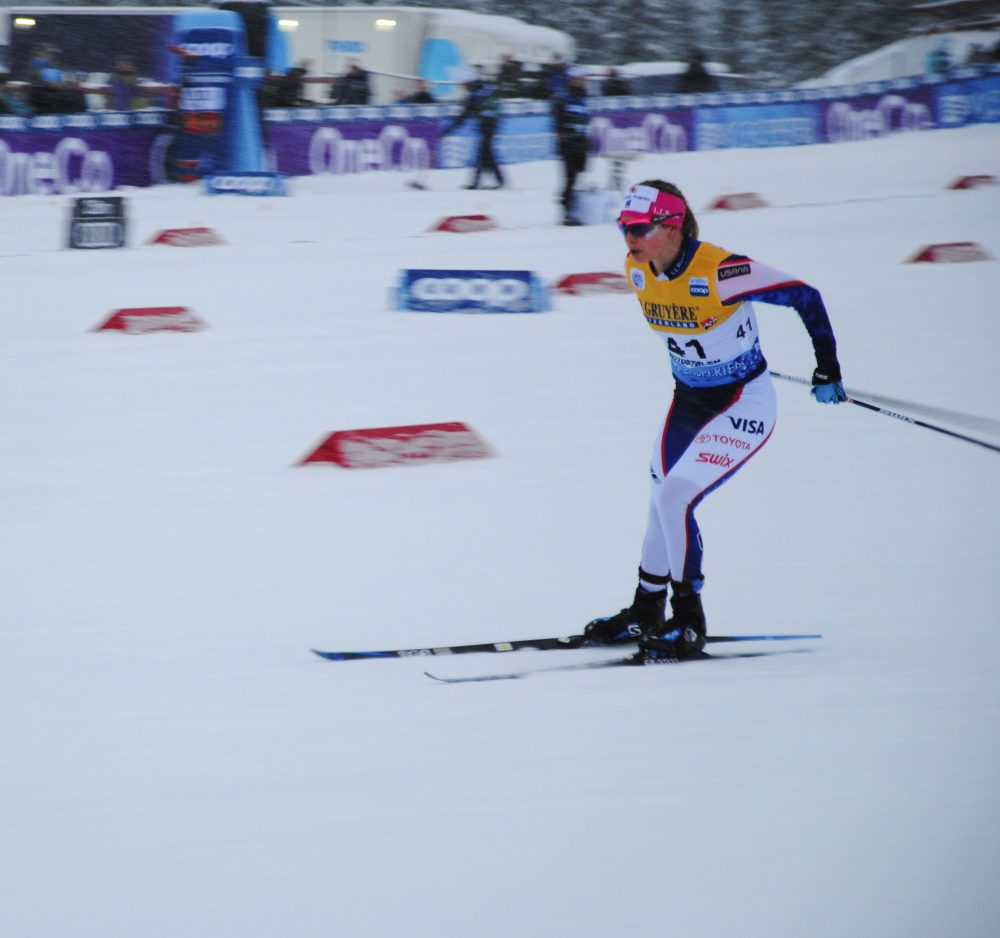
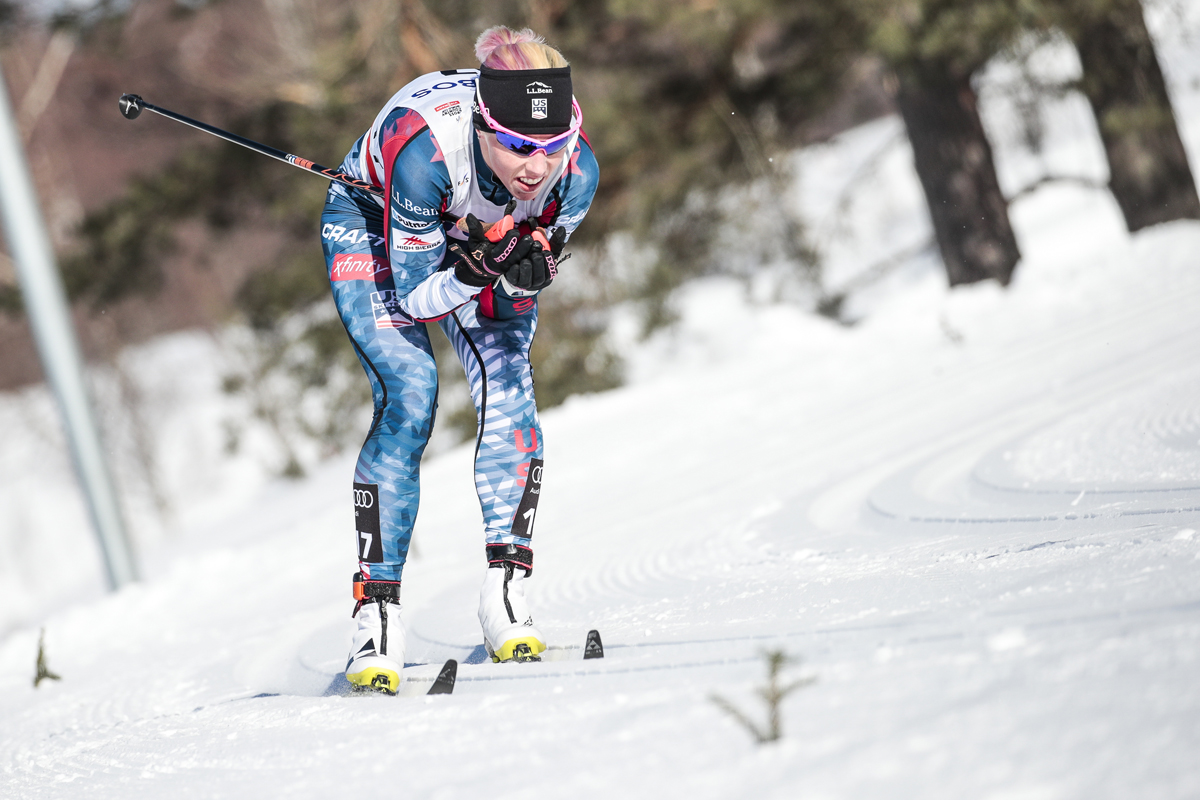
Jessie Diggins racing to sixth overall in the Ski Tour 2020. (Photo: NordicFocus)
Post Stage 6, a spent Jessie Diggins. (Photo: NordicFocus)
Sadie Maubet Bjornsen ended her tour in 10th (+9:43.8). With the big time gaps, the second wave of skiers (the mass start) began with Pärmäkoski in bib 13, starting at 8:08 back. Maubet Bjornsen (bib 12), began 16 seconds ahead and was the initial target of the wave starters. Maubet Bjornsen held off a charging Pärmäkoski for over 5 k.
“Wow, I made it!! That was one heck of a tough tour! Things were looking mighty rough to begin with, but I knew I had to just keep fighting and believing!,” Maubet Bjornsen emailed.
“But among some challenging times, there were some glimmering hopes in there. Tours are my favorite types of racing, because you have to be so resilient and such a fighter. Day after day, you have to put your fatigue and emotions aside, and just stay so positive.
“The tummy troubles at the beginning of the tour were particularly tough! It was scary to start a tour so depleted, but I was thankful we had our nutritionist, Susie Parker Simmons around to help me stay on my feet! From there it was just a matter or fighting for every second from there on.
“Today was a totally wild scene! Conditions were constantly changing, and it was hard to find the perfect skis! I knew the name of the game was to just keep fighting, because everyone would be struggling at some point out there. I managed to find something to work, and went through some highs and lows out there in the 15k which brought me to 10th overall in the tour! I’m super happy and satisfied with that, given the little fatigue hole I had to crawl out of this past month. Thank you to our team for helping make a tricky classic day at the finish of the tour possible to fight with the others.
“I’m looking forward to taking a rest now, and finding the energy to finish the end of the season strong, for the third tour of the season.
“Thanks to the Ski Tour 2020 for bringing some different types of racing. While it wasn’t always the best type of races for my strengths, it was so refreshing to visit some new locations with some different types of events! These are some of my favorite memories this season!
“And of course, hugest thanks to the staff. We couldn’t race day after day like this without them!!! They are the heroes.”
Sadie Maubet Bjornsen (bib 12) racing to 10th overall in the Ski Tour 2020. (Photo: NordicFocus)
Rosie Brennan, starting in bib 10, 7:27 behind the first starter Johaug, placed 12th (+9:53.3).
“Today was a very challenging day,” Brennan wrote in an email. “Due to the massive time gaps in the overall, the wave started at bib 13 so I had a big pack starting not too far behind. The conditions were very challenging with snow, sun, rain and everything in between and some very icy tracks. I did my best to stay in front of the wave but just didn’t have the skis or the energy to make it happen today. I am very disappointed in myself. After having a great tour, it was hard to end on this note, but I am doing my best to look at all the positives from the tour as a whole and make a nice little work list to improve on the things that were so tough today.”
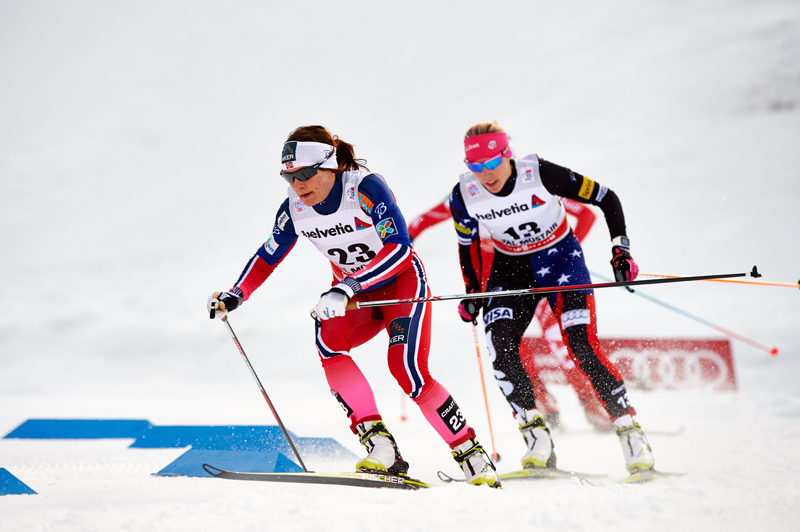
Rosie Brennan (stars and stripes) during Stage 6 of the Ski Tour 2020. (Photo: NordicFocus)
Also for the U.S., Julia Kern placed 30th (+14:51.4), Caitlin Patterson 36th (+16:38.4), Katharine Ogden 42nd (+20:26.6), Rosie Frankowski 43rd (+20:36.7), Sophie Caldwell 44th (+21:41.2), and Alayna Sonnesyn 48th (+24:34.6).
Canada’s Katherine Stewart-Jones placed in the points for the tour overall, by finishing 29th in the pursuit (+14:46.3). Cendrine Browne was 33rd (+15:47.5), and Emily Nishikawa 35th (+16:08.4).
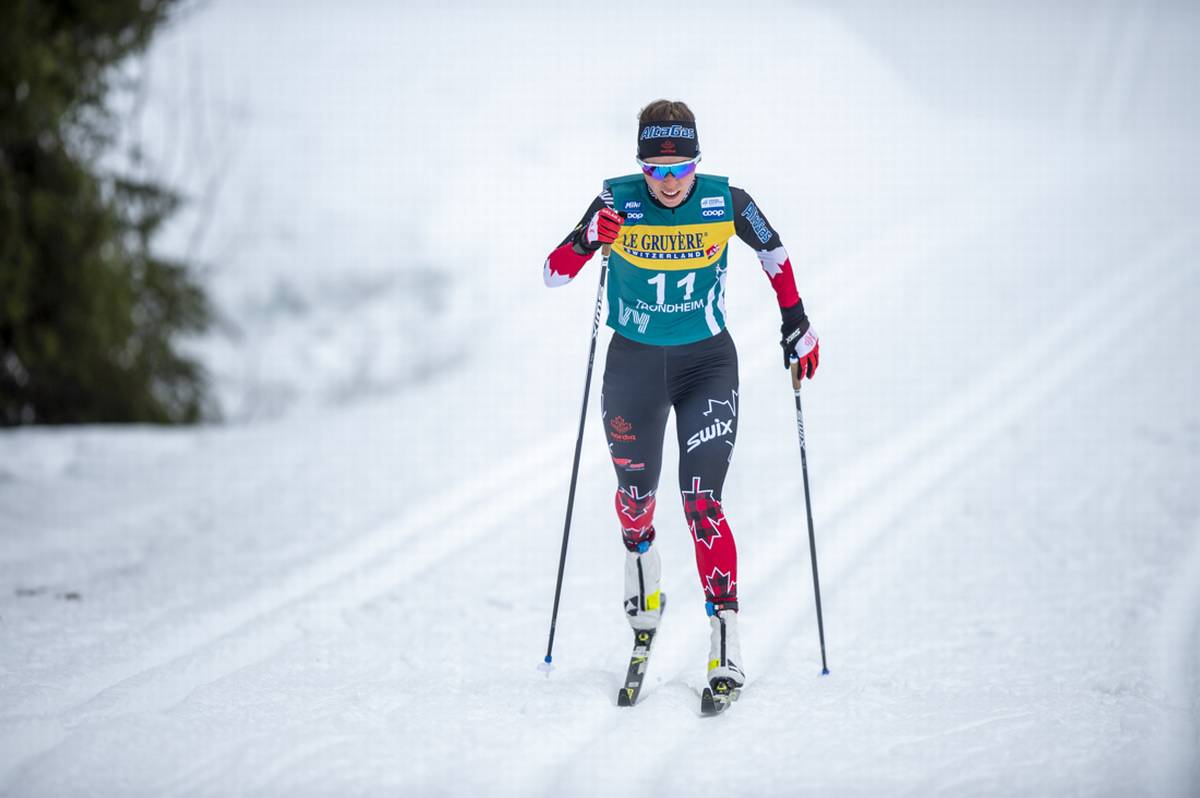
Katherine Stewart-Jones during Stage 5 of the Ski Tour 2020. (Photo: NordicFocus)
This stage concludes the Ski Tour. Racing continues in Lahti, Finland next Saturday.
In this episode, hosted by FasterSkier contributor Rachel Perkins, we dive into the issue of Relative Energy Deficiency in Sport (RED-S). This condition was formerly known as the female athlete triad, which was described as inadequate energy intake, the loss of menstruation (amenorrhea), and decreased bone mineral density. The name was changed to include males, who are also affected, and to expand beyond the three symptoms originally included. Though not quite the same, the condition is closely linked with eating disorders.
This topic has seen a lot of buzz following a November opinion piece in the New York Times where former high school running phenom Mary Cain shared her story of abuse by her coach, Alberto Salazar, at the Nike Oregon Project. While trying to get down to the weight he deemed optimal for her, she lost her period, her performance decreased, and she was littered with stress fractures.
Further concerns arose a few weeks later when Ingvild Flugstad Oestberg and Frida Karlsson were pulled from their World Cup starts after not meeting team health standards for BMI and bone density, presumably due to under eating.
This panel unpacks the misunderstanding that RED-S is an exclusively female phenomenon and how the climate in sport influences the prevalence of this condition, and offers suggestions to shift from a results focused climate in sport to a positive, informed, healthy, and athlete centric program.
Here are links to the resources and articles mentioned in this episode:
The WithAll Foundation and the “What To Say” campaign, which offers suggestions for talking to food and body positive phrases to include in conversations with kids and athletes.
HBO Documentary “The Norwegian Way” which details the Norwegian development program, in particular the omission of results in youth skiing before the age of 12.
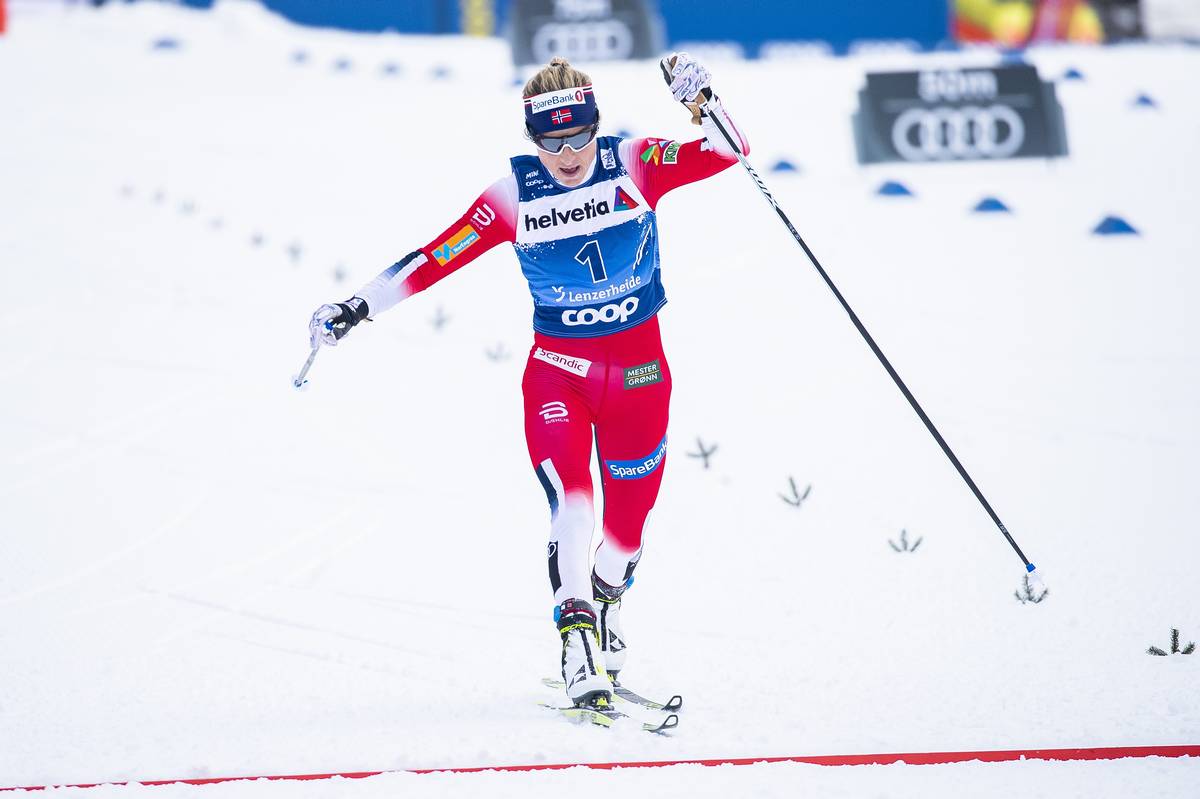
Norway’s Therese Johaug crossing the finish in first place during the first stage of the TdS in Lenzerheide, Switzerland. (Photo: NordicFocus)
Saturday marked the start of the 14th Tour de Ski in Lenzerheide, Switzerland. Forgoing the traditional prologue start to determine time back to the leader, organizers threw in a spicy 11-kilometer mass start freestyle. Easy to follow for fans, maybe not so much for those following in the wake of Norway’s Therese Johaug.
The scene was a Swiss winter ideal: plentiful snow, portions of the course dappled in sunlight, others shrouded in a drifting-in and drifting-out ground fog. Thousands of fans lined the course proving in the right venue, on a festive day, organizing committees can throw a cross-country party.
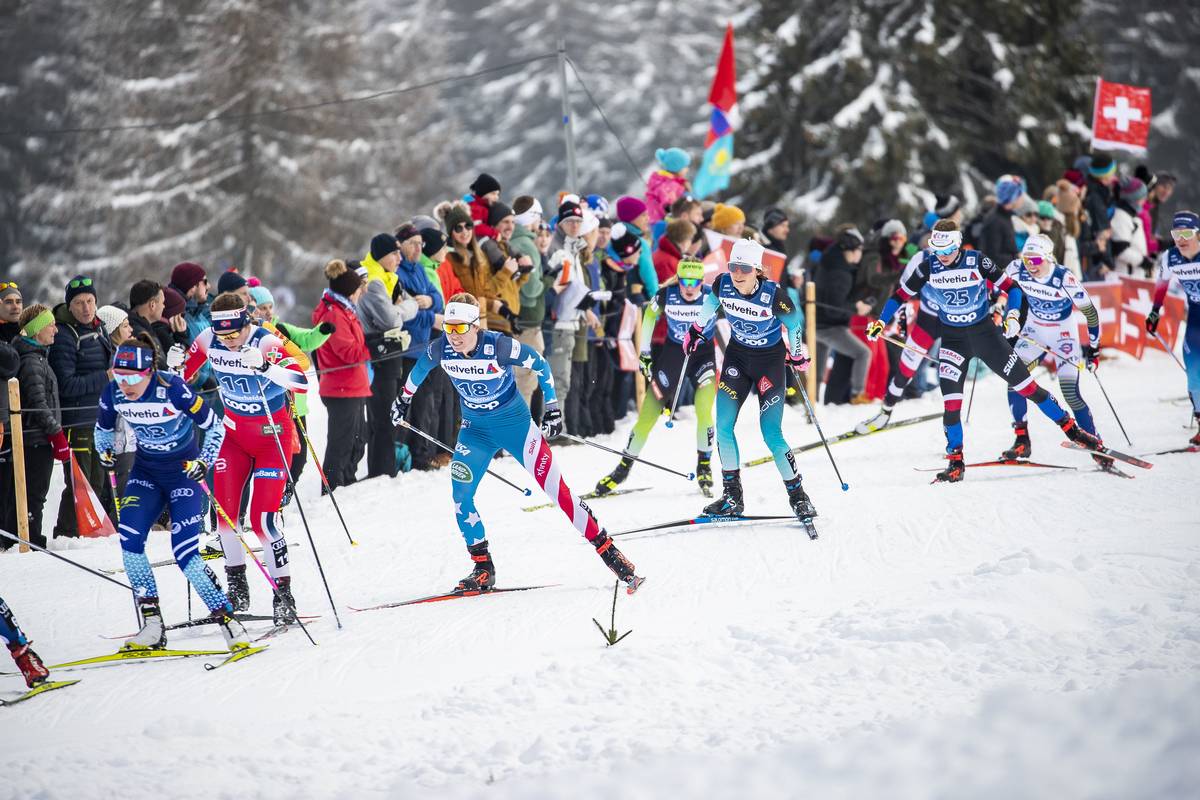
Quite literally, a massive mass start on the World Cup. Stage 1 of the 2019-2020 Tour de Ski in Lenzerheide, Switzerland. (Photo: NirdicFocus)
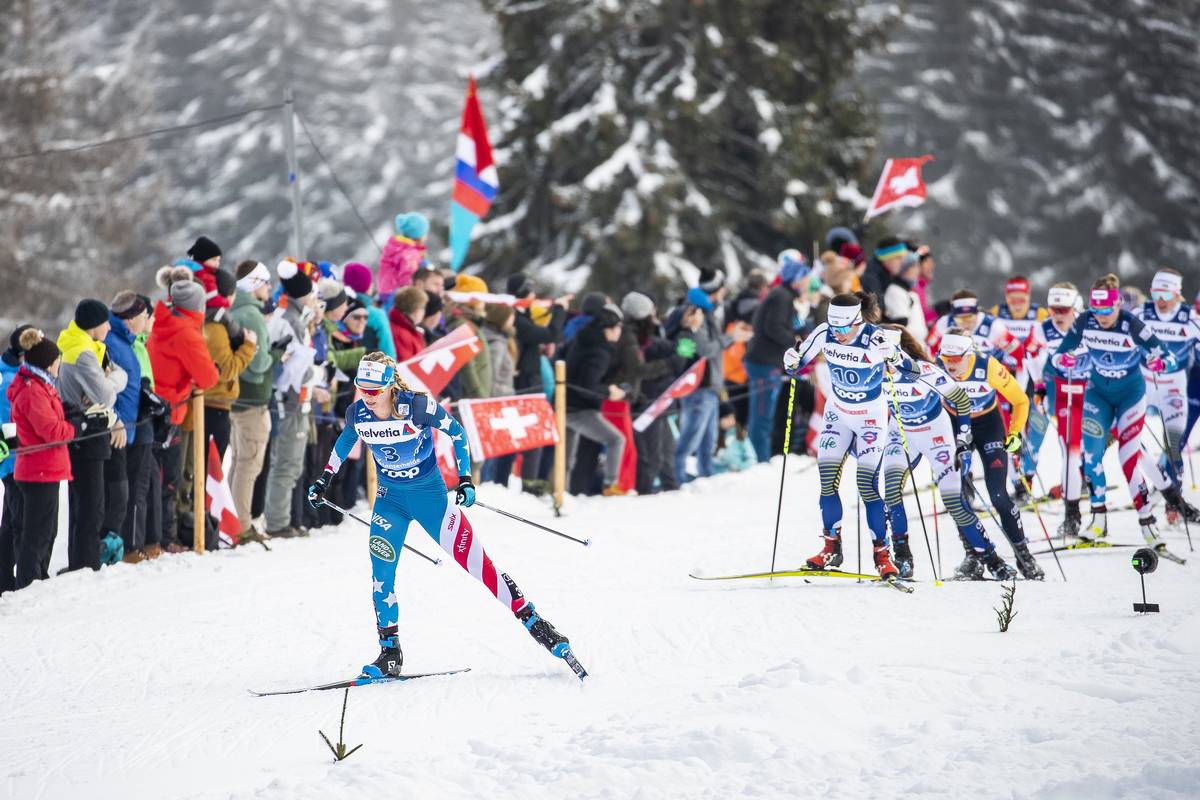
Crowds in full force during the first stage of 2019-2020 in Lenzerheide, Switzerland. (Photo: NordicFocus)
The party jumped into Swiss-cowbell-ringing high gear when the starter’s gun fired. The hot pace was palpable. It appeared no skier wanted to be left dangling too far from Johaug who pulled through to lead 1:20 into the race. Jessie Diggins and Sadie Maubet Bjornsen matched the pace upfront. But, by then, with roughly 1/10th of the race completed, the field was strung out. The vibe was clear: no matter what an athlete’s intent, they all were trying to minimize the hurt Johaug would inflict over the next 10 k.
We could exhaustively detail the splits and time back as the race unfolded. At moments it appeared Johaug was simply at a level where imagining a one minute gap across the finish line wasn’t outlandish. However, with each shot of Johaug churning her high-tempo technique or the on-course mics picking up her solitary but thoroughbred breathing, she was chased by a group just out of contact.
This was not a total runaway for Johaug.
Therese Johaug during Stage 1 of the 2019-2020 Tour de Ski in Lenzerheide, Switzerland. (Photo: NordicFocus)
Therese Johaug (NOR), Heidi Weng (NOR), Astrid Uhrenholdt Jacobsen (NOR), (l-r) during Stage 1 of the 2019-2020 Tour de Ski in Lenzerheide, Switzerland. (Photo: NordicFocus)
Therese Johaug during Stage 1 of the 2019-2020 Tour de Ski in Lenzerheide, Switzerland. (Photo: NordicFocus)
By 5.6 k, the front chase group had coalesced. Two skiers who had yet to compete on the World Cup this season, Sweden’s Ebba Andersson and Norway’s Ingvild Flugstad Østberg, proved racing into form wasn’t a necessity. They were joined by Norwegians Astrid Uhrenholdt Jacobsen, Heidi Weng, and Russia’s Natalia Nepryaeva.
During the three laps of the 3.3 k course, Jacobsen and Nepryeava fell off slightly. Weng, Andersson, and Østberg kept it interesting during this opening act of the TdS. At 8.6 k Joahug was nearly 19 seconds up on Østberg. By the finish, the chasers took a chunk of time out of Johaug’s lead.
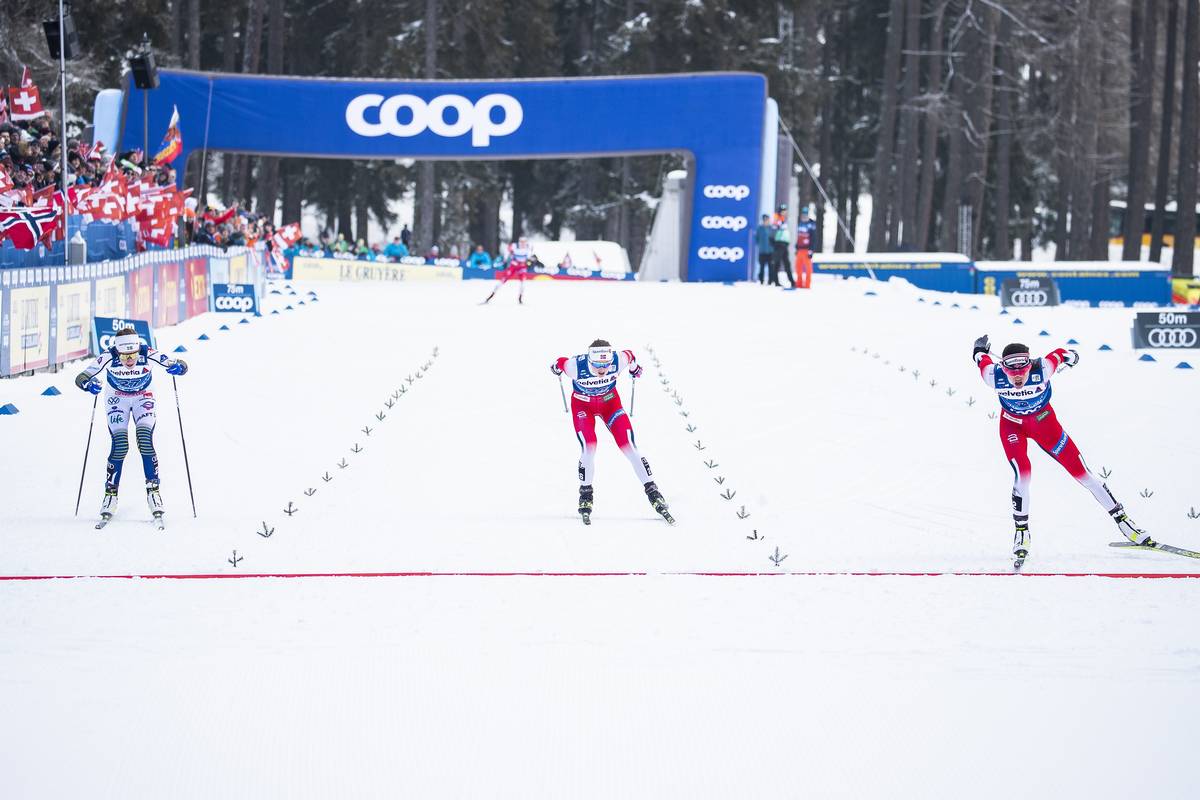
Johaug won in 28:12.1, with Weng in second (+12.3), Andersson in third (+12.9), and Østberg fourth (+13.1). Jacobsen placed fifth (+24.1), and Nepryeava sixth (+40.1).
Ebba Andersson of Sweden on her way to third during the first stage of the 2019-2020 Tour de Ski. (Photo: NordicFocus)
Ebba Andersson (SWE), Ingvild Flugstad Østberg (NOR), Heidi Weng (NOR), (l-r) come into the finish during the Stage 11 k mass start skate in Lenzerheide, Switzerland. (Photo: NordicFocus)
“I was really surprised today, mass start in skating,” Johaug told FIS after the race. “In my mind, I think there would be other girls at the finish line. I had a really good day today. And my skis were perfect. I decided with my trainer and brother that on the first lap I didn’t go so fast, and out of the second lap I should speed up. And then I get a gap. I am so so happy. The mass start in 10 k, it is not my favorite distance so I am really surprised and really happy now.”
According to the FIS database, the last 10 k mass start skate Johaug contested was in 2016, prior to her ban for a positive doping test. In that 2016 Falun, Sweden race, she beat a second place Weng by only 8.8 seconds. (Johaug served an 18-month ban, returning to the World Cup in November of 2018.)
The U.S. women came into the race with formidable stats. Just this year, of the nine races contested prior to Saturday’s TdS Stage 1, including team events, there have been six U.S. podiums.
In Lenzerheide, at least in the early going for this TdS, the U.S. women fell momentarily away from their own high expectations. Rosie Brennan (USST) was the top-finisher in 20th (+59.8). Diggins (USST) placed 29th (+1:20.7) and Maubet Bjornsen (USST) 30th (+1:20.7).
Kerttu Niskanen (FIN), Tiril Udnes Weng (NOR), Rosie Brennan (USA), Delphine Claudel (FRA), (l-r), (l-r) on Satiurday’s first stage of the 2019-2020 Tour de Ski. (Photo: NordicFocus)
“Today was a bit of a mixed day,” Brennan emailed several media outlets. “Having missed the last two weekends of racing, I wasn’t quite sure where I was at, but I felt really good in the race and am really happy with my effort. We struggled a bit with our skis and I maybe wasted a bit too much energy trying to move up in places that didn’t make sense with the skis I had on my feet. The good news is that it was overall a very tight race so, despite less than perfect skis, I didn’t lose too much time in the overall and am still optimistic for the rest of the tour.”
Katharine Ogden (SMST2), in her first World Cup of the season, skied to 42nd (+2:03.0). Sophie Caldwell (USST) placed 46th (+2:23.7), and Julia Kern (USST) 57th (+3:02.6).
Jessie Diggins (USA), Charlotte Kalla (SWE), (l-r), (l-r) early on during Stage 1 of the 2019-2020 Tour de Ski. (Photo: NordicFocus)
During a post-race interview with U.S. World Cup Coach Matt Whitcomb, he was blunt when discussing the team’s lackluster skis. “When we saw them at about 3.5 k coming out of the stadium on the long gradual uphill, Sadie and Jessie just looked tired,” Whitcomb said. “And frankly they are not tired. They are in awesome shape. That’s when we knew something was wrong.”
World Cup Coach Matt Whitcomb’s post-race comments about the U.S. women’s team and lackluster skis
Whitcomb explained during the post-race call that the FIS asked coaches to vote on whether to include or eliminate Stage 1 time bonuses. Initially, Stage 1 was slated for time bonuses at 3.3 k and 6.6 k. However, with the prospect of a Johaug time-bonus sweep, teams voted to eliminate those bonuses for Saturday’s racing.
World Cup Coach Matt Whitcomb’s post-race comments about time bonuses for Stage 1
Racing continues in Lenzerheide tomorrow with a 1.5 k skate sprint for the women.
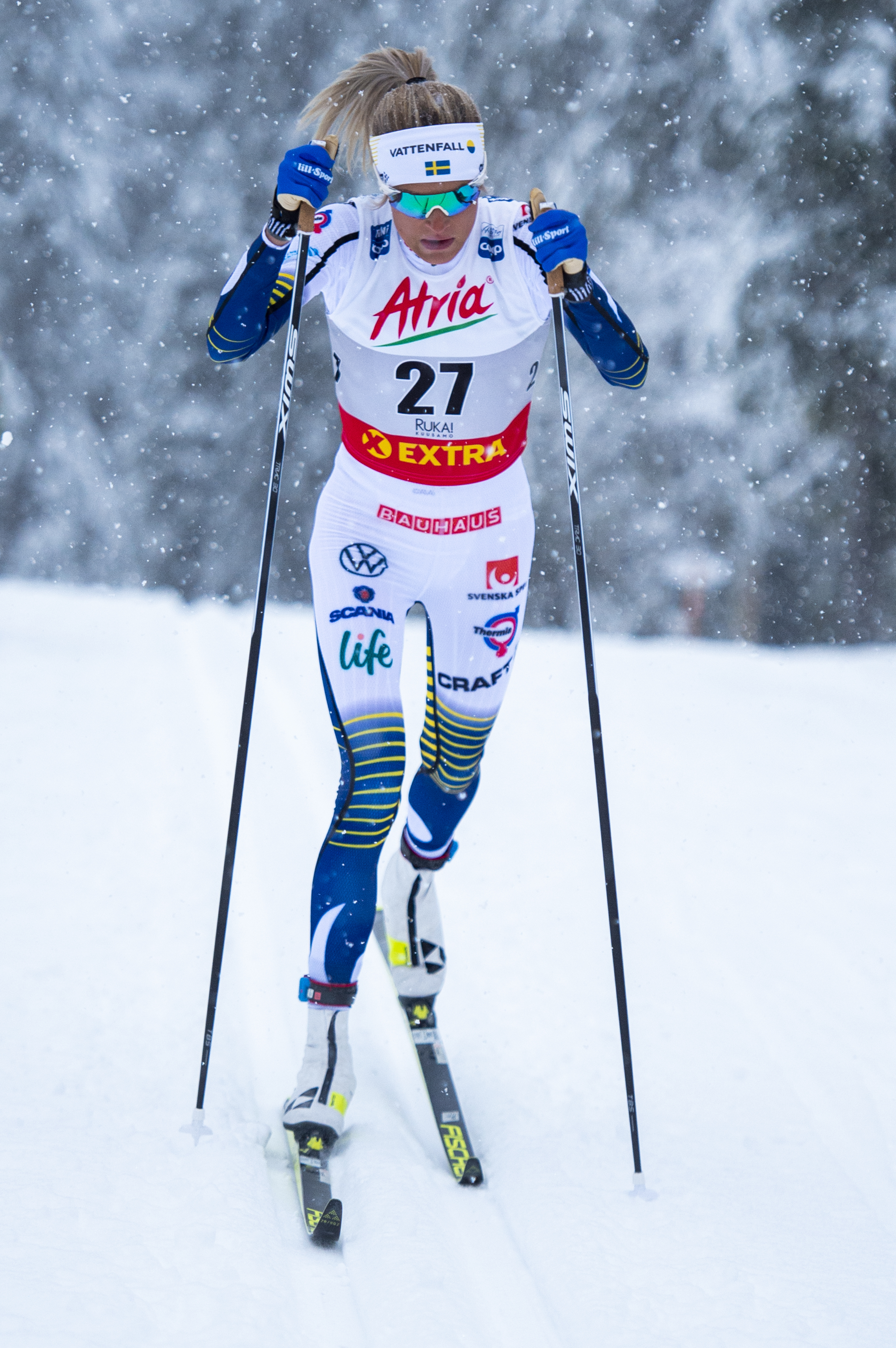
Sweden’s Frida Karlsson on course during the 10-kilometer classic in Ruka, Finland. (Photo: NordicFocus)
The Swedish news outlet SVT announced this morning that Frida Karlsson, Sweden’s rising junior phenom, has been pulled from competition after not meeting team health criteria during a routine check last week. Karlsson raced the World Cup opening series of races in Ruka, placing 40th in the classic sprint, 11th in the 10 k classic, finishing 8th overall after the final 10 k skate stage.
Last season the 20-year-old won the 5-kilometer classic and 10 k skate at the World Junior Ski Championships in Lahti, Finland and turned heads with a second place finish in the 10 k freestyle at the World Ski Championships in Seefeld, Austria, challenging Norway’s dominant distance champion Therese Johaug. Karlsson also placed third in the 30 k skate amongst veteran athletes and skied the second leg of the 4 x 5-kilometer relay that kept spectators on the edge of their seats as Sweden upset the Norwegian favorites.
“From a health perspective, we have to make the decision that she pulls back on everything for a period of time,” national team doctor Magnus Oscarsson explained through translation to SVT Sport. “You have to have a balanced load and recovery, and it has not been sufficiently balanced lately. She has to step back.”
Oscarsson did not specify which parameters of the health criteria Karlsson did not meet.
“Frida is very determined and ambitious and wants very much with her sport. It has simply become a little too intense and too much. She now has to take a step back to regain balance. Health is always more important than sports performance,” Oscarsson continued.
Though it is unclear whether the circumstances are related, Karlsson is the second top World Cup athlete to be removed from competition due to impaired health. Overall World Cup champion Ingvild Flugstad Østberg has missed the first two weekends of competition after not meeting national team minimum body mass index and bone density requirements.
“Right now, I’m very sad and disappointed,” Karlsson said to SVT. “It is easy to to stress yourself out, but you have to see it long term. I will do everything I can to be back in the competition track, as I want to keep [competing] for many years to come.”
For the time being, Karlsson will have a reduced training load to focus on rest and recovery. She will follow up regularly with her doctors to ensure her health is progressing and will be allowed to compete once she is deemed fit. It is unclear how long the recovery process will take. The national team doctors and coaches are focused on Karlsson’s long term health, rather than her performance or rank this season.
“We can’t speculate about that at the moment,” Oscarsson said of her return. “Frida needs to get some peace and quiet in order to focus on the right things and not aim to be back to any specific competition.”
Sweden’s Frida Karlsson pushes across the line for an 8th place finish in the 10-kilometer skate pursuit in Ruka, Finland. (Photo: NordicFocus)
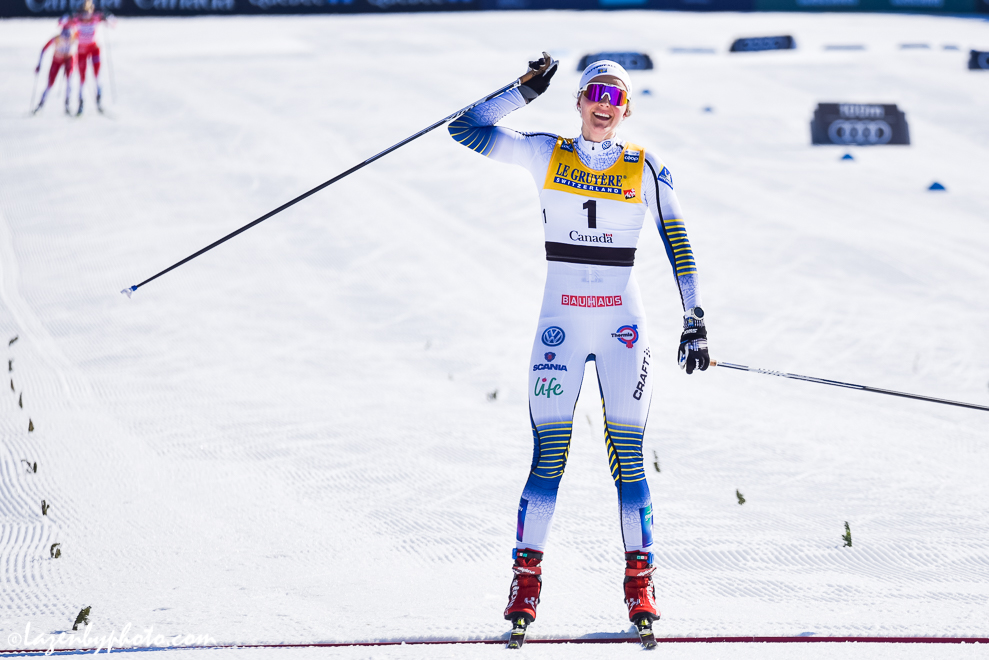
Stina Nilsson of Sweden taking the overall win in Québec City. Here she is crossing the line first in the 10 k skate pursuit. (Photo: John Lazenby/lazenbyphoto.com)
It was beginning to seem as though it could not be done, and then it happened. Norway’s Therese Johaug did not stand atop the podium after the 10-kilometer classic first stage of the women’s pursuit in Québec City. Sprint champion Stina Nilsson did. Not only that, but the bonus seconds garnered from Nilsson’s win in Friday’s skate sprint allowed her to enter the course for the final leg of the week’s three-race series with a margin that seemed as though it might be insurmountable over her nearest competitors. She started the 10-k freestyle pursuit 33 seconds ahead of Norway’s Ingvild Flugstad Østberg who took eighth in the sprint and third in the 10 k classic, and 49 seconds ahead of Johaug, who took 25th in the sprint and after a double pole battle that she could not win, finished only 0.2 seconds behind Nilsson.
When it was her turn, Johaug charged onto the course like a hungry cheetah in pursuit of a Swedish gazelle on the city’s Plains of Abraham. She was simply attacking the course with the unmatched tempo and fire that earned her a perfect record in regular season distance races. On a relatively flat course and hard packed fast conditions, she could not delay her chase; she needed to begin making up time as soon as she pushed through the start gate. At the front, Nilsson skied smoothly, remaining calm and collected despite knowing she was a target for the two skiers in red who were slowly reeling her in.
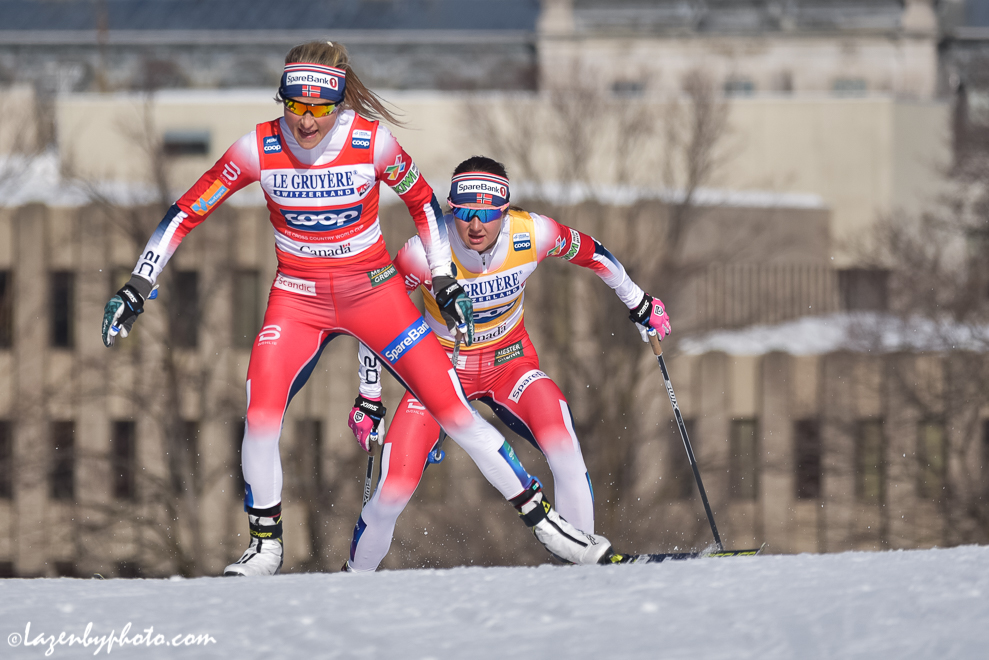
Norway’s Therese Johaug (front) and Ingvild Flugstad Østberg on the chase during the Québec City 10 k skate pursuit. (Photo: John Lazenby/lazenbyphoto.com)
By the 2.4 k checkpoint, Johaug had made up nearly 13 seconds of her deficit. By 5 k, she caught Østberg and remained tucked into her draft as the two continued to gain time on Nilsson. But as the finish line neared, it became clear that the Swede was not going to roll over for the Norwegians. In the final three kilometers, Østberg and Johaug could no longer make up significant ground and remained about 20 seconds behind Nilsson’s graceful and powerful V2.
With less than 1k to go, Nilsson crested the hill by the stone Martello gun tower and headed for the stadium. The Norwegians were lurking not far behind as she rounded the corner past the cannon and no pole skated down the hill before climbing over the final roller. But they were quickly running out of real estate in their chase.
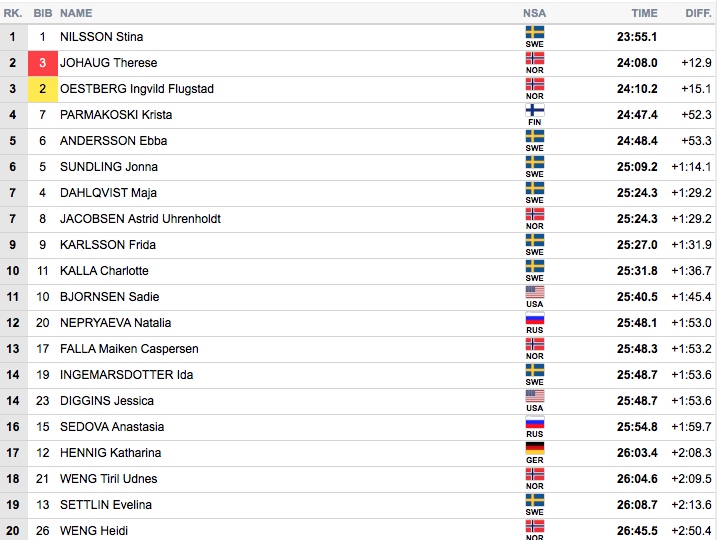
When she arrived at the stadium, she looked back and smiled. The gazelle was safe. She stood up and gave a wave, then continued to ski with purpose and joy to the hairpin turn before the final 100 meters where she savored her hard earned sweep of the World Cup Final tour. Nilsson looked both relieved and proud as she crossed the line, stopping the clock at 23:55.1. Never laying off the gas, Johaug slid through the finish 12.9 seconds behind, followed by Østberg in third (+15.1).
Stina Nilsson of Sweden solo and in front during the Québec City 10 k skate pursuit. (Photo: John Lazenby/lazenbyphoto.com)
“It was really good,” Nilsson told the International Ski Federation (FIS) after the race. “I expected them to catch me quite fast, but when they didn’t I felt like, ‘okay, then I just keep going on with this speed’. It was really nice to be able to enjoy the last 100 meters because it is not so often that I can do that. So, it was really nice.”
The Swede has been well suited for the track in Québec, and though she was skiing alone, Nilsson never felt that way, as cheering spectators lined the majority of the course.
“I really like the course here, as I said yesterday,” she told FasterSkier in the mixed zone. “And the crowd was almost everywhere, so I was never alone even though I never had any [competitors] ahead of me.”
Her clean sweep of the tour was not the first time she has seen success in Canada. She also won the freestyle sprint there in both 2016 and 2017.
“Before this weekend, I had two victories here, and now I have five, so I really like Québec,” she laughed.
With Russia’s Natalia Nepryaeva far behind in 12th (+1:53.0), Østberg also breathed a sigh of relief as she officially became the overall winner of the World Cup season. She led by only a small margin entering the tour, and as Nepryaeva experienced first hand after a crash and broken pole in the classic stage, anything can happen in the finals. Her younger self might have been in disbelief of this title, as she could not imagine herself at the level of her teammates who became champions before her.
“It’s hard to describe actually,” she told FIS about her emotions after the race. “I think I never could have dreamt about fighting for this jersey for some years ago, I saw Marit and Therese fighting for it and I was like, ‘Oh my god, they have the yellow jersey.’ And this year, I managed to fight for it, and the last races I’ve been tough both physically and mentally, and fight between me and Nepryaeve. Today, when I managed to finish on the podium in the tour and can say that I’m the winner of the overall world cup, it’s an unbelievable feeling.”
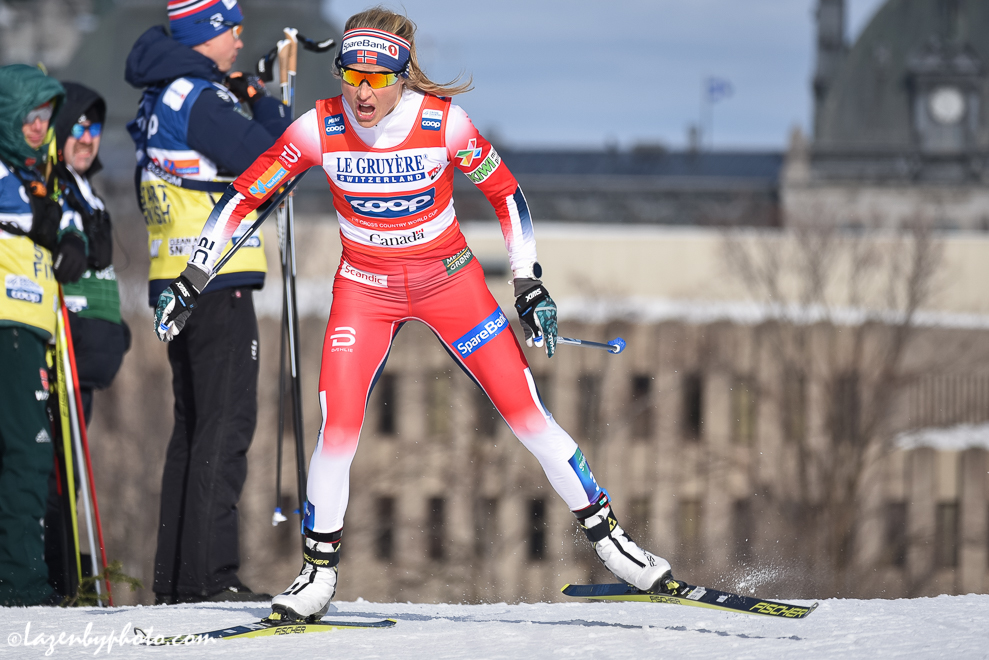
Norway’s Therese Johaug during the Québec City 10 k skate pursuit. (Photo: John Lazenby/lazenbyphoto.com)
Though she did not catch Nilsson, Johaug skied the fastest time of the day, adding to her heavy purse of FIS points. Her second place finish Saturday did not make a dent in the lead she had over the rest of the women in the distance standings; she was essentially in possession of the distance globe before the final tour started. Even without competing in the Tour de Ski, Johaug’s string of nine victories, coupled with her results this weekend amassed 956 points, 139 more than Østberg who took second. She also finished the season ranked third in the overall despite only entering one sprint event on Friday.
“I’m so happy,” she told FasterSkier. “I cannot believe that I am been so good shape the whole time and coming back after two years out and have these results that I have. So I’m really happy.”
The American women were unable to crack the top 10 in the overall tour standings, but four of them were able to place within the top-30 in the Winner of the Day results. Sadie Bjornsen was the overall top ranked skier finishing 11th (+1:45.4) with the 13th fastest time on the course.
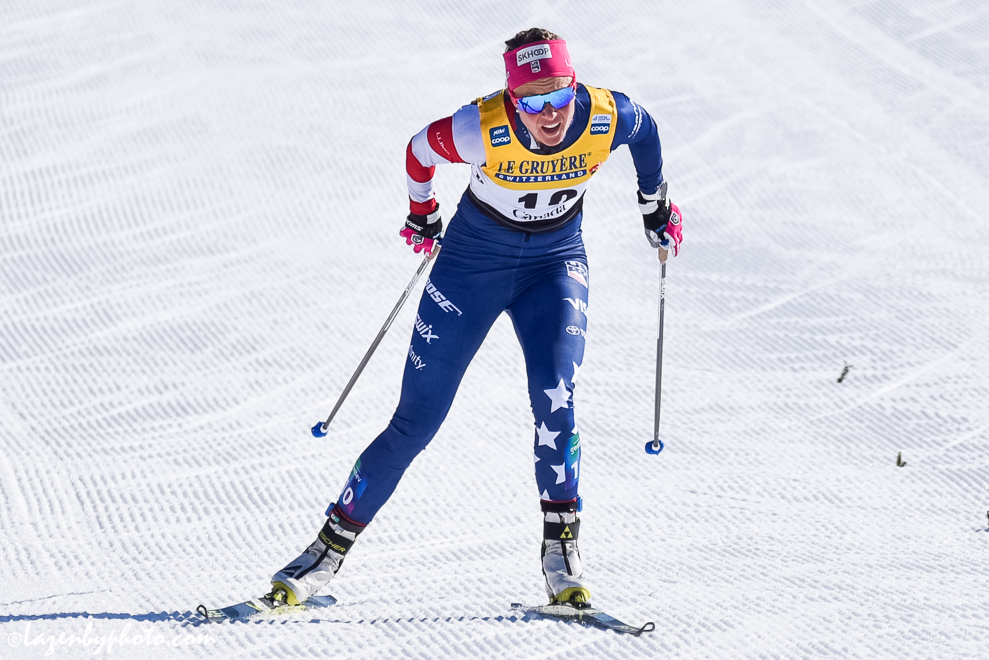
Sadie Bjornsen of the U.S. Ski Team coming into place 11th during the Québec City 10 k skate pursuit. (Photo: John Lazenby/lazenbyphoto.com)
With her usual spark and never-give-up positive attitude, Jessie Diggins moved ahead nine places to finish 14th overall (+1:53.6).
“That was a really fun way to end the season,” Diggins told FasterSkier in the mixed zone. “Skating is always so fun because you can go as hard as you want to go, and it was really fun to be able to have the tools I needed to be able to use what energy my body had. So that was just very satisfying. I got to go so hard and dig deep, and it was just really fun to ski up and ski the way I know I can ski. So yeah, it’s just always fun to end your season on a good race.”
And it was a good race. Diggins powered through the course to ski the 4th fastest time of the day behind Johaug, Krista Pärmäkoski of Finland, and Ebba Andersson of Sweden.
“I was just going after time of day,” she explained. “I wasn’t really worried about where I place in the overall, I just wanted to put together the best race that I could.”
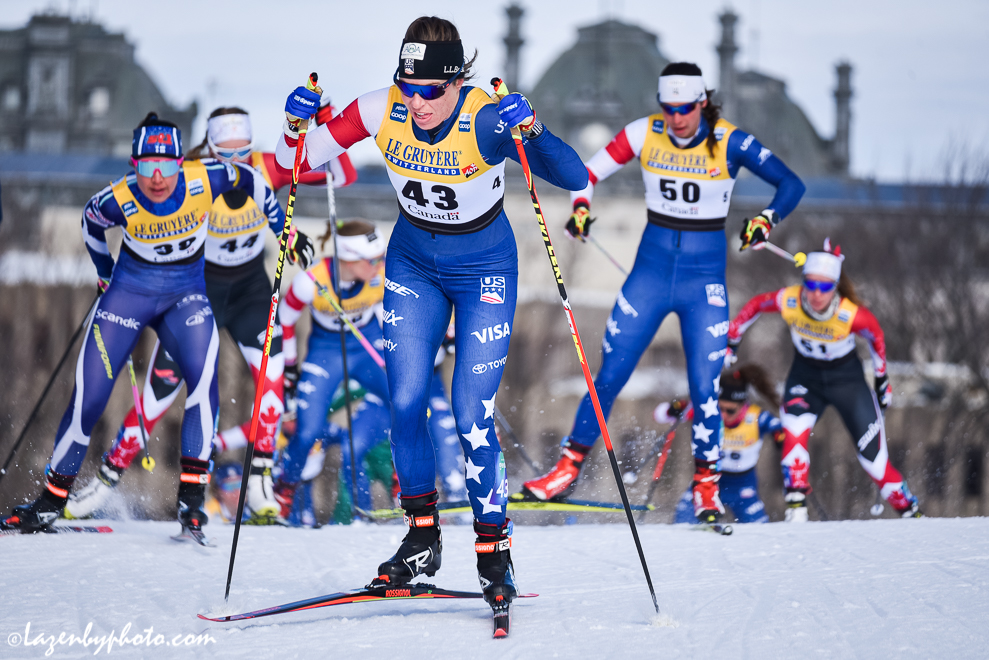
Rosie Brennan (bib 43) and Julia Kern (bib 50) during the Québec City 10 k skate pursuit. (Photo: John Lazenby/lazenbyphoto.com)
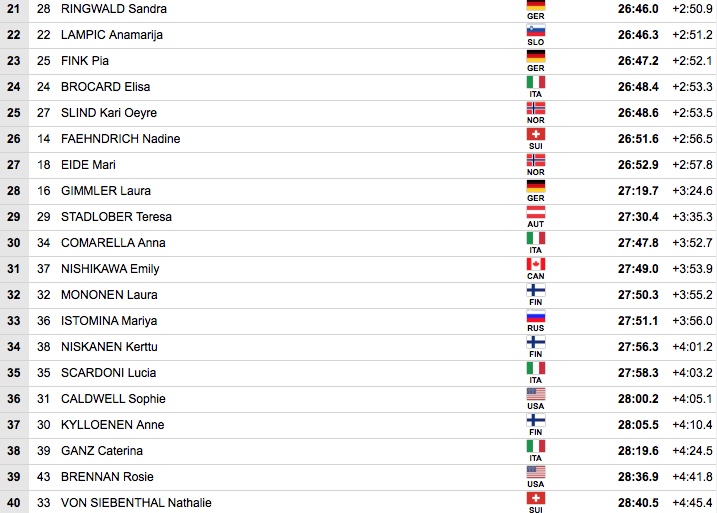
Rosie Brennan moved from 43rd to 39th by skiing the 28th fastest time of day (+4:41.8), and Julia Kern moved ahead seven spots to finish 43rd with the 30th fastest time (+5:23.7).
While Brennan had hoped for more from this weekend, she is proud of her race today.
“This is way better than yesterday,” she told FasterSkier. “It still wasn’t like… I had hoped to be fighting a little higher in the overall tour, but it was good to at least feel strong today and have some fight in there, so yeah, it was good.”
Brennan added insight into the tour format and race conditions during the final series in Quebec.
“It was a little bit wild,” she admitted. “We had a lot of gnarly conditions, so it’s been kind of a game of survival, which is in some ways fun but also hard because there’s so many things out of your control. So it’s maybe hard to get your storybook ending of the year. But it’s fun to be somewhere where we have so many fans. So that helps make up for all the crazy conditions we’ve had.”
Austria’s Terese Stadlober (bib 29) leading the U.S. Ski Team’s Sophie Caldwell (bib 31) during the Québec City 10 k skate pursuit. (Photo: John Lazenby/lazenbyphoto.com)
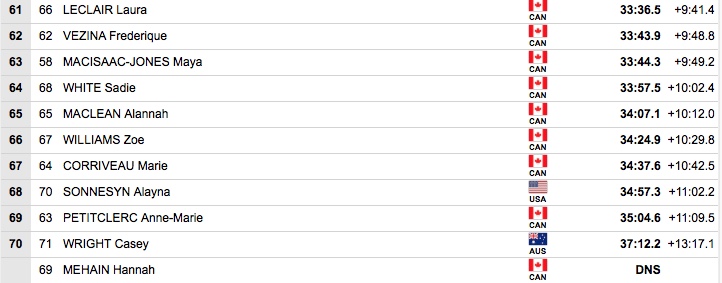
Also for the U.S., Sophie Caldwell finished 36th (+4:05.1), Hailey Swirbul 41st (+5:06.2), Caitlin Patterson 46th (+6:11.4), Katherine Ogden 47th (+6:13.9), Ida Sargent 48th (+6:21.9), Kendall Kramer 51st (+6:31.4), Kaitlynn Miller 52nd (+6:44.7), Hannah Halvorsen 58th (+8:24.3), Becca Rorabaugh 59th (+8:44.1), and Alayna Sonnesyn 68th (+11:02.3).
Kendall Kramer from Fairbanks, Alaska during the women’s 10 k skate pursuit on Sunday. (Photo: John Lazenby/lazenbyphoto.com)
Today’s race will be the last of Sargent’s career. The bio of the 31-year-old Craftsbury Green Racing Project member includes a long list of top 30 finishes from as far back as 2012. She competed in two Olympics, Sochi and PyeongChang, and stood on the podium three times during her career. As her hometown of Barton, VT is only three hours from Québec City, she was able to ski her final race with plenty of family and friends cheering her on. FasterSkier did not hear from Sargent after her finish, but after skiing together for seven years as USST A-Team members, Diggins shared her thoughts on Sargent’s retirement.
“She’s had an incredible career,” said Diggins, “but beyond that she’s just a really caring teammate and she’s always down for a laugh. It’s hard to have somebody who, you know… we joined the team at the same time, so we’ve been on the team together the entire time. It’s hard to see someone retire, but I know that she’s going to do amazing things in her next career and I’m just so happy for her that she got this beautiful wonderful day in front of so many home fans to have her last race. What a special experience. And it was fun to spray her with champagne,” she laughed.
Ida Sargent (bib 46) retired from World Cup racing after Sunday’s race. (Photo:John Lazenby/lazenbyphoto.com)
Since the finals were held in Canada, the U.S. was given the opportunity to enter more athletes in the races. This gave several younger athletes, including 16-year-old Kramer of Fairbanks, AK, the opportunity to experience their first World Cup race.
“It’s just amazing,” she shared regarding her experience. “This is probably the most spectators that have called out my name like ever before. It was just super amazing. This is one of the first times I’ve been hearing anything from the crowd,” she continued. “Usually I’m just in my zone racing, but now I can hear what everyone is saying and it’s all just really really fun.”
After her first season on the USST D-Team, Swirbul is walking away with a slew of positive results, including a 10th place finish in the 15 k classic at the U23 World Ski Championships in Lahti.
The Basalt, CO native said cheerfully that she is “ready for some rest and recovery and to train hard all summer and fall and do it again next year.”
Hailey Swirbul of the USST D-Team, during Sunday’s race. (Photo: John Lazenby/lazenbyphoto.com)
Emily Nishikawa was Canada’s top finisher. She began as the 37th skier and placed 31st (+3:53.9).
“I had a blast racing today,” Nishikawa told FasterSkier. “I felt really strong and I’m really happy with the way I skied today.”
The next two fastest were Katherine Stewart-Jones who finished 44th (+5:27.2) followed by Dahria Beatty in 45th (+5:47.7).
– Peggy Shin, Gerry Furseth and Kelsey Dickinson contributed
Stina Nilsson of Sweden during the women’s 10 k pursuit in Quebec. (Photo: Peggy Hung)
FIS World Cup Finals Québec Women’s 10 k Freestyle Pursuit
Day three in Québec City brought sunny skies and fast tracks. The first starter on the day for the 10 k freestyle pursuit, Sweden’s Stina Nilsson, took the win and with it the Québec City overall.
Nilsson began with a 33.2 second lead over Norway’s Ingvild Flugstad Østberg in second and a 49.4 second lead on third starter Therese Johaug, also of Norway. Nilsson won in a time of 23:55.1 with the chasing Johaug and Østberg running out of real estate on the Plains of Abraham.
Chasers in third and second, Norway’s Norway’s Ingvild Flugstad Østberg (yellow bib) and Therese Johaug during the women’s 10 k pursuit in Quebec. (Photo: Peggy Hung)
For the U.S., Sadie Bjornsen placed 11th (+1:45.4), Jessie Diggins moved up to 14th (+1:53.6). Canada’s Emily Nishikawa began as the 37th skier and placed 31st (+3:53.9).
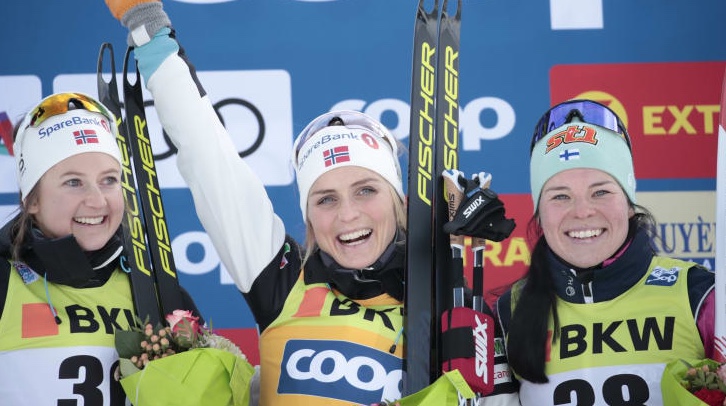
The women’s podium from the 2018 World Cup 10 k freestyle individual start in Davos, Switzerland. Therese Johaug (center) of Norway won, teammate Ingvild Flugstad Østberg (left) was second, and Krista Pärmäkoski (right) of Finland was third. (Photo: Fis-Ski.com screenshot)
Coming off a two-season hiatus from the World Cup for having a banned steroid in her system, Norway’s Therese Johaug has come back onto the distance race stage with time checks and results showing no remorse. This is not to say that Johaug’s reentry to the sport comes with arrogance. But it is to highlight that, on course, her level of control in the early season World Cup distance events has been dominant. Johaug has won all five World Cup distance events thus far. Her string of first places is a way of saying she’ll let the results speak for themselves and her dominance seep into the minds of those who want to fight for second and third place.
Sunday was yet another win for Johaug. The up-tempo skier won the 10-kilometer freestyle individual start in Davos in a time of 26:06.9 minutes. She led the race at every intermediate time checkpoint.
It was Johaug’s 81st World Cup podium. She trails only Norway’s legend Marit Bjørgen who won 99 World Cup podiums during her career.
The second place finisher on Sunday, Johaug’s teammate Ingvild Flugstad Østberg, had the benefit of starting two places behind the eventual race winner: Johaug started in bib 36, Østberg in bib 38.
Through the 5 k lap mark, Østberg was able to keep Johaug’s gap no bigger than 10 seconds. On the second lap’s long climb, Østberg only lost a handful of seconds. Her finishing time of 26:19.0 minutes was 12.1 seconds behind Johaug.
For Østberg, it was her third distance podium in succession after placing second in Lillehammer’s 10 k classic pursuit, and third in Beitostølen’s 15 k freestyle individual start race.
Johaug leads the World Cup overall with a perfect score of 600 points. Østberg sits in second, with a 149 point deficit.
Finland’s Krista Pärmäkoski placed third on Sunday, 19.2 seconds back. It was Pärmäkoski’s first podium of the season. She currently is ranked fourth overall on the World Cup.
Jessie Diggins during the 2018 10 k skate in Davos, Switzerland. Diggins placed fifth for her best result for the season. (Photo: Reese Brown/U.S. Ski Team)
The U.S. placed two skiers in the top-10. Jessie Diggins placed fifth and Rosie Brennan sixth.
For Diggins, it was her best result of the season after her eighth place in Beitostølen’s 15 k skate.
“For me period 1 is a building phase, and it’s a really long season, and every single year I always build into period 1,” Diggins said in a phone call. “And I have to remind myself that I do this for me and that I follow a plan that has worked every other year, so I just have to remember that I will be in the right shape when it’s time. And for me, period 1 is not that time. So I’m really happy that it’s been trending positive.”
The building phase of her season set up a solid foundation on Sunday. Her pace was consistent and only placed her 15.8 seconds out of third at the halfway point. She ended up 1:01.1 minutes behind Johaug at the finish.
“I think that technically, I was really proud of my race today because of the way I skied,” Diggins said of her on course sensations. “It’s hard on a course like this to not go out guns blazing and just charge and then totally flood. Because that’s when I think you can lose so much time. For me, I was just so focused on trying to ski with a strong core and efficient, long-gliding v2 and I was just happy with it because it’s a really hard course to pace, and of course, you’re never sure if you nailed it or not.”
With a two week break from racing, Diggins will be training in Seefeld, Austria during the race respite. Next up on the Diggins race schedule is the Tour de Ski (TdS). She placed third overall in the TdS last season, a historic mark for an American. Although she has ambitions at the TdS, Diggins also clarified that it remains a piece in the building-form puzzle. In-form or trending towards the sharp end of fitness, Diggins understands the possibility for more positive outcomes on the result sheet are more palpable as the season progresses.
“For me, I feel like period 1 and the Tour are really crucial building blocks for the season ahead, so I’m looking to take really good care of myself and just like get after it in the Tour. I do think that parts of a season are building blocks where you recognize that maybe you’re not in top form, and that’s on purpose because of the training load you’re carrying in. So you want to do the best you can with what you have. You’re not setting unrealistic expectations that might set you up to be bummed out. For me being like ‘I want to win Kuusamo 10k Classic’ would be an unrealistic expectation from myself. So I think that the Tour, yes, I would like to get a podium in the Tour, obviously, like I think that’s a good event for me, for my strengths, I really, really like it.”
Rosie Brennan (bib 48) on her way to an individual career best on the World Cup with a sixth place in the 2018 Davos, Switzerland 10 k skate. (Photo: Reese Brown/U.S. Ski Team)
Seeing Diggins steadily improve this season is no surprise. That has been her blueprint for success in the past. Arguably the biggest surprise in total on the women’s World Cup is Brennan’s success.
Brennan placed sixth (+1:04.9) on Sunday for her best career individual World Cup result.
“I just really wanted to feel good racing again and to enjoy it again,” Brennan said in a call. “I was just so miserable last year, and it was it hard decision to know if it was even worth it to continue on if I could find not only fun in racing again but also good form and just good race feelings.”
Brennan’s struggle with fatigue and recovery soured her 2017-2018 season. Her down season resulted in her not being renominated to the U.S. Ski Team. What is clear now is that Brennan has found herself in an unprecedented place. Ranked 11th in the World Cup distance standings, Brennan was able to savor her Sunday in Davos.
“Today was definitely the most fun race I’ve had all period, so I’m leaving period 1 on a high note, there’s not much more I could ask for, so it’s been great,” Brennan said.
Her current high note has not allowed her to lose sight of managing her long-term energy and goals. Brennan will not race the TdS and will return to the U.S. for a training block.
“I had made that plan before the season started, and obviously with good results, it became a very difficult decision,” Brennan said of deciding to forgo the TdS. “But given how late World Champs is in the season this year, I really wanted to make sure that I had enough training under my belt to make it to World Champs, so I’ve decided to stick with the plan.”
Currently, Brennan has not automatically qualified for World Championship team selection. She’ll have to remain in the top-50 of the distance standings before the selection period for the team ends.
“The selection ends the second-to-last day of the Tour, and the Tour is only half points,” Brenna explained. “So I feel confident that I will remain in the top-50. So that helped make the decision easier. I have no pressure to race anything, so I’m just going to focus on training and keeping good fitness through the rest of the season.”
Also for the U.S., Caitlin Patterson placed 38th (+2:22.5) and Kelsey Phinney 65th (+4:02.1). Sadie Bjornsen did not start and according to U.S. coach Matt Whitcomb, that decision was part of her pre-determined race schedule.
Canada’s Emily Nishikawa stormed into the top-30 in only her second World Cup start of the season to place 23rd (+1:47.6). Cendrine Browne(CNST) was 44th (+2:28.8).
For Nishikawa, the result ties her career best on the World Cup. She placed 23rd in a 2015 10 k classic in Lahti, Finland. In an email, Nishikawa explained that living in and training in Canmore mitigated some of the altitude effects of racing in Davos. During her race, she was caught by Diggins around 7 k.
“I hung on as long as I could with [Diggins] and tried to follow her fast pace through top section,” Nishikawa wrote “Other than that I skied alone for the race.”
Racing continues on the World Cup on December 29, for the TdS’s opening stage skate sprint.
The women’s podium from the 2018 World Cup 10 k freestyle individual start in Davos, Switzerland. Therese Johaug (center) of Norway won, teammate Ingvild Flugstad Østberg (left) was second, and Krista Pärmäkoski (right) of Finland was third. (Photo: Fis-Ski.com screenshot)
FIS World Cup Davos, Switzerland 10k/15k Freestyle Individual Start
On Sunday, the final day of racing on the World Cup before a two-week break prior to the start of the Tour de Ski, the early season trend for women’s distance skiing continues. Norway’s Therese Johaug won the 10-kilometer freestyle individual start in Davos in a time of 26:06.9 minutes. She led the race at every intermediate time checkpoint.
The only difference with Sunday’s distance narrative was Johaug’s margin of victory. Teammate Ingvild Flugstad Østberg placed second 12.1 seconds back. Krista Pärmäkoski of Finland placed third (+19.2).
The U.S. Ski Team’s Jessie Diggins popped a season-best fifth place, crossing the line 1:01.1 minutes back. Also for the U.S. and posting a career-best World Cup finish was Rosie Brennan in sixth (+1:04.9).
Also for the U.S., Caitlin Patterson placed 38th (+2:22.5) and Kelsey Phinney 65th (+4:02.1).
Canada’s Emily Nishikawa stormed into the top-30 in only her second World Cup start of the season to place 23rd (+1:47.6). Cendrine Browne (CNST) was 44th (+2:28.8).
In the men’s 15 k skate, Russia’s Evgeniy Belov won in 35:52.5 minutes. It was the Russian’s first career individual World Cup win.
Over the duration of three laps on the up and then down 5 k loop, Belov only outdistanced second-place skier Maurice Manificat of France by a meager 0.9 seconds. Third place went to Norway’s Martin Johnsrud Sundby who finished 4.5 seconds back.
In another tight men’s race, only 10.6 seconds differentiated first from fifth place. Russia’s Denis Spitsov was fourth (+7.5), and Norway’s Chris André Jespersen fifth (+10.6). Only 1:07.7 minutes separated 30th place from first.
Alex Harvey of Canada was the best placed North American in 26th (+1:00.9). Teammate Len Valjas (CNST) was 62nd (+2:13.2), and Andy Shields 76th (+2:52.0).
David Norris (APU) was the best placed American in 61st (+2:12.6). Adam Martin (CGRP) finished in 67th (+2:20.5), Scott Patterson of the U.S. Ski Team (USST) 72nd (+2:49.0), Simi Hamilton 77th (+2:54.3), and Kevin Bolger 92nd (+3:55.3).
The third day of the Canmore NorAm weekend featured mass start classic racing.
In the men’s race, NorAm leader Bob Thompson (TBay) emerged the winner of the 30km in 1:18.40.2 hours after beginning the 8th and final lap in a group of four. Jack Carlyle (AWCA) placed second, 0.3 seconds behind. It had been almost two years to the day since his last podium at this level.
Russell Kennedy (Team R.A.D.) placed third, 8.6 seconds back, after winning the 15km skate individual start race on Saturday.
In the junior ranks, Samuel Hendry (Team R.A.D.) was dropped on the final lap, finishing 22.0 seconds in back of the day’s winner as the top junior. Antoine Cyr (CNST) fell back on the 7th lap but held on for 5th overall and top U23 at 1:24.7 back. Remi Drolet (Black Jack) was the second junior in 6th, 0.3 seconds behind Cyr.
Thompson is the COC leader for Period 1, which should qualify him for the Tour de Ski and World Cup period 3.
Cyr should be automatically to the U23 team for the Lahti, Finland World Juniors when the High Performance committee meets Sunday afternoon to confirm final selections. As both Hendry and Drolet had already qualified, the committee will be interpreting rules to determine the remaining junior men going to Lahti. Team ULLR’s Tom Stephen (14th today, 3:29 behind) and Xavier McKeever (16th at 5:07.4) will be among the athletes considered for the final junior spots.
In the women’s 15km, national team members Dahria Beatty and Katherine Stewart-Jones gained a gap on the shorter first lap of the race and were never reeled in. Beatty won the sprint for first crossing the finish in 42:55.8 minutes, with Stewart-Jones 1.8 seconds back.
Beatty has already met the criteria for World Cup period 2 and 3 starts as COC leader, which means a Canadian woman could possibly be racing the Tour de Ski.
First year senior Hannah Mehain (Telemark) finished alone in third, 1:55.6 minutes back, after dropping the original chasing pack to take the top U23 spot on the day. Frédérique Vézina (CNEPH) started slower but finished strong to take 4th overall, 2:26.7 behind. Sadie White was 5th at 2:29.7 minutes for the second U23 place.
Jasmine Drolet was 6th overall at 2:38.0 behind to take the top junior position and join her brother Remi on the Lahti trip.
IBU World Cup Hochfilzen, Austria women’s 4 x 6 k relay / men’s 4 x 7.5 k relay
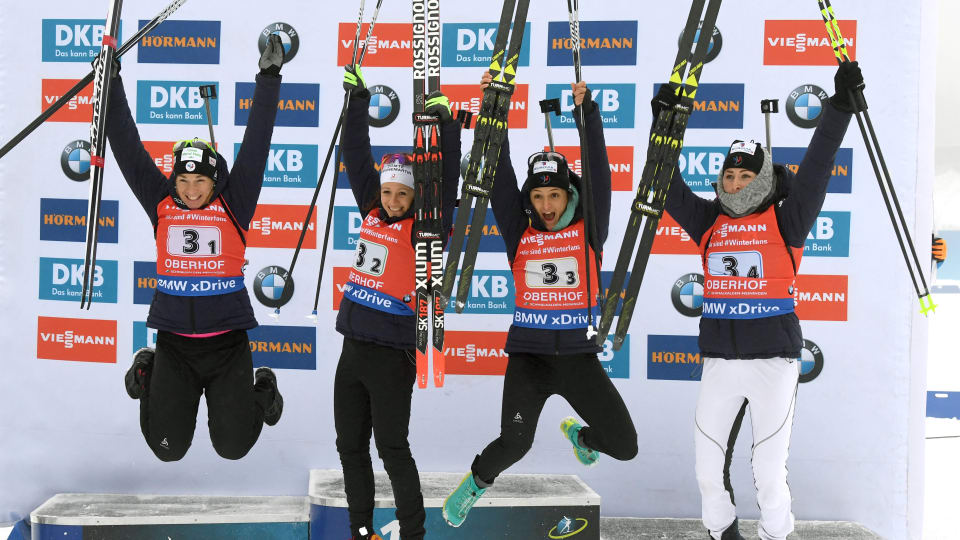
In the women’s 4 x 6 k relay on Sunday, Italy won in a time of 1:10:58.7 hours after using three spares. Italy’s team consisted of Lisa Vittozzi, Alexia Runggaldier, Dorothea Wierer, and Federica Sanfilippo.
Sweden placed second (+8.4) using eight spares. Linn Persson, Mona Brorsson, Emma Nilsson, and Hanna Öberg raced the four legs.
Anais Chevalier, Julia Simon, Celia Aymonier, and Anaïs Bescond placed third for France finishing 11.8 seconds back while using nine spares.
The U.S. team of Joanne Reid, Susan Dunklee, Clare Egan, and Deedra Irwin placed 13th (+3:39.1) using nine spares and skiing one penalty loop.
Canada’s women’s team of Megan Tandy, Megan Bankes, Nadia Moser, and Rosanna Crawford placed 16th (+5:19.3) with two penalties and using 13 spares.
The men’s 4 x 7.5 k relay was won by Sweden’s Peppe Femling, Martin Ponsiluoma, Torstein Stenersen, and Sebastian Samuelsson in 1:16:10.6 hours using five spares.
Lars Helge Birkeland, Henrik L’Abee-Lund,Tarjei Bø, and Vetle Sjåstad Christiansen of Norway placed second (+3.6) using seven spares. For Germany, Simon Schempp, Johannes Kuehn, Arnd Peiffer, and Doll Benedikt were third (+28.8) with a single penalty and using six spares.
The U.S. team of Leif Nordgren, Sean Doherty, Travis Cooper, and Jake Brown placed 12th (+2:33.6) using 10 spares.
Canada’s Scott Gow, Brendan Green, Jules Burnotte, and Nathan Smith placed 20th (+5:13.0) with three penalties and using 14 spares.
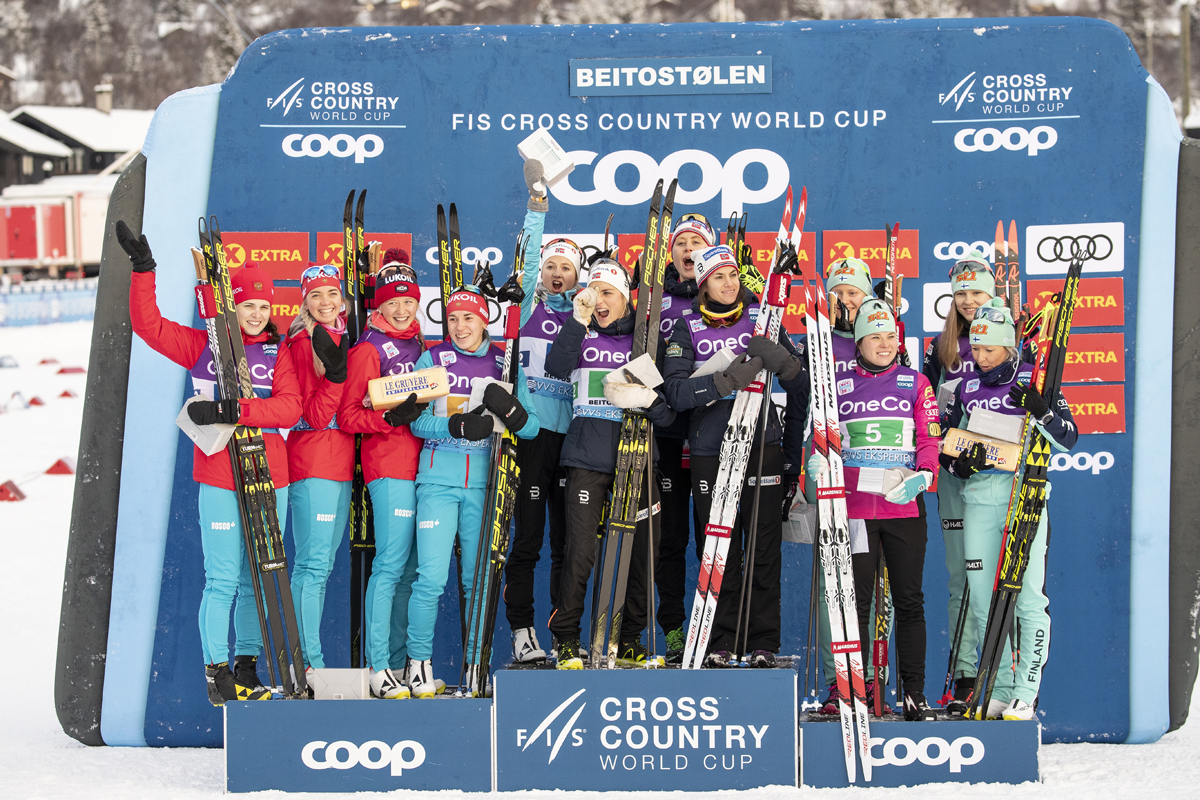
The women’s podium from the 4 x 5 k relay in Beitostølen, Norway. Norway I (center) placed first, Russia II (left) was second, and Finland I (right) third. (Photo: Fischer/Nordic Focus)
For Norway, relays are often tallied not by wins, but how many wins have been missed. Back in 2009, Team Norway watched on as Team Sweden took the top spot of the podium for the women’s 4 x 5-kilometer relay event in Beitostølen, Norway.
In the nine years after that second place finish in Beitostølen, the Norwegian women’s team has missed winning the World Cup relay–excluding team sprints–only one other time (FIS reports that as having been in 2011, when Italy won the Rybinsk, Russia 4 x 5 k).
This December marks the first time Beitostølen has hosted a World Cup race since the team, back then comprised of Vibeke Skofterud, Therese Johaug, Kristin Strørmer Steira, and Marit Bjørgen, placed second in 2009. Though the goal of top relay performances has not changed, changes within Norway’s team itself are palpable.
Skofterud passed away this summer after a jet skiing accident. Strørmer Steira, married to Canadian Devon Kershaw, retired in 2015. Bjørgen announced her retirement last spring. Johaug served an 18-month ban from ski racing and came back to competitions this year. She is the only name to return to the relay team and Beitostølen since the city last hosted World Cup competitions nine years ago.
Sunday’s win marks if nothing else, Norway’s reclaiming of what they see as theirs.
“It’s really nice to have a race in Beitostølen we have a lot of good memories here – all of us,” Johaug said during a FIS post-race interview. “We all did a really good job today and its beautiful to ski with these ladies.”
Norway’s Heidi Weng (left) and Sweden’s Evelina Settlin (right) lead the women’s 4 x 5 k relay train Sunday in Beitostølen, Norway (Photo: Aleks Tangen)
Taking out the Norwegian’s first classic leg was Heidi Weng. Weng hung tightly to the front group until around 3.5 k, when Sadie Bjornsen of the U.S. Ski Team and Russia’s Team I, leg one skier, Yulia Belorukova, began to push the pace.
By the time the women came through for the first exchange, Belorukova and Bjornsen had put a 7.3 second gap on Weng and a 13 second gap on the chasing teams’ skiers, Lidia Durkina of Russia II and Anna Svendsen of Norway II.
“At the beginning, when I was leading, I felt like it was pretty clear that those girls were going to stay in a mass behind me,” Bjornsen told FasterSkier during an in-person interview after the race. “So I tried to stay near the front…then [I said] ‘I’m going on attack mode on the second-half because maybe I can break some people then,’ and it worked out.
“It was a little frustrating to have some people stick in there that I wanted to break harder,” Bjornsen added. “But it was nice to have Belorukova to work back and forth with to push all the way to the end.”
Sadie Bjornsen of the U.S. Ski Team followed by Norway’s Heidi Weng during the women’s 4 x 5 k relay in Beitostølen, Norway (Photo: Fischer/Nordic Focus)
At the start of the second classic leg, it was Natalia Nepryaeva skiing for Russia I in the lead, followed by Rosie Brennan of the U.S. less than a second back positioned in second. The second classic skier for Norway I, Johaug, was positioned 8.2 seconds back through the first kilometer. Chasing down the top-three, 20 seconds back, was Astrid Uhrenholdt Jacobsen skiing for Norway II in fourth, and Russia II’s skier Anna Zherebyateva in fifth.
Within the next kilometer and a half, Johaug had closed the 8 second gap separating her from the U.S. and Russia I. By the race’s 8.5 k mark, Johaug was up on Brennan by almost 14-seconds and looking ready to bury Nepryaeva, who lagged just 1.4 seconds behind the Norwegian.
As Johaug came into the stadium to tag off to her teammate Ragnhild Haga for the first freestyle leg, she was alone. Nepryaeva skied in 9.4 seconds behind Johaug to hand off to Anastasia Sedova. Along with Johaug, Brennan had also been passed by Russia II’s Zherebyateva, Norway II’s Jacobsen and Finland I’s Krista Pärmäkoski having dropped down to sixth, handing off to Caitlin Patterson 29 seconds back from the race leader.
Therese Johaug of Norway leading the U.S. Ski Team’s Rosie Brennan during the 4 x 5 k relay in Beitostølen, Norway (Photo: Fischer/Nordic Focus)
“I’m a little frustrated, I think I have more to give than I did today, I struggled a little bit with my skis, maybe I didn’t have my top form, but it was something to work with and a good starting place, so hopefully I can make some improvements,” Brennan told FasterSkier.
“I mean, I think I skied fairly even, I think it’s just really hard to ski by yourself out there, there was a lot of drafting,” she continued. “Once you’re on your own it’s easy to get swallowed up by the next pack, so hopefully next time I won’t be on my own, I’ll stick with the leaders.”
In the third leg, Haga held onto the lead by a 15 second margin for most of the 5 k. By the time she came through for the final exchange, Haga had 11.6 seconds on her closest challenger, Sedova. Thanks to a hard push from Finland’s Pärmäkoski in the second leg, the Finish Team I’s third skier, Ritta-Liisa Roponen came through the final exchange in third, 0.6 seconds behind Sedova and 12.2 seconds away from Haga.
Patterson had maintained the sixth position, handing off to the U.S.’s anchor leg, Jessie Diggins 53.9 seconds back from the race leader, Norway I.
“This is the first time ever that I’ve been on the relay; I’ve been on a few little team sprints here and there, so this is pretty sweet,” Patterson told FasterSkier. “In my own performance, I can see a lot of potential for improvement…I could see so many people up in front of me, but just didn’t quite have the legs to chase them down, so I see a lot of potential for improvement and you never know on a different day, so I hope I’ll get another chance.”
Caitlin Patterson (right) tags off to U.S. teammate Jessie Diggins during the 4 x 5 k relay in Beitostølen, Norway (Photo: Aleks Tangen)
Taking out the final leg for Norway I, Ingvild Flugstad Østberg held off any challengers and continued to pad the team’s gap on the field. She crossed first for the win in a time of 57:23.6.
Though it seemed as if Russia I were on their way to a podium finish on Sunday, a fall from their anchor Anna Nechaevskaya in the course’s last turn placed them off the podium in fourth (+40.9). Russia Team II’s anchor skier, Elena Soboleva, passed her fellow compatriot to claim second place, 37.3 seconds behind Norway I.
The third and final podium position went to Finland I, with Eveliina Piippo closing out the final leg and finishing 37.8 seconds behind the race winners.
The U.S. placed fifth (+48.0) with Diggins serving as the team anchor.
“It was interesting [be]cause I went out full on sprinting trying to shut down a gap,” Diggins said.
However, Diggins indicated that due to the flat course and the skiers she was positioned with, Sweden’s Ida Ingemarsdotter and Norway II’s Tiril Udnes Weng, she decided to change her strategy.
“So I was charging, but then I realized I wasn’t going to be able to drop the girls I was with…so then, about a third of the way through I just totally changed tactics and went to the back and was drafting, trying to conserve energy, build up my plan for the sprint [to the finish].
“Rounding the corner and seeing Russia [I’s Nechaevskaya] right there, I was like ‘dang it, I wish I had kept pushing super hard,’ I had no idea how close we were going to be. But at the moment I made the best tactical choice I could, which was to beat the group I was with,” Diggins said. “I think it was a really good day and it’s always a good chance to practice those practical decisions and making the right move at the right time.”
The U.S. women’s 4 x 5 k relay team from Beitostølen, Norway. The team of (from left to right) Caitlin Patterson, Sadie Bjornsen, Rosie Brennan, and Jessie Diggins placed fifth. (Photo: Aleks Tangen)
A second U.S. relay team of Sophie Caldwell (USST), Ida Sargent (USST), Kelsey Phinney (SMS T2), and Kaitlynn Miller (CGRP) did not start, as Caldwell is working through “a resurgence of symptoms from the end of her cold.”
“We were very close today on the women’s side,” U.S. Ski Team World Cup coach, Matt Whitcomb wrote in an email to media outlets. “The goal is always to podium. Sadie knew it would be tough to break the lead pack, but her mission was to turn the screws hard. She has a lot of confidence in her fitness right now, and her pace took Sweden out of the podium hunt.”
Sweden ended the day in sixth, 50.0 seconds back from Norway I.
“Rosie’s leg was particularly stacked today, and she did a good job staying as close to the podium as possible on a course with a profile that’s a bit flat for her,” Whitcomb continued. “Today was Caitlin’s first start in a World Cup relay, and she’s an athlete we’ve been wanting to see get some relay experience. While her time was 8th on her leg, not yet good enough for a podium team, she demonstrated that she is close. I’m happy we selected her for the third leg today.
“Jessie was put in a position she thrives in today. Regardless of place, her leg was an invaluable experience to sharpen her relay game,” he added of Diggins’ performance on Sunday. “She was both aggressive and tactical, and had she been only aggressive, we would’ve finished 7th. I was very impressed with her ability to adapt her plan mid-race. I’m particularly excited for her sprint in Davos next week.”
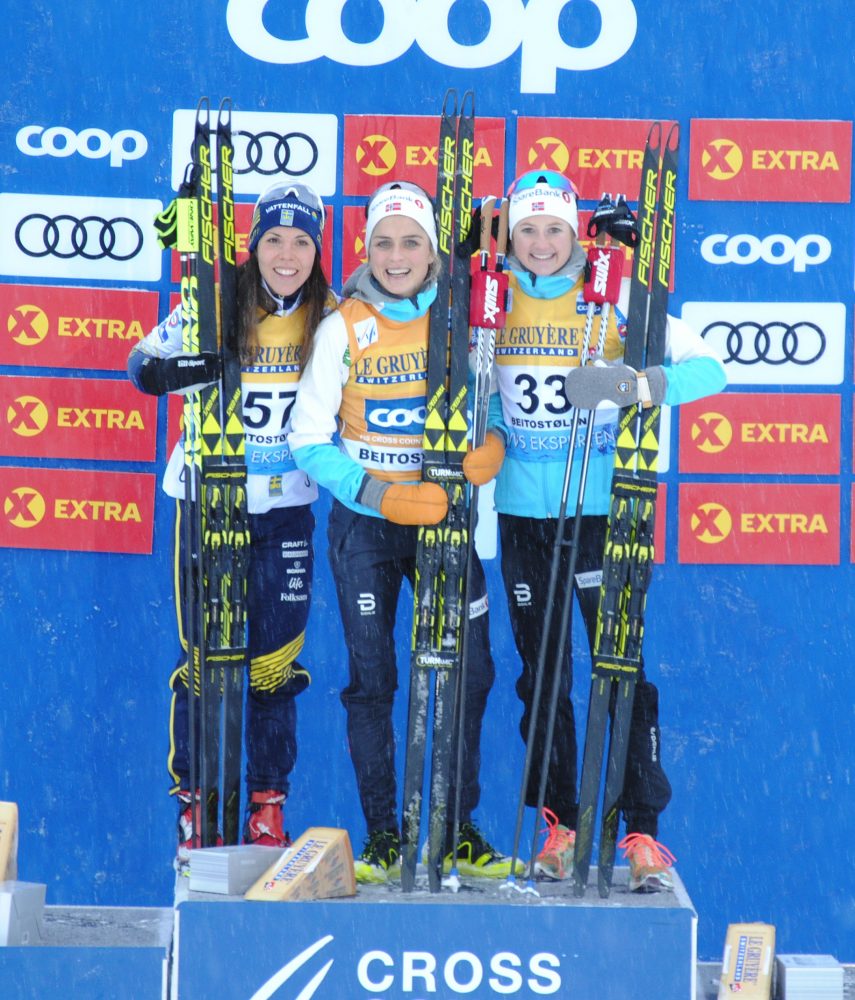
The Women’s podium from the World Cup 15 k freestyle in Beitostølen, Norway. Norwegian Theresa Johaug (center) was first, Sweden’s Charlotte Kalla (left) second, and Ingvild Flugstad Østberg (right) of Norway third.
FIS World Cup Beitostolen, Norway 15 k/30k Freestyle Individual Start
With snow falling and trees covered with fresh snow, Beitostølen, Norway’s wintery essence was on full display during the women’s 15-kilometer freestyle individual start on Saturday.
Keeping her distance win-streak alive was Norway’s Therese Johaug who won her fourth World Cup distance race of the season making it four for four in 2018/2019.
Jessie Diggins of the U.S. Ski Team on her way to eighth place during Saturday’s 15 k freestyle in Beitostølen, Norway.
Johaug won in a time of 38:39.8 minutes. The only blip of egalitarianism on the tracks was at the first time check at 1 k, where Johaug was tied for the best time with Russia’s Natalia Nepryaeva. Otherwise, Johaug gradually pulled away from the fifty-eight finishers by the time she crossed the finish line.
Sweden’s Charlotte Kalla placed second (+1:05.9), and Ingvild Flugstad Østberg of Norway was third (+1:06.1).
U.S. Ski Team (USST) athlete Jessie Diggins finished in eighth (+1:29.6) for her first top-10 result of the season. Sadie Bjornsen (USST) placed 13th (+2:22.9), Rosie Brennan 15th (+2:33.9), Caitlin Patterson (CGRP) 32nd (+3:46.0), and Kaitlynn Miller 50th (+5:02.8).
Canada entered a women’s team for the first time this season. Emily Nishikawa of the Canadian National Team (CNT) was the best placed Canadian in 34th (+4:01.6). Cendrine Brown (CNST) was 38th (+4:16.4).
Sitting atop the men’s overall World Cup this season after Saturday’s racing is Russia’s Alexander Bolshunov. The young skier is a killer in the sprints and distance events. But it is perhaps Norway’s Sjur Røthe who has impressed the most this season in the distance events. Røthe has a slight seven-point lead in the distance overall.
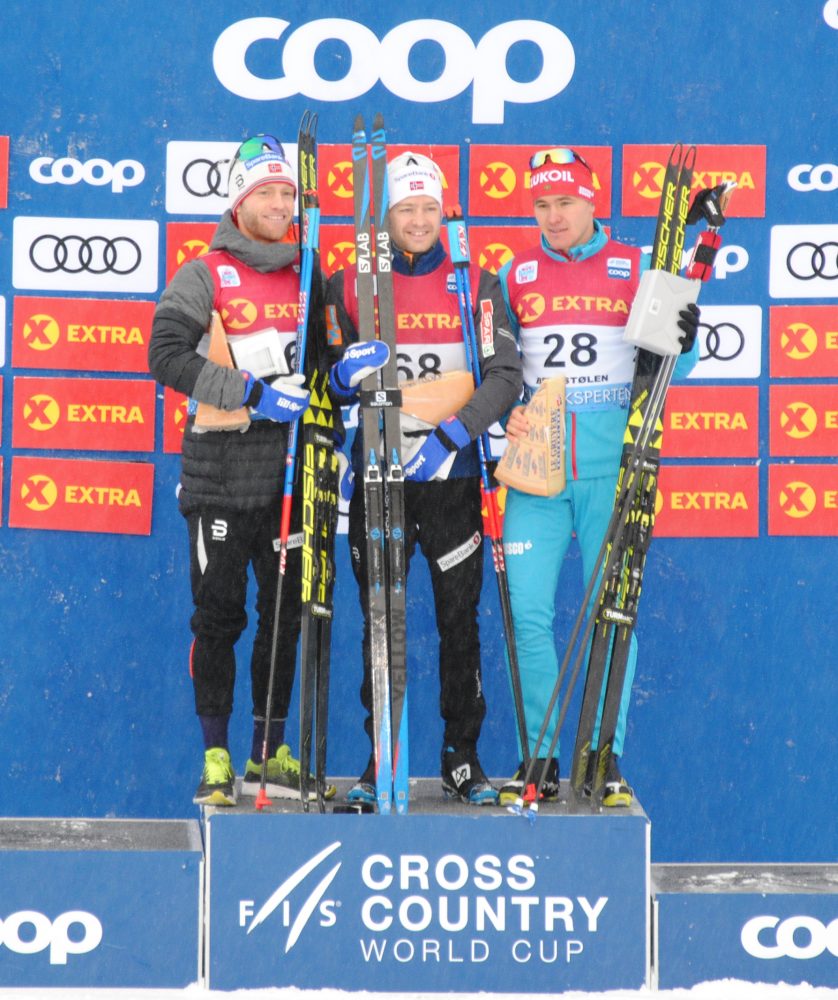
The men’s podium from the 30 k freestyle individual start in Beitostølen, Norway. Sjur Røthe (center) placed first, teammate Martin Johnsrud Sundby (left) second, and Russia’s Andrey Melnichenko (right) third.
Røthe won Saturday’s 30 k skate individual start in a time of 1:09:53.5. It was his second World Cup victory this year. Teammate Martin Johnsrud Sundby, with his first podium of the season, placed second (+35.2), Russia’s Andrey Melnichenko was third (+49.2). For the twenty-six-year-old Melnichenko, it was his first career World Cup podium.
Canada’s Alex Harvey was the best placed North American in 13th (+1:49.8). Also skiing for Canada, Andy Shields finished in 63rd (+7:05.6).
Scott Patterson (USST)was the best-positioned skier for the U.S., placing 47th (+4:32.7). David Norris (APU)skied to 51st (+5:13.3.) Erik Bjornsen (USST) was 52nd (+5:14.9), Adam Martin (CGRP) 59th (+6:14.8).
Egan Leads North Americans in 15th Place in Pokljuka Sprint.
Just before her race on Saturday, US Biathlon’s Clare Egan seemed to be in a relaxed mood and could be seen on the broadcast joking with other athletes and posing for pictures in the warm-up zone. Starting into the women’s 7.5-kilometer sprint in an early group in bib 26, Egan began the race fast and still managed to shoot clean in her prone stage.
She kept near the top at the split times during this early phase of the race.
“I am skiing way faster than I have in past years,” Egan commented on her improved course time in an email to FasterSkier, which in past seasons occasionally had prevented her from achieving positions in the points or qualifying for pursuit and mass start races. “I think my previous best ski time was in the 20’s, but my average was probably in the 50’s. So to have 11th ski time in the Individual [on Thursday] and the 6th today is a very significant improvement for me. It means that I can now aim for the flower ceremony, and even the top of the podium.”
In the standing shooting stage she then missed her very last shot of the race, having to ski once through the 150-meter penalty lap. After another fast final loop she came to the finish in fourth place. But after several athletes who began the race later finished ahead, she was pushed down in the standings, ultimately ending her day in 15th position (+1:08.8, 0+1). According to Egan she only narrowly missed a career-best result, having finished in 13th place in the sprint in Kontiolahti, Finland, during the last season.
“Today I would have been 4th or 5th if I had hit my last shot,” Egan wrote. “Overall my shooting is there, and now my skiing is too, so I just need some more races to get comfortable in this position. I really fought for my last two shots today and I got the 9th one and I’m very happy about that. Also my prone was perfect and I don’t take that for granted. I am focusing on the positive things and learning what I can to do better next time… which is tomorrow!”
Behind Egan, her teammate Susan Dunklee also had drawn a spot in the first start group starting early in bib 2, and remained clean in the prone stage as well. But in her second shooting she incurred two penalty laps, and ultimately ended her race day finishing in 45th place (+1:50.4, 0+2). The third U.S. starter, Joanne Reid, finished 57th with two penalties (+2:06.8, 1+1).
“Our whole women’s team did excellent training and it is paying off: last year at World Cup 1, zero American women qualified for the pursuit, whereas all three of us did today,” Egan commented.
She also credited their revamped coaching staff around which centers around Armin Auchentaller. Auchentaller spent the last few seasons coaching the Swiss women’s team.
“And it’s worth noting that with Susan’s 11th place in the Individual, we’ve now had two women go in the top-15 already in the first two races of the year (which is likely a first for US Biathlon). We are proud of ourselves and motivated to keep climbing. As usual, our ski service team is on fire. Tomorrow we’ll go for it again in the pursuit!”
For Biathlon Canada it was a difficult day on the shooting range overall, with Megan Tandy posting the best result in 73rd place (+2:46.6, 0+2). Her teammates Rosanna Crawford finished 77th with four penalties (+2:52.1, 2+2), Nadia Moser was 88th (+3:42.1, 2+2) and Megan Bankes was 99th (+4:39.6, 1+4). All missed qualifying for the pursuit on Sunday.
About a minute ahead of Egan, the race was won by Finland’s Kaisa Mäkäräinen in a time of 20:08.1 minutes, with no penalties.
“I enjoyed today,” last season’s Overall World Cup winner Mäkäräinen commented in thepress conference. “I really tried to be confident. … Of course it gives you a lot more energy when you shoot clean. I know if I shoot clean that I can fight for the top positions. … But I still had to work hard and had a good last loop.”
In the finish she was 14.8 seconds ahead of Italy’s Dorothea Wierer, who also had no miss and recorded the fastest shooting time on the range on Saturday, but couldn’t match her Finnish rival on the course. Hitting all targets as well, Justine Braisaz of France finished third (+42.1, just two days after ending the individual race only in 82nd place with seven penalties. That’s the ups and downs of biathlon. Also shooting clean and just off the podium was Braisaz’s teammate Julia Simon in fourth place (+44.6), for her first top-ten result in a World Cup. Wierer’s teammate Lisa Vittozzi was fifth with one penalty (+46.9, 0+1).
Julia Kern (SMS) leads Dahria Beatty (CNST) into the final straight in the A final. (Photo: Peggy Hung)
Sovereign Lake Noram/SuperTour, Vernon, BC
North American racing resumed with free technique sprints at Sovereign Lake. The first weekend of the NorAm series was also the second weekend in the SuperTour.
SMS’s first year senior Julia Kern continued her strong start to the season, winning the qualifier and the A final and looking dominant throughout. National team member Dahria Beatty kicked off her season with a crash in the qualifier, but got up to finish 7th. Dartmouth and AWCA’s Laura Jortberg was in third, followed by national team member Maya MacIsaac-Jones. APU’s Hannah Halvorsen was fifth and Stratton Mountain School’s (SMS) Erika Flowers trailed in last after breaking a pole on the final downhill corner.
Andy Newell leads Antoine Briand into the finish straight in the A final. (Photo: Peggy Hung)
On the men’s side, Andy Newell (SMS) continued the American domination, winning the qualifier in 2:15.180, 4.050 seconds ahead of APU’s Logan Hanneman, before winning all of his heats comfortably. Antoine Briand represented for Canada and the Centre National d’Entrainment Pierre Harvey (CNEPH), placing second to Newell in every heat. Ben Saxton (SMS) completed the podium, edging out APU’s Logan Hanneman in a four way battle for third. Antoine Cyr (CNST) and Ben Lustgarten (Craftsbury Green Racing) trailed in two ski lengths behind.
“It was a cascade of issues,” jury member Dave Dyer told FasterSkier.
The short, short version is that the timing system has a number of redundant systems to detect errors. While the timing team was working on an unrelated issue, two athletes tied exactly. There are two sets of results zone4: the provisional (timed to 1/1000ths of a second) and the official (timed to 1/100th of a second). The bib list was generated from one list and the zone4 live timing database was populated from the other, with the two skiers who were tied shown in different order. From this point on, all the backup systems indicated errors and everything had to be hand checked. The results were right, the right athletes advanced, but live timing was switched off and delays ensued.
Full details and video interviews will be in Monday’s event wrap-up.
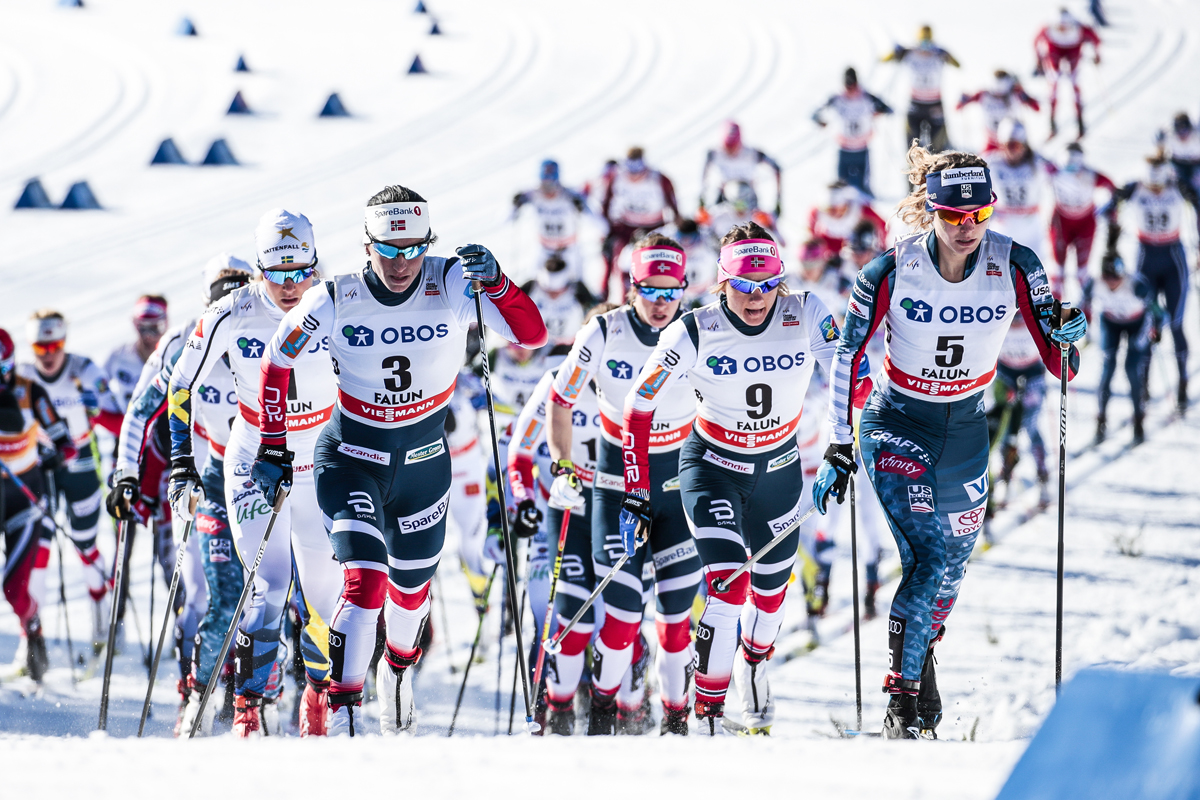
American Jessie Diggins (5) and Norway’s Marit Bjørgen (3) and Maiken Caspersen Falla lead early in the women’s 10 k classic mass start at World Cup Finals in Falun, Sweden. (Photo: Fischer/NordicFocus)
FALUN, Sweden — To those watching, even to those racing, the winner was the woman who had led most of Saturday’s 10-kilometer classic mass start: Norway’s Marit Bjørgen.
“Marit and Tiril [Udnes Weng], another Norwegian young girl, they were skiing really fast and I thought that they would be first and second,” Norway’s Ingvild Flugstad Østberg told FasterSkier after the race.
Seven minutes after the start gun, Bjørgen had moved to the apex of the field and there she seemed intent to stay.
No doubt, the 37-year-old Norwegian holds a close relationship with the 10 k classic event. Over the course of her World Cup career, she has amassed 31 podiums in the distance/discipline, 16 of those being in first place.
Last year in Lahti, Finland, Bjørgen was crowned the 10 k classic world champion, and she also holds the 10 k classic World Championships title from 2011. At the 2006 Olympics in Turin, Italy, she earned silver in the 10 k classic event. The next time a 10 k classic was featured at the Olympics, in 2014 in Sochi, Russia, she finished fifth.
With substantial backing, Bjørgen seemed well on her way to another 10 k classic win at 2018 World Cup Finals on Saturday in Falun. Finland’s Krista Pärmäkoski may have not looked like a real threat — until the finishing stretch.
In the corner before the final 100 meters, Pärmäkoski pulled up just behind Bjørgen. Just two kilometers earlier, the Finn had been skiing two seconds off of the Norwegian’s pace.
Backtracking to the race’s halfway mark, Pärmäkoski had been even farther behind Bjørgen. Three seconds had separated the chase pack from Bjørgen and Tiril Udnes Weng, who led the race at 5 k. At that point, Sweden’s Charlotte Kalla had been spearheading the charge to close down the gap, while Pärmäkoski skied in fifth, almost one second back from Kalla and four seconds back from Bjørgen.
Even earlier in the race, when Bjørgen made her move to the front at 3.75 k, Pärmäkoski, who had started in bib 32, was 19 places out of first.
“I had to start so much behind the others,” Pärmäkoski told FasterSkier, referring to her bib number, which was based on her finish in the opening race of the World Cup Finals, Friday’s freestyle sprint.
“But my body worked very well today … and I had really good grip and glide [with] my skis,” Pärmäkoski continued. “I passed the other athletes when we got to the downhill, the long downhill.”
By the descent heading back toward the stadium, Pärmäkoski had passed Tiril Udnes Weng and moved around Kalla. Close to two seconds stood between her Bjørgen and Østberg, the latter of which had moved into second at the 7.5 k mark.
“I didn’t dare to look back and see how many girls were keeping up with [us] in front,” Østberg said.
If she had looked back, she would have seen the Finn firing on all cylinders.
By the descent back toward the stadium, Pärmäkoski had caught Østberg and hunted her next Norwegian. She closed in on Bjørgen in the corner just before the finishing stretch. Fifty meters to go and Pärmäkoski pulled up just alongside Bjørgen.
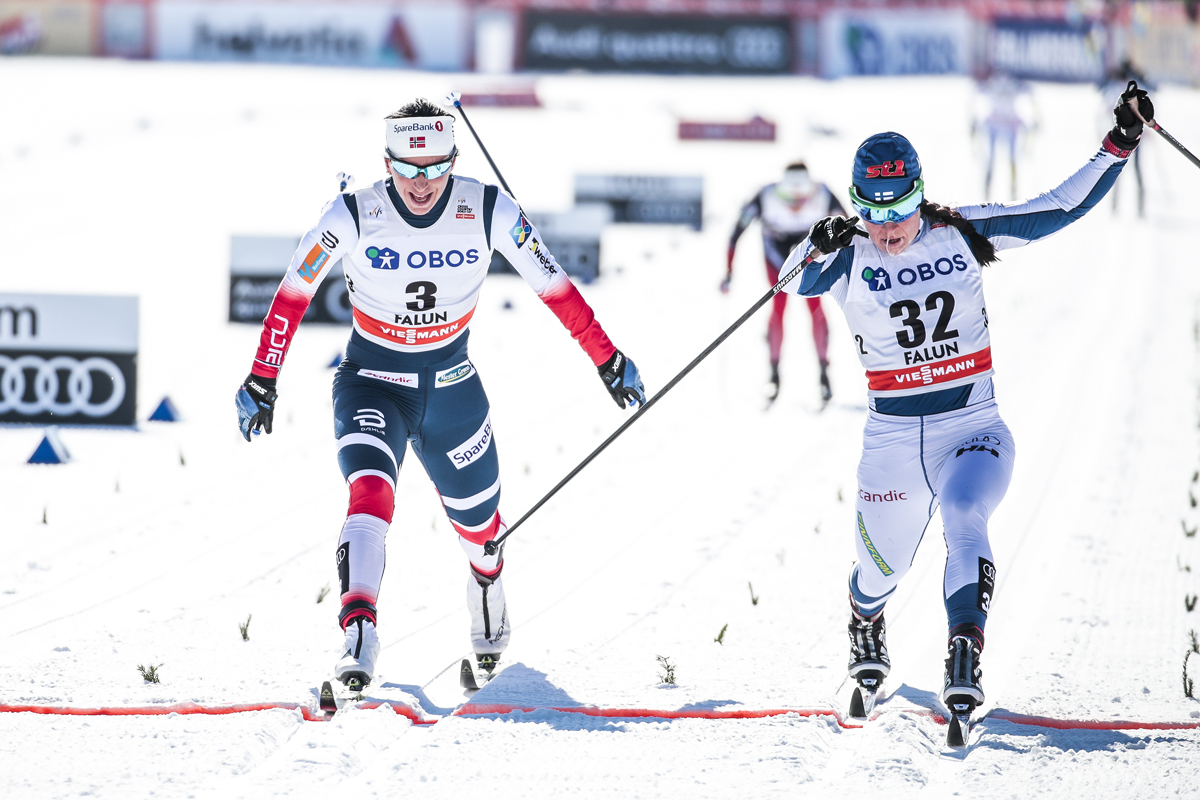
Finland’s Krista Pärmäkoski (32) edges Norway’s Marit Bjørgen for the win in the women’s 10 k classic mass start at 2018 World Cup Finals in Falun, Sweden. (Photo: Fischer/NordicFocus)
The two approached the finish line in tandem. Pärmäkoski, however, was stronger in the final double-pole push and nabbed the win by just 0.2 seconds over Bjørgen in a time of 26:00.5 minutes. Bjørgen took second behind the Finn in a time of 26:00.7.
“I thought that maybe I was stronger than her and I feel that I was doing a good finish, but she was stronger than me,” Bjørgen told FasterSkier, referring to the sprint finish between Pärmäkoski and herself.
“I thought Marit was gonna take it on the last 100 meters, but Krista was too strong,” said Østberg, who finished 5.1 seconds back in third.
The win is Pärmäkoski’s third 10 k classic title in a row this season. Her first came in Planica, Slovenia –which was also her first World Cup win — and her second came two weekends ago in front of a home crowd in Lahti.
For Østberg, the World Cup podium was her first since January.
“It’s been a while since I’ve been on the podium individually, in an individual race, so I was just so happy that I managed to finish in third place,” Østberg said.
Less than 10 seconds behind her, a pack of five surged to the finish line, with Sweden’s Ebba Andersson crossing in fourth (+14.5), Japan’s Masako Ishida fifth (+14.8), Kalla in sixth (+15.2), Austria’s Teresa Stadlober in seventh (+15.4) and American Jessie Diggins in eighth (+15.5). Exactly 1 second separated the five-skier spread, with Diggins bookmarking the tail end.
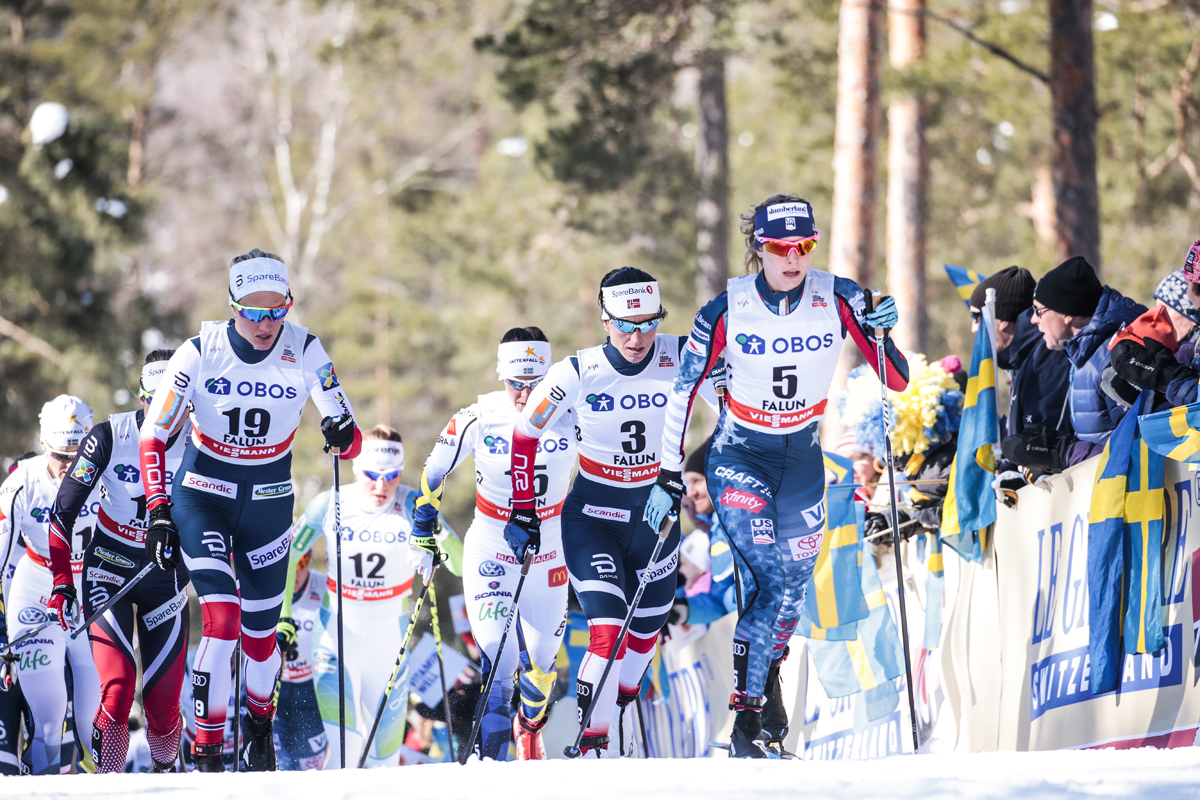
American Jessie Diggins leading the pack up an early climb with Norway’s Kathrine Rolsted Harsem and Marit Bjørgen just behind during the women’s 10 k classic mass start at World Cup Finals in Falun, Sweden. (Photo: Fischer/NordicFocus)
“I was a little bit bummed I didn’t quite have the same feelings in my body that I’ve been having,” Diggins told FasterSkier. “It wasn’t a bad race at all … I just was struggling to find that last gear. I know it’s there because it was there in the sprint yesterday. So I am just going to go hard tomorrow and see what I can do.”
Bjørgen currently leads the World Cup Finals mini tour and will be the first skier on course in Sunday’s 10 k freestyle pursuit. Starting 36 seconds after her will be Østberg in second, then Diggins, 41 seconds back in third.
In the Overall World Cup standings as well, Diggins ranks third with 1226 points. The American is 106 points behind Østberg in second and 213 points behind Norway’s Heidi Weng in first. At most, with a win, Diggins could score 200 points on Sunday. Behind her, Pärmäkoski is 112 points back in fourth.
“I am just excited to keep pushing hard and see if I can break through and get some new firsts for me,” Diggins told FasterSkier. “I am fighting for a good spot in the overall [World Cup] and in the overall distance [ranking] as well … it’s fun to try to do something new and definitely motivates me to keep fighting really hard. It kept me pushing for every second today.”
Diggins is also third in the Distance World Cup standings, 64 points behind Østberg in second and 43 points ahead of Pärmäkoski in fourth.
Rounding out the remainder of Saturday’s top 10 was Norway’s Astrid Uhrenholdt Jacobsen in ninth (+24.8) and Finland’s Kerttu Niskanen in 10 (+26.2). Just 0.1 seconds outside of the top 10 was American Sadie Bjornsen in 11th (+26.3).
American Sadie Bjornsen skiing just behind Germany’s Katharina Hennig during the women’s 10 k classic mass start at 2018 World Cup Finals in Falun, Sweden. (Photo: Fischer/NordicFocus)
This World Cup season has marked somewhat of a breakthrough season for Bjornsen, with the 28 year old earning her first distance podium and two classic sprint podiums.
On Friday, she appeared to be pulling for a podium again. Bjornsen charged hard to the front of the pack in bib 8, three bibs back from Diggins, who led the first 2 k of the race before Bjørgen took over.
When asked about the risk involved with taking such a race tactic and why she chose to do so, Bjornsen was thoughtful. Reflecting on her recent strong results in sprint qualifiers, she explained that she was testing “what can happen if I have no fear, if I have no fear of failing.”
“I keep trying to tell myself that in the distance races … any amount of fear really pulls you back from that podium potential. So this last week I made it a goal of mine to try to race from the gun and see if I can hang on,” Bjornsen said.
With this being the final weekend of World Cup racing until next season, Bjornsen also saw it as an opportune time for her to try going out harder at the start. In a sense, test her pacing in an insular way.
“It’s the best time of the year [for that],” Bjornsen said of a hot start. “You have nothing to lose. I definitely am fighting in the overall [World Cup] for places, too, but at the same time it’s not fighting for a podium. So if I absolutely explode, like I did today in the middle of the race, there is just no failing with that.
“I am learning how to [ski in the front] this year and next year I’m ready to come back and take that risk more often,” she added.
Bjornsen is currently ranked eighth in the Overall World Cup standings with 799 points. Ahead of her is Kalla in seventh (828), Bjørgen in sixth (835), and Stadlober fifth (836). In the distance standings, Bjornsen is 10th. She will start Sunday’s pursuit in sixth, 57.3 seconds after Bjørgen.
American Kikkan Randall tucking during the women’s 10 k classic mass start at 2018 World Cup Finals in Falun, Sweden. (Photo: Fischer/NordicFocus)
Also competing for the U.S. on Saturday was Sophie Caldwell, who placed 41st (+1:36.1), Rosie Frankowski in 44th (+1:43.7), Caitlin Patterson in 47th (+1:54.8), Kikkan Randall in 57th (+2:34.1), Kaitlynn Miller in 64th (+2:50.7).
In her final weekend of World Cup racing, Randall explained Saturday’s result was not quite where she hoped to be, partly as her body still felt the effects of Friday’s sprint effort.
“I always just like to end on a good note feeling like I just really raced hard and [with] regards to the results, feel competitive,” she said. “Yesterday was more along those lines, today was just hard, but it’s still good to be up here. Such a beautiful day for racing, perfect temperature, good tracks, good skis.”
Emily Nishikawa led Canada in 36th (+1:31.1), followed by Cendrine Browne in 50th (+2:05.7), Dahria Beatty in 61st (+2:46.6), and Zina Kocher in 69th (+6:12.0).
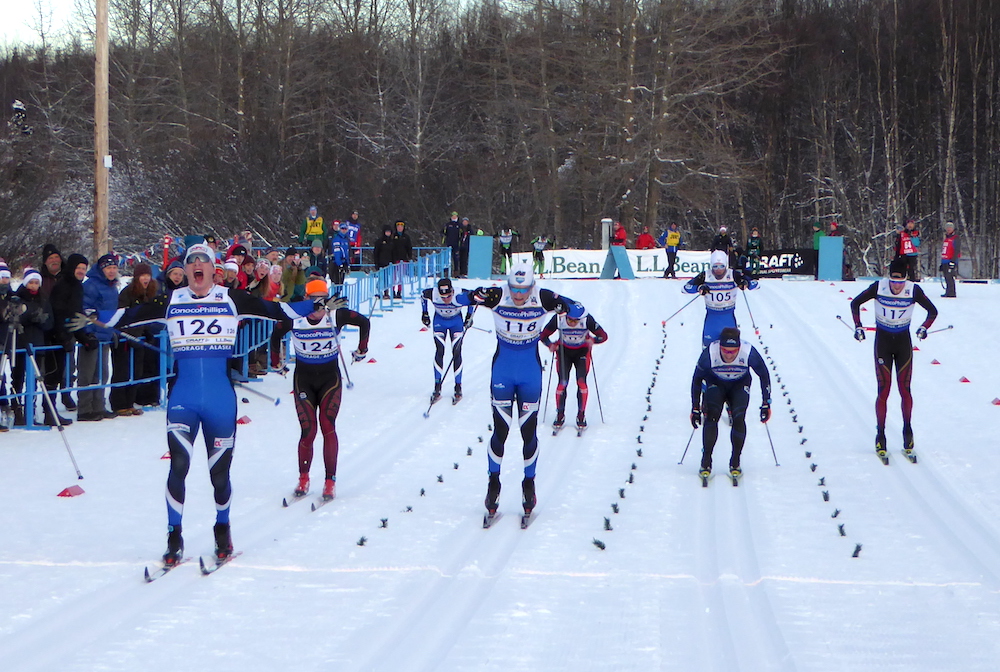
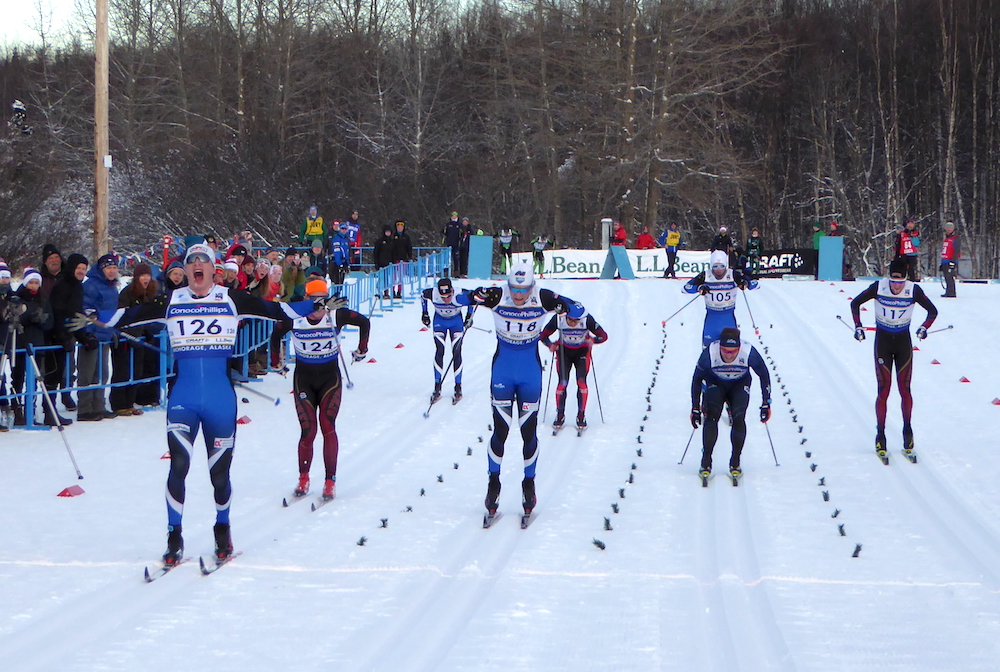
APU’s Tyler Kornfield (126) leads APU’s Eric Packer (118) and DU’s Eivind Romberg Kvaale (124) to the line in the men’s 30 k classic mass start at 2018 U.S. Cross Country Championships on Sunday in Anchorage, Alaska. Kornfield, Packer, and Kvaale finished first, second and third, respectively. Kris Freeman (10, second from left) was fourth overall and the third American.
U.S. Cross Country Championships (Anchorage, Alaska): 20/30 k classic mass starts
Sweden’s Hedda Bångman denied Caitlin Patterson of her first outright victory of the week at 2018 U.S. Cross Country Championships, but Patterson as the first American racked up her third-straight national title in the women’s 20-kilometer classic mass start at Kincaid Park on Sunday in Anchorage, Alaska.
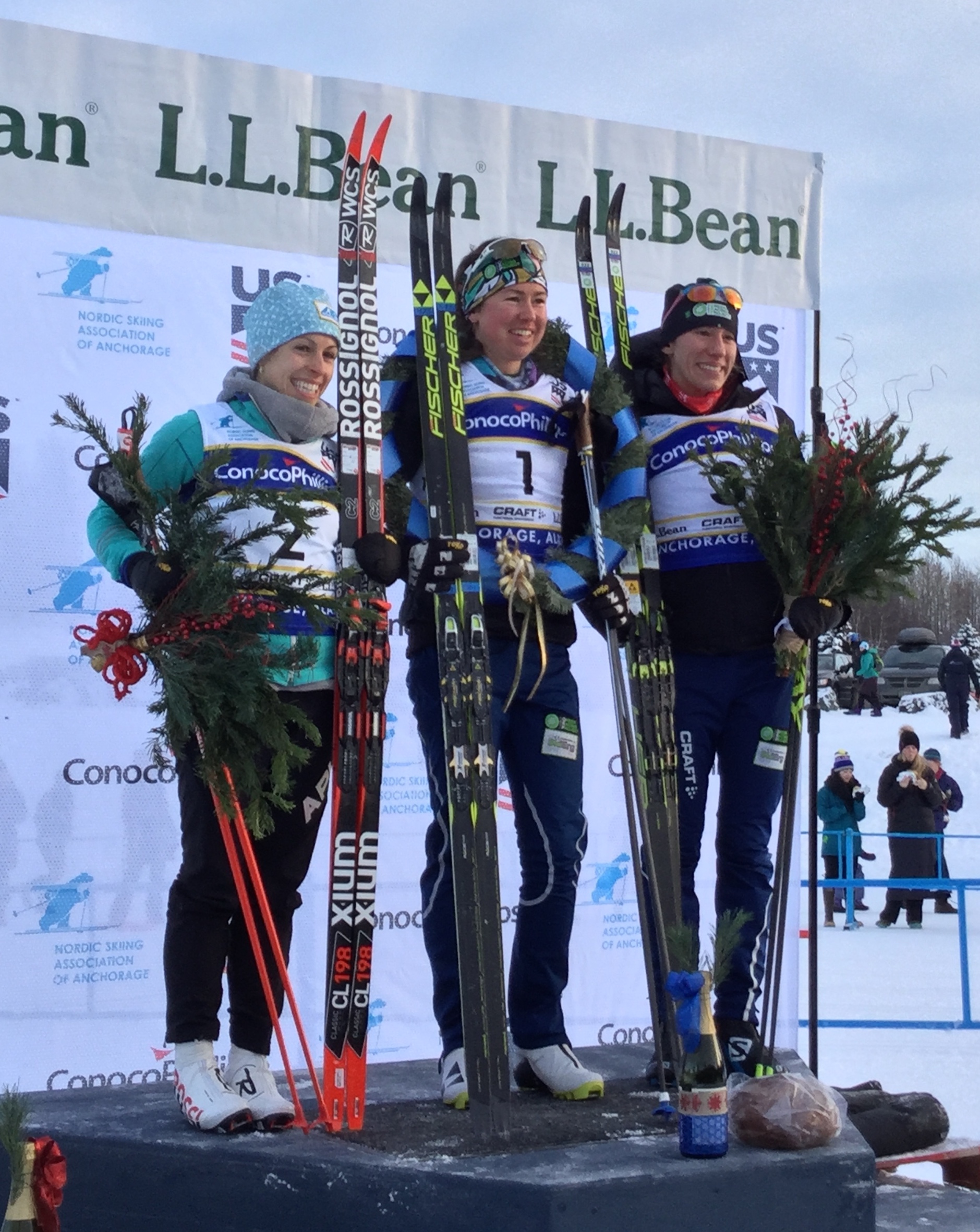
The top-three Americans in the women’s 20 k classic mass start on Sunday at 2018 U.S. nationals in Anchorage, Alaska, with Caitlin Patterson (1) of the Craftsbury Green Racing Project (CGRP) in first, Rosie Frankowski of APU (l) in second, and Kaitlynn Miller (r) of CRGP in third.
Bångman, a 22-year-old freshman at the University of Colorado Boulder (CU), pulled off a 15.9-second win in the mass start, crossing the line in 1:00:55.3 hours. Patterson, of the Craftsbury Green Racing Project (CGRP), finished second, but was the top American in the event for the third time this week, and Rosie Frankowski, of Alaska Pacific University (APU), notched third (second American), 19.6 seconds back.
Rounding out the top 10 was Jessica Yeaton, who trains with APU and races for Australia, in fourth (+44.1), Kaitlynn Miller (CGRP) as the third American in fifth overall (+1:13.5), Alayna Sonnesyn of the University of Vermont (UVM) in sixth (+1:25.3), Chelsea Holmes (APU) in seventh (+1:55.4), Norwegian CU skiers Christina Rolandson and Anne Siri Lervik in eighth (+1:55.7) and ninth (+1:56.1), respectively, and Erika Flowers of the Stratton Mountain School (SMS) Elite Team in 10th (+2:14.6).
The men’s 30 k classic mass start was incredibly close, with APU’s Tyler Kornfield taking his first-ever distance national title (he was the 2012 classic sprint national champion) in 1:21:43.6. He edged his teammate Eric Packer by 0.7 seconds at the line, and Eivind Romberg Kvaale, a sophomore at the University of Denver (DU), finished 1 seconds back in third.
Kris Freeman (Caldwell Sport) was just off the overall podium in fourth (+1.6), but was the third American. Another DU skier, Dag Frode Trollebø, also from Norway, finished fifth (+2.0), and APU had three in the top six with David Norris in sixth (+2.5). Noah Hoffman (Ski & Snowboard Club Vail) finished seventh (+2.6), Scott Patterson (APU) eighth (+3.6), and Craftsbury’s Adam Martin and Ben Lustgarten followed in ninth (+14.7) and 10th (+14.9), respectively. With Brian Gregg (CXC/LNR/Team Gregg) in 11th (+16.1), the men’s top 11 were separated by less than 17 seconds.
IBU World Cup (Oberhof, Germany): Men’s and women’s relays
Racers on the range during the men’s 4 x 7.5 k relay on a foggy Sunday at the IBU World Cup in Oberhof, Germany. (Photo: IBU/Biathlonworld)
The Swedish men’s team and French women won the second relays of the International Biathlon Union (IBU) World Cup season on Sunday, with Sweden winning the men’s 4 x 7.5 k relay by 1:10.8 over Italy, and France besting Germany by 32.4 seconds.
Notably, most of the top teams didn’t start all of their “A” teamers.
In the men’s race, Sweden’s Martin Ponsiluoma, Jesper Nelin, Sebastian Samuelsson, and Fredrik Lindström combined for their first win together — and the first win for most of the members on the team.
“It is a dream when you are a kid to compete in a World Cup,” Samuelsson said, according to an IBU press release. “To have a win is really amazing!”
The Swedish women’s team also landed on the podium in third (+48.2).
“What a race by the whole team,” said Lindström, who also has one non-relay World Cup win (from 2012) to his name. “It could not be better.”
Conditions could not have been much more difficult for shooting on Sunday, with the fog that had descended early in the day for the women’s race worsening for the men’s race. When there wasn’t fog, there was wind.
Misses were common throughout the two races, and even with racers being able to use three spares per shooting stage to clean, there were a high number of penalty laps.
But the Swedish men kept their penalties to a minimum, with just one for the entire team and a total of nine spare rounds used among them. After Ponsiluoma came through the first exchange in sixth, Nelin skied them into third, Samuelsson picked off another place despite skiing a penalty after his standing stage to put them in second, and Lindström anchored them to first.
“The conditions today were so special. Somehow I felt not so nervous, I was calm and had luck on my side,” Lindström said at a post-race press conference about his nearly flawless shooting (0+0; 0+1).
“I have never [been first] before,” he added. “Not like this in a relay at least. That’s really fantastic.”
“I had to look up to see if I was aiming the right way,” Nelin said after cleaning prone (0+0) then using two spares to clean standing (0+2). “I had no idea where I was aiming, so it was really difficult. But I hit, and it was good. Maybe these conditions fit me and I should never see anything.”
Italy placed second with Thomas Bormolini, Lukas Hofer, Dominik Windisch, and Thierry Chenal combining for two penalties and 11 spares. Hofer had skied them up from eighth to second, and Windisch then took the lead on the third leg to put them in first at the final exchange, 1 minute ahead of Sweden. But Chenal slipped with the seventh-fastest last leg time and a penalty after standing.
“Being on the podium with the team is always a special feeling,” Hofer said at the press conference. “For Thierry, it’s the first year in the World Cup, and he does a really good job, not just today. I am really happy that he could close out this relay. Second place is like a win for us.”
Norway placed third (+2:04.6) with Vetle Sjåstad Christiansen, Henrik L’Abée-Lund, Lars Helge Birkeland, and Tarjei Bø. Together, they had three penalties (two from L’Abée-Lund and one from Birkeland) and 14 spares.
“I grew up on Holmenkollen so I practiced a lot there [in fog],” L’Abée-Lund said. “But today was really really hard, I didn’t see anything in prone. Standing was OK, but prone was really difficult.”
“It’s great to be on the podium,” Christiansen said. “Of course Norway always wants to win, but today we are very happy for our brothers in our neighbor-country Sweden.”
The Canadian men placed 10th (+6:23.1) out of 25 teams with Christian Gow, Scott Gow, Brendan Green, and Carsen Campbell having a combined six penalties and 20 spares. Three of those penalties came on Scott Gow’s second leg, two from Campbell’s anchor leg, and one on Christian Gow’s first leg.
After a penalty on his first prone stage (1+3), Christian cleaned standing with a spare (0+1) and tagged Scott in 11th, 53 seconds out of first. Scott then had two penalties in prone and three in standing, but managed to improve to eighth given how much everyone else was struggling with the shooting as well. Green kept them in eighth with two clean stages (0+2, 0+3), and Campbell, in his first World Cup relay, cleaned prone (0+2) but had two standing penalties (2+3) to put the team in 10th at the finish.
In an interview with German broadcaster ARD halfway through the race, Canadian coach Matthias Ahrens called the range conditions, which ranged from thick fog to unpredictable wind, “very hard to assess.”
“… To be honest, the good thing was that conditions were very bad,” he later added. “So regarding visibility, almost everyone was on the range at the same time [with the same irregular conditions]. They had to wait very long, and of course had bad conditions to shoot, but much of the field was there at the same time.”
The French women’s team, of Anais Bescond, Anais Chevalier, Celia Aymonier, and Justine Braisaz, celebrate their relay victory on Sunday at the IBU World Cup in Oberhof, Germany. (Photo: IBU/Biathlonworld)
In the women’s race, with better shooting visibility, France’s Anais Bescond, Anais Chevalier, Celia Aymonier, and Justine Braisaz took the win in 1:12.42.4, with one penalty and 10 spares. After Bescond put them in first through the first exchange, 6 seconds ahead of Italy in second, Chevalier had to ski a penalty loop after prone but cleaned standings (1+3, 0+0) and tagged off in second, 23 seconds behind Italy, now in first.
One loop later, France was back in first thanks to Aymonier, who cleaned with just two spares (0+0, 0+2), and they extended their lead from 0.8 seconds at the last exchange to 32 seconds at the finish with Braisaz, who shot 0+1, 0+3, and skied the fastest anchor leg.
“I know that it’s always good for Justine to start in the first position, so I really wanted to pass the relay to her in that,” Aymonier said in a press conference after.
“I was nervous, too,” Braisaz said. “That kind of shooting turned my mind upside down, actually. The crowd was very loud, and … I wasn’t very focused on what I did. It was a bit foggy, too, so that made it harder. But finally it was a French day, maybe.”
“In my mind the whole team is really strong, and really able to get the first place,” Bescond said. “After years and years and years behind Germany’s team we finally did it. So just Oberhof spirit I think.”
Germany placed second with Vanessa Hinz, Denise Herrmann, Franziska Preuss, and Maren Hammerschmidt. They combined for two penalties and 13 spares; with a penalty on Hinz’s first leg and one more on Hammerschmidt’s last shooting. After being tagged in 14th, Herrmann skied them into fourth, 40 seconds out of first, and Preuss elevated them to second, which Hammerschmidt held onto.
“I was struggling a little bit in the prone shooting,” Herrmann said. “But the skiing was good today, and also the standing [shooting]. I tried to go fast on the track and catch some girls.”
Sweden, with Linn Persson, Anna Magnusson, Elisabeth Högberg, and Mona Brorsson, avoided the penalty loop and used eight spares to reach the podium for the first time in six seasons. In sixth place at the first exchange, they slipped one place to seventh on the second leg, but Högberg raced them up to fourth with near-perfect shooting (0+0, 0+1) with one leg to go. Brorsson then anchored them to third with clean shooting (0+2, 0+1) and the third-fastest last leg.
“It’s just super nice for us! I am super happy,” Magnusson said. “We were very emotional at the finish.”
When Brorsson was asked if she believe she could fight for the podium, she responded, “Not really. But I said to Linn, ‘Maybe it is our day today. Please let it be our day today.’ ”
The Canadian women finished 14th (+6:37.5), out of 20 teams, with two penalties and 13 spares. Sarah Beaudry initially put them in 15th after shooting 0+1, 0+2, then Julia Ransom had a standing penalty (0+2, 1+3) to slip one place to 16th. Megan Tandy picked off three places with clean shooting (0+0, 0+2) and tagged Emma Lunder in 13th, and Lunder had a penalty in prone but cleaned standing (1+3, 0+0) to finish in 14th.
The men’s overall 2018 Tour de Ski podium atop Alpe Cermis after the final Stage 7 hill climb: with Switzerland’s Dario Cologna (c) in first, Norway’s Martin Johnsrud Sundby (l) in second and Canada’s Alex Harvey (r) in third. (Photo: FIS Cross Country/Twitter)
Dario Cologna of Switzerland added a fourth Tour de Ski (TdS) title to his list of accolades on Sunday, winning the 2018 edition of the race in dominant fashion, with a 1:26.5-minute win over Norway’s Martin Johnsrud Sundby. And Canada’s Alex Harvey scored his first TdS overall podium in third.
The 31-year-old Cologna started the 9-kilometer freestyle pursuit up Alpe Cermis 1:15 ahead of Kazakhstan’s Alexey Poltoranin in second. Russia’s Sergey Ustiugov, slated to start third, did not start due to a back injury. Thus Harvey was the third man off the start line, 1:23 behind Cologna.
(Sweden’s Marcus Hellner, 13th after Saturday’s Stage 6, also did not start the Tour’s final stage.)
Early on, Cologna started putting time into his competitors, extending his lead on Poltoranin to 1:20.5 and Harvey to 1:24 at 1.8 k.
By 4 k, however, Harvey had used his speedy skiing on the flatter portions of the race leading up to the climb to catch Poltoranin, and the two clocked through that checkpoint 1:19.4 behind Cologna. Behind them, Russia’s Alexander Bolshunov skied just ahead of Sundby, another 21 seconds and 22 seconds back, respectively, in fifth and sixth.
While Harvey clawed back a few more seconds on Cologna, he was still 1:17.8 back at 6.2 k, with Poltoranin just 0.7 seconds behind him in third.
Harvey remained in second until around 8.5 k; with just a half kilometer to go, Sundby had caught both Poltoranin and Harvey, passing them both. Sundby held that position and finished second, 1:26.5 behind Cologna, who won in 28:52.1.
Harvey stayed strong for third (+1:30.6) while Poltoranin dropped off the Canadian’s pace in the final half kilometer and finished fourth (+1:41.7). Norway’s Hans Christer Holund placed fifth (+2:17.8), Bolshunov lost a spot to finish sixth (+3:09.7), France’s Jean-Marc Gaillard finished seventh (+3:16.7), Sweden’s Daniel Rickardsson eighth (+3:20.8), and Russia’s Alexey Chervotkin and Andrey Larkov took ninth (+3:33.5) and 10th (+3:37.8), respectively.
France’s Maurice Manificat, known for his strength in freestyle hill climbs and pursuit races, rose from 14th to 11th (+3:45.7) with the second fastest time of day, 12.8 seconds slower than Sundby as the time of day winner in 28:36.4. Cologna’s time was fourth fastest (+15.7), behind Russian U23 skier Denis Spitsov in third (+14.3) (Spitsov started 20th and finished 13th). Holund’s time ranked fifth (+20.6) and Harvey’s time was sixth fastest (+23.6) of the 43 men that finished the race.
The lone American man to complete this year’s Tour, Paddy Caldwell (U.S. Ski Team) skied the 22nd fastest time of day for 38th overall (+11:54.8).
Heidi Weng (center) celebrates her second Tour de Ski victory, with teammate Ingvild Flugstad Østberg second and the U.S. Ski Team’s Jessie Diggins third. (Photo: FIS Cross Country/Twitter)
In the women’s hill climb that kicked off the day, Heidi Weng raced to her second consecutive TdS title. The Norwegian started the day within two seconds of teammate Ingvild Flugstad Østberg, and the two skied together for the flat section of the nine-kilometer stage of the competition. But when the climbing got steep on Alpe Cermis, Weng left her teammate behind and eventually racked up a 48.5-second win.
The battle for third was less predictable. Jessie Diggins of the United States started the day in fourth, but made up the ten seconds to third-place KristaPärmäkoski of Finland in the first few kilometers. The pair climbed together for a while before Diggins attacked. Pärmäkoski tired on the final sections of the Alpe Cermis and Diggins took the podium in definitive style, 2:23.2 behind Weng and 24 seconds ahead of Pärmäkoski. It’s the first overall Tour de Ski podium for Diggins or any American athlete.
Teresa Stadlober of Austria finished fifth (+3:09.4), Kerttu Niskanen of Finland sixth (+4:17.0), Russia’s Anastasia Sedova seventh (+4:49.6), and Switzerland’s Nathalie von Siebenthal eighth (+4:56.1).
Sadie Bjornsen started eighth and slipped one spot to finish ninth (+6:15.0), giving the U.S. two top-ten finishers in the Tour de Ski for the first time. Liz Stephen finished 16th (+8:25.8) and Rosie Brennan 24th (+10:59.6).
En route to her win, Weng notched the fastest time of the day on the 9 k stage. Stadlober’s time was second, Diggins third, Østberg fourth, and Stephen fifth.
32 women finished this year’s edition of the Tour de Ski.
Heidi Weng (center) and Ingvild Flugstad Østberg of Norway and Jessie Diggins (right) of the United States atop the Tour de Ski podium on the Alpe Cermis. Diggins became the first North American to ever stand on the overall Tour podium, and Alex Harvey of Canada matched her feat a few hours later. (Photo: Val di Fiemme World Cup/Instagram)
The question wasn’t whether – it was when. Defending Tour de Ski champion Heidi Weng started the day with a two-second deficit to Norwegian teammate Ingvild Flugstad Østberg. But as one of the best climbers in the World Cup field, it was fairly certain that at the top of the Alpe Cermis, Weng would be crowned the Tour winner again.
The move came after about six and a half kilometers of the nine-kilometer skate pursuit starting in Val di Fiemme, Italy. Weng passed Østberg and then just kept going up the grueling Alpe Cermis, where grades approach 30%.
“I like to go in this climb,” Weng said in an interview with the Val di Fiemme media team. “It was really tough this year. I tried to stay focused and go very fast in the uphill. So I tried to get some speed in the last two kilometers. I was very stiff but I stayed focused. I heard my family and my mom and dad [cheering], so that’s very helpful to go fast!”
Tour de Ski winner Heidi Weng of Norway attacking the climb. (Photo: Val di Fiemme World Cup/Instagram)
Even though she had a big gap on Østberg by the finish – 48.5 seconds – Weng was still pushing hard, and collapsed at the line.
Østberg, too, pushed to the finish, picking up the pace on her V2 as she skied towards her winning teammate.
“I am very pleased to secure second place,” she told Norway’s NRK broadcaster, according to a translation. “I tried to fight with Heidi at the bottom of the hill, but… she was stronger than me up there. She was the strongest today. I had a day yesterday that ruined me a bit.”
Like in her first Tour de Ski title in 2017, Weng had to face neither Marit Bjørgen nor Therese Johaug as the race series wore on. Johaug has won the Tour de Ski twice and is currently serving a doping ban; Bjørgen has won once and is sitting out this year’s Tour to prepare for the Olympics, as are Swedish stars Charlotte Kalla (who won the 2008 Tour de Ski) and Stina Nilsson.
Diggins Grabs Historic Third Place for U.S.
The question of the day hadn’t really been about who would win – it was about what would happen after Weng crossed the line. A minute and a half behind the Norwegian pair at the start, Finland’s Krista Parmakoski tried to hold off American Jessie Diggins.
Diggins made up the ten seconds to Parmakoski in the first few kilometers, and the two skied together for the middle section of the race course. Beginning the climb, Diggins was leading but Parmakoski stuck close on her ski tails.
“I caught Krista maybe a third of the way on the flats and we traded leads, working together to go faster,” Diggins wrote in an email. “I love skiing with Krista – she’s an incredible racer and so tough, and really awesome to ski with.”
Game face: Diggins charging up the Alpe Cermis to her first Tour de Ski podium. (ARD screenshot)
Diggins made a move though, around the seven kilometer mark, and Parmakoski initially kept the gap small but then faded back and back.
“Honestly, I didn’t have a big plan for an attack on the climb,” Diggins explained. “My strategy was just to keep the tempo high, keep my body upright and leaning into the climb, and just keep moving. But on the ‘flat’ sections where we were weaving around gates, I noticed I was starting to pull away just a little bit, so I would push extra hard each turn and just keep my tempo up, and that’s how I gradually pulled away.”
Part of the reason was that Parmakoski had a problem with her left leg, which was made worse by the V1 climbing up the steep hill.
By the top of the climb, Diggins had just over 24 seconds on the Finn. She had turned in one of her better final climb efforts – collecting the third-fastest “time of the day”, just 41.9 seconds slower than the time posted by Weng, who not only won the Tour de Ski but also demolished the field in the climb itself.
“To get the third fastest time on the hill climb was a huge surprise for me, for sure!” Diggins wrote. “I woke up feeling good, drank way too much coffee, and stuck to my plan of catching up to Krista on the flats. I had AMAZING skis, so a huge thanks to Salomon and our incredible wax staff!”
As she skied towards the finish line, clearly exhausted, Weng and Østberg cheered her on. She finished 2:32.3 behind Weng. Diggins collapsed at the finish and the two Norwegians ran over to her to offer their congratulations.
Heidi Weng cheers as Jessie Diggins skis for the finish line atop the Alpe Cermis. (Photo: Val di Fiemme World Cup/Instagram)
“It was so cool coming into the finish, with Heidi and Ingvild cheering for me!” she wrote. “I love having friends from around the world and those girls are such awesome ski racers but most importantly, they’re great people and it was really fun to chat with them after. I’m really psyched for them!”
It was the first time a non-European athlete, man or woman, has stood on the final Tour de Ski podium.
“I’m really, really happy,” Diggins told the Val di Fiemme media team after the podium ceremony. “It’s really good for the sport in our country because we need to show our younger skiers that yeah, it’s possible, you can be a cross-country skier in America, and you can podium. So I hope this is really inspiring for all the younger cross-country skiers back home.”
Parmakoski finished fourth, +2:57.7. And with the Tour de Ski concluded and its points divvied out, Diggins is now third in the overall World Cup standings, too. The conclusion of the Tour de Ski was also a major payday for her: she earned 1000 Swiss Francs ($1025) for having the third-best time of the day, 1300 Francs for being third in the Tour de Ski sprint standings, and 23,850 Francs for being third in the Tour itself.
Teresa Stadloberof Austria finished fifth (+3:09.4) in the Tour de Ski, notching the second-fastest time on the stage (41.3 seconds behind Weng’s split) in a valliant effort to catch Parmakoski in case she faltered any further.
Kerttu Niskanenof Finland was sixth (+4:17.0), Russia’s Anastasia Sedova seventh (+4:49.6), and Switzerland’s Nathalie Von Siebenthaleighth (+4:56.1).
Bjornsen Ninth as Four Americans Finish Tour
American Bjornsen had started eighth, and along with Von Siebethal – who started ninth – skied up to Sedova. That had actually been a plan between the American and the Swiss.
“One thing I learned that I learned on the third day of the Tour [was that] if you are going to catch someone in front of you, you kind of have to do that in the first kilometer because after that everyone is just going at a hot pace,” Bjornsen said in an interview. “So today I went to talk to Nathalie before the start. I told her that we needed to work together on the flat and just switch leads, that we could make time on the girls in front of us. I pretty much did the first kilometer at what felt like sprint pace, and I led that part because I knew that Nathalie would jump in after that.”
Despite being mismatched in size – Bjornsen is tall, Von Siebenthal diminutive – the pair worked well together to close the gap to Sedova.
“She glides so much,” Bjornsen said. “Despite being a small person, we ski pretty similar. On the flat section at the beginning it was awesome. We were both really pushing the pace… even at the bottom the V1 section [of the climb] before the wall, she was the perfect person to follow because she is gliding so much. It was really nice.”
But the Russian then dropped the two once they reached the climb, and Von Siebenthal was more successful at keeping Sedova in sight.
“[On the flats] I exchanged very well with Sadie in the lead, we caught up to [Sedova] quite fast,” Von Siebenthal told Switzerland’s SRF broadcaster, according to a translation. “But she could draft with us, and initially in the climb she was behind us but then attacked and I didn’t see her again… I couldn’t quite catch up to her again. There wasn’t any better result possible.”
Bjornsen, who has only done the final climb once before and skipped it last year due to illness, found the steepest part of the course to be an unwelcome jolt.
“When we hit the first wall, I couldn’t keep with those two girls, and so then I was kind of on my own the rest of the time and just pushing up the hill,” she explained. “I kind of forgot about how long the climb was. So I was in this weird place of not wanting to redline, but also trying to push myself… I knew there were some hard chargers coming for me from behind and I was definitely on the struggle bus.”
Bjornsen slipped one spot to finish ninth (+6:15.0), but still gave the U.S. two top-ten finishers in the Tour de Ski for the first time.
“This summer I made a goal to finish top 10 in the Tour, so it feels really good,” Bjornsen said. “It definitely was one of those Tour — I feel like I had more disappointing days than I had great days. But the great days were so great it kind of left a good taste in my mouth at the end.”
Liz Stephenfinished 16th (+8:25.8) and Rosie Brennan24th (+10:59.6). Stephen had the fifth-fastest time on the stage, and Brennan the 17th-fastest.
Like Bjornsen, Brennan said she had some frustrating days along the way.
“It has definitely not been the best Tour for me,” Brennan said in an interview. “I think I tried to put in a little more training over Christmas, and I think I just made myself a little flat for the Tour. Then it didn’t help with the number of crazy days we had – I had some crashes in there and just so many crazy things, it was hard to tell exactly where my fitness was. But having a good time up the hill it tells you that you’re pretty fit.”
While many dread the final climb, Brennan explained that she thinks it is a good way to cap off Tour racing.
“I really like the climb, especially when you are so tired,” she said. “I actually think it is easier to do the same thing over and over again. You don’t have to think about how to ski a section. It is literally just putting one foot in front of the other. So I knew that if I could get my energy back, than I felt like I could have a better day today.”
Brennan, who has now scored World Cup points in eight different races this season in both skate and classic, sprint and distance, is looking forward to regrouping and using that fitness as the season builds towards the Olympics.
“I feel like I had a really good first day and good day today, so I guess I just have to forget the middle part,” she said of the Tour.
32 women finished this year’s edition of the Tour de Ski.
The results have implications for the Americans in terms of Olympic qualification: Stephen is now ranked 35th in the World Cup distance standings, bringing her within U.S. Ski & Snowboard’s objective criteria for the 2018 Games in PyeongChang, South Korea.
The rest of the Tour finishers had been well within the top-50 distance or sprint World Cup ranking needed for selection before the Tour began, but Stephen had been yet to score any World Cup points until the Tour de Ski.
Left to right: Norway’s Marit Bjørgen (2nd), Heidi Weng (1st) and Ingvild Flugstad Østberg (3rd) swept the podium in the women’s 10-kilometer freestye mass start on Saturday in La Clusaz, France. (Photo: Fischer/Nordic Focus)
A little less than twenty seconds into Saturday’s 10-kilometer freestyle mass start, American Rosie Brennan was facing the wrong way. A collision in the first 100 meters had left her spinning and when she finally came to a stop, all that lay before her was the small section of course she had already covered.
A few seconds later — upon turning around and seeing the entire women’s field of World Cup athletes skiing away — the 28-year-old realized where she was: dead last. It was certainly not where Brennan had planned to start her 10 k, but then again not everything always goes according to plan.
When a bout of illness hit the U.S. Ski Team (USST) a couple of weeks ago, Brennan — a USST B-member — did not go untouched. Seven days ago, the Park City, Utah, native opted to skip the women’s 15 k freestyle race in Davos, Switzerland as a result of not feeling in top form.
Norway’s Heidi Weng leading her teammates Ingvild Flugstad Østberg (middle r), Marit Bjørgen (middle l) and Sweden’s Stina Nilsson (far left) during the women’s 10-kilometer freestyle mass start on Saturday in La Clusaz, France. (Photo: Fischer/Nordic Focus))
After a weekend off, the return to racing this Saturday and Sunday in La Clusaz, France, left Brennan unsure of what to expect from her racing. With many of her 2016/2017 season results thus far leaving her just outside of earning World Cup points, Brennan entered Saturday’s 10 k seeking a confidence boost performance.
“I did not have the start to the season that I had imagined,” Brennan said during a phone conversation. “I definitely was looking to turn things around [in Saturday’s 10 k].”
When Brennan said ‘turn things around,’ she hardly meant to facing back to the beginning of her 10 k. Seeded in bib 43, Brennan’s original strategy for the start was to get into a good position from the gun.
“Things don’t always go as planned,” Brennan said.
In fact, for Brennan, things were the exact opposite of what she had hoped.
“I got tangled up like 100 meters into the race, spun around and fell over and then got up and realized that I was in last place,” Brennan explained. “So then I was like ‘OK, well I guess the race starts now.’ ”
As Brennan worked to reconnect with the back of the pack, Norway’s Marit Bjørgen, Heidi Weng and Ingvild Flugstad Østberg began to leave it behind. The three Norwegians, who started in bibs 3, 2 and 1, respectively, wasted no time punching the front pace, with Bjørgen at the helm.
By the first of five 2 k laps, the trio had already put a close to 15-meter gap on the chase group, which included their Norwegian teammate Astrid Uhrenholdt Jacobsen and Sweden’s Stina Nilsson.
Coming into their second lap, Weng took the lead for Norway’s front-running triad, while Nilsson, in bib 8, and Germany’s Nicole Fessel in bib 9, hunted the Norwegians. By 4 k the Swede was comfortably resting on Bjørgen’s ski tails.
As the chase in the front of the field continued to unfold, so did one from the back. Brennan had caught up to her USST teammate, Liz Stephen, and the two were maneuvering around the skiers ahead of them, even if only one at a time.
“I got tangled up like 100 meters into the race, spun around and fell over and then got up and realized that I was in last place. So then I was like ‘OK, well I guess the race starts now.’ ”–Rosie Brennan after Saturday’s World Cup 10 k mass start
“Those two went out of the start basically last and second to last,” USST Head Coach Chris Grover said on the phone. “It was a furious race, but they both worked their way up through the whole race, just picking people off on every lap.”
With a manmade course loop barely wide enough for two racers to ski side-by-side in some sections, passing was no easy feat. Especially if that attempt to move was from last to the low twenties. Yet by the last lap, both Brennan and Stephen had done just that.
“It was not an easy course to pass on so I just had to be patient and hope that my fitness would bring me up and up through the race,” Stephen said on the phone.
“This is one of those races where it’s better if I don’t set specific result goals,” she added of her expecations coming into Saturday. “Take the opportunities when you have them to pass and then just keep your head positive the whole time.”
As Brennan and Stephen furthered their forward momentum, Bjørgen, Weng, Nilsson, and Østberg continued to take command from the front, with lap three and four led by Østberg. Just 50 meters behind was a chase group spearheaded by Fessel.
Heading into the final lap, Nilsson still trailed Bjørgen, threatening to break the Norwegian podium sweep. In the second to last climb, Bjørgen made her move to Østberg’s right and Weng followed. However, by the course’s final climb, it was Weng who powered to the top first, securing the lead and eventually the overall win by a close to 10-meter gap.
Weng finished in 23:43.5 minutes. Crossing 2.1 seconds behind her was Bjørgen in second.
I knew I had to be in first or second position before the finish stretch if I wanted to win,” Weng said, according to a FIS press release. “In the finish I saw Marit and Ingvild and I thought they passed me. It was great to see my name as the winner. I had to give everything I had left.”
Rounding out the all-Norwegian podium in third was Østberg, who finished 2.9 seconds back from Weng.
Despite their late start, Brennan and Stephen managed to move around more than half the field, finishing in 22nd (+1:31.9) and 23rd (+1:36.5) respectively.
Canadian Dahria Beatty racing the women’s 15-kilometer freestyle in Davos, Switzerland, last weekend. (Photo: Fischer/Nordic Focus)
“I felt more like myself,” Brennan said of her overall race performance. “I had a little bit more energy and was able to be in the race. So that was very positive and I’m happy about that.”
Also earning World Cup points for her second-straight top 30 was Canada’s Dahria Beatty (+1:38.7) in 26th overall.
“My race was really good,” Beatty wrote in an email to FasterSkier. “I was hoping to be able to ski strong through the middle laps where I struggled last weekend and I did that. I was thrilled to get my first distance top 30. I got caught up behind a small crash at the beginning but after that I was able to avoid any tangles and move up through the field.”
The next North American to finish was USST member Kikkan Randall in 36th (+2:10.6) followed by American Caitlin Patterson in 37th (+2:12.7).
“I’ve had some indications in the first period that my fitness is better than my results are showing and that is a matter of sharpening my race form,” Randall wrote in an email to several media outlets. “I’m still working on relearning how to handle the race effort feelings after my year away from racing. Every race is helping me get a little bit closer. I was expecting better results in this first period but I am being patient and am confident I can build speed as the season progresses.”
As for how she felt about this race in particular, she wrote that she was “moderately satisfied … I had a good first half but there were a few windows to pull a little more out of myself in the 2nd half that I didn’t quite get today. Going to learn from this and keep pushing forward.”
On more thing: “When the world cup was in La Clusaz in the late 80’s we had no USA skiers racing,” Randall noted. “So we’re pretty pumped to have a strong team over here now that can contend every weekend!”
Grover highlighted Patterson, as she skied in the top 20 for about 2 1/2 laps.
“Then she had a fall on the last tough corner on the fifth lap,” he said. “So she was skiing really well for a while and then she faded and then she fell, so that was a bummer.”
For Canada, the next finisher was Cendrine Browne in 41st (+2:32.3), Emily Nishikawa in 48th (+2:52.4) and Sophie Carrier-Laforte in 59th (+5:59.8).
Neither Jessie Diggins or Sadie Bjornsen of the USST started Saturday due to illness. Bjornsen explained that despite this perhaps being her most looked forward to weekend of racing, being healthy for the remainder of the season was reason enough to not race.
“Between all my French family and friends, my boyfriend here to cheer, amazing France (which has become my second home), and a relay weekend… it was looking pretty amazing!” Bjornsen wrote in an email of the races in La Clusaz. “But, the Tour de Ski and World Champs are pretty important to me as well. So in an attempt to try to get more healthy than I woke up this morning, I did a last minute call to sit out…. and chose health over all other emotions.”
The U.S. women return Sunday for the women’s 4 x 4 k relay.
Norway’s Heidi Weng (l) approaches the finish line ahead of her teammates Ingvild Flugstad Østberg (c) and Marit Bjørgen (r) in the women’s 10-kilometer freestyle mass start on Saturday in La Clusaz, France. (Photo: Fischer/Nordic Focus)
CANMORE, Alberta — Craving more photos from the 2016 Ski Tour Canada? Here’s another batch highlighting the women’s event from Stage 7, the 10-kilometer freestyle individual start. The event took place on Friday at the Canmore Nordic Centre, with Norway’s Ingvild Flugstad Østberg running away with the win by 23 seconds. Tour leader, Heidi Weng of Norway finished in second while Finland’s Krista Parmakoski rounded out the podium in third.
American Anne Hart leads the start of the women’s10 k freestyle at Stage 7 of the Ski Tour Canada in Canmore, Alberta. (Photo: Fischer/NordicFocus)
Norway’s Maiken Caspersen Falla racing to 18th overall in the women’s10 k freestyle at Stage 7 of the Ski Tour Canada in Canmore, Alberta. (Photo: Fischer/NordicFocus)
U.S. ski team member, Sadie Bjornsen racing to a 17th overall in the women’s10 k freestyle at Stage 7 of the Ski Tour Canada in Canmore, Alberta. (Photo: Fischer/NordicFocus)
USA’s Chelsea Holmes skiing to a World Cup best result (22nd overall) during the women’s 10 k skate in Canmore, Alberta.
USA’s Caitlin Gregg, and Italy’s Giulia Stuerz, (l-r) during the women’s 10km , Canmore, Alberta. (Photo: Madshus/NordicFocus)
U.S. ski team member Ida Sargent racing during the women’s 10 k freestyle at Stage 7 of the Ski Tour Canada in Canmore, Alberta.
Norway’s Heidi Weng racing to second in the women’s 10 k freestyle at Stage 7 of the Ski Tour Canada in Canmore, Alberta. Here she’s seen leading Canadians Cendrine Browne (4) and Annika Hicks (31). (Photo: Madshus/NordicFocus)
American Katharine Ogden crests a hill during the women’s10 k freestyle at Stage 7 of the Ski Tour Canada in Canmore, Alberta. (Photo: Fischer/NordicFocus)
American Rosie Brennan racing to a 31st overall women’s 10 k freestyle at Stage 7 of the Ski Tour Canada in Canmore, Alberta.
Norway’s Ingvild Flugstad Østberg leads Slovenia’s Alenka Cebasek during the women’s 10 k freestyle at Stage 7 of the Ski Tour Canada in Canmore, Alberta. Østberg went on to win the stage by 23 seconds over her teammate Heidi Weng. (Photo: Madshus/NordicFocus)
Norway’s Ingvild Flugstad Østberg leads Slovenia’s Alenka Cebasek during the women’s 10 k freestyle at Stage 7 of the Ski Tour Canada in Canmore, Alberta. Østberg went on to win the stage by 23 seconds over her teammate Heidi Weng. (Photo: Madshus/NordicFocus)
Canada’s Emily Nishikawa racing to 35th in the women’s 10 k freestyle at Stage 7 of the Ski Tour Canada in Canmore, Alberta. She went on to lead the Canadian women in 37th overall in the Tour. (Photo: Fischer/NordicFocus)
U.S. ski team member Jessie Diggins races to an overall 5th pace in the women’s 10 k freestyle at Stage 7 of the Ski Tour Canada in Canmore, Alberta.
Norway’s Therese Johaug (r) leading U.S. skier Jennie Bender during the women’s 10 k freestyle at Stage 7 of the Ski Tour Canada in Canmore, Alberta.
Finland’s Krista Parmakoski racing to a third place overall in the women’s 10 k freestyle at Stage 7 of the Ski Tour Canada in Canmore, Alberta. (Photo: Madshus/NordicFocus)
Norway’s Invild Flugstad Østberg (r) being interviewed by FIS’s Jeff Ellis after she won the women’s 10 k freestyle at Stage 7 of the Ski Tour Canada in Canmore, Alberta. (Photo: Madshus/NordicFocus)
Race winner Ingvild Flugstad Østberg of Norway (center) with Norwegian teammate, Heidi Weng in second (l) and Finland’s Krista Parmakoski in third, stand on top of the podium for the women’s 10 k freestyle at Stage 7 of the Ski Tour Canada in Canmore, Alberta. (Photo: Madshus/NordicFocus)
Finland’s Krista Parmakoski (r) broke up an all-Norwegian sweep of Friday’s 10 k freestyle podium, placing third behind Norwegian winner Ingvild Flugstad Østberg (c), and runner-up Heidi Weng (l) also from Norway, in Stage 7 of the Ski Tour Canada in Canmore, Alberta. (Photo: Madshus/NordicFocus)
The U.S. women celebrate third place in Sunday’s 4 x 5 k relay at the World Cup in Lillehammer, Norway. (From l to r) Sadie Bjornsen, Rosie Brennan, Jessie Diggins, and Liz Stephen. (Photo: Fischer/NordicFocus)
Note: This article has been updated to include the U.S. women’s third-place finish at the Lillehammer World Cup in Dec. 2013.
Amidst stunning conditions of bright sun and a dangerously icy track at the Birkebeiner Stadium in Lillehammer, Norway, the Norwegian women’s all-star first relay team of Maiken Caspersen Falla, Ingvild Flugstad Østberg, Therese Johaug, and Heidi Weng, notched another seemingly effortless victory in the women’s 4 x 5-kilometer World Cup relay on Sunday.
Taking the win by almost two minutes over second place Finland’s Krista Parmakoski, Kerttu Niskanen, Laura Mononen, and Anne Kyllönen, the Norwegians may have won the race, but the Americans stole the show.
As Norway’s first team reveled in victory, they had to stop their celebratory hugs to turn and witness the crowd roar in both surprise, and applause, as the U.S. Ski Team’s Jessie Diggins flew past Ragnhild Haga of Norway’s second team, careened down the final hill, into the finishing stretch, snatching the final podium spot from Haga by 1.4 seconds.
Approaching the top of the last short climb before the stadium, Diggins saw a tall figure jumping up and down, swinging their poles in circles around their head, “like a cowboy,” she recalled in a post-race group phone interview with her teammates: Rosie Brennan, Sadie Bjornsen and Liz Stephen.
It was U.S. Ski Team (USST) Women’s Coach Matt Whitcomb, and he was giving her the go-ahead to go for it in the final meters. “I was like, ‘Yes, this is what I live for!’ … and I just hammered,” she said.
On a day where the downhills appeared to equal a life or death decisions on bulletproof ice and uphills hurt just as bad as the day before, Team USA’s women showed the world once again they can ski with the best. Knowing this drive and the precarious track conditions, USST Head Coach Chris Grover explained the prerace strategy as the following:
“In this case, we knew that is was going to be an absolute battle and that anything was possible, so one strategy was just to keep our head in the game and know that at times we might be up and that at other times we might be down, but to just keep our heads in the game and to keep fighting back and fighting back,” he said.
After the first leg, the U.S. team already had its work cut out for them.
Brennan skied smooth through the first large climb at 1.2 k, moving through the time check on the heels of Norway’s Falla and Sweden’s Ida Ingemarsdotter. From there, she lost the pace on the downhills.
On the phone, Brennan explained that they, “woke up to some extremely icy snow conditions,” and she “was quite terrified to be honest.” However, her uphill pace was not far from the leaders’ and she was able to hand off “close enough for these girls [her teammates] to have somebody in sight to go chase.”
From left to right: Finland’s Krista Parmakoski, Norway II’s Astrid Uhrenholdt Jacobsen, Sweden’s Ida Ingemarsdotter, Norway I’s Maiken Caspersen Falla during the first leg of the 4 x 5 k relay in Lillehammer, Norway. (Photo: Fischer/NordicFocus)
At the first exchange Norway’s second-team skier, Astrid Uhrenholdt Jacobsen, led Falla of Norway I by 6.1 seconds, closely followed by Ingemarsdotter of Sweden and Parmakoski of Finland. Brennan tagged Bjornsen for the second classic leg in seventh, 49 seconds back from Jacobsen.
From there the race for first appeared over. Norway’s Østberg dropped the hammer, skiing away from Finland and Norway II, putting them 21.5 and 36.6 seconds down at the second exchange.
For Team USA and Bjornsen, the second leg meant hanging tough and staying upright. Bjornsen said she “got a little over excited at the beginning and tried to close the gap to Germany and Russia in the first k.” She spent the “next 2.5 k trying to hold on for dear life,” recover, and more importantly, make it safely down the icy hills with “completely flooded legs.”
When asked how she managed to hang on despite the excitedly fast start, Bjornsen painted a target on the back of the Norwegians and Swedes.
“Anytime you see a red [Norway] or white [Sweden] suit, man, you just find another gear because those are the two people you’re gunning for normally,” she said.
Before handing off to Stephen, the first skate leg, Bjornsen skied the fifth-fastest second leg, and tagged off 1:29.9 behind the Norwegian leaders, in a pack with Russia’s second team (+1:21.3), Germany (+1:21.7), Sweden (+1:23.5).
Halfway through the first skate leg, Norway II, skiing in third place, looked vulnerable. Falling from only 36.6 seconds back at the exchange to 1:16.0 at the 2.5 k mark; Stephen was also closing the gap, now only down 31.5 seconds to third place.
“I was focused on the uphills. This course couldn’t be much better for someone like me who likes to climb,” Stephen said. “My goal was to just drop them on the first uphill [Germany and Russia].”
Stephen explained her strategy going into her leg. Skiing the third-fastest third leg, she mimicked Bjornsen’s motivation, “You see the white suit and you go for that, and when you look up and see a red suit, you really go!” Closing out her 5 k, the red suit of Norway’s second team hovered a tantalizing 21 seconds away.
At the front, Johaug showed her form from the previous day, skiing the fastest third leg and extending Norway’s lead to 1:04 over Finland at the final exchange.
Second-place Finland continued to ski in no-man’s land, maintaining its distance ahead third — 45.5 seconds at the third exchange — but unable to gain ground on Johaug, dropping to over a minute back at 1:04.
In the battle for third, Stephen handed off to Diggins in fifth, 3.6 seconds behind defending Olympic and World Championship gold medalist Charlotte Kalla.
Diggins quickly passed Kalla up the long climb on the first of two laps, and focused on Haga for the second lap.
Just over 3 k into her race, Diggins caught Haga and the two skied neck and neck.
Diggins dropped her on the last big uphill. “I didn’t look back so I had no idea if she was there or not,” she said.
Coming in toward the stadium, Diggins described the atmosphere as “a total adrenaline rush. The people on that last hill were so loud because I was coming in with a Norwegian. You’re in so much pain, but you just can’t feel anything…”
Diggins closed out the fourth leg with the second-fastest skate leg of the day and fastest final lap of any team.
The U.S. women ended up third, their best result in a four-person relay since Kikkan Randall, Bjornsen, Stephen, and Diggins placed third in the 2013 Lillehammer World Cup relay two seasons ago. Before that, Holly Brooks, Randall, Stephen, and Diggins broke through with the first U.S. relay podium at the November 2012 World Cup relay in Gallivare, Sweden.
The women’s 4 x 5 k relay World Cup podium in Lillehammer, Norway, on Sunday, with Norway I in first (c), Finland in second (l) and the U.S. in third (r). (Photo: Fischer/NordicFocus)
“It speaks volumes to do it here,” Bjornsen said. “We have this belief that it can be any number of the four people on this relay team and it’s totally possible.”
“We’re definitely a team that’s known for our skating on the women’s side — we saw that yesterday in the skiathlon,” Grover said. The U.S. had four women in the top 30. “We know that if we can be close in classic then we can really have a chance in the last couple legs of skating to get to the podium.”
He added that the service team nailed the wax. “We had incredible skis, incredible kick, fantastic glide, for sure, some of the best skis in the field today, both for the women and for the men,” Grover said. “It was really a big effort not only from the group of women and the guys, but also from the entire staff. I’m super proud of everybody performed today.”
What was perhaps most important to the four women was the fact that they recognized not all of them had perfect days.
“Maybe it wasn’t perfect; it was just solid,” Stephen said, adding that both Norway and Finland are “catch-able” — not out of reach.
“Today was really special. I’m so proud of these girls,” Stephen added. “I can really relate to Rosie’s fear of downhills; I think we’re both struggling on it … and I’m really proud of her for that. … When you put relay socks on Jessie Diggins, it’s like a different person. It’s a really fun thing for me to touch her butt and watch her go. Sadie… she kicks ass and is just so solid.
“It’s a really fun team; it’s changed. There’s been a few members changing over the years, but being back on the podium, it’s a real thing to stand on that block and to get a brick of cheese that weighs more than half your team together.”
— Alex Kochon and Katie Madden contributed reporting
Maiken Caspersen Falla (NOR, left) leading a quarterfinal heat in Val Mustair, Switzerland, earlier this season. On Wednesday, Falla picked up the final sprint win of the season. (Photo: Fischer/Nordic Focus)
The final sprint of the 2014-2015 FIS World Cup season was held on Wednesday in Drammen, Norway. There were two races in one: a race for the win in Drammen, and the second a race for the season’s overall sprint title.
Heading into the day, a trio of Norwegian skiers were on top of the Sprint Cup leader board. Marit Bjørgen had the lead with 550 points, ahead of Ingvild Flugstad Østberg with 510 points and Maiken Caspersen Falla with 412 points.
Østberg needed to win Drammen to take the title; Bjørgen needed to finish in 4th place or better.
Bjørgen was the favorite to win her second crystal globe of the season, already securing the overall World Cup title, but Østberg and Falla weren’t ready to give their more veteran teammate the Drammen win without a fight.
“It will be hard to beat Marit but I will give everything I have and give her a struggle,” Østberg said to NRK before the race. “Whoever is best is best. If the winner is Marit then it is very much deserved.”
Before the race, Bjørgen commented with her signature brand of diplomacy, but also a bit of nationalism.
“40 points is not much,” she told NRK. “It will be a tough challenge and the fight is still warm. The main thing is that whoever wins is Norwegian.”
Coming out of the prologue Østberg was the fastest qualifier at 3:01.25, with Katja Visnar of Slovenia second (+1.18) and Bjørgen third (+2.40).
But in the end, Falla proved that it isn’t how you qualify but rather how you finish the race that matters most. That started in the quarterfinals, where Falla fell early in her heat and teammate Astrid Uhrenholdt Jacobsen took the win. Falla came back to finish second, +0.29. In a packed heat, Østberg was third, +0.49, and also advanced along with Aino-Kaisa Saarinen of Finland as lucky losers.
Meanwhile, Bjørgen easily won the third quarterfinal heat gliding away from teammate Heidi Weng, who also advanced.
Other quarterfinal qualifiers were Sweden’s Stina Nilsson, Visnar, Norwegian teammates Kathrine Rolsted Harsem and Kari Vikhagen Gjeitnes, Sweden’s Hanna Falk, and Finland’s Anne Kyllönen.
Again in the semifinals, things didn’t go perfectly for Falla. Østberg showed increased speed and aggression compared to her quarterfinal heat, leading from start to finish. Weng finished second, 1.42 behind, and Falla finished third, lucky to advance on time. Bjørgen and Nilsson skied together for their entire semifinal, and qualified together for the final.
Showdown in the Finals
At the start, Bjørgen was struggling and seemed to be fighting herself as much as the other competitors. She was boxed in between Nilsson and Weng and fought to get position into the track. When Nilsson switched lanes she hit Bjørgen’s skis, causing her to stumble, and as a result the star was in sixth place before the first climb.
If there’s anyone who can come back from such a start on the women’s circuit, it’s Bjørgen. She had to take an outside line in order to get better snow, but was able to work her way to the front to join Falla, Weng and Østberg. As the group of Norwegians descended, Bjørgen was in front for the first time all race.
As the race headed to the finish line Falla stepped out to the left, Bjørgen to the right and it was apparent right away Falla had the faster skis. The two were side by side but Falla double-poled her way past Bjørgen, who was striding and losing ground. Weng caught and eventually passed Bjørgen as well, but the group crossed the finish line within seconds of each other; Falla first, 3:01.37, Weng second (+0.72) and Bjørgen third (+1.51).
“I have to say Drammen is my favorite course,” a happy Falla told FIS. “The crowd was amazing and the atmosphere was thrilling.”
Østberg was fourth 2.49 behind and as a result, second to Bjørgen in the Sprint Cup race.
“I was not sure I could win the sprint crystal globe,” Bjørgen told FIS after the race. “It’s been nine years since I won it last time. I am 34 and I was not sure if I can win it again. I knew I would have the fight with Ingvild.”
Problems With New Heat Selection System
Before her heat even started, Falla had a tougher time selecting her heat than she had hoped. A new system of athlete seeding was started last week in Lahti, Finland, and implemented again in Drammen, in which the athletes in reverse order from their qualification standings got to pick their heat placements. Falla qualified seventh but was not at the podium in time when it was her turn to choose her heat. As a result her heat placement was decided by the race jury.
According to NRK, race director Pierre Mignerey said that Falla was given a verbal message that the elections would start five minutes after the last runner was finished as well as a written notice that it would start 13.25.”
Falla claimed that she was there at the right time but her pick was already decided. Since she missed her time, she was given the time as if she was the 30th fastest qualifier. Eventually she left the podium in tears to prepare for her heat.
“I was angry and really sorry for heat location,” Falla told NRK. “They thought I came late, but I disagree. It is unfair to treat us that way. Every day, almost every hour, I work to succeed at races like this. And then they [FIS] find new rules.”
Mignerey admitted to NRK that FIS had to evaluate whether to continue with the system, as there were also problems in Lahti.
Three Globes for Bjørgen?
With her third place finish today Bjørgen clinched the fifth Sprint Cup crystal globe of her career. The last time she won the sprint globe was in the 2005/06 season. In the end she had 610 points to Østberg’s 560 points and Falla’s 512 points.
Bjørgen has a chance to get the third and final globe of the season on Sunday. The 30 k Holmenkollen mass start race will be the final race for the season and the distance competition. In the distance competition Bjørgen is first with 818 points followed by teammate Therese Johaug with 717 points and Weng with 621 points.
From l-r, Kikkan Randall (USA), Hanna Falk (SWE), Marit Bjørgen (NOR), and Ingvild Flugstad Østberg (NOR) in the final stretch of the World Cup freestyle sprint final in Lahti, Finland (Photo: Fischer/Nordic Focus)
Norway’s Marit Bjørgen won a close final in Saturday’s 1.5-kilometer freestyle sprint in Lahti, Finland, while American Kikkan Randall earned her first World Cup podium of the season.
Bjørgen took the final in a time of 2:59.79, barely outlasting teammate Ingvild Flugstad Østberg (+0.14). The two Norwegians are battling for the lead in the overall sprint standings, and Saturday’s victory puts Bjørgen 40 points ahead of Østberg.
It was a great day for the American team, as Randall took third (+0.24) and Jessie Diggins was close behind in fourth (+0.38).
“Lahti has been a good venue for me the last few years so I was looking forward to racing here this week, especially after a personally disappointing World Championships,” Randall wrote in an email to the press.
Randall – who won last year’s skate sprint in Lahti – snuck into the heats, qualifying in 28th. She was 7.87 seconds behind the fastest women’s qualifier, Hanna Falk of Sweden, who posted the top time of3:03.84.
The International Ski Federation (FIS) tested out a new system of assignment for quarterfinal heat selection, as the top-30 athletes were able to choose their quarterfinal heat based on their results in qualifiers. As bib 28, Randall was able to choose between two heats. She decided to go with the heat that featured the top two qualifiers, Falk and Østberg, as she thought being in a fast heat would give her a better chance of moving on.
The strategy worked, as Randall took third in her quarterfinal – just 0.33 seconds behind winner Østberg – and advanced to the semifinals as a lucky loser. In her semifinal, Randall finished 1.29 seconds behind Bjørgen and placed second.
The final featured an exciting and closely contested sprint to the finish between Randall, Bjørgen, Østberg, and Diggins. While Randall could not outsprint the two Norwegians, she held on to collect her best World Cup result of the season and first podium since last year’s victory in Lahti.
From l-r, Ingvild Flugstad Østberg (NOR), Marit Bjørgen (NOR), and Kikkan Randall (USA) on the podium after the World Cup freestyle sprint in Lahti, Finlad. Bjørgen won the final by 0.14 seconds over Østberg, while Randall was close behind in third and earned her first World Cup podium of the season. (Photo: Fischer/Nordic Focus)
“Making the podium today felt really good after such a frustrating season. I’ve always believed I could get back to fighting for the medals but this year has been a lesson in patience,” Randall explained.
She also wrote that it was fun to ski with Diggins in the final, saying they both made use of fast skis.
“My skis were rockets today and that really came in handy on some tactical downhills,” Randall wrote.
Diggins, who is coming off a second-place finish in the 10 k freestyle at the World Championships in Falun, had a strong qualifier, advancing in fifth, 2.60 seconds behind Falk. In her quarterfinal, the first heat, she finished 0.15 seconds behind Germany’s Denise Herrmann before winning her semifinal in 2:59.12, 0.33 seconds ahead of Østberg.
Though she just missed a spot on the podium by placing fourth in the final, Diggins still earned her World Cup career best, excluding World Championships.
The sprint yesterday was so exciting and I was so happy to be in contention for the medals, I wasn’t even bummed out that I didn’t get one, I was just so psyched to be that close and right there in it. And to see Kikkan get back on the podium was really great, I was so happy. And our skis were good all weekend.
Diggins called the sprint “exciting” in a phone interview, and said she was just happy to be in contention for the medals.
“I wasn’t even bummed out that I didn’t get one [a medal]; I was just so psyched to be that close and right there in it,” she said. “And to see Kikkan get back on the podium was really great, I was so happy.”
Meanwhile, the 2015 Overall World Cup champion Bjørgen said she was very pleased about her victory.
“Today was much better than I thought. It is little bit surprising for me to be so good after Falun,” she told FIS. “I am looking forward to the next competition in Lahti and then in Norway.”
Østberg, who failed to reach the podium in her two individual events at World Championships, was also happy with her result. She told FIS that she had to fight to catch back up to Bjørgen in the final after a slow start, and Bjørgen was stronger in the final stretch. “I am happy for Kikkan to be back,” she also added.
The other finalists, Herrmann and Falk, finished in fifth (+2.49) and sixth (+3.64), respectively.
The American team had other skiers race in the qualifiers that did not manage to reach the heats. Sadie Bjornsen qualified in 32nd (+9.31), 0.94 seconds away from a spot in the top 30, while Sophie Caldwell was 34th (+9.94). Ida Sargent was 43rd (+11.35), Liz Stephen took 46th (+12.04), and Caitlin Patterson finished in 51st (+13.92) in her first World Cup race of the season.
Five Canadian skiers also raced, though none qualified. Andrea Dupont led the team in 42nd (+11.27), while Cendrine Browne was 47th (+12.36). Olivia Bouffard-Nesbitt took 56th (+17.41), Heidi Widmer was 58th (+18.63), while 21-year-old Dahria Beatty – racing on her birthday – took 65th (+23.76).
The World Cup in Lahti, Finland, continues Sunday with the women’s 10 k and men’s 15 k classic individual starts.
Ingvild Flugstad Østberg (in red bib) awaits her longtime friend and Norwegian teammate Maiken Caspersen Falla at the finish of the women’s 6 x 1.2 k classic sprint on Sunday at 2015 World Championships in Falun, Sweden. The two took gold by more than eight seconds over Sweden. (Photo: FlyingPointRoad)
FasterSkier’s coverage of the 2015 FIS Nordic World Ski Championships in Falun, Sweden, is brought to you by the generous support of L.L. Bean, now featuring a complete line of Kikkan Randall training wear.
FALUN, Sweden — With Marit Bjørgen out of the freestyle team sprint on Sunday after what she considered a disappointing sixth-place finish in Saturday’s skiathlon at 2015 FIS Nordic World Ski Championships, that left someone to step up in her absence.
The Norwegian national-team staff decided one of their best bets was Ingvild Flugstad Østberg, a longtime friend of their other athlete in the race, Maiken Caspersen Falla.
Teammates for the last decade, the two wouldn’t have wanted it any other way.
“If there is anyone who makes me better, it’s Ingvild,” Falla, the 2014 Olympic classic-sprint champion told NRK, according to a translation, after Sunday’s race.
“We’ve known each other a long time and push each other on countless sessions,” Østberg added.
Both 24, the two are nearly three months apart in age, with Falla being the elder. Partners in the World Cup freestyle team sprint last month in Otepää, Estonia, Falla and Østberg placed second, 0.85 seconds behind Sweden’s Ida Ingemarsdotter and Stina Nilsson in first.
While the Swedes stuck with their winning order, the Norwegians switched it up on Sunday, with Østberg leading out and Falla anchoring the 6 x 1.2-kilometer freestyle team sprint. The combination worked, as the two won the first semifinal of the day ahead of Poland’s Justyna Kowalczyk and Sylwia Jaśkowiec. The two teams automatically advanced to the final, and Sweden in third earned a spot as one of six teams with fast-enough times to move on as well.
Germany’s Nicole Fessel and Denise Herrmann won the second semifinal, and the Americans, with Sophie Caldwell and Jessie Diggins, placed second in that heat. Finland, Russia and Slovenia advanced as well, along with France and Switzerland from the first semifinal.
Poland’s Justyna Kowalczyk leads Norway’s Ingvild Flugstad Østberg on the second lap of the women’s 6 x 1.2 k freestyle team sprint on Sunday at 2015 World Championships in Falun, Sweden. Østberg reclaimed the lead for good for Norway. (Photo: FlyingPointRoad)
In the final, Norway got down to business from the start, with Østberg leading out of the stadium and into the first-and-only climb of the women’s 1.2 k course. Fessel and Ingemarsdotter followed, while the U.S. positioned itself in fourth with lead-out skier Sophie Caldwell.
By the time the pack returned to the stadium, Kowalczyk put herself in third for Poland, less than half a second behind Østberg in first and Fessel in second. Ingemarsdotter came through the exchange in fourth (+0.88), Slovenia’s Katja Visnar tagged Nika Razinger in sixth (+1.47) while the U.S. was 2.01 seconds back in sixth.
One lap later, Germany was up to first with Herrmann, and Jaśkowiec was 0.55 seconds back in second and Falla 0.57 seconds behind in third. The silver medalist from Thursday’s classic sprint, Nilsson came through in fourth (+1.01) for Sweden, with Diggins three-tenths of a second behind her in fifth. Flying into the exchange and prohibited from snowplowing to stop, Diggins ran into one of the Germans and nearly caused Ingemarsdotter to crash before the Swede headed out on her second loop.
“The U.S. was falling in front of me so I had to go around them,” Ingemarsdotter said in a press conference. “It was a little bit scary for a while, I think, ‘Oh I hope, I don’t fall.”
She didn’t.
With two of six laps completed, the race for gold appeared wide open — until Østberg launched an attack on the steep climb.
Fessel went with her, as did Kowalczyk, while Ingemarsdotter started to fall off the pace and Caldwell drifted farther back in fifth. Østberg led Fessel into the exchange, where they tagged in first and second, respectively, 0.43 seconds apart. Kowalczyk tagged her teammate some 3 seconds out of first, while Ingemarsdotter was another second back in fourth and Visnar 10.17 seconds behind in fifth. Behind Russia in sixth (+10.41), the U.S. slipped to seventh (+11.21).
Heading out on her second lap, Falla made a point to stay up front and push the pace, leading Herrmann up the steep climb while Jaśkowiec and Nilsson clung tightly to them. Diggins moved up into fifth several seconds behind the leaders, while Falla widened the space between her and everyone else on her way back down into the stadium.
By the time she reached the tag zone, Falla put Norway 1.07 seconds ahead in first, followed by Herrmann, Jaśkowiec (+1.67), Nilsson (+2.56), and Diggins (+16.28).
Her final time around, Østberg went for it once more on the sprint hill, this time dropping Fessel. Kowalczyk took advantage of the fading German and moved into second over the top, while Østberg led by a significant margin on the way down. Meanwhile, Kowalczyk, Fessel and Ingemarsdotter pushed to take hold of second.
“I had a little gap to Poland and Germany so I just tried to push everything I had to get Stina in as good a position as possible for the last lap,” Ingemarsdotter recalled. “I know if Stina has a little bit feeling that she is with them, then no one will beat her.”
While she put Sweden in fourth, Østberg gave Falla a 6.11-second head-start for their final lap. Kowalczyk tagged Jaśkowiec in second, six-tenths of a second ahead of Germany in third and nine-tenths of a second ahead of Sweden.
Falla continued to plug away alone up front, while Jaśkowiec, Herrmann and Nilsson jockeyed for position in the chase pack. On a tight turn before a final descent into the stadium, Nilsson came from behind and nearly collided with Herrmann. The two stayed upright, but Herrmann dropped to fourth while Jaśkowiec led Nilsson into the finishing stretch.
The women’s freestyle team sprint podium at the medals ceremony on Sunday night at 2015 World Championships in Falun, Sweden. Norway’s Ingvild Flugstad Østberg (third from l) and Maiken Caspersen Falla (third from r) teamed up for gold, Sweden’s Ida Ingemarsdotter (l) and Stina Nilsson (second from l) took silver, and Poland’s Sylwia Jaskowiec (second from r) and Justyna Kowalczyk (r) tallied bronze. (Photo: Falun2015/Twitter)
There, Falla, the 2015 World Championships classic-sprint bronze medalist, crossed the line uncontested for the Norwegian victory in 14:29.57.
“We were planning to start a little bit easy in the first round and speed up in the second and give it all in the last round, and we did as planned,” Østberg explained in the conference. “It was amazing to give Maiken some seconds and she was really strong in the last lap, and then we could cross the finish line first. That was amazing.”
Nilsson outsprinted Jaśkowiec to clinch second for Sweden, 8.17 seconds after Norway and 0.31 seconds ahead of Poland.
“I was very inspired by Ida’s amazing last lap so I felt that the medals were really close,” Nilsson said after her second-straight silver. “I gave it everything I had on the last lap and I’m very happy it worked out well.”
“I saw only the back of Falla,” Jaśkowiec recalled in the conference. “I was going [for] second place in the finish area, but I felt in my back that somebody push very fast and I tried to focus on only to get the final line. Stina was amazing with amazing finish and I could just only watch how she passed, but bronze medal is for us. I am really happy we could even be a part of this today.”
Her teammate, Kowalczyk was just as thrilled after missing out on a medal when she placed fourth in the classic sprint on the first day of World Championships.
“Before the race, I was sure that we’ll be good because Sylwia has really good skating, but there was five or seven really strong teams,” Kowalczyk told FasterSkier. “I am so happy because this is the first medal for Poland [at these World Championships], and I’m so happy for me and of course for Sylwia because she’s ranking number two in Poland now, who have the medals in cross-country skiing. … It’s not only Justyna now.”
Jaśkowiec reveled in her first World Championships medal after coming back from a rollerski accident in 2010.
“Four years ago, I had a very bad accident and I spent one year on rehabilitation so comeback was very tough,” she said in the conference. “I have a lot of thought if I could come back in skiing — the level is so high that I felt that the top athletes just run away from me so today it’s a huge satisfaction and my dream has come true. I know that the tough time was worth so much pain and fighting, and I hope that my courage just now start to be faster and faster and it will be the beginning of the show.”
Herrmann anchored Germany to fourth, 11.57 seconds back from the winners and three seconds off the podium. Russia’s Anastasia Dotsenko and Natalia Matveeva improved to fifth (+29.19) after ranking ninth at the second-to-last exchange. France was sixth (+30.26) with Coraline Thomas Hugue and Celia Aymonier, and Switzerland was seventh (+33.98) with Seraina Boner and Laurien van der Graaff.
The U.S. finished eighth (+34.06) after slipping from fifth to eighth on Caldwell’s last lap. Slovenia placed ninth (+42.39) and Finland — which reached the team-sprint podium in the last three World Championships — was 10th (+42.9) with Riikka Sarasoja-Lilja and Anne Kyllönen,
At the last World Championships in Val di Fiemme, Italy, the U.S. won the freestyle team sprint with Diggins and Kikkan Randall in 2013. Sweden took silver with Charlotte Kalla and Ingemarsdotter, and Finland earned bronze with Sarasoja-Lilja and Krista Lahteenmaki (now Pärmäkoski).
Østberg and Falla placed fourth in that race, some 20 seconds after the U.S. and 10 seconds off the podium. After that showing, Østberg viewed Sunday as an opportunity.
“When Marit said she wasn’t supposed to go [in the team sprint] then I’m really happy that I could show that I also could do a really good job,” she said in the conference. “In 2013, we were the same team and the same distance and then I ruined it, and today we could do this for the team and to do this with Maiken is amazing. We’ve been teammates for several years and good friends so that’s an awesome feeling.”
“In 2013, we were the same team … and then I ruined it, and today we could do this for the team and to do this with Maiken is amazing.” — Norway’s Ingvild Flugstad Østberg, who won gold with teammate Maiken Caspersen Falla on Sunday in the 2015 World Championships freestyle team sprint
“We were a proper gold team today,” Falla told NRK, according to a translation. “It means so much to stand here with Ingvild — we’ve been through so much together.”
The two set the tone for back-to-back Norwegian victories on Sunday, as Finn Hågen Krogh and Petter Northug teamed up for gold in the men’s 6 x 1.4 k team sprint later that afternoon. They beat Russia’s Alexey Petukhov and Nikita Kriukov by 5.64 seconds.
Kikkan Randall (U.S. Ski Team) during Thursday’s 1.4 k classic sprint qualifier, in which she placed 36th to miss advancing to the heats on the opening day of 2015 World Championships in Falun, Sweden. She finished 35th overall after Sweden’s Hanna Falk was disqualified. (Photo: FlyingPointRoad)
FasterSkier’s coverage of the 2015 FIS Nordic World Ski Championships in Falun, Sweden, is brought to you by the generous support of L.L. Bean, now featuring a complete line of Kikkan Randall training wear.
FALUN, Sweden — The defending world champions in the women’s team sprint will field a new team at the 2015 FIS Nordic World Ski Championships. Sophie Caldwell will join Jessie Diggins as the Americans attempt to defend their title in a field that features fierce competition in the form of Norway’s team of Maiken Caspersen Falla and Ingvild Flugstad Østberg and Sweden’s team of Stina Nilsson and Ida Ingemarsdotter.
Kikkan Randall, a member of the defending 2013 World Championships team, will not start Sunday.
“It was a really hard decision to make. We had a number of women we were considering for that,” U.S. Ski Team (USST) Head Coach Chris Grover said in an interview. “Jessie was the first pick for that team given what her form has been like.”
Grover explained that Caldwell, Randall, Sadie Bjornsen, and Ida Sargent were all in the running for the final spot and that U.S. coaches took results, tactical abilities and current states of fitness into the consideration. He said that the decision to start Caldwell was due to her improving form over the season.
“Sophie seems to be coming into better and better fitness. Her skating in the pack in a sprinting environment is always good,” he said.
Randall has struggled to find form so far this season. In the first two races of World Championships, she finished 35th in Thursday’s classic sprint and 31st in Saturday’s 15 k skiathlon.
“[I’m] just kind of playing it day by day, and searching, and trying to find better feelings,” she said after the skiathlon.
According to Grover, the decision to leave Randall off the team was difficult giver her abilities and experience. He believes that Caldwell’s addition gives the U.S. its best chance at a top result. He also acknowledged that “at the end of the day, you never really know if you made the right choice or not.
“It was a hard decision with Kikkan because even though she’s not at her peak fitness right now, she’s still good tactically and a good skater. She knows where to be and knows where to see the openings,” he said. “It was tough and in the end, we felt like Sophie’s trajectory right now was putting her in a place right now where she could be part of our best team.”
The women’s and men’s team sprints begin tomorrow with semifinals at 12:30 p.m. CET (6:30 a.m. EST).