Tag: Ingvild Flustad Østberg

  • Clutch Down the Finish Straight: Nilsson Edges Johaug in Québec

    Clutch Down the Finish Straight: Nilsson Edges Johaug in Québec

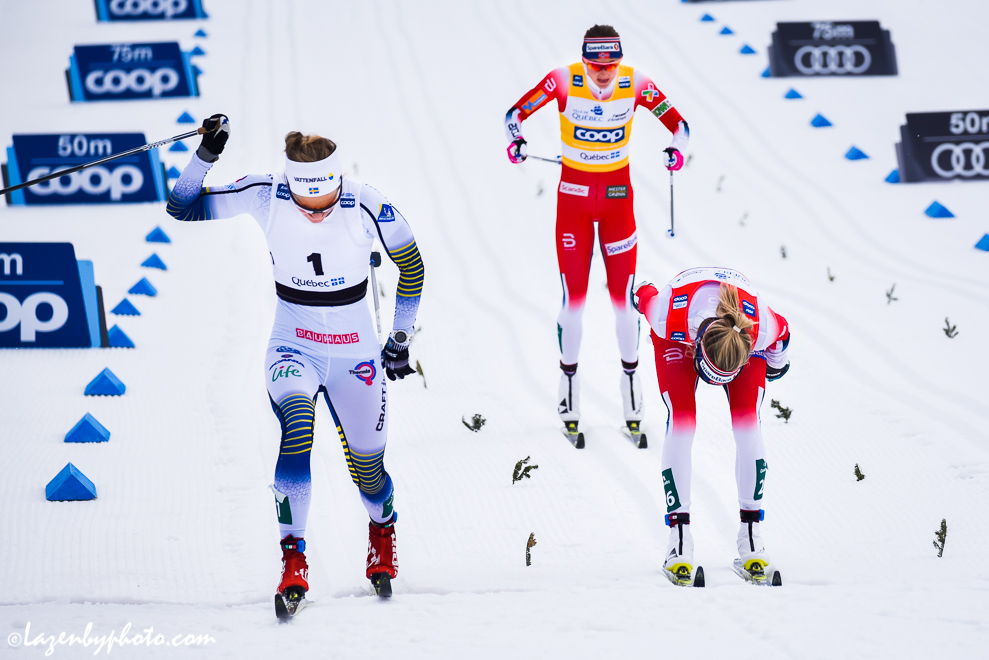
    Taking it at the line. Sweden’s Stina Nilsson (bib 1) wins the 10 k mass start classic in Québec City. (Photo: John Lazenby/lazenbyphoto.com)

    The build-up was immense. Head to head skiing. A mass start classic race with 10-kilometers to prove world-class stamina with Québec City’s cross-country ski fans lining the course.

    In a world now rife with data and the application of that information enmeshed in sport, the calculus seemed simple enough. Norway’s Therese Johaug has made a clean sweep of every World Cup distance race she’s entered this season. Nine World Cup wins. Then add three distance wins from the 2019 World Championships. A flawless resume when the kilometers extend beyond sprint-mode.

    A key piece of information one could apply to Saturday’s race was the final kilometer in the women’s 4 x 5 k relay at World Champs. If you haven’t watched, go take a few minutes. It’s downright worthy of your time. Here’s a link. It’s broadcast in Swedish but you don’t need to understand that language to possess fluency in the universality of stoke. Fast forward to the video’s 53:56 mark. This is when the good stuff goes down. It ends at 57:00. But so worth the four-minute Nilsson-Johaug duel.
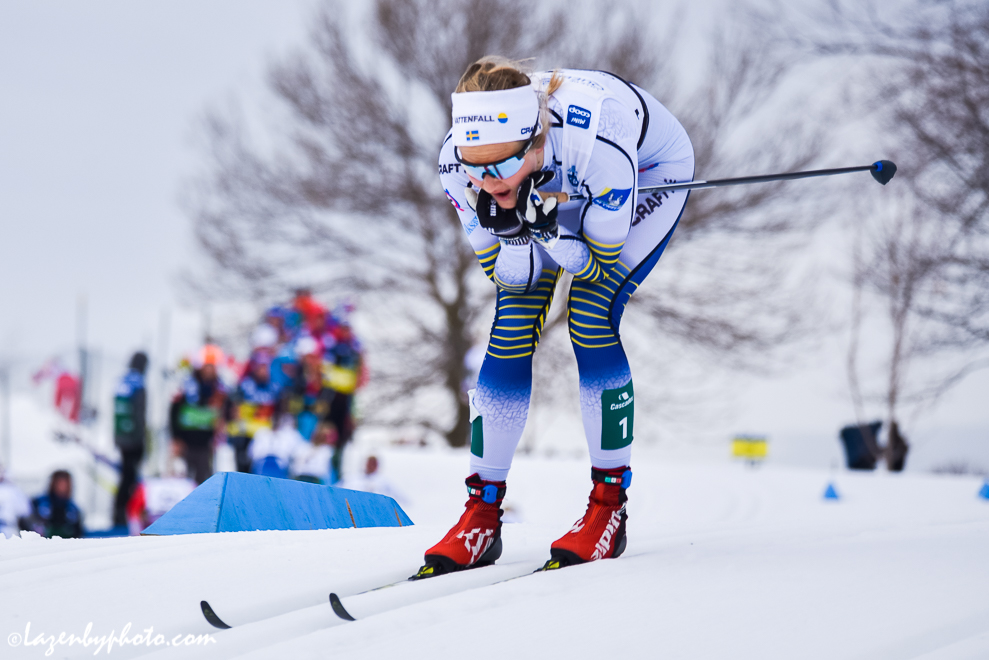
    Sweden’s Stina Nilsson tucking during the 10 k mass start classic in Québec City. (Photo: John Lazenby/lazenbyphoto.com)

    Take a breath. Now, before we get to the ending moments of Saturday’s 10 k race, let’s dial it back again.

    Nilsson skied in bib 1 as yesterday’s skate sprint winner. But Nilsson has distance tricks up her sleeve too. Her World Cup distance results are sparingly peppered with top-threes. She won bronze in last year’s Olympic 30 k mass start classic along with her gold in the 2018 Olympic classic sprint.

    In bib 26, Johaug hurridly skied towards the front after the start. By 1.6 k she was in ninth, less than two seconds from the lead. With the kilometers ticking down, and the big-World Cup snow globe shaken up, Johaug was the pace-setting agitator making sure those in her wake settled further and further back.

    tizanidine

    The time splits back were never the usual Johaug-massive — she’s been known to decimate world-class fields. Yet, on the open course, with no forest to hide distance back to the front group, the gaps began to look insurmountable for many.

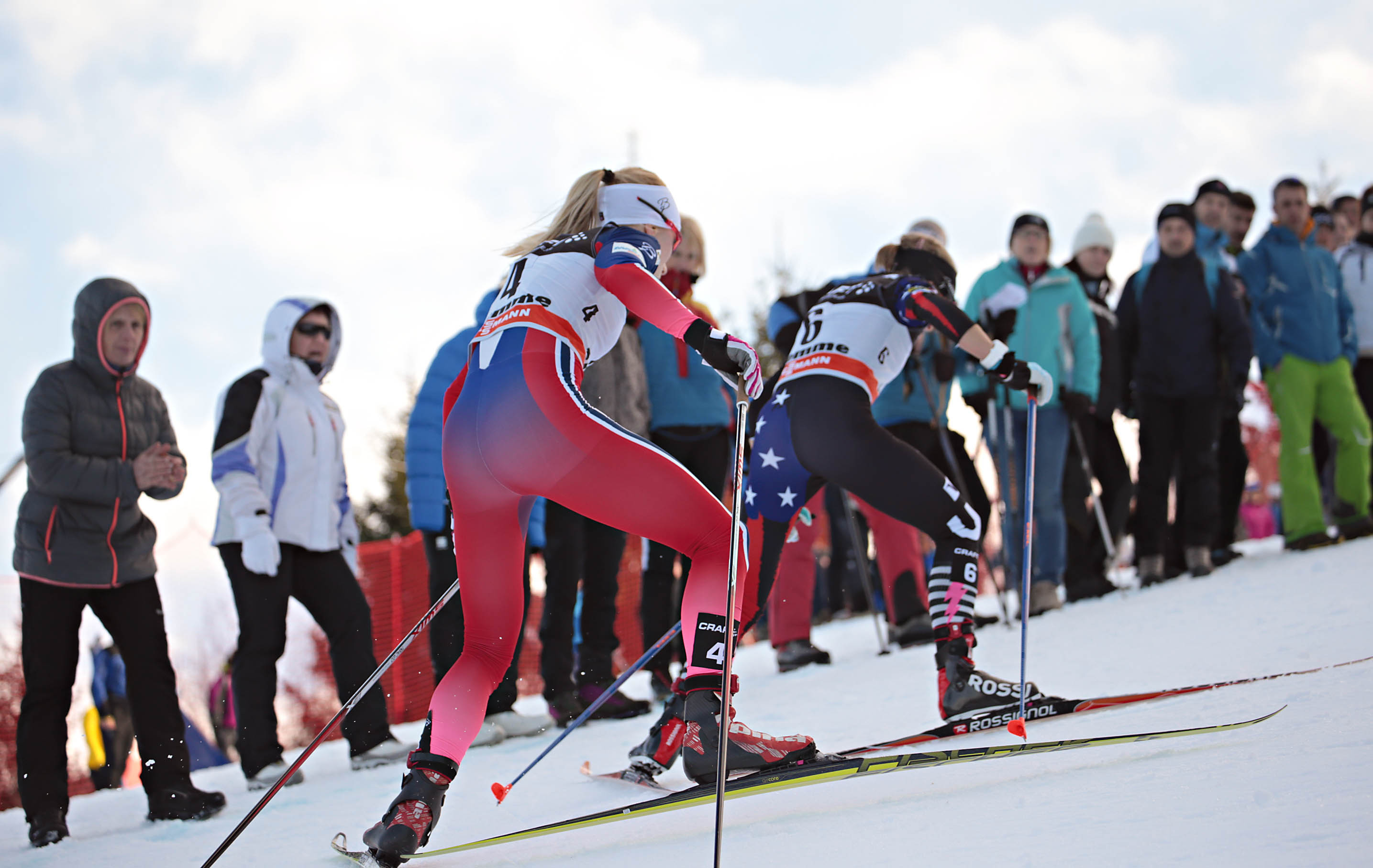
    Norway’s Therese Johaug leads the train during the women’s 10 k mass start classic in Québec City. Stina Nilsson (bib 1) lurks.(Photo: John Lazenby/lazenbyphoto.com)

    A front quartet defined the sharp end. By 5.7 k Johaug, Nilsson, Norway’s Ingvild Flugstad Østberg, and Sweden’s Maja Dahlqvist were fighting for the podium. Although having only an eight-second buffer on a chase-train many skiers deep, the pace of the front four was unmatchable.

    Between 7 and 8 k, with Dahlqvist looking like a possible pacing casualty as Johaug drove on, the Swede snapped a pole and dropped back. The eventual podium skiers never blinked as they scorched ahead.

    With a kilometer remaining, Johaug, Nilsson, and Østberg had a twenty-second cushion on Finland’s Krista Pärmäkoski and Sweden’s Ebba Andersson. With no real pressure coming from the back, Johaug did her best to shake off Nilsson and Østberg.

    Johaug charged the final hill, pushed over the top, and gained a several meter gap. But the lead was marginal considering Nilsson knew a finishing straight sprint would play in her favor. Rounding the 180-turn into the straight, Nilsson was locked on Johaug and went to a wider lane to put down her kill-shot double pole. But it was close. This was no Johaug fade-to-the-back sprint finish. Nilsson won in 25:51.6, Johaug placed second (+0.2), and Østberg third.

    “It feels really good today and I really like the conditions where I can use my upper body almost all the time, it suits me really good,” Nilsson told FIS after the race.

    “My plan was to go for the bonus seconds then to go as fast as I could for the rest of the race and I didn’t expect to be to the finish line with Theresa but I am so happy that I did,” Nilsson added.

    Her tactics were a waiting game and to optimize her strengths.

    “I knew I would not get Therese on the uphills, Nilsson said. “I just wanted to be as close to her as I could. She was strong on the last uphill so she had a gap.”
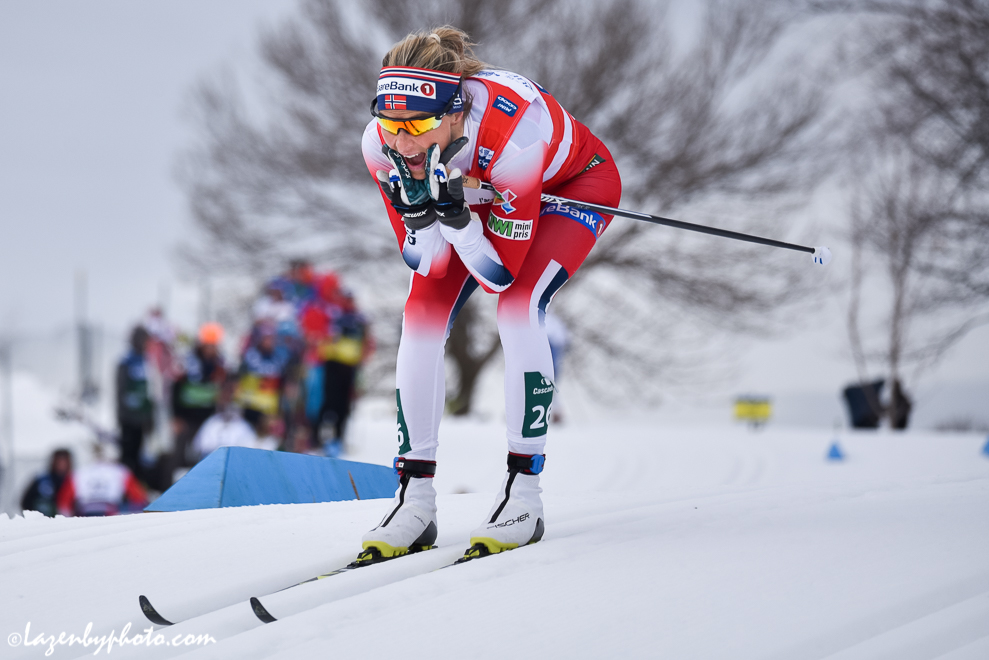
    Norway’s Therese Johaug tucking during the 10 k mass start classic in Québec City. (Photo: John Lazenby/lazenbyphoto.com)

    That gap was obviously closed down. Despite her own confidence, Johaug understands her limitations against Nilsson.  

    “It was great, I think I did a really good race today,” Johaug told FasterSkier in the mixed zone. “Stina was really tough, it was really hard in the end, but I am never sprinting like this before. I’m really happy with my finish and of course, she’s really good at that and she won also yesterday and is in good shape so yeah, I’m happy.”

    But haunted twice now in recent weeks by a Nilsson double pole effort in the closing moments of a distance race, Johaug said she knows how to improve.

    “I think I will sprint more next year and of course because we didn’t have a World Championship,” Johaug continued. “So, I will try and then we will see how it goes, but I feel that I am taking a big step the last year. Now I see that my finish is also great after a 10k so I am really happy.”

    Johaug has already secured the overall distance World Cup crystal globe. It is her third distance title after winning in 2013-2014 and 2015-2016.

    Østberg’s third-place on Saturday had more relevance for the overall World Cup standings. Prior to the Québec City races, Østberg held a 97 point lead over Russia’s Natalia Nepreyaeva in second place. Nepryaeva struggled on Saturday to keep pace and remain firmly on her skis. She placed 12th and now sits 144 points behind Østberg.  

    “Really good skis and felt good, but it was difficult to ski out there,” Østberg told FasterSkier in Québec. “It was kind of hard and people fell. I just tried to stay in front of the field and ski as fast as I could. … I actually just heard like a couple of times that [Nepryaeva] was a little behind. But at the same time, I saw that the group behind was chasing. But when I got to the finish and I heard she had an accident and fell. That is not fun. I don’t want anyone to fall, it is better than to just ski faster than the others.”
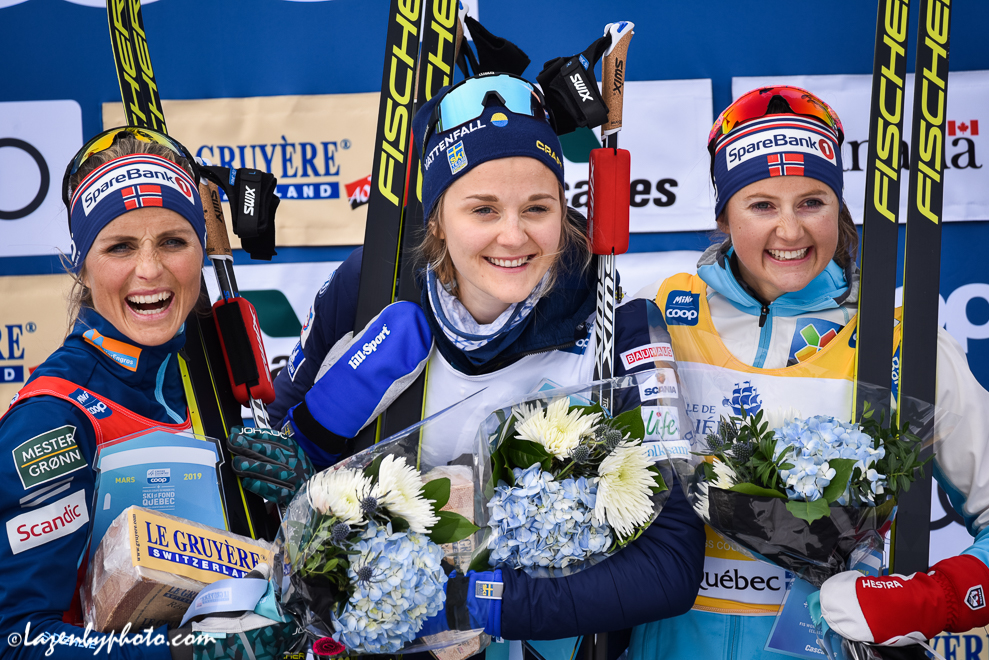
    The women’s podium from the 10 k mass start classic in Québec City. Stina Nilsson (center) of Sweden placed first, Norway’s Therese Johaug (left) second, and Ingvild Flugstad Østberg (right)of Norway third. (Photo: John Lazenby/lazenbyphoto.com)

    Sadie Bjornsen of the U.S. Ski Team (USST) was the best placed North American. Starting in bib 5, Bjornsen slowly dropped off the redline pace of the front skiers. After 10 k, skied across the line 1:03.2 behind in sixth.

    “It was tricky out there, it was definitely one of those days, it was a little frustrating,” Bjornsen told FasterSkier in the mixed zone. “But, the whole crowd and the scene and everything was fun so it made up for it.”

    Bjornsen’s skiing at the end of a European based grind remains on form. Her sixth place in Friday’s skate sprint — during which she made a crazy hard recovery in her semi — reinforced her race sensations. On Saturday, her time losses were minimized by fitness as she was noted to be slipping on several hills.

    “I feel amazing right now, which is really fun,” she said. “Unfortunately we didn’t have much kick out there today so we kind of had to struggle our way up there. I tried to lose as little time as possible, but tomorrow should be fun too. Hopefully, I have not lost too much from those front girls so I can try to ski with them because I definitely am feeling incredible right now so I would love to end the season finding some great finishing distance racing.”
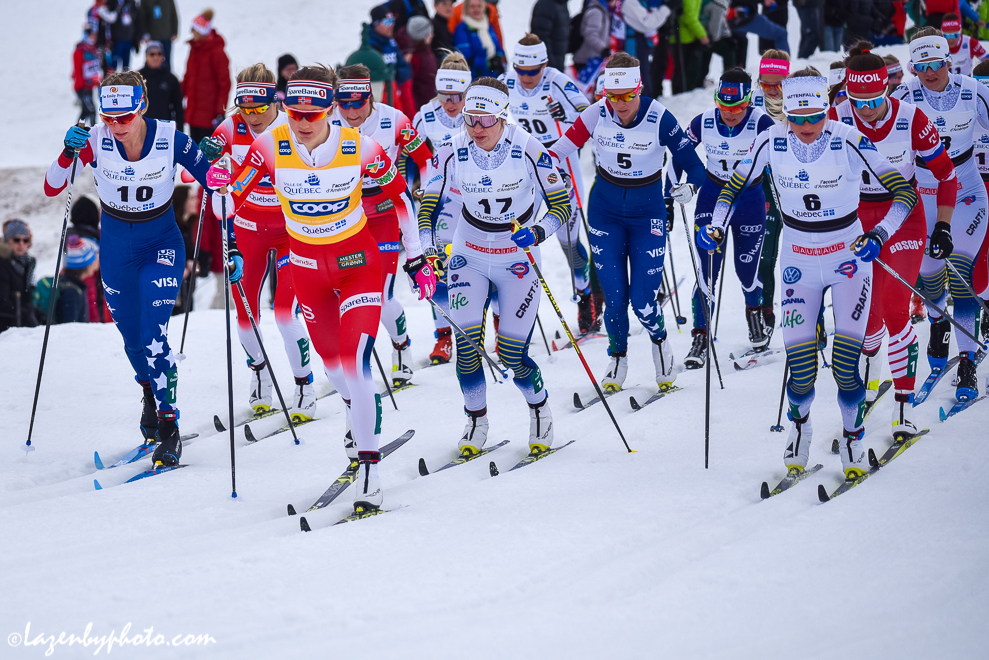
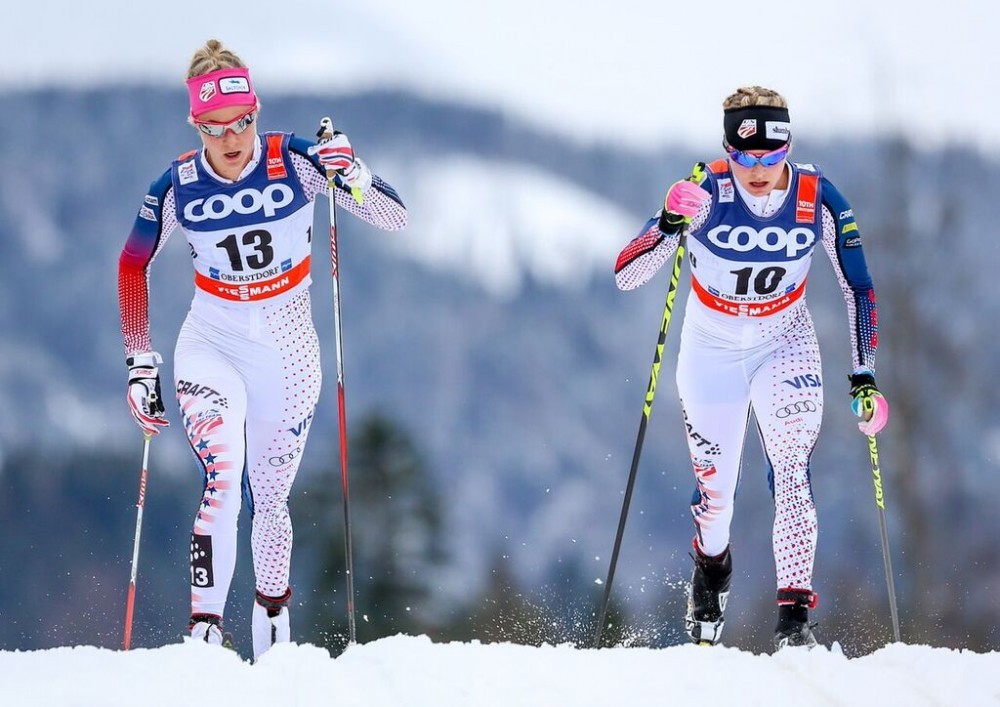
    Jessie Diggins (bib 10), Sadie Bjornsen (bib 5) take pacing cues from Norway’s Ingvild Flugstad Østberg (yellow bib) during the women’s 10 k mass start classic in Québec City. (Photo: John Lazenby/lazenbyphoto.com)

    Jessie Diggins placed 29th, 1:24 back. It was a race where she too fell and struggled with tough-to-kick skis.

    “It was really interesting,” Diggins said in the mixed zone as she discussed her race experience. “There were some pretty treacherous downhills. I had a pretty bad crash. I caught a rut. There were random soft spots out there. Today was honestly not a very good race for me. It was a good effort. I was going as hard as I could. I don’t know what happened in testing. We dialed it in, the process went well, we did everything right. But then in the race, I had no kick. Then when people are riding so far up your skis you can’t even kick, you can’t bring them out to herringbone. You’re just kind of stuck. I’m proud of myself for fighting as hard as I could. I did the best I could with the tools I had. It would have been fun to not have one of my worst races of the year in front of my parents but that’s the beauty of it. They love me for how I race and for getting up from a crash and fighting as hard as I can. They don’t care what the result is. They just want to see me go as hard as I can.”
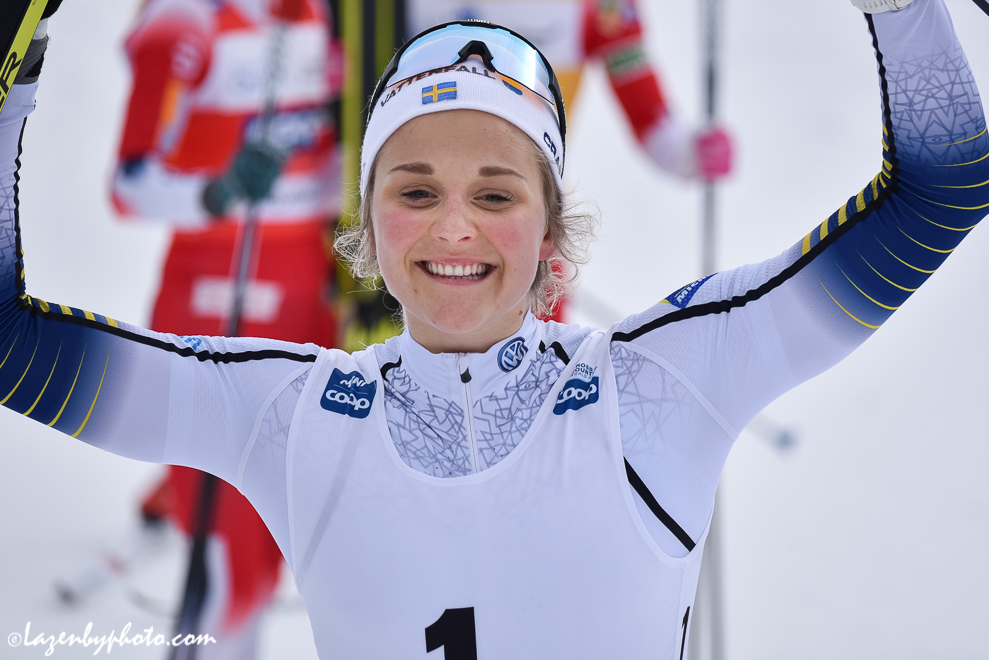
    Sweden’s Stina Nilsson winner of Saturday’s 10 k mass start classic in Québec City. (Photo: John Lazenby/lazenbyphoto.com)

    With the race happenings documented, dialing the lens back gives a better picture of where things sit for tomorrow’s final stage pursuit.

    With time bonuses factored in, Nilsson leads after two stages with an overall time of 28:17.4 minutes. She’ll be the first skier out for tomorrow’s 10 k skate pursuit. Østberg, who placed eighth in the sprint coupled with her third place today will ski off in second, 33.2 seconds back. Johaug will be released third with a 49.4-second deficit.

    Bjornsen is seeded 10th overall. At 1:47 behind, she’ll have plenty of fast company to hunt places. Sweden’s Frida Karlsson is ninth (+1:37.1) and Charlotte Kalla, also from Sweden, is 11th (+1:48.3).

    After two stages, Diggins is 23rd overall (+2:18.8). Sophie Caldwell remains in top-30 contention with a combined 7th in the sprint and 37th in the mass start to be seated 31st (+2:41.4).

    – Gerry Furseth and Kelsey Dickinson contributed

    Women’s Results | Overall Quebec Standings After Two Races


  • Johaug Returns With Win in Typical Fashion; Diggins 13th

    Johaug Returns With Win in Typical Fashion; Diggins 13th

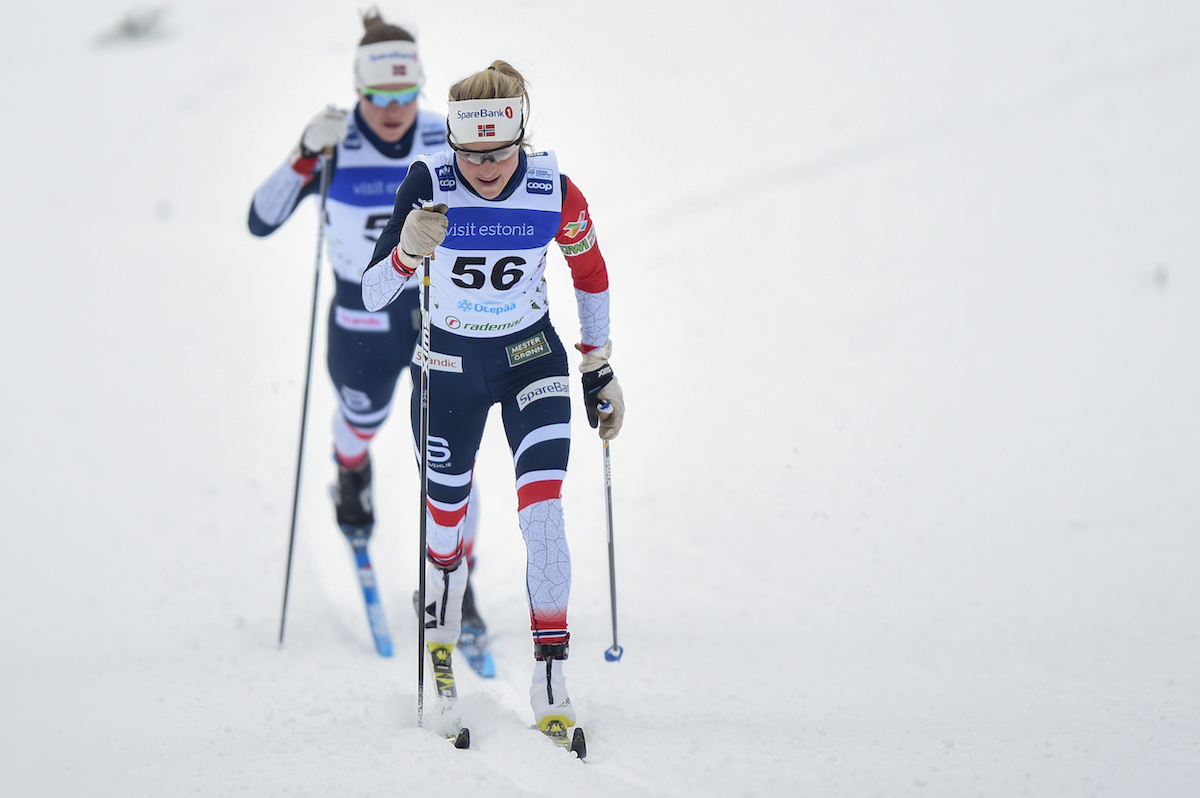
    Norway’s Therese Johaug (bib 56) strides powerfully to another victory by a large margin in the 10-kilometer interval start classic race in Otepää, Estonia. (Photo: Fischer/Nordic Focus)

    In the first distance race after the Tour de Ski, it remained to be seen whether Norway’s Therese Johaug, undefeated in distance events, would be able to pick up where she left off in December. As Johaug sat out the TdS, her teammate Ingvild Flugstad Østberg entered the 10-kilometer interval start classic race with momentum, having taken the win in four distance stages of the Tour, including two 10 k classic victories. Østberg also posted the fastest time of the day on the 9 k hill climb to the top Alpe Cermis, a feat that could benefit her on the course in Otepää, Estonia which featured two brutal climbs in each 5 k lap.

    Appearing at the 2 k and 7 k mark, the largest uphill of the course pushed the limits of the climbing distance allowed in a FIS homologated course. It was too steep for skiers to remain in the track, forcing them into an energy sapping herringbone for the 400-meters toward the top. Adding to the challenge of the terrain were tricky waxing conditions, as light blowing snow fell throughout the race.

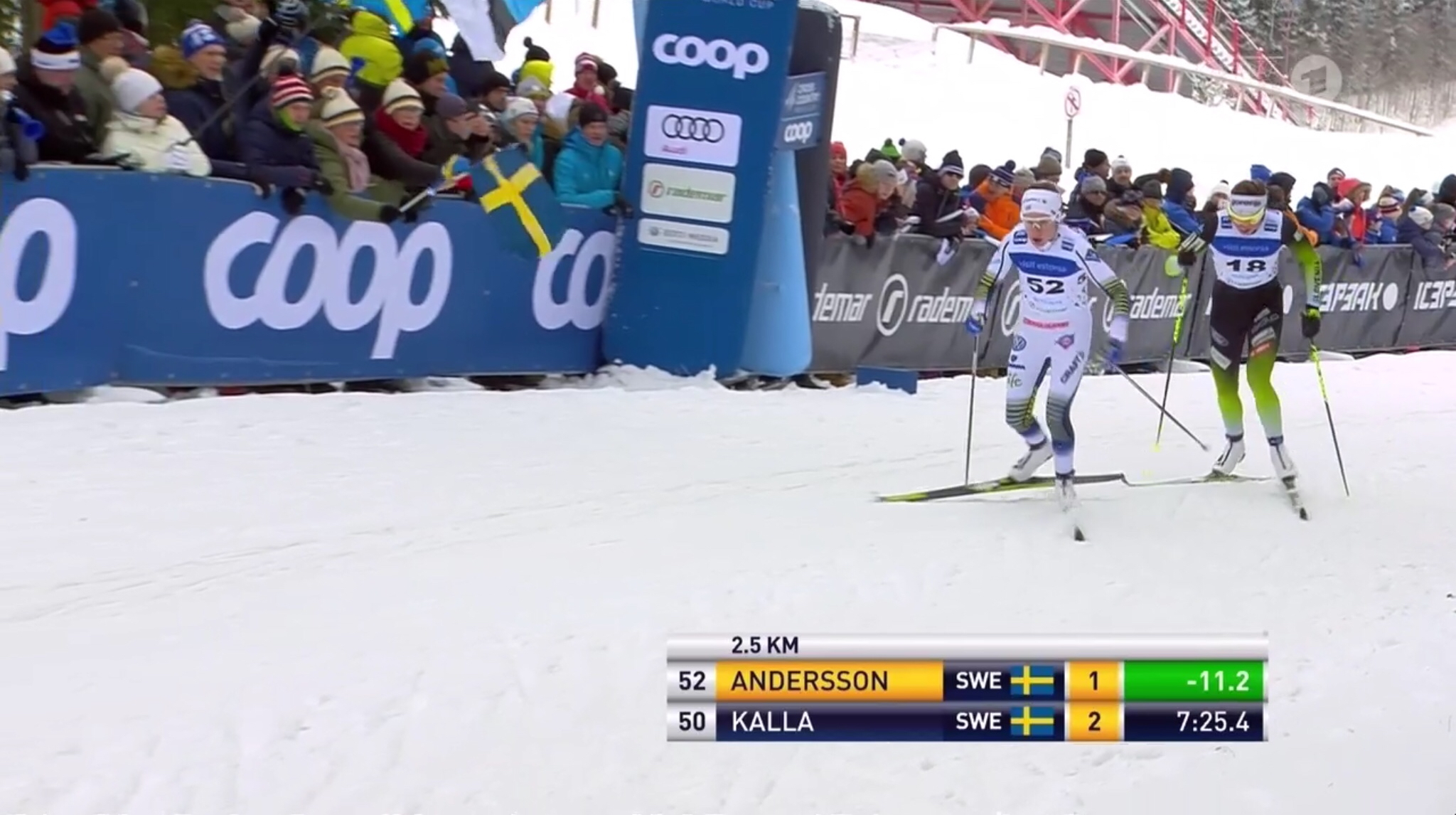
    Sweden’s Ebba Andersson (bib 52) races the clock as she herringbones up the course next to the ski jump in the 10-kilometer individual start classic race in Otepää, Estonia. (Photo: Screenshot ADN/FIS Broadcast)

    Known as a classic specialist, Krista Pärmäkoski of Finland was another favorite for the win. Last season, the Finn won three World Cup 10 k classic races during the season making her, according to an FIS press release, the only woman to win multiple 10 k classic events.

    As skiers entered the course, Pärmäkoski, who started in bib 30, raced conservatively in her first lap, then progressively set the bar higher at each checkpoint. In the second half of the race, Pärmäkoski’s pace reserved her the leader’s chair where she watched the remaining skiers fight for her coveted spot.

    Sweden’s Charlotte Kalla made an early push for the podium, skiing faster than Pärmäkoski in the first 5 k, but fell back in her second lap. Likewise, Østberg and her teammate Astrid Jacobsen, bested the Finn in the first half, falling behind in the second.

    However, three skiers starting behind the Finn wearing bibs in the 50’s were able to best Pärmäkoski, one in her usual supremely dominant fashion. As Johaug attacked the long climbs, powering her way seamlessly through the course with an unmatched tempo, it became clear that the break from racing has not slowed the distance champion.

    While Natalia Nepryeava of Russia and Ebba Andersson of Sweden, who started one and two minutes ahead of Johaug, respectively, were knocking down Pärmäkoski’s splits at each checkpoint, the Norwegian was chasing fiercely, gaining steadily on the other skiers.

    As Johaug double poled powerfully to the finish, reeling in Nepryeava, her victory was indisputable. The Norwegian ran away with the win with a time of 29:53.7, crossing the line 48.4 seconds faster than second place Andersson, and 56.7 seconds ahead of third place Nepryeava.

    “My shape is really good at the moment,” Johaug told the International Ski Federation (FIS) on Sunday. “I had a really good rest at home when the other girls were at the Tour de Ski. But after the break, I was really motivated to come back.”

    Pärmäkoski ended the day in fourth (+1:14.0), followed closely by Østberg in fifth (+1:14.8), Kalla in sixth (+1:19.9), and Jacobsen in seventh (+1:26.5).

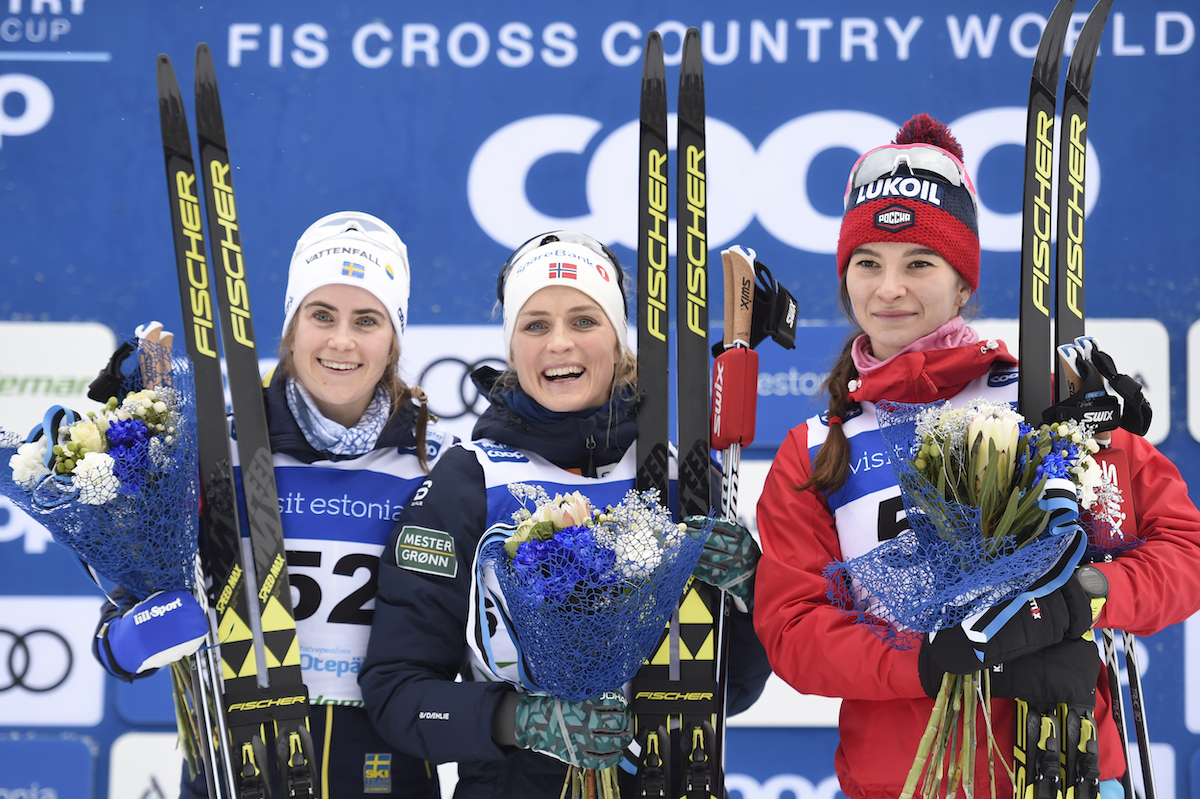
    The women’s podium in the 10-kilometer interval start classic race in Otepää, Estonia. Therese Johaug of Norway (c) took the win ahead of Ebba Andersson of Sweden (l) and Natalia Nepryeava of Russia (r). (Photo: Fischer/Nordic Focus)

    On the American side, Jessie Diggins posted the best result with 13th (+2:26.0). Rosie Brennan (APU) finished next in 27th (+3:09.9), followed by Sadie Bjornsen in 29th (+3:11.3), Caitlin Patterson (CGRP) in 39th (+3:50.9), and Ida Sargent (CGRP) in 41st (+4:17.2).

    Diggins, who finished in sixth place in the Tour de Ski, now sits also in sixth place in the overall standings. Most often thought of as a skate specialist, Diggins has earned three top ten finishes in distance skate races outside of the TdS this season. However, she has steadily improved as a classic skier in the past few seasons and also cracked the top ten this year in the Val di Fiemme 10 k classic race.

    Today was a really interesting and tricky waxing day out there, with variable conditions and snow blown in the tracks in many sections of the course,” Diggins wrote in an email. “I was really happy with my kick and I know I lost a lot of time on the flats, but I was happy with how I raced my race. I was in the zone, pushing as hard as I possibly could and skiing technically better than years past. I’m still carrying some fatigue from the Tour so I need to rest a little more in the next few weeks, but I’m happy with where I’m sitting right now.”

    “I was really impressed with Jessie’s result today,” Matt Whitcomb told FasterSkier in a call. “She works endlessly on her classic skiing, and this condition would’ve eaten her up just a couple years ago because of technique alone. She was skiing very well today.”

    After racing as a discretionary pick in Period 1, Brennan declined her spots in the Tour de Ski and headed back across the pond. Because of her strong results in Period 1, Brennan was offered Period 3 starts as well. She returned to Europe for the races in Otepää and Ulricehamn, Sweden in hopes of qualifying for the World Championships in Seefeld, Austria. After today’s finish, Brennan is ranked 22nd in the overall distance World Cup standings.

    “It was tough conditions this weekend in Estonia,” said Brennan. “I didn’t have too many expectations after suffering some illness and not racing for a little while. I had good feelings in the sprint, but not the speed I needed for the result I wanted. It left me optimistic for the distance race, however.”

    “I was pleased to wake up to new snow as I love slow, tough races, however, I really struggled to find skis that worked well on the uphills and were still fast on the downhill,” she continued. “I made the choice I thought was best, but it wasn’t quite what I needed to be competitive today. I am happy to be back racing and my shape feels good so I am hopeful that things will improve from here.”

    Dahria Beatty, the only Canadian to enter Sunday’s 10 k, finished 43rd (+4:42.5).

    Results

  • Johaug Tops Østberg to Win 2nd Tour de Ski; Diggins 10th; Stephen 3rd-Fastest to the Top

    Johaug Tops Østberg to Win 2nd Tour de Ski; Diggins 10th; Stephen 3rd-Fastest to the Top

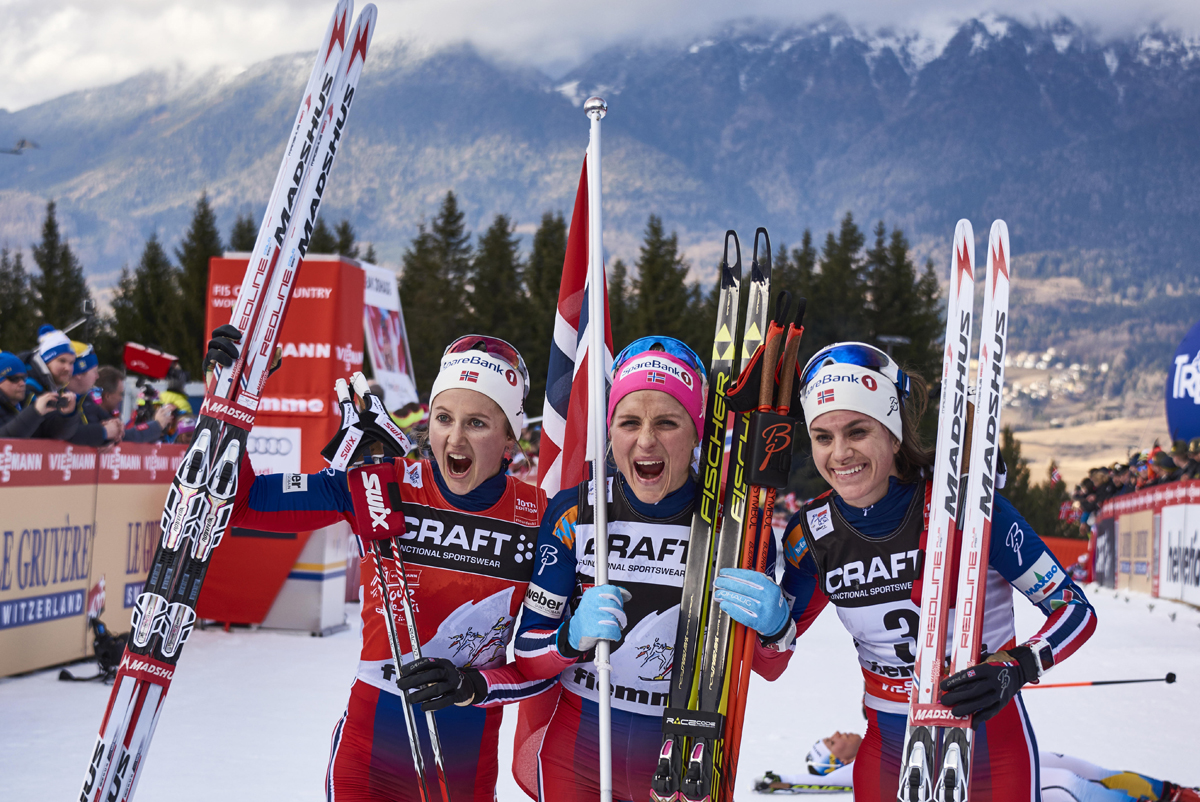
    Ingvild Flugstad Oestberg (l), Therese Johaug (c) and Heidi Weng (r) celebrate the Norwegian sweep of the podium at the FIS World Cup Tour de Ski final climb in Val di Fiemme, Italy. (Photo: Felgenhauer/NordicFocus)
    2016 Tour de Ski overall runner-up Ingvild Flugstad Østberg (l), champion Therese Johaug (c) and third-place finisher Heidi Weng (r) celebrate Norway’s sweep of the podium at Sunday’s Stage 8 final climb in Val di Fiemme, Italy. (Photo: Fischer/NordicFocus)

    The image of several Norwegians sprawled in the snow at the top of Alpe Cermis, while Therese Johaug, also of Norway, kneels to congratulate them on their efforts, says a lot.

    “It was a good fight, Ingvild,” Johaug said to second-place finisher, teammate Ingvild Flustad Østberg, as she sat next to her on the ground.

    Østberg was second to — who else? — but Johaug, who had just bested her to the top of the mountain by nearly two and half minutes after starting 39 seconds behind in the final stage of the Tour de Ski, the notorious 9-kilometer freestyle pursuit up Alpe Cermis in Val di Fiemme, Italy.

    “I hoped I could take some seconds on Ingvild before the climb. It worked better than I had hoped,” Johaug told FIS afterward.

    Norwegian women swept the podium, with Johaug landing at the top with a finishing time of 33:53.5, Østberg reached the summit in second (+2:20.9), and Heidi Weng started third, 2:27 behind Østberg, and held onto third across the line (+3:13.9).

    The event was a pursuit, with start times based on cumulative times over seven World Cup stages in nine days. Sunday marked the eighth and final stage on the 10th day of the Tour. Fatigue was the shared theme among 43 women who started and completed the final climb, thus completing the Tour.

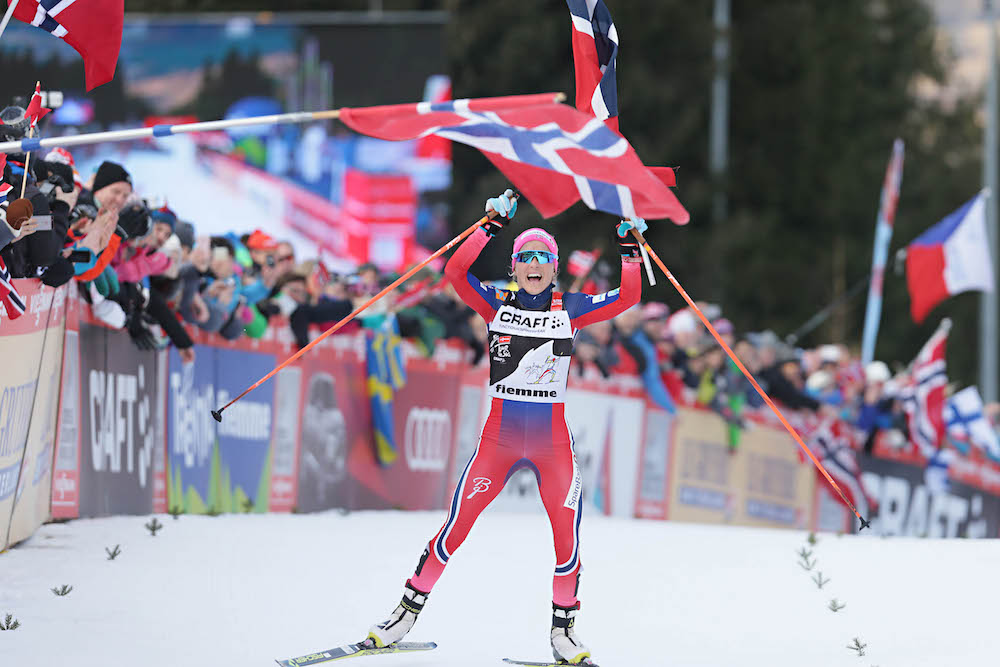
    Norway's Therese Johaug approaches the finish of the 9 k final climb at the last stage of the 2016 Tour de Ski with enough time to grab a Norwegian flag and celebrate her win. It was Johaug's second overall Tour de Ski victory since last winning in 2014. (Photo: Fiemme World Cup)
    Norway’s Therese Johaug approaches the finish of the 9 k final climb at the last stage of the 2016 Tour de Ski with enough time to grab a Norwegian flag and celebrate her win. It was Johaug’s second overall Tour de Ski victory since last winning in 2014. (Photo: Fiemme World Cup)

    While Johaug started the eight-stage series by earning the leader’s bib on Day 1 in Lenzerheide, Østberg took control after winning the 5 k pursuit in Lenzerheide at Stage 3. From that point on, the 25-year-old Østberg continued to lead the Tour, up until about 17 minutes into the final climb, when Johaug caught and passed her.

    Still 14 seconds ahead of Johaug at 6.2 k, shortly after the course began to ascend up the mountain at a brutal grade, Østberg hung onto first for another minute before Johaug reached her. Wasting no time, Johaug pushed on, putting 17 seconds between her and Østberg by 7.1 k. One kilometer later, she was 1:26 ahead and in the clear for the win.

    Following the zig-zagging course to the top, the 27-year-old Johaug V1-ed past excited spectators before a multitude of waving Norwegian flags greeted her at the finish. She grabbed one a few meters before the line and held it up in elation.

    “It was my dream and big goal to win the Tour de Ski,” Johaug said after claiming her second overall title since winning the 2014 Tour. “Ingvild has pushed me at every stage of the Tour this year. I think this was my [best] Tour de Ski ever.”

    According to reporters at the summit, Johaug asked Østberg afterward, “Are you tired now?”

    “Yes,” Østberg replied.

    (Article continues below)

    Diggins 10th, Bjornsen 14th Overall

    After starting 9:01 back in 10th and finishing 10th (+11:20.4), Jessie Diggins led the U.S. women in the final Tour standings. It was the end to an eventful Tour for Diggins, after her first individual World Cup win on Friday.

    Fellow U.S. Ski Team members Sadie Bjornsen (l) and Jessie Diggins (r) started near each other in Wednesday's 10 k classic mass start at Stage 5 of the Tour de Ski in Oberstdorf, Germany. Diggins went on to place 23rd and Bjornsen 26th for 12th and 14th overall, respectively, in the Tour standings. (Photo: Marcel Hilger)
    U.S. Ski Team members Sadie Bjornsen (l) and Jessie Diggins (r) started near each other in the fifth stage of the Tour de Ski, a 10 k classic mass start in Oberstdorf, Germany. (Photo: Marcel Hilger)

    “One of my big goals for the season was to finish the Tour in the top 10, so I made that goal today!” she wrote in an email to media.

    While Diggins didn’t finish the Tour last year because of illness, she did in 2014 and placed 13th overall.

    “That climb is brutally hard hard and I was in a world of pain, but I had to tell myself to just keep my feet moving!” she reflected on Sunday. “It was a real mental battle out there so I was happy to be able to hang tough.”

    Following her to the top of the downhill ski area was Sadie Bjornsen, who started 12th, 9:32 after Østberg, and slipped two spots to finish in 14th (+12:24.1). This year was her first time completing the Tour, after withdrawing after Stage 5 last year despite being in the top 10.

    “I just had no idea what to expect,” Bjornsen said in a phone interview. “I’d done some hill climbs in the U.S., but never against a World Cup field. So I was definitely very nervous because I had a number of people quite close behind me. I decided that I just had to look up the hill, instead.”

    “Sadie will tell you that she’s not a climber,” U.S. Ski Team Women’s Coach Matt Whitcomb said. “But she did great today – she only lost two places on Alpe Cermis. She’s skating at a high level now as well classic skiing … Fourteenth place is just a super result for Sadie and for our team.”

    Stephen Third Fastest on Course, 2nd on Actual Climb

    The U.S. team’s best individual performance in Stage 8 came from Liz Stephen, who climbed six places from 25th to 19th (+13:27.8) and posted the third-fastest time of the day. Stephen’s time was 1:29.5 behind Johaug, who earned “fastest of the day” accolades on Alpe Cermis for the sixth-consecutive year, according to a FIS press release.

    American Liz Stephen leads Norway's Ragnhild Haga during the charge up the final hill of the seventh stage of the 2015 Tour de Ski in Val di Femme, Italy (Photo: Val di Fiemme/www.fiemmeworldcup.com)
    American Liz Stephen led Norway’s Ragnhild Haga during last year’s final climb, the seventh stage of the 2015 Tour de Ski in Val di Femme, Italy. She placed fifth overall. (Photo: Fiemme World Cup)

    Weng clocked the second-fastest course time, less than four seconds ahead of Stephen’s time.

    In her fifth Tour de Ski, Stephen also had the second-fastest split on the climbing portion of the course, the final 3 k to the finish. Only Johaug was 31.7 seconds faster, besting Stephen’s climbing time of 19:18.3.

    “I kind of just did my thing on the uphill and went to go catch as many people as I could,” Stephen said in a phone interview. “I felt really strong today, and I had great skis. It’s my favorite race of the year – not a single downhill. I like just getting into that zone and just grinding.

    “Today was just my ideal conditions,” she added. “I love it when it’s just soft and wet and sloppy and just wonderful.”

    According to Whitcomb, Stephen was coming off a tour that was “stacked against her strengths.” While the U.S. Ski Team veteran, who turns 29 on Tuesday, excels in longer skate races, the tour had a lot of shorter, classical races. Stephen was fifth overall in last year’s Tour – the best result ever for an American at the Tour de Ski.

    “She didn’t put together the Tour she wanted,” Whitcomb said. “But we knew that today would test something that is her strength, and would be a good indicator as to where she is physically. She skied better than she did last year during this race – you can’t compare times – but she was able to maintain form and she paced it better, so I think she’s in a confident place.

    “Third on time of day and only four seconds off of second — that’s something to be proud of,” he added. “She can leave Italy with some confidence.”

    Also for the U.S., Rosie Brennan started 31st and slipped one place to 32nd overall (+20:06.1), and Caitlin Gregg started 38th and finished 42nd (+23:57.6). Both completed their first Tours.

    Unsurprisingly, Whitcomb was pleased with the performance of his team.

    “I’m really excited with having seven athletes finish the Tour [Diggins, Bjornsen, Stephen, Brennan, Gregg, Noah Hoffman and Erik Bjornsen]. I think it’s a little bit of an unlikely circumstance – battling illness and fatigue, even injury in some cases, anything can happen during the Tour,” he said. “So to have seven athletes finish and have seven athletes stay healthy, that’s a big sign of success for a group of athletes. It means that they’re absorbing the [racing] rather than just getting buried by it.”

    Without a World Championships or Olympics this year, the U.S. coaches decided it was safe to have their athletes dig deeper than they otherwise might during the Tour.

    “We were able to afford having a few extra athletes that were well beyond their comfort zones finish the Tour, despite it perhaps burying them for the next week or two,” Whitcomb explained.

    Sprint specialists Sophie Caldwell, Ida Sargent, Simi Hamilton, and Andy Newell all withdrew from the Tour early, with the intention of saving themselves for two days of skate sprinting at next weekend’s World Cup in Planica, Slovenia. The seven skiers that finished the Tour will sit out the Planica sprints to rest for the Nove Mesto (Czech Republic) World Cup the following week.

    But the fatigue runs deep.

    “I’m looking forward to the next tour we have,” Stephen said of the Ski Tour Canada from March 1-12. “Which is crazy that we have another one. Thinking about that today was actually a little bit sickening – we’re just so tired that the thought of doing another [eight-stage] tour later on this year is a little bit tiring just to even think about. But I’m sure by then I’ll be really ready and really excited, and of course skiing in Canada is awesome.”

    Overall results | Time of day