From the FasterSkier archive — posts syndicated from athletes’ and coaches’ own blogs between 2004 and 2012, kept online as published. Current coverage is at fasterskier.com.

Tag: Ingvild Østberg

  • Sunday Olympic Rundown: Bjørgen Dominates 30 k Classic; Diggins 7th

    Sunday Olympic Rundown: Bjørgen Dominates 30 k Classic; Diggins 7th

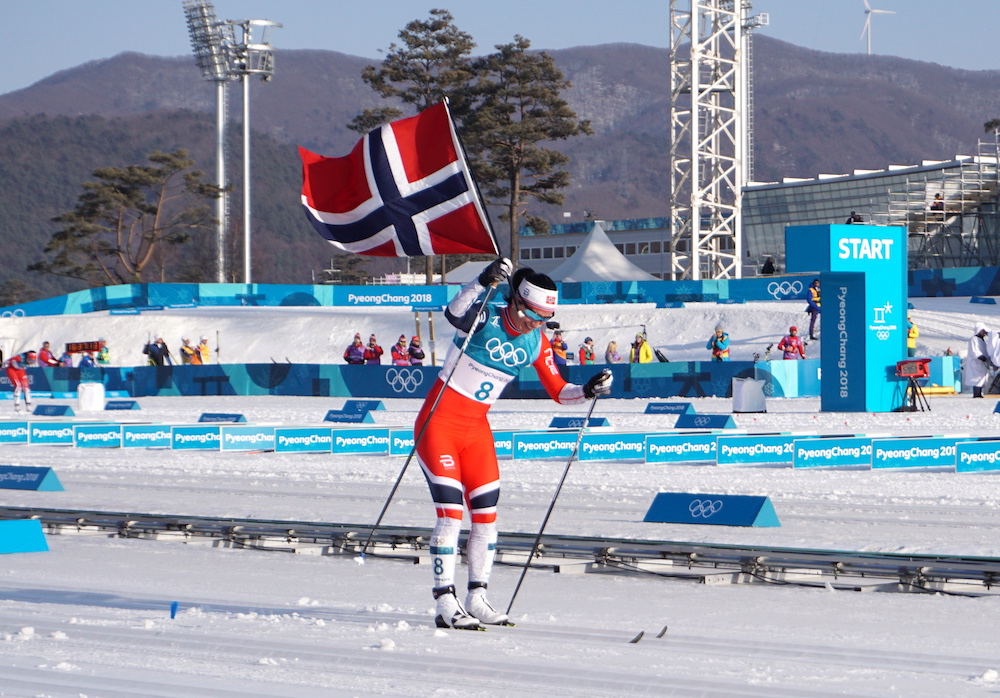
    Marit Bjørgen approaches the line for her eighth-career Olympic gold (and 15th medal) with a win in the final race of the 2018 Olympics, the women’s 30 k classic mass start, on Sunday in PyeongChang, South Korea. (Photo: Noah Hoffman)

    FasterSkier would like to thank Fischer Sport USA, Madshus USA, Concept2, Boulder Nordic Sport, and Swix Sport US for their generous support, which made this coverage possible.

    ***

    2018 Olympics (PyeongChang, South Korea): Women’s 30 kilometer mass start classic

    Report

    Marit Bjørgen went out with a bang. Skiing in presumably the final Olympics race of her illustrious career, the most-decorated Winter Olympian in history simply skied away from a strong field less than 10 kilometers into Sunday’s 30 kilometer classic mass start, earning the 15th Olympic medal of her career (and eighth gold) in dominant fashion.
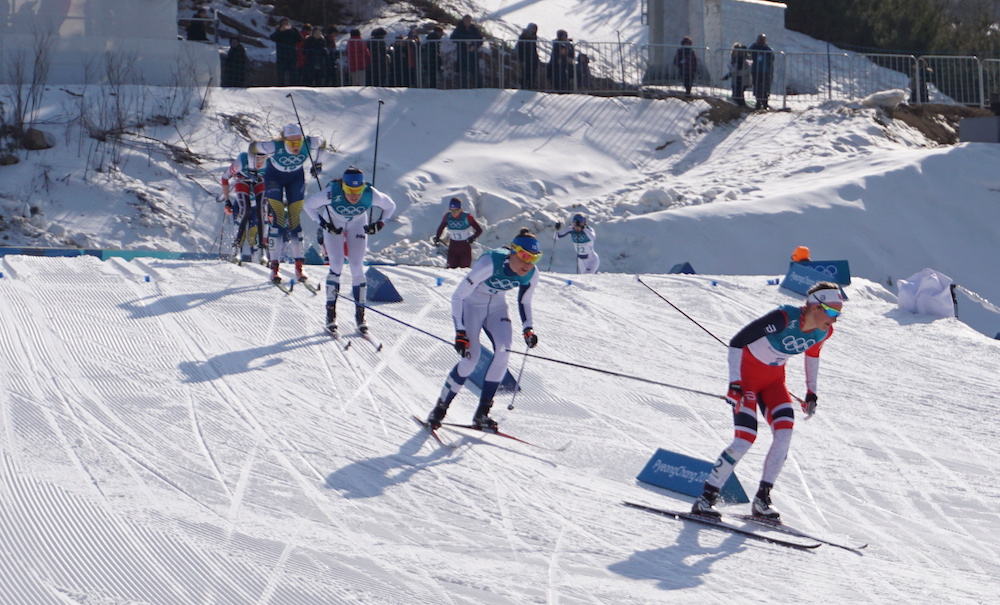
    From right to left: Norway’s Ingvild Flugstad Østberg leading Finland’s Kerttu Niskanen and Krista Pärmäkoski, Sweden’s Stina Nilsson, and Austria’s Teresa Stadlober (r), among others in the women’s 30 k classic mass start on the final day of the 2018 Olympics in PyeongChang, South Korea. (Photo: Noah Hoffman)

    Behind her, Finland’s Krista Pärmäkoski (+1:49.5) and Sweden’s Stina Nilsson (+1:58.9) rounded out the podium, with Nilsson breaking away from Norway’s Ingvild Flugstad Østberg (+2:00.4) within the stadium to edge her out for third.

    Fifth went to Charlotte Kalla of Sweden (+2:57.2), with Kerttu Niskanen of Finland sixth (+3:01.6). Jessie Diggins was seventh (+3:37.2), in an American performance that would have been lauded just a few years ago yet somehow represented her worst placing in all six races at these Olympics.

    Heidi Weng of Norway (+4:07.9) in eighth, Teresa Stadlober of Austria (+4:14.1) in ninth, and Masako Ishida of Japan (+4:20.8) rounded out the rest of the top ten. Stadlober’s ninth-place finish was particularly poignant; she was holding steady in silver-medal position through 20 k, before taking a wrong turn at an ill-marked course intersection and losing well over a minute returning to the correct track.
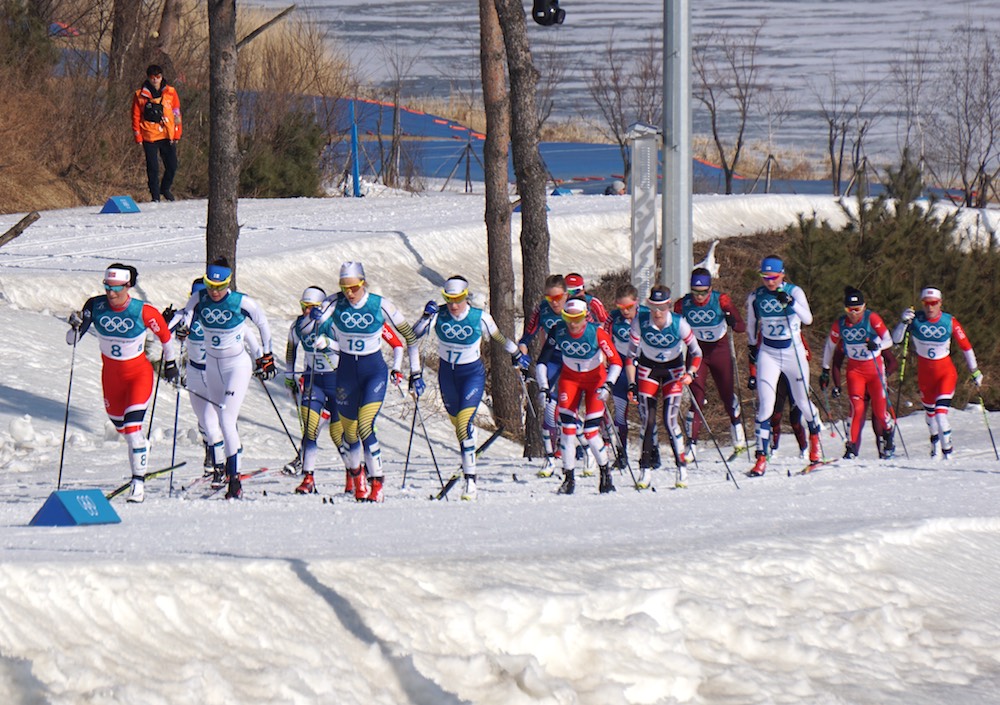
    Norway’s Marit Bjørgen (l) leading the pack during the women’s 30 k classic mass start at the 2018 Olympics in PyeongChang, South Korea. (Photo: Scott Patterson)

    But let’s go back to Bjørgen. Given those time gaps by the finish – nearly two minutes clear of second and third – this was clearly Bjørgen’s day. The 37-year-old Norwegian mother started in bib number 8, and was all of 1.1 seconds off the lead by the first checkpoint, less than one kilometer into the race. But after that… Bjørgen led by 2.3 k, midway through the first of four 7.5-k laps. Bjørgen led at 5 k. Bjørgen led at 7.5 k. Bjørgen led at 8.4 k. And so on. It was not literally a wire-to-wire victory, but it was pretty darn close.

    The race went from a mass start contest to a solo endeavor at roughly 9.5 kilometers in, midway through the second lap. Bjørgen simply surged ahead, and immediately opened up a small gap. By 9.8 k, the gap was 7 seconds. By 12.5 k, it was already up to 33 seconds. By 15 k, the advantage had swelled to 51 seconds. Bjørgen was putting nearly 10 seconds per kilometer on a chase group composed of Olympic medalists and World Championships podium finishers.

    With all due respect to Iivo Niskanen, the hero of Saturday’s courageous breakaway in the men’s 50 k classic, Bjørgen’s performance never felt in doubt the way Niskanen’s did. Bjørgen didn’t have any company, for one, and she had a shorter distance to cover, for another (“only” 20 k of solo skiing off the front). But mostly, well, she is Marit Bjørgen, the most dominant cross-country skier of all time.

    Bjørgen’s gap stretched to as great as 2:04 by the 27.5-k mark of the course. Finally, approaching the finish, she slowed slightly over the last few hundred meters, accepting a large Norwegian flag from a Viking helmet-clad fan and beaming as she carried it across the finish line. Her final time was 1:22:17.6. If they were the final 82 minutes of racing of a five-Olympics career, they were an exceptionally dominant 82 minutes.

    Behind her, a four-woman chase pack formed: Pärmäkoski, Kalla, Niskanen, and Stadlober. As late as 20 k, Kalla was still in seventh, nearly two minutes back of Bjørgen and roughly 35 seconds back of Stadlober in second.

    Soon after this, Stadlober took her wrong turn, skiing for some distance on the wrong course before having her error pointed out to her by a courseside coach or tech. She dropped from second to eighth within a kilometer.

    Reportedly, Austrian coach Markus Gandler was out on the course and the first to inform her of her mistake, yelling, “You are wrong!” She realized her mistake and turned around.

    “We were preparing the feed and noticed she didn’t come,” Gandler told Austrian broadcaster ORF, according to a translation. “I ran over but she didn’t hear me while skiing up. Only on the downhill I caught her.”

    “I don’t know if I should laugh or cry,” Stadlober told ORF after, according to a translation. “I can’t explain it to myself. I have been here for three weeks and if by now I don’t know the loop then I don’t know … I noticed skiing up that something wasn’t right because there was no more staff. When I looked over I just thought: Sh*t!”

    She said she had been feeling great up until that point and confident about her skis.

    “I would have had the power, but had-I-would-I [what could have been] is too late now,” Stadlober said of missing out on her first Olympic medal. “That’s life. It’s just bitter it happened in such a race and on a day when everything would have fit together.”
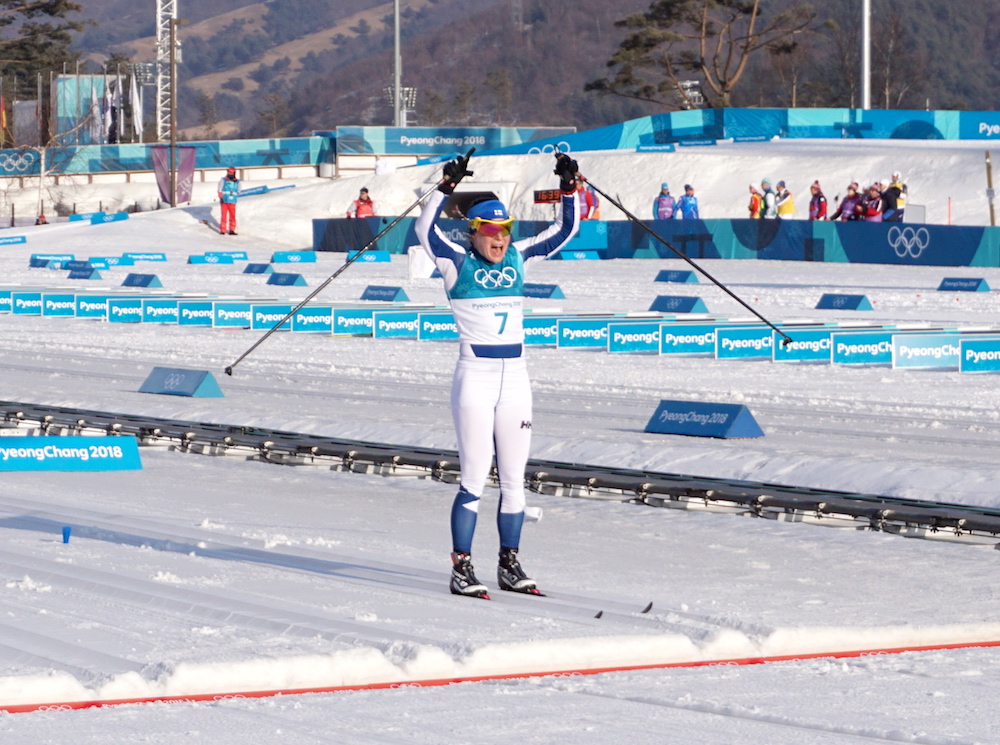
    Finland’s Krista Pärmäkoski celebrates her first individual silver medal which she claimed in the women’s 30 k classic mass start on Sunday at the 2018 Olympics in PyeongChang, South Korea. (Photo: Noah Hoffman)

    By 21 k, Pärmäkoski had a 13-second gap over Niskanen in the race for second, and Kalla had moved up to sixth. By 25 k, it was still Pärmäkoski in second, but now Østberg and Nilsson skiing lockstep in the fight for third.

    Pärmäkoski was never seriously threatened over the final lap, and crossed the finish line for silver.

    “I think that this 30 k was [the] hardest 30 k race [ever] for me,” Pärmäkoski reflected in a post-race press conference. “Of course I heard that Nilsson and Østberg come behind me and I also heard that now it’s 11 seconds, and then 14 seconds. And after this big downhill I heard that it’s a little bit more, but because I know that they are good in sprint, I just hoped that they can’t catch me. This was a crazy, crazy Olympics for me. Before I came here I wanted to win one individual medal and now I won three medals, so I am really happy.”

    In two Olympics, Pärmäkoski, 27, now has four medals — three of which came in PyeongChang (silver in the 30 k and bronze in the 15 k skiathlon and 10 k freestyle races).

    Behind her, Østberg and Nilsson dueled for the final podium spot. But while Østberg was aware of it, Nilsson hadn’t heard about Stadlober’s wrong turn ahead of them.
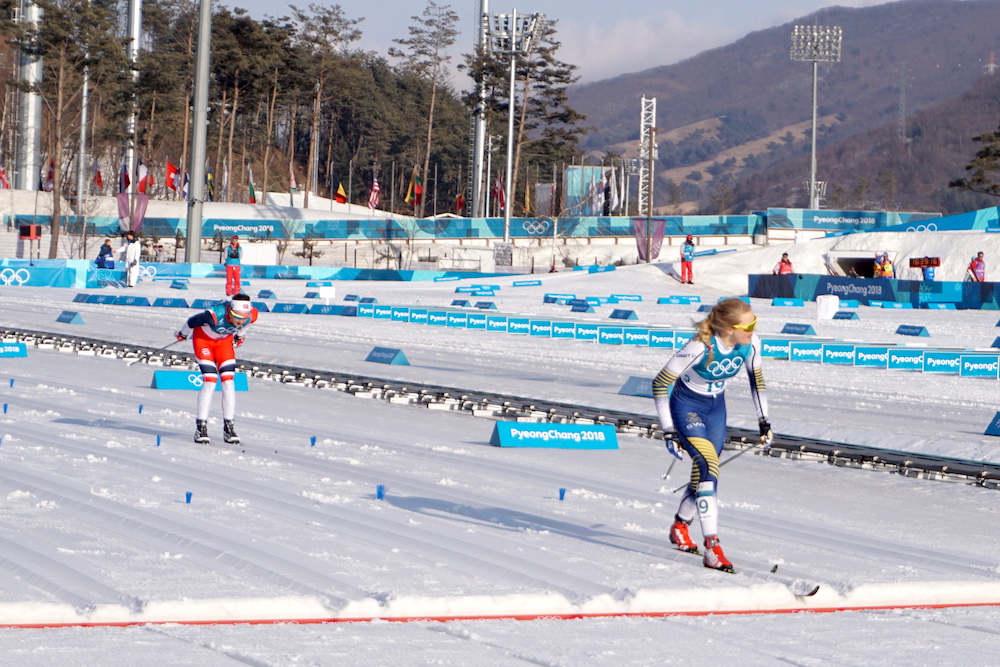
    Sweden’s Stina Nilsson (r) outlasts Norway’s Ingvild Flugstad Østberg (l) for bronze in the women’s 30 k classic mass start at the 2018 Olympics in PyeongChang, South Korea. (Photo: Noah Hoffman)

    At the finish, Nilsson looked surprised when Bjørgen told her she had won the bronze. Bjørgen then went immediately over to console her teammate, Østberg, who finished fourth, 1.5 seconds behind Nilsson in third.

    “I was quite sure that it was fourth. That I got the bronze was quite sick,” Nilsson told Norwegian broadcaster NRK, explaining that she thought the team staff was trying to give her false hope that a medal was within reach.

    “I did not realize that Stadlober had gone wrong. I thought she had moved away,” Nilsson said.

    But Østberg knew the bronze was between her and the Swede. “I definitely knew what I was fighting for. It’s amazing that she did not know, too,” Østberg told NRK.

    Diggins would finish roughly 90 seconds later in seventh, 36 seconds behind sixth and 30 seconds ahead of eighth. The result was emblematic of her day, in which she had skied for much of the race entirely by herself.

    Sadie Bjornsen was the next American, finishing in 17th (+6:32.6). The mid-teens result continued a trend at these Olympics; she was 14th in the classic sprint and 15th in the 10 k freestyle.

    The third American on the day was Rosie Frankowski in 21st (+8:53.8). Forget first Olympic start for the 26-year-old Alaskan and Alaska Pacific University athlete (which it was), Frankowski has zero World Cup starts to her name. She was the second American in the 20 k classic at last month’s U.S. Nationals, though, behind Caitlin Patterson.

    On Sunday Patterson was five spots behind in 26th (+10:26), after narrowly losing a sprint finish to Germany’s Victoria Carl.

    For Canada, Emily Nishikawa led the way in 30th (+12:14.1). She was followed by Cendrine Brown in 43rd (+19:06.3), as Anne-Marie Comeau did not finish.

    Also of note, Jessica Yeaton, who competes internationally for Australia but lives and trains in Anchorage with Alaska Pacific University, was 42nd (+18:37.2). And Petra Hyncicova, who skis in this country for the University of Colorado but races internationally for the Czech Republic, was 39th (+16:57.1).
    Results

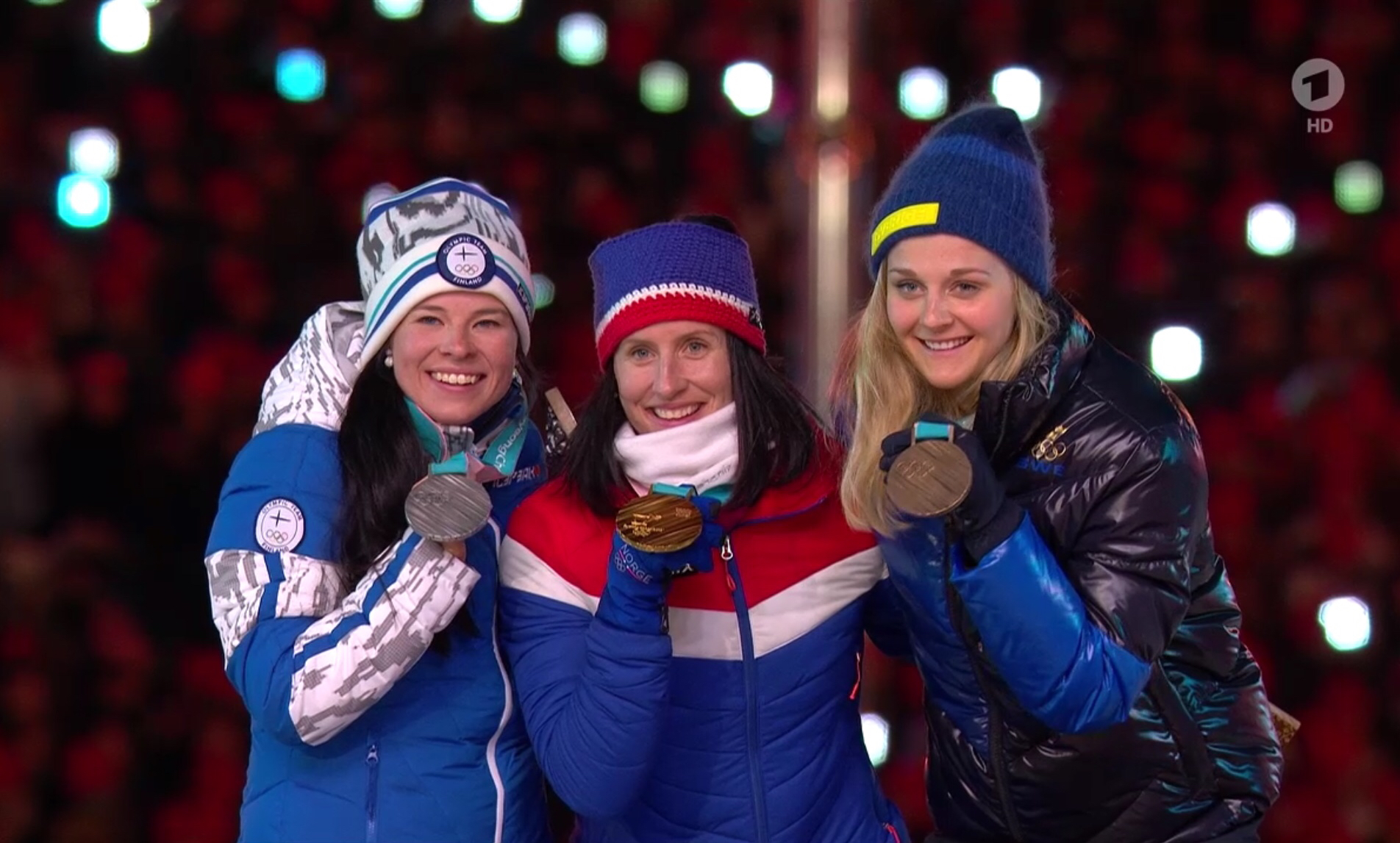
    The women’s 30 k classic mass start medalists at the 2018 Olympics Closing Ceremony, with Norway’s Marit Bjørgen (c) in first, Finland’s Krista Pärmäkoski (l) in second, and Sweden’s Stina Nilsson (r) in third in PyeongChang, South Korea. (Screenshot: ARD broadcast)
  • Randall Times Strike to Win Beitostølen Skate Sprint

    Randall Times Strike to Win Beitostølen Skate Sprint

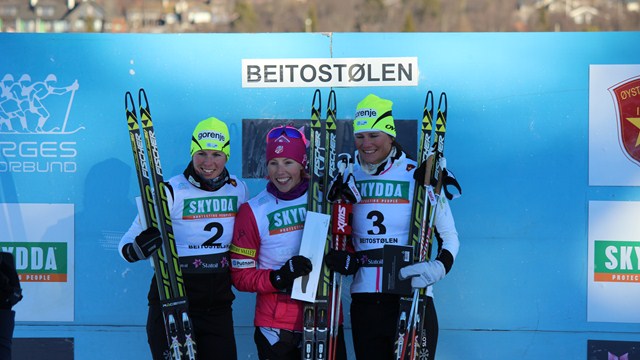
    Kikkan Randall lived up to the hype on Sunday, winning the U.S. Ski Team's first sprint of the season in Beitostølen, Norway. Randall topped Slovenians Vesna Fabjan (l) in second and Katja Visnar in third in the 1.2 k freestyle FIS sprint after qualifying in seventh and placing second in both her quarterfinal and semifinal. http://www.fis-ski.com/cross-country/news-multimedia/news/article=randall-and-fossli-win-free-technique-sprints-beitostølen.html
    Kikkan Randall lived up to the hype on Sunday, winning the U.S. Ski Team’s first sprint of the season in Beitostølen, Norway. Randall topped Slovenians Vesna Fabjan (l) in second and Katja Visnar in third in the 1.2 k freestyle FIS sprint after qualifying in seventh and placing second in both her quarterfinal and semifinal. (Photo: FIS Cross Country)

    The U.S. Women’s Nordic Ski Team finished off their weekend opener in Beitostølen, Norway, with a bang on Sunday, as reigning World Cup sprint champion Kikkan Randall claimed a win in the 1.2-kilometer freestyle sprint FIS race.

    Seventh in the qualifier then second in the her quarterfinal and semifinal, Randall won the final in 2:17 minutes, 0.8 seconds ahead of runner-up Vesna Fabjan of Slovenia. Coming in third, Slovenian Katja Visnar followed her teammate by 1 ½ seconds.

    In an email, Randall explained Brun-Lie, who won the qualifier along with her quarterfinal and semifinal (beating Randall by 0.4 seconds in the semi), led out the final, but lost her balance halfway through. According to Randall, that opened up the race. Randall ended up trailing Fabjan until midway up the final climb, then decided to make a move over the top.

    “I thought I might get challenged on the homestretch but the shadows never came,” Randall wrote.

    Following the top three, three Norwegians – Marit Bjørgen, Celine Brun-Lie and Ingvild Østberg – took fourth through sixth respectively, all within less than a second and a half of each other, but more than three seconds behind Randall.

    When it came to Randall’s game plan, the 30-year-old Alaska Pacific University (APU) skier explained it was simple.

    “Pretty much ski hard, play with some different tactics and get a hard workout!” she wrote. “In both the quarter and semis I was always following someone off the final turn and then making sure I was strong on the homestretch to guarantee moving on each time.”

    All she needed to do was make the top two in each heat. Easier said than done, but the world champion did it. On Friday, Randall placed 10th in the 10 k classic race – her first of the season.

    “ I am happy to have two solid races under my belt,” Randall wrote. “This weekend was mostly about waking up the body before the World Cup opener [in Kuusamo, Finland] next week.  It’s a good confidence boost to stack up well against a strong field. But the real tests begin next week!”

    Four other U.S. Ski Team (USST) women advanced to the heats and ended up in the top 20, failing to make the semifinals.

    Ida Sargent (Craftsbury Green Racing Project) tallied 13th – an improvement from finishing 29th in Friday’s 10 k. She qualified in 13th and went on to place third in her quarterfinal, 1.8 seconds behind Norwegian quarterfinal winner Maiken Caspersen Falla (who ended up seventh) and 0.5 seconds behind Mari Eide (who placed 10th).

    “It was a short fast sprint and the qualifier was over before I knew it,” Sargent wrote in an email. “In the quarterfinal I wanted to get out fast but I got pushed outside on the first corner and ended up in 4th going down the downhill. I moved up to second on the uphill where I was feeling strong but I skied the finishing stretch really poorly.”

    In retrospect, Sargent felt she chose the wrong technique.

    “[I] should have been using V2 alternate instead of V2 on the fast snow,” she wrote. “I was just skiing really awkward and bobbled and almost fell and then I lost ground.”

    On the whole, her experience was positive. “I’m just excited to be back racing again and finding improvements with each race,” she wrote.  “It was still really fun to race a heat against lots of really fast ladies. The Norwegian women are so strong and the Slovenians are also skiing really fast so it was great to race them.”

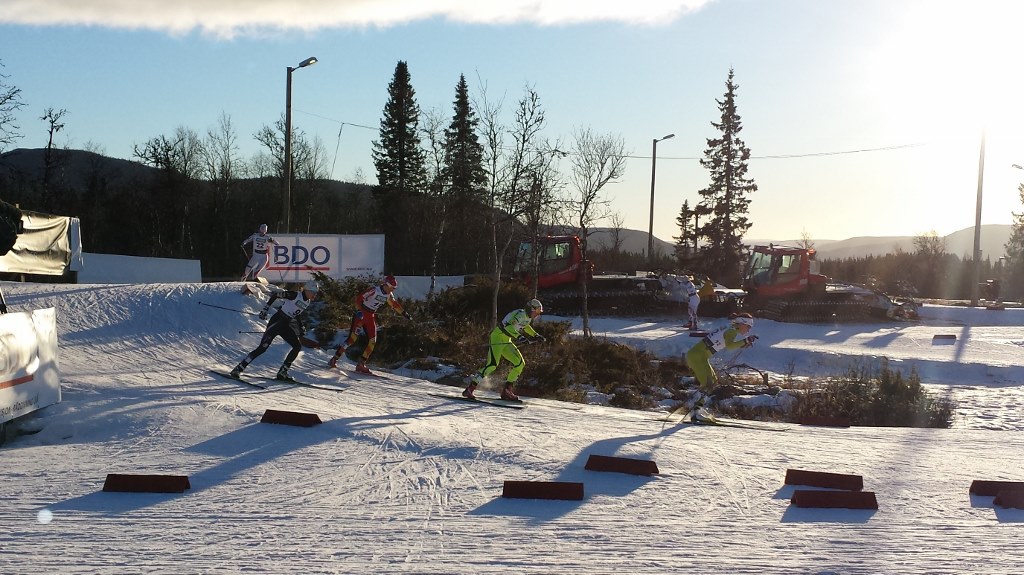
    In the women's freestyle sprint quarterfinals in Beitostølen, Norway, U.S. Ski Team rookie Sophie Caldwell keeps contact with Marit Bjørgen (second from left) and Slovenia's Vesna Fabjan (c), who ended up second overall. Bjørgen ultimately placed fourth in the final, and Caldwell did not advance to the semis, placing 18th overall. (Photo: Noah Hoffman/noahhoffman.com)
    In the women’s freestyle sprint quarterfinals in Beitostølen, Norway, U.S. Ski Team rookie Sophie Caldwell keeps contact with Marit Bjørgen (second from left) and Slovenia’s Vesna Fabjan (c), who ended up second overall. Bjørgen ultimately placed fourth in the final, and Caldwell did not advance to the semis, placing 18th overall. (Photo: Noah Hoffman/noahhoffman.com)

    The rest of the U.S. women came in 17th through 19th, with Jessie Diggins, Sophie Caldwell and Sadie Bjornsen, respectively.

    Fourth in her quarterfinal and just a tenth of a second behind Sargent, Diggins explained in an email it hadn’t been an easy training week leading into Beitostølen, leaving her a little sore and tired before Sunday’s race. But that was part of the plan.

    “It’s a long season ahead!” Diggins wrote. “I was psyched that the two races this weekend went as well as they did, especially since it’s the plan to work into the season.”

    She qualified in eighth, but ran out of room in the quarterfinals, she explained.

    “This sprint was wicked short — like 2:15 in the qualifier,” she wrote. “I like much longer sprints, because it takes me longer to work into it. … I felt better and better in the finishing lanes and was picking up speed, but needed a longer course to do some damage. But it was a great way to get back into the feel of sprinting, get used to the warming up and testing ski process again.”

    Teammate Sophie Caldwell got a little too cold during the prelim and felt a bit stiff in her legs, but was happy to qualify in ninth. From there, she said her quarterfinal was “fun,” going up against top women like Fabjan, Bjørgen, and Norway’s Heidi Weng, who took first through third in the heat, respectively.

    “I didn’t realize I had Marit in my heat until I toed the start line and then I just tried my best to tuck in behind her,” Caldwell wrote. “I had a good start and was able to stay in 2nd for the first half of the race before moving back to 4th. It was exciting to have all five girls qualify, so hopefully that means we’re in a good place!”

    Additionally, she was excited to watch one of her teammates win outright and teammates Andy Newell and Simi Hamilton place sixth and 27th, respectively.

    Bjornsen, who notched fifth in Friday’s 10 k classic, qualified in 14th and went on to place fourth in her quarterfinal. She was 0.8 seconds out of first, with Visnar, Randall and Norway’s Hilde Landheim taking first through third.

    “It was fun to sprint again,” Bjornsen wrote. “… [And] a good warm up for next weekends world cups which I am looking forward to! This weekend was about getting back into the grove of racing. Warm-up, ski selection, nerves, pacing. It was a practice race before it really counts.”

    The last time she started her season in Europe – two years ago – the team didn’t do that, Bjornsen explained.

    “So now I am really looking forward to Finland and a fun season ahead!!” she added.

    — Alex Matthews contributed reporting

    ***

    Results | Brackets