From the FasterSkier archive — posts syndicated from athletes’ and coaches’ own blogs between 2004 and 2012, kept online as published. Current coverage is at fasterskier.com.
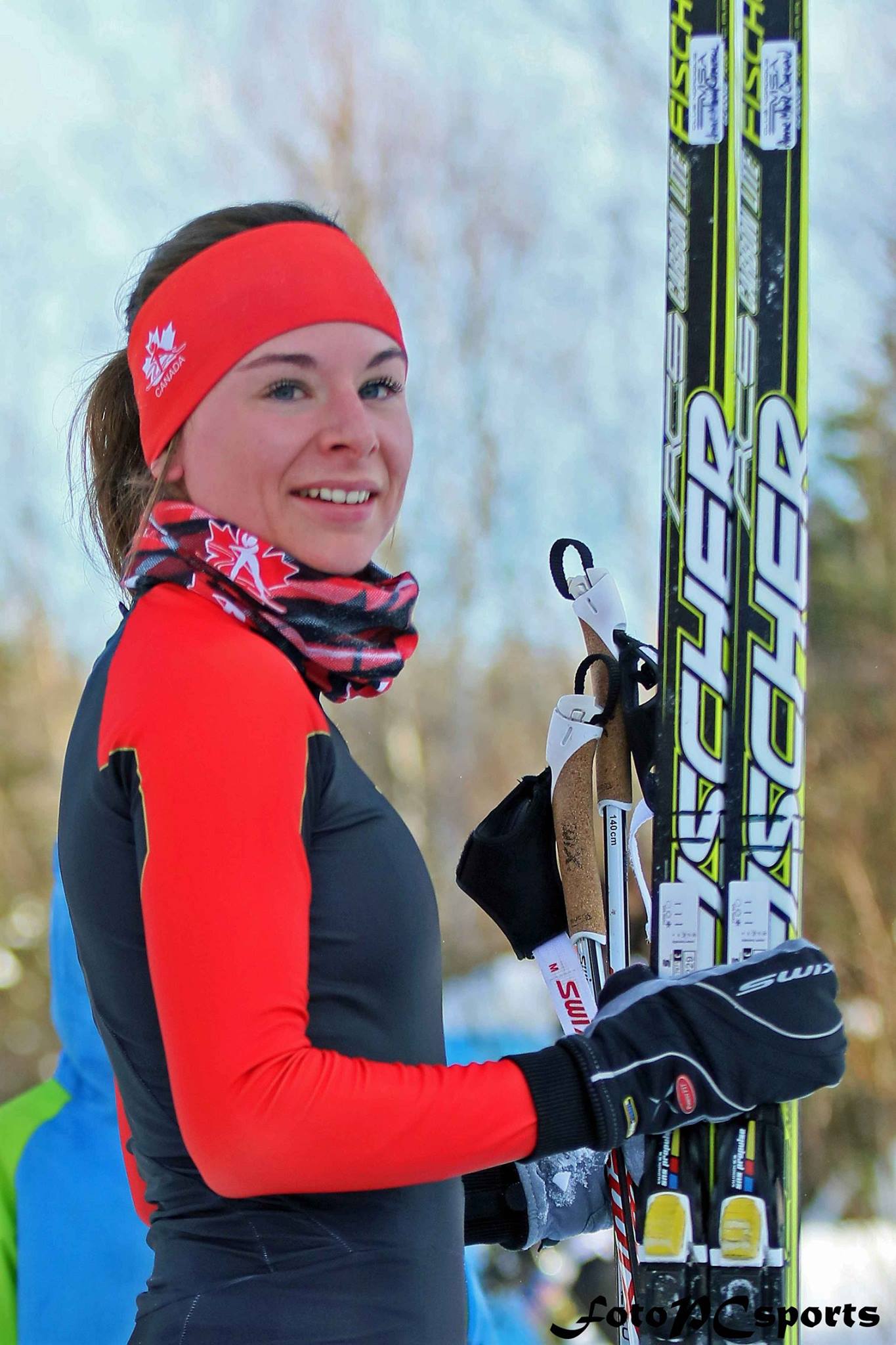
Anne-Marie Comeau leading Cendrine Browne during the skiathlon at Cross Country Canada’s NorAm/Olympic Selection Races in Mont Sainte Anne, Quebec, in January. (Courtesy photo)
Today, she’s Olympic-bound. But two years ago, Anne-Marie Comeau was stepping away from cross-country skiing.
Comeau had raced at 2015 World Junior Championships, finishing 25th in the skiathlon, but by December of that year the Canadian was diagnosed with a shoulder injury that required her to take half a year away from skiing.
Anne-Marie Comeau (Université Laval) racing to third in the women’s 10 k classic on Jan. 10 at Mont Sainte-Anne NorAm Trials in Quebec. (Photo: Mario Walker/NorAm MSA 2018 Facebook)
And that was plenty for Comeau to focus on. A talented runner, she had set the Quebec junior record at 5,000 meters (16:34.4, a time she has since improved on). And she won a silver medal at Junior Pan-American Games.
But skiing was something she couldn’t shake.
“I did more training for running, but skiing remained a sport that I love in the winter,” Comeau wrote in an interview with FasterSkier last week, translated from French into English. “I realized over the months that I missed ski racing, and so I decided in autumn of 2017 that I would do the selection races for Olympics, especially since they were at Mont-Ste-Anne where I live.”
So Comeau, who began attending Université Laval this fall and competed with their cross-country team, adapted her training somewhat. She added a rollerski workout once a week and uphill sessions on Mont Sainte Anne.
“Since it had been two years that I wasn’t doing ski races, it was difficult for me to come up with fixed goals,” Comeau wrote. “The prospect of participating in this type of selection gave me a certain motivation to train, and I couldn’t wait to get back to the joy of ski racing.”
At the same time, she was part of a college team for the first time.
Comeau ran for the Laval Rouge et Or team this fall. (Courtesy photo)
“It’s always really stimulating to be part of a team where the other athletes have the same passion,” she wrote.
The Laval women won the Quebec Conference Championships, and finished third at Canadian U Sports Cross-Country Championships.
“I’m very satisfied with my first season,” Comeau wrote. “I’m particularly pleased with the result that I had when we participated in an NCAA race in Princeton, New Jersey. It was a 6 k cross-country race and our team finished second in the overall standings. I finished first in that race. That second place for our team gave us confidence for what came next. The atmosphere in the team was really good and I am always very proud to represent the Rouge et Or.”
The pride and team energy, combined with just enough ski-specific training, combined perfectly to prepare Comeau to re-enter the world of ski racing.
To say that the Olympic selection races went well would be an understatement. On the second day of racing Comeau placed second in the 15 k skiathlon behind Cendrine Browne, who had already sealed her Olympic nomination by winning the sprint to open the trials series. Then on the last day of competition Comeau placed third in the 10 k classic behind Browne and Katherine Stewart-Jones.
That made her the distance winner of the trials, not counting Browne.
“To succeed in qualifying for the Olympics was truly a huge joy for me and a motivation to give my best for what would follow!” she wrote.
Comeau at the trials races in Mont Sainte Anne. (Courtesy photo)
But there was a catch: because Comeau hadn’t raced in so long – the only competitions she had done this season before selection trials were the Sovereign Lake NorAms – she did not have the required five FIS races averaging 100 points or below. So while she topped the selection list, in order to be allowed to race at the Olympics she had to get a few more results with good FIS points.
“After my races at Mont Sainte Anne, I was so motivated and proud of my results that it gave me positive energy to face the challenges that I had to overcome to meet the Olympic criteria from FIS,” Comeau wrote. “I didn’t really think about everything I had to accomplish, I just went right into it, the motivation of going to the Olympics being my main objective that I wanted to meet.”
To do that, she headed south, racing in a 10 k skate in Craftsbury, Vermont, and a 5 k classic in West Yellowstone, Montana. That brought her average FIS points down to 98.47.
Comeau is still absorbing the idea of becoming an Olympian.
“At 21 years old, I consider myself blessed to be able to live this experience, and I want to try to take the most of this experience to help me in the pursuit of my athletic career,” she wrote. “Honestly, to give the best I can and to live fully in each of my races, that’s my main goal. For the results, it’s hard for me to predict.”
Although she has won hill climbs and had fun appearing on television shows like Top Gear, Therese Johaug has had some bad luck this training season. (Photo: Bymiljøetaten/Flickr)
Therese Johaug’s summer of training woes continues: at a camp in Italy, the Norwegian cross-country skiing star took a fall while running downhill and broke her right hand.
Six weeks ago she fell while running in Seiser Alm, Italy, and broke her left hand. That break required surgery and kept her from competing in the Blink summer ski festival, where she typically is one of the best competitors in the Lysebotn Opp ski race.
It appeared that Johaug was almost back on track, with the initial break representing a minimal training setback.
But when the Norwegian team headed to Livigno, Italy, this week for a rare joint training camp with the men and the women, bad luck hit again. This time it was her right hand.
“Therese was a bit unlucky on the tour today,” Norwegian national team coach Egil Kristiansen told NRK, the Norwegian broadcaster who had happened to be on site for filming and interviews. “[She] has been to radiology. The examination shows that there is a small fracture.”
As with the last incident, Kristiansen does not believe that it will take a major toll on Johaug’s preparations for the upcoming race season.
“I do not think this will have serious consequences at all,” Kristiansen said. “She can run and get trained.”
But he emphasized that until a specialist came back with recommendations, nobody could be sure what the treatment time would be before Johaug could use both poles again.
Meanwhile, Aftenbladet reported that Johaug had been driven the three hours to Zürich and was flying home to Oslo. There, she will meet with a specialist to assess the damage and develop a recovery plan.
After the first break earlier this summer, Johaug had surgery which inserted screws into her finger. If the recovery time is similar, Kristiansen guessed that it would mean two weeks of alternative training.
“She had maximum bad luck,” said teammate Marit Bjørgen, who was in Livigno continuing to train with the team through her first pregnancy.
Maiken Caspersen Falla agreed, but said that if anything it might make Johaug even more fearsome come winter.
“Although it sucks that it’s so close to season’s start, she will only become even more focused,” Falla told Aftenbladet.
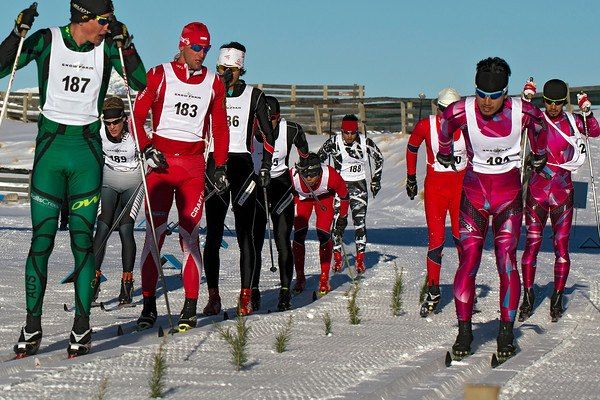
Callum Watson (left) racing in New Zealand in 2012. After a crash which resulted in a punctured lung, Watson has been forced to try to raise funds to pay for his medical expenses. You can donate at www.gofundme.com/djob50. (Photo: Ausxc.com)
Australian cross country skier Callum Watson was looking towards a bright future: after competing in his first Olympic Games in Sochi, Russia, this winter, he and teammate Phil Bellingham decided to take the plunge and join a team in Falun, Sweden, to try to take their skiing to the next level.
“We accepted the offer to join Dala Sports Academy where we began working with our new Coach Mattias Nilsson,” Watson wrote in an email to FasterSkier. “During the European Spring I made some amazingly rewarding progress in many areas resulting in some results that showed a lot of promise. Finally I had the confidence that I was on the path to achieving my goal of a top 30 on World Cup which I am regularly told I have the potential to reach.”
He returned to Australia to compete in his country’s national championships, as well as make some money teaching skiing to fund his own career. But there, disaster struck: in the semifinals of the championship sprint, Watson collided with Swiss racer Simon Hammer and what happened next is practically unheard of in the cross country world. Hammer’s ski slipped in between Watson’s ribs and punctured his lung, which immediately collapsed.
“It was almost like slow-motion as I saw the ski go straight into the top of my chest,” Watson wrote. “I knew that I had been hit hard, however as I tried to get up, I felt burst of air gurgling from where the ski had hit. I immediately knew what that meant but couldn’t quite believe it. As I began to cough, more air could be heard passing through my chest and suddenly I went into panic with an overwhelming inability to breathe.”
Watson explained that he had clipped skis with another competitor and fell in front of Hammer, who had no choice but to ski into him. Still, the outcome was pretty shocking: as skiers we take it for granted that while we might get cut or bruised, cross country skis — lighter and duller than their alpine counterparts – don’t have the capacity to cause major internal damage.
“Snow conditions were good and no-one was at fault, it was just a race incident that resulted a collision and freak accident,” Australian national team coach Finn Marsland said.
While Watson said that at the time it felt like the ski patrol took an “agonizingly long time” to arrive, they actually responded very quickly considering his location. There also happened to be a trauma doctor among the spectators, and Watson’s brother Ewan and another helper tried to keep him calm, which he said probably “prevented me from passing out.” But Watson was still in critical condition. He was sledded down to Falls Creek Medical Center before being stabilized and sent on a helicopter to Melbourne, where trauma specialists could get to work.
“I’m not sure what the chances are, but unluckily the ski had managed to penetrate between my ribs, punctured through the chest cavity and into my right lung causing it to quickly collapse,” Watson wrote. “With a strong dose of various drugs an emergency chest tube was put in place to stabilise me. The drugs put me in a different world but I was still conscious for the whole procedure and was one of the toughest things I have ever been through.”
Unfortunately, that was nothing compared to what still lay ahead.
The original chest tube worked by using suction to create negative pressure in the lung and hold it in place during healing. But after four days, the seal began to leak. As the lung collapsed again, Watson was in excruciating pain. He described the prep work for replacing the tube as the most excruciating thing he had ever experienced: “by far the most traumatic experience of my life and was far worse than the original accident.”
After several days, it became clear that despite the second tube being bigger, it also had not allowed the lung to seal and begin to heal itself. So Watson headed in for surgery. He now feels like he’s back on track.
“I didn’t know how much pain I would be dealing with when I woke up, however I was very happy to find it was minimal compared with the previous ordeal!” he wrote. “The ski created a hole which was around 1cm long and 2cm deep into the lung. I sit here now in the same hospital bed 12 days after the accident and now I am waiting for the 3rd chest tube to complete its work by draining the remaining fluid and air from my chest. The prediction is that I will have the tube out either on Thursday afternoon or Friday and should be out of the hospital by Saturday or Sunday if all goes well.”
While Watson was reportedly in low spirits in the week following the crash, he’s feeling better now. A well-liked World Cup athlete, his sunny approach to life was apparent in his explanations of how he’s dealing with his situation.
“The small length of this suction tube [confines] me to the inside of this small area in my ward,” he wrote. “I have a tube stuck in my chest, it hurts to breath whilst moving and standing up is a painful challenge. I can feel myself wasting away and therefore should feeling like the most depressed and lost soul around, but somehow I find myself always smiling thinking positively about the future and even laughing! …There I have to say that my family, [girlfriend] Teresa and coach Mattias have been amazing through this period and that along with so many visits and kind messages from fellow athletes and friends have been what has gotten me through this horrible experience.”
Encouragement from his coach has played a big role, too.
“My coach believes even with the recovery time required from such an injury, I will be able to ski much faster than I ever have and should keep my eyes positively focused towards my original goals set for this World Cup Season and World Championships in Falun,” Watson wrote. “I have the determination to get myself back to racing at the level I was before the accident and am confident in my coach’s positive approach in what I am capable of.”
But besides the months of recovery time he’ll be forced to take, Watson faces an additional huge challenge: money. He has to pay for the helicopter flight, which he says puts himself in an “impossible financial situation.” In addition, his income was coming from coaching, which he won’t be able to do while he’s in recovery. That cuts off any incoming funds he might have generated.
Watson, his family, and Marsland have worked to set up a fundraising page to help pay the costs of the medical rescue and allow the racer to get back to his career: racing. The goal is to raise $20,000. The GoFundMe page, called “Help Rebuild Callum Watson”, can be found here.
Welcome back to This Month in Journals! After taking the winter off to focus on race reporting, we’re doing a series to catch up on the ski-related research that has been published in scientific and social science journals this winter.
* In the journal Sports Engineering, five researchers from Trondheim, Norway, reported having built an “instrumented rollerski.”
Come again?
The team built full bridge strain gauges into the shaft of the rollerskis so that they could measure force while a skier trained on a treadmill. A wireless sensor picked up the information and transmitted to a base station via a radio transmitter. They also used a motion-capture system to track the rollerski’s position in three-dimensional space.
That allowed them to be able to detect differences in technique between two skiers, or for instance between the same skier when he was skating with and without poles. The researchers hope that the system will allow better work on ski technique – but they wrote that a few adjustments still had to be made to the system.
* Meanwhile in Austria, researchers were focusing on boots.
“Ski boot quality is determined by mechanical properties and comfort,” Dr. Patrick Hofer and four coauthors wrote in their abstract in Applied Ergonomics. “Comfort is strongly affected by cold feet.”
Point taken. The group set out to determine the “microclimate” in ski boots: temperature, humidity, and how much water the boots absorbed. They asked five skiers to participate in their study, using two different brands of alpine ski boots. The men went into a climate chamber set at various temperatures and simulated skiing (rounds of squats, followed by rests so simulate riding on a chairlift); two of the men also did field tests.
The ski boots were outfitted with sensors to detect the temperature and humidity. After the simulation was done, the wetness of the boot liner was measured by weighing it on a scale and seeing how much water weight it had gained.
Alpine boots are completely different than cross-country ski boots, but some of the researchers’ conclusions are still quite valid for our community. Because there are no large muscles in the foot, feet are kept warm only by blood flow. That means that once boots (and feet) start to get cold, they just keep going. In every case, the temperature in the boots declined once the skiing began.
The men began saying that their feet were cold and hurt when their toes reached about 20ºC (68ºF), or when they were about 5ºC colder than the main part of the foot (toes and feet had different sensors). The coldest temperature any of the mens’ toes reached was 11ºC (52ºCF), at which point he said his toes were numb.
The researchers also found that ski boots got far wetter in the field than in the climate chamber (duh) and noted that although boots have good insulation, when they are exposed to snow and get wet, that insulation doesn’t work as well.
In order to keep feet from getting cold – important! – the researchers said that boots would probably have to be built with different materials and maybe even different designs.
* Other researchers were studying the health effects of sports. The American Medical Society for Sports Medicine published a position statement in the British Journal of Sports Medicine about overuse injuries and burnout in youth sports. Noting a culture pushing children towards excellence at younger and younger ages, the panel gave an overview of possible effects with the aim of helping doctors identify young athletes at risk.
Among the consequences of heavier training loads for young athletes, they discussed that:
overuse injuries are most likely to occur during the adolescent growth spurt
prior injury is the biggest risk factor for developing an overuse injury
growth cartilage may be particularly susceptible to repetitive stress
early “sport specialization” increases injury and burnout; participating in a diverse array of sports should be encouraged early in a child’s athletic “career”
scheduled rest periods are essential in maintaining a physically and mentally healthy relationship to sport
emphasis should be placed on skill development and correct technique, not just competition
pressure from family and peers is discouraged
the female athlete triad places girls at increased risk of injury
* While we’re on the subject of the female athlete triad…. Two other research groups addressed the phenomenon. Defined as a combination of disordered eating and irregular menstrual cycles, which eventually through hormonal effects can lead to decreased bone density, the triad, also sometimes referred to as relative energy deficiency syndrome, is assumed to be common in female athletes.
Not all three symptoms have to be present for a woman’s health to be affected. Even without disordered eating, for example, a female athlete can be taking in few enough calories to stress daily body function, at which point reproductive functioning is diminished. Regardless, reducing the energy deficiency – that is, making sure an athlete is taking in more calories than they are burning – can solve a lot of the problems.
The IOC put out a consensus statement pointing out that male athletes are also affected, although few studies have examined to what extent. In any case, the IOC listed the potential effects of relative energy deficiency: decreases in metabolic rate, menstrual function, bone health, immunity, protein synthesis, and cardiovascular health. Because of these risks, which can have long-term consequences, it is important to remedy the symptoms of the triad.
The group called for better clinical approaches to dealing with the syndrome, and suggested dividing athletes into three categories, each with different treatment plans in relation to when they should be allowed to return to sport.
Low-risk athlete should be encouraged to play their sport full-time, with an emphasis on healthy eating. Medium-risk athletes should be placed on a training plan and diet plan, and allowed to train if they follow these plans; they can be cleared for competition by their doctor. For high-risk athletes, competition should not be allowed, and only minimal training under supervision.
The statement was published in the British Journal of Sports Medicine, which also published a paper by a group of Scandinavian researchers who developed a questionnaire to determine whether athletes are affected by the triad. Consisting of 25 questions, validation showed that the survey was effective in identifying female athletes who showed signs of the triad. The researchers suggested that such a questionnaire (called LEAF-Q) be used for early detection of the triad so that female athletes could change their habits before the effects became more serious.
Miriam Gössner, a German biathlete, on her way to a fourth-place finish at FIS Cross Country World Championships in 2013. She was just half a second from the podium.
With the announcement that U.S. alpine star Lindsey Vonn will not be able to compete at the upcoming Olympics due to injuries sustained earlier this season, at least one other woman in the world of sports knows exactly what she’s going through.
In a no-notice press conference after the biathlon World Cup sprint in Oberhof, Germany, on Friday, German racer Miriam Gössner announced that she was unable to overcome the four fractured vertebrae from a bike accident in Norway in May, and was ending her quest for the Olympics.
Was Gössner as big a star as Vonn? No way. But she had very legitimate medal chances, before the accident.
“I have come to the conclusion that I will not go to Sochi, and primarily focusing on getting healthy again,” Gössner announced, before breaking down in tears.
The Garmisch native compated in the Vancouver Olympics as a cross country skier, placing 21st in the 10 k freestyle after a bad crash on the second lap, and taking part in the silver-medal winning 4 x 5 k relay. She was just 20 years old at the time.
After that she went back to biathlon, the sport she preferred but had seen no chance to make the Olympics in as the German women were so dominant at the time. 2012-13 was a breakout season for Gössner: she won World Cup competitions at three different venues, earned three more podiums, and landed ninth in the World Cup Total Score.
This was exciting not just for Gössner, but for Germany. With Magdalena Neuner’s retirement after the 2012 season as one of the greatest female biathletes of all time, and Andrea Henkel sure to retire soon, they were looking for fresh faces. Gössner provided an unexpected spark: she had always been an excellent skier, but her shooting began to come together better than anyone probably could have hoped for, given her previous results.
In particular, Germany feared what would happen to its women’s relay team, once so thoroughly dominant. They shouldn’t have: Henkel, Gössner, and company won relays in Antholz, Italy, and on the Olympic course in Sochi, Russia, last season (although they were only fifth at World Championships).
With her diminutive size, quick tempo, and blonde hair, Gössner drew comparisons to Norwegian ski star Therese Johaug. And indeed, after a lackluster biathlon World Championships in 2013 where her best finish was sixth, she headed to skiing World Championships and placed fourth in the 10 k freestyle. It was one of her only ski races of the season where she didn’t stop to shoot, and she landed just half a second off the podium and 33 seconds behind Johaug herself, who won the race.
So the Olympics were looking very bright indeed for Gössner, who could have had her pick of disciplines and, possibly, multiple sports. But then in May she was in a high-speed road bike crash while training in Norway.
German team doctor Bernd Wolfahrt said that the rehabilitation process had progressed well, and that Gössner had come farther than she probably should have expected to.
“One must again bear in mind that this was a very, very serious injury,” he said. “You have to be happy that she still can ski. This could have had a much, much worse outcome.”
But for Gössner, that’s only a little bit of consolation as her career was seeming to come together just at the perfect time. Instead, this season her top finish so far was 47th.
“In skiing, it is very, very difficult for me,” she said in the press conference. “I can’t really move. I think you can see it… it just is not working. And to be honest, when it comes to the Olympics, my goal is [winning] medals. Currently with my back, I wouldn’t be able to.”
Still 23, Gössner can instead refocus on the next Olympic cycle. Wolfahrt said that part of the reason that “it makes sense to cancel the season” is that while her back is improving, the training load she needs in order to succeed is still too large, and the rehabilitation must be handled delicately.
The two said that they may consider rejoining the World Cup in March, depending on how Gössner’s health progresses.
Erik Bjornsen is putting in a block of training with friends in France in an attempt to increase his comfort with Europe, push his boundaries and get a little summer travel in. The USST and NNF athlete checks in on what has made is trip remarkable so far:
1. FRiendly people! Everyone here has been so nice. I have found that English isn’t as well known as other places in central Europe but that doesn’t stop them from trying. People always welcome me into their home for a drink or a quick snack.
2. Adapting to the culture. My goal is to start racing more and more over here in Europe. It’s where most of the World Cups are and it’s important for me to start feeling comfortable here. Every time I travel over seas it gets easier and I notice the jet leg less.
3. Nice location! I have seen a lot of France this trip and have gotten to train in some really awesome locations. The roads are perfect for rollerskiing, lots of small narrow roads thatfeel like their built for us. It’s no problem finding steep sections for practicing V1. The cars are also so considerate when passing. They will give you space- even if that means causing the on coming car to almost run off the road! You never feel in danger.
4. Connections. Since I have been here I have made a lot of friends. I have been invited to train with some of the best athletes in the world. Sometimes it’s hard to let your competitors see what you are doing for training but they have been very excited and happy to have me join in. It’s been really fun to talk training philosophies and trade ideas. It’s nice to have connections in Europe since we will continue to spend so much time here next season for racing.
5. Extremely good food! I have to include the food. Breakfast, lunch, and dinners are all eaten at the dinning table outside and nobody starts to eat until the meal is ready and everyone is seated. Meals are a social event! My favorite food would have to be the cheese. (Note: There will be a smell coming out of my bag when I fly back to the U.S……. Hopefully security will not find my delicious treasure.)
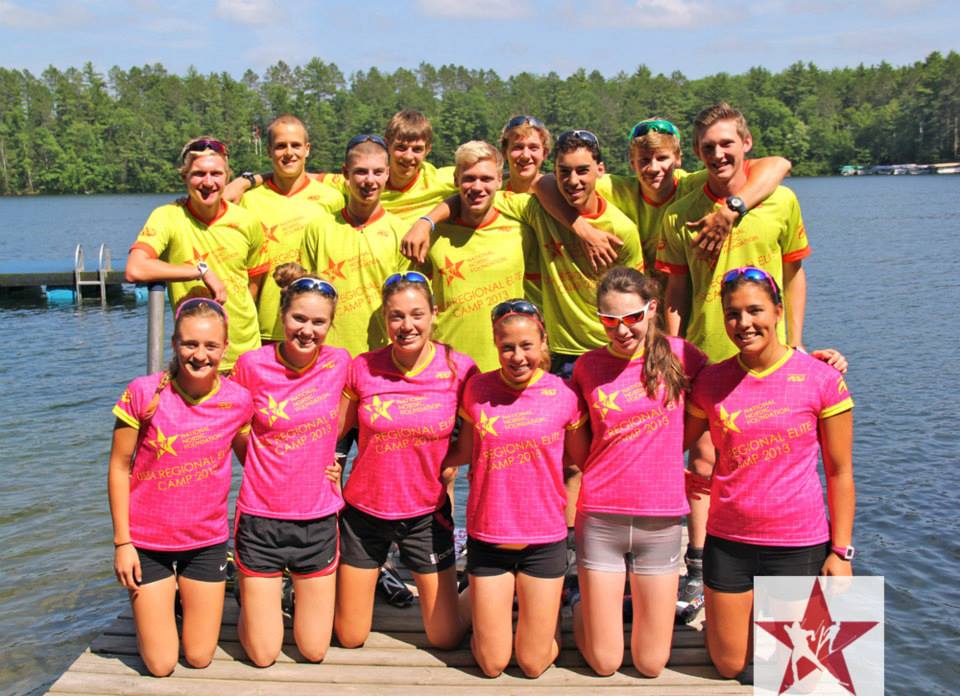
Led by USST Coach, Bryan Fish, Regional Elite Group camps continue throughout the country. This week closed out the Central Region’s training camp. Junior skiers, Vivian Hett and Alayna Sonnesyn, report on their week:
Beginning our experience at the Central REG Camp, all of the athletes ran in a 5km trail race in Seeley, WI, full of challenging twists, turns, and hills. Many of the CXC Elite Team skiers came to push the younger athletes. After checking into our lakeside cabins and having a healthy lunch, we drove into downtown Cable for sprint races again against the CXC Elite Team. While the weather was not exactly ideal with rain beginning prior to semifinals, the positive and encouraging attitudes of cheery bystanders pushed us to complete the two lap sprint course with success. The following day – after the power went out during the night due to strong thunderstorms -all the athletes drove to Telemark for a strength test. After having little time for lunch, we challenged ourselves yet again in an agility course test at Hayward High School. Unfortunately, there were a few broken poles and bloody knees but nothing too serious.
Early Monday morning, we all woke up for a short run and balance exercises before breakfast. Soon we set out for a classic rollerski with technique work from Bryan Fish. The afternoon consisted of similar drills with skate rollerskiing. Post workout recovery involved swimming, diving, and paddle boarding down by Lake Owen. Tuesday’s main workout was a 5km skate time trial up the famous OO road. After a lot of hard work, a coach took us out for an afternoon in Hayward for ice cream. The next morning, we went for another morning run and exercises before heading out for a distance double pole with other local skiers. The afternoon was left open for athletes to decide on a workout fit for their own training plan. That evening, we watched an interview of Jessie Diggins about her life and how she became a world class skier. It was very inspiring and in perfect time for our double pole intervals the next morning (only after we ate our delicious maple monkey bread for breakfast). Later that day, we had an active recovery session with kayaking, paddle boarding, and canoeing.
Over the week, many of us athletes became closer friends and pushed each other when workouts became tough. We would like to thank our amazing cook, Kara and hosts at Lake Owen Resort. In addition, our Central REG Camp could not have been possible without the help of NNF and the Central Cross Country Ski Association. Thanks for a great week! We can’t wait for next year!
Ski Tweets
The Best Tweets This Week from NNF Athletes
1. 2. 3. 4. 5. 6.
Making the Most of Training
Injury Without Insult
Nordic skiing has a mainstream image of safety: the happy ski tourer slowly moving over gentle terrain. But peek at the injury list of skiing heavy-hitters, and there is no doubt, injury is a part of developing skiers, physical adversity is a part of this sport. Here are steps any injured skier can take to make the best of less-than-perfect training circumstances.
Acceptance is the first step of almost every recovery system (it’s what follows every Nordic skier’s first reaction, denial). Here’s the hard truth: injury in an elite athlete is nearly inevitable. It’s an athlete rite of passage. Learning to control an injury, no matter how small, creates better athletes. Take Sadie Bjornsen for example. Suffering from knee and heel injuries for several seasons, she certainly hasn’t let changes in her training schedule slow her down, but it wasn’t easy. She explained on her blog,
“When health goes out the door- forcing you to change your training to great degrees… your happiness walks right out as well. As much as I tried to be positive last summer- I struggled to find my joy. This summer has been different. I have learned to gain control of many of my chronic injuries, and I have started to make improvements.”
Forward progress means working around the injury. An elite, recovering athlete emerges from the healing and recovery process physically stronger and more motivated than when they were first hurt. Whether working in the pool, the arm trainer, in the gym or at the physical therapist, injury inspires an appreciation for the sport different from any other. Tell a skier they can’t and longing takes over. We can’t always get what we want, but if we try, we get what we need. Those unlovable rehab sessions give athletes a chance to focus on specific strength. Commenting on how being in a walking boot helped her last year, Kikkan Randall told the press, “Sometimes injury can be a blessing in disguise.”
Finally, in a sport with a dark history of stressing quantity over quality, injury gives you the chance to reap the rewards of rest. On her foot injury two seasons ago, Therese Johaug commented, “I have to take it easy…I have to be smarter next time and carefully listen to my body.” Injuries, particularly overuse injuries like tendonitis and stress fractures, are usually a sign that the body needs rest. Learning to listen to your body and catch signs of fatigue early will make you a better skier in the long run, and the strongest athletes are those that release the need to fill in their training logs (refer to step one) and focus on recovery.
Unfortunately, these lessons tend to be learned from experience. However, as proven by the professionals, injury can be considered an opportunity, not a set back, and skiing development requires taking advantage of every opportunity.
U.S. Ski Team members Sadie Bjornsen (l) and Sophie Caldwell take a break from skiing in May at their training camp in Bend, Ore. (Courtesy photo)
The five interlocking rings hanging over Sadie Bjornsen’s bed mean everything they did four years ago when she shelved her college education at the age of 19, moved home and threw all she could muster at a dream of skiing in the Olympics – only to come up short.
But closer examination of the wall ornament reveals that an upcoming February trip to Sochi, Russia, isn’t the only ticket to happiness for the experienced, confident and humbled Alaska Pacific University (APU) skier.
Sadie Bjornsen (APU/USST) heads out on her mountain bike at the 2013 USST training camp in Bend, Ore. (Photo: Jessie Diggins)
Massage. Stretching. Sleep. Learning to speak French (for her French boyfriend) – each task has its own ring and a place in the 23-year-old U.S. Ski Team (USST) member’s daily routine, so that her mind and body are given the best opportunity to remain healthy throughout this Olympic year. (The fifth ring’s contents were too personal to share.)
“The biggest thing that I learned [before the 2010 Olympics] was that I need different things in my life,” Bjornsen said Sunday on the phone from her home in Anchorage, Alaska. “Wholly focusing on skiing is not meant for me.”
The significance of the most routine physical activity was magnified this spring for Bjornsen, who could relax after emerging in one piece from USST training camp in Bend, Ore., and most recently, fitness testing in Park City, Utah.
At this time last year, she was hampered by a structural problem in her back and tendonitis in her foot, and this June she participated in most everything except treadmill tests because of foot limitations.
But 2012/2013 was anything but a lost year. Bjornsen was able to check off her first top 10 in a World Cup event, was a member of the fourth place 4 x 5-kilometer relay team at World Championships and added a pair of national titles. She just had a late start.
“Just racing in my first race, I appreciated it so much,” Bjornsen said. “I think it’s sometimes a good reminder to have those challenges. You just appreciate things more.”
Bjornsen estimated it was five years ago when she took the antibiotic Levaquin, which has a known possible side effect of attacking tendons, most commonly the Achilles. She’s lived with a form of tendonitis ever since.
Now she approaches training camps a little differently than her teammates. Bjornsen’s offseason is about consistency. If she has to substitute a dryland activity for a morning ski, that’s OK. Exercise in any form will make her stronger.
“The difference this year is I have a little more confidence in knowing that the way that I train can work out,” Bjornsen said.
What works for Bjornsen is laying off the intensity during the summer, as she has seen it come back to her quickly in the fall. She’s learned how to recognize the warning signs of a balky back. And she feels the support of her teammates and coaches.
“It’s hard because everyone is really competitive and everyone wants to push each other,” Bjornsen said. “Especially now that we’re having some success, you feel like every moment you have to be 100-percent. The girls are really good about being patient.”
Bjornsen described her coach, APU director Erik Flora as “unbearably positive.” Flora had his own racing career abbreviated by the combination of a car accident and back injuries.
“You have to be so mentally strong to make it through without any support,” Bjornsen said. “[The support’s] coming at me from all angles.”
With brief visits to Bend, Park City and Vancouver behind her, Bjornsen will train in Alaska for most of the summer, a place where she is constantly reminded of the intermediate goals she must attend to before approaching the ultimate one. Ideally she will race a full World Cup schedule for the first time in her career and post some of her best results in February.
“The Olympics are a possibility to really spread our sport through our country,” Bjornsen said. “There’s a whole new generation coming into our sport soon. I think it would be really neat for them to see that success is totally possible.”
Here’s to racing well into our old age: like Norway’s Gunnar Tronsmoen, who won 3 gold medals at 2011 Masters World Championships. Photo: Inge Scheve
Welcome back to This Month in Journals, where we read the latest exercise and sports science and pull out some research that might be of interest to skiers.
– Gentlemen of the ski world, some good news: if you started out as an athlete young, it will likely help you in your old age. Dr. Magnus Tveit and his colleagues at Lund University in southern Sweden have completed a cohort study of over 2000 men and concluded that once you hit your 70’s, ex-athletes have a much lower risk of breaking bones.
“This study, currently the largest retrospective matched controlled cohort study published, with the aim at estimate any fracture and fragility fracture incidence in old former athletes, shows a 50% lower risk of sustaining fragility fractures in athletes after career end than would be expected with age,” Tveit et al. wrote inMedicine and Science in Sports and Exercise.
However, the team was unable to completely parse why this might be true. Exercising when you’re growing up increases bone mass, yet it’s unclear whether better bone mass density is maintained after an athlete retires, or for how long. Exercise can also increase bone size, which would independently reduce fracture risk. And are athletes more likely to risk traumatic injuries? How does that fit into the picture?
The researchers also admitted that they would like to work with an even older age group in the future. After the age of 50, rates of hip fractures roughly double every five years; they weren’t sure whether the pattern of fewer broken bones would hold for hips as well. They added that doing sports has an effect on the amount and type of soft tissue in hips and knees, which may interact with the bone qualities themselves to change fracture rates – for better or for worse.
Regardless of the causes, the team was confident in their conclusion: men who are former athletes are less likely to find themselves wrapped up in plaster casts when they hit the golden years.
– Ladies, don’t worry, we’re not left out. And this reporter believes that the conclusions from the previous study are likely applicable to women too, at least to some extent; one main problem with including women was the difficulty of finding hundreds of septuagenarian ex-elite athletes to study. The group of men had been gleaned from a Swedish Olympic Committee book about former athletes, and at the time when the men were competing there were far fewer women in the highest levels of sports than there are today.
But another team looked at a different aspect of aging, and how it affected men and women who exercise. Dr. Michael Deschenes of the College of William and Mary wrote that in young or even middle-aged athletes, men and women metabolize different energy sources with differing levels of efficiency; men gain muscle faster while women lose it faster when they stop exercising; and women seem to maintain stability better during endurance tasks.
Previous studies had compared young and old men, or young and old women, but this was one of the first to directly compare old men and women, the authors claim. In the American Journal of Human Biology, Deschenes and his team reported that sexual dimorphism disappeared in his older group of test subjects, who had a mean age of 70 years. Of the multiple variables investigated, not one varied by sex.
To be clear, the test subjects weren’t all the same: the men still had higher VO2Max scores and more muscle mass. But once they started exercising, men’s and women’s cardiovascular, thermoregulatory, metabolic, and circulatory systems behaved in more or less the same way.
That means that masters can all follow the same training plan – and ladies, do we have some hope of beating the guys? (Probably not – pesky muscle mass. We’ll have to work on our technique.)
– Lots of attention has been focused recently on the effect of exercise on heart health. A year and a half ago, we wrote about a study that used cohort data from the Vasaloppet to show that lifelong skiers were at a higher risk of heart arrhythmias. Bradycardia, as the arrhythmias are called, go along with a syndrome called “athlete’s heart.”
And yet many of the symptoms of athlete’s heart were linked to the left side of the organ itself; for instance, the left ventricle typically enlarges and the heart walls of that chamber become thicker.
But last month, the discussion widened. First a team from Strasbourg, France, reported on cases of atrioventricular (AV) block in two 56-year-old triathletes; these were just the second and third cases of such blocks, which occur when the conduction of the electrical signal in the heart is stopped, having been brought on by exercise (in the athlete’s heart syndrome, these AV blocks disappear when exercise is begun).
Writing in Medicine and Science in Sports and Exercise, they concluded that these types of blocks did in fact happen to athletes, and since there is little clinical precedent to go on, should be handled carefully.
Meanwhile, an Italian team led by Dr. Antonello D’Andrea, the head of the Cardiology division at the Second University of Naples, widened their own scope by looking at the right side of the heart instead of the left. And they did so with impressive attention to detail, comparing 395 top-level endurance athletes to 225 strength-trained competitors. In the International Journal of Cardiology, D’Andrea and his associates wrote that the “right heart,” too, experiences changes.
Using echocardiography, they found that both the right ventricle and right atrium were larger in endurance athletes than strength athletes, with both groups being larger than non-athletes. They also found a correlation between left ventricle stroke volume and the dimensions of the right side of the heart, showing that the chambers grow in cooperation. The team believes it has now defined the “upper limits” of the dimensions of an athlete’s heart.
– A few weeks ago, we wrote about scientists who are looking for the genes that determine how an individual responds to endurance training. Well, the March edition of Annals of Human Geneticsincluded an update from a different team, which used a different group of individuals – this time just 60 women – to identify 39 genes which seemed to be differentially expressed in the individuals who responded best to training. This confirms not only the work, but the concept of the previous research.
This Month in Journals is our occasional series surveying the world of sports science and trying to extract tidbits of research that might be of interest to the skiing public. Previous editions can be found here: February, January, December, October, and September.
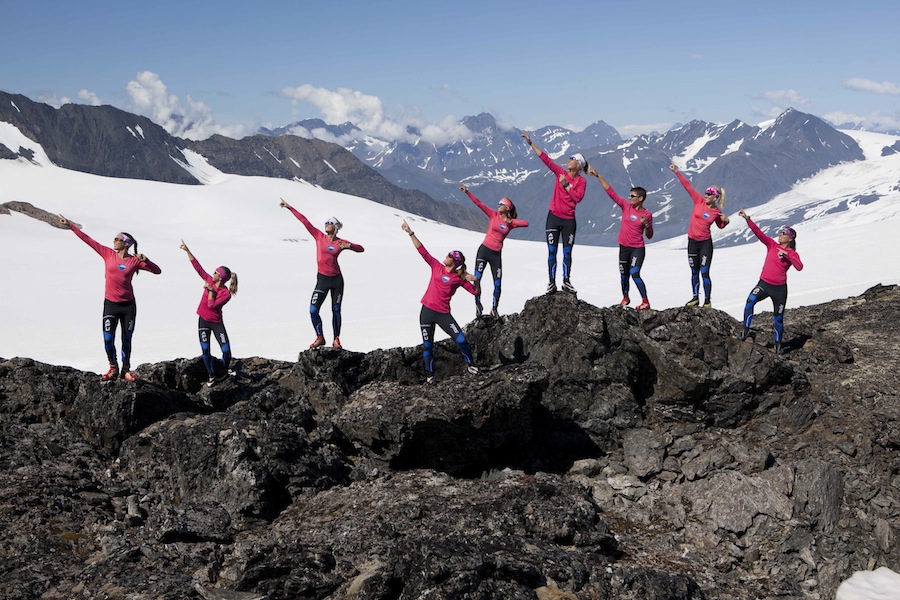
Sadie Bjornsen (fourth from right) and her APU teammates pose like Jamaican sprinter and six-time Olympic gold medalist Usain Bolt on Eagle Glacier near Anchorage, Alaska. (Photo by Chris Hodel)
Last week in Anchorage, a freak windstorm rolled through that would have devastated most mainland Americans. Gusts estimated at 130 miles per hour spewed trees across Alaska’s largest city, leaving at least a thousand residents without power through Saturday – almost four days after the storm hit Tuesday night.
In a phone interview, U.S. Ski Team member Kikkan Randall said the electricity and all the lights at her home came on at 2:15 a.m. Saturday. One tree took out part of their backyard fence, but Randall’s husband, Jeff Ellis, repaired it in no time. Their biggest concern was their refrigerator and freezer, so the two went out and got a generator.
Elsewhere in the city, Randall’s teammate on the U.S. Ski Team (USST) and Alaska Pacific University (APU), Sadie Bjornsen said the power at her on-campus housing was restored Wednesday morning. On the phone, Bjornsen laughed about how she didn’t even know the storm was coming.
A professor in one of her classes warned students about its potential effects. She hadn’t heard anything about it otherwise.
“I was like, ‘What are you talking about?’ I came out of the house and I was like, ‘What is going on? There’s a hurricane!’ ” she recalled with a laugh. “[My APU teammate Rosie Brennan and I] were driving and there were road signs ripping out and flying across the road and all this stuff flying around, and all the stoplights were out. I’m like, ‘Whoa, this is wild!’ ”
When she got home Tuesday evening, Bjornsen moved her car to avoid falling trees. Later that night, the 22-year-old had trouble falling asleep.
“I was freaking out because I’m like, ‘I’m going to wake up with a tree in my lap,’ because I’m on the corner where all the trees were blowing,” she said. “But then when I looked out the next day, I was like, ‘Oh those are all aspen or birch trees, and they aren’t that heavy.’ ”
Reports indicated that nobody was seriously injured, and Bjornsen was relieved. “Only in Alaska,” she said.
On Saturday, Randall said the weather was back to normal with the sun shining and slightly chilly temperatures. That morning they received their first frost. That was Alaska, all right.
Bjornsen’s Back/Foot Troubles
Sadie Bjornsen (APU/USST) working out on Eagle Glacier in July. (Photo by Reese Hanneman)
Way up north, the two Anchorage skiers have endured more than extreme weather in the last few months. Bjornsen’s been coping with back and foot injuries since the spring, and Randall is in a walking boot and training at 50 percent to heal a stress reaction in her foot.
While both joked about doing aqua-jogging sessions together, they also shared some of their frustrations and ways of staying positive through adversity. FasterSkier spoke with Bjornsen and Randall separately: Bjornsen while she was home studying before strength training, and Randall while she cheered on her husband at a local cyclocross race.
Bjornsen’s back injury started nearly a year ago in November, but by the time the racing season started, it disappeared, she said. After two and a half weeks of discomfort, she didn’t feel it again until this past April, just in time for the beginning of training season.
Kikkan Randall (APU/USST) donning a walking boot to relieve a stress reaction on her right foot. If left untreated, the reaction could magnify to a fracture, which is why Randall is training at 50 percent and not skiing or running for five weeks. (Courtesy photo)
She’s had the overuse issue since and initially remedied it by skate skiing. Classic skiing – her strength – seemed to irritate her facet joints the most, so she decided to skate only.
“Originally I was like, ‘Well, OK I’m just going to skate every single workout. I have a weakness with skating anyways so this is great,’ ” Bjornsen said. “That’s what I did and then I got tendonitis in my foot because of it. That’s when I have to stop and say, ‘I need to actually address this problem.’
“It’s challenging because you have a back and a foot injury so then you have to find exercises that are not stressing both of those things because they’re kind of opposites,” she added. “It’s just been hard to find ways to progress.”
Bjornsen discovered her tendonitis at the USST camp in Bend, Ore., in May. With the USST/Canadian women’s joint camp (also known as the North American Women’s Training Alliance) two weeks later in June, she pushed through the injury and raced to get into shape.
“I knew [Finland’s] Aino-Kaisa Saarinen (Auku) would be coming [to the Alaska training camp] and since I first started watching her ski, I have dreamt about classic skiing behind her,” Bjornsen wrote on her blog. “I over-jumped my limitations, skiing a two hour skate through the hills chasing Auku and Kikkan. Again, I was back at the bottom with my heart hanging low. At that point I had to make the difficult decision to leave the National Team Camp in my own town and get away from the excitement and motivated girls to truly get my body back to order.”
Since then, Bjornsen’s let her body recover for the better part of the last three months. She recently started doing some intensity on her feet, which she was excited about. It was a long summer without it, she said.
“I was just doing my intervals running in the pool,” she said with a laugh. “People in the pool will just look at me, like, ‘Why are you breathing so hard, for one, and what are you doing?’ ”
Not to mention, it’s a community pool.
“It’s been a bit humiliating, but it’s fun,” Bjornsen said. “It’s the world’s most boring thing you could ever do, but it makes you appreciate when you go out and do ski intervals, it’s like, ‘Oh my God, this is why I do this sport.’ ”
This summer, Bjornsen has been to the glacier twice to ski and said she’s making progress. As far as she can tell, her back is almost in the clear and her tendonitis is practically gone.
“The thing about tendonitis and stuff like that is you want it to just go away in two days,” she said. “But it’s just kind of something that you always have to look out for a little bit. I’ve just been working through strengthening it.”
As for her fitness, she said it’s hard not to imagine where she should be.
“You feel like you’re so far behind when you have these setbacks, you know? It’s hard to not only focus on that,” she said. “The most challenging part about it is there’s not really an answer to how to make it better. It’s like, ‘You need to work on not having muscle spasms.’… [I’m trying to think] about where I’ve progressed from two months ago and thinking about the season’s really long. You kind of have to think about the end of the season as well as the beginning.”
Her coach, Erik Flora, has been one of her biggest advocates and sources of support, she said. He’s shown her ways to be creative with training, even if it is in the pool.
“Erik’s like, ‘If you stay positive through these sections is when you decide if you’re in it for the long run or if you’re going to wuss out or something,’ ” Bjornsen said.
She’s decided to stick with it.
“It’s been a really challenging summer, for sure,” she said. “It was challenging to have to leave the national-team camp here in Alaska, and it was challenging to have to say no to [the USST camp in] Sweden because I wasn’t healthy enough to be there.”
“It’s just been a rollercoaster of making progress this summer,” she added. “I don’t know where I am, I guess we’ll see, but probably not where I would have hoped to be. Maybe in two months I will be somewhere I hope to be. The cool thing about our sport is your racing is not only based on your year of training, it’s also based on what you’ve done and what you’ve done in the past and what your strengths are. The best you can do is be really positive and do what you can do.”
In about a month, Bjornsen will join Randall and the rest of the USST for their final dryland camp in Park City, Utah. She plans to use the time to practice on the sprint course at Soldier Hollow and nail the slingshot descent into the stadium.
“Somehow I’m always at the wrong place on that last corner, so hopefully I’m going to learn that one this year,” she said.
Looking ahead, that venue is where Bjornsen hopes to podium at the upcoming U.S. nationals in January. Last year, a sinus infection kept her from racing for a national title in Rumford, Maine, which led to another goal: staying healthy.
“That even means paying attention more when I’m sick, to really admit that I’m sick and sort of jump on it rather than just pretend that you’re superman and it’s never going to get to you,” she said.
Throughout the next few weeks, Bjornsen will increase her intensity training. Meanwhile, most of her USST teammates (except those from APU) will do something similar throughout the next two weeks at a camp in Lake Placid, N.Y.
Heading into Park City, Bjornsen said she’d continue to build her base and intensity on skis.
“I still have two and a half months [until the racing season] and the progress I’ve made in the last month has been super encouraging,” she said “I still have hope for the season; there’s a lot to be trained still.”
Randall Healing Both Feet
Without too many injuries in her storied career, Randall feels the same way. She took her foot injury in stride during the Swedish joint camp in early August, wearing a walking boot between workouts.
Randall playing golf in late August with her walking boot. (Courtesy photo)
However, toward the end of camp, things started to get painful for the reigning World Cup sprint champion. She realized that what she was doing – training normally and keeping pressure off her right foot when she wasn’t skiing – wasn’t enough. USST women’s coach Matt Whitcomb convinced her to see a specialist and let it heal before this winter.
About two weeks ago, Randall flew south to see Dr. Tom Clanton at The Steadman Clinic in Vail, Colo. A world-renowned foot and ankle specialist, Dr. Clanton treated former professional basketball player, Yao Ming, the tallest man in the NBA at the time, when he had foot trouble. “We figured he was a good guy to talk to,” Randall said.
There, an MRI showed some fluid around the bone in her right foot, which meant it was starting to weaken, but it didn’t indicate a fracture. That was a good thing, Randall said. The doctor advised she train at a 50-percent effort for five weeks, which meant no skiing or running, but she could swim, bike and do double-pole workouts with APU.
Randall is also healing an Achilles injury in her left foot, which started early last March at the World Cup skiathlon in Lahti, Finland.
“The boots are a little bit different than what we’re used to and it didn’t get better through the spring,” she said. “We had a lot of classic races the last part of the season and I didn’t probably rest it enough, so it’s been nagging.”
While in Vail, physical therapists at Howard Head Sports Medicine taught her strengthening exercises for both feet, and she planned to return to Colorado in early October for a follow-up MRI. After that, she will head to Park City, where she probably won’t participate in the USST tests, but hopes to take advantage of the high altitude and transition back into regular training.
“The frustrating thing with both these injuries is they’re so subtle I can train through them, but it’s a matter of should I train through them,” Randall said. “Eventually the Achilles could get worse and you can get into some serious problems with that, and of course with bone fractures, that could be a serious problem, too. It’s the one time in your life when you have to not be tough and take signs and rest a little bit.”
Since discovering a massive blood clot in her leg in April 2008, Randall hasn’t had too many medical problems, she said.
“I’ve been really fortunate through my career,” she said. “The blood clot happened in the spring when it was the absolute best time when I was taking some time off anyway. I was able to bounce back [and win a World Championship]. This is almost my first time going through something kind of chronic and in the middle of the season. I had a few things when I was in high school but nothing quite like this.”
Still, she’s managed to keep her head up.
“I’m enjoying being at home for an entire month and I have a little extra time. I have a ton of school visits lined up and get to work on some of my community projects and see family and friends before the long winter in Europe,” she said. “Just fill your time with other thoughts and things. I’m focusing on what I can do and I’m using this time to work on some small weaknesses that I probably would’ve just let go. So, yeah, it might be a blessing in disguise in the end.”
In mid-August, Randall did an open-water swim in Ontario, Canada, where Ellis’ parents live. Her husband originally signed them both up for the Bala Falls Triathlon, but Randall decided she shouldn’t run so Ellis left her wetsuit at home in Anchorage.
Race fever caught up with Randall, and she changed her mind – she wanted to swim and bike. Without a wetsuit, she swam anyways and finished third in the swim-bike category.
“It was my first time [competing without a wetsuit]. It was a good, challenging experience,” she said. “It was pretty funny because I had the boot on, and I walk into the transition area to put my bike in the rack. Then I walk around the rest of the day, I’ve got the numbers on my arm with the boot on. It looked pretty ridiculous, I’m sure.”
If she wants to be a serious triathlete someday, Randall joked that she needs to work on her swimming.
“The bike was fun, kind of chasing after people,” she added. “It was actually quite hard not to go out on the run and finish off the race.”
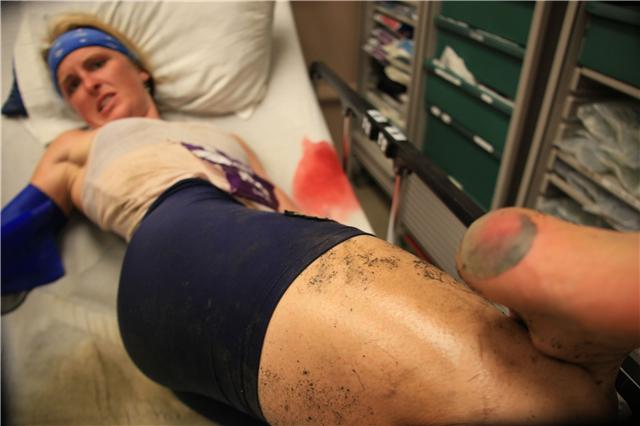
Yes, injuries as severe as a broken leg happen at the Birkie…
While injuries are common in sport, they are relatively unusual in XC skiing – but the Birkie is no normal race…
Think about it. The Birkie is the highlight of the year for many skiers. We look forward to it all year, we train for it all year, we pay hundreds of dollars months in advance to be a part of it. This is the one
Yes, injuries as severe as a broken leg happen at the Birkie…
While injuries are common in sport, they are relatively unusual in XC skiing – but the Birkie is no normal race…
Think about it. The Birkie is the highlight of the year for many skiers. We look forward to it all year, we train for it all year, we pay hundreds of dollars months in advance to be a part of it. This is the one
NORWAY: Summer means variety in training methods, activities and intensities. However, almost all of the summer training methods that skiers engage in, carry some risk of injury. Martin Lobben, a chiropractor and manual therapist who works extensively with athletes recognizes some common injuries that plague skiers. ”I’ve treated a fair number of nordic skiers, and come up with a short list of tips that can be useful,” Lobben says to Norwegian web site www.langrenn.com.
These are Lobben’s top 10 tips for skiers:
1. Build up to it
Build your base carefully and take your time preparing your body for what’s in store, both physically and mentally. There are no short cuts: Base is built with a lot of repetitions with low loads, increasing carefully. This drastically reduces the risk of overuse injuries.
2. Heat creams
Use creams and lotions such as IcyHot and Tiger Balm before and during exercise to improve circulation, which also improves your flexibility.
Rollerskiing is good – just don't overdo it…
3. Stretching and flexibility
Always stretch thoroughly to maintain the muscles’ flexibility. Hold each stretch for 30 to 45 seconds. Pay particular attention to the muscles between your shoulder blades, your lower back and glutes.
4. Treatment
Massage and trigger point treatments both prevent injury and reduces the recovery after hard workouts.
5. Variety
Focus on variety! Strength training, endurance training, plyometrics, balance/coordination, stretching and yoga. Don’t overdo roller skiing and double poling. And keep in mind that rest days are as important as training days.
6. When you get injured
RICE: Rest, Ice, Compression, Elevation. Stop the activity immediately, ice the injured body part and apply direct, firm pressure with a bandage. Elevate the injured body part. Keep in mind that pressure is more important than ice. Ice only reduces the pain!
7. Diet
Eat a normal, varied diet based on healthy foods. Feel free to add some extra pasta or rice the day before a hard workout. Healthy fats are important, so eat plenty of fish or take an Omega-3 supplement.
8. Cool down before you finish
Cool down with some easy activity after a hard ski workout, bike ride run or strength session. The cool-down contributes to decrease the blood pressure and helps clear lactic acid and other byproducts from your muscles.
9. Potassium and fluids during long workouts
Hot weather increases your need to replace the minerals and electrolytes lost through sweat. Consider taking a potassium supplement, which helps avoid cramping. Also make sure you drink enough. Aim for 2 to 3 cups (500 to 800 ML) per hour, but don’t wait until you feel thirsty. Sip small amounts of liquid frequently throughout the workout. Experiment with different sports drinks until you find a flavor and formula that works for you. Try different things during practice, stick with what you know works for races.
10. Working equipment
Make sure your equipment works and cover your bases. Always bring first aid kits, enough food and drink to last through the workout/race. Good luck and stay safe!
Did you know…
– Scientific studies show that by training the healthy side of your body, you also train the injured side. How come? When you train the muscles in one leg, the signals are transmitted through the nervous system in your spine and signals are delivered to the injured leg as well as to the healthy leg.
– “Trigger points” are a string in the muscles that develop in an overused muscle that is deprived of oxygen and nutrients. These strings cause muscle fibers to stick together. A chiropractor or manual therapist can treat the trigger points by pushing hard on the string and force the sticking muscle fibers apart.
– 46 percent of athletic injuries occur during competition
– Misalignment in the foot can cause knee pain. Make sure you analyze your gait if your knee(s) hurt.
From Langrenn.com, July 6, 2010 By Ola Jordheim Halvorsen. Translated by Inge Scheve.