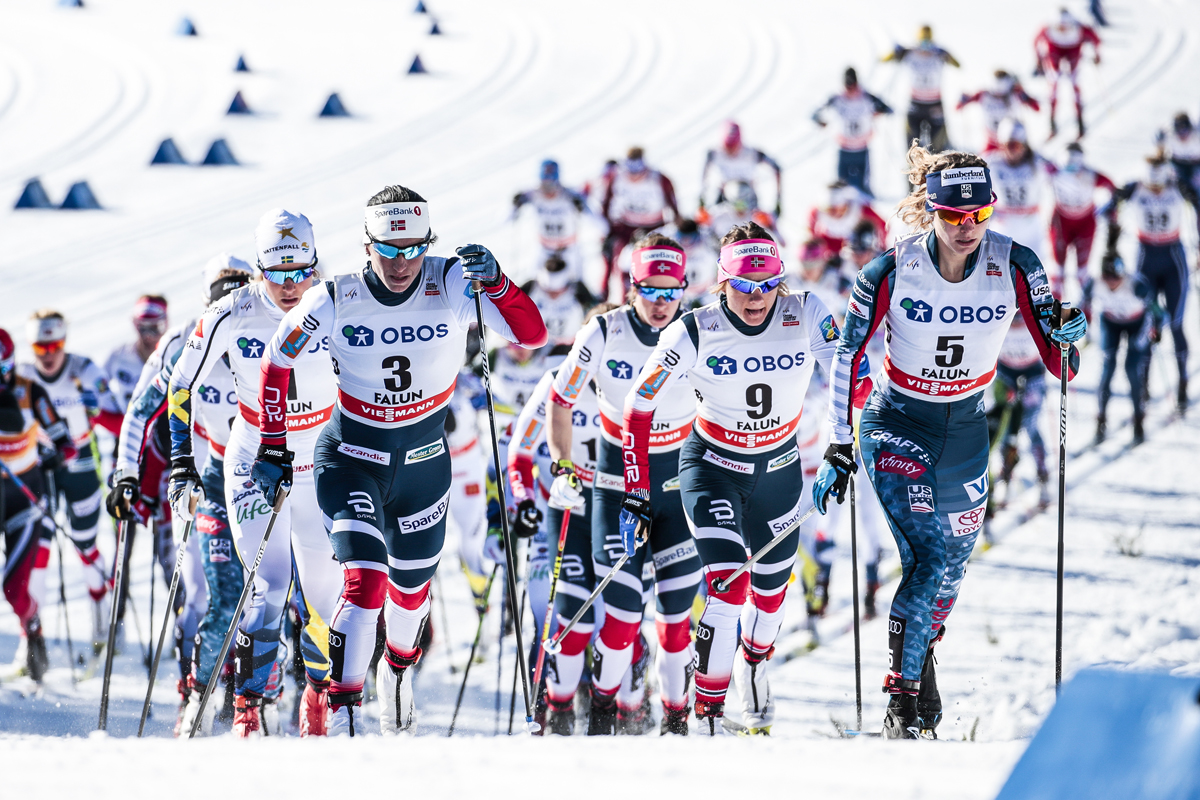
American Jessie Diggins (5) and Norway’s Marit Bjørgen (3) and Maiken Caspersen Falla lead early in the women’s 10 k classic mass start at the 2018 World Cup Finals in Falun, Sweden. (Photo: Fischer/NordicFocus)
On May 29, the latest research paper to dive into Marit Bjørgen’s training logs from 2000-2017 was announced in Gemini, the research news publication from NTNU and SINTEF, two research institutions in Norway.
The authors are described in Gemini as “Guro Strøm Solli of Nord University and NTNU and a former xc-ski team member herself, Espen Tønnessen from Kristiania University College in Oslo, and Øyvind Sandbakk, from NTNU’s Centre for Elite Sports Research.”
The latest paper in their series explores Bjørgen’s use of two distinct types of high intensity training (HIT) and how they impacted her performance.
Gemini describes the two HIT methods as the following: “The first approach was block training, where she clustered her HIT sessions into blocks, interspersed with recovery periods with fewer HIT sessions. Later in her career she switched to a traditional model, where HIT sessions are spread more or less evenly throughout a training period.”
Bjørgen’s block HIT method, used from 2005-2006, involved numerous periods of intense HIT sessions and fewer hours in what many would consider a traditional long-duration low-intensity program.
From 2014-2015, another HIT segment the researchers zeroed in on, Bjørgen used a more “traditional” approach to her HIT training.
Gemini describes the “traditional” methodology as what many athletes have become familiar with: “Typically, the researchers said, the traditional approach means that an athlete relies on a mix of low, moderate and high intensity training, gradually transitioning from high volumes of training — meaning number of hours — to higher training intensity and training that is more specific to the sport the athlete is competing in.” Looking for where to play Crazy Time slot ? Go to the official website of the game https://crazytimegame.com/en/
The scientist do not answer which method is more effective? It is also important to remember this is Bjørgen, and it remains a sample size of one.
“To get progression you need to change something,” Sandbakk told Gemini. “It’s not always that if something works, then more of it is better. That’s an important message.”
Mix it up may be the take-home lesson.
The three research papers derived from Bjørgen’s training logs are linked above and provide some great reading and insight.
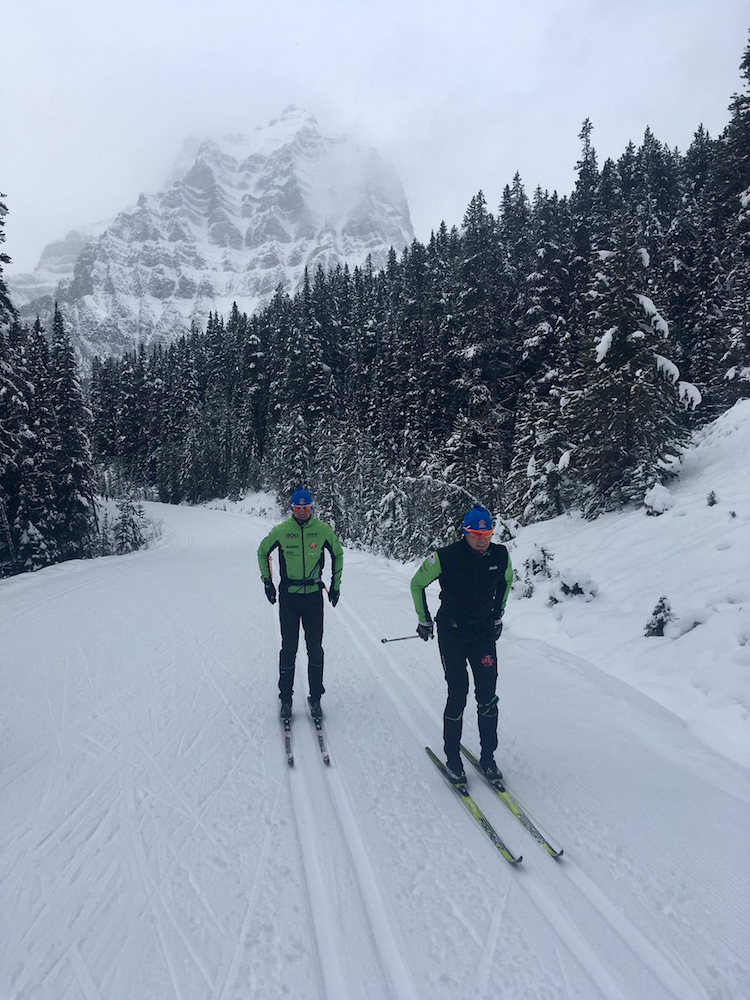
Evan Palmer-Charrette (left, in green) during an intensity session with his National Team Development Centre (NTDC) Thunder Bay teammates Angus Foster (front) and Julian Smith (right) at the Canmore Nordic Centre last November. (Photo: Timo Puiras)
Evan Palmer-Charrette, of Thunder Bay’s National Team Development Centre (NTDC), had an eventful 2016/2017 season, starting with compartment syndrome surgery in the summer to remedy an issue that had plagued him for four years, his first U23 World Championships, his first World Cup races in Quebec, and his first national title.
Palmer-Charrette finished the season ranked second in the overall NorAm standings behind Russell Kennedy (Canmore Nordic/Team R.A.D.) after notching four NorAm podiums. One of those included his third-place finish in the classic sprint at Canadian Ski Nationals, behind two U.S.-based university skiers, which made him the top Canadian.
“Awesome to be Canadian champion, but a surprise for sure in a classic sprint,” he told FasterSkier at nationals, reflecting his preference for distance racing.
A week later at SuperTour Finals in Fairbanks, Alaska, Palmer-Charrette placed second in the skate sprint behind winner Logan Hanneman of Alaska Pacific University. He was FasterSkier’s pick for Canadian Continental Skier of the Year and turned 23 this past Sunday. Palmer-Charrette is currently testing at the Canadian Sport Institute Ontario in Toronto and plans to spend another season with the NTDC in Thunder Bay. He started the new training year with an on-snow volume camp at Sovereign Lake in British Columbia.
He submitted the following workout regarding race-prep intensity.
***
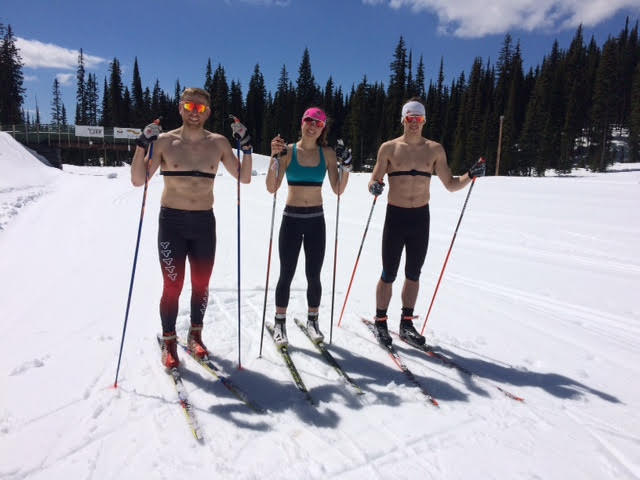
Evan Palmer-Charrette (r) with NTDC Thunder Bay teammate Annika Richardson (c) and former teammate Greg Kilroy. (Courtesy photo)
“From an early start, most everyone knows it is crucial to warm up well the morning of a race to experience each energy system before you put yourself through it during the real deal. I have heard a number of junior athletes surprised to hear that it’s a common practice to put in an intensity workout within a day or two of a race, I was the same as a junior, I would always do some sprints and a bit of speed but nothing with serious structure that I tracked and replicated like the intensity I would do in my race morning warm-up.
Race prep intensity (RPI) is a great way to get the body fine-tuned for a race weekend, especially in the early season when you don’t have as much racing and intensity under the belt. Now, this is not an exam-style cram before the test workout to try and get in better shape two days out, just something light much like you would do the morning of a race. More often than not, you will have traveled for a ski race and a light intensity is a great way to shake the body out and get a feel for a new race course skiing it the same speed you will in a race.
The Warmup
Start out with an easy recovery pace to begin the ski. Closing in on a race weekend, there are very minimal benefits for pushing the pace while skiing easy, but overdoing it can leave the body feeling fatigued. During the warmup, pick up the pace to a point where it feels comfortable, well below threshold, but enough of an increase that you feel like you are gliding rather than shuffling and apply some power to feel the snap in your limbs. I like to do 2-4 minutes of Zone 2 to get the body ready.
The Workout
Zone 3: If your first race or the big race is a sprint, I like to take two laps at a moderate Zone 3 effort. Trying to ski the course as smooth as I can and getting a sense for where the technical sections are that I will use for the following intervals of the workout. If you are prepping for a distance race, I like to do my 5-6 minutes of Zone 3 on what I think will be the most challenging section of the course, getting a feel for cresting the big A-climb into a technical downhill without perfectly rested legs.
Zone 4: This is the most variable portion of the workout. As I mentioned earlier, depending on the time of year I might adjust my RPI workout to how I am feeling — this is generally the section that takes on the change. By the latter half of the race season, if I’m going into a multi-race weekend I’ll skip the stage altogether, however prior to Christmas, I have added more repetitions or duration.
Sprints: 3 x 30 seconds is really just an example, but a good amount to put some snap in the legs and get an idea of what the upcoming course will throw at you. These qualifier-pace sprints are best done on the technical sections of the course that really allow you to get a feel for how a tricky transition or corner will ski while in a race situation.
The Cool Down
Wrap the workout up with a good cool down to flush out the legs making sure to get in at least 25-30 minutes. I like to throw in a few Zone 2 surges if my legs were not feeling great during the intensity to try and flush them out a bit more. If it’s cold, I’ll change my top I wore during the workout, there is nothing worse than getting a chill and catching a cold a day or two before a race.”
Evan Palmer-Charrette (l) and Michael Somppi during a cool-down ski at Lake Louise near Canmore, Alberta, in November 2016. (Photo: Timo Puiras)
May 1 marks the symbolic start of the annual training cycle for many year-round nordic skiers. With that in mind, we recently spoke with Stephen Seiler. A Texas native, Seiler, 51, is a professor of sports science at the University of Adger in Kristiansand, Norway.
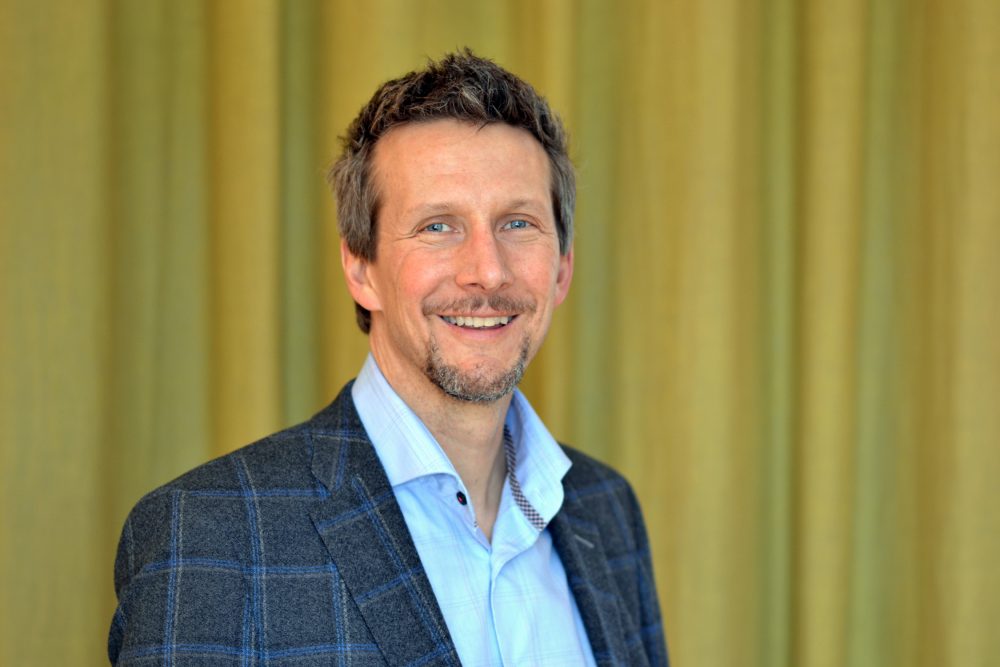
Stephen Seiler, a professor at the University of Adger in Kristiansand, Norway, specializes in exercise science. (Photo: uia.no)
Seiler has researched, written and spoken extensively about physiological adaptations as it relates to endurance athletes. Seiler’s mantra — the 80/20 Rule — the easy to hard intensity ratio when it comes to training sessions, has been well publicized. Seiler believes easy days should be truly easy, meaning walking the hills may be mandatory. If the easy days are easy, then the hard days are hard. He espouses a fidelity to training models with little, if any, in-between efforts; that means no middle-of-the-road intensity. And his observations come straight from Norway.
“… They know what gets you on the podium,” he said of the Norwegians’ tried-and-tested training principles. “And they know that there are no shortcuts. They don’t fall for the latest trend, the latest trick because they know how you get there. The magic is there is no magic in Norway.”
The 2015/2016 U.S. Nordic Ski and Nordic Combined teams during a team photo shoot in their new uniforms on Monday, Oct. 19, in Park City, Utah. (Photo: U.S. Ski Team)
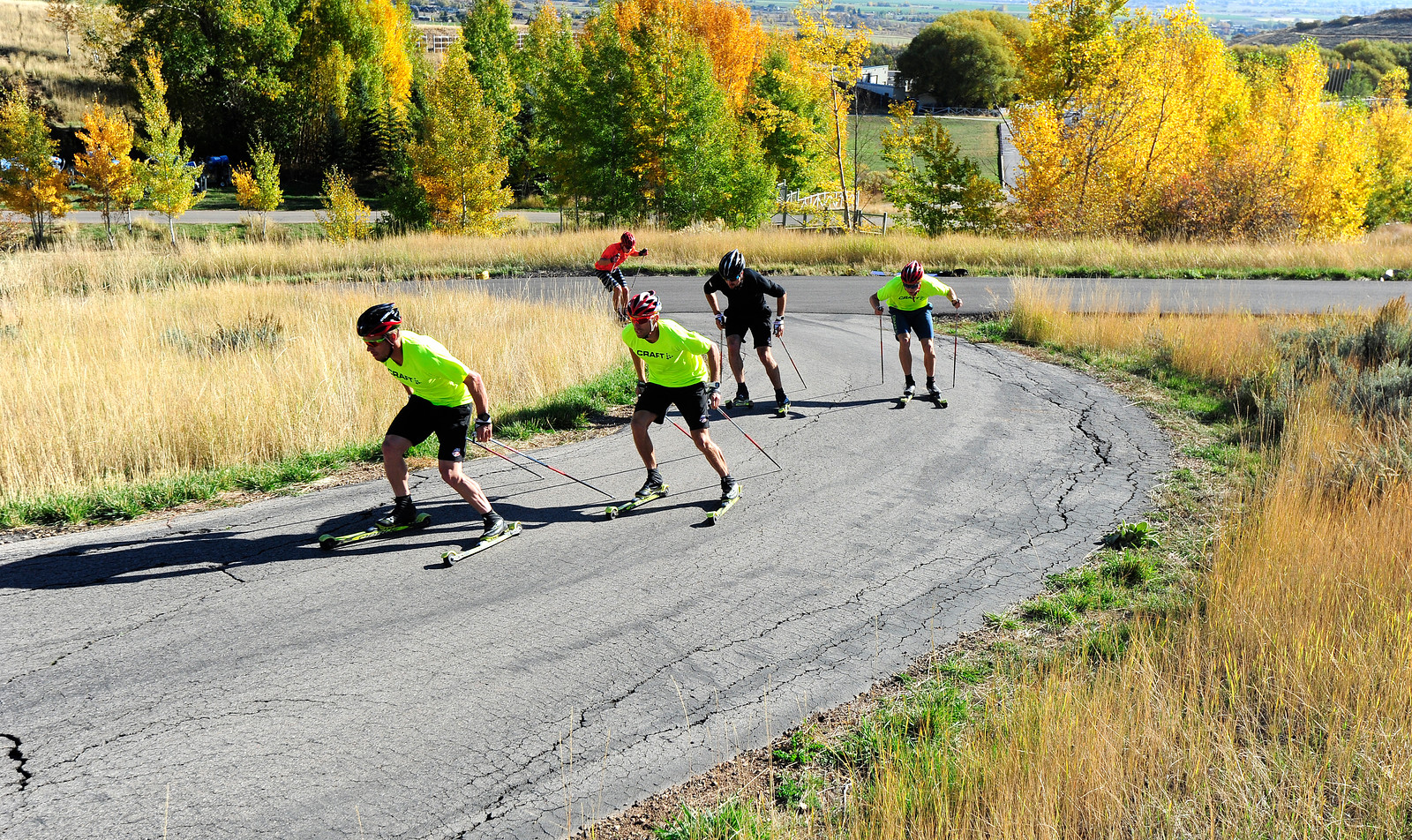
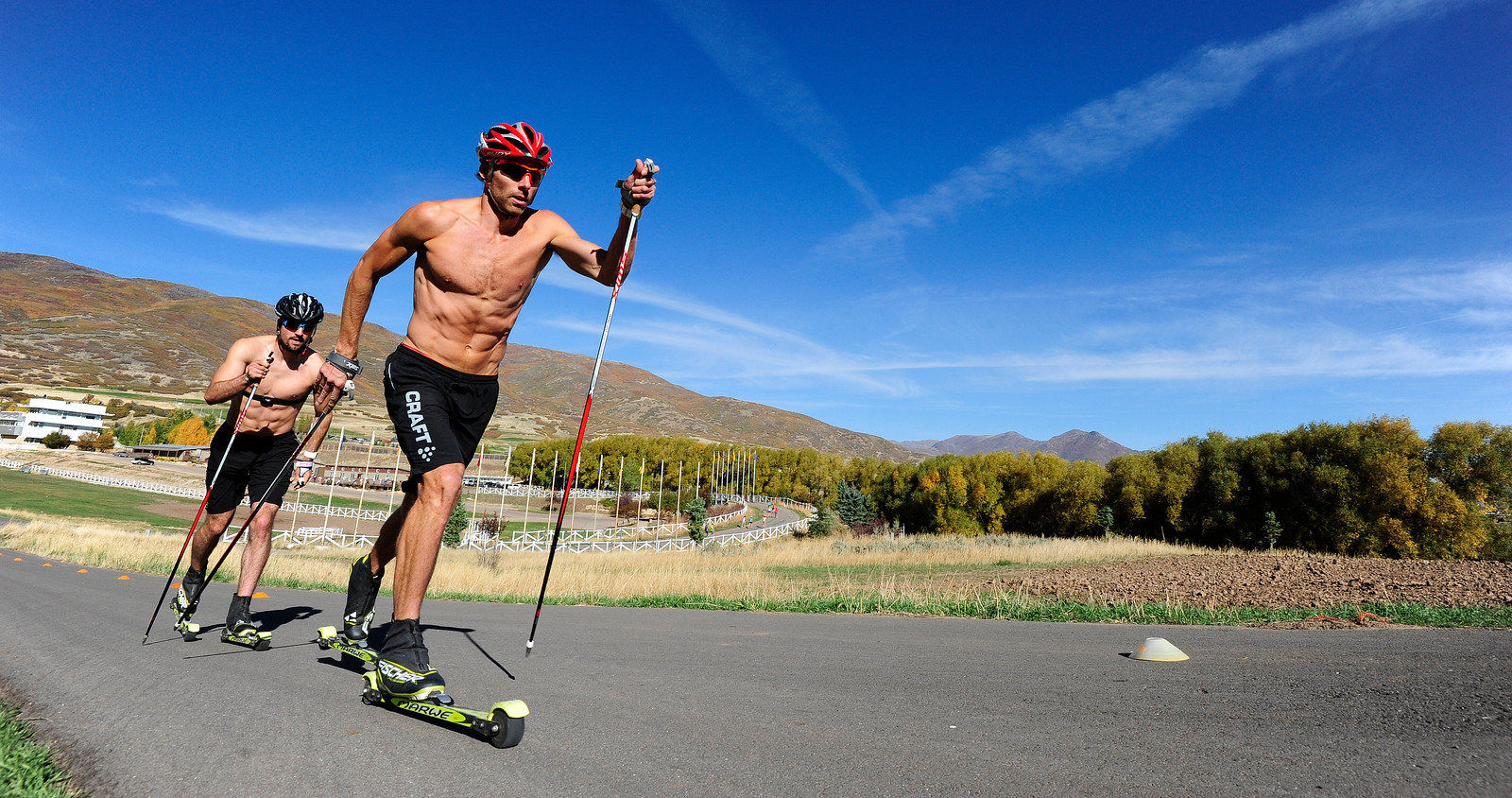
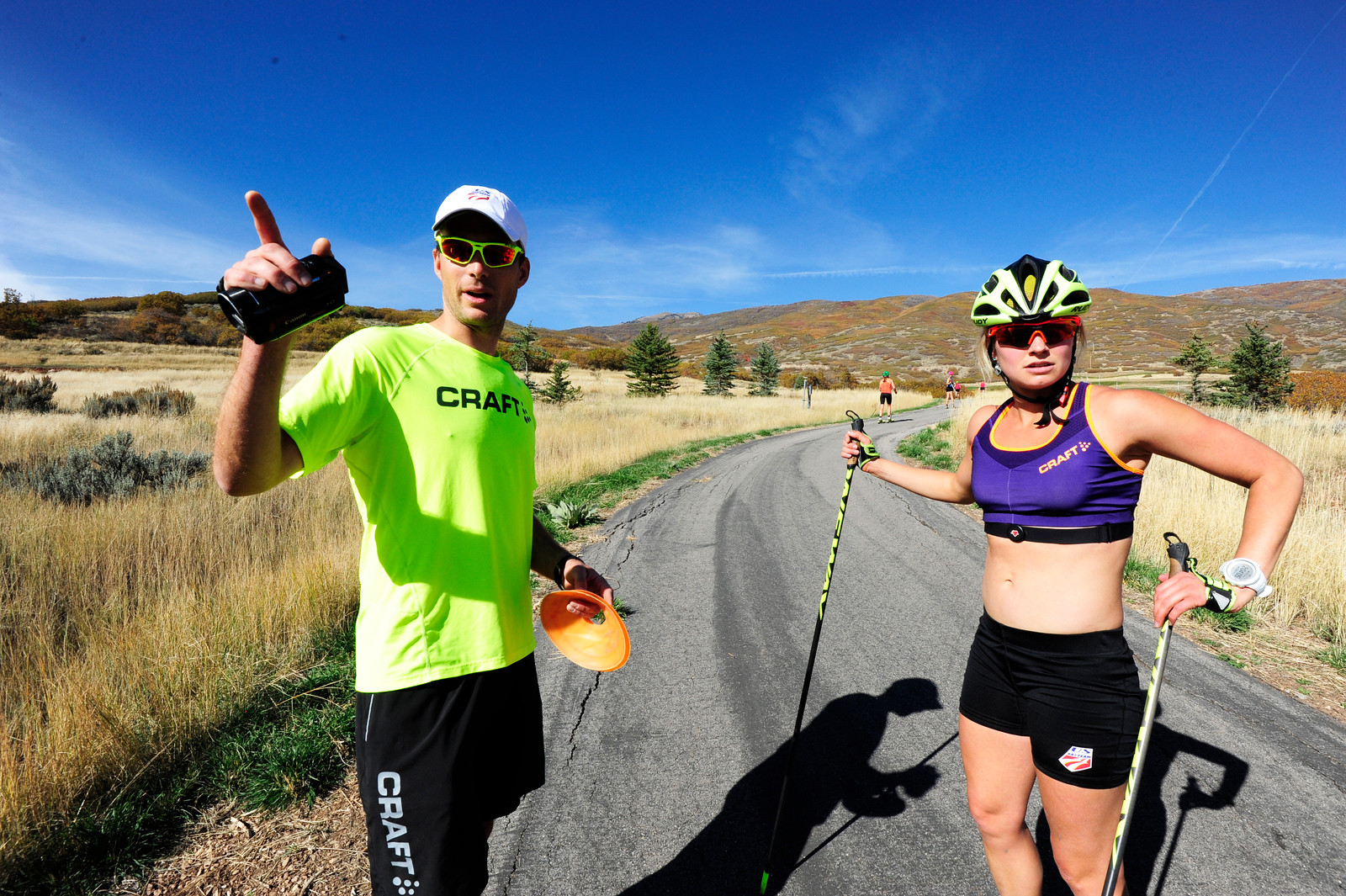
Over the last two weeks, the U.S. Ski Team and many of the nation’s top skiers have been hitting the hardtop and trails around Park City, Utah, intent on getting in quality training sessions at altitude before heading off to on-snow camps. The area’s consistent fall weather and training opportunities, including the rollerski loop at Soldier Hollow, make this camp an annual team staple.
Many of the country’s most competitive nordic skiers outside the U.S. Ski Team (USST) are also in Park City, drawn there by the opportunity to train with the team before it heads to Europe for the start of the World Cup in late November.
USST Head Coach Chris Grover estimated there were slightly more than 30 athletes at the camp, with all 16 national-team members, plus skiers from the National Training Group, Alaska Pacific University (APU), the Sun Valley Ski Education Foundation (SVSEF) Gold Team, Stratton Mountain School (SMS) T2 Team, and the Craftsbury Green Racing Project. On the phone earlier this week, Grover expressed excitement about a, “nice mix of some younger guys and some veterans, and top club athletes and the national team.”
The U.S. Ski Team trains on the Olympic trails during its annual fall camp at Soldier Hollow in Midway, Utah. (Photo: U.S. Ski Team/Tom Kelly)
Although this is a national-team camp, guest athletes are invited to attend the high-intensity workouts as well as the long, over-distance sessions when the venue safely allows them to do so, Grover explained.
During the first week of camp the focus has been on threshold, some testing and speed workouts, and something called “The Double Pole Project.” Grover described this as a pre-workout video session meant to aid in transferring the athletes’ work in the weight room to lower abdominal engagement in their double-pole technique. Stemming from a plan shared at the World Cup coaches’ seminar in Trondheim, Norway, in late August, the team integrated this into their camp with hopes of seeing this strength technique come through this winter.
After the initial week of mellow, acclimatization-based workouts and technique focus, the second week of training included more intensity. On Tuesday, Grover highlighted that morning’s 6 x 4-minute ski bounding session as one that got both athletes and coaches excited. Whether it was the sun beaming down or the lower elevation training site in Salt Lake City, the first full-group, high-intensity workout of the camp went off without a hitch, he said. It also provided a preview of the intensity coming at the end of camp: a three-day rollerski mini tour starting on Sunday.
U.S Ski Team members Andy Newell and Ben Saxton training in mid-October on the Olympic trails at Soldier Hollow in Midway, Utah. (Photo: U.S. Ski Team/Tom Kelly)
In the past, the USST ended its Park City camps with rollerski time trials. This season, without a World Championships or Olympics, and with over half the the World Cup races being tour-stage events (19 to be exact), Grover and his staff decided to shift from race simulations to stage events.
“We’ve definitely put an emphasis on practicing not only how to manage energy from day to day, but how to recover optimally from each session,” Grover said.
The team saw some success at Norway’s Toppidrettsveka mini tour this summer, with Liz Stephen and Noah Hoffman placing third in the hill climb, but also encountered bad luck with broken poles and several crashes in the last stage of that tour, Grover said. These are the types of mishaps he’s hoping the tour simulations will minimize in races this winter.
The mini tour will start this Sunday, Oct. 25 with a freestyle sprint, followed by a shorter classic mass start on Monday, and ending with a longer freestyle pursuit on Tuesday.
The national team also unveiled its new uniforms this week. L.L. Bean and Craft signed as the team’s clothing sponsors this spring and revealed the new suits and warmups with the team on Monday in Park City. Grover explained the shift to L.L. Bean and Craft as one that’s been “excellent” because it provides a “…uniform that is totally unique to the USA.” He also believes the team will benefit from the wide range of pieces available through these larger companies.
U.S. women’s coach Matt Whitcomb works with Jessie Diggins during rollerski training at the U.S. Ski Team’s annual fall camp at Soldier Hollow in Midway, Utah. (Photo: U.S. Ski Team/Tom Kelly)
The first World Cup is a little more than a month away in Kuusamo, Finland, and aside from D-team rookie Julia Kern rebounding from a slight back injury, the team is healthy, Grover said. Erik Bjornsen has resumed training at full capacity after surgery on his hand and a knee injury earlier this summer.
Team veteran Kikkan Randall recently announced her pregnancy and will be missing this season as a result. Grover was fully supportive, acknowledging her pregnancy as one of Randall’s long-term goals. The timing also worked nicely without a World Championships or Olympics this season. While Randall has been training with the team in Park City, she has scaled back her intensity and shifted toward over-distance and technique training, Grover explained.
Without a major championship on the World Cup calendar this season and a North American tour — the Ski Tour Canada — in its place, domestic competition for the additional start spots is something many U.S. and Canadian athletes are looking forward to. Per the “national quota” regulations of the World Cup, the U.S. will be able to start five additional men and five additional women for the entire Ski Tour Canada, for a total of up to 24 racers.
While Grover said the upcoming mini tour in Park City would not decide those spots, he explained the coaches were using this week’s training sessions to note the fitness of non-national team athletes. However, on-snow results will ultimately determine who receives those Canadian World Cup starts. More on the 2015/2016 World Cup Team selection criteria here.
After wrapping up the mini tour on Tuesday, the USST will leave Utah on Wednesday. Several clubs will head directly to Canmore, Alberta, for an on-snow camp at Frozen Thunder, while others, like APU and its USST members, will head back to Alaska in hopes of getting on snow as well.
The USST will reconvene Nov. 13 to fly to Gällivare, Sweden, where they’ll hold a camp and compete in a couple FIS races before traveling to Kuusamo for the World Cup openers.
***
About the Author: New to the FasterSkier team, Jeremy has been involved in many facets of the ski community since he began ditching middle school to go skiing. When not daydreaming of the Birkie, he finds time to explore the fishing and trail-running opportunities of his new home, Seattle, Wash.