From the FasterSkier archive — posts syndicated from athletes’ and coaches’ own blogs between 2004 and 2012, kept online as published. Current coverage is at fasterskier.com.

Tag: intensity

  • Periodization Is About Emphasis, Not Elimination

    Periodization Is About Emphasis, Not Elimination

    This article was made possible through the generous support of our voluntary subscribers. If you value coverage like this, please support FasterSkier with a voluntary subscription.

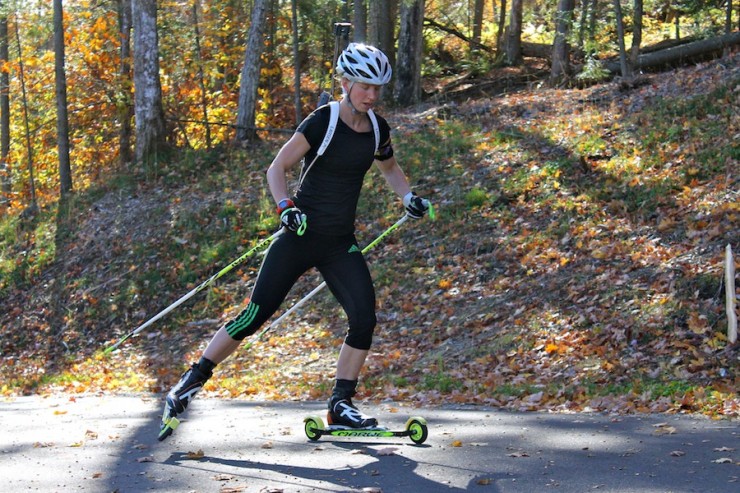
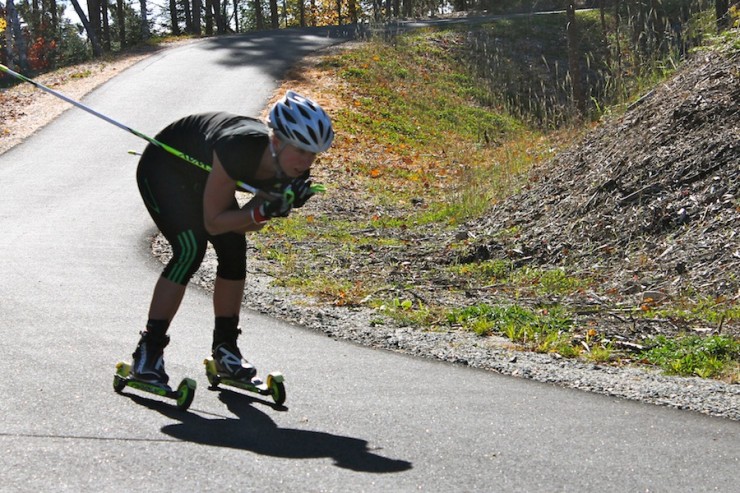
    A University of Vermont skier rollerskiing on a paved road lined with fall foliage at Craftsbury, Vermont
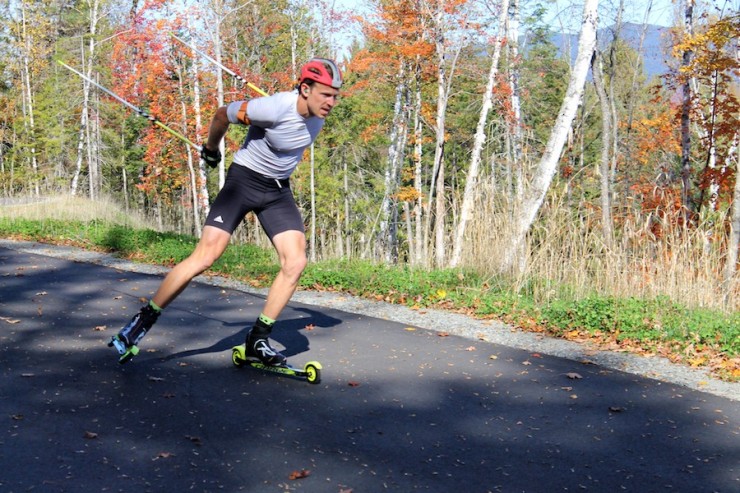
    Wilmington, Vermont’s Luke Rizio rollerskiing with the University of Vermont at Craftsbury last fall. Jim Galanes argues that a training year should change the dose of each quality, never remove one of them entirely. (Photo: Phillip Belena/EISA)

    One of the biggest misconceptions in endurance training is that we should train one physiological capacity at a time. The traditional model usually follows the same progression. First build an aerobic base, lots of easy endurance training. Then add “threshold” training in the middle of the summer. Then, as we move into the pre-competition period, shift the emphasis toward VO2max and race specific intensity.

    The emphasis certainly should change throughout the season. But this approach often leads coaches and athletes to unintentionally neglect important physiological systems for weeks or even months. The problem is that the human body doesn’t work that way.

    Aerobic performance is not determined by one physiological system. It emerges from the interaction of multiple systems, each supporting the development of the others. When one begins to decline, it limits the effectiveness of the entire system.

    The goal of periodization is not to sequentially build individual physiological systems. It is to continually maintain every important system while changing the emphasis toward the adaptations that offer the greatest opportunity for improvement.

    Every Workout Sends a Different Signal

    Training isn’t simply stress. Every workout sends a unique physiological signal for adaptation.

    Long aerobic training stimulates mitochondrial biogenesis, capillary development, fat oxidation, plasma volume expansion, and cardiac remodeling.

    “Threshold” training improves the ability to sustain a high fraction of aerobic power by increasing oxidative capacity, metabolic stability, and lactate transport. It should be noted, in spite of the current buzz, that “threshold” training is not a magic solution. Some athletes may need a heavier focus on VO2max training. Usually “threshold” type training is best for those doing high volumes and with an already high fractional utilization.

    (Note: while I use the common term “threshold” here, there is ample evidence that no threshold actually exists and that it is a vastly misleading term. There is also no consensus on what this so-called threshold is. Depending on which of the many methods you use to define it, the speed or intensity at these various definitions can differ by 40 to 50 percent.)

    VO2max intervals place the greatest demand on oxygen delivery, stimulating central cardiovascular adaptations while also improving mitochondrial function, the oxidative capacity of Type II fibers, lactate transport, and the speed or power that can be sustained at VO2max.

    Sprint training recruits high-threshold motor units, preserves neuromuscular coordination, maintains the oxidative capacity of fast-twitch fibers, and develops the ability to rapidly produce force.

    Strength training increases maximal force production, improves movement economy, enhances tendon stiffness, and helps reduce injury risk.

    These are not interchangeable adaptations. Each contributes something different to developing aerobic fitness and performance.

    The Systems Support Each Other

    These systems work synergistically. The mistake is assuming the adaptations are simply additive. They are not. They interact, and the combined effect on aerobic fitness is larger than the sum of the parts.

    A larger aerobic system allows the athlete to recover more quickly between hard sessions and to produce an increasing proportion of energy aerobically.

    Better “threshold” capacity allows more quality work to be performed with less fatigue. Greater maximal aerobic power raises the ceiling from which “threshold” speed or power can improve.

    Improved strength reduces the relative force required for every stride.

    Sprint training preserves the neuromuscular qualities that improve efficiency even during submaximal exercise. At every intensity, we can move faster and more efficiently.
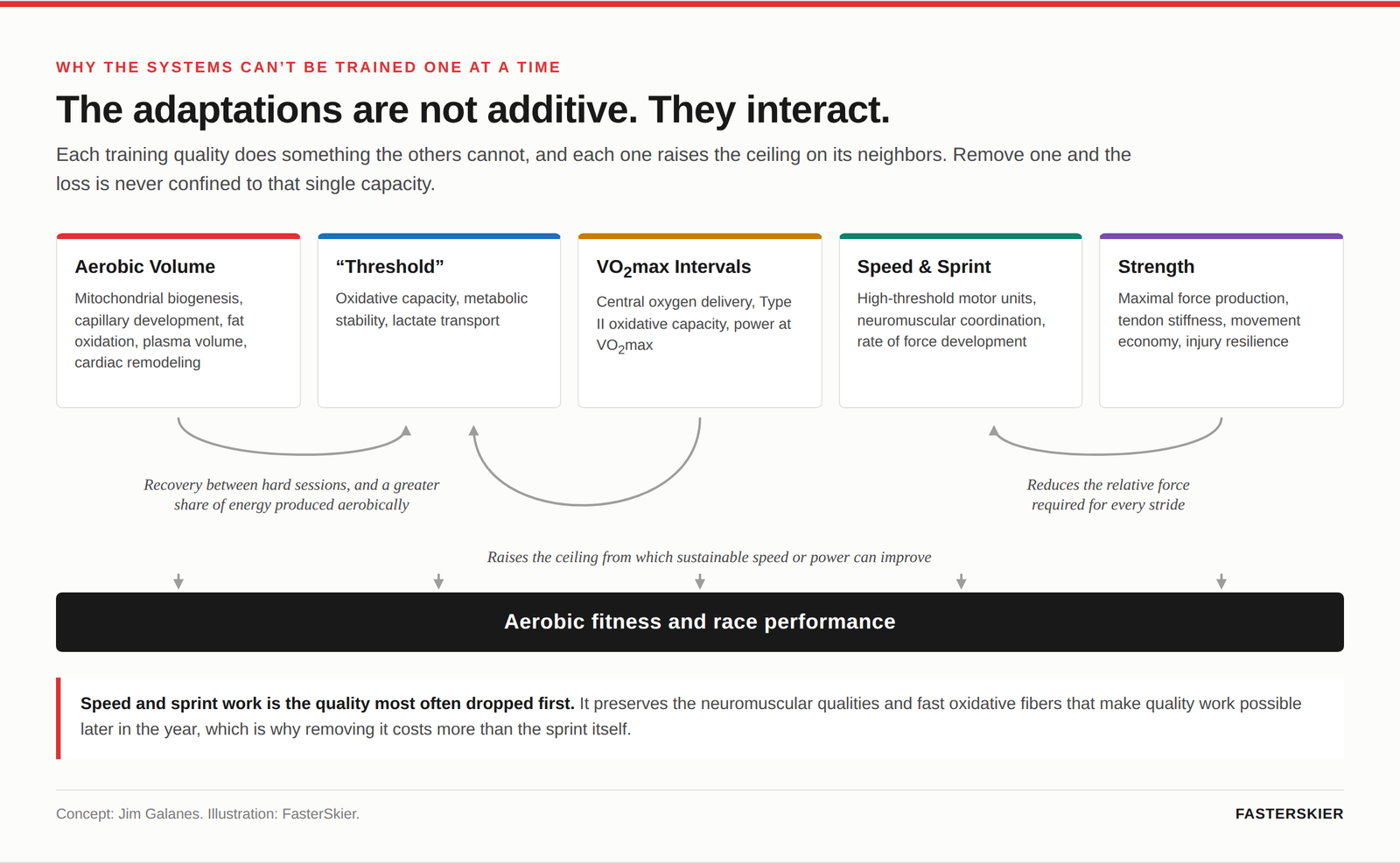
    Diagram of five training qualities feeding into aerobic fitness and race performance
    Aerobic volume, “threshold” work, VO2max intervals, speed and strength each do something the others cannot, and each raises the ceiling on its neighbors. (Illustration: FasterSkier)

    What Happens When One System Is Ignored?

    Every physiological adaptation has a maintenance requirement. Remove the stimulus long enough and that adaptation begins to decline. An athlete who abandons speed training gradually loses neuromuscular recruitment and maximal power. An athlete who eliminates heavy strength training slowly loses force production and movement economy.

    When an athlete reduces aerobic endurance training, they don’t simply lose endurance. They lose the physiological foundation that supports every other adaptation.

    An athlete who removes VO2max work for extended periods may maintain excellent endurance while gradually losing the central cardiovascular adaptations that support maximal aerobic performance.

    These changes are rarely dramatic at first. What we see instead are the symptoms of overtraining. Performance in training declines. Interval sessions become harder. Race pace plateaus or drops.

    Many coaches respond by adding more volume or more intensity. Neither is the likely answer. The solution is to restore the balance between the physiological systems that support performance.


    Chart showing five training qualities across three season phases, with none dropping to zero
    Through the training year the dose and density of each quality moves, but no quality drops to zero. Concept illustration of Galanes’ argument, not a prescribed distribution. (Illustration: FasterSkier)
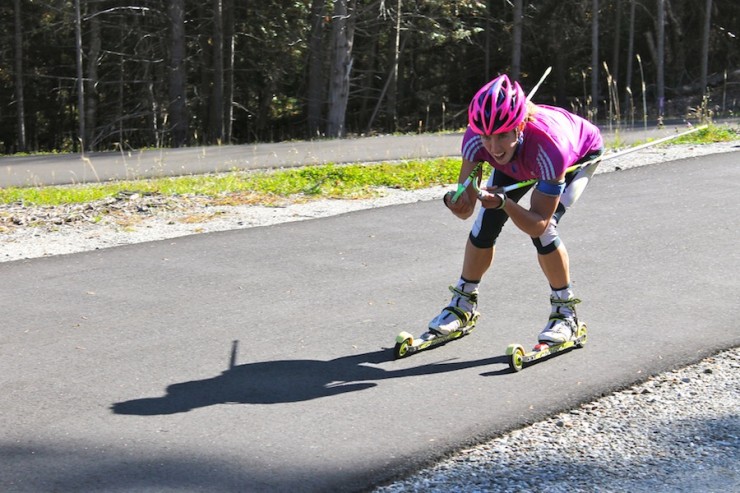
    Two skiers rollerskiing up a climb on a road through autumn woods
    University of Vermont skiers work up a climb during a fall dryland session at Craftsbury, Vermont. (Photo: Phillip Belena/EISA)

    Why High-Intensity Training Belongs in the Base Period

    One of the most common statements heard during base training is: “We shouldn’t do any hard training yet.”

    Current evidence suggests otherwise. High-intensity training during the base period is not about maximizing anaerobic fitness. It is about maintaining the physiological systems that complement the full development of aerobic capacity.

    Appropriately dosed high-intensity training helps preserve central cardiovascular function, maintains high-threshold motor unit recruitment, supports the oxidative capacity of fast-twitch muscle fibers, reinforces movement economy at higher speeds, and prepares the athlete for the demands of future training. Just as importantly, these adaptations support aerobic development rather than detract from it.

    A stronger cardiovascular system allows greater oxygen delivery during long aerobic sessions. Maintaining fast oxidative fibers improves the ability to perform “threshold” work later in the season. Preserving movement economy reduces the energy cost of every stride. Maintaining maximal aerobic capacity raises the ceiling from which “threshold” performance can continue to improve.

    High intensity doesn’t compete with aerobic development when it is properly dosed. It enhances it. This is why elite endurance athletes rarely eliminate intensity completely. They change the dose and the density. Not the presence.

    I often hear athletes say their first interval session or time trial in late July felt terribly slow, or metabolically challenged. Of course it did. That should come as no surprise. If high-intensity work has been absent for weeks or months, the physiological systems required to perform it have detrained. The athlete now has to rebuild those systems before meaningful race-specific adaptations can occur.

    Emphasis Is Not Elimination

    This doesn’t mean every quality deserves equal attention every week. Training emphasis should absolutely change throughout the year. An aerobic development phase should contain more aerobic volume. The pre-competition period should emphasize “threshold” and race-specific intensity. The competition season should prioritize race performance and recovery.

    But changing emphasis is very different from abandoning a physiological system. Even during an aerobic block, athletes should continue performing some high-intensity work, sprint training, and strength training.

    During race season, aerobic volume remains essential. While emphasizing VO2max development, “threshold” training still supports the ability to perform quality work.

    The dose and density change. The physiological adaptation remains.

    There Is No Optimal Intensity Distribution

    One of the most common questions in endurance sports is: “What is the optimal training intensity distribution?”

    The question assumes there is one correct percentage of easy, “threshold”, and hard training. There isn’t. The optimal distribution depends on the athlete’s training background and on which physiological system currently limits performance. Those limiting factors change throughout an athlete’s development.

    Early in a career, building aerobic capacity may deserve the greatest emphasis. Later, improving sustainable race pace may become the priority. Still later, improving neuromuscular power, force production, or movement economy may produce the greatest gains.

    As those priorities change, training distribution changes with them. Not because the principles change. Because the athlete changes.

    The coach’s responsibility is to continually adjust aerobic volume, “threshold” training, VO2max work, sprint training, and strength training so that each enhances the adaptations produced by the others while minimizing interference.

    There is no universal training formula. There is only the continual process of identifying the athlete’s current limiter, maintaining every important physiological system, and emphasizing the adaptations that will produce the greatest improvement.

    Great coaching is not about prescribing the perfect intensity distribution. It is about continually identifying the athlete’s current physiological limiter while maintaining every system that supports performance. As the athlete changes, the emphasis changes, but the physiology never disappears.

    Help Support Our Coverage!

    FasterSkier is independent, reader supported, and free to read. If coaching and training coverage like this is worth something to you, a voluntary subscription keeps it coming.

    Join the FasterSkier community!


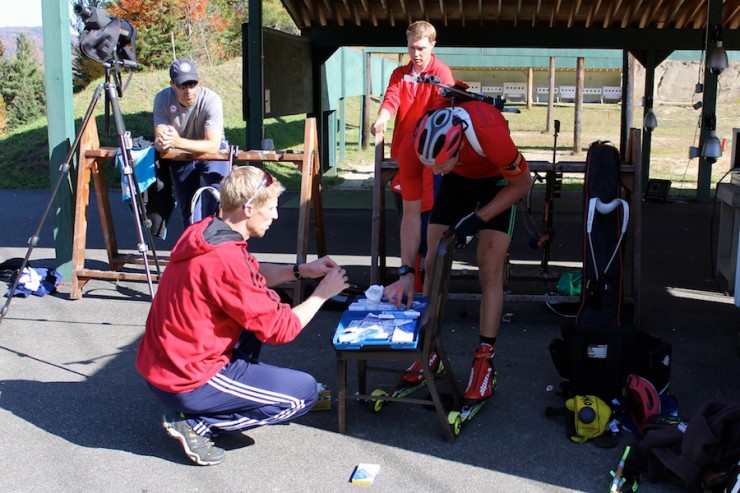
    A ski coach in an olive fleece speaking with an athlete holding rollerski poles
    UVM coach Patrick Weaver talks with first year Hanna Koch of St. Paul, Minnesota, during a fall session at Craftsbury. Identifying an athlete’s current limiter, Galanes writes, is the coach’s central job. (Photo: Phillip Belena/EISA)
  • Wednesday Workout: Race Prep Intensity with Palmer-Charrette

    Wednesday Workout: Race Prep Intensity with Palmer-Charrette

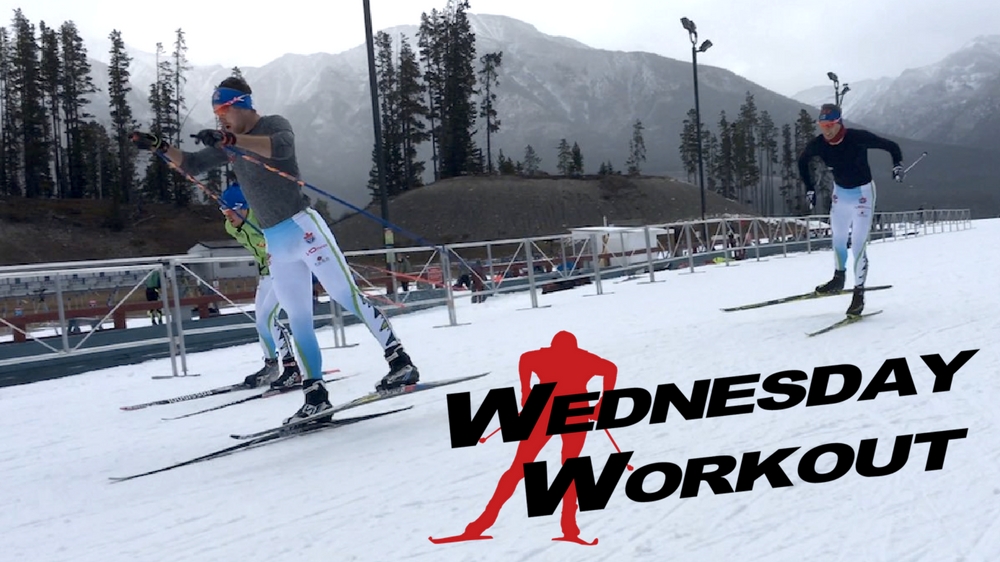
    Evan Palmer-Charrette (left, in green) during an intensity session with his National Team Development Centre (NTDC) Thunder Bay teammates Angus Foster (front) and Julian Smith (right) at the Canmore Nordic Centre last November. (Photo: Timo Puiras)

    Evan Palmer-Charrette, of Thunder Bay’s National Team Development Centre (NTDC), had an eventful 2016/2017 season, starting with compartment syndrome surgery in the summer to remedy an issue that had plagued him for four years, his first U23 World Championships, his first World Cup races in Quebec, and his first national title.

    Palmer-Charrette finished the season ranked second in the overall NorAm standings behind Russell Kennedy (Canmore Nordic/Team R.A.D.) after notching four NorAm podiums. One of those included his third-place finish in the classic sprint at Canadian Ski Nationals, behind two U.S.-based university skiers, which made him the top Canadian.

    “Awesome to be Canadian champion, but a surprise for sure in a classic sprint,” he told FasterSkier at nationals, reflecting his preference for distance racing.

    A week later at SuperTour Finals in Fairbanks, Alaska, Palmer-Charrette placed second in the skate sprint behind winner Logan Hanneman of Alaska Pacific University. He was FasterSkier’s pick for Canadian Continental Skier of the Year and turned 23 this past Sunday. Palmer-Charrette is currently testing at the Canadian Sport Institute Ontario in Toronto and plans to spend another season with the NTDC in Thunder Bay. He started the new training year with an on-snow volume camp at Sovereign Lake in British Columbia.

    He submitted the following workout regarding race-prep intensity.

    ***

    Evan Palmer-Charrette (right) with teammate Annika Richardson and former teammate Greg Kilroy (Courtesy photo)
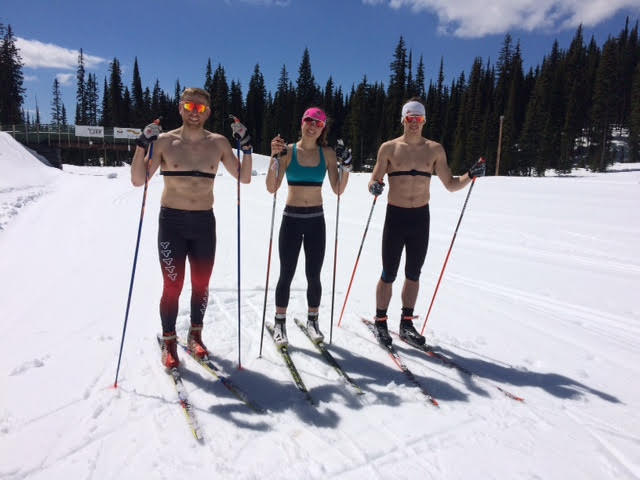
    Evan Palmer-Charrette (r) with NTDC Thunder Bay teammate Annika Richardson (c) and former teammate Greg Kilroy. (Courtesy photo)

    “From an early start, most everyone knows it is crucial to warm up well the morning of a race to experience each energy system before you put yourself through it during the real deal. I have heard a number of junior athletes surprised to hear that it’s a common practice to put in an intensity workout within a day or two of a race, I was the same as a junior, I would always do some sprints and a bit of speed but nothing with serious structure that I tracked and replicated like the intensity I would do in my race morning warm-up.

    Race prep intensity (RPI) is a great way to get the body fine-tuned for a race weekend, especially in the early season when you don’t have as much racing and intensity under the belt. Now, this is not an exam-style cram before the test workout to try and get in better shape two days out, just something light much like you would do the morning of a race. More often than not, you will have traveled for a ski race and a light intensity is a great way to shake the body out and get a feel for a new race course skiing it the same speed you will in a race.

    The Warmup

    Start out with an easy recovery pace to begin the ski. Closing in on a race weekend, there are very minimal benefits for pushing the pace while skiing easy, but overdoing it can leave the body feeling fatigued. During the warmup, pick up the pace to a point where it feels comfortable, well below threshold, but enough of an increase that you feel like you are gliding rather than shuffling and apply some power to feel the snap in your limbs. I like to do 2-4 minutes of Zone 2 to get the body ready.

    The Workout

    • Zone 3: If your first race or the big race is a sprint, I like to take two laps at a moderate Zone 3 effort. Trying to ski the course as smooth as I can and getting a sense for where the technical sections are that I will use for the following intervals of the workout. If you are prepping for a distance race, I like to do my 5-6 minutes of Zone 3 on what I think will be the most challenging section of the course, getting a feel for cresting the big A-climb into a technical downhill without perfectly rested legs.  
    • Zone 4: This is the most variable portion of the workout. As I mentioned earlier, depending on the time of year I might adjust my RPI workout to how I am feeling — this is generally the section that takes on the change. By the latter half of the race season, if I’m going into a multi-race weekend I’ll skip the stage altogether, however prior to Christmas, I have added more repetitions or duration.
    • Sprints: 3 x 30 seconds is really just an example, but a good amount to put some snap in the legs and get an idea of what the upcoming course will throw at you. These qualifier-pace sprints are best done on the technical sections of the course that really allow you to get a feel for how a tricky transition or corner will ski while in a race situation.

    The Cool Down

    Wrap the workout up with a good cool down to flush out the legs making sure to get in at least 25-30 minutes. I like to throw in a few Zone 2 surges if my legs were not feeling great during the intensity to try and flush them out a bit more. If it’s cold, I’ll change my top I wore during the workout, there is nothing worse than getting a chill and catching a cold a day or two before a race.”

    Michael Somppi leads Evan Palmer-Charrette during a cool down ski at Lake Louise near Canmore, Alberta, in November 2016. (Photo: Timo Puiras)
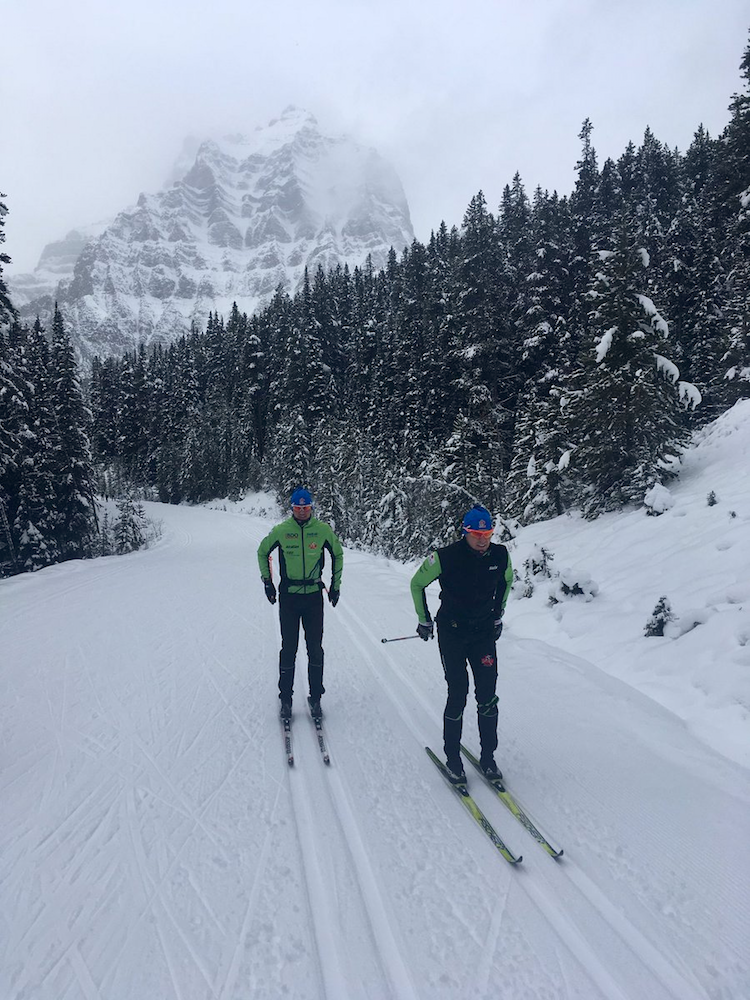
    Evan Palmer-Charrette (l) and Michael Somppi during a cool-down ski at Lake Louise near Canmore, Alberta, in November 2016. (Photo: Timo Puiras)
  • Wednesday Workout: Over-Under Intensity with Brian Gregg

    Wednesday Workout: Over-Under Intensity with Brian Gregg

    rian Gregg rollerskiing through Tyrol during a 15 k over-under intensity session. (Photo: Josh Dobert)
    rian Gregg rollerskiing through Tyrol during a 15 k over-under intensity session. (Photo: Josh Dobert)

    Brian and Caitlin Gregg have long been known for their superb climbing abilities. Anytime a course features a lot of uphills or there is a hill-climb event, the Gregg name is one to look out for. This is hardly surprising, considering the duo has been hammering out intervals on the biggest hills around Minneapolis, Minn., for years. However, the Team Gregg athletes recently realized they were losing more time in races on flats and transitions, and have adopted a new intensity workout that they do every couple of months to improve that aspect of their skiing.

    The first thing they needed for this workout they adopted from a Scott Johnston track exercise was a good loop. It had to be around a kilometer long and also incorporate good, undulating terrain.

    “In this loop we have two 180s as part of the loop, one is across a crack, the other is a manhole cover, and then its got some good turns, some technical skiing. So it’s really fun to work on our weaknesses there, and I feel like it’s made a really big improvement,” Brian Gregg said of their 1 k loop.

    In order to prepare for the workout, Gregg and his wife, Caitlin, do a 10 k time trial on the loop. During the time trial, they focus on pacing and try to have consistent lap times. After the effort, the Greggs note their average lap time, an important factor for the over under intensity workout.

    A few days later, Team Gregg will go back to the same loop with their race pace lap time in mind as well as a threshold pace lap time, which is calculated by adding an extra 10 percent onto the race pace lap time. These two times, which for this example we will say are 2:45 and three minutes, are the lap time goals for the workout.

    Brian Gregg with some fellow rollerskiers after their workout. (photo: Josh Dobert)
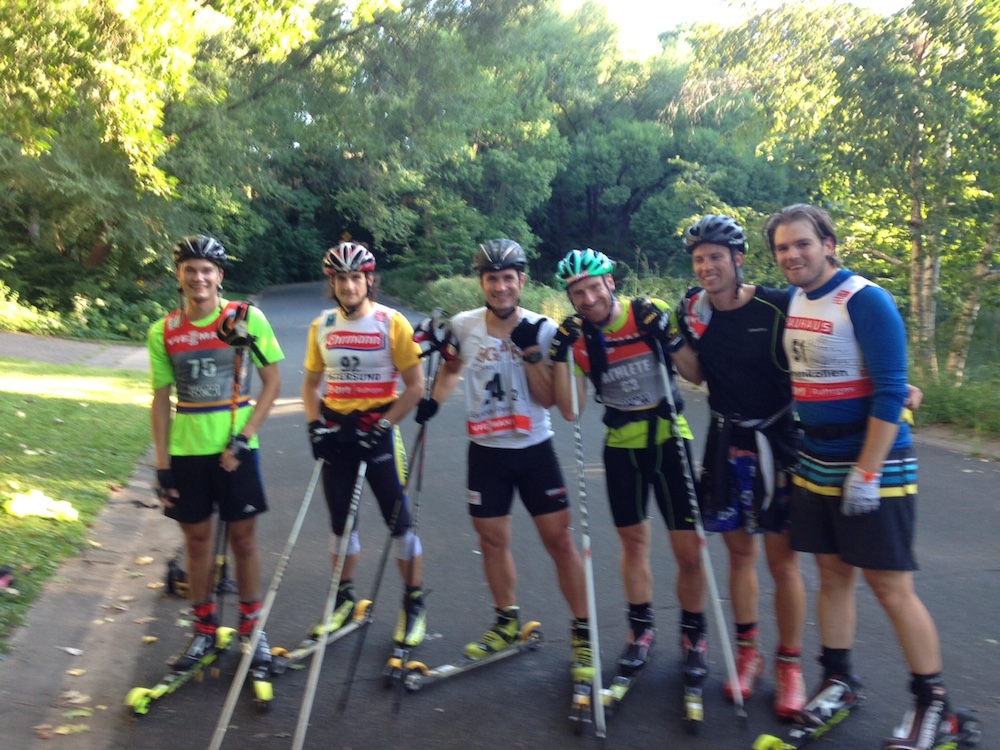
    Brian Gregg (middle in green helmet) with some fellow rollerskiers after their workout. (Photo: Josh Dobert)

    During the over-under-intensity workout, the objective is to ski about 15 kilometers, alternating between threshold lap times (3:00) and race pace lap times (2:45). So for example, Brian Gregg will ski one lap aiming for a three minute lap time, and then on his next lap, he will aim for 2:45.

    After that lap he will once again aim for three minutes, going at a threshold pace in order to recover from the race pace lap. The idea is to alternate between slightly over threshold effort and just about threshold effort to increase the body’s ability to recover while still skiing at a relatively high pace.

    “The goal is to hit that 2:45 time. So essentially you have a time you are looking to hit, and your goal is to have the heart rate as low as possible during that [loop]. I think it’s really good because all of a sudden the focus isn’t on trying to get the heart rate up, it’s on, ‘How can I hit this time with as little energy as possible?’ ” Gregg explained.

    So the workout is not only great for working on transition skiing and increasing the body’s ability to recover at threshold, but also for pacing and having a good feeling for how hard one can push the body without going over the edge.

    The over under workout is great for any discipline, and also for larger groups. Team Gregg will invite others to participate in the workout with them, and it often works out that people’s lap times meet up. Somebody’s threshold pace might equal another’s race pace, so skiers get an opportunity to follow and learn from each other.

    One thing to keep in mind, the 15 kilometers total is just a goal. If the laps are getting slower or recovering adequately on the threshold pace laps is no longer possible, cutting the intensity session short is the right thing to do. The main goal is to ski well throughout the workout, so pushing too hard can be counterproductive. Even Brian has had to cut the number of laps before.

    “When you get to the point where you’re not recovering on your recovery lap, that’s sort of when the workout ends. And so it’s a little bit based on feel trying to find that point. You sort of are looking for the duration of the workout to be the taxation in that over-under situation,” Gregg explained.

    For Gregg, this over-under-workout is one of many steps toward his greater goal of the year, to get onto the World Cup by being the Super Tour leader after Period I. “I’d like to see my wife a little bit, and the best way to do that is to get on the World Cup,” he said.

    Pre-Workout:

    – Find a nice 500 meter to 2 kilometer loop with varied terrain, corners, and transitions.

    – Warm up and do a 10 kilometer time trial on the loop. Try to have as consistent of lap times as possible.

    – After the time trial, use the average lap time as the race pace lap time for the workout and 10 percent more than the average lap time as the threshold lap time for the workout.

    The Workout:

    – Warm up for 20 to 30 minutes

    – Begin with a threshold lap. Try and hit the exact threshold lap time with as little effort as possible.

    – On the next lap, up the pace to try and hit the race pace lap time, also with as little effort as possible.

    – Continue alternating between threshold laps and race pace laps for 14 total laps of the course or until the threshold lap pace is too fast to adequately recover or the lap times increase dramatically, whichever happens first.

    – Warm down for 15 to 30 minutes to finish up the workout.

  • Wednesday Workout: Max Aerobic Speed Intervals with Colin Foley

    Wednesday Workout: Max Aerobic Speed Intervals with Colin Foley

    Colin Foley (Callaghan Valley Training Centre) racing. (Courtesy photo)
    Colin Foley (Callaghan Valley Training Centre) racing. Foley, 18, likes time-based interval workouts that mimic sprint qualifiers, like max aerobic speed at 15-second intervals. (Courtesy photo)

    This week’s workout brought to you by Colin Foley, 18, of the Callaghan Valley Training Centre in British Columbia. Want to submit your own go-to workout? Email alex@fasterskier.com.

    After years of ski training it seems like I’ve done any variety of intensity workouts. From VO2 max to speed, to tempo to you name it, it’s almost a rare event when we do the same intensity breakdown!  Anyway, we did a great workout recently in practice: max aerobic speed at 15-second intervals, it’s something that we’ve done a few times and I really hope we do more in the future.
    The workout: Time-based interval workout, with four intervals of 3 minutes and even rest (3 minutes) in between. We did them at Zone 4, or just as hard as you can maintain for the 3-minute interval.

    Warmup: We warmed up as a group with a 30-minute easy classic ski.  To warm up properly, we stuck to the flatter trails between the stadiums at Whistler Olympic Park for the first 10 minutes then went into some hillier terrain for the last 20 minutes and regrouped in the cross-country stadium at Whistler Olympic Park.

    Interval start: While lots of intervals can be done as a large group (there are 9 on my team), we chose to do this set of intervals in a 15-second interval start format. I really liked this format because it made the workout feel like a sprint qualification … four times!

    When you are doing intervals as a group it’s often easier to push yourself because you have your teammates there at your side, and you don’t want them to get away.  I really like the 15-second interval start format of these intervals because it really helped me practice pushing to the max when I don’t have somebody there at my side.

    “When you are doing intervals as a group it’s often easier to push yourself because you have your teammates there at your side, and you don’t want them to get away.” — Colin Foley

    We definitely have some stronger and weaker “sprinters” on our team, so our coach mixed up the order of our interval start from interval to interval.

    Colin Foley (CVTC) warming up. (Courtesy photo)
    Colin Foley (CVTC) warming up. (Courtesy photo)

    Rest/recovery: In between the intervals we tried to recover as much as possible.  For me, this meant skating easily around the stadium.  We were doing the harder sets on the hills of the sprint course, just outside of the cross country stadium so it was easier to come back (and also hear our coach call the end of the set).

    Result: We do these intervals to increase the amount of time that we can push ourselves at our maximum aerobic output.  I have really found that this has helped my sprint qualifiers this year.

    Post-workout: After the final interval we did a long cool down, but not before we first had some good nutrition.  For us, that’s a bottle of a protein drink and some hydration drink (we also have energy drops if we were feeling a bit hungry).

    We skied for about an hour, this time sticking to rolling terrain (the Madeley Creek Loop at Whistler Olympic Park is great for a longer cool down like this).

    Then it was back to the van, back to our homes in the Whistler Athletes Village (now known as Cheakamus) and a proper lunch and rest.

    We enjoyed being home in Whistler for a few weeks and getting in some good training before heading off to more NorAm competitions and, eventually, Canadian Nationals.

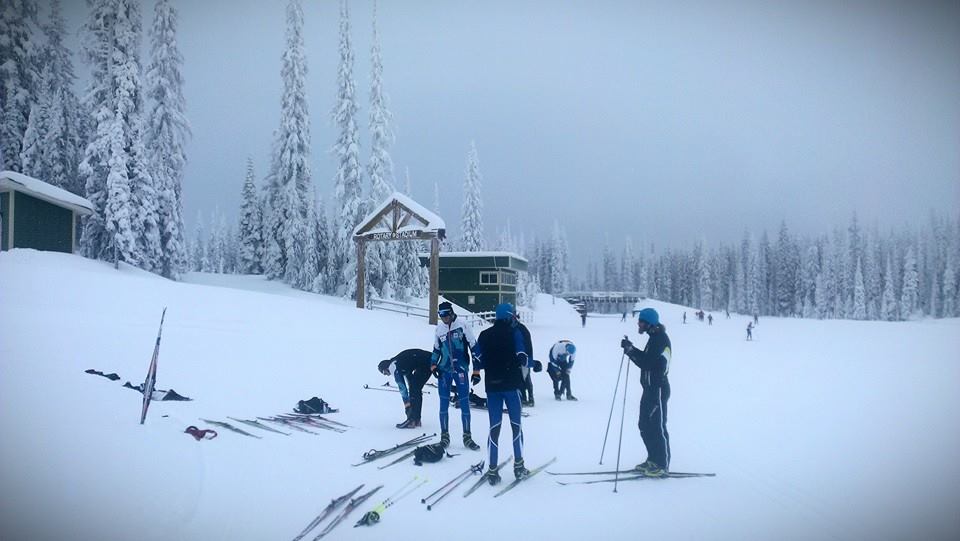
    Callaghan Valley Training Centre team prep (Courtesy photo)
    The Callaghan Valley Training Centre team preps for one of its workouts. (Courtesy photo)


  • Wednesday Workout: Lactate Clearance with the AWCA

    Wednesday Workout: Lactate Clearance with the AWCA

    AWCA skiers get ready for a skate prologue test, which doubled as a lactate clearance workout, this fall in Canmore, Alberta. (Courtesy photo)
    AWCA skiers get ready for a skate prologue test, which doubled as a lactate clearance workout, this fall in Canmore, Alberta. (Courtesy photo)

    This Wednesday Workout it brought to you by Stefan Kuhn, 2010 Canadian Olympian and assistant men’s coach at the Alberta World Cup Academy in Canmore, Alberta. The workout: lactate clearance, which he has his athletes do in the fall three to four times before the race season. The goal: measure each individual’s ability to clear lactate, their mental toughness, physical fitness and overall speed.

    AWCA skiers after a hill-climb running workout last month near Canmore, Alberta. (Photo: Stefan Kuhn/AWCA)
    AWCA skiers after a recent hill-climb running workout near Canmore, Alberta. (Photo: Stefan Kuhn/AWCA)

    “This is a fun workout and it’s super simple to do, but it really makes you have to dig deep, which is why I like to do it around this time of year,” Kuhn explains in an email. “The shape of the athletes is at high level and you can really go for a hard effort to build some lactate and try to survive through the workout the best you can.”

    But don’t go crazy. Kuhn warns his athletes that they need to be mindful how hard they’re pushing from the start of the workout so that they make it to the finish.

    “It’s a speed-focused intensity with an understanding you have to repeat it many times over,” he notes. “I know I loved it when I was an athlete.”

    So what’s the point of so much pain? It helps you deal with lactic-acid buildup, that burning sensation one might feel in their legs or arms that causes them to slow down.

    “As cross country is a lactate-tolerable sport, it is important to learn to try to flush it best you can and to race with it in your system,” Kuhn explains.

    An extended and diligent warmup and cool-down are key. So let’s get to it:

    The Workout: Lactate Clearance

    Warmup: 30-45 minutes

    15 intervals of 30 seconds on, 30 seconds off

    15-minute break: easy running or skiing, keep the body moving

    (Repeat first set) 15 x 30 seconds on, 30 seconds off

    Lactate readings (if available. Wear a heart-rate monitor during workout if not): Kuhn measures his athletes’ lactate levels at the end of the workout because there isn’t enough time in between.

    “I look at lactate clearance and you also get to see a lot by watching the athlete,” he explains. “If they have speed at the end or are they dying hard. I also watch the heart rates, which is a great way to monitor how they are doing. Do they get close to their max, and how much does it drop on the rest parts of the interval?”

    Cool-down: 30 minutes to an hour

  • U.S. Biathletes Hammer Hard in Placid (Photo Gallery)

    U.S. Biathletes Hammer Hard in Placid (Photo Gallery)

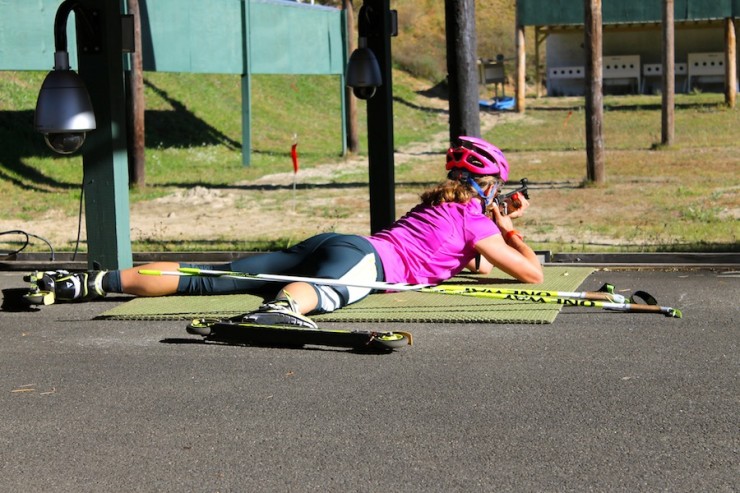
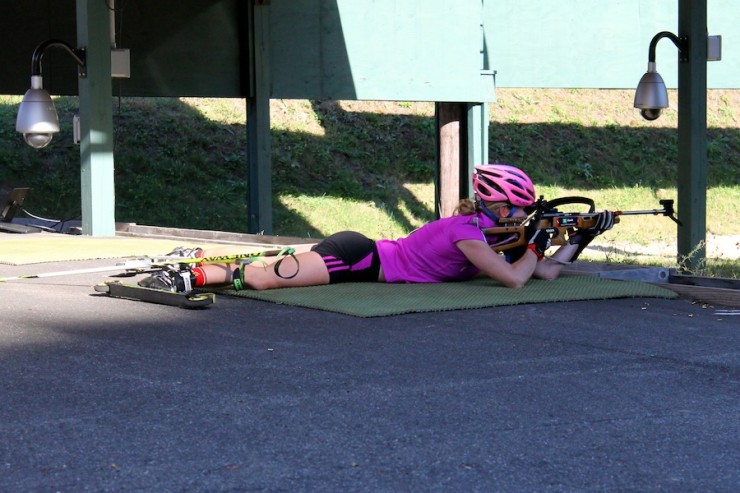
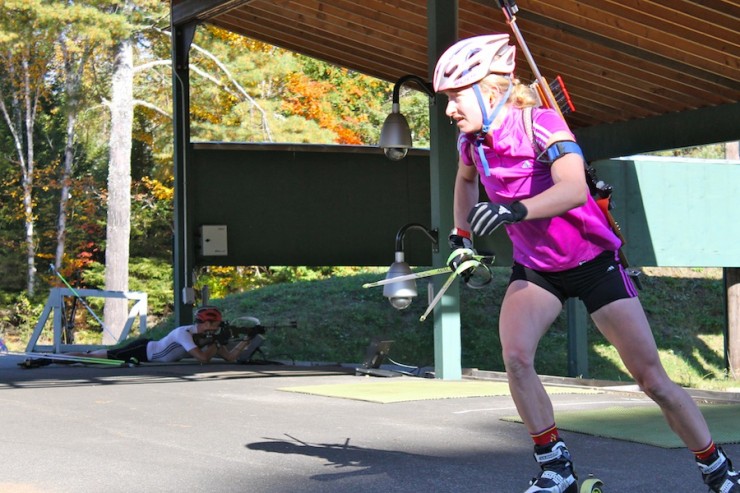
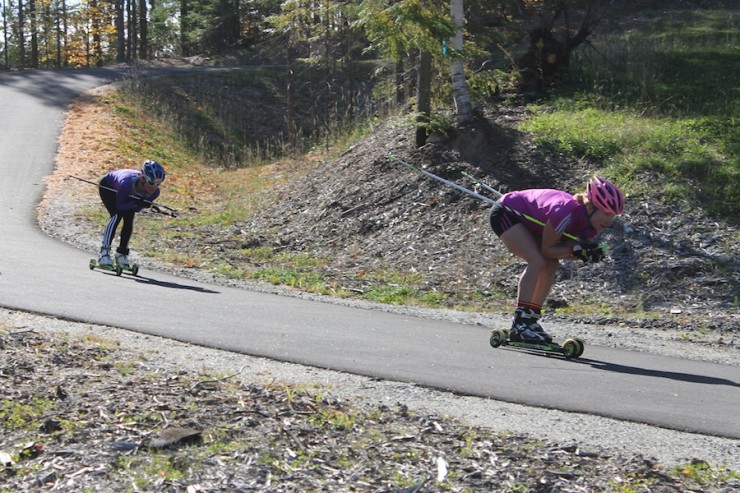
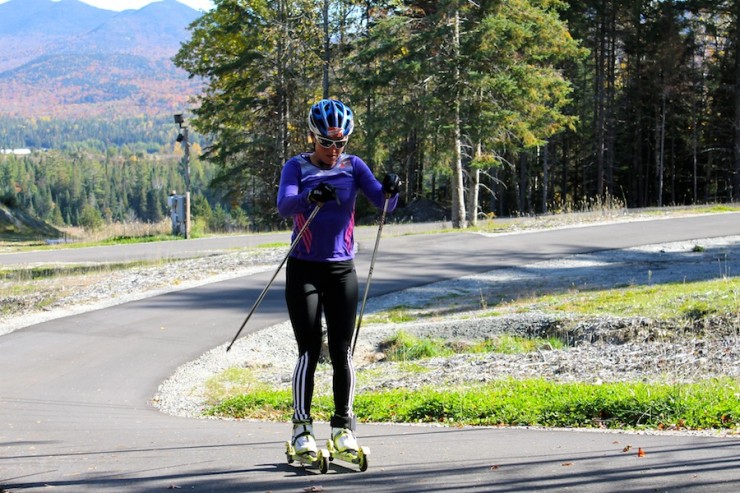
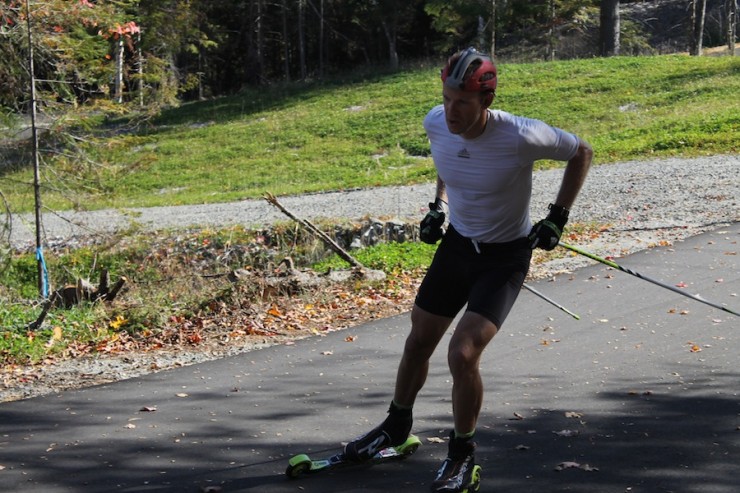
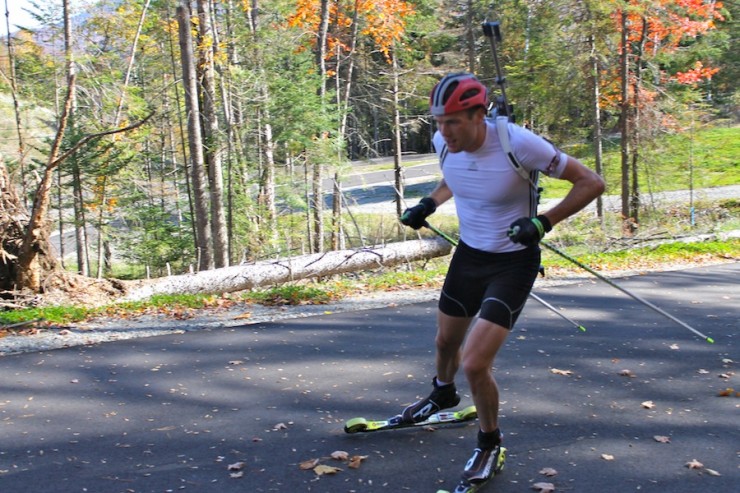
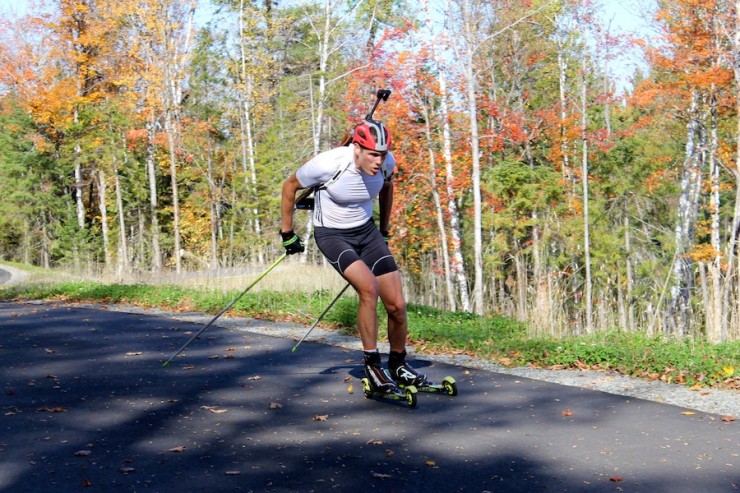
    LAKE PLACID, N.Y. — Nothing says the beginning of October like a grueling combo workout for the U.S. Biathlon squad. As if five to six repeats around their 3-kilometer rollerski loop wasn’t enough, they started Thursday with an all-out race to the top of the course.

    According to women’s coach Jonne Kähkönen, the prelude was something new this year after several of his athletes said they wanted a faster first lap in races. The answer: get the blood pumping and heart racing faster before you start.

    That meant starting at the bottom of the Olympic Jumping Complex — way down in the lower parking lot — and racing one another to the top (mass-start style). Four men (Tim Burke, Lowell Bailey, Leif Nordgren, and Russell Currier) and three women (Susan Dunklee, Hannah Dreissigacker and Annelies Cook) all started at once, along with special guest Andrea Henkel, a German biathlete and Olympic gold medalist (and Burke’s girlfriend). Henkel, 35, did the initial workout with the group, but without a rifle for this trip, opted to double pole around the rest of the morning.

    With a 10-minute rest beforehand, the combo workout (5 or 6 x 8-minute laps around the relatively new course, with prone and standing shooting in between) involved two to four lactate readings per athlete. It marked the end of a tough three-week training block, and Kähkönen said this workout is done once every intense training period. Next week, athletes can enjoy some rest before flying to Utah for the last set of rollerski races in Soldier Hollow Oct. 22-24.