From the FasterSkier archive — posts syndicated from athletes’ and coaches’ own blogs between 2004 and 2012, kept online as published. Current coverage is at fasterskier.com.
The Olympics are facing criticism from athletes and climate activists over sponsorship by ENI, Italy’s state-controlled oil company. (Nathaniel Herz/FasterSkier)
PREDAZZO, ITALY — Two months before the Winter Olympics were set to kick off in Italy, the torch relay, carried by runners from Greece to the Olympic venue, made an unusual stop: the headquarters of Italian oil giant ENI, where an executive from one of the company’s lower-carbon subsidiaries acted as a torch bearer.
The event tied in with what’s become, in recent days, a controversial endorsement deal — one that made ENI a “premium partner” of the Olympics at a time when athletes and fans are increasingly calling on winter sports organizers to renounce fossil fuel sponsorship.
The company is also hosting the “ENI Winter Village” in Milan during the Olympics. Visitors can test out a snowboard simulator, have a virtual snowball fight and try an urban cross-country ski trail made with “innovative polymers” produced by ENI’s chemical company that “makes skiing possible in the city.”
Nikolai Schirmer, a Norwegian extreme skier and YouTuber who’s helping lead a campaign called Ski Fossil Free, said it makes no sense for athletes and events dependent on snow to be advertising for the businesses whose products, through the greenhouse gases emitted by their combustion, pose an existential threat to winter sports and future Olympics, said
“Winter sports, right now, are like a string quartet on the Titanic, playing as the ship is sinking,” Schirmer said. “Not only that, they’re advertising for icebergs while they’re doing it.”
Nikolai Schirmer is a Norwegian extreme skier known for his human-powered ascents. He also has a law degree and once spent a winter living in Alaska. (Nathaniel Herz/FasterSkier)
Schirmer, 35, spoke in an interview Wednesday outside the main media center in Milan, just after he’d delivered a stack of more than 20,000 petition signatures to Olympics officials.
His campaign — endorsed by Olympians like Alaskan cross-country skier Gus Schumacher and Greenlandic biathlete Ukaleq Slettemark — is making what Schirmer describes as a very modest ask: that the Olympics and the umbrella organization that coordinates global ski competitions, the International Ski Federation, examine the ethics of winter sports taking money from fossil fuel companies and draft a report.
A separate letter calling for the Games to reject future fossil fuel sponsorships, with current and former Olympian signatories, is set to be released in the coming week, said the Swedish cross-country skier who coordinated it, Björn Sandström. And Greenpeace, the international environmental advocacy group, has debuted its own protest video showing animated Olympic skiers, skaters and bobsledders being washed away by a flood of crude oil.
In past years, climate campaigners have disrupted top-level cross-country ski races in Europe. And in 2025, they threatened a demonstration at the World Championships in Norway over sponsorship by state oil company Equinor — though they ultimately stood down after a group of top athletes agreed to press ski race organizers for more stringent sponsorship guidelines.
International Olympic Committee officials, asked at a Wednesday news conference about Schirmer’s initiative, praised athletes for speaking up, with President Kirsty Coventry saying they “have a platform to speak up, and to say, ‘Hey, these are the things that we want to see you do better.’”
“We’re always going to try to be better, and ask our stakeholders to be better,” said Coventry, a former Olympic swimmer. “But that also takes time.”
Committee officials also pointed to sustainability efforts for this winter’s Games: renewable electricity at venues, a fleet of cars that includes 21% electric vehicles, and more than 20,000 pieces of recycled furniture from the last Summer Olympics.
But Christophe Dubi, the Olympics executive director, did not respond directly to the petition’s request.
“We have to recognize one thing: Climate is a challenge for all of us,” Dubi said. “As sport, as well, we’re not immune to those climate challenges, and we have to hear voices.”
Officials from state-controlled ENI did not respond to requests for comment. The company told Reuters in a statement that it shares “the importance of addressing climate change” and will continue investing in renewables to hit its net‑zero emissions target by 2050.
At the Games in Italy, numerous athletes have arrived with stories about witnessing the loss of winter and snow.
U.S. downhill star Lindsey Vonn, at a separate news conference this week, said she’s seen, firsthand, “what global warming has done.”
“I’ve been skiing on glaciers since I was nine years old,” said Vonn, 41. “And most of the glaciers that I used to ski on are pretty much gone.”
Another U.S. athlete who has engaged in climate advocacy for several years, 25-year-old Gus Schumacher, lived through some mostly snowless winters growing up in Alaska; he’s also endorsed Schirmer’s campaign.
U.S. cross-country skier Gus Schumacher. (Federico Modica/Nordic Focus)
“We want to be able to ski, and want to be able to ski on natural snow, because that’s the best way to do it,” Schumacher said in an interview. “And I don’t want to support companies that are adding fuel to that not being a possibility.”
Fossil fuel companies like ENI are using their association with events like the Olympics to help burnish their image and diminish public pressure to more quickly transition away from fossil fuels, argued Schirmer.
ENI is using its Olympics sponsorship to advertise sustainability and renewable energy focused business lines. But its oil production has grown in recent years — and is set to keep growing through 2030. The company’s biofuels and renewables companies still bring in less than one-tenth of the earnings as its oil and gas holdings — though its chief executive last year told the Financial Times that profits from the green energy businesses should be equal to those from hydrocarbons by 2035, and exceed them by 2040.
“The Olympics are willingly greenwashing ENI — an energy still heavily invested in fossil fuels,” Schirmer said. “And it doesn’t look like that’s going to change any time soon. So, in my mind, it looks like the Olympics, and organized skiing and snowboarding, are promoting their own demise.”
Help Support Our Olympic Coverage!
FasterSkier has our own Nat Herz on the ground at the Olympics, which is a significant financial lift for us. If you value the thoughtful work and access FasterSkier provides at championships like this one, please consider becoming a Voluntary Subscriber. Your support directly fuels our work to cover the people, places, and moments that make our sport special.
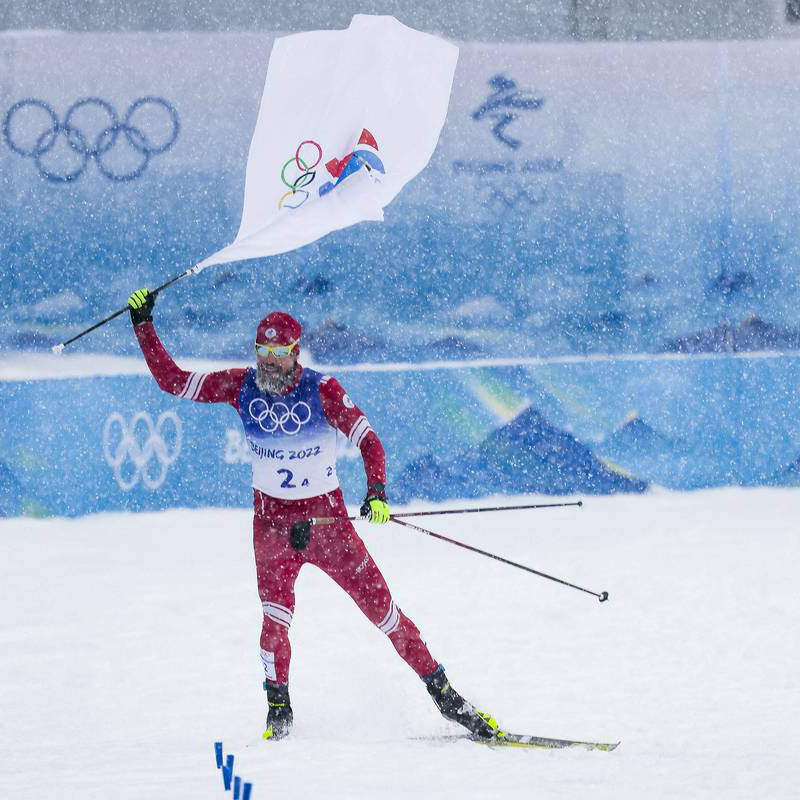
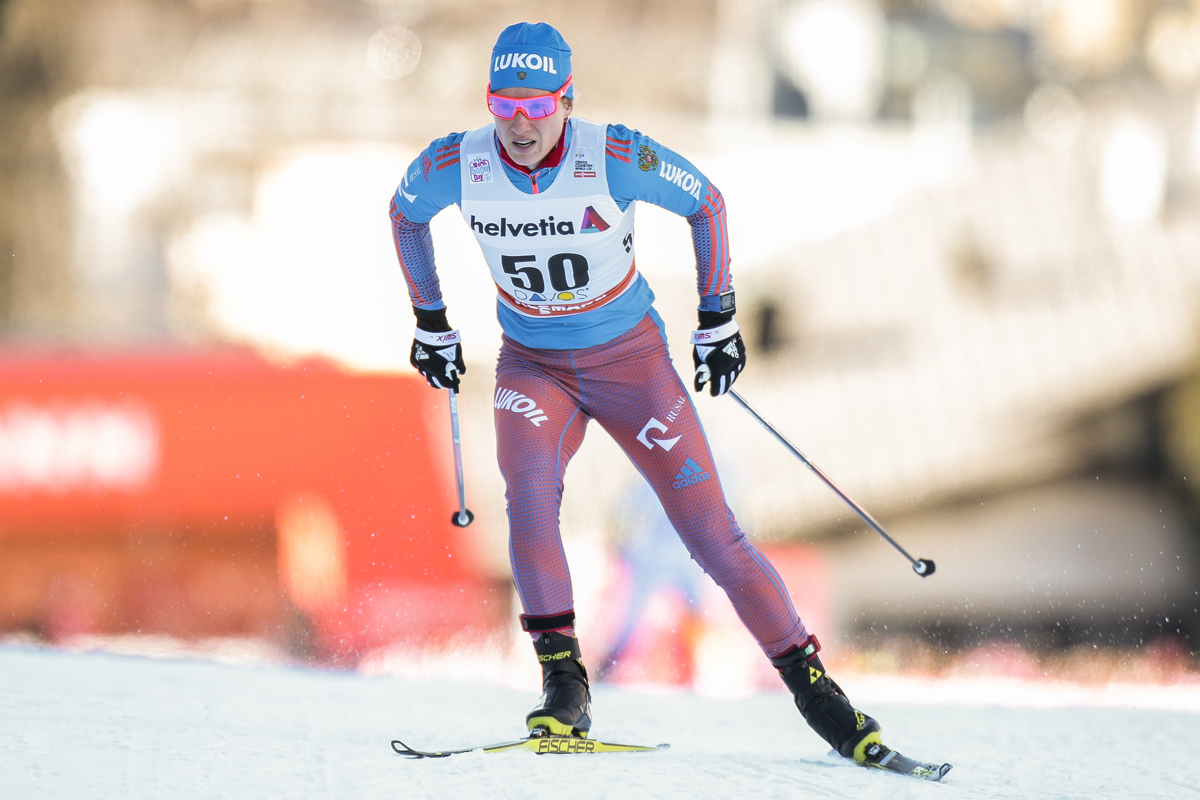
While certain Individual Neutral Athletes will be allowed to compete in the upcoming World Cup races (events that can qualify athletes to compete in the Olympics), the flag of the Russian Olympic Committee is one of those that will continue to be banned from Milano-Cortina’s Olympic Games. (Photo: NordicFocus)
It sounds like things just took a turn . . . and everyone really shoulda seen this coming.
Articles published today (Dec 2) in both the New York Times and Langrenn reported that the Court of Arbitration for Sport had upheld the appeal submitted by Russian Ski Association (RSF) and select Russian athletes. What does that mean? Well, after a complex and convoluted set of explanations, it means that FIS cannot place a wholesale ban on all athletes from Russia and Belarus; therefore, Individual Neutral Athletes (AINs) from both nations will be allowed to compete in upcoming World Cup events that represent qualifying opportunities for the Winter Olympic Games.
A month ago, every media outlet in the sporting world announced that athletes from Russia and Belarus would be excluded from qualifying events sanctioned by the International Ski Federation (FIS) and leading up to the Olympic Winter Games in 2026. If Russian athletes couldn’t qualify for the Olympics, then they couldn’t compete in the Olympics. End of story. Numerous ski-industry publications made it sound like a done deal—Russia was out, and that was it. Time for FasterSkier to toot its own horn a bit: we told you a decision-reversal could happen . . . and now the appeals of Russian and Belarusian athletes and organizations have been approved by the Court of Arbitration for Sport (CAS). As a result, FIS will be compelled to include Individual Neutral Athletes (AINs) from both Russia and Belarus. Russian and Belarusian flags won’t be waving at the ski venues in Cortina this winter, but a select group of Russian and Belarusian athletes will be lining up for those events, nonetheless.
A Russian fan during the men’s 4 x 10 k relay at the 2019 World Championships. There will be no Russian flags waving at the Winter Olympics in 2026. (Photo: John Lazenby/lazenbyphoto.com)
Just like in the Paris Summer Olympics in 2024, the field in Milano-Cortina will include a select set of Russians and Belarusians who meet two conditions:
The individual athletes have never been supporters of the war on Ukraine.
The individual athletes are willing to make themselves available for independent drug screening.
And a few conditions on athlete representation, as well.
AINs can participate in individual events, only. No team events (for skiers, that means no relays).
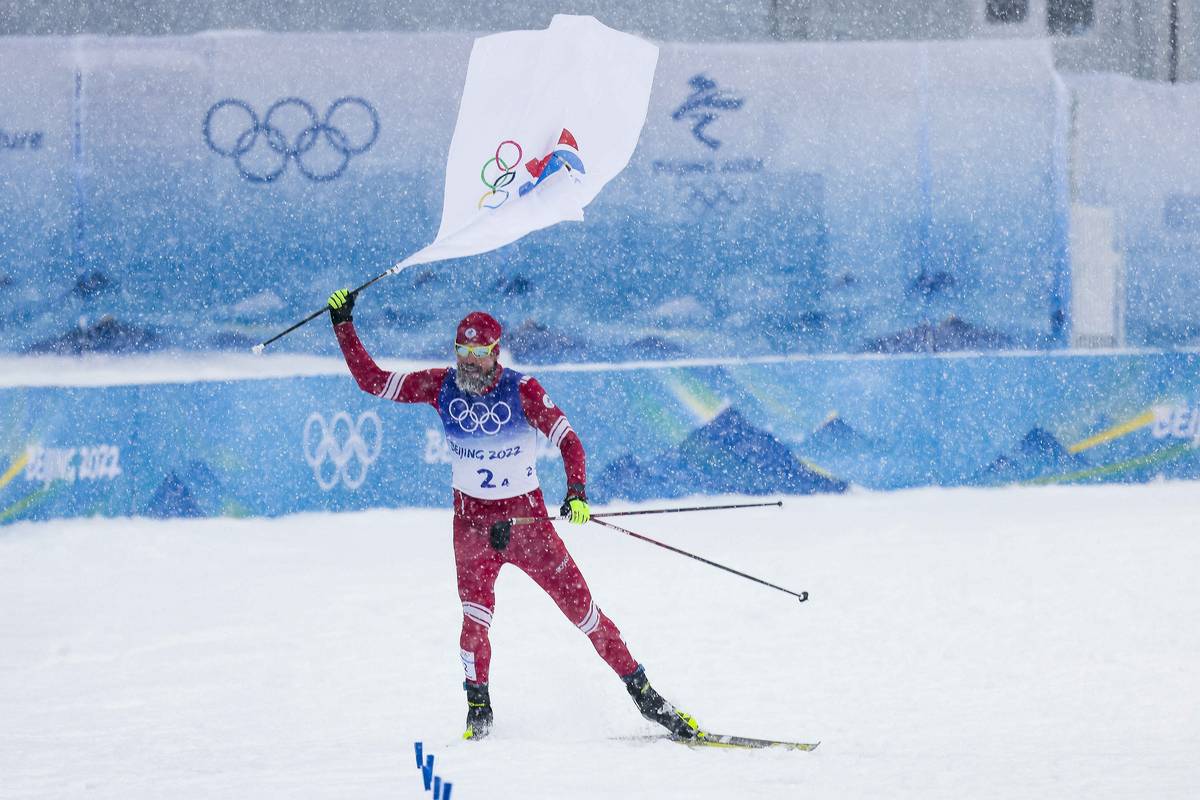
No national anthems, no national flags. They may be Russians, but if an AIN wins gold the IOC gets to pick the music they listen to on the podium, and the flag that flies above them.
No national uniforms. Colors, designs, and insignia must meet standards that will be set by the IOC.
Norway Won’t Like it—But They’ll Probably Be polite About It
This whole set of decisions also means that Russians will be on the starting line at World Cup events this weekend in Trondheim (hometown of Johannes Hoesflot Klaebo, and one of the hotbeds of Nordic skiing in Norway—a nation that has seemed almost wholly opposed to the return of Russian athletes to World Cup and Olympic competition). The rest of the world is left to wonder whether the motivation of many Norwegian administrators, coaches, athletes and fans was simply that the Russians were the team most likely to interrupt the performances of Norwegian stars in the Olympics. Well, duh! Of course they want their rivals sidelined. The fact that the Olympic results would not have included some of the best skiers in the world would have been little more than a footnote in the history of skiing. And Olympic immortality remembers only the medal, not the quality of the field.
The field in question will likely be without the most notable names in Russian skiing, many of whom were vocal and visible supporters of Russia’s invasion of Ukraine. That stance, alone, disqualifies athletes like Alexander Bolshunov (who dominated events at the Beijing Olympics in 2022). In his place we’re likely to see Russia’s former Junior World Champion and current phenomenon, Saveliy Korostelev, who clobbered Bolshunov in last season’s Russian Championships. Norway won’t like it, but Russian skiers may still end up being the most likely to overturn the punch bowl at Klaebo’s Olympic coronation.
A Fair and Logical Choice?
FIS’ charter restricts the organization from discriminating against any athlete for political reasons. That, alone, should’ve let FIS know that what they were doing—painting every Russian and Belarusian athlete with the broad war-mongering brush wielded by Vladimir Putin—was not sustainable. According to its own charter, FIS is precluded from excluding an athlete simply because they are Russian. So, FIS made its point—”We really don’t like you guys”—but now that particular bureaucratic melodrama has ended. The Court of Arbitration ruled clearly, and the Russians (certain Russians) are in.
The CAS decision on FIS policies was not the only one of its kind to hit the headlines recently—and ALL those recent decisions went the same direction. The International Skating Union (ISU) recently announced that, after sufficient and appropriate scrutiny, two Russian figure skaters (Petr Gumennik and Adeliia Petrosian) and one Belarusion figure skater (Victoriya Safonova) had qualified as AINs who will be eligible to compete in the Winter Olympics in 2026. Parallel determinations are expected from the ISU concerning eligible speedskaters and short track skaters. Similar announcements also arrived earlier from international governing bodies in Luge, Bobsled, Skeleton, and Biathlon. The message was clear: the Olympic Committee wants Russias and Belarusian athletes to be participants in the Olympic Games. It’s a watered-down version of the original Olympic Truce, which held that all wars would cease, and the athletes would join together in a display of fairness, collegiality, and peace.
IOC has remained totally in favor of punishing Russia, and excluding all things “Russian” from inclusion in the Olympic Games. But where IOC does make a concession is that Individual Neutral Athletes (AINs) should be allowed to compete if they meet certain conditions. The IOC feels that’s fair and logical. According to the charters of all the organizations involved, that does seem to be the case.
During the ancient Olympics, the Greeks practiced ékécheiria: an Olympic truce, a temporary peace during which wars would pause, combatants would lay down their arms, and athletes competed peacefully and nobly in Olympic contests. The Olympic Games would literally stop wars, the violence and aggression and acrimony of the battlefield replaced with the spirit of the Games. We’re reminded of that notable history during every modern Olympic broadcast, and we’re certain to be reminded of it countless times during the Games in Milano-Cortina in 2026. What broadcasters never seem to disclose is that after those ancient Games concluded—after the Olympic Truce expired—all the soldiers and armies and nation states went right back to waging war again. Whether during times of antiquity or during the modern day, the Olympic Games aren’t as much of a “peace” as they are a “pause,” a time when athletes and nations attempt to live up to the Olympic spirit, requiring “mutual understanding with a spirit of friendship, solidarity and fair play.” It’s also a truce that’s supported by the commercialization of an enterprise and the potential profits from its staging, so much so that sporting events temporarily take precedent over geopolitical aggressions and military invasions. That’s an exceptional reflection of the value of the Olympic Games, but it’s never proven to be much of a lasting solution. Nevertheless, the International Olympic Committee continues to see itself as a peace maker, persisting in sentiments espoused by outgoing IOC President, Thomas Bach, that the Olympics should involve “building bridges, never erecting walls.”
Now, a new IOC head has been elected—Kirsty Coventry—the first woman elected to this role. Coventry identifies Bach as her mentor, seeming to suggest that she will support policies allowing the Olympics to once again host Russian athletes. Historically, traditionally, and fundamentally, that’s what the Olympics are supposed to do . . .
The International Olympic committee (IOC) and the International Ski Federation (FIS) are reportedly reconsidering their existing bans of Russian and Belarusian athletes from international competitions. Current proposals suggest that Russian and Belarusian athletes may be allowed to compete as Independent Neutral Athletes (AIN), representing no nation. They wouldn’t march in Opening Ceremonies, they wouldn’t wear a national uniform. If they win a gold medal, they’ll stand on the podium under an Olympic flag while some as-yet-undisclosed “neutral music” (rather than a national anthem) would be played.
Russia’s recent Olympic involvement has been a rocky road, indeed. Russia had already been exposed for systematic cheating during the Olympic Winter Games in Sochi. Following that team-wide, government-sponsored doping scandal, Russia had already endured a multi-year ban from Olympic competition during which select Russian athletes had been allowed to compete as independent participants. Then came the invasion of Ukraine, and the IOC (and FIS) finally found a rationale that would allow them to kick out the Russians, entirely. But is that really legitimate a reason? Olympic history and philosophy suggests no, as the tradition of the Olympic Truce would seem to indicate. But the modern Olympics have not been part of any Olympic truce. Olympic Games were canceled due to World War I, and again during World War II. That was when the whole world was at war; there was just no stopping the conflicts that involved so many nations, even for an Olympic Truce. So, it seems there have been multiple exceptions to Olympic foundational rules. Even the seemingly egalitarian aims of the Ancient Olympics did not seem to guarantee participation in sport as a human right . . . at least not for women, who were barred from competition. The same exclusions were suffered by non-Greeks, professionals, blasphemers, and convicted criminals. Ironically, it’s the blasphemers category that still seems to be in play: the IOC has suggested that Russian and Belarusian athletes may be allowed into the Olympics Games of Milano-Cortina, except for those athletes who have voiced support for the Russian invasion of Ukraine. If a Russian athlete spoke out in favor of the war (including statements made, re-posted, and/or “liked” in social media), then they’re out. The same goes for athletes who may be enlisted in the armed forces of those countries. That makes Olympic qualification an especially difficult needle to thread for Russian athletes, many of whom make their living by their positions in the Russian military (a virtual governmental sponsorship). Former Olympic and World Cup champion, Alexander Bolshunov, for one, is enlisted in the Russian National Guard.
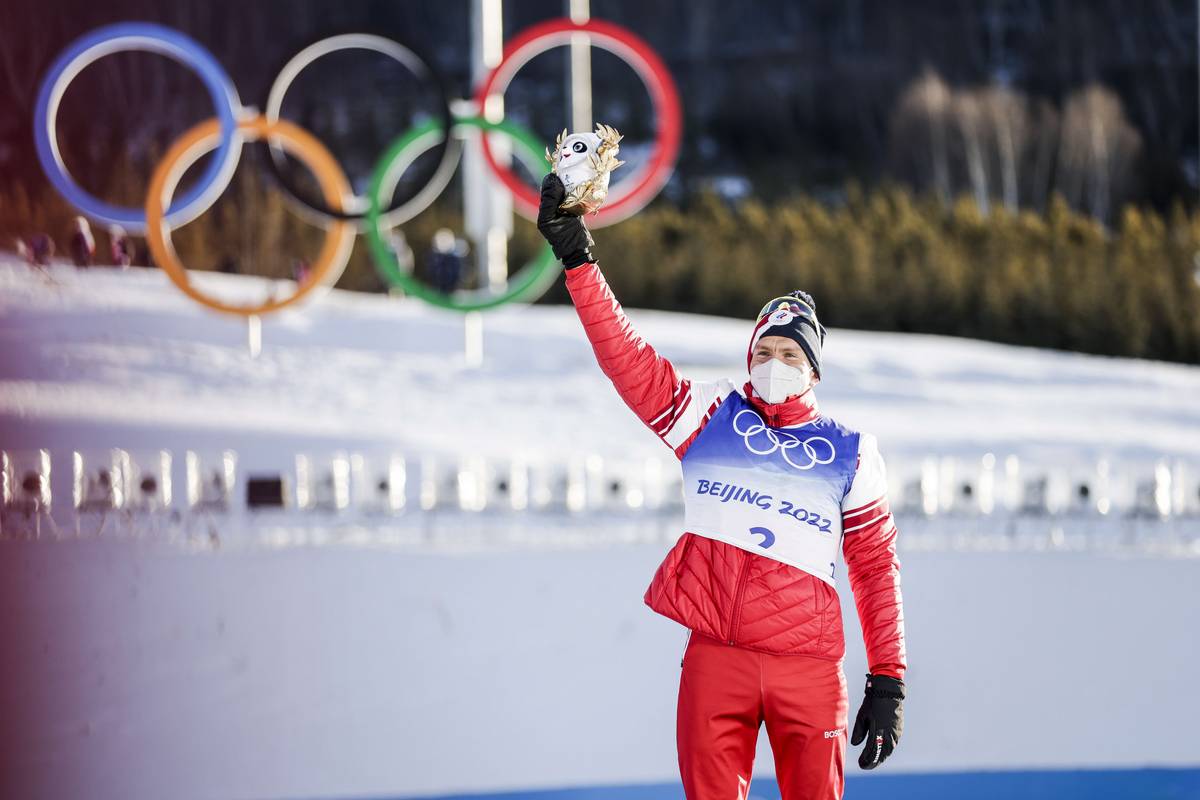
Alexander Bolshunov (ROC) won the men’s 30 k Skiathlon in Zhangjiakou during Beijing’s Olympic Winter Games, 2022. (Photo: NordicFocus)
Bolshunov already owns nine Olympic medals (three of them gold). Eight World Championship medals (even though Russia has been excluded from the last two World Championship events in 2023 and 2025). Bolshunov has been World Cup overall champion twice (2020 and 2021), and Distance champion three times (2019, 2020, 2021). Bolshunov was present at a number of European races (though not World Cup events) during the 2024-2025 season, though his performances suggested he was having a tough time brushing off the rust of two years of World Cup exile. He managed to win one marathon event, but his other races were far from stellar performances, including a dramatic fall just before one finish line that concluded in Bolshunov removing his skis and walking dejectedly across the finish line. Despite his recent unspirited performances, Bolshunov must be considered a prime contender for medals in Milano-Cortina, if they let him into the Games.
Natalia Nepryaeva (ROC) competing as a member of the Russian Olympic Committee during the Olympic Winter Games in beijing, 2022. (Photo: NordicFocus)
Bolshunov’s Russian teammate, Natalya (Nepryaeva) Terentyeva, also finds herself affected by decisions and policies being considered by the IOC. Terentyeva owns four Olympic medals, three World Championship medals, a Tour de Ski title, and an Overall World Cup title that she won in 2022, despite having been excluded from the final two races of that World Cup season due to Russia’s invasion of Ukraine, leaving us to wonder if Terentyaeva ever actually received the Crystal Globe and/or the prize money associated with it?
The Olympic Charter’s Fundamental Principles make it plain that: “The practice of sport is a human right. Every individual must have access to the practice of sport, without discrimination of any kind in respect of internationally recognised human rights.” Consequently—and even in those sports where international sports governing bodies (like those of figure skating, bobsled, speedskating, and cross country skiing) have banned Russian participation—it appears likely that athletes from Russia (and Belarus) will likely toe Olympic starting lines in Milano-Cortina in February of 2026. That’s likely to change the story, and the racing, and the results . . . while the philosophy behind it all attempts to remain true to a hard-to-live-up-to philosophy.
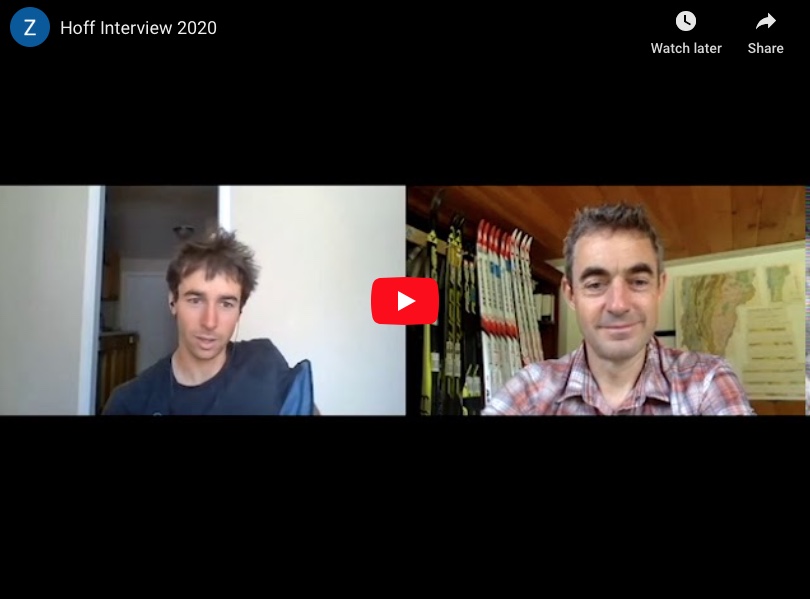
With a kowtow to Zach Caldwell and Noah Hoffman, we are repurposing their recent video conversation about anti-doping reform. On Nordic Nation, you’ll find just the audio. If you are more visual by nature, you can find the video here.
Hoffman is a former longtime U.S. Ski Team member. Caldwell is Hoffman’s former coach and runs Vermont based Caldwell Sport.
In this conversation, you’ll get solid details about anti-doping policy in the U.S. and abroad. Think of this as an advanced level remote learning opportunity to up your game when discussing anti-doping affairs. From Noah’s involvement with Global Athlete, to details on the Rodchenkov Act, USADA, and efforts to magnify athlete voices via labor unions, Caldwell and Hoffman cover lots of ground.
For those that have followed Hoffman’s career, this is an opportunity to hear him as he emerges as a nascent expert in anti-doping policy. It is easy to envision Hoffman leading international clean sport efforts in the years ahead.
Noah Hoffman (left) and Zach Caldwell (right). This is a screenshot of the video, clicking the white triangle will not prompt the video to begin.
The International Olympic Committee (IOC) released results from a wide-ranging survey to assay how the challenges athletes are experiencing during the pandemic and the ensuing lockdown. According to the Athlete 365 Survey Findings, there were over 4000 respondents across the globe, of which 80 percent were athletes, with the remainder described as “entourage” and “stakeholders”. Six percent of respondents were from the U.S.
Of the challenges described by athletes, 56 percent found it hard to train effectively, and 50 percent struggled to remain motivated. When asked, “What are you currently finding most challenging?”, thirty-two percent responded managing their mental health.
The survey also revealed that the needs of stakeholders were focused around event organization, communicating with athletes, and maintaining relationships with sponsors.
(If you or someone you know is struggling with their mental health, you can reach out to 800-273-8255, and speak to a trained mental health professional.)
This story has been updated to include the Thomas Bach’s statement made on 6-10-20 regarding athete protests. Bach is the President of the IOC.
Since the video of George Floyd’s killing was released, pent up frustration has emerged on the streets, social media, and amongst the influential athlete rank and file. Many have called for change.
The United States Olympic and Paralympic Committee (USOPC) sent a letter to athletes Monday announcing the organization was forming a committee to support athletes making political protests.
Sarah Hirshland Chief Executive Officer of the USOPC. (Photo: USOPC)
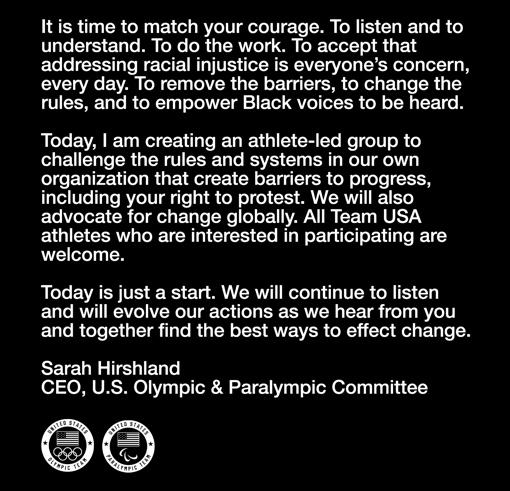
“Today, I am creating an athlete-led group to challenge the rules and systems in our own organization that creates barriers to progress, including your right to protest. We will also advocate for change globally,” wrote Sarah Hirshland, CEO of the U.S. Olympic & Paralympic Committee.
Hirshland’s reference to “change globally” brings to light the International Olympic Committee’s (IOC) Rule 50. Rendered down to its basics, Rule 50 aims to depoliticize the Olympic movement. The rule effectively bans athletes from using their Olympic moment to advance a political agenda. The most iconic example of athlete protests remains Tommie Smith and John Carlos of the U.S. who won the gold and bronze, respectively, at the 1968 Mexico City Summer Games in the 200 meter sprint. Each athlete raised an arm with a gloved clenched fist in a black power salute as the flags were raised. Smith and Carlos were sent home for their anti-racism protest. (NPR’s Code Switch produced a story on the fiftieth anniversary of the protest.)
June 8 Twitter screenshot from @USOPC_CEO
June 8 Twitter screenshot from @USOPC_CEO
Hirshland’s pivot amidst the current protests comes in opposition to a decision made by the USPOC 10 months ago. Then, hammer thrower Gwen Berry and fencer Race Imboden were disciplined for political protests at the 2019 Pan American Games. There, Berry raised a fist on the podium, while Imboden took a single knee during his award ceremony. Both protested pervasive inequalities in the U.S. The USPOC placed both athletes on 12 months of probation.
However, it was reported by the The Telegraph on Tuesday that the IOC intends to enforce Rule 50 at the 2021 Tokyo Games. According to Rule 50, violations will be considered “on a case-by-case basis as necessary.”
The IOC’s Rule 50 guidelines were updated this winter by the IOC’s Athletes’ Commission prior to the original start of the Tokyo Olympics. According to the guidelines they “have been developed with the aim that each and every one of you can enjoy the experience of the Olympic Games without any divisive disruption.”
• Second, to prevent the over-commercialisation of the Games and to keep the Olympic venues – (i.e. the field of play) free from advertising. This is known as the “clean venue” policy.
• Third, to prevent the Games from being used as a platform for protests, demonstrations or the promotion of political, religious or racial propaganda.
• Fourth, to define the rules for manufacturers’ identifications and other identifying features on sports uniforms and equipment, to prevent unauthorised commercial, political, religious or racial propaganda.
On Wednesday June 10, Thomas Bach, President of the IOC, indictaed the IOC might be open to modifying how Rule 50 is interpreted.
“The IOC Executive Board supports the initiative of the IOC Athletes’ Commission to explore different ways of how Olympic athletes can express their support for the principles enshrined in the Olympic charter, including at the time of the Olympic Games, and respecting the Olympic spirit, ” Bach said. “The framework has been set and now let the Athletes’ Commission and the athletes discuss amongst themselves and come up with the relevant proposals.”
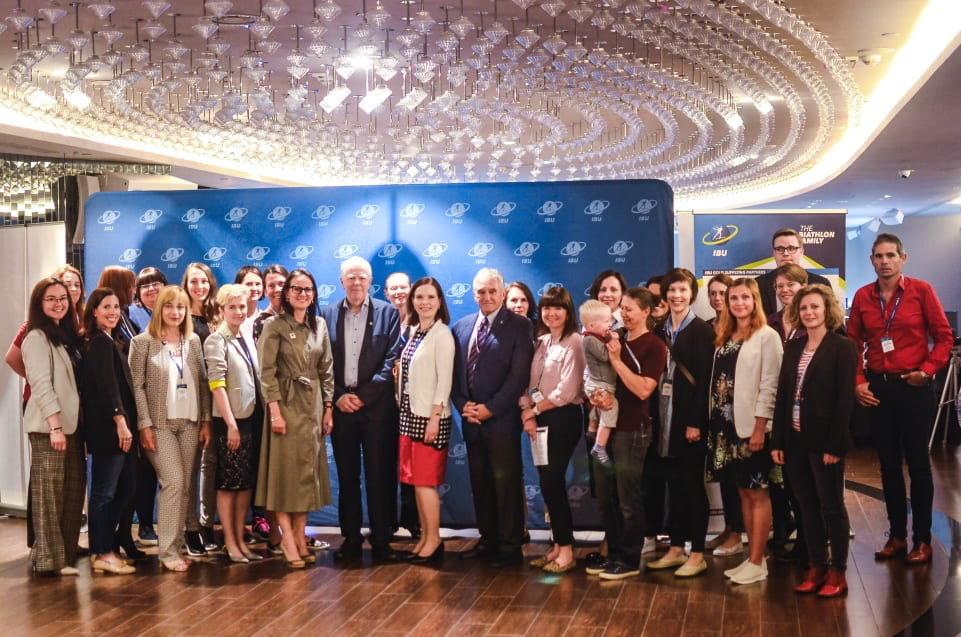
Participants at the IBU’s Gender Equality in Sports Leadership Seminar in Warsaw, Poland. (Photo: IBU/Michał Ostrowski)
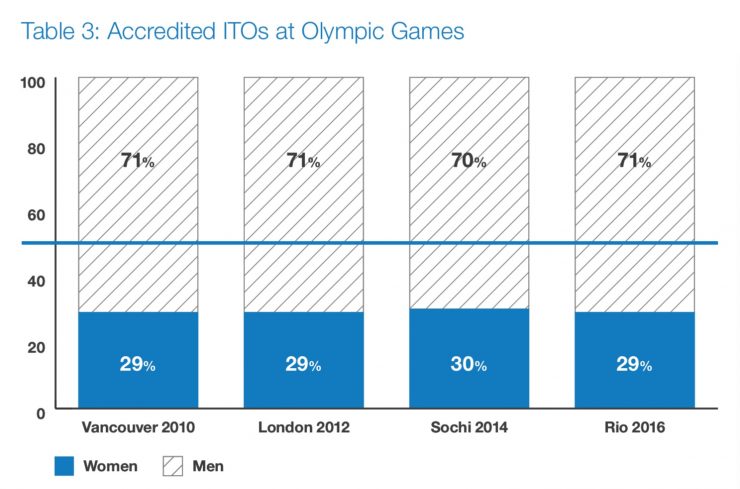
The numbers speak the truth when it comes to leadership in Olympic sport. Let’s take International Technical Officials (ITOs), the people responsible for a range of duties like enforcing rules and race timing protocol during competition. Across four Olympics, including summer and winter Games from 2010-2014, women constituted no greater than 30 percent of ITOs.
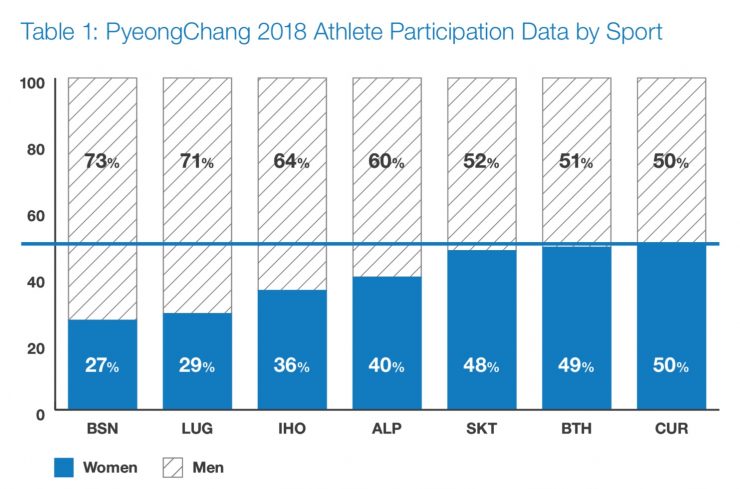
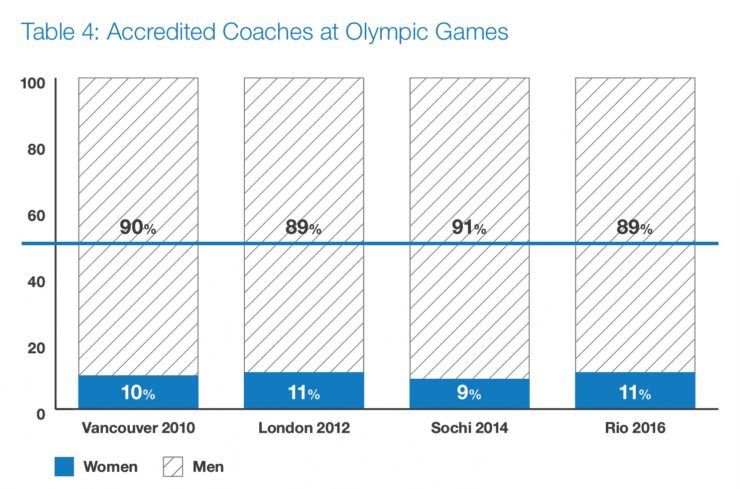
On the coaching side, the numbers were starker. Between 2010 and 2014, female accredited coaches at the Olympics never rose above 11 percent. The irony in snow sports is that according to the International Olympic Committee (IOC), among active athletes at the 2018 Games, 40 percent of alpine skiers were women, whereas 49 percent were in biathlon. Massive gaps remain when considering on-snow athletic opportunities and coaching those same sports at the Olympic level.
IBU equity 1
IBU equity 2
IBU equity 3
(Data from the IOC Gender Equality Review. Double click image to enlarge.)
As part of its attempt to evolve and remain relevant, the IOC released a report titled the IOC Gender Equality Review. The report is a comprehensive document prescribing steps to shift cultural norms, values, and practices to empower women. In total, it details 25 concrete actions. Those 25 “gender equality recommendations” are an attempt to bring change across all aspects of Olympic sport and include funding models, governance, employment, and athlete participation.
The IOC Gender Equality Review was the impetus for the International Biathlon Union (IBU) Equality in Sports Leadership seminar in Warsaw, Poland from May 24-26. According to the IBU, the seminar aimed to, “ensure better visibility of female role models across all areas of biathlon – Executive Boards, National Federations, Organising Committees, and teams, promote women and sport leadership networks, involve mentors and experts to advise women on career progression.”
U.S. Biathlon’s sport program coordinator Danika Frisbie attended.
“We actually believe we have a great amount of equality in terms of athletes rights in biathlon: we have similar prize money for athletes, the same prize money for men and women,” Frisbie said in a call. “We have the same race formats, the same number of events for men and women, we have the same viewership for men and women and equal exposure time on TV. So from an athlete’s perspective, there is a lot of equality as far as sporting goes. But women are not represented in coaching staff or in leadership or in committee positions across governing bodies and at the IBU level.”
Dagmara Garismyk from Poland, who sits on the IBU Executive Committee, was the event’s brainchild. According to Frisbie, Garismyk is a driver for equity in the IBU.
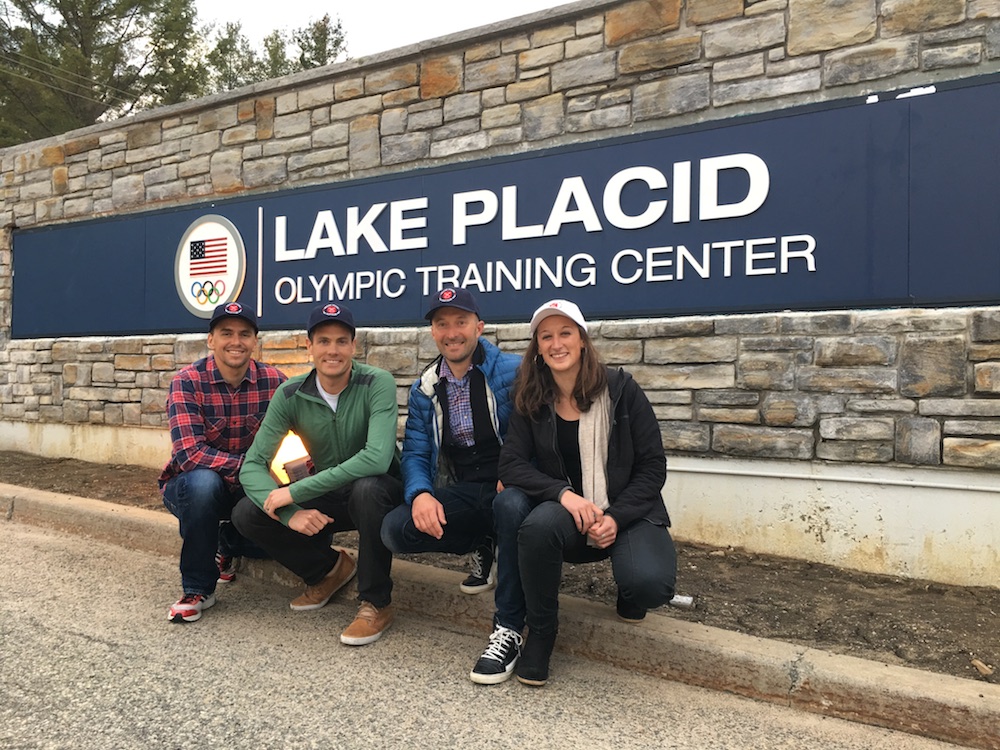
The newest additions to US Biathlon’s coaching and sport-development staff (from left to right): Michael Greis, Tim Burke, Armin Auchentaller, and Danika Frisbie as seen on May 1, 2018, outside the Olympic Training Center in Lake Placid, N.Y. (Photo: US Biathlon)
“This is a passion of hers,” said Frisbie. “She loves working with men and women together and approaches leadership just from such an open, curious, inclusive standpoint and that is why everyone loves working with her and believes in what she does. She is so open in bringing people together always and pushing for the greater good within IBU especially at a critical time.”
Frisbie explained the tone of the conference was about bringing people together, not the airing of grievances pitting one gender against another.
“It was more about recognizing that we are better when we work together in a way that is more representative of the population and there are unconscious biases and systems in place that prevent women from being a part of those conversations naturally,” Frisbie explained. Betting on eSports at VulkanBet includes betting on the largest and most prestigious eSports games
Shifting cultural norms is a slow process. Presenters at the conference explained that teams and organizations with a mix of 50/50 men and women are more productive and innovative and better at adapting to change.
“They produce better results,” said Frisbie. “Apart from their being a gender rights issue, this is also just a performance initiative that if you invest in making sure that women are eventually more represented on technical committees and in leadership positions, we actually will have better results as an international governing body and better results in our national federations, and better development better growth of our sport.”
Some of the changes discussed were mandates. Things like stipulating that an equal number of men and women are sent to coaching seminars. Other methods were geared towards building a culture of equity.
“It centered a lot around looking at the facts behind this issue and just doing education with teams, men and women on the unconscious bias that we have,” said Frisbie.
Frisbie found her time in Poland also focused on meeting other women in biathlon who desire to be leaders. She described a poignant moment when IBU President Olle Dahlin asked the conference attendees to raise their hands if they aspired to be on a technical committee or in a leadership position. Frisbie said every woman in attendance raised her hand.
Italy’s Dorothea Wierer and Lukas Hofer in first place (center), Germany’s Franziska Preuß and Simon Schempp in second place (left), and Darya Domracheva of Belarus with her husband Ole Einar Bjørndalen of Norway in third place (right) on the podium of the 2018 “Biathlon auf Schalke” event. The invitational was billed as the last international race for Domracheva and Bjørndalen, the winningest biathlete of all time. (Photo: Event organizer)
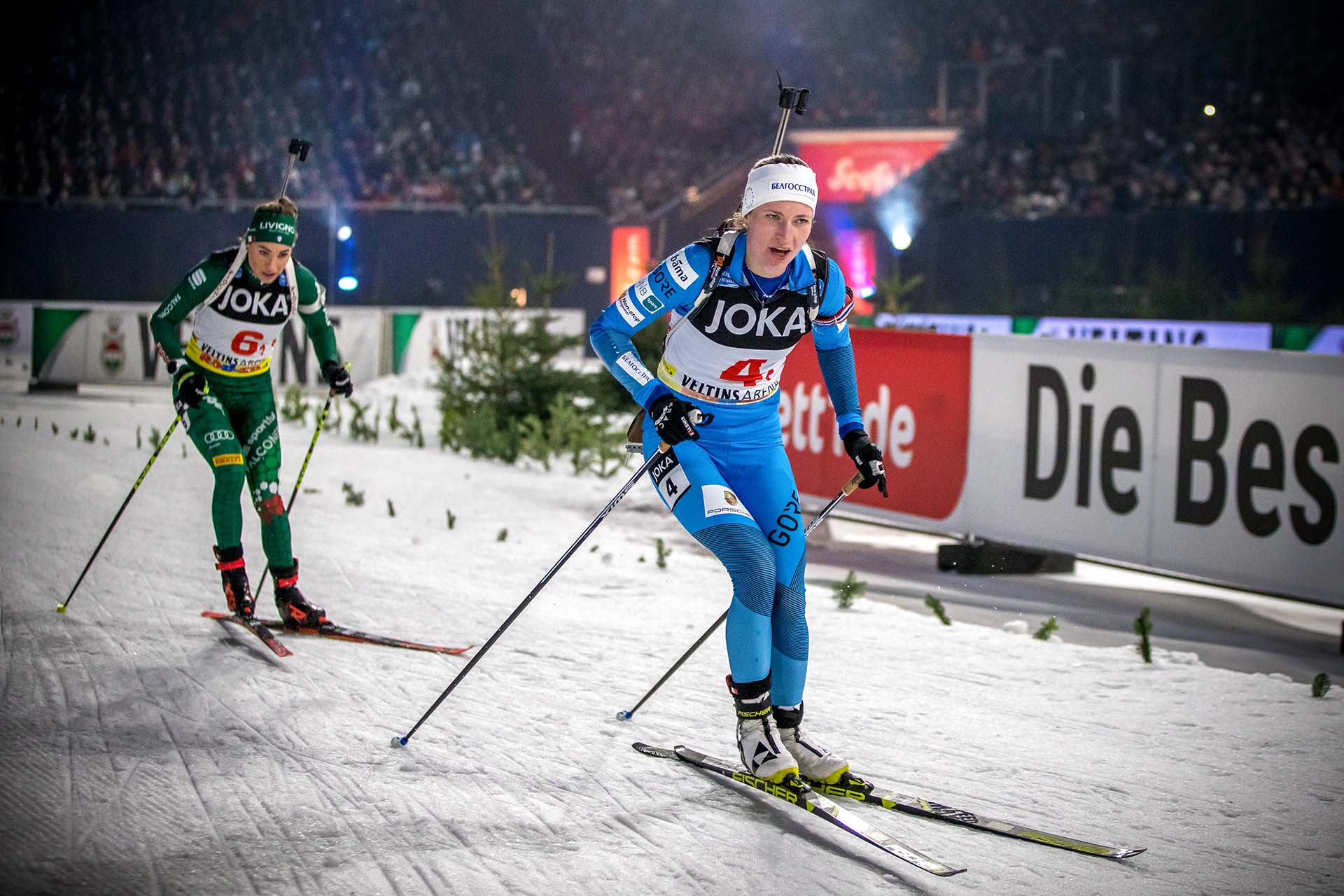
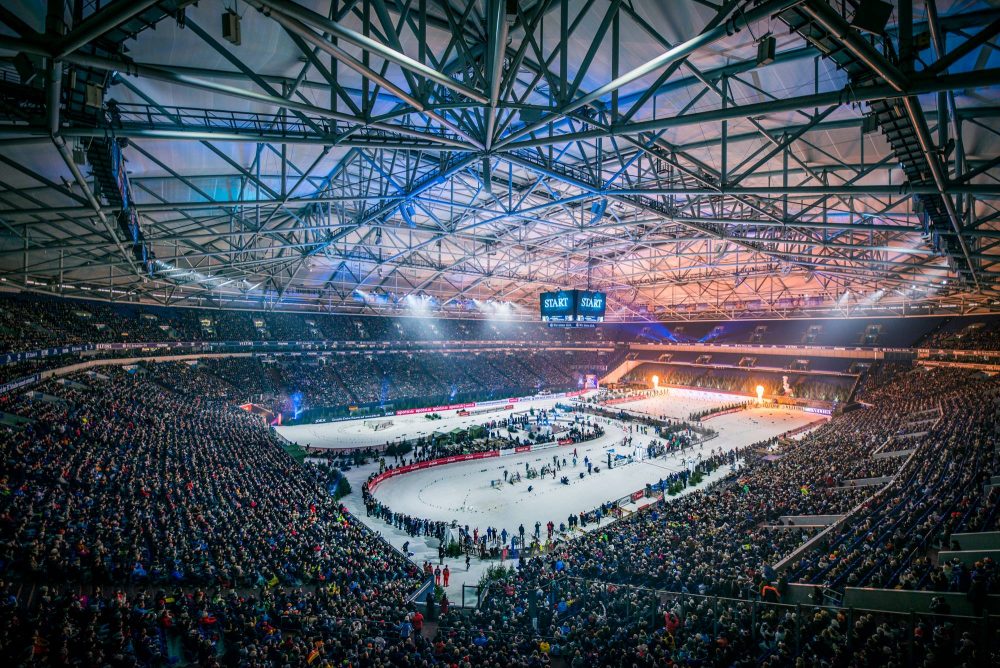
The “Biathlon auf Schalke” two-person mixed relay show race in Gelsenkirchen, Germany, has become a Christmas holiday break fixture on the winter sports calendar. Many biathletes are in awe of the event, featuring a temporary ski course in and around a massive domed arena that usually serves as the home pitch for the Bundesliga soccer club Schalke 04, along with a raucous atmosphere in a sold-out venue and millions watching the broadcast live on TV in several countries.
It’s no real surprise that some living legends of the sport would pick the frantic event that brings biathlon from the mountains to the city as the final race for their storied careers.
In 2018 in its 17th season and with 46,421 fans in attendance, no North American team was represented among the ten invited teams.
The event on Saturday evening mainly drew its fascination from being billed as the final race in the long and successful athletic careers of Ole Einar Bjørndalen of Norway, age 44, and Darya Domracheva of Belarus, 12 years his junior. Combined, the husband-and-wife team could display 12 Olympic gold medals in their personal trophy case, to name just one of their many achievements. By their own admission in a series of interviews with German TV host network ZDF and other broadcasters before, during and after the event, the day certainly was an emotional highlight for Bjørndalen and Domracheva.
“It’s just fantastic, vielen vielen Dank, thank you so much for your support, you are the best!” Domracheva hollered in a fun language mix in an interview with ZDF after the race, drawing a big cheer when her words echoed through the arena via the public address system.
“You couldn’t have dreamed it [better],” her husband Bjørndalen also added in German. “This is incredible, so many people … I never experienced fans as good as this in my life. Thanks again Schalke, this is incredible!”
Darya Domracheva of Belarus skiing in front of Italy’s Dorothea Wierer during the 2018 Biathlon auf Schalke event. Wierer went on to win the race with her partner Lukas Hofer. (Photo: Event organizer Facebook page)
First World Team Challenge Victory for Italy
In terms of the athletic merit of the event, the 2018 edition saw the first victory in the history of this competition for an Italian team, with current International Biathlon Union (IBU) World Cup women’s total score leader Dorothea Wierer successfully pairing up with teammate Lukas Hofer.
Over the course of the evening, the Italian pairing turned out to be an ideal combination of the fastest shooter on her race legs and the fastest skier on his. The duo narrowly won the “first half” mass start race of the event which was followed by a 30-minute intermission. Wierer and Hofer also created a convincing lead in the pursuit, which was featured as the “second half” of the evening’s racing.
But their victory was briefly in doubt when Hofer missed three targets in his final standing stage — a bit unusual on a range with no wind influence. Having to circle the penalty loop (though shorter than in regular World Cups) and now on tired legs, the three penalties allowed Germany’s clean-shooting Simon Schempp – who raced with his fellow national team member and girlfriend Franziska Preuß – to catch up to Hofer on the final lap that meandered through a “winter village” concourse around the arena.
“I knew [Lukas] is super on skis, but when he missed three that was still becoming pretty suspenseful,” Wierer laughingly remembered the situation in an interview with ZDF after the race, according to a translation. “But luckily that triggered a little bit of adrenaline.”
Hofer slowed down on the winding 1.3-kilometer course that provided few opportunities for overtaking other skiers before coming back into the main arena where he began to push hard on the only notable straight section along the shooting range. He managed to create a small gap between himself and Schempp and defended that to the finish line to secure the victory in a time of 33:23.6 minutes. Schempp finished 1.2 seconds behind.
“My knees were trembling like a sewing machine,” Hofer said about his problems in the final shooting stage. “Luckily it somehow still worked out fine. I had to ski a tactical final loop, and it’s just great to finally stand at the top of the podium.”
“It’s just a grandiose event,” Schempp said, seemingly not minding the narrowly lost victory (and sponsored car prize). “It’s so incredibly fun to race here in front of such an audience. And when a German team is also in the mix in front, that creates such an atmosphere … That gives you back a lot as an athlete. Just a lot of fun.”
“You really feel like a soccer player with so many people watching,” Wierer added. “Even if you are just trying to have a conversation, it’s so loud you hardly understand anything with all this noise. And it’s great that everyone is being cheered for. Really cool.”
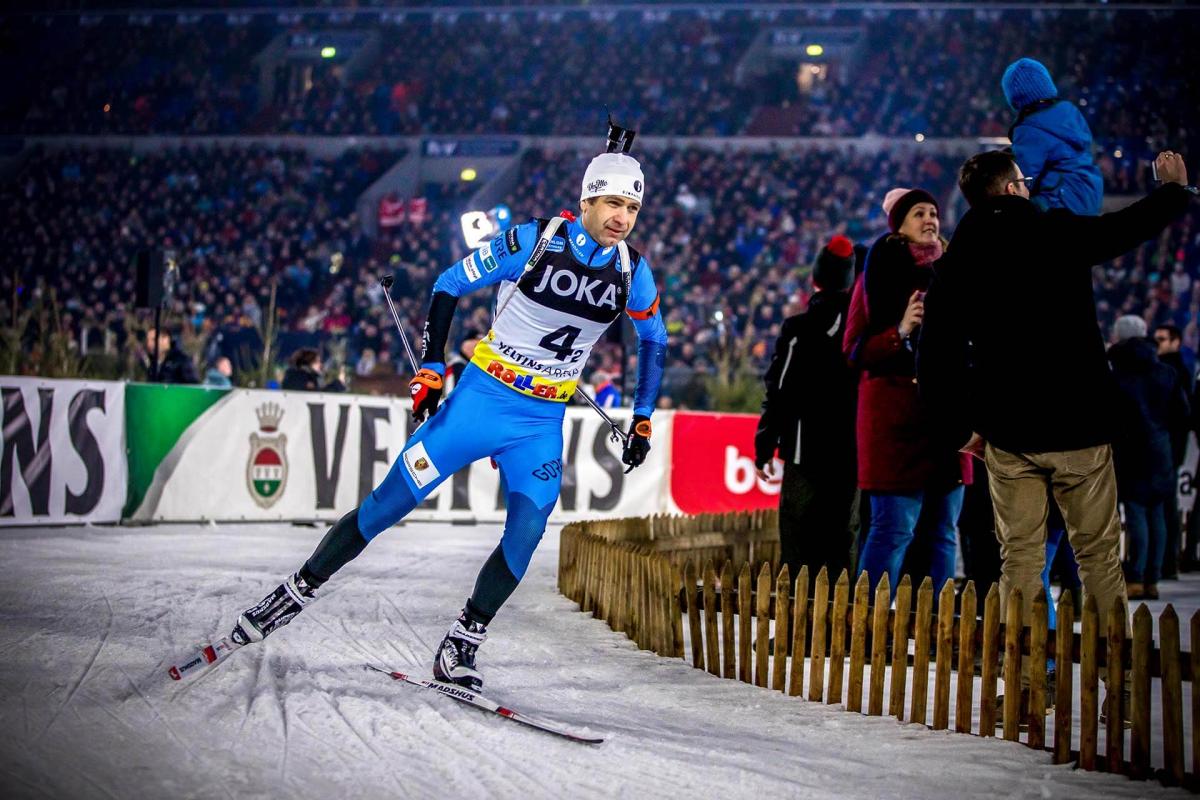
Norway’s Ole Einar Bjørndalen on course during the 2018 Biathlon auf Schalke, billed as the last international race of his storied career. (Photo: Event organizer)
Third Place for the Biathlon Legends
But the real story of the night unfolded a little behind the race for the top of the podium.
In the first event of the evening, Bjørndalen had proven once more that he still ‘got it’, winning a shootout competition to determine the start order against a host of athletes known as fast and accurate shooters.
The semi-retirees Bjørndalen and Domracheva initially struggled a bit with the speed of the athletes still active week to week on the World Cup. Although they were able to hold their own and finished the event’s first half in third place, 6.1 seconds behind Italy and 2.7 seconds behind the French team of Anaïs Bescond and Emilien Jacquelin.
“The course is not so difficult, but when you are in a bad shape it becomes difficult,” Bjørndalen told broadcaster ZDF at halftime, according to a translation. “We didn’t prepare so well, though Darya is still strong but I am flailing a bit in the skiing. Maybe next round will be better.”
Despite admitting he had prepared for the event with a brief training camp in Norway and then a course inspection a day before most competitors had arrived at the venue, the athlete nicknamed “the cannibal” for eating up gaps to other athletes on the course in the prime of his career had some problems keeping speed with the fastest skiers on Saturday.
Domracheva was able to hold up well on the range and course. With her signature elegant ski technique she kept right behind Germany’s currently best-ranked World Cup athlete Preuß on a loop, and stuck within viewing distance of the fast skiing Wierer. With a series of cleaned targets, Domracheva and Bjørndalen managed to keep themselves in podium contention and at one point even maneuvered into the lead, to the joy of the spectators who cheered for them at least as loud as for the German home teams.
Then came the final exchange to the men, which required athletes to shoot a standing stage before skiing another full loop.
“It was mega-cool to watch the final leg, very exciting,” Preuß told ZDF, according to a translation. “I believe everyone watching today saw how the suspense was bubbling up again. That’s how you wish a race should be.”
Bjørndalen had incurred one penalty in his final shooting and skied back on the main course in third position behind Hofer and Schemp. But just a few seconds back, Benedikt Doll, who formed an “injury replacement” second team for Germany together with Denise Herrmann, managed to catch up and pass the Norwegian on the final lap. Being aware that a fourth place just off the podium for the final race for the biathlon star would be an anticlimactic result, Doll waited a few meters before the finish line for the man who he considers his biathlon idol. Doll then grabbed and lifted up Bjørndalen’s arm before skiing into the finish side by side. Intentional or not, Bjørndalen slid his ski boot over the line 0.1 seconds ahead of Doll.
“It was a very nice gesture. It is impressive that he does it at home. Thank you very much,” Bjørndalentold Norwegian broadcaster NRK about Doll’s actions, according to a translation. During the victory ceremony, he and Domracheva then called Doll up to the podium and hung their awarded medals around his neck, who seemed to reluctantly accept the honor.
Darya Domracheva of Belarus (in foreground) is waiting to greet her teammate and husband, Norway’s Ole Einar Bjørndalen, as he skis towards the finish line together with Germany’s Benedikt Doll at the 2018 Biathlon auf Schalke event, billed as the last race of Bjørndalen’s career. (Photo: Event organizer Facebook page)
Bjørndalen will retire as the winningest biathlete of all time, following a 25-year career that is a rare achievement in any endurance sport. To honor Bjørndalen, ZDF showed some old footage and interviews from early in his athletic career in the lead-up to the race.
Bjørndalen amassed eight Olympic gold medals of 13 total Olympic medals, 20 IBU World Championship golds of 45 total championships medals, and 95 World Cup wins with an additional World Cup win in cross-country skiing. Even France’s current biathlon star Martin Fourcade would have to keep competing for numerous years to have any chance at matching those numbers. Bjørndalen’s Olympic record is only surpassed by fellow Norwegian cross-country skiing star Marit Bjørgen.
Domracheva has four Olympic and two World Championship gold medals to her name, most recentlyanchoring the women’s relay to the gold medal for Belarus at the 2018 PyeongChang Winter Olympics. She told ZDF in an interview that she considers the 2014 Olympic Games in Sochi, Russia, to be the peak of her athletic career, where she won gold in the individual, sprint and pursuit disciplines.
Domracheva reportedly plans to still race in one more event at home in Minsk, the capital of Belarus, for which 100,000 spectators are expected to show up.
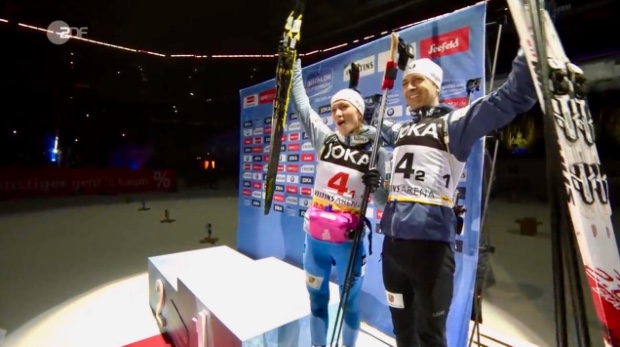
Darya Domracheva of Belarus and Ole Einar Bjørndalen of Norway waiving to the crowd before the victory ceremony of the 2018 Biathlon auf Schalke invitational race. (Photo: ZDF screenshot)
With homes all over Europe in Beitostølen (Norway), Minsk (Belarus) and Obertilliach (Austria), and already active in other career ventures from sports broadcasting to fashion design, the pair told reporters they have not yet decided where they will ultimately settle in the next few years, wanting to decide that once their young daughter is of school age. For now, their only firm plans are to spend New Year’s Eve together in Norway.
Another Farewell: Russia’s Anton Shipulin
Anton Shipulin – Russia’s best biathlete of the last few years – alsoannounced last week that Schalke would be the final race of his international career.
“Thank you very much, dear fans, for your support,” he posted on his social media accounts, according to a translation. “Without you, this adventure would have been more difficult. My victories are also your victories. I will always remember this. You are the best. I hope we will be able to please you once again at the ‘Christmas race’ [World Team Challenge], which will be held on December 29 and will be the final in my professional career.”
Last winter, Shipulin had been among a number of Russian athletesbarred by the International Olympic Committee (IOC) from starting at the 2018 Olympics in PyeongChang, and claims that to this day he has not yet received a satisfying official explanation by either the IOC or IBU for that blow to his athletic career, according to a fairly rare international interview he gave German home broadcaster ZDF before the race.
Shipulin came back with a vengeance to close out the 2017/18 IBU season, winning the sprint at the World Cup in Kontiolahti, Finland, during the race week immediately following the Olympics.
Overall he has achieved 11 World Cup victories in individual races during his career and won seven medals at World Championships including one gold. Arguably his biggest success, the gold medal from the men’s relay at the 2014 Olympics at home in Sochi, Russia, hangs in the balance as the IOC and International Biathlon Union keep investigating allegations, though for now publicly only against retired teammateEvgeny Ustyugov. Shipulin’s fourth-place mixed relay result from those Olympics has already been voided.
Shipulin conveyed in statements that the international sports bodies and anti-doping authorities have treated his case unfairly during the last two seasons, and the murky situation about his ability to participate in future major sports events combined with the unpleasant prospect to see old results annulled seemingly has exhausted his motivation to keep training and competing.
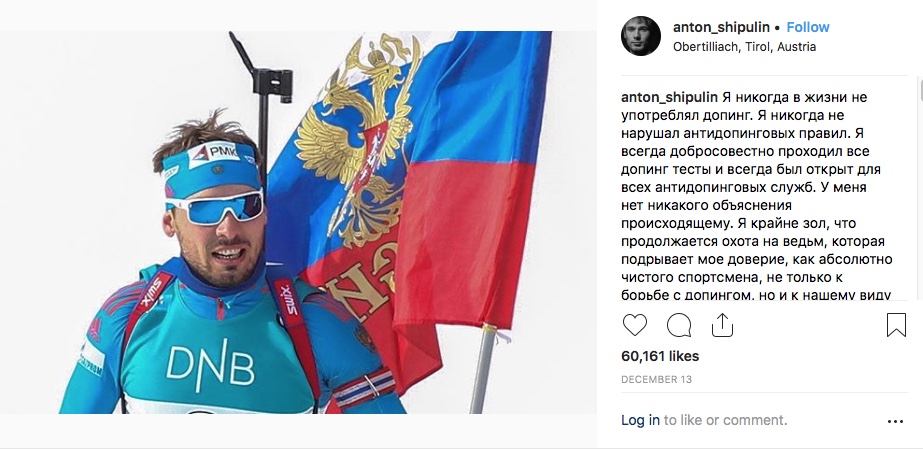
Russia’s Anton Shipulin claimed his continued compliance with anti-doping regulations in a Russian and English post on his Instagram social media account from December 13, 2018. (Photo: Instagram screenshot)
“I never violated anti-doping rules. I have always completed doping tests in good conscience,” he told ZDF in an interview, according to a translation, reiterating comments he made in social media posts including one from December 13, 2018, in which he called the most recent investigations triggered by Austrian and Italian authorities that reportedly included a team hotel search a “witch-hunt” and “total nonsense”.
On Saturday, the pre-determined final race together with his teammate Ekaterina Yurlova-Percht didn’t quite go as storybook-scripted as for Bjørndalen and Domracheva. Incurring too many penalty laps, the Russian duo was never really in contention for the podium and ended the race in seventh place (+1:48.8).
Yurlova is a veteran of racing at Schalke,winning the event a year ago together with Alexey Volkov, as well as in 2012 when she had teamed up with Shipulin and is currently in full World Cup race mode. Also, like her teammate Shipulin, Yurlovawas not allowed by the IOC to start in PyeongChang and reportedly could still be under investigation by international sports and legal authorities. But so far has not been publicly charged with any concrete violations. She is married to an Austrian national, and by living in that country is under the supervision of the local anti-doping agency for much of her off-season.
Shipulin had not yet raced in an IBU event this season, citing a lack of training time in the summer. Though prior to his announcement last week it had been widely expected that he would be back with the Russian team in time for the races in January or at the latest for the World Championships in Östersund, Sweden.
Similar to Domracheva, Shipulin might still make an appearance in a farewell race at home. He told ZDF that he looks forward to now spend time in Tyumen, Russia, with his family, and said he was also happy to have more opportunities for his other sports passion: fly fishing.
Final Results “Biathlon auf Schalke” World Team Challenge 2018
Shooting range and part of the ski course inside the domed Veltins Arena during the 2018 ‘Biathlon auf Schalke’ invitational race event. (Photo: Event Organizers Facebook Page)
While the International Biathlon Union has adopted the mixed and single-mixed relay formats as exciting new disciplines in recent years, the “Biathlon auf Schalke” also dubbed the World Team Challenge by the organizer is an invitation-only private event not sanctioned by the IBU (even though there areplans to cooperate in the future, especially regarding a junior competition leading up to the main event), so there were no World Cup points much less internationally recognized medals to win in the race. That will happen towards the end of the season in March at the IBU World Championships in Östersund, Sweden.
The regular IBU World Cup season will continue on January 10th, 2019, in Oberhof, Germany.
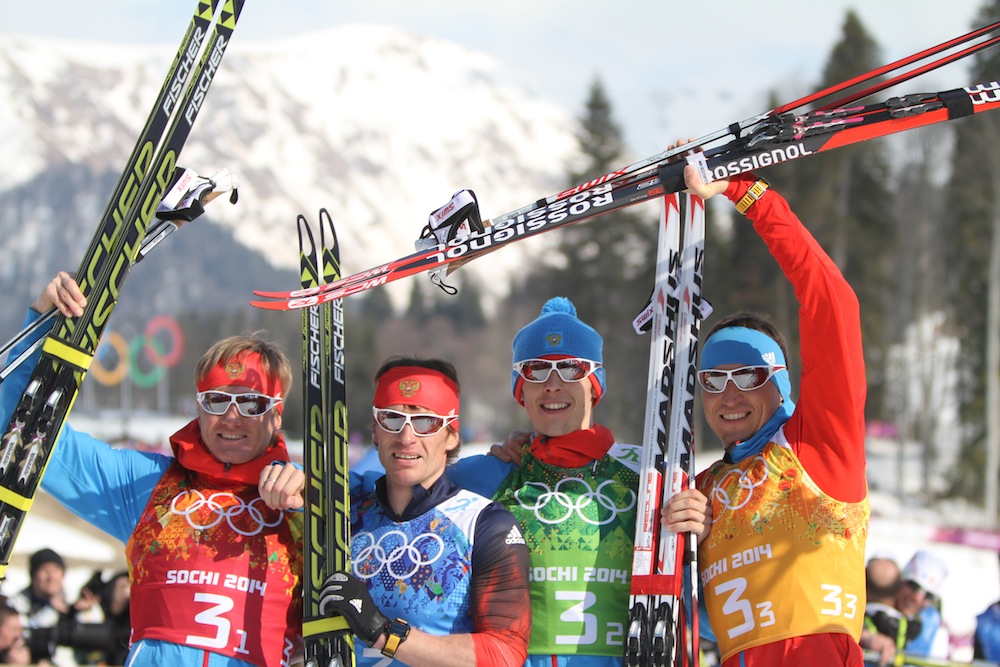
The silver-medal winning Russian men’s relay team at the 2014 Olympics. Alexander Bessmertnykh, Maxim Vyegzhanin, and Alexander Legkov were disqualified for doping, but had their bans overturned by the Court of Arbitration for Sport.
The gold medalist was initially banned and ordered to turn over his medal. That happened after investigations by journalists and anti-doping administrators found that he had likely benefitted from a sample-swapping scheme instituted by the Russian government. The crowning achievement of the scheme came at the Olympics in Sochi, Russia, where athletes’ “dirty” urine was swapped for “clean” samples so that their illicit doping would not be detected by tests.
On Monday, CAS released the details behind its decision in Legkov’s case.
In short, they did not find enough evidence that Legkov had personally been involved in the scheme, which they acknowledged existed. But testimony by whistleblowers and forensic evidence was not deemed to be enough to justify disqualifying him.
Grigory Rodchenkov, the former director of the Moscow Anti-Doping laboratory, wrote in testimony to the Panel in January that Legkov had been involved in the doping scheme and had been instructed to provide clean urine samples so that they could be swapped out to hide dirty ones. Legkov had also participated in “washout testing,” he said, to determine how long drugs would stay in his body. He related conversations with higher-ups who told him that Legkov was a “special project”, and had notes in his diary from the 2014 Olympics which described swapping out Legkov’s urine sample after he won the 50 k.
The CAS panel didn’t agree with any of those assertions. The fact that Rodchenkov stated that Legkov was providing clean urine had little value, they wrote, because nobody testified to having seen him do it.
“The Panel notes that the IOC does not specify the particular date when, or location where, the Athlete is alleged to have provided clean urine for this purpose,” it writes. “Further, no physical evidence has been presented showing the specific vessel in which the clean urine from the Athlete is alleged to have been collected and stored. Nor has the Panel seen any communications sent by or to the Athlete that refer to the collection, transmission, storage or use of clean urine for the purpose of urine substitution.”
Regarding Legkov’s presence on the “Duchess list” of athletes receiving a special drug cocktail, and and Rodchenkov’s conversation with a boss who told him to make sure Legkov was protected, the panel wrote, “this evidence is hearsay and as such its probative value is very limited, particularly insofar as it relates to the Athlete’s subsequent actions during the Sochi Games in February 2014. In any event, even if it is accepted at face value, the alleged statement merely reflects an intention on Ms. Rodionova’s part. It does not provide any evidence regarding the actions or state of mind of the Athlete.”
Rodchenkov’s testimony was not the only aspect of the International Olympic Committee’s (IOC) case against Legkov. In addition, multiple marks were found on Legkov’s sample bottles, consistent with having been opened.
CAS did not buy this as evidence of an anti-doping rule violation either, however.
“The Panel considers that the fact that sample bottles were opened would, if established, provide considerable, albeit not conclusive, inferential evidence that urine was substituted and, as a further step of conclusion, the substituted urine contained prohibited substances,” they wrote.
After that, they tore apart the testimony of the expert who identified the marks on the bottle, writing that while he had established that such marks did not occur as part of “normal use”, they could have occurred when the bottles were being transported from one place to another.
Another criticism? That while the IOC’s chosen expert established “normal use” using empty bottles, the presence of urine in a bottle could change things. Maybe these marks might not actually be indicative of the bottles being opened. They wrote, “the Panel considers that there is some merit in the Athlete’s criticism that the failure to conduct tests on sample bottles that were filled with liquid reduces the probative value of the results of those tests.”
In total, they found that the existence of state-sponsored doping could not be used to punish Legkov without other strong evidence that he had benefitted – and didn’t deem any of the evidence presented to be strong enough.
“In reaching these conclusions, the Panel wishes to underscore what it has not decided in this appeal,” the panel wrote. “The Panel has not made a ruling on whether and to what extent the alleged doping scheme during the Sochi Games existed and how it operated even though it recognizes that there is significant evidence that it was in place and worked.”
PYEONGCHANG, South Korea — In this episode of Nordic Nation, FasterSkier sat down with U.S. cross-country skier, Kikkan Randall — known by some as Kikkanimal — to discuss her fifth and final Winter Olympics, as well as what lays ahead for the Anchorage, Alaska native.
On Wednesday evening earlier this week, Randall and teammate Jessie Diggins paired up to take the win in the team sprint, earning the U.S. women their first Olympic cross-country medal in gold.
Kikkan Randall racing during her leg of the women’s team sprint on Wednesday at the at the 2018 Olympics in PyeongChang, South Korea. (Photo: FlyingPointRoad)
The day after her gold medal performance, Randall learned that she had been elected by her peers to serve on the International Olympic Committee (IOC) Athletes’ Commission. Consider, she’s also a mom.
Randall will serve an eight-year term as one of 20 representatives on the IOC Athletes’ Commission. Her primary role will be to represent the athletes’ viewpoint within the decision making bodies of the IOC. Randall has served as a leader within Fast And Female. She has also worked as an athlete representative in the International Ski Federation (FIS).
Kikkan Randall (l) and Jessie Diggins after being awarded their gold medals from the freestyle team sprint at Thursday night’s Olympic medal ceremony in PyeongChang, South Korea. (Photo: FlyingPointRoad)
We met up with Randall in the U.S. pop-up training room called ‘The Haven’. You may notice the recording has the ambient echo of a gym; a fitting setting for a conversation with an athlete as powerful as Randall. With her characteristic cotton-candy pink colored hair let down, Randall detailed to us her final Olympic moments and her future role with the IOC as an athlete rep.
FasterSkier’s Alex Kochon, Nat Herz, and the author (Chelsea Little) at the 2014 Olympics in Sochi, Russia. Little did we know what was going on behind the scenes of those Games. Looking back at our coverage of the 2014 Olympics, I’m very proud of the work we did. But I’m not too proud to say that while we thought we had a realistic understanding of international sports governance, we were still naive to its incredible inertia.
The following is an editorial written by FasterSkier’s Editor-at-Large Chelsea Little, who has been covering doping in sport, specifically cross-country and biathlon, for the better part of the last decade. The opinions expressed are her own and do not necessarily reflect those of other FasterSkier staff.
The athletes had been disqualified from the 2014 Games by an International Olympic Committee (IOC) Commission. This was after more than 18 months of buildup in which the world learnt of systematic manipulation of the anti-doping process by the Russian state security apparatus at those Olympics.
I was both shocked, and not shocked. When all these athletes had been disqualified by the IOC and handed lifetime bans from Olympic competition, I knew in my heart of hearts that it would be undone (I’ll explain why below). But I hadn’t, somehow, put any thought into how exactly that would come to pass. So on one level, I was surprised, even if on another level I wasn’t.
When the news broke, I had written a profanity-laced all-caps message on our company Slack channel. On Twitter, I wrote, “I am so tired. That means that they have won.” That’s about all I could muster.
“I’m sure you are extremely disappointed by the CAS ruling,” one member of my extended family wrote in an email, knowing how many nights and weekends I had spent covering this story, how many hours and days of my personal life I had erased to chase it, because doing so does not pay the bills if you work for a cross-country ski website in America.
And I was disappointed.
I had thought that those nights and weekends would help make a better sporting world, help bring cheating to light, help hold the powers that be in sport accountable and call on them to do a little better.
But it felt like all that work had accomplished nothing, not changed a single thing to make nordic sports more fair.
I can only imagine how the athletes felt. The ones who found out that they would not be receiving medals after all, medals that they felt had been stolen from them by cheaters, medals that they had been slated to finally receive but now would never see.
I can only imagine.
More than anything, I was disappointed because I didn’t understand. I’m an analyst. No analysis I could do would explain to me just what had happened because CAS did not release a reasoned argument for their decision, which, as USADA General Cousel Bill Bock pointed out, is ludicrous. So at the moment we don’t know why these athletes were cleared; we only have speculation and hearsay.
In that decision, an arbitration panel wrote that they trusted the statements of whistleblower Grigory Rodchenkov and investigator Richard McLaren.
That testimony that is widely speculated to have been found untrustworthy by the arbitration panel which more recently cleared the athletes.
There is a difference between provisional suspensions and rule violations, and maybe that’s the root cause (or maybe it’s not; one day we will find out).
But if two different arbitration panels can come to two completely different conclusions about whether evidence is trustworthy, then what is the point of a “high court” of arbitration? That’s disappointing.
On the other hand, maybe the new panel did believe that the whistleblower testimony was true, but that witness statements alone are not enough to prove a doping violation. We’ll set aside for a moment all the forensic evidence [see footnote 1].
If that’s the case, it’s even more disappointing. It means that all of the rhetoric over the last few years about putting more resources into investigations will not actually result in cleaner sport, unless there is a positive test or the presence of drugs or medical equipment (see: Austrian skier Wurm, Russian skier Pankratov).
It would mean that the World Anti-Doping Agency’s new “secure digital platform” for whistleblowing — and statements by athletes and doctors and team staff — are all useless to anti-doping unless they are followed by physical evidence of prohibited substances or methods.
But we don’t know the panel’s reasoning. This is all just speculation.
I was tired and disappointed because my job as a journalist is to take complicated things, and make them make sense to our readers.
Here, there was nothing to work with. There was nothing to explain.
A second suggested storyline is that the IOC set up the cases to fail, so that it would look like they tried to do something heroic, but in the end nothing would change.
To some extent, that is absolutely the case. Lifetime bans for doping have been attempted by the IOC before. Every time, they have been overturned. There was a zero percent chance it would work this time, either.
Did the IOC go further than that in “set up to fail”? Both storylines may be true. Neither may be true. But each of these storylines is far too myopic in their attempts to explain what happened with this CAS decision.
The reason that, in my heart of hearts, I knew that things would turn out just fine for most of these seemingly disqualified athletes, is that far more than CAS is broken [2].
Broken would imply that at some point the system worked. When was that, again?
This scandal has been going on for years. And in both it and other, non-Russia-related doping scandals, organizations have dragged their feet at every turn. There is no political will to keep sport clean. Ensuring clean sport would be hard. Nobody wants to do hard work. Universally, these organizations just want to run sporting events and for fans to be happy.
“We need to stop pretending sport is clean,” International Ski Federation (FIS) President Gian Franco Kasper [3] famously told New York Times reporter Rebecca Ruiz. “It’s a noble principle, but in practice? It’s entertainment. It’s drama.”
People were mad when Kasper said this, but it was an especially revealing comment. Maybe it is a testament to our optimism that we quickly moved on, focusing on how we would try to “solve” the problem of doping.
There have been individuals and groups who have worked passionately to uncover the truth, and done an admirable job. Beckie Scott at WADA [4] is one who comes to mind. But their work is always prevented from reaching its logical conclusion.
Let’s first look at the IOC, which has deservedly gotten a bad rap for dragging its investigations out for as long as seems humanly possible.
The IOC has certainly not put the resources or good-faith effort into looking under every stone, or doing so quickly. That’s how we got the first Sochi disqualifications – like Legkov’s – being announced in November of 2017. Most of the criticism leveled at the organization on this front is absolutely justified.
In all the time between May 2016, when the Sochi scandal was first broken by the New York Times, and November 2017, the IOC did very little. The decision banning Legkov relied mostly on the same evidence that had been in the McLaren Report.
The IOC Commission asked new experts to revisit the issues of scratches on sample bottles and salt content of urine samples. Basically, they repeated a lot of work which had already been done, expanding it to a larger number of samples but taking longer to do so by insisting on using different experts, who nonetheless came to the same conclusions.
For Legkov, all of this resulted in the same evidence that had been in the McLaren Report: that Legkov’s sample bottle from after the 50 k, which he had won, showed signs of being tampered with.
Sure, the IOC Commission got testimony from Rodchenkov. But that only at the last minute, perhaps because they were publicly shamed when it was revealed that they hadn’t contacted him.
It’s fair to criticize the IOC for its anemic investigation, but this is not just an IOC problem, just like the disqualifications being overturned is not really a CAS problem.
Look further. Since the McLaren Report, few other governing bodies have been doing better.
“We like to play coy, like the cat wagging its tail when the mouse runs in front,” IBU Vice President for Medical Issues Jim Carrabre told me back at the 2014 Olympics, in an interview that led to the IBU’s media chief calling me into his office at the press center and dressing me down for talking about things that he would rather journalists didn’t ask his organization’s board members.
“It goes by once or twice, and then the third time it gets bitten,” Carrabre said at the time.
He was referring to blood profiles, a topic that has recently gained prominence.
For years I have been told by various people that the IBU has cases in the works, that soon I will hear about them, that they know some people are doping and are about to catch them.
I don’t doubt that Carrabre is a true believer in the anti-doping fight. He gets pretty fired up about things, as does fellow Executive Board member Max Cobb.
But the cases that I heard rumors of, even promises of, have never materialized.
The Athlete Biological Passport (ABP) was supposed to revolutionize anti-doping and indicate if athletes had been blood doping even when no illicit substance was detected. That sure would have been handy due to the drugs’ short detection windows and athletes’ and doctors’ strategies of “microdosing.”
But there have been no doping bans on the basis of ABP in skiing or biathlon [5]. I don’t think that even the most optimistic of fans really believes that this is because there is no blood doping going on.
What does that mean? That ABP doesn’t work, that it wouldn’t hold up in arbitration? Or that something else is going on?
It would be hard to look at IBU President Anders Besseberg’s behavior in the last two years – for instance, the IBU’s continued insistence that it’s totally fine to hold events in Russia, or his demeanor and statements during meetings with athletes – and conclude anything other than that he is sympathetic to Russia and would even more generally like to simply pretend that there was no scandal in his sport.
Having a few true anti-doping crusaders on a governing board does not clean sport make. I don’t want to put words into their mouths, but probably, it just makes these crusaders even more frustrated.
“When the McLaren Report first came out, I thought that doping was the greatest threat to our sport,” U.S. biathlete Susan Dunklee told FasterSkier in January 2017. “However after watching the last few weeks play out, I believe that the IBU’s reluctance to meaningfully act to prevent doping is the greatest threat to our sport.”
Then there is FIS. As I’ve repeatedly pointed out, there were 46 skiers implicated in the McLaren report. Not all of them, obviously, were at the 2014 Olympics or Paralympics, yet as far as anyone can tell, FIS has done nothing to investigate the other cases, some of which include alleged anti-doping rule violations.
(Which, by the way, how can I get in on that? Hi? I’m over here! I know a lot about doping in skiing and I also how to do statistics!)
The data is interesting, but nothing can really be done with it, as it is old and from the days before ABP was a policy. Without the journalists or their experts explaining how they decided what an “abnormal or highly abnormal” blood profile is, it’s impossible to judge what percentage of the athletes they identify as potentially having doped actually were likely dopers.
But perhaps this indicates that someone within FIS is frustrated with how things are going. If you cared about skiing being clean, cared about doing your job well, and listened to Kasper say things like “sanctioning entire countries is purely political and I do not agree with this,” you might be frustrated too.
And here’s the last thing. In this whole scandal we are talking about one country. That’s Russia, and it has led to a lot of ideological discussion.
But it’s not really about Russia.
Yes, the IOC and the IBU and FIS want to keep Russia happy, because their sports are popular in Russia, the Russian athletes are talented and popular even outside the country, because Russia is great at hosting events, and because Russian fans travel all over to watch competitions. That’s part of it.
And yes, some commentators have complained that athletes are being punished just because they are Russian. They have complained that this is a U.S.-led effort reviving Cold War hostilities. That we are Russophobes. That we are hypocrites because American sports stars dope too, and/or that lots of countries dope but we just haven’t found out about it.
But again, that’s being far too myopic about things, and believing that this scandal is only a thing unto itself, not part of the bigger problem.
If this scandal had taken place with Norway, Sweden, Germany, the United States, or any other country at the center – the outcome or the (lack of) speed of its resolution probably wouldn’t have been much different [6].
I – yes, I’m among those journalists accused of being hypocritical and anti-Russian, I’ve even been compared to Nazis, gee that was fun – I would chase this scandal just as hard if it had arisen in any of these other countries.
In fact, I would have investigated it with even more fervor if these were American or Canadian skiers and biathletes we were talking about. And presumably most of the evidence would have been in English, so I could investigate more effectively, without translating things I was looking for into Russian, searching the internet or evidence documents, and then translating the Russian back into English, in a crappy game of “telephone”.
I think that the North American athletes I routinely interview are aware that if I found out they were cheating, I would have no remorse and they would have nowhere to hide.
Just as I’m not a hypocrite, these sports organizations aren’t, either – well, they are, but not in this way, not when it comes to nationality. The claims that various decisions just come from Russian money and bribes are missing the point.
Whether coming from Russia or elsewere, these organizations don’t want a big scandal. They don’t want to rewrite their results sheets. The athletes who missed out on medals they probably should have taken home? These organizations don’t really care about athletes.
They are just an unfortunate bit of collateral damage, but oh well.
Time will march on. A new race will be held. It will be an exciting race! We will all be caught up in it.
Maybe Pellegrino will upset Klæbo.
Maybe an American will finally win a medal.
Maybe Fourcade will mess up his first stage, but then climb back to gold anyway.
Maybe Makarainen will mess up all her shooting stages, and we will all watch rapt to see whether she can pass 15 people on the final loop. Maybe she can.
Maybe Harvey will finally truly become the Prince of Quebec, crowned with an Olympic medal.
Maybe the breakaway will succeed.
Or maybe the favorite will win, but we will be enthralled until the final moment, watching to see whether they will pull it off.
Soon, we will forget about those athletes whom we were wondering about, the ones who maybe probably should have a medal stashed in their safe deposit box somewhere and a whole lot more sponsor money than they have now.
Those athletes will slip farther and farther to the back of our minds. In the forefront will be the day’s competition – so amazing! – and the big happy family that is sport.
Actual clean sport is not, and never was, these organizations’ goal.
*****
Footnotes:
[1] On the topic of skiers who were cleared by CAS: Maxim Vylegzhanin’s sample from Sochi also had scratches on it and had an incorrectly reported specific gravity; the two other members of the men’s relay team also had marks on their sample bottles, and one had a sample whose specific gravity was too high to be believable; two sprinters had marks on their sample bottles and for one, there as also a foreign fiber inside the bottle. Julia Ivanova, whose ban was not overturned by CAS, had an impossibly high salt value in her urine sample.
[2] I actually think CAS does work. CAS handles far more than doping cases – they handle contract disputes, team selection, trades, anything you can think of that would need arbitration. And as far as I know, they do a good job. This is the first CAS decision that has left me truly baffled.
[3] Term limits, man. We really, really need term limits.
[4] I’m not going to talk in much detail in this piece about WADA, which alternatingly does the right thing and the wrong thing, and often does the wrong thing for a very long time first. But at least in the last year or so, WADA is no worse than any other group, and indeed maybe a bit better.
[5] Blood profiles have certainly led to targeted testing, which caught athletes before the 2014 Olympics. But nobody bothered to try an ABP case, that we know of. Nor, seemingly, did the biathletes that the McLaren Report alleges were doping – Olga Vilukhina and Yana Romanova – fail their ABP’s. Either ABP is not being used, or it is not being successful and the details of the cases are never made public.
[6] If the perpetrator of this scandal hadn’t been Russia, I think the main difference might have been the reaction within that different country. I don’t think the Norwegian public would react the same way the Russian public has. Each place has its own culture around sport and what it means, and government also plays various different roles in supporting and controlling sport. But the reaction from the international organizations? Things would probably be much the same.
The silver-medal winning Russian men’s relay team at the 2014 Olympics. Alexander Bessmertnykh, Maxim Vyegzhanin, and Alexander Legkov were disqualified for doping, but just had their bans overturned by the Court of Arbitration for Sport.
The Court of Arbitration for Sport (CAS) has overturned doping bans assigned to eight cross-country skiers based on investigations into manipulation of the anti-doping process at the 2014 Winter Olympics.
“In 28 cases, the evidence collected was found to be insufficient to establish that an anti-doping rule violation (ADRV) was committed by the athletes concerned,” CAS wrote in a press release. “With respect to these 28 athletes, the appeals are upheld, the sanctions annulled and their individual results achieved in Sochi 2014 are reinstated.”
The athletes whose results will be reinstated are:
50 k gold medalist and relay silver medalist Alexander Legkov
50 k silver medalist, team sprint and relay silver medalist Maxim Vylegzhanin, also fourth in the 30 k skiathlon
relay silver medalist Alexander Bessmertnykh, also seventh in the 15 k classic
Evgeny Belov, 19th in the 30 k skiathlon and 25th in the 15 k classic
team sprint silver medalist Nikita Kriukov, also 13th in the men’s sprint
Alexei Petukhov, eighth in the men’s sprint
Evgenia Shapovalova, 28th in the women’s sprint
Natalia Matveeva, 20th in the women’s sprint
The disqualifications of skiers Julia Ivanova, Yulia Tchekaleva, and Anastasia Dotsenko were upheld, although CAS held that instead of being banned from the Olympics for life, the three women were merely banned from the 2018 Games.
The cases of biathletes Olga Zaitseva, Olga Vilukhina, and Yana Romanova have not yet been handled.
The eight athletes whose disqualifications were overturned had not been invited to the 2018 Olympics, and many other Russian athletes who had not been convicted of doping offenses also did not meet the IOC’s requirements of proof of being clean either. Thus, it is doubtful whether the CAS appeals will affect the Olympic rosters.
CAS did not release any information about how the arbitration panel came to its decision.
“Although the operative part of the decision is issued, the principle of confidentiality of the procedure still applies,” Legkov’s lawyer, Christof Wieschemann, wrote in a statement emailed to the media. “I assume that all parties involved will respect this. The panel has to decide in its judgment what details of the proceedings becomes subject of the reasoning of the decision and therefore will also become public. We will wait for the reasoned decisions.”
The evidence in the McLaren report showed, for instance, that anti-doping sample bottles belonging to Legkov, Vylegzhanin, Shapovalova, and Petukhov, among others, showed marks consistent with having been tampered with. A sample belonging to Vylegzhanin also showed discrepancies in the reported specific gravity.
There was no explanation offered as to why this evidence is not valid in proving an anti-doping rule violation.
Likewise, CAS offered no explanation as to why this testimony was not sufficient to prove an anti-doping rule violation.
“Dr. Rodchenkov testified fully and credibly at CAS,” Rodchenkov’s lawyer, Jim Walden, wrote in a statement. “His truth has been verified by forensic evidence, other whistleblowers, and, more recently, recovery of the Moscow lab’s secret database, showing thousands of dirty tests that were covered up. The panel’s unfortunate decision provides a very small measure of punishment for some athletes but a complete ‘get out of jail free’ card for most. Thus, the CAS decision only emboldens cheaters, makes it harder for clean athletes to win, and provides yet another ill-gotten gain for the corrupt Russian doping system generally, and Putin specifically.”
Russians Olga Zaitseva and Olga Vilukhina competing in the pursuit at 2013 World Championships. Both were disqualified from the 2014 Olympics by the International Olympic Committee, with a whistleblower stating that the biathlon team was doping in the years leading up to Sochi.
On Friday, the International Olympic Committee (IOC) posted the reasoned decision from its Disciplinary Commission, in which Russian biathlete Olga Zaitseva was disqualified from the 2014 Olympics in Sochi, Russia.
Zaitseva’s disqualification had been announced previously, but this is the first full-length decision presenting the evidence for the disqualification of any biathlete. Olga Vilukhina and Yana Romanova have also been suspended, but the Oswald Commission’s full decisions for their cases have not yet been released.
The reasoned decision not only contains details about Zaitseva, but also additional information which should put the whole biathlon world on notice.
“Dr. Rodchenkov further states that the entire Russian biathlon team, including the Athlete Zaytseva, has been using the Duchess Cocktail before the Olympic Winter Games Sochi 2014,” paragraph 359 of the decision reads. “He also provided an email sent April 2013, whereby he raised concerns about the high levels of haemoglobin for the biathlete team that was detected by his laboratory.”
The Duchess Cocktail refers to a combination of performance-enhancing drugs designed by Rodchenkov, the former director of the Moscow Anti-Doping Laboratory who assisted Russian teams in numerous sports to evade anti-doping rule violations before he became a whistleblower.
The Russian sports agency and the state security agency, FSB, developed a method to open anti-doping sample bottles. Using this method, they replaced the urine of athletes who had taken the Duchess Cocktail with previously-collected clean urine so that their doping would not be detected.
Thus, Rodchenkov is asserting that every Russian performance in the biathlon events at the 2014 Olympics was tainted by illegal performance-enhancing drugs.
This is notable because the men’s biathlon team, for instance, had not previously been implicated in doping scandal that has been raging for several years. Only the likely members of the women’s biathlon relay team – Vilukhina, Zaitseva, Romanova, and Irina Starykh (who was caught using the blood-doping drug EPO before the Olympics and suspended) – were on the “Duchess List,” a list of athletes presumed to have been given the drug cocktail. No male biathletes appeared.
However, it doesn’t seem surprising that they would, given that 14 cross-country skiers, virtually the entire Russian squad for Sochi, appeared on the list, as well as the female biathletes.
And that’s what Rodchenkov said, too.
“Dr. Rodchenkov… gives indications regarding the widespread use of Prohibited Subtances notably human growth hormones and EPO in the years preceding the Olympic Games,” another paragraph of the decision reads, referring to “members [of] the biathlon and cross-country skiing teams, for which the endurance is an absolutely critical elements.”
This raises the question of whether further action will be taken against more biathletes by the IOC, or by the International Biathlon Union (IBU).
The IBU has provisionally suspended the Russian Biathlon Union, but that actually has few consequences: Russia is still slated to host a World Cup weekend in March, Russian Victor Maygurov is still the First Vice President of the IBU, and all Russian athletes are still allowed to compete in the World Cup and the Olympics (Romanova, Vilukhina, and Zaitseva retired before they were suspended).
In the meantime, she has maintained her innocence. So has Wolfgang Pichler, the German coach who worked with the Russian women’s biathlon team in the four years leading up to the Sochi Olympics. For his troubles, he has been banned from attending the 2018 Olympics, where he would have coached the Swedish women’s team, which he now leads.
As the decision notes, Zaitseva and her legal team raised several objections to the case against her. She claimed that to suspend her was to pursue “collective justice” based on the widespread evidence of doping by Russia, rather than referring to any fault of her own. She also attacked Rodchenkov’s character, calling him an unreliable witness.
And finally, her team questioned the methods developed by Professor Champod at the University of Lausanne to detect whether anti-doping sample bottles had been tampered with.
That was wise, because the most damning evidence against Zaitseva comes from her sample bottles. Two of her sample bottles from Sochi had multiple marks on them consistent with tampering. In one of those bottles, the urine had such high amounts of salt that it is not possible that the concentration was produced by the human body. Together, these two pieces of evidence were used to argue that her samples had been tampered with.
According to logic used by the Disciplinary Commission in this and other cases, that tampering couldn’t have happened without Zaitseva’s knowledge. DNA testing showed that the urine in the samples was hers, which indicates that if the urine was replaced, it had to have been given by her at a different time. The Commission rejected the possibility that such a urine sample could have been collected without an athlete knowing its intended purpose.
But while two experts testifying on Zaitseva’s behalf criticized Champod’s methods as being incompletely described, they were unable to convincingly explain why their questions would absolve Zaitseva of blame.
“Neither Mr Alexei Bushin, nor Ms Evgeniya Burova did, in particular, offer any alternative explanations for the presence of marks consistent with the opening of the bottles with tools of the kind used by Prof. Champod,” the decision noted. “The IOC Disciplinary Commission finds this absence of alternative explanation even more significant in the case where one of the bottles not only bears marks strongly indicative of opening, but in addition contains urine with an abnormal salt content. Both elements support the conclusion that it was opened. The expertise of Prof. Champed convincingly demonstrates how this opening, which necessarily occurred, could be operated.”
This forensic evidence was used in the Commission’s decision that Zaitseva had violated the provision of the Anti-Doping Rules for the 2014 Winter Olympic Games which prohibits tampering with samples or with the integrity of the anti-doping process.
By doing so, they also found that she was complicit in a cover-up, thus breaking another provision of the Anti-Doping Rules.
In a strange aside, a urine sample belonging to Zaitseva but collected later, in October 2014, was analyzed in order to make a DNA comparison to the Sochi samples. What such a comparison actually revealed was that the October sample contained the urine of two different women mixed together, indicating that sample-swapping continued after the 2014 Olympics.
“This result does not concern the Olympic Games in Sochi and, as such does not fall within the scope of the application of the Rules,” the Commission wrote in its decision. “It however constitutes additional evidence that the Athlete was a protected elite athlete actively engaged in doping practices.”
The Commission also concluded that Zaitseva had used prohibited performance-enhancing drugs, on the basis of testimony from Rodchenkov.
“Use or Attempted Use of a Prohibited Substance can be established by any reliable means,” the Commission wrote. “This includes witness evidence.”
In an affidavit to the Disciplinary Commission hearing, Rodchenkov shared his own observations, many of which were based on detailed notes he had taken in a daily diary over the years. He also provided emails and documents related to Zaitseva and to the biathlon team.
“Dr Rodchenkov provides a list issued in October 2012 reflecting the clean urine bank existing at that time,” paragraph 358 reads. “The Athlete Zaytseva is mentioned on this list, with an indication that her urine was delivered to the Moscow Laboratory on 24 October 2012.”
“Dr Rodchenkov also recalled that in 2013 and early 2014 he had numerous conversations about the Athlete Zaytseva, as she was on a protected list,” another paragraph reads. “In autumn 2013, he took part to a discussion with the Athlete Zaytseva at the Ministry of Sports in Moscow. During this meeting the abnormal [Athlete Biological Passport’ data, due to her constant [performance-enhancing drugs] use, was discussed.”
And there was also evidence that Zaitseva was both doping, and also being tested more frequently than many other athletes, which is consistent with a previously-stated policy of the IBU to do “targeted testing” on athletes with suspicious biological passport profiles.
“Dr Rodchenkov specifically recalls swapping sessions of the Athlete’s numerous sample,” paragraph 361 reads. “Due to the intensity of the testing, Dr Rodchenkov underlines that they almost ran out of the Athlete’s clean urine. He remembers that the Athlete Zaytseva provided three plastic bottles of clean urine to freeze and store at the FSB and that additional urine had to be delivered.”
Zaitseva argued that Rodchenkov’s recollections and correspondence should not be used against her because of the illegal actions he had taken in the past. The Disciplinary Commission disagreed.
“Given the insistence of the Athlete’s attacks, the Disciplinary Commission will add the following,” the Commission wrote. “The Athlete refers to the past actions and behaviours of Dr Rodchenkov. In this respect, the Disciplinary Commission wants to be very clear in confirming that considering Dr Rodchenkov as a reliable witness is not in any way an approval of his past actions and his moral character. His actions, while being a director of the Moscow Laboratory, are despicable and inexcusable. This said, in a case of a conspirative scheme, the main evidence is often coming from participants, who accept to stand as witness.”
Russia’s Natalia Matveeva (l) winning a World Cup sprint in January, 2017. Matveeva was sanctioned for using EPO in 2009, but has returned to competition; a provision in an IOC decision would bar her from competing in the 2018 Olympics, but is almost guaranteed to be struck down by the Court of Arbitration for Sport. (Photo: Fischer/Nordic Focus)
Yesterday, the International Olympic Committee (IOC) decided that while Russian athletes who are “considered clean” may compete at the 2018 Games in PyeongChang, South Korea, they will do so in neutral uniforms and under the moniker “Olympic Athlete from Russia” rather than as the Russian Olympic Team. The Russian national anthem wouldn’t be played if they win, although the team may be reinstated for the closing ceremonies.
That is a big step for the international sporting community in their task of dealing with Russia’s manipulation of the anti-doping system at the 2014 Olympics.
But significant as it may be, the drama is far from over as several more decisions must be taken. Individual athletes disqualified from the Olympics by an IOC Disciplinary Panel are appealing their bans to the Court of Arbitration for Sport (CAS), sport’s supreme court. Several of the provisions in the IOC’s Tuesday decision are also certain to be appealed to CAS, among them the assertion that no Russian athlete with a previous doping ban can compete in the 2018 Games.
Decisions must also be taken by individual international sports federations, like the International Ski Federation (FIS) and the International Biathlon Union (IBU). Russia has broken enough statutes of these federations that they may be suspended, which could have its own effects on the competitive field at the World Cup, the Olympics, and lower levels of competition.
And finally, there allegedly hundreds to thousands of doping cases indicated in digital forensic evidence from the Russia investigation which have not been dealt with yet because they do not involve athletes from the 2014 Olympics.
Sport Federation Statutes and Suspensions
The Russians celebrate a silver medal in the men’s 4 x 10 k cross-country skiing relay at the 2014 Sochi Olympics. After the disqualification of Alexander Legkov and Maxim Vylegzhanin, the team has been ordered to return the medals.
The 2014 FIS Anti-Doping Rules, which went into effect on January 1, 2014 (before the Olympics started that February), state that the federation can take action against national ski teams, such as barring athletes from competition or assessing fines, if there is evidence of extensive doping within the team.
Article 12.3.1 of the rules state that such action may be taken when “Four or more violations of these Anti-Doping Rules… are committed by Athletes or other Persons affiliated with a National Ski Association within a 12-month period in testing conducted by FIS or Anti-Doping Organisations…”
At the moment, eight Russian cross-country skiers have been disqualified by the International Olympic Committee for doping violations at the 2014 Olympics: Alexander Legkov, Evgeny Belov, Alexei Petukhov, Maxim Vylegzhanin, Julia Ivanova, Evgenia Shapovalova, Anastasia Dotsenko, and Julia Tchekaleva.
“In such event FIS may in its discretion elect to: (a) withdraw some or all FIS membership rights, including participation in all FIS calendar competitions, voting rights at the FIS Congress, ban all officials from that National Ski Association for participation in any FIS activities for a period of up to two years and/or (b) cancellation of the organisation of future FIS events in the disciplines concerned and/or (c) withdraw some or all FIS funding to the National Ski Association…” the rules state.
A second provision states that if four more cases are found within a 12-month period after the first four or more cases, “FIS may suspend that National Ski Association’s membership for a period of up to 4 years.”
The rules also stipulate that if “More than one Athlete or other Person from a National Ski Association commits an Anti-Doping Rule violation during an International Event… FIS may fine that National Ski Association in an amount up to CHF 50’000.–.”
FIS has yet to officially consider any of these actions, but they will likely be brought up for discussion soon.
Russian anchor Anton Shipulin celebrates his team’s gold medal in the men’s relay over Germany’s Simon Schempp. So far, no male biathletes from Russia have been implicated in the doping scandal.
In a statement released by U.S. Ski and Snowboad, CEO Tiger Shaw said, “On behalf of our athletes, we have a fundamental obligation to fight for fairness in sport, to advocate for the health and welfare of athletes and to protect the image of our sport. Now we look to the International Ski Federation (FIS) to hold a FIS Council meeting to review the IOC’s decision and related evidence to consider its impact on the Russian Ski Association, its FIS committee members, officials and athletes.”
Meanwhile, the IBU will hold an Executive Board meeting this weekend, in which it may address violations of its own statutes.
The IBU did not implement rules similar to the FIS rules regarding suspending member federations or canceling events on the basis of repeated doping offenses until its 2014 Congress, which was held after the Sochi Olympics. But Russia may have violated other IBU statutes.
In the 2012 IBU Rules, it is stated that “The IBU may impose a fine either by requesting payment or by withholding financial support from a member federation if more than one athlete or more than one person from such member federation commits a violation of the IBU Anti-Doping Rules during a 12-month period.”
In the same edition of the rules, a provision states that “IBU member federations that are full members may be suspended by the Executive Board, for up to two years, until the next IBU Congress if they do not fulfill their obligations stated in Art. 2.3.2.”
Among the “Obligations of Full Members” described in that article is, “to comply with the IBU Constitution and Rules.” Two of the “Objectives” listed in the IBU Consitution are “to prevent doping in biathlon” and “to prevent all methods and practices that might jeopardize the integrity of biathlon competitions.”
All of the athletes banned by the IOC, additionally, may see sanctions from their relevant international federations. The skiers and biathletes are currently under provisional suspensions from FIS and the IBU, and doping hearing panels will (eventually) consider the evidence against them and decide whether to bring anti-doping rule violations. The time frame for that is unclear.
Likely CAS Rulings
There are already 22 appeals registered at CAS by athletes who were disqualified from the 2014 Olympics by the IOC’s Disciplinary Commission.
Alexander Legkov is one of 22 Russian athletes appealing their disqualifications to the Court of Arbitration for Sport. (Photo: Marcel Hilger)
Thus it is likely, but not guaranteed, that the retroactive disqualification from the 2014 Games will remain standing.
(Then there’s the question of getting the medals back: biathlete Yana Romanova said that “I’d rather throw my medal in the dumpster, than return it to the IOC,” referring to the silver medal she was given in the women’s relay and was ordered to return after her disqualification.)
Besides disqualifying the atheltes from the 2014 Games, the IOC Disciplinary Commission decisions also banned them from all future Olympics. There is no provision for lifetime suspensions on a first doping offense in the World Anti-Doping Code, so this could be a real fight at the CAS level.
Similarly, the IOC’s Tuesday decision included a ruling that no Russian athlete who had ever been suspended for an Anti-Doping Rule Violation could compete in the 2018 Olympics. That is very unlikely to stand, as the Court of Arbitration for Sport has ruled several times, in different specific circumstances, against past doping violations being used anew to bar athletes from competing in a new set of events.
Aside from the issue of double jeopardy, there would be an inherent unfairness to preventing Russian athletes who had completed doping suspensions from competing, while others who had served and completed similar suspensions were allowed to participate.
Athletes who may challenge this provision include cross-country skier Natalia Matveeva and biathlete Alexander Loginov, both of whom finished their suspensions for using EPO, and have since returned to competition.
In comparison, Martin Johnsrud Sundby of Norway and Justyna Kowalczyk of Poland have both served doping suspensions and will almost certainly be on the start line.
Outstanding Cases
Finally, there are many more cases that have not yet been handled.
The IOC has so far only suspended athletes involved in a doping cover-up scheme at the 2014 Olympics. But in the course of the investigation of that scheme, evidence came to light of many, many more cases outside of the Games.
Italy placed second in the mixed relay at the IBU World Cup in Canmore, Alberta, in 2016. Karin Oberhofer (second from l) is the 2014 Olympic bronze medalist in the sprint after the disqualification of Russia’s Olga Vilukhina for doping. (Photo: Daniel S. Guay)
And not only Italy – but specifically, Karin Oberhofer.
The then-28-year-old was part of the mixed relay team which won bronze, along with Lukas Hofer, Dominik Windisch, and Dorothea Wierer. Oberhofer will now receive her bronze medal in the sprint as well, where she finished 27.9 seconds behind gold medalist Anastasia Kuzmina of Slovakia with ten-for-ten shooting. Before 2014, she had never stood on an individual podium at the top level of competition.
“I would be very happy to belatedly receive the Olympic bronze medal,” Oberhofer – who was officially fourth at race time, while now-disqualified Vilukhina was officially second – wrote in an email. Her comments were made in German and translated into English.
Vilukhina, meanwhile, has said that she refuses to give back silver medals from the relay and the sprint.
“I won’t just give up the medals,” she told sports.ru, according to a translation. “I’m a two-time Olympic medalist.”
The International Olympic Committee, however, has ordered that her medals be returned, and notified the Italian Olympic Committee that Oberhofer will be getting bronze.
“Of course everything has a bitter aftertaste, but I would say: ‘better late than never’,” Oberhofer wrote. “It would be wonderful for me if my performance on that day would now be crowned with the bronze. It would also mean to me that justice has finally won.”
Since the Olympics, Oberhofer also won two bronze medals at 2015 World Championships, in the mass start and the women’s relay. The same season, she was second in a World Cup sprint.
Then, Oberhofer took a break last season to prepare her first child, Paul, who was born in August. She has continued training but has not raced yet this season.
“I am very happy with my little family and about my new challenge,” Oberhofer wrote. “Every day with my little son is unique and indescribably beautiful. It’s not always easy, but my family helps me a lot and I love doing sports. I do it because I like to do it, and little Paul allows me to do it and is very well-behaved. At the moment I am at home and prepare myself individually for the competitions. I have to qualify again for the international competitions first.”
Oberhofer has known for nearly a year that her Olympic sprint was likely medal-worthy. When the McLaren report released its evidence packet, the names of four Russian biathletes, including Vilukhina, were not redacted in one of the documents.
“11 months ago there were already these rumors, and several members of the media contacted me about that,” Oberhofer wrote. “[Recently] I was contacted by Giovanni Malagó, President of the Italian National Olympic Committee, who informed me that Vilukhina had been banned and removed from the list of results.”
Oberhofer isn’t sure whether there will be some medal ceremony arranged for the one she missed out on in Sochi.
“Honestly, I don’t really know what to say about that,” she wrote. “It would be a big surprise for me if it took place in public. But that’s not so important. The most beautiful thing for me would be to get the medal at all. But what I do know is that I would belatedly celebrate this medal with my family and friends in a small ceremony.”
Russia’s Yulia Tchekaleva (27) chasing during the women’s 10 k freestyle pursuit last March at 2017 World Cup Finals in Quebec City. She finished 23rd and ended last season ranked 10th in the Distance World Cup and 11th in the Overall World Cup. On Friday, the International Olympic Committee decided on a lifetime ban for Tchekaleva and another Russian cross-country skier, Anastasia Dotsenko, as well as Russian biathlete Olga Zaytseva. (Photo: Dustin Satloff/dustinsatloff.com)
The International Olympic Committee (IOC) has handed down three more lifetime Olympic bans to two Russian cross-country skiers and a biathlete, all of which are women, based on the Oswald Commission hearings concerning Russia’s systematic doping at the 2014 Sochi Olympics.
Russia’s Olga Zaitseva leads Canada’s Megan Imre in a 2014 IBU World Cup pursuit.
Cross-country skiers Yulia Tchekaleva and Anastasia Dotsenko and biathlete Olga Zaitseva have been sanctioned, according to an IOC press release on Friday.
“More hearings concerning other athletes will be held over the next few weeks,” the release stated. “As of now, the number of cases opened by the Disciplinary Commission has reached 36 after additional findings from the re-analyses.”
So far, 25 Russian Winter Olympians have been sanctioned for violating anti-doping rules in Sochi.
“As some investigations are still ongoing (notably the forensic analysis of the bottles), it cannot be excluded that there might be new elements that would justify opening further new cases. Today 26 athletes have been heard and one case has been filled,” the release stated.
While neither Tchekaleva nor Dotsenko medaled at the 2014 Games*, Zaitseva did — taking silver in the women’s relay. That medal was stripped earlier this week when her teammate Olga Vilukhina was sanctioned on Wednesday. Zaitseva, who retired in 2015, is a two-time relay gold medalist from 2006 and 2010; those results are unaffected.
Russia’s Yulia Tchekaleva racing at last year’s Davos World Cup in Switzerland. (Photo: Fischer/NordicFocus)
Tchekaleva finished last season ranked 11th overall on the World Cup and 10th in the Distance World Cup. Now 33, she started this season a couple weekends ago at Sweden’s International Ski Federation (FIS) races in Gallivare, where she placed second in the 10 k classic and sixth in the 5 k freestyle. She hasn’t raced since.
Dotsenko, 31, hasn’t raced a World Cup since February 2016, but she also started this season in Gallivare (where her best result was 18th in the classic sprint), then raced another set of FIS races in Kontiolahti, Finland, last weekend, where she placed fourth and fifth place.
*At the 2014 Olympics, Tchekaleva and Dotsenko originally raced to sixth with two teammates in the 4 x 5 k relay, and the four team members received diplomas for that result, according to the IOC. Tchekaleva also placed 11th in the 10 k classic, 15th in the skiathlon, and 32nd in the 30 k freestyle mass start. Dotsenko finished 22nd in the classic sprint. All of those results have been erased.
Zaitseva notably competed in six Olympic events in Sochi: placing second in the women’s 4 x 6 k relay to take silver, and fourth in the mixed relay “for which she was awarded a diploma“. Individually, she finished 11th in the 10 k pursuit, 15th in the 15 k individual, 23rd in the 12.5 k mass start, 28th in the 7.5 k sprint. Those results are also voided.
Russia’s Anastasia Dotsenko (22) racing with (from left to right) Germany’s Sandra Ringwald, Norway’s Ragnhild Haga, American Sophie Caldwell, Norway’s Kathrine Rolsted Harsem, and Slovenia’s Anamarija Lampic during a World Cup classic sprint in February 2016 in Drammen, Norway. (Photo: Fischer/NordicFocus)
Biathletes Veronika Vítková, Jitka Landová, Gabriela Koukalová, and Eva Puskarčíková after a 2015 relay in Oslo, Norway. The Czech women learned that they would receive an Olympic bronze medal after the Russian team has been disqualified for doping. (Photo: Fischer/NordicFocus)
(Editor’s note: This article contains explicit language.)
The U.S. women finished seventh in the Sochi relay, and some athletes spoke out about how much it would have meant to be sixth not three years later, but the day they competed.
“It only took us 4 years, but now our historic 7th place is actually 6th…tying the best ever Olympic relay result for US Biathlon – men or women!” team member Sara Studebaker wrote on Facebook. “It’s unfortunate it took 4 years for this to happen. Because we were 7th instead of 6th, some teammates missed out on being pre-qualified for events and getting monetary support… Doping affects all athletes at some level. There is no excuse.”
“The ripple effect from athletes doping feels even more personal now,” she wrote. “It’s wild to think about what would have been different for us with a 6th place relay at the Olympics instead of 7th. Thanks Russia for the flower ceremony at the Olympics that we didn’t get to have, A-team status and funding for 2015, and pre-qualification for the World Cup.”
Canada finished eighth in the relay and will now move up to seventh.
Vilukhina earned a silver medal in the 7.5-kilometer sprint; that means that Vita Semerenko of Ukraine will be upgraded from bronze to silver, and Karin Oberhofer of Italy will earn bronze, the first individual Olympic medal of her career.
Then there is the relay, where both Vilukhina and Romanova represented Russia. They took silver with teammates Olga Zaitseva and Ekaterina Shumilova. The Norwegian team will now move from bronze to silver, and the Czech team will now earn bronze.
Gabriela Koukalová posted on her Facebook page about how frustrated she was with the scandal. A translated version reads,
“I know that you all know… I mean about our Olympic medal from Sochi for the women’s relay, which we are going to receive with almost four years of delay. On one side it’s great that justice was achieved, but on the other side I am truly sorry for Eva Puskarčíková and mostly for my lifelong friend Jitka Landová, who had to end her biathlon career due to medical reasons. She spent almost her entire career with hard work and without any memories of success. I am not sure about you, but I want to turn doping into a crime and not allow Russian Federation to start at the Winter Olympics, like it already happened at the Summer Games! I also would like to stress one more goal, and that is more important than victories. Their names are HONESTY AND FAIRNESS, not only in sport but overall in the life! Too bad that they [Russians] hadn’t figured that one yet! And now I would like to move on from this topic…”
Meanwhile, Landová isn’t sure that a medal would have changed the trajectory of her career, saying that she doesn’t look back. But she does wish she’d had the medal earlier, she said in a Czech radio interview.
“Last night I received a message from Eva Puskarčíková that we really had the Sochi medal,” Landová said, according to a translation. “I looked at it first with disbelief, because as long as I have no tangible evidence, I just don’t believe it. From the very beginning, we knew the Russians were not clean.”
“I do not know whether to be glad or cry,” Puskarčíková told the same radio broadcaster.
The pushback against the women on social media has been swift and severe.
The number of comments below Koukalová’s Facebook post calling her stupid and a disgrace are too many to count, as are those telling her to stick to sport and “worry about your performance,” a comment that sometimes had a foreboding connotation. Other comments call her a “b*tch” or a “f*cking b*tch.” Still others compare her to Nazis or fascists.
Then there are the threats.
“Russia will be wait you on World Cup in Tyumen 2017… you want to get negative before the Olympic Games? ok, you will get it!,” wrote one poster, following this with an emoji of a punching fist.
“you have found enemies in the face of 300 million people… be careful,” one commenter wrote.
“Can be you sure that your test-tube Ok or someone scratch it and you will be deprived of all medals,” another threatened.
Instagram was, if anything, worse – even though that’s not the platform where the athletes had made any of their comments.
On the account “jitka_official_landova”, which it is not clear is actually maintained by Landová, received hate on nearly all of the posts, even though the last post was only from 2015 and the account has no recent activity. Under a picture of Landová posted in February, 2015, one comment reads, “prostitutky,” which translates from to “prostitutes”.
There are several Instagram pages attributed to Koukalová, some of which are clearly fan pages and two which are verified by Instagram (calling into question the efficacy of the verification system, but that’s another story.) It’s unclear if either of the two verified accounts are operated by Koukalová; there is no link to Instagram from her website.
But regardless of whether comments left there are actually reaching her, a lot are being posted regardless. Many are filled with emojis of livestock like pigs and sheep, and feces. The pigs and excrement were often accompanied by a lipstick emoji; Koukalová has a contract to appear in makeup ads.
On a page seeming to really belong to Koukalová, she was repeatedly called “scum.”
“you’re a lying b*tch!” one commenter wrote in English. “You are fascist,” wrote another. “You are one disgraceful sh*tty slut,” another commenter added.
Then there were those written in Russian, which translated to, if anything, worse comments:
“Go in a hole and don’t come back”
“prostitute”
“burn in hell”
“F*ck you, f*cking b*tch, no one will remember you and the medal”
“You b*tch”
“you don’t take medals, you only take it in the mouth”
“piece of sh*t”
“The end”
After one Russian fan writes a supportive message, another replies, “burn at the stake with her, sheep.”
Comments also riddled posts on an account which appeared to be maintained by fans.
“Such animals must be hung!” one comment translated from Russian read. Some others:
“Better not come to Tyumen!”
“Whore”
“Her brains are only enough to paint her face”
“Wash it, it’s a man”
“Lose weight, you’re so fat”
Many mention the phrase “life is a boomerang”. “Remember everything comes back, it’s the rule of life and your joy for getting not yours medal will turn into tears soon,” one comment written in English says.
Koukalová is not competing in the opening World Cup weekend in Östersund, Sweden, as she is still recovering from a calf injury. Many comments stated that they hoped she would never return to competition, or if she did, that she would lose every race. See this link for a good example. Take a look.
In the 15 k individual today, the first individual race of the World Cup season, Puskarčíková finished seventh with perfect 20-for-20 shooting; Vítková finished 12th with two penalties.
Hours after this photo was taken and Alexander Legkov had won Olympic gold, Russian anti-doping head Grigory Rodchenov has said that he switched out Legkov’s anti-doping sample for a vial of clean urine collected previously. Legkov has been stripped of his gold medal and banned from all future Olympic Games.
In it: a description of how a second laboratory independently confirmed a finding from the McLaren Report that two of Legkov’s urine sample bottles from Sochi had been tampered with.
The decision also reveals that Grigory Rodchenkov, the former Moscow anti-doping laboratory director who in truth managed a covert doping program before turning whistleblower, personally tested Legkov’s urine as part of a “washout scheme” to see how quickly drugs disappeared from his body.
Rodchenkov also said that he swapped out the urine sample collected after Legkov won a gold medal in the 50 k for a previously-collected clean sample.
However, Vilukhina won silver in the 7.5 k sprint, and this finding means that Ukraine’s Vita Semerenko stands to be upgraded from bronze to silver and Karin Oberhofer of Italy would become the new bronze medalist.
Vilukhina also finished seventh in the 10 k pursuit, 21st in the 15 k mass start, and contributed to Russia’s silver medal in the women’s relay, along with Romanova. That means that the Norwegian team of Fanny Horn Birkeland, Tiril Eckhoff, Ann Kristin Flatland, and Tora Berger would move from bronze to silver, and the Czech Republic’s Eva Puskarcikova, Gabriela Koukalova, Jitka Landova, and Veronica Vitkova should earn bronze.
Legkov has been anything but out of the news. He was targeting a comeback for the 2018 Olympics after sitting out last year with a provisional doping suspension. Legkov and five other skiers had been cleared to return to competition by the International Ski Federation (FIS) despite their IOC bans, with FIS saying that they had to read the IOC decisions in full before taking any action.
During that time, Evgeniy Belov finished sixth in the 15 k classic at the World Cup in Ruka, Finland, on Saturday, and 12th overall in the weekend-long minitour; Maxim Vylegzhanin was 16th in the classic and 20th overall; and Evgenia Shapovalova finished seventh in the women’s sprint and 54th in the minitour overall.
Alexey Petukhov did not compete on the World Cup and the last of the six athletes, Julia Ivanova, has retired.
Legkov did not compete on the World Cup either. Coach Marcus Cramer told Norwegian media outlet VG that after having his gold medal from the Olympic 50 k stripped, Legkov has become depressed and lost five kilograms.
It remains to be seen what FIS will do with the Legkov decision, and when the IOC will publish decisions for the other Russian skiers. All or none of those athletes may be back on the starting line in when the World Cup moves to Lillehammer, Norway, this coming weekend.
In the meantime, here are some key parts of the decision, which you can read in full here.
What proof is needed:
The panel noted that before the 2016 Summer Olympics, the IOC did not ban all Russian athletes but instead shifted the burden onto the athletes to prove that they were clean: “…. the IOC considered that the revelations of Prof. McLaren were so serious and so far-reaching that it was justified to establish a presumption that all top-level Russian athletes had been part of that system and that only the athletes who could rebut such a presumption would be accepted at the Games.”
The IOC panel did not want to do this for winter sports athletes, instead considering individual cases. But they also noted that finding proof of doping would not require a positive drug test, because by nature this scandal is about covering up positive tests and thus that evidence would have been destroyed.
“The evidence of a cover-up is typically either witness evidence or circumstantial evidence from which the application of the process can be inferred,” they wrote. “For the purpose of anti-doping proceedings, CAS jurisprudence has defined a specific standard, defined as ‘comfortable satisfaction of the hearing panel bearing in mind the seriousness of the allegation which has been made’,” they wrote.
Further down in the document, the panel noted that the Court of Arbitration for Sport (CAS, mentioned above, and the Supreme Court equivalent in sports law) has already signaled that it would accept circumstantial evidence.
In another decision, CAS had written that “the combination and different type of facts provided by the Second [McLaren] IP report with respect to any individual athlete are circumstantial evidence that can be used to establish an [anti-doping rule violation.”
The Panel Trusts the McLaren Report, and Rodchenkov
While the panel did commission some of its own forensic analyses of urine sample bottles, it also relied on evidence gathered by Professor Richard McLaren for an Independent Person Report almost a year ago.
“The global evidence obtained by Prof. McLaren is very strong with regard to the existence of the scheme,” the panel wrote. “It allows a conclusion about the existence and implementation of the scheme in Sochi (and well beyond Sochi), which Prof. McLaren describes as ‘beyond reasonable doubt’. The Disciplinary Commission can only agree with that conclusion.”
“The relevance of the elements related to individual athletes has to be considered from a different perspective,” the panel wrote, before concluding that “Prof. McLaren’s credibility is unquestionable.” His evidence would be used as part of a case against athletes, although not the only evidence.
The panel also said that they trusted Grigory Rodchenkov, the former Moscow lab director who became a whistleblower. He has been the victim of character assassination by Russian interests, but the panel did not buy it.
“Dr. Rodchenkov was the main actor in the system and he is the best placed person to explain what it was,” they noted. “Dr. Rodchenkov is no longer in Russia and he is under the protection of the FBI. Therefore he is now free to speak openly…. His statements are very precise and clear. They are also very consistent and there are no contradictions between the various elements he describes… Every time other evidence has been available, the information provided by Dr. Rodchenkov has been systematically corroborated by such evidence.”
The Panel’s Own Forensic Analysis
The IOC commissioned a forensic analysis of urine sample bottles, to be done at the University of Lausanne. The McLaren Report had already done this task using a respected lab in London, but the panel called the Lausanne analysis “a more complete and thorough forensic analysis.”
It took Professor Christophe Champod, the leader of the analysis, two months to discover how sample bottles could be opened and closed. Like the London lab, he examined sample bottles for marks that would indicate that they had been opened using the method he had discovered – and he found bottles with these typical marks on them. Reportedly, examining each of the 232 sample bottles and 30 control bottles he was given took over an hour.
The panel was deliberate in emphasizing repeatedly how carefully Champod had done this work – perhaps because they had been criticized for allowing this aspect of the process to take so long and allow a situation where the provisional suspensions of Russian skiers were lifted by FIS.
“Prof. Champod appeared to be very knowledgeable and very cautious at the same time,” the panel wrote. “When not sure, he never hesitated to admit that he had no certainty. This gave a lot of credibility to the positions of which he claimed to be certain.”
As with the sample bottles the IOC also commissioned a “complete and thorough” investigation of salt levels in the sample bottles, another task which had also been done by the McLaren report. This analysis was done at the Lausanne University Hospital. The professor investigating the urine samples found that a number of samples had salt concentrations “definitively out of range and even out of renal physiological possibilities suggesting strongly a manipulation of the samples for example the addition of sodium chloride.”
Bad News About That
Overall, the panel had come to the conclusion that the sample manipulation and cover-up scheme existed, and that the only way for it to do so was for athletes to be involved. After all, the clean urine samples had to be obtained from somewhere.
“The Disciplinary Commission came to the conclusion that it was not possible that the athletes were not fully implicated… the scheme could not work without the personal implication of the athletes.”
Thus, if the athlete was mentioned in planning documents (called the “Duchess List” and the “Medals By Day List”), they more or less must have been in on the scheme, the panel wrote.
Legkov was on the Duchess List, and moreover, two of his sample bottles showed marks of being tampered with. These where the types of bottles that Prof. Champod was “certain” about.
Furthermore, in a written affidavit, Rodchenkov discussed Legkov specifically, saying that he had at some point checked urine samples provided by Legkov to make sure that the drugs had disappeared, or “washed out”. Washout tests are used to see how long drugs stay in an athlete’s body. This enables planned doping programs and ensures that athletes will not test positive if they are tested by a foreign antidoping agency. Such tests are prohibited by anti-doping rules.
Rodchenkov also said that he had discussed how Legkov was responding to the drugs he had been given – the answer was, he was responding well – and also that he had personally swapped the athletes urine samples in Sochi on the night after Legkov won his gold medal. The relevant sample, collected after that race, was one of the two sample bottles which showed marks consistent with tampering.
“Based on the above elements, the Disciplinary Commission has no hesitation to conclude that it is more than comfortably satisfied that the athlete was a participant in, and a beneficiary of, the cover up scheme implemented on the occasion of the Olympic Winter Games Sochi 2014.”
What Legkov Provided As Evidence
Legkov and his lawyer submitted affadavits from Elena Valbe, the president of the Russian Cross-Country Ski Federation, as well as from his coaches and team staff, stating that nobody knew he was providing clean urine for the sample-swapping scheme.
He also listed all of the anti-doping tests he had undergone, but the panel was not convinced.
“As regards the allegation that the athlete could not have used the Duchess Cocktail because of the intensity of testing he was subject to, the Disciplinary Commission remarks that the history of doping is full of highly controlled athletes, who never tested positive, until they finally had to admit that they had been doping over a long period of time,” the panel wrote.
And, Legkov pointed out contradictions and seeming errors in some of the McLaren Report evidence. Again, the panel did not agree with Legkov’s assertions.
“The Athlete has sought to challenge each individual piece of evidence, but when all the pieces match and comfort each other, no doubt is possible.”
A Bizarre Squabble Over DNA
Legkov and his lawyer wanted the samples assumed to be his, to be DNA tested to make sure that his urine was inside them. This was mistakenly assumed to have been done in the McLaren Report, but it turned out that only some of the Sochi samples had been analyzed in this way. Thus, late in the hearing process, Legkov requested that the IOC get a DNA sample from him, and see if the urine samples matched.
The implication was that if they did not match, then he would not have been the one providing the “clean urine” to swap out, and thus would not be implicated in the scheme.
This led, however, to a game of chicken. Legkov was training in Italy at the time. The IOC requested he come to Lausanne to have the DNA sample collected. Legkov insisted that the IOC come to Italy. The IOC offered to have a car sent to Italy to pick him up, bring him to Lausanne, and then return him, saying that it was necessary to come to Switzerland “for the collection of a reference sample under adequate conditions to avoid the risk of contamination by foreign DNA.”
In the end, no agreement could be reached, and Legkov’s DNA was never collected or matched to the urine in the sample bottles.
The IOC did not see this as a barrier to their conclusions: for the subset of samples which had been DNA-tested in the McLaren Report, all those belonging to athletes on the Duchess List turned out to match the DNA in the sample bottles.
For two female hockey players, DNA did not match. But the reasoning by the investigators was that these athletes were not on the Duchess List and had been added into the doping scheme at the last minute, so they took the drugs but had not provided clean urine and thus their samples had to be swapped out with someone else’s urine.
Russian team staff cheer on Maxim Vylegzhanin, the country’s anchor skier, in the 4 x 10 k relay at the 2014 Olympics in Sochi, Russia. Vylegzhanin has now become the second member of that silver-medal relay team to be disqualified for doping.
All four were identified in the McLaren Report, an independent investigation commissioned by the World Anti-Doping Agency to investigate reports from whistleblowers that Russia had systematically evaded the anti-doping process at the 2014 Olympics.
“The athletes have been disqualified for life from taking part in the Olympic Games,” Valbe said.
With Legkov’s disqualification, Russia had already lost a gold medal in the 50 k and a silver medal in the 4 x 10 k relay.
Vylegzhanin had finished second in the 50 k, but with him now disqualified as well, there could be a substantial medal re-allocation. Third-place Ilia Chernousov, also from Russia but not implicated the McLaren report, would stand to gain gold. Fourth-place Martin Johnsrud Sundby of Norway would take silver, and fifth-place Sergei Dolidovich of Belarus would earn bronze.
Vylegzhanin also won silver in the men’s team sprint with Nikita Kriukov. With that result invalidated, Sweden’s Emil Jönsson and Teodor Peterson will move from bronze to silver, and fourth-place Northug and Ola Vigen Hattestad would earn bronze.
Valbe said that the IOC Disciplinary Commission’s decision will be appealed to the Court of Arbitration for Sport, so such medal reallocations are not yet finalized.
“It’s hard to choose words, but I’ll fight to the end — it’s a violation of all human rights,” Petukhov said, according to a translation.
Petukhov finished eighth in the skate sprint in Sochi; Shapovalova finished 28th. Ivanova was part of the sixth-place women’s relay and team sprint teams, both of which stand to be disqualified, and finished 17th in the 10 k classic and 30th in the 30 k skate.
The Canadian team of Perianne Jones and Dasha Gaiazova missed qualifying for team sprint finals as “lucky losers” by one spot. The Russian pair of Ivanova and Anastasia Dotsenko, however, did advance as lucky losers – meaning that if they had not been in the race, the Canadians would have been next in line for a spot in the finals.
The Slovenian biathlon team of Klemen Bauer, Teja Gregorin, Andreja Mali, and Jakov Fak after winning silver in the 2012 World Championships mixed relay in Ruhpolding, Germany.
Slovenian biathlete Klemen Bauer has competed in nine World Championships and three Olympics, landing just one spot away from a medal in the sprint in Vancouver in 2010. He has a handful of top-10 World Cup finishes to call his own.
Bauer has also been a prominent voice for fair and ethical sport, speaking out in support of the anti-doping process and more recently participating in a campaign to eradicate sexual abuse from sport.
Bauer tweeted cryptically when the International Olympic Committee (IOC) announced that one athlete had been caught doping when samples from the 2010 Olympics were re-tested this year using up-to-date analytical methods. When it was announced that Gregorin was the athlete in question, he tweeted, “Sad, mad, & disappointed.”
Klemen Bauer of Slovenia (right) racing at an IBU World Cup in Hochfilzen, Austria, in 2013.
In a press conference after the news was released, Gregorin said, “I sincerely apologize to all who have been affected my actions in any way.”
Among those affected are, obviously, Gregorin’s competitors, some of whom have voiced their own anger. But her teammates are also affected. Bauer, along with Andreja Mali and Jakov Fak, won mixed relay silver at 2012 World Championships. It remains to be seen whether that result will be invalidated.
Besides that, the Slovenian team’s reputation is affected.
“I feel bad for her other teammates, like Klemen, who has been at this for a long, long time, and it would seem that he will be the victim of speculation surrounding the case,” said U.S. veteran biathlete Lowell Bailey. “That’s just the natural tendency. ‘Well, if there’s one case, then how did she do it? Why did she do it? Who was helping her?’ All those questions come up.”
“Klemen is like a lot of other athletes – he is really a really hard-working, motivated, determined athlete,” U.S. veteran Lowell Bailey said in an interview last week. “He has always been a person that understands the seriousness of what it takes to be a career biathlete, but also understands that there’s a balance there. He has a son, Axel, and a family, and he has that personal balance that is important for a lot of the elder statesmen of the biathlon world. He’s a great guy and I have always enjoyed competing against him and with him.”
Bauer agreed to answer some questions about the Gregorin case and how it is affecting him and his team. The lightly edited interview is presented below, followed by more context from Bailey.
Klemen Bauer of Slovenia (right) chasing Martin Fourcade of France in the 20 k individual at 2017 IBU World Championships in Hochfilzen, Austria. (Photo: Glen Crawford)
FasterSkier: When did you hear about this case and what was your reaction? Were you with the team at the time, or did you have to process this all on your own?
Klemen Bauer: We (athletes) were informed a week before the public announcement. First reaction was shocking and frustrating. Then I was really mad and sad about it. I was on my own at the time. We were all back home.
FS:I guess you have known Teja for a long time.
KB: Yeah. I’ve known her since I was a little kid. She started in the same local club, training with her father. We were training mostly together (at training camps) for the past eight years.
FS:Would you have thought someone could do something like this with nobody else finding out?
KB: I think it’s an easy job to do it without anybody knowing it — as long as it’s a matter of an individual, which it was in Teja’s case.
FS:Do you think or do you worry that this violation by Teja will also affect your reputation? Slovenia’s reputation?
KB: Absolutely. That was actually one of my first biggest concerns. All the good stories we [Slovenian biathlon] have created in the past 8-10 years were destroyed in a moment. Well, hopefully it won’t be that cruel as I think — At this point I find it crucial to expose that it was an act of a single individual athlete. Me personally, I don’t like teams who were involved into doping scandals, so I can imagine the response of the athletes after this. But as I said, I really hope they will realize the rest of us are far away from what happened.
FS:Have you talked to any athletes from other teams/countries since the news came out?
KB: Not really.
FS:What about Teja, have you talked to her?
KB: Not at all. I have no intention to. I will wait for her to come in and explain (apologize).
FS:Has this affected your training for the upcoming season?
KB: It was hard to fall asleep first few couple of days after the news, but the training went well. Sometimes I even got an extra boost, when thinking about it – my anger came out.
FS:What about your attitude?
KB: In general after any doping scandal, my morale goes down. I would rather give up right away. But let’s say I still kind of believe in fair, clean sport (which is very naive), and probably that’s what still keeps me in sport. After recent events I’m even more determined to prove that a good result can be done in a fair, clean way.
FS:Is there anything else you would like to say about this situation, to fans of the sport for instance?
KB: I’d like to emphasize to have faith in our small team — most of other athletes are still young — and not to judge us by the act of one individual.
FS: Is this something you would have said in the past, when an individual from another team was caught?
KB: There are countries doing it [doping] on national level (supported by their government), and there are individuals. Of course a single act usually leads to suspicion of the whole rest of the team even if not so. I might be a little more careful about my judgment after this incident.
Bailey could sympathize with Bauer to some extent – the American had no idea that Gregorin had been doping, and he did not indicate that he’d ever had suspicions of the Slovenian team, who he called “always really friendly and open.”
It got more personal for Bailey when he pulled up that athletes’ petition during the interview and realized that Gregorin had signed it, adding her voice to demands for stronger anti-doping policies.
“That’s troubling to see from someone who had three positive tests – that, in my mind, represents knowingly committing an anti-doping rule violation,” he said. “To be quite honest, she was an athlete who I had a lot of respect for. She came from a smaller country in terms of biathlon and had some really impressive results. I always looked at her as an example of an athlete who was working hard within the rules. So it’s a feeling of betrayal to have something like this come out.”
Bailey emphasized that Gregorin deserves due process. When the case is over, competitors and fans may know more about how and why she decided to dope.
“I stand steadfastly behind every athlete having due process – there has been a lot of discussion about just treatment of alleged doping cases,” Bailey said. “I totally support that. I support due process and quick and fair and just proceedings. I hope that her case is treated that way. But it’s really sad. It’s really unfortunate to see that happen.”