From the FasterSkier archive — posts syndicated from athletes’ and coaches’ own blogs between 2004 and 2012, kept online as published. Current coverage is at fasterskier.com.
The highs were high and the lows were low in the Olympic team sprint in Italy, with the Ogden-Schumacher men’s team claiming silver and the Diggins-Kern women’s pair finishing out of the medals. Devon and Nat break the whole thing down.
We’ll be back after Saturday’s men’s 50 k. Reach us at devon[at]fasterskier.com and nat[at]fasterskier.com. We’re really grateful for all the support during the Olympics — thanks for notes and encouragement.
A reminder: This is a homegrown podcast done by two guys working long hours and late nights. We’re also paying real money to be here in Italy. If you can, support the show and FasterSkier’s ongoing coverage with a voluntary membership. We’re also offering a bonus during the Olympics: a WhatsApp group with notes on Nat’s experiences in Italy, the food he’s eating, interview transcripts and more.
Send nat[at]northernjournal[dot]com a confirmation of your voluntary membership and the number he should use for WhatsApp and we’ll get you signed up. You can also Venmo him directly at @nat-herz if a membership isn’t for you. We’re suggesting a minimum of $10, but we also won’t turn anyone away who wants to join because of an inability to pay.
Help Support Our Olympic Coverage!
FasterSkier will have our own Nat Herz on the ground at the Olympics, which, to be honest, is a very big financial lift for us. If you value the thoughtful work and access FasterSkier provides at championships like this one, please consider becoming a Voluntary Subscriber. Your support directly fuels the work we do to cover the people, places, and moments that make our sport special.
This article was made possible through the generous support of our voluntary subscribers who have helped us put our Nat Herz on the ground reporting at the Olympics. If you value coverage like this, please support FasterSkier with a voluntary subscription.
Jonna Sundling (SWE) follows Jessie Diggins (USA) during the Olympic Women’s Team Sprint in Tesero, Italy. (Photo: Vanzetta/NordicFocus)
PREDAZZO, ITALY — Eight years ago, on a different continent, the words “Here Comes Diggins!” by Chad Salmela vaulted American cross-country skiing into a new era. On Wednesday in Val di Fiemme, the event that changed everything for the United States returned to the Olympic stage.
The Women’s Freestyle Team Sprint has long been one of the Americans’ signature races. In the PyeongChang 2018 Winter Olympics, Kikkan Randall and Jessie Diggins delivered the nation’s first Olympic gold medal in cross-country skiing. Last March in Trondheim, Diggins and Julia Kern claimed World Championship silver.
On Wednesday, Diggins started the race in the first leg, handing off to Kern for the anchor leg, as they had in their previous medal run. They hoped for one more shared championship moment.
It was not to be. The Americans finished fifth, in a race that required not just fitness but flawless execution. Sweden’s Jonna Sundling and Maja Dahlqvist took gold. Switzerland’s Nadja Kaelin and Nadine Faehndrich secured silver. Germany’s Laura Gimmler and Coletta Rydzek won bronze after a late-race crash by Finland opened the door in the final turn.
For the Americans, the margin was not dramatic. But close, at this level, does not bring home a medal.
Jessie Diggins (USA) and Jonna Sundling (SWE), (l-r) come through the stadium during the Olympic Women’s Team Sprint. (Photo: Vanzetta/NordicFocus)
“Honestly, left it all out there.”
The Team Sprint is one of the sport’s most punishing formats. Two skiers qualify individually; their times are combined to determine which 15 nations reach the final. In that final, the athletes alternate laps — three each — on a course that offers no reprieve.
Often, one skier brings distance strength, and the other sprint speed. For the United States, Diggins and Kern blur those categories. Both are capable of driving pace. Both can finish.
From the gun, Diggins did what she has done throughout her career: she went to the front.
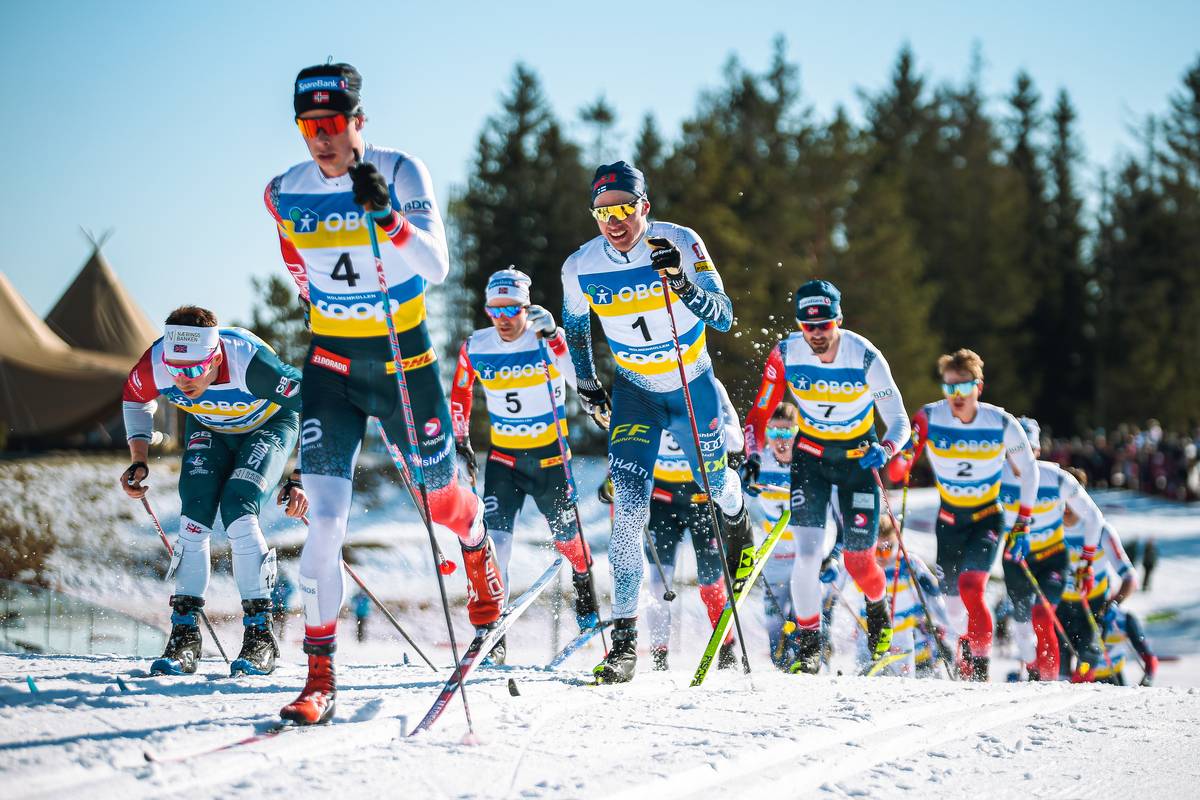
She and Sundling stretched the field immediately, driving into the Zorzi Climb, the race’s defining ascent. The early order — Sweden, the United States, Norway, Canada — hinted at the nations prepared to dictate terms.
Jonna Sundling (SWE) stretches her lead. (Photo: Vanzetta/NordicFocus)
When Sundling surged later in the race, Diggins expected it.
“I knew she was probably going to do that,” Diggins said afterward. “And I was like, just do the best that you can do. You know, like, you can’t control anything except your effort and your heart. And I was like, skiing out of my body, and I just did everything that I could, and I’m proud of that.”
That theme — control what you can — carried through her reflections.
“Honestly, I almost passed out like four different times,” she said. Then, clarifying: “No, from going that hard, no regrets. Honestly, left it all out there. I feel like we did everything we could, and that is the only thing you can control at the end of the day.”
Julia Kern (USA) and Jessie Diggins (USA), (l-r) gather in the finish area after the race, Diggins racing in the US team’s relay socks for the final time. (Photo: Barbieri/NordicFocus)
One final lap with ‘Relay Socks’
By the last exchange, Sweden had carved out daylight. Switzerland began clawing into Finland’s hold on silver. Behind them, Germany, Norway, the United States, and Finland battled for bronze.
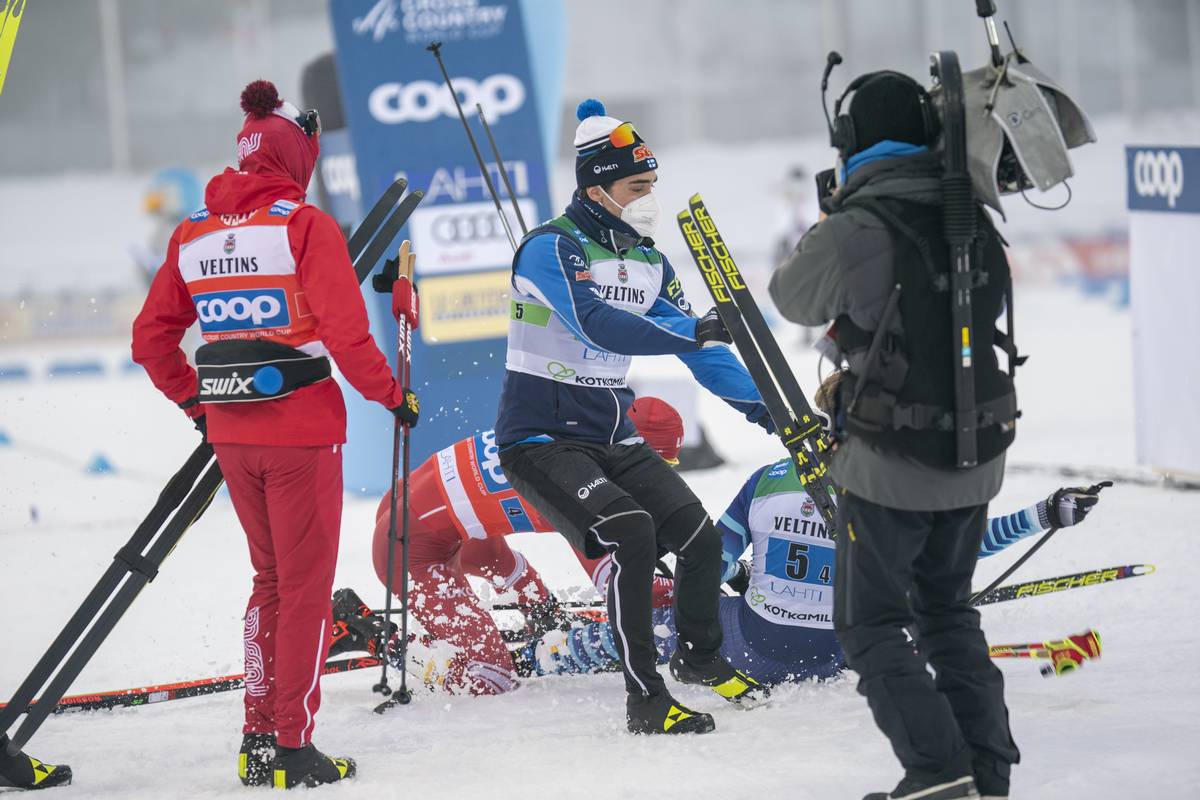
On the final descent, Finland’s anchor, Jasmin Kahara, lost her balance in the sweeping right-hand turn and fell, sliding out on her stomach. Germany and Norway slipped past in their tucks. Kern, just meters behind, fought to the line, but the podium had narrowed to two.
Coletta Rydzek (GER) brings home the bronze medal for Germany with Norway’s Julie Bjervig Drivenes just off camera. (Photo: Vanzetta/NordicFocus)
As they drove for the line side by side, aerodynamically no-pole skating with everything they had, it was clear this was going to be close. Germany claimed bronze while Norway left empty-handed in fourth. Just behind, Kern brought the United States to the finish in fifth.
For Diggins, the moment carried a different weight. It was, by her admission, her last Olympic relay leg.
“I love racing with this girl. I’m so, so proud of her,” she said of Kern. “And, yeah, it’s emotional to feel like I’m never gonna pull on those relay socks again.”
When asked whether there was a sense of handing the event forward, she reflected on the arc of her career — from her first team sprint world title in 2013 to the growth of youth programs back home.
“It’s just really cool to be part of the evolution of American skiing,” she said.
Julia Kern (USA) and Nadine Faehndrich (SUI), (l-r) find their lines around a tricky corner. (Photo: Vanzetta/NordicFocus)
Whitcomb knows they can win
For Head Coach Matt Whitcomb, the analysis was candid and clear-eyed.
“Yeah, it was a good race,” Whitcomb said. “Of course, this is an event that we know we can win, and we didn’t today.”
In a format this tight, small imperfections are decisive.
“For even a bronze medal to happen, both legs have to be firing exquisitely,” he said. “We swung as hard as we could. We did our best. We were prepared to win today, and we just didn’t.”
Of Kern’s anchor leg, Whitcomb offered both empathy and affirmation.
“Julia is an incredible performer, and one thing you can always trust from her is that you’re gonna get her absolute best,” he said. “We saw it on the final climb. I was happy with how she climbed. Just didn’t quite have the entire thing today, and that’s okay.”
Jessie Diggins tags Julia Kern (USA), while Jonna Sundling tags Maja Dahlqvist (SWE), (l-r) in the exchange zone between laps. (Photo: Vanzetta/NordicFocus)
Diggins in the best fitness of her life
Diggins has raced these Games managing injury concerns, including rib pain after a fall in the opening Skiathlon. But when asked whether her fitness was lacking, she pushed back.
“I feel like I’ve come into this with the best fitness in my life,” she said. “And that’s one of the only things I could control.”
There is comfort, perhaps, in that certainty — in knowing preparation was not the missing piece.
“I was skiing out of my body,” she said. “And I just did everything that I could.”
In Olympic-level team sprinting, that is sometimes enough. On Wednesday, it was not quite.
But the American women did what Diggins described as the only thing you can in cross-country skiing: you have to leave it all on the course without regret.
FasterSkier will have our own Nat Herz on the ground at the Olympics, which, to be honest, is a very big financial lift for us. If you value the thoughtful work and access FasterSkier provides at championships like this one, please consider becoming a Voluntary Subscriber. Your support directly fuels the work we do to cover the people, places, and moments that make our sport special.
Andrew Kastning is one of a small crew of Americans who work as commentators on late-night broadcasts of European cross-country ski races. He works from laptops and a television in his home in Anchorage, Alaska, and says he draws energy from a jumpsuit donated by a local U.S. Ski Team member.
PREDAZZO, ITALY — By day, Andrew Kastning’s life sounds conventional: He’s a father of three, with a desk job in Alaska doing permitting work for a federal agency.
During the winter? It’s another story.
On periodic Friday and Saturday mornings, you’ll find Kastning awake at 1 a.m., 2 a.m. or 3 a.m., standing in his living room in a sports jumpsuit, wearing a headset and delivering a monologue while watching his television.
Welcome to the strange world of being a North American television announcer of Olympic-level cross-country skiing.
With nearly all of the sport’s premier races taking place at European venues, those following cross-country from stateside have to pull overnight shifts to catch the events on an internet livestream.
Kastning, who’s paid by the International Ski Federation to call an English-language broadcast, has outfitted his wife with earplugs and a face mask that plays white noise so she can sleep through his calls. But he still woke his family up with some particularly enthusiastic play-by-play two weeks ago, when a fellow Alaskan, Gus Schumacher, cracked the podium in two World Cup races in Switzerland.
“My oldest daughter said she dreams sometimes and hears me calling the race, like: ‘Jessie Diggins!’” said Kastning, referring to the U.S. Olympic medal-winning skier.
Other regular cross-country broadcasters include Chad Salmela, a former competitive biathlete and veteran analyst from Minnesota, along with Kikkan Randall, the retired Olympic gold medal winning cross-country skier, who lives in Anchorage.
Both Randall and Salmela also pull the weekend wee-hours shifts as regular hosts of the English language livestream. And the pair will be featured this month as commentators on NBC’s national Olympics broadcast — though rather than being on site in Italy, they’ll be working out of an office complex in Connecticut.
The NBC Olympic cross-country broadcast team of Chad Salmela, right, Kikkan Randall and Steve Schlanger prepared for the first event at an office complex in Connecticut. (Courtesy photo)
Still, the setup will be an improvement over the 2022 COVID Olympics, when the broadcasters were at the same complex but sealed into individual booths connected by plexiglass windows — so they wouldn’t be sharing the same air.
It’s also the first time cross-country skiing will have Olympic commentary from announcers who are working consistently together in the leadup to the Games, with a U.S. Ski Team donor helping to boost Salmela’s and Randall’s pay in recent years to keep them on the livestream for non-Olympic World Cup races.
Cross-country athletes, coaches and boosters say regular television coverage of the sport could ultimately help make the U.S. more competitive with traditional ski powerhouses like Norway and Sweden.
“An underappreciated role of the TV product is how it builds kids’ dreams of being future champions,” Randall said in an interview. “This can actually be an important piece of developing our pipeline for the future.”
Randall’s own experience shows how much more accessible cross-country skiing has become for American spectators in recent years. A digital platform, Ski and Snowboard Live, now allows consumers to pay to stream international races while they’re happening or on tape delay.
When Randall, 43, was in high school, she said, “I remember sending in a check via mail to the National Ski Education Foundation to get VHS tapes of the World Cups of the year before.”
Kikkan Randall competing during her World Cup career in Estonia. (Fischer/Nordic Focus)
“Outside the Olympics, that was the only way to see World Cup level skiing,” she said. It was “pretty much completely inaccessible,” she added.
Randall has now fully embraced her role translating cross-country skiing’s sometimes-complicated race formats to a mass audience.
“I was curious: Am I going to know what to say? It’s one thing to have lived it, and it’s another to be able to talk about it,” she said. “But it’s come to me more naturally than I thought it would, and I really enjoy it. I get, kind of, a thrill from it — and it makes me happy to still feel that connection to the sport.”
With two kids and a full-time job leading Anchorage’s ski association on top of the commentary gig, Randall said she has to weigh opportunities carefully. It’s helped that the ski team donor, a strategic consultant named Liz Arky, offered to bump up the pay rate for the core broadcast team of Randall and Salmela — who now earn more than the few hundred dollars a night Kastning gets when he fills in.
“They can hook you, because they’re such good storytellers, and they’re so immersed in it, and they’re so passionate about it — and I just feel like that’s infectious,” Arky said in an interview. “It’s incumbent on us to grow our community and grow the audience.”
Salmela, meanwhile, pulls double duty as a commentator for both biathlon and cross-country races that are nearly all in Europe. The repeated early morning wakeups are a grind, and Salmela said his doctor has questioned whether it’s worth the cost.
“It’s a hard existence for a guy who’s 54 and dealing with Parkinson’s,” Salmela said. “It’s a tough call, because I recognize that it’s important for the sport.”
Salmela’s looking forward to the Olympic broadcasts on NBC, though, as they offer the commentators substantially more support than they get for the World Cups during the rest of the season: statistics researchers, a producer, a sound assistant. Salmela also said he’s enjoyed the partnership with Randall, who he called a “natural analyst.”
Chad Salmela interviews cross-country skier David Norris at the American Birkebeiner in 2023. (American Birkebeiner Ski Foundation)
“Her content is superb,” he said. “Because she’s smart, and she’s been one of the best at the sport — so, her perspective is well-spoken and legitimate.”
Kastning’s job can be tougher: He’s a solo practitioner for all his broadcasts, with no other analysts to banter with or riff on his takes.
He spends lunch breaks in the days before the races looking for storylines and fiddling with an Excel statistics spreadsheet. He’ll try to nap a bit in advance, then wakes up, closes his sleeping kids’ bedroom doors and heads into the living room for a sound check that takes place an hour before the start.
The toughest nights are when he’s calling two separate races, one for men and one for women: There’s generally an hour, sometimes two, between them.
“It’s really tempting to take a nap in between, because we’re talking like 2 to 3 a.m.-ish,” he said.
Kastning draws energy, he said, from his jumpsuit, which was donated by Alaska Olympic cross-country skier JC Schoonmaker.
After the soundcheck, Kastning said, “I’m kind of waiting until 10 minutes out — the countdown begins.”
“And then I’m off and running,” he said.
Help Support Our Olympic Coverage!
FasterSkier has our own Nat Herz on the ground at the Olympics, which is a significant financial lift for us. If you value the thoughtful work and access FasterSkier provides at championships like this one, please consider becoming a Voluntary Subscriber. Your support directly fuels our work to cover the people, places, and moments that make our sport special.
Alexander Bolshunov of Russia celebrates a dominant victory in the Olympic skiathlon in 2022. (Photo: NordicFocus)
TRONDHEIM, NORWAY — On the eve of the first race at the Nordic World Ski Championships, an anonymous source told Swedish national broadcaster SVT that the International Olympic Committee (IOC) has urged both the International Ski Federation (FIS) and the International Biathlon Union (IBU) to allow Russian and Belarussian athletes to return to international competition in time for the 2026 Olympic Games in Italy.
IBU President Olle Dahlin confirmed to SVT that the IOC is encouraging winter sport federations to adopt the same “Individual Neutral Athlete” (AIN) regime used at the Paris Olympics in 2024, which saw 15 Russian and 17 Belarussian athletes take part.
Dahlin, however, stated the IBU is not currently considering a Russian or Belarussian return to racing.
Meanwhile, FIS president Johan Eliasch—who is running to become the new IOC President in a vote later this month—is hopeful that athletes from Russia and Belarus will be back on the start line at the next Winter Olympics.
Both FIS and the IBU have instituted a ban on all Russian and Belarussian athletes and staff from international competition since March of 2022. This decision followed a stand-off between the Norwegian Ski Association—who refused to welcome Russian athletes to their events—and FIS, who initially insisted on Russian participation but changed course after the IOC recommended a ban.
The IOC did not make anyone available for an interview, but shared a written statement with FasterSkierwhich called on international sports federations and event organizers to adopt the Individual Neutral Athlete protocol in time for the 2026 Milano Cortina Olympics.
FIS President Johan Eliasch spoke before the start of the World Ski Championships in Slovenia in 2023. (Nathaniel Herz/FasterSkier)
In a telephone interview with FasterSkier, Eliasch said that the blanket ban on Russian athletes is unfair: “The athletes can’t choose where they were born,” the FIS president said, adding that he would like to see the Individual Neutral Athlete program carried forward to next year’s Games.
Eliasch emphasized that, in order to be invited to the Olympics as an AIN, “Athletes have to fulfill very clear criteria, and there is a process for vetting.” These criteria, based on recommendations from the IOC’s Ethics Board, exclude Russian and Belarussian athletes who are contracted by their nation’s military and security forces, as well as those athletes who actively support the Russian invasion of Ukraine.
“It’s worked well,” said the president about the independent evaluation process, “So I fully support this program.”
Secretary general of the Ski Federation of Ukraine Julia Syparenko says that the AIN scheme has been less effective than Eliasch suggests: “There have been numerous cases where these so-called neutral athletes failed to meet the established requirements,” Syparenko said via email.
A 2024 investigation by Global Right Compliance found that two thirds of Russian athletes who had been invited by the IOC to participate at the Paris Olympics had in fact shown support for the invasion of Ukraine, often by “liking” pro-war posts on social media.
Syparenko was unable to provide exact numbers, but said that many former athletes from the Ski Federation of Ukraine currently serve in the military, and that some have been killed in the fighting. The British Government estimates that up until the Paris 2024 Olympics, 487 Ukrainian athletes had been killed in the war, and that roughly 4,000 Ukrainian athletes continue to serve in the war effort. Similar statistics are not available for Russian athletes.
Syparenko said that Russian attacks have destroyed homes and displaced athletes, coaches, and officials, and competitions can only be held in the west of the country — and only so long as there are bomb shelters in place. Previous reporting from FasterSkier has detailed the risks that Ukrainian athletes have had to face to pursue their sport, and the losses they’ve endured during the war.
Viktoriia Olekh, a Ukrainian Olympic cross-country skier, posed for a photo at the World Ski Championships in Slovenia in 2023.(Federico Modica)
According to Syparenko, the Individual Neutral Athlete scheme used at the Olympic Games was an inadequate response to the realities of the invasion: “In such questions as war one cannot be neutral,” she said. “Either you don’t support the war and you say it, or otherwise you support the war, saying nothing against it.”
When asked for comment, Nordiq Canada’s acting CEO Megan Begley reiterated the federation’s stated position from 2022, which reads: “Nordiq Canada and its national team athletes fully support the decision by FIS to immediately suspend Russian and Belarusian athletes and officials from participating in FIS-sanctioned competitions.”
U.S. Ski and Snowboard did not respond to an interview request.
Russian powerhouse Alexander Bolshunov had been the main challenger to Norwegian Johannes Høsflot Klæbo until Russia was excluded from all FIS competitions in March 2022, following Russia’s full-scale invasion of Ukraine.
Bolshunov told the Russian website sports.ru in 2023 that he had no intention of returning to international racing following FIS’s ban. “Honestly,” he said, “I’m not interested in how these dirty competitions go.”
“I think it’s better to compete where we are expected,” Bolshunov said. “First you are disappointed, but now in Russia there are excellent competitions, broadcasts are organized, and you forget about it.”
Alexander Bolshunov won five medals at the Beijing Olympics in 2022. (Nordic Focus)
But the nine-time Olympic medallist has since had a change of heart.
Last Friday, Bolshunov told the Russian outlet Match TV: “If there are no Olympics, why train and run? For all-Russian competitions? No, thank you.”
Bolshunov is a captain in the National Guard of Russia and has appeared on stage at public rallies in support of the Russian invasion.
Though he declined to comment on the situation of any particular athlete before they had undergone the vetting process, Eliasch confirmed that an athlete who had been contracted by a Russian national security agency or had participated in state propaganda “would not qualify under the AIN scheme.”
British skier James Clugnet — who is serving as an athlete representative to FIS — understands that his peers are divided on the subject of Russia’s return: “Over 50% of the athletes voted that they didn’t want the Russians to come back,” he said. “And 48% said that they were happy for the Russians to come back with conditions.”
Italian athlete Federico Pellegrino — who, in 2021 joined a Russian Ski Team training group led by coach Markus Cramer — is fed up with questions about the fate of his former training partners: “Again and again, always always. I say the same since four years.”
“In my opinion, sport must unite people, not divide, as it’s many times said in the North,” said the Italian sprint star. “I hope that the institution will do their job without the push from different things that are not right for the good of sport and, hopefully, for the end of the war.”
Alexander Bolshunov, left, and Federico Pellegrino, center. (Photo: NordicFocus)
Canadian Katherine Stewart-Jones says that it is important for athletes to stay engaged in the debate surrounding the Russian situation: “We’re the ones that are living the consequences of the decision. So I think it is a fair question to ask.”
As for whether the Russians should be allowed back to FIS and IOC competitions — under a neutral flag or otherwise — Stewart-Jones is concerned that inviting Russian athletes back to racing at this stage would compromise the ethical principles of the Olympic Charter, which are supposed to ensure respectful and meaningful competition. “Sport should be promoting peace and fair play and all those things,” she said, “And I just feel that what Russia is doing right now doesn’t go with the values of sport and the values of the Olympics in general.”
Canada’s Katherine Stewart-Jones after a race at the 2025 World Championships in Norway. (Nordic Focus)
The Canadian skier is wary of what motivates those who advocate for a Russian return: “I think that sport should bring people together,” Stewart-Jones said, “And people sometimes use that as an excuse to have them back.”
Stewart-Jones says that the sport’s international governing body may be motivated to welcome Russian athletes back into the sporting fold out of a desire to draw audiences back to ski racing, rather than in response to a substantive change in the war.
“We know that cross-country skiing is in trouble,” said Stewart-Jones.
She remarks that FIS and the IOC have a financial incentive to allow the Russian competitors to return: “That’s where a lot of the viewership is from, and we’ve been losing a lot of viewership.”
FIS World Cup television ratings have almost halved in the Russian team’s absence. From an international viewership of 1.28 billion in 2021 prior to the full-scale invasion of Ukraine, audiences have since shrivelled to 690 million viewers worldwide.
Reporting from the BBC estimates that at least 70,000 Ukrainian soldiers, and between 160,000 and 235,000 Russian-aligned fighters have been killed in combat since the full-scale invasion began in February 2022.
James Clugnet racing at this year’s World Championships. (Nordic Focus)
Clugnet shares some of Stewart-Jones’ moral concerns, and says that the Federation may have already backed itself into a corner: “If FIS returns the Russians, I think it kind of loses credibility — because why did they ban the Russians in the first place if they’re going to put them back in when there’s been no change in the war?”
While the present bans and the IOC’s Individual Neutral Athlete program each pose their own moral dilemmas, Clugnet says that skiing’s governing body should soften its stance toward the Russian athletes: “I think FIS should follow the IOC guidelines,” said the Brit, “Because I think the sport is actually better with the Russians.”
Whether or not athletes from Russia and Belarus will — or should — be invited to compete for medals at next year’s Olympics is still in question, and as the geopolitical winds seem to shift as wildly as the Trondheim weather, we may not have an answer any time soon.
This coverage is made possible through the generous support of Marty and Kathy Hall and A Hall Mark of Excellence Award. To learn more about A Hall Mark of Excellence Award, or to learn how you can support FasterSkier’s coverage, please contact info@fasterskier.com.
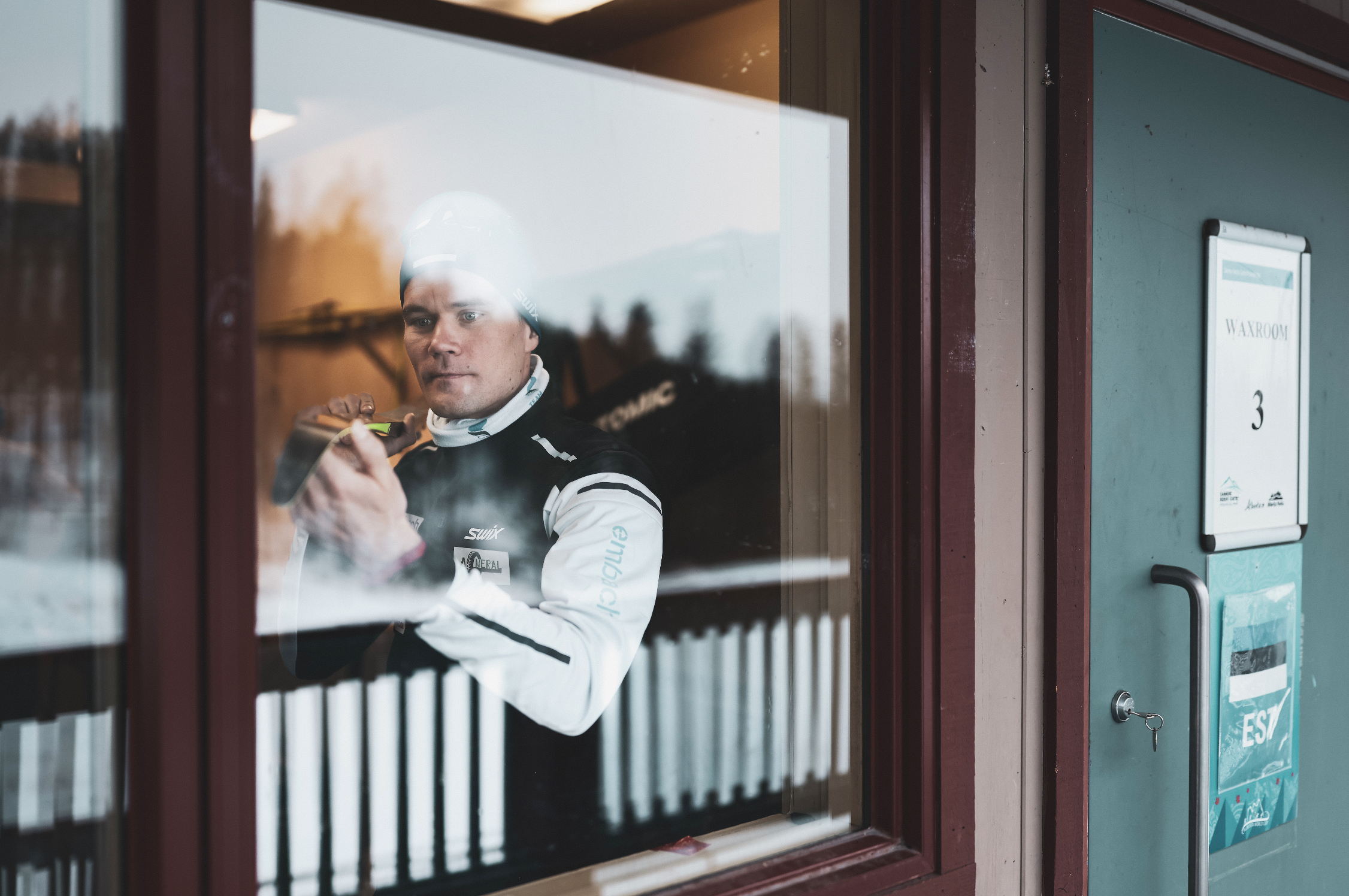
Alvar Johannes Alev inspects a ski in Canmore this month. (Federico Modica for FasterSkier)
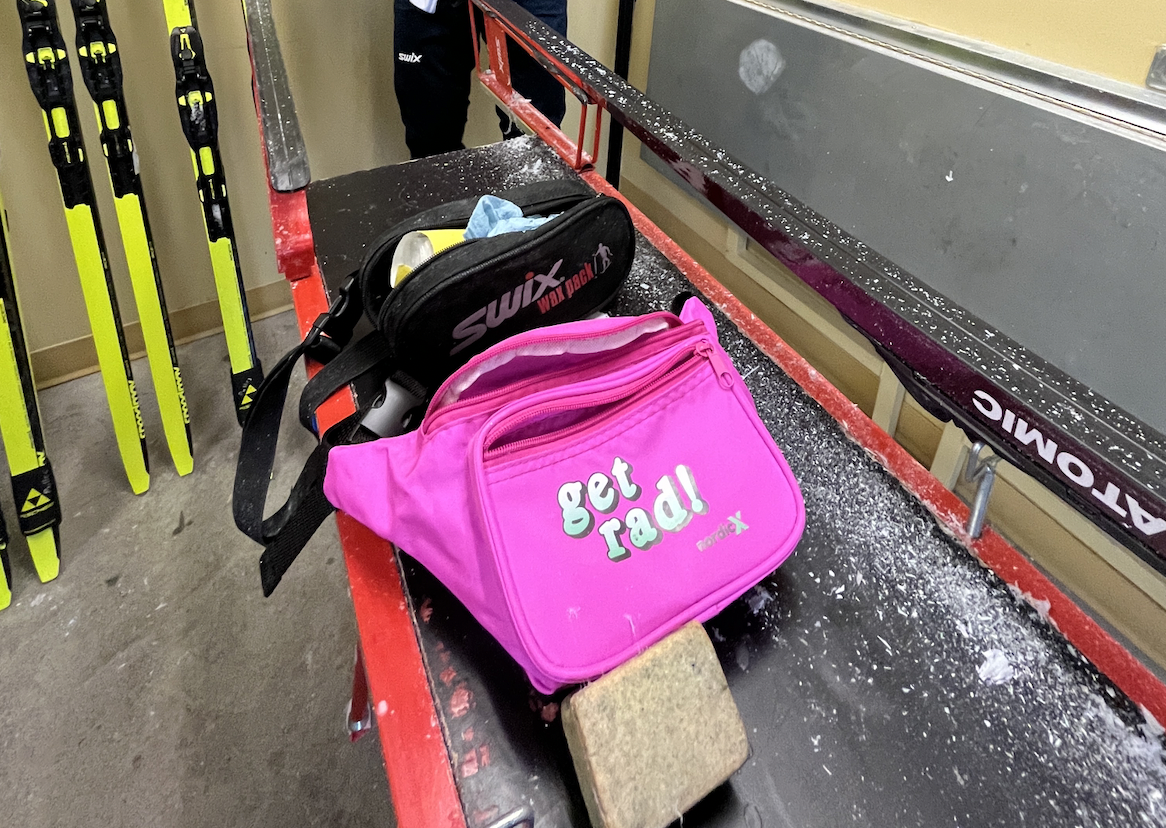
CANMORE, ALBERTA — With his fanny pack of kick wax and Kia minivan, you could have easily mistaken Alvar Johannes Alev for a weekend warrior cross-country ski dad in this Canadian mountain town.
Except it turns out that the 30-year-old is one of the fastest men on cross-country skis from his home country of Estonia. And his fanny pack held the ski wax he used in the lead-up to racing in Canmore against the best athletes on the planet, on the elite-level World Cup circuit.
The Estonians relied on these bags of waxes for training in Canmore. (Nathaniel Herz/FasterSkier)
Teams from other competing nations had armies of paid and volunteer ski technicians, coaches, even chefs helping them as the World Cup travels through Canada and Minnesota this month. Norway brought 10 wax technicians and four coaches on the trip, team officials said.
Alev and his two Estonian teammates were almost completely on their own in Canmore, without dedicated support staff except race-day waxing help from Finland.
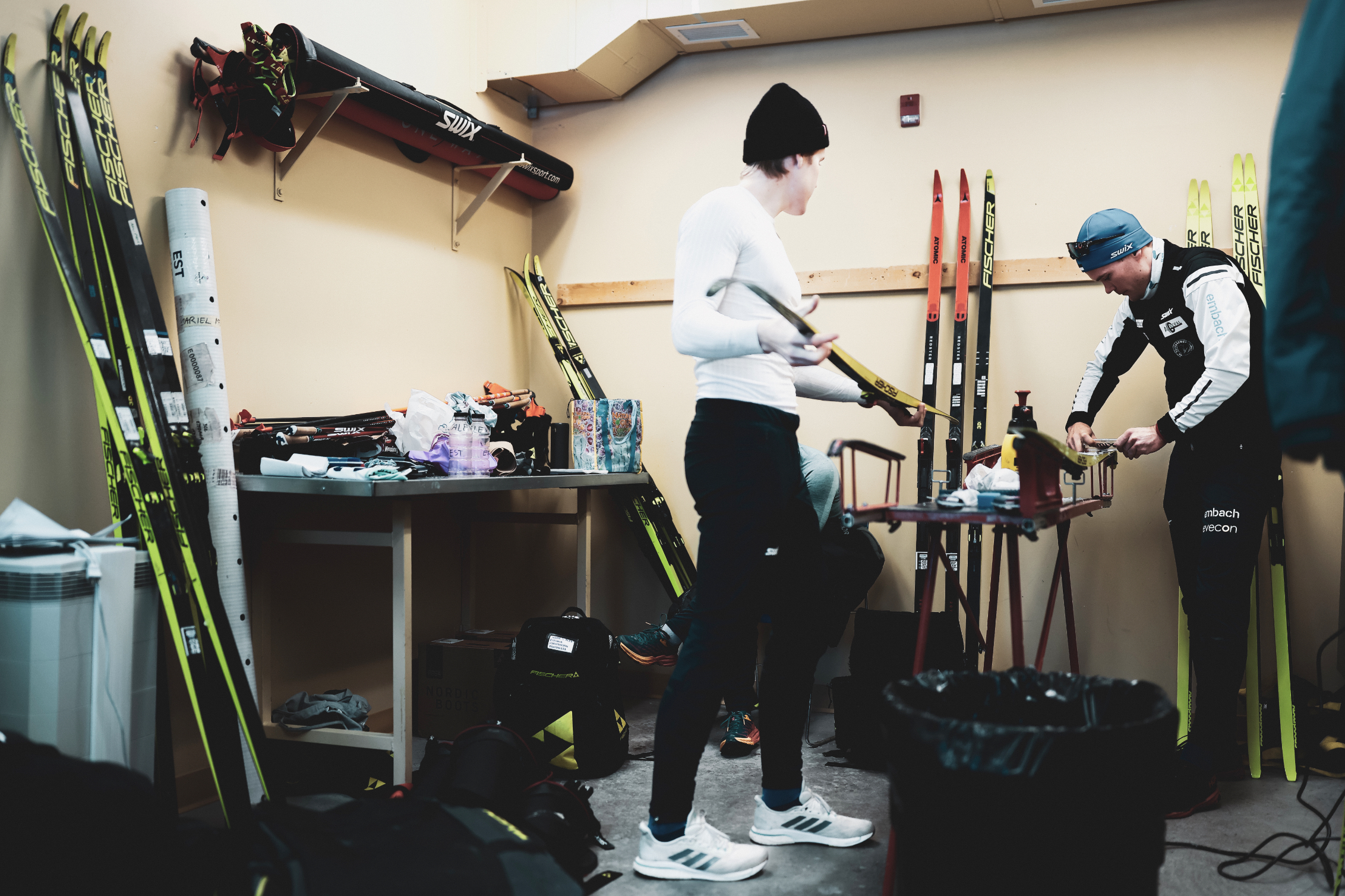
The Estonians were athletes, baggage handlers, drivers, team captains and ski testers wrapped into one, using a wax bench borrowed from another team.
In Canmore, they stayed at an AirBnB and drove their own rental car, rather than paying for rooms at the official race hotel and riding buses scheduled by the organizers. In Minnesota, they depended on help from Minneapolis-based Team Birkie, and stayed at a home offered up by a local.
“I can imagine that our team looks a bit homeless compared to the big nations,” Kristjan Koll, the head of Estonia’s national ski association, said in an interview from his home country. But, he added: “In general, we manage quite well, considering how little resources we have.”
The Estonians do have paid coaches and a wax technician who support them when the World Cup is in Europe—though the staff is far smaller than those of wealthier teams from Scandinavia, Canada and the U.S.
Christopher Kalev, an Estonian who attends University of Alaska Fairbanks, cleans a ski in Canmore this month. (Federico Modica for FasterSkier)
For the North American races, the cost was too high for the Estonians to send support staff, so the association gave athletes the option to travel to the events by themselves.
Alev, an Olympian who once raced for the University of Colorado, traveled from his current home base in Norway; his teammates for the month, Mariel Pulles and Christopher Kalev, are both students at University of Alaska Fairbanks.
Kalev, 24, who made his World Cup debut in Canmore, said he knew what to expect.
“We’re used to it—it’s been going on like this for a while now,” he said. “If you don’t get your expectations too high, it’s going to be okay.”
Partnerships boost other small World Cup teams
The Estonians’ predicament in Canmore, if a somewhat extreme example, underscores what some coaches and pundits increasingly describe as a threat to cross-country skiing’s identity as a global sport: the big divide between the haves and the have-nots.
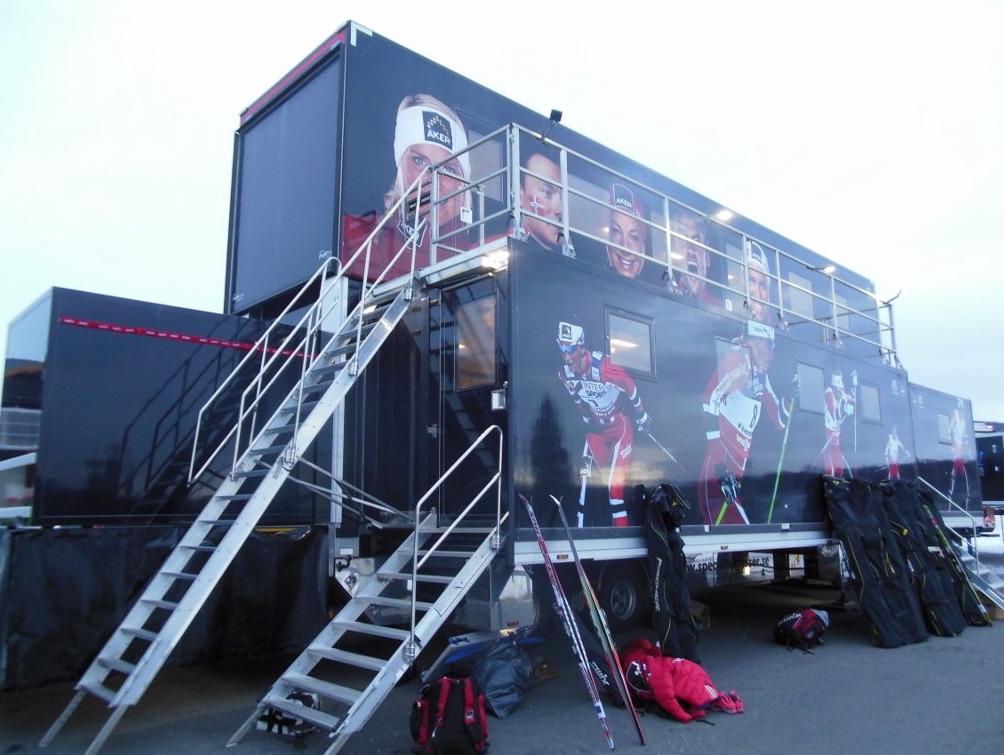
There’s no limit to the amount of money that powerhouse nations like Norway, Sweden and Finland can spend to boost their teams’ chances. They travel the World Cup circuit with enormous semi trucks that have been converted into mobile ski waxing facilities, and with substantial staffs who care for athletes’ needs.
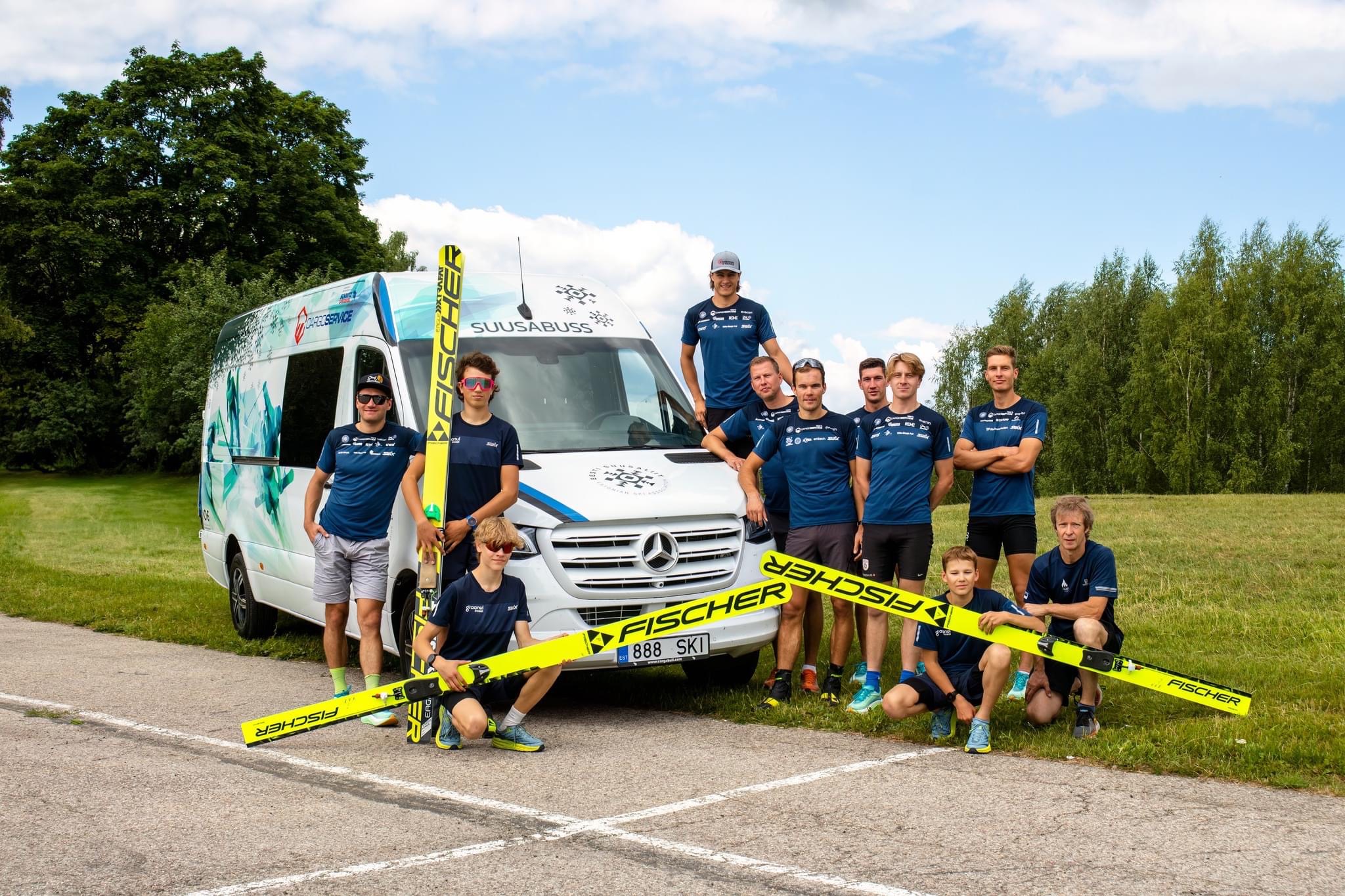
The U.S. team has its own truck, too, while the Estonians were thrilled to acquire a “Suusabuss,” or ski bus, for the winter—a glorified van.
Estonian skiers and their new “suusabuss,” or ski team van. (Courtesy Estonian Ski Association)
Koll, a former elite racer himself, said that the organization that manages the World Cup circuit — the International Ski Federation, known as FIS — has made some “good decisions over the years” to level the playing field. But more needs to be done, he added.
“We should and need to think about how we could support the smaller nations, especially if it is FIS’s desire to widen the reach of the cross-country program so that we have World Cups in different parts of the world,” Koll said. “Every nation is different. But on some level, we share the struggles, and in the end, I think that the common goal for everyone is that our athletes will be on the start line and the sport will be interesting.”
In an interview, FIS’s coordinator for World Cup cross-country skiing, Doris Kallen, said she’d like to hear small nations’ own ideas about what her organization could do to help them. But she added that the question is a “bit tricky.”
“At FIS, a lot lies in the hands of the national ski federations. And it’s not actually FIS that can impact things,” she said. “We can impact things by rules, for example, and regulations. We can make it mandatory or not. But with every action you take there is a reaction, which might impact another small nation in a negative way.”
One option for the Estonians could be to lean harder into their existing ski waxing partnership with the Finns, said Jostein Vinjerui, a coach who leads a multinational team, Aker Daehlie, with athletes from Great Britain, Latvia, Ireland and the Czech Republic.
The British component of Vinjerui’s team has its own partnership with the Norwegian squad, which transports some of Great Britain’s equipment, tunes many of the team’s skis with stone grinding machines and places joint orders of ski waxes to secure bulk discounts.
One of the waxing trucks that Norway’s cross-country ski team has used on the World Cup circuit. (Courtesy Noah Hoffman)
“The way Norway is treating us is a very good role model,” Vinjerui said.
FIS incentivizes such partnerships by giving extra race course access to coaches and wax testers from collaborating nations.
But that incentive only applies to agreements between two nations, according to Vinjerui; FIS grants no additional access if a third or fourth country participates.
Vinjerui and Norway’s ski waxing manager, Tord Hegdahl, are eager to share insights from their decade-long partnership, Venjerui said. And there seems to be general interest in collaboration from teams competing on the World Cup, he added.
But FIS hasn’t prioritized it, he said.
“Other issues, they find more important,” Vinjerui said.
“It just comes down to the money”
The Estonians have been on both sides of cross-country skiing’s financial divide.
In the 1990s, when Estonia was a newly independent nation after the fall of the Soviet Union, it had to create its own cross-country skiing program on a shoestring budget.
One athlete, Andrus Veerpalu, borrowed money from his coach to feed his family; he and his teammates at one point carried bags of their food, on foot, to a train that took them to a training camp in Finland.
Andrus Veerpalu skiing at a race in Estonia in 2011. (Nathaniel Herz/FasterSkier)
But the Estonians improved, won an array of medals at the Olympics and World Championships and secured major endorsement deals and sponsors—before Veerpalu failed a doping test in 2011 and one of his sons, eight years later, was caught in his own blood doping scandal.
Sponsors fled the ski association, which has been trying to resurrect itself since then.
“For the small nations, it would really help if we got some extra funding from somewhere,” said Koll, the ski association director.
Alev, the senior member of Estonia’s team in North America, has shown flashes of potential. He finished 31st in a season-opening World Cup race in Finland in November and was picked for Estonia’s relay team at last year’s World Championships, and at the Olympic Games in Beijing in 2022.
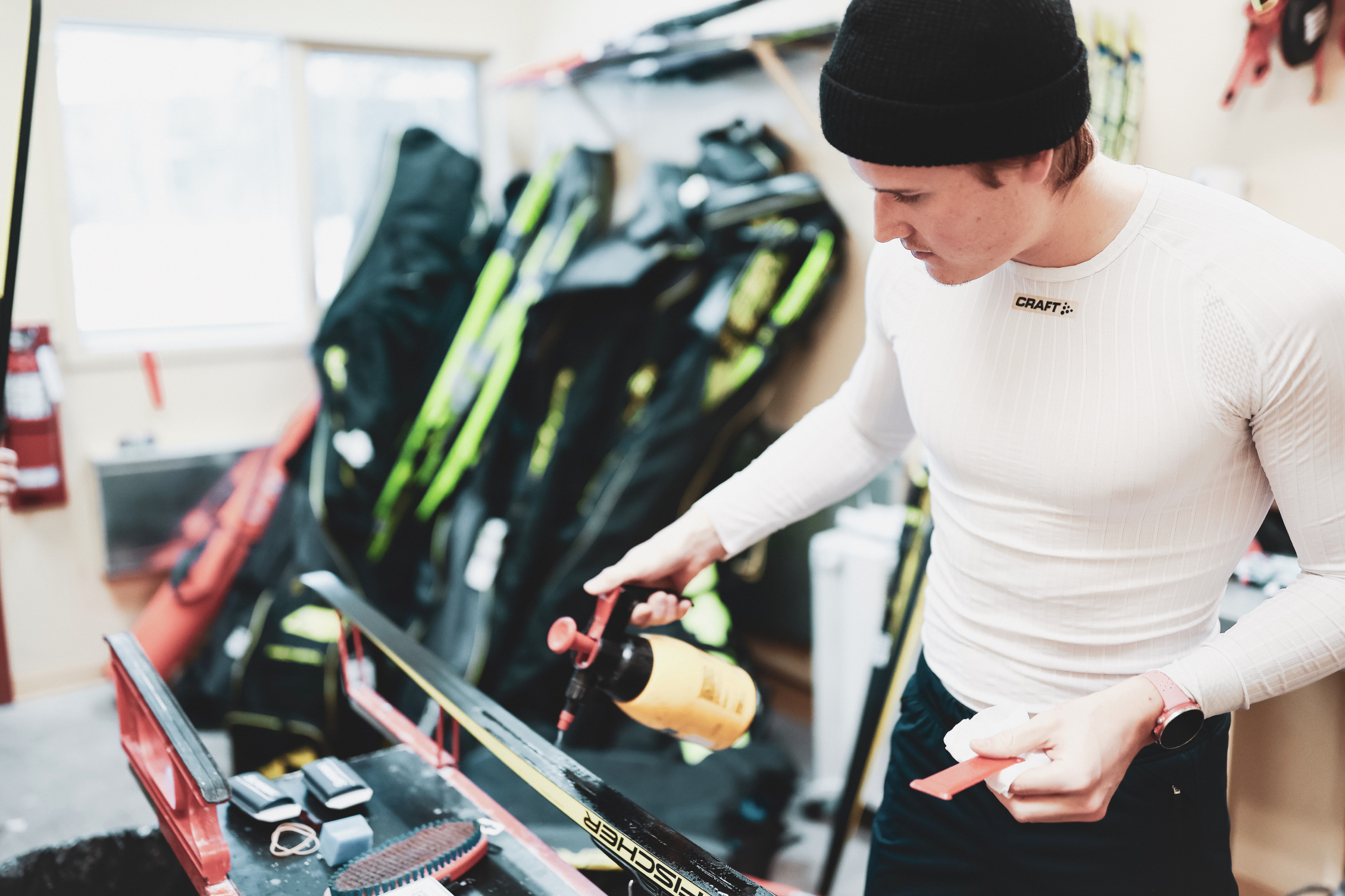
Christopher Kalev, left, and Alvar Johannes Alev wax their own skis at a World Cup event in Canmore in February, 2024. (Federico Modica for FasterSkier)
In Canmore, his top finish in three events was 35th. One of his races was derailed by what he described as a frustratingly slow pair of skis—though he said he probably chose the wrong pair to race on, and that the problem didn’t seem to be the wax applied by the Finnish team.
“I guess the ratio is like that: One out of three races, you will have to take some setbacks,” he said.
Alev said he hadn’t given much thought to what, exactly, could be done to help teams like his be more competitive with powerhouse ski nations.
But, he added: “It just comes down to the money.”
“And it’s just not easy to get it,” he said. “Once there’s a solution for that main problem, then everything starts coming together.”
Wang Qiang became the first Chinese athlete to podium in a World Cup last year, finishing 2nd in a classic sprint in Norway. This year, political turmoil has stranded him at home and kept him out of the World Ski Championships in Slovenia. (Photo: NordicFocus)
This World Championship coverage is made possible through the generous support of Marty and Kathy Hall and A Hall Mark of Excellence Award. To learn more about A Hall Mark of Excellence Award, or to learn how you can support FasterSkier’s coverage, please contact info@fasterskier.com.
PLANICA, SLOVENIA – Wang Qiang was cross-country skiing’s Next Big Thing.
Wang, 29, was the product of a colossal investment from his home country to identify and train potential medal winners in the lead-up to the 2022 Beijing Olympics. Communist Party leaders saw cross-country skiing as a prestige sport and poured hundreds of millions of dollars into their national team, building an indoor ski tunnel and recruiting top coaches from Europe.
The effort didn’t produce medals at the Olympics. But a big payoff came just weeks later, when Wang cracked his first podium on the World Cup circuit, a huge accomplishment that came against some of the same competitors he faced in Beijing.
In a sport typically dominated by Europeans, Wang’s podium was a breakthrough — an announcement of a rising power in cross-country skiing.
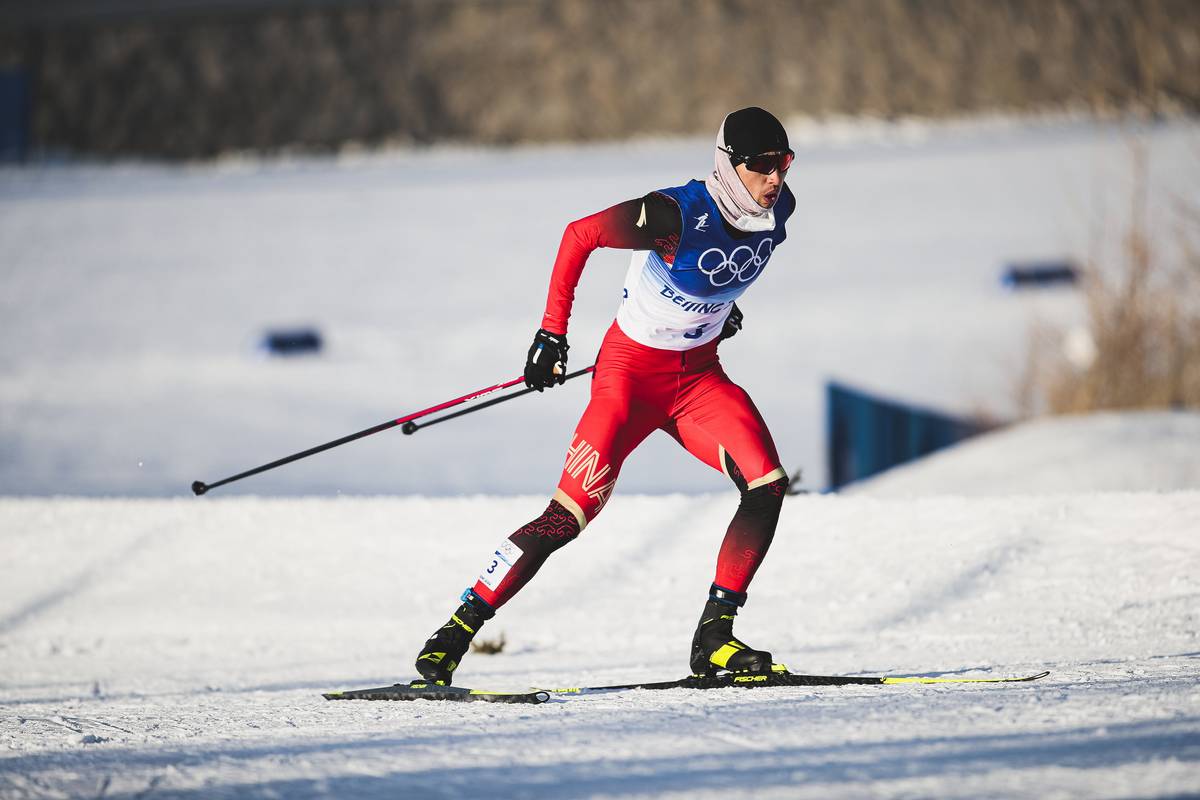
Wang Qiang was fifth in the skate sprint qualifier at the 2022 Beijing Olympic Winter Games. (Photo: NordicFocus)
But when Wang’s best event, the sprint, was held at those championships Thursday, he was missing — apparently back home, in China, where he’d been forced to watch the entire World Cup season from the sidelines. On social media, he published a screenshot of a Norwegian news story about his absence, the latest in a string of posts expressing regrets about his departure from Europe.
The tale of Wang’s unexplained disappearance has become something of a tragedy and a mystery among his friends and competitors on cross-country skiing’s World Cup circuit, who say he’s one of the few athletes with the raw talent to challenge Norway’s superstar sprinter, Johannes Høsflot Klæbo.
“They’ve got this one guy that could be the world’s best skier, and he just doesn’t get to race. I don’t quite understand it,” said Andrew Musgrave, a British cross-country skier who lives and trains in Norway. “It just seems bizarre.”
Wang’s experience is emblematic of what’s happened in Chinese snow sports since the end of the Beijing Olympics: turmoil, without a clear explanation.
The country’s national cross-country ski team has been shut down, and it hasn’t fielded athletes in top-level competitions this year. Its nordic combined team is also missing from the World Championships in Slovenia.
China’s Olympic alpine skiers haven’t competed internationally since Beijing. And the country’s biathlon squad, after its own substantial investment in the lead-up to the Games, has also largely disappeared, skipping World Cup competitions and sending a skeleton crew to recent World Championships races in Germany.
In a strange twist, though, China’s best ski jumpers have been consistently present on the World Cup circuit since January, and are competing at World Championships in Slovenia this week.
In a brief interview outside the team’s wax cabin Friday evening, the Finnish coach who leads China’s jumping squad, Jani Klinga, said the group has a step-by-step, four-year plan building toward the 2026 Olympics.
A nordic combined team is forming some time later, Klinga added, but he said he has no information about the fate of China’s cross-country skiers.
“I don’t know about the cross-country athletes, the situation over there,” Klinga said. “But on our side, everything is moving forward.”
International snow sports leaders also appear to be largely in the dark about China’s plans.
In biathlon, contracts with the foreigners hired to coach the national team were not renewed, and a plan to buy 3,000 laser training rifles each year also has not been carried out, said Max Cobb, the International Biathlon Union’s secretary general.
“They were really making progress as a nation and had some really decent results from their athletes,” Cobb said in a phone interview Friday. “It’s really hard to know what the plan and leadership structure is, and who’s ultimately responsible. We certainly hope that they’ll come back — there’s just, at the moment, not a lot of activity, and it feels like the momentum’s been lost.”
International Ski Federation President Johan Eliasch said his organization is in close contact with the Chinese Ski Association and that “everything we hear is aligned with their stated commitment to proliferate winter sports in China.”
FIS President Johan Eliasch speaks with reporters Wednesday before the start of the World Ski Championships in Planica. (Nathaniel Herz/FasterSkier)
But in remarks to reporters in Planica this week, Eliasch said he couldn’t comment on the Chinese cross-country ski team’s absence from World Championships other than citing the nation’s restrictive coronavirus protocols — which were lifted in December.
The leader of China’s defunct cross-country ski team, Zhang Bei, didn’t respond to an emailed request for comment.
But in phone interviews, two sources close to China’s cross-country program described Wang’s absence as a symptom of a larger realignment in the nation’s sports regime after the 2022 Olympics.
In the lead-up to the Beijing Games, they said, China’s sports minister, Gou Zhongwen, was not actually a sports expert: He was a well-connected Communist Party insider, who used those connections to secure ample budgets for his programs.
The nation’s cross-country ski team was among Gou’s most favored projects, the sources said, because of European countries’ longstanding dominance in the sport: If China could win a medal, it would be a major triumph over the West.
But the massive investment in cross-country skiing didn’t produce any hardware: Wang, the country’s top prospect, was disqualified from the Olympic sprint race when he crashed into a Norwegian competitor.
Once the Games were over, Gou retired. His replacement, Gao Zhidan, is a sports specialist who lacks the same level of political support, and the same interest in cross-country skiing, the sources said.
“After the Olympics, the cards have been reshuffled. And cross-country lost its aces,” said one of the sources, who worked in Chinese sports in the lead-up to the Games.
Around the same time as the change in ministers, Norwegian media reported, Wang was returned home from Europe to China. The national cross-country ski team was also disbanded, the sources said, and its athletes were sent back to their regional teams.
Those regional teams, the sources said, prioritize Chinese national championships over international racing because there’s substantial prize money at stake.
An internal audit of the cross-country program is also underway, according to the other source, a Chinese resident.
There’s a good chance the national ski team will be rebuilt in time for next winter, said the Chinese source, who requested anonymity because of “internal struggles” in their home country. But even insiders don’t really know what will happen, the source added.
“Even if you’re in the Communist Party, you don’t know,” the source said. “You need to be connected with the right people. Otherwise, forget about it.”
During his involuntary break from international-caliber competition, Wang has continued training and stayed relatively optimistic, avoiding direct criticism that could put him in conflict with the political leaders who control his future.
“I am aware that I am missing out on a fantastic season. But I have to accept the situation,” he told a Swedish newspaper recently. “I want to concentrate on training this summer and be in the World Cup next season. I think I’ll make it.”
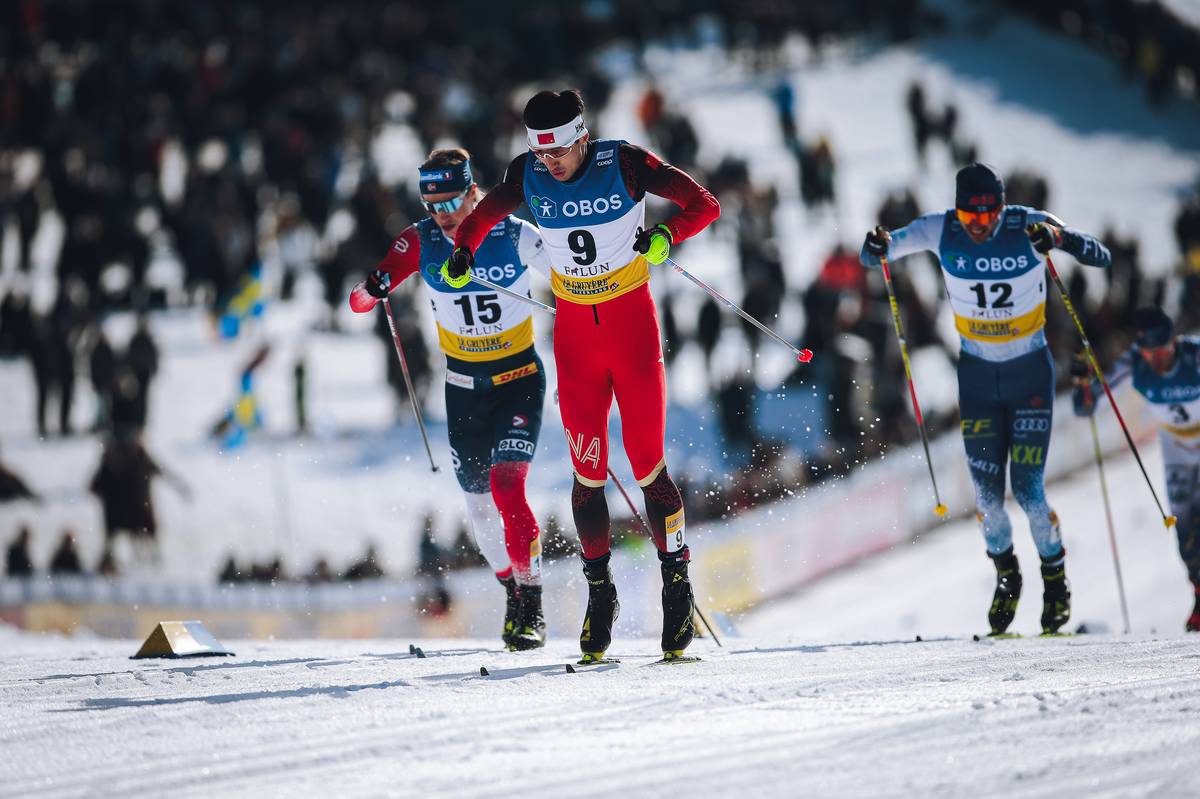
Wang Qiang races in a World Cup classic sprint last year in Falun, Sweden. (Photo: NordicFocus)
But his friends and fellow competitors said they’re worried about the effects of isolation on Wang and his Chinese teammates, who haven’t done much of the kind of tight, close-quarters racing that happens on the World Cup. There’s also Wang’s advancing age: He turns 30 this year.
“It’s difficult when they are not here, because they need the experience in every World Cup race,” said Finnish skier Remi Lindholm, who trained with some of the Chinese athletes for several months in the lead-up to the Olympics.
Like Musgrave, Lindholm said Wang “absolutely” has the potential to beat Klaebo, the Norwegian superstar. Which makes it sad, Lindholm added, that Wang is stuck in his home country.
“He’s a good guy,” Lindholm said. “And he knows that he has to do the job every day to get to the World Cup.”
Beginning of the FIS World Championship Skiathlon in Oberstdorf, Germany in Febuary 2021 (Photo: Nordic Focus).
The International Ski Federation (FIS) is again postponing its ban on the use of fluorinated (fluoro) waxes, originally passed in November 2019. The decision to delay the ban’s implementation until after the 2022-23 season was announced in a press release earlier today.
The FIS cites the need for “further refinement of the fluoro testing device and to define procedures to protect the integrity of FIS competitions.” The same concerns over an efficient and effective testing procedure have already led to two prior announcements of delays in the implementation the fluoro ban in 2020 and 2021. This latest decision will mean that the World Cup, World Ski Championships, World Junior/U23 Ski Championships, and other FIS-sanctioned events will continue to see the unregulated use of waxes containing fluorocarbons this upcoming winter.
Fluorinated waxes contain a class of chemicals called per- and polyfluoroalkyl substances, commonly referred to as PFAs, which have been the subject of increased regulation in the past decade following research showing significant environmental and human health risks. To read a comprehensive overview of this evolution in PFA regulation, read here. Fluoro ski waxes have been found to be some of the most PFA-rich substances on Earth, on account of their extreme hydrophobia. Wax manufactures are now shifting away from producing fluoro-containing race waxes, long a standard in competitive Nordic ski racing, and with that shift, regional, national, and international governing bodies have had to adopt policies regarding their usage in sanctioned competitions.
Johannes Høsflot Klæbo lunges for the finish line in FIS World Cup action last February in Lahti, Finland. (Photo: Nordic Focus).
When the FIS announced its ban in 2019, originally to be implemented at the start of the 2020-2021 season, it was on the forefront of fluoro policy-making. As the international governing body, FIS’ ban was set to take the broadest step possible in banning fluoros from Nordic ski racing. With the ongoing delays in implementation, however, a patchwork of policies across national governing bodies, and even individual races and venues, now govern fluoro wax policy. In the United States, U.S. Ski & Snowboard enacted a total ban on fluoro containing waxes in January of last year, following the Beijing 2022 Olympic qualifying period. Nordiq Canada has yet to release updated policy guidelines for the 2022-23 season, but it’s 2021-22 policy implemented a “tiered system” that essentially banned fluoros at all non-co-sanctioned Nordiq Canada and FIS events (SuperTours and the Canadian National Championships therefore, were exempt). Nordiq Canada’s policy will be of particular interest this season, with the 2023 FIS Nordic World Junior Ski Championships scheduled to be held next January in Whistler, British Columbia.
In place of a ban, the FIS says it “will increase the systematic collection and testing of samples during the upcoming season 2022-23.”
FIS World Cup start in Val di Fiemme in March, 2022. (Photo: Nordic Focus).
On Monday, June 20th, the Ski Associations of Austria, Switzerland, Germany, and Croatia made good on threats issued after the FIS Congress in May, and filed an appeal to the Court of Arbitration for Sport (CAS) contesting the voting procedure that elected the unchallenged FIS President Johan Eliasch.
The four nations argue that it was unlawful to deny them the option of voting no to Eliasch, and that the election procedure violated FIS statutes and Swiss law.
Unable to vote no, the dissenting delegates decided to either walk out of the election in protest or abstain from voting altogether. Members of the appealing ski associations have suggested that Eliasch would not have received a majority of the votes cast if an option to vote no had been offered. Had that happened, the appealing nations may have been successful at installing a new candidate.
Instead, Eliasch received 100% of the votes cast, leading his opponents to characterize the proceedings as, in the words of the German delegate, a “farce.” Nevertheless, Eliasch received 70 of a possible 117 votes—a clear 59% majority, and a five vote increase from last year.
For FIS, an appeal of voting procedure technicalities is unprecedented: as a rule, FIS presidential elections have been uncontested and decided by acclaim. In response FIS released a statement saying the allegations, “are entirely without merit or substance.”
Eliasch was reportedly told in advance about the appeal during a meeting in Innsbruck with the Austrian Ski Association. “He took it very professionally and said he needed it too, otherwise [the allegations] would resonate throughout his term,” according to Chrisitan Scherer, the head of Austrian skiing.
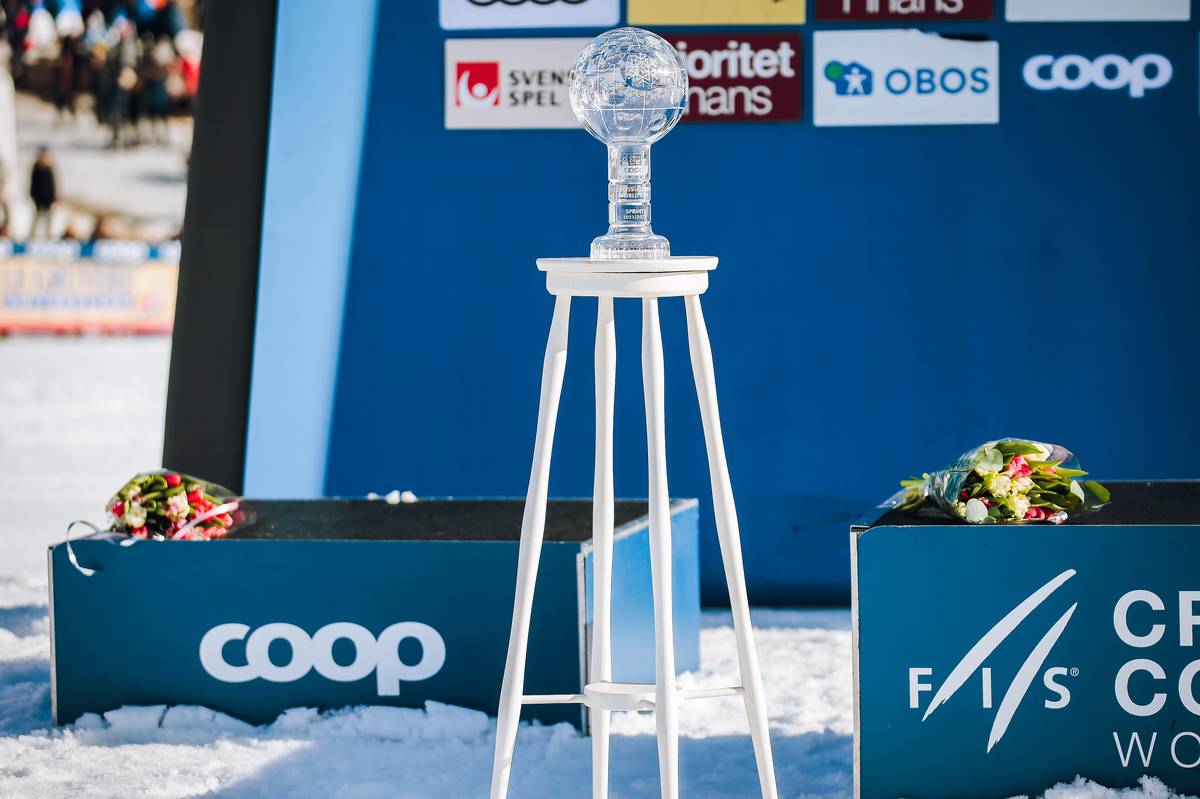
The women’s sprint crystal globe awaits its recipient at 2021-22 FIS World Cup Finals in Falun, SWE. (Photo: NordicFocus)
While the CAS case will examine legal minutiae, it is best seen as the latest contest in a power struggle between a bloc of dominant ski nations and FIS President Eliasch, whose agenda to rapidly centralize media rights under FIS and shake up the World Cup calendar has threatened their hegemony.
“If you think about the bloc here [in FIS], it’s the French, Germans, Swiss, Austrians, Norwegians, Swedes, and Finns,” said Dexter Paine, the U.S.’s former FIS Vice President and Councilor who was voted off the council over his support of centralization.
What the bloc hopes to achieve from the CAS appeal is unclear, though it seems unlikely to overturn the result of the election. The aim may be to stall Eliasch’s agenda as the case will take months to resolve, or to wound him politically and bring him to the bargaining table in a weaker position. It may also be that the four appealing nations are determined to find a way to overturn the election and install their preferred candidate: Urs Lehmann, the head of Swiss Ski.
Eliasch’s election in 2021 interrupted the Swiss reign at FIS, with just two Swiss men— Marc Holder and Gian Franco Kasper—leading the Federation for the previous 70 years. Lehmann, who called the FIS election a “muppet show”, appears to be an opposition candidate that will preserve the bloc’s established order.
France’s Richard Jouve earns the 2021-22 FIS sprint crystal globe. (Photo: NordicFocus)
Both Paine and Eliasch spoke to FasterSkier earlier this month to discuss the issues facing FIS as it attempts to centralize the media rights, expand the reach of the World Cup, and attract a larger audience in North America.
Eliasch’s bid to modernize FIS in the near term will now be hampered by Paine’s absence from the council, an assertive bloc, and entanglements at every corner with the sport media company Infront.
While there has been general disagreement between the bloc and Eliasch over centralization, one development in particular has alarmed the bloc as well as Infront: A judgment won in Swiss court that found FIS to be the rightful owner of World Cup races and not, as was previously understood, the hosting National Ski Association.
With this ruling in hand, Eliasch has suggested that the contracts with Infront could be broken—a move that would take centralization from the theoretical realm, where it has support from the bloc, to the immediate, where it does not.
Much of Infront’s contracts for FIS events extend to at least the 2025/26 season, with Swiss Ski signing a deal that lasts until 2027/28.
Urs Lehmann, the head of Swiss Ski, opposes the notion of breaking contracts. “That’s not possible,” he said to Tages Anzeiger. “Infront hasn’t done anything wrong, on the contrary, it’s a big partner of the FIS when it comes to world championships.”
For his part, Lehmann said centralization would require a long time frame, presumably after 2028, and could be done only after proving that Ski Associations would receive at least the same amount of money.
Eliasch has said that FIS has ample funds to give “cast-iron guarantees” to match Ski Association’s deals with Infront, saying, “We can back it up any day of the week.”
FIS’s financial assets at the end of 2020 amounted to around $146 million, suggesting that if the Federation is prepared to dip into their reserves, it has the ability to support Ski Associations through the transition.
Infront’s VP of Strategic Communications, Jörg Polzer, outlined the risks for FIS of moving away from the current arrangement in an interview in Ski Racing, suggesting that the new proposal “would represent a de facto expropriation of the National Ski Associations.”
Polzer also felt that the outcome would be a “plethora of legal claims and lawsuits for many years to come,” the result of which could mean that fans might not be able to access “FIS World Cup coverage as conveniently and widely as it is the case today.”
Centralization under FIS threatens to disrupt both Infront’s profits and its valued portfolio of winter sports which encompasses all seven winter Olympic sport federations. It is likely to respond to broken contracts by both halting payments and pursuing damages from National Ski Associations.
Eliasch reassured members in a letter to the FIS council stating, “The FIS will award all national ski federations compensation for all claims by Infront.”
Johannes Høsflot Klæbo leads his heat during his final sprint of the 2021-22 season in Lahti, FIN. (Photo: NordicFocus)
The plan to centralize FIS, known as the Concorde Agreement, is supported by US Ski & Snowboard, who believe the proposal would help modernize the sport and increase funding for everyone.
Paine said that “Johan [Eliasch] has been really explicit about the fact that he would envision that revenues related to media would increase under the new model. In fact, he’s talking about potentially up to a 25% increase in revenues.”
Still, the bloc has opposed the centralization of media rights, with Austria’s Scherer saying, “you can’t just take them (media rights) away from us, as an organizer you also bear the risk.” Scherer’s position is that hosting events should come with a risk/reward incentive. Considering that the opposing nations host many events, including the highest profile ones, the rewards are significant.
The Ski Associations of the bloc also oppose the “expropriation” of ownership that centralization presents. Scherer argued that it could only be done on a voluntary basis—an option that would defeat the purpose of centralization, but preserve the bloc’s influence over skiing.
Facing resistance, Eliasch decided to table the Concorde Agreement to allow for a period of consultations with members.“We decided not to bring [the Agreement] forward to Congress, because it needed more work,” Paine said.
Some representatives have complained about poor communication between Eliasch and National Ski Associations with regards to his plans for centralization.
Paine agreed that improvements are needed in this area, saying, “FIS needs to do a much better job articulating why this would be good for everyone in the sport, and how they would make sure that those countries aren’t any worse off than they were before.”
Though Paine added that, “Johan has been very explicit about the fact that he is going to seek the advisement of the [FIS] Counsel, and all members, on all the items regarding centralization rights.”
Entanglements with Infront
Another challenge for FIS will be breaking free from Infront. The company has become enmeshed in the fabric of FIS, from the television production of races, to long term contracting of rights, to negotiating sponsorships, to even building the FIS app and website.
FIS will also have to overcome its own independent marketing agency, FIS Marketing AG, which was created in 2009 to acquire and sell the sponsorship rights to FIS World Cup events.
FIS Marketing AG (FISMAG) is majority owned by FIS (51%), with 24.5% owned by Infront, and the final 24.5% owned by Tridem Sports. The venture is led by Christian Pirzer—the CEO of Tridem Sports, a two man marketing firm started by Pirzer in 2008 and based in Freienbach, Switzerland.
“Part of Johan’s platform, and I think most candidates’ platform, was to bring all of that in house,” said Paine. “I think people didn’t fully understand why 49% of our marketing organization was owned by a third party.”
Infront’s role in the venture has been principally to acquire sponsors, billing €855,000 for its services to FIS Marketing AG, according to an SEC filing in 2018. For its part, FIS recorded its 2018 income from partnerships at 676,000 Swiss francs—around €577,000 at the time.
“Most entities own 100% of their sponsorship revenues, and I think it’s unusual that FIS wouldn’t,” Paine said. Questions have been asked about whether this arrangement is in the best interests of FIS. “We don’t [even] have a title sponsor for Snowboard. That just always astounded me.”
Eliasch intends to end the venture, writing in a letter to the FIS Council, “We have terminated all agreements related to FISMAG so we have removed this obstacle to realizing our sponsorship potential.” To date the firm has not been closed, and Swiss courts are reportedly handling the injunctions necessary to stop it from continuing.
According to German paper Bild, Pirzer is suing Eliasch to defend himself against allegations that he has been involved in fraud. Pirzer said simply, “I have filed a criminal complaint against Johan Eliasch for defamation.”
Hailey Swirbul powers through the quarterfinal during a skate sprint in Lahti, FIN in March 2022. (Photo: NordicFocus)
Infront Sport and Media is based in Zug, Switzerland, and is led by Phillipe Blatter—nephew of former FIFA president Sepp Blatter who presided over the governing body of soccer from 1998 to 2015 when he stepped down after a massive corruption investigation roiled the organization and put him under investigation for fraud.
After Phillipe Blatter was appointed Infront CEO in 2005, the company won comprehensive distribution rights to the FIFA World Cup until 2022. Infront released a statement in 2015 squashing “unwarranted assumptions” of nepotism with regard to its FIFA contracts.
While Infront remains a respected titan of its field, the company has been dogged by investigations over the improper sale of media rights in Italy’s Serie A soccer league, advertising in the German Football Association, and antitrust activities. The company’s 2019 prospectus stated possible investment risks included negative publicity “prompted by actual or alleged criminal activities, such as money laundering, tax evasion or bribery.”
In 2015, Chinese conglomerate Wanda Group purchased a controlling stake in Infront for $1.2 billion. The Group was a key player in China’s drive to create 300 million Chinese skiers, building, among other things, the world’s largest indoor ski area in Harbin. Wanda Group acquired Infront six months prior to the IOC vote on hosting the 2022 Winter Olympics, and the addition of the Swiss company was seen as a boost to Beijing’s successful bid.
Sweden’s Maja Dahlqvist hoists her crystal globe after a season that included winning the opening four World Cup sprints, and collecting an Olympic silver medal in both the individual freestyle sprint and the classic team sprint. (Photo: NordicFocus)
Should Eliasch prove successful at centralizing the rights, it is still likely that Infront would remain involved with FIS, considering its primacy in its field and the fact that other centralized sports such as biathlon and F1 both contract with Infront.
Paine said that he’s “been an advocate for Johan sitting down with Infront. I think there has to be some negotiation with all the parties involved, if this is going to come to a successful conclusion.”
Eliasch met with Infront in May, and was scheduled to meet again in June. “I’ve been a big advocate for those conversations taking place,” Paine said. “I was the loudest advocate, quite frankly, on the Council for making sure that Johan was in dialogue with Infront.”
A Push for More Racing in the United States
Paine and Eliasch also drew ire from some nations over their push for more World Cup racing in the United States, aimed at attracting a larger American audience.
The seasonal stops on the World Cup have grown so indelible that there’s been little room left for visits to new venues. “The calendar from one year to the next has looked very similar,” said Paine. “There were very few changes.”
The arguably stagnate routine has kept World Cup racing of all disciplines overwhelmingly in the Alps region and in the Nordic countries, and moves to change this has frustrated some nations. “It’s about planning security,” argued Walter Reusser, the Alpine Director at Swiss Ski.
Eliasch argued that the prescribed calendar has hindered the growth of the sport, particularly in the U.S. “I know [FasterSkier is] focused on cross-country, but alpine is a good example,” said Eliasch. “NorAm races, which are the second tier, are much more famous than the FIS World Cup races in the U.S. That tells you that something is really off. And when do we come to the U.S.? At the wrong time [November] when there is little interest in ski racing. So we have changed that, at least for alpine, so that we come back in March. We go to Aspen and Palisades Tahoe, as it’s called now. And here we hope we get proper viewership, and we can build much more time and engagement with American viewers.”
Though American alpine skiers have gained widespread fame, as a television audience the U.S. does not make the top ten for alpine, ranking somewhere below the likes of Slovenia.
“Johan has said whether it’s cross-country, or alpine, we need to have more events outside of Central Europe and Scandinavia,” said Paine. “And those countries, once again, are the countries with the most events. If we’re going to hold events in North America or in Asia, they have to come from somewhere.”
The addition of men’s alpine racing in Aspen and Palisades Tahoe next winter comes at the expense of Norwegian venue Kvitfjell. Erik Røste, the outgoing head of Norwegian skiing responded, “The Norwegian Ski Association will do everything we can to ensure that both women and men can run the World Cup in Norway in the years to come. As a large and dominant alpine nation, this is important.”
Iivo Niskanen (FIN) takes the distance title for the 2021-22 FIS World Cup season. (Photo: NordicFocus)
Paine dissauged fears that the Cross-Country World Cup races tentatively scheduled for Minneapolis, MN and Cable, WI in 2024 would be in jeopardy without his seat on the Council. “I don’t believe there’s any issues,” Paine said. “That cross-country calendar seems to be pretty widely supported. Chris [Grover], has done a really nice job in building relationships.
“Look, there’s going to be a lot of turnover in cross-country as Erik Røste is going to be done in June and there is going to be a new head of the Norwegian Ski Federation, as well as all the issues with races in Russia given the conflict in Ukraine. My sense is that we’re in good shape for the 2024 races, particularly since everyone was ready to go with the Minneapolis races when the pandemic led to its cancellation.
This is good news for American fans waiting since 2001 for the Cross-Country World Cup to return on home snow. For Paine, long an advocate for more racing on our shores, the bolstered American World Cup calendar is a job well done.
Elections at FIS Congresses are normally not the scene of political intrigues, particularly when there is only one candidate for President. Yet, in a surprise twist, a bloc of powerful ski nations walked out on FIS President Johan Eliasch’s uncontested election and voted out Dexter Paine, the U.S. Ski & Snowboard representative, as well as a FIS Vice President and Councilor.
Prior to the vote for President on May 26th in Milan, Italy, Croatia’s representative Vedran Pavlek insisted that the procedure be changed to allow a yes, no, or abstaining vote. Denied by FIS Legal Counsel, the delegates of Switzerland, Austria, Germany, Croatia and Scandinavia walked out. In all, only 70 of the 117 available votes were cast—just over the 63 minimum needed to reelect Eliasch.
U.S. Ski & Snowboard representative Dexter Paine was ousted from the FIS Council after a vote during late May Congress sessions. (Photo: U.S. Ski & Snowboard)
The vote for FIS council followed, and Dexter Paine, who has served on the council since 2014, found himself in third lowest position—an abrupt turn of events for US skiing’s representative.
“It was a real surprise,” Dexter Paine said on a call with FasterSkier. “A year ago, I was elected with the second largest number of votes. I think it was more of a protest vote against Johan [Eliasch], because, ultimately, he was the only name on the President’s ballot.”
“One of the things that I find disappointing,” Paine said, “is that I wish people were more direct and more open on the council and within that community, rather than being political.”
Austria’s representative, Christian Scherer, seemed to sum up the underhanded attitude in an interview with Kleine Zeitung, saying, “We don’t want to say whether we voted for [Paine] or not. What I can say is that we always had excellent connections with the United States.”
Paine explained that he received close to the same number of votes (74) as Eliasch and said, “I assume all the countries that walked out voted against me.”
President Johan Eliasch said that Paine’s presence on the council “will be missed,” adding, “He’s really been one of the people before I came in that was very strongly driving change for the better. His contribution has been invaluable over the years.”
The lead men kick and glide as a large group early in the 2022 50 k classic at Holmenkollen in Oslo, Norway. (Photo: NordicFocus)
Paine had long advocated for modernization efforts within FIS—a position that led him to wholeheartedly endorse Eliasch’s progressive platform. Together, they rode a victorious crest during last year’s FIS elections.
Their decisive electoral wins in 2021 were interpreted as a mandate for change, and the two men pushed for Eliasch’s positions, key among them, the centralization of media rights that would help fund an overhaul of how FIS presents its sports and funds its athletes.
Just one year in, the representatives of large ski nations have seemed to sour on their enthusiasm for disrupting the status quo, with those that walked out of the Congress and voted out Paine decrying the election as undemocratic.
“An election is called that because one has a choice,” said Urs Lehmann, the head of Swiss Ski. “But that didn’t exist, that goes against our understanding of the law.” The Swiss, according to Lehmann, are considering legal action to invalidate the election.
FIS statutes stipulated that candidates who wished to run for President needed to register by March 31st. When none did, Eliasch, who was voted in last year in a competitive election, was left as the lone candidate.
“Anyone could have run against [Eliasch] 60 days ago,” said Paine. “So, if the folks who objected to the ballot were so focused on a democratic process, they should have run someone 60 days ago. Clearly, they didn’t think that they could run someone and have them win.”
Johan Eliash was elected president of FIS Council in June 2021. (Photo: FIS-Ski.com)
Lehmann insisted that the discord with Eliasch only began to occur after March 31, when, according to Tages Anzeiger, Eliasch presented “his sometimes hair-raising plans”to National Ski Associations. “The whole thing has only escalated in the last few weeks,” said Lehmann, adding, “the time for a serious candidacy was simply too short.”
Paine sees Lehmann’s motivations differently. “I think Urs Lehmann, who’s the head of Swiss Ski, desperately would like to be the President of this organization,” said Paine. “He lost last year and he could have filed his name and run this year, if he chose to.” Better that, Paine thought, than to “create a disruptive event at the Congress.”
The discontent directed at Eliasch and Paine over the electoral process seems disingenuous. The former FIS President, the late Gian Franco Kasper, ran unopposed throughout the course of his 23 year Presidency—and had much more to do with a plan to centralize media rights under FIS.
“I’ve been a pretty vocal advocate for centralization of media rights,” Paine said. “Every successful sports organization out there, Formula One [F1], NFL, Premier League, all have centralized rights.”
Paine’s position has been backed by U.S. Ski & Snowboard President and CEO Sophie Goldschmidt, who wrote that she is “pro-centralization.” The rights, she said “are valuable, and centralization can offer a significant revenue increase for countries across the board. This is a proven strategy across many successful sports globally, and by building the right structure, all of the national governing bodies under FIS can benefit.”
Under the current long-standing structure, National Ski Associations (NSAs) presumed ownership of the media rights to FIS events hosted in their countries. Nearly all nations sold the totality of these rights to Infront Sports and Media who in turn brokered deals with broadcasters around the world to air these events.
Sophia Laukli (right) skis in the pack during a mass start skate race in Val di Fiemme, ITA, the final stop in the 2021-22 FIS Tour de Ski. (Photo: NordicFocus)
Eliasch and Paine advocated a different approach—a proposal called the FIS Concorde Agreement, in which FIS would own or distribute the rights previously controlled by the NSAs and sell them, much as Infront has done.
The potential windfall of income to FIS by retaking control of the media rights would be substantial. “The estimate is that Infront makes somewhere between 40 and 50 million euros on their ski contracts,” said Paine. “If you could instead allocate that increased income to increase prize money for athletes, increase distributions for our members, I think those would all be really good things. We can also do things like give digital rights to athletes.”
Currently, an athlete is unable to post videos of themselves racing due to copyright infringement. Paine suggested that if FIS owned the distribution rights, an athlete such as Jessie Diggins would have been able to post footage of her Tour de Ski win.
“Today, athletes don’t have that opportunity,” Paine said, “but if we were to control those rights, we could do that to really help our athletes, not just to generate more revenue, but increase our appeal globally.”
According to Hannah Kearney, an athlete representative on the FIS council, “This is something that would benefit athletes, so I believe they support the centralization.” However, Kearney wrote that “athletes from different countries definitely have unique perspectives on the issue which makes it hard to make a broad claim about how all athletes feel.”
The proceeds would also fund the improvement of viewers’ experience. “I think cross country is a great product,” said Eliasch, “but we can make the television production more attractive, so what you see on television is more exciting. That applies across the board. I mean, we’re talking about using drone technology, telemetrics packages, more cameras, stuff like Formula One does. We need a series like ‘Drive to Survive’ like F1.”
Netflix’s Drive to Survive takes viewers inside the inner workings of F1 and has helped boost interest in the motorsport. The show has been touted by Eliasch as an example of what would be possible if FIS had centralized rights. Asked if he could envision a similar series on cross country skiing, he said, “Yeah, definitely.”
While Eliasch has promoted the model of F1, Paine has looked to biathlon, which he said was “a perfect example—they’ve been wildly successful. The new biathlon leadership has done a great job with their television contracts, with sponsorship, and really grown revenues and distributions very nicely for athlete prize money.”
“It is the model we should be looking at,” Paine said chuckling. “I’ll be really direct about that.”
The course in Val di Fiemme, ITA is prepped and ready for the men’s mass start during the 2021-22 FIS Tour de Ski. (Photo: NordicFocus)
The basic concept is that FIS, by reinvesting the profits from the rights, would be able to improve both the media product and the competitive field by supporting coaches and athletes from underfunded nations. The more attractive media product and broader competition would draw in more viewers, and in turn, more profits.
In theory, the Concorde Agreement would raise all National Ski Associations, through a profit sharing initiative between FIS and the event hosts, and by distributing proceeds to all NSAs.
Clearly, that is not the view of the big players in the ski world, who have viewed the rapid moves by Eliasch to remove Infront as a threat to their bottom line.
Paine explained that the largest TV revenue contracts go to Austria and Switzerland, with Germany and Norway likely close behind. “So I think their very simple calculus is,” Paine said, “they have the most downside—not what is best for the athletes and the sport.”
“If you’re Austria, you make €25 or €30 million a year from your TV contract,” said Paine. “That’s how you fund your athletes, and you don’t want to end up with €15 million. Now, Johan [Eliasch] would say that €25 [million] will, in fact, be €30, or €35 [million]—under a new contract [with] centralized rights. But he needs to make sure that people get comfortable with that and understand the math which seems compelling.”
The FIS President recognized the hesitancy of large ski nations, saying, “For the dominant alpine nations, this is a big change. But it is essential if we want to move forward, because today we don’t have a digital media platform. We don’t have any content. The app and the website are [both] done by the same company—which control FIS’s media and broadcast rights.”
For FIS, the problem of Infront as a middleman goes beyond recapturing profits and platforms—the Swiss based media company has made deals that run counter to the interests of both FIS and the NSAs.
“They’ve been very clever,” Eliasch said of Infront. “They have done the centralization of FIS’s media and broadcast rights—what FIS should have done twenty years ago.”
“Historically,” said Eliasch of the existing business model, “the FIS World Cup rights have been sold outright, mostly at below fair market value with very onerous terms contributing to a loss of viewership.”
“A good example is Scandinavia,” continued Eliasch. “FIS World Cup rights were sold to a marketing agency who in turn sold them to a web based streaming platform for more than double what they paid.”
Eliasch noted that while “this model proves exceptionally profitable for the marketing agency, the strategy behind the sale is problematic to our future. The streaming channel is a specialty channel with small viewership compared to mainstream broadcasters. Consequently, less people are able to access the product and viewership is down a staggering 40% in Norway and Sweden which is disastrous for our sport.”
Norway’s Therese Johaug stands atop her final podium at Holmenkollen, her home course in Oslo, in March 2022. (Photo: NordicFocus)
The streaming service that Eliasch was referring to is NENT, now rebranded as Viaplay, whose purchase of the rights has taken skiing events off public TV, to various degrees, in Norway, Sweden, and Finland, and put them behind a paywall—an unpopular move that has suppressed viewership in a key market for cross country skiing.
In all, the sport has lost 27% of its total audience this season, with Norway losing close to half in just two years. With Scandinavia hemorrhaging viewers, the Viaplay deal could have hardly come at a worse time: the sport is poised to lose a further third of its audience in Russia should it remain banned. All things being equal, this possibility would see cross country skiing’s viewership crater to just a third of what it was a decade ago.
While the windfall to Infront from brokering the rights to Viaplay is purportedly worth more than €10 million a year and extends until the 2024/25 season, the sponsorship value lost in the past year—more than €22 million—suggests that the deal only made sense to the third party selling the rights.
“Future deals will be based on previous audience metrics,” said Eliasch. “Any decline in viewership is a decline in value.”
For Ski Associations there was little recourse to prevent the Viaplay deal, explained Eliasch. “The current agency rights agreements are so restrictive they prevent an NSA the ability to approve or reject distribution channels, which today is a ‘standard’ right of the IP rights holder.”
The FIS President felt that the Viaplay deal demonstrated what happens “if you do an agreement with a complete buyout.”
By buyout, Eliasch was referring to the policy of selling the totality of the media rights, rather than, say, granting a “license for a live showing and then you [get] the rights back.”
Eliasch felt a more typical approach would be a commission based contract that grants a “license for a live showing and then you [get] the rights back.”
“That’s how it [normally] works,” said Eliasch, adding, “If you have a middleman involved, he gets a 15% commission. You get a minimum guarantee, you have controls over the distribution channels. That’s kind of how the business works today. An outright sale to an agent is not how the business is done.”
When asked how Infront had gained so much influence over FIS, Eliasch replied:
“I can’t…I can’t begin to explain that. I can only say these agreements make the Versailles Treaty look like a good treaty. But again,” added Eliasch, “we can only blame ourselves. And that is what we have to change.”
“We must evolve,” he said. “It is essential if we want to move forward. We’re not in control of our own destiny.”
Norway with the lead during a 15 k mass start classic in Val di Fiemme, ITA in January 2022. From left to right, Even Northug, tour leader Johannes Høsflot Klæbo, and Erik Valnes. (Photo: NordicFocus)
Eliasch has been clear in his vision for the future of FIS, saying, “We are an FIS for all members, not just for the chosen few—we are for all disciplines, all over the world. I want to strengthen our commercial activities. I want to make sure we’re fit for purpose. I want us to expand our reach, and make us more attractive to young people.”
Paine remained steadfast in his views despite running afoul of entrenched interests at FIS, saying, “I wouldn’t do anything differently in terms of the positions we advocate for, or what we think is best for the athletes in the sport. I’m very much a person that does what I say I’m going to do.”
The election loss was bittersweet for Paine, as he felt that much of his agenda set out in the last couple of years had been accomplished: “We were very focused on electing women to the council,” said Paine, “So we had put through the statute change that required three women [to be elected] and actually four women were elected, which I think is great for the organization.”
He listed other goals attained at this spring’s Congress such as the culmination of a ten year effort to officially change the name of FIS to include Snowboard, as well as the (likely) integration of Para sports under the FIS umbrella at the end of June.
“On the alpine side, we doubled the number of World Cup races we have in the US, including a block in March, which is terrific. We were able to get through many of the things we’ve worked really hard on, that I think will have a really positive impact on athletes,” said Paine, adding, “So that’s exciting.”
Paine’s presence on the council will be missed by many. “I sincerely appreciate Dexter’s sense of humor and his willingness to stand up for what he believes is right,” Kearney wrote. “Dexter was an energetic, outspoken, and thoughtful Council member. He advocated for the athletes and was a wonderful mentor to me.”
U.S. Ski & Snowboard President and CEO Sophie Goldschmidt wrote that “Dexter has been an incredible advocate for modernization and making the FIS more democratic throughout his time on the FIS council.” She added that his work to get smaller nations and women represented on the council “will help bring a global and more inclusive perspective to the FIS.”
While the US continues to have a vote on the council through athlete representative Hannah Kearney, her role is somewhat different from that of Paine’s. Selected by the fourteen athlete representatives, she wrote that her role is to “represent the interest of the athletes, whereas elected council members balance the interests of all stakeholders across the FIS family.”
“I am really sad that we (the US) don’t have an elected voice,” Paine said. “Forget whether it’s me or someone else, I just think it is important to have a voice.”
“The good news is,” said Paine, “Johan continues to call a lot. So, I think we continue to have the ear of the presidency.”
Goldschmidt noted that the US is still well represented in FIS committees and that the “[U.S. Ski & Snowboard] has some great relationships with other countries and members of FIS,” including, “new elects Deidra Dionne from Canada, Magdalena Kast of Argentina, and Fiona Stevens of New Zealand.”
“While we’re disappointed that Dexter was not reelected,” wrote Goldschmidt, she pointed out that Paine still retains influence at FIS. After his electoral loss, he was voted in as an Ex Officio Honorary Member, a title that lacks voting rights but will, according Goldschmidt, allow Paine to “participate in council meetings and encourage U.S. Ski & Snowboard-backed changes.”
“Hopefully,” Paine reflected on his eight year career on the FIS council, “it ultimately has been a real benefit to the athletes at FIS.”
Germany’s Sofie Krehl in course during a 10 k mass start classic in Val di Fiemme, ITA in January 2022. (Photo: NordicFocus)
Over the weekend, it was reported that Gian-Franco Kasper, the former president of the International Ski Federation (FIS), died. Kasper stepped down from his role at FIS after serving the organization as president for 23 years. In total, Kasper worked 46 years for the organization.
Gian-Franco Kasper stepped down as the President of the International Ski Federation last month after 23 years in the position. He passed away last Friday. (Photo: Fis-Ski.com)
Newly elected FIS president, Johan Eliasch, memorialized Kasper in a press release. “Gian Franco Kasper was unique in the international sports community,” Eliasch said. “He built FIS from a small federation, to the undisputed leader in winter sports, a testament to his vision and work ethic. I had the privilege of knowing Gian Franco for 25 years and shared many fond moments and stories with him. His understated nature and his quick wit will be deeply missed within FIS and the international sports world. On behalf of the entire FIS family, I would like to extend our deepest sympathies to the Kasper family”.
Days before the most recent FIS Congress, during which Eliasch was elected, Kasper was admitted to the hospital. Kasper’s health deteriorated and he never left the hospital. He passed away on the evening of July, 9th.
Kasper was born in St. Moritz, Switzerland.
The FIS headquarters has lowered the FIS flag in Kasper’s honor and it will remain lowered for 23 days, representing each year he served as president.
Gian Franco Kasper, President of FIS for the past 23 years stepped down earlier this month. Under his leadership, FIS grew to be the preeminent winter Olympic sport federation. Yet despite its growth, Kasper resisted most efforts to reform and modernize FIS, and he left the organization much as he found it.
In 1975, FIS President Marc Holder needed a hand at FIS and brought in the then 29-year-old Kasper—who up to that point had worked as a reporter and representative of Swiss tourism—to serve as the FIS Secretary General. Holder would become his mentor and when he retired from the presidency in 1998 after 47 years at the helm, Kasper began his tenure as president in what was an uncontested transfer of power.
Gian Franco Kasper stepped down as the President of the International Ski Federation last month after 23 years in the position. (Photo: Fis-Ski.com)
Kasper was already a creature of FIS, he spoke five languages and was suited to a winter life, claiming to be uncomfortable in temperatures above 54 degrees Fahrenheit.
“The guy is super smart and very dedicated to FIS” said Dexter Paine, former U.S. Ski & Snowboard chairman and current FIS Vice President and councilor. “He was dedicated 24 hours a day, 365 days a year to the sport for 40 years. There’s no one I know who has the kind of encyclopedic knowledge around the sport that he did. If you wanted to know who won the cross country world championships in 1993, he could tell you—it was extraordinary.”
Kasper became most known to the public for making politically incorrect comments and chain-smoking. The two habits often went hand in hand as reporters could count on unfettered access to Kasper while he smoked somewhere quiet. He is said to have devised his own elaborate—and illegal—method of smoking undetected in airplane bathrooms.
His sarcastic and unfiltered speaking style did him no favors on the written page. Paine said, “You were never quite sure what was going to come out of his mouth, he was always brutally honest and at times politically incorrect. The press only picked up certain things, but he wasn’t a guy who was different privately than he was publicly…did he say many things that you thought, ‘I can’t believe he said that?’ the answer is absolutely.”
In February 2019, the Swiss paper Tages-Anzeiger visited Kasper in his FIS office overlooking Lake Thun in the charming Swiss city of Oberhofen, and described the scene: “Downstairs at the reception the smoke was already in the nose, upstairs in the study the boss smoked one Marlboro red after the other during the conversation, until only his contours could be seen.”
The red pin identifies FIS HQ near the shores of Lake Thun and sporting an Alpen backdrop. (Screenshot: Google Maps)
René Hauri, a journalist for Tages-Anzeiger who held the interview with Kasper told FasterSkier in an email, “Gian Franco Kasper is an extremely interesting and entertaining conversation partner. It never gets boring with him.”
In that 2019 interview, Kasper held forth, sardonically doubting climate change and mocking environmental concerns over building ski resorts. When asked if he was concerned about hosting events in countries with poor human rights records, he responded with stark honesty: “The fact is that it is easier for us in dictatorships. From a business point of view, I say: I only want to go into dictatorships, I don’t want to argue with environmentalists.”
The interview caused an uproar when it was picked up and relayed beyond the readership of Tages-Anzeiger, which seemed to catch Kasper off guard, further reinforcing the idea that he had become out of touch with the wider world.
“The statements he made in the interview,” wrote Hauri, “…did not come as a surprise to me, he had already expressed himself in our newspaper in a similar form, especially with regard to climate change.” Indeed, Kasper had long been vocally doubtful of climate change, a position that he best summed up to Ski Racing in 2004 when he said, “Basically, I just don’t want to believe in global warming, that’s clear.”
If Kasper’s comments had only created a modest stir in the past, his interview with Tages-Anzeiger proved to be a bombshell. Hauri explained what set this interview apart: “In 2019 it caused an international uproar because Greta Thunberg was just becoming famous and the World Ski Championships in Åre was coming up. So the timing was one of the deciding factors. Kasper’s problem is that he says a lot of things ironically, flippantly, that he talks like that – and this then seems very hard on paper.”
POW cut to the chase with this terse Tweet regarding Kasper’s 2019 comments about climate chamge. (Photo: Twitter @ProtectWinters screenshot.
After the 2019 interview, Kasper faced a new level of scrutiny and pressure to reform FIS. He confided that spring that he didn’t want to be a ‘lame duck’ as he navigated his final term in office. In November 2019 he reached a conclusion and declared he would stand down from the presidency two years into his term at the 2020 Congress. When the pandemic canceled the 2020 Congress, he stayed on for a final year.
Still, Kasper did manage to expand the role of FIS sports at the Olympics. Kikkan Randall wrote FasterSkier in an email that Kasper had, “helped the organization retain good awareness and respect in the snow sports world. He was well connected within the greater International Federation world and the IOC.” As a member of the International Olympic Committee, Kasper deftly used his contacts and position to expand FIS by adding 23 medal events, largely by embracing snowboarding and freestyle events, with the two disciplines adding 16 medal events between them. Under his leadership FIS has become the preeminent winter sports federation. The FIS portfolio of sports includes alpine, cross-country, ski jumping, nordic combined, freestyle & freeski, and snowboard.
Under Kasper’s tenure, alpine skiing experienced a growth phase. Here, a U.S. Ski Team alpine skier races at the Cortina, Italy 2021 FIS World Championships. (Photo Credit: Ryan Mooney – U.S. Ski Team)
A U.S. Ski Team athlete finding air at the Snowboard Slopestyle Finals of the 2021 Land Rover U.S. Grand Prix – Aspen, CO. (Photo: @ussnowboardteam)
While the sports under the FIS umbrella grew rapidly, the organization’s structure remained largely unchanged under Kasper. The Neue Zürcher Zeitung described FIS as a “sedate club,” and suggested that there were inherent political reasons for the status quo, namely, that it concentrated power in the hands of Kasper. “We are a small association, the board consists of people who are not too involved,” Kasper said, adding, “That is also pleasant for me.” Kasper told the paper he could not remember ever failing to get a proposal passed.
Kasper held sway in part through a council that met just twice a year and remained largely, though not wholly, aloof and disinterested. Leadership on many levels ultimately fell to Kasper, so much so that when World Cup race organizers ran into problems, they went directly to Kasper for assistance. “I’m a Vice President of FIS,” said Paine, “that and five dollars buys you a cup of coffee at Starbucks—there was one guy who ran the organization. He led the organization in a very typical sort of old fashion IF [International Federation] way,” said Paine, “It was very hierarchical, but we weren’t the only IF run that way.”
Kasper was cautious about turning ski events into a commercial spectacle. In 2001, he said, “There is a certain balancing act between putting on a show and what I would almost call prostitution.” The idea, and phrase, would become a recurring theme for Kasper. Wary of marketing, FIS mostly offloaded the task to a separate entity in 2009— FIS Marketing AG—a concoction between FIS and two competing marketing firms. In total, it employs 8 people. Kasper shrugged off criticism of its laconic strategy, saying, “We are still a sports association and not a commercial company.”
“Kasper is an old-school functionary who primarily wanted to preserve the old,” Hauri wrote. “He has rejected numerous reforms. The FIS could certainly have grown significantly more, but Kasper always resisted too much marketing.”
Structurally, the organization did little to develop under Kasper, even as the sport grew rapidly. Dexter Paine introduced a package of reform proposals that included more frequent board meetings, term limits, increased transparency and a restructured role for the president. “We introduced the reforms in 2014, 2016, 2018 and 2020,” said Paine, “so at multiple congresses.” Unfortunately, the reforms were never adopted under Kasper.
Instead, Kasper favored a system that allowed initiatives to work their way slowly through committees and Kasper deftly maneuvered to ensure reforms he resisted were put to rest. The Neue Zürcher Zeitung reported that Kasper directed the FIS board to send the reforms that Paine introduced to the good governance working group, headed by Janez Kocijančič, (who passed away in 2o2o) and who was then a Vice President of FIS and a counselor since 1981. Under Kocijančič’s review, Kasper could be assured that the reforms would fester and eventually be forgotten.
In the later years of Kaspers’ incumbency, the ignored reform measures piled up and the backlog of inaction frustrated many ski nations. “IFs tend toward inertia and not toward action,” said Paine. “I would describe my experience on the council as being frustrating. It was an organization that really didn’t want to change but now is our opportunity for change and we’re really very much looking forward to being part of building a more modern FIS under Johan Eliasch’s leadership.”
Though Kasper never faced a contested election, he did have a political foe in Peter Schröcksnadel—the President of the Austrian Ski Federation. Frustrated with FIS, in 2009 Schröcksnadel openly rebelled with the formation of a breakaway entity—the Continental Association—which was joined by Urs Lehmann, the president of Swiss Ski, and runner up in the 2021 FIS election. In the end, the breakaway organization never materialized as a viable alternative to FIS. Through some method, Kasper found a way to tame his rival. “In the beginning he [Schröcksnadel] was against everything, on principle, the votes ended 16:1,” Kasper recounted in 2018. “But I was able to control him.”
As Hauri put it to FasterSkier, “Kasper understood perfectly how to keep calm in the FIS. He could also hold out until a storm or criticism had passed.”
Part of this method of control was through the FIS voting system. Each full member ski association receives between one and three votes depending on its size as a ski nation. 73 associations have voting rights, of which a good number have only rudimentary ski programs. Associations such as Mexico, South Africa, and Hong Kong each receive a vote. In that way, voting power within FIS remains in the hands of small ski associations, many of them from places without much snow. The 18 large ski nations comprise a 43 percent share of the votes, insufficient to maintain a base of power on their own. “He must have watched the small nations well,” wrote Hauri, “which helped him for the support. In the whole 23 years, there has never been an opponent.”
Kasper managed to keep FIS free from corruption scandals that have plagued other sport federations. “I have to say he’s an incredibly moral and ethical guy,” said Paine. “FIS never had many of the issues that biathlon had where ultimately the transition occurred because they threw out the President, so that really speaks to Gian Franco being a really honest, straightforward guy.”
A 2019 report by Play the Game on sports governance found that FIS received an overall score of 74%. FIS scored highest on transparency and societal responsibility, and lowest on democratic processes, and the report placed the organization amongst the best run federations. By comparison, scandal-plagued biathlon ranked low on the list, with an overall score of 39%. (Since that time, the International Biathlon Union has implemented massive reforms including the formation of the independent Biathlon Integrity Unit.)
—
At the most recent FIS Congress, delegates elected Johan Eliasch, the billionaire CEO of ski company HEAD. He won 54% of the vote.
“We were big fans and big supporters of Johan and are very happy that he was elected the next President,” said Paine. Eliasch’s campaign was also supported by others from the U.S., notably Secretary John Kerry, the current Climate Envoy for the Biden administration.
Kikkan Randall wrote FasterSkier that she thought Kasper’s “perspective was a little conservative and ‘old school’ at times, and while we are grateful for his leadership over the years, it was time for FIS to get some fresh new thinking.”
With Eliasch as FIS President, there is now a receptive audience for the reforms that Paine has called for over the past eight years. “We’ve been very outspoken,” said Paine, “that we need a lot more transparency around financials and executive compensation. We are advocates for using the significant cash reserves for increasing prize money for athletes, and to put more money into athlete safety. It’s just very important that we become more athlete centric with a focus on increasing prize money, safety, and youth development.”
Paine continued, “While Gian Franco certainly had his shortcomings and said many things that we did not endorse, it’s important to thank him for working at FIS for 40 plus years; he really gave his heart and soul to the organization.”
Due to a medical event, Kasper was not able to attend his final FIS congress.
“We didn’t get a chance to say thank you at the Congress, and whether you agree with his views or don’t agree with him, I think it’s really important that we all say thanks for what he has done for the sport. Not everything we wanted got done, but during that time the number of ski and snowboard events at the Olympics has increased significantly. Today we represent 52% of the winter Olympic medals, the dominant winter sports federation, and he had a big part in creating that success. Despite our frustration, I hope what’s not lost is our thanks to a guy who gave his life to the sport and FIS.”
In 2019 Kasper was asked how his career will be remembered, and he reminisced in his typically blunt fashion, “I may have managed more than anything else, but one thing is certain: I kept this pig heap together.”
The tag zone during the women’s 4 x 5 k relay at the 2021 World Championships. (Photo: NordicFocus)
Following the FIS Cross-Country committee meetings in May, the FIS Council approved the race calendar for the upcoming season. On the list of events is the newly approved Mixed Relay (4x5km) and Mixed Team sprint, both to debut Sunday, March 13th, 2022 in Falun Sweden.
The Swedish Ski Federation and the “Svenska Skidspelen” organizers conducted a study on the feasibility of these formats before approval. At last year’s Swedish senior national competition in Falun, they held a mixed relay event which was a success. “[It’s] super fun to drive with the guys,” said Maja Dahlqvist according to a translation, “The women’s and men’s team have had a part in each other’s successes through team cohesion over the past year, so it will really be spicy teams that start together.”
Maja Dahlqvist (SWE) on her way to capturing a team sprint World Championship gold with partner Jonna Sundling (not pictured) at the 2021 World Championships. (Photo: NordicFocus)
Johan Eriksson, a club leader in Falun shared a similar sentiment saying, “Team cohesion was strengthened when ladies and gentlemen fought against the same goal line. At the same time, the entertainment was great with reversals in the result lists and tactical moves in team line-ups.”
The mixed format racing is nothing new for the International Biathlon Union. Biathlon has featured a mixed relay format since 2005, and it was first contested at the Olympics during 2014 in Sochi. Teams in the mixed relay consiste of two men and two women. In 2015, the single mixed relay was introduced and was added to the World Championships in 2019. This format is a two skier event – one female and one male.
Canadians Emma Lunder and Christian Gow compete in the IBU World Championship single mixed relay in Pokljuka (SLO). (Photo: NordicFocus)
This upcoming season marks the 40th anniversary of the FIS Cross-Country World Cup and this long-discussed race format further diversifies the World Cup’s race format offerings this upcoming Olympic season. “With Falun hosting two mixed team events on the same day, spectators on site but also fans in front of [the] TV can look forward to an extraordinary World Premiere in Cross-Country skiing,” says Pierre Mignerey, the FIS Cross-Country Race Director.
Other races that weekend include a classic sprint on Friday and a 10/15 k skate event on Saturday. The full 2021/2022 season calendar is now available on the FIS website.
FIS President Gian Franco Kasper (c) during a press conference at the 2017 Nordic World Ski Championships. Sarah Lewis (l), at the time served as Secretary General of FIS.
Gian-Franco Kasper, the President of FIS for the past 23 years, will step down after a new candidate is elected at the FIS virtual FIS Congress on Friday, June 4th. The new President will be only the fifth person to hold that role since the inception of FIS in 1924. The elections come at an inflection point within the organization as it looks to navigate the ski sports under its governance into a new, post-pandemic era. Four candidates are vying to replace Kasper as the leader of world skiing.
Here is a brief look at each candidate and where they may take the organization in the future.
Mats Årjes
Titles: Swedish Olympic Committee President, and FIS Vice President.
Mats Årjes (Photo: Fis-Ski.com)
Billed as the safe pair of hands to modernize FIS, Mats Årjes is Kasper’s preferred successor at FIS. He brings experience from a decade with FIS and 17 years as the CEO of SkiStar, which operates Scandinavia’s largest resorts. Årjes’ agenda is to review FIS practices, bring together stakeholders, promote ski sports more widely, and establish environmental standards for FIS events. As the mainstream candidate to take over FIS, Årjes has put forward a cautious, middle-of-the-road agenda that can be described as a gentle transition to a reformed FIS.
Opposition: Årjes has stated that if elected he will continue in his role as President of the Swedish Olympic Committee, and will hold dual presidencies. Whether or not Årjes will be distracted by his Olympic Committee duties and the potential for conflicts of interest remain a concern. As Kasper’s favored successor, he will need to win over delegates who are looking for change to come from outside of FIS.
Pet Campaign Promise: Environmental standards
Urs Lehmann
Title: Swiss Ski President
Urs Lehmann. (Photo: urs-lehmann.ch)
Lehmann is running on the promise of replicating his leadership successes at Swiss Ski, both organizationally and financially, at FIS. Lehmann believes that FIS must be run more like a company, and suggests that the organization’s structure is outdated, telling SkiRacing.com that, “it has become dusty over the years.” In response, he proposes streamlining its product in the fashion of the IBU. “Things have been done in bits and pieces, but there is no clear system.”
He also promotes changing the tenor of its governance, telling Inside the Games, “FIS has to take the lead” when it comes to big issues such as the environment, human rights, and inclusivity. “What about transparency? What about gender diversity? People are talking about this, but there is no clear set of values and ethics,” Lehmann lamented to SkiRacing. Lehmann told Inside the Games that his solution was simple: “FIS has to take a clear position on all these big issues.”
Lehmann points to a possible source of future income from gaming. “The key word for me is E-gaming”, he has said, and points to FIFA—a popular soccer game—that helped keep the governing body of soccer fiscally afloat during the pandemic.
He advocates bringing a more muscular approach to FIS leadership in all respects: He wants more World Cup events to take place outside of Europe, a more efficient FIS that takes a strong stand on issues, and a more developed financial model for the sport. In short, Lehmann promises that FIS, under his presidency, will lead.
You can learn more about Lehmann’s candidacy at this link.
Johan Eliasch
Titles: CEO of HEAD
Johan Eliasch (Photo: johaneliasch.com)
Eliasch, the billionaire CEO of ski company HEAD, and dual Swedish-British citizen is campaigning as the outsider and radical change agent in this election. His manifesto is expansive and he calls for, among other things, rethinking how ski events are produced. Viewer-friendly production that includes night races, interactive experiences, and content streaming are all part of his plan. He would like to take the FIS racing package in the direction of the PGA or Formula 1.
Eliasch calls for sweeping change to shepherd FIS into the 21st century, and argues that his success in the ski industry is the sort of outsider know-how the organization has been lacking.
Opposition: Eliasch summed up the reasons to vote against him best in his statement to delegates reported by Skiracing: “I have a vision and I can execute that vision. If you don’t want change, then I’m not your candidate. If you do want change, then I’m your choice.” The comfort of the status quo may prove difficult for some delegates to overcome.
Pet Project: Interactive content
You can learn more about Eliasch’s candidacy at this link.
Sarah Lewis
Titles: Former Secretary General of FIS
Sarah Lewis. (Photo: sarah-lewis.com / Tom Trachsel)
Sarah Lewis has developed a manifesto she calls the “FIS piste map” for the future of the organization. The piste map is a part of her three-pillar strategy that will also offer national associations financial help in recovering from losses during the pandemic and reformed governance at FIS.
She is championing the possibilities of bringing in private equity investments to support World Cup skiing, and eyeing new revenue models including virtual reality, suggesting to Skiracing, “Wouldn’t you love to be in the eyes of that skier as she’s dropping into Cortina?” She points to expanding snowsports in new markets, with China as a key opportunity.
Opposition: Paradoxically Lewis is considered to be both the outsider and the status quo candidate. From 2000 – 2020 Lewis served as FIS Secretary General before being suddenly terminated from the position “based on a total lack of confidence”, according to a short-lived FIS statement.
FIS has provided no further information on the matter, but Dagbladet reported that her ouster had to do with a deteriorating relationship between Lewis and Kasper and other FIS officials that came to a head over poor work performance due to the amount of time Lewis was spending campaigning for president. Lewis, on a call with the AP, said she was shocked by her dismissal, saying, “I was probably blindsided that there were politics going on behind the scenes.” The decision to remove her from her post by the FIS Council has been reported by SVT and Nettavissen as being 15-1.
Lewis has been nominated by the Belgian Ski Federation after her home federation of Great Britain opted to nominate Eliasch. The Washington Times reported that she was positioning herself as the global candidate with support from Russia, China, and South Korea. Whatever truth lies behind her dismissal from FIS, a Lewis presidency is likely to be divisive within the organization.
Pet Project: Pandemic recovery funds for National Federations
You can learn more about Lewis’s candidacy at this link.
Racing during the 2021 men’s team sprint in Ulricehamn, Sweden. (Photo: NordicFocus)
Last week, the International Ski Federation (FIS) held spring meetings to discuss the 2021-2022 cross-country race season. The Cross-Country Committee made several proposals that remain to be approved by the FIS Council.
A familiar-looking draft of the 2021-2022 World Cup calendar was proposed. Ruka, Finland will kick off racing with a three-race weekend at the end of November. This series, however, will not be organized as a mini-tour. Period I advances with three races in Lillehammer, Norway then moves to Davos, Switzerland and Dresden, Germany. The early season’s main event, the Tour de Ski (Period II), consists of six races. The most recent edition of the Tour, won by American Jessie Diggins, was eight stages.
Period III begins with three races in Les Rousses, France and concludes in Planica, Slovenia on January 23. Afyter Period III, the World Cup takes a hiatus for the Beijing Olympics which runs between February 4-20.
The final moments of the women’s World Championship team sprint in Oberstdorf, Germany. (Photo: NordicFocus)
More changes were proposed for the team sprints. This past season, the rules clarified several paths to the finals. If the semis were timed, the top two teams from each semi auto-advance. The remaining final’s spots were earned by the six fastest teams (ranked 3rd – 8th) overall between the two semis. In instances where the semis were untimed, the top-five teams from each respective semi advance to the finals.
The new proposed team sprint qualification rules promote the top four teams from each semi to the final. The next two fastest teams overall (considering both semis) will be considered “lucky losers” and advance to the finals.
Finally, FIS also claims to be discussing inequities when it comes to race ski preparation at the World Cup Level. For nearly a decade, as some countries have purchased mobile wax buses and expanded their ski-prep-staff, a debate between the haves and have-nots has festered. The most recent statement from FIS claims to be addressing the unsustainable nature of the ski-prep arms race.
“The working group will be challenged to completely re-think the status of ski preparation as the current system is interfering with the set focus to make the World Cup more sustainable, stated FIS. “A main point for the working group to focus on will also be the big impact the different possibilities of ski preparation between larger and smaller nations have on race results and their financial possibilities.”
The closing stages of Sunday’s 50 k classic mass start. Klaebo was eventually DQ’d for obstructing Alexander Bolshunov (bib 1). Norway’s Emil Iversen was declared the winner (left to right). (Photo: NordicFocus)
“Go back and watch the video,” is something I have heard and done maybe 100 times collectively since the men’s 50 k mass start classic concluded with a winner then a DQ, then another winner on Sunday as the 2021 World Championships slammed the door on competition.
To say it was a bizarre scene would be an understatement as Norway’s Johannes Høsflot Klæbo and Russia’s Alexander Bolshunov rocketed into and around a sweeping left-hand curve and into the final straight in Oberstdorf. Here’s what I wrote to describe the scene on Sunday:
“No matter how you look at it, pro-Russia, pro-Norway, pro-fun racing, Bolshnov went wide to close the door on Klæbo, and the Norwegian sprinter nearly lost his balance dodging V-boards, ski tips, and Bolshunov’s physical presence. During the brush-up, with no crowd noise, you can hear Bolshunov’s pole crack with the bottom half falling to the ground after he stuck it between his legs.
“As Klæbo and Bolshunov re-centered, both now with barely enough room to push the pedals down, the drag race ensued with, as one might guess, Klæbo winning and Bolshunov, with one effective pole, losing ground. It looked like this: Klæbo as the 2021 championship sprint champ and 50 k classic champion in 2:10:52.2. Iversen, for his part, closed in down the straight and passed Bolshunov for second place (+0.7), with the Russian crossing third (+1.4) while slamming his now-dysfunctional pole to the snow.”
After watching the race, watching slo-mo on the rewindable live-feed, and listening in on Devon Kershaw and Alex Harvey discussing the details of the rumble in Oberstdorf, the case seemed maybe a few degrees clearer in terms of who had the right of way. If you are looking for a 3000-word treatise on the FIS rules and how obstruction in and near the finishing lanes has been interpreted, this is not it. We hope to have something for you next week. For now, social media appears to be a rife environment for opinions and speculation.
After the race, when Klæbo had been disqualified, the Norwegian Ski Federation (NSF) intimated they would appeal the race jury’s decision to DQ Klæbo for obstructing Bolshunnov. That appeal came from the NSF, reportedly, on Tuesday. On Wednesday, with a post on Instagram, Klæbo informed the public he asked the NSF to rescind the appeal. The NSF is bowing to the skier’s wishes.
Klæbo wrote:
I must honestly admit that I have had some difficult days – and a roller coaster emotionally. Yes, I have been far down – and it has been dark. It has taken a lot of energy, and I do not want to spend more time and effort on this. The case has become much bigger than the competition itself. I was born and raised with ski races in Nilsbyen. Now they have to decide the result of a ski race in an office – and that’s wrong. But I have to look ahead. I have had my best days in my definitely best world championship, and I will make sure that I will never be in this situation again. I have just told the Norwegian Ski Association to cancel the appeal to FIS jury. In any case, there would not be the same to get the gold medal several days after my best race in my entire career. I lost that feeling on Sunday. I will always believe that I did nothing wrong – and that I did NOT prevent anyone. But now I’m done with the case and have to focus on the weekend’s World Cup final. I want to congratulate Emil on the victory – and I think he deserves a real celebration. Congratulations friend! At the same time, I would like to congratulate Bolshunov on his silver medal. He is a brilliant skier. We will have many tough competitions in the future. I look forward – and will do what I can on Saturday and Sunday.
For fans, this latest episode between two historic figures in cross-country skiing adds plenty of drama for the weekend’s closing distance races in Engadin, Switzerland – a 15 k mass start classic and 50 k skate pursuit.
Alexander Bolshunov of Russia tackling Joni Maki of Finland after the conclusion of the men’s 4 x 7.r k relay in Lahti, Finland. (Photo: NordicFocus)
By Ella Hall and Jason Albert
So many moving parts when considering Alexander Bolshunov’s aggression towards Joni Mäki of Finland in the closing moments of the men’s 4 x 7.5-kilometer relay in Lahti on January 24. The finish line was in sight for the two skiers as Mäki came around the sweeping left-hand turn into the final straight ahead of Bolshunov. Mäki, it seemed, sensing Bolshunov making a move and advancing in the outermost right lane, carried momentum towards Bolshunov, and closed the door on the Russian’s progress. In a moment, Bolshunov became unglued. He swung a pole at Mäki, and after crossing the finish line, he barreled into the Finn, knocking him down.
After a short period, the competition jury reviewed the footage and disqualified Bolshunov’s relay team, Russia I. The aftermath of the incident was predictably muddy. Some said Mäki drifted, obstructing Boshunov. Others likened Mäki’s tactics to bike racing where closing sprints are often rife with aggressive position tactics.
We know this: the jury did not penalize Mäki, only Bolshunov.
Finland’s Joni Mäki racing earlier this season in Davos, Switzerland. (Photo: NordicFocus)
The cries for a harsher and longer-lasting penalty for Bolshunov were loud on social media. One commenter on Facebook claimed Bolshunov needed an intervention. “Bolshunov should be taking anger management classes instead of winning World Cup races,” stated the post.
One response to that claim was equally terse: “Chill, and by the way, even if he will stop skiing and take crocheting classes – with his world standing he will win everything and wear his yellow bib regardless just deal with it.”
The next week, mum was the word from FIS. Bolshunov arrived in Falun, Sweden, and won the two distance races – a 15 k interval start skate, and a 15 k mass start classic. He contested Sunday’s sprint but finished 46th. He still leads the overall World Cup and represents the sport as the best all-around skier, wearing the yellow bib.
To get a closer look at the inner workings of FIS, we opened the cross-country rules tomb that is the FIS International Ski Competition Rules (ICR) Book II which was approved by the FIS Council in October 2020. It’s dense and arcane but historically has functioned adequately. In this case, Bolshunov was disqualified according to ICR rule 223.1.1 for unsportsmanlike behavior. (Now that you have the link, and find fault with Mäki’s move – you consider it obstruction- you can look to ICR rule 343.10 on “overtaking”).
The question became, with Bolshunov arriving in Falun, what other sanctions could FIS have handed down? Clearly, at least for the Falun weekend, Bolshunov was allowed to race.
Rule 223.3.2 states, “All competing competitors may be subject to the following additional penalties: – Disqualification – Impairment of their starting position – Forfeiture of prizes and benefits in favour of the organiser – Suspension from FIS events.” There it is, “Suspension from FIS events”.
But diving a bit deeper into the rules, ICR Rule 223.4 states: “A jury may impose the penalties provided in 223.3.1 and 223.3.2, however they may not impose a monetary fine of more than CHF 5’000.– or suspend a competitor beyond the FIS event at which the offence occurred.” The operative verbiage here being, “beyond the FIS event at which the offence occurred.” The competition jury in Lahti was not authorized to suspend Bolshunov in a manner that would impact his standing at another event – like Falun.
It’s worth mentioning that the skier in question, Bolshunov in this case, could be held back from competing by their national ski federation. The Russian Ski Federation did not penalize Bolshunov. They did, however, issue a public apology.
The press release stated: “On behalf of the Russian Ski Association, Alexander Bolshunov and Elena Vyalbe express their apologies for the reaction of Alexander towards Joni Mäki (FIN) during the men’s relay competition at the FIS Cross-Country World Cup in Lahti, Finland. Animosity is not a part of the spirit of Russian Team and we strongly value fair play in every aspect. Alexander Bolshunov therefore apologized to Joni Mäki and an official letter of apology was sent to the Finnish Ski Association by the Russian Ski Association. We sincerely hope that the dedication and hard work of all athletes, their performances as well as the beauty of Cross-Country skiing will return to focus and amaze many fans all around the world.”
Any further action regarding Bolshunov rests on FIS gatekeepers. According to FIS Cross-Country Race Director Pierre Mignery, FIS has several avenues for suspending an athlete. He pointed us towards the FIS statutes for clarity.
Mignery wrote, “suspensions can be given by the Appeals Commission, the FIS Council and the FIS Court (but not by competition juries as written above).”
Part V of the FIS Statutes deals with sanctions and appeals, which is where you can find the references Mignery cited. Under that sub-heading, Statute 55 states, “The following sanctions can be imposed … suspension for a period or a lifetime.”
Statute 56 illuminates “Responsibilities”. It puts forth what FIS entities are empowered to sanction and enforce those sanctions. Those were noted by Mignerny above and are spelled out in Statute 56 – they are the Appeals Commission, the FIS Council, and FIS Court.
Statute 56 also uses similar language to ICR rule 223.4 in stating, “The competition juries can express warnings, start prohibition, changes of the starting order, disqualification, removal or refusal of accreditation, fines to a maximum amount of CHF 5’000 (Five Thousand Swiss Francs) and suspension from the event at which the offence occurred.”
Alexander Bolshunov taking his second win of the weekend in Falun, Sweden. (Photo: NordicFocus)
For now, Bolshunov is free to race as if it’s business as usual, which is most often race-win fast. He leads the overall by a whopping 839 points over second place, Ivan Yakimushkin of Russia. If in fact Bolshunov is sanctioned further by FIS, an appeals process and specific procedures are described in FIS Statutes 57 and 58.
Learned on background, FasterSkier understands the Bolshunov incident continues to be discussed by FIS.
Sarah Lewis, secretary general of the International Ski Federation. (FIS file photo)
The International Ski Federation announced last Friday that Secretary General Sarah Lewis has been relieved of her duties effective immediately.
“At its meeting today, the FIS Council, including the members of the Marc Hodler Foundation, has decided by a great majority vote to terminate the employment relationship with Sarah Lewis (in accordance with its contractual terms) and that she is released from her work duties as the Secretary General of FIS, effective 9th October 2020.”
The statement now publicly available on the FIS website stands in contrast to the FIS announcement made public on October 9. Although close in verbiage, that statement included the following, “based on a complete loss of confidence” in lieu of “(in accordance with its contractual terms)”.
For 20 years, Lewis worked for FIS in several capacities. Since 2000, she has served as Secretary General. With Gian-Franco Kasper, the current FIS president expected to step down, Lewis was considered a possible replacement.
Testing the Fischer fleet in Davos. (Photo: NoridcFocus)
This morning the International Biathlon Union (IBU) and the International Ski Federation announced they were postponing their fluoro wax bans until the 2021-2022 season. The stated reason in the IBU press release was the following: “allow more time to test and refine the Fluorine Tracker device that is currently under development.”
FIS also claimed the device was not ready for use on the World Cup: “Despite the accuracy of the device measurement technology, testing also indicated that there were potential sources of measurement error related to other aspects of the testing system that require further testing and design adjustments to ensure absolutely fair and consistent results for all competitors.”
FIS stated “user error” could cause discrepancies in fluoro readings. Further, they revealed the device required an additional sensor to eliminate false readings caused by different “base materials, structures and base preparations.”
Both the IBU and FIS asserted they remain committed to a fluoro free race circuit in the future. This season, waxes that meet EU guidelines are permitted. Effective July 4, 2020 the EU banned ban the use of of PFOAs, otherwise known as C8, below a 0.025mg/kg limit. The threshold is so low, the chemicals are essentially banned from commercial use. In the ski industry, C8 waxes are considerd to impact speed more readily than their C6 cousins in humid and dirty snow conditions. C6 based fluoro waxes are permitted in Europe.
Andrew Young of Great Britain during Stage 6 of the 2020 Tour de Ski. (Photo: NordicFocus)
Last week, the International Ski Federation (FIS) concluded its fall Cross-Country Committee meetings. The most pressing issues are COVID related and concern the calendaring and running of safe events. Many variables remain in play, like how each hosting country experiences a predicted uptick in COVID cases this winter. Within this context, the Cross-Country Committee made several recommendations that have yet to be approved by the FIS Council. The FIS Council is scheduled to meet on Oct, 9.
The 2021 Nordic Junior World Ski Championships to be held in Zakopane, Poland will be rescheduled. The Polish Ski Association asked for a 2022 date in Zakopane. The FIS said it is “committed to find alternative solutions” for a Junior Worlds competition this season.
The other newsworthy item of note was the linked schedule in the FIS posting. The linked schedule remains a typical looking World Cup schedule. For example, between Periods I-II, athletes will race in Finland, Norway, Switzerland, and Germany before a short respite before the Tour de Ski, which begins in Switzerland.
Looking further out, the schedule includes a “reserve” weekend at the beginning of February. Those dates will serve as an open weekend for the possibility of rescheduling races.
The always well received Drammen city sprint in Norway, usually run mid-week prior to the Holmenkollen 30 k/ 50 k, has been swapped out for a classic sprint in Oslo. The Oslo sprint runs on Friday, March 12, the day prior to the women’s 30 k skate. The men’s 50 k skate is scheduled for Sunday, the 14th.
Beijing is penned to hold the World Cup finals — a pre-Olympic test event for the 2022 Games. That three day series of races begins on March 19 and concludes on the 21st.
Otherwise, the World Cup calendar appears to be the same semi-modified series of races presented last May.
Kikkan Randall (bib 17) racing in 2018. (Photo: Fischer/Nordic Focus)
Marit Bjørgen at the 2017 World Champs – winning the 4 x 5 k relay. (Photo: John Lazenby)
Another key measure approved at the committee level was a change to an athlete’s “maternity protection status”. This provision protects an athlete’s FIS point status during maternity leave. The period of protection was extended from nine to a maximum of 24 months.
In recent years, several new moms have excelled at championship events, including Kikkan Randall and Marit Bjørgen.
With the ever-evolving nature of the pandemic, two months out from our article titled “Covid-19 Trends and Early Season World Cups“, we thought it an appropriate time to review Covid-19 trends in Europe. If the International Ski Federation chooses not to modify Period 1 and Period II on the World Cup, Finland, Norway, Germany, Switzerland, and Italy will host already calendared events. In early June, when we first examined Covid-19 in those countries, the overall trends in terms of community spread were negative, with Switzerland the lone outlier as it experienced a rise in newly confirmed cases.
Fast forward two months and the landscape looks less optimistic. In the below map, we see all Period 1 and Period II host countries have macro-trends indicating increased daily new confirmed cases. The FIS has yet to finalize a schedule for this winter, yet it is worth revisiting the context within which FIS and relevant stakeholders will make decisions.
Below, we see that in much of Central Europe, daily new confirmed cases have increased when compared to similar data presented on July 6. Finland remains in good shape, whereas Norway is experiencing a setback.
The final map depicting the biweekly change in confirmed cases presents a mixed bag of trends. Finland, Norway, and Germany are trending towards fewer cases. However, Italy reports a 91 percent biweekly change (increasing), while Swizterland reports a biweekly 36 percent increase.
One of the key regulations to keep an eye on as FIS finalizes its schedule is the cap on people attending organized events. The Norwegian Institute of Public Health updated its policy on August 21. Events with up to 200 people “in public places” are currently allowed. According to the policy, “employees or contractors who are responsible for the event are not counted in the number of participants at the event,” but those 200 people do include “participants, audience, parents/ siblings/ companions and others who are present.” Sporting events in Norway must adhere to these guidelines.
Digging deeper, the policy leaves some wiggle room for hosting a World Cup. For longer duration events, organizers are allowed to “replace” participants. So the prospect of a ski race where the men’s and women’s fields rotate on site once a race is completed appears plausible. The policy also states that “top athletes performing in sports events” are exempt from social distance requirements during the competition “if it is necessary for the activity to be performed normally.”