Tag: interval start

  • Gløersen Earns First World Cup Distance Victory as Alternate

    Gløersen Earns First World Cup Distance Victory as Alternate

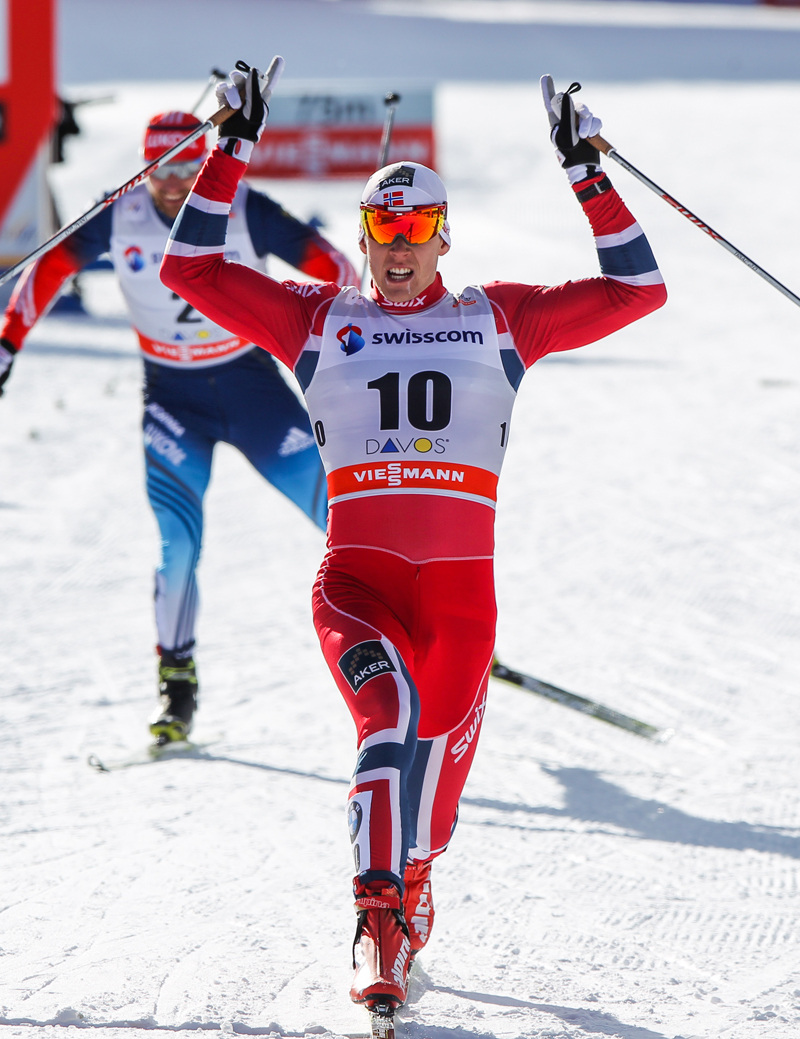
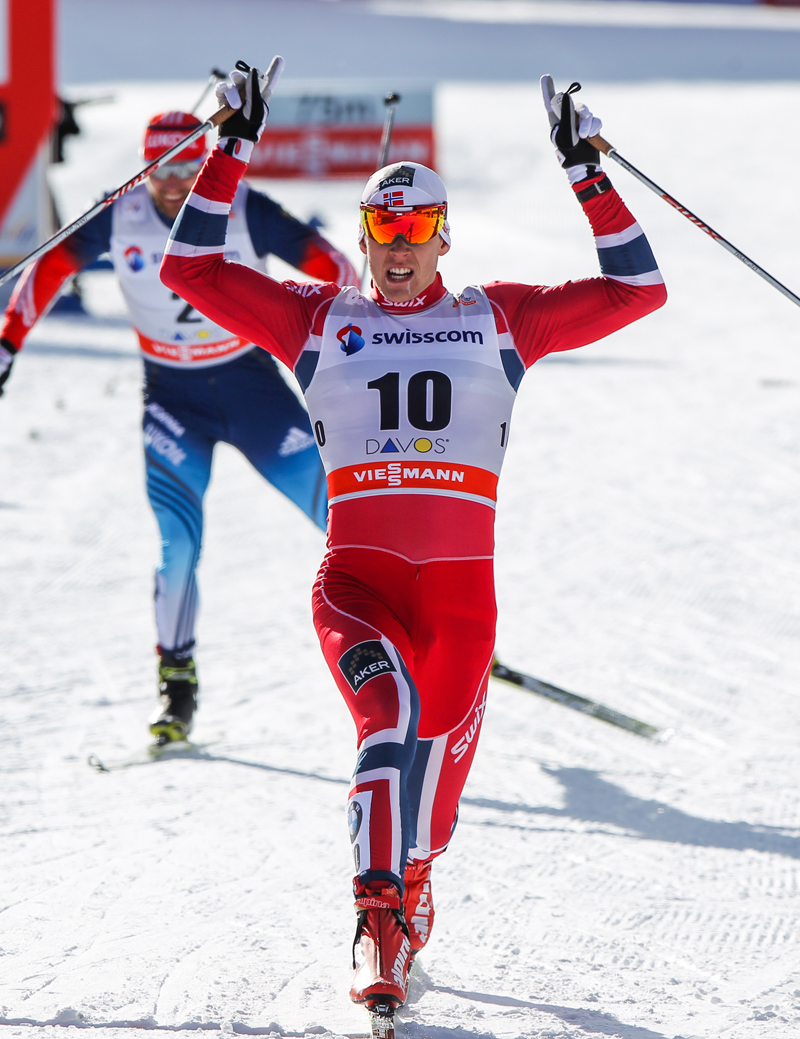
    Norway’s Anders Gløersen celebrates his win as he crosses the finish line (Photo: Fischer/Nordic Focus)
    Norway’s Anders Gløersen won Saturday’s 15 k freestyle in Davos, Switzerland for his first World Cup distance win. Pictured here, the 28-year-old celebrates a 2013 sprint win. (Photo: Fischer/Nordic Focus)

    Anders Gløersen had planned to sit out Saturday’s World Cup 15-kilometer freestyle interval start in Davos, Switzerland in order to rest for Sunday’s sprint. However, as fate would have it, several teammates came down with illness and Gløerson was placed on the start list.

    It turns out fate was in the Norwegian’s favor, as he earned his first World Cup distance victory in convincing fashion.

    An early starter with bib 15, Gløersen maintained a consistent pace throughout the majority of the course. While his 2 k time put him in 49th position, the Norwegian was able to increase his speed to give him the fourth fastest time at 12.8 k. It was in the last 3 k, however, where Gløersen won the race.

    Crossing the line with a time of 34:27.9, the 28-year-old endured a long wait in the leader’s chair before he officially won. Although he had skied the race of a lifetime, the field’s strongest competitors were still to come, including teammate Martin Johnsrud Sundby, who won last week’s 15 k classic on the same course.

    But as time went on, one famed name after another – from hometown-favorite Dario Cologna to Petter Northug – failed to match Gløersen’s effort.

    In bib 81, Sundby was the last starter for the men and nearly equalled Gloersen’s times at each split. At the 12.8 k mark, Sundby was only 0.5 seconds off of his teammate’s time. However, as Sundby rounded the corner into the stadium it was clear that he was nowhere near Gløersen.

    Knowing that he had skied a near-unbeatable pace in the final kilometers, Gløersen started realize that the victory was his.

    “When I saw Martin Sundby behind me after 12.8 km I started to believe I could win. I knew I had a very good final part of the competition,” he said to FIS in a post-race interview.

    Gløersen, who has earned victories in four previous World Cup spirnts, said that he was surprised by the result, but that he had high expectations before Saturday’s race due to his increased distance training.

    “I have been training for 15 km free technique. This is my first victory in a distance competition and it means a lot for me,” he said to FIS.

    Behind Gløersen in second was Northug, who finished 4.8 seconds off the winning time. Northug skied in the top-ten through the majority of the race and then delivered a characteristic strong finish to overcome all but Gløersen.

    Northug also said he was surprised by his result.

    “I did not feel that good today and I did not think I was fighting for podium. My plan was to keep the high pace from the highest point to the stadium. I felt I had some power left after the two first laps. I had very good last 3 k,” he said to FIS.

    Northug told NRK Sport that he knew he was battling Gløersen and fifth place finisher Jean-Marc Gaillard throughout the race, but had no idea it was for the win – or even a podium position.

    The finish is Northug’s season-best in a distance race. His best previous finish this winter was in Lillehammer where he had the 14th fastest time in the 15 k classic to give him 15th overall in the mini tour.

    Unlike Gløersen and Northug, third place finisher Chris Andre Jespersen did not have a strong finish. At the 12.8 k mark he was the race leader, roughly five seconds ahead of Gløersen and Sundby. By the time he crossed the finish line, however, he was 10.4 seconds back.

    “I’m really satisfied with the third place but I was hoping for more. I have never had a good feeling in such a high altitude. The whole race was quite good for me but the last 2 km were really difficult,” he said to FIS.

    Jespersen told NRK Sport in a post-race interview that he placed his pole between his legs twice in the final kilometers, with both incidents resulting in a fall. Jespersen said that the falls may have cost him the win, but considering the time he lost, the 31-year-old was pleased to have finished on the podium.

    Following Jespersen was Calle Halfvarsson of Sweden in fourth (+11.6), Gaillard in fifth (+13.8), and Sundby in sixth (+14.9). Despite a strong start to the 15 k and a desire to gain his first World Cup victory in his native Switzerland, Cologna finished his day in 10th (+17.1).

    The 15 k was the last distance competition of period one racing on the World Cup. As skiers take a short break before starting the Tour de Ski, Sundby is the men’s World Cup leader followed by teammate Finn Hågen Krogh and Hafvarsson in second and third. After today’s race, Northug and Gløersen have advanced to fourth and ninth positions.

    Northug explained to NRK that he’s looking forward to the remainder of the season as he searches to find his top form.

    “Now I’ll relax and prepare for the Tour de Ski. After the Tour my shape will hopefully get better and better, and in Falun I will have a good feeling for the first time this season,” he said.

    World Cup racing continues Sunday in Davos with a 1.4 k freestyle sprint, where Gløersen will look to improve on his third place finish in the same event earlier this December.

    Results

  • Emily Nishikawa, Cockney Canadian National Champs in Classic Races

    Emily Nishikawa, Cockney Canadian National Champs in Classic Races

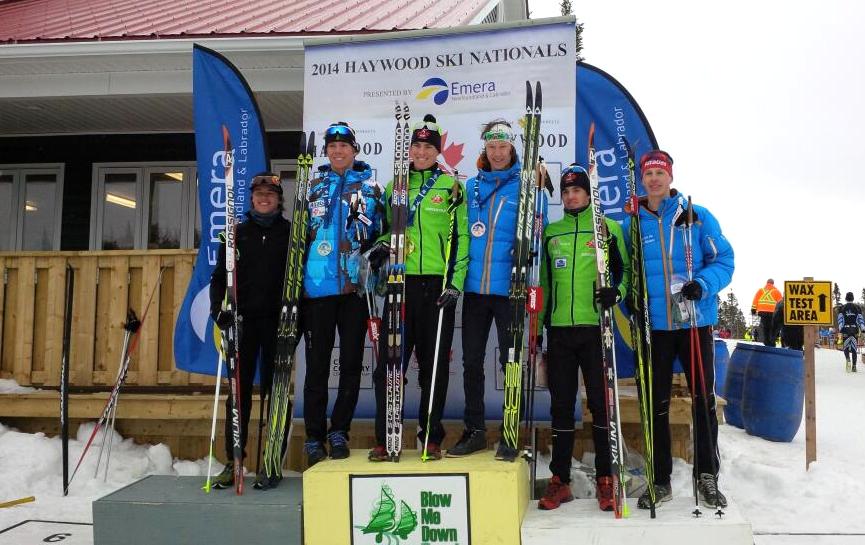
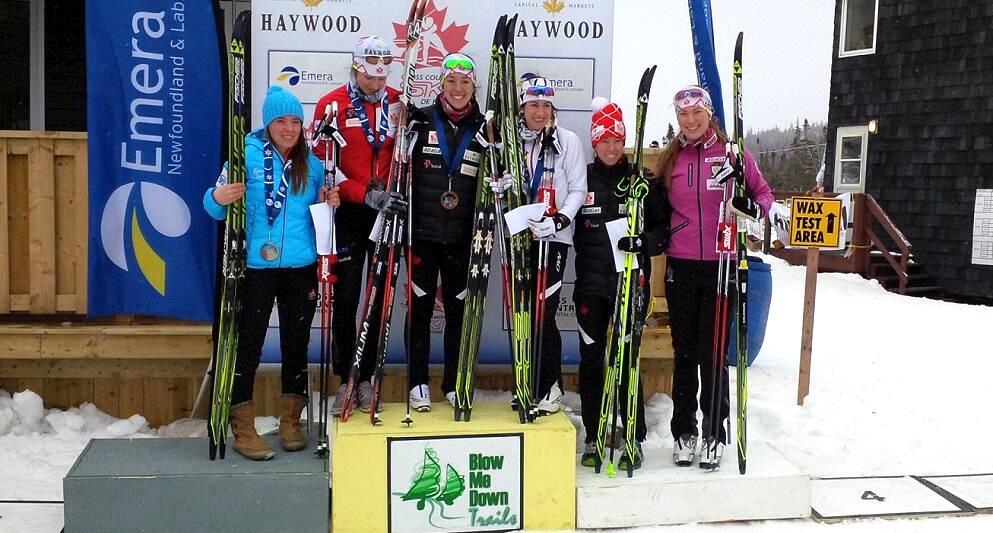
    The senior women’s 5 k classic interval start podium on Sunday at Canadian Nationals with winner Emily Nishikawa (AWCA/NST), Dasha Gaiazova (NST) in second and Amanda Ammar (Team Ninja) in third. (Photo: Cross Country Canada)
    The senior women’s 5 k classic interval start podium on Sunday at Canadian Nationals with winner Emily Nishikawa (AWCA/NST), Dasha Gaiazova (NST) in second and Amanda Ammar (Team Ninja) in third. (Photo: Cross Country Canada)

    CORNER BROOK, Newfoundland — The 2014 Canadian Ski Nationals started Saturday, March 15, with the classic team sprints. This year the five races, held over the course of a week, are at Blow Me Down Trails in Newfoundland.

    Sunday’s races were the 5- and 10-kilometer classic interval starts. Talking to the skiers afterwards, the big thing that defined this day of competition was adversity, particularly evident in the snow conditions. The race was really hard to wax for — with some skiers opting for klister, some hardwax and others going with zeros.

    But even with this much variation in what people were going with for grip, it seems that nobody really found the perfect set up. Pretty quickly, herringbone washed out the tracks and it turned into a competition of who could double pole the most.

    With steep hills, sketchy weather and limited grip, this was one of those races where the winner is the one who stays positive and adapts to the conditions rather than fight them.

    Here are Sunday’s champions:

    Senior Men: Jess Cockney

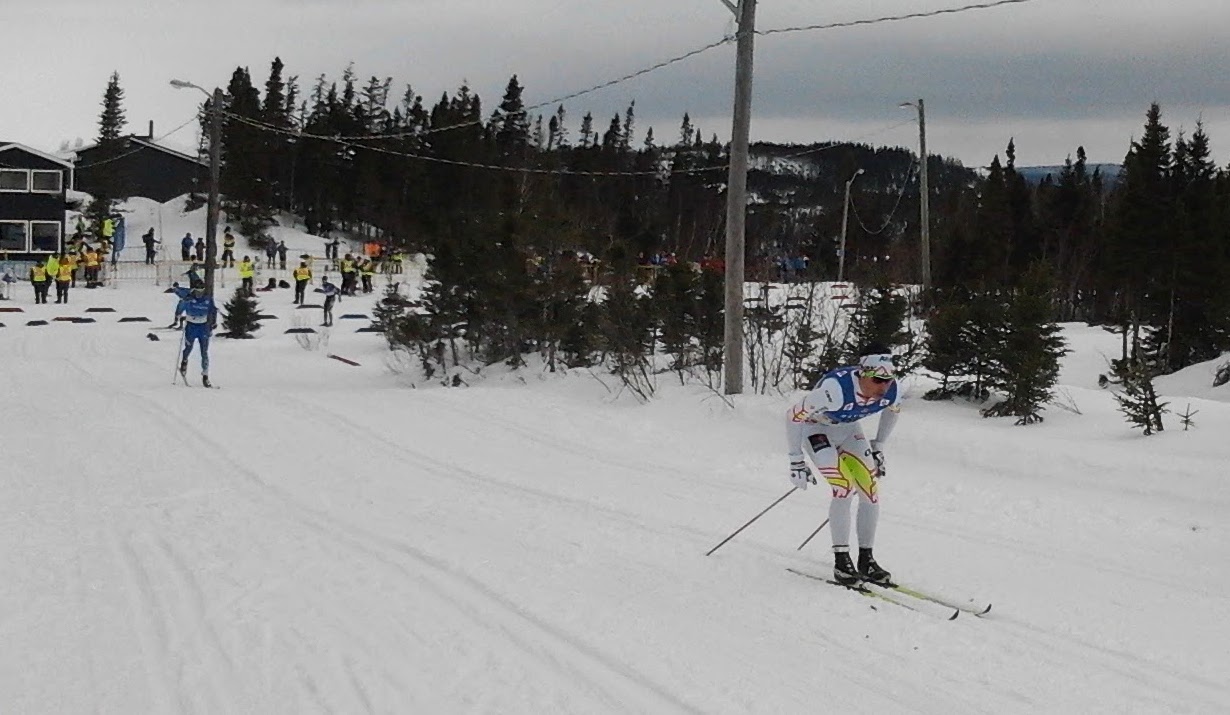
    Jess Cockney racing to his second-straight win at 2014 Canadian Nationals in the 5 k classic interval start on Sunday at Blow Me Down Trails in Newfoundland.
    Jess Cockney (r) racing to his second-straight win at 2014 Canadian Nationals in the 5 k classic interval start on Sunday at Blow Me Down Trails in Newfoundland.

    In the North-American skiing world, Jess Cockney, winner of the men’s 10 k classic, doesn’t really need an introduction. For those living under a rock (or a lot of snow), he trains out of Canmore with the Alberta World Cup Academy (AWCA) and National Senior Development Team (NST) and just returned from his first Olympics at the Winter Games in Sochi, Russia.

    1. Something about Jess that doesn’t have to do with skiing: “I run a fantasy football league through the NFL season. 2012 League Champion!”
    2. Was there anything in particular training-wise that you did this past summer that really contributed to your performance today? “I double poled most of today’s race so all the strength work and long double pole sessions really helped with today.”
    3. Was there any aspect — positive, negative or otherwise — that stood out about today’s race? “I had a ton of fun yesterday and today and had great feelings in the races so I’ll just try to keep the fun going for the rest of the week!”

    Senior Men’s 10 k Classic Top 10

    1. Jesse Cockney (AWCA/NST) 27:38.1

    2. Kevin Sandau (AWCA/NST) +1.1

    3. Knute Johnsgaard (Yukon Elite) +10.0

    4. Colin Abbott (Yukon Elite) +25.5

    5. Frédéric Touchette  (Laval) +35.7

    6. Michael Somppi (AWCA/NST) +40.1

    7. Raphaël Couturier (CNEPH/NST) +42.7

    8. Russell Kennedy (AWCA) +43.7

    9. Graeme Killick (AWCA/NST) +49.0

    10. Bob Thompson (NDC Thunder Bay) +1:15.4

    Senior Women: Emily Nishikawa

    Like Cockney, Nishikawa doesn’t need much of an introduction. She also won her first title of the week in the team sprint and trains with the AWCA and NST and is just back from representing the red maple leaf at her first Olympics.

    1. Something about Emily that doesn’t have to do with skiing: “I used to be a competitive gymnast. My best result was winning the Jurassic Classic when I was 11!”
    2. Was there anything in particular training-wise that you did this past summer that really contributed to your performance today? “I’ve been working really hard all year, and other than that one cold I’ve been healthy all year. I think that contributed to today’s performance.”
    3. Was there any aspect — positive, negative or otherwise — that stood out about today’s race? “Today’s race was really fun, with tricky conditions. I was happy to make the skis work as best I could. This is my first time in Newfoundland and I am so excited to be here!”

    Senior Women’s 5 k Classic Top 10

    1. Emily Nishikawa (AWCA/NST) 14:54.5

    2. Dasha Gaiazova (World Cup Team) +1.6

    3. Amanda Ammar (Team Ninja)+27.3

    4. Perianne Jones (World Cup Team) +38.2

    5. Kendra Murray (Carleton) +1:03.9

    6. Heidi Widmer (AWCA/NST) +1:06.7

    7. Alysson Marshall (AWCA/NST) +1:10.1

    8. Erin Tribe (NDC Thunder Bay) +1:16.2

    9. Alannah Maclean (NDC Thunder Bay) +1:21.9

    10. Chisa Obayashi (Madshus Japan) +1:26.9

    Junior Men: Scott Hill

    The junior men's podium in the classic interval start at 2014 Canadian Nationals, with winner Scott Hill (NDC Thunder Bay).
    The junior men’s podium in the classic interval start at 2014 Canadian Nationals, with winner Scott Hill (NDC Thunder Bay), Colin Foley (CVTC) in second and Alexis Dumas (QC ST) in third. (Photo: Cross Country Canada)

    An Ontario native and member of NDC Thunder Bay and National Junior Team, Hill took gold in the junior men’s 10 k race.

    1. Something about Scott that doesn’t really have to do with skiing: “My younger self’s goal was to play in the NBA–and be a part time ski-racer.”
    2. Was there anything in particular training-wise that you did this past summer that really contributed to your performance today? “I became an overall-better runner this year completing many running workouts.”
    3. Was there any aspect — positive, negative or otherwise — that stood out about today’s race? “Going into the race I was prepared to not have the best wax. I knew that wax was going to be an issue for everyone and that I could still do well as long as I didn’t let the conditions get to me.”

    Junior Men’s 10 k Classic Top 10

    1. Scott Hill (NDC Thunder Bay/NST) 28:48.9

    2. Colin Foley (CVTC) +27.6

    3. Alexis Dumas (QC ST) +34.7

    4. Evan Palmer-Charrette (NDC Thunder Bay/NST) +46.3

    5. Julien Lamoureux (Cégep Édouard-Montpetit) +46.8

    6. Nicholas Pigeon (Skinouk) +1:15.4

    7. Benjamin Wilkinson-Zan (NDC Thunder Bay/NST) +1:20.6

    8. Conor Thompson (Cégep Édouard-Montpetit) +1:29.1

    9. Frédéric Samson (Skibec) +1:54.9

    10. Gavin Shields (OST) +1:58

    Junior Women: Dahria Beatty

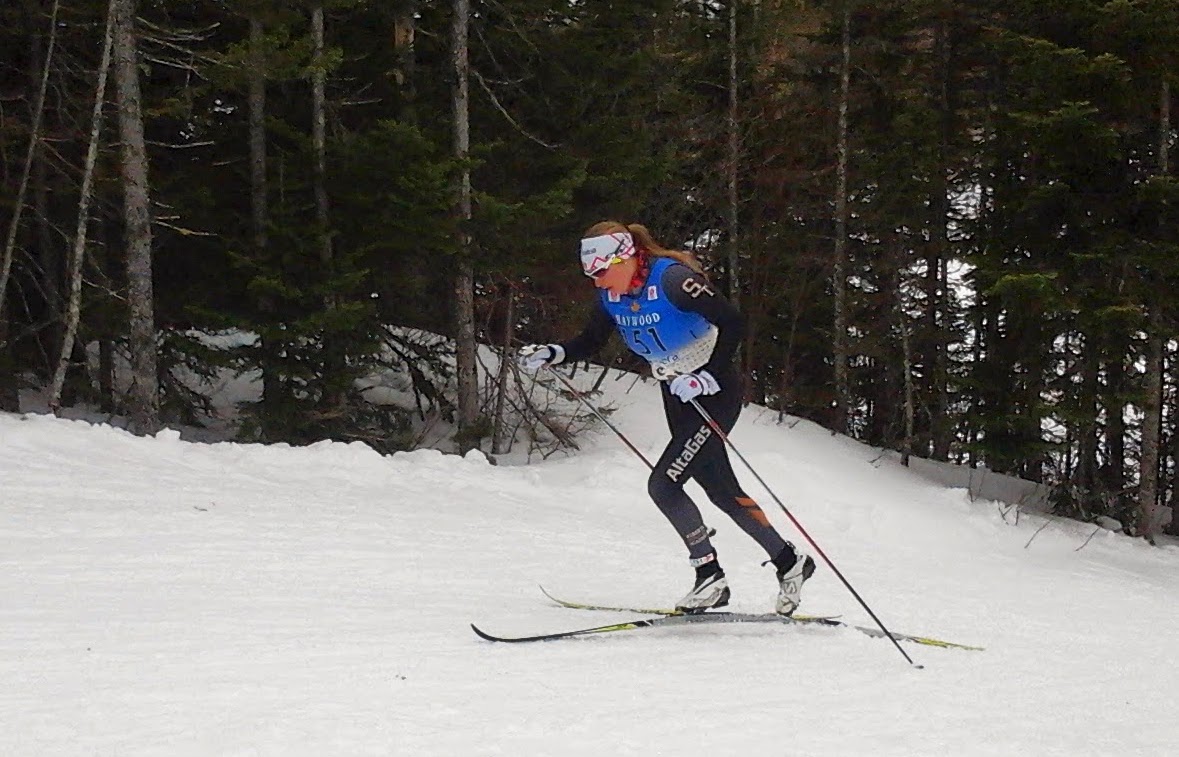
    Dahria Beatty racing to a junior title in the 5 k classic interval start on Sunday at 2014 Canadian Nationals in Corner Brook, Newfoundland.
    Dahria Beatty racing to a junior title in the 5 k classic interval start on Sunday at 2014 Canadian Nationals in Corner Brook, Newfoundland.

    Two days after teaming up with Nishikawa to win the classic team sprint, Beatty, of the AWCA and Junior National Team member, took top spot on the podium in the junior women’s 5 k race.

    Originally from the Yukon, she spends her offseason in Canmore training with the AWCA. This year she’s seen some solid results in the European race scene, both at Junior World Championships and on the Scandinavian Cup B-Tour.

    1. Something about Dahria that doesn’t have to do with skiing: “I have a tendency to impulse buy plaid shirts.”
    2. Was there anything in particular training-wise that you did this past summer that really contributed to your performance today? “To be honest I really think it was all the time I spent walking Loki, the Davies’ family dog, (with whom I live). It really adds up and my competitors just can’t match it. “
    3. Was there any aspect — positive, negative or otherwise — that stood out about today’s race? “The conditions today were pretty interesting and very similar to the ones I had in Europe racing at World Juniors and on the B Tour. This made it very advantageous to me, using what I learned over there I knew what was necessary in order to have the race I wanted. It was also super cool to be so close to World Cup skiers and it is very motivating for the future.”

    Junior Women’s 5 k Classic Sprint Top 10

    1. Dahria Beatty (AWCA/NST) 15:35.3

    2. Katherine Stewart-Jones (QC ST/NST) +22.9

    3. Annah Hanthorn (YTST) +54.4

    4. Sophie Carrier-Laforte (Skinouk) +56.9

    5. Maya Macisaac-Jones (CNEPH/NST) +1:02.8

    6. Jennifer Jackson (NDC Thunder Bay/NST) +1:17.6

    7. Frédérique Vézina (CNEPH/NST) +1:22.6

    8. Anne-Marie Comeau (CNEPH/NST) +1:26.7

    9. Emilie Stewart-Jones (Nordique) +1:27.4

    10. Alexandra Slobodian (Carleton) +1:46.3

    Complete results

    ***

    About the Author: A Canadian cross-country ski racer with the Alberta World Cup Academy, Zeke spends most of his time in Canmore, Alberta, but calls Cantley, Quebec, his home. He thinks that you can learn a lot about a person from their goals — his is to ski really fast on the Winter Olympic race course in 2018. Unfortunately he is not competing at 2014 Canadian Nationals on account of an injury. Check out his blog: zekewilliams1.blogspot.ca.


  • Scoring WC Points Is Far, Far Harder Today Than In 1983

    This post is somewhat of a teaser trailer for the sorts of things we can do once we have a complete record of major international ski results stretching back to the 70′s.

    A natural and possibly controversial question is whether the World Cup field has become more or less competitive over time.  Intuitively, I think it’s clear that it probably has.  That’s just the natural progression of any sport as it attracts more money, sponsors and participants.  The skiing community as a whole simply gets better at producing fast skiers.

    But this process can make it difficult to compare the results of today’s athletes to those of many years ago.

    In a sort of XC skiing data fantasy world, we’d like to make direct comparisons between modern skiers and historical skiers (i.e. is Petter Northug faster than Gunde Svan?).  The only real way to answer that question would involve time travel.  We can, however, make relative comparisons about the entire field.  So we can ask the following: Is the average 30th place finisher on today’s World Cup closer to or further behind the winner than the average 30th place finisher in 1984?

    To do this I grabbed some preliminary data from my big data entry project.  To keep the comparison and fair (and simple) as possible, we’re only going to look at men’s interval start classic races.  (I think it’s pretty obvious that skating comparisons are going to be problematic.)

    I happened to have all the results for World Cup races from the 1982-1983 and 1983-1984 seasons, so those races will serve as our “historical” data set.  I’m assuming that all these races were classic races, which isn’t technically correct, if I have my history right.  At least a few of these races had experimental “skating zones” where people were allowed to skate for a few hundred meters at a time.  Personally, I think that’s a small enough deviation from “classic skiing” that for these purposes, we needn’t worry.

    Next, we’ll take a roughly equivalent number of modern men’s interval start classic races.  The result is around twenty historical races and twenty modern ones (from across the last several seasons, since classic interval start races are more spread out in the schedule).

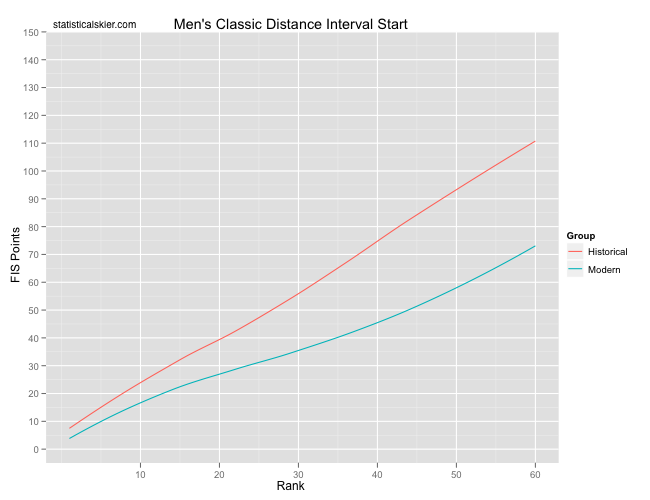
    The following graph shows the average FIS points (calculated using modern rules for all races) for both groups versus finishing place:

    I was expecting the average modern skier to be closer to the winner, but I wasn’t expecting the difference to be this large or to range across the entire field like this.

    Now, World Cup point rules have changed as well.  Back in the day, only the top twenty scored points, and the point scale differed.  Still, we can make some sensible comparisons for the average 10th, 20th, etc. place finishers here.

    For interval start races, FIS points are essentially just percent back times 800.  This means that the average male 30th place finisher in the early 80′s was ~2.5% further behind the winner than today’s average male 30th place finisher.  Two and a half percent!  That’s probably almost a minute in a 15km and just over two minutes in a 30km.

    Obviously, the point here isn’t that the skiers from back in the day were slow.  Remember, we can’t say things like that because that would be a direct comparison.  It’s just that when the sport was younger, there were fewer people able to ski close to the winner.

    The way I like to think about this is to compare the World Cup circuit to a game of musical chairs. This entails reading the above graph “backwards”. Let’s start with a 30 FIS point World Cup result. If we move across horizontally from that spot on the y axis, we see that there were typically around 15 skiers in the early 80′s who were capable of finishing that close to the leader. Continuing across the graph, we can see that that number has increased to around 25 now. So you could think of that as adding 10 people to a game of musical chairs that started with 15 people and 15 chairs.

    Related posts:

    1. <Predicting FIS Points For World Cup Races
    2. <Predicting World Cup FIS Points (con’t)
    3. <Are Women’s WC Fields Really ‘Weaker’?


  • Noah Hoffman’s Pacing

    I was interested (rather than offended) to read about Noah Hoffman’s pacing strategies in Sunday’s classic WC race. I have a limited supply of data on split times (what I do have is thanks to Jan over at worldofxc.com, though) so the following data is definitely incomplete.

    Hoffman seemed determined to not start too fast, something that apparently he does quite often. Since pacing interval start races is so much different than mass start or pursuits, we’ll only look at his splits for interval start races. I only have split times from a total of eight WC-level interval start races for him (of varying lengths). Here’s a simple graph showing them all together, with Sunday’s race highlighted with the black dashed line:

    This is a very crude representation of split times, where I’ve simply plotted how fast Hoffman skied each timed section compared to the field. So, for example, the y-axis means he had the 20th fastest, 40th fastest, etc. split time on that section.

    In order to compare races of different length I’ve converted the x-axis from raw kilometers to a percentage of the total race distance. (This may be dubious, since pacing strategies will be markedly different in a 15k versus a 30k. However, these data consist of two 10k’s, five 15k’s and only one 30k, so I think we’re on fairly safe ground.)

    Certainly Noah’s first split was slower than his subsequent splits on Sunday. And it was the 3rd slowest initial split of the eight I have. But it seems to me like he proceeded to ski the rest of the race fairly consistently, rather than gradually accelerating. At least, until he faded a bit on the last section.

    This is in contrast to several of the other lines here that begin with fairly quick initial splits, but by mid-race he’s clocking only ~60th fastest time on each section or so. So whatever he did seemed to work.

    I should say that I’m fairly cautious about my ability to analyze split times. I’m sure the coaches are keeping more detailed data on this sort of thing than I have access to. But it’s interesting, nonetheless.

    Related posts:

    1. <Should You Start Fast Or Slow?
    2. <US World Cup Split Times
    3. <Canadian World Cup Splits


  • Södergren Frustrated By Evolution of XC Skiing

    Anders Soedergren helping his Swedish team to victory in the men's 4×10 k relay at the 2010 Olympics

    Anders Soedergren (SWE) is considered one of the best 50 K racers in the world, and has a first place from the venerable Holmenkollen 50 K on his resume.

    However, the Swede won’t have a chance to put his capacity to work on that distance in the upcoming World Cup season. The FIS Congress in Turkey nailed a World Cup schedule with no 50 K events for 2010-2011.

    The lack of a World Cup 50 K race has Soedergren frustrated. “XC skiing is well on its way to lose its identity and its character,” Soedergren said to zsport.se.

    The 50K during the 2011 World Championships in Holmenkollen will be the only race of that distance this season, and that event is a mass start, which typically have held no advantages for a skier like Soedergren. “There was an opportunity to make the World Championship 50 K an individual start race, but Norway vetoed the suggestion. They have Northug,” Soedergren said to the Swedish national TV station SVT.

    Soedergren is not afraid to speak his mind on what he thinks of the recent evolution of FIS-governed XC skiing. “I don’t mind changes, but not all of the changes have been for the better,” he concludes.

    From www.langrenn.com, June 22, 2010.