From the FasterSkier archive — posts syndicated from athletes’ and coaches’ own blogs between 2004 and 2012, kept online as published. Current coverage is at fasterskier.com.

Tag: interval training

  • Threshold Versus VO2max Training: Are We Asking the Right Question?

    Threshold Versus VO2max Training: Are We Asking the Right Question?

    This article was made possible through the generous support of our voluntary subscribers. If you value coverage like this, please support FasterSkier with a voluntary subscription.
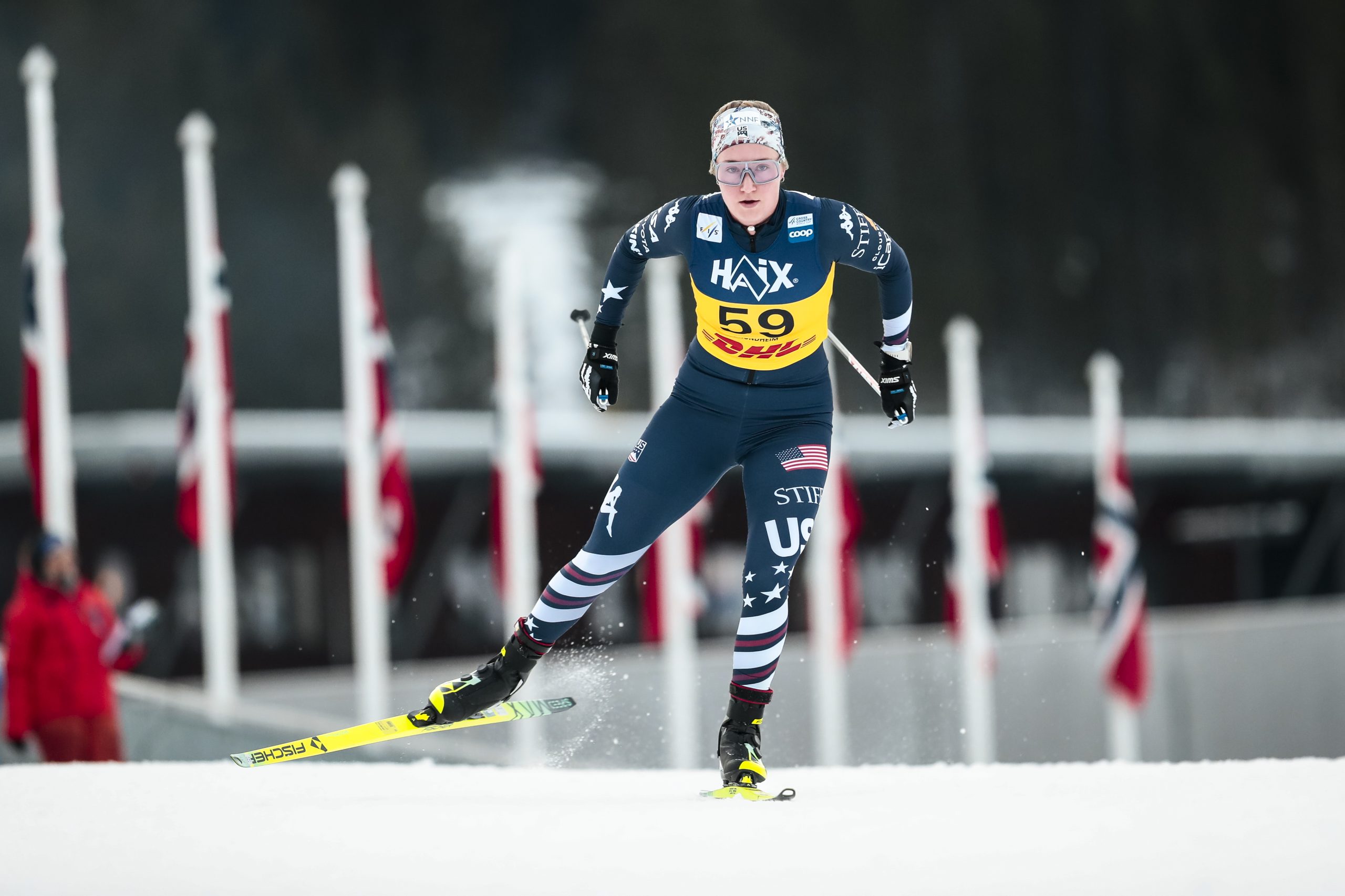
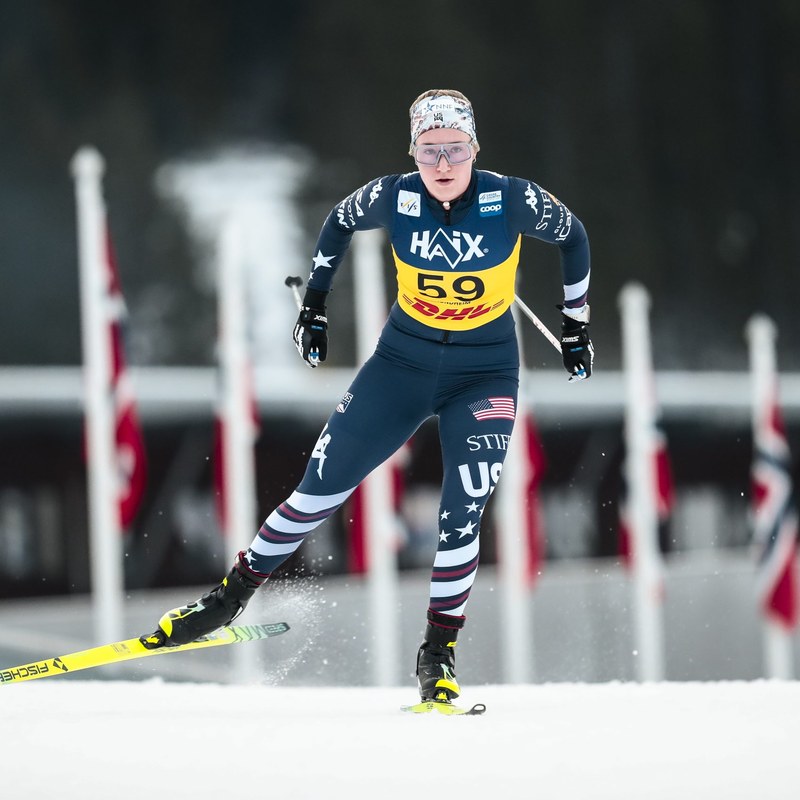
    Kate Oldham in a U.S. team suit and yellow bib 59 skating toward the camera past a row of flags
    Kate Oldham racing the 10 k freestyle at the Trondheim World Cup in December 2025. Races of 5 to 15 kilometers, Jim Galanes points out, are not raced at threshold. (Photo: Modica/NordicFocus)

    For the last couple of decades, the priority for high-intensity training has shifted from threshold, to VO2max, and now back to threshold again. Nowadays threshold training is increasingly presented as the ideal endurance training intensity. The suggestion is a high aerobic stimulus at a low recovery cost, repeatable and sustainable. VO2max is often portrayed as the opposite: a very high stimulus, high stress, very high fatigue, and something to be used carefully, if at all. Folks, we have seen this story before, in the threshold boom of the mid to late ’90s.

    From some perspectives this may be intuitively correct and perhaps logical. If we compare one minute of threshold work to one minute at VO2max intensity, the VO2max work is more demanding. That is a no-brainer. There is more carbohydrate use, higher oxygen demand, higher lactate production, greater perceived exertion and generally a greater physiological disturbance. But is that the way training really works? We build training plans around individual workouts and daily and weekly loads, not per minute of high-intensity training.

    For example, we might plan 5 x 4 minutes at VO2max intensity, or 20 minutes of total work. Or it might be 4 x 10 minutes at threshold, or 40 minutes of total work. When we look at the load of the whole session, things become far less clear. Both types of training produce similar adaptations, although the adaptive signal from the higher-intensity work is much stronger, and there is little evidence that a threshold session creates less recovery demand than an appropriately controlled VO2max session.

    This is really the point I want to make. We need to stop confusing intensity with training load, and, perhaps more important, we need to stop confusing training load with the recovery timeline. They are related, but they are not the same thing.

    As I have written before, threshold is a moving target, and defining it is problematic. There are perhaps a dozen or more methods used to determine threshold, and they can produce very different speeds, heart rates, power outputs and lactate values. Some athletes are working just above LT1 and calling it threshold. Others are working around 4 mmol, and others are using ventilatory threshold, critical power, some percentage of race pace, or simply an intensity that feels controlled and hard. So when people say “threshold training,” I am not sure we are even talking about the same thing. That alone should make us careful about assigning a fixed physiological cost or benefit to threshold training.

    The generally accepted training model is usually described like this: easy endurance training provides a relatively small stimulus at a relatively low cost, so we need a lot of it. Threshold gives us a much larger aerobic stimulus, still at a manageable recovery cost. VO2max gives us a very large stimulus, but at a very high recovery cost. Again, that makes intuitive sense, but is it true when we compare realistic sessions? I am not convinced it is. In fact, I am certain it is not.

    If we think of training load in simple terms, it is a combination of intensity and duration. Higher intensity produces greater load per minute, while longer duration produces more total load. A 3-hour easy workout, for example, produces a bigger training load than a 75-minute workout with 5 x 4 minutes of VO2max intervals. This is obvious, but somehow we often forget it when discussing threshold and VO2max training.

    Take a typical VO2max workout of five by four minutes, 20 minutes of work. Using Firstbeat’s TRIMP model, that might create about 55 to 60 TRIMP. Now take a threshold workout of four by ten minutes, 40 minutes of work. That might generate something in the 95 to 100 TRIMP range. With Firstbeat we can also look at EPOC as an estimate of the disturbance of homeostasis. Again, these are estimates and certainly not perfect measures, but 20 minutes at around 90 percent of VO2max might produce an EPOC of around 175 ml/kg, while 40 minutes at around 85 percent might produce an EPOC of 225 ml/kg. Once again the threshold workout produces a significantly higher stress load.

    I don’t want to get hung up on whether those exact Firstbeat numbers are accurate, because that is not really the point. The point is that it is entirely possible for the lower-intensity session to produce the larger total load, and that should not surprise anyone, because it is twice as long.

    The same thing happens if we use session RPE. Twenty minutes of VO2max work at an RPE of 9 gives us 180 AU (arbitrary units), while forty minutes of threshold at an RPE of 6 gives us 240 AU. Again, the threshold session creates the larger estimated training load. That does not prove threshold is more stressful or that it takes longer to recover from. TRIMP and session RPE are measures or estimates of training load, not measurements of recovery time.

    We have at least three different things being discussed as if they were the same: the intensity of the exercise, the total load of the workout, and how long it takes the athlete to recover. A VO2max interval clearly creates greater physiological disturbance per minute. A longer threshold session may create a greater total training load. Neither one, by itself, tells us which athlete will be better recovered 24 or 48 hours later.

    High cost per minute is not the same thing as high cost per session, and high session load is not necessarily the same thing as longer recovery.

    Four skiers rollerskiing in a line up a switchback road climbing out of a green alpine valley
    Otto Invenius, Campbell Wright, Maxime Germain and Adam Runnalls climbing the Stelvio Pass on rollerskis above Livigno, Italy, in July 2025. The adaptations from threshold and VO2max work overlap far more than the zone names suggest. (Photo: Manzoni/NordicFocus)

    What Are We Actually Trying to Adapt?

    The other issue is that we spend far too much time talking about training zones and not enough time talking about desired adaptations. What adaptations are we trying to create? That should come first.

    VO2max training provides a very strong aerobic stimulus at near-maximal oxidative capacity. It can increase maximal cardiac output, improve oxygen transport, create very high muscular oxygen demand and expose the athlete to speeds and power outputs similar to race demands. Threshold training lets us accumulate a large amount of work at a high aerobic fractional utilization. It can improve sustainable speed or power, oxidative capacity at that intensity, and the ability to maintain a high percentage of maximal aerobic power for a longer period of time.

    These adaptations overlap a great deal. I sometimes hear people talk as if threshold develops lactate clearance and the muscles’ ability to sustain work, while VO2max develops the central cardiovascular system. But VO2max training creates a large muscular stimulus as well. ATP turnover is very high, calcium flux is high, metabolic disturbance is high, and the signaling associated with mitochondrial biogenesis is substantial. VO2max training is not simply “central cardiovascular training.” It also provides a significant peripheral training stimulus.

    Threshold training obviously produces a similar but slightly smaller mitochondrial and muscular signal for adaptation. But I think its real advantage may be something much simpler. Because the intensity is lower, we can normally do considerably more of it. That allows us to accumulate a large amount of work at a high aerobic fractional utilization, with substantial muscular recruitment and a large amount of sport-specific work.

    That may be threshold training’s most important characteristic. Not that it creates some unique physiological adaptation unavailable at other intensities, but that it allows us to accumulate considerably more work while still creating a high oxidative demand.

    This can be particularly important for an athlete who already has a high VO2max and whose limitation is the fraction of that VO2max that can be sustained. If fractional utilization is relatively low, increasing sustainable aerobic power may be far more important than trying to push VO2max another few percent. For that athlete, a greater amount of threshold work may make very good sense.

    But that is an argument based on the needs of the athlete, not an argument that threshold is inherently a better training intensity or that we recover from it more quickly.

    Lactate clearance and resynthesis is another area where I think training discussions have become confused. We often hear that threshold training is necessary because the athlete needs to train to “clear lactate.” I have always had a problem with this explanation, because it is neither accurate nor scientifically valid. Remember, it is lactate we are talking about, not lactic acid, as many refer to it.

    Lactate is not a waste product that suddenly appears at threshold and then needs to be removed. It is being produced, transported and oxidized all the time, at all intensities, and it is an important fuel. Endurance training improves the ability to transport and oxidize lactate, but there is no reason to believe this only happens at threshold. High-intensity interval training also improves lactate transport and can move lactate threshold substantially.

    VO2max intervals also create very high lactate production and turnover. So if we are looking at the lactate shuttle, why would it only, or even preferentially, adapt when lactate is sitting around 2, 3 or 4 mmol? That doesn’t make much physiological sense to me. Producing higher levels of lactate will stimulate resynthesis.

    The same is true for mitochondrial biogenesis, oxidative enzymes and capillarization. We cannot neatly assign these adaptations to one training zone, because there is considerable overlap between endurance, threshold and high-intensity training.

    That doesn’t mean all intensities are the same. They clearly aren’t. It means we should be careful about inventing unique adaptations for a training zone simply because we have given that zone a name. Threshold training is not the only method, or even the optimal method, to improve lactate oxidation and resynthesis.
    A skier in a Vermont jacket and white helmet skating on rollerskis along a paved path lined with autumn trees
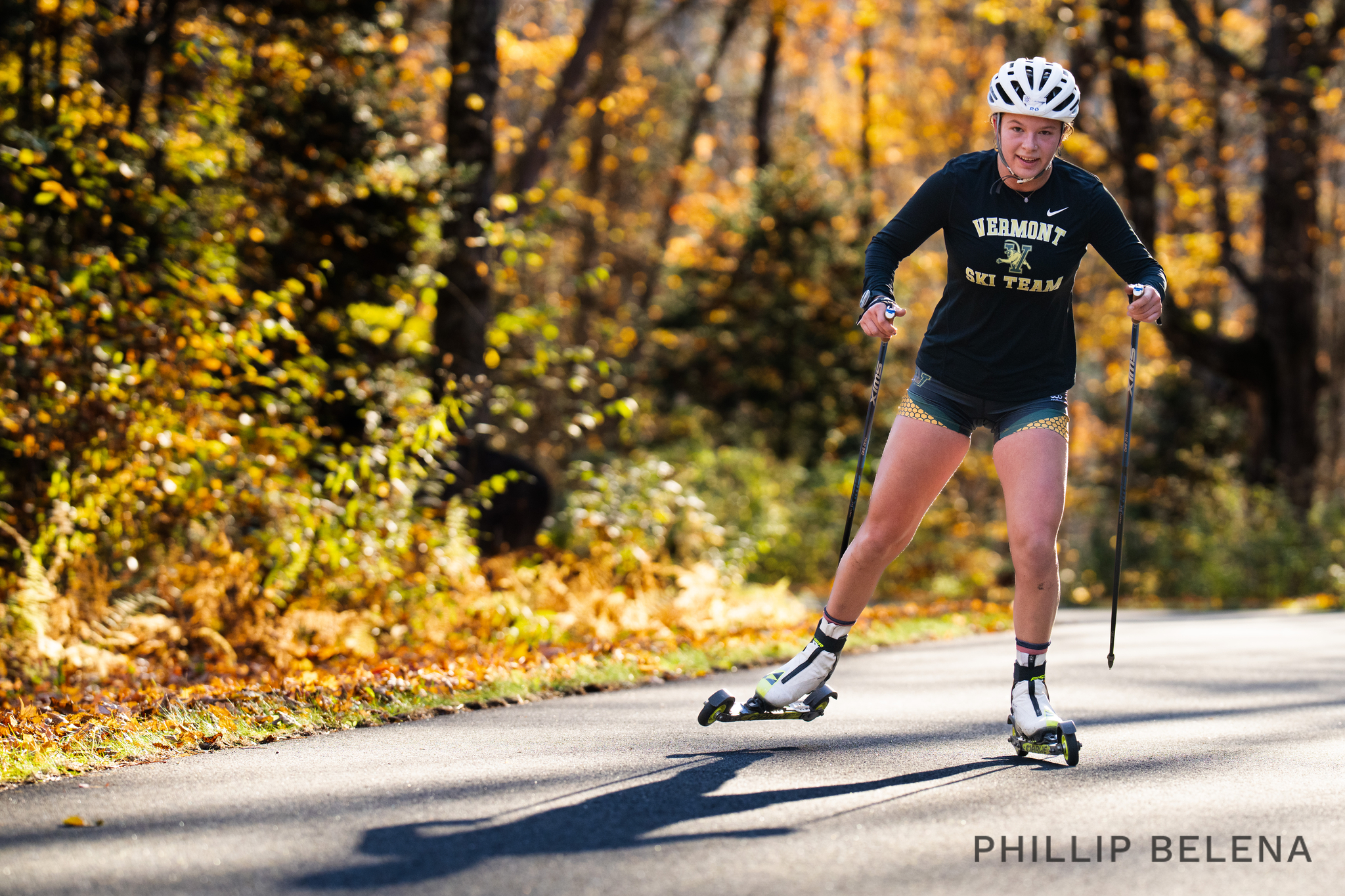
    A University of Vermont skier on rollerskis at Craftsbury Outdoor Center in October 2025. Autonomic, glycogen, muscular and mechanical recovery all run on different clocks. (Photo: Phillip Belena/EISA)

    What Is Recovery?

    Another problem in this discussion is recovery. People will say that threshold is easier to recover from. Maybe, but recover from what? Autonomic disturbance, glycogen depletion, neuromuscular fatigue, muscle damage, mechanical load, dehydration or psychological fatigue? These are not the same thing, and they do not necessarily recover at the same rate. A 2-hour run and a 2-hour rollerski at the same intensity, for example, carry very different mechanical loads to recover from.

    HRV may tell us something about autonomic recovery, which should also reflect other aspects of recovery but does not specifically measure them. Resting heart rate can tell us something, but again not everything. Blood lactate tells us something about what is happening during and immediately after the workout, but remarkably little about whether the athlete is going to train well 24 or 48 hours later. Creatine kinase may tell us something about muscle damage, but there is huge individual variation. So when we talk about recovery cost as if it were one number, I think we are being too simplistic.

    This is also why I don’t think we can simply use TRIMP, EPOC, duration, distance or session RPE to say one workout takes longer to recover from than another. They can give us useful information about internal load or physiological disturbance, but they are not recovery measurements. Ultimately, recovery must be considered in terms of which physiological systems were stressed and, more practically, what the athlete can do in the days immediately after a hard workout.

    Carbohydrate use is another good example. VO2max exercise clearly has a higher rate of carbohydrate use per minute than threshold exercise. But once again, the session matters more than the minute. Twenty minutes at VO2max intensity may have a very high glycogen cost per minute. Forty, fifty or sixty minutes at threshold has a somewhat lower rate, but it is sustained for two or three times as long. We cannot automatically assume that the shorter VO2max workout creates greater total glycogen depletion.

    This becomes particularly important when athletes are doing regular quality sessions. If glycogen restoration is an important part of recovery, a long threshold session may impose a very substantial recovery requirement despite producing lower lactate concentrations and feeling much more controlled. An athlete does not have to be lying on the ground after a workout for that workout to have been expensive to recover from.

    That is one of the problems I see with the idea that threshold can be repeated frequently simply because lactate is controlled. Low lactate does not necessarily mean low glycogen use, low muscular load or rapid recovery. If we keep extending the duration of the threshold work, at some point the additional work has a cost.

    Which brings us to what I think is probably the most meaningful recovery measure, and one that is surprisingly rarely studied: can the athlete perform the next important training session at the expected level?
    Three skiers in U.S. team suits and one in an orange jacket standing together on snow among pine trees
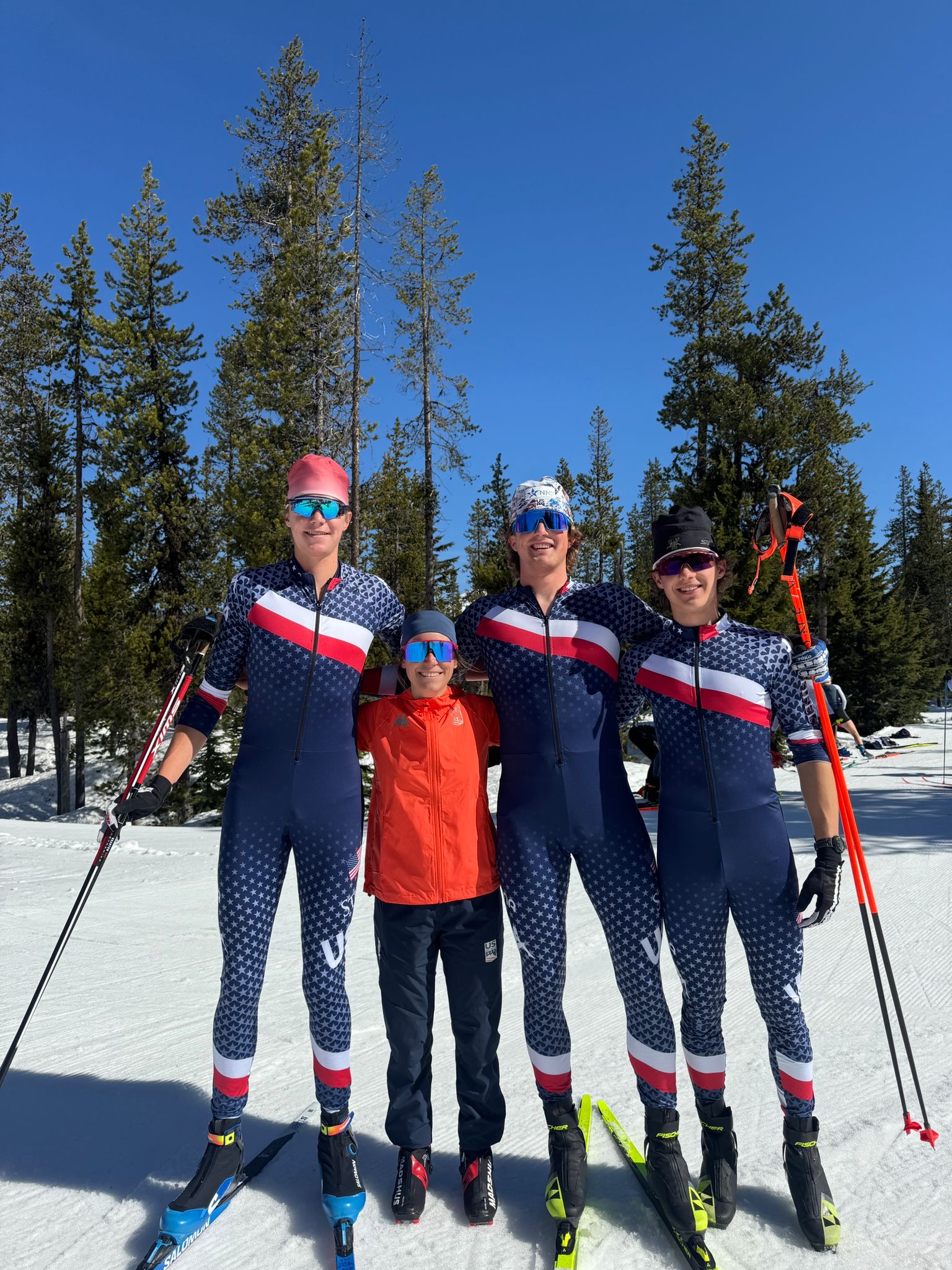
    Lucas Wilmot, Kristen Bourne, Murphy Kimball and Tabor Greenberg after their first L3 intervals at a 2025 camp in Bend, Oregon. (Photo: Leann Bentley)

    An Interesting Study

    One of the more interesting comparisons was made by Seiler, Haugen and Kuffel with highly trained runners. On one occasion the athletes did a threshold session of around 30 minutes between the first and second ventilatory thresholds, and on another, six three-minute intervals at around 95 to 96 percent of VO2max. I would point out that 95 to 96 percent of VO2max is already hard, and above what I would normally call a controlled VO2max session.

    The differences between the workouts were substantial. Lactate during the threshold session was around 2.7 mmol, while during the VO2max intervals it was around 7.1. Perceived exertion was also much higher during the VO2max workout. By almost any acute measure the VO2max workout looked harder, so we might reasonably expect recovery to take longer. But HRV recovery following the two sessions was remarkably similar.

    Now, this study does not fully answer the question. The threshold work was only around 30 minutes, HRV measures one part of recovery, and there are all kinds of differences between athletes. But it does challenge an assumption that I think is important. Greater acute metabolic disturbance does not necessarily mean longer recovery, but the dose does.

    It also raises what I think is an even more interesting question. What would have happened if the threshold session had contained 40 or 50 minutes of work rather than 30? That would be much closer to the threshold sessions many trained endurance athletes are actually doing.
    Campbell Wright (USA) works with his US Biathlon Team coach, Armin Auchentaller (ITA) this summer in Livigno (ITA). (Photo: NordicFocus)
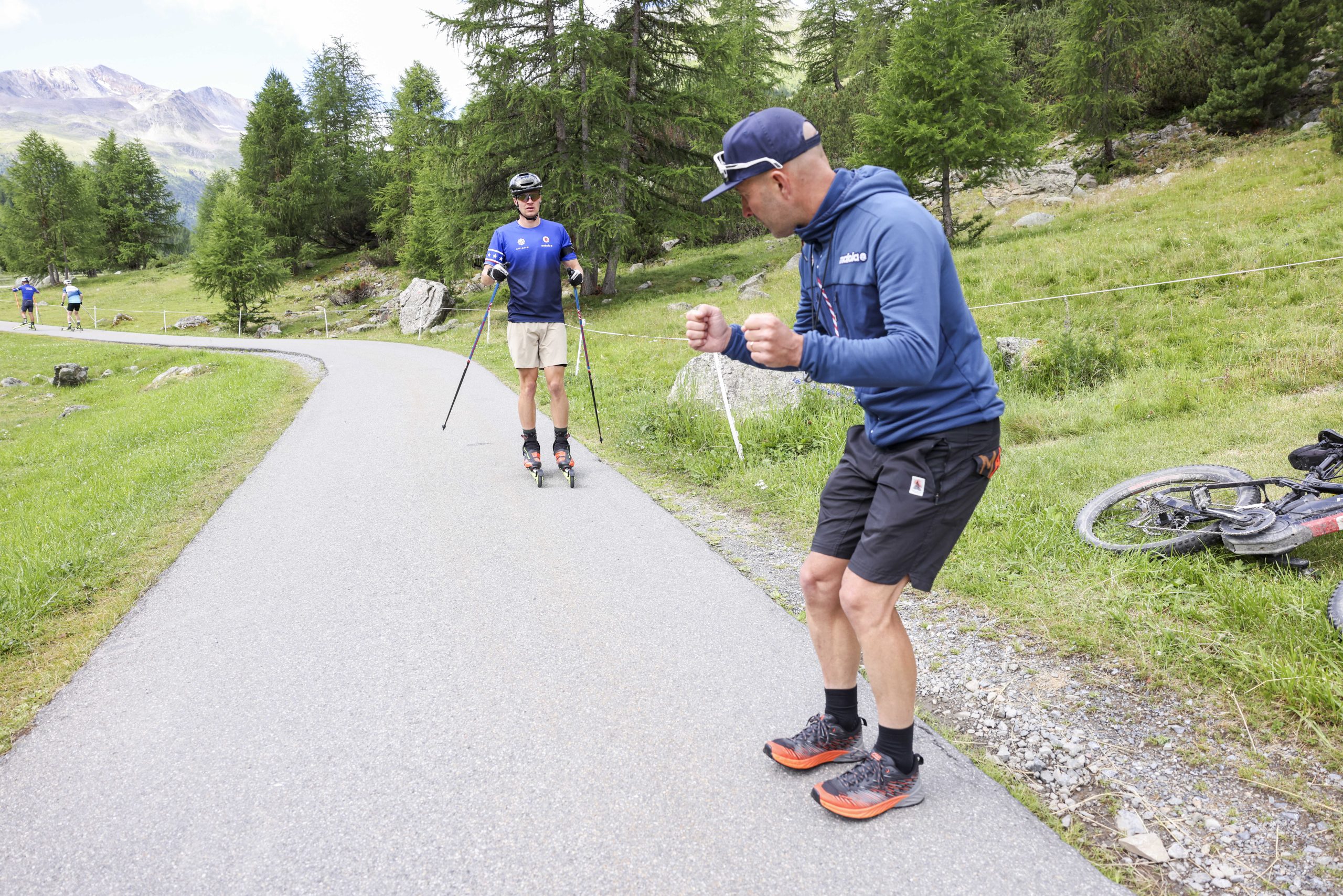
    U.S. Biathlon coach Armin Auchentaller with Campbell Wright during summer training in Livigno, Italy, in July 2025. A controlled VO2max session is about time at high oxygen uptake, not about producing as much lactate as possible. (Photo: Manzoni/NordicFocus)

    Control of VO2max Training

    There is another issue here that I think is important. A lot of people seem to think VO2max training means going as hard as possible. It doesn’t, at least not the way I see it and use it.

    If I give an athlete 5 x 4 minutes of VO2max work, I am not asking them to race every interval or see how much lactate they can produce. I am trying to get them to accumulate time at a very high oxygen uptake, typically around 90 to 95 percent of maximal heart rate and VO2max.

    If the objective is a cardiovascular and oxidative stimulus, we need sufficient intensity to drive oxygen consumption toward a very high fractional utilization of VO2max. For many athletes, something in the range of 90 to 95 percent of VO2max may be enough to accomplish that. Once we have produced the stimulus we are looking for, going harder does not necessarily make the workout better.

    This becomes important when we compare threshold and VO2max training. If someone compares a carefully controlled threshold session with a set of VO2max intervals performed as hard as possible, then of course the VO2max workout is going to look very stressful. But that may simply be a badly controlled VO2max workout.

    A well-controlled VO2max session and an all-out interval session are not the same workout, just as a controlled threshold session and a threshold session that slowly turns into a race are not the same workout. Anyone who has coached for very long has seen both.
    A skier in a green Vermont shirt and helmet skating on rollerskis down a paved path through autumn woods
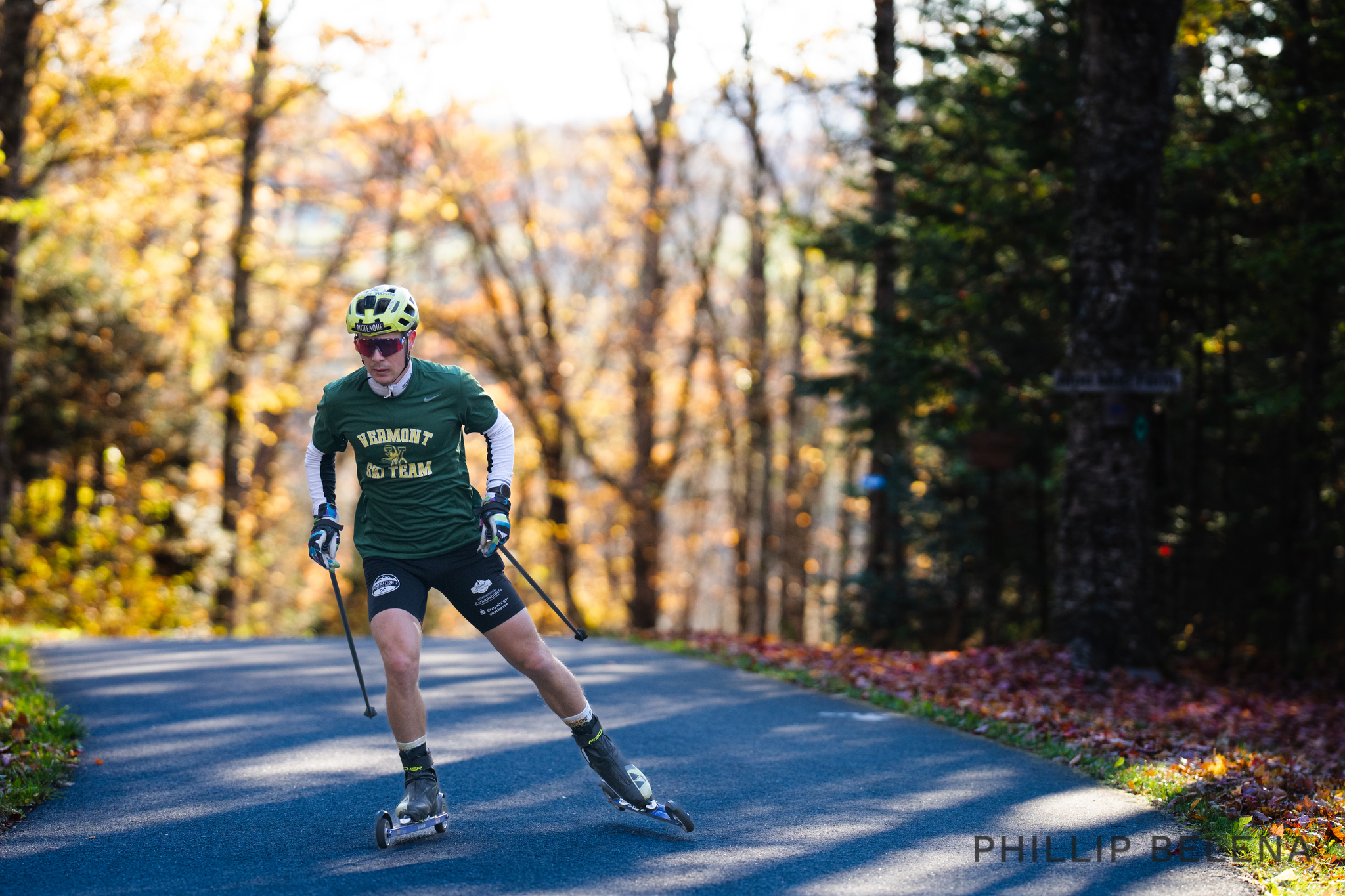
    A University of Vermont skier on the rollerski track at Craftsbury in October 2025. Forty minutes at threshold is a lot of work, and so is fifty, and so is sixty. (Photo: Phillip Belena/EISA)

    What Is Threshold’s Real Advantage?

    In my view, the strongest argument for threshold training is not that it produces some special adaptation, but that athletes can accumulate a lot of high-quality aerobic work. Forty minutes at threshold is a lot of work. Fifty minutes is a lot of work. Sixty minutes is a lot of work. For an elite endurance athlete doing a very large total training volume, that may be exactly what is needed, provided the athlete can recover from the overall workload of the training period.

    Threshold gives us a way to accumulate a substantial amount of work at high oxidative fractional utilization, with considerable muscular recruitment and a lot of sport-specific work. For an athlete with a high VO2max who needs to improve fractional utilization or sustainable aerobic power, this can be valuable.

    I think this is where some of the current discussion around threshold becomes problematic. Because it is controlled, because lactate is relatively low, and because the athlete is not destroyed afterward, threshold starts to be treated almost like endurance training. It isn’t. It is still hard training, and if you do enough of it, it carries a substantial training load and potentially a substantial recovery cost.

    The question is not simply whether forty or fifty minutes at threshold creates more adaptation than twenty minutes of VO2max work. It probably creates more of some kinds of stimulus simply because we are doing so much more work. The more useful question is whether the additional adaptation we get from that extra work is worth the additional load and recovery cost.
    Kevin Bolger in a U.S. suit skating downhill in fog with other racers and trees behind
    Kevin Bolger in the fog at the Oslo World Cup mass start in March 2026. The first question is what adaptation an athlete needs. The second is the smallest dose that will produce it. (Photo: Authamayou/NordicFocus)

    Are We Asking the Wrong Question?

    The debate is usually framed as threshold versus VO2max. Which is better? I don’t think that is the right question. The first question should be what adaptation this athlete needs. The second, and I think this is more important, is what is the smallest dose capable of producing that adaptation? It isn’t necessarily 40, 50 or 60 minutes. The third is what effect that dose will have on the training the athlete can perform over the next several days.

    We tend to assume that if some training is good, more of it must create a greater adaptation. Up to a point that is probably true. But the objective of training is not to produce the largest possible stimulus in every workout. It is to produce enough stimulus to create the adaptation while still being able to absorb the rest of the training.

    If an athlete has a relatively low VO2max and that is limiting performance, perhaps 15 or 20 minutes of controlled VO2max training gives us exactly the stimulus needed. If that is enough to stimulate the adaptation, why do 50 minutes of threshold just because threshold is currently popular?

    On the other hand, if an athlete already has a very high VO2max but relatively poor fractional utilization, and cannot sustain a high percentage of it, then perhaps a larger volume of threshold work is exactly what is required. In that case the ability to accumulate 40 or 50 minutes at high aerobic flux may be the important stimulus.

    A large group of skiers in bright vests rollerskiing up a two-lane road beside a grassy bank
    NENSA athletes rollerskiing together in Craftsbury, Vermont. A workout can look great on paper and still be the wrong choice if it costs the next two days. (Photo: Chris City)

    The Training Week Matters More Than the Workout

    I also think we make a mistake when we look at workouts in isolation. A workout can look great on paper and still be a poor training choice, because the real issue is not simply what happened during those 60 or 90 minutes. It is what that workout allows us to do over the next several days.

    Suppose a threshold workout produces 10 percent less adaptive stimulus than a VO2max session but allows the athlete to train substantially better over the following two days. Threshold may clearly have the better stimulus-to-recovery ratio and therefore be the better choice.

    But reverse the situation. Suppose 20 minutes of well-controlled VO2max work produces the adaptation we want and the athlete is ready to train normally the next day, while 40 or 60 minutes of threshold creates substantial glycogen depletion and muscular fatigue. In that circumstance, the shorter VO2max workout may have the better stimulus-to-recovery ratio.

    We shouldn’t decide the answer beforehand simply because one workout carries the label “threshold” and the other “VO2max.” Threshold is not automatically low cost, and VO2max is not automatically high cost. The dose matters, the athlete matters, the training done before the session matters, what needs to be done after the session matters, and the total training week matters.

    Therese Johaug in a red suit skiing alone through classic tracks
    Therese Johaug racing the mass start at the Lahti World Cup in March 2025. Even races of up to 90 minutes, Galanes says, are often skied well above threshold. (Photo: Thibaut/NordicFocus)

    Dose, Adaptation and Recovery

    I am certainly not arguing against threshold training. Rather, I am arguing that the dose needs to be controlled relative to the individual athlete, and that the time to recover is not what is often suggested. I use threshold with athletes who need it, and it can be effective. But I do think we need to be more careful about how it is being presented. It is not automatically what every athlete needs.

    Threshold and VO2max training have different characteristics, but their physiological adaptations overlap substantially. VO2max training provides a very large physiological stimulus in a relatively short period of time and appears particularly useful when maximal aerobic capacity is what we are trying to improve. Threshold allows us to accumulate considerably more work at a high aerobic output and can be extremely effective when sustainable aerobic power or fractional utilization is the limitation.

    Both can be valuable, and both can be overdone.

    In my experience, especially over the last decade, I have seen far more athletes become flat, stale, overtrained or simply stagnant from doing too much threshold training than from doing properly controlled VO2max work. Usually it comes from doing too big a volume of threshold work, too often. That doesn’t mean threshold is bad. It means threshold must be appropriately prescribed and dosed.

    I also think the very large amounts of threshold work we sometimes see promoted are primarily appropriate for highly trained elite athletes who are also doing very large overall training volumes and have spent years developing that volume. I would be much more cautious applying the same model to younger athletes, developing athletes, masters athletes, or anyone doing a much smaller overall training volume.

    There is another point that seems to get lost. Athletes racing 5, 10 and 15-kilometer events are not racing those events at threshold. I have decades of data showing that even in races of up to 90 minutes, fractional utilization can be well above threshold. The shorter races are at a very high intensity, in what is defined as the VO2max zone. At some point we need to train that capacity directly. Doing more threshold work because it is supposedly lower cost does not eliminate the need to train at race-relevant intensity.

    In the end, I think we need to get away from ranking training zones as good, bad, safe or dangerous, and think more in terms of dose, desired adaptation and recovery. What are we trying to adapt, what dose is needed to produce that adaptation (often less than we think), and what does that dose cost us in terms of the training that follows?

    The most valuable workout is not necessarily the one that creates the greatest immediate physiological disturbance, nor is it necessarily the one that accumulates the most minutes around some predetermined lactate value. It is the workout that provides enough stimulus to produce the adaptation we are looking for while preserving the athlete’s ability to absorb the rest of the training program.

    In the end, that is the balance we are trying to find.


    Help Support Our Coverage!

    If you value the thoughtful work and access FasterSkier provides, please consider becoming a Voluntary Subscriber. Your support directly fuels our work to cover the people, places, and moments that make our sport special.

    Join the FasterSkier community!


  • Periodization Is About Emphasis, Not Elimination

    Periodization Is About Emphasis, Not Elimination

    This article was made possible through the generous support of our voluntary subscribers. If you value coverage like this, please support FasterSkier with a voluntary subscription.

    A University of Vermont skier rollerskiing on a paved road lined with fall foliage at Craftsbury, Vermont
    Wilmington, Vermont’s Luke Rizio rollerskiing with the University of Vermont at Craftsbury last fall. Jim Galanes argues that a training year should change the dose of each quality, never remove one of them entirely. (Photo: Phillip Belena/EISA)

    One of the biggest misconceptions in endurance training is that we should train one physiological capacity at a time. The traditional model usually follows the same progression. First build an aerobic base, lots of easy endurance training. Then add “threshold” training in the middle of the summer. Then, as we move into the pre-competition period, shift the emphasis toward VO2max and race specific intensity.

    The emphasis certainly should change throughout the season. But this approach often leads coaches and athletes to unintentionally neglect important physiological systems for weeks or even months. The problem is that the human body doesn’t work that way.

    Aerobic performance is not determined by one physiological system. It emerges from the interaction of multiple systems, each supporting the development of the others. When one begins to decline, it limits the effectiveness of the entire system.

    The goal of periodization is not to sequentially build individual physiological systems. It is to continually maintain every important system while changing the emphasis toward the adaptations that offer the greatest opportunity for improvement.

    Every Workout Sends a Different Signal

    Training isn’t simply stress. Every workout sends a unique physiological signal for adaptation.

    Long aerobic training stimulates mitochondrial biogenesis, capillary development, fat oxidation, plasma volume expansion, and cardiac remodeling.

    “Threshold” training improves the ability to sustain a high fraction of aerobic power by increasing oxidative capacity, metabolic stability, and lactate transport. It should be noted, in spite of the current buzz, that “threshold” training is not a magic solution. Some athletes may need a heavier focus on VO2max training. Usually “threshold” type training is best for those doing high volumes and with an already high fractional utilization.

    (Note: while I use the common term “threshold” here, there is ample evidence that no threshold actually exists and that it is a vastly misleading term. There is also no consensus on what this so-called threshold is. Depending on which of the many methods you use to define it, the speed or intensity at these various definitions can differ by 40 to 50 percent.)

    VO2max intervals place the greatest demand on oxygen delivery, stimulating central cardiovascular adaptations while also improving mitochondrial function, the oxidative capacity of Type II fibers, lactate transport, and the speed or power that can be sustained at VO2max.

    Sprint training recruits high-threshold motor units, preserves neuromuscular coordination, maintains the oxidative capacity of fast-twitch fibers, and develops the ability to rapidly produce force.

    Strength training increases maximal force production, improves movement economy, enhances tendon stiffness, and helps reduce injury risk.

    These are not interchangeable adaptations. Each contributes something different to developing aerobic fitness and performance.

    The Systems Support Each Other

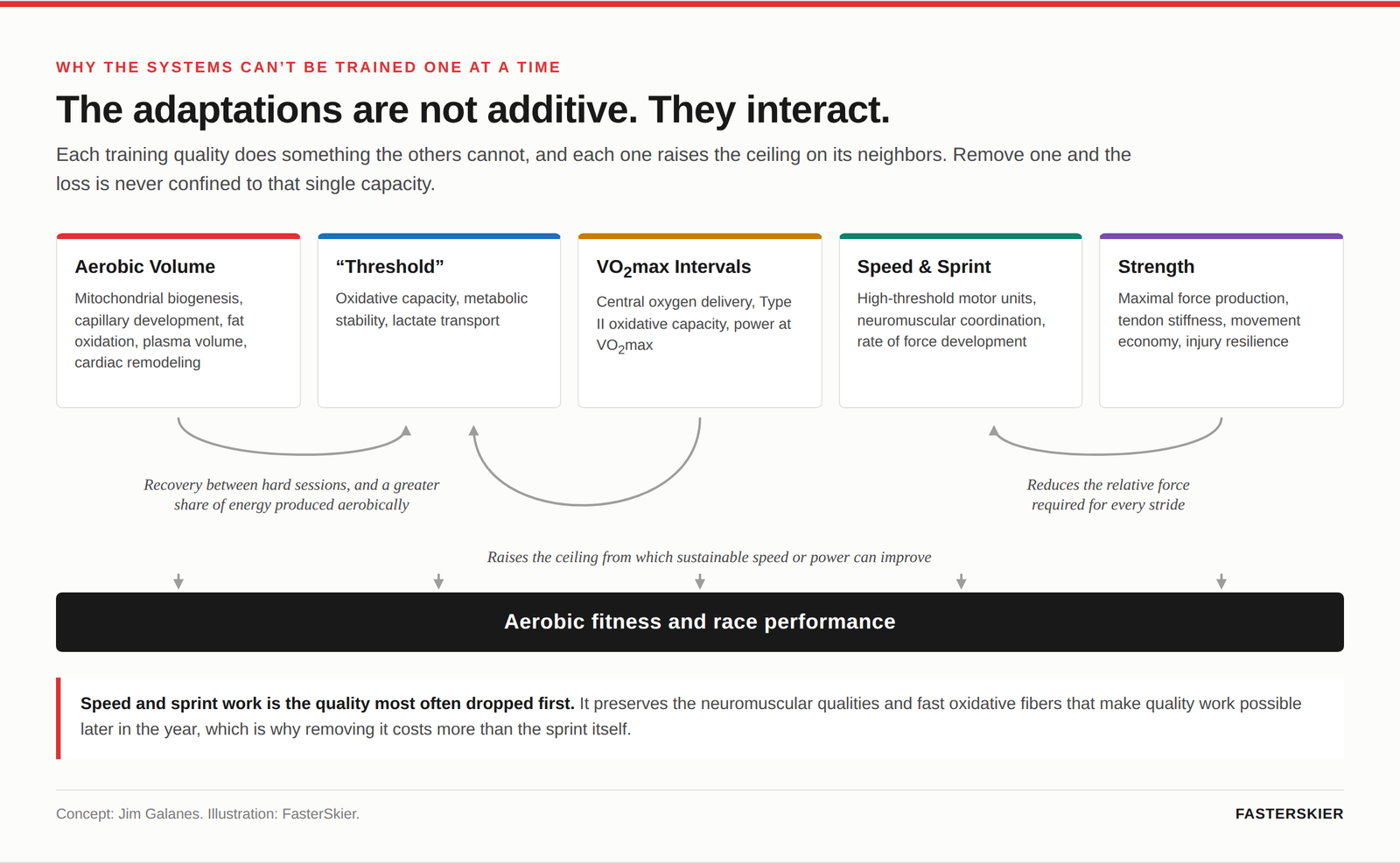
    These systems work synergistically. The mistake is assuming the adaptations are simply additive. They are not. They interact, and the combined effect on aerobic fitness is larger than the sum of the parts.

    A larger aerobic system allows the athlete to recover more quickly between hard sessions and to produce an increasing proportion of energy aerobically.

    Better “threshold” capacity allows more quality work to be performed with less fatigue. Greater maximal aerobic power raises the ceiling from which “threshold” speed or power can improve.

    Improved strength reduces the relative force required for every stride.

    Sprint training preserves the neuromuscular qualities that improve efficiency even during submaximal exercise. At every intensity, we can move faster and more efficiently.

    Diagram of five training qualities feeding into aerobic fitness and race performance
    Aerobic volume, “threshold” work, VO2max intervals, speed and strength each do something the others cannot, and each raises the ceiling on its neighbors. (Illustration: FasterSkier)

    What Happens When One System Is Ignored?

    Every physiological adaptation has a maintenance requirement. Remove the stimulus long enough and that adaptation begins to decline. An athlete who abandons speed training gradually loses neuromuscular recruitment and maximal power. An athlete who eliminates heavy strength training slowly loses force production and movement economy.

    When an athlete reduces aerobic endurance training, they don’t simply lose endurance. They lose the physiological foundation that supports every other adaptation.

    An athlete who removes VO2max work for extended periods may maintain excellent endurance while gradually losing the central cardiovascular adaptations that support maximal aerobic performance.

    These changes are rarely dramatic at first. What we see instead are the symptoms of overtraining. Performance in training declines. Interval sessions become harder. Race pace plateaus or drops.

    Many coaches respond by adding more volume or more intensity. Neither is the likely answer. The solution is to restore the balance between the physiological systems that support performance.

    Chart showing five training qualities across three season phases, with none dropping to zero
    Through the training year the dose and density of each quality moves, but no quality drops to zero. Concept illustration of Galanes’ argument, not a prescribed distribution. (Illustration: FasterSkier)
    Two skiers rollerskiing up a climb on a road through autumn woods
    University of Vermont skiers work up a climb during a fall dryland session at Craftsbury, Vermont. (Photo: Phillip Belena/EISA)

    Why High-Intensity Training Belongs in the Base Period

    One of the most common statements heard during base training is: “We shouldn’t do any hard training yet.”

    Current evidence suggests otherwise. High-intensity training during the base period is not about maximizing anaerobic fitness. It is about maintaining the physiological systems that complement the full development of aerobic capacity.

    Appropriately dosed high-intensity training helps preserve central cardiovascular function, maintains high-threshold motor unit recruitment, supports the oxidative capacity of fast-twitch muscle fibers, reinforces movement economy at higher speeds, and prepares the athlete for the demands of future training. Just as importantly, these adaptations support aerobic development rather than detract from it.

    A stronger cardiovascular system allows greater oxygen delivery during long aerobic sessions. Maintaining fast oxidative fibers improves the ability to perform “threshold” work later in the season. Preserving movement economy reduces the energy cost of every stride. Maintaining maximal aerobic capacity raises the ceiling from which “threshold” performance can continue to improve.

    High intensity doesn’t compete with aerobic development when it is properly dosed. It enhances it. This is why elite endurance athletes rarely eliminate intensity completely. They change the dose and the density. Not the presence.

    I often hear athletes say their first interval session or time trial in late July felt terribly slow, or metabolically challenged. Of course it did. That should come as no surprise. If high-intensity work has been absent for weeks or months, the physiological systems required to perform it have detrained. The athlete now has to rebuild those systems before meaningful race-specific adaptations can occur.

    Emphasis Is Not Elimination

    This doesn’t mean every quality deserves equal attention every week. Training emphasis should absolutely change throughout the year. An aerobic development phase should contain more aerobic volume. The pre-competition period should emphasize “threshold” and race-specific intensity. The competition season should prioritize race performance and recovery.

    But changing emphasis is very different from abandoning a physiological system. Even during an aerobic block, athletes should continue performing some high-intensity work, sprint training, and strength training.

    During race season, aerobic volume remains essential. While emphasizing VO2max development, “threshold” training still supports the ability to perform quality work.

    The dose and density change. The physiological adaptation remains.

    There Is No Optimal Intensity Distribution

    One of the most common questions in endurance sports is: “What is the optimal training intensity distribution?”

    The question assumes there is one correct percentage of easy, “threshold”, and hard training. There isn’t. The optimal distribution depends on the athlete’s training background and on which physiological system currently limits performance. Those limiting factors change throughout an athlete’s development.

    Early in a career, building aerobic capacity may deserve the greatest emphasis. Later, improving sustainable race pace may become the priority. Still later, improving neuromuscular power, force production, or movement economy may produce the greatest gains.

    As those priorities change, training distribution changes with them. Not because the principles change. Because the athlete changes.

    The coach’s responsibility is to continually adjust aerobic volume, “threshold” training, VO2max work, sprint training, and strength training so that each enhances the adaptations produced by the others while minimizing interference.

    There is no universal training formula. There is only the continual process of identifying the athlete’s current limiter, maintaining every important physiological system, and emphasizing the adaptations that will produce the greatest improvement.

    Great coaching is not about prescribing the perfect intensity distribution. It is about continually identifying the athlete’s current physiological limiter while maintaining every system that supports performance. As the athlete changes, the emphasis changes, but the physiology never disappears.

    Help Support Our Coverage!

    FasterSkier is independent, reader supported, and free to read. If coaching and training coverage like this is worth something to you, a voluntary subscription keeps it coming.

    Join the FasterSkier community!
     

    A ski coach in an olive fleece speaking with an athlete holding rollerski poles
    UVM coach Patrick Weaver talks with first year Hanna Koch of St. Paul, Minnesota, during a fall session at Craftsbury. Identifying an athlete’s current limiter, Galanes writes, is the coach’s central job. (Photo: Phillip Belena/EISA)
  • Wednesday Workout: Beach Skiing with the Bowdoin Nordic Team

    Wednesday Workout: Beach Skiing with the Bowdoin Nordic Team

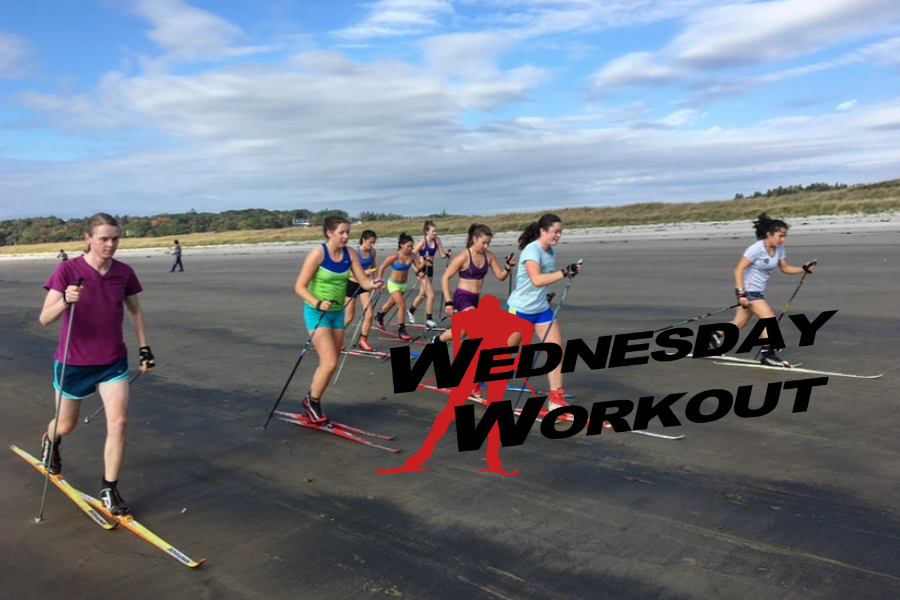
    Maine is Beach Skiing Paradise for Bowdoin College’s Ski Team. (Photo: Nathan Alsobrook)

    The workout this week comes from the head coach of the rising Bowdoin Ski Team, Nate Alsobrook. While it can certainly be beneficial to train at altitude or in the mountains, Alsobrook shows that the unexpected beaches of the Maine Coast can be equally well suited for preparation. This workout highlights looking outside the box to take advantage of the terrain you have access to. 

    In our program, we are always looking for creative ways to use our surroundings for fun and productive training.  We don’t have a ton of mountains on the Maine Coast, but we have some gorgeous beaches – perfect for sand skiing intervals. Sand skiing feels surprisingly realistic – like skiing up a fairly steep hill.  On a flat beach with fine, damp sand (ideally when the tide’s going out) you can also get some decent glide.  It’s definitely a grind, so it’s best for high-intensity intervals.

    Skiing on sand takes some getting used to; it’s easy to break into a run or bound, but with some focus, you can ski with proper technique (striding only – good luck trying to skate or double pole).  Wet sand is surprisingly gentle on the bases, but even so, you’ll want to use your rock skis.  Any skis will do, even skaters – you’ll have no trouble getting kick!

    The team does this workout 2 or 3 times in the fall as a nice change of pace from running and rollerskiing.  It’s particularly useful in the lead-up to our on-snow Thanksgiving Camp – it helps our athletes get a feel for sliding on long skis before getting back on snow.

    buy indocin online

    Here’s an overview of the workout:

    • 20 minute warm up run.

    Our favorite beach is only accessible by a 2 mile run through the woods, which makes for a perfect warm up – skis in one hand, poles in the other, and boots in a backpack.

    • 1 x 3 minutes at a low threshold pace to complete the warmup and get a feel for the sand.
    • 4 – 5 x 3 – 4 minute intervals at 5k effort (90%+ of max HR).  Equal recovery time between intervals.
    • Jump in the ocean for a quick recovery swim, then pack up and jog 2o minutes back out.

    Happy skiing!

  • Wednesday Workout: Sizzling Hot 30/30’s with BSF’s Nick Michaud

    Wednesday Workout: Sizzling Hot 30/30’s with BSF’s Nick Michaud

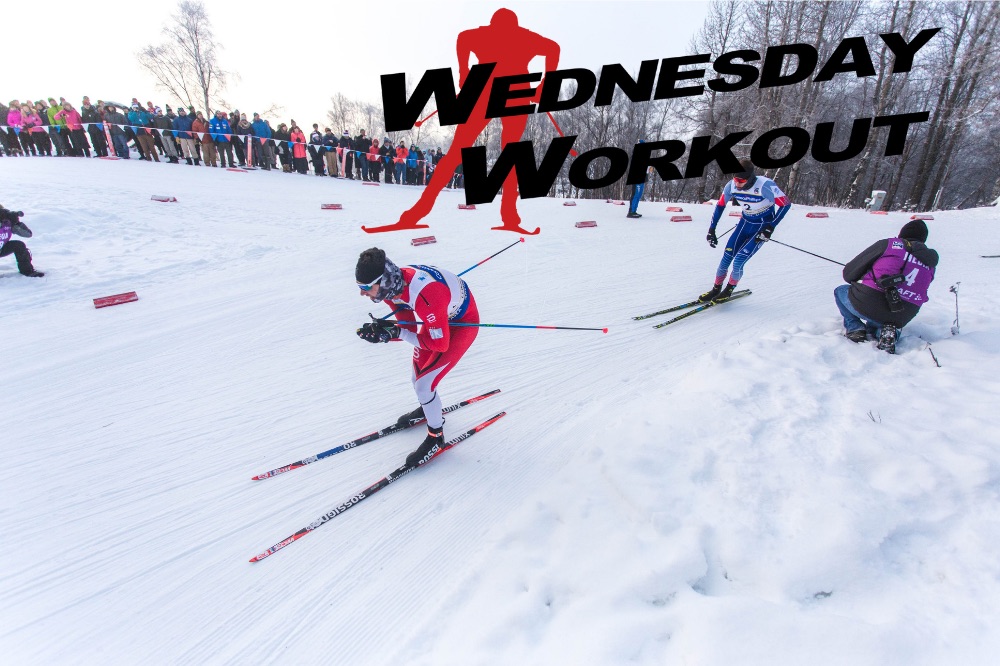
    BSF’s Nick Michaud (red suit) at last season’s Senior National Championships in Anchorage, Alaska. Michaud qualified 4th. (Photo: Gilbert Michaud)

    This Wednesday Workout was provided by twenty-six-year-old Bridger Ski Foundation (BSF) skier Nick Michaud. Bates College educated and raised plumb-line north in Fort Kent Maine, Michaud has emerged as a sprinter to watch on the SuperTour. He’s a gritty, salt-of-the-earth athlete who barely missed a nomination to the 2018 Olympic Team.

    Michaud offered FasterSkier a menu of options for the 30/30 workout — 30 seconds on 30 seconds off. From junior athletes to masters in M8 and beyond, Michaud has you covered with these training session variants.

    Let the gains begin.

    Backstory of the Sizzling Hot 30/30’s from Michaud:

    “Short, explosive movements are like bacon for me. I’m thrilled to eat bacon anytime, anywhere, with anyone. With vegetables, grains, and most foods that are really important for function, it can feel like a chore. That’s what a lot of nordic ski training feels like for me. My body, my mind, would prefer to just do speed work, lift heavy weight, and play basketball — and eat bacon. But in order to meet my performance goals, I have to eat vegetables and grains: aerobic base, lactate threshold, energy management, mindfulness and so much more. For these reasons, I love 30/30s.

    30/30 home terrain for BSF’s Nick Michaud in Bozeman, Montana. (Photo: Max Lachance)

    The execution is very simple: 30 seconds “on”, 30 seconds “off”. The effort and duration can be customized for the purpose of the workout. There should always be a purpose!. For athletes with periodized training plans, 30/30s can be used in different cycles of training to meet different goals. For a more casual athlete, 30/30s can simply be an extremely fun way to get in some higher intensity training.  

    Dragan Danevski, BSF nordic program director, began using 30/30s eight years ago. There was a study in Europe focusing on track and field and how to improve efficiency of running economy, improve aerobic capacity, and reduce the recovery time in a 30/30 workout. The original study tracked mainly 1500m and 3000m runners. Danevski adjusted the workout for skiers here at BSF.

    Danevski said BSF has used 30 by 30s for a few different goals: improving skier’s economy, stimulate good technique, and shortening recovery time for lactate clearance. Originally it was for improving threshold.  For his skiers, Danevski saw the potential to improve anaerobic capacity.

    Throughout summer Danevski follows the study and uses 30/30s to improve threshold.

    For the following age groups, the coach prescribes one 25-30 minute block of 30/30s for U16 and U18s. U20s go for a 30-35 a minute block of 30/30s. Some older skiers are ready for a 45 minute 30/30 session.

    Danevski said these 30/30 training days need to be disciplined by monitoring heart rate.

    tizanidine buy online, buy baclofen online, zanaflex online

    In the past, the 30/30 workouts were used only during intensity blocks. Recently, we’ve started using it throughout the whole training year: on skis, foot, and rollerskis.

    Psychologically, Danevski said the 30/30 is a more tolerable intensity session, especially for kids, since they can focus on high-quality efforts for 30 seconds each time. It’s easier to focus.

    As we transition into fall here at BSF, we also use 30/30s to improve anaerobic capacity. One basic example we use are three to six sets of a 15-minute long 30/30s — with appropriate rest between each set.

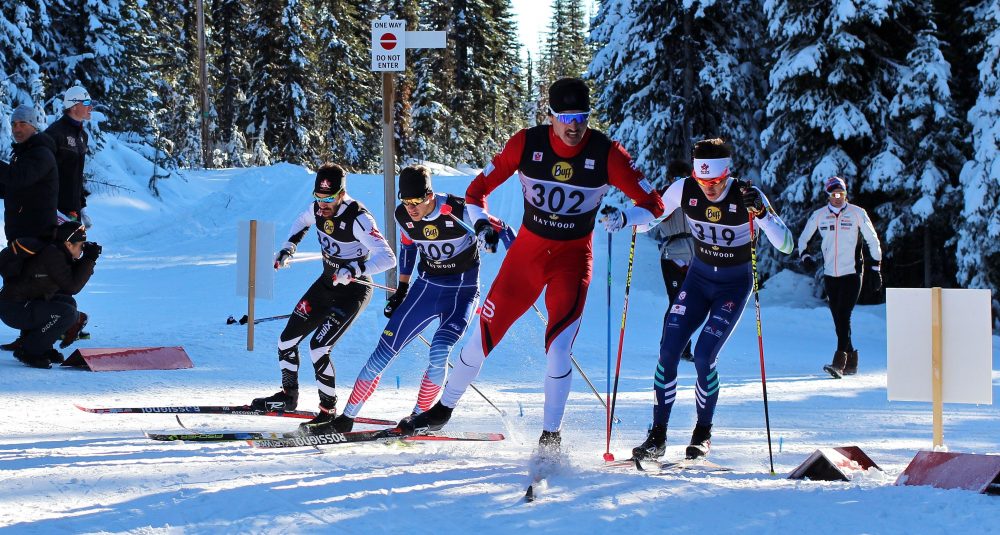
    Nick Michaud (BSF) in bib 302 putting those 30/30s to good use at the Sovereign Lake NorAm in 2017. Michaud was the second fastest qualifier. (Photo: Forrest Mahlen)


    The 30/30 Workout Menu Starting with Michaud’s Favorite Variation:

    Nick Michaud: 3 x 5 minutes, sprint pace. So we are all clear, this means a five minute long  30/30 excecuted three seperate times. During each five minute period, that’s a total of 2.5 minutes “on”, and 2.5 minutes “off”. For the entire session, the athlete is “on” for 7.5 minutes, or half the total elasped time. I rest for five minutes between each set.

    Notes: I use this two days before a sprint race, increasing my effort each set. It’s a great way to get a feel for speed, technique, and effort in all areas of the course. I take five minute breaks between sets. I leave the venue with a good understanding of the course and excited to move fast on it two days later. Using this training sessions at different points of the year is a great way to practice understanding the critical difference between effort and ski speed — which I think is crucial.

    Favorite 30/30 Variations from Others:

    Gary Colliander, US Paralympic Biathlon Coach: 4-8 x 6 minutes. Number of blocks depends on L3 or L4.

    Notes from Colliander: “Focus on quality of movement through the interval and a slightly higher turnover. With the short ‘on’ time I think you can hold the technique together better and because there is a short rest you can potentially push the pace and thus the level a bit. They’re still very tough, but that short rest just seems to offer bit of recovery while allowing the heart rate to remain high.

    Another way to look at the short 30 second rest is like it’s a downhill. Anytime you get a downhill it’s a chance to grab some O2 and recover although for a very short bit. But it always feels good when you come out of that tuck.”

    Lina Hultin, Bridger Ski Foundation Development/Competitive Team Coach: 5×6 minutes.

    Notes from Hultin: “What I like with 30/30s and 45/15s is that it allows the athletes to ski more efficiently. Since you have that shorter break, you tend to have better and more efficient technique since athletes ‘dare’ to push it a little harder when they know they will have a shorter break. Good technique requires strength and power and the shorter interval allows athletes to keep good technique for a longer time.

    The closer you get to the season you can dare to let go of that shorter break and hopefully you can maintain that good efficiency in you technique in a continuous time trial or longer intervals.”

    Akeo Maifeld Carucci: Craftsbury Green Racing Project Athlete: 2-4  x 10-15 minutes at L4+.

    Notes: “Terrain wise, I like small rolling terrain or maybe gradual uphill with some bumps. I believe in keeping it between L1 and recovery pace during the rest phase, but it is important that it keeps moving at the least.”

    Seth Hubbard, Bridger Biathlon Club Head Coach: 15/15s for sets of 4-8 minutes at race pace +

    Notes: “This workout is altered depending on an athlete’s age and their work on pacing, and ability to surge and recover.”

    Will Sweetser: Nordic Programs Director at Sugar Bowl Ski Team and Academy: 15 sec/15 sec 6-12 minutes.

    Notes: “I use 6-12 minute repeats with ‘on time’ at either L3+ or goal pace for races 8 minutes and longer. First used this coaching runners in the mid 90’s. Have since had good success with younger athletes developing pace sense.

    Used the 15/15 to help take an athlete’s 3,000 meter time from 11:38 to 10:10 in 5 weeks. The next year this athlete brought their time down to 9:27 using 15/15 session of 2 x 3000m about once every 10 days.”


  • Wednesday Workout: Building Sprint Capacity with Dr. Øyvind Sandbakk

    Wednesday Workout: Building Sprint Capacity with Dr. Øyvind Sandbakk

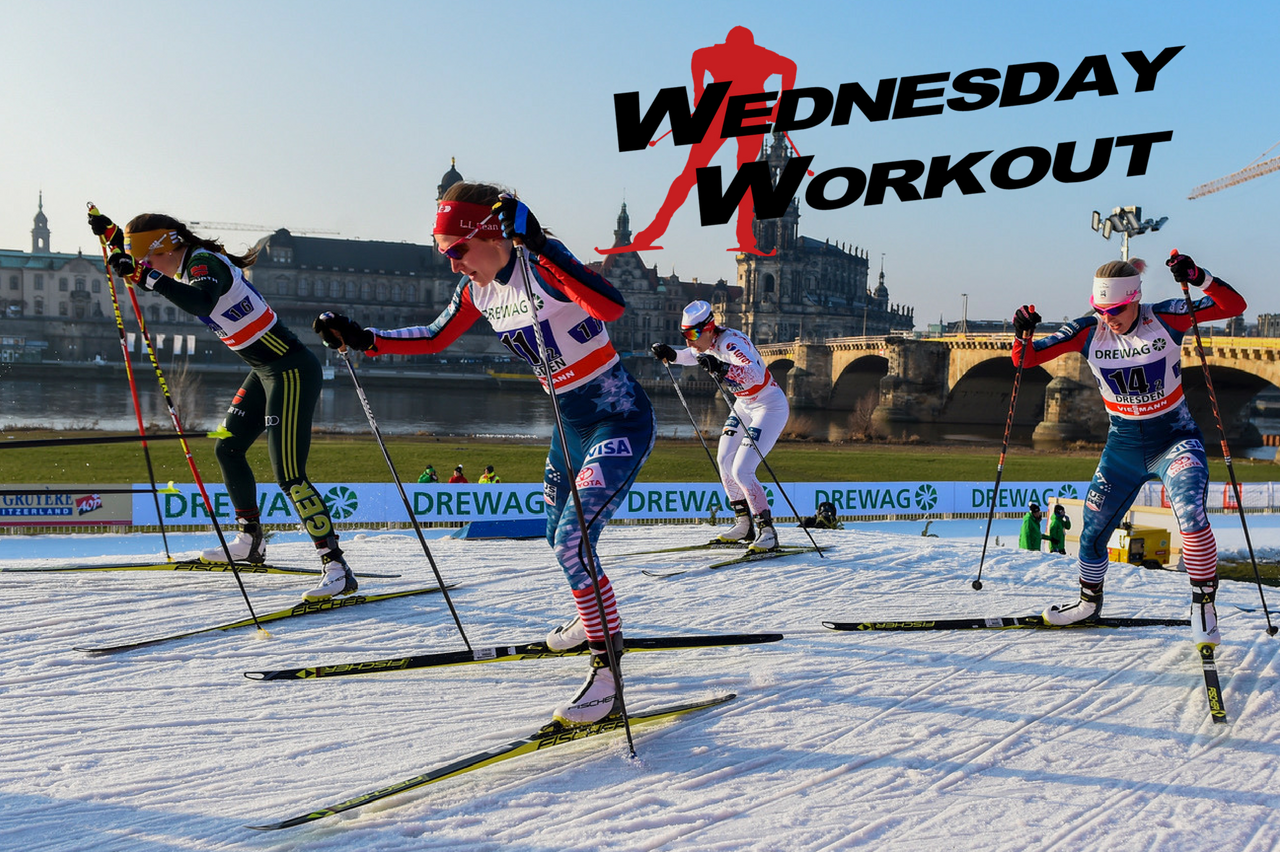
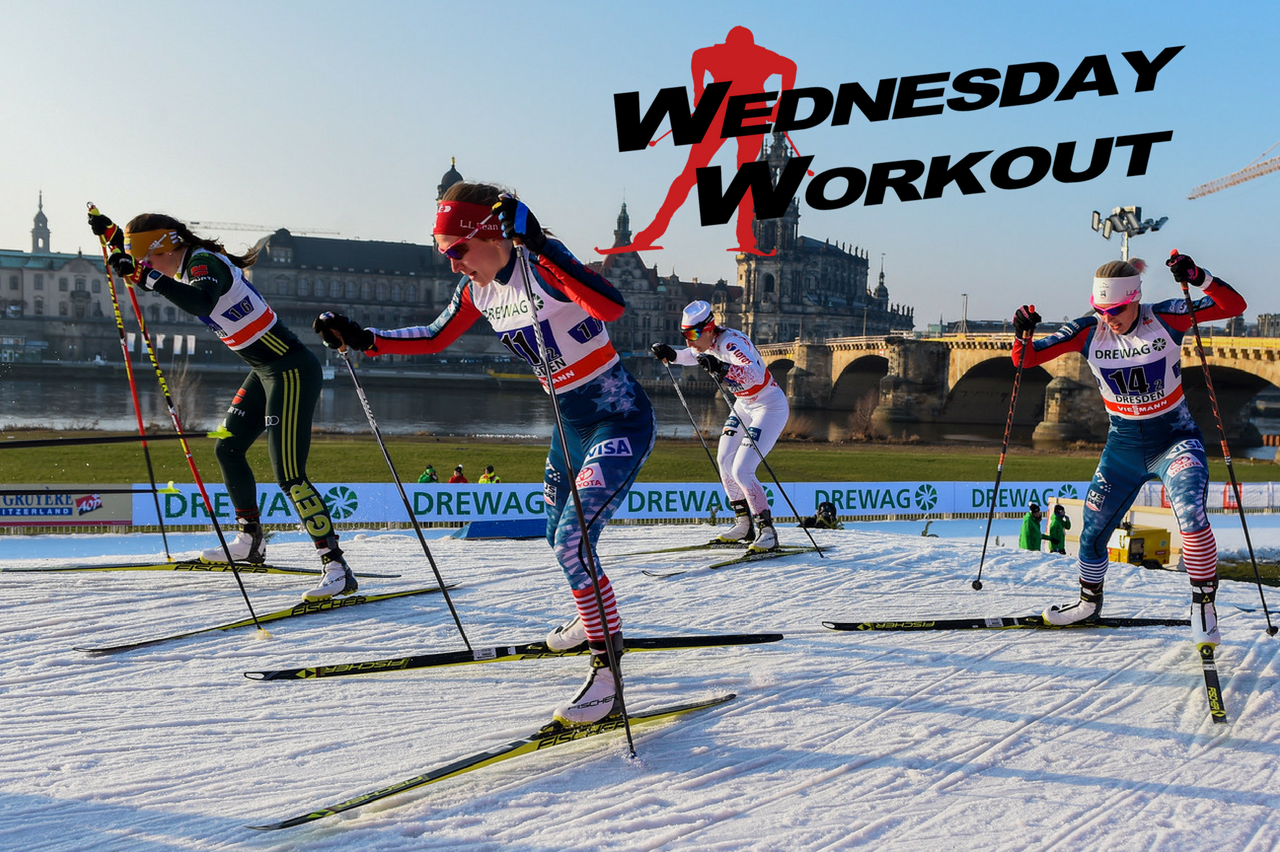
    On-snow sprint speed, something to work on now as the temps heat up. Here, Sophie Caldwell (second from left) and the newly retired Kikkan Randall (r) work their own sprint speed at the 2018 World Cup city sprint in Dresden, Germany. (Photo: Fischer/Nordic Focus)
    Dr. Øyvind Sandbakk (Courtesy photo)

    The following Wednesday Workout was written by Dr. Øyvind B. Sandbakk, the managing director at the Centre for Elite Sports Research at the Norwegian University of Science and Technology (NTNU) in Trondheim, Norway. (He’ll also be featured in an upcoming Nordic Nation podcast.)

    Beyond his work at NTNU, Sandbakk is the head of research and development at the Norwegian Olympic Sports Center (Olympiatoppen). At 37, he has established himself as one of the premier researchers studying how to optimize performance for cross-country skiers. Even a simple online search is a treasure trove of relevant Sabdbakk research. You can follow him on Twitter @OyvindSandbakk.

    The following workouts focus on building sprint capacity:

    Sprint training

    Short sprint sessions are important to develop the neuromuscular system specifically and the technique at high speeds. In order to assure that technique development is optimal, I normally start sessions with sprints at 90 and 95% of maximal speed, before the last part of the sessions are done with close 100% effort. For athletes struggling with the technique, the entire session is sometimes done with 95% of maximal speed in order to facilitate good technique. Most of such sessions should be done using specific skiing techniques. One example:

    • 5 x 15-second strides with gradually higher speeds, followed by 4 x 10 seconds in heavy terrain (90-95-100-100% of max speed) and 4 x 15 seconds in easy terrain/spurt (90-95-100-100% of max speed). 2-minute recovery between sprints and 5 minutes between series.

    Sprint intervals

    Sprint interval sessions should develop specific areas or weaknesses. These sessions are done technique-specific with good technique and quality maintained throughout the entire session. I personally like that they are target terrain where races are often decided such as simulations of attacks or final sprints. The cost of such sessions are high, so they should not be done too often, but regularly. Some examples:

    •  2-3 series of 6 x 20-second maximal sprints with diagonal or skating in moderate or heavy terrain with 2 to 3 min recovery, and 5 min between series
    • 2-3 series of 6 x 30-second double poling or skating in easy terrain, with 1-2 minutes recovery, and 5 min between series

    Note: The terrain decides how long the duration of work and recovery periods can be, and easier terrain and when the upper body is more loaded allows longer work durations and shorter recovery

    Short intervals

    Short interval sessions allow the aerobic system to be stimulated at high skiing speeds, with additional stimulus at the anaerobic system without totally fatiguing the athlete. Such sessions should mainly be done using specific technique, and personally, I like to use modes and terrains that are of particular importance at the end of races, such as attacks in uphill terrain or the final sprint. It is also important that good technique and high speed is maintained throughout the entire session. Some practical examples:

    • 40-45-second work durations, with 15-20 seconds of active recovery at an easy pace, performed over 5-8 minute intervals. Depending on the age and level of the athlete, 3-5 such intervals should be done.
    • 20 seconds slow — 20 seconds hard – 20 seconds close to maximal – 20 seconds slow, etc. over 4-5 minutes. Depending on the age and level of the athlete, 4-6 such intervals should be done.
  • Wednesday Workout: Getting Adaptable with NSCF-FXC

    Wednesday Workout: Getting Adaptable with NSCF-FXC

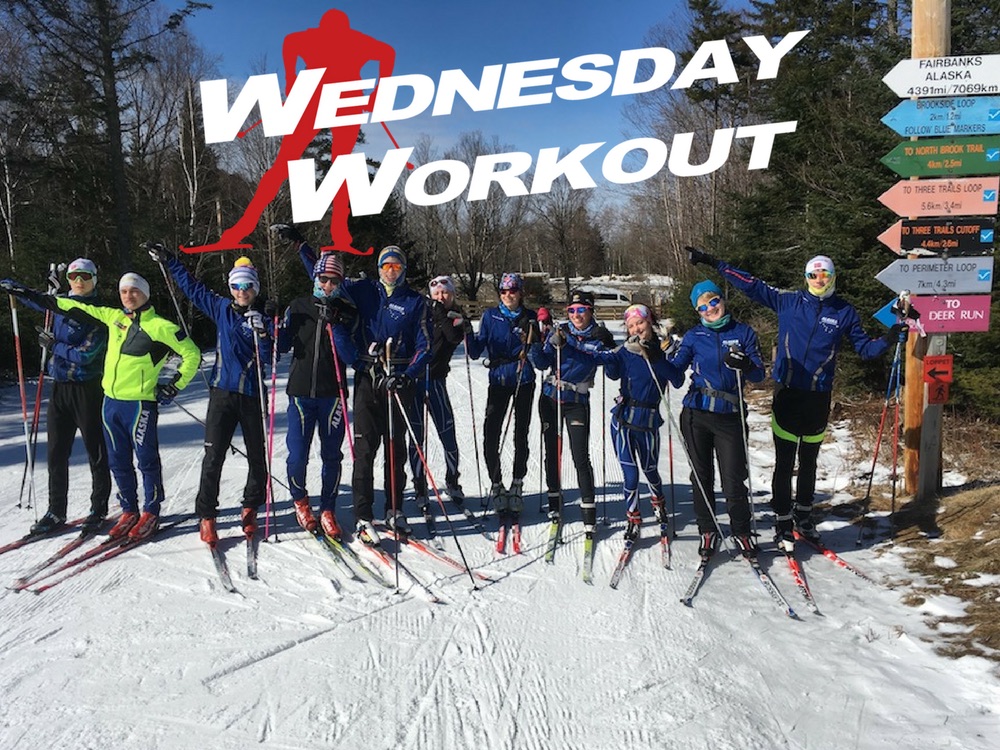
    The NSCF-FXC crew points toward home (some 7,000 kilometers away) at 2017 Junior Nationals this past March in Lake Placid, N.Y. (Photo: Peter Leonard)

    The following workout comes from Alasdair Tutt, interim coach for the Nordic Ski Club of Fairbanks/Fairbanks XC (commonly known as NSCF-FXC). Tutt recognizes that while training in central Alaska has its perks (like reliable snow), it can also be tough for skiers to excel outside of their familiar environment (like on significantly warmer snow). This is true for anyone racing in variable climates and at both high and low elevations across North America. So for NSCF-FXC, the goal is to get develop speediness for races in the lower 48. 

    ***

    Training in Fairbanks, Alaska, may have many advantages: skiable snow for six months a year, tough homologated loops at Birch Hill and the endless wilderness to explore regardless of the season. However, it presents many challenges for the 33 junior athletes who are part of our summer Comp Team when they compete out of town in temperatures often >30 degrees warmer than the average Fairbanks day.

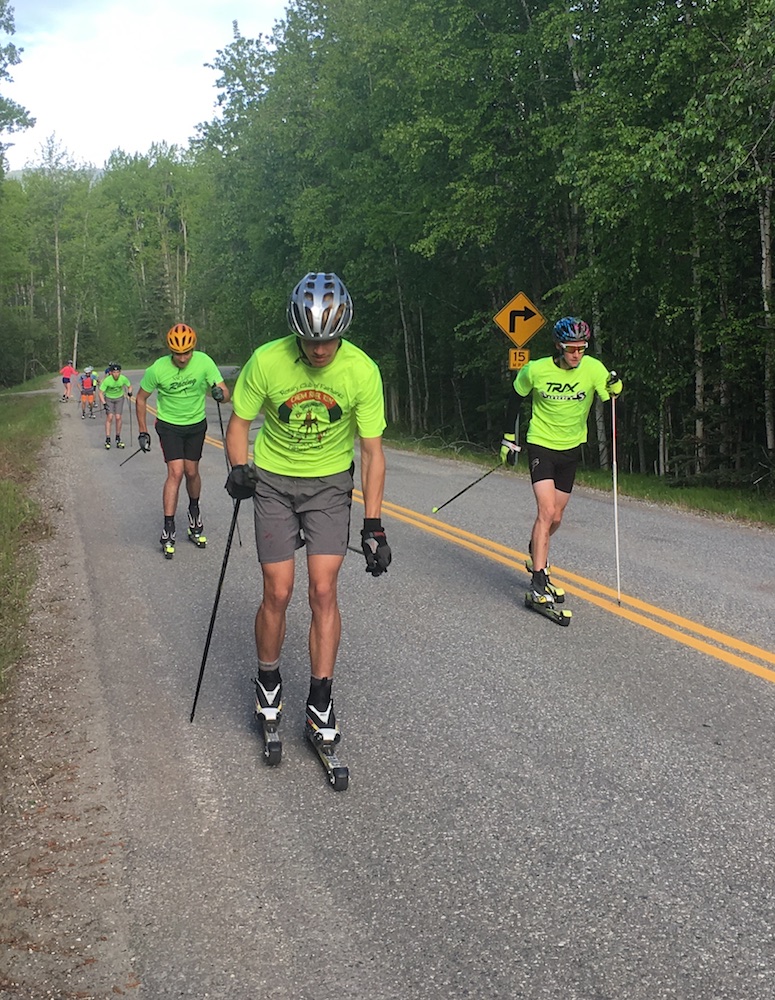
    (From left to right) NSCF-FXC skiers Ben Keener, Ari Endestad and Ti Donaldson work on diagonal striding during a summer workout near Fairbanks, Alaska. (Photo: Alasdair Tutt)

    This workout is designed to counteract the effect of always skiing on slow snow and steep terrain at Birch Hill mid-winter so the athletes can be competitive in faster conditions at the U.S. Cross Country Championships (a.k.a. Senior Nationals) or Junior Nationals. It can be completed skating, bounding, double poling, or diagonal striding. We have primarily focused on using it to improve diagonal striding this summer.

    We have no problem getting our skiers to be strong or have a high-aerobic capacity, but we often struggle to further develop the neuromuscular capacity of our skiers once the snow hits the ground. This can also be true when our athletes compete in high-school cross-country running, as their training can become pretty monotonous and low volume unless they make a considerable effort to add their own ski training on top of the running. This workout is applicable to all athletes though, as I believe all junior athletes need to first develop their capacity to go fast before learning to use that speed over a longer distance.

    The workout: Alaska-Specific (Speed) Training

    • Warmup: Preparation and Mobility
      • Our warmup is typically 20-30 minutes long consisting of about 10 minutes easy skiing to our start point, followed by 10-15 minutes of mobility and preparation exercises specific to the technique being performed on the day (we do this workout skating, double poling and striding depending on the goals of the team as a whole from last year)
    • Intervals: 2-3 sets of 3-5 x 150-250 meters at 2-3 k pace, and 50-80 m at 400 m pace over a course with two separate hills — not so steep as to lose full range of motion, but to challenge the athletes’ balance a little. Then, take a short recovery to return to the start of the next interval.
      • The course should cover around 150-250 m for the longer interval and 50-80 m for the shorter one on a gradual hill that is typically able to either be climbed in double pole or diagonal striding to induce a high speed.
      • First do the ~200m interval at a speed similar to how you would a hill in a 2-3 k event, then after a short recovery, complete the ~60 m interval at a speed just below that of an all out sprint (about 400 m pace). The idea being to have a repeated sprint stimulus and a clear difference in pace between the short and long speeds, without exhausting their capacity in one set.
    • Recovery: About 4-6 minutes active recovery between sets.
      • Between the longer and shorter sprint, just a rolling recovery back to the base of the hill repeated 3-5 times. Between each set there is a 4-6 minutes of active recovery with a chance to grab a drink or watch some video of technique.
    • Cool down: 30-45 minutes of easy rollerskiing back to the starting location.

    Technique Notes: We are looking for full extension through the arms to the back, a pendulum arm swing to return and a relaxed body position with hips over the heel when gliding on a ski during these intervals, as it quite easy to get into a posture with limited range of motion through the shoulders or a “back-seat” body position with little glide and a late kick when mostly skiing on green hardwax. As always when striding on classic rollerskis, we are careful to emphasize an early initiation of power with the lower body and a quick weight transfer from the center of mass over the gliding ski.

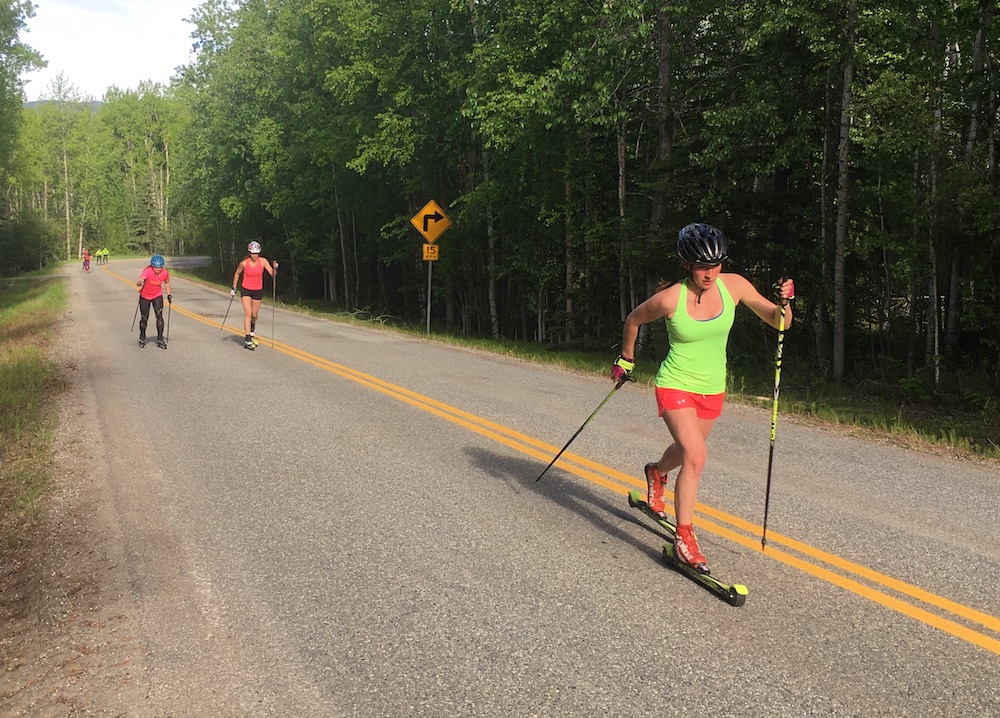
    NSCF-FXC skier Jenna DiFolco (r) leads Mackenzie Parrott (l) and Zoe Ratzlaff (c) during a diagonal-striding workout near Fairbanks, Alaska. (Photo: Alasdair Tutt)

    ***

    Have a workout you want to share? Email info@fasterskier.com with the subject line: Wednesday Workout.

  • Wednesday Workout: Intervals on Flatter Terrain with Charlotte Kalla

    Wednesday Workout: Intervals on Flatter Terrain with Charlotte Kalla

    Charlotte Kalla of Sweden skiing to a monster win in the 10 k skate at 2015 World Championships on home turf in Falun, Sweden. (Photo: Fischer/NordicFocus.com)

    Fresh off an interview with Nordic Nation, Sweden’s 29-year-old Charlotte Kalla offered up a Wednesday Workout for those looking for technical sharpness and speed on flatter terrain. Here’s the workout straight from the combined 17-time world champ and Olympic medalist.

    “This time of year I take the opportunity to work on keeping my speed up also on flatter terrain,” Kalla wrote in an email. “I usually go interval training uphill during summer and fall. It is simple to just move yourself up to the top of the hill by roller skis and you know you will have a higher heart rate just by getting there. When I do intervals in flatter terrain I have to be more focused on my technique and to keep the speed up. It is important to be able to keep up the speed during competition also on the flat.”

    The workout:

    • Warmup: 20 minutes easy skiing
    • 10 minutes of intervals (85-90% of max heart rate). After that, easy skiing for 2 1/2 minutes. Repeat 5 times and focus on having a good technique and keeping up the speed.
    • Cool down: 20 minutes slow skiing

    The video below provided by Kalla was taken on May 24 when indeed she worked on speed and technique in flatter terrain.

  • Wednesday Workout: Weng’s Fall Favorites

    Wednesday Workout: Weng’s Fall Favorites

    Heidi Weng during a photo shoot on Sept. 22 at the Madshus factory in Biri, Norway. (Photo: Stefano Zatta)
    Heidi Weng during a photo shoot on Sept. 22 at the Madshus factory in Biri, Norway. (Photo: Stefano Zatta)

    For this week’s workout, we consulted Norwegian national team member Heidi Weng. A 2014 Olympic bronze medalist, Weng, 24, finished third overall in the World Cup last winter. This season, she’s going all in — chasing the coveted Crystal Globe along with the overall Tour de Ski title.

    To get there, Weng spends a lot of time with both hard intensity and easy distance sessions. Here are two of her favorite fall workouts:

    1. ‘Moosehuf‘/bounding intervals:

    5 x 5 minutes on steep terrain (i.e. up an alpine slope while using ski poles. One variation: 5 x 5 speed progressions)

    “Hard bounding intervals on steep terrain are the workouts I love to hate,” Weng told FasterSkier late last month at the Madshus factory in Biri, Norway. “I love these intervals because I know they work, and they really challenge me. But I hate them because they are so hard. My legs fill up with lactic acid from the get-go.”

    Heidi Weng on the podium in the skiathlon at the 2014 Olympic Games, along with Norwegian teammate Marit Bjørgen and Sweden's Charlotte Kalla. (Photo: Fischer/NordicFocus)
    Heidi Weng (r) on the podium in the skiathlon at the 2014 Olympic Games, along with Norwegian teammate Marit Bjørgen (c) and Sweden’s Charlotte Kalla (l). (Photo: Fischer/NordicFocus)

    2. Long rollerski workouts:

    Rollerskiing for 1 1/2 hours or more. (Weng advises to keep the intensity low and in check during these easy distance workouts. Opt for interesting terrain.)

    “I love going for long rollerski workouts near my parents’ house in Enebakk, Norway,” she said. “There is hardly any traffic there, and the terrain is perfect for long workouts. It’s not too steep, but perfectly rolling and never boring.

    “But it’s not too twisty and there are no really long downhills. I don’t like long downhills,” she added. “At the same time, it’s impossible to do hard intensity workouts on this terrain, for the exact same reasons.”

  • Work and Skiing: Martin Rosvall Challenges the Pros

    Work and Skiing: Martin Rosvall Challenges the Pros

    This is the first of a two-part profile on Swede Martin Rosvall, who recently completed hi post-graduate degree at the University of Washington.  Rosvall finished 15th in the 2010 Vasaloppet, challenging some of the world’s top skiers.

    Most of his competitors train full time; Martin Rosvall, 32, works full time. In March, Rosvall was 15th overall at the Vasaloppet, after having led the podium finishers large portions of the way from Sälen to Mora. No small feat for an amateur.

    Rosvall became quite a celebrity among the Seattle-area skiers and beyond while doing his post-graduate research at the University of Washington from 2006 to 2008. Rosvall won just about every local race, was 9th at the 2008 US Nationals 50K in Fairbanks and delivered a long list of solid Nor-Am results, as well as placing 2nd in the 2009 Ski2Sea Nordic leg in Bellingham. This year he was 4th at Ski2Sea, beat by Ivan Babikov, Brian Gregg and Eric Bjoernsen, but edging out Olympians including Torin Koos. That following a season where he had skied alongside World Cup skiers such as Axel Teichmann, Jörgen Brink, Jerry Ahrlin and Mathias Fredriksson in several FIS events.

    World Cup talent

    Rosvall, a native of Umeå in northern Sweden and a member of Lycksele IF ski club, grew up training and competing with former Olympian Per Elofsson, as well as World Cup racers Björn Lind and Björn Ferry. While nobody could challenge Elofsson, Rosvall outskied Ferry and Lind on several occasions during his last junior season, and the success changed his perspective on racing.

    “After chasing the podium for so many years, beating Björn Ferry and Björn Lind gave me a chance to feel what it was like to win. But it wasn’t what I thought it would be. It didn’t feel any different than before. That’s when I realized I love skiing for the sake of skiing. It’s not about winning. So for an underchallenged high school student, choosing a university degree over a World Cup career was not hard. And it’s a decision I have never regretted.”

    The benefits of a career

    Now Rosvall works full-time as an assistant professor in physics at the University of Umeå and finds that ski racing and a professional career are not mutually exclusive.

    “I’m always the underdog. A pro should beat an amateur, so whenever I beat a pro, it’s a victory in itself,” Rosvall says, noting that having a career adds another dimension to his life.

    “I notice that the moods of my full-time pro skier friends entirely depend on their performance. When they ski well, they’re happy. If they’re not having success, they’re grumpy. If I have a bad day on the trails or a bad race, I can always come back to my career and my research, and vice versa,” he says.

    Furthermore, Rosvall thinks his lifestyle lets him get the most out of his training hours.

    “Every workout is fun and feels like a luxury. If I were to increase my annual hours by 30 percent from 600 hours to just below 800 hours, I’d have a 50 percent chance of becoming 2 percent fasters. I’d also have a 50 percent chance of training too hard and becoming 10 percent slower,” Rosvall says.

    Martin Rosvall at the 2010 Ski2Sea in Bellingham, Wash. Photo: Debbie Kolp

    Less is more

    So how does a full-time worker with time constraints, extensive work travel, conferences and hotel life in non-skiable places keep up with World Cup racers? The answer is simple, according to Rosvall: Less is more. Less hours means feeling fresher more often.

    “I trained less this year than before. Every skier knows when to take a day off, but they don’t. This year I did. The result is that I start every intensity workout feeling fresh, and I recover better. I get the most out of every workout. I logged fewer hours overall, but better hours. I didn’t do any more intensity than before, just better quality,” Rosvall explains. And the strategy paid off.

    “The only bonk I had was teaching a class. I ran out of things to say, my brain ran out of glycogen and class ended early. I tried to teach for five more minutes, but I realized that I couldn’t even understand what I was trying to say myself,” Rosvall recalls.

    Then what separates the World Cup racers from a 15th place Vasaloppet finisher? Mostly, speed and sprint capacity.

    “I couldn’t do well on Olympic courses compared to the pro skiers. There are no short cuts. 50 percent more training hours in the log makes you on average 2 percent faster. That equation doesn’t work with a full-time job,” Rosvall explains. “They’re sprinters and can burn lots of fuel in a short time. I get too much lactate sooner than they do. But in long races, it’s all endurance. In a flatter, 90K race, they don’t have that much of an advantage from being good at 15K courses with lots of hills.”

    Changing the recipe

    “Having a different strategy was certainly part of the success this year, but also I was stronger than I have been before,” Rosvall says. The secret to more strength? None. Rosvall simply started doing strength workouts on a regular basis.

    “This was my first year in the gym,” Rosvall says with a laugh. He completed one or two max strength workouts in the gym each week, focusing on a few key exercises.

    “I went in before work and did an hour of few reps and high weights. I focus on my weak parts, which is hamstrings and core,” Rosvall says. Dynamic/ explosive lunges with a weighted bar, chin-ups, dips and hamstring kick-back on a machine was the mainstay of the diet, in addition to a healthy dose of core drills.

    Rosvall also changed the way he did intervals.

    “No more pushing beyond threshold. I did mostly nine to ten minute intervals at race pace, or right below my lactate threshold,” Rosvall says, noting that he believes max effort intervals tend to increase recovery time while adding little to the capacity for marathon racing.

    Additionally, Rosvall is convinced that countless hours running through wetlands with poles pay off.

    “For a strength workout, there is nothing that really compares. It’s a full body workout, both strength and cardio, and all with very little impact on the joints compared to running even on trails,” he says, adding that running in sand might deliver similar benefits.

    More than one basket

    Rosvall didn’t put all his eggs in the Vasaloppet basket. He built up to the race by doing a number of other high-profile events, including the 42K Dolomitenlauf (skate) in the Alps, followed by the 70K Marcialonga (classic) in Italy the week after, and a handful of Swedish FIS-sanctioned races. Of the Swedish races, the 45K classic Åsanespelen stands out. Rosvall skied neck a neck with Jörgen Brink, Jerry Ahrlin and Mathias Fredriksson – Swedish World Cup and full-time racers that he would encounter again at the Vasa in March. Rosvall was 4th overall in Åsane.

    “Åsanespelen was a great opportunity to ski with the best. I realized that I really could ski with them. I was right there for 30K, when we hit a long uphill. That’s where you recognized that they are World Cup skiers and I’m not. World Cup skiers start out fast on the hills and they continue at the same pace, even when you can’t see them anymore,” Rosvall explains.

    Martin Rosvall at the summit of Cutthroat trail as it crosses the Pacific Crest Trail. Photo: Kent Murdoch