Tag: interval workout

  • Wednesday Workout: Building Intervals with Olivia Bouffard-Nesbitt

    Wednesday Workout: Building Intervals with Olivia Bouffard-Nesbitt

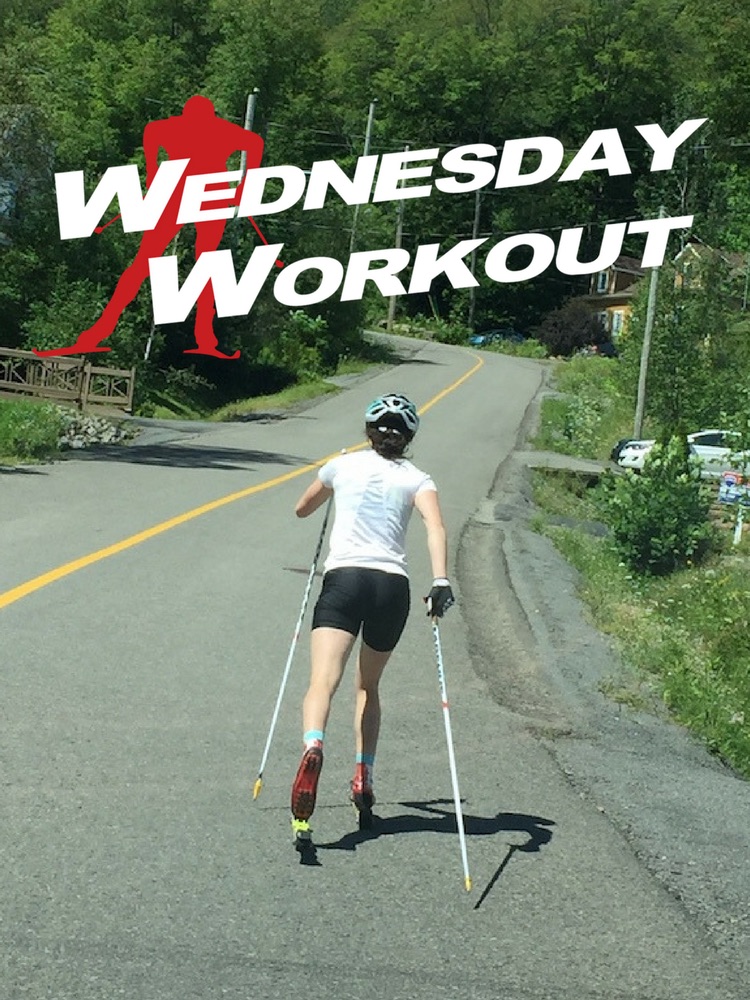
    Olivia Bouffard-Nesbitt rollerskiing in Sainte-Anne-des-Lacs, Quebec, last summer. (Courtesy photo)

    It’s May 2 and the overall NorAm leader heading into the 2018/2019 race season, Olivia Bouffard-Nesbitt, is champing at the bit to get back at it. Like most other pro nordic skiers, the 25-year-old Morin Heights, Quebec, native spent the last month getting some off-ski R & R, which wasn’t completely devoid of snow. In April, Bouffard-Nesbitt and her boyfriend went surfing at Lawrencetown Beach near Halifax, Nova Scotia (brrr!).
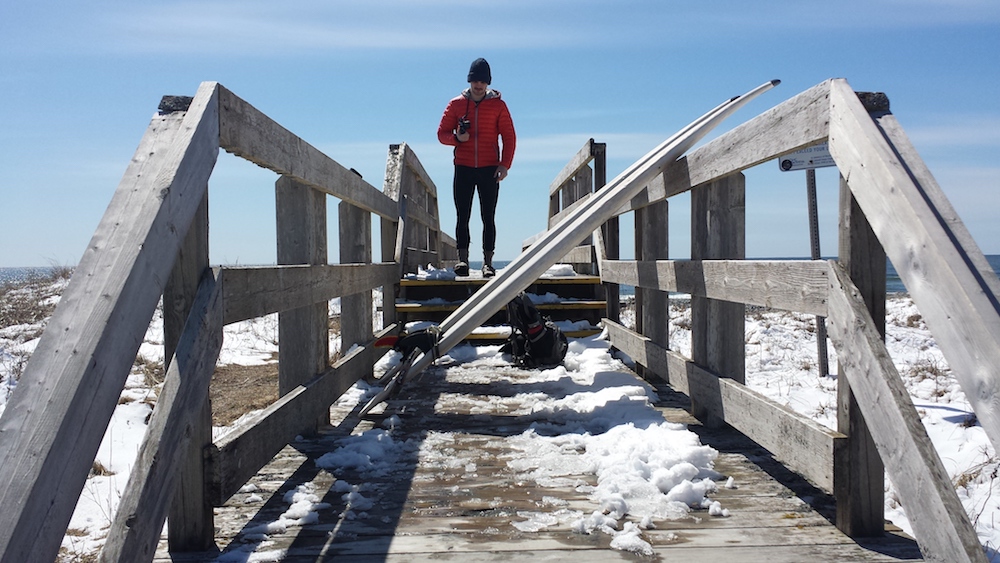
    Olivia Bouffard-Nesbitt snaps a photo of her boyfriend Stuart and their boards while surfing in April near Halifax, Nova Scotia. (Courtesy photo)

    “I was planning to travel somewhere a little more exotic later in April but opted to get all my wisdom [teeth] pulled out instead,” Bouffard-Nesbitt wrote in an email.

    She planned to return to her training base in Canmore, Alberta, next week, where she’ll be “jumping right back on snow and right into some training camps” with her team, Rocky Mountain Racers (RMR). They’ll start the training season at Sovereign Lake in Vernon and Penticton, British Columbia, then head south to Bend, Oregon, in early June.

    “I can’t even tell you how excited I am to dive head first into this training season!” wrote Bouffard-Nesbitt, who has had previous seasons derailed by a myriad of injuries.

    Despite a late start, she finished last winter as the first Canadian woman in the overall NorAm standings, earning World Cup starts in November and December later this year.

    So what’s one of the workouts she’s looking forward to this spring? That would be Rocky Mountain Racers’ “most tried and true workout”, which can be done skiing, rollerskiing, ski striding, or even biking.

    inhalers online

    “It’s simple, it’s appropriate for pretty much any time of the year, and it’s reliable,” Bouffard-Nesbitt explained. “I found myself really looking forward to doing these intervals after coming back from injury. This workout kind of feels like ‘home’ for me, and I trust it to get me fit in a short period of time.

    “It’s funny, even just thinking about this workout makes me happy, that’s how good it makes me feel,” she added. “When I got back to Canmore and started doing some on-snow intensity last December I was nervous about my fitness, but after a few of these types of workouts, within two weeks I already felt way more confident in my fitness and my race readiness.”

    The workout: 6-8 x 5-minute Building Intervals

    • Warmup: 15-30 minutes of easy Zone 1 skiing

    “We usually do a lap or two of the predetermined interval course to get familiar with it. I like to get up into zone 2 near the end of the warm up to get my technique right and set my technique intentions for the intervals.”

    • Intervals: 6-8 times 5 minutes, building from interval to interval, with around 3 minutes of rest.
      • First interval: Below threshold to wake up the body.
        • “The goal after the first one is to increase the distance you cover over every consecutive interval.”
      • Last two intervals: should be harder, “definitely into race pace. On the last two intervals we also like to increase the effort within the interval, so the last minute would be flat out.”

    More on “building”: 

    “I like the building aspect because you’re not demanding a huge effort of yourself right off the bat. You get really familiar with how much your body can handle, and I love the feeling of just having the reins cut loose for the last interval and seeing how much further I can push.

    “Mentally it just feels great to go further and further every interval, and I love the challenge near the end of the set to make sure you’re primed to push harder in the next interval, and to convince yourself that you always have more in you. The last interval is usually pretty hard, but you rarely get to the end of the workout feeling crushed, because the intervals aren’t too long and you’re really only pushing hard at the end. So it covers everything from threshold to race pace and gives you a great race feeling by the end.”

    • Cool down: As long as you need, usually around 30 minutes.

    “I love this workout because I feel like it gives me everything I need, including a bit of mental conditioning and confidence,” Bouffard-Nesbitt wrote. “It’s nice to start the intervals with a controlled effort to get a sense of how your body feels that day. Building from interval to interval allows you to work on your pacing because you’re always trying to make it further than the last interval while conserving just enough energy to go further on the next one. Seeing how much your increase in effort translates to the extra distance you covered also helps you become more efficient.

    “I’m paraphrasing my coach John [Jaques] here to summarise – this workout is great because you are taxing different energy systems all within the same interval set,” she concluded. “And it’s a low-risk and adaptable workout in that you only continue to build if you can handle the previous interval.”
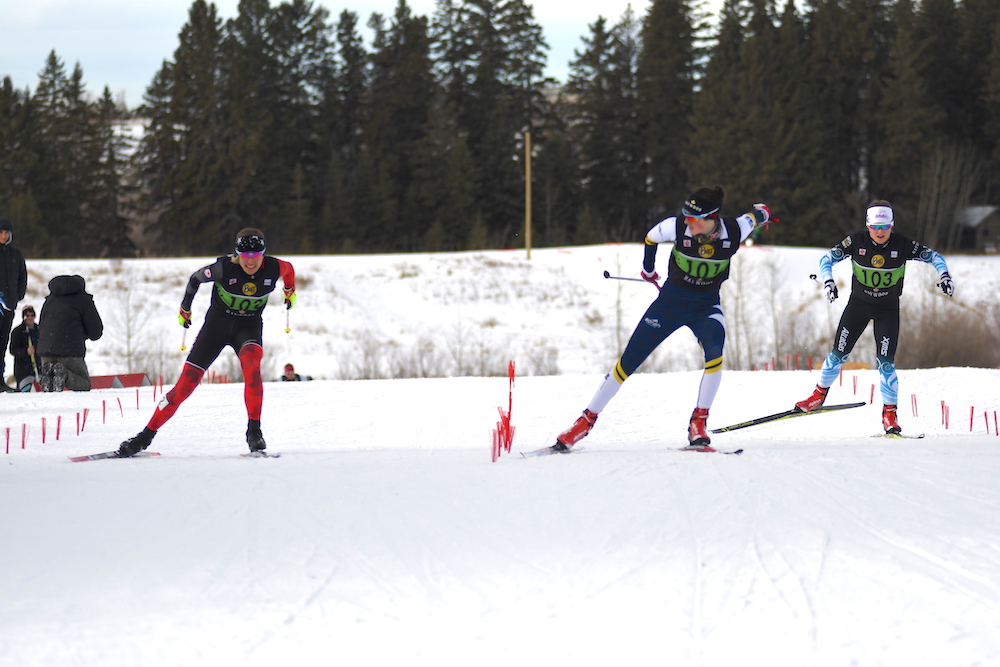
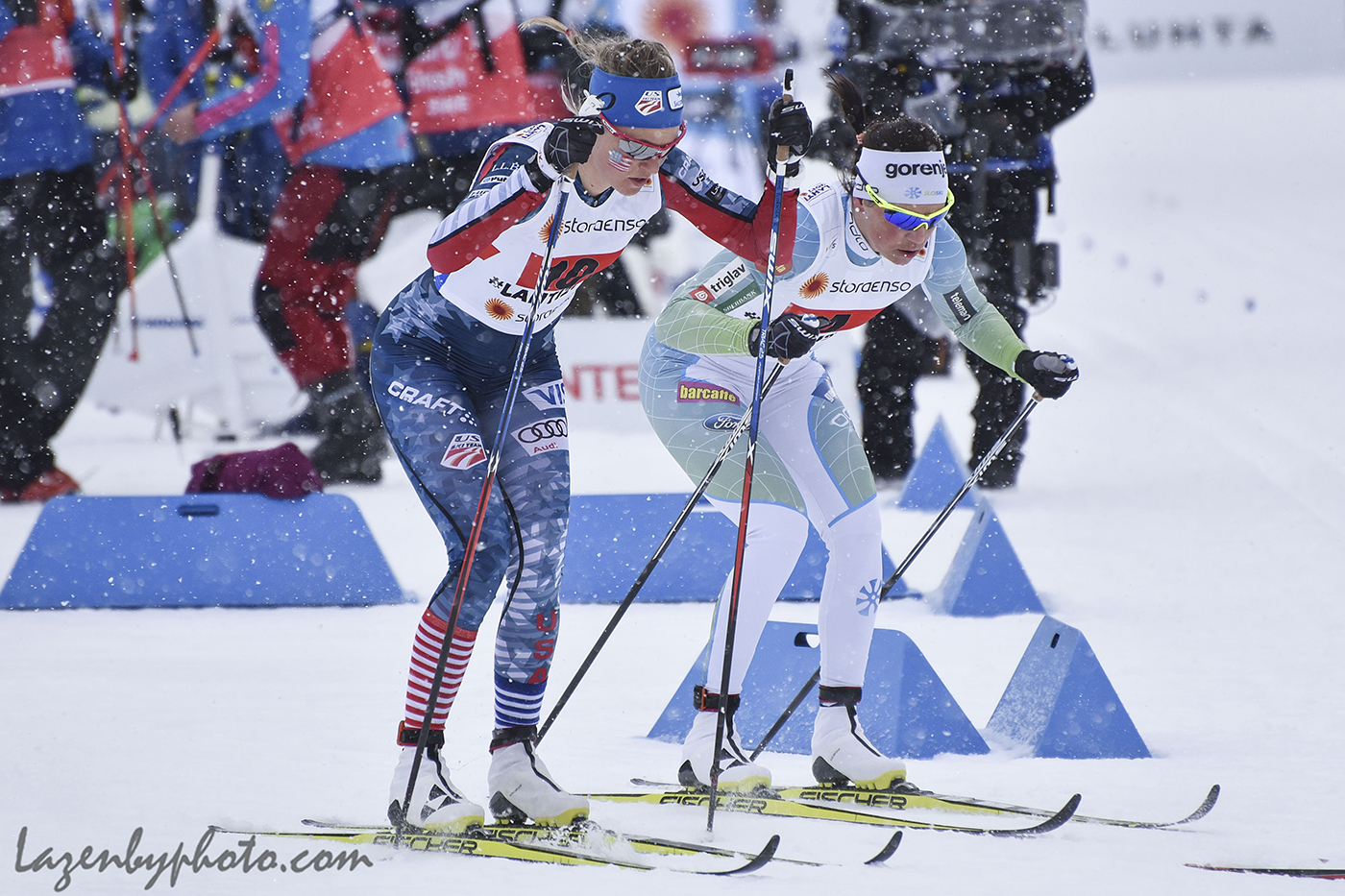
    Olivia Bouffard-Nesbitt (c) holds off Zina Kocher (l) and Annika Hicks (r) to win the women’s freestyle sprint final at 2018 NorAm Western Canadian Championships in January in Red Deer, Alberta. (Photo: Doug Stephen)
  • Wednesday Workout: SkiErg Intervals with Sadie Bjornsen

    Wednesday Workout: SkiErg Intervals with Sadie Bjornsen

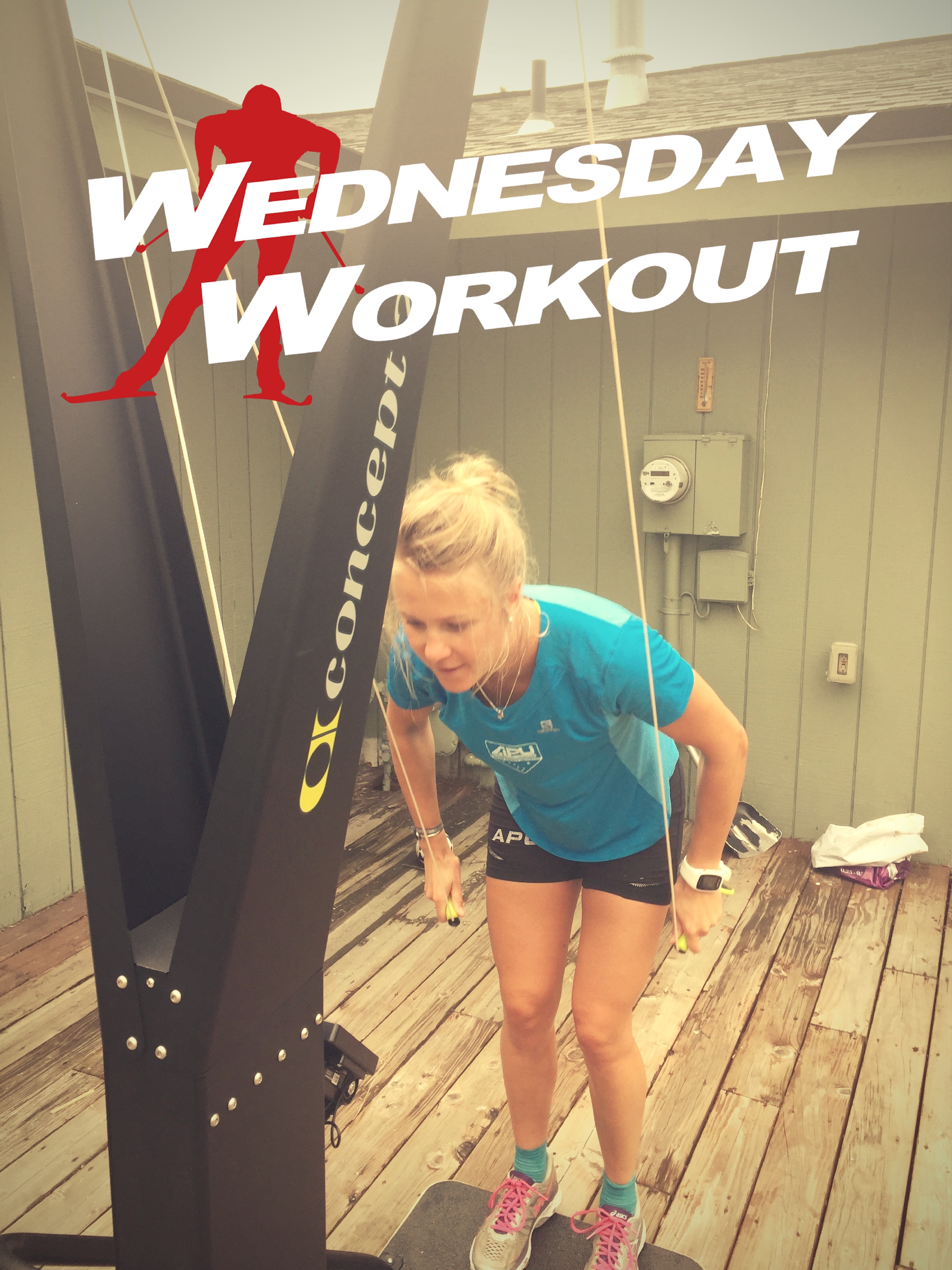
    Sadie Bjornsen, of APU and the U.S. Ski Team, during a SkiErg interval workout at her home in Anchorage, Alaska. (Courtesy photo)

    If you have a lower-body injury, be it acute or chronic, training for cross-country skiing can be frustrating: there are so many activities which must be cut back if you are trying to protect a knee, ankle, or foot.

    Luckily, there are good training options available, especially if you have access to a double-pole machine like an Ercolina or a Concept2 SkiErg.

    “I use the SkiErg a lot because I fight with feet injuries, and it is a safe escape from ski boots or shoes,” U.S. Ski Team and APU skier Sadie Bjornsen wrote in an email.

    Last season, Bjornsen won World Championships bronze in the team sprint with Jessie Diggins. This season, she is back to battling heel spurs. That’s why she has been putting in time on the SkiErg she has at her house, but she sees other benefits to these types of workouts as well.

    Sadie Bjornsen (l) en route to her first World Championships medal, bronze with teammate Jessie Diggins (not shown), in the women’s classic team sprint on Feb. 26 in Lahti, Finland.

    “The SkiErg can also be really helpful on rainy days, super cold days in the winter, or just days that you want to rock out to some tunes indoors and avoid traffic on the roads,” Bjornsen explained. “It is an easy workout to get the most ‘bang for your buck’ if you have a short amount of time, which I also really like. There is no wasted time tucking on downhills, or coasting across the flats. Instead, you are on power mode from the start to the finish.”

    And as numerous research studies have recently shown, double-poling ability and upper-body strength are more and more becoming great predictors of overall ski performance, even in freestyle races.

    “I like to do a little intensity in my SkiErg workouts because it helps keep it fun and fresh, and I also think it really helps to build my upper body strength,” Bjornsen wrote. “Our sport has become really upper-body driven, so I feel like I can never get too much upper-body workouts!”

    With that in mind, she shared a recent interval workout she did on the SkiErg — it’s bread and butter for Bjornsen. “I like to try to do this workout at least once a week all through the summer, and sometimes more if I am going through a period of struggle with my heel spurs,” she wrote.

    It aims for an hour of total workout time.

    The Start: “I start my workout with a fifteen-minute warm up. During this time, I often shut my eyes, and visualize skiing. This helps bring in true ski form, and feel my movements, rather than just fall into a ‘SkiErg-specific technique.’”

    Getting Speedy: “During this time, I will do some little ten-second increases in power to warm up my back and arms, and get ready to go hard.”

    The Workout: “After fifteen minutes, I begin the workout known as 30-30’s. This means 30 seconds of intervals followed by 30 seconds of recovery, then repeat for 30 minutes. What may feel easy at first, quickly catches up after 10 minutes, so I always start this workout more conservative than feels appropriate.”

    Keeping It Going: “After about five minutes of 30 seconds on, 30 seconds off, I start to see a common number of watts I am exerting during the 30 seconds. This is where I set a goal. Maybe it’s 190 watts I am hitting, I want to continue to reach that level or more for the next 25 minutes of this workout. This becomes increasingly hard around 20 minutes, and requires a certain amount of mental power. The 30 seconds of rest begins to pass too quickly, and I find myself becoming really focused in my own little world… forgetting where I am (maybe a garage, maybe a gym).”

    Finishing Up: “By the end of 30 minutes of 30-30’s, I am pretty worked, and feel like I have just done a race out on the snow. This is when I bring myself back to my surroundings, and finish with a fifteen minute easy warm down to help flush my arms out.”

    Final Thoughts: “Not only does this one hour pass really fast, but it is a really focused workout that feels like it truly helps build specific power. I always make sure I finish this workout with a little five minute walk. This helps flush all my muscles, but also helps make sure my back goes back to moving naturally after a pretty intense workout.”
  • Throwback Workout: Ski Walk/Moose Hoof Combo

    Throwback Workout: Ski Walk/Moose Hoof Combo

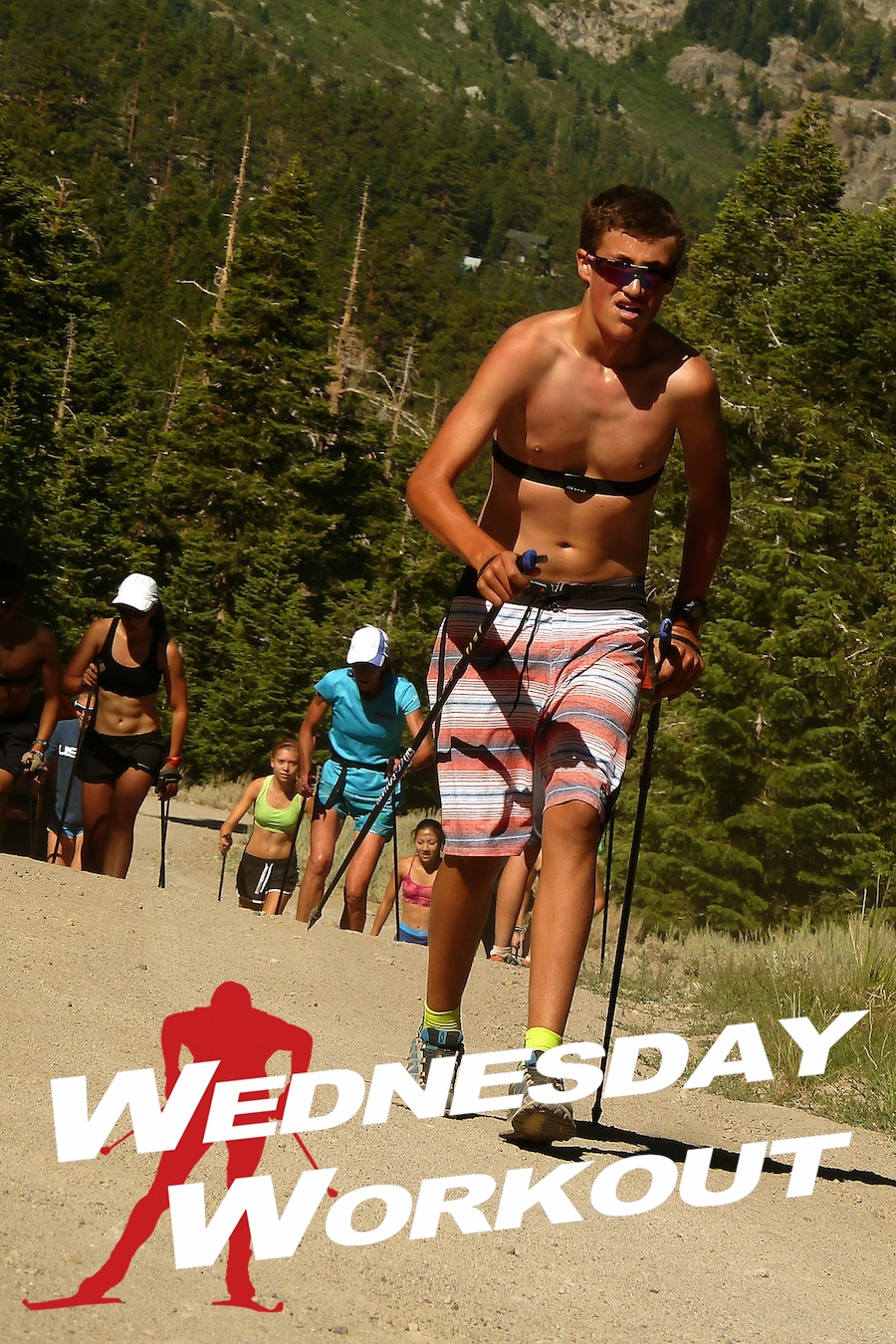
    Brandon Herhusky leads Far West juniors in a ski walking/moose hoofing workout at the 2012 June Lake Camp in California. (Photo: Mark Nadell/Macbethgraphics.com)

    For this week’s workout, we’ve brought back a how-to-guide to ski walking, hill bounding and moose hoofing, written by former U.S. Ski Team member Nancy Fiddler, a two-time Olympian and past FasterSkier contributor. Fiddler shared this workout, which works for juniors to masters, in four years ago. Read the original here.

    ***

    [circa June 2013]

    Ski walking, hill bounding, and moose hoofing are a great way to incorporate ski-specific movements into a dryland workout. There are many ways to use these training tools, but I am going to recommend a favorite interval workout that touches on all three techniques. This low-impact workout works great for skiers of all ages and abilities, from juniors to masters.

    “It helps to think of a deer bounding through the forest. The deer’s feet briefly make contact with the ground, and then it is flying forward with all four feet off the ground.” — Nancy Fiddler’s description of hill bounding

    I was introduced to foot-specific training back in the late ’80s by my U.S. Ski Team coach, Torbjørn Karlsen. Although much has changed about skiing since then, this type of training, which mimics the diagonal stride movement, remains highly valuable to cross-country skiers today.

    Ski walking is diagonal striding without the glide. Think of the arm and leg swing as pendulums while striding on foot up a gradual incline. It’s key to not reach too far up the hill with the foot and to make a complete weight transfer (hip over foot) upon footfall.

    The 2008 Auburn Ski Club Development Team during a ski-walking workout in Squaw Valley, Calif. (Photo: Mark Nadell/Macbethgraphics.com)

    Add poles, and ski walking is highly specific. It is important to have ski poles that are about sternum-high in height, or about 10 cm shorter than your classic poles. While ski walking, keep the poles angled so that the hands are low and the arms can swing freely forward.  The hand is pushing the pole down and back, finishing just past the upper leg.  The pole will plant further back than when on skis.

    Hill bounding resembles striding up a steep hill on skis. It is more explosive than ski walking and it helps to think of a deer bounding through the forest. The deer’s feet briefly make contact with the ground, and then it is flying forward with all four feet off the ground. To practice, start with a jog up a moderate hill, then make each footfall more explosive. Lifting the front knee will help extend the bound. Again poles are planted angled back with hands low. The kick will be assisted by the pole push.

    Moose hoofing is similar to hill bounding, but less explosive, and therefore more sustainable for longer periods of time.  Think of moose hoofing as a way to imitate the diagonal stride up a long, gradual hill.  The timing of the kick and pole push remain synchronized, as in bounding, but not as snappy.  I like to think of a moose shuffling through the forest, not in as big of a hurry as the bounding deer.

    The Workout:  4’s and 1’s

    Find a dirt or grass hill about 400 meters or more in length. The incline should be gentle to moderate and fairly consistent.  Alpine ski areas and logging roads work great.

    • Warm up: 15-20 min easy jogging.  Add some gentle dynamic stretches and some arm and leg swings.
    • Get explosive: Do a set of 6-10 hill bounds (15-20) sec each.  Use the first one or two to coordinate technique and timing, and then work on popping off the ground with each bound.  It is possible to do this with or without poles.
    • Intervals: 4 minutes steady ski walking at a Level 3 effort.  Walk back down the hill for recovery (recommend 3 minutes recovery), then moose hoof back up the hill for 1 minute.  By the end of 1 minute, you will be in Level 4!  Recover back down the hill for 1 minute then repeat the cycle.  Depending on your fitness level and time of the year, try for 3-6 cycles of ski walking and moose hoofing.
    • Cool down: 10-15 minutes of easy jogging.

    Equipment:  running shoes, water bottle, and short ski poles.

    Enjoy the workout!

  • Wednesday Workout: Ski Walking with Erika Flowers

    Wednesday Workout: Ski Walking with Erika Flowers

    Wednesday Workout
    The SMST2 Team hard at work last season. (Photo: Erika Flowers/SMS)

    This week’s Wednesday Workout comes from Erika Flowers, a member of the Stratton Mountain School T2 elite team. Flowers graduated from Dartmouth in 2012 where she was a three-time NCAA All-American skier. Throughout her career with SMS, she has had multiple top-10 finishes at the U.S. Cross Country Championships. Keep up with Flowers and her training by following her blog.

    ***

    Most of the workouts we do here at Stratton are pretty simple. Especially during the early training season, the focus is on quality, practicing good technique and building a strong base. Ski walking up Stratton Mountain is one of our basic go-to workouts that we use throughout the summer to improve efficiency at threshold, build explosive power, and fine-tune ski technique. Although we introduce more bounding towards the middle and end of the summer, we try to force the “walking” early in the season in order to practice a good forward body position and avoid simply running up the mountain with poles.

    The basic workout:

    25-30 minutes easy running/ski walking with poles plus a few short uphill pickups (15-30 sec.) to get the body primed and ready for ski walking at threshold

    6×8 minutes uphill ski-walking with poles at Level 3 or Threshold with 2-4 minutes active recovery between each interval

    20-30 minute cool-down

    Total time: About 2 hours

    A few notes:

    Erika Flowers and Sophie Caldwell work together during their ski walking intervals in Stratton in 2013.
    Erika Flowers and Sophie Caldwell work together during their ski walking intervals in Stratton in 2013. (Photo: SMS)

    Equipment needed: Running shoes, water bottle and holder, HR monitor/watch, ski-walking/bounding poles (shorter than classic ski poles), a fun group who want to go charge up a mountain (or hill… depending on where you live)

    Interval options: During the early spring and summer the ski walking intervals tend to be shorter (6X6-8 minutes). We will increase length and/or number of the intervals throughout the training season as we build fitness and total time at threshold (6X10-15 min. towards the end of the summer).

    This workout also allows us to really dial in our heart rate at threshold by testing blood lactate between intervals. The goal is to maintain blood lactate levels around 4mM.

    Recovery Time: The recovery time is largely dictated by terrain. We try to run down the mountain between each interval for 3-4 minutes so that we finish our last interval at the top of the Stratton.

    If you have a smaller mountain you may need to run down a little further between each interval. Alternatively, if you live out West where the mountains climb for days, you may be able to take shorter breaks and still not reach the summit by the end of the workout.

    Technique tips:

    Our coaches emphasize a few basic technique tips for ski walking intervals:

    1. Fall “up” the mountain with forward hips rather than reaching with legs

    2. Use your poles; Engage your lats, core and arms to weight your poles and push off of them

    3. Full extension with legs

    The SMS T2 Team is joined by the SMS Juniors in their ski walking intervals.
    The SMST2 Team is joined by the SMS juniors in their ski-walking intervals.(Photo: SMS)

    Group/Team Suggestions:

    The SMST2 team often joins the SMS juniors for ski walking intervals. This workout is great for groups because it is easily adaptable for different ages and abilities and allows athletes to work together and learn from each other.

    Between intervals, the fastest skiers run down the mountain for recovery while the slower skiers walk down. This way, the slower ski-walkers can learn from some of the more experienced athletes by jumping in behind them at the start of each interval.

    The younger skiers can hop in behind older athletes to mimic technique and practice keeping pace, even if just for a minute or two at a time. The interval number and length can also be modified for skiers of different fitness levels and abilities.

  • Wednesday Workout: Max Aerobic Speed Intervals with Colin Foley

    Wednesday Workout: Max Aerobic Speed Intervals with Colin Foley

    Colin Foley (Callaghan Valley Training Centre) racing. (Courtesy photo)
    Colin Foley (Callaghan Valley Training Centre) racing. Foley, 18, likes time-based interval workouts that mimic sprint qualifiers, like max aerobic speed at 15-second intervals. (Courtesy photo)

    This week’s workout brought to you by Colin Foley, 18, of the Callaghan Valley Training Centre in British Columbia. Want to submit your own go-to workout? Email alex@fasterskier.com.

    After years of ski training it seems like I’ve done any variety of intensity workouts. From VO2 max to speed, to tempo to you name it, it’s almost a rare event when we do the same intensity breakdown!  Anyway, we did a great workout recently in practice: max aerobic speed at 15-second intervals, it’s something that we’ve done a few times and I really hope we do more in the future.

    The workout: Time-based interval workout, with four intervals of 3 minutes and even rest (3 minutes) in between. We did them at Zone 4, or just as hard as you can maintain for the 3-minute interval.

    Warmup: We warmed up as a group with a 30-minute easy classic ski.  To warm up properly, we stuck to the flatter trails between the stadiums at Whistler Olympic Park for the first 10 minutes then went into some hillier terrain for the last 20 minutes and regrouped in the cross-country stadium at Whistler Olympic Park.

    Interval start: While lots of intervals can be done as a large group (there are 9 on my team), we chose to do this set of intervals in a 15-second interval start format. I really liked this format because it made the workout feel like a sprint qualification … four times!

    When you are doing intervals as a group it’s often easier to push yourself because you have your teammates there at your side, and you don’t want them to get away.  I really like the 15-second interval start format of these intervals because it really helped me practice pushing to the max when I don’t have somebody there at my side.

    “When you are doing intervals as a group it’s often easier to push yourself because you have your teammates there at your side, and you don’t want them to get away.” — Colin Foley

    We definitely have some stronger and weaker “sprinters” on our team, so our coach mixed up the order of our interval start from interval to interval.

    Colin Foley (CVTC) warming up. (Courtesy photo)
    Colin Foley (CVTC) warming up. (Courtesy photo)

    Rest/recovery: In between the intervals we tried to recover as much as possible.  For me, this meant skating easily around the stadium.  We were doing the harder sets on the hills of the sprint course, just outside of the cross country stadium so it was easier to come back (and also hear our coach call the end of the set).

    Result: We do these intervals to increase the amount of time that we can push ourselves at our maximum aerobic output.  I have really found that this has helped my sprint qualifiers this year.

    Post-workout: After the final interval we did a long cool down, but not before we first had some good nutrition.  For us, that’s a bottle of a protein drink and some hydration drink (we also have energy drops if we were feeling a bit hungry).

    We skied for about an hour, this time sticking to rolling terrain (the Madeley Creek Loop at Whistler Olympic Park is great for a longer cool down like this).

    Then it was back to the van, back to our homes in the Whistler Athletes Village (now known as Cheakamus) and a proper lunch and rest.

    We enjoyed being home in Whistler for a few weeks and getting in some good training before heading off to more NorAm competitions and, eventually, Canadian Nationals.

    Callaghan Valley Training Centre team prep (Courtesy photo)
    The Callaghan Valley Training Centre team preps for one of its workouts. (Courtesy photo)


  • Pro Workout: Sea-level Speed with Dakota Blackhorse-von Jess

    Dakota Blackhorse-Von Jess at the 2010 West Yellowstone SuperTour.

    For a long time, Dakota Blackhorse-von Jess has known he was fast. He won a junior national championship in the sprint, won carnival races while representing Dartmouth College, qualified for a World Cup in Canada, and then transitioned into being a full-time, post-collegiate racer.

    But it wasn’t until this past January that the Bend Endurance Academy racer had his breakthrough, finishing fifth in the freestyle sprint at U.S. Nationals in Rumford, Maine.

    While Blackhorse-von Jess undeniably has natural speed – before that he had once qualified third in a Nationals sprint – he said that it’s fitness and tactics that determine a skier’s ultimate placing in sprint heats.

    “To be perfectly honest, pure speed is totally a function of fitness,” he told FasterSkier in an interview. “I mean, either you have it or you don’t, but if you make it through four rounds and you’re coming into the last 100 meters, if you don’t have fitness you’ve already blown your speed reserves so it doesn’t matter how ‘fast’ you are.”

    To work on speed, fitness, and tactics all at once, Blackhorse-von Jess and his teammates travel to sea level (Bend is situated above 3,000 feet) for training camps and do a specific interval workout several times a year.

    “It’s actually a pretty cool workout,” he said.

    As in any speed workout, he said that a good warmup was essential. The Bend Endurance Academy does a five-minute block of level three (threshold) work as an “indian run”, with the last skier periodically sprinting as hard as they can to get to the front. Then, it’s on to the real workout.

    “We do three minutes with equal rest, and probably seven or eight of them, depending on how many you can make it through.

    “The first minute is fast, and it kind of depends on how big the group is, and how talented the members of the group are, what the gamesmanship is. Pretty much you ski for a minute or two, hard, to get into it, and then at some point somebody jumps as hard as they can, because you have to break the draft if you’re going to get away. Then once somebody jumps… it’s the obligation of the rest of the group to then get back on and jump again and win each interval.”

    The result is more or less a series of sprint races, with athletes competing for the victory in each bout. For the best sprinters, the workout is an opportunity to practice gamesmanship in scenarios that mimic a real sprint race. But different athletes respond to the workout in different ways.

    “If you’re not as strong, then you come out of the draft and that’s basically it, you just go as hard as you can for the rest of the interval,” Blackhorse-von Jess explained.

    He said that he’s done the workout with as many as five or six athletes, but was recently impressed with how well it worked as a three-person game.

    While the team works on intensity throughout the year, this particular workout is reserved for sea-level training blocks once or twice during the season. Blackhorse-von Jess had just finished a training camp on the coast when he talked to FasterSkier.

    “We only do [this workout] when we’re at sea level,” he explained. “At elevation, there’s just not enough speed involved for the drafting to make any difference. Obviously fitness makes a much bigger difference. But in this workout, nobody cares about heart rate. You just go as hard as you can.”

  • Cross Training: Rowing

    Cross Training: Rowing

    During the summer months, it can be hard to stay focused and keep your muscles snappy when all you seem to do is rollerskiing, rollerskiing and more rollerskiing. Cross training is important in order to avoid burnout or injury–especially for juniors or masters looking to mix it up during the off-season.

    In a new series to FasterSkier, we’re going to take a look at some of the ways skiers keep themselves and their bodies sane by use of cross training. Some of the workouts are as familiar as a pre-breakfast run, while others may be as exotic as Cirque de Soleil.

    Craig Pond, coach of the UBC Women’s rowing team, strongly believes in the diversity of sport as a means of teaching athletes to live an active lifestyle–instead of merely participating in a specific sport.

    “It’s important, when you are a developing athlete, to have a broad range of sports. Just rowing and rowing and rowing is boring, and it’s the same with skiing. It tends to lose some of its excitement,” Pond said. “Try to keep variation so you’re not just hammering away at the same thing.”

    For athletes who have been brought up in the ski arena, the sport can lose some of its shine by the time they hit the senior level. Rowing can help in keeping things fresh and new, with a little time off from the specific–but not from athletics.

    Pond started out as a cross country skier in Belleville, Ontario, but was convinced to try rowing in high school. He went on to become first an elite rower, then, after injury, a coach.

    “Both sports require most muscle groups in your body. Both are leverage sports that require force from your entire body,” said Pond.

    Rowing can also help build strong muscles. Photo: Thomas Auer

    Rowing and skiing are similar in that they both require the use of the body’s major muscle groups. A rowing stroke has both a drive and a recovery phase, not unlike skiing and both start with the bigger muscles in the body and end with the smaller ones. They’re also similar in they both have diversity in their races—sprints, mid-distance and long distances.

    Andrea Bundon is a part of University of British Columbia’s (UBC’s) women’s team. She trains with them during the spring, summer and fall, then switches over to skiing for the winter to race.

    She was also a guide for one of Canada’s blind skiers, Courtney Knight, in the Vancouver 2010 Paralympic Games this past winter. She finds that rowing gives her a mental break while still maintaining her fitness.

    “When I hit the snow again, I feel refreshed and ready for the ski season,” said Bundon.

    Here’s a sample workout from UBC’s playbook. If it’s too rainy and awful outside to rollerski, erg (or rowing) machines can usually be found at a gym to get a great interval session in. It can also be modified to become a longer interval. Pond thinks it’s a good workout because it keeps the structure of a race.

    The Five -Thou-Five Workout

    1. Do a good warm up. Either a 30 minute run or ride, or do a 30 minute rowing warm up so your muscles are ready to go.
    2. Start with a 500-meter interval, which simulates of the beginning of a race. Make it a strong, steady burst.
    3. Take an active break, light rowing or a couple minutes on the bike. It should be at least the same amount of time as your interval.
    4. Hold a threshold pace for a thousand meters. This simulates the middle of a race. You should hold a strong pace with a consistent heart rate.
    5. Take an active break.
    6. Final 500-meter sprint to the finish line. This simulates the final sprint in a race and should be all out.
    7. Cool down.
    Rowing is a way to work at a team or solo. Above, the UBC women's lightweight four races on the Fraser River, B.C. Photo: Emmett Tuyp