Tag: Intervals

  • Reaping Mountain Biking Benefits for Cross-Country Ski Training with Jessica Yeaton

    Reaping Mountain Biking Benefits for Cross-Country Ski Training with Jessica Yeaton

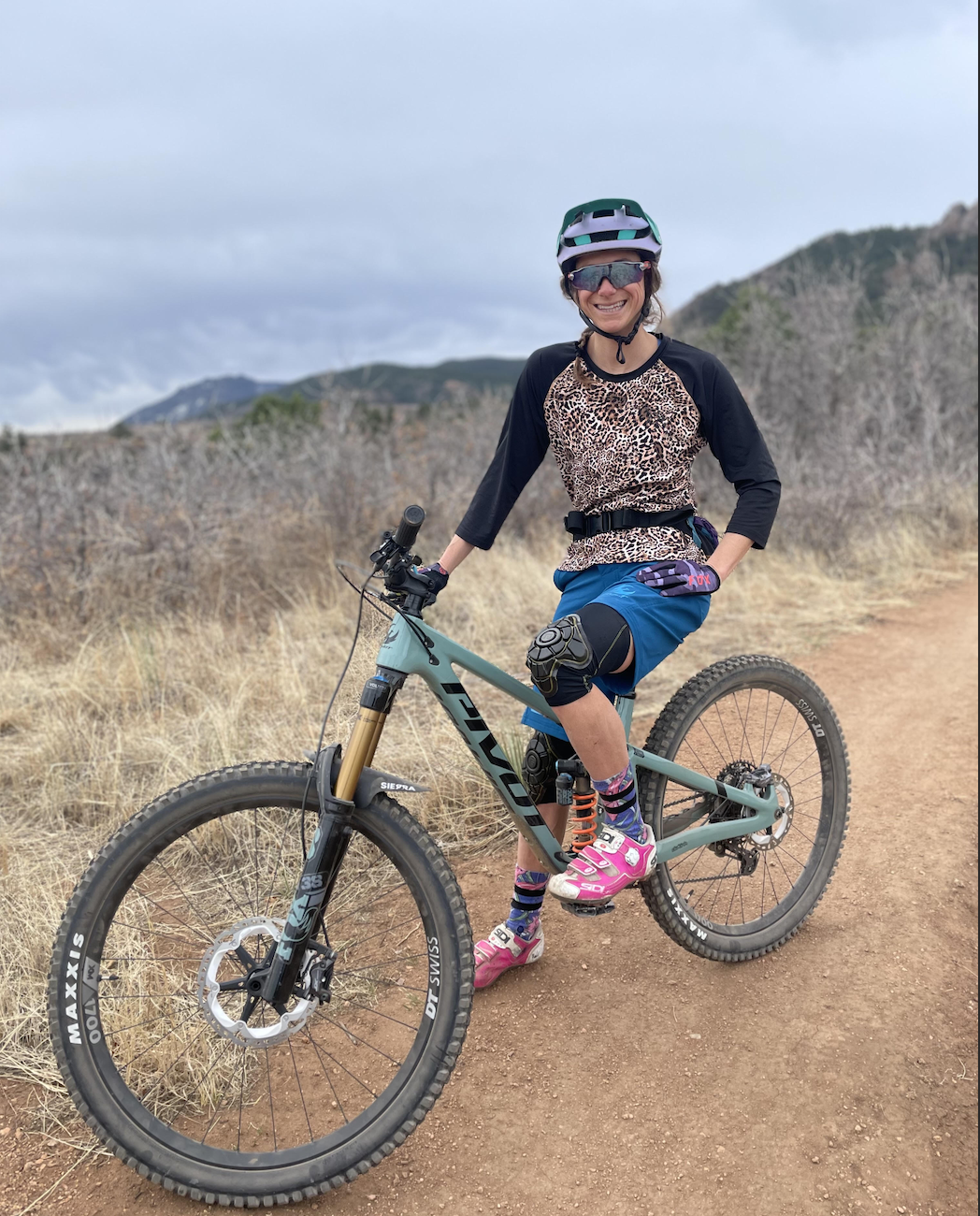
    2x Olympian and soon to be DPT Jessica Yeaton shares insights into incorporating mountain biking into your cross-country ski training. (Courtesy photo)

    Cross-country skiers are notorious for training high volumes during the off season in order to be in peak racing form in the winter. There is a common mantra used by coaches to help motivate athletes to train hard even though the racing season is months away: “skiers are made in the summer”.  From my experience working with different coaches, the large bulk of the summer’s volume is intended to be on roller skis or foot (either running or bounding with poles). While this may work for some, many athletes struggle with injuries when training 800-900 hours/year – myself included – making it hard to consistently rely heavily on these high impact training modalities. 

    A constant battle with an overuse injury one summer forced me to think outside the box; I began using the mountain bike to train. In the back of my mind, I doubted the effectiveness of this as it translates to skiing. I had heard coaches saying since I was in high school that cycling hours needed to be counted as 50% when logged due to the lack of specificity to our sport. However, I had no choice – it was either train on the bike or don’t train much at all. 

    Three years later, I now perform 60-70% of my summer training on a mountain bike. This is no longer because I have to, however; I now choose to use it as my primary mode of volume and a large amount of my intensity due to the immense gains in fitness and muscle activation, along with technical and terrain aspects that I have found translate well to cross-country skiing. 

    Jessica Yeaton enjoys a fall mountain bike ride in Sedona, AZ. (Courtesy photo)

    It’s a no-brainer that mountain biking heavily engages lower extremity musculature, placing a high demand on our quadriceps, hamstrings, glutes, and calves. However, mountain biking also employs shoulder, chest, and arm muscles due to the control required in technical sections, downhills, and even steep uphills. Thus, the muscles used while mountain biking closely mimic those during cross-country skiing – particularly skating, which has a higher demand on our glutes than classic skiing. Additionally, the terrain in a network of mountain bike trails is often tough, causing fluctuations in heart rate similar to those experienced while skiing. There are long climbs followed by flowy descents with sharp corners and short, punchy uphills thrown into the mix. High workloads followed by challenging downhills on which to recover – doesn’t that sound like ski racing? I find that a 90 minute bike race feels very similar to a 30k skate race in effort. 

     The downhills also offer a technical challenge that heightens reaction times. I often ride into more difficult features multiple times to get the line right before committing – something that has changed the way I now approach tough downhill corners before a ski race.  An added bonus is the smile that I can’t wipe off my face after a flowy descent or when I’m able to conquer a new feature! 

    Dropping! Jessica Yeaton gets after it on a technical ride in Colorado this spring. (Courtesy photo)

    Lastly, the fact that it is low impact makes it a great addition to a summer training plan that is full of running and rollerskiing. If you struggle with injuries or are looking to increase volume without added stress on your joints, jumping on the mountain bike for a few workouts a week is a great way to accomplish that. 

    So, with all of those factors in mind – what is the best way to approach your workout on a mountain bike? 

    The aerobic demand and muscular fatigue is often higher while mountain biking than during other activities where it is easier to keep my heart rate consistently lower. Because of this, I tend to pick a few workouts a week where I am ok doing a higher distance pace (L2 into L3) to hop on the bike. I choose terrain that mimics ski racing, and do not stress about keeping my heart rate low. I often pair my rides on a day with double pole intervals or strength sessions. If I am trying to keep it easy or have hard skate rollerski intervals planned the next day, I opt for easier trails or a light run so I can keep my heart rate low.

    Want to test it out for yourself? Here are two of my favorite workouts on the bike. 

    Due to the aerobic challenge mountain biking presents, it’s an awesome place to do threshold workouts. If you live in a place where you can find a sustained climb or an up-track, you can use this to do L3 efforts (for example, 2 x 20 or 3 x 15 minutes up an up-track), then use the downhill for active recovery. This stimulates downhills in racing and forces you to focus on coordination while flooding with lactate. 

    2x Olympian and soon to be DPT Jessica Yeaton shares insights into incorporating mountain biking into your cross-country ski training. (Courtesy photo)

    Another great workout on the bike is 30-30’s, or where you go hard for 30 seconds, then recover for 30 seconds while continuing to ride easy. This workout focuses on power and strength, and I find that it translates really well to sprinting, and teaches the body to recover and get used to back-to-back punchy hill efforts, so you’re able to regain power descending off a roller before hammering up the next climb in a race. I recommend doing 3 x 10 minutes or 2 x 15 minutes of 30-30s. Just make sure you are able to keep your legs spinning during the recovery – you shouldn’t need to get off your bike to rest in between! The goal is to put in a hard effort, but maintain a reasonable pace in between.

    I am a big believer in making training as fun as possible while still putting in the hard work. Mountain biking is something to look forward to that makes me excited to get out and train. Ultimately, this helps me train harder and stay motivated, so I am a huge advocate for learning how to integrate it appropriately – which for me means creating a smart training plan that will help me reach my goals in the winter. If you also crave time on the bike, I hope this advice can give you the confidence to structure it into your dry-land training as well. 


  • Interval Session to Kick Start The Season

    Interval Session to Kick Start The Season

    We’ve reached mid-December. With any luck, your local trail system is beginning to fill in, you’ve scraped off your storage wax, and you’ve put in at least a handful of easy days getting reacquainted with your boards. Whether or not you rollerski during the summer, skiing on snow has its own jive and it’s normal to feel a little like Bambi your first few sessions. 

    In my experience as a coach and masters athlete, I find it best to lean into the Bambi phenomenon. Don’t expect to pick up where you left off last season. Accept that you’ll feel a little loose and wobbly and go back to the basics. Spend plenty of time skiing without poles and keep things very easy, continually emphasizing form over speed or power.

    (Find more on this from the FasterSkier archives here.)

    Early season intervals build the strength, fitness, and stamina to help you thrive as winter provides the goods.

    Okay. Now that that’s done and you’re no longer rusty, are you feeling dialed in and ready to get your heart rate up a bit? Great. That’s what this interval session is designed for. 

    Objective #1: Pick up the pace and effort without losing your form.

    Regardless of ability, we can all recognize that skiing harder does not always equate to skiing faster. Particularly when we’re learning or regaining technique, skiing harder might mean skiing less efficiently and wasting energy with extraneous movement. During this session, your focus should be on keeping the intervals in control so your technique isn’t compromised as fatigue and intensity increase. 

    Objective #2: Ease in. Don’t be too hot out of the gate. 

    The variations below both involve relatively short periods of rest, meaning your heart rate will stay elevated, even during the rest periods. The fitness boost is similar to doing long threshold intervals, just broken into smaller and more manageable chunks. 

    Going out too fast on your first few sets will quickly dig a hole, compromising either the consistency of the effort during the subsequent intervals or your technique on tired legs or both! The season is young. Easy on the gas. 

    The Workouts:

    Now that we’re on the same page in terms of when to introduce an interval session and what to keep in mind, here are two bread and butter workouts to help boost your fitness and enhance your skiing this season. These can be incorporated throughout the season, but they make great candidates for early season training as the duration of the intervals is short enough to wrap your head around.

    8-10 x 1 minute on / 1 minute easy ski (2-3 sets)

    Though simple, this workout will leave you feeling tired, satisfied, and accomplished, remembering just how many muscles you use when you’re skiing. Try it on varying terrain to work through each of your gears and practice transitioning smoothly between them. 

    Reinforcing the importance of easing in, after the first few intervals of the set, you should feel like the minute of rest is plenty of time to catch your breath as you continue on easily. It’s more about stamina than speed here. Don’t worry – by the last few, you’ll be thinking, “Wow, that minute of rest went by fast!”

    Take 5-6 minutes to ski very easy between sets so your heart rate has the chance to come back down. Aim for two sets of eight intervals on your first go, then introduce a third set or bump up to ten intervals the following round. 

    Totaling 16-30 minutes worth of “work”, the load is equivalent to skiing hard for 5-10 kilometers, broken into bite-sized pieces. When using this for the first time, keep the effort equivalent to a 40-60 minute race to ensure you can maintain form and effort throughout. Dial-up the effort to a 5k pace as your fitness and ski form improve throughout the season. 

    The author during an early-season interval session in Crested Butte, CO.

    8 – 10 x 2 minutes on / 2 minutes easy ski (1-2 sets)

    This variation challenges you to hold onto your technique for a longer effort, with increased rest between to account for the extra load. These sessions help improve both your mental and physical stamina, as you focus on your technique under the duress of the challenge. 

    Since one set equates to 16-20 minutes of work, it’s important to scale back the intensity compared to the 1 on/off, perhaps starting the first few at an effort you might be able to sustain for 60 minutes in a race, then hitting the last few a bit harder if you’re feeling up for it. 

    This time, give yourself 6-8 minutes of easy skiing between sets. You’ll feel the accumulation of fatigue as you work your way into the second set!

    What are the pros doing?

    FasterSkier reached out to three-time World Junior Champion Gus Schumacher via email to see how he tests the intensity waters once he is back on snow, which given his residence in Anchorage, Alaska tends to arrive earlier than it might for those of us at lower latitudes. Turns out, it’s pretty similar — just without the breaks!

    Taking it. Gus Schumacher of the U.S. wins the World Junior’s 10 k classic. (Photo: Doug Stephen)

    “The workout I like to do early in the season to get some ski legs under myself again is a longer level 3 (medium intensity) interval session. Normally I’d do 12-15 minute intervals for a total of 45-60 minutes of on time. This workout is nice because it gives you time to settle into the intensity and adjust to new movements on snow. During this time, big strides in technique can be made, because you ski with more similar power and motions to racing. It’s also a workout that doesn’t have to be overly taxing, giving it a good return on technique work without being overly physical. 

    “It also has the benefit of building or maintaining base fitness that can be added to as skiing starts to feel more normal. It can easily be adjusted to your level, the goal is basically to just give you some time on skis at a faster pace!”

  • Wednesday Workout: Building Sprint Capacity with Dr. Øyvind Sandbakk

    Wednesday Workout: Building Sprint Capacity with Dr. Øyvind Sandbakk

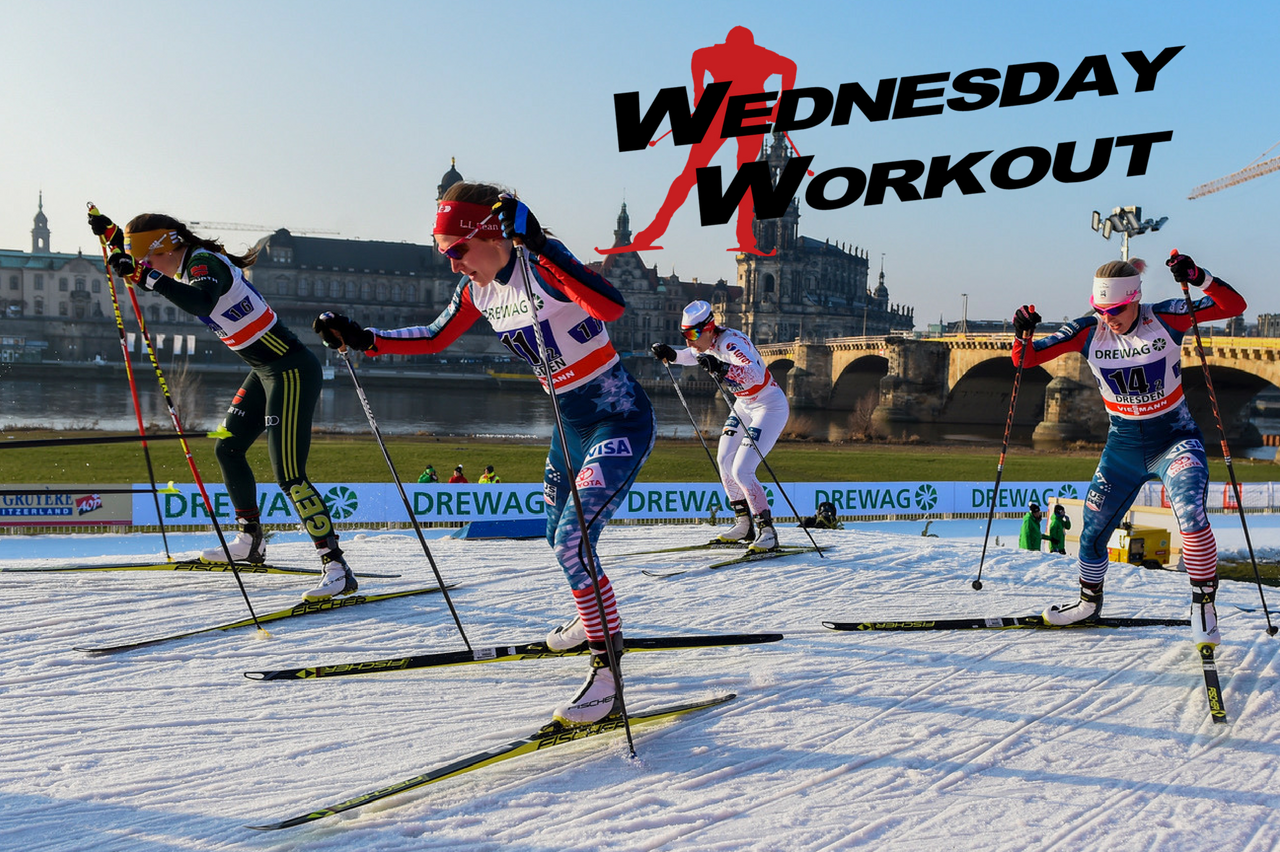
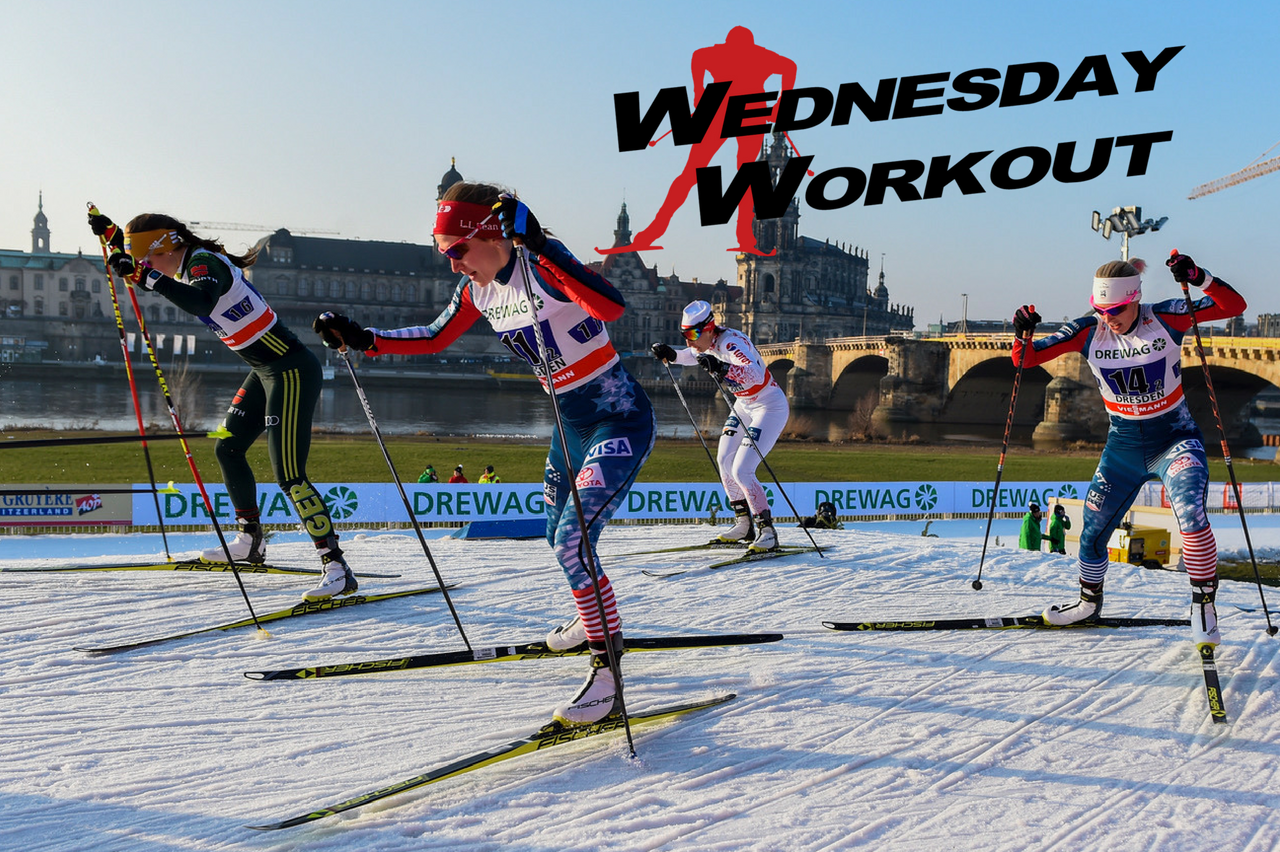
    On-snow sprint speed, something to work on now as the temps heat up. Here, Sophie Caldwell (second from left) and the newly retired Kikkan Randall (r) work their own sprint speed at the 2018 World Cup city sprint in Dresden, Germany. (Photo: Fischer/Nordic Focus)
    Dr. Øyvind Sandbakk (Courtesy photo)

    The following Wednesday Workout was written by Dr. Øyvind B. Sandbakk, the managing director at the Centre for Elite Sports Research at the Norwegian University of Science and Technology (NTNU) in Trondheim, Norway. (He’ll also be featured in an upcoming Nordic Nation podcast.)

    Beyond his work at NTNU, Sandbakk is the head of research and development at the Norwegian Olympic Sports Center (Olympiatoppen). At 37, he has established himself as one of the premier researchers studying how to optimize performance for cross-country skiers. Even a simple online search is a treasure trove of relevant Sabdbakk research. You can follow him on Twitter @OyvindSandbakk.

    The following workouts focus on building sprint capacity:

    Sprint training

    Short sprint sessions are important to develop the neuromuscular system specifically and the technique at high speeds. In order to assure that technique development is optimal, I normally start sessions with sprints at 90 and 95% of maximal speed, before the last part of the sessions are done with close 100% effort. For athletes struggling with the technique, the entire session is sometimes done with 95% of maximal speed in order to facilitate good technique. Most of such sessions should be done using specific skiing techniques. One example:

    • 5 x 15-second strides with gradually higher speeds, followed by 4 x 10 seconds in heavy terrain (90-95-100-100% of max speed) and 4 x 15 seconds in easy terrain/spurt (90-95-100-100% of max speed). 2-minute recovery between sprints and 5 minutes between series.

    Sprint intervals

    Sprint interval sessions should develop specific areas or weaknesses. These sessions are done technique-specific with good technique and quality maintained throughout the entire session. I personally like that they are target terrain where races are often decided such as simulations of attacks or final sprints. The cost of such sessions are high, so they should not be done too often, but regularly. Some examples:

    •  2-3 series of 6 x 20-second maximal sprints with diagonal or skating in moderate or heavy terrain with 2 to 3 min recovery, and 5 min between series
    • 2-3 series of 6 x 30-second double poling or skating in easy terrain, with 1-2 minutes recovery, and 5 min between series

    Note: The terrain decides how long the duration of work and recovery periods can be, and easier terrain and when the upper body is more loaded allows longer work durations and shorter recovery

    Short intervals

    Short interval sessions allow the aerobic system to be stimulated at high skiing speeds, with additional stimulus at the anaerobic system without totally fatiguing the athlete. Such sessions should mainly be done using specific technique, and personally, I like to use modes and terrains that are of particular importance at the end of races, such as attacks in uphill terrain or the final sprint. It is also important that good technique and high speed is maintained throughout the entire session. Some practical examples:

    • 40-45-second work durations, with 15-20 seconds of active recovery at an easy pace, performed over 5-8 minute intervals. Depending on the age and level of the athlete, 3-5 such intervals should be done.
    • 20 seconds slow — 20 seconds hard – 20 seconds close to maximal – 20 seconds slow, etc. over 4-5 minutes. Depending on the age and level of the athlete, 4-6 such intervals should be done.
  • Wednesday Workout: Russian Intervals with a Canmore Master

    Wednesday Workout: Russian Intervals with a Canmore Master

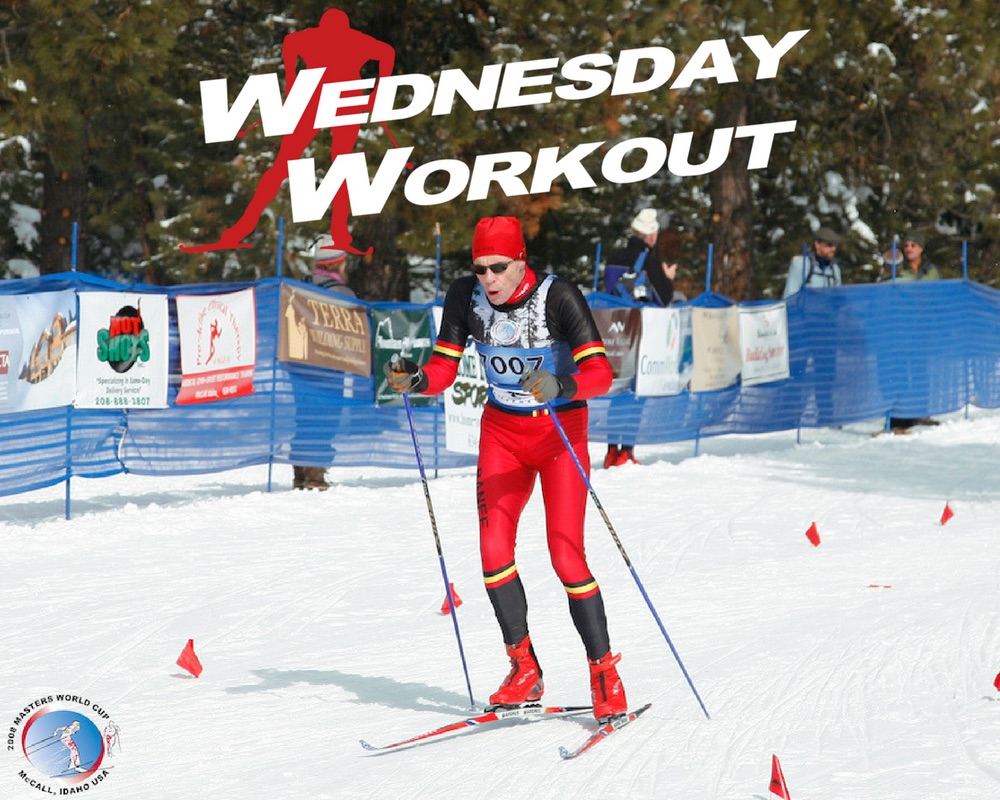
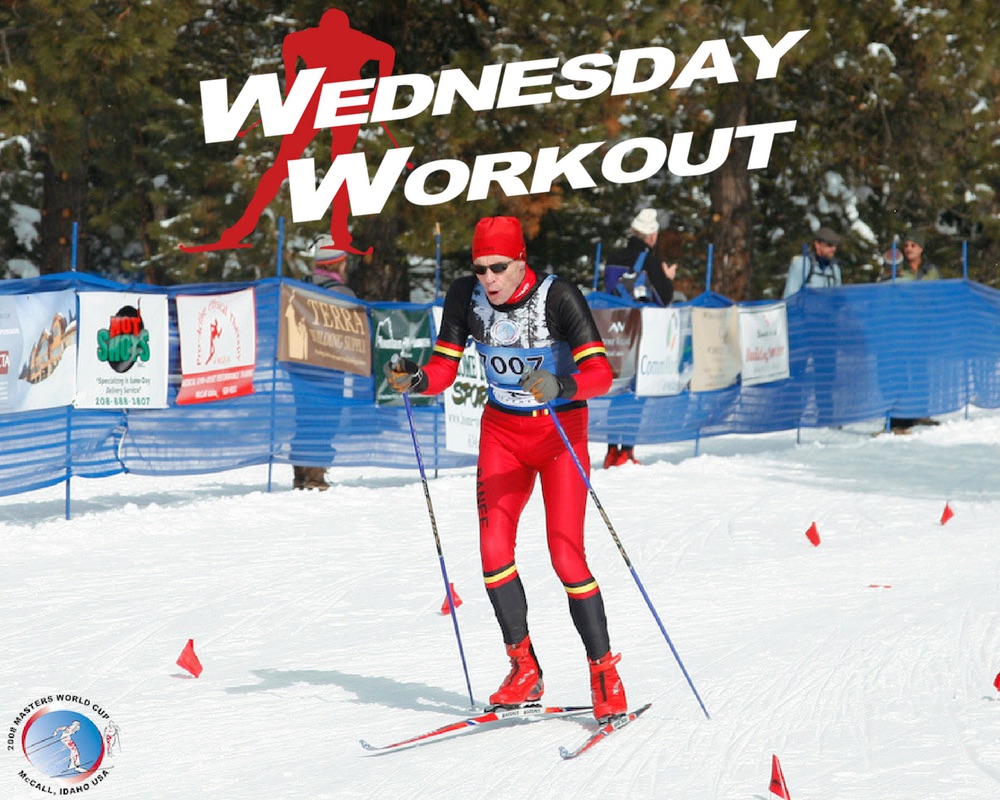
    Author Everett Fee racing at his first Masters World Cup in 2008 in McCall, Idaho. (Courtesy photo)

    (Note: The following workout was submitted to FasterSkier by Everett Fee of Canmore, Alberta. If you’d like to share a workout of your own and the story behind it, please email alex@fasterskier.com with the subject line: ‘Wednesday Workout submission’.)

    ***

    Competitive cross-country skiing is a great lifelong sport. I came late to the party, skiing in my first Masters World Cup when I was 63. I am now 73 and looking forward to being in the thick of things in 2021 when the Masters World Cup races will be in my hometown of Canmore — I’ll be a youngster in the M10 (75-79) age class!

    I got into both XC skiing and rock climbing soon after moving to Winnipeg in 1972. They were complimentary sports — we used skis to explore the SW margin of the Canadian Shield in search of unclimbed granite cliffs that we approached by canoe on climbing trips in summer.  I enjoyed skiing the occasional loppet but, in truth, climbing was what I was keen on; when there was no snow on the ground I didn’t think about skiing.

    ((Some accounts of those days are available online (ELA climbing guide) or in the Canadian Alpine Journal (CAJ v. 65 (1982), p. 24; 66 (1983), p. 98).)

    After a sabbatical year in 1979 in distant mountains (the Pyrenees, the Alps, Morocco, and Chile), the remainder of my Winnipeg years were focused on climbing trips: Mexico, Yosemite, the Red Rocks, the Dolomites, Ecuador, Nepal, and, most frequently, the Canadian Rockies.

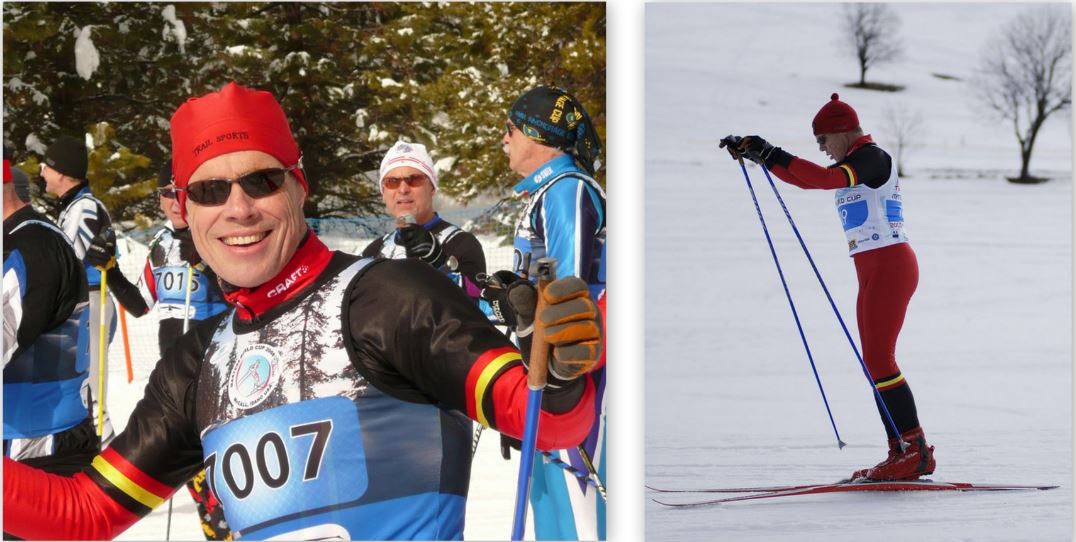
    My two Masters World Cup experiences. Left: On the starting line in McCall, Idaho (2008). Right: Mid-race in Autrans, France (2009). (Photos: Dave Rees (l) and purchased/courtesy photo (r))

    When I retired in 1997, moving to Canmore in the heart of the Canadian Rockies was a given. Now, 21 years later, the focus of my summers is training for and thinking about XC skiing. This transformation happened for several reasons. First, because I’m a lazy fun hog I couldn’t resist the five months of carved-in-marble grooming at the Canmore Nordic Centre, which is only 10 minutes from our house. The venue for the 1988 Calgary Olympics XC races and a regular stop on the World Cup XC circuit since 2005, it was so easy to ski there 100 days each winter. And all that skiing gave me the fitness I needed to tackle long-held climbing objectives such as Mount Alberta.

    Another thing that drew me to XC skiing is the people I met on nordic-centre trails.  A lot of them were masters skiers who trained seriously during the dryland months for racing in Canadian Nationals Masters and Masters World Cup in the winter. They encouraged me to dream big, too. In considering this, it became clear that I would have to seriously upgrade my haphazard approach to training (basically, a lot of random skiing in the winter and climbing in the summer).

    lioresal, erythromycin, ofloxacin online


    Canada’s Graeme Killick representing the Banff Ski Runners at 2007 Canadian nationals. (Photo: Anders Lenes)

    So in 2007 I joined the Banff Ski Runners (BSR), a small Norwegian-style club coached by Anders Lenes and signed up for the club’s six-days-per-week training program. Anders had skied on the Norwegian National Team for seven years, won Junior World Championships gold, silver, and bronze medals and had several top-10 finishes in World Cup races. He came to Canada in 1975 to prepare the national team for the 1976 Olympics and was on the Canadian national team coaching staff until 1984, during which time he worked with many great athletes, including Shirley and Sharon Firth, Burt Bullock, Esther Miller, and Angela Schmidt. He started coaching the Banff Ski Runners in 2000 and by 2007, the year I joined, he had transformed this small neighborhood Canmore club into a dominant force nationally. The juniors were ripping it up at Canadian nationals and shooting for the big leagues., and two of them (Graeme Killick and Jesse Cockney) went on to ski on the Canadian national team for two Olympic cycles. 

    In a recent FasterSkier article on his retirement from the Canadian national team, Cockney highlighted the importance of Anders and BSR in his development as a junior.

    It was a real treat to train year round with this small group of about a dozen elite juniors. Although I started training with BSR too late in life (at 62) and had too little natural talent to finish above the middle of the pack in my Masters World Cup races, training with BSR was essential to getting me to the starting line in those events.

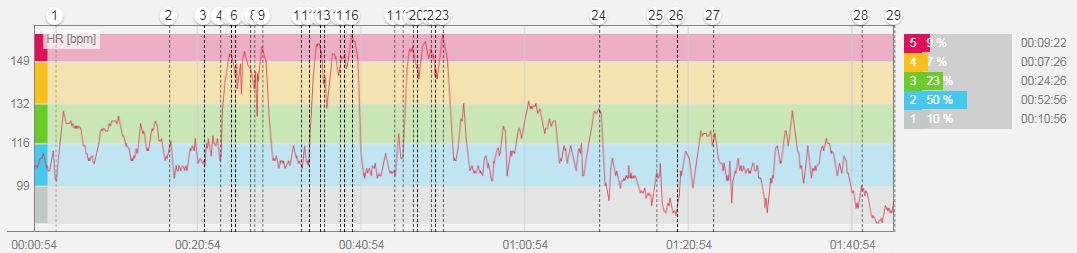
    Anders’s BSR dryland program was highly varied — we rollerskied, hiked, trail ran, road biked, and (my favorite) ski walked. The unquestioned heart of the program was weekly intensity workouts. Among the different intensity workouts that we did, the one that had the most positive effect on my fitness is what Anders called “Russian intervals”: three sets with each set having three approximately one-minute, maximum-effort sprints separated by 30-second rests. This workout builds lactate tolerance:

    The workout: Russian Intervals

    The course: A hill 45-60 meters high (or stairs if that’s all that’s available)

    Warmup: 15 to 30 minutes of easy (Zone 1-2) jogging (striding hills to keep heart rate low) followed by a nonstop lap or two of the intervals course in Zone 2-3

    The intervals: Three sets of 3 approximately 1-minute, maximum-effort sprints separated by 30 seconds of rest and a minimum of 2 minutes rest between sets

    Warmdown: 30 to 45 minutes jogging at a very easy pace (zones 1 to 2)

    Here’s my heart-rate record in a typical Russian intervals workout.

    The goal of this workout is to train the body (and mind!) to go hard when flooded with lactate. Done properly, this workout hurts (bent over gasping after each of the three sprints in a set). 

    Be aware that this is an extremely demanding workout that should be introduced into the dryland season only after building a solid aerobic base. When Anders retired from coaching in 2013, I decided that it was also time for me to move on and I’ve been training on my own since then. I generally follow the BSR dryland program, with a bit more rest to accommodate my aging infrastructure. I make sure to do an intensity workout every week and occasionally make a mistake. Last year, overly keen to get started, I started doing Russian intervals in May and was ambushed in mid-summer when my iliacus hip muscle seized up so bad that just walking was a problem for most of a week! This year, the first third of the dryland (May and June), I’ve been doing “building intervals” as recommended by Olivia Bouffard-Nesbitt in another Wednesday Workout.

    This fun workout, which just tickles the AT threshold, really hits the easily neglected, sub-threshold AT zone. The past month’s three-, four-, five-, and six-minute building interval workouts have me to the point where I now feel it’s time to start doing Russians. 

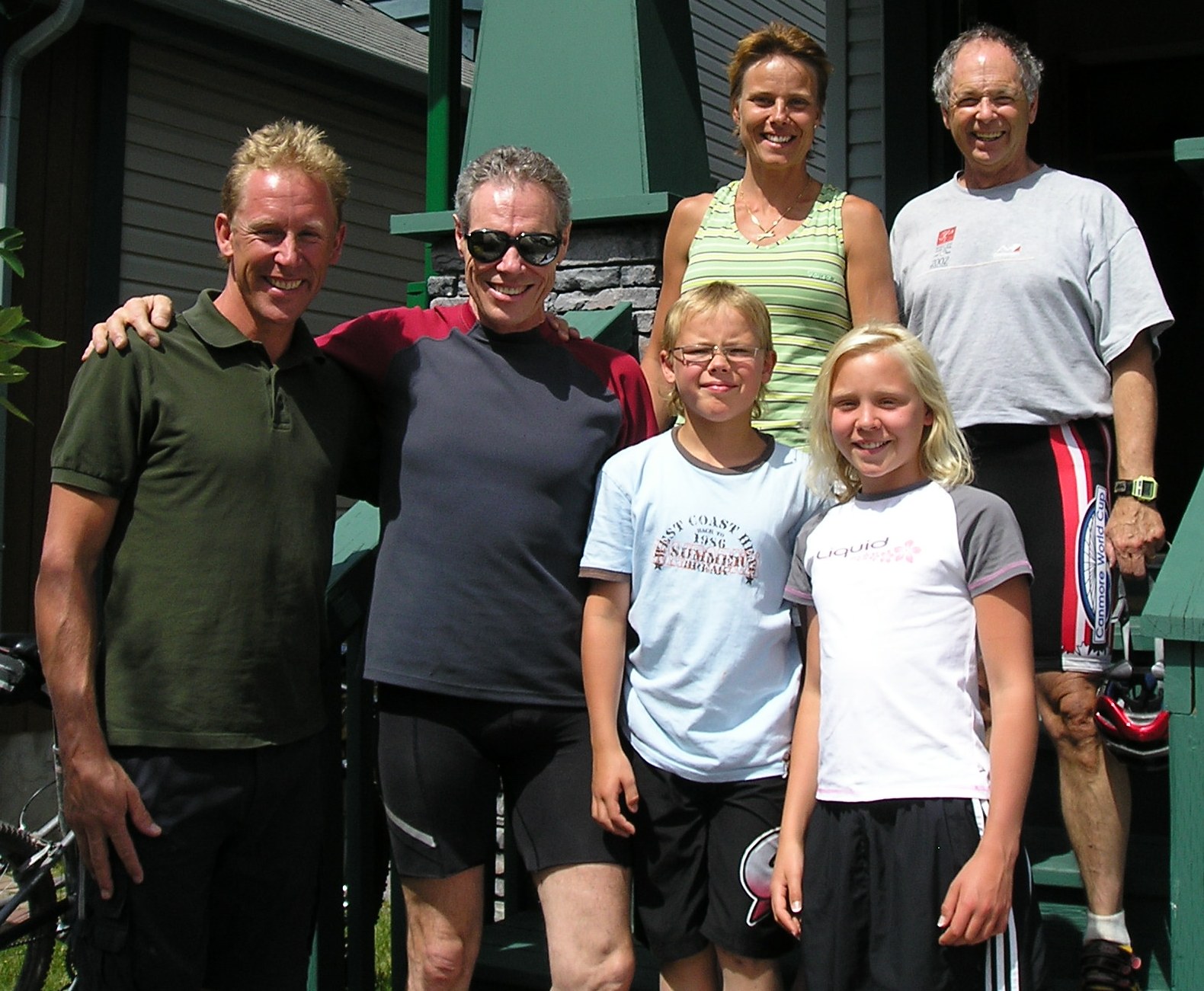
    Left to right: Gunde Svan, me (even standing on a step I’m shorter than Gunde!), Mari, Rob Mackenzie, and the Svan kids, Ferry and Julia, in Canmore in 2006. (Courtesy photo)

    [As an aside, the great Swedish champion Gunde Svan brought his family to Canmore for the summer in 2006. Through my friend Rob Mackenzie, who had met Gunde during the 1988 Olympics, I was able to spend most of a day hanging out with Gunde and his family. This amazing experience added fuel to the fire building under my growing passion for XC skiing.]

  • Wednesday Workout: Lung-Busting with Hanna Falk

    Wednesday Workout: Lung-Busting with Hanna Falk

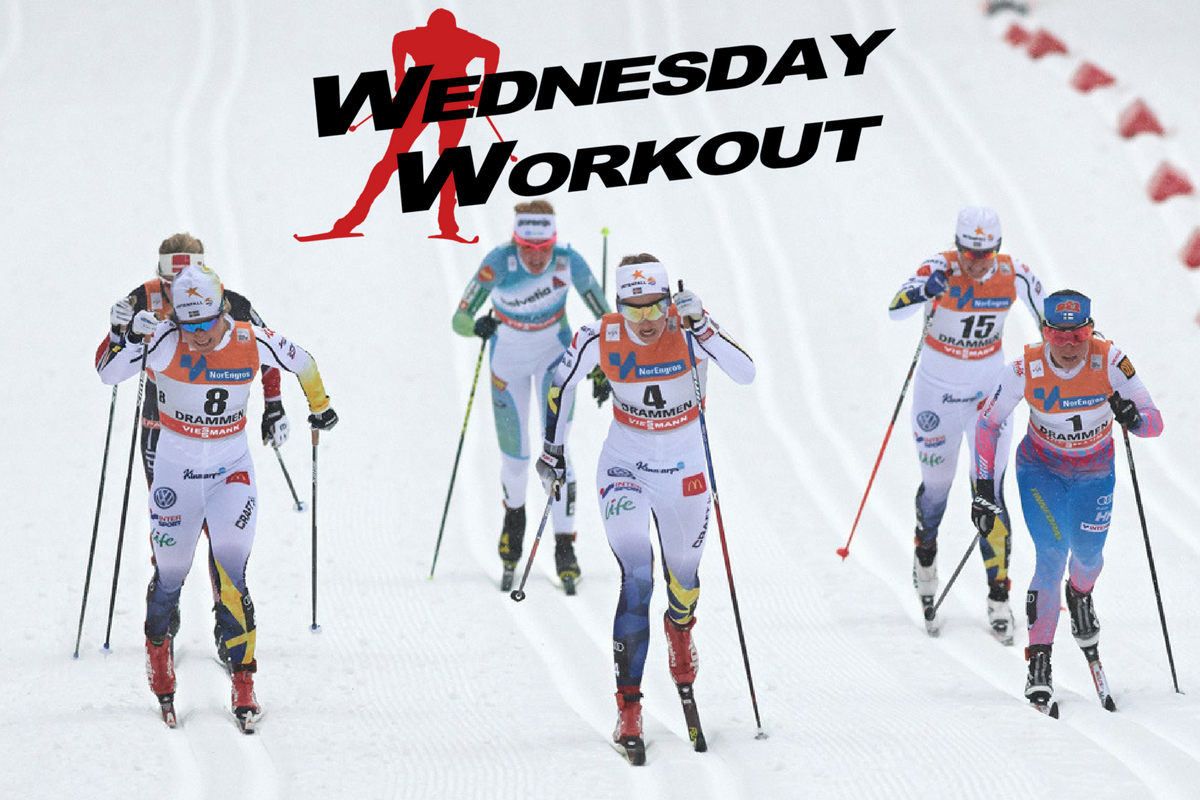
    Sweden’s Hanna Falk (8) going for it in a sprint finish in Drammen, Norway, with her teammate Stina Nilsson (4) and Finland’s Krista Parmakoski (1) on March 8, 2017. (Photo: Fischer/NordicFocus)

    “I have a workout that I like and usually do in the autumn when it’s time to shape up.”

    Those are the words of Swedish national-team member Hanna Falk. To take Falk’s words literally, it is that time of year: in the Northern Hemisphere, it’s officially autumn and “time to shape up”. In two months, the 2017/2018 World Cup will open with classic sprints on Nov. 26 in Kuusamo, Finland.

    For the figurative aspect of Falk’s comment, if you’ve been eschewing hard workouts and log six days a week of perfunctory OD, yes, “it’s time to shape up”. For World Cuppers, potential 2018 Olympians and those giving a Heisman to Father Time, it’s the season to think about priming for those moments when latching on to those skiers pushing the sharp-end pace is paramount.

    In group sprints or distance events, no one likes to be yo-yoed off the back of the pack.

    Last season on the World Cup, Falk finished third in the sprint rankings and 20th overall (a combination of both sprint and distance results.) Although certainly a sprinting force, Falk now considers herself an all-arounder. She placed eighth in the World Cup 10-kilometer freestyle race held in her birthplace of Ulricehamn, Sweden. After we interviewed Falk for FasterSkier’s Nordic Nation, we reached out for a Wednesday Workout, requesting something she uses this time of year to round herself into shape.

    The Workout: 6 x 5 minutes with 2 minutes rest

    “I usually do the workout on roller skis in variable/tough terrain,” she explained. “I also try to do a real sprint start in the start of each interval, just to practice that special moment. It means 10 seconds all out and then continuing the interval in the speed you can manage. You can also do a short sprint at the end of the interval if you want to practice the change of frequency in the finish. It’s a race-inspired workout that will get you tired!”

    How to pace it:

    “You should try to go hard, at high speed, without losing the technique — and with the same speed from the first to the last interval. It probably means Level 4. If you start off too hard and you are not able to have the same speed on the last interval, you are doing it wrong!”


  • Wednesday Workout: SkiErg Intervals with Sadie Bjornsen

    Wednesday Workout: SkiErg Intervals with Sadie Bjornsen

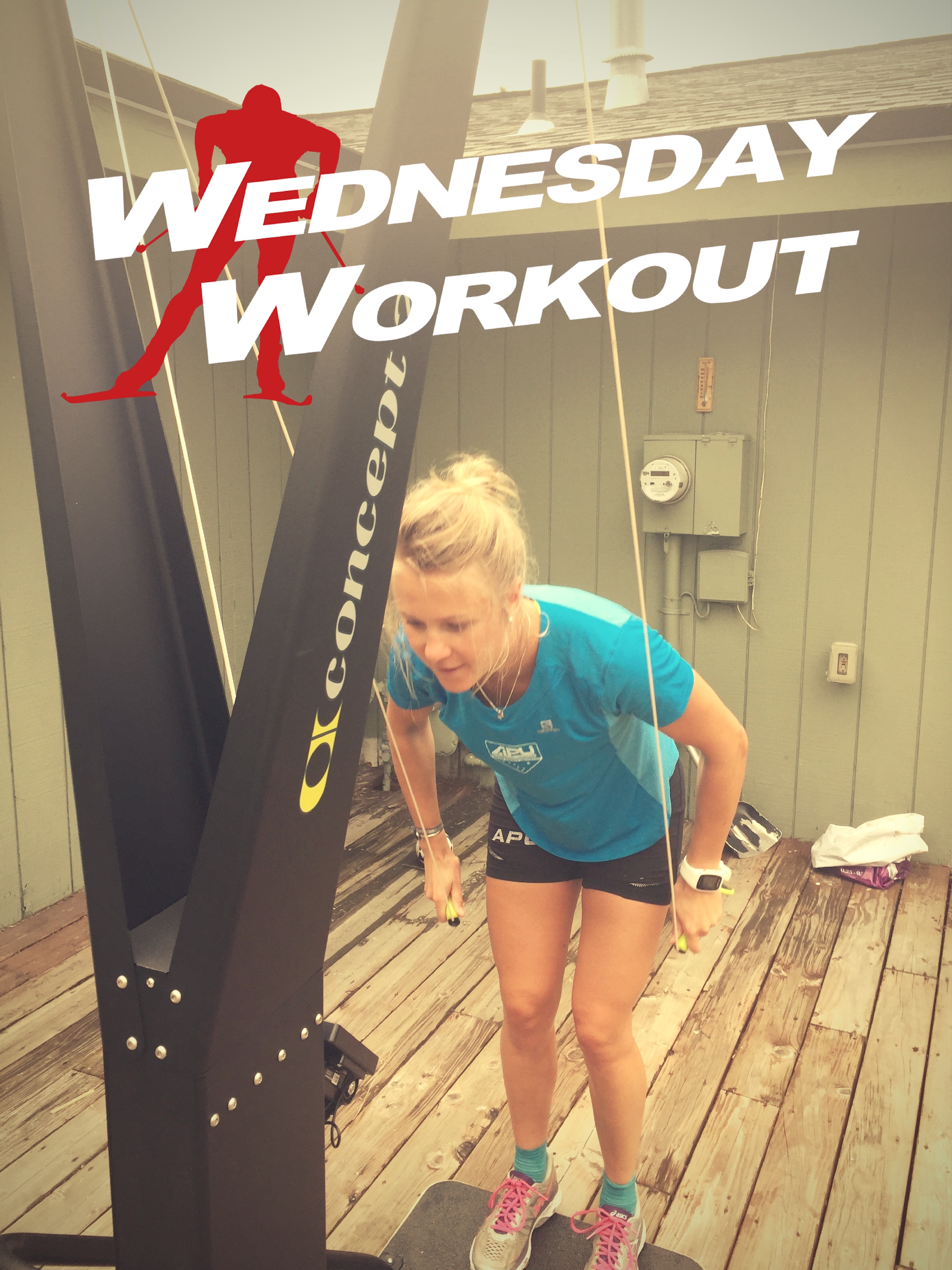
    Sadie Bjornsen, of APU and the U.S. Ski Team, during a SkiErg interval workout at her home in Anchorage, Alaska. (Courtesy photo)

    If you have a lower-body injury, be it acute or chronic, training for cross-country skiing can be frustrating: there are so many activities which must be cut back if you are trying to protect a knee, ankle, or foot.

    Luckily, there are good training options available, especially if you have access to a double-pole machine like an Ercolina or a Concept2 SkiErg.

    “I use the SkiErg a lot because I fight with feet injuries, and it is a safe escape from ski boots or shoes,” U.S. Ski Team and APU skier Sadie Bjornsen wrote in an email.

    Last season, Bjornsen won World Championships bronze in the team sprint with Jessie Diggins. This season, she is back to battling heel spurs. That’s why she has been putting in time on the SkiErg she has at her house, but she sees other benefits to these types of workouts as well.
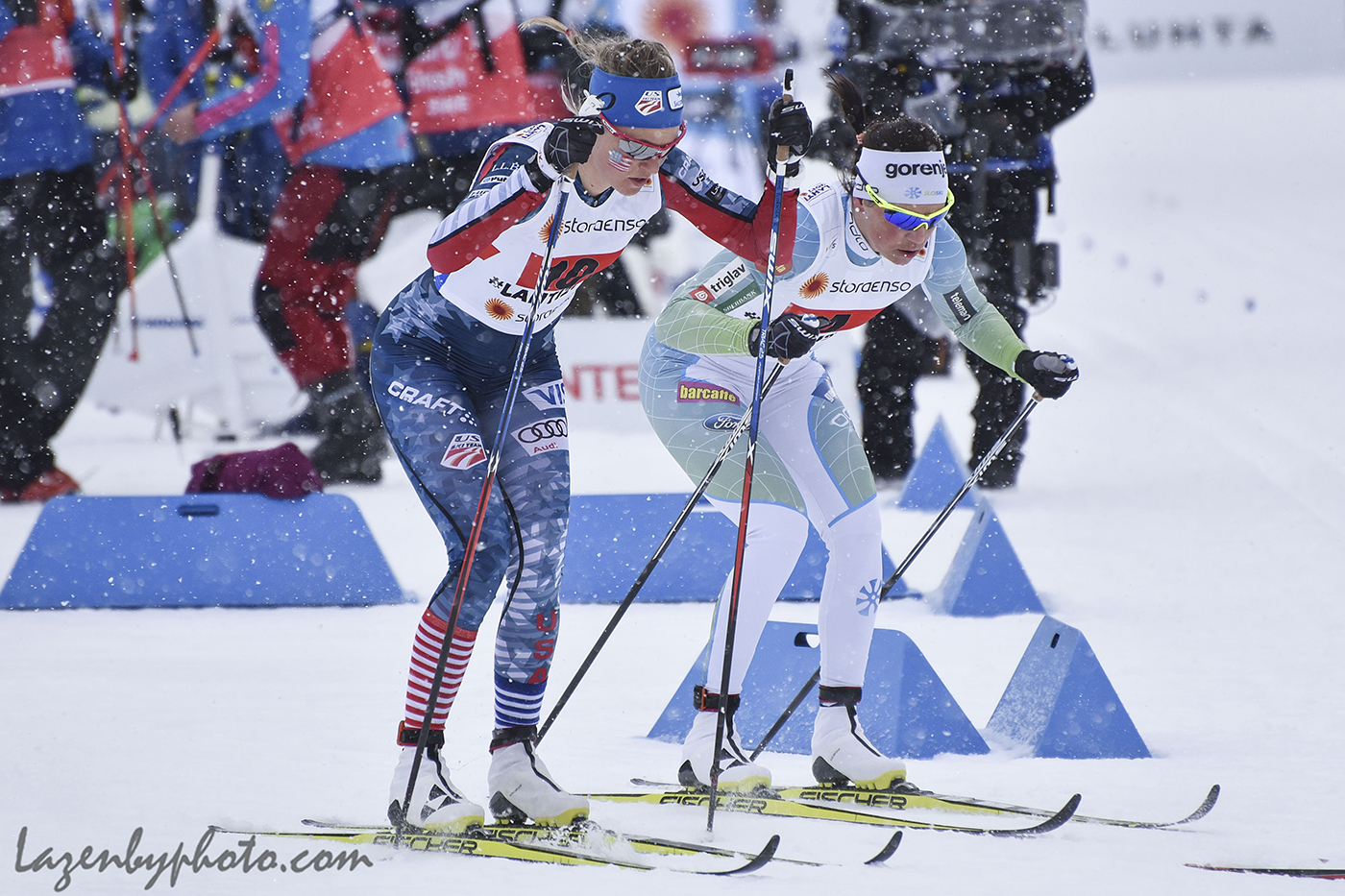
    Sadie Bjornsen (l) en route to her first World Championships medal, bronze with teammate Jessie Diggins (not shown), in the women’s classic team sprint on Feb. 26 in Lahti, Finland.

    “The SkiErg can also be really helpful on rainy days, super cold days in the winter, or just days that you want to rock out to some tunes indoors and avoid traffic on the roads,” Bjornsen explained. “It is an easy workout to get the most ‘bang for your buck’ if you have a short amount of time, which I also really like. There is no wasted time tucking on downhills, or coasting across the flats. Instead, you are on power mode from the start to the finish.”

    And as numerous research studies have recently shown, double-poling ability and upper-body strength are more and more becoming great predictors of overall ski performance, even in freestyle races.

    “I like to do a little intensity in my SkiErg workouts because it helps keep it fun and fresh, and I also think it really helps to build my upper body strength,” Bjornsen wrote. “Our sport has become really upper-body driven, so I feel like I can never get too much upper-body workouts!”

    With that in mind, she shared a recent interval workout she did on the SkiErg — it’s bread and butter for Bjornsen. “I like to try to do this workout at least once a week all through the summer, and sometimes more if I am going through a period of struggle with my heel spurs,” she wrote.

    It aims for an hour of total workout time.

    The Start: “I start my workout with a fifteen-minute warm up. During this time, I often shut my eyes, and visualize skiing. This helps bring in true ski form, and feel my movements, rather than just fall into a ‘SkiErg-specific technique.’”

    Getting Speedy: “During this time, I will do some little ten-second increases in power to warm up my back and arms, and get ready to go hard.”

    The Workout: “After fifteen minutes, I begin the workout known as 30-30’s. This means 30 seconds of intervals followed by 30 seconds of recovery, then repeat for 30 minutes. What may feel easy at first, quickly catches up after 10 minutes, so I always start this workout more conservative than feels appropriate.”

    Keeping It Going: “After about five minutes of 30 seconds on, 30 seconds off, I start to see a common number of watts I am exerting during the 30 seconds. This is where I set a goal. Maybe it’s 190 watts I am hitting, I want to continue to reach that level or more for the next 25 minutes of this workout. This becomes increasingly hard around 20 minutes, and requires a certain amount of mental power. The 30 seconds of rest begins to pass too quickly, and I find myself becoming really focused in my own little world… forgetting where I am (maybe a garage, maybe a gym).”

    Finishing Up: “By the end of 30 minutes of 30-30’s, I am pretty worked, and feel like I have just done a race out on the snow. This is when I bring myself back to my surroundings, and finish with a fifteen minute easy warm down to help flush my arms out.”

    Final Thoughts: “Not only does this one hour pass really fast, but it is a really focused workout that feels like it truly helps build specific power. I always make sure I finish this workout with a little five minute walk. This helps flush all my muscles, but also helps make sure my back goes back to moving naturally after a pretty intense workout.”
  • Wednesday Workout: Getting Adaptable with NSCF-FXC

    Wednesday Workout: Getting Adaptable with NSCF-FXC

    The NSCF-FXC crew points toward home (some 7,000 kilometers away) at 2017 Junior Nationals this past March in Lake Placid, N.Y. (Photo: Peter Leonard)

    The following workout comes from Alasdair Tutt, interim coach for the Nordic Ski Club of Fairbanks/Fairbanks XC (commonly known as NSCF-FXC). Tutt recognizes that while training in central Alaska has its perks (like reliable snow), it can also be tough for skiers to excel outside of their familiar environment (like on significantly warmer snow). This is true for anyone racing in variable climates and at both high and low elevations across North America. So for NSCF-FXC, the goal is to get develop speediness for races in the lower 48. 

    ***

    Training in Fairbanks, Alaska, may have many advantages: skiable snow for six months a year, tough homologated loops at Birch Hill and the endless wilderness to explore regardless of the season. However, it presents many challenges for the 33 junior athletes who are part of our summer Comp Team when they compete out of town in temperatures often >30 degrees warmer than the average Fairbanks day.

    (From left to right) NSCF-FXC skiers Ben Keener, Ari Endestad and Ti Donaldson work on diagonal striding during a summer workout near Fairbanks, Alaska. (Photo: Alasdair Tutt)

    This workout is designed to counteract the effect of always skiing on slow snow and steep terrain at Birch Hill mid-winter so the athletes can be competitive in faster conditions at the U.S. Cross Country Championships (a.k.a. Senior Nationals) or Junior Nationals. It can be completed skating, bounding, double poling, or diagonal striding. We have primarily focused on using it to improve diagonal striding this summer.

    We have no problem getting our skiers to be strong or have a high-aerobic capacity, but we often struggle to further develop the neuromuscular capacity of our skiers once the snow hits the ground. This can also be true when our athletes compete in high-school cross-country running, as their training can become pretty monotonous and low volume unless they make a considerable effort to add their own ski training on top of the running. This workout is applicable to all athletes though, as I believe all junior athletes need to first develop their capacity to go fast before learning to use that speed over a longer distance.

    The workout: Alaska-Specific (Speed) Training

    • Warmup: Preparation and Mobility
      • Our warmup is typically 20-30 minutes long consisting of about 10 minutes easy skiing to our start point, followed by 10-15 minutes of mobility and preparation exercises specific to the technique being performed on the day (we do this workout skating, double poling and striding depending on the goals of the team as a whole from last year)
    • Intervals: 2-3 sets of 3-5 x 150-250 meters at 2-3 k pace, and 50-80 m at 400 m pace over a course with two separate hills — not so steep as to lose full range of motion, but to challenge the athletes’ balance a little. Then, take a short recovery to return to the start of the next interval.
      • The course should cover around 150-250 m for the longer interval and 50-80 m for the shorter one on a gradual hill that is typically able to either be climbed in double pole or diagonal striding to induce a high speed.
      • First do the ~200m interval at a speed similar to how you would a hill in a 2-3 k event, then after a short recovery, complete the ~60 m interval at a speed just below that of an all out sprint (about 400 m pace). The idea being to have a repeated sprint stimulus and a clear difference in pace between the short and long speeds, without exhausting their capacity in one set.
    • Recovery: About 4-6 minutes active recovery between sets.
      • Between the longer and shorter sprint, just a rolling recovery back to the base of the hill repeated 3-5 times. Between each set there is a 4-6 minutes of active recovery with a chance to grab a drink or watch some video of technique.
    • Cool down: 30-45 minutes of easy rollerskiing back to the starting location.

    Technique Notes: We are looking for full extension through the arms to the back, a pendulum arm swing to return and a relaxed body position with hips over the heel when gliding on a ski during these intervals, as it quite easy to get into a posture with limited range of motion through the shoulders or a “back-seat” body position with little glide and a late kick when mostly skiing on green hardwax. As always when striding on classic rollerskis, we are careful to emphasize an early initiation of power with the lower body and a quick weight transfer from the center of mass over the gliding ski.

    NSCF-FXC skier Jenna DiFolco (r) leads Mackenzie Parrott (l) and Zoe Ratzlaff (c) during a diagonal-striding workout near Fairbanks, Alaska. (Photo: Alasdair Tutt)

    ***

    Have a workout you want to share? Email info@fasterskier.com with the subject line: Wednesday Workout.

  • Wednesday Workout: ‘Old Lady’ Interval Ladder with ’94 Olympians Hall and McCabe

    Wednesday Workout: ‘Old Lady’ Interval Ladder with ’94 Olympians Hall and McCabe

    Laura McCabe, 1994 and ’98 Olympian, during her weekly Wednesday interval workout. (Photo: Leslie Hall)

    *Note: This article has been updated to include email comments from Laura McCabe as of Wednesday. 

    Don’t let the name “Old Lady Intervals” (designated by Leslie Hall) fool you. The interval ladder she and Laura McCabe complete every Wednesday and submitted to FasterSkier is one that takes experience and willpower. Hall doesn’t recommend the workout for juniors, but more for masters and those with limited time for harder training efforts.

    ***

    If their houses were any closer, Leslie Hall and Laura McCabe could probably comfortably hold conversations from the threshold of their front doors. For a little more than two decades, the duo have been neighbors, living within one-tenth of a mile from each other in northern Washington. But a street name and sidewalk view of the Methow Valley isn’t the only thing the two women share.

    In 1994, they were teammates, representing the U.S. at the Winter Olympic Games in Lillehammer, Norway. Two years later, they moved into their neighboring houses, and close to six years after that, they became co-coaches of Methow Valley Nordic.

    For the past 15-plus years, Hall and McCabe, who are now 53 and 51 respectively, also share Wednesday mornings.

    Following the birth of Hall’s second child and McCabe’s first, the women decided that neither was about to give up interval workouts. Even if it meant having their toddlers in tow.

    “When she stopped competing and had her daughter, my son was close in age, so I was like, ‘What are you doing?’ … and she said, ‘I’m going out and I’m doing intervals and I’m carrying Novie,’ and I’m like ‘OK, I’m going to come,’ so then we just started going together,” Hall explained on the phone.

    Every Wednesday for the next 51 weeks, the women completed the intervals with their babies on their backs.

    “Once they got on a schedule where they were in preschool or something, we’d go off without them,” Hall said. “Now, we drop the kids off at the bus and then we go. It works for both of us because we don’t go into the office at a certain time, so that’s nice.”

    The workout itself, which is a ladder-type interval set totaling 43 minutes of on-time at a pace Hall describes as “as hard as we can,” is not one she recommends for junior skiers, but rather those on a tight training schedule.

    “It obviously wouldn’t be the best workout for someone, say a 14 year old, that’s not going to be the best workout for them,” Hall said. “But for a lot of masters or working people, they always go sort of medium-hard, so having a targeted interval workout helps raise their fitness. … They go easy [during easy days] because they’re either too tired from the interval workout or they know the interval workout is coming up.”

    Both women continue to compete, with Hall jumping into local running and ski races that fit with her coaching schedule and McCabe racing internationally, competing in this year’s Fossavatnsgangan Worldloppet in Iceland (where she placed third in the 25-kilometer skate behind Caitlin Gregg and Britta Johansson Norgren), and the Masters World Cup in Switzerland (where she won two races).

    “Leslie and I have been through a lot of life stuff together, starting with being on the U.S. team to raising our children together, going through the joys and difficulties of life as they are handed to all of us,” McCabe wrote in and email on Wednesday. “Working together as coaches, running the Methow Valley xc ski team and just being great friends. WE have kept each other motivated on Wed for some intensity for many years, as just that 1:30-2 hours pays off if you are consistent. Wed we discuss things that need to happen for the team, the kids, life etc and we both get a good solid workout!”

    Hall couldn’t agree more.

    “I think my favorite part is having someone who makes sure I get out and do it,” Hall added. “I don’t have to worry about how I’m going to fit in some hard training, and that’s really satisfying.”

    The Workout

    • Terrain type: Hilly
    • Warmup: 15-20 minutes jogging followed by 4 x 30 second speeds
    • “Old Lady” (as Hall likes to call it) Interval Ladder: 5-6-5-6-5-4-4-4-4 minutes with 3 minutes recovery between each 
      • i.e.: 5 minutes on, 3 minutes recovery, 6 minutes on, 3 minutes recovery, 5 minutes on, 3 minutes recovery…etc.
    • Interval Effort: Between Level 4-Level 3
    • “We just go and go as hard as we can, which is another thing I don’t recommend for everybody necessarily,” Hall explained. “Some days it’s just naturally Level 3 and some days it’s Level 4. And also it’s longer than what most people would want to do, but that’s just what we’ve gotten to at this point.”
    • Cool down: 15-20 minutes jogging with 4 x 5 second sprints incorporated throughout to “clear out the legs”
    • Total time: 75-80 minutes
  • Wednesday Workout: Moosehoofing for Speed and Capacity with Chris Mallory

    Wednesday Workout: Moosehoofing for Speed and Capacity with Chris Mallory

    Jack Hegman and Rogan Brown bounding at Dollar Mountain in Sun Valley, Idaho, with coach Paul Smith chasing. (Photo: Chris Mallory)
    Jack Hegman (l) and Rogan Brown bounding at Dollar Mountain in Sun Valley, Idaho, with coach Paul Smith chasing. (Photo: Chris Mallory)

    This week’s workout comes from Chris Mallory, the new head coach of the Sun Valley Ski Education Foundation (SVSEF) Gold Team. Having recently arrived in Sun Valley after a long road trip from Vermont, where he was previously the assistant nordic coach at the University of Vermont (UVM), Mallory has jumped right into a career in Idaho’s high country. It’s not Mallory first coaching stint with SVSEF. He coached in a variety of roles lasting eight years, ending most recently in 2013, when he took the UVM position. 

    ***

    One of the staple training methods we use at SVSEF to build fitness is Moosehoofing or Hill Bounding. We will vary the workouts at different times of year to target different fitness gains and keep the workouts fresh. Some of our go-to workouts are 2 x 30 min. L3 [Level 3] ski walking up Baldy [Mountain], 45 min. of continuous L3 work Moosehoofing on the Lake Creek race courses, 5 x 4 min. L4 hill bounding up Dollar Mtn, or another variation I like to implement this time of year involving hard 20 sec. bounding repeats every minute. Simi Hamilton passed a variation of this workout on to me as one of his favorites a few years ago, and the athletes really like it.

    The goals of the workout are to increase classic striding leg speed and explosiveness, make neuromuscular gains, and increase aerobic capacity. The workout is fairly short and sweet, but very effective, and it helps to sharpen the athletes up as we near race season.  The workout load certainly builds up throughout the sets, so start a little conservatively. Legs will get heavy, but it’s good to keep the recovery short here so you learn to go fast with lactate in the system.

    The Workout:

    Warmup:

    • 20 minutes easy aerobic running
    • 1 x 3 min. L3 Moosehoof warmup interval
    • Couple sets of plyo exercises (single-leg hops, broad jumps, 10 sec. bounds)

    Workout:  3 sets x 7 reps (20 seconds on/40 seconds off) with 5 min. jogging between sets

    Cooldown: 20 min. recovery jog

    This workout is best done with bounding poles. A good-height bounding pole comes up to your sternum. Drop a starting cone and finishing cone roughly 100 meters up the hill. Adjust the length if needed after their first effort. The hill should be a moderate grade, too steep and you won’t get the speed benefits. The athletes can run a watch and know they need to start on the minute every minute.  

    The workout can be made easier for junior athletes with 15 sec. of on-time or tougher with 25 sec. on-time. Another variation you can add is allowing more of a run with poles on the last set rather than bound. This will keep the speed high and might closer mimic how hills are being skied in classic sprints these days anyway.  

    SVSEF Moosehoofing on Dollar Mountain: Building Speed and Capacity from FasterSkier on Vimeo.

  • Wednesday Workout: Quality Level 3 and 4 for the Working Class

    Wednesday Workout: Quality Level 3 and 4 for the Working Class

    The leaders in this year's 2015 Climb to the Castle rollerski race up Whiteface Memorial Highway in Wilmington, N.Y. Rogan Brown of the Sun Valley Ski Education Foundation (SVSEF) leads around mile four of five. (Photo: Tim Cowan)
    The leaders in this year’s 2015 Climb to the Castle rollerski race up Whiteface Memorial Highway in Wilmington, N.Y. Rogan Brown of the Sun Valley Ski Education Foundation (SVSEF) leads the top men around mile four of five. (Photo: Tim Cowan)

    On the day after my 58th birthday, I raced the Climb to the Castle. Again. It’s an incredible thrill to be on the same starting line as the best skiers in the U.S., even if I finish towards the back. This year, I finished within 6 seconds of my best time. And for the first time, instead of being totally gassed for the final half mile, I had good energy all the way to the finish.

    Peter Minde nears the finish of the Climb to the Castle in 2011.
    Author Peter Minde nears the finish of the Climb to the Castle in 2011.

    During the dryland season, my goal is to do one Level 4 and one Level 3 workout each week. I hate to admit it, but now there are now some days when my body revolts and says, “Enough! You’re not finishing this interval session.” To that end, I try to make sure I’m really rested.

    I take into account my work and my family commitments as well as the stuff in the training log. I hate conceding workouts, but nowadays, I’d rather do one really good interval workout rather than two mediocre sessions.

    Although I have good terrain for dryland training, I don’t have super long hills. For a Level 4 workout, either running or rollerskiing, I’m going up a hill, back down and repeat. The recovery time is always a little longer than the actual work period. Not best practice, but possibly beneficial at my age.

    “I hate conceding workouts, but nowadays, I’d rather do one really good interval workout rather than two mediocre sessions.” — Peter Minde, FS contributor and annual Climb to Castle competitor

    Workout 1: 5 x 5 Minutes Level 4, Uphill Running

    My bread-and-butter Level 4 workout is five repeats, five minutes, going uphill.

    I do this either running or rollerskiing. It’s OK if the pitch varies, but the final few hundred meters should be the steepest. Generally, I run in the woods, and I use trails that aren’t excessively technical.

    Warm up with dynamic stretching, then run 15 minutes at Level 1 in rolling terrain.

    Then go 5 minutes up your hill at Level 2. Return downhill, and repeat with 5 minutes in Level 3. Finish that, go down, and you’re ready for the main event.

    In the Level 4 section of the workout, I focus on starting in the lower end of my heart-rate range and increase the intensity over each interval. At the base of the hill, I moose hoof the first 30 meters before settling in to a run. During each repeat, I focus on positive self talk.

    Workout 2: 5 x 5 Minutes Level 4, Rollerskiing

    As with the running intervals, look for a long hill. It’s OK if there are rolling or short downhill sections; however, the final section of the hill should be steep enough that you have to check speed – snowplow, traverse, whatever – to return downhill safely.

    Warm up as above. Fifteen minutes in Level 1, followed by 5 minutes of Level 2 and five minutes of Level 3.

    As with running, my goal is to start conservatively and make the last interval the hardest. In addition to positive self talk, I focus on skiing transitions smoothly. If I’m classic rollerskiing, I’ll double pole a flat section and the base of the climb before changing to striding. If I’m skating, I try to V2 as much of the uphill as I can, or V1 the steep bits and switch to V2 where the grade is easier.  Don’t forget the warmdown and stretching.

    Workout 3: 3 x 15 Minutes, Running

    While I do this on rollerskis, I prefer to run, because I’m able to keep recovery times to 3-5 minutes between hard work periods. Find a loop in the woods that takes approximately 14-16 minutes to run.  It should be rolling with some long uphills.

    Warmup: Similar to the Level 4 workouts above. Begin with dynamic stretching, followed by 15 minutes of easy running.

    Ramp up your heart rate to Level 2 for five minutes, then head onto your loop and crank it up to a controlled pace.  In downhills, I pick up the pace to keep my heart rate in the zone.  At the end of 15 minutes, a short connector gives me around five minutes of recovery before the next repeat.

    Then I run easy back to the car, for 15-20 minutes warming down.

  • Wednesday Workout: Max Aerobic Speed Intervals with Colin Foley

    Wednesday Workout: Max Aerobic Speed Intervals with Colin Foley

    Colin Foley (Callaghan Valley Training Centre) racing. (Courtesy photo)
    Colin Foley (Callaghan Valley Training Centre) racing. Foley, 18, likes time-based interval workouts that mimic sprint qualifiers, like max aerobic speed at 15-second intervals. (Courtesy photo)

    This week’s workout brought to you by Colin Foley, 18, of the Callaghan Valley Training Centre in British Columbia. Want to submit your own go-to workout? Email alex@fasterskier.com.

    After years of ski training it seems like I’ve done any variety of intensity workouts. From VO2 max to speed, to tempo to you name it, it’s almost a rare event when we do the same intensity breakdown!  Anyway, we did a great workout recently in practice: max aerobic speed at 15-second intervals, it’s something that we’ve done a few times and I really hope we do more in the future.

    The workout: Time-based interval workout, with four intervals of 3 minutes and even rest (3 minutes) in between. We did them at Zone 4, or just as hard as you can maintain for the 3-minute interval.

    Warmup: We warmed up as a group with a 30-minute easy classic ski.  To warm up properly, we stuck to the flatter trails between the stadiums at Whistler Olympic Park for the first 10 minutes then went into some hillier terrain for the last 20 minutes and regrouped in the cross-country stadium at Whistler Olympic Park.

    Interval start: While lots of intervals can be done as a large group (there are 9 on my team), we chose to do this set of intervals in a 15-second interval start format. I really liked this format because it made the workout feel like a sprint qualification … four times!

    When you are doing intervals as a group it’s often easier to push yourself because you have your teammates there at your side, and you don’t want them to get away.  I really like the 15-second interval start format of these intervals because it really helped me practice pushing to the max when I don’t have somebody there at my side.

    “When you are doing intervals as a group it’s often easier to push yourself because you have your teammates there at your side, and you don’t want them to get away.” — Colin Foley

    We definitely have some stronger and weaker “sprinters” on our team, so our coach mixed up the order of our interval start from interval to interval.

    Colin Foley (CVTC) warming up. (Courtesy photo)
    Colin Foley (CVTC) warming up. (Courtesy photo)

    Rest/recovery: In between the intervals we tried to recover as much as possible.  For me, this meant skating easily around the stadium.  We were doing the harder sets on the hills of the sprint course, just outside of the cross country stadium so it was easier to come back (and also hear our coach call the end of the set).

    Result: We do these intervals to increase the amount of time that we can push ourselves at our maximum aerobic output.  I have really found that this has helped my sprint qualifiers this year.

    Post-workout: After the final interval we did a long cool down, but not before we first had some good nutrition.  For us, that’s a bottle of a protein drink and some hydration drink (we also have energy drops if we were feeling a bit hungry).

    We skied for about an hour, this time sticking to rolling terrain (the Madeley Creek Loop at Whistler Olympic Park is great for a longer cool down like this).

    Then it was back to the van, back to our homes in the Whistler Athletes Village (now known as Cheakamus) and a proper lunch and rest.

    We enjoyed being home in Whistler for a few weeks and getting in some good training before heading off to more NorAm competitions and, eventually, Canadian Nationals.

    Callaghan Valley Training Centre team prep (Courtesy photo)
    The Callaghan Valley Training Centre team preps for one of its workouts. (Courtesy photo)


  • U.S. Biathletes Hammer Hard in Placid (Photo Gallery)

    U.S. Biathletes Hammer Hard in Placid (Photo Gallery)

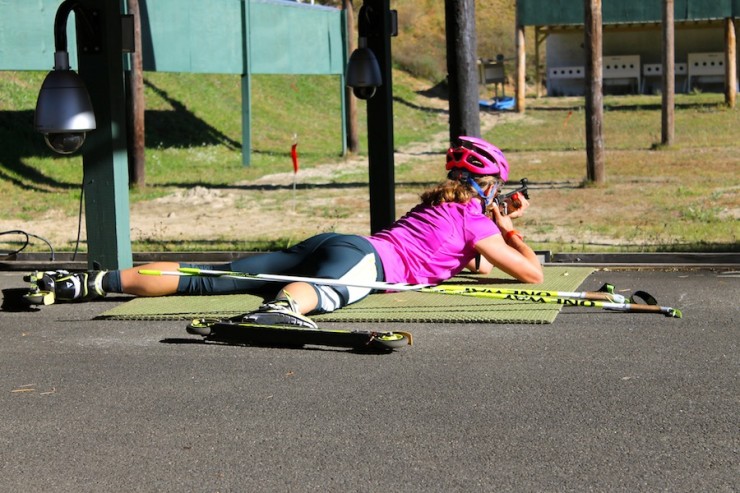
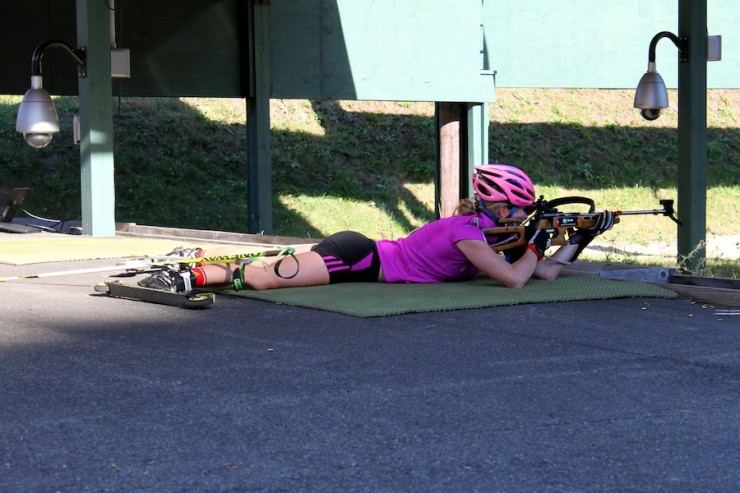
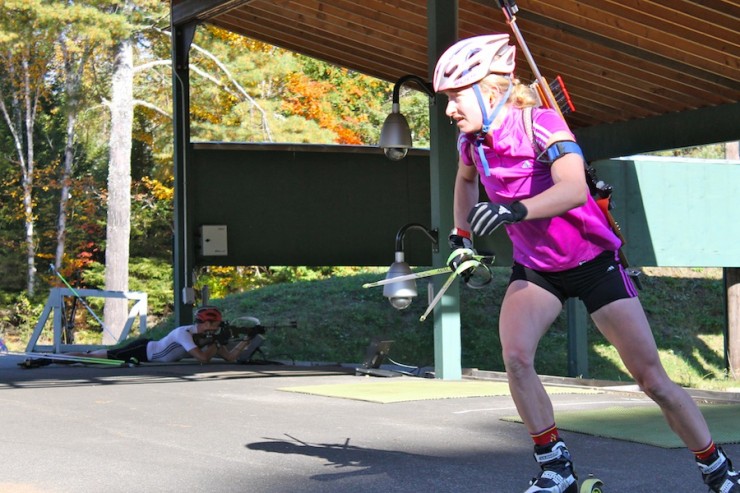
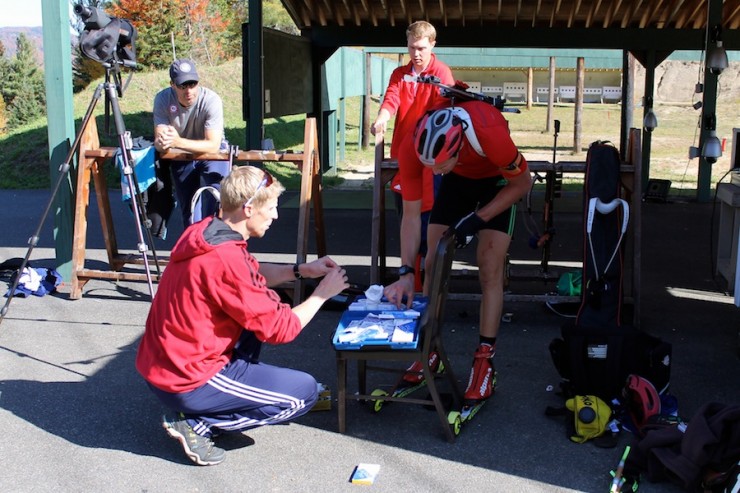
    LAKE PLACID, N.Y. — Nothing says the beginning of October like a grueling combo workout for the U.S. Biathlon squad. As if five to six repeats around their 3-kilometer rollerski loop wasn’t enough, they started Thursday with an all-out race to the top of the course.

    According to women’s coach Jonne Kähkönen, the prelude was something new this year after several of his athletes said they wanted a faster first lap in races. The answer: get the blood pumping and heart racing faster before you start.

    That meant starting at the bottom of the Olympic Jumping Complex — way down in the lower parking lot — and racing one another to the top (mass-start style). Four men (Tim Burke, Lowell Bailey, Leif Nordgren, and Russell Currier) and three women (Susan Dunklee, Hannah Dreissigacker and Annelies Cook) all started at once, along with special guest Andrea Henkel, a German biathlete and Olympic gold medalist (and Burke’s girlfriend). Henkel, 35, did the initial workout with the group, but without a rifle for this trip, opted to double pole around the rest of the morning.

    With a 10-minute rest beforehand, the combo workout (5 or 6 x 8-minute laps around the relatively new course, with prone and standing shooting in between) involved two to four lactate readings per athlete. It marked the end of a tough three-week training block, and Kähkönen said this workout is done once every intense training period. Next week, athletes can enjoy some rest before flying to Utah for the last set of rollerski races in Soldier Hollow Oct. 22-24.

  • Wednesday Workout: Finding Your Realistic Race Pace

    Wednesday Workout: Finding Your Realistic Race Pace

    FS-WednesdayWorkout-MWSC
    Maine Winter Sports Center (MWSC) biathletes working on uphill pace identification in Fort Kent, Maine. (Photo: Seth Hubbard)

    Welcome to Wednesday Workout, where we round up training ideas on a weekly basis. This week Will Sweetser, competitive programs director of the Maine Winter Sports Center, explains how to identify your personal race pace using his Reality Race Pace Progression rollerski workout. 

    ***

    Like most clubs around the country, our focus here in northern Maine is on youth and junior skier development. We want, first and foremost, to help the next generation of skiers earn spots on college teams, international trips, and the U.S. Biathlon and U.S. Ski Teams.

    While it is quite common for us to hear junior racers vocalize their dreams of representing the red, white and blue, it is equally common to see the same racers destroy any hopes of doing so, through poor pace identification in race after race. The start timer counts down and kid after kid across Maine throws caution to the wind and hammers out of the gate at Level “Go!”.

    Over the course of my time here in Aroostook County, I’ve steadily refined a workout aimed specifically at curing this lack of pace sense. I call it: Reality Race Pace Progression. This workout is aimed at identifying one’s 10 kilometer race pace. The beauty of the system is that it gives athletes a tremendous amount of worthwhile feedback.

    The concept is simple, and shamelessly stolen from track and field sessions practiced in Africa. All that is required is a lightly traveled stretch of road at least 500 meters long. Athletes should warm up as though it is race day — this is a great way to fine-tune race day prep.

    MWSC post-graduate Emily Ramsey racing in the 2012 U.S. Ski Association (USSA) SuperTour at Bohart Ranch in Bozeman, Montana.
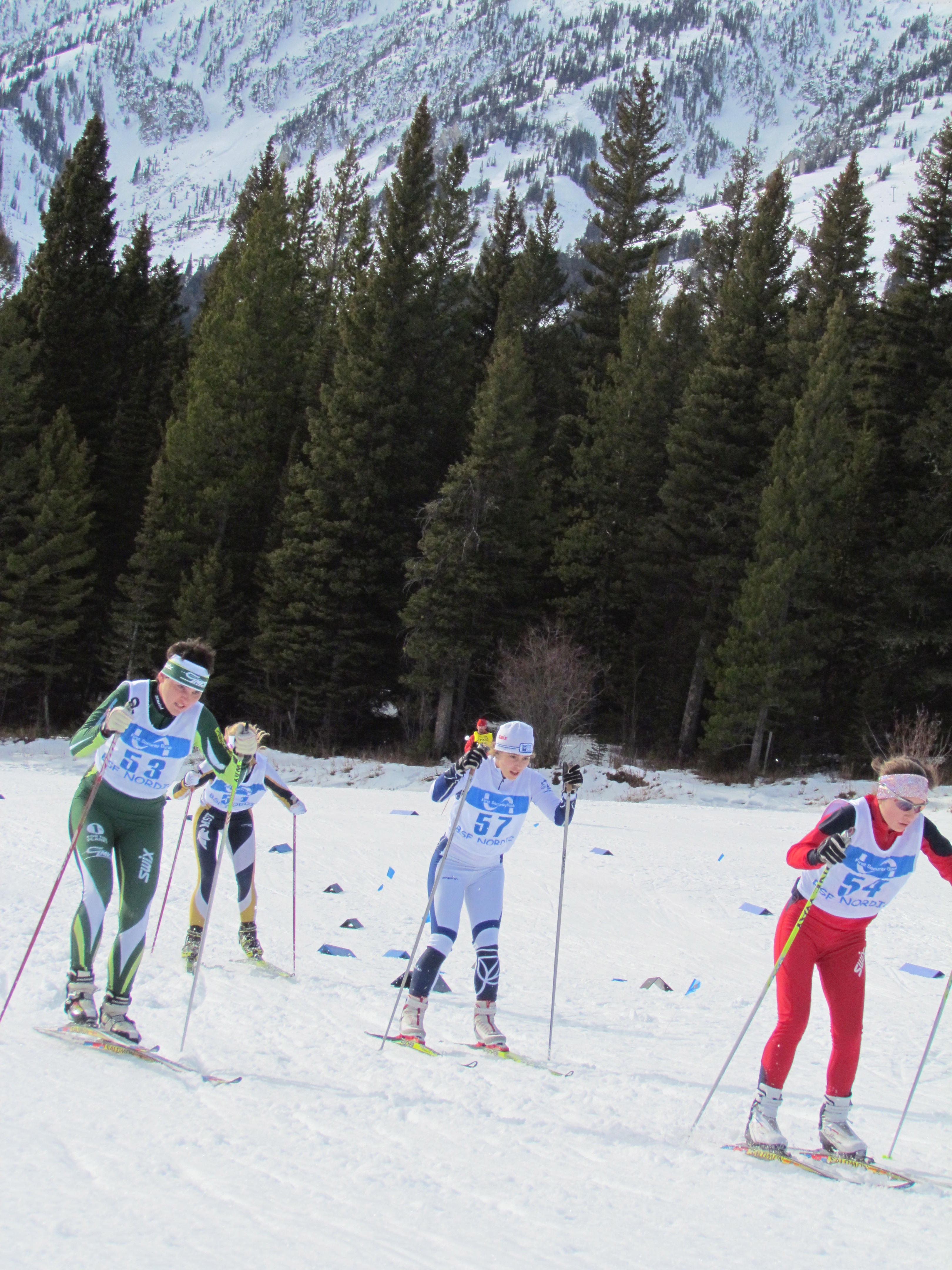
    MWSC post-graduate Emily Ramsey (57) racing in the 2012 U.S. Ski Association (USSA) SuperTour at Bohart Ranch near Bozeman, Montana. (Photo: Will Sweetser)

    After warm up:

    • 1 kilometer time trial at maximum effort.

    • 15-20 minutes easy recovery skiing at Level 1.

    • 7-12 x 1 kilometer (over the same course as the time trial) at 15-20 percent slower than time trial pace. 2-3 minutes moving recovery between intervals.

    • Cool down 15-20 minutes.

    The time trial helps identify one’s current performance level. As I said earlier, it’s easy to set a goal of making a team, but most younger athletes do not have any idea of how fast they actually need to ski to do so. With the advent of improved grooming, snow making and sizably better waxing knowledge, most races throughout the year are relatively comparable in terms of per-kilometer times.

    Frequently, I’ve had athletes realize that their current sprint pace is not yet fast enough to compete in 10 k races on the New England Nordic Ski Association (NENSA) circuit. Even more often, I’ve had athletes show up and realize after the time trial that they just aren’t ready for the workout. Time trial times just don’t lie!

    The repeats, themselves, are aimed specifically at pace averages taken directly from a 10 year sample of International Ski Federation (FIS) sprint and distance races held at the same venue, in the same technique, in stable weather.

    All-around European racers averaged 18-percent slower per-kilometer over 10-15 k than they did in sprints. Distance specialists averaged 12-percent slower. Women tended to keep the gap a bit closer at around 15-percent (likely due to the generally shorter race distances for women and relatively longer early race times for women’s sprints). Interestingly, U.S. racers averaged 22-percent slower across the board in distance races versus sprints.

    Most athletes will claim immediately that the pace for the repeats is far too slow. It is important to keep the recovery times no longer than equal to repeat time. It’s also critical to emphasize that the goal of the workout is to get through enough repeats to accurately reflect race distance. If the athlete can only get through four repeats, he/she has done it wrong! Remember, these are Reality Race Pace Progression pieces. If the athlete can’t perform 10 repeats at the same pace, it’s not 10 k pace.

    With a little bit of research, athletes go into the workout with a goal per-kilometer time in mind. They immediately get feedback from the time trial, and then with each repeat. Athletes can readily identify where they’ve lost or gained time by repeating the same course. Especially with juniors or inexperienced racers, coaches will see athletes able to repeat their time trial time or even improve it through 7, 8, or even 10 repeats. This typically indicates either the need for technique development or an inadequate warm-up.

    At MWSC, we use our rollerski loops (paved ski trails at Nordic Heritage Center, 10th Mountain Ski Center) for these workouts. Since we’ve got an established loop, we don’t always use the time trial, especially if we’re repeating this workout within a week of the last time. As many athletes find this workout a bit of a mental strain, we don’t often use it more than 2-3 times per month during the fall. But, for those few times we repeat this workout, we see some fantastic results.

  • This Month in Journals: Team Dynamics in Individual Sports, How to Prescribe Intervals

    This Month in Journals: Team Dynamics in Individual Sports, How to Prescribe Intervals

    Team spirit has been widely touted as one of the keys to the U.S. women's recent success. Photo: Matt Whitcomb.
    Team spirit has been widely touted as one of the keys to the U.S. women’s recent success. (Photo: Matt Whitcomb)

    Welcome back to This Month in Journals, where we review the latest exercise and sports science and pull out some research that might be of interest to skiers.

    Αssumptions and research are changing the way that psychologists and coaches think about team dynamics in individual sports.

    It has long been known that team cohesion, leadership and cooperation are important for success in team sports, like soccer or basketball, but far less research has been done on whether these same concepts are important in solo sports, like running and skiing. In fact, one classical theory holds that team cohesion can even be detrimental because it destroys competitive rivalries between teammates that might spur them to better performance.

    But recently, these ideas have been challenged. Beginning in the 1990s, researchers showed that even when teammates in an individual sport don’t have to cooperate on a task during competition to reach their goals, cohesion is positively associated with performance to the same extent that it is in those other team sports, like basketball.

    Blair Evans and Mark Eys of Wilfrid Laurier University and Svenja Wolf of the German Sport University Cologne furthered this work this month, publishing a paper in the Journal of Applied Sport Psychology based on interviews with six distance runners, six cross-country skiers, a mountain biker and a wrestler. All the athletes were Canadian and had several years of experience at the Olympic or World Junior Championships level.

    In terms of performance, there was little doubt that a good team atmosphere made these individual athletes more competitive. A middle-distance runner told the researchers that when she was training on her own, her race times were typically slower than during periods where she had training partners.

    Being able to use teammates as a measuring stick was also frequently cited as a benefit. Athletes talked about times when a teammate was having a good race, and they tried hard to follow because they knew they could keep up during practice every day. Even if they couldn’t achieve the same result that day, teammates’ success often boosted their confidence because they knew they had been doing the same training so a similar result might be possible.

    Finally, the social aspect of a team and the support it provides are extremely important to individual athletes. Despite all of the athletes’ strong drive for competitive success, they almost unanimously cited the group or team as a main reason to compete and to stay in sport. Many discussed how teammates became their closest friends, and that these friendships are maintained even after one or several of the members quit the sport.

    This was particularly important in adolescence, in terms of determining what path an athlete might take, but also at the senior level, where several participants described moving teams or locations or even traveling internationally to be part of a more friendly training group. Group was also important for maintaining motivation when injured and ensuring a comeback to competition.

    And what about that old theory that being friends with your teammates killed any competitive instinct that you might have against them? Athletes were divided on this one – or, more accurately, had experienced groups moving in both directions. In some teams, cohesion bred a healthy sort of competition that facilitated success.

    In other situations, teammates actively sought to avoid competition against one another because they thought it would be detrimental to their relationships. The researchers found that jealousy, for example, was definitely relevant to group dynamics and performance. This isn’t unique to individual sports: once again, it underscores that team dynamics, good or bad, have just as big an effect on running and skiing as they do on soccer or football, and the effects are “context-dependent.”

    Moving from psychology to physiology, a team from the University of Cape Town, South Africa, thought about how to prescribe interval training.

    The most common approaches used by coaches are to give instructions on the effort level based on a percent of VO2Max, or a percent of maximal heart rate.

    But different athletes respond differently to effort; for instance the same percentage of maximal heart rate may produce a different amount of lactate in one athlete than another, leading more quickly to exhaustion. Is there an easy way around this, or do instructions have to be specific to each individual athlete?

    Writing in the journal Sports Medicine, Theresa Mann, Robert Patrick Lamberts and Michael Ian Lambert describe that a more uniform way to prescribe workouts would be as a percentage of aerobic threshold or anaerobic threshold. These thresholds can be determined in physiological tests, and should provide a good “anchor” at which all athletes respond in the same way.

    This has many benefits: “less variation in time to exhaustion during constant-intensity exercise, a more homogenous exercise stimulus at the molecular level, and less individual variation in the adaptive responses following a training program,” the authors write.

    But for many low- and mid-level athletes, this approach might not be possible as repeated testing is needed to accurately pinpoint thresholds, and not every team has a physiology lab available to them. The authors suggest that using regular lactate testing during a non-laboratory workout can be used as verification, since below the anaerobic threshold, for instance, lactate production should be no different than baseline. If a coach prescribes a workout below the threshold assumed from, say, one laboratory test, but the athlete is still producing high lactate, then the threshold is probably wrong.

    And speaking of how to prescribe intervals, what terrain is best?

    Many times, athletes are instructed to do their interval training going uphill, to make sure that the work is very hard. A South Dakota team of Derek Ferley, Roy Osborn, and Matthew Vukovitch wondered if that was really ideal. They recruited 32 distance runners and compared the effects of uphill interval training to that of level-ground workouts.

    Strangely, though, they prescribed the two groups completely different workouts. Twice a week, the hill-running group would complete 10 or more 30-second sprints at a steep grade; they also did several normal long runs. The flat group did the same long runs, but their intervals were longer and fewer in number, with runners completing just four to six intervals.

    The authors concluded in the Journal of Strength and Conditioning Research that hill-running had great merit as a training plan, because it changed some metabolic processes for the better. However, they also pointed out that the flat-training group had greater improvements in time-to-exhaustion, so maybe coaches are overprescribing hill workouts. As a result, they advocate that level-ground workouts that are fit to an individual’s own physiological parameters will create the biggest gains.

    It’s difficult to see how they directly tested the effects of hills themselves, considering that athletes did different workouts. But the last conclusion, whether on hills or on the flats, seems like common sense that can be followed no matter what.

  • Wednesday Workout: Double-Pole Intensity with Ida Sargent

    Wednesday Workout: Double-Pole Intensity with Ida Sargent

    High hands. Ida Sargent sprinting in Milan, Italy, in 2012.
    High hands. Ida Sargent sprinting in Milan, Italy, in 2012.

    Welcome to Wednesday Workout, the newest workout series on FasterSkier. During the offseason, we’ll feature components of summer training programs from top individuals and teams from throughout the U.S. and Canada at the high school, college and elite club levels. Now get outside and get to work!


    Whether it’s the first few meters of a mass start or the final stages of a head-to-head sprint, a strong double-pole can be critical to the outcome of a race. Ida Sargent, of the Craftsbury Green Racing Project and U.S. Ski Team, has one interval session in particular that has helped her make recent gains with her double-pole strength, and offers a bonus opportunity to practice head-to-head tactics when done in a group setting.

    “I think I’ve made big improvements in my double pole by doing this workout with my teammates,” Sargent says.

    At USST camps, Sargent and her teammates repeat each interval on the same gradual uphill terrain, with the goal of gradually building intensity throughout the workout.

    “We start in the same spot for every interval and build into them so that each interval covers more distance,” Sargent explains. “Usually we do the first one at about L3 and push the pace with each consecutive interval and the last one should be close to max.”


    The workout:

    15-20 minute warm up

    5 x 3 minutes on gradual uphill. Start first interval at Level 3 and finish last interval “close to max.”

    15-20 minute cool down


    “They’re an awesome interval session to do with your team or in a group with everyone taking turns leading, following, drafting, or pushing the pace,” Sargent added.

    When she’s back in Vermont with her Craftsbury teammates, Sargent adds a level of difficulty to the workout by finishing on a tougher uphill.

    “We also do it at Craftsbury on a three minute stretch of road that gets kind of steep at the end which adds some specific strength into the practice,” Sargent said. “It’s a short session that doesn’t need to take more than 90 minutes with warm up and cool down, as the focus of the workout should be on high quality intervals.”

  • Wednesday Workout: Reese Hanneman’s On-the-Road Intervals

    Wednesday Workout: Reese Hanneman’s On-the-Road Intervals

    Reese Hanneman (APU) rollerskiing in Alaska this spring. (Photo: Woodski)
    Reese Hanneman (APU) rollerskiing in Alaska this spring. (Photo: Woodski)

    It’s summer time, or close to it, which means vacation season is here. Whether you have a family reunion on a beach or a trip to the mountains planned, it can be tricky to carve out time for training while you’re on the road.

    Alaska Pacific University’s Reese Hanneman has a solution to this dilemma: a compact, efficient interval workout that fits into a single hour. It can be done on rollerskis, in running shoes, on a bike — with whatever equipment you have available away from home.

    “If I’m on vacation with people…and I’m only going to get one workout in a day, I want to do more than go ski or run or bike for an hour at distance pace, because that’s not that hard,” Hanneman explains.

    He frequently returns to this threshold workout when he’s pressed for time. It’s short on warm up and cool down time, but the meat of the workout is challenging and efficiently improves overall fitness. In the past, Hanneman has repeated this session as many as three to five days in a row when he’s traveling. And it clearly works for him: he racked up early-season World Cup starts in Canada and had a series of career-first podiums on the SuperTour last winter. The traditionally strong sprinter improved his distance chops, too, and finished last season with a sixth place at U.S. 50 k Championship in April.


    Hanneman sprinting in Canmore, Alberta. (Photo: Rob Whitney)
    Hanneman sprinting in Canmore, Alberta, last December. (Photo: Rob Whitney)

    The workout:

    Warm up: 10-15 minutes L1

    3×10 minutes L3, with 2 minutes of recovery in between. For added intensity, “if you really want to push yourself,” ramp up the pace to L4 or race pace for the last 3 minutes of each interval.

    Cool down: 10 minutes L1

    Total workout time: about 60 minutes


    By the end of the session, Hanneman is usually pushing the pace.

    “If [I] do that hard enough, without it being a sprint workout, I feel like it’s improving my fitness and improving my skiing,” he said. “If I was on a vacation for weeks on end and I did that every other day, I would still come away from that travel feeling like I improved as an athlete.

    “For me, obviously you could just do a straight hour of threshold, but by breaking it up then [I’m] able to push it pretty hard in L4,” he added. “So you get that feeling at the end where you feel like you were moving really fast.”

    In a perfect world — say, at a training camp — Hanneman would do such a workout after a 45 minute warm up beforehand with some pickups and have time for a longer cool down. But when he has to fit a session in a small window — within a road trip lunch stop, for example — he returns to this stripped-down version.

    “On a family vacation, where you’re someplace not suited well to a training block, you don’t want to be that weird person always out training during your family vacation,” Hanneman reasons.

    The quicker threshold intervals also work well outside the summer vacation context, when work and life encroach on workout time.

    “I think you could reach a pretty high-level doing workouts just like that,” Hanneman said. “People are always under this illusion that you have to do so many hours.”

    That’s not just the sprinter in Hanneman talking, either. He’s always considered himself to be a hybrid, but with a jump up in his distance racing last season he’s approaching training this summer with more distance focus.

    “I’m trying the Kikkan approach,” he laughed. “It worked for Erik [Bjornsen]. Certainly I have been more consistent as a sprinter, but some of that was mental, too. I’m trying to help myself expand my horizons.”

  • This Month In Journals: All About Intervals

    This Month In Journals: All About Intervals

    This month, we’re doing a slightly different take on journal club. We’ll look at some new academic research into endurance training, then question how it can be applied to cross country skiing.

    We’ve already discussed, on several occasions, how VO2Max is not necessarily a good predictor of success as a ski racer. But this is often one of the response variables for studies of training responses, along with time to exhaustion, power output, and lactate levels. So how easy is it to take research that focuses on raising these numbers, and apply it to a complex, dynamic sport such as skiing?

    Before delving into this question further, let’s review a few papers that came out in the last month looking at different aspects on interval and intensity training. Here’s what researchers have recently been addressing.

    Kristiansand Study: A team from the University of Agden in Kristiansand, Norway, wanted to know how training intensity and accumulated time at intensity across a training block affect an athlete’s adaptation to work hard.

    Dr. Stephen Seiler and his colleagues designed four seven-week training plans: one of only easy distance training, and three with varying levels of intervals, ranging from 16-minute repeats at threshold to four-minute intervals at higher than race pace. The study subjects, masters cyclists, were assigned to a training plan, and physiological changes were tracked compared to their initial conditioning. Within each group of athletes, the intervals were assigned twice a week.

    The study’s results, published in the Scandinavian Journal of Medicine and Science in Sports, showed that the greatest physiological gains came from the group of test subjects who did 8-minute intervals twice a week at about 90 % of their maximum heart rate. That group showed significant gains in VO2Max, power at peak VO2, and time to exhaustion when doing max tests at the end of the study.

    In other words: it’s not all that useful to do threshold intervals that are too short, but submaximal effort is still incredibly valuable.

    “Our findings seemingly contradict recent research concluding that ‘up to an intensity approzimating VO2Max, intensity determines the training response, not duration,’” the authors wrote. “… Intensity and work duration appear to be integrated, and not independent of each other as signaling components of the adaptive response to training.”

    Stirling-Dublin Study: A group from the University of Stirling in Scotland and University College Dublin in Ireland looked at a slightly different question in regards to training block design – whether training sessions within a block should be similar or very different. Dr. Craig Neal and his colleagues published a study in the Journal of Applied Physiology asserting that having a large difference between intensities of training led to the biggest performance gains.

    Like the Kristiansand group, this team used cyclists, and designed two six-week training blocks. One featured 80% of the work at low intensity and 20 % of the work at high intensity; the second was more broadly distributed, with none at high intensity but 43 % of the work at middle or threshold intensity. The 80/20 treatment was similar to the Kristiansand group’s high-intensity treatment: three times a week, the cyclists did 6 x 4 minute intervals. The other treatment consisted of continuous 60-minute stretches of mid-level exertion on the “workout” days.

    Across most of the physiological indicators – lactate threshold, peak power output, and work capacity at 95 % – the 80/20 group showed significant, and in some cases very significant, improvement while the threshold group did not.

    “The present study therefore confirms the hypothesis that a polarized training-intensity distribution model is an effective strategy in already well-trained endurance athletes,” the authors concluded. “[It] is recommended for trained cyclists wishing to maximally improve performance and physiological adaptation over a short-term training period, particularly if they are currently following a threshold training distribution model.”


    * * *

    Now. What do these studies actually mean? Because at face value, they have different conclusions: one supports high-intensity, four-minute intervals, the other, longer eight-minute threshold intervals. Should skiers switch their training to focus on one or the other? And if they did, how would they choose between them?

    Why All These Studies?

    The fact that two studies, assessing very similar questions, were published in the same month is not surprising – training is big business, not just for elite athletes with their sponsors and prize money, but for the booming recreational sports industry and weekend warriors always looking for the best way to train.

    A Web of Knowledge search for “interval training” revealed more than 1,000 articles. Not all were about endurance training – some focused on other sports, like soccer or football – but you get the idea. There are tons of studies addressing these questions, and more coming out every year. Why should we take one of these recent papers as uprooting all this previous research?

    First, let’s turn to the authors themselves. The Kristiansand team noted that their study was different from several other recent papers because many researchers prescribe the same amount of work across groups in a study, but have that work be at different intensity. They believe their approach, of varying from longer intervals at a slightly lower work rate to short intervals at absolute maximum, more realistically matches how athletes and coaches design their training.

    The Scottish and Irish researchers, also asserted that their training design was more relevant to actual athletes than previous research, noting that an 80/20 distribution of low- and high-intensity training was common. They also invoked the idea that “zone 2” training was useless, and claimed to have demonstrated as much with the failure of their threshold training program.

    In comparing the two studies, one major problem immediately jumps out: they don’t report the same types of data or use the same response variables. For instance, the Kristiansand team reported extensively on the characteristics of the work done in each training regimen, including data for percent of maximum heart rate and blood lactate levels during intervals for each group.

    Those metrics were nowhere to be seen in the other paper, which prescribed the “zones” for the athletes to train in based on lactate threshold and lactate turning point, but gave no information about the actual measurements taken on athletes during the workouts. Instead, they reported power output and real heart rate. Because the zones were so large, it’s actually very relevant to wonder exactly where within them the athletes were training.

    So it’s impossible to compare actual data from the two studies. And that might be one reason that so many studies are being done – it’s in many cases hard to directly compare protocols and results from one to another. It’s easy to argue that the specific way a study is conducted is new and adds some knowledge to what’s already out there.

    What About Skiing?

    But perhaps the bigger question is how these hyper-controlled studies interact with actual training plans for skiers. Because it’s all well and good to conclude that eight-minute intervals are the way to go, or that mid-level training is pointless, but what elite athlete only does one type of intervals, in the same formulation, week after week? No coach would recommend one of the training protocols tested above to their athlete.

    (That said, master skiers, recreational skiers, and just plain busy people who can’t fit in too many workouts each month and are looking for quick increases in fitness might be interested to see these results – if you can only do one set of intervals per week and can’t make the brainspace to plan an elaborate, multi-workout rotation, one of these might be a good candidate.)

    If it seems a little outrageous that more research isn’t being done on actual, realistic training plans, it’s important to remember who researchers are writing for. The goal of academic research is to answer a question and test a specific hypothesis, and to do so, scientists must control all other potentially confounding factors. They’re not writing for athletes or coaches, although they hope that the information they discover might be useful. Instead, they are writing for the academic community.

    And in terms of applying tightly-controlled, simplified training studies to actual sports, skiers present one of the biggest challenges in the endurance world. Like other athletes, skiers periodize their training. Each week is different than the last, and a given week likely includes several sets of intervals, of different lengths and intensities. But while runners do most of their training on foot and cyclists do most of their training on bikes, in that same week a skier might rollerski, run, bike, hike, and bound with poles, adding yet another of complexity.

    Imagine writing the methods section of an academic paper that describes a skier’s yearly training plan, and remember that the reviewers, editors, and readers are not familiar with the sport. There’s no “Journal of Cross Country Ski Science.”

    All of this is not to say that academic research is useless to skiers – far from it. If all of these studies were stopped and discontinued for the future, we’d all suffer. By oversimplifying the training regimens they prescribe, scientists are hoping not only to learn what kind of intervals are best, but also why they might be best. If they can answer some underlying physiological question, then the new knowledge can be built into complex, real-life training plans.

    So if you’re a real training and physiology geek, don’t stop reading about new research. Just remember that you’re never going to find a magic key to athletic greatness in a sports science journal – those kinds of studies don’t exist. Instead, look at the big picture, and try to find trends and underlying physiological explanations in the papers.

    This Month in Journals is our occasional series surveying the world of sports science and trying to extract tidbits of research that might be of interest to the skiing public. Previous editions can be found here: January, December, October, and September.


  • Q&A: Efficient Interval Training and Boot Width

    Q&A: Efficient Interval Training and Boot Width

    Welcome to another installment of FasterSkier’s Question and Answer series. In this edition we offer advice on interval training for skiers short on time, and Nathan Schultz of Boulder Nordic Sport provides information on boot width.

    What type, and how to do intervals for the time crunched skier?

    — Dave

    It is easy to get a robust intensity workout in 45 minutes (or even less) with some focus. It matters less what specific interval session you do, and more how you approach it.

    They key is to be efficient. Warm up as little as you can get away with safely. Often, treating the first part of the first interval as a part of the warm-up is a good idea. Work into the interval, increasing intensity as your body gets going.

    Stephen Randall thumb
    Liz Stephen and Kikkan Randall banging out some intervals

    Don’t waste time fussing with equipment or clothing. If you know you will have a short window, prepare the evening before. Have your gear ready to go, know what you are going to do, and get after it.

    One great option is the oft-used 4×4 level 4 workout. Four intervals, four minutes in duration with three or four minutes rest. Ten minute warm-up, 24 minutes of intervals (with rest) and five minute warm down = 39 minutes.

    In a more relaxed situation, you might do some speed or strength as part of warm-up, but when you are pressed for time, you need to keep your eye on the prize – cranking the engine. So don’t bother with any bells and whistles.

    It may not be a perfect workout, but it is much better to get out and do something.

    Another option is to do a single interval — a 30 minute pace, gradually increasing effort is a good choice. This way you eliminate rest and maximize active time.

    Again, the exact combination of minutes on and minutes of doesn’t matter much. Get out quickly, go hard, and wrap it up.

    — Topher Sabot, FasterSkier

    ***

    Do any of the boot manufactures produce a high performance boot in widths? Wide feet and bunions come with master skiers. If not, which boot has the widest toe box?

    — Bigfoot

    All of the companies offer different lasts that vary the width/volume, they just do it in different ways.  Most companies’ 2nd or 3rd tier boots will be wider and have more of a “comfort” fit than the top of the line boots which tend toward a narrower/lower volume last for the “performance” fit.  Rossignol actually offers their top-end X-ium World Cup boot in a Low-Volume Fit (LVF) and regular fit.  All other companies only change the last per model.

  • Bounding Up Whiteface: Video from USST Elite Camp (Updated with Quotes)

    Bounding Up Whiteface: Video from USST Elite Camp (Updated with Quotes)

    About 25 elite nordic skiers did maximal-intensity, ski-bounding intervals up Whiteface Mountain on Tuesday as part of the U.S. Ski Team Elite Camp in Lake Placid, N.Y.

    WILMINGTON, N.Y. — The view from partially up Whiteface Mountain on Wednesday morning was about as picturesque as they get. From the trail, one could see that the leaves had started to turn shades of red and yellow — just in time for the U.S. Ski Team’s fall training camp in Lake Placid, N.Y.

    Way down below, a few small dots proceeded up the dirt access road: first to warm up, then to get after it. US Ski Team Head Coach Chris Grover organized the maximal-intensity, ski-bounding interval workout for about 25 athletes, and said it was probably the toughest many had done this training season.

    “Typically what we’re doing in the fall is switching gears from kind of our base anaerobic phase in training, where we’re concentrating more on is distance and technique acquisition, and now starting to work a little bit more poignantly with developing the athletes’ VO2 max,” Grover said. “You probably heard comments from athletes who said this was the first session of quite hard bounding that they’ve done this season. A lot of these guys have done quite a bit of threshold-type bounding, but they haven’t done short, hard bounding like that. It’s intended to develop their maximal aerobic capacity.

    “So that’s what we’re going for,” he added. “It’s the beginning of September, kicking it into a little bit more intensity mode. Obviously during the camp, we have some more hard workouts coming up, including the Climb to the Castle [on Saturday], the sprint rollerski time trial, as well as some threshold sessions. Just trying to start into a little bit more hard training.”

    Click here for a photo gallery

    More quotes from the US Ski Team:

    Head Coach Chris Grover: 

    “We saw some great performances [today] out of individual athletes, both national-team athletes and club athletes, but it’s definitely early in the season and we won’t get the real measuring stick until we get to Muonio [Finland], get to Gällivare [Sweden] in the fall and see how these guys stack up.

    “This is the point of the year where I think everyone around the world is looking around going, ‘Oh yeah, these guys have made great progress through the summer,’ but it’s easy to forget that probably everybody in the world has made good progress through the summer. It’s kind of hard to take away from this particular workout except for particular technique changes, perhaps, that someone’s made, that they’re maintaining their form through the bounding sessions, for example. And if they’re mature enough to learn to really pace it well so that they’re still there at the end.”

    How did each athlete decide whether to do five or seven intervals?

    “Each of these guys is pretty much talking with their individual coach about what they should be doing right now and kind of what their training history has been over the summer, how old they are, and particularly what they’ve done over the last couple of weeks. Some athletes have come in with a good rest week, for example, and they’re ready to do the full-prescribed seven [intervals]. Others are coming off a little bigger training block, for example, and they’ve got to kind of work their way into camp a little slower.”

    Andy Newell: 

    “I felt good. I always try to pace this workout well. It’s one of the harder ones we do at the camp, I think, as far as how much it takes out of your body. It kills my legs usually. But these are the kind of workouts that really you make lot of gains in building VO2 max. We haven’t done a ton of them so far this year, so for me I try to build into them so I can make the last few intervals hard. But it’s a long camp so we try not to blow ourselves out too much.”

    How did you like doing the intervals with about 15 others, including some up-and-comers pushing to lead the pack?

    “I like that. Some people don’t like training with a big group, but I think it’s sweet. I think the more people you have out, the better for an interval session. It’s funny, some of the young guns come to the front and go really hard on one, and they’re dead two intervals later. I was that same guy probably five or six years ago back when I was coming to these camps, too. So it’s cool to see these younger guys go out and hammer in front.”

    Jessie Diggins:

    “At the start of the workout I wasn’t feeling that great. It wasn’t the worst workout, definitely not the worst, but I wasn’t feeling the very best. It took me a while to warm into it and on the last three it started feeling really good, which is nice. I’m still trying to experiment with when beforehand I should take my inhaler. … I’m getting closer and closer to make it kick in when I want it.

    “When you do these intervals, it’s super, super important to not dig yourself into a huge hole, but once in a while it’s really good to figure out exactly where your limits are and know what it feels like right before you hit the wall, and I found that 30 seconds before I was done today so that was really nice.”

    Tad Elliott:

    How was your summer?

    “I’ve had a great summer out in Park City, [Utah]. I’ve been there pretty much all summer and then, just to Europe and back really quick [for a USST men’s camp in Austria and Germany]. It’s really nice to have my old coach Jason Cork back [as] the U.S. Ski Team men’s coach. He trains with me every day and we hang out, so training’s been going really well and it’s fun to have him around, too. Things are going awesome.”

    What kind of training changes have you made?

    “Ski training. I’ve been ski training a lot more, haven’t been mountain biking as much and a lot more strength, too, this year with our coach Michael [Naperalsky] at the COE. A lot more bounding, a lot more running, and yeah, less biking.”

    What are some of the bigger mountain bike races you’ve done this year?

    “I did nationals and that went all right. I was still solid when I came on the last lap, but nowhere near as well as I did last year. I think it’s all this muscle I’ve gained in my upper body, can’t carve as fast. I was 14th this year, sixth last year [in my first two years in the elite field].”

    What was it like watching mountain biking at the Olympics?

    “Man, the Olympics was awesome. Todd [Wells] is one of my good friends back in Durango. My dog, Gus, and his dog, Winston, have little man crushes on each other so we always go on play dates together with Todd, and I play golf with him. It was really fun to see him get a 10th place in his final Olympics [the best U.S. men’s result in Olympic history]. That was really cool. And then I’m good friends with Georgia [Gould], got to talk to her at nationals; she came home with some hardware [as the second U.S. mountain biker to ever win Olympic bronze] so that was sweet.”

    Ida Sargent:

    How was your summer?

    It’s been great. I was in Craftsbury [Vermont] for basically the whole summer, except for our camp in Sweden, so it’s been good to be home and in one place for a while.

    What have you been working on, and what did you learn from your first season on the World Cup?

    “More hard training and keeping some consistency with the gains that I made last year and a lot of technique stuff, too. … It was tough to race the full season on the World Cup. I was pretty tired at the end of the year after having been on the road and traveling and racing the World Cup every weekend, so that was a great experience. This year I’m looking forward to building on that and returning to some of the same venues and having a little more familiarity with the whole scene, just ready to improve my results with that extra experience.”

    What would you say your strengths are?

    “I think sprinting is my strength, so this year I’m going to try to focus a little bit more on [that], but I would love to be a really good distance skier, too, so I don’t consider myself a sprinter. I want to be in the points in the distance races as well. It’s great to do training camps with Jessie, and Liz will be here later this week, and these other girls, too, to kind of improve my distance skills, too.”
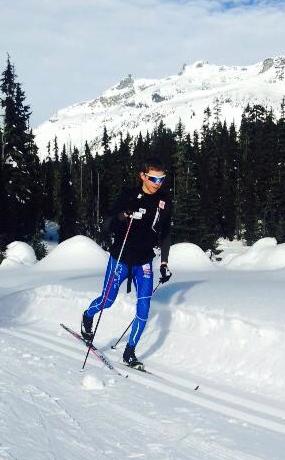
    How was your joint camp with the Swedish women’s national team in Sweden?

    “It was good. We trained a ton. It was a lot of hard work, a lot of hours, but it was cool to see that they weren’t doing anything different than us, and we could hang with those guys and train with them. It was just a good confidence builder that our team’s really on the right track and building momentum also.”
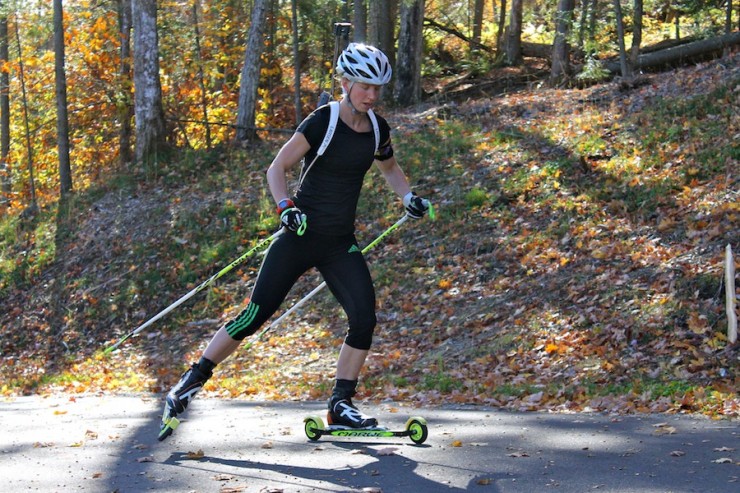
  • Pro Workout:  Running Intervals in the Rain with Liz Stephen

    Pro Workout: Running Intervals in the Rain with Liz Stephen

    Some skiers love to run; others tolerate it. The U.S. Ski Team’s Liz Stephen is the former. And while uphill running intervals present plenty of challenge for most, Stephen not only wants a solid grade and 20+ minutes of active time – she wants a steady downpour, mud, slippery footing, and whatever else nature can throw at her.

    “For me it is always more fun when it is raining out,” said Stephen. “It is muddy…your hair is all matted down. There is rain in your face, your glasses don’t work, feet are slipping.  You have to figure it out.  I like that kind of stuff.”

    Stephen ripping it up on the World Cup

    Her workout of choice consists of a relatively standard set of intervals – six four-minute repeats of hard effort building to maximum over the course of the session.

    The optimal hill is long enough that you don’t have to go all the way down after each effort, keeping the rest period in the target zone of three to four minutes. The grade should be challenging but run-able. These are not bounding intervals.

    Bounding may be more specific and powerful, but running gives Stephen a chance to work on quickness.

    “It should be a fun feeling,” she said. “A hard feeling, of course, but not bogging down.

    “You want to feel like you can be fast!”

    Staying light and quick is a regular theme in ski technique, and this is a perfect dryland opportunity to apply those concepts.

    At the end of the day, however, it is the rain that makes it for Stephen.

    “I just like that feeling – being muddy, coming in and showering, drinking hot cocoa and sitting by the fire, stretching and reflecting on ‘I just got some shit done today,’” said Stephen.

    And part of getting it done is learning to deal with the adverse conditions.

    “Whether you are on the World Cup or at some Eastern Cup, there is still shitty weather and the rain still falls, and the course is still not groomed the way you want it to be,” she said. “There is always going to be something that is not ideal for you. You have to know how to do that, too.”

    The rain may not raise your VO2max, or increase your foot speed, and mental benefits are hard to quantify – but Stephen sees real value.

    “Honestly, did it make you a better athlete than if it was sunny out? Maybe, maybe not, but in terms of your mental approach, you feel you really accomplished something,” she said.

    Stephen has been working on evaluating every workout – what went well, what could have been better. And, she concludes, “with running intervals in the rain, the positive is always that it is raining!”