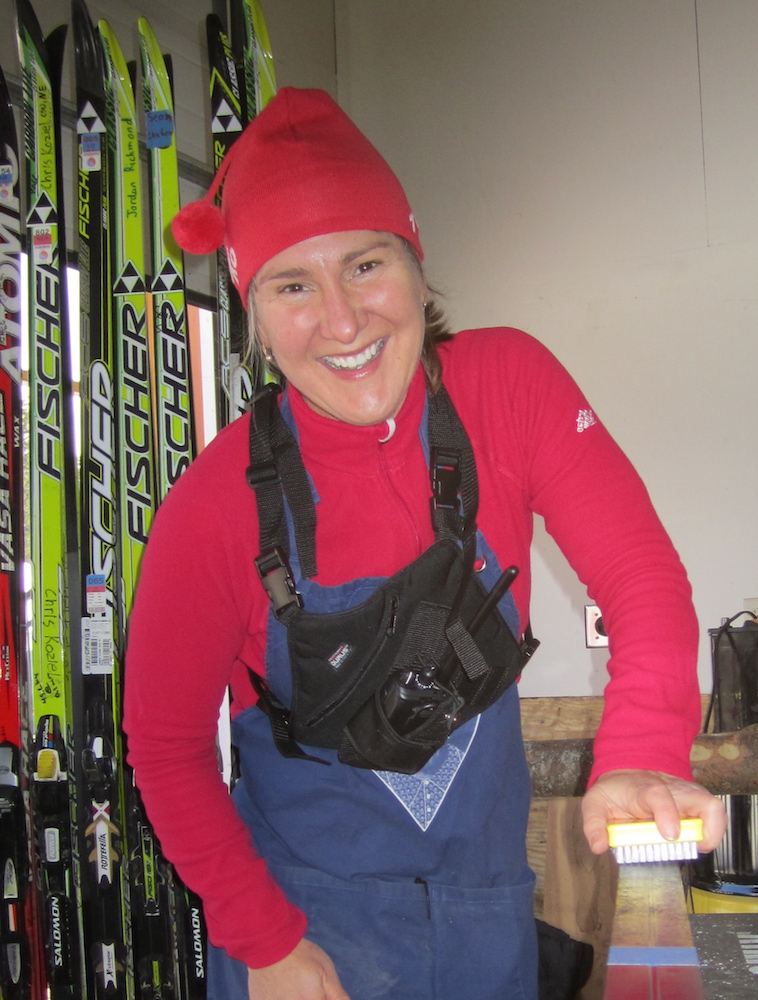
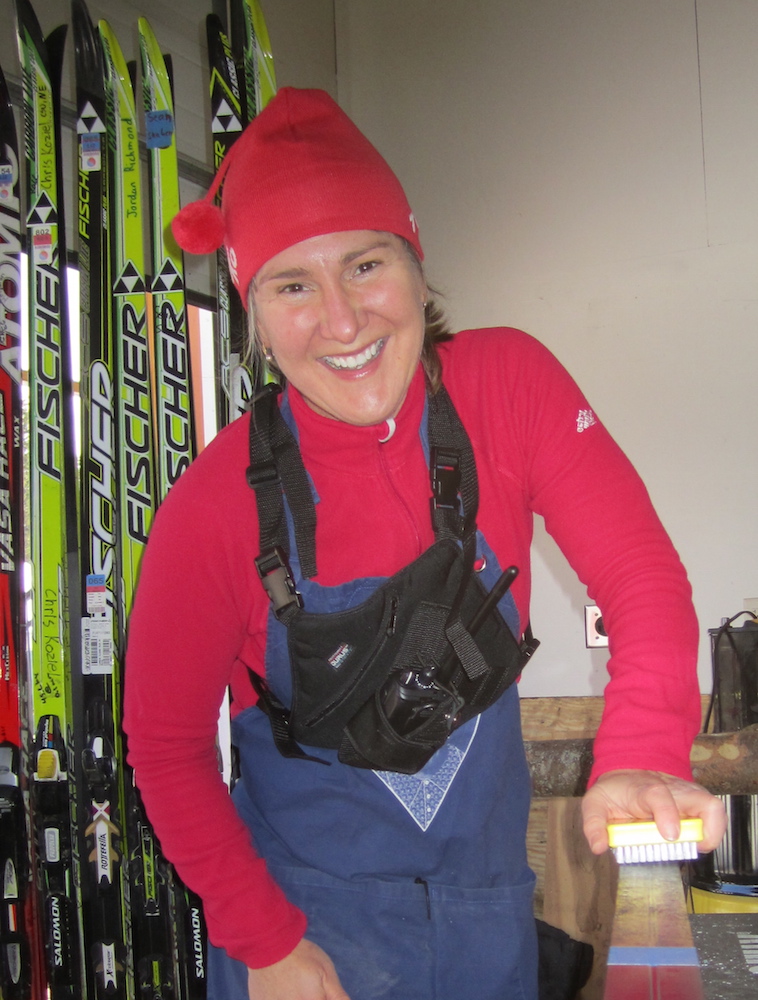
Amie Smith, a Cambridge Sports Union volunteer and the new high-performance director at NENSA, in the wax room. (Courtesy photo)
The New England Nordic Ski Association (NENSA) is joining the high-performance bandwagon. In May, the association, based in New Gloucester, Maine, announced its competitive programs director of nine years, Janice Sibilia was stepping down “due to changes in essential functions” of her position. The next day, NENSA published a job posting for a high-performance director.
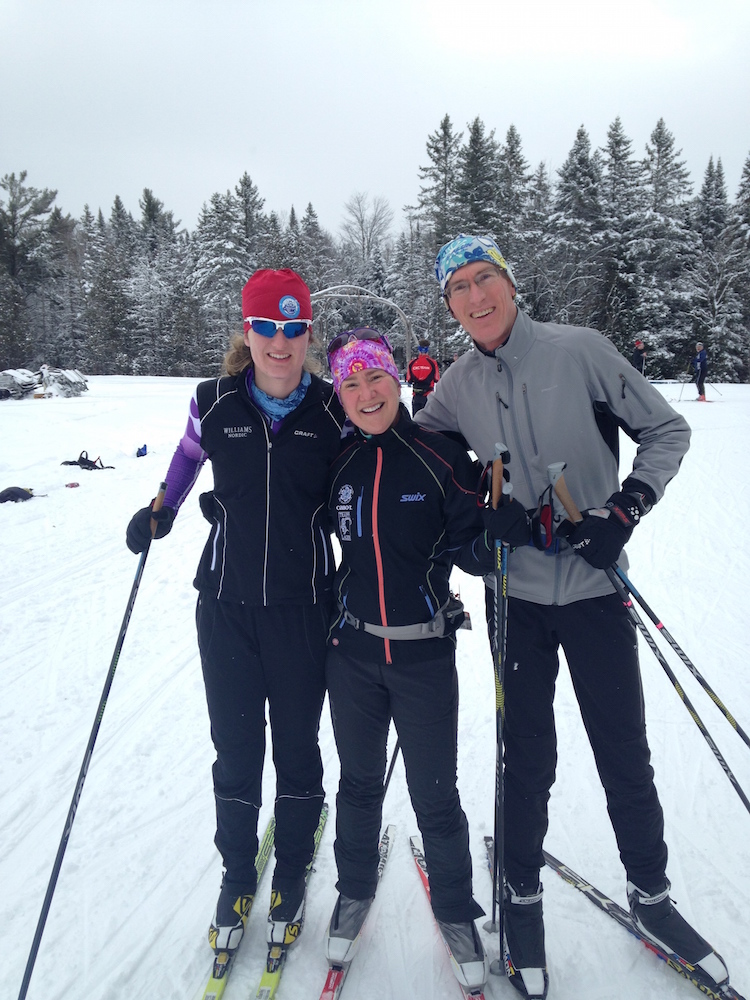
Amie Smith (c) on a ski with her daughter Rebecca (l) and her husband Tom. (Courtesy photo)
That’s where Amie Smith came in. Late last month, NENSA hired Smith, of Wellesley, Mass., to their team. As high-performance director (HPD), Smith will manage competitive cross-country ski programs throughout New England, much like Sibilia did, however, the position expands beyond the athletes and into the coaches’ side of skiing as well. The HPD also will manage race data and be responsible for keeping track of points throughout New England, from Zak Cup points to Junior National Qualifier points.
Smith enters the position with a lot of background within the New England ski community. Originally from Bennington, Vt., she grew up skiing and racing in the local youth ski league there, attended the University of Vermont and Columbia University, then settled down in Wellesley, a suburb about ten miles west of Boston. In 2007, she became involved with the Cambridge Sports Union (CSU), a ski club based out of Weston, Mass., along with her daughters who skied for the all-volunteer organization. For the past two years, Smith has also been the New England Junior National Championship trip leader, a position she plans to fulfill as HPD for years to come.
NENSA’s Executive Director Zach Stegeman told FasterSkier he is excited to have Smith onboard, as she brings a lot of enthusiasm and experience to the new job. Since the role spans throughout many facets of skiing, a person such as Smith — with experience in many aspects of the sport — is ideal, he explained.
“Amie is uniquely positioned for this role through her experience on every side of the sport: as a parent of competitive racers, as a coach, as an athlete herself, and in critical behind-the-scenes roles as a race director, a volunteer, a trip leader, and as board chair of a highly successful club,” Stegeman wrote in an email.
FasterSkier caught up with Smith earlier this month during her first week at NENSA. She started July 13.
FasterSkier: How has your first week been so far?
Amie Smith: Well, I have to say that we are in the throat of trying to finalize our Eastern Cup schedule for this coming year. Although I officially started [July 13], I have actually been working with the athletic development committee from NENSA the last couple weeks on finalizing what the schedule will be, what our venue options are. … I can tell you we have two SuperTours back to back this year, which is awesome for the East Coast. … Those weekends are going to be fantastic because were going to have so many great skiers from all over the country joining us in the midst of carnival and Eastern Cup weekends. But it also makes planning our eastern cup schedule this year a little different from previous years because we’ve already got two back-to-back weekends so were trying to spread out the other races and figure out the rest of the scheduling. So that’s my first week.
FS: You currently live outside of Boston; does this new position mean you have to move?
AS: No. The beauty of this job is I can work remotely. Obviously, I’ll have a lot of travel to all the Eastern Cup races, to Junior Nationals — I will be the trip leader again and organizing — a big part of my job is Junior Nationals. And then all the other things. We have a USSA Coaches Symposium in Lake Placid this September and all sorts of stuff. So I can stay in Boston and just travel to work when needed.
FS:Traveling around is something you are used to because you have daughters that have been nordic ski racers for a while, right?
AS: Yes. Rebecca will be a sophomore at Williams [College] next year and she skis for the Williams Ski Team, as did Hannah. When I looked at the schedule and between having daughters, who have been on the Eastern Cup and carnival circuit for the last eight years, and my previous work or my work with the CSU Junior Ski Team… Obviously I have more things like NENSA board meetings, and I represent NENSA for … the Olympic development committee, which are meetings out in Colorado every October. There are some other things, too, for travel that are a little bit more, but all to cool places, so it’s very familiar in a lot of ways.
FS: What was your role with the Cambridge Sports Union and what does becoming the high-performance director mean for your role within the club?
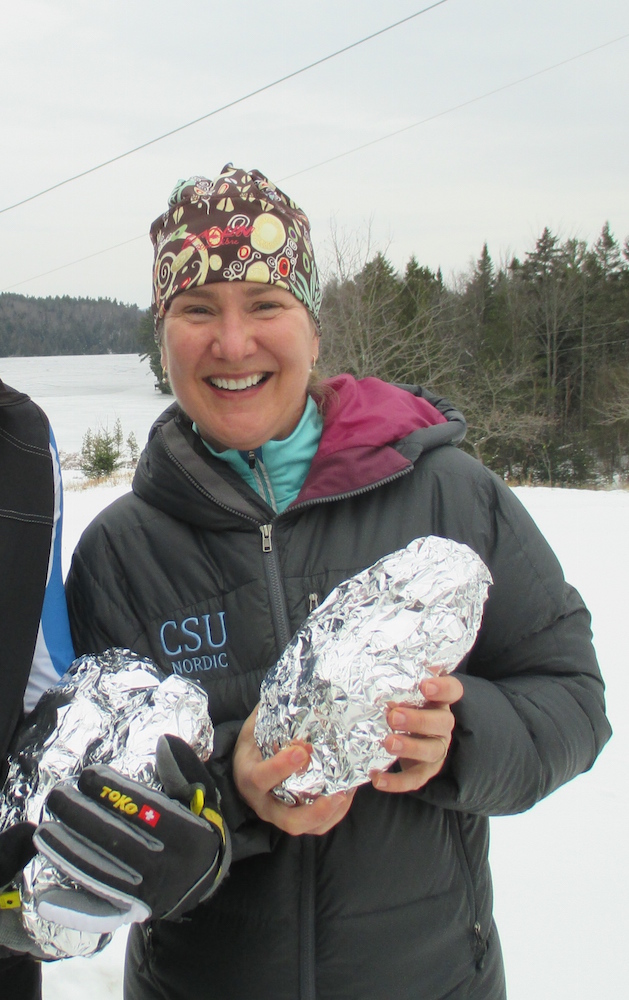
Amie Smith after “winning” a loaf of homemade bread at the 2014 Craftsbury Opener. (Courtesy photo)
AS: The last eight years I have been involved with CSU on a lot of different levels, as a parent volunteer, starting with that because it is an all-volunteer organization, and then in 2010 we created our first board: the CSU advisory board, which I have chaired since then. Also at that time, I moved from volunteer coordinator into the general manager position. So kind of helping oversee the day-to-day smooth running of the club along with Rob Bradlee, our head coach. I have also been, for the last three years, a coach for CSU. I started coaching, which I really love. So I am actually going to continue as a coach as I can, but I am giving up my general-manager volunteer position and my board-chair position although I am going to stay on as a board member. … Obviously I won’t be under the wax tent anymore. I was the wax-team leader for a couple years for CSU. So I wont be doing that because I will be running the Eastern Cups or helping the host venues with Eastern Cups.
FS: What did you see and contribute to during the rise of CSU as a program and why do you think it has become so successful?
AS: I think there are a couple of things that have contributed to that. One, the kids have a great time, the coaches have a great time, the parents have a great time. Our motto is having fun basically; it’s contagious. We have grown numbers-wise from, a handful of really active skiers — even if we had thirty on our roster, we might have only had eight kids at an Eastern Cup on a great weekend — to now this year we have 52, and the last number of years we’ve had 52 on our roster and we will consistently get 40 or more kids at each Eastern Cup race, which is crazy. I think it’s word of mouth, kids talk about it with each other … And the coaching, I think the fact that we are an all-volunteer club, I was thinking about this when we got the Club of the Year award just recently from NENSA; it’s been a really great model for us.
Here in the Boston area I think another part of our success is we have so many people to draw from since we are a large urban community. Our pool is huge. The fifty kids we have are from a very large population so you are going to end up with kind of the top skiers, and there are a lot of them. … I think part of our success is we have a large population pool to draw from, from both athletes, coaches and parents. And a lot of the parents were collegiate skiers and lifelong skiers themselves and we have our coaches the same way, you know, lifelong skiers, collegiate, and World Cup skiers. Without saying, Rob Bradlee is the glue and the base of our club and he is so passionate about CSU and about the kids — it’s great. So between Rob and our other group of fantastic coaches, I think that’s the key to our success, the people.
FS: What attracted you to the opening at NENSA?
AS: I have to say that the opportunity to work in the nordic ski community and have a job in the nordic ski community such as this is what attracted me to it. I have loved what I was doing for CSU over the years and that was in a volunteer position. I was thinking about going back to work … and I love the nordic community I’m super excited.
FS: What does the HPD job entail?
AS: A big thing I’m excited about actually is to delve into coaches’ education here in New England and really having the opportunity for our coaches to be well trained and up to date on the latest techniques and thoughts on skiing, as well as getting certified either on the NENSA level or the USSA level depending on where they want to go. Again to that, also we have the development and elite teams so I hope to be able to whenever possible hook up with them and get our competitive skiers, all our new England skiers jazzed up. Like Andy Newell showed up at an Eastern Cup last year, get that word out that, you know, Andy is going to be at this Eastern Cup and take advantage of it, or Sophie [Caldwell] is back so let’s take advantage of her being here and let people know about it, opportunities like that for the development and elite teams have a place to shine.
FS: Do you have any goals for NENSA or a long-term vision for the program?
AS: It’s still evolving. I’m still trying to get a handle on the job responsibilities and the to-do list … I would really like to not only continue with high-caliber Eastern Cup races and bringing the best New England Junior National Team to JNs each year, I mean that’s obviously a huge thing, but I really feel strongly about coach development and my hope is to work with the NENSA coaching committee to really ramp up coach education and make sure that opportunities are available to all of our coaches across New England to advance and tune up some stuff. But I’m still evolving on that one, you will have to give me a little bit of time. [There are] lots of great goals to accomplish.
FS: Is there anything else you would like to add?
AS: I’m really looking forward to this. In a way, it is a dream job, I mean you get to work in a community with people, athletes, coaches, parents, venues that you love and get to be a part of that. In a way it’s a dream job and what a great opportunity to be able to do this in New England. And I’m just really excited. I know it’s going to be hard, I know I’m going to make some mistakes … but I’m hoping by year two, OK, this all looks very familiar. You know, as you go on, it gets easier. … I think it is such a great community on so many levels to be involved with. I’m so happy my kids grew up in it, I’m so happy I’m still a part of it.
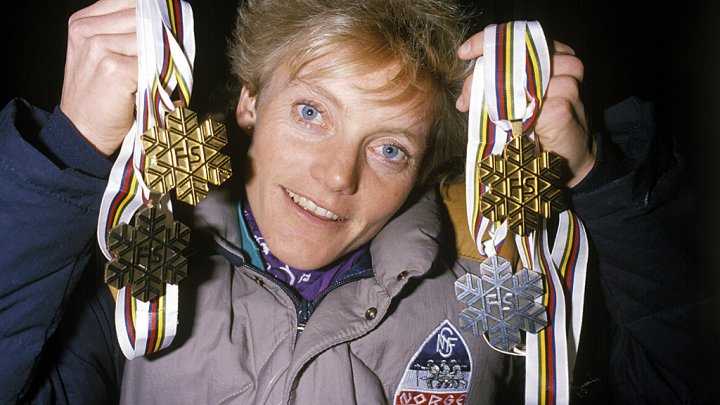
Anette Bøe displays her medals from the 1985 World Championships in Seefeld, Austria. She earned two gold, one silver, and a bronze at the Championships and was crowned Overall World Cup Champion later that year. (Photo: Anette Bøe/Facebook)
Anette Bøe has led a life filled with innovation and adventure.
The Norwegian skier was the first woman on the international racing circuit to venture into the realm of skate skiing in 1984 despite a Norwegian distaste for the new technique.
When she retired from professional skiing, she decided she wanted to try a new sport in order to “cool-down” and in the process earned a podium finish in the inaugural year of the mountain bike World Cup in 1989.
She didn’t stop there. Fulfilling a childhood desire to play hockey, Bøe joined a professional team where she earned two Norwegian national championships.
According to Bøe, her adventurous nature can be traced back to her hometown of Larvik, Norway.
“It was a very active, small town and I was very lucky to grow up in that kind of community,” she said in a phone interview. “When we came back from school we were always on skates or skis.”
In addition to the active environment she grew up in, Bøe attributed her entry and drive in nordic skiing to her father Albert. Before Bøe was born, Albert attended the University of Denver as one of the first Norwegians to receive a ski scholarship, under famed coach Willy Shaeffler.
Bøe was born in 1957 and from then on her father used his experiences as a ski racer to ensure his daughter shared his love for the sport.
“I think he had a plan with me because he loved cross-country skiing,” she said.
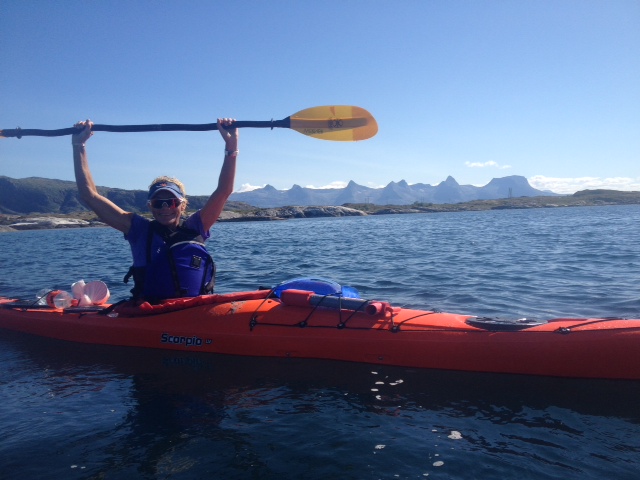
1985 Overall World Cup Champion Anette Bøe kayaks on Norway’s Helgeland Coast in a recent photo. (Photo: Anette Bøe)
With guidance from her father throughout her developmental years, Bøe had dreams of becoming the best skier in the world, despite disapproval of such ambitions at the time.
“It sounds crazy, but in the old days you couldn’t say that to anyone,” Bøe said of her aspirations. “Now it’s open. You can say that to anyone you want to, but in the old days you couldn’t say ‘I have a goal to be the best skier in the world.’”
Her drive to succeed lasted well into the peak of her skiing career. In the 1980s she was training in St. Moritz, Switzerland where she interacted with many international teams and broadened her horizons outside of the often-isolated Norwegian team.
Because of her familiarity with international teams such as the U.S. Ski Team, Bøe experienced the new technique of skating very early on in its conception.
Bøe was selected for the Norwegian Olympic team in 1984, but despite winning a trial race, she was not picked to compete. She watched from the sidelines as skiers like Bill Koch used skating to their advantage. Later that season, Bøe followed suit and made the decision to abandon the kick wax on her skis, making her the first woman to skate on the international circuit.
“No one on the girls side of the Olympics was skating but then I picked it up in the end of 1984 at the last ski race,” Bøe explained. “I took off the wax and I skated. I’m actually the first woman in the world to be skating without wax (on the international racing scene).”
By 1985, Bøe had fully embraced the skating technique and earned two gold medals at the World Championships in Seefeld, Austria in addition to two other podium finishes. Later that year she was crowned the Overall World Cup Champion.
Bøe also won the prestigious Holmenkollen Medal in 1985, Norway’s highest honor in in skiing.
For the Norwegian, the creation of skating represented a new era not only for her but also for nordic skiing as a whole.
“I think it was really good for cross country skiing when the skating came because everybody had a new chance,” she said.
She pointed to the U.S. Ski Team as an example, saying that the innovative use of skate skiing opened the door for skiers like Bill Koch and Kikkan Randall to shine on the international stage and grow the sport outside the realms of Scandinavia.
According to Bøe, the Norwegian national team was reluctant to embrace the new technique and suffered the consequences. She said she was fortunate to be training in St. Moritz at the time, so that she could practice the technique.
“The Norwegians were in the back yard and all the other nations were in the front because they picked it up pretty quick,” she said. “We lost a generation in Norway of skaters because they were old-fashioned.
“I was lucky to be in the right spot, in the right time and be open to changes. Every day being an athlete you need to find new ways.”
Bøe retired from her cross country skiing World Cup career in 1989, but knew she still needed sport in her life.
“I like to give something back (to others) what the sport gave to me,” Anette Bøe says of her relationship with cross country skiing today. (Photo: Anette Bøe Skiskole)
During her first of many visits to America Bøe witnessed mountain biking for the first time, and was inclined to try it.
“I was lucky because I have always been adventurous and wanted to do new things,” she said on her entrance into the new sport.
By the end of 1989 Bøe had participated in the inaugural year of the mountain biking World Cup and took third place in a cross country style race, making her one of the first women in the world to earn a World Cup podium in mountain biking.
By the early 1990s she was finished with bike racing, but her ventures into new realms of athleticism were far from over.
During her career as a skier, Bøe had an encounter with a Norwegian women’s hockey team. Having always been intrigued by hockey from a young age, Bøe talked with the team. After her conversation she walked away thinking that as soon as she retired from skiing she would play hockey.
Once her skiing career ended, Bøe did just that. She joined a local team and in the 1990s she and her teammates won two Norwegian national championships.
In 2000 she was awarded the Honorary Prize of Egeber, a distinction bestowed on Norwegian athletes who excel in more than one sport, for her accomplishments in cross country skiing and hockey.
Bøe found her experience as a hockey player very rewarding, not only because of her successes but also because of the team dynamic she discovered while competing on ice.
“When I was a cross country skier I would always ski by myself and I was always depending on me,” she said. “But when you are on a team and depending on the team to play together, it’s totally another ball game. For me it was good, it was very interesting.”
Since Bøe’s departure from professional competition, she has filled her time with a variety of endeavors. She’s worked in the Norwegian television and radio industry, as a manager for an ice hockey team, and as a packager for athletic firms and Olympic sponsors.
One of her favorite projects is the ski school that she created ten years ago.
Anette Bøe hopes to move to the U.S. soon to be closer to friends and her two children who live in Denver and Boston. (Photo: Anette Bøe Skiskole)
“That’s giving me a lot because it’s nice to give something back to the sport,” Bøe said of her ski school. “I see people getting happy when they break the code; when they feel all their body weight is on one ski and they can kick and glide with total body control on the skis.”
However, now that the 56-year-old has more time on her hands she thinks she might be ready for a change. At the movement, Bøe sees that change as a move to the U.S.
Intrigued by her father’s stories of America as a young girl, Bøe always found the U.S. very attractive. On top of that, two of her children will be living in the country in the coming year: her oldest daughter, Thea, graduated from the University of Denver in 2013 and is still living in Colorado, while her youngest son, Oliver, will be attending a boarding school in Boston this coming year.
Bøe has been searching for work in the U.S. but can only commit to a year due to uncertainly of whether her youngest son will stay stateside. Earlier this year, Bøe had secured a job in Massachusetts but due to her sister’s illness she was forced to decline.
Much like many other accomplished foreign skiers in the country, Bøe envisions herself as a possible coach or public figure in the U.S. cross country skiing community.
“I like to give something back (to others) what the sport gave to me,” she said.
Whatever lies ahead for the 1985 Overall World Cup Champion, her ability to take advantage of her surroundings will likely ensure that her future is just as innovative as her past.
U.S. teammate Kikkan Randall (l) and Sophie Caldwell celebrate the first U.S. women’s double podium in a 2014 World Cup skate sprint in Lahti, Finland. (Photo: Fischer/Nordic Focus)
BOZEMAN, Mont. — When talking with the Sophie Caldwell, her humble demeanor would never reveal that she claimed the highest Olympic finish by a U.S. woman in cross country skiing at the 2014 Games. From her simple goals of increased experience and continued enjoyment of the sport, it would be hard to guess that she was part of the first U.S. women’s double podium with Kikkan Randall in the Lahti, Finland World Cup this past season.
Both she and her sister, Isabel, are alumni of Dartmouth College and come from a family that has been a major part of the American nordic ski in recent decades. While the Caldwell name is often associated with success, they both agree that they’ve never felt pressure because of their family legacy.
During their recent trip to Bozeman, Mont. to visit their cousin and former UNH skier Anya Caldwell Bean, FasterSkier was able to sit down with Sophie and Isabel to reflect on last year’s racing season and talk about their future plans.
FasterSkier: This past season you obviously found a lot of success on the international circuit. Was this something you knew you could do? Were you expecting to achieve the accomplishments you did?
Sophie Caldwell: My success and results from last season were certainly unexpected. I wasn’t expecting that at all going into the season. I had set some goals but none were super concrete. I don’t like to set results-based goals, but making the Olympics was a big goal, and I wasn’t sure if that was realistic or not. When we found out that we had qualified for the Olympics pretty early on, that took a lot of pressure off. Once that happened I was like ‘I’ve accomplished all my goals for the season. Let’s just have fun with it.’ It was a really exciting place to be and it was really fun.
I trained well last season, but a lot of it was being excited, being in a good place mentally, and having a good team. I think that’s what I owe a lot of the results to. I definitely wasn’t expecting to have a season like that.
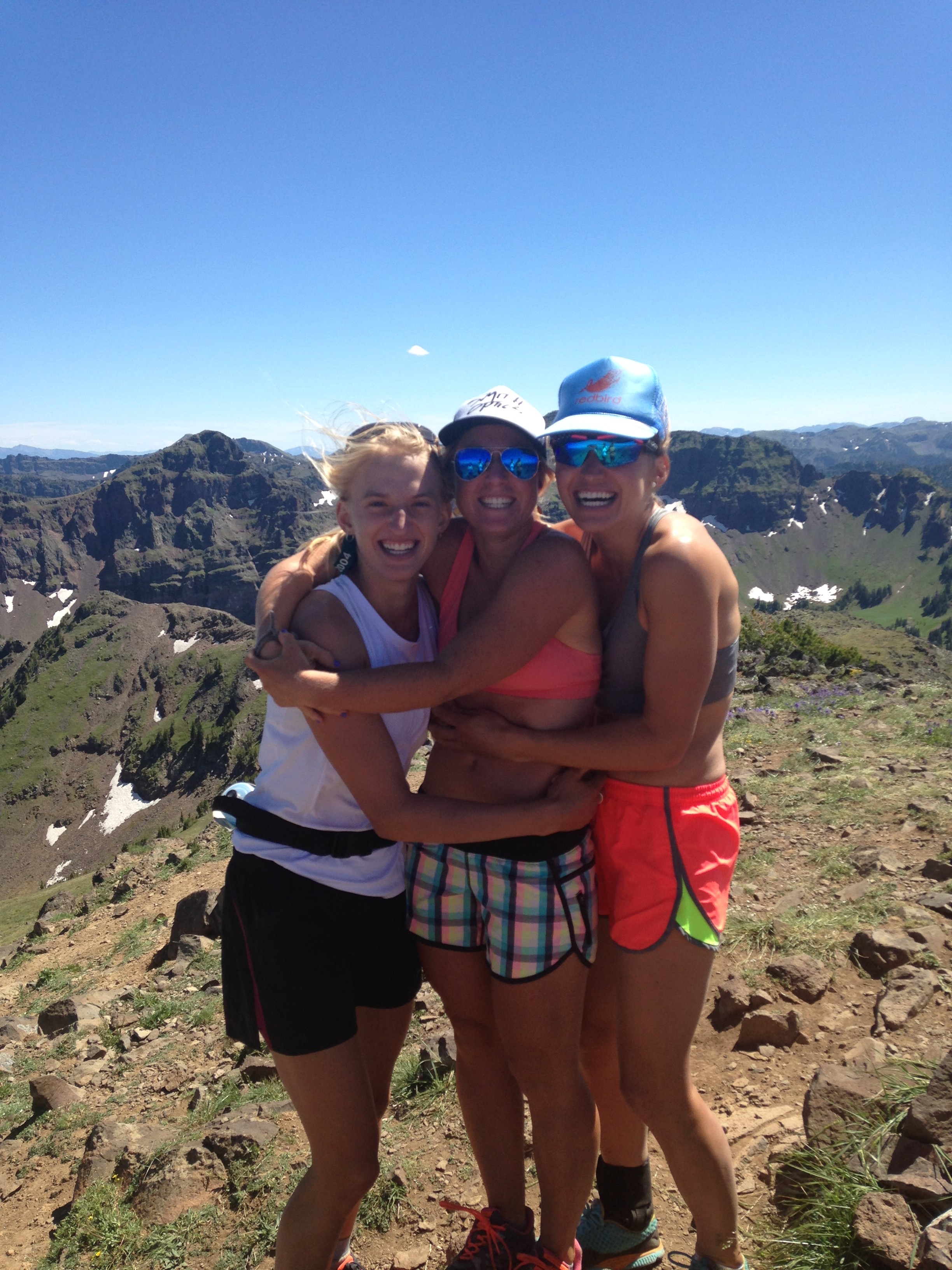
Isabel Caldwell, Anya Caldwell Bean, and Sophie Caldwell (l-r) pose on the top of Mount Blackmore in Bozeman, Mt. during the sisters recent trip to visit Anya.
FS: How was it adjusting to your first full season on the World Cup?
SC: It was easier adjusting than I thought it would be. That being said, it’s never easy being home away for that long. Living out of a duffle bag and going from hotel to hotel is exciting because you get to see a lot of new paces but sometimes you miss coming back to a real home.
FS: What was the most memorable moment of the season for you?
SC: Everything about the Olympics, especially the sprint day. It was memorable, but it’s also all a blur. Those few weeks were pretty incredible.
Having my family over for Christmas was pretty fun as well. That was a nice break because we had been bouncing from World Cup to World Cup each weekend so it was nice to tone things down and spend time with my family.
Some other highlights were Davos, because that was my first top ten. That was really cool because I could see that I could compete with the big girls. That gave me a boost of confidence. Also, Lahti was obviously a highlight when I shared the podium with Kikkan.
FS: Izzy, how was it visiting your sister during the season this year?
Isabel Caldwell: Christmas was wonderful! We went to Asiago (Italy) and watched the sprints, then we went to Ramsau (Austria) for Christmas, and then Davos (Switzerland) for the first stage of the Tour (de Ski). It was really fun to see Sophie race and spend time with her.
FS: How was your experience at your first Olympics? Was it overwhelming?
SC: It was definitely a little overwhelming going to the opening ceremonies. The fact that we got on TV was pretty cool and we heard from everyone at home. Because we were in the endurance village, which was full of Nordic skiers and biathletes, it was easier because most people you saw there were with you every weekend on the World Cup. You could definitely focus on racing. It was a tough place to get to and a tough place to leave, so it was pretty easy to calm down there.
After the sprint day I felt like I heard from just about every person I had ever met in my life. That was a little overwhelming. After the race I looked at my phone saw all the texts and emails. I was on my way to dinner and I just pulled out my phone, looked at it and turned it off. I took a deep breath and decided to take in the moment and pay attention to it after dinner.
FS: Did you feel any pressure at the Olympics?
SC: I didn’t feel any pressure at the Olympics because, as I said, my biggest goal was to qualify for the Olympics. Up to that point I had qualified for all the skate sprints and it was a skate sprint at the Olympics. At that point I made another goal to make the heats. After that it didn’t really matter what happened.
Of course, at the same time, there was a little more pressure and I was more nervous than I ever had been on the start line, but I wasn’t worried about results.
“As far as having the best finish, that was really cool, but I feel that on any given day it could have been any one of us. I’m proud, but having that below my name isn’t defining me or the team.” – Sophie Caldwell on having the best female finish of an American at the Olympics.
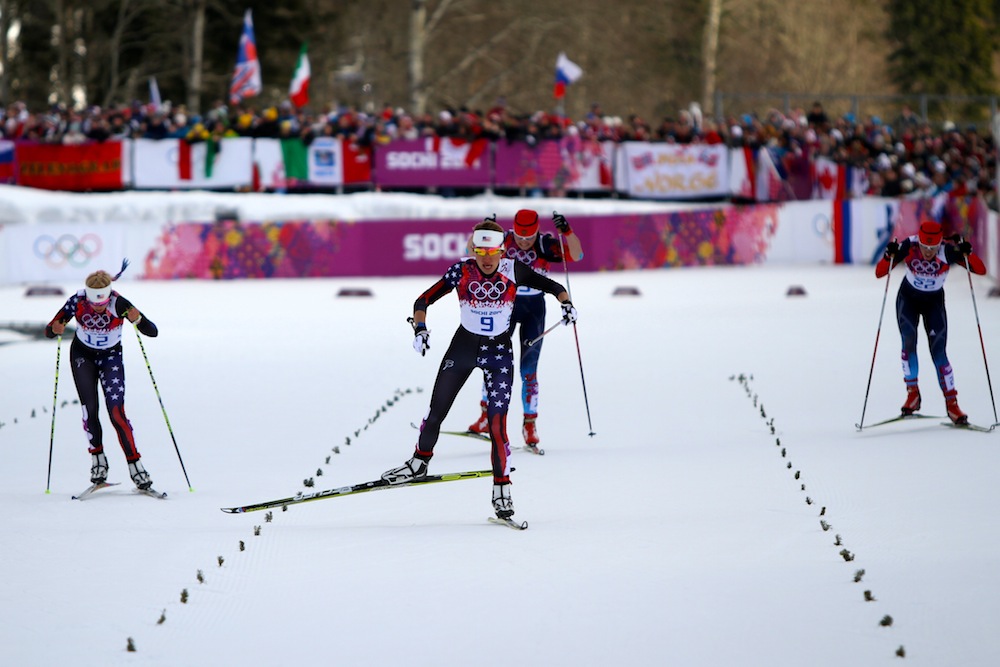
Sophie Caldwell (bib 9) heading for the finish in her Olympic quarterfinal heat in February, where she placed second to advance automatically to the semifinals.
FS: Now that you’ve had time to reflect, how does it feel to have the best finish of any American female at the Olympics?
SC: It is still sinking in. I was talking to Anya (Caldwell Bean) today about that and she was saying that it all happened so quickly and before the Olympics nobody thought it was that big of a deal and then you get there and it was a big deal. It was a huge deal, but I still think it’s sinking in.
As far as having the best finish, that was really cool, but I feel that on any given day it could have been any one of us. I’m proud, but having that below my name isn’t defining me or the team.
FS: How did Kikkan failing to advance from the quarterfinals affect your race?
SC: It was bittersweet because we were all broken-hearted when she didn’t make it past the quarterfinals. We had to regroup and focus on the race again. That was definitely some extra motivation. On any given day Kikkan could have gotten a gold medal there and that was some motivation to do it for Kikkan and do it for the team.
FS: Izzy, you watched the Olympics from Dartmouth? What was it like seeing your sister advance to the A-final?
IC: Yeah it was amazing. I woke up for every single one of her races this year. For the Olympics the whole Dartmouth team was watching on campus at the big televisions. Everyone was going wild. Meanwhile there was a big group text going on with about 20 family members all screaming their heads.
It was pretty fun because everyone on the Dartmouth team feels a special connection with Sophie, and also with Ida. There’s definitely a lot of pride coming from Dartmouth. Everyone gets pumped up when they do well, and everyone is watching every morning.
FS: Sophie, what are your general goals for next season?
SC: I’ll be racing in the full World Cup season again and I’d obviously like to be competing at World Championships and do well there. Right now it’s hard to tell who is going to be racing which race, I mostly just want to get more World Cup experience under my belt. Last season I felt like each weekend I was becoming more and more confident on the World Cup, but in no way am I a veteran or expert. That’s my big goal, to just keep enjoying the experience and keep learning.
I haven’t made any large adjustments in my training plan. I have been training a little more but I had some injuries (broken elbow and twisted ankle) but those seem to be fine now.
FS: What are you most looking forward to?
SC: I’m just excited to be back on the road with the team, but I’m definitely still enjoying my time at home right now. It’s hard to think about heading over to Europe just yet but it was a blast being over there with such a supportive group and hopefully the team will continue to grow and we’ll get some good results. I think it’s really cool to see the relays where we have started to pop out and do well. Hopefully, as a whole, the U.S. Team will continue it’s upward trend.
“Our dad in particular did a really good job of balancing being a dad and being a coach. Dad always came before coach, which was really helpful. I think it has just been a pressure free environment from day one. We all have different relationships with skiing but I think we all want to do it for the rest of our lives.” – Sophie Caldwell
FS: What are you up to these days, Izzy?
IC: I am officially done with ski racing. I think I want to become a teacher and I have a teaching internship at home for the year at the Burr and Burton Academy Mountain Campus. I’m very excited. It’s a semester program about science and sustainability.
Austin, Sophie, and Isabel Caldwell (l-r) pose during the Caldwell’s visit Europe during Christmas to see Sophie race on the World Cup circuit. (Photo: Sophie Caldwell/sophiecaldwell.blogspot.com)
FS: Do you see yourself continuing to be involved in the sport in any capacity in the future?
IC: I have always loved skiing and will continue to in the future, but I’m not that excited about racing anymore. I can live vicariously through Sophie (Laughs). I’ll probably hop in some races this year. I want to do Craftsbury Marathon for Torin (Tucker, a Dartmouth skier who passed away earlier this year) and then maybe do the Berkie if David Sinclair is doing it.
FS: Finally, you both come from a family that is well known in the nordic ski community. How has that influenced both of you?
SC: It’s funny because when people ask us that question the follow-up is usually ‘that must be a lot of pressure.’ It really isn’t. I’m definitely proud to be a Caldwell but I’ve never felt any type of pressure. We grew up skiing but that was just because it was a lifestyle that my parents enjoyed. They did a really good job in raising us to learn to appreciate skiing, love it, and have a healthy relationship with it.
Our dad in particular did a really good job of balancing being a dad and being a coach. Dad always came before coach, which was really helpful. I think it has just been a pressure free environment from day one. We all have different relationships with skiing but I think we all want to do it for the rest of our lives.
Izzy and I were on a team together for two years at Dartmouth and three years at Stratton and we got along really well as teammates. It wasn’t a competitive thing. I was just saying to Anya this morning, that in college I said that if anyone is going to beat me I want it to be my sister. I think we are each other’s biggest fans. It was never competitive. A lot of that comes form having a healthy relationship with sports and competition from a young age.
IC: That pretty much sums it up!
Sophie currently skis for the Stratton Mountain School T2 Team and is a member of the USST A-Team. Follow her training, travels, and racing through her blog.
ANCHORAGE, Alaska — The youngest of two Bjornsen siblings on the U.S. Ski Team, 22-year-old Erik Bjornsen recently sat down with Reese Hanneman, FS media contributor and Bjornsen’s teammate on the Alaska Pacific University (APU) Elite Team, at the APU Nordic Ski Center for a frank discussion about last season and the one just ahead.
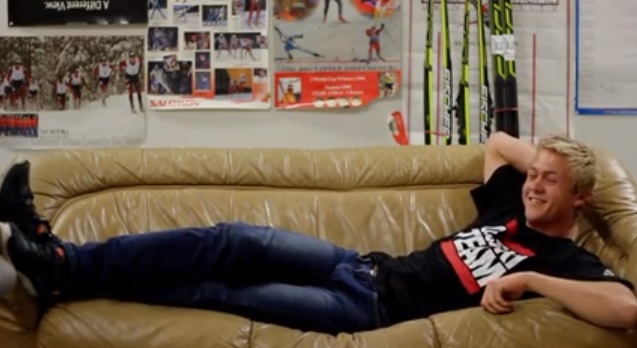
“How should I sit?” Bjornsen says with a smile at the start of the interview. Then he lies down.
But in all seriousness, Hanneman raises some questions that elicit elaborate responses from the Washington native, now in his third year with APU.
“I’ve never been that nervous for a race before,” Bjornsen says of one particular competition at U.S. SuperTour Finals, one of the highlights of his 2012/2013 season.
And then there was a helicopter tour of Alaska: “… It just made me realize how crazy this place is that I live in.”
Finally, his hopes and dreams, and the people he has to thank for the ability to pursue them: “You guys have all stepped it up I hope we can make you proud this year.”
As I approached Len Valjas for an interview during a recent junior training camp at his home club in Southern Ontario, I couldn’t help but think something was a bit off – I caught him in the middle of the buffet line, about to load up his plate with pizza. The newest member of the Canadian National Ski Team (CNST) World Cup team was wearing baggy shorts, a big t-shirt, and sunglasses perched atop his head – which at 6’6, was considerably above my own.
After asking if I could chat with him over lunch, he grinned and said “sure, just let me grab my pizza, and I’ll meet you in a minute.”
Here I was interrupting a guy who finished 9th in the World Cup in Drammen, Norway, last season, and has out-gunned some of the best sprinters in the world as he was slumming it in the buffet line with juvenile boys and washed-up former-athletes turned coaches, all the while politely thanking the volunteers passing out food.
Almost exactly a minute later, he folded his lanky frame into a chair next to me, setting down a plate towering with pizza and a big pile of salad, greeting me casually.
The first thing he said? “Man, I was nervous about that presentation last night.”
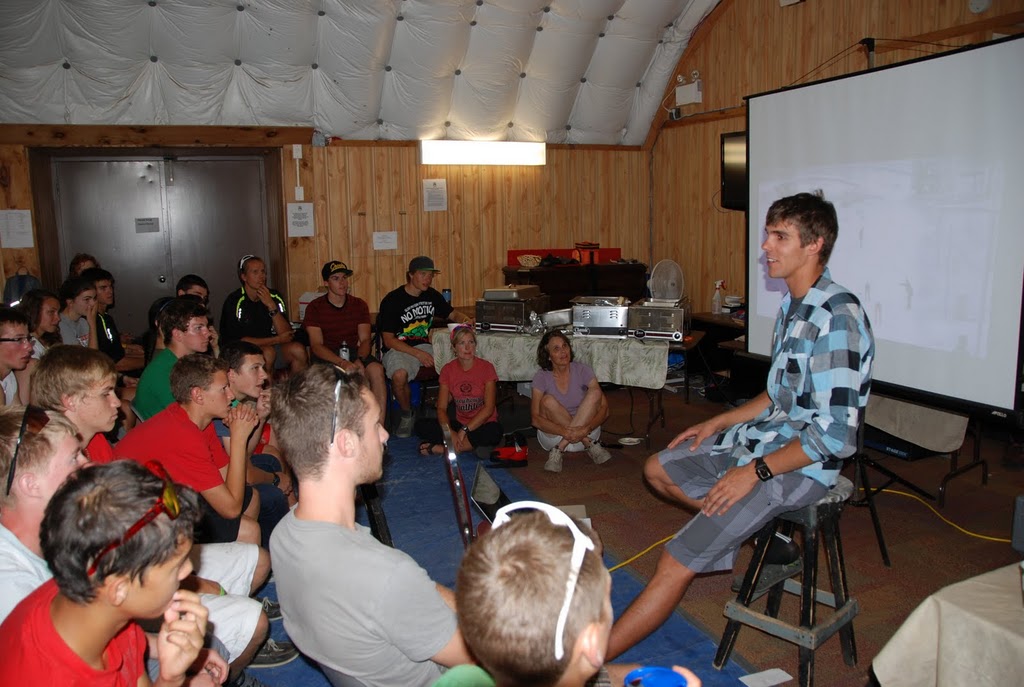
The previous evening he had given a presentation to the hordes of camp participants about his rise through the Canadian skiing system, and his previous season on the World Cup – I heard via the grapevine it was his first such appearance, and the previous day had heard him joke; “if it goes bad, I’ll just put up some windsurfing video from Hawaii, or something.”
Len Valjas capturing the attention of the crowd in his presentation at the recent SOD Camp (Photo: Graham Longford)
It was far from bad; Valjas, who I have known for the better part of ten years as being a bit of a quiet guy, but you wouldn’t have guessed it from his public-speaking demeanor. He was calm, concise, and had timing that stand-up comedians would kill for.
But the first feeling you get from Valjas (or ‘Lenny’, to most) isn’t one of extreme confidence, or cockiness, which he has probably earned. Valjas’ down-to-earth, earnest attitude was obvious during the aforementioned presentation, particularly when he played the start of his heat at World Championships in Oslo.
The clip shows him doing one double-pole, and then face-planting hard into the snow in front of hundreds of thousands of spectators. During the presentation, he then immediately rewound it, and ran it again in slow motion, unable to keep from laughing as he told the story. (For the record, it earned him the biggest laugh and applause of a very entertaining night.)
And right off the bat, Valjas makes it clear that he comes from modest beginnings as a ski racer, growing up in the suburbs of Toronto, and commuting out to Hardwood Ski & Bike to compete for Team Hardwood.
“I got cut from Team Hardwood’s Devo Squad [junior racing team] as a 12 year-old by Jack Sasseville,” he recalled in his presentation, a story I have heard from him in previous interviews. “I wasn’t serious enough; he was probably right.”
Valjas’ rise to World Cup success has been meteoric. At his first World Cup in 2009 at Whistler Olympic Park he finished 46th, or dead last (“I was dead last by ten seconds; I thought there was a timing error or something,” he quipped); he is now on the CNST World Cup team, and the most striking thing about him is his humble attitude.
“It was kind of unexpected,” he said of his World Cup season, “I was really happy with how it went.”
And obviously so – it was a season most skiers can only dream of. The young Canuck recorded his first World Cup top 30, his first World Cup top 10 (and the corresponding prize money), his first World Championship starts, and to top it all off, even managed to defend his title as Canadian National Sprint Champion in Canmore, Alberta, at Canadian National Championships.
“That was one of the prouder points of the season for me,” he said.
“I was really stoked to defend that [National sprint title].”
Valjas' slide of the results from his first Canadian National Championship classic sprint, where he finished 41st, demonstrating how far he has come (click to enlarge).
While Valjas may be the current National Sprint Champion, and Canada’s fastest pure sprinter, he hardly lords it over people. Instead, he almost seems to revel in fact that he has worked his way up from practically the bottom. In his presentation the day before, his third slide was of his first classic sprint at Nationals in 2004 – where he finished 41st, over 15 seconds behind now-teammate Alex Harvey.
If Valjas was excited about his success Canadian Nationals, the highlight of the season was without a doubt his trip to World Championships in Oslo, Norway.
“I’m not going to forget that ever,” he said. “It’s a totally different atmosphere than I’ve ever been in and I’ll probably never be in an atmosphere like that again.”
Valjas was just happy to be there, to take in the experience.
“To be there just as an alternate I would have been happy – it was nuts.”
And he almost was there ‘just as an alternate’ – the Canadian team used the skate sprint World Cup in Drammen, Norway, the week before World Championships to determine which of their three pre-qualified sprinters (Valjas, Stefan Kuhn, and Phil Widmer) would join Harvey and Kershaw on the start list at the World Championship sprint.
“The pressure was on for sure for all three of us,” said Valjas. “It went by so fast – I one-skated the whole thing. I went across the [finish] line, and I was in the top three for a while.”
Valjas was eventually out-qualified by one other person (less than a tenth of a second behind one Andy Newell) but qualifying in fourth was a shock.
“After finishing fourth I honestly thought there was some kind of timing error again,” he said, laughing, referencing to his first World Cup experience.
“The coaches and staff were all freaking out after I crossed the line – it kind of took me by surprise for sure. Sometimes you need those races just to tell yourself you’re just as good as those guys.”
And Valjas wasn’t just a one-shot wonder on the day; he punched his way through to the semi-final, where he ultimately ended up just missing the A-Final and finishing ninth on the day.
“Going into the heats I kept it going,” he said.
“I had a low bib number, and I’ve never had that, it kind of felt like I fit in, and I knew I could ski the course faster than almost everybody.”
Valjas chalked some of his success up to tactics.
“Everyone else kept shooting out on the [last] turn and I could get inside and make up a few positions there. It kind of worked until the semi, when I ran out of gas,” he said.
For Valjas, the biggest boost he gained from his result in Dramman was confidence – less than six months previous he had been looking up at the top World Cup sprinters in awe, and now he knew he could ski with the best of them.
“Those guys, they’re pretty intimidating,” Valjas said of the men he competes against on the circuit.
“The whole year I kind of walked by them and I would try and name them – you know who they are, but they have no idea who I am. I mean, hopefully now they are starting to know, but I don’t think we should be all intimidated by them.”
Len Valjas (bib #4) on his way to a career-best ninth at the Drammen, Norway World Cup sprint.
And Valjas truly believes that the top level of skiing in Canada is extremely close to that of Europe.
“Our Canadian guys are as fast as those guys,” he said.
“I think Canada is one of the best ski nations now, we just don’t have as many people racing compared to countries like Norway. For the amount of guys we start and the amount of medals we bring in it is amazing.”
Valjas built his confidence up slowly, starting from the moment he set foot in Quebec, and began training with Alex Harvey.
As soon as he started doing workouts with Harvey, he recognized the value in having one the top World Cup skiers doing intensity next to him. He gradually found himself working up to Harvey’s speed, and trying to match him in sprints.
“In training I knew I could be close to Alex, and in races I knew I could do the same thing,” Valjas said.
“A lot of our workouts were replicating sprint races, or sprint heats, and I just knew I had to learn the tactics pretty quick as well.”
And tactics are something Valjas has made an effort to learn, and understand. He called the tactical aspect a “big difference” from North American to European sprint heats.
“Guys are caught surprised,” he said.
“There’s not too much contact, but it’s close quarters, and if you’re not aware of your skis and poles you’re going to get stepped on and tripped.”
“You have to ski small sometimes, you can’t just assume someone is going to be nice and give you space. I’ve always done that, even in NorAm races. I’ve just tried to make sure I stay on my feet, not be super aggressive.
“Once you get better at staying on your feet, you can start being the aggressor, but as soon as you figure that out, it helps, guys aren’t going to start passing you when they aren’t supposed to. If you feel a guy coming up the side, just drift right over, shut the door. Say no, not here,” Valjas explained.
But Valjas hasn’t started being the aggressor quite yet – he still has a lot of respect for his World Cup competitors, and isn’t in a hurry to “piss them off”.
Valjas (l) teaching sprint-start technique to Junior athletes (Photo: Graham Longford)
“I also don’t want to be the guy that everyone wants to beat out there, at least not yet,” he said.
Despite the gains he has made tactically in sprinting, he still had some rookie growing pains to go through last season.
Specifically, his trip to World Championships.
Valjas started off his sprint day well, qualifying 21st. As he stood on the start line of his quarter-final, he was soaking up the atmosphere of the thousands of fans as he thought about how proud he was to be a Canadian at that moment.
And then he made a huge mistake – he missed his second pole plant out of the gates, and went crashing onto his face in the tracks.
“The first thought that came into my head was ‘oh crap, this sucks. That’s not how it’s supposed to be. I look like an idiot,’” he said.
But his next thought was a lot more productive – “I just relaxed,” said Valjas, “that was the fastest push-up of my life.”
Luckily, Valjas was able to stay in control and ski smooth to catch up to the group without wasting too much energy. Despite the start, when Valjas crossed the line, he was happy with how the race went.
“It was one of my favourite races, even though it didn’t go as I planned, and my whole game plan was totally blown out the door when I wiped out in the start gate,” he said.
And Valjas has learned from his mistakes – he and the entire Canadian team have dedicated a large portion of time this summer to working on start gates, and sprint starts, something he now feels very confident with.
Valjas was lucky enough to start a second race at World Championships, but it wasn’t without a little controversy.
When Alex Harvey opted out of the relay, it opened the door for some of the other skiers to jump in, albeit with a different mindset.
“It is his decision, that’s what it came down to. Definitely the other teammates didn’t fully agree with it at the time, but that’s his call, he’s got his own goals too,” Valjas said of Harvey’s decision to sit out the relay to save himself for the individual events.
“We didn’t let it bother us, we were going out to race as fast as we could.”
Len Valjas skiing the second leg for team Canada, in Oslo, Norway at World Championships last March.
The relay is something Valjas is keen on being a part of on a regular basis – and with the retirement of George Grey, it has become a real possibility, as there is one spot available.
“I would love it to be me,” said Valjas. “It’s one of the most exciting events to race. There’s not so many team events in cross country skiing, so it’s cool to be a part of.
He has switched up his training a little to try and improve his endurance and his distance skiing, and hopes to start a few distance World Cups this season. Last season he started five distance races in total, a number he is convinced is doing little to improve his distance-skiing ability.
“I get better at distance racing by doing more distance races. It’s good training; you can figure out all the pacing and stuff,” said Valjas.
But for Valjas, this season his focus is still sprinting – he hopes to crack the top 30 in the Sprint Cup, and top 50 in the World Cup overall.
He is also thinking about the Tour de Ski – he has a deal with CNST Head Coach Justin Wadsworth where if he notches two top 12’s before the registration deadline, he can decided to race the event or not.
“I’m in no rush to race the Tour,” Vlajas admitted. “I’m still not in the distance and endurance shape that I probably should be to enter that kind of stage race.”
Valjas is feeling confident with the work he has done this summer, as he has been working closely with Wadsworth and Louis Bouchard on improving his fitness and his technical ability.
“I hope this year goes well again, I think I’m in the best shape I’ve ever been in this summer,” said Valjas.
While he may be in the best shape physically, as I wrap up the interview, and Valjas and I collect our dishes and head for the door, I can’t help but notice one thing – he has left his salad untouched. There’s still work to be done.
Tommy Krenz in action at the 2011 Seeley Hills Classic
Recently I caught up with Cyclova XC team member & Elite Birkie skier Tommy Krenz and interviewed him about his Birkie experience this year. Tom is as professional about his training as anyone I have ever met and in my opinion, athletes of any level could learn much from him – so here is your chance! There is much fun stuff and
Tommy Krenz in action at the 2011 Seeley Hills Classic
Recently I caught up with Cyclova XC team member & Elite Birkie skier Tommy Krenz and interviewed him about his Birkie experience this year. Tom is as professional about his training as anyone I have ever met and in my opinion, athletes of any level could learn much from him – so here is your chance! There is much fun stuff and
Andy Newell racing in the individual sprint at the 2010 Olympics, where he fell and finished 45th.
“Driven,” “opinionated,” and “uncompromising” are probably three of the best words to describe U.S. Ski Team (USST) coach Pete Vordenberg, but you can’t forget “thoughtful,” too.
Vordenberg, the team’s head coach from 2006 until this spring, is one of the few ski coaches out there who can claim to have authored a book. With his blend of pragmatism and passion, he sat at the helm of USST for four years, during which the program went from being on the cusp to in the mix.
While Vordenberg can’t claim full credit for the team’s successes during his tenure, he can certainly be seen as responsible for a shift in its attitude. As he puts it, World Cup podiums and World Championship medals are no longer a dream—“it’s something that we’ve done.”
The next step—the one he’d set as a goal since the start of his stint as head coach—was that elusive Olympic medal. And while the USST came into the 2010 Games with a number of legitimate chances for gold, none materialized. In April, the U.S. Ski and Snowboard Association announced that Vordenberg’s time was up, and that he would be replaced by Chris Grover.
Vordenberg has remained with the team in a new position, and FasterSkier caught up with him at the USST’s camp in Lake Placid last week. He talked about his time as head coach, his experience at the Games, and his new role.
FasterSkier: It was announced this spring that you were switching roles—can you tell us what your new position is going to entail?
Pete Vordenberg: The job description—it entails a lot of the same stuff, especially going into the winter. Going to a lot of World Cups still, and doing the same kind of roles there. But then, the biggest change in the winter is also going to more Continental Cup races. From Muonio [Finland], where the whole team is, I’ll probably take a crew over to Rovaniemi, while the World Cup crew goes to Sweden. And then I’ll take that Continental Cup crew to some more races over in Sweden. So, just below World Cup-type races.
FS: Is it nice to get back down to a slightly lower level?
PV: For sure. I mean, I’m psyched to be doing both—I wouldn’t want to just be doing that. For a lot of reasons—I have history on the World Cup, and with the athletes that will mostly be racing World Cup, so I wouldn’t want to just give that up. But I feel like the next developing level is something we need to—it’s a real big area of opportunity for us, so I’m excited about that.
FS: Is that something you missed when you were the head coach?
PV: I didn’t feel that I missed it at the time—that’s for sure. I was engaged in what I was doing. But looking at it now, yeah, I like that.
FS: Can you tell us how the position switch came about?
PV: Well, I guess it happens in a bunch of ways. Almost everything that we do happens like, we just talk about it, work on it amongst ourselves. So, it’s never just like one person making the decision. It’s always talked about.
For sure, from the upper end of things, the Olympics plays a big role, too—that’s a factor. And then from the staffing side of things, it’s the perfect time to have a renewed energy and a different head coach, for sure. And [newly-appointed Head Coach Chris] Grover’s just like the perfect guy for that. We still work the same way, where we just all talk and make decisions together.
FS: So, looking back on your time as head coach, you had set three big goals: fitness, continuity, and partnership. Can you tell us how you think you did?
PV: It’s a conflicted feeling about it, for sure, because those three goals were really important, but the big outcome goal was to win a medal at those Olympics. That’s something that I certainly would like to have done. So, the big outcome goal wasn’t reached, but on the other hand, the process goals—but also some of the results goals—we did meet. And we can’t just ignore those.
Morgan Arritola moved from the U.S. Continental Cup Team to the World Cup Team while Pete Vordenberg was the U.S. Ski Team's head coach. Photo, Rob Whitney.
It’s similar when we look at those three specific goals. Fitness got unbelievably better. Continuity definitely got better. I mean, we’ve had the same wax staff for a long time—maybe not everybody, but a really good core. And the actual staff, the coaching staff, has been the same for longer than I can think about. The continuity with the programming has been pretty good. I’m pretty happy about that—over those four years we went from five guys on the World Cup team to having a World Cup team and Continental Cup team, and we saw people legitimately move from the Continental Cup Team onto the World Cup Team.
Partnership, probably, is the most conflicting one. I think that we do have better partnership, with programs and other coaches. But at the same time, maybe if I could have gone back, I would have been stricter with some of our programs, and not had quite as big a structure that an athlete could fit into, and still be on the team. I think in some ways we did a disservice to some athletes, in that maybe we could have pushed harder with them, and maybe pushed them along better. It’s hard to say—we’ll see. But I’m happy that we do have more partners than we used to have, and the feeling in the community is still pretty good. It’s better than it was four years ago. And those partners—I think especially with the economy, we have to rely on them even more than we have in the past. This summer, we’ve tried to get a lot more feedback from everybody—probably more than I had in the past.
FS: What do you mean by that?
PV: At each of the regional elite group camps, we talked to the regional leaders, or at least the coaches who were at those camps, and we were like, ‘well, what can the Ski Team do better for you guys? What kind of direction should we take?’ This is especially with regard to development. So, we’ve been trying to get the feedback together, and make it into something. Which is why, other than the winter, my job description is a little bit vague, still, because we’ve got to see: What will my role really become? And that’ll depend on what the regions want to see us do, and then also what we feel will be successful.
FS: So do you see partnership as Grover’s biggest challenge? If not, what is?
PV: His biggest challenge—I don’t know. I think we face a lot of the same challenges. We have a large number of young skiers, but we don’t have a large-enough number of young skiers training and developing along a path we think will lead to success. So, a big part of our challenge—not just Grover, but just our challenge in general—as a ski country, is just to motivate more people to do the right things. I think the information is out there, but motivating people to utilize that—to use us, and stuff—maybe that’s our biggest challenge.
FS: You mean, just, engagement?
I think so. Especially with [new U.S. Ski Team coach Bryan] Fish, who’s this ultra-motivated, organized, engineer-ski coach kind of guy, we’re revamping our education system, and building it in a better way. But we still have to get people to do it. And it’s kind of frustrating, because when we had the national coach’s conference here [in 2005 in Lake Placid], we asked, ‘what do you guys want from us?’ And almost everybody said, ‘coach’s ed.’ And I think we have like 80 level 100 coaches, or something like that. It’s not that many. We have to motivate better.
FS: Is it a question of reaching more coaches, or reaching the athletes directly?
PV: I think ultimately, we have to reach the athletes, and they’ll demand from their coaches what they think they need. And I’d like to motivate the athletes, primarily—they’re the ones that do the actual work.
FS: So, you had those three goals—those aren’t really as quantifiable. You already touched on results a bit, but looking at those, specifically—outside of the Olympics, do you see those as reflecting success?
PV: For sure, absolutely. Just World Cup points, World Cup podiums—all those things. From a historical perspective, for me, especially as an athlete—where I was, and where my generation of skiers was, and even before that, too, when I was growing up as a skier—even then, Bill Koch was history. We looked at this guy as a historical figure. When we looked at the skiers who came after Bill Koch, it was like, not even close—it was literally just a dream.
Kikkan Randall on the podium at the 2009 World Championships, as seen on the stadium video board. Photo, James Southam.
And then, with World Cup podiums, it’s not a dream. It’s something that we’ve done. The next step was the Olympic medal. Kikkan [Randall] got a World Championship medal—that’s awesome—but the Olympics is the big prize, of course.
FS: So, by that measure, you look at those results as a reflection of the fact that you did a solid job?
PV: I don’t look at anything as this or that. We made big improvements and we took great steps. So, I see those things, and I also see what’s yet to be done. Of course, the things that didn’t go well, we have to look at and say, ‘well, they didn’t go well.’ It’s not, ‘well, that’s a failure.’ It’s something that didn’t go well—what are we going to learn from that? How are we going to step forward from those things that didn’t go well?
FS: It’s an interesting question as a coach, that balance between looking at process and results as a measure of your success. Because it seems like athletes can be faced with the same type of questions—the results are the bottom line, but you can also look at what you were doing to get there, and using that as a measure.
PV: Skiing, as far as subjective and objective measures, so far, it’s been hard. Nobody’s come up with a sum or measure of how training is going, like running or swimming, where it’s just punching a clock, and it’s like, ‘there’s your answer.’ That stretches out into the whole picture of what skiing is, and how you measure these steps.
We can’t just punch a thing and say, ‘yeah, Andy Newell—he’s fast enough, and he’s strong enough to do it.’ We have to gain confidence from any kind of workout, from any kind of result. For example, it would be a terrible disservice to Kikkan Randall to say, ‘we screwed up at the Olympics.’ And Kikkan Randall says, ‘whoa, whoa, whoa—that’s my best-ever classic sprint, and you’re telling me that’s a failure?’ That’s a terrible disservice to Kikkan. But it’s also a terrible disservice to the U.S. ski community to say ‘U.S. skiing is a failure because of this Olympics.’ That destroys so much confidence, and so much that we should have confidence in and build upon. It was a huge bummer not to have the results at the Olympics that we’re capable of, but it doesn’t destroy anything else…It just shouldn’t.
FS: Looking the Olympics, the results, obviously weren’t what you wanted. But looking back at the process, do you actually have any regrets? Or do you still feel like you did everything you could?
PV: Everything you could—at the time, you feel like you did everything you could, and then looking back, it’s like, ‘oh, maybe we could have done this and that.’ But, when it comes to the Olympics, it’s more looking at each individual. As far as the program goes, I think we really felt like we did what we needed to do. We prepared well at the venue, and we really were familiar with the area. And we did prepare for media, and that sort of stuff.
But, we didn’t do well with the media, and we didn’t do well at the venue, either. I think we did have good skis, but we didn’t have the best skis. So, we did what we thought we needed to do, and were successful in many ways, but ultimately, I think, these failures on the coaching end of things, and everywhere else, with each individual, didn’t go well. I mean, Liz [Stephen] didn’t have a good season, at all. So, that’s not a program thing, that’s how we prepared Liz.
FS: Do you think that the Olympics could have been viewed as a success without winning a medal? Like, if Andy Newell had finished seventh, and Kris Freeman had finished fifth? Do you think that the expectations were at a point where it was a medal or nothing, and people couldn’t be satisfied?
PV: Well, I don’t know about people. If you talk to each individual…Andy felt like he went into the Olympics in the best shape ever. And really prepared. When he looks back, he doesn’t think he would have done anything differently. For sure, Kikkan—she had a great Olympics.
I guess I still have to look at it as each individual. Kikkan had a successful Olympics. There’s things that I, for sure, would have done differently with Andy. And I would have done differently with Torin, as well. Because he qualified second in Canmore. He didn’t lose his fitness at the Olympics. So, I would have, for sure, done some things differently. Same with Kris. But a lot of the things that I would have done differently with Kris may or may not have
Torin Koos racing in the sprint at the pre-Olympic World Cup in Canmore, where he qualified second. Photo, Win Goodbody.
had any difference, because there’s a lot of variables. I don’t want to dwell too much on that, but hopefully the things that I would have done differently, we will have learned and incorporate in the next World Championships in Oslo.
FS: It seems like you guys have a really intense focus on those World Championship and Olympic medals—do you feel like that makes your guys’ job harder, in that after those successes of getting people on the World Cup podium, it doesn’t mean as much? And in terms of the organization, you’re not getting as much credit?
PV: That’s probably true. But the failure to recognize those World Cup successes is more mine. I don’t know how Andy [Newell] looks at it, compared to me. But I look at those, and I’m already looking ahead too much, instead of being like, ‘okay, here’s a step that we made.’
I always have to remind myself, ‘okay, that was a success we just had today, and let’s look at that.’ As an athlete, I was terrible that way, too, and I’ve just been learning since then. I didn’t connect all the dots between where I was and where I wanted to be, and I was always looking too far ahead, and falling, and not being able to move forward. And I think that being able to recognize those steps and those successes is something I have to do a better job with.
As far as the organization, I mean, I think they see those World Cup results, and they recognize—I mean, [U.S. Ski and Snowboard Association CEO] Bill Marolt, he’s been with the team long enough to know that there were a lot of years where we didn’t even come close to that. I think he sees that, too, even though he definitely wants the big picture. I guess when I say ‘he,’ I mean the organization, but he runs it.
FS: You talked about this engagement issue already, a little bit. But looking back at the Games, it seems like there was indeed some vitriol being thrown around a little bit. I know that’s something you guys have dealt with in the past—do you feel like you have settled on the right balance with the media, with websites and blogs and such, in terms of paying attention, reading comments, criticism, feedback, versus knowing when to step back and ignore that stuff?
PV: I think we all have different strategies, and some are better than others. My own is really extreme—I mean, I don’t pay attention to it. It’s a complete distraction, and I’m unable to balance it at all. I’ve never learned anything from those comments, so I just don’t do that at all. It’s not helpful to me. Maybe some other people are able to draw something constructive from it, but I’m not at all.
FS: Do you read the not-comments part? Do you read ski websites at all?
PV: Not at all. Not at all.
FS: So, do you feel like you’re missing out on anything?
PV: No, because I used to, and now I don’t, and I don’t feel like I’m missing anything except for the distraction. And if anything happened when I was reading those, I would find myself trying to bend to satisfy people, and not trying to satisfy the right people. To be unpopular is not fun, but to be popular is not a goal. I need to do the right things for the right reason, and if anything, those kind of websites and comments—it would only lead me to do things for the wrong reason.
The only kind of feedback that has ever helped me is direct, so a phone call, e-mail, or whatever. Everything else has just been a distraction.
FS: And so you feel that the approach you’ve taken, where you’re asking for more direct feedback—that works well for you?
PV: No. Well, not in a public thing—like, when I ask people to e-mail me on [the website of] NCCSEF [the National Cross-Country Ski Education Foundation], I don’t hear very much, at all. But, what is great is like at the REG’s [regional camps], talking directly to people, or when it comes to a specific
A group of athletes at the eastern Regional Elite Group (REG) camp.
athlete, talking to a coach. That really helps. But I hear very little from people that are like, ‘hey, I saw something on NCCSEF—what do you think about this?’ Most of the time, it’s just like, ‘hey, who was that in this picture?’
FS: Thinking about some of the new media, with Facebook, Twitter, etc.—is that something the Ski Team could utilize a little bit better?
PV: Oh, 100 percent. We have a Facebook site; I don’t even know if there’s Twitter. We have those things, but we don’t do a good job with them. I think that our marketing and our media department—they have their outlets, but I don’t think that those outlets are connected to our community. So, we do have to do a better job of connecting our media outlets to our community. Right now, our community is connected to you guys, and that is what it is, but for us, it’s not a success. It’s a media failure, and a communication failure on our part.
FS: Is that a priority for you guys? Something that you’re really trying to work on?
PV: It should be a priority. It’s on the list, let’s say that. But I don’t know that it can be that high on the list.
FS: Is that stuff the responsibility of the coaches? Or is it more the responsibility of your marketing department at the U.S. Ski and Snowboard Association?
PV: I’d love to say that it should be somebody else’s responsibility, but it’s our responsibility, for sure. If that is something we feel strongly about, we need to do it. Or we need to push our marketing department harder to do that. But, they have a humongous job as well. We’re accountable to what happens with our team.
FS: Do you feel like the U.S. Ski Team is understaffed? It seems like you guys are working harder than just about anyone.
PV: That’s hard to answer, because it would be great to have more staff. What’s hard about that question is that there’s no end to what we could potentially be doing. I think that with this-sized staff, and with the staff that we have, we can accomplish our goals. Looking more long-term—how do we maintain growth and raise our goals? Then, I don’t know. I tried to grow—I was the head coach in an environment where growth was more realistic, at least initially, so I tried to grow as much as possible.
FS: That’s another thing, in that it seems like it’s hard to create growth and build for the future when you’re in an environment that’s so sensitive to the fluctuations of the economy.
PV: I mean, who isn’t? I think that that’s what partnership, and things like NCCSEF, can support. If those partners can help create a platform underneath, that helps see the Ski Team through ups and downs. Even if we were totally rich, we would still desire their partnership and their support.
FS: I was going to ask you about NCCSEF—you’ve taken a role in helping them grow…
PV: Publicly, I’m pretty involved because I put those posts up. I wanted to bring what we’re doing to more and more people, and make them excited about it.
FS: What do you see as the next step for them? Is there anything else about your work with NCCSEF or your work with the Ski Team that you wanted to highlight? You sent me a lot of links and information when we were setting up this interview.
PV: I think I more or less said it. We’ve created a lot of information—if somebody wants to see how to take a kid that’s just starting skiing and bring them step-by-step up all the way to the national team, I think you can see basically how it’s done. We’re ready to answer questions. We’re not the be-all experts, but we have the resources to answer anything.
FS: Why aren’t there more people coming to you guys for information? It seems like there are a lot of people out there who are motivated, but they’re not knocking you’re your door.
PV: That’s a huge question in my mind. I guess we haven’t capitalized on the success that we have had. I think maybe the historical view of U.S. skiing
Andy Newell (R) on the podium in March after finishing third at the World Cup in Drammen.
had been lost, a little bit, and probably the Olympics helped hurt that. People saw—their view back in time was, ‘hey, here’s these guys who have gotten on the World Cup podium,’ and so on and so forth. ‘No Olympic medals? Forget about that.’
I definitely feel like there was a hitch in the momentum. Where it felt like the momentum had been building and building, and was going pretty well—maybe it did slow down. Probably it did, and I think that that’s in large part to do with our failure to capitalize on the successes that we had, and the momentum that we were building. Somehow, we have failed to motivate—at least, failed to motivate as much as I would be happy with.
FS: A related question—one thing still that keeps coming up is that a lot of young athletes still aren’t training enough. What do you think, and what needs to happen to change that?
PV: It appears that training has stepped up, and technique is for sure better, compared to what it was. But it’s not enough—not enough people are doing it at a high level. And more objectively, I think we have more top-30 results at Junior Worlds, but we need to see more top-10s.
From our side of things, there’s a sphere we can be influential within. So we’re going to try to focus on that, and the top skiers that we do have some connection with. We need to make sure that they’re doing it. We have this National Elite Group and the National Training Group—they’ve been pretty good programs, and we’ve gotten pretty good connections with skiers and their coaches, but not good enough. Somehow, some way, that’s where I want to step in, and make that much more solid.
We’re looking at things like a junior national team, and evolving that J2 [talent identification] camp…Continuing to build down—I mean, J2 camp is something that was great on the national level, and we should continue with that, but also continue to add more J2 connections on the regional level. I think that maybe it feeds back into the website stuff—I mean, we can’t overly concern ourselves with that kind of media outreach. We need to really reach the people we can influence much more directly. And that would be reaching down even further to, like, J2 levels, and the actual coaches. That’s probably where we need to focus.
FS: You’ve been with the U.S. Ski Team for a number of years—do you see yourself continuing for a while?
PV: All along, I’m only motivated if I feel like I’m contributing, and filling a role that I have strengths to contribute towards. As long as I still feel like I’m doing that, then yeah. I’ve also got family—I need to think about how to balance that as well. But as long as I can contribute, then yes.
It’s a good question. I always ask myself, ‘well, if we won a medal, would I have been more likely to have stopped?’ Because that would have been a big goal achieved. But looking back, in 2006, when Andy did get that first podium, that was a huge goal achieved as well: a World Cup podium. And the last thing that occurred to me then was ‘ah, success, I’m done!’ It was more like, ‘okay, now we can really achieve some stuff!’ So, I wonder, if we had gotten that medal, if I just would have been like ‘now we’re going to go and kick some butt.’ So I don’t know. And I’m trying not to look at it so much that way—to practice what I preach and really look at each little step and each day.
Rhonda Jewett was recently appointed to the Cross Country Canada Board of Directors and hopes that she will be able to help shape the future of Canada’s athletes. As a former racer, she realized how many hours were put into the Canadian ski racing program by volunteers and staff alike.
“Now that I’m done ski racing, I feel that I have the time to give back so that younger skiers can have even more opportunities than I did,” she said in an interview.
Being an athlete certainly has helped Jewett bring a unique set of skills to the table. Her insider experience with the technical aspects of the organization such as racing, coaching and officiating will make her a valuable asset to the board. Her position includes representing CCC’s membership and offering direction that will be in its best interest.
She believes athletes have a very strong personal and emotional tie to the sport and it’s far too draining for them to become involved in the underlying politics that govern their ski career. “Now that I don’t have a personal interest in the decisions made by CCC, I feel that I can apply my experiences as a ski racer to not only address issues that face ski racers but also assist in directing CCC towards an environment that will promote success at all levels of xc development in Canada,” she said.
In terms of changes within the CCC board, she’s hoping to see more transparency in the decision making processes. She doesn’t believe there is any reason to do things ‘under the table’ or for there to be delays in informing CCC’s membership of decisions being made. She also wants to see better communication between CCC’s levels.
Jewett is also looking to create equal opportunity for the ski racer memberships, including equal opportunities for women and men, National Team and independent racers, and ‘sprinters’ or ‘distance racers,’ whether for selections for teams, races, and training opportunities.
CCC has a history of not having many women in leadership roles and Jewett hopes that by having three women on the board of directors, more women will become involved in the organization, especially in decision-making positions. “I think that it is crucial that women be involved in the decision making processes of the organization, especially when the decisions concern female racers and coaches,” she said.
For the upcoming year, she hopes to have a woman directly involved in the high performance committee’s decisions. “I believe that this will foster equal representation and opportunities for both female and male athletes,” she said.
Jewett is in the first year of a two year term on the CCC Board of Directors.