From the FasterSkier archive — posts syndicated from athletes’ and coaches’ own blogs between 2004 and 2012, kept online as published. Current coverage is at fasterskier.com.
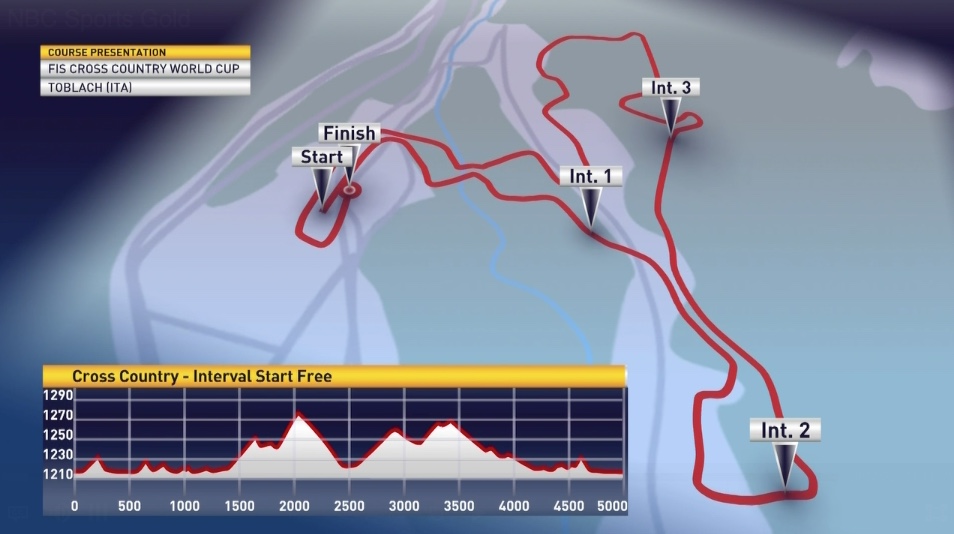
Toblach, Italy. A stunning stadium and backdrop with the Dolomites lording over the venue and a steady cling-clang of baritone bells greeted skiers along portions of the course. Stage 3 in Toblach, a 10-kilometer interval start skate, turbocharged the 2019-2020 Tour de Ski (TDS).
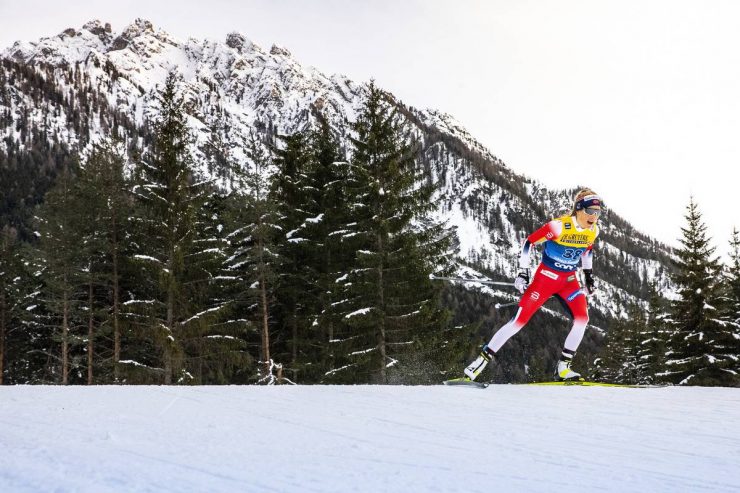
Another win for Therese Johaug, albeit by a small margin, during Stage 3 of the 2019/2020 Tour de Ski in Toblach, Italy. (Photo: NordicFocus)
After two stages, a Stage 1 mass start skate and Stage 2 skate sprint, Russia’s Natalia Nepryaeva sat atop the overall standings. In third overall, Norway’s imminent threat, Therese Johaug, was positioned only five seconds back. Other names to watch, like Ingvild Flugstad Østberg, also from Norway, was seventh overall, 27 seconds back.
With three distance stages in a row — today’s 10 k skate, Wednesday’s 10 k classic pursuit (both in Toblach) and a Stage 5 10 k classic mass start in Val di Fiemme — this mid-stretch of the TdS would firm up the overall standings.
We’ll say this upfront with a bit of biased towards the spectacle of mass starts — this was fun-to-watch on-the-edge-of-your-seat interval start racing. Imagine a window for FIS live timing open on the desktop, a live stream of the racing open in another, and some texting banter here and there about the close splits, and it was a highlight so far of the young ski racing year.
Two laps around a working 5 k course featuring two climbing sections, one beginning at 1.4 k, the other at 2.5 k, was enough to jostle the standings and draw out some great performances.
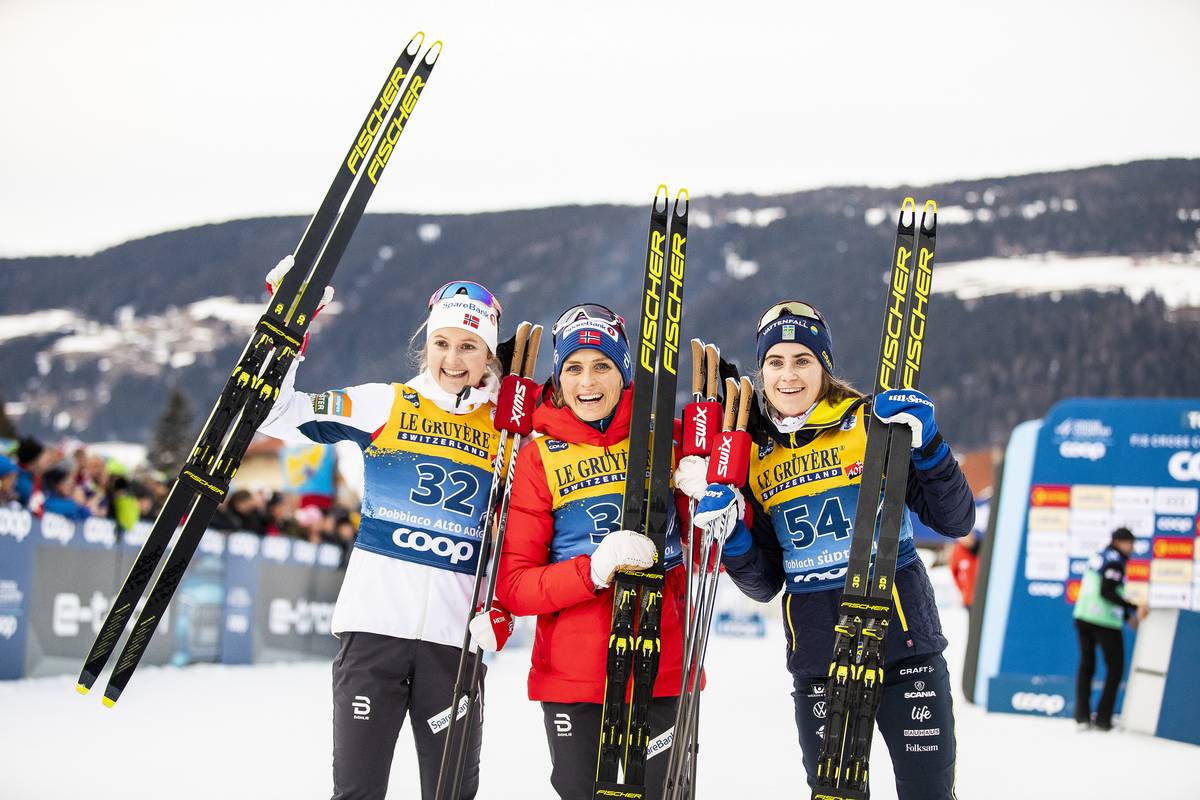
Let’s start with the day’s top-10 finishers and then get to how the suspense built. Rosie Brennan for the U.S. was ninth (+45.0), Sadie Maubet Bjornsen (U.S.) eighth (+42.9), Jessie Diggins (U.S.) seventh (+35.6), Nepryaeva sixth (+26.0), Astrid Jacobsen Uhrenholdt (Norway) fifth (+20.8), Heidi Weng (Norway) fourth (+10.5), Ebba Anderson third (+10.2), Østberg second (+0.7), and Johaug in first.
23:51.9 was the winning time for Johaug. That Johaug won is no surprise. She’s the winner of the last 15 of 16 distance races on the World Cup. What startled many was the eye-blink time difference between Johaug and Østberg.
Ingvild Flugstad Østberg on her way to a close second place in Stage 3 of the TdS in Toblach, Italy. Stage 3 was a 10 k interval start skate. (Photo: NoridcFocus)
Ebba Anderson slides across the finish in Stage 3 of the 2019/2020 Tour de Ski in Toblach, Italy. Wearing bib 51, Katharine Ogden finishes just outside the points in 34th. (Photo: NordicFocus)
We’ll take a two-race 10 k skate interval start sample for comparison. In Ulricehamn, Sweden last February, Johaug put 58.7 seconds into her teammate. In March, Johaug gapped Østberg by 30.8 seconds in Falun.
Fast forward to today’s third stage in Toblach, and 5 k in, Johaug had the fastest time with Østberg 8.9 seconds back. At 6.7 k Østberg was 4.1 seconds behind. With almost all of the climbing past, at 8 k, Østberg had pulled ahead by an ephemeral 0.1.
In the armchair analysis, we should note that Østberg began in bib 32, Johaug in 38. Of the top-10 skiers on Tuesday, only two began before Østberg making her effort amidst less than perfect timesplit information that much more remarkable. Prior to the TdS, Østberg had been kept from competing by the National Team for not meeting certain health metrics. This was her third World Cup race of the season.
The reigning TdS champion arrived at this TdS primed.
With no time bonuses on offer, Johaug leapfrogged from third overall before the stage into first, with a total time of 55:14. Nepryaeva is second (+0:21), Weng third (+0:23), and Østberg fourth (+0:23).
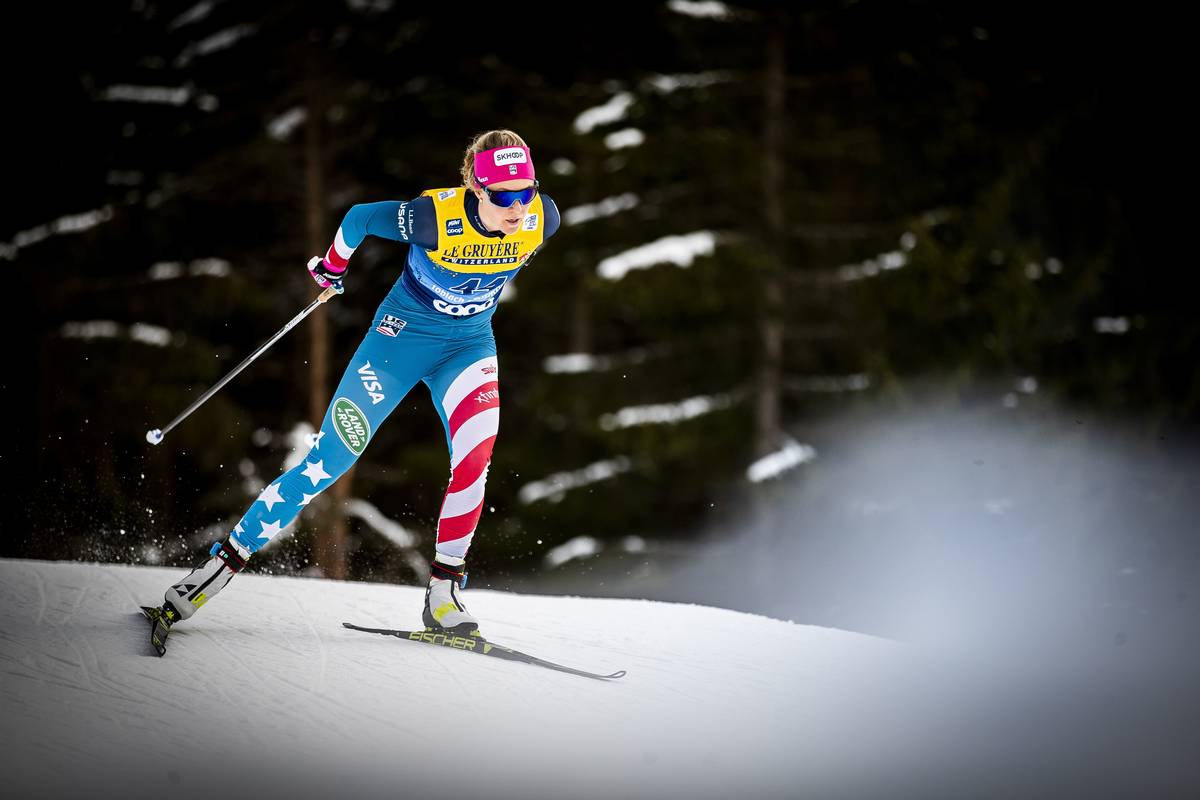
Jessie Diggins skiing to seventh overall during Stage 3 of the TdS in Toblach, Italy. (Photo: NordicFocus)
Jessie Diggins skiing to seventh overall during Stage 3 of the TdS in Toblach, Italy. (Photo: NordicFocus)
Post-race interview with Jessie Diggins
Diggins is ninth overall (+1:10), Maubet Bjornsen 10th (+1:19), and Brennan 13th (+1:46).
Rosie Brennan continues her top-10 drive during Stage 3 of the TdS. (Photo: NordicFocus)
“I am very happy with my race today,” Brennan emailed. “I have some big goals riding on this tour and while I didn’t have my worst races that last two days, they were quite what I dreamed of. Today was much more what I had in mind. I love individual races and knew I had to make the most of the one intervals start race in the tour. I had a strong first lap and faded a bit more than I wanted the second lap but am happy with an improved result. Tomorrow will be a fun day as I get to ski with my favorite training partner, Sadie!”
Sadie Maubet Bjornsen during Stage 3 of the TdS in Toblach, Italy. (Photo: NordicFocus)
“Another exciting day of racing in stage 3,” Maubet Bjornsen emailed several outlets. “I woke up feeling recovered and refreshed, so I was really excited for today. We have raced three skate races in a row now, so our skating muscles are getting pretty tired, but every time things are tough in the tour, I just remind myself that everyone is in the same boat! I was really happy to finish 8th today, and I feel like I am in a great place for the pursuit classic race tomorrow. Rosie, Jessie and I are all starting close enough together that we can make an American train, and take on “the world” together. We are still trying to dig ourselves out of a hole in the “overall standings” from the stage 1 waxing mistake, but every day, we are chipping away little by little… which is the key to this tour. I can’t wait to put some classic skis on my feet tomorrow, and see what I can do!”
Outside the top-10, the U.S. had an astounding day. Sophie Caldwell, currently the fourth-ranked sprinter on the World Cup, raced to 25th (+1:25.9). According to FIS, this is Caldwell’s third time in the top-30 for a World Cup distance event and her first in skate.
Katharine Ogden raced to 34th (+1:42). Julia Kern did not start due to illness.
World Cup Head Coach Matt Whitcomb’s post-race comments on the women’s race
Sophie Caldwell primed for distance racing and in the points during Stage 3 of the TdS. (Photo: NordicFocus)
Racing continues tomorrow for the women with a 10 k classic pursuit. Start positions and time back are based on today’s results, not time back in the overall standings. For example, Johaug will start first, Østberg second (+0.1) — times are rounded — and Diggins seventh (+0:36). This should make for a tighter and more exciting TdS pursuit at a time when overall time gaps can make head-to-head racing less likely.
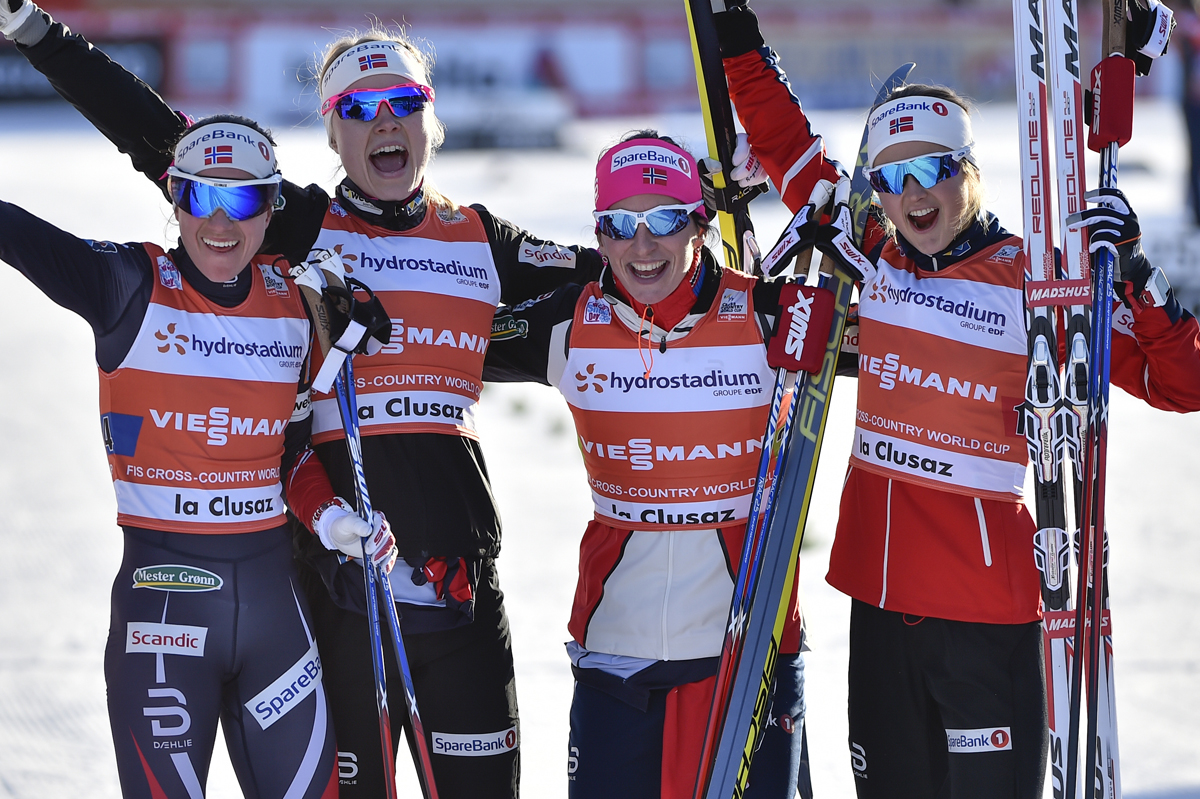
Norway won the women’s World Cup 4 x 4 k relay on Sunday in La Clusaz, France, with (from right to left) Ingvild Flugstad Østberg, Marit Bjoergen, Ragnhild Haga, and Heidi Weng. (Photo: Fischer/Nordic Focus)
Sunday’s 4 x 4-kilometer relay in La Clusaz, France, was a 39:23.3 minute macro-statement by the Norwegian women’s team of Ingvild Flugstad Østberg, Marit Bjørgen, Ragnhild Haga, and Heidi Weng.
That statement was dominance. Norway won the relay in time-trial-like fashion: each Norwegian leg a solo affair. Finland’s team of Aino-Kaisa Saarinen, Anne Kyllönen, Riita-Liisa Roponen, and Laura Mononen placed second (+50.2). Sweden’s team of Emma Wiken, Stina Nilsson, Maria Rydqvist, and Anna Dyvik was third (+1:08.9).
As with lopsided races, the 10,000 foot view on the first classic leg showed Østberg stretching a fatigued rubber band back to the pack. At 2 k, 11.5 seconds was Østberg’s initial gap.
Then snap. The band broke. At 4 k when Østberg handed off to Bjørgen, it was a 28-second cushion on Russia, 33.3 to Switzerland, 34.9 to Finland.
Why belabor the point in words when the numbers tell the micro-story which lead to the dominance?
Østberg fastest leg at 10:04.
Bjørgen fastest leg at 10:11.8.
Haga seventh-fastest leg at 9:43.2.
Weng fastest leg at 9:27.9.
Some problems are good to have. That’s the case with Norway and Haga. Here’s the context. Although she skied the seventh-fastest leg split, it was a tight leg and she kept Norway’s lead comfortable.
For example, the U.S. Ski Team’s Liz Stephen skied the 10th-fastest third leg, only 13.4 seconds off the fastest time skied by Sweden’s Rydqvist. Compare that to the fourth leg, the 10th fastest time was skied by Kazakhstan’s Irina Bykova — she was 57.2 seconds off Weng’s pace.
There’s the number crunching and analysis, but it can be rendered down to this: Weng had plenty of time to high-five the crowd before crossing the line.
“It wasn’t that scary when the girls performed so well,” Weng told Norwegian broadcaster NRK after the race about her anchor role. “I didn’t have to sprint at the end. The last time I had a final leg I was too afraid to do anything. Now I was high-fiving the spectators and had some fun.”
Østberg told NRK in the same article that she was experiencing pre-race butterflies. “I was extremely nervous before the start, but it went well,” Østberg said. “I didn’t want to disappoint the other. You’re competing for a team in a relay and not yourself. I didn’t want to let the others down … I had to go fast today so Marit could go home to her son Marius. She’s missed him all week.”
Relay Socks and Rebounding from Illness
Here’s the straight talk. The two powerhouses of the deep U.S. women’s team, Jessie Diggins and Sadie Bjornsen, were scratched from the roster due to illness. But the relay socks made a feisty appearance.
The U.S. lineup that finished seventh overall (+2:26.0) consisted of Sophie Caldwell, Rosie Brennan, Liz Stephen, and Kikkan Randall.
“You know clearly we were not at full strength today and it showed I think,” U.S. head coach Chris Grover told FasterSkier on the phone. “My guess is that Sophie might be fighting a little bit of something, we have seen that before where an athlete maybe is on the edge of getting sick and goes out and skis fine for a while and then kind of blows up and it turns out maybe they are coming down with something.”
Caldwell is primarily known as a sprinter on the World Cup. Sunday’s relay legs were 4 k, a relative no-women’s land when it comes to sprint or distance race length. One kilometer into the race and Caldwell was third (+1.0). By the first tag to a resurgent Brennan, Caldwell had lost over a minute to Norway.
“I haven’t really seen any times yet, there is no internet up here today, so it seemed like a pretty solid leg out of Rosie,” Grover posited.
In fact, Brennan skied the fourth-fastest split of any second-leg skier (+38.2) — Bjørgen set the benchmark.
“The legs were incredibly short, especially for people like Liz and I who like a little longer,” Brennan said of the 4 k distance, as opposed to 5 k, on the phone. “I think it was a solid effort and especially considering the illness that has destroyed our team the last week.”
Brennan began the season out of the points and took last weekend’s races in Davos off.
“I definitely had a less-than-stellar start to the season, I don’t really know why,” Brennan said. “I guess in my past it hasn’t been uncommon for me to start a little slow, but I was trying, I was actually focusing on doing the opposite just knowing it is so important to come over here and have some good races and build some confidence right away, that obviously that didn’t work out quite as planned.”
Brennan will remain in France for the holiday break and begin resting and preparing for the Tour de Ski beginning on Dec. 31. She’ll begin the Tour with a boost of confidence. “It was great to turn that around yesterday and I am feeling much better to hear that I had the fourth-fastest leg, or time on my leg, it is really encouraging especially for such short race,” Brennan said. “I wasn’t quite sure about my speed just yet, that is definitely a step in the right direction for me.”
Like Brennan, Stephen came into the day heartened by a solid effort and result on Saturday. But 4 k is a k short of 5 k.
“Even a 5 k is like a sprint for me. Rosie and I were actually talking about that in our cooldown,” Stephen said after the race. “When I go out, it’s like a sprint, because when I’m done with a sprint, I’m like ‘it’s already over?’ and it’s kind of like that in a relay. Don’t blow up, but it’s pretty hard for me to completely blow up in such a short race. I attacked from the beginning knowing that this is a nine-minute race today, and I do intervals longer than that often times.”
Grover reiterated that point. “It was a 4 k course for the relay and you know Liz just needed more real estate out there. It was almost like, some of our athletes, it takes them one or two k to get into the race and you are already half way through the race at that point.”
Stephen kept the margin to Norway just under two minutes and showed improving form before her favorite stretch of racing in the Tour. “I’m always looking forward to [the Tour]. But also I feel like this last weekend that I’ve been able to feel like I want to. Physiologically I feel like racing has really helped get me into the shape I want to be in. I have some work to do over the break, but I feel like I’m in a good place to do what I’m normally able to do at the Tour.”
Team and relay vet Kikkan Randall skied the anchor leg. Her’s was the seventh-fastest anchor leg (+27.1).
“I got the tag from Liz a ways back from Germany ahead and a gap to Italy behind,” Randall wrote in an email to several media outlets. “I focused on holding a good rhythm on the first lap but Italy was able to almost close the gap. I was getting ready for a good battle on the last two climbs but I guess the Italian anchor crashed behind me. So I skied the rest of my lap alone.”
Randall secured seventh place for the U.S. (+2:26).
Grover didn’t spend any time lamenting what could have been. “I really expect by the time we do our next relay in Sweden that we are going to be very competitive for the podium,” he said. “Norway, of course, on paper was far gone, but in terms for the hunt, the usual hunt for Seed 3, we will be back there.”
Last season’s U.S. women’s 4 x 5 k relay team after placing third in the first relay of the 2015/2016 season in Lillehammer, Norway: (from l to r) Sadie Bjornsen, Rosie Brennan, Jessie Diggins, and Liz Stephen. They matched a team best in third in December 2015, and went on to place second in January 2016 (with Sophie Caldwell in place of Brennan) in Nove Mesto, Czech Republic. (Photo: USSA Nordic/Twitter)
Expectations are what they are for the U.S. women’s relay team: high.
Grover explained that the relay is a target event for a podium at both 2017 World Championships and the 2018 Olympics. “We also have a women’s team right now that is the strongest women’s team we’ve had in the history of U.S. skiing. So the time to win is now, and we’ve got the athletes to do it,” Grover added.
In mainstream professional sports, cybermetrics is understandbly the rage. Essentially it’s data-based decision making when it comes to sports. Coaches like Grover and U.S. women’s coach Matt Whitcomb play their version of ski-cybermetrics when picking a relay team.
“It’s a matter of putting together on a certain day the right athletes, with the right fitness in the right technique, in the right legs, and also taking into account the course profiles in terms of strengths of the athletes, and what are the attributes of the course,” Grover said of picking the most viable relay squad. “Is the course long for 5 k, it it short for 5 k? Is it flat for classic? Is it hilly for classic? Is it technical or is it more of just a grinding course?”
The U.S. team’s strategy is to have at least three skiers in each discipline, skate or classic, to choose from on relay day.
“If we can do that, then we can put the women who are the fittest at the time and for whom the technical elements of the course suit their strength the most, and we can put together a super competitive team, so that is kind of the puzzle that we are always putting together with relays,” Grover said.
The next opportunities to contest the relay will be the 4 x 5 k in Ulricehamn, Sweden, on Jan. 22, and March 2 at World Championships in Lahti, Finland.
Canada’s team of Emily Nishikawa, Cendrine Browne, Dahria Beatty, and Sophie Carrier-Laforte finished 12th (+4:07.9). But the biggest victory of the day for the team was fielding a women’s relay.
“We were so happy to have a women’s relay team today,” Nishikawa wrote in an email. “I didn’t feel great today, but my teammates all skied really well and I’m very proud of them. It makes having a tough day so much better when you can be pumped to see amazing races from the rest of your team! The atmosphere in La Clusaz is just amazing! So many fans out cheering and the organizers did an incredible job of getting the course ready. It was a lot of fun racing here.”
Beatty was also excited about Canada fielding a legitimate women’s World Cup relay team.
“It is wonderful for us to be able to start a relay,” Beatty wrote in an email. “Having a group of women on the world cup this first period has been really great for all of us. Today’s race was a great building point for our team and I am really proud to be able to races with this group and grow together.”
The Canadian appears to be coming into good form; Beatty skied the second-fastest third leg (+2.8).
“I was really happy with how my leg went,” Beatty added. “I was able to build off my good feeling from yesterday and ski a really strong race. I was just focusing on trying to catch as many people as possible. When I found out that I had skied the 2nd fastest leg time I was a bit shocked and really excited. It feels great to have a great feeling race correlate to a strong result.”
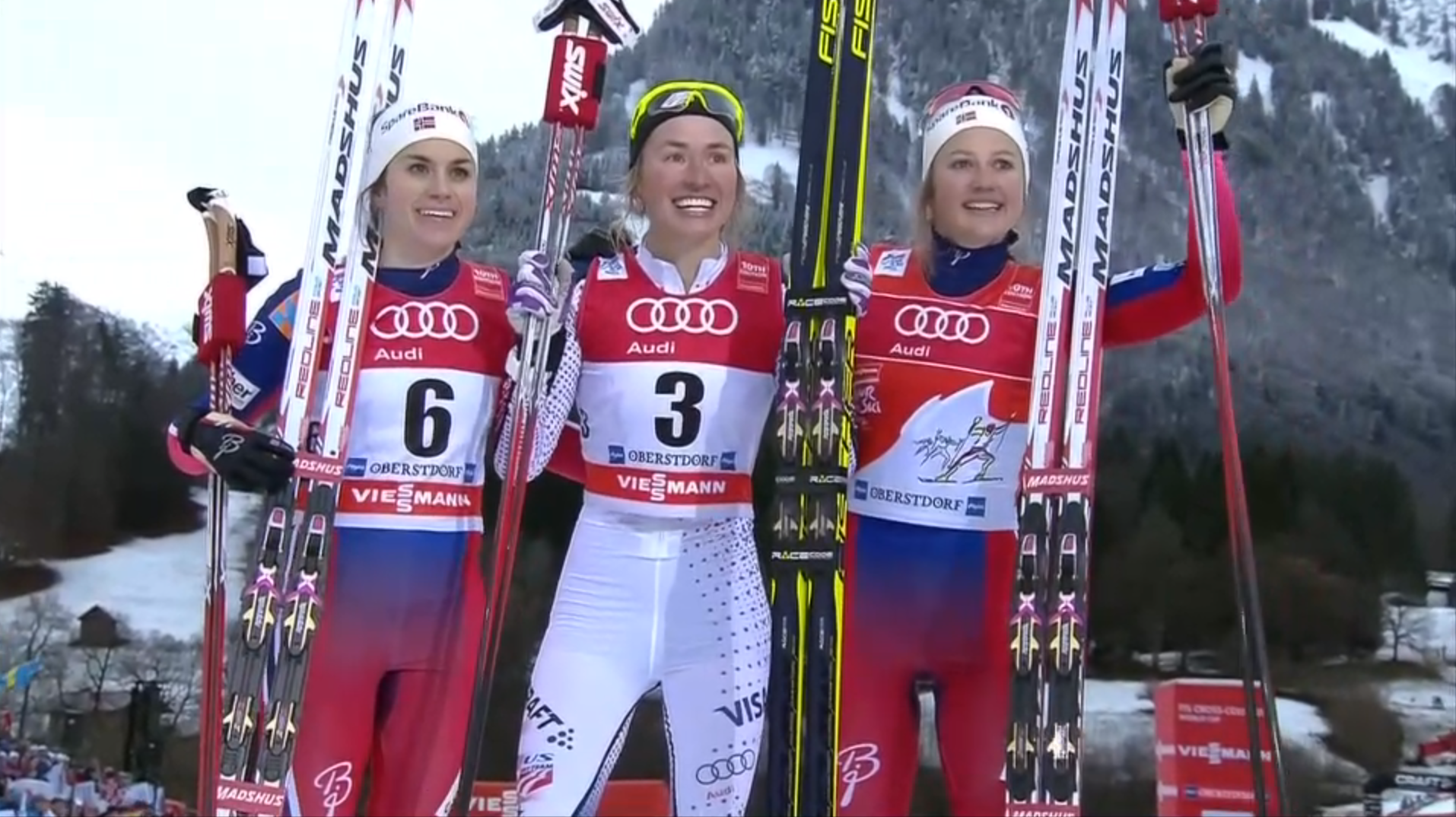
Sophie Caldwell (c) became the third U.S. woman to win a World Cup race on Tuesday at Stage 4 of the Tour de Ski in Oberstdorf, Germany. The U.S. Ski Team member won the classic sprint ahead of Norwegians Heidi Weng (l) and Ingvild Flugstad Østberg (r), the latter of which leads the Tour de Ski standings.
Note: This is an initial post about American Sophie Caldwell’s World Cup victory on Tuesday at the Tour de Ski in Obertsdorf, Germany. Stay tuned for more in-depth reports about the women’s and men’s classic sprints.
Correction: This article has been updated to reflect the fact that Caldwell became the third U.S. woman to win a World Cup. Alison Kiesel (formerly Owen-Spencer) won the inaugural women’s World Cup event in December 1978 at Mount Telemark in Wisconsin.
***
OBERSTDORF, Germany — Sophie Caldwell saw the opportunity in the final roller of a hill in the women’s 1.2-kilometer classic sprint final on Tuesday and she seized it, overtaking the last Norwegian in her sights and holding off Heidi Weng by one-tenth of a second to win Stage 4 of the Tour de Ski.
“It feels really good,” Caldwell, a 25-year-old member of the U.S. Ski Team, told FasterSkier in an in-person interview after the race. “It has been a while since I have been on the podium and that is the first sprint I have ever won. So I am psyched, I never thought it would come in a classic sprint so that was a pleasant surprise.”
A native of Peru, Vt., and daughter of the Stratton Mountain School’s nordic director Sverre Caldwell, Caldwell has been on the World Cup podium once before — in a freestyle sprint in March 2014 in Lahti, Finland. There, she placed third after teammate Kikkan Randall, who won, and Slovenia’s Katja Visnar in second. Two U.S. women had never before shared a World Cup podium.
On Tuesday, Caldwell continued to make U.S. history, becoming the third American woman, after Randall and Alison Kiesel, to win a World Cup race. Caldwell is also the first U.S. woman to win a World Cup classic sprint.
No stranger to sprint finals, she had reached the finals (thus placing in the top six) in two of the last three sprints (all of which were freestyle) before Tuesday. The only one she missed, she did so by just one place in seventh in Toblach, Italy. She has now placed in the top seven in four consecutive sprints.
“I knew I had some really good skis today and my strengths are usually tricky downhills because I didn’t like to snowplow and I don’t get freaked out by them,” Caldwell said of Tuesday’s classic sprint.
“I was probably the last person who woke up this morning and thought this would happen,” she told FIS media coordinator Jeff Ellis (Randall’s husband) in a post-race interview. “I’m thrilled.”
“We know Sophie is among the best downhill skiers in the world,” U.S. women’s coach Matt Whitcomb said. “These conditions today are like, growing up in New England, skiing through slob it’s no big deal. She got to the tops of climbs and attacked over them rather than backing off, and that was a big difference-maker today. But what really stood out was that she was climbing with the best of the world today.”
Caldwell stayed on her feet all day, even in the final when Sweden’s Ida Ingemarsdotter came close to nicked her skis. Ingemarsdotter began to snowplow on a washed-out descent, which caused problems in several heats — including those of Caldwell’s U.S. teammates Ida Sargent and Jessie Diggins. In the final, Caldwell scooted around the snowplowing Ingemarsdotter and moved into third behind Norway’s Ingvild Flugstad Østberg — the overall Tour de Ski leader — and Weng. She proceeded to pick both Norwegians off to take the win.
Earlier in the day, Sargent avoided a crash in the first women’s quarterfinal to place third in that heat. But finishing 10.36 seconds behind Østberg as the winner of that quarterfinal, Sargent did not advance to the semifinals.
Neither did Diggins, who got hung up in a snowplow snafu by Sweden’s Hanna Falk on that same downhill in the fourth quarterfinal. The back of Falk’s skis caught Diggins and both went down. Diggins finished fifth in that heat, 26.22 seconds behind Norway’s Therese Johaug, who won that quarterfinal. Falk crossed the line 50 seconds back in sixth.
At the end of the day, Sargent placed 15th and Diggins 21st. Also for the U.S., Rosie Brennan again narrowly missed qualifying in 35th, Sadie Bjornsen did not make the quarterfinals in 44th, along with Liz Stephen in 49th, and Caitlin Gregg in 53rd.
In terms of overall Tour standings after four of eight stages, Diggins ranks 10th (+4:33.4), Bjornsen slipped out of the top 10 to 13th (+4:53.7), Caldwell is up to 14th (+5:23.7), Stephen is 25th (+6:22.1), Caitlin Gregg 39th (+8:12.6), Brennan 42nd (+8:33.1), and Sargent 45th (+8:47.3).
Racing continues in Obertsdorf on Wednesday with the women’s 10 k classic mass start and men’s 15 k classic mass start.
“[I] plan on racing tomorrow as long as … I have had a bit of a race hack, so as long as that doesn’t get any worse,” Caldwell said.
(Her boyfriend Simi Hamilton had to skip Tuesday’s sprint and thus withdraw from the Tour due to illness.)
“I plan on racing tomorrow and then probably dropping out,” she continued. “There is a small chance I would do the 5 k in Toblach [Italy on Friday], but kind of taking it a day at a time. I won’t go past Toblach.”